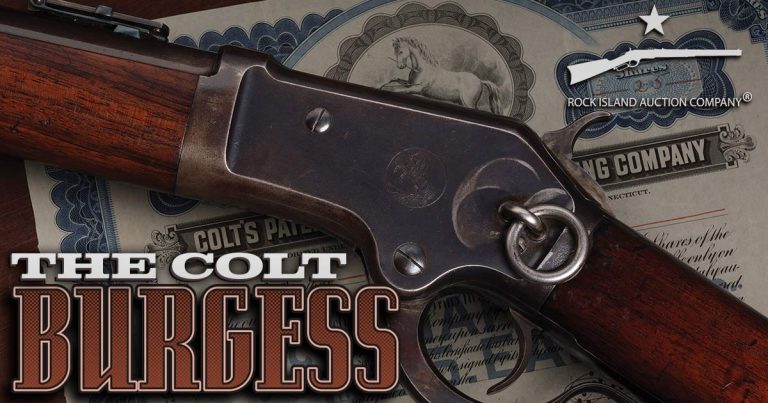
The Colt Burgess Rifle and Samuel Colt

0

Samuel Colt is often remembered as much for his business sense and marketing prowess as he was for his contributions to firearms. His is a story that often is simplified for brevity at the expense of the complexity, as history often does. It’s easier to remember Colt’s “invention” of the revolver, even if he never claimed to have invented it at all, only improved upon Collier’s design (and centuries of earlier inventors such as Artemus Wheeler).

A Colt Texas Paterson No. 5 revolver (left) and a Colt Paterson Second Model ring lever percussion rifle (right).

It’s easier to herald the great success of the Peacemaker than it is to remember the failures in both Paterson and London. It is also easier to remember a gun that is still seen and used today, than it is to remember his phenomenal marketing efforts including, but not limited to:

  • Presenting lavish pistols and dinners to potential buyers and influencers
  • Establishing the Colt’s Armory Band
  • Buying much of the fallen “Charter Oak,” an early American patriotic symbol in Hartford, and commissioning several works from its wood
  • Hanging a 14-foot sign on the roof across from British Parliament that read “Colonel Colt’s Pistol Factory”
  • Celebrity endorsements
  • Visiting foreign heads of state to procure weapons contracts
  • Pitting said heads of state against each other in an arms race to buy more Colt firearms
  • Offering to raise, train, equip, and lead a military regiment, the “First Regiment of Colt’s Revolving Rifles of Connecticut.”
  • Literally inventing the phrase “New and Improved”

If there were one Colt firearm that perfectly embodied Samuel Colt, some might point to an extravagant, damascened revolver presented to a head of state. Others might suggest a rugged and well-worn Colt Walker that cut its teeth as a young nation realized its “Manifest destiny.” However, a more unusual choice might represent Colt better than any other: the Colt-Burgess rifle. It’s an odd choice considering that it wasn’t developed until 20 years after Colt’s death, but it captures so much of what set the man apart: his business sense, his ability to see and utilize talent, and his uncanny knack for wringing success out of apparent failure.

This significant Colt Burgess carbine from the beginning of production in 1883 has the historic serial number “1” clearly stamped on the lower tang. Available this August.

The Burgess Rifle: Turning Failure into Success

Colt’s early failures are well known. The Patent Arms Company in Paterson, along with his ventures in waterproof cable, underwater mines, tinfoil cased cartridges, and even a stint as a nitrous oxide “medicine man” were all doomed. However, out of nearly all of them arose a bit of necessary capital required to advance to the next stage or some other benefit.  Even the Paterson revolvers, the plant for which was closed in 1843 and the assets auctioned off, introduced his revolvers to Captain Samuel Walker who helped give birth to the first revolvers of the wildly successful Colt’s Patent Fire-Arms Manufacturing Company: the Colt Walker.

The only known documented 3rd Model Burgess military carbine. Available this August.

The 1883 Burgess rifle is also quite easy to consider a success, despite its short 16-month lifespan and with only 6,403 produced. If the notion of a “gentleman’s agreement” between Colt and Winchester is to be believed, then this little rifle protected the Colt Manufacturing Company from a major competitor entering their primary market. Also, considering that Colt revolvers saw significant use by the U.S. military (a relationship which continued into semi-automatics), while Winchester lever actions saw only selective use in the military, it is safe to say that Colt had more to lose and therefore benefited more than Winchester did from any potential arrangement.

A factory gold plated Winchester Deluxe First Model 1873 lever action rifle commissioned as a factory exhibition display piece for the Philadelphia Centennial International Exhibition of 1876. Available this August.

Harvesting Genius

Sam Colt was skilled at hiring talented people to work around him (with a glaring exception made for Rollin White). His hiring and trust of Elisha K. Root in 1849, allowed Colt’s dream of interchangeable parts to materialize, which would ultimately give rise to the assembly line. His attorney, Edward N. Dickerson, defended his patents to no end and can be credited a significant portion of Colt’s success.

A Colt Burgess rifle for sale. This example is marked with the standard two-line address and patent dates on the top barrel flat and correctly lacks caliber markings as it was only offered in .44-40 W.C.F. Available this August.

Even after its patriarch passed away in 1862, the company he built wisely continued by hiring men whose names Colt collectors are well acquainted with: Thuer, Richards, and William Mason. Another of those wise acquisitions was that of Andrew Burgess, who was brought aboard in 1882 to develop a new lever action rifle. Burgess was a one-man breeding ground for new firearms designs. Before he arrived at Colt, he had worked for both Whitney Arms and Marlin.

A Marlin Model 1881 rifle manufactured in 1883. John Marlin incorporated patents from H.F. Wheeler, E.A.F. Toepperwein, and Andrew Burgess when he developed the Model 1881 lever action rifle. Available this August.

After his stint at Colt, Andrew Burgess would go on to found the Burgess Gun Co. in 1893 and would have 894 patents in his name.  The contracting of Burgess is definitely in line with Samuel Colt’s ability to sniff out top talent.

One of the rarest firearms offered by the Burgess Gun Co., this extraordinary factory exhibition quality panel scene engraved Burgess deluxe slide action shotgun sold at RIAC in 2022 for $52,875.

Colt’s Business Savvy

In the early 1880s, Colt decided they wanted a piece of the pie that Winchester was hoarding all to itself: the successful lever action rifles. Or at least, that’s how the story goes. Legend has it that Colt Manufacturing wanted to enter the ever-growing lever-action rifle market, so they released the Model 1883 Burgess rifle, an improvement on the Winchester Model 1873 in several ways.

In addition to being serial number one, this Burgess carbine has some particularly rare features: the encircled Rampant Colt trademark on the frame and the unmarked lever. Most of production had the trademark without the border and had the patent marking on the lever. Available this August.

This supposedly inspired a “social call” from Winchester in June 1884, where Winchester representatives allegedly displayed a prototype of an double action revolver. Neither company wanted to gain a massive new competitor in their respective bread-and-butter markets, so they came to a “Gentleman’s Agreement” whereby Colt Mfg. agreed to not manufacture lever actions and Winchester Repeating Arms agreed to stay out of the revolver market. This is an inaccurate and oversimplified story.

By the early 1880s, Oliver Winchester’s shop had already released the Models 1866, 1873, and 1876 and showed no signs of slowing down. When Rollin White’s patent for the bored through cylinder expired in 1870, Colt Mfg. would have reasonably surmised that they would not be the only player to try and develop a revolver utilizing that patent. Remington, Colt, and Winchester were all chomping at the bit to develop a revolver that could utilize metallic cartridges.
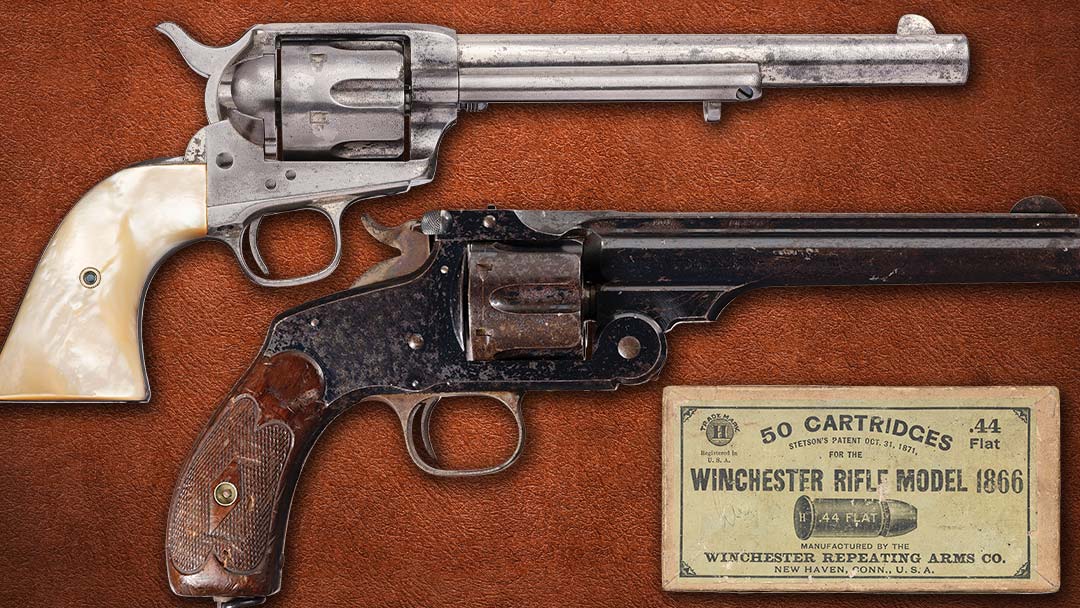
(Top) The single known factory nickel and pearl stocked Colt SAA in .44 Henry. (Middle) A scarce Turkish contract S&W New Model No. 3 in .44 Rimfire (Bottom) A 50 count box of Winchester 44 flat ammunition, label marked for the Model 1866 rifle.

Indeed, Winchester had already head hunted two designers from Smith & Wesson to come on-board and assist in the development of a Winchester revolver. Their names were William W. Wetmore and Charles S. Wells and their resultant revolver, today referred to as the Wetmore-Wells revolver, smacked of the Smith & Wesson No. 3 revolver with which they were so familiar. The Wetmore-Wells was displayed at the 1876 Bicentennial Exhibition in Philadelphia, and this would not have gone unnoticed to Colt Mfg, who was also present at that exhibition.

The Colt Burgess rifle and the Winchester Wetmore-Wells revolver.

The legend paints Winchester as responding to Colt’s foray into their market with the threat of a revolver, when in reality, it was Winchester who had made the first move. Does that make Colt’s development of the Burgess rifle a lethargic, but effective response to Winchesters foray into revolvers?  Kind of.

One of the most advanced rarities in Winchester collecting, a Winchester swing-out cylinder ‘Centennial 1876’ SA U.S. Navy test revolver sold with RIAC in September of 2019 for $431,250.

The delay from when Colt Mfg. was undoubtedly aware of Winchester’s plans for a revolver (1876) until the hiring of Burgess (1882) is too long a time to consider the development of the Burgess rifle a direct response to Winchester’s development of a revolver. That said, Colt Mfg. had little reason to respond quickly. Smith & Wesson had won the contract to provide their No. 3 revolvers to Russia, and Colt was contracted to provide Single Action Army revolvers to the U.S. government.

The documented, Ainsworth inspected, Lot Five 7th Cavalry Custer battle era SAA pictured above is attributed as captured at the Little Bighorn. Available this August.

Winchester was having little success pushing any revolver past the prototype stage and presented little threat for any major contracts (though Winchester did obtain a contract for 30,000 in June 1877 from the Sultan of Turkey). It wasn’t until Winchester wooed away Colt armory Superintendent William Mason in May 1882 that Colt felt pressure outside the realm of regular business competition.

Colt’s “New Magazine Rifle”, the Burgess, was unvieled in 1883.

Competition Heats Up

Mason had been instrumental in transitioning Colt from percussion revolvers to those firing metallic cartridges. He helped design the Richards-Mason conversions, and was significantly involved in the development of the Colt’s first three models that accepted metallic cartridges: the “Cloverleaf” House Pistol, the .22 caliber Open Top, and the Model 1871-72 Open Top.
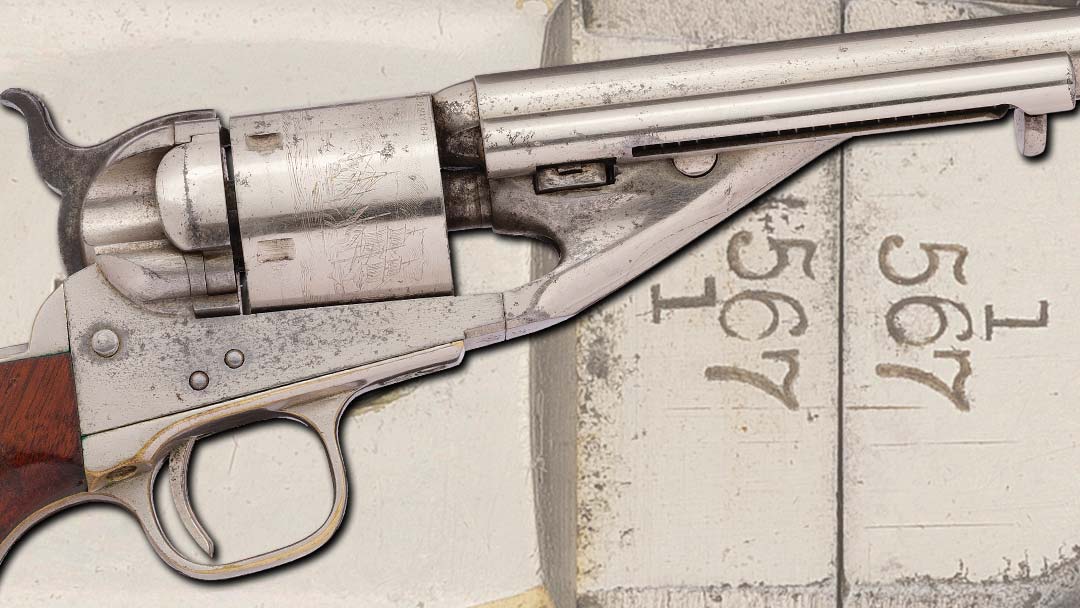
An exceptional, nickel finished Colt Model 1861/72 Navy Richards-Mason conversion revolver with a tooled leather Slim Jim holster. Available this August.

It is also of no small consequence that Mason helped develop the iconic Single Action Army, the “New Line,” the 1877/78 double actions, and his designs contributed to the eventual M1889. Mason was issued several patents related to the Peacemaker. His transition to Winchester six short years after they exhibited a revolver design at the Centennial Exhibition was no small matter, nor was the resultant Wood-Mason revolver developed by him and Stephen Wood, the model which allegedly halted Colt’s lever action ambitions.

This one-of-a-kind Winchester Model 1883 prototype revolver, developed by Stephen Wood and William Mason, sold for $51,750 at RIAC in December of 2016.

If all this weren’t complex enough, Colt and Winchester were also embroiled in competition for the shotgun market. Colt had produced their Model 1878 and Winchester was importing English doubles that were produced exclusively for them by English gunsmiths. The PR battle between the two became heated, and allegedly it was Colt who had had enough and finally decided to simultaneously move forward with a new lever action in 1883 and a pump action (the Colt Lightning) in 1884. Winchester then fired back and began importing Webley double action revolvers.

This exhibition quality Louis D. Nimschke engraved Colt-Burgess Deluxe saddle ring carbine in .44-40 with factory letter sold at RIAC in 2018 for $109,250.

So it was not Colt who wandered ambitiously, nor casually, into a lever action market that drew an “Oh yeah?” response from Winchester.  Indeed, it was bold moves by Winchester that finally prompted the response by Colt Mfg. in the hiring of Burgess. It was an incredibly savvy move on Colt’s part to not react to a Winchester prototype that had no prospects for military contracts. Hindsight may make it easy to agree, but to not respond immediately to a huge competitor, especially one so deft and cunning as Oliver Winchester (who was still alive in 1876), must have taken a remarkable amount of vision and poise.

On page 110 of ‘Lever Action Rifles’ by Samuel Maxwell, the author identifies this carbine as the only known example of a 3rd Model Burgess carbine with two barrel bands and no bayonet lug. Available this August.

The Winchester 1873 vs the Colt Burgess Rifle

By all rights, the Burgess rifle (a.k.a. the Colt-Burgess Rifle, the 1883 Burgess) should have been a fine competitor against the Winchester. Admittedly, it would have struggled against such a dominant force in the market, as well as to other newcomers such as Marlin in 1881, but it held several advantages over the legendary Winchester Model 1873.

Colt Burgess serial number 1 saddle ring carbine (top) compared to a Winchester Model 1873 saddle ring carbine (bottom).

Compared to the Winchester 1873, the Colt Burgess is shorter, weighs less, the breech bolt is sturdier, its toggle lock is stronger, and the receiver is beefier thanks to fewer cuts. The rifles, which made up around 60% of of the 6,403 Burgess produced, held 15 rounds beneath their 25.5-inch barrels and the carbines packed 12 rounds under a 20-inch barrel.

Burgess rifles could be ordered with a octagon or round barrel. All were chambered for the popular .44-40 Winchester round, yes, the standard chambering for the Model 1873. While the loading gate on the Winchester was still the leaf spring door of the King’s patent, the Burgess uses a sliding loading gate.

Colt Burgess Rifles and Carbines for Sale

For all the comparisons, rumors, history, and competition, at the end of the day the Colt-Burgess rifle is just another “almost was” in the history of American firearms. Its short production span and the great story behind it involving two of America’s powerhouse 19th century manufacturers make these rifles desirable to collectors of Colts, Winchesters, and 19th century American arms.

Colt Burgess carbine, serial number 1, a desirable cornerstone in the Burgess lever action story. Available this August.

Subscribe to the weekly Rock Island Auction newsletter to receive new gun blogs and gun videos that explore the history of the lever action platform. From pieces on the Volcanic pistol, the Evans repeater, the Whitney-Kennedy, the Savage Model 99, the Winchester Model 1894, the Winchester Model 1895, the Spencer rifle, and more, we examine every corner of this fascinating firearms field.

Find the finest lever action rifles at Rock Island Auction Company. Available this August.

The Beauty and Precision of the Norman R. Blank Collection

0

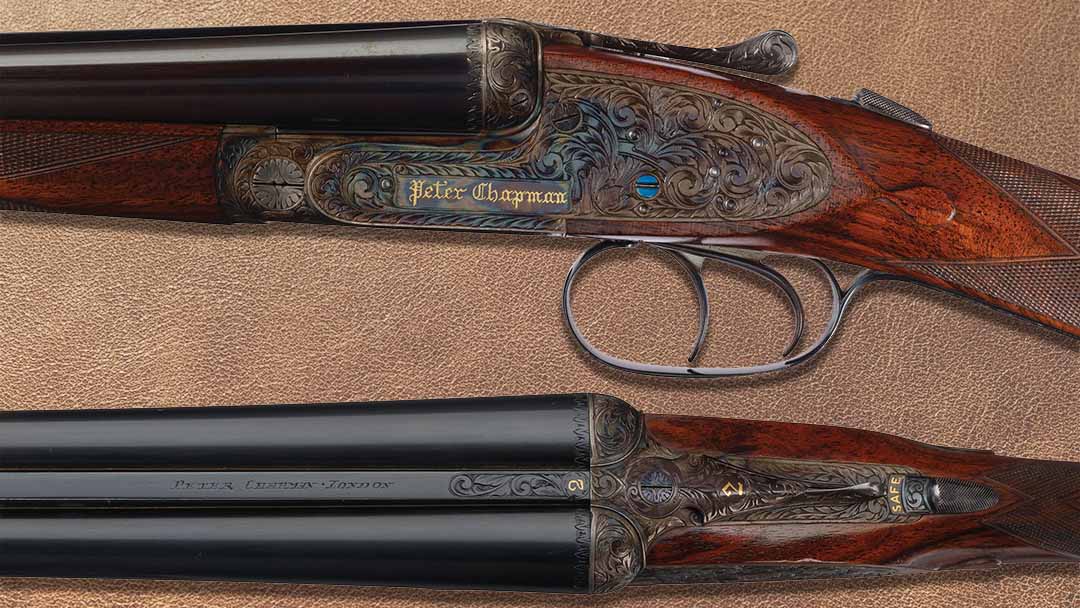
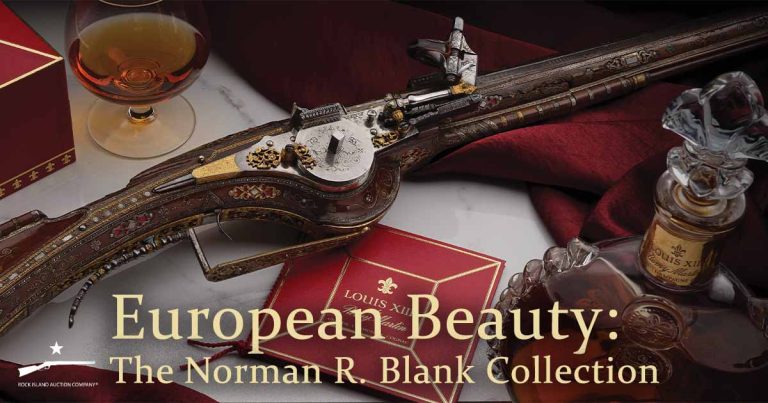
The Norman R. Blank Collection holds some of the most beautiful and historic firearms ever sold. With more than 30 lots from the Blank Collection being offered in Rock Island Auction Company’s Aug. 23-25 Premier Auction, there is a lot to unpack, so let’s break them down into a few related categories, each containing spectacular pieces from their genre.

Wheellock Sporting Guns

Wheellocks were the first self-igniting firearms which made them particularly significant in firearms evolution and also made them far more practical. Most of the wheellocks seen today were produced for European noblemen to use on their hunts and therefore are often as much artworks as they are firearms. Some of the finest historic examples of this fascinating genre can be found in Rock Island Auction Company’s Aug. 23 – 25 Premier Auction in Bedford, Texas, including certainly the most historically significant wheellock the auction house has ever brought to auction.

There is nowhere better to start than with the best of the best. One of the most significant antique firearms in private hands is gun Number 24 from King Louis XIII of France’s Cabinet d’Armes, an absolutely stunning wheellock sporting gun attributed to gunmaker Francois Poumerol. This is certainly one of the crown jewels of this already outstanding collection. The smoothbore sporting gun is over 400 years old and is a fantastic work of art received by the young French king as he was consolidating his control of France after ousting his powerful mother, Marie de Medici. Very few firearms from the Cabinet d’Armes of Louis XIII are in private hands. This piece has been tucked away in Mr. Blank’s collection for decades and may never be publicly available again as it could very well find itself on display in an internationally renowned art museum.

Superb Pair of Wheellock Sporting Rifles by Caspar Zelner

These two matching wheellock sporting rifles by Caspar Zelner (1661-1745), the royal gunmaker for Emperors Joseph I and Charles VI are beautiful, featuring gold inlays that contrast with the blue finish. The large flat lock plates serve as excellent canvases for the engraved scenes featuring Diana, goddess of the hunt, and the motif continued on the pierced side plates.

This superb pair of Wheellock sporting rifles is by Caspar Zelner Vienna for Emperor Joseph I and Charles VI.

Large German Wheellock Sporting Gun with Double Dogs

Two dogs on the large lock allows a hunter to quickly get this smoothbore wheellock sporting gun back into action should they have one of their pyrites fail to spark against the wheel. The fruitwood stock features extensive bone/staghorn inlays intricately engraved with bestial motifs, including a series of four masks along the forend and serpents.

This late 16th century wheellock sporting gun may be from Bartel Wechter the Elder of Dresden.

Smoothbore Muzzle Loading Long Guns

Most of the sporting guns of the 18th century and earlier were smoothbores, and they naturally remained popular into the percussion era. These versatile firearms could fire birdshot, buckshot, buck and ball, or single round balls depending on their quarry, and many were fairly ornate given their owners were primarily wealthy landowners and the nobility. The August auction has an impressive selection of primarily English smoothbore muzzle loading sporting guns.

Ornate Flintlock Sporting Gun by Griffin

The Norman R. Blank Collection notes indicate that noted author and collector W. Keith Neal believed the outstanding sporting gun with silver inlaid stock by Griffin from circa 1770 “may have been made up by Griffin as a show piece since there is no name or crest on the escutcheon.” It features chiseled and engraved floral and classical martial motifs throughout as well as an interesting scene depicting two putti studying a book and globe and another scene on the heel tang of a dog flushing a bird. The full-length stock also features incredibly detailed raised relief carved floral patterns and extensive silver wire inlays with inlaid engraved floral blooms and leaves.

John Twigg Flintlock Swivel Breech Sporting Gun

John Twigg (1732-1792) was a renowned English gunmaker in the late 18th century, so much so that his name was sometimes spuriously marked on guns made by other gunmakers. Twigg’s impressive swivel breech or “wender” sporting gun is the real deal and features dual Damascus barrels with gold vent liners, fine engraving, and classic English carving and broad checkering.

John Fox Twigg (1732–1792) was among the premier English gunmakers of the 18th century, and this fine swivel breech or “wender” sporting gun clearly demonstrates the fact.

Historic Cased Silver-Mounted John Manton & Son Shotgun Made for U.S. Senator Edward Lloyd

Like Twigg, John and Joseph Manton were certainly among the premier gunmakers of their time. Their careers stretched into the percussion era, and this cased silver-mounted 7-bore shotgun is a fascinating example that bridges the flintlock and percussion era by including both an advanced flint lock and rare tube lock. This piece is also historically significant as it was purchased by U.S. Minister to England Richard Rush and owned by influential U.S. Senator Edward Lloyd. The senator also served as the governor of Maryland and is widely remembered as a notorious slaveholder thanks to The Narrative of the Life of Frederick Douglass.

This impressive gun from 1820 is recorded on page 98 of “The Mantons: Gunmakers” by W. Keith Neal and D.H.L. Back where it is described as a “Single Barrel 7 Bore Shotgun Cased” and as having a “Self-Priming Lock converted to Tube Lock” and noted as owned by “N. Blank, U.S.A.”

John Manton & Son Double Barrel Shotgun with Bird’s Eye Maple Stock

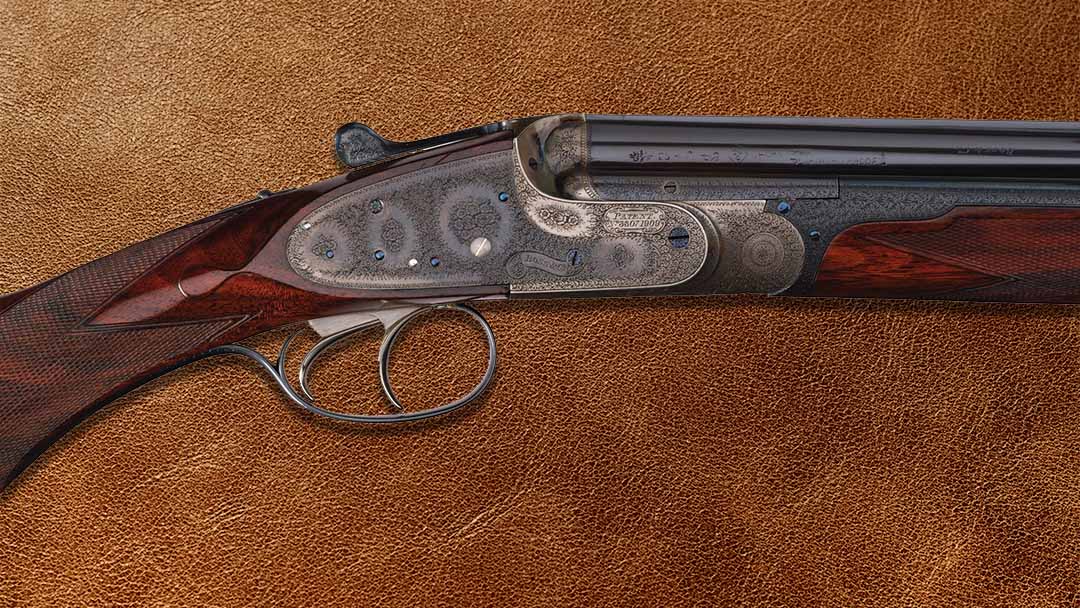
This truly special John Manton & Son double barrel percussion shotgun has a bird’s eye maple stock, nearly unheard of on an English shotgun and truly highlights the gold inlays. The gun glistens with a gold bead front sight and a gold sunburst pattern inlaid base, “John Manton & Son, London” in gold inlay, and gold inlaid foliate patterns. The breech plugs and the Damascus barrels feature additional gold inlaid scroll patterns. Norman R. Blank wrote, “This is one of the most elaborate English percussion guns I have seen.” Given the breadth of his collection and its overall quality, that is quite the statement!

This magnificent shotgun by John Manton & Son features this incredibly high conditioned bird’s eye maple stock.

Cased Percussion Double barrel Shotgun by John William Edge

This cased 12 gauge shotgun from John William Edge of Manchester features beautifully intricate engraving, including scenes of various game birds, the gun’s intended targets. It is an elegant example of a high quality English percussion fowling piece from the mid-19th century.

John William Edge of Manchester was a gunmaker from 1827 to 1864. This double barrel shotgun by Edge features Damascus barrels with a concave rib signed “JOHN WILLIAM EDGE” and fitted with a bead front sight. Each barrel is marked with London proof marks. The casehardened patent breeches have pierced platinum plugs, and the rib divider is engraved with a pheasant.

Muzzle Loading Rifles

For most of the muzzle loading era, smoothbores were by far the most common firearms, but rifles have been around for a long time and gained in popularity in the last quarter of the 18th century. Norman R. Blank acquired some of the finest examples of muzzle loading rifles made both in Europe and the United States.

Silver Mounted Half-Stock Flintlock Sporting Rifle by James Haslett

A perfect example from Mr. Blank’s collection is this silver mounted half-stock flintlock sporting rifle by James Haslett. His collection is almost entirely focused on European arms, and, while this stunning rifle from James Haslett was made in Baltimore, Maryland, and has a distinctly American theme, at first glance it appears to be a very high quality English half-stock sporting rifle from the early 19th century. This silver mounted rifle is among the finest of its type and is truly one of my favorite pieces from Mr. Blank’s collection. It is a collector’s wishlist in terms of condition, quality, rarity, beauty, and artistry.

Bohemian Flintlock Sporting Rifle by J.A. Maerckle

Returning to the Old World, this fascinating flintlock rifle by J.A. Maerckle of Bohemia is shaped like a traditional wheellock sporting rifle and features a rare bronze barrel and lock plate. This beautiful piece was formerly in the famous arms collection of the Grand Dukes of Saxe-Weimar at Schloss Ettersburg.

This elaborately adorned flintlock rifle was in the collection of the Grand Dukes of Saxe-Weimar at Schloss Ettersburg before being sold in 1927.

Elaborate Target Rifle by Joseph Perger

This incredible rifle from Joseph Perger of Gratz, Austria, takes us a bit forward in time to the mid-19th century and also represents another kind of sporting rifle: a percussion off-hand target rifle. For its stated purpose, it is already a piece of functional art, but the engraving plus gold and silver inlays featuring a variety of Greco-Roman gods and goddesses takes it above and beyond and places it at the pinnacle of fine percussion target rifles.

This fabulous target rifle by Austrian Joseph Preger is elaborately engraved with complex scrollwork framing various mythological figures, gold and silver inlaid, and fitted with chiseled furniture.

Whitworth Sporting Rifle for the Duke of Somerset

The iconic Whitworth rifle was one of the most accurate of all muzzle loading rifles, which has long made them highly sought after by collectors. They were famously used by Confederate sharpshooters during the Civil War, but this rifle was not made for Johnny Reb, it was made for Edward A. St. Maur (1804-1885), 12th Duke of Somerset and First Lord of the Admiralty.

The Whitworth rifle was developed in the 1850s as a sharpshooter’s rifle and this fine example has casehardened colors on the lock, breech plug, patchbox and buttplate.

John Dickson & Son 4 Bore Dangerous Game Rifle

Most of the muzzle loading rifles we see are fairly small caliber compared to this shoulder-busting 4-bore rifle by John Dickson & Son. This rifle was clearly purpose-built for hunting dangerous game and was sold on July 14, 1859. 4-bore rifles were popular with English sportsmen hunting elephants and other big game in Africa in the middle part of the 19th century.

This big bore gun is by Scottish gunmaker John Dickson and features scroll engraving, a checkered trigger, running stag scene engraved on the trigger guard bow, standing stag scenes on the heel tang and patchbox lid, a dark horn forend cap and silver reinforcement plates on the stock.

Breech Loading Sporting Guns

While the attention thus far has been focused on muzzle loading firearms, Mr. Blank was an active sportsman who also collected beautiful English breech loading sporting guns, particularly double barrel shotguns and double rifles. The following three lots from his collection are excellent examples of the finest English double guns.

A Purdey in Paris

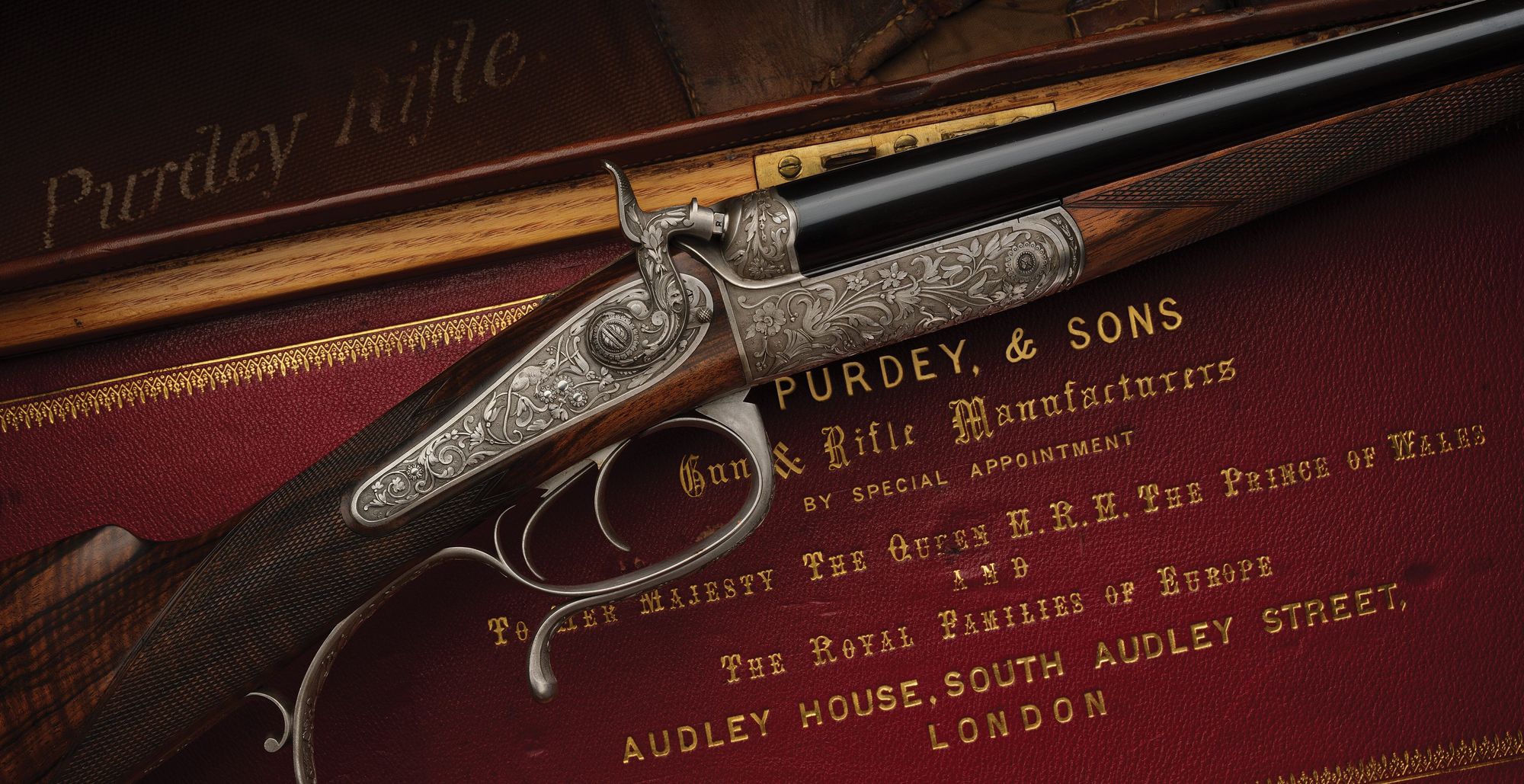
This double rifle from J. Purdey & Sons is truly a work of art. This stunning .450 3 ¼ (Black Powder Express) rifle was displayed by Purdey at the extravagant Exposition Universelle in Paris in 1878 and again the following year at the Sydney International Exhibition in Australia before being owned by Baron Keane. This exceptional rifle features absolutely remarkable engraving.

Watch to learn more about the Purdey Exhibition Under Lever Double Rifle of Baron Keane.

Purdey Double Barrel Shotgun Pair Engraved by Ken Hunt

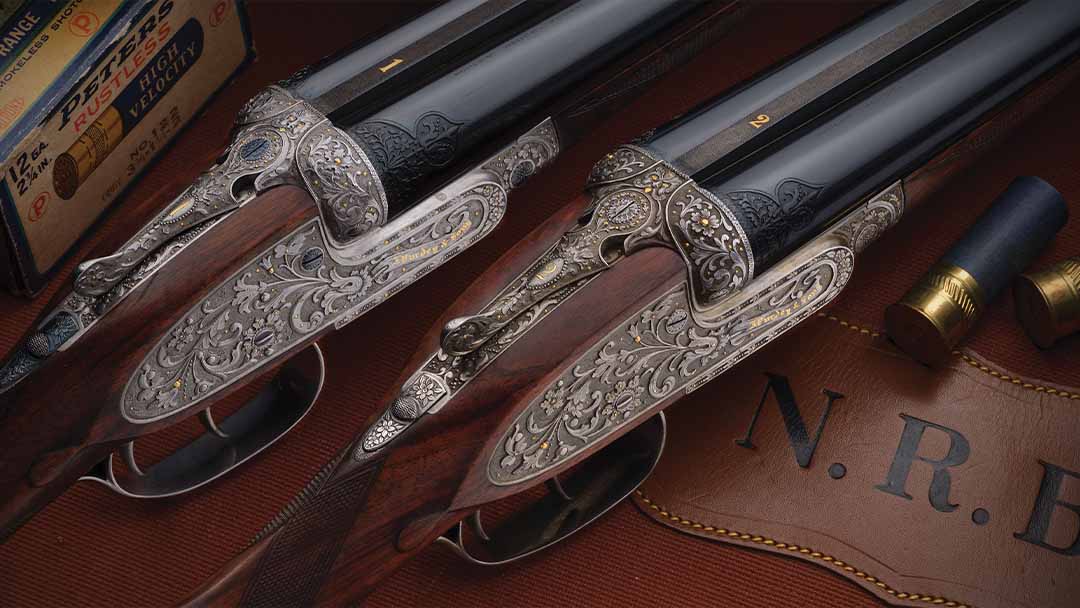
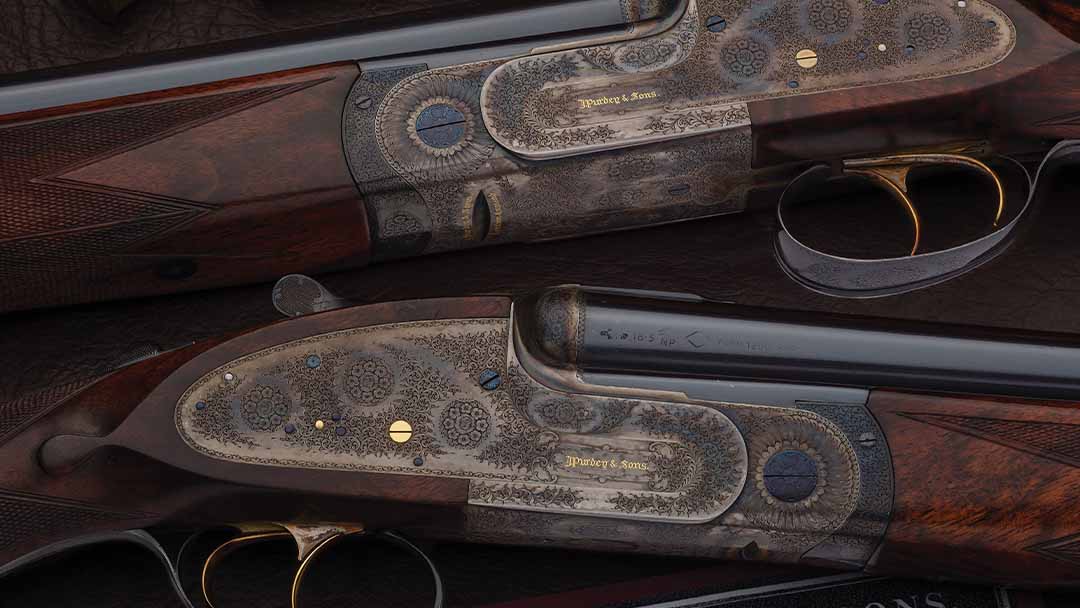
The next selections continue the theme of Purdey’s famous excellence with not one but a matching pair of Ken Hunt master engraved sidelock double barrel shotguns complete with a case and extra barrel sets. The pair even includes Mr. Blank’s original invoice from Purdey for the pair from July 18, 1960, as well as other documentation.

Norman R. Blank amassed a magnificent collection of fine firearms but he was also a sportsman and ordered this shotgun pair from Purdey in the late 1950s.

Holland & Holland 8 Bore No. 3 Double Barrel Paradox Gun

Holland & Holland’s famous Paradox guns were innovative and are highly sought after by serious sporting arms collectors. They feature rifling at the muzzle that allows them to effectively fire bullets in addition to shot. This rare 8 bore example produced in 1897 is one of only 69 or 70 8-bore Paradox guns built by Holland & Holland over a 24 year period.

*Built in 1897, this Holland & Holland 8 Bore Double Barrel Paradox Gun is pictured and discussed on pages 195-196 of David Baker and Roger Lake’s “Paradox: The story of Col. G. V. Fosbery, Holland & Holland, and the Paradox” where it also states that only 69 or 70 8 bore Paradox guns where built over a 24 year period.

Muzzle Loading Pistols

While Norman R. Blank clearly had a taste for a wide variety of fine sporting guns, his interest in fine antique firearms also extended to European muzzle loadings pistols. The upcoming sale contains several notable examples, including silver mounted English and Spanish pistols, dueling pistols, and an incredibly ornate pair of wheellock pistols from Brecia in Northern Italy.

Pair of Brescian Wheellock Pistols

The gunmakers of Northern Italy are well-known for their incredible pierced metalwork, and that is demonstrated beautifully on this pair of Brescian pistols in the upcoming auction. They have been touted as the world’s most beautiful wheellock pistol pair, and are documented in “Die Waffensammlung des Fursten Salm-Reifferscheidt zu Schloss Dyck” by Max von Ehrenthal and appeared on the cover of Dexter’s “Armseller” Vol. 2, August-September 1956, No. 3 where they are noted as “Considered the world’s most valuable Italian pistol pair.”

The smoothbore barrels on these Brescian wheellock pistols each feature decorative girdles at the muzzles, transition points and breeches. The locks have chiseled and engraved scroll accents, and a “fleur-de-lis/FG” maker’s mark inside. The ramrod tips, triggers, trigger guards, and pommel borders are gilt brass, and the trigger guards feature a winged classical figure among the pierced scroll designs.

Pair of Silver Mounted Wogdon Flintlock Dueling Pistols

When it comes to dueling pistols, no maker is as well-known as Robert Wogdon. He was so connected to dueling that to participate in a duel was known as taking part in “a Wogdon affair.” This pair of cased and silver mounted Wogdon dueling pistols is a stunning example of classic late 18th century British dueling pistols.

These pistols were exhibited at the NRA in 2004 and were manufactured about 1780 by famed dueling pistol maker Robert Wogdon. The breech ends of the barrels and front of the standing breeches have bands of beadwork engraving.The mounts are solid silver and includes classic acorn finials on the trigger guards.

Cased Pair of Joseph Manton Half-Stock Rifled Flintlock Dueling Pistols

Joseph and John Manton were among the most respected London gunmakers of the late 18th century and early 19th century. In addition to fine sporting guns like those discussed above, they were both also well-known for their fine pistols, particularly their dueling pistols. This cased pair from “Joe Manton” is particularly noteworthy as it features rifled barrels, an unusual feature for British pistols in the early 19th century.

Displayed at the NRA in 2004, these Joseph Manton dueling pistols date to 1804. They are listed on page 238 of “The Mantons: Gunmakers” by W. Keith Neal and D.H.L. Back where they are identified as a “Pair of Single Barrel 44 Bore Pistols Cased.”

Lot 3280: Silver Mounted Spanish Miquelet Belt Pistol by Doiztua

This very ornate pistol offers a different flavor, dating from the late 18th century. The stunning silver mounts and complimented by gold inlays on the barrel and fine raised relief carving. While the flintlock was the dominant ignition system for firearms across most of Europe, the Spanish, Italian, and other Mediterranean gunmakers also utilized a snaplock commonly known as the “miquelet” today. Unlike a “true flintlock,” the miquelet lock has half and full-cock sears that engage the cock on the exterior of the lock.

This southern European miquelet-style pistol has silver mounts complimented by gold inlaid foliate scrollwork inhabited by birds on the breech section, a sunken gold lined “crown/FRo/DOIZ/TUA” maker’s mark and a fleur-de-lis pattern gold inlaid band ahead of the bright foliate and border engraved standing breech,

Bespoke Firearms of the Norman R. Blank Collection

The beautiful bespoke European fine arms of the Norman R. Blank Collection represent just one of the many collections featured in the Aug. 23-25 Premier Auction. The August Premier Firearms Auction contains over 1,700 lots, including selections of fine and historic arms from other notable collections such as the Greg Lampe Collection, the George S. Lewis Jr. Collection, the Mac McCroskie Collection, the Andrew Singer Collection and many others. If you are on the hunt for the best of the best to add to your collection, check out the catalog online now and make sure to be in Bedford, Texas, for the preview day on August 22nd.

This beautiful and well-documented cased and factory engraved Colt Model 1851 Navy revolver is a selection from the Greg Lampe Collection offered alongside the Norman R. Blank Collection.

Fantastic Flight Jackets of World War 2

0

If clothes make the man, then World War II flight jackets make legends.

A closeup of the WW2 flight jacket worn by Peter A. Donovan who served in the China Burma India Theater as a pilot in a reconnaissance unit flying the Lockheed F-5 Lightning (the recon version of the P-38 fighter). F-5 missions contributed to 80-90 percent of all aerial reconnaissance photos during the war.

The A-2 flight jacket, introduced as standard issue for U.S. Army flyers in 1931, is a classic, made of horsehide with a spun silk lining, a shirt-style collar, with knitted wrists and waist band. Flyers often painted them to claim some individuality. They frequently featured the name of a girlfriend, the outline of their home state, the name of their plane, cartoons, unit insignias, and the number of missions.

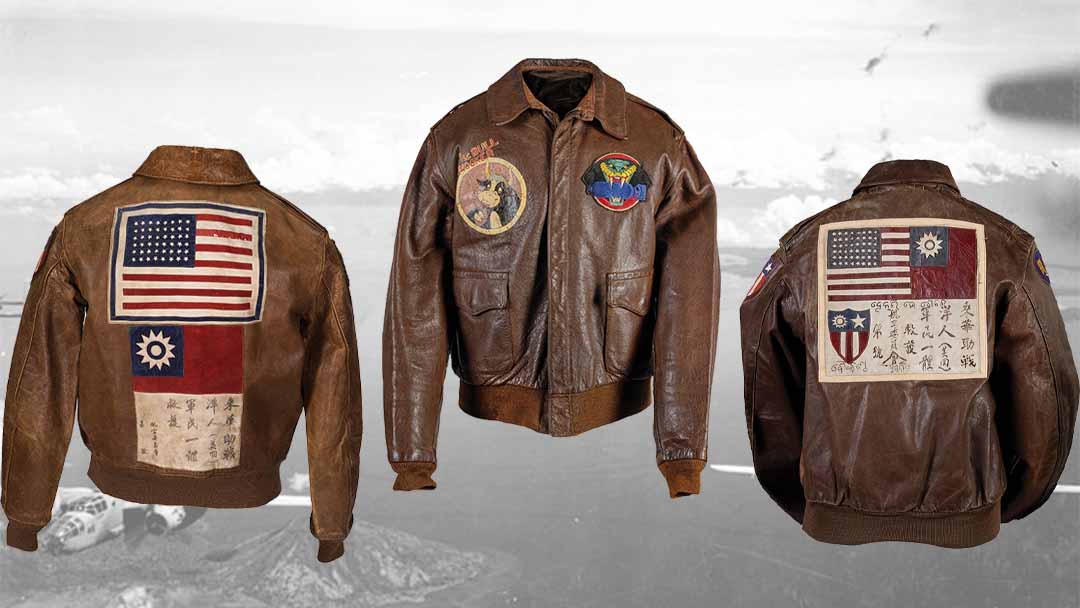
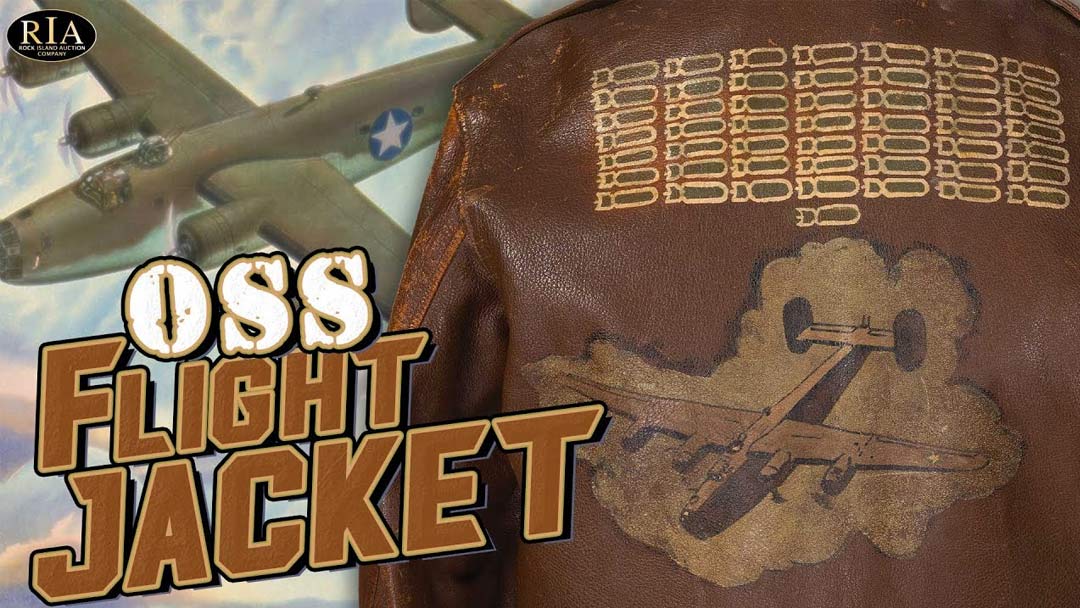
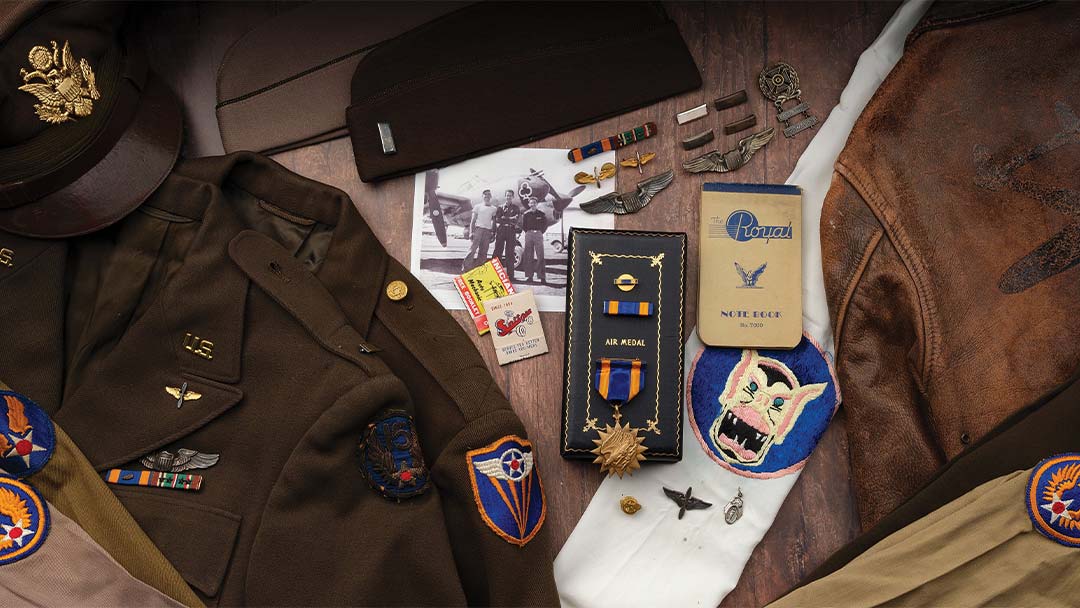
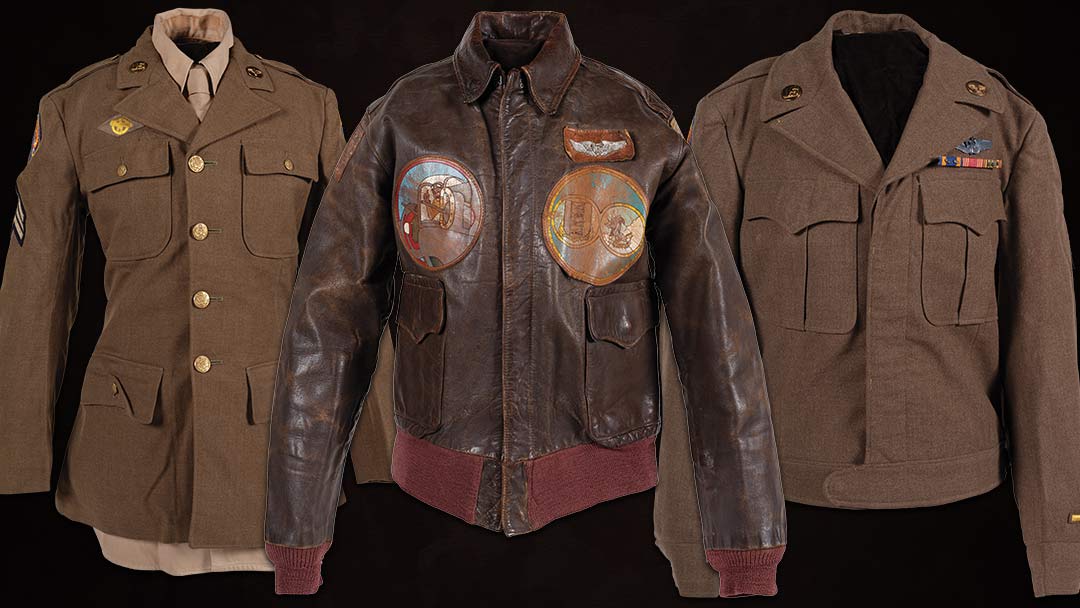
Flight jackets provided a bit of individuality in the military when their owners might have them painted to show off, perhaps with a partially nude woman, their aircraft, the number of missions flown or disdain for the enemy. The flight jackets shown here and available in the Aug. 23-25 Premier Auction are all business, representing a B-24 bomber crewman (Lot 1292) a B-24 bomber radioman whose plane flew missions for the OSS (Lot 3345) and a P-38 Lightning pilot (Lot 335).

Rock Island Auction Company offers some of the finest flight jackets from WW2. The examples below include one worn by a fighter ace, one from the unit that dropped the atomic bomb, and one worn by the first American to successfully launch an intercontinental ballistic missile (ICBM). Many of the flight jackets are A-2s, as the standard issue for much of World War 2.

SSGT Clarence E. Craver’s flight jacket (Lot 3345) with “Mary Jane Ace of Spades” depicted proudly on the back, flying in a moonlit sky. After flying 50(!) missions, its sleeve still bears damage from hot flak, a reminder of just how harrowing these top secret OSS flight missions could be.

Flight Jackets: Origin

As aircrafts went higher, the air got colder, not just outside but also in the cockpit. In 1910, pilots of the Royal Flying Corps in Belgium and France started wearing long coats for warmth in the biplanes, balloons, and airships. The coats were often made of leather since it was more windproof.

The U.S. Army introduced the A-1 flight jacket in 1927, followed by the A-2 four years later. The A-2 was one of the first garments specifically designed for a zipper.

The A-2 was eventually made by 19 manufacturers with slight variations in design and color. Some were made of cowhide and even goat skin, with color varying from dark brown to nearly black to russet to pale-red or medium brown.

Some flight jackets displayed a blood chit – like two of the three here — often used throughout the China Burma India theater and the Pacific theater to immediately identify the wearer and request safe conduct if they are a downed airman. They often display the U.S., China and Burma flags with a message in multiple languages. The following are available in the upcoming Aug. 23-25 Premier Auction: Lot 1314 is the jacket of a crewman who flew combat cargo missions, while Lot 3371 was worn by the bombardier of the B-24 bomber, “The Bull Snooker.” On the right is the flight jacket of the F-5 lighting pilot in CBI during World War 2 (Lot 3334).

Later issue flight jackets weren’t leather but often made of different materials like nylon or a cotton-rayon blend. The B-10 was a cloth jacket that had an alpaca fur collar and lining and was lighter weight than previous flight jackets. The B-15 flight jacket, issued starting in 1944, was made with a synthetic shell and had a mouton fur collar and wool knit waist and cuffs. Its key feature was a pen pocket on the upper left sleeve.

The epitome of cool, the A-2 was highly sought after, even when they were no longer being issued. Germans took them from captured flyers. The unadorned jackets often ended up in the civilian wardrobe when flyers returned home. Steve McQueen wore an A-2 in “The Great Escape.”

Painted flight jackets likely found their way to the back of the closet, according to John Conway, co-author of “American Flight Jackets and Art of the Flight Jacket.”

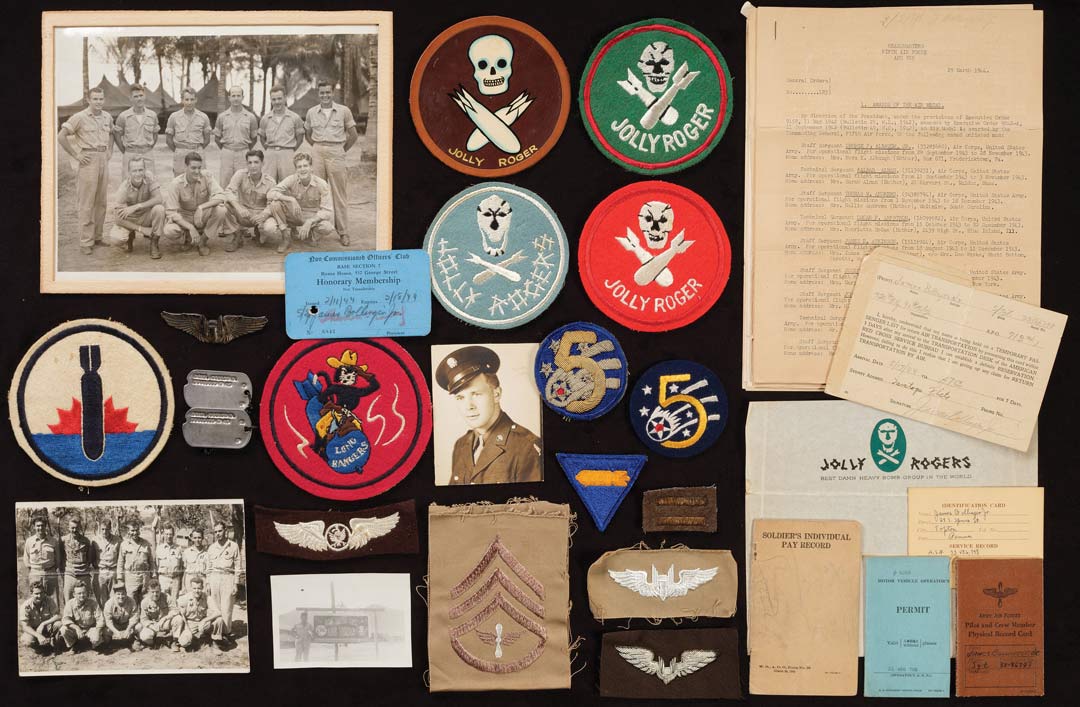
Several groupings of patches like these in Lot 1293 and Lot 1320 are available in the Aug. 23-25 Premier Auction represent several different World War 2 bomber units from the European and Pacific Theaters.

“I’ve talked to people who, when they got back from the war, hung their jacket up in the closet because they wouldn’t dare ever wear it in public again,” says Conway, co-author of Schiffer Books’ American Flight Jackets and Art of the Flight Jacket. “When you’re a teenager and you’re 3,000 miles from home, having a naked lady painted on the back of your jacket is not that big a deal. But you wouldn’t want your mom to see it.”

War Art: Painted Flight Jackets

Sometimes the flight jackets could be bawdy, with a scantily clad women painted on them, or ferocious with a lion or some angry beast, or whimsical featuring a cartoon character of the time, or tempt fate with the grim reaper or a devil painted on the back.

Having their individualism stripped away during training, the flyers found a way to reclaim some of that individuality as they went on missions where they might not return. More than 40,000 American airmen were killed in combat and over 23,000 aircraft were lost during World War II.

Flight jackets are held in high regard for the legendary men who wore them. Airmen who risked life and limb in the cold and unforgiving skies saw numerous combat roles that aided the Allied victories in the European and Pacific theaters. Often painted by the men who wore them, each one tells a tale of the service and missions it saw.

During the 1940s, sign painting was a common trade as each town needed signs for businesses, so one could often be found in the unit who could be hired to paint a flight jacket. Some of the paintings could be well done representations of an airplane, a nude woman, a knight riding a bomb, possibly a cartoon wolf, or Hitler’s head on a pole.

Flight Jacket of a Bomber AND Fighter Pilot

The A-2 flight jacket of Friend Frank Wilson displays his versatility as a pilot. Wilson flew 26 missions as a B-17 pilot with the U.S. Army Air Force’s 8th Air Force 333rd Bomb Squadron before volunteering to fly a P-51 fighter for the 3rd Scouting Force.

Wilson’s jacket denotes the 26 bombing mission with 26 yellow bombs painted on the jacket’s front left while the back has high quality paintings of Wilson’s B-17 and P-51, the “Miss Vera” with its guns blasting.

The Scouting Forces, a little known arm of the strategic bombing force, was intended to help the bombers assemble formation over England, lead the bomber formation to the target through bad weather, assist in keeping the bombers in tight formation to the target, and protecting the bombers from enemy fighters. The 8th Air Force Scouting Forces were comprised of former bomber pilots who had experience with bombing missions.

The flight jacket of Friend Frank Wilson has a P-51 Mustang fighter and a B-17 bomber painted on the back. He flew for the 3rd Scouting Force that utilized both aircraft.

Flight Jacket of B-17 “Mary Alice”

The A-2 flight jacket of Lt. Kelly F. Harouff is both whimsical and foreboding. The back features a depiction of Bugs Bunny above the worlds “GNATZI KNIGHTMARE” and below “Mary Alice.” The back also has several painted on bombs and a swastika.

The bomber “Mary Alice” was assigned to the 615th Bomb Squadron, 401st Bomb Group of the 8th Air Force. It was named after pilot Don Knight’s mother and returned to the United States following 64 bombing missions.

Harrouff was a navigator assigned to the 359th Bomb Squadron, 303rd Bomb Group of the 8th Air Force and completed 18 missions between February and April of 1945 assigned to several different B-17 crews. How he might’ve come into possession of “Mary Alice” painted jacket is unknown, but jackets were known to be recycled by crews. A previous name tag appears to have been removed where Harrouff’s tag is located.

Bugs Bunny is featured on the back of this A-2 flight jacket dubbed the “Gnatzi Knightmare.” The jacket of Kelly F. Harouff is attributed to the “Mary Alice” B-17, but Harouff isn’t recorded as having flown a mission in the Mary Alice. However, jackets were known to be recycled by crews.

Thunderbirds Flight Jacket

The Thunderbirds of World War II were the planes of the 34th Bombardment Squadron. B-25 bombers from the squadron took off from the USS Hornet in the famed April 1942 Doolittle Tokyo raid that did minor damage but gave the U.S. a morale boost in the wake of the attack on Pearl Harbor.

The unit deployed to the Mediterranean Theater, flying B-26 Marauders from bases in North Africa, Sardinia, Corsica, and France. The Thunderbirds flew in support of Operation Torch, the Tunisian campaign, and the invasions of Sicily and Italy, as well as American troop movements in southern France.

The A-2 jacket, with the name I.G. Wolfe, painted on the left front of the jacket, records 41 missions flown with as many yellow bombs painted on the right front of the jacket. A painted leather patch with the squadron logo is on the left front. On the back is a professionally painted B-26 against a background of clouds.

The Thunderbirds of the 34th Bombardment Squadron included the B-25 bombers that took off from the USS Hornet in the famed April 1942 raid on Tokyo. The unit also deployed to the Mediterranean and provided support in north Africa, Tunisia, Sicily, Italy, and southern France.

Flight Jacket and an ICBM

The B-10 flight jacket of Tommie Zannes is a bridge from propeller aircraft to rockets and space travel.

Zannes was a glider pilot for the 1st Glider Provisional Group 4th Section that arrived in New Guinea in November 1944 as part of the 54th Troop Carrier Wing. Gliders were little used in the Pacific, often used to fly into remote areas with men and supplies to establish airfields.

After the war, Zannes graduated with a mechanical engineering degree from the University of Miami and eventually became operational projects manager for Convair at Vandenberg Air Force Base where the Strategic Air Command was testing ICBMs. Zannes oversaw Convair’s ICMB program that resulted in the Atlas, the first operational ICBM for the United States. After a trio of test failures, the program had a successful launch on July 28, 1959. The man who pressed the launch button was Zannes. The Atlas evolved into rocket boosters used in the space program that led to an American walking on the moon. Zannes died in 1962, seven years before the moon landing.

The flight jacket has glider pilot wings, Zannes’ name tag, and the 5th Air Force insignia on the left front. Bugs Bunny smoking a cigar wearing a crush-type hat is on the back in a blue circle with a gold and black border.

Tommie Zannes was a glider pilot for the 1st Glider Provisional Group 4th Section assigned to the south Pacific theater. His flight jacket has Bugs Bunny smoking a cigar on the back. After the war, he was operational projects manager for Convair at Vandenberg Air Force Base where he became the first American man to successfully launch an intercontinental ballistic missle in 1959.

Flight Jacket of an Ace in One Day

Lt. William H. Allen flew in the 343rd Fight Squadron 55th Fighter Group of the 8th Air Force. He became an ace on Sept. 5, 1944 when he was returning from an escort mission in his P-51 Mustang and spotted several planes taking off from the airfield at Goppingen, Germany. He and his squad zoomed into action and when the smoke cleared from the skies, Allen was credited with shooting down five Heinkel He 111s. He got his five kills in one dogfight to become an ace in a day.

Allen enlisted when he was 18 and after training was assigned to the 343rd fighter squadron. The unit flew twin-engine P-38 fighters before converting to P-51. Allen’s Mustang was nicknamed the Pretty Patty II. The original Pretty Patty was a P-38 that was shot down. He earned the Air Medal with four oak leaf clusters and the Distinguished Flying Cross. Both medals are awarded for, “single acts of heroism” or “meritorious achievement while participating in aerial flight.” Oak Leaf Clusters signify subsequent decorations and awards.

After the war, Allen remained in the service and flew 39 different aircraft in his career from four engine fixed wing airplanes to helicopters. He retired in 1963 and became an aircraft accident investigator for the Civil Aeronautics Board and the FAA.

Allen’s B-15 flight jacket has lost one of two leather triangle patches on the front and has a faint USAAF insignia on the left sleeve yet represents an impressive piece of military history. The olive green jacket is featured on page 255 of “American Flight Jackets,” by Jon A. Maguire and John P. Conway.

William Allen found himself returning from a mission in September 1944 when he spotted several German planes taking off. He was able to shoot down five and earn the “ace” designation.

Flight Jacket, the Himalayas, and a Blood Chit

James N. Thompson was assigned to the 331st Troop Carrier Squadron, 10th Air Force, which operated in the China Burma India Theater. The squadron flew troops and supplies over the Himalayas to ensure units in the combat zone remained operational, including Chinese units. The airlift logged an estimated 1.5 million flight hours and delivered a total tonnage of 650,000 net tons.

Thompson’s A-2 flight jacket features his leather name tag above the 331st Troop Carrier Squadron’s insignia as well as patches for the 10th Air Force and the CBI on the right and left shoulders, respectively. The back of the jacket has a large multi-leather blood chit. A blood chit was used throughout the CBI theater and were designed to immediately identify the wearer and request safe conduct if they are a downed airman. They often had the flag of the U.S. China, Burma, or the United Kingdom with messages in multiple languages.

A basic chit might read: “Dear Friend, I am an Allied fighter, I did not come here to do any harm to you who are my friends. I only want to do harm to the Japanese and chase them away from this country as quickly as possible. If you will assist me, my government will sufficiently reward you when the Japanese are driven away,” according to Maguire and Conway’s book.

 Many airman had the blood chits on the back of their jacket’s like Thompson’s but were later moved inside of jackets after they realized they made a nice target.

This flight jacket from the 331st Troop Carrier Squadron and has a blood chit on the back that was a way for an airman, if they were downed, to communicate that he doesn’t want to hurt them and that the U.S. government will rewarded those who help the airman.

War Art of a Hell’s Angels

Sgt. Millard Wilkerson was a flight engineer/gunner in the 715th Squadron of the 448th Bomb Group of the 8th Air Force who painted several flight jackets. He served in England in January 1944, flying 35 missions before returning to the United States. In April 1945 he was reassigned to the 6th Emergency Air Service Rescue Squadron to search for downed B-29 crews.

Wilkerson’s commercial leather jacket has the Far East Air Forces insignia on the sleeve while the back has a painted nude blonde woman with angel wings and wings on her feet over a cloud between the words “Hell’s Angels.”

The jacket is also shown in “American Flight Jackets” on page 266, along with other examples of his work that also feature scantily clad women, well-drawn airplanes, and cartoon animals.

Millard Wilkerson was a flight engineer/gunner in the 715the Squadron of the 448th Bomb Group. While this jacket isn’t military issue it is Wilkerson’s handiwork. He is known to have painted several flight jackets, according to the book “American Flight Jackets” by Jon A. Maguire and John P. Conway.

Flight Jacket and the Atomic Bomb

Lt. Col. Walter Mitchell Staub was a pilot and meteorologist in the U.S. Army Air Corps assigned to the 509th Composite Group, the unit that dropped the atomic bombs on Hiroshima and Nagasaki. The unit was declared a composite because it included transport as well as bombing duties.

After the war the unit returned to Roswell Army Airfield in New Mexico. When the Strategic Air Command formed in 1946, the 509th was one of 10 original bomber groups. The unit was assigned to Operation Crossroads to determine the destructive capabilities of an atomic bomb on naval warships, testing at Bikini Atoll in 1946.

The weather was important in testing so Staub was among those determining when the usually stormy July weather would be clear enough for testing.  The meteorologists also monitored wind so that military personnel wouldn’t be downwind of atomic material.

Staub’s A-2 flight jacket has his name written on the lining and has a large patch for the 509th Composite and 58th Bomber Wing on the front left. The patch has a large mushroom cloud and two red lightning bolts on a blue field.

Walter Mitchell Staub was assigned to the 509th Composite Group that transported and dropped the atomic bombs that ended World War II. This is his A-2 flight jacket with a unit patch showing a mushrom cloud on the front left of the jacket.

Flight Jackets and War Art

Call them high art, as in altitude, for these flight jackets flew with men whose names may not be of the household type, but their contribution to fighting fascism and winning World War II cannot be forgotten. Flight jackets that flaunt their wearers individuality while sharing in a common goal are an amazing opportunity to collect a piece of World War II history and classic Americana, a fantastic gift idea, and seven of them are available in Rock Island Auction Company’s Dec. 9-11 Premier Auction.

Review: Vosteed Hedgehog (Aluminum Scales)

0

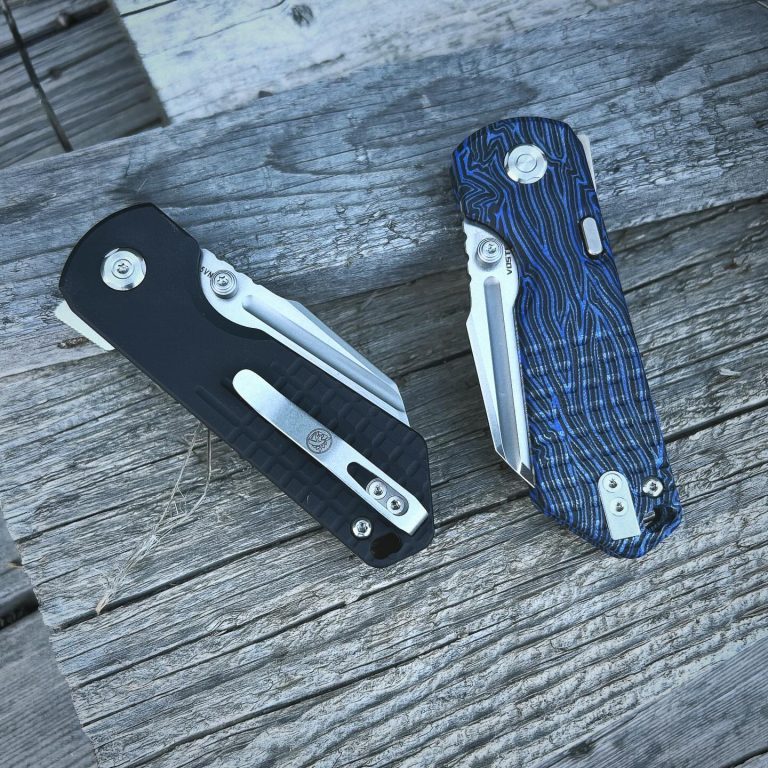
I’ve said before that the Hedgehog is, in my opinion, one of Vosteed’s best knives. So, do the new aluminum-handled versions keep up that high standard? Thanks to Vosteed for the review sample, I found out.

Specs

You can see the full specs at Vosteed.com. The most relevant specs are listed below.

Blade Length: 2.99″ | 76.00 mm

Overall Length: 7.11″ | 180.60 mm

Blade Thickness: 0.138″ | 3.50 mm

Blade Material: S35VN

Weight: 4.42 oz | 113.90 g

Opener: Back Flipper | Thumb Stud | Fuller

Lock Type: Top Liner Lock 

Handle Material: Aluminum

Observations from Use

Sometimes small changes can make a knife feel completely different. In the case of these new aluminum scales versions of the Hedgehog, I think the rugged new scales make the knife feel even more like it should – a premium knife that is tough enough for hard work and refined enough for the EDC knife crowd.

The aluminum scales add a sturdy feeling to this knife and slightly more heft that feels reassuring. This version makes more solid, metallic sounds when you open it and it seems more rigid or solid in a way that is hard to describe (because the previous version doesn’t feel flimsy in the slightest).

The finish on these aluminum scales feels slightly finer in texture than other Vosteed aluminum scales I have tried. It is slightly grippy and almost doesn’t feel like metal in the hand. This finish, coupled with the frag pattern milling, makes this one of the grippiest aluminum handled knives I have ever owned.

I don’t want to spend a lot of time rehashing what makes the Hedgehog great so I’ll just direct you to the previous review and summarize my thoughts here. It has an incredibly well-executed top liner lock (basically a Compression Lock with a button) that makes this knife both bull-strong and just as fidgety as any button lock. The handle provides MANY options for how to grip the knife and the blade shape perfectly fits the tough, hard-working design of this knife. It’s modern, stylish, and it just works.

Wrap Up

If pocket time is the measure of which version of the Hedgehog I like best, I have been carrying the new aluminum scale version since I received it. This feels, to me, like the best version of one of Vosteed’s best knives. It is just as stylish as previous versions while somehow feeling more refined and even more hefty in a good way.

Vosteed.com

Vosteed Hedgehog on Amazon.com

Rapid Fire Innovation of the German Machine Gun

0

German machine guns designed during the buildup and during World War 2 made a number of advancements in machine gun technology from the MP35 and MP38 to the MKb42(H).

The German machine gun and a number of iterations faced off against the Thompson submachine gun on the beaches of Normandy and influenced the development of the M60, America’s warhorse in the Vietnam War.

Rock Island Auction Company’s Aug. 23-25 Premier Auction features a variety of rapid fire firearms dating from World War 1 to the present. These offerings bear an international flair, coming from Germany, the United States, United Kingdom, Japan, Italy and more.

Developed toward the end of World War 1, this is one of the earliest German machine guns, offering a compact platform to use in “knife-fighting range.” It was widely studied by a number of imitators.

German Machine Gun: Machine Pistols

The submachine gun, often called the maschinenpistole in German, dates back to the trench warfare of World War 1 with the Bergmann MP18 that fired pistol rounds and was fairly lightweight.

Heinrich Vollmer’s design from 1930 used a 32-round box magazine that refined the telescoping tube that housed the return spring. This stabilized the action, protected the spring and prevented it from getting distorted, resulting in a firing rate of 350-400 rounds per second.

The machine milled MP35 found its way to the Spanish Civil War, was adopted by Sweden as the M38 and sold to Ethiopia and Denmark. Expensive because of the milled parts, complex bolt assembly and wood stock, about 40,000 were made during their five-year production period. These were mostly issued to Waffen SS troops. The magazine is inserted on the right side of the gun and the cocking system was similar to a bolt action that pulled the cocking handle back and up before returning it to the closed position. It could be set to single or continuous fire.

This MP35 has the “ajf41” manufacturing marking for Junker & Ruh Ag, of Berlin, and “SS ZZA1” proof mark that it was shipped to the Waffen SS.

The German High Command started developing a light burst firearm for armored vehicle crews and paratroopers. The Maschinenpistole 38, substituting wood with plastic and a folding shoulder stock, firing from an open bolt, was the forerunner of the MP40.

This is an exceptional example of a seldom-seen MP38. It has a rare original leather bolt retention strap, issued to the Eastern Front. The MP38 is a bridge from the more expensive machined metal and wood submachine guns of the 1920s and 1930s to wartime manufacture using stamped steel.

The MP40 simplified the manufacture of the wartime maschinenpistole, utilized stamped carbon steel, brazed and spot-welded with sub-assemblies performed by sub-contractors. While it saved costs in manufacturing, the United States Army tested the gun in 1940-41 and found it to be extremely reliable and very accurate. About 1 million were made.

Nearly every armed branch and paramilitary organization in Germany used the MP40 and it also found its way to the French Resistance and Poland’s Home Army. This example is mechanically excellent.

The MP40’s production techniques, embracing stamped metal with welds and rivets would also be utilized in the MP41, directly copying the stamped metal receiver and action but fitted with a hardwood stock. The MP41 also used the fire-selector mechanism from the MP28. The MP41 wasn’t adopted by the German Army and was manufactured in limited numbers for the German state police and Romanian troops.

This is a rare example of an early World War 2 MP41 with matching numbers on the barrel and receiver and the model markings on top of the receiver.

German Machine Gun: MKb42(H)

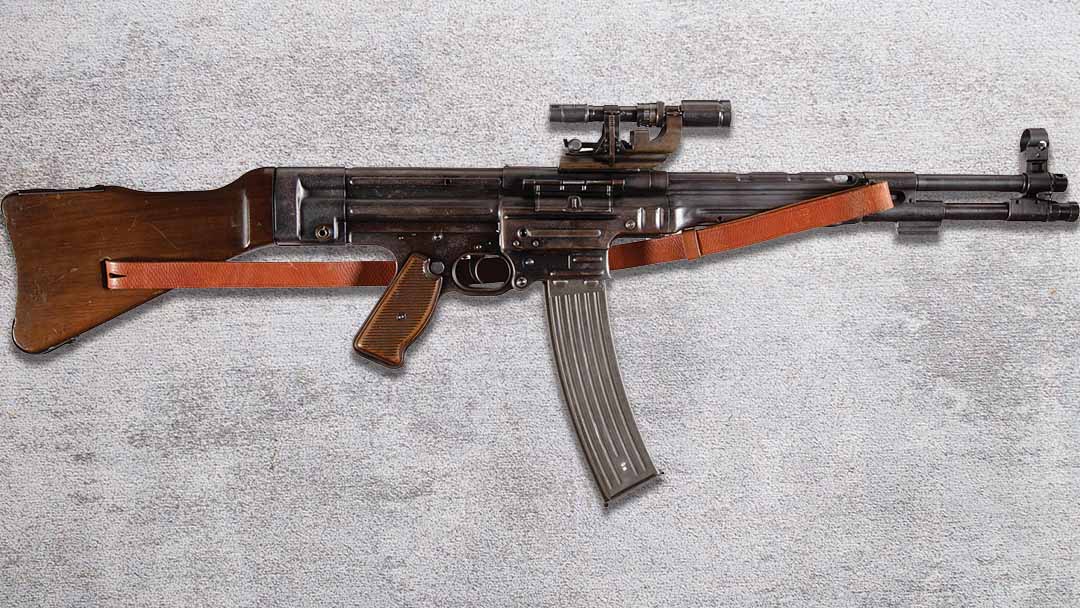
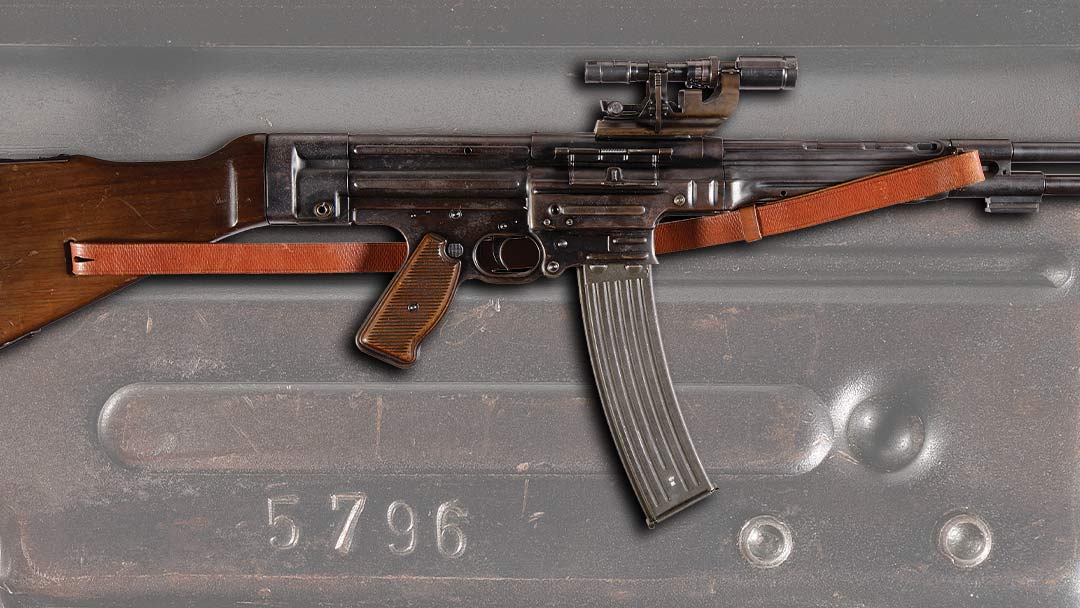
In the inter-war period, German military officials came to the realization that they needed a weapon with better range and accuracy than a machine pistol but not as unwieldy as a battle rifle. First came the intermediate 7.92mm Kurz cartridge, then came the MKb42. The example on offer here, the grandfather of the modern assault rifle, was made by Haenel, hence the “(H)” designation.

The carbine utilized a short operating rod housed in a full-length gas tube located above the barrel. It was fabricated with stamped metal and a minimum of machined parts. German military leaders tried to convince Dictator Adolph Hitler for the need of a machine carbine but he wouldn’t listen. The Army went ahead with production despite disapproval from the Fuhrer.

The total production number for the MKb42 was 11,833 from November 1942 to September 1943. Most were sent to the Eastern front where few survived.

This extremely rare MKb42(H) has bulges on each side of the rear sight base that would serve as the base for a future sniper scope/mount design. The scope mount here was sheet metal folded and welded with few machined parts. This gun would be a centerpiece to any World War 2 firearms collection along with the “Invictus” Singer.

THE German Machine Gun: Hitler’s Buzzsaw

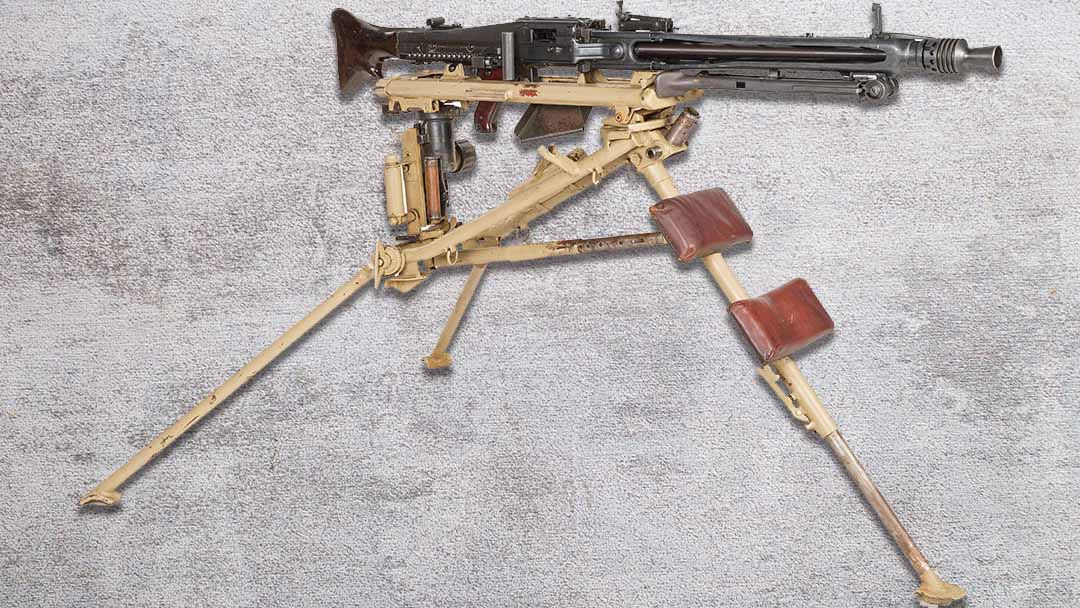
German submachine guns at the time averaged around 500 rounds per minute, but the Maschinengewehr 42, known as “Hitler’s Buzzsaw” to American GIs, more than tripled that rate of fire, slapping out as much as 1,550 rounds per minute. The United States War Department created a training film to combat the gun’s psychological effect on soldiers by downplaying its lethality while calling it inaccurate. When most soldiers heard the gun ripping they took cover and waited for artillery or tank support to take care of the MG42. During the invasion of Italy, the Germans held Monte Cassino for about four months in 1944 using the MG42 defensively to hold off Allied assaults.

Despite its frightening rate of fire, the MG42 had its shortcomings. The barrel tended to heat up quickly and had to be swapped out as often as every 200-250 rounds. Squads carried as many as six spare barrels on hand and trained soldiers could change them out in seconds. Squads of six also carried extra ammunition since the gun spat it out at such a high rate.

Easier to manufacture and cheaper than the machined MG34, the MG42 could serve in a fixed position but also maneuverable enough to be shoulder fired and fired from the hip. It served as the inspiration for the United States’ machine gun, the M60 that was a workhorse for the U.S. military in the Vietnam War.

The MG42 found life after World War 2, in service with the West German armed forces and being rechambered for NATO-standard calibers. Professionally refinished, this example remains in excellent mechanical condition.

German Machine Gun Foe: Thompson Submachine Gun

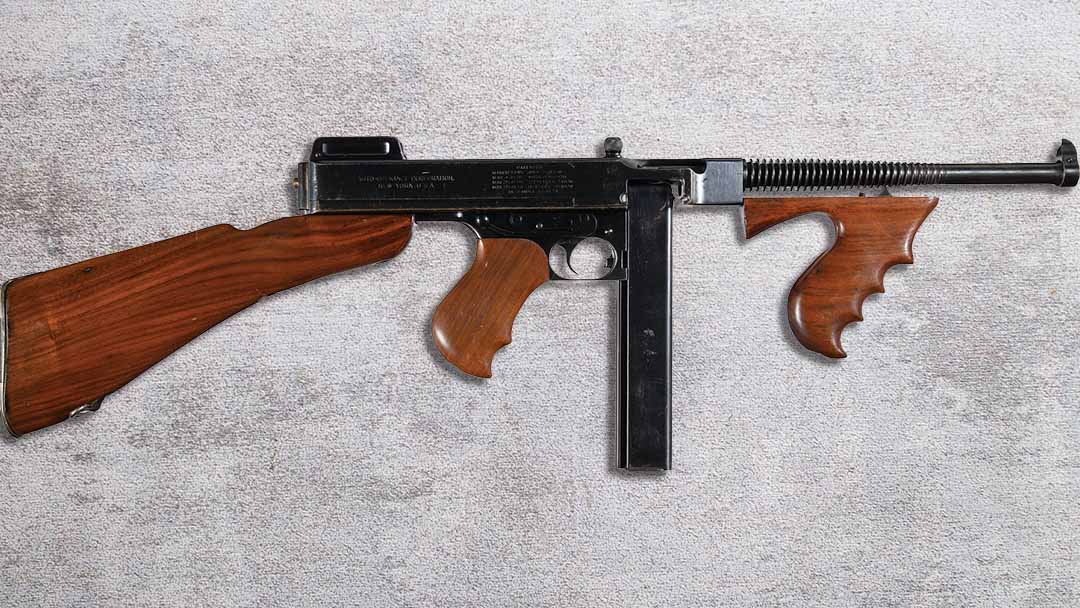
The winning side needs to be represented here, too, and the Aug. 23-25 Premier Auction has a number of fantastic American machine guns on offer including the legendary Thompson submachine gun. John Thompson’s gun, also known as the Tommy Gun, was introduced too late to make a significant impact on World War 1, and his company, Auto-Ordnance had trouble finding a peacetime market until law and disorder discovered the Thompson. Gangsters bought them. Al Capone is known to have purchased three in 1926, and two were used in the St. Valentine’s Day Massacre in 1929. Police departments acquired Tommy Guns to match the gangsters’ firepower.

The U.S. Marines were the first significant buyer of the gun in 1928. France sought to buy 3,750 Tommy Guns in 1939 and as World War 2 started, orders poured in. During World War 2, about 1.75 million Thompsons, that included numerous variants, were made.

The gangland Thompson submachine gun of the Roaring 20s also gained interest from Irish Republicans fighting for independence. This Tommy Gun was among a 30-piece order that was to be shipped to Ireland but was discovered by inspectors concealed in the coal bunkers of the steamship “East Side” in June 1921, a violation of American neutrality laws. The war ended in a stalemate but secured Ireland’s independence from the United Kingdom, except for Northern Ireland. This gun ended up going to Ireland before finding its way back to the United States in 1956.

German Machine Gun Foe: Johnson 1941

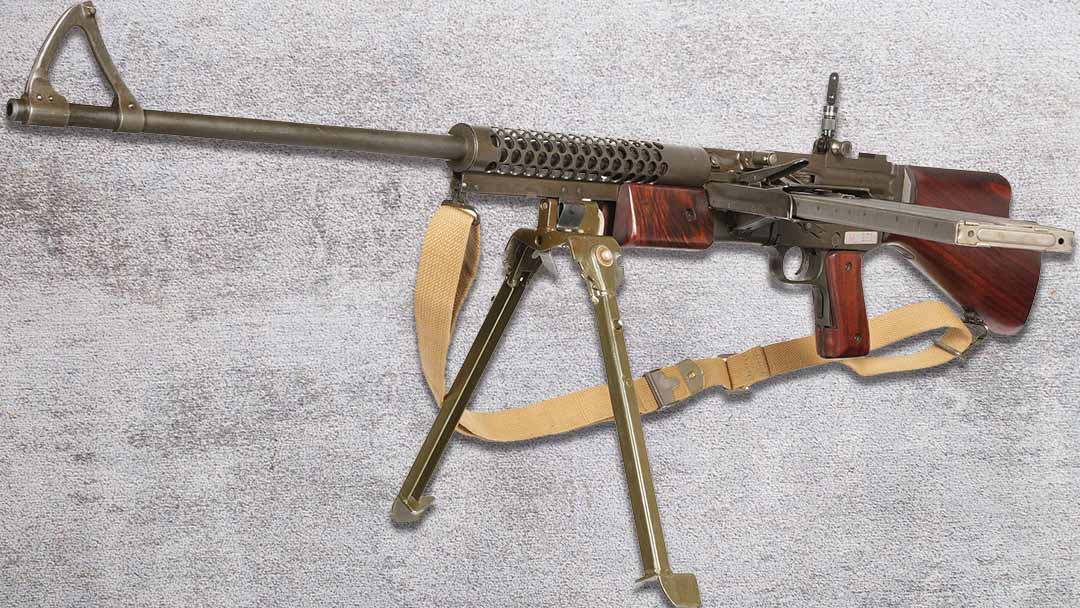
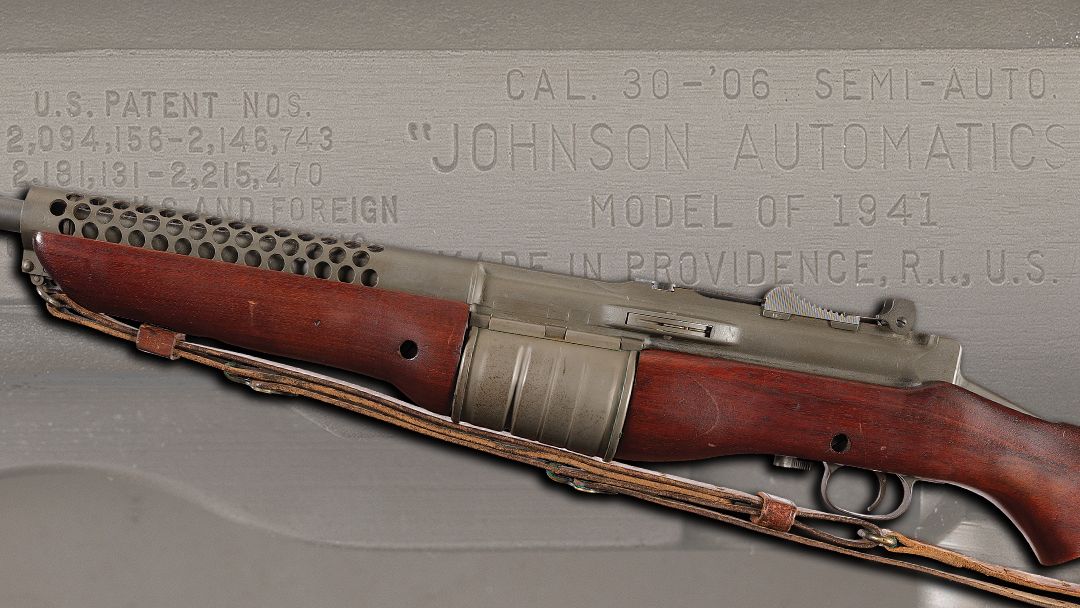
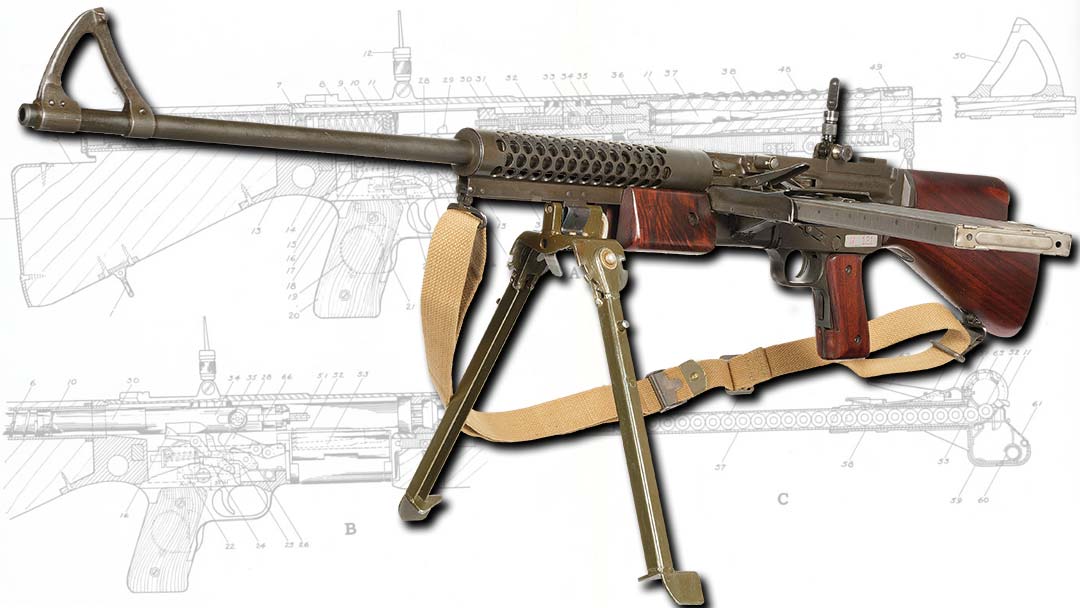
Developed alongside the Johnson semi-automatic rifle as a squad light machine gun it has a short-recoil barrel assembly inside a ventilated heat shield. The semi-automatic action was converted to a dual function mechanism firing from a pure closed bolt semi-auto to open bolt operation in full-auto. The stock and grip assembly were reconfigured to accommodate the new firing mechanism.

The Johnson light machine gun was lightweight, maneuverable, could swap barrels and share ammo but didn’t find large-scale acceptance. Less than 10,000 were made.

This very scarce Johnson 1941 light machine gun has a rectangular metal tag attached to the left side of the receiver, signifying it was part of the Winchester Factory Collection as a study piece for company engineers. “Inventory of the Winchester Firearms Reference Collection” records the gun as item number 2017.

German Machine Gun Inspiration: M60

Nicknamed the “pig,” the M60 design melded the MG42’s belt-fed mechanism and the firing action of the FG42 in the early T44 prototype. The gun’s development was stopped to focus on creating the NATO-standard caliber round, the 7.62mm.

The specifications for a machine were to weigh no more than 18 lbs. with a firing rate of 600 rounds per minute and quick-change barrel. When it was adopted, the M60 weighed in at 23 lbs. The MG42 weighed 25 lbs.

The M60 was first issued in 1959 and went into widespread service in Vietnam in 1965. The gun was mounted on helicopters, armored personnel carriers, tanks and gunboats. Grunts carried it into the jungle. Soldiers loved it for its reliability but hated it because of the bulk and the awkward process of changing out the barrel.

The M60 could fire 600 rounds per minute and was designed to be fired from the shoulder, from the hip and while prone. It had a mounted bipod for firing while prone. Both examples on offer here are fitted with bipods. The M60 at top is chambered in the standard NATO round of 7.62mm, while the M60 at bottom is chambered in .30-06.

German Machine Gun Inspiration: Stoner 63A

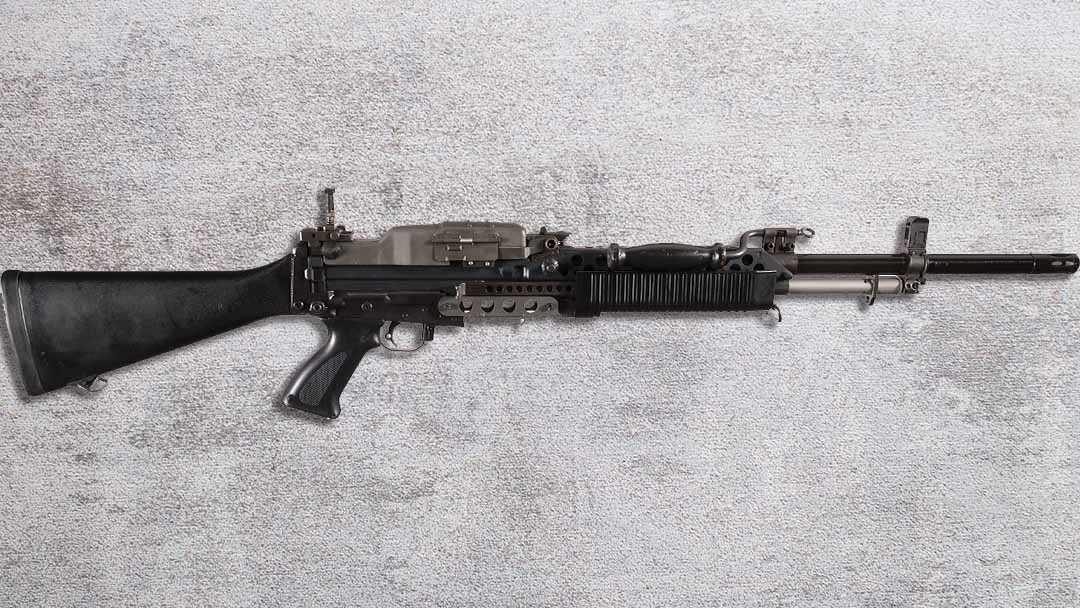
The Stoner 63, designed by Eugene Stoner, designer of the AR-15, was without equal with its modular components that could be customized depending on the mission. Depending on its assembly, the gun’s roles could be fixed machine gun, belt-fed light machine gun belt-fed, magazine-fed light machine gun, medium machine gun, assault rifle and carbine. The platform’s quick change barrel system, feed tray and top cover were similar to the MG42 and later the M60.

The gun served with the Marine Corps briefly in Vietnam and on a wider scale with the Navy SEALs. It was a complex platform and more maintenance-intensive than the M16 and development ended in 1971. About 4,000 were believed to be produced, most of those by Cadillac-Gage. Many were destroyed after the 63A was replaced by the M249 Squad Automatic Weapon.

About 4,000 of the Stoner 63 are believed to have been produced mostly by Cadillac-Gage. This example was made by Knight’s Armament of Vero Beach, Fla., in a much smaller amount, making it highly desirable to collectors.

Machine Guns for Sale

German machine guns from World War 1 to the present are among the Class III offerings in Rock Island Auction Company’s Aug. 23-25 Premier Auction alongside American, British, Chinese, Italian and Japanese full-auto fire power. These historic and modern Class III firearms are among the roster of fantastic pieces from across multiple genres and eras in the upcoming Premier Auction. Get a good look at them on Preview Day, Aug. 22.

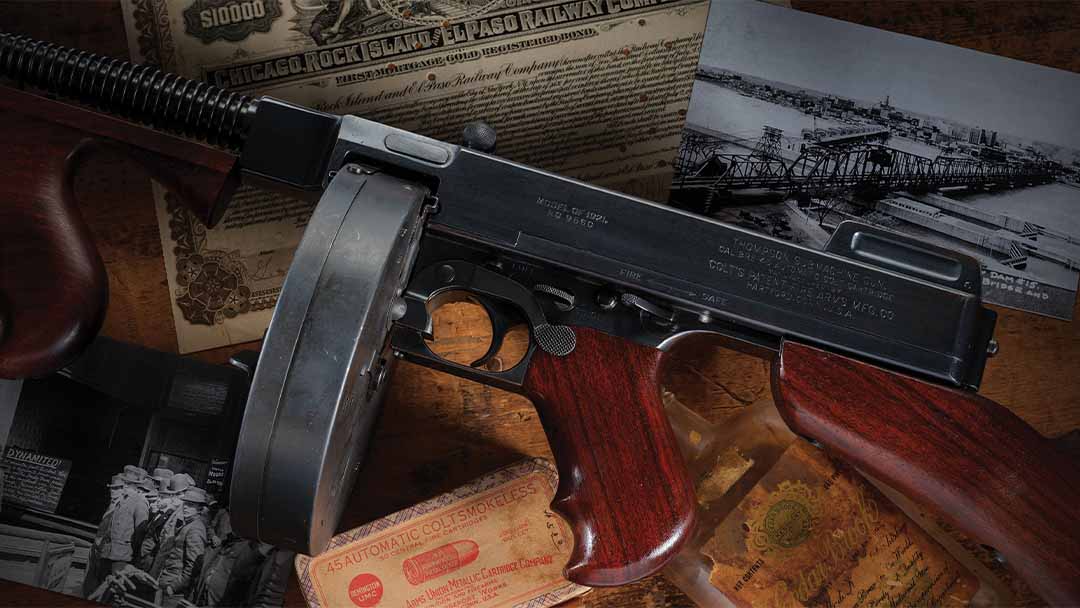
This Colt 1921 Thompson submachine gun is documented to Rock Island County (Ill.) Sheriff’s Department, shipped to the law enforcement agency in 1930. Located on the upper Mississippi River west of Chicago, the city faced a crime wave in the 1920s from notorious gangster and blackmailer John Looney who was portrayed in the graphic novel and film, “Road to Perdition.”

The EDC Tool Roll: 711L Hex Bit and Socket 2 in 1 Extension

0

The EDC Tool Roll is a feature on Jerking the Trigger in which we profile various everyday-carry-worthy tools. The tools shown aren’t multi-tools but rather real tools, that by virtue of their compact size, light weight, usefulness, or unique functionality, can find a place in any range kit, emergency kit, or everyday carry bag.

Feel free to comment on the tools that you carry so we can all learn! The discussion on these posts has been very valuable so far.


We have written about a number of compact ratcheting drivers in The EDC Tool Roll series and it’s safe to say I like them a lot. These tools are very handy but need two accessories to really get the most out of them. Those two accessories are a 1/4″ socket adapter and a bit extension.

Unfortunately, those two parts aren’t always included… but even if they were, the shear convenience of the 711L Hex Bit and Socket 2 in 1 Extension might convince you to carry it instead.

711L is a new-to-me tool brand that designs a number of cool things for EDC tool nerds. Their bit extension kills two birds with one stone. It has a clever bit holder designed that can be retracted to reveal an integrated 1/4″ socket adapter that is part of the shank.

Not only does it hold both regular 1/4″ shank bits AND 1/4″ drive sockets, it does both well. The bit holder uses a spring-tensioned, ball-bearing detent to retain standard bits with just the right amount of tension. The bit-holding sleeve is knurled to make it very easy to extend or retract. The quality is just very, very nice overall.

This 711L Hex Bit and Socket 2 in 1 Extension may not have the sex appeal of the other tools I have profiled in this series. It is just an extension, after all. But, it is a well-made extension with a clever, useful design for EDC, and I enjoy using it. It is one of my favorite recent additions to my EDC Tool Roll.

Note: This is NOT a ratcheting extension.

Where to Buy:

It appears that 711L Tools are only available online. If you have a brick and mortar source for these, please share it in the comments! I purchased mine from Amazon (and I already regret not buying the two-pack): 711L Hex Bit and Socket 2 in 1 Extension on Amazon.com

The above links may be affiliate links.

Brown Bess, Britain’s Military Flintlock for 100 Years

0

For more than a century, distinctive English flintlock muskets were used around the globe as the primary firearms of the sprawling British Empire. From about 1720s through the 1830s, the various “Brown Bess” muskets or “King’s muskets” are historically significant arms of the making of their “empire on which the sun never sets.”

Smoothbore muzzleloading firearms date back centuries to the 15th century and evolved over time as technology progressed. Relatively little, however, changed with the 18th century muskets of Europe and the Americas. Most countries’ militaries wielded large caliber smoothbore flintlock muskets with socket bayonets that fitted over the muzzle.

Brown Bess muskets are very important and historic firearms for Americans because they were the arms used across multiple nation-defining conflicts. During the French & Indian War, American soldiers fought the French and their native allies on the frontier with the Brown Bess imported by the thousands from England, and the British regulars were also naturally armed with the Brown Bess.

The initials “BH” are carved into the stock of this 1743-dated British Brown Bess musket that is identified as being owned by Revolutionary War soldier Beriah Holcomb of Stephentown, N.Y., who served in the New York Second Regiment. The unit fought at Saratoga, Monmouth and Yorktown, all key battles in the War for Independence.

In the American Revolution, the Brown Bess continued to be the primary arm of the British and colonial loyalists and a staple firearm for the American Patriots. During the War of 1812, the Americans again faced off against British and Canadian troops armed with the Brown Bess, and down in the southwest in the 1830s, the Mexican army at the Alamo was largely armed with the iconic British muskets. Rock Island Auction Company’s Aug. 23-25 Premier Auction has several Brown Bess muskets on offer in a number of variations.

A solider loaded the Brown Bess with paper cartridges containing the black powder for the main charge and primed the lock and an undersized round ball (.68-.70 caliber) to allow for faster loading. While soldiers occasionally drilled for accurate fire, that wasn’t as large of a concern as the soldier’s ability to reload rapidly for sustained volleys of coordinated fire which could devastate the enemy formations. The Brown Bess’s front sight doubled as the lug for securing a socket bayonet which slid over the muzzle and was then rotated to lock it in place. After firing volleys, the infantry could affix their bayonets and drive their adversaries from the field. Bayoneted muskets also served as pikes for defense and for controlling prisoners and crowds.

This British Brown Bess with a button head ramrod is a Short Land Pattern that was manufactured about 1777-1782 during the Revolutionary War and has Tower proofs.

The Origin of the Term “Brown Bess”

“Brown Bess: A soldier’s firelock. To hug Brown Bess: to carry a firelock, or serve as a private soldier.”

– Francis Grose, A Classical Dictionary of the Vulgar Tongue, 1785.

There have been many claims and theories regarding the origin of the nickname “Brown Bess” for British muskets. Some have presumed the “Brown” referred to the color of the muskets, and others thought “Bess” was a corruption of the Dutch term “busse” for a firelock. However, the best explanation backed by period sources is explored extensively by Jonathan Ferguson of the U.K. Royal Armouries in his article “‘Trusty Bess’: the Definitive Origins and History of the term ‘Brown Bess’”where he demonstrates that the name “Bess” historically referred to a  common lower class woman, while “brown” meant “drab” or “common”. It was adopted as a nickname for muskets in the 18th century but also continued to refer to lower class women through the 18th century as well as the names of racehorses in the 19th century.

This British Short Land Pattern Brown Bess musket has a button head ramrod and a socket bayonet. The Short Land Pattern Brown Bess is one of the variations that will be discussed below.

Variations

Naturally, there were a wide variety of British muskets across their more than century-long period of use, and you will find examples noted as a particular pattern only made for a few years based on minor features such as a change in the cock or other smaller details. However, the three major variations typically found are the Long Land Pattern, the Short Land Pattern and the India Pattern.

The Long Land Pattern

The Long Land Pattern muskets were the most widely used in the French & Indian War and the American Revolutionary War. Variations of the Long Land Pattern served as the primary infantry arms of the British Empire in the 18th century and had the longest period of use. They trace their origins back to earlier muskets prior to the standardization of British arms and were introduced in the 1720s.

This 18th century musket’s side plate, trigger guard and butt are all in the style of the Brown Bess musket with a 45-inch barrel. The gun has non-martial marks including “DUBLIN/CASTLE.”

The classic Long Land Pattern has a .75 caliber 46-inch barrel with a bayonet stud for securing a socket bayonet. The stud also served as the front sight. The barrel is secured to the stock by the screw in the tang at the breech and metal pins that pass through the stock and loops on the underside of the barrel. The mounts were brass and included a distinctive serpentine-like side plate that was raised and rounded. The stock had a bulbous swell at the ramrod entry point and a rather heavy butt.

Over time, minor changes were implemented including changes to the shape of the lock, mounts, and stock, but the basic form remained the same. Earlier examples prior to 1764 will generally be found with the date and a contractor’s name on the tail of the lock. Later examples do not have either and instead were simply marked “TOWER” for the Tower of London.

This Long Land Pattern Brown Bess musket has the Georgian cipher and is marked “EDGE/1762.”

Short Land Pattern

The Short Land Pattern was introduced in 1769 following the Seven Years War (French & Indian War in America). Still .75 caliber, its most notable difference was the shorter 42-inch barrel. One of the changes also seen on the Short Land Pattern is the flat, flush sideplate. There were also less noticeable improvements such as the trumpet shaped ramrod ferrules. Some Long Land Pattern muskets were also shortened in the period to Short Land Pattern length.

India Pattern

The India Pattern takes its name from the fact that this pattern is based on muskets manufactured for the East India Company. The Board of Ordnance began purchasing muskets of this pattern out of necessity in the early 1790s and officially adopted them in 1797 during the French Revolutionary Wars. This pattern was widely used during the Napoleonic Wars and War of 1812. The most notable differences in the India Pattern are a shorter 39-inch barrel and simpler mounts. The India Pattern sideplate is very similar to French sideplates of the era but remained brass rather than the usual iron seen on French muskets. In 1809, the India Pattern’s lock was improved by introducing a reinforced “French” cock. Thanks to their simpler furniture and short length, these muskets have a much different appearance than the prior patterns.

This 1779 East India Company Brown Bess has 1786 stock carving and bayonet. It bears the East India Company marking “4/V/EI/C” heart logo on the tail and “TWIGG” signed at the center as well as other British proofs.

Other Patterns

In addition to these three major patterns used by the British Infantry, there were also the simpler Militia & Marine muskets which featured flat side plates commonly found on the Short Land Pattern but were less expensive by not featuring a forend cap, rear ramrod piper or wrist escutcheon. Gunmakers also produced a variety of muskets and fusils patterned after the official Brown Bess for the commercial market. They were not sold directly to the Board of Ordnance and can be identified in part by their commercial proofs. Lot 1237 in the Aug. 23-25 Premier Auction is a nice example of this. It is essentially a commercial India Pattern musket sold by T. Ketland & Co. during the Napoleonic Wars. Some of these would have been purchased for militia, volunteers, and by officers.

This India Pattern Brown Bess was sold during the Napoleonic Wars by T. Ketland & Co., a Birmingham gunmaker. The gun bears the Georgian cipher and the gunmaker’s marks.

French & American Muskets

No discussion of the Brown Bess would be complete without at least mentioning its French counterpart the “Charleville” musket. Its nickname is more obvious; the Charleville musket received its name from the arsenal in Charleville. However, these muskets were also produced at other arsenals such as those in Tulle and St. Etienne. Numerous variations of the Charleville musket were used from 1717 to well after the fall of Napoleon in 1816.

The French muskets are notably different than the Brown Bess. Their smaller .69 caliber barrels were generally secured by iron or brass barrel bands. The bands also secured the ramrod and many examples have a front sight as part of the upper band. Like the Brown Bess, the Charleville utilized a socket bayonet, typically with a locking ring that secures on a lug on the barrel.

This distinctive French Mle. 1777 flintlock musket was manufactured at the arsenal in Mutzig in 1811 during the Napoleonic Wars. French firearm designs were influential in Europe and the United States.

Prior to the American Revolution and in its early years, American soldiers primarily used the Brown Bess, but after the French began supplying the Americans with muskets and parts and then formally allied themselves with the Americans, the Charleville became the dominant musket. The first U.S. martial musket was the Model 1795 which is essentially a duplicate of the French Model 1763/66 design. Subsequent muskets featured minor improvements but were largely of the same design until the adoption of percussion ignition in the 1840s. Early U.S. martial pistols were also influenced by French designs, particularly the first model, the North & Cheney Model 1799 which was closely patterned on the French Mle 1777 pistols.

The Successor: The Rifle-Musket

In the 1830s and 1840s, new percussion muskets and converted flintlocks were in use in Europe and the U.S. By that period, there were also military rifles and even breech-loading rifles of various designs in use, but the musket remained the primary firearm until the mid-19th century and the invention of the Minie ball. The Minie ball is an elongated bullet with a hollowed base. When the rifle is fired, the pressure causes the skirt at the base to expand outwards which causes the bullet to engage the rifling. This allows for much more rapid loading than with a tight fitting patched round ball which had been used for previous rifles.

Improvements in firearms technology quickly made percussion rifle-muskets obsolete, making their military lives much shorter-lived than flintlock muskets.  Breech-loading rifles that fired metallic cartridges began to replace them in the 1860s and bolt and lever action rifles became prominent in the late 19th century.

The brief successor to the Brown Bess is the Pattern 1853 “Enfield” rifle-musket that was reportedly the second-most used rifle in the American Civil War. This long gun is marked with “1863/TOWER” and St. Edward’s Crown without “VR” denoting it as a commercial arm.

A Treasure Trove of Military Firearms

Whether you are interested in flintlock muskets from the colonial era and early national period, percussion rifle-muskets from the American Civil War, the early breechloaders of the American West, or the various firearms of World War I and World War II, you will find a ton of variety available in Rock Island Auction Company’s August Premier Firearms Auction August 23-25, 2024, in Bedford, Texas. The full catalog is available online now.

Bespoke Shotguns of the UK

0

Imagine a tweeded gentleman striding across the hillocks of Scotland in search of quarry on the wing. Quail or grouse get spooked out of the underbrush and the gentlemen shoulders his bespoke shotgun. The gun speaks and the fowl falls.

“To the dedicated collector there is more fun in some rusty old game gun, or dented powder flask, when he also has a knowledge of the period when the gun first bellowed and smoked over the stubbles and the marshes,” wrote Macdonald Hastings in his 1969 book, “English Sporting Guns and Accessories.”

The entry to the era of the bespoke English shotgun was Joseph Manton whose name can be found in the resumes of James Purdey, Thomas Boss, William Greener and many others. The tradition of fine English shotguns kept in British showrooms but can require years-long waits, but beautiful shotguns bearing legendary names that can be obtained within days are among the offerings of Rock Island Auction Company’s Aug. 23-25 Premier Auction in Bedford, Texas. These fabulous firearms can be admired and examined in person at the auction’s Preview Day on Aug. 22.

Sidelock vs Boxlock

Hammerless guns started appearing in the 1870s when it was located inside the action along with the mainspring and sear. Boxlocks, with fewer parts, contain the trigger mechanisms while sidelocks have two lockplates that sit at the back of the action containing the firing mechanisms.

Generally, sidelock shotguns are considered more elegant and desireable. They are also more expensive and considered to have a better trigger pull than boxlock shotguns. The British upper class set the fashion of the day and the preference was the sidelock shotguns of the London gunmakers over the boxlocks made up north in Birmingham.

Purdey & Sons, among the leading names of bespoke sporting arms, makes sidelock shotguns with immense precision and high art engraving, and this over/under shotgun certainly is an outstanding specimen. The action is magnificently color hardened bringing out the intricate scrollwork engraving of engraver Alison Hunt. The scrolls swirl and surround three individual game fowl in flight on both sides of each shotgun. On gun “1” the right shows a pheasant, grouse and pigeon and the left has individual ducks. On gun “2”, are three water fowl on the left and a quail, grouse and woodcock on the right. Amid the tight scrolling on the underside of each shotgun is a single dove in flight in identical poses. The Purdey engraver has signed each gun three times and each gun has a single gold trigger.

One of a fantastic pair of Purdey over/under shotguns, completed in 1987 and 1989, have beautifully figured stocks and forends and are accompanied by fine oak and leather takedown cases for each gun.

P.V. Nelson and the English Shotgun

Finding a P.V. Nelson shotgun on the market is a true rarity and the opportunity to get this high condition model shouldn’t be missed. Peter Nelson started his career as an apprentice at Purdey in 1953 learning to file actions, before taking on side-by-side and over/under shotguns, double rifles and bolt actions, too.

He stayed with the London gunmaker until 1971 when he decamped for the continent, joining Hartmann & Weiss in Hamburg, Germany.  He returned to the United Kingdom three years later to establish Hartmann & Weiss UK before starting his own business. Under his own shingle, Nelson produced 83 guns for nine clients, he said in a 2020 interview. Of those, two clients commissioned 60 guns. One of his final guns was an elaborately embellished over/under shotgun to commemorate Queen Elizabeth II’s Golden Jubilee in 2002.

This sub-gage shotgun is a brilliant example of Nelson’s workmanship and stands as his first .410, marked with serial number 0001 and “OUR FIRST 410 OVER & UNDER” on the lower tube beneath the forend. The casehardened sidelock action featuring full coverage bouquet and scroll engraving surrounding nitre blue action pins and a relief gold inlaid snipe in flight on the underside. The scroll overflows from the action to the triggerguard, toplever and both tangs.

The first P.V. Nelson .410 over/under is signed by Master Engraver Keith Thomas on the triggerplate “K THOMAS ENG.” This already rare shotgun bears serial number 0001 and “OUR FIRST 410 OVER & UNDER.” It is one of 15 guns Thomas engraved for Nelson.

The Boss of English Shotguns?

Thomas Boss worked for both Joseph Manton and James Purdey, before opening his own shop in 1830; Geoffrey Boothroyd wrote that Boss’s over/under shotgun action is considered the finest British over/under, writing in his 1991 book “Sidelocks & Boxlocks, The Classic British Shotguns” that “the Boss O/U is not just a shotgun, it is a work of art.” Boothroyd advised author Ian Fleming on weapons for James Bond, suggesting the Walther PPK that first appeared in “Dr. No.”

This Boss & Co. 28 gauge sidelock over/under shotgun was built between 1921 and 1925 according to Donald Dallas’ “Boss & Co.: Makers of Best Guns Only.” The shotgun and its extra barrel show the immense quality produced by Boss with its blued steel barrels and casehardened action. The casehardened surface shows off the extensive bouquet and scroll engraving that lands on the triggerguard, the tangs and the toplever. The gun also has gold centerline cocking indicators.

This Boss & Co. 28 gauge over/under shotgun manufactured in the 1920s is accompanied with a period takedown case with relined interior for both barrel sets as well as a nickel oiler.

Norman Blank and Purdey, a Legendary Collector and a Legendary Gunmaker

This August, Rock Island Auction Company proudly offers a number of fine European firearms from the 16th to 19th centuries from the Norman Blank Collection including the wheellock of Louis XIII, but also available is a pair of Purdey double barrel shotguns personally ordered by Blank from Purdey in 1958. Blank visited Purdey in London and ordered one gun but then requested a second along with extra barrels. The pair is adorned by the work of legendary Master Engraver Ken Hunt, Alison Hunt’s father.

Among the documentation provided with these fantastic shotguns is a letter from Purdey & Sons managing director Harry Lawrence explaining that a surge of flu through the factory slowed production and asking about the type of engraving he would like on the gun, he wrote “My special young Engraver is now back at work and is doing some exceptionally fine work. He has just completed an Over and Under in a semi carved style, which I am having photographed and will send you some copies which may help you in making a decision.”

Harry Lawrence was correct. Master Engraver Ken Hunt’s adornment on Blank’s pair is spectacular. The coin finish sidelock action has deep relief chiseled floral scroll engraving dotted with gold inlaid highlights. On the underside of each gun is a grotesque mask with gold teeth and cherubs on the trigger guard. A smaller mask is atop the action on each gun. Hunt signed each gun, marked with a gold “1” and “2” with “K HUNT” at the bottom of the lockplates.

This pair of Purdey double barrel shotguns chambered in 12 gauge with two extra barrels and engraved in chiseled deep relief by Master Engraver Ken Hunt was ordered by Norman R. Blank in 1958. Gun “1” is marked “SKEET” and gun “2” is marked “DUCK.”

Woodward & Sons‘ O/U Becomes Purdey’s

Following World War 2, gunmakers struggled to return to regular production and James Woodward and Sons was one of those faced with difficulties. The owner, a nephew of one of the sons of founder James Woodward, was 71 and childless in 1948 when he approached Tom Purdey about buying his company – and most importantly, the well-respected over/under patent it had used since 1913. Purdey accepted and the Woodward over/under became the Purdey over/under.

This pair of over/under Purdey shotguns, marked “1” and “2” were manufactured in 1993 and 1996 with blued steel barrels. The casehardened action shows off the beautiful bouquet and scroll engraving that surrounds the gold, gothic lettering “J. Purdey & Sons” on the sidelocks and “J.Purdey & Sons/London England” on the undersides.

The flats of this pair of Purdey over/under shotgun are marked with the name “Bartlett Burnap” who died in 2022 at the age of 90. Considering this fine pair of Purdeys, it is no surprise his obituary states that he hunted the Scottish highlands, birded in Spain and went on safari in Africa.

More Fruit from the Purdey Family Tree

Peter Chapman apprenticed as a finisher for Purdey, starting in 1952, a year before Peter Nelson came on as an apprentice. Chapman stayed for 25 years before striking out on his own. By some estimates he made about 160 guns under his name, about twice Nelson’s output but still making his guns a rarity.

This pair of 20 gauge double barrel shotguns have blued steel chopperlump barrels and casehardened Purdey-type sidelock action with highly attractive floral scroll engraving surrounding “Peter Chapman” in gold gothic lettering on the lockplate. The scroll engraving also lands on the toplever that also bears either a gold “1” or “2”, the triggerguard and both tangs. The safety mounted on the tang has “SAFE” in gold inlay.

This pair of beautifully blued and casehardened Peter Chapman 12 gauge shotguns have beautiful floral engraving and come with a factory labelled takedown case with a canvas cover that houses both guns.

Don’t Forget Scottish Shotguns

An engineer by training, David McKay Brown apprenticed for John Dickson & Son before founding his own company in Scotland 1967, starting with repair work before moving into the manufacture of bespoke sporting arms that rival the finest and oldest names in the business. The company prides itself on the McKay Brown Round boxlock action providing the gun with a more slender and elegant look.

This trio of side-by-side shotguns have dated proofs of 1990 for guns “1” and “2” while gun “3” is proofed 1992. An article from “Shotgun Life Magazine” details the trio’s pedigree, originally ordered by safari hunter and guide Charles Williams.

The trio of richly casehardened round body boxlocks is decorated with Master Engraver Charles Lee’s nearly full coverage scroll engraving that flows onto the trigger guards, tangs and the toplevers. The scrolling surrounds “DAVID McKAY BROWN” banners on either side. The toplevers bears a gold inlaid numeral of 1, 2, or 3 and a gold inlaid “SAFE” on the tang.

Fine English Doubles and the Double Rifle

Joseph Manton established London as the center of English gunmaking and James Purdey cemented that sentiment. Purdey made not just shotguns for field and fowl but also double rifles for the savannas of Africa.

Purdey & Sons made this incredible double rifle in 1876 for display at the Exposition Universelle in Paris in 1878 where it won a gold medal and then shown at the Sydney International Exhibition in 1879. It was sold to the 3rd Baron Keane in July 1884. Keane purchased four of the eight guns Purdey presented at the Exposition Universelle. When he died three of the four Purdey guns were willed to the Duke of York who would ascend to the British throne as George V in 1910. The guns are in the Royal Gunroom at Sandringham. This double rifle is the only one remaining in private hands.

This fantastic Purdey Double Rifle is identified as Lord Keane’s by its serial number, bears the heraldry of Lord Keane and his name on the accompanying case. The French gray finish on the action trigger plate and trigger guard are decorated with deep relief engraving of interlacing foliate scrolls, blooms as well as animals, masks and mythical beasts.

British Shotguns for Sale

Fine English shotguns are marked by immense craftsmanship, whether it is the precision of the gun’s action or the unforgettable finish and adornment, either of which makes them desirable as field pieces or for display in one’s gunroom. Rock Island Auction Company’s offerings of fine English sporting arms are unmatched and the roster for the Aug. 23-25 Premier Auction provides numerous opportunities for collectors to obtain high-conditioned, historical and rare pieces.

WW2 Artifacts | Rock Island Auction

0

As history’s largest conflict, the Second World War left an immeasurable impact on nearly every corner of the globe. For collectors, the arms and artifacts from the conflict’s numerous theaters offer a tangible connection to the stories of heroism, sacrifice, and resilience that defined the most pivotal era in modern history.

An extensive historic collection of U.S. Navy WW2 artifacts belonging to Rear Admiral Morton L. Deyo, including flags, hats, commissions, and logbooks.

The demand for WW2 artifacts has been on the rise in recent years, with interest in the era continuing to grow thanks to popular films, documentaries, podcasts, video games, and social media groups connecting fellow enthusiasts. Collectors, investors, and historians can find an impressive selection of period firearms, jackets, badges, flags, letters, accessories, and countless other items from the conflict at Rock Island Auction Company.

A rare WW2 German C.G. Haenel MKb 42(H) machine carbine with a sheet metal sniper scope mount and a ZF41/1 sniper scope.

RIAC’s August 23 – 25 Premier Auction in Bedford, Texas demonstrates the wealth of WW2 artifacts and armaments available to collectors of all aspirations and interests. Click on the images throughout this article to learn more about each model.

A cornerstone of WW2 collecting in WW2 collecting, this M1941 rifle is documented as one of the first 23 Johnson rifles acquired by the U.S. Marines from Melvin Johnson’s initial donation. Available this August.

WW2 Captures

War trophies are as old as war itself, and documented captured firearms are some of the most sought after WW2 artifacts in the collecting field. The example below, a Japanese Nagoya Arsenal Type 97 sniper rifle, includes a plaque on the bottom of the forend that reads “CAPTURED ON CORRIGADOR/28 FEBRUARY 1945/LT. DONAL D. ENGEN”.
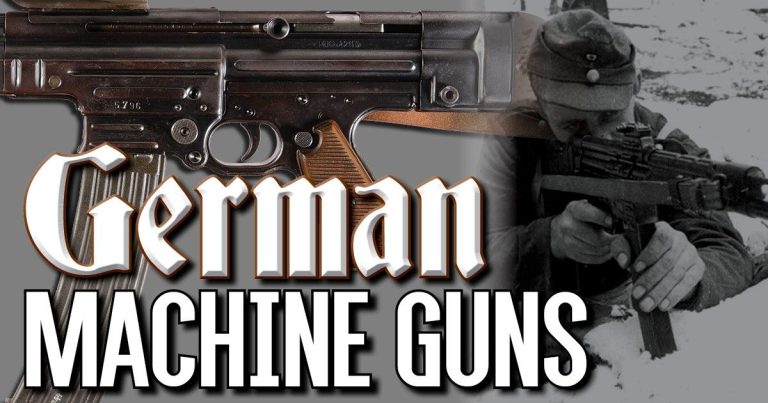
Donal D. Engen was an American commander aboard the B-24 Bomber “Deanna’s Dreamboat” starting in January of 1945. The Battle for the Recapture of Corregidor, where Lt. Donal D. Engen captured this exceptional Japanese rifle, occurred between February 16 and February 26 of 1945.

A Japanese Nagoya Arsenal Type 97 rifle with its scope, case, and a capture plaque to Lt. Donal D. Engen, Commander of B-24 Bomber “Deanna’s Dreamboat.”

Our next example, a Nagoya Type 2 Paratrooper rifle, was captured days before Japan officially surrendered. An included document signed by the consignor states, “My brother gave this Arisaka Type 2 Paratrooper rifle S/N 6754 to me in 1946 when the LST-1083 [Landing Ship, Tank] came back to the U.S. at the end of World War 2. He was an officer on the 1083, part of TF31 and the first LST to drop anchor in Japanese water on 27 Aug 1945 after the atom bomb was dropped. At 0930, 30 Aug 1945 the second LST by mere minutes to be beached at Yokosuka Navy base home of the Japanese Marine Paratrooper ‘Rikusentai’ Special Naval Landing Force with the US Marines of the 1st and 3rd Battalions of the 4th Marine division. That is where he captured the rifle.”

An exceptional find for collectors of WW2 artifacts, this Nagoya Type 2 Paratrooper rifle includes a Toyoda Automatic Loom Works marked bayonet, metal scabbard, period canvas sling, two stripper clips, and a binder containing a period photograph of Japanese paratroopers and information related to this rifle, the capturer, and LST-1083.

WW2 Issued Pistols

A wide range of sidearms were manufactured during WW2, with pistols carried by soldiers, police officers, and political leaders among the most collectible. The U.S. Colt “Transitional” Model 1911/1911A1 highlighted below includes a fascinating history to go along with its rarity.

Author Charles W. Pate lists this pistol by serial number as sold by the Benicia Arsenal in California to Robert H. Solier on January 19, 1939. Lt. Comdr. Solier was on the commander’s staff of the Western Task Force during the D-Day landings, earning a Bronze Star and the French Croix de Guerre. In August 1944, Lt. Comdr. Solier was transferred to the USS Wisconsin where he served as Gunnery Officer for the remainder of the war.

A U.S. Colt “Transitional” Model 1911/1911A1 attributed to U.S. Navy Rear Admiral (Ret.) Robert H. Solier. Other WW2 artifacts accompanying the pistol include a hard cover USS Wisconsin calendar book embossed “UNITED STATES SHIP/WISCONSIN” on the cover and featuring pictures of the crew (including Solier in the center of the second photo on page 7) and a hardcover U.S. Naval Academy year book for the class of 1933 dubbed “LUCKY BAG” with Solier’s section on page 267.

Our next example, a Walther Model PPK “Party Leader” pistol manufactured in 1939, is one of the most coveted WW2 artifacts in its genre thanks to the platform’s official status as the “Honor Weapon of the Political Leaders” for the Nazi party. The one-piece wraparound “Party Leader” grip displays at the top on both sides a large eagle clutching a swastika encircled by a wreath.

A Walther PPK Party Leader pistol with its original Walther factory box, cleaning rod, extra standard magazine, manual, and cleaning kit tin.

The Walther P38, among the first successful semi-automatic pistol models to use a double action/single action trigger, was introduced in 1939 with the Walther “concealed extractor” Zero Series of test pistols for the German Army. The example below is a “third issue” in the Zero Series and features a round profile firing pin as opposed to the rectangular profile firing pin found in the previous iterations and represents a fine opportunity for collectors of WW2 artifacts to own one of the earliest Walther P38 pistols.

An excellent WW2 German Walther Third Issue Zero Series P.38 pistol.

Our next pistol, a U.S. inspected Colt Super .38, was part of a 376 gun shipment to the warehouse and property officer at the Fowler building in Rosslyn, Virginia on 20 July 1945. The facility was a known warehouse for Office of Strategic Services (O.S.S.) equipment. The left side of the pistol frame exhibits a “G.H.D.” inspection mark while the right features a crossed-cannons ordnance marking.

An extremely rare, documented, U.S. inspected Colt Super .38 pistol shipped to the O.S.S. Warehouse, one of the most desirable WW2 artifacts for sale this August.

Guns of the Airmen

For collectors of WW2 artifacts, handguns carried into combat hold immense prestige. The revolver below was part of an order for 163 Colt Single Action Armies by the British Purchasing Commission that was shipped from Colt on June 18, 1940. The revolvers were ordered by the British as an emergency replacement for small arms lost by the British Expeditionary Force during the evacuation from Dunkirk in May 1940. The “Battle of Britain” revolvers were the last Colt SAAs ordered under a military contract.

This revolver is identified by serial number as a “Battle of Britain” SAA in ‘A Study of the Colt Single Action Army Revolver’ on page 182.

Only 500 Singer M1911A1 pistols were ever manufactured, with few retaining both the condition or the immense provenance of “The Invictus Singer.” The personal sidearm of Lt. Col. Thomas R. Moss, WW2 bomber pilot and recipient of the Distinguished Flying Cross, Moss carried the Singer M1911A1 pistol on every one of his 35 missions over war-torn Europe in the B-24 Liberator nicknamed “Invictus” by her crew.

This Singer M1911A1 pistol issued to Lt. Col. Thomas R. Moss, one of the finest WW2 artifacts for sale this August, conjoins immense history, high condition and rock solid provenance.

The German Luftwaffe equipped their pilots with luxurious firearms, including the Merkel O/U shotgun and the M30 drilling. The latter was issued to elite German pilots operating in North Africa between 1942 and 1943. In addition to serving as a survival weapon, Luftwaffe General Adolf Josef Ferdinand Gallan stated that the M30 drilling was also used by fighter pilots for trap shooting exercises intended to sharpen the eyes and reflexes. Today, the M30 drilling is one of the rarest WW2 artifacts in the field, particularly examples that include an original Luftwaffe storage case and accessories.

A WW2 J.P. Sauer & Sohn Luftwaffe survival M30 Drilling with its aluminum blue/gray painted storage case, the original boxed three-section wooden cleaning rod, a brass jag, and bore brushes.

WW2 Flight Jackets

The A-2 flight jacket, introduced as standard issue for U.S. Army flyers in 1931, has become one of the most sought-after WW2 artifacts. They were often customized and decorated with everything from the names and images of girlfriends, their plane, unit insignias, references to their home states, or other creative identifiers. Two of the three WW2 flight jackets pictured below feature blood chits intended to identify their wearer and help them obtain local assistance and safe passage if their planes have been downed.

(Right) The jacket of a crewman who flew combat cargo missions. (Center) The jacket worn by the bombardier of the B-24 bomber, “The Bull Snooker.” (Left) The flight jacket of the F-5 Lighting pilot in the China-Burma-India Theater during World War 2.

The flight jacket below, owned by SSGT Clarence E. Craver, is pictured and identified on page 274 of ‘American Flight Jackets.’ The publication states that Craver was “a radio gunner who took part in “Operation Carpet Bagger.” He flew combat missions into France, Denmark, Italy, and Yugoslavia from July 30, 1944, to April 24, 1945. He was assigned to the 15th Provisional Special Group, 859th Bomber Squadron. Originally, he was assigned to the 492nd Bomber Group then to the 15th Provisional Group, and later to the 261st Special Group. Craver and his unit were top secret.”

Few WW2 artifacts carry the history of SSGT Clarence E. Craver’s flight jacket. The jacket depicts the B-24 “Mary Jane Ace of Spades” proudly on the back, flying in a moonlit sky. After flying 50 missions, the jacket’s sleeve still bears damage from hot flak.

A painted A-2 flight jacket belonging to Lockheed P-38 Lightning pilot Joseph Scherer of the 97th Fighter Squadron, 82nd Fighter Group, is one of numerous WW2 artifacts comprising in the grouping below. Other items include an Italian made white silk scarf embroidered with the 97th FS emblem, the devil cat, a photograph of Scherer taken in front of his P-38, a dress uniform jacket featuring USAAF officer lapel insignia, a pilot wing badge, two ribbon bars, and a bullion 15th AF patch.

This grouping of WW2 aviation items includes a desirable painted USAAF A-2 flight jacket identified to Joseph Scherer, a P-38 pilot of the 97th Fighter Squadron.

Another fantastic USAAF grouping from WW2 offered this August includes a painted A-2 flight jacket, two uniform jackets, and other personal effects of Sergeant Phillip L. Fritz, who was assigned to the 827th Bomb Squadron, 484th Bombardment Group, 15th Air Force. The flight jacket features Fritz’s leather name tag and numerous painted patches and images, including a painted B-24 with 484th BG markings flying above eight flak bursts. Six of the flak bursts expose the names of European countries: Italy, Germany, Austria, Yugoslavia, Czechoslovakia, and Hungary.

This fantastic grouping of WW2 artifacts includes USAAF 827th Bomb Squadron B-24 gunner Sergeant Phillip L. Fritz’s painted A-2 flight jacket.

WW2 Flags

Flags from the conflict are another sought after genre of WW2 artifacts. The example below is a massive U.S. 48-star ensign that was flown from U.S. Navy cruiser USS Tuscaloosa during its service. The Tuscaloosa took part in Operation Torch in 1942 and was part of Task Force 125 during the D-Day invasion in 1944.

In February 1945, Tuscaloosa was part of the bombardment group supporting the invasion of Iwo Jima and was on station for the entire campaign, taking only six days to refit and resupply for the Okinawa campaign. The Tuscaloosa supported nearly the entire Okinawa campaign with target fire from her main guns while also dealing with heavy attacks by Japanese kamikaze aircraft, managing to come out unscathed.

A historic WW2 U.S. 48-star sea hoisting ensign from Cruiser USS Tuscaloosa CA-37.

The flag offered below was recovered from the city of Heilbronn, the site of a battle that raged from April 4th to April 12th in 1945, as the U.S. 100th Infantry Division engaged the remnants of the 17th SS Panzergrenadier Division. Measuring 55 inches by 71 inches, the 48-star flag shows heavy wear, with several inches lost off the fly, splitting of the stripes, and tears near the hoist, suggestive of a flag that saw extremely harsh field use and may have been abandoned as the front advanced.

A U.S. 48-star flag attributed to the 100th Infantry Division in the Battle of Heilbronn, one of the front-line WW2 artifacts for sale this August.

Our next pair of WW2 artifacts, two flags originally part of the inventory of the Cannon-class destroyer USS Levy (DE-162), saw their share of history in the South Pacific. The Levy participated in bombardment in the Marshall Islands in 1944. In August of 1945, Captain H.D. Grow of the Levy personally negotiated the Japanese surrender of Mili Atoll. On September 4th, the Levy transported USMC Brigadier General Sanderson to successfully negotiate the surrender of Wake Island.

A pair of American 48-star flags attributed to the surrender ceremonies of the Japanese Forces on Mili Atoll and Wake Island.

WW2 Patches and Memorabilia

Our next series of examples highlights a range of collectible WW2 patches and memorabilia. Below’s grouping includes numerous U.S. bomber crew patches, dog tags, aviator wings, military documents, and other items linked to Corporal George Dean of the 424th Bomb Squadron, 307th Bomb Group and Sergeant James Bollinger of the 90th Bomb Group.

A grouping of bomber patches, insignia, and other desirable WW2 artifacts.

Another grouping of fascinating bomber memorabilia, the items below are tied to the 374th Bomb Squadron, who deployed to China in 1943 and performed actions against Japanese ground and water assets. Among the WW2 artifacts included with the lot are two “flying tiger” patches, one China-Burma-India patch, an Amico-brand sterling silver bomber wings, a patch for the 374th Bomb Squadron, and a silk drape/banner with the 374th BS and Flying Tiger motifs, U.S. Army Air Force and CBI emblems, and an embroidered dragon.

A grouping of U.S. WW2 China-Burma-India theater patches and memorabilia.

WW2 artifacts from the China-Burma-India Theater are collecting rarities, and our next grouping offers items related to SACO, the Sino-American Cooperation Organization. Established in 1943, SACO served as a joint Nationalist/American operation headed up in tandem by the chief of Chiang Kai-Shek’s secret police and the commander of the U.S. Navy’s intelligence outfit in China. The organization coordinated intelligence gathering as well as training Chinese guerrilla forces operating in Japanese occupied territory.

A grouping of two unit insignia patches, a leather name tag, and a photo of United States Navy man wearing a SACO patch, and a lighter with a CBI shield on the lid.

Established in 1941, the 509th Parachute Infantry Battalion would gain the distinction of being the first American paratrooper unit to perform a live combat jump, dropping into North Africa as part of the joint U.S./British opening of Operation Torch. Later, the 509th would deploy for the invasions of Italy and Southern France, and the unit saw combat in Sadzot, Belgium during the Battle of the Bulge.

The grouping below includes eight WW2 artifacts attributed as the wartime property of a Private Edwin Solak, a Combat Medic who served with Company C and the Headquarters Company of the 509th. The grouping features a vintage picture postcard of Solak in uniform displaying the parachute tab and Fifth Army patch on his shoulder that are part of the lot. Also included is a nickel plated Combat Medic badge, a silver-finished set of jump wings, a brass badge for the French 3rd Zouave Regiment, and two versions of the unofficial but authorized “Man in the Door”/”Gingerbread Man” insignia of the 509th.

A grouping of airborne infantry insignia and memorabilia from Combat Medic Edwin Solakwith of the 509th Parachute Infantry Battalion.

The Depth of WW2 Collecting

Valuable and historic WW2 artifacts are found in all shapes and sizes, including painted metal artwork obtained from the aircrafts themselves. The example below is a 27 1/2 inch by 19 inch sheet of blue painted aluminum that depicts the original insignia of Marine Fighter Squadron VMF-222, the “Flying Deuces.” The squadron saw extensive action across the Pacific, including the Philippines campaign and the Battle of Okinawa.

This piece of painted metal artwork depicts the earliest version of the insignia for Marine Fighter Squadron VMF-222, the “Flying Deuces”, a winged “V” behind three deuce playing cards.

Rare items like the stainless steel Walther Kreigsmarine contract Germany Navy double barrel flare pistol also illustrate the depth found within the WW2 collecting field. The flare pistol was adopted in 1936 by the German Navy and accepted 25mm flares used for signaling and illumination. Many of these fascinating flare guns went down with their ships in the North Sea, and finding surviving examples in high condition is a true rarity.
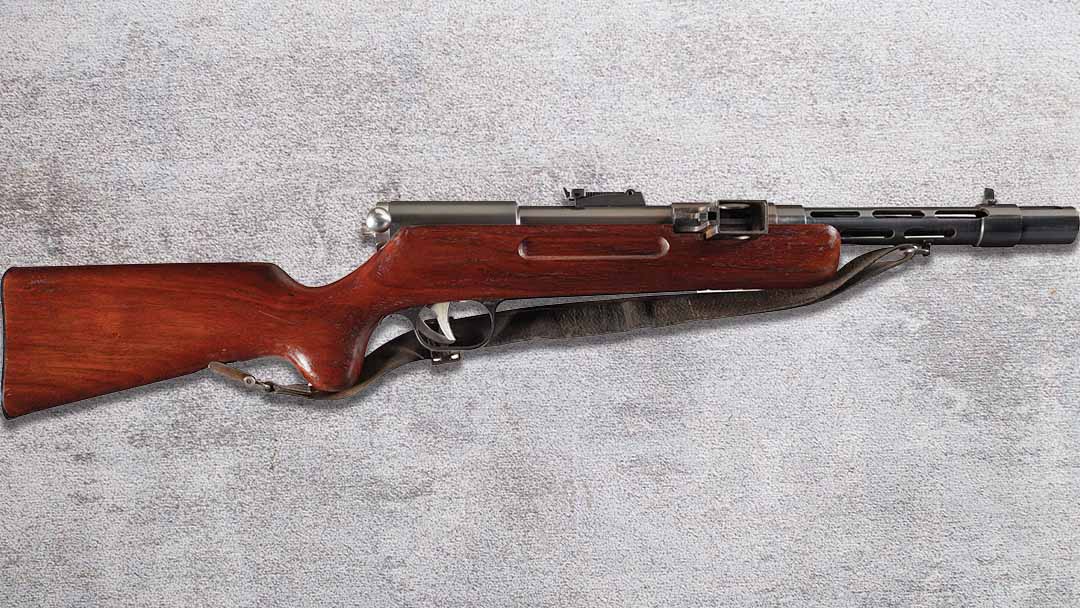
German Navy flare pistols are desirable WW2 artifacts, and this Walther Kreigsmarine contract “ac/41” code double barrel example remains in excellent condition.

Sniper scopes are another collectible class of WW2 artifacts that appeal to any collector interested in the evolution of arms technology. The USMC Unertl 8 Power sniper scope featured below is one of the approximately 2,800 scopes developed and manufactured in 1940 for the U.S. Marine Corps to be installed on 1903 National Match rifles by USMC/Navy armorers. Many of the surviving scopes were kept in inventory after WW2 and saw re-issue as late as Vietnam.

A WW2″USMC-SNIPER” marked Unertl 8 Power sniper scope with a green paint finished Bakelite field case fitted with a canvas lid retainer and belt loop, and a spring loaded interior.

WW2 saw an explosion of arms innovation, particularly in the machine gun genre. The machine guns developed during the conflict complemented the offensive tactics and rapid mobility of the era, with lightweight, adaptable platforms like the Johnson LMG and FG42 designed to serve in numerous battlefield roles. For arms collectors, military historians, and any fan of hard-hitting heavy metal, WW2 machine guns represent one of the pinnacles of the field.
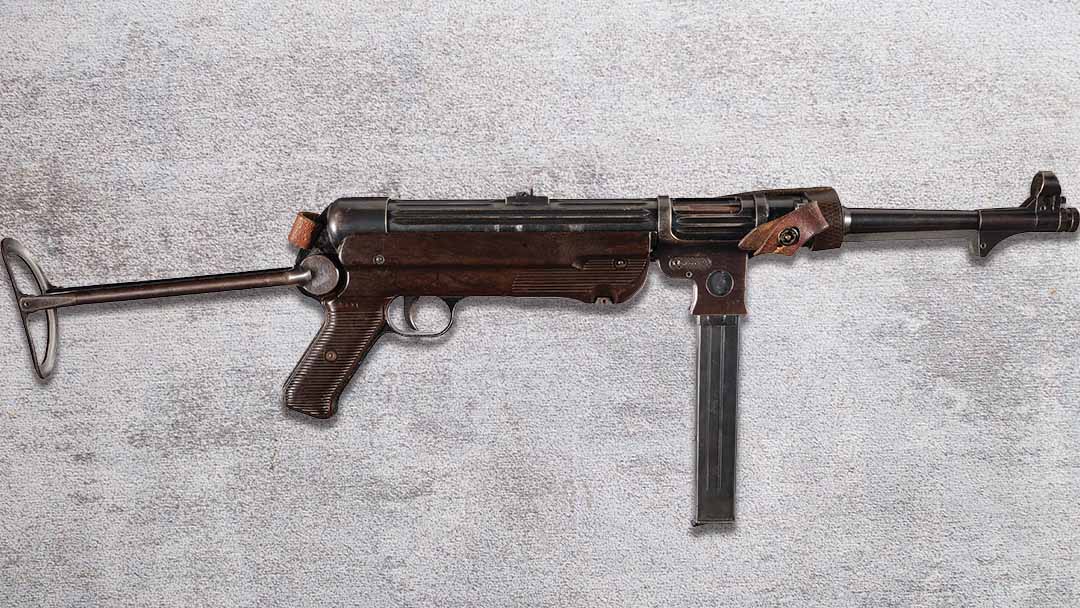
A scarce Winchester Reference Collection Johnson Automatics M1941 light machine gun. Available this August.

WW2 Artifacts for Sale

From pistols, rifles, and machine guns to flags, badges, jackets, and more, the extensive range of WW2 artifacts for sale at Rock Island Auction Company caters to every corner of the collecting field. For those interested in preserving the past and owning a part of this defining era, August’s 23 – 25 auction provides a rich and varied lineup of WW2 offerings.
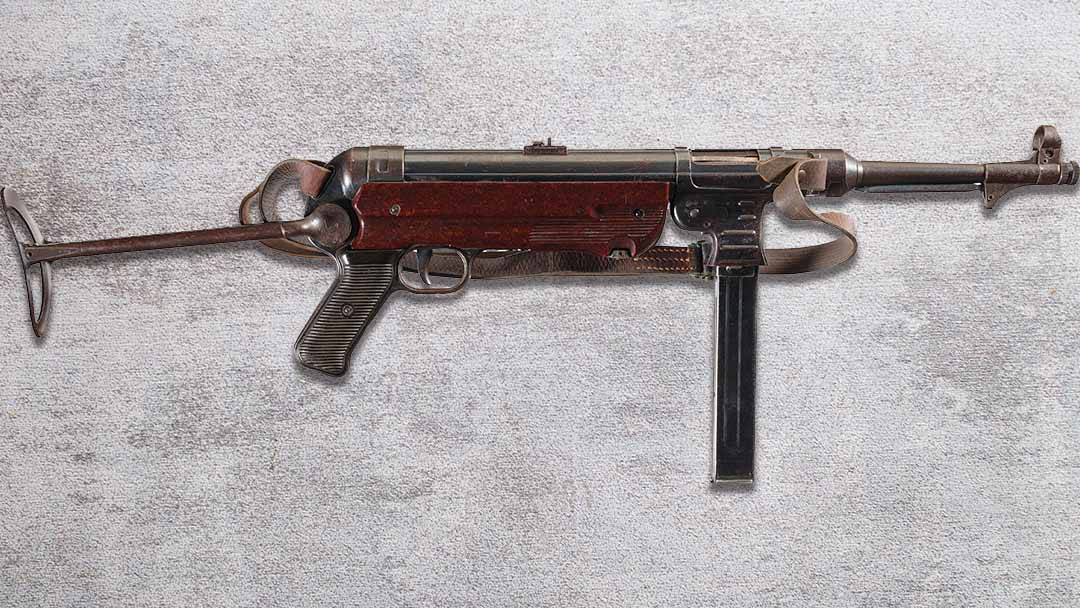
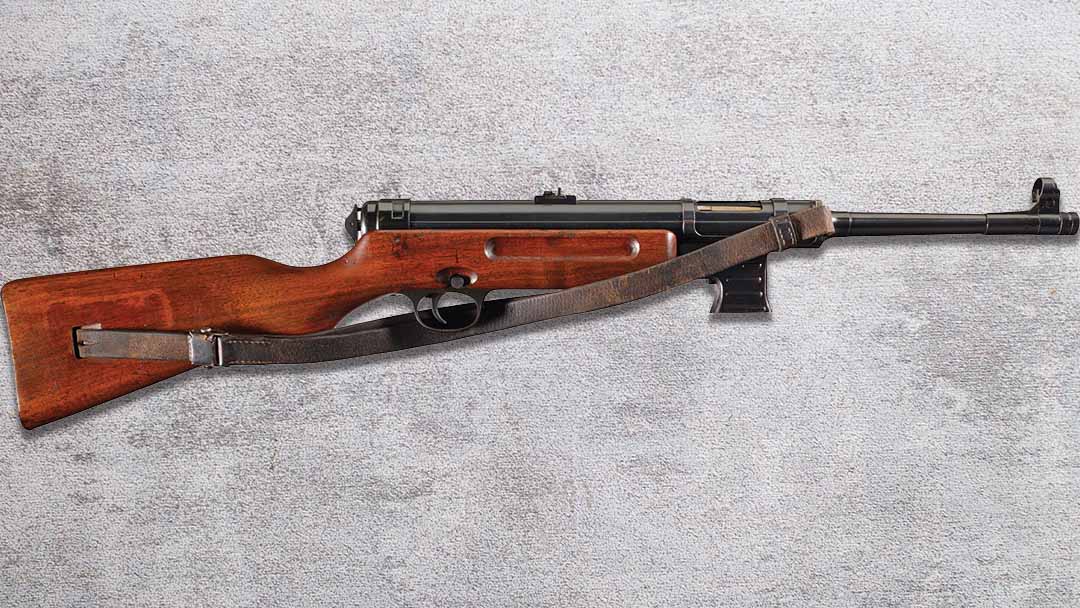
This desirable grouping of WW2 artifacts includes a scarce unit patch for the 307th Airborne Engineer Battalion and other items from the Chinese Commandos/Chinese Marauders.

Subscribe to the weekly Rock Island Auction newsletter to receive new gun blogs and gun videos that cover the most collectible WW2 artifacts and weaponry. From pieces on the the M1 Garand, the M1 Carbine, the Tommy gun, the MP40, and the PPSh-40 and 41, to unusual arms and curio like the Sedgley Fist Gun, the FP-45 Liberator, escape barter kits, aerial gunnery trainers, the Norden Bombsight, and more, we cover the Second World War in detail.

Grouping of Airborne Infantry Insignia for a 1st Lieutenant with the 509th Parachute Infantry Battalion

The EDC Tool Roll: Wiha GoBox Bit Set and Mini Ratchet

0

The EDC Tool Roll is a feature on Jerking the Trigger in which we profile various everyday-carry-worthy tools. The tools shown aren’t multi-tools but rather real tools, that by virtue of their compact size, light weight, usefulness, or unique functionality, can find a place in any range kit, emergency kit, or everyday carry bag.

Feel free to comment on the tools that you carry so we can all learn! The discussion on these posts has been very valuable so far.


I have owned this Wiha GoBox for a couple of years now. I initially held off on reviewing it because prices and availability were all over the place. At times, this kit was selling for more than $50 when it was even available. Now, they are readily available for less than I paid back then and that is great news because the GoBox kits are excellent.

If you know tools, you likely know Wiha. They make excellent quality tools and their driver bits are especially well-liked. The quality of this kit is top-notch – almost unbeatable when they cost about $30. The bits are great. The ratchet feels great in use and the included extension is shockingly nice.

The ratchet has a large, easy-to-operate direction switch and a relatively large, comfortable handle. Both of these features really stand out among other small ratchets I have used. The bit extension shows a level of design and finish that is impressive, almost out-of-place on an extension. The lock collar holds bits securely and also free spins to give the user a convenient hold point when really trying to lean into a fastener.

The real star of the show with these GoBox kits is the form-factor. The box is compact and made of steel with a secure, friction latch. There is a plastic insert that organizes all the contents with the extension nested under the ratchet. This isn’t some cheap plastic insert either. It is thick, rugged, and holds the bits very well with no signs of wearing out. This is easily the most compact kit of its kind that I have used and also the best organized.

This GoBox kit is relatively complete for my needs but yours may vary. As usual, it is easy to swap in the standard 1/4″ shank bits for the ones you need for your specific applications. I appreciate that it includes a 1/4″ drive socket adapter as these are shockingly commonly overlooked in similar kits.

Where to Buy:

I don’t have a local source for Wiha tools. Amazon now has regular stock for a number of the GoBox kits now and that is where I purchased mine: Wiha GoBox kits on Amazon.com

If it was available at the time, I would have picked the GoBox Standard kit versus the impact rated set that I have. I don’t need the impact rated bits and I prefer that bit selection on the standard kit. It’s cheaper too.

Previously Reviewed Alternatives:

  1. Alltrade/Powerbuilt Ratchet & Driver
  2. Chapman MFG Midget Ratchet and Accessories
  3. GearWrench MicroDriver Set
  4. Klein Tools 65200 Ratchet Set
  5. Prestacyle T-Handle Ratchet
  6. Topeak Ratchet Rocket Lite DX
  7. VIM Tools HBR3 Bit Ratchet
  8. VIM Tools HBR4/Prestaratchet Mini Ratchet
  9. VIM Tools HBR5 Bit Ratchet

The above links may be affiliate links.