.308 vs .30-06 Faceoff | Rock Island Auction

0

The .30-06 Springfield and .308 Winchester are two of the most iconic cartridges in American history. Both have developed faithful followings after decades of military service, hunting trips, and shooting matches, but how do these two long-range stalwarts compare head-to-head?

The .308 vs .30-06 debate is a popular topic in the firearms community, and you can find classic rifles in each chambering at Rock Island Auction Company this October.

We’ll examine the .308 vs .30-06 showdown through the decades, including the history, strengths, and weaknesses of each cartridge platform and some of the most famous firearms chambered for these classic rounds. The examples featured below are from Rock Island Auction Company’s October 4 -6 Sporting & Collector Auction in Bedford, Texas, and you can learn more about each model by clicking on the images.

.308 vs .30-06

Today, both the .308 and .30-06 cartridges top the charts with American hunters. The .308 and .30-06 both use the same .308″ diameter bullets and overlap in many areas, though the .30-06 round is nearly half an inch longer in terms of case length and has a higher case capacity. The result is the .30-06 is a bulkier round that requires a long action to operate.

The Springfield 1903 rifle, the first platform chambered in .30-06. Available this October.

The .308 is a lighter, short action round. A short action bolt throw is preferred by many shooters and allows faster follow up shots. Though bullet weights vary widely, in general the lower capacity of .308 results in less recoil.

A Christensen Arms Classic Carbon bolt action rifle chambered in .308. Includes a Nightforce Scope and box. Available this October.

While .308 is limited to 200 grains, the increased case capacity of the .30-06 allows 220-grain bullets. This translates to greater stopping power and penetration, clear advantages when taking on large game like elk, moose, and bear. .308 fans point to the round’s edge in trajectory at long distances, its perceived accuracy advantage, and shot placement being the most important factor in hunting and battlefield scenarios.

.30-06 Development

The origins of both the .30-06 and .308 date to the turn of the 20th century. Service cartridges with lighter and faster Spitzer (or pointed tipped) bullets had become the emerging trend in Europe. These rounds offered higher ballistic co-efficiencies and thus greater accuracy and flatter trajectories at range.

A Spanish-American War era U.S. Springfield Krag-Jorgensen Model 1896 saddle ring carbine. Available this October.

America’s .30-40 Krag cartridge had underperformed during the Spanish-American War compared to its 7mm Mauser rival, leading U.S. Ordnance to develop its own rimless centerfire smokeless cartridge, the .30-03 Springfield. The early M1903 rifles chambered in .30-03 were found to suffer from poor trajectory and quickly worn-out barrels thanks to excessively high pressure.

In 1903, Springfield Armory adopted a new cartridge to replace the .30 Army rimmed cartridge (or .30-40 Krag.) The initial design was not well-received.

To rectify this shortcoming, the design of the existing .30-03 cartridge was modified with a slightly shorter neck, seating a 150 grain Spitzer tipped bullet that achieved an approximate ballistic co-efficient of 0.405, muzzle velocity north of 2,700 feet-per-second, and muzzle energy of roughly 2,430 foot-pounds. This resulted in a cartridge adopted in 1906 as “cartridge, ball, caliber .30, Model of 1906”, but more popularly known as .30-06 Springfield.

This exceptional WW2 Winchester M1 Garand rifle was manufactured in June of 1945, the final production month for Winchester. Available this October.

The .30-06 Springfield would go on to become the primary rifle cartridge of the U.S. military. From the M1903 and M1917 bolt action to the semi-automatic M1 Garand and M1941 Johnson rifles, the .30-06 was a US military staple. The .30-06 cartridge also saw use in numerous automatic weapons like the Hotchkiss, Vickers, M1909, Browning M1919, BAR, and Johnson LMG.

A WW2 era U.S. Johnson Automatics Model 1941 semi-automatic rifle chambered in .30-06. Available this October.

.30-06 vs .308 in the Military

The .30-06 cartridge continued to see major use with the U.S. military into the 1970s, and is still in active use with foreign militaries today, but its role has been largely supplanted by other cartridges. The first major challenger arose in 1954 in the form of 7.62 NATO.

Two U.S. M1 Garand rifles available this October. (Top) A U.S. Harrington & Richardson M1 chambered in 7.62 NATO. (Bottom) A U.S. Springfield Armory M1 chambered in 30-06 Springfield.

Introduced as a civilian round in 1952, the .308 Winchester was touted as a shorter version of the .30-06 and was developed to increase magazine capacity, save on costs, and allow a hunter to carry more ammunition. After WW2, the U.S. military sought to replace the M1 Garand with a more modern standard that could rival the capabilities of the German STG-44 and the newly introduced AK-47 but still chamber a .30 caliber round. The .308 Winchester presented a blueprint for what would become the 7.62 NATO.

The 7.62 NATO offered similar ballistics to its .30-06 predecessor, its shorter case allowed it to be chambered for a short action, and its lighter weight meant a soldier could carry more rounds. Adopted in 1957, the M14 became the U.S. Army’s first standard issue rifle with select-fire capability. NATO platforms like the FN FAL and G3 would also chamber the round.

An early production pre-ban Springfield Armory Inc. M1A semi-automatic rifle chambered in .308. This example was made with USGI parts after the company was relocated to Geneseo, Illinois in late 1974. Availabe this October.

Though changes in U.S. military doctrine would soon favor the M16 and its smaller 5.56 chambering over the 7.62, the larger round continued to see broad battlefield application with marksmen and snipers with platforms like the M40 and M21. Meanwhile, the 7.62 cartridge’s civilian sibling was taking off in the hunting market and the world of competitive shooting.

A post-Vietnam era assembled Remington M40 pattern bolt action sniper rifle with a Redfield M40 type sniper scope, chambered in .308. Available this October.

.308 vs .30-06 in the Sporting Market

In Townsend Whelen’s 1918 book ‘American Rifle,’ the famed soldier, author, and outdoorsman declared “The .30-06 is never a mistake.” The same capabilities that had made the .30-06 such an efficient battlefield round also translated to the sporting market. The cartridge has brought down every medium-sized and large game animal in North America and has a more nearly twelve decade track record of success.

A U.S. Springfield Model 1903 NRA Sporter rifle in .30-06. Manufactured in 1932, this example includes a hooded blade front and Lyman peep rear sights. Available this October.

“The .30-06 is the quintessential classic hunting round,” declares Matthew Peake, Rock Island Auction Company’s Digital Marketing Director. “When people like Ernest Hemingway and Townsend Whelen rely on it you know you can too. I took this Bull Elk with a Remington 700 chambered in 30-06 and self-loaded 180 grain Nosler Accubond bullets.”

“I have used a 30-06 and many bullet weights to take medium and large game all over the United States and have never been disappointed with its terminal performance,” Peake recounted.

The .308 hit the scene in 1952, the same year the Winchester Model 70 Featherweight was introduced. The Winchester Model 88 lever action rifle chambered the cartridge upon its release in 1955, and it wasn’t long before nearly every sporting arms maker was manufacturing rifles that could fire the round. In 1966, the first Ruger No. 1 single shot rifle that left the factory was chambered in .308.

A 1956 manufactured Steyr Mannlicher-Schoenauer Model 1956 full stock bolt action rifle in .308. Available this October.

“The .308 is a perfect round for African plains game,” Joel Kolander, Rock Island Auction Company’s Interactive Production Manager, attests. “I used Hornady ELD-X 178 gr and took more than one critter at 450+ yards.”

The .308 is a proven round for both the whitetail woods and the African savanna.

Continual improvements by both military and civilian circles have resulted in a wide range of loadings for both the .30-06 and .308 cartridges. Each of these .30 caliber all-stars has options ranging from lighter 110 grain variants to 200 grain workhorses, tailored for a variety of ranges and animal sizes. As mentioned earlier, the ability of .30-06 to accept 220-grain bullets means a higher sectional density thus superior penetrative power. Both rounds are more than capable of ethically harvesting a bull elk in the hands of an experienced hunter, however.

A Cooper Arms Model 54 bolt action rifle with its box, chambered in .308. Available this October.

.308 vs .30-06 Accuracy

Accuracy is one of the most contentious topics in the .30-06 vs .308 comparison. When .308 first hit the scene, the short action and lower recoil was predicted to result in higher accuracy rates and improved shooting fundamentals. Competition results in the 1950s supported those assertions. Despite decades of improved rifle technology and ballistics tightening the gap between the two rounds, .308 continues to hold the edge in competitive shooting.

An Ed Brown custom bolt action rifle with a Nightforce scope, chambered in .308. Available this October.

Gunnery Sergeant Carlos Hathcock, the most famous sniper of the Vietnam era, earned most of his 93 kills with a Winchester Model 70 rifle in .30-06. Three decades later, ‘American Sniper’ Chris Kyle employed a number of rounds in Iraq, including .300 Win Mag and .338 Lapua, but his favorite target shooter in civilian life was a George Gardner Precision Gladius rifle in .308.

At age eight, Chris Kyle first learned to shoot with a Model 1903 chambered in .30-06, a round he praised as the ultimate long range specialist in his book ‘American Guns: A History of US Firearms.’ Kyle knew better than anyone that the most important factor in the .308 vs .30-06 debate was the shooter behind the scope.
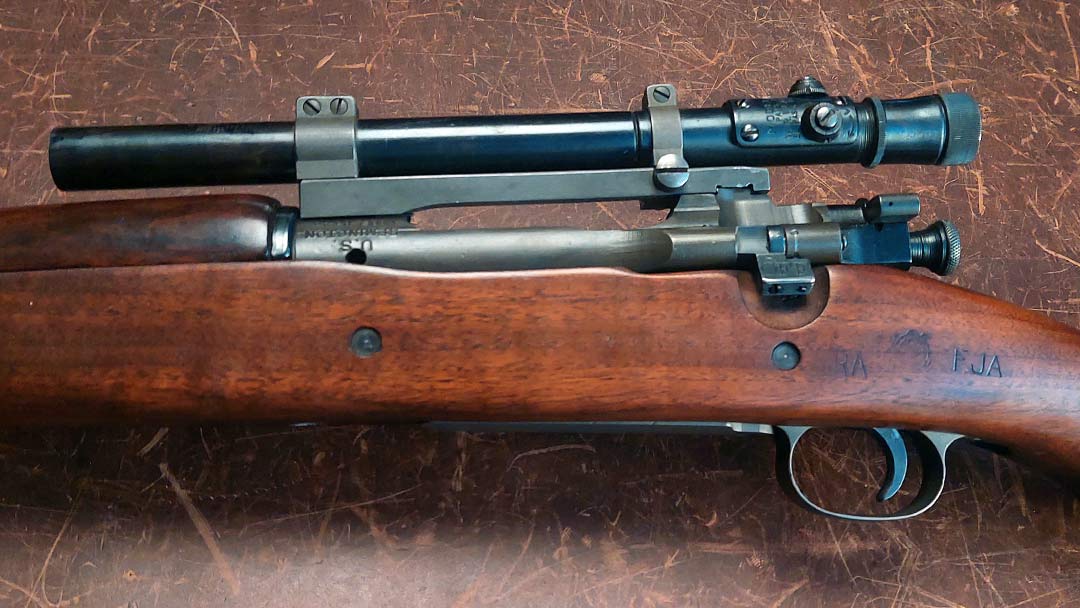
A U.S. Remington 1903-A4 sniper rifle with a Weaver 330 scope. Available this October.

.308 vs 30-06 Today

Due to their continued popularity and decades of use, both the .30-06 and .308 are chambered in a plethora of rifle types, from budget options, valuable curio pieces, sporterised examples, and everything in between. The .30-06, with its more than four decades head start, holds the edge when it comes to classic milsurp like the Model 1903, M1 Garand, and Johnson rifles, while the .308 can be found more frequently in modern semi automatic options.

A Colt Model LE901-16S semi-automatic modular carbine with case, chambered in .308. Available this October.

In the .308 vs .30-06 showdown, the smaller .308 tends to hold a slight advantage when it comes to cost. At the time of writing, Federal Premium advertises a box of 20 Gold Medal Sierra MatchKing 168 grain .30-06 rounds for $53.99, with the same brand of 168 grain .308 cartridges priced at $52.99. While this difference is insignificant to the average hunter, the cost could add up for the competitive or recreational shooter.

Both rounds offer countless weight and propellant options and are accommodating to handloaders looking to squeeze as much speed and energy out of their chosen cartridge.

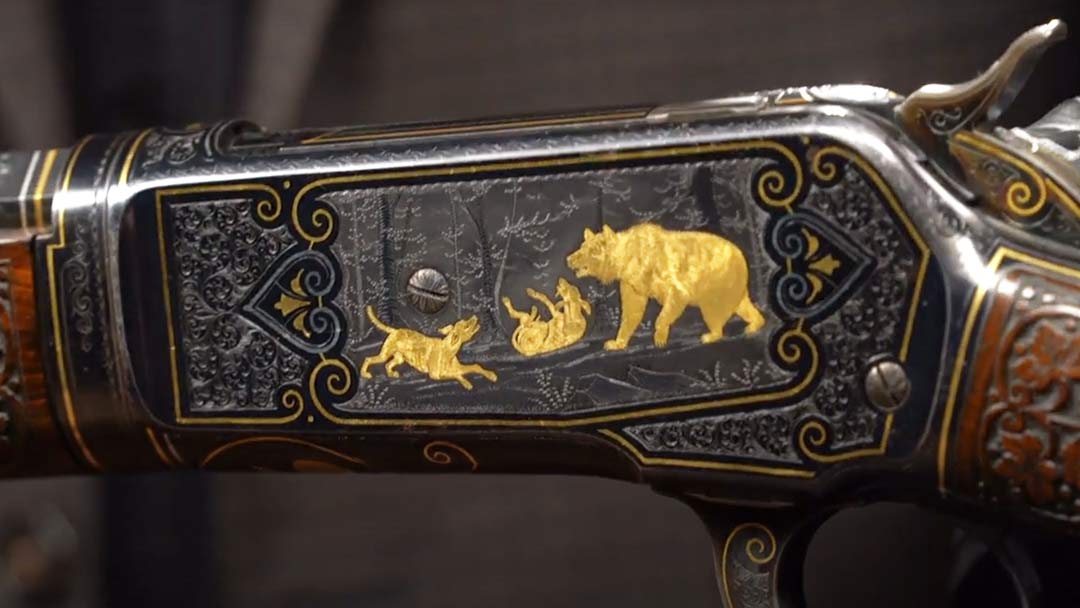
A T. Naka signed, engraved, and gold inlaid Browning Model 1895 “One of One Thousand” lever action rifle, chambered in .30-06. Available this October.

.308 vs .30-06 Showdown this October

Both .30-06 and .308 have a long history of serving America and its allies in a military role, contributing to the collectability of platforms like the M1 Garand and M40. When it comes to target shooting and putting meat in the fridge, each of these long-range specialists are time-tested rounds, and the rarest and most collectible, curio, and modern examples of firearms chambered in either cartridge can be found at Rock Island Auction Company.

Two upgraded pre 64 Winchester Model 70 rifles. (Top) A 1946 manufactured example with a replacement barrel chambered in .308 Winchester. (Bottom) A 1942 example chambered in .30-06.

Final word in the .308 vs .30-06 debate? The answer ultimately depends on the shooter. While some firearm enthusiasts will develop a clear favorite, there’s no need to choose between the two since there’s no such thing as owning too many guns.

A U.S. Johnson Automatics Model 1941 semi-automatic rifle. Available this October.

Subscribe to the weekly Rock Island Auction newsletter to receive new gun blogs and gun videos that dive deeper into the stories behind America’s most iconic rifles. From early American classics like the Kentucky and Hawken rifles, the Henry, Spencer, and Sharps rifles of the Civil War, to the Springfield Trapdoor, the immortal M1 Garand, and modern classics like the Stoner 63 and M82 sniper rifle, we examine American longarms through the ages.

Find 20th century rifles for sale and more this October at Rock Island Auction Company.

Colts Witnessed History | Rock Island Auction

0

Samuel Colt’s firearms are interwoven into American history, from the Walker percussion revolver of the Mexican-American War to the Model 1911A1 of World War 2, worn on the hip as witnesses to major events.

The legendary Colt Single Action Army became part of the fabric of the American West, but lesser-known revolvers like the Model 1902 and Commando played a role in continuing the American way of life. This is a sampling of Colt handguns that stood at the edge of history, all available in Rock Island Auction Company’s Oct. 4-6 Sporting & Collection Auction.

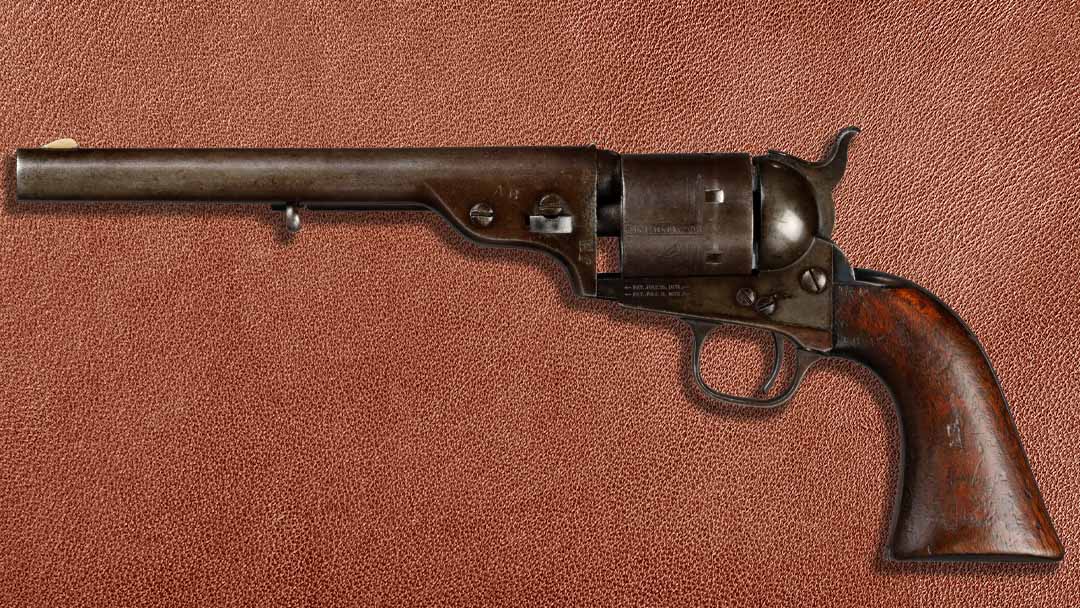
Colt Fluted Cylinder Model 1860 Army Revolver

Ohio Gov. William Dennison was a strong supporter of Abraham Lincoln’s war plans and his call to arms at the outset of the Civil War mobilized more than 100,000 troops. He also ordered telegram and railroad lines seized for the Union cause. He refused demands by Kentucky and Virginia authorities to return fugitive slaves or punish residents who violated the Fugitive Slave Act.

Dennison sent troops to Wheeling to provide protection where a convention was underway to discuss creating the state of West Virginia from Virginia. Lincoln asked him to fire Gen. George McClellan as general of the Union Army and demoted back to the Army of the Potomac, but the general refused to meet with Dennison and he learned of his demotion through the newspapers.

This Colt fluted cylinder Model 1860 Army was one of 200 shipped to Dennison in Columbus, Ohio on June 14, 1861. A second shipment, this one of 300 1860 Army revolvers, also shipped the same day to Dennison. Not renominated for governor, Lincoln appointed Dennison U.S. Postmaster in 1864.

Of more than 127,000 Colt Model 1860 Army revolvers made, only 4,000 fluted cylinder revolvers like this one were made. This revolver is one of 200 sent to Ohio Gov. William Dennison in June 1861. A second shipment of 300 was sent to the governor the same day.

Colt Model 1871-1872 Open Top Single Action Revolver

The Colt Open Top is to the Colt Single Action Army what Wally Pipp was to Lou Gehrig, a footnote that gave way to legend. The Open Top was among the first Colt revolvers manufactured to fire metallic cartridges, chambered in .44-23-200. The Army didn’t like that it lacked a top strap, a carryover from percussion cap and ball revolvers. Also, the Army wanted a .45 caliber handgun. Colt engineers returned to the drawing board and came back with the New Model Army Metallic Cartridge Revolving Pistol – and the Single Action Army was born.

One of about 7,000 made, this Colt Model 1871-72 Open Top revolver is period stamped “AB” on the left side of the barrel and both sides of the grip and “JH” on the left side of the barrel lug, though their significance is unknown.

Colt Single Action Army

The Colt Single Action Army, SAA, Peacemaker, The Great Equalizer and “Judge Colt and his Jury of Six,” are among the name and nicknames handed down to this legendary sidearm over three generations. Single Action Army production began in 1874 and ended as Colt turned its focus to government orders during World War 2.

With the rise of the western in movies and on television, manufacture of the second generation Single Action Army resumed in 1956 and ran until 1974. The increase in cowboy action shooting revived interest in the SAA yet again, and production returned in 1976 and continues today. More than 450,000 Single Action Army have been made.

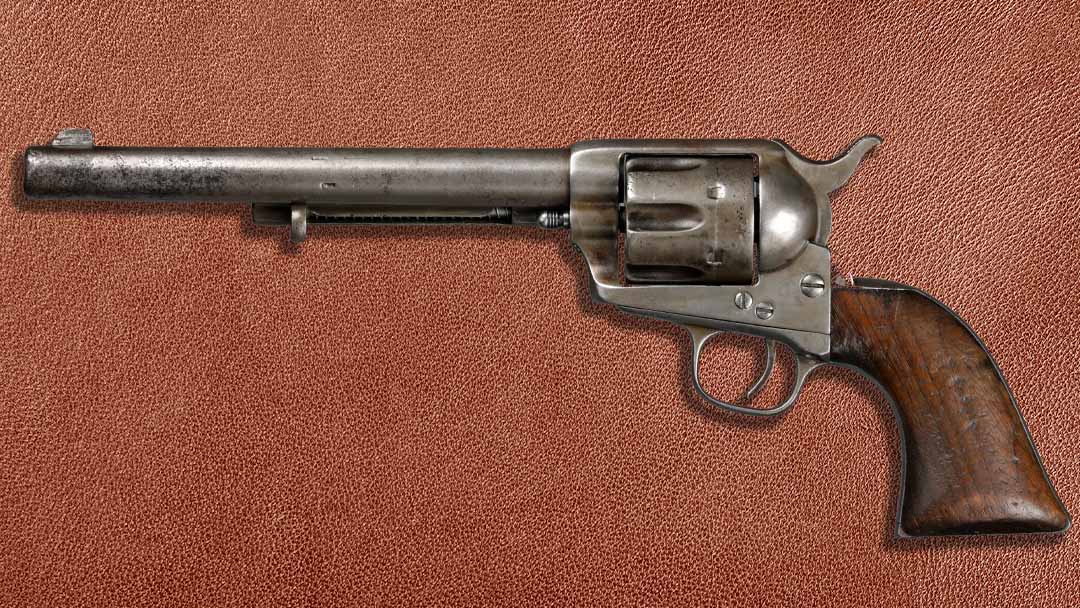
This Colt Single Action Army is cited in “Cavalry & Artillery Revolvers, A Continuing Study,” by John Kopec and H. Sterling Fenn on page 280 as among a grouping of “Historically Associated Seventh Cavalry Revolvers.”

George Armstrong Custer and the Battle of Little Big Horn have been inexorably tied to the Single Action Army as an important cavalry sidearm and its use in the Indian Wars that followed the Civil War. It was as one of the commanders of the 7th Cavalry that Custer led the men on the Yellowstone Expedition to survey a Northern Pacific Railroad line and the Black Hills Expedition that confirmed the presence of gold there and unleashed white settlers on Native American land.

Another American historical figure tied to the Colt Single Action Army was Theodore Roosevelt. The president was an enthusiastic outdoorsman and hunter who loved the American West. A Colt Single Action Army he owned was sold by Rock Island Auction in 2020 for $1.466 million.

George Thompson, one of Roosevelt’s soldiers in the 1st Volunteer Cavalry – better known as the Rough Riders, was issued a Colt Single Action Army on June 20, 1898. The Rough Riders are the best-known U.S. military unit from the brief Spanish-American War. The Rough Riders fought their way up Kettle Hill during the Battle of San Juan Hill, the most widely known action of the conflict.

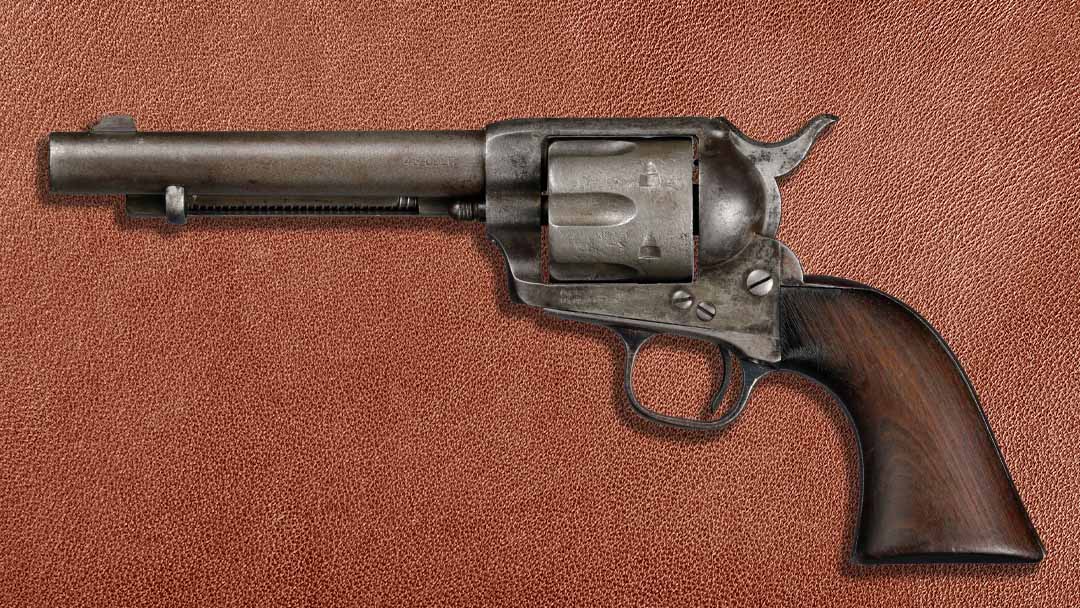
National Archives records show this Colt Single Action Army issued to George Thompson of the U.S. 1st Volunteer Cavalry, the Rough Riders, on June 20, 1898, according to Kopec.

The Colt Single Action Army was carried by lawmen and outlaws alike as people embraced Manifest Destiny and went west, but by the end of the 19th century, the west was nearly settled but still had plenty of lawlessness. For example, Fleming Parker, an Arizona outlaw robbed a train in February 1897 near Peach Springs and was on the run for about a week before he was arrested. He escaped and committed a murder during his time on the lam. Captured again, he was tried for the murder and hanged.

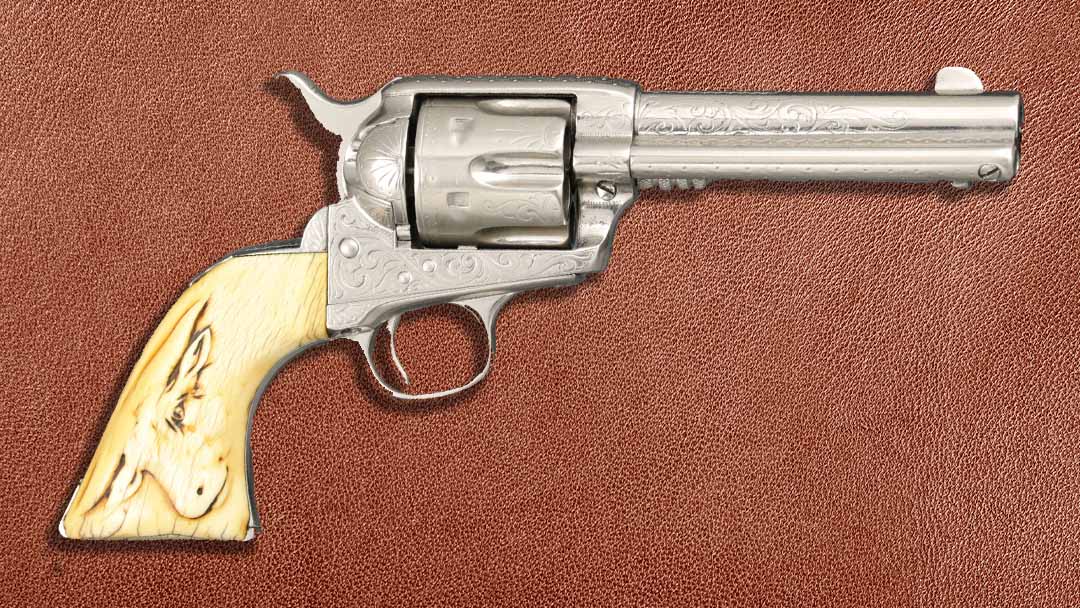
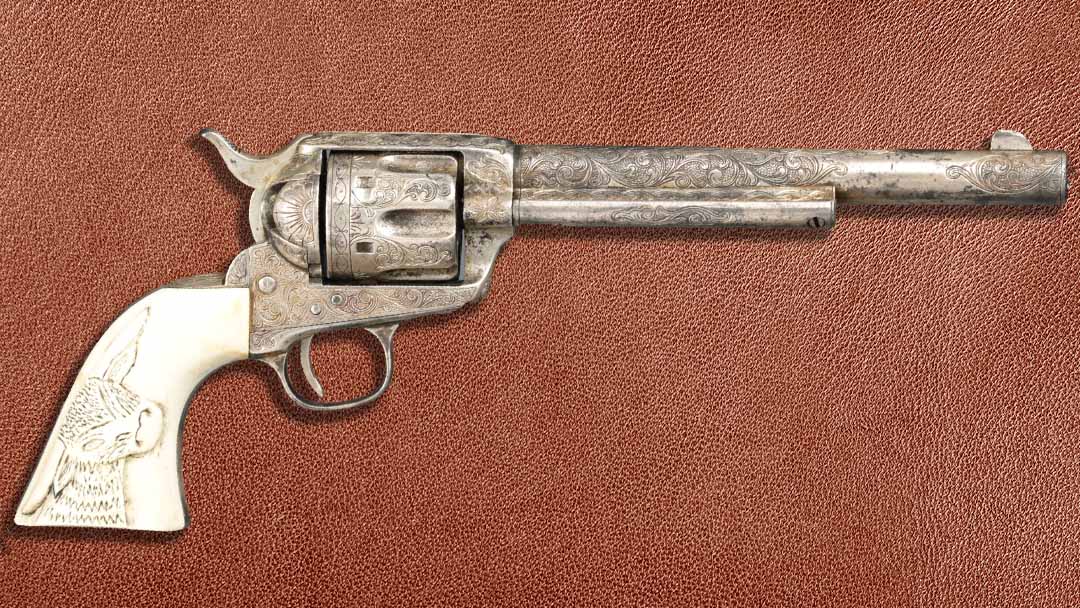
This Colt Single Action Army was shipped to the Arizona Territory in February, 1897. Chambered in .45 Colt, it has a nickel finish and ox head relief carved grips and factory engraving.

As the Wild West was tamed, dime novels and news reports about cowboys and Indians, desperados and lawmen created interest in the way of life, and shows by Buffalo Bill Cody, Pawnee Bill and the 101 Ranch brought rootin’ tootin’ fun, trick shooting, gun fights and wild animals to parts of the country yearning to see this part of America brought to life.

The 101 Ranch was a sprawling outfit spread across four Oklahoma counties in the early 20th century that raised cattle, grew crops and offered a popular Wild West Show both at home and on tour. The ranch even had a film company that brought the cowboy life to early Hollywood. Photos of the time show Apache warrior Geronimo featured at one show as well as American Bison, trick riding, a turtle race and elephant rides.

This silver-plated black powder Colt Single Action Army with relief steer head carved grip is inscribed to 101 Ranch elephant trainer Zelma Zimmerman. She is listed as an elephant worker as well as a trick rider and roper in the 101 Ranch’s Real Wild West and Great Far East 1925 season booklet.

U.S. Colt Model 1878/1902 Philippine/Alaskan Revolver

The U.S. Army found itself embroiled in the Philippines after the Spanish-American War left the United States with a colony in the Pacific Ocean. Facing guerilla tactics and fierce Moro fighters, soldiers and officers learned their .38 caliber revolvers didn’t have the stopping power needed. Many soldiers reached for their Colt Single Action Army revolvers, while the military contracted with Colt for a double action, .45 caliber revolver.

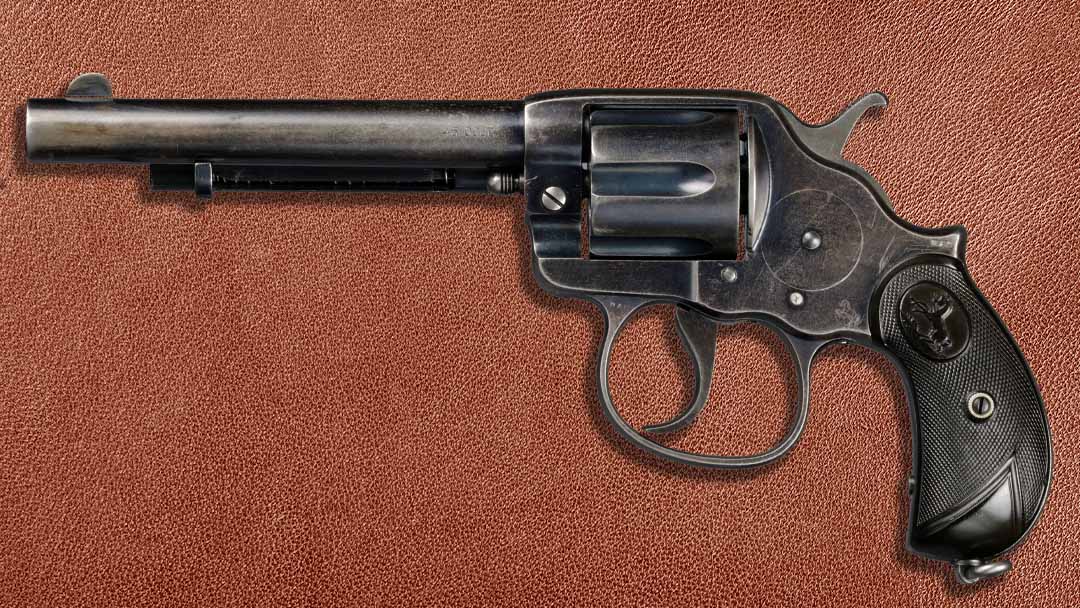
Revisiting the double action Model 1878 that became the 1878/1902, the military wanted a sturdier gun. The 1878/1902 received a stronger trigger spring that, in turn, made for a heavier trigger pull. To make the pull easier, the trigger was extended, requiring a much larger trigger guard. The gun’s Alaska designation is a misnomer that came about with the claim that it could be fired while wearing gloves because of the larger trigger guard.

The United States finally defeated the insurgents at the battle of Bud Bagsak on June 15, 1913, after wiping out nearly all of the Moro fighters.

The Colt Model 1878/1902 Philippine/Alaskan revolver chambered in .45 Colt was intended for the Philippine constabulary and bears the inspector markings “RAC” and “JTT.”

Colt Model 1911

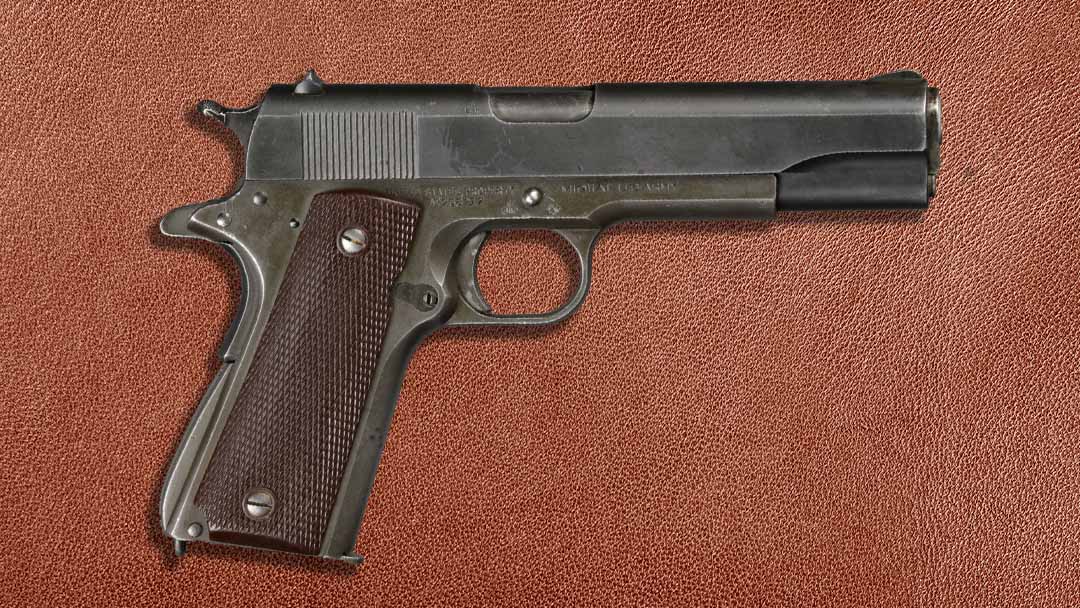
The Colt Model 1911, undefeated in two world wars, is John Moses Browning’s workhorse design. While most American gunmakers disregarded the rise of automatic pistol designs in Europe, Colt saw that a reliable automatic pistol could rival the revolver.

During the testing process, Browning’s design went through several iterations before reaching the legendary pistol  adopted in 1911. The recoil operated gun was designed to take .45 ACP ammunition. The 1911 has had the longest production run of any automatic pistol. Slight external changes were made to the 1911 after World War 1 to make it easier to shoot by soldiers with small hands, designating it the M1911A1, as well as the commercially available Government Model.

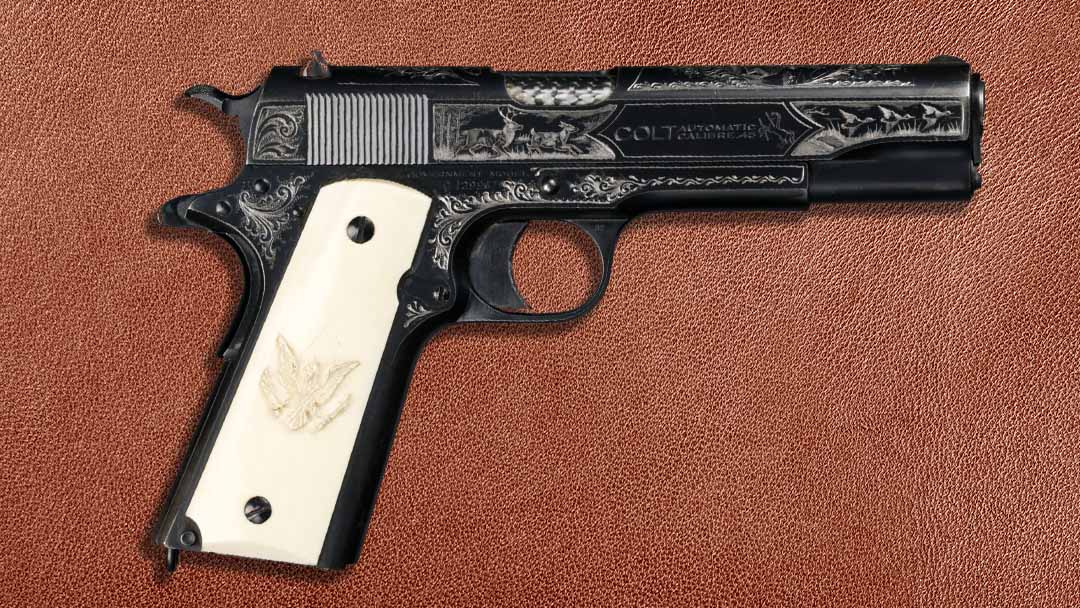
This Government Model manufactured in 1922 is still in the M1911 configuration and has light floral motifs on the frame and slide, while the slide has a bear game scene on the left, a cowboy on top and three ducks and two deer on the right side. The grips have the Great Seal of the United States.

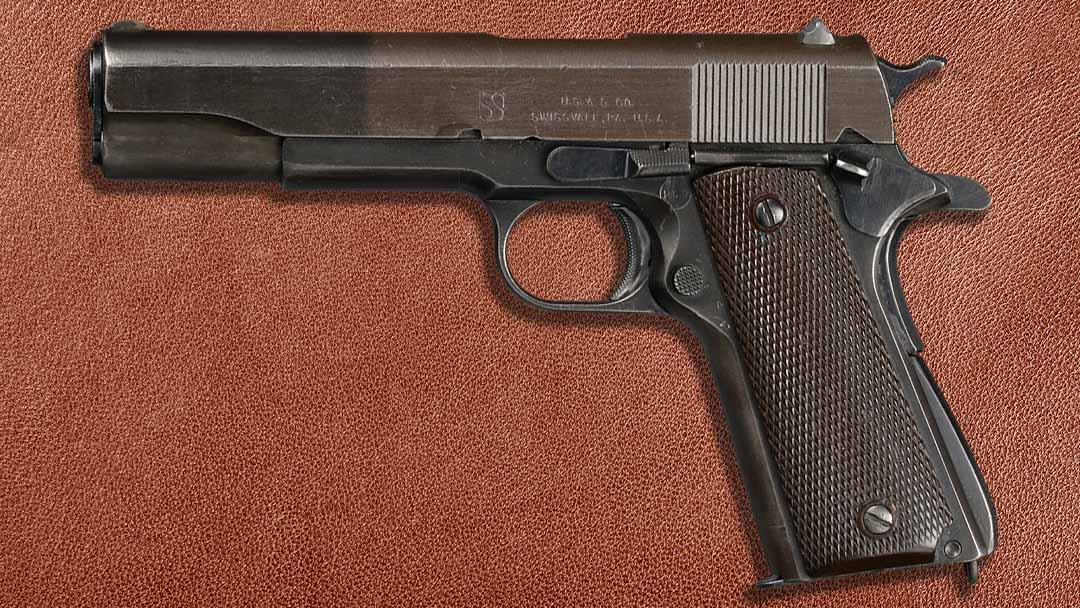
Colt was the only maker of the 1911A1 until World War 2 in 1941, producing about 7,600 during the interwar years. Difficulties in production volume proved to be a problem during World War 1, and the fear was it would occur again. Singer Sewing Machine received what was called an educational contract to determine if it could tool up for mass production of 100 pistols per hour. The company made 500 but never achieved the production goal. Instead, Singer machined precision parts for aircraft navigation and bombsights as part of the war effort, making its pistols very rare and highly collectable.

During World War 2, the 1911A1 wasn’t just used by U.S. soldiers but many Allied forces starting through the Lend-Lease Act. Singer’s tooling went to Remington Rand which was one of the companies contracted to manufacture the 1911. Remington Rand made 1.03 million, while Colt turned out 480,000, Ithaca made 370,000 and Union Switch and Signal produced 55,000.

This Union Switch & Signal Model 1911A1 with a holster was manufactured in 1943 and has “HS” and “P” markings on the sides of the lug.

By 1944, the United States was producing 60 percent of all munitions used by the Allies. The British issued about 40,000 1911A1 pistols to its military, primarily to commando and parachute units. In four years, American industrial production doubled.

“It is not enough to turn out just a few more planes, a few more tanks, a few more guns, a few more ships than can be turned out by our enemies,” he said. “We must out-produce them overwhelmingly, so that there can be no question of our ability to provide a crushing superiority of equipment in any theatre of the world war,” President Franklin D. Roosevelt said not long after Pearl Harbor.

This U.S. Colt Model 1911A1 has British proofs and National Match markings on the chamber hood of the barrel.

Colt Commando Double Action Revolver

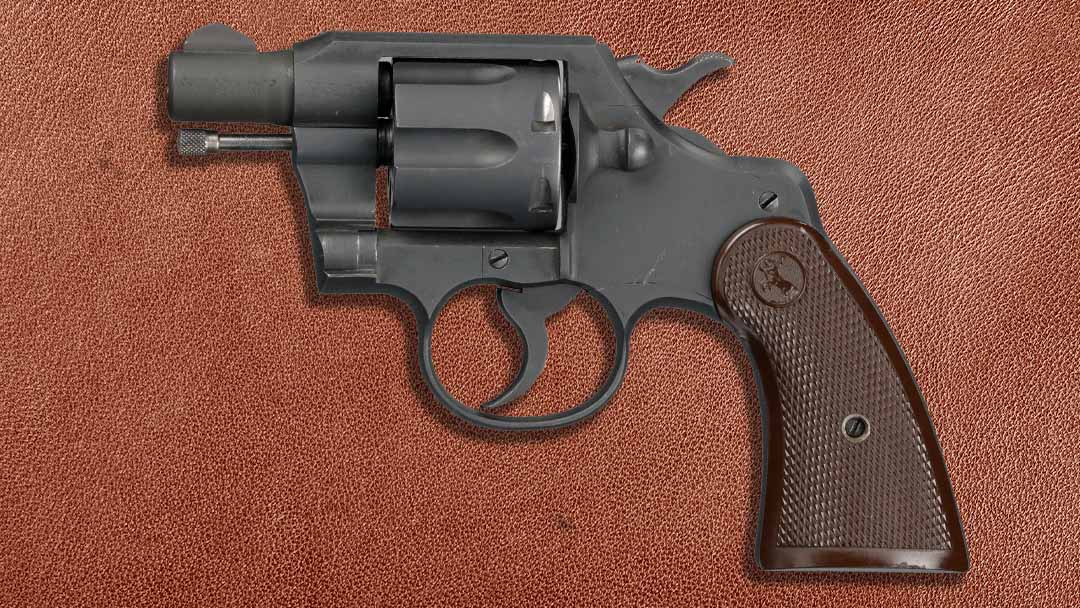
The U.S. government hustled to feed, outfit and arm a military that would grow to more than 12 million personnel by the time the war ended, but couldn’t ignore the homefront, either. Police, factory guards and security guards needed to be armed, too. Colt started producing the Commando model with the four-inch barrel for civilian use in these roles, delivering more than 50,000 during the war. Of those, about 3,450 had two-inch barrels and are often referred to as the Junior Commando.

According to its factory letter, this Colt Commando initially sold to the U.S. Government and shipped with a four-inch barrel to the U.S. Maritime Commission in Charlotte, N.C., on July 12, 1944 as part of a 1,166 gun shipment. Currently it is configured with a two-inch barrel.

Colt New Frontier Revolver

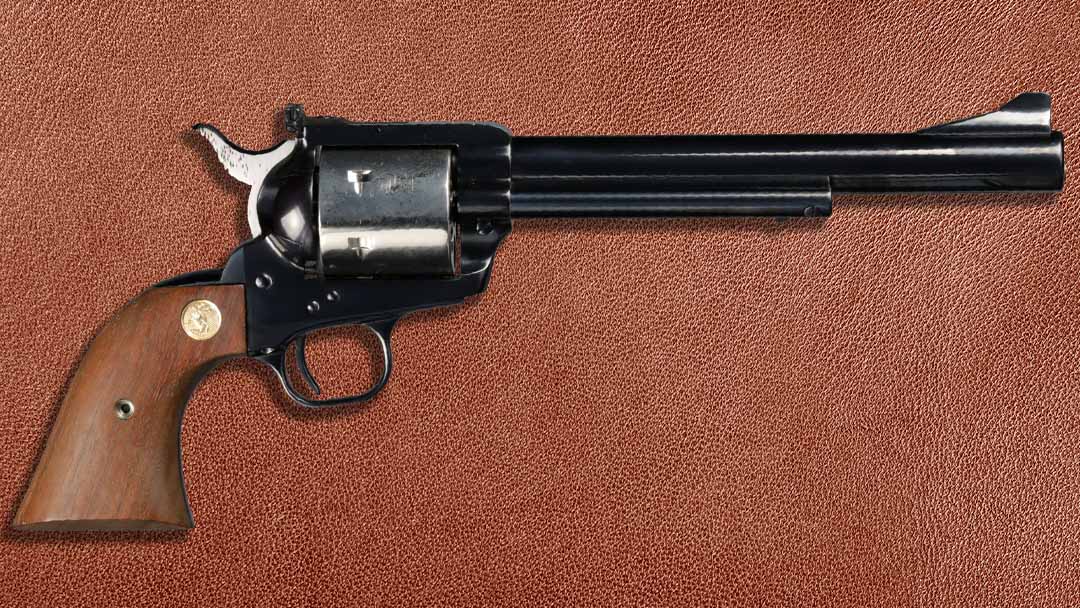
John F. Kennedy’s presidential campaign slogan was “We stand at the edge of a New Frontier,” and Colt claimed the name for its second generation Colt Single Action Army target pistol. Made with a flat top frame with adjustable sights and a wider hammer and trigger, about 4,200 were manufactured in chamberings of .38 Special, .357 Magnum, .44 Special and .45 Colt.

This Colt New Frontier revolver was one of 25 experimental prototypes chambered in .44 Magnum to determine whether the gun could handle the pressures of the high-powered cartridge. The included factory letter warns these revolvers shouldn’t be loaded or fired.

Colts for Sale

Colt knows history and its conflicts, from the Mexican American War, to the Civil War, to the Indian Wars, to the War to End All Wars, and World War 2, through the Colt Walker, 1860 Army, the Single Action Army, and Model 1911 and other less well-known models. These handguns were there to help shape American history and they are available in Rock Island Auction Company’s Oct. 4-6 Sporting & Collector Auction.

Your Credit Cards and ID’s Are Not Safe

0

I traveled all over the Gulf Coast working for 34 years and never gave any thought to or worried about ID theft until approximately 3 weeks ago. Fortunately, there was no foul-play involved and we were alert enough to immediately catch the issue and take measures to prevent future credit card and/or ID theft.

The story – My wife and I were at a local doctor’s office and were finishing up the office visit with the co-pay at the front counter. As the office manager typed in the charges for the credit card machine before we had presented her with a credit card, the machine started completing the transaction. We all immediately realized what was happening and the manager quickly cancelled the transaction. After some serious and quick investigating we determined my wife was three to four feet away from the card reader while where I was standing my billfold was approximately 12–15 inches from the credit card machine on the opposite side of the counter partition. We determined it was reading my cards in my billfold – scary! This hadn’t happened prior to today to our knowledge – and now it won’t happen again.

Once home I started researching RFID and NFC (Radio Frequency IDentification and Near Field Communication) to learn how to block readers from obtaining our credit card and other info. I learned that some RFID readers can collect RFID information from up to three feet (1 meter) away. Some more intelligent and sophisticated hackers can collect information from up to ten feet (3 meters) away, meaning you could be in a store, mall, shopping center, etc. just walking around shopping and have your information read and stolen by someone passing close by.

As a rule, I don’t usually recommend products because if they don’t work for you, I don’t want to be blamed. However, after reading numerous articles on RF Blocking wallets, sleeves, and cards, I decided we needed RFID and NFC blocking cards due to their versatility over the wallets and sleeves. The cards are credit card sized and are used to sandwich your credit cards in your wallet, billfold or purse. After several hours of reading research and videos, I chose the Slimliang RFID & NFC Blocking Card (see photo). It came highly recommend by several high-tech engineers. They have two options, white or gold writing. I chose the gold and ordered a set of four cards from Amazon for $8.50 plus local tax and got it to our door for less than $10 total in two days.

It works by creating an active electronic field surrounding the card using an embedded microchip which makes your credit cards invisible to all 13.56 MHz credit card machines. I now carry two cards in my billfold in the folding money section, allowing the blocking cards to sandwich my credit cards, ID cards, and licenses when closed and in my back pocket as suggested. My wife keeps two in her purse in the same configuration.

Testing – Testing was fun. Every store I’ve been to the last week (and I visited stores I’ve never shopped before just for fun) has been a testing ground for the blocking cards. For the record, I asked the store employees if it’s alright to check the blocking card on the store card readers. Everyone was curious and happily complied with my request; the RF blocking card blocked every attempt when tested. I even managed to lock up one reader at a nearby neighborhood store. I also tested the blocking cards using my cell phone by downloading “NFC TOOLS” from the Google Play Store and followed the directions. I turned my mobile device’s NFC scanning capabilities to “On” and scanned my credit cards and wallet without the blocking card and then with it to determine if it’s working. If the blocking card is working it will block or scramble the data from being read. The blocking cards passed these tests also.

When testing with actual card readers in the stores and using the NFC TOOLS app, I checked each card machine with the blocking card and without. Our testing showed it doesn’t matter if the credit card chip is on top or bottom of the blocking card – just being with the credit card no information was exchanged.

The Results of Testing RFID Blocking Cards

I tested this card all over and it passed every time. It’s always on guard and protecting my credit card information. My credit cards can only be read when they are removed from my billfold and away from the RF Blocking cards. Its credit card size, works without a battery, and protects against both RFID & NFC signals. The orientation of the blocking card doesn’t matter. They are not expensive.

Fun fact – While researching I realized that the RF signal from the credit card scanner is energizing the embedded blocking chip. What’s comical to me, is by working properly, the card scanner is actually causing the blockage of data it’s seeking.

I think the next test for fun is to see if my phone will detect and/or interrogate our dog’s ID chips and will the card block it.

                                                                             Jim Jones – KC5DOV

Federal Overreach is Destroying Off-Roading and Public Land Access

0

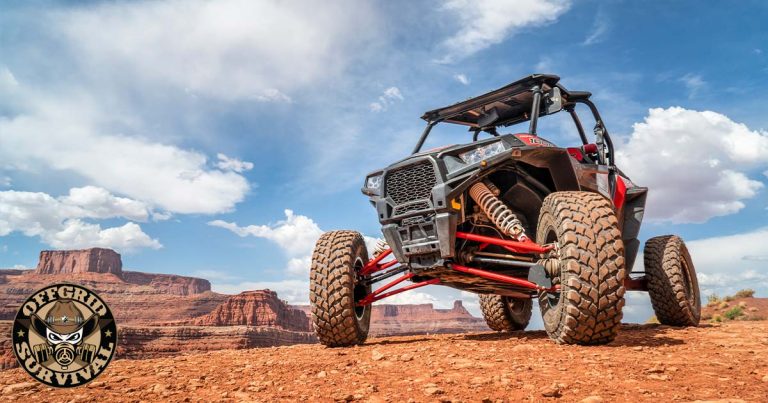
The federal government is yet again targeting off-road enthusiasts and anyone who actually enjoys using public lands. Under the pretense of “environmental protection,” the Bureau of Land Management (BLM) and other agencies have been shutting down trails, seizing control of massive swaths of land, and restricting access to the very people who care about these areas the most.

It’s a blatant power grab, and it’s time we call it what it is—bullshit.

Take Utah, for example. The state is fighting back with a lawsuit against the feds to take control of millions of acres that the government has locked up for years. Utah’s Attorney General has had it with the federal government dictating how the state can use its own land. They’re not trying to sell it off—they just want to manage it in a way that actually makes sense for the people who live there.

Utah is taking a stand against what it sees as federal overreach by filing a significant lawsuit against the U.S. government. The state’s Attorney General, backed by Governor Spencer Cox, is challenging the federal government’s control over millions of acres of land within Utah. Specifically, the lawsuit targets what’s known as “unappropriated land,” which makes up a significant portion of the 70% of Utah that is currently under federal control.

The state argues that this land should be managed locally, not by distant federal agencies. The lawsuit isn’t about privatizing the land or selling it off; it’s about giving Utah the authority to manage these lands in a way that benefits both the environment and the people who live there. Governor Cox has made it clear that the state is better positioned to make decisions about land use, whether it’s for recreation, grazing, or conservation.

Utah Attorney General Sean Reyes speaks in the Gold Room at the Utah State Capitol in Salt Lake City, Aug. 20, 2024. State leaders are suing the federal government over 18.5 million acres of Bureau of Land Management land, which covers about 34% of Utah.

Utah Attorney General Sean Reyes speaks in the Gold Room at the Utah State Capitol in Salt Lake City, Aug. 20, 2024. State leaders are suing the federal government over 18.5 million acres of Bureau of Land Management land, which covers about 34% of Utah.

Part of the state’s frustration stems from recent decisions by the Bureau of Land Management (BLM) to close off significant portions of public land to off-road vehicles. For example, the BLM recently restricted 317 miles of trails near Moab, citing environmental concerns. Utah, along with Wyoming, is pushing back, arguing that these closures are unnecessary and that they harm the communities that rely on access to these lands for recreation and economic activity.

No more camping at Government Wash at Lake Mead because of so-called “crime”.

And it’s not just Utah feeling the squeeze. In Nevada, the National Park Service has recently closed the Government Wash portion of Lake Mead National Recreation Area to motor vehicle access and overnight camping as of August 1, 2024. They’ve blocked Government Wash Road and 8.0 Mile Road, cutting off vehicle access entirely. Their excuse? They claim it’s because some stolen cars have been dumped out there.

But let’s be real—how is that the fault of outdoor enthusiasts?

Lake Mead

Instead of going after the criminals who dumped those cars or questioning how they got through the supposedly guarded entrances in the first place, they’re punishing everyone else. Why shut down a whole area to law-abiding citizens who just want to enjoy the outdoors? It’s another example of how the government is using any excuse it can find to restrict access and control public lands, all while ignoring the real issues.

Off-road enthusiasts aren’t the villains here. They’re the ones out there fixing trails, cleaning up trash, and making sure the land stays accessible for everyone. They’re the real stewards of these public lands, not the bureaucrats in Washington who wouldn’t know a trailhead from a pothole.

The fact is, these so-called “environmental protections” are just a cover for a federal land grab. They’re stripping states of their rights, shutting down access, and killing the off-roading culture that’s been a part of these areas for generations. It’s an attack on our freedom to enjoy the land that belongs to all of us, not just a bunch of out-of-touch bureaucrats.

This isn’t just about Utah or Nevada. It’s happening all over the country, and it’s time we stand up and fight back. The federal government has overstepped its bounds, and if we don’t push back now, we’re going to lose even more access to the lands we love.

It’s time to tell the feds to back off and let the people who actually know and care about these lands manage them.

Is the 16 Gauge Still Sweet?

0

The 16 gauge shotgun is a legend in American wingshooting. Often called “the gentleman’s gauge,” this balanced blend of power and finesse was once a mainstay with hunters and clay shooters before seeming to fade from prominence in the American market. Is this classic platform the relic of a bygone era, or is a comeback in the works for the sweet 16?

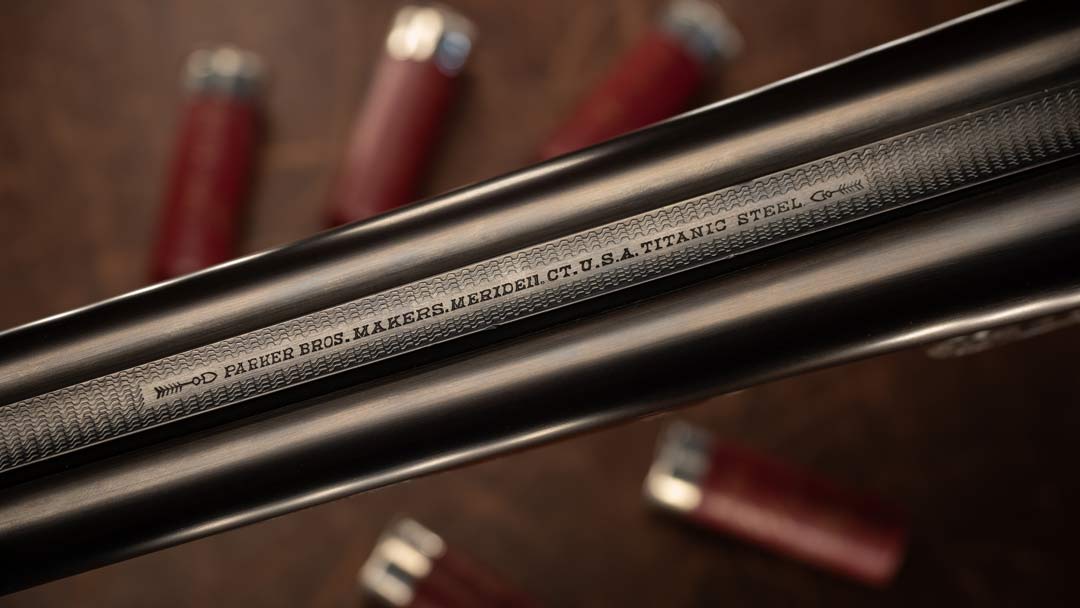
Manufactured in 1929, this is one of just 568 Parker DHE grade 16 gauge shotguns built in this specific configuration according to Gunther, Mullins, Parker, Price, and Cote on page 291 of ‘The Parker Story.’ Available this October.

We’ll explore the legacy of the 16 gauge shotgun and examine numerous examples from Rock Island Auction Company’s October 4 -6 Sporting & Collector Auction in Bedford, Texas as well as several highlights from RIAC’s December Premier Auction. Click on the images throughout this article to learn more about each gun model.

What is 16 Gauge?

A 16 gauge shotgun refers to a smoothbore firearm with a bore diameter of about .663 inches before any chokes. Tracing its lineage to the 18th century, the gauge system for shotguns was defined by how many round lead balls, matching the bore size, could be molded from a pound of lead. The smaller the gauge, the wider the bore.

For instance, if ten identical round balls were made from a pound of lead, the diameter of one ball would be used as the measurement for the barrel’s diameter and called 10 gauge. Similarly, a pound of lead yielding sixteen such balls would result in a 16 gauge.

The Browning Sweet Sixteen, an iconic 16 gauge shotgun for sale this October.

The 16 gauge shotgun has been around for centuries and has been offered in everything from flintlock fowlers, break action double guns, pumps, over/unders, autoloaders, and bolt action shotguns. Though the colloquial definition of sub-gauge can vary, according to most competition rules and the definition of Field & Stream editor Phil Bourjaily, anything smaller than 12 gauge is considered a sub-gauge, making the 16 gauge shotgun the largest common sub-gauge bore.

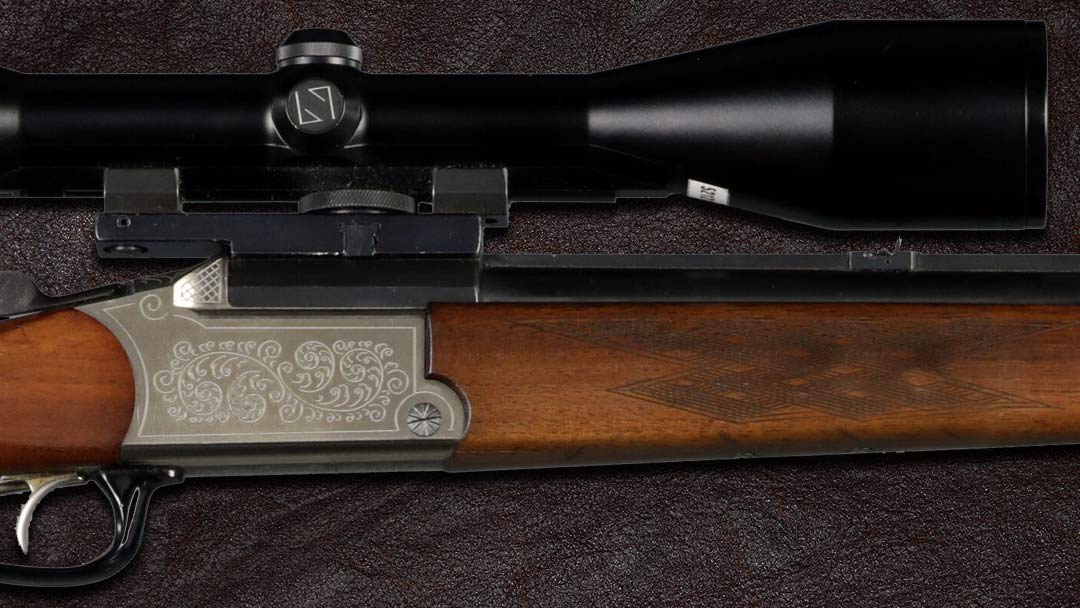
A 16 gauge Blaser BBF O/U combination gun with Zeiss scope. Available this October.

The 16 Gauge Shotgun Finds a Market

In the 1860s, English imports from manufacturers like Westley Richards, J. Purdey, W. W. Greener dominated America’s upland hunting market, where the 16 gauge shotgun started to develop a small but faithful following. Local makers took notice of this growing niche, with Parker Bros. adding the 16 gauge to their lineup in 1874.

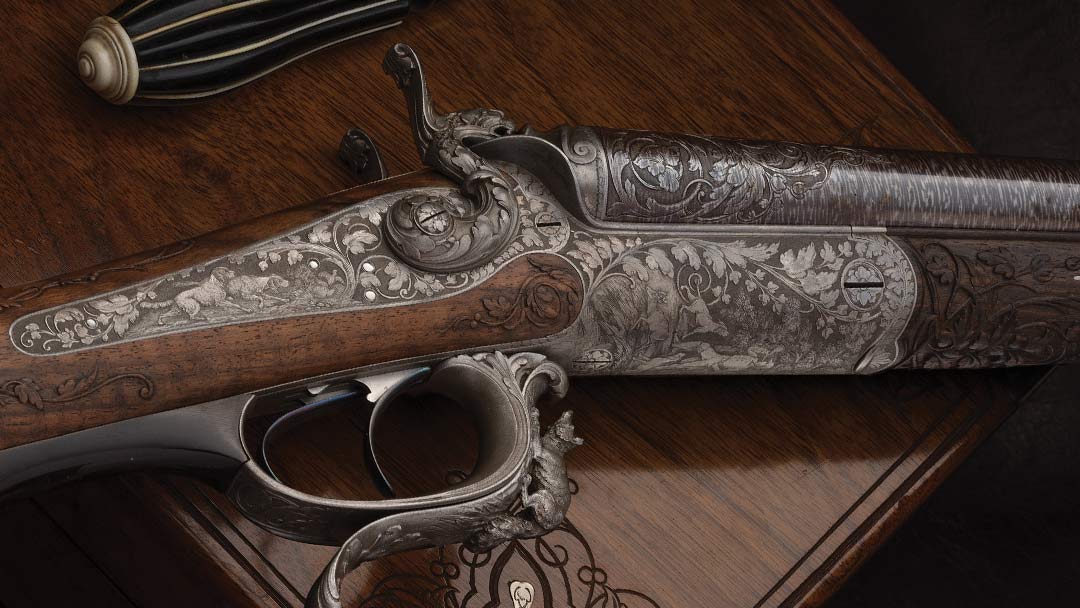
A highlight from the Norman R. Blank Collection, this early breech loading, cased, exhibition quality, panel scene engraved, relief carved double barrel underlever 16 gauge shotgun comes from the well-respected shop of Johann Springer in Vienna around the 1860s. Available this December.

In his 1897 book, ‘The Gun and its Development,’ William Wellington Greener commented that, “The 16-BORE GUN was at one time a favorite with Continental sportsmen, who now for the most part, prefer the 12-bore; for use in England probably not one gun in five hundred is made 16-bore.”

Greener also noted the exceptional scarcity of the 20 bore at the time in the UK as well, writing, “The 20-BORE has been strenuously advocated by writers in the sporting papers, but there are very few sold — the proportion is perhaps one 20-bore to twenty of 16-bore.”

Parker Brothers produced some of the finest 16 gauge shotguns of all time. This engraved DHE grade example is availabe this October.

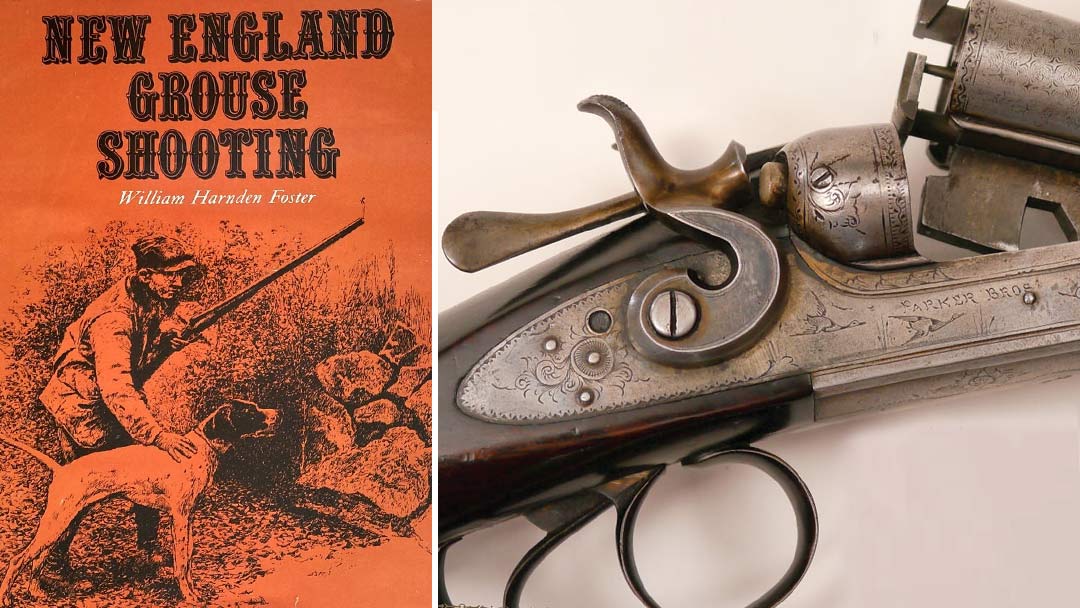
William Harnden Foster, a writer, illustrator, and sportsman, co-invented skeet shooting in 1920 along with grouse hunter Charles Davis. At age 12, Foster took his first grouse with one of the most famous 16 gauge shotguns in history, “The Little Gun.” The 1889 manufactured, Damascus-barreled Parker with exposed hammers weighed 6 1/2 pounds, remarkably light for the era. Foster inherited the gun from his grandfather and featured it in the first chapter of his popular 1941 book, ‘New England Grouse Shooting.’

Foster fondly described his grandfather’s 16 gauge Parker as “a sweet gun, clean lined and truly balanced and more.”

16 Gauge Shotgun Golden Age

Firearms technology was rapidly evolving in the late 1800s, with advancements in shotshells and propellants that provided higher velocities and longer ranges. The lighter 16 gauge shotgun benefited from these improvements and enjoyed a surge of popularity through the early decades of the 20th century.  
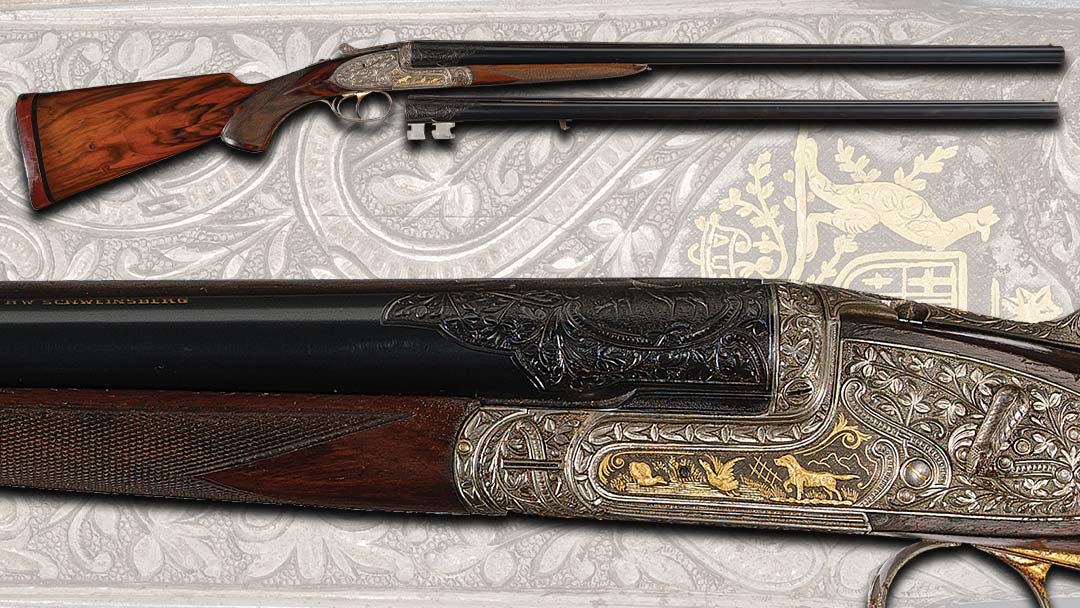
A factory game scene engraved D. M. Lefever Sons & Co. boxlock 16 gauge shotgun for sale this October.

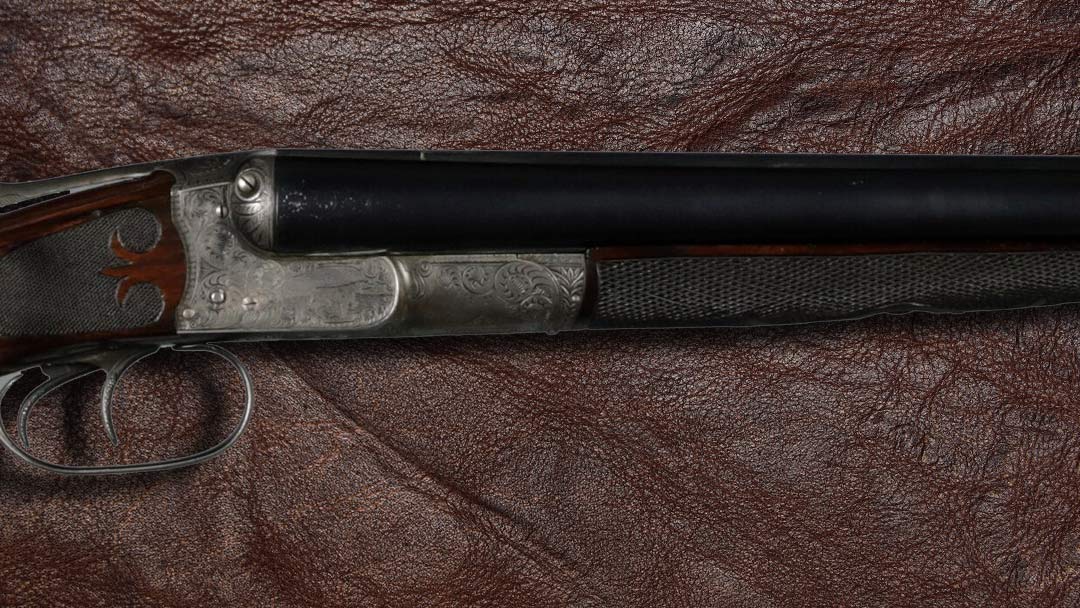
Classic American manufacturers like Parker Bros, A.H. Fox, and L.C. Smith offered some of the finest 16 gauge hammerless double guns of the early 20th century. Because of its versatility, patterning performance, and milder recoil compared to its 12 gauge sibling, the 16 gauge became a natural favorite with upland hunters and clay shooters. A 16 gauge variant of the Browning A-5 shotgun hit the market in 1909 and went on to become a legend.

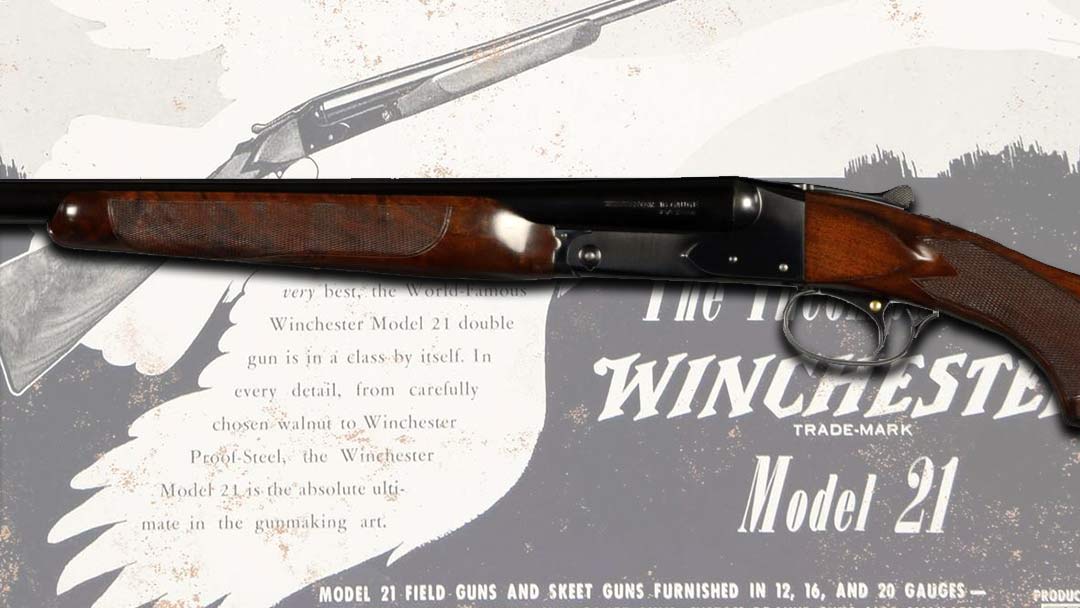
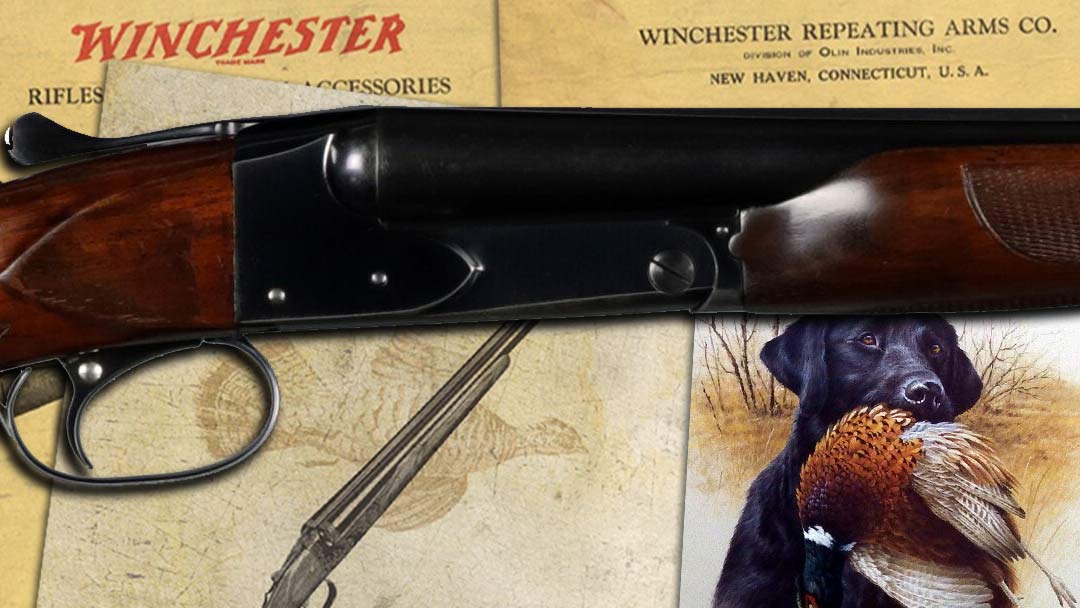
A Winchester Model 21 Skeet Grade 16 gauge shotgun for sale this October.

The Browning Sweet Sixteen

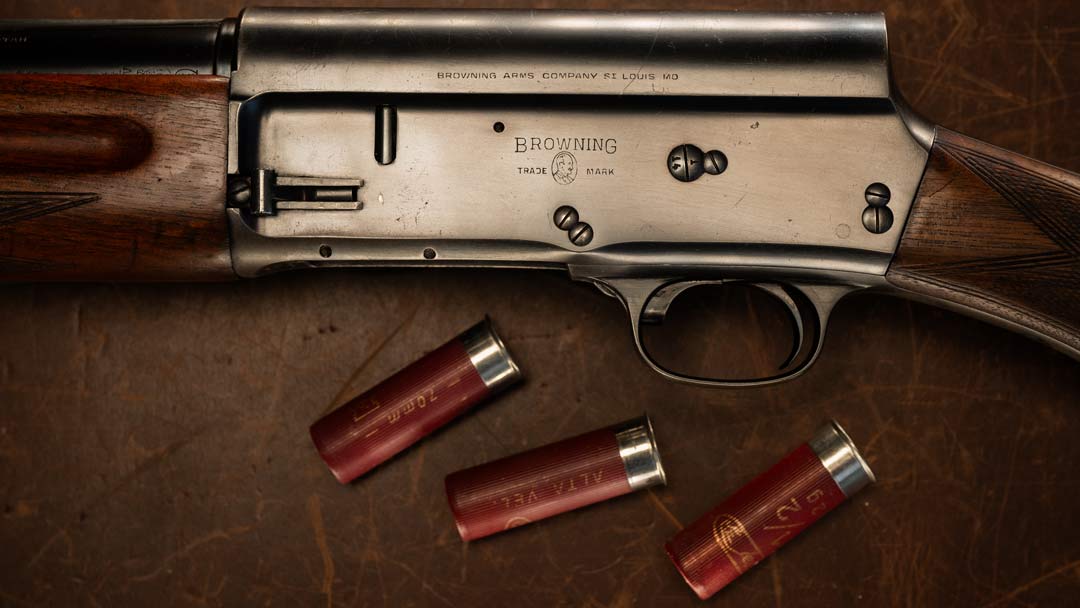
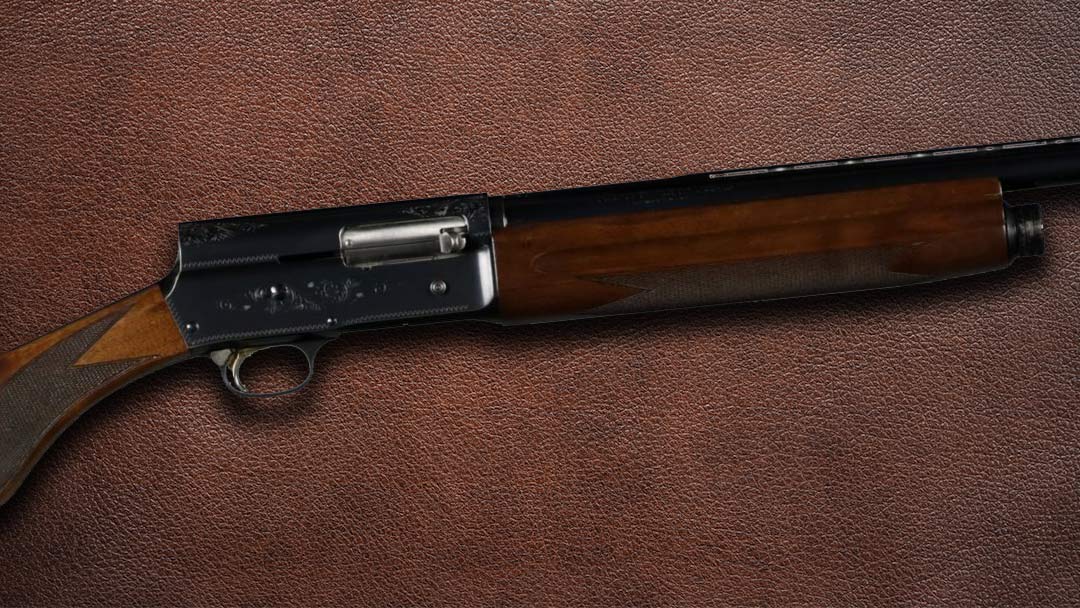
Released in 1902, the John Moses Browning designed Automatic 5, or A-5, was the world’s first successful semi auto shotgun. Widely advertised as “Five shots under your finger” and nicknamed “Humpback” due to its trademark squared-off receiver, the long-recoil operated A-5 became one of the most produced shotguns in history.

The 16 gauge A-5 Humpback became a sweetheart for 16 gauge enthusiasts.

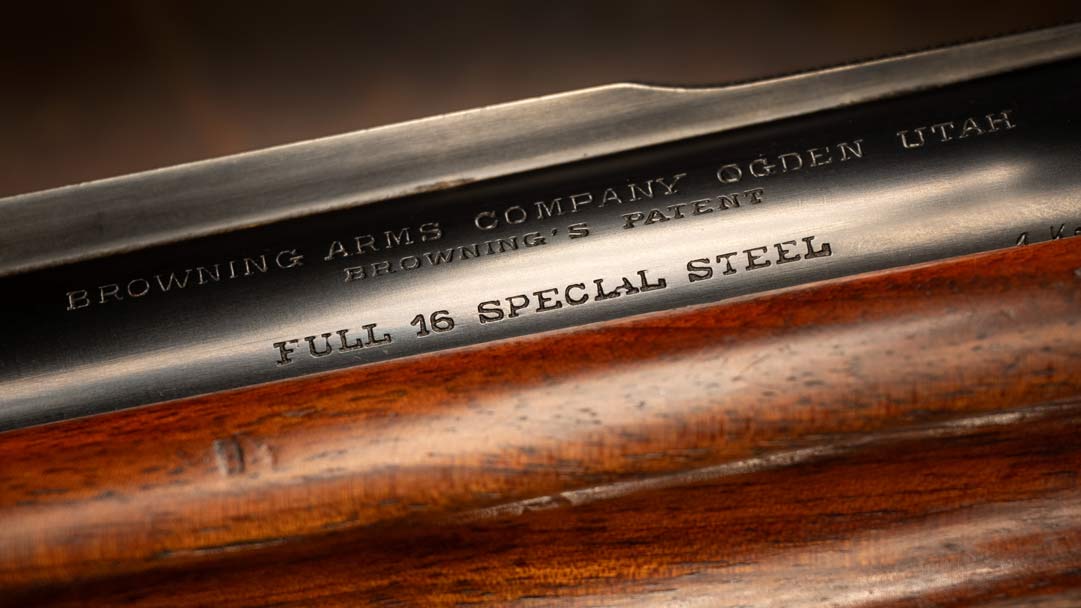
First released as a 12 gauge shotgun, the 16 gauge version of the A-5 debuted in 1909 thanks to popular demand. In 1936, a lighter variant of the 16 gauge Humpback debuted as the “Sweet Sixteen.” Pre WW2 Sweet Sixteens are identified by their gold plated triggers and three holes through the barrel band. The Sweet Sixteen name started to appear on the left side of the receiver in 1948.

The 16 gauge Browning Auto-5 has become a popular model with today’s collectors and hunters.

A Setback for the 16 Gauge

By the early decades of the 20th century, the 16 gauge shotgun had carved out a solid foothold in both the European and North American market, with the 16 gauge rivaling the 20 gauge for upland hunting use. While the popularity of the 16 gauge shotgun never waned in Europe, the platform suffered a major setback in American in 1926.

This factory engraved Vincenzo Bernardelli Italian 16 gauge boxlock shotgun was manufactured in 1966. Includes a wood and leather takedown case. Available this October.

Only a few years after its invention by William Harden Foster and Charles Davis, skeet shooting had become one of America’s most popular shooting sports. New rules formalized in 1926 recognized only four bore sizes for competition: 12, 20, 28, and .410 gauges. 16 gauge was classified as a big bore and was forced to compete in the 12 gauge category.
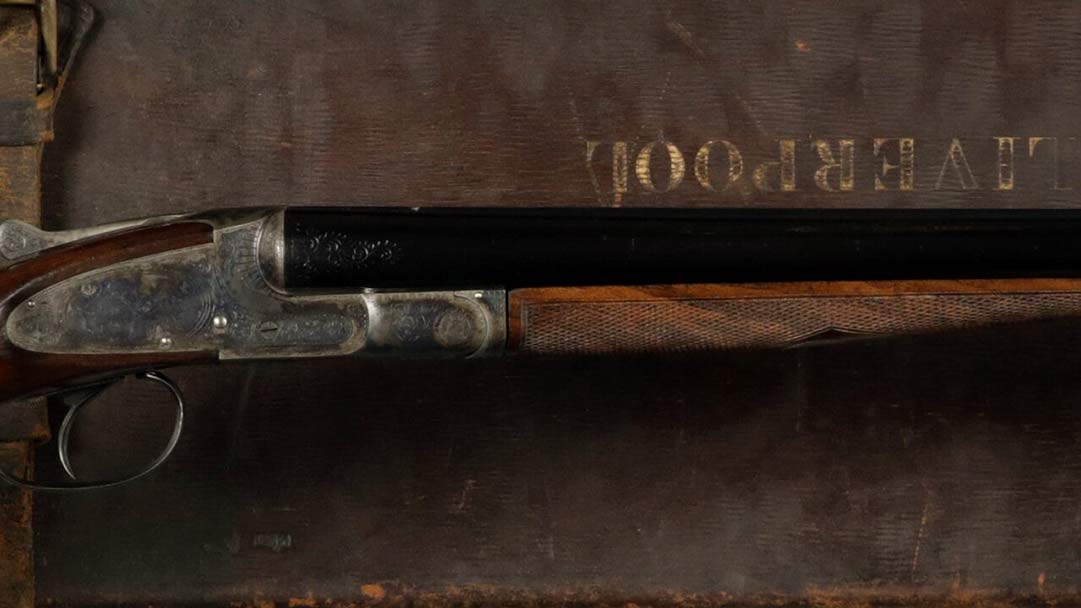
An Angelo Bee signed and engraved Belgian Browning Diana Grade Superposed 12 gauge shotgun. Available this October.

Without its own skeet category, the 16 gauge shotgun saw a marked decline in sporting ammunition sales. Since clay shooters typically purchase far more rounds than hunters, ammunition manufacturers took notice. While the 12 gauge and 20 gauge saw substantial advancements in both ammunition and firearms over the following decades, the 16 gauge slowly fell behind its rivals.

Lightweight 12 gauge shotguns and more potent 20 gauge ammunition like the 3 inch magnum began to fill the niche previously occupied by the 16 gauge, and that gap further narrowed in the 1960s and 70s. By the 1980s, 16 gauge ammunition was increasingly harder to find in America and notably more expensive than its competitors. Gunmakers cater to ammunition availability, so the 16 gauge shotgun saw few developments on the hardware end as well.

A Bottega C. Giovanelli signed, engraved, and gold inlaid Beretta 20 Gauge Model 471EL shotgun. Available this October.

16 Gauge Shotgun Ammo

Early black powder 16 gauge shotgun shells were about 2 1/2 inches long and .663 inches inches in diameter. The standard case today has been lengthened to 2 3/4 inches to accommodate more shot.

The most affordable 12 gauge shotgun shells at the time of writing tend to cost around 40 cents per round, while the cheapest 16 gauge shotshells usually run around double that price point. For reference, the current cost of a 25-pack box of Winchester Super-X Game Loads 12 gauge shotgun shells is around $10.79, while its 16 gauge counterpart retails for $21.99.

An engraved Parker Brothers 16 gauge DHE grade shotgun, manufactured in 1929. Available this October.

While the ammunition price disparity is a clear disadvantage for 16 gauge shotgun aficionados, not many years ago this classic round was even more expensive and often hard to find at all, with hulls for reloading especially difficult to come by. Dan Compton, product line manager for Federal Premium, noted that 16 gauge shotgun ammo has seen a growing demand over the last decade, and most major online sporting goods retailer offer the numerous options for the round.

Rebirth of the 16 Gauge Shotgun

Only a few decades ago, many gun writers noted that the 16 gauge shotgun had faded into irrelevancy in the American market. It’s death seemed imminent, yet in recent years the platform has seen a steady resurgence in popularity. Which factors have spurred America’s 16 gauge revival?

Social media and dedicated forums have provided an accessible means for collectors, sportsmen, shooters, and arms enthusiasts to share their passion for specific models and genres that might have previously fallen under the radar. The internet has also made obtaining vintage firearms and rare ammunition easier, including classic 16 gauge shotgun models.

According to the included factory letter Winchester Model 21 was built for stock as a 16 gauge shotgun with a checkered buttplate (currently with added Winchester recoil pad), regular comb, and regular wood when the inspection was completed on June 13, 1946. Available this October.

American sportsman are more connected than ever to hunting communities around the world, including the European market where the 16 gauge shotgun has continued strong. And that small but loyal segment of 16 gauge wingshooters in the States now has a greater reach to tout the performance, quick handling, and fast-pointing abilities of their prized platform.

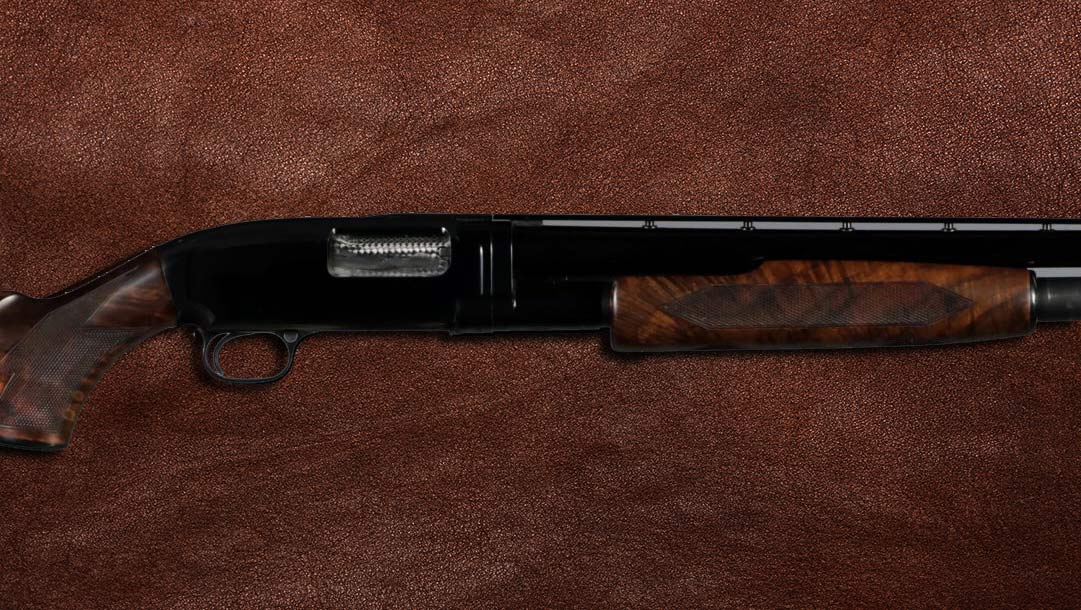
A Winchester Model 12 Pigeon Grade 16 gauge shotgun for sale this October.

In addition to the classic side-by-side renaissance facilitated by auction houses like RIAC, a growing number of new 16 gauge shotgun models have hit the market over the last few decades. Absent for over 20 years, Remington reintroduced the 16 gauge Model 870 in 2002 and has since added multiple 16 gauge shotgun variants to its lineup. In 2016, Browning released a new line of Sweet Sixteen shotguns, a short-recoil operated design that’s lighter than its predecessor while paying homage to the classic look.

A Browning Sweet Sixteen manufactured in 1988 by Miroku of Japan, available this October.

In Project Upland Magazine’s 2023 North American Upland Hunting Survey, 10.63 percent of upland hunters cited the 16 gauge shotgun as their preferred choice, with the 28 gauge just edging it out. The 16 gauge ranked especially well with Millennials, their third most popular shotgun chambering. For the elder sportsman and the greenhorn shooter, the ease of handling and reduced recoil that originally popularized the 16 gauge platform still holds true today.

16 Gauge Shotgun for Sale

Whether the 16 gauge revival is driven by performance, nostalgia, or a little bit of both, there’s no denying that this timeless platform has earned a reputation as a dependable tool for the upland hunter. For those interested in fielding a classic through the woods, prairie, or cornfields this fall, Rock Island Auction Company offers a sweet selection of vintage and modern 16 gauge shotguns for sale.

A 1953 dated factory engraved and gold inlaid Victor Sarasqueta 16 gauge hand detachable sidelock double barrel shotgun with an extra barrel and case. Available this December.

For more gun blogs and gun videos on classic and modern sporting arms, subscribe to the weekly Rock Island Auction newsletter to find pieces on Winchester, Marlin, Savage, and W. J. Jeffery & Co., as well as unique and unusual historic curiosities like the M30 Luftwaffe drilling, the combination gun, the Paradox gun, the revolving shotgun, the 4 bore, the Punt gun,  and more.

A factory engraved Hunter Arms/L. C. Smith 20 gauge Crown Grade shotgun with case. Available this October.

Survival Guns | Rock Island Auction

0

For the outdoorsman, homesteader, pilot, sailor, or the pragmatic prepper, a survival gun is defined as a lightweight firearm that can be easily stored and packed. Reliability, weight, portability, and adaptability are all desirable traits in the genre, a gun that can mean the difference between life and death in a wilderness survival scenario or serve as the most important part of your bug out bag.

A U.S. property marked Harrington & Richardson M4 bolt action survival rifle. Available this October.

Rock Island Auction Company’s October 4 -6 Sporting & Collector Auction in Bedford, Texas features a number of famous classic and modern examples in this fascinating firearms niche, including civilian models and survival guns designed for military use. Click on the images throughout this article to learn more about each gun model.

A cased Wildey Survivor pistol chambered in .45 Win Mag, for anyone interested in carrying the ultimate bear spray. Available this October.

The Takedown Rifle

For prepping, backpacking, or camping in remote regions, takedown rifles are a popular option. The concept of the takedown gun dates back centuries. Earlier takedown firearms sometimes featured removable buttstocks, threaded barrels, and were more purpose built to be storable. The lever guns and pump actions of the late 19th and early 20th century like the successful Winchester Model 1890 brought the concept of the takedown rifle into the mainstream.

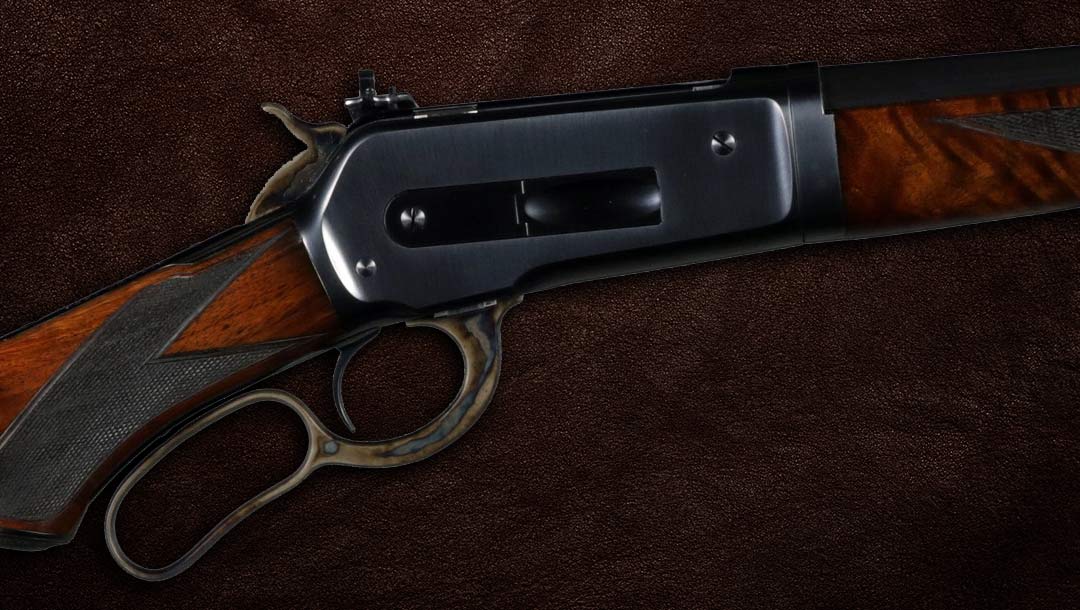
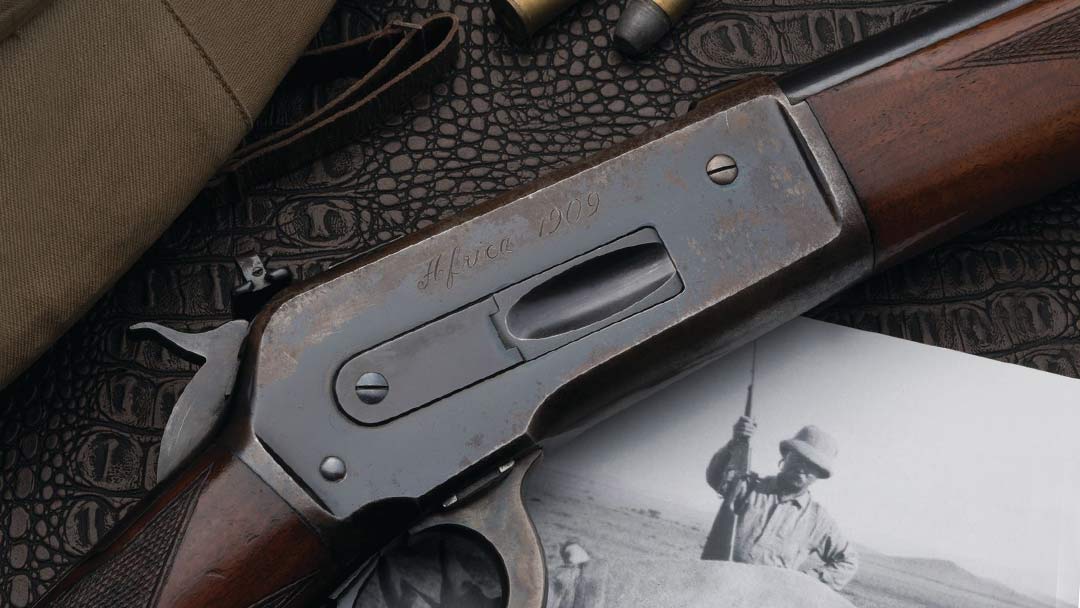
A special order Winchester Deluxe Model 1886 lightweight takedown short rifle manufactured in 1904. Available this October.

Marlin gained a reputation with the public for easy-to-shoot .22 LR takedown rifles, including a predecessor to the Model 39 designed to fit in a case beneath the top bar of a bicycle. The Marlin Model 39 and popular Marlin Model 39A follow-up offered a reliable, accurate, and portable takedown package. The slimmer profile and flatter receivers inherent to the lever gun genre makes them easy to store and handle, and it’s no surprise the platform continues to serve as a survival gun option today.

A Marlin Model 39 takedown rifle, a classic survival gun for sale this October.

The M30 Drilling

The rise of aviation helped drive the development of more dedicated survival guns, particularly when it came to equipping military aircrews. As the extended range of aircraft increased, pilots found themselves traveling over vast stretches of remote wilderness or hostile territory. As the likelihood of emergency landings became more frequent, crafts were equipped with weapons that could be easily stored and were capable of self defense and hunting local game.

A Luftwaffe M30 Sauer and Sons drilling, one of the most famous survival guns of the WW2 era. Available this October.

Manufactured by Sauer & Son on contract for the German Luftwaffe during WW2, the M30 drilling was am excellent commercial grade hunting weapon that could be stowed aboard bombers and other large aircraft in a specially prepared case.

“The purpose was to shoot animals for survival,” according to Luftwaffe General Adolf Josef Ferdinand Gallan. The pair of 12 gauge shotgun barrels over a 9.3x74R rifled barrel made the M30 a versatile survival gun that could cull nearly any game animal encountered in the Luftwaffe’s North African area of operation, from small birds to large herbivores.

A WW2 J.P. Sauer & Sohn Luftwaffe issue survival M30 drilling with its case, manual, three-piece cleaning rod, leather sling, and a box of Hirtenberger 9.3x74R cartridges. Available this December.

The Savage Model 24

While the Third Reich equipped its aces with the elegant M30, most militaries opted for more affordable survival guns that could be quickly produced. Over 15,000 of the efficient and practical Stevens 22-.410 combination guns were purchased by the U.S. Army Air Corps during WW2.

The platform became the Savage Model 24 near the end of the war and found a wide following in civilian circles as a North American survival gun. A selector switch on the hammer of the Model 24 allows the user to fire either the top rifle or bottom shotgun barrel. Though numerous configurations are available, the .22LR/.410 gauge variant of the model set the standard for a survival focused combination gun, and this ammunition pairing continued to find favor when the Model 24’s famous successor, the Savage Model 42, was released in 2012.

The Savage Model 24 family is considered one of the best survival guns around.

The M4 Survival Rifle

While the M30 drilling is a fascinating firearm and a sought-after collectible, and the Savage Model 24 remains an outdoor favorite, neither were built from the ground up as military survival guns like the M4. Developed in the years following the Second World War for downed fighter pilots and bomber crews, the M4 bolt action, chambered in .22 Hornet, was intended more for hunting than self defense. Revolvers tended to fill the latter role, like the lightweight Colt and S&W aircrewman models developed in the 1950s.

An M4 survival rifle manufactured by Harrington & Richardson Arms Company of Drummondville, Québec, Canada. Available this October.

The M4 weights only four pounds and is incredibly easy to store with its removable magazine, short take down barrel, and telescoping wire buttstock similar to the M3 Grease gun. The M4 was originally equipped with a leaf rear sight. Later versions, like the example above, employed a more versatile Lyman 55-H adjustable rear peep sight.

The U.S. Air Force included the M4 in survival kits for B-52 bomber crews through the late 1950s and early 1960s, when the airmen engaged in frequent long range missions during the early decades of the Cold War.

Introduced in 1949, the M4 survival rifle borrowed from a number of models, including basing its action off of the Savage Stevens M23D in .22 Hornet caliber.

The Springfield M6 Scout

The U.S. Air Force continued to opt for affordability and function when it came to survival gun development. The Springfield Armory M6 Scout, also called the “Air Force M6 Aircrew Survival Weapon,” was introduced in 1952. A break action combination gun, the M6 Scout is chambered in .22 Hornet in a top rifle barrel and .410 shotshells in its bottom barrel, like its Stevens 22-410 precursor.

Though the U.S. Air Force phased out the M6 Scout in the early 1970s, civilian versions produced by manufacturers like Chiappa and Springfield remain popular with outdoorsmen who appreciate the platform’s versatility and ease-of-use are considered among the best survival guns.

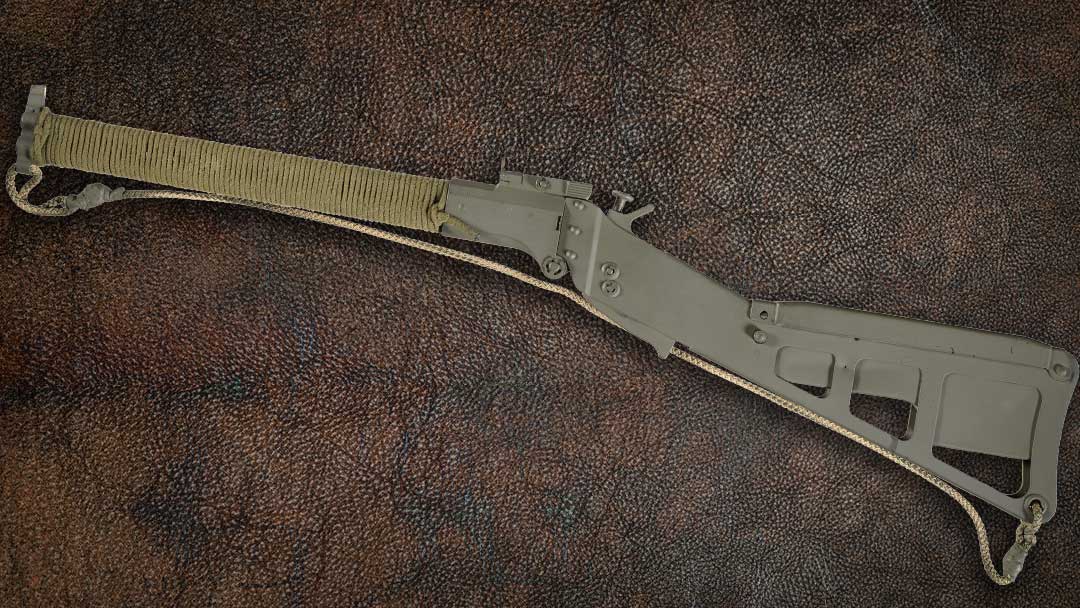
Unlike the commercial versions, original examples of the M6 are classified as an NFA SBR and are highly collectible firearms. The example below has a stamped, skeletonized stock with a cartridge block located inside the stock. The comb area lifts up to show that the spare cartridge block holds nine .22 rifle cartridges and four .410 shotgun shells.

An Ithaca U.S.A.F. property marked M6 survival gun. This example sold for $5,561 at RIAC in May of 2022.

The M6 Scout and its folding skeleton stock was based on the Marble Game Getter, another compact combination gun outfitted with a rifled .22 caliber upper barrel and a smoothbore lower chambered in either .410 or .44 bore. The Game Getter was pitched to the public as a weapon for all seasons which could be folded up and strapped to a pack without excess burden, then rapidly deployed for recreational plinking or taking small game.

A Marble Safety Axe Co. Game Getter 22 .410 O/U combination gun. Available this October.

The AR-7 and the .22 Takedown Semi-Auto

Like the M4 survival gun, the AR-5 was a bolt action takedown platform chambered in .22 Hornet. Designed by Armalite in 1954 for the U.S. Air Force as a potential competitor to the M6, this lightweight rifle was included in XB-70 bomber survival kits.

The M6 ended up winning out, and few AR-5 rifles were produced. Hoping to minimize their losses, ArmaLite commissioned Eugene Stoner to develop a semi-automatic commercial version of the platform. Released in 1959, the ArmaLite AR-7 Explorer employed aluminum and plastic alloys like its predecessor to keep its weight down. The weapon can be disassembled into six parts without any tools and stored in a compact package within the hollow stock. The gun was famously designed to float.

Hailed by many as one of the best survival guns, the ArmaLite AR-7 Explorer found a niche with pilots, boaters, and outdoors enthusiast.

Henry has been producing the AR-7 since 1980 and the platform continues to serve as one of the most popular survival guns today. Other takedown survival guns perfect for the backpack include the Ruger PC carbine, the Marlin PSS, the Ruger 10/22, and two grandfathers of the genre, the Remington Model 24 and Browning 22-Auto.

An Ernest L. engraved Belgian Browning 22-Auto Browning Collector’s Association Edition semi automatic rifle, one of just 155 made to commemorate the 10th anniversary of the Browning Collector’s Association. Includes an original box, factory Naugahyde takedown case, and Browning certificate of identification. Available this October.

The AR-15 as a Survival Gun

The AR-15 is one of the most modular firearm platforms today, so it’s no surprise that Eugene Stoner’s design has served as the template for numerous survival gun variants. The GAU-5A Aircrew Self Defense Weapon, adopted by the U.S. Air Force in 2018, is compact enough to store in an aircraft ejection seat survival kit when broken down.

The GAU-5A Aircrew Self Defense Weapon can be assembled quickly.

Chambered in 5.56, the GAU-5A packs more punch than a semi-automatic rimfire and offers a higher firing rate than an O/U, bolt action, or single shot survival gun. Though a heavier round, 5.56 is still small enough to pack in quantity, capable of taking medium game, and an effective combat round. For backpacking, camping, prepping, and more, the adaptability of the AR-15 platform is unrivaled. And with a 5.56 to .22LR conversion kit, the AR-15 offers even more options.

This Colt M4 “Survival Kit” semi-automatic carbine sold at RIAC in 2020 for $1,955. The survival kit on this model includes a Camillus multi tool, a survival pack, survival knife, compass, food and water rations, a flashlight, and a map pouch.

Survival Revolvers

Where early Air Force survival rifles were intended primarily for hunting small game, special lightweight revolvers were developed by Colt and Smith & Wesson in the 1950s as emergency self-defense sidearms. These aircrewman revolvers were originally produced with an aluminum alloy frame and cylinder in order to reduce the gun’s weight.

A USAF Smith & Wesson M13 Aircrewman DA revolver, a survival gun designed for bomber crews. This example includes a copy of the U.S. Army TM9-2027 technical manual for the M13 revolver, USAF leather flap holster, and a box of Federal Cartridge .38 Special M41 ball cartridges. Available this December.

Revolvers have been carried as civilian survival guns for decades, with examples like the Smith & Wesson .357 Magnum designed with enough punch for hunting and fending off predators.  Models like the S&W 460 Emergency Survival Revolver provide the ultimate portable defense against bears, mountain lions, and anything else that moves. These compact cased revolvers were available in multiple calibers and packaged with a folding knife,  flashlight, whistle, compass, survival saw, signal, mirror, fire starter packs, and emergency blankets.

This Smith & Wesson Model 460 Emergency Survival DA revolver with case and survival tools sold for at RIAC in 2023 for $3,819.

Revolvers have a reputation for reliability, will never lose their magazine, and are more readily available in larger bear-killing cartridges than their semi-automatic pistol counterparts. But there are plenty of pistols on the market that can chamber imposing rounds as well.

In Ammoland.com’s ongoing documentation into handgun defense again bear attacks, pistols and revolvers have an impressive 98% combined success rate. Though large cartridges were often used, everything down to the lowly .22 has been documented as deterring grizzly and black bears. Whether you prefer the pistol or the revolver, handguns are the ultimate portable survival guns.

A .44 caliber Smith & Wesson Model 29 DA revolver. Available this October.

Survival Guns for Sale

If you’re a hunter, outdoorsman, or survivalist, a versatile arsenal is essential. For collectors and firearms enthusiasts interested in exploring different genres, survival guns offer a diverse shooting experience and can serve in a wide range of roles, from trail gun, varminting, small game hunting, and plinking. From takedown single shot rifles, combo guns, bolt actions, semi automatic rifles, and handguns chambered in survival calibers, examples from every era can be found in Rock Island Auction Company’s October 4 -6 Sporting & Collector Auction.

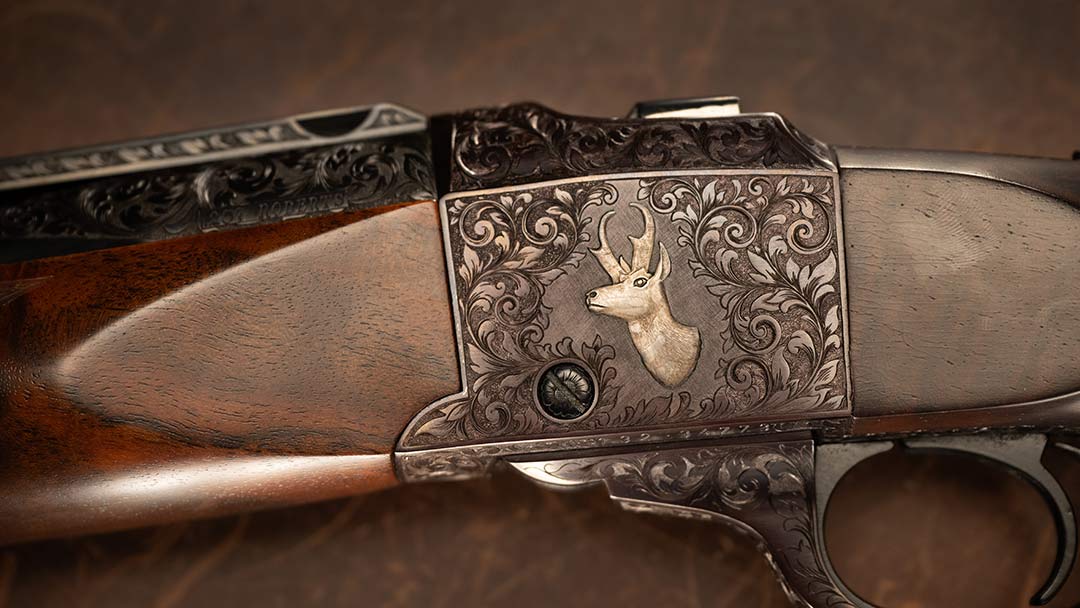
In terms of sheer simplicity and ease of upkeep, reliable break-open single shot rifles like the Ruger No. 1 can fill the survival gun role. This engraved example is available this October.

Subscribe to the Rock Island Auction newsletter to receive new gun blogs and gun videos every week on all firearm genres, including arms for hunting and survival. From break-open single shots like the Ruger No. 1, lever action workhorses like the Winchester 94, big game bolt actions and double rifles, and classic shotguns chambered in every caliber, we cover history’s most popular field guns.

Find survival guns for sale and more this October.

German Pistol Innovations of the 20th Century

0

Germany has a rich history of innovative gunmaking, from the armories of renaissance nobility to World War 2 and the present, and Rock Island Auction Company’s Oct. 4-6 Sporting & Collector Auction has a fantastic selection of 20th century German pistols.

From the Mauser C96, designed toward the close of the 19th century to Heckler & Koch’s P7 there are plenty of fascinating examples of German pistol design. For more information about a specific gun, click on the photo.

German Pistols: C96 Broomhandle

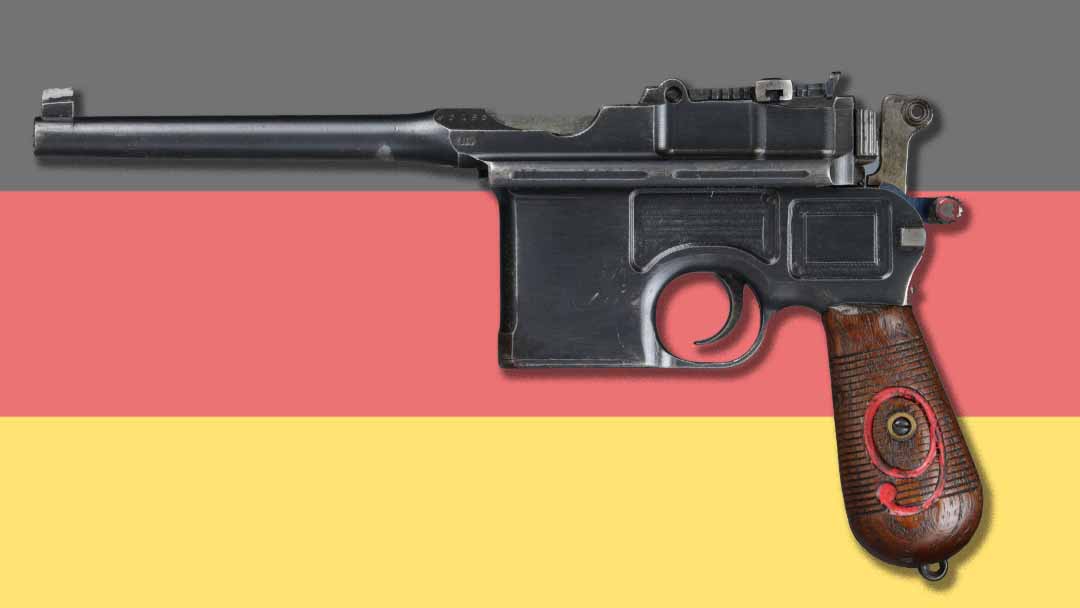
Easily recognizable by their broom handle-shaped grip and box magazine, the semi-automatic C96 was conceived by the three Feederle brothers – Fidel, Freidrich and Josef — employed by Mauser. Company co-founder Paul Mauser initially dismissed the design before rethinking it with the advent of Hugo Borchardt’s C-93 semi-automatic pistol.

The steel-machined C96’s design was intricate for the time, raising questions about the gun’s durability during military field tests. The hand-fitted parts of the design also made the pistol expensive and therefore typically acquired by officers, generals and the wealthy elite.

This very unique C96 is a large ring 20-Shot Broomhandle Mauser pistol marked with the small “DV” and “AV” markings of the Italian Navy contract. Rather than a spur hammer, this pistol has a large ring hammer, the long extractor on top of the breech bolt, the first style safety lever that is pulled down to engage, and the “20-shot” frame forging.

The gun was never adopted by any major military power but did see limited military purchases. The gun proved popular around the world with numerous unlicensed copies produced for the commercial market. Winston Churchill carried a Broomhandle in the Second Boer War as did T.E. Lawrence (better known as Lawrence of Arabia) during his time in the Middle East. The most recognizable Broomhandle might be the modified one that became Han Solo’s DL-44 Heavy Blaster of “Star Wars: A New Hope.”

This World War 1 Imperial German C96 is a “Red 9” example of a Broomhandle. Normally chambered in 7.65mm, C96 pistols chambered in 9mm had the red “9” branded on both sides of the grip is to let the user know to use the 9mm ammunition.

German Pistols: Luger

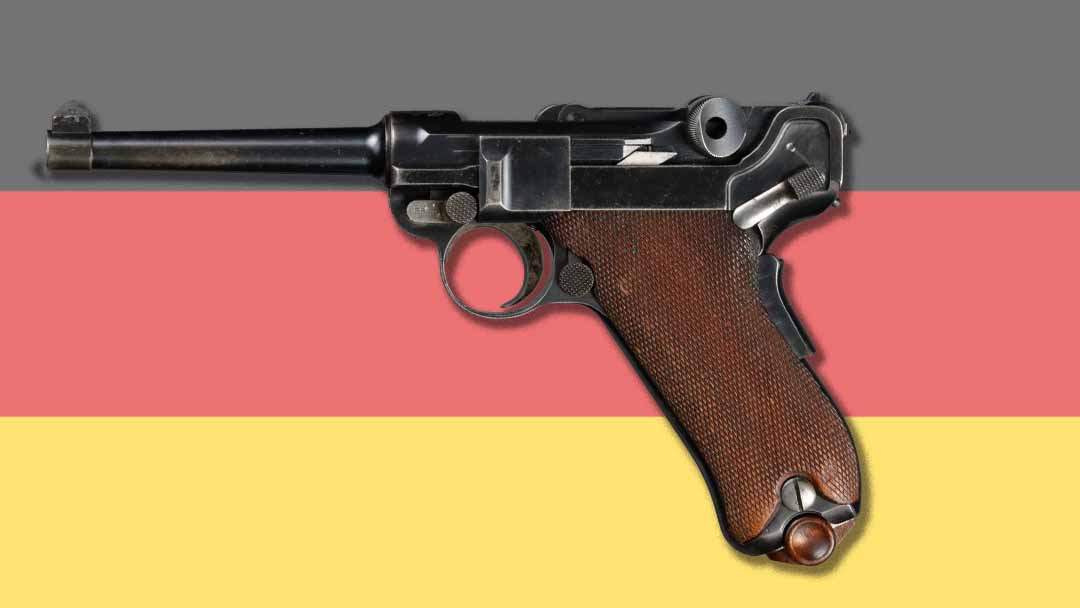
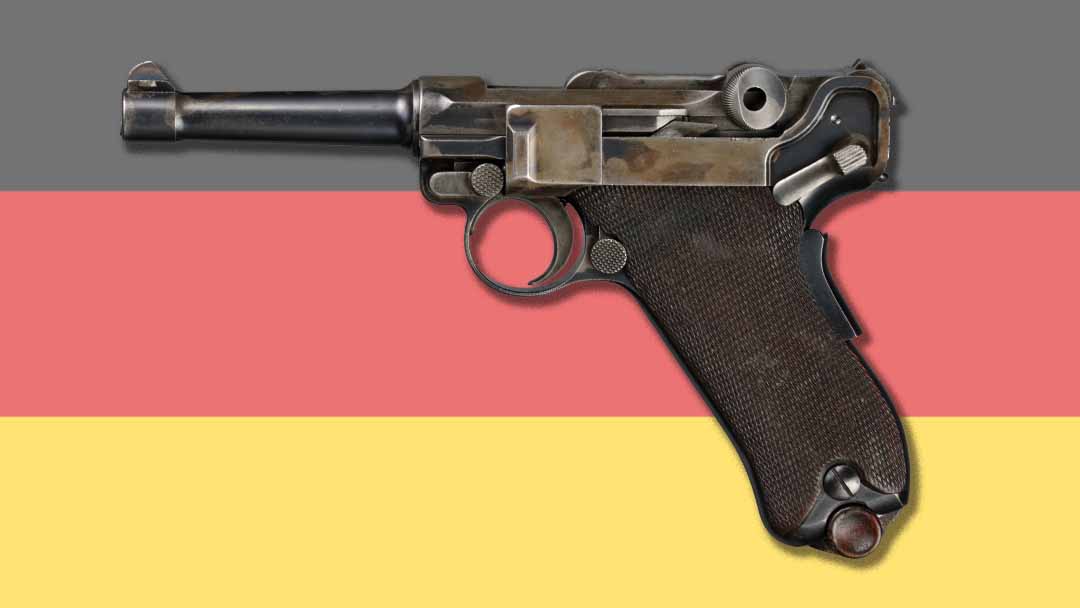
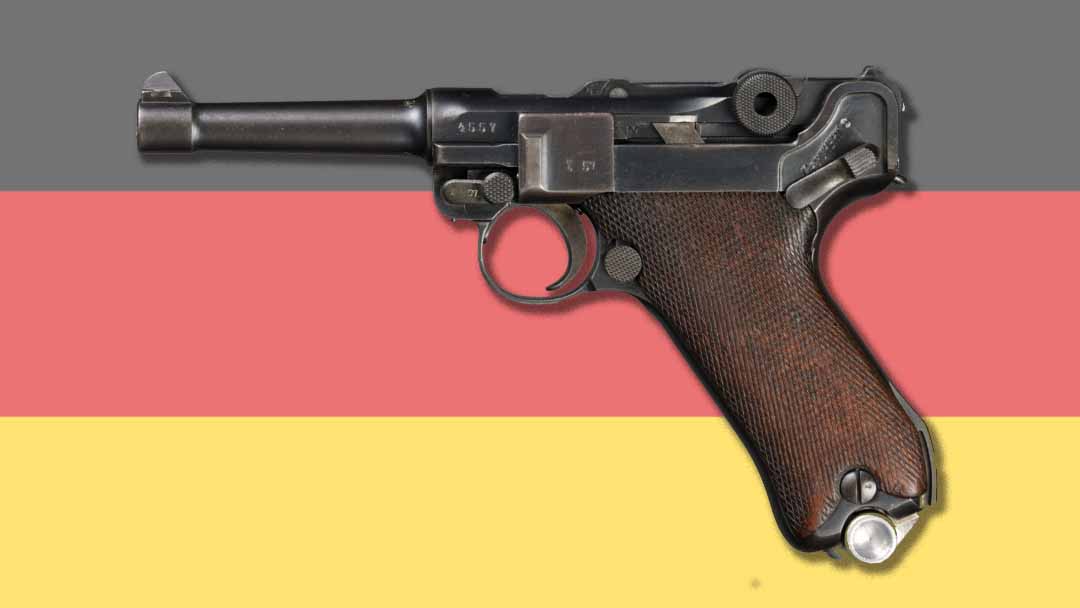
The Luger enjoyed a long military life before attaining legendary status and popularity as a prized World War 2 war trophy. It took time and some redesigns before the German Navy and Army adopted it in 1904 and 1908, respectively. It also served as the official sidearm of the militaries of Switzerland, Holland, Bulgaria and Portugal among others. The gun was offered to the Prussian Military Ordnance Board five times before acceptance and tested by the U.S. military three times but never adopted. American test Lugers and those sold commercially in the United States bear an eagle crest atop the receiver.

This American Eagle Luger, serial number 7555, is after the generally accepted approximate 6100-7100 serial number range of the U.S. test trial Lugers but shares similar characteristics. It is listed by its serial number on page 416 of the book “Central Powers Pistols” by Jan C. Still as an example witnessed by the author with test Luger attributes that falls outside the traditional serial range, notably lacking “GERMANY” export markings.

Georg Luger’s pistol utilized many of the principles used in Hugo Borchardt’s design of the C93 but Borchardt wasn’t given any recognition, resulting in a long-time rift between the two men. The 1902 Luger like the one here was chambered in 9mm, changing handgun history. Author Fred A. Datrig considered the 1902 a bridge from the original 1900 model to the 1904 adopted by the German Navy.

This is a rare example of a DWM Model 1902 “Danzig Test” Luger from the 1902 Army Trials. It is found within the 22,200 to 22,400 serial range, produced for the Imperial German army tests of that year. Early features including a recessed breech block, dished toggles with toggle lock, narrow trigger, and grip safety. Blank chamber, and lacking the typical “DWM” monogram on the toggle link.

Following World War 1, Simson & Co., owned by a Jewish family, was given the contract to supply Lugers to the diminished 100,000-man Reichwehr and were the only supplier of pistols from 1925-1934. Simson only made 12,000 Lugers. Arthur Simson who led the company was charged with failing to pay income tax in the 1930s and imprisoned for seven months. After being released from prison he fled Germany and eventually making his way to the United States where he joined his family. The Nazis took control of the company.

This Weimar Era Simson & Co. Luger has a blank undated chamber, with “SIMSON & Co/SUHL” marked front toggle link and only proofs, part numbers and serial number on the gun parts.

German Pistol: J.P. Sauer & Sohn Model 1913 Semi-Automatic

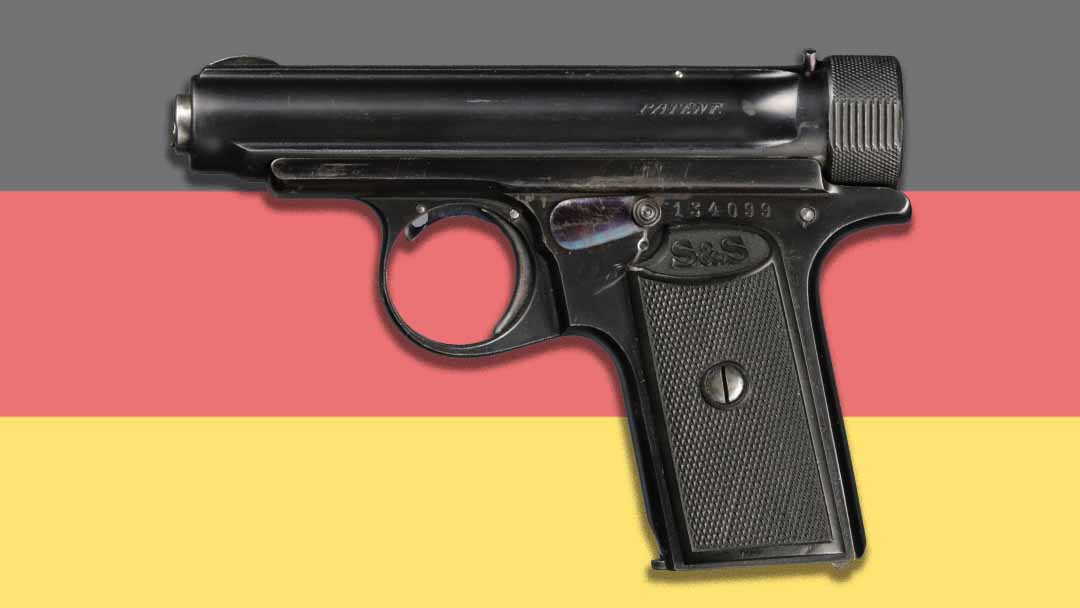
The Luger era was lengthy so let’s work back to J.P. Sauer & Sohn, a distinguished gunmaker founded in 1751. The company’s first semi-automatic pistol was made in 1905 but didn’t bear Sauer’s imprimatur. That wouldn’t happen for nearly a decade with the Model 1913 compact pistol.

Chambered in .32 ACP, the 1913 was considered a sturdy gun, with its most distinctive feature the large knurled cocking knob at the back of the slide. The gun was intended for commercial sale but with the outbreak of World War 1, the German military purchased 10,000. Production ended in 1931 with a run of 175,000 pistols made.

This J.P. Sauer & Sohn Model 1913, chambered in .32 ACP, includes its rare original box with handwritten matching number on bottom.

German Pistol: Walther PPK

Founded in 1886, Walther started making pistols with the Model 1 in 1908. The PP came about in 1929 followed by the PPK, a compact version of the Model PP, two years later. Walther offered the PPK at a discount to Nazi Party officials. These pistols known to collectors as Party Leader pistols, were officially “Honor Weapon of the Political Leaders.”

Chambered in 7.65 mm and concealable, the pistol found new life after World War 2 especially as Agent 007 James Bond’s handgun of choice. The PPK remains in production today.

This Walther PPK, manufactured in 1939, is fitted with a reproduction party leader grip with an eagle, with its wings spread, holding a wreath with a swastika in its talons. It comes with a leather wrapped case with a similar eagle badge on the lid, a period brown leather PPK holster and several pieces of memorabilia.

German Pistol: Walter P.38

The Luger gave way to Walther’s P.38 in 1938 when it was adopted by the Wehrmacht and it was the standard German pistol during World War 2. About 1.2 million P.38 pistols were manufactured by May 1945 by Walther, Mauser and Spreewerk when the factories were captured by the Allies.

The P.38 found new life when it was adopted by the West German armed forces in 1956. A duralumin frame replaced the steel frame making the gun lighter and less expensive to manufacture.

This rare Walther P.38 is marked “480,” the code used by Walther for roughly two months of production in 1940 before it was switched to the more common “ac” code.

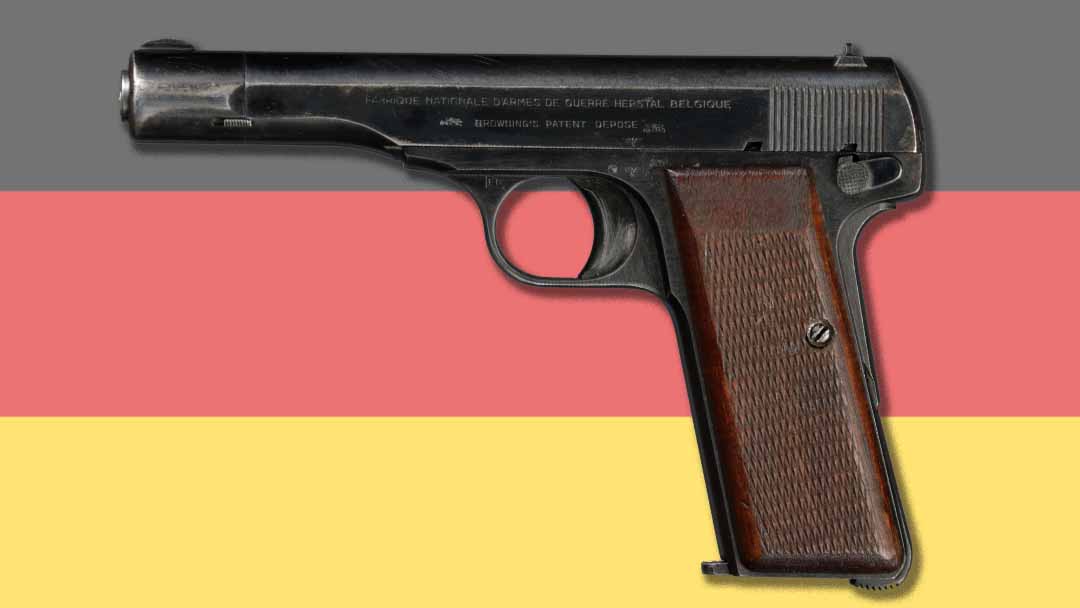
German Pistol: Fabrique Nationale Model 1922

Fabrique Nationale’s Model 1922 was manufactured for commercial and military use before World War 2. Chambered in 7.65mm, its German military designation was Pistole 62(b), with the “b” denoting it was made in Belgium. Germany made or assembled 363,200 of the Model 1922 before the FN plant was liberated in September, 1944. This example of the Model 1922 came to the United States as a war trophy and it is accompanied by the capture certificate.

This German occupation Fabrique Nationale Model 1922 pistol was brought back on May 28, 1945 by Col. Paul Mahaney and is accompanied by the capture certificate listing the gun by serial number as well as a Hapo 5 camera and its brown leather case decorated with a Third Reich eagle badge.

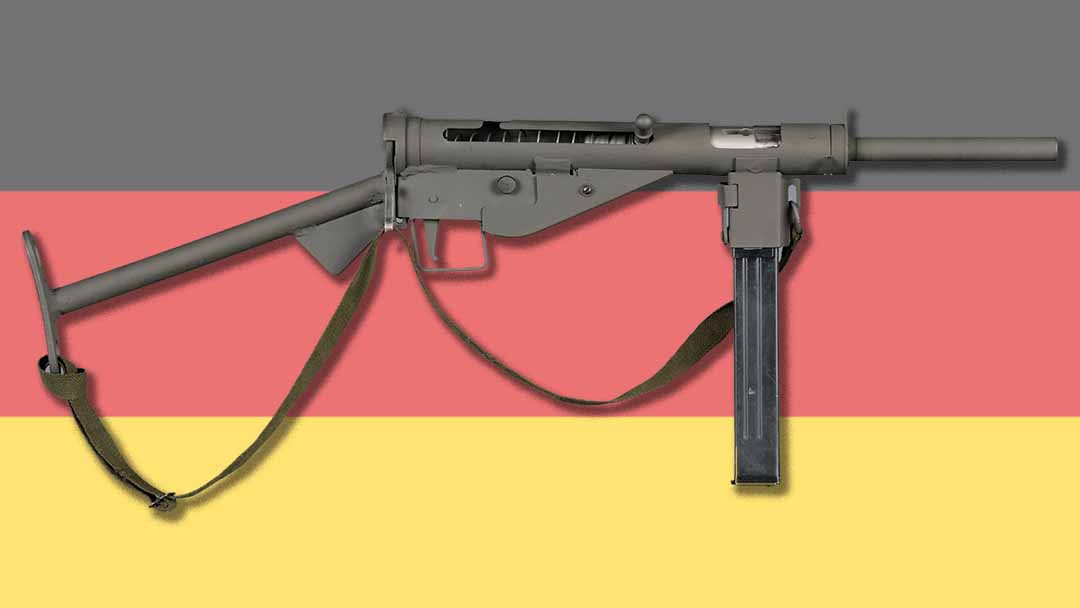
German Pistol: MP3008 Submachine Gun

A last gasp weapon, the select fire MP3008 – the MP is for maschinenpistole – was a knockoff of the Sten Mk II except that it utilized a vertical magazine like the MP40. Initially, the gun was made with a skeletal pattern stock and used phosphate components. Mauser created production drawings and tooled up its plant to make the gun in just a few weeks. More than 10,000 were made by February 1945.

The MP3008 was manufactured in the dying days of the Third Reich and this weapon is spartan like the British STEN gun it replicates, with very few markings on it. Included with the gun is a “clg 43” marked dual pouch magazine carrier set, five extra magazines and a loading tool.

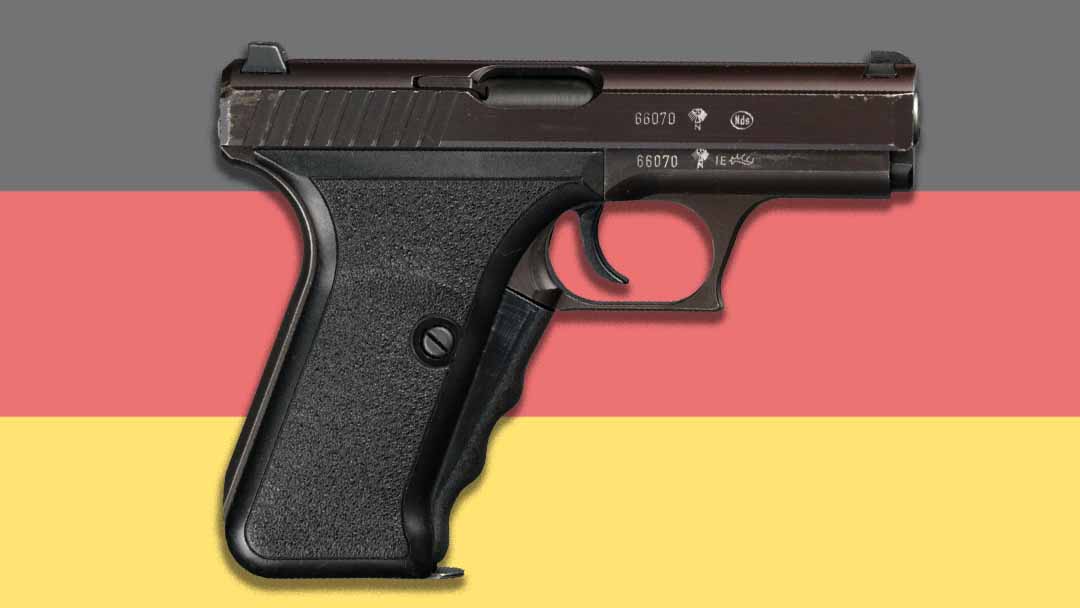
German Pistol: Hecker & Koch P7

Described as the most innovative pistol design since World War 2 and advertised as “the most expensive handgun in the world,” Heckler & Koch’s P7 was designed for German police contracts for a compact pistol after the Munich Olympics terror attack. Alas, only three police forces adopted it.

An interesting feature of the pistol is the lever that serves as the frontstrap of the grip and also cocks the gun before firing. If dropped the gun decocks and won’t accidentally discharge, plus it doesn’t require a double-action first shot for more accurate shooting. H&K produced the P7 from 1976 to 1998.

In 1983, the gun was modified for a thumb lever magazine release for sale in the United States (as the P7M8) but was adopted by only a handful of departments. The P7M13 followed a year later with a magazine capacity of 13 rounds, again in an attempt to attract interest from police.

This Heckler & Koch P7 was manufactured in 1984 and includes a hard case and manual.

German Pistols for Sale

With the tragedy of two world wars and the tension of the Cold War, firearms innovations grew rapidly in the 20th century and German firearms grew, too, first as an adversary and later as an ally. These firearms from a once and still mighty military are fabulous opportunities to obtain pieces that turned the semi-automatic pistol into a mainstay of fighting forces around the world and are available in Rock Island Auction Company’s Oct. 4-6 Sporting & Collector Auction.

Winchester 1886: Browning’s First Lever Gun

0

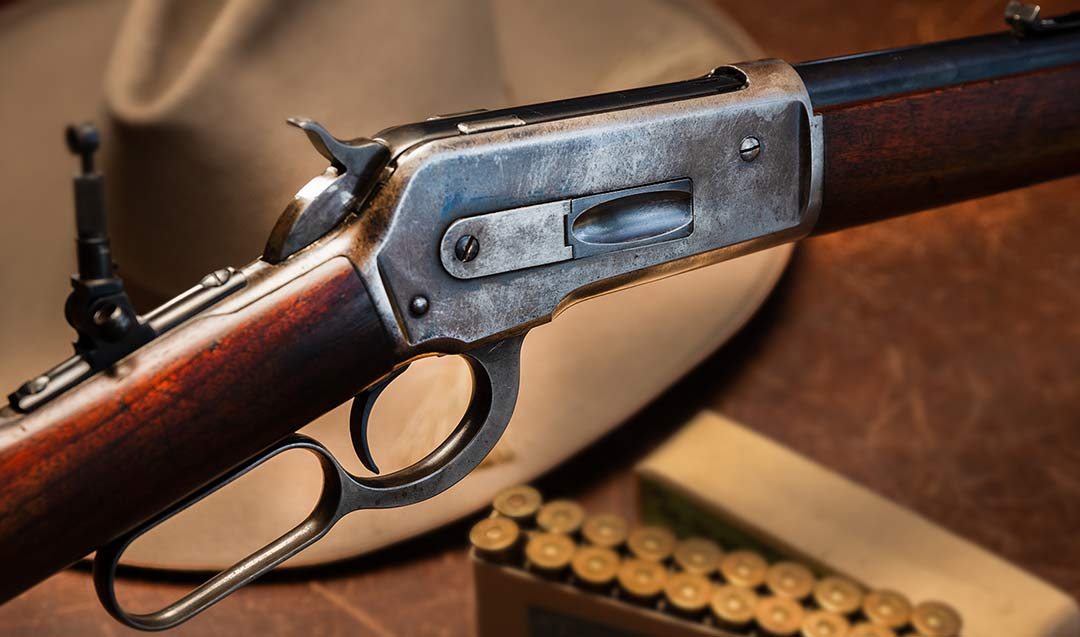
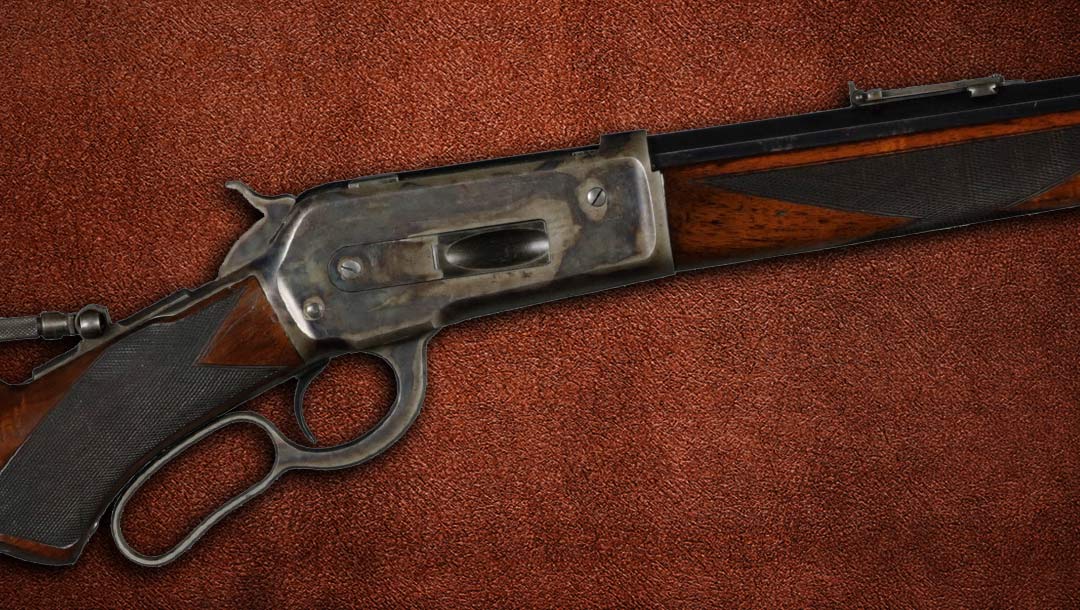
20 years after the founding of Winchester Repeating Arms Company, the Connecticut gunmaker released its most impressive rifle yet. The Winchester Model 1886 set the standard for large caliber lever guns and offered hunters and frontiersmen enough firepower to take on the most dangerous North American game.

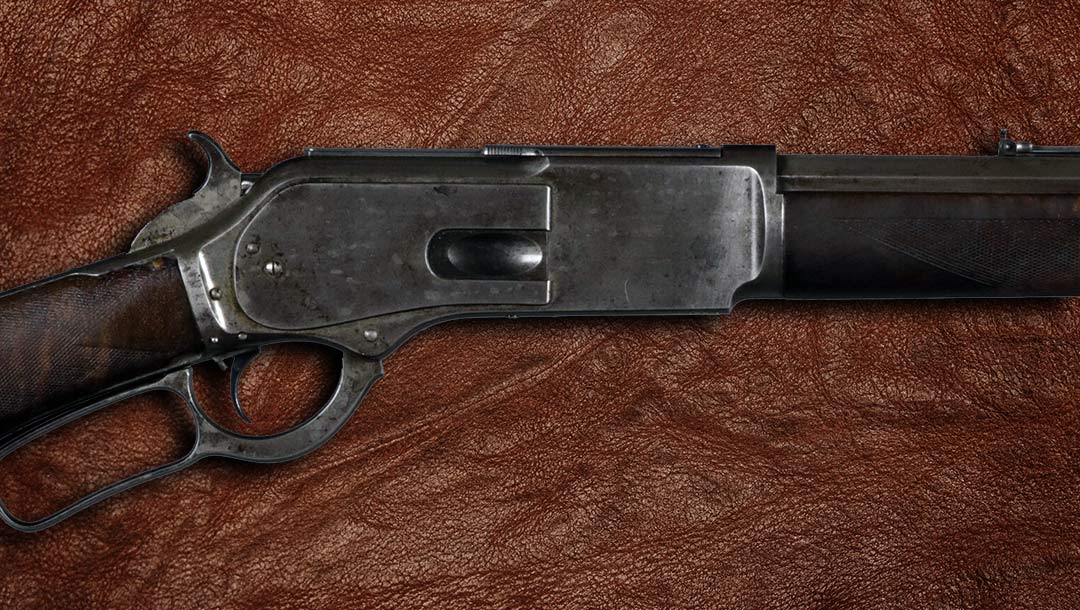
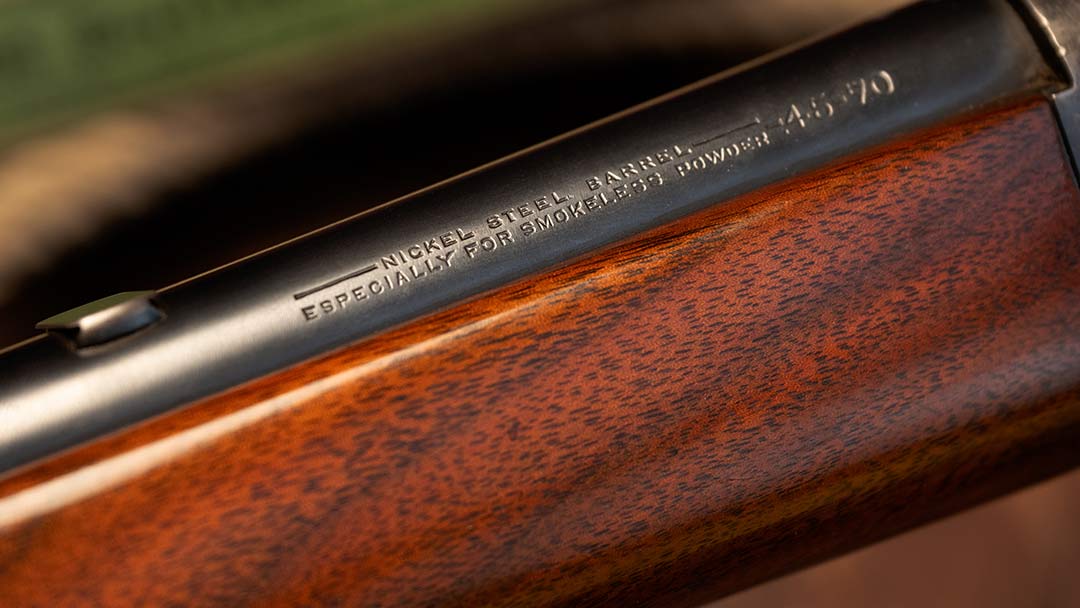
A Winchester Model 1886 lightweight takedown short rifle in .45-70. Available this October.

Rock Island Auction Company’s October 4 -6 Sporting & Collector Auction in Bedford, Texas features some of the finest antique and curio Winchesters, including a handsome range of Winchester Model 1886 rifles and carbines. Click on the images throughout this article to learn more about this impressive platform and its frontier contemporaries.

Road to the Big Game Repeater

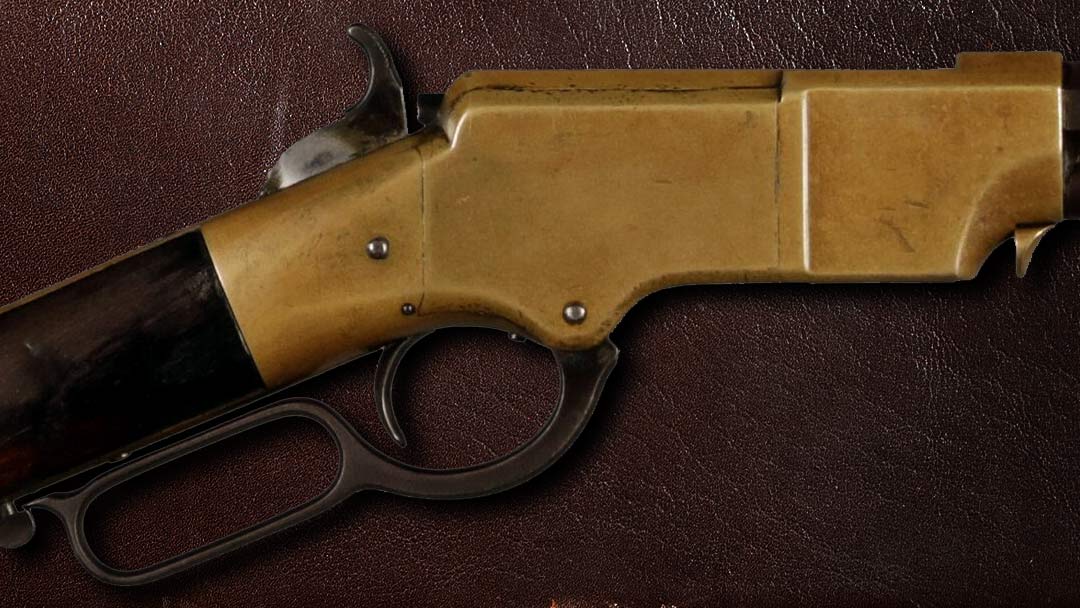
Patented in 1860, the Henry rifle was designed around a low-powered .44 caliber rimfire cartridge. The Henry’s successor, the Winchester Model 1866, continued to chamber this modest round, but the metallic cartridge was rapidly evolving.

The Henry set the stage for the Winchester lever actions to follow. This Civil War era New Haven Arms Company Henry rifle is available this October.

Winchester’s Model 1873 offered a significant upgrade with its iron frame, stronger action, and ability to chamber the new .44-40 Winchester Centerfire round. The popular model, later dubbed “the gun that won the West,” was a fine firearm, but its pistol-sized cartridges weren’t equipped to bring down large game like big bore single shot rifles such as the Sharps, Remington rolling block, and Springfield Trapdoor platforms.

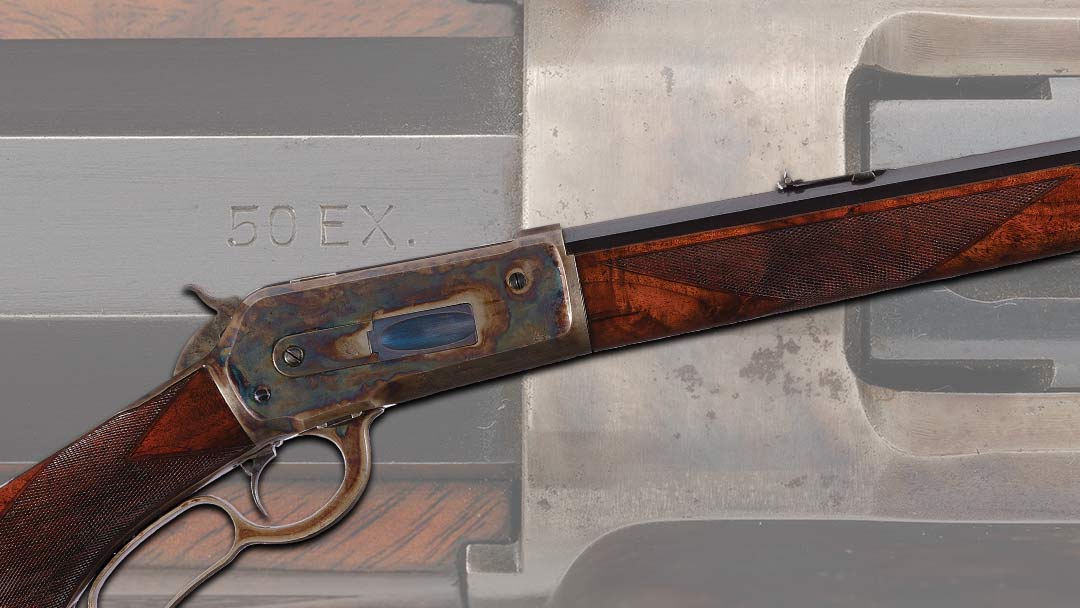
Winchester’s next model, the 1876, was a scaled-up version of its predecessor. Like the Model 1873 and its earlier iterations, the Winchester 1876 used a toggle-link lockup. Its receiver was larger and stronger, allowing the model to handle rifle cartridges like .45-75 WCF and .50-95 Express, but the gun was still unable to chamber the wildly popular 45-70 Govt round.

A Winchester Deluxe Model 1876 rifle. This 1882 manufactured example is chambered in .45-60 and includes a factory letter. Available this October.

Marlin Fire Arms Co. entered the market in 1881 with the first true big game lever action rifle. Originally introduced in .45-70 Govt. and .40-60 chamberings, dealers out West advertised the Marlin Model 1881 as “the Buffalo gun.” This market niche would elude Winchester until they discovered a young gunmaker from Ogden, Utah with experience in big bore rifles.

The Marlin Model 1881 incorporating patents from inventors like H.F. Wheeler, Andrew Burgess, and E.A.F. Toepperwein. The example above, manufactured 1887, is available this October.

John Browning and the Winchester Model 1886

In 1883, Winchester’s Vice President and General Manager Thomas G. Bennett visited John Moses Browning in Ogden and negotiated a deal that led to Winchester purchasing the rights to manufacture Browning’s single shot rifle patent. Browning had also been working on a concept for a big bore lever gun, which Bennett followed with great interest.

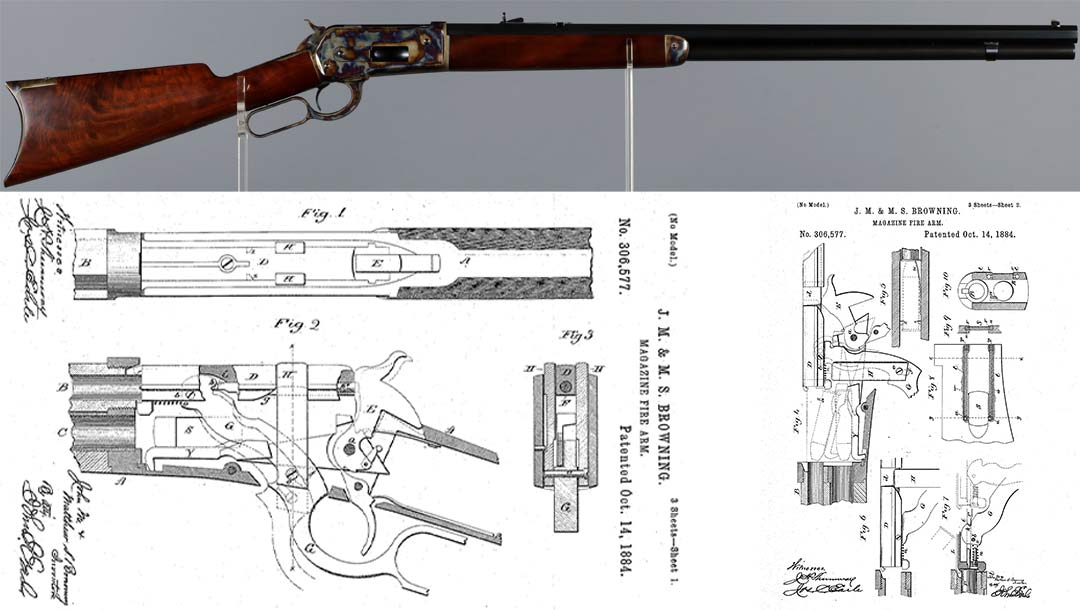
Browning patented the design on October 14, 1884, then traveled to New Haven, Connecticut to demonstrate a prototype of his new lever rifle to Mr. Bennett. The exact price Bennett offered Browning for the patent is uncertain, but John Browning once stated that Winchester paid him “more money than there was in Ogden at the time.”

On Oct. 14, 1884, patent No. 306,577 was approved for John Moses Browning’s “new Improvement in Magazine Fire- Arms.” This Winchester 1886 rifle pictured above is available this October.

Browning’s prototype would be refined by Winchester designers, including former Colt Superintendent William Mason. The toggle-link system employed by earlier Winchester models was both too weak to chamber the largest rifle cartridges and also physically constrained by geometry. The Winchester 1876 already weighed more than nine pounds, so scaling the design up further would have been impractical.

A Winchester 1886 for sale this October.

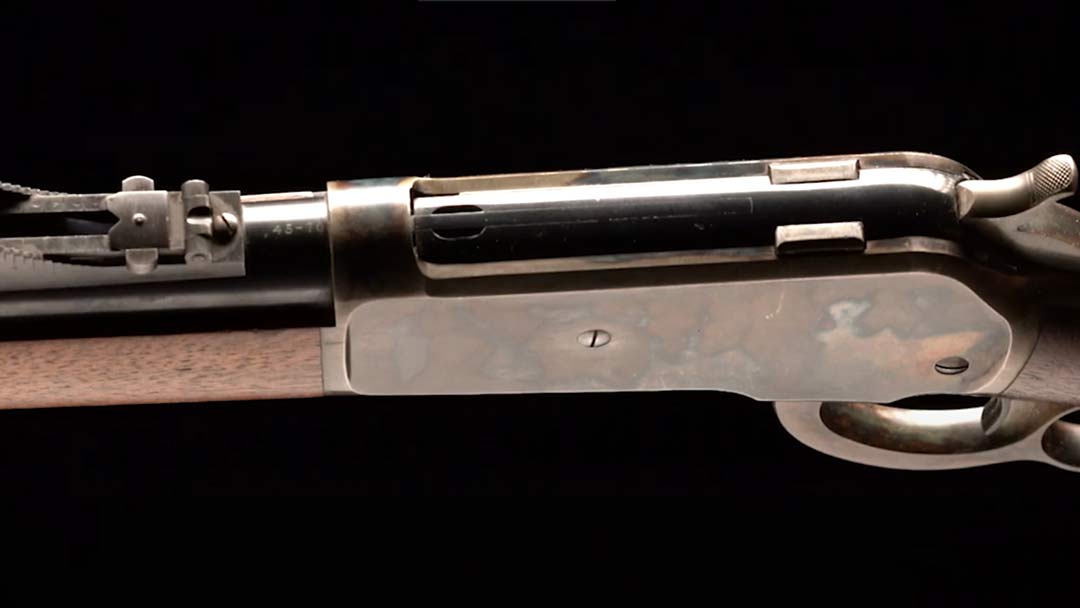
The Model 1886 needed to be long enough and sturdy enough to handle the .45-70 Govt. yet light enough for a hunter to field afoot. Browning’s design, inspired by the success of the falling block system found on many single shot breechloaders, employed dual vertically sliding locking lugs to seal the breech bolt against the chamber. This allowed for a powerful rifle with a shorter, streamlined frame. Winchester describes the design in their 1886 catalog as follows:

“The gun is locked by two bolts, having a motion like the old Sharp’s breech block, which show on the top of the gun when it is closed. In this position the locking bolts lie one on each side of the breech bolt, each fitting into its slot in the frame on the one side, and into a similar slot in the breech bolt on the other.”

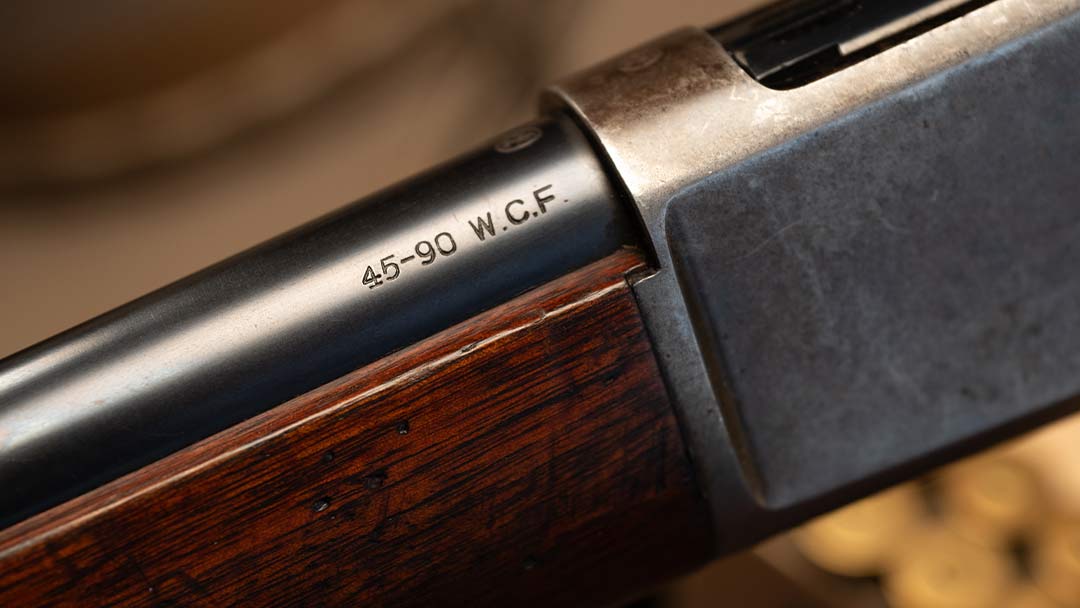
A special order Winchester Model 1886 in .45-90 for sale this October.

Birth of the Winchester Model 1886

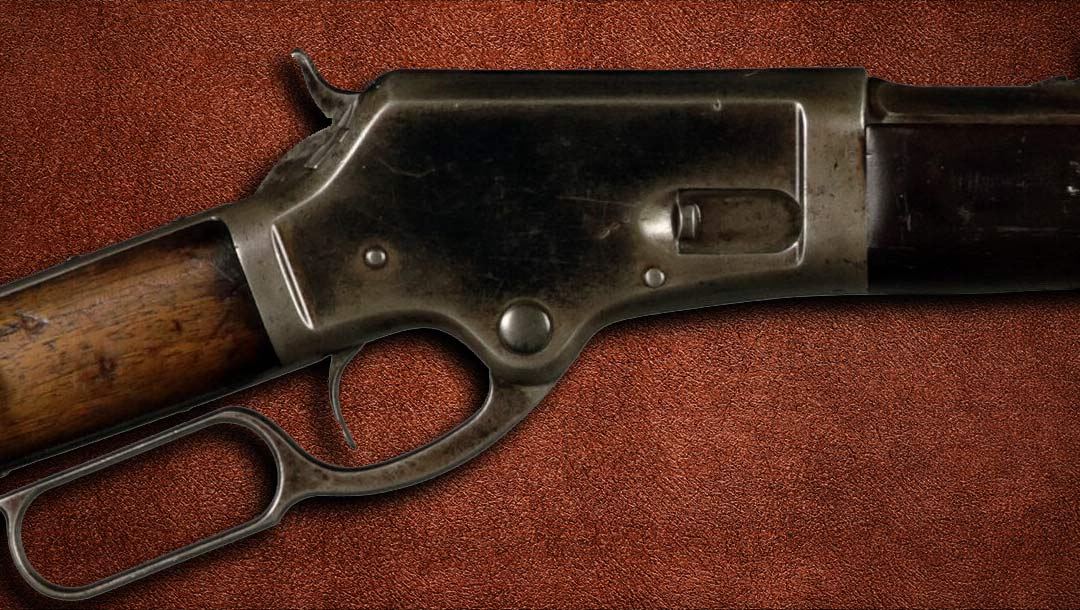
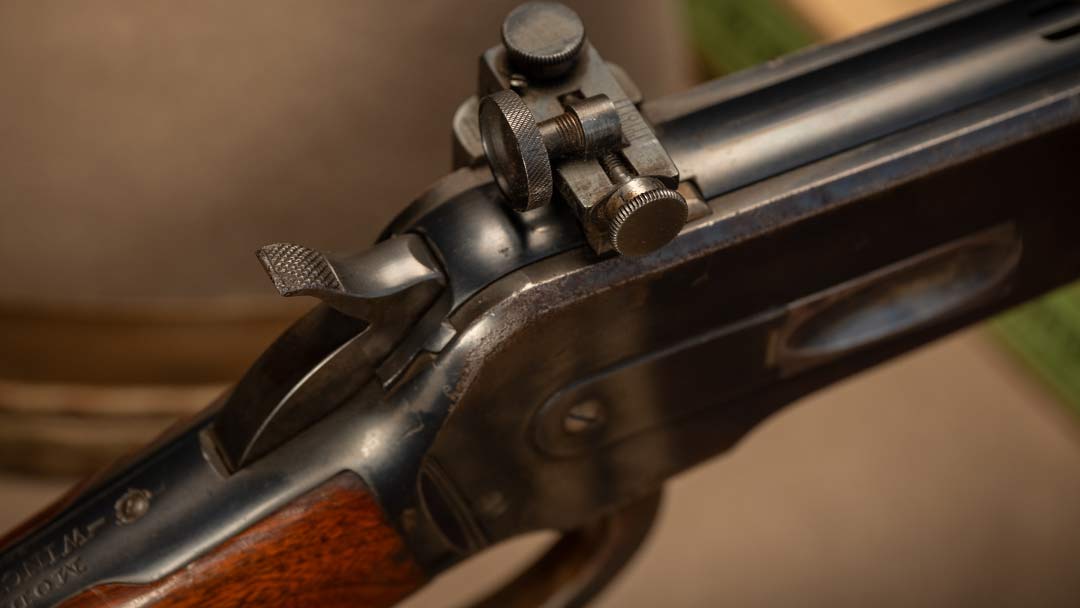
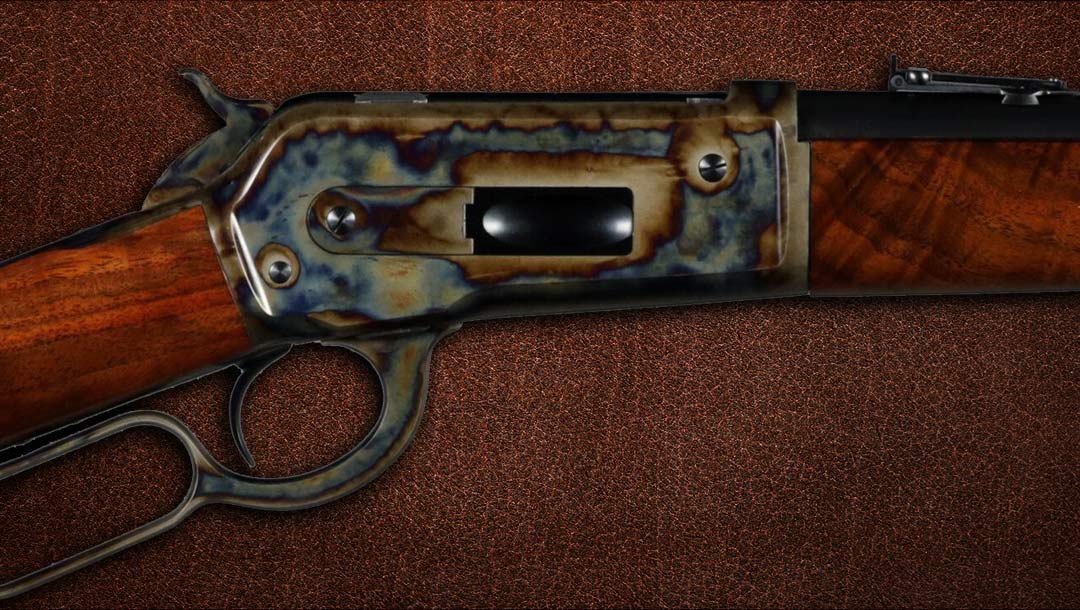
The Winchester 1886 was a top-eject lever gun with a smooth, powerful action. Distinct outward characteristics included a full oval loading gate and a solid frame that lacked a side plate, elevator, and dust cover.

“The New Winchester Model of 1886” appeared frequently in ads across the country by November and December. In late 1886, W.F. Sheard, a sporting goods dealer in Livingston, Montana, was advertising round barrel Winchester 1886 rifles for $20. The Winchester Model 1873 and Model 1876 were offered for $14 and $15 dollars, while the Marlin Model 1881 was sold at a comparable price point to the Winchester 1886.

An antique special order Winchester Deluxe Model 1886 for sale this October.

Serial number 1 of Winchester’s new model was presented to Captain Henry Ware Lawton in September of 1886 by Lieutenant George Emerson Albee, a Civil War veteran, exhibition shooter, and designer for Winchester. Lawton had played a key role in capturing Geronimo, and Albee’s connection to Winchester almost certainly helped him obtain the first production Winchester Model 1886 rifle. Not surprisingly, this iconic Winchester is one of the most expensive guns to ever sell at auction.

Winchester Model 1886, serial number 1, a factory presentation to Henry W. Lawton from a fellow soldier George Emerson Albee following the surrender of Geronimo, sold for $1.265 million in RIAC’s May 2016 Premier Action.

Winchester 1886 Variants

Like other Winchester lever guns, the Model 1886 was offered in a wealth of styles, including options for special stocks, grips, sights, triggers, and fancy features like inscription, engraving, checkering, and nickel, silver, or gold finish. The costly add-ons were comparatively rare for the model, which was widely viewed as an everyman’s working gun.

The Winchester Model 1886 was available in a wide range of configurations.

Early Winchester Model 1886 models featured a standard 22 inch barrel length for the carbine, 26 inches for the rifle, and 30 inches for the extremely rare musket variant. Takedown models were offered in half and full-length tube magazines. A round barrel was standard across all variants, with an octagon barrel selling at a premium.

A deluxe, special order Winchester 1886 .50 Express rifle with a factory letter, available this December.

The Winchester Model 1886 was sold in rifle, carbine and musket configurations. The musket was made in smaller numbers than any other Winchester 1886 variation with just over 350 produced. Featuring a steel block front sight that served as a mount for a socket bayonet and a military style folding leaf rear sight, most of these rare Winchester 1886 muskets were manufactured for export.

An exceptional Winchester 1886 musket with sold for $54,625 in 2019 with RIAC.

The Winchester 1886 and 45-70

The Winchester 1886 had been specifically designed for its ability to chamber large cartridges like the .45-70 Govt. This selling point was heavily pushed in early advertising. In the company’s 1886 catalog, the first line reads: “This Gun is adapted to the 45-75 Government Cartridges with 405 or 500 grain bullet, and to 45-90-300 or 40-82-260 Cartridges especially made for it.”

.45-70 Govt. was effective, plentiful, and reasonably affordable. The previously mentioned Montana sporting goods retailer, W.F. Sheard, was advertising  .45-70 Govt. for $2.75 per box of 100 rounds, equivalent to .92 cents a round in today’s dollars.

A Winchester 1886 saddle ring carbine manufactured in 1887. Available this October.

The Winchester 1886 was offered in ten factory chamberings. In addition to being paired with powerful cartridges like .45-90 WCF and .40-82 WCF, the mighty 1886 was capable of handling monsters like the .50-100 Express buffalo round, the most powerful factory black powder lever action cartridge ever produced.

A special order Winchester 1886 for sale in .45-90. Available this October.

The Winchester 1886 in the Field

In their October 28, 1887 issue, the Kansas Weekly Bulletin reviewed the new Winchester, noting, “These guns are made especial for large game and before the season is over we expect to hear of some wonderful work on deer.”

The same year, ‘Chasse et Pêche au Canada’, a hunting and fishing journal by Quebec native James MacPherson Le Moine, offered similar praise to the Winchester 1886, writing, “Its lightness and freedom from recoil is a great desideration to the Easter sportsman.”

A Winchester 1886 for sale with a filler block in rear sight dovetail and a receiver peep sight.

Though not designed for a top-mounted rifle scope, the Winchester 1886 was well-suited to hunting in the American West, offering the power needed to take down grizzly, elk, moose, and buffalo. In ‘Adventures with Indians and Game: Twenty Years in the Rocky Mountains,’ author William A. Allen recounts his experiences hunting with his Winchester 1886 and holding his own alongside his companions and their single shot rifles.

Teddy Roosevelt’s Winchester 1886, serial number 9205, became the future president’s primary sporting rifle from 1887 until 1894. Roosevelt’s Model 1886 included numerous custom features like a deluxe pistol grip stock, Monte Carlo cheek piece, and a shotgun buttplate. Roosevelt sent his rifle back to the Winchester plant five times to be refit and refinished. He also gifted the Winchester 1886 to a number of his friends and hunting companions.

A “Winchester Deluxe Model 1886 takedown rifle chambered in .45-90, reportedly made for Theodore Roosevelt’s 1909 African Safari sold for $28,750 with RIAC in September of 2020.

The Winchester 1886 also saw its share of use by militaries, militias, and law enforcement. The Citizens’ Guard of Hawaii, operating at the turn of the 20th century, was outfitted with the Model 1886. The Texas Rangers and Pancho Villa’s irregular military forces carried the model. And members of the British Royal Flying Corps employed Winchester 1886 rifles chambered in .45-90 Sharps incendiary cartridges during WW1 for use against German airships.

The example pictured below is one of 52 Winchester Model 1886 rifles bearing the inscription “Arapahoe County” on the left of the receiver and ordered in response to Denver, Colorado’s “City Hall War,” a series of clashes between the governor and Denver’s city government.

A well-documented, “Arapahoe County” inscribed Winchester 1886 rifle in .40-82 WCF. Available this December.

The Winchester 1886 Goes Smokeless

Browning’s design proved so robust that the Winchester 1886 was easily adapted with a nickel steel barrel to allow the platform to fire smokeless powder cartridges that became popular near the turn of the 20th century. Another change was introduced around 1902, somewhere after serial number 122,000, when the Model 1886’s standard casehardened receiver and lever was replaced with a blue finish.

A Winchester Model 1886 for sale in .45-70 W.C.F. Available this October.

The Winchester Model 1892, Browning’s scaled-down version of the Winchester 1886 designed for low-powered revolver cartridges, made a similar transition into the smokeless era.

A Special Order Winchester Model 1892 saddle ring carbine, chambered in .38 WCF and manufactured in 1906. Available this October.

Winchester 1886 Legacy

The original Winchester Model 1886 was produced until 1935. The gun’s production total reached just under 160,000. While this figure fell well short of popular platforms like the Winchester Model 1894, the Model 1886 was a modest success in its market niche and continued to be manufactured until 1935.

A Winchester Deluxe Model 1886 rifle in .50 Express. Available this October.

The Winchester 1886 faced competition from the Marlin lever gun line and the Savage 99, the latter employing a rotary stacked magazine that could chamber Spitzer cartridges. The Model 1886 was a costly gun to produce as well, and the increasingly popular bolt action rifle offered a more affordable platform for big game hunting. The Great Depression finally ended the 1886 for good, but Winchester already had a successor planned with the Model 71.

A special order Winchester Deluxe Model 1886 lightweight takedown short rifle manufactured in 1904. Available this October.

Winchester Model 71

The Winchester Model 71 started production in 1936, 50 years after the debut of its Model 1886 predecessor. Despite their mechanical similarities, few parts were interchangeable between the two platforms, as the Model 71 was designed to reduce manufacturing costs. The Model 71 was specifically chambered for the .348 WCF cartridge, a powerful round based on the black powder .50-110 Express.

This Winchester Model 71 was manufactured in 1957 and subsequently embellished with extensive scroll engraving over a matted background surrounding a running deer on the left, a grizzly on the underside, and a moose on the right all inlaid in fine gold relief. Available this October.

Sales numbers were modest, and production of the Winchester Model 71 was halted during WW2 and resumed again in 1947. By that time, bolt action ammunition was rapidly evolving. The popularity of scopes was also increasing, and the Model 71’s simplified design was still more expensive to produce than its big game competitors. The gun was discontinued in 1958 after an estimated production run of 47,254.

The Winchester Model 71 proved popular in the Alaskan wilds for being strong enough to take down deer, moose and bears. The early production deluxe model pictured above, manufactured in 1936, is available this October.

The Winchester 1886 Today

For the 100th anniversary of the Winchester 1886, Browning Arms partnered with Miroku Corporation of Japan for a Model 1886 commemorative run. The gun became a regular part of Browning’s lineup, and was at last reintroduced to the Winchester family in 2020.

A T. Mori factory signed, game scene engraved and gold accented Browning Model 1886 “1 of 3000” High Grade saddle ring carbine Manufactured 1992 and chambered in 45-70. Available this October.

Pedersoli, Uberti, and Chiappa have also produced modern reproductions of the Winchester 1886. While these firearms are a fantastic way for shooters to experience the classic Model 1886 platform, there’s nothing like owning a genuine antique or curio example of Winchester’s big game hunting specialist.

Winchester 1886 Prices

In the 1880s, the Winchester 1886 could be purchased for as low as $20, a premium firearm for its era. Today, the Model 1886 is one of the most coveted firearms in the collecting pursuit, commanding ever-more impressive prices at auction. This isn’t a surprise to arms enthusiasts, since 19th century Winchester lever guns are right up there with antique Colt revolvers in terms of collectability, and the Winchester 1886 was designed for the Wild West.

This beautifully engraved and exceptionally rare Winchester Model 1886 Express rifle sold for $1,178,750 during the September 2018 Premier Auction.

Two of the top ten guns ever sold at Rock Island Auction Company are Winchester 1886 rifles, like the breathtaking John Ulrich signed, engraved, and inlaid example pictured above. Rare special features, engraving, high condition, notable provenance, and documentation can greatly increase the value of a Winchester 1886, and factory records for the model are more complete compared to some of its predecessors.

Preserved in near-new condition for 140 years, this newly discovered Winchester Model 1886 in .45-90 WCF sold for $352,500 in RIAC’s August 2024 Premier Auction.

Winchester Model 1886 for Sale

In terms of power and engineering, John Browning’s first lever gun design more than lived up to its promise as a working man’s big game repeater. Rock Island Auction Company offers an unparalleled selection of Winchester Model 1886 rifles and carbines for sale in its Premier and Sporting & Collector Auctions, where original examples of this frontier classic can be obtained at every collecting aspiration.

A Winchester 1886 rifle for sale this October. This 1905 manufactured example is import marked and German proofed.

Subscribe to the weekly Rock Island Auction newsletter to receive new gun blogs and gun videos that cover other historic hunting icons in the Winchester family, including the Model 1887 and Model 1901 lever action shotguns, the Model 21 side-by-side, , the Model 1897 and Model 42 pump shotguns, the Model 1895 lever rifle, the Model 70 and Model 52C bolt action rifles, and more.

An antique Winchester Model 1887 shotgun, manufactured in 1891. Available this October.

Review: Kizer Militaw | Jerking the Trigger

0

The Jonathan Styles designed Militaw has been a smash hit for Kizer. The original Militaw, with its unique design and premium construction, has spawned seemingly endless variations that sell out quickly. I’ve had the chance, thanks to Kizer for providing the review sample, to check out the original version that started it all.

Specs

  • Model Number: Ki3634A1
  • Overall Length: 7.99″/203mm
  • Designer: Jonathan Style
  • Opener: Front Flipper, Thumb Hole
  • Blade Style: Drop Point
  • Blade Length: 3.35″/85mm
  • Blade Thickness: 0.12″/3.0mm
  • Blade Material: S35VN
  • Handle Length: 4.65″/118mm
  • Handle Material: Titanium+Micarta
  • Pocket Clip: Machined Ti Clip
  • Weight: 3.92oz./111g
  • Lock Type: Frame Lock

Observations from Use

I have always liked the look of the Militaw. It reminds me of a classic Green River Traditional knife in its shape when it is opened. But, it wasn’t until I had one in hand that I fully understood why this knife is so popular.

It is lighter than you expect but also has the kind of heft that only comes with titanium construction. The Ti handle is countoured and radiused so that not a single uncomfortable corner remains. It’s blade has a very finely executed stonewash finish that feels oily smooth under your fingertips and it swings through its ark with ease thanks to ceramic bearings in the pivot. In short, it feels like something special in hand.

The front flipper on this knife is very well executed. It features very effective jimping that wraps up and over the top of the flipper. That setup makes it very easy to get the leverage needed to operate the flipper, even on this larger blade. The triangular shaped opening hole also works well. The user can slide along the relief cut in the handle to catch the corner of the opening hole with their thumb and the the blade flies open with haste. The reverse flick is absolutely effortless thanks to the crispy, well-tuned detent.

Kizer calls the Militaw’s blade shape a drop point but it almost looks like a straight clip point with a long straight clip. This shape brings the point basically in line with the pivot and makes it very easy to access without having to cant the knife too much. That point is also fairly fine but plenty strong thanks to the long swedge grind. The almost full-height flat grind tapers down to a decently thin edge that cuts well and seems to hold up well in cutting thanks to the relatively tough S35VN steel.

The handle design is one of the most distinctive and unique parts of the Militaw design. It is mostly straight with a relief cut that serves to allow access to the opening hole and lock bar and as a finger groove of sorts. This long, straight handle is very neutral in it’s shape, so it accommodates just about any grip type you could want.

The handle also showcases the micarta inlays which have a complex shape that really shows off Kizer’s ability to achieve impressive fit and finish at a production knife price. These inlays are fit with precision and perfectly blend into the contours of the machined titanium handles. The micarta inlay on the lock side of the knife also functions as an integrated overtravel stop for the lock bar.

Wrap Up

The Militaw isn’t not an inexpensive knife but it is an incredible value. I am not sure there is another knife with these premium features that can compete with it on price. This is a showcase of what Kizer can do – precision manufacturing, premium materials, and high-end design, all at a very competitive price.

Kizer Militaw at KizerKnives.com

Kizer Militaw at Amazon.com

The above links may be affiliate links.

The Beauty and History of the August Premier

0

A Find, a Singer, and a wheellock from French King Louis XIII’s Cabinet d’Armes are among the incredible array of firearms on offer in Rock Island Auction Company’s Aug. 23-25 Premier Auction in Bedford, Texas.

The Find, is of course the Marshfield Find, a Winchester 1886 amazingly discovered in the attic of a colonial era home in Marshfield, Mass. where it sat for nearly a century. The high-conditioned gun, chambered in the desirable .45-90 WCF, and its accompanying shipping crate are a time capsule that includes packing papers, five boxes of ammunition and a leather scabbard.

The Invictus Singer is the Model 1911A1 carried by B-24 Liberator pilot Thomas R. Moss on 35 missions over Axis-occupied Europe. Already a rarity because only 500 were made by the Singer Sewing Machine Company, this pistol occupies truly rarified space because of its history and provenance. Moss kept the Singer in very good condition and only parted with it a few years before his death at the age of 99 in 2020.

Louis XIII could be considered the first gun collector based on his legendary Cabinet d’Armes, and this gold and silver ornamented royal presentation wheellock from that collection is truly an amazing piece and one of the first pieces in his collection. Likely made by Francois Poumerol, the gun is immensely embellished with gold and silver, making it a true piece of art.

Impressive Collections

Offerings from the collections of George S. Lewis, Greg Lampe, Norman R. Blank, Andrew Singer and Mac McCroskie continue to provide historic and highly conditioned firearms from bygone eras. The Lewis Collection has some immensely well-conditioned Colts, and Singer provides prime examples from the late percussion and early cartridge eras of the 19th century. The McCroskie collection is legendary for the well-documented history and provenance of absolutely beautiful guns.

From the Lampe Collection comes amazing holster rigs and scarce vintage ammunition as well as firearms that glisten with blued and casehardened finishes like a cased factory engraved Colt Model 1861 Navy revolver available on Day 2 of the Auction.

Among the awe-inspiring offerings from the Blank Collection, aside from the spectacular Wheellock of Louis XIII, are amazing flintlocks from James Haslett and Joseph Griffin and an award-winning exhibition quality Purdey double rifle that appeared at the Exposition Universelle in Paris in 1878 and the Sydney International Exhibition the following year.

Wild West Guns

Recognizable names like Buffalo Bill Cody, Pat Garrett and actor Lee Marvin pop up among the many Wild West guns and other western memorabilia that will be offered at the auction. A Buffalo Bill presentation Winchester 1895 carbine to M.R. “Gold Nugget Mike/Deadwood Mike” hovers at the pinnacle of guns from the American West. A gold Lincoln County sheriff’s badge and an engraved gold washed Colt 1877 Thunderer presented to Pat Garrett offers a glimpse into the hardscrabble and often lawless nature of the West.

A pair of Colt Single Action Army revolvers associated with the 101 Ranch in Oklahoma show the transition of the west from a land of desperadoes and outlaws to hard-working settlers carving out a living as farmers and ranchers. A Colt Single Action Army provides a bit of Hollywood glamour, carried by actor Lee Marvin alongside Hollywood royalty John Wayne and Jimmy Stewart in the film “The Man Who Shot Liberty Valance. A screen-used Colt Model 1903 Hammerless carried by Gary Cooper in the film “City Streets” is also available.

Classic handguns and pocket pistols from Smith & Wesson, Tranter, Remington and Merwin Hulbert populate the auction catalog alongside the numerous historic and well-conditioned offerings from Colt that range from the percussion era Paterson of the early Texas Rangers to the modern times of the Model 1911A1 that was a military mainstay for the United States during most of the 20th century.

Only approximately 1,000 No. 5 Holster Model “Texas Paterson” revolvers were manufactured by Colt. This example is available on Day One of the August 23-25 Premier Auction. Also available is the Colt Paterson Model 1839 Percussion Revolving Shotgun also pictured at right.

L.A. Huffman’s photographs chronicled the end of the Wild West era, capturing images of horse soldiers and Native Americans alike. Several of his prints, including some that are hand-colored and accompanied by their stencils, are available in the auction. The auction will also offer a number of leather holster rigs and law enforcement badges that are fantastic relics of a bygone era of lawlessness and adventure in the Old West.

Military Collectibles

The Invictus Singer pistol is surrounded by fascinating militariain the auction in the form of handguns, infantry rifles, machine guns and flight jackets from several conflicts like the Brown Bess of the American Revolution, several German machine guns like the MP40 of World War 2, the M60 of the Vietnam War and the U.S. Barrett M82A1 of Desert Storm. Also of interest to collectors are terrific offerings of military uniform patches from World War 2 that come from every corner of the conflict.

Joining a medley of German machine guns are a number of rapid fire hotshots like the Thompson Submachine gun, the Stoner 63A, the Winchester BAR and the Colt M16, and modern classics like Heckler & Koch’s HK53 and MP5.

Sporting Arms

Collectors hunting for upland elegance or hunters aiming for both accuracy and artistry have plenty of options in the auction, with highly embellished examples from Purdey, Boss, Ivo Fabbri and Perazzi dotting the roster alongside guns that are easily their equals but from less-recognized makers like P.V. Nelson, Peter Chapman and David McKay Brown.

Not to be outdone are double rifles and safari rifles that bring the big game feel from makers like Holland & Holland and Winchester. Randall Knives, classic American designs for hunting and survival, and Bowie knives, the legendary large-bladed knives of the American frontier, each have numerous examples available in the auction.

Place Your Bids

Rock Island Auction Company will host a preview day on Aug. 22 at its auction venue at 3600 Harwood Road, Bedford, Texas where all of the fabulous inventory of the auction will be available to swoon over and examine. The Aug. 23-25 Premier Auction has an outstanding roster of fine firearms brimming with provenance, history and beauty that would be outstanding additions to any collection.

Buffalo Bill Cody presented this Winchester 1895 Carbine to his friend and Deadwood, S.D., businessman Mike Russell who had two nicknames, “Gold Nugget Mike” and “Deadwood Mike.” Buffalo Bill was known to hunt with the Winchester 1895 and present it to friends. This gun is pictured and described in R.L. Wilson’s book “Buffalo Bill’s Wild West: An American Legend.”