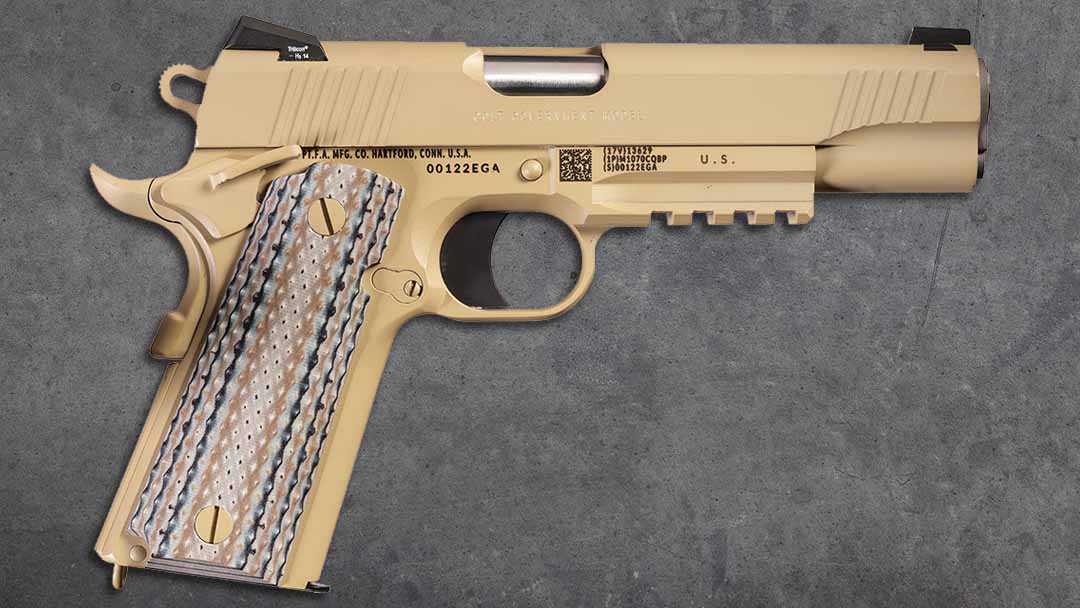
Las Vegas is gearing up for the 2025 NSSF SHOT Show, and let me tell you, if you’re into guns, hunting, or anything outdoors, this is where you need to be. Come January, the city will be packed with the best the firearms world has to offer—new gear, cutting-edge tech, and the people who actually know what the hell they’re talking about.
OFFGRID Survival is locked and loaded to bring you all the action from the 2025 SHOT Show. From the latest in firearms and ammo to cutting-edge hunting and survival gear, we’ll have your six. Curious about what’s going to shake up the industry next year? Stick with us—we’ve got the inside track on everything that matters.
If you’re heading to SHOT, get ready for a week that’s more than just gear and gadgets. This is where the best in the business cut deals, forge connections, and shape the future of the industry. Plus, let’s not forget the legendary parties, exclusive meetups, and top-tier networking events that make this week unforgettable.
For those hitting the ground in Vegas, here are some of the top parties, meetups, and events you don’t want to miss. We’ll see you out there—don’t forget to say hi if you spot us in the action.
SHOT Show Party List
We will be updating the list as we are informed of more events so check back!
Industry Day at the Range is the largest, most influential one-day event in the hunting and shooting industry. Industry Day at the Range / SHOT Show Media Day at the Range is held annually on the day before the opening of each year’s SHOT Show. Invite Only!
After Dark Welcome Mixer Date & Time: January 20, 2025 – 8:30 PM – 10:30 PM Location: Venue TBA Description: The SHOT Show AFTER DARK schedule provides nightly opportunities to mix with your industry colleagues at some of the best venues in Las Vegas. Upgrades, such as open bar packages, are available.
Nightclub Guest List Access – JEWEL Date & Time: January 20, 2025 – 10:30 PM – 1:00 AM Location: Jewel Nightclub, Las Vegas Description: Upgrade your nightlife experience with expedited “Guest List” access to one of the most exclusive nightclubs in Las Vegas.
Tuesday, January 21, 2025 – SHOT Show Events
All Star Jam Concert January 21, 2024 – 5:30 pm-8:00 pm Outside Caesars Forum, next to Great Outdoors Plaza
Concert will be free to all 2025 SHOT Show attendees and exhibitors. Cash bar will be available.
Nightclub Guest List Access – OMNIA Date & Time: January 21, 2025 – 10:30 PM – 1:00 AM Location: OMNIA Nightclub, Las Vegas Description: Elevate your evening entertainment by gaining fast-track entry to one of Las Vegas’ most prestigious and thrilling nightclubs through our “Guest List” priority access.
SHOT Show BBQ Date & Time: January 21, 2025 – 5:30 PM – 8 PM Location: 3600 Las Vegas Blvd, Las Vegas, Nevada Description: Skogen’s SHOT Show BBQ brings together a mix of dry-aged beef and whiskey for a memorable evening. Open to the public. Hosted in Spring Valley, Nevada.
Wednesday, January 22, 2025 – SHOT Show Events
Industry Welcome Reception Great January 22, 2022 – 5:30 pm-6:30 pm Outdoors Plaza, outside Caesars Forum
Relax after SHOT Show and connect with the industry on the Great Outdoors Plaza patio. Open to all SHOT Show attendees, manufacturers, suppliers, distributors and media.
After Dark Mixer Date & Time: January 22, 2025 – 6:00 PM – 8:00 PM Location: Venue TBA Description: Join your fellow SHOT Show attendees for a happy hour. Available exclusively to 2025 SHOT Show badge holders with an AFTER DARK package. Limited spots are available. Open bar upgrades are available and recommended.
Nightclub Guest List Access – Marquee Date & Time: January 22, 2025 – 10:30 PM – 1:00 AM Location: Marquee Nightclub, Las Vegas Description: Elevate your nighttime escapades by enjoying accelerated “Guest List” entry to one of Las Vegas’s most exclusive nightclubs.
Thursday, January 23, 2025 – SHOT Show Events
Industry Reception Continuation January 25, 2024 5:30–6:30 PM Great Outdoors Plaza, outside Caesars Forum
Stop by for a drink and connect with colleagues before heading to dinner.
Firearms Industry Marketers Meetup During SHOT SHOW TBA Location: TBA
Firearms Industry Marketers Meetup During SHOT Show is an informal meetup for firearm, military, outdoor, hunting and fishing marketing professionals to come together, swap stories, talk about the challenges associated with marketing firearms in the current climate, network, and relax after a long day at SHOT Show.
Nightclub Guest List Access – TAO Date & Time: January 23, 2025 – 10:30 PM – 1:00 AM Location: TAO Nightclub, Las Vegas Description: Elevate your nighttime escapades by enjoying accelerated “Guest List” entry to one of Las Vegas’s most exclusive nightclubs.
Friday, January 24, 2025 – SHOT Show Events
More Events to come as we get closer to the show! Check back for a full list of events as the convention gets closer.
Every Night of the Show!
UnofficialFirearms Industry Meetup During SHOT SHOW Every night of the show Location: Venetian Bellini Bar (Circle Bar)
Firearms Industry Marketers Meetup During SHOT Show is an informal meetup for firearm, military, outdoor, hunting and fishing marketing professionals to come together, swap stories, talk about the challenges associated with marketing firearms in the current climate, network, and relax after a long day at SHOT Show.
Check back for a full list of events as the Show gets closer.
For those planning to attend SHOT Show 2025, if you are at the show and see us, say hello! We always have some free OFFGRID Shirts, Shirts of Liberty Shirts, Stickers, and a few of my books to give away.
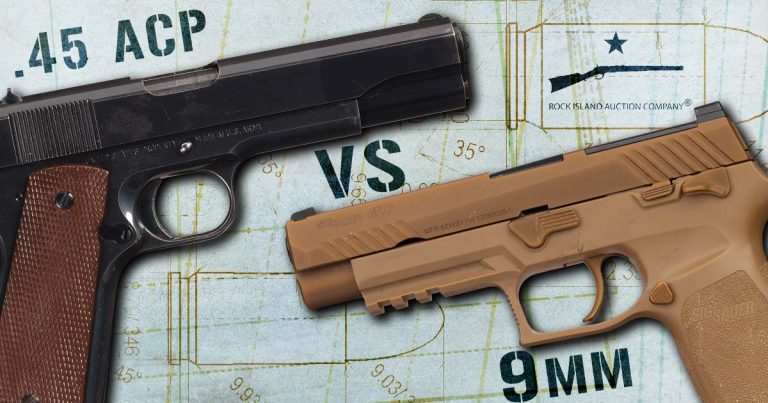
Of all the firearms debates, perhaps none is more heated today than 9mm vs .45 ACP. Originating in the early 20th century, 9mm and .45 ACP have dominated the semi-automatic pistol market for decades and remain two of the most popular rounds in the world.
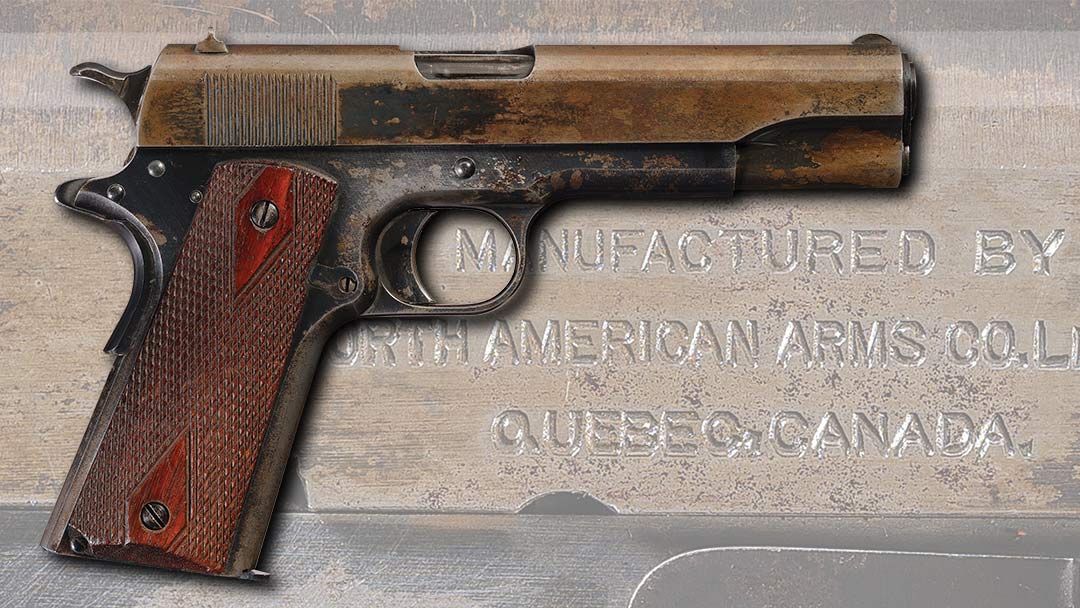
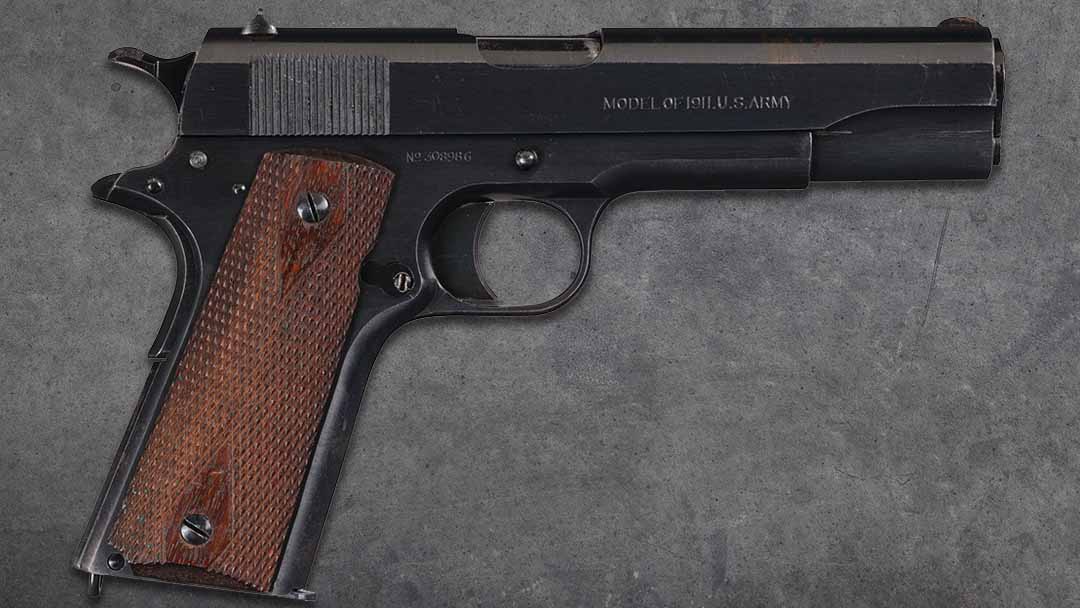
A rare unserialized WW2 Singer Manufacturing Co. prototype/presentation Model 1911A1 pistol. Available this December.
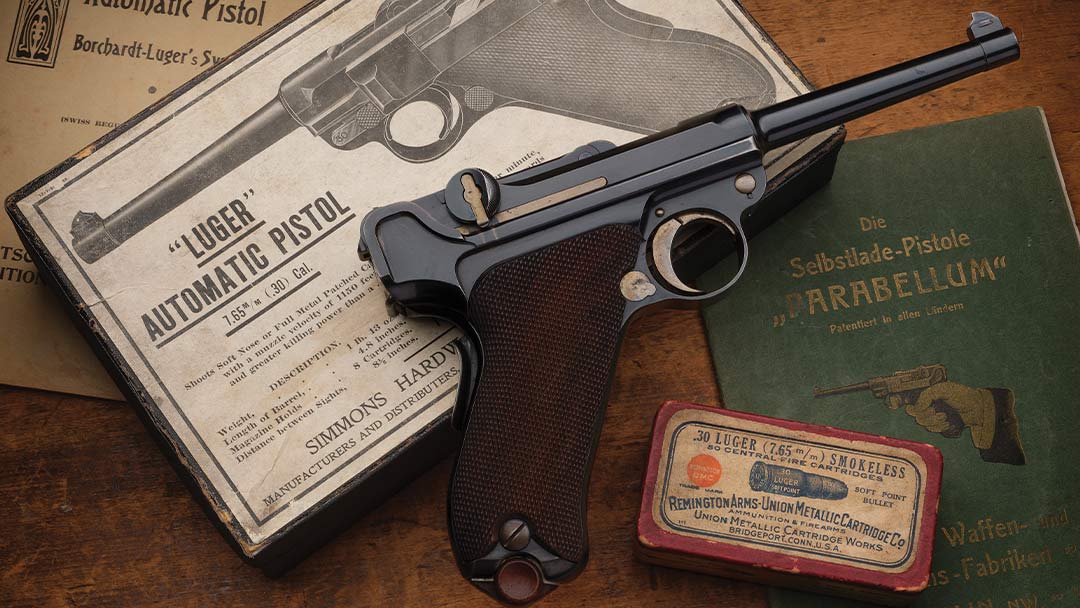
The .45 ACP vs 9mm showdown defined the development of 20th century pistols and submachine guns. Some of the finest vintage and modern firearms chambered for each of these iconic cartridges are available in RIAC’s December 6 – 8 Premier Firearms Auction inBedford, Texas, including an outstanding assortment of 1911s and Lugers. Click on the images throughout this article to learn more about each model.
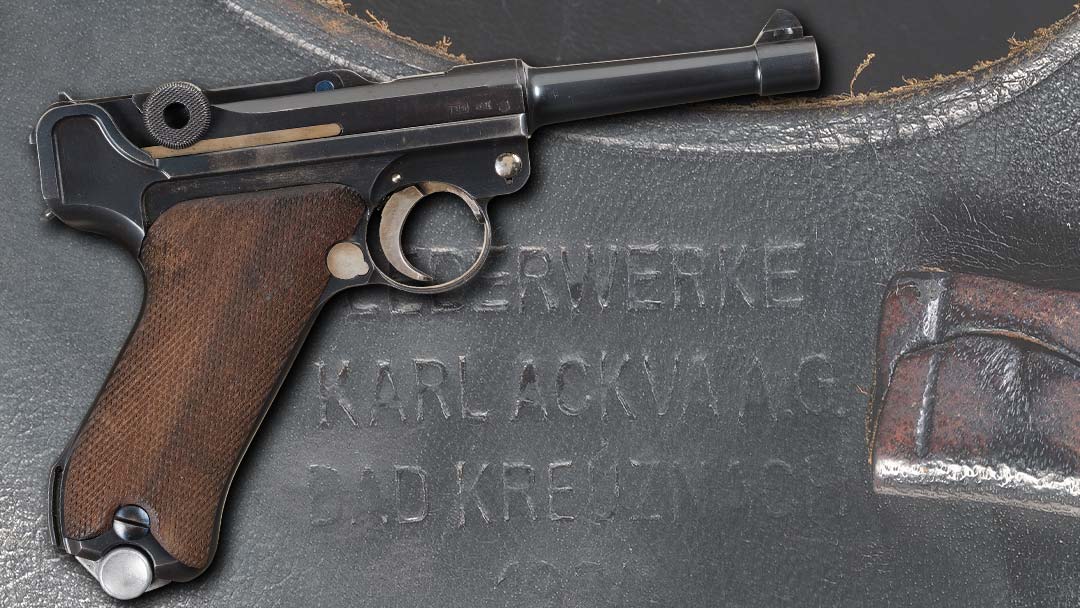
An outstanding Mauser “K” Date “S/42” Code P.08 Luger pistol rig with two matching magazines and a “1934” dated holster. Available this December.
9MM vs .45 ACP
Proponents of .45 ACP will point to the cartridge’s status as a two-time World War champ and its superior stopping power. 9mm advocates laud their chosen round’s greater magazine capacity, ease of carry, and lighter recoil.
In the 9mm vs .45 ACP debate, capacity is often considered the most important factor. 9mm wins here hands down. The classic .45 ACP 1911 design and its single-stack magazine holds only six rounds, with a seventh in the chamber. The 9mm Browning Hi Power and its double stack magazine offers 13 rounds, while the Glock 17 has a 17 round capacity. Later .45 ACP double stack pistols still fall short in this category, with examples like the Glock 21 only able to hold 13 rounds.
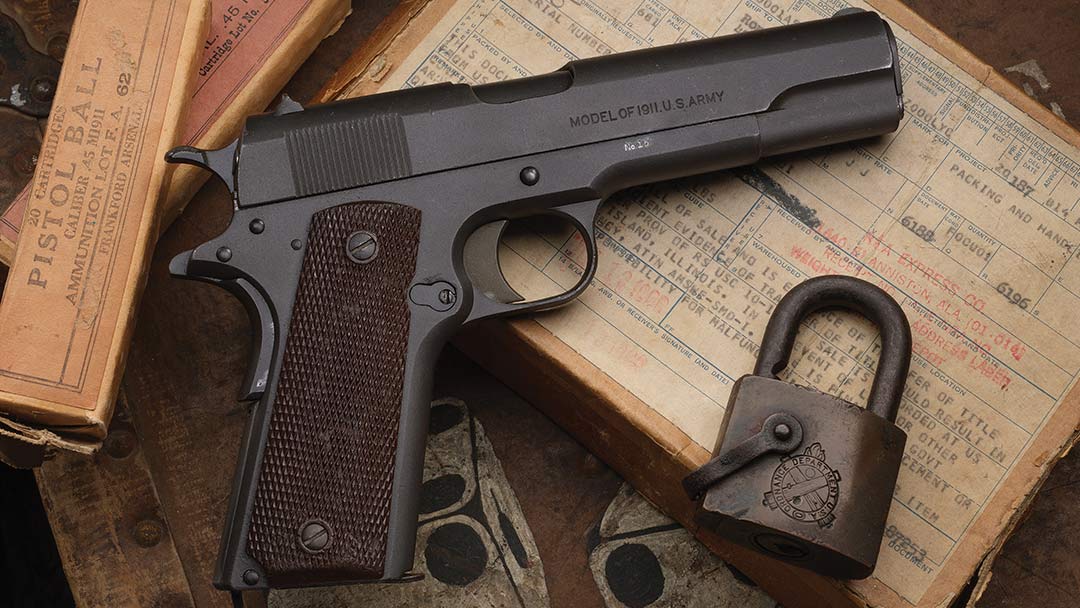
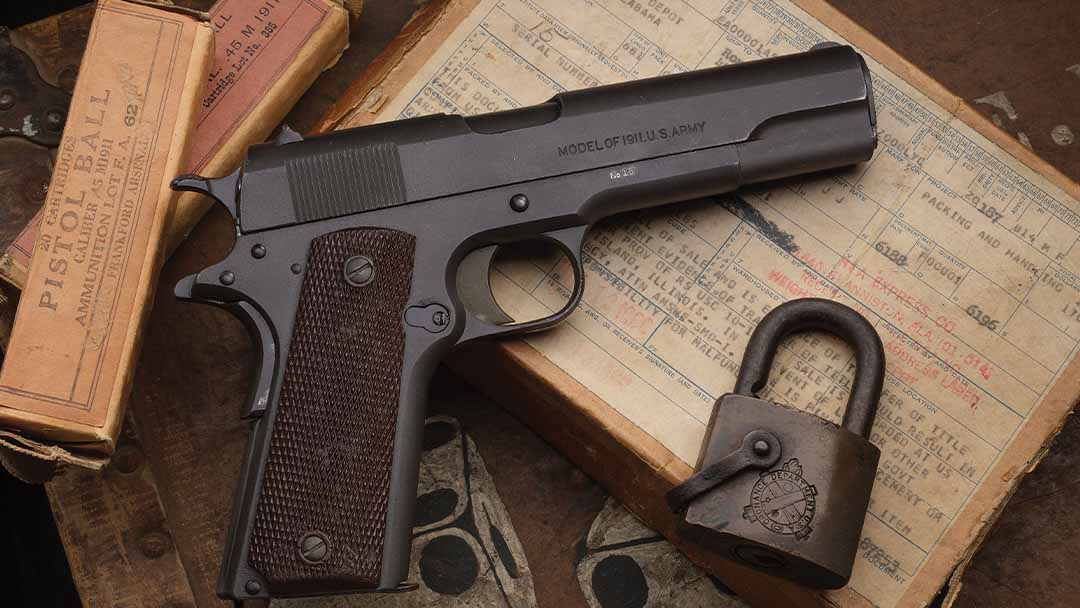
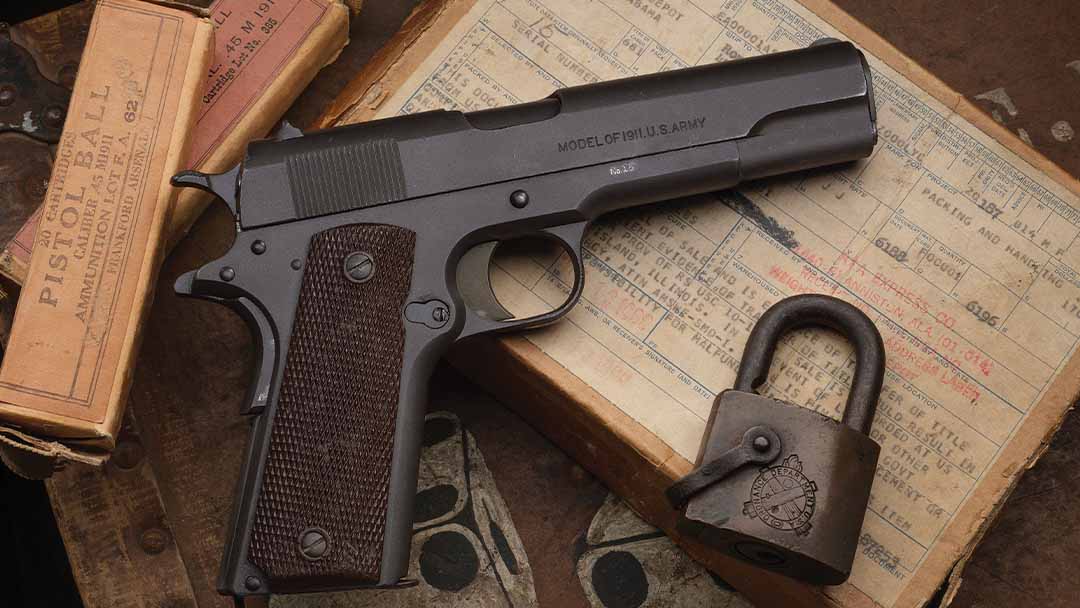
An incredibly early production two-digit serial number 15 U.S. Colt Model 1911 pistol with an Anniston Army Depot shipping box. Available this December.
.45 ACP is a fatter, heavier round that carves out a larger wound channel and delivers greater muzzle energy to a target without excessive penetration. Though advancements in modern hollow point bullets have helped the higher velocity 9mm bullets close this gap, .45 ACP holds the advantage when it comes to imparting more mass on impact.
That power comes with greater recoil, however. The weight and style of a .45 ACP firearm can reduce this drawback, like the classic 1911 pistols and their sturdy frames, but the lighter 9mm still holds the edge in this category.
Another advantage 9mm offers over .45 ACP is a significantly cheaper ammunition cost. Both rounds are widely available though, and every major handgun manufacturer offers pistols chambered in each of these classic cartridges.
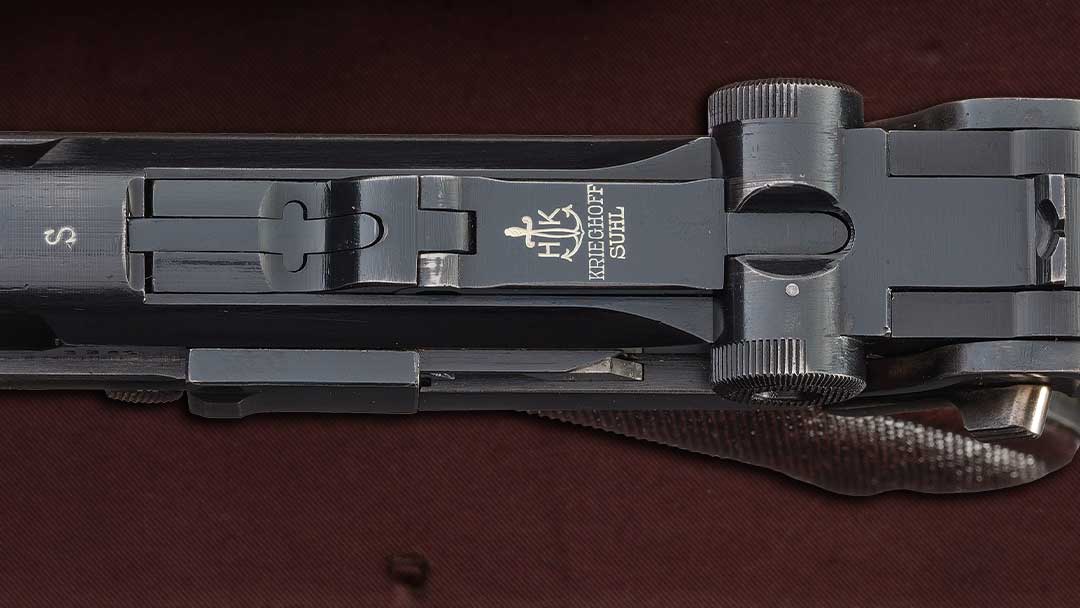
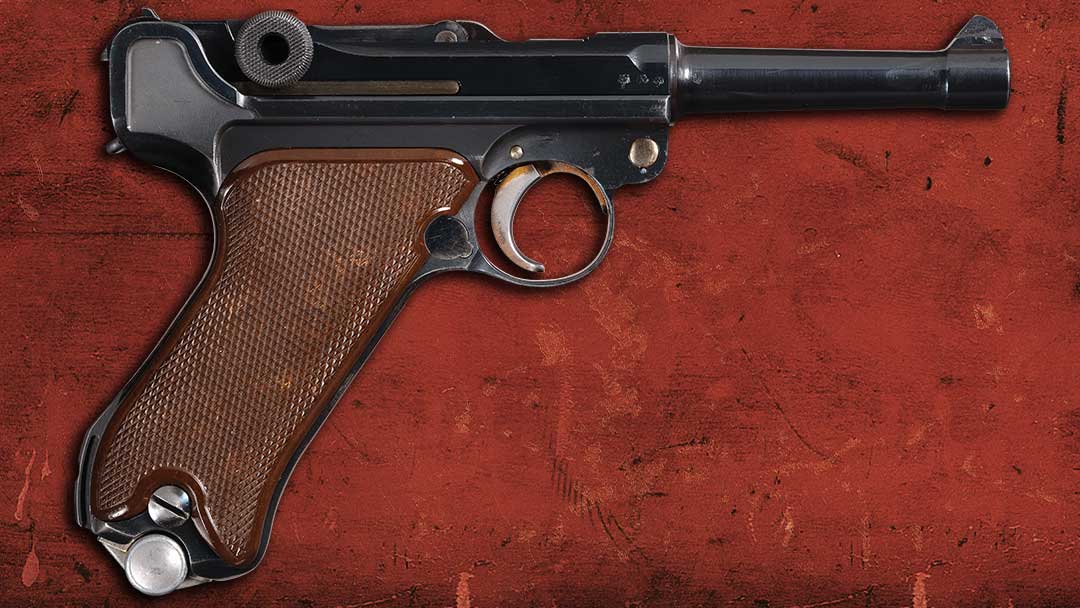
A desirable pre-WW2 “S” code Krieghoff Luger pistol rig with two matching magazines, a Krieghoff proofed holster, and a service belt. Available this December.
9mm Development
In 1901, Georg Luger adapted the 7.65 mm Luger cartridge, which had been previously derived from the 7.65 Borchardt, and created the 9×19mm Parabellum, or 9mm Luger. Modifications included shortening the case, removing the bottleneck shape, and increasing the diameter and weight of the bullet.
The resulting 9mm round, a tapered rimless cartridge with more power than its predecessors, was created at the request of the German Military. In 1904, the German Navy adopted the Luger pistol and the 9mm round, and the Army did four years later.
The 9mm Luger would be officially adopted by Bolivia, Bulgaria, Portugal, and the Netherlands over the next few years, with the pistol becoming a standard of numerous other military branches and law enforcement agencies around the globe in the decades to follow.
A pre-WW2 9mm German Luftwaffe contract “1936” dated 9mm Krieghoff Luger pistol with matching magazine. Available this December.
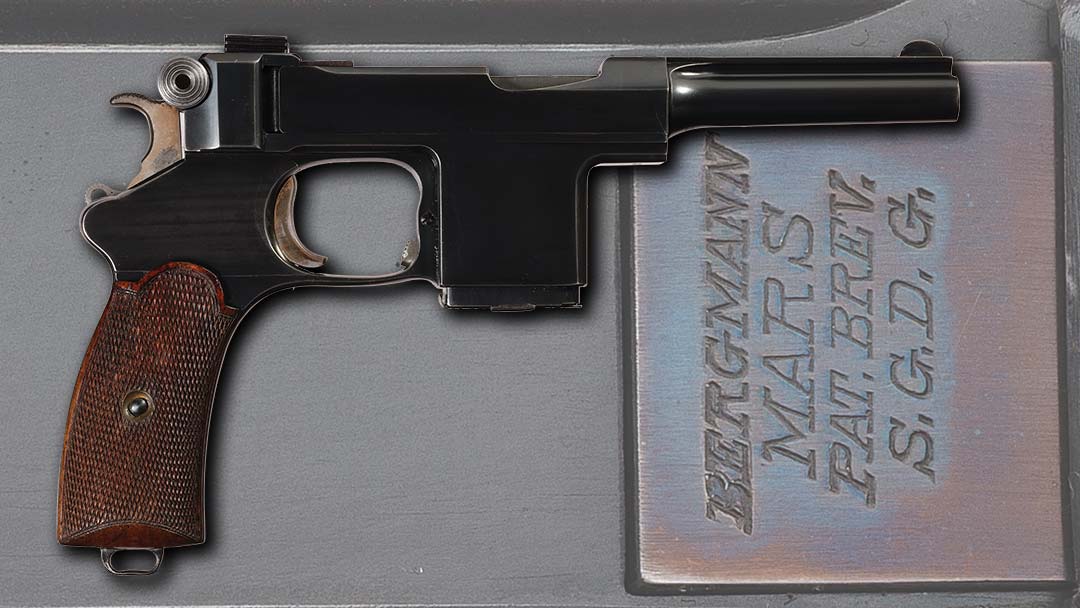
The 9mm cartridge saw several notable variants in its early years, including the 9x25mm Mauser, the 9mm Steyr, and rarities like the 9×23mm Largo developed for the Bergmann Mars pistol. American inventor John Moses Browning developed the 9mm Browning Long for the FN Model 1903 pistol, which was employed by France, Belgium, and several other European nations.
During the Philippine Insurrection at the turn of the 20th century, U.S. troops reported that the .38 caliber revolver lacked sufficient power to stop determined combatants. John Moses Browning had been working with Colt to develop a .41 caliber pistol cartridge. After the Thompson-LaGarde field tests concluded that a .45 caliber bullet would be most desirable, Browning scaled up both his handgun and his cartridge design in preparation for the next round of military testing, officially marking the start of the .45 ACP vs 9mm faceoff.
Winchester, Union Metallic Cartridge Co., and Frankford Arsenal would help develop the .45 ACP. Years of testing resulted in a 230 grain, full metal jacket round with a muzzle velocity of 850 fps. In short, a large slow cartridge compared to its 9mm competitor.
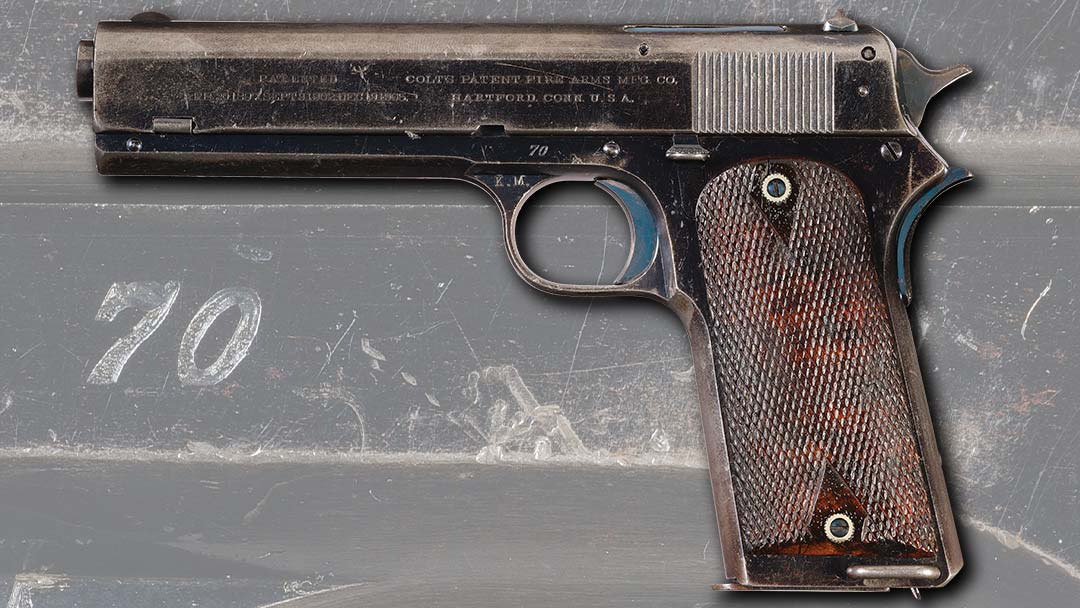
U.S. Army Test Trials serial number 70 Colt Model 1907 military pistol in .45 ACP. Available this December.
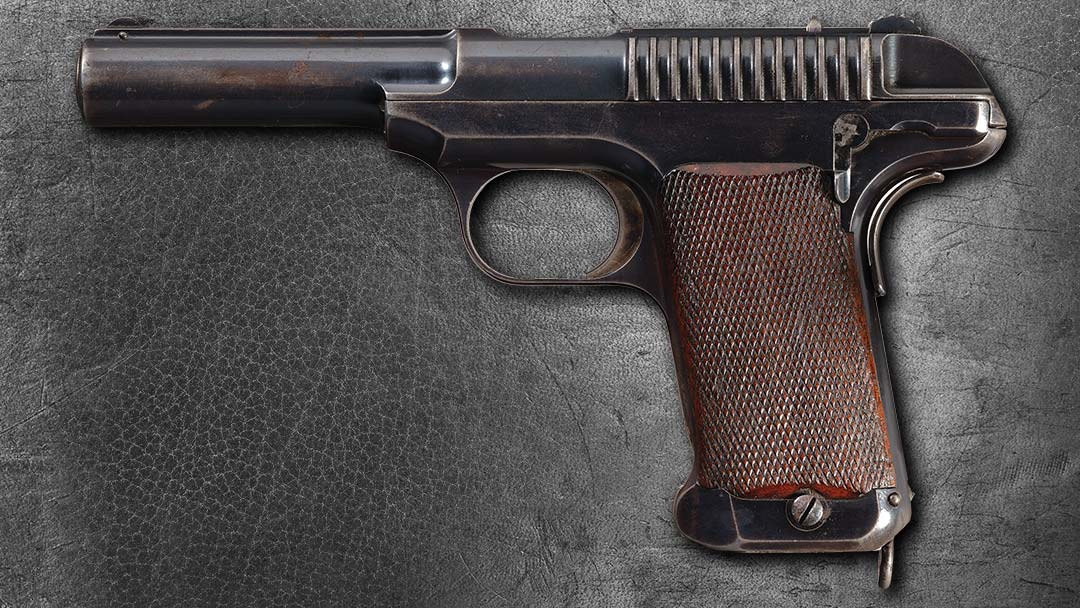
In January 1906 Chief of Ordnance B.G. Crozier invited gun manufacturers to develop and submit a semi-automatic handguns that chambered Browning’s new .45 ACP cartridge for submission into a new round of field trials. Eighteen companies initially responded with only eight actually submitting a test sample pistol, including Savage and Luger. The Savage Arms Corporation entered a version of its Model 1907 automatic pistol scaled up for .45 ACP like the exceptionally rare example below.
A rare U.S. Army Model 1907 Savage Arms .45 ACP test pistol serial number 222. Available this December.
The DWM factory is believed to have originally produced one prototype and two full-size Lugers in .45 ACP for the 1907 U.S. test trials. DWM eventually withdrew its bid over concerns that the American military would not select a European manufacturer regardless of firearm quality.
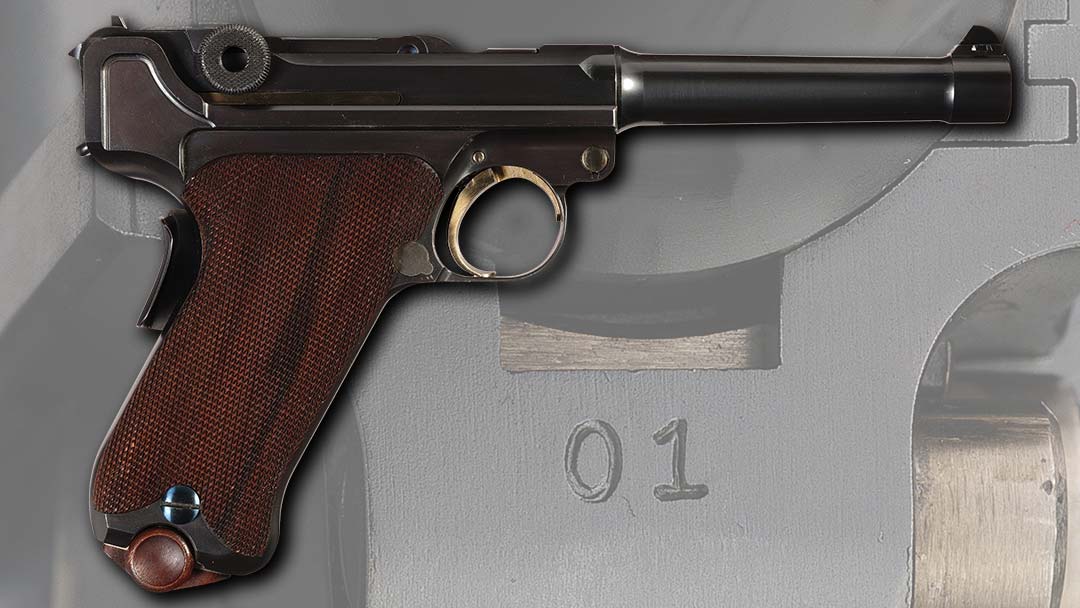
The example below is the first of only a handful of custom recreations of the original DWM Model 1906 Luger test pistols chambered in .45 ACP. Produced by Mike Krause out of San Mateo, California in the late 1990s, these rare pistols exhibit the distinctive flat bottom trigger guard shape.
Serial number “01” Krausewerk custom-made Model 1906 U.S. Trials .45 ACP Luger pistol with an extra magazine. Available this December.
.45 ACP vs 9mm Early Firearms
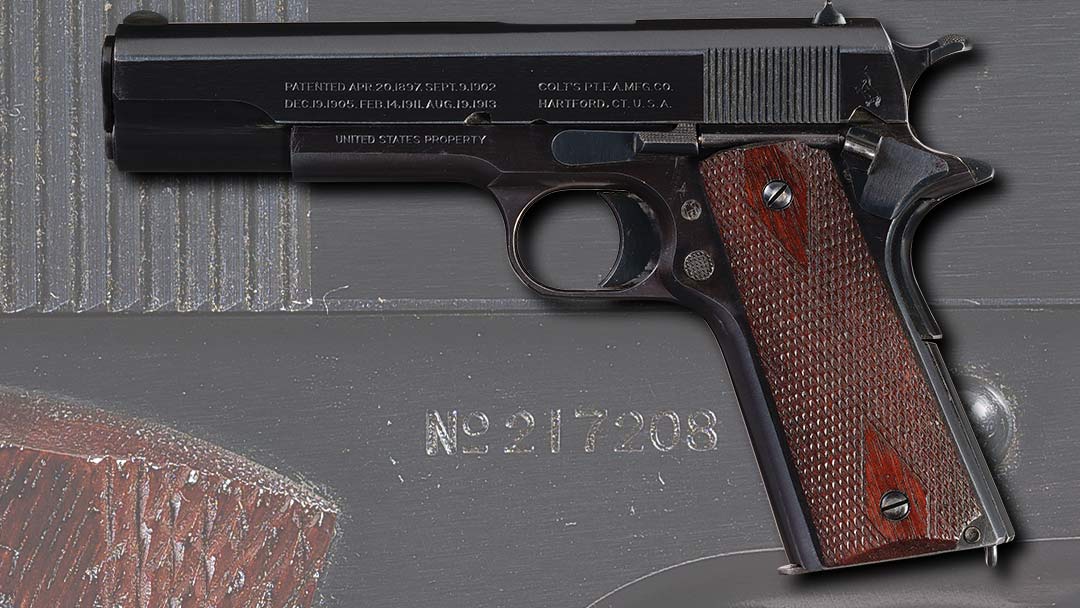
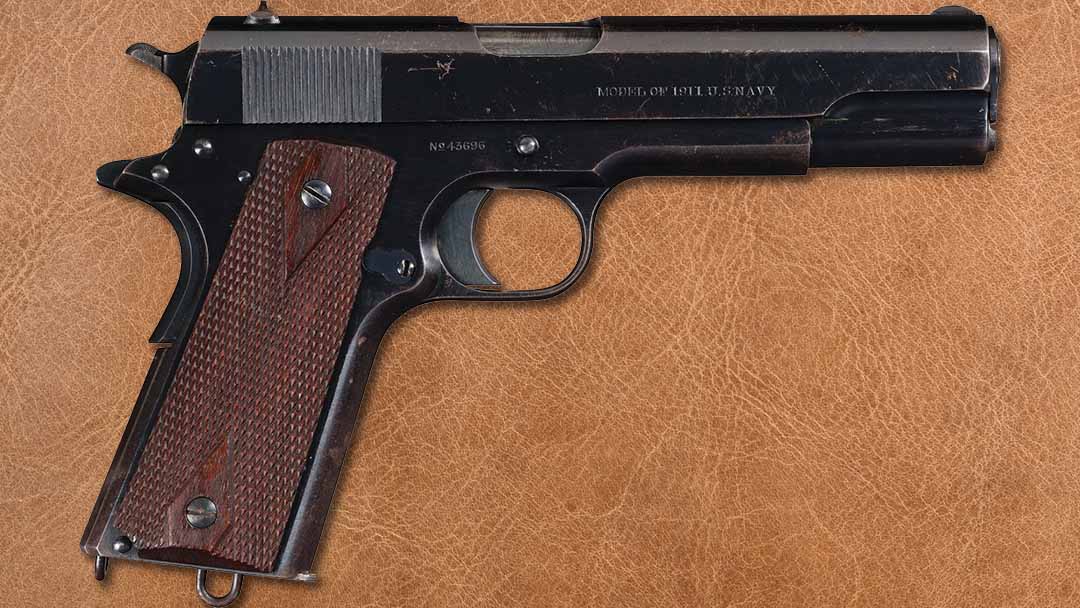
Colt would ultimately win the competition and receive a contract to produce the American military’s .45 ACP semi-automatic pistol. The M1911 pistol was adopted by the Army in March 1911, with the Navy and Marine Corps following suit in 1913. The Colt Government Model, the civilian version of the M1911, found a role in home defense, law enforcement, and as privately purchased military sidearms.
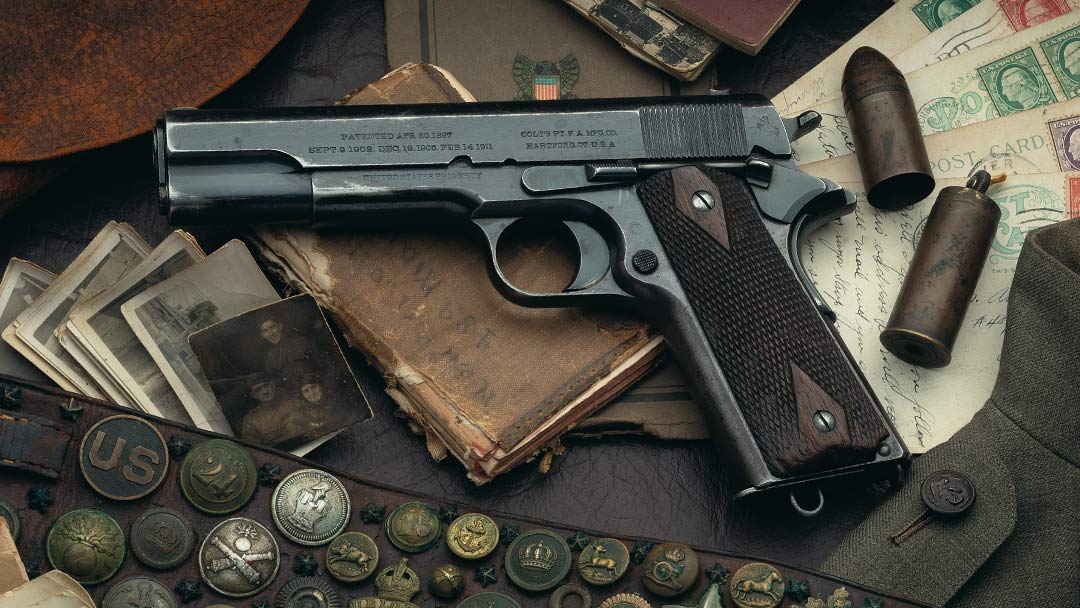
When America entered the Great War in 1917, the military had less than 75,000 M1911s on hand. By the end of the conflict, Colt would go on to produce 412,114 more pistols. The M1917 revolver chambered in .45 ACP would help fill the shortfall.
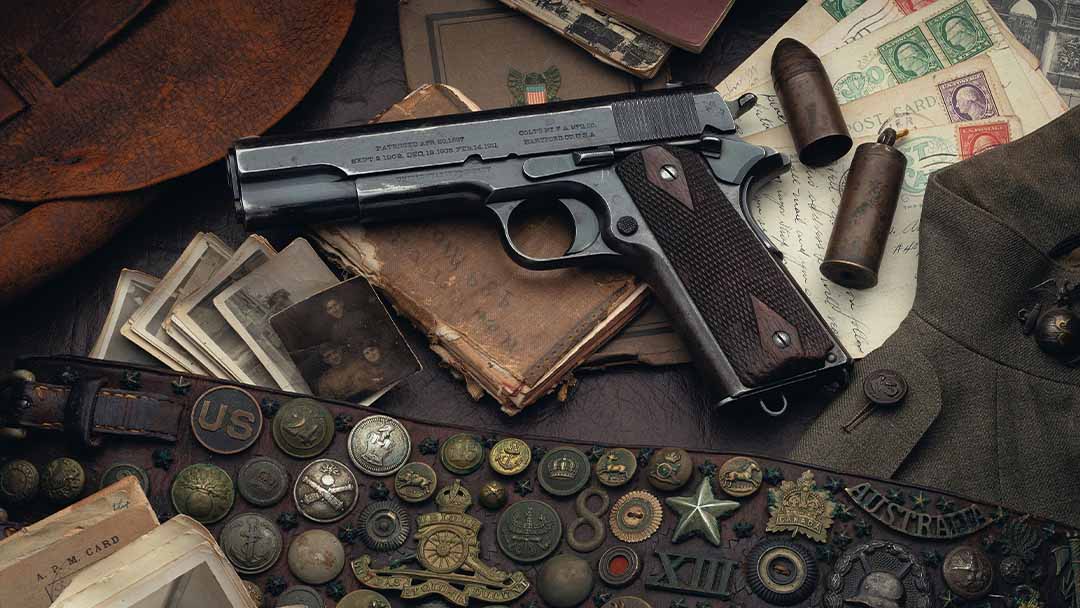
A documented historic WW1 era U.S. Marine Corps shipped Colt Model 1911 pistol with a war-era “Hate Belt,” photographs, and documents attributed to Corporal Andrew Liebler. Available this December.
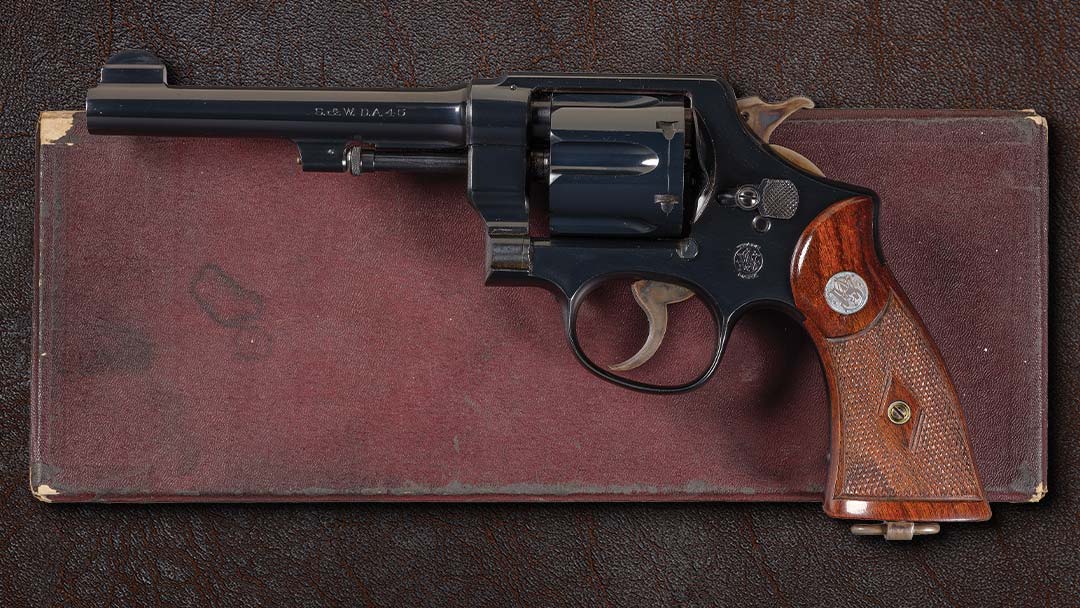
The large-frame M1917 revolver, based on Colt’s New Service model, employed half-moon clips to extract and eject the .45 ACP rimless cases. With nearly 300,000 M1917 revolvers produced between Colt and Smith & Wesson, the model became a common surplus item after the war. Peters Cartridge Company of Ohio would introduce the .45 ACP Auto Rim in 1920, a .45 ACP round with a thick rim that allowed the revolver to be loaded and unloaded by hand.
Across the pond, the 9mm cartridge had become a rising star. Though WW1 saw its fair share of European pistol models fielded, including the M1912 in 9mm Steyr and the Beretta Model 1915 in 9mm Glisenti, the Luger in 9×19mm Parabellum was far and away the most prevalent sidearm issued to German forces. According to historian Stephen Bull, about 1.6 million Luger pistols had been produced by the end of the Great War, most chambered in 9mm.
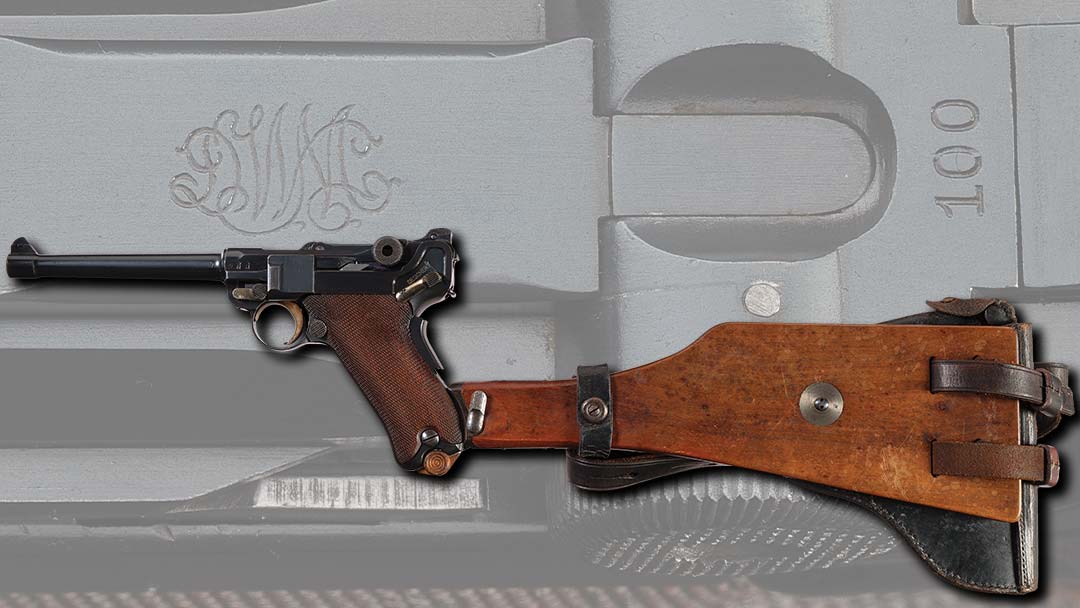
A 9mm Imperial German DWM Model 1906 First Issue Navy Luger with a Kiel Shipyard marking, a commercial export marking, and a matching shoulder stock and holster rig. Available this December.
WW1 saw a revolution in arms innovation, including the first submachine gun fielded by a major military. Though Hugo Schmeisser’s 9mm Maschinenpistole 18 was introduced too late to make a dramatic impact, the straight blowback weapon demonstrated the potential of an automatic firearm chambered for handgun rounds. Hugo Schmeisser’s double-stack, single-feed, 9mm magazine patents would be employed in the Mp18’s spiritual successors.
In America, retired army Colonel John Taliaferro Thompson had been developing a submachine gun of his own. More than a decade earlier, Thompson had served a key role in recommending the adoption of the .45 ACP cartridge, and he selected the round for his submachine gun design when .30-06 proved incompatible. The war ended before Thompson’s “trench broom” could hit the battlefield, but the weapon would find a wide range of roles in the interwar period and beyond.
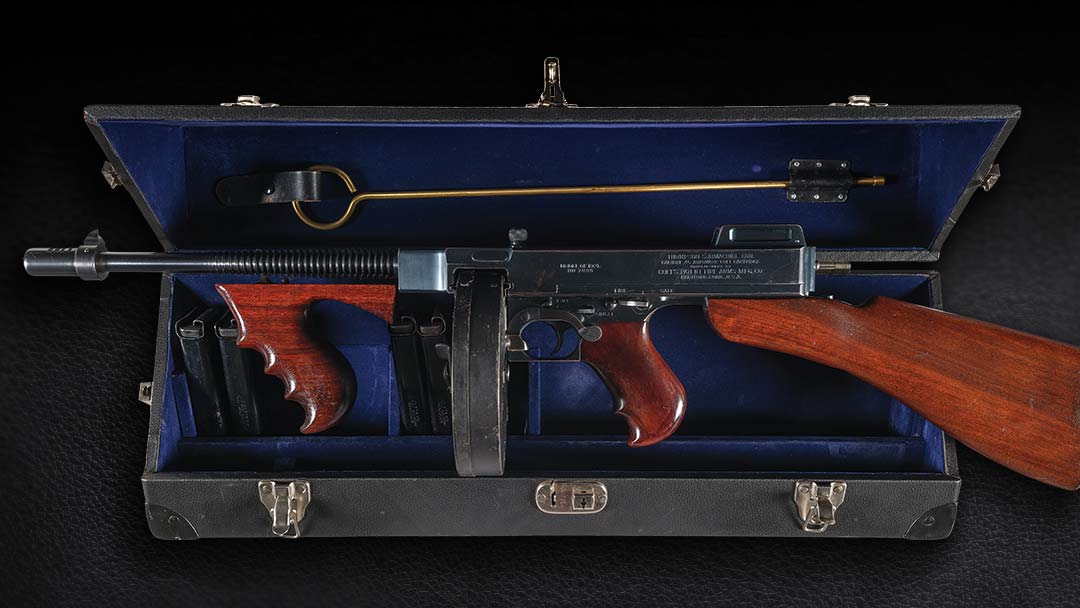
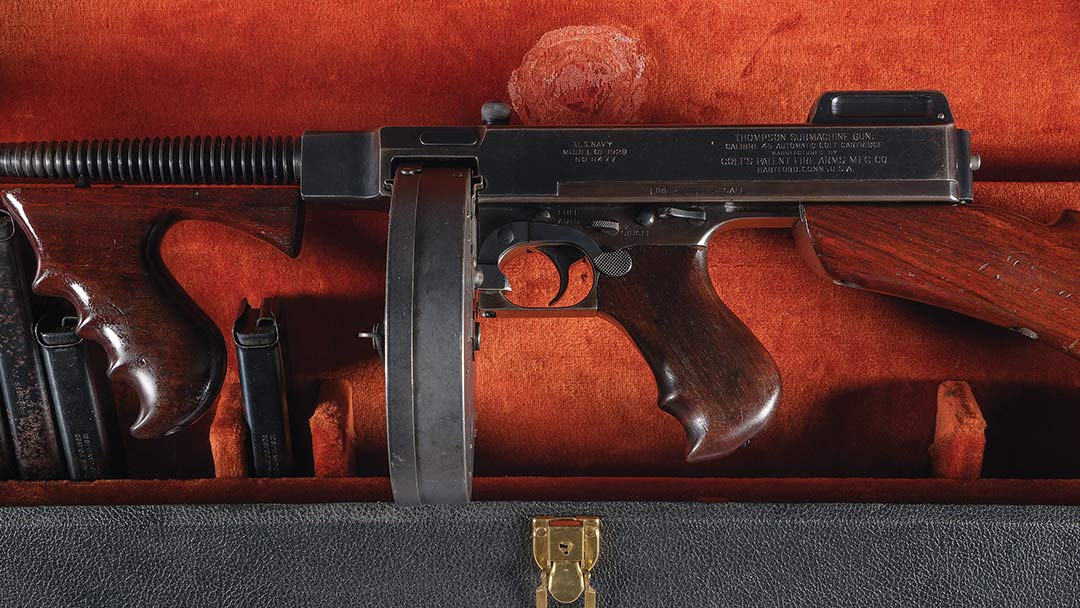
A Colt Thompson Model 1921 submachine gun in .45 ACP. This example was shipped in “1921AC” configuration to the Police Department of Mattoon, Illinois, on March 22, 1930. Available this December.
The .45 ACP vs 9mm Faceoff Heats Up
The 1911 saw numerous clones, copies, and licensed models before and after the interwar period. The .45 ACP round became a favorite in China, with government factions and warlord militias purchasing Tommy guns and manufacturing their own copies. In the late 1920s, the Shansei Arsenal developed a Broomhandle variant chambered in .45 ACP.
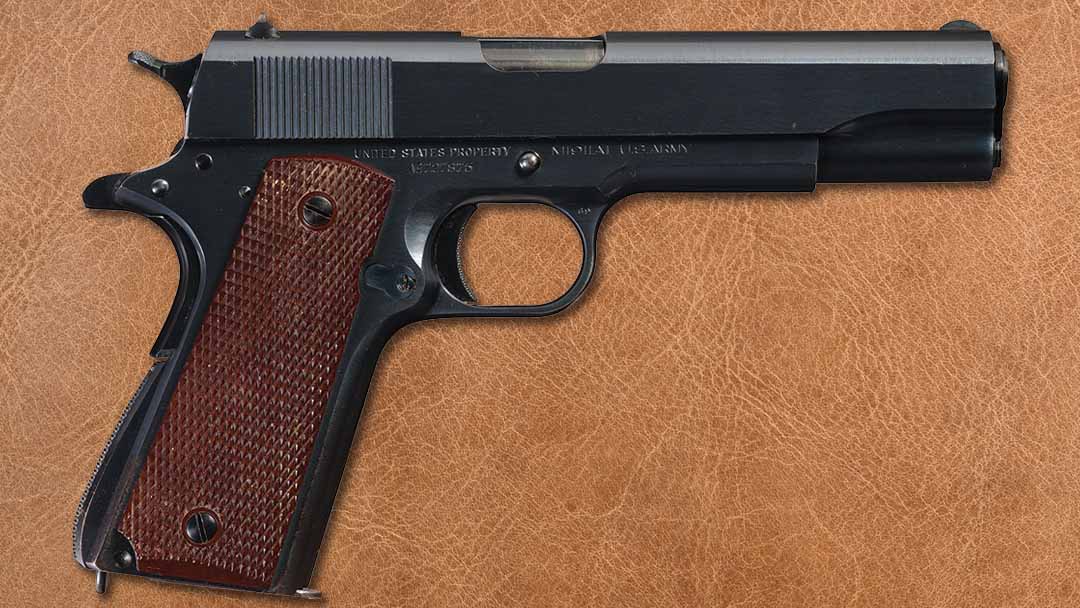
In 1926, Colt introduced an updated version of the M1911. Designated the M1911A1, improvements included a shortened trigger, extended hammer spurs, simplified checkered grips, an arched mainspring housing, a thicker front sight, and angled clearance cutouts. These refinements were also present in Colt’s 1932 civilian competition pistol, the National Match model.
With the winds of war stirring in Europe, the U.S. Government reached out to established arms makers like Colt, Ithaca, and Remington Rand to mass produce the M1911A1 pistol. Civilian contracts were also granted to companies like Singer and Union Switch & Signal.
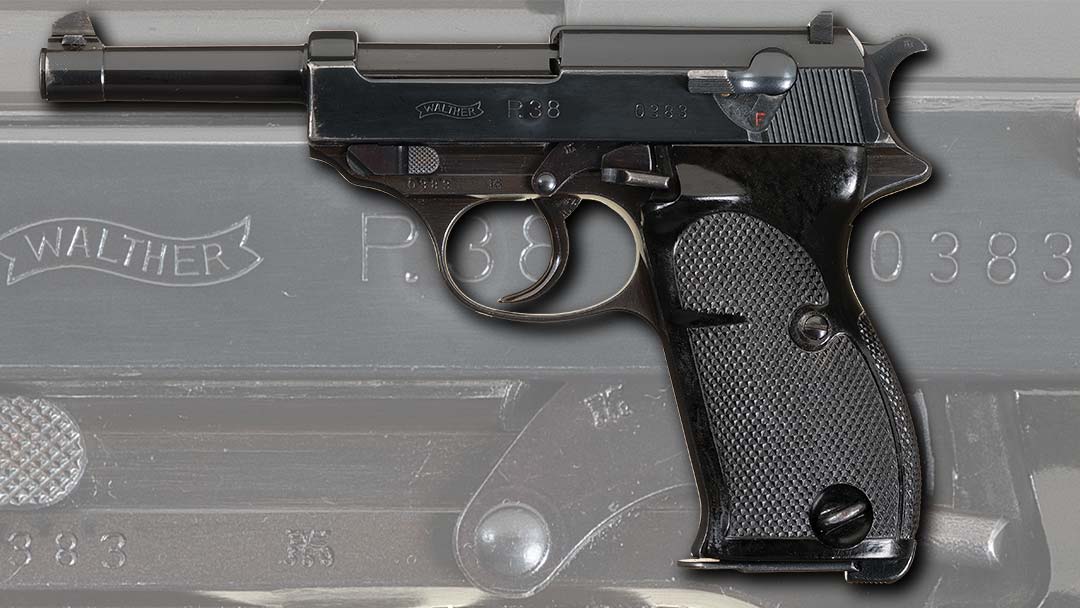
During the Great War, the 9mm Luger had proved itself as an effective pistol and submachine gun round, and the German war machine would continue to favor the cartridge as they developed the next generation of firearms. While the Luger remained a common secondary sidearm, the Walther P.38 became the Wehrmacht’s standard pistol during WW2. The pistol saw a production run of nearly 1.2 million by the war’s end.
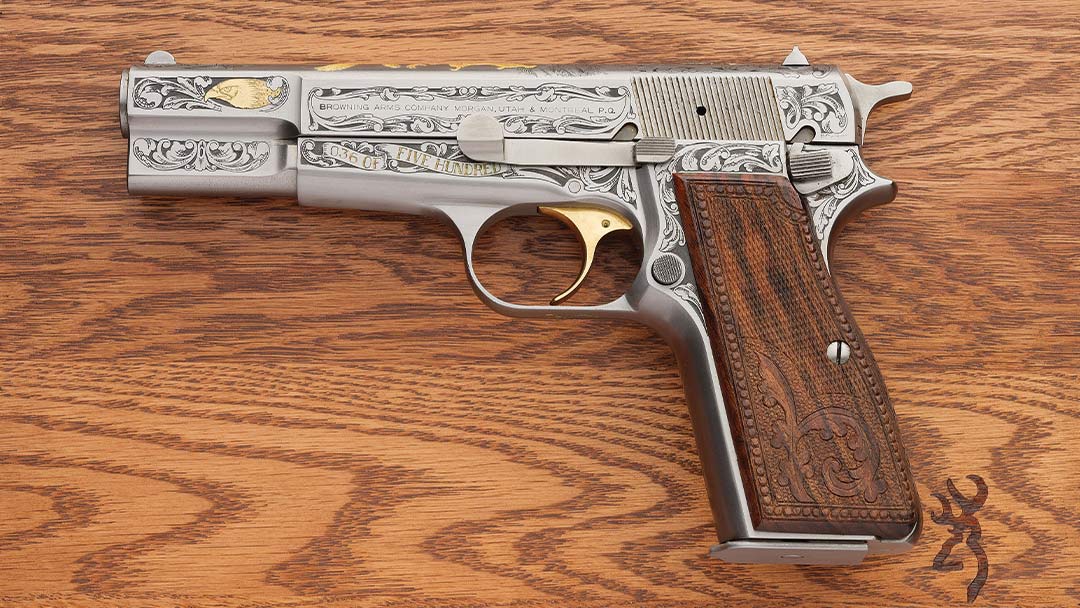
Before WW2 started, another 9mm pistol hit the market in Europe and became one of the most influential designs in the genre. The Browning Hi Power was designed in the 1920s in response to a potential French military contract. Incorporating elements from his .45 ACP 1911 pistol, inventor John Moses Browning envisioned a high capacity, double-stack 9mm magazine and a magazine disconnect.
Browning passed away before the pistol was finished, but the design was completed by Dieudonné Joseph Saive of Fabrique Nationale. With a 13 round capacity, the Hi Power saw prominent use by police and military branches across Europe, including the German Waffen SS and the Fallschirmjäger. The pistol was also produced for Canadian, British, and Chinese forces.
A cased, engraved, and gold inlaid Browning Gold Classic Hi Power pistol. Available this December.
.45 ACP vs 9mm Submachine Guns
America continued to rely on the .45 ACP for its submachine guns throughout WW2. Every iteration of the Thompson M1928 saw service with the Allied forces, with many M1928s being purchased by the British military. To meet surging demand, a streamlined, lower cost version of the platform was developed in 1942 called the M1 Thompson.
America adopted the M3 “grease gun” in 1943, a no-frills .45 ACP submachine gun. The M3’s sheet steel design was cheaper and far more manufacturer-friendly, with 620,000 produced by war’s end.
A documented law enforcement shipped Colt Model 1921/1928 U.S. Navy Overstamp Thompson submachine gun. Available this December.
The British considered using the .455 Webley Automatic Mk I cartridge for their submachine guns, but they found the 9mm offered a greater range and a notably higher muzzle velocity. The lighter 9mm also allowed each soldier to carry more rounds. The 9mm Lanchester was used by the British early in the war, a model that took heavy inspiration from the German M28, but the more affordable STEN would ultimately be adopted. With 4 million produced, the STEN became the most fielded 9mm SMG of the conflict.
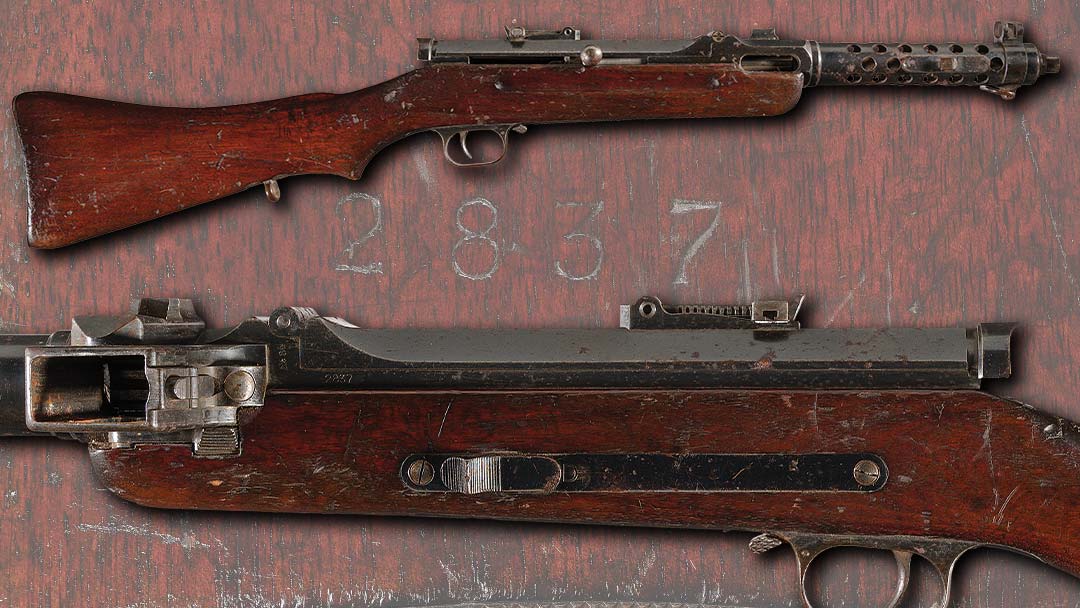
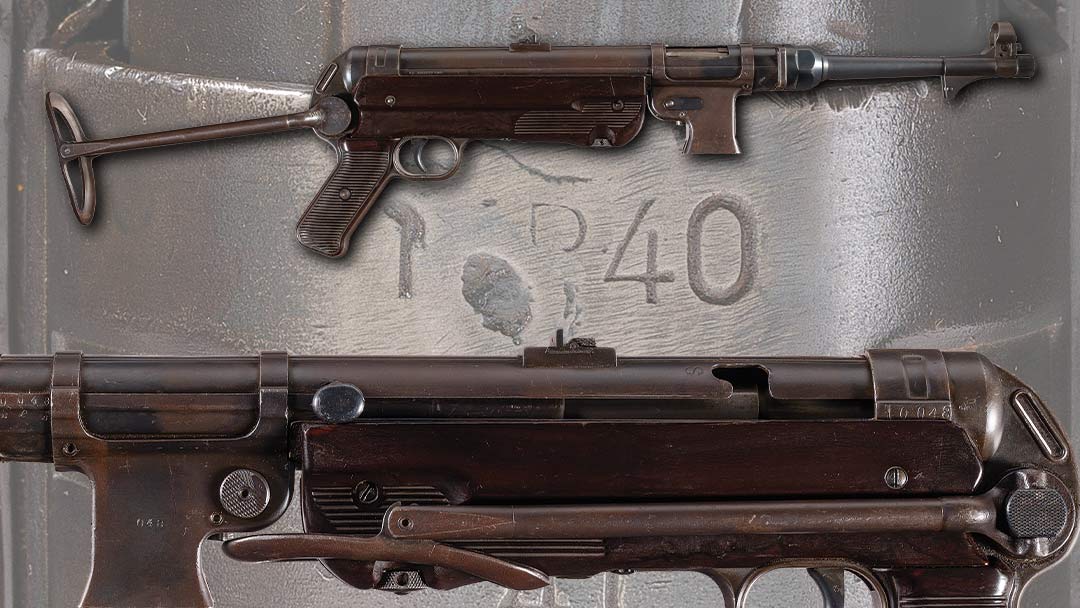
While the Italians produced the 9mm Beretta Model 38, the MP40 and its predecessors were the most commonly encountered SMG faced by the Allies in Europe and North Africa. Germany’s straight blow-back, open-bolt MP40 employed a 32-round 9mm box magazine, providing compact firepower to the paratroopers, armored crewmen, and support infantry who carried it.
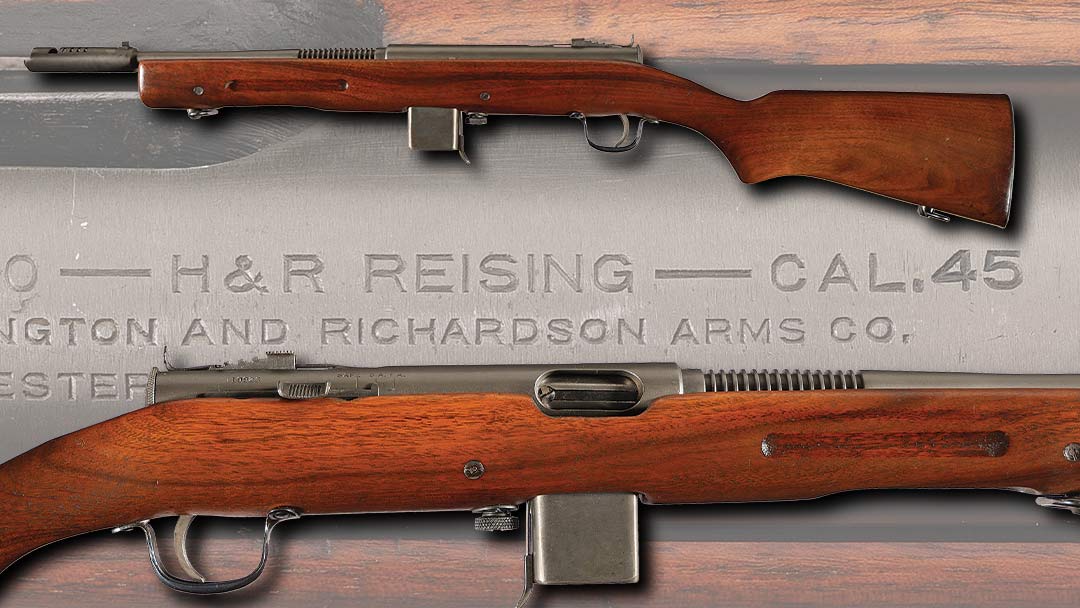
The .45 ACP vs 9mm arms race would continue with the next generation of SMG designs, but the 9mm cartridge quickly emerged as the clear favorite. Models like the WW2 Reising Model 50 that were specifically designed around the .45 ACP would become increasingly scarce, though multi-caliber platforms like the UZI, MAC-10, and Heckler & Koch UMP included .45 ACP variants.
A .45 ACP Reising Model 50 SMG. The Reising Model 50 saw action with the U.S. Marines in the Pacific as a substitute for the M1 Thompson. Available this December.
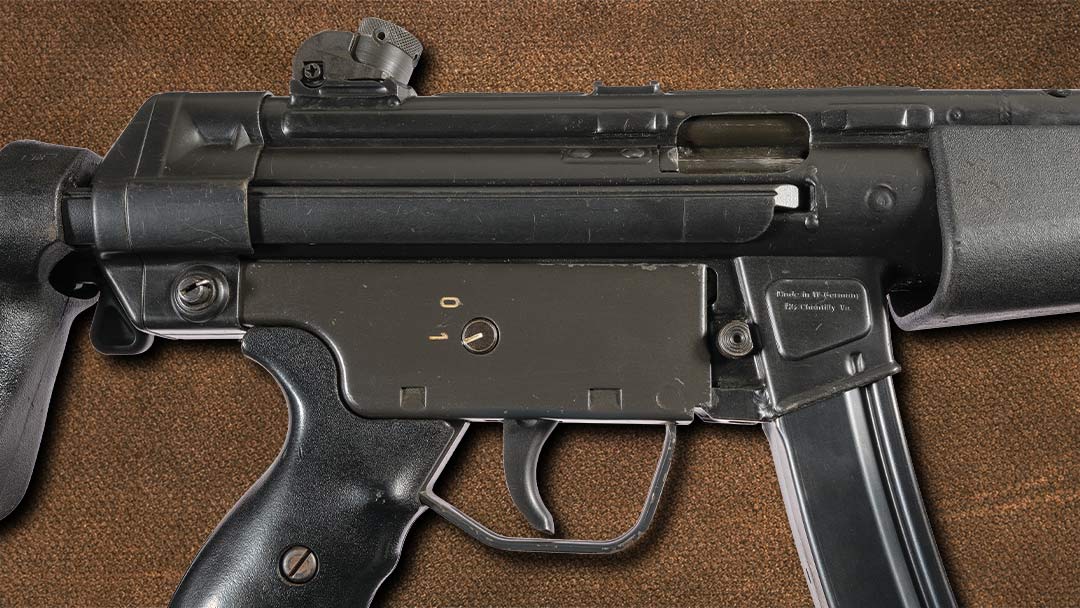
In contrast, the number of 9mm submachine gun models is staggering. The British Sterling, the Smith & Wesson 76, and the Beretta M12 are just a few notable examples of the 9mm round serving as a proven SMG standard for decades. Today, Heckler & Koch’s MP5 family continues to lead the market, with over 40 nations having adopted the platform and countless law enforcement and security agencies relying on this tried-and-true 9mm design.
After WW2, every NATO nation would adopt the 9mm pistol cartridge except for the United States, which continued to issue the M1911A1 until 1985. In America, the revolver continued to dominate the law enforcement market, but the wheelgun would eventually be challenged by the “Wonder Nine” pistols of the 1970s and 80s.
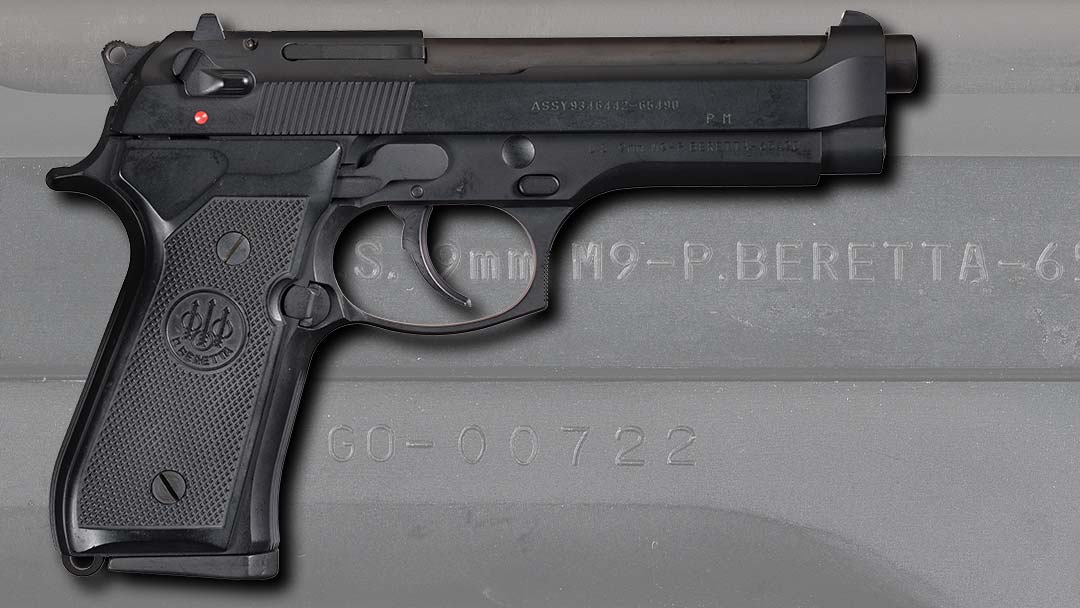
Successors to the Browning Hi Power, the Wonder Nine moniker is a reference to a wave of 9mm DA/SA action pistols with double stack mags and lighter polymer frames. Popular examples include the S&W 59, the CZ-75, the Glock, and the Beretta 92. The latter would be adopted by the American military as the M9, finally replacing the venerable .45 ACP 1911.
A documented U.S. Beretta M9 General Officer’s Pistol with holster, magazine pouch and two extra magazines. Available this December.
The .45 ACP continued to maintain a steady following, and a surplus of ammunition became available in the decades after the war. Surplus guns chambered in the round hit the market as well, including M1917s and Webley revolver conversions. Smith & Wesson also offered the Model 22, Model 25, and Model 26 revolvers as the commercial successors to the M1917. The .45 ACP Model 625 continues to enjoy popularity today thanks to its use by speed shooting champion Jerry Miculek.
The 1911 was another readily available surplus handgun after the war, and the National Match returned to Colt’s catalog in 1957 as the Gold Cup National Match. In 1970, the popular Colt Series 70 hit the market, and the Series 80 followed 13 years later. Today, the 1911 pistol is produced by numerous manufacturers.
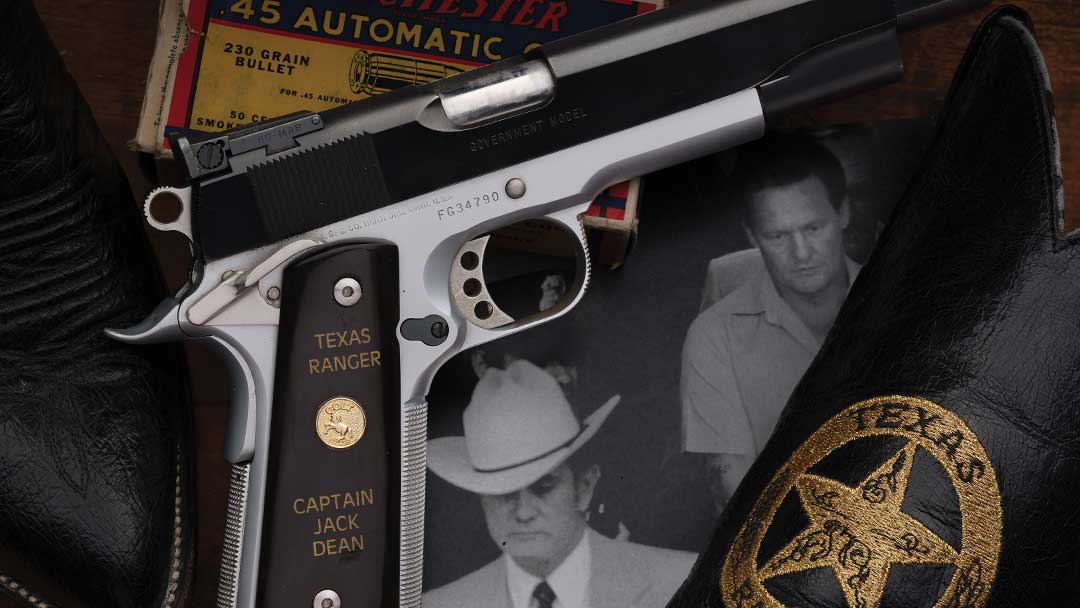
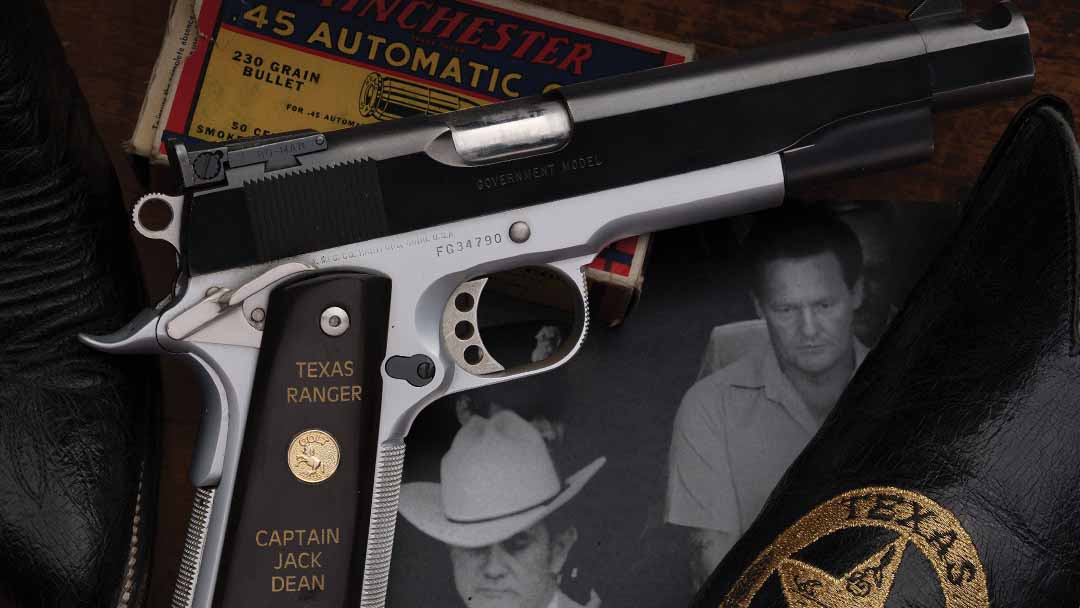
A documented Colt Mark IV Series 80 Government Model pistol previously owned by Captain Jack Dean of the Texas Rangers. Available this December.
In the .45 ACP vs 9mm arms race, each round has benefited from advancements in propellant and material design, but the 9mm capacity advantage that had won the cartridge such a widespread following in Europe would help the round conquer the American market as well. For law enforcement and military branches, pistols like the Glock 17 and SIG Sauer P320 offered high capacity, reliability, and ease of operation at an affordable price point.
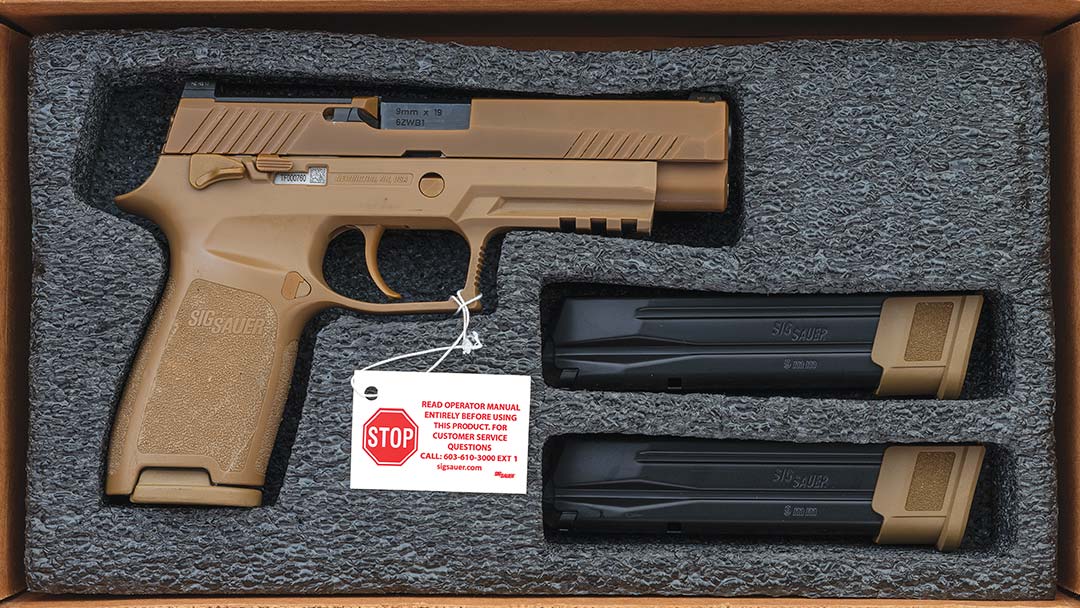
A documented, Fort Hood shipped, U.S. Army issued SIG Sauer M17 with FOIA letter and box, serial number “TF000760” Available this December.
With up to 2 billion rounds sold each year in America alone, the dominance of the 9mm round is undeniable today. The Glock, the best selling handgun platform in history, includes popular 9mm options like the Model 17, 19, 19X, 26, 34, 43, 45 and 48.
The classic 1911 still continued to be carried by select American military units and officers through the War on Terror, and today the platform and its .45 ACP cartridge enjoys popularity with shooters and competitors. Like its 9mm rival, .45 ACP pistols are manufactured by nearly every major manufacturer.
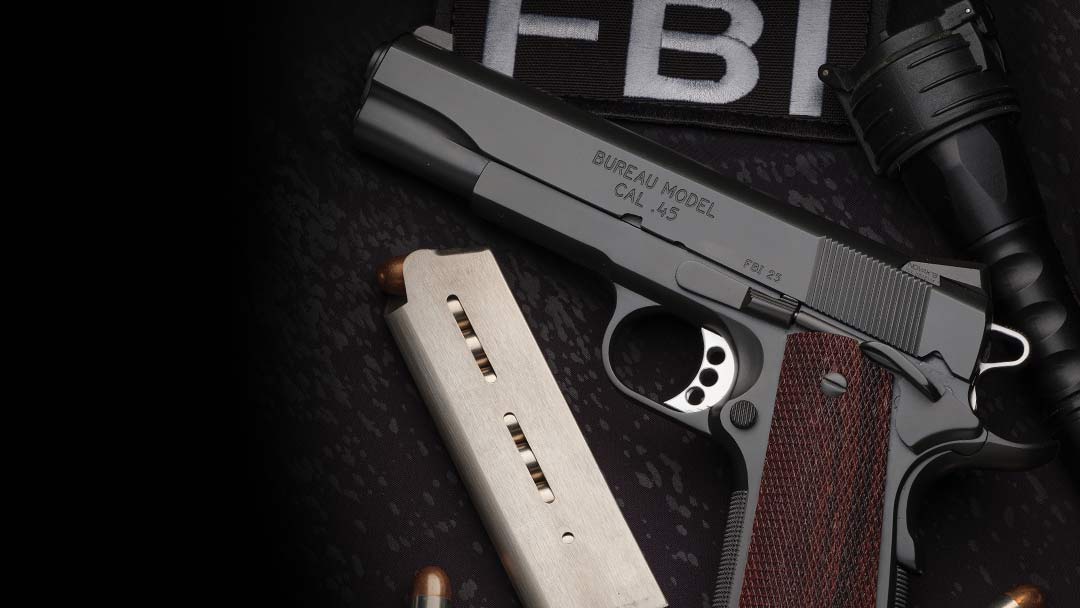
A scarce Springfield Armory Inc. Custom Shop “FBI” prefix Bureau Model pistol, serial number “FBI 25”, with a Certificate of Authenticity. Available this December.
.45 ACP vs 9mm Today
From pistols and revolvers to rifles and SMGs, the 120-year faceoff between 9mm and .45 ACP has resulted in some truly legendary firearms. Though the 9mm has become the clear favorite today, each iconic cartridge has stood the test of time. For the arms enthusiasts, there’s always room in your collection for a vintage Luger, 1911, or a modern classic like the M17, and Rock Island Auction Company offers the finest examples chambered in each of these iconic calibers.
The rare and high condition Lugers from a master in the field will be available this December at Rock Island Auction Company. Author, forum founder, historian, and respected collector Jan C. Still amassed an outstanding collection over decades. The offering of items from his impressive collection is an opportunity fellow collectors should not take lightly.
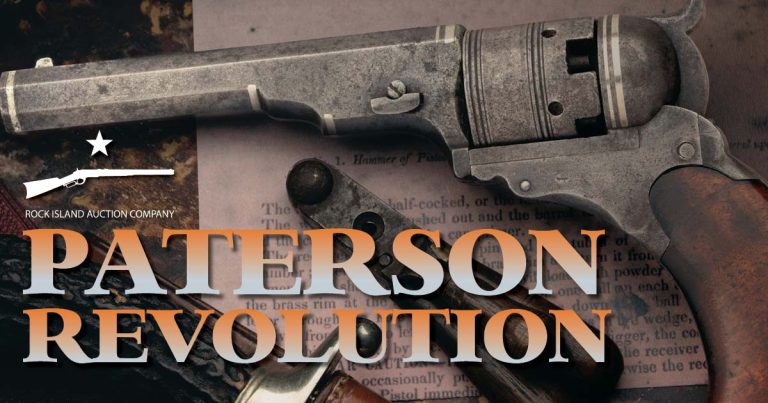
By the time Samuel Colt patented his first revolving firearms designs in 1836, revolving guns had been around for centuries. The impressive array of early revolving firearms included in RIAC’s December 6 – 8 Premier Firearms Auction inBedford, Texas provides an excellent opportunity to compare the Colt Paterson revolver with its numerous predecessors and competitors.
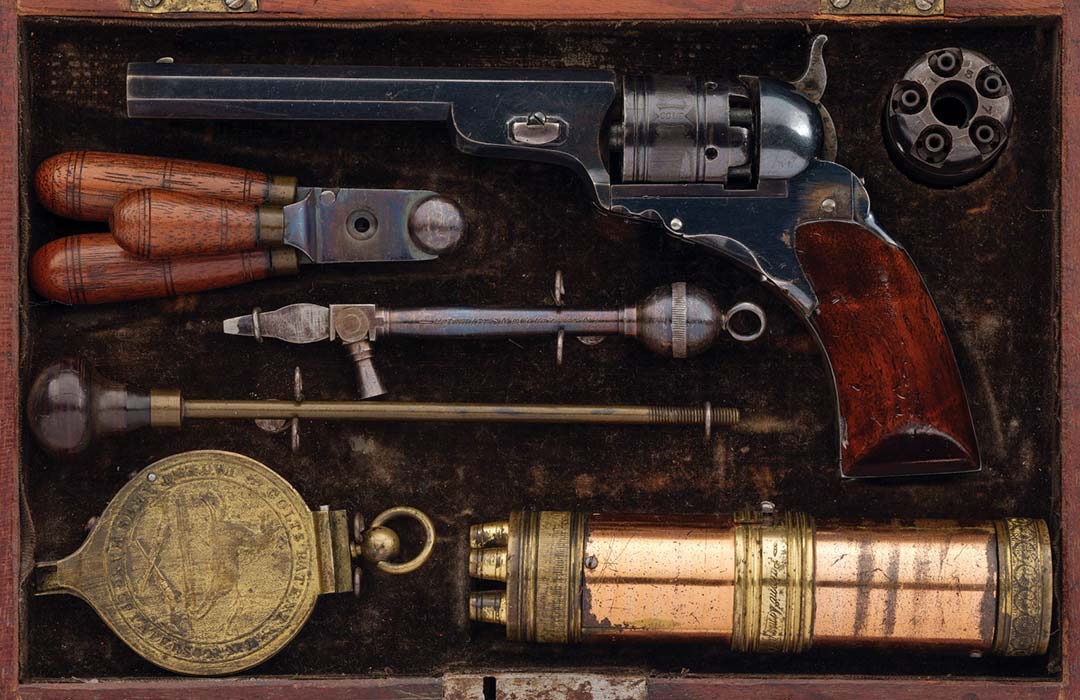
A cased Patent Arms Manufacturing Company “Colt Baby Paterson” No.1 Pocket model percussion revolver with a full set of accessories. Available this December.
Samuel Colt did NOT Invent the Revolver
Though Samuel Colt did not invent the revolver, he was the first to realize the concept of accurately syncing a rotating cylinder to a fixed barrel. Exploring the history of the revolving flintlock and other early repeaters illustrates the various approaches gunsmiths attempted when it came to achieving multi-shot firearms before the Colt Paterson was invented.
Five examples of the Colt Paterson genre as well as a historic selection of Colt revolvers are offered this December at Rock Island Auction Company.
A closer examination of early revolver technology and how Colt built upon that foundation helps us appreciate why Colt’s name eventually became synonymous with the revolver and how his designs made the wheel gun a standard sidearm for the second half of the 19th century, deep into the 20th century, and a continued favorite with shooters and arms collectors today.
Matchlock, Wheellock, and Flintlock Repeaters
Black powder (gunpowder) has been around since at least the 9th century, and revolving firearms date as far back as the 16th century. One of the main limitations in early firearms was their slow rate of fire due to being manually loaded from the muzzle for each shot, so gunmakers naturally tried to find ways to improve firing rate. Adding more barrels or a revolving set of chambers to a firearm were two of the primary ways to achieve this goal.
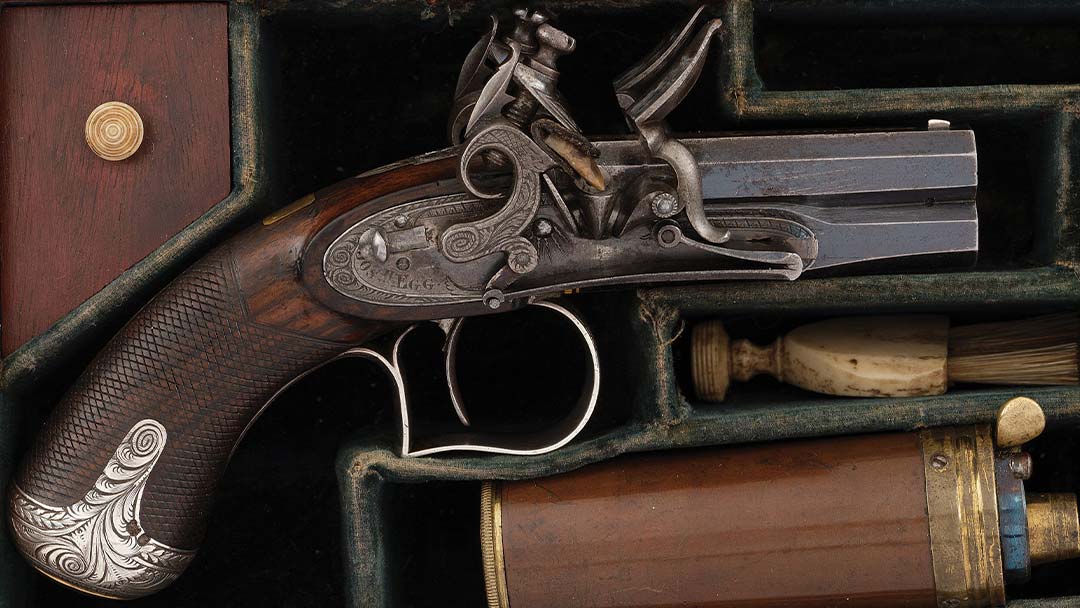
A cased, finely engraved, gold inlaid and silver mounted Joseph Egg O/U “Baby Egg” flintlock pocket pistol. Available this December.
Other early ideas experimented with replaceable breechloading chambers foreshadowing later metallic cartridges, designs for superposed loads firing multiple shots out of a single barrel, and lever action designs like the Lorenzoni and Kalthoff repeaters. Each had its advantages and disadvantages, and all were too complicated, expensive, and often delicate to become standardized, unlike single-shot muskets and pistols.
While one of the more common solutions to getting multiple shots out of a muzzleloading firearm was to simply add another barrel, that generally required also fitting a second lock and getting everything installed in such a manner that the locks could work independently of one another to fire the appropriate barrels and triggers setup to fire each lock.
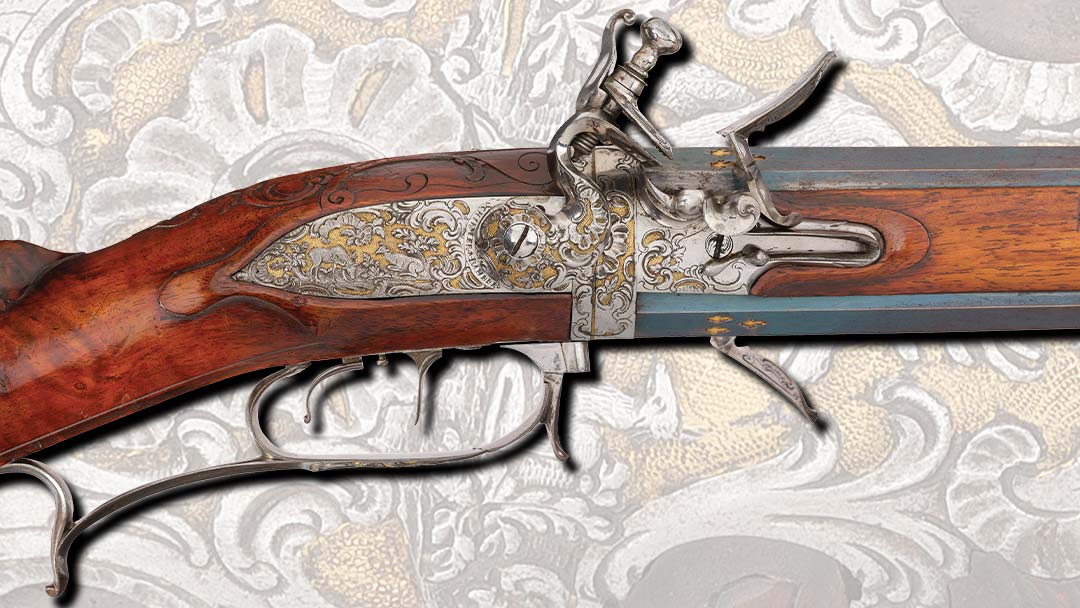
An 18th century engraved, gold inlaid, and relief carved flintlock swivel breech/”wender” combination gun by Schirmer of Bamberg, available this December. Note that each barrel has flashpan, frizzen, and frizzen spring.
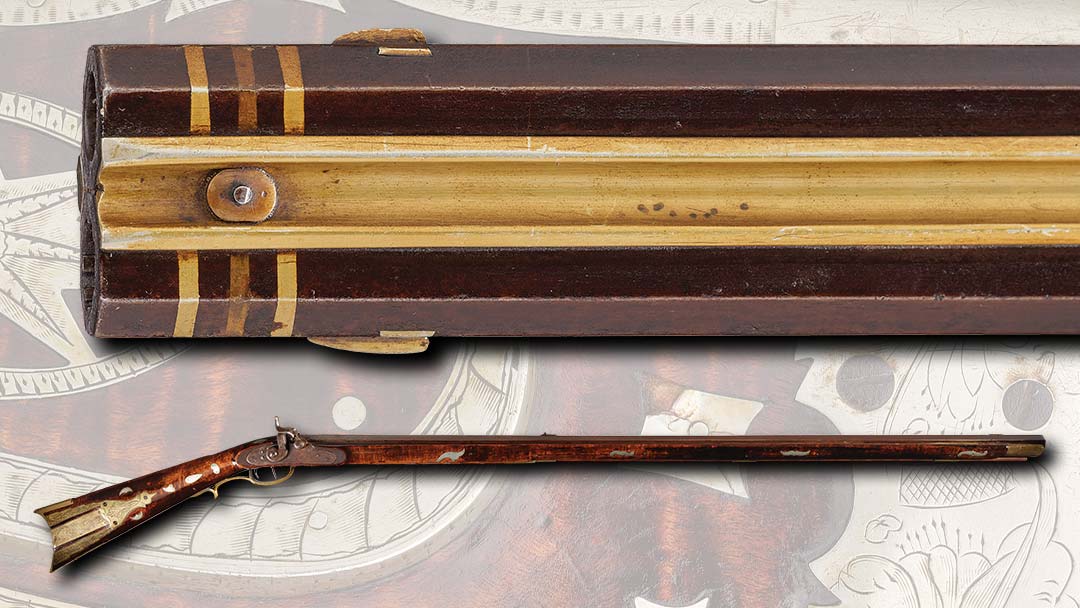
Good locks weren’t cheap, so one popular solution, especially in the flintlock and percussion eras, was to use two barrels that could be rotated to switch for a second shot and then one lock. These guns still needed to have two sets of the priming portions of the mechanisms fitted to the barrels. Such firearms are called swivel breeches or “wenders” (meaning “turner” in German). They were commonly sporting guns and pistols rather than standard military issue firearms, but some may have been used by military officers.
With percussion cap ignition, the swivel breech system was even more practical. You simply needed a nipple for each barrel. Most were still two-shot, like this ornate combination gun from the mid-19th century. Available this December.
Despite the added weight of a second, third, or even forth barrel, they tend to still be fairly well-balanced. In addition to being made by European gunmakers for the well-to-do, swivel breech guns were also made by American rifle makers and owned by more common folk in the U.S.
Early Colt Paterson Precursors
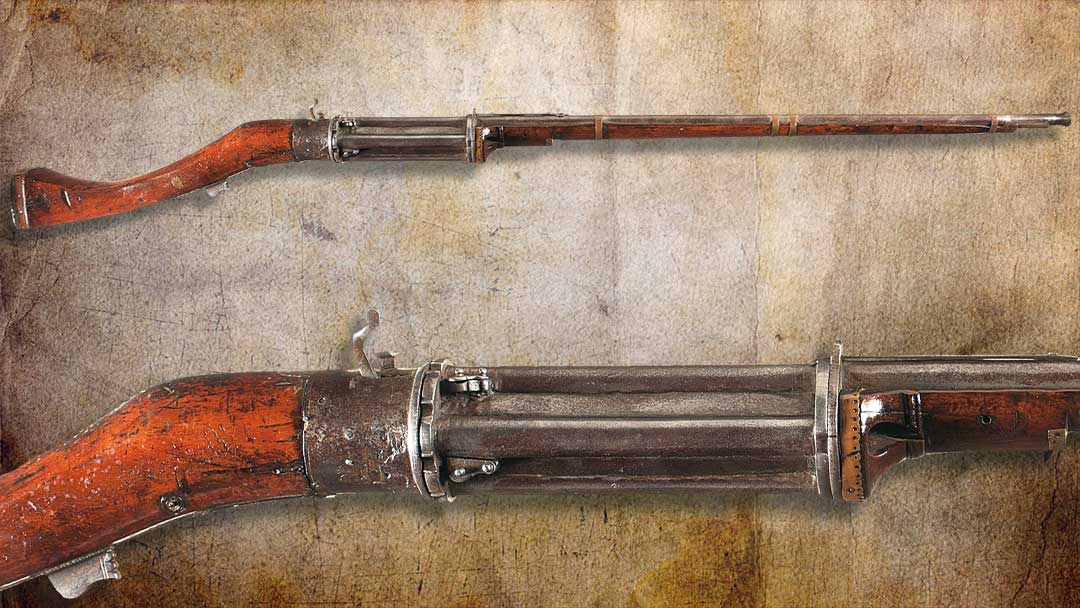
At least as early as the 16th century, almost three centuries before the Colt Paterson, there were matchlocks with manually revolving chambers. These early revolvers were sometimes configured as a one-piece similar to the “cylinder” that is common on later revolvers, but they were generally not widely used in the 17th and 18th centuries.
The revolving matchlock became a little more widely used in India in the early 19th century, but they were never nearly as common as other firearms. In these guns, you can see aspects of more modern revolving firearms. There were also multi-shot flintlocks with revolving chambers.
A rare engraved European six-shot flintlock hand-revolving sporting gun with a carved and silver wire Inlaid stock, attributed to the Tula Arms Factory. This example is available in December.
Early gunsmiths produced some fine examples of three and four-shot revolving flintlock pistols and sporting guns, but the system remained rarely used and limited to the armories of the nobility rather than a weapon adopted widely for the military or common people. The example featured above was almost certainly the creation of the Tula Arms Factory in Russia. Most revolving flintlock designs were similar to swivel breech guns, but with only the breech sections of each barrel and then a single barrel they line up with instead.
The Pepperbox Pistol
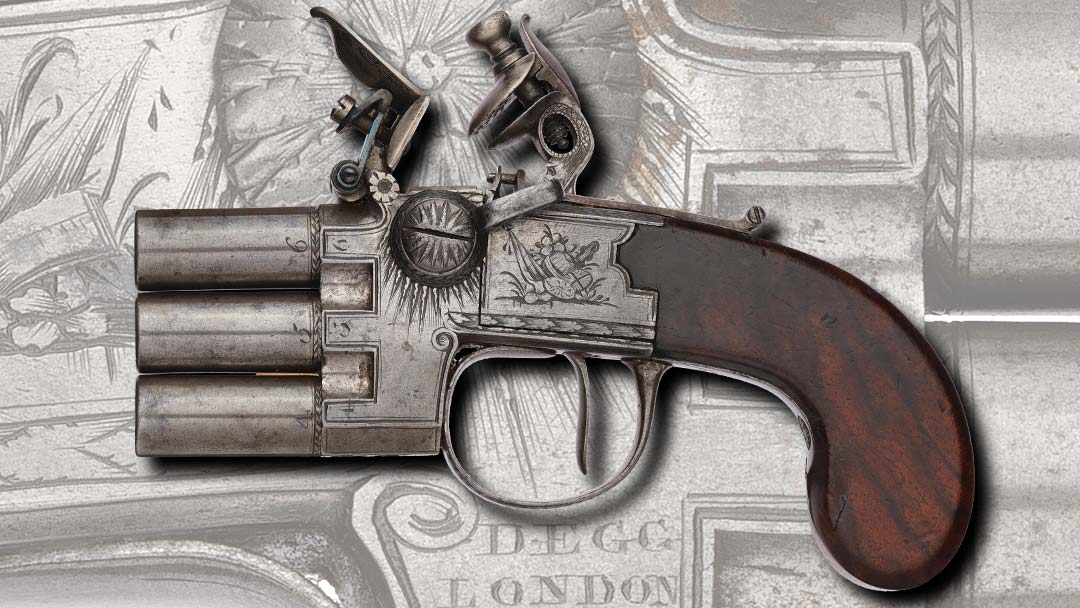
Another solution for multi-shot firearms, especially handguns, was to take the swivel breech concept and basically keep adding more barrels. A cluster of several barrels designed to rotate multiple shots is generally known as a pepperbox. These firearms existed in the flintlock era but were not very common until the percussion era in the 1840s and 1850s, and were a key alternative to the Colt Paterson and Colt’s other early revolvers as his patents limited the ability of other gunmakers to manufacture what we now think of as a standard revolver. By that period, pepperbox barrels were generally an elongated revolving cylinder rather than a group of separate barrels.
An engraved H. Fox, Frewsburg, New York, six-shot percussion pepperbox/swivel breech revolving rifle. Available this December.
Mark Twain discussed them in his classic Roughing It: George Bemis “wore in his belt an old original ‘Allen’ revolver, such as irreverent people called a ‘pepper-box.’ Simply drawing the trigger back, cocked and fired the pistol. As the trigger came back, the hammer would begin to rise and the barrel to turn over, and presently down would drop the hammer, and away would speed the ball. To aim along the turning barrel and hit the thing aimed at was a feat which was probably never done with an ‘Allen’ in the world. But George’s was a reliable weapon, nevertheless, because, as one of the stage drivers afterward said, ‘If she didn’t get what she went after, she would fetch something else.’ And so she did. She went after a deuce of spades nailed against a tree once, and fetched a mule standing about thirty yards to the left of it. Bemis did not want the mule; but the owner came out with a double-barreled shotgun and persuaded him to buy it, anyhow. It was a cheerful weapon–the ‘Allen.’ Sometimes all its six barrels would go off at once, and then there was no safe place in all the region round about, but behind it.”
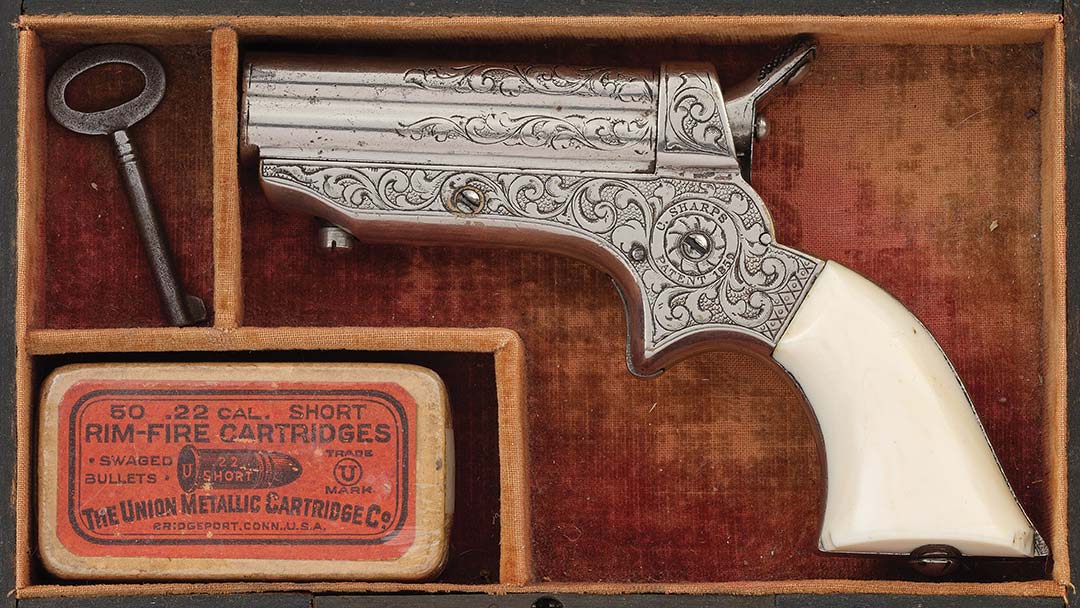
While some cartridge pepperboxes still had rotating barrels, many, including this classic design by Christian Sharps incorporate rotating strikers instead. This presentation cased, factory engraved Sharps Model 1A four barrel pepperbox pistol is available this December.
Pepperboxes had a reputation for being inaccurate as Twain mocked, and most had no sights and were double action only with stiff trigger pulls. At close self-defense ranges, they were probably sufficient and maybe even better than Colt’s percussion revolvers in some cases, but they were not suitable for military use or for people wanting to take shots at any real distance. Nonetheless, Ethan Allen’s various partnerships and several American and British gunmakers manufactured thousands of these revolving pistols, and “pepperbox” style pistols mostly with non-rotating barrels continued to be manufactured even into the metallic cartridge era, mainly as small pocket pistols.
The Collier Revolver: The Revolving Flintlock Perfected
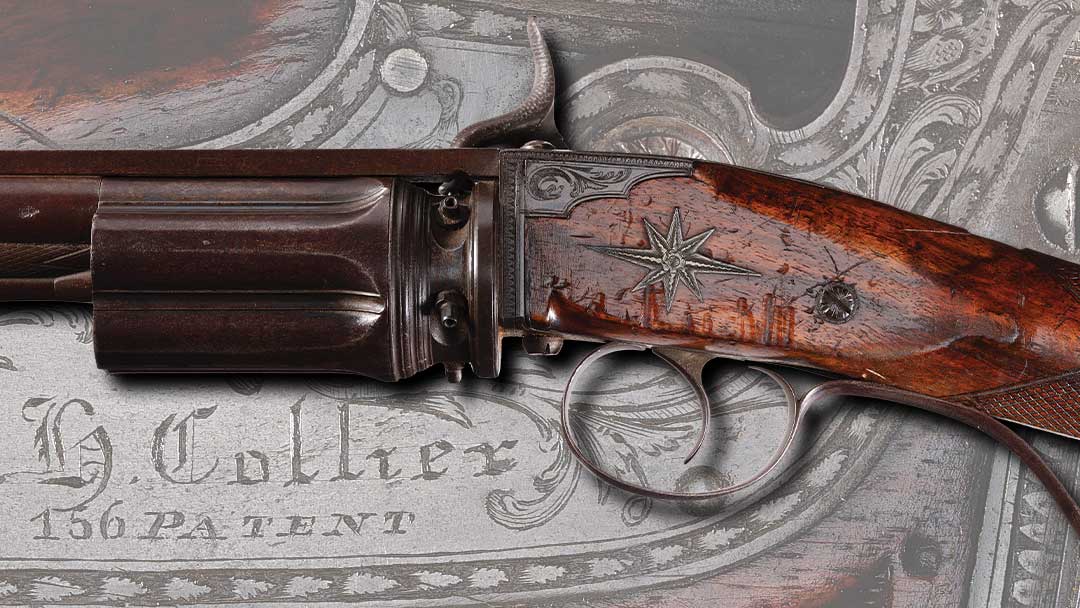
One of the most famous of all revolving firearms designs prior to the Colt Paterson was the Collier. Less than 250 total Collier revolver examples are estimated to have been manufactured across multiple variations. The designs were patented by Artemus Wheeler of Concord and Bostonians Cornelius Coolidge and Elisha Haydon Collier.
Wheeler patented the design in the United States of America on June 10, 1818. Collier patented an improvement of the design in the United Kingdom on Nov. 24 of the same year, and Coolidge patented Collier’s improved design in France on Aug. 5, 1819. Collier & Co. of London in 1818-1827 sold variations of the design in the form of pistols, rifles, carbines, and shotguns
One of the few matched pairs of Collier revolvers and the only pair known to the author at the time of filming. Carrying a pair of pistols was common before revolving firearms became popular, and many famous gunfighters continued to wear a pair of Colts on their hips into the late 19th century.
Howard L. Blackmore in Gunmakers of London, 1350-1850 indicates the Collier revolvers were manufactured by John Evans (John Evans & Son) in London. The patent was then taken over by William Mills around 1830, and some revolvers were sold by a partnership between Mills and Collier. Blackmore also notes William Elliot Lee of London as patenting the design in Paris in 1823, and he may have been an agent or manufacturer for Collier as well. Other British gunmakers may have produced components used in manufacturing the Colliers.
Both the First Model and Second Model Collier variations are revolving flintlocks. The First Model had a delicate and complex clockwork-assisted rotation mechanism that revolved the cylinder automatically. The Second Model Colliers revolvers have manually rotated cylinders. Later variants, known as Third Models, using percussion ignition (the first known use of caps for a revolver) were also manufactured in limited numbers.
Many of the rare surviving Colliers remain functional, but if you take a close look at them, it is clear the design, especially the flintlocks, probably wouldn’t have stood up well to extensive use. The major components all are strong, but the weak point is the automatic primer mechanisms built into the locks’ frizzens. It utilizes some rather small and fragile components, and it could potentially explode if the flash from the pan found its way into the priming reservoir.
It had been reported in many publications in Colt’s early history that he was influenced primarily by the capstan on a ship while he was a young sailor on the Corvo in 1830-31, but Colt is said to have later indicated that the Collier design did influence his own. The Collier patents and testimony from Collier were also part of the 1851 court case brought by Colt against the Massachusetts Arms Co.
The Miller Patent Revolving Rifle
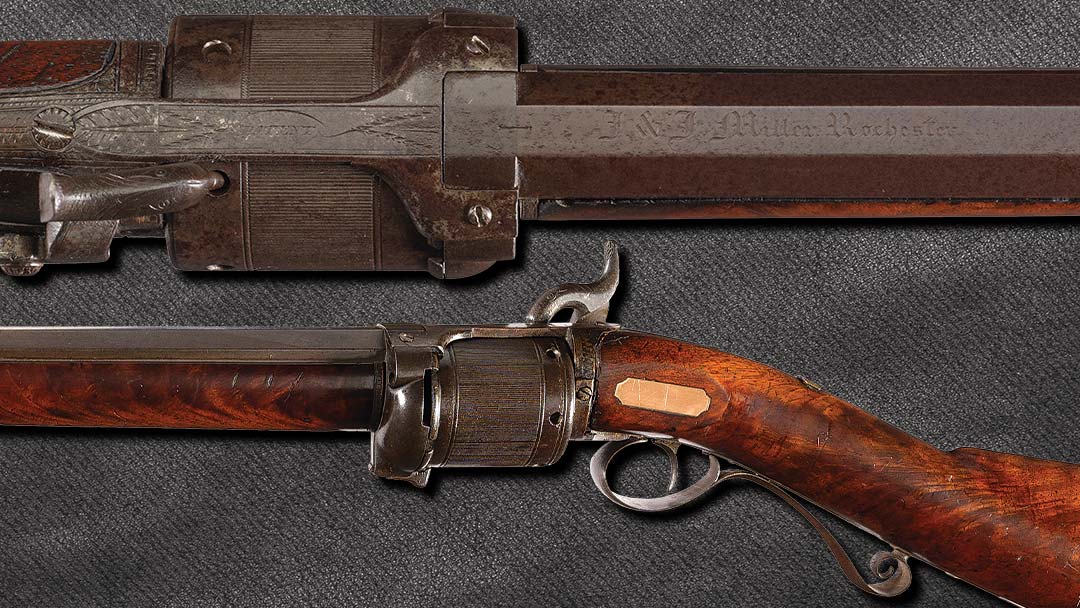
Before Samuel Colt crossed the sea as a young sailor and likely saw a Collier revolver, another American, James Millar (also spelled Miller), patented his own revolving firearms system on June 11, 1829, and manufactured them with his brother John Millar in Rochester, New York, in the 1830s and also licensed others to make them.
An exhibition quality, panel scene engraved J. & J. Miller revolving pill lock rifle with gold fittings. Available this December.
At least 15 gunsmiths ultimately made revolving rifles under the Miller patent, but William Billinghurst, a former employee of the Miller, is the most famous who bought their patent in 1841 and produced a significant percentage of the total Miller patent revolving rifles. Thus, to many collectors, these rifles are more familiar as “Billinghurst revolving rifles.” It is estimated that only a few hundred were produced in total.
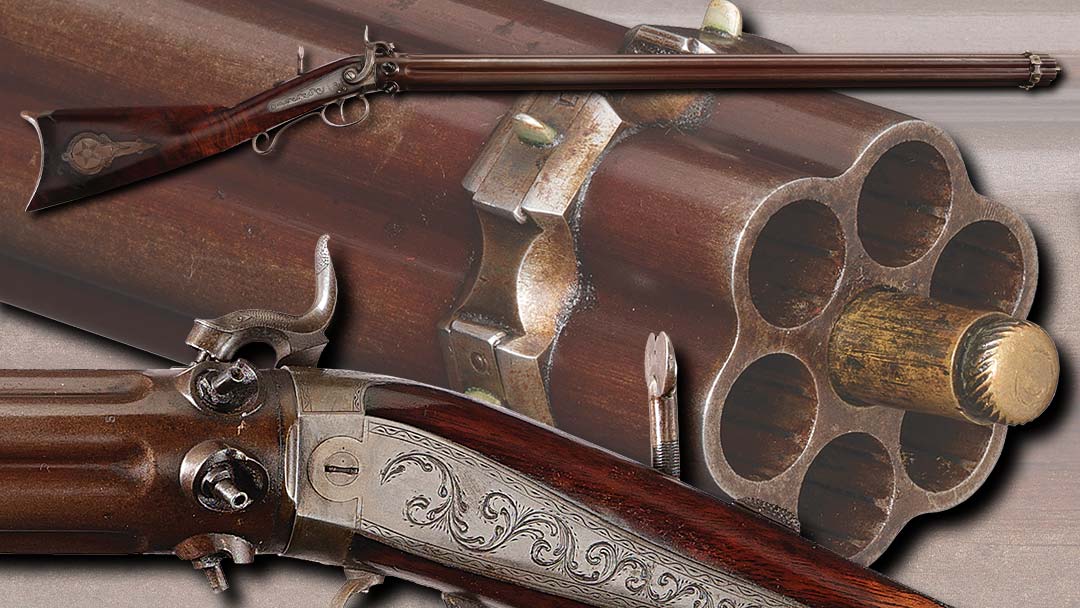
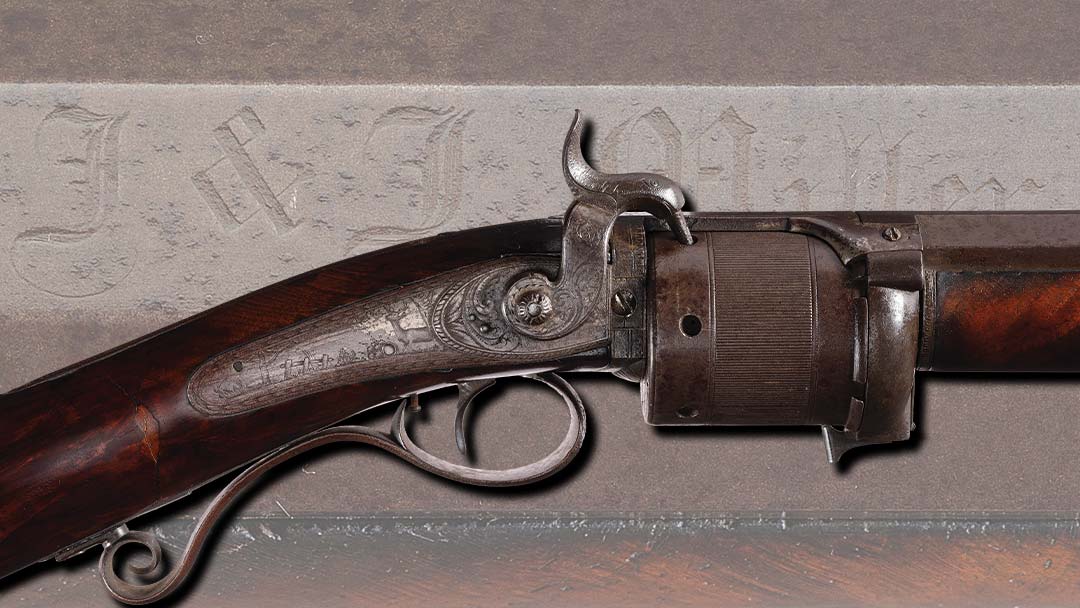
This design is also manually revolved and is generally configured to be fired using priming pills rather than percussion caps. A small latch just ahead of the cylinder helps keep it in alignment and secure when the gun is fired. The cylinders are generally textured in some fashion to make revolving them by hand easier.
A rare gold mounted and panel scene engraved J. & J. Miller revolving pill lock rifle. In this close-up look at the lock and cylinder, the the small holes for the priming pills and the latch at the front of the cylinder are clearly visible. Available this December.
Birth of the Colt Paterson
I’ve spent a lot of time showing you that Samuel Colt didn’t invent the revolver, but I’ll happily concede that he manufactured the first widely successful revolvers. He just didn’t get it right the first time around.
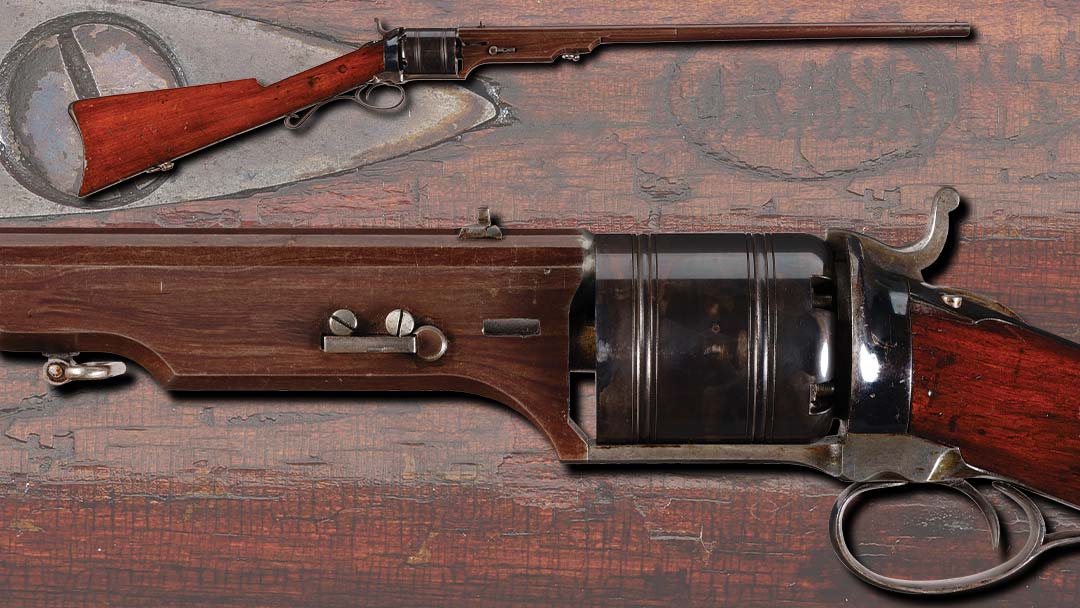
Colt received his first American firearm patent on Feb. 25, 1836, for an “improvement in fire-arms” which included a design that had clear similarities to the Collier design in the handgun version which included a bayonet and also included a really interesting lever-operated revolving rifle. He also submitted his patent in England in 1835. Colt formed the Patent Arms Manufacturing Company based in Paterson, New Jersey, to produce and market his new revolving arms.
An outstanding “Albert Foster Model” Colt Paterson Model 1839 percussion revolving carbine. Available this December.
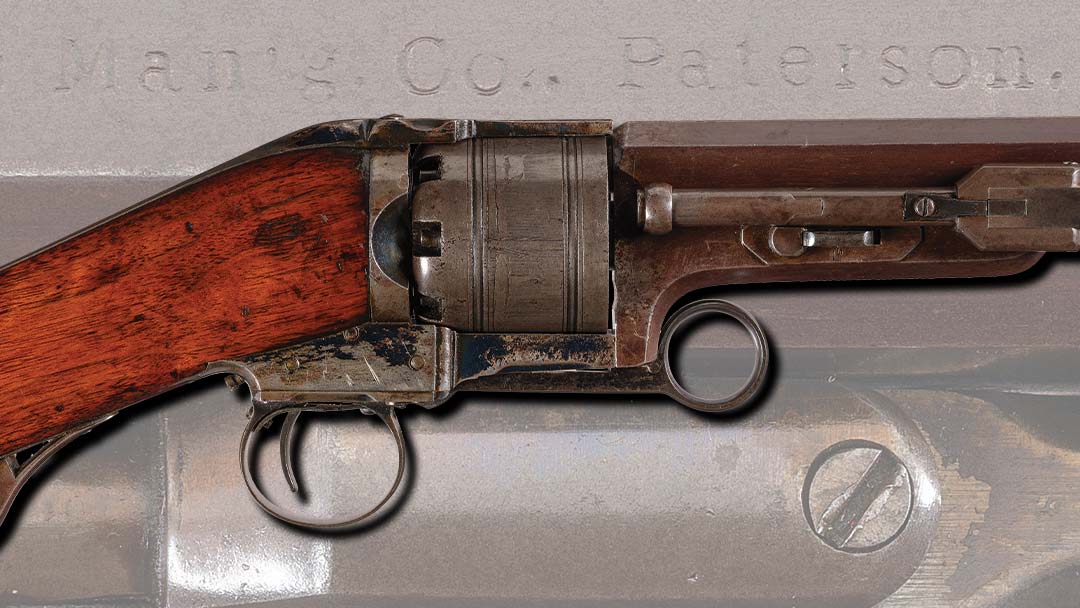
The ring lever rifles were actually the first to be manufactured. They utilize a lever with a loop to rotate the cylinder and cock the internal hammer. Only 200 of the First Models were manufactured c. 1837-1838. Unlike earlier revolving arms, they were adopted by the military, and the U.S. Ordnance Department purchased 1/4 of them for use in the Seminole Wars in Florida.
An exceptional Colt Paterson No. 1 ring lever percussion revolving rifle, a rare example of one of Colt’s first firearms. Available this December.
The Colt Paterson Revolver
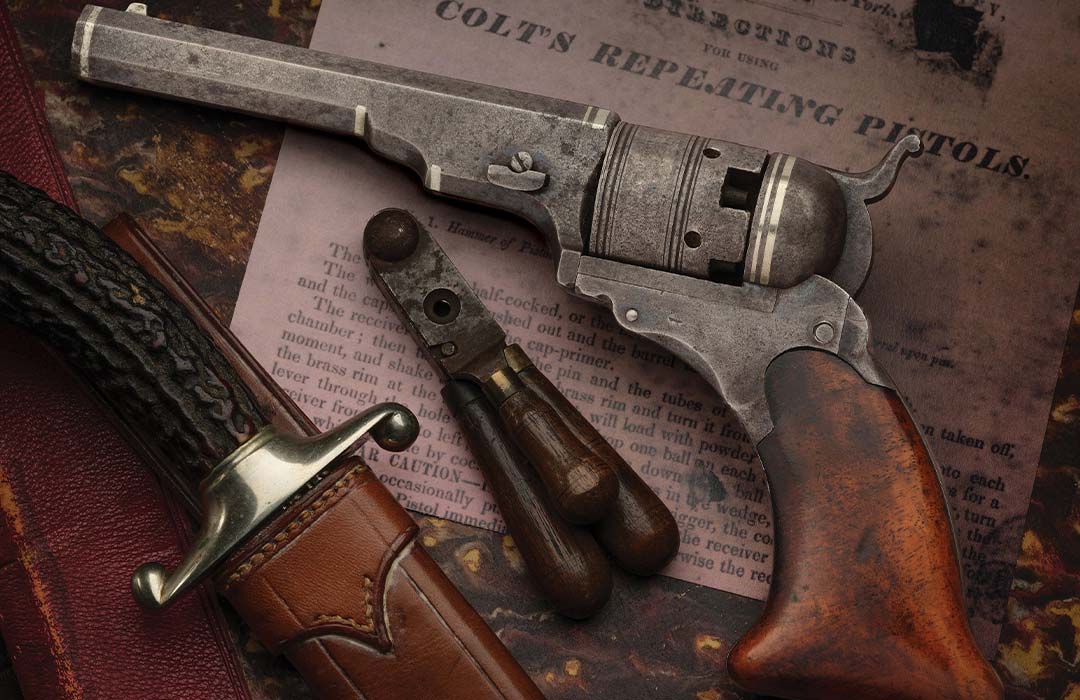
The more famous of Colt’s new firearms were his Paterson handguns which he introduced later in 1837. He had them manufactured in various sizes appropriate for pocket carry, belt holsters, and cavalrymen. Unlike the ring lever, these were all single-action revolvers and were much simpler than most revolving firearms before them. All the shooter had to do between shots was cock the hammer. They also utilized folding triggers which make the Paterson revolvers particularly sleek but they could also get jammed up. The Colt Paterson was used by the U.S. Army, Marine Corps, and Texas Rangers. They are widely considered to be the first practical revolvers. Had issues with production been worked out in time, the Colt Paterson would have become widely used.
The Paterson revolvers proved to be a financial failure for Colt, but they were well-made firearms and set the stage for the rebirth of his firearms enterprise in the late 1840s. This cased “Colt Baby Paterson” No.1 Pocket Model is one of the finest surviving examples of the genre. Available this December.
Unlike later Colts, the Paterson revolver did not truly have interchangeable parts and proved difficult to produce in large quantities at competitive prices. Because the Paterson revolvers could not be made economically enough and in sufficient quantities, and because of some design flaws, the company failed in 1842 just six years after Colt received his patent.
A factory German silver banded Colt No. 3 belt model Paterson revolver with an original mold. Available this December. The Paterson belt model demonstrates just how sleek and practical Colt’s revolver was compared to the cumbersome revolving arms that came before it.
Despite this collapse, those who had gotten their hands on Colt’s early revolvers continued to use them. The Texas Rangers in particular are famous users. Texas ordered 180 of the larger Holster Models popular nicknamed “Texas Patersons” before Colt’s business failed. They famously used their Patersons in a running fight with the Comanche during the Battle of Walker’s Creek, a battle between guns vs bows, where the rangers came out victorious despite being outnumbered. Without the Colts, they would have been overpowered by the Comanche and their bows which they could fire faster than anyone can reload a muzzleloader on horseback.
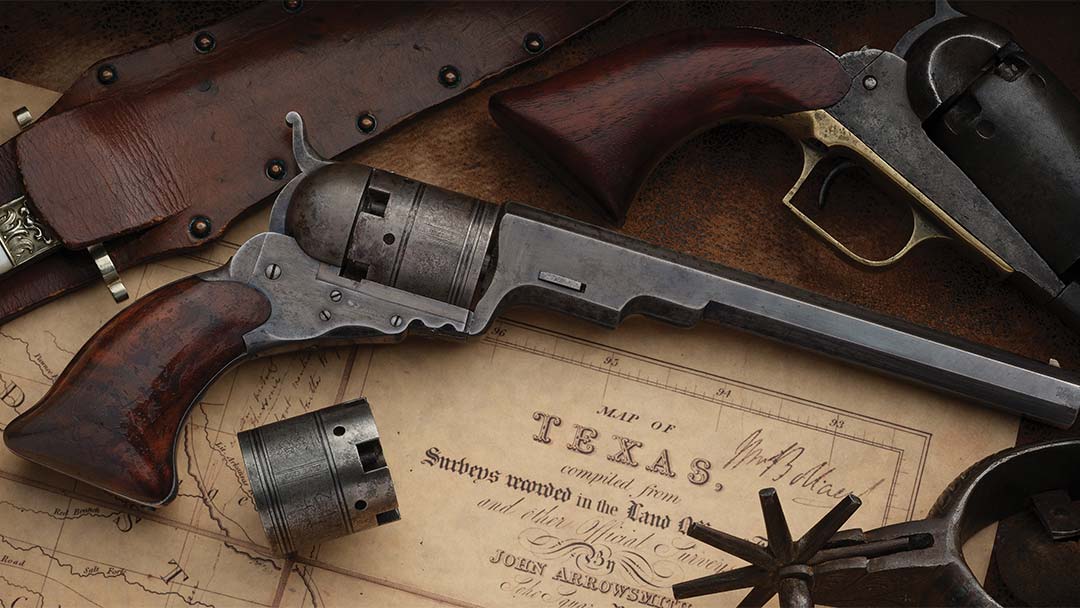
A rare early production two-digit serial number 23 Squareback Colt “Texas Paterson” No. 5 holster nodel percussion revolver with a matching extra cylinder. Available this December.
Beyond the Colt Paterson
Colt’s firearms business revival in 1847 is widely known among gun collectors and stems from the Texas Rangers. In short, while the Texans liked the number of shots Colt’s Texas Paterson revolvers carried (five), they found them to lack sufficient stopping power and overall were too delicate. Texas Ranger Captain Samuel Walker turned to Colt seeking a new revolver that would meet their needs. Colt listened and designed a new revolver based on Walker’s recommendations. This became the Colt Model 1847 Walker revolver, one of the Holy Grails for Colt collectors.
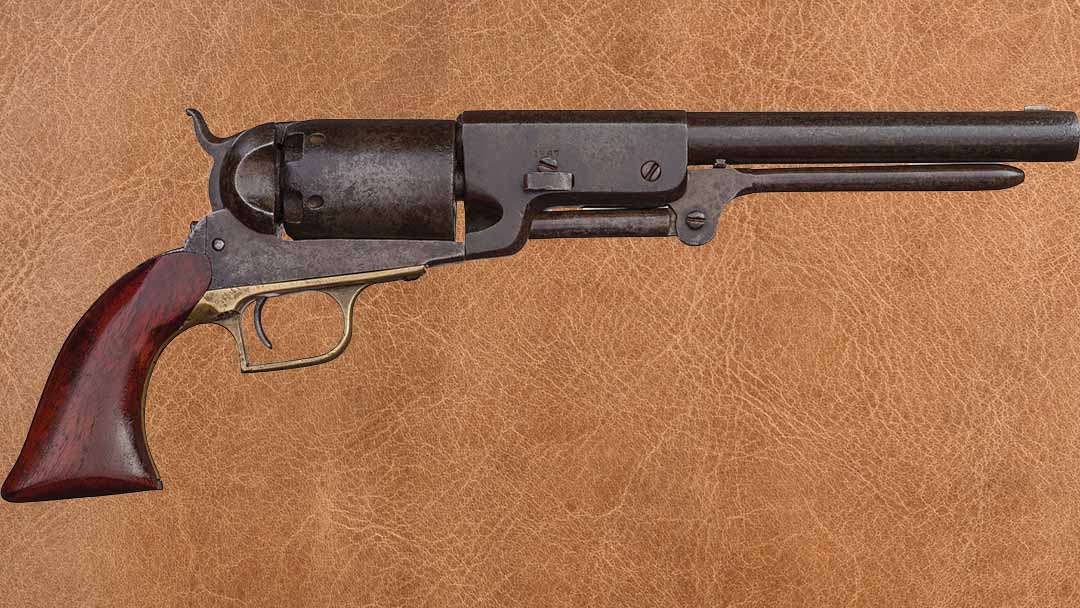
The Colt Walker was the most powerful revolver of the 19th century and dwarfed its Paterson sucessor. This C Company Walker, No. 81, is available this December.
Because Colt did not have a factory of his own in 1847, he turned to the Whitneyville Armory run by Eli Whitney Jr. for the production of 1,000 revolvers ordered by the U.S. Ordnance Department. Colt also had another 100 “civilian” Walkers produced by Whitney’s factory. These massive revolvers packed a serious punch compared to their Colt Paterson precursors. They were the most powerful revolvers manufactured up until the introduction of the .357 Magnum cartridge and Smith & Wesson Registered Magnum Revolvers in 1935. The Colt Walker could be loaded with a .44 caliber ball or conical bullet and up to a 60 grain powder charge. For comparison, most muzzleloading pistols would be loaded with around half that amount of powder for a ball of that size. A 60 grain powder charge was more typical of a .54 caliber rifle.
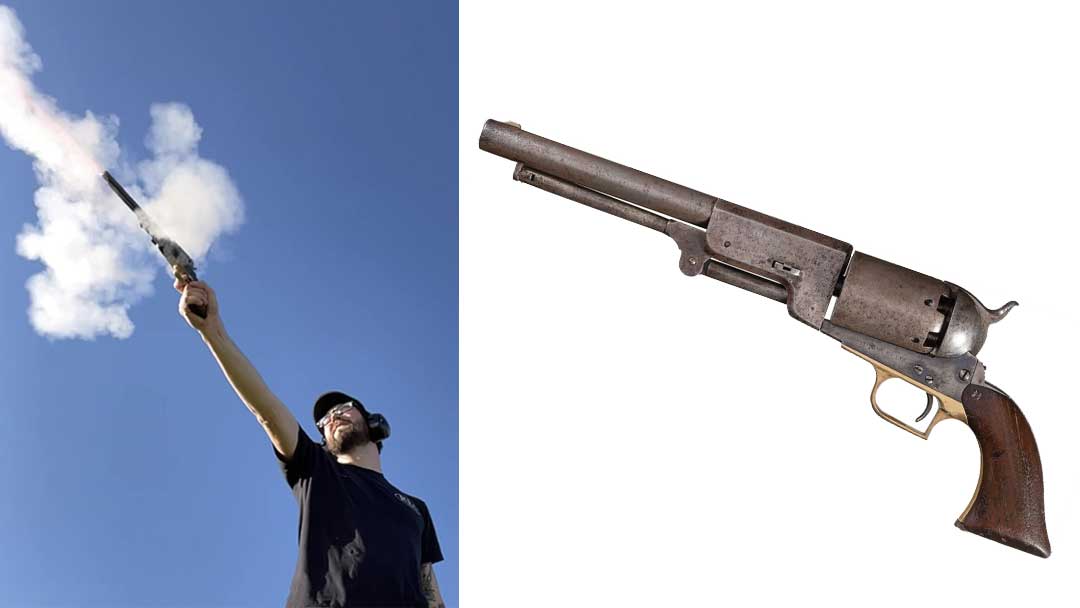
The author shooting a reproduction Colt Walker (left). An authentic Colt Model 1847 Walker Revolver (right). Many hobbists primarily shoot reduced loads through their reproduction Walkers as the full 60 grain powder charge simply isn’t necessary. It was sometimes too much pressure for the originals to take, but its fun to experience in a good reproduction using modern steel. Reproductions can be an affordable way to start collecting and shooting Colt percussion revolvers.
The Colt Walker had some problems such as a weak loading lever latch, heavy overall weight, and cylinders that too often ruptured (at least in part because they were being loaded improperly), but the majority of the Colt revolvers produced from the late 1840s through the 1873 introduction of the Colt Single Action Army were essentially the same design as the Walker in various sizes. The grip, backstrap, and frame design was simplified a bit for a straight junction, and the loading levers received better catches, but the basic overall design remained the same, and the overall profile is what we think of when we picture a revolver in our mind.
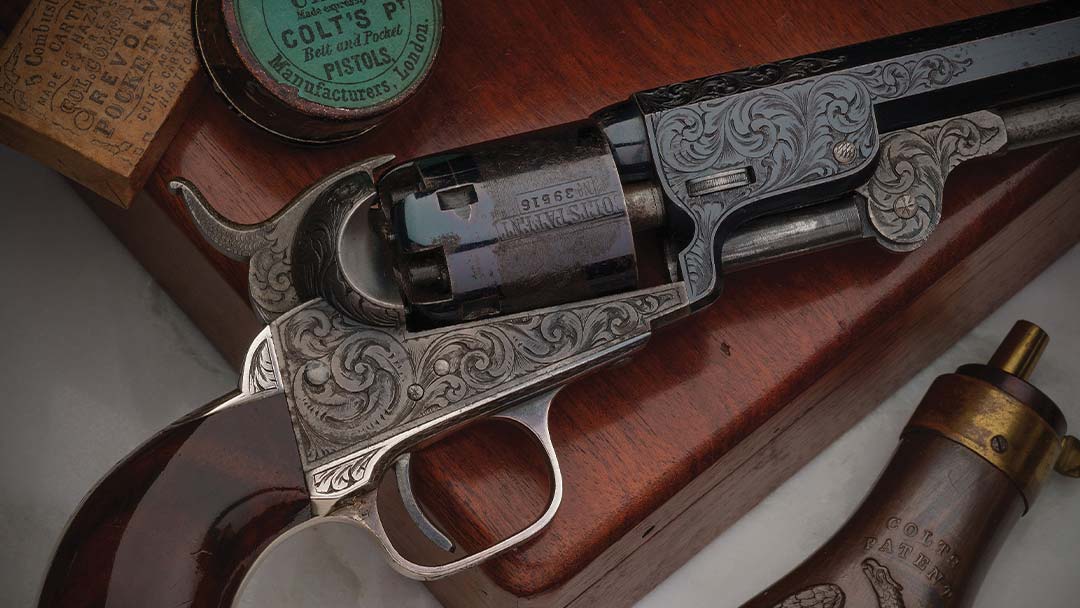
An exceptional documented cased early factory “donut scroll” engraved presentation Colt Model 1849 pocket percussion revolver featured in “The Colt Engraving Book Vol. 1.” Available this December.
Samuel Colt’s Empire
The most popular of Colt’s new revolvers, in fact, the most popular of all 19th century Colt firearms, was the .31 caliber Model 1849 Pocket, the successor to the Model 1848 Baby Dragoon. Over 300,000 of these handy revolvers were manufactured before production ended in 1873. They came in several barrel lengths and became six-shot later in production.
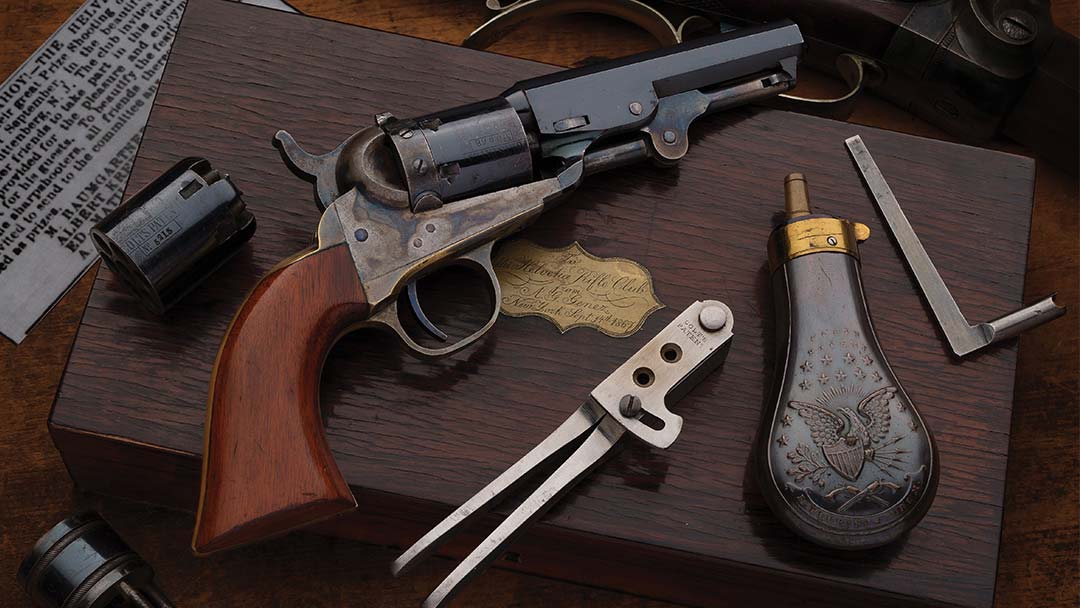
A Colt Thuer centerfire conversion Model 1849 Pocket revolver with a presentation case inscribed to the Helvetia Rifle Club from A.G. Genez of New York, and an extra percussion cylinder. Available this December.
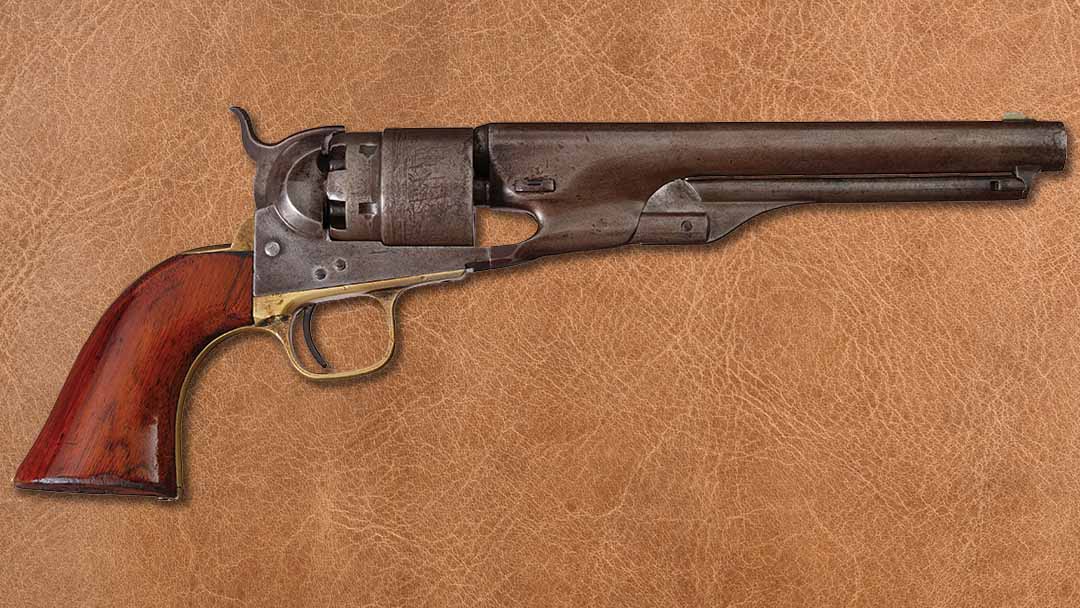
The next most popular was the .36 caliber Model 1851 Navy with around 272,000 produced. Unlike the ‘49 Pocket, many ‘51 Navies were purchased by governments as issued sidearms. During the Civil War, Colt’s .44 caliber Model 1860 Army based on the 1851 Navy was the most widely used sidearm. In total, 129,730 of these “six-shooters” were purchased by the U.S. Ordnance Department and went on to become one of the most iconic American guns of all time.
Although Colt is mostly associated with revolving handguns, his company continued to produce revolving long guns as well. The Model 1855 First Model and New Model 1855 series long guns were similar to the “New Model Pocket Revolving Pistols” (Model 1855 “Root” revolvers) but on a much larger scale. Instead of being a .28 or .31 caliber pocket pistol, the New Model 1855 long guns could be had with chambers as large as 10 gauge and packed some serious firepower.
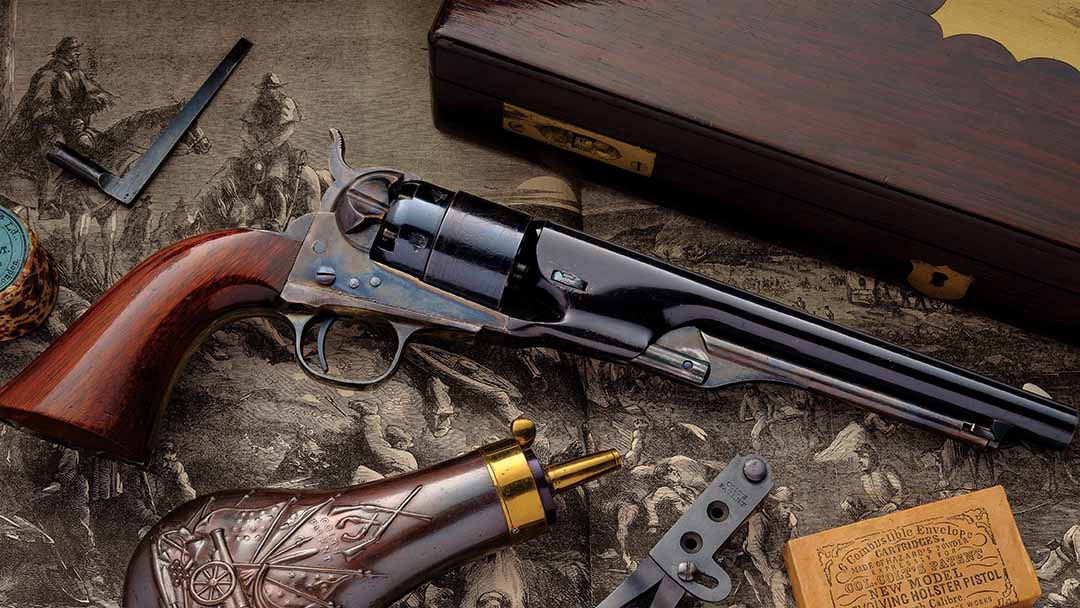
A documented Civil War presentation cased Colt Model 1860 Army percussion revolver with a factory inscription to Dr. Milhau from Colt Vice President R.W.H. Jarvis. Available this December.
The Colt 1855 revolving rifles were offered in several different variations and saw use in the Civil War with the Berdan Sharpshooters, Confederate cavalry, and others. One issue with the revolving rifles and shotguns was a problem that could happen with any early revolving firearm: chain fires. A chain fire occurs when the explosion from the main shot leaks through into additional chambers and causes multiple discharges. The main projectile will go down the barrel, but the others will be spit out from the front of the cylinder and could hit the shooter’s hand or arm that is supporting the forend. Even when chainfires did not occur, the gas leak at the breech could potentially burn your front hand.
Prior to the Civil War, Samuel Colt sold arms to both sides and even considered opening a second armory in the South, but once the war began in earnest, he threw his support behind the Union and supplied hundreds of thousands of firearms, mainly his famous revolvers but also many of his New Model 1855 rifles as well as single shot rifle-muskets. By the time he died in 1862, his legacy had been solidified both in the U.S. and abroad, a fact attested to in his obituaries. Colt went from business failure to one of the wealthiest men in the country and had firmly established his business as one of the biggest and most influential private arms manufacturers in the world.
An exceptional presentation cased deluxe factory engraved Colt Model 1862 Police percussion revolver with extremely rare pearl grips and an inscription to Professor J.D. Butler from Colt’s Patent Fire Arms Mfg. Co. Available this December.
An excellent cased, engraved, and silver inlaid Uberti “Texas” Paterson replica percussion revolver with pearl grips and accessories. Available this December.
The history of the modern world is tightly tied to the history of the gun, and you can subscribe to the Rock Island Auction newsletter for weekly gun blogs and gun videos that dive deeper into the story behind the most famous firearms. From articles on the development of the Colt Gatling gun, the Henry rifle, and the Winchester Model 1873, we take a deeper look at the evolution of firearms and the gun inventors who broke new boundaries.
Government contracts were crucial to the success of the Colt Patent Firearms Manufacturing Co. throughout the 19th and 20th centuries. This U.S. martially inspected Civil War four screw frame Colt Model 1860 Army percussion revolver with shoulder stock is available this December.
In 1914’s ‘Life-Histories of African Game Animals,’ Theodore Roosevelt noted that, “With the possible exception of the lion, the elephant is the wisest and most interesting of all the kinds of big game.”
Africa’s “Big Five,” the leopard, lion, Cape buffalo, rhino, and elephant, are some of the most dangerous game on Earth, with the elephant representing perhaps the most terrifying example of a game animal that “runs both ways.” Whether an African hunter is actively stalking elephant or is venturing through their territory, carrying a rifle powerful enough to stop one of these giants is essential.
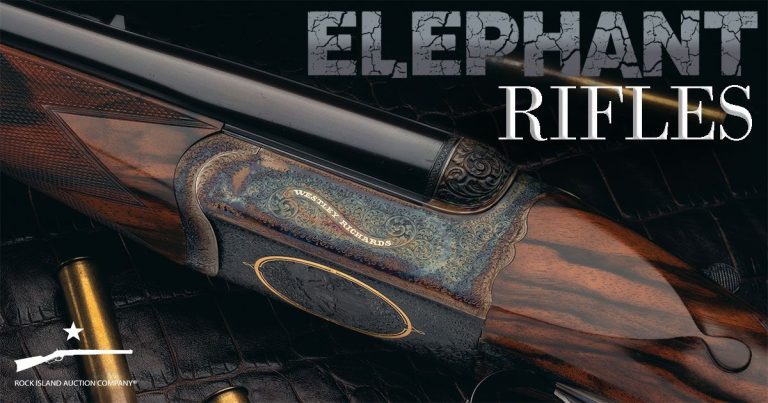
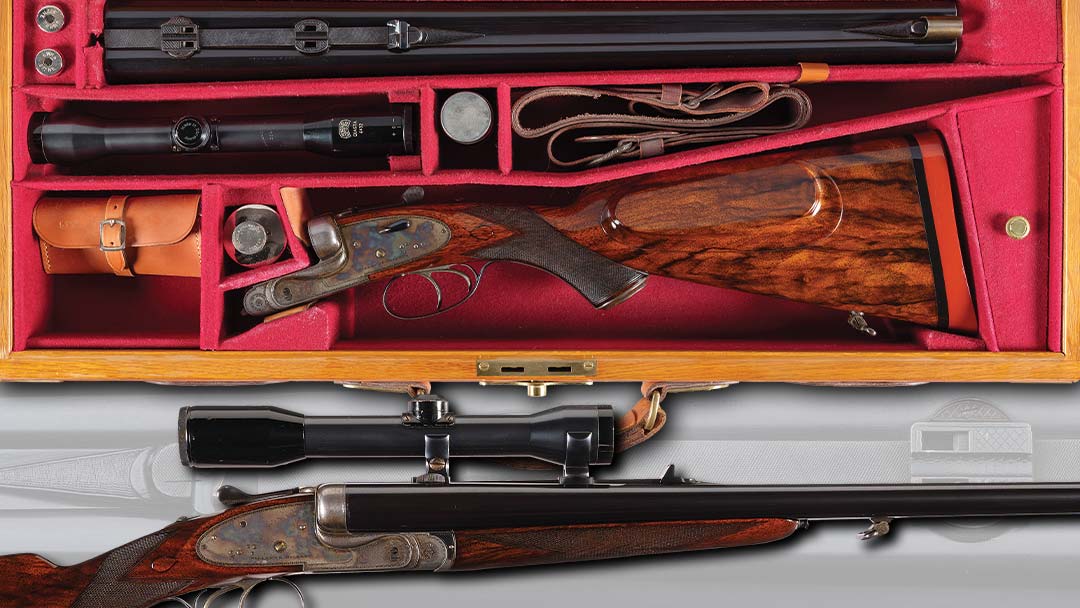
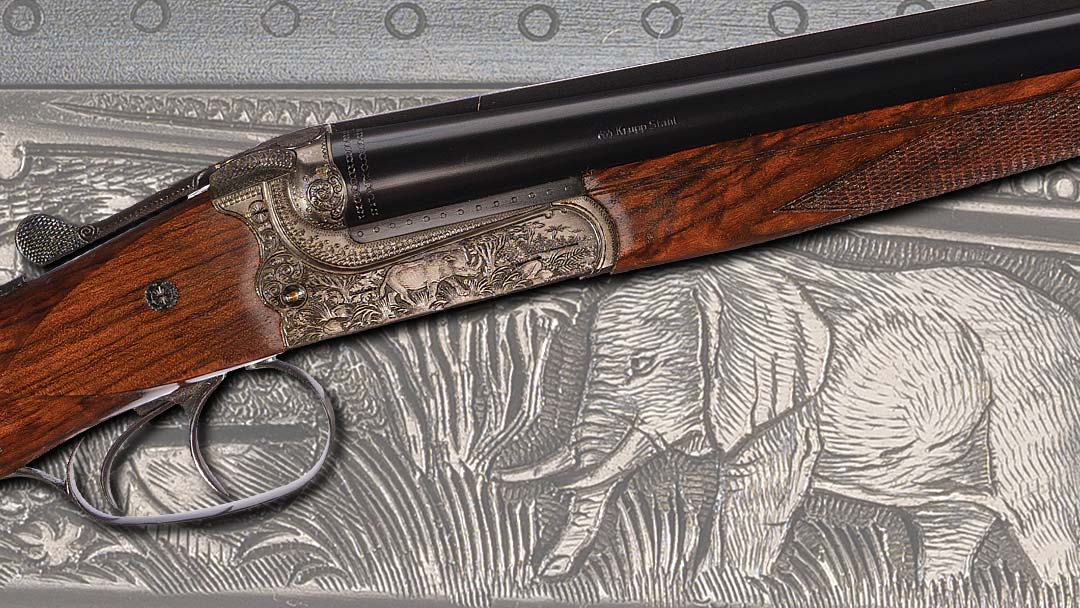
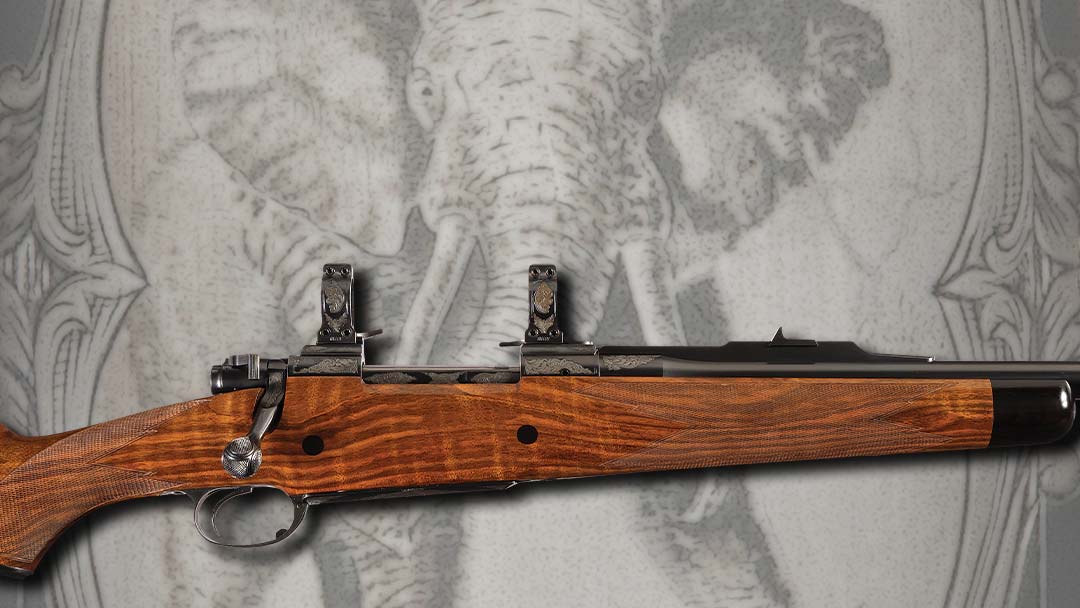
A magnificent master Anja Dammenhayn signed, relief game scene engraved, and gold inlaid Westley Richards hand detachable droplock dangerous game double rifle in 500 Nitro. Available this December.
From the black powder 4 bore to the Nitro Express double rifles developed during Africa’s big game hunting Golden Age, RIAC’s December 6 – 8 Premier Firearms Auction inBedford, Texas offers some of the finest historic and modern examples of the elephant rifle. Click on the images throughout this article to learn more about each model.
The Early Years of the Elephant Rifle
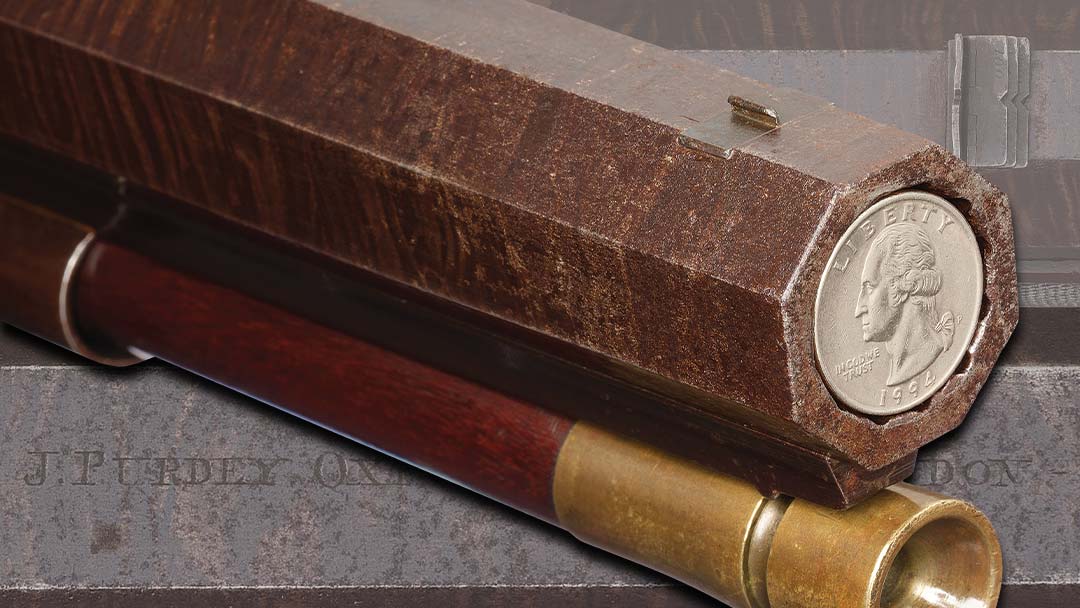
In the mid-1800s, the British colonization of Africa brought a flood of explorers, hunters, and royalty to the continent seeking adventure and riches. The promise of trophies spurred the development of massive black powder elephant rifles capable of tackling the titans of the savanna. Famed British hunter Frederick Selous and many of his contemporaries started their careers using big bore black powder elephant rifles like the exceptional J. Purdey example below.
An engraved “Jno. Rigby & Co.” and J. Purdey percussion 4 bore, king of the 19th century elephant rifles. Available this December.
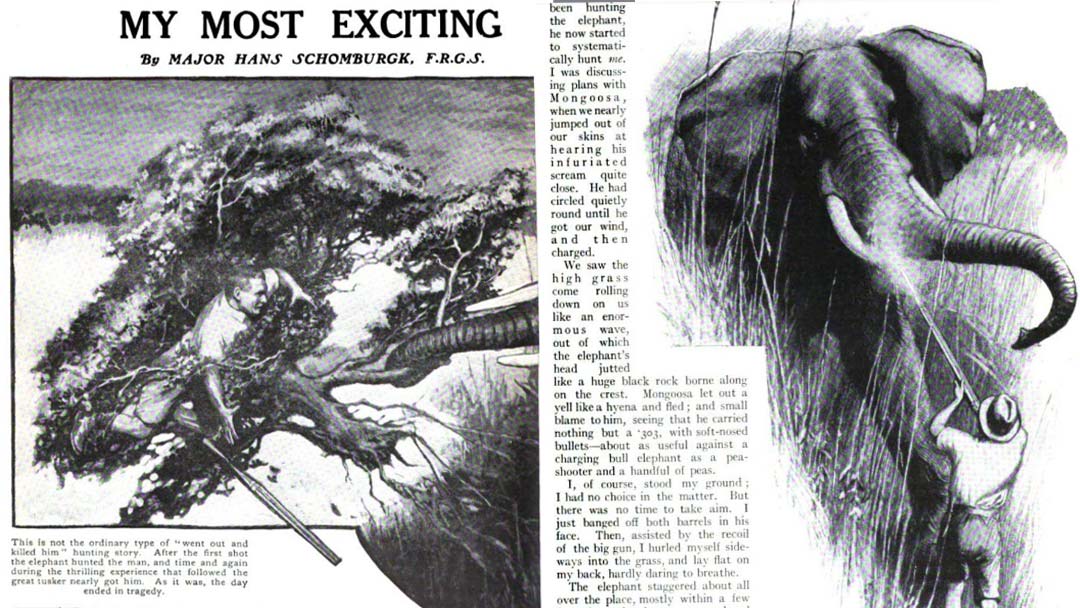
The evolution of the English double rifle offered hunters a second shot in the event of a miss or if the first shot failed to drop the animal outright. German adventurer and pioneering filmmaker Hans Schomburgk illustrated the importance of carrying a multi shot firearm in his 1907 story for ‘Wide World Magazine’ titled ‘ ‘My Most Exciting Elephant Hunt.’
Big game hunter, explorer, and documentary filmmaker Hans Schomburgk travelled to Africa numerous times between 1897 and 1958.
Schomburgk’s close-call occurred near the western shores of Lake Bangweolo, on the upper Congo River basin in Zambia, when the filmmaker’s double rifle suffered a misfire against a charging bull elephant. In a running battle through the sparse canopy and thorny underbrush, Schomburgk would ultimately sink four rounds into the bull before the enraged giant went down for good.
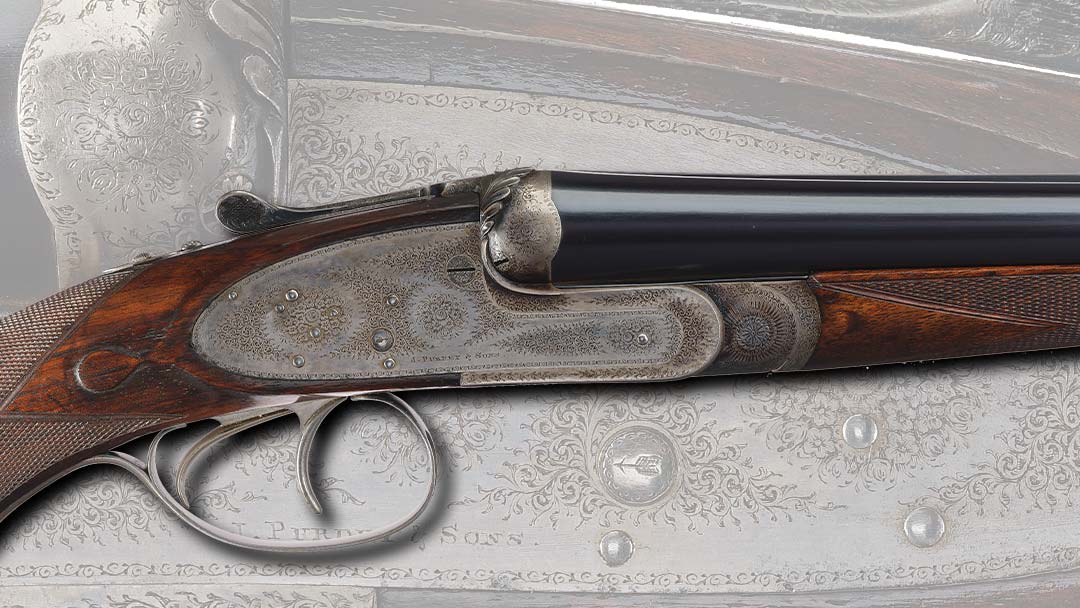
A factory engraved J. Purdey & Sons self-opening non-ejector sidelock double rifle in .500 Black Powder Express, dating from 1884. Available this December.
The Nitro Express Elephant Rifle
The introduction of smokeless powder cartridges marked a significant breakthrough for the double rifle, including the. 577 Nitro Express in 1898. An upgrade from its .577 Black Powder Express predecessor, the .577 NE delivered a 750 grain bullet with a muzzle velocity exceeding 2,000 feet per second. Earnest Hemingway joked that .577 NE was “good for rhino, buffalo, and lightly armored vehicles.” Scottish born hunter and soldier James H. Sutherland saw the round as a perfect elephant caliber.
Two stunning factory engraved Westley Richards rifles. (Left) A 577 NE double rifle. (Right) A .30-06 bolt action. Available this December.
In his 1912 book ‘The Adventures of an Elephant Hunter,’ Sutherland wrote, “After experimenting with and using all kinds of rifles, I find the most effective to be in the double .577 with a 750 grain bullet and a charge in Axite powder equivalent to a hundred grains of cordite. The heavier double-barreled .600 bore rifle, with a bullet weighing 900 grains, lacks the penetration of the .577, while its weight (16 lbs. against 13 lbs. of the latter) renders it a much more awkward weapon to handle. I think the superiority of the .577 over the .50 and .500 rifles will be evident when I state that I have lost elephants with these last two rifles, while I have bagged others with identically the same shots from .577.”
This excellent cased Holland & Holland Royal Model side lock double rifle in .577 Nitro Express with scope weighs in at 12 lbs. 5 oz. Available this December.
John Rigby & Company’s .450 Nitro Express was another early pioneer of the smokeless era. Author William Steven Rainsford wrote that Frederick Selous was, to his knowledge, “the first man to try a small bore .450 on elephant.” After years of using a 4 bore, Selous suffered shoulder issues and likely welcomed a comparatively more manageable option. Still, the .450 is far from a gentle giant.
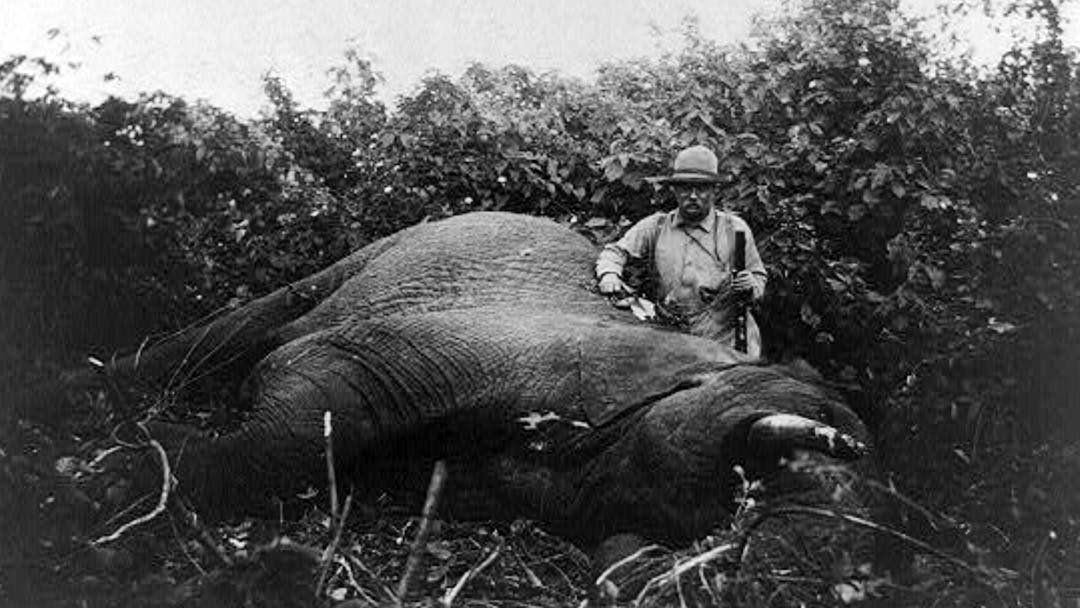
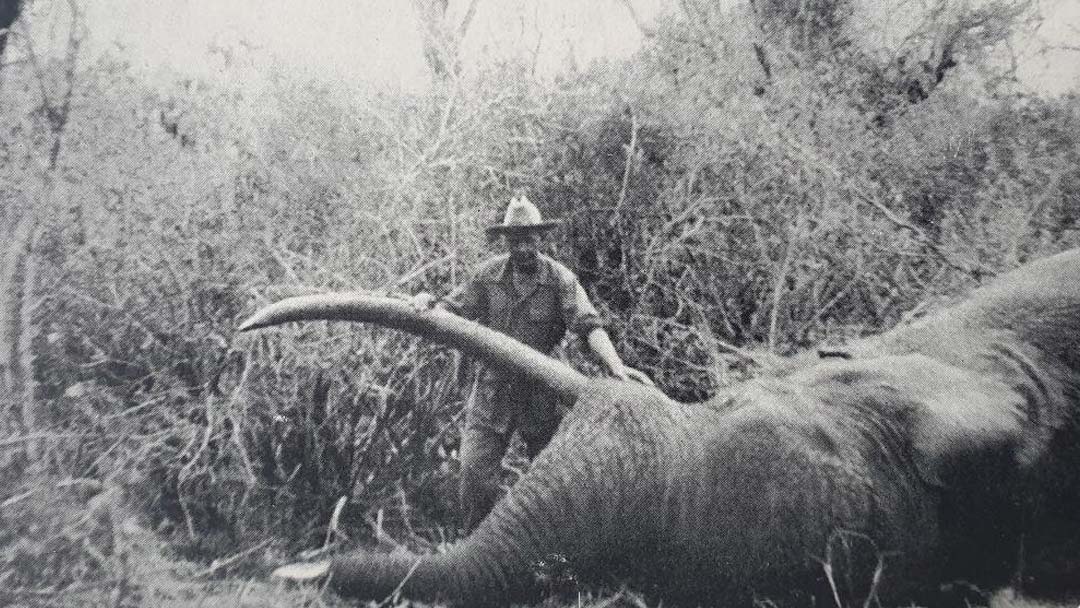
Theodore Roosevelt beside an elephant taken near Meru, Kenya. Photo courtesy of The Library of Congress.
Theodore Roosevelt brought down eight elephants during his 11-month African adventure with the mighty caliber. On his .450 double rifle, nicknamed the ‘Big Stick,’ Roosevelt’s son Kermit noted that “the recoil of the big gun was so severe that it became a standing joke as to whether we did not fear it more than a charging elephant!”
A cased W. J. Jeffery & Co. boxlock ejector dangerous game double rifle in .450/400 Express. Available this December.
The .450 NE laid the groundwork for Holland’s .500/450 Nitro Express and numerous variants of Joseph Lang’s .470 Nitro Express in the years to follow. Robert Ruark, Peter Capstick, Harry Selby, and other famed 20th century hunters carried a .470 as their elephant rifle.
A factory master Dorothee Wage signed and game scene engraved Gebruder Merkel Model 140A double rifle in .470 Nitro Express. Available this December.
American born hunter and author Peter Hathaway Capstick was particularly fond of the .470 Nitro Express, referencing the round frequently in his 1977 work, ‘Death in the Long Grass.’ Of all the dangerous game he hunted across the savannas and bushveld of East and Southern Africa, Capstick considered elephants the most deadly, noting the number of “lonely little rock-piled bush graves” he’d encountered “with inscriptions stating simply that the occupant was guilty of indiscretion with jumbo.”
A factory engraved, cased two barrel set of Krieghoff Classic dangerous game double rifle in .470 Nitro Express. Available this December.
The .475 Nitro Express was another popular elephant rifle round. In the January 1928 publication of ‘The American Rifleman’, an article titled ‘Elephant Rifles’ by W.M. Garlington discusses firing the .475 NE, a 500-grain, bullet with “up to 2,100 pounds of muzzle velocity” and “5,000 pounds of muzzle energy.”
When firing the hefty cartridge, the author describes the muzzle blast and concussion as more jarring than the recoil itself, though notes that when facing elephants, “The excitement caused by the presence of such dangerous brutes, and the concentration of the facilities on the business at hand entirely diverts the attention from these two disturbing elements.”
A factory engraved W. J. Jeffery & Co. boxlock ejector dangerous game double rifle in .475 Express. The rifle was built between 1910 and 1913 according to Nigel Brown’s “British Gunmakers Volume One: London.” Available this December.
The .375 Holland & Holland Magnum became another popular elephant rifle round. Dubbed the “Queen of the Medium Bores” by writer and outdoorsman Jack O’Connor, .375 H&H offers a powerful, dependable hunting option with comparatively manageable recoil. Today, .375 H&H is the minimum recommended cartridge for most dangerous game in many African countries.
A factory engraved and gold inlaid Heym double rifle in .375 H&H Magnum. Available this December.
Prolific African hunter John “Pondoro” Taylor gave the .375 H&H Magnum a glowing review, writing, “I’ve had five of these rifles—two doubles and three magazines—and have fired more than 5,000 rounds of .375 Magnum ammunition at game. One of them accounted for more than 100 elephant and some 411 buffalo, besides rhino, lions and lesser game.”
A factory master Sebastian Scheerschmidt signed and engraved Gebruder Merkel Safari double rifle in .375 H&H. Available this December.
The Bolt Action Elephant Rifle
The early 20th century also saw the bolt action rifle making its mark in African hunting circles, serving as a more affordable alternative to the double rifle. With new big game cartridges developed for the platform, the bolt action offered reliable stopping power, extended range, greater capacity, and durability.
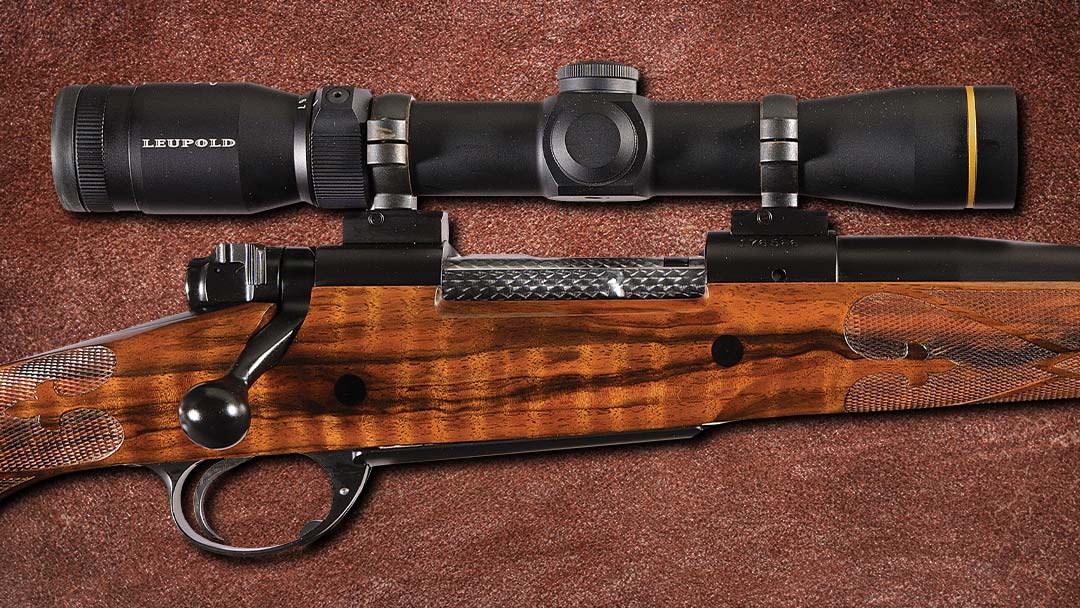
A custom Kilimanjaro Rifles upgraded pre-64 Winchester Model 70 African bolt action rifle in .375 Ruger with a scope and case. Available this December.
Elephant hunter Karamojo Bell favored more modest cartridges like the 6.5×54 Mannlicher Schoenauer and .276 Rigby, but not all hunters possessed the experience or shot placement needed to bring down elephants with these rounds. William Steven Rainsford warned of greenhorns plastering their prey with twenty or more bullets, writing, “Accidents keep happening because anyone who can borrow a gun and take out a license fancies himself capable of elephant hunting, taking little notice of wind or cover as they do.”
“Bror Blixen was one of the greatest of the East African professional hunters,” according to Jim Cornelius, writer and podcast host of ‘Frontier Partisans.’ An archetypal adventurer of his age, Cornelius rightly notes that Blixon, “could have had his own Dos Equis commercial.” Check out Blixen’s story and other tales of the African hunt on Jim’s fantastic blog.
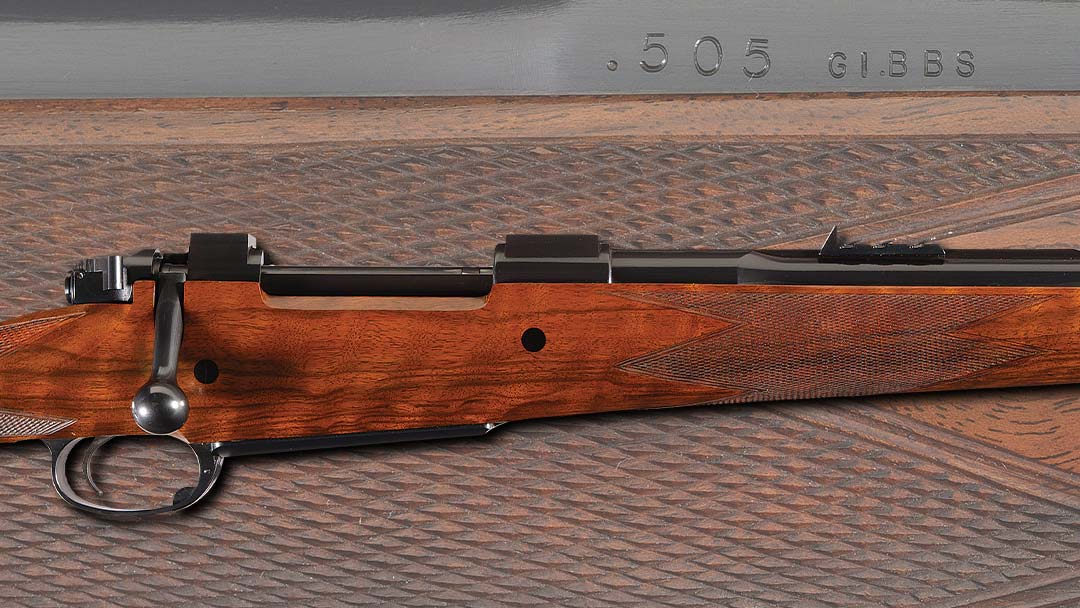
Developed in 1911, heavyweight rounds like the .505 Gibbs were embraced by professionals like Sir Samuel Baker, John A. Hunter, and Bror Blixen. In Hemingway’s short story, ‘The Short Happy Life of Francis Macomber,’ the English guide Robert Wilson carries a rifle chambered in the sturdy round. Wilson considers the .505 Gibbs ideal for taking “an elephant, a rhino, or a really big male lion” and muses, “if the .505 were any larger, you would have to call it a cannon. It is simply the most powerful game rifle there is.”
The .404 Jeffery hit the market in 1905 and became one of hunter’s Kai-Uwe Denker’s most favored elephant rifle rounds. As mentioned, shot placement was vital when taking Africa’s largest game with such a caliber. In ‘The Land of the Lion,’ William Steven Rainsford advised hunters to aim, “Full in the middle between the tusks the ball must strike, in order to kill, and there must be behind it the driving power of a good charge.” Rainsford also recommended “The shoulder, or just behind the kink of his big foreleg is the easiest mark and quite deadly enough. There lies the great heart, quite as big as a large water bucket, and any man who keeps his wits about him, and fires from broadside, can hit it.”
An American Hunting Rifles/CZ Model 550 left handed Safari Magnum dangerous game rifle in .404 Jeffery with a Swarovski scope. Available this December.
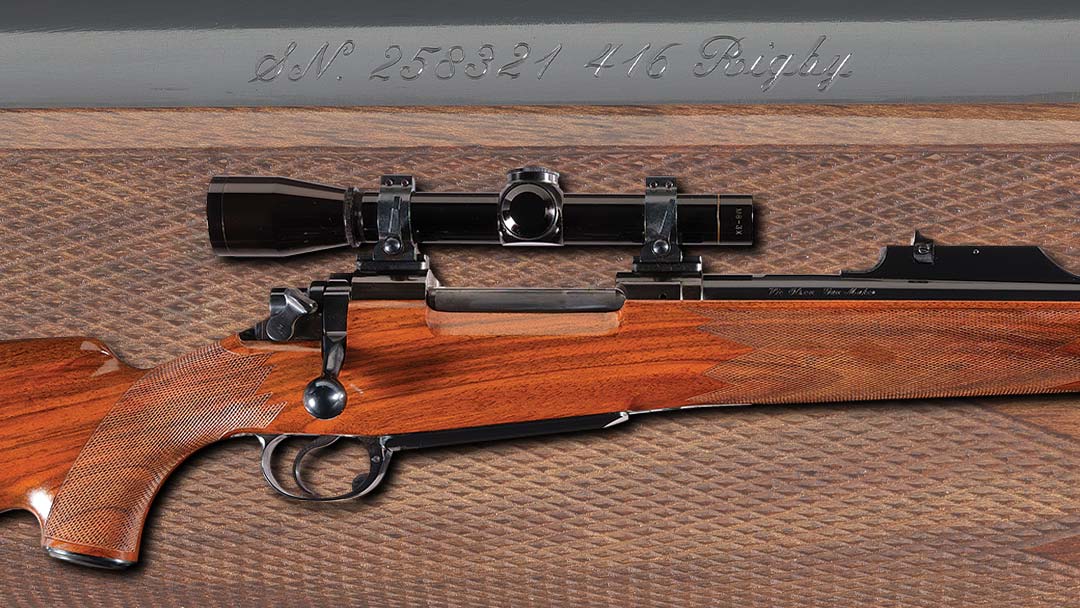
Introduced in 1911, the .416 Rigby fell under the radar for decades. The cartridge found new life in the 1950s thanks to Robert Ruark’s ‘Horn of the Hunter’, which relays the safari the author undertook with the famous guide Harry Selby. When a safari rig ran over the barrels of Selby’s double rifle, the hunter began using a bolt action chambered in .416 Rigby. As Selby recounted, “After using the .416 Rigby on two safaris, I never looked back on my rifle preference — I had no intention of returning to a double gun.”
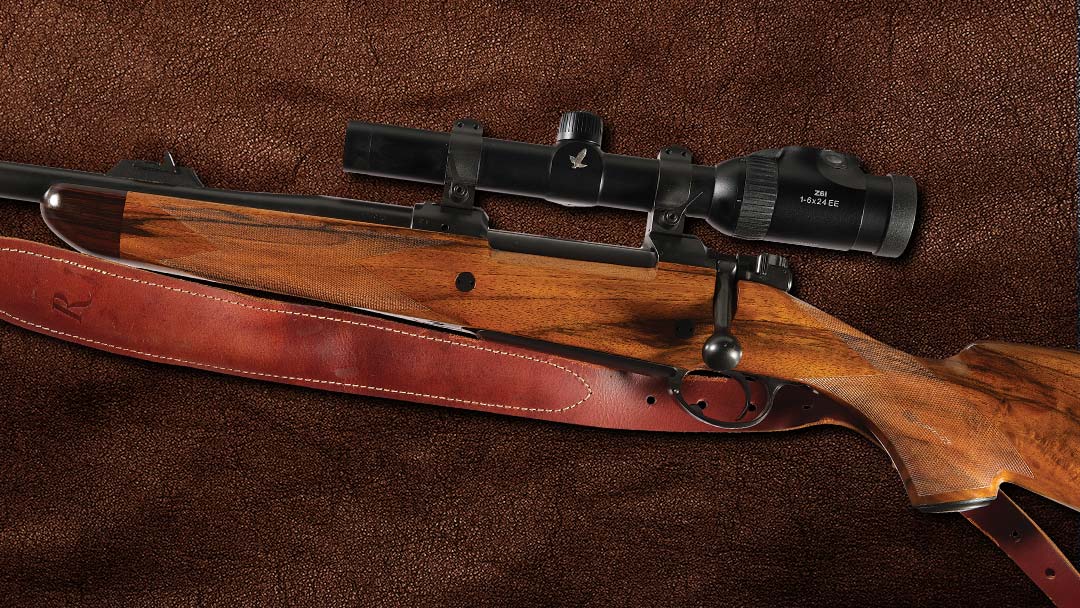
A Vic Olson built Remington Model 1917 sporting rifle in .416 Rigby with scope. Available this December.
The Elephant Rifle Today
By mid-century, South Africa’s elephant numbers had dwindled due to sustained hunting pressure. Conservation measures introduced in the 1970s helped reverse declining wildlife populations and sparked a steady revival in Africa’s hunting industry. Many legendary hunters were also committed conservationists, and their writings continue to inspire efforts to protect the continent’s wildlife and landscapes for future generations.
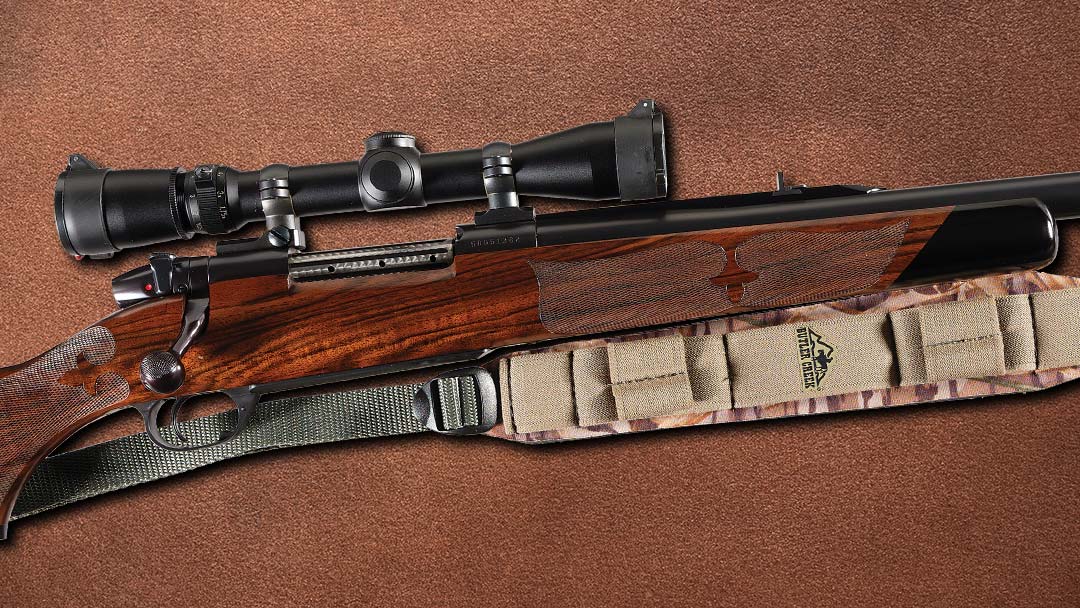
A Weatherby Custom Shop Mark V Safari rifle in .460 Weatherby Magnum with scope. Available this December.
Today’s elephant rifles can be found chambered in everything from the comparatively modest .375 Holland & Holland to the imposing 4 bore and 2 bore. Renowned European gunmakers remain dedicated to the double rifle, incorporating modern materials and construction methods to merge old-world craftsmanship with contemporary sensibilities.
Whether double rifle or a bolt action, a sporting arm can last generations if properly cared for, and hunters who dream of fielding a hand-crafted classic can find some of the most exceptional masterworks from decades past at Rock Island Auction Company.
A factory engraved J. Bury boxlock ejector double rifle in .405 Winchester from the personal collection of Reichsmarschall Hermann Goring. Available this December.
Elephant Guns for Sale and More
As Peter Hathaway Capstick observed, “The problem of elephant control has long been handled by a good man with a big rifle.” Whether hunting the 7-ton giants of Botswana or the mighty cape buffalo of Tanzania, carrying a big stopper in a time-tested cartridge can make all the difference. For collectors, shooters, arms enthusiasts, and sportsmen with the grit to confront the world’s most dangerous game, Rock Island Auction offers a fine range of heavy hitting double rifles and bolt actions from every era.
A master engraved Dakota Arms Model 76 African Grade custom bolt action rifle in .404 Dakota. Available this December.
From the independent gunsmiths who shaped an industry to the most renowned names in arms manufacture, both have fashioned masterfully crafted sporting arms with their sights set on superior performance.
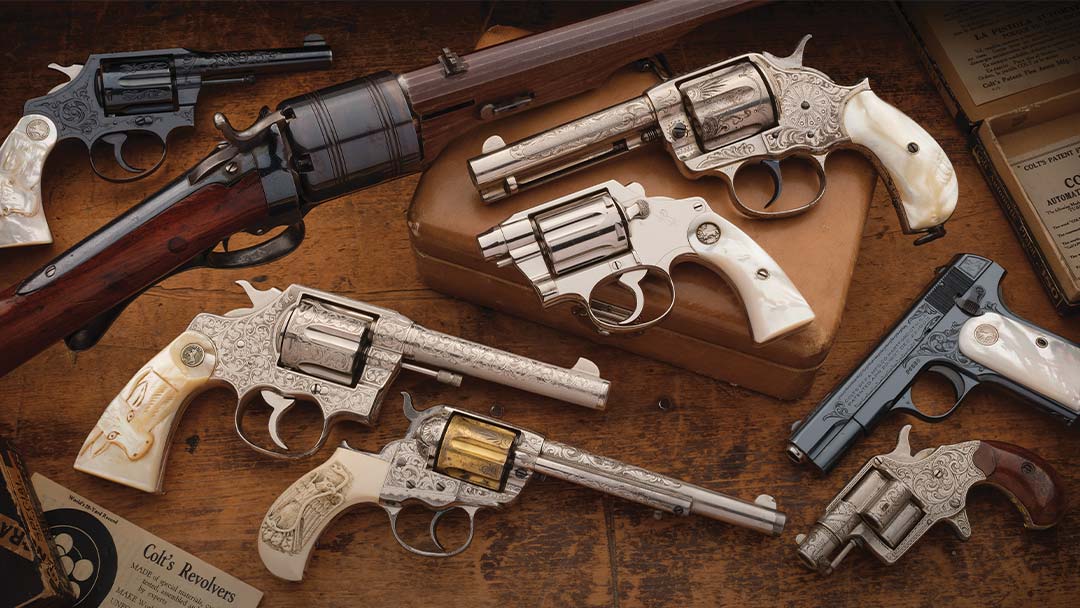
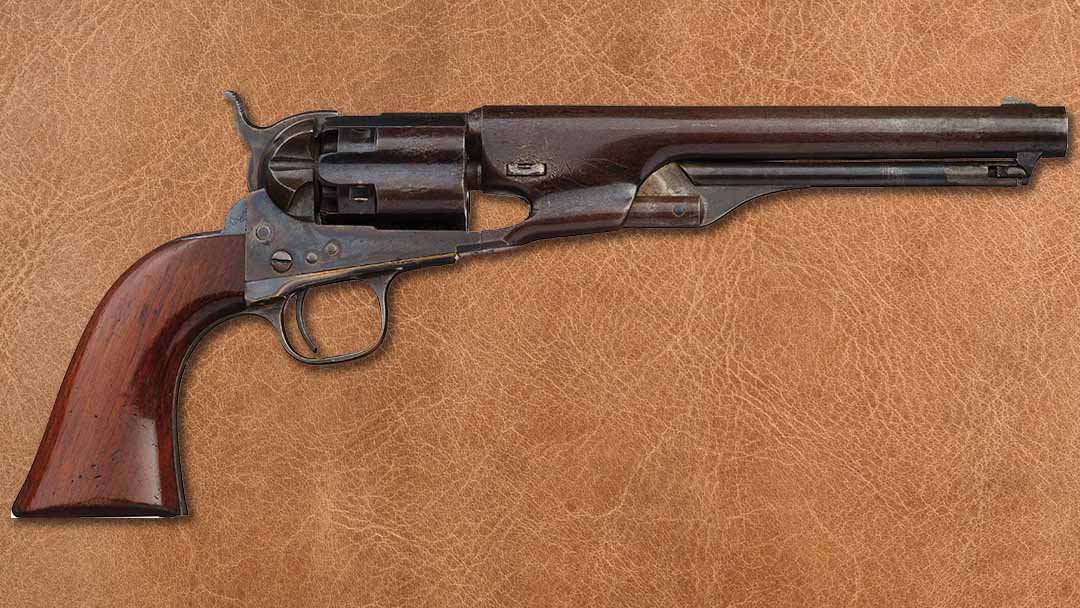
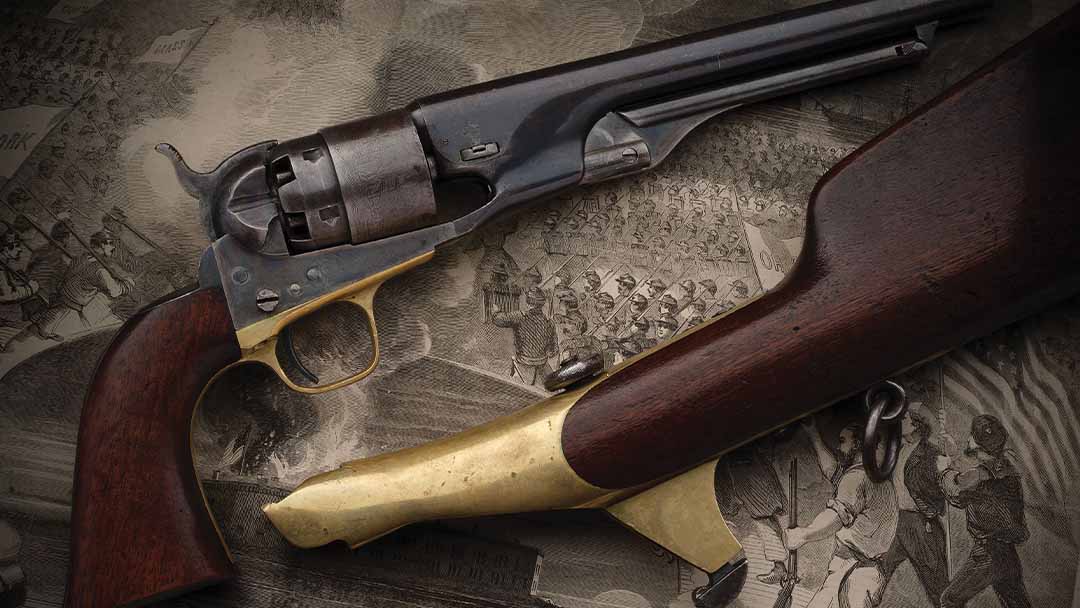
Colt’s Manufacturing Company has been producing historic guns for 177 years, drawing numerous collectors, scholars and devotees, so declaring the “Mount Rushmore of Colt collecting” Is a good way to start an argument. Trying to present the best four examples of just about anything — from rock singers to American authors to WWE wrestlers — is a thought experiment that can quickly get emotional.
That said, let’s replace George Washington, Thomas Jefferson, Abraham Lincoln and Theodore Roosevelt – some of the greatest presidents in U.S. history – to find the most legendary Colt firearms. Consider the historic impact that these guns should have such monumental recognition. Of the many guns, Colt has produced, the four presented here bear a historic and lasting impact on the United States and the world. Examples that will be available in Rock island Auction Company’s Dec. 6-8 Premier Firearms Auction in Bedford, Texas, are presented as part of this spirited discussion.
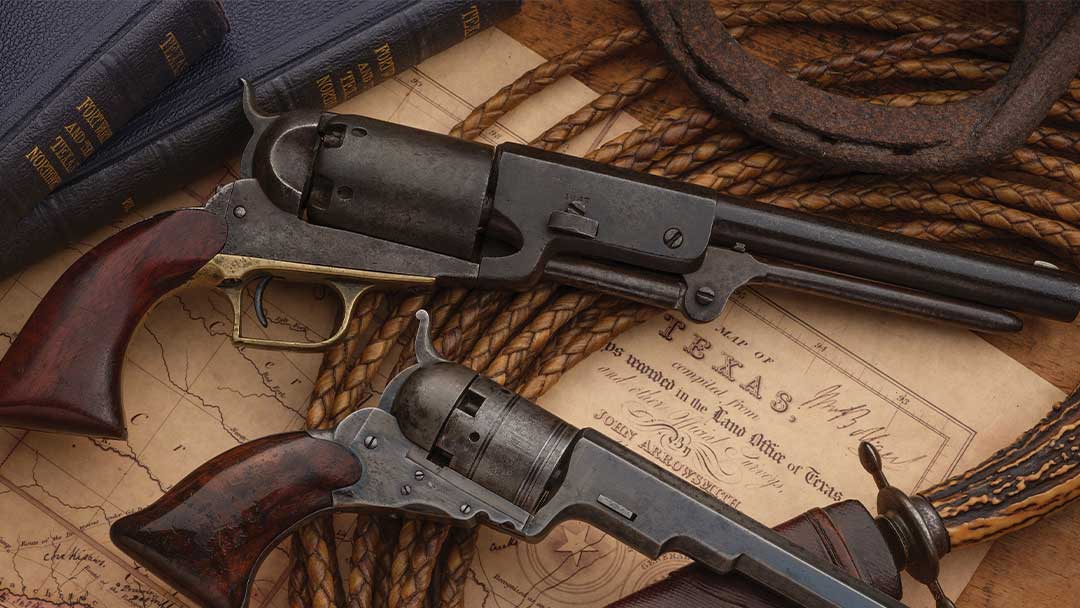
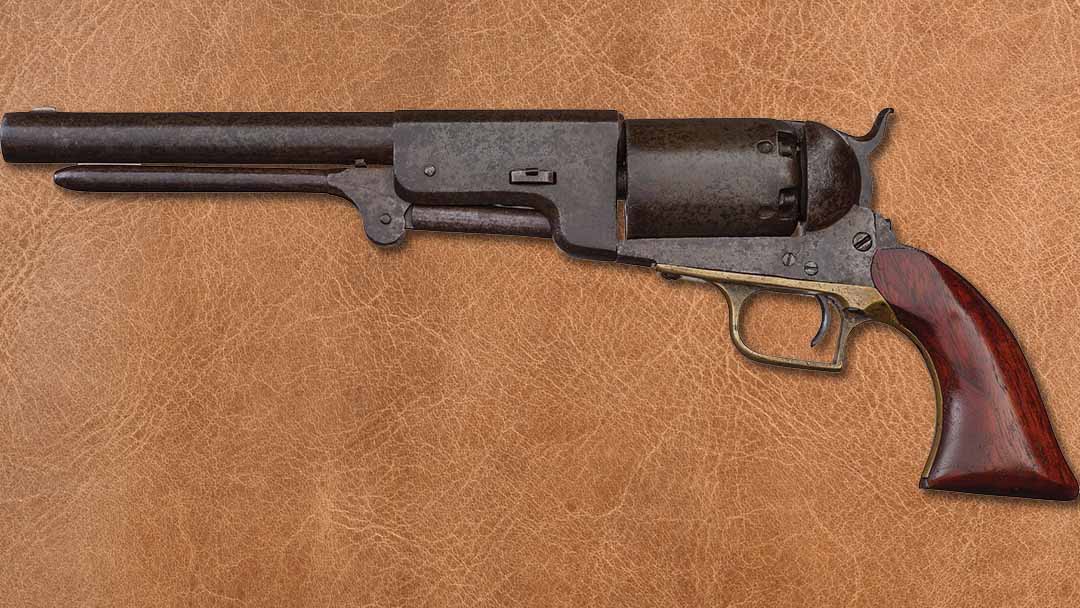
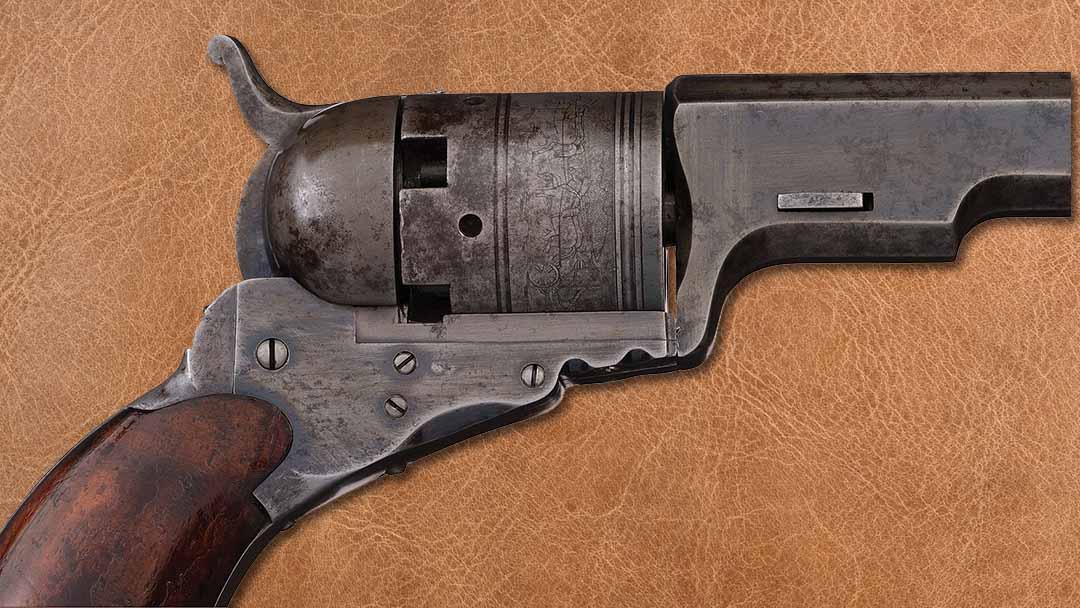
The Colt Walker, like this C Company Colt U.S. Model 1847 Walker Percussion Revolver at top, deserves to be on the Mount Rushmore of Colts, while this Texas Paterson No. 5 holster model, below it, is definitely part of the conversation.
Mount Rushmore of Colts: Colt Walker
Some may say the Paterson deserves to be on this Mount Rushmore as Samuel Colt’s first commercial venture, patented in 1836, but that was made by the Patent Arms Company, rather than the company that would bear its founder’s name. It was a gun that would show the promise Colt would fulfill a decade later with the Walker revolver and truly show Colt’s innovation. Without the Walker revolver, there would be no discussion. Without George Washington, there would be no other faces on Mount Rushmore. The Walker is truly a foundational gun
In 1846 as war with Mexico was looming, Samuel Walker, a captain with the Texas Rangers who had used the Paterson, contacted Colt about an improved version of his first revolver. Walker wrote to Colt, whose Patent Arms had failed, telling him of a band of 15 Texas Rangers holding off 80 Comanche warriors because of the repeating Paterson revolvers, rather than the single shot guns of the day.
This very rare and historically significant C Company No. 81 U.S. Colt Walker is one of only 1,000 martial contract revolvers made during the Mexican American War. This revolver is one of the first batch of 220 revolvers manufactured and specifically marked for Capt. Samuel Walker C Company of the U.S. Mounted Riflemen. Though intended for Walker’s company, Col. John Coffee Hays of the First Regiment, Texas Mounted Volunteers signed for 214 of the C Company revolvers in October 1847, issued during the war.
“With improvements I think they can be rendered the most perfect weapon in the world for light mounted troops…The people throughout Texas are anxious to procure your pistols & I doubt not you would find sale for a large number at this time,” wrote Walker.
Colt who had been working on underwater naval mines saw a business opportunity and expressed his interest in restarting his gun-manufacturing-concern. The two men met in New York City to discuss improvements and by December 1846 had secured a contract for 1,000 of Colt’s revolvers. The specifications for a more durable and powerful gun included 9-inch rifled barrels and a cylinder chambered in .44 caliber for six charges. The chambering was a significant difference with the Paterson that was a .36 caliber revolver. The Walker would weigh in at a beefy 4 lbs. 9 oz. and turn around Colt’s business fortunes.
This incredibly rare and desirable early production, two-digit serial number squareback Texas Paterson No. 5 holster model is one of 180 ordered by the Republic of Texas Rangers used in running battles with the Comanche on the southwestern frontier prior to the Mexican-American War. The gun inspired Samuel Walker as a Texas Ranger and prompted him to collaborate with Samuel Colt on a more durable and more powerful revolver, the Colt Walker.
Despite not having a facility to make the guns, he contracted with Eli Whitney to manufacture the Walker revolver and delivered the first lot of 220 pistols in June 1847. Though they were to go to Walker’s unit the initial shipment was claimed by Col. Jack Coffee Hays for his First Regiment of the Texas Mounted Volunteers.
After the war ended most of the surviving Walker revolvers were returned to government arsenals. Of the 191 turned in by Hays’ men, only 92 were recorded as serviceable. Some walkers, captured by the Confederacy at the start of the Civil War and issued to cavalry units.
The Walker was the beginning of Colt’s large “horse pistols,” known as dragoons that would be manufactured up to the Civil War. Though Colt claimed he made little or no profit off the Walker, he gained publicity and the tooling through his contract with Whitney to build his own factory in Hartford, Conn. One of the Ordnance Department’s early suggestions was to make it smaller and lighter though early Dragoons still weighed in at 4 lbs. From 1847 to 1844, the U.S. government purchased 6,000 army pistols, and by the time of Colt’s death in 1862, more than 100,000 Colt revolvers were in circulation because of his collaboration with Samuel Walker.
Samuel Walker wanted Colt to number the revolvers they collaborated on by company. The first batch of 220 the Colt Walker revolvers were sent for Walker’s unit of the U.S. Mounted Riflemen, but Col. John Coffee Hays signed for them, issuing 214. This rare and historically significant Colt Walker us marked “US/1847” on the right and “C COMPANY No 81” on the left side. “C CoM-Y No 81” is marked on the trigger guard. This revolver also has its original loading lever, rarely found with surviving Walker revolvers.
Mount Rushmore of Colts: Model 1860 Army
The Civil War wrenched apart a nation in order to do what the Founding Fathers didn’t — answer the question of slavery. In this war of North versus South and in the hands of brother versus brother, was the Colt Model 1860, the most widely used firearm of the conflict. The revolver contributed mightily to the northern victory and holding the country together, a monumental feat.
This extremely rare Colt Model 1860 Army serial number 50 has a round cylinder, rarely seen Model 1851 Navy-sized grip and a 7 1/2-inch barrel.
The U.S. government was the biggest customer for the Model 1860 Army, purchasing 129,730 revolvers for the Union Army, but the gun found itself in the hands of both sides during the Civil War. Colt shipped revolvers to the South before the start of hostilities and for a short time after fighting began. Plus, firearms scholar and author Charles W. Pate estimates that during the war 10,000-12,000 of the revolvers were captured by the Confederacy.
To examine a Model 1860 is to hold a piece of American history, of camaraderie around bivouac campfires and the shared horror of battle. Adopted a year before the southern states made their intentions clear, many examples of the 1860 Army have the finish, patina, nicks and scratches of a firearm that was in the crucible of war, a tool of both tragedy and triumph.
Through the 1850s, Samuel Colt was aware of what U.S. Army officers thought about the Dragoon and Model 1851 Navy revolvers. They liked the size of the Navy revolver but wanted the .44 caliber punch of the Dragoon. Colt engineers experimented with lightening the Dragoon and enlarging the caliber of the Navy revolver. What they designed was the Colt Model 1860 Army.
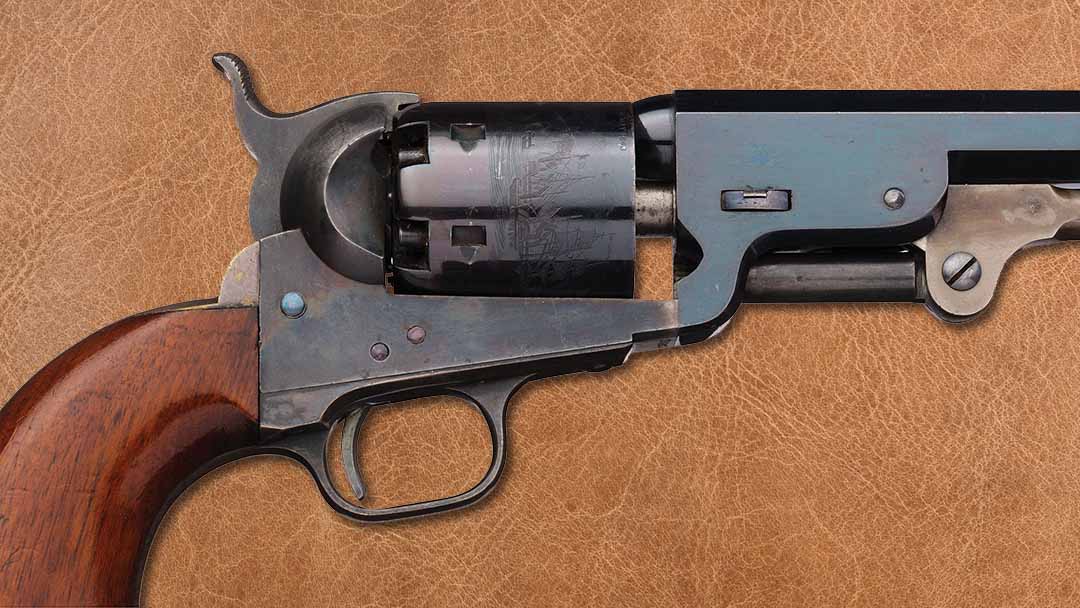
When designing the Colt Model 1860 Army they based the size on the Colt 1851 Navy, like the exceptional example shown here, manufactured in 1866. In designing the New Model Army, the grip was extended and the front of the cylinder was bored out to take a larger caliber bullet.
Colt’s health was deteriorating as his company worked to produce a revolver suitable for the U.S. Army. He saw the 1860 Army adopted by the U.S. government but died in 1862 as his revolver was becoming crucial to the Union effort.
This cased presentation Model 1860 inscribed from Colt Vice President Richard H.W. Jarvis to Union surgeon Dr. John J. Milhau who was placed in charge of all Army hospitals in the Washington, D.C. area in September 1862. The revolver and case are shown on page 380 of Charles W. Pate’s “The Colt Model 1860 Army Revolver.”
Though many 1860 Army revolvers show the wear of use, there are also amazing cased examples. Samuel Colt wasn’t shy about greasing the wheels of commerce to his advantage, so often presented his firearms to those in government and business who could help him in some way.
Like many Colt firearms, the original often isn’t the best or only model and the 1860 Army is no different. Early examples have fluted cylinders before they were discontinued, while some have the short grips of the 1851 Navy. The U.S. contract stipulated 8-inch barrels, but can be found with 7 1/2-inch barrels and even as short as 4 1/2-inches. Some of the Model 1860 also were later converted to take metallic cartridges.
This Colt Model 1860 Army was part of early production, and one of only 4,000 of these revolvers made with a fluted cylinder.
Many of these revolvers made their way west as war veterans sought their manifest destiny while cavalry soldiers wielded them in the early years of the ongoing Indian Wars, extending the weapon’s war experience for nearly a decade after the Civil War. In total, more than 200,000 Model 1860 Army revolvers were made 1860-1873. By comparison, more than 350,000 first generation Single Action Army revolvers were manufactured between 1873 and 1940.
This martially inspected Civil Colt Model 1860 Army has a shoulder stock and is a rare example of the four-screw variation.
Mount Rushmore of Colts: Single Action Army
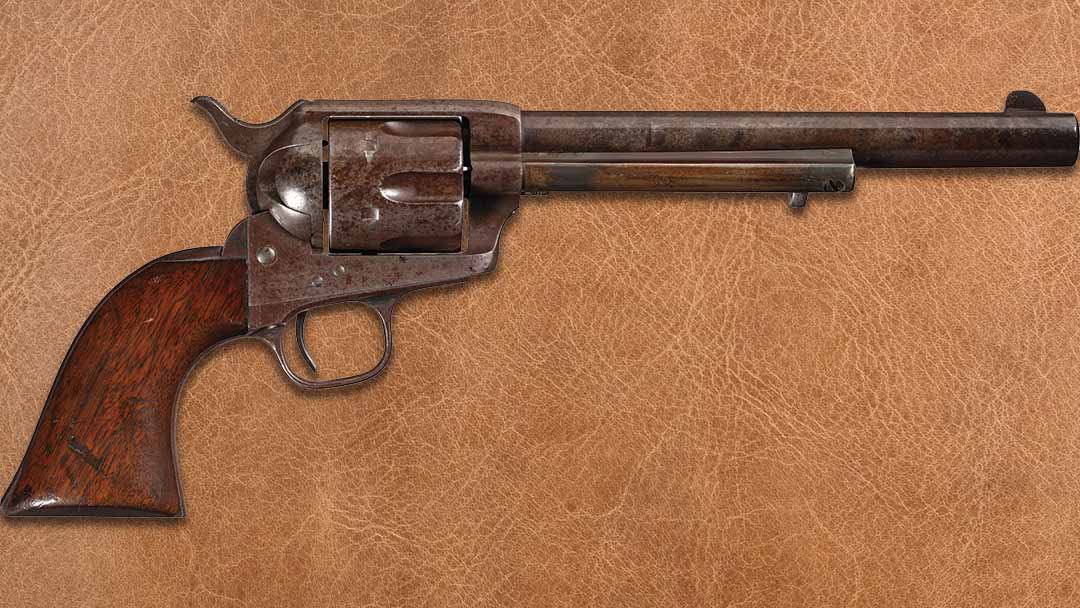
The Colt Single Action Army is indelibly written in the history of America’s westward expansion. Despite its development and use at a time without major conflict, it was in the hands of Indian fighters, lawmen trying to keep the peace, ranchers carving out a life on the frontier and desperadoes looking for a payday. To think of 19th century manifest destiny is to think of covered wagons and Colt’s revolver. The Single Action Army stands shoulder to shoulder with the Winchester Model 1873 as the guns that shaped the American West.
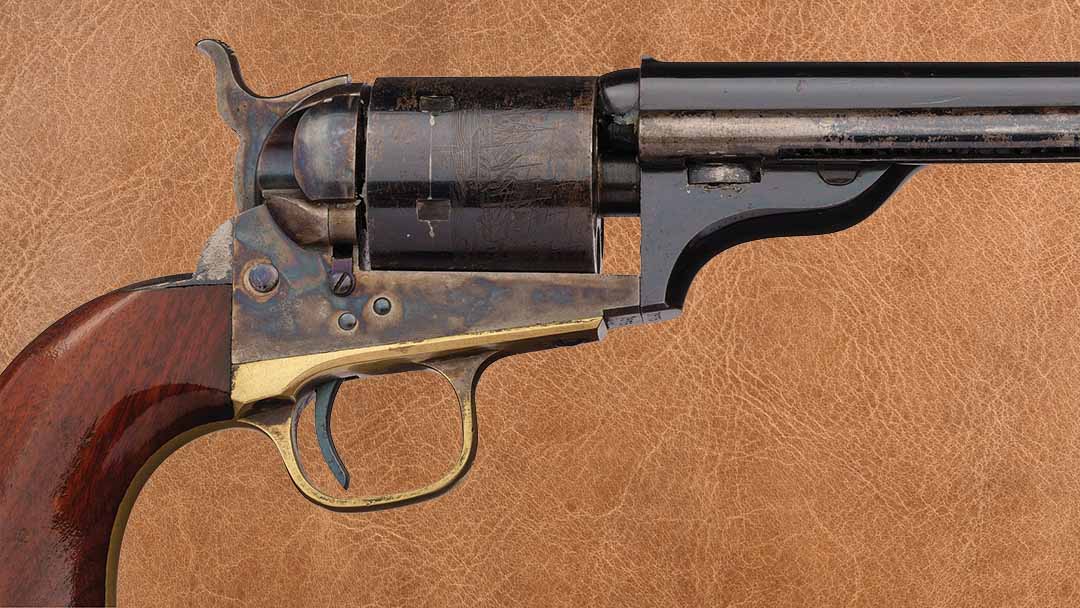
The Single Action Army was initially intended for the U.S. Army. Colt submitted its Model 1871-1872 Open Top to military trials and was rejected. The Army also wanted a more powerful cartridge than the .44 Rimfire. Colt designed a well-balanced revolver with a top strap and worked with Union Metallic Cartridge to create the .45 Colt.
This highly attractive Colt Model 1871-72 Open Top is one of 7,000 produced 1872-73 but was rejected by the U.S. Army for not having an top strap and using an under-powered cartridge. The gun preceded the hugely successful Colt Single Action Army revolver and its .45 Colt center fire cartridge.
“I have no hesitation in declaring the Colt revolver superior in all aspects, and much better adapted to the wants of the Army than the Smith & Wesson, wrote Capt. Joh R. Edie in the official test board summaries. The Army ordered 8,000.
Issued to the Cavalry with 7 1/2-inch barrels, and the guns found their way into the Indian Wars. Guns from the fifth military shipment of SAAs, known as Lot 5 guns, are legendary because of their rarity and their ties to the 7th Cavalry at the Little Bighorn Massacre.
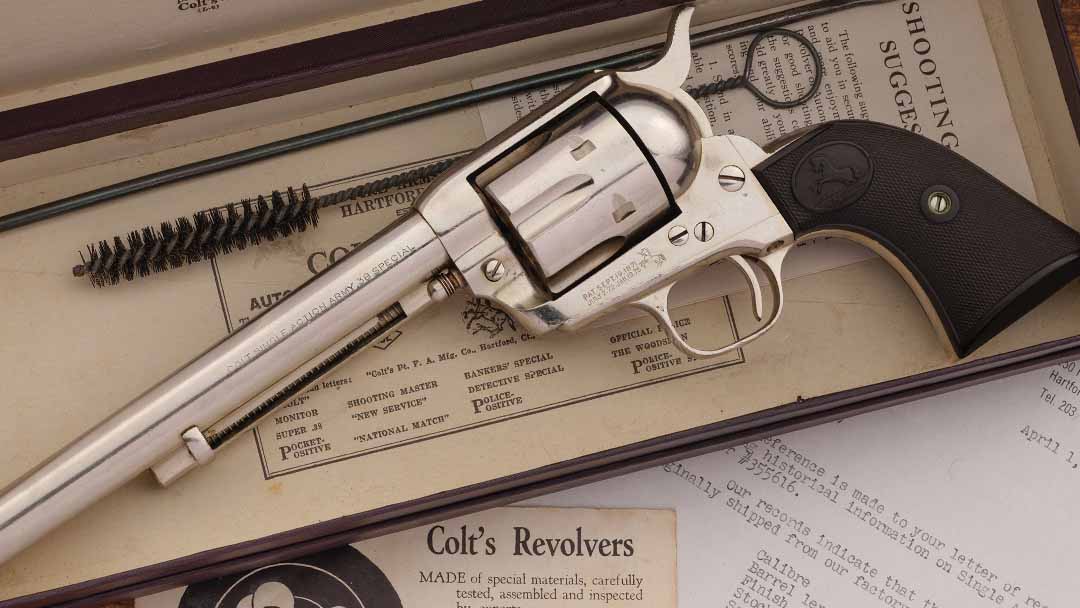
This Colt Single Action Army is from Lot 5, the shipment of revolvers sent to North Dakota and issued to the 7th Cavalry of George Armstrong Custer. These revolvers were carried into battle at the Little Bighorn. After the battle 302 of 632 revolvers carried into battle were lost. In an accompanying letter, Colt expert and author John Kopec writes the revolver falls into the serial number range of other confirmed Lot 5 guns.
Starting in 1875, the guns could be purchased by the general public with 5 1/2-inch barrels known as the Artillery Model starting in 1875 and with 4 3/4-inch barrels called the Sheriff’s Model in 1879. In 1878, the revolver was chambered in .44-40 Winchester, pairing it with the legendary Winchester 1873 lever gun so the lawless, lawmen and frontiersmen could use the same ammunition.
The Single Action Army’s popularity only grew after Colt displayed 18 beautifully engraved SAAs at the 1876 World Fair in Philadelphia. The famous like Theodore Roosevelt, Bat Masterson and Elmer Keith, as well as the infamous Billy the Kid, Butch Cassidy and Bob Dalton were known to carry the wheelgun.
This historic, documented Battle of Britain Single Action Army was part of an order 163 SAAs ordered by the British as an emergency replacement for small arms lost at Dunkirk in May 1940. The SAA is one of only 36 “Battle of Britain” revolvers chambered in .38 Special and one of 63 shipped with a nickel finish.
The Single Action Army became highly collectable based on when it was made, where it was shipped, who owned it and whether it had special features. Author and collector David M. Brown recorded 36 different chamberings in his book, “The 36 Calibers of the Colt Single Action Army. Nearly half are chambered in .45 Colt but some caliber offerings can be counted on one hand.
Though initially blued, the SAA would eventually be offered with additional finishes and legendary 19th century artisans Gustave Young, Cuno Helfricht and Louis D. Nimschke would engrave them. The gun would be offered as a target shooter with a flattop rather than a half-round top. Colt would also offer a Bisley Target model named after the famous British shooting range that had an under-swept grip, an enlarged trigger guard and a lowered and widened hammer spur.
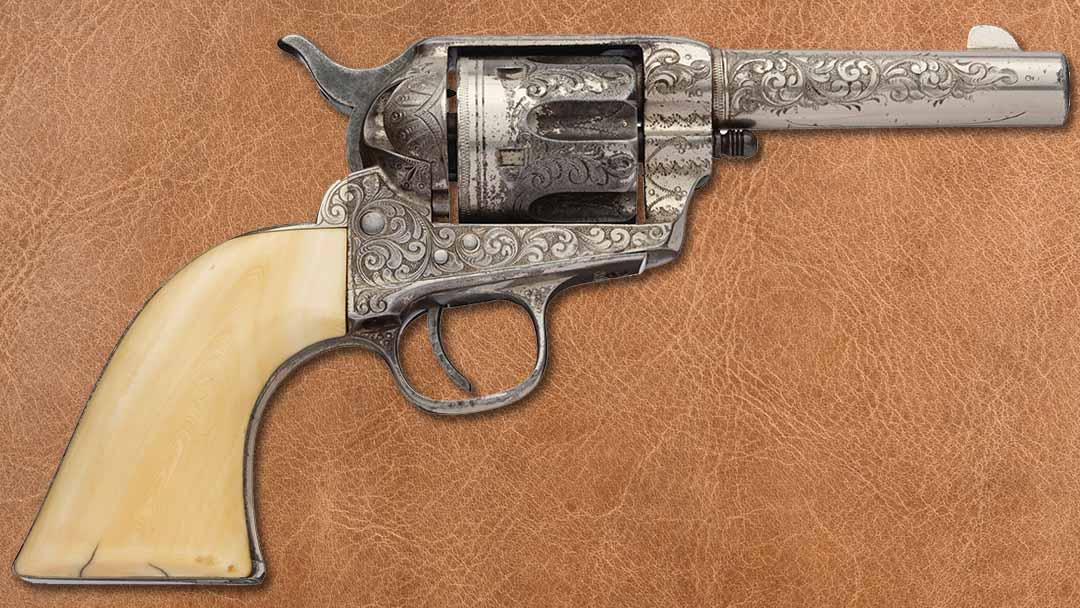
This L.D. Nimschke master engraved ejectorless Sheriff’s Model Colt Single Action Army is among the rarest of SAAs, according to “The Official Record of the Colt Single Action Army Revolver, 1873-1895,” as one of fewer than 600 ejectorless examples produced between 1882 aand the 1830s. It was soft-shipped to Nimschke in 1882 and owned by Texas Ranger Benjamin Franklin Finn (1865-1943).
Collectors are also interested in early sub-inspector marks and where they went, whether they shipped to Fort Worth’s Wolf & Klar, carried in the Spanish-American War or served as emergency replacement small arms during the Battle of Britain.
The Single Action Army has been in and out of production since 1873. The first generation stopped for World War 2 in 1940, but restarted in 1955 with the rise of the Hollywood westerns when John Wayne and Clayton Moore wore the SAA on their hip. The second generation ran to 1975 when equipment had to be retooled after being used for 100 years. Production of a third generation restarted in 1976, powered by the growth in cowboy shooting. This true legend has been in countless scraps and accumulated fantastic history, weaving itself into the fabric of America.
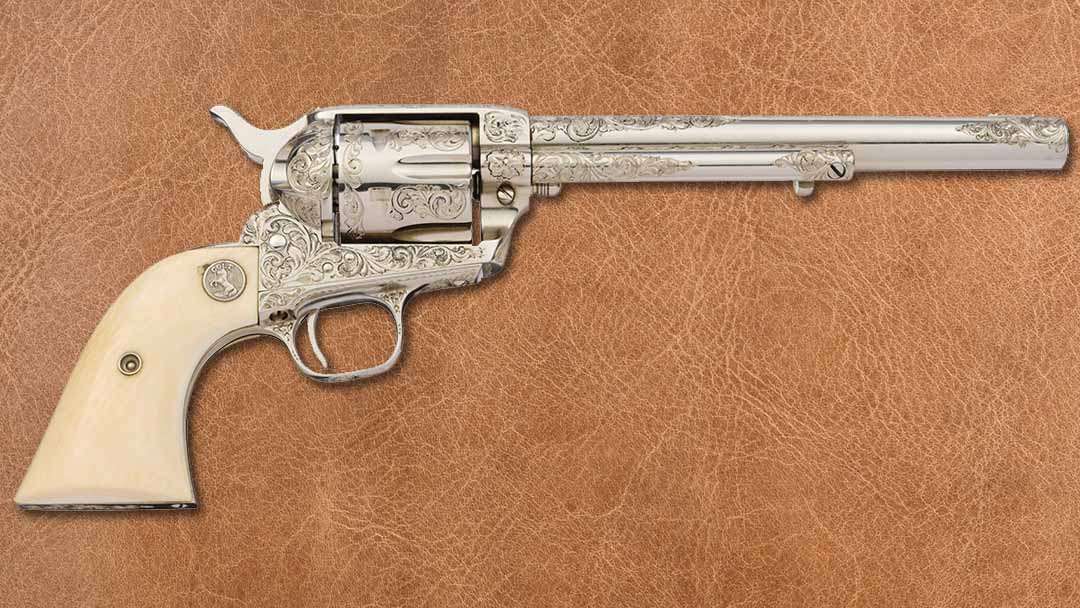
This spectacular, documented Alvin F. Herbert master engraved Colt Single Action Army shipped in February 1940 chambered in .357 Magnum, one of only 525 in that caliber and according to the Brig and Louise Pemberton Collection, the only pre-war Single Action Army engraved by Herbert who engraved for Colt from 1954-1968.
Mount Rushmore of Colts: M1911
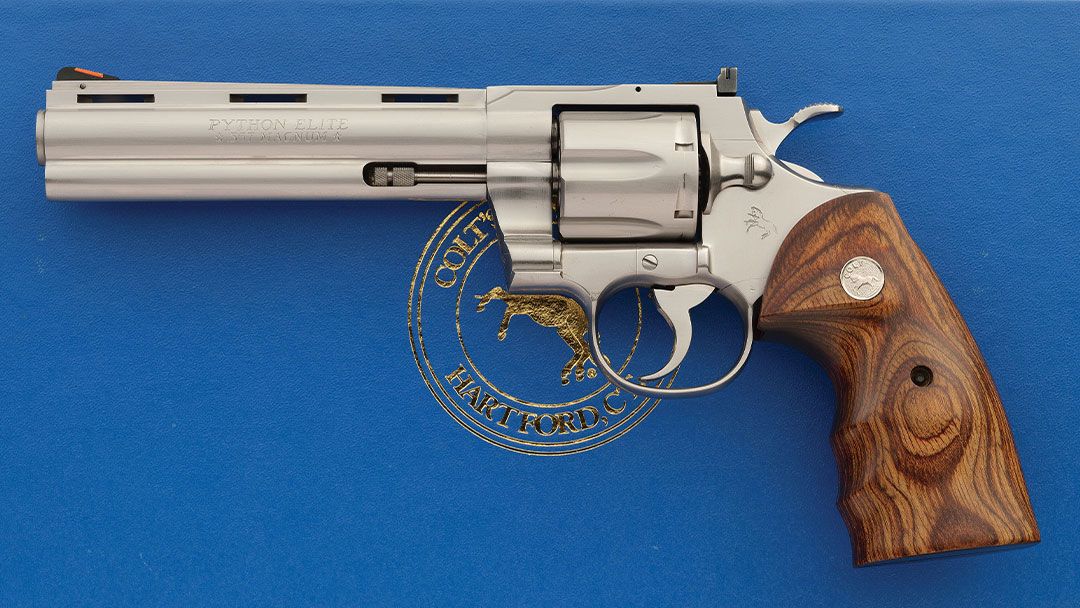
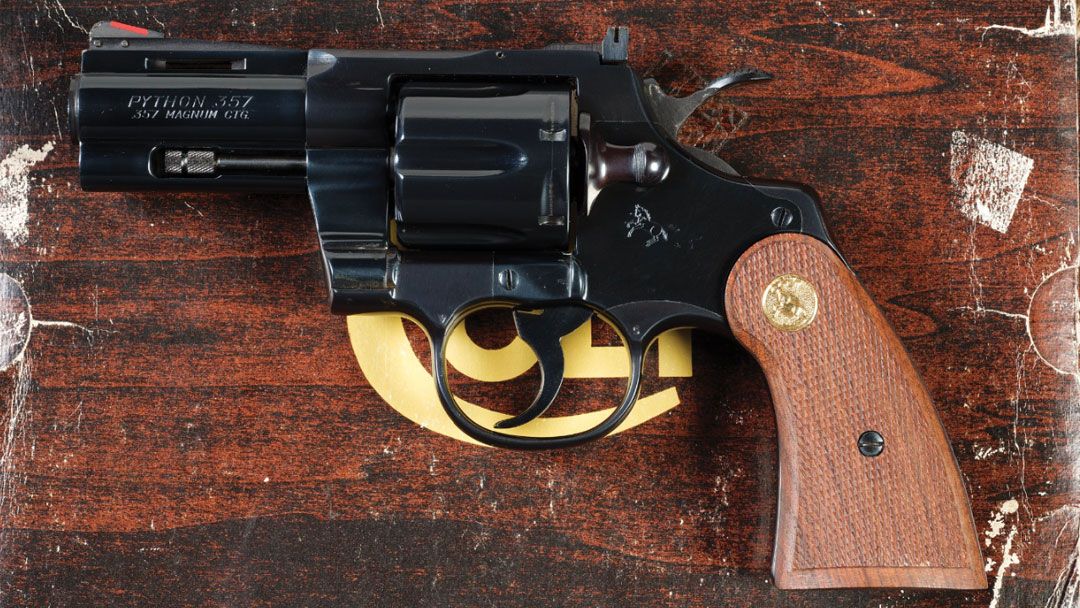
If this were a Mount Rushmore of Colt revolvers, then an argument can be made for the Colt Python, a reliable and wonderfully well-made wheel gun chambered in .357 Magnum that historian R.L. Wilson called “the Rolls Royce of Colt revolvers.” However, this is about Colts in general and there is no way to leave out a back-to-back World War 2 champion like the Model 1911. This gun fought at Belleau Wood, the beaches of Normandy and island-hopped the Pacific. “Old Slabsides” was the longest serving pistol in U.S. military history before being replaced by the Beretta M9 in 1985.
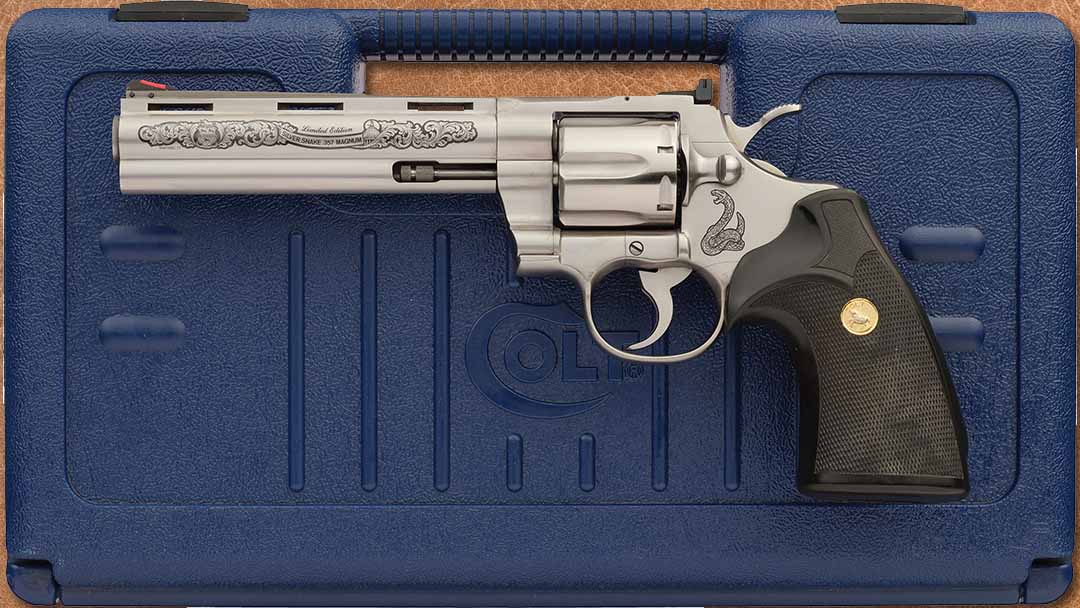
This limited edition Colt Python Silver Snake is one of 250 made by the company’s custom shop in 1983. The right side of the barrel is etched with a floral pattern bordering a banner with the years 1836 and 1982 and Samuel Colt’s signature on it. The other side has floral scrolling and a banner that reads “SILVER SNAKE .357 MAGNUM” under cursive “Limited Edition,” and an etched silver python.
The invention of John Moses Browning, this classic military arm launched Colt into the 20th century and wears its reputation proudly. It offers design, reliability, historic pedigree and stopping power. It arrived at a time when automatic handguns like the Mauser C96 and the DWM Luger were coming into vogue in Europe. Colt was one of six manufacturers that submitted a gun for the 1907 U.S. military trials, Browning’s design and two others were the only ones remaining after the early rounds.
The design included years of revisions, experimentations and torture tests to the guns and it simply outperformed the competition from Savage and DWM. During World War 1, production was slow, but Colt and Remington-UMC went into full production and turned out 643,000 while Springfield added an additional 25,767 M1911 pistols by the end of World War 1.
This U.S. Colt Model 1911 is two-digit serial number 15, one of the earliest offered by Rock Island Auction Company, bested only by serial number 14 in the September 2021 Premier Auction. Only 51 pistols were produced in the gun’s namesake year.
The 1911 saw early uses in Mexico and Haiti prior to World War 1 before taking on heroic actions during the “War to End All Wars,” by the likes of Ace of Aces Lt. Frank Luke Jr. who used his he was surrounded after being shotdown, or Sgt. Alvin York who was immortalized by Gary Cooper after using his M1917 rifle and M1911 pistol to capture 132l German soldiers as well as killing 20.
This documented historic World War 1 era U.S. Marine Corps-shipped Colt M1911 is attributed to Andrew P. Liebler who served in the 801st Stevedore Battalion of the Transportation Corps. Stevedore battalions, many of which consisted of Black troops served in ports in the U.S. and France unloading supplies and equipment as well as refueling and resupplying vessels. The gun is accompanied by a “hate belt” with buttons, medals and insignia from nations involved in the war on both sides, including a 1914 dated Iron Cross.
Given some refinements after World War 1 and designated the M1911A1, the gun was shipped to Great Britain, Canada and China among others for use during World War 2. To help with production, the U.S. enlisted companies Ithaca, Remington Rand, Union Switch & Signal and sewing machine maker Singerto make the 1911A1 along with Colt. About 2.7 million of the pistols were made with the stopping power of the .45 ACP dwarfing the competition.
There are also heroic tales of soldiers using their 1911 during World War 2. Sgt. John Basilone’s might be one of the best known for his actions on Gaudalcanal trying to defend Henderson Field in October 1942. Basilone, a Marine, braved constant enemy fire to repair and man machine guns, rally his men and keep them supplied, running form position to position. Fighting his way back through Japanese lines to deliver more ammunition, using his 1911 to take down several attackers. He received the Congressional Medal of Honor.
This exceptional U.S. Navy contract Colt M1911 is one of 15,037 pistols manufactured by Colt for the U.S. Navy that has a roll-mark on the slide before being discontinued in April 1915 for standard U.S. Army markings.
Browning’s “Yankee fist” wasn’t done after contributing to American victories in both world wars. The gun played a role in the Korean War and in Vietnam. Even after the Beretta was adopted, the 1911A1 still found use by elite fighting units like Delta Force and the U.S. Marine Corps Force Recon, serving in both Gulf Wars and Afghanistan. The 1911 is simple to operate, take apart and repair. It’s accurate and functional. Its silhouette has made it familiar on the big screen and on TV making it an American icon and the definitive firearm of the 20th century.
This Colt Model 1911A1 was manufactured in 1941, a transition from Colt’s blue to the Parkerized finish that would be standard for the remainder of World War 2. It retains 95 percent of its original blue finish.
Amazing Colt Firearms for Sale
The Mount Rushmore of Colt firearms is truly the company’s foundation, from the Walker revolver that gave life and business to Samuel Colt’s dream, to the legendary Colt Single Action Army that saw action in the Indian Wars, across the frontier of the American West and served in late 19th century U.S. conflicts, remaining in production today. The Model 1860 Army proved to be the trusted sidearm of the American Civil War, especially the victorious Union Army, while the Model 1911 saw action in both world wars of the 20th century and into the gulf wars and Afghanistan during its long and storied history. Rock Island Auction is proud to offer these heroic and celebrated guns in its Dec. 6-8 Premier Auction in Bedford, Texas.
Colt revolvers are one of the undisputed kings of arms collecting, revered for their craftsmanship and historic appeal. The Colt Python and its serpent-inspired counterparts have emerged as rising stars in the genre. We’ll take a look at each of the seven Colt snake guns and find out what gives these predators their bite.
A cased matched set of Colt Python “Snake Eyes” revolvers, one of a limited run of only 500 sets. Available this December.
What are the Seven Colt Snake Guns?
In order of original release date, the seven Colt snake guns include the Cobra, Python, Diamondback, Viper, Boa, King Cobra, and Anaconda. Each model in the series was named after a fearsome ophidian, a creative marketing tactic to stress the speed and precision of these desirable double action revolvers.
A Colt Boa with a 4 inch barrel and a factory box, one of the rarest and most valuable Colt Snake guns for sale this December.
From the debut of the .38 Cobra in 1950 to the .44 Magnum Anaconda in 1990, countless arms enthusiasts have gotten wrapped up in the coils of snake gun collecting. For those hunting these scarce sidewinders, some of the finest and rarest examples of the genre can be found at RIAC’s December 6 – 8 Premier Firearms Auction inBedford, Texas, and you can click on the images to learn more about each revolver.
The Colt Cobra
Hitting the market in 1950, the Colt Cobra was built on the company’s tried-and-true “D” frame, the same used for the Police Positive Special and Detective Special. The greatest innovation this six shot, short-barreled revolver offered was the lightweight aluminum used for the Cobra’s frame, a material dubbed “Coltalloy” by the company. At 15 ounces unloaded, the Cobra presented a significantly less hefty sidearm than its Colt D frame predecessors and competitors like the Smith & Wesson Military & Police. Available in .22 LR, .32 Colt New Police, .38 Colt New Police, and .38 Special, the latter chambering was by far the most popular option.
Firearms historian Keith Ford examines the iconic Cobra, the first of the Colt snake guns to hit the market.
The Cobra’s original run ended in 1988, but in 2017 the model became first in a series of Colt snake gun rereleases. Paul Spitale, a Senior Vice President at Colt, pointed to a number of upgrades offered by the new Cobra, stating, “The grip was moved rearward to not only allow for more comfort and recoil control, but this also opened up the trigger guard area to allow for a flatter, more intuitive feeling trigger, as well as easy use with gloved hands.”
The Colt Cobra prototype pictured below, which sold at Rock Island Auction Company last May, is documented as shipped to Newington Gun Exchange in Newington, Connecticut for Colt chief engineer, Paul Hochstrate on March 24, 2017. The factory letter states that this Cobra revolver featured a bar stock hammer, trigger and hand, a rapid prototype transfer bar, and a prototype mainspring. The revolver was also used for company testing and as part of the 2017 SHOT Show display.
A prototype for the 2017 Colt Cobra sold at Rock Island Auction Company in May 2024 for $4,406.
The Colt Python
Premiering in 1955, the Python brought real fangs to the Colt snake gun line with its .357 Magnum chambering. Dubbed the “Rolls-Royce of Colt revolvers” by R.L. Wilson and hailed the “best revolver in the world” by British author Ian V. Hogg, the Python was marketed as a premium wheelgun from the start.
A Colt Python Target revolver with a factory box, one of only 1,962 Python Target models finished in nickel. Available this December.
Designed to compete with the finest factory double actions, the mighty Python became known for its smooth trigger, hand fitting, small tolerances, and a super polished blued finish known as “Colt Royal Blue.” The model’s ventilated rib and full underlug barrel give this mesmerizing snake gun a distinct profile, and Colt boasted that while their competitors were rushing their revolvers off to shipping, the Python was still in the factory being polished with the care and respect it deserves.
An 1986 manufactured example of one the most popular Colt Snake gun models, this snub nosed Python includes a Colt Heritage box with hand marked end label. Available this December.
In advertising, Colt asserted that the Python’s “very name means craftsmanship and incomparable value” and urged arms enthusiasts to pick up one of the top-of-the-line revolvers because “the value of the Colt Python won’t be going down tomorrow.” This prediction turned out to be a massive understatement. In recent years, the serpentine superstar has tipped the scales at auction, and even the reintroduction of this popular snake gun model hasn’t impacted the impressive prices commanded by original examples.
The rare Colt Python Elite is even more valuable. This first production Colt Python Elite, serial number “PE00001”, is a fantastic opportunity to obtain one of the most collectible examples of the Colt snake gun genre. Available this December.
The Colt Diamondback
The next Colt snake gun was released in 1966 and dubbed the Diamondback. Where the Python employed Colt’s large I frame, the Diamondback was built on the D frame like its concealable Cobra counterpart. Though the Diamondback lacks some of the finesse of the Python, this reliable rattler offered a well-made wheelgun with adjustable sights and a long, grooved target hammer that’s a joy to shoot.
Manufactured in the 1970s, this Diamondback includes a serrated blade front and fully adjustable rear sights, a pair of checkered gold Colt medallion grips, and a Colt vertical display case. Available this December.
Like the Python, the Diamondback has been featured in numerous films and television roles. This superb serpent was chambered in .38 Special and .22LR, and it was produced in 2 1/2 inch, 4 inch, and 6 inch barrel lengths. The .38 Special snub nose version found favor among detectives, earning a strong reputation with West Coast agencies like the LAPD. Discontinued in 1988, the Diamondback has yet to be reintroduced by Colt, but original examples continue to enjoy popularity among collectors and handgunners.
A fine example of one of the most prominent models in the Colt snake gun kingdom, this 1969 manufactured Diamondback includes with its original box.
The Colt Viper
Colt’s next serpent standout was revealed in 1977. The Colt Viper was built on the same compact, lightweight aluminum D frame as its popular Cobra predecessor, but shed its smaller sibling’s skin by offering a longer grip and four inch barrel length.
A Viper revolver in nickel finish, one of the rarest revolvers in the Colt snake gun lineage. Available this December.
Other than the choice of blue or nickel finish, no other variations were available for this .38 Special venom shooter. The Viper wasn’t able to match the success of its Cobra and Diamondback cohorts and was only produced for a single year, becoming one of the shortest lived species of Colt’s iconic sidewinders. This rarity has made the Viper a valuable collector’s gun today. In 2024, the Viper surprised some revolver fans by becoming the latest Colt snake gun to receive a modern update.
Even more elusive than the Viper, the Colt Boa was another .357 Magnum that used the same barrel as its powerful constrictor cousin, the Python. The Boa was produced in 1985 as a special limited edition revolver from Massachusetts distributor Lew Horton that was developed with the Mark V frame and finished in the Python’s high polish blue.
Only 1,200 Boa revolvers were produced, 600 with four inch barrels and 600 in six inch barrels. 100 matched sets were offered like the example pictured above. Thanks to its extreme rarity, the Boa has become one of the forbidden fruits in gun collecting, a temptation for not only Colt snake gun completionists but a must have for any advanced arms collection.
The included factory letter lists this Colt Boa as having a six inch barrel chambered in .357 Magnum with “Royal Blue” finish and checkered rosewood stocks when shipped on March 8, 1985. Includes an original Colt “wood grain” box. Available this December.
The Colt King Cobra
Introduced in 1986, the King Cobra was developed around the Colt Trooper MK V, the first Colt revolver to offer a matte stainless steel before a blued version. This .357 Magnum powerhouse was also the first Colt wheelgun to feature an image as part of the standard barrel stamp, in this case a roll stamp of the gun’s fierce namesake with its hood unfurled.
With its bold, clean lines, the Colt King Cobra offers a hypnotic harmony of strength and precision.
This serpent sovereign could be purchased in six barrel lengths and a number of special variants, including the rare Whitetailer II, the snub nose Combat Cobra, and the Colt Grizzly. An example of the latter pictured below was produced by Colt Custom Gun Shop and features a Magna-ported Python barrel and an unfluted cylinder. In 2019 the King Cobra was reintroduced as a .357 Magnum version of the new Cobra, and a 10 shot .22LR variant was later released as the King Cobra Target.
As one of only 500 produced, the Grizzly is another rare piece of Colt snake gun collecting. Includes original box and blue Colt hard case. Available this December.
The Colt Anaconda
Released in 1990, the .44 Magnum Anaconda represents the apex predator of the Colt Snake gun genus. The company’s first large frame revolver since Colt’s New Service line, the stainless steel Anaconda was built on the hefty “MM” frame and intended to compete with the likes of the Smith & Wesson Model 29, Ruger Redhawk, and .44 Magnum Dan Wesson revolvers. While the Anaconda found a modest niche with hunters and shooters, Colt’s coiled colossus was late to the .44 Magnum market by several decades and missed the height of the craze.
A bite above the rest of the Colt snake gun kingdom, the mighty .44 Magnum Anaconda packs a wallop. This 1996 manufactured examples includes a case, factory letter, and a rare 5 inch barrel. Available this December.
Like the Python and King Cobra, the Anaconda saw numerous variants that appeal to today’s collectors, including a somewhat short lived run of Anacondas chambered in .45 Colt and several special issue of the model like the “Colt Anaconda First Edition” series, the Anaconda Realtree Camouflage revolvers, and Colt Kodiaks like the example pictured below. With the success of the rebooted Cobra and Python lines, Colt decided to lure the Anaconda out of its lair for a fresh run in 2021.
Another rarity for Colt snake gun collectors, this Colt Kodiak was part of a special run of only 2,000 Anacondas with a ported barrel and unfluted cylinder. Includes original picture sleeve box and factory blue hard case. Available this December.
Snake Guns for Sale
As the gun collecting pursuit expands, comparatively modern classics like the Colt snake gun family have become increasingly sought-after. From the Cobra to the Anaconda, these serpent-themed sensations carried the legacy of the Colt double action revolver in the last half of the 20th century and have become synonymous with beauty, balance, and a precision worthy of their lethal namesakes.
A Colt Python Elite, a rare version of one of Colt’s most popular snake guns. Available this December.
While most vintage Colts hold their value and increase in over time, Colt snake guns have been rattling the market in recent years with notable price spikes. With rarities like the California Combat Python and Boa setting five-figure records and popular everyman models of the genre trending higher each year, now is the time for gun collectors to strike, and the finest examples of each species can be wrangled at Rock Island Auction Company.
The average value of a Colt Boa revolver at Rock Island Auction Company over the past seven years demonstrates the collectability of rare Colt snake guns.
I’ve been hesitant to write this review. On the one hand, I own several Olight products and like them. On the other, I am aware that Olight has a reputation for saturating the internet with reviews. So, I will say up front that I bought this and all of my Olight products with my own money because I felt that they met my needs and this Warrior Nano no different. And now that I have spent more than a year with it, I’m ready to talk about it.
I am not going to get bogged down with stats. There are a lot of great, much more technical, flashlight review sites that can help you decide on a light if stats are what is important to you. Instead, I will focus on what drew me to this light which is the well-designed user interface and very consumer-ready experience. I’ll also be honest about some things that bother me about this light (and many of Olights).
User Interface
In my opinion, this light has one of the most complete, easy to understand, and useful user interfaces I have come across. It is this interface, split between two buttons, that lets the Warrior Nano move effortlessly between a multi-functional EDC light and a full-on tactical light.
The Warrior Nano (an other lights in this series) has just two buttons: a tail switch and a separate button on the body close to the head of the light. The tail switch is a “gas pedal” style of switch which I prefer. In fact, I only found the Warrior series because I was looking specifically for lights with gas pedal switches. It allows me to press lightly for Medium output and push more heavily for a either Turbo and Half-Turbo. Basically, you just push for light and push harder for more light. It’s so simple and most of what I need from this light can be done with this switch.
The body-mounted switch allows the user to select from High, Medium, Low, and Moonlight modes. Just tap the switch to turn on the light. Press and hold from on to cycle modes. Moonlight can be accessed directly by holding this switch for a few seconds. The light will remember which mode you last selected the next time you turn it on with this switch.
All of that switch talk boils down to the fact that you can use this light however you want and it isn’t confusing. Want a tactical light? Just use the tail switch. Want a multi-mode EDC with lots of options? Use the side switch. It’s a great UI which is a big part of the polished user experience I want to talk about next.
User Experience
The experience of using this light reminds of using an Apple product. It is just so easily consumable and slick. Olight does this better than any other flashlight maker I can think of. They deliver features that flashlight nerds like myself want but in a way that is approachable to anyone.
The Warrior Nano’s charger is a great example. While other lights make you remove the battery or open a port to attach a cable, Olight’s charger magnetizes to the tail of the light. It is an absolute no-brainer. You just get it close and the magnet takes over. There is a small, easy-to-understand indicator light that keeps you up to date on charging status.
Other really user-friendly features include a small indicator light on the body switch that can tell you charge level at a glance, a two way pocket clip, and it can stand on its tail.
Until now, everything I have written is true of pretty much any light in the Warrior series. However, one great aspect specific to the Warrior Nano is its size. The Nano big enough to use easily and pump out plenty of lumens but small enough to be easy to carry. This might be the most approachable light in the Warrior series.
What I Dislike
I drew an Apple comparison earlier regarding the consumer-friendliness of this light and so it may come as no surprise that, like Apple, Olight uses more proprietary accessories than other light makers. The main issue to which I object is the use of a proprietary battery design. That kind of sucks for compatibility with batteries you already own, though at least Olight batteries tend to be competitive in price.
The other thing that I hate but manage to live with about many Olights is that they don’t have a glass lens. The optic is just sitting there, ready to be scratched. It is recessed in the bezel so it is not without some protection but these acrylic optics will eventually get a bit scratched and scuffed which may impact that beam shape. It would be nice to have a glass lens over it.
Wrap Up
This light does everything I want it to in such a way that it is actually easy to use. I can access moonlight from off. I can access Turbo/Half-Turbo from off. Momentary, constant, multiple modes, tactical simplicity… it’s all there. On top of that, the charger is so easy to use that there is no excuse for running out of juice.
When it comes to lights, it is easy to chase stats but this Warrior Nano is just so easy to live with that it can’t be ignored.
A Word on Price…
Never buy an Olight at the original price! Don’t do it. They are on sale frequently (25% off as of the time of this writing). I just waited for a good price at Amazon to buy mine: Warrior Nano on Amazon.com
John Moses Browning’s genius is apparent up and down the roster of Colt semi automatic pistols, an amazing lineup of reliable and accurate handguns.
Browning started work on semi automatic pistols in 1894 and two years later had a blowback design and recoil-operated design along with two others that he licensed to Colt. An early presentation to the U.S. Ordnance Board in 1898 showed Browning’s design was easy to operate, capable of a high rate of fire, reliably loaded by either hand, shot flat and more accurate than a revolver. However, Browning and Colt’s gun fired the underpowered .38 cartridge and couldn’t attach a shoulder stock so they got passed over.
Colt and Browning went to work creating the hard-hitting .45 ACP cartridge and refining the gun design that would eventually fire it — the Model 1911. Though the M1911 went on to be a military stalwart for most of the 20th century, other Colt pistols proved their merit, too. Take a look at the amazing lineup of Colt semi automatic pistols available in Rock Island Auction Company’s Dec. 6-8 Premier Auction in Bedford, Texas. It is a fascinating tour of Colt semi automatic pistols history.
Colt Semi Automatic Pistols: Model 1900 “Sight Safety” Pistol
This gun was Browning’s early Colt semi automatic pistol that fired the .38 Automatic Colt Pistol (ACP) cartridge with a recoil-operated design. The design introduced the modern slide for cocking the gun. The U.S. Army purchased 100 for testing purposes and later purchased 200 more on a second contract for field testing. The safety was activated when the rear sight was in the down position, fitting into a notch that locked the firing pin and giving the gun its name. Unfortunately the feature wasn’t a popular one.
This U.S. Navy Colt Model 1900, is one of only 250 Model 1900 produced for the Navy. The pistol was shipped to the Brooklyn Naval Yard on Oct. 22, 1900.
Colt Semi Automatic Pistols: Model 1903 with OSS Holster
Colt chose to focus on Browning’s recoil-operated platform while the blowback design was licensed to Fabrique Nationale. FN’s Model 1900 chambered in 7.65mm (.32ACP) was a commercial success as about 700,00 were made by the time production ended in 1909. Colt’s Model 1900 had a production run of less than 5,000. Colt saw FN’s success and asked Browning to patent his design and the result was Colt’s Model 1903.
Manufactured in 1945, this Colt Model 1903 Hammerless was issued to general officers in World War 2 and also used by intelligence officers and OSS operatives due to their concealability. This pistol is documented as shipped to the property officer at the Pentagon on Feb. 20, 1945. It is accompanied by the U.S. type 1 holster made of russet leather. Both the gun and the holster have boxes.
Colt Semi Automatic Pistols: U.S. Army Test Trials Model 1907
Colt and Browning’s recoil-operated Model 1905 was well received but the military wanted to be able to carry it cocked with a round chambered so made a grip safety requirement as well as a loaded chamber indicator and new spur hammer design. Whether the 1907 is a standalone gun or a variation of the Model 1905 as Colt progressed toward the Model 1911 is open for debate.
This highly desirable and very rare two-digit serialized Colt Model 1907 is one of only 207 made and what is believed to be one of 66 known survivors of the pistol trials, according to “U.S. Military Automatic Pistols 1894-1920,” by Edward Scott Meadows. This gun has Major Kenneth Morton’s inspector initials on the upper left front of the trigger guard bow and small British “crown/GP” proofmarks.
Colt Semi Automatic Pistols: Model 1908 Hammerless
The Model 1908 is the same gun as the 1903 but chambered for .380 cartridges with an enlarged extractor head. This gun was also issued to general officers and OSS agents during World War 2. Despite the two models’ “hammerless” name, the hammer on the 1903 and 1908 are shrouded at the back of the slide. These guns were discontinued shortly after World War 2.
This lustrous Colt Model 1908 was manufactured in 1927 and given “level 3” factory engraving that pops off the beautifully blued finish and nicely complements shiny pearl grips.
Colt Semi Automatic Pistols: World War 1 Model 1911
The final test of Colt’s recoil-operated pistol and Savage’s trial pistol put 6,000 rounds through each pistol. The Savage experienced 37 misfires. The Colt had none and also proved to be more accurate. The first military contract for 30,000 of the Colt Model 1911 was submitted in what would be more than 6 million pistols for the U.S. military over 75 years.
This incredibly early production Colt Model 1911 is serial number 15 and comes with an Anniston Army Depot Shipping Box.
The truly iconic Model 1911 would be a back-to-back winner of two world wars and serve in the Korean and Vietnam Wars and even see action with the U.S. military in the Middle East. Remington Rand would assist with production during World War 1. After some refinements following World War 1, the gun would be classified as the Model 1911A1. During World War 2 the gun was shipped to Great Britain, Canada and China. Demand was so high during war, Remington Rand, Ithaca, Union Switch & Signal and sewing machine maker Singer manufactured the M1911A1. As will be shown here, the 1911 platform also performed in other roles.
This Colt Model 1911 was manufactured in 1918 and shipped with 4,200 pistols to Springfield Armory, according to Meadows’ book, “U.S. Military Automatic Pistols 1894-1920. The gun retains 95 percent of its original blue finish and the “double-diamond” pattern walnut grips are excellent.
Colt Semi Automatic Pistols: Imperial Russian Government Model
Russian forces in World War 1 were poorly equipped, with many troops going into battle unarmed. Simply put, the Czar’s army needed guns. Russia purchased 51,000 Colt Government Model pistols that were delivered between February 1916 and January 1917. Czar Nicholas abdicated two months later and Russia collapsed into chaos. The M1911 was reportedly among the weapons used to assassinate the Czar and his family in July 1918.
Many of the M1911 pistols intended for Russia have Cyrillic markings “ANGL. ZAKAZIE” that translates to “English Order” because Great Britain served as an intermediary of the transaction, using a line of credit established by the Russians and backed by gold reserves held in Britain. About 3,000 of the pistols were reportedly off-loaded to Finland.
This Colt Government Model shipped as part of a 2,000-pistol allotment to Russia on Dec. 5, 1916 and features the Cyrillic markings mentioned earlier. This very scarce pistol retains nearly 60 percent of its original blue finish.
Colt Semi Automatic Pistols: Woodsman
Another John Browning design was the Colt Woodsman, an automatic target shooter, introduced in 1914. It holds a lot of memories for people who learned to shoot with it, plinking in the woods or backyard. Simply called the .22 Caliber Target Pistol, it earned the Colt Woodsman moniker in 1917.
The gun’s production run ran until 1977 with a number of variations, including the Target model, the Sport model and Match Target model. The gun was hand polished and hand fitted.
This beautiful game scene engraved and gold inlaid Colt Woodsman pistol carries a small game theme. A squirrel on a branch on the left side of the receiver, a possum on the right and a falcon with a successful kill on top of the pistol are each rendered in raised gold relief. Gold wire borders highlight the floral scroll and wavy line engraving on the beautifully blued barrel.
Colt Semi Automatic Pistols: Gold Damascened Government Model
The Colt Government Model is the company’s commercial version of the Model 1911. Introduced in 1912, it was a success on the heels of the adoption by the U.S. Army and Navy. An early Colt brochure noted, “6,000 consecutive shots being fired from one pistol in the final Government test, without a jam, misfire or broken part.”
The Colt Government Model proved popular in South America and was also copied by several Spanish gunmakers. Argentina bought more than 21,000 pistols from 1914 to 1941, nearly half of the Government Models shipped to South America during that time.
Shown below is a gold damascened presentation Colt Government Model manufactured in 1953 and inscribed to Associated Press foreign correspondent Major Harold K. Milks, a World War 2 veteran who is likely the only American journalist to personally meet communist leaders Mao Zedong, Nikita Khrushchev and Fidel Castro during assignments in China, Moscow and Cuba during his career.
This historic presentation Colt Government Model with a Colt .22 conversion unit barrel and slide has extensive engraving on the gun and grips. It has gold damascene inlay featuring primarily floral scroll motifs and borders on a background of matte blue. The German silver grips have traces of silver plating and brass mounts of a stag head, diamond and Mexican eagle on each side.
Colt Semi Automatic Pistols: Colt Service Model Ace
Colt developed the Ace as a .22 caliber shooter on the 1911 platform that was introduced in 1930. The company intended it as a companion to the M1911A1 or Government Model as an economical target shooter using the .22 Long Rifle cartridge instead of the more costly .45 ACP.
The Ace is built on the same platform as the Government Model but utilized a blowback design rather than the M1911A1’s recoil system. “It is built on the same identical frame as the Government Model and had the same grip, feel and method of operation – as well as full Government Model safety features.”
The Ace was lighter than the 1911 because wall thickness was reduced. Early on, the gun suffered from performance issues because the .22 cartridge didn’t provide the blowback strength needed for the heavier .45 caliber slide. David Williams, who would later earn the nickname “Carbine,” for his design of the M1 Carbine, was contracted by Colt to redesign the Ace. He designed it with a floating chamber that served as a gas piston to cycle the pistol. The newly redesigned Colt Service Model Ace went into use in 1937. The system was adapted to serve as a conversion kit for standard Government Model pistols that went on the market in 1938.
Manufactured in 1942, this was part of a 100-pistol shipment to Springfield Armory on July 2, 1942 and has the inspection mark of Col. Waldemar S. Broberg (WB).
Colt Semi Automatic Pistols: Super 38
Another part of the M1911 family, the Super 38 was slightly redesigned to be chambered in .38 Auto. Colt experimented with smaller designs but decided to hold onto the full-sized 1911 platform. Introduced at the 1928 National Matches at Camp Perry and touted in “The American Rifleman” as “The Ideal `One-handgun’ for Big Game.” It sold well, moving 26,000 pistols for Colt in the first eight years it was offered.
This outstanding and rare early post-World War 2 factory engraved Colt Super 38 was part of Colt’s traveling display and was shown at the NRA convention in 1948. Between World War 2 and 1971, only six of these pistols were factory engraved, with this one having level “C” engraving that features intertwined vines of floral scrolls and a punch-dot background covering nearly the entire pistol.
Colt Semi Automatic Pistols: Texas Ranger-Owned Mark IV Series 80 Government Model
The Mark IV Series 80 of the Colt Government Model was introduced in the early 80s with an internal firing pin safety and a half-cock notch on the sear. This Government Model owned by Texas Ranger Capt. Jack Dean has been upgraded. Dean served in Ranger Company D as captain and Company F between 1970 and 1993. Among the high profile cases he investigated was the assassination of a federal judge that resulted in the arrest of Charles Harrelson, father of Woody Harrelson. He also served as a U.S. Marshal for 10 years.
This Mark IV Series 80 Government Model has a replacement Wilson barrel and fitted with a compensator with serrated blade front sight and the rear sight dovetail has been fitted with a Bo-Mar rear sight with serrations that extend down the rear face of the slide. The front of the trigger guard, fronstrap and mainspring housing have been checkered. It has a hard chrome finish and horn Colt grips marked “TEXAS/RANGER/CAPTAIN/JACK/DEAN” on the right panel.
In 2012, the U.S. Marine Corps contracted for up to 12,000 Colt M45A1 pistols for use as “close quarters battle pistols” (CQBP) for its Force Recon units. The initial order was for 4,036 pistols. These are Colt’s first pistol with a Cerakote finish and also have a dual recoil spring assembly and Picatinny rails.
This is a Colt Custom Shop civilian version of the U.S. Marine Corps Colt M45A1 and has a long solid aluminum trigger, an enhanced hammer with elongated slot, upswept beavertail grip safety with palm swell and ambidextrous safety. It has a National Match barrel and an accessory rail.
Colt Semi Automatic Pistols for Sale
John Moses Browning’s designs for Colt Semi-Automatic pistols started in the 19th century but carried through the 20th century with a reputation for reliability and accuracy. These are just the tip of the iceberg for any Colt collector. They can find terrific examples of the iconic M1911 or any of Colt’s equally renowned revolvers from truly astonishing collections in Rock Island Auction Company’s Dec. 6-8 Premier Auction in Bedford, Texas.
I was drawn into Meshtastic by the promise of license-free, relatively easy-to-use, off-grid, off-network text communication on affordable hardware. There is very little barrier to entry and the potential upside is immense so I thought it was worth a try. I am going to drag you along with me, an absolute radio simpleton, as I learn so you can decide if it is worth a try for yourself.
Be advised: If you actually know something about radios or Meshtastic, you are going to be very frustrated with my layman’s misunderstanding and oversimplification. You have been warned!
Before we go too much further, we should establish what Meshtatic even is. Well, you can read about it here from its creators on Meshtastic.com. Basically, it is a radio mesh network made up of mostly inexpensive radios that allow the user to send small amounts of data across the mesh either corporately or privately. The mesh network does not require the use of any network or data connection other than the radios themselves. Meshtastic utilizes the license-free 915mhz band in the USA. Additionally, many of the radios used have very low power requirements making them easy to keep running even when electrical power is scarce.
My Goals for Meshtastic
This is just an introduction to my time with Meshtastic given that I am still firmly in the don’t-know-what-I-don’t-know phase of my journey. However, I have set three basic goals for what I would like to try to accomplish:
Communicate reliably within a few miles of my home.
Set up a private, local mesh within a few miles of my home.
Communicate as far as 40-60 miles away in my region.
The Gear I Have Used So Far
If you want to follow along, I can already suggest a specific radio which I will probably do a more thorough review of later. The Lilygo T-Echo is one of the more affordable ready-to-use options that has a more energy-efficient chipset than many others in this price range. I bought mine on Amazon along with an improved antenna (the stock antenna is compact but doesn’t do the radio any favors):
Where I Am and What to Look Forward To
I have already accomplished goal 1 using just the gear listed above. I will have a post about that eventually as it is quite easy and there are some simple tips and dirt-bag hacks that will make a local mesh even more reliable.
My initial testing has been promising so far with contacts being made over tens of miles and detecting nodes as far as 70 miles (over multiple hops). It has been encouraging enough that I am already researching an outdoor solar node to install on my property to further improve my chances at meeting my goals.
There will be reviews of radios, tips and tricks, and practical information shared all along the way so stay tuned.
The blunderbuss is among the most iconic of all muzzleloading firearms, with their distinctive bell shaped muzzles they have long been associated with pirates and Pilgrims in popular culture. If you have seen any pirate film or series, you are sure to have seen multiple blunderbusses in use, often with exaggerated power. They also appear in a fair number of representations of warfare in the colonial and Napoleonic eras.
WIth its easily recognizable look and romantized associations, the blunderbuss has captured the attention of arms collectors for generations, and Rock Island Auction Company has a steady supply in a wide variety of configurations, including some absolutely massive examples that are sure to make a statement in any gun room. Take a look at some offerings of the blunderbuss in the Dec. 6-8 Premier Auction in Bedford, Texas.
This flintlock blunderbuss is an English brass-barreled example from Joyner c. 1760s-1770s and has a 10 bore barrel that flares to 1.1 inches at the muzzle and measures 15 ⅛ inches in length.
What is a blunderbuss?
The exact definition of a blunderbuss gun varies from source to source. A New General English Dictionary from 1751 defines a blunderbuss as “a short gun, the barrel of which is commonly made of brass, and has a large bore; also a careless, negligent, heedless person.” Samuel Johnson in 1768’s The Dictionary of the English Language defined a blunderbuss as “A gun that is discharged with many bullets.” The following year, Nathan Bailey wrote in An Universal Etymological English Dictionary that a musketoon was “a blunderbuss, a short Gun of large Bore carrying small Bullets.” George Crabb in A Dictionary of General Knowledge from 1830 defined a blunderbuss quite simply as a “short brass gun with a large bore.”
In essence, a blunderbuss is a smoothbore firearm with a barrel that flares towards the muzzle, but can vary widely in terms of their overall design. The vast majority are flintlocks, though a small number were produced during the percussion era. Barrel lengths are similar in length to a tactical shotgun of about 14 to 18 inches. Some, particularly earlier versions are much shorter, and the shorter varieties and carbines are sometimes known as musketoons but like blunderbuss the definition can be wide-ranging. There were also blunderbuss pistols produced.
Who invented the blunderbuss and the precise origin of the term remains up for debate, but the most common theory is that the term originates from “dunderbuschse” or “donderbus” (German and Dutch respectively for thunder gun).
This pair of early 19th century flintlock blunderbuss pistols marked Berleur have 6 7/8-inch barrels measuring .87 inch tall by 1.7 inches wide at the elliptical muzzles. The actual bore diameter towards the breech end of the barrels is .62 caliber (slightly over 20 bore).
Blunderbusses have been around since around the 16th century and would have originally been matchlock and wheellock firearms, becoming more prevalent in the late 17th century and 18th century in the flintlock era. The majority of examples found today date from 1750 to 1830, mostly originating from England as well as occasional examples from Continental Europe and the distinctive short “knee” blunderbusses from the Ottoman Empire. Despite their pop culture association with the Pilgrims, these guns don’t appear to have been common in the American colonies or early United States.
This early 18th century blunderbuss from Louis Barbar of London has an approximately 6-8 bore, 16 1/2-inch barrel that flares out to 1 1/2 inches at the muzzle. It is largely unembellished but has a very attractive serpentine side plate.
Blunderbuss Design
The actual bore diameters and the designs of the taper in the barrels varied widely and produced a number of patterns. Firearms historians and collectors tested the effects on bore designs and concluded that the blunderbuss barrel design created a larger pattern than a straight barrel of the same bore size. The type of load also dramatically affected the pattern. In addition to a larger spread of the shot and making it more likely to hit one or more adversaries with a single pull of the trigger, the large muzzle opening of the blunderbuss also acted as a funnel making it easier and faster to load powder and shot which would be particularly helpful while loading on a moving ship or on horseback.
It is often claimed that a blunderbuss could be loaded with just about anything on hand from rocks, chopped nails, glass, and other random bits, but such atypical loads could damage the barrel. The jagged nature of these projectiles could mar the bore or even create an obstruction, bursting the barrel. Most of the time, blunderbusses were loaded with small shot, buckshot, pistol balls, and/or musket balls. If there was powder on hand to load the blunderbuss, lead was also probably available as well. There were likely exceptions to this such as in the heat of battle where a man might have lost his ammunition but still had powder.
Period accounts of blunderbusses tell of how they often appeared in the hands of criminals concealed beneath a coat. However, they were also owned by those seeking to use them as a defensive weapon. Accounts mention them being loaded with a number of “leaden bullets” or “lead slugs” of varying quantities. Some specifically noted that the blunderbusses in the incidents were loaded with “small shot,” others with a small number of leaden balls or slugs indicating larger shot, while some accounts report only the powder charge kept at the ready in the barrel. In the latter case, the shot could be quickly loaded when needed.
In the late 18th century and early 19th century, many English blunderbusses featured brass barrels and folding “snap bayonets” as seen in this classic example. It has Birmingham proof marks dating to 1813 or later. The 14-inch barrel is the fairly common “carbine bore” (17 gauge or .65 caliber) on blunderbusses of this period. The bore flares to 1 1/3 inches at the muzzle.
Blunderbuss Variations
There are several fairly distinctive variations of the blunderbuss. Many we see today are blunderbusses produced for the private market as defensive weapons. These are often known as coach guns or coaching guns, used to defend coaches from highwaymen targeting the coaches of wealthy gentlemen as they passed through isolated areas of the English countryside. Some are very ornate and feature high end engraving, figured stocks, carving, and other embellishments for wealthy clients. Highwaymen themselves also often employed blunderbusses in committing their crimes, perhaps after securing them in earlier holdups.
This incredibly rare double barrel blunderbuss by Bunney from the Norman R. Blank Collection is an impressive piece with a pair of 14-inch “carbine bore” (17 bore or .65 caliber) barrels with muzzles that flare out to 1 inch at the muzzles.
As a secondary means of defense, many civilian blunderbusses at the end of the 18th century and into the early 19th century have folding “snap” bayonets. The most common variety has the bayonet on a hinge near the muzzle and folding with the blade tip secured by a sliding latch/release on the barrel tang. Some varieties have the bayonet on the underside and use a sliding trigger guard to secure the blade in the folded position or a secondary trigger with a sliding catch. A small number feature side folding bayonets, and in rare cases, these bayonets are secured by the cock on the lock so that when the blunderbuss is fired, the bayonet automatically swings open.
The author showed off a wide variety of blunderbusses in this video from 2022, as well as demonstrated snap bayonets in action.
Compared to civilian versions, military blunderbusses tended to be nondescript English military blunderbusses had furniture similar to the Brown Bess muskets of the same era, and their stock styling and other details tend to be very similar. Most of the military blunderbusses from the U.K. feature brass barrels, but there were iron-barreled blunderbusses that were more common in Continental Europe and the Ottoman Empire.
In addition to the normal shoulder-fired military blunderbusses, there were also oversized swivel mounted blunderbusses that helped cover an area between small arms fire and artillery. These “swivel guns” often look like a supersized blunderbuss with particularly large bores. They could spray shot to repel boarders in naval battles and could also be used as signal guns. They were also used inland on fortifications, and Lewis and Clark and the Corps of Discovery utilized swivel guns during their exploration of the West and often fired them as a salute.
As the blunderbuss faded out, stagecoach and railway agents in the Wild West were often armed with double barrel shotguns – also known as “coach guns” — and revolvers to defend against attacks. The increasing popularity of double barrel shotguns led to the demise of the blunderbuss. There were even a very small number of double barrel blunderbusses, but they are very rarely seen.
This behemoth blunderbuss was formerly in the collection of the influential British arms collector and historian W. Keith Neal and has an approximately 1-inch bore diameter towards the breech end and flares out to an imposing 3 1/2 inches at the muzzle. Given its massive size and substantial weight, it was most likely fitted in a swivel mount during its working life.
Blunderbusses for Sale
Rock Island Auction Company is the world’s leading firearms auction house for antique and collectible firearms, including blunderbusses from around the world. Blunderbusses are available throughout the year in our various auction formats with examples up for auction at price points suited to any collector. Be sure to check out the online catalog for the upcoming December 6-8 Premier Auction for more details on the blunderbusses featured in this article and definitely keep an eye out on our future auctions in 2025!
Sources and Further Reading
● Flanagan, Melvin. “Myths of the Blunderbuss.” American Society of Arms Collectors Bulletin96 (2007): 59–66.
● Neumann, George C., and George C. Woodbridge. The History of Weapons of the American Revolution. New York: Bonanza Books, 1967.
● Suydam, C. R. “Some Variations of the British Coaching Blunderbuss.” American Society of Arms Collectors Bulletin 31 (1975): 2–23.