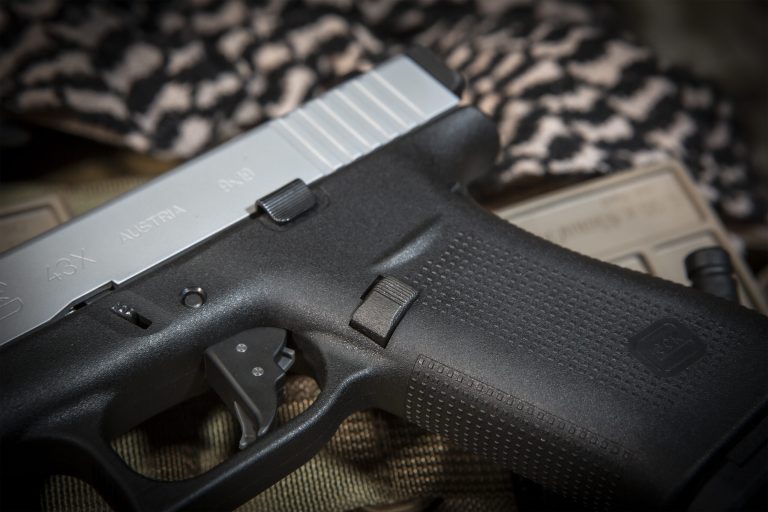
TangoDown® Inc. announces newest item to the Vickers Tactical™ lineup: Steel Magazine Release for G43X/G48 (GMR-007S). We teamed up with Addtac MFG. to have our existing GMR-007 magazine release created in steel. This steel magazine release is compatible for use with the Shield Arms® S15 steel magazines. The GMR-007S is the same shape as the existing magazine release, but offers the durability needed to function with steel magazines.
Features:
All steel composition for compatibility with Shield Arms® S15 Steel Magazines
Extended and contoured for easy manipulation
Ambidextrous
Durable black nitride finish
For use with G43X and G48 ONLY.
NOT for use with OEM GLOCK® factory magazines or other polymer magazines.
MSRP: $31.00
**If you are not familiar with modifying your firearms, seek appropriate assistance from a Certified Armorer or Gunsmith.
In the latest insanity, democrats across the country are trying to do away with criminal charges for people under the age of 25. In fact, in Maryland this week, lawmakers proposed legislation that would ban charging murders with felony murder if the criminal is under 25 years of age.
Democratic Delegate Charlotte Cruchfield introduced the Youth Accountability and Safety Act, House Bill 1180. If passed, the bill would prevent anyone under the age of 25 from facing felony murder charges.
Recently Maryland Governor Wes Moore picked a person to run the state’s Juvenile Justice Service that said no one under the age of 21 should be introduced to the justice system because the brain is not fully developed.
Ironically these are the same Democrats who seem to think the brain is developed enough at five years old for a child to decide they want to change sex – THESE PEOPLE ARE BEYOND SICK AND TWISTED!!!
Maryland Republican Delegate Susan McComas says Democrats are only using mental capacity when it comes to soft-on-crime policies.
“Proponents of the bill say that the human brain is not fully formed in the frontal lobes until age 25. But yet, we’re doing other things in the general assembly, letting children vote earlier and earlier, letting them get hormone-inducing drugs to change their sex,” said McComas.
Delegate McComas believes the bill, if passed, would lead to a spike in crime.
“If this bill passes, you’re going to have kingpins, you’re going to have gangs use juveniles to do their dirty work.,” said McComas.
Are you prepared for the coming rise in Social Unrest?
The Ghettoization of our culture is one of the biggest threats we face!
In 2021, according to the FBI, murders in the U.S. rose by 4% as compared to the previous year. The fact that so many of our politicians are now embracing these criminals has emboldened them to believe there will be no consequences for their actions.
According to the Heritage Foundation, Of the top 30 cities with the highest murder rates, 27 have Democrat mayors. Within those 30 cities, there are at least 14 rogue prosecutors backed or inspired by radical leftist billionaire George Soros.
It’s important that you understand the threat and the criminal mind. The world our kids are growing up in is not the world you grew up in!
The number one thing you can do to protect your kids from these criminals is to be aware of what’s going on around you and don’t hide the truth from your children.
Don’t let your kid be a Walking Dead Zombie! Make sure they stay off their cellphones, remove the earbuds, and pay attention to their environment. These thugs are looking for easy victims.
Start training them when they are young. Take the time to show them examples of what they should be looking for– and again don’t sugarcoat the truth.
Teach them to be aware of their surroundings, and to start developing mental mind maps of the places they visit. This will help them during an attack or any type of disaster where they might have to make a quick getaway.
Volusia County Florida was a rough and tumble place at the close of the 20th century where Sheriff Jeff Kurtz was known alternatively as the “brave little sheriff” and “the best detective in Florida.”
Kurtz, who was appointed sheriff in 1891, arrested train robbers, hoodlums, and murderers during his tenure, filling the jail to the point that prisoners had to be transferred to jails in other counties. For foiling crimes on trains he was often well rewarded.
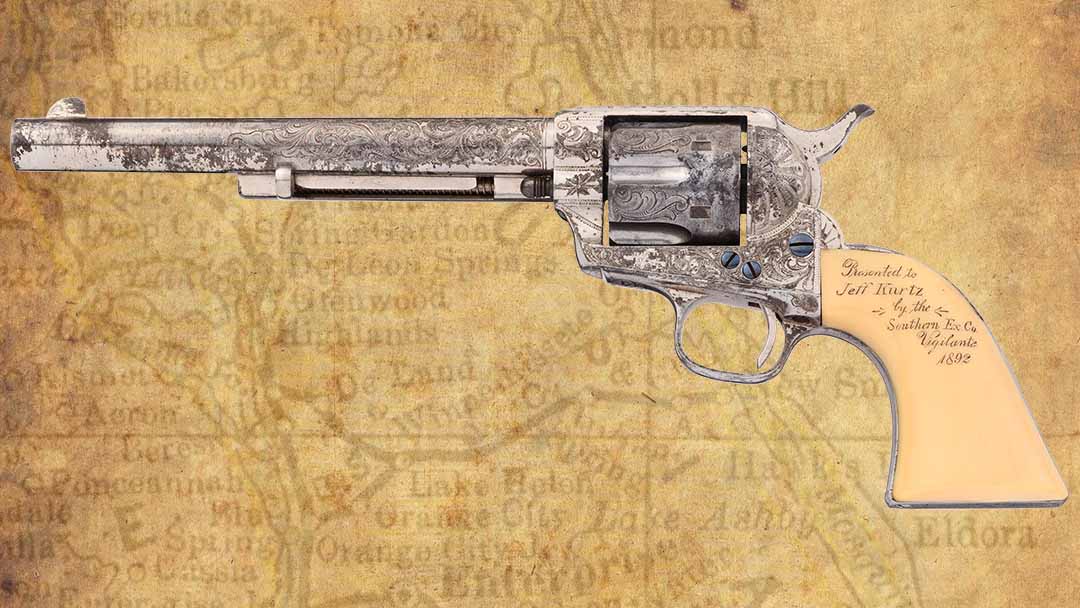
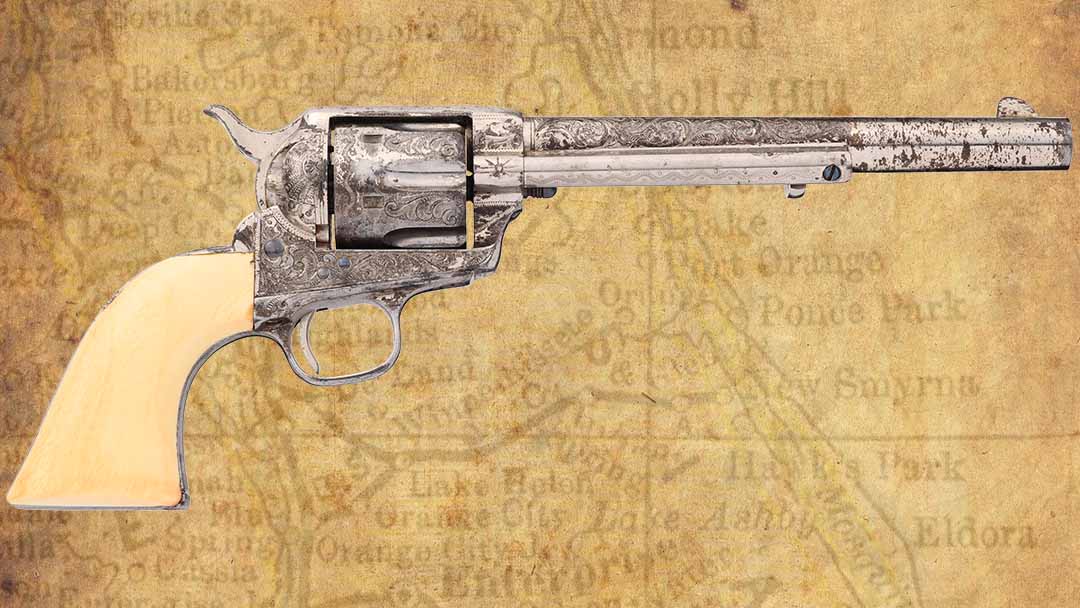
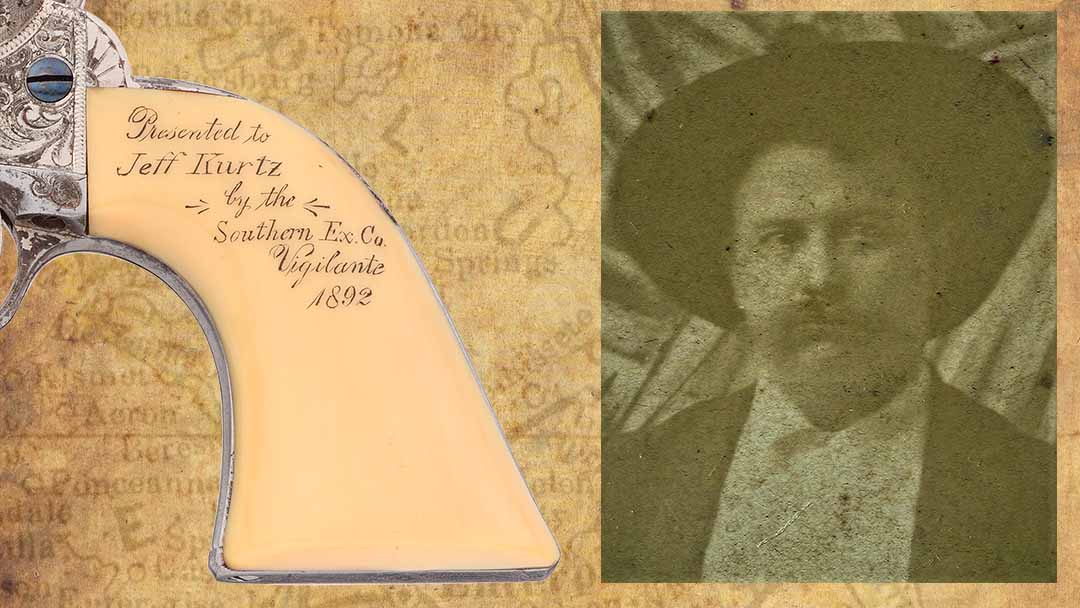
One such reward, a “soft shipped” New York engraved antique first generation Colt Single Action revolver with the grip inscribed “Presented to Jeff Kurtz by the Southern Ex. Co. Vigilante 1892” will be available in Rock Island Auction Company’s Premier Auction May 19-21.
This engraved, nickel-plated first generation Colt Single Action Army was given to Volusia Sheriff Jeff Kurtz in 1892. Presented to him by Southern Express Railroad, it will be available in Rock Island Auction Company’s May 19-21 Premier Auction.
Before Becoming Volusia Sheriff
The son of a rebel and great grandson of a revolutionary, Kurtz was born in Virginia in 1861 shortly after the first shots of the Civil War. His full name was Jefferson Davis Kurtz, named for the Confederate president. His father Robert Kurtz served in the Marion Rifles of the Fifth Virginia Regiment during the Civil War. His great grandfather was a bodyguard for General Daniel Morgan, commander of Morgan’s Riflemen during the American Revolution.
Jeff Kurtz lived in Texas for a time in the early 1880s before arriving in DeLand, Florida in 1887 where he became a Volusia County Sheriff deputy. In 1891 when the sheriff resigned, Kurtz was appointed as the county’s sheriff. He was 30 years old, and the next year he won election as sheriff.
This first generation Colt Single Action Army was shipped with a 7 1/2 inch barrel and a “soft finish” for engraving to be done later. The gun was sent to Hartley & Graham of New York.
Volusia Sheriff Jeff Kurtz
Kurtz was described as “short, wiry, strong and handsome,” and despite his short stature was “fast with his fists and his gun.” He quickly developed a reputation as a fugitive tracker. Two of his brothers, Charles Kurtz and Robert Kurtz Jr., as well as a nephew served as deputies for Volusia County.
In May 1892, during the robbery of a Southern Express Company train, a company agent was shot and killed and another shot twice and seriously wounded. The robbers fled the scene and were pursued by Sheriff Kurtz and other lawmen. Though no account of the incident’s conclusion is available, the date engraved on the grip of Kurtz’s ornate Colt Single Action Army’s would lead one to believe that justice won out.
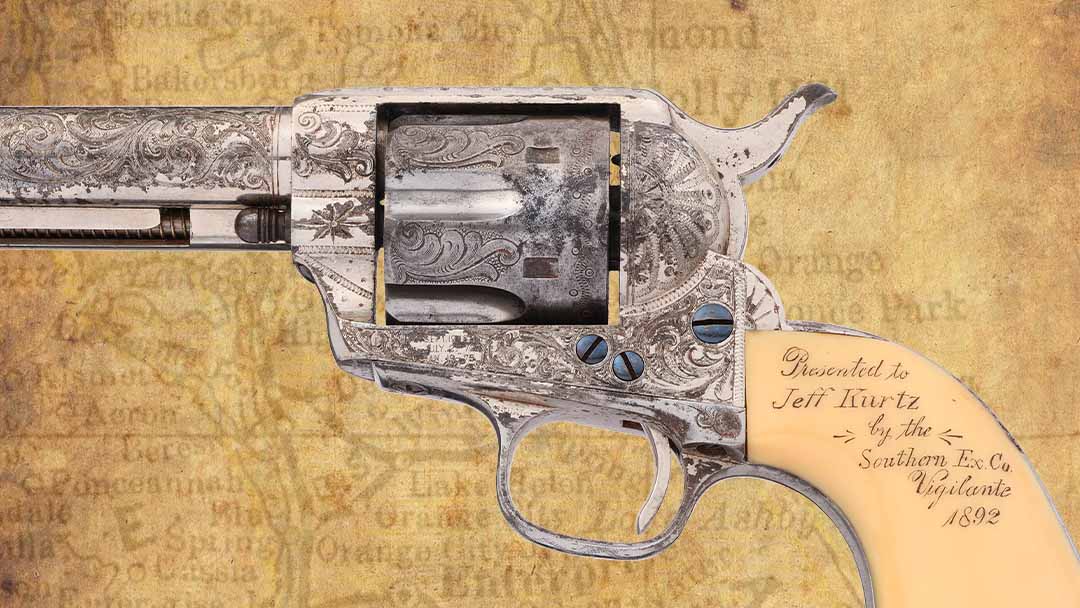
The ivory grips on Kurtz’s highly embellished revolver read “Presented to Jeff Kurtz by the Southern Ex. Co. Vigilante 1892” `with black enamel fill. The Colt revolver was shipped in .45 caliber with a 7 1/2-inch barrel with a “soft finish” to Hartley & Graham of New York City, one of the largest retailers of Colt firearms in the country at the time. A revolver with a soft finish doesn’t have the final finish in order for engraving to be done outside the factory, according to the Colt factory letter that accompanies the gun.
The revolver shows classic L.D. Nimschke style engraving, with scroll patterns, beaded backgrounds, wavy line designs, accents, and “Nimschke stars,” and floral/fan patterns on the recoil shield and loading gate. The gun received a nickel finish and has nitre blue screws.
The closeup of Sheriff Jeff Kurtz’s Colt Single Action Army shows the inscription on the ivory grips and the ornate engraving.
Southern Express
Adams Express initially began as an express service between New York City and Boston, but by 1854 had expanded throughout the southeast, Pennsylvania, Maryland, and Ohio. In 1861, Henry Bradley Plant was a Connecticut native transplanted to Georgia where he served as an agent for Adams Express. As the Civil War loomed, Plant bought the southern rail system and named it the Southern Express Company.
After the war, as lawlessness ruled, Southern Express advised its agents, messengers, and passengers to arm themselves against robberies. The company provided legal assistance in case of a self-defense fatality, and rewarded those who thwarted criminal behavior, like Volusia Sheriff Jeff Kurtz.
Volusia Sheriff Fatally Shot
On April 25, 1895, Putnam County Sheriff J.W. Hagan responded to an early morning pay dispute on the East Coast Line Railroad that left his brother with minor gunshot wounds. Hagan would need help arresting the suspect so he called the Volusia County Sheriff, Jeff Kurtz. Kurtz agreed and hopped a train to Ormond Beach where he arrived around noon. By 3 p.m., the two sheriffs and one of Hagan’s deputies located the suspect at a cabin near Ormond Beach.
The two sheriffs decided to keep watch outside the cabin while the deputy was sent to fetch an arrest warrant. The deputy’s return was delayed and the two lawmen outside the cabin became concerned that impending darkness would let their suspect slip away. They decided to act.
Hagan, the Putnam County Sheriff, approached the house from the front, while Kurtz, the Volusia Sheriff went to the back of the cabin. The suspect spotted Kurtz moving along the side of the house and fired a rifle at him. The bullet grazed Kurtz’s chest. He returned fire but was hit with a second bullet to the left side of his chest. Kurtz got off another shot and wounded the suspect.
Volusia Sheriff Jeff Kurtz was shot while assisting the apprehension of a fugitive in 1895. This Colt Single Action Army revolver was presented to him by Southern Express Railroad.
The Volusia Sheriff yelled out a warning to Hagan that he was shot. The suspect shot at and barely missed Hagan as he came to Kurtz’s aid. Hagan got off a shot that left the suspect lying on the floor of the cabin but trying to fire again. Hagan fired twice more, hitting the suspect who died at the scene.
Reaching Kurtz, the Putnam County Sheriff asked Kurtz how badly wounded he was. “He’s got me. I’m done for,” Kurtz replied. Two men arrived at the scene allowing Hagan to run for a doctor. He and the doctor returned within 20 minutes but Kurtz died as they arrived.
Mourners lined the road traveled by the wagon carrying Kurtz back to DeLand. Following a funeral service, Kurtz body was shipped to his hometown of Winchester, Virginia for burial. Kurtz’s final trip was paid for by Southern Express Company for his service “running down the Monroe Junction train robbers” several years earlier. After another funeral service in Winchester, Jeff Kurtz was buried at the cemetery next to his mother.
Described as “fast with his fists and his gun,” Sheriff Jeff Kurtz was one of the best fugitive trackers in Florida.
A Sad Coda to Volusia Sheriff Kurtz
Just over three years later, in December 1898, 22-year-old Deputy William Kurtz Kremer, Jeff Kurtz’s nephew, arrived at a domestic violence incident on his first day on the job for the Volusia Sheriff Department. Stationed outside the house, twin brothers wanted for robbing trains and post offices saw the rookie deputy as they tried to get out a side door. They shot Kremer dead.
On Sept. 3, 1907, Volusia Sheriff Deputy Charles Kurtz, Jeff Kurtz’s brother, decided to move a prisoner suspected of a brutal rape to a more secure jail in Daytona Beach to avoid a lynching. As the deputy and his prisoner headed toward Daytona Beach, a plank on a bridge they had to cross had to be put back in place. As Charles Kurtz bent down, his revolver fell and fired when it hit the ground. The bullet caught Kurtz in the aorta, killing him immediately.
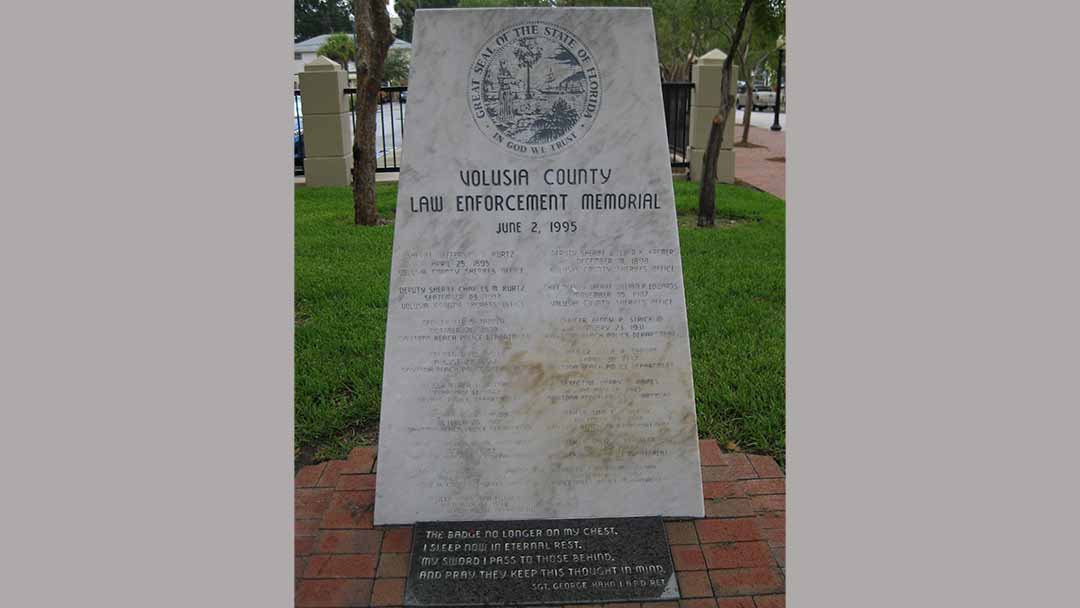
The names of Volusia Sheriff Jefferson Davis Kurtz, Deputy William Kurtz Kremer, and Deputy Charles Kurtz are today among the names on the Volusia County Sheriff memorial.
The memorial is difficult to read, but Sheriff Jeff Kurtz, his brother, Charles Kurtz, and nephew, William Kurtz Kremer, are listed on the Volusia County law enforcement memorial.
Volusia Sheriff Jeff Kurtz’s Revolver
The brilliantly embellished first generation Colt Single Action Army revolver with ivory grips inscribed “Presented to Jeff Kurtz by the Southern Ex. Co. Vigilante 1892” checks a number of boxes for collectors, with its outstanding nickel finish, nitre blue screws, and being shipped to Hartley & Graham of New York City, but it goes beyond that.
This gun belonged to a law man who battled bank robbers and tracked fugitives. Rock Island Auction Company has offered the weapons of lawmen in the past, but this antique Colt Single Action Army is the legacy of a brave and talented sheriff who answered a call from a fellow sheriff and was shot down while trying to assist in the arrest of a dangerous suspect. The nickel-plated revolver of Volusia Sheriff Jefferson Davis Kurtz is available in Rock Island Auction Company’s Premier Auction, May 19-21.
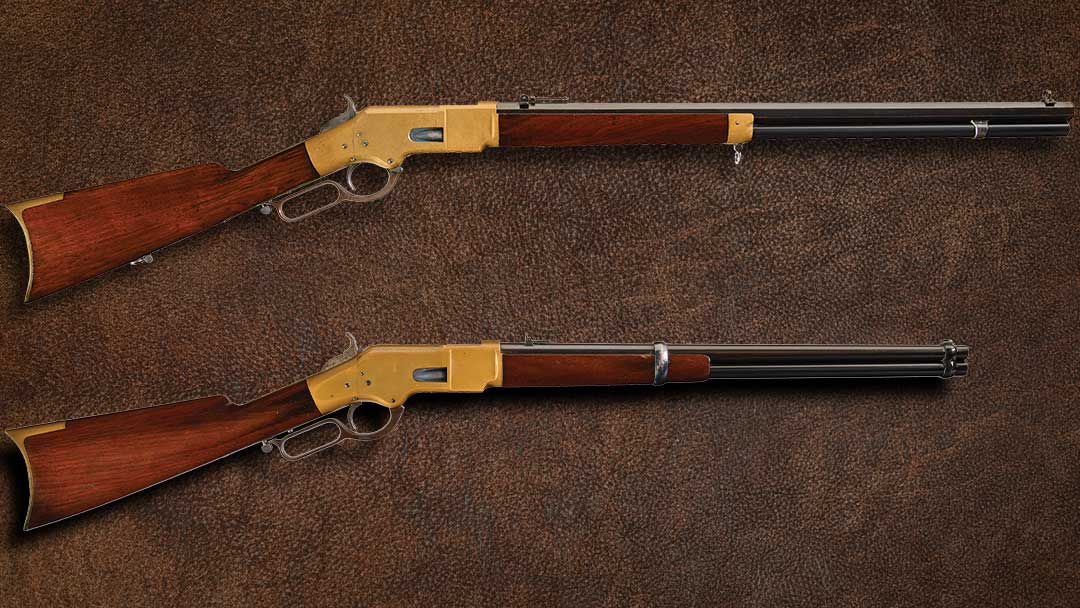
The Winchester Model 1866, also known as the “Yellowboy,” was the first rifle to bear the Winchester name. Introduced in the immediate aftermath of the Civil War, the Yellowboy rifle and carbine were popular guns in their time and helped establish the Winchester Repeating Arms Company as one of the preeminent gun manufacturers of the late 19th century.
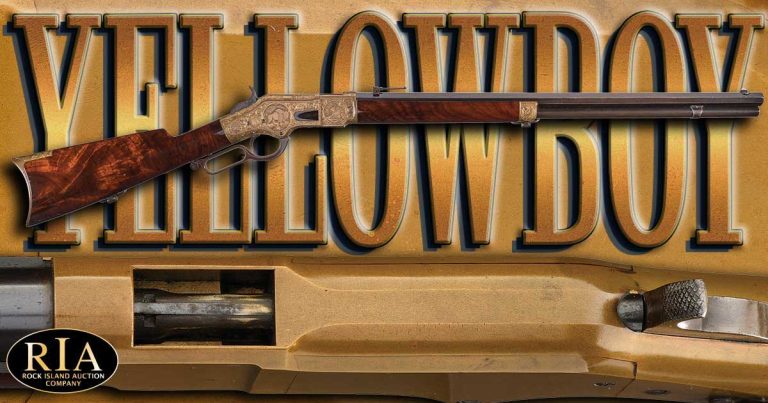
An exhibition relief, Conrad Ulrich attributed master factory engraved and gold plated Winchester Model 1866 lever action rifle. Available this May.
The Yellowboy was the original cowboy rifle, making its way Westward along with hundreds of thousands of settlers who followed the transcontinental railroad to seek their fortune on the frontier. With approximately 170,100 Winchester Model 1866 rifles, carbines, and muskets manufactured in total, the Yellowboy became the first lever action rifle and carbine design to see widespread use in every corner of the United States and beyond.
A direct descendant of the developmentally significant Henry rifle, the Winchester Model 1866 was the first firearm produced under the Winchester name.
Why is it called the Yellowboy Rifle?
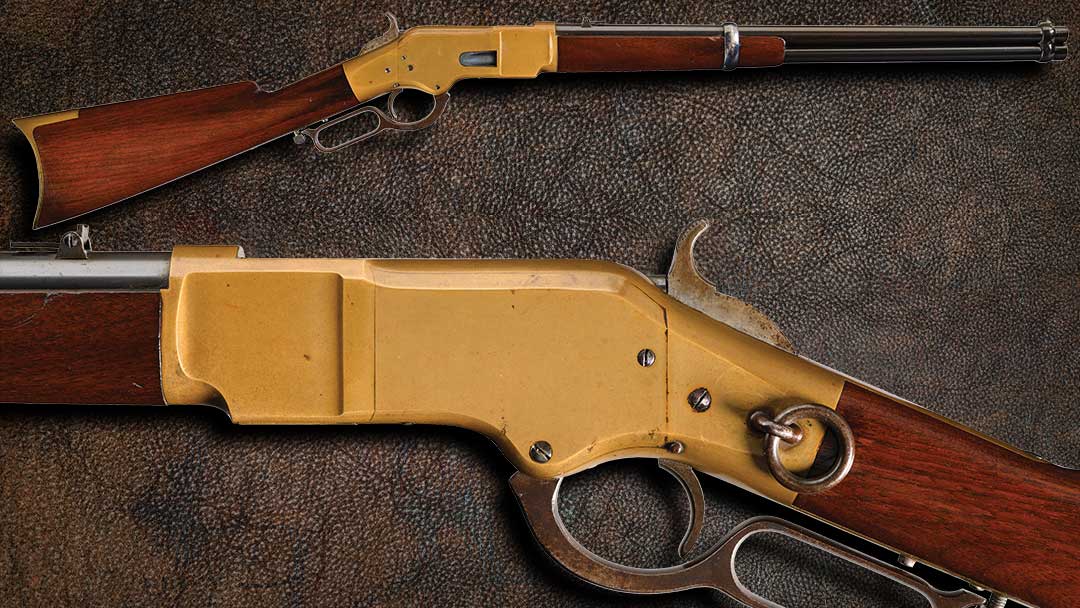
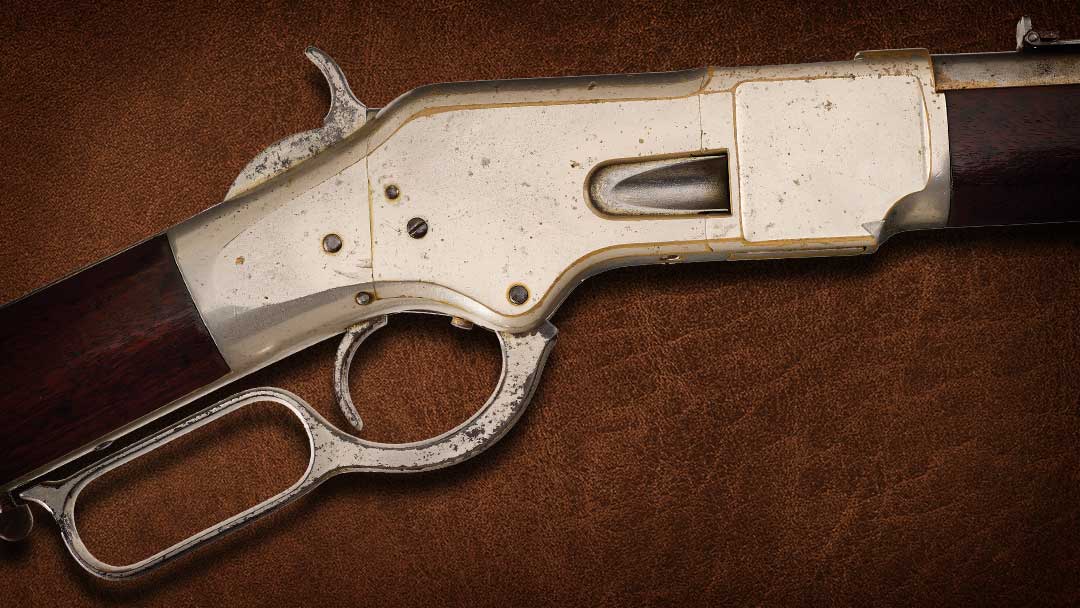
The Winchester 66 was nicknamed the “Yellowboy” because of its distinctive gunmetal frame, forend cap, sideplates, and buttplate. Gunmetal is a strong type of bronze alloy composed of copper, tin, zinc, and sometimes a small amount of lead. Also known as “red brass,” gunmetal was rust-resistant and easy to machine.
The unique yellow tint of the gunmetal alloy gave Winchester’s first lever action rifle its distinct look and “Yellowboy” nickname. Available this May.
The Yellowboy rifle’s gunmetal receiver not only aesthetically set it apart from its iron-framed competitors, but the material was also easier to work with than iron and provided improved corrosion resistance. The latter trait made the Yellowboy more durable in the harsh environments of the American West, where the nickname became the most prevalent.
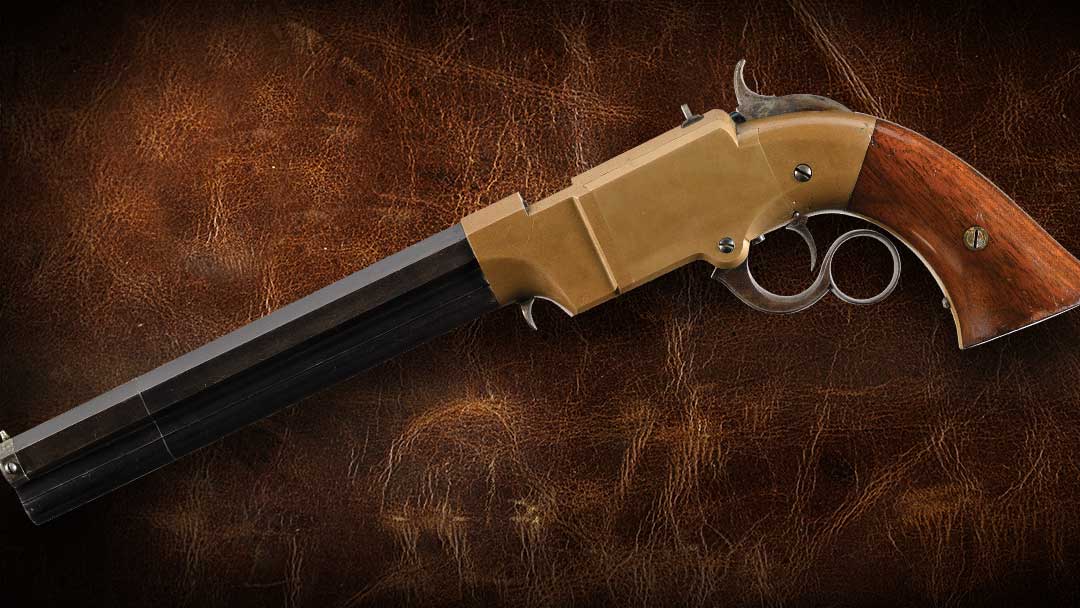
A Volcanic Repeating Navy pistol, documented from the Winchester Gun Museum. The gun’s receiver is composed of gunmetal, like its Henry and Winchester 66 successors. Available this May.
The word “yellowboy” or “yellow-boy” is an archaic British expression for gold coins that can be found in writings throughout the 18th and 19th centuries. Given the yellow/bronze color of gunmetal on a glistening new Winchester Model 1866, it’s no stretch to see why the yellowboy term was adopted for the rifle on the American frontier.
“I wish both their necks were broke, though the two cost me forty good yellow-boys.” – The Adventures of Peregrine Pickle by Tobias Smollett, 1751.
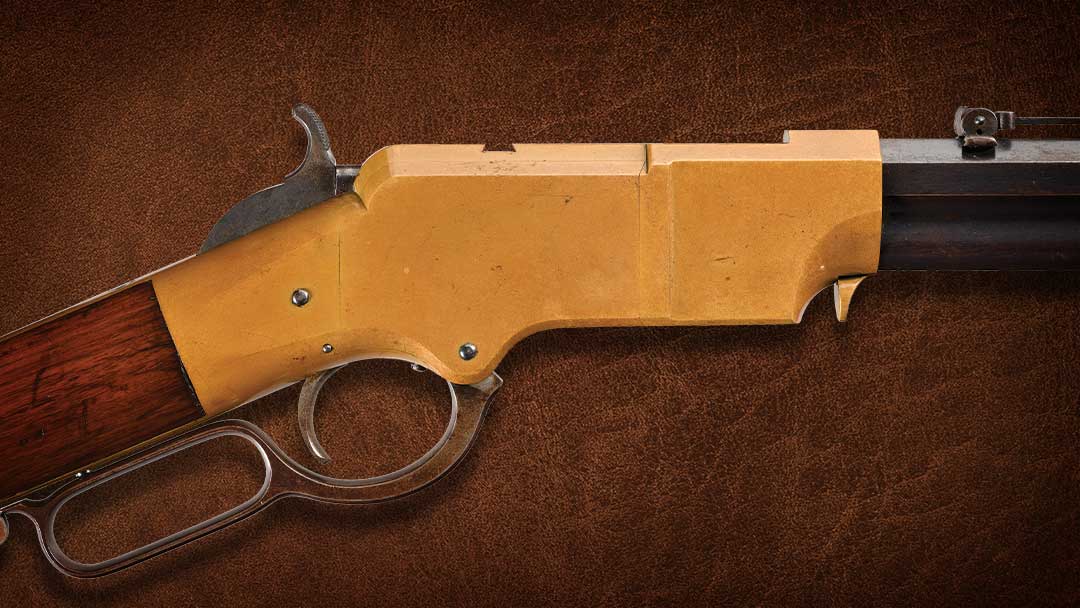
A stunning Civil War production New Haven Arms First Model Henry rifle and its gunmetal receiver. Available this May.
The Winchester Model 1866 did not receive its official name in company catalogs until 1873, when the introduction of its famous successor required the two rifles to be differentiated. Before this, the Winchester Model 1866 was commonly referred to as the “Improved Henry,” “Winchester Repeating Rifle,” or the “Sixteen Shooter.” The later name was a misnomer and a carryover from the Yellowboy’s Henry rifle forerunner, which held a fifteen-round magazine capacity with an additional round in the chamber.
The Winchester Model 1866: Birth of the Yellowboy Rifle
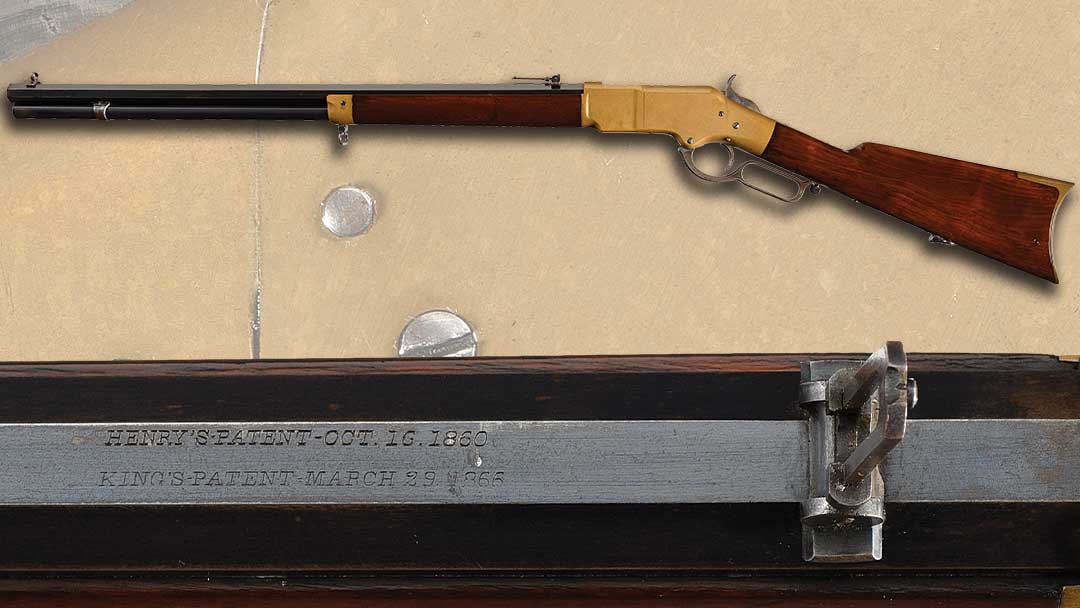
In 1866, the New Haven Arms Company reorganized into Winchester Repeating Arms. Oliver Winchester’s factory superintendent, Nelson King, built off of the success of the Henry rifle, one of the few repeating longarms of the Civil War. This “Improved Henry” design incorporated the same double toggle link action but included a more efficient cartridge loading system with a spring-steel loading gate on the right side of the receiver, a fully enclosed magazine tube, and a wooden forearm under the barrel.
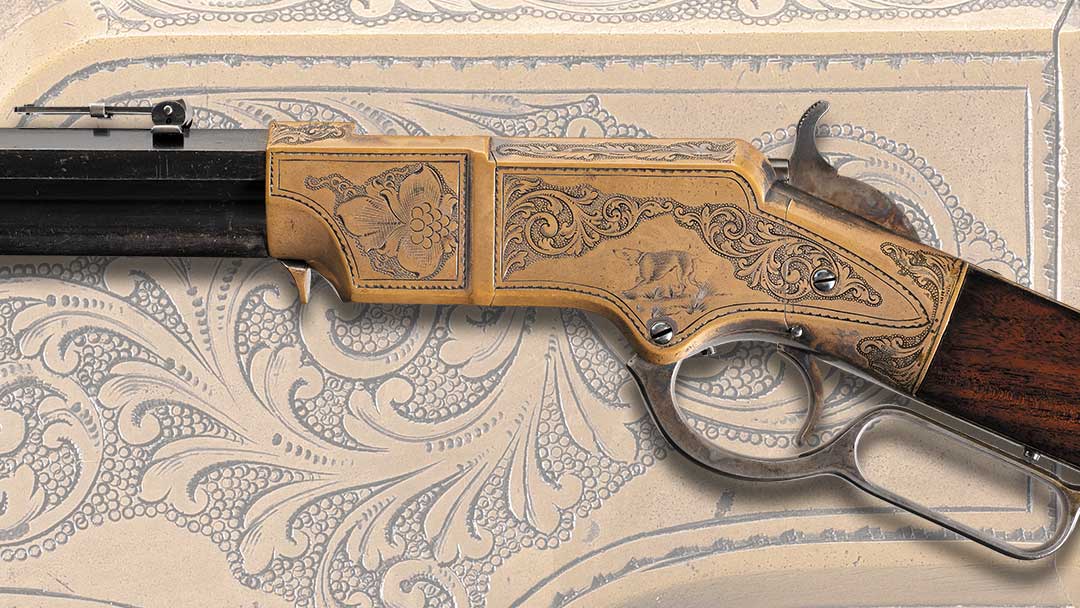
A documented factory engraved New Haven Arms Co. Henry rifle. Available this May.
The Yellowboy’s loading gate, also known as “King’s gate,” sped up the loading and reloading process, the closed magazine tube offered more protection from the elements, and the wooden forearm allowed for easier handling and shielded the shooter’s supporting hand from a hot barrel.
Nelson King’s patent was issued on May 22, 1866. Shortly after, the Winchester board of directors authorized the manufacture of 5,000 rifles and carbines. Early serial records have not been preserved, but other company records during the period have noted that the “first two carbines of the new model” were sold on August 31, 1867, for $34 each. Early sales were promising, and the board authorized the production of another 10,000 Yellowboy rifles and carbines on February 18, 1868.
A documented L.D. Nimschke signed, deluxe engraved Winchester Model 1866 rifle attributed to attorney and politician Albert J. Fountain, as pictured in “Winchester Engraving.” Available this May.
“It is of the same caliber and length of barrel as the Henry Rifle, and carries two charges more in the magazine,” Winchester declared in their original ad campaign. “It is lighter and more simple in its construction, less liable to get out of order, and is in every respect a better and more perfect weapon.”
Yellowboy Rifle Variations
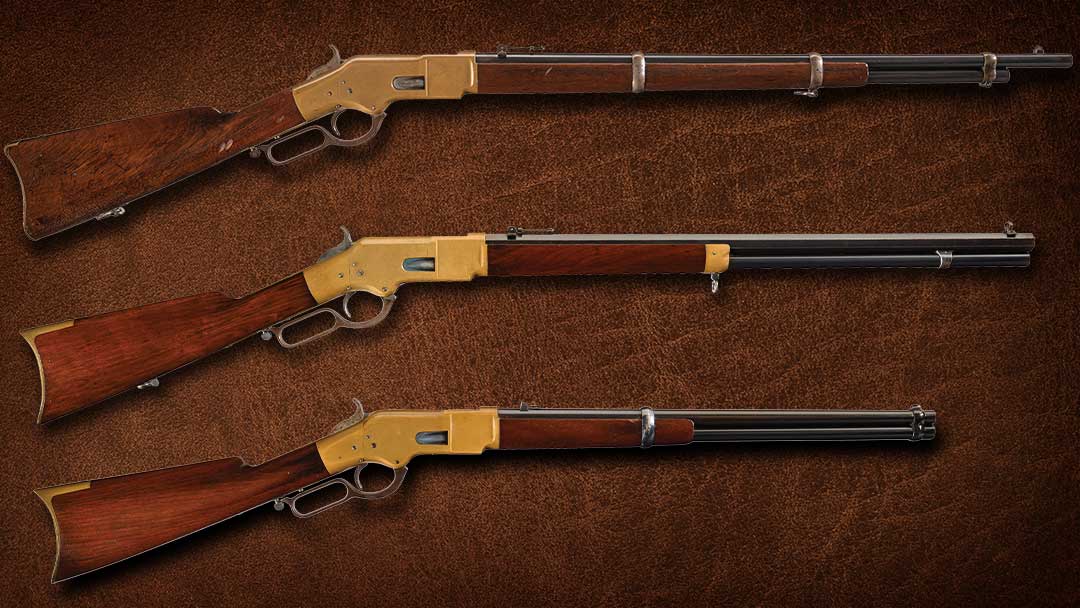
The Yellowboy was offered in three different styles: rifle, carbine, and musket. In 1870, the Winchester catalog advertised the rifle for $50.00, the musket for $45.00, and the carbine for $40.00. Ammunition was offered at the price of $20.00 per 1,000 cartridges. Typical barrel lengths for the Yellowboy ranged from 20 inches for the carbine variant, 24 inches for the rifle, and 27 inches for the musket.
Even with their reduced capacity (13 rounds instead of 17) carbine versions of the Yellowboy were the runaway favorite in the United States. Winchester took inspiration from military carbines by including a ring and a staple fastened to the left side of the receiver near the hammer screw. This allowed the carbine to be secured to the saddle, earning it the nickname “saddle ring carbine.”
Documented Winchester Model 1866 carbine with a scarce nickel-plated finish and factory letter. Available this May.
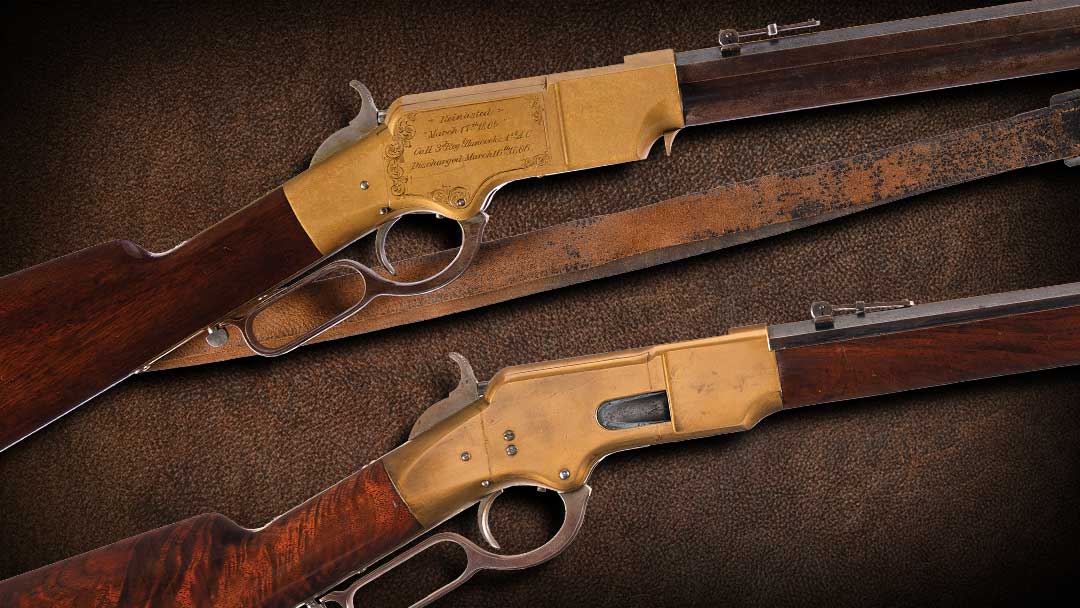
There are four different models of the Yellowboy, and you can read about those differences in detail in the article linked here. The standard configuration for the Winchester Model 1866 rifle, for example, is a 24 inch octagon barrel, crescent buttplate, and a full-length magazine, though this changed frequently throughout their production life. By the third model, Winchester had worked out many of the early design changes, so in addition to their dramatic increase in production, they also began to produce more custom pieces and stunning exhibition works.
A Henry rifle (top) compared to a First Model Winchester 1866 “Flatside” rifle (bottom.) The Henry pictured here is a U.S. martially inspected second contract rifle inscribed for Archibald McAlister of Co. E of the Pennsylvania Regiment Volunteer Corps and the 3rd Regiment of Veteran Volunteers. The Henry rifle is available this May.
The vast majority of 1866 rifles and carbines were produced in .44 Henry Rimfire caliber only, a round with a 28 grain powder charge and a soft copper casing. A small number of mostly late-production rifles and carbines were converted to use a centerfire cartridge through the addition of a third firing pin protrusion at the center of the bolt face to supplement the two rimfire protrusions on the circumference. These conversions used the .44 Henry centerfire cartridges and not the .44-40 WCF developed for the Winchester Model 1873.
A rare L.D. Nimschke signed, engraged, gold finished Winchester Model 1866 lever action saddle ring carbine chambered in the .44 Henry centerfire cartridge sold for $51,750 in RIAC’s September 2021 Premier Auction.
“For Indian, Bear, or Buffalo hunting, it is unrivaled,” an early Winchester ad proclaimed. “And as a war weapon is as much superior to the Prussian Needle Gun, or any single Breech Loader, as they are to the old muzzle loading arms.”
The Yellowboy Rifle Makes an Impression
“The Winchester repeating rifle is lighter than the Henry rifle, weighing only nine and a half pounds, and can be fired eighteen times in nine seconds,” wrote the Louisville Courier Journal in an October 1867 review of the Yellowboy.
The Los Angeles Daily News had similar praise for the new Winchester in a June 1869 article on the gun. “All military companies should examine their new Infantry Rifled Musket with bayonet, which is said to be the most perfect and beautiful military arm ever produced.”
An exceptional Winchester Model 1866 rifle with the ‘Henry’s Patent’ barrel legend. Available this May.
The Yellowboy quickly found favor around the country, including taking center stage in President Grant’s reconstruction efforts in the recently defeated Confederate states.
In 1871, Rep. Ellis H. Roberts of New York, lamenting the frequency of KKK violence, referred to Winchester Model 1866 rifles and carbines serving as tools of intimidation for the southern militias. “Their weapons are often new and of improved patterns; and however poor may be the individual member he never lacks for arms or ammunition.”
In March of 1869, the South Carolina Legislature passed the “Winchester Rifle Resolution,” authorizing the governor to purchase 2,000 “Rifles of the most improved pattern” to arm the state’s police force to combat racial violence and voter suppression. Two years later, South Carolina Governor R. K. Scott stirred controversy around the country with his “Winchester Rifle Speech,” where he suggested the best way to answer violence at the polls was to buy as many Winchesters as possible and one hundred rounds for each man willing to fight for fair elections. “I tell you,” the governor declared, “the Winchester rifle is the best law that you can have.”
The Yellowboy Overseas
In the fall of 1866, Oliver Winchester entered the Winchester Model 1866 into a Swiss trial at Aarau. A British trial at Wollwhich followed in 1868 with an experimental Winchester Model 1866 Musket. Both militaries were impressed, but backed out for financial reasons. Winchester found more success in Japan and France, shipping 5,000 Yellowboys to the Japanese in 1867 and 6,000 to the French during the Franco-Prussian War in 1870.
The Yellowboy had another chance to shine as a military weapon when the Ottoman Empire ordered 5,000 carbines and 45,000 muskets in 1870 and 1871. During the Russo-Turkish War of 1877, Turkey delayed the superior Russian-Romanian force by using M1872 Peabody-Martini rifles at a distance, then switching to Winchesters at close range. The Yellowoy inflicted devastating casualties, showing the world the effectiveness of repeating military arms on a mass scale.
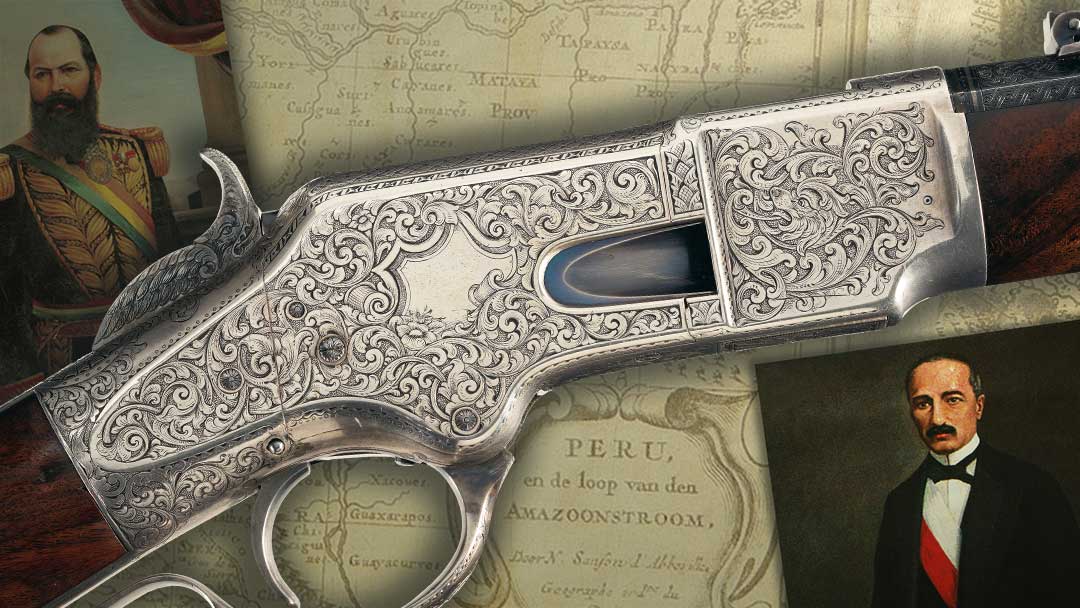
The Yellowboy was purchased throughout Central and South America as well, becoming an especially popular firearm of the wealthy elite. This solid silver Winchester Model 1866 rifle, commissioned by President Jose Balta of Peru for presentation to President Mariano Melgarejo of Bolivia, sold for $977,500 in RIAC’s December 2021 Premier Auction.
The Yellowboy Goes West
Repeating longarms like the Henry rifle and Spencer carbine had ceased to be novelties in the American West by the late 1860s, and the Yellowboy was quickly embraced as well. Gaining favor for its reliability, simplicity, impressive capacity, and rate of fire, the Winchester 1866 rifle and carbine became a favorite choice for hunting and self-defense, riding in the scabbards of many cowboys, lawmen, settlers, and outlaws of the era.
Major John Wesley Powell, for instance, relied on Yellowboy carbines for game and security during his Colorado River expeditions in 1868 and 1871. Frederick Samuel Dellenbaugh, a topographer during the 1871-1872 expedition, noted that “Most of the rifles were Winchesters.”
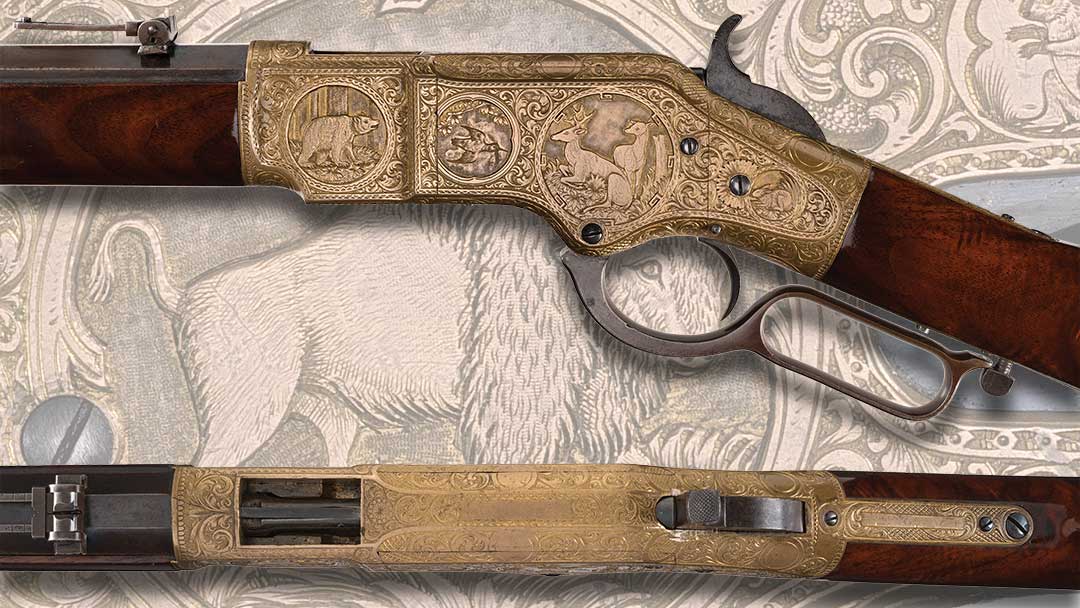
This extraordinary exhibition grade Winchester Model 1866 rifle was manufactured in 1872 and features 10 exquisite North American game scenes. Available this May.
In 1867, Red Cloud and Crazy Horse suffered a catastrophic defeat near Fort Phil Kearny, Wyoming in what would become known as the Wagon Box Fight. Two of the defenders toted Henry rifles and reportedly unleashed over 100 rounds of .44 Henry during the battle, helping repel the attack. The Native Americans learned from this defeat and took every opportunity to acquire “many shot” rifles as well, including the Yellowboy.
During the height of the Indian Wars, including the Battle of Little Bighorn, the Yellowboy rifle and carbine was far more common than its Winchester Model 1873 successor, outnumbering the ’73’s presence in America several times over in 1876. Major Marcus Albert Reno, who commanded three companies at the Little Bighorn, observed, “The Indians had Winchester rifles and the column made a large target for them and they were pumping bullets into it.”
Legacy of the Yellowboy
The Yellowboy rifle not only established Winchester Repeating Arms as a global brand but helped transform the company into a finely oiled machine that could push the boundaries of lever action rifle design. The Yellowboy’s successors, the steel-framed Model 1873 and Model 1876, were offered to the public in a bevy of new calibers and special order options. While the Winchester ’73 is often dubbed the gun that won the West, the Yellowboy rifle helped set the stage for every lever action Winchester to follow.
Though the Winchester Model 1866 was discontinued in 1898, the spirit of the Yellowboy rides again thanks to Uberti, Henry, and Winchester Repeating Arms (through Miroku of Japan.) These contemporary representations of the classic lever action are chambered in modern cartridges and are readily attainable for cowboy action competitors, hunters, and shooters today.
The Yellowboy Rifle in Popular Culture
As the original cowboy rifle, the Yellowboy has been featured in numerous novels, films, and television series depicting the Old West. In some cases, such as ‘The Good, the Bad, and the Ugly’ and ‘True Grit,’ the Yellowboy served as a stand-in for the Henry rifle. More recent prominent appearances include ‘Back to the Future Part III,’ ‘Appaloosa,’ ‘Open Range,’ and Paramount’s ‘Yellowstone’ prequel series, ‘1883.’
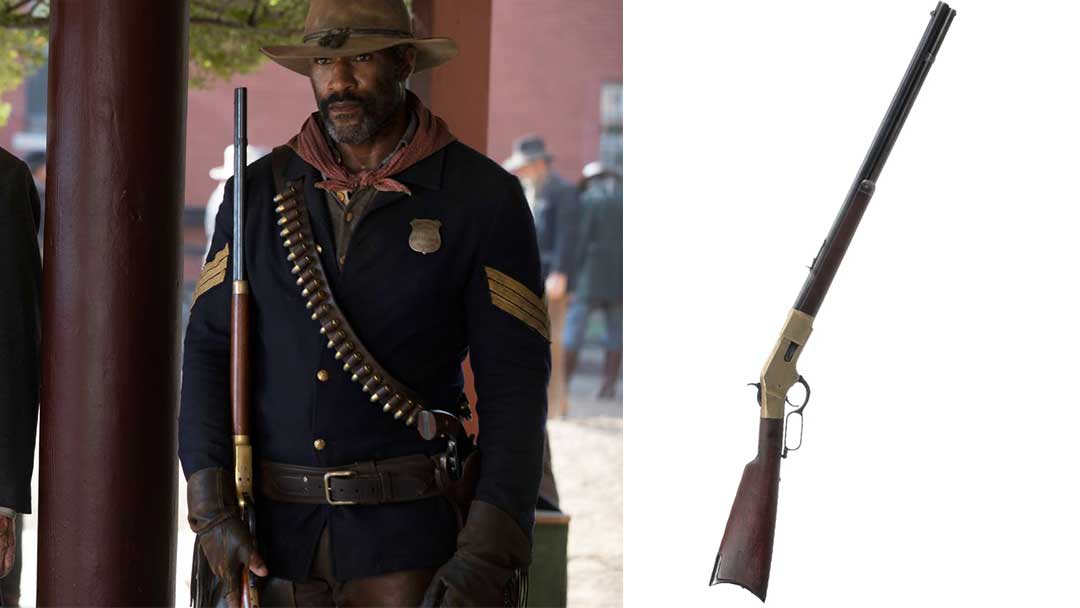
In Taylor Sheridan’s 1883 series, a Yellowstone prequel, Pinkerton Agent Thomas (LaMonica Garrett) carries a Yellowboy rifle that appears to be a centerfire conversion.
Yellowboy Rifle for Sale
As one of the archetypical Old West guns, the Yellowboy remains popular today with arms collectors, fans of the Western genre, and anyone interested in antique lever action rifles. While buying a reproduction can quench some of that desire for shooters, there’s nothing like owning an original Yellowboy or one of its lever action heirs, and some of the finest and most valuable antique Winchesters can be found for sale at Rock Island Auction Company.
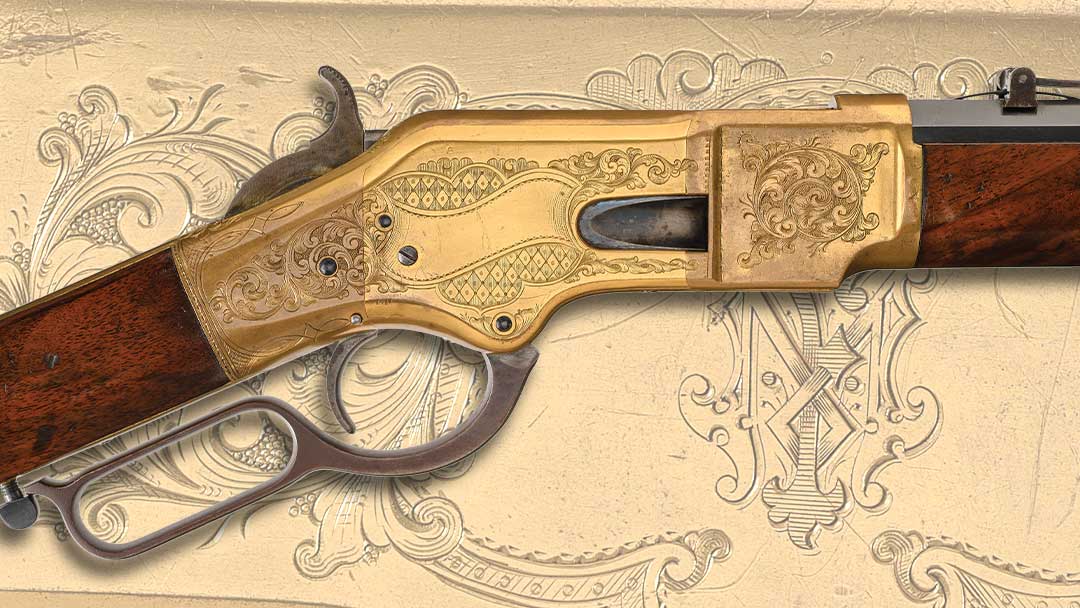
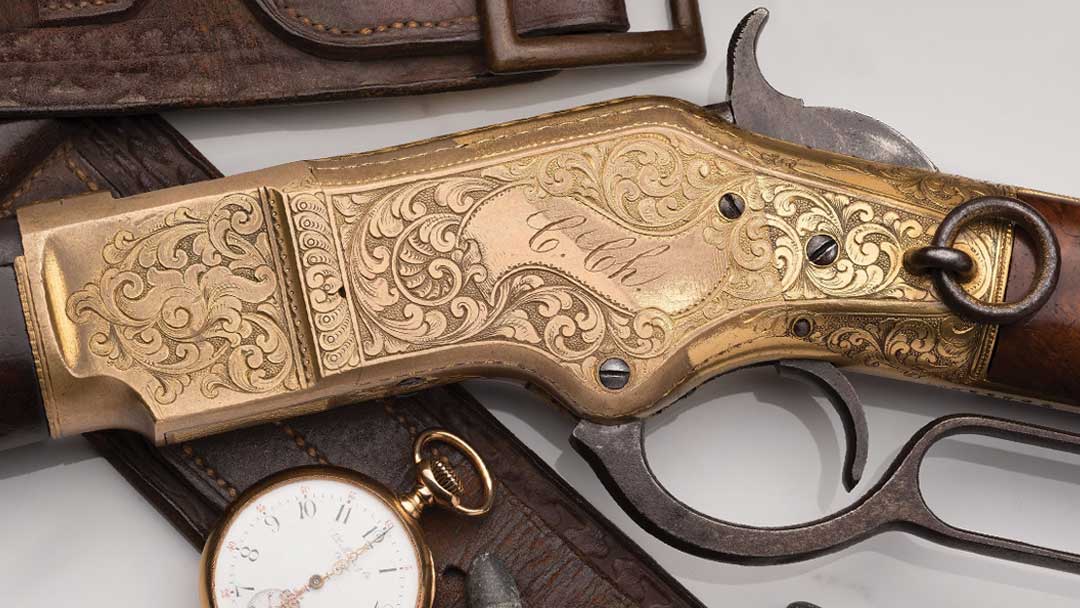
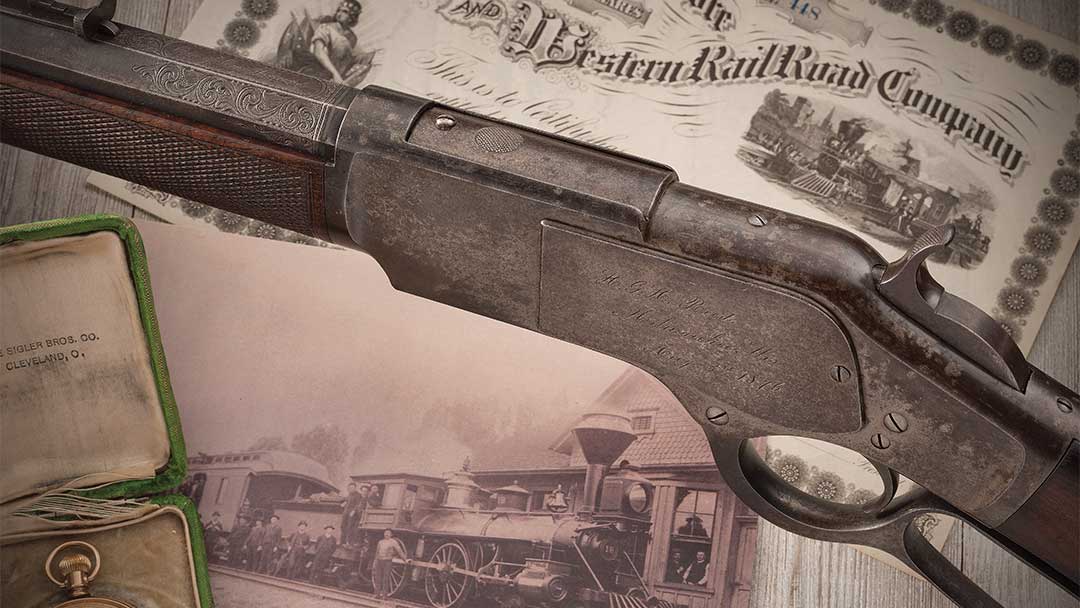
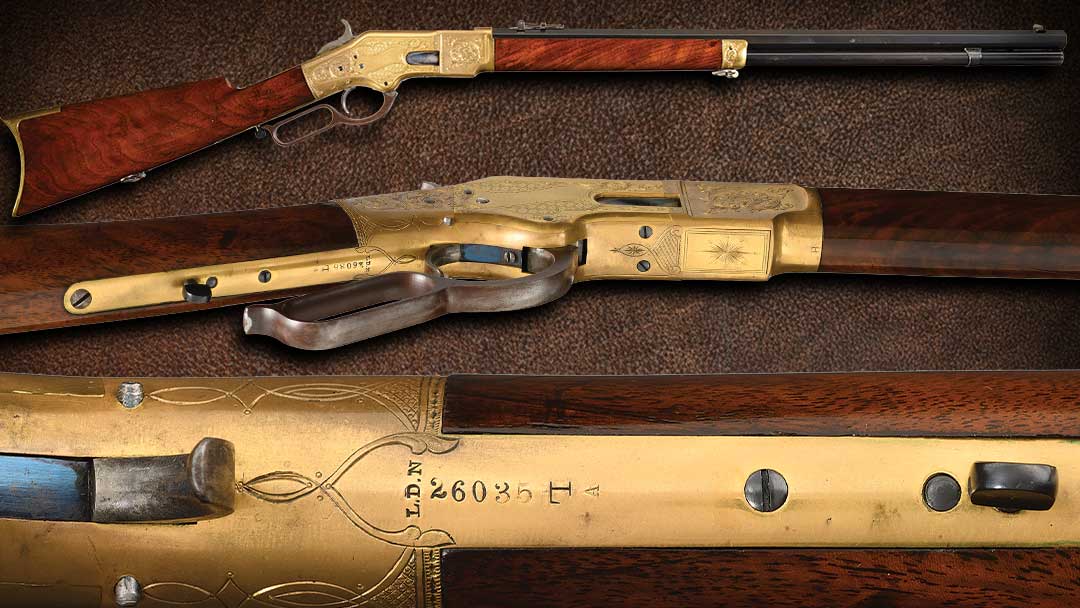
Manufactured in 1869, this Winchester Model 1866 is beautifully engraved, with attractive floral scrollwork on a punch dot background displayed on the forend cap, with the left side plate engraved with a monogram and the lower tang featuring the initials “LDN” for Louis D. Nimschke. Available this May.
The Colt Single Action Army revolver and the Winchester Model 1873 rifle went on to be dubbed the guns that won the West, and both firearms have forged a legacy that endures 150 years after their introduction. Read the latest blog at https://t.co/aqahRwvef4pic.twitter.com/qXgFINGOky