Western Guns, Antiques, and Cowboy Collectibles

0

Few collecting niches capture America’s pioneer spirit like the arms, artifacts, and artwork of the Wild West. The period spanning the late 19th century to the early 20th century was an age defined by cowboys, lawmen, desperados, Native Americans, and settlers looking to find their fortune on the frontier, and Western items from the era offer a glimpse into the legends they left behind.

Find the most desirable Western collectibles for sale at Rock Island Auction Company.

The demand for vintage Western antiques and memorabilia has been on the rise in recent years, and collectors, investors, historians, and Old West enthusiasts can find an impressive selection of period firearms, blades, badges, holsters, cowboy pictures and prints, and other desirable Western items in Rock Island Auction Company’s August 23 – 25 Premier Auction in Bedford, Texas.

A historic “The Continental” double barrel hammer shotgun with a gold inlaid “J R PLATT TEXAS RANGERS” inscription, one of the fantastic Wild West artifacts for sale this August.

Legendary Wild West Guns

Frontier-era firearms are among the most desirable pieces in vintage Western memorabilia, with guns owned by Wild West legends representing the pinnacle of the pursuit. Sheriff Patrick Floyd Jarvis Garrett gained fame for tracking down and ultimately killing Billy the Kid. The gold-plated Colt Model 1877 Thunderer featured below was presented to Pat Garret after he was appointed United States Collector of Customs by President Theodore Roosevelt. A historic, solid gold Sheriff’s badge that was presented to Pat Garrett by Billy the Kid’s lawyer is also available this August.

For lovers of Wild West artifacts and Western collectibles, it doesn’t get much better than a documented Pat Garrett gun. Available this August.

Allan Pinkerton is another name associated with law and order on the frontier. The revolver below, a treasure for vintage Western collectors, is documented in Robert Lee and R.L. Wilson’s ‘Magnificent Colts’ book as a Thomas Tranter of Birmingham double action “Bulldog” made especially for William A. Pinkerton. As one of Allan Pinkerton’s two sons, William became an heir to his father’s Pinkerton National Detective Agency which became legendary during their pursuit of Jesse James, the Younger Gang, the Dalton Brothers, and Butch Cassidy’s Wild Bunch.  

In the realm of Western antiques and memorabilia, this documented and engraved Thomas Tranter revolver made for W.A. Pinkerton of the famed Pinkerton National Detective Agency should be on every collector’s wish list. Available this August.

Buffalo Bill Cody is a name well-known to Western collectible enthusiasts and anyone else familiar with the myths and lore of the American frontier. The Union scout, Pony Express rider, Civil War soldier, Indian fighter, and buffalo hunter became one of the great legends of the era, and factory-documented Buffalo Bill presentation firearms like the Winchester Model 1895 carbine below are some of the scarcest treasures in the Western antiques field.

One of the most important vintage Western items for sale this August, this historic Winchester Deluxe Model 1895 saddle ring carbine was presented by Buffalo Bill to Deadwood businessman and friend M.R. “Gold Nugget Mike/Deadwood Mike” Russell. Available this August.

Wild West artifacts attributed as captured from the Little Bighorn stand among the rarest of the rare. Pictured below, the Ainsworth inspected U.S. Cavalry Colt Single Action Army originated from within Lot Five, one of the prime lots from which 7th Cavalry revolvers were drawn.

One of the most desirable vintage Western items for sale this August, the revolver is accompanied by a 1991 dated letter from Kenneth Leonard, a previous owner of the gun, and a John Kopec Gold Seal authentication letter. Leonard purchased the Colt from Jake Herman, a tribal council member of the Oglala Lakota Nation, a tribal historian, and a curator of the tribal museum at Pine Ridge. As told by Herman, “the gun was captured at the Little Big Horn and had been in his family since that time.”

For fans of Western antiques and memorabilia, any items tied to the Battle of the Little Bighorn are going to turn heads. This Colt Single Action Army, inspected by Orville W. Ainsworth, is from Lot Five, the lot issued to the 7th Cavalry ahead of the fateful battle and is attributed as a battlefield capture. Available this August.

Vintage Guns as Western Art

As the market for classic Western-themed artwork experiences an impressive uptrend, engraved firearms offer collectors a convergence of two popular fields. The Old West rifle was particularly suited to embellishment, with high-end examples exhibiting some of the most spectacular engravings from the period.

For lovers of Western antiques and cowboy collectibles, engraved Winchesters evoke the romance and spirit of the Wild West. Available this August.

The exceptional artistry of master engravers like L.D. Nimschke, Gustave Young, Cuno Helfricht, and the Ulrich brothers hold particular appeal for collectors of rare Western antiques and Wild West artifacts. The 1882 manufactured Winchester Model 1873 saddle ring carbine pictured below features an immensely rare combination of traits for the model, including a plated finish, panel scene engraving, and the signature of the legendary John Ulrich.

For lovers of vintage Western art and memorabilia, this documented John Ulrich signed and factory panel scene engraved, full nickel plated Winchester Model 1873 saddle ring carbine checks all the right boxes. Available this August.

Old West revolvers are another frontier firearm platform that could serve as a canvas for artistry by way of both their frames and the carvings that sometimes appeared on the rare examples featuring ivory or pearl grips. The pair of First Generation Single Action Armies below combine Wild West styling with Texas cattle brand engraving pioneered by Cole Agee and Weldon Bledsoe. The revolvers wear a set of pearl grips featuring jewel-eyed relief carved steer heads with gold horns and nose rings on the right grip panel, representing one of the finest examples of the firearm as vintage Western art.

A pair of Western collectible treasures, this brace of cattle brand engraved, gold and silver plated First Generation Colt SAA revolvers features relief steer head carved pearl grips and a book-style case. Available this August.

From the 1880s to the early 1900s, luxury jewelry and specialty retailer Tiffany & Co. created spectacular embellished handguns and rifles for America’s leading firearms manufacturers. One of the most desirable classes of high art Western antiques, Tiffany embellished 19th-century arms are exceptional collectibles that are rarely offered for public sale, with the largest collections in the hands of private institutions like the Metropolitan Museum of Art.

A rare Tiffany shipped, deluxe and embellished Smith & Wesson .32 Safety Hammerless 1st Model DA revolver (left) and a documented W. & S. Butcher Sheffield Bowie knife with an intricately carved and engraved metal grip (right), two of the finest vintage Western items for sale this August.

Vintage Western Knives

In the field of vintage Western collectibles, authentic Bowie knives are extraordinarily valuable. To the American hunter, settler, and gambler of the mid-19th century, the Bowie knife offered a versatile weapon for survival and close-quarters fighting. Bowie knives often saw hard use on the frontier, and surviving examples offer a glimpse into the lives of those who shaped the untamed lands of the American West.

Exceptional examples of the Bowie knife, like this early Samuel C. Wragg Sheffield coffin hilt Bowie, are highly valued by collectors of Western antiques and memorabilia. Available this August.

The push dagger, also known as the gimlet knife, was a compact weapon that could be deployed in a close-in fight with speed and power. These Wild West artifacts are closely associated with the California Gold Rush, like the example below manufactured by Will & Finck of San Francisco. The company produced a wide variety of knives and gambling equipment to supply the influx of settlers and prospectors looking to find fortune in the Golden State.

A Will & Finck, San Francisco marked push dagger with scabbard, one of the vintage Western items associated with the California Gold Rush era. Available this August.

Wild West Holsters

Old West holsters are one of the rarest classes of vintage Western antiques and memorabilia, particularly the surviving examples produced during the golden age of the American cowboy. The holster below was manufactured by Samuel B. Severs of Muskogee, Indian Territory, who operated during the 1880s and 1890s. Configured in the classic Mexican loop style with dual retention loops, this is the only known matching holster and belt set by S.B. Severs.

A true cowboy collectible, this historic S.B. Severs tooled leather Mexican loop Colt SAA revolver holster includes a matching Severs cartridge/money belt. Available this August.

Established in 1879, Moran Bros. was one of the first saddlery and gun leather firms founded in Miles City, Montana Territory, the “Cow Capital of the West.” The Moran brothers operated a two-man shop until 1895, when they sold their business to Charles E. Coggshall, founder of the famous Miles City Saddlery. Due to their limited production capacity and short time of operation, Moran Bros. holsters are one of the most prized Wild West artifacts.

An exceptional Moran Bros. Miles City, Montana Territory, tooled “Mexican Loop” Colt SAA holster with a matching Moran Bros. cartridge/money belt (right) and a nickel plated First Generation Colt Frontier Six Shooter revolver with relief carved buffalo head pearl grips (left), two of the finest vintage Western items for sale this August.

The second Moran Bros. holster for sale this August was pictured and described on page 116 of ‘Packing Iron: Gunleather of the Frontier West’ by Richard Rattenbury. An authentic cowboy collectible, the holster is fitted to accommodate a Colt SAA Cavalry Model revolver and a row of .44 or .45 caliber bullets in its cartridge loops.

Two vintage Western collectible icons from the frontier era. A documented Moran Bros. tooled “Mexican loop” Colt SAA holster with a matching Moran Bros. cartridge/money belt (left) and an engraved silver and gold Colt SAA with relief Mexican Eagle pearl grips (right) .

Vintage Western Badges

No collection of Western antiques is complete without an authentic Old West badge. As settlers moved westward during the 19th century, sheriffs, marshals, and deputies were recruited to bring order to the frontier. The lawman’s badge evolved from simple pieces cut from coins, tin, or scrap metal to more formalized and ornate symbols of authority, such as the iconic five-pointed star found in the badge included with the revolver below.

The revolver and badge of a sheriff, two Wild West artifacts from the Lone Star State. The engraved Colt SAA with pearl grips is inscribed “T.C. Nunn” and “Bryan Tex.” and the accompanying silver badge is marked “SHERIFF/BRAZOS COUNTY” with “TEXAS” marked on the points of the central star. Available this August.

James F. Fagan was presented with the diamond-studded badge pictured below soon after his appointment by President Ulysses S. Grant as the U.S. Marshal for the Western District of Arkansas in 1875. “Hanging Judge” Isaac C. Parker tasked Fagan with hiring 200 Deputy U.S. Marshals to restore order in neighboring Indian Territory. Fagan deputized the legendary Bass Reeves shortly after receiving this badge, making this truly extraordinary piece of vintage Western memorabilia all the more notable.
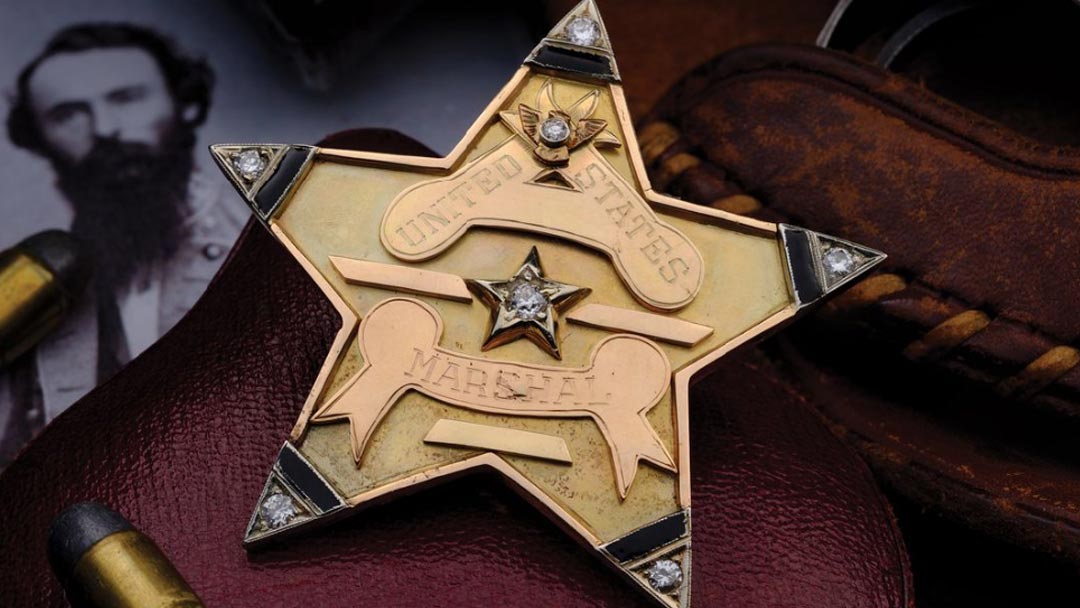
One of the most historic Western antiques for sale this August, this presentation, 1875 dated, diamond-studded 14K gold U.S. Marshals badge is inscribed “PRESENTED BY/WIFE AND FRIENDS TO/JIM FAGAN/FT. SMITH ARK./1875.” The badge comes in a period velvet-lined presentation case. Available this August.

Pat Garrett’s badge ranks near the top on any list of legendary Western antiques. The solid gold badge, presented to Sheriff Garrett after he shot and killed Billy the Kid, is prominently inscribed with “LINCOLN” and “COUNTY” in banners at the top and bottom, with “SHERIFF” at the center in raised white gold. The back of the badge is inscribed “To/Pat Garrett/with the best/Regards of/A.J. Fountain/1881.”

The Lincoln County Sheriff’s badge presented to Sheriff Pat Garrett by Albert J. Fountain in 1881, one of the most iconic Wild West artifacts in the genre. Includes a black leather bound case with red and white satin lining. Available this August.

Like most frontier lawmen, Garrett’s career was varied and his travels numerous. August’s auction includes multiple lots containing documents signed by Sheriff Garrett as well as other photos and documents from his life, including a framed warrant and subpoena, a letter to his wife, and other documents and Western items linked to the fabled lawman. The lot pictured below includes Pat Garrett’s wallet, his life insurance documents, and a telegram to his wife concerning his appointment by President Theodore Roosevelt as a United States Collector of Customs.

Numerous pieces of Western memorabilia related to Pat Garrett are for sale this August, including the lawman’s wallet and personal documents.

Western Photography, Prints, and Bullet Boards

Frontier photos are another important Western collectible genre, with L.A. Huffman capturing some of the most iconic images of Montana Territory. Laton Alton Huffman employed a combination of hand-tinting and hand-sketched texture in some of his prints, giving the portraits and landscapes a unique and slightly ethereal appearance.

“B Evening at the Roundup”, one of the most famous old cowboy pictures from L.A. Huffman. Available this August.

Huffman’s pictures featured cowboys, ranchers, wild horses, and daily life out on the range, providing an authentic glimpse into the last two decades of the American frontier. L.A. Huffman prints represent one of the most sought-after classes of vintage Western memorabilia, particularly pieces from the photographer’s early career.

Another one of Huffman’s iconic old cowboy pictures, “The Mill Iron Rawhide” shows early Montana cattle ranching in its heyday. Available this August.

Along with Western photography, advertising prints helped shape the myth of the Wild West and the American cowboy. Artists of the late 19th century and early 20th century created a romantic vision of the era through Wild West Show posters, themed calendars, and prints for firearms companies like the Colt “Patches” advertisement below from iconic artist Frank E. Schoonover.

Two vintage Western items for frontier collectors. (Left) “Trailing Sheep,” a colorized print from the L.A. Huffman. (Right) “A framed Colts Patent Firearms “Tex and His Horse, Patches” advertising print.

The bullet board or cartridge board, is another class of vintage Western memorabilia that has been gaining significant traction in recent years. A late 19th century advertising display, the bullet board typically features hundreds of cartridges, shells, and bullets and offers collectors a tactile piece of art. The example below also includes a central sporting print.

A Winchester Repeating Arms Co. “Double W” cartridge board, one of the most desirable examples of this unique Western antiques collecting class. Available this August.

Vintage Western Memorabilia for Sale

Interest in America’s frontier heritage is stronger than ever today in no small part thanks to popular podcasts, video games, and television programs like Taylor Sheridan’s ‘Yellowstone’ universe. Vintage Western memorabilia allows collectors to own a tangible piece of that legacy, and the depth of the field is vast.

A pair of engraved and silver plated First Generation Colt Frontier Six Shooter SAA revolvers with relief carved steer head grips connected to the historic 101 Ranch, an elite Western collectible brimming with history, rarity, and artistry.

From sixshooters and lever guns to badges and bowie knives, Rock Island Auction Company offers some of the finest Western items in the field. Whether you’re looking to own a holster, badge, or photograph from the era or a gun owned by one of the period’s most legendary figures, RIAC’s August 23 – 25 Premier Auction features one of the finest selections of Wild West artifacts around.

Collectors from far and wide are invited to swing by our new venue at 3600 Harwood Rd., Bedford, Texas on Thursday, August 22nd, the day prior to auction, to examine these fantastic Western collectibles firsthand. Open from 10 a.m. to 6 p.m., preview day allows collectors the opportunity to inspect and handle any of the over 1,700 lots up for bid, rub elbows with fellow enthusiasts, and step into the boots of the explorers, lawmen, outlaws, and pioneers who rode the trails of yesteryear.

Documented serial number 1 Colt Burgess Model lever action saddle ring carbine, a monumental piece of firearms history. Available this August.

For fans of Western antiques and frontier firearms, subscribe to the Rock Island Auction newsletter for new gun blogs and gun videos covering the arms that helped win the West. From black powder Colts like the Walker, Dragoon, and Colt revolving rifle, competing wheel guns like the LeMat, Smith & Wesson, and Merwin Hulbert, lever gun icons like the Spencer carbine, the Marlin, and the Winchester family, and the various Civil War revolvers, surplus muzzleloaders, and breech loading rifles that settlers carried, we tackle the guns that made America.

A special order, factory engraved and inscribed First Generation Colt SAA with a factory relief steer head carved grip and original box, one of the finest vintage Western guns for sale this August.

The Colt 1851 Navy: America’s Belt Revolver

0

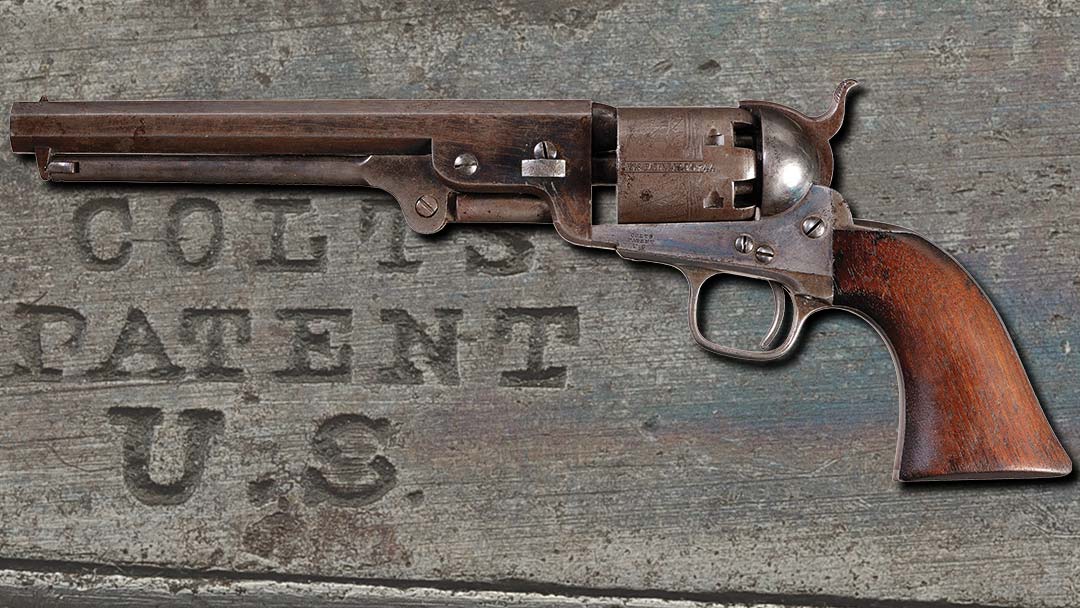
As a Civil War staple and a favorite frontier gun of countless pioneers, outlaws, lawmen, and Texas Rangers, the Colt 1851 Navy revolver made its mark on America and beyond. Combining power and portability, Colt’s “Revolving Belt Pistol” became one of the best-selling guns of the 19th century and helped usher in the age of the gunfighter.

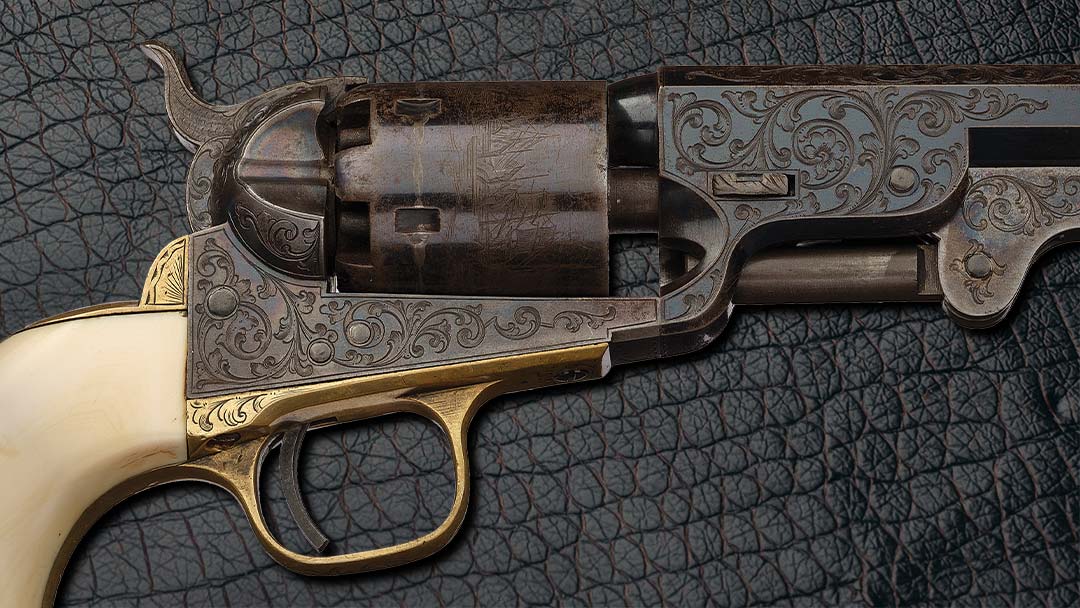
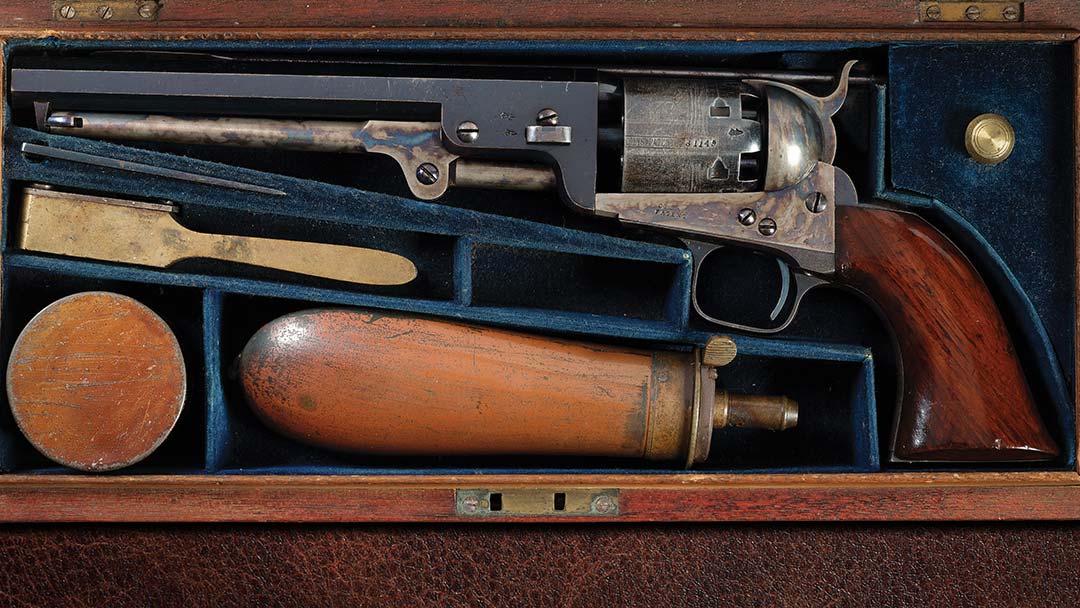
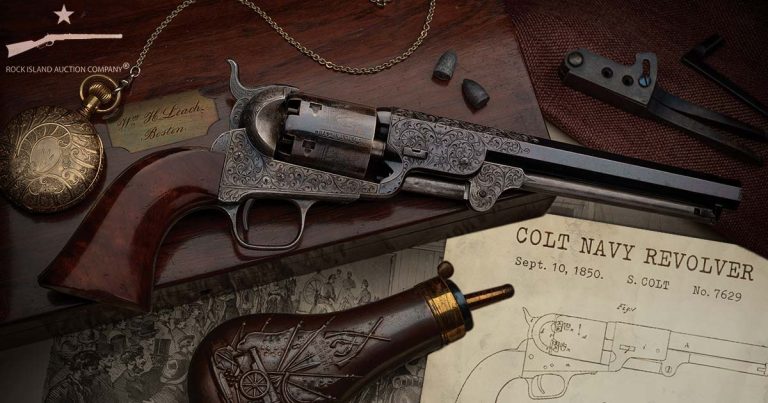
A factory engraved Colt 1851 Navy revolver for sale this August, with case and accessories.

The Colt Paterson and Colt Walker established the general blueprint for every Colt percussion revolver design to follow, including the prolific Colt 1851 Navy. Examples from every chapter in Samuel Colt’s legacy can be found in Rock Island Auction Company’s August 23 – 25 Premier Auction in Bedford, Texas.

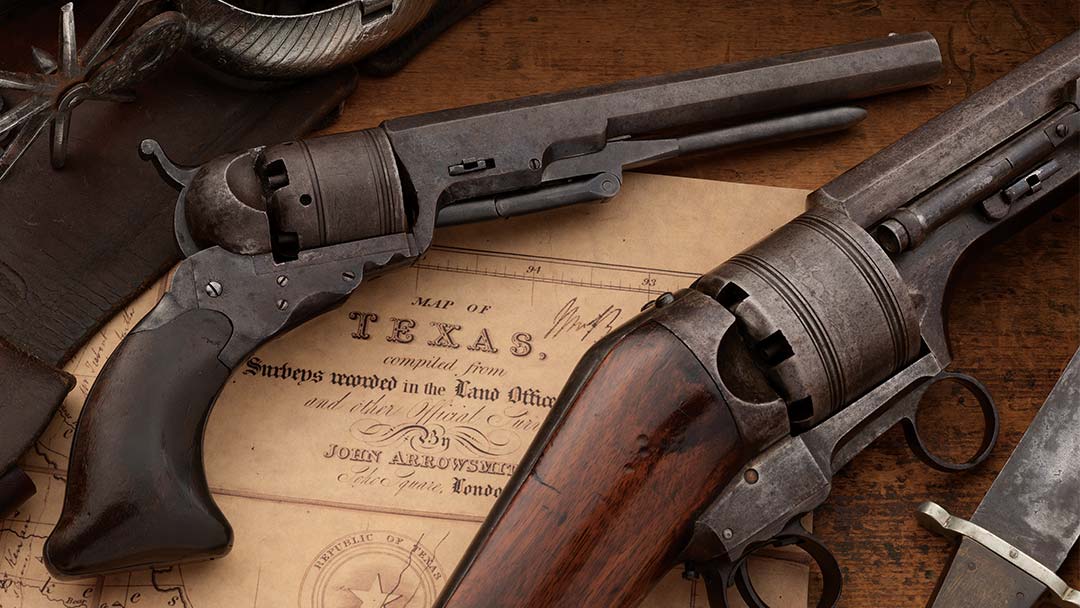
A Colt Texas Paterson No. 5 revolver (left) and a Colt Paterson Second Model ring lever percussion rifle (right).

Road to the Colt Navy Revolver

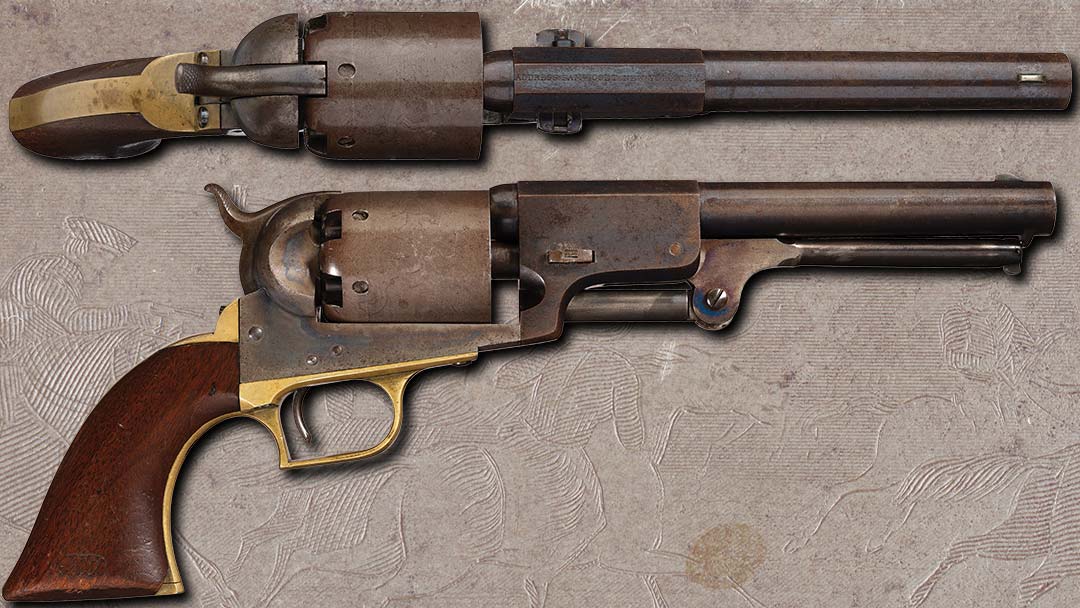
The Colt Dragoon corrected some of the issues with the Walker and helped Colt establish his factory in Hartford, Connecticut in 1848. Where the Dragoon was a six-shot, .44 caliber revolver, a smaller variant was produced that became known as the “Baby” Dragoon. These pocket revolvers reduced the cylinder count to five and the ball to .31 caliber.

The finest known Colt “Fluck/Walker Replacement” Dragoon revolver. Available this August.

The .31 caliber Colt 1849 Pocket replaced the Baby Dragoon in 1850. Refinements included a round trigger guard and square cylinder stops and pins. The diminutive 1849 Pocket became Colt’s most successful 19th century revolver with sales figures exceeding 340,000. Where the 1849 Pocket brilliantly filled the role of a concealable close-quarters option, its sized-up sibling, the six-round Colt 1851 Navy, offered Samuel Colt a platform to pursue lucrative military contracts.

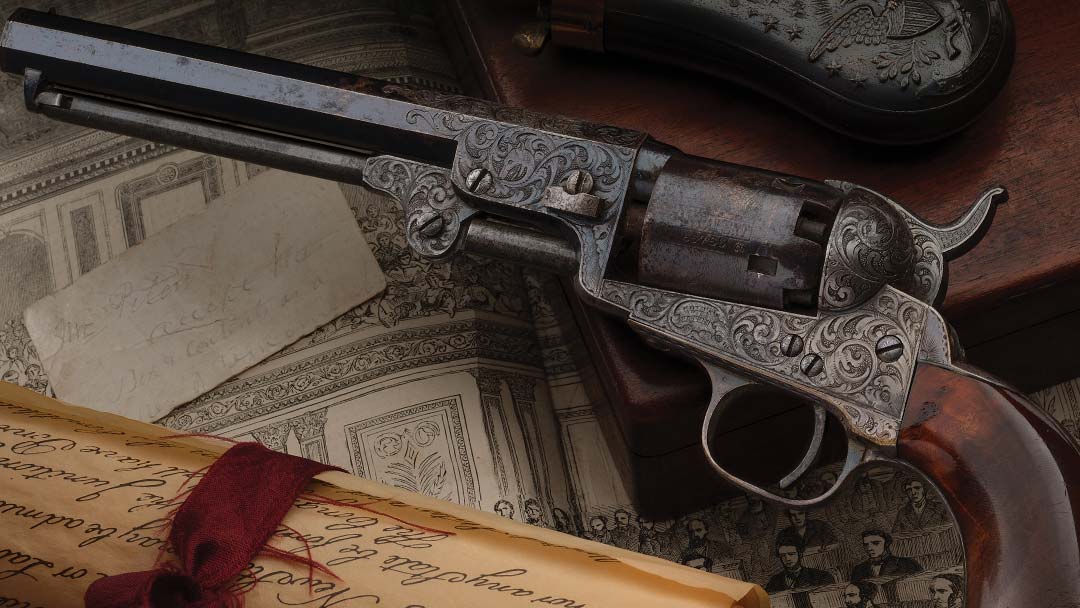
A cased, deluxe, factory engraved Colt Model 1849 pocket revolver attributed as a thank you gift from U.S. Senator Jesse D. Bright. Available this August.

The 1851 Colt Navy Revolving Belt Pistol

Initially referred to as the “Revolving Belt Pistol,” the Colt Model 1851 revolver would quickly adopt a “Navy” designation. The model’s .36 caliber offered a middle-ground between the .31 caliber 1849 Pocket and the mighty .44 caliber Dragoon saddle holster pistol, where a moderately sized “belt pistol” would be a more attractive option to a sailor. The U.S. Navy purchased their first 100 Colt Navy revolvers in June 1852.

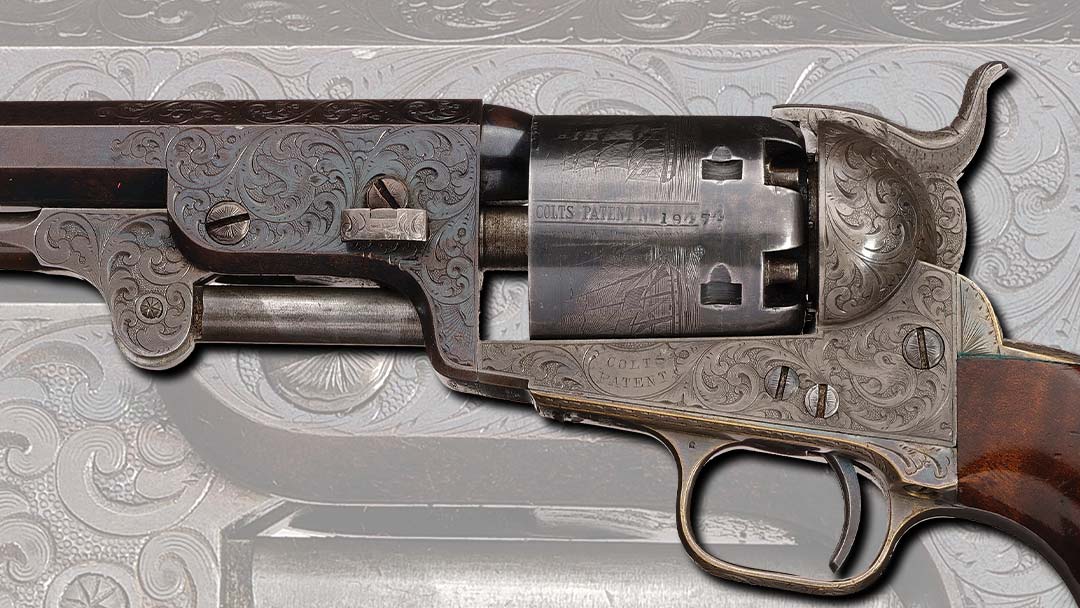
A factory engraved Colt Model 1851 percussion revolver manufactured in 1852. Available this August.

Though comparatively rare, Colt issued numerous 1851 “Navy-Navies,” referencing Model 1851 revolvers inspected by the U.S. Navy. The example pictured below, serial number 90744, is one of the final group of 600 Colt M1851 Navy revolvers delivered to the United States Navy in September 1859 and features a large rounded trigger guard, a recoil shield with no capping channel, and a blued iron trigger guard and back strap.

In ’51 Navies’ by Nathan L. Swayze, the author writes, “Most of the guns in this range were Navy-Navies. The only martial markings in this group were the small “U.S.” stamped on the frame under the Colt Patent stamping, and they did not have the “U.S.N.” stamping, Naval Officer inspector’s initials, or the anchor stamping that were found on the early Navy-Navies in the Late Third Model serial number range 55500/62000.”

A scarce Colt U.S. Navy contract Model 1851 revolver for sale this August with an iron trigger guard and backstrap. Author Nathan L. Swayze wrote that Navy revolvers in this serial number range “are frequently referred to as “black Navies” because of their overall dark appearance.”

Where the Colt Model 1851 revolvers produced for the U.S. Navy featured iron backstraps and trigger guards, the revolvers purchased by the U.S. Army were manufactured in the standard configuration with brass backstraps and trigger guards. Government-purchased Colt Navy revolvers are stamped “US” on the left frame beneath the Colt Patent markings.

The U.S. Army accepted the Model 1851 Navy revolver in early 1855. Nearly 17,000 were delivered to the Ordnance Department over the next three years, with many fielded by mounted troops during the early Plains Wars. The Colt Navy became a popular sidearm with militia, early police departments, and civilians as well.

A vine scroll factory engraved Colt Model 1851 Navy revolver, manufactured in 1863 and formerly part of the famous Norm Flayderman Collection. Available this August.

The Colt 1851 Navy flourished throughout the 1850s. During a tour of the American Southwest in 1856, journalist and social critic Frederick Law Olmsted reported “There are probably in Texas about as many [Navy] revolvers as male adults, and I doubt if there are one hundred in the state of any other make.”

As Samuel Colt’s fortunes rose in the domestic market, the tireless entrepreneur also explored opportunities overseas, with a particular eye on the United Kingdom.

A cased Colt London Model 1851 Navy percussion revolver for sale this August.

The 1851 Colt Navy Revolver Overseas

Colt displayed his Navy revolver at the Great Exhibition in London in 1851. Interest proved great enough that Samual Colt invested in a London factory and hoped to establish strong markets in England, France, Russia, and beyond.

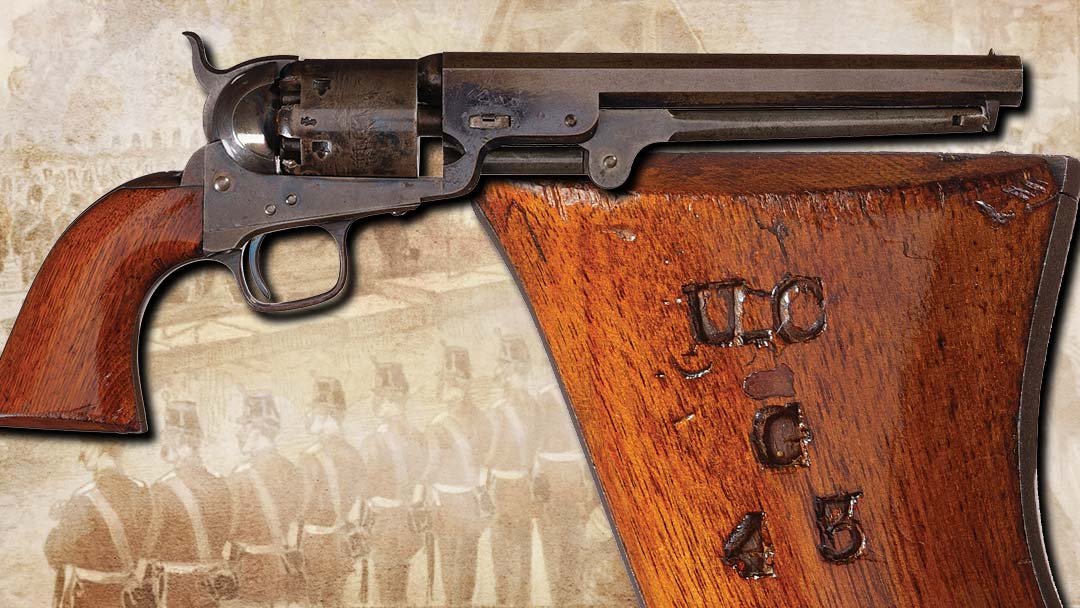
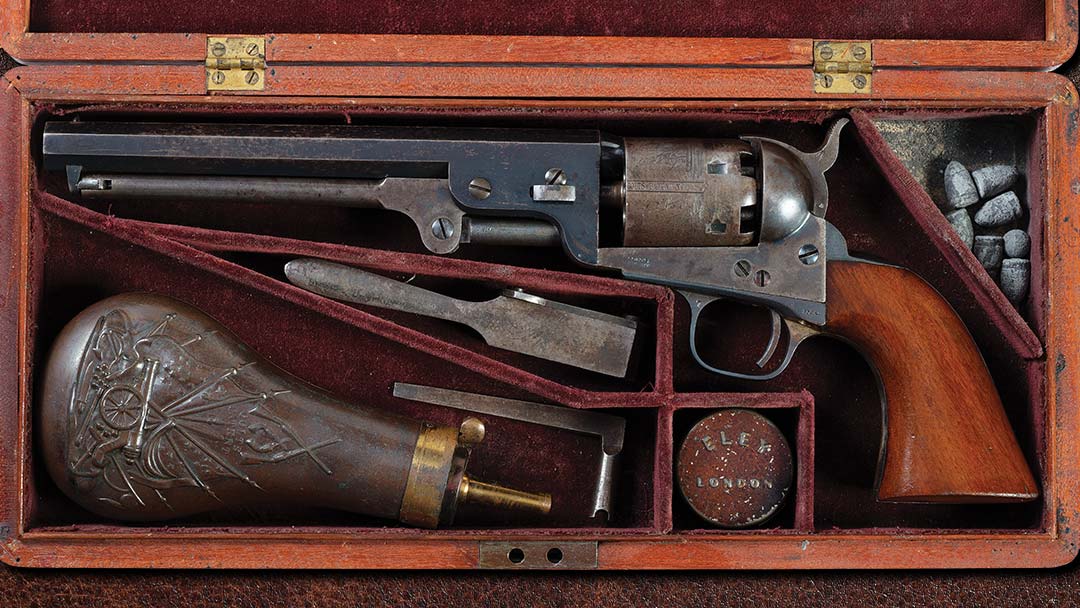
Pictured below is a rare example of a London-produced Colt 1851 Navy revolver that was marked and issued to troops of the Upper Canada Militia. “London-London” refers to a Colt revolver that used parts that were both manufactured and assembled in London. Because Upper Canada 1851 Navies are London-London Models, the usual British proofmarks are found on the left barrel lug and alternately on the shoulders between the nipple recesses of the cylinder. The left side grip is stamped “UC/G/43,” representing Upper Canada, Company G, 43rd Volunteer.

One of an estimated 55 Colt 1851 London Navy revolvers issued to Company G, Napance Troop of the Upper Canada Militia. Available this August.

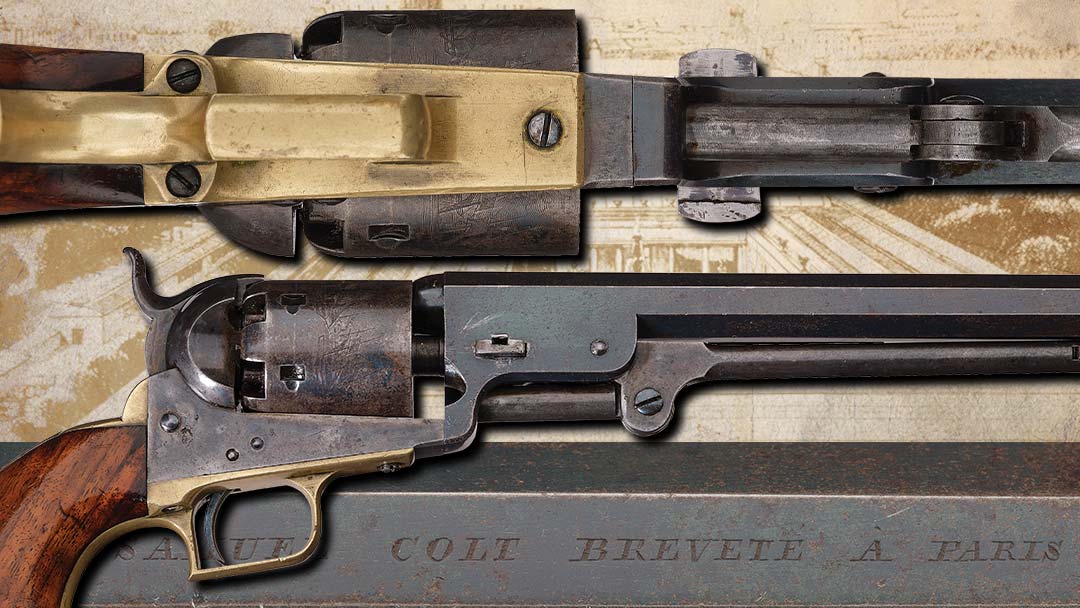
The Colt 1851 Navy pictured below is another example of Colt’s expansionist mindset. Inscribed with “SAMUEL COLT BREVETE A PARIS,” the revolver is a one-of-a-kind rarity. R.L. Wilson wrote that the revolver is believed to have been produced as a “prototype arm…made up for test purposes and showings in France, with a view towards arms sales there, and toward possibly opening a Colt factory in that country.”

Author Herbert G. Houze features this historic Colt Navy on pages 92 and 93 of ‘Samuel Colt: Arms, Art & Invention’ and identifies it as a “Sample Patent Verification Belt Pistol.” Houze writes that “Samuel Colt’s 1861 inventory of his “small office” notably listed “1 Navy Pistol marked in French” suggesting this revolver became part of Colt’s collection.“

A one-of-a-kind documented Colt Patent Model 1851 Squareback Navy revolver made as a prototype for French Patent approval and aspirations toward a future manufacture in France. Available this August.

Samuel Colt displayed his Model 1851 Navy at the Great Exhibition in London in October of 1851. 14 months later, his London factory was up and running. Despite modest production success, operating expenses and growing competition from European competitors made profit elusive. 1856 would mark the untimely end for Colt’s London factory, with more than 42,000 Navy revolvers produced in total.

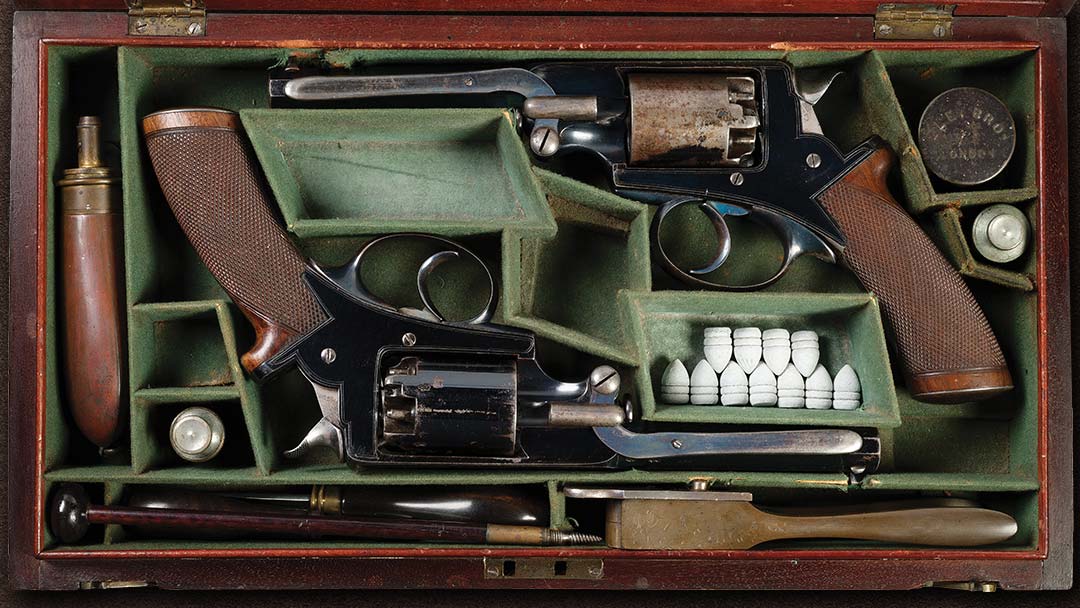
Colt’s most significant English competitor during this period was the Adams line of double action percussion revolvers. Patented in 1851, the .44 caliber Adams revolver packed more punch than the 1851 Navy and could be fired more rapidly. Both features made the Adams an attractive option for British officers during the Crimean War and Indian Mutiny. Lieutenant Frederick E. B. Beaumont patented an improvement to the Adams revolver in 1856 that was soon adopted by the British army.

A cased pair of Williams & Powell retailer marked London Armoury Company Beaumont-Adams DA revolvers, identified as owned by Governor Rufus Bullock of Georgia. Available this August.

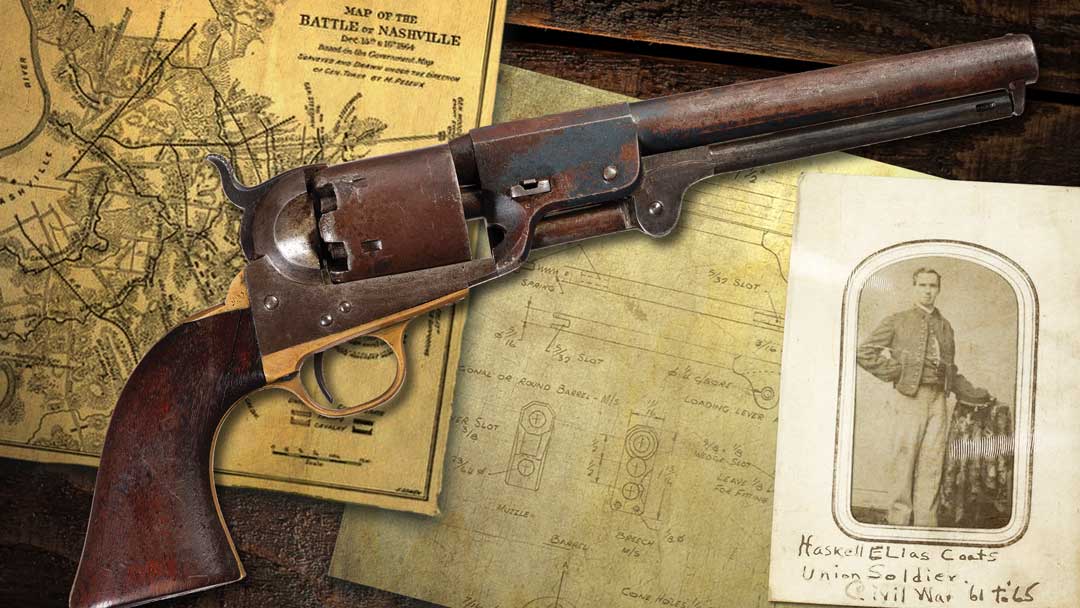
Colt and his associates engaged in frequent legal action to prevent European gunmakers from counterfeiting his design and importing these copies into the United States. Belgium and Russia were among the most prolific manufacturers of Colt Navy clones. During the Civil War, Confederate gunmakers produced several revolvers based on the Colt 1851 Navy, including the Griswold & Gunnison and the Leech & Rigdon.

A historic Civil War Confederate Leech & Rigdon revolver identified as captured by Union Cavalryman Haskell Elias Coats. Available this August.

The Colt Navy in the Civil War

More than 50 Union regiments were issued Colt 1851 Navy revolvers during the Civil War, with about 35,000 purchased by the Union military during the conflict. The 1851 Navy was extremely popular in the South as well, who continued to purchase the reliable revolver in quantity until pressure from the Northern media caused Samuel Colt to end such shipments in April of 1861.

Many officers on both sides of the conflict carried a Colt 1851 Navy, including Robert E. Lee, whose engraved revolver is displayed in the American Civil War Museum in Richmond, Virginia. Engraved or specially inscribed Colt revolvers were often purchased as gifts or presentation pieces for officers, enlisted men, and even volunteers being honored by their community.

This Colt 1851 Navy revolver for sale this August. This example was manufactured in 1863 and includes its case and accessories.

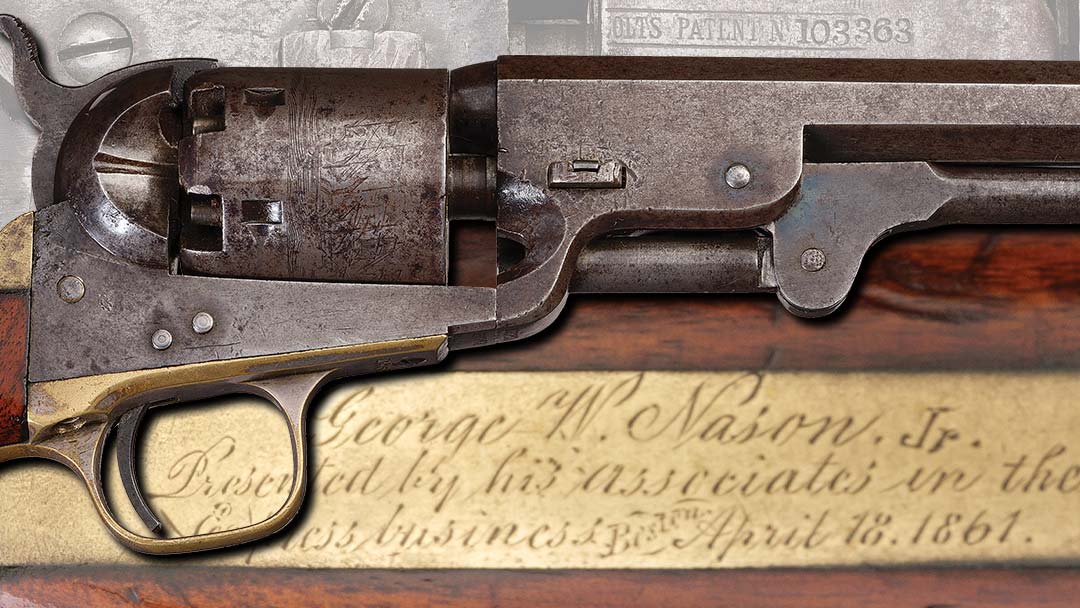
The Colt 1851 Navy example featured below was shipped to Colt’s New York City office on April 15, 1861, three days after the Confederate attack on Fort Sumter and on the same day President Lincoln issued his call for 75,000 state militia troops to suppress the southern rebellion. The revolver’s back strap is inscribed “George W. Nason, Jr./Presented by his associates in the/Express business Boston April 18, 1861”.

The presentation of this historic Colt 1851 Navy is documented in “The Fifth Regiment Massachusetts Volunteer Infantry in Its Three Tours of Duty, 1861, 1862-63, and 1864” by Alfred S. Roe. On page 22, in the section on Company I (Somerville), the book describes in detail how on Saturday, April 20, 1861, “Geo. W. Nason, Jr., a Franklin man, still a member of the company, delivery clerk for the Fiske & Co.’s Express, was presented with a silver-mounted Colts revolver.”

George Warren Nason Jr. was among the “Minute Men of ’61,” the Massachusetts volunteers who heeded Lincoln’s “First Call”, set out for Washington, D.C., and officially mustered into federal service on May 1, 1861. Nason was wounded and captured at the First Battle of Bull Run. He escaped and rejoined his regiment, enlisted on the Union gunboat Huzza, and was wounded again while serving the starboard cannon during the Battle of Roanoke Island in early February, 1862. He was wounded a third time on March 14, 1863, at New Bern, North Carolina. Later in life, Colonel George Warren Nason Jr. would go on to become President of the Association of Minute Men of ’61.

A documented Colt 1851 Navy revolver with an April 18, 1861 dated presentation inscription to George W. Nason Jr. of the “Minute Men of ’61”. Available this August.

The Colt 1860 Army

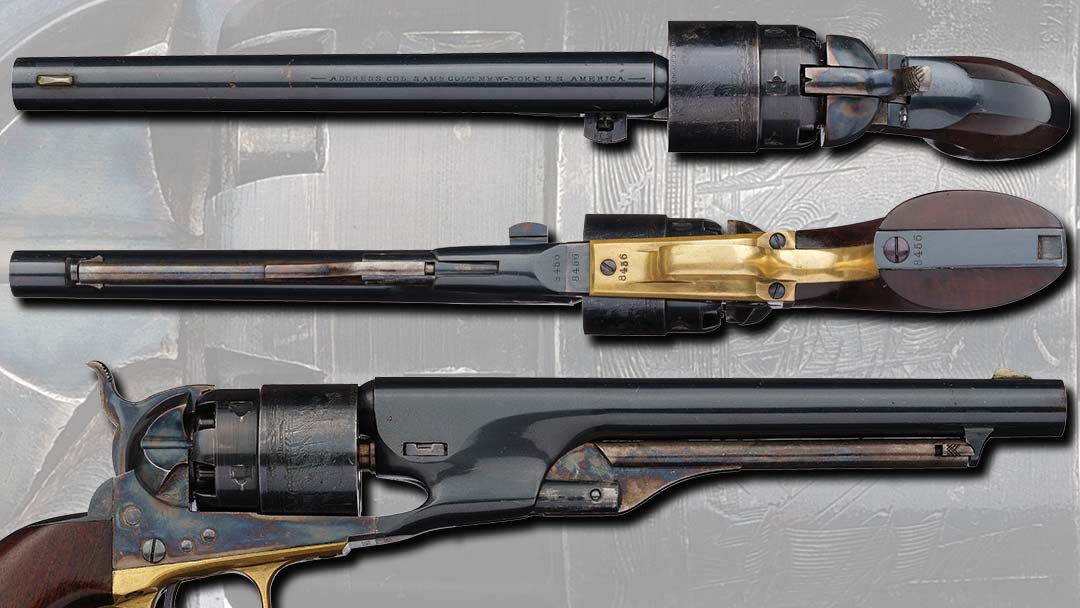
While the Colt 1851 Navy served as an efficient medium sized pistol during the Civil War, Colt developed a revolver suited to a .44 caliber conical bullet, the Model 1860 Army. Based on the same frame as its 1851 Navy counterpart, the 1860 Army employs a longer, rebated cylinder, a larger cylinder pin, and a shorter forcing cone on the barrel.

An early Civil War production U.S. contract Colt Model 1860 Army revolver in nearly factory new condition. Available this August.

The Colt Model 1860 Army became the primary issued revolver of the Civil War, with nearly 130,000 purchased by the U.S. Ordnance Department before a factory fire in February 1864. More than 200,000 revolvers were manufactured in total between 1860 and 1871.

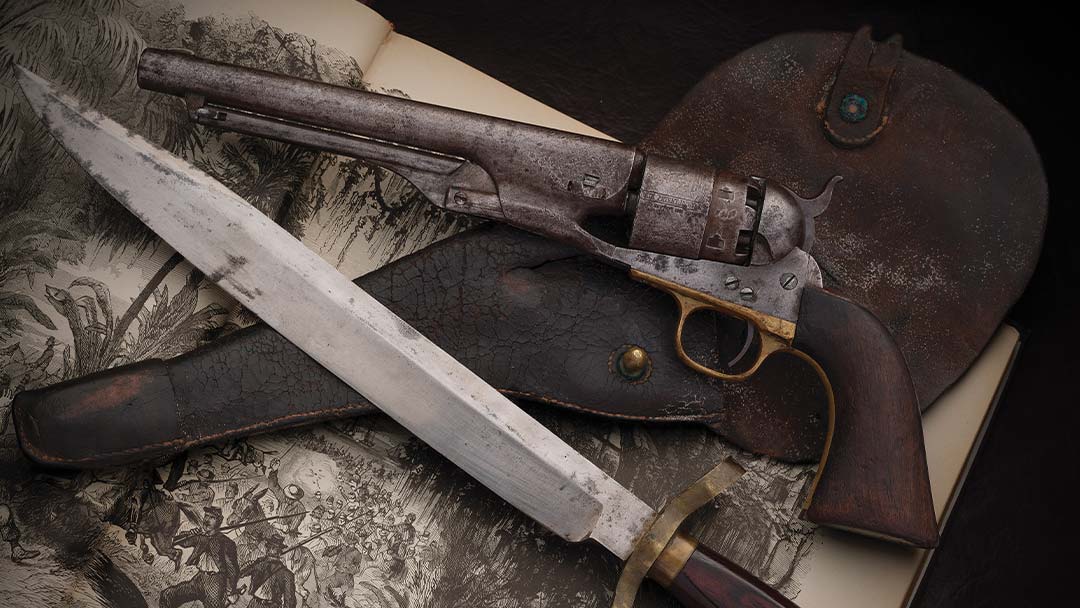
A historic Civil War U.S. contract Colt Model 1860 revolver with holster identified as owned by Texas Confederate Trooper G.W. Cloud. Available this August.

The Colt 1861 Navy

The Colt Model 1861 Navy revolver, officially called the “New Model Navy or Belt pistol,” represented a streamlined version of its 1851 predecessor. Though produced in only a fraction of the number of its Army counterpart, the Colt 1861 Navy was still a prevalent Civil War revolver, with many being privately purchased by troops. Out of the 38,864 Colt 1861 Navy revolvers produced, fewer than 1,300 are estimated to still survive, with high-condition examples being exceedingly scarce.

An outstanding commercial Colt 1861 Navy revolver with a blade front sight with a dovetailed German silver base. Available this August.

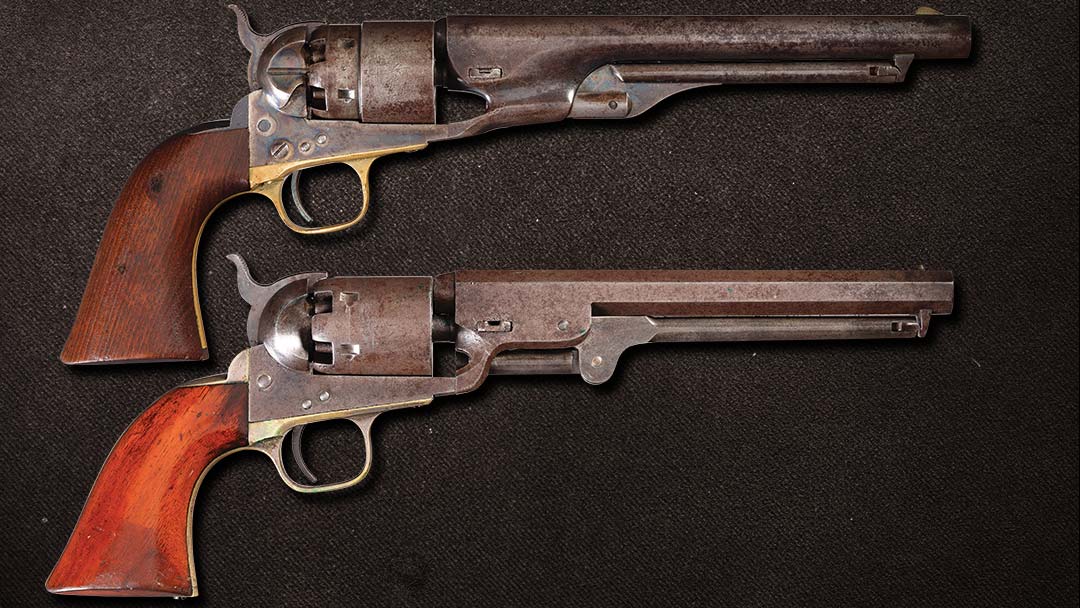
Both the Colt 1860 Army and 1861 Navy feature the Battle of Campeche roll engraving and share many other similarities. Differences include the Army’s large grips, more rounded lines, and its .44 caliber compared to the 1861 Navy’s .36 caliber. The Colt 1861 Navy revolver is slightly heavier at 2.6 pounds compared to the Army’s 2.11 pound weight, and the Army’s barrel is 8 inches as opposed to the Navy’s 7 1/2 inch length.

A Colt 1860 Army (top) and a Colt 1861 Navy (bottom.)

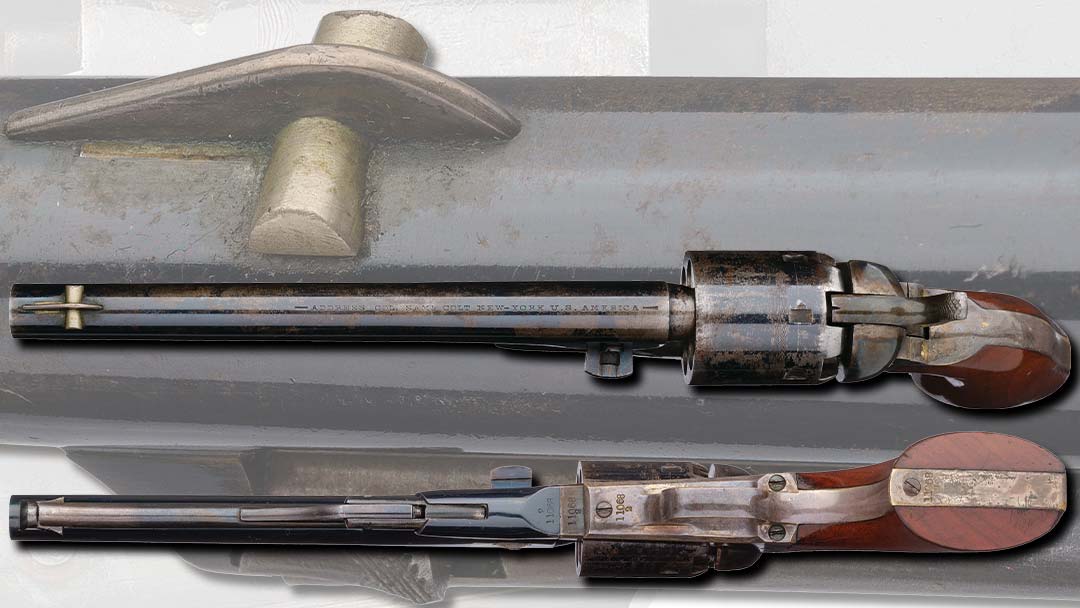
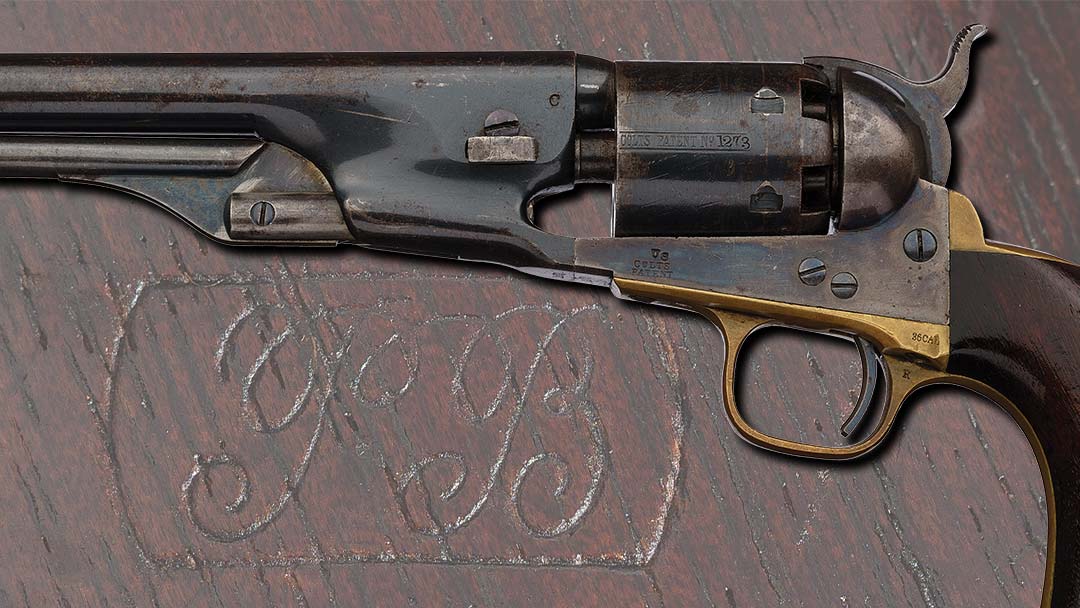
After U.S. Contract Walker Colt revolvers, U.S. Contract 1861 Navy revolvers are the rarest U.S. martial Colt percussion handguns. The exceptional example below was part of a 2,000 gun contract with the U.S. Ordnance Department, signed on April 13, 1861. Although the Ordnance Department subsequently purchased 363 additional Model 1861 Navy revolvers from Colt distributors, the 2,000 pistols purchased under the April 1861 contract were the only Ordnance inspected, military finished Model 1861 Navy revolvers manufactured by Colt during the Civil War.

An exceptional U.S. inspected Civil War Colt Model 1861 Navy revolver for sale this August.

Legacy of the Colt Navy Revolver

The Colt 1851 Navy remained a popular revolver after the Civil War. Some were used by early police departments, and the Colt Navy saw extensive use out West with outlaws, Texas Rangers, and frontier lawmen like Wild Bill Hickok, who famously carried a pair of engraved Navies with ivory grips.

Most revolvers claiming an attribution to Wild Bill Hickok can be quickly dismissed as “fanciful talk.” So when one is offered to the public, formerly housed in the Cody Firearms Museum, is likely a factory mate to that gun, was manufactured in the appropriate timeframe, has faced the scrutiny of numerous historians and experts, and possesses all the correct physical features – the competition to own it was going to be heated.

Production of the Colt 1851 Navy continued until 1873. With more than 215,000 produced in the United States and 42,000 in London, the 1851 Navy became the second most produced Colt percussion revolver. In its final years, sales slowed to a trickle as new revolver models designed for self-contained ammunition and cartridge conversion options were introduced.

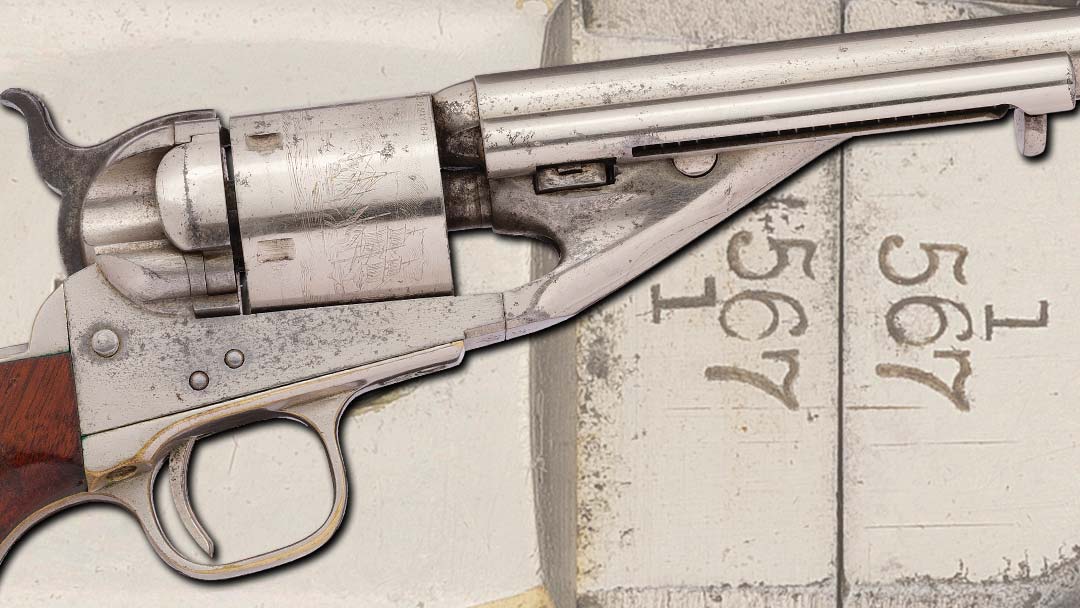
An exceptional, nickel finished Colt Model 1861/72 Navy Richards-Mason conversion revolver with a tooled leather Slim Jim holster. Available this August.

Colt Navy Revolver for Sale

From the Civil War battlefield to the frontier streets of the Old West, the Colt 1851 Navy revolver saw plenty of action throughout its 22-year production run. Owning one of these iconic sixguns is an aspiration of every Colt collector and 19th century arms enthusiast, and some of the rarest and high condition examples can be found at Rock Island Auction Company.

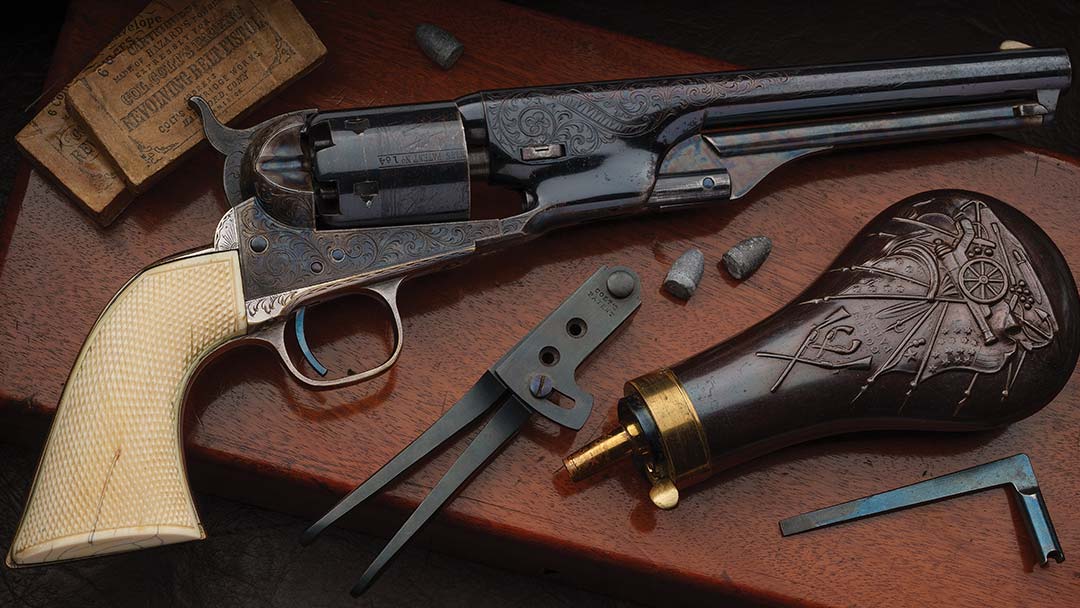
An excellent cased factory vine scroll engraved, checkered grip Colt Model 1861 Navy revolver for sale this August.

Sign up for the Rock Island Auction Company’s weekly newsletter for new gun videos and gun blogs that cover the full gamut of Civil War and Wild West revolvers. From the Colt 1855 Root revolver, the Colt revolving rifle, the Colt Cloverleaf pistol, the Colt SAA, the Colt Lightning, the LeMat revolver, the Remington 1875, the Merwin Hulbert, the S&W Model No. 3, the S&W Schofield, the S&W Model 320 revolving rifle, we cover classic revolvers in every form.

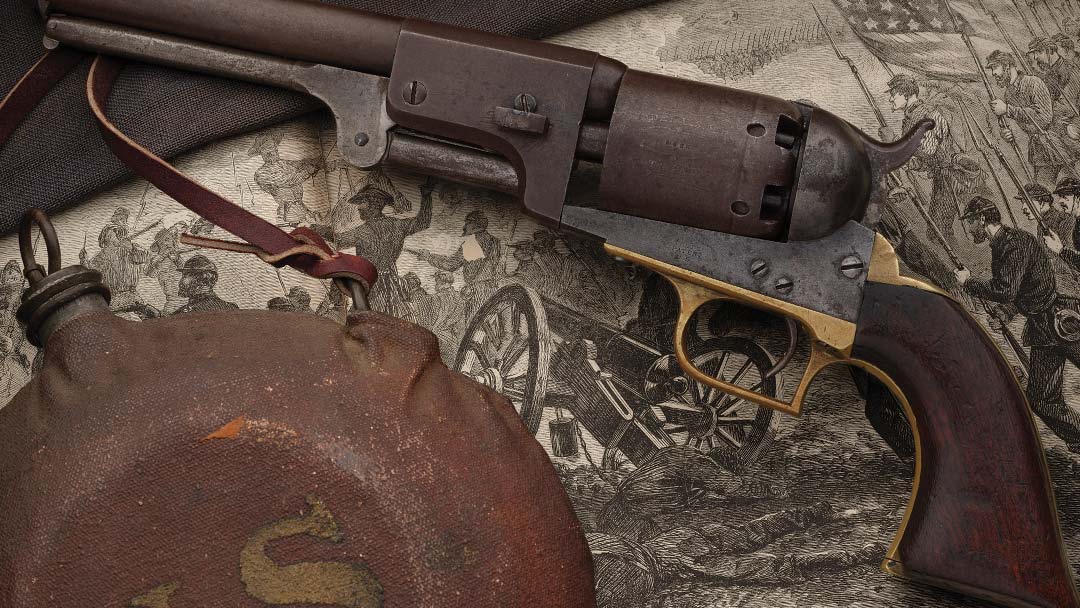
A documented U.S. Colt “Second Contract” First Model Dragoon revolver identified as used by Brevet First Lieutenant Jonathan V. Morgan of Pennsylvania during the Civil War. A period canteen with 1st Regiment of Massachusetts Volunteer Militia markings is also included in the lot. Available this August.

An Unconquerable Singer M1911A1 | Rock Island Auction

0

The same day Allied troops stormed the beaches of Normandy, Lt. Thomas R. Moss strained against the controls of his B-24 — named “Invictus” by his wife Margie — during a raid on the oil refineries of Ploesti, Romania.

While Allied forces fought to overpower the defenses of “Fortress Europe,” Moss’s Invictus and the rest of his B-24 Liberator squadron of the 461st Bombardment Group of the 15th Air Force again tried to flatten Ploesti’s refineries in hopes of starving the Third Reich of fuel. Missions to heavily-defended Ploesti claimed more than 200 B-24 Liberators and more than 2,000 crewmen during the war.

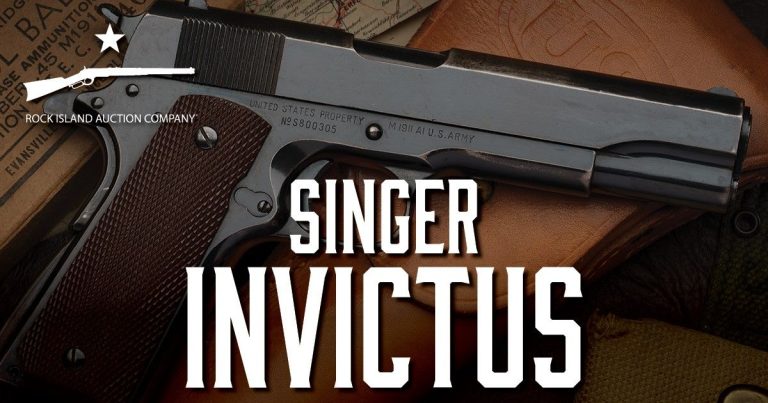
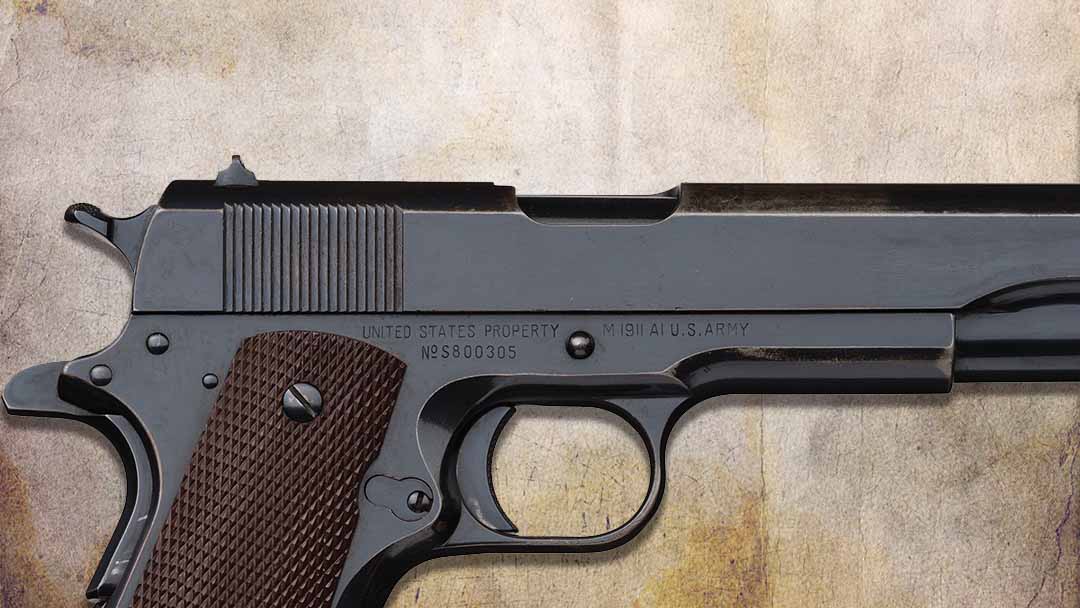
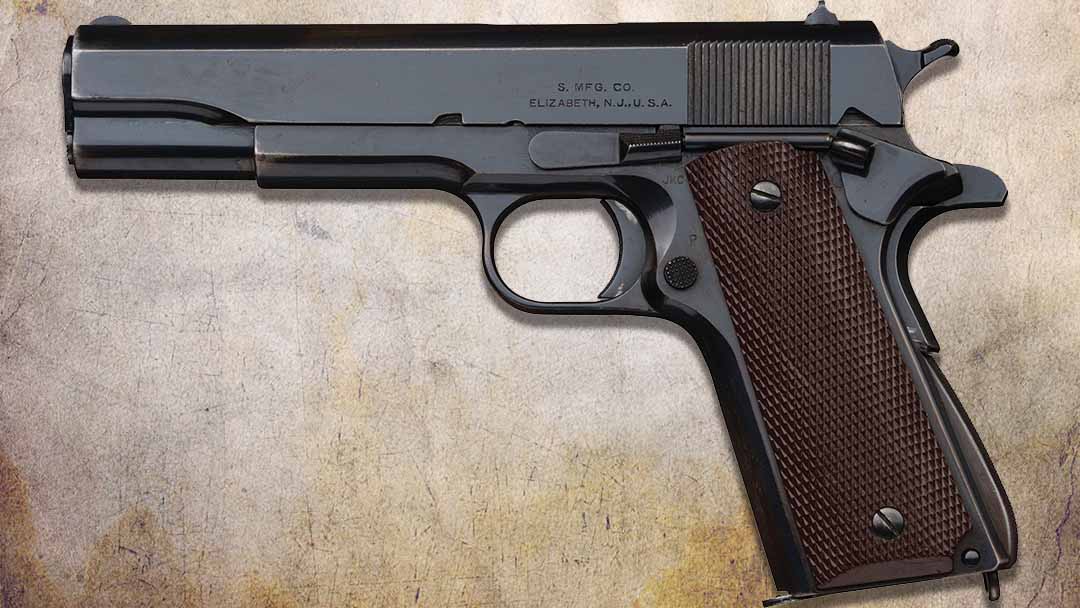
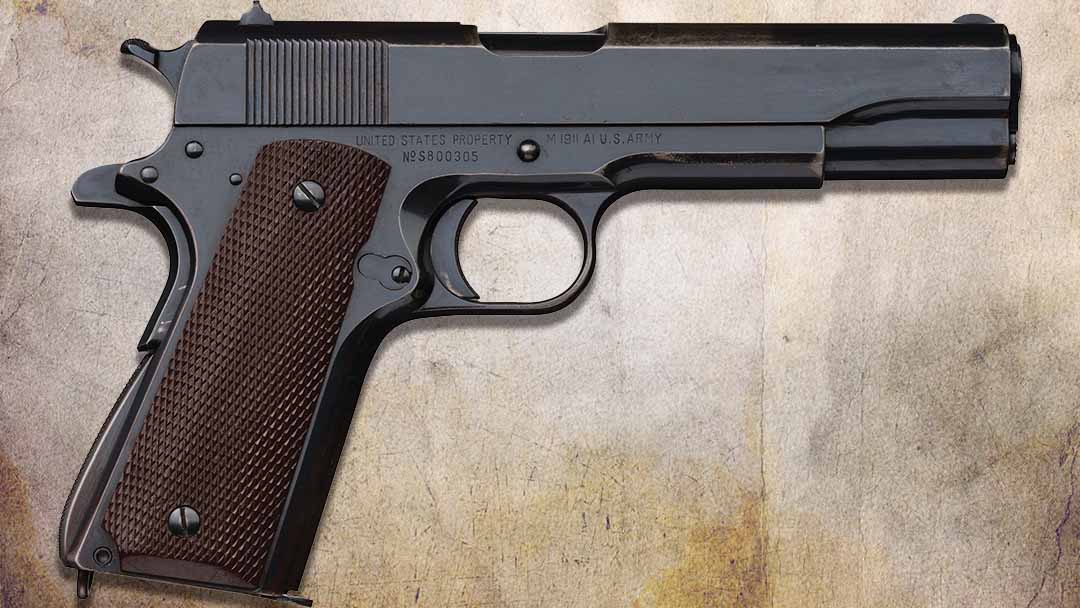
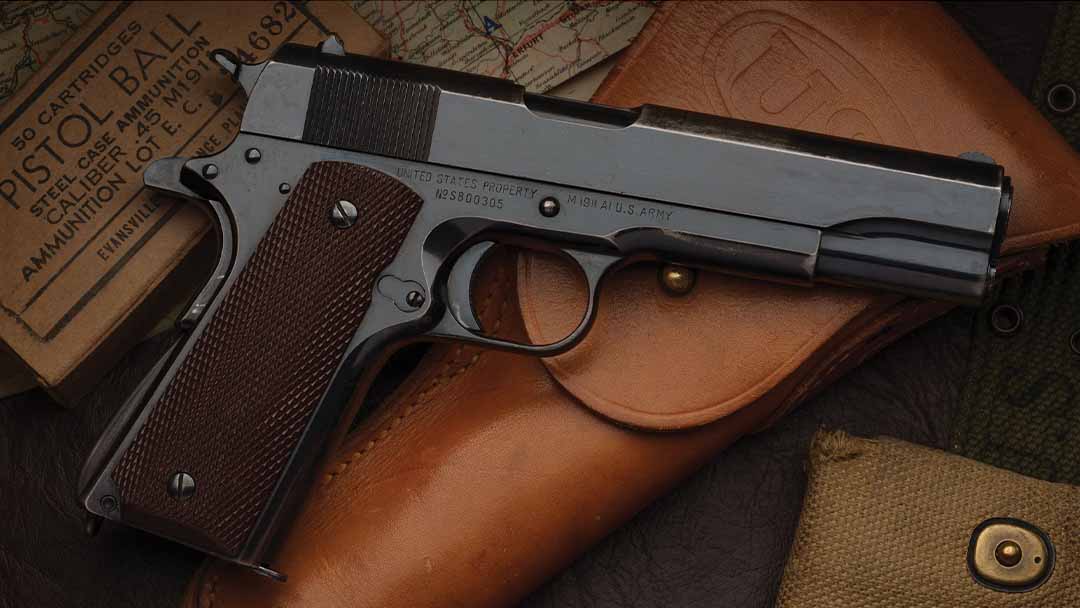
The Invictus Singer, a rare Singer M1911A1 carried by Thomas Moss, pilot of the Invictus, a B-24 Liberator, on 35 missions in World War 2.

During the attack the Invictus lost an engine supercharger, making the already lumbering Liberator that much harder to control. Moss fought to maintain control and speed, in hopes of making it to Italy or at least Yugoslavia where if they had to bail out or crash land the crew might be taken in by partisans. Would he have to use the Singer Model 1911A1 he carried to stay alive in order to get back to Margie? For Moss the gun served as a tool for personal defense, but 80 years later, the rare firearm has become a highly-desired firearm among collectors.

Moss ordered his crew to jettison the B-24’s guns and other equipment to lighten the plane to keep up with the squadron’s protective formation. Away from the target, the Invictus broke formation and limped its way across the Adriatic Sea, landing at Foggia, Italy with only fumes left in the fuel tanks. The crew refueled the Invictus and the hobbled B-24 bomber made its way back to its home base at Torretta, Italy.

Moss, with the Singer 1911A1 as his sidearm, flew 13 more missions before completing his tour with his 35th on July 8, 1944. Moss’s pistol, nicknamed the “Invictus Singer” and carried on every one of his bombing runs over Yugoslavia, Romania, France, Italy, Austria, Hungary and Germany is available on Day Two of Rock Island Auction Company’s Aug. 23-25 Premier Auction. The gun, one of 500 made by Singer was kept by Moss until 2018, and still shines with 80 percent of its original blue finish. Moss died in 2020 at the age of 99.

Who Is B-24 Liberator Pilot Thomas R. Moss?

Moss was the son of musician parents, born in Spokane, Wash., but grew up in and around Baltimore and Washington, D.C. A student at Johns Hopkins University where he was in the engineering ROTC program when the Japanese bombed Pearl Harbor, Moss decided to control how he fought in the war. At an Army recruiting office he took the aviation cadet examination and passed, so he left college and entered the U.S. Army.

He recalled the decision he and a friend made to take the flight cadet test in a video interview in the Library of Congress, saying “If we don’t do something first, they’ll do it for us.”

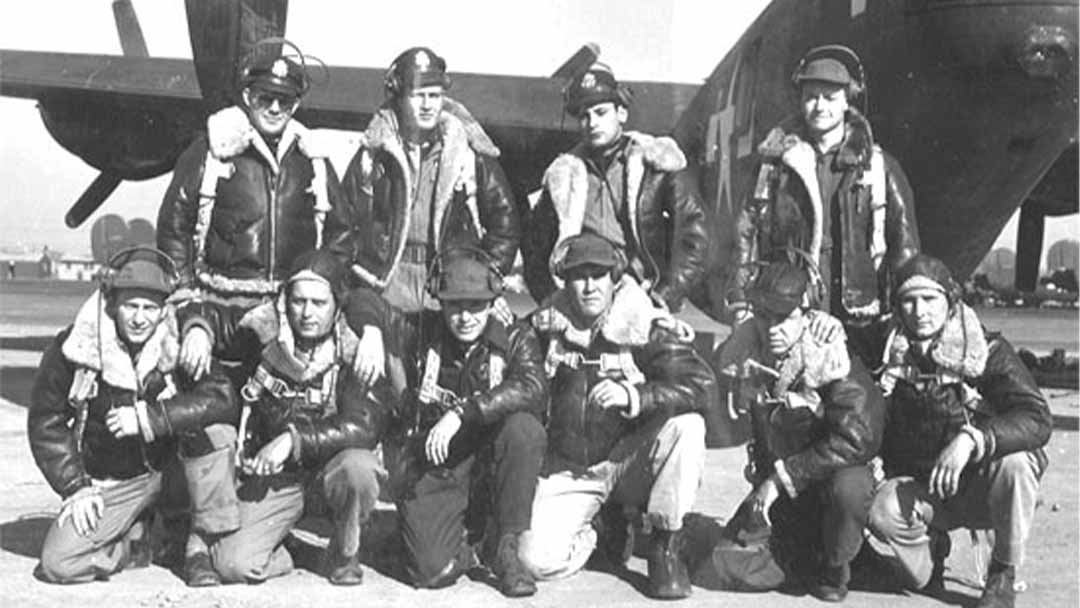
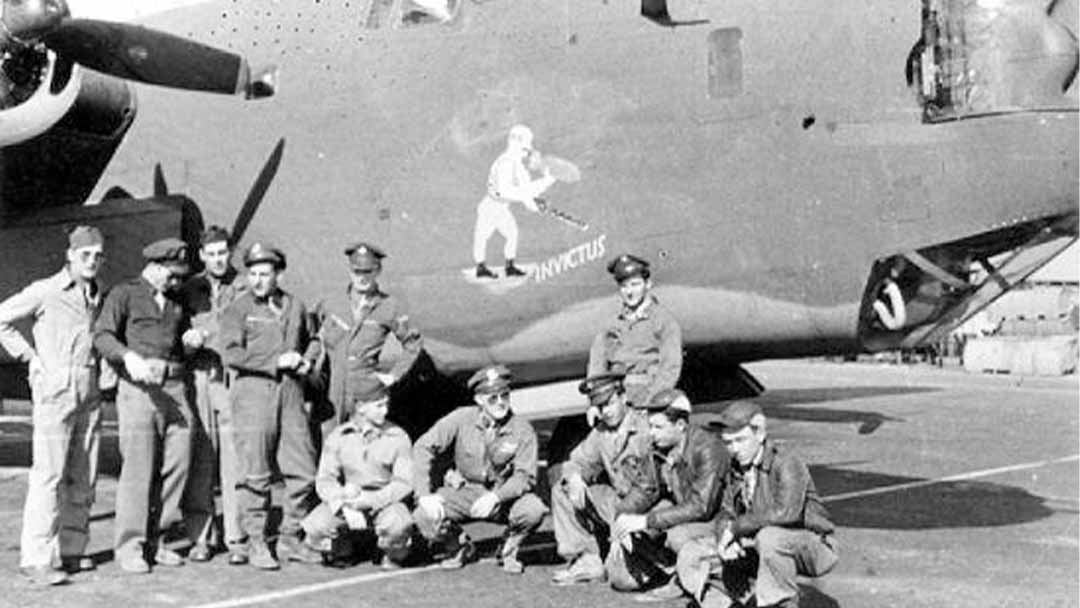
The Crew of the B-24 Liberator, “Invictus.” The rare Singer M1911A1 carried on 35 missions by pilot Thomas R. Moss is available in RIAC’s Aug. 23-25 Premier Auction. Moss is standing at left.

He started training at Maxwell Field in Montgomery, Ala., before pre-flight training at Douglas, Ga., where he learned flying on biplanes. He returned to Montgomery for further basic training before transferring to Blytheville, Ark., for advanced flight training, flying the A-20 Havoc light bomber. Perhaps the biggest day of Moss’s life was March 25, 1943 when he was commissioned in the Army Air Force and married Margie, his high school sweetheart.

Moss bounced from several assignments, even flying B-17 bombers for a few weeks before being assigned to fly the B-24 Liberator despite a minor protest. “I said, I don’t know how to fly the B-24. They said, `you will;’ and I did.”

After training on the B-24s for a few months in northern California, Moss, piloting the Invictus, headed east with the 765th Bomber Squadron to Florida. The unit transited across the Atlantic via Brazil and North Africa before arriving in Italy in early 1944. When he was issued his rare Singer sidearm isn’t known.

The first of Moss’s and the Invictus’ 35 missions was on a railyard in Bihac, Yugoslavia. Two Liberators collided in mid-air and were lost. With one mission completed, the 461st Bombardment Group “set out to let the “Jerries” know that the organization with the painted cowlings was over here strictly for business; and that business was complete destruction of the enemy,” according to the squadron history.

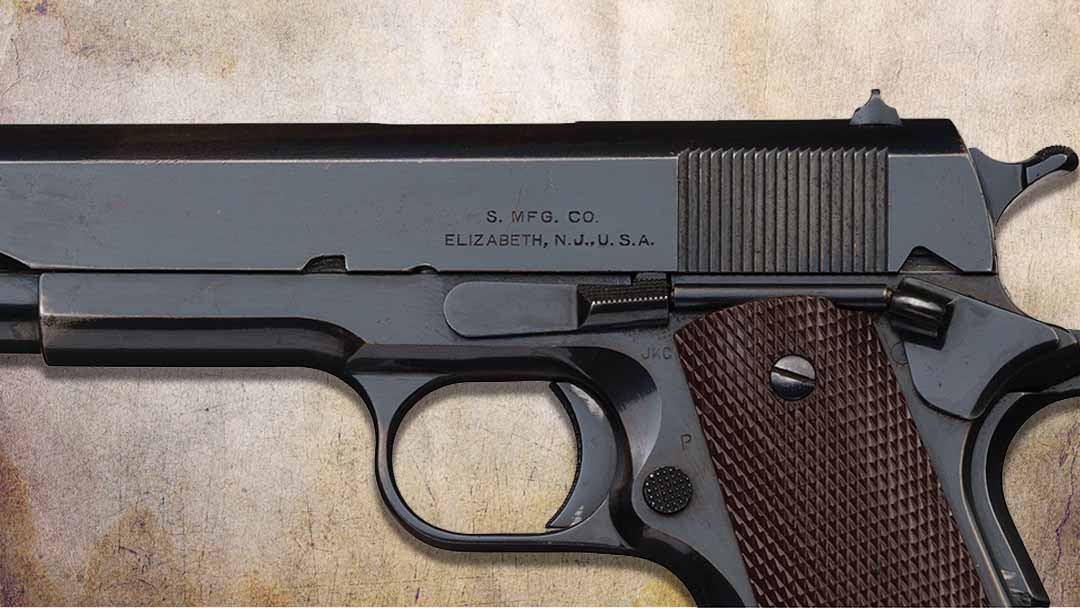
A closeup of the left side of this Singer M1911A1 shows the “S. MFG. CO./ELIZABETH, N.J. ,U.S.A.” address. This pistol was carried on 35 missions during World War 2 by pilot Thomas R. Moss on the B-24 Liberator “Invictus.”

Flying with the 765th Bomber Squadron

Flying out of Italy could be dangerous at takeoff since airfields were located so close together along the Adriatic coast. The airbase at Torretta certainly wasn’t a tourist destination, with ragged-looking tents and hard scrabble buildings.

Moss and the Invictus, Latin for “unconquered,” flew 12 of the 765th’s 20 combat missions in May 1944 when the 461st Bombardment Group was rated first in the 15th Air Force in bomb hits within 1,000 feet of the target.  June was slower with only 10 combat missions flown by the 765th due to poor weather conditions in southern Europe and the Balkans regions.

The 765th and the Invictus made their first raid into Germany on June 9, bombing industrial targets in Munich. On that raid to Munich, the Invictus held its own in the air as the ball turret gunner Staff Sgt. Peter Drezek claimed a probable kill of a Messerschmitt as it was last seen smoking as it plummeted to earth.

In July, Moss and Invictus flew five missions before he and Drezek, the ball turret gunner, reached 51 mission points. Moss’s final two missions were against a synthetic oil refinery at Blechhammer, Germany and Korneuburg, Austria. Anti-aircraft fire over both targets was heavy but all the squadron’s ships returned safely.

The crew of the B-24 Liberator “Invictus” during training before heading to Europe. Pilot Thomas R. Moss who carried a Singer M1911A1 on 35 missions during World War 2 is squating second from left with his crew. “Invictus” was named by Moss’s wife Margie. A circle around the nose art was added after the plane arrived in Europe. Invictus is Latin for “unconquerable” or “undefeated.” The Singer M1911A1 is available in RIAC’s Aug. 23-25 Premier Auction.

The B-24 Liberator and Ploesti Oil Fields

Romania’s oil fields and the refineries at Ploesti were vital to Germany, supplying 60 percent of the Third Reich’s crude oil and making them a crucially vital target for American bombers. Ploesti bristled with anti-aircraft batteries, and squadrons of fighters laid in wait. The first bombing mission to Ploesti on Aug. 1, 1943 was a disaster, with the loss of 52 aircraft, 310 American airmen killed 130 wounded and 100 captured.

That Mission, Operation Tidal Wave, went against U.S. Army Air Forces policy and attempted low-level bombing from less than 1,000 feet. Taking off from Benghazi, Libya, 1,200 miles from the target, a force of 178 Liberators made their way to Ploesti, maintaining strict radio silence. It didn’t matter because the Germans were ready.

The 88mm anti-aircraft guns boomed and smoke generators created confusion over the targets. Barrage balloons protected valuable assets. Fighters awaited. The American bombers suffered navigational errors and formations didn’t arrive on target at the same time. The Americans didn’t strike the blow they had hoped. Within weeks, through the use of forced labor, the refineries were back at full capacity.

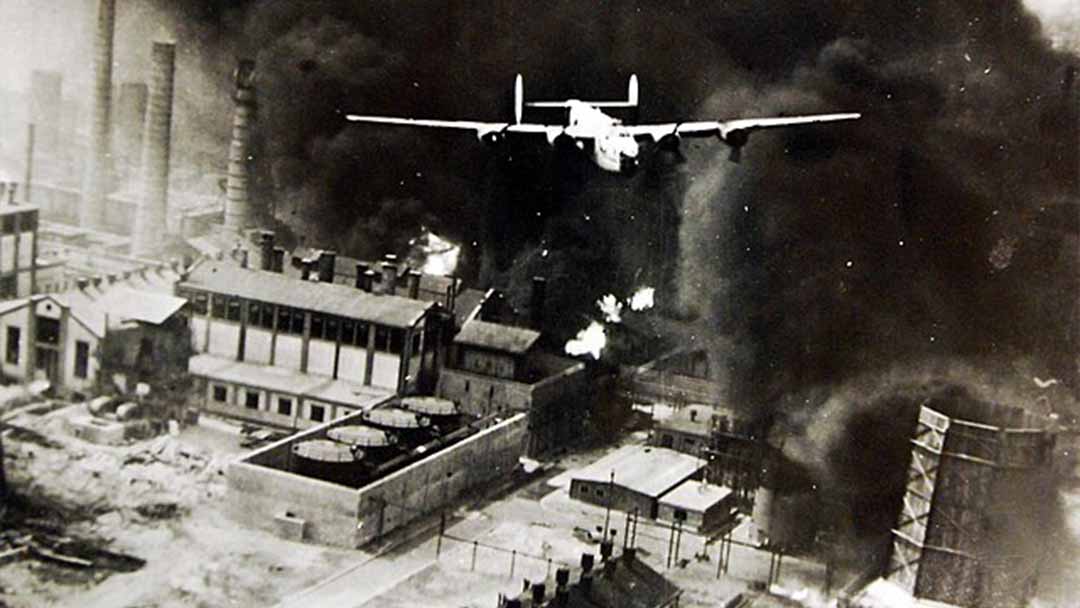
A B-24 Liberator makes a bombing run during the disasterous Operation Tidal Wave on Aug. 1, 1943. The Singer M1911A1 of Liberator pilot Thomas Moss who flew two later missions over Ploesti is available in Rock Island Auction Company’s Aug. 23-25 Premier Auction.

Attacks on Ploesti didn’t resume until April, 1944, by that time, the Army had air bases in Italy, making the distance shorter for the bombers. Moss and the Invictus flew their first raid against Ploesti on May 31.

“We had to get rid of Ploesti,” Moss said in the Library of Congress interview. “When we would walk into the briefing room, the briefing officer would pull the blankets down (from the mission map); there was that line going from our place straight east almost to Ploesti. I thought, he we go again. We had to get rid of Ploesti, it was just bad news to go to Ploesti.”

Enemy fighters were spotted but reportedly none engaged on the May 31 raid. Anti-aircraft fire was heavy and many of the Liberators of the 765th were damaged, but only one plane was lost on the mission.

Moss and the Invictus made one more raid over Ploesti, the eventful June 6 mission that earned him the Distinguished Flying Cross. The squadron report listed heavy, accurate and intense anti-aircraft fire that again left many of the planes damaged, though all 10 of the squadron’s planes returned safely, including the limping Invictus.

A closeup look at the “Invictus” Singer M1911A1 carried on 35 missions during World War 2 by B-24 Liberator pilot Thomas R. Moss that is available in Rock Island Auction Company’s Aug. 23-25 Premier Auction.

Thomas Moss after Invictus

Moss recorded 279 hours of flight time at the controls of the Invictus. Of the 35 missions Invictus flew, 16 were considered more hazardous and crews received double credit, so Moss earned 51 mission points. After completing his tour, he continued as a B-24 instructor as well as for the C-54, a four-engine cargo plane. He also flew for Transcom, Air Transport Command that ferried cargo and troops.

He remained in the Army as the world settled into the Cold War, and by 1948 he was on the front line of that simmering conflict. At the end of World War 2, the Allies divided Germany into four occupation zones, with the Soviet Union controlling the east-most zone that contained the German capital of Berlin that was likewise divided. As the relationship between the western Allies and their one-time ally broke down, concern was whether Berlin’s sections controlled by the U.S., Great Britain and France would continue under their control.

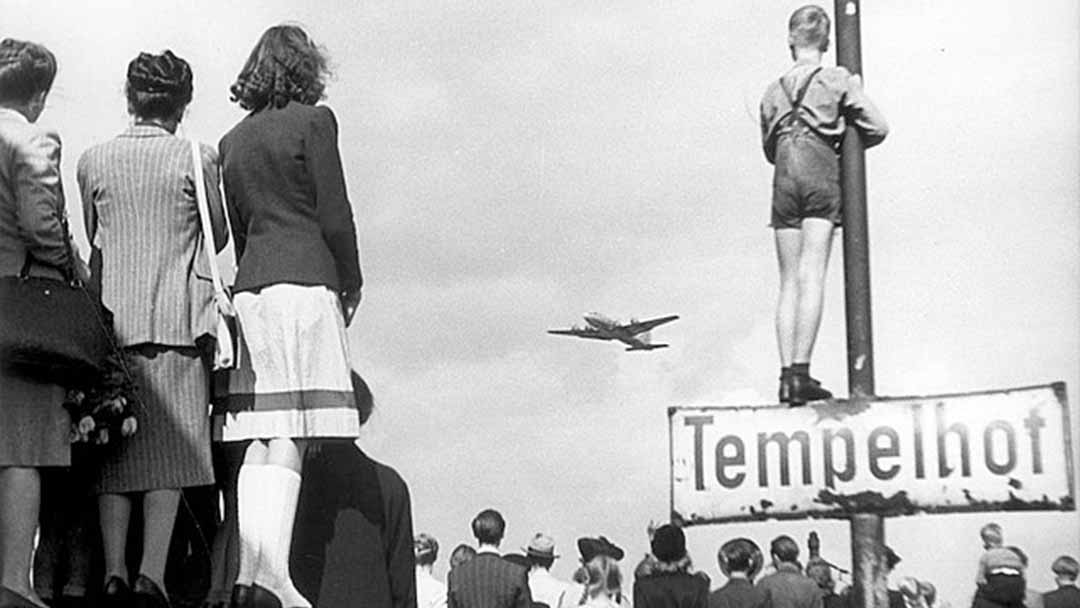
After his time flying B-24 Liberators, U.S. Army Air Forces pilot Thomas R. Moss also flew a cargo plane during the Berlin Airlift.” Berlin residents watch an airlift plane landing at Temelhof Airport that was the center of the airlift.

On June 24, 1948, the Soviets blockaded rail, road and water access to the Allied-controlled part of Berlin. The Allies started airlifting food and fuel to Berlin, putting Moss at the controls of a C-54, hauling 8,000 lbs. of coal per flight. At the height of the airlift, a plane landed every 45 seconds at Berlin’s Tempelhof Airport. The airlift delivered supplies for nearly a year, from June 16, 1948 to May 11, 1949, shortly after the creation of the North Atlantic Treaty Organization (NATO).

After more than 20 years of service, Moss retired as a lieutenant colonel in 1964.  He continued working in the air industry, training flight engineers on the DC-10 for United Airline, McDonnell Douglas and others. He logged over 60,000 hours of flight time in his career. His 63-year love story with Margie, who named the Invictus, ended with her death in 2006.

The “Invictus” Singer M1911A1 carried by Thomas R. Moss on 35 missions as pilot of the B-24 Liberator “Invictus.” This is one of 500 manufactured by Singer Sewing Machine Company.

The Singer M1911A1

Singer Sewing Machine Company was a global leader in sewing machine manufacturing and during World War 1 the company’s factories were converted for wartime production, making armaments, ammunition and parts. In 1939, Singer and other companies were invited to participate in a production study of the M1911A1 and bid on educational orders. Selected, Singer was to produce 500 pistols along with the necessary tooling, fixtures and machines and patterns for mass production for $278,875.67, or $538 per gun.

Singer completed its order of 500 pistols in December, 1941 but couldn’t achieve the 100 pistols/day production level wanted. During World War 2, the production run of 500 pistols were reportedly issued to flyers like Moss. Given that airmen suffered high casualty rates, it’s hard to tell how many Singer M1911A1 pistols remain.

The equipment and tooling Singer used to manufacture the 500-pistol run was shipped to Remington Rand. Singer went on to contribute to the war effort by producing highly-precise aviation components, for the Sperry T-1 bomb sight, B-29 bomber gunfire control computers, directional gyroscopes, artificial horizon instruments, and automatic pilot systems.

The “Invictus” Singer M1911A1 carried by Thomas R. Moss on 35 missions as pilot of the B-24 Liberator “Invictus.” This is one of 500 manufactured by Singer Sewing Machine Company.

The Invictus Singer M1911A1

This magnificent Singer M1911A1 conjoins immense history, high condition and rock solid provenance. Carried on 35 B-24 Liberator missions by pilot Thomas R. Moss over Axis-controlled Europe and held in his possession until 2018, this is a spectacular firearm that would easily be the cornerstone of any collection of World War 2 firearms or M1911 pistols, and it is available in Rock Island Auction Company’s Aug. 23-25 Premier Auction in Bedford, Texas.

A final look at the “Invictus” Singer M1911A1 carried by Thomas R. Moss on 35 missions as pilot of the B-24 Liberator “Invictus.” This is one of 500 pistols manufactured by Singer Sewing Machine Company.

Review: Kizer Banish with Nitro-V Steel

0

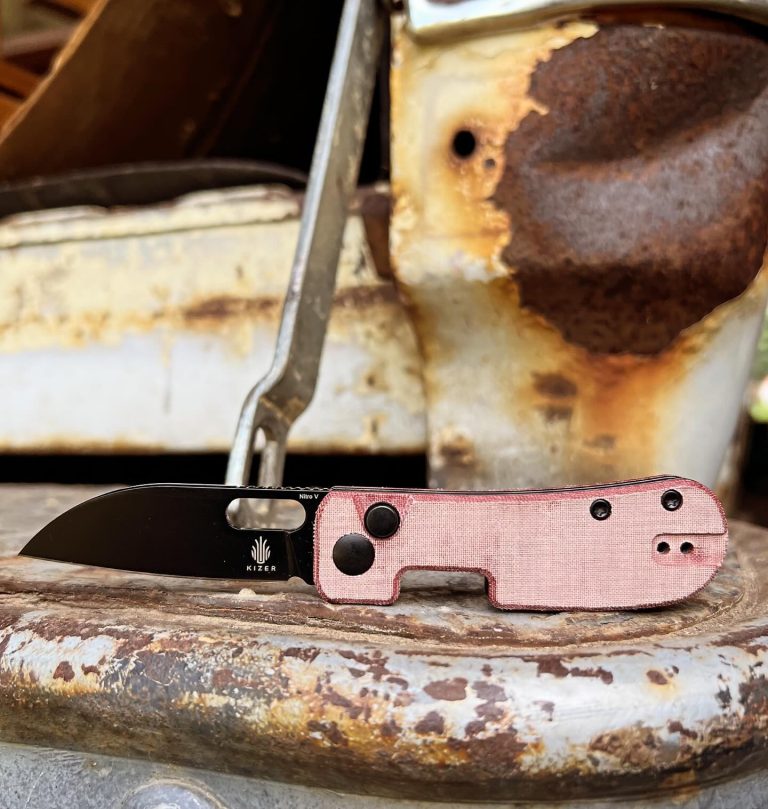
The Jacob Lundquist designed Kizer Banish has been available for a while now. Kizer recently introduced multiple new versions of this excellent fifth pocket knife with new Nitro-V steel, new handle scale options, and an even more affordable price. If you like small, useful EDC folders… tune in. This is a great one.

Specs

  • Overall Length: 5.4″/137.1mm
  • Designer: Jacob Lundquist
  • Opener: Thumb Hole, Front Flipper
  • Blade Style: Sheepsfoot
  • Blade Length: 2.30″/58.5mm
  • Blade Thickness: 0.098″/2.5mm
  • Blade Material: Nitro V
  • Handle Length: 3.09″/78.6mm
  • Handle Material: Various
  • Pocket Clip: Deep Carry, Reversible
  • Weight: 2.01oz/57.1g
  • Lock Type: Button Lock
  • Hardness: 61.5-62

Observations from Use

Anyone can design a small knife but not everyone can make one that is easy to live with. Small knives can be very hard to open, close, or even hold effectively when you have adult-sized hands. This is where the Banish shines – it makes everything easy.

It’s easy to open and close. The button lock makes both opening and closing easy. It’s the perfect lock choice for a small knife like this. The proportionally large blade opening hole, and relief cut/finger groove to provide access, means this knife can easily be flicked open with a thumb or middle finger. Additionally, the front flipper works shockingly well on this knife.

It’s easy to grip. The most stylish visual element of the Banish (and other well known other Lundquist designs) is the swayback design. This isn’t all for looks though. The shape, coupled with the pronounced finger groove, serves to lock this little knife into your grip in a surprising way. It’s perfect for the sort of quick, little cuts you might make with an EDC-oriented knife like this.

It’s easy to, you know, cut stuff with. The Banish has a super-slicey, thin sheepsfoot-shaped blade. This means you have plenty of cutting leverage and an easy-to-access, needle-sharp point. It’s exactly what you want in an EDC knife that is well-suited to use as a secondary knife.

It’s easy on your wallet. These are $42. That’s amazing when many of the other small knives that work as well as this one are $50 or more.

It’s easy to decide on a handle scales options. Maybe… but maybe not. The Banish is available with a variety of options but Kizer’s red linen micarta is so, so good. It offers plenty of grip without being aggressive. It also looks great, starting out looking brown/tan and gradually darkening into a rich red-brown with use.

Wrap Up

As you likely know by now (because it seems like I mention it in every one of these compact knife reviews), I frequently carry a fixed-blade knife. So, I am always on the lookout for a great small folder to carry as a “Public Knife”. The Kizer Banish is PERFECT in this role. It’s a top-tier compact folder that oozes style and it’s an incredible value. I think it goes on the Rushmore of fifth-pocket knives.

I also want to mention that my daughters love this knife. It is small enough to fit the pockets in lady’s pants, easy for them to operate (even the front flipper), and I like that the lock is “finger safe” since they are still learning to be confident with knife safety. This would make a great gift.

Kizer Banish on Kizer.com

Kizer Banish on Amazon.com

The above links may be affiliate links. Thank you for Kizer for providing this review sample.

Review: Vosteed Mini Nightshade Titanium and S35VN

0

If you have been following JTT for a while, you’ll know that the Mini Nightshade isn’t just one of my favorite Vosteed designs, it is one of my favorite knives. The Nightshade, with its unique and useful Shilin Cutter shape, is what put Vosteed on my radar and I have been carrying one version or another of this knife for a while now. Now, I have my mitts on one of the most premium versions to date.

Specs

Blade Length: 2.60″ | 66.04 mm

Overall Length: 6.32″ | 160.53 mm

Blade Width: 1.13″ | 28.70 mm

Blade Thickness: 0.098″ | 2.49 mm

Blade Material: S35VN

Blade Grind: Flat

Blade Style: Shilin Cutter

Hardness: HRC 60±2

Handle Length: 3.71″ | 94.33 mm

Handle Width: 0.89″ | 22.60 mm

Handle Thickness: 0.437″ | 11.10 mm

Handle Material: Titanium

Weight: 2.59 oz | 73.40 g

Opener: Thumb Stud

Lock Type: Crossbar Lock

Pivot Assembly: Caged Ceramic Ball Bearing

Pocket Clip: Reversible | Stainless Steel

Carry Position: Tip-up

Observations from Use

To me, the Mini Nightshade is all about performance and the performance is all about that blade! Do you want a knife that gives you easy access to a fine, useable tip? It does. Do you want thin blade stock that tapers to a thin, incredibly sharp and slicey edge via a full flat grind? It does. Do you want a shape that holds the material in the cut and has plenty of belly? It does.

These knives CUT!

They also manage to pack that performance into a very compact package. The Mini Nightshade is small enough to pull fifth pocket duty but large enough for a medium size hand to get all four fingers on the grip. It also happens to be a very slim design. It’s a Goldilocks size.

I also want to point out the weight. These knives are incredibly lightweight due to the partial liners and thin blade stock. This is the heaviest version yet and it is still well under 3 ounces at 2.6 ounces. Saying that “you’ll forget you are carrying it is a cliche”, but I genuinely have.

This is also the most premium version of this knife to date. It features sculpted titanium scales that are radiused for comfort and have a very attractive scalloped texture pattern. Vosteed also went premium with the blade steel. CPM S35VN is a great choice here as it can take a fine edge and has solid toughness to support the thin cutting geometry. It’s a great premium, powdered metallurgy option for this knife. While it isn’t a heavy knife by any stretch, it has a solid heft in the hand for such a compact knife.

Wrap Up

This is my favorite version of one of my favorite knives. The most important thing a knife must do is cut… and Vosteed goes all out with cutting performance on these knives. Secondly, you want a knife that is easy to live with and this is definitely that with it’s slim, lightweight design.

See full specs and all available colors: Vosteed.com

See all of the Nightshade family on the Vosteed Amazon Store with 20% off options: Amazon.com

Previous reviews of the Mini Nightshade including more budget-oriented options: Mini Nightshade Reviews on JTT

Airlines, Businesses, and Border Crossings Hit by Global Tech Disruption

0

We’ve been warning about this for a while. Today, a global tech outage, primarily affecting Microsoft services, caused widespread chaos by locking people out of bank accounts, leading to hospital cancellations, and grounding flights worldwide.

The Blue Screen of Death appeared across multiple sectors, inducing panic and confusion. United, Delta, and American Airlines halted all flights. Both Microsoft and CrowdStrike, a cybersecurity firm responsible for a faulty update, have been working to resolve the issue. Emergency services and hospitals were severely impacted, with manual operations and system failures becoming rampant. The incident highlights the critical vulnerability and overreliance on centralized tech providers.

What Microsoft and CrowdStrike Are Saying

Microsoft said they’re working on the problem and things should get better soon. CrowdStrike, the cybersecurity firm involved, said the issue came from a bad update for Windows, not a cyberattack. They’ve isolated the problem and are fixing it.

The Impact Around the World

The outage affected everything. Hospitals are having system failures, police are using pen and paper, and air traffic controllers had to inform pilots mid-flight about the communication breakdowns. Some flights are back up, but delays are everywhere. Even emergency services had to go manual in places like Phoenix and New Hampshire.

The recent global tech outage hit hard, showing just how much we rely on centralized tech providers. When one goes down, the ripple effects are huge. Here’s why this incident is a wake-up call for everyone to step up their preparedness game:

Widespread Impact

  • Airlines Grounded: Major airlines like United, Delta, and American had to halt flights, throwing travel plans into chaos.
  • Bank Access Denied: People couldn’t get into their bank accounts, making essential financial transactions impossible.
  • Healthcare Systems Down: Hospitals had to cancel appointments and go back to pen and paper, putting patient care at risk.

Essential Services Affected

  • 911 Systems: Emergency services had to use pen and paper, slowing down response times significantly.
  • Retail and Media: Supermarkets and media outlets went dark, showing how much we depend on technology in our everyday lives.

Potential for Larger Future Threats

This outage hints at even bigger problems we could face down the road. Here are some scenarios that could make things much worse:

Cyberattacks

  • Coordinated Cyberattacks: If cybercriminals hit multiple critical points at once, it would be way more devastating than a single faulty update.
  • Pre-Installed Malware: With electronics being shipped with malware already installed, the threat is growing.

Critical Infrastructure Vulnerabilities

  • Privately Owned Infrastructure: Over 85% of critical infrastructure in the U.S. is privately owned, often with inconsistent oversight and resources. This leaves many exploitable gaps.
  • Supply Chain Attacks: The cyber-supply chain is always at risk, with vulnerabilities in manufacturing and software updates posing big threats.

Economic and Social Disruption

  • Economic Collapse: Long outages can mess with financial markets, leading to economic instability or even collapse.
  • Social Unrest: If people can’t access essential services during a major tech outage, panic, looting, and unrest could follow.

How to Prepare for Cyber Attacks and Tech Outages

Today’s global tech outage is a critical wake-up call about the importance of preparedness in our digital society. When our world relies so heavily on technology for everything from communication to emergency services, these systems’ vulnerabilities can have far-reaching consequences.

Here’s how to stay prepared:

We suggest reading our article on EMP Preparedness: Preparing for an Electromagnetic Pulse Attack and Protecting yourself from Attacks on our Power Grid.

Perform a Threat Assessment

Part of truly being prepared for anything, means knowing exactly how this type of threat will affect your long-term preparedness efforts.  By performing a realistic threat assessment, you can get a better idea of how this threat will affect you and what you can do to prepare for the situation.

The Ultimate Situational Survival Guide: Self-Reliance Strategies for a Dangerous World: This guide provides in-depth strategies for self-reliance, helping you prepare for a wide range of threats, from economic collapse to natural disasters.

Survival Communications

When the power lines go down, the internet blackout starts and the grid crashes; there is one line of emergency communication that will still be alive and well – HAM RADIO.  A good survival plan must include some type of emergency communications equipment. The ability to send and receive information, after the grid goes down, is vital to being able to survive that situation.

For more information on Ham Radio and Emergency Communication, check out these articles:

Stock up on the Basic Survival Necessities

Think about what things you need to survive, and start to stock up on those items now. Water, Food, Shelter and Protection should all be at the top of the list. In my opinion water, food, shelter and protection are the most important things that you can stock up on.  If you can cover those four categories then you will be far better off than 99% of the country.

Be Prepared to Feed Yourself when the Collapse Hits!

Grocery Options that ship right to your Home: 

What is a Wheellock? | Rock Island Auction

0

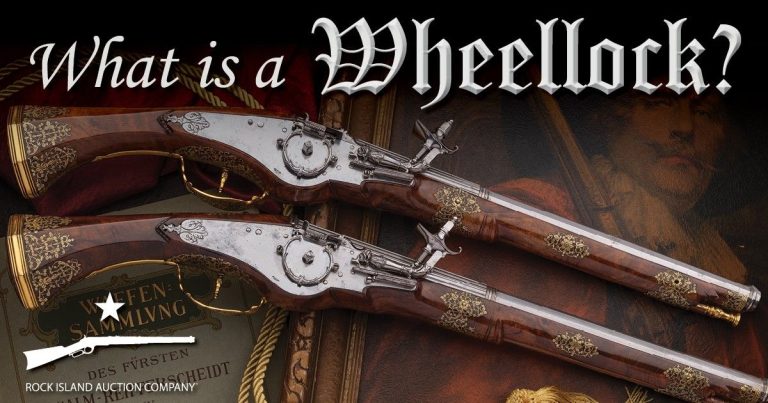
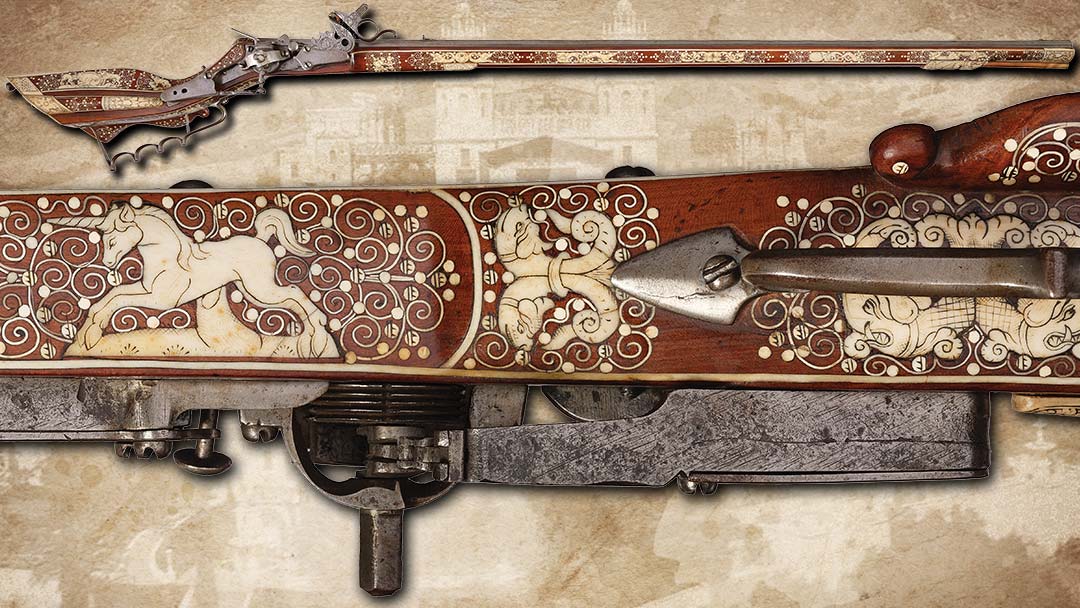
A wheellock is a gunlock that uses a metal wheel under spring tension to generate sparks that ignite gunpowder. As the first self-igniting firearm, the wheellock was a revolution in arms development, and some of the finest historic examples of this fascinating genre can be found in Rock Island Auction Company’s August 23 – 25 Premier Auction in Bedford, Texas.

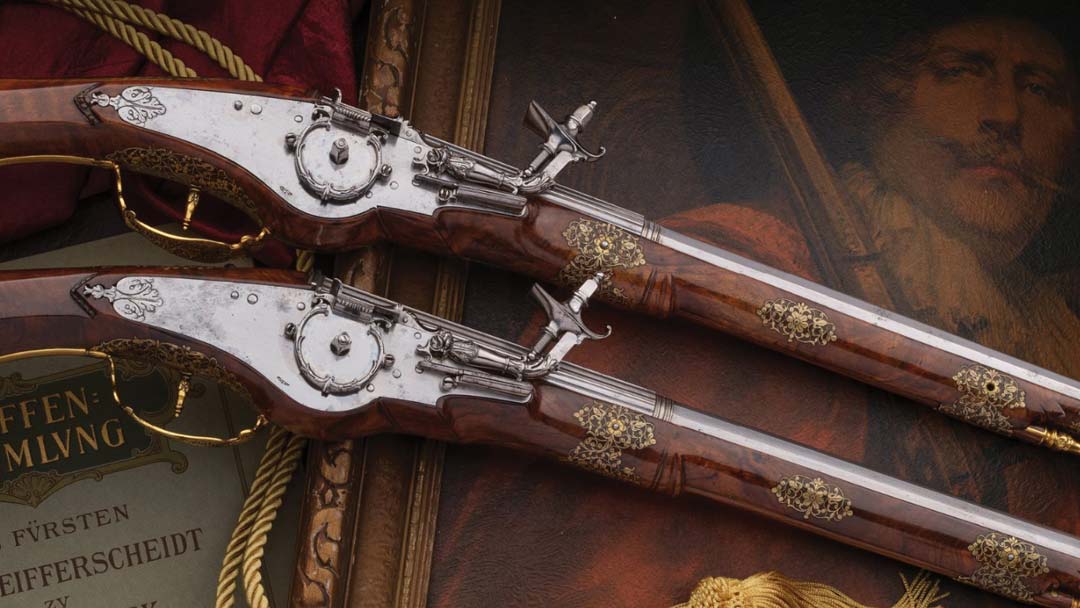
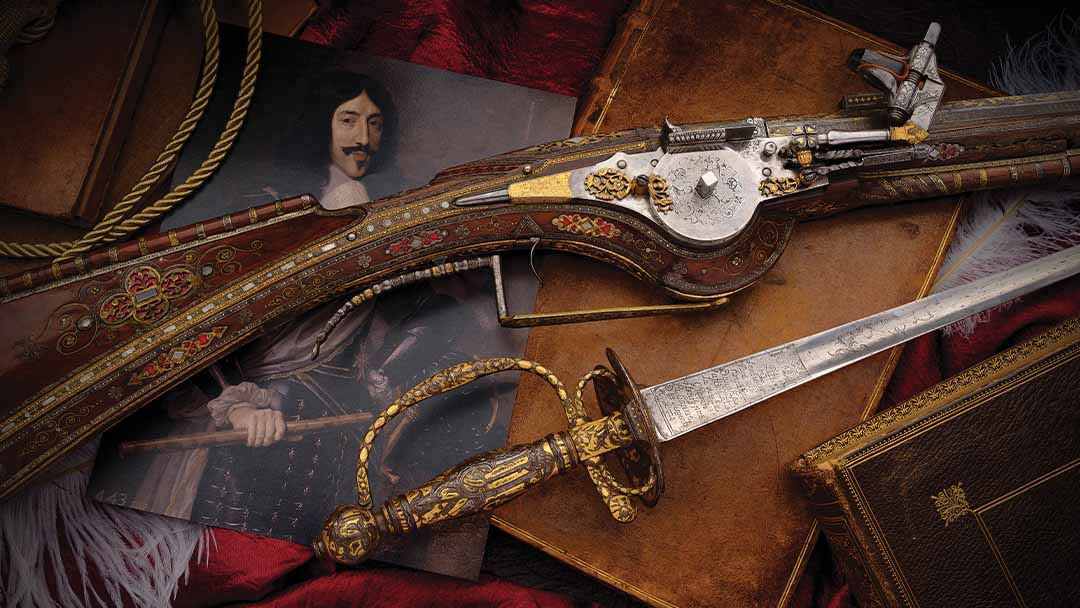
This exquisite wheellock was one of King Louis XIII’s early additions to his collection. It dates back almost exactly as far as the King James Bible, near the very beginning of the Baroque period, and is one of the most ornamented and beautiful objects in his renowned Cabinet d’Armes.

How does a Wheellock Work?

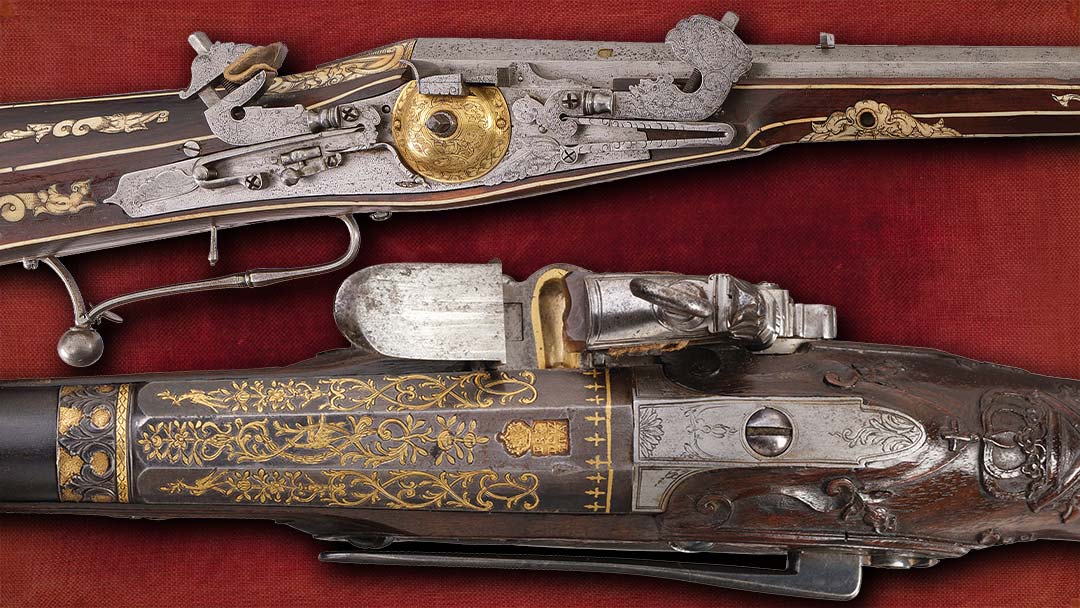
Most wheellocks are readied for firing by rotating the wheel using a special wrench called a spanner. When the wheel is turned, it is placed under spring tension. On rare versions, the locks are “self-spanning” and wind by moving the dog, which is the arm that holds a piece of pyrite (fool’s gold) or more rarely a piece of flint.

Diagram of parts for the standard wheellock mechanism.

The priming pan is situated by the wheel, and the dog rests on the pan cover when ready to fire. When the trigger is pulled, the wheel spins very rapidly, and the pan cover quickly opens, allowing the pyrite or flint to grind against the wheel creating sparks.

This late 16th century wheellock sporting gun features a large lock with two dogs that would allow a hunter to quickly get the gun back in action should the first pyrite fail. Available this August.

The Wheellock action is often compared to a modern Zippo lighter. The sparks ignite the gunpowder in the pan. The explosion of that powder then ignites the main powder charge through a hole in the barrel by the pan (the vent or touch hole). While there are multiple components in motion during the wheellock ignition sequence, the actual process is nearly instantaneous unless viewed in slow motion.

What is a wheellock? Rock Island Auction Company’s Interactive Production Manager, Joel Kolander, provides a step-by-step explanation.

When was the Wheellock Invented?

Though Leonardo DaVinci is often credited with its invention, the exact origins of the wheellock mechanism is not known, but they are generally believed to have been invented in the early 16th century in Nuremberg.

A pair of chiseled Brescian wheellock pistols with pierced brass inlays and barrels marked “Lazarino Cominazo.” The locks were manufactured in Gardone, Italy, about 200 miles from Leonardo DaVinci’s home city of Florence. Available this August.

Wheellocks were the first self-igniting gunlocks. Earlier firearms like the primitive hand-cannon had to be manually ignited, and matchlocks relied on a pre-lit slowmatch to ignite the powder, but with a wheellock, a firearm could be loaded and kept ready for immediate use. Wheellock ignition was more reliable than matchlocks since there was no concern about the match getting extinguished. The wheellock could be kept constantly at the ready and quickly brought to action when needed which made them particularly useful for hunters.

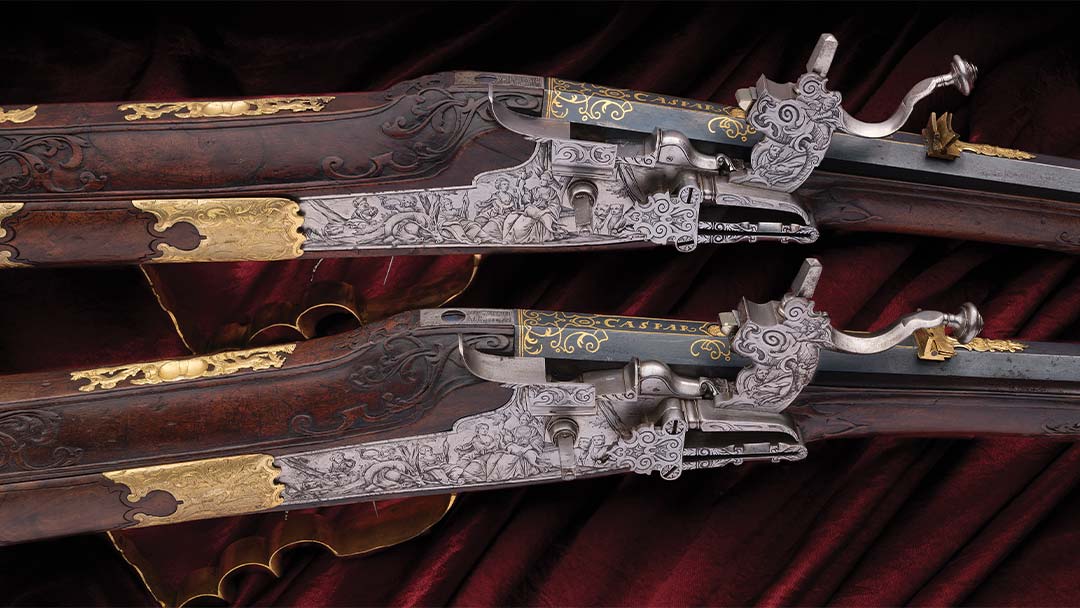
A superb pair of engraved, gold inlaid, and relief carved wheellock sporting rifles by Caspar Zelner, a royal gunmaker in Vienna for Emperor Joseph I and Charles VI near the turn of the 18th century. Available this August.

Wheellock ignition time or “lock time” was very fast. In fact, high quality wheellocks can be faster than even many high end flintlocks of later periods which led to wheellocks still being produced and used, particularly in Germanic areas, even after the flintlock became widely adopted.

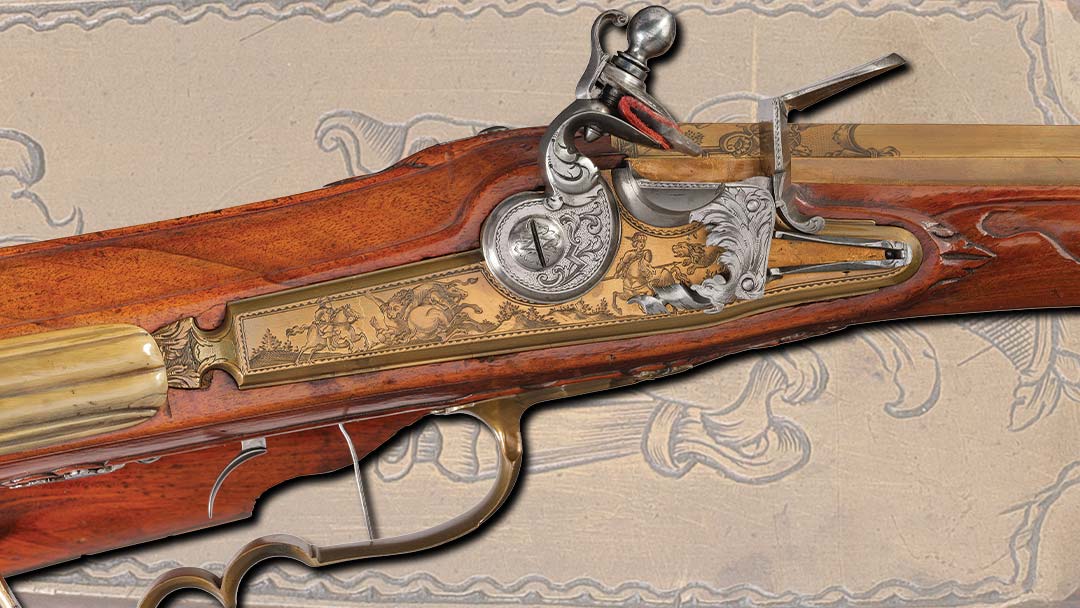
This distinctive Eastern European Tschinke small caliber wheellock birding rifle features its wheellock mechanism on the outside of the lock plate, a rare design produced in and around Teschen, Silesia, in present day Poland in the mid-17th century. Available this August.

The cost of manufacturing these complicated gunlocks often meant that they were owned by the elite who could afford expensive arms for hunting and warfare while the common soldiers continued to use the much simpler matchlocks. Some wheellocks were used by specialized units in European militaries, particularly by cavalry and royal bodyguards. Because they could be kept loaded and at the ready, wheellocks were also selected by assassins, and this led to their outlaw by regular individuals in some countries.

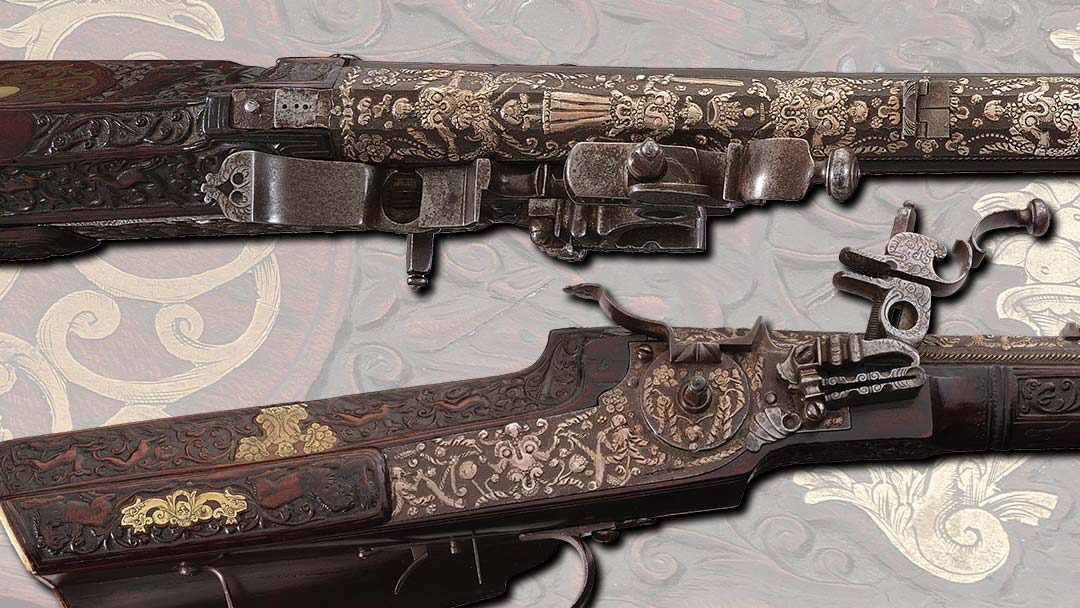
A true work of art from end-to-end, this relief carved and chiseled 17th century Austrian wheellock sporting rifle was produced by the anonymous gunstocker called the “Master of the Animal-Head Scroll”, a name eluding to the eponymous design motif that appears throughout his work. Available this August.

The fact that wheellocks were more expensive than other ignition systems before and after them meant that they were not as widely used compared to other firearm locks, especially outside of Europe. They were never widely used in North America, but a small number may have been used in the colonies.

The Artistry of the Wheellock

Because they were primarily the arms of the elite, many wheellock firearms are very fine arms and are the work of multiple talented and specialized craftsmen. Their artistry and rarity has also made the wheellock a staple in the arms collections of many art museums around the world like the MET. Wheellock firearms remained in use for over 200 years, and some black powder and historical reenactment enthusiasts still shoot them today.

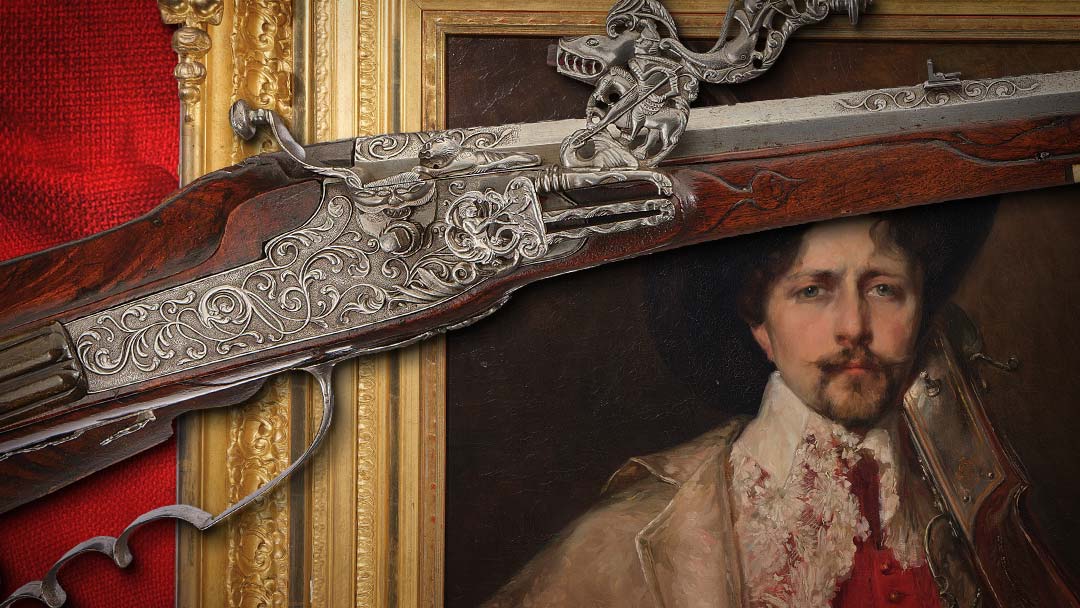
(Top) An ornate chiseled Germanic wheellock sporting rifle with a St. George and the Dragon theme. (Bottom) A framed portrait of a hunter with a wheellock arquebus by Alex de Andreis, a Belgian painter working in the UK and specializing in portraits depicting the 17th century.

Over four hundred years after it was first received by King Louis XIII of France, a magnificent royal presentation wheellock is available to the collecting public during Rock Island Auction Company’s August 23 – 25 Premier Auction. One of the earliest inclusions in the French monarch’s renowned Cabinet d’Armes, King Louis XIII’s ornamented wheellock is a historic cornerstone of European artistry.

French King Louis XIII’s gold and silver ornamental and bejeweled royal presentation wheellock, from the king’s fabulous Cabinet d’Armes, is available this August.

The Wheellock/Matchlock Hybrid

Though the wheellock provided more reliable ignition when properly maintained and functioning, the complex mechanisms could fail with wear from extended use and fouling, and wheellocks could not be easily repaired.

One solution to this found on a group of unusual military muskets manufactured in Suhl and used by the Austrian military in the second half of the 17th century was a lock design that incorporated both a wheellock and matchlock mechanism. This would allow the benefit of having a gun always at the ready when necessary but also allow for use as a matchlock if the wheellock mechanism was out of service or if the user had time to light the match and wanted to keep the wheellock mechanism in reserve.

Some firearms incorporated both a wheellock and matchlock mechanism.

Antique Wheellocks for Sale

Finding wheellocks for sale can be difficult, but Rock Island Auction Company presents collectors with opportunities that are attainable for all financial aspirations. We regularly feature wheellock and other early and antique firearms in our Premier, Sporting & Collector, and Arms & Accessories Auctions each year. Due to their rarity and value, collectors will primarily find wheellocks in our Premier Firearms Auctions, but examples, particularly ornate Victorian copies, can be found in our Sporting & Collector Firearms Auctions, and occasionally reproduction wheellocks can be found in our Arms & Accessories Day sales.

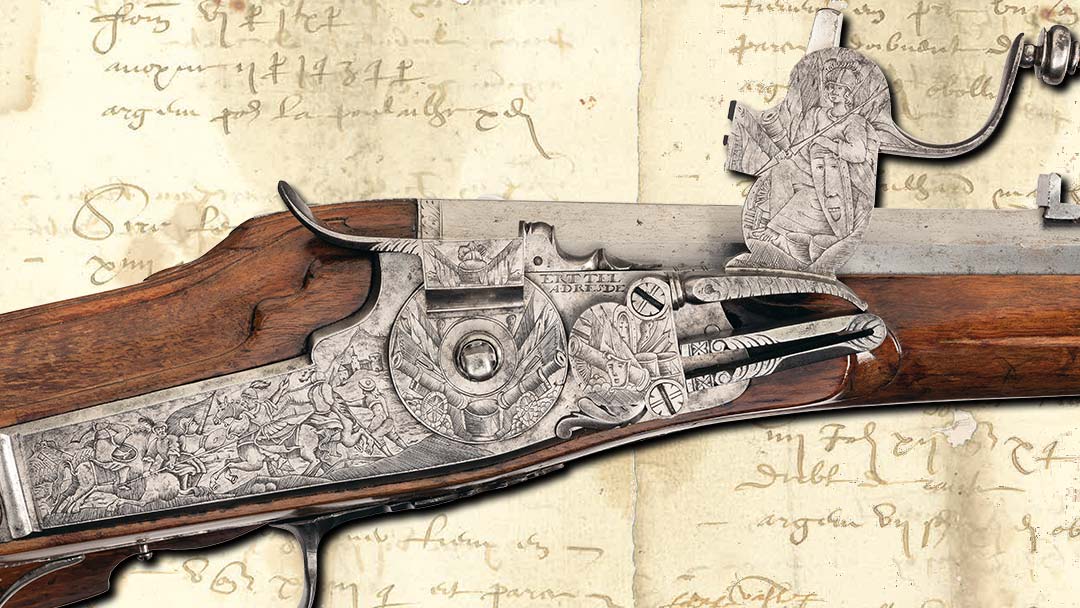
This engraved wheellock rifle is thought to be the work of Andreas Erttel, c. 1679-1725, one of several members of the Erttel family active as gunmakers in Dresden in the 17th and 18th centuries. Available this August.

Subscribe to the Rock Island Auction newsletter to receive new gun blogs and gun videos on early firearms like the wheellock. We cover topics like the development of the percussion lock, the patch box, and the powder horn, and famous muzzleloading models like the Brown Bess, the Kentucky rifle, the Hawken rifle, the history of dueling pistols, and more.

An engraved and relief carved Bohemian J.A. Maerckl flintlock sporting rifle of wheellock form with a rare bronze barrel and lock plate. Available this August.


  1. M. L. Brown, Firearms in Colonial America: The Impact on History and Technology, 1492-1792.
  2. Merrill Lindsay, One Hundred Great Guns: An Illustrated History of Firearms.
  3. George D. Moller. American Military Shoulder Arms – Volume I: Colonial and Revolutionary War Arms.

Smith & Wesson’s History of Innovation

0

Horace Smith and Daniel Wesson stand among the titans of 19th century American gunmaking. They worked on early lever actions and the metallic rimfire cartridge and landed Rollin White’s patent that changed the way revolvers worked.

From the first lever action pistol produced in 1854 all the way to today, the partnership of Smith & Wesson and the company they founded have long been leading innovators among American gun manufacturing. Their guns are legendary, like the New Model No. 3 of the 19th century, and the .44 Magnum of the 20th century.

This sampling of Smith & Wesson firearms available in Rock Island Auction Company’s Aug. 23-25 Premier Auction is a tour through the innovative history of American gunmaking.

Smith & Wesson No. 1 Lever Action Repeating Pistol

This legendary Smith & Wesson pistol had a short production life, from 1854-1855, with about 1,200 manufactured. The gun’s design utilized the toggle lever action, a spring-loaded magazine, and fired self-contained primed cartridge, all highly significant developments in the evolution of repeating firearms.

Before designing this pistol, Smith and Wesson both worked on early lever actions, like the important Hunt Volitional and Smith-Jennings rifles. This pistol is touted as the first repeating American firearm capable of firing a fully self-contained cartridges. The design, utilizing a six-shot magazine, was solid but it suffered from reliability issues due to underpowered ammunition.

Hampered by sluggish sales, the company was reorganized and Smith and Wesson were briefly on the outside looking in. The men turned their attention to developing the .22 Short rimfire cartridge and a revolver to fire it, utilizing White’s patent for a bored-through cylinder that allowed for breech loading.

This .31 caliber Smith & Wesson No. 1, once part of the Mac McCroskie Collection, features scroll and leaf engraving, standard engraving on most of these pistols.

Smith & Wesson New Model No. 3

Jumping ahead two decades, Smith & Wesson’s New Model No. 3 arrived after the company stopped making other models of the No. 3 like the American, Russian and Schofield in 1877. The gun continued with a hinge at the bottom of the frame for the barrel and cylinder but the new design redesigned the extractor, improved the cylinder retention and changed the mainspring. It had the longest production life of any single action revolver in Smith & Wesson’s history.

Smith & Wesson enjoyed an audience outside the United States. Of the 35,796 New Model No. 3 revolvers made between 1878 and 1912, about 40 percent went to foreign countries like Russia, Turkey, Japan, Australia, Cuba, England, France, Germany, Argentina and China, among others. Japan purchased about one-third of the total production and in 1902 the company advertised the New Model No. 3 as the sidearm of choice for the Japanese Navy. The New Model No. 3 was sold from stock parts starting in 1898, so the entire production run is classified as antiques for collectors.

This historically significant “sample” New Model No. 3 has a 6 1/2-inch barrel and chambered in .44 Smith & Wesson Russian. It was sent to the U.S. Treasury Department in March 1881 where it was received by H.F. French, Assistant Secretary of the Treasury. A year later, at least 10 others were shipped to the Treasury Department and delivered to U.S. Postmaster George Cook.

Smith & Wesson Tiffany-Embellished .32 Safety Hammerless First Model

Smith & Wesson’s first hammerless model was for police officers required to carry a gun. The gun’s hammer is concealed so it wouldn’t snag on a pocket flap or holster. It was also known as the ‘lemon squeezer” because of its grip safety.

Tiffany adorned firearms for Colt, Winchester and Smith & Wesson from the 1880s to the early 1900s. Examples of the famous American luxury jeweler can be found in the Metropolitan Museum of Art. How many guns adorned by Tiffany is unknown, but Smith & Wesson benefitted the most from the partnership.

Compared to the classic Model No. 3 or a double action revolver, this Safety Hamerless might be an odd canvas for embellishment but makes it all the more rare and desirable. Its aged silver grips that have the appearance of pouring off the grip frame and highlighted by borders and a single large scroll engraved on the right and a similar scroll on the left intertwined with the original owners initials.

This nickel-finished .32 Safety Hammerless has sterling silver grips with etched Art Nouveau style floral scrollwork with the original owner’s initials, “P.D.O.” among the engraving on the left side.

Smith & Wesson Model 1917 Double Action Revolver

As the winds of war in Europe swirled, Smith & Wesson experimented with .45 cartridges in its .44 hand ejector second model; and was able to load the Colt M1911’s .45 ACP using half-moon clips. Despite production of the M1911 by a number of companies, the U.S. Army needed more handguns so it approached Colt and Smith & Wesson to produce the Model 1917 revolver. What would come to be called Smith & Wesson’s Model 1917 started as the .44 Hand Ejector Second Model.

The company delivered its first revolver to the U.S. Army in Sept. 1917. A year later just two months short of the end of the war, the U.S. government took control of the factory to increase production. During World War 1, Smith & Wesson manufactured 163,476 Model 1917 revolvers.

This Model 1917’s factory letter doesn’t list a shipping date, but Smith & Wesson historian Roy Jinks estimates it was likely made in the mid-1950s. It was delivered to Smith & Wesson assistant sales manager Fred H. Miller chambered in .45 Long Colt, a true rarity.

This Model 1917 was delivered to Smith & Wesson Assistant Sales Manager Fred H. Miller in .45 Long Colt. “This rare revolver was specially built for Mr. Miller who could have any special he wanted assembled by the company. This is certainly one of the rarest variations of the .45 Hand Ejector Model of 1917 known,” wrote S&W Historian Roy Jinks.

Smith & Wesson .357 Registered Magnum

Based on Smith & Wesson’s .38 Special cartridge, the .357 Magnum cartridge was introduced by the company in 1935 after lobbying by handloaders like Elmer Keith and Phillip B. Sharpe. Smith & Wesson offered its .357 Registered Magnum with numerous ways to customize the pistol, from barrel length to grip style, finish and sight options. Smith & Wesson president Douglas Wesson selected three of his finest craftsmen to assemble the guns, making them some of the smoothest actions to leave the factory.

Douglas Wesson was friends with Col. Alexander “Sandy” MacNab, a big game hunter, career U.S. Army officer and expert shot who was also known as “the man who taught the (American Expeditionary Force) to shoot.” In the early 1930s, MacNab was preparing for a hunting trip to Alaska when Wesson asked him to try out a revolver and provide his opinion. When MacNab returned, Wesson asked about the gun, to which MacNab replied “It’s pretty nice; I think I’ll keep it.” Wesson said, “The hell you will, that’s the prototype. I’ll give you one when it goes into production. It was the .357 Registered Magnum prototype. Wesson kept his promise and presented MacNab with a Registered Magnum.

The Registered Magnum offered customers a bespoke premium revolver with a remarkable level of customization. This .357 Registered Magnum presented to Sam D. Myres by Douglas Wesson has an 8 3/4-inch barrel, a pinned blade front sight and standard Smith & Wesson factory markings. It is accompanied by a full coverage floral tooled holster manufactured by S.D. Myres Saddle Co.

Certificates were provided to purchasers who sent in an optional registration card to the company. The first Registered Magnum was presented to J. Edgar Hoover in April 1935. By 1938, approximately 5,500 Registered Magnums were manufactured, but due to costs the registration practice was halted along with the registration number stamping on the gun.

Certificates received by the registering gun owners had Douglas Wesson’s personal signature, the owner’s name and the revolver’s registration number, serial number, barrel length, front and rear sight type, the distance the revolver was sighted, plus the type of hold and ammunition. Of the 5,500 produced only half of the owners sent in their registration cards to Smith & Wesson.

Joining MacNab among those who received a Registered Magnum were Gen. George S. Patton, fast-shooting legend Ed McGivern, and actors Clark Gable, Jimmy Stewart and Gary Cooper. Wesson presented one to Sam D. Myres who founded Myres Saddle Company. Myres, whose career making saddles and holsters spanned more than four decades, knew Tom Mix, Buffalo Bill, Ed McGivern, Gene Autry and many other Western figures. He made holsters for Patton and Texas Rangers Frank Hamer and Manuel Gonzaullas. He made a special order saddle for Joe Miller of the 101 Ranch that cost $10,000 in 1910. Myres’ Magnum is one of 11 in the August Premier.

*The Registered Magnum of Col. Alexander “Sandy” MacNab and is one of 1,518 Registered Magnums manufactured with 6 1/2 inch barrels, and it features a McGivern front sight, adjustable “U” notched rear sight and standard S&W factory markings with “REG. 1183” stamped on the yoke.

Smith & Wesson .44 Hand Ejector 4th Model Target “Club Gun”

Smith & Wesson introduced the 4th Model of its .44 Hand Ejector in September 1950 and dubbed it the Model 24 in 1957. The company manufactured 5,050 between 1950 and 1966. A Club gun was intended to be given or loaned to shooting clubs and individuals as test guns, with some going to notable shooters.

This gun is inscribed to “Cecil R. King” who served in Congress from 1942 to 1969, after serving for five years in the California State Assembly. King fought in World War 1 and was appointed to Congress following the death of his predecessor. He was an early proponent of Medicare and voted for the Civil Rights Acts of the 1950s and 1960s.

This .44 Hand Ejector 4th Model is inscribed to U.S. Rep. Cecil R. King. He received it while serving in the U.S. House of Representatives where he served the state of California for 27 years. It has a matching “Club Gun” serial number of 0472 stamped on the butt, cylinder and barrel.

Smith & Wesson Model 13 Aircrewman Revolver

In the 1950s, the U.S. Air Force wanted survival guns for its strategic bomber crews. The revolvers had to be lightweight and fit in a chest pocket on their flight suits. A heavy gun could injure a crew member if they had to bail out because of the parachute straps. Smith & Wesson made its Aircrewman’s on a J-frame of aluminum along with an aluminum cylinder and steel barrel. Over time, the cylinder would crack and bulge, so the Air Force eventually rejected the revolvers and all the remaining Aircrewmen were to be destroyed, making surviving examples rare and desirable to collectors.

(pic) This Smith & Wesson Aircrewman is marked “PROPERTY OF U.S. AIR FORCE” on the backstrap. The factory letter confirms the gun’s configuration and it being shipped to Norton Air Base, in San Bernadino, Calif., in January 1954.

Smith & Wesson .38/44 Outdoorsman Double Action Revolver

First came the cartridge, then came the gun. The .38/44 came at the request of law enforcement wanting ammunition companies to create a round with more penetrating power than the .38 Special cartridge. Built on the N-Frame, the .38/44 Heavy Duty was born in 1930. Introduced in November 1931, the Outdoorsman was for competitive target shooting or handgun hunting. More than 4,600 of the Outdoorsman were produced by 1941 when it was discontinued because of World War 2. Production resumed in August 1946 and 2,326 were manufactured. When pre-war parts for the Heavy Duty ran out in 1949, and new parts went into production, they offered a modern update on the Outdoorsman, with a ribbed barrel, new micrometer sight and a short throw hammer.

This pre-war .38/44 Outdoorsman was embellished by Master Engraver Russ Smith after World War 2 for Charles “Trigger” McGowan, a Smith & Wesson service department employee who served the company for more than half a century. The gun has carved grips with crisp floral design and checkering. The floral scrollwork, geometric line patterns and animal scenes engraved on the barrel, frame and cylinder pop from the revolver’s immaculate blued finish. The right side plate is engraved with a scene of a bear in a tree, while the left side is engraved with a wild cat in tall grass.

Smith & Wesson Model 76 Submachine Gun

Denied the use of the Carl Gustaf M45 “Swedish K” submachine gun by the neutral Swedish government during the Vietnam War, the U.S. military turned to Smith & Wesson for a lightweight stamped metal submachine gun. The U.S. Navy SEALs liked the Swedish gun for its reliability in the jungle, its 600 rounds per minute rate of fire and the plausible deniability that came with it.

The U.S. Navy provided a list of characteristics it wanted in Smith & Wesson’s SMG. Despite claims to the contrary, the Smith & Wesson prototype delivered in January 1967 shared the M45’s tubular shape, 9mm chambering, size, and distinct folding metal stock with the Swedish gun. This open bolt SMG could spray bullets at 720 rounds per minute.

The Model 76 was an open bolt submachine gun that featured an ambidextrous selector switch, perforated heat shield, smooth pistol grip, and grooves in the receiver to keep maintenance minimal. One thing it didn’t have was the Navy’s interest. A small number did make it into the Navy arsenal, but they were also sold to police agencies and the general public. About 6,000 were made by the time production ended in 1974.

Smith & Wesson’s Model 76 submachine gun is similar to Sweden’s Carl Gustaf M45 “Swedish K” SMG. The “K” stands for Kulsprutepistole, translating to “bullet-squirting pistol.”

Smith & Wesson Model 38 Bodyguard Airweight Double Action Revolver

The Bodyguard Airweight is another Smith & Wesson hammerless revolver intended for law enforcement with the protected hammer. Built on an aluminum J-Frame to keep the weight down, this gun wasn’t destined for police, but for a U.S. Marine Corps commandant.

FBI Director J. Edgar Hoover presented the revolver to U.S. Marine Corps Gen. Leonard F. Chapman, a World War 2 veteran who served in the Pacific and was decorated for his actions in the Battle of Peleliu and the Battle of Okinawa. Nominated by President Lyndon Johnson, Chapman served as the 24th Marine Corps Commandant from 1969 to 1972. After retiring from the Marine Corps after 37 years, he served as the Commissioner of the Immigration and Naturalization Service.

This Model 38 Bodyguard Airweight double action revolver is inscribed on the side plate “To General/Leonard F. Chapman Jr./Commandant/United States Marine Corps/From his FBI Friends.” Factory records show the gun being shipped in December 1967 to Special Agent Henry Sloan, Quantico, Va. A carbon file copy of a memorandum to file by Chapman’s personal aide notes that FBI Director J. Edgar Hoover presented the gun on April 4, 1968.

Smith & Wessons for Sale

Whether it’s the company’s oldest model or a 20th century classic, Smith & Wesson has long been at the forefront of firearms development with a tremendous legacy that deserves examination. This sampling of guns is only a small taste of the Smith & Wesson offerings in Rock Island Auction Company’s Aug. 23-25 Premier Auction in Bedford, Texas.

Sources

“History of Smith & Wesson,” by Roy G. Jinks

Perazzi: The Gold Standard | Rock Island Auction

0

In terms of craftsmanship, artistry, and competitive shooting acumen, the Perazzi shotgun brand ranks among the elite. Born from humble beginnings in 1957, this high-end Italian shotgun maker continues to appeal to hunters, sportsmen, and collectors around the globe.

A magnificent pair of factory master Robert Narcisi signed and engraved Perazzi 28 gauge SCO shotguns with case.

In addition to an exquisite selection of Perazzi shotguns, Rock Island Auction Company’s August 23 – 25 Premier Auction in Bedford, Texas features the finest works from other legendary Italian gunmakers like Beretta, Caesar Guerini, Abbiatico & Salvinelli, Rizzini, Fabbri, and more. Click on the images throughout this article to learn more about each exceptional example.

A cased pair of Giustacchini signed and factory engraved Beretta SO6EELL O/U shotguns.

The Perazzi Shotgun is Born

The son of a shoemaker, what young Daniele Perazzi lacked in wealth he made up for with a relentless work ethic and an inexhaustible drive to succeed. A 14-year-old Perazzi cut his teeth in the arms industry by apprenticing as a cleaner for a local gunsmith. Six years later, Perazzi patented and sold a design for a single trigger mechanism.

Daniele Perazzi went into business for himself in 1955, making custom shotguns from a little bench in his mother’s kitchen. In 1957, at the age of 25, Perazzi realized his dream by establishing Armi Perazzi. The production plant was built in Botticino, a province in the northern Italian Lombardy region known for its winemaking heritage and breathtaking landscapes.

Daniele Perazzi’s reputation for quality craftsmanship gained him enough customers and revenue to open a factory in 1957.

The truly formative years of Armi Perazzi began in 1960 with a partnership between Daniele Perazzi and Ivo Fabbri. Fabbri had worked as a toolmaker for Fiat in Turin, known as Italy’s automobile city, and brought his experience with state-of-the-art computerized manufacturing to Perazzi’s production process.

The Perazzi and Fabbri partnership produced approximately 300 shotguns.

Perazzi Shotguns Shoot for Gold

1964, the year of the Tokyo Olympic Games, proved a turning point Perazzi company. Ennio Mattarelli, an Italian trap shooting champion and talented gun designer in his own right, became aware of the custom over/under shotguns being produced by Perazzi & Fabri and sought the designers out. At the time, Ennio Mattarelli had been using a Browning, the dominant force in the competitive shooting market.

(Browning pic) A 1951 manufactured, factory signed and engraved Felix Funken Belgian Browning Grade IV Superposed shotgun with case.

Mattarelli’s collaboration with Perazzi resulted in a sidelock trap shotgun with a 29 inch barrel length, a 3/4 full choke, a stock with a straight-hand grip, and a barrel with a hollow top rib to reduce weight. Where the bolting and jointing were concerned, Perazzi and Fabri were both greatly influenced by English models like the Boss & Co. example below.

A master engraved pre-war Boss & Co. 28 Gauge Best Quality sidelock O/U Ejector shotgun with an extra barrel set and case, built between 1921 and 1925.

Mattarelli’s Perazzi shotgun was completed in two months. That October, Ennio Mattarelli became the first Italian to win a Gold medal in the 1964 Olympics with his world record score of 198/200 in men’s trap. Perazzi developed further refinements to his design for Mattarelli’s next outing in 1968, including higher ribs for better heat dissipation in Mexico’s sweltering climate. The MX8 shotgun model, named for the Mexico City Olympic Games, would become the blueprint for every Perazzi competition gun to follow.

A 1975 manufactured, factory engraved and gold inlaid Perazzi MX8 O/U shotgun with case.

The MX8 and its successors were used by champions around the world and rocketed Perazzi to international fame in the competitive shooting market. During the 2008 Beijing Olympics, every medal winner shouldered a Perazzi shotgun. In total, Perazzi shooters have scored 62 Olympic medals, including 21 gold, a record in the history of clay shooting Olympic events.

An Angelo and Laura Galeazzi engraved and signed pair of Perazzi Extra Super shotguns with case. Angelo engraved famously engraved the Perazzi commissioned by Ennio Mattarelli for the 1964 Olympic Games.

Perazzi and Fabbri

In 1965, Ivo Fabbri sold his shares back to Perazzi and dissolved their partnership. While Perazzi had set his sights on competition shooting, Fabbri was focused on constructing the highest-end shotguns possible.

A Claudio Tomasoni master engraved and signed Ivo Fabbri sidelock O/U shotgun three barrel set with case.

Much like the vintage Ferraris, Lamborghinis, and Maserati, Fabbri shotguns offer a classic, high-performing over/under design engineered more like an Italian supercar than a traditional shotgun. Fabbri focuses solely on quality, producing only 30 shotguns per year.

With a client list that includes Steven Spielberg, Tom Selleck, and Eric Clapton, Fabbri shotguns have earned an exclusive status and represent one of the pinnacles in modern arms collecting. The vividly detailed Renaissance and fantasy-style engraving present on many Fabbri shotguns, like the breathtaking example pictured below, truly embodies the sporting arm as a canvas for exceptional artistic achievement.

A cased Claudio Tomasoni signed and engraved Ivo Fabbri sidelock O/U shotgun with a Greek Mythology theme.

The Perazzi Shotgun Goes Global

Perazzi’s success in competitive shooting led to increased demand for not only the company’s sidelock guns, but for models designed for other shotgunning disciplines as well. Daniele Perazzi expanded his line to offer more rugged options for every type of clay target shooting. Today, Perazzi produces countless trap, skeet, and sporting options, as well as numerous over/under hunting shotgun and rifle models and several side-by-side offerings.

Factory master Oscar Granetti signed and engraved Perazzi 28 gauge SCO/C O/U shotgun two barrel set with case.

Like Fabbri, Perazzi shotguns enjoy an all-star clientele that includes names like Arnold Schwarzenegger, King Juan Carols of Spain, George H.W. Bush, and former Vice President Dick Cheney, who was using a 28 gauge Perazzi shotgun during a famous accidental shooting during a quail hunt. Highness Sheikh Saeed bin Maktoum Al Maktoum of Dubai helped popularize the Perazzi in the Middle East and won a gold medal with an MX8.

In 1973, Ithaca Gun Company in New York became an importer of Perazzi shotguns. Ithaca was forced to file for bankruptcy and reorganize in 1978, and after a brief partnership with Winchester, Perazzi established an American subsidiary, Perazzi USA, to help manage its ever-growing North American market.

A cased, 1977 manufactured, factory Fausto Galleazzi engraved Perazzi Single Barrel Trap shotgun owned by former President of Ithaca Gun Company John V. Moynes. The lot includes a correspondence between Moynes and Mauro Perazzi.

Building the Perazzi Shotgun

On the company’s production process, Daniele’s son, Mauro Perazzi, remarked, “Back in the 1600’s there was an Italian violin maker, Antonio Stradivari, who took great care in his work: legend goes that he cut the woods at the right moon, only on one specific night every year, then embalmed and treated each single wood component with secret paints, and then chiseled away and tuned his violins. He spent hundreds of hours to craft each instrument. This is why there are no second-choice Stradivaris around, only masterpieces. And why there are no second-choice Perazzis, each piece being unique and tailored to each customer.”

Factory master Hassa signed and engraved Perazzi MX28 SCO/C O/U shotgun two barrel set with case.

Perazzi shotguns are fully customizable, with customers given a broad range of options for the blank and grade of wood, the rib height and width, the trigger group, and the receiver engraving. These bespoke offerings are made using a fusion of traditional craftsmanship and precision technology by a close-knit team of engineers, technicians, gunsmiths, woodworkers, and master engravers. Only 3,000 Perazzi shotguns a year are produced, each representing a distinct work of art.

A gorgeous pair of factory L. Vibrioni signed and engraved Perazzi 20 Gauge SC3 O/U shotguns with case.

Perazzi’s Legacy

Daniele passed away in 2012, just months after the Perazzi shotgun won 12 medals, including four gold, in the London Olympics. In late 2023, Czechoslovak Group, a global industrial and technology holding company, acquired an 80% stake in Perazzi, with the founding family retaining the remaining stake. Daniele Perazzi’s daughter Roberta now serves as the company’s chief financial officer, with his son Mauro managing design, production, sales, marketing, and dealer relations.

Perazzi DC 12 side-by-side shotgun with case.

Daniele Perazzi was a passionate sportsman who dedicated more than 60 years of his life to building high-grade shotguns that defined the competitive shooting market. It’s no surprise that Daniele selected Ferrari Red to define his brand, the color of elegance, engineering, and peak performance.

On the memory of his father, Mauro said, “My favorite quote is from Clarence Buddington Kelland and makes me think of him – ‘My father didn’t tell me how to live; he lived and let me watch him do it.”

Perazzi Shotguns for Sale

From the Olympic Games to the upland fields, the Perazzi shotgun has made its mark. The brand has become synonymous with strength, balance, beauty, and Italian craftsmanship, and Rock Island Auction Company’s August Premier Auction offers some of the finest vintage and modern Perazzi shotguns for sale.

Factory master Oscar Granetti signed and engraved Perazzi 28 Gauge SCO/C O/U shotgun three barrel set with case.

For more gun blogs and gun videos on classic and modern sporting arms, subscribe to the weekly Rock Island Auction newsletter to find pieces on Purdey, Abercrombie and Fitch, Parker Brothers, Winchester, Marlin, Browning, and Savage, as well as unique and unusual historic curiosities like the M30 Luftwaffe drilling, the combination gun, the Paradox gun, the revolving shotgun, the 10 gauge shotgun, the 4 bore, the Punt gun,  and more.

Boss, Purdey, P.V. Nelson, Parker Bros., and more of the world’s best shotgun manufacturers can be found in RIAC’s August Premier Auction. From the well-known names envied by collectors, to the smaller manufacturers with quality that matches the larger houses, Rick Henley takes us through several notable examples as well as his two personal favorites.

Bolt Action vs Lever Action Showdown

0

The mid-19th century saw an explosion of arms innovation, including the birth of the modern bolt action and lever action rifle. Both platforms competed head-to-head in the sporting and military market as the world gradually embraced the self-contained metallic cartridge and the magazine-fed repeater.

Preserved in near-new condition for 140 years, this newly discovered Winchester Model 1886 .45-90 WCF lever action rifle contains its original shipping crate with a scabbard, five boxes of ammunition, and its factory letter. Available this August.

We’ll explore the bolt action vs lever action faceoff through the decades and look at some of the notable, rare, and intriguing examples in each firearm platform, most of which can be found in Rock Island Auction Company’s August 23 – 25 Premier Auctionin Bedford, Texas. Click on the images throughout this article to learn more about each model.

A special order, factory engraved and gold inlaid pre-64 Winchester Model 70 Super Grade bolt action rifle in .22 Hornet. Available this August.

Bolt Action vs Lever Action

The lever action rifle as we know it today employs a lever to move back the bolt and firing pin, lift new cartridges into the chamber, and eject spent casings. The bolt action rifle acts on the bolt directly by pushing a round into the chamber, rotating to lock the breech, and ejecting spent casings by pulling up and back again.

Find the rarest bolt action rifles for sale at Rock Island Auction Company. Available this August.

In the bolt action vs lever action showdown, the bolt action platform carries a number of key advantages. Bolt actions tend to lock up tighter and offer a more durable operating system. In many cases, bolt action rifles have far fewer parts than their lever action rivals. Historically, this often meant lever action rifles were more expensive to produce, more difficult to field strip, and less tolerant to the elements.

Bolt action rifles also allow rapid follow-up shots in the prone position without the hindrance of a swinging lever underneath. Bolt action military rifles can be clip fed, whereas most lever action rifles cannot. And due to the limitations of the tube magazines employed by most lever action models, bolt action rifles can chamber more powerful and more accurate ammunition, resulting in flatter trajectories.

Rock Island Auction Company offers the finest lever action rifles in the collecting pursuit. Available this August.

In the lever action’s favor, the platform often wins when it comes to firing rate. Lever actions typically carry more ammunition, though this varies depending on chambering and barrel length. Lever actions in many cases are lighter and shorter than their bolt action counterparts, with flatter receivers that make them well-suited for saddle scabbards. For those looking for a fast-handling brush gun that can serve in a variety of hunting and varminting roles, the lever action platform holds its own.

Early Lever Actions

Lever action systems date to the 17th and 18th centuries. Italian armsmaker Michele Lorenzoni produced early repeating flintlocks operated by a lever, and Parisian inventor Nicolas Bouillet used a lever mechanism and tube magazine for some of his repeating air guns. Samuel Colt’s Ring Lever rifle employed similar ideas, but the direct predecessor of today’s lever guns was conceived in 1847 by mechanical engineer Walter Hunt.

(Top) A factor engraved Robbins & Lawrence Jennings breech loading rifle. (Bottom) A factory engraved Robbins & Lawrence Second Model Smith-Jennings repeating rifle. Both examples are available this August.

The Jennings repeater combined Lewis Jenning’s concept for a movable ammunition carrier with Walter Hunt’s Rocket Ball cartridge. This design was refined during the 1850s with the Volcanic lever action family, but the ammunition proved woefully underpowered.

Benjamin Tyler Henry, the shop superintendent at Oliver Winchester’s New Haven Arms Company, developed a .44 caliber rimfire cartridge in 1858. Henry spent the next few years upgrading the Volcanic design to chamber his new round. With a larger frame, a barrel adapted for the .44 rimfire, an ejection system, and firing pins independent from the bolt face, the Henry rifle was born, the most advanced repeating rifle platform to date.

Two exceptional early lever actions. (Top) A New Haven Arms Company Volcanic carbine. (Bottom) A New Haven Arms Co. Henry rifle. Available this August.

Early Bolt Actions

In 1824, German inventor Johann Nicolaus von Dreyse developed the first bolt action rifle. The Dreyse design was adopted by the Prussian army in 1841 as a needlefire rifle employing paper-contained cartridges. Though the concept was hindered by unreliable cartridges and a weak combustion chamber that suffered from gas leakage, Dreyse’s invention laid the blueprint for a generation of bolt action designs to follow.

This engraved, gold inlaid F. V. Dreyse bolt action sporting rifle sold for $7,475 in RIAC’s May 2017 Premier Auction.

Patented in 1863, the Palmer carbine was the first metallic cartridge firearm with a bolt action mechanism ever adopted by the U.S. Ordnance Department. The Palmer’s bolt is used to seat the cartridge and seal the breech, but does not contain a firing pin. Instead, the Palmer fires with a traditional side lock. Just over 1,000 Palmer carbines were ordered on contract with the U.S. government, but they were delivered too late to see action in the field.

An early entry in the bolt action vs lever action faceoff, a Civil War Era E. G. Lamson & Co. Palmer bolt action saddle ring carbine. Available this August.

Bolt Action vs Lever Action Rifles After the Civil War

The Spencer lever action rifle became the first military-issued metallic cartridge repeating longarm when it was officially adopted by the United States Army in 1863. More than 110,000 Spencer rifles and carbines were produced for the U.S. Ordnance Department during the Civil War, where it served on the battlefield alongside the Henry lever action rifle. After the Civil War, the Army continued to employ the Spencer in the American West during the Indian Wars until the platform was replaced by the Springfield Trapdoor.

An excellent Indian Wars era U.S. inspected Spencer Model 1865 carbine. Available this August.

Oliver Winchester submitted the Model 1866 “Yellowboy” lever action rifle into military trials with the British and Swiss. 5,000 Model 66s were purchased by the Japanese in 1867, the year before the Boshin War, and the French purchased 6,000 Model 66s in 1870 during the height of the Franco-Prussian War. The British and Swiss ultimately passed on the Model 66 due to cost concerns. The Swiss would instead adopt the Vetterli rifle, an important milestone in the bolt action vs lever action arms race that combined the tube magazine with the bolt action of the Dreyse needle gun.

From 1870 to 1871, the Ottoman Empire purchased 5,000 Winchester Model 1866 carbines and 45,000 of the musket variants. The musket configuration was offered in hopes of procuring military contracts and featured a 27 inch barrel and a bayonet lug. The Turkish military employed their lever action rifles to devastating effect, demonstrating the potential of repeating arms on the battlefield.

Two Winchester muskets. (Top) A Winchester Model 1866 (Bottom) A Winchester Model 1873. Available this August.

The bolt action platform was improving, with new centerfire metallic rounds offering a reliable alternative to the needle fire paper cartridges. Built using the French Chassepot Model 1866 needle gun, the Norris Patent Model 67/69 bolt action rifle marked the beginning of the Mauser line and combined the efforts of brothers Peter and Wilhelm Mauser.

The single shot bolt action Mauser 1871, or Infanterie-Gewehr 71, became the first brass cartridge rifle issued by the German Empire. Peter Mauser continued to innovate his design, with repeating bolt actions like the German Spandau Arsenal Model 71/84 Mauser example below, which integrated an under-barrel tube magazine like many of its lever action counterparts.

An exceptional Imperial German Spandau Arsenal Model 71/84 Mauser bolt action rifle. Available this August.

In America, the Winchester-Hotchkiss bolt action repeater was adopted in limited quantity by U.S. Navy in 1879 and the U.S. Army four years later. The First Model Hotchkiss carbine variant was built using a mix of Winchester and Springfield components and would have been used in early Army field trials. Only 501 are believed to have been manufactured.

‘U.S. Military Bolt Action Rifles’ by Bruce Canfield lists the Springfield/Winchester-Hotchkiss First Model Army bolt action carbine pictured below by serial number as having been shipped from Springfield Armory on June 27th, 1879. The carbine has “J.L.P” inspection initials on various components, the three-line Winchester address and Hotchkiss patent marking on the left of the action followed by the serial number, and the distinctive First Model magazine cut-off on the right.

A scarce Springfield/Winchester-Hotchkiss First Model Army bolt action saddle ring carbine. Available this August.

Bolt Action Rifle Development

The late 1800s saw a renaissance in bolt action rifle development. Keenly aware of the rapidly advancing bolt action repeaters being developed and fielded in Europe, the U.S. Military conducted numerous trials with the platform in an effort to replace the single shot Trapdoor.

Produced from 1880 to 1883, the Remington-Keene magazine bolt action carbine was Remington’s first attempt at producing repeating rifles to compete with Winchester lever actions. A tubular magazine and carbine style forward barrel band like those used on classic lever action saddle ring carbines are fitted below the barrel. The magazine is loaded using a loading gate at the bottom of the action much like slide action shotguns. The hammer at the back of the bolt must be manually cocked for each shot.

A Remington-Keene magazine bolt action carbine in .45-70, Remington’s first attempt to combat Winchester in the bolt action vs lever action arms race. Available this August.

The Remington-Lee competed with both the Winchester-Hotchkiss and Remington-Keene bolt action designs in U.S. military trials. The example pictured below is one of approximately 750 Remington-Lee Model 1882 bolt action rifles manufactured on U.S. Army contract. The breech end of the barrel is marked “U.S.” and “V/P”. David F. Clark’s “D.F.C” inspection initials are stamped on the left breech end of the barrel, bolt, right receiver rail, behind the trigger guard, and a boxed script cartouche on the right rear of the stock. The “US” marked buttplate and barrel bands were furnished by Springfield Armory.

A U.S. Army contract Remington-Lee Model 1882 bolt action rifle in .45-70. Available this August.

Springfield Armory manufactured 753 Chaffee-Reece Model 1882 magazine bolt action trials rifles in 1884, one of the armory’s rarest production lines. Based on the designs of General James Reece and Reuben Chaffee, the Chaffee-Reece bolt action rifle developed an innovative solution to the problem of a bullet nose contacting the primer in front of it that came with the use of spring-driven tube magazines. A double ratchet was employed to move a cartridge forward one space each time the bolt was cycled. A cutoff switch on the right side of the receiver allowed for single shots while keeping the magazine fully loaded.

An exceptional U.S. Springfield Chaffee-Reece Model 1882 magazine bolt action trials rifle. A boxed script “SWP/1884” (Samuel W. Porter) inspection cartouche is stamped on the left of the butt. Available this August.

In 1886, Chief of Ordnance Brigadier General Stephen Vincent Benet made the following remarks on the subject. “I have been and am an advocate for a magazine gun, but it would seem part of the reason to postpone for the present any further efforts towards the adoption of a suitable magazine arm for the service. The Springfield rifle (Trapdoor) gives such general satisfaction to the Army that we can safely wait a reasonable time for further development of magazine systems.”

Lever Action Military Service

Near the turn of the 20th century, ammunition was evolving just as rapidly as the bolt action design. In addition to high-pressure smokeless powder and stronger casings, pointed Spitzer bullets allowed greater range and accuracy. European bolt action rifles moved away from horizontal tube magazines in favor of stacked vertical magazines to accommodate these new cartridges.

John Moses Browning decided to apply some of the same design sensibilities to the Winchester Model 1895, the first lever action rifle to use a box magazine and capable of chambering Spitzer rounds. Theodore Roosevelt carried a Winchester 1895 in .30 Army while leading the Rough Riders during the Spanish-American War and later sported a Model 1895 in .405 Winchester during his African expedition and many other hunts.

The Model 1895 lever action became an immediate hit with hunters like Buffalo Bill. This historic Winchester Deluxe Model 1895 saddle ring carbine was presented by Buffalo Bill to Deadwood businessman and friend M.R. “Gold Nugget Mike/Deadwood Mike” Russell. Available this August.

The Winchester Model 1895 found favor with the Texas Rangers, Arizona Rangers, and irregular military forces like Pancho Villa’s Conventionists fighters. More than two-thirds of the 425,000 Winchester Model 1895s produced were musket variants commissioned for the Russian military and chambered in the 7.62x54R cartridge.

The Winchester 1895 made a case for itself in the bolt action vs lever action faceoff, widely fielded by the Russian military. This exceptional WW1 Russian Contract Winchester Model 1895 Musket with a Winchester marked bayonet is available this August.

Another favorite lever action rifle carried during the Texas Border Wars and Mexican Revolution was the Winchester 1894. The Model 1894 saw limited military service with the United States Army Signal Corps, the British Royal Navy, and French support troops and personnel during WW1, and with the Canadian Pacific Coast Militia Rangers and the British Home Guard during WW2.

An early production, documented Special Order Winchester Deluxe Model 1894 rifle with an extremely rare casehardened receiver. Available this August.

The Savage Model 1895 and its successors is another intriguing design in the bolt action vs lever action arms race.  Employing a rotary stacked magazine to chamber Spitzer cartridges, the Savage Model 1899 became a popular hunting platform and was carried by the Montreal Home Guard during WW1. The Savage 1899’s predecessor, the Model 1892 lever action musket, was submitted to America’s Ordnance Department in July 1891, but was rejected in favor of the Krag-Jorgenson rifle, the first widely-issued U.S. Military bolt action.

An exhibition quality, factory engraved Savage Rival Grade Model 1899 takedown rifle. Available this August.

The Bolt Action Dominates the Battlefield

By the time America had adopted the Norwegan-designed Krag-Jorgensen rifle in 1892, every major European military had already embraced the bolt action magazine platform. The French Lebel Model 1886, the British Lee-Metford, the Russian Mosin Nagant, and the Gewehr 88 demonstrated the effectiveness and durability of the bolt action design, which became the infantry standard for the next five decades.

An exceptional 1902 dated U.S. Springfield Armory Model 1898 Krag-Jorgensen rifle. Available this August.

While turn-of-the-20th century bolt action repeaters had a slower rate of fire than most lever actions of the era, their long-range accuracy and lower pricepoint were among a host of advantages offered by the platform. Perhaps most importantly, bolt action rifles displayed a durability advantage in the brutal hand-to-hand fighting common in late 19th century and early 20th century warfare.

Lever action rifles like the Winchester Model 1894 and 1895 continued to serve in the limited roles discussed in the previous section, with the Russian contract Winchester 1895 muskets serving the Finns and Soviet forces as late as WW2 whenever there were weapon shortages. These were the exceptions, however, and the bolt action rifle reigned supreme as the infantry standard around the globe.

An antique, Second Boer War era, unit marked British Lee-Enfield L.E.C. Mk I bolt action cavalry carbine manufactured in 1898. Available this August.

Bolt Action vs Lever Action Hunting Rifles

The bolt action vs lever action showdown proved more competitive in the American sporting market. Whitetail guns like the Winchester Model 1894 and Marlin Model 1893 dominated in the early decades of the 20th century.

Two lever action hunting staples. (Top) A signed, engraved, and highly embellished Winchester Model 1894 rifle with gold wire filled borders and a hand carved deluxe walnut stock and forend. (Bottom) A special order factory panel scene engraved Marlin Deluxe Model 1893 takedown Rifle. Available this August.

After WW1, surplus bolt action rifles like the Model 1903 were cheap and abundant. New platforms like the Winchester Model 70 offered a bolt action repeater that could be chambered in nearly any game cartridge imaginable, including rounds capable of tackling the largest North American quarry from a distance.

An extraordinary documented Alden George Ulrich factory engraved and gold inlaid Winchester pre-64 Model 70 bolt action rifle in .220 Swift with scope. Available this August.

For African big game hunters, the bolt action magazine rifle provided a more affordable alternative to the double rifle. The early 1900s saw the introduction of big game cartridges like .404 Jeffery, .425 Westley Richards, .416 Rigby, and .375 H&H Magnum. The latter cartridge, dubbed the “Queen of the Medium Bores,” by writer and sportsman Jack O’Connor, is widely chambered by modern rifle manufacturers and has inspired numerous offshoots.

A massive W. J. Jeffery & Co. Ltd. Magnum Mauser bolt action rifle in .500 Jeffery Magnum. Available this August.

The lever action continues to enjoy popularity with hunters in numerous niches. Lever action carbines are often lighter than bolt actions and offer an ideal walking gun, truck gun, saddle gun, or varminting option. Today’s hunters can find lever action rifles and carbines in all manner of chamberings, including modern cartridges like .338 Federal and 6.5 Creedmoor capable of taking elk and moose.

A cased, limited production, engraved and gold inlaid Winchester Model 94 One of One Thousand lever action rifle. Available this August.

Bolt Action vs Lever Action Face-Off

Today, the bolt action rifle continues to serve as a marksman and sniper military standard and is fielded in nearly every hunting role. The lever action holds its own as a sporting and shooting platform, and the rarest and most collectible antique, curio, and modern examples of each firearm class can be found at Rock Island Auction Company.

A factory gold plated Winchester Deluxe First Model 1873 lever action rifle commissioned as a factory exhibition display piece for the Philadelphia Centennial International Exhibition of 1876. Available this August.

Subscribe to the Rock Island Auction weekly newsletter for more blogs and videos on fascinating firearm topics like bows vs guns, striker fire vs hammer fire, the revolver vs the pistol, the Mac 10 vs the Uzi,  the Colt Army vs the Colt Navy, the M1941 Johnson vs the M1 Garand, the M60 vs the M240, the Nordenfelt vs the Gatling gun, and more.

A factory signed and engraved Sauer 202 “The Oaks” bolt action rifle. Available this August.