Imagine a tweeded gentleman striding across the hillocks of Scotland in search of quarry on the wing. Quail or grouse get spooked out of the underbrush and the gentlemen shoulders his bespoke shotgun. The gun speaks and the fowl falls.
“To the dedicated collector there is more fun in some rusty old game gun, or dented powder flask, when he also has a knowledge of the period when the gun first bellowed and smoked over the stubbles and the marshes,” wrote Macdonald Hastings in his 1969 book, “English Sporting Guns and Accessories.”
The entry to the era of the bespoke English shotgun was Joseph Manton whose name can be found in the resumes of James Purdey, Thomas Boss, William Greener and many others. The tradition of fine English shotguns kept in British showrooms but can require years-long waits, but beautiful shotguns bearing legendary names that can be obtained within days are among the offerings of Rock Island Auction Company’s Aug. 23-25 Premier Auction in Bedford, Texas. These fabulous firearms can be admired and examined in person at the auction’s Preview Day on Aug. 22.
Sidelock vs Boxlock
Hammerless guns started appearing in the 1870s when it was located inside the action along with the mainspring and sear. Boxlocks, with fewer parts, contain the trigger mechanisms while sidelocks have two lockplates that sit at the back of the action containing the firing mechanisms.
Generally, sidelock shotguns are considered more elegant and desireable. They are also more expensive and considered to have a better trigger pull than boxlock shotguns. The British upper class set the fashion of the day and the preference was the sidelock shotguns of the London gunmakers over the boxlocks made up north in Birmingham.
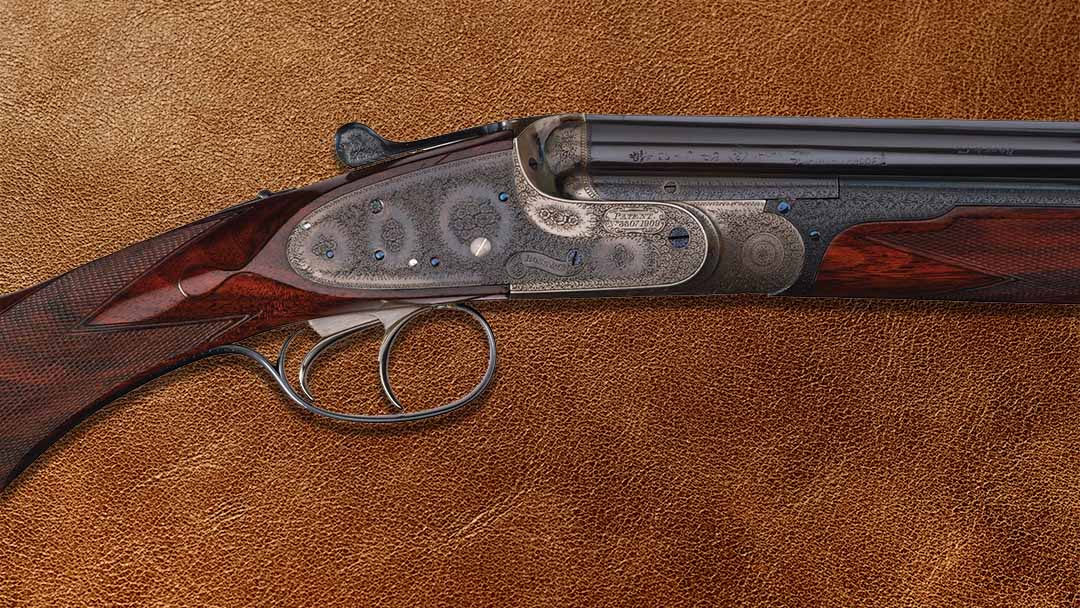
Purdey & Sons, among the leading names of bespoke sporting arms, makes sidelock shotguns with immense precision and high art engraving, and this over/under shotgun certainly is an outstanding specimen. The action is magnificently color hardened bringing out the intricate scrollwork engraving of engraver Alison Hunt. The scrolls swirl and surround three individual game fowl in flight on both sides of each shotgun. On gun “1” the right shows a pheasant, grouse and pigeon and the left has individual ducks. On gun “2”, are three water fowl on the left and a quail, grouse and woodcock on the right. Amid the tight scrolling on the underside of each shotgun is a single dove in flight in identical poses. The Purdey engraver has signed each gun three times and each gun has a single gold trigger.
P.V. Nelson and the English Shotgun
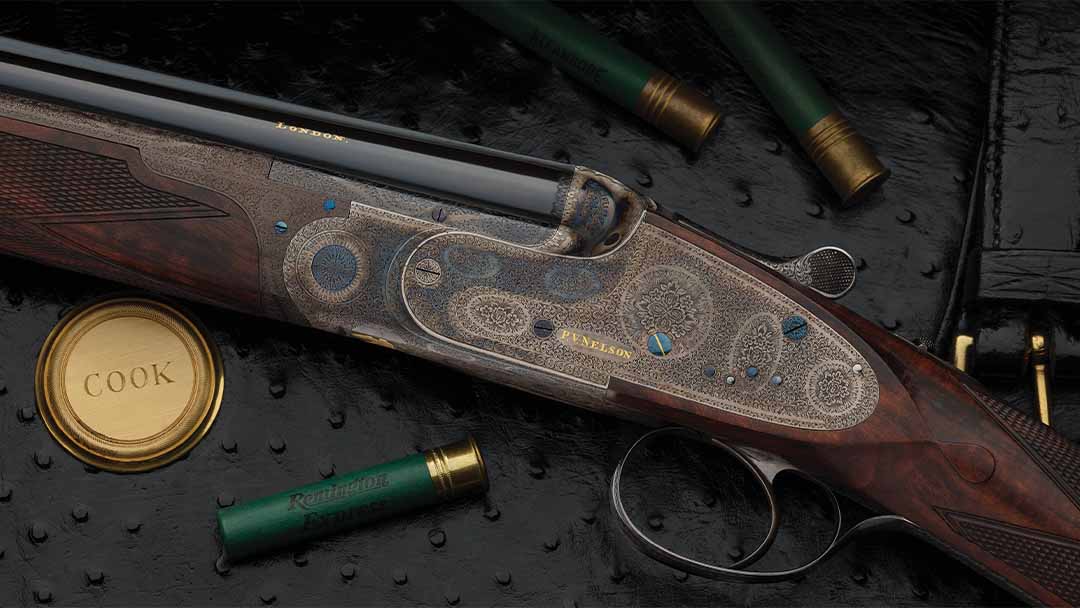
Finding a P.V. Nelson shotgun on the market is a true rarity and the opportunity to get this high condition model shouldn’t be missed. Peter Nelson started his career as an apprentice at Purdey in 1953 learning to file actions, before taking on side-by-side and over/under shotguns, double rifles and bolt actions, too.
He stayed with the London gunmaker until 1971 when he decamped for the continent, joining Hartmann & Weiss in Hamburg, Germany. He returned to the United Kingdom three years later to establish Hartmann & Weiss UK before starting his own business. Under his own shingle, Nelson produced 83 guns for nine clients, he said in a 2020 interview. Of those, two clients commissioned 60 guns. One of his final guns was an elaborately embellished over/under shotgun to commemorate Queen Elizabeth II’s Golden Jubilee in 2002.
This sub-gage shotgun is a brilliant example of Nelson’s workmanship and stands as his first .410, marked with serial number 0001 and “OUR FIRST 410 OVER & UNDER” on the lower tube beneath the forend. The casehardened sidelock action featuring full coverage bouquet and scroll engraving surrounding nitre blue action pins and a relief gold inlaid snipe in flight on the underside. The scroll overflows from the action to the triggerguard, toplever and both tangs.
The Boss of English Shotguns?
Thomas Boss worked for both Joseph Manton and James Purdey, before opening his own shop in 1830; Geoffrey Boothroyd wrote that Boss’s over/under shotgun action is considered the finest British over/under, writing in his 1991 book “Sidelocks & Boxlocks, The Classic British Shotguns” that “the Boss O/U is not just a shotgun, it is a work of art.” Boothroyd advised author Ian Fleming on weapons for James Bond, suggesting the Walther PPK that first appeared in “Dr. No.”
This Boss & Co. 28 gauge sidelock over/under shotgun was built between 1921 and 1925 according to Donald Dallas’ “Boss & Co.: Makers of Best Guns Only.” The shotgun and its extra barrel show the immense quality produced by Boss with its blued steel barrels and casehardened action. The casehardened surface shows off the extensive bouquet and scroll engraving that lands on the triggerguard, the tangs and the toplever. The gun also has gold centerline cocking indicators.
Norman Blank and Purdey, a Legendary Collector and a Legendary Gunmaker
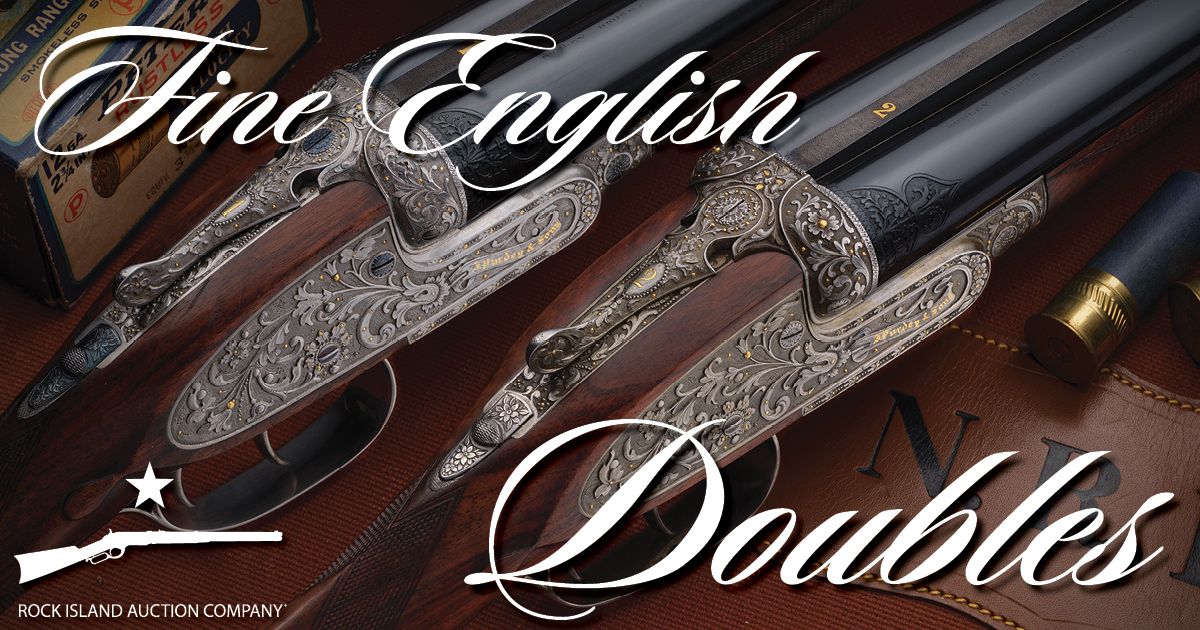
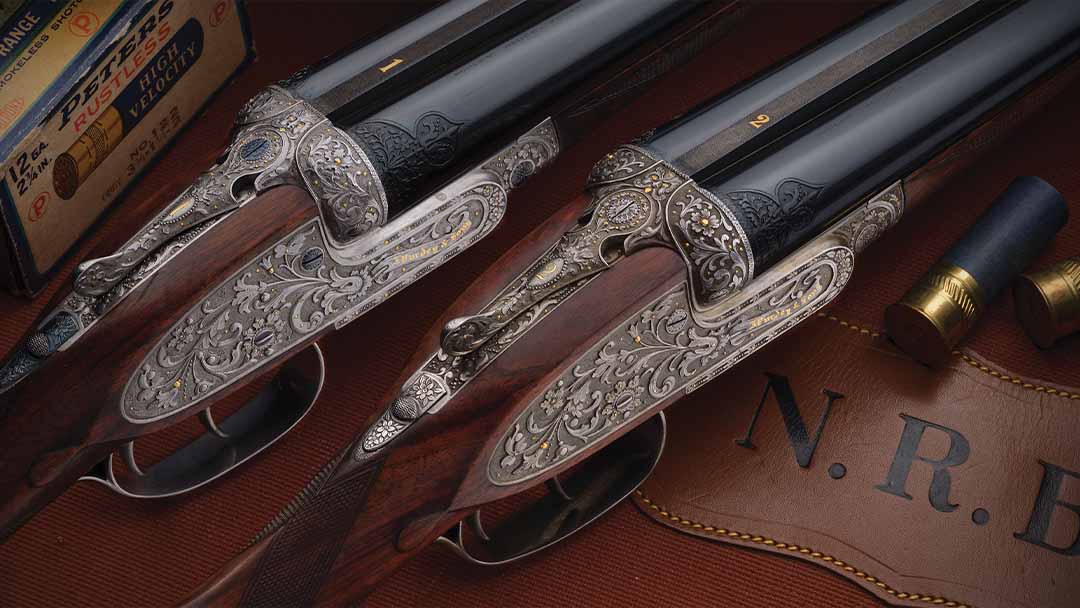
This August, Rock Island Auction Company proudly offers a number of fine European firearms from the 16th to 19th centuries from the Norman Blank Collection including the wheellock of Louis XIII, but also available is a pair of Purdey double barrel shotguns personally ordered by Blank from Purdey in 1958. Blank visited Purdey in London and ordered one gun but then requested a second along with extra barrels. The pair is adorned by the work of legendary Master Engraver Ken Hunt, Alison Hunt’s father.
Among the documentation provided with these fantastic shotguns is a letter from Purdey & Sons managing director Harry Lawrence explaining that a surge of flu through the factory slowed production and asking about the type of engraving he would like on the gun, he wrote “My special young Engraver is now back at work and is doing some exceptionally fine work. He has just completed an Over and Under in a semi carved style, which I am having photographed and will send you some copies which may help you in making a decision.”
Harry Lawrence was correct. Master Engraver Ken Hunt’s adornment on Blank’s pair is spectacular. The coin finish sidelock action has deep relief chiseled floral scroll engraving dotted with gold inlaid highlights. On the underside of each gun is a grotesque mask with gold teeth and cherubs on the trigger guard. A smaller mask is atop the action on each gun. Hunt signed each gun, marked with a gold “1” and “2” with “K HUNT” at the bottom of the lockplates.
Woodward & Sons‘ O/U Becomes Purdey’s
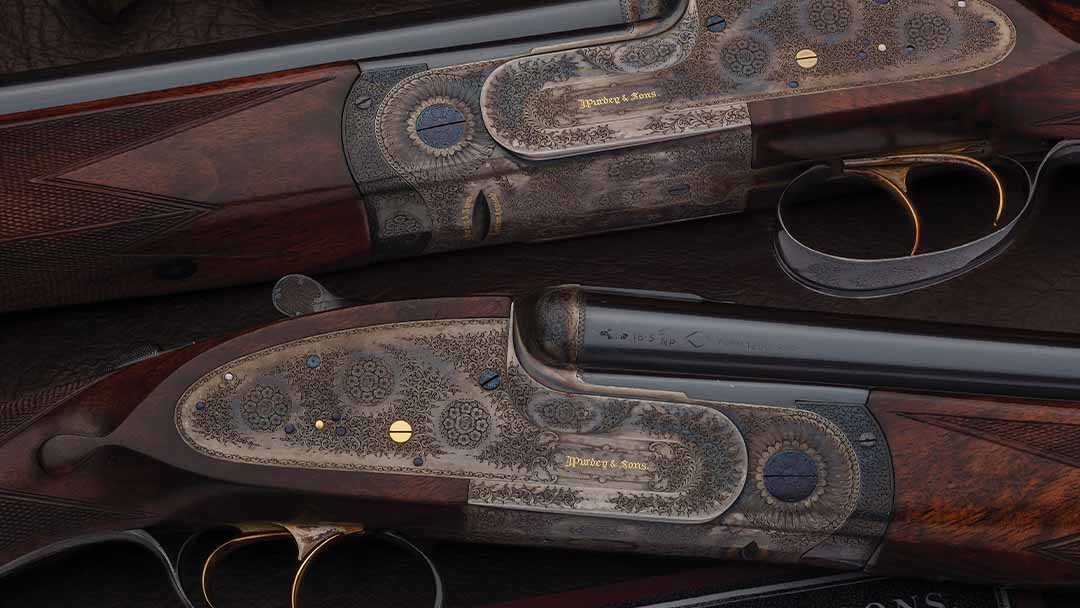
Following World War 2, gunmakers struggled to return to regular production and James Woodward and Sons was one of those faced with difficulties. The owner, a nephew of one of the sons of founder James Woodward, was 71 and childless in 1948 when he approached Tom Purdey about buying his company – and most importantly, the well-respected over/under patent it had used since 1913. Purdey accepted and the Woodward over/under became the Purdey over/under.
This pair of over/under Purdey shotguns, marked “1” and “2” were manufactured in 1993 and 1996 with blued steel barrels. The casehardened action shows off the beautiful bouquet and scroll engraving that surrounds the gold, gothic lettering “J. Purdey & Sons” on the sidelocks and “J.Purdey & Sons/London England” on the undersides.
More Fruit from the Purdey Family Tree
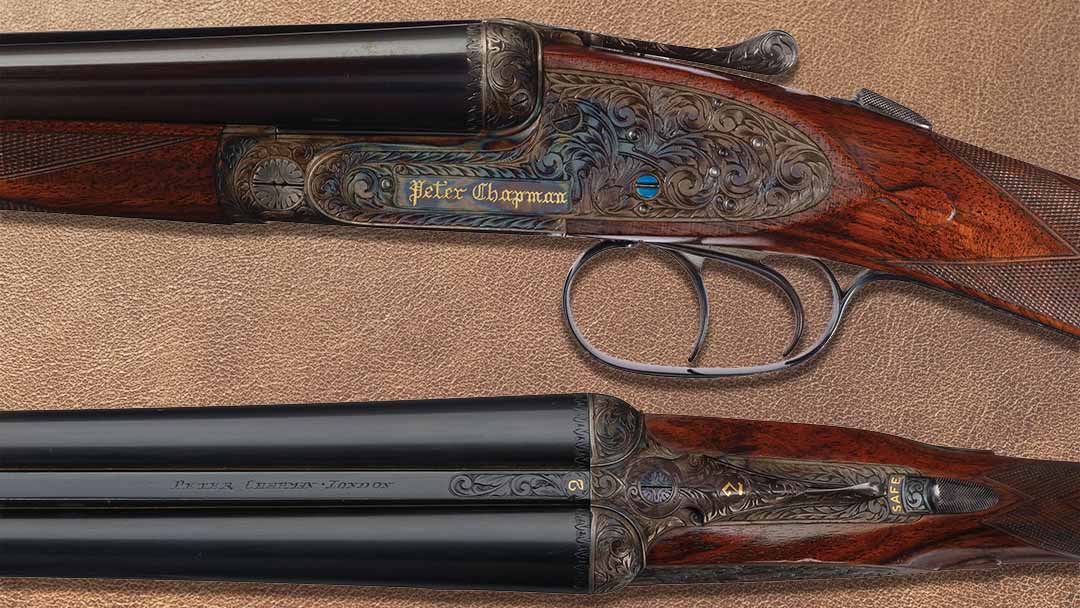
Peter Chapman apprenticed as a finisher for Purdey, starting in 1952, a year before Peter Nelson came on as an apprentice. Chapman stayed for 25 years before striking out on his own. By some estimates he made about 160 guns under his name, about twice Nelson’s output but still making his guns a rarity.
This pair of 20 gauge double barrel shotguns have blued steel chopperlump barrels and casehardened Purdey-type sidelock action with highly attractive floral scroll engraving surrounding “Peter Chapman” in gold gothic lettering on the lockplate. The scroll engraving also lands on the toplever that also bears either a gold “1” or “2”, the triggerguard and both tangs. The safety mounted on the tang has “SAFE” in gold inlay.
Don’t Forget Scottish Shotguns
An engineer by training, David McKay Brown apprenticed for John Dickson & Son before founding his own company in Scotland 1967, starting with repair work before moving into the manufacture of bespoke sporting arms that rival the finest and oldest names in the business. The company prides itself on the McKay Brown Round boxlock action providing the gun with a more slender and elegant look.
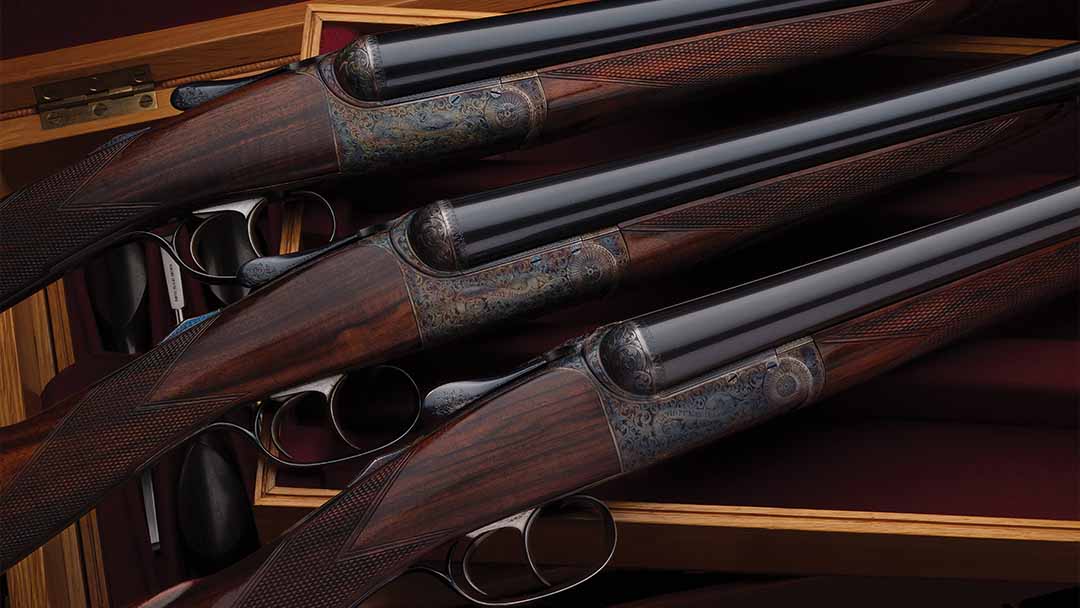
This trio of side-by-side shotguns have dated proofs of 1990 for guns “1” and “2” while gun “3” is proofed 1992. An article from “Shotgun Life Magazine” details the trio’s pedigree, originally ordered by safari hunter and guide Charles Williams.
Fine English Doubles and the Double Rifle
Joseph Manton established London as the center of English gunmaking and James Purdey cemented that sentiment. Purdey made not just shotguns for field and fowl but also double rifles for the savannas of Africa.
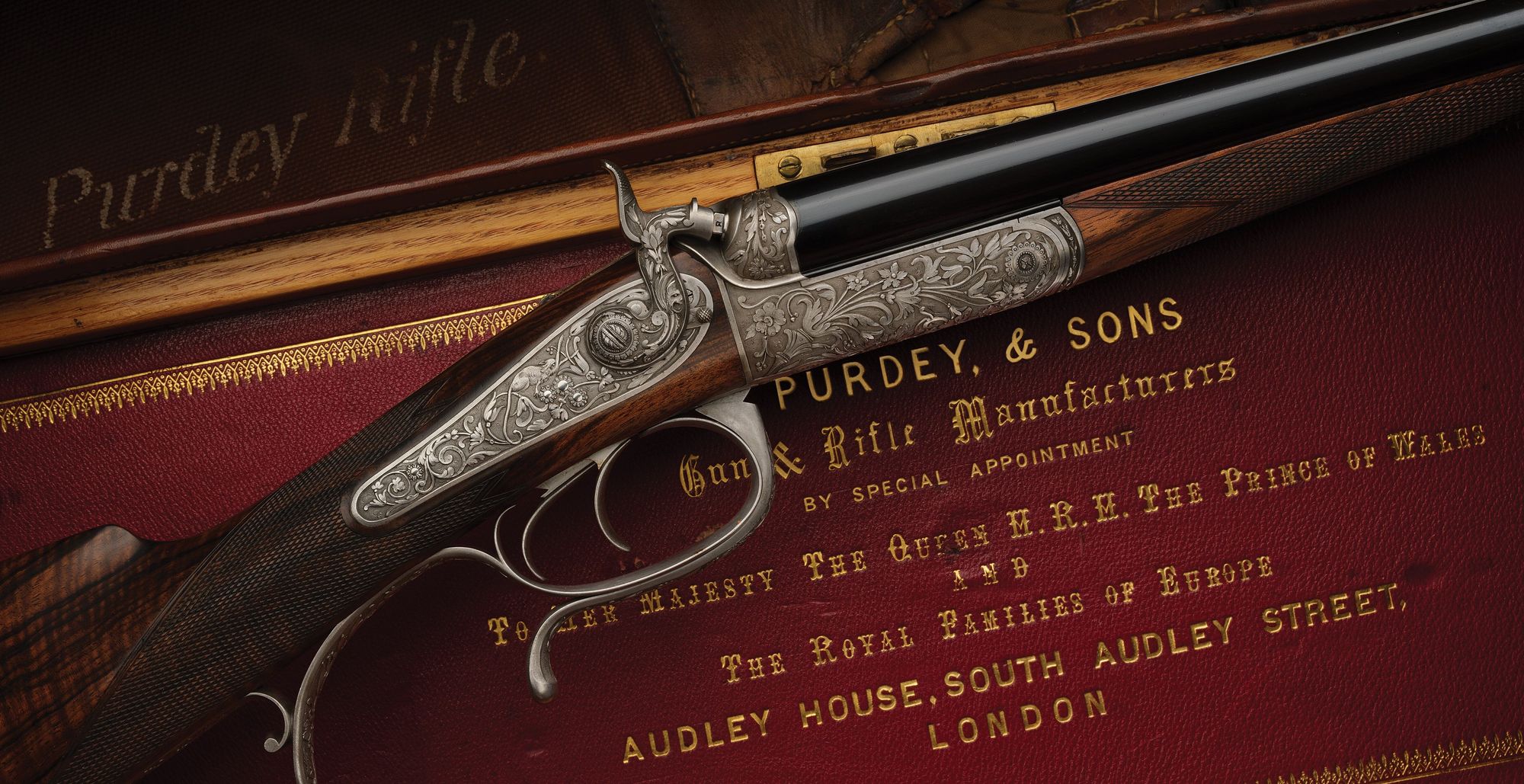
Purdey & Sons made this incredible double rifle in 1876 for display at the Exposition Universelle in Paris in 1878 where it won a gold medal and then shown at the Sydney International Exhibition in 1879. It was sold to the 3rd Baron Keane in July 1884. Keane purchased four of the eight guns Purdey presented at the Exposition Universelle. When he died three of the four Purdey guns were willed to the Duke of York who would ascend to the British throne as George V in 1910. The guns are in the Royal Gunroom at Sandringham. This double rifle is the only one remaining in private hands.
British Shotguns for Sale
Fine English shotguns are marked by immense craftsmanship, whether it is the precision of the gun’s action or the unforgettable finish and adornment, either of which makes them desirable as field pieces or for display in one’s gunroom. Rock Island Auction Company’s offerings of fine English sporting arms are unmatched and the roster for the Aug. 23-25 Premier Auction provides numerous opportunities for collectors to obtain high-conditioned, historical and rare pieces.