Collector Spotlight Auction Shines on Smith & Wesson

0

Rock Island Auction Company will be aglow with Smith & Wesson handguns  ̶  rarities and classics  ̶  dedicating its entire May 1 Collectors Spotlight auction slate to only firearms from the legendary American company.

More than half of the Smith & Wesson handguns in the 300-lot auction are from the collection of long-time collector Jon M. Maxwell. Maxwell was a 40-year member of the Smith & Wesson Collector Association and devoted himself to the pursuit of assembling a group of experimental, early production, one-off and rare collectable Smith & Wesson handguns, even influencing some of their prototypes. The Smith & Wesson Collectors Association started in 1964 by six collectors at a gun show in Tulsa, Okla., then elected its first slate of officers at the 1970 Las Vegas Gun Show.

Here is a sampling of some of the Smith & Wesson handguns in the Collectors Spotlight Auction.

Rock Island Auction Company will hold its first-ever Collectors Spotlight Auction dedicated specifically to one firearms company, Smith & Wesson, on May 1.

Third Model Ladysmith Revolver

The smallest hand-ejectors made on the Smith & Wesson M frame fire seven shots. A tall tale about the Ladysmith involves Daniel Wesson learning it was the gun of choice for prostitutes. Shocked by the salacious story and given his puritanical New England upbringing, he ordered production ceased. The trouble with the story is Wesson died in 1906 but production continued until 1921.
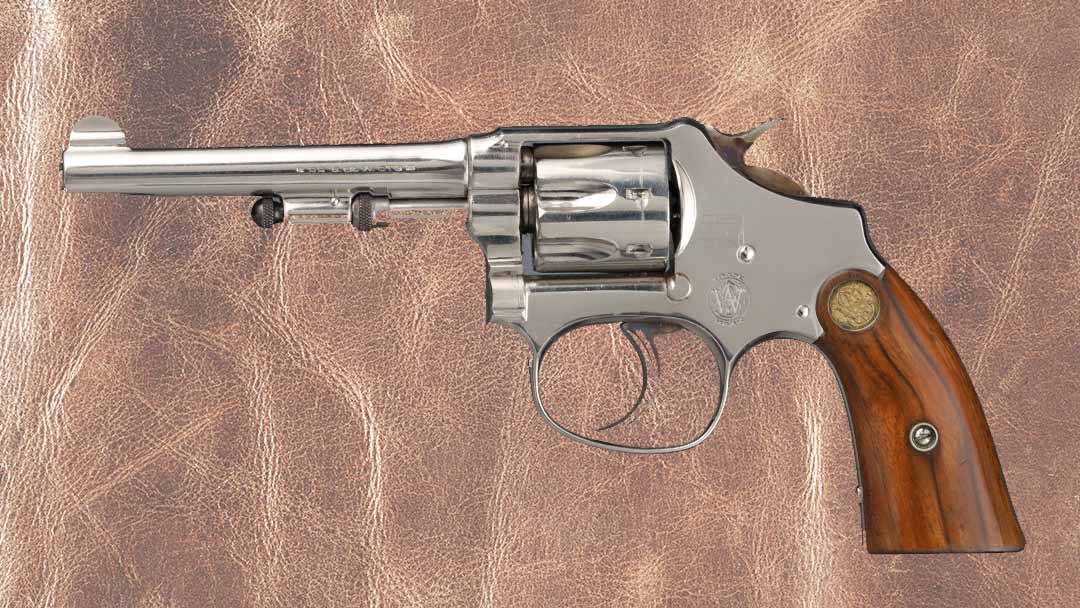
Smith & Wesson produced the Third Model from 1911 to 1921. This superb example, chambered for .22 caliber, is very fine overall with a high condition nickely finish.

Wiley Clapp Tested Smith & Wesson Performance Center 4566 Pistol

When Smith & Wesson started turning out semi-automatic pistols in the 1950s they were given two-digit designations until 1982. The second generation went by three digits during production from 1979 to 1988 while the third generation series adopted four-digit model numbers that used codes for calibers, frame size and finish.

This Performance Center Model 4566 is a mid-sized double action/single action chambered for .45 ACP. This gun was tested by Wiley Clapp whose article “New S&W PC 4566 .45ACP” in “Combat Handguns” magazine. Clapp was a U.S. Marine and police officer before becoming a writer and consultant, mostly on handguns.
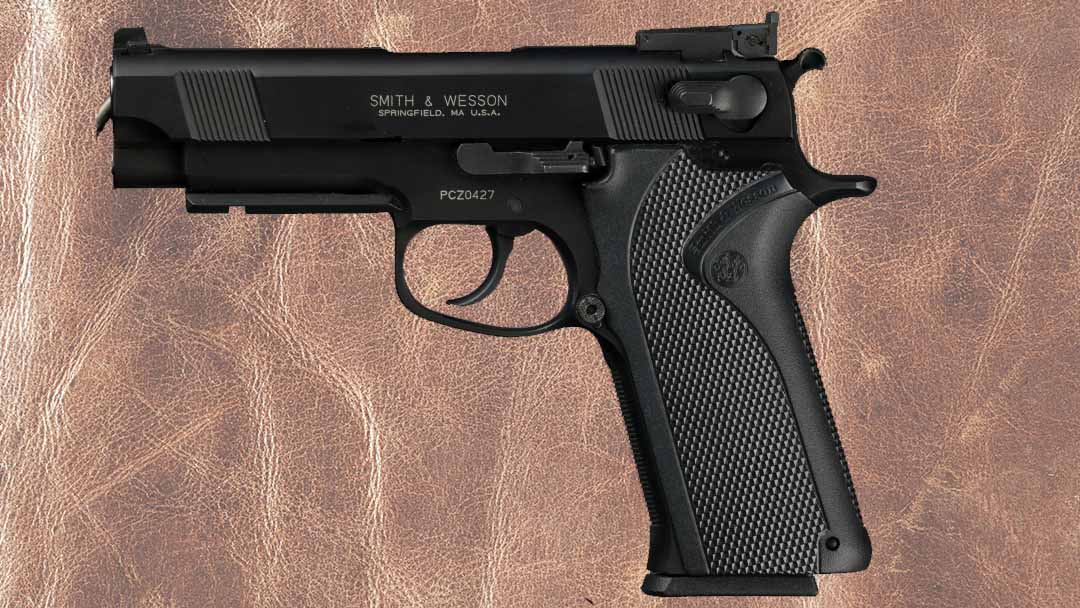
Made in the 1990s, this Performance Center Model 4566 is excellent overall, including mechanically, and was tested by handgun writer Wiley Clapp.

Pre-War K-22 Masterpiece Second Model Revolver

Designed in the 1890s, the medium-sized K frame served as the platform for a .38 caliber service model. The gun eventually led to Elmer Keith and other handloaders advocating for the .357 Magnum round.

The K-22, re-christened the Model 17 when Smith & Wesson started using model numbers in the 1950s, is a good small game and plinking gun, and given that it fires .22 long rifle, the larger frame makes for a smooth shooting revolver.
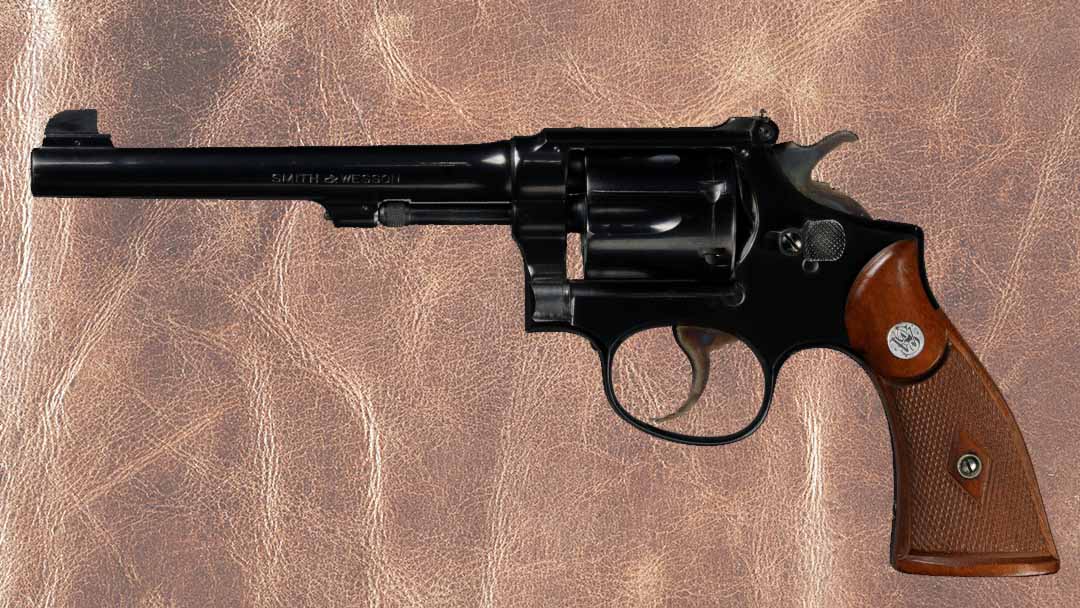
Made about 1940-1941 this pre-war K-22 Masterpiece is mechanically excellent. The Second Model has taller rear sights as well as a short action hammer.

Venezuelan Police-Marked Model 469

This semi-automatic pistol has a 3 1/2-inch barrel, reportedly earning the nickname “the Mini Gun” and was an early model in Smith & Wesson’s development of a compact-sized semi-automatic pistol small enough for concealed carry but offering enough firepower to work as a service weapon.
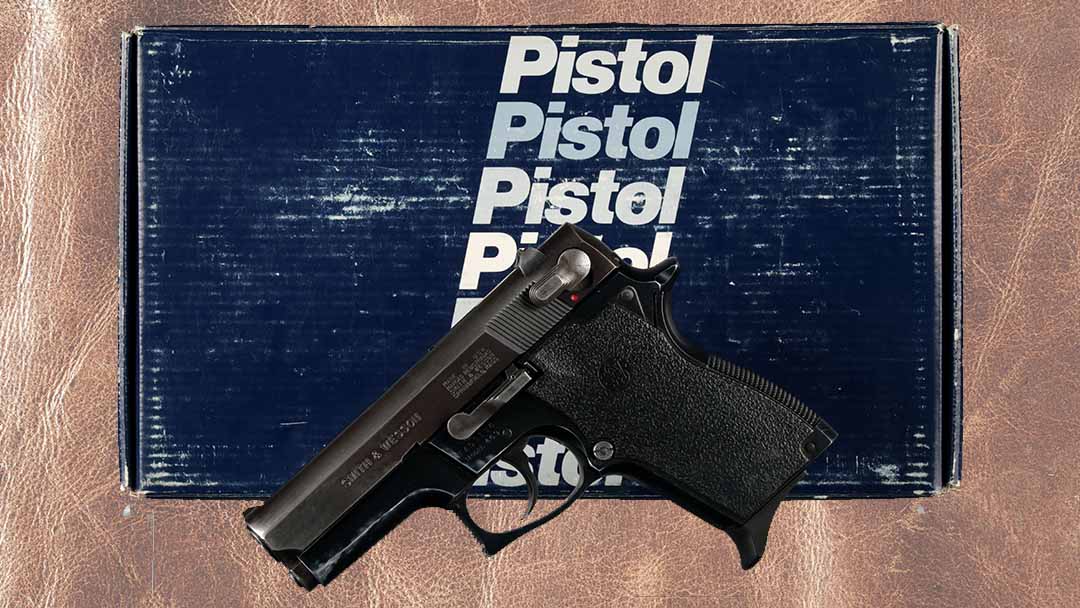
This gun bears the Venezuelan crest on the right side of the slide and the frame is marked “C.T.P.J.” “The Standard Catalog of Smith & Wesson” by Jim Supica and Richard Nahas states that a Venezuela marked model can be valuable. “Extremely rare, value in the four figures.”

.44 Hand Ejector Model of 1950 Military Revolver

Hand Ejectors are revolver royalty. The First Model .44 caliber Hand Ejector introduced in the early 20th century is better known by another name – the Triple-Lock. When production re-started after World War 2, the revolver received some design changes, most significantly a full rib on the top of the barrel. Company documents from the 1950s state that 90 percent of production of this double action was chambered for .44 Special.

Made from 1950 to 1966, this wheelgun was re-designated the Model 21 in 1957.
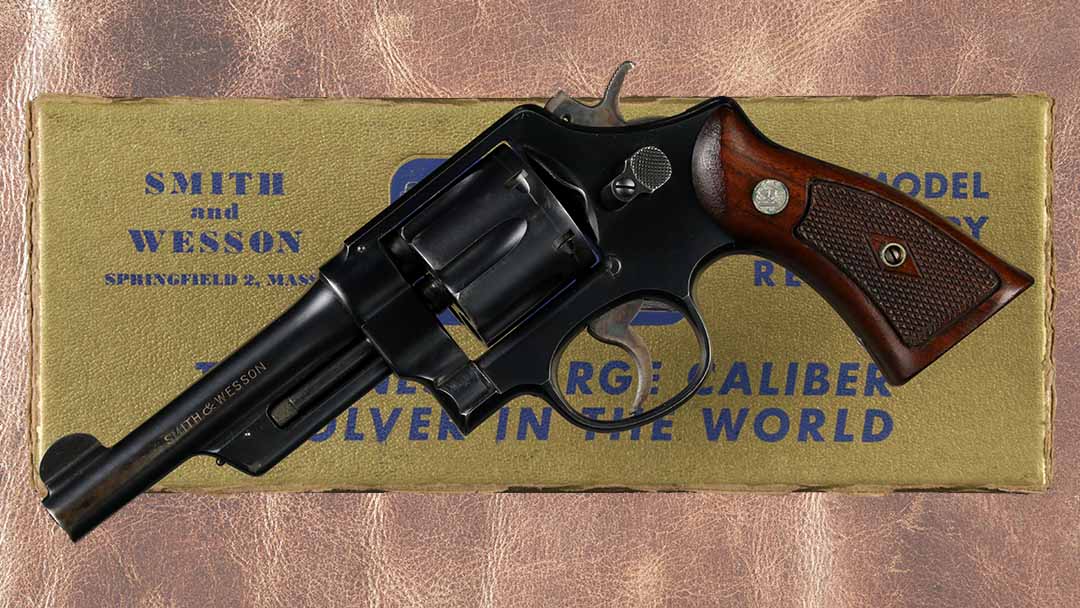
Manufactured about 1955-56, this .44 Hand Ejector Model of 1950 has a five-inch barrel, blued finish and is mechanically excellent.

.357 Magnum (Pre-Model 27) Revolver

In the 1930s, Smith & Wesson worked with Phil Sharpe and Elmer Keith, among other handloaders wanting a more powerful cartridge, to design the .357 Magnum cartridge. The company developed its Registered Magnum program that provided a number of options including 23 barrel lengths, six main sight choices, blue, nickel and engraved finishes, two types of grips along with other options before ending it in 1939.

When the Registered Magnum program ended, fewer options were available. The barrel lengths for unregistered .357 Magnum revolvers were whittled down to just five. After World War 2, the gun was modernized with a short-throw hammer with either blue or nickel finishes. It became the Model 27 in 1957.
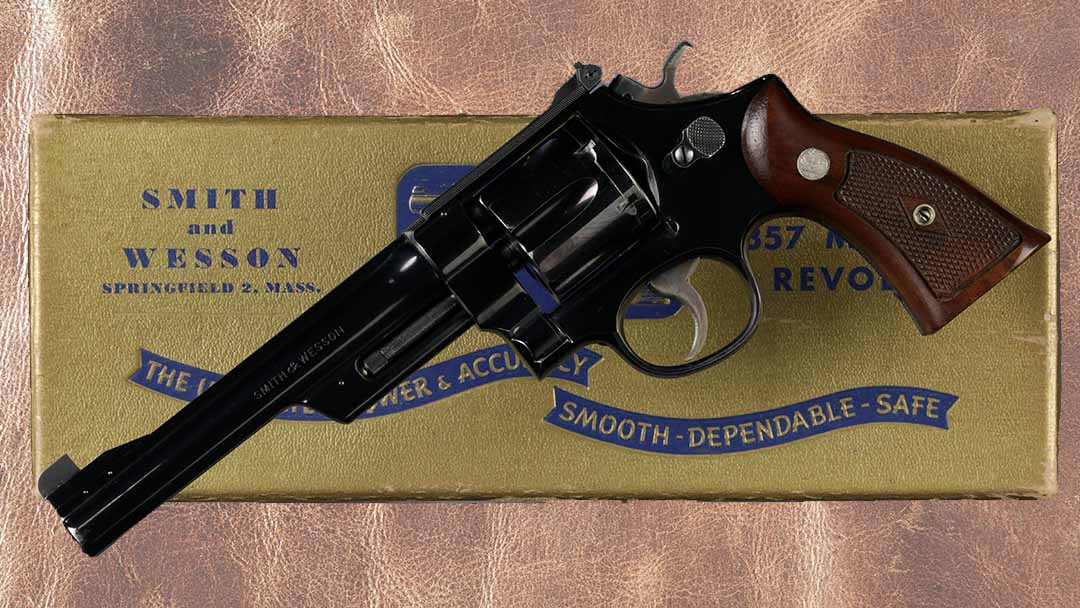
This is as close to a Registered .357 Magnum as you can get and a foundational piece for revolver collectors. It has a 6 1/2-inch solid rib barrel and blue finish. It is rated fine overall and very fine mechanically.

Performance Center Schofield Model of 2000

The Schofield dates back to the revolver trials that brought the world the Colt Single Action Army and Smith & Wesson’s No. 3 revolver. It also drew the attention of George Schofield, a Civil War veteran who attained the rank of brevet brigadier general and remained in the U.S. Army after the war at the rank of major. Schofield’s version has a square butt frame with no knuckle on the backstrap, the latch mounted on the frame and chambered in .45 caliber. The U.S. Army bought 8,000 Schofields, but the gun found interest from the U.S. Marshal Service and Wells Fargo employees.

The Performance Center update around 2000 added a modern hammer block safety and used a carbon and steel frame. Still chambered for its original .45 S&W caliber, this is a great way to obtain a classic revolver that is safe to shoot.
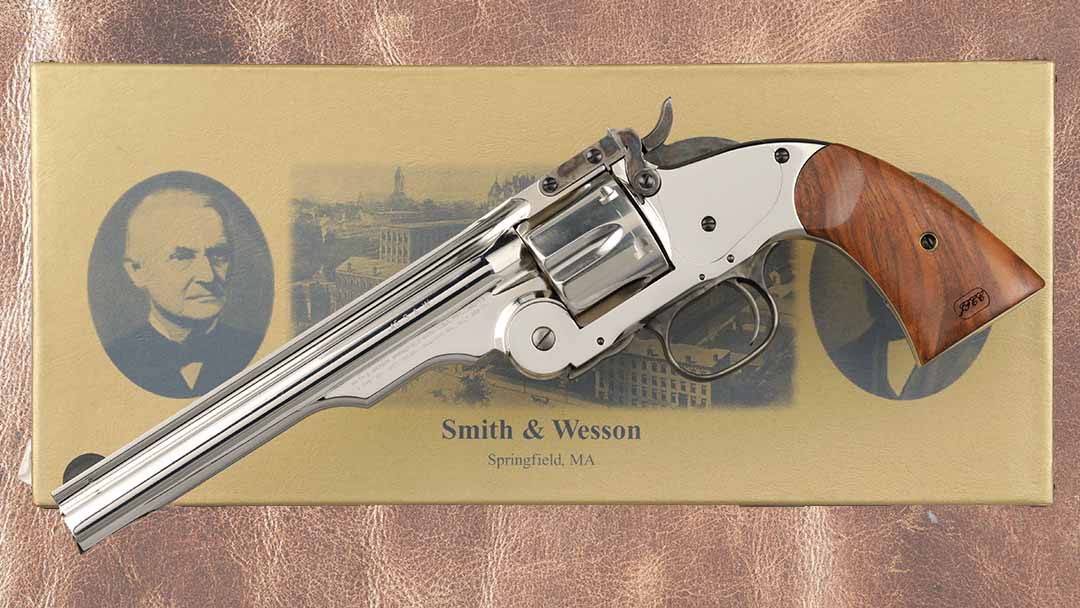
This Performance Center Schofield of 2000 has a seven-inch solid rib barrel and nickel finish. Chambered in .45 Smith & Wesson, it is mechanically excellent.

Smith & Wesson Model 559

Originally based on the large-capacity Model 59 that is considered one of the original “wonder-nine” double action pistols. The Model 559 uses a double column magazine similar to the Browning High Power. This second generation semi-automatic pistol went from the 59’s alloy frame to a steel frame and steel slide. Manufactured from 1980 to 1983 there are only two known to have a chrome finish, and this is one of only 15 with a rare matte gray finish.
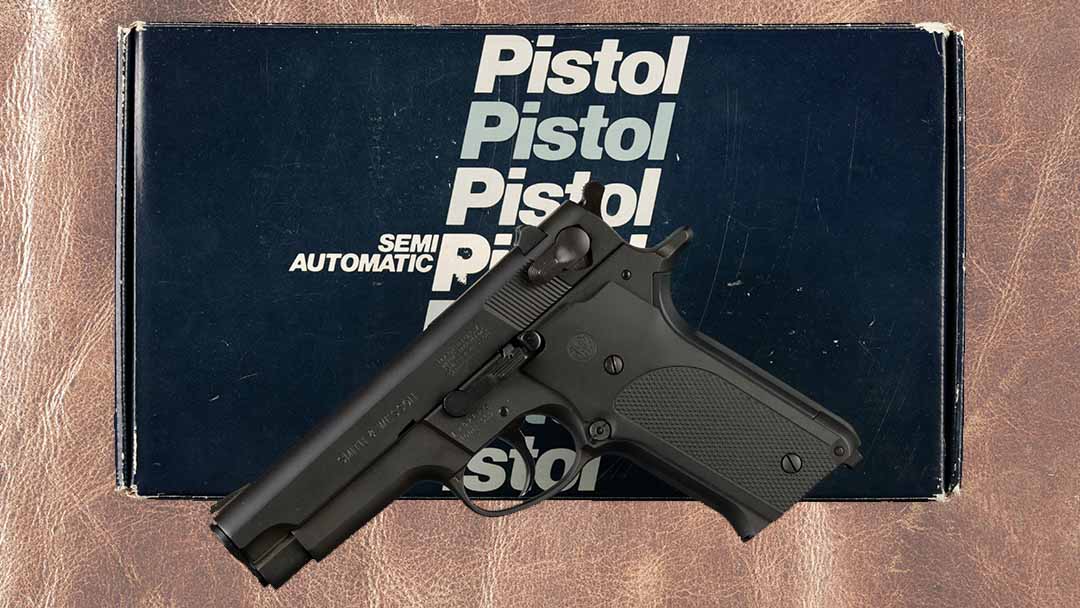
This 9mm Model 559 pistol is a rarity for its dull gray finish. Of 10,609 manufactured, only 15 have the matte finish.

Model 29 Revolver

The gun that made Dirty Harry Callahan snarl the question, “I know what you’re thinking – `Did he fire six shots or only five?’ Well, to tell you the truth, in all this excitement, I’ve kinda lost track myself. But, being as this is a .44 Magnum, the most powerful handgun in the world and would blow your head clean off, you’ve got to ask yourself one question: `Do I feel lucky?’ Well, do you, punk?”

Elmer Keith and other hand loaders had already lobbied for the .357 Magnum cartridge in the 1930s and now wanted something more potent than the .44 Special. By the mid-1950s, the .44 Magnum cartridge was born and the Model 29 double action revolver was introduced in late 1955. This revolutionary revolver, made to handle the spicy round, came in one of three barrel lengths, including the 8 3/8-inch version that was introduced in 1958. It was a difficult gun for buyers to find after Clint Eastwood’s “Dirty Harry” was released in 1971. Discontinued in January 1999, this revolver is still made occasionally in small quantities.
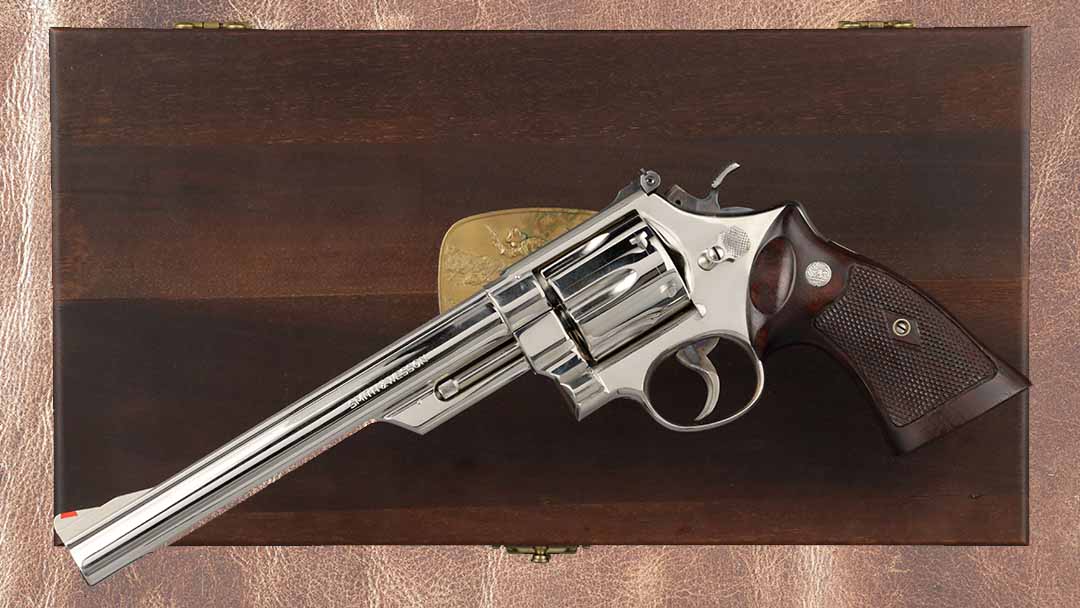
Chambered in .44 Magnum, Dirty Harry’s round, this firearm with its 8 3/8-inch barrel was manufactured in 1959-60. Mechanically excellent, it comes with a wooden Smith & Wesson display case.

First Model .44 Double Action Revolver

Made from 1881-1913, these double action revolvers followed the New Model No. 3. All the frames for this wheelgun were made before 1899 making them antiques. About 54,000 were made.

One of only two antique Smith & Wesson handguns in the auction, the .44 double action revolver is joined by a .38 caliber single action Second Model revolver.
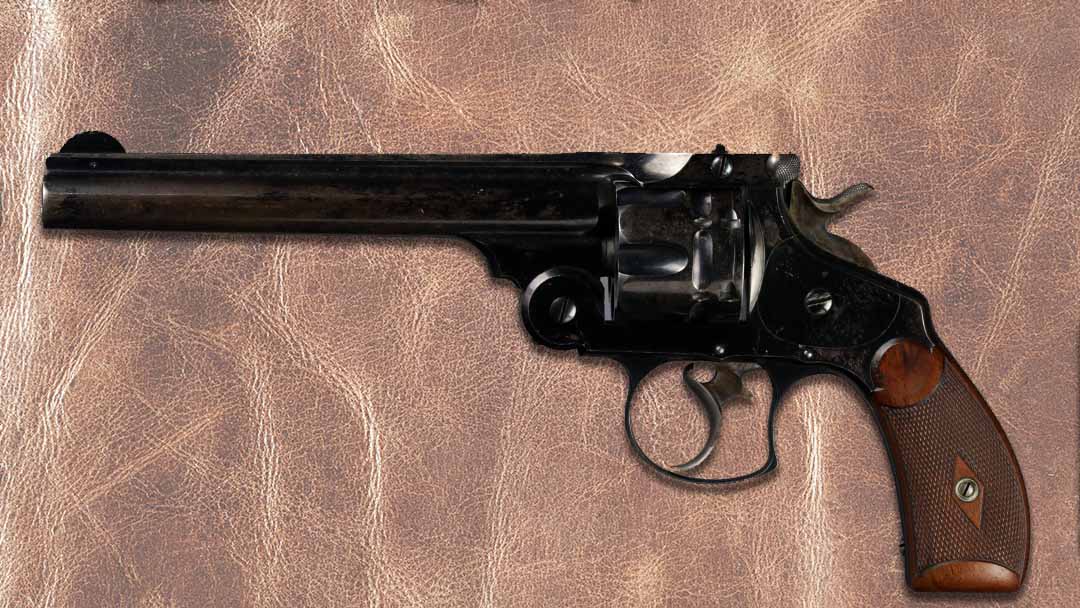
This First Model .44 double action revolver chambered in .44 Russian was shipped in January 1886 to M.W. Robinson Company, New York City. It is mechanically very good.

FBI-Purchased Model 1076

Following on the heels of the Bren Ten and the FBI’s realization that it needed more firepower after the notorious 1986 Miami shootout that killed two of its agents, Smith & Wesson created the Model 1006 and the law enforcement Model 1076 in 10mm. The FBI ordered 10,000 of these semi-automatic pistols and 2,400 were delivered.

This gun doesn’t get nearly the attention as its others 10mm breathren, the aforementioned Bren Ten nor the Colt Delta Elite, so collectors shouldn’t sleep on this opportunity to get an FBI-purchased 10mm pistol.
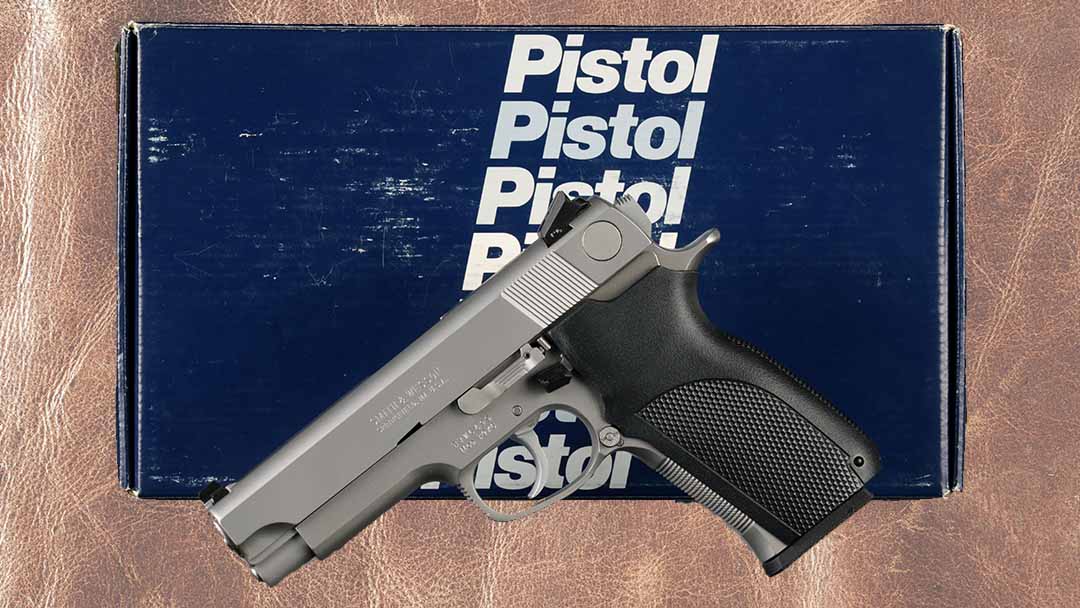
Chambered in 10mm, this Model 1076 meets the purchase product code that shows it was bought by the FBI. The FBI version was built without a magazine disconnect.

Performance Center Model 66-3 Carry Comp Revolver

This stainless steel double action revolver that began life as the Combat Magnum is made to conceal carry on the company’s K target frame. The 66 has adjustable sights and a ramped front blade. It received a new yoke retention system/radius stud package/hammer nose bushing/floating hand in 1986 to earn the Model 66-3 designation.
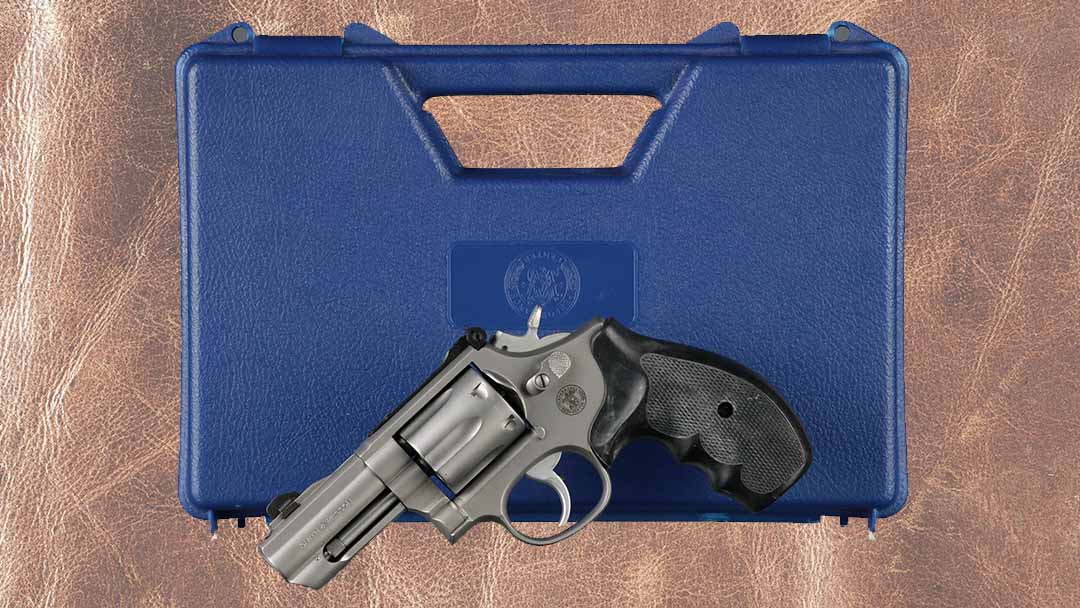
The Model 66-3 chambered in .357 Magnum with its three-inch barrel, rubber grip and stainless steel finish make it a terrific concealed carry option.

Model 19-P Double Action Revolver

Smith & Wesson President Carl Hellstrom asked retired Assistant Chief U.S. Border Patrol Inspector Bill Jordan, a noted shooting skills writer, about the ideal firearm. Jordan replied it would be built on S&W’s K frame and have a four-inch barrel and shrouded extractor rod. Also, it should be able to handle both .38 Special and .357 Magnum cartridges. The gun, unveiled in 1955, was named the Combat Magnum and the first one was given to Jordan. Later it became the Model 19. This revolver has a fixed sight that was built for export to Peru in limited quantities, making the Model 19-P scarce.
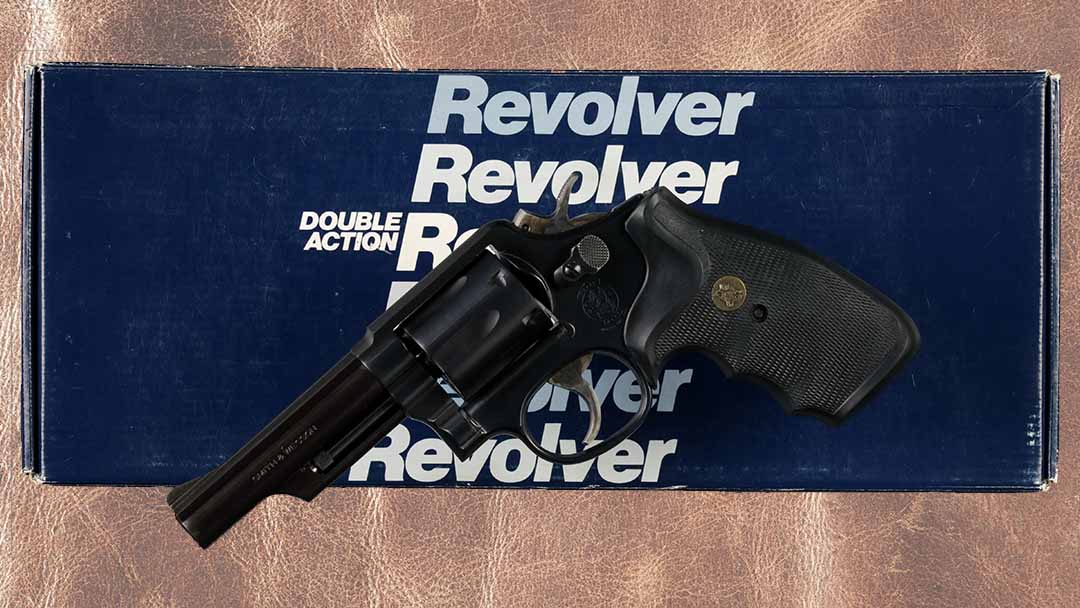
The scarce Model 19-P was offered in limited quantities with either a 2 1/2-inch barrel with a round butt or 4-inch barrel with a square butt for sale in Peru. This revolver has a four-inch barrel and is chambered in .357 Magnum.

Model 28-2 Highway Patrolman Revolver

Introduced in 1954 to meet the no frill needs of police, this revolver chambered in .357 Magnum is described as a utilitarian Model 27 offered in 4-inch or 6-inch barrels. The original test production was marked Patrolman but changed to Highway Patrolman on the suggestion of Florence Van Orden of The Evaluators Ltd. to Hellstrom. The Highway Patrolman was produced from 1954 to 1986. In the second model, the cylinder stop was changed and the trigger guard screw was eliminated in 1961.
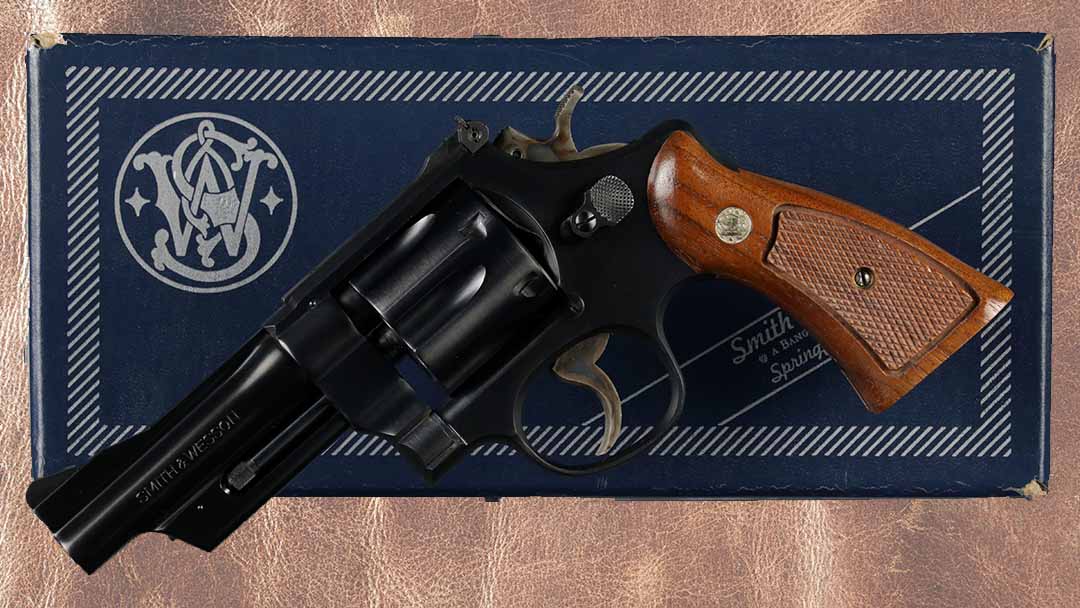
This Highway Patrolman is offered with a 4-inch solid rib barrel. It is mechanically excellent.

Smith & Wesson Handguns for Sale

Jon Maxwell’s legacy as a collector of Smith & Wesson handguns is long and influential, bringing together classics like the Model 29 and .357 Magnum and rarities like the matte gray-finished Model 559 and Wiley Clapp-tested Model 4566. All of the firearms among the 300 lots of the Smith & Wesson Spotlight Auction offer fantastic opportunities for collectors of this legendary firearms company to pluck something from their wish list.

An Affordable Classic Pen Modernized – the Parker Jotter

0

I always carry a pen. Usually, it is a Pokka Pen since I can easily drop it in my pocket. However, I also like to have something a bit more substantial and enjoyable to write with most of the time. That means you’ll often find a Parker Jotter with me and you probably need one too.

The Parker Jotter is an absolute classic design that looks at home in any EDC or sitting on any desk. It is also incredibly modern thanks to the fact that it takes standard Parker-style refills which is an incredibly common ink refill format. You can take a Jotter from all-weather “tactical” pen to basic ballpoint to precise gel pen to smooth writing rollerball just by swapping the refill.

I’ll call out one refill that I particularly like because it offers a precise .5mm tip, smooth writing, quick-drying ink, and a fairly large reservoir at a very low price (as low as $2 each). The Ohto Flash Dry refills will drop right into the Jotter and feature a fine tip that I love writing and doodling with. I also appreciate that these refills are lighter weight than metal ballpoint refills which makes the Jotter a very lightweight pen. This is an incredibly useful combination.

I have two Jotters. One that is more modern and made in France. The other is an older one, made sometime before the 1970s and it is still writing. That is impressive for a $13 pen.

You can find Parker pens at many office supply stores locally (wait for a sale) or pick them up at Amazon:

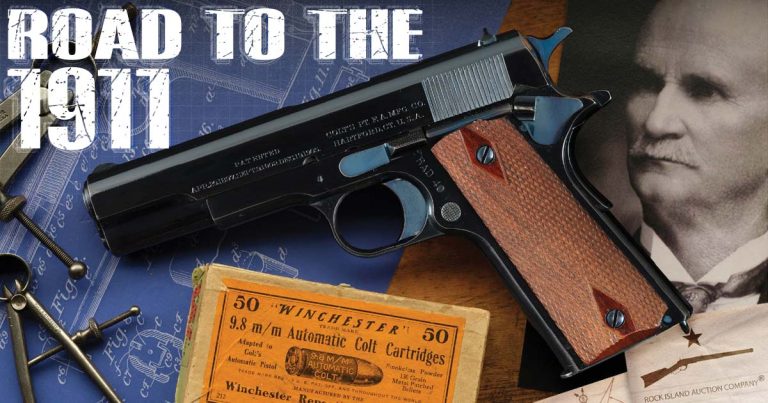
Road to the 1911 Pistol

0

The famous 1911 pistol is one of the most popular handguns of all time. When it comes to factors like balance, comfort, and reliability, John Browning’s 1911 design has no shortage of admirers. The legendary pistol was eventually adopted by the U.S. Army and went on to become the longest-serving sidearm in American military history, but the 1911’s road to success was far from an easy path. The story of the 1911 design involved numerous early models and prototypes as Browning raced to develop a pistol that would stand out against a slew of competitors.

The 1911 pistol is a cornerstone of any U.S. military collection, but its massive appeal transcends typical genres. From the earliest 1911 design iterations to unfathomably rare variations that never entered full production, the selection in RIAC’s May 2024 Premier Auction is as extensive as it is extraordinary.

The U.S. Military’s search for a reliable semi-automatic sidearm was a primary driver in the development of John Moses Browning’s .45-caliber pistol. Many of the evolutionary predecessors to the Colt 1911 are rare guns today, with especially scarce examples like the Colt Model 1910 prototype pistol considered gun collecting treasures. The Colt 1910 was a significant milestone in the progression of the 1911 design, but the real story began over a decade earlier.

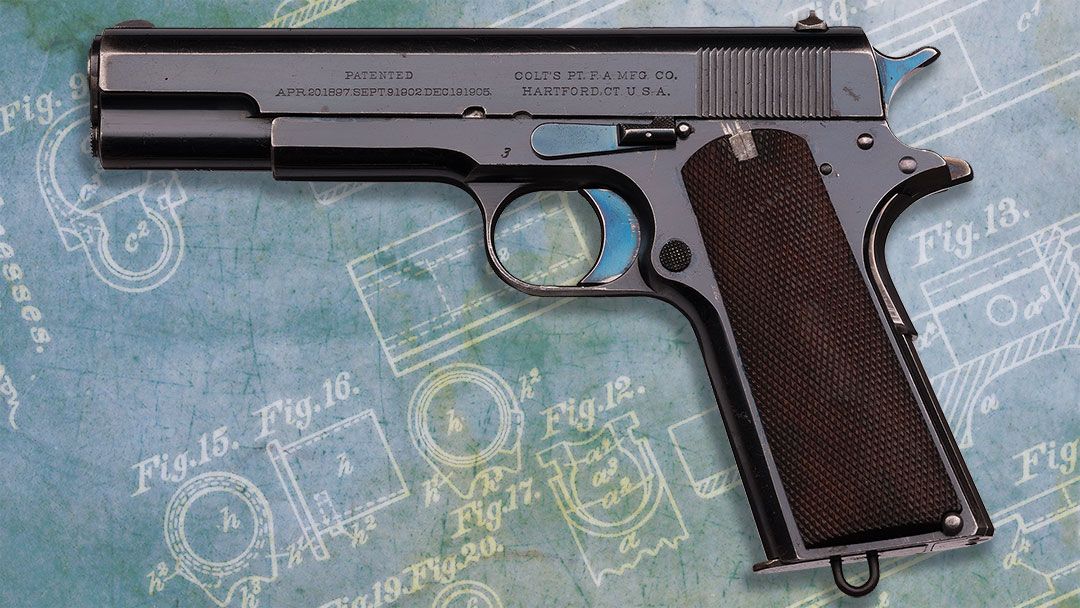
One of four known experimental/prototype Colt Model 1910 9.8 MM pistols, serial number 4. Available this May.

The First 1911 Predecessors

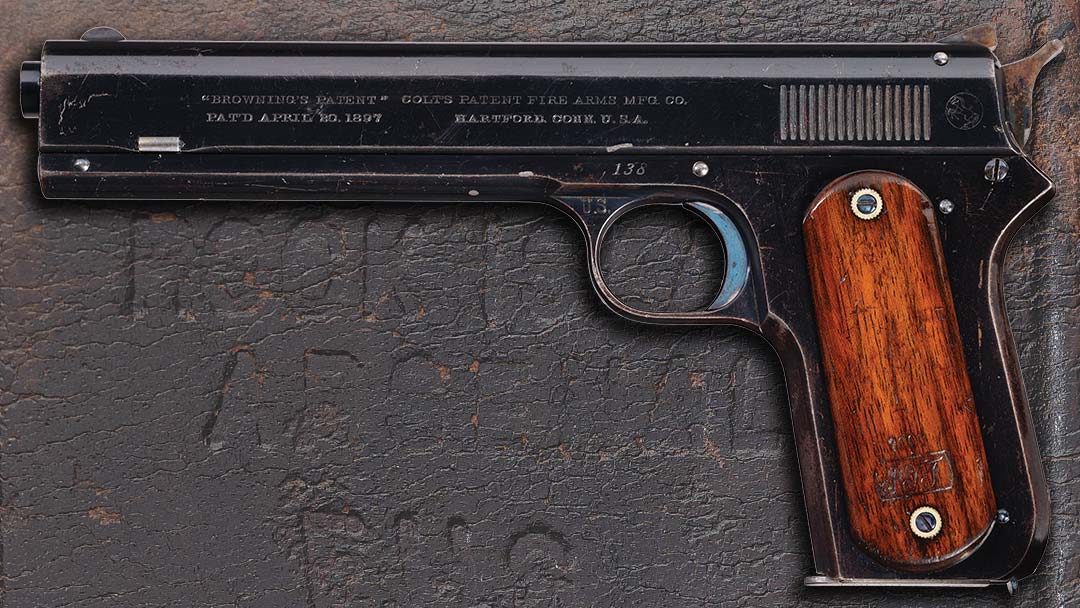
The 1911 pistol’s military lineage started in 1898 with Browning’s Colt Automatic Pistol, a gun that would become known as the first production Colt Model 1900. Chambered in .38 Auto, this early Browning design was a locked breech, short recoil-operated, hammer fired handgun that was sent to the U.S. Ordnance Department to test the feasibility of an automatic pistol in the hands of army officers.

An extremely rare, first U.S. Army contract U.S. Colt Model 1900 “Sight Safety” pistol, only one of 100 manufactured. Includes a period holster and factory letter. Available this May.

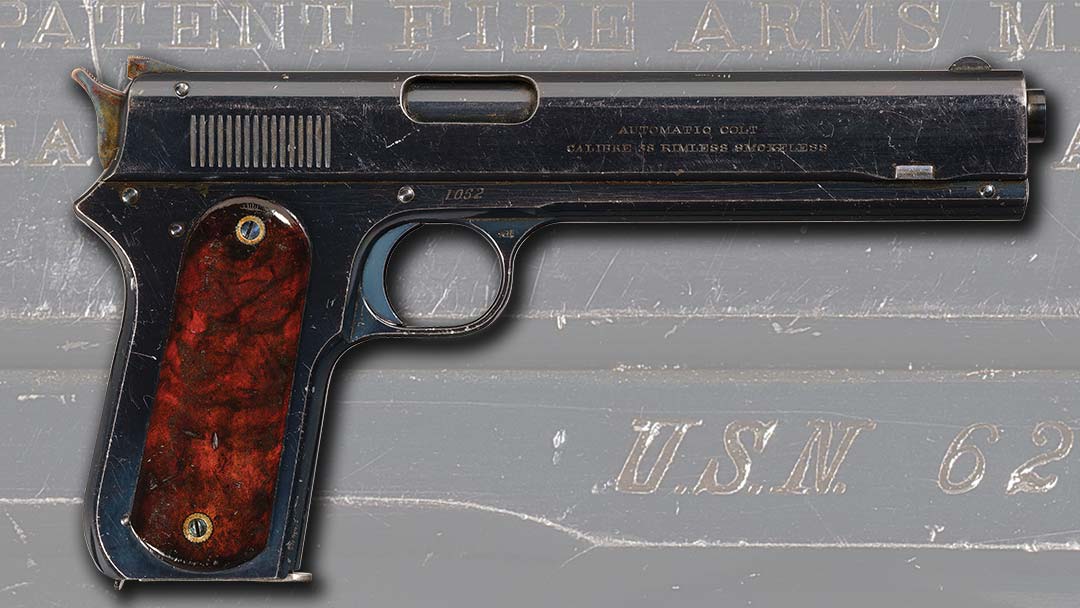
The pistol below, shipped on October 17, 1900, falls in the second shipment of Model 1900 “Sight Safety” pistols sent from Colt to the U.S. government general storekeeper at the Brooklyn Navy Yard. Colt produced only 250 of these scarce pistols under contract for the United States Navy, all of which were shipped in the fall of 1900 to test the potential of the automatic pistol as a seafaring weapon.

An exceptional and scarce U.S. Navy contract Colt Model 1900 “Sight Safety” pistol with a factory letter. Available this May.

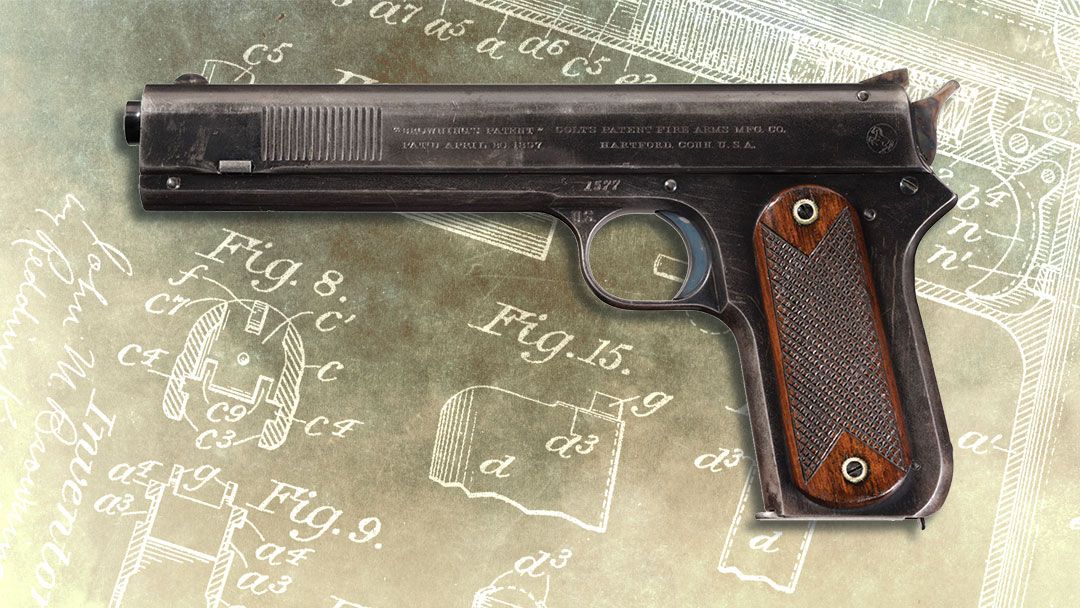
Officers stationed in the Philippines had a high demand for automatic pistols, and after initial field testing the Ordnance Department requested a number of design changes and ordered 200 more Colt Model 1900 pistols. These U.S. Army Second Contract models only incorporated two of the recommended improvements, including checkered, thicker grips, and deeper slide serrations that were moved to the front of the pistol.

This U.S. Army Second Contract Colt Model 1900 “Sight Safety” pistol sold for $13,800 in RIAC’s September 2021 Premier Auction.

Colt Model 1902 Design

Reports from the field were mixed, and some of those complaints are reflected in how the Model 1900’s frame differs from its famous successor. A shorter, deeper grip, no slide stop, a muzzle heavy design, and one of the early Browning pistol’s most famous features, its rear sight safety. Having a rear sight that doubled as a safety by blocking the firing pin wasn’t popular with the troops, as both the sight and firing pin tended to wear and made the weapon both unsafe and inaccurate.

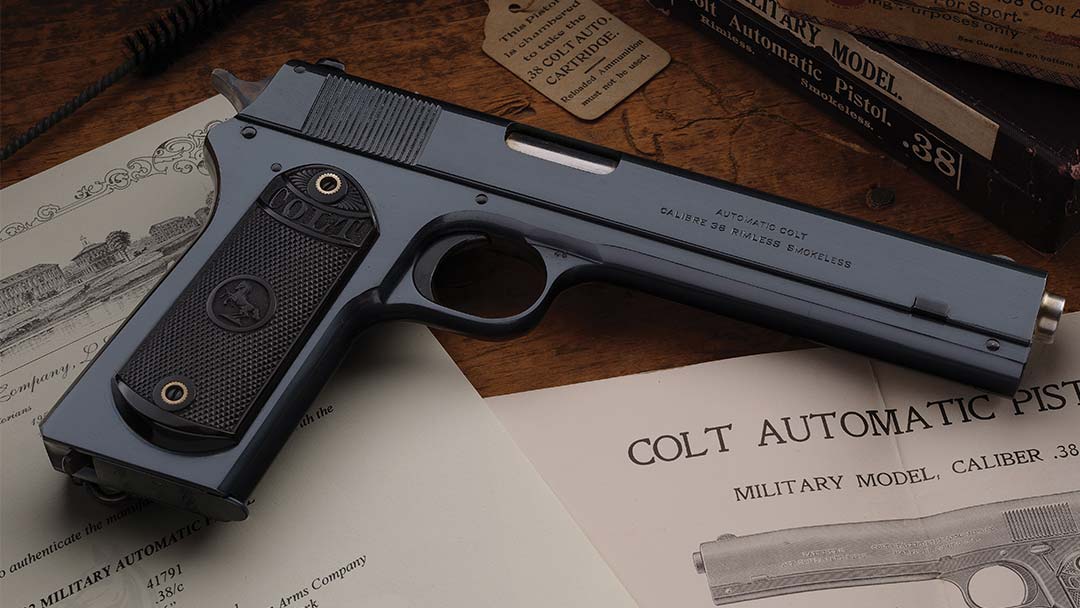
A benchmark condition, documented Colt Model 1902 Military pistol with its original box and a factory Letter. Available this May.

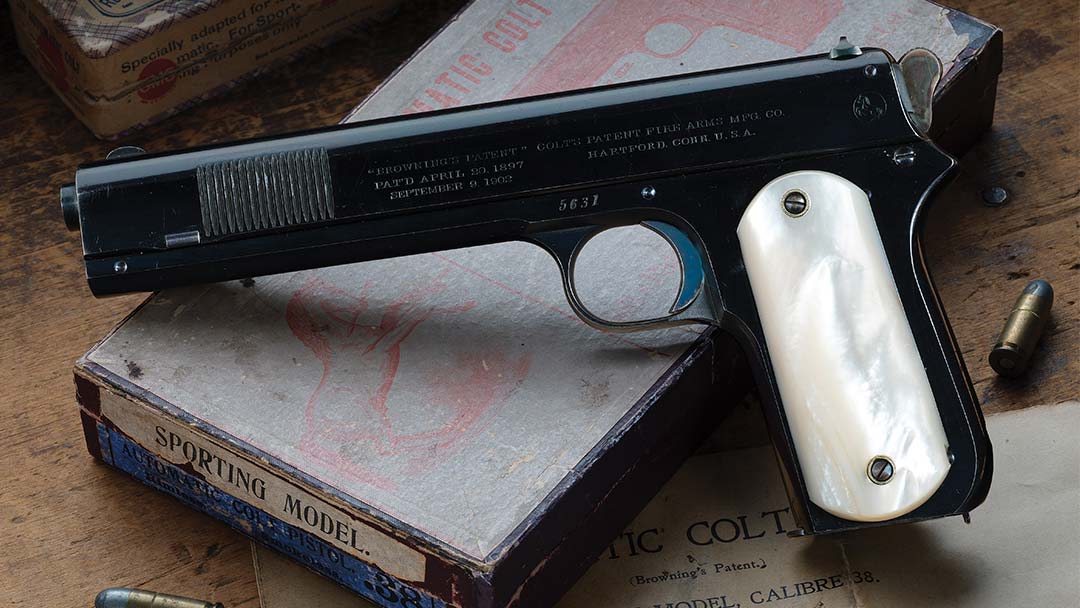
The next historic precursor to the 1911 design, the Colt 1902, addressed a number of military complaints and included a lengthened grip, a slide stop, and an increased magazine capacity from seven to eight, though the pistol was still chambered in .38 ACP (which stands for Automatic Colt Pistol). Again, the feedback from the field trials was mixed, questioning the durability of the pistol compared to well-known and comparatively reliable alternatives like the New Army Colt 1892 revolver.

An outstanding early production Colt Model 1902 sporting pistol with a rare picture box and a Colt Factory Letter. Available this May.

Developing the .45 ACP Pistol

In 1904, Colt and Browning had been developing a .41 caliber cartridge. In the same year, the Thompson-LaGarde field tests were conducted to determine which caliber the U.S. Military should adopt going forward. The tests were in part initiated by the poor performance of the Army’s .38 caliber revolvers during the Philippine Insurrection, and Colonel John T. Thompson concluded that nothing short of .45-caliber stopping power was suitable for dealing with a determined opponent like the Moro juramentado warriors during the Moro Rebellion.

Browning beefed up his .41 caliber cartridge to create the .45 ACP and modified his pistol design to chamber the larger round in order to accommodate the military’s request. Enter the “Military Model of 1905”.

A rare Colt Model 1905 military pistol. Available this May.

In January 1906, U.S. Army Ordnance Chief B.G. Crozier issued a letter of invitation to the gun manufacturing industry to develop and submit new semi-automatic handguns utilizing Browning’s new .45 ACP rounds. Lured by the promise of a rich military contract, eighteen companies initially responded, though only six were able to produce a test sample pistol. Three of those designs were eliminated early, with Colt, Savage, and DWM remaining as the sole survivors.

Only 288 Savage Model 1907 in .45 ACP were made for the 1907 Pistol Trials. They are a rare bird for collectors of U.S. military arms, early semi-autos, and 1911 pistols.

During the next testing phase, DWM would voluntarily withdraw its U.S. Trials .45 ACP Luger pistol design due to concerns that the Americans wouldn’t pick a European offering regardless of virtue. The Savage Arms Corporation produced a version of its Model 1907 automatic pistol that was scaled up for .45 ACP and faced off against Colt during the next round of military testing.

The .45 ACP Colt Model 1905

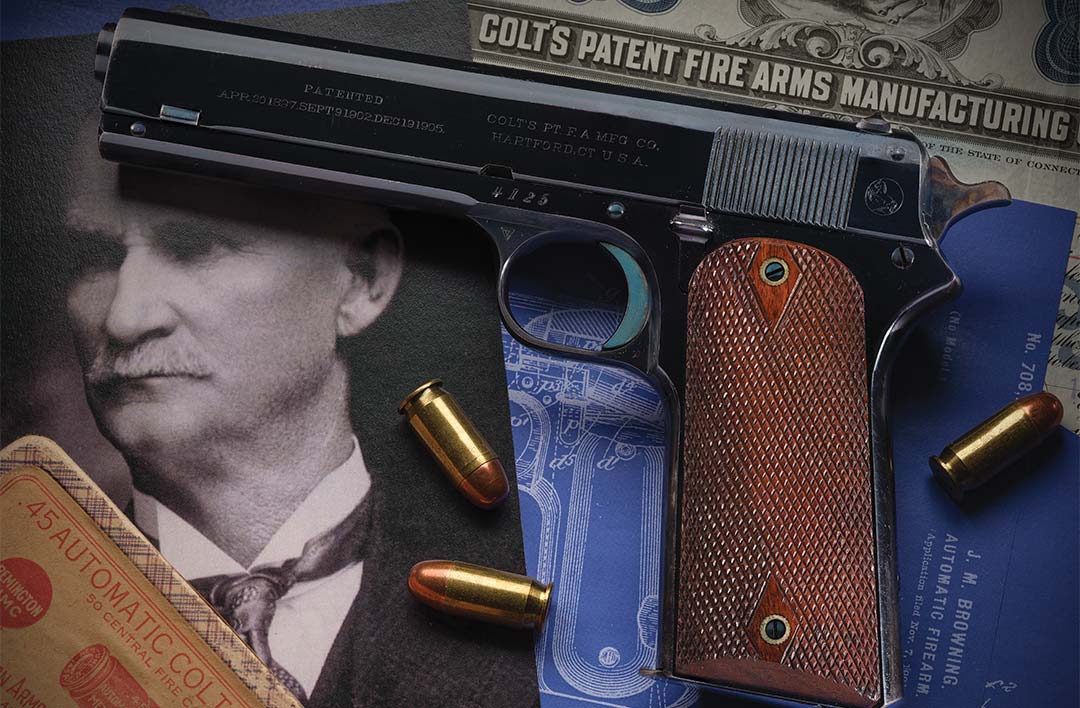
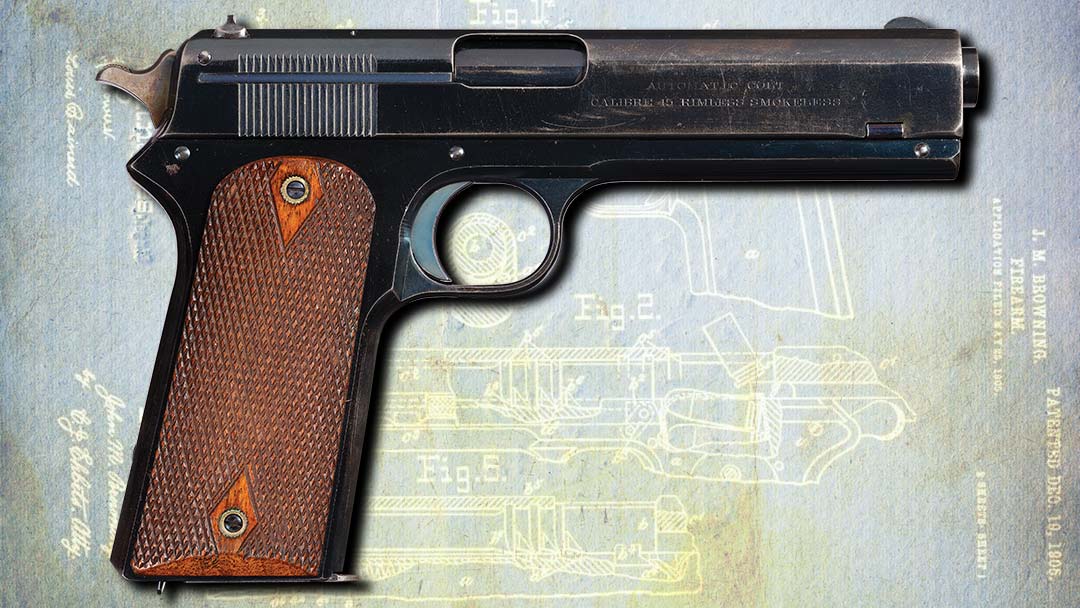
With an external extractor and a larger grip to house the new cartridge, the Colt 1905 was an important evolutionary leap in the development of the 1911 design. Browning had also reduced the number of parts and simplified the internals, a trend toward efficiency that would continue in later iterations of the handgun.

An exceptionally fine, documented Colt Model 1905 Military pistol with factory letter. Available this May.

The Model 1905, while a step in the right direction, proved too fragile to stand up to the recoil forces of the .45 ACP rounds and the rigors of military torture testing. So while the Colt 1905 wasn’t the final answer that the military was searching for, it helped set the stage for the sturdier 1907.

The Colt Model 1907

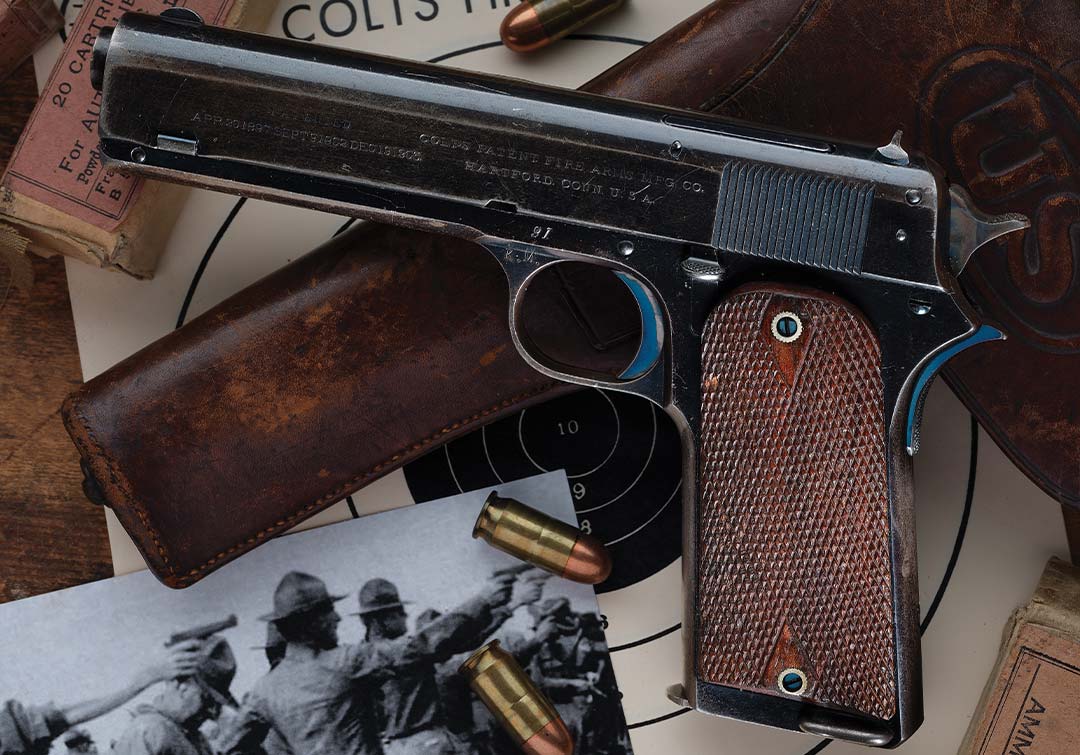
Browning continued to refine his design with the Colt Model 1907, a beefed-up 1905 with a grip safety. The Model 1907 pictured below, serial number 91, is one of only 200 manufactured under the Army Contract of 1907 for field trials, with an additional five made for presentation. The pistol was shipped from Colt to the Springfield Armory on March 17, 1908, and was one of the 64 pistols issued to Troop H, 2nd Cavalry Regiment at Fort Des Moines, Iowa, for actual evaluation.

An exceptionally rare Colt Model 1907 U.S. Army Test Trials pistol with an RIA holster. The serial number “91” is located on the left side of the frame above the trigger guard bow, which has the initials of Ordnance inspector “K.M.” (Major Kenneth Morton). Available this May.

While a notable upgrade, the Colt 1907 still proved unsuitable for the .45 ACP round during rigorous field evaluations. In June 1909, Colt submitted a letter to the Chief of Ordnance requesting to withdraw all of their test samples, agreeing to modify them to correct the design flaws and return them to the Army for further evaluations. While much of the groundwork had been laid for what would become the iconic 1911 design, Browning realized an extensive redesign was needed to accommodate the power of the new military cartridge.

The Colt Model 1909 and 1910

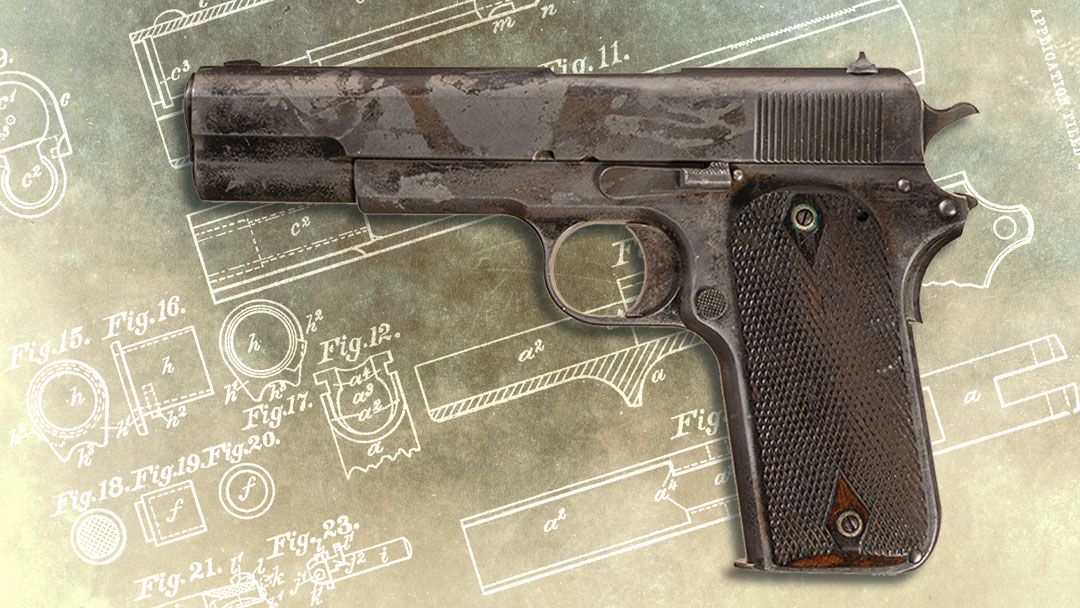
John Browning would continue to refine his pistol with the Colt Model 1909, which replaced the two link barrel lock up design with a single link, tilting barrel system for greater reliability. The 1909 also made improvements to the recently added grip safety, the ejector and ejector port, a new placement for the magazine release, and the weapon’s overall ease of disassembly was also fine-tuned.

Colt Model 1909 Prototype test trial pistol, an example previously sold at Rock Island Auction Company for $126,500.

Browning’s pistol was drawing closer to its final form, but the next prototype was perhaps the most important evolutionary piece in the legacy of 1911 design. Originally manufactured in 1910, there were possibly as few as eight Model 1910 prototype pistols ever produced.

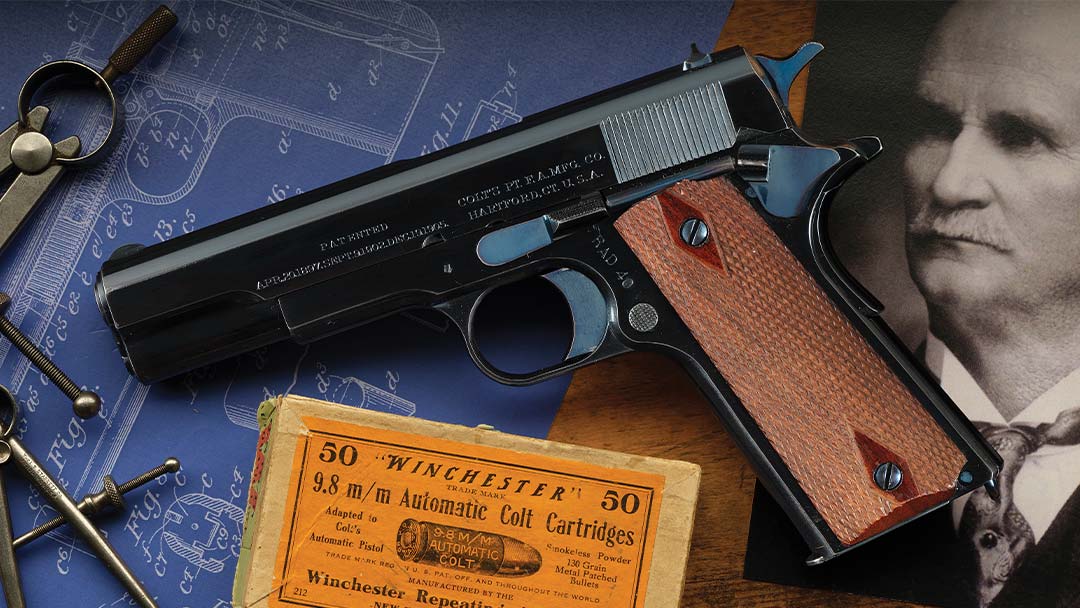
One of four known Colt Model 1910 experimental/prototype pistols in 9.8 MM, serial number 4. Available this May.

Colt Model 1910 Serial Number 4

With the Model 1910, Browning made further refinements to the componentry, while other design changes are more outwardly apparent, like the change of grip angle, a square ejector, and most examples included thumb safeties. In most respects, the 1910 represents the blueprint for what would become the 1911 design.

This remarkable Colt 1910 pistol comes with a First Place Award from the 2007 Colt Collectors Association (CCA) Show at Reno, Nevada, a CCA 2007 Display Award, and a Texas Gun Collectors Association Spring 2008 Most Historical Award, a Texas Gun Collectors Association Display Award. Available this May.

The exceptionally rare 1910 prototype pistol offered this May is one of only five examples that were produced in 9.8 mm and is slightly scaled down in size compared to its Model 1910 .45 ACP counterparts. Colt developed the 9.8 mm prototype as a potential replacement to the Colt Model 1903 Pocket Hammer pistol that could compete with Fabrique Nationale in Eastern Europe. The outbreak of WW1 along with a marketing deal between FN and Colt led to the Model 1910 pistol and its experimental 9.8mm Auto cartridge never making it to full production.

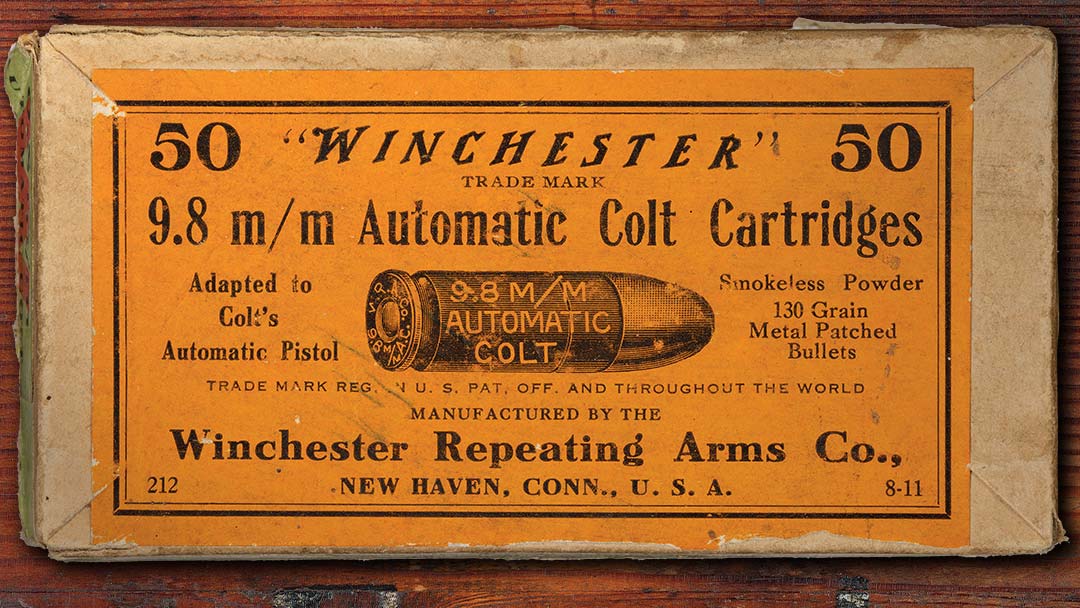
A 50 count box of Winchester 9.8 mm Automatic Colt cartridges, an experimental cartridge that was developed in 1910 for use in the prototype Colt Model 1910 pistol. Available this May.

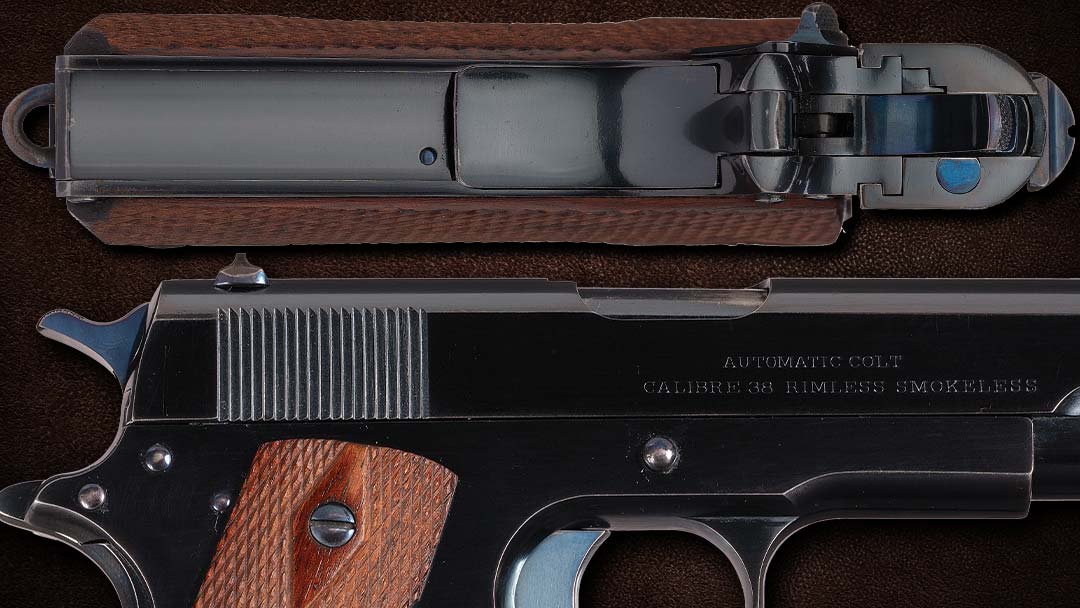
The Model 1910 9.8 mm prototype pistol features a shorter, narrower slide and a 4 1/2 inch barrel with four concentric locking rings. Other unique features include a flat-sided hammer with a checkered spur, a slide with an early rounded rear sight, and a slide stop and safety lock that appear to be Colt Model 1911 Special Army components. The pistol’s magazine is a modified Model 1902 Military magazine with an un-marked floor plate and a full blue finish.

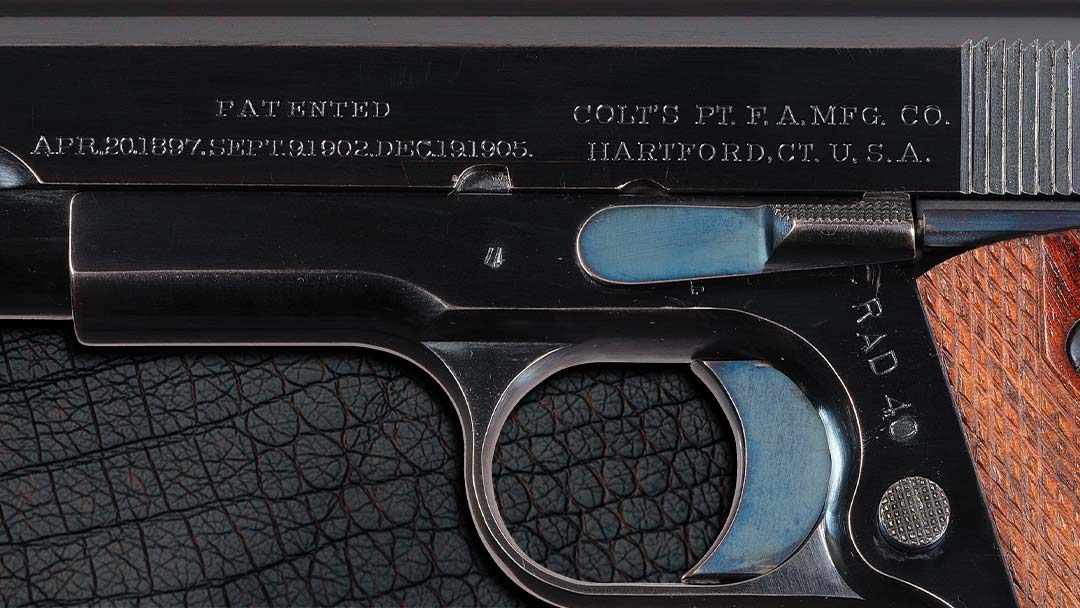
The left side of the frame is hand-stamped with the serial number, “4” above the trigger guard. “40 CAL/MODEL” are stamped in two vertical lines beneath the slide stop; “40 CAL” is hand-stamped and “MODEL” is stamped with a single die. “RAD 40” (Research and Development) is hand-stamped vertically above the magazine release. “98” is stamped on the lower left side of the barrel chamber above the lug. Available this May.

The First 1911 Pistols

In November of 1910, the Ordnance Board met to pit the Colt and Savage .45 ACP pistols against each other for the second to last time. Each gun was fired 6,000 times in a grueling test, and while both pistols had breakage issues, the Colt Model 1910 emerged as the clear favorite.

Colt Model 1910, serial number 3, sold for $241,500 in RIAC’s September 2021 Premier Auction.

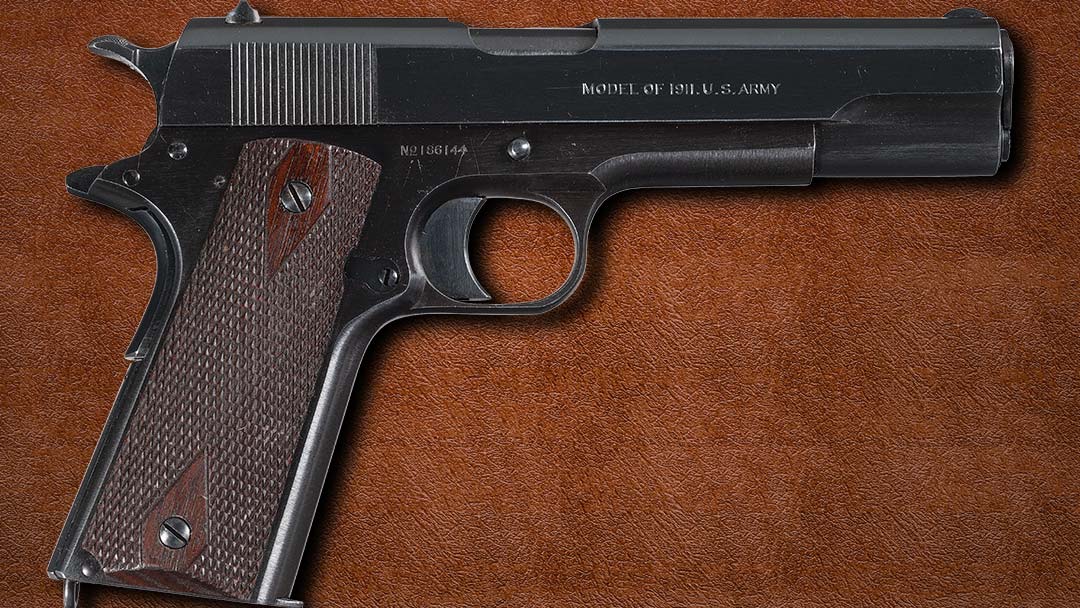
The military pressed for further refinements, and those subsequent modifications lead to the development of the renowned U.S. Army Model 1911, a design approved on March 19, 1911 and officially accepted on May 5th as the “Automatic Pistol, Calibre .45, Model of 1911.”

Manufactured in 1917, this pistol was part of a 400 gun shipment on 10 October 1917 to the United States Marine Corps. Available this May.

Following its adoption by the Army, the Model 1911 was also selected by the Navy and the Marines. The 1911 design we know today had truly arrived, and the storied pistol would soon go on to serve thousands of GIs in World War I. Browning’s 45-caliber semi-automatic pistol earned a reputation as a rugged, reliable sidearm that was comparatively easy to maintain.

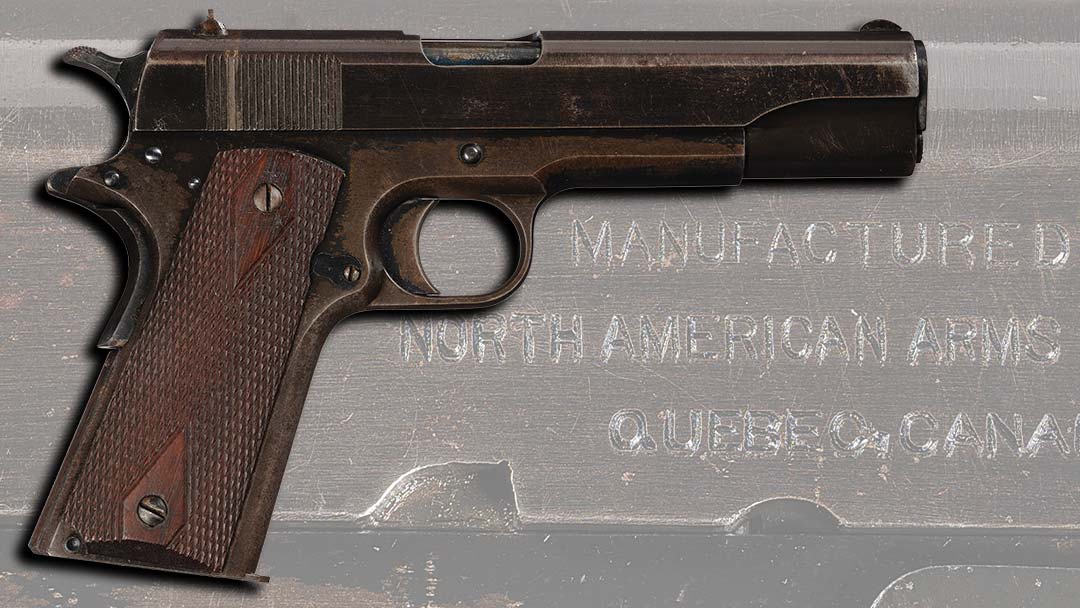
An extremely rare North American Arms Co. Model 1911 presentation pistol produced in 1918. Available this May.

The Military Heritage of the 1911

After serving with distinction in WW1, the 1911 design underwent a series of small refinements including a shortened trigger, extended hammer spurs, simplified checkered grips, an arched mainspring housing, a thicker front sight, and angled clearance cutouts. Designated the M1911A1, no major changes were made to the 1911’s internals, testifying to the pistol’s exemplary performance record. “Old Slabside” became an icon of WW2 and saw service in every theater.

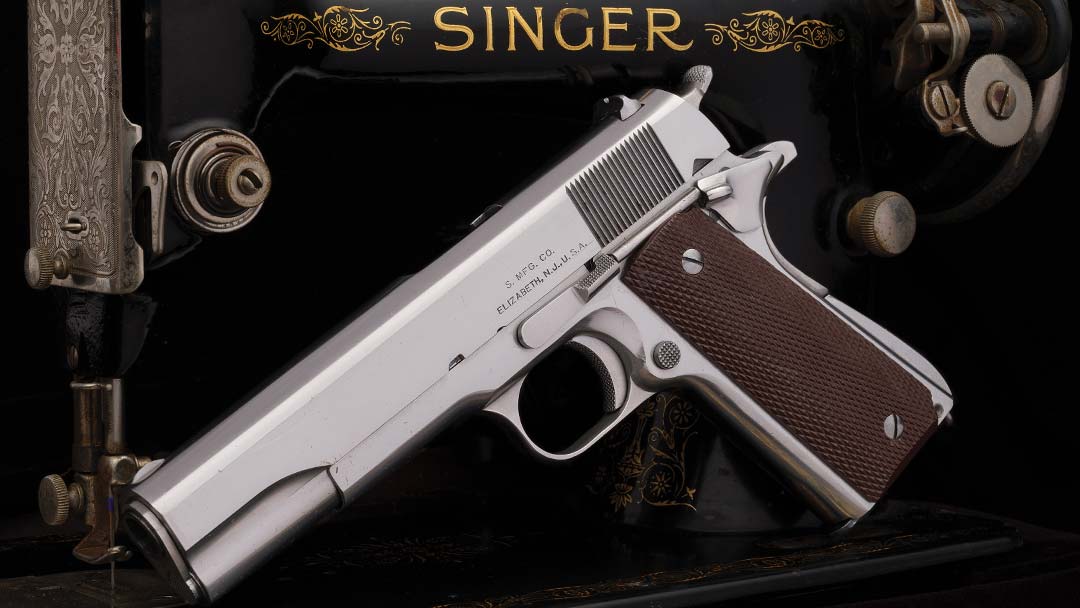
A rare and highly desirable unserialized WW2 Singer Manufacturing Co. prototype/presentation model 1911A1 with a unique factory polished, in-the-white finish. Available this May.

Over 3 million 1911 pistols were produced for the U.S. military during the famed firearm’s more than six-decade reign as America’s official military sidearm, with nearly 2 million of that number manufactured during WW2 alone. Despite its eventual replacement by the Beretta M9, the 1911 pistol is still carried by numerous officers to this day.

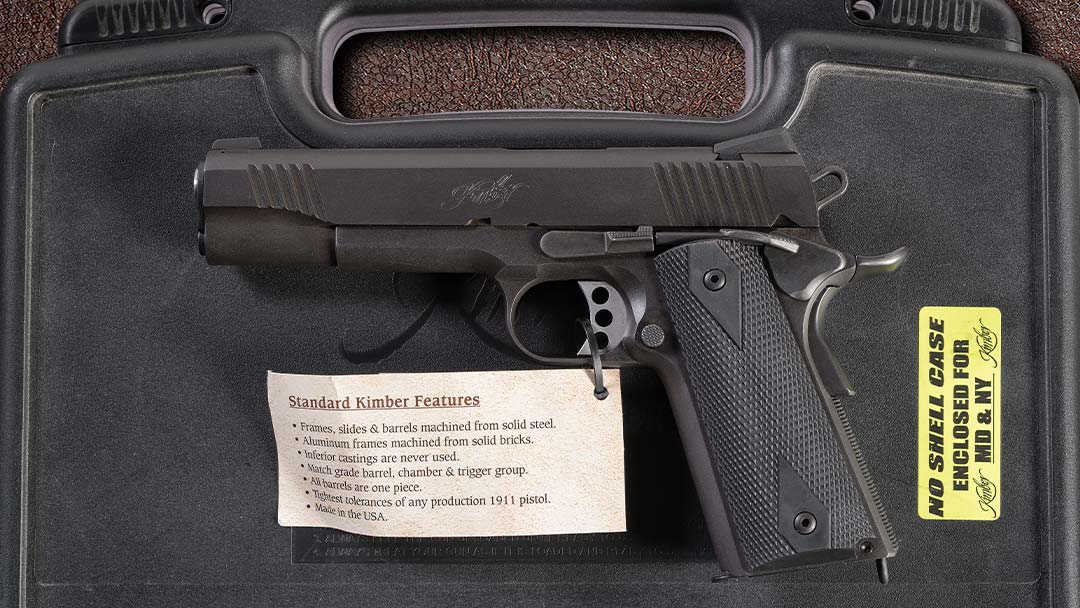
An extremely scarce documented U.S. Marine Corps Kimber DET-1 1911 pistol with case, an example of the longevity and adaptability of the 1911 design. Available this May.

1911 Pistols for Sale

The 1911 genre is more popular than ever today. Browning’s landmark design continues to be produced by dozens of manufacturers across the globe, with pistols like the Kimber 1911, the Sig Sauer 1911, and the Ruger 1911 a consistent hit with shooters and collectors during Rock Island Auction Company’s Arms & Accessories Day auctions. Classic 1911 pistols are prominently featured during Premier and Sporting & Collector auctions, with  Rock Island Auction Company’s May 17-19 Premier Firearms Auction in Bedford, Texas offering one of the finest historic assemblages a collector could ask for.

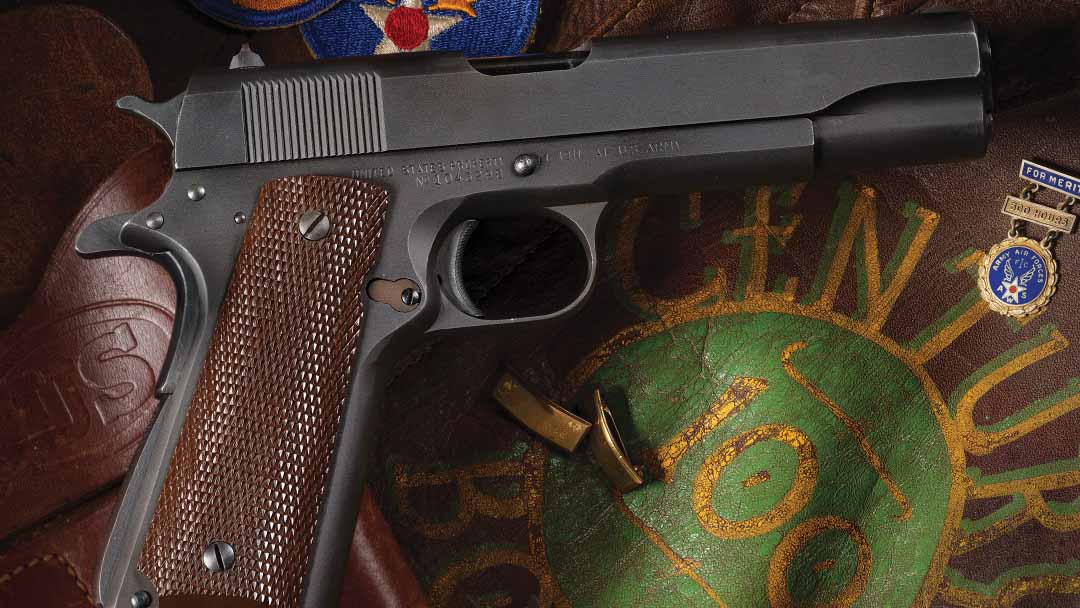
Union Switch and Signal produced 55,000 M1911A1 pistols during World War 2. This pistol was issued to B-17 Co- Pilot Arthur C. “Bud” Stipe of the legendary “Bloody Hundredth” 100th Bombardment Group, featured in “Masters of the Air” on Apple TV+. Available this May.

The Rock Island Auction newsletter offers readers new gun blogs and gun videos every week on classic American military sidearms. From the Colt Peacemaker, the 1911’s reign as back to back World War champs, to the Beretta M9 and  M17 pistol, we cover every ironic gun in American history.

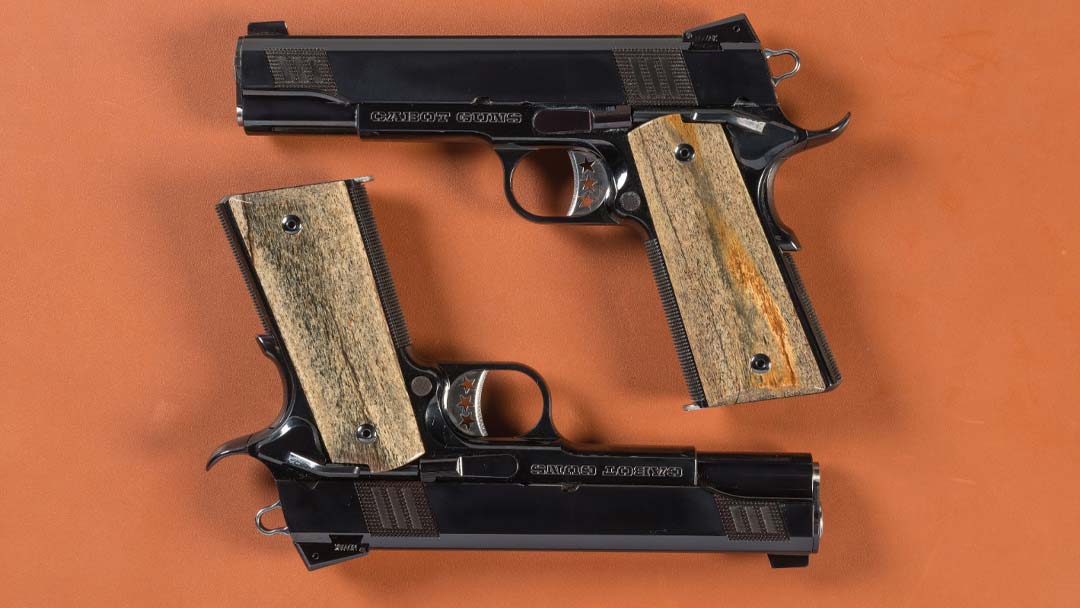
An exceptional pair of consecutive serial numbered Jones 1911 pistols with Emmebi leather display case for both guns. Available this May.

SOURCES

[Meadows, Edward Scott] U. S. Military Automatic Pistols Volume 1 1894-1920

[Goddard, William H. D.] The Government Models: The Development of the Colt Model of 1911

Roosevelt Hunting Arms: TR’s Hawken Rifle and Kermit’s Parker Shotgun

0

Theodore Roosevelt remains one of the most popular men in American history and certainly one of our best and most beloved presidents. His face is chiseled into Mount Rushmore, and his legacy is represented far wider in the national landscape thanks to his immense contributions to conservation and national parks.

Theodore Roosevelt passed his love for outdoor adventure on to his son Kermit, who accompanied his father on numerous hunts. This Hawken rifle and Parker Brothers shotgun offered by RIAC this May belonged to father and son, and together tell a story of an intimate period in the Roosevelt family.

Roosevelt came from a well-to-do family but was genuinely concerned about the lives and well-being of his fellow countrymen of various walks of life. He worked side by side with cowboys in the West, brought in thieves, worked personally to clean up the New York Police Department and the streets of New York City, valiantly led the Rough Riders during the Spanish-American War, and ascended rapidly through the political ranks to the presidency at the age of 42.

As a very active president, Theodore Roosevelt worked hard to help shape our country in the early 20th century. He has been especially revered by outdoorsmen and firearms collectors thanks to his contributions to wildlife and habitat conservation, his hunting exploits, and his bold masculine spirit.
Theodore Roosevelt’s son, Kermit, as a child and as a student at Harvard. Kermit shared his father’s love of hunting and adventure.

Guns of Theodore and Kermit Roosevelt

Though Roosevelt was involved in a variety of endeavors throughout his life, he was a dedicated family man, especially considering the era and his position within society. He ensured his children had a good upbringing, thorough education, and solid principles. Roosevelt and his second son Kermit were especially close, and they shared many of the same passions.

They both loved to hunt, explore, read, and write, and Kermit followed after his father in many ways. Like his father, he also struggled with his health in his youth, and yet he was notably more reserved and melancholy.

Theodore Roosevelt and his second son Kermit hunting in Africa after Roosevelt left the White House.

In Rock Island Auction Company’s May 17-19 Premier Firearms Auction in Bedford, Texas, two lots containing firearms from the Roosevelt family remind us of the deep connection between Roosevelt and his son Kermit, their grand adventures, and Kermit’s tragic decline after losing both his younger brother Quentin and his father within a short period.

This impressive Hawken rifle from Lot 1287 packs serious firepower with its heavy .70 caliber barrel. It was most likely used for hunting big game in the American West before being given to Theodore Roosevelt. The Roosevelt family tradition states it belonged to Kit Carson. Available this May.

Roosevelt’s Hunting Legacy

At their family home, Sagamore Hill, young Kermit would have seen a wide variety of firearms, including those in the Gun Room. One of those guns was a truly massive Hawken rifle. While many Hawken rifles were around .54 caliber, this beast of a gun is .70 caliber. Furthermore, the rifle is said to have belonged to none other than the famous frontiersman Kit Carson.

This historic rifle is featured on page 49 of “The Peacemakers: Arms and Adventure in the American West” by R.L. Wilson where it is described as a “Sam Hawken-made .70 caliber rifle, the most massive Hawken known” and “Likely a buffalo killer, as well as a target rifle for bench shooting. Condition and the quality of workmanship as fine as those of any known Hawken firearm.” Available this May.

Theodore Roosevelt no doubt told his sons stories about Carson. The frontiersman was a legend when Roosevelt was growing up as a trapper, frontier guide, hunter, soldier, and Indian fighter. We know Roosevelt took a personal interest in Carson because he bought a bronze of Carson on horseback holding a rifle as a birthday present for himself from Tiffany’s in 1915.

The Gun Room at Sagamore Hill. Note the variety of firearms on display, including several muzzleloading firearms. Many of Roosevelt’s collectible firearms were given to the Boone & Crockett Club for their collection and remained for many years before being sold, including the incredible Hawken rifle in the upcoming sale.

Young Theodore Roosevelt had been given his first gun, a Lefaucheux pinfire double barrel shotgun, when he was fourteen. By the time Kermit turned 14 in 1903, he had already fired his father’s old shotgun, dubbed “rust bore” by the family, and likely many others as Roosevelt encouraged his boys to develop their marksmanship skills.

That year, Kermit’s own side-by-side was manufactured by Parker Brothers, a 20 gauge VH Grade double barrel hammerless shotgun. Theodore Roosevelt received his first shotgun at that age, this historic Parker Bros. shotgun was likely a gift from the sitting president of the United States to his son. Roosevelt took his oldest son, Teddy, on his first deer hunt shortly before Teddy turned 14, suggesting that age was an important milestone on the road to manhood for the Roosevelt family.

Kermit Roosevelt’s Parker Brothers 20 Gauge VH Grade double barrel hammerless shotgun, Lot 1501 in RIAC’s May Premier Auction.

While Roosevelt was president, Kermit was hitting his formative years studying at the Groton School. As Roosevelt prepared to leave the White House, Kermit was starting at Harvard. Roosevelt wrote to his son about practicing shooting shotguns and making plans for hunting trips. Ultimately, they went on a far grander trip than had originally been discussed, but only after Kermit promised he would study hard when he returned.

In his classic account of the expedition, African Game Trails, Roosevelt dedicated the work: “To Kermit Roosevelt My Side Partner in our ‘Great Adventure’”. The book is filled with their exploits and many of Kermit’s photographs. Many of the famous photographs of Roosevelt during the expedition were taken by his son.

Theodore Roosevelt and his son embarked on an extensive safari to collect specimens for multiple museums during the Smithsonian–Roosevelt African Expedition. Roosevelt was set to write about the expedition, and Kermit served as the official photographer. They landed in Africa in April 1909 with an impressive cache of firearms and loads of ammunition ready for their grand adventure. It’s easy to imagine how formative of an experience this must have been for young Kermit exploring far-off lands and hunting massive beasts side by side with his father over many months.

R.L. Wilson and Greg Martin later took several of the historic firearms from the expedition back to Africa to film the documentary In the Blood. During the filming, a fire swept through killing one of the local members of the team and burning up Kermit’s Winchester Model 1895, a presentation combination gun given to Roosevelt before the expedition, and a Single Action Army. Fortunately, Kermit’s shotgun was not there to be destroyed.

The Last Adventures of Theodore Roosevelt

As promised, Kermit completed his four-year degree in just two and a half years. When he graduated in 1912, his father was running for a third term as president, first challenging President Taft for the Republican nomination and then running as a Progressive. The Progressive Party under Roosevelt’s leadership was popularly known as the Bull Moose Party.

That October, Roosevelt survived an assassination attempt when he was shot in the chest at close range. Thanks to his experience as a hunter and military officer, he was able to calmly determine that the bullet had not punctured his lung and famously went on to give his speech anyway, opening with the lines: “Friends, I shall ask you to be as quiet as possible. I don’t know whether you fully understand that I have just been shot; but it takes more than that to kill a Bull Moose.”

Kermit no doubt feared for his father’s safety, especially considering Roosevelt had first become president because an assassin shot and mortally wounded President McKinley. Roosevelt remained undeterred, but ultimately the split between the Republicans and the Progressives handed the election to Woodrow Wilson and the Democrats.

“The Bull Moose Colt Single Action” was ordered as a gift for Theodore Roosevelt for his 54th birthday just days before he was shot while running for president in 1912 and was sold at Rock Island Auction Company for $1,466,250 in December 2020.

Roosevelt soon planned another grand adventure. He accepted an invitation to speak in Buenos Aires and then on another arduous scientific expedition to explore the uncharted River of Doubt in Brazil: the Roosevelt-Rondon Expedition. Edith Roosevelt asked Kermit to go along to look after his father. He was already in Brazil on business and left behind his fiancé, Belle Willard.

Theodore Roosevelt photographed by Kermit Roosevelt during their harrowing expedition on the River of Doubt in South America.

While the father and son were again off on an adventure to hunt and explore a faraway land, unlike their African safari, their journey on the River of Doubt was far from a pleasant experience. They were plagued by problems, including tropical diseases, serious injuries, the loss of much-needed equipment, and even the deaths of multiple members of one of their crew, including one murdered by another.

Roosevelt severely wounded his leg and was weakened by disease. He asked to be left behind to overdose on morphine in the jungle rather than risk the lives of the remaining members of the expedition, but Kermit would not leave his beloved father behind and convinced him to press on. Roosevelt is said to have never fully recovered from the perilous journey, and Kermit too must have been a haggard mess when they returned, but he went on to marry and was all too soon destined for another harrowing experience: The Great War.

Lot 371 in May’s auction contains a historically identified World War I U.S. Army Air Service leather flight helmet connected with the 1st Pursuit Group, the first air combat group formed by the Air Service of the American Expeditionary Force. Theodore Roosevelt’s son Quentin Roosevelt was a member of the 95th Aero Squadron in the 1st Pursuit Group and remains the only child of a U.S. president killed in combat.

The Roosevelts and the Happy Hunting Grounds

During World War I, Theodore Roosevelt offered to again lead men in combat as he had done at the head of the Rough Riders during the Spanish-American War, but he was rebuffed by his political adversary Woodrow Wilson. His sons Ted, Kermit, Archie, and Quentin, however, served in the war in different units. Quentin was a pilot and was shot down and killed, remaining to this day the only child of an American president killed in combat. Ted and Archie were both wounded but recovered, and Kermit made it home physically unscathed, but the loss of Quentin shook the family.

Theodore Roosevelt planned to run for president again, but the great patriarch of the family suddenly deteriorated, dying of what is believed to have been a coronary embolism. Some have said he died from a broken heart after the loss of his youngest boy, and others have pointed to his near-death experiences with Kermit in Brazil. Both certainly may have been major contributors. Regardless of the exact cause, his death left a major hole in the family.

Included with Kermit Roosevelt’s Parker Brothers shotgun in Lot 1501 from May’s auction are four pieces of silver drink ware, including a large flask presented to him before heading out on one of his expeditions in Asia with his brother, and a silver cup from the private speakeasy “The Room.”

Kermit’s life started to fall apart after the loss of his father and brother. He had long been prone to depression as had other members of his family and faced serious financial losses during the Great Depression. He began to drink heavily and had an open affair leading to distress in the family. Like his father before him, he sought an active life and went on two hunting expeditions in Asia for ostensibly scientific purposes and wrote of the adventures in Trailing the Giant Panda and East of the Sun and West of the Moon with his brother Ted.

Kermit and his wife, the former Belle Wyatt Willard (left) and Kermit Roosevelt as an officer during WW2 (right.)

World War II again offered him the opportunity to serve. Kermit joined the British Royal Army and participated in the failed invasion of Norway, and then in Egypt. His health was severely compromised by his continued drinking, leading him to be medically discharged. Back in the States, Kermit’s family had him tracked down by the FBI and committed to a sanitarium in an attempt to save him.

Through President Franklin D. Roosevelt, Kermit was given a position as a major in the U.S. Army in Alaska in the hopes that military service would help, but instead, he wanted a combat role and continued to decline, ultimately taking his own life as his father had considered in different circumstances back in Brazil. Kermit Roosevelt’s death was reported to his mother and the public as a heart attack. His remaining family may have thought about how he had crossed over to “the happy hunting grounds” where his father Theodore Roosevelt and younger brother were already waiting.

Like his father, Kermit Roosevelt wrote extensively about his hunting expeditions with his father and family. Books like ‘The Happy Hunting-Grounds’ provide a fascinating insight into their family life and adventures and the deep connection between father and son.

TangoDown® New Product Release – TD® Inc. MK3 Rifle Magazine

0

TangoDown® Inc. is pleased to announce the release of the MK3 Magazine.  After extensive engineering and testing, the wait is over.  The MK3 magazine body is of modular construction and features aggressive texturing along with ribbed design for positive no-slip manipulation.  We’re confident you’ll be pleased with the features and function the MK3 brings to your rifle.

Here are just a few of the MK3 features:

  • Available in Black and Flat Dark Earth
  • 30 Round Magazine (20 Round option coming soon)
  • Available in a Flat Bottom and Round Bottom (for mono-pod style use)
  • White anti-tilt low friction follower
  • Impact resistant polymer construction
  • Corrosion resistant heat treated spring

Note:  The MK3 is intended for 5.56 x 45mm NATO cartridge use and will work in any AR15 or M16/M4 MIL-SPEC pattern magazine well.

Visit the product page for all information regarding the TangoDown® MK3 Magazine:

https://tangodown.com/tangodown-mk3-rifle-magazine-30-round-5-56mm/

Part Numbers:  MK3RND30-01BLK / MK3FLT30-01BLK / MK3RND30-01FDE / MK3FLT30-01FDE

MSRP:  $23.95Customer Questions:[email protected]

Review: Vosteed Ankylo with New Vanchor Lock

0

The Vosteed Ankylo has a lot of momentum right now. It’s a new knife with a promising new lock, its all over my feeds, and it met its funding goal on Kickstarter in 30 minutes. That’s hype and all signs point to the Ankylo living up to it.

Specs

Blade Length: 3.18″ | 80.90 mm
Overall Length: 7.75″ | 196.90 mm
Blade Width: 1.22″ | 31.00 mm
Blade Thickness: 0.134″ | 3.40 mm
Blade Material: Elmax
Blade Grind: Flat
Blade Style: Reverse Tanto
Blade Finish: Black Stonewash / Satin / Stonewash
Hardness: HRC 60±2
Handle Length: 4.57″ | 116.00 mm
Handle Width: 1.06″ | 27.00 mm
Handle Thickness: 0.563″ | 14.30 mm
Handle Material: 6061 Aluminum
Color: Black / Green / Gray / Orange / Blue
Weight: 4.76 oz | 135.00 g
Opener: Front Flipper | Back Flipper | Thumb Hole
Lock Type: V-anchor Lock
Pivot Assembly: Caged Ceramic Ball Bearing
Pocket Clip:  Non-reversible | Stainless Steel
Carry Position: Tip-up
Knife Type: Manual Folding
Designer: Yue

Observations from Use

The Vanchor lock that is debuted on this knife is the recipient of most of the hype but, first, I want to talk about the Ankylo as a knife. It has dominated my pocket since I received a prototype for evaluation. Vosteed’s take on the reverse tanto blade shape has everything you want for an EDC knife – a strong and useable point, plenty of sweeping belly, a tall flat grind, and a reasonably thin edge.

The choice of Elmax steel made my day. Elmax is underappreciated and underused as a blade steel. It has very well-rounded characteristics with solid edge holding, toughness, and corrosion resistance while being easier to sharpen than many other super steels which I appreciate.

Accessing the blade is easy thanks to the multiple deployment options baked into this knife. It has a front and back flipper, neither of which add any width to the knife which I love. They also both have great jimping. The large thumb hole works like a champ for any deployment method you would want – slow rolling, thumb flicking, or reverse flicking. The Vanchor lock provides a very well tuned detent to support all these opening methods and the action is kind of unique. It’s very smooth and moves freely with somewhat of a buffered feel that is hard to describe – you need to try it. I think that feel might come from the magnet in the lock.

This knife fills and melts into the hand in multiple grips. The handle is long enough that average hands will be able to hold it with the index finger in the finger groove or choke up to the flat ahead of the finger groove… or choke up even further to place the index finger on the large comfortable finger choil. None of the opening methods get in the way of your grip because they all tuck cleanly into the handle when the blade is deployed (this is one of my most appreciated design elements that Vosteed incorporates into several of their knives).

Finally, we can talk about the Vanchor lock. This lock does exactly what you want a knife lock to do – lock up like a vault. The Ankylo with its Vanchor lock seems to have no play at all, in any direction. Not only does the Vanchor lock provide a lot of lock surface area but the large pivot assembly requires larger diameter caged ball bearings which coupled with the all metal construction make this knife feel like a fixed blade when it is deployed. Most knives on bearings can be flexed at least a little bit… not the Ankylo.

The heart of the Vanchor lock is a steel bar with a large lock plate on one end (all one piece). The steel bar is mounted inside the knife scale much like a nested liner lock so the lock plate can flex toward the blade. However, instead of locking against the tang, the lock plate mates into a groove at the base of the blade. When locked, this solid steel bar would need to break or deform for the lock to fail.

This design provides a few interesting benefits for end users and even knife designers. First, it is button-actuated which brings with it a lot of ease of use /fidget-factor for left and right handed users. Second, its detent geometry is very much like that of a liner lock which makes it easy to achieve a strong, crisp detent to support all fidgety-goodness that can be designed into a button lock knife.

When it comes to new knife locks, only time can tell the whole story. We can’t know yet how this lock will fair over the long term, exposure to pocket lint, sand, etc. but it certainly seems like a promising mix of strong, reliable lock-up with the user-friendliness of a button lock.

No knife is perfect and there are a few changes I would like to see made that are really just my preferences. First, it would be nice to have milled pocket clip on a chunky knife like this. I like Vosteed’s stamped clips but a milled clip would suit this knife. Second, I would like to see the large lock button recessed a bit more. It is large enough that you will always be able to find it so making it even more resistant to inadvertent contact seems like a win-win.

Wrap Up

The Ankylo is a knife worthy of an exciting new lock. It would be easy to loose sight of the fact that this is just a great knife in all the hype around the Vanchor lock. That said, the Vanchor lock does deliver. It has strong lock up, a great detent, and is as easy to use as any button lock. It will be very, very interesting to see where this lock turns upon next.

You can learn more about the Ankylo on Kickstarter. Learn more about Vosteed at Vosteed.com.

A Return to the Norman R. Blank Collection

0

The Norman R. Blank Collection’s unveiling at Rock Island Auction Company’s December opening of its new Bedford, Texas venue showed off the elaborate and intricately embellished firearms of European royalty and found a welcoming audience. Collectors seeking a piece from among the diverse offerings of this prestigious collection will find numerous opportunities in May’s Premier.

More than 40 pieces of beautiful antique European firearms, especially sporting guns from the 18th and 19th centuries will be offered at auction, May 17-19. The majority of these stunning firearms have been tucked away since the 1950s and 1960s, and all of them have been off the market for decades. Represented in this selection are many of the best gunmakers in European history such as Joseph and John Manton.

The collection as a whole offers an encyclopedic study of antique European firearms through the ages, an extraordinary collection with so much to offer to collectors and historians. As these incredible firearms have been cataloged, it has been impossible not to take notice of their individual beauty and how together they show continuity and changes across large periods of time and space. With a collection so diverse, it is easier to get a handle on it in batches rather than trying to examine them as a larger group. When the collection is examined as a whole, it is frankly overwhelming!

The Norman R. Blank Collection features such amazing depth that only a sampling can be glimpsed here. There is certainly much more to the collection, so keep your eyes out for the full catalog!

John Manton Dueling Pistols

If you like flintlock pistols, dueling pistols are always exciting, especially classic late 18th century pairs from top makers like John Manton. Manton was among the finest gunmakers in London durin gthe late 1700s and early 1800s, particularly well known for fine dueling pistols and sporting arms. The quality of Manton’s pistols is incredible. The locks alone are works of art. The sets below show an evolution in dueling pistol design across several decades while exuding that wonderful Manton quality.

This pair from John Manton dates to 1793 and has a hidden feature: the barrels are hair rifled, something that is hard to see without modern technology like a pen light. The rifling would have increased the pistols’ accuracy, although top-notch smoothbore dueling pistols were already very accurate.
This pair, exhibited at the NRA in 2004 has gold-lined touch-holes and flash-pans, and the hammers are fitted with rollers to run over ridges on the feather springs.

Featured along with the previous pair in W. Keith Neal and D.H.L. Back’s “The Mantons: Gunmakers,” and at the NRA in 2004, this pair was made in 1816 by John Manton & Son and shows the later half-stock dueling pistol style and more traditional rifling. This pair has engraved sunburst and foliate motifs including stylized pineapples on the trigger-plate finials.They each have a platinum band and vent liner.

Rounding out the dueling pistols is a pair of percussion pistols by John Manton & Son circa 1840. Like the first pair, they have “hair” or “scratch” rifling. By the 1830s and 1840s, dueling was less popular in England, but rifled barrels were the norm in continental Europe. The casehardened breeches have pierced platinum plugs and scroll engraving on the breeches and locks.

European Double Barrel Pistols

Most firearms in the muzzleloading era were single barrel and thus single shot, but gunmakers learned very early on that multiple barrels were advantageous since they increased the amount of shots before reloading was required. By far, the most popular multi-shot pistols were double barrels into the 19th century and the growing availability of percussion revolvers. While two of the following examples have fixed barrels, one has barrels the shooter has to rotate by hand.

This “Baby Egg” pistol, below, was made for the Prince Regent, the future King George IV, circa 1818. This diminutive little pistol is a very refined example of Joseph Egg’s famous double barrel single trigger flintlock pistols. Joseph Egg was the nephew of Durs Egg, known for his fine over-and-under pocket pistols.

Rock Island Auction previously sold one of the Duke of York’s larger Egg double barrel pistols, and this smaller version is even more impressive because of the intricacies of producing a pistol this size. It has beautiful embellishment, including a gold cap engraved with the royal coat of arms and the gold wrist escutcheon is engraved with a coronet.

While on the topic of the Egg family, take a look at this beautiful pair with hallmarks from 1784 by Durs Egg, Joseph’s uncle. This pair of engraved, carved, gold inlaid, and silver mounted Durs Egg double barrel flintlock pistols has silver hallmarks that date to about 1784 and demonstrate that the family was already producing fine double barrel pistols around the end of the American Revolution. The pistol is engraved with lined borders and sunbursts, floral and bird motifs.

The famous Rigby shop in Dublin was run by William and John Rigby between 1818 and 1858, and multiple pistols from the shop in that era are represented in the upcoming May auction. This attractive pair of turnover or swivel breech pistols, dating from circa 1830, have a single lock and the barrels are turned by hand between shots, unlike the Egg pistols which feature stationary barrels and dual locks.

Deluxe European Single Barrel Sporting Guns

Norman R. Blank’s collection has one of the most impressive array of muzzleloading sporting guns ever seen. A single barrel smoothbore firearm was the most popular and practical firearm of the muzzleloading era, and naturally they are well-represented in the collection, but these aren’t just plain sporting guns. With kings, princes, and other noblemen as their clients, many of Europe’s best gunmakers produced extraordinary smoothbore sporting guns that were fully functional but also works of art.

The superb gun by Trois Fontaine, seen below, dates to circa 1725 and features elaborate engraved and chiseled designs, including floral, scroll, bird, and mask patterns on the breech section. It came from the collection of the Dukes of Saxe-Weimar at Schloss Ettersburg.

This intriguing sporting arm was made by Trois Fontaine. It’s lock and steel mounts are engraved and chiseled en suite and feature a variety of finely executed patterns and motifs. The side-plate has pierced serpentine scroll designs and a portrait bust of a man wearing armor and a helmet. The wrist escutcheon is pierced with scrollwork and has a second portrait bust of apparently the same armored man with a coronet above.

This circa 1730-1740 sporting gun also came from the Dukes of Saxe-Weimar at Schloss Ettersberg but was the work of Johann Jacob Behr who had tenures in Wurzburg, Maastricht, and Liege. This firearm displays beautiful metal work and stock carving. The mounts are gilt brass cast with rococo ornamentation. A pierced side-plate has classical figures, a lion and a classical trophy of arms. The full stock has fine relief foliate carving and carved scroll accents.

This very rare and attractive pair was made by Johann Jacob Behr and features rare flat beveled enclosed locks which serve as a flat canvas for elaborate scroll engraving inhabited by monster heads against stippled backgrounds and enclosed by ornate borders. Its finely embellished stocks have pierced scroll pattern side-plates with a classical figure and an eagle.

This ostentatious piece features gold inlays, engraving, silver furniture, and a carved and silver wire inlaid stock. It was crafted by Jean-Baptiste la Roche and his son Jean. Jean-Baptiste la Roche was gunmaker to Louis XV and received lodgings in the Louvre in 1743 and was later joined by his son who succeeded him in 1763. Together they signed their guns with the plural “Les La Roche.” Several examples of their work can be found within major institutional collections in Europe.

This miquelet sporting gun by Fernando Olave of Placentia, Spain, circa 1805 is described in detail in W. Keith Neal’s “Spanish Guns and Pistols,” stating, “This gun is the last word in fine production and compares with the best work of Boutet and of the finest artists to be found anywhere in Europe.” This exceptional Spanish muzzleloader features deeply chiseled steel, gold inlays on the barrel and breech, and extensive carving. The burnished lock has chiseled and engraved floral, scroll, and mask motifs, a seated figure on the frizzen, and gold-lined priming-pan and frizzen.

This rare Holland & Holland Paradox ball and shot gun, dating to 1898, is one of only three single barrel 10 bore Paradox guns made by Holland & Holland and is 17 of 101 Paradox guns made with a 10 bore barrel. It is a rare variation of a model already popular with collectors. The Paradox guns featured smoothbore barrels with essentially fixed rifled chokes near the muzzles that allowed them to shoot balls more accurately without disrupting the patterns when shooting shot.

Deluxe European Double Barrel Sporting Guns

Not surprisingly, this is one of the larger portions of the second batch of the Blank Collection. Smoothbores were by far the main firearms of the muzzleloading era, and double barrels were the natural solution to get more than one shot before reloading. Blank’s collection demonstrates the incredible variety of these sporting guns produced for wealthy sportsmen over the centuries, including different configurations. This group also highlights the wide array of decorative motifs from scrollwork to classical Greco-Roman gods and goddesses and the lighter and more floral patterns of the French gunmakers. This is a selection of some favorites.

This fine Parisian turn-over sporting gun or “wender” by Thuraine of Paris was made circa 1685 and restocked and partially remounted during the 18th century. The elaborate engraving has floral scroll patterns with a mask and figure. The 18th century buttplate features the distinctive serpent finial inspired by the patterns of Claude Simonin, and this serpent design happens to be a favorite among Simonin’s diverse motifs.

This very attractive deluxe sporting gun from the early 19th century seen below features silver mounts and is a combination rifle and shotgun from gunmaker Carl Philipp Crause of Cassel with French barrels by Claude Berthon-Boulier. Berthon-Boulier of St. Etienne worked from 1777-1831, specializing in higher end arms for the Eastern markets. Crause was identified as active about 1802-1828.

This combination rifle and shotgun from gunmaker Carl Philipp Crause left barrel has seven-groove rifling with the left barrel while the right is smoothbore.The standing breech has floral engraving while the lock is engraved with hanging game, a sunburst design and foliate patterns and borders. The trigger guard has a large hunting trophy involving a spear, quiver of arrows and a longbow surmounted by a stag’s head. A smaller trophy on the heel-plate tang shows a spear, hunting sword and hunting horn with a boar’s head in the center.

This cased 20 bore double barrel flintlock shotgun is another fine example from John Manton & Son and dates to 1819. The locks have John Manton’s V design priming pans and frizzens covered by patent No. 3942 from July 21, 1815, and feature a separate rod dividing the powder into two lines in an effort to improve ignition consistency and speed.

This rare double shotgun was made while William Peacock was located at 26 Duke Street, Grosvenor Square, London in 1821-1824 using tubelock ignition. Instead of a more traditional percussion cap, this system used priming tubes held in place at the vent to ignite the main charge.

The breeches of this rare double shotgun by William Peacock have inset “WILLIAM PEACOCK LONDON” platinum-lined maker’s marks and inlaid platinum bands. The locks feature differing scroll engraving inhabited by monster-heads. Scroll engraved blued mounts with pineapple finials.

This cased Holland & Holland single barrel 4-bore percussion duck gun, below, was made for Roderick Donald Matheson Chisholm of Chisholm (1862-1887), the 28th chief of Clan Chisholm in the brief period of 1885-1887. A silver escutcheon on the bottom of the stock has the clan motto “FEROS FERIO” over the Chisholm crest and the initials “R.D.M.C.” in Gothic script for the clan chief.

The breech, lock, and mounts of this Holland & Holland single barrel 4-bore duck gun are nickel-plated with scroll and foliate engraving while the trigger-plate finial is a stylized pineapple.

Antique European Rifles

Norman R. Blank acquired an incredible selection of antique European sporting rifles, especially antique muzzleloading rifles. Rifles were far from the norm in Europe in the 17th and 18th centuries, especially outside of Germanic regions, but by the mid-19th century, rifles were well-established as the preferred firearms for hunting most game as well as for the highly competitive long range matches. With the adoption of self-contained metallic cartridges, rifles came into their own.

The May auction has two beautiful early muzzle-loading rifles featuring precious metals: an unusual European wheellock rifle with an engraved and gilt brass barrel and a beautiful silver mounted flintlock jaeger rifle. After those are a Manton percussion sporting rifle, a classic single shot express rifle, and then jumping forward into the later part of the 19th century, we have two Alexander Henry breech-loading express caliber firearms.

This unusual mid-17th century wheellock rifle features an engraved and gilt barrel and was previously in the collection of the Princes of Hohenzollern,Sigmaringen at Schloss Sigmaringen from around the mid-17th century. The flat lock has an enclosed wheel and is also gilded and decorated with punched floral patterns.

This circa 1730-1735 flintlock jaeger rifle by Paul Ignazius Poser features beautiful silver mounts. It appears to be the mate to a rifle within the famous Victoria & Albert Museum (accession number M.120-1953). The decorative metalwork attributed to Franz Matzenkopf on the flat lock plate alone is a work of art and with its finely detailed scene of a hunter with his dog and a slain hare in a wooded scene and a putto pulling on a scroll pattern disgorging from a bestial mask on the cock. The side plate is also very distinctive and shows putti and bound captives.

This Manton sporting rifle, dating to 1819, is an excellent example of a British half-stock sporting rifle from the early 19th century when rifles were steadily gaining in popularity. The flat casehardened detented lock is signed “JNO MANTON & SON/PATENT” and has a blued sliding half-cock safety. The casehardened patent breech has a vented rosette engraved platinum plug and scroll engraving en suite with the standing breech, lock, and mounts.

This elaborate Alexander Henry double rifle in .577 Black Powder Express shown below is identified in a note inside the case as having belonged to Mir Turab Ali Khan, Salar Jung I, who was Prime Minister of Hyderabad from 1853 to 1883 and was succeeded by his son Salar Jung II. Hyderabad, in southern India, was known for its pearl industry until the 19th century. There were no modern industries there until 1874.

This Alexander Henry double rifle features beautiful gold inlays that were factory order for the prime minister of Hyderabad. The Damascus barrels are profusely decorated with gold-inlaid floral scrollwork. The flat raised rib has an “SJ” monogram over Urdu script in gold inlay and the action and mounts feature gold inlays, too.

This classic Alexander Henry falling block express rifle was completed on May 25, 1880. In the late 19th century and early 20th century, single and double barrel express rifles were the preferred tools of many British hunters seeking out large and dangerous game throughout the British Empire, and single shot rifles steadily grew in popularity among competitive marksmen competing in long range matches. This gun features a casehardened border and scroll-engraved action.

Norman R. Blank Collection at Auction

After the reception of the first offerings from Norman R. Blank’s outstanding collection of European percussion firearms, as much or more is expected when the exquisite pieces highlighted here cross the podium in Rock Island Auction Company’s May 17-19 Premier Auction in Bedford, Texas. Keep following as we profile many of these firearms through articles and videos.

Beautiful Krieghoff Will Boost USA Shooting

0

The USA Shooting Team is preparing to build on its Olympic medal-winning legacy as it aims for the Paris Games this summer, but it needs help from the wider firearms community before it gets there.

USA Shooting has displayed decades of dominance on the Olympic stage, including three gold medals in the 2021 Tokyo Olympics and 58 gold medals since shooting competitions were part of the first Olympics in 1896.

Unlike other countries, the federal government doesn’t fund the U.S. Olympic Team, and programs like USA Basketball draw sponsors like Nike and AT&T. USA Shooting relies on donations and small sponsorships, so an engraved and gold inlaid Krieghoff K-32 over/under shotgun will soon provide a financial boost to the squad ahead of the Paris Olympics.

This magnificent firearm will be auctioned off on the first day of Rock Island Auction Company’s May 17-19 Premier Auction, with 100% of the proceeds from this lot to be donated to USA Shooting. The team faces additional costs as it heads to France where the shooting venue, at Chateauroux, is 170 miles south of Paris and the Olympic Village.

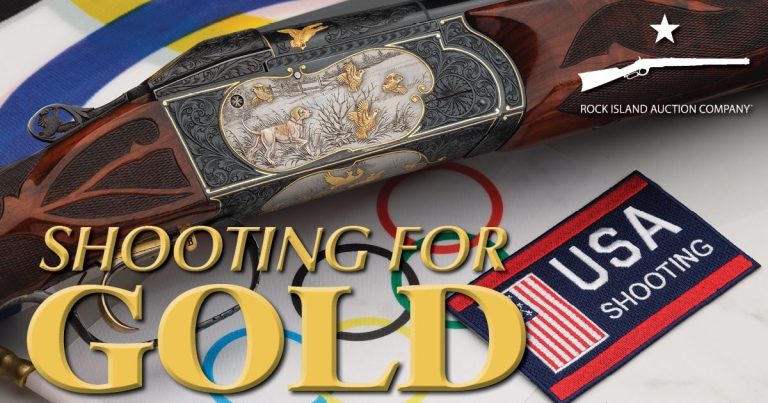
This magnificent engraved and gold inlaid Krieghoff K-32 with a four-barrel set will be auctioned May 17 to open the Premier Auction benefitting USA Shooting.

Shooting for Olympic Glory

Ivan Roe, who qualified in the 50M small bore event in March said afterward, “Representing the U.S. is — it’s a dream I’ve had since I was a little kid, so, it’s a culmination of everything I’ve been doing the last two decades. It’s a huge, huge milestone.”

That sentiment should get American hearts beating, flags waving and pride swelling.

Vincent Hancock, who qualified in skeet shooting for his fifth Olympics, will chase after his fourth gold medal in the same event, a feat only accomplished by five other athletes, including three Americans: track and field stars Al Oerter and Carl Lewis and swimming legend Michael Phelps. He would be the first shooter to earn a fourth gold for the same event in separate Olympic Games.

The left side of this beautifully embellished Krieghoff K-32 shotgun has an amazing game scene pheasant hens in flight over upland landscape with gold inlaid birds and border on a brillant coin finish.

Hancock’s gold in Tokyo was one of six medals won by the USA Shooting Team, its best Olympic performance since 1964. Other Tokyo medalists were William Shaner in men’s air rifle and Amber English in women’s skeet who won gold, silver medalists Kayle Browning in women’s trap shooting and the mixed team air rifle shooters Mary Tucker and Lucas Kozeniesky, and the bronze medal mixed trap team of Maddy Bernau and Brian Burrows. Since the Olympics began in 1896, USA shooters have earned 121 medals, including 58 gold medals, the most by any country in shooting sports.

Olympic athletes have always been at the top of their sport, and such performances don’t come without sacrifice. U.S. athletes must find the time amidst +intense training while also pursuing sponsorships and fundraising opportunities. Most countries massively fund their athletes, but not the United States. Funds appropriated by the United States Olympic and Paralympic Committee are lean, and shooting competitors are almost exclusively funded through donations and meager sponsorship dollars.

Rock Island Auction did something similar to provide a financial lift for USA Shooting in the lead-up to the delayed Tokyo Olympics, auctioning off a Krieghoff K-80 and a range day with two-time Olympic medalist Corey Cogdell-Unrein that netted a donation of $30,425 to the USA Shooting Team. In an interesting bit of bidding, the gun was sold three times in a matter of minutes in Rock Island Auction’s May 2021 Premier Auction.

The winning bid for this beautifully embellished Krieghoff will ease the financial strain as American shooters pursue Olympic glory.

The stunning engraving on the right side of this K-32 shotgun, to be auctioned for the benefit of USA Shooting, has a gold border around a game scene of gold inlaid pointer and quails on a coin finish.

Gold Inlaid Krieghoff for the Gold!

Master Engraver Angelo Bee’s artistry is on display in this striking Krieghoff K-32 and its four-barrel set. It is built with blued steel barrels with dual bead sights on the matted vent rib marked with a gold inlaid “12” at the base. It has highly attractive gold bordered scroll engraving on the front barrel hanger with scroll engraving and a gold inlaid mallard on each side.

Bee’s gold borders and floral engraving surround four exceptional game scenes cut into striking coin-finished backgrounds that are gold inlaid and intricately detailed. On the right is a depiction of a pointer and quails, while the left has a covey of pheasant hens in flight over an upland scene. Underneath, four mallards are landing on a pond, while on top are a trio of quail bedded down on the top latch. The exquisite scrollwork continues onto the triggerguard that is also adorned with a quail. The top lever is pierced in the form of a grouse.

This fantastic sporting arm also has a single selective gold trigger and is fitted with beautifully figured fleur-de-lis checkered forend with engraved and gold inlaid shoe and a pistol grip stock with a rosewood grip cap and a blank inscription oval. It has an extra set of 12 gauge barrels with matching gold inlay and engraving, a full length 20 gauge insert and sets of full length 28 gauge and 410 bore inserts as well as eight extra choke tubes and an aluminum takedown case.

The engraving and gold inlays of the game scene on the underside of this Krieghoff K-32 are as opulent as the more visible game scenes with four mallards landing on a pond along with a single quail on the trigger guard.

Berlin 1936 Olympics Pistol

Also on offer is a firearm that already bears Olympic glory, Erich Krempel’s engraved, inlaid and relief carved Gotz single shot free pistol. Krempel, the top German pistol shooter of the 1930s, earned a silver medal in the 1936 Berlin Olympics 50M Free Pistol event and was presented this gorgeous Gotz pistol by the Suhl Schuetzen Guild for his success. The gun, beautifully engraved on a blued finish with a carved stock, was a war trophy of Col. John H. Sampson who brought it back after World War 2.

This Gotz single shot free pistol was presented to 1936 Olympics 50M Free Pistol silver medalist Erich Krempel, of Germany. The gun, a World War 2 war trophy, has Krempel’s initials engraved on the left side of the receiver.

Back to the Future: 2024 Paris Olympics

Who will be the bidder who boosts the financial fortunes of the USA Shooting Team and win a spectacular engraved and gold inlaid Krieghoff K-32 four-barrel set with its gilded mallards and pheasants? The winning bid will help alleviate the additional costs faced by the American shooters and hopefully ease their path to Olympic glory and maintaining the U.S. team as one to be reckoned with in international shooting sports.

The top of this beautifully embellished Krieghoff K-32 shotgun features a trio of quail bedded down on the top latch. The top lever is pierced in the form of a grouse.

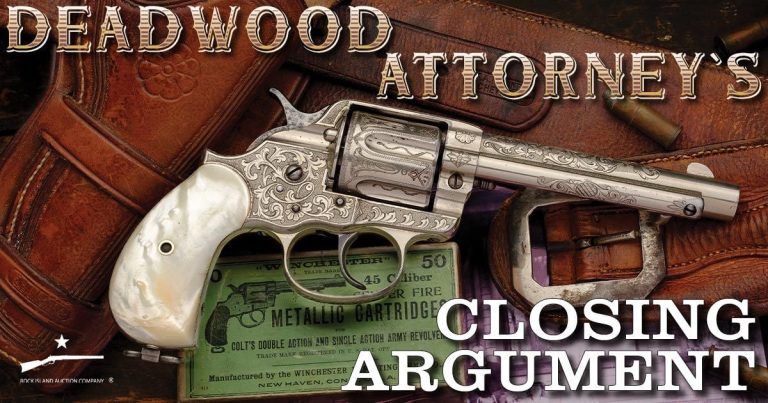
Deadwood Attorney’s Gold Rush Colt 1878

0

George Armstrong Custer and Wild Bill Hickok were dead when John H. Burns arrived in Deadwood, Dakota Territory in 1877 with a letter of recommendation in his pocket from a well-known Chicago Circuit Court judge.

Custer’s expedition into the Black Hills in 1874 sparked the gold rush. A year later in the fall of 1875, gold was discovered in “Deadwood Gulch” and a mining camp sprang up the following spring. Hickok arrived in the summer of 1876 as part of a wagon train to the gold rush but was only in town for a few weeks before he was shot dead at a card table holding aces and eights.

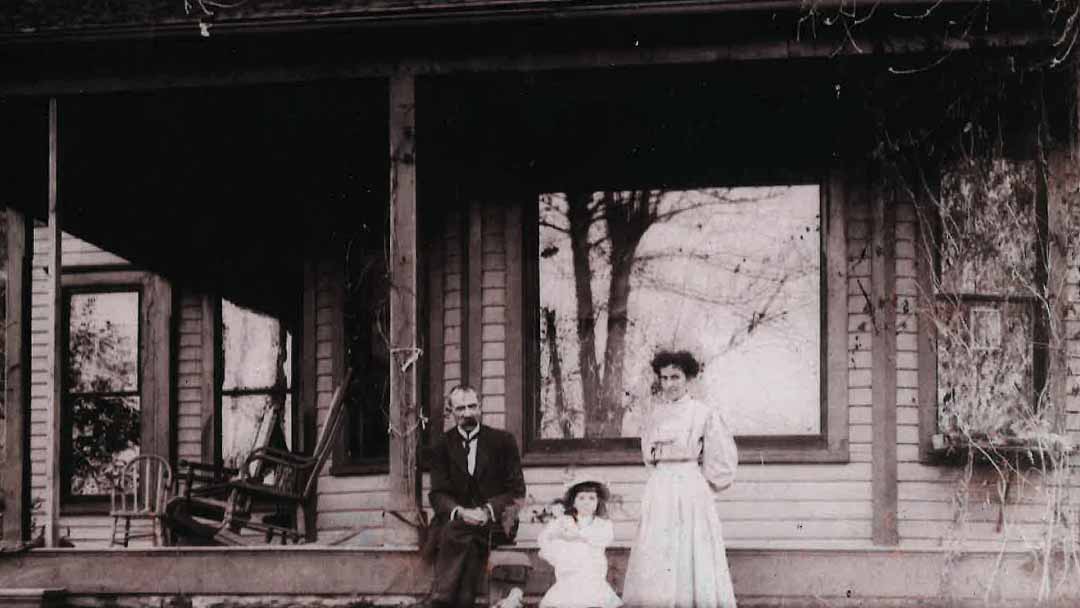
Into this rough and tumble mining town stepped Burns. Born in 1850 in Indiana and a practicing attorney from Chicago, he first visited the Deadwood area in the summer of 1876 when the Black Hills region’s population was booming. Hearing about the Little Big Horn Massacre, he rode out to the battlefield, serving as the first reporter at the scene of the slaughter. He picked up a war club and other items that were eventually handed down to his granddaughter.

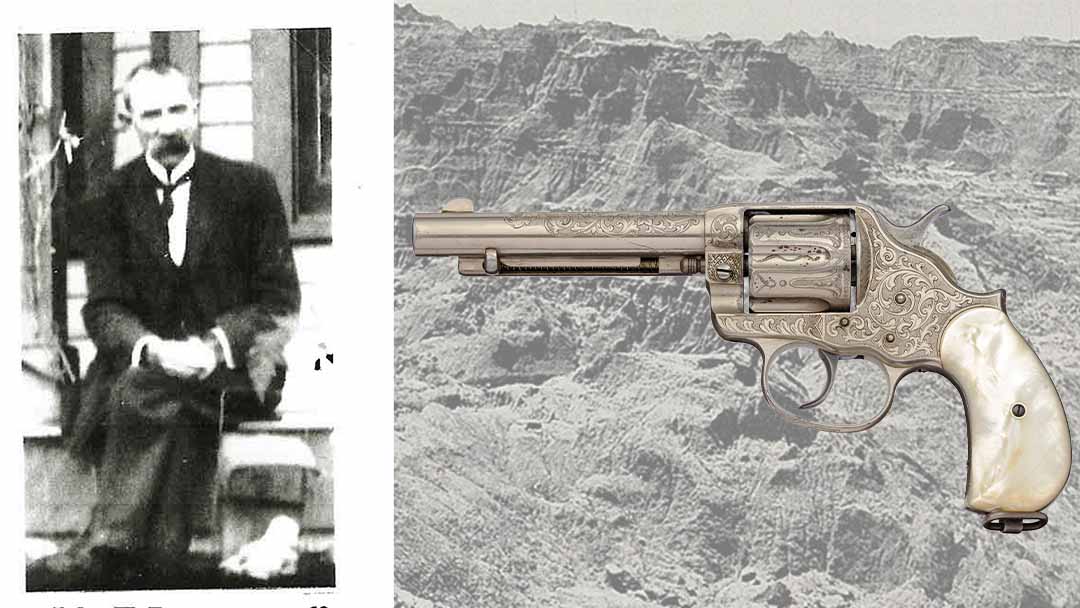
A year later, he returned to Deadwood – its population soaring to 5,000 — and hung up his shingle, practicing law out of the building that served as Custer’s headquarters in 1874. A documented factory engraved Colt Model 1878 Frontier double action revolver attributed to Burns, a deadwood attorney, judge, rancher and author will be on offer in Rock Island Auction Company’s May 17-19 Premier Auction.

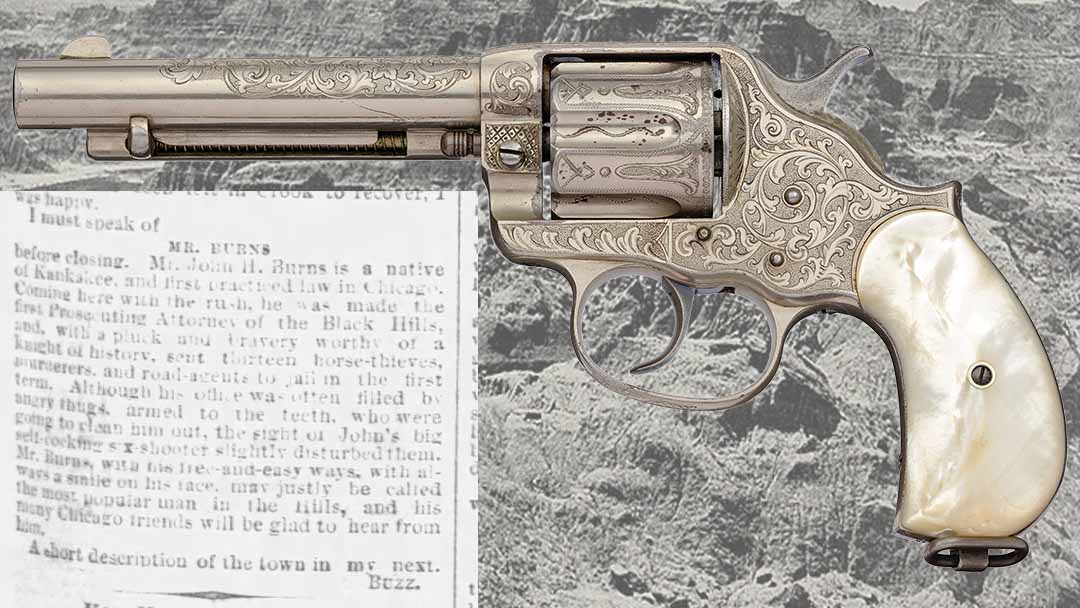
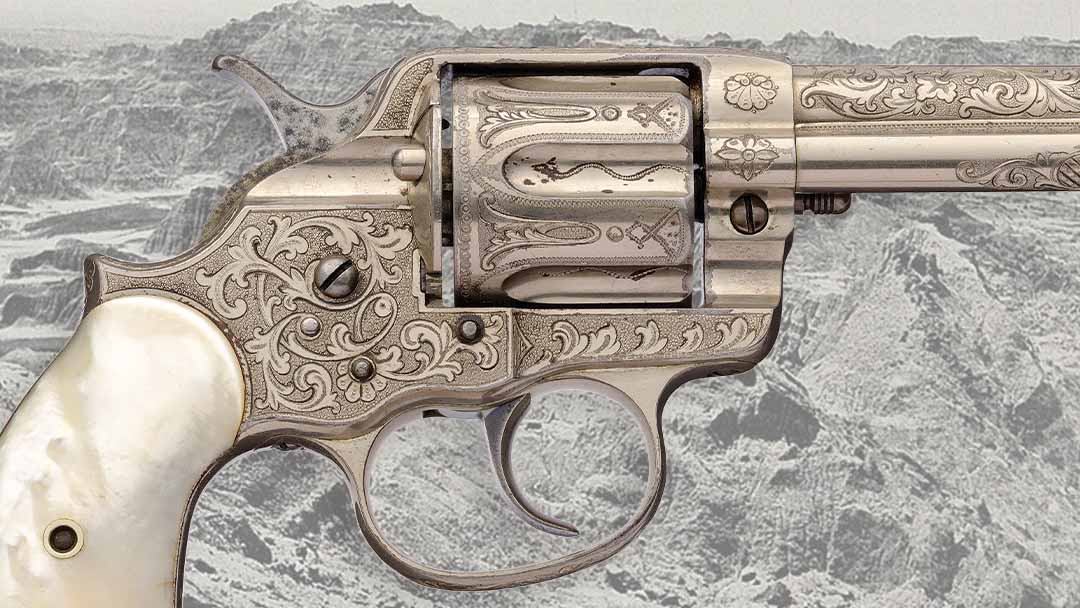
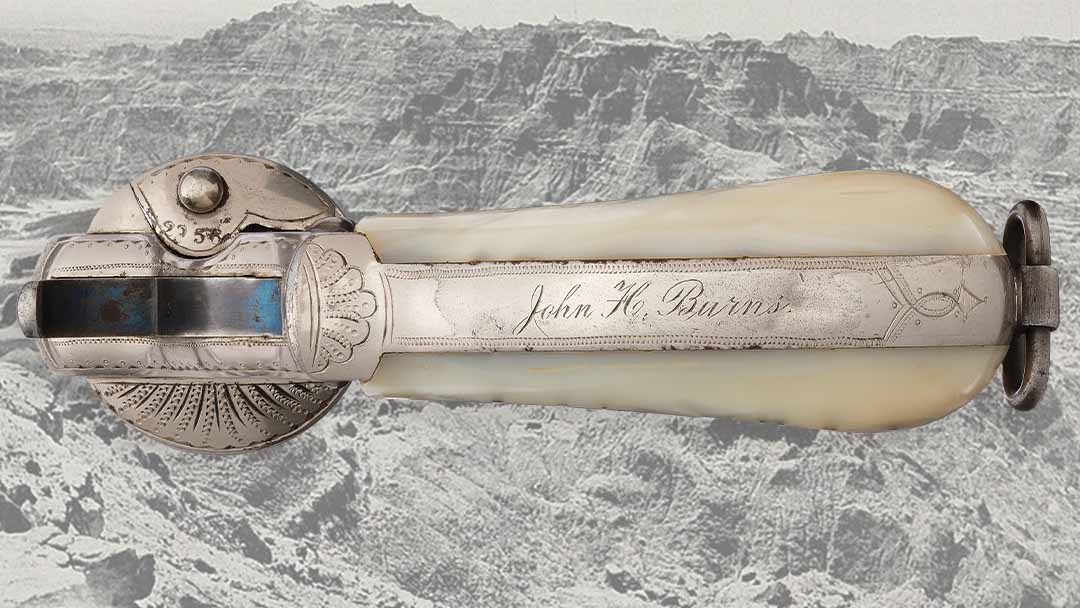
The Colt double action revolver of John H. Burns, of Deadwood, has pearl grips, factory engraving from the shop of Cuno A. Helfricht, and is inscribed “John H. Burns” in script on the backstrap.

Black Hills Gold Rush

Burns practiced law, wrote for the Deadwood newspapers as well as the Chicago Tribune. He learned the Sioux language and wrote a Sioux to English dictionary. As a hunter he was credited for taking the most antelope in the area and considered the man you wanted with you on a bear hunt because of his shooting prowess. Fearless, he would occasionally venture into the wilderness alone.

One tale about Burns showed him to be a cool customer in front of a mob. As an attorney in Deadwood in 1877, he was quickly recruited as a prosecutor and ran afoul of townspeople angered by a murder prosecution. As the story goes, Burns was eating dinner in a restaurant when a deputy came to warn him about a group gathered outside for him and asked if he had a sidearm. Told no, the deputy loaned Burns a revolver. Coolly finishing his meal, he got up and after borrowing a second revolver, cocked them both and waded his way through the crowd and back to the courthouse, according to the Black Hill Daily Times in 1884.

As a prosecutor in Deadwood he “sent thirteen horse-thieves, murders, and road-agents to jail in the first term.” A double action revolver in his office kept the angry thugs who visited him slightly uneasy despite his “free-and-easy ways, with always a smile on his face,” it was reported.

Over time, which in a boomtown can be just a few short years, he became involved in Republican politics and local affairs. By the following year, his parents had followed him to Deadwood from Indiana and farmed 160 acres about seven miles outside of town.

A reporter for The Chicago Tribune traveled to Deadwood in July 1878 and wrote of John Burns’ law practice: “Although his office is often filled by angry thugs, armed to the teeth, who were going to clean him out, the sight of John’s big self-cocking six shooter slightly disturbed them.”

Black Hills Gold Rush Practicalities

Photographs of Deadwood in the late 1870s show a town built on a hillside with dirt streets and boardwalks. Infrastructure and public safety were slow to arrive, but in just a short time Burns became involved in municipal affairs. He served on the commission that formed Deadwood’s fire department in May 1878. Though Seth Bullock was appointed sheriff in March 1877, Deadwood didn’t appoint night watchmen until the following year. Burns chaired the board that hired the first four night watchmen, also in 1878.

In a bit of irony, a year after the fire department’s founding most of Deadwood’s business district burned down in 1879. One person died in the conflagration and more than 300 buildings burned to rubble. Burns rebuilt and reopened his law office though the town shed thousands of residents who’d lost everything in the flames.

About the time of the 1879 fire that burned down much of Deadwood’s business district, including John H. Burns’ law office, he acquired the Colt 1878 double action revolver with its nickel finish, pearl grips and factory engraving. It is chambered in .45 caliber and has a 5 1/2-inch barrel.

Black Hills Gold Rush and the Sioux

The Sioux were eventually pushed onto reservations after their defeat in the Indian Wars and found only desperation there. As a result, the Ghost Dance movement arose, preaching that peaceful coexistence and a strong work ethic would make white people disappear from the earth while Native Americans would return from the dead and American bison would again be plentiful.

The U.S. Army and the government saw the Ghost Dance as a threat. Trying to dispel it, the Army asked Sitting Bull, who defeated Custer at the Little Big Horn, to help tamp down the movement in December 1889. Sitting Bull hated the federal government and refused. After an arrest warrant was issued, Indian Agency police officers went to arrest him. They were met by followers of the Sioux leader and a shootout ensued that killed Sitting Bull and several others. That sent Sioux fleeing from the nearby Pine Ridge reservation.

Burns, who was South Dakota Governor Arthur C. Mellette’s aide-de-camp, rode with the U.S. Army as they tried to return the Sioux to the reservation. During an encounter with the Sioux near the White River on Jan. 1, 1891, two days after the Wounded Knee massacre that killed 150-200 Sioux, the horse-mounted soldiers faced off with 300 Sioux and managed to fight them off. In an after-action report, Capt. John Brown Kerr wrote that Burns “accompanied the command and showed himself to be an efficient aid. He rendered valuable service with his rifle.”  Kerr was awarded the Medal of Honor for his leadership in the attack.

This nickel-plated Colt Model 1878 double action revolver’s factory engraving from the shop of Cuno Helfricht features foliate scrollwork with beaded background as well as wavy line patterns, especially on the cylinder as well as panel scenes of crosshatching and dots, and floral motifs.

After the Black Hills Gold Rush

Burns, who moved in and out of the area for a time, settled down in Deadwood and got married in 1897. The couple had one daughter, and he wrote “Memoirs of a Cow Pony as Told by Himself,” that was published in 1906. At some time between 1910 and 1920 the family moved to Tampa, Fla., where he operated an automobile and limousine service. In 1923, the family moved to Inglewood, Calif. Burns worked in real estate and as an attorney. He retired in 1930 and died the following September at the age of 81.

The backstrap of this Colt Model 1878 is inscribed with the “John H. Burns” an attorney in Deadwood during the gold rush.

Colt Model 1878 Double Action Revolver of a Deadwood Attorney

This well-researched and high-conditioned Colt Model 1878 from the Greg Lampe Collection is a piece from the height of Deadwood’s boomtown history. The town and region were lawless and dangerous when attorney John Burns arrived from Chicago and helped shape the course of the town over a few short years. A fascinating, high-conditioned revolver full of Wild West and gold rush lore, this Colt revolver is available in Rock Island Auction’s May 17-19 Premier Auction.

Attorney John H. Burns, left with his wife, Clara, and daughter Norma, in front of their Deadwood, S.D., home. The couple married in 1897 and also lived in Florida and California after leaving Deadwood.

Review: SRM Knives 9201 | Jerking the Trigger

0

I have a confession to make. I like cheap knives. I’m not talking about “gas station knives” (though I like those too, if I am honest) or knives that are cheap for the sake of being cheap. I’m talking about the thrill of finding knives that are cheap but that actually offer compelling reasons to like them. It’s one of the reasons I spend so much of my money on knives that cost around $30 to review here but…

Today, we aren’t talking about a $30 knife. We’re talking about a knife that costs closer to $20 but still manages to offer some features that set it apart from anything you’ll find at that one sketchy knife table at every flea market. We’re talking about the SRM Knives 9201 – specifically the version with polymer scales.

Specs

  • Blade Length: 3.5″
  • Closed Length: 4.55″
  • Overall Length: 8.09″
  • Blade Steel: 8Cr13MoV (stainless)
  • Blade Thickness: 0.12″
  • Blade Shape: Clip Point
  • Handle Material: FRN
  • Locking Mechanism: Ambi-Lock
  • Pocket Clip: Reversible Stainless Steel
  • Weight: 3.4 oz

Observations from Use

This is the most affordable version of the SRM 920X series. It costs under $22 shipped to your door. While nothing about this knife screams premium, it manages to make a compelling case for itself with workaday features that make it a very useful… and dare I say… likable tool.

I want to start with some things that genuinely surprised me about this knife in a good way. First, the knife came greased – not packed with grease like some cheap knives (though there was a lot) but with grease that was applied purposefully to the pivot. This knife clearly passed through human hands before going into the shipping container bound for American shores. Additionally, I took it apart and found surprisingly thick bronze washers and blue tread locking compound applied to all the screws. It also arrived very sharp due to the near MIRROR POLISHED EDGE… impressive and surprising for $22.

The blade steel, 8Cr13MOV, is nothing to write home about but it is similar to AUS8 which sharpens easily and polishes well (easy to maintain on a strop). SRM has done the steel some favors here with a very tall flat grind and thin, polished edge so it cuts very well. They clearly put some effort into getting the edge, the most important part of a knife, as right as it could be. They also give you a lot of edge to work with thanks to the 3.5″ length and great piercing thanks to the large clip that tapers down to a needle-like point. It’s chocked full of slicey, pokey goodness.

The experience of using and carrying reminds me a lot of the Spyderco Endura. It is relatively large but slim and lightweight. And, like the Endura it has FRN scales. The FRN feels/sounds a little cheap at first but they do seem to have decent glass content (very crunchy when you touch them with a soldering iron) and they offer really excellent grip thanks to the embossed SRM logo pattern. As much as it would be easy to take shots at these plastic scales, they are well executed.

The SRM 9201 is very easy to flick open thanks to the smooth action (after cleaning out some of that aforementioned grease) and well-designed opening hole. Its very fidgety and easy to access.

The biggest draw for me when I added this to my cart was the crossbar lock. We are unaccustomed to seeing proven, hard-use, finger-safe locks like this at this price point and I wanted to see if was decent. This lock is better than decent. Mine locks up perfectly and has passed multiple spine whack “tests”. A lock like this and at this price is impressive.

Not everything is coming up roses for this knife though. The blade centering on mine is off and I can’t correct it despite trying. I also wish the omega springs in the lock were just a bit more stout but the provided springs work well enough. The blade coating marks up easily and likely won’t last. And, like I already said, the FRN scales feel cheap even though I don’t think they actually are that cheap (makes you appreciate how companies like Spyderco make FRN feel premium). Fortunately, a lot of these gripes can be overcome by selecting a different version of this knife with different scale material or a lack of blade coating… and SRM offers several.

Wrap Up

If you read around the internet a bit, you’ll find that the SRM 920X series is a bit of a cult classic among cheap knife enthusiasts and I can see why. It is a knife nerd’s knife at a big box store price.

This knife is very slim and lightweight for its size. Its easy to carry and boasts a strong lock. It’s an aggressive cutter and will be easy to keep that way thanks to great cutting geometry. There is a lot to like here for around $20. This is a knife that isn’t just cheap. It fights for a spot in your pocket by offering actual value and personality.

I purchased my SRM 9201 on Amazon. The blue FRN scale version with a coated blade is not currently available but the selection changes frequently. You may want to shop around a bit as there are many versions of this knife at various price points: SRM 9201 on Amazon.com