Colt Peacemaker: Naming a Legend

0

In ‘The Pilgrim’s Progress: 1620-1875,’ a humorous chronology of U.S. history widely published in 1875 newspapers, historian James Hammond Trumbull declared that in 1835 America “Invents the revolver, and sets about supplying the world with it, as a peace-maker.”

From the Paterson onward, the concept of the wheelgun as an equalizer was touted by gun dealers around the globe, with no model representing that idea more prominently than the Colt Single Action Army, the favorite peacemaker of the Wild West.

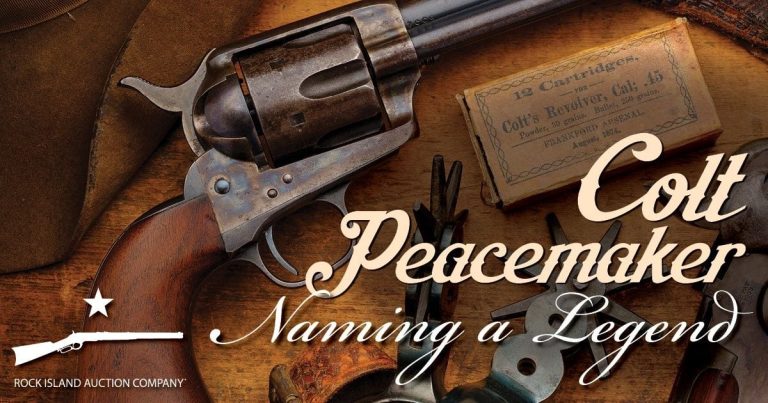
This high condition U.S. contract Colt Cavalry Model Single Action Army was manufactured in 1884, inspected by Captain Frank Heath, and sub-inspected by David F. Clark. The included Gold Seal letter from noted historian and author John A. Kopec observes that this revolver “remains today in a remarkable state of preservation, being in an unfired condition and showing that it had seldom been used during its militia service period.” Available this May.

The Six Shooter. The Thumb-Buster. Judge Colt and his Jury of Six. A plethora of nicknames were inevitable for the Colt Single Action Army revolver. In 1874, Cincinnati-based firearms dealer Kittredge & Co. came up with the gun’s most iconic branding by dubbing it the Colt Peacemaker. 150 years after the Colt SAA was first marketed as the Peacemaker, the name still resonates in the arms collecting community, popular culture, and beyond.

An exceptional Colt Peacemaker for sale this May, this historic L.D. Nimschke engraved SAA includes a raised relief carved steer head grip inscribed to “F. Villa.”

The Colt Peacemaker is arguably the most famous handgun ever made and an absolute must-have for every firearms fan. Rock Island Auction Company’s May 17-19 Premier Firearms Auction in Bedford, Texas features numerous pinnacle examples of the Colt Single Action Army genre, including two 1874 manufactured, Ainsworth inspected Colt SAA Cavalry models detailed below.

In the included Kopec Gold Seal letter, John Kopec notes that “after considerable consideration, together with the only logical evidence, it is the opinion of this write that our subject revolver #8554 had originally been issued to the 8th Cavalry within a block of revolvers beginning with #8357 and ending with serial #8886.” Available this May.

The first is a high-condition Lot 8 revolver documented to the 8th U.S. Cavalry and later the property of General Thomas W. Bennett (pictured above) and the second is a prime 7th Cavalry range “Lot Six” revolver with Kopec letters and extensive research attributing it to Captain Myles Moylan, Commander of Company A of the 7th Cavalry at the Battle of the Little Bighorn (pictured below.)

A historic documented Ainsworth inspected “Lot Six” U.S. Colt Cavalry Model Single Action Army revolver with extensive attribution to Captain Myles Moylan, Commander of Company A of the 7th Cavalry during the Battle of Little Bighorn. Available this May.

When was the Colt Peacemaker Made?

The invention of William Mason, Colt’s Superintendent of the Armory, the Single Action Army was originally designated the “New Model Army Metallic Cartridge Revolving Pistol” and the “M1873.” Once Colt’s new revolver passed Ordnance Department trials at Springfield Armory, the government placed an order for 8,000 SAAs to be issued to the U.S. Cavalry in July of 1873.

As previously mentioned, this exceptional early “Peacemaker” is a documented Ainsworth inspected Lot 8 U.S. Cavalry Model Colt Single Action Army revolver attributed to the 8th U.S. Cavalry and General Thomas W. Bennett is available this May.

Thanks to its comparatively simple and reliable design, the Colt Single Action Army became the most prevalent standard Army sidearm in America for the next two decades. Almost all of the first Colt SAA’s went to the Ordnance Department, with commercial distributors having to wait until 1874 to offer the new revolver in meaningful numbers, when the revolver was dubbed “The Peacemaker.”

Another fantastic photo of the Ainsworth inspected, 7th Cavalry range “Lot Six” U.S. Colt SAA mentioned in the previous section. This exceptional revolver is accompanied by Kopec letters, including a letter from 2023 in which Kopec indicates this revolver was Captain Myles Moylan’s of the 7th Cavalry and notes documentation attributing serial number 6055 to Captain Moylan and as part of Captain Benteen’s collection. Available this May.

The Colt Peacemaker Nickname

Benjamin Kittredge & Co. of Cincinnati, Ohio, a major dealer of military and sporting goods and one of Colt’s largest distributors, came up with at least nine Colt revolver monikers over the years. Famously, Kittredge devised four nicknames to help promote Colt’s Model 1877 DA revolver series, including “Lightning” for the .38 caliber, “Thunderer,” for the .41, and “Rainmaker” for the .32 variant. The .45 caliber Model 1878, Colt’s first large frame double action revolver, was dubbed the “Omnipotent.”

An exceptional, 1879 shipped, factory engraved, etched panel Colt Model 1877 Thunderer DA revolver with a grip inscribed to “Fred L. Seely, Jr.” and a factory letter. Available this May.

B. Kittredge & Co.’s nickname for the Colt Single Action Army may have been inspired by a quote from Samuel Colt from May 18, 1852, where the famous inventor noted in a letter to Charles Manby, the Secretary of the Institution of Civil Engineers in London, “The good people of this world are very far from being satisfied with each other, and my arms are the best peacemakers.”

In 1876, legendary British Captain Frederick Burnaby echoed Colt’s sentiment, writing, “A revolver is sometimes a peace-maker.”

A Cuno Helfricht factory engraved Colt Single Action Army revolver with steer head pearl grips and a factory letter, shipped to Praeger Hardware Co. of San Antonio, Texas on July 25, 1916. Available this May.

The Colt Peacemaker designation played to the sentiment that an armed society was a polite society and the mere presence of a Colt revolver could dissuade any troublemakers from picking a fight they might not survive. The platform was viewed as an equalizer for women, the elderly, and those lacking in physical stature, with one popular expression contending that, “God may have made man, but Samuel Colt made them equal.”

Another historic Peacemaker for sale this May, this historic, documented Custer battle era “Lot Five” U.S. Cavalry Model Colt Single Action Army includes a Kopec authentication letter.

The Colt Single Action Army received an abundance of clever colloquials as it became more widely available, including Plowhandle, Hog-Leg, Skull Buster, One-Eyed Judge, Civilizer, Equalizer, Persuader, and Etiquette Trainer. While all were more memorable than official names like “Model P” and “45-Caliber Centerfire Colt Single Action Army,” it was Kittredge’s Peacemaker nickname that stuck with the public.

The Kittredge Peacemaker

An October 1876 B. Kittredge & Co. advertisement in ‘The Turf, Field and Farm,’ a leading New York sporting journal of the era, reveals how the Colt Peacemaker was marketed in its early years. The advertisement introduces Colt’s new gun with a life-size illustration of an SAA Cavalry model with a 7 1/2 inch barrel, its .45 caliber cartridge, and text that assures customers that the pistol “has been adopted by the War Department for the Cavalry Service of the United States.”

An October 1876 B. Kittredge & Co. full-page advertisement for the Colt Single Action Army revolver featuring “The Peacemaker” branding in multiple places.

The Colt “Peacemaker” branding is used throughout the ad, with testaments to the gun’s prowess and superiority. The revolver is advertised at $17.00 for the “best citizens’ finish” and $13.00 for “rejected government finish, but good serviceable arms,” likely referring to U.S. contract guns rejected for flaws.

Nickel plating was available for an additional $1.50, with ivory grips priced at $5.00. The Colt Peacemaker example pictured below, shipped to B. Kittredge & Co. in 1877, features both of these optional features.

A Colt Peacemaker by every definition, this SAA with a 7 1/2 inch barrel was shipped on August 25, 1877 to B. Kittredge & Co. with nickel plating and .45 caliber chambering. The ivory grips were likely fitted by Kittredge. Includes a period slim Jim holster and a factory letter. Available this May.

B. Kittredge & Co. also offered Colt’s Peacemaker with a 16-inch “long carbine barrel” and “an attachable breech which enables it to be shot from the shoulder as a rifle,” each feature costing an additional $5.00. These long barrel configurations later became known as “Buntlines,” one of the supreme rarities in First Generation Colt Single Action Army collecting.

According to ‘A Study of the Colt Single Action Revolver,’ by Graham, Kopek, and Moore, only 18 Peacemakers with carbine-length barrels were produced by Colt in the 28,800-28,830 serial range, and only 10 of those, including the example pictured below that shipped to B. Kittredge & Co. on March 30, 1880, had 16-inch barrels.
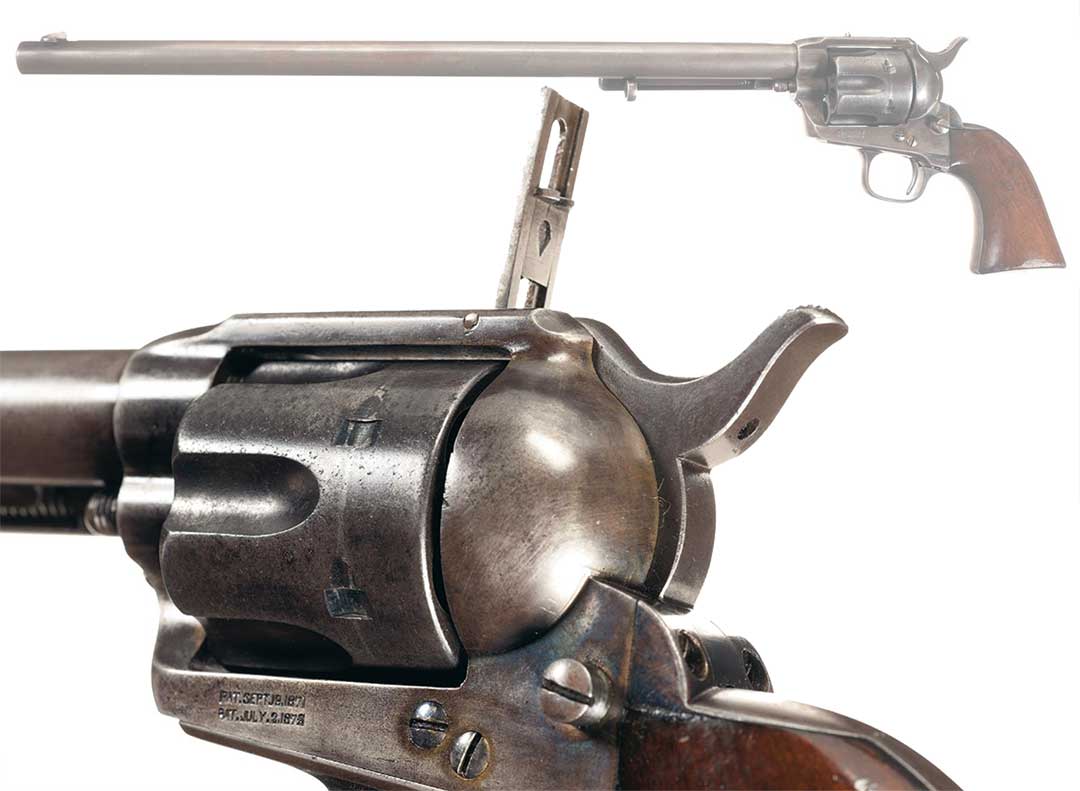
An exceptionally scarce Buntline Special Colt revolver with a skeletal shoulder stock realized $546,250 in 2012 with Rock Island Auction Company.

The Colt Peacemaker Goes West

As a major distributor, B. Kittredge & Co. helped deliver Colt’s new revolver into the hands of thousands of settlers, ranchers, cowboys, lawmen, and outlaws who headed West with the railroad, and the Kittredge “Peacemaker” branding traveled with them.

A Fort Worth, Texas shipped, Glahn factory engraved Colt SAA with relief carved steer head grips from Wolf & Klar. Available this May.

“We deliver at our cost and risk within 1,200 miles and without extra charge,” B. Kittredge & Co. touted, with only 50 cents extra beyond that distance. Already becoming a favorite sidearm with the U.S. Army, the Colt Peacemaker would find its way to every corner of the continent, carried on cattle drives, frontier streets, in smokey saloons, and anywhere else someone needed a reliable, affordable cartridge revolver.

An exceptional, documented 1882 production U.S. D.F.C. inspected Colt Cavalry Single Action Army revolver with a Kopec Gold Seal letter. Available this May.

Prevalence of the Colt Peacemaker Name

The Colt Peacemaker designation was used far and wide, including in military and government circles. ‘The Journal of the Armed Forces: (1877-1878), Volume 15’ references the Colt SAA as the “.45 Peacemaker (Army).”

In ‘Report of the Adjutant-General of the State of New Hampshire, May 31, 1887’ an inspector of the Troop A Cavalry of the New Hampshire National Guard notes that, “If this troop could be armed with a good revolver, the army “Peacemaker,” caliber .45, for example, and properly instructed in its use, its efficiency would be very materially increased.”

A classic example of the Colt Peacemaker for sale this May, the included factory letter for this SAA revolver states that the gun was shipped to H&D Folsom Arms Co. of New York City on April 12, 1880 with .45 caliber chambering and blue finish.

A March 1897 article from ‘The Oklahoma Herald-Democrat’ noted that Nevada’s “long-haired miners” had a tendency to use “Col. Colt’s peace-makers in settling disputes.”

By the early 20th century, advertisements frequently refer to the Colt SAA as the “Peacemaker,” “Peace-Maker,” “.45 Peacemaker,” “Colt’s Peacemaker,” and so on. The Colt Peacemaker name was widely used by Western authors and Hollywood screenwriters as well.

This excellent Colt SAA with relief carved eagle grips and a factory box displays the classic “Peacemaker” silhouette. Available this May.

Colt Peacemaker Barrel Length

When B. Kittredge & Co. first branded the Colt Peacemaker, the only standard factory barrel length was 7 1/2 inches. Shorter lengths like the 5 1/2 inch Artillery Model and 4 3/4 inch Sheriff’s Model became available after 1880, though the Peacemaker name could be applied to any .45 caliber Colt Single Action Army, as illustrated by ‘Issue 4’ of ‘Hibbard, Spencer, Bartlett Co. General Catalog’ from 1891.

A Texas shipped, factory engraved Colt Single Action Army with carved steer head grips. Available this May.

The ejectorless Colt Sheriff’s Model Single Action Army revolver is one of the rarest and most sought-after variations of the legendary Peacemaker. According to ‘The Official Record of the Colt Single Action Army Revolver, 1873-1895,’ “just under 600 ejectorless Single Action Army revolvers were produced” with black powder frames. The Colt SAA example below was shipped in a factory documented 4 inch barrel configuration.

A factory documented First Generation Colt “Sheriff’s Model” Single Action Army revolver shipped to H.L. Dyer of Richmond, Texas in 1904. Available this May.

For shopkeepers, bankers, lawmen, and outlaws, a shorter barrel was easier to conceal in the pocket or under the counter. ‘A Study of the Colt Single Action Army Revolver’ by Graham, Kopec, and Moore notes that only around 40 Sheriff’s Model SAAs with 3 inch barrel lengths were produced, making the 1894 manufactured example pictured below a rarity among rarities in the Colt Peacemaker genre.

This Colt black powder frame Sheriff’s Model Single Action Army revolver with a scarce 3 inch barrel was shipped to Dunlay & Geisler in Houston, Texas in 1894, one of only 40 produced. Available this May.

The Colt Frontier vs The Peacemaker

Colt introduced additional chamberings for the Single Action Army, including the the .44-40 WCF in 1877. Intended for use in conjunction with the identically chambered Winchester Model 1873, the new revolver allowed a frontiersman to carry ammo for both sidearm and rifle in the same cartridge belt.

New York Colt dealer J.P. Moore’s Sons quickly saw a marketing opportunity and dubbed SAA revolvers chambered in .44-40 the “Frontier Six-Shooter.” In early 1878, Colt executives embraced the Frontier branding and began acid-etching “Frontier Six Shooter” to the side of the barrel. From 1889 to 1919, the Frontier legend was roll-stamped onto the barrel instead.

A Colt Frontier Six Shooter with a relief carved Mexican eagle pearl grips manufactured in 1883, one of the scarce few factory engraved Frontier Six Shooters produced before 1896. Available this May.

While Colt officially adopted the Frontier nickname and the Peacemaker remained a mere colloquialism, some advertisements still placed the Frontier SAA under the broader “Peacemaker” umbrella.

In the aforementioned ‘Hibbard, Spencer, Bartlett Co. General Catalog’ from 1891, Colt Single Action Armies in every caliber are dubbed “Colt’s Peacemakers,” though subheads are used to differentiate between “41 Caliber,” “Frontier,” and the “Peacemaker” in .45 caliber.

In Stuart Lake’s highly fictionalized but influential 1931 book, ‘Wyatt Earp: Frontier Marshal’, Lake recounts a supposed quote from the legendary lawman, where Earp appears to use Peacemaker and Frontier interchangeably, describing his revolver as, “Colt’s frontier model forty-five-caliber, single-action six-shooter with the seven-and-one-half inch barrel, the gun we called ‘the Peacemaker.'”

This acid etched panel Colt Frontier Six Shooter is attributed to outlaw Henry “The Flying Dutchman” Wagner and includes a factory letter and documentation. Available this May.

From 1882 to 1887, the .45 Colt Peacemaker and .44-40 Frontier dominated Single Action Army production. The former commanded 60 percent of the market, while the latter garnered another 25 percent of sales. The remaining 34 calibers only composed 15 percent of the early SAA market combined.

Some of the more obscure Colt SAA chamberings enjoyed slightly more popularity in the early 20th century, including desirable examples in .32-20 like the revolver pictured below. As author Dan Brown noted in ‘The 36 Calibers of the Colt Single Action Army,’ “The .32-20 WCF cartridge had good range and accuracy. It is very easy to shoot, as it does not make the revolver buck as the larger calibers do. It also was used as a companion to the Winchester rifle of the .32-20 WCF caliber.”

A documented, Kansas City shipped, 1916 manufactured, factory engraved Colt SAA with a factory steer head grip, chambered in the rare .32-20 WCF. Available this May.

The Colt Peacemaker vs the Bisley

Another nickname for a Single Action Army variant that Colt would go on to officially embrace was the Bisley. The Bisley’s predecessor, the Flattop Target Single Action Army, was first introduced in 1888 with a flat top frame and adjustable front and rear sights to satisfy the needs of target shooters. Only 925 were produced.

In 1894, the Colt Special Target Single Action Army hit the market. Some of the configuration’s main updates intended to aid in target shooting included a wider trigger, a lower and wider hammer spur, and a new grip frame profile. The revolver soon made a name for itself in target matches at the famous Bisley Range in England. This success inspired Colt’s Patent Mfg Co. to adopt the “Bisley” designation for the model. Colt went on to produce 44,350 standard-frame Bisleys, as well as 976 flattop Bisleys like the rare and desirable example pictured below.

An 1895 manufactured Colt Flattop Target Model SAA, one of only 122 chambered in .38 Colt (top.) and a 1908 manufactured Colt Bisley Flattop Target Model revolver (bottom.) Both of these exceptional rarities are available this May.

The concept of the Colt Peacemaker as a target shooting platform endured into the mid-20th century with modifications like our next featured revolver, customized by the legendary King Gunsight Company. A rarity in its genre, this factory engraved Colt-King Super Target First Generation SAA is equipped with a Colt-King Super Target rib with a red bead blade front sight and adjustable white outline notch rear sight, an iconic King’s cockeyed hammer, and a knurled trigger.

A rare, documented factory engraved Colt-King Super Target First Generation SAA with factory letter, manufactured in 1940. Available this May.

Colt Peacemaker Renaissance

The turn of the 20th century was a booming time for Colt’s Patent Mfg Co., with the Colt Peacemaker soaring in popularity despite a variety of double action revolver options on the market and comparatively new semi automatic pistols like the Luger, C96 Broomhandle, and Colt 1903 Pocket Hammerless. Over half of the 357,859 First Generation Single Action Army revolvers ever produced rolled off the lines between 1890 and 1910.

In the early 1900s, Wells Fargo & Co. began arming all of their express agents and ordering large quantities of firearms directly from manufacturers instead of through local retailers. The Colt SAA pictured below, marked “W.F. & Co.” on the butt, was shipped to W.M. Ashton of Wells Fargo & Co. in New York on 19 October 1908 in an order of 12 guns and demonstrates the Peacemaker’s continued role as a reliable sidearm for self-defense.

Manufactured in 1908, this rare Colt SAA is documented as purchased by Wells Fargo & Co. to arm their express agency agents and is featured in the ‘Colt Peacemaker Collector Handbook and Guide’ by Keith Cochran. Available this May.

1914 saw the slowest Colt Single Action Army production year since the model was introduced in 1873. Less than 13,000 Colt SAAs were manufactured in the 1920s and fewer than 4,000 the following decade. With the frontier conquered and increased competition from both revolver rivals like Smith & Wesson and ever improving semi automatic pistols like the 1911, the age of the Colt Peacemaker appeared to be fading at last.

This fine example of the legendary Colt Peacemaker, shipped to U.S. Marine Corps General Joseph Berry in 1932, is chambered in the iconic .45 LC caliber and is accompanied with an extremely rare factory shipped .45 ACP cylinder. Available this May.

The Modern Colt Peacemaker

Production of the Colt Single Action Army ended in 1940, but the world hadn’t seen the last of the legendary design. The Western genre’s popularity in 1950s film and television compelled Colt to bring back the Peacemaker in 1955 in the form of the Second Generation Single Action Army, followed up by a Third Generation that continues today.

An exhibition quality, Alvin White signed, master engraved, and gold inlaid inaugural Gene Autry Western Heritage Museum Gala Colt Third Generation SAA with pearl grips, presentation case and factory letter. Available this May.

A century after the Single Action Army hit the market, Colt finally officially adopted the Colt Peacemaker branding in the form of several official releases. These included a line of Colt SAA .22 caliber revolvers called the Peacemaker 22, a series of Colt Peacemaker Centennial revolvers, and an SAA branded “The Peacemaker Edition” in 2004.

A Colt Peacemaker 22 manufactured in 1971.

Colt Peacemaker for Sale

2023 witnessed the 150-year anniversary of the Colt Single Action Army. One year later, we celebrate the sesquicentennial of the gun’s most famous moniker, the Peacemaker. From the earliest Benjamin Kittredge & Co. advertisements of the Colt SAA to official models like the Peacemaker 22, the Colt Peacemaker has become one of the most defining names in the history of firearms.

A classic Colt Peacemaker for sale this May, this SAA revolver, chambered in .32-20 WCF, was shipped from Colt to J.F. Schmelzer & Sons Arms Company in Kansas City, Missouri, on December 20, 1898 and is inscribed “Bill Kearns Melrose Montana”.

The Colt Peacemaker transcends the world of gun collecting. Thanks to its pop culture appeal, historic significance, iconic profile, and starring role in modern-day Cowboy action shooting competitions, the Colt Single Action Army has stood the test of time like few other firearm platforms, and some of the rarest and most exceptional examples of the SAA genre can be found at Rock Island Auction Company.

This magnificent nickel-plated pre-war Colt Frontier Six Shooter Single Action Army was shipped to Laredo, Texas in 1931 and includes documentation, a factory letter, and its original box. Available this May.

For fans of the Colt Peacemaker and other frontier firearms, subscribe to the Rock Island Auction newsletter for new gun blogs and gun videos covering the guns that tamed the Wild West. From black powder Colts like the Walker, Dragoon, and Colt revolving rifle, competing wheel guns like the LeMat and Merwin Hulbert, lever gun icons like the Spencer carbine, the Marlin, and the Winchester family, and the various Civil War revolvers, surplus muzzleloaders, and breech loading rifles that traveled settlers carried, we explore the weapons that drove America’s push Westward.
Famed Westerner Buffalo Bill Cody presented this classic Winchester 1866 Yellowboy to a man known as “Panther Bill.”

Purdey Shotguns: Finest in the Field

0

For over two centuries, James Purdey & Sons has ranked among the finest names in gunmaking. From shooting champions to English royalty, Purdey sporting arms have been treasured far and wide, and owning a shotgun or rifle from the famed London gunmaker is a dream come true for countless sportsmen, shooters, and collectors today.

A consecutive trio of engraved 28 gauge Purdey Best Quality sidelock over/under shotguns. All three scenes were executed in exceptional detail by the hand of highly renowned master engraver Simon Coggan, who has signed each of the guns on the triggerplate. Available this May.

When it comes to fit, accuracy, precision, and exceptional workmanship, Purdey shotguns represent the upper echelon of the sporting arms genre. Rock Island Auction Company offers some of the finest vintage and modern Purdey shotguns for sale, including the phenomenal consecutive trio of Simon Coggan game scene engraved 28 gauge Best Quality over/under shotguns featured above and the exceptional pair of S. J. Kelly engraved sidelock double guns pictured below.

A pair of factory master S. J. Kelly signed and engraved James Purdey & Sons self-opening sidelock double barrel shotguns. Available this May.

Filled with luxury arms from the world’s finest collections, Rock Island Auction Company’s May 17-19 Premier Firearms Auction in Bedford, Texas features exceptional examples from every genre of the sporting pursuit, including Holland & Holland, Boss, Westley Richards, and other elite names in English gunmaking.

An exceptional factory engraved Holland & Holland Royal assisted-opening hand detachable sidelock shotgun with case (top) and an engraved Purdey self-opening sidelock shotgun two barrel set with case (bottom.) Both available this May.

Founder James Purdey

Company founder James Purdey received his first apprenticeship in 1798 at the age of 14. Seven years later, his talent and commitment earned him a position with Joseph Manton, arguably the most renowned London gunmaker of his era. Manton stressed the importance of detail in every aspect of armsmaking, with James Purdey later remarking, “But for him, we should all have been a parcel of blacksmiths.”

Joseph Manton trained his brother John, who started his own shop in London. A progression of John Manton dueling pistols are available at Rock Island Auction Company this May.

After working for Reverend Alexander Forsyth, the inventor of the first percussion lock, James Purdey decided to build a business of his own. In 1814, Purdey set up shop at 4 Princes Street, near Leicester Square in the West End of London. Purdey started small, producing only six firearms in his first year of operation. By 1824, Purdey was manufacturing 165 guns a year, including, pistols, rifles, and exceptional double guns like the percussion shotgun pictured below.

Marked serial number 424, this example is one of the earliest and rarest Purdey percussion guns ever offered, a 14 bore double barrel shotgun with a stunning curly maple stock from the 1820s. The shotgun was recently inspected by James Purdey & Sons Ltd, and they confirmed this gun as the only known Purdey in private hands stocked with a spectacular piece of birdseye maple.

A documented engraved Purdey double barrel percussion shotgun from the 1820s with a Purdey Patent Safety Sears and an exceptionally rare birdseye maple stock. Available this May.

James Purdey Expands

In 1826, Purdey’s success led to the need for a larger shop, and the company moved to 314 ½ Oxford Street, formerly owned by Purdey’s mentor Joseph Manton. James Purdey’s reputation led to patronage from some of the most famous names in English history, including Charles Darwin and Queen Victoria.

An exceptional, 1838 dated, cased panel scene engraved James Purdey 12 bore percussion double barrel shotgun. Available this May.

London’s sporting arm scene was thriving, and Purdey wasn’t the only rising star to get his start with Joseph Manton. Other famous artisans trained by Manton included Thomas Boss, William Greener, Charles Lancaster, and William Moore, all who went on to compete with Purdey in the shotgun market. Boss worked for James Purdey before forging out on his own, and Charles Lancaster supplied barrels for Purdey’s early business.

Joseph Manton trained some of London’s finest future gunmakers, including Charles Lancaster and Thomas Boss. The 1883 dated Charles Lancaster rotary underlever backaction hammer double rifle (top) and the 1888 dated factory engraved Boss & Co. backaction sidelock shotgun (bottom) illustrate the innovation and craftsmanship of London’s finest sporting arms manufacturers in the late 19th century. Both examples are available this May.

Purdey Shotgun Evolution

Born in 1828, Purdey’s son, James the Younger, was destined to follow in his father’s footsteps. By 1853, the younger Purdey collaborated with his father to invent the express double rifle, and five years later the elder Purdey retired to allow his son to assume full leadership.

James the Younger witnessed immense change in the firearms industry throughout his more than six-decade career. He remained at the forefront of innovation by taking out several successful patents including the Purdey thumb lever and the Purdey bolts locking system, both still used on many double guns today. Combined with the acquisition of Frederick Beesley’s self-opening action and William Wem’s ejector patent, Purdey was able to offer a cutting-edge design for sportsmen that has remained functionally similar since the 1880s.

A factory relief engraved James Purdey & Sons self-opening sidelock double barrel shotgun with case, manufactured in 1911 according to ‘Purdey: The Definitive History’ by Donald Dallas. Available this May.

In 1877, with his two eldest sons, James III and Athol entering the family business, James the Younger changed the company name to the now-familiar James Purdey & Sons. Six years later, Purdey moved to 57 South Audley Street, a storied site with firearms enthusiasts today that continues to serve as company headquarters.

‘The County Gentleman, Sporting Gazette and Agricultural Journal,’ an 1880s title for the British publication that became ‘Land & Water’ magazine, summarized the London gunmaker as follows:  “Men do not go to Purdey because they want to economise;  they go to him and pay his price with the utmost cheerfulness because they are well aware that by doing so, they will have done for them all the art of smoothbore making can do.”

An engraved James Purdey & Sons self-opening sidelock shotgun manufactured circa 1920, a two barrel set with case. Available this May.

Athol Purdey was next to take up the company mantle, guiding the business through the First World War and helping develop designs for single-barreled trap guns and Purdey’s first over/under shotgun. Purdey supported the British war effort, and both of Athol’s sons, James and Thomas, were injured during the conflict. Representing the fourth generation of the Purdey gunmaking dynasty, the two brothers would go on to join the firm and help the company shift back to sporting arms production during the Interwar period.

Completed in 1939, this factory engraved James Purdey & Sons self-opening sidelock double barrel shotgun includes an extra barrel set and case. Available this May.

Purdey Shotguns Today

In the 1920s, Athol Purdey commissioned his factory manager, Ernest Lawrence, to develop an over/under shotgun for the company. Purdey’s “Sextuple Bite” over/under action was costly to produce, and by the outbreak of WW2 only 27 had been sold.

The war had devastated the British economy, and sporting arm producer James Woodward & Sons had been hit particularly hard. In 1948, Charles Woodward, grandson of company founder James Woodward, approached Thomas Purdey to explore the possibility of Purdey acquiring his floundering company. Needing a new over/under action, Thomas eventually obliged.

After a few modifications from Harry Lawrence and his younger brother, Ernest Jr., the Purdey Over and Under was born. The model has remained in production ever since, with the consecutive trio of small bore Purdey over/under shotguns offered by Rock Island Auction Company this May representing the pinnacle of one of Purdey’s most popular shotgun designs and is a true rarity in the genre of elite sporting arms.

This consecutive trio of engraved Best Quality over/under shotguns includes an extra 28 inch .410 barrel set with a gold inlaid “1” at the base of the rib. Also included is a fine oak & leather takedown case that houses the entire set along with three oilers, two cleaning rods, and a pair of .410 bore snap caps. Available this May.

In 2014, Purdey celebrated its bicentennial. As one of Britain’s oldest and most revered heritage brands and the sole London gunmaker with three Royal Warrants of appointment to the British royal family, the legacy of James Purdey & Sons is unrivaled. When it comes to blending old-world craftsmanship with modern innovation, Purdey shotguns and double guns remain the epitome of extravagance for today’s sportsmen, shooters, and collectors.

A pair of engraved James Purdey & Sons self-opening sidelock double barrel shotguns, a testament to the exceptional quality Purdey continues to produce. Available this May.

Purdey Shotgun Prices and Values

Gun prices have experienced a remarkable uptrend in recent years, including the luxury sporting arms market. Both classic and modern Purdey shotguns are prized for their rarity, artistry, condition, and provenance, with high-end examples sold by Rock Island Auction Company testifying to the prestige and investment value of these exceptional objects.

With only 30 to 50 individual orders taken by Purdey each year and a production time upwards of 12 months for a highly personalized shotgun, collectors willing to set aside customization can obtain a top-tier, heirloom quality Purdey at auction without the wait.

An S. Coggan engraved Purdey & Sons .410 bore sidelock shotgun sold in RIAC’s December Premier Auction for an impressive $235,000.

Purdey Shotgun Quality

Purdey shotguns are the definition of bespoke. Each piece is custom-tailored at every level, from barrel making, actioning, stocking, finishing, fitting, and Purdey’s world-renowned engraving. Thanks to the company’s exclusive lineup of hard-metal engravers, Purdey shotguns display some of the finest artistry of any luxury collectible.

The matching pair of Purdey shotguns pictured below exhibit exceptionally coin finished self-opening sidelock actions with extensive deluxe Purdey rose and scroll engraving. The scrollwork extends to the toplever, triggerguard, with both the upper and lower tangs adding to the elegance of the guns. When it comes to a marriage of artistry and engineering, this example demonstrates Purdey’s marquee quality in every detail of their trade.

A pair of engraved James Purdey & Sons self-opening sidelock double barrel shotguns, hand-made English craftsmanship at its finest. Available this May.

No two individual Purdeys are exactly alike, and while finding a matching pair of Purdey shotguns like the pair above is exceptionally rare, a consecutive trio is an absolute holy grail in sporting arms collecting. Each of the three immaculate shotguns pictured below feature an exquisite brush bright finished action with masterfully cut broad leafy floral scrollwork.

A different game bird scene adorns the underside of the action on all three pieces, each displaying the skill of the engraver, Simon Coggan, arguably one of the most talented artisans to ever wield a hammer and chisel. All three shotguns have highly figured and double line bordered multi-point checkered forends with matching engraved bright fittings, truly a tour de force in the field of pinnacle shotgun making.

The toplever of each Purdey shotgun in this exceptional consecutive trio is marked with a gold “1”, “2”, or “3”, and both the upper and lower tangs which bear the serial number in gold. Available this May.

Purdey Shotguns for Sale and More

Purdey is more than a luxury shotgun maker; they’re an international icon. From hand-laid, deep-finished walnut to intricate engraved scrolling, Purdey sets the standard. Each gun forged from the workbenches of Purdey is a masterpiece every sportsman aspires to own, and you can find the finest Purdey shotguns for sale at Rock Island Auction Company.

A close up look at one of the consecutive trio of engraved Best Quality over/under shotguns. Each gun in this exceptional grouping features a single gold trigger, gold centerlined cocking indicators, right hand rolled triggerguards, and tang mounted automatic safeties with gold inlaid “SAFE” indicators. Available this May.

From benchmark condition examples to pieces marked by a lifetime in the field, Rock Island Auction Company’s May 17-19 Premier Firearms Auction offers an immense selection of classic and modern sporting arms. If you’re looking for a bounty of master engraving, inlaid precious metals, handsome wood grain, and sought-after special features, May’s auction is can’t miss event for hunters and collectors of every aspiration.

A Cortini signed and factory game scene engraved Holloway & Naughton 20 gauge sidelock over/under shotgun with case. Available this May.

For more gun blogs and gun videos on classic and modern sporting arms, subscribe to the weekly Rock Island Auction newsletter to find pieces on Abercrombie and Fitch, Parker Brothers, Winchester, Marlin, Browning, and Savage, as well as unique and unusual historic curiosities like the M30 Luftwaffe drilling, the combination gun, the Paradox gun, the revolving shotgun, the 10 gauge shotgun, the 4 bore, the Punt gun,  and more.

Rock Island Auction’s May Premier will mark the second offering from the exquisite Norman R. Blank Collection. This superbly curated grouping is a masterclass in all the gunmakers arts as exhibited on firearms from some of Europe’s top artisans.

Review: Vosteed Mini Nightshade with New Aluminum Scales

0

I’ve been fortunate to handle several Vosteed Cutlery knives at this point and the Mini Nightshade is still in my top 2 (alongside the Raccoon). The Nightshade series knives, with their unique Shilin Cutter shape, are the knives that really exemplify what I like about Vosteed – great functional shapes and materials, great prices, and some really bold designs.

Vosteed provided the latest version of the Mini Nightshade for me to check out.

Specs

Blade Length: 2.60″ | 66.04mm

Overall Length: 6.31″ | 160.37mm

Blade Width: 1.13″ | 28.28mm

Blade Thickness: 0.098″ | 2.49mm

Blade Material: 14C28N

Blade Grind: Flat

Blade Style: Shilin Cutter

Blade Finish: Stonewash

Hardness: HRC 60±2

Handle Length: 3.71″ | 94.33mm

Handle Width: 0.89″ | 22.6

Handle Thickness: 0.437″ | 11.10 mm

Weight: 2.16 oz | 61.10 g

Opener: Thumb Stud

Lock Type: Crossbar Lock

Pivot Assembly: Caged Ceramic Ball Bearing

Pocket Clip: Reversible | Stainless Steel

Carry Position: Tip-up

There are other finishes and handle materials available but my review sample has a black-washed blade, green aluminum handles, and gold accents (thumb stud and backspacer).

Observations from Use

I have already written in-depth why I like the Mini Nightshade in the previous review which I suggest you check out. In this review, I’ll focus on the differences with this new aluminum scale version.

I expected this would just be a scale-swapped version of an already great knife but I was surprised to find that the aluminum scales changed the character of the Mini Nightshade a lot. The new scales are slightly thicker than the original G-10 version. It’s enough that you notice a difference. That extra thickness with the great machined texture makes this new version feel a little more capable… more ready to work.

Speaking of the texture, Vosteed gets a gold star for how they executed it. They machined a scalloped pattern into the scales that provides great grip out near the edges but tapers down to smooth at the center of the scale. This means the clip rides on the smooth part of the scale making it very easy to take in and out of the pocket. This is such a clever touch that works and looks great.

This version of the Mini Nightshade feels more substantial in the hand in part due to a slight weight increase but it is still an absolute feather-weight at just 2.16 ounces. That is incredibly light for an all-metal knife.

The Mini Nightshade was already a refined, gentemanly knife but this new version received even more refinements from Vosteed. The deep carry clip is now nested into the scale and they provided a filler tab for the side that is not in use. They even took care to slightly extend the thumb studs to account for the thicker scales. That is some solid attention to detail.
If you haven’t tried something from the Vosteed Nightshade series, you really should. This blade shape is incredible. It holds material in the cut and gives easy access to the point like a sheepsfoot or warncliffe style blade but also offers belly for slicing and draw cuts like a drop point or leaf shape blade. It’s unique and useful.

Wrap Up

This is new version of the Mini Nightshade from Vosteed builds on the back of an already great knife. The proven cutting geometry, useful blade shape, lightweight, and compact design are still there but with some additional refinements, new texture, and a great new look. This is my favorite version of the Mini Nightshade to date.

You can see the whole Nightshade range at Vosteed.com. Now is a great time to check them out as many of their knives are up to 20% off for Easter (no code required).

The new Mini Nightshades are also on sale and available at Amazon: Mini Nightshade on Amazon.com

Review: Flextail Tiny Pump 2X

0

You may be surprised to see a small, lightweight, USB-C rechargeable air pump on these pages but this Flextailgear Tiny Pump 2X has earned a permanent place in my backpacking gear.

This is sold as an air pump for sleeping pads but I think of it more as a lantern that happens to blow up sleeping pads. That is how it earned a spot in my pack… it kicked out the backup light/lantern that I was already carrying out of my pack.

Maybe it is weird to start out a review of this pump talking about its secondary functionality as a lantern, but is actually a very useful light. The included bail makes it easy to hang up in or near your tent and it has broad, floody beam with three well-spaced output settings. It’s a better backup light/tent light than what I was carrying before and it weighs less than many similar lights.

The main reason that I appreciate the pump feature is how easy it makes setting up my sleeping pad. After a long day hiking up hill the whole way, it’s easier to push a button than to blow up the pad with your lungs. It’s also nice to not introduce the moisture from your breath into your sleeping pad where mold can form. This might help extend the life of your sleeping pad and help you sleep a bit warmer.

At around 3.5 ounces and roughly the size of a shot glass, this Tiny Pump 2X packs a lot of usefulness into a small space. I would probably never carry a dedicated pump, but a lantern that also happens to pump up my sleeping pad effortlessly… I can get with that.

I bought my Flextailgear Tiny Pump 2X on Amazon.com but shop around, as sometimes there are better deals direct from Flextailgear.

Confederate Guns: Valuable Rarities | Rock Island Auction

0

Guns linked to the Confederacy are rare today, but relatively speaking, there weren’t many to begin with. While northern gunmakers were turning out plenty of guns, the Confederacy with its lack of resources struggled to obtain the weapons to fight the Civil War.

Southern ordnance officers turned to guns purchased in Europe that passed through the Union blockade or from gunmakers who were turning out small numbers of guns, sometimes relying on brass rather than steel for parts.

Rock Island Auction Company’s May 17-19 Premier Auction will have a number of Confederate guns on offer, ranging from the fallen Mississippi officer’s Colt revolver from Gettysburg, to a LeMat, popular among Confederate officers, to classic southern revolvers like the Spiller & Burr.

Confederate Guns: A Colt Model 1860 from Gettysburg

Colt shipped plenty of guns to the South in the months leading up to the opening salvos of the Civil War, but promptly stopped as the war got underway and the company faced public outcry for arming the South. Among these guns shipped by Colt were 160 Model 1860 revolvers, along with 80 shoulder stocks and 80 flasks in January 1861 to William T. Martin, the commander of the Adams Troop of Cavalry in Natchez, Miss.

William Gustine Conner was a Yale University graduate and Mississippi plantation owner. He was commissioned as an officer in the Adams Troop as it was renamed Company A of the Jefferson Davis Legion Cavalry. Conner was captured in May 1862 and released in August 1862, shortly before Antietam.

By the time the Legion reached Gettysburg on July 1, Conner was a major and served as the unit’s executive officer. Conner held a bitter grudge from his time in a Union prison and was promised he could lead the charge once inside enemy territory.

Lined up across from George Custer’s unit, the Michigan Brigade, on the third and decisive day, Conner and his men charged the Union line in a fierce cavalry assault as Gen. J.E.B. Stuart’s cavalry tried to draw Union forces away from Pickett’s Charge.

Conner charged fearlessly into battle and soon found himself in the midst of the enemy and injured. Surrounded and attempting to escape, Conner’s plight is said to have attracted the attention of Confederate General Wade Hampton. The men had ridden side-by-side earlier in the fight. Hampton spotted the surrounded trooper and rushed to his aid. He was slashed twice by sabers and took shrapnel to the hip before escaping without his comrade. Conner was not as fortunate.

The Mississippi Historical Society has documented testimony that Conner rode into the fray “amid the rattle of pistols and clashes of sabers, he seized a guidon (a cavalry standard or flag) of the enemy, and when ordered to surrender drew his pistol and killed two of his assailants before being killed himself.”

In Stuart’s report of the Battle of Gettysburg he writes, “Among the killed was Major Conner, a gallant and efficient officer of the Jeff. Davis Legion.”

William Gustine Conner’s Colt 1860 Army Revolver with fluted cylinder and stock reflects the patina of one used in the Civil War and is an immense opportunity to obtain a gun with provenance to the Confederacy and the Battle of Gettysburg. The back strap has the historical inscription “Capt. W.G. Conner.” It also includes a non-matching shoulder stock that was among the 80 sent along with 160 revolvers and 80 flasks. A factory letter lists the shipment to the commander of the Adams Troop of Cavalry, of Natchez, Miss., on Jan. 17, 1861. Among the documentation is the original receipt for payment dated Jan. 14, 1861.

Confederate Guns: Colt Model 1851 of the Hawks

Born into a slave-owning family in North Carolina, Francis Lister Hawks had a diverse career as a lawyer, clergyman, historian and author. He studied for the Episcopalian ministry and was ordained as a priest, becoming the highest paid clergyman in the United States. He served as rector of a church in New York City for 12 years before serving at various southern churches and the first president of the University of Louisiana that later became Tulane University. He returned to New York City in 1849 where he served at Cavalry Church before going to Christ Church in Baltimore in 1862 and then returning to New York City in 1865. He died a year later.

Francis Tomes Hawks, was born in New York City in 1832, the son of Francis Lister Hawks and his second wife. He served as an engineer on the construction and landscaping of Central Park. Despite his ties to the North, he was commissioned as a captain and aide-de-camp to Gen. Lawrence O’Bryan Branch of the 33rd North Carolina. He was likely given the Colt Model 1851 Navy by his father when he went off to fight for the Confederacy.

Hawks resigned his commission for one with Company A of the 2nd Regiment Engineer Troops in Wilmington, N.C., in August 1863 and helped prepare coastal defense at the mouth of the Cape Fear River. Hawks fell ill in January 1865 and was on sick leave when the Union attacked the Carolina coast. He married after the war and moved to a tobacco plantation owned by his wife’s sister and worked for Midland Virginia Railway. He died in 1883.

Francis Lister Hawks originally owned this high condition Colt Model 1851 Navy made in 1852. He likely gave the gun to his son, Francis Tomes Hawks in 1861. This incredibly high condition early factory engraved Colt Model 1851 Navy revolver features beautiful early Hartford engraving, quite a rarity. The engraving consists of very circular scroll patterns with some feather-like detailing on the rear third of the barrel, flats of the loading lever arm, essentially all of the frame, most of the hammer, and on the trigger guard and back strap along with wavy line borders and some areas of light crosshatching. This early style Hartford engraving is attributed to Thomas J. Barlow who engraved for Colt between mid-1852 to early 1854. The revolver is featured in the book “Colt 1851 Navies and 1861 Navies and Conversions” by Robert Jordon on page 267.

Confederate Guns: C.L. Dragoons Colt Third Model Dragoon Revolver

In the months leading up to the Civil War, Colt’s Manufacturing Company sold guns to all parties, but  Colt revolvers continued to find their way past the Union blockade throughout the conflict.

In an article titled “C.L. Dragoons” in “The Gun Report” Volume 36, Number 8 from January 1991, author Walter L. Anderson concluded that arms dealer Cooper & Pond of New York ran a number of revolvers through the Union blockade. A factory letter included with this revolver shows it was shipped to Cooper & Pond in February of 1861 as part of a 16-gun shipment. It has “C.L. Dragoons” on the upper left flat at the breech.

The Crocheron Dragoons were led by its commander Robert W. Smith and organized in Dallas County, Alabama where Selma is located. The unit was named after prominent planter John Crocheron, who purchased arms and equipment to outfit the company. The unit became a company in the 3rd Alabama Cavalry. The unit stood guard around Mobile and Pensacola before being taken on as Gen. Braxton Bragg’s escort and courier unit.

Along with this Colt Third Model Dragoon revolver’s very scarce hand-engraved “C.L. Dragoons” on the upper left flat at the breech, the frame’s recoil shield is cut for a shoulder stock, and the elongated mounting screws are fitted to the sides of the frame. The butt has the corresponding slot for the stock. Only an estimated 1,200-1,500 Third Model Dragoons were cut for a shoulder stock.

Confederate Guns: Griswold and Gunnison Revolver

The largest number of Confederate revolvers came from a firm run by Samuel Griswold and Arvin Gunnison out of Griswoldville, Georgia. Griswold & Gunnison produced approximately 3,700 revolvers, making them the most prolific Confederate handgun manufacturer during the Civil War. Perhaps the most well-known type of Confederate revolver model, the Griswold was patterned off of the Colt Model 1851 Navy and features a brass frame, trigger guard, and back strap.

This standard model revolver has an octagonal barrel lug with a round barrel, one-piece walnut grip, a brass frame, trigger guard, and back strap. The six-shot cylinder has rectangular stops, and safety pins between the percussion nipples.

This Griswold and Gunnison revolver correctly has no maker identification; however, it has a few of the cryptic marks found on most Griswold & Gunnison revolvers. In this case, “III” and “V” are stamped on the left side of trigger guard extension and left side of the matching rear strap, and a “V” on the rear flat surface of the frame, all hidden underneath the grip.

Confederate Guns: Spiller & Burr Revolver

In 1861, Lt. Col. James H. Burton, Edward N. Spiller, and David J. Burr launched a factory in Richmond, Virginia in an attempt to manufacture revolvers for the Confederacy, but quickly relocated to Atlanta, Georgia. Production started with an optimistic government contract of about 15,000 revolvers in 1862, but operation was halted in November 1864 due to Sherman’s March to the Sea with only about 1,400 revolvers made.

Edward Spiller was aiming for a rugged yet easy to produce design, and he selected the Whitney Arms Company Navy as the basis for the Spiller & Burr revolver. The primary differences are observed in the Spiller & Burr’s distinctive solid brass frame and the revolver’s cylinder composition, with Spiller & Burr opting to use iron cylinders rather than steel, as fine quality steel was in scarce supply.

About 1,400 Spiller & Burr revolvers were manufactured between factories in Atlanta and Macon, Ga. “C.S” is stamped on the lower right side of the frame at the front. It features a post front sight, frame groove rear sight, six-shot cylinder with safety notches between the nipples like the Remington revolvers, and smooth walnut grips. The cylinder has the spiral twist visible in the metal which is similar to Damascus twist in shotgun barrels of the period; a feature noted in authentic revolvers.

Confederate Guns: Bilharz, Hall & Co. Saddle Ring Carbine

Only 400-700 of these carbines were made by Bilharz, Hall & Co. of Pittsylvania Courthouse, Va. From late 1863 to early 1864. These are a .58 caliber muzzleloader with a 22-inch barrel. It is closely copied on the Springfield Model 1855 carbine. These were apparently handmade because of the lack of facilities and gunmaking equipment faced by the Confederacy. Because of their scarcity, it is unclear to what units the carbines were distributed.

(pic) This Bilharz, Hall & Co. saddle ring carbine has a “P” marked on the left side of the barrel near the breech. It is mounted in a one piece straight grip walnut stock with iron fittings. It is also marked with serial number “523” on the rear face of the barrel and on the underside of the breech.

Confederate Guns: Second Model London LeMat “Grapeshot” Revolver

The LeMat revolver is one of the most distinctive Confederate pistols thanks to its unusual central smoothbore “grape shot” barrel. This fascinating firearm was carried by numerous Southern military generals and officers such as P. G. T. Beauregard, Braxton Bragg, and J. E. B. Stuart.

Designed by Dr. Jean Alexandre LeMat of New Orleans, these unique revolvers were primarily produced in Liege, Belgium, and Paris, France, and smuggled into the South during the Civil War. Period advertisements for the revolvers refer to them as “LeMat’s Grape Shot Revolvers.” Total production of LeMat revolvers in Liege, Paris, and London was less than 2,900 between 1856 and 1865, and this example was manufactured about 1863.

This Second Model London LeMat grapeshot revolver, manufactured in 1863, has a 9-shot cylinder chambered in .42 caliber and a 16 gauge smoothbore grapeshot barrel. This revolver has an overcoat of golden varnish. It is accompanied by an unmarked Confederate officer’s sword.

Confederate Guns: Colt Single Action Army marked “Thomas J. Goree”

This Colt Single Action Army is an anachronism since it is a post-Civil War revolver, but it has ties to the top of the Confederate military. Thomas J. Goree was an attorney in Houston at the start of the Civil War who left his practice and headed to Virginia to join the Confederate Army. Traveling to New Orleans by boat from Galveston, he met Major James Longstreet who resigned from the Army and was also headed to Virginia to join the rebellion. Longstreet, who fought bravely in the Mexican War, would rise to be one of Robert E. Lee’s most trusted generals.

Goree who achieved the rank of captain served as Longstreet’s aide-de-camp through the war and involved in almost every battle fought by Longstreet’s division that included Second Manassas, Antietam, Fredericksburg, and Gettysburg. Longstreet doubted Lee’s invasion of the North fearing the casualties that would weaken the Army in an offensive and openly questioned Lee’s attack at Gettysburg and especially the action known as “Pickett’s Charge.”

Goree’s clothes were often bullet-ridden and horses shot out from under him but he never experienced serious harm during the war. Longstreet, on the other hand, was wounded by friendly fire in the neck and shoulder in May 1864, leaving his right arm permanently paralyzed.

At Appomattox, Lee told Goree, speaking of Longstreet, “Captain, I am going to put my old war horse under your charge. I want you to take good care of him.”

Goree returned to Texas where he resumed his legal career and had other business interests. He was appointed to the Texas State Prisons board of directors and served as superintendent of the Huntsville prison in 1877 and then superintendent of the state prisons. He likely received the revolver when he was superintendent of the state prisons.

This Colt Single Action Army was shipped in 1884 chambered in .45 Colt. It has checkered hard rubber grips with “THOMAS J.” (left) and “GOREE.” (right) marked on the butt. The lot includes a tooled holster and factory letter.

Confederate Guns for Sale

The scarcity of Confederate-made guns and northern-made guns with Confederate provenance make these Civil War firearms highly attractive offerings. The May 17-19 Premier Auction deserves the full attention of collectors who are fascinated by this soul-wrenching period of American history.

Le Page: French Opulence | Rock Island Auction

0

When it comes to “armes de luxe” Parisian gunmakers have received near universal acclaim. French artistry in arms began to grow in prominence in the early 17th century. Even the smug English critics during the early World’s Fairs could not avoid giving the French their due.

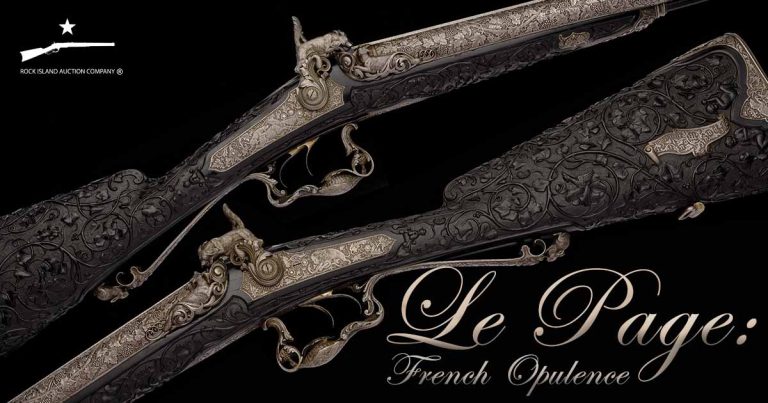
French gunmakers have been producing incredibly ornate fine arms for centuries, both for the royal court and international exhibitions. Their beautiful works of art have remained among the most desirable antique arms in both museum and private collections, exemplified by this incredible shotgun from Le Page-Moutier in Rock Island Auction Company’s upcoming May 17-19 Premier Auction. The pair of pistols pictured alongside the Le Page-Moutier shotgun are by Gastinne-Renette that sold in RIAC’s December 2023 Premier Auction for $411,250.

In “Masterpieces of Industrial Art & Sculpture at the International Exhibition, 1862 Vol. 1″ it was written: “For ‘Armes de luxe’ Paris has long maintained supremacy over all competitors: the names of Devisme and Le Page-Moutier are of world-wide note; to which follow worthily in suit Gastinne-Renette, Gaudin, Brun, Perrin, and Thomas, all of whom obtained the highest commendation of the Jury in Class 11…”

The jury wrote, “The sporting guns and pistols exhibited by the Paris makers are chiefly remarkable for the extreme artistic beauty of their decorations, which are designed and executed with the greatest skill and taste, the ornamental parts of the gun being highly valued in France, and in other countries, to which the French gunmakers export largely, especially South America.” Similarly, Record of the International Exhibition, 1862 states: “An adequate notice of the various specimens of artistic firearms in the French court would far exceed the limits of this article and would indeed come more properly under the department of fine arts.”

French Art is `Armes de Luxe’

Rock Island Auction Company has had the pleasure and privilege of cataloging and bringing to market many of the finest works of these French “armes de luxe,” and one particular firm continues to impress time after time: Le Page of Paris. The Le Page shop remains active today as a luxury leather goods maker, stemming from their past production of gun leather, dating back to 1717 when the shop was opened by Louis Pigny, gunmaker to Louis XV. He passed the shop onto his niece’s husband, Pierre Le Page, and the shop passed from generation to generation, producing fine arms for successive French kings on to today.

The shop at 13 de Richelieu near the royal palace passed on to Gilles Michel Louis Moutier-Le Page in 1842, just in time for the increasingly popular French national expositions of the 1840s that predated the World’s Fairs. Styled Le Page-Moutier, the company under his leadership – and then of Emile Henry Faure Le Page – won numerous accolades and awards for their fine exhibition firearms. The awards include the International Exhibition in Paris in 1855 (1st Class Medal), 1867 (Silver Medal), 1878 (Gold Medal) 1889 (Grand Prix), in London in 1851 and 1862 (Prize Medals) and in Vienna 1873 (Medal of Progress).

By this period, carved ebony stocks, elaborately relief-chiseled and engraved metalwork, and beautifully crafted cases and accouterments all decorated with complimentary patterns were essentially standard for French exhibition arms, and the array of patterns executed in ebony and steel held their own in the world of French art.

The Great Exhibition in London in 1851 is recognized as the first World’s Fair, but it was inspired by the national expositions held by the French. France continued to host World’s Fairs or “Expositions Universelle” where their fine arms continued to win distinction on the international stage and to delight both the millions of visitors and royal patrons. This extraordinary cased pair of pistols by Brun of Paris was displayed at the World’s Fair in 1862. Rock Island Auction Company sold this set in September, 2020 for $373,750.

The example in Rock Island Auction Company’s upcoming May Premier Auction is unquestionably one of the finest exhibition arms ever produced by the famous Parisian firm and a true piece of French art. This famous double barrel shotgun with ornamentation covering essentially all of the visible surfaces was presented by President Jules Grevy of France to President Manuel Gonzales Flores of Mexico. Given this extraordinary shotgun’s completion in 1860, it may have been first displayed at the Exposition Universelle in Metz, France, in 1861 and was likely displayed at subsequent exhibitions such as the 1862 International Exhibition in London. During the London exhibition, the company is noted as displaying “Sporting guns, carbines, revolvers, etc.”

A somewhat similar shotgun from the firm is also shown in Masterpieces of Industrial Art & Sculpture at the International Exhibition, 1862 Vol. 1 in Plate 6: “French Ornamented Fire-Arms.” The shotgun illustrated in the book is now in the Royal Armouries (object number: XII.4751), and their description notes: “The gun was exhibited at the 1862 International Exhibition in South Kensington and was awarded a medal. A similar gun was presented to the President of Mexico, Don Manuel Gonzales, by M. Paul Jules Grevy, President of France, in 1879.”

The relief chiseled grapevines and rib inscription on the barrels of this shotgun alone are absolutely incredible French art. They are but one part of the overall Bacchanal theme appropriate for the international fairs. Grapevines in particular, and sometimes wildlife that inhabited the vineyards, are often featured on 19th century French exhibition arms.

LePage Moutier Shotgun Is Functional French Art

The Damascus barrels by Parisian barrel maker Leopold Bernard feature a solid, concave rib signed “LE PAGE MOUTIER ARQER BREVETE A PARIS” in raised relief lettering with floral bloom accents flanked by raised foliate scrollwork. The rear of the barrels exhibit 9-inch panels of beautifully executed chiseled vine, leaf, and grape patterns on a finely beaded background. A band of chiseled oak leaves and acorns are seen at the front of the breech panels. The underside of the barrels are signed “LEOPOLD BERNARD/CANONNIER A PARIS” and have the numbers “N998” and “A1860” (barrel number and date) and two “crown/LB star” maker’s marks. The rib is marked “57445 – 1850” on the underside. A chiseled scroll pattern incorporating a beautifully carved three dimensional fox covers the fences and extends down the sides of the barrel breeches, and the hammers are finely chiseled in the form of dogs that pounce on each fox when the gun is fired. The shotgun has pierced scroll patterns, and the standing breech has a chiseled vulture among the designs.

The chiseled dogs and foxes on the hammers and bolsters are a fascinating design given that the dogs pounce when the locks are fired.

The locks and furniture feature the same high quality work as the barrels. The back action lock plates are fully covered in floral scroll patterns and game scenes; the left lock plate has a lion and a snake reminiscent of the famous sculpture by Antoine-Louis Barye, and the right lock plate has two dogs attacking a stag. Both lock plates are signed “Lepage moutier” following the contour of the hammers at the front. The foliate scrollwork spills onto the ornate buttplate side extensions. The buttplate tang offers a brilliant canvas for carved game scenes, with a leopard on the right side, a leaping fox decorates the left, and the heel tang depicts a dramatic hunting scene of three dogs bringing down a boar. The flat of the buttplate is covered with an intricately engraved floral scroll and rose blossom motif with a small satyr mask in the center.

Look at the complicated and intricate design of this pierced and sculpted trigger guard. It flows seamlessly with the rest of the designs. Le Page-Moutier and other French gunmakers utilized a variety of complicated pierced trigger guard designs with different animals and mythical creatures on their exhibition arms in the 19th century.

The chiseled and pierced trigger guard features a stunning three dimensional pheasant eating grapes at the front of the bow and a three dimensional hare consuming foliage at the rear of the grip extension. Both pheasant and hares were popular game animals. The Romans introduced pheasant to much of Europe, making it a popular quarry for upland hunters from the 19th century to today. Cooked pheasant pairs excellently with a nice glass of wine, so it’s a fitting design for this functional work of French art. The trigger plate finial is artfully shaped and features chiseled foliage scrollwork with a small bird. A carved steel raised inlay adorns the sides of the stock. Each stock inlay is engraved with a foliate pattern, and the left inlay is inscribed “Le Page Moutier ferit 1860” indicating the work was completed in 1860. The forearm tip has a carved mask representing Silenus, the god of wine-making, with a grape vine pattern below completing the festive vineyard theme on the metal.

The small hare at the rear of the trigger guard along with the birds among the relief carved vines on the stock are smaller details that demonstrate the overall level of French artistry of the piece.

The vine theme meanders down the incredible ebony stock with beautiful full-coverage leafy vine carving. Inhabiting the leaves on the sides of the butt are two carved birds, and at the buttplate there are four carved putti cradling hunted game. The ebony takedown case brilliantly coordinates with the stock and the metalwork of the shotgun with its wide steel bands, monogrammed initial plate and hardware, all featuring carved foliate pattern. The initial plate on the lid bears an engraved “MG” monogram. A suite of loading and maintenance equipment is included with the case and decorated in coordination with the shotgun and case.

The inscribed initials on the case lid would have been added when the cased set was presented by the French president to the president of Mexico over a decade after the cased set was produced. It isn’t unusual for 19th century exhibition pieces to later be used as presentation sets. Rock Island Auction has sold multiple pieces with connections to leaders in Latin America.
History of the Le Page-Moutier Shotgun

This incredible shotgun, truly French art, was once part of the Harolds Club Museum of the Old West and is described and photographed in a booklet published in 1958 by the museum. The museum describes the gun as “One of the most valuable weapons in the world, this shotgun was presented in 1879 by M. Paul Jules Grevy, President of France, to Don Manuel Gonzales, President of Mexico.” The gun was examined by San Francisco jewelers Shreve & Company who stated, “there is no person living today capable of executing such metal carving. If such a person could be found, it would unquestionably take him 5 to 10 years to complete such a job.” It is also referenced in multiple publications about the Harolds Club collection, including the Boys Town Times on Nov. 13, 1964, when the collection was on display during Nevada’s centennial celebrations. The caption noted “Among the guns on display was a shotgun presented in 1879 by M. Paul Jules Grevy, President of France, to Don Manuel Gonzales, President of Mexico, now valued at $15,000.”

As President of Mexico, Manuel Gonzalez, right, established better relations with France, and after leaving office, he was involved in Mexico’s participation in the Exposition Universelle de Paris in 1889. French President Jules Grevy presented the Le Page-Moutier shotgun to Gonzalez.

As a soldier, Manuel del Refugio Gonzalez Flores (1833-1893) was wounded several times and lost his right arm during the Second Franco-Mexican War. Despite the loss of his limb, as Mexico’s 31st president (1880-1884) he worked for improved relations with the French. He started his military career in the Mexican-American War after his father was killed. He rose to the presidency after being selected by his predecessor, Porfirio Diaz. Along with better relations with France, Gonzalez also re-established relations with Britain, and Germany. French bankers played an important role in the establishment of the Banco Nacional de Mexico, and Mexico adopted France’s metric system during his term. Diaz came back to office after Gonzalez’s lone term.

“Mexico at the World’s Fairs‘” by Mauricio Tenorio-Trillo notes that “…in 1888 Manuel Flores, a member of the Mexican exhibition team, was commissioned to evaluate the French plans or an exhibition of social economy,” and that “Mexico published its own catalog in French and Spanish” of the Exposition Universelle de Paris in 1889. Mexico had its own pavilion in the exposition, the Palacio Azteca, and also published in Paris the first encyclopedic survey of Mexican history for the event.

Jules Grevy (1807-1891) was President of the French Republic from 1879 to 1887 and was the French leader when President Gonzalez rekindled ties between their nations. Grevy is considered the first real republican President of France and actively worked to increase the power of the French legislature rather than the executive. Grevy likely presented Gonzalez this shotgun as part of the efforts to establish better relations between the two countries, and it remains today as one of the finest works of firearms art from the World’s Fairs.

By the early 1960s, the Harolds Club Museum in Reno, Nevada, possessed a collection of some 3,000 guns in all with about 2,000 displayed in the Roaring Camp Room, the Silver Dollar Bar, and elsewhere throughout the casino. Co-owner Harold Smith Sr. called it “one of the world’s greatest gun collections.” The Le Page-Moutier shotgun was among their most prized pieces before the collection was sold in 1993.

Le Page Sporting Arm is French Art for Sale

This incredible shotgun is just one of the stunning antique firearms featured in the upcoming May 2024 Premier Auction. We have a phenomenal selection from multiple collections, including the second installment of the Norman Blank Collection, the first installment from a marvelous private collection of American longrifles, and so much more.

This Le Page-Moutier shotgun is an amazing piece of French art with jaw-dropping embellishment. The vividly detailed engraving of the receiver and sculpture on the hammer and bolster and the precision carving of the ebony stock are simply magnificent. In the coming weeks we will feature many of the outstanding fine firearms that will be on offer in the May 17-19 auction.

The Tommy Gun: America’s First SMG

0

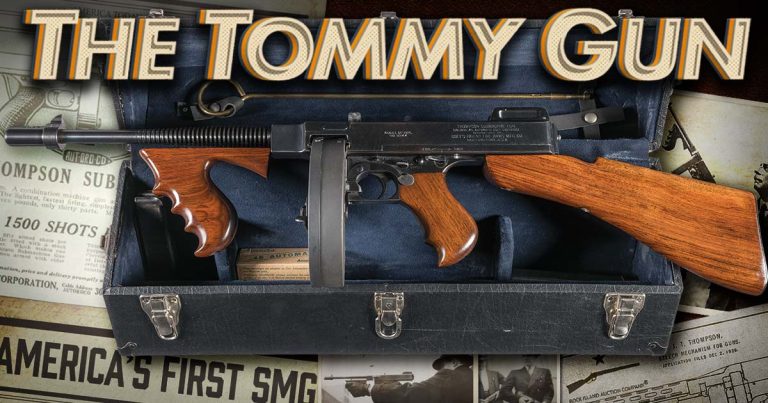
The Thompson submachine gun, a product of finely machined hand craftsmanship, was completed too late to fill its intended role as a WW1 trench sweeper but saw service on all Allied fronts in WW2. Known colloquially as the Tommy gun, this impressive SMG also found fame on the streets of Prohibition-Era America.

A Tommy gun for sale this May with documentation and accessories, this Model 1921 in “1921AC” configuration shipped to Hot Springs, Arkansas in 1929, and is later listed as shipping to the Greenville, South Carolina Police Department in 1932, during the heart of Prohibition.

Rock Island Auction Company’s May 17-19 Premier Firearms Auction in Bedford, Texas features nearly 100 Class III firearms, including collecting rarities like the Stoner 63, the German MG34, and the immensely desirable M240. With growing popularity and a finite supply, there’s no better time to get your hands on some of these desirable heavy hitters, including iconic classics like the Tommy gun.

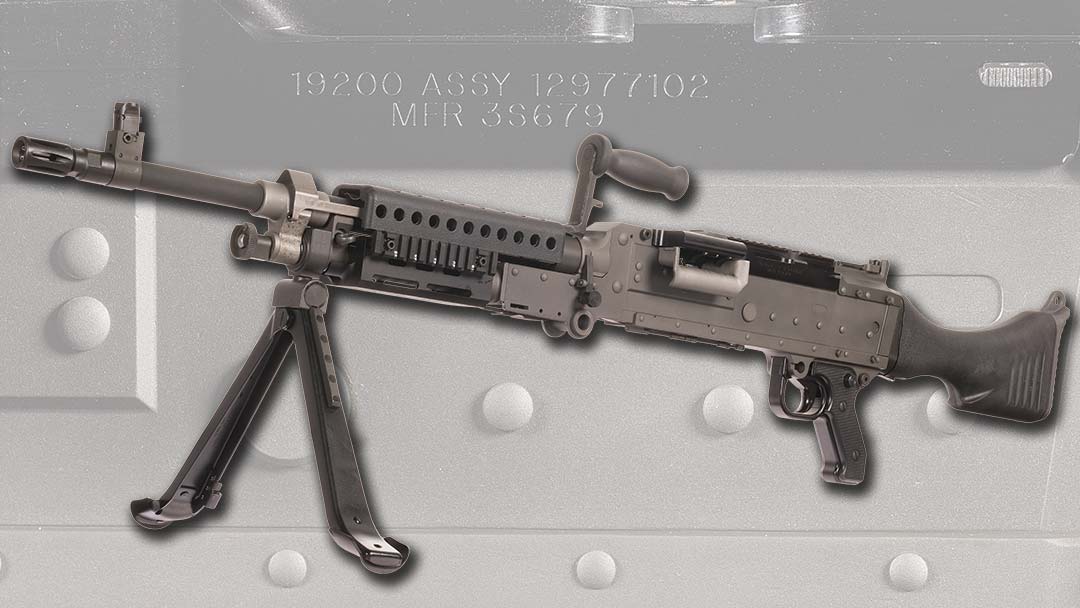
An M240 general purpose medium machine gun, a crown jewel of arms collecting. Available this May.

What is a Tommy Gun?

A Tommy gun is a select fire submachine gun with a milled steel receiver that was initially built around the Blish Lock delayed-blowback action. Designed to chamber the .45 ACP cartridge, most examples of the early Thompson platform include features like front and rear pistol grips, a finned barrel, a detachable buttstock, and compatibility with a 20-round stick magazine and a 50 and 100-round drum mag. While the M1921 Thompson could spew lead at a blistering 1,500 rpm, its successors reduced the firing rate to more manageable levels.

Technical details aside, the Tommy gun is one of the world’s most famous guns thanks to the weapon’s Hollywood coverage and depiction in foreign propaganda posters. Even a century after the Thompson’s debut, the gun’s profile is still recognized the world over.

An Auto-Ordnance M1928 Tommy gun for sale this May in the “A” serial range. Includes three stick magazines, a 50-round drum mag, a black leatherette transport case, cleaning tools, and papers.

When was the Tommy Gun Invented?

The first Tommy gun prototype, called the “Persuader,” was completed in late 1917. Around 40 more prototypes followed, each including a series of design modifications. The idea behind the Tommy gun was conceived two years earlier by John Taliaferro Thompson, a retired army Colonel working as Chief Engineer of Remington Arms Company, when he obtained the patent of Navy Commander John Bell Blish for a unique breech locking mechanism.

While the Tommy gun was invented in 1916 and the first prototypes were completed in 1917, official production started four years later with examples like this early production Colt Model 1921 shipped to the Nelson Hardware Company of Roanoke, Virginia on December 5th, 1921, for delivery to the Roanoke Police Department. Available this May.

In 1916, Thompson partnered with financier Thomas Fortune Ryan to create the Auto-Ordnance Corporation. As WW1 raged in Europe, the U.S. military’s need for advanced weaponry was greater than ever, and Thompson envisioned a fully automatic “trench broom” that could help infantrymen break the bloody stalemates of modern warfare.

The Armistice signed on November 11, 1918 ended the Great War and lessened the opportunity for Auto-Ordnance to score major military contracts for their new weapon. Thompson instead set his sights on the civilian and law enforcement markets. The “Thompson Submachine Gun, Model of 1921,” the first commercial production run for the model, was manufactured by Colt and saw 15,000 units.

What Caliber was the Tommy Gun?

In the early stages of developing the Tommy gun, Auto-Ordnance engineers Oscar V. Payne, Theodore H. Eickhoff, and George E. Goll discovered that rifle calibers like .30-06 failed to properly extract with the Blish Lock system unless they were oiled. Later tests revealed that the .45 ACP cartridge had no such issues. In September of 1917, Thompson approved .45 ACP as the official Tommy gun caliber, a cartridge he’d helped test during U.S. Army pistol trials 13 years earlier.

Manufactured in the 1970s/1980s as part of the “A” suffix serial range, this Auto-Ordnance M1928 Tommy gun is chambered in .45 ACP. Available this May.

Though the Tommy gun was beat to market by the German MP18, it was the first firearm to include the term submachine gun in its name thanks to the weapon’s use of the .45 ACP pistol caliber. Auto-Ordnance would eventually offer .22 caliber conversion kits for the Thompson, and in the 1980s a select number of fully automatic Tommy guns chambered in .22 LR were produced, dubbed the Auto-Ordnance Model 1928 A22. A limited number of fully automatic FBI Tommy guns were converted to 10mm in 1990. Today, semiautomatic Tommy guns can be found in a variety of chamberings.

An Auto-Ordnance WW2 commemorative Thompson 1928 with a glass-topped commemorative display case and related paperwork, one of only 85 fully automatic examples produced in the series. Available this May.

Mobster Tommy Guns

Today, the Tommy gun is synonymous with the Roaring 20s and the Great Depression thanks to its use by motorized robbers and the lawmen on their tail. Though the Thompson was initially marketed to ranchers and advertised to police departments as an “Anti-Bandit Gun,” the weapon ended up becoming a favorite of the gangers during America’s Public Enemy Era.

This historic Colt Model 1921 Tommy gun, sold by RIAC in 2018, is documented to legendary FBI Agent Melvin Purvis during the final pursuit and death of Charles Arthur “Pretty Boy” Floyd, Public Enemy Number One.

The Tommy gun provided a substantial firepower advantage to those with deep enough pockets to afford one. Notable users include criminals like Bonnie and Clyde, Baby Face Nelson, and Machine Gun Kelly, and Capone Gang toted a pair of Thompsons during the brutal St. Valentine’s Day Massacre. The FBI and law enforcement agencies around the nation armed themselves with Tommy guns in an effort to keep up with their criminal adversaries.

The bandits and gangsters of the 1930s relied on a variety of weaponry, including heavy hitters like the Tommy gun and BAR.

Tommy Gun Nicknames

The image of the mobster Tommy gun inspired numerous colorful nicknames for the weapon during America’s gangland era. Some common monikers include “trench broom,” “street sweeper,” “rat-tat-tat,” “chopper,” “drum gun,” “Chicago piano,” “Chicago organ grinder,” and “Chicago typewriter.”

A Colt Thompson M1921 submachine gun shipped as a single item to Chief of Police James Dinan of the Edgewater, New Jersey Police Department on October 30, 1930. Includes case and accessories. Available this May.

The platform’s most well-known nickname, “Tommy Gun,” is a blue-collar shorthand for Thompson. Ever the businessman, John Thompson trademarked the Tommy gun term as its popularity grew, and the top of the receiver on a limited run of Savage Arms produced M1928 and M1928A1 Thompson’s are marked with “TOMMY GUN” on top of the receiver.

A Savage Arms Corporation M1928A1 sold at RIAC in 2012, marked “Tommy Gun” on the receiver.

Adoption of the Tommy Gun

Auto-Ordnance only sold around 6,000 Tommy guns in the platform’s first seven years on the market. Thompson’s dream of attracting major military contracts seemed like a lost cause, although a deadly mail truck robbery in 1926 spurred President Coolidge to authorize the purchase of 250 Tommy guns for the U.S. Marine Corps to assist in protecting post offices and mail transportation.

The following year, the Marines deployed some of these newly acquired Thompsons during the Nicaraguan Campaign. Based on feedback from the Marine Corps, Auto-Ordnance made several changes that resulted in the Thompson M1928, including slowing down the firing rate with a heavier actuator. Another addition was the standardization of the Cutts Compensator. An optional accessory offered in 1926, the Cutts Compensator was a .45 ACP muzzle brake that increased the Tommy gun’s accuracy.

An exceptional example of a Tommy gun for sale this May, this documented law enforcement shipped, U.S. Navy overstamp Colt Model 1921/1928 includes desirable accessories like a 50-round “L” drum magazine and four 20-round stick magazines.

In 1928, the Navy Bureau of Ordnance formally adopted the Thompson. Despite the weapon’s success with the Navy and Marines, a U.S. Army test in February of 1928 concluded the Thompson was “an undesirable weapon, effective only at short range.” Their opinion would change ten years later when the threat of war once again reared its head in Europe and Asia.

The Tommy Gun in WW2

Every iteration of the Thompson M1928 saw service in WW2. Savage Arms was contracted in late 1939 to help produce the M1928, with many being purchased by the British military. The U.S. Army had adopted a parkerized version of the Tommy gun the previous year designated the M1928A1. In 1940, the U.S. Army ordered 20,450 Thompson SMGs, with over 300,000 more the following year for America and her allies.

To meet surging demand, Auto-Ordnance developed the U.S. M1 Thompson in 1942, a streamlined version of the platform intended to reduce production time and cost.

An Auto-Ordnance M1 Tommy gun for sale. Includes two tan canvas “USMC” marked magazine pouches. Available this May.

The M1 was produced with a shorter barrel and lacked cooling fins and the Cutts Compensator. Drum magazine compatibility was eliminated, the buttstock became fixed, and the charging handle was moved from the top to the side of the receiver. The Blish Lock was dropped completely from the M1 design in favor of a simple blowback system. Initial military testing calculated the average firing rate for the M1 Thompson at 775 rpm, with subsequent tests recording speeds as high as 920 rpm.

The M1A1 update incorporated a fixed firing pin machined to the bolt face in favor of its predecessor’s interchangeable firing pin, which modestly reduced the M1A1 Thompson’s firing rate. The Tommy gun offered American officers and NCOs in the European and Pacific theaters a devastating close-quarters volume fire option to complement the more frequently equipped M1 Garand and M1 carbine. The Thompson was also issued to vehicle and tank crews before the M3 “grease gun” became available.

The M1 Thompson served in every theater of WW2. This example is available in May.

The Tommy gun’s high price point led to the British adopting the STEN in 1941 and America adopting the M3 in 1943, both cheaper sheet steel SMGs. The Thompson continued to roll off the assembly line until early 1944, with a staggering 1,750,000 produced during the war.

Classified as a “Limited Standard,” the Tommy gun saw service during the Korean War by America and its allies due to the weapon’s plentiful supply. During the War in Vietnam, Thompsons were shipped to the South Vietnamese in the early years of the conflict and carried by some American military advisors. Though South Vietnamese soldiers came to prefer the lighter M16 rifles, the Tommy gun continued to serve as an auxiliary weapon throughout the conflict.

A U.S. Guide Lamp M3 “grease gun.” Available this May.

How Much is a Tommy Gun?

The price of a Tommy gun in 1921 was $200.00, or $3,246.49 in today’s currency. For reference, a Ford Model T cost $310 during the same period, with early semi-automatic rifles like the Winchester Model 1907 being offered for only $58.00. A Tommy gun with accessories like additional stick or drum mags would raise the price even further.

Due to limited supply and a high demand in the collecting community, machine guns have soared in value, particularly Tommy gun prices. At the time of writing, the low end for purchasing a Tommy gun is around $30,000 and steadily rising. Many examples are regularly achieving mid-to-high five figure price tags at auction, especially high-condition examples that include their original case and accessories like the Colt M1921 Thompson pictured below.

How much is a Tommy gun? This Colt M1921 Thompson realized $94,000 in Rock Island Auction Company’s August 2022 Premier Auction.

The Tommy Gun Today

While advancements in materials and manufacturing techniques allowed lighter, cheaper, and more compact submachine gun models to exceed the Thompson in performance, the style and craftsmanship of the classic Tommy gun continue to appeal to arms enthusiasts around the globe.

Up until the Firearm Owners Protection Act of 1986, Auto-Ordnance continued to assemble fully automatic Tommy guns using surplus components produced during WW2. The gold-plated Thompson Korean War commemorative pictured below, manufactured for distribution by the American Historical Foundation, is one such example.

A gold Tommy gun for sale, this post-WW2 Auto-Ordnance Thompson was produced in the 1928A1 configuration and has been outfitted and decorated as a commemorative piece for the Korean War. Available this May.

Auto-Ordnance changed hands numerous times throughout the years and was purchased in 1999 by Saelio Enterprises Inc., the parent company of Kahr Arms. At the time of writing, Kahr Arms offers a variety of modern Tommy gun variants for sale in the form of the 1927A-1 family, a closed bolt, semi-automatic version of the classic design with an extended barrel and fixed buttstock.

Kahr Arms models include colorful names like “Commando,” “Tanker,” and “Bootlegger Special,” with several featuring extensive gold plating. Though these modern Tommy gun replicas might lack the giggle-switch of their vintage counterparts, they offer a unique range experience in their own right while capturing some of the essence of the original Tommy gun.

A modern Tommy gun for sale, this semi-automatic Auto-Ordnance Model 1927 pistol with its case is available during RIAC’s April 3rd A&A Auction.

The Tommy Gun in Hollywood

The image of the mobster Tommy gun was immortalized by Hollywood beginning in the early 1930s with films like ‘Little Caesar’ and ‘Pardon Us.’ The Thompson continued to play a starring role in countless movies and television productions over the decades, with recent appearances in ‘Peaky Blinders’ and Yellowstone prequel ‘1923.’

In 1972’s ‘Godfather,’ perhaps the Tommy gun’s most notable movie outing, Sonny Corleone is gunned down by hitmen wielding the famous weapon. One of those screen-used Tommy guns, formerly of the Stembridge Gun Rental collection, was sold by Rock Island Auction Company in 2020.

A documented Hollywood screen-used Colt Model 1921 Thompson submachine gun sold for $43,125 in December of 2020.

Tommy Guns for Sale

Due to its sleek lines, remarkable craftsmanship, Hollywood exposure, and historic connection to Prohibition and WW2, the Tommy gun stands as one of America’s most iconic firearms. For collectors, historians, and anyone interested in engineering and the evolution of the machine gun, the Thompson is an absolute must have, and the best place to find an original Tommy gun for sale is Rock Island Auction Company.

An Auto-Ordnance Model 1928 Tommy gun manufactured in the 1970s as part of the “A” suffix serial range. Three extra stick magazines and a black leather pouch are included. Available this May.

Subscribe to the Rock Island Auction newsletterto receive new gun blogs and gun videos on all things machine gun. From SMGs like the Uzi, MAC-10, PPD-40, Smith & Wesson Model 76, and MP5, WW2 icons like the FG42 paratrooper rifle and Japanese Type 99, to heavyweights of the genre like the M60, we cover machine guns from every era.

A German MP40, one of the adversaries the Tommy gun faced off with in WW2. Available this May.

President Gerald Ford’s Sporting Arms

0

President Gerald Ford, who helped heal the nation from the Watergate scandal as the only president to enter office without being elected or through the death of a president, had a zeal for the outdoors.

Ford, the 38th president, learned to fish from his stepfather, earned his Eagle Scout badge from the Boy Scouts, and in his autobiography recalled a photo of himself as a youngster dressed “like an early frontiersman.” He and his wife, Betty, were part-time residents of Vail, Colo., where he was an avid skier. Ford was the only president who served as a ranger for the National Park Service. As president during the bicentennial year of 1976, Ford was presented fine, engraved sporting arms from Winchester, Browning and Ruger.

Those guns — an engraved and gold inlaid Winchester Model 21 double barrel shotgun, a pair of factory engraved game scene pair of Browning Model 1885 single shot rifles and a pair of factory engraved Ruger No. 1 Bicentennial single shot rifles, will be available in Rock Island Auction Company’s May Premier Auction.

The Bicentennial Presentation sporting arms of President Gerald Ford, from top a pair of Browning Model 1885 single shot rifles, a Winchester Model 21 double barrel shotgun, and a pair of Ruger No. 1 single shot rifles, all available in Rock Island Auction Company’s May 17-19 Premier Auction.

Gerald Ford, Richard Nixon and Watergate

Ford served In Congress from 1949 until becoming vice president in 1973. A popular legislator, he rose through the ranks to serve on the House Appropriations Committee, Defense Appropriations Subcommittee, as well as the Warren Commission that investigated the John F. Kennedy assassination. Well-liked on both sides of the aisle, he declined offers to run for the Senate or as governor of his home state of Michigan.

His chief ambition was to become Speaker of the House and he was serving as House Minority Leader when Spiro Agnew resigned as vice president following his conviction for tax evasion. President Richard Nixon asked the advice of Congressional leaders on whom to appoint and heard unanimously that it should be Ford, who would require confirmation by both the House and Senate.

John Moses Browning’s Winchester Model 1885 played a significant role in taming the American West in the late 19th century and this rifle pair from Browning Arms has exquisite American-themed engraving for its presentation during the American Bicentennial to President Gerald Ford. Both rifles show highly attractive floral scroll engraving surrounding circular game scenes on either side. This rifle depicts a magnificent bald eagle on the left side and a proud American bison on the right, both inlaid in highly detailed semi-relief with gold inlaid line borders.

By August 1974, Watergate was overwhelming the White House as Nixon tried to do damage control. Three trusted Congressional Republicans told Nixon he’d lost their support, and Ford announced in a cabinet meeting that he wouldn’t offer any further public support, pushing him toward resignation. Ford was sworn in Aug. 9, 1974 as the only unelected President of the United States eight months after his appointment as vice president.

Speaking after his swearing in, Ford said, “My fellow Americans, our long national nightmare is over. Our Constitution works. Our great Republic is a government of laws and not of men. Here, the people rule.”

A month later, Ford announced a full, free and absolute pardon for Nixon of any offenses against the United States committed between Jan. 20, 1969 and Aug. 9, 1974. The pardon was controversial and likely factored into his re-election loss in the 1976 election, but Ford never second-guessed his decision.

This view of the Browning Model 1885 bicentennial presentation to President Gerald Ford shows the gold inlaid and highly detailed semi-relief engraving of an American bison.

Young Gerald Ford

Ford was born Leslie King in Omaha, Neb. in 1913. His mother soon divorced his abusive father and moved to Grand Rapids, Mich. To live with family. There, she met Gerald Ford, who she married. His stepfather adopted young Leslie and renamed him Gerald Ford Jr.

The family struggled financially as young Gerald grew up, taking jobs while excelling at athletics. He captained the state champion high school football team and played varsity basketball and ran track as the United States sank into the Great Depression. He played football at the University of Michigan where he was named the Wolverines most valuable player as a senior offensive lineman. He received offers to play for the Detroit Lions and Green Bay Packers but didn’t see a future in professional football. He took a coaching position at Yale while considering law school.

This gorgeous set of Ruger No. 1 rifles was a part of a two-rifle Bicentennial presentation set to President Gerald Ford. Each are marked “MADE IN THE 200TH YEAR OF AMERICAN LIBERTY” on the left side. Both rifles have extensive floral scroll engraving surrounding gold inlaid semi-relief animals and gold inlaid lettering with each featuring a beautifully cut gold eagle on the right side of the action and “1776/1976” in gold on the underside along with the serial number. This rifle has a running elk on the receiver’s left side.

This view shows the gold semi-relief go eagle on the right side of the receiver of one of the bicentennial presentation of Ruger No. 1 rifles of President Gerald Ford.

National Park Ranger, Gerald Ford

Ford learned about being a National Park ranger from a former classmate who had worked at Yellowstone one summer. In 1936, Ford landed a job at Yellowstone. He welcomed tourists, gave tours to VIPs and helped feed the bears.

At the time, bear feeding was promoted and tourists flocked to scheduled feedings. Ford, late in the afternoon would load garbage onto a flatbed truck and take it to a designated feeding area. He wrote of the task, “Tourists watched the feeding ritual in a fence-enclosed area from the banks of the pit and I stood on the flatbed truck, rifle in hand, to make sure that the bears kept away from their audience.”

That was the only summer he worked at Yellowstone, returning to the University of Michigan the next summer to take law classes. He eventually was allowed to coach at Yale and attend law classes, earning his juris doctorate and returning to Grand Rapids where he practiced law.

The Winchester Model 21 double barrel shotgun presented to President Gerald Ford is dazzling. The shotgun is marked “CUSTOM BUILT BY WINCHESTER CELEBRATING” ahead of “U. S. BICENTENNIAL” This shotgun has oak leaf engraving on the fences, tasteful sprays of floral scroll engraving, and five highly detailed gold inlays. On this side is two of four vignettes, showing a mallard in flight and a pointer on the left side of the receiver.

The right side of the receiver of the bicentennial presentation Winchester Model 21 of President Gerald Ford has a pointer and a quail in flight. On the underside is the Great Seal of the United States “1776-1976” and “BICENTENNIAL” above and below respectively. It has a single selective gold trigger. The Winchester also has fantastic checkering on the stock with a chevron pattern.

Gerald Ford Goes to War

Despite his burgeoning law practice, when World War 2 started, Ford joined the Navy in 1942, starting his service as a fitness instructor. The future president wanted in the fight and was soon ordered to U.S.S. Monterey, a soon to be commissioned light aircraft carrier, where he served as assistant gunnery officer and later moved to the bridge as a navigator.

Ford earned 10 battle stars for engagements like Okinawa, Wake, the Philippines and the Gilbert Islands. Just before Christmas 1944, the Monterey was caught in a typhoon and while out on deck, Ford was swept off his feet and nearly went overboard only to be saved by a two-inch lip on the flight deck intended to keep dropped tools on the deck in heaving seas. He was discharged in February 1946 with the rank of lieutenant commander.

This bicentennial presentation Ruger No. 1 of President Gerald Ford shows a howling wolf on the left side of the receiver. This set of Ruger No. 1 rifles accommodates preferences for iron sights or optics. One of the guns has a ramped beaded blade front sight and a rear quarter rib holding the rear sight and is chambered in .30-06 with a 22-inch barrel. The second Ruger No. 1 has no provision for open sights but has scope bases and is chambered in .22-250 with a 24-inch round barrel.

As a Congressman on the Defense Appropriations Subcommittee, Ford visited Vietnam in 1953, and in the late 1960s he believed North Vietnam could be defeated. Handed the task of ending the United States’ presence in Vietnam, he ordered the evacuation of U.S. personnel and South Vietnamese who wanted to leave the country as the North Vietnamese advanced to Saigon. Final evacuations were April 28, 1975.

“It was the saddest hour of my time in the White House, sitting in the Oval Office and watching those last Americans being finally evacuated from Vietnam. To see United States troops kicked out, literally, was a hard thing for a President to swallow, and hard for most Americans to swallow,” Ford wrote.

The right side of this bicentennial presentation Ruger No. 1 of President Gerald Ford has a gold inlaid semi-relief engraved eagle like its partner in the set.

Gerald Ford Survives Assassination Attempts

President Ford, on visits to California survived two assassination attempts within three weeks of each other in 1975. Lynette “Squeaky” Fromme failed to chamber a round in her M1911 and never got a shot off on Sept. 5 as he entered the state capitol in Sacramento. She was only a few feet away from the president.

On Sept. 22, Ford was in San Francisco to speak to the World Affairs Council when Sara Jane Moore fired two shots at him with a .38 caliber revolver. Both shots missed the president but one hit a taxi driver who was standing inside the hotel where Ford spoke. After the first shot, a Vietnam veteran grabbed her arm before she fired again. The taxi driver survived.

This bicentennial presentation Browning Model 1885 of President Gerald Ford has similar animal engravings as its partner but the engraving, here an eagle, is directly on the left side of the coin-finished receiver.

The right side of the receiver of this bicentennial presentation Browning Model 1885 of President Gerald Ford features an American bison engraved into the coin finish.

Gerald Ford Guns for Sale

Rock Island Auction Company has had the pleasure of selling presidential guns from Theodore Roosevelt, John F. Kennedy, Abraham Lincoln, Chester Arthur and Ulysses S. Grant and a sword of Andrew Jackson’s. These weapons are extremely rare and getting the chance to acquire one seldom occurs.

The United States’ only unelected president, Gerald Ford’s tenure was brief but remarkable, healing a nation reeling from Watergate and bringing American’s lengthy and divisive role in Vietnam to an end. Heaping presidential history onto remarkably embellished sporting arms – a Winchester Model 21 double barrel shotgun, a pair of Browning Model 1885 single shot rifles and a pair of Ruger No. 1 single shot rifles – make them tremendous opportunities for collectors. These historic presentation pieces to the 38th president will be available in Rock Island Auction Company’s May 17-19 Premier Auction in Bedford, Texas.

The underside of the bicentennial presentation Winchester Model 21 of President Gerald Ford shows the Great Seal of the United States and the years 1776-1976 and “BICENTENNIAL” underneath it.

“Masters of the Air” Pistol Is Among World War 2 Artifacts

0

The Apple TV+ program, “Masters of the Air,” depicts the horror and chaos that fliers faced over Germany as anti-aircraft fire and enemy fighters swarmed their aircraft. It also shows the quiet and melancholy of life on the ground in wartime and away from home.

During the course of World War 2, the 100th Bombardment Group, featured in “Masters of the Air” earned the nickname “Bloody 100th” for its casualty rate on eight significant missions in 1943 and 1944. The group flew 306 missions and 8,630 sorties. It lost 229 planes and 757 men killed or missing in action and 923 prisoners of war.

“Masters of the Air” shows the impact of the casualties and the effect on the men of the Eight Air Force as they take on the American strategy of daylight bombing, especially the unit that would become known as the “Bloody 100th.” During “Black Week,” a stretch in October, 1943, the show depicts the day when one squadron lost 12 of 13 planes, tagging the 100th Bomb Group as “jinxed.”

The Apple TV+ program also displays what the airmen wore and the sidearms they carried, especially if they were shot down and had to defend themselves. Some of these types of items, ranging from flight jackets to handguns, will be available in Rock Island Auction Company’s May Premier Auction.

Union Switch & Signal M1911A1 of the “Bloody 100th”

In the sixth episode of “Masters of the Air,” after evading capture, Major Bucky Egan is captured carrying a Colt Model 1911A1.

Arthur C. “Bud” Stipe, co-pilot of “The BIGASSBIRD II” of the 349th Squadron of the Bloody 100th, was issued a Union Switch & Signal Model 1911A1 in 1943. Stipe flew on the “Black Thursday” mission to Schweinfurt on Oct. 14, 1943. On that mission, 650 of the 2,900 fliers and 60 bombers were lost.

Stipe flew 25 missions from July 4, 1943 to Oct. 20, 1943 – the second pilot to do so — before returning to the United States and the Seventh Ferry Group where he served as assistant operations officer.

Union Switch and Signal produced 55,000 M1911A1 pistols during World War 2. This pistol issued to a pilot in the “Bloody 100th” is parkerized with a blued finish High Standard barrel, stamped trigger, checkered slide stop and safety lock, narrow checkered hammer and main spring housing, and brown plastic checkered Keyes Fibre grips. The “Bloody 100th” and its tragedies is featured in “Masters of the Air” on Apple TV+.

Tragic Colt SAA

Chambered in .45 ACP, this Colt Single Action Army is one of only 44 first generation SAAs chambered for the cartridge intended for the Colt Model 1911 and M1911A1, according to David Brown, author of “The 36 Calibers of the Colt Single Action Army.” These were made on a special order basis after World War 1 and sold mostly to men in the armed forces with ready access to plentiful ammo.

This very rare gun bears a fascinating tale that started with its purchase by Staff Sgt. Forest S. Nelson from Stoeger Arms in New York. Nelson enlisted in the U.S. Army Air Forces in May 1942 and was a gunner on the B-25 “Dirty Nellie” assigned to the 42nd Bomb Group’s 75th Squadron. The unit flew on the West Coast before deploying to the Pacific theater in early 1943. Nelson sold the gun in May 1944 to Staff Sgt. Paul J. Smith. In January 1945 during a dangerous low altitude mission on an enemy supply depot Nelson’s “Dirty Nellie” was hit by enemy fire and crashed in the water. The three-man crew went missing and was declared dead.

While the other men’s identities aren’t clear, a Staff Sergeant Paul J. Smith was a tail gunner on a B-17 Flying Fortress in the 487th Bomb Group and 838th Bomb Squadron within the 8th Air Force. “The Gentlemen from Hell” began operations ahead of D-Day, bombing airfields in Northern France, with missions later taking them into Germany. Paul J. Smith sold the revolver to a Cpl. Charles H. Kern on Sept. 10, 1944. If this is indeed the correct Nelson, he was shot down a month after selling the revolver, listed as a prisoner of war.

A Cpl. Kern served as an engineer on the B-17 “Garbage Cannie” also known as “Tennessee Sunshine” attached to the 301st Bomb Group, 353rd. First assigned to England, it was later moved to North Africa in 1942 and then to Italy. On a mission in April 1945, “Garbage Cannie” was hit by anti-aircraft fire and ditched in the Adriatic Sea. Three crewmembers were killed, while Kern and six others evaded capture and returned to duty.

According to the string of bills of sale, Kern sold the revolver to Staff Sgt. Moroni Frederickson on Dec. 16, 1944. He served as a mechanic and crew chief on a B-25 bomber. Frederickson returned home after the war and later sold the gun to his son in 1966. These airmen’s tragic ends illustrate the high casualty rate of the United States daylight bombing strategy portrayed in “Masters of the Air.”

This Colt Single Action Army with a bill of sale to multiple World War 2 airmen is chambered in .45 ACP. Based on research presented by author David Brown in “The 36 Calibers of the Colt Single Action Army,” Colt manufactured only 44 First Generation Single Action Army revolvers in .45 ACP.

Colt National Match Pistol of Curtis E. LeMay

Curtis LeMay was a major at the outset of World War 2 and by 1943 was commanding the 305th Bomb Group of the Eighth Air Force. He helped develop the combat box formation and led the mission against Schweinfert and Regensburg on Aug. 17, 1943 that is presented in episode three of “Masters of the Air.” LeMay has also been mentioned in passing during the show.

Later in the war, LeMay would transfer to the China-Burma Theater and then put in command of strategic bombing operations against Japan. Commissioned as a pilot and second lieutenant in 1930, he rose in the ranks after the war. He was the first deputy chief of air staff for research and development before going back to Europe to command the U.S. Air Forces in Europe and led operations of the Berlin Airlift in 1948-1949. Following that assignment he took command of the newly formed Strategic Air Command in the early days of the Cold War and served as Air Force Chief of Staff, retiring as a four-star general. A factory presentation inscribed Colt National Match pistol presented to LeMay is available in RIAC’s May Premier.

This factory inscribed Colt National Match pistol has “GENERAL/CURTIS E. LEMAY” with four stars below it on the front left of the slide. It also has an extended Patridge blade front sight and adjustable BO-MAR rear sight, serrated adjustable trigger, serrated slide stop and thumb safety, and a serrated narrow hammer, and serrated and stippled front strap and a pair of diamond pattern checkered rosewood grips. LeMay, who would go on to be U.S. Air Force Chief of Staff was portrayed in one episode of “Masters of the Air.”

WW2 Flight Jacket of a Caterpillar Club Member

A USAAF A-2 WW2 flight jacket bears the name “GRANT L. FARNSWORTH” on the lining just under the data label. However, that name was crossed out. Sewn to the front left chest is the distinctive patch of the 707th Bomb Squadron that flew B-24 Liberators. Above the patch in white paint is the name “Bill.” This is Sgt. William H. Sunday, the engineer on board the “Shoo Shoo Baby!”

Flying out of England on Dec. 27, 1944, “Shoo Shoo Baby!” was on a mission targeting a rail bridge and train yards at Kaiserslautern, Germany when it developed engine trouble. It turned toward a British-held airbase at Brussels, Belgium as the weather turned bad. A string of unfortunate incidents caused the bomber to be unable to land and barely able to stay above 75 feet and avoid church steeples.

The flight jacket comes with a uniform coat, a Caterpillar Club membership card from Irvin Airchute Company issued to Sunday, and a very rare Caterpillar Club gold lapel pin with ruby eyes. Fliers earned entry into the informal Caterpillar Club the hard way, from successfully bailing out of their aircraft. Pins were often issued by parachute manufacturers. The club’s name refers to the debt owed to the silk worm that allowed the flier to land successfully, with the motto “Life depends on a silken thread.” Famous members of the club include Gen. James Doolittle, Charles Lindberg and astronaut John Glenn.

The pilot, Lt. William Woodburn, initially hoped to reach the North Sea but instead ordered the plane’s bombs dropped in an empty field to gain altitude. The B-24 reached 4,000 feet and the crew was ordered to bail out. The entire crew bailed out except Woodburn who would bail out after stabilizing the B-24. Woodburn was knocked out and broke a foot and sprained an ankle on landing. He woke to local men who swarmed around and beat him believing him to be a German spy. The men eventually realized he was an American. He returned to his unit after being hospitalized for several days. The crew would complete 33 missions before returning to the United States in the summer of 1945.

One episode of “Masters of the Air” depicts an emergency landing in Scotland where the locals have never seen Americans and aren’t happy to have a gigantic bomber crash near them, showing a fate similar but not quite as violent as what the pilot of the “Shoo Shoo Baby” experienced.

A closeup of the Caterpillar Club lapel pin shows the ruby eyes. The pin is included with the Shoo Shoo Baby! flight jacket available in the May 17-19 Premier Auction.

Hand-Painted WW2 Flight Jacket

The epitome of cool, the A-2 flight jacket slightly varied in design and color depending on the manufacturer and material used. Nineteen companies made the jacket, some using cowhide or goat skin, making them dark brown to nearly black to russet to pale-red or medium brown. The coats could also be privately purchased.

These leather jackets also served as a canvas. Sgt. Millard Wilkerson was a flight engineer/gunner who served in the 715th Squadron of the 448th Bomb Group of the 8th Air Force stationed in England. He flew 35 missions before returning to the United States and is known to have painted several flight jackets including the “Hell’s Angels” jacket offered in the May Auction. This coat, bought privately, is shown in “American Flight Jackets,” by Jon A. Maguire and John P. Conway. Wilkerson’s work often featured scantily clad women but also well-drawn airplanes.

Faced with a shortage of flight engineers, Wilkerson found himself in the Pacific theater assigned to the Air Sea Rescue service. This jacket was likely painted after he was attached to the 6th Emergency Air Service Rescue Squadron.

The name tag on the front of this flight jacket is to Millard Wilkerson, an artist who painted it. The jacket is featured in Maguire and Conway’s “American Flight Jackets” along with several other jackets Wilkerson painted and owned.

World War 2 Flight Jacket Patches

Patches from two fighter squadrons, a bomber squadron, a night fighter squadron and an anti-submarine group make up the collection of patches on offer in the May Premier Auction, with two of the units operating in the Pacific, one in the Mediterranean and the last one assigned to England.

The 2nd Pursuit/2nd Fighter Squadron was assigned to the Mediterranean where its pilots flew P-40 Warhawk and P-39 Airacobra. The unit later flew Spitfires and P-51 Mustangs. The patch features a beagle in a top hat and tails holding a small naked woman in a champagne glass while stabbing a bloody swastika.

The 479th Anti-Submarine Group was assigned to England to attack submarines that were coming out of the Bay of Biscay on France’s west coast. The unit’s assignment ran from early June 1942 until late July 1942 when the submarines began to cross the bay underwater.

Pilots for the 40th Fighter Squadron flew the Airacobra when they were assigned to the Pacific Theater, starting with assignments over New Guinea before the unit’s last posting at Okinawa in June 1945. The patch depicts a red devil about to throw a lightning bolt.

The 549th Night Fighter Squadron fought in the Pacific theater late in World War 2 with its P-61 Black Widows flying from Iwo Jima to protect airfields that housed long-range bombers. The patch shows a bat with Browning machine guns in each foot and lightning shooting from its eyes.

Pilots of the 653rd Bomb Squadron had unusual and dangerous missions, flying their British de Havilland Mosquitos ahead of European bombing missions to report on weather conditions and enemy fighter activity. The pilot and navigator’s unarmed aircraft relied on its speed and high altitude capabilities to stay out of trouble. The patch, embroidered on green felt, is fairly on the nose, showing a mosquito with a telescope kneeling on a rain cloud.

These World War 2 United States military unit patches represent two fighter squadrons, a bomb squadron, a night fighter squadron and an anti-submarine group.

World War 2 Flight Jacket of a Marine

Once owned by an English jazz musician, this flight jacket is from one of the most well-known U.S. Marine Corps squadrons of World War 2. The unit, the VMF-111 “Devil Dogs” were founded years before World War 2 and served as the Corps’ show unit for Marine flying. The unit had several official designations following its formation in 1925 before becoming VMF-111 shortly before World War 2.

As one of only two combat-ready USMC squadrons, the “Devil Dogs were immediately assigned to the island of Tutuila, flying the Grumman F4F Wildcat in the Samoan Islands. In early 1943, the squadron transitioned to the highly-recognizable gull-winged F4U Corsair. By 1944, the unit was operating in the central Pacific where it would remain to the end of the war. The Devil Dogs would rack up the leading number of bomb tonnage dropped and miles flown in their close air support role.

The jacket was reportedly acquired by an English jazz musician while performing a gig in the 1940s. The only clue to the former owner of the jacket is “Billy Jo” painted above and below the “Devil Dogs” insignia on the left chest. The back of the jacket is a bit of a conundrum since it depicts the combat scene titled “Screamin’ Debby,” showing a Curtiss P-40 Warhawk painted to the “Flying Tigers” scheme flying over two downed Japanese fighters, a very non-USMC scene.

World War 2 Flight Jackets for Sale

The aerial warfare of World War 2 was brutal and chaotic and that intensity comes out in every episode of the “Masters of the Air.” If you want a piece that relates to the intrepid airmen that took on the German war machine over the European continent, there is something for the World War 2 collector in this auction, from guns to flight jackets to patches.

These aerial artifacts tell the story of amazing aviators and their real life tales of heroism and tragedy, whether it was over the battlefields and cities of Europe or the wide seas and tiny islands of the Pacific theater. These fascinating items will be on offer in Rock Island Auction Company’s May 17-19 Premier Auction.

Big Game Rifles for Serious Sportsmen

0

Whether hunting the African savanna or the Texas plains, the gentleman sportsman deserves to field the finest in luxury and refinement. From specialized pieces to do-it-all generalists, there are countless big game rifles available on the market, and Rock Island Auction Company’s May 17-19 Premier Firearms Auction features exceptional options capable of tackling a wide range of game.

An outstanding factory master game scene engraved and gold inlaid Karl Hauptmann African big five themed sidelock dangerous game ejector double rifle in .470 Nitro Express, one of the best big game hunting rifles for sale this May.

A hunter’s rifle is a substantial part of his character and not a choice to be taken lightly. In addition to accounting for factors such as caliber, hunting landscape, and the desired game being pursued, properties like round count, weight, accuracy, durability, and fit are also important considerations. And for those looking for an elegant big game rifle that doesn’t sacrifice performance and comfort, some of the examples this May offer a handsome balance of innovation and artistry.

An Alison Hunt signed, engraved, and gold inlaid J. Rigby & Co. sidelock dangerous game double rifle with case, chambered in .416 Rigby. Available this May.

Big Game Rifles Through the Ages

Since the 1800s, explorers and dangerous game hunters have trusted their lives to the mighty double rifle. In the black powder era, massive guns evolved to take the largest game, and wealthy British hunters drove the demand for specialized sporting arms that could tackle the most dangerous beasts of India and Africa.

One of the best big game rifles featured in May, this cased engraved and gold inlaid Alexander Henry .577 (Black Powder Express) Jones underlever double barrel rifle was owned by Prime Minister Salar Jung of Hyderabad.

While the double rifle came to dominate the cape shores of Africa, big game rifles in North America took on different forms. The American Bison, the undisputed king of the prairie, required accurate long-range options that could also pack a punch. Breechloading single shot rifles like the Sharps, the Trapdoor, and the Remington rolling block were widely used in the mid-to-late 19th century.

In 1881, Marlin Fire Arms Co. offered a lever action rifle chambered in .45-70, a large enough cartridge to take on the imposing buffalo. The lever gun continued to dominate the market for North American big game rifles until the bolt action began gaining ground with sportsmen like Townsend Whelen in the early 20th century.

In the late 19th century, Marlin offered some of the best big game rifles for North American hunters. These exceptional antique guns are available this May at Rock Island Auction.

Big Game Double Rifles

Africa’s “Big Five,” the leopard, lion, Cape buffalo, rhino, and elephant, are some of the most dangerous game that can be hunted today. In the case of the elephant, rhino, and Cape buffalo, the double rifle provides the stopping power needed to halt a charge from these ill-tempered beasts, with the capability of delivering a rapid follow-up shot with the press of a trigger.

One of the best big game rifles for sale this May, an incredible factory master Peter Spode signed and game scene engraved bicentenary Westley Richards .470 Nitro Express hand detachable droplock double rifle.

The double rifle pictured below, a Holland & Holland chambered in .500/450 Nitro Express, illustrates the practical but precision craftsmanship and classic aesthetic of these elegant big game rifles. Manufactured circa 1900, the weapon cuts a fine figure and displays the exceptional artistry that came to define the pinnacle of the genre. The trio of game scene engravings adorning this example include a lion poised to strike a wildebeest from the grass, a Bengal tiger preparing to pursue a trio of blackbuck, and an elephant standing proud on the rifle’s underside.

An attractive factory masterfully game scene engraved Holland & Holland .500/450 Nitro Express sidelock double rifle. Available this May.

European manufacturers continued to improve and innovate the double rifle platform throughout the 20th century. The 1999 dated example pictured below from German gunmaker Juch Grund is an extremely rare example of a three-barreled big game rifle that consists of two barrels in .416 Rigby located above a smaller barrel chambered for .300 Holland & Holland Magnum. With its included Zeiss Diavari VM 1.5-6x42mm T* scope, this exceptional triple rifle weighs in at 12 lbs. 11 oz, but it’s far from the heaviest big game rifle on the market.

One of the most unique big game rifles available this May., this breathtaking factory master engraved and gold inlaid Juch Grund multi-caliber sidelock dangerous game ejector triple rifle is a true piece of artistry.

Double Rifle Ammunition

After the development of smokeless cartridges, double rifle ammunition evolved in a range of calibers. Big game rifles in .450/400 Nitro Express proved a popular early option for dangerous game hunters like Jim Corbett, a famed slayer of Indian maneaters. In 1907, English gunmaker Joseph Lang developed the .470 Nitro Express, a round that became a favored choice for taking Cape buffalo and elephants. Today, the .470 NE continues to serve as one of the most widely chambered double rifle cartridges.

A factory engraved B. Searcy & Co. boxlock underlever double rifle in .470 Nitro Express, one of the best big game rifles for sale this May.

Modern double rifles can be found chambered in everything from the comparatively modest .375 Holland & Holland to the imposing 4 bore and 2 bore, the true titans of big game rifles. Though large caliber double rifles are a heavy burden to carry around the hot African Savanna and present an equally daunting recoil, their sheer knockdown power is well-suited for the tense, up-close encounters experienced during safari hunts. The .500 Nitro Express offers a balance of potent stopping power that can still be managed by an experienced sportsman, and the round has a high success rate against even the mightiest of Africa’s Big Five.

One of the best hunting rifles for big game, a factory engraved Wikinsons boxlock double rifle in .500 Nitro Express. Available this May.

Bolt Action Big Game Rifles for Africa

By the early 1900s, the bolt action magazine rifle started gaining traction with African hunters, offering a more economic alternative to the double rifle. A slew of big game cartridges were developed for the bolt action platform, including the .404 Jeffery in 1905, the .425 Westley Richards in 1909, the .416 Rigby in 1911, and the famous .375 H&H Magnum in 1912.

An H. L. “Pete” Grisel upgraded, game scene engraved and gold inlaid pre-64 Winchester Model 70 bolt action rifle in .375 Holland & Holland Magnum with a Schmidt & Bender scope, one of the best big game hunting rifles for sale this May.

Bolt action big game rifles chambered in large calibers offer greater distance and longer accuracy than double rifles while being fairly easy to clean, field strip, and maintain. They’re easy to shoot, reliable, and capable of multiple follow-up shots while still possessing the power to fell a charging elephant.

An upgraded pre-64 Winchester Model 70 Super Grade bolt action rifle in .458 Win Mag. Available this May.

The .375 Holland & Holland Magnum became one of the most popular jack-of-all-trades options for big game rifles. Prolific African hunter John “Pondoro” Taylor, praised the .375 H&H Magnum as a capable cartridge for both double rifles and bolt action platforms, stating, “I’ve had five of these rifles—two doubles and three magazines—and have fired more than 5,000 rounds of .375 Magnum ammunition at game. One of them accounted for more than 100 elephant and some 411 buffalo, besides rhino, lions and lesser game.”

A factory master Diane Scalese signed, gold inlaid, and game scene engraved cased Kilimanjaro African bolt action rifle in .375 H&H Magnum, one of the most breathtaking big game rifles for sale this May.

For decades, the .416 Rigby was more of a novelty, with Rigby only producing 169 custom rifles built on the Magnum Mauser No. 5 receiver between 1912 and the end of WW2. Thanks to famed authors like Robert Ruark and Jack O’Connor, the .416 Rigby saw a resurgence in the 1950s and 1960s. In ‘The Rifle Book,’ O’Connor called the .416, “an outstanding cartridge,” possessing less recoil than the .450 Watts the author had used on prior African big game hunts.

An impressive factory engraved J. Rigby & Co. bolt action dangerous game rifle in .416 Rigby with a Swarovski scope. Available this May.

Bolt Action Rifle Chamberings

Pictured below, the six consecutively serialized rifles from John Rigby & Co. demonstrate a small sample of the range of hunting rounds available for the modern bolt action platform. From a scaled-down action in .223 Remington to the massive .450 Rigby Magnum, one of the most potent bolt action big game rifles, today’s sportsman has no shortage of chamberings to consider.

Six of the finest big game rifles for sale this May at RIAC, this grouping of consecutively serialized Rigby rifles is a veritable tour de force in outstanding craftsmanship.

Today, .375 H&H is the minimum recommended cartridge for most dangerous game in many African countries. Referred to by Jack O’Connor as the “Queen of the Medium Bores,” .375 H&H offers good performance and a manageable recoil. Most modern big game rifle manufacturers chamber the round, and ammunition is comparatively easy to find. The venerable cartridge is also popular with North American hunters and has inspired numerous variants like the .375 Weatherby Magnum.

A classic in the genre of big game rifles, this documented special order pre-64 Winchester Model 70 Super Grade bolt action carbine is chambered in .375 Holland & Holland Magnum. Available this May.

In 1956, the Winchester Model 70 African bolt action rifle was chambered in the hefty .458 Winchester Magnum cartridge, an attempt by Winchester to compete with common double rifle rounds like the .450 and .470 NE. After failing to take down a Cape buffalo with the .458 Winchester, big game hunter Jack Lott designed a more potent variant in 1971 with the .458 Lott.

A Kimber Model 8400 Caprivi bolt action rifle in .458 Lott with a Swarovski scope. Available this May.

In 1994, John Rigby & Co. developed the .450 Rigby Magnum Rimless for bolt action big game rifles. Based on the iconic .416 Rigby cartridge, the .450 Rigby Magnum Rimless is necked up to accept a .458 bullet and can stand toe-to-toe with big hitters like the .458 Lott. A plethora of even heavier bolt action hunting rounds are available today, including the .577 Tyrannosaur, .585 Nyati, and .585 Gehringer.

A massive factory engraved J. Rigby & Co. bolt action dangerous game rifle in .450 Rigby with a Zeiss Scope. A grouping of desirable Kynoch .450 Rigby Magnum rimless cartridges, with five 50-count cases in total, is also available this May.

Big Game Rifles for the New World

Many of the heavier cartridges mentioned above are not only overpowered for most North American game but also more costly compared to the likes of .338 Win. Mag. and .338 Lapua Mag. A favorite of the great Elmer Keith, .338 Win. Mag can take anything from a bull elk to a Kodiac brown bear.

A G. McMillan & Co. Standard Grade Signature Model bolt action sporting rifle in .338 Win. Mag. with a Schmidt & Bender scope, one of the best hunting rifles for big game in North America. Available this May.

When it comes to do-it-all North American big game rifles, the Winchester Model 70 ranks high on the list. In his book on the gun, author Roger Rule dubbed the Model 70 “The Rifleman’s Rifle.” While the modern Winchester Model 70 is a fine hunting platform, the hand craftsmanship of the pre-64 action is particularly revered. The pre-64 Winchester Model 70 rifle below features an upgraded chambering in .338 Win. and a Swarovski scope, an elegant combination of classic and modern sensibilities that would meet the approval of both Keith and Rule.

An upgraded Winchester Model 70 in .338 Win. Mag. with a Swarovski scope. Available this May.

Developed as a sniper cartridge, the .338 Lapua Mag. shoots much flatter than .375 H&H, an ideal trait for big game rifles fielded in the wide-open country of the Great Plains. When pairing .338 Lapua Mag. with an accurate platform like the Blaster R-93, you have a hunting arm capable of stretching shots beyond 800 yards in the hands of an experienced sportsman.

A desirable Blaser GmbH R93 Tactical 2 straight pull bolt action sniper rifle in .338 Lapua Mag. with a Nightforce scope and accessories. Available this May.

Lever Action Big Game Rifles

According to Winchester, .30-30 has killed “more North American big game than any other cartridge.” Given the popularity of the Winchester Model 94 over the decades, this statement may be true when it comes to whitetails. In 1965, Marlin introduced both the Model 444 and the .444 Marlin cartridge, a lever action meant to tackle the biggest North American game. Today, lever actions are available in cartridges like .338 Federal and .338 Marlin, both capable of taking elk and moose.

An exceptionally fine antique Winchester Deluxe Model 1894 rifle with its factory letter, chambered in .30 WCF. Available this May.

Single Shot Big Game Rifles

Large bore single shot rifles were the original platform for taking big game around the globe. The classic Winchester Model 1885, the first gun design patented by the legendary John Moses Browning, has continued to see action thanks to advances in ammunition technology. Today, modern .45-70 is capable of taking moose and elk, though at a more limited range than some of the cartridges mentioned above.

A factory master game scene engraved, signed, and cased pair of Browning Model 1885 Bicentennial single shot rifles presented to President Gerald R. Ford Jr. in 1976. Chambered in .45-70 Government. Available this May.

Big Game Rifles for Sale

If you’re planning your next hunting adventure, RIAC’s May 17-19 Premier Firearms Auction includes big game rifles suitable for any quarry. In addition to the sportsmen and shooters who appreciate the history and allure of the hunting pursuit, collectors and arms enthusiasts will value the precision craftsmanship and exceptional artistry found within this fascinating genre.

Rock Island Auction Company offers big game rifles for sale from every era, style, and price point available.

To recieve more gun blogs and gun videos on modern and classic sporting arms, subscribe to the Rock Island Auction newsletter, where we cover topics like the bench rest rifle, the Howdah pistol, the Savage 99, the Browning Citori shotgun, the Winchester Model 42, the M30 drilling, the Hawken rifle, flintlock rifle hunting, and more.

One of the highlights of RIAC’s May Premier Firearms Auction, this Lepage exhibition shotgun was created in 1860 and remains a stunning example of high-level engraving, carving, precision, and design. It was later presented in 1879 to Mexican President Don Manuel Gonzalez by M. Paul Jules Grevy, President of France.