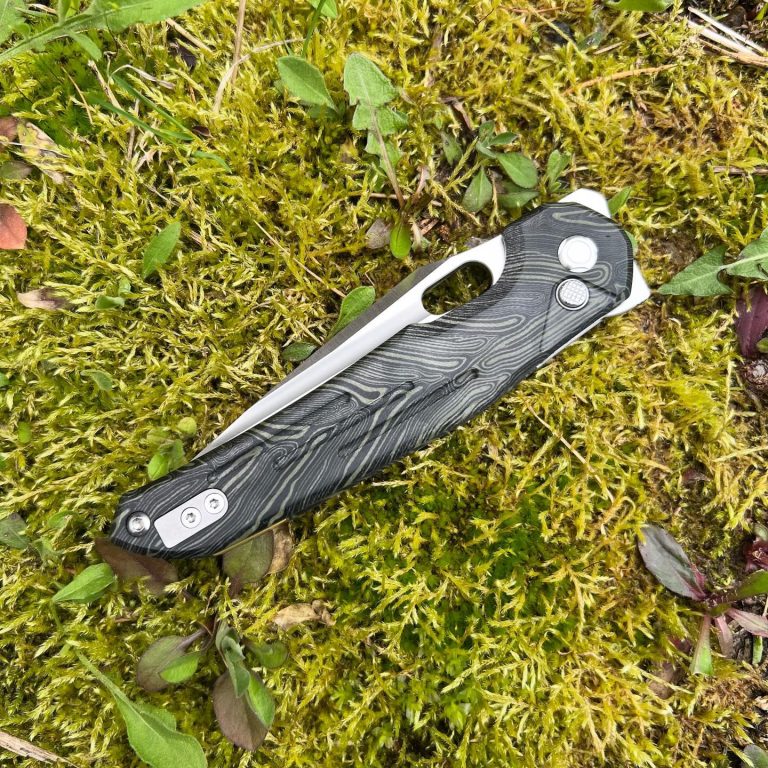
The Hedgehog is one of the best knives to come out of Vosteed yet. They seem to be completely unafraid to try new things and this knife is a prime example.
Specs
You can see the full specs at Vosteed.com. The most relevant specs are listed below.
Blade Length: 2.99″ | 76.00 mm
Overall Length: 7.11″ | 180.60 mm
Blade Thickness: 0.138″ | 3.50 mm
Blade Material: S35VN
Weight: 4.02 oz | 113.90 g
Opener: Back Flipper | Thumb Stud | Fuller
Lock Type: Top Liner Lock
Observations from Use
The big star of the show is Vosteed’s take on the Compression Lock. This lock is a Spyderco invention on which the patent has now expired. A handful of companies are trying their hand at them and Vosteed’s take is very innovative. They have added a button that is affixed to the liner and passes through the show-side scale for easy access (see following two images). The result is a lock that has the crispy tuned detent of a liner lock, the easy finger-safe action of a button lock, and the brute strength of a compression lock. If you can try one of these in person, do it. It’s impressive.
The detent on this knife is just about perfect and it pairs well with the slightly heavier blade to create reliably snappy action. I can use the fuller to flick it open with all four fingers, it rockets open with the thumb studs and low profile flipper tab, and it lands home with a satisfying thwack when closed. This knife has very well-tuned action.
So, it’s fidgety and the lock is strong but does it cut? Yeah. It cuts. I found it to be an excellent chore knife. The S35VN holds an edge well and is nice to see on a knife around this price point. The tall flat grind provides aggressive cutting geometry at the edge. The modified sheepsfoot blade has a gently sweeping belly and an easy to access tip. This knife wants to work.
All that cutting power is backed up with very good ergonomics that lets you really push behind the edge. The handle is hand-filling and offers great grip thanks to the frag pattern milling. The Hedgehog offers a generous finger choil so you can choke up right behind the edge for control.
There are also a lot of refined details if you go looking for them. The liners are nested into the handle scales and HEAVILY skeletonized to reduce weight. This knife may look chunky but its weight is kept in check. There are extra machined details in the large barrel spacer, pivot, and two different patterns of blade jumping. The blade finish is Vosteed just flexing on everyone – it features a belt satin primary grind, a sort of hand-rubbed satin on the flats, and light bead blast in the fuller. Vosteed is clearly setting this knife apart at the more premium end of their line.
It is difficult for me to come up with criticism of the Hedgehog as it was seemingly designed specifically to appeal to me. It is exactly what I like in a knife but there is one thing I would change. The blade jumping on the spine of the knife could stand to be finer and I think it could be extended a bit to help with control of the tip. However, the chunkier jumping that Vosteed chose is effective and fits well visually with the design of the Hedgehog.
Overview
The Hedgehog is a stylish, refined, fidget-friendly EDC knife that also happens to be a hard-use, rugged work knife. It pulls of both with equal aplomb. Vosteed seems to have this type of lock, the Top Liner Lock, thoroughly figured out and they are already using it on other knives in their line like the much-loved Raccoon. It will be interesting to where else they can take it.
The diversity of offerings on display at Preview Day Thursday will be breathtaking. Museum-worthy antiques from the Norman R. Blank Collection, presentation pieces, Wild West handguns, Class III firepower and more will be available in the May 17-19 Premier Auction.
Pristine to gritty, from beautiful to historic, and sometimes both at once, like the presidential sporting arms of President Gerald Ford, can be found among the nearly 2,100 lots in the auction that starts with a nod to the USA Shooting Team’s preparations for the upcoming Paris Olympics.
This fantastic Angelo Bee-engraved two-barrel set Krieghoff K-32 over/under shotgun being sold for the benefit of USA Shooting will be Lot 1 in the May Premier Auction that starts Friday.
Rolling Thunder
Five tanks are among the small curated grouping of military vehicles from the Allan Cors Collection, including a highly desirable World War 2 U.S. M3A1 Stuart light tank and a rare U.S. M41 Walker Bulldog.
The iconic U.S. M3A1 Stuart light tank is one of just 4,621 produced by American Car & Foundry and one of 22,750 total of M3 and M5 variants. The Stuart, the Bulldog, and a massive Swiss Centurion battle tank top the sampling of military vehicles available in the May Premier Auction. Along with the tanks, the offerings include support vehicles, an ambulance and military trucks from the United States, the United Kingdom, Soviet Union, Sweden and Switzerland.
Fantastic Firearms of the Norman R. Blank Collection
The Norman R. Blank Collection made quite a splash with its offerings in the December Premier Auction and look for that wave of interest to continue with more than 30 lots of classic and museum-worthy antique European pieces, with some from the collection of royals and nobility.
A double barrel flintlock sporting gun by French gunmaker Nicholas-Noel Boutet heads the lineup, but legendary gunmakers Alexander Henry, Durs Egg and John Manton are also represented among the stunning and high-condition items from the Blank Collection.
Historic Guns of the Greg Lampe Collection
Firearms from the Greg Lampe Collection are high condition and dripping with history, and the offerings in this auction are no different, led by a cased early production factory engraved Colt Model 1851 Navy handed down from a father to his son who served in the Confederate Engineer Corps, and a cased factory presentation Colt 1862 Police revolver from the Colt Factory to Henry Kellogg of the Phoenix Fire Insurance Company.
Other items from Lampe’s collection include Revolutionary War era flintlock pistols, a U.S. Colt Third Model Dragoon revolver with stock, a Colt Model 1878 double action revolver owned by Deadwood attorney John Burns and the Colt Single Action Army of outlaw Henry “The Flying Dutchman” Wagner.
Presidential Firearms
The guns of presidents always draw interest when they are made available, and this auction offers sporting arms from Theodore Roosevelt and Gerald R. Ford. President Gerald Ford helped heal the nation from the Watergate scandal as he led the United States in its bicentennial year when he was presented fine engraved sporting arms from Winchester, Browning and Ruger.
Ford received a spectacular engraved and gold inlaid Winchester Model 21 double barrel shotgun, a brilliant pair of factory engraved game scene pair of Browning Model 1885 single shot rifles and an impressive pair of factory engraved Ruger No. 1 Bicentennial single shot rifles. These guns are beautifully embellished with patriotic themes and heaping with presidential history, presented to the only president who served in the Oval Office without being elected.
This amazing array of firearms presented to President Gerald R. Ford during the U.S. Bicentennial Year of 1976 will be available in three lots: a presentation Winchester Model 21 double barrel shotgun, a presentation pair of Browning Model 1885 single shot rifles, and a presentation pair of Ruger No. 1 single shot rifles that all bear phenomenal engraving and gold inlays fitting of a presentation to a U.S. president.
Bidders will be impressed by a .70 caliber Hawken rifle that was among the guns at Theodore Roosevelt’s Sagamore Hill and is said to have belonged to famous frontiersman Kit Carson. A more personal firearm is the Parker Brothers 20 gauge side-by-side shotgun, likely a gift from Theodore Roosevelt to his son Kermit. The Bull Moose instilled a love of hunting in Kermit who accompanied him on adventures in Africa and South America.
Presentation Firearms
Presentation pieces can often be breathtaking, and a stunning Le Page-Moutier flintlock shotgun is just that. More French masterpiece than field piece, it has a luxurious carved ebony stock and opulent ornamentation that include the hammers formed into dogs that each pounce on a fox when the gun is fired as well as magnificent vine and leaf engraving. French President Jules Grevy presented the shotgun to President Manuel Gonzales Flores of Mexico in 1879.
Recently discovered and documented, a factory engraved Winchester Model 1873 has a gold-plated receiver decorated with floral scrollwork and circular game scenes of a buffalo on the left and a moose on the right at the front of the receiver. Vignettes of an elk, leaping on the right, and standing majestically on the left harkens to the Ulrich engraving family and signals an outstanding presentation piece.
This amazing gold-plated Winchester Model 1873 with its circular game scenes was only recently discovered.
A magnificent Civil War era cased and engraved Colt Model 1860 with a blued cylinder and barrel, casehardened frame covered with vine and scroll embellishments and ebony carved grips that was owned by Huntington Wolcott, a tragic scion of the influential Wolcott family of Massachusetts.
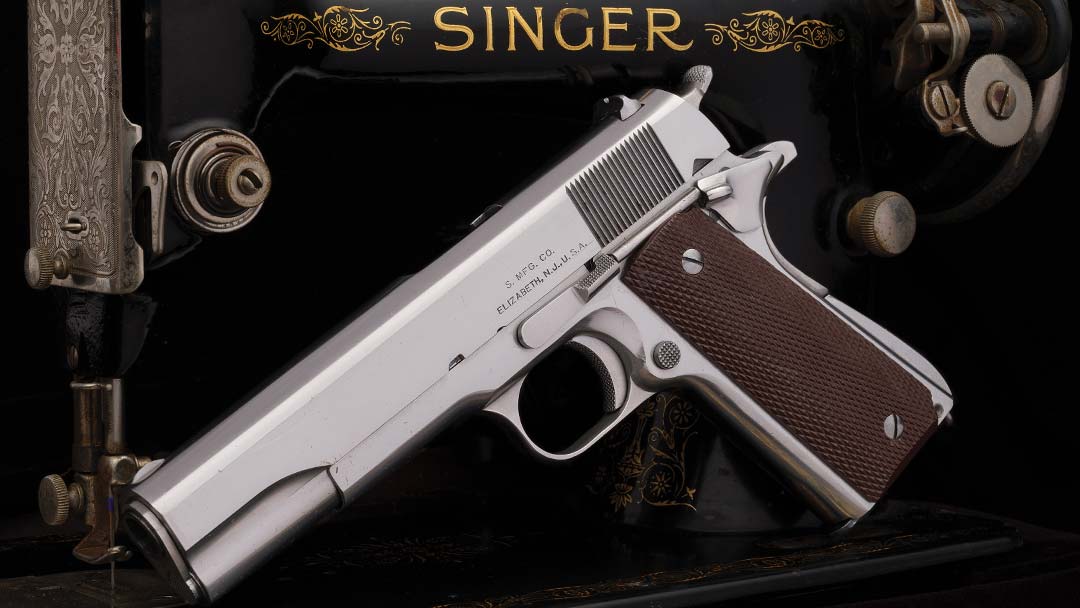
Moving to the 20th century, a World War 2 Singer Model M1911A1 is an amazing piece that has rarity heaped atop rarity with only 500 of the firearms made by Singer, and this one without a serial number and bearing a nearly mirror polished “in the white” finish.
This stunning Singer M1911A1 has a brilliant “in the white” and has no serial number.
A pair of Winchester Model 1866 rifles are definitely worth noting. One was presented by Buffalo Bill Cody to Panther Bill in 1880 and the second was presented to a Peruvian military officer and politician from an American railroad builder.
Magnificent M1911 Pistols
The M1911 served on the winning side in two world wars and this auction has some fine representations that should make collectors sit up and pay attention. Beyond the incredible Singer that has already been mentioned, several variations that led to the 1911, including a 1902, 1905, an exceptionally rare Model U.S. Trials 1907 and an even rarer Model 1910 chambered for 9.8mm can be found in the auction catalog.
Also available is a Union Switch & Signal 1911A1 issued to B-17 co-pilot Arthur C. “Bud” Stipe who flew in the “Bloody Hundredth” 100 Bombardment Group, the unit portrayed in the Apple TV+ show “Masters of the Air.” With its definite cool factor, a modern Colt Government Model upgraded by gunsmith Richard Heinie that appeared on the cover of “American Handgunner” magazine and served as a prop gun in an episode of “Miami Vice” guest starring Liam Neeson is also part of the auction.
Spectacular Sporting Arms
The May Premier offers an amazing selection of masterfully engraved shotguns from the finest companies like Purdey, Fabbri, Holland & Holland and Westley Richards.
Top of the class is a trio of Purdey shotguns with phenomenal game scene engravings by Master Engraver Simon Coggan surrounded by intricately beautiful scrollwork across the receiver. Another Purdey on offer has the fascinating artistry of French engraver Aristide Barre on display. Barre’s work shows meticulous floral scrolls interspersed with cherubs battling winged creatures on each side of the receiver and green man masks in several places on the coin-finish.
A Holloway & Naughton over/under shotgun should draw attention with its engraving by the Italian engraving firm of Creative Art and master engraver Dario Cortini. This gun is displayed on the Holloway & Naughton website as an example of the company’s work. The left side lockplate depicts a hawk taking on a ferret and the right has an owl descending on a hare. Both are excellent Bulino engraving. A pair of Goddess Diana-engraved Ivo Fabbri double barrel shotguns has scenes of Diana and her handmaidens hunting with dogs on the right and the Goddess and handmaidens at rest on the left as well as Diana and a hunting dog on the underside of the receiver.
Rampant Colt Revolvers
Among the impressive lineup of Colts in the auction are three lotted Colt Single Action Armies that found themselves at outposts of the Indian Wars. A Lot 6 Colt attributed to Capt. Myles Moylan is well documented and fresh to auction. Moylan was commander of Company A of the 7th Cavalry and a Medal of Honor winner. Moylan served with Custer at Gettysburg and in the 7th Cavalry in Major Marcus Reno’s battalion. He was part of the attack on the Native American village at Little Bighorn that was forced into retreat while taking heavy casualties. A rare and high condition Colt Single Action Army made in 1874 and issued from Lot 8 to the 8th Cavalry is also in the auction along with a first-year production Single Action Army that was likely issued to the 10th Cavalry.
A Colt Model 1860 Fluted Army shipped south of the Mason Dixon line ahead of the Civil War is included in the auction. Confederate Capt. William Conner of the Jeff Davis Legion who carried the revolver was killed at the Battle of Gettysburg. The gun was part of a January 1861 shipment of 160 revolvers to Natchez, Miss. Conner was a plantation owner who was commissioned a lieutenant in the Jefferson Davis Legion who was promoted to major before arriving in Gettysburg where he was killed.
From the Mexican-American War, a B Company Colt Walker listed in “The Colt Whitneyville-Walker Pistol” by Lt. Col. Robert Whittington III is a highly desirable example. It is marked on the grip for Mexican Gen. Andres S. Viesca.
Confederate Capt. William Conner of the Jeff Davis Legion was killed in action on the third day of the Battle of Gettysburg.
Winning Winchesters
While some fine Winchester rifles have been previously mentioned, there are many outstanding examples available in the auction including a Model 1873 One of One Thousand that has been documented in the publication “The Story of the Winchester 1 of 1000 and 1 of 100 Rifles,” by Edmund Lewis, and James Gordon’s “Winchester New Model of 1873: A Tribute Volume II.”
Another Winchester featured in print is a deluxe factory-engraved Model 1866 with silver-plated finish that was illustrated and described in R.L. Wilson’s “Winchester Engraving.” An exhibition Winchester Deluxe Model 1890 slide action rifle with nickel and gold plating and factory engraving as well as two factory engraved Winchester Deluxe Model 1886 rifles with consecutive serial numbers will be on offer as well.
Lots 3013 and 3014 are consecutively serial numbered Winchester Deluxe Model 1886 rifles that are similarly embellished with checkering on the stock and game scene engraving. They are each chambered in .45-70.
Class III Firepower
At the head of the Class III offerings is a rare FN M240 general purpose machine gun with an extra barrel followed by a couple examples of the M60, the workhorse general purpose machine gun of the Vietnam War. They are joined by a Cadillac-Gage Stoner 63 select fire rifle, an Armalite AR-18 “shorty/carbine,” and several Thompson submachine guns.
Fine Firearms for Sale
Visit Rock Island Auction’s Bedford, Texas venue on May 16 to check out the amazing history and beauty that will be on display for preview day. Examine and admire fantastic items like the Le Page-Moutier double barrel shotgun, gold-plated Winchester Model 1873, embellished sporting arms, a progression of Colt pistols leading to the M1911, fabulous Colts and the guns of presidents. The three-day auction opens on May 17 with the auctioning of a fantastic engraved and gold inlaid Krieghoff K-32 shotgun to benefit USA Shooting.
This remarkable Winchester Model 1873 One of One Thousand has high condition, provenance and factory engraving.
The Vosteed Thunderbird seems to be designed with a deep love and understanding of what it takes to make a great knife for the EDC market. It’s large but slim and light. It’s fidgety but functional. It’s aggressively styled but refined. And, it has all the little touches that the knifyest knife guys will geek out about.
In short, the Thunderbird is Vosteed’s love letter to EDC knife aficionados.
Specs
The Thunderbird is available in MANY different sizes and versions. In short, I have the 3.48″ blade version with Topo handles and S35VN steel. You can learn more about the specs of this review sample (provided by Vosteed) and other variants at Vosteed.com.
Observations from Use
The Thunderbird is one of Vosteed’s more premium offerings and it shows. The impression is one of refinement, sleekness, and attention to detail. Some knives are smooth. The Thunderbird feels all but frictionless as the blade swings through its arc. It feels… fancy.
This knife is so slim and light for its size that it brings to mind classic EDC knife designs like the Benchmade 710 or 940 (but at a fraction of the cost). It has that same sort of large-knife-that-carries-easier-than-a-small-knife vibe. In that sense, it is sort of optimized for everyday carry.
And while you are carrying it, you can rest assured you will be able to access it… all the ways. It back flips, front flips, slow rolls, flicks off the fuller, wrist flicks, and more. It does all of these opening methods exceedingly well thanks for plenty of jimping in the right places and a well-tuned detent on the Trek Lock.
Speaking of the Trek Lock… Vosteed’s version of a plunge lock or button lock has really come into its own. This one is solid as a rock and has been spine-whacked when it was brand new and again after several weeks of use – no problems.
My favorite thing about the Thunderbird is the blade. It has a wild but useful compound grind that is something like a traditional tanto meets a harpoon. The long straight edge portion of the blade is very thin behind the edge and offers a ton of cutting power. The belly/tip portion is flat ground to put more meat behind the useful tip. A small swedge grind is added to make the tip especially acute while still strong. This knife cuts.
The GT-Mascus handle material used is interesting. It is very smooth but still has a similar grabbiness to something like polished G-10 or linen micata which I like. It has an almost tacky feel when your hands are slightly damp which is reassuring. Vosteed uses this material on several of their more premium knives and now I see why. It offers grip without shredding pockets.
One of the cooler touches that Vosteed adds to each version of the Thunderbird is a little special something in the backspacer. Some have glow-in-the-dark material or some might be a space-agey metal like titanium. In this version, they offer a chunk of solid brass or copper. Mine has started to patina with use which is very cool and will someday (probably) look impressive on Instagram.
Most of my nitpicks on this knife come down to me being a curmudgeon. First, if the harpoonish thumb ramp was just chopped off the blade, it would be even more slim in the pocket. Second, the chunk of brass in the butt of the knife adds weight. A piece of contrasting GT-Mascus or even anodized aluminum would weigh less. But I admit that both of those changes would make the Thunderbird feel a little less special and a lot less cool.
Wrap Up
The Thunderbird is the kind of knife that comes around when a knife maker intimately understands their target market. It’s practical, functional, easy to live with, refined, and looks cool in an Instagram flat lay. I can see why they continue to iterate on this design because it seems to have it all.
Vosteed is, as of the time of this writing, offering 20% off many knives for Mother’s Day.
As history’s largest global conflict, the Second World War ignited the ultimate arms race. From tanks and artillery to machine guns, rifles, and pistols, WW2 weapons saw immense innovation in every arena as the Axis and Allies vied for battlefield superiority. The sheer number of distinct models produced and fielded during the conflict has resulted in one of the most diverse arms collecting classes today.
Rock Island Auction Company is proud to present a small, curated grouping of pieces from one of the largest privately held collections of military vehicles in the world. Such extraordinary pieces are seldom offered publicly, let alone with the rarity and condition inherent in The Allan Cors Collection of Military Vehicles. Other rare vehicles in the collection will be featured in the upcoming Americans in Wartime Experience museum in Dale City, VA.
Rock Island Auction Company’s May 17-19 Premier Firearms Auctionin Bedford, Texas demonstrates the wealth of WW2 weapons available to collectors of all aspirations and interests. Click on the images throughout this article to learn more about each model.
A late production J. P. Sauer & Sohn Model 38H Heinrich Himmler inscribed sniper’s prize presentation pistol, one of the most historic WW2 guns for sale this May. The included original bring back paper lists this pistol by serial number as brought back in a duffel bag by Private First Class Paul W. Sansone after the war on April 2, 1946. Available this May.
WW2 Tank Warfare
The tank stands tall as one of the quintessential WW2 weapons and a true game-changer on the battlefield. Though the tank first appeared in WW1 and served as infantry support, armored warfare came into its own during the Second World War as new technology and strategies evolved. The North African Campaign saw the Italian M13/40 and the German Panzer III and IV facing off with British Crusaders, Matildas, and Valentines like the exceptional example highlighted below.
Valentine tanks saw widespread use by British Commonwealth forces in North African, where they were found to be reliable in a desert setting and easy to maintain. This British Valentine Mk III infantry tank is available this May.
The British were also supplied with a large number of American tanks like the M4 Sherman and the M3 Stuart through the Lend-Lease program. The M3A1 Stuarts saw their first major campaign with U.S. troops during the Allied invasion of North Africa in November 1942.
Stuarts, with their 37mm main guns and .30 caliber Browning machine guns, were found to be most effective against light armored vehicles and offered Allied forces a fast, reliable scouting option. In the European theater, most U.S. tank battalions had three companies of Sherman tanks and one company of Stuarts. Many Stuarts were also successfully employed in the jungles of the Pacific.
The U.S. M3A1 Stuart is one of the most iconic light tanks of WW2 and this exceptional example is available this May.
The rapid evolution of tank warfare can be observed in Germany’s Pak 36 anti-tank gun. As one of the early WW2 weapons capable of disabling thePolish 7TP tank, the Pak 36 found itself rapidly outmatched by stronger Allied armor and would be gradually replaced by the stronger 50 mm Pak 38 and 75 mm Pak 40 anti-tank guns.
A desirable example of a German 3.7 cm (37mm) Pak 36 anti-tank gun. Available this May.
The Allies made similar adjustments in reaction to the swift advancements in enemy armor. While the M3 was America’s first dedicated anti-tank gun and served admirably in the Pacific theater, the North African Campaign demonstrated the need to field a heavier armor-busting option. The British Ordnance Quick-Firing 6-pounder 7 cwt, widely shortened to the “6-pounder” hit the field in mid-1942 and was adopted by the US Army as the M1 57mm anti-tank gun.
A York Safe & Lock Co. manufactured U.S. M3A1 37mm anti-tank gun (top) and a Yoder Co. manufactured U.S. M1 57mm anti-tank gun (bottom), two important WW2 weapons available this May.
Explosive Firepower of WW2
According to ‘The WWII Databook’ by John Ellis, 75% of battle wounds suffered by British soldiers during the conflict were the result of mortars, grenades, bombs, and shells. One of the most fearsome WW2 weapons the Allies faced was the German 15 cm Nebelwerfer 41 multiple rocket launcher. Nicknamed “Screaming Mimi” and “Moaning Minnie” due to the characteristic high-pitched screech made by incoming rockets, this six-tubed launcher had a maximum firing range of 4.3 miles.
A rare surviving example of a 15 cm Nebelwerfer 41 multiple rocket launcher with carriage, one of the most infamous German WW2 weapons. Available this May.
The French Brandt mortar, based on the British Stokes design, served as the basis for most WW2 light mortar systems, including the Japanese Type 3 81 mm, the Soviet 82-PM-36, the Italian 81/14 Model 35, and the American M1 and M2 mortar launchers. The M1 served as America’s primary indirect-fire infantry weapon throughout WW2 and into the 1950s, with the M2 offering a lighter variant. The Brandt pattern design was robust and effective, allowing for an impressive rate of fire.
A KVS Mfg. & Eng. Co. M2 60mm infantry mortar (left) and a U.S. PSCM Co. M1 81mm mortar (right), two of the most prolific weapons used in WW2. Both examples are offered this May.
WW2 Machine Guns
Some historians have said that the primary purpose of small arms during WW2 was to pin down the enemy until they could be targeted by artillery. Nothing accomplished this task better than the machine gun.
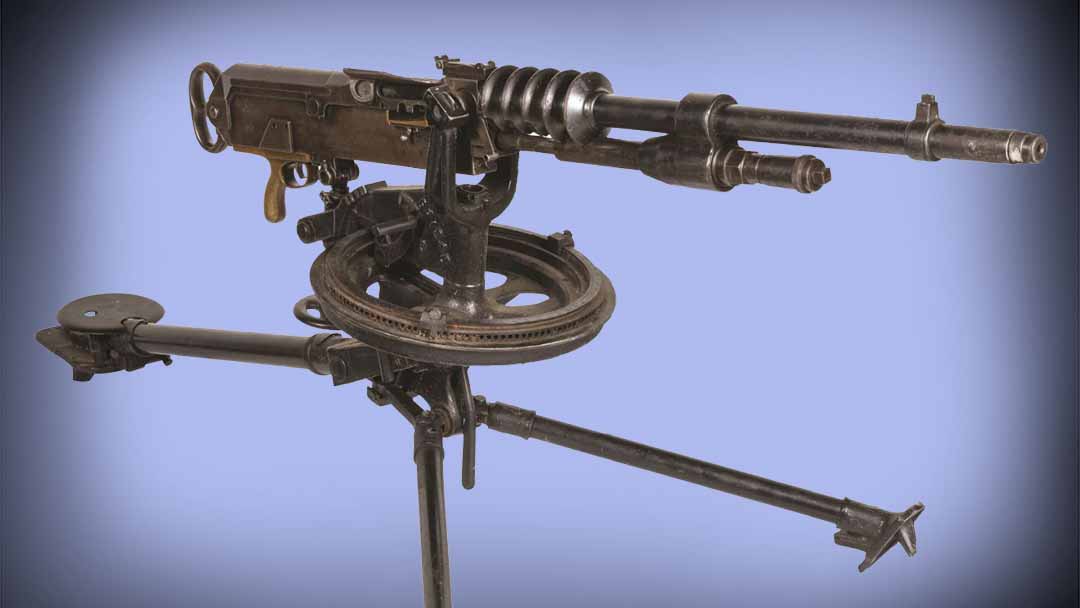
The machine guns used in WW2 provided a heavy volume of fire ideal for both infantry support and enemy suppression. Models like the 7.7mm JapaneseType 92 machine gun pictured below were designed to be operated by multiple crew members, with the hefty 125-pound rig relying on carry poles that could be inserted into the tripod for rapid redeployment.
A derivative of the classic Hotchkiss machine gun designed by Kijiru Nambu, the Type 92 heavy machine gun was one of the go-to automatic WW2 weapons for the Imperial Japanese Army and Navy during WW2. Available this May.
The German MG34, invented by Heinrich Vollmer of Mauser, demonstrates the machine gun’s status as one of the most versatile weapons of WW2. Filling the role of both a light and heavy machine gun, the MG34 allowed for rapid tactical movement from a bipod, support fire from a sturdy folding tripod, as well as providing an ideal option for vehicle use such as a coaxial weapon in German tank turrets.
Developed prior to the war, the MG34 was a mainstay of German forces throughout the conflict. The example pictured above is one of the most desirable WW2 guns for sale this May.
Many WW2 machine gun models like the American M1919 Browning and M2 Browning enjoyed wide application on aircraft and ships as well as providing heavy firepower options to ground vehicles. The M20 Greyhound armored utility car pictured below features an armored open-topped superstructure with an anti-aircraft ring mount for use with a .50 caliber M2 Browning.
The success of the German Blitzkrieg demonstrated the advantage of rapid mobility, and the light machine guns used in WW2 complemented this offensive approach to warfare. One of the most prolific examples of the light machine gun platform was the Soviet Degtyaryov DP28. Adopted in 1928, the DP28 served as the primary light machine gun for the Red Army throughout WW2 and was noted for its simplicity, reliability, and resilience during harsh winter conditions.
The Soviet Degtyaryov DP28, one of the most prolific WW2 weapons. Available this May.
The .30-06 chamberedBAR filled the role as one of America’s WW2 squad guns as well as serving the British early in the conflict. The British had been exploring replacing the aging Lewis gun with a light machine gun since 1922, and would ultimately settle on the BREN design over the BAR. The BREN earned a reputation as one of the finest WW2 weapons and saw action in every British theater.
A fine example of a desirable WW2 British Universal Carrier. More popularly known as a Bren Gun Carrier, the vehicle helped provide the British LMG with even more mobility. Available this May.
Germany developed some of the most innovative WW2 weapons, including a new class of firearm that was smaller than a light machine gun but chambered in intermediate rifle cartridges rather than pistol calibers like an SMG. While the trailblazing FG42 was chambered for the full-bore 8mm Mauser round, the MP44 was designed for 8mm Kurz, giving birth to the assault rifle platform.
One of the later weapons used in WW2, the MP44 was the forerunner and later namesake of the intermediate caliber, select fire, infantry assault rifle. Available this May.
WW2 Submachine Gun
One of the deadliest close combat WW2 weapons, the submachine gun made a lasting impact on the battlefield. SMGs were most commonly equipped to infantry leaders, paratroopers, and armored vehicle crews who would find carrying a full-sized rifle impractical. Germany’s straight blow-back, open-bolt MP40 was one of the most recognizable SMGs fielded during the war.
A German MP40 with a hooded blade front and two-leaf notch rear sights, Bakelite side panels, and an underfolding steel stock, one of the most desirable WW2 guns for sale this May.
Another classic SMG, the Tommy gun was an early entry into the war, originally seeing service with America and the British in its M1928 incarnation. To meet surging demand, Auto-Ordnance developed the M1 Thompson in 1942, a streamlined version of the platform intended to reduce production time and cost.
A fine example of one of the most famous WW2 weapons, this Auto-Ordnance M1 Thompson includes two tan canvas “USMC” marked magazine pouches. Available this May.
Even with the design changes, the M1 Thompson and its milled steel receiver proved more expensive and slow to produce compared to cheaper sheet steel alternatives like the British STEN and American M3 “grease gun.” Where the STEN could be produced for a mere 10 dollars, the M1 Thompson cost over 40 dollars in 1942. As a result, the STEN saw over 4 million units manufactured across all variations, becoming one of the most successful WW2 weapons in terms of production numbers.
While bolt action rifles were the most common WW2 infantry weapons throughout the conflict, the semiautomatic rifle was fielded in various forms, with none more successful than America’s M1 Garand. Dubbed by Gen. George S. Patton as “the greatest battle implement ever devised,” the M1 Garand and its 8-round capacity provided American troops with a significant firepower advantage over most bolt-action adversaries.
A US Winchester WIN-13 M1 Garand, an exceptional example of one of America’s most iconic WW2 weapons. Available this May.
Russia produced a wide arsenal of WW2 weapons to combat the German advance, and the Tokarev SVT-38 and its SVT-40 successor offered the Red Army an effective semi-automatic rifle with a 10-round detachable magazine. 150,000 SVT-38s and 1,600,000 SVT-40s were produced by the Tula and Izhevsk arsenals, and the self-loading rifle platform was put to hard use on the Eastern front.
Germany pursued its own self-loading rifle in the form of the G41. Mauser and Walther developed similar designs, with Mauser producing a rifle with a gas-trap/bolt action hybrid system like the example pictured below. The platform’s G43 successor improved the design and saw 400,000 rifles produced, yet was introduced too late to change the tide of the war.
This Mauser Model G41(M) gas trap rifle with sling, manufactured circa 1941-1942, is among the scarcest WW2 guns for sale this May.
WW2 Bolt Action Rifles
Though the Third Reich fielded a variety of rapid-fire WW2 weapons, including machine guns, SMGs, and a limited number of semi-automatic rifles, the Karabiner 98 kurz served as the backbone of the German infantry. A derivative of the Mauser 98, the Germans produced well over 14,000,000 K98 bolt action rifles in numerous variations, including the K98k double claw sniper rifle featured below.
An extremely rare, documented German SS Proofed WW2 Steyr “bnz” code K98k double claw bolt action sniper rifle with scope. Available this May.
One of the most common WW2 weapons issued to the Imperial Japanese Army, the Type 99 bolt action short rifle was a progression of the previous Type 38, re-chambered for the 7.7×58 mm Arisaka cartridge. After its adoption in 1939, the Type 99 served as the standard issue infantry rifle for Japanese forces. The Kokura Arsenal 23rd series Type 99 pictured below was recovered from the battlefield in 1945 and includes an Imperial Japanese Jinsen Arsenal Type 30 bayonet, leather sling, a period shipping crate, and an assortment of Imperial Japanese military artifacts.
One of the standout WW2 guns for sale this May, this exceptional WW2 field captured Japanese Type 99 rifle includes its shipping crate, bayonet, and artifacts attributed to a U.S.M.C. veteran.
After serving as America’s infantry standard during WW1, the bolt action Springfield Model 1903 continued to be fielded alongside the M1 Garand throughout the Second World War. One of the WW2 weapons closely associated with the American sniper, the M1903A4 variation was produced by Remington and excluded iron sights in favor of a Redfield scope mount and scope.
A Remington U.S. 1903-A4 sniper rifle manufactured in 1942 with a Redfield scope mount and a Lyman M73B1 scope numbered “7669611”. Available this May.
WW2 Pistols
For collectors of WW2 weapons, the sidearms of the conflict offer a wide assortment of styles and variants to pursue. An evolution of the C93 Borchardt, the Luger pistol hit the scene in 1900 and became one of the most recognizable guns in history. More than a million Lugers saw combat during WW1 and the famous pistol continued to serve Germany in a wide range of roles during the Second World War.
Manufactured in 1937, this is one of approximately 2,500 Lugers manufactured by Krieghoff that year for the German Luftwaffe, just prior to WW2. Available this May.
Due to the steep cost of the Luger P08, the German Army searched for more affordable alternatives. The Walther P38, among the first successful semi-automatic pistol models to use a double action/single actiontrigger, offered the Reich an effective sidearm that could be produced in quantity. 1939 saw the introduction of the Walther “concealed extractor” Zero Series of test pistols, which helped refine the P38 design before formal adoption.
One of the finest WW2 guns for sale this May, this early production, exceptional Walther Zero Series P38 pistol, serial number “0268”, includes an experimental holster, an extra magazine, and a U.S. capture certificate.
Japanese designer Kojirõ Nambu developed numerous Japanese weapons used in WW2, including the Nambu family of pistols. The 7mm Type B “Baby” Nambu was a more compact iteration of the earlier Type A “Grandpa” and “Papa” Nambu designs. While too expensive to be formally adopted, nearly all Baby Nambu pistols were purchased by Japanese officers.
An excellent Tokyo Arsenal Baby Nambu pistol rig with matching magazine and holster, one of the classic WW2 weapons of the Japanese Empire. Available this May.
After serving with distinction in WW1, the M1911 pistol underwent a series of small external refinements for what would be dubbed the M1911A1. No significant changes were made to the pistol’s internals, speaking to the reliability of John Moses Browning’s iconic .45 ACP design. The 1911A1 ranks as the most widely carried American pistol of the war, with the Singer variant representing one of the scarcest and most desirable WW weapons for collectors.
An immensely rare, unserialized WW2 Singer Manufacturing Co. prototype/presentation model 1911A1 with a unique factory-polished, in-the-white finish. Available this May.
WW2 Shotguns
Often one of the lesser noted WW2 weapons, trench shotguns served a key role in America’s combat arsenal, particularly in the Pacific theater where they helped clear Japanese bunkers and earthen fortifications. Famous models included the Winchester M1897, Winchester M1912, Ithaca Model 37, and Stevens Model 520-30.
A U.S. Stevens Model 52030 (top) and a Winchester Model 97 (bottom), two powerful American trench weapons used in WW2. Both WW2 shotguns are available this May.
Some of the most elegant WW2 weapons were issued to the German Luftwaffe, including the Merkel O/U shotgun and the famous M30 drilling. Luftwaffe General Adolf Josef Ferdinand Gallan stated that the M30 drilling was widely equipped to German aces in 1942 and 1943 operating in North Africa. Primarily intended as a survival weapon, Gallan recounted, “We also used it for trap shooting during our obligatory exercise training to sharpen our eyes and reflexes of the fighter pilots.”
One of the rarest WW2 guns for sale this May, this M30 drilling includes its original case, accessories, and a large inlaid aluminum plaque insignia of the Jagdgeschwader 3 “Udet” on the right side of the buttstock and a large inlaid aluminum plaque on the left of Group II, a Luftwaffe squadron that operated on all the German fronts.
WW2 Guns for Sale
The extensive range of WW2 weapons manufactured throughout the conflict has led to one of the most popular genres in historic arms collecting, and we’ve only just scratched the surface here. From the M3A1 Stuart tank to the M3 grease gun, Rock Island Auction Company’s May 17-19 Premier Firearms Auction offers a wealth of options to WW2 collectors of all aspirations and interests.
One of the most prolific WW2 weapons, the 25mm Hotchkiss Model 1934 anti-tank gun saw use with various countries including France, Germany, United Kingdom, Italy, Finland, Romania, and Spain. Available this May.
I walk a lot, hike whenever I can, and run occasionally. I tell you this to justify the fact that I wear a fanny pack regularly… almost daily during some parts of the year. I even like doing it. Please don’t judge me. It is a convenient way for me to carry the items I want to have ready access to when I am outdoors and that includes a firearm.
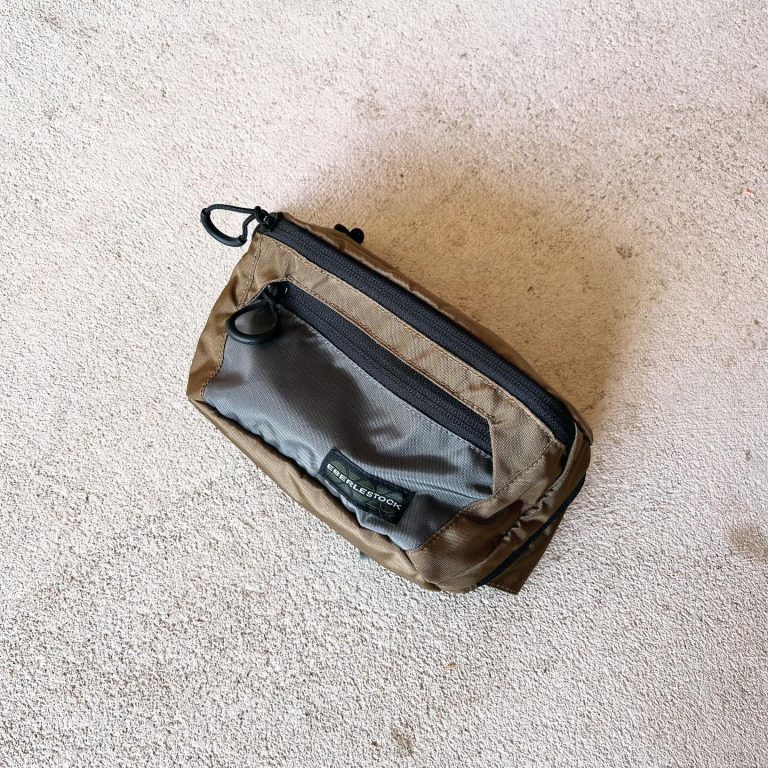
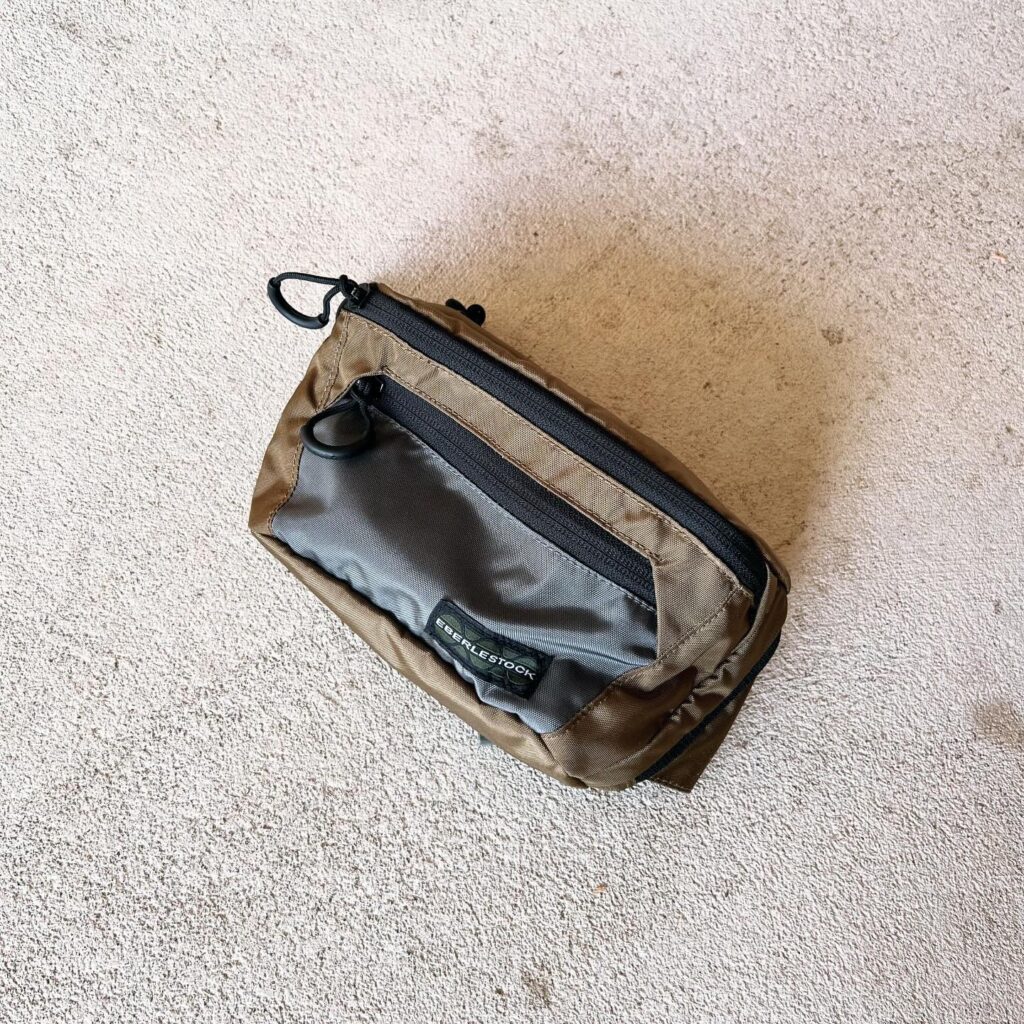
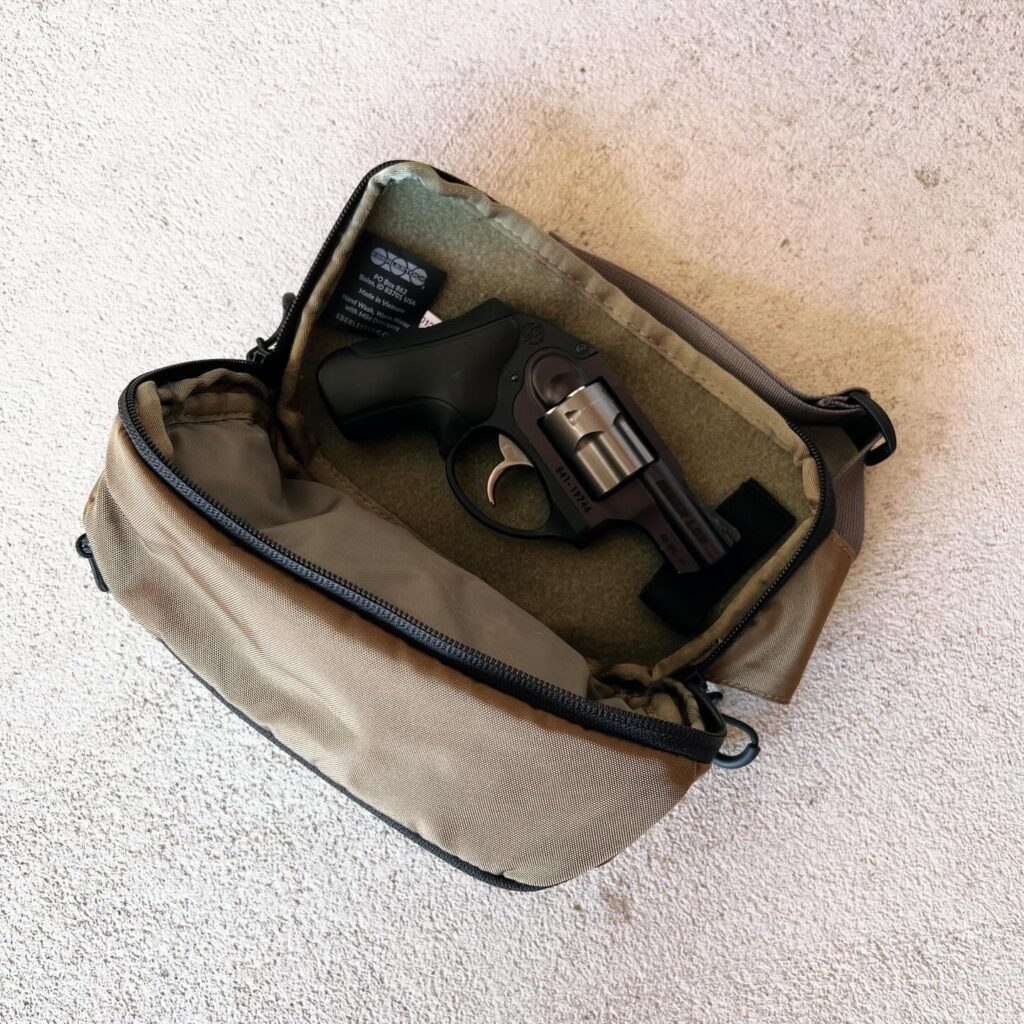
It has been my experience that you can carry a firearm in almost any fanny pack but not all fanny packs are well suited to it. Access is the key. That is where my Eberlestock Bando Bag comes in. This fanny pack has a dedicated pocket that makes accessing a firearm quick and easy. I have been using it since December of last year.
There are other fanny packs that are suited to carrying vital self-defense items but what sets the Bando Bag apart is its appearance. It looks like any other sporty, outdoor-brand fanny pack and this is what I appreciate about it most. I don’t wear it into town but if I did, it would look like every other fanny pack you see in an outdoorsy area.
The Bando Bag features three compartments. The firearm compartment (5.5″ x 9.5″) is accessed via a full zipper. It can be “torn” open to allow full access by grabbing one of the zippers or hooking your thumb in the gap between the double zippers (my preferred method). It works well. This compartment will just barely fit a G19 (I usually use a G43 or small-frame wheelgun) but the new XL version fits full-sized handguns.
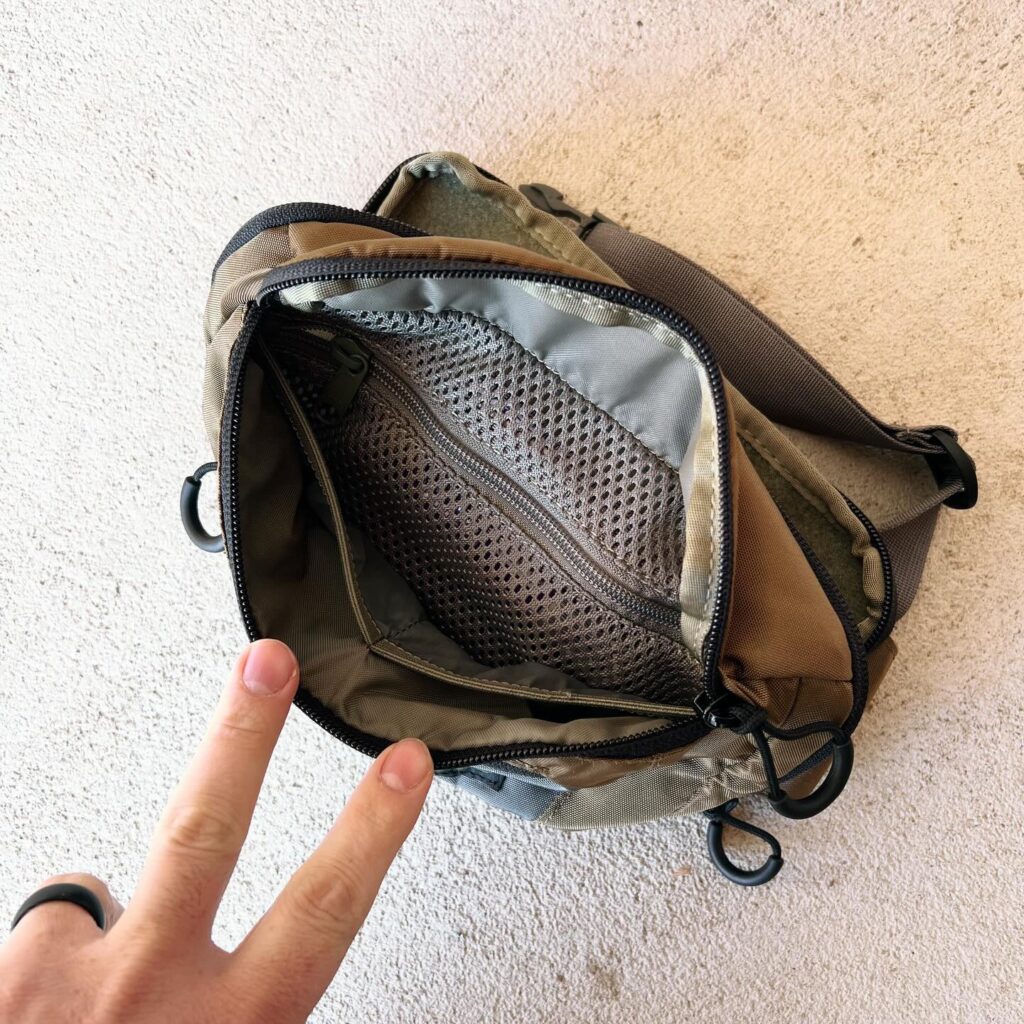
The second compartment is a very generous cargo compartment with organization. There are two small slip pockets and a large mesh zippered compartment with plenty of other loose space for larger items like phones. The third compartment is a zippered stash pocket on the front which is great for small items like chapstick or a lighter.
I have found the Bando Bag to be comfortable to wear and efficiently laid out to allow me to carry anything I would otherwise have knocking around in my pockets. Drawing from concealment is easy with practice. On top of all that, it is significantly less expensive than most similar bags. I like the first one I bought so much that I just ordered the new XL version to try.
As of the time of this writing, the Bando Bag and Bando Bag XL are on sale for 20% off on Amazon (the regular size Bando Bag is less than $40!): Bando Bag and Bando Bag XL on Amazon.com
Russia, defeated by France and the Ottomans in the Crimean War in 1856, was a broken and weakened military. Its officials knew modernization was necessary. The Imperial Russian Army needed a new handgun. It looked to the United States.
In World War 1, when Russia sent troops into battle unarmed it again looked to the United States. Both times the United States and its gunmakers responded, pleased to enjoy the money of a foreign government contract.
In the 19th century, fledgling gun companies sought government contracts that could potentially make them financially stable. Samuel Colt did that, beating the bushes and handing out presentation revolvers to whoever could possibly order large numbers of guns. He finally found financial security with a contract for 1,000 Colt Walker revolvers. The Russians would come calling to Colt many years later.
Smith & Wesson sold the very first large bore metallic cartridge revolver to the U.S. government, with an order of 1,000 New Model .44 caliber revolvers. However, it was a massive sale of its No. 3 revolver to Russia that made Smith & Wesson truly solvent.
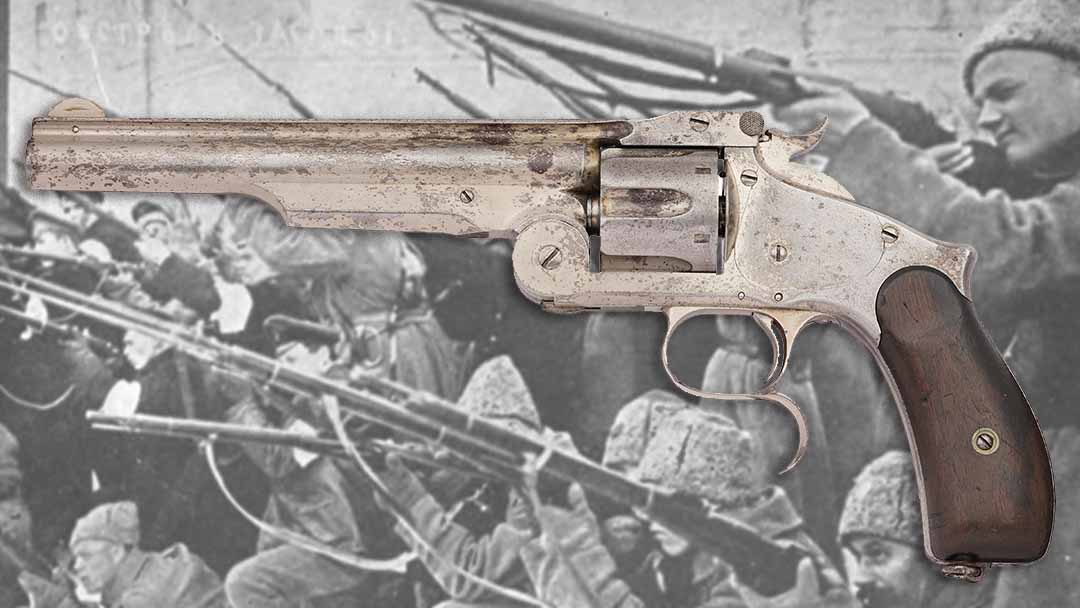
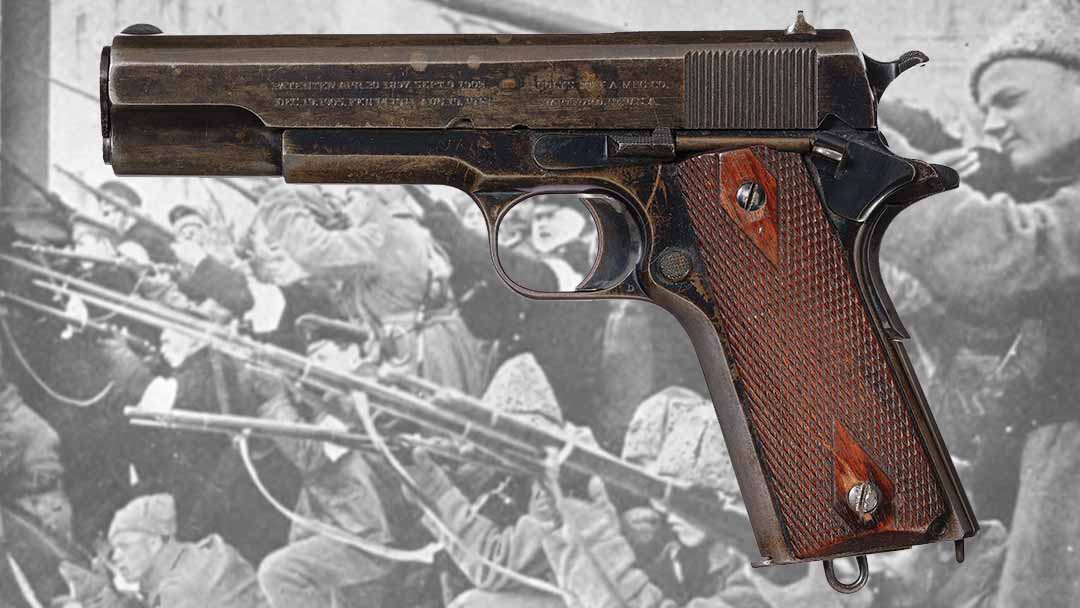
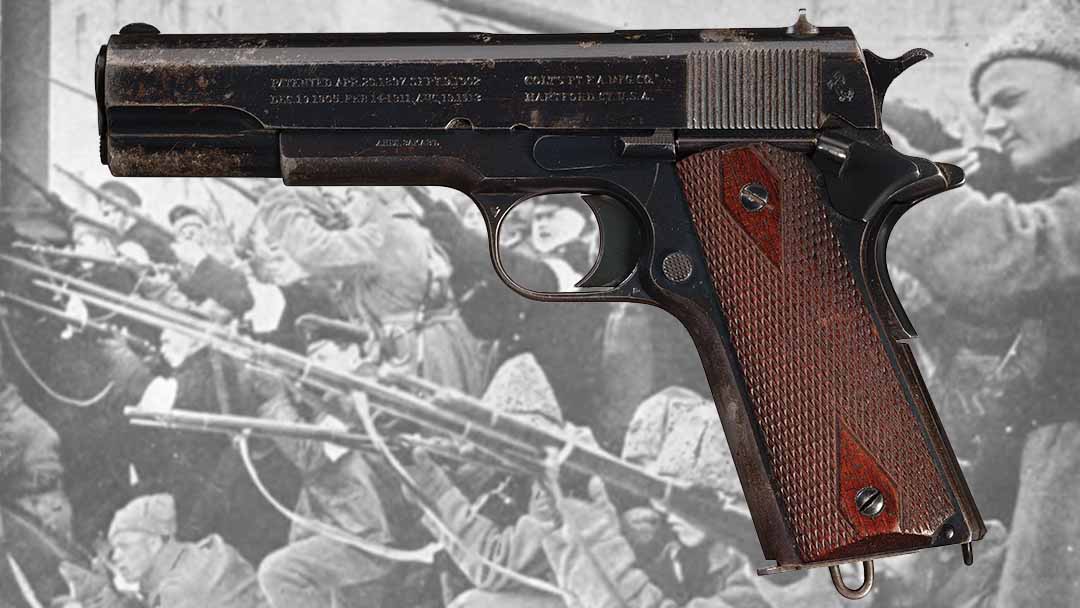
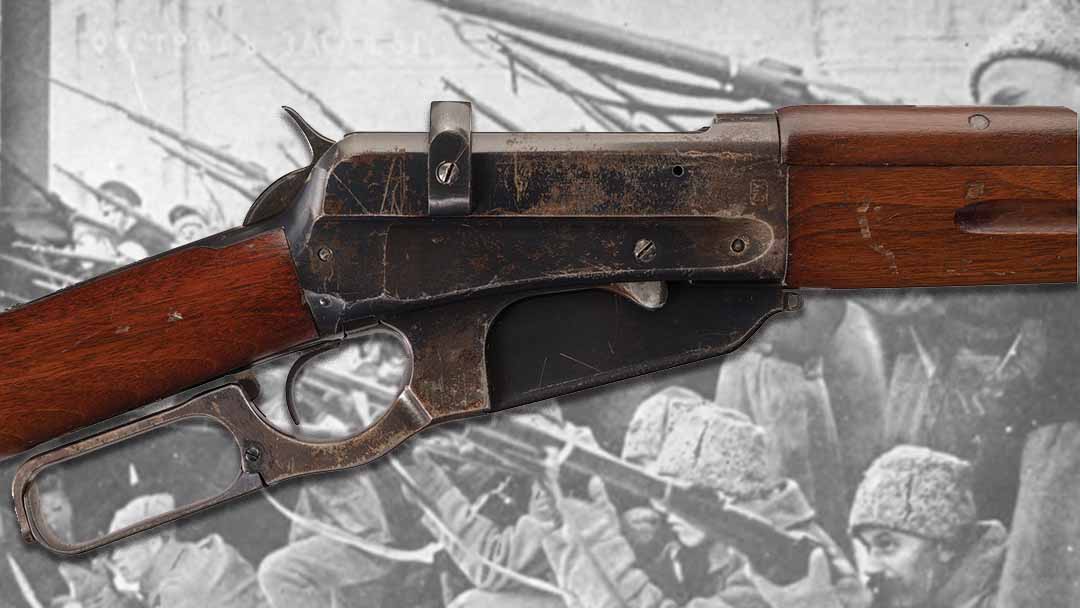
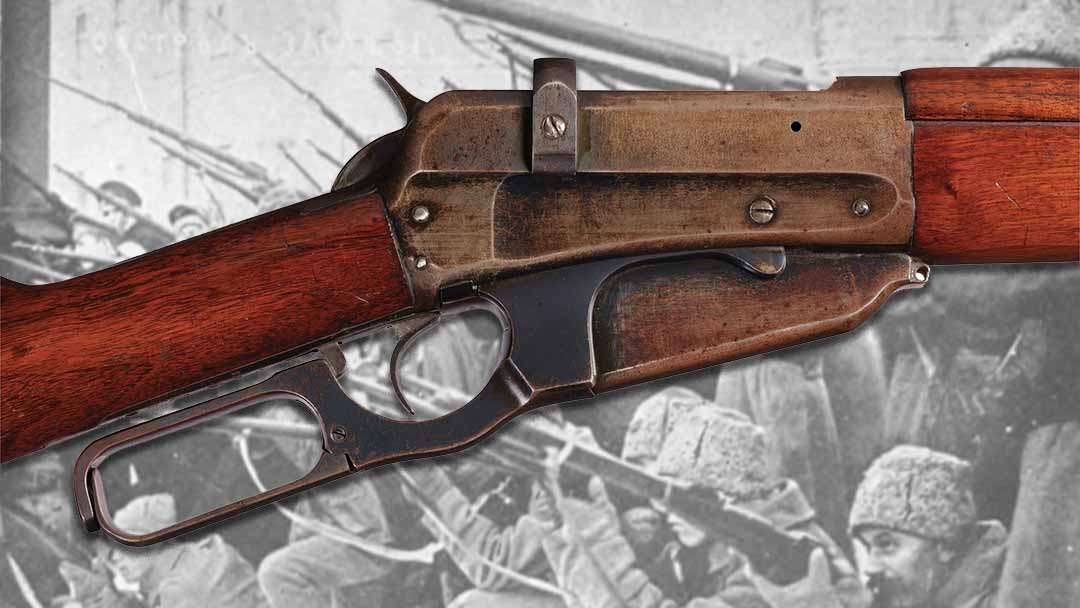
American firearms like the Smith & Wesson No. 3, the Colt Government Model and the Winchester Model 1895 were sold to the Russian government from the late 19th century to the early 20th century. Caught up in the mayhem of the Russian Revolution, the Russian Civil War and World War 1, these Russian pistols and rifles are scarce and often well used, however, Rock Island Auction Company will offer several superb examples of these rare military guns in its May 17-19 Premier Auction.
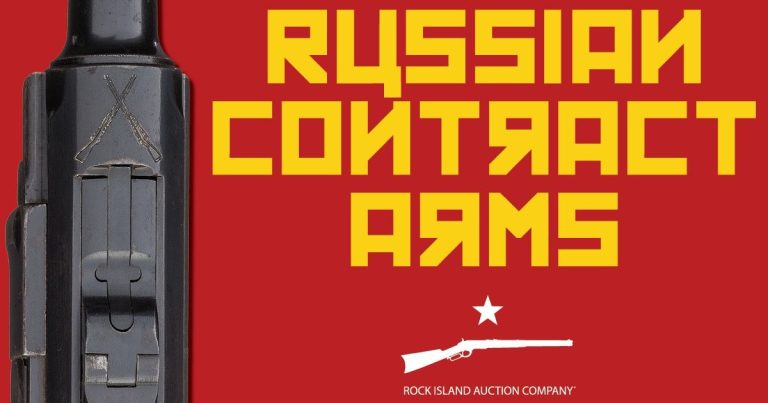
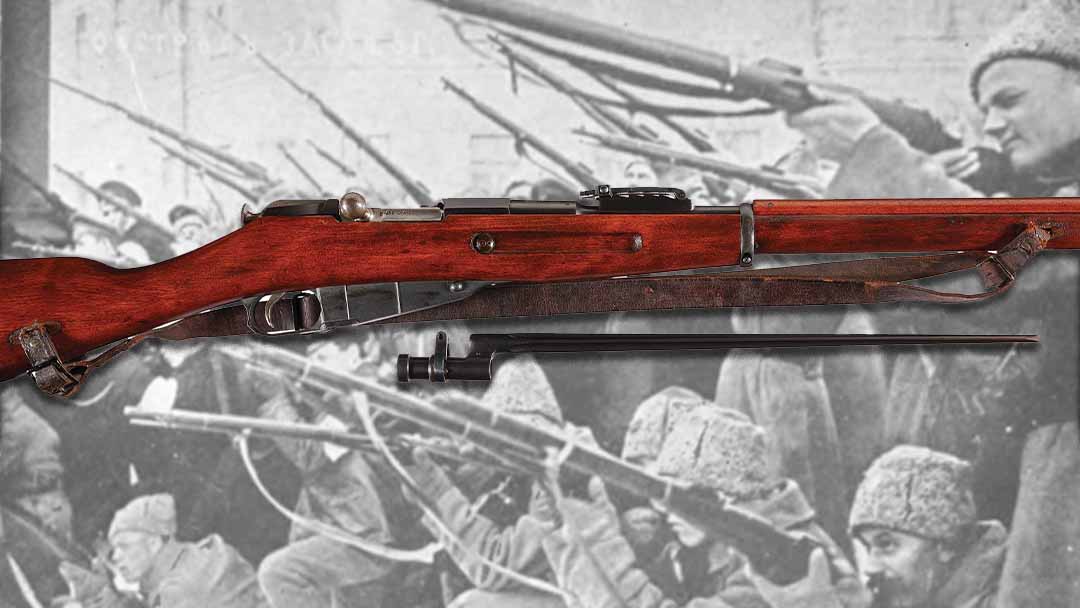
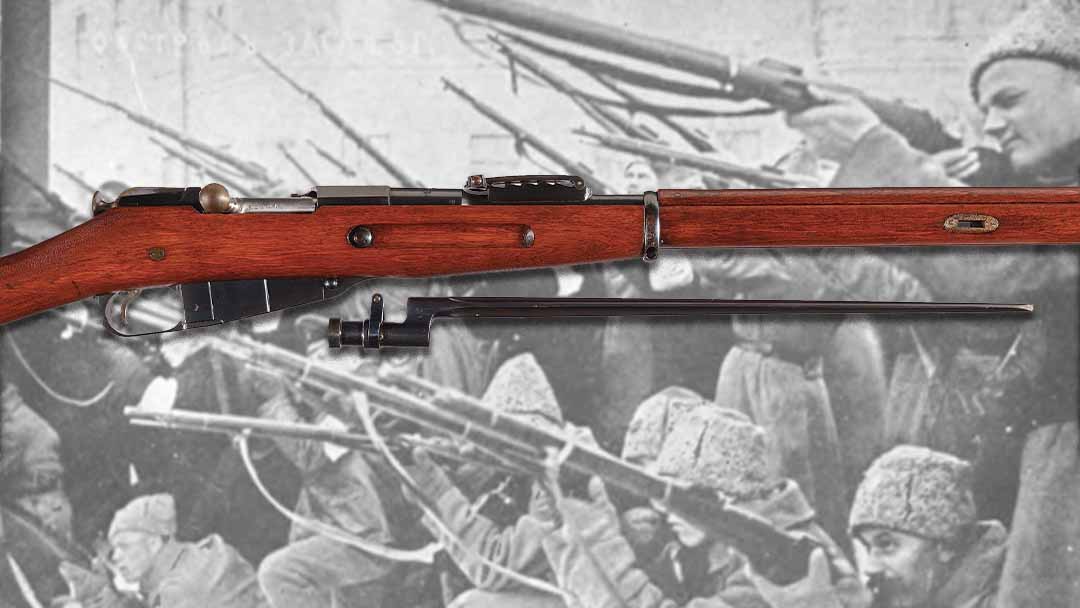
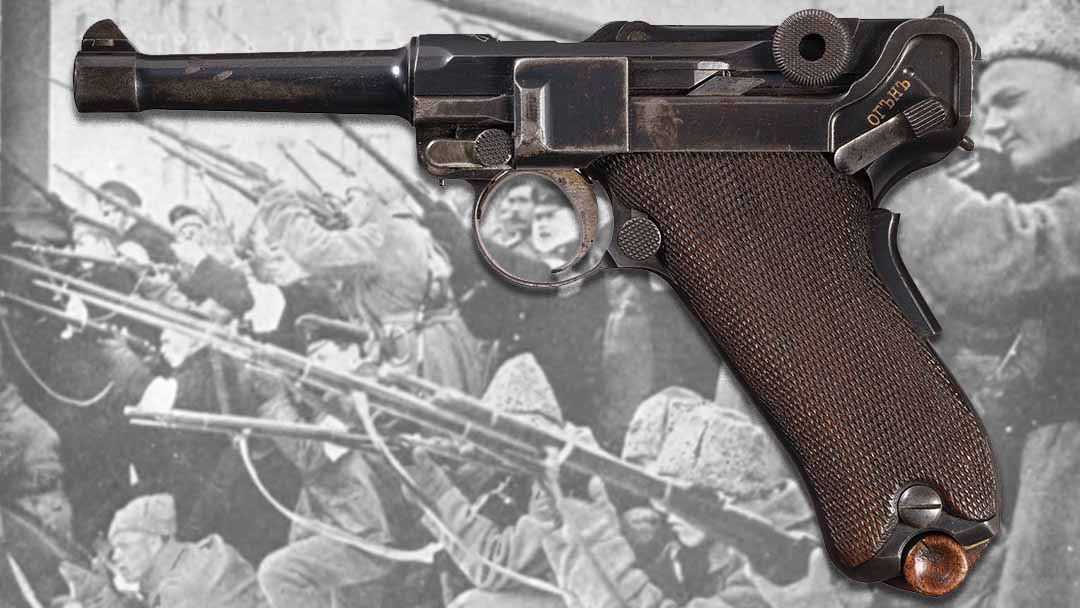
These closeups of the chambers of, from left to right, a Remington-made Mosin-Nagant, a Westinghouse-made Mosin-Nagant and a DWM Luger, show the two-headed eagle of Czarist Russia on the rifles and the crossed Mosin-Nagants on the Luger marking them as Russian contract guns.
Russian Pistols: Smith & Wesson No. 3
The U.S. government wasn’t satisfied by Smith & Wesson’s No. 3 metallic cartridge revolver and didn’t order any more beyond the initial 1,000. Russia, also looking for a revolver that was reliable, could offer a rate of fire and lethality, looked at the No. 3 and too found it wanting.
However, the Russians didn’t give up on the Smith & Wesson and demanded some changes to the cartridge which would become .44 Smith & Wesson Russian. A request made by Russian ordnance officer Kasavery Ordinetz at the Smith & Wesson factory ordered the second model to have a knuckle added to the backstrap and a spur to the trigger guard. The Russians had the barrel shortened to seven inches.
Russia initially contracted for 20,000 No. 3 First Model revolvers in May 1871, before eventually buying a total of 131,000 No. 3 revolvers from 1871 to 1878. Smith & Wesson also sold the No. 3 Second Model to the Turkish and Japanese governments.
“The Russian Model completely changed the Smith & Wesson position in the world, for it established the factory as a world-famous arms manufacturer, helped the company to establish financial stability, and also precipitated orders from other nations,” Smith & Wesson historian Roy G. Jinks stated. “[F]rom the first Russian contract stemmed the growth and success of Smith & Wesson.”
In an unrelated episode, Russian military officials also ordered Gatling Guns with specific Russian modifications including chambering them in .42 caliber and increasing the number of barrels from six to ten for a rate of fire of 200 rounds per minute. Russia bought 400 of the Colt Gatling Guns and a manufacturing license.
This Smith & Wesson No. 3 2nd Model has the Cyrillic markings on the nickel-finished barrel rib showing it is a Russian contract revolver.
Russian Pistols: Colt Government Model
In August 1914, France stood on the brink of disaster as the Germans approached Paris. The Allies needed a miracle and they got one, thanks to the Russians. On the Eastern front, theRussians attacked German forces at Tannenburg in what is now Poland. Despite severe losses by the Russians, it wasn’t a decisive victory for Germany. The Germans had to reinforce troops in the east and the war settled into a stalemate.
During the Russian attack, nearly half of the Russian Imperial Army was unarmed as the second and third waves were to advance, picking up the guns of their fallen comrades. In 1915, Russian Minister of War Alexei Polivanov estimated that 1 million Russian soldiers were unarmed, reflecting “Rifles were more precious than gold.”
This Colt Government Model was part of a shipment of 5,500 guns to the Russian government on June 13, 1916. Russian contract Colt Government Models are scarce on the American market in any condition. This example retains traces of its blue finish and is mechanically excellent.
Russia needed guns. Among its purchases were 51,000 Colt Government Model pistols with the first order of 2,600 coming through England. After Czar Nicholas II abdicated in March 1917, Russia descended into chaos. War supplies, including the Colts, sat in warehouses. U.S. Ordnance Gen. William Crozier recommended no longer sending guns to Russia.
A pair of M1911 pistols were among the firearms used in the assassination of Czar Nicholas II and his family in July 1918 and in fact one was reportedly carried by the ringleader. German soldiers were known to take M1911 pistols off soldiers in the Eastern Front in World War 2 where some were received through the Lend-Lease program.
This Colt Government Model was among a shipment of 4,000 guns to Russia on Nov. 28, 1916. On the left side of the frame is stamped “ANGL. ZAKAZIE”(transliterated) for “English Order.” This gun retains 60 percent of its blue finish and is mechanically excellent.
Russian Rifles: Winchester 1895
Due to its lack of preparedness at the start of World War 1, Russian rifles were needed along with Russian pistols. Winchester immediately received a contract for 300,000 rifles based on the Model 1895. Known as the Russian musket with an extended barrel and forend, 70 percent of all Model 1895 sales were for this variant.
U.S. troops had tried the Model 1895 in the Philippines and soldiers reported it too difficult to load. When Russia came looking for guns they were immediately offered the Model 1895, chambered in the Russian service caliber, 7.62x54R. These guns had stripper clip guides mounted on the receiver for fast reloading, solving the problem U.S. soldiers complained about. Winchester delivered 294,000 of the 300,000 Russian rifles contracted from 1915 through 1916.
This Model 1895 musket has a 28-inch barrel and is chambered in 7.62mm. Despite most Russian contract Model 1895s are generally encountered in rough shape, this Russian rifle is well preserved with 70 percent of its blue finish and is mechanically excellent. Russian inspector markings are clear.
Russian Model 1895 rifles also turned up in Republican Spain during the Spanish Civil War. Several were imported by Interarms and sold for $34.95 according to ads in firearms magazines of the early 1960s.
This Winchester Model 1895 is chambered for the Russian service 7.62mm round and has a Russian inspection stamp on the right of the stock, and a Finnish-marked canvas sling is included. With 40 percent of its blue finish retained, it is mechanically excellent.
Russian Rifles: American-Made Mosin-Nagants
The Russians also contracted with Westinghouse and Remington to make Mosin-Nagant rifles. After the collapse of the Russian monarchy the contracts were terminated and the remaining rifles were purchased by the U.S. Ordnance Department.
These rifles would be used by the American Expeditionary Force in the Allied intervention in North Russia as a way to use the ammunition that was stockpiled. The goals of the intervention was to prevent Allied war materials stockpiled in Arkhangelsk and also rescue the Czechoslovak Legion that was stranded along the Trans-Siberian Railroad.
This Russian Westinghouse U.S. 1891 Mosin-Nagant rifle bears the “imperial eagle” crest above the maker’s mark and “1915” on the breech of the barrel as well as a U.S. Ordnance flaming bomb stamp.
More than 37 million Mosin-Nagant rifles have been made. Remington was contracted to make 1.5 million and Westinghouse was to manufacture 1.8 million from 1915 to 1917. Sources vary on the exact number of rifles produced and shipped, but it is estimated that Remington made 750,000 to 840,000, while Westinghouse manufactured 770,000 Mosins, according to author Bruce N. Canfield.
It is estimated that 131,400 to 469,951 Remington-produced Mosins and about 225,000 Westinghouse-made Mosins reached Russia by the time the monarchy verged on collapse in January 1917 and the contracts were cancelled. The U.S. Army distributed the guns to the American Expeditionary Force, as well as to National Guard units and other state militias.
Overseas, the United States provided guns to the fledgling country of Czechoslovakia as well as to Finland, Spain and Mexico. Some were sold to surplus companies that converted them to .30-06.
This Remington-made Mosin-Nagant has a standard “imperial eagle crest” above the maker’s mark and “1917” date on the breech of the barrel. The stock has an eagle head stamp on the bottom ahead of the trigger guard housing and a circled Russian inspection stamp on the left of the buttstock. It is mechanically excellent.
Russian Pistols: DWM 1906 Luger
Only about 1,000 of these DWM 1906 Lugers were produced for imperial Russia ahead of World War 1. Some historians believe these were destined for local police rather than military use, or even for the secret police or the Czar’s bodyguards. Few have made their way to the United States.
This DWM 1906 Luger has a pair of crossed Mosin-Nagant rifles on top of the receiver near the barrel and Cyrillic markings are on the extractor, upper safety position (“Fire”), in place of the “GESICHERT (safe)” and “GELADEN (loaded)” indicators on the upper safety position and left side of the extractor, respectively.
Russian Pistols and Russian Rifles for Sale
United States gunmakers manufactured these particular Colts, Winchesters, Smith & Wesson and even Mosin-Nagants when czarist Russia needed weapons. Caught up in the chaos of the Russian Revolution, Bolshevik Uprising and World War 2, they firearms tend to have been hard used, but the examples on offer in Rock Island Auction’s May 17-19 Premier Auction are superb specimens from an interesting period of Russian military history.
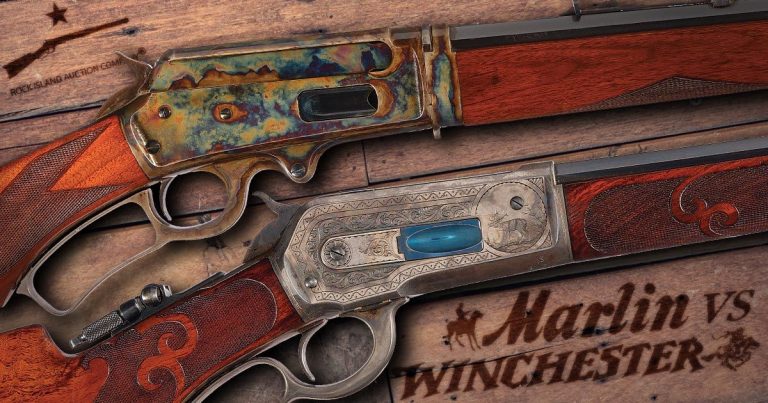
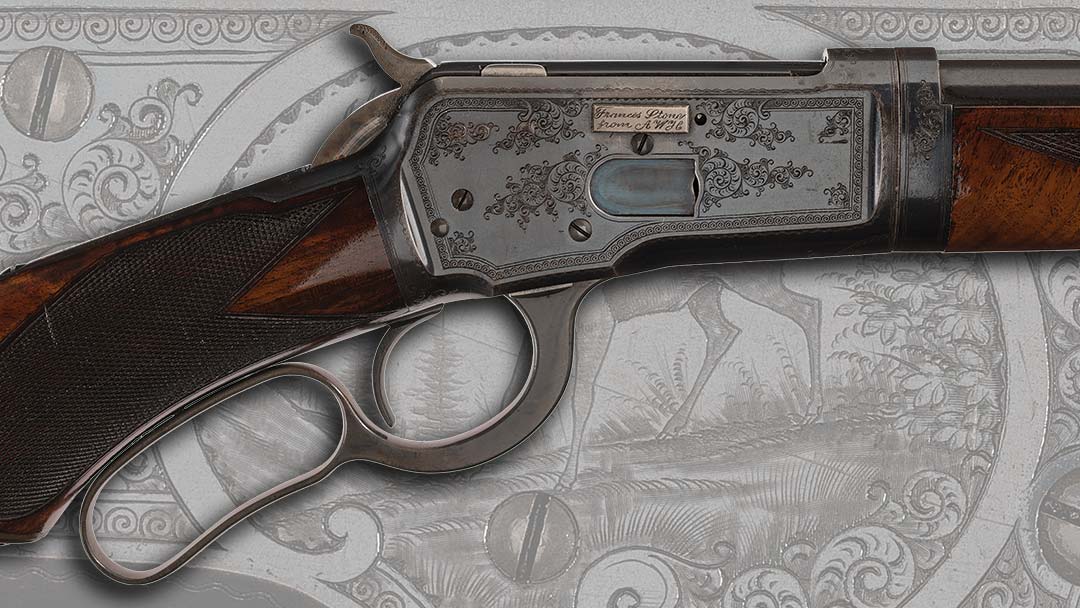
Over the decades, competition between Winchester and Marlin has produced some of the best lever action rifles on the market. For 19th century arms collectors, both platforms are iconic, with rare Winchesters like the relief game scene engraved, gold inlaid and plated Winchester Deluxe Model 1873 pictured below representing the pinnacle of the fine arms field.
A factory engraved Winchester Model 1873, one of the best Winchester lever action rifle offerings available this May.
Despite Winchester’s market dominance, Marlin also made a respectable name for themselves in the twilight years of the American West. Sterling condition antique Marlins are often more attainable than their Winchester rivals while still carrying similar artistry and historic appeal. Rock Island Auction Company’s May 17-19 Premier Firearms Auctionin Bedford, Texas offers an assemblage of some of the best Marlin lever action rifles around.
A small sample of the fine and historic Marlin lever action rifles for sale this May.
Though Winchester and Marlin were the kings of Old West lever action rifles, numerous competitors would also try their hand in the market.
Lever Action Rifle Evolution
Rare evolutionary predecessors to popular firearm models are often highly valued in the collecting community, and that certainly holds true for Winchester’s forebearers. The Jennings repeater, based on Walter Hunt’s Rocket Ball cartridge patent in 1848 and Lewis Jennings’s movable ammunition carrier patent in 1849, laid the foundation for nearly every lever action rifle model to follow.
The Volcanic design came next, produced by Smith and Wesson, Volcanic Repeating Arms Company, and finally New Haven Arms Company, a familiar name to Winchester enthusiasts.
A Second Model Smith-Jennings repeating rifle (top) and an early production New Haven Arms Company Volcanic carbine (bottom), two lever action predecessors to the Henry and Winchester. Both examples are available this May.
In 1858 Oliver Winchester’s shop superintendent Benjamin Tyler Henry developed a .44 caliber rimfire cartridge with a muzzle velocity of 1,200 fps. Over the next two years, he designed a firearm sturdy enough to handle the new round and received a patent in October of 1860.
Up to 14,000 of Henry’s 16-shot lever action rifles would be produced, with 6,000 to 7,000 reportedly used by Union soldiers during the Civil War. Winchester’s Henry precursor is a collecting cornerstone today, with scarce examples like the iron frame Henry below representing one of the best lever action rifles in an already rare genre.
A documented iron frame New Haven Arms Co. Henry rifle, serial number 90, manufactured during the first three months of production from April to June 1862 according to Les Quick’s book, ‘The Story of Benjamin Tyler Henry and His Famed Repeating Rifle.’ Available this May.
Winchester Lever Action Rifle Development
Though the Henry set the stage for the lever action rifle, a dispute over royalties with the weapon’s inventor resulted in Oliver Winchester reorganizing into the Winchester Repeating Arms Company in 1866. Winchester’s new factory superintendent, Nelson King, developed an “Improved Henry” design that included a more efficient cartridge loading system with a spring-steel loading gate on the right side of the receiver, a fully enclosed magazine tube, and a wooden forearm under the barrel.
The Model 1866 “Yellowboy”, often hailed as the original cowboy rifle, became the first lever action rifle to bear the Winchester name. With a total production run estimated at 170,100 rifles, carbines, and muskets, the Model 1866 was also the first lever gun to see widespread use in every corner of the United States and beyond. The 1867 production example below, presented and engraved to Peruvian military officer and politician Justiniano Borgono, illustrates the international appeal of these classic lever guns with the wealthy elite throughoutCentral and South America.
A historic Winchester Model 1866 lever action rifle manufactured in 1867 and engraved to Peruvian military officer and politician Justiniano Borgono. Available this May.
Though the Model 1866 put Winchester on the map, it was the Model 1873 that earned the company a reputation with the public as the best lever action rifle manufacturer for years to come. With its strengthened action and iron frame, the gun was designed to fire the .44 Winchester Centerfire cartridge, a notable upgrade in every respect. Later dubbed “the gun that won the West,” the Winchester 73 is a pop culture staple and is one of the most recognized firearms in history.
When ranking the best Winchester lever action rifle options available for elite arms collectors, this exceptional, documented Winchester Model 1873 One of One Thousand is a pinnacle example of its genre. Available this May.
Winchester was riding high after the Model 1873. While several other lever gun brands hit the scene, like the Evans repeater in 1873 and the Whitney-Kennedy in 1880, neither presented Winchester with a meaningful challenger.
Instead, Winchester eyed expansion, including a greater presence in the big game hunting market. While the Model 1873 was a fine weapon for self-defense, pest control, and taking medium game, a stronger model was needed to compete with big bore single-shot rifles like the Sharps and Springfield Trapdoor when it came to bringing down North America’s largest quarry.
A documented, factory inscribed Winchester Deluxe Model 1876 lever action short rifle chambered in .40-60 WCF, with a factory letter. Available this May.
Effectively a sized-up version of the Model 1873, the Winchester Model 1876 featured a larger and stronger receiver capable of handling cartridges like the .45-75 WCF, .50-95 Express, .45-60 WCF, and .40-60 WCF.
Theodore Roosevelt famously praised the Model 1876 for its hunting potential, considering it not only the best lever action rifle of its era, but “the best weapon I ever had.” Roosevelt ordered a consecutively numbered pair of these iconic Winchesters in 1881, the same year another arms maker would introduce its first lever gun onto the market and present Winchester with its first true taste of competition.
Winchester vs Marlin
In the mid-1870s, gunsmith John Mahlon Marlin had been partnering with New York retailers August Schoverling and Charles Daly to produce the single shot Ballard sporting rifle. The experience Marlin gained manufacturing the Ballard and other firearm designs gave him the confidence to pursue a lever action rifle concept of his own.
In late 1879, John Marlin patented his first lever action rifle. His initial prototype, a short-barreled, under hammer design, was only suited for smaller cartridges. Marlin went back to the drawing board, incorporating patents from H.F. Wheeler, Andrew Burgess, and E.A.F. Toepperwein to develop what would become known as the Model 1881 lever action rifle, the first repeater sturdy enough to chamber the .45-70 Govt. caliber.
One of the best lever action rifle examples available this May, this special order, deluxe factory game scene engraved Marlin Model 1881 was presented by Buffalo Bill to Western rancher and guide Jim McLaughlin and later owned by famous Wyoming dude rancher Larry Larom.
Thanks to the financial backing of Shoverling & Daly, Marlin Fire Arms Co. was incorporated, with the Model 1881 as its flagship product. The Model 1881 was a side loading, top ejection lever action that established Marlin as a premier American brand.
May’s auction includes a spectacular lineup featuring some of the best Marlin lever rifles in the collecting field.
Winchester 1876 vs Marlin 1881
For big game hunters in the early 1880s, the Marlin 1881 was the best lever action rifle available. First introduced in .45-70 and .40-60 chamberings, .32-40, .38-55, and 45-85 calibers were added to the lineup by the time production ended in 1892.
This documented special order Marlin Deluxe Model 1881 lever action short rifle with a 20 inch barrel is chambered in .45-70 Gov. Available this May.
Both the Winchester Model 1876 and Marlin Model 1881 were comparatively expensive lever guns for their day, with each hefty rifle costing over 30 dollars in the early 1880s when they competed head-to-head. Though the Winchester Model 1876 had a five-year head start on its Marlin rival, Winchester’s rifle remained in production three years longer and ultimately outsold the Marlin Model 1881 63,800 to 20,000.
A special order Winchester Deluxe Model 1876 .50 Express lever action short rifle with a factory letter. Available this May.
Winchester 1886 vs Marlin 1895
As the Marlin Model 1881 was gaining a modest foothold, Winchester brought in prolific inventor John Moses Browning to help develop a big game repeater that could chamber cartridges like .45-70 Govt.
Distinguished by its dual vertical locking bars designed to seal the breech bolt against the chamber, the Model 1886 was the best Winchester lever action rifle of its age in terms of sheer power, and its popularity and lengthy production run reflect the impressive quality of Browning’s first repeating design.
Two consecutively serialized exhibition quality engraved Winchester Deluxe Model 1886 lever action rifles, SN 116728 (left) and SN 116729 (right), both available this May.
In the years after the Model 1881’s introduction, Marlin brought on accomplished rifle designer Lewis L. Hepburn to develop new lever action models. Hepburn secured some 20 patents for Marlin over his career and had a hand in everything from the Marlin Model 1888 to the Model 1897.
Features like a side ejection port, a cartridge carrier, and a firing pin system designed to prevent accidental discharge were introduced to the Marlin line, with the Marlin 1895 representing a large caliber refinement of the action Hepburn had developed in the earlier Model 1893.
While never gaining a sizable portion of the market, the Marlin 1895 did gain a reputation as an accurate and dependable big game rifle. With its nine-year headstart and arguably stronger design, it’s no surprise that the Winchester 1886 substantially outsold the Marlin 1895. Both guns represented some of the finest large caliber hunting platforms of the period and are two of the best lever action rifle models of all time.
One of the best lever gun offerings for sale this May, an exceptional antique factory exhibition quality game scene engraved and gold and platinum inlaid Marlin Deluxe Model 1895 rifle in .45-90.
Winchester 1892 vs Marlin 1894
John Browning provided a scaled-down version of his exceptional Model 1886 design in the Winchester Model 1892. The Model 92 offered a lever gun chambered for popular low-powered revolver cartridges like its Model 1873 predecessor and often stood in for the Model 73 in Hollywood productions.
An Ulrich signed presentation inscribed Winchester Deluxe Model 1892 lever action takedown rifle with factory letter, chambered in .44-40 WCF. Available this May.
Marlin advertised their Model 1894 as “the Model 1893 rifle adapted for shorter cartridges.” Like the previously mentioned Marlin Model 1895, the Model 1893 and Model 1894 represented a refinement of Lewis L. Hepburn’s earlier designs.
Though the WinchesterModel 1892 is often thought to be a sturdier gun than its Marlin counterpart, the solid-top Marlin Model 1894 was considered superior at resisting the elements, particularly the snow, mud, and freezing temperatures of Canada, Alaska, and the Pacific Northwest.
Where the Winchester 1886 and Marlin 1895 represented two of the finest heavy-hitting lever guns of their era, the Winchester 1892 and Marlin 1894 rank among the best lever action rifle models for pistol caliber cartridges and are certainly two of the most influential designs.
A historic factory engraved Marlin Deluxe Model 1894 takedown lever action rifle inscribed and presented to Carl G. Winter, President of the Fraternal Order of Eagles. Chambered in .30-20. Available this May.
Marlin 1893 vs Winchester 1894
Speaking of influential designs, our next two lever gun contenders both remain popular today in their modern iterations. The Marlin Model 1893 incorporated Lewis L. Hepburn’s patents for a new locking bolt system and a two-piece firing pin, both vital to the gun’s ability to handle smokeless powder loads.
Initially chambered in black powder .32-40 and .38-55., the sturdy Marlin Model 1893 proved suited for smokeless rounds like the .30-30 that would go on to dominate the market.
An exceptional factory engraved Marlin Deluxe Model 1893 lever action takedown rifle chambered in .30-30. Available this May.
John Browning’s Winchester Model 1894 also turned out to be an ideal platform for chambering smokeless rounds. Employing a single rear locking bolt block in place of the Model 1892’s dual rear locking bar, the Model 1894 was more than capable of handling the higher pressures and velocities found in cartridges like .30 WCF and .25-35 WCF, and Winchester offered the gun in a “nickel steel” alloy to resist barrel wear from the new smokeless ammunition.
One of the best Winchester lever action rifle examples of a classic genre, this exceptionally fine antique Winchester Deluxe Model 1894 rifle is available this May.
In terms of sales figures, the Model 1894 wins the title of best Winchester lever action hands down and remains the best-selling lever action of all time. Though Winchester’s Model 1894 left the Marlin Model 1893 in the dust, the Model 1893’s descendants like the Marlin Model 36 and Marlin Model 336 saw steady sales. Today, the Marlin 336 vs Winchester 94 faceoff continues, with the Marlin 336 having achieved 3.5 million units sold and counting.
Best Lever Action Rifles for Collectors
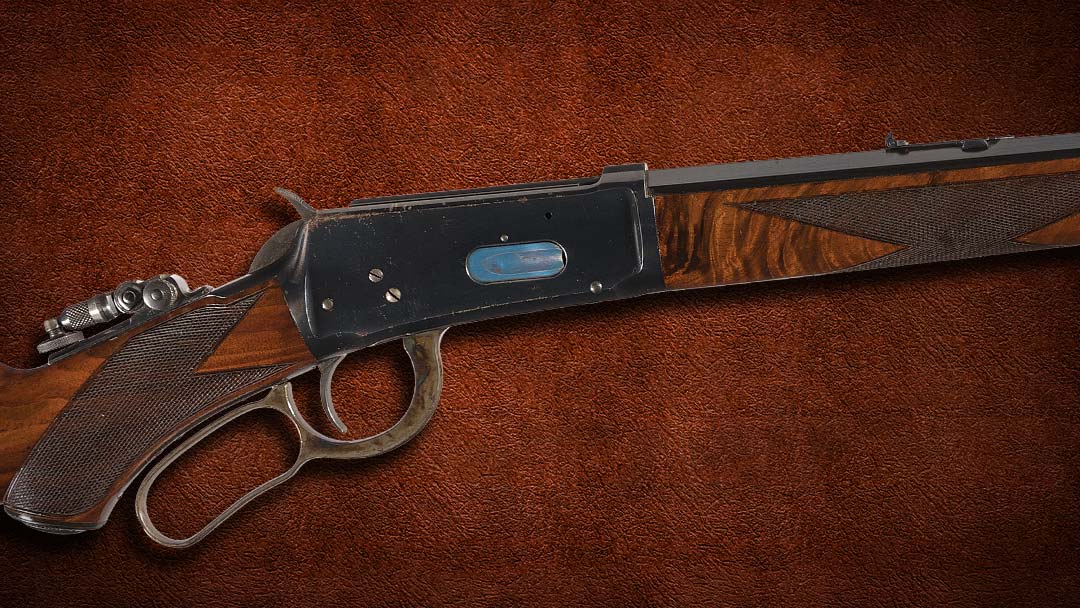
Vintage lever action rifles are some of the most popular arms collecting genres, with high condition, historically significant, and examples exhibiting scarce features representing some of the most sought-after arms in the field. Both platforms were particularly suited to embellishment, with engraved Winchester and Marlin lever action rifles appealing to both classic arms collectors and Western art enthusiasts today.
An exceptional factory engraved antique Marlin Deluxe Model 1897 lever action .22 rifle with a factory letter. Available this May.
Though Winchester dominated the 19th century lever gun market, Marlin earned a commendable reputation with hunters and shooters, with legendary Westerners like Buffalo Bill and Annie Oakley further elevating the brand. Rock Island Auction Company’s May 17-19 Premier Firearms Auction features some of the best lever action rifle examples offered under one roof, and the collecting public is invited to inspect, handle, and shoulder any of these exceptional firearms during RIAC’s May 16th Preview Day at 3600 E Harwood Rd, Bedford, TX starting at 10:00 AM.
A one-of-a-kind H.H. Schulte, early production, documented special order Winchester Model 1873 lever action rifle. Available this May.
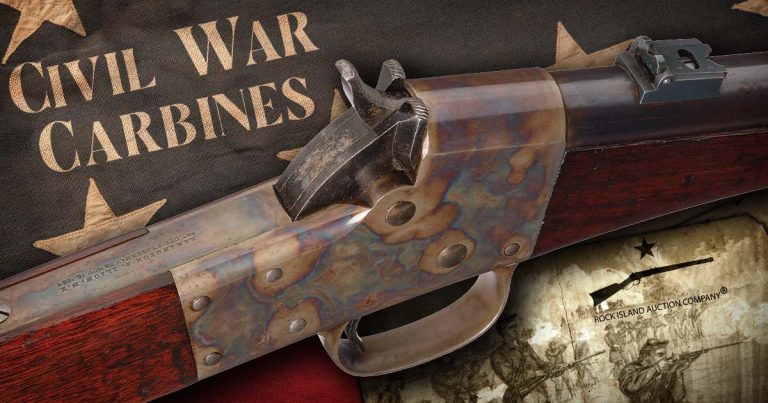
Originating from French words like “carabin” and “carabinier,” the term carbine came to refer to lightweight muskets and rifles with shortened barrels and stocks. These weapons provided mounted troops and other units who required greater mobility with an easier-to-carry and more maneuverable option on the battlefield. Early carbines tended to be smoothbore, but rifled carbines gained traction in the 19th century, and the American Civil War saw a renaissance of innovation in the platform.
An excellent U.S. inspected American Machine Works Smith Patent percussion carbine (top) and an outstanding Civil War Ball repeating carbine (bottom) are just two of the many rare and collectible Civil War carbine examples available this May.
During the American Civil War, carbines were widely fielded by both sides of the conflict, with models from at least 19 different manufacturers adopted by the Union alone. Though most infantry troops equipped rifles, carbines were sometimes carried by skirmishers in addition to the platform’s prevalent role with cavalry units. The wealth of rare Civil War carbines for sale at Rock Island Auction Company demonstrates the experimentation and innovation found within this fantastic collecting category. Click on the images throughout this article to learn more about each of the featured firearms.
The Colt Model 1855 revolving rifle and carbine was fielded during the Civil War, though this rare and breathtaking example was manufactured for factory exhibition at the 1876 Philadelphia Centennial and later Schuyler, Hartley & Graham Display board. Available this May.
When it comes to fierce battles, rich history, and the sheer number of weapon types introduced, the Civil War era has everything a firearms fan could ask for. It’s little wonder that today’s collectors are drawn to relics from the conflict, and Rock Island Auction Company’s May 17-19 Premier Firearms Auctionin Bedford, Texas features some of the finest, scarcest, and most historic Civil War arms available, including the exceptional iron frame Henry rifle pictured below.
A documented iron frame New Haven Arms Co. Henry rifle, serial number 90, manufactured during the first three months of production from April to June 1862 according to Les Quick’s book, ‘The Story of Benjamin Tyler Henry and His Famed Repeating Rifle.’ Available this May.
Ball Repeating Carbine
Ordered by the Union in 1864, a reported 1,002 Lamson & Co. Ball carbines were received by the U.S. Army in May 1865, in the final days of the Civil War. Manufactured by Lamson & Co. of Windsor, Vermont, this seven-shot repeater was patented by Massachusetts inventor Albert Ball and was one of the most advanced weapons of its era. While the gun’s action operated similarly to a Spencer carbine, the Lamson & Co. Ball repeater also utilized a side action loading system and tubular magazine covered by a wooden forestock not unlike the latter Winchester Model 1866.
An extraordinary U.S. E.G. Lamson & Co. Ball repeater, one of the most advanced Civil War carbine designs. Available this May.
Ballard Carbine
Ball & Williams Co. of Worcester, MA were originally contracted to manufacture 5,000 Ballard carbines for the U.S. government in January 1864. Only 1,500 were produced before Ball & Williams abandoned the order and instead shifted production toward a more lucrative contract solicited by the Kentucky Cavalry. 1,200 of the initial 1,500 Ballard carbines manufactured were issued to the Vermont militia after the St. Albans Raid in October 1864. The fine condition example below appears to be among the select few Ballard carbines not issued and likely sat in government storage.
An outstanding, nearly as issued, Civil War U.S. martially inspected Ball & Williams Ballard carbine, with “M.M” inspection initials on various components including a circled script “MM” cartouche on the left of the stock. Available this May.
Bilharz, Hall & Co. Carbine
Originally attributed to D.C. Hodgkins & Sons of Macon, Georgia, more recent research indicates that these Civil War carbine models were made by Bilharz, Hall & Co. of Pittsylvania Courthouse, Virginia, for the Confederate Government in late 1863 to early 1864. A close copy of the Springfield Model 1855 carbine, only 400 to 700 Bilharz, Hall & Co. carbines were produced in total. Like many Confederate arms, these .58 caliber muzzleloading carbines were likely manufactured by hand due to a lack of factory equipment.
This rare Confederate Bilharz, Hall & Co. saddle ring carbine features serial number “523” marked on the rear face of the barrel and on the underside of the breech. Available this May.
Burnside Carbine
This exceptional Civil War Burnside carbine was manufactured by the Burnside Rifle Company in Providence, Rhode Island between 1864 and 1865. Developed by future General Ambrose Everett Burnside in the 1850s, the Burnside carbine would become the third most purchased breech-loading Civil War carbine after only the Sharps and Spencer. The 5th Model Burnside represents the most advanced version of the general’s design, with a “guide screw” in the breech block that helped accelerate the loading process.
An excellent Civil War U.S. Burnside Rifle Co. 5th Model carbine. Available this May.
Gallager Carbine
The Gallager carbine was designed by South Carolinian dentist Dr. Mahlon J. Gallager and manufactured under license by Richardson & Overman in Philadelphia. Around 18,000 Gallager carbines were manufactured in three variations, with the first two versions widely used by the Union cavalry.
An exceptional Civil War U.S. Richardson & Overman Gallager breech-loading saddle ring carbine. Available this May.
Gibbs Carbine
The Gibbs was one of the scarcest breech-loading Civil War carbine models. Only 1,052 were manufactured by William F. Brooks at the New York City Phoenix Armory and delivered to the U.S. government before the factory was burned down during the New York Draft Riots in July 1863. Around 500 Gibbs carbines were issued to the 10th Missouri Cavalry, with smaller quantities issued to the 13th and 14th New York Cavalry.
One of the finest known Civil War U.S. Contract Gibbs breech-loading carbines. Available this May.
Greene Patent Breech-Loading Percussion Carbine
200 Greene carbines were delivered to fill a U.S. contract in March of 1856. 170 were sent west to the 1st Cavalry for field testing and were carried on the Cheyenne Expedition in May of 1857, with a small number issued to the 6th Ohio at the outbreak of the Civil War.
2,000 Green carbines were also manufactured between 1855 and 1857 on contract with the British for use in the Crimean War, with only a few hundred surviving today. The Massachusetts Arms Co. British contract Greene Patent carbine pictured below includes a “U.S.” marking in the left tail of the stock, indicating it could have been bought back from the British and used in U.S. military service during the Civil War era.
A fine U.S. marked Massachusetts Arms Co. British contract Greene Patent breech-loading carbine. Available this May.
Gwyn & Campbell Type II Carbine
Gwyn & Campbell manufactured around 8,200 Type I and Type II Civil War carbines in 1863 and 1864 for the Union. Primarily issued to Midwestern units, including members of Col. Benjamin Grierson’s 6th Illinois Cavalry, these unique-looking .52 caliber breech-loaders were nicknamed “grapevine carbines” for their long hammer and serpentine-shaped trigger guard.
This exceptional Civil War Gwyn & Campbell Type II breech-loading saddle ring carbine/Union rifle features a boxed script “WHR” cartouche on the left side of the wrist and small “WHR” inspection initials on the top of the stock ahead of the buttplate tang. Available this May.
Hall-North Model 1843 Carbine
Around 10,500 “side lever” Hall-North Model 1843 carbines were manufactured by Simeon North of Middletown, Connecticut from 1844 to 1853. The 1st and 2nd U.S. Dragoons were among the units issued these carbines during the Mexican-American War, and more than half are believed to have been rifled for use in the Civil War. Original smoothbore examples like the high-condition Hall-North Model 1843 carbine offered below are a true rarity in 19th century military arms collecting.
An exceptional U.S. Simeon North Model 1843 “Side Lever Hall” breech-loading saddle ring carbine. Available this May.
Joslyn Model 1862 Carbine
One of the most fielded Civil War carbine types, the Joslyn was offered in two models: the 1862 and the more prolific Model 1864. Approximately 2,200 of the less common 1862 Joslyn breechloaders, distinguishable by their brass-mounted hardware, were purchased by the Ordnance Department. Designed by the prolific Massachusetts-born gun inventor Benjamin Franklin Joslyn, the carbine is equipped with a hook-type friction latch breechblock that pulls up and to the left for loading.
An early production Civil War U.S. Joslyn Model 1862 saddle ring carbine with inspector initials “E.F” marked at the breech on the left side of the barrel and two “EF” cartouches on the left stock flat above the saddle ring bar. Available this May.
Lindner Carbine
Designed by Edward Lindner and manufactured by Amoskeag Manufacturing Company of Manchester, New Hampshire, approximately 500 of these First Type American carbines are reported to have been manufactured for the Union. The guns were delivered in January 1863. 297 Linder carbines were subsequently issued to the 8th West Virginia Mounted Infantry and used in skirmishes against Confederate forces between August and November of 1863.
A scarce U.S. contract First Type Lindner breechloader, a rarity for Civil War carbine collectors. Available this May.
Maynard Carbine
Another Civil War carbine designed by a dentist, the Maynard carbine was favored by both North and South. Maynard’s breech-loading carbine saw two variations, with several thousand First Model Maynard carbines purchased by southern states in the lead-up to the war. Not to be outdone, the Union armed its cavalry with 20,000 Second Model Maynard carbines between 1863 and 1865, including the 6th, 9th, and 11th Indiana Cavalry as well as the 10th and 11th East Tennessee Union Cavalry.
This fine Civil War U.S. Massachusetts Arms Co. Second Model Maynard breech-loading saddle ring carbine features “G.W.S” inspection initials stamped on the left barrel flat and two boxed script inspection cartouches stamped on the left stock wrist. Available this May.
Palmer Bolt Action Carbine
The Palmer carbine was patented in 1863 and holds the distinction of being the first metallic cartridgebolt action firearm ever adopted by the U.S. Ordnance Department. The bolt on this design is used to seat the cartridge and seal the breech. It fires with a traditional side lock. Over 1,000 of these innovative Civil War carbine models were ordered by the U.S. government, but they arrived one month too late to see action in the conflict.
This outstanding Civil War era E. G. Lamson & Co. Palmer bolt action saddle ring carbine features “M.M” (Miles Moulton) inspector initials on the left of the breech, left stock flat and top of the stock, and a script “MM” cartouche on the left stock flat. Available this May.
Remington Type I Split Breech Carbine
These Type I split breech carbines were manufactured by Savage Revolving Arms Co. for Remington to fulfill a U.S. Government contract for 5,000, with deliveries completed from February to April of 1865. Around 3,600 were repurchased from the government by Remington in 1870 and then resold to the French for use in the Franco-Prussian War, lending to their scarcity in today’s collecting market.
One of the finest known Civil War Era U.S. martially inspected Remington Type I split breech rolling block saddle ring carbine. Available this May.
Sharps Carbine
A must have for any Civil War carbine collection and firearms fans of every stripe, the Sharps needs no introduction. The Sharps platform got its start during the Antebellum Era and saw use with figures like abolitionistJohn Brown and Mormon leaderBrigham Young in the years leading up to the Civil War. Both North and South equipped their elite marksmen with Sharps carbines and rifles, including the Union’s green-jacketed regiment of volunteers popularly known as Berdan’s Sharpshooters.
A fine Sharps Model 1852 Slant Breech saddle ring carbine. Available this May.
The Sharps proved well suited for testing an enemy’s strength, slowing advances, picking off officers, and harassing a retreating foe, and the Union armed 80 cavalry regiments with Sharps carbines during the conflict. The incredible U.S. Sharps New Model 1863 percussion carbine pictured below is an example of perhaps the Civil War’s most popular variant of the platform.
This exceptional Civil War U.S. Sharps New Model 1863 saddle ring carbine features “A.W.M.” inspection initials stamped on the bottom flat of the forend and on top of the stock comb ahead of the buttplate tang and “TWR” and “PB” cartouches stamped on the left side of the wrist by the saddle ring bar. Available this May.
Sharps & Hankins Model 1862 Carbine
While Christian Sharps is remembered for the platform mentioned above, he was involved in multiple firearm designs, including a cartridge rifle developed with Philadelphia entrepreneur William Hankins. The Sharps & Hankins was a breechloader chambered for a .52 caliber rimfire cartridge and designed with a barrel that slides forward in a track on the frame when the lever is pressed forward. This mechanism is a unique standout to many Civil War carbines and early breech loaders that utilized barrels that tilted on a hinge downwards, rotated to the side, or had moving breechblocks.
The Sharps & Hankins Civil War carbines were manufactured in three different variations, and government records list 6,686 purchased for the U.S. Navy. These Navy Sharps & Hankins included leather covering designed to protect the barrel from corrosive saltwater. Due to age and hard use, the original leather covering on most of these firearms didn’t survive or show extensive damage. The U.S. Navy Sharps & Hankins Civil War carbine pictured below is one of the most remarkably complete examples of the genre.
This U.S. Sharps & Hankins Model 1862 Navy rimfire carbine includes its original leather covering in remarkable condition. Available this May.
Smith Carbine
One of the most prolific Civil War carbine models fielded by the Federal cavalry was invented in 1857 by Dr. Gilbert Smith of New York. 30,362 Smith carbines were reportedly purchased by the United States government during the war, an impressive figure considering the Union’s frequent skepticism toward new technology.
The Smith carbine folded open similarly to a break action shotgun and was designed to use ammunition with a reloadable case made with a special rubber known as “gutta percha.” Though rubber shortages resulted in a limited supply of Smith casings and the ammunition could be slow to extract due to heat expansion in the chamber, the Smith carbine still saw hard use in combat. Finding high-condition “as issued” examples like the Smith carbine pictured below is a true collecting rarity.
This excellent Civil War American Machine Works Smith breech-loading carbine features “L.F.R” inspection initials on the left of the breech, “H.D.H.” on the bottom of the forearm, “JH” inspection initials ahead of the buttplate, and a crisp oval script “JH” inspection cartouche stamped on the left of the wrist. Available this May.
Spencer Carbine
No Civil War carbine collection is complete without the legendary Spencer repeater. As the first military-issued repeating metallic-cartridge long gun design, the Spencer rifle and carbine offered an unprecedented level of firepower for its era. After inventor Christopher Spencer gave President Lincoln a personal demonstration of his seven-shot lever action repeater, Lincoln pressured his Ordnance Department to adopt the new weapon.
An exceptional Civil War U.S. Spencer Model 1860 Army repeating rifle (top) and a fine U.S. Contract Spencer Model 1865 repeating carbine (bottom) are each available this May.
The first Spencer rifles purchased by the Ordnance Department were priced at a hefty $40.00, over two and a half times the cost of a Springfield Model 1861 muzzleloading rifle. The shorter-barreled Spencer carbine, accepted by the Union in the fall of 1863, quickly became the preferred standard due to its more affordable $25.00 price tag. Late in the war, the Burnside Rifle Co. retooled its facilities to manufacture Spencer carbines to help meet production demand for the model and made their first deliveries early in 1865.
This excellent Civil War U.S. Burnside Rifle Co. Model 1865 Spencer repeating carbine includes a crisp “DAP” cartouche on the left side of the stock. Available this May.
Springfield Model 1855 Pistol-Carbine
A rarity for Civil War carbine collectors, Springfield Armory only manufactured 4,021 of these distinctive weapons between 1855 and 1857. The Model 1855 pistol-carbine was intended to provide the U.S. Cavalry and Dragoon regiments on the pre-Civil War frontier with a weapon that could be utilized as a pistol on horseback and a carbine for dismounted action when fitted with the stock.
The carbine was designed to fire the newly introduced .58 caliber expanding base bullet (Minie ball) and was fitted with the Maynard tape primer system that was employed in numerous military models from 1855. Though the Model 1855 pistol-carbine was quickly replaced with the Colt revolver, these adaptable firearms were brought out of retirement and issued to volunteer cavalry units during the early stages of the Civil War. High condition examples like the Model 1855 pistol-carbine pictured below that retain their original matching stock are few and far between.
An exceptional U.S. Springfield Model 1855 percussion pistol-carbine dated 1855 with matching stock. Available this May.
Starr Arms Carbine
Before he developed his famous revolvers, Ebenezer Starr patented a .54 caliber falling block carbine in 1858. The Union ordered more than 20,600 Starr carbines and earmarked the weapons for cavalry units in the Civil War’s Western theater. In the end, the Starr became the fifth most manufactured Civil War carbine, though high-condition offerings like the example below are immensely difficult to find.
A U.S. Starr Arms Co. percussion breech-loading saddle ring carbine. Available this May.
Triplett & Scott Repeating Carbine
Another example of advanced Civil War carbine development, the Triplett & Scott repeater was produced by the Connecticut-based Meriden Manufacturing in 1865. 5,000 Triplett & Scott carbines were ordered by the Kentucky Home Guard to help protect supply lines under General Sherman, but these unique repeaters arrived too late to see action on the battlefield. The Triplett & Scott carbine features a seven-round magazine and is loaded by twisting the barrel to align with the magazine on the lower left side of the receiver.
An outstanding Civil War Kentucky marked Meriden Manufacturing Co. Triplett & Scott repeating rimfire carbine. Available this May.
Warner Carbine
One of the most distinctive Civil War carbine models, the brass frame Warner carbine was designed, patented, and produced by lifelong gun inventor James Warner of Massachusetts. Warner managed to land an Ordnance Department contract for his carbine before the patent was issued in February 1864. About 1,500 carbines were produced near the end of the war, issued primarily to the 3rd Massachusetts and the 1st Wisconsin Cavalry Regiments.
A scarce and extraordinary Civil War James Warner Patent breech-loading saddle ring carbine. Available this May.
Civil War Carbines for Sale
The vast number of gun models and ammunition types fielded during the Civil War was a daunting challenge for each military’s ordnance bureaus, but the result was a goldmine for today’s arms collectors. The bounty of Civil War carbine models produced during the conflict demonstrates an arms race of innovation, and the finest and rarest period examples can be found at Rock Island Auction Company.
An excellent Providence Tool Co. Peabody rimfire saddle ring carbine, a model that was developed during the Civil War but not military issued in North America during the conflict. Available this May.
A U.S. marked Colt Third Model Dragoon revolver with a desirable three-leaf rear sight, “four-screw” frame, and matching shoulder stock. Available this May.
This May, Rock Island Auction will offer a Calderwood & Son double action pinfire revolver, that comes straight out of the Custer family, and owned by none other than George Armstrong Custer.
Benjamin Berkeley Hotchkiss was born in 1826 to a family of inventors in Connecticut, the hotbed of gun creation in the 19th century. The family had a business that manufactured many of their inventions, including an early variation of a monkey wrench.
Early in his career Hotchkiss worked as a gun maker for Colt and Winchester. He patented a cannon shell for rifled cannons. More of his shells were used for rifled cannons during the American Civil War than from any other munitions maker.
The main heavy machine gun used by the French Army in World War I bore his name, but before the machine gun was the Hotchkiss Revolving Cannon. A 37mm “1-pounder” Hotchkiss Revolving Cannon with five barrels will be available in Rock Island Auction Company’s May 17-19 Premier Auction.
This 37mm five-barrel Hotchkiss Revolving Cannon is available in the May 17-19 Premier Auction.
Machine Guns Predecessors
A rapid-fire gun was long a dream of military leaders.
The Puckle gun, designed and patented in 1718 by London attorney James Puckle, is considered one of the earliest predecessors of the machine gun. Designed for naval defense against smaller, faster ships, the Puckle gun was a single barrel flintlock with a revolving cylinder that could fire off a whopping nine shots per minute before swapping out the cylinder for a freshly loaded one. In military tests it was found to be unreliable.
Other guns, like the Chambers Flintlock, came and went until the Gatling gun of 1862 arrived, firing from 200 rounds per minute to as many as 1,200 rounds per minute as improvements were made.
This U.S. Army Colt Model 1874 Gatling gun realized $149,500 in Rock Island Auction Company’s December 2019 Premier Auction.
Hotchkiss Revolving Cannon
After the Civil War, the U.S. Government wasn’t interested in new munitions, so Hotchkiss went to Europe where it seemed in a perpetual state of war. He established a factory in France on the eve of the Franco-Prussian War in 1870 where he made metallic cartridges for small arms. It was here that the Hotchkiss Revolving Cannon was born.
Hotchkiss saw shortcomings in the Reffye Mitrailleuse, the French volley gun that fired ammunition from a 25-cartridge magazine in separate barrels within a cannon sleeve. He saw the French weapon had a fragile firing mechanism and a narrow cone of fire.
Since it also has a crank handle, the Hotchkiss Revolving Cannon is often compared to the Gatling gun but has a number of differences. The most starkly obvious difference was the size of the rounds. The Gatling gun fired small firearm rounds but the Hotchkiss fired a 37 mm round. The St. Petersburg agreement of 1868 forbid exploding ammunition that weighed less than 14 oz., but the Hotchkiss projectile weighed 16 oz.
The Gatling gun had a bolt for each barrel, but the Hotchkiss Revolving Cannon had an immovable breech block with a bolt. One rotation of the crank handle was a firing cycle for the revolving cannon that stops the barrel in place for firing accuracy. The Gatling, shooting small arms caliber rounds, was the rapid-fire gun of choice for the U.S. Army. It was adopted by the Army in 1866 and served on the slopes of San Juan Hill during the Spanish American War. The Gatling gun was used in multiple African conflicts.
This Spanish-American War Colt 1895 Gatling gun with a caisson is available this May.
The Hotchkiss Revolving Cannon used what one 1879 publication called 10-round “feed cases” to load cartridges into the gun. With an assistant gunner to load ammunition, it could fire about 60-80 rounds per minute out to a range of about 4,000 meters. The gun offered no recoil so one gunner could fire it with accuracy if it was suitably mounted.
This 37mm five-barrel Hotchkiss Revolving Cannon is available this May.
Hotchkiss Revolving Cannon Trials
The gun was produced too late for use in the Franco-Prussian War but faced trials by the French Ministry of Marine as a maritime weapon. As a naval gun, the Hotchkiss Revolving Cannon could fire about 15 shots a minute aimed at a fast-moving target, like a torpedo boat.
During testing, 1,136 rounds were fired with only five malfunctions. The gun destroyed a boat during trials, hitting the ship 70 times out of 119 shots aimed at it.
As a field gun, the Hotchkiss Revolving Cannon was considered as an anti-personnel weapon because the shells weren’t very powerful. Firing canister shot could spray 7,000 balls per minute with an effective range of 2,000 yards. It was also considered for use arming railway cars guarded by steel shields to protect from small arms fire.
This U.S. Navy Hotchkiss Revolving Cannon offered in Rock Island Auction Company’s May 2021 Premier Auction realized $149,500.
Naval Use for Hotchkiss Revolving Cannon
The naval model revolving cannon was adopted by the French Navy in 1877. By 1880, the Hotchkiss Revolving Cannon was adopted for naval use by Brazil, China, France, Holland, Greece, the United States, Chile, Argentina, Russia, and Denmark.
However, its time was short as a naval weapon as torpedo boats grew larger and were better protected. The Hotchkiss Revolving Cannon was also made in 47 mm and 53 mm sizes, but the multi-barrel guns increased in weight and could no longer be mounted aboard ships where they were most effective. The revolving cannon was out of vogue by the early 1890s with the advent of the machine gun.
Benjamin Berkeley Hotchkiss is seen at right, next to a drawing of a naval Hotchkiss Revolving Cannon.
Hotchkiss Machine Gun
Benjamin B. Hotchkiss began working on an automatic machine gun to compete with the Maxim that came out in 1884. Designed in England by Hiram Maxim, his machine gun was used by every major power. Hotchkiss never got to see a working machine gun from his company. He died in 1885 before a design could be developed.
Before the turn of the century, Hotchkiss’s company eventually developed the Model 1897 that went through three variations before becoming the Model 1914. The era of automatic weapons had begun. In World War 1, the Germans fought with the MG 8 that was a version of the Maxim machine gun, while the British used the Vickers machine gun, also based on Maxim’s weapon.
The French Army used the Hotchkiss Model 1914 machine gun starting in the second half of World War 1 and continued to use it through World War 2. The Model 1914 was a sturdy, air-cooled weapon that was one of a number of modifications made to the Hotchkiss Model 1897. When the United States joined in World War 1, it was underprepared so relied on France for automatic weapons so the American Expeditionary Force used the Hotchkiss Model 1914 and Savage-made Vickers.
Legendary gun maker John Moses Browning would soon provide a machine gun for the U.S. military but production couldn’t ramp up fast enough to get his M1917 in the war until late 1918. His Browning Automatic Rifle, or BAR, was also adopted by the United States as a light machine gun and was in the hands of doughboys by the end of the war.
This Hotchkiss M1914 machine gun achieved $11,500 in Rock Island Auction Company’s May 2021 Premier Auction.
More Crank-Powered Rapid Fire: Gardner Gun
The Gardner Gun came out about the same time as the Gatling and the Hotchkiss also had similarities because of its crank-type rapid fire capability. Invented in 1874 by Civil War veteran William Gardner, of Toledo, Ohio, the gun was designed as a one-, two- or five-barrel weapon. Turning the crank moves bolts back and forth for firing and extraction in a reciprocating motion used in many of today’s machine guns. The U.S. Navy bought a small number and while the U.S. Army was initially uninterested, 10 were procured and delivered Sept. 30, 1898 in the midst of the Spanish-American War.
This two-barrel Gardner Gun, like the Hotchkiss Revolving Cannon and Gatling Gun, is another step in the evolutionary development of the machine gun. It is available in the May Premier Auction.
Hotchkiss Revolving Rifle Available
This particular Hotchkiss Revolving Cannon looks more like a Gatling gun, with its nine smaller caliber barrels as opposed to the five 37 mm barrels on the U.S. Navy Hotchkiss shown earlier. However, a peek inside the receiver shows a single bolt, rather than the multiple bolts inside the Gatling. This unmarked prototype is chambered to fire .6335 caliber ammunition (approximately 16 mm), and is likely from the turn of the 20th century. A Bureau of Alcohol Tobacco and Firearms letter that accompanies the gun concludes that the receiver is similar to the original design of the Hotchkiss Revolving Cannon and the barrels are chambered for a one-of-a-kind black powder cartridge that is no longer manufactured in the United States. In scouring our library, we were unable to find any similarly chambered Hotchkiss cannons, leaving an air of mystery around this model.
While Benjamin B. Hotchkiss may not land among the great gun inventors like Browning, Samuel Colt, or Daniel Wesson, his vision of the revolving cannon helped bridge early attempts at automatic weapons to the machine guns used in World War 1. This piece of history is part of the evolution of full auto guns born out of 19th century European land wars available in the May 17-19 Premier Auction.
This 37mm five-barrel Hotchkiss Revolving Cannon is available in the May 17-19 Premier Auction.
I have owned a Regiment Blades Lo Viz Pro since shortly after the new company was launched. In that time, I have come to appreciate what this knife offers – a purposeful design that is easy to retain and intuitive to use, a sheath that works, and a value price. Regiment Blades even offers a polymer trainer that fits the sheath. This is an extremely rare combination of features in the backup/defensive knife landscape.
The Lo Viz Pro is a frequent companion for me when walking or jogging thanks to an excellent sheath that clips into workout shorts and the “bent” design that rides comfortably on the waist. The 8Cr14MoV stainless steel with black nitride coating has held up to all the sweat and frequent trips to the swimming hole.
If you are looking for a backup knife that is ready to go into your rotation without having to splash out a small fortune and without immediately shopping for a sheath upgrade, the Regiment Lo Viz Pro could be it.
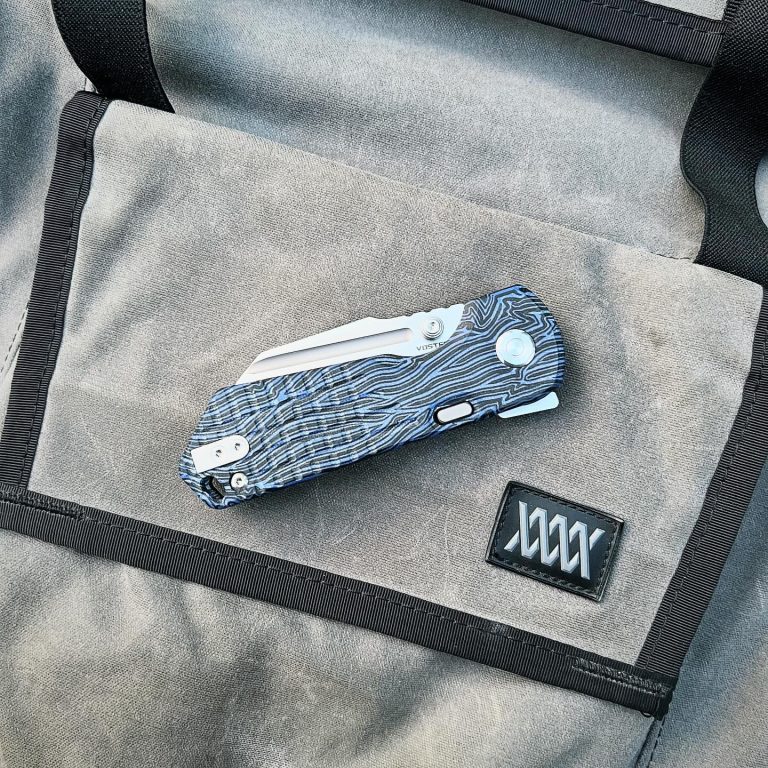


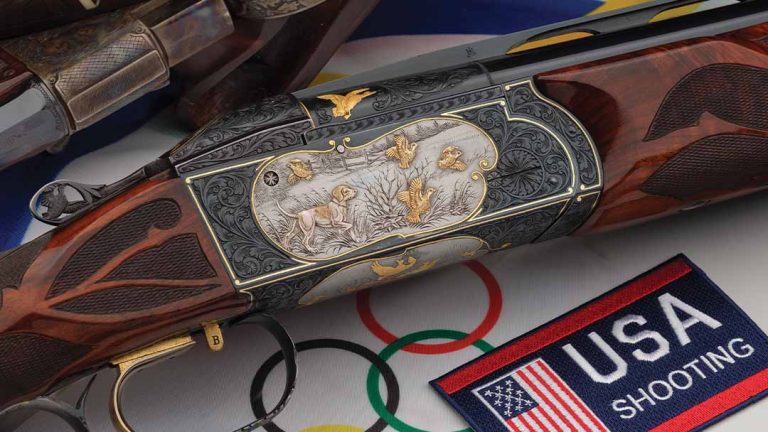


 This remarkable Winchester Model 1873 One of One Thousand has high condition, provenance and factory engraving.