
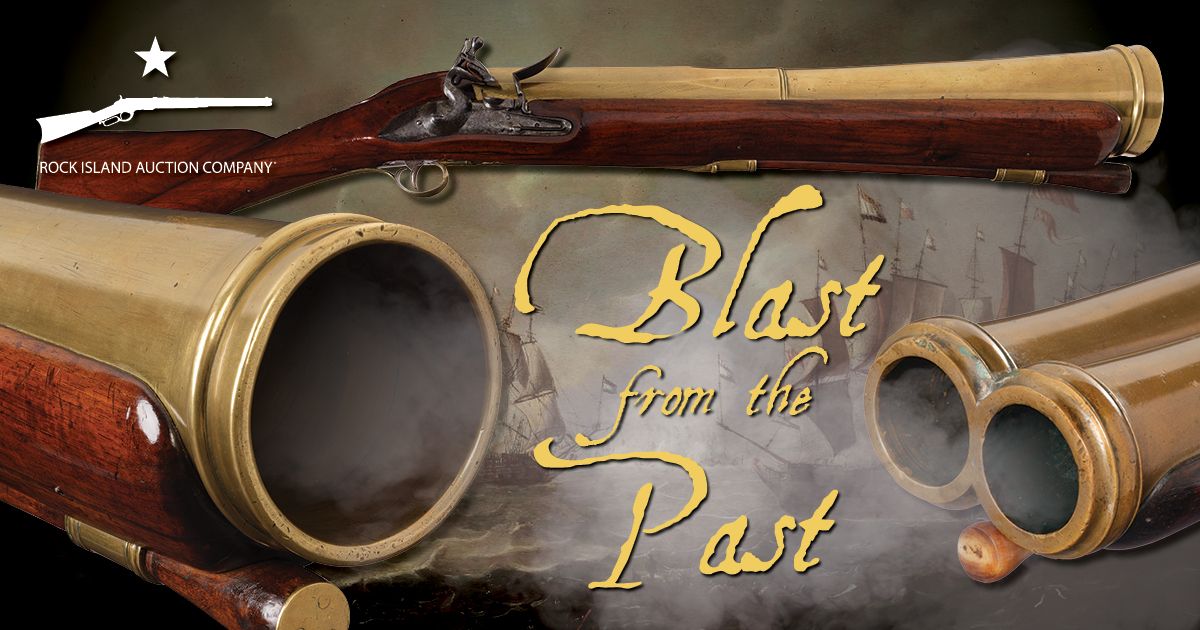
The blunderbuss is among the most iconic of all muzzleloading firearms, with their distinctive bell shaped muzzles they have long been associated with pirates and Pilgrims in popular culture. If you have seen any pirate film or series, you are sure to have seen multiple blunderbusses in use, often with exaggerated power. They also appear in a fair number of representations of warfare in the colonial and Napoleonic eras.
WIth its easily recognizable look and romantized associations, the blunderbuss has captured the attention of arms collectors for generations, and Rock Island Auction Company has a steady supply in a wide variety of configurations, including some absolutely massive examples that are sure to make a statement in any gun room. Take a look at some offerings of the blunderbuss in the Dec. 6-8 Premier Auction in Bedford, Texas.
What is a blunderbuss?
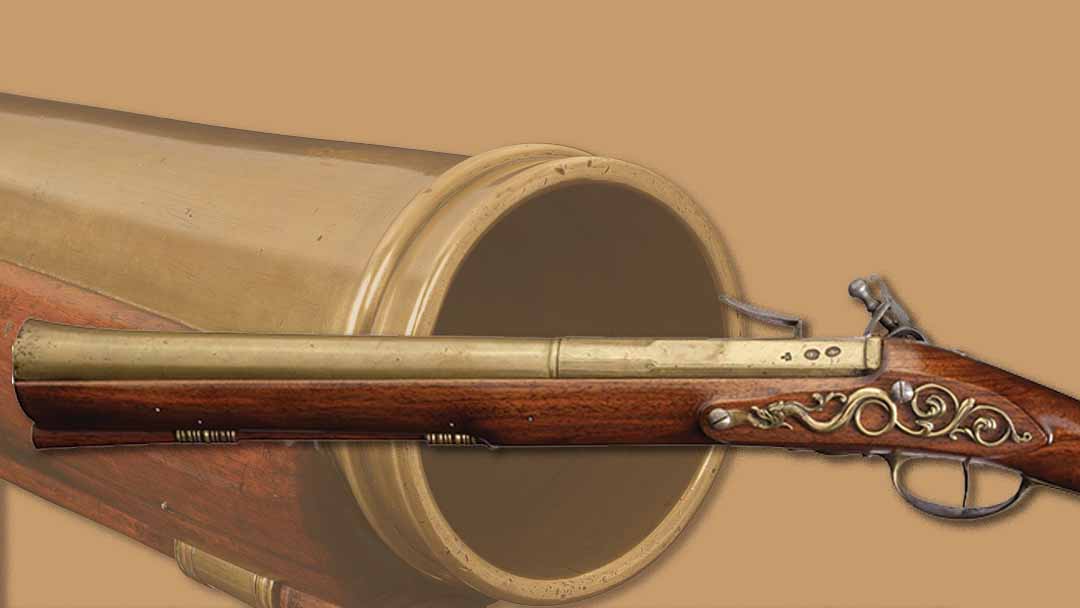
The exact definition of a blunderbuss gun varies from source to source. A New General English Dictionary from 1751 defines a blunderbuss as “a short gun, the barrel of which is commonly made of brass, and has a large bore; also a careless, negligent, heedless person.” Samuel Johnson in 1768’s The Dictionary of the English Language defined a blunderbuss as “A gun that is discharged with many bullets.” The following year, Nathan Bailey wrote in An Universal Etymological English Dictionary that a musketoon was “a blunderbuss, a short Gun of large Bore carrying small Bullets.” George Crabb in A Dictionary of General Knowledge from 1830 defined a blunderbuss quite simply as a “short brass gun with a large bore.”
In essence, a blunderbuss is a smoothbore firearm with a barrel that flares towards the muzzle, but can vary widely in terms of their overall design. The vast majority are flintlocks, though a small number were produced during the percussion era. Barrel lengths are similar in length to a tactical shotgun of about 14 to 18 inches. Some, particularly earlier versions are much shorter, and the shorter varieties and carbines are sometimes known as musketoons but like blunderbuss the definition can be wide-ranging. There were also blunderbuss pistols produced.
Who invented the blunderbuss and the precise origin of the term remains up for debate, but the most common theory is that the term originates from “dunderbuschse” or “donderbus” (German and Dutch respectively for thunder gun).
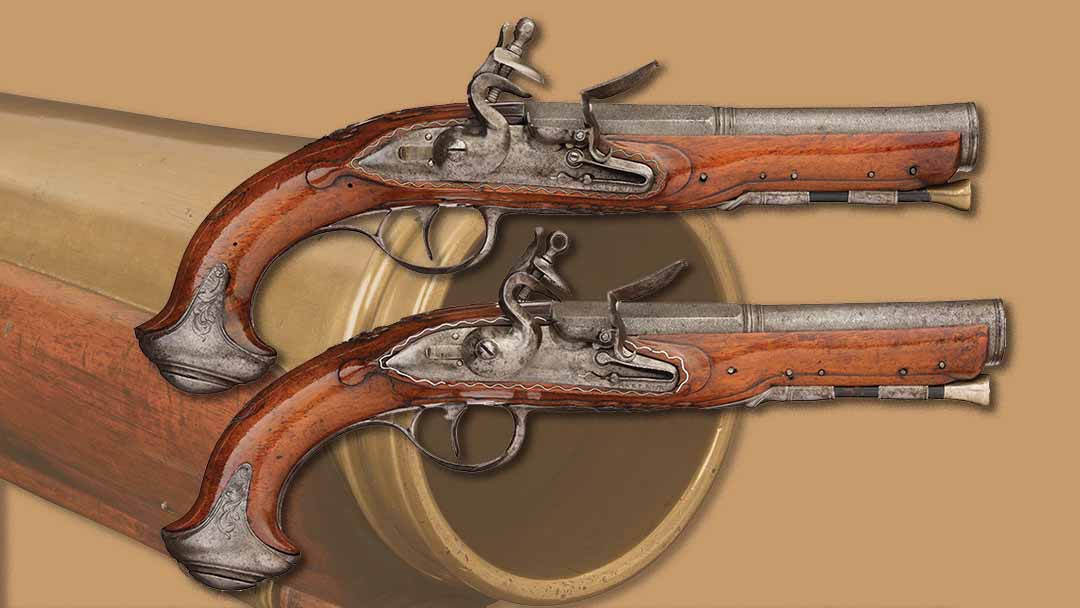
Blunderbusses have been around since around the 16th century and would have originally been matchlock and wheellock firearms, becoming more prevalent in the late 17th century and 18th century in the flintlock era. The majority of examples found today date from 1750 to 1830, mostly originating from England as well as occasional examples from Continental Europe and the distinctive short “knee” blunderbusses from the Ottoman Empire. Despite their pop culture association with the Pilgrims, these guns don’t appear to have been common in the American colonies or early United States.
Blunderbuss Design
The actual bore diameters and the designs of the taper in the barrels varied widely and produced a number of patterns. Firearms historians and collectors tested the effects on bore designs and concluded that the blunderbuss barrel design created a larger pattern than a straight barrel of the same bore size. The type of load also dramatically affected the pattern. In addition to a larger spread of the shot and making it more likely to hit one or more adversaries with a single pull of the trigger, the large muzzle opening of the blunderbuss also acted as a funnel making it easier and faster to load powder and shot which would be particularly helpful while loading on a moving ship or on horseback.
It is often claimed that a blunderbuss could be loaded with just about anything on hand from rocks, chopped nails, glass, and other random bits, but such atypical loads could damage the barrel. The jagged nature of these projectiles could mar the bore or even create an obstruction, bursting the barrel. Most of the time, blunderbusses were loaded with small shot, buckshot, pistol balls, and/or musket balls. If there was powder on hand to load the blunderbuss, lead was also probably available as well. There were likely exceptions to this such as in the heat of battle where a man might have lost his ammunition but still had powder.
Period accounts of blunderbusses tell of how they often appeared in the hands of criminals concealed beneath a coat. However, they were also owned by those seeking to use them as a defensive weapon. Accounts mention them being loaded with a number of “leaden bullets” or “lead slugs” of varying quantities. Some specifically noted that the blunderbusses in the incidents were loaded with “small shot,” others with a small number of leaden balls or slugs indicating larger shot, while some accounts report only the powder charge kept at the ready in the barrel. In the latter case, the shot could be quickly loaded when needed.
Blunderbuss Variations
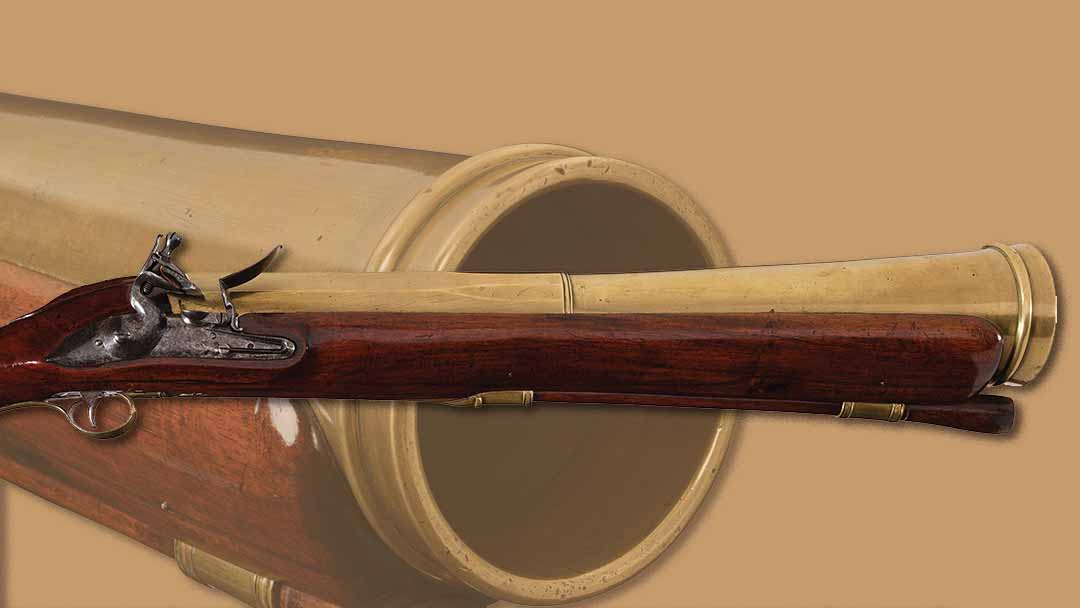
There are several fairly distinctive variations of the blunderbuss. Many we see today are blunderbusses produced for the private market as defensive weapons. These are often known as coach guns or coaching guns, used to defend coaches from highwaymen targeting the coaches of wealthy gentlemen as they passed through isolated areas of the English countryside. Some are very ornate and feature high end engraving, figured stocks, carving, and other embellishments for wealthy clients. Highwaymen themselves also often employed blunderbusses in committing their crimes, perhaps after securing them in earlier holdups.
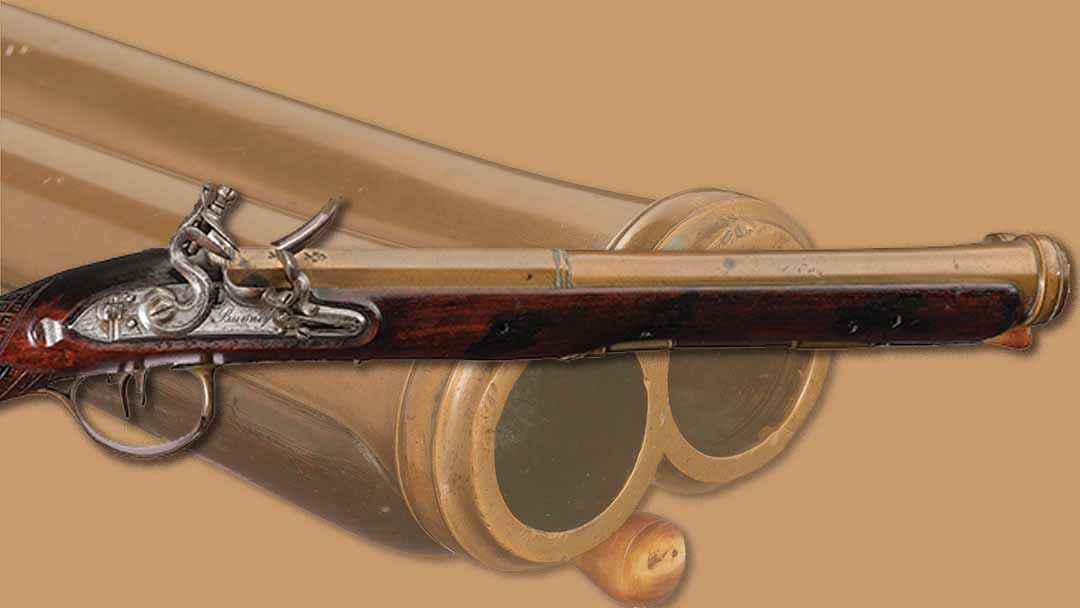
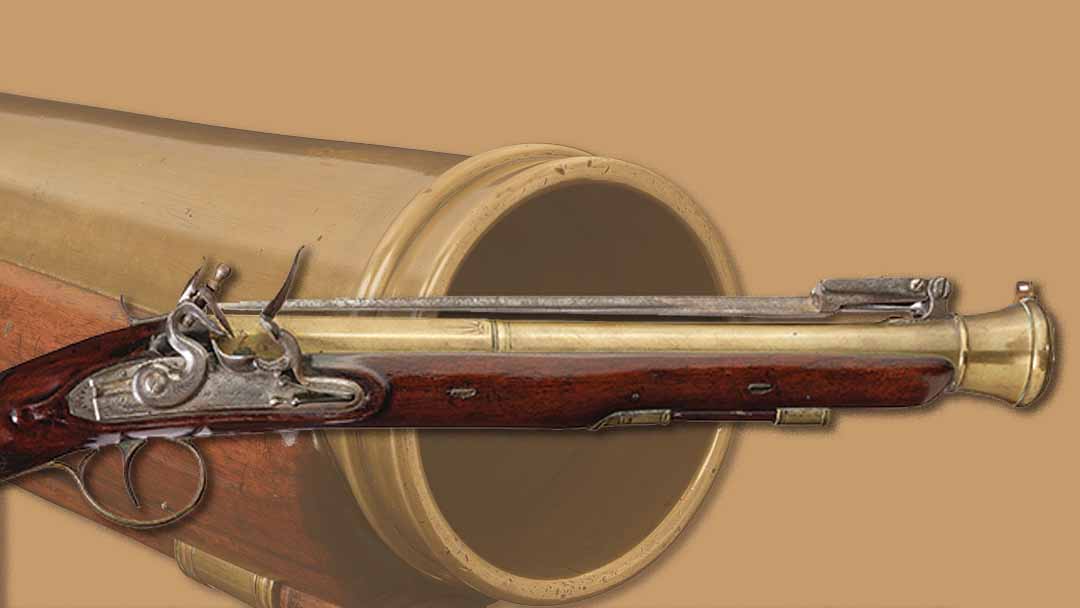
As a secondary means of defense, many civilian blunderbusses at the end of the 18th century and into the early 19th century have folding “snap” bayonets. The most common variety has the bayonet on a hinge near the muzzle and folding with the blade tip secured by a sliding latch/release on the barrel tang. Some varieties have the bayonet on the underside and use a sliding trigger guard to secure the blade in the folded position or a secondary trigger with a sliding catch. A small number feature side folding bayonets, and in rare cases, these bayonets are secured by the cock on the lock so that when the blunderbuss is fired, the bayonet automatically swings open.
Compared to civilian versions, military blunderbusses tended to be nondescript English military blunderbusses had furniture similar to the Brown Bess muskets of the same era, and their stock styling and other details tend to be very similar. Most of the military blunderbusses from the U.K. feature brass barrels, but there were iron-barreled blunderbusses that were more common in Continental Europe and the Ottoman Empire.
In addition to the normal shoulder-fired military blunderbusses, there were also oversized swivel mounted blunderbusses that helped cover an area between small arms fire and artillery. These “swivel guns” often look like a supersized blunderbuss with particularly large bores. They could spray shot to repel boarders in naval battles and could also be used as signal guns. They were also used inland on fortifications, and Lewis and Clark and the Corps of Discovery utilized swivel guns during their exploration of the West and often fired them as a salute.
As the blunderbuss faded out, stagecoach and railway agents in the Wild West were often armed with double barrel shotguns – also known as “coach guns” — and revolvers to defend against attacks. The increasing popularity of double barrel shotguns led to the demise of the blunderbuss. There were even a very small number of double barrel blunderbusses, but they are very rarely seen.
Blunderbusses for Sale
Rock Island Auction Company is the world’s leading firearms auction house for antique and collectible firearms, including blunderbusses from around the world. Blunderbusses are available throughout the year in our various auction formats with examples up for auction at price points suited to any collector. Be sure to check out the online catalog for the upcoming December 6-8 Premier Auction for more details on the blunderbusses featured in this article and definitely keep an eye out on our future auctions in 2025!
Sources and Further Reading
● Flanagan, Melvin. “Myths of the Blunderbuss.” American Society of Arms Collectors Bulletin96 (2007): 59–66.
● Neumann, George C., and George C. Woodbridge. The History of Weapons of the American Revolution. New York: Bonanza Books, 1967.
● Suydam, C. R. “Some Variations of the British Coaching Blunderbuss.” American Society of Arms Collectors Bulletin 31 (1975): 2–23.