Gun Collection Must Haves | Rock Island Auction

0

Whether you’re buying your first gun or deciding which pieces to add to your collection, there’s always more to learn in the world of arms collecting. From matchlocks to military pistols and everything in between, we’ll take a look at some of the absolute gun collection must haves that every determined firearms fan should own.

RIAC’s May Premier Firearms Auction includes some of the finest treasures in gun collecting.

Featuring a host of examples from some of the most storied gun collections in the world, Rock Island Auction Company offers arms that cater to every level of the collecting pursuit. The pieces below are just a snapshot of what the company’s May 17-19 Premier Firearms Auction in Bedford, Texas has to offer.

Rock Island Auction Company features quality gun collection must haves from every firearm genre.

The M1911 Pistol

When you think of the most American guns, the M1911 probably ranks high on the list. And why shouldn’t it? “Old Slabside” is the longest-serving sidearm in U.S. military history and the pistol that helped the United States become back to back World War champs. The 1911 genre is wildly popular, and every great gun collection should contain at least one original 1911.
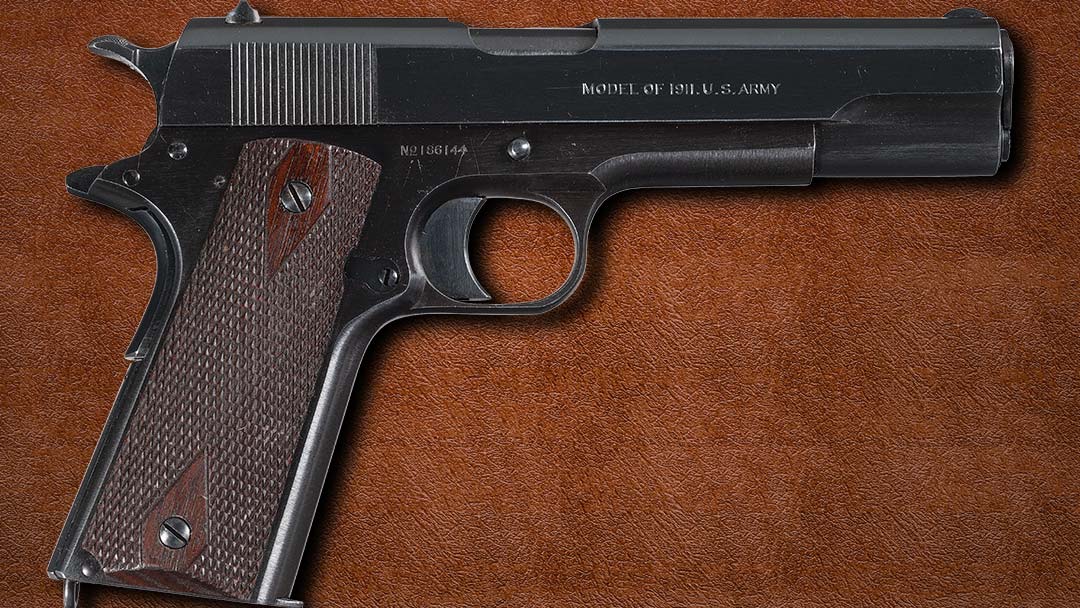
One of the most collectible Colt 1911 pistols offered this May, a documented WW1 U.S. Marine Corps contract Colt M1911, a must have gun for any Colt or U.S. military collection.

After serving with distinction in WW1, the M1911 design pioneered by John Moses Browning underwent a series of small refinements intended to make the .45 ACP handgun even easier to shoot. These included a shortened trigger, extended hammer spurs, simplified checkered grips, an arched mainspring housing, a thicker front sight, and angled clearance cutouts.

Designated the M1911A1, no major changes were made to the 1911’s internals, testifying to the pistol’s exemplary performance record. As the most widely carried American pistol of WW2, the M1911A1 is a gun collection must have for any US military aficionado. The Singer 1911 pistol below represents one of the rarest and most desirable pieces in the gun collecting pursuit.

A rare and highly desirable unserialized WW2 Singer Manufacturing Co. prototype/presentation model 1911A1 with a unique factory polished, in-the-white finish. Available this May.

The continued popularity of the 1911 pistol and its variants is reflected in the genre’s impressive price growth in recent years. When it comes to design, reliability, customization, historic pedigree, and iconic silhouette, the 1911 pistol design has few rivals, and modern examples like the Kimber DET-1 1911 demonstrate the timeless quality if this tried-and-true platform.

Manufactured in the early 2000s, the Kimber DET-1 example below was one of a small number manufactured by Kimber on contract for the U.S. government which were intended to be issued to the newly formed Marine Corps special operations unit called Detachment One. Only 150 of 350 examples survive today, making them one of the rarest of the rare in the world of 1911 collecting.
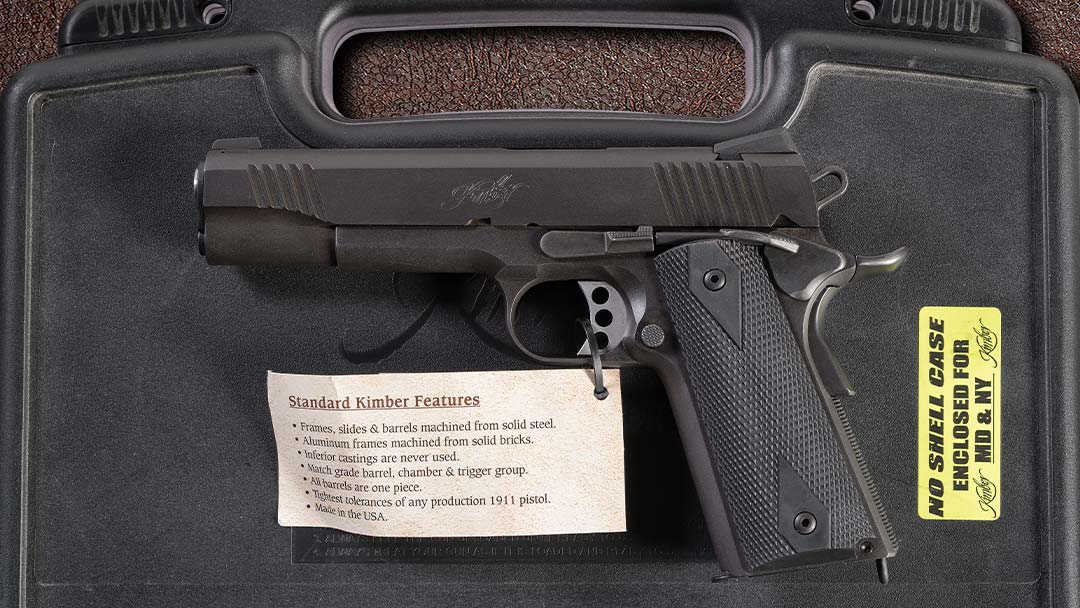
A must have gun for the modern 1911 fan, an extremely scarce documented U.S. Marine Corps Kimber DET-1 1911 pistol with case. Available this May.

Old West Revolvers

Everyone loves Old West guns, and RIAC’s bounty of gun collection must haves includes a wide assortment of authentic Wild West sixshooters. Leading the lineup is the Colt Single Action Army revolver, a wheelgun on everyone’s wishlist. Hollywood’s favorite Western handgun served as the choice sidearm for countless lawmen, desperados, homesteaders, and cowboys who braved the frontier, and May’s selection carries numerous examples of the storied revolver offered at attainable price points.

An outstanding David F. Clark inspected Colt Single Action Cavalry Model revolver with a factory letter and a Gold Seal Kopec letter, a pinnacle piece for any gun collection. Available this May.

Early percussion Colts like the Colt Dragoon are another gun collection cornerstone. Known by Sam Colt as the “Old Model Holster Pistol,” the Colt Dragoon is a familiar sight to fans of Westerns like ‘True Grit‘ and ‘The Cowboys’. The Dragoon was an improvement on the Colt Paterson and the Walker in several respects, with the Third Model being the final and most prevalent iteration of the American Dragoon revolver.

The classic Colt Dragoon is a must have gun for any antique arms collection. The example above is a fine U.S. marked Colt Third Model Dragoon with a desirable three-leaf rear sight, “four-screw” frame, and shoulder stock.

Another prevalent big iron revolver from the Old West, the Smith & Wesson First Model Schofield single action revolver was designed by Col. George Schofield to improve the S&W No. 3 American for military use, offering greater ease of reloading compared to the Colt SAA. 3,000 S&W Schofields were ordered in 1875 with 5,000 more produced two years later in the Second Model.

Many Schofield revolvers were issued to the 4th, 9th, and 10th Cavalry during the Indian Wars in the American Southwest. Others were delivered to state militias across the country. The Schofield’s quick reloading capability and hefty .45 caliber cartridge made them a favorite to outlaws like the James Gang and law enforcement agencies like the San Francisco Police Department during the time of the Sandlot Riots.

While they’re sometimes overshadowed by Colt, Smith & Wesson revolvers shares the same frontier legacy and are absolute must haves for any Old West gun collection. This U.S. Smith & Wesson First Model Schofield revolver is available this May.

Winchester Lever Actions

Another genre of gun collection must haves would undoubtedly be Old West Winchester rifles. Vintage Winchester lever actions remain as popular as ever today with arms collectors, cowboy shooters, and fans of frontier history. The “Improved Henry,” or what would become known as the Winchester Model 1866, is often hailed as “the first cowboy rifle” and is also the first rifle to bear the fabled Winchester name.

A historic Winchester Model 1866 rifle featuring a presentation inscription to Panther Bill from Buffalo Bill in 1880. Available this May.

As one of the archetypical Wild West guns, the Winchester 1873’s tough frame, stronger chambering, and wide-scale availability helped this legendary Winchester become the rifle that won the West. Ned Crossman, a prolific firearms writer in the early 20th century, wrote that the sturdy Model 1873 “put the name Winchester on the map of the West, trotting along with the equally formidable Colt gun at the belt of the frontiersman.”

From James Stewart’s Winchester ’73 movie to Paramount’s recent 1883 series, the rugged rifle remains one of the most well-known guns of Hollywood, and its real-life history is even more enduring. Needless to say, no frontier gun collection is complete without an antique Winchester Model 1873.

A factory letter for this fantastic and fresh Winchester 1873 shows that it has an octagon barrel, set trigger, factory engraving and gold plating. Available this May.

The Winchester Model 1894 emerged too late to claim the title “Gun That Won the West,” but it certainly kept Winchester’s frontier legacy alive. The Winchester 94’s balance and slim profile made it a favorite walking gun for hunters, ranchers, and law enforcement who appreciated the power and reliability of Winchester’s .30-30 WCF smokeless cartridge. The classic lever gun’s accuracy, simplicity, and rugged resilience added up to an ideal big-woods whitetail gun, and more than a century later the venerable rifle has become one of the most memorable pieces of Americana.
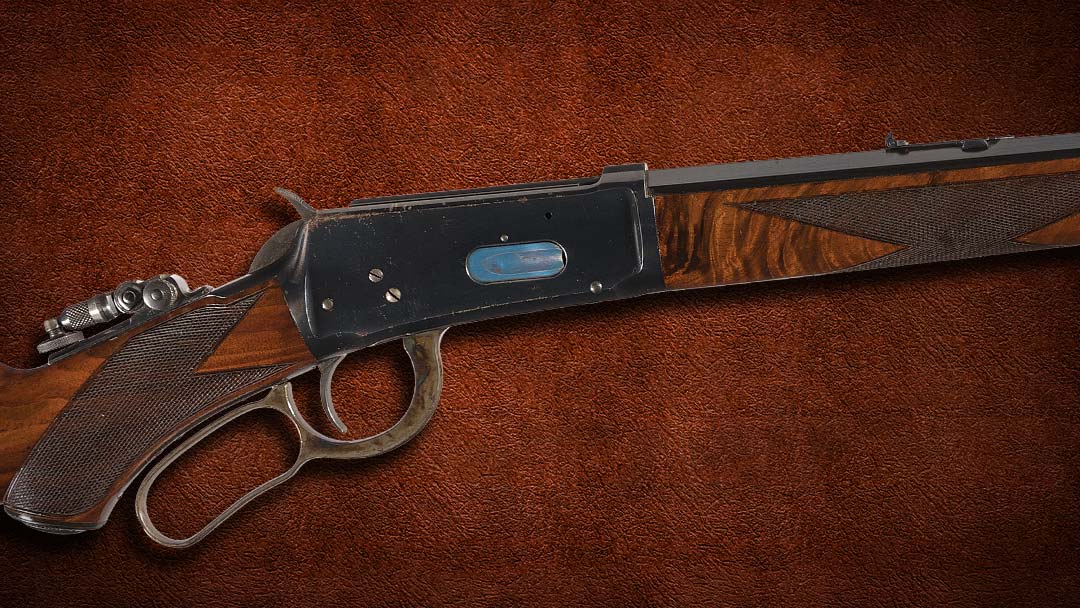
An exceptional antique Winchester Deluxe Model 1894 rifle with its factory letter, a fine piece to add to any gun collection. Available this May.

WW2 Guns

General George Patton once hailed the M1 Garand as, “the greatest battle implement ever devised.” Fielded by millions of American GIs from 1936 to 1959, the M1 Garand served as the standard United States infantry rifle, and it continued to see use as late as the Vietnam War. Nearly a century after gun inventor John Garand first started developing the storied rifle, the M1 Garand is more popular than ever with shooters, collectors, and WW2 arms enthusiasts, and the rifle is an absolute must have gun in any U.S. military collection.

Rock Island Auction Company offers a range of M1 Garand’s for sale this May. This exceptional WW2 US Winchester WIN-13 M1 Garand is a fantastic addition to any WW2 gun collection.

The WW2 Model 1941 Johnson semi-automatic rifle was seriously considered by the U.S. Army and Marine Corps as an alternative to the M1 Garand in 1941. Although the Army never officially adopted the Johnson rifle, after the fall of the Dutch East Indies to Japan in 1942 some of the Dutch contract Johnson rifles were obtained by the Marine Corps and issued to the Marine Parachute and Raider Battalions for use in the early island hopping campaign in the South Pacific in 1943. With fewer than 21,500 manufactured, these scarce and intriguing rifles represent rare opportunities for WW2 gun collectors.

A Johnson Model 1941 Semi-Automatic Rifle with U.S.M.C. style modified sights, a must have WW2 rifle for any military gun collection. Available this May.

79 years on, and the legacy of WW2 looms larger than ever in the public consciousness. Adding arms and militaria from the Second World War to a gun collection is a way to honor the exceptional men who carried, wore, and won these items in their fight to defeat the Axis powers. Captured German and Japanese arms were viewed as valuable war trophies for the Allies, and these “bring back guns” are considered some of the most desirable pieces in the gun collecting community today.

An exceptional WW2 field captured Imperial Japanese Kokura Arsenal 23rd series Type 99 bolt action rifle with shipping crate, bayonet, and artifacts attributed to a U.S.M.C. veteran. Available this May.

Rock Island Auction offers no shortage of options for gun collection builders looking to add some sniper rifles to the mix. From the Mosin Nagant, the Walther G41, the Kar98k, the Mauser 98, the British Lee-Enfield, and more. Sharpshooting rifles evolved in the late 19th century and WW1, with improvements to telescopic sights making their WW2 counterparts even deadlier.

An extremely rare, documented German SS Proofed WW2 Steyr “bnz” code K98k double claw bolt action sniper rifle with scope. Available this May.

The Walther PPK, or “Polizeipistole Kriminalmodel,” is a scaled-down variant of the Walther PP that has become an absolute gun collection must have. The PPK became the more popular model before, during, and in the years following WW2. The PPK below is a fine example of WW2 production that features high quality leafy scroll engraving, extensive gold finish, and “Eagle/N” proofs on the slide and muzzle.

An engraved, cased, gold finished WW2 Walther PPK pistol with two matching magazines. Available this May.

The Nambu line of Japanese semi-automatic pistols was created by their namesake Kijirō Nambu, a legendary gun inventor. Trying to compete with smaller, more compact pistols from Europe and America, the “Baby Nambu” was a scaled-down version of its two predecessors, the Grandpa and Papa Nambu pistols. Only 6,500 Baby Nambu were made, almost all of which were privately purchased by senior Japanese officers, making these rare sidearms a tempting item to add to any 20th century gun collection.

An excellent Tokyo Arsenal Baby Nambu pistol rig with matching magazine and holster, a must have gun for the WW2 buff. Available this May.

WW1 Guns

The distinctive Luger is often called the most famous pistol in modern warfare. Manufactured in numerous variants, George Luger’s creation was one of the most widely carried sidearms of WW1 and beyond. Captured Luger pistols were considered valuable war trophies for the Allies, and it’s no surprise the desire to own one of history’s iconic pistols continues today in the gun collecting community.

As one of the most recognizable pistols in history, the Luger is an absolute gun collection must have. Available this May.

Trench guns have a larger-than-life reputation for their slam fire heroics in WW1, with the Winchester Model 1897 shotgun leading the charge for the United States. As America prepared to enter the Great War, General John Pershing recalled the effectiveness of the Winchester shotgun in the Philippines and envisioned how they could be wielded in the trenches of Western Europe. These incredible military shotguns lived up to their reputation on the battlefield and have become one of the gun collecting world’s rising stars today.

One of the finest known U.S. Army documented WW1 Winchester Model 1897 slide action trench shotguns with a Winchester M1917 bayonet. Available this May.

The Springfield 1903 is another absolute gun collection must have for every military collector. Based on the German Mauser bolt action, the 1903 rifle became a cornerstone of accuracy and rugged resilience. Many early 20th-century rifles like the Springfield 1903 are still carried by hunters and shooters today, including thousands of sporterized examples, a testament to the character and craftsmanship of these timeless designs.

A historic documented U.S. Springfield Model 1903 Mark I rifle fitted for presentation to the Mayor of Springfield by the Springfield Armory, a must have gun for any complete firearms collection. Available this May.

The Mauser C96 self-loading pistol is another unquestionable gun collection must have. Known as the Broomhandle, the Pistole 7.63, and many other slangs and designations, the C96’s unique silhouette makes it a standout sidearm with collectors and a favorite in Hollywood, featured onscreen in period dramas like Peaky Blinders and serving as the basis for Han Solo’s DL-44 Heavy Blaster, perhaps the most eminent of all Star Wars guns. Though a highly sought-after collectible, quality examples of the Mauser C96 can still be found at attainable prices.

A WW1 Imperial German Mauser Red 9 broomhandle pistol rig with a matching numbered shoulder stock. Available this May.

Civil War Guns

Perhaps the most famous Civil War repeating rifle, the New Haven Arms Co. Henry rifle is a must have genre for Winchester fans, history lovers, and gun collection completionists. These trailblazing lever actions were chambered for the .44 Henry rimfire cartridge, 15 of which were kept within a tube magazine located under the barrel, offering an unprecedented rate of fire for the era.

Many other Henry rifles were acquired by individual soldiers during the Civil War, often veterans using a portion of their re-enlistment bonus to obtain the expensive firearm. With only roughly 13,000 Henry rifles manufactured, these historic guns are a hot commodity in the collecting world.

Henry rifles are must have guns for every 19th-century arms collection. This exceptionally engraved, Civil War martially inspected rifle is identified to a member of the U.S. 3rd Veteran Volunteer Infantry. Available this May.

The Colt Model 1851 Navy was one of the most prevalent sidearms of the Civil War and the most common revolver carried by the Confederate forces. Indeed, the 1851 Navy became the basis for numerous Confederate produced brass-frame revolver styles like the Griswold & Gunnison Revolver and the Leech & Rigdon revolvers.

Building off of the successful Colt 1849 Pocket percussion, the Colt 1851 Navy was a personal favorite of Samuel Colt and a preferred sidearm for Western legends like Wild Bill Hickok and Buffalo Bill Cody, and the sturdy sixgun continued to see widespread use long after the Civil War. Today, the Colt Model 1851 Navy is one of the most desirable gun collection must haves from the antique revolver genre.

A spectacular cased early factory engraved Colt Model 1851 Navy revolver passed down through the family of prominent Southern Episcopal priest Francis L. Hawks and Captain Francis T. Hawks of the Confederate Engineer Corps. Available this May.

Popularized recently by Quigley Down Under, the various Sharps rifle and carbine models manufactured from the Antebellum Era through the late-19th century were some of the most renowned firearms of the American frontier. Sharps were well-trusted for their accuracy and reliability during the Civil War, and the Union purchased approximately 80,000 Sharps carbines and almost 10,000 rifles.

Specially ordered Sharps rifles were fielded by the 1st and 2nd U.S. Sharpshooter Regiments (the Berdan’s Sharpshooters) to great effect. They were later produced for centerfire metallic cartridges and were manufactured in a dizzying array of configurations through the decades.

The Sharps rifle is another gun collection must have for lovers of Civil War and frontier history. This exceptional Civil War U.S. Sharps New Model 1863 saddle ring carbine is available this May.

Revolver? Shotgun? Why not two-in-one? Some of the coolest guns came out of the Civil War era, and this unique Confederate revolver was no exception. The LeMat revolver stored nine black powder pistol rounds with an additional smoothbore “grapeshot” barrel below.

This unconventional design offered the LeMat two distinct firing modes that could be alternated by toggling a movable firing pin on the hammer. Surviving LeMats are comparatively scarce due to their limited production run and heavy use during combat, making examples like the revolver below absolute gun collection must haves.

A Second Model LeMat revolver. The revolver and sword are accompanied by a Sons of Confederate Veterans certificate indicated that the consignor was a descendant of Corporal Giovanni Batta Rossi of Co. F, Cazadores Espanoles, Louisiana Militia. Available this May.

Combining a rolling breechblock with a seven-shot tubular magazine in the buttstock that was cycled with a lever action, the Spencer rifle and carbine offered an unprecedented level of firepower during the Civil War. Millions of Spencers went West following the war, becoming one of the favored longarms of frontier scouts, Indian fighters, and some of the Native American warriors they faced. The Spencer’s rich history and innovation makes surviving examples of these fantastic weapons all the more desirable today and a must have gun for military collections.

A Civil War Spencer rifle, another absolute gun collection must have. This excellent U.S. Burnside Rifle Co. Model 1865 Spencer carbine is available this May.

Classic Revolvers

The vaunted Smith & Wesson Registered Magnum was the first production gun to fire the .357 Magnum cartridge and was offered as a high-end, customizable revolver with a focus on quality. Each Registered Magnum came with a registration card that the buyer could mail back to Smith & Wesson to obtain a registration certificate, a guarantee of quality from S&W. Only 5,224 of these premium revolvers were offered. The model’s rarity combined with its remarkable quality marks the Registered Magnum as a must have gun for every revolver collector.

A nickel plated Indianapolis Police shipped Smith & Wesson .357 Registered Magnum revolver, one of only 5,224 sold by S&W between 1935 and 1939 and a true gun collection must have for wheelgun fans. Available this May.

As the “Rolls-Royce of Colt revolvers,” the Colt Python platform is a true gun collection must have that can still be acquired at attainable price points. From the 1970s ‘Starsky & Hutch’ to ‘The Walking Dead‘, the Python’s Hollywood appeal is stronger than ever, and values for vintage examples of this classic handmade Colt revolver have been on an impressive rise in recent years.

A documented factory inscribed “Joe Foss Freedom Special 1” Colt Python Hunter revolver with a factory letter, scope, and case. Available this May.

The original S&W .44 Magnum, the Model 29 was a popular gun collection staple upon its release in 1955, but its depiction in 1971’s ‘Dirty Harry’ propelled the revolver to superstardom. Described by Eastwood as “the most powerful handgun in the world,” the Model 29-2 saw its values soar. The Smith & Wesson Model 29 set off an arms race that continues today with revolvers chambered in titans like the .454 Casull, .460 S&W, .480 Ruger, .500 JRH, and .500 Linebaugh, but the original S&W Model 29 has been elevated to a must have gun for any revolver collector.

An excellent factory engraved Smith & Wesson Model 29-2 DA revolver with case. Available this May.

The Colt Detective Special is one of the most famous early modern factory production snub nose revolvers. The wheelgun was made as a double action with the ability to function as single, used a swing-out frame for faster loading, and was specifically designed for the .38 Special. The classic snubbie is a must have gun for any collection thanks to its history with undercover cops and detectives, as well as Taxi drivers, store owners, and mobsters.

A pair of snub nose .38 revolvers. The Colt Detective Special is gun collection must have for any fan of wheelgun history.

Antique Muzzleloaders

When it comes to gun collection must haves, antique pistols make for some of the most impressive display pieces. Flintlock officer’s pistols were often crafted as matching pairs that carried a higher level of prestige and embellishment compared to the more standard pistols of the lower ranks.

These pistols typically exhibit quality engraving and ornamentation, and surviving examples tend to be well preserved. Antique pistols that include their original box and accessories are particularly valued in the collecting community, and a number of intriguing examples can be found amid RIAC’s extraordinary selection.

Both flintlock rifles and pistols are definite gun collection must haves for every firearm fan, and May’s selection delivers some of the finest examples in the field.

Carried both on land and sea, the unique-looking blunderbuss belongs in any antique arms collection. Drawing its name from the Dutch word ‘donderbus’, or thunder pipe, the blunderbuss is a smoothbore short-barreled long gun with a flared muzzle that was especially useful for defending ships from boarders and carriages from highwaymen.

Much like a modern shotgun, the blunderbuss was designed to deliver a devastating blast of shot or buck and ball at close range. George Washington equipped them to his dragoons late in the Revolutionary War, and other militaries around the world issued the blunderbuss as cavalry weapons through the early 18th century.

A blunderbuss is a definite must have in any antique gun collection. This fine Barber & Boaler brass barrel flintlock blunderbuss with snap bayonet is available this May.

Want to get away from flint and steel ignition? Wheellocks are always unusual and attractive. There is a reason these high art examples are staples of fine arms and art collections in both Europe and the U.S.

A scarce gilt engraved brass barrel wheellock sporting rifle, a gun collection must have for the antique lover. Available this May.

How about we go back to the earliest form of gunlocks with a beautiful matchlock pistol from Japan? To build a truly ‘complete’ antique military arms collection, the matchlock is an absolute essential.

A silver inlaid Japanese Tanegashima matchlock arquebus. Available this May.

Gun Collection Must Haves at Rock Island Auction Company

Aside from the joy of building a fantastic gun collection, firearms can be a rewarding investment, with gun prices seeing an impressive upswing across many genres as the hobby swells in popularity around the globe. From vintage to modern, from new-in-box pieces to guns marked with honest wear, Rock Island Auction Company’s offers a vast selection of gun collection must haves that truly span the centuries.

Two consecutively serialed exhibition quality engraved Winchester Deluxe Model 1886 rifles, a pair of gun collection must haves available this May.

The essential genres featured here just scratch the surface of what the gun collection field has to offer, and we cover every model and genre in depth with gun blogs and gun videos in the Rock Island Auction newsletter. From engineering marvels like the  J. & J. Miller pill lock revolving rifle, the Collier revolver, and the Nock volley gun, antique icons like the Colt 1855, the Colt Lightning, and the C93, 20th century firepower like the SKS, M1 Carbine, MP40, and Thompson machine gun, to modern classics like the SIG Sauer Model P226, H&K P30L, M17, and Beretta 92F, Rock Island Auction Company features history’s most collectible guns.

Modern Military Pistols | Rock Island Auction

0

Just before the turn of the 20th century, the handgun was changing. Hugo Borchardt’s C93 pistol, the Mauser C96, and Luger pointed toward the end of the revolver as a martial gun. John Moses Browning was tinkering toward the inevitable Model 1911.

Wheelguns were being displaced by semi-automatic magazine guns as the military sidearms of the 20th century. Though carried alongside revolvers by the British, Russians and others, these pistols would grow to be mainstays through two world wars and into the 21st century. Rock Island Auction Company will have numerous examples of new military pistols in its May Premier Auction. Let’s take a look at some modern military pistols and a few not so modern pistols.

New Military Pistol: U.S. Marine Corps Kimber DET-1 1911

The U.S. Marines avoided being pulled into the U.S. military’s Special Operations Command (SOCOM) when it was formed in 1987. While the command’s creation brought Navy SEALs, Army Rangers and the Air Force’s Special Operations wings, search and rescue squads and AC-130 gunships under one umbrella, Marine leaders saw their branch already did many of the things the other Special Forces already did.

The Marines were pulled in after the Sept. 11, 2001 terrorist attacks when the Pentagon realized more commandos were needed with the rise of asymmetrical warfare. The Marine commandant at the time, Gen. James Jones ordered a special unit be stood up to study for two years called Detachment One. Marines saw it as a way to slow walk the process of coming under SOCOM, thinking the issue would fade when Defense Secretary Donald Rumsfield left. Rumsfield remained on and Detachment One became Marine Forces Special Operations Command (MARSOC) in 2006 and continues to this day.

Special Forces units have the ability to procure mission-based equipment as needed, and that is how the Marine Corps ordered the Kimber DET-1 1911 pistols. This scarce handgun is documented as being from the U.S. Marine Corps Detachment One where they were used for testing. Two-hundred were ordered and in the initial tests didn’t perform as well as needed so they were destroyed. However, an additional 150 pistols had already been ordered but not issued. Following the testing issues, the second run of 150 guns were offered to people involved with Detachment One. These 150 military 1911s are rarer than the World War 2 Singer 1911 of which 500 were made.

This U.S. Marine Corps Kimber DET-1 1911 is one of two ordered by a former member of Detachment One who states in a letter that it remains unfired. It bears the special serial number “DET1-235” as well as “U.S. MILITARY PROPERTY USMC.”

New Military Pistol: 5th Special Forces Group SIG Sauer P220R

Founded in 1961 and based at Fort Campbell, Ky., the Fifth Special Forces Group has an active history that includes 18 Medal of Honor winners during the Vietnam War, of which nine were awarded posthumously. The 5th SFG was also the first American unit deployed to Afghanistan after the September 11, 2001 terrorist attacks also serving in Iraq and in the Global War on Terror having performed thousands of missions targeting terrorist and insurgent networks.

This Sig Sauer P220R is themed for the 5th SFG with a unique serial number range starting with “5SFG” and slide markings with the unit’s coat of arms laser engraved into the top of the slide and the group’s motto, “DE OPPRESSO LIBER,” and the 5th SFG’s nickname, “THE LEGION,” underneath it. The pistol is one of 200 made by SIG Sauer for the unit.

This SIG Sauer P220R specially marked for the Fifth Special Forces Group has three-dot fixed front and rear sights with tritium inserts, a Picatinny rail and checkered trigger guard.

New Military Pistol: M15 General Officer Pistol

During World War 2 as battle lines became more fluid than in previous conflicts, the U.S. military began issuing sidearms to general officers to protect themselves if they ran into trouble. Beginning in 1944, the Army issued Colt Model 1903 and Model 1908 to generals, and created the General Officers firearm regulations in 1956. Generals must file a report annually that they still have the issued firearm, and can purchase the gun when they leave the service.

The Colt M15, a Colt M1911-A1 modified pistol, became the General Officer pistol in 1972. Just over 1,000 were issued from 1972 to 1982. Modified at Rock Island Arsenal, the gun’s barrel was shortened by about ¾ of an inch and had one locking nut removed. A full-length recoil spring guide was used and sights were enlarged. They received walnut grips with a brass plate bearing the officer’s name.

This M15 General Officer pistol is a prototype with “Serial No. GO” with no following digits on the frame was published on page 121 of “U.S. Military Automatic Pistols 1945-2012,” by Edward Scott Meadows, where it is described as a “General officer prototype with third type slide and serial number markings.” It is one of two in the auction.

New Military Pistol: Beretta M9 General Officer Pistol

When the Beretta 92FS was adopted by the U.S. Military as the M9, it also became the General Officer pistol for the Army and Air Force but had no distinguishing characteristics beyond the G.O. serial number. It was first issued as a General Officer pistol in 1986, a year after its adoption.

This Beretta M9 General Officer pistol was issued to Brig. Gen. Thomas E. Kittler who joined the Air Force in 1984 after serving in the Reserve Officer Training Corps at the University of Illinois. He has served as Chief of Safety, Executive Officer, Squadron Scheduler, Chief of Current Operations, Flight Commander, Chief Pilot, Squadron Commander, Operations Group Deputy Commander, and Vice Wing Commander in his career.

This Beretta M9 General Officer pistol has a blade front sight, notch rear sights and a high polish blue finish with a set of walnut checkered grips adorned by the Hap Arnold wings on the left and the United States Air Force logo on the right. It is accompanied by a Beretta hard case, tag from the USAF gunsmith shop dated “MAR 04 2023” with “B.G. Kittler” in the remarks section, as well as a U.S. Military M9 manual, a black General Officer’s belt, M12 holster, double magazine pouch and trigger lock.

New Military Pistol: SIG Sauer M17 and M18

The U.S. Military wanted to phase out its Beretta M9 as a sidearm and after testing announced in 2017 that the SIG Sauer M17 won the Modular Handgun System competition. The gun, adopted as the M17 is a variant of SIG’s P320 line of striker-fired pistols that can swap out its fire control unit between grip frames of different sizes. The P320 variant was later offered for sale on the commercial market.

This SIG Sauer M17 is documented as issued to 101st Airborne, one of the first units to receive the SIG after its adoption in 2017. This firearm has illuminated night sights, optics mounting point on the slide, “+P” weight recoil spring and Coyote PVD metal finish with coyote-colored polymer. It is accompanied by the original box dated “23-DEC-2019” identifying the pistol as “UDM17-9-SURPLUS” along with two extra magazines, an extra guide rod and action spring assembly, a “M17” marked user’s manual, and an action lock.

A carry-sized version, the M18 was chosen by the Air Force and Navy as their standard service pistol. Both guns are chambered for 9mm. For the Marines, the M18 replaces its Colt M45A1 and Glock M007 pistols.

This SIG Sauer M18 remains sealed in the original blue plastic factory wrapper with its original box, user manual and two sealed 21 round magazines. This firearm is marked with a “TC” prefix serial number only found in U.S. Military contract production.

Portuguese National Guard Contract Luger

Portugal’s Republican National Guard serves as a national security force throughout the country and its territorial seas and is a descendent of the Royal Police Guard that was created in 1801. The Republican Guard came to be after the 1910 revolution when Portugal became a constitutional monarchy. The Guard received this Mauser Model 1906 Luger among a limited manufacturing run of 579 firearms in 1935.

Technically not a new military pistol, this Mauser Model 1935/06 Luger with a holster bears the “GNR” (Guarde Nacional Republicana) monogram on the chamber. Along with the holster, the pistol is accompanied by a cleaning rod, pin punch and a takedown tool.

New Military Pistol: XM9 Trials Star/Colt Model 30 PK

When the U.S. Military went looking for a gun to replace the legendary M1911, it put out a criteria of 85 characteristics that must be met. Nine pistol types were tested, among them were the Star Model 28. Colt expressed interest in partnering with Star on the trials and purchased 20 of the Model 30, a variant of Star’s Model 28, but rejected the Spanish gun after purchasing 20 to review. Colt sold the guns to employees. This pistol is listed by serial number on page 519 of “Star Firearms” by Leonardo Antaris.

This Star/Colt Model 30 PK features fixed white-ramp blade front and adjustable orange-dot tangent rear sights. It is accompanied by the original STAR blue plastic case with manual, cleaning rod and bore brushes.

New Military Pistol: Danish Contract SIG M/49

Denmark’s SIG Sauer M/49 is the company’s all-steel P210 chambered for 9mm. The gun was used by the Swiss Army, designated the Pistole 49, from 1949 to 1975. Adopted about the same time by Denmark, the gun was in service unit it was replaced by SIG’s P320 X-5.

This Danish contract SIG M/49 comes with its blue box marked “SIG P210-DK M-49. The pistol has a fixed blade front and notch rear sights dovetailed into the slide. The slide has a “SIG” proof and the frame is marked “9 mm P m/49” and “Crown/FKF.”

New Military Pistol: Lithuanian Contract FN Hi Power

Late in the 20th century, militaries started looking for guns with double-stacked magazines, like the Walther P38, Beretta 92 or the Browning Hi Power. While most of the double-stacked pistols wouldn’t come along until the 1970s or later, John Moses Browning was developing his gun after completing the Model 1911. He died before completing the final design that was eventually finished by Fabrique Nationale. More than 1.5 million Hi-Powers have been made.

This Fabrique Nationale High Power was made before World War 2 as part of about 5,000 Hi Power pistols made on a Lithuanian military contract. The distinctive “Column of Gediminas” emblem, a national symbol for Lithuania, is present on the top of the slide. the Column of Gediminas can be seen on top of the slide at left.

Definitely Not a New Military Pistol: U.S. Colt Commando

During World War 2, as the United States spooled up its military industries there was a need for guns for non-military guards and police protecting those installations. In came the Colt Commando. The Commando was a parkerized version of the Colt Official Police revolver chambered in .38 Special with a four-inch barrel and plastic grips. The gun was carried by Gen. Dwight Eisenhower and most went to civilian security uses, the OSS and Navy personnel. The two-inch barrel was considered the “Junior Commando.” The two-inch barrel makes this revolver one of only 3,450 believed manufactured during World War 2.

This Colt Commando with a desirable two-inch barrel has “COLT COMMANDO/38 SPECIAL” marked on the left of the barrel and the ordnance “flaming bomb” on the left side of the frame. An accompanying factory letter states the revolver was part of a 1,000 pistol shipment to San Francisco Port of Embarkation, Oakland, Calif., on March 20, 1943.

New Military Pistol for Sale

Some of the pistols mentioned here may be newer than others, but in the vast history of firearms, these are all relative newcomers. They offered new designs or beat out a number of other guns to earn a coveted military contract, making them interesting pieces for collectors. These guns are available in Rock Island Auction Company’s May 17-19 Premier Auction.

Collectible Firearms for Serious Gun Collectors

0

Tanks and Blank.

Rock Island Auction Company’s May Premier Auction features a second round of offerings from the Norman R. Blank Collection and a small curated grouping of heavy armor from the Allan Cors Collection. The auction, May 17-19, also features a fantastic lineup of historic firearms, exceptional sporting guns and an eye-popping array of Class III firearms.

Whether you are looking for something from the Wild West, the lawlessness of the early 20th century, a highly embellished percussion piece or a World War 2 gun, new and veteran collectors can visit our Bedford, Texas venue and examine the guns at our May 16 preview day ahead of the three-day auction.

Cool Tanks

A lifelong hunter and competitive shooter, he has a passion for military vehicles. The first military vehicle he purchased was a World War 2 Jeep in 1982, followed by his first tank in 1985, a Stuart M5A1. His collection has been housed at Aden Field about 50 miles from Washington, D.C., where it is referred to as the Virginia Museum of Military Vehicles, and later as the Tank Farm. A grouping from Cors’ collection will be available in May, led by a rare M41 Walker Bulldog and a highly desirable World War 2 U.S. M3A1 Stuart light tank.

The iconic U.S. M3A1 Stuart light tank available in the May Auction is one of just 4,621 produced by American Car & Foundry and one of 22,750 total of M3 and M5 variants. The Stuart, the Bulldog, and a massive Swiss Centurion battle tank top the sampling of military vehicles available in the May Premier Auction. The offerings includes tanks, armored cars, an ambulance truck and military trucks from the United States, the United Kingdom, Soviet Union, Sweden and Switzerland.

The Stuart, of which a small fraction remain with most in museum collections, were first deployed to the Philippines in 1941 and fought valiantly against the Japanese light tanks. They saw their first major campaign in North Africa with Operation Torch in 1942. The Stuart was also used by the British, and Commonwealth forces as well as Soviets through the Lend-Lease program. The Stuart’s held their own against other light tanks but were vulnerable to the more heavily armed Panzers of the Germans. Still, they performed reasonably well thanks to their speed and reliability.

Great Guns of the Blank Collection

Norman R. Blank was a legendary collector of European fine arms and his collection contains numerous museum worthy pieces including some made for royalty. Many of the pieces from Blank’s collection haven’t been seen publicly in years. An exquisite pair of dueling pistols by Gastinne-Renette graced RIAC’s December, 2023 Premier Auction, realizing $411,250.

More than 30 offerings from the Blank Collection’s beautiful sporting arms and pistols are available including a gold inlaid double barrel rifle of the prime minister of Hyderabad in India and guns from Spain, France, England and Italy with some featuring spectacular gold inlays and silver mounts. These pieces are from legendary gunmakers like Alexander Henry, John Manton, Durs Egg and Holland & Holland and have amazing lineage, conditioning and provenance.

Great Guns: Winning Winchesters

A newly discovered factory exhibition relief game scene engraved Winchester Deluxe Model 1873 with gold plate and inlays is among the top pieces in the May auction. A stunning testament to Winchester craftsmanship in the decorative arts in the late 19th century, this example bears factory floral scrollwork and game scenes including a buffalo, moose and elk.

The marvelous Model 1873 doesn’t stand alone. Fabulous Winchesters abound with a terrific example of a Model 1873 One of One Thousand and an extremely rare factory engraved nickel and gold plated exhibition quality Model 1890, a rare Model 1892 engraved by John Ulrich featuring game panel scenes, and an exceptional Model 1876 in .50 Express.

A factory letter for the fantastic and fresh Winchester 1873 shows that it has an octagon barrel, set trigger, factory engraving and gold plating.

Great Guns: President Gerald Ford’s Long Guns

When we think of presidential vim and vigor, the first name that pops up is Theodore Roosevelt, a long-time outdoorsman and big game hunter, but President Gerald Ford brought manny similar traits to the White House. Ford ascended to office on the resignation of Richard Nixon, was MVP of his University of Michigan football team and once worked a summer as a park ranger at Yellowstone National Park. He was a Boy Scout and achieved his Eagle Scout badge.

As an outdoorsman and president during the U.S. Bicentennial, Ford was presented with highly embellished sporting guns from classic American firearms companies. He received a factory engraved and gold inlaid Winchester Model 21 double barrel shotgun, a factory game scene engraved pair of Browning Model 1885 single shot rifles, and a game scene engraved pair of Ruger No. 1 single shot rifles as the nation celebrated in 1976. President Ford’s Winchester, Browning 1885s and Ruger No. 1s will be on offer in the May Premier Auction.

President Gerald Ford was presented nicely embellished sporting arms during the U.S. Bicentennial. This pictured cased pair of Browning Model 1885 Bicentennial single shot rifles as well as a cased pair of Ruger No. 1 Bicentennial single shot rifles and a Winchester Model 21 Bicentennial double barrel shotgun of President Ford will be available in the May Premier Auction.

Great Guns: Henry and Marlin Rifles

Spectacular Henry Rifles have found their way into the May Premier Auction, including two martially inspected Civil War Henrys, a presentation Henry Rifle and a martial Henry with tack decoration.

The auction also has magnificent Marlins, led by a special order game scene engraved Marlin Model 1881 presented by Buffalo Bill Cody to rancher and guide Jim McLaughlin, and an engraved Deluxe Model 1895 with gold and platinum inlays by Conrad Ulrich chambered in .45-90 with gold and platinum inlays.

This U.S. martially inspected inspected with tack decoration will be available in Rock Island Auction’s May Premier Auction.

Great Guns: Stellar Sporting Arms

A phenomenal trio of game scene engraved Purdey & Sons 28 gauge over/under shotguns and a historic presentation cased exhibition quality Le Page/Moutier double barrel percussion shotgun lead an outstanding lineup of sporting firearms in May Premier.

The Le Page/Moutier, with its relief chiseled embellishment and elaborately carved ebony stock is more museum than grouse hunt. Masterly crafted in 1860 by the legendary gunmaking firm, French president Jules Grevy presented it to Mexican President Manuel Gonzales Flores in 1879.

The Purdey & Sons shotguns are more likely to be the focal point of a gun room than carried into the field, too. The coin-finished action features extensive broad leafy scrollwork and a beautiful game bird scene on the underside of the action that is different to each of the guns numbered 1, 2 and 3. Executed by master engraver Simon Coggins, gun 1 has a pair of pigeons in flight over a field, gun 2 shows a pair of grouse flying through desert scenery that includes cacti and a windmill, while gun 3 has a pair of snipe taking flight from a tree.

More outstanding sporting guns will be available, like a Peter Spode signed and game scene engraved Westley Richards droplock double rifle in .470 Nitro Express, a cased pair of Ivo Fabbri sidelock double barrel shotguns factory engraved by Master Engraver Claudio Tomasoni with the goddess Diana theme, and a game scene engraved and gold inlaid Karl Hauptmann African big five themed sidelock double rifle in .470 Nitro Express.

These fine James Purdey & Sons shotguns are available in the May Premier Auction.

Great Guns: Confederate Revolvers

The Colt Model 1860 Fluted Army of William G. Conner leads a fascinating slate of Confederate revolvers. Among the guns with Confederate provenence are the Colt Model 1851 of prominent Episcopal priest Francis L. Hawks and Capt. Francis T. Hawks, both of the Confederate Engineer Corps, a Griswold and Gunnison revolver, Second Model London LeMat “grapeshot” revolver, an antebellum U.S. contract Colt Third Model Dragoon, and a very scarce Civil War Confederate Spiller & Burr revolver.

Conner, of Mississippi, served in the famed Jeff Davis Legion cavalry unit. His Colt 1860 Fluted Army was an early production Colt that was among 2,300 shipped south shortly before the Civil War, in January 1861. The Jeff Davis Legion was attached to the Army of Northern Virginia under Robert E. Lee and J.E.B. Stuart, and later Wade Hampton.

A plantation owner, Conner was promoted to captain and company commander in October, 1861 and was captured a year later. He was exchanged in a prisoner swap in August 1862 and returned to duty before the Legion fought at Antietam and the Chambersburg Raid. Conner never lost his hatred for the Union after his imprisonment. He was promoted to major in December. At Gettysburg, Conner was the executive officer of the Legion as part of General Wade Hampton’s brigade and granted permission to lead the charge for his hatred of the Union. During a charge on the battle’s third and decisive day, Conner was felled.

In J.E.B. Stuart’s report of the Battle of Gettysburg he writes, “Among the killed was Major Conner, a gallant and efficient officer of the Jeff. Davis Legion.”

This LeMat “grapeshot” revolver and accompanying sword are among the Civil War revolvers available in the May Premier Auction.

Great Guns: Class III Offerings

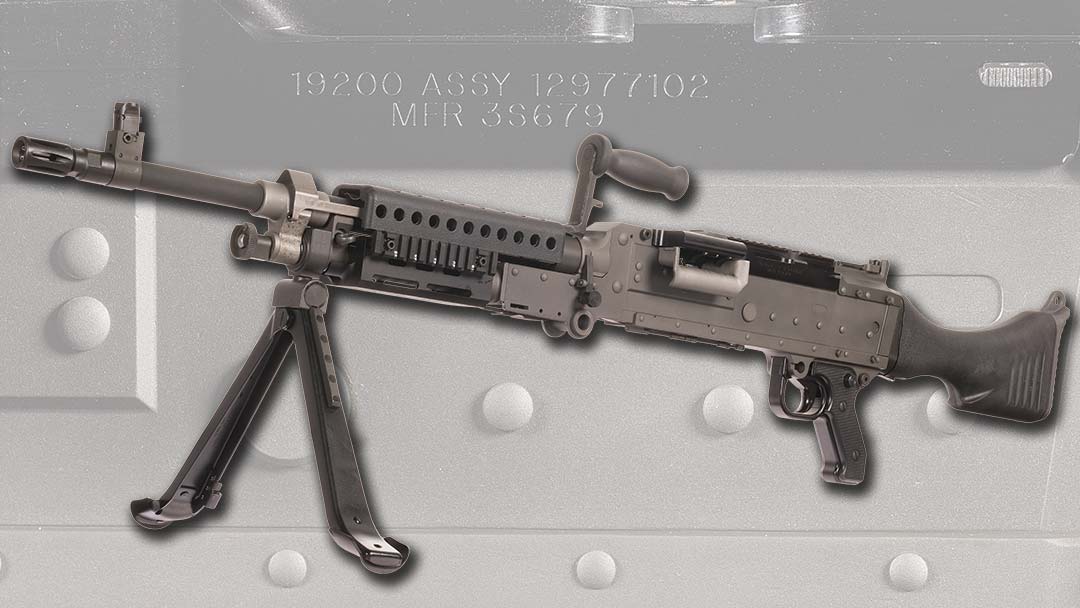
An extremely rare FN Manufacturing M240 general purpose medium machine gun tops a deep field of Class III firepower, joined by several Thompson submachine guns, a Cadillac-Gage Stoner Model 63, M60 general purpose machine guns, and a rare Armalite AR-18 that are just some of the full-auto action to be found in the May auction. Several World War 2 submachine guns will also be available including a MP44 Sturmgewehr rifle, MG34, MP40s and a U.S. Guide Lamp M3.

A M240 general purpose medium machine gun, a Cadillac-Gage Stoner 63 selective fire rifle and several Thompson submachine guns are available in the May Premier Auction.

Great Guns for Sale

Rock Island Auction Company is excited to host its second Premier Auction at its Bedford, Texas location and present such a catalog of fine arms. No matter what they dabble in, collectors will find classic and high-conditioned Colts and Winchesters alongside luxurious European arms that border on artistry, spectacular sporting guns and the rat-a-tat power of Class III weapons. Visit on preview day, May 16, to get an up-close opportunity to examine all of these amazing offerings and rub shoulders with fellow collectors. All of these fantastic firearms and more will be available in the auction, May 17-19.

Collectible Firearms for Serious Gun Collectors

0

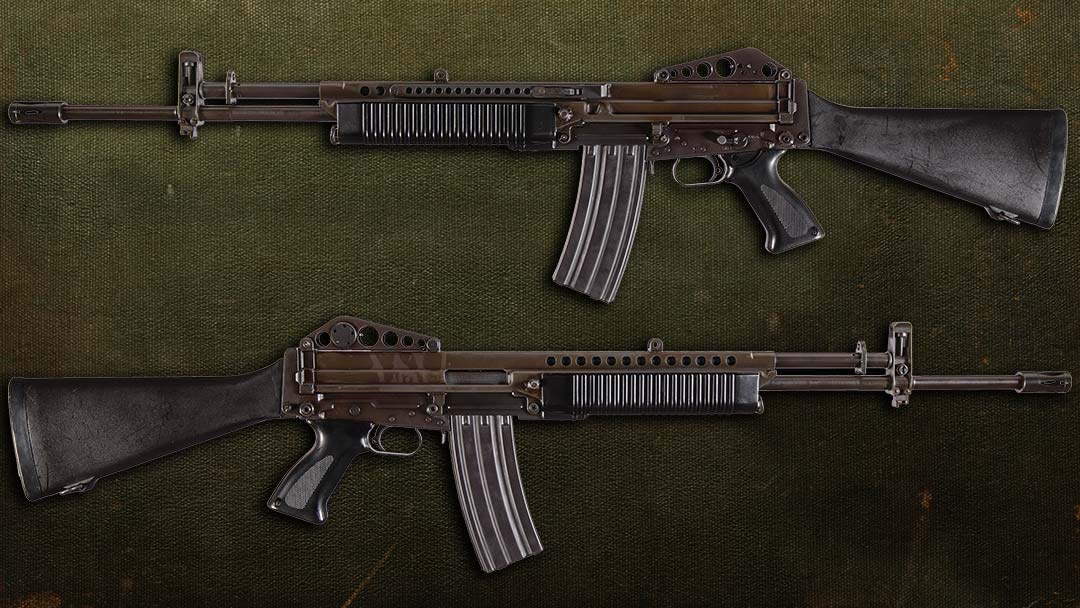
Of the many notable products from the mind of famed American arms designer Eugene Stoner, the Stoner 63 was arguably his most ambitious. This unique modular machine gun platform saw combat for a brief period in Vietnam with the Marine Corps and on a wider scale with the Navy SEALs. Today, the Stoner 63 is one of the most sought-after machine guns available for public sale and an absolute cornerstone of collecting.

A scarce Cadillac-Gage Stoner Model 63 modular selective fire rifle. Available this May.

Rock Island Auction Company frequently features some of the rarest machine guns available to the collecting public, and the company’s May 17-19 Premier Firearms Auction in Bedford, Texas is no exception. In addition to the Stoner 63, pinnacle pieces like the M240, the SACO M60E3, and several rare examples of the Armalite AR-18 platform will be up for bid, along with dozens of other fully transferable heavy hitters to add to your collection.

An M240 general purpose medium machine gun, a crown jewel of arms collecting. Available this May.

The Genius of Eugene Stoner

World War 2 U.S. Marine veteran Eugene Morrison Stoner was a natural engineer from an early age. Stoner took a position with the ArmaLite Division of the Fairchild Engine and Airplane Corporation in 1954 and developed several firearm prototypes, including the groundbreaking AR-10.

Exceptional original Portuguese contract Armalite AR10 rifle previously sold by RIAC for $34,500.

The US Military sought to replace the venerable M1 Garand and Armalite submitted Stoner’s design. The AR-10 was constructed with fiberglass and lightweight aluminum alloys and employed an 8-lug rotary bolt concept and a type of gas operation system that Stoner described as “a true expanding gas system instead of the conventional impinging gas system.”

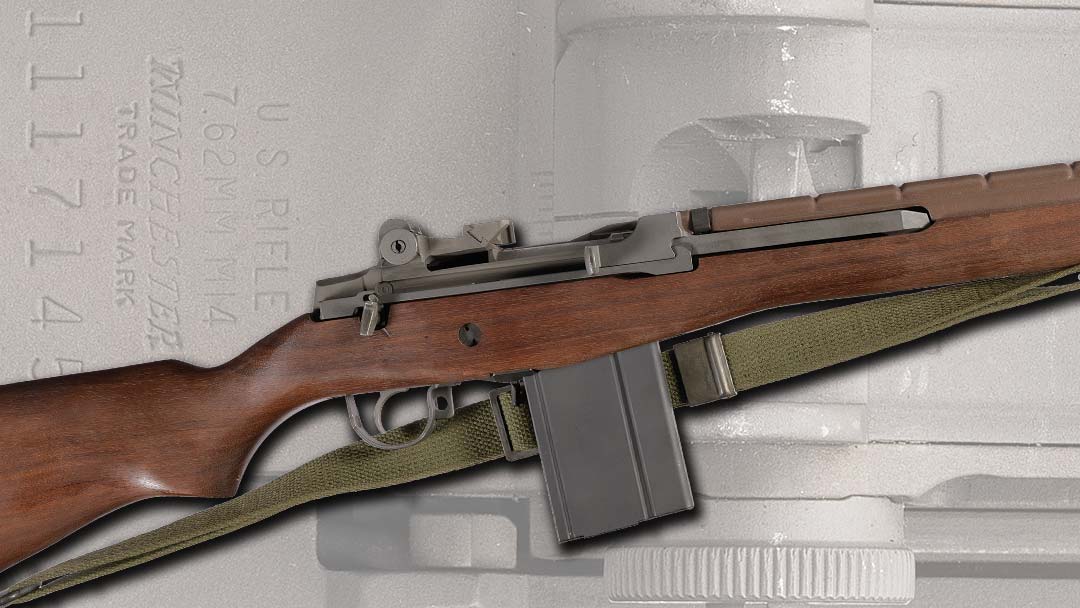
The AR-10 underperformed during 1956 endurance tests, and the military instead chose the M14 as their new battle rifle.

A Winchester M14 selective fire battle rifle. Available this May.

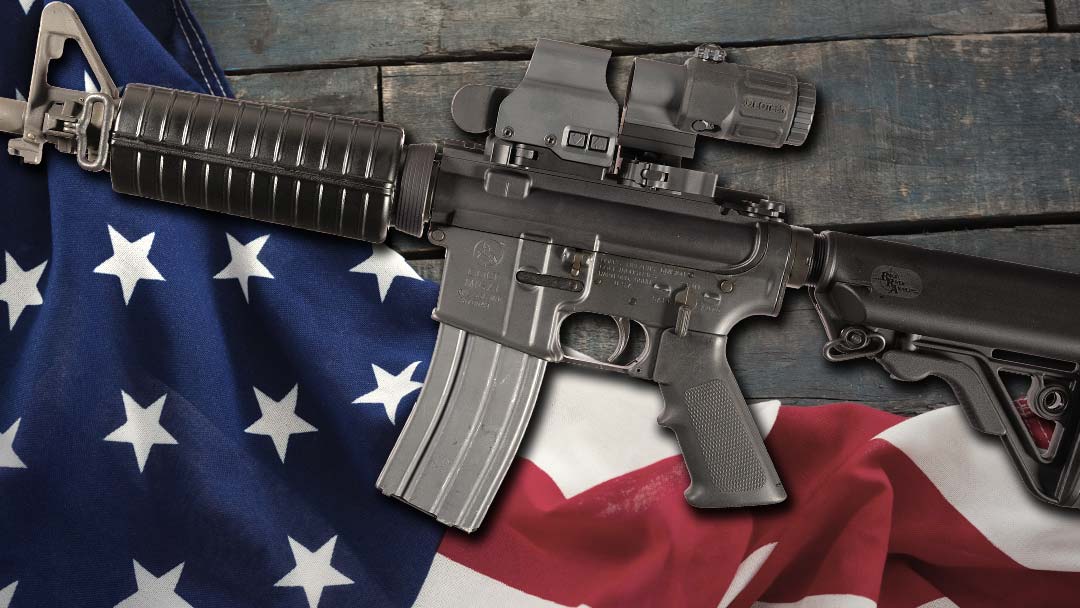
ArmaLite addressed the AR-10’s performance issues and began developing the AR-15, a new .22 caliber rifle that also utilized Stoner’s operating system and similar lightweight materials. Both weapons caught the attention of Colt’s Manufacturing Company, which purchased production rights to the AR-10 and the AR-15 in 1960. Eugene Stoner would briefly become a consultant for Colt in 1961. Two years later, the AR-15 would receive its official M16 military designation.

A Colt M16A1 selective fire rifle. Available this May.

Cadillac Gauge and the Stoner 63

During his time with Colt, Eugene Stoner developed an idea for a modular weapon system consisting of a common receiver group that could be rapidly reconfigured into multiple subassemblies based on the needs of the mission. Stoner took his concept to U.S. military contractor Cadillac Gage and brought on Jim Sullivan and Bob Fremont, who’d both helped Stoner develop the AR-15.

The first iteration of Stoner’s new weapon system was developed in 1962. This incredibly rare Stoner 63 example is available this May.

According to Jim Sullivan, “In 1962, Bob and I joined Stoner again at Cadillac Gage where he was designing the 7.62 mm Stoner 62 rifle and machine gun. The owners of Cad Gage wanted a 5.56 mm model so Bob and I designed the Stoner 63.”

The Stoner 63 was one of the first post-WW2 light machine guns to use a stamped sheet metal receiver, designed so that the core of each weapon could be affordably produced in large quantities. The platform’s quick change barrel system, feed tray, and top cover were similar to the MG42 and later M60 machine guns, but the Stoner 63 took the idea of customization much further.

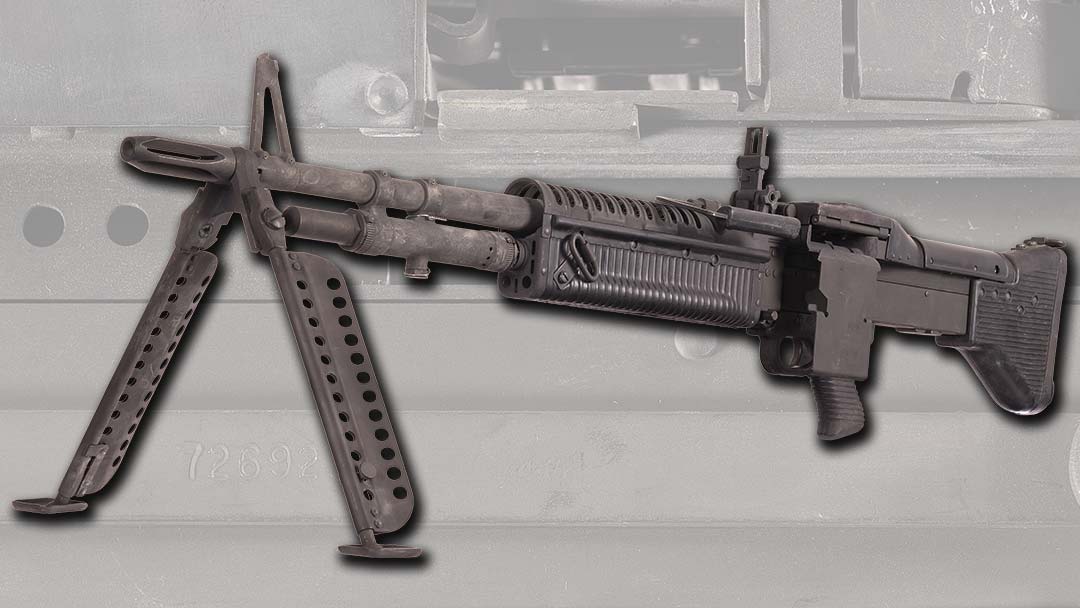
An excellent Maremont/New England Group M60 belt fed general purpose machine gun with accessories. Available this May.

The Stoner 63, a Jack of All Trades

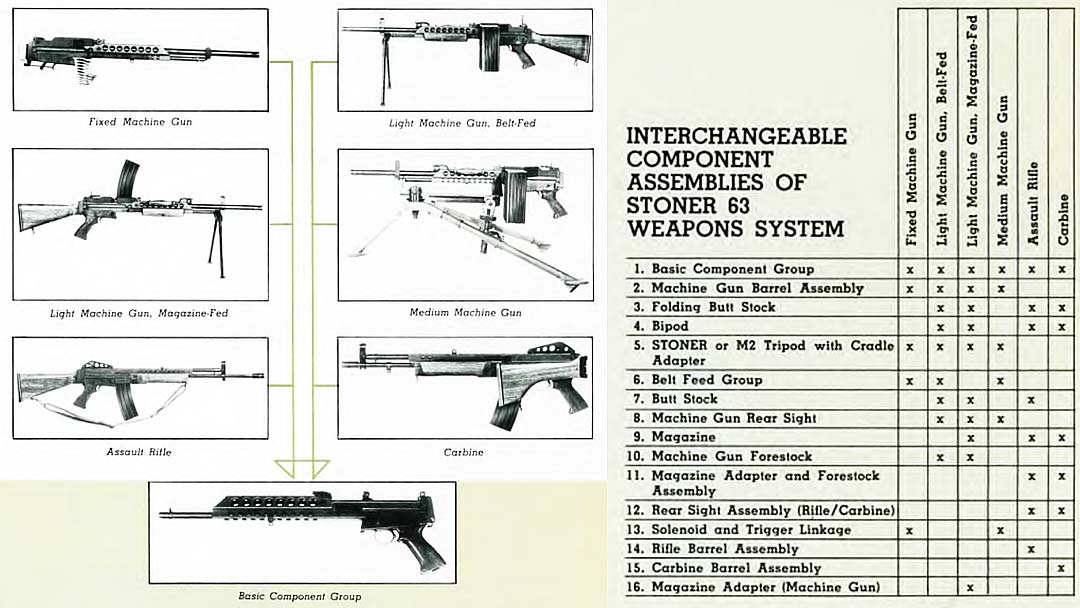
Like a Swiss Army knife, the Stoner 63 attempted to fill every role in a rifle platoon. Advertised as a “complete small arms weapons system” the Stoner 63 could be reconfigured at the user or the armorer level and allowed one man to repair and maintain six separate guns.
According to the Stoner 63’s original sales brochure, “The system comprises six separate arms, all built from one common Basic Component Group: 1) Fixed Machine Gun; 2) Light Machine Gun, Belt-Fed; 3) Light Machine Gun, Magazine Fed; 4) Medium Machine Gun; 5) Assault Rifle; and 6) Carbine.”

Sub-assemblies are joined with a “Basic Component Group” in varying combinations to produce each of the six weapons in the Stoner 63 system. The fixed machine gun cyclic rate reached 850 rounds per minute, while the carbine could fire 660 rpm from a 30 round detachable box magazine.

The weapon’s 16 interchangeable components included the basic component group, machine gun barrel assembly, folding buttstock, bipod, tripod with cardle adapter, belt feed group, buttstock, machine gun rear sight, magazine, machine gun forestock, magazine adapter and forestock assembly, rear sight assembly (rifle/carbine), solenoid and trigger linkage, rifle barrel assembly, carbine barrel assembly, and magazine adapter (machine gun.) Nine of the 16 components were common to three or more weapon configurations.
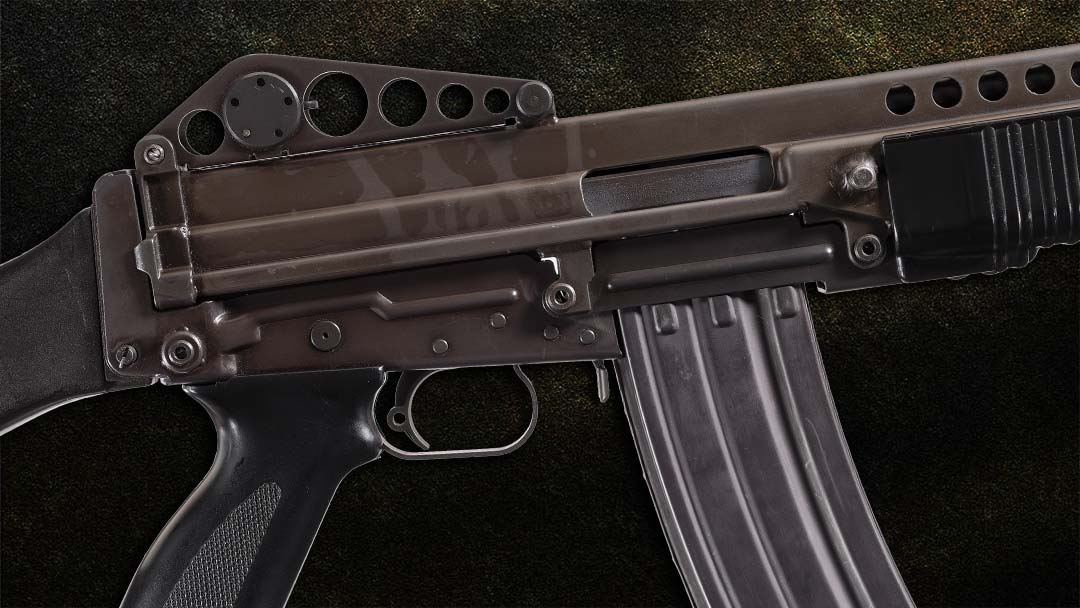
The barrel, forestock, buttstock, rear sight base, and trigger housing could all be removed without dedicated tools. Any Stoner 63 could be quickly repaired by stripping parts from a weapon not currently in use.
The Stoner 63, pitched as a “state-of-the-art advance in modern tactical armament.” Available this May.

The Stoner 63 Put to the Test

Developed with an eye for military sales, the Stoner 63 earned early interest from the Defense Advanced Research Projects Agency, then known as ARPA, in March of 1963. In August, the weapon was demonstrated at the Marine Corps Landing Force Development Center at Quantico, Virginia. Prototypes were ordered by both agencies.

The following year, the Marine Corps published the report ‘Stoner 63 Weapons System.’ Despite noting several flaws, the Stoner 63 was received favorably during testing and the report concluded an improved version of the platform could offer a suitable replacement for the M14, M3A1, and M60. An Army report from September of 1964 was more harsh, criticizing the platform’s limited barrel life, weak belt pull, stock breakage while launching grenades, and casting doubt on the Stoner 63’s extended durability in harsh conditions.

General Wallace M. Greene, Jr, Commandant of the Marine Corps, fires the Stoner 63 as Eugene Stoner looks on.

In ‘Report on the Stoner 63: A New Small Arms System,’ a story in the March 1964 issue of Marine Corps Gazette, noted author and military historian Jac Weller was impressed with the platform, commenting, “The Stoner (63) magazine-fed AR and belt-fed LMG can deliver bursts which are even more accurate than those from a BAR. The lightness of CAL .223 ammo would mean a lot more fire in most tactical situations.”

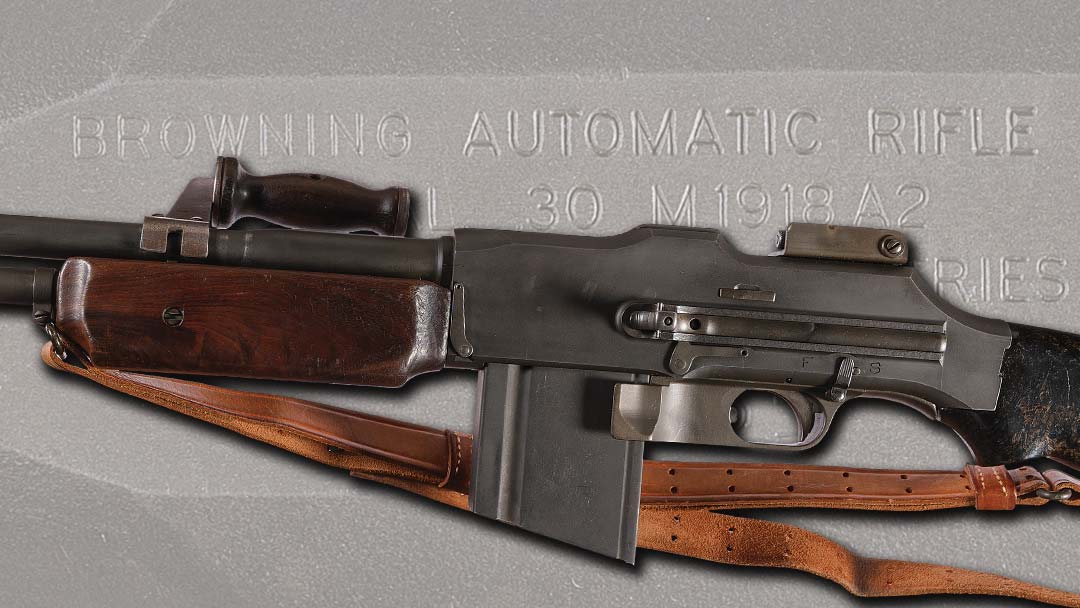
A Group Industries Model 1918A2 Browning Automatic Rifle. The Model 1918A2 remained in limited service through the Vietnam War, particularly with the South Vietnamese Army. Available this May.

The Stoner 63 in the Field

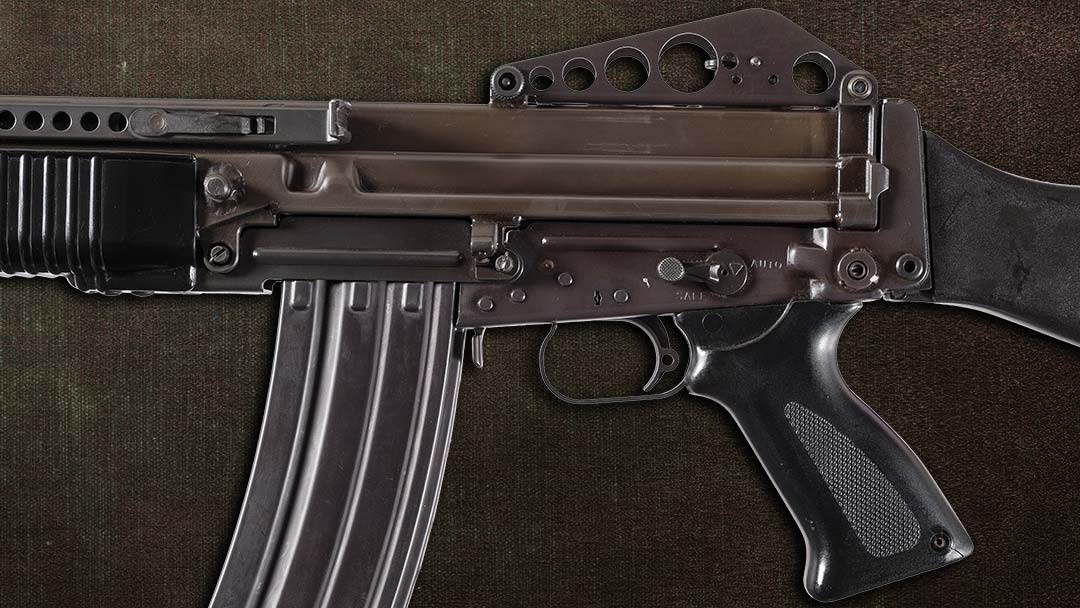
Cadillac Gauge only produced around 2,000 Stoner 63 rifles before upgrading the design in March of 1966. The Stoner 63A included a host of improvements such as a stainless steel gas tube to reduce corrosion, a stronger polycarbonate stock and forearm, a redesigned cocking handle for the rifle and carbine subassemblies that was easier to operate, a more durable feed cover, feed tray, dust covers, plus a spring-loaded cover placed over the ejection ports to better protect the rifle’s internals.

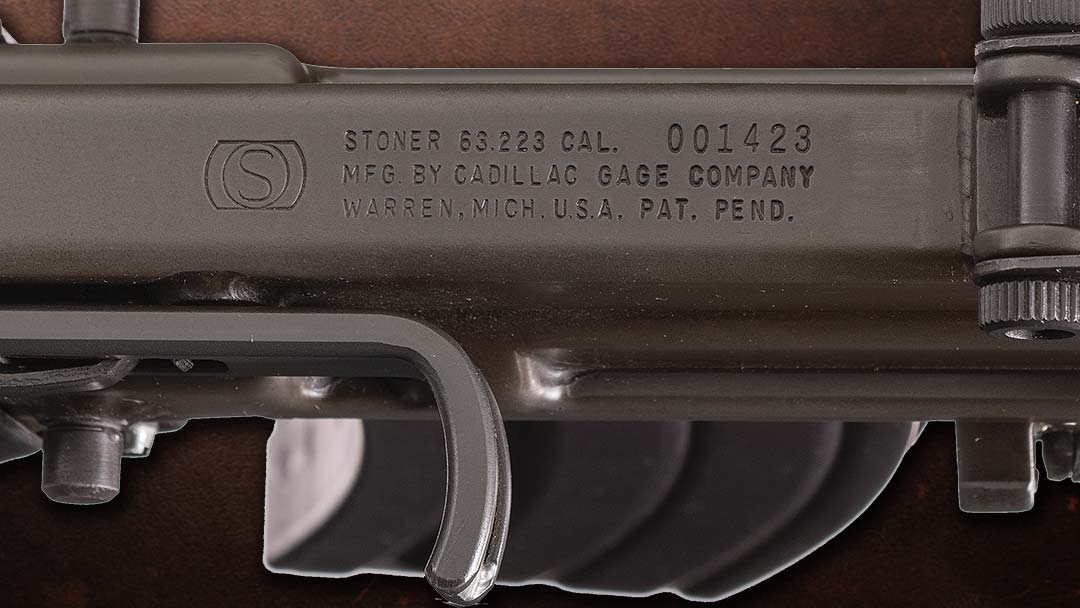
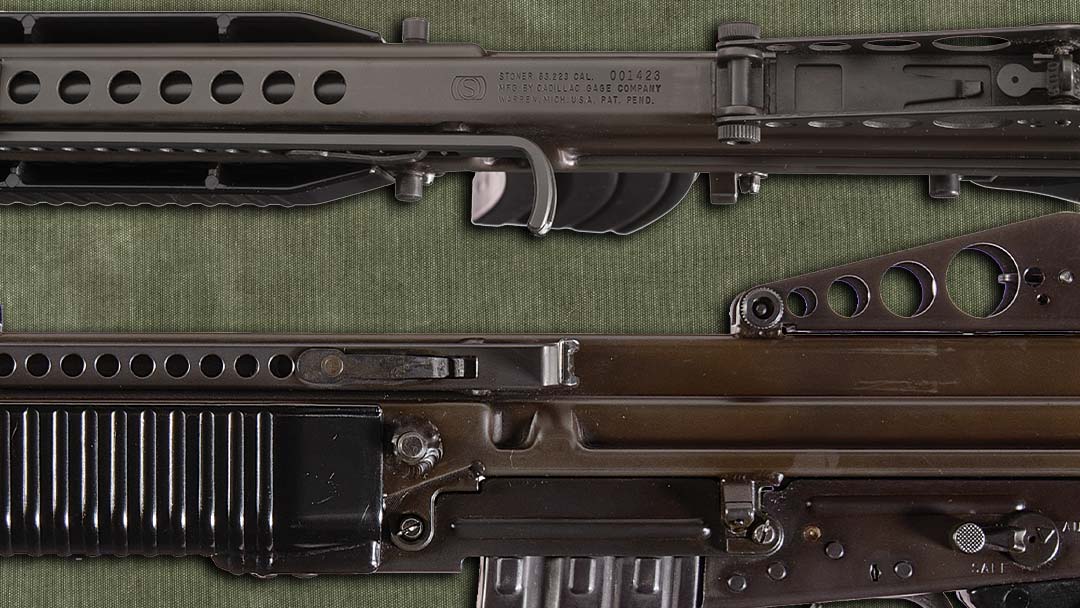
The top of the receiver bears the model, caliber and manufacturer markings, with “STONER/63” on the buttplate. Available this May.

In October of 1966, the Marine Corps ordered Cadillac Gage to modify 286 Stoner 63 weapons into the new 63A standard, where they would endure combat testing in Vietnam with Lima Company, 3rd Battalion, 1st Marine Regiment the following February. The Navy SEALs began conducting field testing of their own, with an overall positive response that resulted in Cadillac Gage introducing an additional Stoner 63 subassembly in the Commando configuration, a carbine length derivative of the LMG variant.

The Stoner 63 saw combat with the Marines and the Navy SEALs in Vietnam.

The Stoner 63 worked well for the short-term missions conducted by the Navy SEALs, but the platform was viewed as a liability for extended assignments. Even after the myriad of improvements the system received with the Stoner 63A upgrade, the Army feared the weapon’s numerous parts and fine tolerances wouldn’t withstand the rugged elements endured by the average infantryman in Vietnam.

Stoner 63 vs M16

According to Jim Sullivan, the Stoner’s lack of wide scale acceptance may have also been political. As Sullivan recalls, “I left to join Ruger in 1965 after the Marines had tested the Stoner 63, ordered 300,000 and been shot down by the senate funding committee which decided that the Marines should use what the Army uses (in other words, the AR-15 which by then had been adopted and officially designated the M16).”

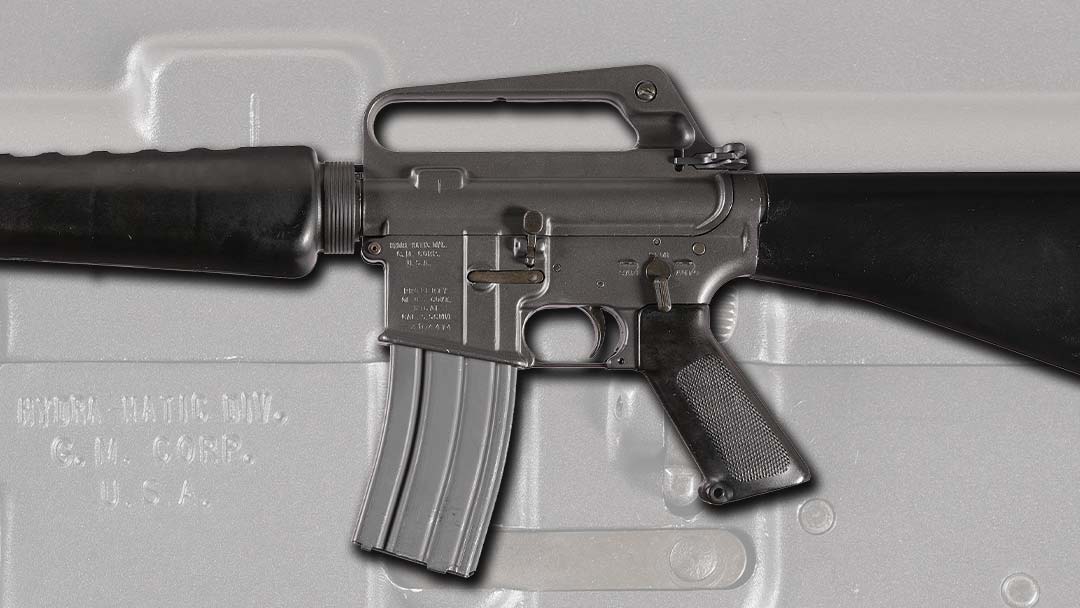
A U.S. Hydra-Matic J. Stemple M16A1 rifle.

Another concern from various trial reports was that the Stoner 63 would require far more training and maintenance compared to simpler platforms like the M16. The Stoner 63 proved better suited as a niche platform, providing the SEALs with a belt-fed LMG at a significantly lower weight than the standard M60 machine gun, which meshed well with highly mobile small unit tactics.

Though the Stoner 63 would ultimately not find widespread adoption, the SEALs continued to field the weapon throughout the Vietnam War and during the United States invasion of Grenada in 1983.

A Stoner 63 for sale this May. Included with the lot is a spring-loaded clip-on bipod with telescoping legs. Available this May.

Knight’s Armament Company and the Stoner 63

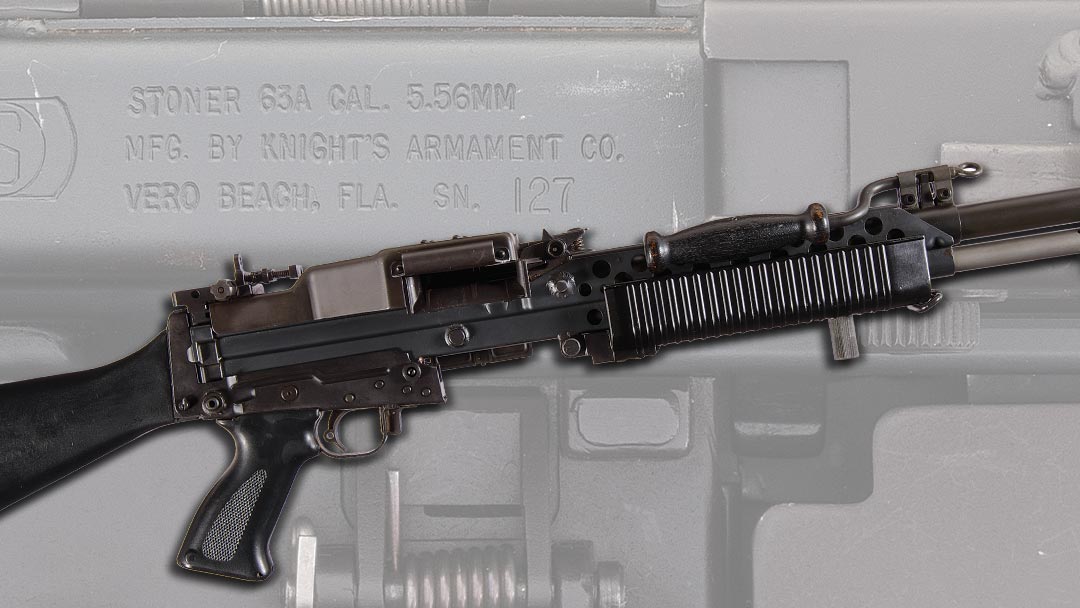
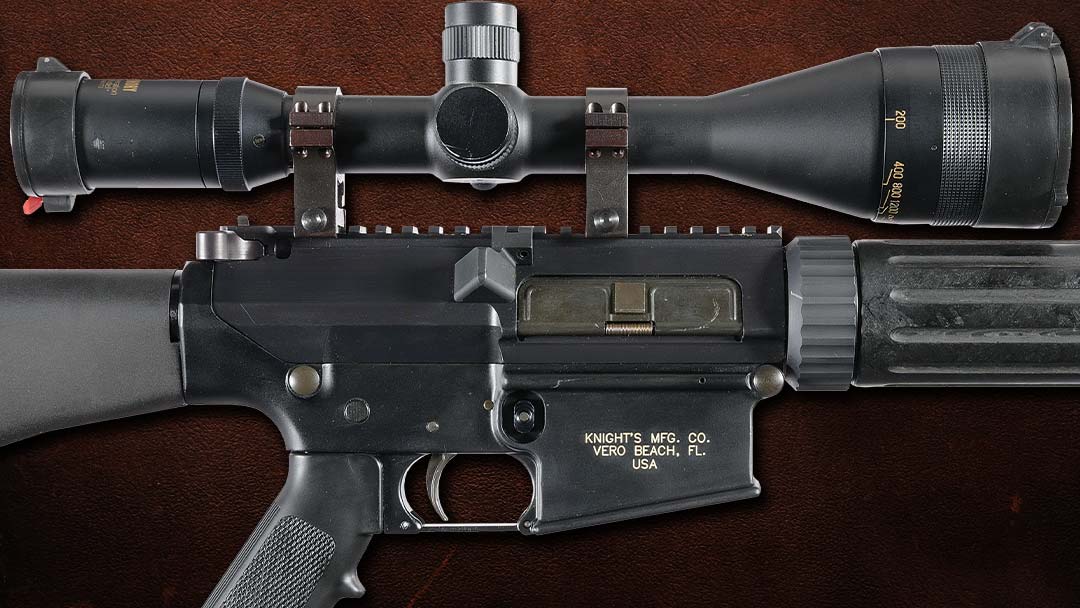
While Cadillac Gage ceased development on the Stoner 63 in 1971, Knight’s Armament Company of Titusville, Florida was able to purchase a supply of original Stoner 63 parts and assemblies and resume production of the platform in extremely limited quantity. Of the 4,000 Stoner 63 examples manufactured in total, fewer than 100 were assembled by Knight’s Armament.

A scarce Vero Beach production Knights Manufacturing Co. SR-25 semi-automatic “Stoner Carbine” with scope.

Knight’s Armament Company CEO Charles Reed Knight Jr. partnered with Eugene Stoner and developed the SR-25 platform, which served the Navy SEALs for 17 years as Mk 11 Mod 0 sniper rifle. Stoner would go on to develop the Stoner 86 LMG, a descendant of the Stoner 63, which led to the platform’s most recent iteration in the Knight’s Armament Company Light Assault Machine Gun (LAMG).

Stoner 63 Price

Many of the Stoner 63 examples that served with the US Navy and US Marine Corps in Vietnam were eventually destroyed, further decreasing the supply of an already limited production run for the model. It’s no surprise to arms collectors that machine gun prices have skyrocketed in recent years, and the price of a Stoner 63 has experienced a particularly strong uptrend over the last decade.

This Knight’s Armament Co. sold for $141,000 in RIAC’s December 2023 Premier Auction.

Looking at the three fully transferable Stoner 63 examples sold at Rock Island Auction Company since 2013, we find the price of the platform has nearly doubled. In April of 2013, a Knight’s Armament Co. Stoner Model 63A sold for $69,000. A Cadillac Gage Co. Model 63A broke the six-figure barrier and reached the impressive price of $103,500 in June of 2020. Another example of the platform from Knight’s Armament Co. tipped the scales at an impressive $141,000 in RIAC’s December 2023 Premier Auction, a testament to the scarcity, desirability, and investment potential enjoyed by this classic Eugene Stoner design.

Stoner 63 Legacy

Over the decades, a few different infantry rifles have been developed that offered users a “standard” flavor in addition to a short carbine variant and a heavier configuration that could act as a mag-fed SAW. Examples include the Steyr AUG, the FN FAL/FALO, and the Israeli Galil, but in terms of an “everything for everyone” modular infantry weapon, the Stoner 63 truly was ahead of its time.

An icon of arms collecting, the Stoner Model 63 could fill numerous roles on the battlefield. Available this May.

While the AR15/M16 is far and away the most famous Stoner platform in terms of pop culture impact, the Stoner 63 is a familiar name to fans of Metal Gear Solid 3 and numerous Call of Duty games. And anyone who played with the classic green army men miniatures growing up might be surprised to learn that the machine gun figure with the bipod is equipped with a Stoner 63.

The Stoner 63 has made appearances in popular games throughout the years.

Stoner 63 for Sale

For arms collectors, military historians, investors, and any fan of rapid-fire range action, it doesn’t get much better than the Stoner 63. In a May auction filled with the rarest arms from every era, this example of Eugene Stoner’s most ambitious design is a can’t-miss opportunity for any determined firearms fan.

A Stoner 63 for sale this May at Rock Island Auction Company. Available this May.

For more gun blogs and gun videos on 20th century military arms, subscribe to the Rock Island Auction weekly newsletter, where we cover topics ranging from early semiautomatic pistols like the 1911, Luger, and C96, bolt action icons like the M1903, Mosin Nagant, and Winchester Model 70, semi automatic WW2 workhorses like the Garand, SKS, and SVT 40, heavy hitters like the Winchester 1897 trench gun and the M82, and the full auto glory of weapons like the MP40, the PPSh 41, and the FG42 Fallschirmjager paratrooper rifle.

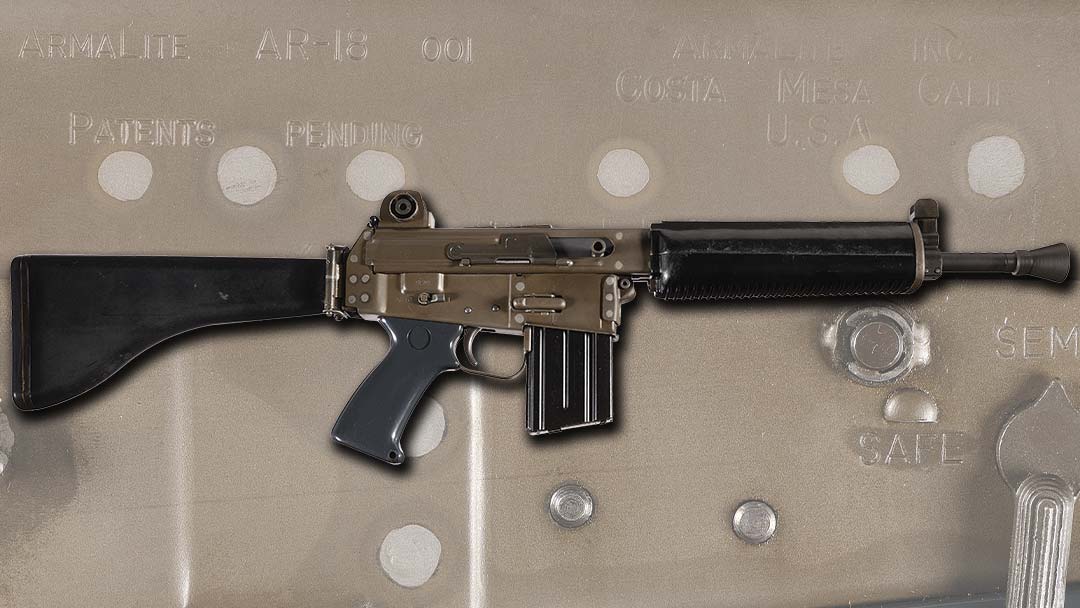
Art Miller designed the AR-18 in 1963 after Stoner left Armalite. This highly collectible example, serial number 001 in shorty carbine configuration, is available this May.

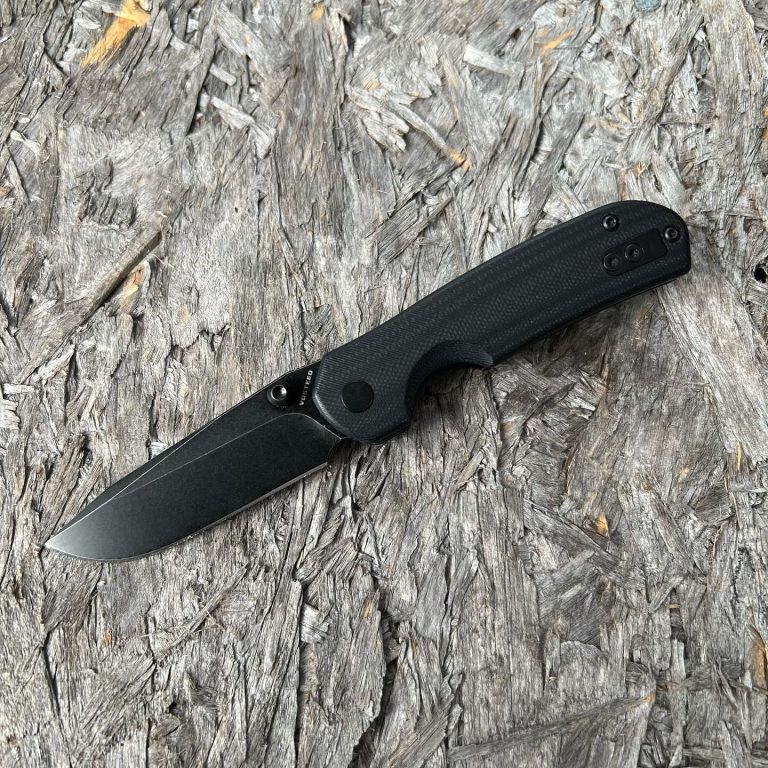
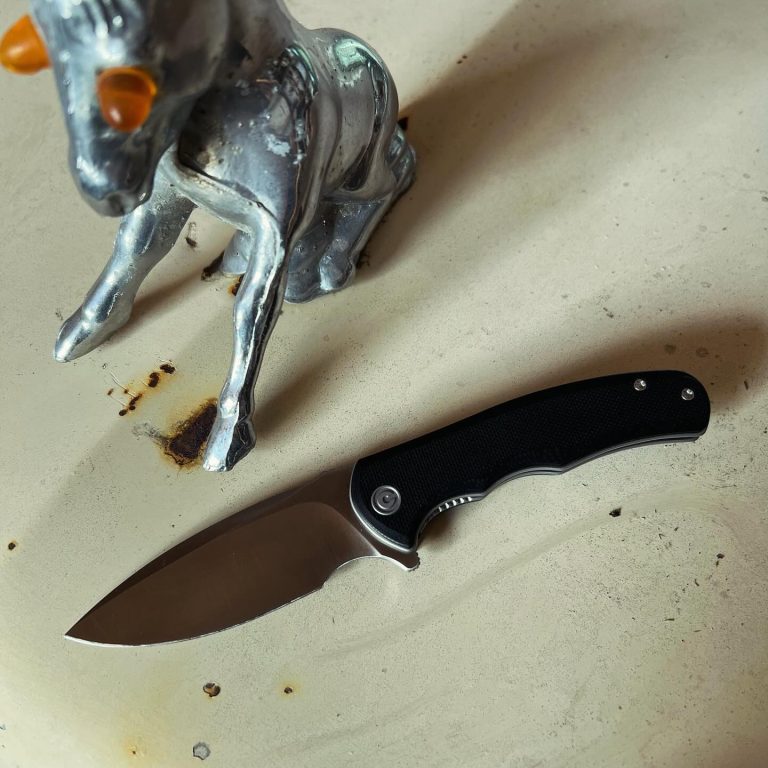
Review: Sub $30 Civivi Mini Praxis

0

It wasn’t that long ago that multiple solid knives were available for less than $30. These days, many of those knives like the Ontario RAT 2, have moved up market to closer to $40 or even more in some cases. So, when someone recently asked what I would recommend for an EDC or work knife for less than $30, I couldn’t fall back on my old recommendations. That’s why I purchased a Civivi Mini Praxis to see what $30 buys you these days.

Specs

  • Overall Length: 6.79″ / 172.5mm
  • Width: 1.27″ / 32.3mm
  • Overall Height(Include Clip): 0.62″ / 15.7mm
  • Blade Length: 2.98″ / 75.6mm
  • Closed Length: 3.81″ / 96.9mm
  • Blade Thickness: 0.1″ / 2.5mm
  • Handle Thickness: 0.45″ / 11.5mm
  • Knife Weight: 2.77oz / 78.5g
  • Blade Material: D2
  • Blade Hardness: 59-61HRC
  • Blade Grind: Flat
  • Blade Type: Drop Point
  • Handle Material: G10
  • Liner Material: Stainless Steel
  • Pocket Clip: Tip-Up, Right Carry
  • Clip Material: Stainless Steel
  • Screws Material: Stainless Steel
  • Pivot Assembly: Caged Ceramic Ball Bearing
  • Locking Mechanism: Liner Lock

Observations from Use

The Mini Praxis is essentially just a down-sized version of the Civivi’s well-known Praxis. It is very impressive how gracefully that design, known for being a large work/tactical knife, scaled down to a surprisingly refined EDC-oriented knife that just about disappears in your pocket thanks to a true deep carry clip. I think this is due, in large part, to the finger choil. On the larger Praxis, the choil allows the user to choke up on what is a fairly large knife but on the Mini Praxis, it allows a very svelte and compact knife to feel much larger.

This knife cuts aggressively. Civivi generally does a very nice job with their D2. The cutting geometry on this little laser beam also helps. The spear point blade is thin, with a very high flat grind that thins out the edge very nicely. The long swedge grind provides an acute but relatively strong tip.

The flipping action is what you would expect from Civivi which is to say it is very good. The detent is crisp and the action is smooth so the blade rockets out when you use the back flipper. That’s a good thing because that is the only method for opening the Mini Praxis that is provided by the design. This design is classy enough to serve as an office carry so it would have been nice to have a method of opening that is more suited to slower opening but the design is true to the original Praxis which also only had a back flipper.

Civivi did a great job of taking weight out of this design. The blade is very broad compared to many folders of this size so you might expect it to be heavy but the liners are aggressively skeletonized. The 2.77 ounce weight puts this firmly into ultralight range.

It would have been nice if Civivi didn’t scale down the design quite so literally as I wish the jimping on the spine extended out a little bit more. It also would be nice if the G-10 slabs had a bit more thickness and contour. However, those are relatively small nitpicks at this price. I think people would buy this knife at $45-50 and feel it is was a solid buy. 10 years ago, you would expect to pay $80-100 for something like this… maybe more. In today’s market it is impressive to see it at a sub-$30 price point. That isn’t a sale price either. That is the everyday price.

Wrap Up

The Mini Praxis proves that the Praxis design was more versatile than any of us realized – able to go from rugged work knife to classy EDC just by scaling it down in size. This knife has great cutting performance, solid ergonomics, and it is easy to carry. It’s a well-designed EDC option that impresses at under $30. It seems like a worthy and very recommendable alternative to something like the RAT 2 at this price point.

I purchased my Civivi on Amazon for even less by taking advantage of their occasional used knife offers (returns): Civivi Mini Praxis with satin blade and black G-10 or the Mini Praxis blackwash blade with green G-10 on Amazon.com

Collectible Firearms for Serious Gun Collectors

0

Tanks and Blank.

Rock Island Auction Company’s May Premier Auction features a second round of offerings from the Norman R. Blank Collection and a small curated grouping of heavy armor from the Allan Cors Collection. The auction, May 17-19, also features a fantastic lineup of historic firearms, exceptional sporting guns and an eye-popping array of Class III firearms.

Whether you are looking for something from the Wild West, the lawlessness of the early 20th century, a highly embellished percussion piece or a World War 2 gun, new and veteran collectors can visit our Bedford, Texas venue and examine the guns at our May 16 preview day ahead of the three-day auction.

Cool Tanks

A lifelong hunter and competitive shooter, he has a passion for military vehicles. The first military vehicle he purchased was a World War 2 Jeep in 1982, followed by his first tank in 1985, a Stuart M5A1. His collection has been housed at Aden Field about 50 miles from Washington, D.C., where it is referred to as the Virginia Museum of Military Vehicles, and later as the Tank Farm. A grouping from Cors’ collection will be available in May, led by a rare M41 Walker Bulldog and a highly desirable World War 2 U.S. M3A1 Stuart light tank.

The iconic U.S. M3A1 Stuart light tank available in the May Auction is one of just 4,621 produced by American Car & Foundry and one of 22,750 total of M3 and M5 variants. The Stuart, the Bulldog, and a massive Swiss Centurion battle tank top the sampling of military vehicles available in the May Premier Auction. The offerings includes tanks, armored cars, an ambulance truck and military trucks from the United States, the United Kingdom, Soviet Union, Sweden and Switzerland.

The Stuart, of which a small fraction remain with most in museum collections, were first deployed to the Philippines in 1941 and fought valiantly against the Japanese light tanks. They saw their first major campaign in North Africa with Operation Torch in 1942. The Stuart was also used by the British, and Commonwealth forces as well as Soviets through the Lend-Lease program. The Stuart’s held their own against other light tanks but were vulnerable to the more heavily armed Panzers of the Germans. Still, they performed reasonably well thanks to their speed and reliability.

Great Guns of the Blank Collection

Norman R. Blank was a legendary collector of European fine arms and his collection contains numerous museum worthy pieces including some made for royalty. Many of the pieces from Blank’s collection haven’t been seen publicly in years. An exquisite pair of dueling pistols by Gastinne-Renette graced RIAC’s December, 2023 Premier Auction, realizing $411,250.

More than 30 offerings from the Blank Collection’s beautiful sporting arms and pistols are available including a gold inlaid double barrel rifle of the prime minister of Hyderabad in India and guns from Spain, France, England and Italy with some featuring spectacular gold inlays and silver mounts. These pieces are from legendary gunmakers like Alexander Henry, John Manton, Durs Egg and Holland & Holland and have amazing lineage, conditioning and provenance.

Great Guns: Winning Winchesters

A newly discovered factory exhibition relief game scene engraved Winchester Deluxe Model 1873 with gold plate and inlays is among the top pieces in the May auction. A stunning testament to Winchester craftsmanship in the decorative arts in the late 19th century, this example bears factory floral scrollwork and game scenes including a buffalo, moose and elk.

The marvelous Model 1873 doesn’t stand alone. Fabulous Winchesters abound with a terrific example of a Model 1873 One of One Thousand and an extremely rare factory engraved nickel and gold plated exhibition quality Model 1890, a rare Model 1892 engraved by John Ulrich featuring game panel scenes, and an exceptional Model 1876 in .50 Express.

A factory letter for the fantastic and fresh Winchester 1873 shows that it has an octagon barrel, set trigger, factory engraving and gold plating.

Great Guns: President Gerald Ford’s Long Guns

When we think of presidential vim and vigor, the first name that pops up is Theodore Roosevelt, a long-time outdoorsman and big game hunter, but President Gerald Ford brought manny similar traits to the White House. Ford ascended to office on the resignation of Richard Nixon, was MVP of his University of Michigan football team and once worked a summer as a park ranger at Yellowstone National Park. He was a Boy Scout and achieved his Eagle Scout badge.

As an outdoorsman and president during the U.S. Bicentennial, Ford was presented with highly embellished sporting guns from classic American firearms companies. He received a factory engraved and gold inlaid Winchester Model 21 double barrel shotgun, a factory game scene engraved pair of Browning Model 1885 single shot rifles, and a game scene engraved pair of Ruger No. 1 single shot rifles as the nation celebrated in 1976. President Ford’s Winchester, Browning 1885s and Ruger No. 1s will be on offer in the May Premier Auction.

President Gerald Ford was presented nicely embellished sporting arms during the U.S. Bicentennial. This pictured cased pair of Browning Model 1885 Bicentennial single shot rifles as well as a cased pair of Ruger No. 1 Bicentennial single shot rifles and a Winchester Model 21 Bicentennial double barrel shotgun of President Ford will be available in the May Premier Auction.

Great Guns: Henry and Marlin Rifles

Spectacular Henry Rifles have found their way into the May Premier Auction, including two martially inspected Civil War Henrys, a presentation Henry Rifle and a martial Henry with tack decoration.

The auction also has magnificent Marlins, led by a special order game scene engraved Marlin Model 1881 presented by Buffalo Bill Cody to rancher and guide Jim McLaughlin, and an engraved Deluxe Model 1895 with gold and platinum inlays by Conrad Ulrich chambered in .45-90 with gold and platinum inlays.

This U.S. martially inspected inspected with tack decoration will be available in Rock Island Auction’s May Premier Auction.

Great Guns: Stellar Sporting Arms

A phenomenal trio of game scene engraved Purdey & Sons 28 gauge over/under shotguns and a historic presentation cased exhibition quality Le Page/Moutier double barrel percussion shotgun lead an outstanding lineup of sporting firearms in May Premier.

The Le Page/Moutier, with its relief chiseled embellishment and elaborately carved ebony stock is more museum than grouse hunt. Masterly crafted in 1860 by the legendary gunmaking firm, French president Jules Grevy presented it to Mexican President Manuel Gonzales Flores in 1879.

The Purdey & Sons shotguns are more likely to be the focal point of a gun room than carried into the field, too. The coin-finished action features extensive broad leafy scrollwork and a beautiful game bird scene on the underside of the action that is different to each of the guns numbered 1, 2 and 3. Executed by master engraver Simon Coggins, gun 1 has a pair of pigeons in flight over a field, gun 2 shows a pair of grouse flying through desert scenery that includes cacti and a windmill, while gun 3 has a pair of snipe taking flight from a tree.

More outstanding sporting guns will be available, like a Peter Spode signed and game scene engraved Westley Richards droplock double rifle in .470 Nitro Express, a cased pair of Ivo Fabbri sidelock double barrel shotguns factory engraved by Master Engraver Claudio Tomasoni with the goddess Diana theme, and a game scene engraved and gold inlaid Karl Hauptmann African big five themed sidelock double rifle in .470 Nitro Express.

These fine James Purdey & Sons shotguns are available in the May Premier Auction.

Great Guns: Confederate Revolvers

The Colt Model 1860 Fluted Army of William G. Conner leads a fascinating slate of Confederate revolvers. Among the guns with Confederate provenence are the Colt Model 1851 of prominent Episcopal priest Francis L. Hawks and Capt. Francis T. Hawks, both of the Confederate Engineer Corps, a Griswold and Gunnison revolver, Second Model London LeMat “grapeshot” revolver, an antebellum U.S. contract Colt Third Model Dragoon, and a very scarce Civil War Confederate Spiller & Burr revolver.

Conner, of Mississippi, served in the famed Jeff Davis Legion cavalry unit. His Colt 1860 Fluted Army was an early production Colt that was among 2,300 shipped south shortly before the Civil War, in January 1861. The Jeff Davis Legion was attached to the Army of Northern Virginia under Robert E. Lee and J.E.B. Stuart, and later Wade Hampton.

A plantation owner, Conner was promoted to captain and company commander in October, 1861 and was captured a year later. He was exchanged in a prisoner swap in August 1862 and returned to duty before the Legion fought at Antietam and the Chambersburg Raid. Conner never lost his hatred for the Union after his imprisonment. He was promoted to major in December. At Gettysburg, Conner was the executive officer of the Legion as part of General Wade Hampton’s brigade and granted permission to lead the charge for his hatred of the Union. During a charge on the battle’s third and decisive day, Conner was felled.

In J.E.B. Stuart’s report of the Battle of Gettysburg he writes, “Among the killed was Major Conner, a gallant and efficient officer of the Jeff. Davis Legion.”

This LeMat “grapeshot” revolver and accompanying sword are among the Civil War revolvers available in the May Premier Auction.

Great Guns: Class III Offerings

An extremely rare FN Manufacturing M240 general purpose medium machine gun tops a deep field of Class III firepower, joined by several Thompson submachine guns, a Cadillac-Gage Stoner Model 63, M60 general purpose machine guns, and a rare Armalite AR-18 that are just some of the full-auto action to be found in the May auction. Several World War 2 submachine guns will also be available including a MP44 Sturmgewehr rifle, MG34, MP40s and a U.S. Guide Lamp M3.

A M240 general purpose medium machine gun, a Cadillac-Gage Stoner 63 selective fire rifle and several Thompson submachine guns are available in the May Premier Auction.

Great Guns for Sale

Rock Island Auction Company is excited to host its second Premier Auction at its Bedford, Texas location and present such a catalog of fine arms. No matter what they dabble in, collectors will find classic and high-conditioned Colts and Winchesters alongside luxurious European arms that border on artistry, spectacular sporting guns and the rat-a-tat power of Class III weapons. Visit on preview day, May 16, to get an up-close opportunity to examine all of these amazing offerings and rub shoulders with fellow collectors. All of these fantastic firearms and more will be available in the auction, May 17-19.

Cell Network Disruption Underscores Critical Importance of Backup Communication Plan

0

In the latest event that shows how vulnerable our nation’s infrastructure is to a variety of threats, thousands of Americans were disconnected today during a significant cellular network outage, affecting major service providers, including AT&T, Verizon, and T-Mobile. The outage, which began in the early hours of Thursday, was met with concern by federal agencies, including the FBI and the Department of Homeland Security, prompting an urgent investigation into whether a cyberattack was to blame.

The disruptions began just before 3:30 a.m. ET, with Downdetector, a website tracking service outages, registering a spike in reports that peaked at over 73,000 by 9 a.m. ET. Customers reported a range of issues, from total loss of service to inability to access mobile internet, again highlighting people’s critical dependency on cellular networks for both personal and professional communication.

Security experts, including Lee McKnight, an associate professor at Syracuse University, pointed to the hallmarks of a Distributed Denial of Service (DDOS) attack, which aims to overwhelm systems with a flood of superfluous requests, causing them to shut down. Such attacks are becoming increasingly common among cybercriminals, raising concerns about the vulnerability of core internet infrastructure and the potential for widespread disruption.

The outage had severe implications for public safety, with reports of 911 services being affected, highlighting the very real consequences of disruptions to essential communication services. The Federal Communications Commission (FCC) and the Cybersecurity and Infrastructure Security Agency (CISA) were quick to respond, with the FCC stating that its Public Safety and Homeland Security Bureau was actively investigating the incident.

By late afternoon, AT&T announced that service had been restored for the affected customers and apologized for the inconvenience, emphasizing their commitment to preventing such incidents in the future. However, the event has raised significant concerns about the security of the nation’s telecommunications infrastructure and the potential for future attacks.

Are you Prepared?

Ham Radio

The cellular network outages should serve as a critical wake-up call to the importance of preparedness in our increasingly digital society. In an era where our world is heavily reliant on technology for everything from personal communication to emergency services, the vulnerability of these systems can have far-reaching consequences. This incident underscores the need for people, communities, and businesses to have contingency plans to maintain essential communications and operations during unexpected disruptions.

To enhance you level of preparedness, it’s important to explore alternative communication methods that can serve as backups when primary systems fail. Satellite phones, two-way radios, and even ham radios offer reliable means of communication that do not depend on traditional cellular networks. Investing in emergency supplies such as power banks, solar chargers, and backup generators can ensure that communication devices remain operational even during prolonged outages.

Are you prepared to stay in communication and gather vital intel if the communication networks go down?

For more information on Ham Radio and Emergency Communication, check out these articles:

Review: Vosteed Mini Labrador | Jerking the Trigger

0

The Vosteed Mini Labrador might be a lot of things. It might be Vosteed’s best value for money to date. It might be their best fifth-pocket knife to date. It might be their best gentleman’s knife to date. Let’s take a look at the newest offering provided by Vosteed for this review.

Specs

  • Blade Length: 2.73″ | 69.30 mm
  • Overall Length: 6.23″ | 158.20 mm
  • Blade Width: 0.72″ | 18.40 mm
  • Blade Thickness: 0.098″ | 2.50 mm
  • Blade Material: 14C28N
  • Blade Grind: Flat
  • Blade Style: Drop Point
  • Blade Finish: Black Stonewash
  • Hardness: HRC 60±2
  • Handle Length: 3.50″ | 88.90 mm
  • Handle Width: 0.72″ | 18.30 mm
  • Handle Thickness: 0.374″ | 9.50 mm
  • Handle Material: Titanium
  • Color: Black
  • Weight: 1.93 oz | 54.80 g
  • Opener: Back Flipper
  • Lock Type: Frame Lock
  • Pivot Assembly: Caged Ceramic Ball Bearing
  • Pocket Clip: Non-reversible | Titanium
  • Carry Position: Tip-up
  • Knife Type: Manual Folding
  • Backspacer Material: Titanium
  • Designer: Yue

Observations from Use

The specs above don’t tell the whole story of the value that this knife offers. The handle has full titanium construction including the milled pocket clip (which is great by the way) and backspacer. The blade is 14C28N which is as good as it gets for value steels. The lack bar features a steel insert that also includes an integral overtravel tab. These are materials and construction that is normally reserved for knives well above the $69 price point of the Mini Labrador.

This tiny fifth-pocket knife is built like a lot of knives costing 2-3x as much… but tiny is the operative word. I think everyone I have shown it to has made the statement that it was smaller than they thought it would be (and that is important to know if you are considering buying one). The specs given by Vosteed are spot on but somehow the knife seems smaller than you are prepared for. I think that is part of the success of the design as a gentleman’s knife that can still do some real cutting as opposed to a jack-of-trades EDC knife or a work knife. This knife is visually smaller than you thought it would be and yet medium-sized hands can get a 3 or even 4-finger grip for real work. It’s voodoo.

This knife is SOOO slim and SOOO light (under 2 ounces!). Normally, I would say something like, “It’s a joy to carry.” But that would indicate that you are actually aware that you are carrying it which seems unlikely with this featherweight. It’s perfect for the fifth-pocket of jeans thanks to plenty of clearance under the clip or dress slacks where it won’t weigh down lighter or thinner fabrics.

The Mini Labrador is an aggressive cutter. The blade has a full-height flat grind, thin blade stock, and is very thin behind the edge. The point is very acute which I think is especially useful on a gentleman’s knife.

This knife has a single opening method, a back flipper. It works very well inspite of how tiny it is thanks to a perfect detent and very smooth action. My example started smooth and only became more smooth as it broke in. It is smooth enough that it will drop shut with some light shakes and that is noteworthy when you consider how lightweight the blade is.

Normally, I try to have some constructive criticism for these knives but I am struggling to come up with anything for the Mini Labrador. In terms of a gentlemen’s knife design, this is a great success. It is an actual tool first, slim, light, and easy to carry while also being classy and a great value. I would love to see Vosteed try more titanium frame-lock folders, maybe some that are larger with more opening methods.

Wrap Up

If you are looking for a high-value knife that is as easy to carry as possible or something to carry at the office, this is a great option. If you just want a fifth-pocket knife that is built like a tiny tank, this is a great option. Vosteed has made some great small knives like the Mini Nightshade and Chipmunk but if you want something that works hard but is truly small, this is what you are after.

The Mini Labrador is currently available at Amazon (sold out at Vosteed.com): Vosteed Chipmunk at Amazon.com

You can learn more about all Vosteed’s offerings at Vosteed.com.

These two images may help give a sense for how compact this knife is. The Mini Labrador is similar in blade length and overal length to the Chipmunk but it is signiificantly slimmer and lighter. The Chipmunk (top) seems more like an compact, jack-of-all-trades EDC while the Mini Labrador (bottom) comes across more as a svelte, compact, gentleman’s knife.

Review: D&M Leather Mini Composition Book Cover

0

The affordable, simple, minimalist leather cover for mini composition books is probably my favorite EDC item purchased in 2023. D&M Leather sells these on Amazon, claiming them to be hand-sewn with a saddle stitch. I was skeptical but took a chance based on the customer pictures. I’m glad I did.

I often carry a standard mini composition book in a back pocket to log workouts, take notes in church, log range data, remind myself of appointments, or anything else I would like to track on actual paper. These notebooks can be surprisingly durable if you buy the type that is stitched and then taped on the binding. However, the basic cardboard or craft paper covers will eventually degrade faster than I can fill one with notes. This is where the leather cover comes in…

The cover does a great job of preventing the notebook from breaking down which allows these dirt-cheap composition books (3 for a $1 at your local Wal-Mart) to last long after you fill it with notes. Not only that, but it looks great and it is actually real saddle-stitched leather. I am blown away with the quality for the price.

You can spend more than the cost of this cover for just one notebook that will stand up to the rigors of pocket carry but you don’t have to. This affordable leather cover adds class and style to your EDC while allowing you to reuse it over and over again on affordable, readily available mini composition books. It is one of those things that is does just one thing and does it satisfyingly well.

D&M Leather Mini Composition Book on Amazon.com

Notes on mini composition books: Look for books with bindings that are stitched and taped. The ones that are glued or stapled will never hold up. Also, this cover comes with a 50 page book but it will easily fit the standard 80 page mini composition books.

Review: Vosteed Chipmunk | Jerking the Trigger

0

The Vosteed Chipmunk is small in size but big on fidget-factor. It also happens to be a useful, fifth-pocket knife option that won’t break the bank. It fits squarely in the “small but mighty” folding knife carry that I like so much.

Specs

Blade Length: 2.64″ | 67.10 mm

Overall Length: 6.15″ | 156.20 mm

Blade Width: 0.88″ | 22.40 mm

Blade Thickness: 0.118″ | 3.00 mm

Blade Material: 14C28N

Blade Grind: Flat

Blade Style: Modified Drop Point

Blade Finish:  Black Stonewash

Hardness: HRC 60±2

Handle Length: 3.51″ | 89.10 mm

Handle Width: 0.82″ | 20.90 mm

Handle Thickness: 0.488″ | 12.40 mm

Handle Material: G10

Weight: 2.53 oz | 71.70 g

Opener: Front Flipper | Back Flipper | Thumb Stud

Lock Type: Liner Lock

Pivot Assembly: Caged Ceramic Ball Bearing

Pocket Clip: Reversible | Stainless Steel

Carry Position: Tip-up

Observations from Use

The Chipmunk is a fidgeter’s dream but before we get to that, I want to make it clear that this is an actual, useful knife. The Chipmunk has a useful blade shape that gets a lot done. It came with one of the most refined edges I have seen on a Vosteed to date. And, it is much more hand-filling than its small size would lead you to believe thanks to thick, micro-textured G10 scales. This knife is clearly designed to be used as much as it is designed to be fidgeted with while you are stuck on endless Zoom calls at work.

The Chipmunk combines very smooth action with a great detent and basically every type of opening device known to man. It can be front flipped, top flipped, back flipped, slow rolled, thumb flicked, middle finger flicked, and probably other opening techniques that I am not skilled enough to execute. The detent is tuned such that all of these work well but I find it particularly satisfying to middle finger flick as Vosteed designed this with large comfortable thumb studs with great access from either side.

I also want to call out the back flipper on this knife. It projects up above the pivot rather than out the back. This means there is nothing sticking out the back of the knife knocking into the other items in your pocket when it is folded. There is also nothing to get in the way of choking up on the knife when it is open. In fact, this design allows me to get a full, four-finger grip on this very compact knife. I would like to see Vosteed explore this style of flipper on more knives!

The Chipmunk seems like a knife that Vosteed can really riff on. A little-big knife like this has all kinds of potential for new blade shapes like a wharncliffe or some kind of modified sheepsfoot. These are blade shapes Vosteed also does well on models like the Raccoon and Valkeryie.

There are a couple of changes I would suggest. First, it would be nice if the point was dropped just a bit more on a knife this small. This would make it easier to use the point for cutting which is useful in such a compact design that is so well suited to EDC tasks. Second, it would be nice to see a hollow grind on this design. As I mentioned, the edge came very sharp and very well refined to almost a mirror polish. However, it is a little thick behind the edge thanks to the very short blade height. It cuts very well but this design would be even more laser-like with a hollow grind.

Wrap Up

I have mentioned how much I like this little-big knife/companion knife genre countless times before as someone who carries a fixed-blade knife basically daily. This one is near the top of my list right now. It is a ton of fun thanks to all the fidget potential but it is also just a solid user that offers a surprising amount of grip in such a compact package.

The Chipmunk is currently on sale for up to 15% off for Valentine’s Day at Amazon: Vosteed Chipmunk at Amazon.com

You can learn more about all Vosteed’s offerings at Vosteed.com.