Sniper Rifles and 20th Century Warfare

0

Sharpshooters, marksmen or snipers, no matter the name, their era or the weapon, shooting – and hitting – military targets from a distance has long been seen as a way of gaining a tactical and even psychological advantage in warfare.

It wasn’t seen as honorable during the French and Indian War for ranger units of British Loyalists to skirmish with foes then blend into the forests rather than to stand toe to toe in direct battle. While European marksman considered it dishonorable to see officers as targets, that changed in the Civil War with the Berdan Sharpshooters. Their prime targets: Confederate officers, artillery crews and other marksmen.

Sharpshooters used rifles rather than the muskets of the common infantryman. A gun with a rifled barrel provides greater accuracy and range. Continental Army sharpshooters were effective to about 300 yards at targets like British officers, but black powder didn’t allow for much stealth as a cloud of smoke quickly gave away a sharpshooter’s position.

Through the 19th century, the development of the Minie ball and smokeless powder along with rifled barrels helped usher the sniper into the wars of the 20th century.

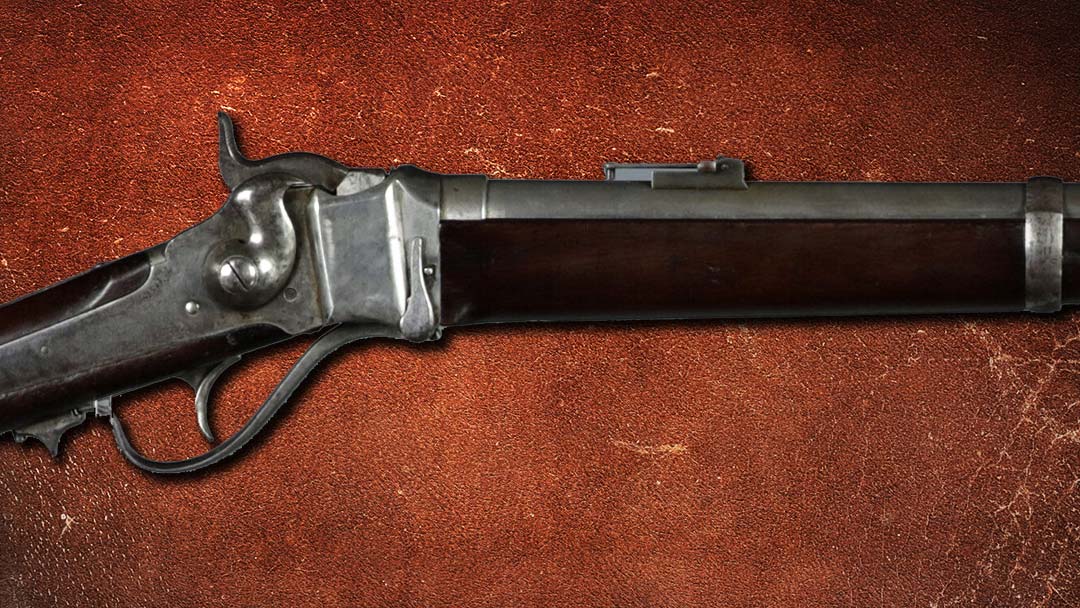
Hiram Berdan was an inventor who was famous in 19th century America for being the nation’s best target shooter for many years. At the outbreak of the Civil War, he lobbied for a regiment of sharpshooters that would become known as Berdan Sharpshooters. “No man would be enlisted who could not put ten bullets in succession within five inches from the center at a distance of six hundred feet from a rest or three hundred feet off hand.” Sharpshooters were eventually issued Sharps rifles. This Berdan Sharpshooters-issued Sharps New Model 1859 rifle sold at Rock Island Auction for $115,000 in September, 2021.

In the U.S. Civil War, Hiram Berdan raised two regiments of sharpshooters and commanded one. They were the first units tasked with taking out targets from long range. Despite this emphasis in the Civil War, the U.S. Army often considered snipers as afterthoughts and didn’t establish a full-time sniper program until more than 100 years later, in 1987. The Army considered marksmanship more important than camouflage, field craft and concealment and at times of war left training to individual unit commanders.

The lore and dramatic tales of sniper heroics in film and in books has made their guns used in 20th century conflicts into fascinating and collectable objects. Here are examples of some of those firearms that are coming up in the June 21-23 Sporting & Collector Auction.

Springfield 1903A1 Sniper Rifle

During the Spanish-American War, the Krag-Jorgensen rifle’s limitations were on display: a low-power cartridge, a troublesome locking system and difficult to adapt to clip-loading. The Ordnance Department authorized rounds of experimentation that led to the 1903 Springfield rifle in .30 caliber.

Widely used in World War 1, the Springfield proved smooth and reliable even in terrible battlefield conditions and with an effective range of 650 to 1,000 yards, it proved to be a capable sniper rifle. It also saw significant use in World War 2 and Korea for the same purpose before finally being phased out in 1974.

While the Army didn’t see the advantage of snipers in its military planning, the U.S. Marine Corps did and has trained snipers since World War 1, and reinvigorated its training in the 1960s. The feats of Charles “Chuck” Mawhinney and Carlos Hathcock in Vietnam became legendary among the military community.

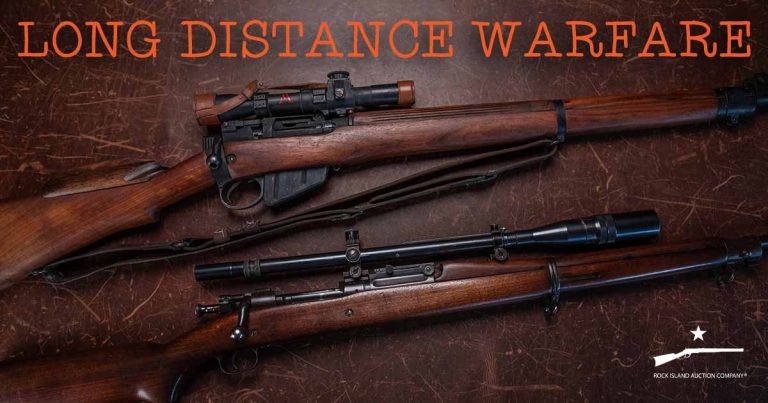
This U.S. Springfield 1903A1 is assembled to resemble a U.S. Marine Corps sniper rifle with the 8x UNERTL scope marked “J.UNETL/USMC-SNIPER.”

British M47C No. 4 Mk I Sniper Rifle

“The sniper is an expert shot whose services are of equal value in open and static warfare and in attack and defense. He should be able to pick out targets exposed only for short periods and kill with a single shot from a concealed position,” according to British sniper training materials.

In 1941 the British had an eight-man unit in each battalion that was trained for a target range of 400 yards. Among suggestions for British snipers: do not smoke or use fires or candles at sniper posts, chew gum if restless, and never use a rifle with a highly polished exterior – cover it with sacking, tape, brown paint or mud.

The No. 4 was adopted by the British in 1941 with a heavier barrel than its predecessor and ladder sights that could be calibrated from 200 to 1,300 yards. The bolt release catch was replaced by a simpler notch on the bolt track of the receiver. Rifles for sniper use were selected through factory accuracy tests and had a wooden cheek piece that could be raised, and a telescopic sight.

In 1942 Holland & Holland took on the task of converting what would be 26,442 sniper rifles. Along with the cheek piece and scope, conversion included stripping and re-stocking rifles and fitting them with steel tabs or pads for the scope mounts.

These sniper rifles were outfitted with No. 32 MK I scopes that weighed 2 lbs., 3 oz., with a magnification of 3x and field of view of nine degrees. The guns were first put to use in North Africa where sniper tactics weren’t suited.

This arsenal refurbished No. 4 MK I is dated 1944 on the receiver socket, and the scope is dated 1945.

Mosin Nagant Sniper Rifle

Soviet shooters were the most storied snipers of World War 2. The Red Army’s sniper program ramped up during the interwar period with help – surprisingly — from the Germans. Germany offered sniper training and assistance in procuring scopes for sniper rifles. The Soviets honed their sniper tactics during the Spanish Civil War, siding with the Republicans against the German-backed Nationalists.

In 1940, the Soviets started using silencers and subsonic 7.62mm ammunition to make it harder to find their location. Faced with sieges at cities like Stalingrad, the Soviets were able to put sniper tactics to use in urban warfare situations.

Despite inflicting high casualty rates on the Germans, Soviet snipers were also lost in significant numbers. Once their locations were detected, snipers often faced mortar and artillery attacks and even infantry assaults. The Soviets assigned rookies to learn from veteran snipers, but at Stalingrad the average lifespan of a nascent sniper was two weeks.

More than 2,000 Soviet female snipers served during World War 2 with many using the Mosin Nagant. This example from Izhevsk Arsenal is dated 1943 with a “1969” dated scope and lens cap.

Veteran German sniper Joseph “Sepp” Allerberger, recorded 257 official kills said of Soviet snipers that he couldn’t believe they would “…make the cardinal error of shooting from a tree without the ability of retreat or taking cover… while they were good shots, they were tactically inexperienced. Like sacks, the Russians fell from the trees.”

Used by a decent sniper, a Mosin-Nagant could be accurate to 800 yards. The Mosin would serve as the Soviet sniper rifle until the Dragunov was introduced in 1963.

This Vietnam captured Ishevsk SVD Dragunov sniper rifle with scope sold at Rock Island Auction in June 2020 for $57,500.

1903-A4 Sniper Rifle

During World War 2, Remington made M1911A1 pistols, Browning Model 1917 machine guns, the Model 1917 Enfield bolt action rifle and Pedersen devices. The company also manufactured Springfield 1903 rifles for sniper use.

Little sniper training was done by the U.S. Army except on a unit by unit basis. This simplified version of the 1903 was first used in North Africa and Sicily, locales unsuitable for sniper tactics. The invasion of Italy, a target rich environment, put sniper tactics and the Model 03-A4 to use.

GIs complained that the 03-A4 provided moderate accuracy to untrained troops and could only be loaded one bullet at a time because of the low scope mount. The scope was considered “optically inadequate” due to its low position above the receiver and fogged in humid conditions like the Pacific and China/Burma/India theatres. If the scope broke, the gun couldn’t be aimed because it wasn’t equipped with iron sights.

Remington made just over 28,000 Model 03-A4 rifles with production ending in 1944. The gun was also used in Korea. This example of the Remington Model 03-A4 has a parkerized “M82” scope and bears a desirable “Z” prefix serial number. The barrel is marked “RA/12-43.”

M1D Garand Sniper Rifle

The battle rifle of the U.S. Army in World War 2, Gen. George Patton called the M1 Garand “the greatest battle implement ever devised.” The Garand replaced the Springfield Model 1903 that has been discussed a couple of times here. More than 5.46 million Garands were made between 1934 and 1957.

The Garand was designed for easy assembly and disassembly to make field maintenance a simple task, however the top-loading gun was difficult to convert to scope-mounted sniper rifles. The first attempt at converting the Garand to a sniper rifle, the M1C had scope mounts drilled into the receiver based on a Griffin & Howe mount.

John Garand, the gun’s designer, devised the simpler M1D. The standard barrel was swapped out with a barrel with an integral mounting block for the scope.  The scope was attached with a single thumb screw tightened to the barrel rather than the receiver. The scope was offset because of the loading issue so a leather cheek piece was made to help line up the shooter’s eye with the target.

The M1D wasn’t adopted until 1951 with an order of 14,325 delivered that year. Despite delivery and more than 21,000 manufactured in total, the gun didn’t see action in the Korean War. Small numbers saw use in the American intervention into Lebanon in 1958 and the Dominican Republic in 1965 as well as early in the Vietnam War.

The M1D was sold through the Civilian Marksmanship Program. This example of the M1D Garand has a receiver manufactured in September 1943 and has a “7-51” marked barrel and a mounted M84 scope.

Sniper Rifles for Sale

Sniper tactics came of age during the World Wars of the 20th century with the Soviet Red Army leading the way. The U.S. Army didn’t emphasize the use of snipers but still modified guns for that use. These are fascinating tools of long-range shooting tactics, whether they are from the United States or its World War 2 allies, and they are available in the Rock Island Auction’s June 21-23 Sporting & Collector Auction in Bedford, Texas with Preview Day on June 20.

Sources

Was the M1903A4 Sniper Rifle No Good?, by Tom Laemlein, The Armory Life

The Genesis of Sniping, Part 6: Soviet Sniping 1939-1945, American Rifleman

Through the crosshairs, A history of Snipers, by Andy Dougan

The British Sniper, British & Commonwealth Sniping & Equipments 1915-1983, by Ian Skennerton
Keep Training with Leukotape P

0

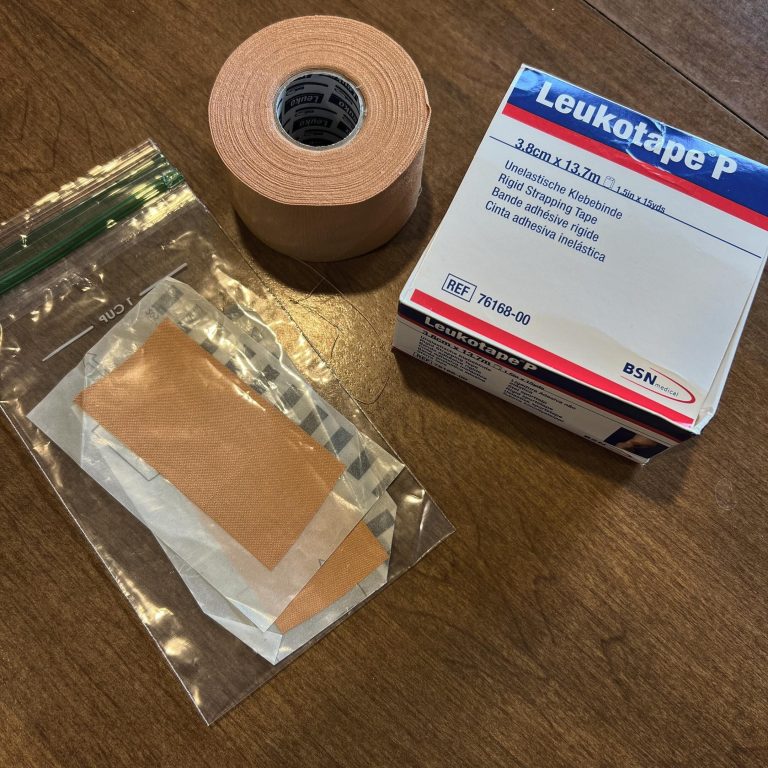
Blisters suck. You are faced with quitting your training or a whole lot of pain the moment you start to feel that hotspot developing… unless you have a way to prevent it from becoming a blister in the first place. That’s how I use Leukotape P, to prevent blisters as soon as I can feel that one might be developing.

Leukotape is a thin fabric tape with low stretch and an incredible adhesive that sticks to skin, even sweaty skin, but also peels away fairly easily. It is best used on friction spots where a blister has not yet developed but where you can feel one coming. I also use it preventatively on known problem areas until that area fully heals and toughens.

The adhesive and the thinness of the tape is the real game-changer here – it lets me keep my runs, hikes, or other training going without the annoyance of moleskin coming loose in my boot. Moleskin is probably still a better treatment for areas that have already developed large blisters thanks to the gentler adhesive and additional padding… but I haven’t gotten a serious blister since I started using Leukotape.

Pro Tip: Don’t carry the whole roll around with you. Save your scraps of release paper (from stickers, receipts, return labels, etc.) and store pre-cut sections of Leukotape on those.

This stuff can be a little hard to find in some areas. I have a local drugstore with a better-than-average medical supply section that sometimes has it. Otherwise, I just buy it on Amazon. If you go that Amazon route, watch the pricing because it fluctuates heavily. I paid $7.99 a roll last week and there is usually some discount for buying in bulk. A single roll lasts a long time but I usually buy at least 3 at a time and end up giving this stuff away like candy.

Leukotape P on Amazon.com

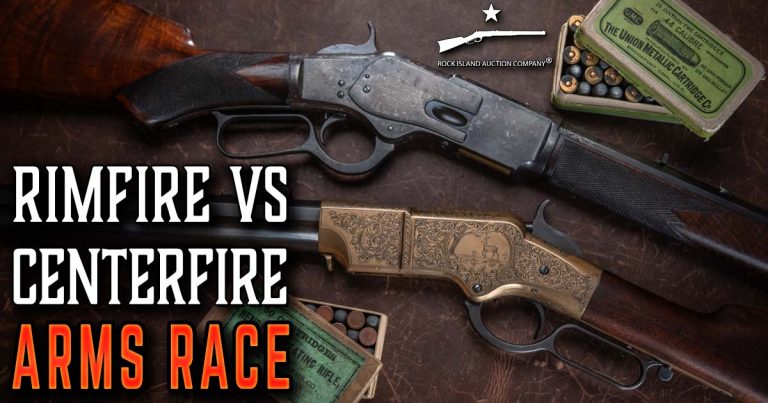
Rimfire vs Centerfire Arms Race

0

In 1857, Daniel B. Wesson’s .22 Short rimfire round set off an arms race in self-contained cartridge development that continues today. While modern centerfire ammunition dominates every niche above .22 caliber, rimfire rounds were once produced in a wide array of sizes, including large bore shells for hunting and military service.

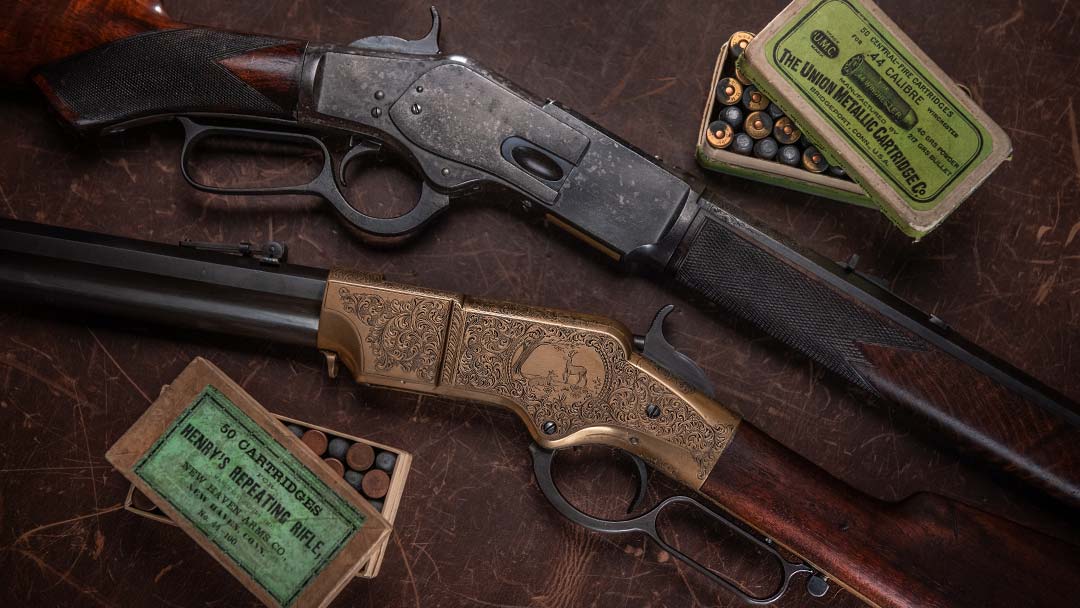
A game scene engraved New Haven Arms Company Henry rifle, a classic platform that introduced the .44 Henry rimfire round. Available this June.

Rock Island Auction Company’s June 21-23 Sporting and Collectors Auction in Bedford, Texas includes pioneers in cartridge development like the Henry rifle in .44 Henry Flat rimfire and the .44-40 Winchester Model 1873 in .44-40 WCF. We’ll take a look at the rimfire vs centerfire faceoff through the decades and examine some of the notable firearms chambered in each cartridge style. Click on the images throughout this article to learn more about each model.

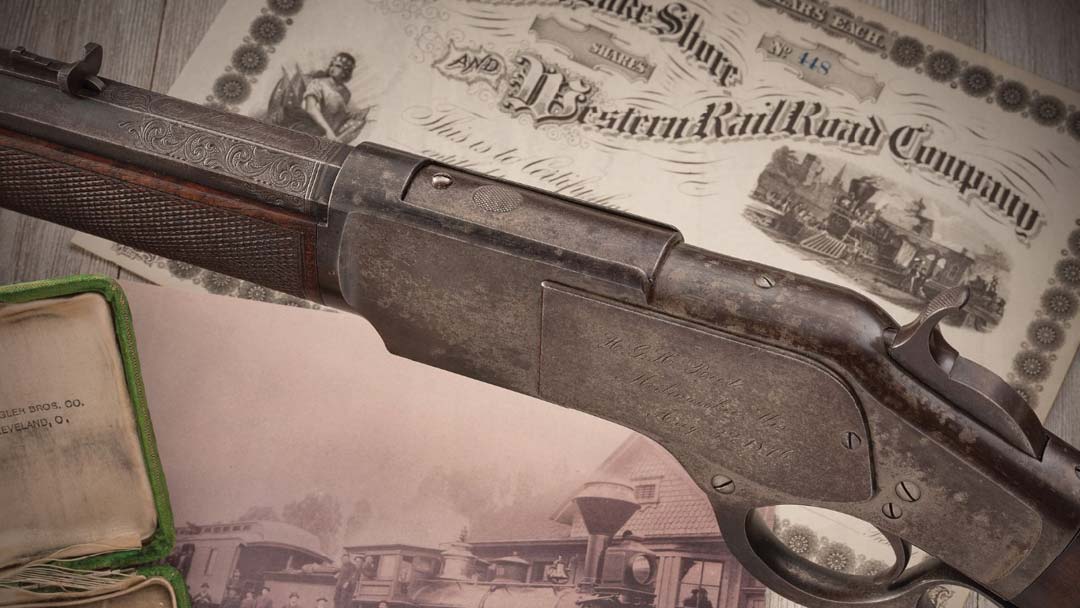
A historic, documented Winchester One of One Thousand Model 1873 smoothbore rifle inscribed for H.G.H. Reed of Milwaukee, one of the many highlights available in June’s auction.

What is the Difference Between Rimfire and Centerfire?

The terms rimfire and centerfire refer to how a self-contained firearm cartridge is ignited. A rimfire round stores its primer within a rim protrusion at the base of the cartridge casing, where a centerfire round is equipped with a separate primer contained in a metal cup mounted in the center of the casing base.

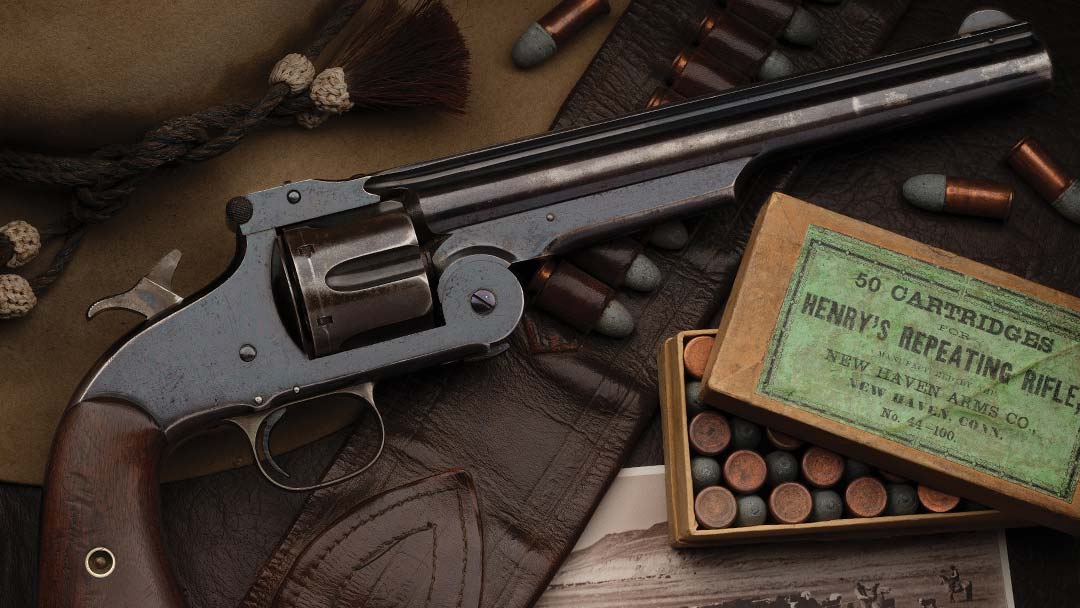
An exceptional S&W No. 3 American 2nd Model SAA chambered in .44 Henry rimfire. Available this August.

Centerfire ammunition is more complicated to manufacture than its rimfire counterpart, resulting in a higher price point. In terms of efficiency, centerfire rounds contain more powder than similarly sized rimfire cartridges, resulting in higher pressures and speeds, though at the expense of greater report and recoil.

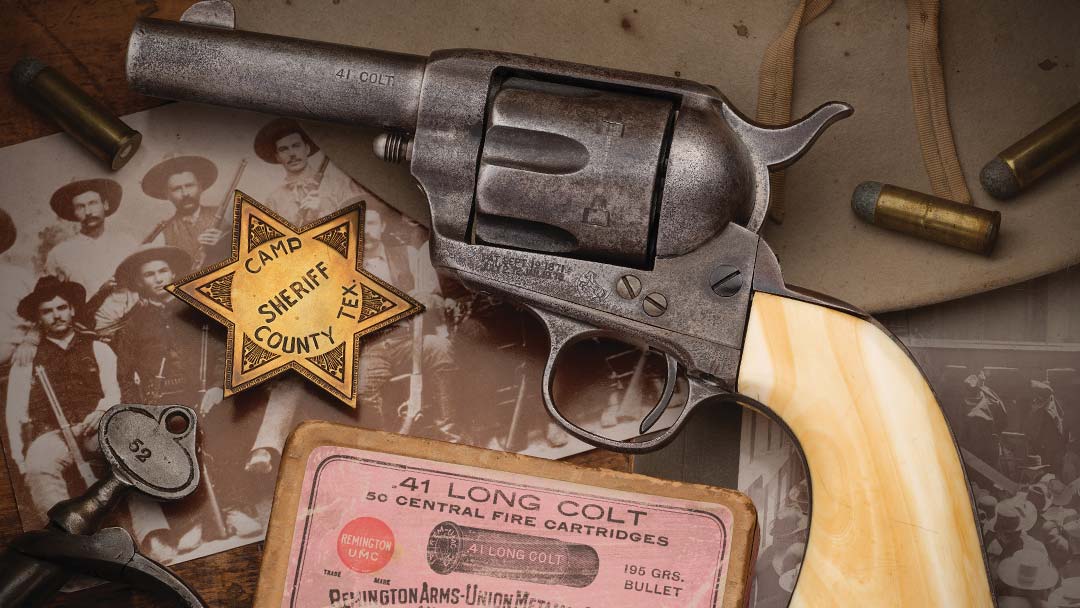
A New Orleans Shipped Colt Black Powder Sheriff’s Model SAA with a 3 1/2 inch barrel, chambered in .41 LC centerfire. Available this August.

Today’s rimfire ammunition is small and primarily used in target shooting and varminting, with the .22LR cartridge serving as the most popular option. Centerfire ammunition is available in countless calibers and fills every major military, sporting, and self-defense role today. Though modern rimfire ammunition serves a more narrow set of applications, in the 19th century the rimfire vs centerfire arms race wasn’t so clearly defined.

A Henry rifle in .44 Rimfire (bottom) and a Winchester Model 73 One of One Thousand in .44-40 WCF (top) Both examples are available this June.

Rimfire Cartridge Evolution

In 1854, Daniel B. Wesson took inspiration from Louis-Nicolas Flobert’s .22 BB Cap and created the .22 Rimfire cartridge (later dubbed the .22 Short), a design that included a small amount of mercury fulminate in the rim of a hollow brass case filled with black powder. The end product was the first practical American rimfire copper cartridge, a breakthrough that became one of the foundations for modern ammunition.

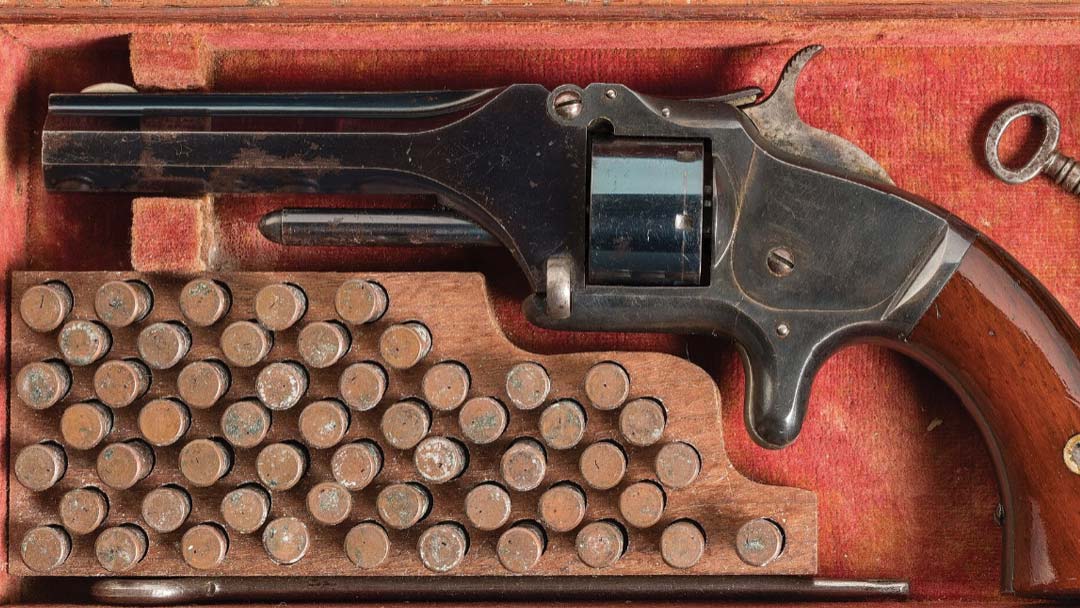
This 1860 manufactured Smith & Wesson Model No. 1 Second Issue sold at RIAC for $5,288 in May of 2022. The case contains 53 original rounds of .22 Short, a rimfire round that set the stage for countless cartridge developments to follow.

Released in 1857, the Smith & Wesson Model No. 1 became one of the world’s earliest revolvers to employ fully self-contained cartridges. Its patents allowed the company to successfully corner the American cartridge revolver market for the next two decades. According to Smith & Wesson, the .22 Rimfire cartridge had “a 4-grain charge of black powder and 29 grain bullet.”

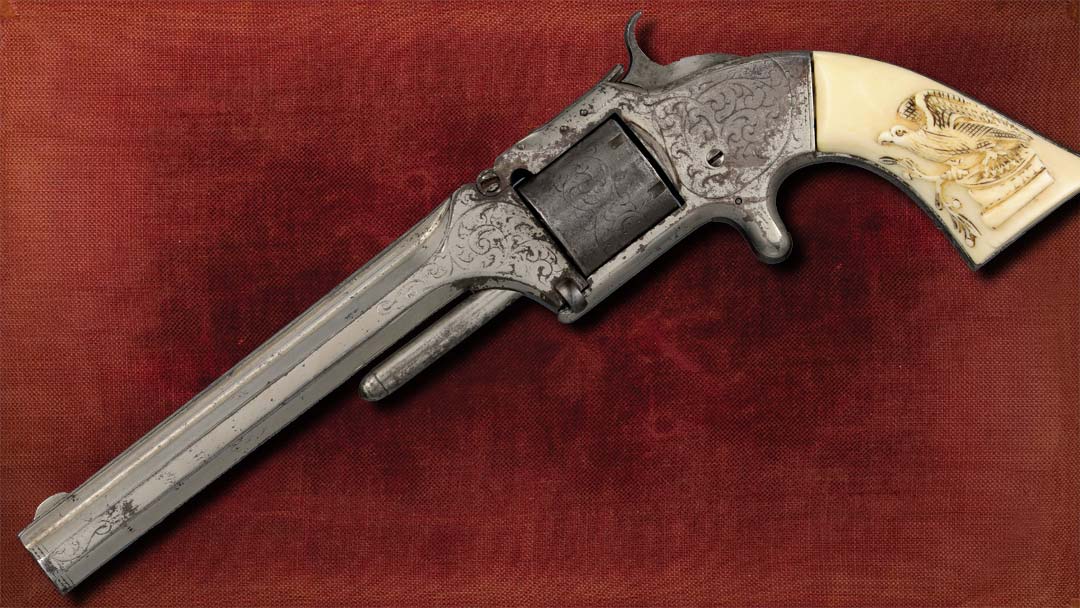
Smith & Wesson released a more powerful revolver in 1861, the S&W No. 2 “Old Army” chambered in a .32 caliber rimfire cartridge. This engraved, 1863 manufactured example is available this June.

Wesson’s .22 caliber rimfire cartridge served as the influence for numerous larger rimfire rounds, including the .56-56 Spencer rimfire patented by Christopher Miner Spencer in March of 1860 and the .44 Henry rimfire patented by Benjamin Tyler Henry seven months later.

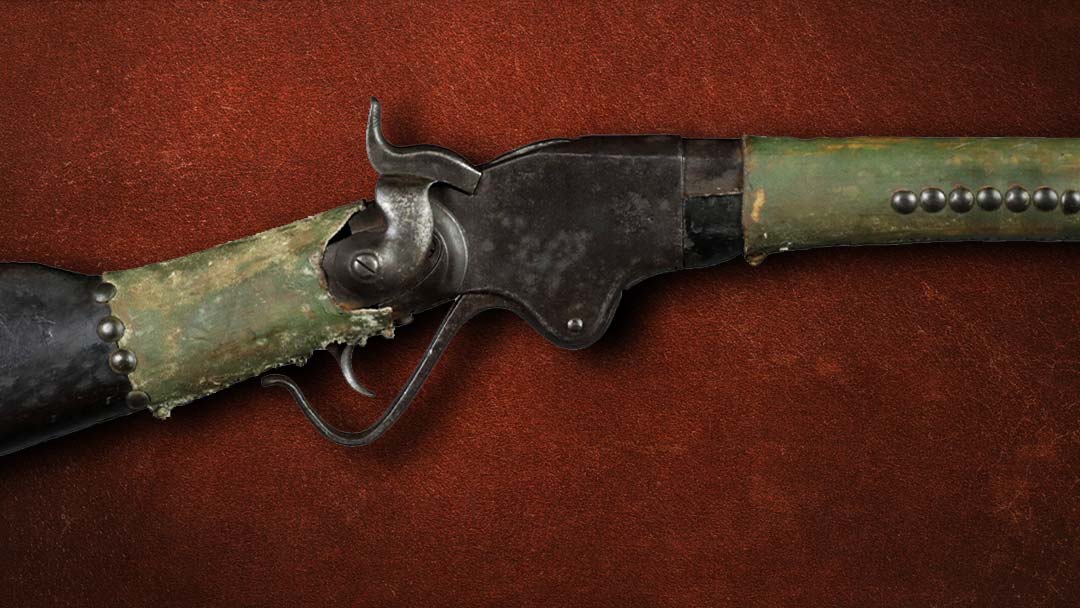
Manufactured between 1865 and 1866, this Spencer carbine includes a hide wrapped forend and wrist with tack decorations, notches carved on top of the comb, and an “IC” branding on the right of the buttstock. Available this June.

The .44 Henry became one of the most successful early rimfire cartridges. The 200-grain flat-nosed bullet was backed by 28 grains of black powder and capable of a 1,125 fps muzzle velocity from the barrel of a Henry rifle. Though lacking compared to the centerfire cartridges to follow, the .44 Henry was a dramatic upgrade from the ammunition used in the Henry’s anemic Volcanic predecessor. .44 Henry became a standard for some of the earliest full-sized metallic cartridge revolvers as well.

This early production three-digit serial number Henry rifle was manufactured by the New Haven Arms Company in August 1862, the fifth month of production. Available this June.

Rimfire vs Centerfire Winchester Rifles

The Winchester Model 1866 “Yellow Boy”, the first in what became a long line of Winchester lever actions, was also chambered in the .44 Henry Flat rimfire cartridge. While the Model 66 was an improvement over its Henry predecessor, Winchester understood that a new platform designed for a centerfire cartridge would offer their customers greater range and stopping power.

An engraved Winchester Model 1866 rifle. Available this May.

The .44-40 Winchester Center Fire, or .44 WCF, provided a notable upgrade from its rimfire sibling. With 40 grains of black powder propelling its 200-grain bullet up to 1,245 fps from the barrel of a Model 73 rifle, .44 WCF was faster, strong, and easier to reload compared to rimfire ammunition. Winchester sold reloading kits for this purpose, an ideal tool for frontiersmen far removed from the nearest ammunition store.

A Winchester One of One Thousand, one of the rarest examples of the famous Winchester Model 1873 platform. Available this June.

.44 WCF became one of the most popular rounds of the late 19th century. Winchester competitors Marlin and Burgess chambered rifles in the prolific centerfire cartridge and every major revolver maker offered wheelguns in .44 WCF, including Colt, Smith & Wesson, Remington, and Merwin Hulbert. Colt’s famous Frontier Six Shooter became an immensely popular option out West, allowing a frontiersman to carry ammo for both sidearm and rifle in the same cartridge belt.

Rimfire vs Centerfire Revolvers

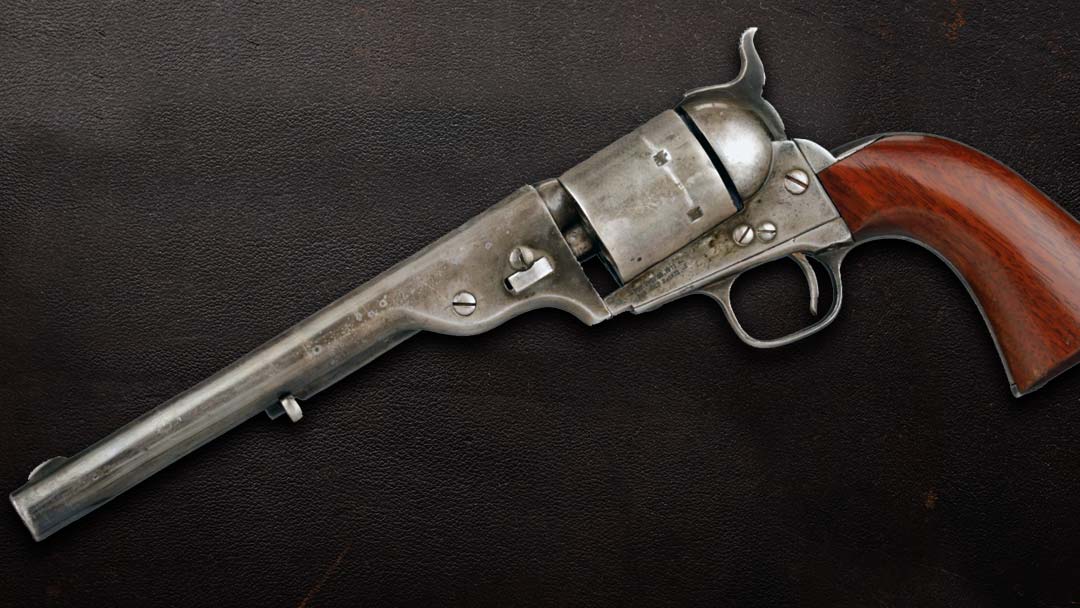
The rimfire vs centerfire showdown heated up in the handgun market after the Rollin White patent expired in 1869. Colt began converting thousands of percussion revolvers to cartridges and the company released the five-round Colt House revolver and four-round Colt Cloverleaf revolver in 1871, each chambered in .41 rimfire.

.41 rimfire also served as the primary caliber for the Moore’s Patent derringer from the National Firearms Company. Colt purchased the manufacturer outright in 1870 and continued to sell the .41 rimfire pocket pistols in the form of the Colt 1st and 2nd Model derringers.

For the Colt Open Top revolver, Colt’s Superintendent of the Armory, William Mason, eyed the .44 Henry round due to its popularity with frontiersmen of the day.

A Colt Model 1871-72 Open Top revolver chambered in .44 rimfire. Available this June.

In their search for a metallic cartridge revolver, the U.S. Army prioritized stopping power and reliability. Colt’s new Single Action Army design, released in 1873, fulfilled both requirements. The solid frame sixgun was chambered in .45 Colt, a stronger round than .44 Henry rimfire and centerfire competitors like .44 S&W and .45 Schofield. Colt’s “M1873” and its hefty centerfire cartridge excelled in Ordnance Department trials and became the U.S. Army standard for years to come.

An 1874 manufactured U.S. Ainsworth Inspected Colt Cavalry Model SAA revolver with holster, chambered in .45 Colt. Available this June.

In the rimfire vs centerfire arms race, the power offered by the centerfire round made it the clear choice for American cavalry revolvers, but popular cartridges like the .44 rimfire persisted for decades in the civilian market and even endured with a few foreign militaries.

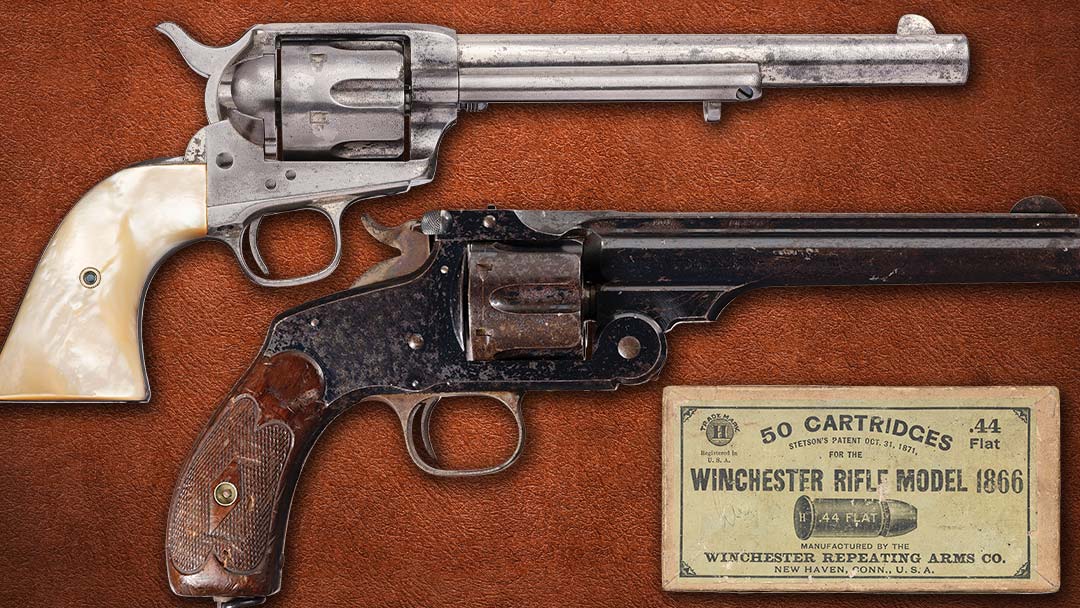
The Turkish Contract S&W New Model No. 3 chambered in .44 Henry Rimfire pictured below is an example of the latter. The Ottoman Empire had purchased 50,000 Winchester Model 1866 muskets and carbines and commissioned Smith & Wesson to chamber thousands of revolvers in the same cartridge.

(Top) The single known factory nickel and pearl stocked Colt SAA in .44 Henry. (Middle) A scarce Turkish contract S&W New Model No. 3 in .44 Rimfire (Bottom) A 50 count box of Winchester 44 flat ammunition, label marked for the Model 1866 rifle. Each item is available this August.

All but the smallest rimfire cartridges fell out of favor after the introduction of smokeless powder and the advances in higher-pressured, more reliable centerfire ammunition. For military, police, and hard-hitting self-defense options, revolvers chambered in centerfire reigned supreme.

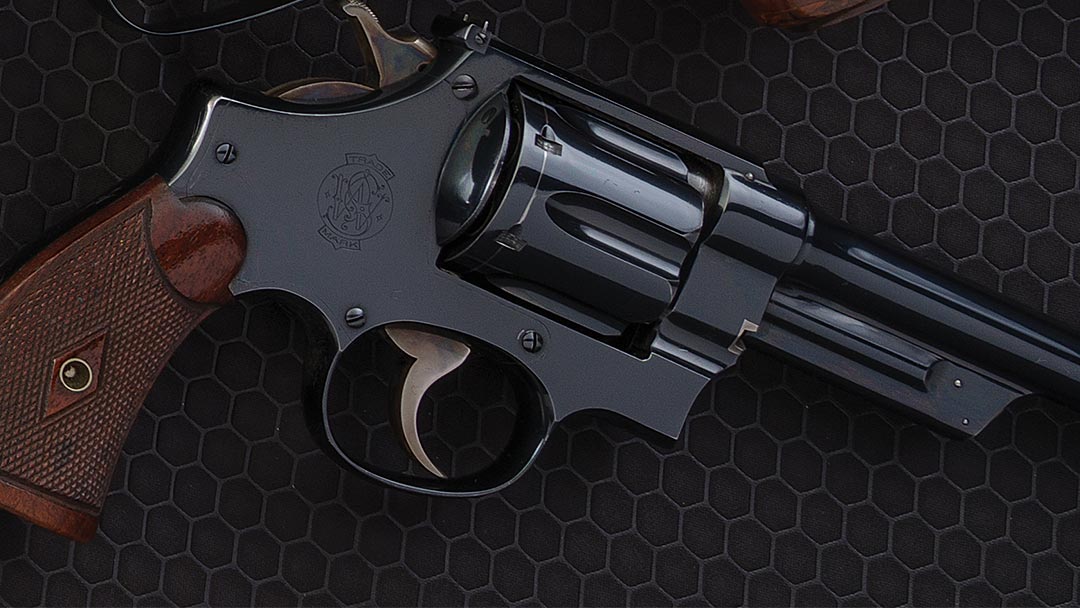
A 1918 shipped Smith & Wesson .44 Hand Ejector First Model Target Triple Lock DA revolver chambered in .44 Special. Available this June.

Rimfire vs Centerfire Big Bore Rifles

In addition to serving as inspiration for the .44 Henry and .56/56 Spencer, Smith & Wesson’s .22 Rimfire round gave rise to a variety of large chamberings, including the mammoth .58 Gatling RF Long cartridge that stretched over 2 inches in length. Civil War carbines such as the E. G. Lamson & Co. Palmer bolt action and the Remington Type II Split Breech carbine were chambered for .50 rimfire rounds, while 1866 saw the introduction of the hefty .58 Miller/Allin rimfire cartridge.
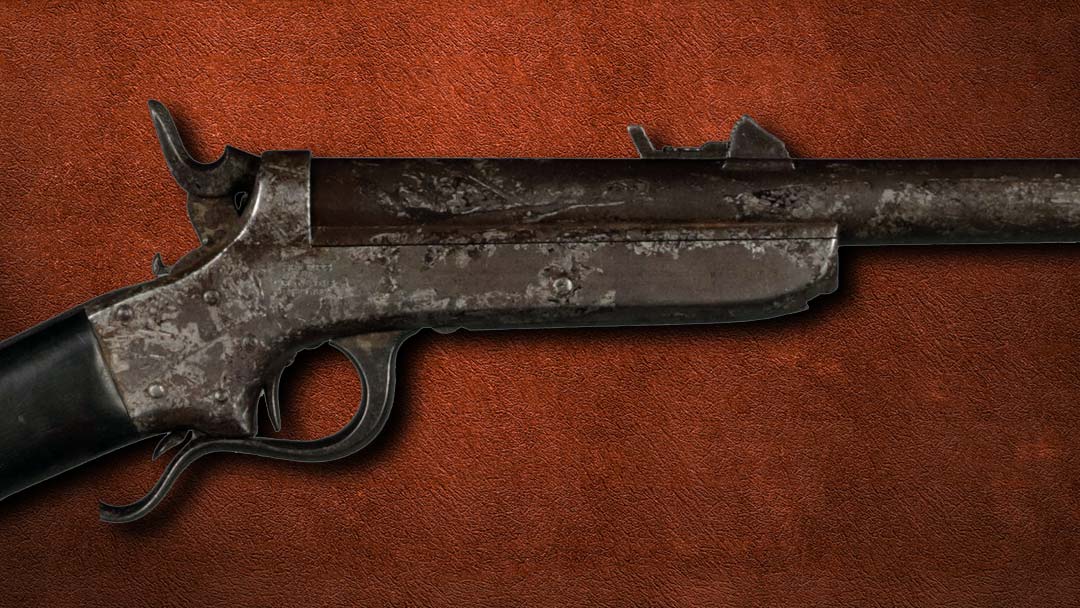
Manufactured betwee 1861 and 1862, as few as 100 of these scarce Sharps & Hankins Model 1861 breachloading carbines were produced for the commercial market. This example is chambered in .52 rimfire and is available this June.

After the Civil War, the U.S. Army had 5,000 Springfield Model 1866 rifles converted to single shot breechloaders chambered .58 Miller/Allin. The following year, 25,000 more rifles were converted for the .50-70 centerfire round, which provided a more than 10% upgrade in velocity over its larger rimfire predecessor. The .50-70 and its .45-70 sibling became military and hunting standards for years to come.

A scarce U.S. Springfield/Sharps Model 1870 Second Type cartridge conversion infantry trials rifle chambered in 50-70 Government. Available this June.

Rimfire vs Centerfire Palm Pistols

The competition between rimfire vs centerfire ammo was more even in the late 19th century concealed carry market. ‌Derringers, pocket revolvers, and palm pistols were chambered in everything from .22 to .44 caliber in each cartridge style, with scaled-down variants of some rounds developed for the most diminutive firearms.

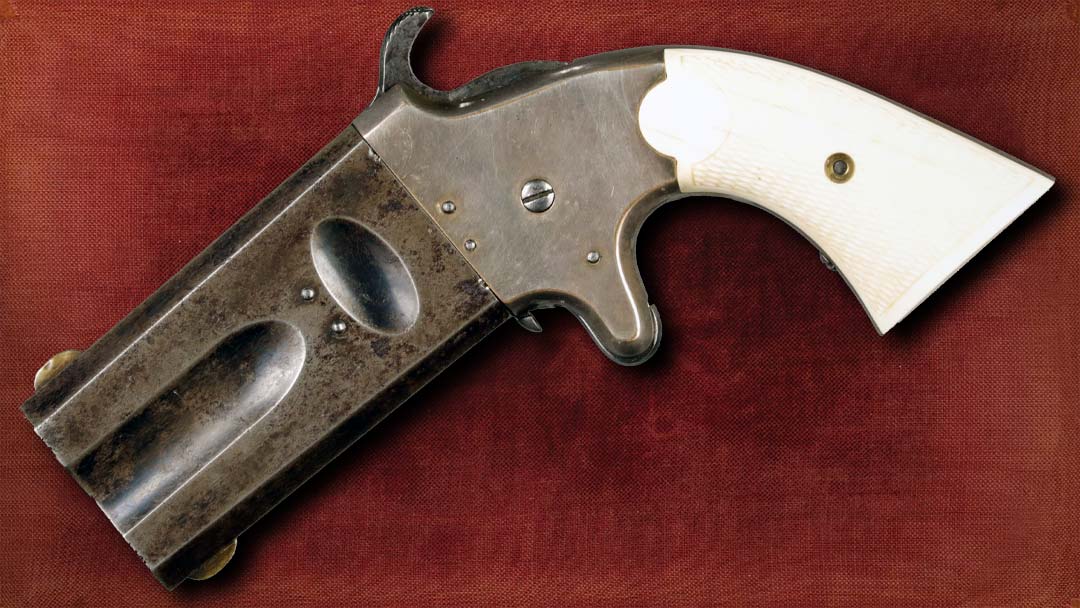
An American Arms Co. double barrel swivel breech pistol chambered in .41 rimfire. Available this June.

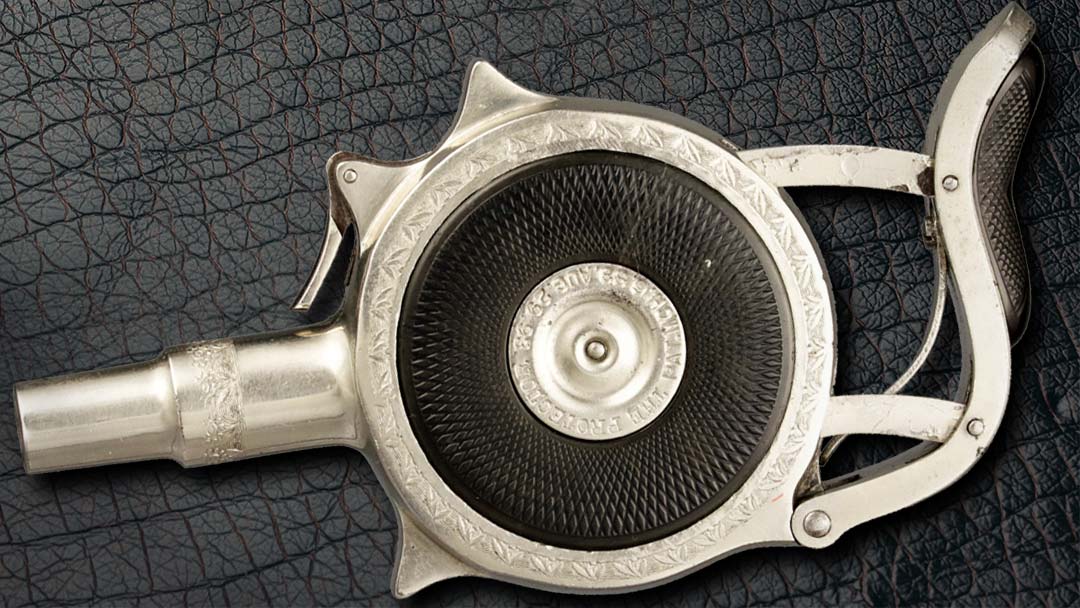
One of the most unusual palm pistols, “The Protector,” was produced in both a rimfire and centerfire variant. The early models sold by the Minneapolis Firearms Co. in 1891 are chambered in .32 Centerfire Extra Short, while the examples produced by Ames Sword Co. starting in 1892 are chambered for .32 Rimfire Extra Short, also called .32 Protector.

A Chicago Fire Arms Co. Protector Palm Pistol chambered in 32 XSRF. Available this June.

The Legacy of .22 Rimfire

167 years after its introduction, the venerable .22 rimfire still serves as a popular round. .22 Short remains in production as the oldest commercially manufactured cartridge, though its .22 Long Rifle cousin dominates the rimfire sales charts.

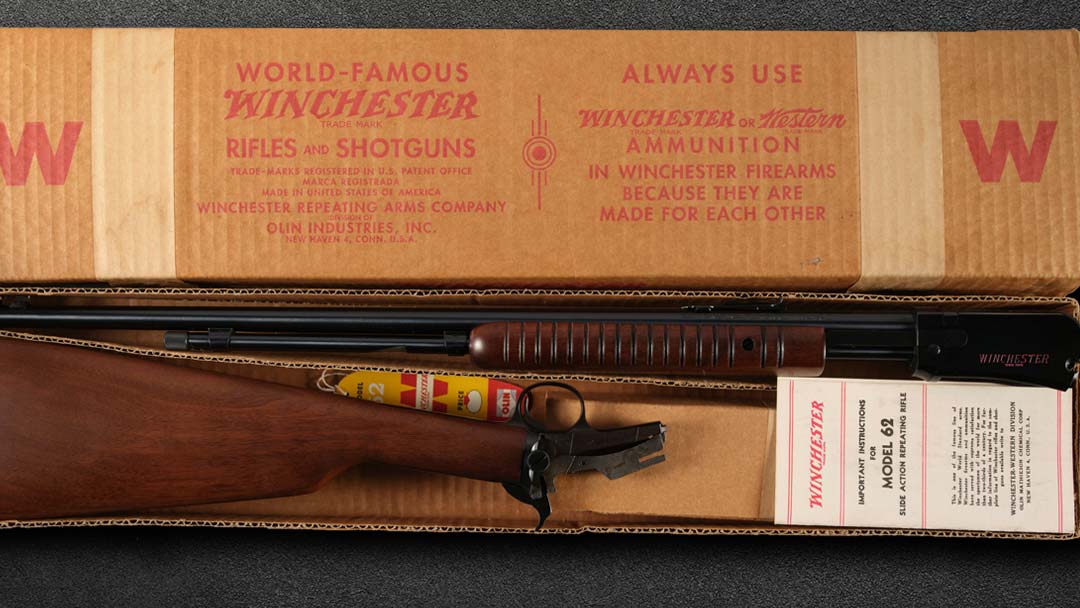
.22 Short, the original rimfire round, continues to thrive. This Winchester Model 62A slide action take down rifle manufactured in 1957, is chambered in the classic cartridge. Available this June.

1871 saw the introduction of the .22 Long rimfire round, featuring a longer case with an additional grain of powder charge. Nine years later, the .22 Extra Long increased the length and charge further still.

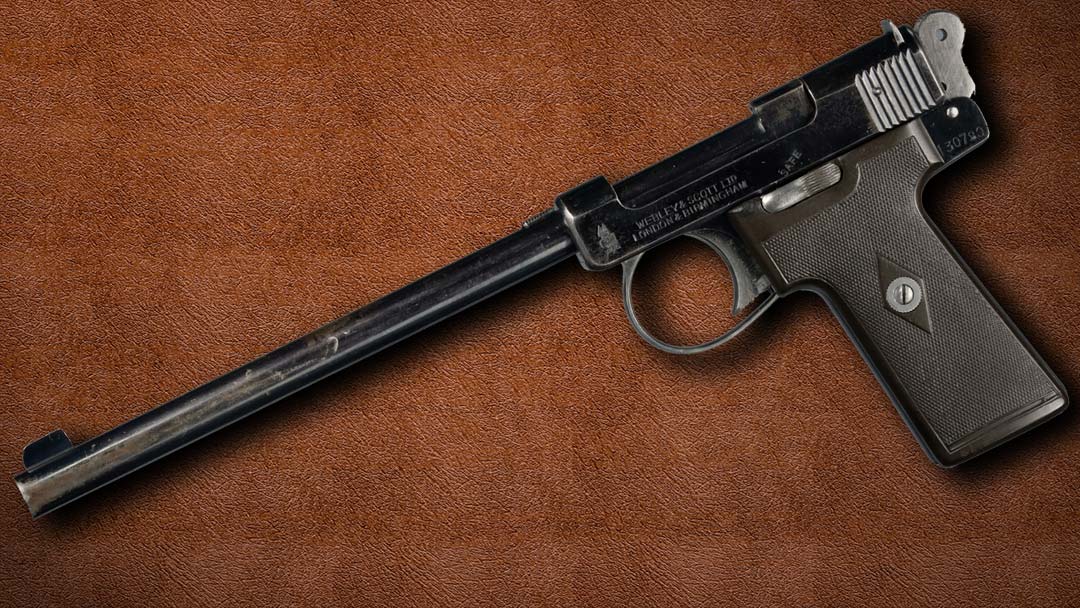
British Webley & Scott Ltd. Model 1911 single shot target pistol, chambered in .22 Long. Available this June.

The classic .22 Long Rifle would finally emerge in 1887. A product of the J. Stevens Arms & Tool Company, this essential rimfire round was designed to rival the power of the .22 Extra Long but in a shorter package.

In the rimfire vs centerfire showdown, the sheer number of centerfire ammunition variants vastly outmatches its rival, but .22 LR still tops the sales charts. As a training caliber, a plinker, a small game staple, and a target round chambered by countless rifles and pistols, .22 LR is timeless. The cartridge’s price and availability are unmatched, and an abundance of .22 LR rounds can be carried in a belt pouch, coat pocket, or in the buttstock of a survival rifle like the AR-7.

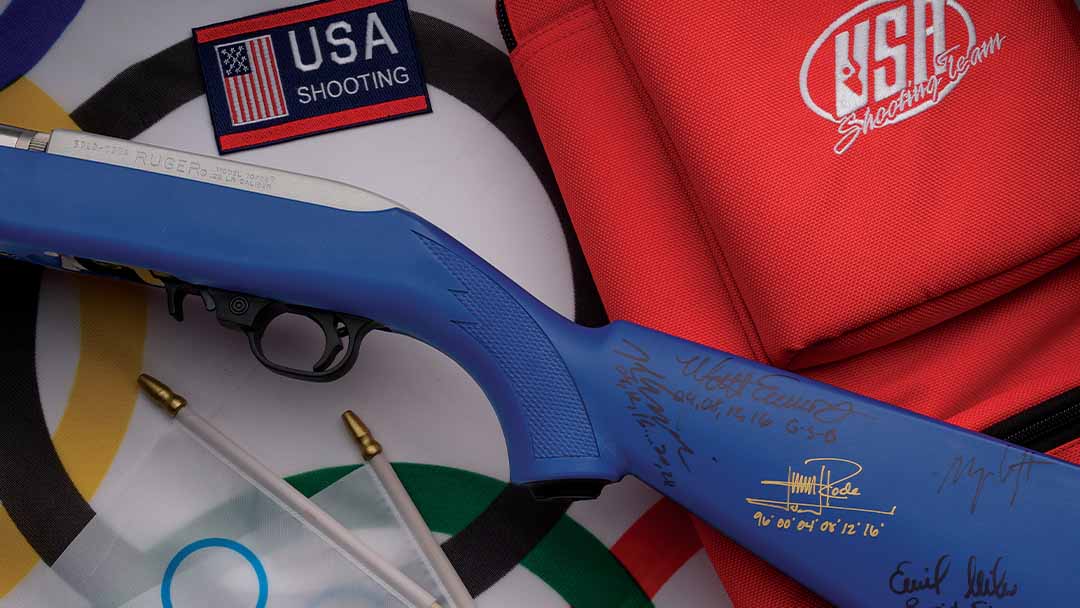
The Ruger 10/22, one of the classic platforms for .22 LR. This special autographed Ruger 10/22 was originally manufactured to raise funds for the USA Shooting Team in 2012 and bears the signatures of 15 members of the USA Shooting Team on the stock. Available this June.

Rimfire Evolution in the Modern Era

One of the more enduring 20th century advancements for rimfire ammunition was realized with Winchester’s.22 WMR in 1959. Widely known as “.22 Magnum,” .22 Winchester Magnum Rimfire offered a cartridge that surpassed the performance of .22 LR. The round was embraced by a multitude of pistol and rifle manufacturers and continues to serve as a favorite for plinking and varminting needs.

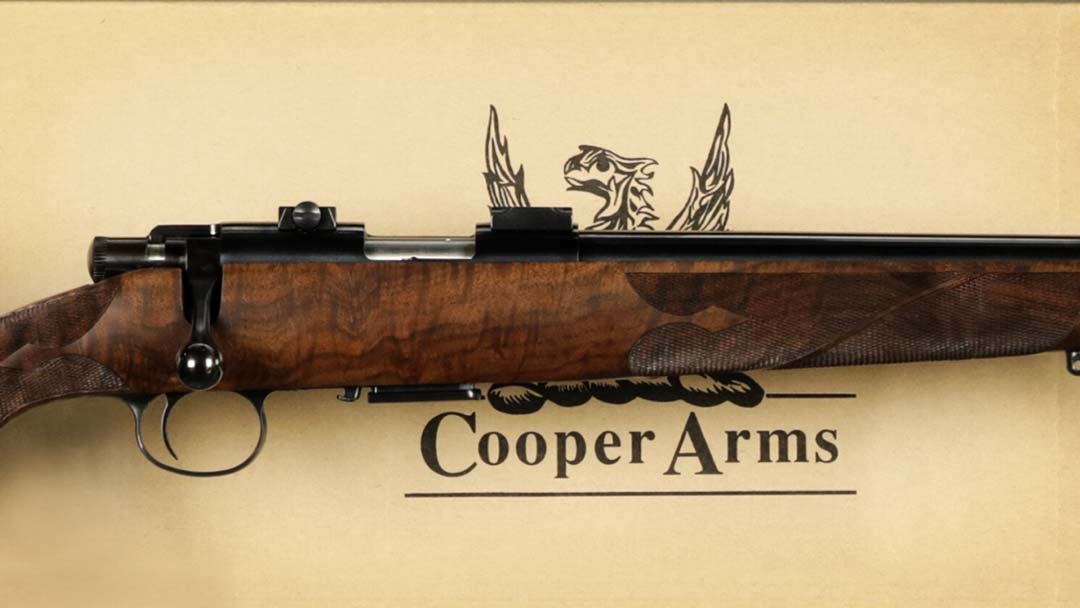
A Cooper Arms Model 57-M rifle with its box chambered in .22 WMR, a popular rimfire round. Available this June.

Over the next four decades, there were numerous attempts to popularize new rimfire cartridges, but none would find lasting success until Hornady Manufacturing introduced the .17 HMR in 2002. Based on a necked down .22 WMR case, .17 Hornady Magnum Rimfire would hold the title of the fastest commercial rimfire round for the next 11 years, and many popular manufacturers offer rifles chambered in this efficient little cartridge.

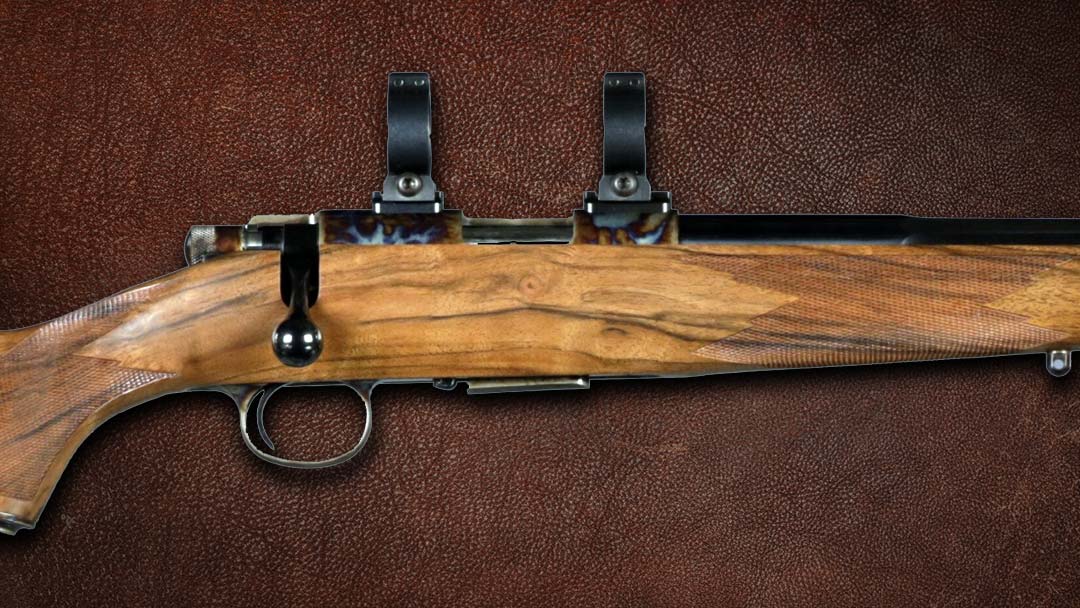
A Cooper Firearms Model 57-M bolt action rifle chambered in .17 HMR, a rimfire round capable of achieving 2,650 fps. Available this June.

Hornady continued to innovate with the release of the .17 Mach 2 in 2004. A collaboration with CCI Ammunition, the .17 Hornady Mach 2 rimfire round was built on CCI’s .22 Stinger. Where .17 HMR provided a faster and flatter version of .22 Magnum, .17 Mach 2 offered a higher performing variant of the timeless .22 LR.

A Kimber Mfg Inc. Rimfire Target pistol chambered in the swift .17 Mach 2.

In April of 2013, the .17 Winchester Super Magnum hit the market and took the title for the fastest commercial rimfire round. Developed from a necked down .27 caliber nail gun blank, the .17 WSM can exceed speeds of 3,000 fps, offering an accurate and comparatively powerful option for a range of small-game hunting applications. In the rimfire vs centerfire competition, .17 WSM is one of the few rimfire rounds that can come anywhere close to the speeds of the zippy .17 Hornet.

The Rarest Rimfire and Centerfire Arms

From the .22 Short onward, the self-contained metal cartridge evolved to fill every niche conceivable. The rimfire vs centerfire arms race gave rise to numerous experimental gun designs and scarce chamberings that are highly desirable for today’s collectors, and a rare range of examples can be found at Rock Island Auction Company.

A U.S. Bureau of Ordnance ammunition display board, marked “MK.1 MOD.0 (VISUAL TRAINING AID)”. Available this June.

Subscribe to the weekly Rock Island Auction newsletter for new gun blogs and gun videos that dive deeper into the ammunition. From powerhouse pistol rounds like the .357 Magnum, .44 Magnum, .500 S&W, heavy hitting hunting ammo like the 10 gauge shotgun shell, the Nitro Express, and the mammoth punt gun shell, to ammunition oddities like the pinfire cartridge, the Gyrojet pistol, the Dardick revolver, and the Daisy V/L, we explore every niche of arms development.

The rimfire vs centerfire showdown was at its height in the post Civil War period, with a wealth of innovative arms and chamberings that collectors can obtain today at Rock Island Auction Company.

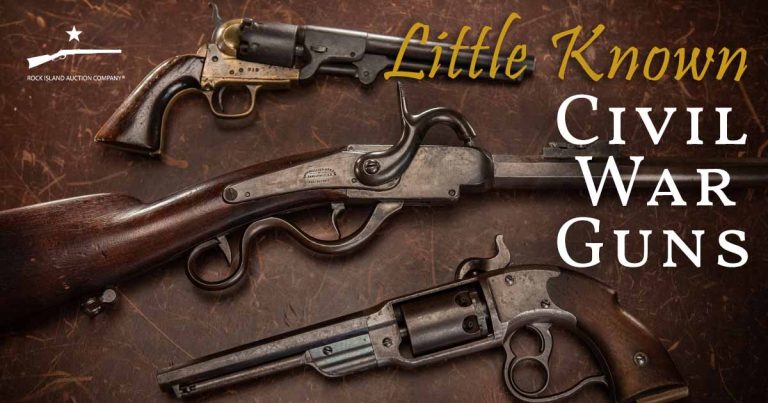
Starr to Savage: Little Known Civil War Guns

0

As the United States descended into Civil War, both sides came to the realization they didn’t have the weapons to put up a fight. The Union, with its industrial advantage, started manufacturing all types of weapons, many that were well-made, innovative and accurate but not necessarily well known.

Many gun companies like Starr and Burnside that had struggled to find an audience for their product now had a ready and willing buyer in the U.S. government. The Confederate government, without the industrial base the northern states had and unable to buy guns from northern companies, struggled to find weapons, looking to Europe, but occasionally finding a home-grown opportunity.

Here are some guns that might not be as well-known as many Civil War-era firearms as well as two legendary wheelguns that will be available in the June 21-23 Sporting & Collector Auction in Bedford, Texas.

The Billinghurst-Requa volley gun is a little know Civil War gun that could fire 24 shots that will be discussed below.

Starr Arms Percussion Revolvers

Inventor Ebenezer Starr’s family supplied the U.S. government with swords, sabers, cutlasses and pikes for several years as well as more than 20,000 flintlock muskets from 1831 to 1845. He designed a carbine and revolver but sold out his part of the company that bore his name by the time the Civil War started.

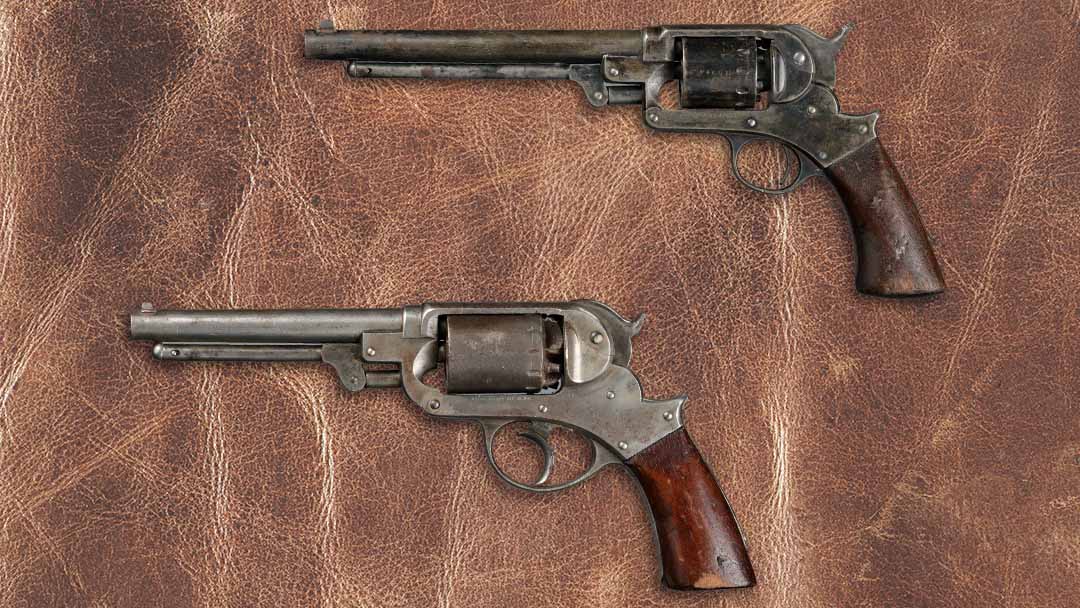
Starr created something innovative with a double action revolver, but the Ordnance Department wanted single action. Though popular in Europe, double action revolvers were looked down on in the United States because of concerns that the action was easier to fire, leading to the depletion of more ammunition than the single action. The government successfully persuaded Starr Arms to do away with the double action and the Army purchased 25,000 revolvers.

The single action Starr Model 1863 Army revolver at top is chambered in .44 caliber, while the Model 1858 double action revolver, below, is a Navy model in .36 caliber. About 32,000 of the Army single action revolvers were made from 1863-1865, while about 3,000 of the double action Navy revolvers were made from 1858-1860.

Cosmopolitan Arms “Grapevine” Carbine

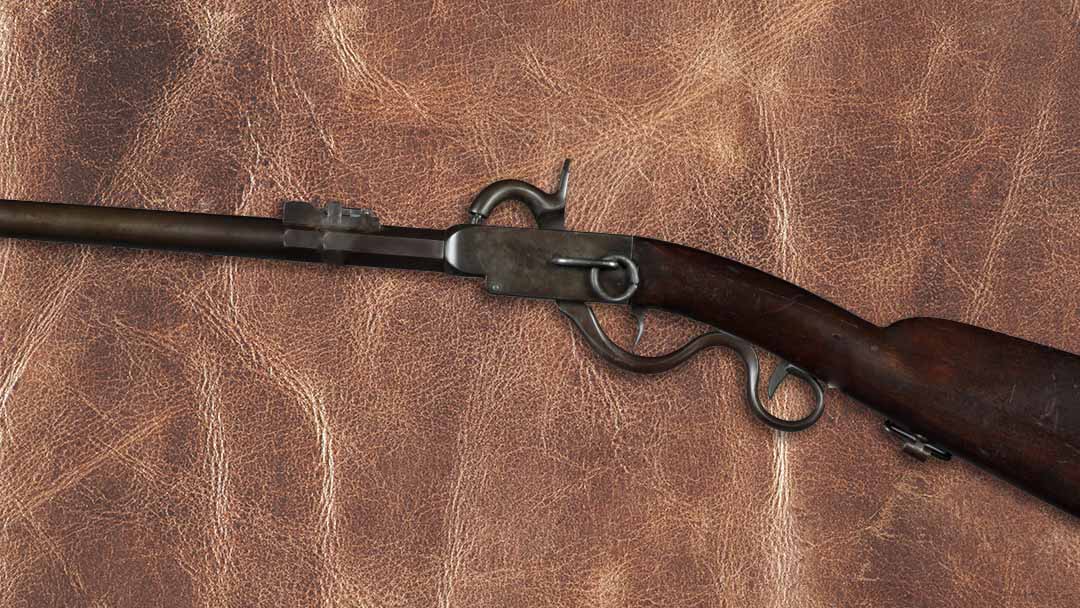
The Cosmopolitan Arms Company was founded in Hamilton, Ohio in 1859 by Abner Campbell and Edward Gwyn and received one of the earliest Union contracts among any carbine manufacturer – and there were several! At the start of the war, the federal government didn’t see a need for many horse-mounted troops because a short infantry-fought affair was expected. However, state militias saw the usefulness of cavalry and organized their own units and required carbines that could be handled on horseback.

Cosmopolitan shipped 1,140 breech-loading, .52 caliber carbines to Illinois units in mid-1862. They had a unique double loop lever that lent the carbine its “grapevine” nickname. The company reorganized as Gwyn & Campbell, producing 8,200 carbines for Union forces.

The Cosmopolitan Arms carbine was produced early in the Civil War and the reviews for it on the battlefield were that it had too much gas leakage at the breech.

Savage Navy Percussion Revolver

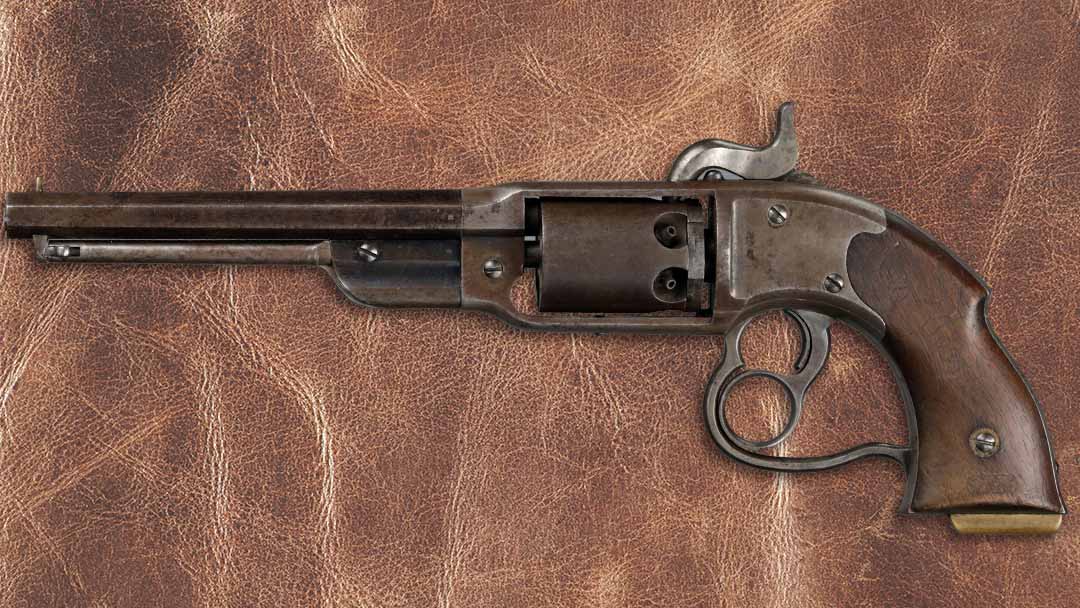
Its predecessor, the Savage & North “figure 8” revolver had a distinct look with its trigger and trigger guard, and the Savage Navy is also recognizable with its over-sized trigger guard. Made in 1861-62, the dual-trigger setup with a ring trigger to rotate the cylinder and cock the hammer, and the forward trigger to fire the gun reportedly made it difficult to manipulate and shoot accurately. The guns, in the Navy caliber, were sold to the Army for use mostly in the Civil War’s western theater. Some did find their way into Confederate hands, mostly troops from Virginia and Texas.

Rather than located at the rear of the cylinder, the percussion caps sit and rotate so they point upward and the hammer comes down on the cap. The caps couldn’t fall off and jam, but they could be knocked off and create a failure to fire.

The Savage Navy revolver, of which 12,000 went to the Army and 1,126 went to the Navy, were offered to soldiers for the tidy sum of $8 after the war, and only 17 were purchased among a vast inventory of surplus arms.

James Warner Saddle Ring Carbine

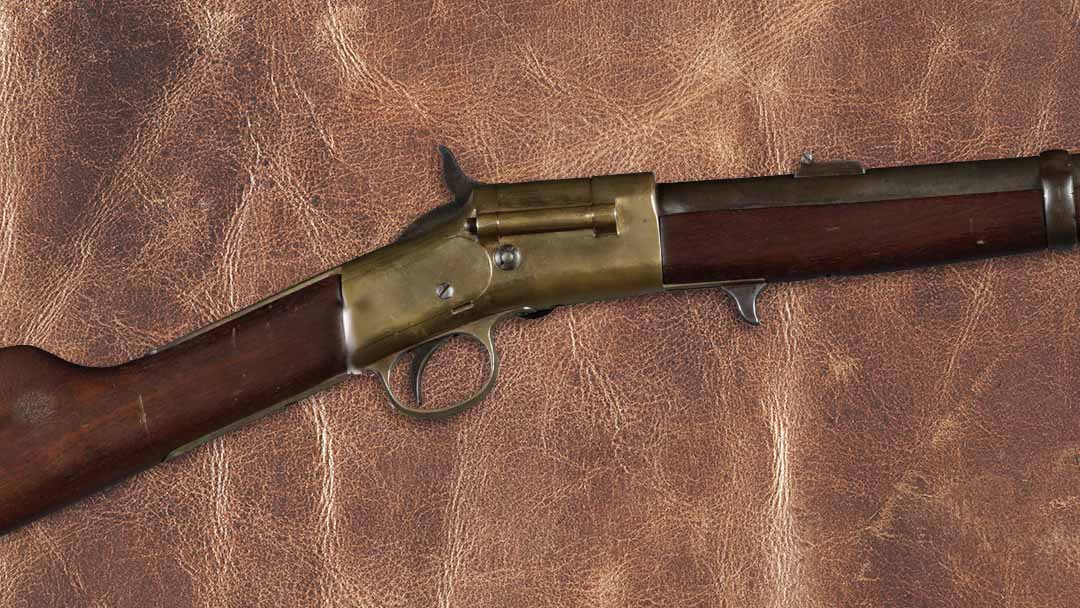
One of the most distinctive Civil War carbine models, the brass frame Warner carbine was designed, patented, and produced by lifelong gun inventor James Warner of Massachusetts. Warner managed to land an Ordnance Department contract for his carbine before the patent was issued in February 1864.

The James Warner Carbine is a must-have for Civil War collectors because of its rarity. Only 1,501 of these carbines were produced after going into production late in the Civil War, issued mainly to the 3rd Massachusetts and the 1st Wisconsin Cavalry regiments.

Billinghurst-Requa Volley Gun

Dentist Josephus Requa invented his namesake volley gun with gunsmith William Billinghurst. The Billinghurst-Requa Volley Gun mounted 24 barrels mounted in a horizontal fashion running parallel. Patented in 1862, the gun’s hammer ignited a percussion cap that lit a channel of black powder that fired cartridge clips. A three-man crew could fire 175 shots – seven volleys – per minute.

Never accepted into military service, the gun was considered unpredictable and unreliable with a chain reaction difficult to achieve. The Billinghurst-Requa was patented a few months before another doctor, Richard Gatling, patented his Gatling Gun.

This example of a Billinghurst-Requa Volley Gun is a half-scale model of the Civil War-era volley gun with 18 barrels to fit the scale requirements that fires.

E.G. Lamson Palmer Bolt Action Saddle Ring Carbine

The Palmer carbine was patented in 1863 and holds the distinction of being the first metallic cartridge bolt action firearm ever adopted by the U.S. Ordnance Department. The bolt on this design is used to seat the cartridge and seal the breech. It fires with a traditional side lock. Over 1,000 of these innovative Civil War carbine models were ordered by the U.S. government, but they arrived one month too late to see action in the conflict.

The grandfather to modern bolt-action rifles, the Lamson-Palmer carbine was sold on the open market after being delivered to the Army too late for use in the Civil War. Just over 1,000 were made, so their rarity makes them attractive to Civil War collectors.

Confederate Griswold & Gunnison Revolver

The Battle of Griswoldville was the first battle on Sherman’s March to the Sea. Unincorporated, the village outside of Macon, Ga., was mostly industrial buildings as well as worker and slave residences. Union cavalry burned down the factory where the Griswold & Gunnison revolvers were made. Many of the Confederate dead and wounded were old men and boys of the Georgia militia. A Union officer remarked, “I hope we will never have to shoot at such men again.”

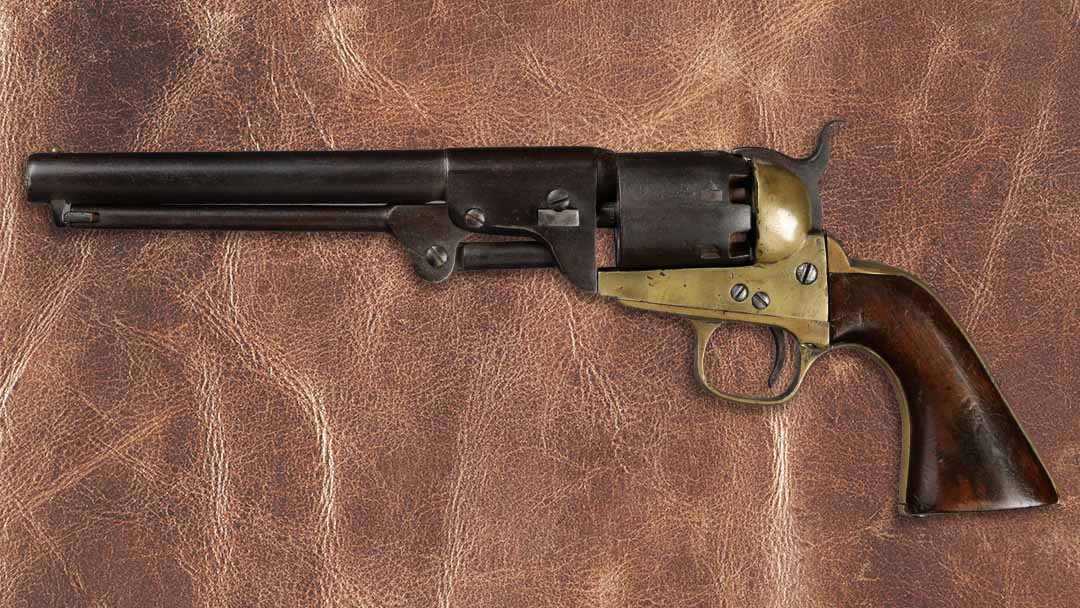
About 3,700 Griswold & Gunnison revolvers, with their recognizable brass frames and dragoon-type barrel, were manufactured between 1862 and 1864, more than any other revolver in the Confederacy.

This rare Confederate Griswold & Gunnison revolver has the name “W.A. Jones” stamped on the gun’s butt, a fairly common name found among the rolls of Confederate units.

Rogers & Spencer Army Model Percussion Revolver

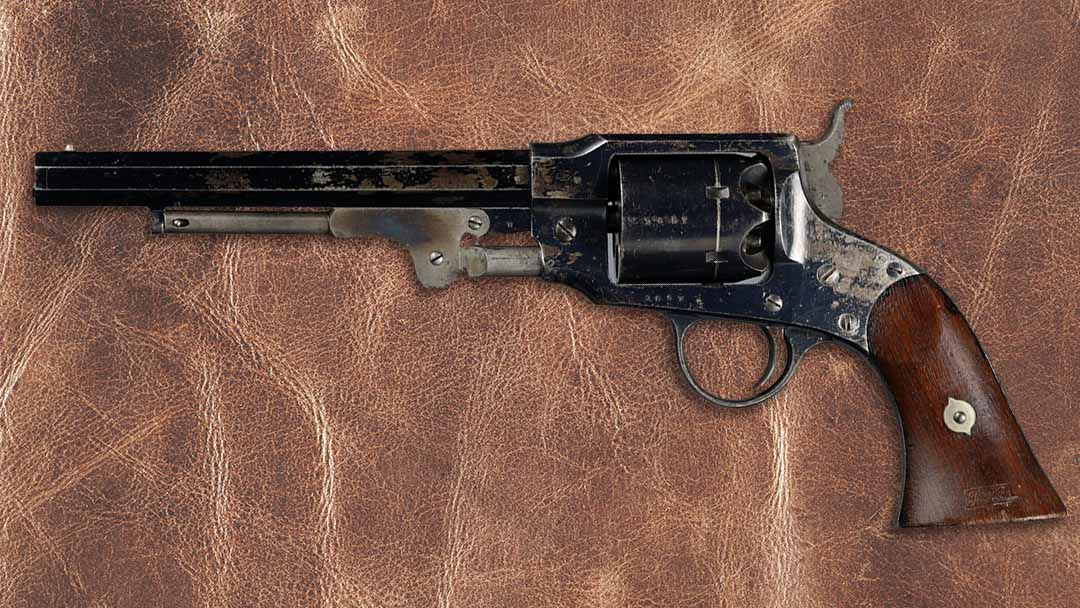
Like the Lamson Palmer carbine, the Rogers & Spencer revolver never got to prove its mettle in war. Rogers & Spencer of Willowvale, N.Y., received an order for 5,000 revolvers in November, 1864, but Gen. William T. Sherman had captured Atlanta, Lincoln was re-elected, and the war’s end was fast approaching. Rogers & Spencer produced 5,800 single action revolvers for the Ordnance Department. After the war they were issued to the Army and police. In 1901, the unused revolvers were purchased by Francis Bannerman, a sporting goods company, for sale to the public.

Chambered in .44 caliber with a 7-1/2 inch barrel, the pistol appears similar to the Remington New Model Army.

Burnside Carbine Second Model Percussion Saddle Ring Carbine

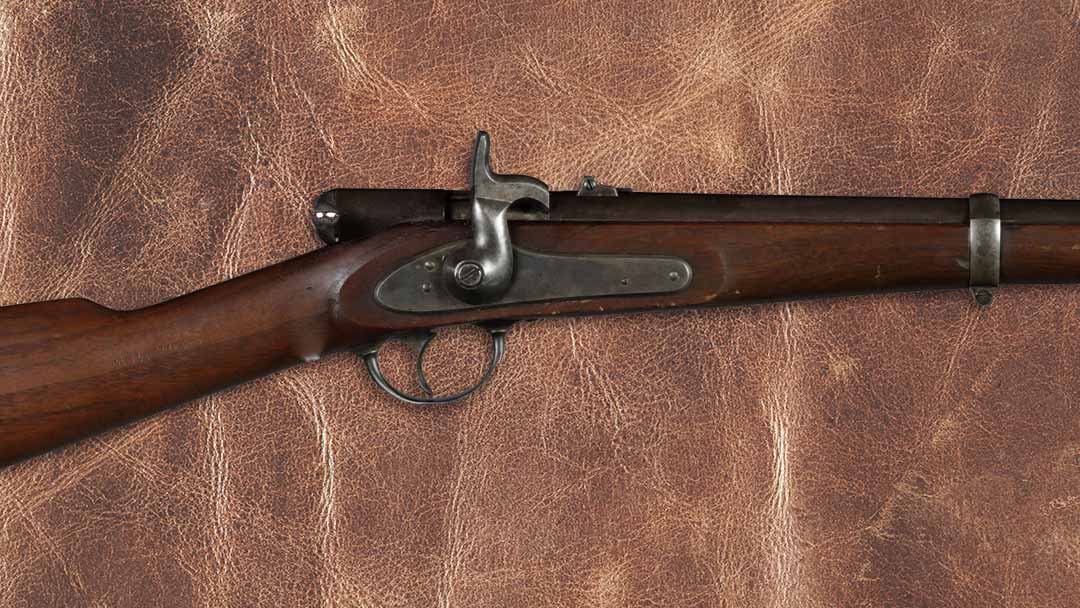
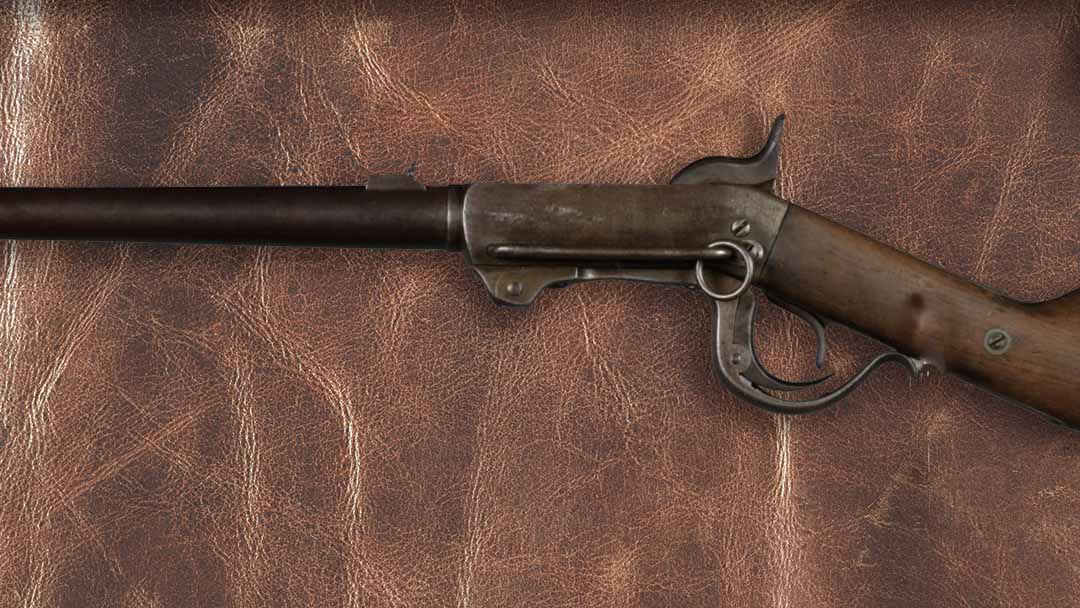
The Burnside carbine trailed only the Sharps and Spencer carbines as the most manufactured shoulder-fired cavalry weapon of the Civil War. However, that wasn’t until the Burnside’s Fifth Model with 43,000 made. The previous models just trickled along, with as many as 2,000 each of the Second and Third Models manufactured. There were 7,000 of the Fourth Model produced.

The Second Model had a curved locking device for the operating lever/trigger guard instead of a lever wrapped under the hammer as the first model had. It also didn’t have a forend, but one was added with the Third Model. The Fifth Model was made with a newly patented breech action that was an improvement on earlier versions.

Despite the more widely available later models of the Burnside Carbine, the Second Model is one for collectors to snap up since only about 2,000 were manufactured and offer an early look at how the carbine evolved.

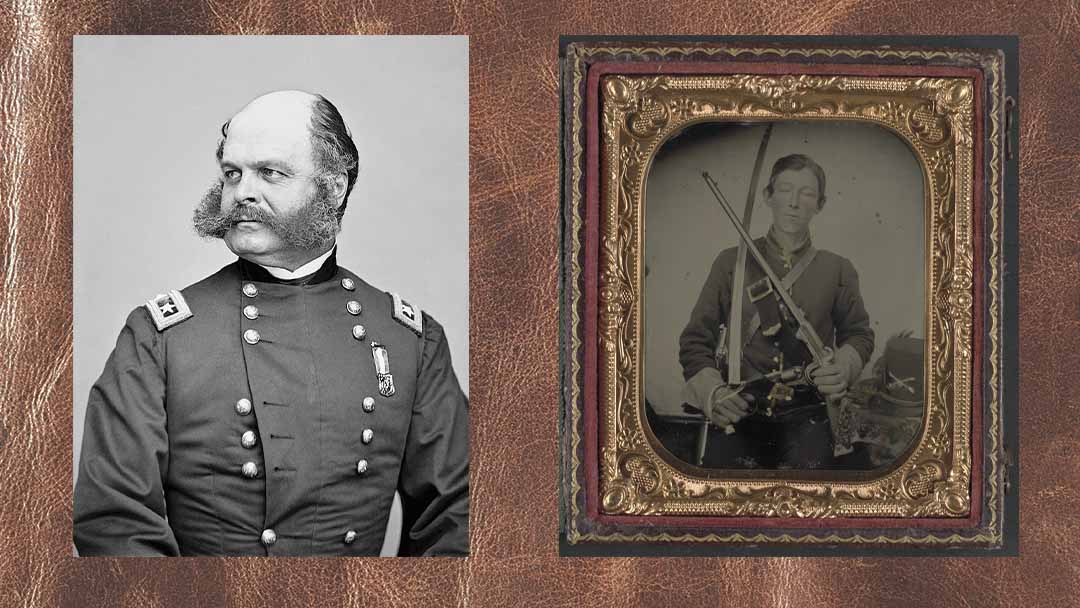
The carbine’s namesake was Ambrose Burnside, a West Point graduate who served in the Mexican-America War and on the western frontier before resigning his commission to devote his time to designing his carbine. The business failed and Burnside sold his patent to cover the debts. During the Civil War, his carbine would find wide use.

At the dawn of the Civil War, Burnside organized an infantry unit that was one of the first to arrive in Washington, D.C., to protect the capital. Promoted to general, he experienced early successes and was named commanding general of the Army of the Potomac but within a few months was relieved of his command after costly strategic mistakes. He was given command of the Department of Ohio in 1863 and found some renewed success before he resigned his commission near the end of the war following one last failure. He served as governor of Rhode Island and as a U.S. senator after the war.

General Ambrose Burnside who designed his namesake carbine and returned from civilian life to serve the Union in the Civil War, left, and a heavily armed Union soldier holding a Burnside Carbine.

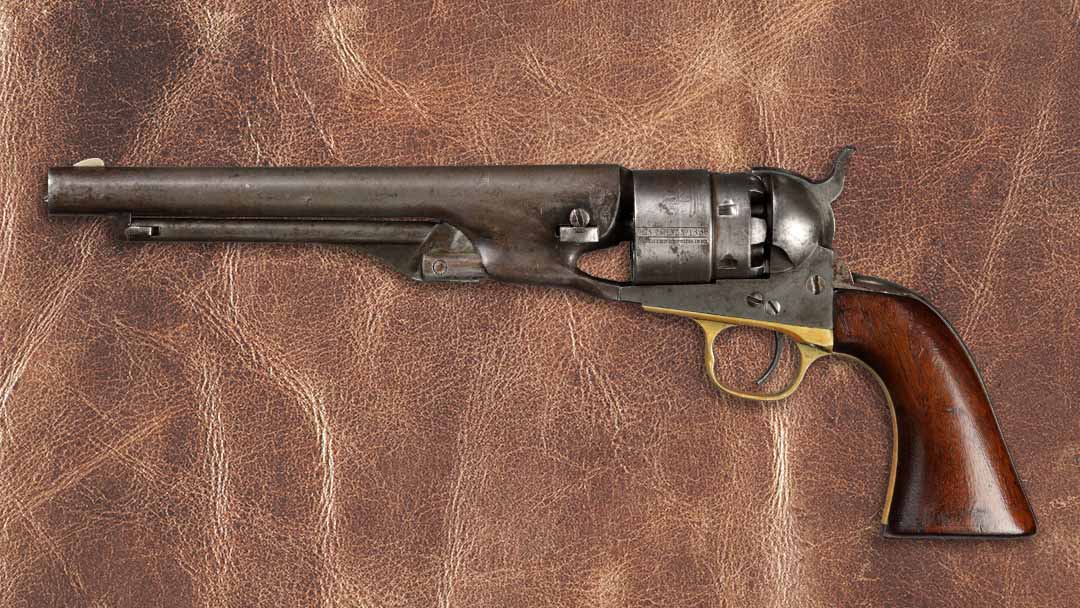
Colt Model 1860 Army

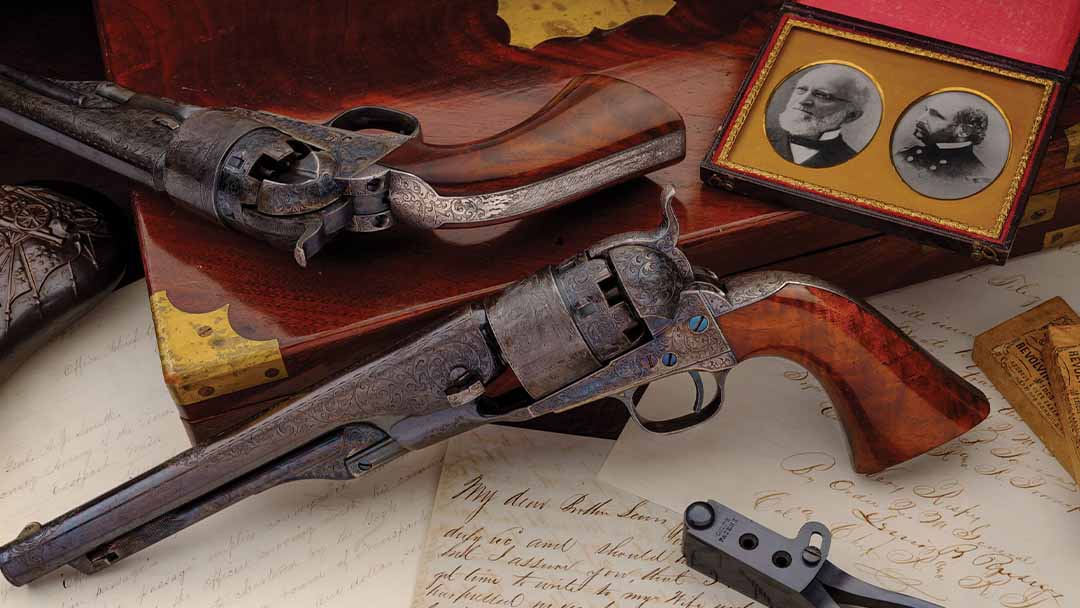
Some guns related to the Civil War are well known but when they offer an amazing glimpse into a lesser known part of the Civil War, they deserve a mention. Colt manufactured more than 200,000 Model 1860 Army revolvers during their production with 129,000 purchased by the Ordnance Department, so obviously these aren’t little known Civil War guns, but that it is inscribed to a Union army surgeon whose harrowing ordeal definitely makes it unusual.

More than 12,000 surgeons served during the Civil War, with about 3,200 serving the Confederacy. This was at a time when antiseptic principles were still being learned by the medical profession. That said, nearly 30,000 amputations were performed in the Civil War with a 26.3 mortality rate. Amputations took from two to 10 minutes. Compared to medical advancements and better understanding of sterile environments, the mortality rate for amputations during the Franco-Prussian War of 1870 the mortality rate for amputations was 76 percent.

This Colt Model 1860 in inscribed on the backstap in punch dot “Dr. M.W. TOWNSEND, Bergen, N.Y.” Townsend was an 1853 graduate of Jefferson Medical College of Philadelphia and settled in Bergen. He enlisted as a surgeon with the 4th Regiment, New York State Volunteers, serving into 1864.

Three of every four surgical procedures performed during the Civil War were amputations. Dr. M.W. Townsend, who owned this Colt, performed amputations for 36 straight hours during the Battle of the Wilderness. The year after the Civil War ended, Mississippi spent 20 percent of its annual budget on artificial limbs for veterans.

Medical advancements during the Civil War included the use of quinine to prevent malaria, use of quarantine to stop the spread of disease, particularly yellow fever, the ambulance system, large hospitals, anesthetic during surgery, rudimentary neurosurgery, techniques for arterial ligation, and plastic surgery.

Dr. Townsend practiced in Bergen, N.Y., for 40 years. He enlisted as a surgeon with the 47th New York Regiment of the New York State Volunteers in December 1861 and mustered out in 1864. He participated in 12 battles including Chancellorsville, the Wilderness, Spotsylvania and Cold Harbor.

This spectacular cased pair of Colt Model 1860 Army revolvers sold at Rock Island Auction Company’s August 2023 Premier Auction for $528,750.

E. Remington & Sons New Model Army Percussion Revolver

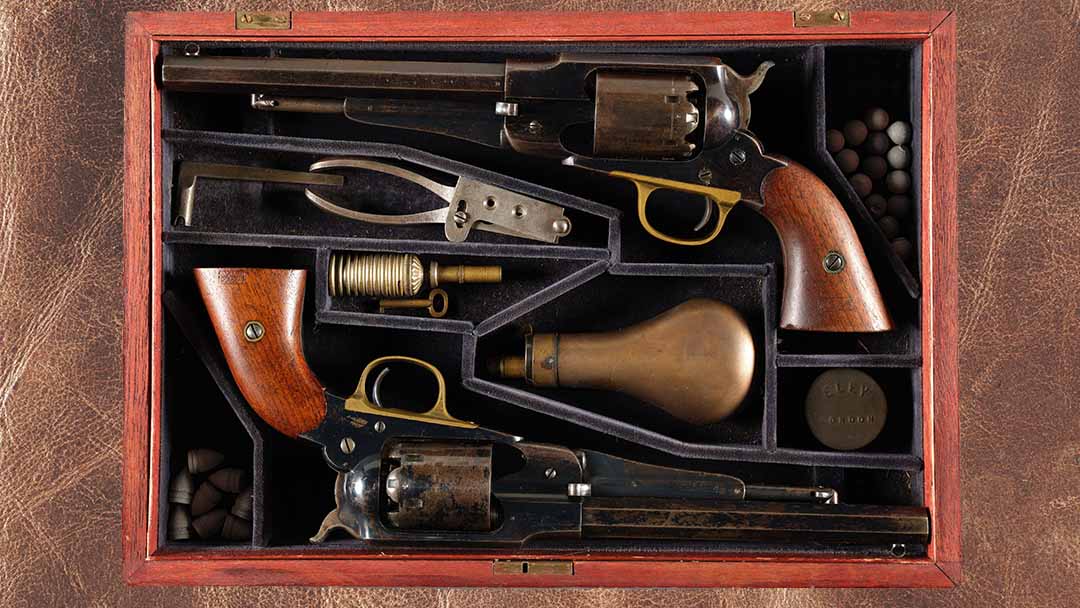
Another well-known Civil War revolver that lives in the shadow of Colt’s 1860 Army, the New Model Army from Remington deserves a mention, too. Remington & Sons started making percussion pistols in the mid-1850s, but didn’t have a large frame revolver for military use. Seizing on a pocket pistol design, the way it secured the cylinder pin with the loading lever would be adapted to Remington’s military revolvers. Seeing the signs of conflict, Samuel Remington, the middle son of company founder Eliphalet Remington II, went to Washington, D.C., where he secured a contract for 5,000 revolvers. Eliphalet Remingon II died in July 1861. After going through a design change from earlier models, the New Model Army revolvers were first delivered to the Ordnance Department in March 1863.

Remington trailed only Colt in the number of revolvers delivered during the Civil War, manufacturing 116,765 Army pistols for the U.S. Ordnance Department. The disparity in production numbers between the two companies was clear at the Battle of Gettysburg where Union Cavalry units carried 7,674 Colt 1860 Army revolvers while only 380 Remington pistols were carried. However, Remington delivered more revolvers than any other company in the war’s final two years in part because of the Colt factory fire in 1864.

This cased pair of Remington New Model Army revolvers are accompanied by a number of accessories, including balls and a bullets, a dual cavity bullet mold, a combination tool, oiler, flask and cap tin.

Civil War Guns for Sale

The U.S. Civil War pitted brother against brother in a brutal struggle that led to numerous weapons innovations and improvements from multi-shot volley guns to breech-loading carbines and revolvers. Some of the manufactures are recognizable like Colt and Remington, but others remain relatively unknown but with examples of their works left behind for collectors in small numbers. Find firearms like the Griswold & Gunnison and Starr Arms revolvers and Cosmopolitan “Grapevine” Carbine in the June 21-23 Sporting & Collector Auction and June 20 Preview Day in Bedford, Texas.

Review: Vosteed Acorn | Jerking the Trigger

0

Vosteed’s newest knife, the Acorn, has all the makings of the next big thing. Every once in a while, a knifemaker tweaks all the knobs just right and one of their knives becomes an instant classic – the kind of knife that becomes so easily recommendable that it seems to be on Youtube channel, every Instagram feed, and every knife related Reddit all at once. The Acorn could be one of those.

Specs

Blade Length: 2.93″ | 74.50 mm

Overall Length: 6.92″ | 175.70 mm

Blade Thickness: 0.118″ | 3.00 mm

Blade Material: 14C28N

Weight: 3.14 oz | 89.00 g

Opener: Thumb Hole

Lock Type: Liner Lock

Pivot Assembly: Caged Ceramic Ball Bearing

Pocket Clip: Reversible | Stainless Steel

Carry Position: Tip-up

Observations from Use

In the intro to this review, I went off about the Acorn being a new instant classic. I’ll tell you why I think that based on my time with this knife…

Function – First, and most importantly, it’s a good knife. It has a useful blade shape with a tall, flat grind that renders thin, slicy edge geometry. The 14C28N blade steel is as good as it gets at this price. The grip is ergonomic, hand filling, and very comfortable regardless of how you hold it. This is designed to be an all-around cutting tool and it shows.

Size – It has that perfect EDC size. It’s big enough to do anything you need from an EDC knife but compact and thin enough to carry any time. There is a reason so many folding knives are released with a just under 3″ blade and just under 7″ overall length… and it isn’t just legality. It’s a useful side.

Features and Fidgets – The Acorn also has a lot the quality-of-life goodies that people like on an EDC knife. It has a crispy, well-tuned detent and very smooth action. There is plenty of jimping all around on this knife including a generous amount on the spine of the blade. There are multiple opening methods including an opening hole and front-flipper. The opening hole is large and well-shaped so that, coupled with the great action, it makes for satisfying fidgeting.

Good Looks – This is more subjective than a lot of the other metrics but I think this is a great-looking knife and that seems to be the consensus opinion online. The Acorn’s organic, balanced shape along with an eye-catching new pivot design, color-matched highlights (pivot and lanyard loop), and weathered canvas micarta makes for the kind of rugged good looks that seem popular right now.

Value – Last but not least, the Acorn fits in a lot of budgets. The everyday price comes in at the lower end of Vosteed’s line but the Acorn is currently on sale for 20% off which makes this knife under $40. It is going to find its way into a lot of pockets at that price.

Wrap Up

The Acorn is a stylish, all-around EDC knife at a good price. If you can pick one up during the introductory sale, you can make that a great price.

The 20% sale on Amazon runs through June 6th, 2024. The Acorn will sell for just $39.20 during that time. It is currently only available on Amazon: Vosteed Acorn on Amazon.com

Review: Kizer Drop Bear | Jerking the Trigger

0

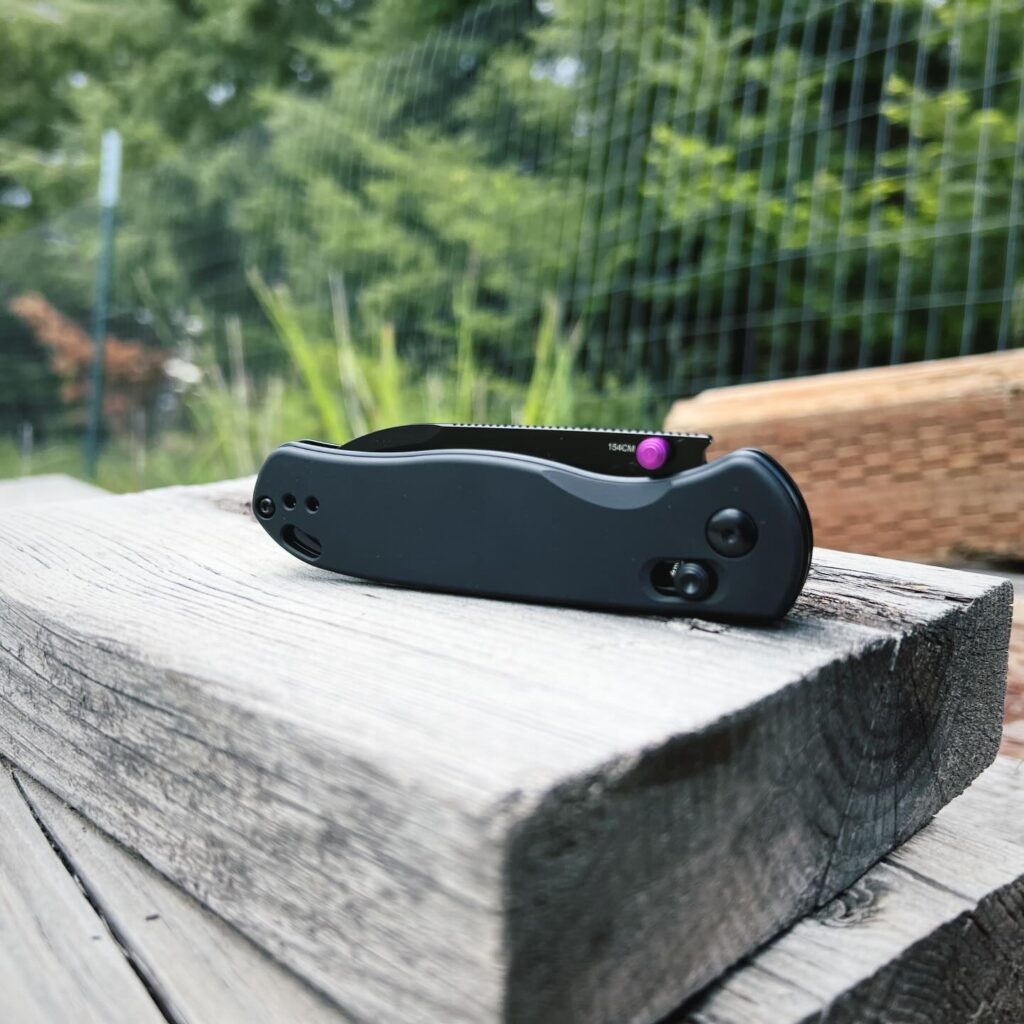
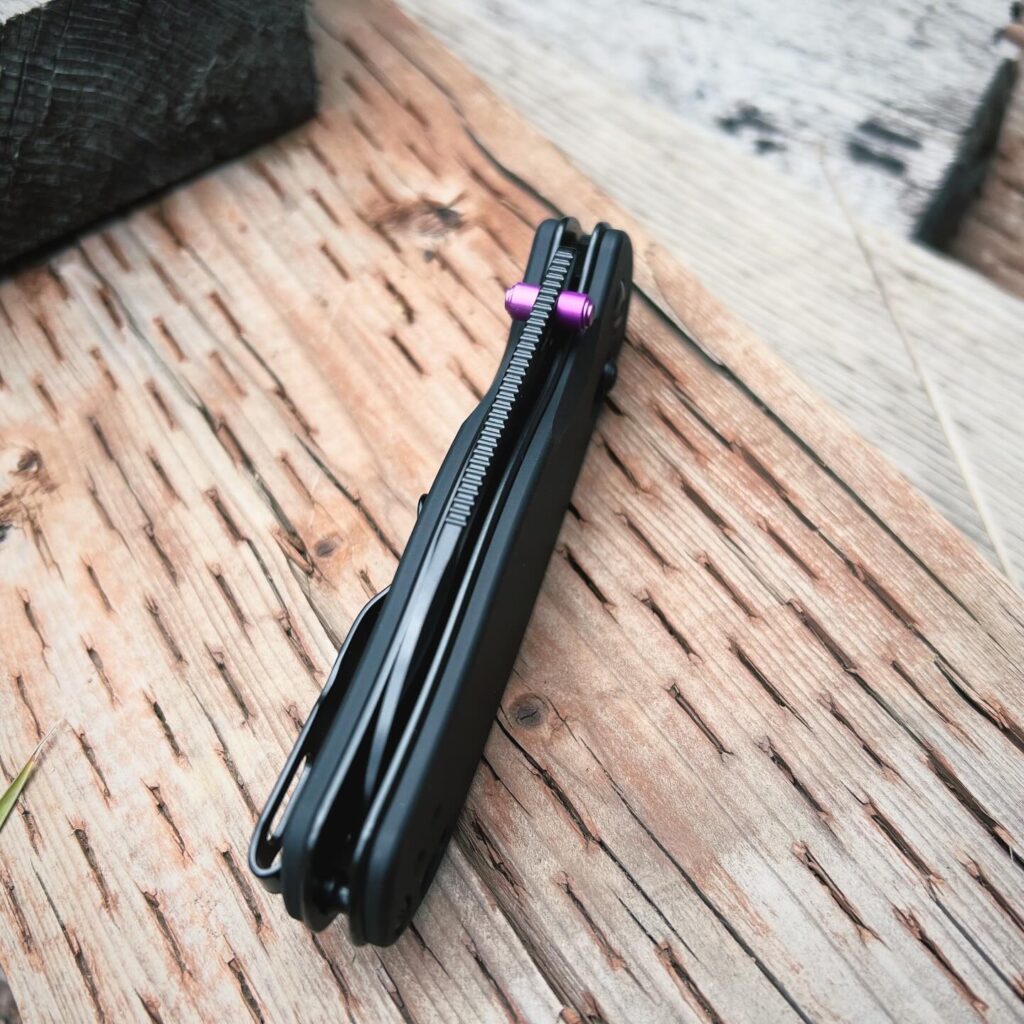
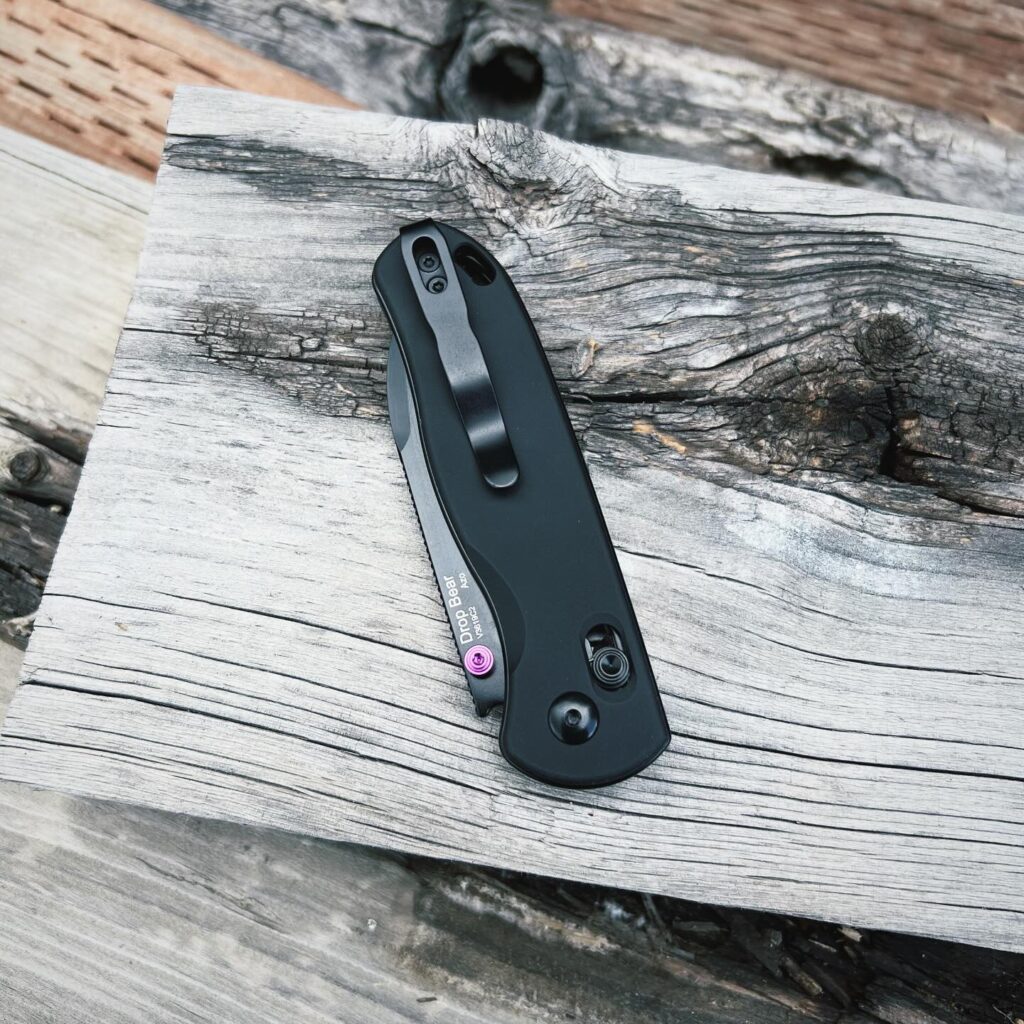
Some knives go down as all-time classics – knives that never get discontinued, that constantly have new versions being introduced, that never stop being recommended, and never go out of style. Kizer Knives has produced several of these types of knives like their Begleiter series, Sheepdog series, and more recently, the Drop Bear series. This review will take a look at the original Drop Bear version that started it all.

Specs

  • Model Number: V3619C1
  • Overall Length: 7.15″/182mm
  • Designer: Azo
  • Opener: Thumb Stud
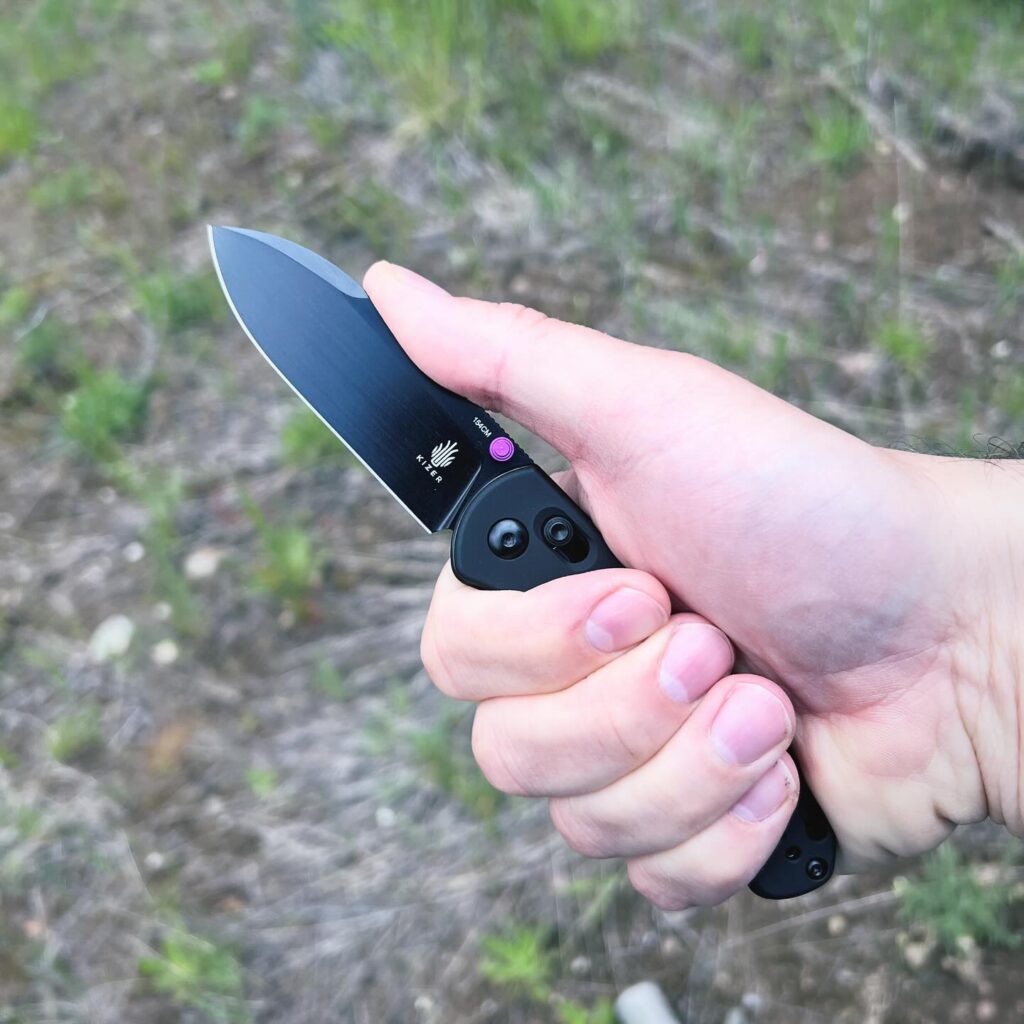
  • Blade Style: Drop Point
  • Blade Length: 2.97″/76mm
  • Blade Thickness: 0.11″/2.8mm
  • Blade Material: 154CM
  • Handle Length: 4.17″/106mm
  • Handle Material: Aluminum
  • Pocket Clip: Tip-Up
  • Weight: 3.68oz./104g
  • Color: Black

Observations from Use

The Kizer Drop Bear is a great example of what can happen when a company gets the little things right. There are so many little touches that elevate this knife.

Comfortable, Nuetral Handle – The Drop Bear’s handle shape is comfortable in every way you might want to hold a knife. The ergonomics are subtle in that there are just some gentle curves but they get the job done well without forcing any one grip.

Unique and Useful Blade Shape – The blade shape is unique. At first glance, it looks like a Kephart-esque spear point with a reasonably tall flat grind but when you look closer you see that Kizer has dropped the point down below the midpoint of the blade. The result is something in between a sheepsfoot and a spear point. It’s a great all-around shape and something that I think really steals the show in this design. You get a knife with a tip that is easy to access while also having plenty of belly and a long straight edge for powerful cuts. Kizer also added a GREAT swedge grind to make the tip even more useful without sacrificing strength.

Jimping – Kizer clearly put a lot of thought into making the tip of this knife useable which is why it is so nice that they ran jimping all the way out to the swedge grind. That means you can rest your index finger out near the tip to control it in precise cuts. Details like this matter!

Action – I don’t think anyone gets better action from their crossbar locks than Kizer and that is impressive because this is the knife on which they introduced their version of the lock (Clutch Lock). It is end-user adjustable for tension meaning you can dial it in to your heart’s content but mine came snappy and soooo smooth, right out of the box.

The Drop Bear series is available in several variations now to suite any taste or budget. The version I have with 154CM steel and aluminum scale is the original but it now sits in the middle of the line with options for more high-end blade steel sitting above it in price. More recently, Kizer has also introduced new, more budget-oriented versions with Nitro-V blade steel making this a GREAT time to try something from the Drop Bear series.

Wrap Up

The Drop Bear may be relatively new to the scene but it is already a classic. It isn’t flashy but, if you go looking for them, the details abound. This knife is a true all-arounder that can slide into dress slacks, everyday jeans, or work pants thanks to impressive attention to detail, compact proportions, a strong lock, and a great blade shape.

See the whole Drop Bear series at KizerKnives.com

The Drop Bear series is also available on Amazon with frequent sale pricing: Kizer Drop Bear on Amazon.com

Review: Streamlight Wedge XT | Jerking the Trigger

0

The Streamlight Wedge XT is the newest addition to Streamlight’s Wedge line of rechargeable EDC lights. The Wedge line is known for its knife-like form factor that makes carrying them a breeze and the Wedge XT leans even harder into that by being the most compact version to date.

Great Light, Dumb Takes

I’ve seen some weird, whiny takes on this light from other reviewers. In some ways, it is a major departure from the original Wedge which might be why some people seem to misunderstand how good this light is. It does away with the lever-style switch of the original in favor of a tail switch and it cuts the output in half… neither of which bothers me.

The tail switch is a massive upgrade in my opinion. It makes the light dead-simple to operate with basically the same UI as the venerable Micro and Macro Stream flashlights. Almost all of the modern techniques to use a flashlight with a firearm are built around a simple tail switch interface so, to my mind, this is a huge upgrade. The level style switch is what PREVENTED me from even considering the previous versions of the Wedge. The tail switch won me over.

The output being cut in half is also not an issue for me. 500 lumens for 2 hours is a lot of light for a long time. As lights get smaller, manufacturers tend to dial the output back. It’s a tale as old as time. It’s expected. I actually find 500 lumens for 2 hours, instead of the typical 1 hour for most lights on high, to be impressive.

I think a lot of complaining about this light comes from a different perspective. If you are a flashlight nerd first (I use that term lovingly), I can understand mourning the loss of your pet fidgety switch and lamenting less lumens. If you want a functional light to carry alongside other defensive tools, you likely won’t care.

I should also mention that the Wedge XT is USB-C compatible. I think that is also a major upgrade. Micro-USB, with its fragile connectors, needs to go away at this point. Streamlight has been moving basically all of their rechargeable to USB-C and that is a welcome change.

The Shape of Things to Come

When I first took on the Wedge XT for review I thought it would just be like the Streamlight Macrostream and in terms of output and UI, it is similar. I was completely taken off guard by how much the shape of this light would play into its usefulness.

The flat(ish) shape makes it ride in the pocket more like the very slim Streamlight Microstream. It disappears in the pocket. It is light that you can carry when you don’t think you can carry a light.

That same flat(ish) shape makes it easy to pack in something like a pouch. I run, walk, and hike multiple times a week with something like a Hill People Gear Kit Bag or some kind of fanny pack. This shape is IDEAL for these pouches where items in the pouch often end up layered on top of each other. A barrel-shaped light, in these pouches, can use up a lot of space and really push into other items.

I also like the subtle “hook” shape with knife-like jumping that Streamlight incorporated into the tail of the light. It is very easy to take the light out from wherever it is stored thanks to this.

General Observations and Potential Improvements

The Wedge XT has a very floody beam. There is a hotspot but it is wide and tapers gradually to a bright spill beam. Streamlight claims 87 meters of throw and, in my testing, that is optimistic. It might brute force its way there but this is not a portable spotlight. The beam shape is ideal for most people’s EDC tasks.

The switch used on the Wedge XT is good but could be better. On one hand, it is easy to use and requires a long travel to activate which I like. I also like the subtle tactile feedback it gives when it hits the point that the light activates. However, I wish that it was pressure-sensitive, where a partial press would activate the light momentarily, like the switch on the Microstream.

Finally, the clip is great in that it is very secure and shaped well so it doesn’t catch on stuff. It is affixed to the light in a bezel-down carry configuration which I normally prefer. However, a light like this would be great if it could be clipped to your ball cap. Either a two-way clip or a bezel-up option would have been great.

Wrap Up

Don’t let the flashlight nerd lamentations scare you away from this light. The Wedge XT is the RIGHT direction for the Wedge line. It is an excellent light and a triumph of design. The shape of this light serves a purpose and the new functional changes make this a legitimately good EDC light.

This light is easy to use, easy to carry, offers a very useful beam shape with plenty of output for plenty of time, and wraps it all up into a very tidy package. It’s in my pocket right now.

Streamlight.com

Streamlight Wedge XT on Amazon.com

Essential Tips for Economic Hard Times

0

In today’s uncertain economic climate, many Americans are growing increasingly concerned about the future. Recent surveys indicate that a third (33%) of Americans fear that a total economic collapse could be on the horizon, a collapse that could quickly spread across the nation, causing widespread chaos. Understanding these fears and the current economic climate is crucial to your survival.

The Looming Economic Threat

High Inflation and Interest Rates: Americans are demoralized by persistent inflation and high interest rates. Joanne Hsu, the director of the University of Michigan’s consumer sentiment survey, noted that many Americans have abandoned saving for traditional long-term goals like homeownership and retirement. Instead, they are spending money now, attempting to maintain their lifestyle despite economic pressures​​.

Consumer Sentiment at a Low: The University of Michigan’s survey showed consumer sentiment plummeting to a six-month low in May, driven by high inflation and rising interest rates. This decline in confidence suggests that consumers are reaching their breaking point, reining in spending after months of elevated inflation​​.

Retail Sales and Economic Slowdown: Recent data from the Commerce Department highlights that retail sales have stagnated, with almost no growth from March to April. This stagnation is a stark contrast to the 3% surge in retail sales a year ago. While some sectors saw slight increases, such as gas stations and food stores, others, like online retail, experienced significant declines​​.

Debt and Delinquency: Americans are increasingly relying on credit to support their spending, with credit card debt reaching all-time highs. Delinquency rates are also rising, indicating that many consumers are struggling to keep up with their financial obligations. The strain is particularly evident among younger generations and those in low-income neighborhoods​​.

Unemployment and Job Market Woes: The labor market, while still relatively strong, is showing signs of stress. The nation’s unemployment rate ticked up last month, and the number of people applying for unemployment benefits rose to its highest level since August. This weakening job market is causing consumers to act with more caution​​.

Economic Crisis by the Numbers

  • Out of Control Inflation: It now takes at least $177,798 for a family of four to live comfortably in the U.S. A recent study highlighted that in the most expensive states, families need nearly $300,000 to maintain a comfortable lifestyle, while even the least expensive states require over $100,000. The average annual salary in the U.S. is $59,428 as of May 2024.
  • Record Household Debt: Tens of millions of Americans are trapped in an endless cycle of debt. U.S. households are currently $17.69 trillion in debt, with household debt hitting a new record in the first quarter of this year. This surge includes a $184 billion increase from the previous quarter, primarily due to mortgage balances rising to $12.44 trillion. Auto loan balances have also climbed to $1.62 trillion, while credit card balances remain near a record high at $1.12 trillion.
  • The Wealth Gap: The gap between the rich and the poor is larger than ever, leading to growing frustration. The wealthiest 10% of Americans own a record high 93% of all stocks, while the poorest 50% own just 1%. When considering all forms of wealth, the bottom 50% of the U.S. population holds only 2.6% of the total wealth. This disparity has caused tens of millions of Americans to lose faith in the system, with politicians attempting to pacify them with handouts.

Preparing for the Worst: Survival Tips for Economic Collapse

Given the current economic climate, it’s important to prepare for the possibility of a large-scale financial crisis. Here are some practical tips for surviving an economic collapse:

  1. Stockpile Essentials: Ensure you have a sufficient supply of non-perishable food, clean water, and essential medications. Aim for at least a three-month supply to weather disruptions in supply chains.
  2. Secure Your Home: Increase home security to protect against potential crime surges during economic instability. This includes reinforcing doors and windows, installing security systems, and establishing a neighborhood watch program.
  3. Diversify Your Assets: Convert some of your savings into physical assets like gold, silver, or other tangible goods that retain value during economic downturns. These can provide a buffer if cash loses value.
  4. Learn Bartering Skills: In a severe economic collapse, traditional currency might become worthless. Learn bartering skills and start stockpiling items that can be traded, such as alcohol, batteries, and basic tools.
  5. Develop Self-Sufficiency Skills: Learn essential skills like gardening, hunting, and basic medical care. These skills can reduce your reliance on external systems that might fail during a crisis.
  6. Establish a Community Network: Build strong relationships with neighbors and local community members. A tight-knit community can offer mutual support and resources during tough times.
  7. Create a Bug-Out Plan: Have an evacuation plan in case staying in your current location becomes unsafe. This includes knowing multiple routes out of the area and having a pre-packed emergency kit (bug-out bag) with essentials.
  8. Maintain a Cash Reserve: While diversifying assets is important, keep some cash on hand in small denominations. In the immediate aftermath of a crisis, cash can still be useful for essential transactions.
  9. Invest in Self-Defense: Economic downturns can lead to increased crime. Ensure you have the means to protect yourself and your family, whether through self-defense training or legal ownership of firearms.
  10. Stay Informed: Regularly update yourself on economic news and trends. Being informed can help you anticipate changes and react swiftly to new developments. Additionally, consider getting a ham radio license. Ham radios can be a vital communication tool during any collapse where traditional communication methods might fail.
  11. Have a Backup Power Source: In case of extended power outages, invest in alternative power sources such as solar panels or generators to keep essential appliances running.
  12. Prepare for Medical Emergencies: Stock up on first aid supplies and over-the-counter medications. Learn basic first aid and consider taking a course to be better prepared for medical emergencies.
  13. Build a Food Garden: Start growing your own food to reduce dependency on grocery stores. Even a small vegetable garden can provide significant sustenance.
  14. Reduce Unnecessary Expenses: Cut back on non-essential spending to save money and redirect funds towards critical supplies and debt reduction.
  15. Invest in Durable Goods: Purchase durable goods that will last through tough times, such as quality tools, clothing, and home repair supplies.
  16. Create a Family Emergency Plan: Ensure every family member knows what to do in various emergency scenarios, including how to contact each other and where to meet if separated.
  17. Stockpile Fuel: Keep extra fuel for your vehicle and generator. Fuel shortages are common during economic collapses and can hinder your mobility and power supply.
  18. Prepare for Economic Migration: Be ready to relocate if your area becomes unsustainable. Have a plan for where you might go and how you’ll get there.
  19. Develop Mental Resilience: The stress of an economic collapse can take a toll on mental health. Develop strategies for coping with stress and maintain a positive outlook to stay strong during difficult times.

Are you prepared for an economic collapse?

Are you prepared for the economic chaos that seems inevitable? For many American families, the nightmare has already begun.

To help you navigate these uncertain times, we’ve compiled some of our best tips and articles on preparedness and survival. These resources cover everything from building your emergency food stockpile to creating a comprehensive survival plan:

Be Prepared to Feed Yourself when the Collapse Hits!

Grocery Options that ship right to your Home: 

In times like these, having expert guidance can make all the difference. That’s why you need Robert Richardson’s essential survival guides. These books offer comprehensive strategies and practical advice for surviving economic collapse and other crises:

Dirty Harry Guns

0

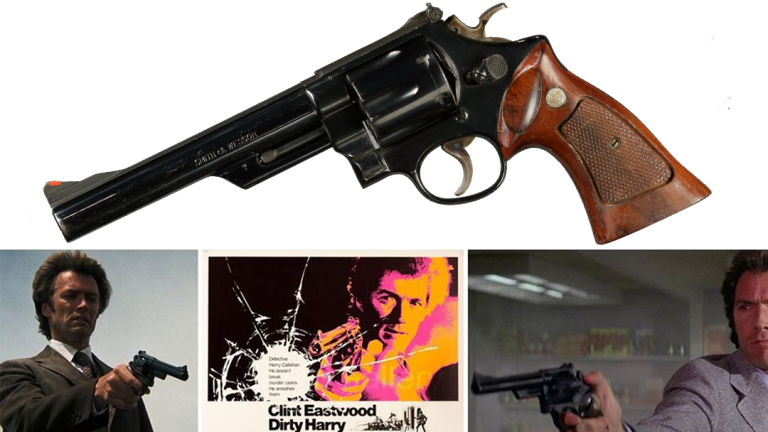
Few firearms depicted on the silver screen have influenced pop culture like Clint Eastwood’s .44 Magnum Smith & Wesson Model 29 in the ‘Dirty Harry’ series. Along with the iconic revolver, the Dirty Harry films prominently feature an arsenal of other gun models that can be owned by shooters, collectors, and movie fans today.

The quintessential Dirty Harry gun model, the .44 Magnum S&W 29 revolver. The example above is available this June.

Rock Island Auction Company’s June 21-23 Sporting and Collectors Auction in Bedford, Texas offers some of the most prominent Dirty Harry gun models, including multiple examples of the S&W 29, three Auto Mag pistols, and numerous other handguns, rifles, shotguns, and machine guns that made an impact on the big screen. Click on the images throughout this article to learn more about each firearm type. Needless to say, there are spoilers below.

Dirty-Harry-Gun-AutomagThe Auto Mag Pasadena Model 180 pistol, a prominent Dirty Harry gun model featured in 1983’s ‘Sudden Impact.’ The cased example pictured above is available this June.

📧
Get guns in your inbox! Sign-up for our weekly emails.

The Smith & Wesson Model 29

The screenplay for 1971’s ‘Dirty Harry’ went through numerous revisions, including the contributions of writer and firearms enthusiast John Milius. For Dirty Harry’s gun, Milius chose the Smith & Wesson Model 29. A 4-inch nickel finished or chrome-plated Model 29 was originally intended, but production struggled to find any examples. With the film date approaching, Milius and Clint Eastwood settled on a blue finished Model 29 with a 6 1/2 inch barrel.

-smith-wesson-model-29-double-action-revolver-Dirty-HArry-gunThanks to its recognition as “the Dirty Harry gun,” the S&W Model 29 became an overnight hit with shooters, collectors, and movie fans around the globe. The Model 29 pictured above is just one of multiple examples of the platform available this June at RIAC.

In the early 1950s, Elmer Keith, “the father of big bore handgunning,” pushed Remington to develop a longer and more powerful variant of the .44 Special cartridge and Smith & Wesson to produce a revolver that could handle the high-pressure load. The result was Remington’s .44 Magnum ammunition and simultaneously urged Smith & Wesson’s robust N-frame “.44 Magnum revolver,” which would be officially designated the Model 29 in 1957.

Smith-and-Wesson-44-Magnum-Pre-Model-29--Revolver-with-Case-Manufactured-in-1956Advertised by Smith & Wesson as “The utmost in smashing power,” the “.44 Magnum revolver” was first shipped to industry writers in late 1955 and officially released in January of 1956. This 1956 manufactured example is available this June.

While Clint Eastwood has wielded countless guns throughout his career, some of his most memorable lines were delivered while toting the Model 29 revolver. Appearing in all five films of the franchise, the imposing Smith & Wesson .44 Magnum wheelgun became a character in the Dirty Harry series as recognizable as its titular star.

San Francisco Police Inspector ‘Dirty Harry’ Callahan describes his weapon as “the most powerful handgun in the world.” Though technically the .44 Remington Magnum cartridge had been eclipsed by famed Wildcatter Dick Casull’s .454 round, Casull’s cartridge wasn’t widely available until the early ’80s, making Harry’s claim accurate in terms of factory production, double action revolvers of the era.

Diry-Harry-gun-Model-29-8-and-1-2-inch-barrelWhile a revolver in 6 1/2 inch barrel length is featured in most shots, Clint Eastwood carried a Model 29 with an 8 3/4 barrel in posters, promotional images, and in select scenes for dramatic effect. The 1960 manufactured Model 29 example pictured above is available this June.

The Auto Mag Pistol

In the revolver vs pistol debate, Inspector Callahan prefers his wheel guns, but he isn’t beyond using a semi-auto if it’s chambered in a hefty round. In ‘Sudden Impact,’ we’re introduced to the second most famous Dirty Harry gun in the Auto Mag Model 180.

tde-auto-mag-model-180-semiautomatic-pistol-with-caseThe Auto Mag Model 180 holds one round in the chamber and seven in the magazine. The cased example above, manufactured by TDE, is available this June.

When taking in some target practice, Callahan’s colleague Inspector Horace King (played by the late, great Albert Popwell) touts the power of his Smith & Wesson 3000 shotgun that can smash a target to mush so effectively that “you’ve got to strain the remains for the fingerprints.” Displaying his new gun, Harry replies, “This is the .44 Magnum AutoMag, and it holds a 300 grain cartridge, and if properly used it can remove the fingerprints.”

In reality, the Auto Mag was designed to fire a factory 240 grain bullet like the 240 grain Remington .44 Magnum revolver cartridge. Perhaps Dirty Harry is packing some heavy-hitting custom rounds, making his feat of emptying two magazines from the gun one-handed and without hearing protection all the more impressive.

auto-mag-pasadena-model-180-semiautomatic-pistol-with-caseAnother Dirty Harry gun model that packs a wallop, the .44 AMP Auto Mag pistol has become a popular collectible. The cased Auto Mag Pasadena Model 180 above is available this June.

Dirty Harry’s fourth film outing renewed interest in the Auto Mag pistol, which had been discontinued in 1972 after a production run of less than 3,000. The gun was featured in several 1980s TV shows and films such as ‘Beverly Hills Cop II’ and ‘Malone’ from 1987. Moreover, Dirty Harry’s use of an oversized pistol helped inspire a slew of appearances by large caliber semi-autos like the Desert Eagle and the Wildey.

wildey-semiautomatic-pistol-in-45-winchester-magnum-with-boxThe Wildey pistol was famously carried by Charles Bronson in ‘Death Wish 3’ from 1985. The Wildey pistol above includes its original box and is available this June.

The Colt Python

Revolvers dominated the law enforcement market during the 1970s. In ‘Magnum Force’ (1973), the first Dirty Harry sequel, many SFPD officers are packing 4 inch blued Colt Python revolvers, including the film’s vigilante cop antagonists. Another Dirty Harry gun that brings the heat, the mighty .357 Python serves as a kind of foil to Harry’s Model 29 throughout the film, particularly during the Police Pistol Competition.

Colt-Python-Dirty-Harry-gun-lot-3184The Colt Python, one of the prominent Dirty Harry guns in ‘Magnum Force’. It’s a worthy adversary to Harry’s Model 29, but as Lieutenant Neil Briggs (Hal Holbrook) discovers, “A man’s got to know his limitations.” The 1995 example above includes a Colt hard case, extra grip, and Bianchi leather holster and is available this June.

In the final round of the shooting contest, Harry sends a message with his Model 29, then gives Officer John Davis’s Python a try while nabbing a bullet for forensic evidence in the process. Davis, played by David Soul, would go on to again famously tote the Python in the ‘Starsky and Hutch’ series, which helped elevate the sales and recognition of Colt’s premier snake gun.

Colt-Python-Dirty-Harry-and-Starsky-and-Hutch-Gun-Lot-1073David Soul’s performance in ‘Magnum Force’ helped land him the role of Det. Ken ‘Hutch’ Hutchinson in ‘Starsky and Hutch,’ and he continued to carry the Colt Python revolver. The 1962 manufactured example pictured above includes its original factory “wood grain” box and is available this June.

The Colt Diamondback

Two of Dirty Harry’s partners, Inspector Early Smith and Inspector Kate Moore, carried short-barreled variants of the Python’s smaller sibling, the Colt Diamondback. Produced between 1966 to 1986, Diamondback revolvers chambered in .38 Special found a niche with law officers who preferred something lighter than the .357 Magnum. Like the Python, the Diamondback series was priced and marketed as a premium revolver and are desirable collector guns today.

Colt-Diamondback-Dirty-Harry-gun-lot-4952“Every other cop in this city is satisfied with a .38 or .357,” Inspector Kate Moore (Tyne Daly) quips to Harry. For quality .38 revolvers, look no further than the Colt Diamondback like the top example pictured above. Available this June.

The Colt Detective Special

One of the most prominent guns of the Dirty Harry series, the Colt Detective Special is seen carried by police officers and criminals alike. The wheelgun makes a particular impression in ‘Sudden Impact’ in the hands of both protagonist Jennifer Spencer (Sondra Locke) and sadistic villain Mick (Paul Drake). A sized-down version of the popular Police Positive Colt, the Colt Detective Special offered a covert pocket revolver to undercover cops and detectives, Taxi drivers, store owners, mobsters, and anyone else in the market for a reliable close-range option.

Dirty-Harry-guns-Colt-Detective-SpecialThe Colt Detective Special appears throughout the Dirty Harry series. In the case of the top two examples featured in the photo above, the blue finish Detective Special ( top left) was shipped to Sheriff Douglas Mitchell, White County, Sparta, TN, on October 17, 1938. The nickel finished example (top right) was manufactured in 1970 and includes its original factory “wood grain” box.

The Walther P38

The Walther P38, the 9mm pistol carried by the psychopathic Scorpio (Andrew Robinson) through the original film’s closing act, earns a nod on our list of memorable Dirty Harry guns for its use in several key scenes, including a bus chase, a running shootout, and the Walther’s involvement in the climactic final standoff.

As Scorpio finds himself looking down the barrel of Harry’s Model 29, wondering “did he fire six shots or only five?,” his Walther P38 lies within arms reach. “You’ve gotta ask yourself a question,” Harry growls, “‘Do I feel lucky?’ Well, do ya, punk?” Scorpio takes his chances, and the rest is movie history.

Walther-P38-Dirty-Harry-gun-Scorpio-KillerThe Walther P38 faces off with Dirty Harry’s gun in one of the most memorable and quoted scenes in the series. The early WW2 commercial Walther P38 pictured on the right is available this June.

The Colt 1903 Pocket

In ‘Sudden Impact,’ when confronted with a robber toting a Colt 1903 Pocket pistol, Dirty Harry drops one of the most famous lines in cinematic history, “Go ahead, make my day.” While the 1903 Pocket is an iconic and immensely collectible pistol, the compact Colt is no match for Smith, Wesson, and Inspector Callahan, especially when it’s standing in the way of an officer’s morning coffee.

Dirty-Harry-gun-make-my-day-line-Colt-1903-pocket-lot-2579The Colt 1903 Pocket faces down with Dirty Harry’s gun in one of the franchise’s most popular scenes. The U.S. Property marked Colt Model 1903 Pocket Hammerless pistol pictured on the left is available this June.

The Browning Hi Power

The Browning Hi Power is another frequent gun of the Dirty Harry franchise, often appearing as the sidearm of choice for assassins and bodyguards. One of the last designs from legendary gun inventor John Moses Browning, the 13-round Hi Power was finally brought to America by Browning Arms Co. in 1954 and saw an elevated presence on the big screen in the 70s and 80s.

Browning-Hi-Power-Dirty-HarryThe Browing Hi Power pistol became a popular Hollywood firearm during the 1980s. The example pictured on the left was owned by Texas Ranger Bon Price and with Prince’s name on the lid above a Texas Rangers Department of Public Safety badge. Available this June.

The Winchester Model 70

Another Dirty Harry gun that packs a punch, the  Winchester Model 70 makes notable appearances in the first two films of the franchise. In the original movie, the rifle Inspector Callahan chooses to target the Scorpio killer during a nighttime rooftop stakeout is chambered in .458 Winchester Magnum, a round designed for African big game hunting. While the massive cartridge suites Harry’s fondness for excessive force, a Model 70 chambered in a more distance-friendly caliber like the .300 Win Mag rifle pictured below would have been more suited for sniping.

Dirty-Harry-gun-Winchester-Model-70-lot-4677(Top) An excellent pre-64 Winchester Model 70 rifle chambered in .300 Winchester Magnum, available this June.

The Type 2 Arisaka Paratrooper Rifle

By contrast, Scorpio’s longarm of choice is a Japanese Nagoya Arsenal Type 2 Arisaka paratrooper rifle with a Maxim silencer that’s been sporterized and rechambered for .30-06. The Type 2 was developed as a takedown version of the Arisaka Type 99 infantry rifle and offers an accurate platform with a strong action. Scorpio is shown assembling the rifle in about 20 seconds, a process that firearms specialist Keith Ford demonstrates in the video linked here.

Japanese-Nagoya-Arsenal-Type-2-Arisaka-Bolt-Action-Paratrooper-Rifle-Dirty-Harry-gun-lot-2745One of the most famous Dirty Harry guns from the original film, the Arisaka Type 2 paratrooper rifle. Non-sporterized examples are particularly valuable with collectors today, like the Japanese Nagoya Arsenal Type 2 paratrooper rifle pictured above with matching serial numbers on the barrel and bayonet lug and matching takedown assembly numbers. Available this June.

The Ithaca 37

The pump action Ithaca 37 is a constant throughout the Dirty Harry series. As the longest continuously-produced shotgun in American history, Ithaca’s versatile Model 37 has gained a reputation as a reliable autoloader that can be adapted for field, police, and military service. In ‘Magnum Force,’ Harry’s partner Early Smith (Felton Perry) arms himself with a Model 37 during one of the most memorable shootouts of the franchise.

police-marked-ithaca-gun-co-model-37-featherlight-shotgun-dirty-harry-gunThe Ithaca 37 makes prominent appearances in three of the Dirty Harry films. The example at the top, a Police marked Ithaca Gun Co. Model 37 Featherlight trench pattern shotgun, is available this June.

The Winchester Model 1897

When Harry and crew attempt to serve a warrant, mob boss Frank Palancio (Tony Giorgio) answers the door with his Winchester Model 1897. The original “trench gun,” the Model 97 has a long history of appearing in films in the hands of police officers, prison guards, and mobsters alike, and the weapon is employed by Palancio and crew to deadly effect.

winchester-97-police-trench-gun(Bottom) Frank Palancio and company unload with their Model 97 shotguns. (Top) A Winchester Model 1897 riot shotgun with a Berkeley Police Department inventory plaque, available this June.

Dirty Harry and the Guns of Pop Culture

One of cinema’s first iconic antiheroes, “Cold, bold Callahan with his great big .44” inspired a generation of movies featuring maverick cops who bent or broke the rules. As the officer responsible for confronting “every dirty job that comes along,” Dirty Harry finds himself facing a variety of guns throughout the five-chapter franchise, and most of the same models can be found at Rock Island Auction Company.

RIAC-June-Sporting-and-Collector-Auction-heavy-firepowerFind Dirty Harry guns and more this June at Rock Island Auction Company.

Genuine screen-used hero guns such as Lara Croft’s pistols, Quigley’s Sharps rifle, John Wayne’s ‘True Grit’ revolver, and Han Solo’s DL-44 blaster from the original ‘Star Wars’ are finding a booming market in the collecting community, but the same Hollywood appeal can elevate entire gun models that made their mark on the entertainment world. From pistols like the Beretta 92FS and Bren Ten to the Street Sweeper shotgun and Jurassic Park’s Spas-12 shotgun, some of the coolest guns of film, television, and video game fame can be found in RIAC’s Sporting & Collector Auctions.

RIAC-June-Sporting-and-Collector-Auction-modern-fun-guns-for-saleRIAC’s June 21-23 Sporting and Collectors Auction includes no shortage of heavy hitting firearms with pop culture appeal.

Fans of pop culture and arms collecting can subscribe to the weekly Rock Island Auction newsletter to recieve new gun blogs and gun videos covering some of the most fascinating firearms in the entertainment world. From classic movies such as Winchester 73, Rambo, Indiana Jones, and Die Hard, to more recent productions like John Wick, Peaky Blinders, the Walking Dead, Bass Reeves, Masters of the Air, Yellowstone and its prequels, we examine some of the greatest guns of Hollywood.

“1923”, the prequel to “Yellowstone,” offers four different settings, three of which happen to be major gun collecting genres: World War 1, the Old West, and Dangerous Game hunting. Each setting is packed with classics from the genre, and Joel & Seth walk us through each one.

Biggest Texas Gun Auction: June 2024 Preview

0

Historic, rare, miniature and desirable are all words found in the descriptions of collectible fine arms in Rock Island Auction Company’s upcoming Sporting & Collector Auction, June 21-23.

Among the remarkable lineup of offerings are legendary American guns like a Winchester Model 1873 One of One Thousand, Colt Walker Model 1847, Henry Rifles and Thompson Submachine Guns. The auction will also feature a number of firearm miniatures ranging from flintlocks to a Beretta 92FS.

Rock Island Auction will host the three-day auction, featuring a lineup of more than 3,000 lots and 4,400 firearms at its amazing state-of-the-art facility in Bedford, Texas, offering one of the finest gun shows in the Lone Star State with its preview day on June 20.

This Winchester Model 1873 One of One Thousand is joined by a Colt Walker in Rock Island Auction’s Sporting & Collector Auction. The One of One Thousand bears the inscription “H.G.H. Reed./Milwaukee, Wis./Aug. 3 1876” and is also documented in the book “Winchester’s New Model of 1873: A Tribute, Volume II,” by James Gordon.

Legendary Firearms

The auction’s headliner is a documented Winchester Model 1873 One of One Thousand inscribed to “H.G.H. Reed./Milwaukee, Wis./Aug. 3 1876” and is documented in “Winchester’s New Model of 1873: A Tribute, Volume II,” by James Gordon. From one legendary gunmaker to another is the Colt Walker Model 1847 manufactured by the Whitneyville Armory and is one of 220 C Company revolvers.

The auction will also feature several examples of the Henry Rifle that led to the Winchester 1866 and the Model 1873, considered “the gun that won the west.” The Henrys include a game scene engraved rifle, a Civil War era gun, a martially inspected example and an early production rifle with a three-digit serial number.

Of two Thompson Submachine Guns in the auction, one was in a unit of 10 shipped to the Indiana National Guard in July 1922. The second is a scarce World War 2 M1928A1 manufactured by Savage Arms Co.

1046-Walker-Ad-Shot-2This Company C marked U.S. Contract Colt Walker will be available in RIAC’s June Sporting & Collector Auction, it is one of the 38 surviving C Company Walker revolvers listed on page 80 of “The Colt Whitneyville Walker Pistol” by Lt. Col. Robert Whittington.

Rare Guns

Colt Dragoons, including a rare second contract Fluck Dragoon, and Volcanic lever action pistols and a carbine are a part of a fantastic roster of historic arms that also include a Smith & Wesson Model 320 Revolving Rifle, a factory engraved silver-plated Winchester Model 1873, a Colt Model 1883 Burgess lever action rifle, a Civil War U.S. Burnside Second Model Breech Loading Percussion Saddle Ring Carbine and a rare Roper Repeating Rifle Co. Revolving Shotgun.

A rare and documented Colt presentation English cased and engraved London Model 1851 Navy presented to Admiral Sir Thomas Cochrane is among the anticipated arms in the auction. The scroll engraved gun bears the inscription on the backstrap, “FROM THE INVENTOR/TO ADMIRAL/SIR THOs COCHRANE.” Cochrane had a distinguished naval career with victories over French and U.S. warships in the Napoleonic Wars and War of 1812 and participated in the burning of Washington, D.C. The presentation coincided with the purchase of 23,500 Colt 1951 Navy revolvers in 1854.

RIAC-June-Sporting-and-Collector-Auction-Antiques-for-sale-1Remarkable revolvers and lever action rifles are among the offerings in the June Sporting & Collector Auction, including a Colt second contract Fluck Dragoon and a factory engraved silver-plated Winchester Model 1873.

Military Arms

From the Civil War to now, there are guns for military history buffs, from Henry Rifles, a Civil War U.S. Rogers & Spencer Army Model percussion revolver, a French Chauchat Model 1915 light machine gun, a Johnson Model 1941 rifle, M1 Garands, Colt M1911s and Colt pistols like the Model 1902 and 1905 that led to the M1911.

A Chinese Type 56 SKS semi-automatic carbine recorded as a documented Vietnam War bring-back gun is among the numerous military arms that can be had, alongside muskets and other Class III items. The SKS, made in 1966, is included with documentation dated shortly after the Tet Offensive that it is a war trophy with stamps from Tan Son Nhut Air Base customs.

RIAC-June-Sporting-and-Collector-Auction-military-guns-for-saleLooking for that Civil War gun or a World War 1 or World War 2 weapon? They are in the June Sporting & Collector Auction.

Sporting Arms

A Ruger Model 10/22 takedown rifle signed by members of the USA Shooting Team and American Olympians is among the sporting arms in the auction. The rifle, with the special serial number “GOLD-0004” is one of 5,000 manufactured in a collaborative effort between Ruger and Talo Distributors to raise funds for the 2012 London Olympics USA Shooting Team. Among the 15 signatures on the gun’s stock is Kim Rhode, one of 10 American athletes to compete in six Olympics, medaling in all six. She won gold for skeet shooting at the London Games.

The sporting arms available include flintlock long rifles, a Sharps Model 1874 Bridgeport Business Model Heavy Barrel buffalo rifle, a factory engraved Krieghoff K80 over/under shotgun with an extra barrel set and case, an engraved Winchester 20 gauge Model 21 Skeet Grade double barrel shotgun, a factory engraved Gustav Genschow clamshell boxlock double rifle with a scope, a factory game scene engraved Blaser Model K95 Luxus Stuzen single shot rifle with a Schmidt & Bender scope, and a factory engraved Holland & Holland Royal Model sidelock double barrel shotgun.

Olympic-gunThis special autographed Ruger 10/22 originally manufactured to raise funds for the USA Shooting Team in 2012 as a combined effort by Ruger and Talo Distributors is one of 5,000 rifles built with the special serial number “GOLD-XXXX” with this being the fourth built. It also bears the signatures of 15 members of the USA Shooting Team on the stock.

Class III Weapons

The auction offers a wide array of Class III weapons, ranging from the more recognizable, like the MAC-10, UZI and Tommy guns to lesser known weapons like the previously mentioned Chauchat, a Mark II Sten submachine gun, a French MAS 1938 submachine gun and an early production Sentinel Arms Striker 12 semi-automatic revolving shotgun.

RIAC-June-Sporting-and-Collector-Auction-heavy-firepower-1Rock Island Auction Company’s June Sporting & Collector Auction will have Class III items like the MAC-10, UZI and Thompson submachine guns available.

Modern Guns

The auction is loaded with historic and legendary guns but there are plenty of modern firearms that are of interest to collectors like the Group Industries HR4332 submachine gun that was among the final generation of fully transferable American machine guns before the Firearms Owners Protection Act went into effect.

A scarce Dornaus & Dixon Bren Ten Special Forces “light” 10mm semi-automatic pistol, a Blaser Model R93 Luxus straight pull bolt action rifle with a scope, Heckler & Koch semi-automatic pistols, a titanium gold Desert Eagle and a Franchi SPAS-12 shotgun are also available in the auction.

RIAC-June-Sporting-and-Collector-Auction-modern-fun-guns-for-sale-2Did someone say Desert Eagle? Rock Island Auction Company’s June Sporting & Collector Auction has numerous modern firearms.

Fabulous Firearms

Rock Island Auction Company prides itself on its hospitality and presentation and that shines through on Preview Day, the day before the three-day Sporting & Collector Auction. Visit the company’s stunning state-of-the-art auction venue in Bedford, Texas for the biggest gun auction in the Lone Star State.

The June 21-23 Sporting & Collector offerings run a sizzling gamut of historic and rare firearms, remarkable military and modern arms, and fantastic field pieces. Come and see them ahead of the auction on the June 20 Preview Day, and then stay for the bidding.

1046-Minature-ad-shotFrom the big to the small, a number of miniature firearms from flintlocks to modern pistols, will be available in Rock Island Auction Company’s upcoming Sporting & Collector Auction, June 21-23, with Preview Day June 20.