Collectible Firearms for Serious Gun Collectors

0

The Pistolete Pulemyot Degtyaryova 40, or PPD-40, was the bridge to making full auto submachine guns a huge part of the Soviet arsenal on the Eastern Front of World War 2.

After World War 1, the Soviets were in need of a submachine gun and tested more than a dozen before the search was whittled down to two designs, one by Vasily Degtyaryov and the other by Fedor Tokarev. Both guns were chambered for the 7.63x25mm pistol cartridge, and while Tokarev’s model was lighter, Degtyaryov’s gun was simpler to make, cheaper to produce, and more reliable.

Eventually, the open bolt PPD-40 submachine gun would make way for the PPSh-41 to spit all kinds of lead and spill all kinds of German blood as the Soviets sent the Nazi war machine scurrying back to Berlin. A PPD-40 is among the more than 100 Class III/NFA offerings in Rock Island Auction Company’s May 19-21 Premier Auction.

The PPD-40 was the submachine gun in the Soviet arsenal on the eve of World War 2 but never met the mass production of its successor, the PPSh-41. Six million of the stamped metal PPSh-41 were made during the war as it became the submachine gun of the Red Army.

Full Auto Inventor

Tokarev, who competed with Degtyaryov on the submachine gun, is best known for the SVT-38 and SVT-40 self-loading rifles and the TT-30 and TT-33 semi-automatic pistols. Degtyaryov, who was born in 1880 headed the Soviet Union’s firearms design bureau and created several machine guns and anti-tank guns.

One of his greatest designs was the DP-27/DP-28, a light machine gun first deployed in 1928 that served as the Red Army’s light machine gun during World War 2. Because of its 47-round circular ammunition pan on top of the receiver it was nicknamed “Stalin’s phonograph.” This gun led to a tank-mounted machine gun and two aircraft machine guns.

Degtyaryov was named “Hero of Socialist Labor,” only the second person to be awarded the honor. The first was Joseph Stalin. He invented more than 80 machine guns, submachine guns, and anti-tank rifles. Nineteen were adopted.

Vasily Degtyaryov designed the PPD-40 as well as several machine guns and anti-tank guns. The DP-28 light machine gun that Degtyaryov designed served the Red Army during World War 2.

No Full Auto Enthusiasm

Degytyaryov’s gun (officially the Пистоле́т-пулемёт Дегтярёва) was originally adopted as the PPD-34, but production was sparse as the Red Army focused on a self-loading battle rifle. A mere 44 SMGs were made in 1934 and even fewer — 23 — in 1935 going primarily to the People’s Commissariat of Internal Affairs (NKVD) and border guards.

The early PPDs fired about 1,000 rounds per minute with heavy recoil. The PPD, whether the 34, 38 or 40 models, fired from an open bolt with a blowback system capable of 800 rounds per minute, had select fire, and wooden stocks and machined metal parts. The PPD-40 would have a drum magazine that carried 71 rounds.

Soviet generals were unsure of how to tactically use the SMG so production was kept low. Production ramped up to 1,291 in 1937, followed by 1,115 produced in 1938, and a whopping 1,700 in 1939 when the gun was decommissioned. Some slight tweaks were made in 1938 to make the gun less expensive to make. Most notably, a wooden two-part stock was made for a separate foreend on PPD-40.

Then came the Winter War with Finland in late 1939. The Finns had the Suomi KP-31 that essentially fired Luger rounds. They used the submachine gun to good effect holding the invaders at bay until the Red Army’s overwhelming force took control. The sides made peace in March 1940, but not after Soviet soldiers found an appreciation for the Finns’ SMGs.

Soviet military leaders were unsure of the tactical use of submachine guns so production of the PPD-40 was limited until the Winter War with Finland in 1939. The Finns used their Suomi KP-31 submachine guns to some success before the Red Army’s might took over. The following year, more than 80,000 PPD-40s were made. That opened the door for six million PPSh-41 submachine guns to be made during World War 2.

More importantly, Joseph Stalin found an appreciation for the submachine gun, especially after Degtyaryov intervened when the gun orders were cancelled. The dictator was convinced to resume production of the PPD and he took it under his direct control, with impossible tasks and deadlines. One thing he wanted was a drum magazine that was similar to the Finnish gun and held more rounds than the box magazine. Missed deadlines meant visits from the NKVD and the arrests of the factory manager and chief design engineer.

Stalin wrote, “if deadlines are not met, the government will take the manufacturing plant under special control and execute all the bastards clogging up the factory.”

Production was ramped up to around-the-clock shifts and the mass executions were avoided and 81,118 PPD-40s were made in 1940. The one issue that continued to dog the PPD-40 was the cost to manufacture. Producing a PPD cost 900 rubles per unit while machining took 13.7 hours for production. The Soviets started looking for a new submachine gun that was easier and cheaper to manufacture like the stamped metal British Sten or the German MP40.

Full Auto Fury

With these improvements in mind, the Soviets rushed the stamped metal-made PPSh-41 into production in 1940. It had a drum magazine like the PPD-40 and also fired from an open bolt, blowback action. The PPD and the PPSh were each about the same size and weighed about the same despite the PPSh being about three inches longer.

Manufacture of the PPsh-41 was cheaper and took less time to produce than the PPD, using only 87 components compared to 95 with the PPD-40. It also used Mosin-Nagant barrels that were cut in half, providing barrels for two PPSh-41s.

The PPSh-41 was fitted with a gas compensator designed to prevent muzzle rise during full auto bursts. Studies showed shot grouping improved by about 70 percent over the PPD-40. Because of its 1,250 rounds per minute rate of fire, it was nicknamed the “burp gun.”

The PPSh-41 was cheaper to make and took less time to manufacture than the PPD-40 so it became the submachine gun of the Red Army as it faced the Germans on the Eastern Front. This PPSh-41 sold for $51,750 in Rock Island Auction Company’s April 2018 Premier Auction.

Finally Full Auto Enthusiasm

The Germans launched Operation Barbarossa in June 1941. Despite the siege of Leningrad and the suffering and starvation that killed hundreds per day, with production left to women and children, 5,868 PPD-40s were made in 1941 as the Soviets stepped up manufacture of the PPSh-41. The PPD-40 remained in use by the Red Army even though the Soviets ultimately produced more than 6 million PPSh-41s during the war, costing only 142 rubles per unit and manufacturing time was a mere 5.6 hours.

In mid-1942, 6 percent of Red Army infantry battalions carried submachine guns but by early 1944 a quarter of the infantry battalion were equipped with SMGs. The Red Army had light machine gun squads dedicated to only carrying the PPSh-41 or PPD-40 along with a light machine gun.

The submachine guns range was only about 200-300 meters so the SMG units would be deployed for surprise attacks. Soldiers might start an attack firing in semi-auto mode to mask their full auto capability. Submachine guns excelled in house-to-house warfare. By the time the Germans were pushed out of the Soviet Union, 30 million soldiers and civilians were dead.

Though it was quickly succeeded by the mass produced PPSh-41, the PPD-40 still found use in World War 2 as the Red Army needed submachine guns. This closeup shows the barrel markings on the PP-40 that is available in the May Premier Auction.

Full Auto Finery

With less than 100,000 of the PPD-40 made, the submachine gun didn’t get the glory that its successor, the PPSh-41 — 6 million made — did in the Great Patriotic War. The PPD-40 scratched the Soviets’ early submachine gun itch and serves as an historic reminder of a time when the role of full auto guns in the infantry was uncertain. Time and the Finns proved the usefulness of full auto infantry weapons to the Soviets, but the cost and time to manufacture the PPD-40 made it a less than ideal weapon, so it served as a bridge to one of the Soviet heroes of the Eastern Front, the PPSh-41.

Sources:

The History of the First Russian SMG – Degtyaryov PPD-34/38/40, by Vladimir Onokoy, thefirearmblog.com

The DP Machine Gun Looks Funny, but Spilled a Lot of Blood, by Paul Richard Huard, War is Boring

Top Supplies for a Post-Collapse Trading Economy

0

When it comes to preparing for disasters, especially long-term economic disasters where paper currency either loses its value or becomes completely unusable, bartering is a preparedness skill that could come in very handy. Those who like to dicker and know how to negotiate are going to have a valuable skill that helps ensure their ability to thrive in a post-collapse world.

While some may dismiss the need for stocking up on goods for trade, a quick look back at our history will show you the very real value of being able to barter during times of crisis. In fact, it wasn’t long ago that people in this country got by simply bartering for goods in their local communities. And during the Great Depression, essential items became more valuable than the currency itself.

The History of Bartering for Goods: The Great Depression is a Great Example of Why Bartering is a Necessary Post-Collapse Skill.

The history of bartering systems can be traced back to biblical times. In fact, numerous
passages mention people trading things like livestock in exchange for
food or other services.

Genesis 47:17
So they brought their livestock to Joseph, and Joseph gave them food in exchange for the horses and the flocks and the herds and the donkeys, and he fed them with food in exchange for all their livestock that year.

But in terms of bartering during times of
crisis, there is no better recent example than that of the Great Depression.

During the Great Depression, a great number of
American families relied on the barter system to pay their bills, feed their
families, and survive. While some bartered goods, others who had valuable skills
to offer traded their knowledge and their time.

But if the 1930s is too far back for you, and you believe something like that could never happen in today’s society, just take a look at what has been going on in Venezuela over the last decade.

In the hyperinflationary South American country,
where their currency is extremely unstable and scarce, many have reverted to a
barter economy.  Paying for even the
cheapest goods literally requires piles of
banknotes, of which there simply aren’t
enough circulating. It’s estimated that hyperinflation
in the country has reached 42,000%.

Once one of most prosperous Latin American counties,
socialist policies have transformed Venezuela into an apocalyptic-style,
dystopian novel.

To survive, businesses have started trading their services
for things like loaves of bread and canned goods. People have even started private
Facebook groups to barter goods with others in their country and have taken to
various social media channels using the hashtags #Trueque (barter/exchange) and
#Vzla to find others to trade with.

Survival Bartering: Trading your Way through a Long-term Disaster or Economic
Collapse

If you’re fully stocked and prepared to survive,
then you need to put some serious thought
and effort into stockpiling some popular bartering items for those times when paper currency becomes worthless.

People trading goods

What are the best bartering goods to stock up on before things go bad?

What bartering supplies you choose to start
stockpiling will depend on the situation you’re planning for; but in general,
the following items will all probably be in high demand after a total collapse
situation:

Water Purification Supplies

Most people don’t realize how hard finding clean
drinkable water will become in a post-collapse situation. When the water
treatment plants stop running, people are going to be scrambling to find a way
to purify their drinking water. Iodine tablets, bleach, water filters,
canteens, and even cooking pots will all be needed and in very high demand.

Guns, Ammunition and Firearm
Accessories

1 out of every 3 Americans owns a gun, but how
many of these gun owners stockpile an adequate amount of ammunition? After the
economic collapse in 2008, ammunition became very scarce. Some types of
ammunition, specifically .22lr, were impossible to find, and those that had it
were selling it for 10-20 times its original price.

During a long-term disaster or collapse, ammo is
going to be a highly sought after and will quickly become a very popular barter
item. I recommend stocking up on calibers that you actually use, followed by the most common calibers (.22lr, .223,
9mm, .45, 30-06, 12ga, & .308)

If the SHTF, those two out 3 Americans who don’t own guns are going to be wishing, they did. That means guns and firearm
accessories are going to be in high demand. From people looking for parts to
repair broken guns, to those who are currently anti-gun and will quickly change
their position when the chaos hits, I can almost guarantee that firearms will
become one of the most wanted items after a collapse. Even pellet guns might be
good items to stock up on; They’re cheap, easy to find, and would be easier to part
with.

Alcohol: It’s always a Top
Bartering Product

The history of using alcohol as a bartering tool
is long and complex and dates back probably to the beginning of alcohol itself.
For early American moonshiners, making and selling alcohol wasn’t a hobby; it
was how they survived.

Let’s not beat around the bush here; during hard times there is always a market
for alcoholic beverages. And during an apocalyptic SHTF scenario, there’s going
to be a huge number of people who will want to drink their sorrows away. Hard
liquors like Whiskey and Vodka are going to be the best option because of their
long shelf life.

Medications & Medical
Supplies

Almost half of all Americans are currently
taking at least one prescription medication. In a post-apocalyptic world,
prescription medications will be another highly sought-after item. From people
who need to treat life-threatening illnesses with antibiotics, to those that
will just want to forget everything
that’s happening and dull their senses, medications will be worth their weight
in gold. 

Check out our list of top
medical supplies
; everything
on the list will be helpful in a barter economy.

Food & Water

This category is really
a no-brainer. During a long-term crisis, food and water will be the most traded
items on the market. Historically, these are some of the most-values items
for trade:

  • Canned goods: Vegetables, fruits, and meats
  • Beans: These are relatively cheap and are a
    great long-lasting item to store.
  • Rice: You want to go with white rice because brown
    rice goes rancid after six months.
  • Flour and baking goods
    like cornstarch, baking soda, baking powder, etc..
  • Sugar, Honey, and Spices
  • Cooking oils
  • Powdered milk and powdered
  • Popular Snacks and Candy: I know this is just a
    movie, but for those who have seen Zombieland, do you remember how obsessed Tallahassee
    becomes with finding a Twinkie?  People
    are going to want comfort foods and things that take their minds away from
    trouble!
  • COFFEE!!!!

Check out our list of some of the most important foods to
stockpile
. These will all be in high demand and are all good
items to start stocking up on before things go bad.

Non-Food
Barter Items

  • Toiletries: Toilet paper, toothpaste, soaps, and hygiene products.
  • Batteries: I would stockpile batteries like crazy, especially rechargeable, AA and AAA varieties.
  • Lighters and Matches: I would also add things like candles, camp stoves, and oil lamps to this category.
  • Fuels: Propane, butane, and other long lasting fuel.
  • Flashlights: When the grid goes down this is a no-brainier.
  • Leisure: Playing cards, dice, books and board games.
  • DIY Duct Tape and WD-40: I would also add items like JB weld, glues and adhesives, and other DIY construction and home/vehicle repair tools.

Skills, Tools & DIY
Knowledge

Having a good stockpile of tools, combined with
the knowledge of how to use them, is not only a sound investment but can also
ensure you have a method for generating income when things go bad. If things
ever completely collapse, those who can fix things are going to be some of the
most sought-after people in the new economy.

Plumbers, carpenters, and handymen are all going
to be able to trade their services for almost anything they need. That means
the best thing you can do to ensure your survival is to start learning skills
that will be important during a collapse.

The great thing about this category is you’re not giving away anything that you might need in the future.

Never barter with something that you may need.

Tips on starting a Local Bartering Network

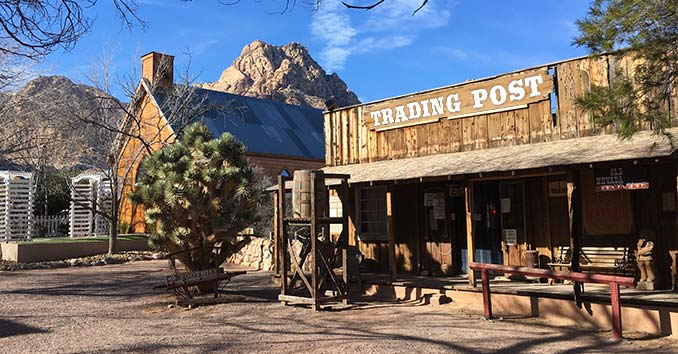
An Old West Trading Post

During an all-out economic collapse or breakdown in government, traditional currency may lose its value very quickly, making it incredibly difficult for people to obtain the goods and services they need to survive. This is where knowing how to barter may become a lifesaving survival skill. If you’ve never had to barter or haggle with someone, head out to some local garage sales this weekend and try it – just like any other survival skill, it gets easier with practice.

Here are some tips on bartering for trading goods and services during a SHTF collapse or crisis.

Identify your skills and resources: Before getting started in bartering, you need to know what you have to offer – these can be goods or skills that may be valuable to others. Make a list of your skills, such as carpentry, sewing, fixing vehicles, cooking, or gardening. Then, list your resources, such as food, water, medical supplies, fabric, or tools.

Find potential trading partners: Don’t wait till things go bad; you can get started now! Reach out to people in your community or online who may be interested in bartering. You can post on social media groups, join local prepper groups, or attend events where preppers and hagglers attend. Look for people who have skills and resources that you may be lacking.

Set up a trading network: Once you have a group of potential trading partners, set up a network where you can communicate and make these trades. This can be a social media group, a forum, or even better, a physical meeting place where the government or other troublemakers can’t watch your every move. Make sure that everyone is clear on the rules of the barter system and that there is a system in place for resolving disputes.

Determine the value of goods and services: Without a traditional currency, it can be challenging to determine the value of goods and services. One way to do this is to assign a point system where each skill or resource is assigned a point value. For example, an hour of carpentry work may be worth two points, while a gallon of water may be worth one point. This way, people can trade goods and services of equal value.

Be flexible: People’s needs and resources will quickly change in a crisis. So be willing to be flexible and adapt to changing circumstances. For example, if someone needs medical supplies but doesn’t have anything to trade, you may be willing to offer them in exchange for something else down the line.

Build trust: Bartering relies heavily on trust between trading partners. Be honest about the quality and value of your goods and services. Follow through on your commitments and don’t try to take advantage of others. Building trust in your trading network can help ensure the success of your barter system.

While bartering may become a real part of life in a post-disaster world, you really need to consider what items you can and can’t do without. That means when it comes to bartering, the only thing you should be trading are items that you have a surplus of or items that you are sure you won’t need in the future.

Collectible Firearms for Serious Gun Collectors

0

Rifle? Shotgun? Why not two in one?

Designed for optimal versatility, combination guns have been offered in many forms. These unique firearms are often comprised of at least one smoothbore barrel and one rifle barrel, and they usually include a selector mechanism to choose between the two. While somewhat obscure today, the combination gun flourished in Europe, Africa, and India in the 19th and early 20th centuries.

A finely engraved Westley Richards hammerless small bore drilling combination gun with .22 rimfire over .410 bore configuration, from the Tom Selleck Collection.

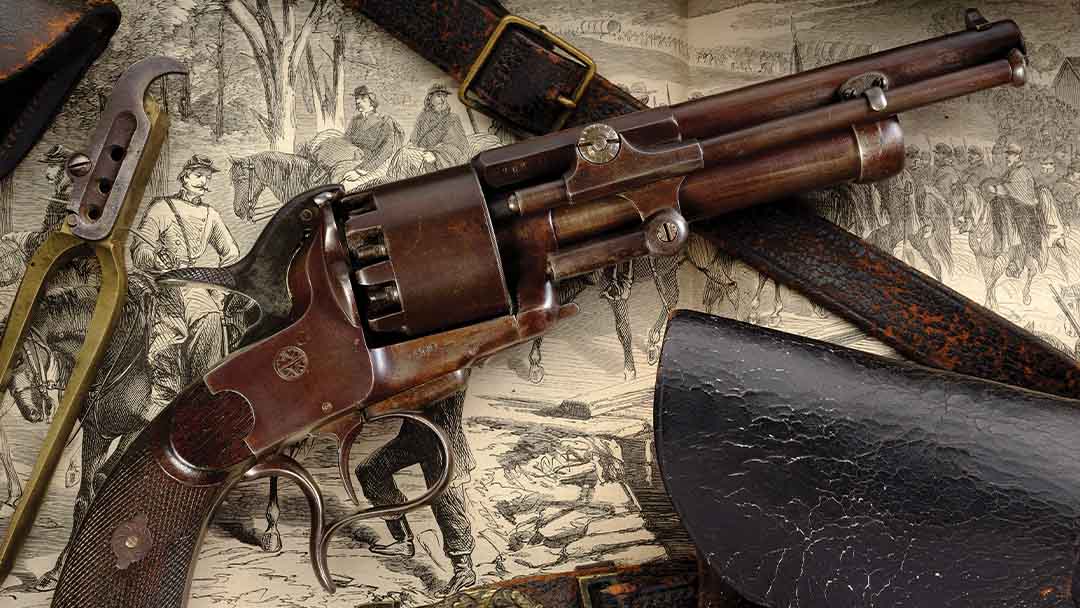
While there have been combination wheelguns like the LeMat revolver family of the 19th century, the notable majority of combination guns have been longarms. Even some contemporary revolver examples today harness the combination gun’s spirit of practicality like the Taurus Judge and the Smith & Wesson Governor. Both are able to chamber cartridges for bullets or shot, but use a single barrel.

A LeMat revolver, a nine-shot .42 caliber muzzleloading wheelgun with an 18 gauge shotgun barrel mounted beneath the barrel. From the Greg Lampe Collection.

The combination gun has been manufactured in countless configurations, chambering options, and barrel combinations. Some combination guns were designed for specific situations, like taking small game, while others are capable of filling nearly any role, from wingshooting, mountain hunting, varmint control, home defense, survival, or pleasure on the range. Below, we’ll take a closer look at the history, diversity, and application of this fascinating firearms genre.

Early Combination Guns

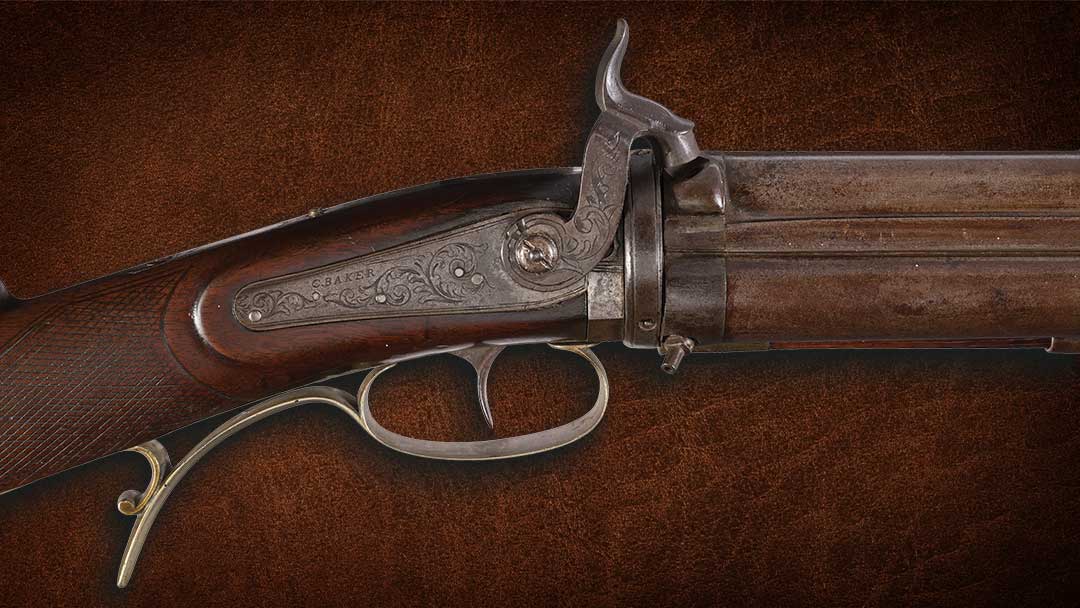
While modern combination guns tend to resemble double rifles or double-barreled shotguns, with almost every model using a break-open action, early offerings of the combination gun were less standardized. In ‘Longrifles of Pennsylvania Vol. 1’ by Russell Harriger, the flintlock combination gun examples discussed are typically swivel breeches, or “wenders,”designed to rotate their barrels to line up with a single firing mechanism. Combination guns in general are rarer in the flintlock period, but both swivel breeches and combination guns with a separate lock for each stationary barrel were produced in slightly higher numbers in the percussion era.

An unusual C. Baker marked percussion swivel breech three-barreled combination gun with a single rifled .54 caliber barrel and two 14 gauge shotgun barrels.

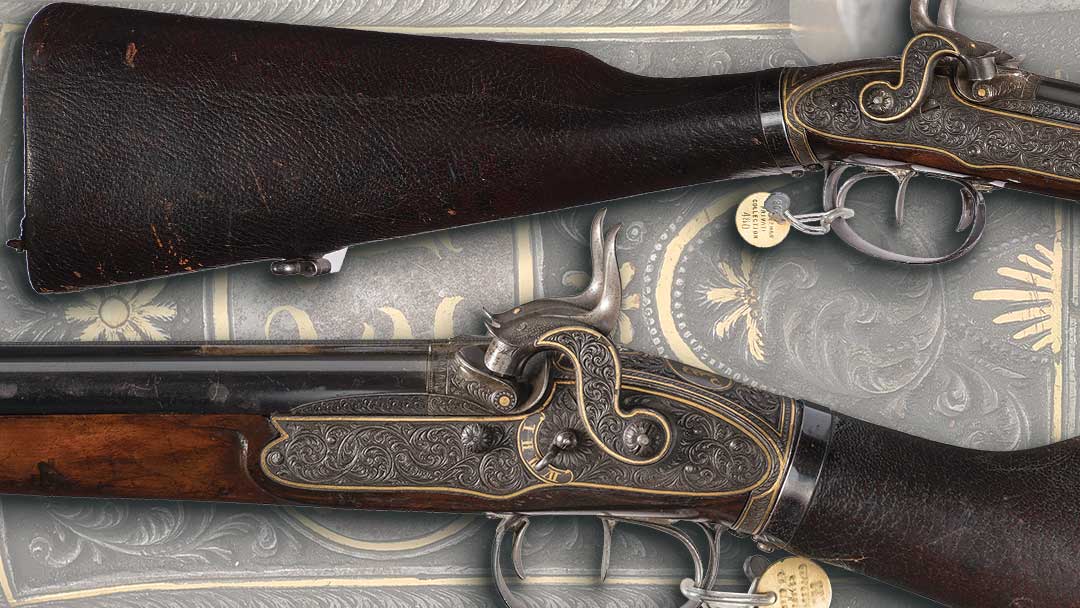
Before American gun designers like John H. Hall and Simeon North revolutionized the manufacturing process by introducing the concept of standardized, machined parts, complex firearms like the combination gun were bound by the limitations of hand craftsmanship. A gun’s configuration was often dictated by the customer or the individual gunsmith, resulting in some astonishingly rare designs like the air gun/percussion action hybrid below.

A documented 19th century, exhibition quality, relief engraved and gold inlaid European Girardoni style stock reservoir double barrel combination air rifle/percussion shotgun.

The combination gun evolved alongside its shotgun counterpart, seeing a series of innovations in the 1860s and 1870s like the invention of the hammerless boxlock and sidelock actions and the adoption of metallic cartridges. Arguably the most influential development for the combination gun, however, was the introduction of the break-open, breechloading action.

The Cape Gun

Named for its popularity with hunters in the Cape Colony region of South Africa, the cape gun is a combination firearm with two barrels attached side-by-side. German and Austrian-manufactured cape guns, sometimes called “Büchsflinte,” often had a smooth left barrel and a rifled right barrel. British-made cape guns were typically produced in the opposite configuration, with their rifled barrel positioned on the left.

A factory game scene engraved and gold inlaid J. Eberwein cape backaction hammer gun with relief carved stock.

South Africa’s sparsely settled frontier presented enterprising hunters with a vast assortment of game, and carrying a single gun that could take anything from birds to cape buffalo offered convenience and flexibility. Most cape guns were robust firearms chambered in the large calibers required for the African bush. The cape gun found a market in Europe and America as well, and the variability and heavy stopping power offered by these unique combination guns also made them a favored choice with gamekeepers of the era.

A factory engraved and gold inlaid W. J. Wurz pinfire double cape gun with an extra barrel set.

The Drilling Combination Gun

The drilling combination gun derives its name from “drei,” the German word for the number three. The traditional drilling, or “forester’s gun,” is composed of a rifle barrel situated underneath a break action double barrel shotgun, though numerous alternative layouts and barrel configurations were produced that catered to a variety of European hunting needs.

This engraved Westley Richards hammerless drilling has a unique layout, with a single rifle barrel centered over side-by-side shotgun barrels.

The Westley Richards hammerless drilling above offers an unusual exception and demonstrates the custom nature of these three-barreled combination guns. Sometimes called a “Schienendriling” or “rib drilling,” this layout includes a rifle barrel centered atop two shotgun barrels. This Westley Richards example, completed in January of 1933, is chambered in .410 gauge and .22 extra long rimfire and includes fixed locks, double trigger ejector action, and 26 inch barrels.

A factory game scene engraved Emil R. Martin drilling with a Zeiss scope. This unique combination gun features three triggers.

Many classic drillings were stocked more like a shotgun than a rifle since German hunters of the era tended to take far more game with shot and slugs, but configurations with two rifled barrels were also offered.

A factory game scene engraved Franz Sodia/H. Mayer drilling with a Zeiss scope. This gun features double triggers, a side-mounted barrel selector, and a manual tang safety.

The engraving on the highest quality drilling examples featured a wide range of game including fox, hare, partridge, roe deer, stag, and wild boar, speaking to the sheer versatility of these fantastic combination guns. For the buyer who could only afford a single firearm, the drilling offered a tool well suited for bagging almost any quarry they encountered in the forests, fields, and meadows of continental Europe.

A factory game scene engraved G. Fuch 10 gauge/.22 Rem. Jet drilling combination gun.

Vierling and Fünfling Combination Guns

Equipped with four barrels, vierling combination guns offered even more versatility than their drilling counterparts. The most common vierling designs featured two matching smoothbore barrels and two rifle barrels, usually one centerfire and one .22 rimfire. Typically these scarce combination guns included a shotgun and a rifle trigger and two corresponding selectors.

A factory engraved Karl Kormes boxlock vierling combination gun chambered in 16/16/22/8x57R. Barrels are dated to May, 1938.

German and Austrian designers pushed the concept to the limit with the five-barreled fünfling, the rarest of the rare when it comes to combination guns. Almost all of these elusive firearms were custom-made for the high-end commercial market. Where vierling translates to “quadrupled” in German, fünfling in turn means “quintuple.”

The Over/Under Double Barrel Combination Gun

Where the cape gun and most common drilling examples are based around a side-by-side configuration, other combination guns employ a superposed design. Over/under models became a popular choice for combination guns in the 20th century for several reasons, including price point, balance, and a broader variety of cartridge configurations.

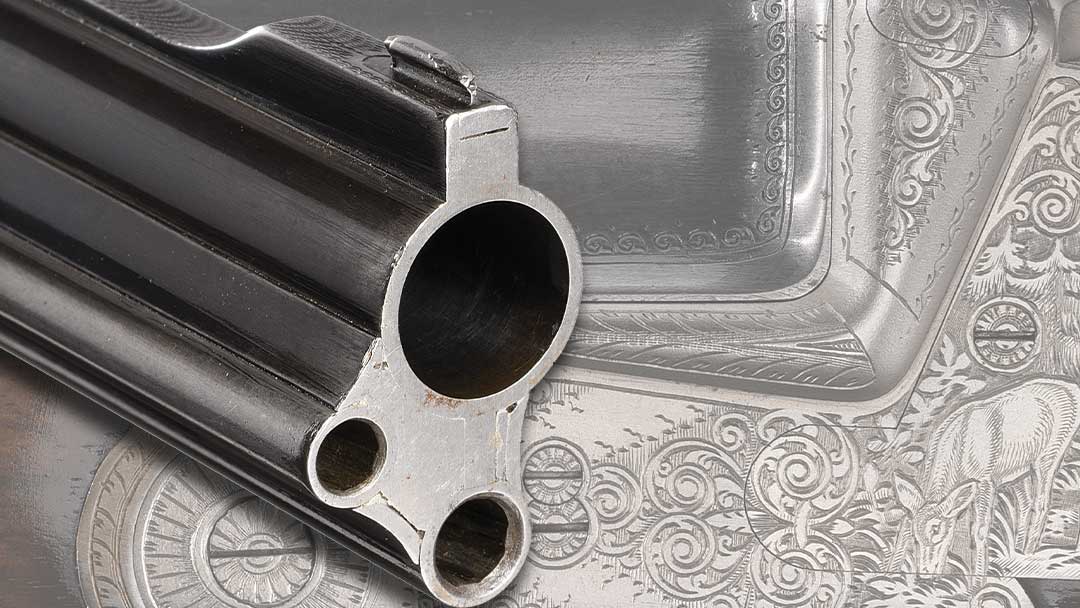
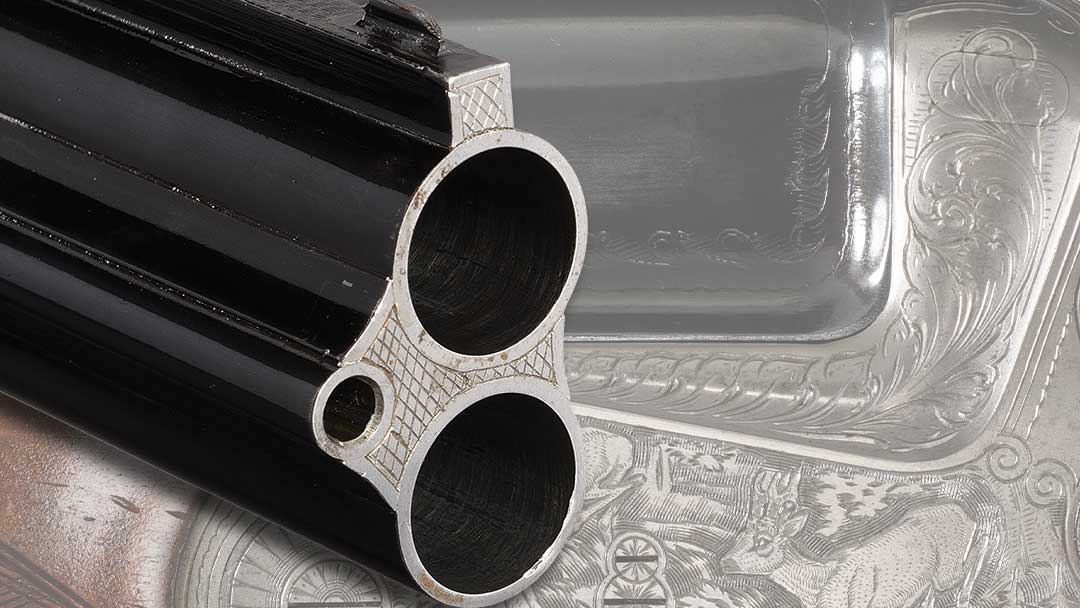
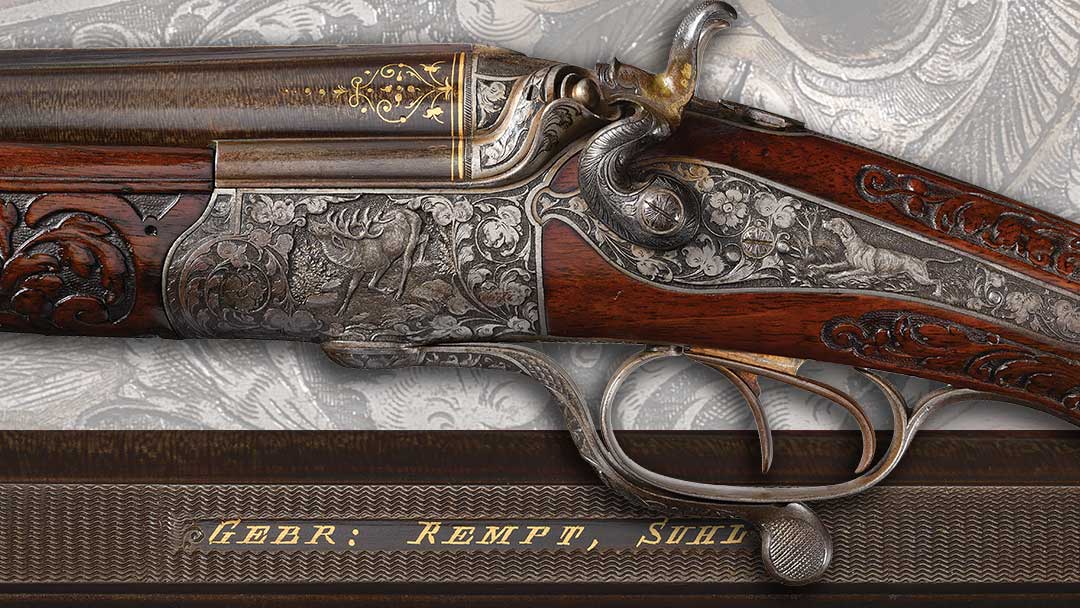
An attractive relief chiseled game scene and gold inlaid Gebruder Rempt over/under combination gun.

Stacking a smoothbore and a rifle barrel on top of one another eliminated some of the horizontal obstruction found in side-by-side combination guns and meant that each barrel was naturally aligned directly with the gun’s rear sights. And unlike the horizontal force recoil experienced with side-by-sides that could result in the firearm twisting in the shooter’s hand, the over/under combination gun produced a more manageable up-and-backward recoil.

A factory game scene engraved Gebruder Merkel hand detachable sidelock over/under combination gun with Zeiss Scope.

From high-grade custom offerings by reputed German manufacturers like Merkel to utilitarian examples like the Savage Model 24, the over/under combination gun covered every niche in the market. For the American farmer or homesteader, such guns could perform double duty as a sustenance and predator control option. For the intrepid hunter, the over/under combination gun provided the versatility of having a moose and a grouse gun in one.

A factory engraved left-handed Johann Fanzoj hand detachable sidelock over/under combination gun two barrel set with two scopes.

The Savage Model 24

Perhaps no over/under combination gun is as famous with the everyman hunter as the Savage Model 24. Debuting in 1950, the Savage Model 24 went on to enjoy a six decade production life, offering an easy-to-store, easy-to-upkeep truck gun that appealed to the masses.

The Savage Model 24 over/under combination gun, well-suited for any sort of farm, woods, or survival roles.

The original and most common configuration for the Savage Model 24 combination gun was a .22 caliber barrel atop a .410 bore shotgun barrel, but the handy firearm’s popularity soon resulted in a laundry list of chambering options to choose from.

During WW2, the U.S. Army Air Corps was searching for a compact, lightweight long gun to issue to aircrewmen. The Savage Model 24’s predecessor, the Stevens 22-410 was adopted in 1939 and illustrates yet another role the combination gun would fill as a military survival arm.

The M30 Drilling Luftwaffe Survival Gun

While the U.S. Army Air Corps ordered the no-frills, easy-to-produce Stevens 22-410 for $10.62 per unit, the German Luftwaffe equipped its airmen with the luxurious M30 drilling, a combination gun that would have been right at home on an alpine hunt. The M30 drilling was composed of a pair of two 12 gauge barrels over a 9.3x74R rifled barrel and finely engraved by respected Suhl gunmaker J.P. Sauer & Sohn.

German Luftwaffe airmen received the luxurious M30 drilling guns as survival tools in the event they were shot down in remote locations.

In 1941, the Luftwaffe adopted the M30 drilling during the height of WW2’s North African campaign. As Luftwaffe General Adolf Josef Ferdinand Gallan described, the M30 drilling was “standard equipment for our fighter Bf 109 and Stuka bombers to operate in the desert. The purpose was to shoot animals for survival.”

The Springfield M6 Scout and the Marble Game Getter

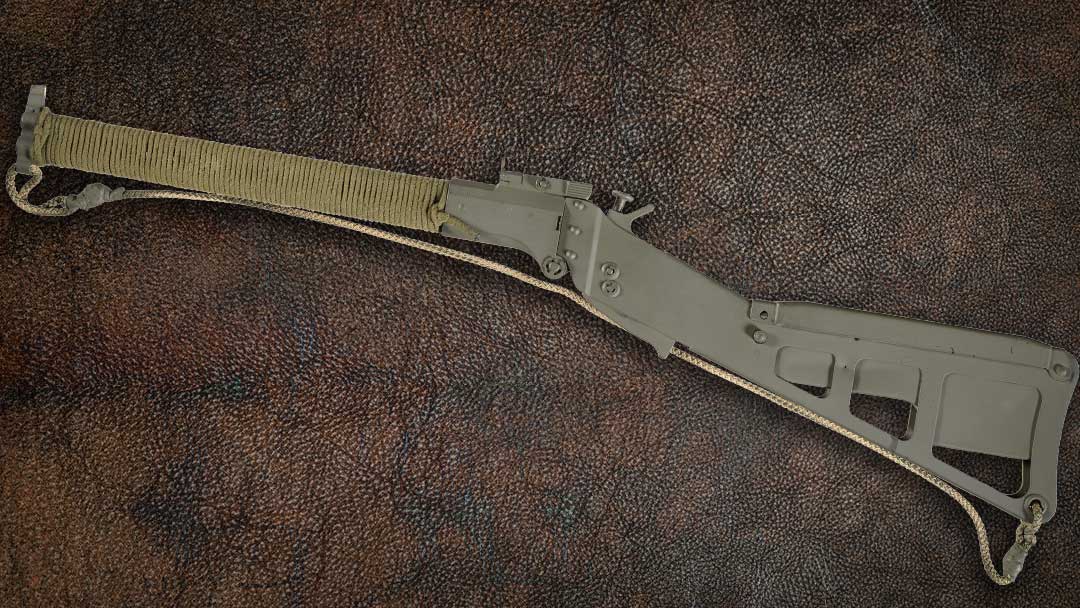
The U.S. Air Force continued to opt for affordability and function when it came to its survival guns, introducing the Springfield Armory M6 Scout in 1952. Also called the “Air Force M6 Aircrew Survival Weapon,” the M6 Scout was a combination gun with similar chambering to its Stevens 22-410 precursor. Civilian versions of the M6 Scout offered by manufacturers like Chiappa and Springfield found a market with survivalists and outdoorsmen, keeping the design alive after it was phased out by the Air Force in the early 1970s.

An Ithaca U.S.A.F. property marked M6 rifle/shotgun combination gun.

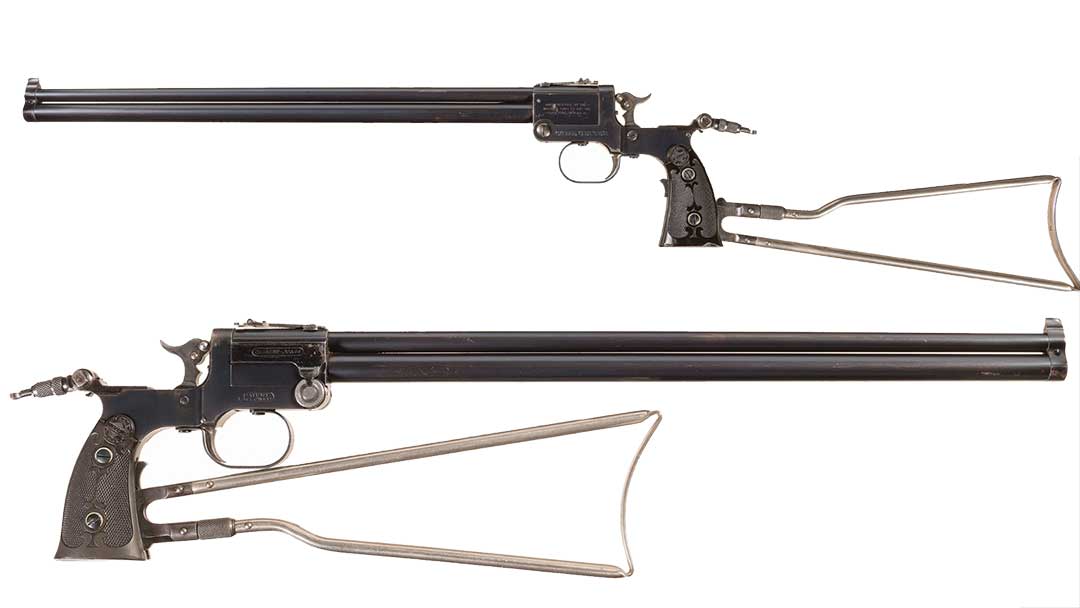
The M6 Scout and its folding skeleton stock was based on the Marble Game Getter, another distinct combination gun outfitted with a rifled .22 caliber upper barrel and a smoothbore lower chambered in either .410 or .44 bore. The Game Getter was pitched to the public as a weapon for all seasons which could be folded up and strapped to a pack without excess burden, then rapidly deployed for recreational plinking or taking small game.

A Marble Safety Axe Co. Game Getter over/under combination gun.

Combination Guns for Sale

Today, the combination gun remains in use with a relatively small but loyal segment of firearms enthusiasts. Fine modern offerings are available from European manufacturers like Italy’s FAMARS and Germany’s Johann Fanozj, while more modest pieces like the Savage Model 42, the Chiappa Firearms Double Badger, and the Baikal MP94 are found at entry level price points. Models like the Winchester Super Grade XTR over/under combination gun fall somewhere in between, offering a classic elegance at an attainable cost.

A factory engraved Winchester Super Grade XTR over/under combination gun with its box and case.

Rock Island Auction Company features combination guns for sale from every era, with examples that cater to all tastes and aspirations. For hunters and sportsmen, the combination gun offers the chance to own a firearm capable of taking a wide array of game in a single package and the ability to capitalize on opportunities with a simple flip of a selector. To collectors, shooters, and arms enthusiasts, the combination gun represents the chance to own a specialized firearm with a unique aesthetic and deep ties to our hunting heritage.

A factory engraved Gebruder Merkel hand detachable sidelock over/under combination gun two barrel set with scope.

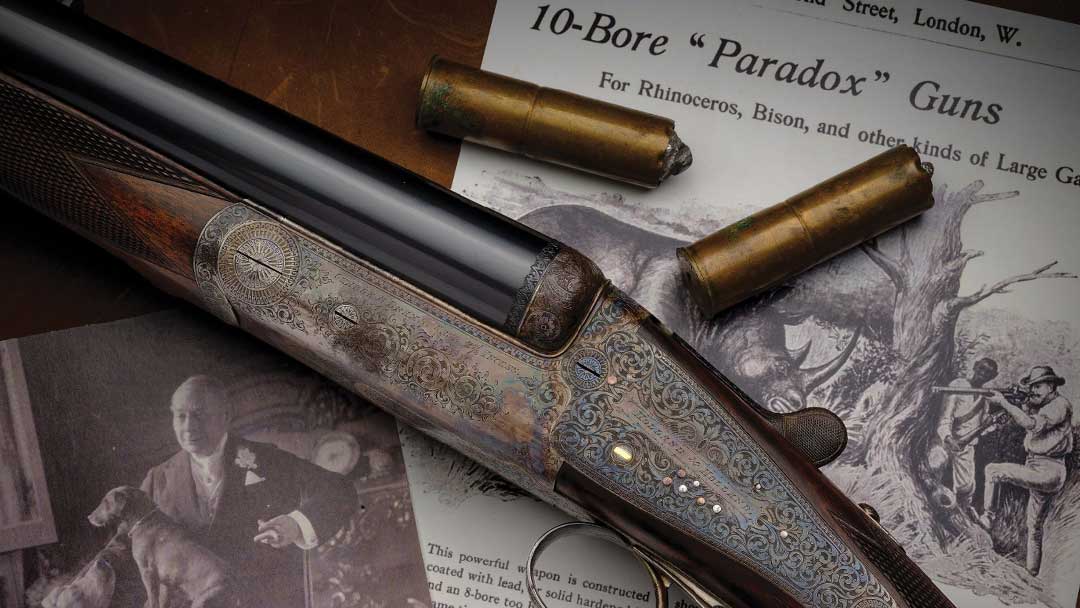
Subscribe to the Rock Island Auction newsletter for more gun blogs and gun videos on both historic and modern sporting arms, where we cover classics like Parker Brothers, Holland & Holland, Abercrombie and Fitch guns, and the Winchester Model 21, as well as curiosities like the Paradox gun, the Punt gun, the Howdah pistol, the Ithaca Auto & Burglar, and more.

A factory engraved Holland & Holland 10 bore sidelock ejector Paradox gun built for British sportsman and explorer Hugh Lowther, 5th Earl of Lonsdale.

Collectible Firearms for Serious Gun Collectors

0

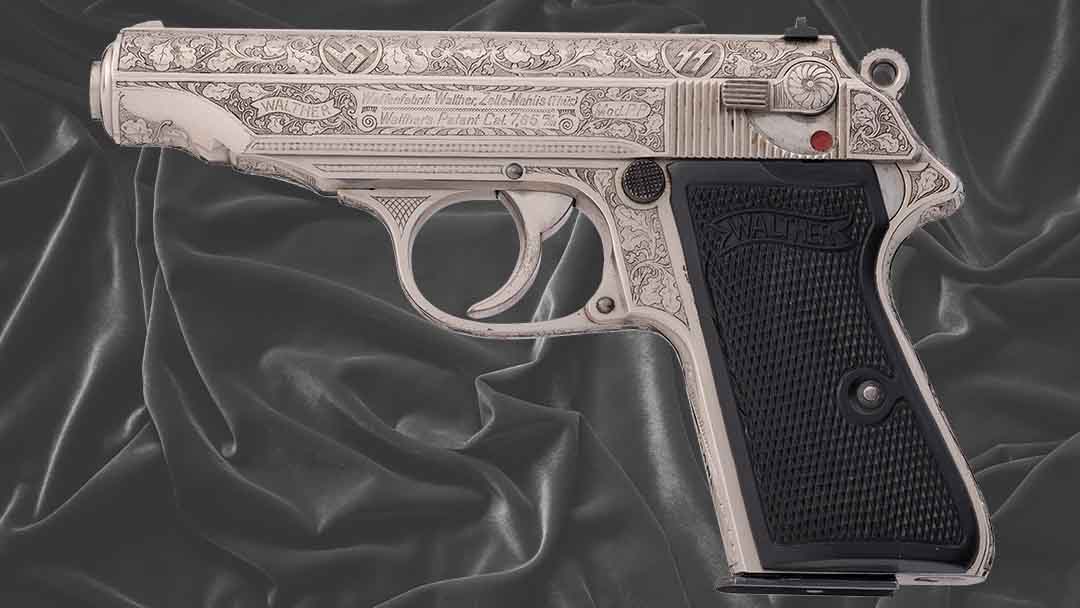
Some World War 2 war trophies or bring-back guns can be well-used and battle worn, but occasionally they turn up as an eye-catching engraved Walther PP pistol with a nickel finish. A beautiful gun with an owner whose history was downright ghastly.

The gun was brought back by a U.S. Army colonel at the end of World War 2, but how he came into possession of this German pistol is lost in time and the fog of war. The gun has full coverage Walther factory, semi-relief, presentation engraving with the initials “HF” engraved on the backstrap. Similar factory engraved Walther PP pistols were tied to high-ranking Germans during World War 2.

The initials on the German pistol are attributed to Gen. Hermann Fegelein, who for a time was a part of the highest circle of German leadership until his demise as the Soviets closed in and he tried to flee the Furher Bunker in the final days of World War 2. This gun, owned by a murderous sociopath who served on the Eastern Front and was Eva Braun’s brother-in-law, will be on offer in Rock Island Auction’s May 19-21 Premier Auction.

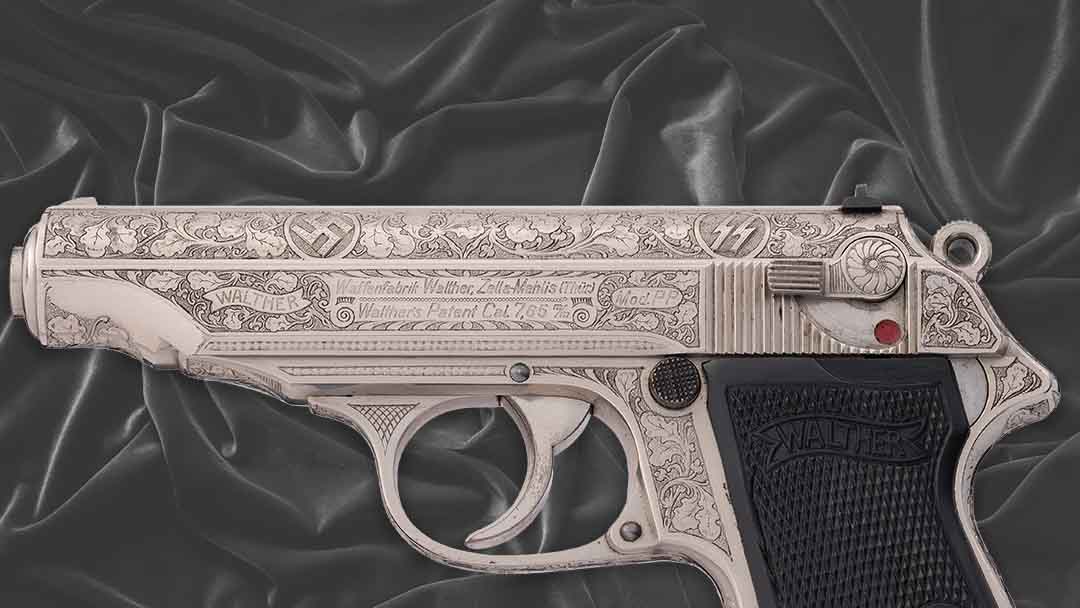
This Walther PP with a nickel finish features amazing engraving. The German pistol is covered with oak leaves and zigzags as well as checkering in the engraving.

A Simple Stable Boy

Born in Bavaria in 1906, Fegelein served as a stable boy for Christian Weber, a rich horse fancier and early member of Germany’s far-right extremist party as it rose to power amid the economic turmoil of the 1930s. With Weber as a patron, Fegelein rose through the ranks of the party, catching the eye of Heinrich Himmler who pulled Fegelein into his orbit.

Himmler gave Fegelein command of a cavalry regiment and overseeing preparations for the 1936 Berlin Olympics equestrian competition.  By 1939, Fegelein commanded the SS Totenkopf Reiterstandarte (Deaths-Head Horse Regiment) and was part of the blitzkrieg that swept into Poland in September.

In Poland, Fegelein’s regiment was tasked with dealing with the resistance movement, and from December 1939 to July 1941 the Deaths-Head Regiment participated in the mass executions of 1,700 people in the Kampinos Forest northwest of Warsaw. Prisoners were taken to the forest and shot where mass graves had already been dug. Wounded prisoners were likely buried alive. The largest mass execution was reported to be 358.

While in Poland he was accused by the German secret police of looting goods and sending them back to the SS cavalry school in Riem to be distributed to school members. A search of the school turned up a lorry, a Mercedes sedan, a two-seat Stoda, 50 lbs. of coffee, 14 packets of cocoa, a chest of tea, two chests of chocolate, clothes, and other goods. Fegelein claimed he was being persecuted by police. Himmler helped Fegelein avoid prosecution and he was sent east as part of Operation Barbarossa.

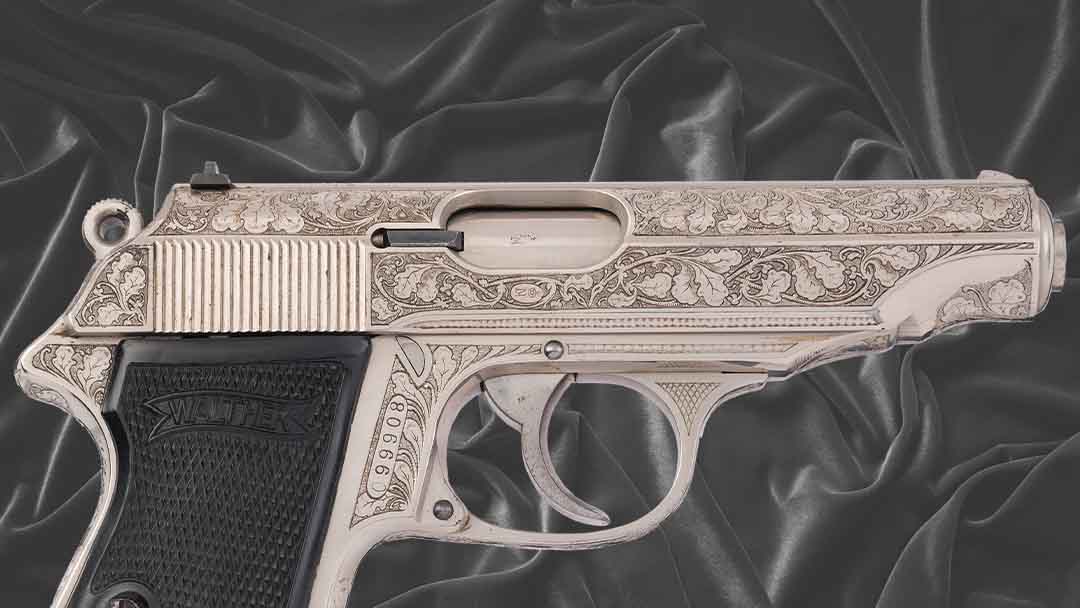
The floral engraving on the nickel finish of this Walther PP is complimented by engraved oak leaves, zig zags and checkering.

Onward and Upward

The surface of Fegelein’s skills were only scratched in Poland. His aptitude for cruelty shown through as his regiment took up the assignment of rounding up and exterminating the Jews, partisans, and other civilians of Belarus starting in July 1941. Fegelein’s unit, assigned to the Pripet Marshes, killed 13,788 in July and 3,500 men in August. Himmler didn’t think the “pacification of the rear areas” — a euphemism for genocide – was moving fast enough. Religious minorities were ordered to be shot as partisans, women and children were deported, and villages burned to the ground.

Himmler promoted Fegelein to the German rank of brigadier general. In the marshes, the moral and psychological barrier of killing women and children came down. By the time Germany was turned back in August 1944, 380,000 had been deported from Belarus and 2.23 million killed during the occupation. A Soviet sniper wounded Fegelein in December 1941. After recovering he was assigned to the 8th SS Cavalry Division Florian Geyer that continued on with his assignment.

Fegelein’s unit received an influx of 9,000 Romanians and was renamed the 8th SS Cavalry Division Florian Geyer and kept up the unit’s previous task of eliminating any resistance in Belarus.

A closeup of the Walther PP shows the German pistol’s nickel finish along with oak leaves, zig zags, and checkering.

Our Man in Berlin

Fegelein was wounded again in October 1943. This time Himmler sent him to Berlin to serve as SS liaison to the German leadership. Dashing Fegelein was popular among the ladies in the bunker and was befriended by Eva Braun. The secretaries described him as a ruthless man whose top priorities were his career and a good life. Albert Speer, German Mister of Armaments and War Production, described Fegelein as “one of the most disgusting people in Hitler’s circle,” seen as an opportunist and philanderer who ingratiated himself with Himmler, earning plum assignments and quick promotions.

Though there appeared to those around them an attraction between Eva Braun and Fegelein, it is believed nothing happened between them. Instead Eva Braun became a matchmaker between her younger sister, Gretl, and the dashing cavalry officer.

Fegelein and Gretl Braun were married on June 3, 1944, with Himmler officiating a pagan ceremony with Martin Bormann as a witness. The wedding party, with the Fuhrer in attendance for a time, lasted three days until the announcement of the D-Day invasion of June 6.

A closeup of the left side of this Walther PP with its nickel finish shows the markings of the German pistol, including a swastika and SS runes, that was brought back to the United States as a war trophy after World War 2.

The End in Berlin

The Florian Geyer Division, no longer with Fegelein at the helm, was transferred to Budapest where they were destroyed when the city fell to the Red Army in February 1945.

By April 21, 1945 Soviet tanks were on the outskirts of Berlin, and members of Hitler’s inner circle were looking at how to save their skins. Himmler reached out to the western allies for peace negotiations but there was no interest unless it was unconditional surrender.

On April 27, Fegelein asked for a vehicle to deliver him to his apartment. The Fuhrer asked for his aide, only to discover that Fegelein had abandoned his post. The Fuhrer was furious and demanded the SS man be located. He was found at his apartment, drunk and with his mistress, planning to go to Sweden or Switzerland. Wearing civilian clothes, he had cash, jewelry, and documents confirming Himmler’s outreach to the Allies. He was dragged back to the bunker and interrogated.

Gretl Fegelein was pregnant and expecting to give birth in early May. Hitler, from lobbying by Eva Braun, considered letting Fegelein off without punishment or assigning him to Gen. Wilhelm Mohnke as part of the defense of central Berlin. On April 28, the Fuhrer heard of the BBC account of the attempted peace negotiations and became more enraged. Fegelein was quickly court martialed and stripped of his medals and sentenced to death. On April 28, he was unceremoniously dragged out of the Fuhrer bunker and executed in the garden. Gretl Fegelein gave birth to a daughter on May 5.

Hermann Fegelein, worked his way up the ranks of the Nationalist Socialist German Workers Party and committed attrocities on the Eastern Front before being assigned to Berlin in 1943. He married Gretl Braun, the sister of Adolf Hitler’s girlfriend, Eva Braun, just days before D-Day in June 1944. He tried to flee the Fuhrer Bunker in the final days of the war but was caught and executed for desertion on April 28, 1944. The engraved backstrap of the Walther PP has Fegelein’s initials.

Brilliant Walther PP Pistol

U.S. Army Col. Michael Dizdar acquired the German pistol. How he acquired it remains unknown but is likely a war trophy brought home after World War 2. Dizdar, who was 90 when he died in 1995, was likely stationed in Northern Ireland as part of the medical section for training ahead of D-Day and ended up on the European continent before the end of the war.

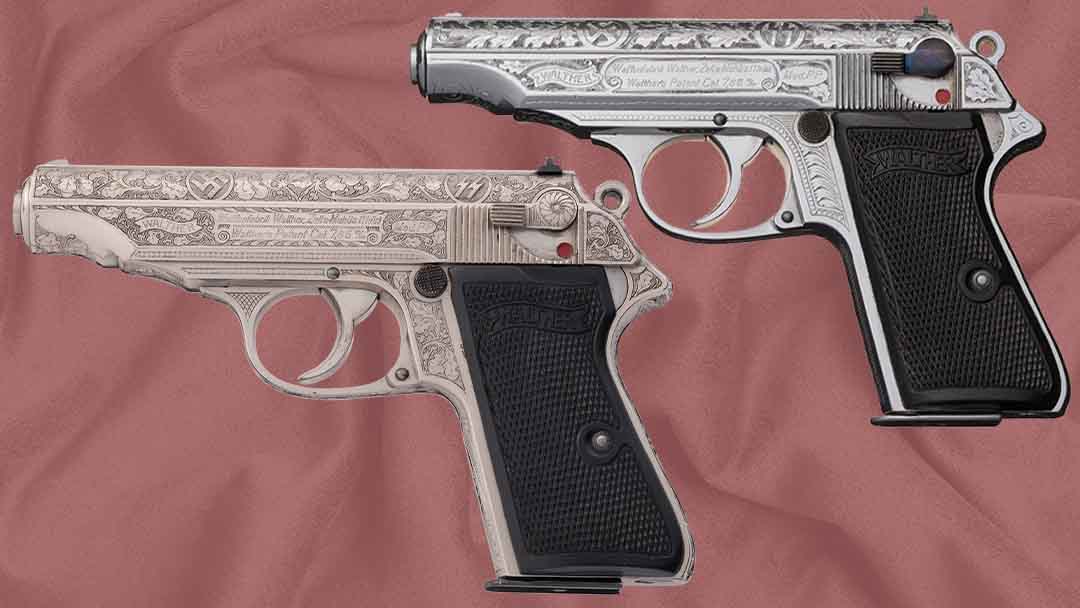
Two finely engraved German pistols. A Walther PP attributed to Heinrich Himmler, right, sold by Rock Island Auction Company for $287,500 in 2019. A Walther PP attributed to SS Gen. Hermann Fegelein, left, has similar engraving. It is on offer in RIAC’s May Premier Auction.

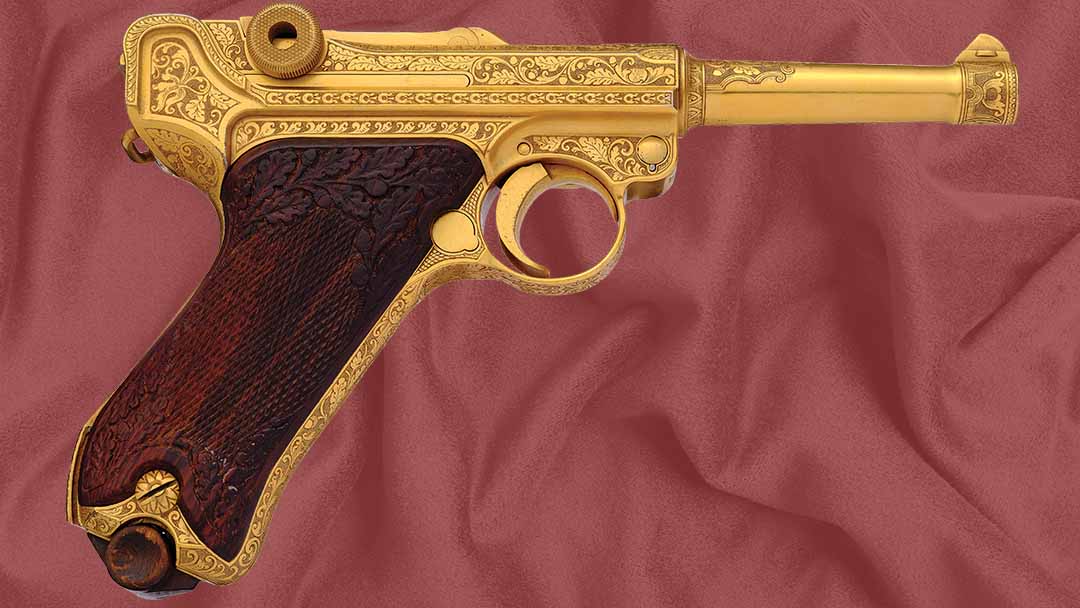
It appears that dreadful human beings liked to reward themselves with beautiful guns. German pistols destined as presentation pieces for the high command can show phenomenal engraving and finish. A Walther PP attributed to Himmler sold by RIAC in 2019 for $287,500 shares similarly detailed oak leaf engraving, punch dot borders and breathtaking finish, and a gold-washed Walther PP presented by Himmler to Gen. Karl Wolff that was captured in the Italian campaign is equally as detailed with a beautiful finish. It was sold by RIAC in 2015 for $287,500. A gold-plated and finely engraved Luger presented to Ambassador Franz von Papen by Foreign Minister Joachim von Ribbentrop is also on offer in the May Premier Auction.

The nickel finish on the Walther PP pistol is eye-popping, allowing the factory presentation engraving to stand out with its finely done oak leafs, zig-zags, and punch dot borders, alas as well as its swastika and SS runes on the gun’s left side. It also has checkerboard panels on the trigger guard and butt, and the backstrap is engraved with the monogram “HF.” Belonging to one of the very highest-ranking men in the German army, this German pistol is a symbol of American victory for democracy and human decency over the horrors inflicted by the Third Reich and the abhorrent people that led it.

A gold plated and finely engraved Mauser P.08 Luger attributed to a pair of World War 2 era German diplomats will be available in Rock Island Auction Company’s May 19-21 Premier Auction.

Sources:

The Execution of Hermann Fegelein – Eva Braun’s Brother in Law, History of Sorts

The Fegelein Wedding – Nazi Fairytale or Nazi Nightmare?

Genocidal Counterinsurgency: The German Anti-Partisan War in Belarus, by Kyle Sajoyan, Small Wars Journal

Hermann Fegelein, Spartacus Educational

Surviving Traumatic Events starts with Developing the Right Mindset

0

In life, unexpected situations can arise. During a crisis or emergency, dealing with the stress of these unexpected events can be incredibly challenging. Whether it’s a natural disaster, a manufactured disaster, or even just a financial setback, a survival mindset can help you navigate these situations more resilient and confident.

On most survival sites, the main focus is often on things like gear, survival skills, and emergency planning; while those things are extremely important and will make surviving a lot easier, there’s one thing that’s often overlooked that really is the key to survival: Mental Preparedness.

What is a survival mindset?

A survival mindset is a way of thinking that prioritizes adaptability, resilience, and resourcefulness. It’s about being able to stay calm and focused in the face of challenges, and to find ways to keep moving forward even when things seem impossible. A survival mindset isn’t just about physical survival – it can also help you to navigate emotional and psychological challenges, too.

How to develop a survival mindset

Mental preparation is usually something most people don’t prepare for. It’s just not something that many of us are taught in life. There isn’t a class in school called “developing the proper mindset,” which is pretty shameful since our mindset plays such an important role in all aspects of our life.

The will to survive is probably the most important aspect of surviving a traumatic event; disaster after disaster has shown that the people with the strongest mindset and the ability to control their fears are often the ones that come out on top. In fact, history is filled with examples of well-prepared people dying because they lost the will to survive.

Training is the first step to developing a Survival Mindset.

A feeling of hopelessness, or losing the will to survive, is often born from a lack of preparation. One of the best things you can do to ensure a proper survival mindset is to give yourself the tools and the knowledge you will need to survive in a wide variety of situations.

Study the most likely disasters that you will face. The more you know about the disaster, the less likely it is to affect you negatively. A good place to start, and something I recommend to everyone, is to take our threat assessment. This will help you determine what problems to prepare for, and what you should be mentally ready to face.

Train with added stressors. During your training exercises, you want to put yourself in situations where you feel a bit uncomfortable. Adding a bit of stress into your training process can help better prepare you to face these situations in the real-world.

An example of this would be training in real-world self-defense situation. I come across a lot of people who claim to be ready to defend themselves during a life-threatening situation. When pressed on their training tactics, a majority of these people have never used their firearm outside of firing at paper targets at the range.

To truly be prepared, these people should have added some stress to the situation; things like an instructor screaming at you, having to fire from awkward positions, or having to shoot at moving targets are all examples of uncomfortable situations that should be added to your training process. The closer you can get to real-world training, the better prepared you’ll be to face real-world threats.

Battle-proofing your mind

Training your mind to survive

Most Special Forces operators will tell you how important battle-proofing your mind is to the ultimate success of the mission. Through the use of visualization techniques, you can condition your mind to be physiologically strong during times of crisis and stress.

An example of this would be a soldier visualizing a firefight or an upcoming mission. He mentally pictures everything about that mission, including what could go wrong, what it’s going to feel like, what it’s going to smell like, and his response to every danger he might face. He is mentally preparing himself for every aspect of what he might face, so when confronted with that danger, the brain responds without fear because it feels like the situation is normal.

In essence, you are tricking your brain into believing the situation is familiar, thus removing anxiety from the equation.

Setting Goals and a Game plan

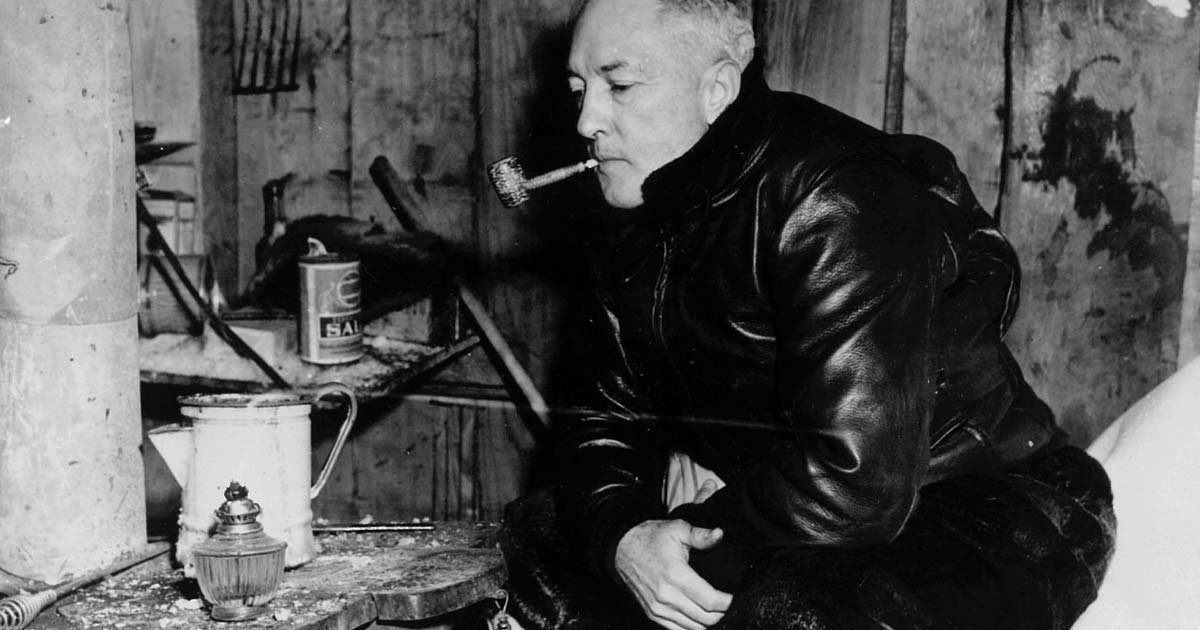
Admiral Richard Byrd, the infamous Antarctic explorer.

Having goals, and a developing a game plan, are two surefire ways to ensure a proper survival mindset. The process of setting goals, and then breaking these goals down into small manageable tasks, can help make stressful situations seem less overwhelming.

Admiral Richard Byrd, the infamous Antarctic explorer, learned this lesson while spending five months alone in a small shack buried into a glacial icecap.

Completely isolated from the outside world, without another living creature within hundreds of miles, Byrd spent five months living in this mind-bogglingly, brutally cold arctic environment. It was so cold that his breath actually froze and crystallized in the air when he exhaled. To top it off, he spent those five months living in the complete darkness of the Arctic, where even the days where as black as night.

To stay sane, in conditions that would drive most men mad, Byrd found that the only way to maintain his mental health was to get busy by setting goals and having a routine. He gave himself small manageable goals like cutting bookshelves into the frozen walls and gave himself a set schedule for performing ordinary tasks like cleaning and routine maintenance.

In his book Alone, he talks about his method for maintaining the will to survive. “It was wonderful,” he said “to be able to dole out time in this way. It brought me an extraordinary sense of command over myself.” He added, “Without that or an equivalent, the days would have ended, as such days always end, in disintegration.”

Without goals, and without a game plan, you give your mind the power to run rickshaw over your ultimate fate. By giving yourself a series of easy to accomplish tasks, you create a situation that seems less psychologically overwhelming and help to ensure your ability to survive the challenge.

Tips for Developing a survival mindset

Strong mindset

Practice mindfulness

Mindfulness is the practice of being present in the moment and observing your thoughts and feelings without judgment. Practicing mindfulness regularly allows you to develop greater emotional awareness and learn to manage difficult emotions more effectively. This can be especially helpful in high-stress situations, where staying calm and focused can be a matter of life and death.

Build your physical resilience

Physical resilience is your body’s ability to withstand stress and recover from physical challenges. By taking care of your physical health through regular exercise, healthy eating, and good sleep habits, you can build your physical resilience and prepare yourself for unexpected challenges.

Learn basic survival skills

Knowing how to start a fire, build a shelter, and find clean water can be essential in survival situations. By learning these skills, you’ll be better equipped to handle unexpected challenges and stay safe in the wilderness or in other emergencies.

Cultivate a growth mindset

A growth mindset is the belief that your abilities and intelligence can be developed over time. By cultivating a growth mindset, you can approach challenges as opportunities to learn and grow rather than as insurmountable obstacles. This can help you to stay motivated and resilient in the face of adversity.

Practice problem-solving

Thinking critically and solving problems creatively are essential in survival situations. By practicing problem-solving in your daily life, you can develop the skills you need to find solutions to unexpected challenges. This might involve brainstorming multiple solutions, evaluating the pros and cons of each option, and being willing to adapt your approach if your first attempt doesn’t work.

Prepare for the unexpected

While it’s impossible to predict every challenge that might come your way, you can take steps to prepare yourself for the unexpected. This might include creating an emergency kit with supplies like water, food, and first-aid materials, or learning about local emergency protocols and evacuation routes. Knowledge is the key to success and the key to staying calm when the shit hits the fan!

By developing a survival mindset, you can be better prepared to handle unexpected challenges and emerge stronger and more resilient on the other side. No matter what survival situation you ar facing, a survival mindset can help you to stay calm, focused, and resourceful, no matter what comes your way.

Classical Conversations Homeschooling for Christian Families

0

Classical Conversations is a homeschooling program that has grown in popularity recently. It is based on the classical education model, which has been around for centuries and focuses on teaching students how to think, rather than just what to think.

What is Classical Conversations?

Classical Conversations is a Christian homeschooling program that is based on the classical education model. It was founded in 1997 by Leigh Bortins, a homeschooling mother who wanted to give her children a classical education. The program now serves over 130,000 students in all 50 states and several countries worldwide.

How does Classical Conversations work?

The Classical Conversations program is designed to be flexible and adaptable to each family’s unique needs. The program is divided into three stages: Foundations, Essentials, and Challenge.

Foundations (ages 4-12) focuses on the basics of language arts, math, science, and history. The program uses a memory work system, where students memorize key facts and information about each subject. The program also includes art and music study, as well as science experiments and history projects.

Essentials (ages 9-11) builds on the foundation laid in the earlier stage and focus on language arts, specifically grammar and writing. Students learn how to write and analyze sentences and learn about the parts of speech and how they function in a sentence.

Challenge (ages 12-18) is designed to prepare students for college and beyond. Students thoroughly study literature, writing, math, science, and history. They also participate in debates, public speaking events, and service projects in their communities.

The program uses a homeschool community model, where families meet once a week for classes and socialization. Each family is responsible for teaching their own children at home throughout the week, using the curriculum provided by Classical Conversations.

Benefits of Classical Conversations

One of the key benefits of the Classical Conversations program is its focus on the classical education model. This model has been proven over centuries to be effective in developing critical thinking skills and preparing students for college and beyond.

Another benefit is the flexibility and adaptability of the program. Families can customize the program to meet their unique needs, and the homeschool community model provides support and socialization for both parents and students.

Lastly, the program’s Christian perspective may appeal to families who are looking for a faith-based education for their children. It also incorporates once a week co-op classes and helps create strong bonds with other homeschooling families.

Classical Conversations is a homeschooling program that offers a unique approach to education. Its focus on the classical education model, flexibility, and Christian perspective make it an appealing option for many homeschooling families. If you are considering homeschooling your child, it is worth exploring whether the Classical Conversations program might be a good fit for your family.

EMPs, Terror Attacks and Grid Failures

0

What was once considered something that can only happen in a science fiction novel is now a very real possibility: the complete shutdown of our entire electrical grid.

Power grid failures are nothing new; in fact, during the winter of 1965 the United States experienced one of the worst power outages in its history. Over 30 million people from seven northeastern states and the province of Ontario in Canada were plunged into darkness when maintenance workers mistakenly tripped a safety relay. Almost forty years later, the same area was hit by the great Northeast blackout of 2003, where over 55 million people experienced power outages as a result of a software bug.
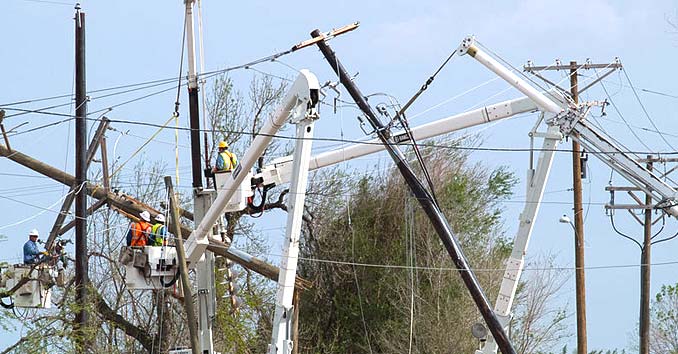
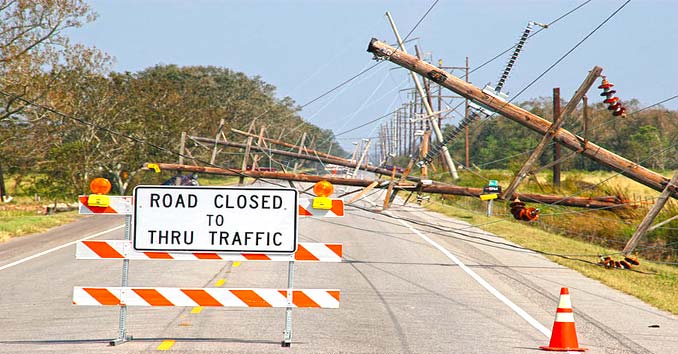
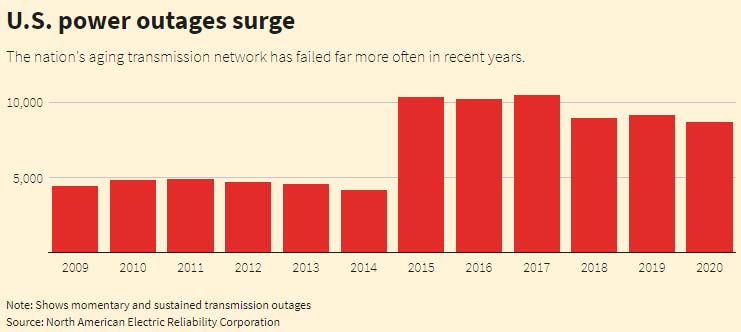
While most power outages are caused by storms or utility company mistakes, a growing number of these outages are being blamed on everything from our deteriorating electrical infrastructure to terrorists and hackers.

History of Major United States Power Outages

Over the last couple of decades, power outages have affected just about every American. These outages cause the average U.S. electrical utility customer to go without power for an estimated 214 minutes every year, costing the U.S. economy up to an estimated $55 billion annually.

The United States has a long history of major power outages that have disrupted daily life, caused significant economic losses, and even resulted in the loss of life. From the Northeast Blackout of 1965 to Hurricane Katrina in 2005, let’s take a closer look at some of the most significant power outages in U.S. history.

Northeast Blackout of 1965

On November 9, 1965, a faulty relay at a power plant in Ontario, Canada, led to a power surge that caused a chain reaction and resulted in a massive blackout that affected over 30 million people across the northeastern United States and parts of Canada. The outage lasted several hours and left many stranded without transportation or communication.

New York City Blackout of 1977

On July 13, 1977, a series of lightning strikes caused significant power outages in New York City, plunging the entire city into darkness. The blackout lasted for over 25 hours, caused over 9 million to lose power, and led to widespread looting and arson in several neighborhoods.

Utah Goes Dark in 1981

January 1981: Almost the entire state of Utah goes dark after prisoners on a work assignment accidentally knocked out transmission lines. 1.5 million people, in nearly all of Utah, as well as parts of southeastern Idaho and southwestern Wyoming lost power.

The Loma Prieta earthquake

October 1989: The Loma Prieta earthquake knocked out power to over 1.4 million people in Northern California due to damaged electrical substations.

The Western U.S. Energy Crisis of 2000 and 2001

2000-2001: The Western U.S. Energy Crisis of 2000 and 2001 hit California causing rolling blackouts that lasted for over 12 months.

The Midwest Grid Failure of 2003

On August 14, 2003, a software error in the alarm system of a power plant in Ohio caused a power outage that affected over 55 million people across the Northeastern and Midwestern United States and parts of Canada. The outage lasted several days in some areas and led to billions of dollars in economic losses.

Hurricane Katrina of 2005

On August 29, 2005, Hurricane Katrina landed on the Gulf Coast, causing widespread destruction and power outages in Louisiana, Mississippi, and Alabama. The storm knocked out power to over one million people, leaving many without electricity, clean water, or access to basic necessities for weeks.

Superstorm Sandy of 2012

On October 29, 2012, Superstorm Sandy and the Mid-Atlantic storms of 2012 struck the Northeastern United States, causing massive power outages that affected over eight million people across 17 states. The storm surge caused significant damage to power lines and substations, leaving many without electricity for weeks and causing over $50 billion in economic losses.

The list above is only a fraction of the power outages that have been experienced over the last couple of decades, and experts are warning about a frightening increase in non-disaster-related outages. Significant power outages have risen from 76 in 2007 to 307 in 2011.

Electrical Grid Threats

Downed Powerlines

Our Aging Power Grid

The United States power grid is one of the most advanced in the world, but it is also aging and in need of desperate repair. The grid is made up of a patchwork of thousands of power plants, transformers, 400,000 miles of electric transmission lines, and distribution centers. Some of our grid still relies on  lines and equipment dating back to the 1880s! Our aging infrastructure is a growing concern, and the danger it poses cannot be ignored.

The vast majority of our grid was built in the 1950s and 1960s; most of the equipment we rely on to keep our grid running is 50 to 60 years old. Unfortunately, most of that technology was designed to last 40 to 50 years, and there seems to be no real urgency to update these essential parts of our infrastructure.

Power outages increasing.

The average age of large power transformers, which handle 90% of U.S. electricity flow, is more than 40 years. According to research by reinsurance provider Swiss Re, transformer malfunctions tend to escalate at about 40 years.

The Cyber/Terror Threat to the Grid

Cyber Attackers

It’s really not a secret; our power grid is incredibly vulnerable to attacks from terrorists, hackers and rogue nations.

The General Accounting Office (GAO) has explicitly stated that the U.S., Energy Grid is vulnerable to cyber-attacks. The GAO notes that the grid distribution systems—which carry electricity from transmission systems to consumers—” have grown more vulnerable, partly because their operational technology increasingly allows remote access and connections to business networks. This could allow threat actors to access those systems and potentially disrupt operations.”

The GAO also notes that “nations and criminal groups pose the most significant cyber threats to U.S. critical infrastructure, according to the Director of National Intelligence’s 2022 Annual Threat Assessment. These threat actors are increasingly capable of attacking the grid.”

According to a report from the National Academy of Sciences, which was sponsored by the Department of Homeland Security, our power grid is incredibly vulnerable to an attack which could cause widespread blackouts for weeks, maybe even months. This is incredibly worrisome, especially when you consider that most Americans says they wouldn’t be able to survive for longer than 2 weeks without power.

Cyber security expert Eugene Kaspersky warned about the very real threat of crippling attacks against key infrastructure throughout the world. He said that the threat of cyber terrorism had reached a point that could spell “the end of the world as we know it”.

Physical Attacks on the Grid and Utility Infrastructure

Shooter attacking the grid

The potential for physical attacks on these systems has increased with the rise of technology and automation in utility infrastructure. The consequences of such attacks can range from minor disruptions to entire infrastructure collapse, causing widespread power outages and other hazards. In recent years, there have been several instances of physical attacks on utility infrastructure that have resulted in significant damage and loss of service.

Between 2011 and 2014, electric utilities in the United States reported 362 physical and cyberattacks that caused outages or other power disturbances to the U.S. Department of Energy. In a vast majority of those cases, no suspects were ever identified.

In 2013, we reported on a number of these attacks where people were targeting small power substations throughout the country. During one attack, an unknown group cut communication cables along a highway in San Jose, California before firing over 100 rounds of ammunition into large transformers at the substation. The FBI categorized the attack as a “Military-style” attack, but were never able to identify who was responsible.

That attack, revealed a major vulnerability in our power grid. According to a study by the Federal Energy Regulatory Commission (FERC), a relatively small coordinated attack in each of the nation’s three separate electric systems could cause the entire power grid to collapse.

Another incident occurred in December 2015, when gunmen attacked a power substation in California, destroying 17 transformers and causing a power outage affecting 52,000 people. The attack was carried out by firing more than 100 rounds of ammunition at the substation, causing significant damage to the facility. While no one was injured in the attack, the damage caused estimated losses of up to $15 million.

In another instance, in 2019, a drone was used to attack two oil facilities in Saudi Arabia, causing significant damage and a temporary reduction in oil production. The drone, believed to have been launched by Yemeni rebels, reportedly bypassed the facilities’ security measures, highlighting the vulnerabilities in even the most secure utility infrastructure.

In January 2023, a Department of Homeland Security (DHS) bulletin warned that violent domestic extremists “have developed credible, specific plans to attack electricity infrastructure since at least 2020, identifying the electric grid as a particularly attractive target.”

The problem is that physical attacks on substations are easy because they are soft targets and there are more than 55,000 connected to the grid in the U.S.

The EMP Threat

EMP Blast

An electromagnetic pulse (commonly referred to as an EMP) is a burst of electromagnetic radiation caused by the detonation of a nuclear device above the earth surface. In my opinion, this is one of the worst case scenarios that we can think of. If a terrorist group or rogue nation were able to detonate one, it could shut down the entire country’s power grid for years, possibly permanently.

An EMP attack over the United States could literally put an end to the world as we know it in a matter of minutes. The damage caused by an EMP would be catastrophic. In a matter of minutes, everything our country depends on would come to a screeching halt.

From ATM’s and banking systems to key infrastructure like power, water and gas utilities, you would immediately see failures across the board. Our way of life would change in the blink of an eye, and it would take years to even begin to repair the damage.

In testimony late last year, Brandon Wales, director of the Department of Homeland Security’s (DHS) Infrastructure Threat and Risk Analysis Center, admitted that DHS is not adequately prepared to deal with an electromagnetic pulse (EMP) event or attack.

Wales testified that the United States power grid is even more vulnerable to attack than it was only a few years ago, and that DHS had no real plans to deal with the possibility of an attack.

The situation is pretty clear, and it’s pretty grim. We have severely neglected key infrastructure throughout the country. On top of that, our government is either ignoring, or is willfully negligent in protecting the county’s power grid from attack. This has left a large portion of our country, which has become incredibly dependent on these systems, extremely vulnerable if they fail.

Preparing for Power Grid Failures

Create an power outage emergency kit:

First, ensure you have an emergency kit ready to go now! It’s important to have a kit that you can easily access in case of an outage. The kit should include necessities such as flashlights, candles, batteries, a first-aid kit, a radio, a cellphone battery charger, and extra clothing or blankets. Remember to pack enough supplies for everyone in your home and ensure the kit is stored safely.

Have a backup power source:

Invest in a backup power source like a portable generator or solar panels. If you are investing in solar panels, then make sure they have enough capacity to power your essentials, such as your refrigerator or medical equipment.

Stock up on non-perishable foods:

During an outage, your fridge and freezer won’t be able to keep food cold, so be sure to stock up on non-perishable foods. Canned foods, granola bars, and crackers are all excellent options. It’s also important to keep a supply of safe drinking water on hand.

Secure your home:

Before an outage occurs, make sure your home is secure. For example, trim branches close to power lines, secure outdoor furniture, and close all windows and doors. If you have a garage, make sure it’s locked, so that you don’t have to worry about intruders.

Stay informed:

Keep up-to-date with weather reports, and stay informed of any updates from your local utility company.

Preparing for a power outage may not seem like a big deal, but it’s a crucial step in ensuring your safety and comfort. By creating an emergency kit, having a backup power source, stocking up on non-perishable foods, securing your home, and staying informed, you’ll be ready for anything that comes your way.

Collectible Firearms for Serious Gun Collectors

0

“Extraordinary,” “finest known,” “historically significant,” “rare,” and “phenomenal” are words that carry plenty of heft.

Place the weight of those words on an amazing and carefully curated collection of fine arms and you have the Greg Lampe Collection. Rock Island Auction Company will proudly unveil the initial offering from this far-reaching gun collection in its May 19-21 Premier Auction. The lots range from remarkably conditioned Colt revolvers, to pocket pistols, to rare flintlocks to well-documented martial long guns. It is a collection as varied in its breadth as it is breathless in its distinction and will be offered over several auctions.

“Most collectors go through periods of different interests,” said firearms consultant Herb Glass Jr., a long-time friend of Lampe who died in 2022. “They will start collecting one field and then get exposed to another field. Transitioning between the many fields of antique firearms is probably a natural thing for collectors.”

Glass, who spoke with Rock Island Auction Company about Greg Lampe and his gun collection, said the two men’s friendship dated back to when they first met at an Ohio Gun Collectors Association event in the 1970s. Lampe was from Ohio where he founded his company, Emtech, before selling to 3M in 2002 and retiring to Arizona.

Glass described Lampe as a “persistent collector,” starting a gun collection with little money but watching it evolve into something special. He was a 23-year member of the Texas Gun Collectors Association and several of his cased sets were used as correct examples in Robin J. Rapley’s books on Colt accessories.

“He didn’t buy things on the spur of the moment,” Glass said, noting that Lampe’s gun collection touched a number of genres. “His interests changed. His pleasure in part was the study, and the study led him from one field to the other. That accounts for the range.

“People buy things, collect things and never try to learn much about them,” Glass said. “He did. Students have the most fun.”

Some of the guns, like a gold- and nickel-plated Colt Model 1877 Lighting have already been highlighted. The fine arms from the Greg Lampe gun collection on offer in the May 19-21 Premier Auction range from bladed weapons to muzzleloaders to percussion Colt revolvers to dueling pistols to percussion rifles to what was his last genre of interest, pepperbox pistols.

Here is a sampling of some of the variety weapons that will be on offer.

Finest Known Three-Digit Serial Number Cased Colt Model 1860 Fluted Army Percussion Revolver

More than 200,000 of the Colt Model 1860 Army revolver were made between 1860 and 1873 when the Colt Single Action Army revolver was adopted. About 5,000 to 6,300 revolvers with fluted cylinders, with serial numbers under 8,000, were made, and of those, only about 2,800 had the 7 1/2 inch barrel length.

These Civil War era Colt revolvers are much sought after because some were even shipped to the South on the eve of the Civil War and even after the opening salvos were fired at Fort Sumter. Very few survived with much finish on them, a testament to their use in the war.

This fluted Colt Model 1860 Army percussion revolver is in extraordinarily high condition and likely never saw use. Research shows this fine arm was shipped to Colt’s New York sales office and bears serial number 964. The brilliantly color casehardened four-screw frame bears the three-digit serial number, as does the fluted cylinder. The hammer is also casehardened and features borderless knurling. This revolver was reported as found in a vault in an antique and coin shop in Colorado following the death of the shop’s owner in the 1970s. It was then sold to another coin dealer before being sold to well-known collector George S. Lewis Jr.

Rare S. Hawken Signed Full-Stock Percussion Rifle

Jacob and Samuel Hawken set up their gun making business in St. Louis in 1825 where they developed the rifle that would be used by trappers, traders, and frontiersman to explore the Rocky Mountains and the west. It was light and could take down large animals at long range. This gun dates to after the heyday of the Rocky Mountain fur trade but when Hawken rifles remained in demand, not only by hunters, guides, and scouts, but by migrants headed west.

The Hawken shop offered full-stock and half-stock rifles. The full-stock was offered at $18, while the half-stock rifles were more labor intensive, priced at $25.

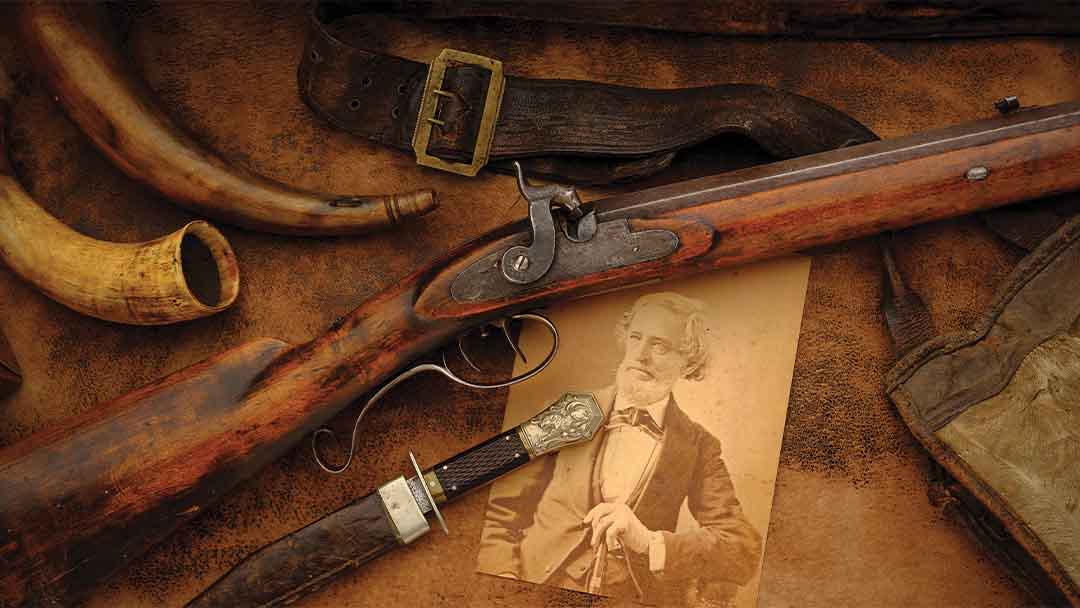
This rifle, dating from the 1850s is a full-stock rifle stamped with the “S. HAWKEN St. LOUIS” marking on top of the barrel behind the rear sight. The marking was used after Jacob Hawken died in 1849. The rifle has a silver blade front sight with dovetailed copper base, and a dovetailed iron notch rear sight. The lock has scroll end border engraving and has double set triggers. The butt has a straight “Tennessee” style cheek piece and a crescent iron butt plate and rounded heel tang with an iron toe plate.

This Remington single action revolver is one of the first off the line in late 1874 or early 1875. Originally planned for .46 caliber rimfire, the gun maker released them in .44 Remington centerfire. After 1878, most were chambered in .44 WCF or .45 Colt. The Remington Model 1875 Single Action Army was meant to compete with the Colt Single Action Army, but because of Colt’s two-year head start, Remington’s Single Action Army never caught on as well commercially as the Peacemaker. Between 25,000 and 30,000 revolvers were made from 1875 to 1889.

A First Type, First Issue model bears the factory-modified hammer from rimfire to center fire as well as a First Type lanyard loop on the butt and a pinched blade front sight threaded into the barrel.

This is one of the finest existing Remington Model 1875 revolvers, with engraving by master engraver L.D. Nimschke. The gun features classic scrollwork, a “kidney” design behind the hammer, and entwining lines, stars, and other embellishments straight from Nimschke’s designs. Nimschke engraved other Remington early Model 1875 Single Action Army revolvers, but other surviving guns aren’t as highly conditioned as this revolver. Serial number 81 is marked on the rear face of the cylinder, the trigger guard tail, and the left side of the frame at the heel.

Historically Significant, Exceptional, and Documented One of the First Etched Panel Colt Black Powder Frontier Six Shooter Single Action Army Revolver

This revolver stands as the finest known example of the earliest shipped etched panel Colt six-shooter. New York distributor J.P. Moore’s Sons marketed the idea of associating “Frontier Six Shooter” with .44 WCF and etching the name on the barrel. Colt agreed and a legend was born, as the Colt Single Action Army in this caliber was branded as the “Frontier Model.”

The revolver is pictured and identified in the March 2010 cover story “The Birth of the Colt ‘Frontier Six Shooter’” in “The Gun Report,” and Don and Carol Wilkerson and Kathleen Hoyt’s “The Official Record of the Colt Single Action Army Revolver 1873-1895” on page 73.

A must-have for the serious Colt Single Action Army collector, this revolver was manufactured in 1878, the first year for the etched .44 WCF panel, and was one of the first shipped in February 1878 to J.P. Moore’s Sons. This SAA has a blued finish with a 7 1/2 inch barrel and walnut grips.

Spectacular U.S. Contract Whitney Model 1841 Percussion “Mississippi Rifle”

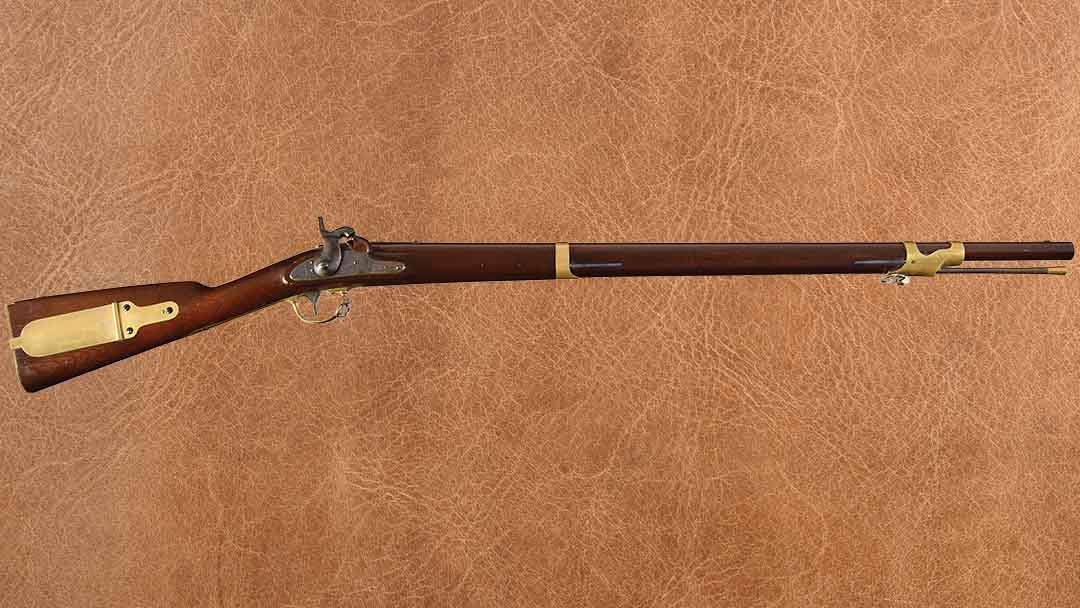
The “Mississippi rifle” nickname came out of the Mexican-American War when Jefferson Davis was appointed colonel of the Mississippi Rifles, a volunteer regiment from that state. Davis, who would eventually be president of the Confederate States of America, wanted the 1841 rifles but his commanding officer, Gen. Winfield Scott refused. Davis went over his head to President James K. Polk who overruled Scott. Davis’s unit, with its rifles, played a key role the Battle of Buena Vista. The Model 1841 was used across both the Federal and Confederate armies in the Civil War.

This “Mississippi rifle” is exceptional, in nearly as issued condition, and chambered in the original .54 caliber round ball configuration. It appears to have remained in storage throughout its service life. It has a color casehardened lock plate and hammer with browned barrel. The trigger, screw heads, and band spring have a vivid nitre blue finish. The buttplate, over-sized patch box, trigger guard, sideplate, and barrel bands are brass. It bears two ordnance inspection cartouches.

Very Scarce and Desirable Civil War Confederate 1st Model LeMat “Grape Shot” Percussion Revolver

The nine-shot revolver was popular with Confederate officers during the American Civil War, with about 450 of these 1st Models made in Liege Belgium. Along with the barrel for rounds held in the cylinder, the LeMat also had a secondary and larger caliber underbarrel that functioned as a short-barreled shotgun. The shooter flipped a lever on the hammer to select whether to fire like a pistol or with the larger bore barrel.

These revolvers were used by well-known Confederate generals like P.G.T. Beauregard, Braxton Bragg, and J.E.B. Stuart. Despite most of the manufacturing occurring in Paris and Liege, the gun was designed by Jean Alexandre LeMat of New Orleans.

This LeMat “grapeshot” revolver features the improved barrel latch pinned in the front of the frame and fitted with a spring and has interrupted threads on the “grape shot” barrel allowing the barrel and cylinder to be easily removed. It has a triangular front sight. An incredibly rare holster and belt rig are offered separately in the auction.

Exceptional Woodhead & Hartley Sheffield Etched Blade Half Horse, Half Alligator “American Bowie Knife” with Pearl Grips and Scabbard

The English firm of George Woodhead & Joshua Hartley offered patriotic American themes on its knives as a way to tap into the craving for large knives in the booming United States marketplace. The company was established in Sheffield in 1839.

This knife is 13 3/8 inches long with a 9 inch clip point blade with a long false edge. On the left is etched an American eagle and patriotic slogans including “THE UNITED STATES, THE LAND OF THE FREE AND HOME OF THE BRAVE/PROTECTED BY HER NOBLE AND BRAVE VOLUNTEERS” and “CALIFORNIA./GOLD AT THE DIGGINGS.” It has an elliptical German silver guard and coffin-shaped pommel with a relief half horse, half alligator on each side. A scabbard with gilt floral tooling and German silver fitting is included.

Presentation “Book” Cased E. Remington & Sons Over/Under Derringer with Photographs and Plaque Inscribed to “LW” on December 25, 1876, Attributed to Lillie Woods of Cheyenne, Wyoming

The over/under derringer by Remington, the Model 95, is one of the iconic pocket pistols of the American West. They were popularly associated with gamblers and women of the saloons, brothels, and mining camps where personal protection would be a good thing. The Remington derringer was patented in 1865 by William H. Elliott and remained in production until 1935.

An article from the April 1992 “The Gun Report,” attributes the gun to Lillie Woods based on a newspaper article about the Metz family massacre in April 1876 south of Custer, Wyoming addressed to Lillie Woods of Elm Grove, West Virginia. Woods is in photos included in the gun case. Consigner research points to Woods as being a woman with a son who turned to prostitution after the boy’s father was killed in an Indian attack in Wyoming.

The derringer on offer is an early version with a serial number of 139, marked on the bottom of the lower barrel and on the frame under the grips. The book “case” has a small brass plaque inscribed “Dec 25/LW/1876” and is made from a Roberts Brothers photo album.

Extraordinary Special Presentation Cased, Deluxe Factory Engraved Colt Model 1849 Pocket Percussion Revolver with Inscription to Hartford Businessman H.B. Beach, Deluxe Grip, and Extremely Rare Matching Factory Engraved Extra 4 Inch Barrel

Hartford businessman Henry Bruce Beach, one of the partners of the Woodruff & Beach Iron Works, owned this cased set that dates to 1851. Lampe provided a binder of information on Beach who came from a wealthy Connecticut family and became a prominent industrialist in Hartford. Woodruff & Beach grew to become one of the largest manufacturers of steam engines, boilers, heavy machinery, and precision iron and brass castings in the country, supplying steam engines and boilers for several U.S. military sloops during the Civil War.

This Colt 1849 Pocket is one of the few known with both 6 inch and 4 inch barrels. A cased set of engraved transitional Baby Dragoon revolvers owned by Beach’s brother, also with 6 inch and 4 inch barrels, was sold by Rock Island Auction in May 2017 for $172,500 as part of the Robert M. Lee Collection. This revolver is in even finer condition and features more deluxe engraving. It has been in several well-known gun collections.

This revolver features distinctive early style of engraving but is more refined in style than typical engraving for Colts in the early 1850s. The blued barrels have floral borders engraved at the muzzle and scroll engraving on the breech section and the casehardened loading lever arm flats with shaded backgrounds and some crosshatching. A vignette of a cougar or bobcat is on the left side and a horse head on the right side of the wedge on the 6 inch barrel. The cylinder has an engraved stagecoach holdup scene. The frame is covered with scroll engraving with shaded backgrounds, some crosshatch sections, a floral bloom on the recoil shield. The silver-plated back strap has a shell design by the hammer, scroll patterns, and “H B Beach/HARTFORD CONN” finely inscribed in a panel on the back. The stunning rosewood presentation case is inscribed “HBB” on the lid escutcheon in highly ornate letters and contains a pocket flask with eagle and revolver design on both sides, an early “COLT’S/PATENT” ball and bullet mold and a blued L-shaped combination screwdriver and nipple wrench, a cap tin with lime green “100/COLT’S PISTOL/CAPS/MADE BY/ELEY BROS./LONDON” label as well as several balls/bullets, and a key.

Exceptional Cased Factory Engraved Manhattan Fire Arms Mfg. Co. Six-Shot Percussion Pepperbox Revolver

Pepperbox pistols were Greg Lampe’s latest and last interest in adding to his gun collection. These guns, popular from the 1830s to the 1850s, have multiple barrels that rotate around a central axis, rather than a cylinder that syncs to a single barrel. The guns fell out of popularity with the rise of bored cylinder revolvers. Manhattan Fire Arms Co. manufactured about 2,500 to 3,000 from 1856-1859.  At the end of the 1850s, the company switched to manufacturing revolvers.

This pepperbox is an early example from about 1856 based on the low serial number and the address being on the barrel rather than the hammer. Its fluted barrels have scroll engraving on the sides. The serial number, 37, is found at the breech between two of the nipples, on the trigger guard, as do the grips, the frame, and the various internal components. A fitted mahogany case contains a red Moroccan leather wrapped powder flask with a plunger spout and a screw-off bottom, a ball mold, a loading/cleaning rod, a lidded compartment for ammunition, and the key.

The Greg Lampe Collection

This is just a sample of the fine arms from the Greg Lampe Collection that will be on offer in Rock Island Auction Company’s May 19-21 Premier Auction. Because of his collection’s immensity, additional items will be available in future auctions.

How to raise backyard chickens

0

With rising inflation, worldwide political instability, out-of-control grocery prices, and social unrest, more and more people are looking for ways to feed themselves and their families without relying on antiquated systems that no longer guarantee food during emergencies and crisis situations. Because of these concerns, backyard chickens are rapidly gaining popularity as more and more people are looking to learn how to raise chickens to gain some independence and food security.

Before the days of Walmart, raising chickens was a pretty normal thing to see. Even in the city, people would keep chickens as a way to have fresh eggs and control bug problems. However, with more people turning towards organic foods and backyard gardens, raising chickens is starting to increase in popularity again. From knowing where your food came from to making sure your family has fresh food during an emergency, there are several reasons that people decide to raise chickens.

Benefits of raising your own chickens:

Fresh and Nutritious Eggs: One of the most obvious benefits of raising your own chickens is the access to fresh and nutritious eggs. You will always have access to eggs laid within the last 24-48 hours and contain more vitamins and beta-carotene. A single hen can lay up to 200 a year, and you give yourself a fresh organic food source, free of pesticides and chemicals.

Cost Savings: When you have your own chickens, you will be able to save money by not having to purchase eggs at the store. In addition, chickens can be raised for their meat as well, providing a cost-effective protein source.

Pest Control: Chickens are a great way to keep bugs from infesting your garden. Chickens can help control pests in your garden by eating insects, ticks, and other bugs. This can help reduce the need for chemical pesticides and keep your garden healthier.

Fertilizer: Chicken manure is an excellent source of natural fertilizer that can help improve soil quality and produce healthier plants. They produce good nitrogen-rich manure that when mixed with your compost, is excellent for plants.

Education: Raising chickens can be a great way to teach children about the responsibility of caring for animals, the source of their food, and the basic principles of biology.

Personal Satisfaction: Many people find raising chickens a rewarding hobby providing a sense of pride and accomplishment. It can also be a stress-relieving and peaceful activity.

How to get started and things to consider when deciding to raise backyard chickens

While there are a couple of breeds of chickens that produce eggs and meat, most chickens are bred either for their meat, or for their eggs.

For the beginner, we recommend either buying a couple of young female chickens that have just started to lay eggs, or a few baby chicks that have already hatched. You can also buy fertilized eggs and keep them in an incubator until they hatch, but baby chicks are much easier to deal with when you’re just starting out.

Get educated

The first thing to do when you’re thinking about raising chickens is to learn as much as you can about them. You need to know about their daily needs, the kind of feed they require, and how to keep them safe from predators. Many resources are available to help you learn about raising chickens, including books, blogs, and chicken-keeping forums.

Build a coop

Chickens need a safe and secure place to live, and that means building them a coop. You can buy a coop or build your own if you’re handy with tools. A good coop should provide enough space for your chickens, be easy to clean, and include a roosting area and nest boxes.

Provide for their basic needs

Chickens need food, water, and shelter, just like any other animal. Feeding your chickens a balanced diet is important for their health and laying eggs. You can buy chicken feed at a feed store or online. Chickens also need fresh water daily, and their water should be changed often to prevent bacteria buildup.

Give them a place to free-range

Chickens love to scratch and peck around, so providing them with a place to do so is essential. A fenced-in yard is an excellent option for providing your chickens with the room they need to explore their surroundings. Just be sure to protect your flock from predators like foxes, raccoons, and coyotes.

Keep them healthy

Chickens can get sick just like any other animal, so monitoring their health and taking action if you notice any signs of illness is essential. Provide a clean environment and watch for any unusual behavior or symptoms, such as lethargy, loss of appetite, or breathing difficulties. If you’re unsure about the health of your chickens, consult a veterinarian specializing in poultry.

Enjoy the fruits of your labor

Raising chickens can be a rewarding experience, especially when you start to see the benefits of fresh eggs that taste far better than store-bought eggs. Collecting eggs from the nest boxes is a fun and satisfying part of chicken keeping that you’ll soon come to love.

What to feed your chickens

Feeding Backyard Chickens

The taste of your chickens meat and eggs has a lot to do with proper feeding and watering.

Water – Each hen will drink approximately 2 cups of water per day. It’s very important to always have a fresh supply of water for your chickens.

Food – Chickens need 3 basic things:

  • Grains – Wheat, corn & oats.
  • Greens – Greens can be made up of grass, weeds and other fresh vegetables from your garden.
  • Protein – During the summer months most of the protein that your chickens need can come from bugs. If supplementation is needed you can use soybeans, fish meal, worms, milk and or meat.

Homemade Chicken Feed Recipe:

You can purchase chicken feed from just about any feed store, but making it yourself can save money and ensure that you know what your chickens are eating.

2 Parts corn meal
3 Parts soft white wheat
3 parts hard red winter wheat
1 Parts oat groats
2 Parts sunflower seeds
1 Parts split peas
1 Parts lentils
1 Parts sesame seeds
1 part quinoa
1/2 Parts flax seed
1/2 part kelp

Chicken Coop: Building a Shelter for your Chickens

A homemade Chicken Coup

A chicken coop doesn’t have to be overly complicated or expensive. In fact, a decent coop can be made with materials that you probably already have. The basic Chicken coop is made up of some wood and a couple of feet of chicken wire. The floor can be Lind with wood shavings or straw for easy cleanup.

Also, if you have the room we suggest enclosing a large area so your chickens can roam free and feed off the bugs and grass.

Choose a Design

Start by choosing a design that suits your needs and preferences. Then, you can either buy a pre-made coop or build one from scratch. Consider the number of chickens you have or plan to have, your space, and the climate in your area.

Gather Materials

Once you have the design, gather all the necessary materials, such as lumber, hardware, and wire mesh. Measure and cut the lumber according to the design’s specifications.

Build the Frame

Start by building the frame of the coop. Use 2×4 lumber to make a rectangular frame for the base. Then, attach four 2×4 posts at the corners to support the roof. Secure the posts and the base frame using screws and brackets.

Add Siding and Roofing

Next, add the siding and roofing materials to the frame. Use plywood or similar material for the walls and cover them with a weather-resistant and chicken-safe material such as siding or paint. Use corrugated metal or shingles for the roof, depending on your preference and budget.

Install Windows and Ventilation

Ventilation is critical to prevent respiratory infections and heatstroke in chickens. Install windows and vents on the coop’s walls to allow fresh air to circulate and sunlight to enter. Cover them with wire mesh to prevent predators from accessing the coop.

Add Perches and Nesting Boxes

Chickens need perches to roost at night and nesting boxes to lay eggs. Make perches by attaching 2×4 lumber to the coop’s walls, making sure they’re at least 18 inches apart. For nesting boxes, build individual cubbies using wooden crates or other sturdy materials.

Install a Feeder and Waterer

Lastly, install a feeder and waterer inside the coop. Use hanging or gravity-fed models to prevent spillage and contamination. Make sure they’re raised from the floor and secured in place.

Resources for Raising Chickens

Books:

Commercial Pre-Built Chicken Coops:

Hiking the Pacific Crest Trail

0

Clocking in at 2,663 miles, The Pacific Crest Trail is one of the world’s most famous long-distance hiking trails, stretching from Mexico to Canada through California, Oregon, and Washington. The trail crosses through some of the most diverse landscapes in the country, from deserts to mountains, and offers hikers stunning views and an unforgettable experience. The PCT passes through 25 national forests and seven national parks, with elevations ranging from just above sea level to 13,153 feet.

Hiking the Pacific Crest Trail is not an easy feat; it will most likely require months of planning, preparation, and a hell of a lot of physical and mental strength. Most hikers start in April or May, and it takes between four to six months to complete the entire trail. Along the way, you will have to deal with extreme weather conditions, dangerous wildlife, and limited access to food and water.

However, hiking the Pacific Crest Trail is a life-changing adventure despite the challenges. On the PCT, hikers experience a sense of freedom and simplicity they cannot find in their daily lives. The trail provides a break from modern society, and it offers hikers the opportunity to disconnect from the daily grind and reconnect with themselves and the wilderness.

Hiking the PCT: Section to Section or The entire trail…

Pacific Crest Trail in Gifford Pinchot National Forest, Washington

Most hikers hike the Pacific Crest Trail in sections, hiking from one small town to another and resupplying their food and water as they go. However, a growing number of hikers hike the trail in its entirety, known as thru-hiking. Thru-hiking the Pacific Crest Trail requires a high level of commitment, dedication, and endurance. You will have to carry everything you need on your backs, including food, water, shelter, and clothing. Somewhere around 300 people attempt it every year, with a little over half of them is finishing the entire PCT.

What you can Expect on the PCT

One of the highlights of hiking the Pacific Crest Trail is the breathtaking scenery. Hikers will encounter snow-capped mountains, alpine lakes, deep valleys, forests, and deserts. They will cross rivers and streams and hike through pristine wilderness areas that are home to diverse flora and fauna.

The Pacific Crest Trail is not just a physical challenge but also a mental one. Hikers will face a range of emotions, from loneliness to euphoria, and will have to find ways to cope with them. The trail also offers opportunities for personal growth and self-discovery. Hikers learn to be self-sufficient, resilient, and adaptable. They develop a deep appreciation for nature and a sense of responsibility to protect it.

Hiking the Pacific Crest Trail is an adventure of a lifetime. Hikers will come out of the experience with lifelong memories, a sense of accomplishment, and a newfound appreciation for the natural beauty of the world around them.

Hiking Resources:

PCT Resources