Hiking The Pacific Northwest Trail: Thru-Hiking the PNT

0

The Pacific Northwest Trail (PNT) is a 1,200-mile, iconic hiking trail that stretches from the Continental Divide in Montana to the Pacific Ocean in Washington. The trail crosses through five unique ecosystems and seven mountain ranges, offering thru-hikers unsurpassed scenic views and incredibly diverse landscapes.

For those who love a challenge of a long-distance, backcountry hike, the PNT is a dream come true. However, the trail’s difficulty level is rated as “very difficult” due to its unpredictable weather, rugged terrain, and remote wilderness areas – so if you’re going to undertake this adventure, you need to be at the top of your game.

History of The Pacific Northwest Trail

This PNT is one of the most challenging and scenic backpacking trails in the United States, offering hikers a unique adventure through the rugged mountainous terrain of the Pacific Northwest.

The history of the PNT is fascinating, dating back to the early 1900s when explorers began exploring the vast wilderness regions of the Pacific Northwest. In 1926, pioneering mountain climber and naturalist Olaus Murie suggested creating a long-distance trail that would connect the wilderness regions of the Pacific Northwest.

However, it was not until the 1970s that the idea gained traction, thanks to the efforts of Ron Strickland, a backpacker, and writer based in Washington. Strickland was fascinated with the idea of a trail that would lead hikers through some of the most beautiful and scenic landscapes of the Pacific Northwest, including Glacier National Park, the North Cascades, and Olympic National Park.

In 1976, Strickland founded the Pacific Northwest Trail Association (PNTA) and dedicated himself to building the trail. By 1983, the first official maps for the PNT were published, and the trail was established as a National Scenic Trail in 2009.

Building the PNT was no small feat. The trail crosses through dense forests, steep mountains, and rugged coastlines. Volunteers and staff had to work through difficult and dangerous terrain to create the trail, using axes, saws, and shovels to clear paths and build bridges over rivers and creeks.

Despite the challenges, the PNT has become one of America’s most popular backpacking trails. Thousands of hikers visit the trail every year, drawn to its stunning scenery, challenging terrain, and the opportunity to explore some of the most remote and beautiful areas of the Pacific Northwest.

In recent years, the PNTA has worked hard to improve the trail, building new campsites, improving trail signs, and creating new maps and guides. The organization also works closely with local landowners and government agencies to ensure the trail remains open and safe for hikers.

Today, the Pacific Northwest Trail stands as a testament to the vision and hard work of Ron Strickland and the many volunteers and supporters who helped build the trail. It continues to inspire adventure seekers and nature enthusiasts who are drawn to the breathtaking beauty and rugged terrain of the Pacific Northwest.

The Route through the PNT

 Glacier National Park

The trail begins in Glacier National Park in Montana, where hikers will get a firsthand view of the stunning views of glaciers, alpine meadows, and pristine lakes. The park is home to diverse wildlife, including grizzly bears, mountain goats, and wolves. The PNT then takes hikers through the rugged Selkirk Mountains of Idaho, where the trail provides astounding views of the Selkirk Crest, the Kootenai River, and the Kootenai National Wildlife Refuge.

Hiking the Pasayten Wilderness in Washington is another bucket-list experience for backpackers. The wilderness area is home to stunning vistas, including the Larch Lakes and Cathedral Lakes. The Pasayten is also a haven for wildlife, including the elusive lynx and the swift gray wolf.

The trail also traverses the North Cascades National Park, where hikers can view high alpine peaks, mountain glaciers, and sub-alpine forests. The park is home to the Ross Lake National Recreation Area, which offers stunning views of the Skagit River and the peaks above.

The Pacific Northwest Trail is more than just a challenging hike. It offers hikers a chance to reconnect with nature, push themselves physically, and discover new parts of the country that few have ever had the opportunity to explore. The trail is both an adventure and a journey of self-discovery, allowing hikers to experience what life is like in some of the most remote and wild parts of the United States.

Hiking the PNT requires planning, preparation, and experience. Hikers should be experienced with long-distance hiking and should have the necessary equipment to survive in remote wilderness areas. The trail is often remote and does not have cell phone coverage or amenities, so hikers should always be prepared for any situation that may arise.

Tips for Hiking the Pacific Northwest Trail

Olympic National Park

Hiking the Pacific Northwest Trail can be challenging, and it requires careful planning, preparation, and the right equipment. Here are some tips to help you make the most out of your hike:

Plan your route carefully

Before you set off, you need to plan your route carefully. The Pacific Northwest Trail passes through a variety of environments, from high alpine terrain to dense forests, and it can take up to three months to complete the entire trail. Decide how much time you have, and plan your route accordingly. It’s also important to be aware of seasonal changes, particularly snow and trail conditions.

Invest in good gear

Hiking the Pacific Northwest Trail will require good equipment. Invest in a sturdy backpack, comfortable hiking boots, a reliable tent and sleeping bag, a water filter, and proper clothing for all types of weather, including rain.

Be prepared for wildlife encounters

The Pacific Northwest Trail winds through remote backcountry areas and national parks that are home to a range of wildlife, including bears, cougars, and wolves. It is important to carry bear spray and know how to use it. Store your food and cooking gear in bear-resistant containers, hang your food, and avoid cooking or storing food in your tent.

Know how to find water sources

Water sources can be scarce along the Pacific Northwest Trail, particularly during the summer months. Be prepared to carry enough water to last several days, and know how to find water sources along the trail. Bring a water filter or purification tablets to treat water from streams and lakes.

Familiarize yourself with Leave No Trace principles

The Pacific Northwest Trail passes through sensitive ecosystems that are easily damaged by human activity. It is essential that you follow Leave No Trace principles to minimize your impact on the environment. Pack out all trash, bury human waste at least six inches deep, and avoid trampling on vegetation.

Be aware of weather conditions

The Pacific Northwest Trail is subject to unpredictable weather conditions, particularly in higher elevations. Be prepared for rain, snow, and cold temperatures, even in the summer months. Check weather reports before setting out, and be aware of potential hazards such as lightning strikes and flash floods.

Know your limits

Hiking the Pacific Northwest Trail can be physically and mentally challenging. Be aware of your physical abilities, and take regular breaks to rest and refuel. Know how to recognize the signs of dehydration and hypothermia, and seek medical help if necessary.

For those who are prepared to take on the challenge, the Pacific Northwest Trail offers a once-in-a-lifetime experience that is not to be missed.

Hiking Resources:

PNT Hiking Resources

Hiking The American Discovery Trail: A Coast-to-Coast Journey

0

The American Discovery Trail (ADT) is a long-distance hiking trail that spans 6,800 miles across the United States from the Atlantic to the Pacific Ocean. The trail passes through 15 states and offers an unparalleled opportunity to experience America’s diverse landscapes, cultures, and history.

Hiking the ADT is a journey of a lifetime that can take several months or even years to complete. Hikers will encounter rugged mountains, rolling hills, vast prairies, and expansive deserts along the way. They will also travel through small towns, big cities, national parks, and historic sites, gaining a unique perspective of the country and its people.

The ADT was created in 1989 by the non-profit organization the American Discovery Trail Society, to provide a cross-country trail system that would promote outdoor recreation, healthy lifestyles, and cultural and economic development. The trail is designated as a National Scenic Trail by the National Park Service, and it is open to hikers, cyclists, and equestrians.

In this article, we will look closer at the American Discovery Trail, its history, route, highlights, challenges, and tips for hikers planning to hit the trail.

History of the American Discovery Trail

Amish Country Ohio

The idea of a national trail system that would connect the East and West coasts of the United States was first proposed in the 1960s by hiker and outdoor enthusiast Benton MacKaye. MacKaye envisioned a trail linking the Appalachian Trail (AT) in the East with the Pacific Crest Trail (PCT) in the West, forming a continuous hiking route from Maine to California.

In the following decades, several long-distance trails were established across America, including the Pacific Northwest Trail, the Continental Divide Trail, and the Florida Trail. However, no unified trail system linked all these trails together.

In 1989, the American Discovery Trail Society was founded by a group of outdoor enthusiasts and advocates who shared the vision of a cross-country trail system. The Society’s mission was to create a trail connecting existing trails and incorporating new routes to form a continuous hiking trail that crossed the entire length of the United States.

Over the next few years, volunteers and trail organizations worked tirelessly to scout, survey, and build the trail. Finally, the ADT was officially launched in 1999, connecting the Cape Henlopen State Park in Delaware with Point Reyes National Seashore in California.

Since then, the trail has undergone several improvements and modifications, with new sections added and existing sections rerouted to avoid hazards or improve hiker safety. Today, the ADT is a well-established but still evolving national trail system that attracts thousands of hikers annually.

Only a few people have actually completed the entire trail; most notably was Mike “Lion King” Daniel who was the first person to backpack the entire 6,800 miles in one continuous hike.

American Discovery Trail Routes

Point Reyes

The American Discovery Trail is divided into two main sections: the Eastern half and the Western half. The dividing point is the small town of La Junta, Colorado, which is located in the southeastern corner of the state.

The Eastern half of the trail starts at Cape Henlopen State Park in Delaware. It continues through Maryland, West Virginia, Pennsylvania, Ohio, Indiana, and Illinois before reaching the Mississippi River at St. Louis, Missouri. The total length of the Eastern half is approximately 3,070 miles.

The trail’s western half starts at the Mississippi River and continues through Missouri, Kansas, Colorado, Utah, Nevada, and California before ending at Point Reyes National Seashore in California. The total length of the Western half is approximately 3,730 miles.

As mentioned earlier, the ADT combines existing and new trails that were established specifically for the ADT. Some of the trials that make up the ADT include:

  • The Ohio-to-Erie Trail in Ohio
  • The Cardinal Greenway in Indiana
  • The Katy Trail State Park in Missouri
  • The Santa Fe Trail in Kansas and Colorado
  • The Pony Express National Historic Trail in Utah and Nevada

In addition to these trails, the ADT includes numerous connecting routes linking the main trail to nearby towns, landmarks, and other points of interest. These connecting routes can vary in length and difficulty, and hikers should consult the official ADT maps and guidebooks to plan their routes accordingly.

Highlights of the American Discovery Trail

Arches National Park in Utah

One of the most exciting aspects of hiking the American Discovery Trail is the vast array of landscapes, cultures, and history that hikers will encounter along the way. The ADT has something for everyone, from pristine beaches to snow-capped mountains, from bustling cities to quaint towns, and from ancient ruins to modern museums.

Here are some of the highlights of the American Discovery Trail:

  • The Chesapeake & Ohio Canal National Historical Park in Maryland
  • The New River Gorge National River in West Virginia
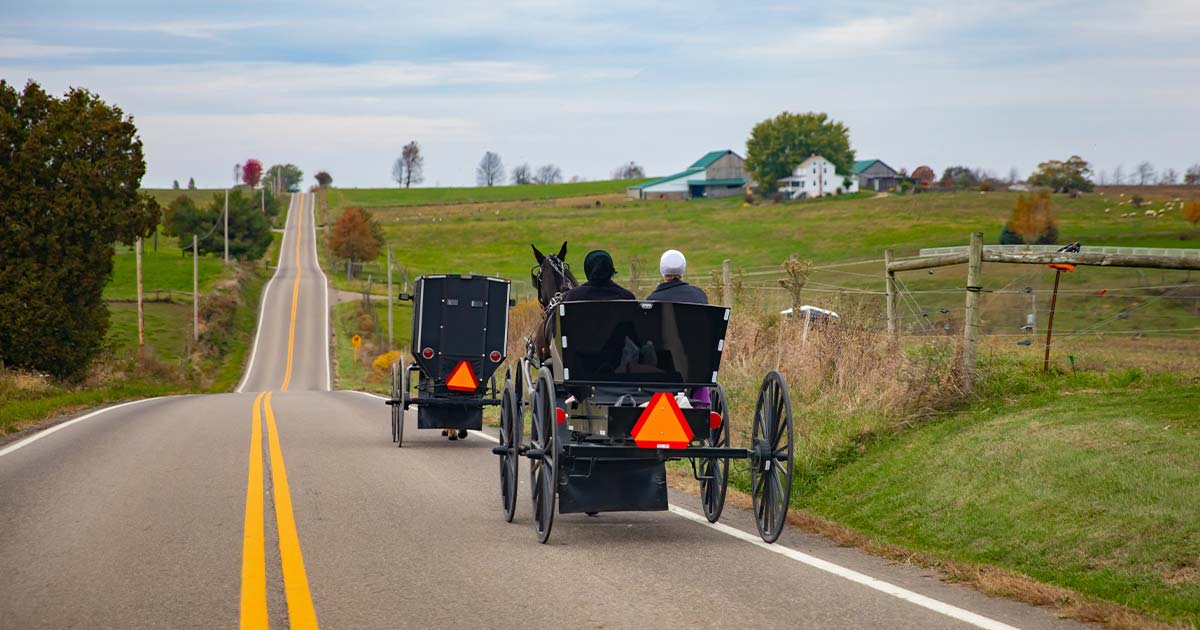
  • The Amish Country in Ohio
  • The Indiana Dunes National Park in Indiana
  • The Gateway Arch National Park in St. Louis, Missouri
  • The Rocky Mountains in Colorado
  • The Arches National Park in Utah

Hiking Resources:

PNT Hiking Resources
Thru-Hiking the CDT From Mexico to Canada

0

Hiking the Continental Divide Trail (CDT) is an adventure like nothing you’ve probably ever experienced. The CDT stretches over 3,100 miles through some of the most spectacular wilderness from the Mexican border to the Canadian border, along the backbone of North America, the Continental Divide. The trail is a test of endurance, a journey of self-discovery, and an opportunity to connect with nature in its purest form.

The Continental Divide Trail is one of America’s longest and most challenging hiking trails, winding through numerous diverse terrains, including deserts, mountains, forests, and grasslands. It takes hikers through five states: New Mexico, Colorado, Wyoming, Idaho, and Montana, and it can take around six months to complete. While the time commitment is massive, the reward is a life-changing experience where hikers experience some of the most breathtaking scenery in the world.

History of the Continental Divide Trail

The Continental Divide Trail

The idea of a trail following the Continental Divide dates back to the early 1900s when the first attempts were made to mark the route. However, it wasn’t until the 1970s that the concept of a long-distance hiking trail gained traction. The idea was to connect the existing long-distance trails, such as the Appalachian Trail and the Pacific Crest Trail with a route that followed the Rocky Mountains’ Continental Divide. In 1973, Congress passed the National Trails System Act, which included the Continental Divide Trail as one of the country’s national trails.

The CDT offers a unique hiking experience because it is still a work in progress. Currently, only around 70 percent of the trail is complete, while the rest follows roads or designated routes. Efforts are ongoing to connect the remaining sections of the trail, and the route is constantly evolving.

The trail runs along the continental divide, the imaginary line separating water that flows west to the Pacific Ocean from water that flows east to the Gulf of Mexico and the Atlantic Ocean.

Why Hike The Continental Divide Trail?

The Continental Divide Trail

Hiking the CDT offers an unparalleled opportunity to connect with nature and push your physical and mental limits. The trail takes you through some of North America’s most remote and pristine wilderness areas, where few have ventured before. If you are looking for a trail that is off the beaten path, one that very few people ever complete, this is the trail! From the soaring peaks of the Rocky Mountains to the arid deserts of New Mexico, the trail offers a diverse array of awe-inspiring landscapes.

Like most of the major national trails, the CDT is also an opportunity to live a simpler life, free from distractions and the pressures of modern society. Hiking for months and relying solely on what you can carry on your back is a humbling experience promoting self-reliance, resilience, and mindfulness. The trail offers a chance to disconnect from the digital world and reconnect with your inner self and the natural world.

Challenges of Hiking The Continental Divide Trail

The Continental Divide Trail

Hiking the CDT is not for the faint of heart. It is a challenging and physically demanding trail that requires extensive preparation and training. Hikers on the CDT face numerous obstacles, including:

Weather: The CDT spans a variety of climates and elevations, which means hikers can experience extreme weather conditions. Hikers can encounter snow, hail, thunderstorms, high winds, heatwaves, and drought.

Navigation: The CDT is still a work in progress, which means that some sections of the trail are not well marked, and hikers may need to rely on maps and compasses to navigate.

Water: Water sources on the CDT can be scarce, especially in arid regions, so hikers must plan water stops carefully.

Resupply: The CDT passes through some remote areas, which makes resupplying food and other essentials challenging.

Wildlife: Hikers on the CDT may encounter wildlife such as bears, mountain lions, and moose, which can be dangerous if not cautiously approached.

Preparing for Hiking The Continental Divide Trail

The Continental Divide Trail

Proper preparation is critical to a successful CDT hike. Hikers need to prepare physically, mentally, and logistically to tackle the challenges of the trail.

Physical preparation

Hiking the CDT is physically demanding, so hikers need to be in excellent physical condition before setting out on the trail. Ideally, hikers should start training several months before their hike, focusing on cardiovascular endurance, strength, and flexibility.

Mental preparation

Hiking the CDT is mentally challenging as well. Hikers need to be mentally prepared to deal with the physical challenges, as well as the isolation and potential dangers they may encounter on the trail. Meditation, mindfulness, and visualization techniques can help hikers mentally prepare for the trail.

Logistical preparation

Hikers on the CDT must plan their logistics carefully, including resupplying food and water, staying safe in remote areas, and dealing with emergencies. Hikers should also thoroughly research the trail and be familiar with the route before heading on the journey.

Tips for Hiking The Continental Divide Trail

Plan and prepare for the journey: Before embarking on the CDT, it’s crucial to do your research, map out your route, and plan your resupply strategy. Take the time to study the terrain, weather patterns, and potential hazards like wildlife, river crossings, and extreme weather. Make sure you have the appropriate gear, including a durable backpack, lightweight tent, sleeping bag and pad, adequate clothing layers, sturdy hiking boots, and plenty of food and water.

Connect with the community: The CDT is a physical challenge and a social and cultural experience. Meet fellow hikers, trail angels, and locals along the way, and share stories, tips, and support. Join hiking groups, attend trail events, and use social media and other resources to stay connected and informed.

Pace yourself: The CDT is a long-distance hike that takes several months to complete. It’s important to avoid burnout and injury by pacing yourself and listening to your body. Start slow and gradually increase your daily mileage, taking rest days when needed. Take time to appreciate the scenery, the wildlife, and make sure you get enough rest.

Be flexible and adaptable: The CDT is a dynamic and challenging trail that requires flexibility and adaptability. Be prepared to adjust your plans due to unexpected weather, trail closures, or other challenges. Have backup plans for resupply, side trials, and emergencies.

Respect the environment and wildlife: The CDT passes through some of the most diverse and fragile landscapes in the world, including national parks, forests, deserts, and mountains. Leave no trace, respect local regulations, and minimize your environmental impact. Keep a safe distance from wildlife and practice proper food storage to avoid confrontations.

Stay safe and prepared: The CDT can present unpredictable challenges like sudden storms, flash floods, and medical emergencies. Carry a first aid kit, whistles, headlamps, and other essential safety gear. Stay informed of weather and trail conditions, and avoid taking unnecessary risks.

Embrace the journey: Finally, remember that the CDT is not just about reaching the endpoint but about embracing the journey. Savor every moment, challenge yourself, and immerse yourself in the beauty and wonder of the trail. Keep a positive attitude, be open to new experiences, and enjoy the adventure of a lifetime.

Hiking the Continental Divide Trail is a once-in-a-lifetime experience that can transform you physically, mentally, and spiritually. By following these tips and preparing well, you can make the most of this unforgettable journey and create memories that will last a lifetime.

Hiking Resources:

CDT Hiking Resources
Thru-Hiking the AT from Georgia to Maine

0

As the longest hiking-only trail in the world, the Appalachian Trail – better known as the AT — is an adventure you cannot miss. Stretching over 2,190 miles from Springer Mountain, Georgia, to Mount Katahdin, Maine, the AT winds its way through some of the most stunning scenery in the eastern United States. Backpacking The Appalachian Trail has become a dream for most hikers around the world.

While thru-hiking the AT is not for the faint-hearted, the trail offers a unique and unforgettable experience for those willing to put in the effort. The backcountry beauty includes snow-capped mountains, cascading waterfalls, mesmerizing forests, and diverse wildlife. More than just an epic journey, it’s a perfect way to become one with nature while enjoying the solitude and the personal growth that comes from achieving something truly remarkable. If you are up for a once-in-a-lifetime adventure, this guide will help you plan your trip and prepare for the Appalachian Trail hike.

History of the Appalachian Trail

Hiking the Appalachian Trail

Before discussing what it’s like to hike the Appalachian Trail, let’s look at the history of the trail’s development. In the 1920s, Benton MacKaye, an American forester and planner, proposed constructing a footpath spanning the Appalachian Mountains from Maine to Georgia. His vision was to create a sanctuary for city folk to once again rediscover and get closer to nature. The massive project gained significant interest and support, and in 1931, the first 14 miles of the trail were opened.

Over the years, other conservationists and hiking enthusiasts have joined the AT movement, and today, the Appalachian Trail is maintained by a mix of volunteers, private organizations, and government offices. The Appalachian Trail Conservancy (ATC), headquartered in Harpers Ferry, West Virginia, oversees the preservation and management of The AT.

To sustain The AT’s ecological integrity and ensure the enjoyment of future generations, there are rules and regulations established by park authorities that hikers must adhere to. It’s important to emphasize that the Appalachian Trail is a National Scenic Trail and should be treated with respect and care. After all, it’s one of America’s top hiking trails.

AT Trail Logistics

Hiking The Appalachian Trail is a serious task, and planning plays an essential role in a hikers ultimate success. In the following sections, we’ll look at some of the logistics of hiking The AT.

Trail access and transportation options

Accessing the trail can, at times, be a challenge, so planning out your route is important.  

If you’re starting your journey from Georgia, you can fly into Atlanta or the Hartsfield-Jackson International Airport to reach the southernmost point of The AT: Springer Mountain. You can take then take a shuttle service to the trailhead from Atlanta, which is approximately two hours away. Similarly, if you plan to hike Millinocket, Maine’s northernmost section of the trail, you can fly into Bangor International Airport, which is about one hour south of Millinocket.

While not the safest option, most AT hikers wind up hitching a ride. If you don’t have the luxury of commercial transportation to reach the trailhead, you can try looking for access options online; many AT enthusiasts offer their vehicles to drop off and pick up hikers traversing The AT.

Trail maps and planning tools

The AT is an extensive hiking trail spanning over 14 states — New Hampshire, Vermont, Massachusetts, Connecticut, New York, New Jersey, Pennsylvania, Maryland, West Virginia, Virginia, Tennessee, and North Carolina — and offers a unique adventure in each one. Before starting your journey, be sure to research the section you plan to hike, check the trail conditions, and try to estimate how long your hike will take.

The Appalachian Trail Conservancy offers resupply guides, maps, and trail updates through their website. The Appalachian Trail Guide is an official guidebook distributed by the Appalachian Trail Conservancy and offers valuable information on trailheads, campsites, and trail conditions. Additionally, you can find tons of information from the trail’s hiking communities like family hiking blogs, trail websites, or YouTube channels.

Hiking Resources:

AT Resources

Hiking the Pacific Coast Trail

0

Clocking in at 2,663 miles, The Pacific Crest Trail is one of the world’s most famous long-distance hiking trails, stretching from Mexico to Canada through California, Oregon, and Washington. The trail crosses through some of the most diverse landscapes in the country, from deserts to mountains, and offers hikers stunning views and an unforgettable experience. The PCT passes through 25 national forests and seven national parks, with elevations ranging from just above sea level to 13,153 feet.

Hiking the Pacific Crest Trail is not an easy feat; it will most likely require months of planning, preparation, and a hell of a lot of physical and mental strength. Most hikers start in April or May, and it takes between four to six months to complete the entire trail. Along the way, you will have to deal with extreme weather conditions, dangerous wildlife, and limited access to food and water.

However, hiking the Pacific Crest Trail is a life-changing adventure despite the challenges. On the PCT, hikers experience a sense of freedom and simplicity they cannot find in their daily lives. The trail provides a break from modern society, and it offers hikers the opportunity to disconnect from the daily grind and reconnect with themselves and the wilderness.

Hiking the PCT: Section to Section or The entire trail…

Pacific Crest Trail in Gifford Pinchot National Forest, Washington

Most hikers hike the Pacific Crest Trail in sections, hiking from one small town to another and resupplying their food and water as they go. However, a growing number of hikers hike the trail in its entirety, known as thru-hiking. Thru-hiking the Pacific Crest Trail requires a high level of commitment, dedication, and endurance. You will have to carry everything you need on your backs, including food, water, shelter, and clothing. Somewhere around 300 people attempt it every year, with a little over half of them is finishing the entire PCT.

What you can Expect on the PCT

One of the highlights of hiking the Pacific Crest Trail is the breathtaking scenery. Hikers will encounter snow-capped mountains, alpine lakes, deep valleys, forests, and deserts. They will cross rivers and streams and hike through pristine wilderness areas that are home to diverse flora and fauna.

The Pacific Crest Trail is not just a physical challenge but also a mental one. Hikers will face a range of emotions, from loneliness to euphoria, and will have to find ways to cope with them. The trail also offers opportunities for personal growth and self-discovery. Hikers learn to be self-sufficient, resilient, and adaptable. They develop a deep appreciation for nature and a sense of responsibility to protect it.

Hiking the Pacific Crest Trail is an adventure of a lifetime. Hikers will come out of the experience with lifelong memories, a sense of accomplishment, and a newfound appreciation for the natural beauty of the world around them.

Hiking Resources:

PCT Resources

Collectible Firearms for Serious Gun Collectors

0

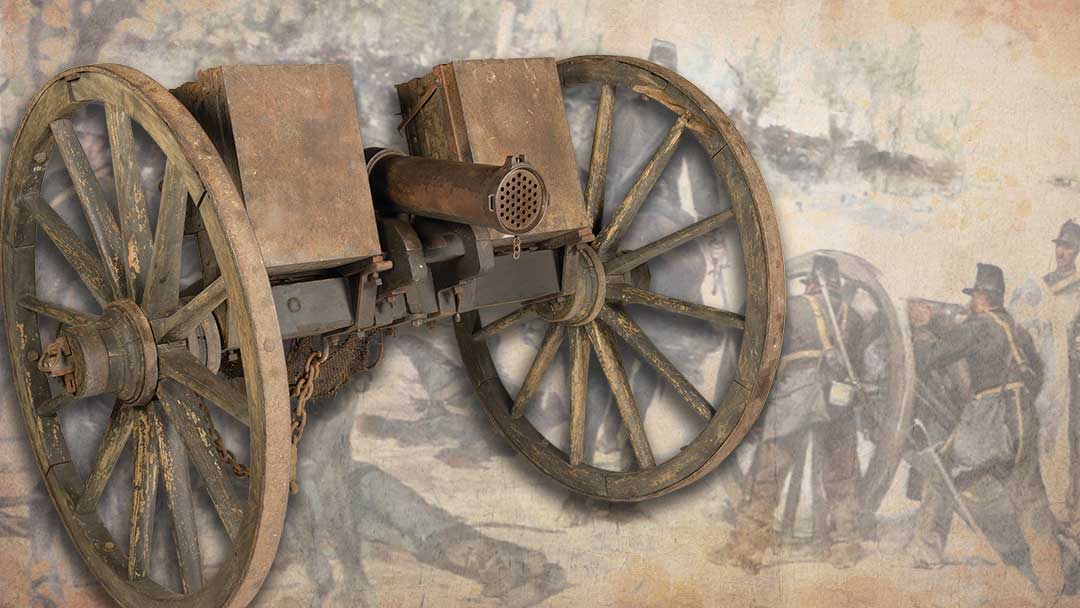
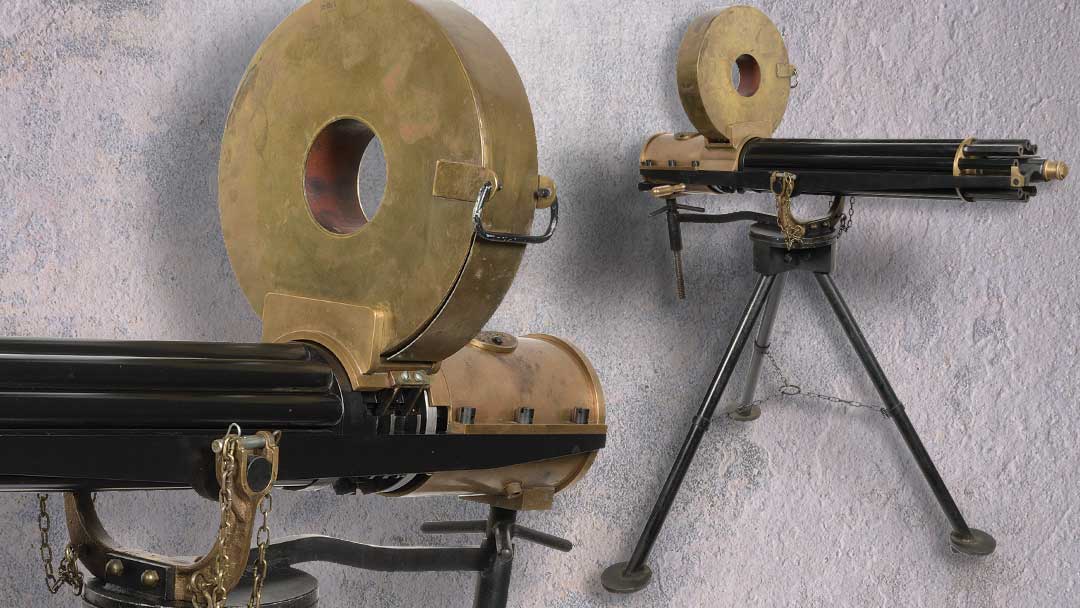
Developed a decade prior to the Gatling gun, the Mitrailleuse volley gun is an extraordinary piece of 19th-century arms technology that saw action on the battlefields of Europe. Surviving Mitrailleuse volley guns are few and far between, and high-condition examples like the crank-operated 37-shot Austro-Hungarian Montigny Mitrailleuse Szorloveg Model 1851/65 rapid repeating 37-shot volley gun for sale this May at Rock Island Auction Company provides a rare look into one of the machine gun’s most innovative predecessors.

An incredibly rare 37-shot Austro-Hungarian Montigny Mitrailleuse Model 1851/65 rapid repeating 37-shot volley gun manufactured by Georg Sigl of Vienna, Austria. Available this May.

Captain Fafschamps and Joseph Montigny

The term Mitrailleuse was derived from the word “mitraille,” which translates to grapeshot in French. The concept of the Mitrailleuse volley gun originated from an invention by Belgian Captain Toussaint Henry Joseph Fafchamps. According to ‘Machine Guns: Their History and Tactical Employment’ by Graham Seton Hutchison, Captain Fafchamps displayed a rough prototype and design schematics of his 50-barrelled volley gun concept to engineer Joseph Montigny in 1851.

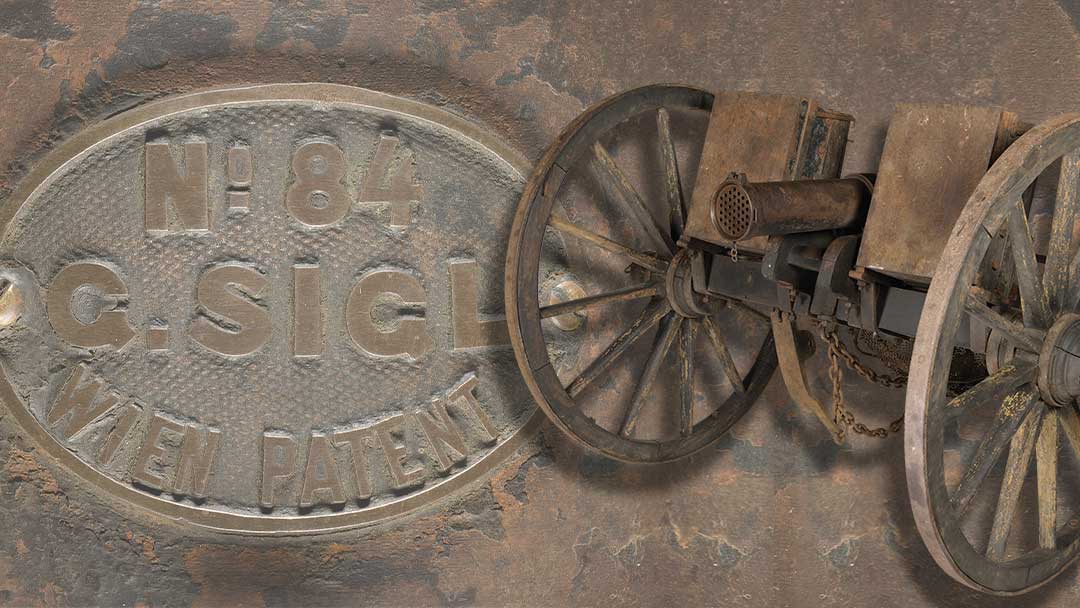
The Montigny Mitrailleuse volley gun, a successor to Joseph Fafchamps’s “Carbine Multiple” design. “No. 84/G. SIGL/WIEN PATENT” is embossed on an oval bronze plate affixed to the top of the housing of this example. Available this May.

Dubbed the “Carabine Multiple,” Fafchamps’s early volley gun concept was a needle fire system that used paper cartridges. The multibarreled gun was intended to be a defensive artillery piece that could spread shot across a large area. Over the next decade, Joseph Montigny refined the idea into a more mobile design that could be loaded faster and use metallic cartridges.

Birth of the Volley Gun

Captain Joseph Fafchamps’s volley gun was derived from a long line of similar concepts dating back to at least 1339 with the Organ Gun, or “Ribauldequin.” The Organ gun and its numerous variations offered a multibarreled, anti-personal platform that was more mobile than conventional artillery, but they were expensive weapons to produce.

The 7-barrel Nock volley gun was a formidable weapon of the British Navy, wreaking havoc on any boarding party unfortunate enough to meet its business end.

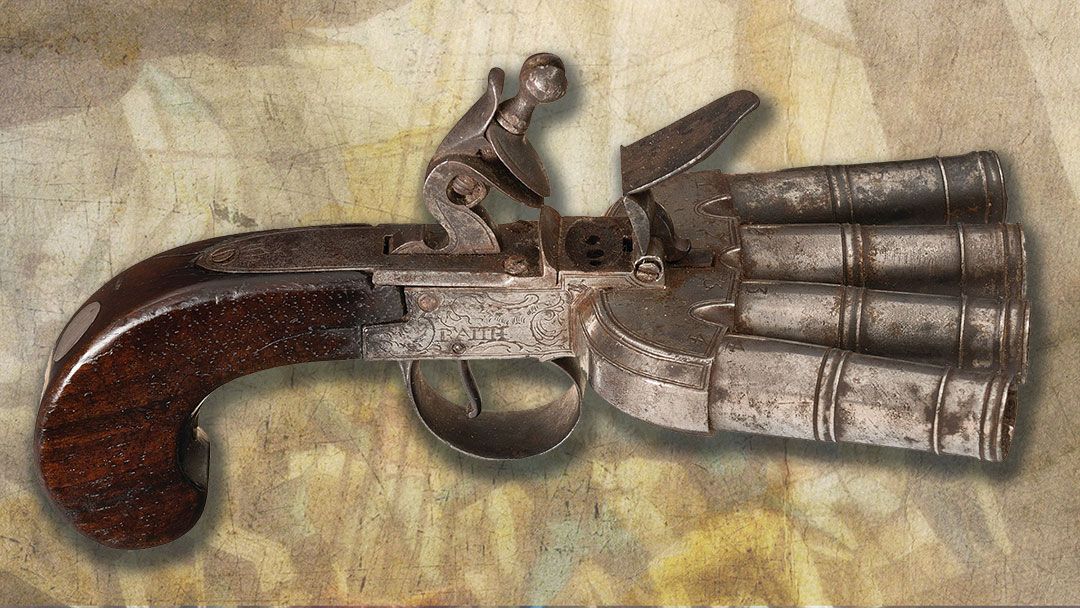
Volley guns came in numerous forms, but they were all designed around the concept of firing multiple barrels simultaneously. In the 18th century, advances in metallurgy allowed several styles of volley guns to be miniaturized. The Duck Foot pistol used splayed barrels like certain styles of the Organ gun, while the Nock volley gun employed circled clusters of barrels that were welded together.

The Raith boxlock Duck Foot pistol, a hand-held volley gun used for close-quarters combat.

One of the most famous examples of an organ gun-style firearm using a row of barrels was the “infernal machine,” a custom-crafted 25-barrel volley gun constructed by Giuseppe Marco Fieschi of France in a failed bid to assassinate King Louis Philippe I in 1835.

Two decades earlier, the Chambers swivel gun demonstrated a more standardized design, a large volley gun that used a circled cluster of seven barrels, each that could be loaded with 25 special superposed rounds. The Chambers gun, commissioned by the United States during the War of 1812, caught the attention of numerous European governments. Though the Chambers design ultimately faded into obscurity, the French and Austrian militaries would revisit the concept of a volley gun that could be mass-produced some 50 years later with the Mitrailleuse.

The Mitrailleuse Volley Gun: The De Reffye and Montigny

Belgian engineer Joseph Montigny, along with his business partner and fellow gunsmith Christophe Louis, developed the Mitrailleuse volley gun in 1863, a time of rapid industrial advancement and innovation in arms technology. In December of 1867, the two engineers registered a Belgian patent for an early version of their weapon, calling it a “battery gun for blast discharging.” Montigny approached the French military with his design, and Emperor Napoleon III saw immediate potential.

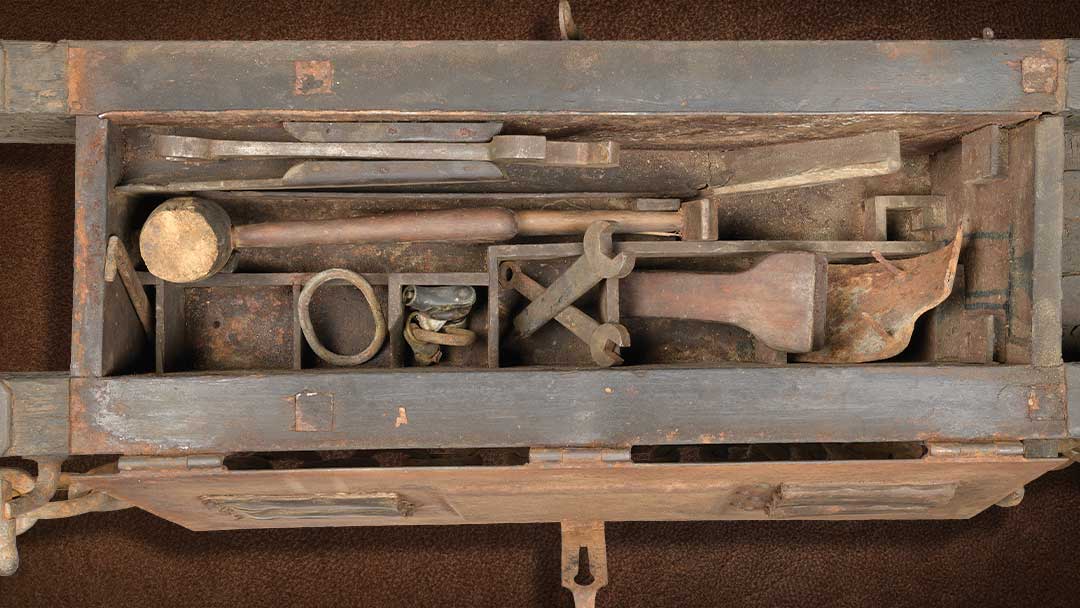
The Montigny Mitrailleuse Model 1851/65 volley gun for sale at Rock Island Auction Company this May includes various period tools inside a compartment of the carriage.

French ordnance officer Jean-Baptiste Verchère de Reffye went on to develop a 25-barrel variant of the Mitrailleuse volley gun chambered in 13mm. This version of the weapon became known as “Le canon à balles de Reffye” or “Reffye’s Bullet Cannon.” After successful trials in 1868, 200 examples of the Reffye Mitrailleuse were produced. Many went on to serve in the Franco-Prussian War.

An animation of the 25-barreled Reffye Mitrailleuse in action, including the firing and loading process.

The Montigny Mitrailleuse Model 1851/65 volley gun was a licensed variant of the weapon and the second most common version of the Mitrailleuse design. Not counting prototypes and trial models, only around 80 pieces were produced between two manufacturers: OEWG Steyr handling a contract for the Austrian Army in 1870, and Georg Sigl producing Mitrailleuse guns for the Hungarian Army in 1871.

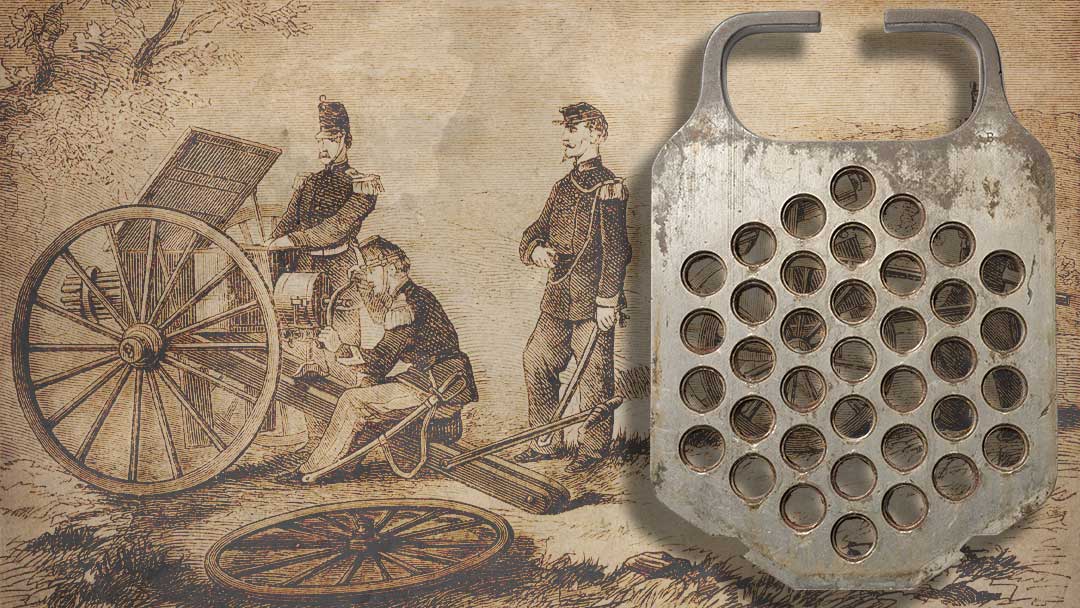
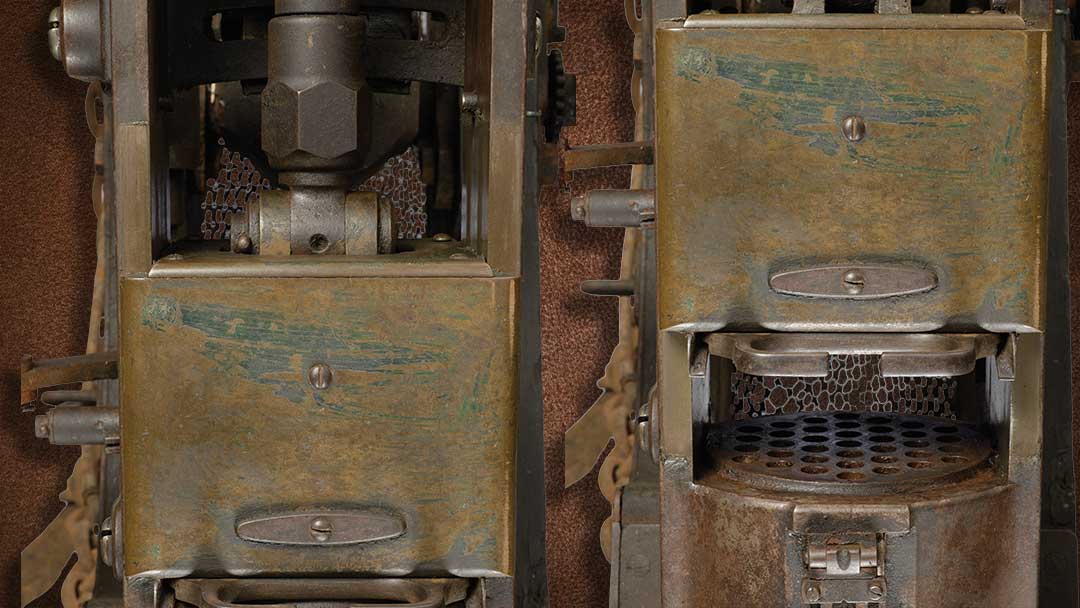
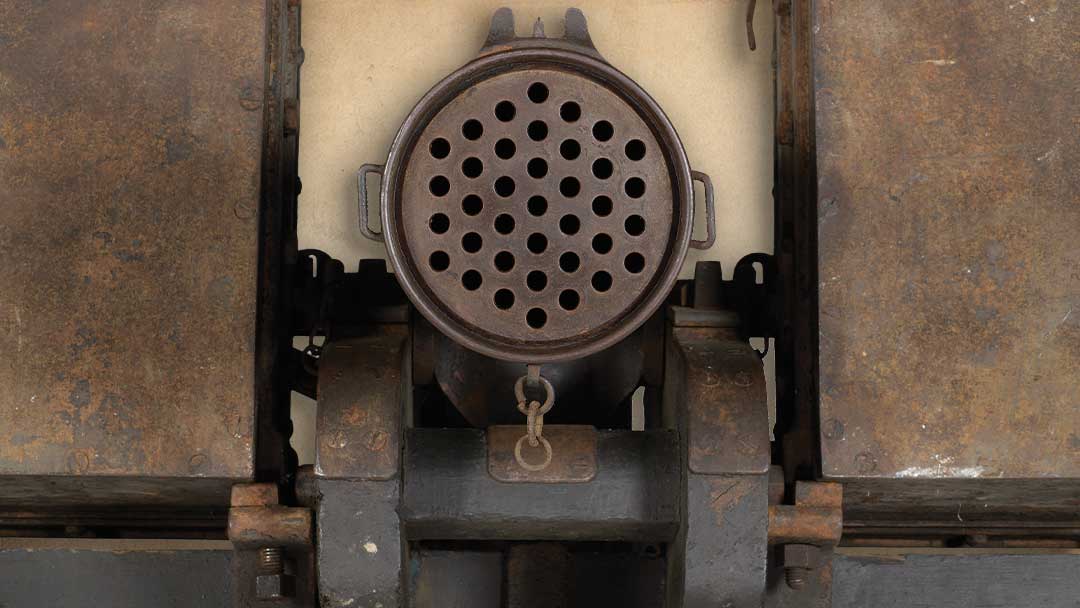
A close-up look at one of 14 surviving loading plates on the Montigny Mitrailleuse Model 1851/65 volley gun example offered by Rock Island Auction Company this May.

The Austrian Montigny Mitrailleuse volley gun differs from its Hungarian and French Mitrailleuse siblings in that it is chambered in centerfire 11.15x42mm caliber, the same ammunition used in the Austrian Werndl-Holub Model 1867 rifle then in service. All Montigny Mitrailleuse volley gun designs relied on individual barrels that were manufactured separately and assembled together in a cluster inside the gun’s casing.

The Montigny Mitrailleuse Model 1851/65 Volley Gun

The Montigny Mitrailleuse Model 1851/65 volley gun uses a cluster of 37 barrels mounted in a hexagonal shape and surrounded by a cover with a post front sight and ladder rear sight. The gun is fed from loading plates that are each able to hold 37 cartridges, and a slot is located in the face of the breech block for the loading plate to slide in from the top by hand through the use of gravity. A trained team of operators was able to load eight to 10 loading plates per minute.

The Montigny Mitrailleuse Model 1851/65 volley gun’s removable cartridge plates allowed the weapon to maintain a high rate of fire as long as loaded plates were available to the gunners. Available this May.

While the French De Reffye Mitrailleuse was fired with a side crank similar to a Gatling gun, the Montigny’s firing mechanism is a rear-mounted lever (or firing arm) that is pressed down by the operator to push the rounds into their respective chambers. Once the rounds enter their chambers, all 37 cartridges are detonated at the same time through the use of 37 firing pins. The spent shells are removed while still attached to the loading plate and a new plate is able to be inserted.

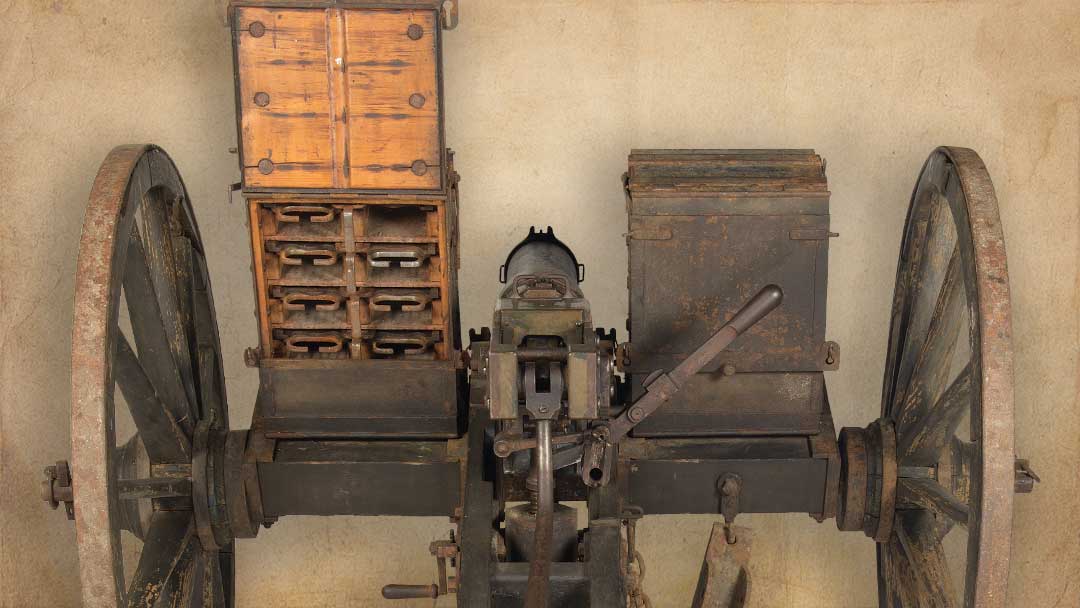
The Montigny Mitrailleuse Model 1851/65 volley gun for sale at Rock Island Auction Company this May includes 14 of its original 37-round loading plates housed in the two crates attached to the axle of the carriage.

The carriage of these Austrian Montigny Mitrailleuse Model 1851/65 volley guns included two large fixed wooden crates that could carry 10 loading plates each, providing a total capacity of 740 rounds of ammunition on the gun carriage alone. Standard practice was to include an attached ammunition cart that carried an additional 13,200 rounds. These weapons typically required 3 operators and 4 ammunition suppliers to maintain a firing rate of 296 to 370 rounds per minute, a blistering amount of firepower for the era.

The Mitrailleuse Volley Gun on the Battlefield

The Mitrailleuse volley gun was a wildcard on the battlefield when the French deployed the guns during the Franco-Prussian War. Instead of serving as infantry support weapons, the Mitrailleuse guns were initially treated more like artillery and fired at the outer edge of their effective range. Primitive open sights made judging accuracy difficult, and the French officers had little understanding of how to incorporate the Mitrailleuse gun into the conventional tactics of the day.

Mitrailleuse volley guns were found to be inaccurate and underpowered when deployed as long-range artillery. Available this May.

Two notable exceptions include the Battle of Mars-la-Tour and the Battle of Gravelotte in August of 1870, where in both cases the French commanders used their Mitrailleuse volley guns on closely grouped advancing infantry, inflicting heavy casualties on their Prussian attackers. The outcome of the Franco-Prussian War was all but decided by this point, however, and France’s defeat left some European powers with a lingering skepticism toward any type of “machine gun” for years to come.

Manufactured by Thunder Valley Machine Company, this is a factory-quality reproduction of the Colt Model 1883, marked as being the fourth in a series of six made by TVM. Available this May.

The United States and Britain, by contrast, continued to employ new technologies like the Gatling gun and the Hotchkiss revolving cannon in infantry support and naval defense roles. It wasn’t until the introduction of Hiram Maxim’s machine gun in 1884 that the rest of Europe gave the concept of high-volume anti-infantry weapons another look.

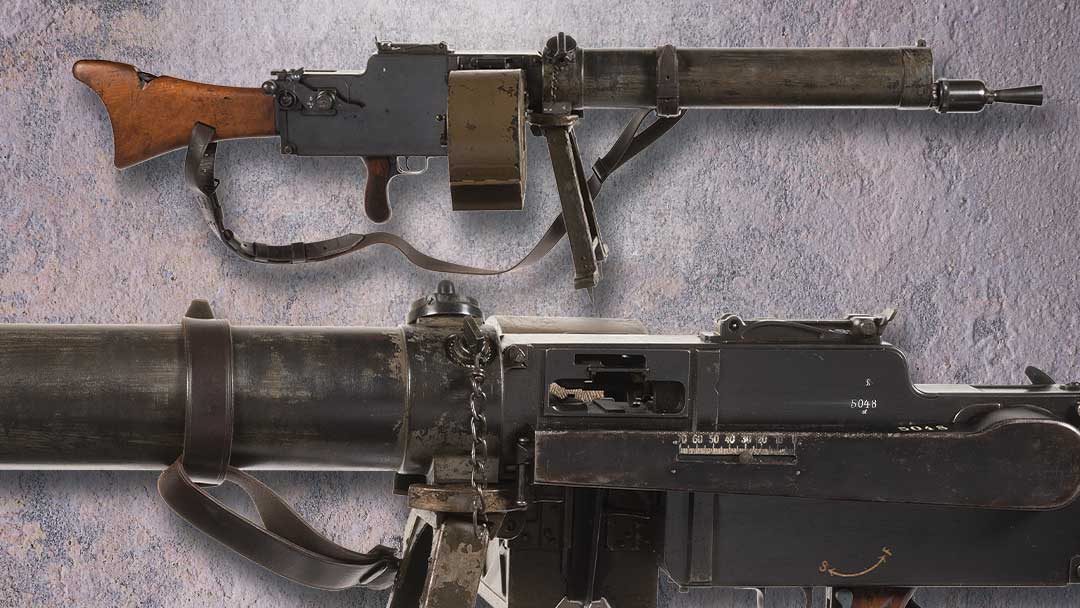
A scarce WW1 Spandau Model 1908/15 Maxim machine gun with bipod. Available this May.

Where the Mitrailleuse and Gatling guns of the era required a hand crank or a lever to fire, machine guns like the Maxim gun were designed to use the energy of recoil to mechanically cycle themselves. Although the Volley gun design was declared obsolete before the outbreak of WW1, its story was far from finished.

The Volley Gun Today

In recent decades, a number of volley gun concepts employing multiple barrels designed to be fired sequentially or simultaneously have been introduced. Australian manufacturer Metal Storm Limited developed a prototype system for an electronic ignition volley gun capable of firing 180 rounds of caseless 9mm ammo from 36 barrels in less than one-hundredth of a second. The Spanish Navy uses the Meroka Close-In Weapon System (CIWS), a 12-barreled volley gun that offers close-range defense against missiles, aircraft, and small boats.

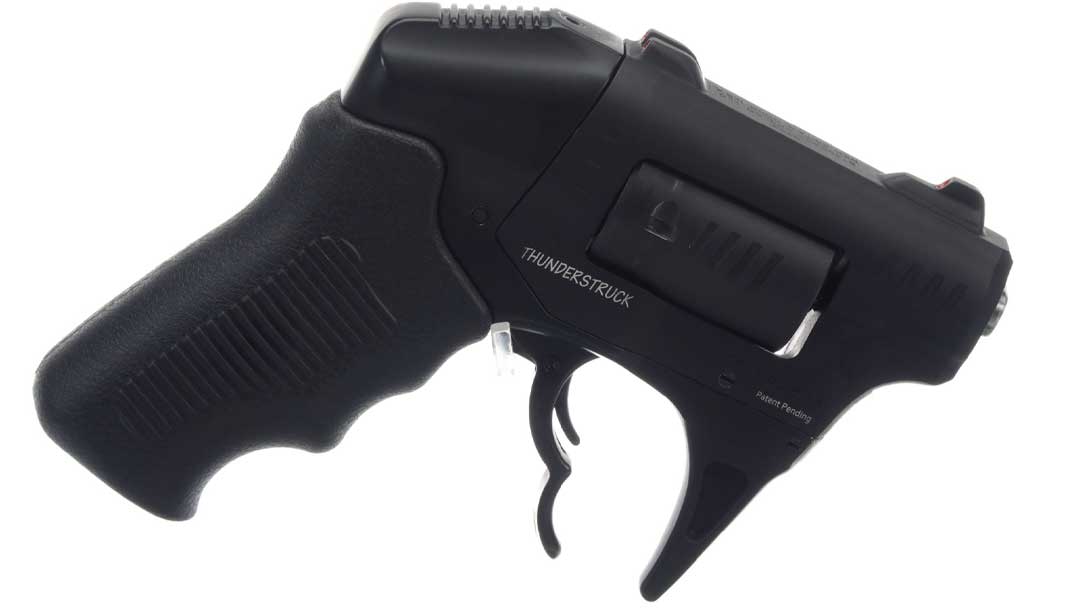
The S333 Thunderstruck, a double-barreled pocket revolver and a modern-day volley gun example, as each pull of the trigger simultaneously fires a .22 Winchester Magnum Rimfire cartridge from both the revolver’s barrels.

The word “mitrailleuse” endures today in the military designations of numerous French, Yugoslavian, Serbian, Swedish, and other European machine guns. From the French  “Mitrailleuse Vickers” of WW1 to the more recent Belgian FN MAG 58, or “Mitrailleuse d’Appui General,” the legacy of Captain Toussaint Henry Joseph Fafchamps’s invention lives on.

Mitrailleuse Volley Gun for Sale

Despite dated tactics limiting the impact of the Mitrailleuse volley gun on the battlefield, Joseph Montigny’s design introduced central Europe to one of the most intriguing machine gun predecessors. Only around 80 Montigny Mitrailleuse Model 1851/65 volley guns were manufactured. Some saw limited service in defensive roles in the early stages of WW1, while others were melted down for scrap, making surviving examples exceedingly scarce today. In terms of rarity, history, and engineering, the Mitrailleuse volley gun is a gun collection standout.

A Montigny Mitrailleuse Model 1851/65 volley gun for sale this May, a true rarity in the field of machine gun predecessors. Available this May.

Unique and unusual weapon platforms like the Montigny Mitrailleuse volley gun carry a fascinating history, and you can subscribe to the weekly Rock Island Auction newsletter to receive new gun blogs and gun videos each week that dive deeper into the stories behind some of the most curious examples in firearms evolution. From looks at rare transitionary firearms like the Gardner gun to pieces on the invention of the Volcanic pistol, the Spencer rifle, and the conception of flying battery artillery, we thoroughly explore the history of the gun and the inventors who pushed the boundaries of arms technology and shaped our world today.

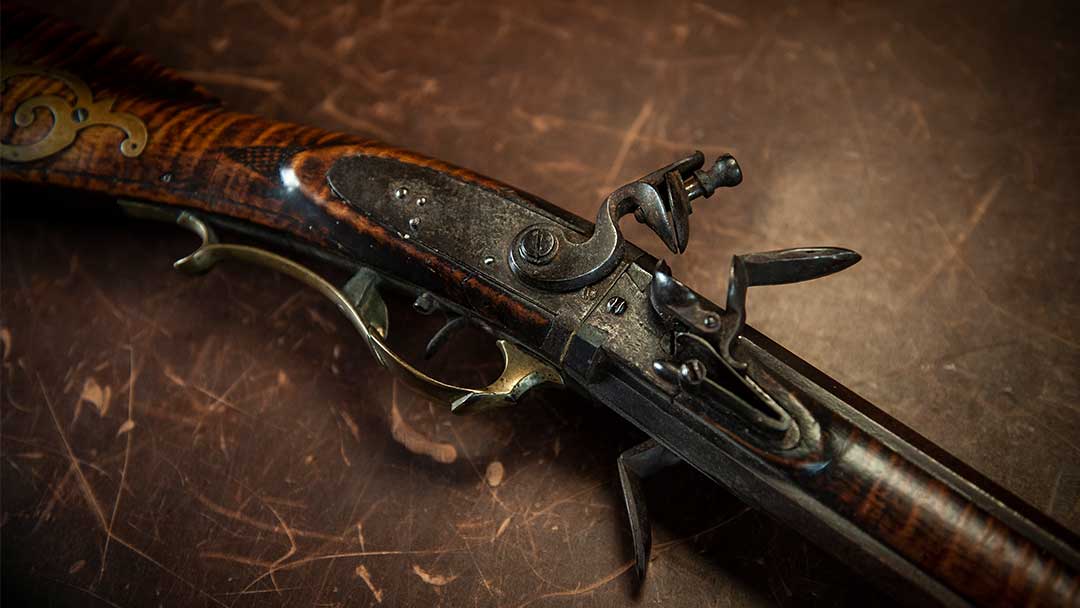
An engraved, early 19th century swivel breech or “wender” double rifle, a rare example of a multishot flintlock firearm. Available this May.

Collectible Firearms for Serious Gun Collectors

0

A Colt Single Action Army made specifically for a Metropolitan Museum of Art benefit auction in 1985 is truly a piece of gun artistry. The revolver is one of a kind, from its serial number to its engravings of specific museum pieces.

Made and donated by Colt Industries, the Colt Single Action Army transcends the unadorned working-class Wild West six shooter to become a piece of art through the gorgeous and meticulous work of master gun engraver Alvin White. White began working for Colt following World War 2 and was considered the “dean of American arms engravers.” He passed in 2011.

This amazing Colt Single Action Army that sold at that 1985 auction to benefit the Met’s Arms and Armor Department is among the offerings Rock Island Auction Company will have available in the May 19-21 Premier Auction.

A Colt Single Action Army revolver that was engraved with gold inlay by master gun engraver Alvin White for an auction at the Metropolitan Museum of Art in 1985 sits in its case with an extra cylinder.

Colt Gun Art at the Met

Steel is the canvas – in this case brilliantly blued steel, and rather than oils and water colors the art medium is 18 karat gold inlays and engraving tools. Master engraver White rose to the occasion for the piece that is considered by some experts to be the most inspired work of his career.  The Colt Single Action Army, nestled in the burnt orange velvet of its custom, French-fitted case, shows White and his work are worthy to succeed the 19th century artisans responsible for the finely engraved and gold inlaid Colt Third Model Dragoon and 1851 Navy revolvers that reside in the Met’s collection. Comparisons are easily drawn between those objects at the Met and the Single Action Army on offer this May.

The Met’s Dragoon similarly exhibits a blued finish adorned with gold inlaid animals, borders, a raised relief shield and eagle alongside subtle floral engraving. A portrait of George Washington decorates the cylinder. This revolver was part of a sequentially numbered pair presented to the Czar of Russia, with the other Dragoon currently residing in the Hermitage in St. Petersburg, Russia. The Met’s revolver entered the museum’s collection in 1995, but the institution does not list the engraver.

Also exhibited at the Met is a heavily gilded 1851 Navy even more lavish than the Dragoon. It features dense gold inlaid floral scrolling across the gun’s blued finish. Highlights of the gold inlays are a lion, animal heads, birds, the Goddess of Liberty, and a Native American on horseback shooting a buffalo. A hand-engraved naval battle scene is depicted on the cylinder. This is one of five known gold-inlaid Model 1851 revolvers and was a gift to the museum from the Robert M. Lee Foundation in 2018. Gun engraver Waterman Lilly Ormsby is known to have done the cylinder engraving on this piece.

A Colt Model 1849 Pocket Percussion revolver embellished by gun engraver Gustave Young is also part of the Met’s collection. Though not nearly as ornate as the other two Colts, the tight scrollwork displays the work of a true master.

A closeup of the right side of this magnificently embellished Colt Single Action Army shows a flush gold engraved portrait of Bashford Dean, the founder of the Metropolitan Museum of Art’s Arms and Armor Department. Also visible is a Japanese sword hand guard in front of the cylinder, gold floral scrolls and crosshatching on the cylinder, a dragon can be seen below Dean’s portrait while an inlaid flush engraved dolphin dolphin is on the hammer.

Colt Single Action Army to Support the Met

The gold inlays truly pop from the Colt Single Action Army’s blued steel. The department’s founder, Dr. Bashford Dean is depicted in a flush inlaid engraved gold can be found on the frame behind the cylinder. Specific items from the Met’s collection are also depicted in the gunmetal in a similar manner. They include a medieval spur that decorates the trigger guard, and a hand and a half sword adorns the back strap. The gun’s fluted cylinder features golden scrolling and cross-hatching. The façade of the Second Branch Bank of the United States that is part of the Met’s American Wing, a relief Renaissance helmet, as well as the museum’s logo are interspersed with floral scrolling in gold inlay on an extra, non-fluted cylinder.

A Swiss dagger, mace, and the Peter Peck over/under Wheelock pistol bedeck the gun’s 7 1/2-inch barrel, and cross-hatching covers the front sight as floral scrolls and borders encircle the muzzle. Joining Bashford on the frame are a Japanese sword guard – or tsuba, stirrup, a sea serpent, and a Merovingian shield boss.  Dancing dolphins festoon each side of the Colt Single Action Army’s hammer. A relief chiseled gold eagle with its wings spread is surrounded by flourishes on the butt plate. On the left grip, a plaque in the shape of a Venetian Lion’s head helmet is inscribed “From/Colt Industries/logo/to benefit/Met logo/Dept of Arms & Armor/Christie’s/Octr. 8th 1985.” A plaque in the profile of a Renaissance breastplate is blank and located on the right grip. The grips are oil-stained walnut.

MMA-1, the custom serial number, is on the underside of the frame in front of the trigger guard. Gun engraver White signed his work. “A.A. White” is located on the trigger guard bevel behind the serial number.

A closeup of the right side of this highly embellished Colt Single Action Army auctioned to benefit the Metropolitan Museum of Art in 1985 shows a Peter Peck over/under Wheelock pistol on the barrel, a stirrup directly behind the cylinder and a Merovingian shield boss. A gold dolphin also adorns the hammer on this side.

Colt Single Action Army at the Met Auction

The Oct. 8, 1985 auction featured 147 lots and was standing room only. Johnny Cash served as a guest auctioneer for a handful of lots. The Colt-donated Single Action Army was the penultimate lot in the catalog and was featured with a full color photo on its catalog page and on the catalog’s cover, sitting atop its vibrant blue case. It wasn’t the only piece of gun art on offer but it was the most spectacular. The New York Times mentioned the revolver specifically in its write up ahead of the auction:

“The most spectacular piece was one that has been promised but not yet given. As its contribution to the Auction, Colt Industries has offered a finely decorated weapon, a modern counterpart to the elaborate armor of Renaissance Europe.

A view of the top of the embellished Colt Single Action Army revolver made specifically for an auction benefiting the Metropolitan Museum of Art shows a mace on the barrel behind the gold-covered sight, while behind it is a Swiss dagger on the left of the barrel and the Peter Peck over/under wheelock. The one and a half hand sword on the backstrap is also visible.

“The weapon, a custom-made Colt .45 revolver will be richly inlaid and engraved with scenes and details from the Metropolitan Museum. A famous Renaissance helmet in the Arms and Armor Collection, formerly owned by J. Pierpont Morgan, will be engraved on one side of the revolver’s chamber and the façade of the (Second Branch Bank of the United States) that stands in the museum’s American Wing will adorn the other side.

“Every square inch of the weapon is especially designed, right down to the 18-karat-gold front sight and the serial number, `MMA-1’ for Metropolitan Museum of Art-1. The Armor and Arms Club hopes that the one of a kind weapon will sell for more than $25,000 at auction.”

The Single Action Army donated by Colt hammered for $34,000. Whether that was the highest price in the auction was unknown, but it did significantly clear the amount organizers had hoped to achieve.

The underside of the Colt Single Action Army features a spur on the trigger guard and a gold eagle with its wing spread surrounded by scrolling. Its truly unique serial number, MMA-1, can be seen in front of the trigger guard.

The Colt-donated gun art wasn’t the lone Single Action Army in the auction that also featured a number of books, flintlocks, fine sporting arms, and experiential opportunities. A Single Action Army donated by singing cowboy Gene Autry was also available along with one featuring ivory grips, another was a John Wayne commemorative SAA. The only gun to approach the level of artistic endeavor as was invested by White was a Single Action Army embellished by Tiffany & Co. that featured an undersea theme with a seashell on the barrel, swimming dolphins on the cylinder, a wave crashing on the receiver, and sailboats embossed on the grip.

An auction-goer was quoted by the New York Times saying, “Arms and armor is a fine art. It’s just like collecting painting and sculpture. A design on a gun can be every bit as fine as you’d find on an etching.”

A Colt Single Action Army made for a 1985 Metropolitan Museum of Art auction benefiting the museum’s Arms and Armor Department sits on a specially made case of blue leather with a lid tooled in gold leaf. A plain spare cylinder that has the Second Branch of the United States Bank that is now part of the museum’s American Wing, the Met’s logo, and a relief chiseled helmet on it also sits on the case.

Colt Single Action Army Auction Effect

The auction was part of a $4 million fundraising effort for the first-ever expansion and renovation to the Arms and Armor Department. The department was founded in 1912 and by the 1980s, it needed more space. And air conditioning. A lack of air conditioning was causing ivory inlays to loosen on some pieces in the collection. More modern display cabinets and an improved lighting system were also included in the plan. The auction raised more than $500,000 for the expansion.

This amazing Colt Single Action Army won first place at the 2009 Colt Collectors Association Show in Concord, N.C. For the achievement, a Colt Collectors Association Rampant Colt bronze statue by Thomas Palmerton was awarded and is included in the lot.

A Colt Single Action Army made especially for and donated to the Metropolitan Museum of Art shows the subtle engraving in the blued steel as well as the intricate flush gold inlaid covering the gun.

Colt Single Action Army at Auction, Redux

It is well established that this brilliantly adorned Colt Single Action Army is a work of art and has a case befitting it. The French-fitted blue leather case with gold leaf lettering was made by Arno Werner of Blue Oasis. The case’s lid bears the inscription, “MMA-1/DONATED BY COLT INDUSTRIES/COLT FIREARMS DIVISION/FOR THE BENEFIT AUCTION/THE METROPOLITAN MUSEUM OF ART/ARMS AND ARMOR DEPARTMENT/CHRISTIE’S NEW YORK/OCTOBER 8th 1985.” A factory letter accompanying the SAA confirms the revolver was specifically made for the auction.

This bespoke Single Action Army auctioned off to benefit the Metropolitan Museum of Art is a genuine piece of art, with its blued steel acting as canvas for dazzling engraving and luminous gold inlays representing pieces found in the Met’s collection as well as a portrait of the Arms and Armor Department’s founder. This is the opportunity to obtain an amazing firearm created by master gun engraver Alvin White to benefit the Metropolitan Museum of Art’s encyclopedic collection of weapons.

This bespoke Colt Single Action Army made specifically for a 1985 auction benefitting the Metropolitan Museum of Art’s Arms and Armor Department can be seen facing right, showing off the blued steel the engraving and the flush gold inlays and some of the distinct items from the Met on the gun.

Collectible Firearms for Serious Gun Collectors

0

Zane Grey remains perhaps the greatest storyteller of the American West. An adventurer, hunter, and avid outdoorsman, Zane Grey stands as one of the rare few authors who lived a life to rival his works, and it’s only fitting that such a heralded name in the genre of Western literature would own one of the most incredible Winchester rifles in the collecting pursuit.

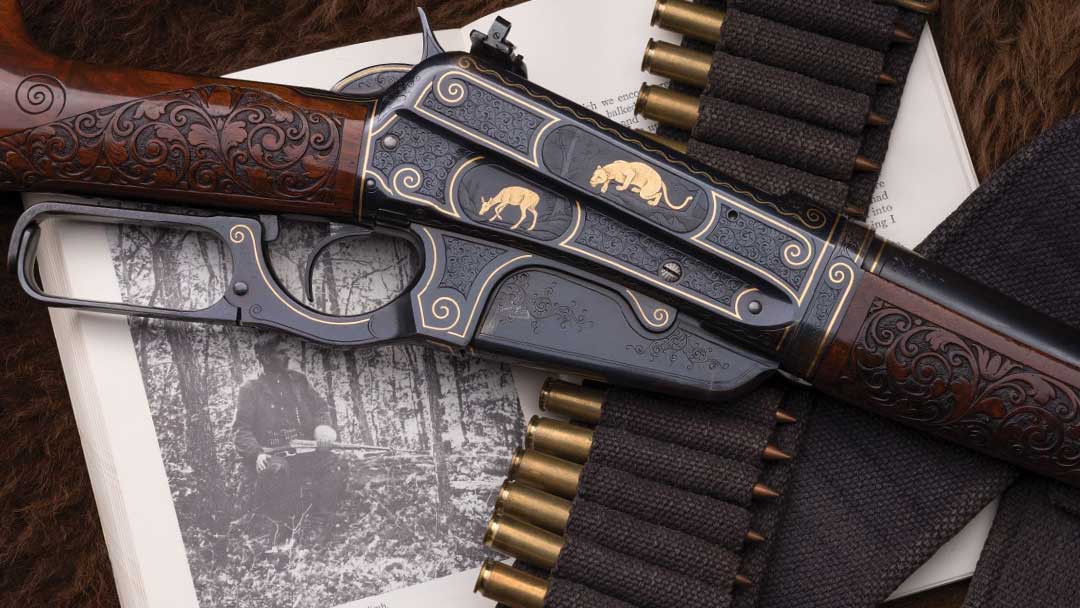
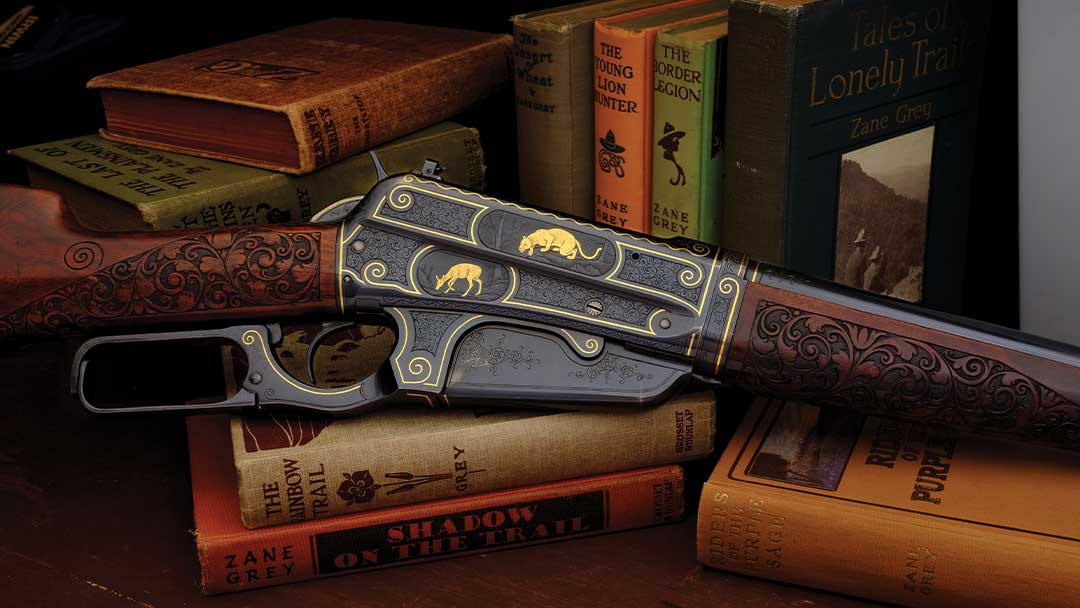
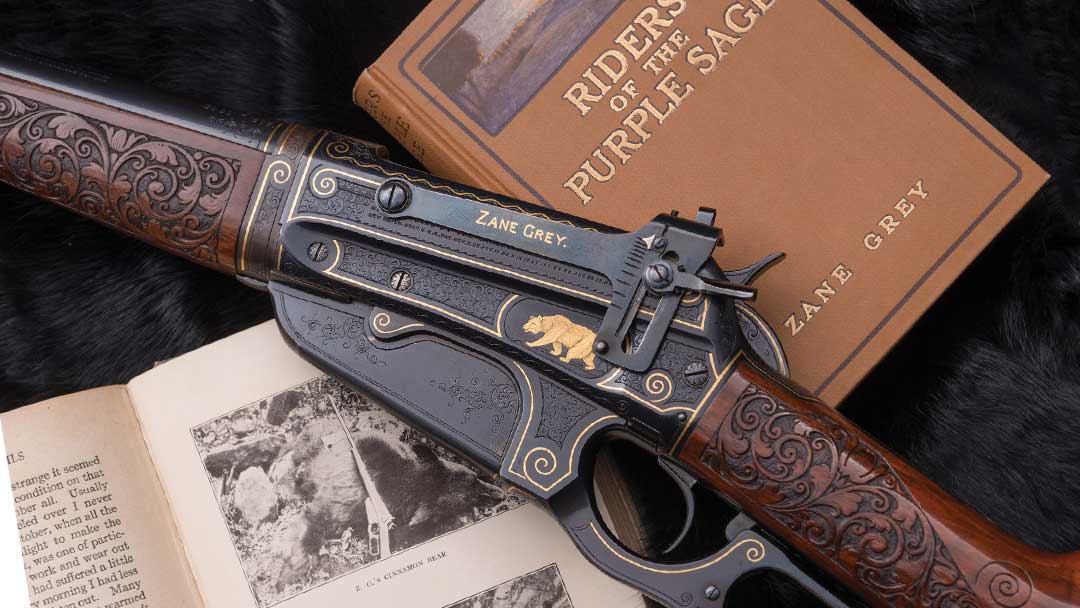
This monumental, well-documented, Ulrich signed masterpiece Winchester Deluxe Model 1895 takedown rifle once owned by famed author Zane Grey is offered by Rock Island Auction Company in May of 2023.

Zane Grey praised the Winchester 1895 as “the finest rifle ever built.” This May, Rock Island Auction Company presents a crown jewel of the Winchester 1895 genre and a tour de force of master engraver John Ulrich’s exceptional skill.

Zane Grey goes West

Pearl Zane Grey was born in Zanesville, Ohio in 1872, a town named after Grey’s ancestor Ebenezer Zane, who was instrumental in settling the Ohio wilderness after the Revolutionary War. Adventure was in Zane Grey’s blood. He earned a dentistry degree and opened a New York practice to pay the bills, but storytelling had become his true passion, and the call of the frontier took him westward in 1906.

Zane Grey penned 60 Westerns, nine novels about fishing, several short story collections, a biography on George Washington, and three volumes documenting Ohio legend Ebenezer Zane and his family.

Zane Grey’s first runaway success was ‘Riders of the Purple Sage’ in 1912, a rangeland romance that would set the standard for many of Grey’s countless Westerns to follow, as well as creating a formula that would define the genre for decades. This newfound wealth allowed Zane Grey to settle in Altadena, California and pursue his passions for hunting, fishing, shooting, and exploring the far reaches of the world.

This incredible John Ulrich masterpiece Winchester Model 1895 rifle combines Zane Grey’s love of hunting, shooting, and the American frontier. Available this May.

Zane Grey and the Winchester 1895

As recorded in ‘Tales of Lonely Trails,’ a nonfiction collection of Zane Grey’s adventures out West, Grey sought out a Winchester chambered in .30-06 Springfield in 1919 in preparation for his annual fall hunt. Zane Grey recalled, “To make sure of getting a .30 Gov’t Winchester I ordered from four different firms, including the Winchester Co. None of them had such a rifle in stock, but all would try to find one. The upshot of this deal was that, when after months I despaired of getting any, they all sent me a rifle at the same time. So I found myself with four, all the same caliber of course, but of different style and finish.”

This mechanically excellent, stunning example of fine Winchester craftsmanship combines beauty, rarity, and the extraordinary history of its owner, Zane Grey. Available this May.

On his four Winchester 1895s, Zane Grey noted, “One was beautifully engraved and inlaid with gold – the most elaborate .30 Gov’t the Winchester people had ever built. Another was a walnut-stocked shot-gun butted fancy checkered take-down. This one I presented to R. C. (Zane’s brother) The third was a plain ordinary rifle with solid frame. And the last was a carbine model, which I gave to Nielsen.”

Sievert Nielsen, who received the Winchester 1895 carbine mentioned above, was a Norwegian sailor turned prospector who struck up a friendship with Grey and shared several adventures with the author. The third Model 1895, a plain solid frame rifle, Zane Grey used for target shooting and for shooting ravens, stating that he felled a raven with his Winchester 1895 rifle at 500 yards.

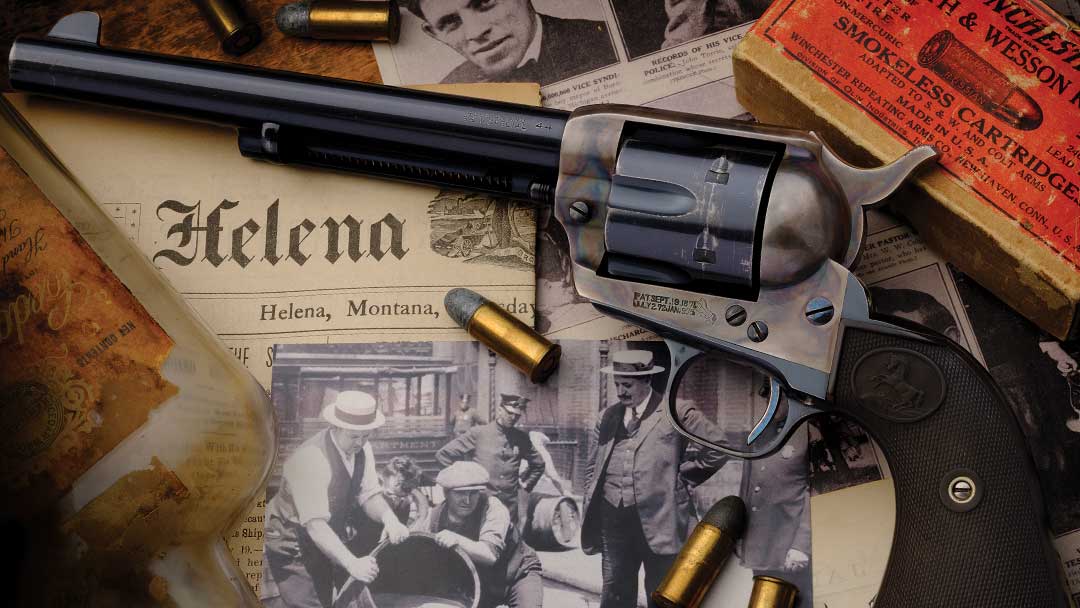
Famed wheel gun shooter Elmer Keith witnessed Zane Grey shooting his Winchester Model 1895 rifles as documented in his autobiography ‘Keith’ on page 170: “I believe I showed Zane Grey the first long-range pistol shooting he’d ever witnessed. He had Bob Carney and Romer Grey shooting at a rock at 400 yards with a .30-06 Model 1895 Winchester that had Z.G. inlaid in gold on the left side of the receiver. They couldn’t seem to hit it. So I lay down with my back to a log, took my old 7 1/2 inch .44 Special single-action Colt, and hit the rock repeatedly.”

A documented Montana shipped First Generation Colt SAA in the scarce dual caliber of .44 Russian/.44 S&W Special. Elmer Keith used a Colt SAA chambered in .44 S&W Special while shooting with Zane Grey. Available this May.

Praising the Winchester 1895 chambered in .30-06 Springfield as “the finest rifle ever built,” Zane Grey went on to claim, “All the outdoor men I have known – I mean real hunters, and not sportsmen – claim this the great rifle for American hunting. I have used all makes – have had many rifles given me to recommend, but none ever equaled the 30.”

Zane Grey’s Winchester 1895 rifle is fitted with a blade front sight, folding two leaf rear sight, and a Lyman receiver sight. Available this May.

A John Ulrich Engraved Winchester 1895 Rifle

Winchester Museum curator Richard Rattenbury firmly believed that this Zane Grey engraved, Winchester 1895 rifle was a factory original as it is in “identical quality and style” of a select number of known factory embellished Model 1895s, some of which were a part of the Winchester Museum collection. Winchester historian George Madis concluded the same, noting that “Catalogs advised that magazines of the Model 95 were not ornamented, but here is an exception. Ulrich often did a small amount of engraving on the hammer of the more expensive engraving jobs.”

This Winchester 1895 rifle was identified as an Ulrich original by Winchester expert and author George Madis in “The Winchester Book” on page 472. Available this May.

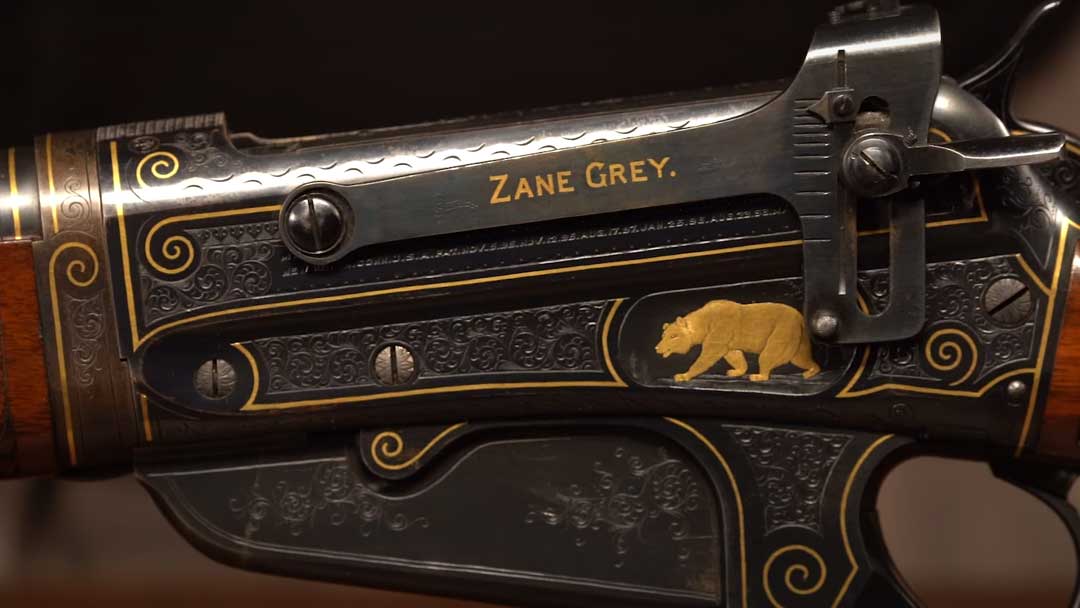
A stunning example of John Ulrich’s superb skills as a master engraver, this Winchester Model 1895 rifle features a deer, a grizzly bear, and a mountain lion, inlaid in solid gold on the receiver, animals Zane Grey hunted and wrote about in his works on the American West.

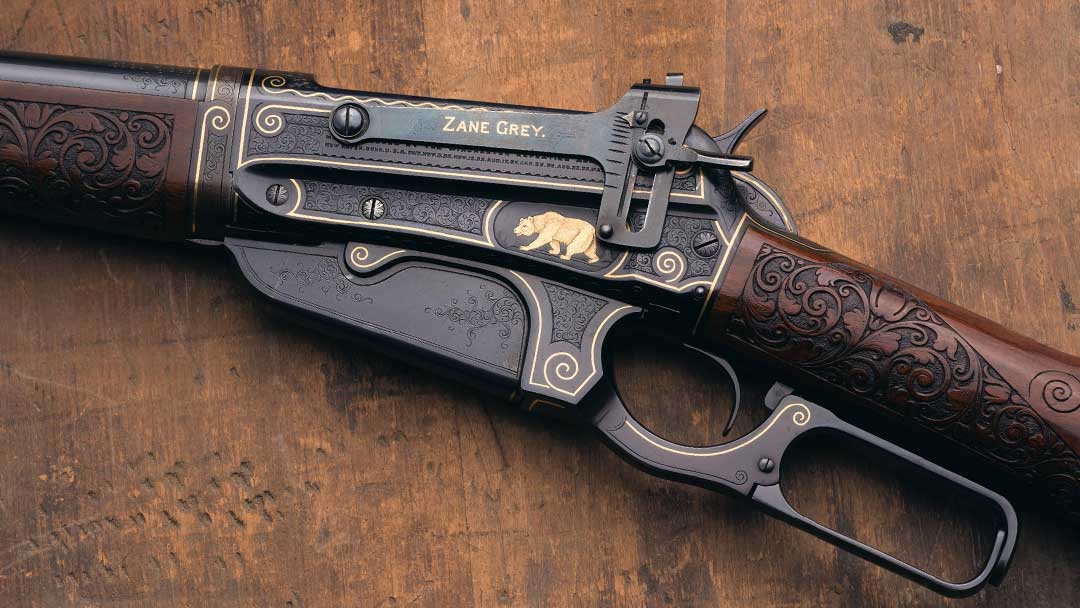
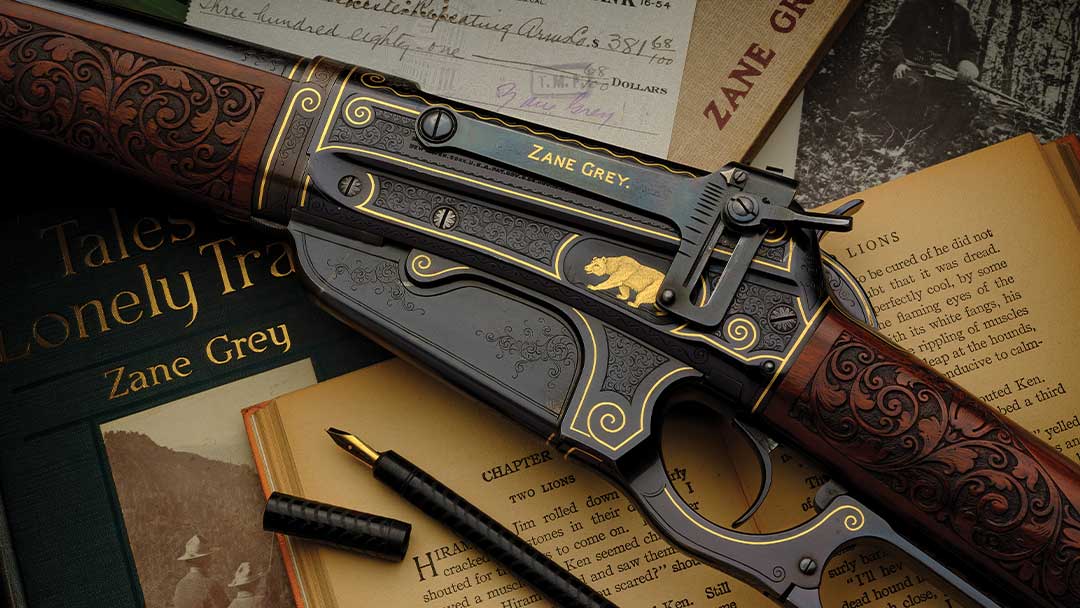
The receiver sight is inscribed with the original owner’s name in gold: “ZANE GREY.” The deluxe, fancy grade walnut stock and forearm feature Winchester Style B relief carved scroll and vine designs with a highly polished piano finish. Available this May.

The receiver, upper tang, bolt, takedown collar, hammer, lever, barrel breech, and buttplate on Zane Grey’s Winchester 1895 rifle are engraved with arabesque scrollwork and artistic borders. The rifle’s scrollwork and engraved borders are accented with numerous gold inlaid borders, and a gold inlaid band and an engraved scallop band appear on the barrel at the muzzle. John Ulrich has signed this breathtaking Winchester 1895 rifle with his “JU” initials on the lower tang.

This stunning Winchester 1895 rifle is a fitting treasure for a man that loved the American West and made his mark as a writer of frontier stories. Available this May.

An American Treasure: Zane Grey’s Winchester 1895 Rifle

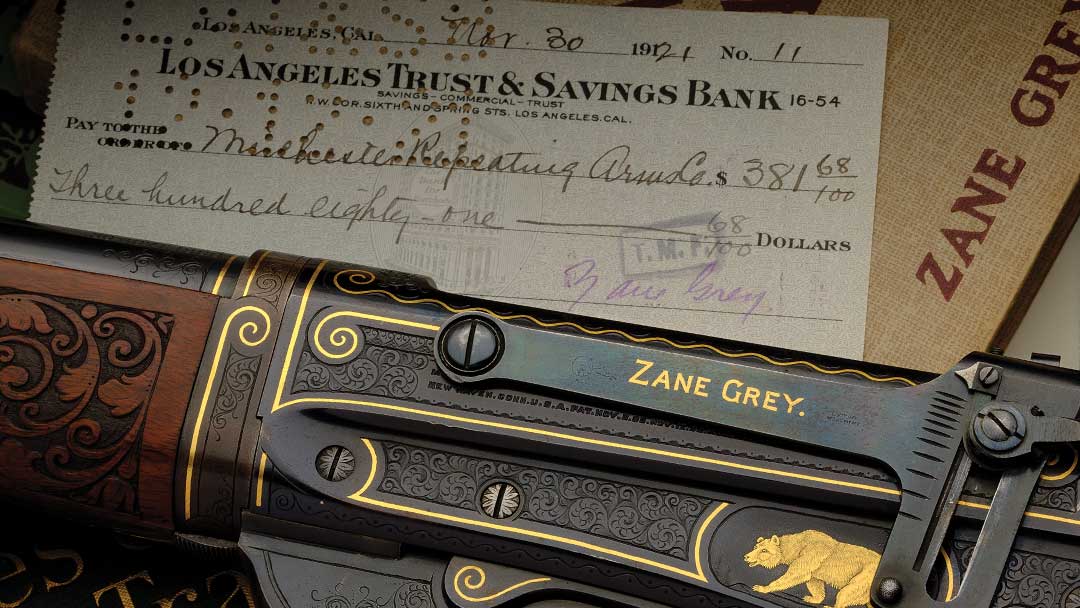
The typical Winchester 1895 rifle was put through its paces in the field and a scarce few retain their original condition like Zane Grey’s stunningly engraved Winchester 1895 rifle. According to Madis, a standard Model 95 listed for $32.50, but the added extras on this particular rifle built for Zane Grey cost an astonishing $335.00. The total cost of this spectacular rifle would have been $367.50, or about $6,177.68 in today’s money. For reference, a Ford Model T was priced at $310.00 in 1921.

Zane Grey’s $381.68 check to Winchester from Nov. 20, 1921 is included with the Model 1895 rifle. Available this May.

Though numerous options for engraving and embellishment were available for the Winchester 1895 at the customer’s request, deluxe examples of the Model 1895 rifle were markedly scarce compared to other Winchester models. The Winchester 1895 was viewed foremost as a rugged hunting gun. Firearms author George Madis notes that optional features like checkered stocks and higher-grade finishes “will be found less often on the Model 95 than on other models.”

When considering the gun’s original condition, its immaculate John Ulrich engraving, and a remarkable provenance to Zane Grey, the best-selling Western author of all time, a one-of-a-kind rarity and a true American treasure begins to emerge.

The Winchester 1895 Rifle Makes an Impression

Zane Grey’s favorite model of Winchester rifle was designed by gun inventor John Moses Browning, whose previous experience developing lever action Winchesters had included the Model 1886, the Model 1892, and the iconic Model 1894. A more robust design was needed to handle the higher pressures of the newly introduced smokeless powder cartridge. Additionally, the choice of a fixed single-column box magazine over a tube magazine for the Winchester 1895 allowed the new rifle to use the pointed Spitzer bullets that had rapidly gained traction in the European market.

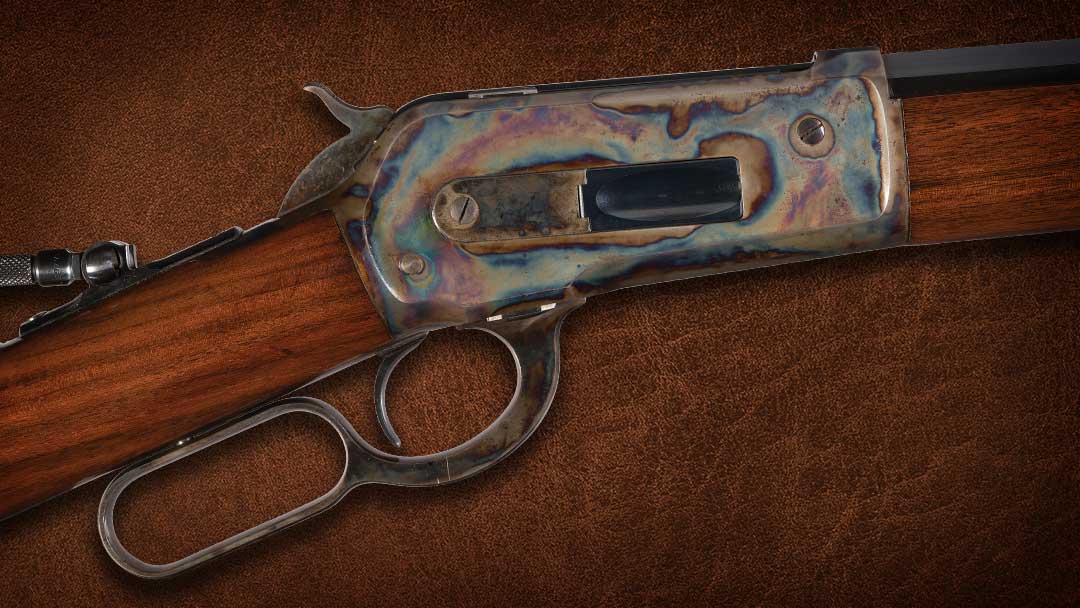
An excellent Winchester Model 1886 rifle with an attractive casehardened frame and factory Letter. The 1886 was John Browning’s first Winchester lever action design. Available this May.

The Winchester 1895 magazine capacity varied from four to six rounds depending on the many types of cartridges it would go on to be chambered for. Zane Grey preferred the .30-06 Springfield cartridge, which Winchester started offering as an option for the Model 1895 starting in 1907.

A 1912 dated Winchester 1895 N.R.A. musket chambered in the scarce .30-03 caliber. These Model 1895 muskets were made to comply with the specifications of National Rifle Association of America target matches and produced with special 24 inch barrels, Model 1901 Krag rear sights, and special flat butt plates. Available this May.

Zane Grey was among tens of thousands of American hunters who cherished the Winchester 1895 rifle. Buffalo Bill was an early adopter of the Winchester 1895, and Theodore Roosevelt would go on to epitomize the model. During the Spanish-American War, Roosevelt carried a Winchester 1895 in .30 Army while leading the Rough Riders in Cuba, then sported a Model 1895 chambered in .405 Winchester (Roosevelt’s “Big Medicine”) during his famous African safari and many subsequent hunts throughout North America and his later Amazon expedition in 1915.

A 1917 manufactured Winchester 1895 saddle ring carbine in .30-40 Krag (or .30 Army,) the same caliber Teddy Roosevelt carried in Cuba. Available this May.

Nearly 426,000 Winchester 1895 rifles, carbines, and muskets were manufactured during its original run from 1896 until 1931, with 294,000 commissioned for the Russian military. The Winchester 1895 has been re-introduced by Winchester in recent years, though classic examples of the Model 1895 remain a popular purchase with collectors and shooters looking for a vintage Winchester that can also serve as a reliable working rifle.

A 1921 manufactured Winchester Deluxe Model 1895 takedown rifle chambered in .405 W.C.F. Available this May.

Lever Action Legacy

Zane Grey introduced millions of Americans and Europeans to the Wild West and immortalized the frontier myth for generations of writers and filmmakers to follow. As a passionate hunting enthusiast, Zane Grey valued the best of the best when it came to sporting arms, and it’s only fitting that one of the most monumental examples of Winchester’s 19th-century big game rifle was owned and cherished by the legendary author.

Zane Grey’s rifle is identified in R.L. Wilson’s book “Winchester: An American Legend” on page 106. Available this May.

Zane Grey leads a May 2023 Premier Auction filled with a fantastic slate of historic lever action rifles that includes a Winchester Model 1873 One of One Thousand, a U.S. martially inspected second contract Civil War Henry rifle inscribed for Archibald McAlister of Co. E of the Pennsylvania Regiment Volunteer Corps and the 3rd Regiment of Veteran Volunteers, and a Deluxe Winchester 1895 saddle ring carbine with a gold inlaid inscription and presentation silver plaque to Medal of Honor recipient Major General Nelson A. Miles.

An assemblage of treasures documented to American General Nelson A. Miles is offered this May at Rock Island Auction Company, including an inscribed Winchester 1895 carbine. Available this May.

Rock Island Auction Company offers the finest selection of American frontier firearms in the collecting pursuit, so subscribe to the weekly Rock Island Auction newsletter to receive new gun blogs and gun videos on lever action icons like the Henry rifle, the Spencer carbine, the Winchester 1866 ‘Yellowboy,’ the Winchester 1873, the Marlin Model 1881, the Savage 99, and more.

Self Defense | Defending Yourself from an Attacker

0

Are you able to protect yourself and your family from a violent attack? Do you know what you would do in a situation that required you to stop an attacker?

If you’re like most people that I talk to, your first answer is probably with your guns. But what happens if someone gets a drop on you or blindsides you and jumps you before you can get to your weapon? I love my guns just as much as the next guy, but to truly be prepared for anything, you also need to be able and have the knowledge to protect yourself without them.

Self-defense is a critical skill that everyone who is serious about preparedness needs to put on the top of their list of priorities. As we document in our social unrest section of the site, violent attacks are not only a growing threat, but, in our opinion, the number one threat to your survival that you face on a daily basis.

Self-defense is far more than owning a gun, and it’s not just about physical strength or fighting skills, but it also involves mental preparation, situational awareness, and self-confidence. In today’s world, where crime rates and the ghettoization of our culture are at an all-time high, self-defense has become necessary for everyone. This article will discuss how to defend yourself from an attacker and the different self-defense techniques you should be studying.

Different Types of Attacks

Self Defense situation

Before we talk about the different self-defense techniques, it is essential to understand the different types of attacks that can happen and the legal ramifications of defending yourself:

Basic Physical Assault

A physical assault can happen anywhere and at any time. It can involve hitting, punching, kicking, or choking. It can also involve using weapons like guns, knives, or blunt objects. Defending yourself from these attacks will depend on several factors, but be aware that even a single punch from an attacker can be deadly, so never underestimate the need to be able to fight back, and quickly put an end to the threat.

Sadly, depending on the state you live in – especially if it’s run by liberal politicians that favor criminals over law-abiding citizens – you need to be aware of your local self-defense laws and when you can and can’t legally defend yourself. But, and this is not legal advice, in my opinion, it’s better to come out alive and worry about the legal bullshit later. “Better to be Tried by 12 than Carried by 6”!

Sexual Assault

Sexual assault involves any form of unwanted sexual contact, including unwanted touching, groping, rape, or other forms of sexual violence. According to the FBI, every 68 seconds, an American is sexually assaulted. It can happen anywhere, but what the media will never admit — and yes, we know this isn’t politically correct — one of the best ways to protect yourself from this type of attack is not to put yourself in stupid situations. Most sexual assaults occur because of bad decisions and drinking – Sorry, BUT THOSE ARE FACTS!

Riots and Politically Motivated Violence

We are living through a time of unprecedented violence, chaos, and social unrest. As a result, we have seen a considerable uptick in the number of violent protests and riots. Check out our article on surviving a riot for a detailed dive into the subject.

Violent Flash Mob Attacks

Technology is changing how we live; unfortunately, it’s also making it easier and faster for criminals to communicate, plan, and execute their crimes. With the advent of texting and social media, it’s never been easier for large groups of criminals to come together and wreak havoc in a matter of minutes. Check out our article on mob attacks for a detailed dive into the subject.

Mass Shootings

While active shooter situations are still pretty rare, it’s a phenomenon that does seem to be increasing in regularity. Check out our article surviving a mass shooting for a detailed dive into the subject.

School Shootings & School Violence

While technically, this could fall under the category of mass shootings, the fact that we are dealing with children requires some extra training and caution. Please read our article on

Home Invasions

When it comes to defending your home, nobody can do a better job of protecting it, and more importantly, the people who live within its walls than you. Unfortunately, we live in a society that has grown increasingly reliant on the government to protect them in every little aspect of their lives, believing that when trouble hits, some random government agency is going to be there to help. They are not! You need to learn how to protect yourself, and the people in your home – here is how!

Car Jackings

Although it doesn’t receive as much media attention as some other types of crimes, carjacking has once again become one of the top crimes in the country. For unsophisticated car thieves who can’t bypass modern-day car alarms, the crime is an easy way for them to steal a vehicle.

Check out our article surviving a carjacking for a detailed dive into the subject.

Verbal Assault

Verbal assault involves any form of verbal abuse or threats. It can include name-calling, bullying, and harassment. Remember, while it might feel good to knock the shit out of some troublemaker mouthing off, the judge will probably see it differently – so keep your cool, be ready for the loudmouth to escalate, and if you can, leave the situation ASAP!

How to end the Fight Quickly if you don’t have a weapon!

Guy attacking a woman

Remember that these tips should only be used in a life-or-death situation, as they could cause severe damage or death.

When defending yourself from an attack, every move you make should be made in an effort to end the altercation as soon as possible. This is not the time to start slugging it out or pretending you’re in the UFC.

Every punch or kick you throw should be delivered to the weakest or most vulnerable areas of your attacker’s body.  This is because your strikes need to cause serious damage, and your main goal should be to end the fight and immobilize your attacker as fast as possible.

Attack Vital Points on the body!

Diagram of the vital points on a human body and where to hit an attacker

When defending yourself, aim for the vital points of the body. The eyes, nose, ears, throat, and groin are all vulnerable areas that can incapacitate an attacker, giving you time to escape. Use quick, sharp movements that inflict the most damage. It’s your life or their life!

Eyes – If they can’t see you, they can’t hit you. Jabbing your attacker in the eye can temporarily blind them, allowing you to gain the upper hand. However, if done hard enough, it can actually cause permanent blindness.

Nose – A Palm strike or punch to the nose can have a devastating effect on your attacker. While it probably won’t immobilize them, it may be enough to cause them to retreat. A well-executed strike to the nose will cause immense pain and cause the eyes to fill with tears instantly. This will allow you to either run away or quickly end the fight with a follow-up attack.

Throat – The throat is one of the body’s most vulnerable areas. When attacking the throat, there are two areas that you should focus on.

  • First, the Adam’s Apple –   A blow to the Adam’s apple can collapse the attacker’s airway and can literally kill them with one strike.
  • Second is the soft area where your throat meets your collarbones. This area can be jabbed with the fingers to cause your opponent to lose his breath temporarily.

Groin – A good kick to the groin can cause a man to drop to the ground instantly. Just remember that this target is usually the most well-guarded and may be difficult to strike.

Knee Caps – The Kneecaps are highly vulnerable to attack and can be easily dislocated or broken by a well-placed kick to the knee. A kick to the side of the knee can also cause a considerable amount of damage.

Feet – Stomping on your attacker’s feet probably will not end the fight, but it can cause a huge amount of pain. Foot stomps are often used to escape from a hold and can give you time to setup for your next attack.

Self-Defense Techniques you should know!

Self-Defense Techniques

Be Aware of Your Surroundings and Study the Art of Situational Awareness!

The first thing you must do to protect yourself is to be aware of your surroundings. Pay attention to anything that seems out of place and watch for suspicious behavior. Keep your head up, look confident, and don’t be afraid to make eye contact with people.

Please read our full article on How to Protect Yourself by Developing your Situational Awareness

Don’t be afraid to Use Your Voice

This one is important for women and children. The use of your voice is a powerful tool to deter attackers. Scream, shout, or use a whistle to draw attention. By making noise, you let people know you are in trouble, and the attacker knows that people will hopefully come to your aid.

Carry and KNOW HOW To Use Weapons

If you have access to a weapon, then you should use it to protect yourself. Remember, people can die from a single well-placed punch, so if you feel your life is in danger, then you need to access the force required to stop that danger!

Check out our Weapons Articles:

Take a Self-Defense Class

Reading about it is one thing, but one of the best ways to learn self-defense is to take a self-defense class. These classes teach you how to protect yourself, avoid dangerous situations, and feel more confident in handling difficult situations. In addition, you will learn different techniques, including striking, blocking, and grappling, as well as how to use weapons effectively.

Related Self Defense Articles:

Collectible Firearms for Serious Gun Collectors

0

Whether you know the SPAS 12 from Terminator, Jurassic Park, or the shotgun’s inclusion in countless video games over the last two decades, the Franchi SPAS 12 has become one of the world’s most famous gun models. Primarily designed as a close combat weapon for military and law enforcement use, the SPAS 12 shotgun’s large heat shield, metallic folding stock, and distinctive butt hook give the gun a unique profile that stands out in any firearms collection.

A SPAS 12 for sale that features the iconic hooked folding stock.

The Franchi SPAS 12 Shotgun

The SPAS 12 was manufactured in 1979 by the Italian company Luigi Franchi S.p.A. as a special-purpose automatic shotgun. Franchi’s SPAS 12 design was inspired in part by the High Standard Model 10, an American-made 12 gauge semi-auto bullpup shotgun developed in the late 1950s to be either shoulder-fired or fired one-handed with the swiveling buttstock braced against the bicep of the shooting arm. Like its SPAS 12 successor, the intention was to provide law enforcement and Special Forces with a versatile tactical shotgun.
The SPAS 12 shotgun had a predecessor in the High Standard Model 10.

The Franchi SPAS 12 shotgun was released two years after the High Standard Model 10 was discontinued in 1977. Marketed to police and military forces in Europe and America, the SPAS 12 offered a dual-mode shotgun design that allowed its users to choose either manual pump action or gas-operated semi-automatic at the touch of a button. This provided the operator with the option of high-speed stopping power running buck or slug in semi-automatic mode and the ability to switch back to pump when a situation called for a less lethal round and their lighter load cartridges.
The Franchi SPAS 12, a dual-mode shotgun that can quickly shift between pump and semi-automatic modes.

Some of the more prominent SPAS 12 adopters included the French GIGN and Austrian EKO COBRA counter-terrorism units, Brazil’s Special Tactical Action Group, Malaysia’s National Special Operations Force (NSOF), Indonesia’s Komando Pasukan Katak underwater demolition units, and select U.S. SWAT Teams.

The SPAS 12’s metal folding arm and hook are two of the shotgun’s defining features.

What Does SPAS 12 Stand For?
The SPAS 12 was initially called the “Special Purpose Automatic Shotgun,” with the 12 referring to the weapon’s 12 gauge chambering. The SPAS 12 was soon offered to civilians as a sporting arm as well, where the exact same model was relabeled as the “Sporting Purpose Automatic Shotgun.”
A SPAS 12 with its original box, labeled “Sporting Automatic Shotgun.” This example sold for $5,750 in RIAC’s December 2021 Premier Auction.

After California passed a 1989 import ban that classified the SPAS 12 as an assault weapon, Franchi introduced a modified version of the SPAS 12 to the American market in 1990 with a solid traditionally shaped stock and a smaller capacity, which also took on the designation of “Sporting Purpose Automatic Shotgun.”

A SPAS 12 with a fixed stock (top) and a SPAS 12 with a metal folding stock (bottom.)

The Jurassic Park SPAS 12

For many firearms fans and movie buffs, their first exposure to the SPAS 12 came from blockbuster films like 1984’s ‘Terminator’ and 1993’s ‘Jurassic Park.’ The Jurassic Park SPAS 12 shotgun was carried by game-warden Robert Muldoon (Bob Peck) and included the model’s original lever safety and a latching-style folding stock, though without the famous butt hook attachment.

A “Clever girl.” The Jurassic Park SPAS 12 has become one of the most famous movie guns.

The SPAS 12 has been notably featured in many other films, including ‘The Matrix,’ ‘Bad Boys,’ and ‘Robocop 3,’ as well as popular shows like ‘Miami Vice’ and ‘The Walking Dead.’ Today, the SPAS 12  shotgun continues to earn recognition with video game fans as well thanks to its inclusion in hits like ‘Half Life,’ ‘Modern Warfare 2,’ ‘F.E.A.R.,’ ‘Left 4 Dead 2,’ ‘Ghost Recon: Wildlands,’ and ‘Dino Crisis.’

The SPAS 12 Action

The SPAS 12 can switch between pump action and semi-automatic mode by pressing the auto/manual fire selector button on the bottom of the forend and sliding the forend (forward for semi-automatic and back for pump action). The SPAS 12 shotgun’s tube magazine can hold up to eight 12 gauge shells. Full-power shells can be fired in either action mode, but Franchi advised users to switch to pump action mode when shooting less lethal rounds like beanbags or low-velocity birdshot that didn’t provide enough pressure to cycle the gun.

The Franchi SPAS 12 shotgun can fire everything from buckshot, slugs, and door breaching rounds to low-powered non-lethal shells for riot control.

The Franchi SPAS 12 user manual states: “When firing in PUMP MODE you can use any kind of 2 3/4′ shell from the lightest target load to the heaviest buckshot, rifled slug, and magnum loads. However, when firing in SEMIAUTOMATIC MODE you must use loads that provide sufficient energy to ensure reliable operation.”

The SPAS 12 Hook and Folding Stock

Along with its metal folding stock and large heat shield, the SPAS 12 butt hook is one of the most defining features of the shotgun. When the stock is folded to the top of the receiver the hook can be used as a carrying handle. While certainly a convenient feature, the real reason the SPAS 12 hook is so popular is the one-handed shooting options it provides.

The SPAS 12 manual recommends its user shove the shotgun forward as they fire, essentially “punching” the weapon at the target so the forward momentum of the gun at the time of discharge provides extra resistance.

The SPAS 12 manual describes the process as follows: “For one-hand firing, either right or left-handed, rotate the hook to the right or left position. This allows you to fire around a corner or barricade without exposing yourself to view. When doing this, it is difficult to provide enough resistance to recoil to allow functioning in semi-automatic mode. You may have to thrust the gun forward as you pull the trigger because your bent arm acts like a shock absorber and permits the gun to recoil excessively.”

A SPAS 12 for sale this April 5th at Rock Island Auction Company.

In short, the operator’s bent or extended arm provides a less rigid support for the SPAS 12 when firing in semi-automatic mode, resulting in a failure of the bolt to completely cycle. This situation is similar to limp wristing a pistol, where the shooter’s grip isn’t firm enough to keep the handgun from excessively moving when firing and the slide fails to move with enough force to extract or cycle a new round.

SPAS 12 Import Bans

California’s Roberti–Roos Assault Weapons Control Act of 1989 banned the ownership and transfer of over 50 specific firearm models, including the Uzi, the Streetsweeper, and the SPAS 12 shotgun. Even with Franchi’s solid stock and lower capacity redesign for the sporting market, the SPAS 12 was again targeted five years later by American politicians with the 1994 Federal Assault Weapons Ban, which banned the import of any semi-automatic shotgun that included both a pistol grip and a fixed magazine capacity in excess of 5 rounds.

A close up of the SPAS 12 shotgun’s iconic heat shield. After the 1994 Federal Assault Weapons Ban, imports of the SPAS 12 were halted in America.

SPAS 12 Production Ends

Even before Franchi was forced to abandon its American market, the SPAS 12 was losing ground to new competitors. The Benelli M3, for example, which was introduced in 1987, offered a similar dual-mode system at a more affordable price point. The SPAS 12 was also heavier than most of its peers, weighing in at 9.7 lbs, or 4.4 kg unloaded. Additionally, the suite of features offered by the SPAS 12 was perceived by some police departments as awkward, overly complicated, and too situational to justify the added expense.

The SPAS 12 shotgun’s unique suite of features came at a comparatively high price point.

In the 1980s, dedicated nonlethal riot control weapons like pepper spray, rubber bullets, stun grenades, and electric tasers became increasingly popular with law enforcement, and since the turn of the millennium, the AR-15 platform took over much of the shotgun’s niche for situations demanding lethal stopping power. The need for a highly specialized police shotgun diminished, and reliable inexpensive favorites like the Remington Model 870 and the Mossberg 500 continue to serve in select roles like door breaching and firing tear gas rounds.

The SPAS 15 was Franchi’s successor to the SPAS 12. This example sold for $7,638 in Rock Island Auction Company’s August Premier Auction.

2000 marked the final year of production for the SPAS 12 shotgun. Franchi continued the dual-mode shotgun concept with the SPAS 15, a lighter design with a faster reload thanks to its detachable box magazines. In the years since it was discontinued, the desire to own a SPAS 12 has only grown among collectors, shooters, and arms enthusiasts, and that popularity is reflected in the model’s surging price point.

SPAS 12 Price

In its final year of production, the SPAS 12 price was $1,500. Over the last two decades, and particularly in recent times, gun values have been rising across the board, but saying that the SPAS 12 price is experiencing a rapid upswing is a gross understatement.

When considering the average SPAS 12 price by year at Rock Island Auction Company, we’ve gathered data from every Sporting & Collector Auction, Premier Auction, and Arms & Accessories Auction dating back to 2016. In an effort to maintain consistency and accuracy, the graph presented below has excluded multi-gun lots and notably rare specialty examples lots like the scarce nickel-plated SPAS 12 shotguns. The buyer’s premium (ranging from 15% to 17.5% during the periods analyzed) is included in the sales price as this reflects what a gun collector was willing to pay to own a SPAS 12 shotgun. The graph below specifically looks at SPAS 12 shotguns with the folding metal stock that was produced before California’s 1989 import ban, and only mechanically excellent SPAS 12 examples are included.

The average SPAS 12 price by year at Rock Island Auction Company from 2016 to 2022. The dramatic uptrend is consistent with recent SPAS 12 blue book values and presents an intriguing case for the SPAS 12 shotgun as a true collector’s arm.

In only a seven-year span, the average SPAS 12 price at Rock Island Auction Company nearly tripled, a dramatic surge in value that equals or surpasses some of the hottest collectible guns on the market right now by growth percentage. In 2016, a SPAS 12 averaged $2,588, hovering around the same price in 2017 and 2018 before leaping to $3,091 in 2019, then rocketing upward the next three years and shattering the $7,000 price barrier, a number that would have seemed unimaginable ten years ago.

Specialty examples like the nickel-plated SPAS 12 are even more rare.

The reason for such a dramatic SPAS 12 price surge is multifaceted. Hollywood and video game coverage received by the SPAS 12 have certainly helped, and the shotgun’s representation in popular Youtube videos from the likes of Demolition Ranch and Garand Thumb has further elevated the model. Recent SPAS 12 values at Rock Island Auction suggest that the shotgun’s rise is no accident, and arms collectors and consigners should expect the average SPAS 12 price in 2023 to continue its strong showing.

Spas 12 for Sale

Given the SPAS 12 shotgun’s history, unique set features and aesthetic, and its presence in popular media, it’s little wonder that this Italian curiosity continues to garner interest from gun collectors across the globe. The SPAS 12 presents the chance to own and shoot a specialized tactical firearm that stands apart from any shotgun seen before or since.

SPAS 12 for sale! The famous shotgun leads the lineup in Rock Island Auction Company’s April 5th Arms & Accessories sale.

Finding a SPAS 12 for sale has become ever more challenging as the shotgun’s popularity has skyrocketed. In years past, the SPAS 12 shotgun was primarily featured in RIAC’s Premier and Sporting & Collector Auctions. The famous gun’s presence in an Arms & Accessories Day Auction highlights the expanded quality and selection found in RIAC’s newest auction format.

A Magnum Research Desert Eagle Mark XIX pistol with case.

Hollywood action films have made stars out of numerous guns, enhancing their value in the eyes of the collecting community. Subscribe to the Rock Island Auction newsletter to receive weekly gun blogs and gun videos on firearm models that forged their legend in Hollywood like the Beretta 92FS, the Mac-10 SMG, the Bren Ten pistol, as well as genuine screen-used hero guns like Lara Croft’s pistols, John Wayne’s ‘True Grit’ revolver, and Han Solo’s DL-44 blaster from the original ‘Star Wars.’

The H&K USP 9 Match pistols wielded by Angelina Jolie in 2001’s ‘Tomb Raider’ film sold for $32,250 in RIAC’s August 2022 Premier Auction.