Are you ready to set out on an extraordinary adventure? Buckle up and prepare to dive into the world of full-time RVing, where the road becomes your companion, and every destination offers a new story to create.
1. Embrace Your inner Nomad: Go Off the Grid and Equip Your RV for the Ultimate Boondocking Experience
While there are some benefits of hitting up modern campsites, there is something liberating about leaving behind the constraints of traditional campgrounds and embracing the freedom of boondocking. That’s why we suggest ensuring your RV is set up to thrive off the grid, allowing you to camp anywhere your heart desires.
A good battery bank, complemented by a solar panel charging system, will keep you powered up even in the most remote locations.
Increase your fresh water and holding tank capacities. Your water usage and the size of your tanks will be one of the most important things to consider when figuring out how long you can stay in your boondocking spot.
Research Boondocking Camping Spots: We like using Use Google Earth to scout out the landscape before choosing a site.
As one couple who we interviewed a while back told us, “We boondock in beautiful wilderness areas where the quiet makes it easy to relax and slow down. The nomad lifestyle requires you to get more deeply in touch with your own survival, which has been a wonderful experience for us.”
2. Filter It: Clean Water = Happy Traveler
When your water source varies from campground to campground, having a reliable water filter is essential. Install filters both outside and inside your RV to ensure clean, sediment-free water for your faucets, water heater, and toilet valves. Double filtration ensures that even your drinking water tastes as crisp and refreshing as natural spring water, allowing you to save money on buying bottled water. With a clean and abundant water supply, you can focus on quenching your thirst for adventure.
3. The Key to Happiness on the Road Lies in Following Good Weather
Managing the temperature inside your RV can greatly impact your comfort and energy costs. Plan your travel routes to chase mild weather instead of relying on air conditioning or heating systems. During summer, seek out cooler areas or higher elevations where the air is naturally cooler. Look for campsites with natural shade or sites near water, which provides a cooling effect. By embracing climate-conscious travel, you’ll optimize your comfort and minimize energy consumption.
4. Fueling the Journey: Plan Your Travel Route to Budget for Gas
Gas prices can be a dealbreaker for many trying to get into the lifestyle, but with careful planning, you can minimize your fuel costs.
Carefully plan your travel routes, avoiding toll roads whenever possible.
Opt for the most fuel-efficient routes and manage your driving habits to avoid rush hours and constant stop-and-go traffic.
Download Apps Like Gas Buddy to find the cheapest gas stations along your route, and don’t be afraid to head off the highway and into town for cheaper gas!
5. Roll Up Your Sleeves and Don’t Be Afraid To Do Your Own Maintenance and Repairs
Living in an RV means occasional maintenance and repairs are inevitable. Instead of shelling huge sums of money for every minor issue, take the time to learn how to do some basic DIY skills. Start by learning simple tasks such as oil changes, air filter replacements, and spark plug checks. YouTube has a treasure trove of tutorials to guide you through most small repairs.
6. Find Affordable Internet Options on the Road
Staying connected while on the road is important for many full-time RVers. To avoid high internet costs, explore affordable options such as mobile hotspots offered by cell phone carriers or parking in areas with free WiFi. Alternatively, consider satellite internet, like Starlink, which ensures a strong connection even in remote areas with weak cell phone coverage. Check out our article on Off-Grid Internet Options.
7. Harness the Power of the Sun: Let Nature Fuel Your Travels
One of the great things about full-time RVing is the sustainability of the lifestyle if done correctly.
8. RV Memberships: Unleashing the Benefits
We love boondocking, but there are some upsides to having a good campground membership. Programs like Thousand Trails, Passport America, Escapees RV Club, and Harvest Hosts offer various perks, including reduced rates, access to a network of campgrounds, and an easy, worry-free camping experience. These memberships can be a budget-friendly way to enjoy campground amenities while connecting with a community of fellow RV enthusiasts.
9. Finding Meaning in Your Journey: Never Forget the Reason Behind Your RV Adventures
Contrary to the life of your normal 9-5 drones, full-time RVing is about slowing down and truly experiencing the places you travel to. Seek places that capture your imagination, and don’t be afraid to stay awhile and soak in the local culture. By staying put for 2 to 4 weeks, you’ll have the opportunity to go much deeper into the local culture, explore hidden trails, and really enjoy the unique wonders of that location.
In our interview with full time RVers, the Globe Trekker Family, they told us “We typically try to keep our driving from point A to point B to around 200 miles. We will stay at an RV Park, or we can boondock, depending on where we are and what we need. We like to stay at every location for one week so that we have time to explore and also time to relax. When we first started out, we only stayed 3-4 days at each place, and that was exhausting. After six months, we realized that we didn’t have to keep up the “vacation” mentality and that we could slow down so that we didn’t get burnt out.”
Full-time RVing is not just a lifestyle; it’s a chance to embrace the unknown, explore new ways of living, meet new people, and create one-of-a-kind, unforgettable memories. As
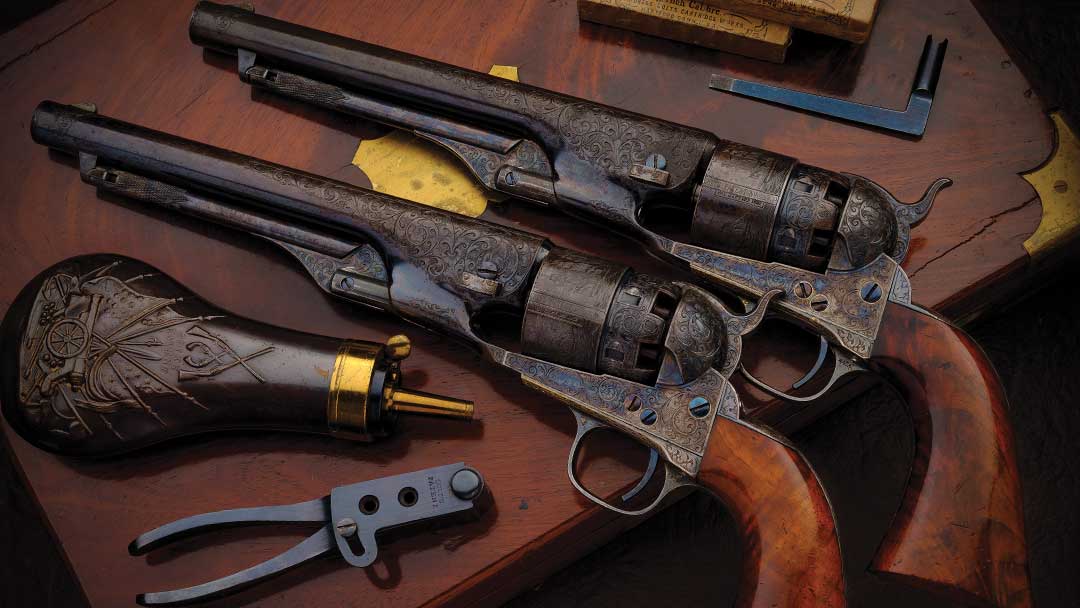
While shooting history is filled with tall tales and mythmaking, Ed McGivern was the real deal. As a record-setting exhibition shooter, celebrated firearms author, and famed shooting instructor, Edward “Ed” McGivern needs no introduction to serious firearms fans. Few Ed McGivern guns are held in private hands today, and Rock Island Auction Company has the privilege to offer the collecting public two of McGivern’s iconic revolvers during the upcoming August 25-27 Premier Firearms Auction.
A documented Ed McGivern revolver, this Smith & Wesson .357 Registered Magnum includes a factory letter. Available this August.
Fastest Gun in the World
Growing up in Omaha, Nebraska during the twilight years of the Wild West, Ed McGivern was destined to be a marksman. McGivern was a self-taught shooter, cutting his teeth on semi-automatic pistols before gravitating toward the double action revolver, a move that would prove to be a more than ideal match for the talented handgunner.
Another outstanding Ed McGivern gun, this K-32 Hand Ejector Target is one of the rarest pre-war K frame revolvers manufactured by Smith & Wesson. Available this August.
While working as a sign painter for his day job, Ed McGivern spent years refining his shooting technique, using electric timers to find the fastest angles for his quick draws and aid in honing his hand reflexes. Though the squat 5’5” McGivern didn’t fit the popular image of the Hollywood gunslinger, he let his shooting talk for him. He started touring with Wild West shows in the early 1900s and by the 1930s he would earn the title “fastest gun in the world.”
Fast and Fancy Revolver Shooting
Working with his Philadelphia patron, Walter Groff, Ed McGivern gained fame around the country as an exhibition shooter, demonstrating his fast draw, speed shooting, and accuracy on aerial targets like cans, shotgun clays, and quarter-sized lead discs. As the crowds grew, so did the complexity of Ed McGivern’s legendary trick shots.
A rare Ed McGivern gun offered to the collectible public, a Smith & Wesson Registered Magnum. Available this August.
Some of Ed McGivern’s most notable pistol trick shooting feats included hitting two targets with two revolvers simultaneously, shooting through the .5” center hole of a washer thrown in the air, shooting dimes on the fly, driving a tack or nail into wood with a bullet, and splitting playing cards that had been tossed into the air edge on.
Most of these fancy revolver tricks were accomplished with one or two of Ed McGivern’s factory Smith & Wesson double action wheel guns. The two Ed McGivern guns for sale at Rock Island Auction Company this August were shipped to the famous marksman shortly after his popular book, ‘Fast and Fancy Revolver Shooting,’ was first published in 1938.
Ed McGivern’s Registered Magnum
The first Ed McGivern revolver for sale this August is a Smith & Wesson .357 Registered Magnum, registration number 2902. The revolver was shipped on May 25, 1938, and delivered to Ed McGivern in Lewistown, Montana. The factory letter states that the revolver “was authorized as a ‘no charge’ shipment by D.B. Wesson and marked for fast double action shooting.” By 1938, Ed McGivern had developed a close friendship with Douglas Wesson, Smith & Wesson’s then-vice-president. McGivern was instrumental in helping Wesson advertise the Magnum revolver and market the .357 to law enforcement.
An exceptional Ed McGivern revolver, a Smith & Wesson Registered .357 Magnum, registration number 2902. Only 5,224 of these premium revolvers were offered. Available this August.
The Smith & Wesson order form and invoice confirm the revolver’s configuration as listed in the factory letter and its delivery to Ed McGivern, and the revolver was among the firearms listed after his death. The Registered Magnum’s hammer spur is offset on the right side, one of the alterations Ed McGivern is known to have performed on many of his Smith & Wesson revolvers and provides further confirmation of McGivern’s ownership and usage.
Each Registered Magnum came with a registration card that the buyer could mail back to Smith & Wesson to obtain a registration certificate, a guarantee of quality from S&W. Available this August.
This Registered Magnum was displayed at the 2015 NRA Annual Meeting in Nashville, Tennessee, along with other Ed McGivern-owned ephemera. The gun is pictured on page 45 of ‘Fast and Fancy Revolver Shooting’ and an autographed copy of McGivern’s book is included with the lot.
Ed McGivern’s Target Revolver
The second fantastic Ed McGivern gun for sale during RIAC’s upcoming August 25-27 Premier Firearms Auction is one of only 96 K-32 Hand Ejector Target revolvers manufactured by Smith & Wesson from 1936 to 1941. These rare revolvers are found in the 653388 through 682207 serial number range and are built on Smith & Wesson’s square butt K target frame with five screws and pinned 6 inch round barrels. After WW2 this model became part of the K-22/K-32/K-38 Masterpiece series of target revolvers.
A fancy revolver owned by the fastest gun shooter of his era, this Smith & Wesson K-32 Hand Ejector Target revolver is available this August.
The factory letter and Smith & Wesson invoice included with Ed McGivern’s K-32 Hand Ejector Target revolver confirm the gun’s 6 inch barrel, McGivern gold bead front sight, humpback hammer, and checkered walnut grips. The letter also states the revolver was shipped to Ed McGivern on May 10, 1939. This gun was displayed at the Smith & Wesson Collectors Association Annual Meeting in Orlando, Florida, in June 2011.
The McGivern Bead Front Sight
Ed McGivern experimented with numerous iron sight styles throughout his shooting career. His preference was a type of iron sight with a small diameter rear aperture and a black post with a domed-gold bead for the front. Both Ed McGivern guns for sale in Rock Island Auction Company’s August Premier feature examples of this unique sight. The 1952 Smith & Wesson Centennial Catalog describes the McGivern sight as follows: “This is another dual-purpose sight different from the Call design in that the bead is a half sphere of gold which protrudes from the rear face of the Partridge blade.”
Both Ed McGivern guns offered in RIAC’s August Premier Auction feature the distinctive McGivern front sight.
The Centennial Catalog goes on to state, “The advantage of the McGivern bead lies in the fact that its globular shape will pick up skylight from practically any angle and reflect it back to the eye of the shooter. Its originator, Ed McGivern, the famous speed and exhibition shooter from Great Falls, Montana, holds this sight to be the best possible for aerial work, or where targets are dark colored and not clearly lighted.”
The Speed of Ed McGivern
Needless to say, Ed McGivern set numerous records for fast and fancy revolver shooting, including achieving a world record for “the greatest rapid-fire feat” on September 13, 1932, in Lewistown, Montana, performing five shots in 2/5 of a second. This record still stands today.
Ed McGivern, the fastest gun shooter of his era, set the standard for fancy revolver marksmanship and performed countless legendary trick shots.
Ed McGivern demonstrated that shooting with both extreme accuracy and speed was possible, an ideal combination in close-up self-defense situations that relied on instinctive reflex. In ‘Fast and Fancy Revolver Shooting’ Ed McGivern wrote that with sufficient practice “the subconscious mind can, will, and does make corrections instantly or within a very few hundredths of a second, while the gun and target are moving, and in plenty of time to score hits.”
With age and arthritis catching up to him, Ed McGivern turned his attention to training police officers, federal agents, and servicemen, and he was called to testify in at least 37 trials as a firearms and ballistics expert. In addition to his famous book, McGivern also wrote numerous articles for outdoors and shooting magazines of his era and collaborated with Douglas Wesson on ‘Burning Powder,’ a 1938 booklet offering detailed instruction on revolver shooting and handgun hunting.
Ed McGivern: The Fastest Gun Shooter of His Era
Elmer Keith called Ed McGivern “the fastest and finest double-action revolver shot that ever lived and probably ever will.” Though shooting has evolved in the decades after his death in 1957, McGivern’s advice on trigger control, holsters, sight alignment, proper grip, and shooting fundamentals are still more than relevant for today’s handgunner.
Two Ed McGivern Smith & Wesson DA revolvers, a Registered Magnum and a K-32 Hand Ejector Target revolver. Available this August.
Ed McGivern’s name continues to rank high in the pantheon of renowned exhibition shooters, with some of his handguns proudly displayed at the National Firearms Museum. In 2001, Smith & Wesson offered a Performance Center Heritage Series Model 15-9 revolver in .38 Special commemorating the legacy of Ed McGivern. While these commemoratives are gorgeous revolvers, there’s nothing like owning one of the legendary trick shooters’ real-life wheel guns, true treasures in arms collecting that are a rare opportunity for the most dedicated arms collectors, Smith & Wesson fans, and students of firearms history.
A Smith & Wesson Performance Center Heritage Series Model 15-9 Ed McGivern tribute revolver from RIAC’s August 2022 Premier.
It is Dec. 19, 1913 in Kansas City, Kansas, and gray-haired Harvey S. Faucett looks at the newspaper and laughs at the fantastical account of his adventure decades ago when the West was still wild and dangerous. The tall tale leaves him both bemused and sullen as he recalls the true events of 1877.
The newspaper account tells the story of three men, two experienced frontiersmen, Harvey “Arapahoe Harve” S. Faucett and Henry “Ranger Hank” Wormwood, helping an eastern greenhorn “college kid” by the name of Zechariah “Zack” Chafee get the body of his colleague Professor Henry Newton east to the railroad for it to be transported home for burial. Together the three men took Newton’s remains hundreds of miles by wagon to the railhead and came under assault from numerous Native American raiders and fought for their lives in a running battle for nearly 200 miles. Using both revolvers and rifles, Faucett and Wormwood fired off shots to good effect, taking out many of the enemy ponies and some of the warriors, including a deadly shot by Harve at some 500 yards just before the U.S. Cavalry came to the rescue. The kid pledged Harve his lifelong friendship that day and sent him a magnificent engraved rifle as thanks.
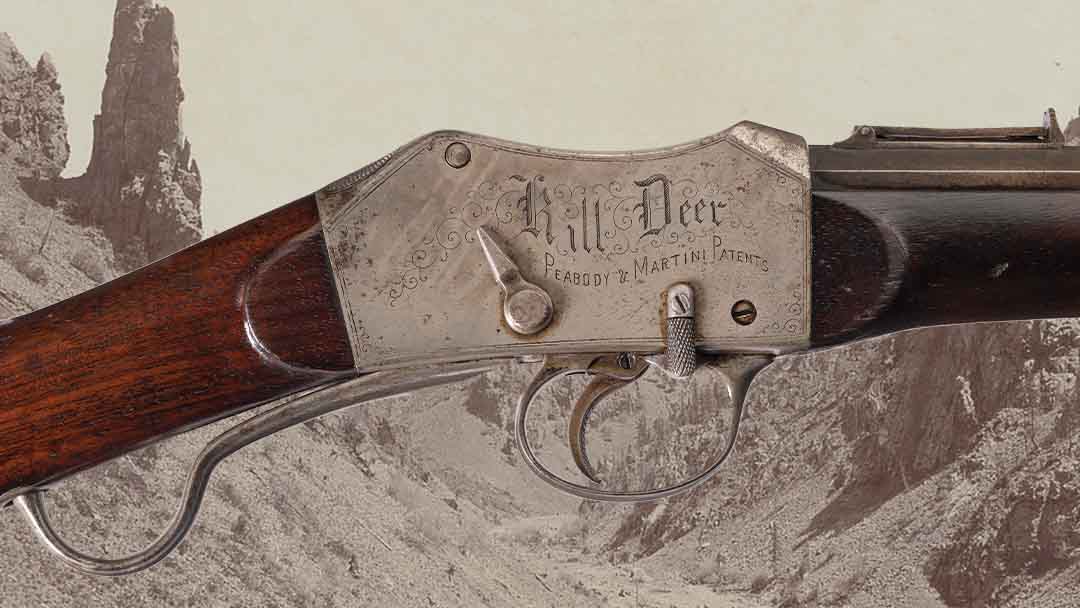
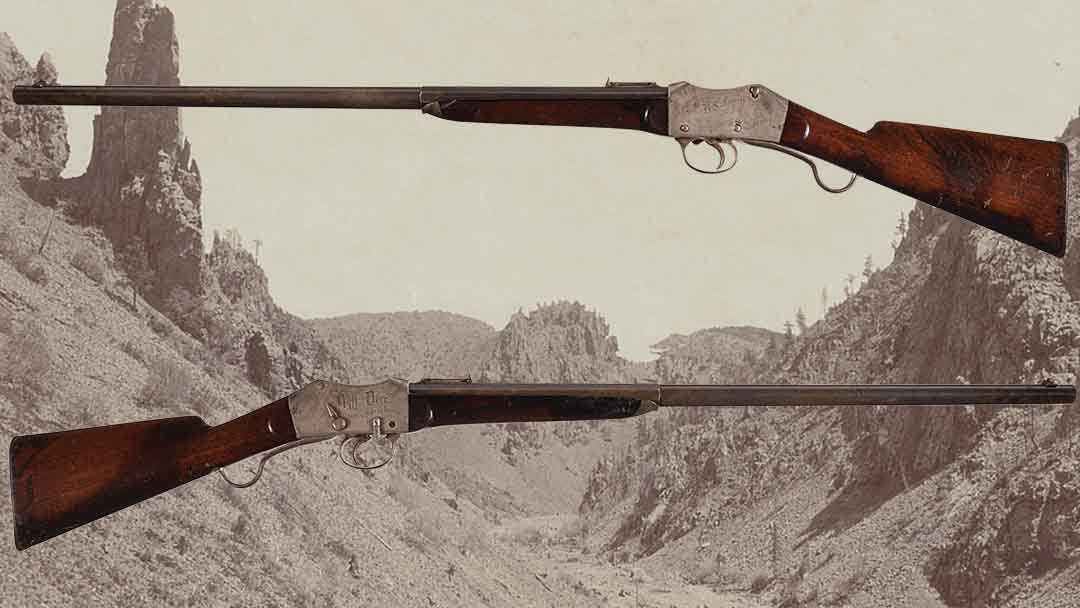
This closeup of the Providence Tool Co. Peabody-Martini “Kill Deer” rifle shows the engraving that recognized the friendship formed on the frontier as Harvey “Arapahoe Harve” Faucett and “Ranger Hank” Wormwood helped Zechariah Chafee get the body of the dead Professor Henry Newton back east.
Some of the account is true, but Faucett was going to have to write to his dear friend Chafee and explain the situation. Had he known the tall tale was going to be published he would have given them “proper data” about the events. He picked up his rifle, a beautiful piece of eastern craftsmanship: A Providence Tool Co. Peabody-Martini “Kill Deer” rifle in .45-70 Government with a 28-inch part octagon, part round barrel fitted with a combination blade and folding globe front sight and a notch and ladder rear sight with the sliding aperture missing, and he was going to have to ask if he could still get a replacement for the latter. The left side of the frame has the inscription “H.S. Faucett/From Z. Chafee for Services/1877.” This rifle was among his most prized possessions and an important memento of a friend lost, a treacherous journey, and a lifelong friend he hadn’t seen in many years.
All of the above is based on the truth as documented thoroughly by the late Greg Lampe in the provenance binders that accompany this historic rifle. Creative liberty has been taken to imagine Faucett holding the rifle, but the thoughts are directly taken from his letters. As you read through the copies of the original letters from Faucett to the “college kid” Zechariah Chafee you get a real sense for who Faucett was as a friend, how connected he became to the young man he helped guide across the plains and the Badlands, and how much he truly appreciated this rifle, received in appreciation for his help getting Chafee and Professor Newton’s body across hundreds of miles of hostile terrain.
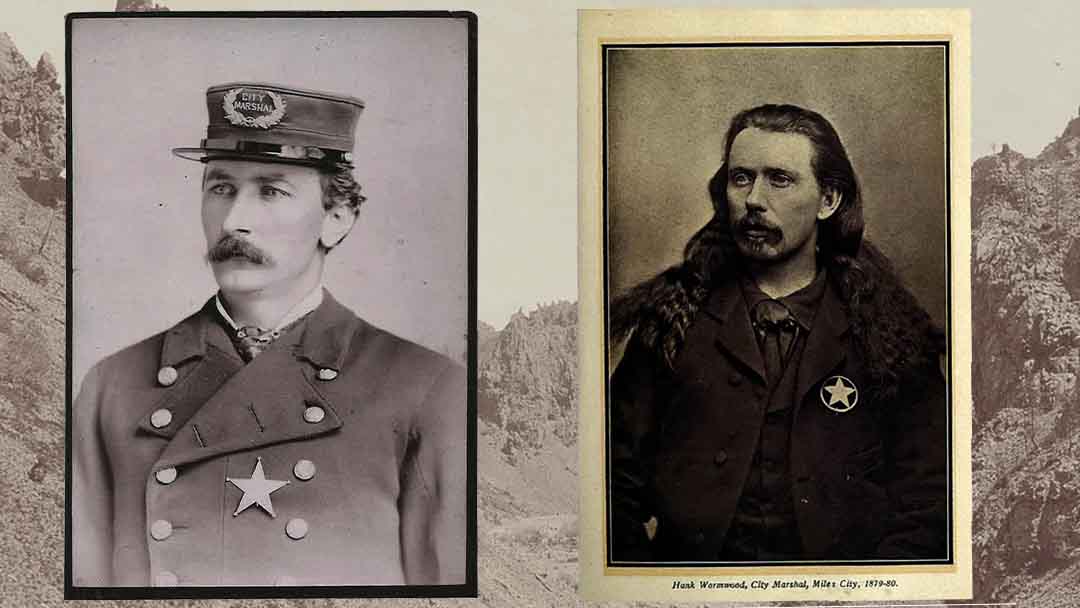
Harvey S. “Arapahoe Harve” Faucett, left, and Henry “Ranger Hank” Wormwood both served as scouts and lawmen during their careers on the frontier of the American West.
“Kill Deer” Rifle from the “College Kid”
Faucett wrote to Chafee for decades even as the two men did not see each other in person for a considerable time. In his letters, Faucett makes mention of the rifle on numerous occasions. On Sept. 2, 1877, Faucett wrote to his “Dear Friend Zack” in reply to Chafee asking if Faucett and Wormwood would like anything to remember Professor Newton by. All they asked for was a photograph of the professor if one was possible. He also noted that the ramrod and wiper for his rifle was left at the stable in Sydney, Nebraska, where their journey ended. A handwritten note by Chafee was added to the letter stating, “Z.C. Providence 9th mo 11th 1877 The best presents will be two ‘Providence Tool Co. Rifles’ properly engraved.” The last two words were underlined several times followed by the name “Burough.”
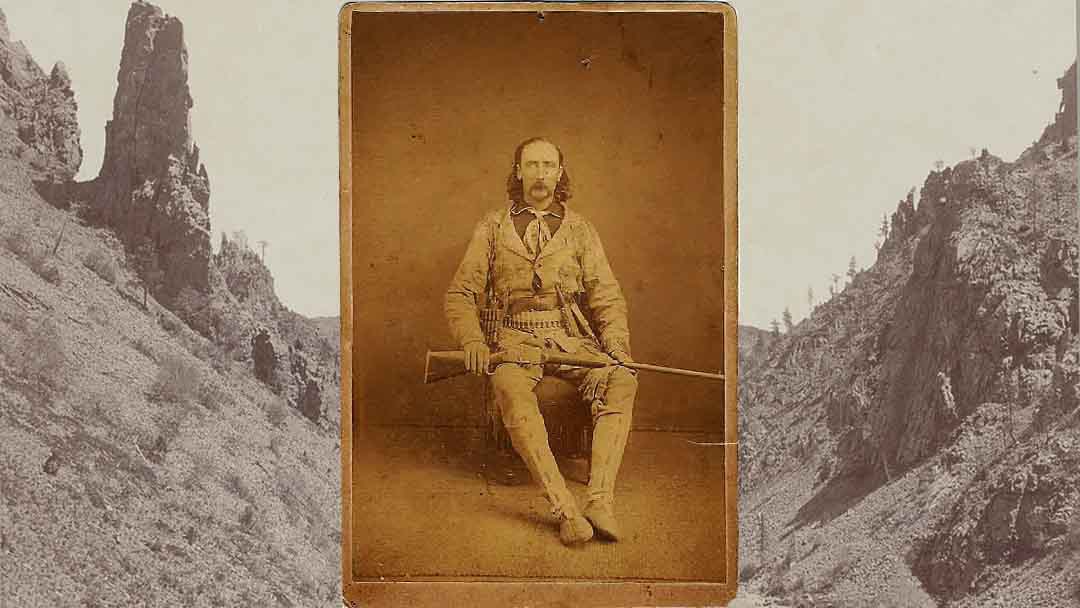
By Nov. 22, 1877, the rifles had arrived in the legendary frontier town of Deadwood in the Dakota Territory. Faucett wrote to Chafee, “I am well pleased with my gun and must congratulate you on your good judgment in choosing a gun for the frontier more especially on account of the calibre amount of powder &c. I am unable to express my feelings of regards to the giver, for such unmerited tokens of friendship, but suffice to say I will ever keep my gun in grateful remembrance of the giver and trust Hank (referring to Henry Wormwood) will do the same…I have not had any photos taken yet, but as soon as I get rested and cleaned up a little, (get some of the ruff off) I will have some taken…The one Hank sent was taken at RC agcy, but in a short time I will send you one. I don’t want to get any unless they are good ones, and the artist here now is not good. But there is a new gallery fitting up as soon as tis done, I will sit for a negative.” A copy of a fantastic photograph of Faucett dressed in buckskins with a cartridge belt, knife, revolver, and this rifle presented across his legs accompanies the rifle, likely the same portrait he sent his dear friend in Providence, Rhode Island.
Faucett continued to write to Chafee over the years, and the rifle came up again. On April 27, 1913, he told Chafee that he was writing down his frontier experiences and “I still have the old rifle you sent me and love it as a true and tried old friend.” Five years later, he wrote to Chafee saying, “I am now 73 years of age, but there is a betting chance that we will yet have to fight the Germans here at home, and in this event, I am ready to go and help the boys.” He also asked if Chafee could send him a replacement peep sight for his rifle. He notes, “The peep sight I want is for the back sight. I have all in place but the peep or thumbscrew sight.” His drawings show that he was looking for the aperture still missing from the rifle now. So even at 73, Faucett was prepared to fight for his family, his friends, and his country with a single shot black powder cartridge rifle. It certainly paints an interesting portrait of Faucett that fits the story of his life in the West.
This closeup of Harvey S. Faucett’s Providence Tool Co. Peabody-Martini “Kill Deer” rifle, reads “Kill Deer/Peabody & Martini Patents” and subtle scrolling on the receiver.
Sad Fate of Professor Newton
While the newspaper account may have been far-fetched, the true origin story of this fascinating historical rifle in the recipient’s own writing is like something from a classic Wild West novel with four central characters. To reiterate, Harvey S. Faucett was also known as “Arapahoe Harve,” and alternately the “Eagle of the Trail.” His frontier companion was Henry Wormwood, who was recognized in the Dakotas as “Ranger Hank.” The two men guided Eastern intellectuals Professor Henry Newton and his young assistant “the college kid” Zechariah Chafee through the Black Hills in 1877 during a time of Native American raids following the Great Sioux War.
Newton and Walter P. Jenney led the Newton–Jenney Party of 1875, a scientific expedition sponsored by the U.S. Geological Survey to map the Black Hills of the Dakota Territory after Custer’s expedition there. Escorted by government troops and others, including Calamity Jane who didn’t get along with Faucett, Newton and Jenney confirmed the presence of gold, fueling the gold rush and the tensions that led to the Great Sioux War of 1876-77 which included the famous Battle of Little Bighorn.
In a full account of his adventures, Faucett indicates Professor Newton first hired Wormwood and later himself as guides as he continued to study the mines and mountains of the Black Hills in 1877 accompanied by Chafee, who served as his assistant. Chafee hunted and fished during the expedition and once got lost after going out to hunt deer and was rescued by Wormwood and Faucett. Wolves surrounded their camp hoping to get some of the venison. According to Faucett’s account, the men fought off “the brutes with revolvers, I brought out my (Faucett’s) King patent Winchester rifle and loading the magazine with 15 cartridges also, one in the gun waited until they were gathered thick under the tree on which hung Mr. Chafee’s meat and then let them have it.” Coyotes then came and ate the dead wolves. The next day, Faucett claimed “a hundred or more wolves followed us” and that Chafee used his own Winchester to wound several which were then attacked by the remaining wolves.
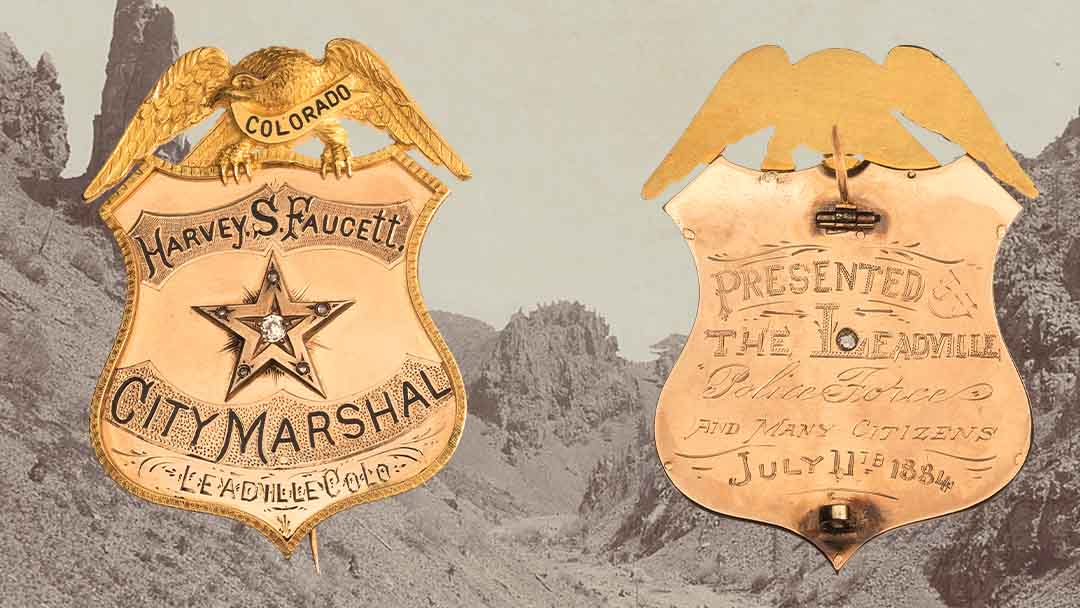
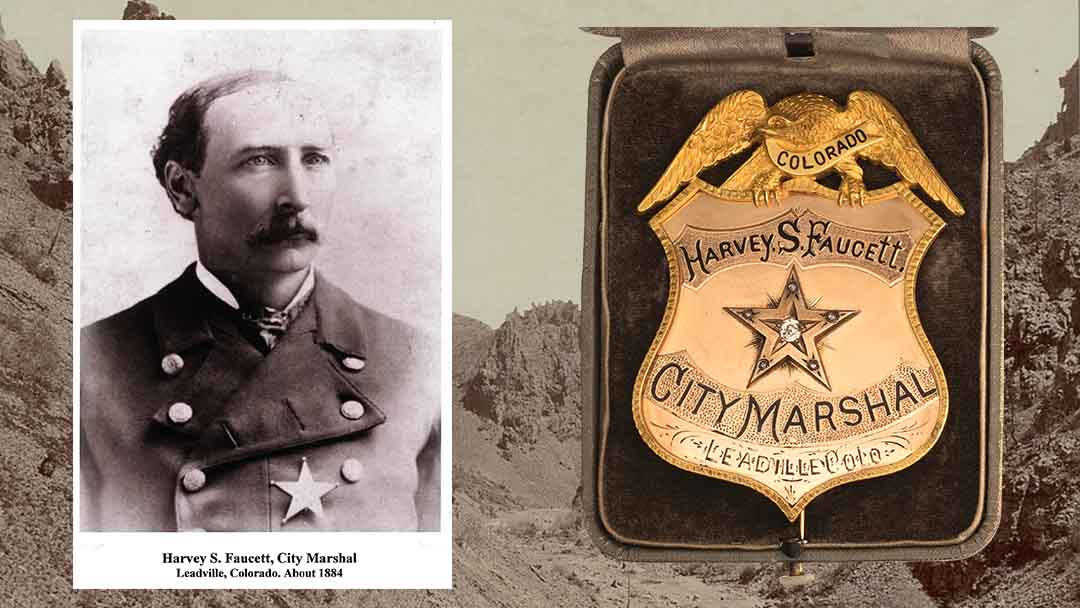
This stunning shield shaped badge has an eagle with a “COLORADO” marked banner in its mouth on top and “HARVEY S. FAUCETT/CITY MARSHAL/LEADVILLE COLO” on the shield. All but the last marking are highlighted with black enamel. The five-pointed star at the center has a five small diamonds and one larger diamond in the center. The back of the shield is inscribed “PRESENTED by/THE LEADVILLE/Police Force/AND MANY CITIZENS/July 11TH 1884.” The badge’s presentation is recorded in the Leadville Daily Herald on July 12, 1884, which reads: “BADGE PRESENTATION Harvey S. Faucett Presented with a Handsome Badge by the Police Force. Last night at 12 o’clock, when the police changed shifts, there was quite a little surprise sprung on City Marshal Faucett by the boys. Officer Ledford made a few introductory remarks, in which he referred to the high esteem in which the police force held their chief, and then asked him to accept a slight token of their high regard, at the same time presenting him with a handsome gold badge. The marshal was taken completely by surprise, but he managed to thank the donors for the beautiful present, and acknowledging in his modest way his appreciation of the esteem which was evidenced by the elegant badge…”
Faucett wrote that the professor complained of feeling ill shortly after the run-in with the wolves but continued on for a week or more until he was convinced to return to Deadwood for medical attention. Wormwood and Faucett remained at the camp as the easterners returned to Deadwood. While they were away, Wormwood led a party of men to help an immigrant train that was attacked by Native Americans near Spear Fish Stockade and helped drive off the attackers and guided them to safety before returning to the camp two miles from the stockade where Faucett remained with the livestock.
On Aug. 5, 1877, Wormwood went to Deadwood and learned of Newton’s death that morning. Heartbroken at the loss of their companion, the three remaining men – Faucett, Wormwood, and Chafee — agreed to travel with the professor’s body about 300 miles in order to get his body to the railroad at Sidney, Nebraska. They were armed to the teeth with revolvers and Winchester Model 1873 rifles. Comically, the kid’s sidearm was a .22 revolver, presumably a Smith & Wesson No. 1. They were three men traveling across a vast lawless region.
Given the recent Great Sioux War and continuing raids, the three men were concerned they might be ambushed out on the frontier, especially as they crossed the inhospitable Badlands towards Nebraska. Again a wolf pack threatened their camp, but this time they withheld their fire for fear the gunfire might attract a much more dangerous foe. After eight days of travel, the men reached the safety of Sydney. Faucett and Wormwood saw Chafee and the professor’s remains off to complete their journey to New York by train.
Harvey S. Faucett was as good as his word in his letter to Zechariah Chafee when he wrote to thank him for the Peabody-Martini style rifle he received, writing that he would get his picture taken with it.
The Chafees of Rhode Island
Chafee was part of a long line of Rhode Island’s Chafee family to bear the name Zechariah, and he became a successful businessman back in Providence. His father (1815-1889) ran the Builder’s Foundry in Providence, which produced artillery and ammunition during the Civil War, and was the treasurer of the Quidnick Company in 1877, the trustee of the A. & W. Sprague Manufacturing Company, and the president of the Bank of America in Providence in 1880. He may have also been involved with the Providence Tool Company as suggested in the tall tale version of the story, but the family’s connection to the company is not clear aside from it being based in their hometown. The younger Chafee’s own son, Zechariah Chafee Jr., was a professor at Harvard Law School from 1916-1956 and drafted the Federal Interpleader Act of 1936. He also landed on Senator Joseph McCarthy’s list of the seven people “most dangerous to the United States.”
“Arapahoe Harve” Roves the Range
From Sydney, Wormwood and Faucett set off back across the same path together to continue their rugged lives on the plains. Both men later became respected lawmen. Wormwood went to Miles City and became a city marshal before dying in 1882 from pneumonia. Faucett had a much longer career as a lawman in various locales across the West.
Faucett wrote, “We each received a Peabody Martini rifle with one hundred cartridges of 45 calibre and seventy grains of powder for the guns. The rifles were expressed from Providence R.I. A present from Mr. Zach Chafee, Jr. and were suitably engraved. My rifle bore the following inscription: H.S. Faucett for services, 1877. From Z. Chafee. Jr. Providence. R.I. The engraving on Mr. Wormwood’s rifle was similar. This rifle I still have and hold it dearly as an old faithful friend that has been with me on man a long journey laid beside me a the camp-fire and I trust that we will continue so until the red current of life ceases to course my veins, and death ends the hunter, and my varied and eventful career.”
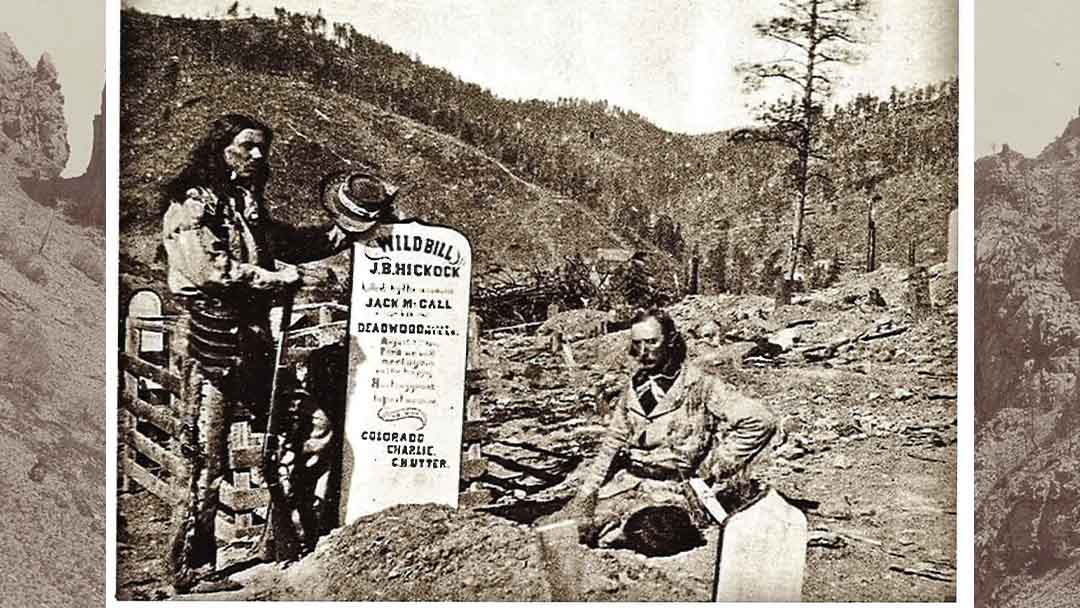
The men in this photo have long been identified as Colorado Charlie Utter and either his brother Steve Utter or Arapaho Joe. A similar photo in Greg Lampe’s documentation for the Providence Machine Co. Peabody-Martini rifle states, “However, it has recently been identified correctly as: “Ranger” Hank Wormwood and Harvey Faucett, “Arapahoe Harve.””
Faucett had been born in the East in Butler County, Ohio, but by the 1870s he had travelled frequently across the West as opportunities presented themselves. His list of jobs and careers is long and varied. He ran supply trains based out of St. Louis for the U.S. government during the Civil War. In 1863, he was part of an expedition to the Gulf of Mexico that shipwrecked when the steamer Nassau struck a sandbar at Brazos Bay, Texas. He worked as a scout and courier from Brownsville to various posts. In 1864, he returned to St. Louis before traveling to Fort Leavenworth, Kansas, where he joined a party headed to the Montana gold fields. In 1870, he traveled to Elwood, Indiana, and worked as a druggist briefly before returning to the West, working as a surveyor in Nebraska.
The Many Jobs of Arapahoe Harve
By 1873, Faucett was in real estate and shipping grain before heading again to Texas. He returned to Seward, Nebraska in 1874 and worked as a merchant before joining Custer’s expedition into the Black Hills. Faucett stayed behind after the soldiers left to prospect the streams and reportedly found a great deal of placer gold on the Indian land.
The following year, federal troops kicked Faucett and other trespassers off the Indian land but he returned with the next geological survey. In 1876, Faucett worked for the government as a courier, scout, and guide during the Great Sioux War. The Blackfoot reportedly captured Faucett during this time and was present with General Ranald McKenzie’s troops at the Battle of Crazy Woman Creek that fall. He is said to have fought off a wolf pack attacking the mortally wounded Cheyenne warrior Riskohonge and was given his scalp jacket and blanket which he later posed with in photographs. He reportedly learned of the massive Lakota and Cheyenne encampment and rode off to warn General George Crook but didn’t arrive in time to prevent the massacre at the Battle of Little Bighorn. He continued to work for Crook as a courier, guide, and scout.
Harvey S. Faucett had a varied law enforcement career, serving as city marshal in Leadvill, Colo., city marshal of Robinson, Colo., a deputy sheriff in Robinson, Colo. While in Leadville, Faucett arrested Doc Holliday for a non-fatal shooting and helped get him out of town.
Faucett Becomes a Lawman
After his adventure with Chafee, Faucett partnered in Faucett & Holden Freight to move freight between Bismarck and Fort Pierre later in 1877. In 1878, Faucett became an Indian trader at the Red Cloud Agency and worked for the Indian Department until the spring of 1879. In 1880, he headed to Leadville, Colorado, to prospect for silver. There he joined the 3rd Colorado Volunteers as a lieutenant and later became the captain of F Company that were involved in the miners’ strike in Leadville. He became a special policeman and later a detective in Leadville under gunfighter Mart Duggan, the town’s marshal. That same year, he became a full-time policeman and by the next year, he was city marshal of the nearby town of Robinson with William G. Milner as his deputy.
In 1882, Faucett was elected as constable of the 1st Ward and married Mary Young of Leadville. In 1884, he was appointed city marshal in Leadville and became known as a tough lawman who cleaned up the town and was presented a gold badge on July 11. The frontier town had grown to some 40,000 residents. Among them was Doc Holliday who worked as a card dealer in the saloons after arriving in 1883. On Aug. 19, 1884, Holliday sent a friend to tell Faucett that a bartender from the Monarch Saloon, Billy Allen, was coming for $5 Holliday owed him or there would be a shootout. Allen arrived to retrieve his debt before the law and Holliday shot him in the arm. Holliday was arrested and charged with attempted murder but was acquitted. Faucett helped get Holliday sent off to Denver to avoid future bloodshed.
Faucett later worked a brief stint selling fruits and vegetables before returning to law enforcement. He became a deputy sheriff in Lake County Colorado in 1887 and then had a stint as marshal for Robinson. He served as a U.S. Deputy Marshal and an officer in Seattle, Wash. He was involved in a shootout that wounded “Kid” Donnelly. In 1895, he moved to Elwood, Ind., for a time but then moved back west. He lived in Kansas City, Kansas, for his remaining years and as an older man worked as a special officer in the Kansas City Market. While there, he received a surprise visit from his old friend Chaffee. He died after a fall and possibly a bout of pneumonia. He was rumored to have five scars from Native American arrows, tomahawks, and knives. His death was reported in newspapers across the country, from Los Angeles to New York City. Some of the obituaries included versions of the story from 1877 with varying degrees of accuracy. The Los Angeles. Times, for example, reported that Newton had been killed in a battle with Native Americans and that “Araphoe Harve” had fought them off with his rifle after taking an arrow to the shoulder.
Harvey S. “Arapahoe Harve” Faucett and “Ranger” Hank Woodworm helped “college kid” Zechariah Chafee return the body of Professor Henry Newton east. The men each received a Providence Machine Co. Peabody-Martini rifle from Chafee.”
Provenance of the “Kill Deer” Rifle
After his death, Faucett’s beloved rifle and his golden presentation badge remained with his family for generations before being purchased by Michael Simens who then sold them to Greg Lampe. Thanks to the preservation of these historic artifacts, we remember the fascinating life of Harvey Faucett, a man who deserves to be a true legend of the American West. His life story, and the story of the events that led to the presentation of this rifle, read like something out of a western dime novel, but they really happened. Faucett truly played his part in the settlement of the West and in civilizing dangerous frontier towns that sprang up around the gold and silver mines in the late 19th century.
King Carol II of Romania was known as the “Playboy Prince” for his wandering eye and trying to play footsie with both sides in the lead-up to World War 2 only to be dethroned.
Born in 1893, his great-grandmother was Queen Victoria of Great Britain. A womanizer, his behavior was disapproved by his great uncle, King Carol I, who believed he lacked discipline. He renounced the throne as crown prince in 1925, only to retake the throne from his 5-year-old son in a coup d’etat before being dethroned for good in 1940.
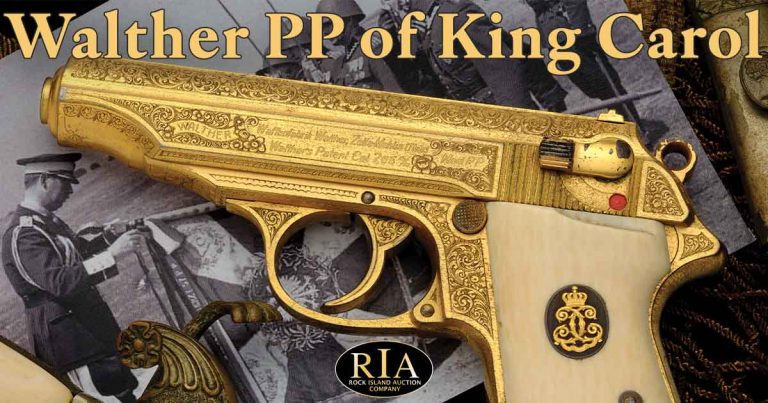
King Carol II, despite his complicated history, ruled a country that had valuable oil fields wanted by German leadership. He sought to balance Germany’s influence by courting France first, then Great Britain. As war broke out, Romania declared its neutrality. A pre-war factory engraved presentation Walther PP was commissioned by German leaders to present to King Carol II and is available in Rock Island Auction Company’s August Premier Auction. The gold-plated pistol has complete coverage with English scroll engraving on the slide, frame, barrel, trigger, and trigger guard highlighted with numerous Edelweiss flowers. The grips have an inset on the left side that features the Romanian crown over the initials “CC.”
This the the earliest known factory engraved Walther Model PP, displaying early features like the fat safety lever, split firing pin, large ring hammer, 90 degree safety, and early style magazine. The gun is profusely embellished with very tight fancy English scrolling and numerous edelweiss flowers. The gun was likely given to King Carol II of Romania by Adolph Hitler.
King Carol and His Early Philandering Ways
It should say something that in 1957, four years after the death of King Carol II, author Barbara Cartland, best known for her bodice-ripping romance novels, penned a biography of him. The Playboy Prince had an eye for the ladies from an early age and was accused of fathering two illegitimate children before he was 19. His great uncle, King Carol I had him commissioned in the 1st Prussian Guards in 1913 in hopes that it would plant some discipline in Crown Prince Carol.
King Carol I died in September, 1914 and Ferdinand I ascended to the throne. His son Carol II visited the Russian court in 1914 for the possibility of an arranged marriage to Grand Duchess Olga, but there was no romantic spark between the two. Carol preferred commoners for their spontaneity, informality, humor, and passion.
In 1918 after deserting the Prussian Guards, Carol spirited away Joanna Marie Valentina “Zizi” Lambrino, the daughter of a Romanian general and a commoner, and secretly married her in Odessa, Russia. The marriage was annulled the following year though the couple continued to live together and had a child in 1920. Pressured by the royal family to give up the relationship he went on an around-the-world tour.
This view of King Carol II’s gold-plated Walther PP shows the grip with a Romanian crown and the King’s initials.
King Carol Marries a Princess
In 1921, Carol married Princess Helena of Greece and Denmark. They proved to be a mismatched pair. The couple had a son, Michael, who was scandalously born seven months after the wedding. She disapproved of his cheating ways, while he found her stiff and formal.
Being married with a legitimate heir didn’t stop Carol from his libertine ways. He also believed she had taken up with another royal, Prince Amedeo of Savoy, Duke of Aosta. The couple split when Carol found the woman he would be with for the rest of his life, divorcee Elena “Magda” Lupescu.
King Carol II of Romania and his mistress, Elena “Magda” Lupescu, who he married in 1947 in Rio de Janeiro.
King Carol Renounces the Throne but Returns
As Crown Prince, he renounced the throne in 1925 and moved to Paris where he lived openly with Magda. He and Princess Helena divorced in 1928. His father died in July 1927, making 5-year-old Michael king and a regency was installed.
Tired of the footloose life in Paris, Carol returned to Romania in 1930 and reclaimed the throne to the pleasure of Romanian political leaders, effectively committing a coup d’état of his son. Michael, now 9, took the demotion to crown prince in stride. He is quoted by The New York Times as saying “I have been terribly tired of wearing long trousers and a stiff hat and going to places I don’t want to go at all.”
Now King Carol II, he ignored the constitution in creating a royal dictatorship and became personally involved in governing Romania. He strengthened ties with France as a way to offset territorial threats from Hungary.
A closeup of King Carol II’s Walther PP revolver shows the beautiful English scroll engraving and gold-plated finish.
King Carol Faces Fascist Machinations
In the mid-1930s, Nazis started organizing ethnic Germans within Romania and increased relations with right-wing political parties like the National Christian Party and Iron Guard. By 1936, King Carol recognized that France was unable to respond effectively to German re-militarization so he worked to improve relations with Germany and received an assurance of neutrality in territorial disputes with Hungary.
To curry favor with Germany, King Carol installed Octavian Goga, a right-wing Christian nationalist, as prime minster. He also signed a treaty with Germany bringing Romania into Germany’s sphere of economic influence. King Carol believed Goga would be easy to control and ignored Goga’s persecution of Romanian Jews.
About this time, King Carol likely received this pre-war, gold-plated, factory-engraved Walther PP from Adolph Hitler himself as he grudgingly accepted Germany’s protection while trying to keep fascist elements at bay within Romania. This eye-catching firearm features Zella-Mehlis Guild/Walther engraving of tight English scrolling over its near entirety and has numerous Edelweiss blossoms on it that highlight the pistol’s gold finish. The grip on the left features the Romanian crown and the initials “CC.” The earliest known factory engraved Walther PP, it has a low serial number, fat safety lever, a split firing pin, large ring hammer, 90 degree safety, and early magazine style.
This is another closeup view of the fine scroll engraving and gold-plated finish of this Walther PP given to King Carol II of Romania by Adolph Hitler.
Goga, the prime minister, realized his weak position within the government and built ties with the right-wing Iron Guard. King Carol seized emergency powers and fired Goga, naming a completely loyal follower as new prime minister. He also imprisoned the head of the Iron Guard and several other high-ranking party members. As the Iron Guard started terrorizing Romania, Carol ordered the execution of jailed Iron Guard leaders in November, 1938.
At the same time, he reached out to Great Britain, knowing France was too weak to offset Germany. He also began courting Poland as an ally. Germany pressured Romania to give it control of Romanian oil fields, but Carol denied the demand with the support of Great Britain.
Alarmed by the Molotov-Ribbentrop Pact and the ensuing invasion of Poland in 1939, Carol declared his nation’s neutrality. At Germany’s urging, the Iron Guard assassinated the current Romanian prime minister on Sept. 21, 1939. Royal supporters rounded up nine Iron Guard members and executed them, followed by the execution of 242 more Iron Guard members a short time later. None of the Iron Guard members stood trial.
King Carol II gave up his claim to the throne as crown prince as he chased women but took the throne back from his 9-year-old son, Michael. He ruled from June 1930 to September 1940 when he was pushed out by pro-Fascist forces.
King Carol gets Out-Maneuvered
King Carol thought he had the Iron Guard under his thumb, and as Germany gained control of Belgium, the Netherlands, and France, Carol started leaning toward supporting Germany. Meanwhile, that same success was emboldening the outlawed Iron Guard.
As the political maneuvering was going on and the Great Depression continued, Magda was the most hated woman in Romania with her extravagant purchases of clothes and jewelry. The Romanian fascist party, the Iron Guard, partly financed by the Nazis, called the king weak and dominated by Magda.
In June 1940, the Soviets demanded control of the same oilfields Germany wanted. The next month, Carol leaned into his relationship with Germany and appointed an Iron Guard member, Ion Gigurtu as the new prime minister. He also accepted territorial concessions to Hungary negotiated by Germany and Italy. With these latest actions, King Carol was losing favor with Romanians as the summer wore on.
As a last ditch effort to regain popularity as September approached, King Carol appointed a new prime minister, Ion Antonescu, an opposition leader who was tied to the Romanian elite and believed wouldn’t turn on the king. Carol had miscalculated. Antonescu demanded Carol’s abdication on Sept. 6, 1940, only days after the new prime minister took office. King Carol and Magda fled the country by train, lying on the floor of their carriage to dodge Iron Guard gunfire as they neared the border. The couple fled with three poodles, two Pekinese, King Carol’s stamp collection, and their servants.
The many dalliances of King Carol II received a romance novel treatment in the biography by author Barbara Cartland released in 1957, four years after the king’s death.
King Carol in Exile
King Carol and Magda traveled to Mexico where they lived in Mexico City. He sold part of his stamp collection to raise funds. He tried to set up a free Romanian government but was so unpopular he couldn’t spur interest.
The altitude in Mexico City affected Magda’s health so the couple moved to Rio de Janeiro where they married in 1947 before moving to Portugal where he died in 1953 at age 59. Magda lived until 1977. King Michael didn’t attend his father’s funeral in Portugal nor the re-interring of his remains in Romania in 2003.
Cartland’s book came out in 1957. Usually her books featured handsome cads who find true love in the arms of beautiful, young, virginal women. The tagline for the biography, titled “The Scandalous Life of King Carol,” had the tagline “The intriguing story of a modern monarch who chose a bizarre path to love.”
Even The New York Times noted King Carol’s many self-inflicted scandals in his obituary, noting “Carol suffered from a romantic weakness which made it impossible for him to accept cheerfully the daughter of royalty assigned to him by protocol.”
King Michael of Romania both preceded and succeded his father, King Carol II. He is credited with firing the Nazi-leaning prime minister and renouncing Romania’s alliance with Germany in 1944. He was forced to abdicate in 1947 by the Soviets. After the fall of communism, King Michael who was still immensely popular in Romania wasn’t allowed to return except for a few brief visits until his citizenship was restored in 1997. He died in 2017 at the age of 97. The photo on the left is King Michael in 2007. The photo on the right is Time magazine from 1927 when he was first crowned king.
Michael, Son of King Carol
Following the abdication of King Carol, Michael was king once again at the age of 18. He was given few royal duties but as he matured, he planned, secretly meeting with anti-government forces that were gaining momentum as the German war machine began to stall.
In the summer of 1944, he publicly spoke against Antonescu and demanded he surrender to the Soviets. The prime minister refused, and when summoned to the palace Michael again demanded the prime minister surrender to the Soviets. After declining again, Michael had him arrested. The prime minister was held in the vault that once held the stamp collection of King Carol.
When German pilots bombed the palace in an attempted assassination, King Michael immediately renounced his country’s alliance with Germany resulting in vague threats from the Germans, which he promptly dismissed. Loyal Romanian forces attacked German forces inflicting serious losses.
King Michael received the Legion of Merit from the United States and the Order of Victory from the Soviet Union. He was forced to abdicate under pressure from Moscow in 1947. He lived in exile in Switzerland. He returned in 1990, welcomed by adoring crowds, but the elected government banished him again. He returned in 1992 and still found to be immensely popular but not allowed to return again for five years. During that 1997 visit his citizenship and his castle were returned. King Michael died in 2017 at the age of 96.
The gold-plated and factory engraved Walther Model PP of King Carol II of Romania.
King Carol and a Gold-Plated Walther PP
Known as “the Playboy Prince” for his footloose ways in his youth, King Carol II embraced authoritarian tendencies as he tried to manipulate allies and enemies alike in an effort to maintain a power that wouldn’t last. This Walther PP is an amazing piece that recalls the intricate diplomatic maneuvers of the inter-war period and the history of a ruler who scandalized his country before taking the throne then was forced to abdicate as World War 2 flared around him.
One million single-shot Liberator pistols were the answer to a problem that didn’t seem relevant to the American war effort in World War 2 when they were manufactured by a headlight maker in just three months. After the war, hundreds of thousands of the clandestine weapon were destroyed or simply dumped in the ocean.
These crudely-made guns were intended to be dropped behind enemy lines for resistance fighters. Rock Island Auction Company is proud to offer a collection of 10 Liberator pistols that range from prototypes to the last one off the production line and even its CIA successor, the Deer Gun, in the August 25-27 Premier Auction.
A Literal Tower of Liberator Pistols
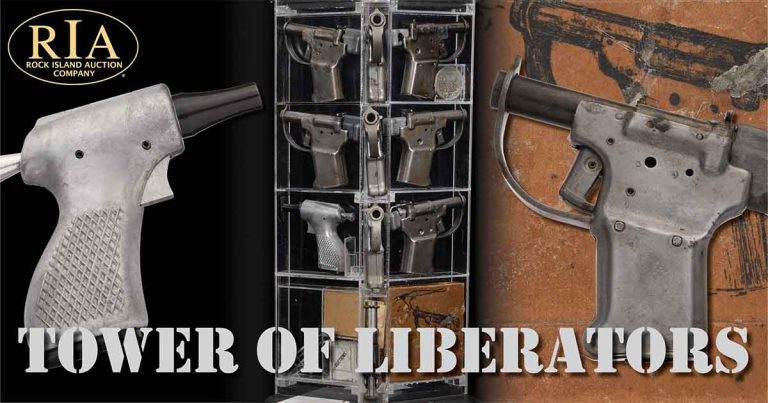
The collection of Liberators is displayed in a rotating circular platform with three columns of acrylic, allowing the guns to be viewed from all angles. Among the collection are an incredibly rare first prototype and the 1 millionth and last made, as well as rare pre-production and production models.
This collection was once part of author Ralph Hagan’s collection, assembled by him, earning a “One of the Ten Best Arms Exhibits” and the NRA silver medal that is included. Among Hagan’s works is “The Liberator Pistol” written in 1996. Hagan, who passed away in 2006, tracked down his first Liberator pistol in 1975.
Here are a couple of different perspectives of the Tower of Liberators. The tower includes one of a kind prototypes, a Liberator pistol in an unopened box and the CIA successor, the Deer Gun.
The Start of the Liberator Pistol
The Liberator’s name didn’t come until after the guns were manufactured. The gun’s government-assigned name was the FP-45, or Flare Projector 45 as it was conceived by the U.S. Joint Psychological Warfare Committee in 1942. The committee thought the idea of a single-shot pistol that could be dropped behind enemy lines and be used to eliminate an enemy and take their rifle was a good one. Of course, the committee didn’t consult with anyone in the U.S. military about this concept.
The name was a bit of misinformation for what would be a secret project since it wasn’t intended as a flare gun. As it was designed, parts also received obfuscating names. The barrel was a “tube” and the trigger was a “Yolk,” while the cocking knob was “a control handle,” and a trigger guard was listed as a “spanner.” The Liberator was also called the “Woolworth Gun” after the dime store.
Inland Corporation was initially contacted about designing the .45 ACP gun and George Hyde, who would design the M-3 submachine gun, was among fewer than 10 people involved in the design. Hyde, Inland’s gunsmith, made the first Liberator prototype by hand. Because of Inland’s production of the M-1 Carbine, the project was passed along to Guide Lamp, another division of GM, that made head lamps for vehicles. Contracted to manufacture 1 million pistols, production began at a walled-off part of Guide Lamp’s Andersonville, Ind., plant and the employees were sworn to secrecy.
This standard production Liberator pistol from the Tower of Liberators has an inspection stamp on barrel strap just before the loading gate.
The first pistols misfired in live fire tests. The cocking knob could get out of alignment with the firing pin causing it to fail. A guide pin was added to the cocking knob to keep it in place in what was called the Model 2 pistol. The guide pin needed to be stronger so the cocking knob was made of cast zinc as the Model 3 came to be. Model 3 production began the second week of June 1942 and ran until the last of the 1 million Liberators came off the line on Aug. 21, 1942.
Parts for the Liberator were made at a number of plants. Frigidaire chambered the gun, reaming 600 barrels per hour. Saginaw Steering Gear Division made barrel bushings, Detroit Transmission made barrel collars, and Moraine Products Division built the barrel and trigger guard assembly for Guide Lamp.
Since the gun was intended to be clandestine, none of the Liberator’s 23 parts were serial numbered nor the Liberator marked – except for the 1 millionth gun that was marked “1,000,000 LIBERATOR/1942 GUIDE LAMP GMC/Fred B. Thacker/US ARMY 0360133.” Thacker was the U.S. Army liaison for the project.
This Liberator Model 3 is likely a “show and tell” model painted with aluminum paint and has an enlarged hole on the right side to show the sear operation and it has the number “3” stamped on the front of the trigger guard. It appears to have been fired a number of times. This exact pistol is photographed and described on page 63 of Ralph Hagan’s book, “The Liberator Pistol”.
The Liberator Pistol: The Basics
Let’s take a moment to consider this easily concealable gun. The Liberator was five inches long and weighed about 1 lb., with a smooth bored barrel meaning bullets would tumble after leaving the barrel and keyhole a target. The pistol’s effective range was about 25-50 feet and had significant recoil because of how light the gun was.
The muzzle velocity for the Liberator was 730-740 feet per second, while an M1911 had a muzzle velocity of about 850 feet per second.
The Tower of Liberators includes an unopened waxed box containing a liberator, instructions, a dowel to remove the spent casings and 10 rounds of .45 ACP ammunition.
Reloading of the one-shot gun was expected to take about 10 seconds and they were made to be fired only once or twice. The Liberator was a fragile pistol that was found to split at its welded seams. Its maximum life expectancy was, at most, about 50 rounds.
The collection in the “Tower of Liberators” include what is likely the very first Liberator prototype with a red-oxide finish, a second prototype from Inland, a Model 2 developed after the misfire issues of the Model 1, a Liberator with an unknown inspection stamp, an incredibly rare Liberator in its unopened box, the 1 millionth Liberator, a Liberator with “F” inspection stamps, a demonstration model, a cutaway Liberator, a Liberator with unique German proof marks, and a CIA Deer Gun.
This pistol from the Tower of Liberators is one of five pre-production prototype FP-45 pistols made at the Inland plant in Dayton, Ohio before production was moved to the Guide Lamp facility in Anderson, Indiana. This pistol is photographed in Ralph Hagan’s “The Liberator Pistol” book on pages 54 and 55, in which it states this pistol was kept by Paul Hamisch, one of two skilled draftsmen involved with the FP-45 project at the Inland facility. An “H” inscribed on the right of the cocking knob was done by Hamisch.
Other prototypes that Hagan discovered in his research included a Liberator with a lever ejector, a model with a lever to hold the breech block open when loading, one with a breech block extractor, an experimental two-shot model with a sliding breech, and a sub-caliber barrel for .32 ACP.
What Next for the Liberator Pistol?
From concept to the manufacture of 1 million Liberators took less than six months – one Liberator manufactured every 6.6 seconds. The Liberators shipped in small waxed cardboard boxes with illustrated instructions in comic book form so that anyone could load and use it regardless of language barriers or literacy. Also included was a dowel for extracting a cartridge and a box of ammunition. The cost to make the Liberator was $1.73 per gun or $2.10 when the packaging was included. The cost to make an M1911 in 1942 was $15.
Great Britain requested 500,000 of the guns in October 1942 with the intention of dropping them in occupied parts of Europe. Gen. Dwight D. Eisenhower nixed the idea because it wasn’t a good use of Allied bombers to drop something other than bombs. British Whitley bombers could each carry about 600 guns per mission so more than 800 flights would have to be made to drop the guns leaving no way to effectively distribute them. About 450,000 were eventually melted down or dumped in the Irish Sea.
This pistol from the Tower of Liberators has the right side cut away to show the interior workings and construction of the gun. This exact pistol is photographed in Ralph Hagan’s “The Liberator Pistol” book on page 88.
Gen. Douglas McArthur requested 50,000 Liberators that were distributed throughout the India-China-Burma Theater as well as the Pacific. About 200,000 guns were shipped to Calcutta, India of which about 115,000 met their end in the Indian Ocean.
The Office of Strategic Services, the predecessor of the Central Intelligence Agency, received and distributed the Liberator, too.
Philippines Police did carry the Liberator as an issued weapon for a time after World War 2.
Illustrated instructions to use the Liberator pistol are shown on the left, while the photo on the right shows an insurgent armed with a Liberator pistol.
The Liberator Pistol Preceded the Deer Gun
The CIA has never acknowledged the existence of the Deer Gun, developed early in the Vietnam War when covert operations were anticipated. CIA officials approached American Machine & Foundry’s special firearms division. AMF made Harley-Davidson motorcycles, bicycles, snowmobiles, and pin-setting machines, but also low-key Cold War items like launch silos for Titan and Atlas ICBMs and nuclear reactors. The company added the covert Deer Gun to its portfolio.
The Liberator was constructed with 23 parts while the Deer Gun had 12. There wasn’t a trigger guard, and the Deer Gun was packaged in a cardboard box with a Styrofoam inset with three 9mm cartridges. The Deer Gun, like the Liberator wasn’t its original name. It was originally DEAR Pistol for “Denied Area” Pistol. How that came to be Deer Gun is unknown.
It is believed about 1,000 were produced under contract for $300,000 but became low priority as situations changed in Southeast Asia. About 200 were sent to Asia for field testing. A robbery suspect in New York City in 1975 reportedly was arrested with a Deer Gun and said he bought it from someone off the street who brought it back from Vietnam. The gun disappeared from its evidence locker. Another tale about the Deer Gun is that it was used in the 1970 assassination of a Cuban official in Mexico City. Only about 20 are known to be in circulation.
A CIA Deer Gun, the successor to the World War 2 Liberator pistol, is included in the Tower of Liberators, but one of these extremely rare guns — possibly only 20 in circulation — is also available as a separate lot in the August Premier Auction.
Liberator Pistol, a One-Shot Wonder
The Liberator was an idea hatched without considering the practicalities of waging a war. Once made there was no practical way to get them into the hands of insurgents or resistance fighters on the European continent and whether they would or wouldn’t be able to use them properly. Still it was a symbol of American ingenuity that it was conceived, designed, and manufactured in less than six months in wartime.
Cheaply made with hopes of disposing of the enemy with a single, close-range shot, the Liberator is a piece of World War 2 history that considered the subterfuge without taking into account battle planning, logistics, and troop movements. By simply destroying most of these guns along with nearly all of the CIA’s Deer Guns, these firearms have become fascinating pieces for World War 2 military collectors and this “Tower of Liberators” is an amazing opportunity.
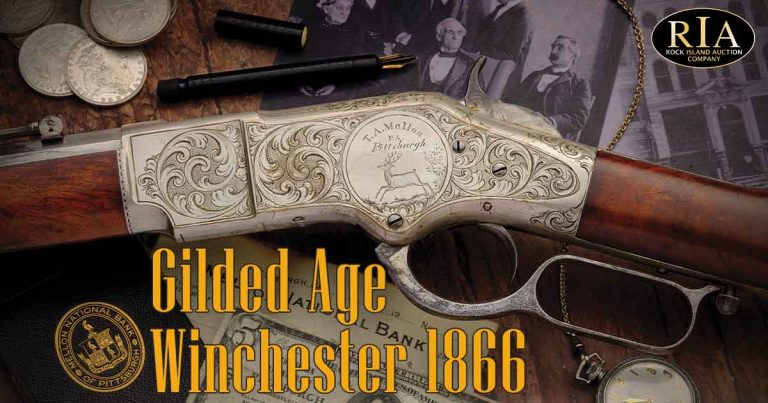
This engraved Winchester Model 1866 is a nickel-plated gun from the Gilded Age of America.
The rifle, has a sprinting stag encircled on the left side of the receiver along with the name T.A. Mellon, Pittsburgh, PA. The surname alone should be telling of the vast wealth connected to it.
The Mellon family name should resonate alongside the Rockefellers, Carnegies, and Vanderbilts in the annals of American capitalism. The Mellons were a wealthy family of Pittsburgh who got into banking and made a fortune during the unprecedented industrial expansion and huge personal fortunes often amassed alongside it that earned the late 19th century the name “The Gilded Age.”
This nickel-plated Winchester 1866 was the work of Master Engraver John Ulrich who engraved for Winchester in the late 1800s. His beautifully executed scrollwork with beaded backgrounds on the action, foreend cap, and buttplate remains crisp and pops from the finish. It has an extra-long 28-inch barrel topped with a dovetailed front sight blade of German silver, and retains a remarkable 75 percent of the original nickel plating.
This nickel-plated Winchester 1866 with its beautiful factory engraving was owned by Thomas Alexander Mellon Jr. the first son of Honorable Thomas Alexander Mellon who founded T. Mellon & Sons Bank and whose family amassed immense wealth.
A Winchester 1866 and the Mellon Family
The story of the Mellon family has its rags-to-riches tale of an immigrant pulling himself up by the boot straps leading to immense wealth. However, that wealth didn’t arrive overnight.
Thomas Alexander Mellon was born to a family of farmers in Ulster, Ireland. His family immigrated to the United States when he was five, settling in western Pennsylvania where the family farmed. Inspired by a biography of Benjamin Franklin he read as a teenager and not wanting to work a plow the rest of his life, he became the first of his family to graduate from college in 1837.
After college, Mellon became an attorney and married the daughter of a prominent landowner in 1843. They had eight children. Mellon became a judge in 1859 and invested heavily in coal and real estate. He left the bench a decade later to found a bank, T. Mellon & Sons in Pittsburgh. When he retired, the bank was handed to sons Andrew and Richard.
It was through the bank the family gathered its fortune. Savvy business dealings led to stakes in what would become U.S. Steel, Alcoa, and Gulf Oil. The bank also funded other recognizable American companies like Westinghouse, General Motors, and H.J. Heinz.
A closeup of the right side of this nickel-plated Winchester 1866 shows the masterful scrollwork and beaded background of the engraving by Master Engraver John Ulrich.
Thomas Alexander Mellon Jr. and a Winchester 1866
The T.A. Mellon on the gun is likely Thomas Alexander Mellon Jr., oldest son of the Mellon clan. Born in 1844, when he was out west he met and married Mary Caldwell, the sister of Alexander Caldwell who would go on to be a U.S. Senator from Kansas.
A nephew, William L. Mellon, wrote in “Judge Mellon’s Sons” that his uncle, — T.A. Mellon professionally, but “Tom” to his family — was fascinated by birds and snakes.
“Uncle Tom’s devotion to hunting was a passion. His prowess was based on such a knowledge of wild creatures and their habits as entitled him to be called a naturalist…Uncle Tom likewise has an interest in guns that carried over when the hunting seasons were finished,” William L. Mellon wrote. “How that interest began I don’t know; of course his wife, like my mother, had grown up in the West, in Leavenworth, and his devotion to her and her western background may have sharpened his interest in shooting irons. At any rate, he was a great fellow for guns and collected all kinds. They were kept behind glass in a large case, and in time the collection became quite impressive in size.”
In 1887, Thomas Jr. was listed as general manager of the Ligonier Valley Railroad Company, working with his father who was president, while Andrew William Mellon (A.W. Mellon) was secretary and treasurer while two other brothers served as company directors. Thomas Jr. had a home next to his father in Pittsburgh.
The still-bright nickel plating shows the beautiful scrollwork and beaded background engraving by Master Engraver John Ulrich. The left side of the receiver features a running stag encircled along with “T.A. Mellon / PA / Pittsburgh.”
He served in the Civil War along the Maryland border. Thomas Jr. wasn’t part of his father’s banking venture and opened a nursery and landscaping business when he was 18, and then ran a lumber and building supplies business as well as developed real estate.
William L. Mellon, the nephew, recalled that his uncle always had a cigar in his mouth. Thomas Alexander Mellon Jr. developed cancer in his mouth and throat and died in 1899, at the age of 55, before his family’s wealth would vastly expand through banking investments.
The Mellon Family’s Wealth
Their father transferred ownership of the bank to A.W. Mellon in 1882. With A.W. and brother R.B. (Richard Beatty) Mellon at the helm, they steered the family bank to successful investments time and time again. A.W. and R.B. would become two of the wealthiest men in the world.
The first significant loan A.W. Mellon offered was to Pittsburgh Reduction Company as it sought to be an aluminum producer. The company would become Alcoa and the Mellons’ role in the company would be one of their most profitable. Mellon family businesses would make the family a producer of 10 percent of the oil exported by the United States at one time.
By 1921, A.W. Mellon was one of the wealthiest men in the United States when President Warren G. Harding appointed him Treasury Secretary, a post that he would lead until 1932. His policies to cut taxes lowered the national debt, but saw that short lived as the Great Depression hit, ballooning the debt.
Judge Thomas A. Mellon, left, invested in real estate and coal and founded T. Mellon & Sons Bank in 1869. A. W. Mellon, right, took over the bank and through investments in companies like U.S. Steel and Gulf Oil would amass immense wealth for the family. He would serve as U.S. Treasury Secretary in the 1920s.
An avid art collector, A.W. Mellon donated $10 million for the National Gallery of Art in Washington, D.C., and along with R.B. founded the Mellon Institute of Industrial Research that would become part of Carnegie Mellon University.
R.B. Mellon took over as president of the bank that would eventually become BNY Mellon and served on numerous corporate boards. His estate was estimated at $200 million when he died in 1933. His son, Richard King Mellon would take over as president of the family bank and be a significant philanthropist in his native Pittsburgh and in environmental endeavors.
A.W. Mellon died in 1937, four years after R.B. Mellon. The Mellon family’s wealth is currently estimated at $12 billion.
Another Engraved Winchester of the Mellon Family
Rock Island Auction Company proudly had the opportunity to offer fine sporting arms, flintlock pistols, swords, and cannons from the Richard P. Mellon Collection in the September 2021 Premier Auction. Among the offerings were an extremely rare and finest known special order engraved Winchester Deluxe Model 1903 rifle that was factory engraved by Angelo Stokes. The engraving on the left side of the receiver offered a poker hand of a royal flush of hearts surrounded by scrolling and a border. The right side of the receiver had a panel scene of four boys setting out in two canoes outside a cabin. The scene is also surrounded by a border and scrolling. The firearm realized $126,500.
The fantastic factory engraving by Angelo Stokes on this Winchester Deluxe Model 1903 rifle shows a royal flush of hearts poker hand surrounded by scrolling and a border. This firearm realized $126,500 in Rock Island Auction Company’s September 2021 Premier Auction.
The Winchester 1866 of a Gilded Age Family
This nickel-plated Winchester 1866 with an extra-long 28-inch barrel displays the classic engraving of Master Engraver John Ulrich and is featured on page 285 of “Winchester’s New Model of 1873: A Tribute,” by James Gordon. Along with the masterful engraving of a running buck on the left side of the receiver and the inscribed name of “T.A. Mellon,” the rifle is also engraved with beautifully executed scrollwork and beaded backgrounds.
This magnificent firearm, owned by a proud collector who was the second generation of one of America’s once wealthiest families, is a reminder of the United States’ industrial age of the late 19th and early 20th centuries when prosperity found itself heaped upon those with the forethought and vision to recognize the country’s vast economic opportunities.
The top of this nickel-plated Winchester 1866 shows the fine engraving by Master engraver John Ulrich.
Is there such a thing as the perfect gun for every game? While rifles and scopes improve every year, it all starts with a great round. Enter the venerable .30-06, America’s caliber for over a century and counting.
The .30-06 rifle has proven its value on game fields and battlefields for over a century. This Group Industries Model 1918A2 BAR is an example of an automatic .30-06 rifle. Available this August.
The .30-06 is an American standard centerfire rifle cartridge that’s chambered by nearly every hunting rifle manufacturer today. Known for its ability to shoot flat and can deliver plenty of power downrange, the .30-06 is a jack-of-all-trades game round, ideal for everything from whitetail deer to African plains game. Originally developed for the legendary Springfield Model 1903, both the rifle and the round boast an origin story to match their larger-than-life reputation.
Like the development for most U.S. military arms, the Springfield M1903 went through numerous tweaks before arriving at the reliable .30-06 rifle we know and love today. One of the most important refinements was the perfection of its ammunition.
In 1903, Springfield Armory adopted a new cartridge to replace the .30 Army rimmed cartridge (or .30-40 Krag.) The initial design was not without its faults, however.
In 1898, Roosevelt’sRough Riders had endured blistering fire at the Battle of San Juan Heights from Spanish Mausers. After the war, the Mauser action was carefully analyzed by the U.S. Ordinance Department. The Springfield borrowed heavily from the Model 1893 Mauser and was eventually forced to pay royalties, but the result was a sturdy bolt action rifle chambered in .30-03, or “the 30-caliber Cartridge, Model of 1903,” a cartridge the borrowed from the .303 round favored by the British.
An experimental U.S. Springfield Model 1901 bolt action carbine chambered in .30-03 inscribed to Lieutenant Townsend Whelen sold during RIAC’s February 2022 auction for $8,625.
The .30-03 Springfield cartridge employed a heavy 220-grain round-nosed bullet, similar to .30-40 Krag. The M1903 rifles chambered in .30-03 were found to suffer from poor trajectory and quickly worn-out barrels thanks to excessively high pressure. In 1906, the .30-03 was modified to fall more in line with the lighter, faster, sharp-pointed spitzer bullets of Europe.
A WW2 U.S. Remington Model 1903, a fantastic .30-06 rifle for sale. Available this August.
With a shorter case neck and an increased powder capacity loaded with a cooler burning propellant, the new 150-grain cupro-nickel-jacketed cartridge could achieve a muzzle velocity of 2,700 fps, a nearly 400 fps upgrade from its .30-03 predecessor and a highly respectable velocity for its day. The .30-06 cartridge was adopted on October 15, 1906, much to the dismay of countless game animals and American adversaries around the globe.
“Thirty-Aught-Six”
The .30-06 cartridge became famous enough to gain an affection moniker that is still widely used in hunting and shooting circles, “thirty-aught-six.” “Aught” came from an American tendency to shorten the word “naught”, which meant “zero.” The slang was common in the early 20th century, used as shorthand speak to refer to years in the first decade of the 1900s. This same lingo came to distinguish the .30–06 from other common 30 caliber rounds of the era like the .30–30. In today’s world, “thirty-aught-six” is a nostalgic term that’s widely understood by .30-06 rifle shooters across the country.
The example above is an exceptional U.S. Winchester “WIN-13” M1 Garand, the semi auto .30-06 rifle that helped win WW2. The “aught-six” in “thirty-aught-six” refers to the year the cartridge was introduced rather than the size of the ammo. Available this August.
The Springfield Model 1903: The First .30-06 Rifle
The .03-06 cartridge found an ideal pairing in the Springfield Model 1903 rifle. Officially christened the “U.S. Rifle, Caliber .30, Model of 1903,” America’s five-round-magazine, stripper-clip-fed, bolt-action rifle was shorter and viewed by some shooters as slightly easier to handle than its Mauser Gewehr 98 counterpart. Born for the battlefield, the .30-06 rifle brought the U.S. infantry into the modern era and increased the effective range of the nation’s standard service arm.
Between 1903 and 1936, nearly a million and a half Model 1903 rifles were produced. The adaptable gun was fitted with various experimental scopes, sights, and even rarer curiosities like the extended 25-shot “Air Service” magazine and the 40-round semiautomatic Pedersen device, but it was the standard-issue .30-06 rifle that ultimately served as America’s infantry backbone for the better part of three decades and beyond.
The .30-06 Rifle on the Battlefield
.30-06 ammo made the 1903 Springfield rifle an American icon that was fielded in the Philippines, Nicaragua, the Dominican Republic, and in General Pershing’s raids into Mexico in pursuit of Pancho Villa. The outbreak of WW1 would mark the large-scale debut of the .30-06 rifle on the battlefields of Europe, where it would face off with competing bolt-action arms and ammunition.
The .30-06 cartridge was also used for machine guns of the era, including the 1917 Lewis Gun and M1917 Browning. This U.S. Savage Model 1917 Lewis gun is available this August.
America’s .30-06 rifle became immortalized by the Battle of Belleau Wood in June of 1918, when General Pershing emphasized Marine Corps marksmanship to engage the attacking Germans over open ground and drive them from the field. The Marines took heavy casualties, but their efforts halted Germany’s drive toward Paris.
“The French told us that they had never seen such marksmanship practiced in the heat of battle,” recalled U.S. Marine Corps Colonel Albertus Wright Catlin. “The Germans swept down an open slope in platoon waves across wide wheat fields bright with poppies that gleamed like splashes of blood in the afternoon sun.”
.30-06 vs .30-30
After WW1, the .30-06 became the most popular bolt-action cartridge in the United States, with plenty of surplus rounds and rifles flooding the market. The lever action rifle still reigned supreme, however, as did .30-30 ammunition. Introduced by Winchester in 1895 as the first commercial smokeless centerfire cartridge, .30-30 WCF and its variants soon became America’s defacto lever action caliber, a perfect pairing for popular big-woods whitetail guns like the Winchester Model 1894 and Marlin Model 1893.
A special order Deluxe Winchester Model 1894 takedown rifle. In the mid-20th century, .30-06 and .30-30 competed for dominance in the hunting market. Available this August.
Writers of the era like Grancel Fitz and Colonel Towsend Whelen helped popularize the .30-06 rifle, with Whelen touting, “The 30-06 is never a wrong choice.” In 1930, Ernest Hemingway commissioned a custom Griffin & Howe .30-06 rifle, taking a lion, a rhino, and a cape buffalo with the sporterized bolt action. In the 1930s and 1940s, Grancel Fitz became the first hunter to net every North American big game animal and used a .30-06 rifle for most of those trophies.
The .30-06 and .30-30 cartridges rose to prominence due to their versatility. Both rounds offered a jack-of-all-trades tool that could competently handle a multitude of game animals with a single rifle, an appealing prospect during the Great Depression era. Each cartridge has its advocates, and while the iconic .30-30 lever action has no trouble taking deer from a tree stand, the .30-06 bolt action rifle offers greater range and stopping power. For mule deer, elk, and black bear, the .30-06 rifle became an American all-star.
The Semi-Auto .30-06
The .30-06 cartridge saw use in numerous automatic weapons like the Hotchkiss, Vickers, M1909, Browning M1919, and the BAR, but America’s military had its eye on developing an effective gas-operated, semi-auto infantry rifle that could chamber the ubiquitous cartridge. In 1919, a Canadian engineer working for Springfield Armory got started on what would become the M1 Garand.
A rare early Springfield Armory M1 Garand semi-auto .30-06 rifle for sale with an experimental fiberglass stock and hand-guard assembly. Available this August.
After going back and forth on powder specifications, the U.S. military finally settled on an upgraded version of the .30-06 Springfield that used 174 grains of quicker-burning IMR (Improved Rifle Powder) instead of the previously used 150 grains of slower-burning pyro double-graphited powder.
An original WW2 Johnson Model 1941, a semi auto .30-06 rifle that competed with the M1 Garand. Available this August.
In 1936, after a decade and a half of development, the M1 Garand was adopted as America’s standard-issue .30-06 semi-auto rifle. Competitors like the M1941 Johnson would follow, but John Garand’s rifle would serve as America’s rifle from Normandy’s beaches to the islands of the South Pacific.
The .30-06 Rifle in WW2 and Beyond
U.S. Marine, shooting innovator, and firearms historian Jeff Cooper once famously said, “Bushido is all very well in its way, but it is no match for a 30-06.” The Springfield Model 1903, the original .30-06 rifle, remained in service through WW2 and saw limited used in Korea and Vietnam. The M1 Garand was fielded by most United Nations forces during the Korean War, and the M1C and M1D variants offered American troops an effective semi-auto .30-06 sniper rifle.
A Browning AN/M2, a version of the M1919 Browning machine gun designed for aircraft, chambered in .30-06. Available this August.
The Winchester Model 70 had been eyed by the U.S. Marine Corps since 1942. Widely dubbed “the rifleman’s rifle,” the Model 70 bolt action rifle quickly developed a reputation in the sporting arms market. During the Vietnam War, the Marines turned to the Winchester Model 70 for their precision rifle. The most famous sniper of the era, Gunnery Sergeant Carlos Hathcock, earned more 93 confirmed kills during the conflict, holding the records for body count and longest shots taken for years to come. Most of Hatchock’s shots were taken with his Winchester Model 70 rifle in .30-06 Springfield. If the Model 70 was the rifleman’s rifle,” the thirty-aught-six was the rifleman’s cartridge.
A documented U.S. property marked Winchester Model 70 “Van Orden Sniper” chambered in thirty-aught-six. Available this August.
.308 vs .30-06
In 1957, the 7.62×51mm NATO cartridge, a military version of the .308 Winchester civilian round, replaced the .30-06 Springfield as America’s standard. The .308 Winchester, touted as a shorter version of the .30-06, was developed to increase magazine capacity, save on costs by using fewer materials, and allow a soldier to carry more ammo.
An AMP Technical Services DSR No.1 Police bolt action sniper rifle in .308 Winchester. Available this August.
Today, both cartridges top the charts with American hunters, and comparing the two is inevitable. The .308 and .30-06 both use the same .308″ diameter bullets and overlap in many areas, though the .30-06 round is longer and has slightly higher case capacity. .30-06 rifle fans claim a slight velocity advantage, while .308 Winchester devotees point to an edge in trajectory at longer distance. In the end, the modern sportsman would be hard-pressed to go wrong with either time-tested cartridge, and there’s no such thing as owning too many hunting rifles.
A rare .30-06 rifle for sale, a U.S. property marked Winchester Model 70 “Van Orden Sniper” Special with a U.S.M.C. property marked Lyman Scope. Available this August.
Best .30-06 Rifle Today
As America’s jack-of-all-trades cartridge, the .30-06 fills a multitude of roles as a varminting, small game, and large game round, offering impressive power without excessive recoil and muzzle blast. Improved powders have nudged thirty-aught-six velocities steadily upward and kept the cartridge competitive, with dedicated reloaders squeezing a bit more speed and energy out of a quality handload.
A .30-06 rifle for sale this August, this factory decor signed and engraved Fausti Class Express over/under double rifle comes with a Zeiss scope and case. Available this August.
Today, both vintage and modern .30-06 rifle models can be found from every major manufacturer and offered in every action available. Whether you’re looking for a Fausti over/underdouble rifle, a Remington Model 740 semi-automatic rifle, a Remington Model 760 slide action rifle, or a classic .30-06 like the Model 1903, M1 Garand, or Winchester Model 70, Rock Island Auction Company’s August 25-27 Premier Auction features the finest .30-.06 rifle models from every era.
This M1903 .30-06 rifle, present on December 7, 1941, aboard the USS California when she was struck by two torpedoes and a bomb, sold for $11,750 in RIAC’s December 2022 Premier Auction.
160 years ago, the Battle of Gettysburg marked a critical turning point in the American Civil War. Taking place around the town of Gettysburg, Pennsylvania, the three-day engagement pitted 85,000 Union soldiers against 75,000 invading Confederates, resulting in devastating casualties on both sides. Artifacts linked to this pivotal battle are some of the most revered items in Civil War collecting, and examining the stories behind these treasures can provide a broader perspective on the battle that changed American history.
The Berdan’s Sharpshooters skirmish line at Gettysburg was the first line of defense against the Confederate forces of Major General John B. Hood’s division as they assaulted the Union left. This example of a Berdan’s Sharps rifle, arguably the finest known, sold for $115,000 at Rock Island Auction Company in September of 2021.
The Battle of Gettysburg
On July 1st, 1863, General Robert E. Lee’s Confederate Army of Northern Virginia collided with a portion of the Union Army of the Potomac at Gettysburg, surprising the Union cavalry. Both sides gathered reinforcements, with the Union fortifying a series of hills and ridges south of town.
In early 1863, Robert E. Lee sent almost every Confederate bronze 6-pound cannon to the Tredegar Arsenal to be melted down for 12-pound Napoleons, and Confederate Secretary of War James A. Seddon supported this strategy. Most of the surviving Columbus Arsenal pieces are still located at Gettysburg. This 1863 dated, Confederate Columbus Arsenal bronze 9-pound cannon sold at RIAC for $661,250 in May of 2021 and is the only known example of its kind.
June 2nd saw tens of thousands of new arrivals at Gettysburg, including Union General George Meade, who’d only been appointed to command the Army of the Potomac three days earlier. Colonel Emory Upton and his 121st New York Regiment reached the battle after a grueling 16-hour march. Upton’s unit was set to work reinforcing the Union’s left flank at Little Round Top.
In a letter to his sister, Upton wrote: “For about ten minutes I watched the contest, when it seemed that the weight of a hair would have turned the scales. Our men fought most gallantly. The rebels began to give way, and soon retreated in utter confusion.”
Two Colt revolvers from two men who fought on opposing sides at the Battle of Gettysburg, Confederate Captain William Conner (left) and Union Colonel Emory Upton (right) were auctioned at RIAC in December of 2021.
On the opposing side of the field, Brigadier General Paul J. Semmes of Georgia led a Confederate assault on the Little Round Top, where he fell mortally wounded. Semmes passed away 8 days later, asking to hold his sword and his bible with his last breath.
Norm Flayderman, an author, collector, dealer, and revered authority in the antique arms field, explained,
“There are few Confederate edged weapons that can compare to the silver and diamond-studded sword of Brig. Gen. Paul Jones Semmes. His treasured sword by Ames, the Rolls Royce of American sword makers, embodied all that was dear to a Southern patriotic gentleman – stature, elegance, duty, and valor. He was mortally wounded in the Wheatfield at Gettysburg while wielding it. He died grasping it.”
Robert E. Lee wrote that Semmes, “died as he had lived, discharging the highest duty of a patriot with devotion that never faltered and courage that shrank from no danger.”
Confederate General P.J. Semmes’s Ames presentation sword, one of the most storied and documented artifacts from the Battle of Gettysburg, sold for $176,250 during Rock Island Auction Company’s December 2022 Premier Auction.
Gettysburg Day 3: The Battle Turns
On the third and final day of the bloody battle, 12,500 Confederate infantry assaulted the Union center on Cemetary Ridge, an action known as ‘Pickett’s Charge.’ Confederate Major William Gustine Conner of the Jefferson Davis Cavalry Legion fought in a fierce cavalry assault as General J.E.B. Stuart tried to draw Union forces away from the center of their line to assist in General Pickett’s efforts. Conner was a wealthy cotton grower who had served the Confederacy since the start of the war.
The Mississippi Historical Society has documented testimony that Conner rode into the fray “amid the rattle of pistols and clashes of sabers, he seized a guidon (a cavalry standard or flag) of the enemy, and when ordered to surrender drew his pistol and killed two of his assailants before being killed himself.”
In General Stuart’s report of the Battle of Gettysburg, he writes, “Among the killed was Major Conner, a gallant and efficient officer of the Jeff. Davis Legion.”
Captain William Gustine Conner’s Civil War Colt revolver sold for $138,000 in RIAC’s December 2021 Premier Auction.
Gettysburg swords and firearms owned by generals and officers are rightfully revered, but the documented arms of the common soldier can be equally valued among Civil War collectors. Union sharpshooter Private Robert John May served as a marksman in Company D of the famous 149th Pennsylvania Volunteer Infantry Regiment, which is honored today with three monuments on the Gettysburg battlefield.
Private May recorded his experiences at Gettysburg in detail, including a July 3, 1863 dairy entry that reads, “Remained all last night on picket – had no sleep – a most disagreeable duty we lay on the Battlefield with dead and dying on all sides- the suffering of the wounded was terrible… This morning the enemy opened on our lines with their [artillery] – very soon they got their answer and more – the nearest Reb Battery was only about 500 yds. in front of us where we sat at the picket line….we lay under the fire of both lines of artillery for nearly two hours – our own guns came very near ruining us several times – dropping shells within a few feet of us…”
This documented Civil War Union sharpshooter’s cased William Craig Pittsburg percussion target rifle with Morgan James scope, accessories, powder horn and diaries of R.J. May of Company D of the 2nd Bucktail Regiment and the Sharpshooter Battalion sold at Rock Island Auction Company in September of 2021 for $69,000.
Sharpshooting rifles weren’t the only advanced firearms to aid the Union victory at Gettysburg. Ordnance records of the 5th and 6th Regiments Michigan Cavalry, part of General George Armstrong Custer’s “Wolverines,” indicate that the two regiments fielded 572 Spencer rifles between them during the Battle of Gettysburg and carried around 10,000 rounds of ammunition. The 5th and 6th Michigan put their “Spencer seven shooters” to the test as they engaged Jeb’s Stuart’s calvary behind the Union right and helped drive back the Confederate assault.
160 years ago, Robert E. Lee’s invasion of Pennsylvania was repelled at the Battle of Gettysburg, sending the Confederate army reeling back to Virginia and crippling their prospects for future offensives. As many as 51,000 men were killed, injured, or lost to action at Gettysburg, the bloodiest single engagement of the Civil War.
President Lincoln delivered the Gettysburg Address on November 19, 1863, part of the commemoration ceremony for the Gettysburg National Cemetery.
On November 19th, President Lincoln visited the battlefield and delivered one of his defining speeches with the Gettysburg Address, declaring, “…we here highly resolve that these dead shall not have died in vain—that this nation, under God, shall have a new birth of freedom—and that government of the people, by the people, for the people, shall not perish from the earth.”
Gettysburg National Military Park
In the years following the Civil War, Gettysburg became a site of national mourning and remembrance. Daniel Sickles, who’d served as a Union general during the Civil War, became an advocate of preserving the Gettysburg battlefield. In 1894, now Congressman Sickles introduced legislation to create Gettysburg National Military Park, which President Cleveland signed into law the following year.
Daniel Sickles spent the rest of his life leading the New York Monuments Commission for the Battlefield of Gettysburg, raising money for memorials that honored New York’s regiments and making sure they were property located. Today, Gettysburg National Military Park includes 1,328 monuments, memorials, markers, and plaques that commemorate the men who fought and died during the Battle of Gettysburg.
Collecting the Civil War
The 160th anniversary of the Battle of Gettysburg is a solemn reminder of the sacrifices made during a devastating Civil War that touched nearly every family in America. The Union victory halted General Lee’s advance and solidified President Lincoln’s resolve to preserve the Union at any cost. As Lincoln noted when commemorating the Gettysburg National Cemetery, “The brave men, living and dead, who struggled here, have consecrated it, far above our poor power to add or detract. The world will little note, nor long remember what we say here, but it can never forget what they did here. It is for us the living, rather, to be dedicated here to the unfinished work which they who fought here have thus far so nobly advanced.”
A closeup of the monument to Captain Andrew Cowan’s 1st New York Artillery at Gettysburg National Military Park. Daniel Sickles led the New York Monuments Commission for the Battlefield of Gettysburg from 1879 to 1913.
‘History Lives Here’ isn’t just a slogan at Rock Island Auction Company, it’s an appreciation for the items we curate and an acknowledgment of the immense responsibility that comes with handling weapons and militaria associated with some of the most pivotal events that have shaped our world today. Civil War arms collecting can help bridge the gap between the past and the present and ensure that these immensely historic arms and the stories behind them are preserved for generations to come.
An incredibly historic and extremely well-documented Civil War presentation cased pair of deluxe factory-engraved Colt Model 1860 Army percussion revolvers with hand-engraved cylinder scenes and presentation inscription from Philo Parsons to Union Colonel Lewis B. Parsons. Available this August.
Red, white, and polished blue steel. The 4th of July is a celebration of freedom, and America’s freedom was forged through courage and gunpowder. We’re looking back at the top 25 American guns of all time, and the competition is fierce. Most of the featured firearms are offered in Rock Island Auction Company’s upcoming August Premier Auction, along with a few examples from past events.
Iconic American arms from every era will be featured in Rock Island Auction Company’s August Premier.
The Kentucky Rifle
One of the first truly iconic arms of America was pioneered by German and Swiss gunsmiths who immigrated to the Colonies in the 18th century. Popularly known as the Kentucky Rifle or Pennsylvania Rifle, the American Long Rifle allowed accurate shooting up to 200 yards or more, a decisive advantage to backwoodsmen while hunting in the western wilderness or sniping Red Coats during the Revolutionary War and War of 1812.
A John Armstrong Maryland Golden Age flintlock American Long Rifle, an extraordinary example of one of America’s best guns of all time. Available this August.
Colt Model 1851 Navy
A personal favorite of Samuel Colt, the Model 1851 Navy was one of the most prevalent sidearms on both sides of the American Civil War, even serving as the basis for numerous Confederate produced brass-frame revolver styles like the Griswold & Gunnison Revolver and the Leech & Rigdon revolvers. The sturdy sixgun’s impressive production numbers, widespread use on the American frontier, and status as the favored revolver for Western legends like Wild Bill Hickok, Buffalo Bill Cody, and countless early gunslingers elevate the 1851 Navy to one of best American guns of all time.
An exemplary cased, early factory engraved Colt Model 1851 Navy revolver with extremely scarce gold plated grip straps. The Navy set the standard for countless black powder revolvers, earning a clear spot on any list of iconic arms of America. Available this August.
The Sharps Rifle and Carbine
The various models of Sharps rifles and carbines earned a reputation as iconic arms of America in the Civil War, the Old West, and in popular culture thanks to films like ‘Quigley Down Under’ and ‘True Grit.’ Produced from the Antebellum Era through the late-19th century and noted for their exceptional accuracy and reliability, the Sharps filled a key role during the Civil War when the Union purchased approximately 80,000 Sharps carbines and almost 10,000 rifles. Specially ordered Sharps rifles were famously fielded by the 1st and 2nd U.S. Sharpshooter Regiments (the Berdan’s Sharpshooters) to great effect.
A historic Sharps Model Model 1853 “John Brown Sharps/Beecher’s Bible” slant breech percussion carbine documented as shipped to abolitionist General Samuel C. Pomeroy in Kansas during the Bleeding Kansas period. For its role in revolutionizing sniping tactics, the Sharps rifle platform wins a nod as one of America’s best guns of all time. Available this August.
The Springfield Model 1861 Rifle-Musket
The Springfield Model 1861 rifle-musket became one of the most prolific Northern rifles issued during the Civil War, taking the field in quantity from 1862 onward, from Shiloh to Appomattox. With over 1 million being produced during the conflict by Springfield Armory and two dozen other firearm producers, the dependable .58 caliber rifle improved precision over infantry traditional musket. This percussion powerhouse finds a worthy spot on our list of America’s best guns of all time thanks to its role in winning the Civil War, protecting workers on the Transcontinental Railroad, and serving as the material platform for a line of Springfield breechloading rifles that would culminate with the 1873 Trapdoor.
An outstanding Civil War U.S. Springfield Model 1863 Type II/1864 percussion rifle-musket, the final iteration of one of the most iconic arms of America. Available this August.
Remington Rolling Block
Developed from the Remington “Split Breech” carbine, a Civil War gun designed to fire the same cartridges as the Spencer repeater, the Remington Rolling Block family became not just one of the most iconic arms of America but a popular longarm around the world. As the most widely used single shot military breechloader of the 19th century, the Remington Rolling Block’s service record is expansive. The gun was produced in a variety of calibers, both rimfire and centerfire, and its action was sturdy enough to easily accommodate the increased pressure of new smokeless powders hitting the market in the late 1890s.
An impressive example of one of the best frontier guns of all time, this Remington No. 1 Rolling Block long-range target rifle sold for $8,050 in RIAC’s May 2021 Premier Auction.
The Colt Single Action Army
The Colt Single Action Army revolver is a no-brainer inclusion for any best guns of all time list. Possibly the most famous firearm ever made, “Judge Colt and His Jury of Six” was first adopted by the U.S. Army in July 1873 and went on to serve as the choice sidearm for countless lawmen, cowboys, homesteaders, and desperados who came to define the American frontier. For 150 years, the Colt SAA has prominently appeared in dime novels, radio shows, film, and television, and today continues to represent the enduring spirit of the American West.
An Ainsworth inspected Lot Five U.S. Cavalry Colt Single Action Army revolver with a Kopec Gold Seal letter, a stunning early example of one of the most iconic arms of America. Available this August.
The Winchester 1873
A well-armed frontiersman carried a Colt on his hip and a Winchester over his shoulder. As the successor to the Henry rifle and the 1866 Yellowboy, the Model 1873 put the name Winchester on the map and went on to conquer the open range. Dubbed “the Gun that Won the West”, the Winchester ’73 became a symbol of freedom and self-determination on the American frontier. From movie sets to modern-day cowboy action shooting competitions, these iconic arms of America have stood the test of time.
An exceptional example of one of the best guns of all time, a special order deluxe Winchester Model 1873 rifle. Available this August.
Winchester Model 94
The Winchester Model 1894 hit the scene too late to see the height of the American Wild West, but the rifle certainly kept Winchester’s frontier legacy alive. The Winchester 94’s balance and slim profile made it a favorite walking gun for hunters, ranchers, and law enforcement who appreciated the power and reliability of Winchester’s .30-30 WCF smokeless cartridge. The classic lever gun’s accuracy, simplicity, and rugged resilience earned it a place in millions of gun racks across America. In terms of tried-and-tested hunting arms, the Winchester Model 94 is hands down one of the best guns of all time.
A pre-64 Winchester Model 94 carbine with its original box, an outstanding example of one of the most iconic arms of America. Available this August.
Smith & Wesson Military and Police and Model 10
What qualities should a model have to be considered one of the best guns of all time? Production numbers? Versatility? Fame? The Smith & Wesson.38 Military & Police series checks all those boxes and more, remaining in continuous production for over a century and becoming the overwhelming favorite sidearm of countless police forces and militaries around the world. Later renamed the Model 10, this iconic revolver became the most produced wheel gun platform of the 20th century and a mainstay of nearly every police department around the country well into the 1980s. Now that’s an American success story.
As iconic arms of America go, it doesn’t get much better than a classic Smith & Wesson. This factory engraved .38 Military & Police Model of 1905 Fourth Change revolver sold for $4,025 in December of 2020.
Marlin Model 39A
The first lever action chambered in .22 LR, this classic Marlin went through a number of name changes over the last 132 years. Releasing as the Marlin Model 1891, the gun was redubbed “Bicycle Rifle” in 1897, then again renamed to Model 39 in 1922 before finally embracing its most famous iteration in 1939 in the Marlin 1939A. As the longest continuously produced rifle in the world and the lever action Annie Oakley made famous, the Marlin Model 39A and its predecessors are undeniably iconic arms of America.
A scarce Marlin 90th anniversary Model Golden 39A rifle sold for $4,313 in December of 2021. As .22 rifles go, one of the best guns of all time.
Winchester Model 1897 Shotgun
One of the best guns of all time in terms of military shotguns, the Winchester Model 1897 shotgun was popularized as a sporting arm before finding a role during the Philippine-American War. In WW1, the Model 1897 was officially adopted as the U.S. “Model of 1917 Trench Shotgun” and modified with a bayonet lug, a heat shield, and a shorter barrel for maneuverability in the trenches of Western Europe. The shotgun and its slam fire heroics proved effective enough to earn a diplomatic protest from the Germans, who claimed that America’s use of trench guns caused “unnecessary suffering.”
The Winchester Model 1897 slide action trench shotgun earned a larger-than-life reputation in WW1 and has become one of the most iconic arms of America. Available this August.
1903 Springfield Rifle
Not all iconic arms of America were born in the Land of Stars and Stripes. Based on the German Mauser bolt action, America took the design and made it their own with the Springfield Model 1903 rifle. Initially chambered in .30-03, the rifle suffered from poor trajectory and excessive barrel wear. However, by chambering a lighter, spitzer bullet and a cooler burning propellant, a legend was born in the .30-06 cartridge, and battlefield and deer stand would soon feel the wrath of the mighty Springfield Model 1903.
One of the best guns of all time by sheer production numbers, the U.S. Springfield Model 1903 rifle is still widely fielded by shooters and hunters today. This rare example is equipped with the innovative 1918 Mark I Pedersen Device.
The Colt 1911
As the longest-serving military sidearm in American history, the legendary Colt 1911 pistol is going to find itself in any best guns of all time discussion. The brainchild of John Moses Browning, this .45-caliber magazine-fed semi-automatic pistol set a new design standard that helped the United States become back to back World War champs and continues to be carried by numerous American officers to this day. The M1911 design has been widely emulated, with few major changes made to the pistol’s internals over the decades, a testament to the gun’s exemplary performance record.
A scarce 1937 production Colt U.S. Navy contract Model 1911/1911A1 transitional semi-pistol. The 1911 pistol is easily one of the most recognizable and iconic arms of America. Available this August.
Browning Auto-5
John Browning was said to consider the Auto-5 his greatest achievement, a bold statement from the prolific gun inventor and more than enough to earn the famous “Humpback” a solid ranking among the most iconic arms of America. Browning’s 1903 recoil-operated design was a versatile workhorse for all types of fowling and target shooting. This sturdy scattergun continues to be fielded by the modern sportsman today and holds the title of second-best autoloading shotty of all time.
As the first successful semi-automatic shotgun, the Auto-5 should be considered one of the best guns of all time. The fantastic example below is a double signed, engraved and gold inlaid Belgium Browning Gold Classic Auto-5 with its original box. Available this August.
The Thompson Submachine Gun
In terms of cultural impact and a notable service record in WW2, Hollywood’s favorite gangster weapon merits consideration as one of the best guns of all time. Designed by John Thompson, the fully automatic Tommy Gun was completed too late to fill its intended role as a WW1 trench sweeper. The inventor subsequently marketed the weapon to everyone from law enforcement to ranchers, but the deadly submachinegun found an unexpected niche with organized crime. On the eve of WW2, the Thompson submachine gun was adopted by the U.S. military and employed by the British as well, with over 1.5 million of the new military-issued M1928A1 and M1A1 produced. This earned the weapon international recognition through German and Japanese propaganda posters that portrayed the U.S. and her allies as Tommy-toting gangsters.
From mafia to military to Hollywood, the Thompson became one of the most iconic arms of America. This fantastic example is a police documented Colt Thompson Model 1921 that includes a case and extra magazines. Available this August.
The M2 Machine Gun
A good portion of John Browning’s inventions have become iconic arms of American history, including the famous M2 Heavy Machine Gun. Affectionately dubbed “Ma Deuce” and “The Mother of All Machine Guns” by the troops who continue to rely on its .50 caliber firepower, this air-cooled, belt-fed behemoth has stood the test of time like few other firearms. As a U.S. military mainstay since the 1930s, the M2 has touched the battlefield in every major American conflict from WW2 onward.
One of the best guns of all time, this M2 machine gun lived up to its iconic reputation and sold for a stunning $94,000 in RIAC’s May Premier.
Ithaca 37
Hailed by many hunters as one of the best guns of all time, the Ithaca 37 shotgun is a legendary platform inspired by the ideas of John Moses Browning and John Douglas Pedersen. This pump action icon quickly found a market after its 1937 release and never looked back, becoming the longest continuously-produced shotgun in American history and earning a reputation as a versatile autoloader that was well suited for field, police, and military duty alike.
One of the most iconic arms of America in terms of longevity and adaptability, this USSF marked Ithaca Model 37 Special Forces trench-style shotgun highlights the platforms role as a military weapon. Available this August.
The M1 Garand
In the list of iconic arms of America during WW2, the M1 Garand might be number one. Fielded by millions of American GIs, General George Patton once hailed the rifle as, “the greatest battle implement ever devised.” The .30-caliber M1 Garand served as the standard U.S. infantry rifle from 1936 to 1959 and it continued to see use as late as the Vietnam War. From Saving Private Ryan and Band of Brothers to the Call of Duty video game series, few weapons can symbolize America’s valor in WW2 better than John Garand’s iconic rifle.
An exceptional WW2 U.S. Winchester “WIN-13” M1 Garand. For its role as WW2s most successful semi-automatic infantry rifle, the M1 Garand can be hailed one of the best guns of all time. Available this August.
The M1 Carbine
Another red-blooded American gun that complimented the M1 Garand’s high-volume fire, the M1 Carbine offered an effective firearm sized somewhere between a rifle and a pistol that was ideal for units like paratroopers, drivers, weapon crews, intelligence officers, and communications personnel who required a lighter burden. One of the best guns of all time thanks to its spectacular service history, the M1 carbine helped lead the United States to victory in Europe and the Pacific theater then went on to become widely owned and fielded after the war thanks to an abundance of WW2 surplus.
A worthy addition to our list of top 25 iconic arms of America, a WW2 U.S. Inland M1 carbine. Available this August.
Winchester Model 70
If you’re widely known as the superlative bolt action rifle, chances are you’re going to make America’s best guns of all time list. Enter the Winchester Model 70. Widely dubbed “the rifleman’s rifle,” the Model 70 has gone through numerous changes and iterations over its nearly nine decades of production and is chambered to take everything from white-tailed deer to African dangerous game. The gun served the United States Marines as their precision rifle during the Vietnam War, famously fielded by Gunnery Sergeant Carlos Hathcock, who used the mighty Model 70 during most of his 93 confirmed kills. Today, the Winchester Model 70 continues to find favor with shooters and collectors, the latter preferring the desirable “Pre-64” production model.
One of the most iconic arms of America, the Winchester Model 70 is instantly recognizable to nearly every sporting gun enthusiast. This rare documented U.S. property marked Winchester Model 70 “Van Orden Sniper” rifle includes an 8x Unertl U.S.M.C. sniper scope and case and a CMP Certificate of Authenticity. Available this August.
Smith & Wesson Model 29
Elmer Keith and Clint Eastwood helped elevate the .44 Magnum Smith & Wesson Model 29 into one of the iconic arms of America. Elmer Keith had long been advocating for a more powerful version of the .44 Special cartridge. In 1955, Remington Arms introduced the .44 Remington Magnum cartridge, while Smith & Wesson delivered a revolver to chamber the beast. The S&W Model 29 found niche success with handgun hunters, law enforcement, and revolver lovers before launching into the stratosphere thanks to 1971’s ‘Dirty Harry.’ While this powerhouse pistol has been since surpassed by monsters like the .500 S&W Magnum, for a time Dirty Harry’s revolver truly was the most powerful handgun in the world.
A Smith & Wesson Performance Center Model 29-5 revolver from the Hank Williams Jr. Collection sold for $10,350 at RIAC in September 2021. For it’s power, aesthetic, and cultural appeal, the Model 29 family earns a nod as one of America’s best guns of all time.
Remington Model 870
With over 12 million in circulation and counting, the Remington Model 870 should be considered a candidate for any top 25 best guns of all time list. A shotgun known for its rugged reliability, the Model 870 has lent itself perfectly to every need over the last seven decades. Game wardens, duck hunters, police officers, and Vietnam Navy Seals have all shouldered the Model 870, and the gun is featured in nearly every modern film and TV show involving law enforcement, zombies, or action of any sort. One would be pressed not to find an example of this robust shotty in every town across the United States, and it continues to sell as the recently introduced Remington 870 Fieldmaster.
This example of a Remington Wingmaster 870 realized an astounding $38,188 in RIAC’s December 2021 Premier Auction, an impressive example of one of the most iconic arms of America.
The M60 Machine Gun
First issued in 1959, the M60 machine gun was an attempt to combine the firepower of the M1919 Browning with the relative mobility of the BAR. What resulted was one of the most iconic arms of America, a 23-pound belt-fed beast that could eat a ton of 7.62mm ammo and chew through anything down range. The M60 often found itself in the mud and muck during combat, and its relatively slow cyclic rate made this heavy hitter sound akin to a grunting boar. The Pig humped, sailed, and soared through Vietnam, Operation Just Cause, and the Persian Gulf War and continues to see service in specialized roles today.
For years, Marlin billed the Model 60 as “the most popular 22 in the world.” Whether that’s enough to also call this prolific semi-auto one of the best guns of all time is up for debate, but it certainly ranks as an American essential. Introduced in 1960, Marlin’s semi-auto .22 LR tack driver remained in production for six decades and was carried by generations of Americans who fell in love with its resiliency and ease of use. For target shooting, plinking, and small game hunting, the Marlin Model 60 is a true American classic.
Caleb Savant from Brownells shows off the Marlin Model 60, one of the most iconic arms of America.
The M16
Adapted from the famous ArmaLite AR-15 platform, the M16 offered an all-in-one battle rifle that could excel at both distance combat and close-quarter fighting. Though the refinement of the M16 was not without its hurdles, the rifle’s updates and successors soon stepped up to the challenges of modern warfare and became the longest-serving infantry long arm in U.S. military history, a contemporary defender of Lady Liberty, and one of the indisputably iconic arms of America.
Who doesn’t need a Colt M16A1 selective fire rifle in the 9 million serial range? Available this August.
Perhaps the most influential non-firearm weapon in American history, the Bowie Knife carries a fascinating story in its own right. This rare Tillotson Sheffield patriotic “Gold Hunters Knife” Bowie knife is available this available this August.
Our sick culture of allowing perverts to do whatever they want in the name of political correctness and Pride has backfired yet again. A devastating mass shooting in Kellogg, Idaho has left four people dead, leading to allegations of overlooked reports of indecent exposure, perversion, and pedophilia by local law enforcement and Kellogg High School staff.
Despite what the mainstream media is reporting as a mass-shooting with no known cause, multiple sources told the Idaho Tribune is reporting that one of the victims is 18-year-old Devin Smith, a recent graduate of Kellogg High School. These sources claim that Smith was caught masturbating in class and to underaged girls, and the resulting disciplinary action amounted to just one day of in-school suspension.
It appears things all came to a shocking end on Father’s Day, after Smith, who had been accused of this type of behavior for years, was allegedly caught masturbating while watching his underage neighbors, two young girls. Earlier in the week, police were called out after 18 year old Devin Smith was also caught masturbating and apparently did nothing.
“So we got new downstairs neighbors 2 weeks ago. They have two teenage boys, one just graduated and the other one does next year. We share a backyard, my kids stay on their side but they are out there a lot. They jump on the trampoline with the sprinkler. Almost every single time the older boy goes outside on his porch and seems to be watching them. I tried to brush it off since it’s their yard too but my momma gut couldn’t shake it. I was outside with Emery and Ellie coloring with chalk in our backyard tonight when Emery says mom the boy is in the window and she seems shocked. I say yes it’s their house, it’s fine and she goes no mom the boy, he’s shaking his penis! This dude was staring out the window directly at my girls and I and beating his d#$% off. I saw his naked body jump up on his bunk bed and scoot back. I make an effort to not look in their windows so the fact that he was standing right in front of it and my daughter saw everything is absolutely disgusting. Especially because she was on the opposite side of our climbing dome as far away in the yard as she could be on our side, not even close to his window. Why were you staring in their direction?! I immediately ran to get Major who went down to go bang on the window, he was gone so Major went to the front door and had to knock several times before he got an answer. I am freaking distraught. I’m already so uncomfortable living here and now this. I called the landlord to let him know in case they start trying to complain about us or if they want to try and start drama and get us kicked out so he knows why. I am livid. The police have been called! I don’t take stuff like this lightly, I just want to protect my children but people always act like you are being dramatic. This is the last thing I want to be dealing with in this market. Now my kids can’t play outside like they’ve been able to for years when there was just a sweet old lady living below us.”
According to Kaylie Kaylor, the mother of the two young girls, police yet again did nothing about the incident.
According to multiple sources, when the father found out that nothing was going to be done and that the pervert was continuing to abuse his daughters, he snapped, went next door and killed the pedophile and the pedophiles entire family.
According to a Facebook post by Sarah Lindsay, it appears that despite Kaylie’s call to the Police, no action was taken, and that Smith was again seen committing perverted acts while watching the Kaylor children.
When news broke, people flooded social media accusing the police and the school district to ignoring years of this type of behavior.
Concerns of Inadequate Response and Ties to PRIDE and sexual Deviancy:
The tragic incident is yet the latest example of law enforcement and school administrators failing to address and intervene in cases involving inappropriate conduct. Many are questioning why these reports of indecent exposure and potential pedophilic tendencies were seemingly disregarded, allowing the situation to escalate to such a tragic outcome.
In fact, some are pointing to school policies that have punished students for even speaking out about indecent sexual exposures inside the school system. Just weeks ago a Kellogg, Idaho student was banned from his high school graduation for saying “Guys are guys and girls are girls. There is no in-between.”
Apparently commenting on scientific facts about biology is enough to get you banned from graduation, but masturbating to girls in class seems to be just fine. The student claims that in a school of around 300 kids, 10% now identify as transgender.
They are TARGETING YOUR KIDS!
They are targeting your kids and trying to brainwash them into these sick and twisted ideologies and this week we witnessed where it is heading!
While the media attempts to bury what really happened in Kellogg, Idaho, their very act of doing so highlights why this happened and why it will likely happen again. People are fed the hell up with their kids being targeted by a culture of perversion.