Collectible Firearms for Serious Gun Collectors

0

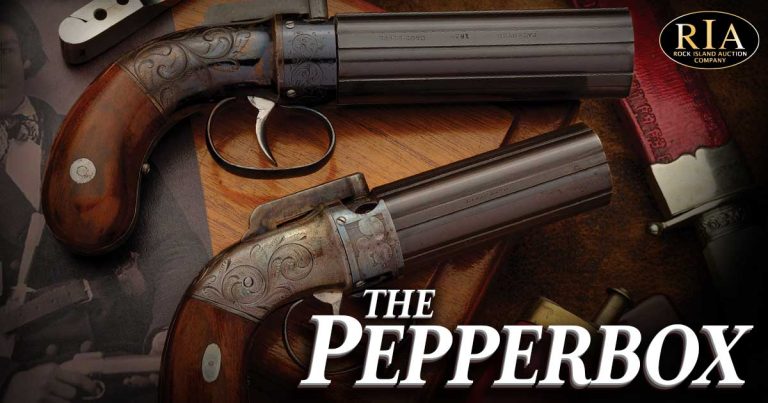
The pepperbox pistol’s heritage reaches back centuries, with the concept of guns using multiple revolving barrels to fire off repeated shots dating to the age of matchlocks. While pepperboxes represent some of the earliest revolving firearms, they really came into their own in the 19th century and were mass-produced as sidearms both in the U.S. and Europe.

The pepperbox goes back deep in firearms history, including flintlock revolving carbines like this extremely rare example from Nock in London – not to be confused with their more recognized volley gun. Available this August.

The Greg Lampe Collection offers a phenomenal and carefully curated assemblage of fine arms that cover a wide range of revolvers, pocket pistols, flintlocks, and well-documented martial long guns. The pepperbox pistol was the late Mr. Lampe’s last passion in the fine arms collecting pursuit. The three rare, historically significant, and high-condition examples from Greg Lampe’s collection that are offered in Rock Island Auction Company’s August 25-27 Premier Firearms Auction, as well as several examples from other collections help provide an in-depth illustration of the genre’s progression and innovation. Click on the images throughout this article to learn more about each model.

What is a Pepperbox Pistol?

A pepperbox, aka pepper-box, is a multi-shot firearm containing three or more clustered barrels. Most are handguns, but there are pepperbox long guns as well. They were also sometimes called “pepper pots.” Their nicknames reference the visual similarity of the multi-shot barrel groups with pepper boxes and pepper grinders used for culinary spices.

This exceptional cased and factory engraved Allen & Thurber percussion pepperbox revolver from the Greg Lampe Collection is one of the finest examples of a classic Ethan Allen bar hammer pepperbox you will ever see. Available this August.

The Pepperbox Pistol in Action

The term ‘pepperbox’ goes back to their period of use, and Mark Twain explained satirized the common rotating barrel percussion pepperboxes of the 1840s-1850s in Roughing It about his journeys in the 1860s:

He wore in his belt an old original “Allen” revolver, such as irreverent people called a “pepper-box.” Simply drawing the trigger back, cocked and fired the pistol. As the trigger came back, the hammer would begin to rise and the barrel to turn over, and presently down would drop the hammer, and away would speed the ball. To aim along the turning barrel and hit the thing aimed at was a feat which was probably never done with an “Allen” in the world. But George’s was a reliable weapon, nevertheless, because, as one of the stage-drivers afterward said, “If she didn’t get what she went after, she would fetch something else.” And so she did. She went after a deuce of spades nailed against a tree, once, and fetched a mule standing about thirty yards to the left of it. Bemis did not want the mule; but the owner came out with a double-barreled shotgun and persuaded him to buy it, anyhow. It was a cheerful weapon—the “Allen.” Sometimes all its six barrels would go off at once, and then there was no safe place in all the region round about, but behind it.

Two exceptional pepperbox pistols for sale this August at Rock Island Auction Company. From the Greg Lampe Collection.

While Twain’s quote is certainly entertaining, and there were instances to corroborate his observations, the pepperbox was widely used for a reason: they provided multiple shots in quick succession. Since most self-defense was close quarters, superb accuracy was less important, and the pepperbox offered much more firepower than the common single shot pocket and belt pistols of the period, which were often no more accurate.

Percussion Pepperbox Revolvers

While flintlock pepperbox pistols were found in numerous variations, the pepperbox really came into its own during the percussion era in the first half of the 19th century. The classic form of pepperbox firearms is generally seen as the double action only pepperbox revolvers.

This stunning example of a cased Allen & Thurber percussion pepperbox revolver has a desirable retailer mark from New York City gun dealer J.G. Bolen on Broadway. Available this August.

Most percussion pepperbox revolvers are relatively small caliber, generally around the .28-.36 caliber range. This was considered sufficient for self-defense, but these pistols often had less firepower than a .22 rimfire handgun. Pepperbox pistols were also generally smoothbore and did not have sights. Some rifled examples are certainly known as are some with simple sights. A few even have part of the hammer cutout so that you can look through the aperture to point the pepperbox at the target, but pepperboxes were not meant to be precision firearms.

While most pepperboxes had around five to six shots, this massive J.J. Herman Brevete percussion pepperbox packs an impressive 18 shots. Available this August.

There were manually revolved and single action versions, but most of these pepperbox revolvers were double action and automatically revolve when the triggers are pulled. The “classic” percussion pepperbox revolvers often have bar-shaped hammers on top of their box lock actions and have mainsprings that extend into the grip frames under the grips. Pulling the trigger raises the hammer and rotates the barrel group. When the trigger is pulled all of the way to the rear, the hammer drops down onto the nipple of one of the barrels.

This very attractive cased Robbins & Lawrence Co. Leonard’s Patent percussion pepperbox demonstrates another alternative to the popular bar hammer pepperboxes. The barrel group unscrews for loading, and instead of a rotating barrel group, it has a rotating striker, a feature that carried over into the metallic cartridge period. Available this August.

While revolver cylinders generally had the nipples on the back facing towards the shooter, pepperboxes generally have the nipples roughly perpendicular to the bore. When being carried, the hammer can rest between the nipples. Of these, the most famous are the Ethan Allen designed pepperboxes manufactured by his various partnerships from the 1830s into the 1860s.

Pepperbox pistols saw use on both sides of the Civil War.

Percussion pepperboxes were the main competitors of Samuel Colt’s famous revolvers for several years but became less common after the patent expired and more percussion revolvers entered the market. A revolver with a single rifled barrel and a shorter revolving cylinder was lighter and more accurate, but new forms of pepperboxes were introduced thanks to evolving cartridge technology.

Metallic Cartridge Pepperbox Pistols

The Rollin White patent gave Smith & Wesson control of the metallic cartridge revolver market in the late 1850s and 1860s. Pepperbox pistol designs allowed gunmakers a platform to work around the Rollin White patent, and new pepperbox pistols were introduced starting in the 1850s designed around mainly .22, .30, and .32 caliber rimfire ammunition.

This is an exceptional and very scarce documented Remington Zig-Zag derringer complete with the only known factory box. From the Greg Lampe Collection. Available this August.

While most percussion pepperbox revolvers were double action, most metallic cartridge pepperbox pistols were manually cocked single actions. The vast majority of rimfire pepperboxes were also rifled. Some of these, such as those by Jacob Rupertus, Bacon Arms Co., and Remington’s “Zig-Zag” pepperbox, still had rotating barrel groups. Many cartridge pepperbox pistols, however, employed hammers with rotating strikers instead of rotating barrel groups. Remington’s Elliott derringers were examples of this format and came in five-shot .22RF and four-shot .32RF variations.

A fantastic pepperbox pistol for sale this August, this presentation cased, factory engraved Tipping & Lawden Sharps Patent four-shot pepperbox pistol was manufactured under license in the United Kingdom. It is a truly phenomenal example of one of the most popular cartridge pepperbox designs. Available this August.

The most famous example of the fixed barrel group, rotating striker pepperbox pistol variety is certainly Christian Sharps’s four-shot pepperboxes. These were manufactured by C. Sharps & Co. c. 1859-1862, by Sharps & Hankins c. 1862-1866, and then again by C. Sharps & Co. c. 1866-1875. The barrels slide forward for reloading. Collectors recognize four distinct models based on their calibers along with numerous sub-models based on production variances. The Model 1 in .22RF is the most common. The Model 2 was in .30RF, the Model 3 was in .32 Short, and the Model 4 was in .32 Long. Licensed copies of these pistols were also manufactured by Tipping & Lawden in England and L. Ghaye in Liege, Belgium.

The Sharps four-shot pepperbox is one of the classic “gambler” or “gentleman” pistols of the American West. Professor Moriarty in Arthur Conan Doyle’s iconic Sherlock Holmes series used a Sharps pepperbox as a concealed sidearm in some films. Holmes and Watson both use one in “Sherlock Holmes: A Game of Shadows” (2011), and a highly ornamented Sharps pepperbox also plays an important role in the recent mystery film “Death on the Nile” (2022).

This incredible cased and factory engraved Colt New Line .38 revolver with pearl grips is an excellent example of the spur trigger pocket revolvers that largely replaced the pepperbox in the late 19th century. Available this August.

Pepperbox Pistol Legacy

After the expiration of the Rollin White patent, pepperboxes were largely replaced by affordable pocket revolvers manufactured by numerous companies, including high-quality examples by Colt and Remington along with numerous smaller companies often producing cheap spur trigger revolvers commonly derided as “suicide specials.”

Pepperbox handguns largely faded away in the late 19th century, but arguably the famous Gatling guns and Hotchkiss revolving cannons continued the concept. The impressive Vulcan cannons used by the military today certainly recall these early repeating firearms but at an astonishingly high rate of fire.

A Norwich production pepperbox with the barrel cluster marked “ALLEN & THURBER NORWICH C-T” and “PATENTED 1837 CAST-STEEL,” floral scroll engraved frame, acid etched nipple shield, and “ALLENS PATEN” marked bar hammer. Available this August.

Pepperbox Pistols and Revolvers for Sale

Rock Island Auction Company’s Premier Firearms Auctions are prime sources of more valuable and high-condition pepperbox pistols in the collecting pursuit. The exquisite examples featured throughout this article are available in the August 25-27 Premier Firearms Auction, and RIAC’s Sporting & Collector Auctions offer a wide array of examples that are more attainable to all collecting aspirations.

This cased factory engraved Allen & Thurber PWorcester production pepperbox was manufactured circa 1847-1865. Available this August.

Compared to percussion revolvers and antique cartridge revolvers, pepperbox pistols are often quite affordable, and they are excellent collectibles thanks to the variety of designs to collect. Some pepperbox pistols have commanded incredibly high sales prices in recent years, demonstrating the continued interest in these fascinating repeating firearms.

Brownells showcases a John Rigby of Dublin pepperbox pistol at Rock Island Auction Company.

Subscribe to the weekly Rock Island Auction weekly newsletter to receive new gun blogs and gun videos that describe the innovative world of 19th-century concealed firearms. From short-barreled versions of popular revolvers like the Colt SAA and Lightning  “Sheriff’s” Model and to the Merwin Hulbert pocket pistol to the Derringer, the palm pistol, the cane gun, and other unique and extraordinary curiosities that have become gun collection must-haves today.

An extremely rare .32 caliber Colt Model 1877 Sheriff’s Model “Rainmaker” with a 3 1/2 inch barrel and no ejector. Available this August.

Collectible Firearms for Serious Gun Collectors

0

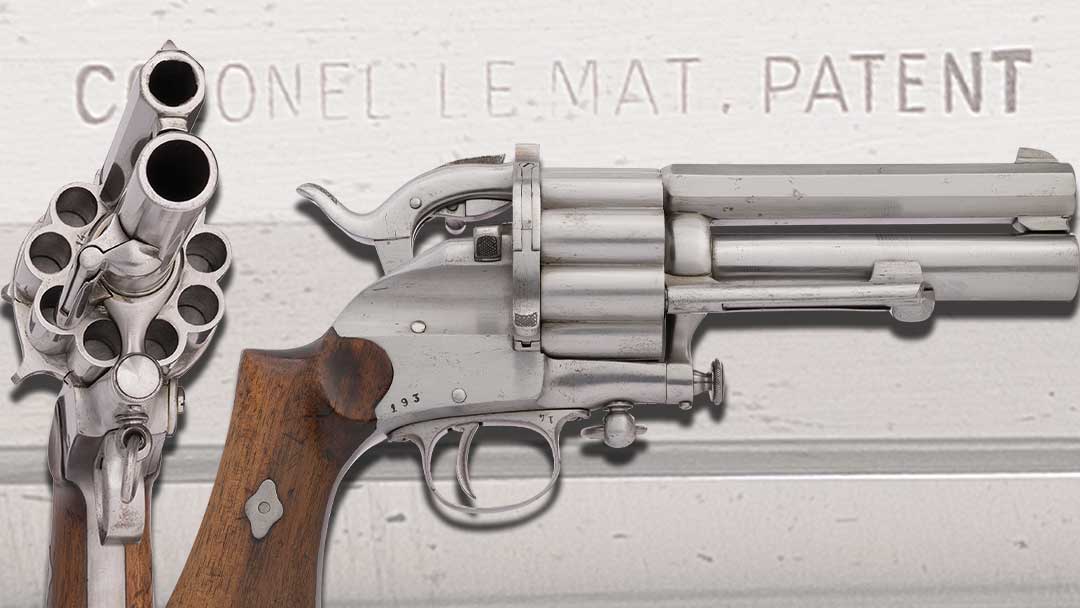
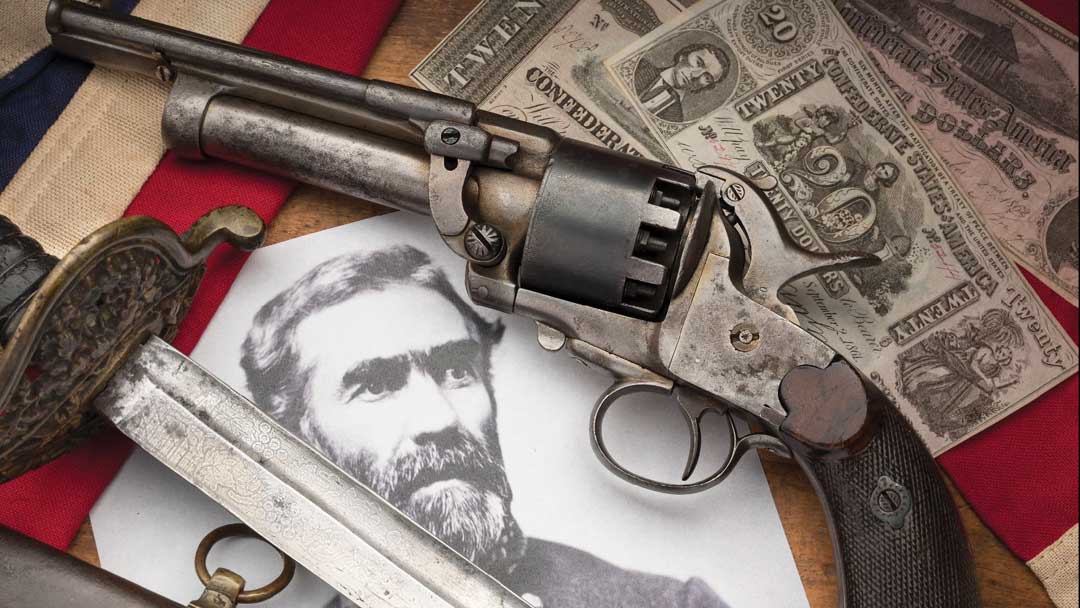
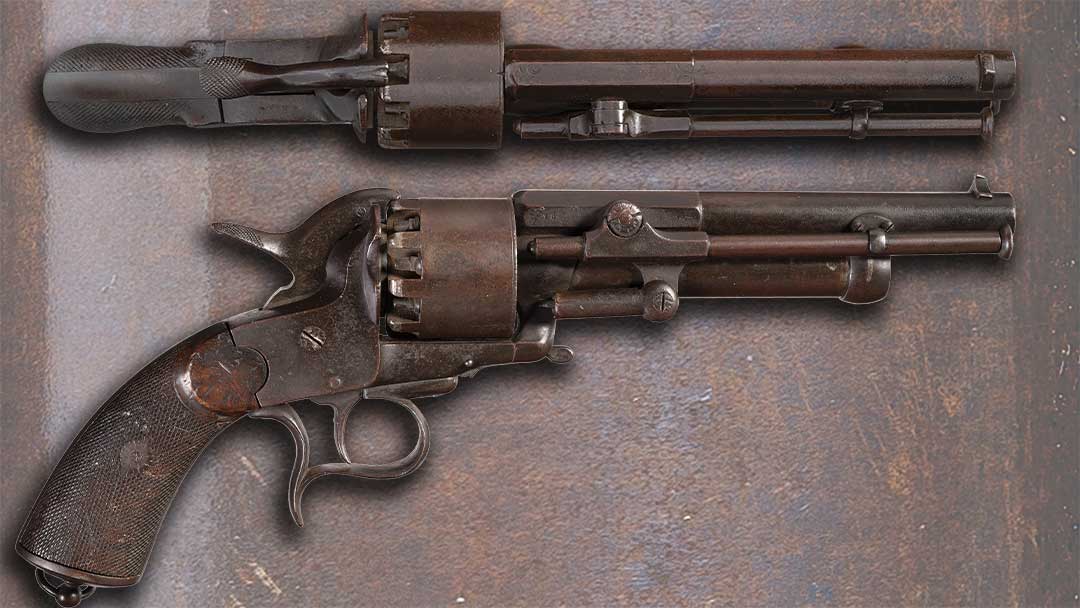
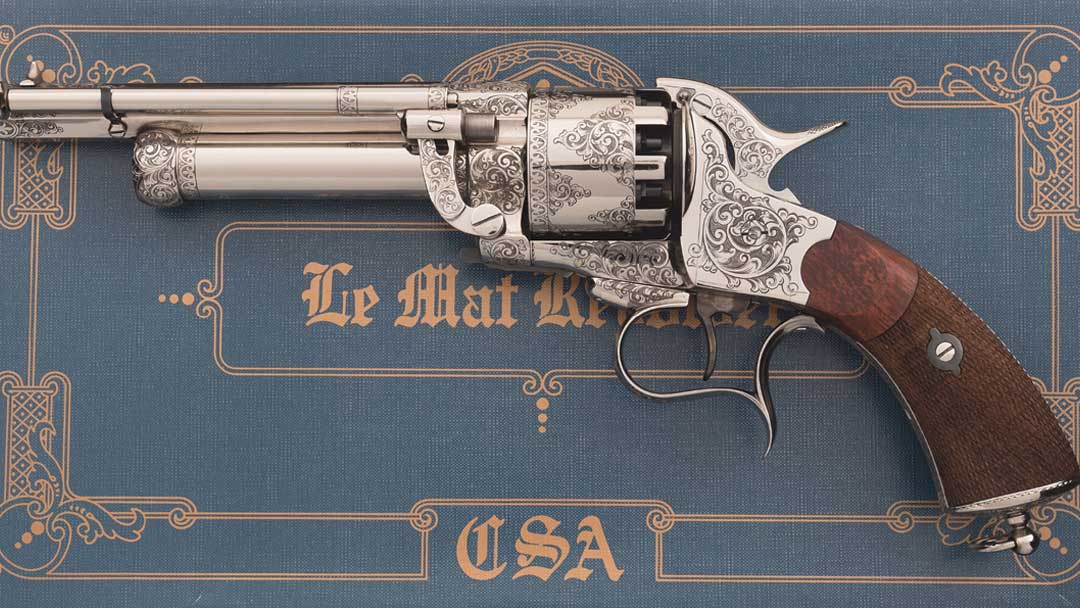
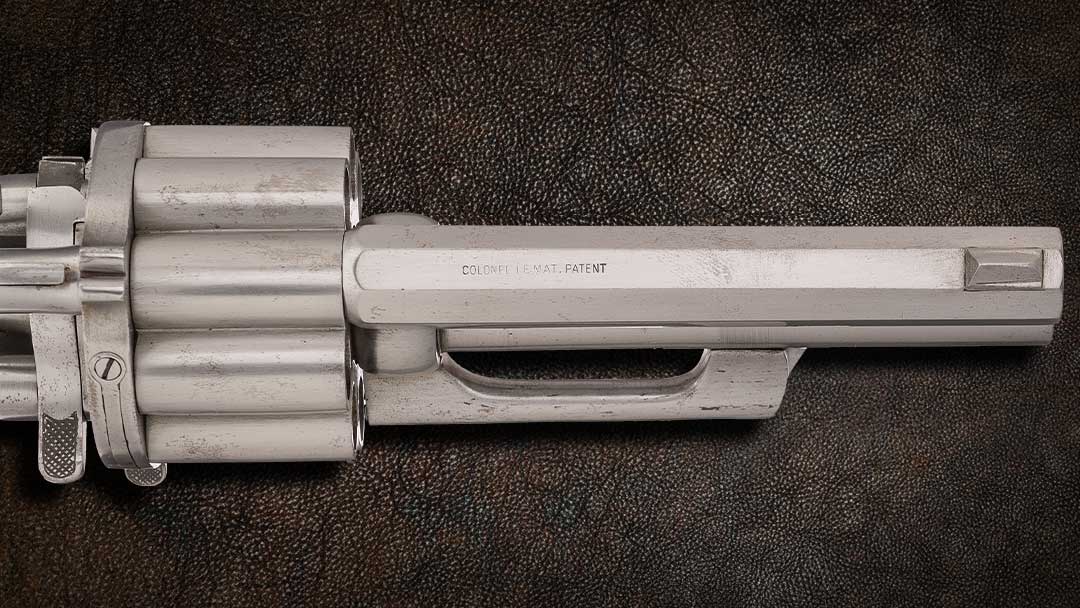
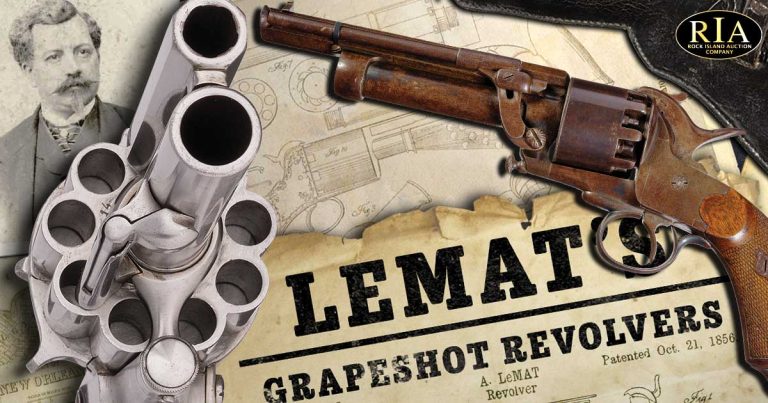
The LeMat two-barrel grapeshot revolver was one of the most unconventional wheel guns ever conceived. Invented by native Frenchman Dr. Jean Alexandre LeMat of New Orleans, these fascinating combination guns were primarily produced in Belgium, Paris, and England, and earned fame with the Confederacy during the Civil War.

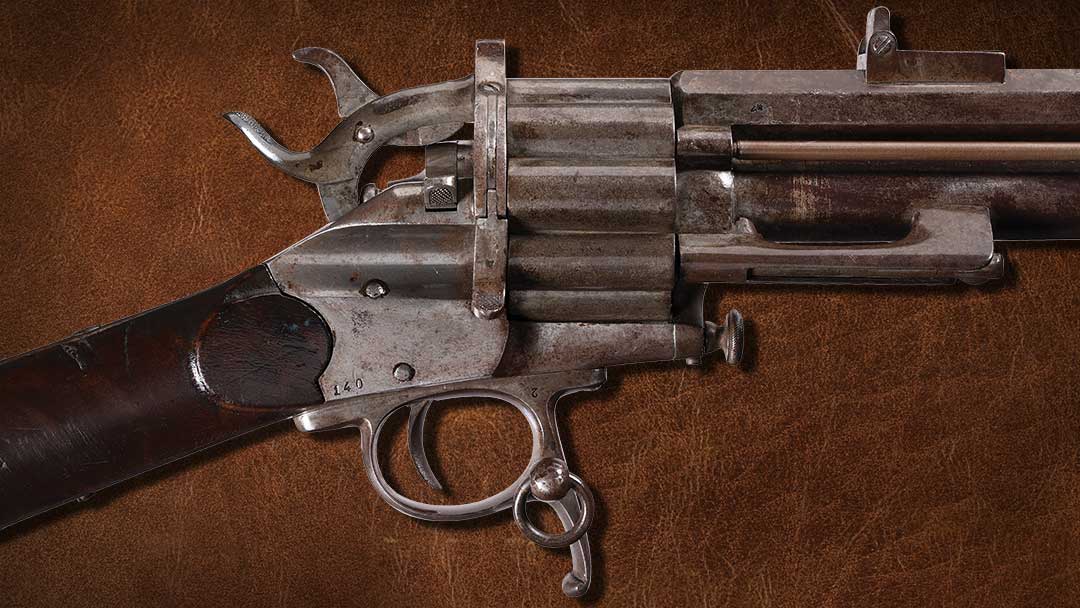
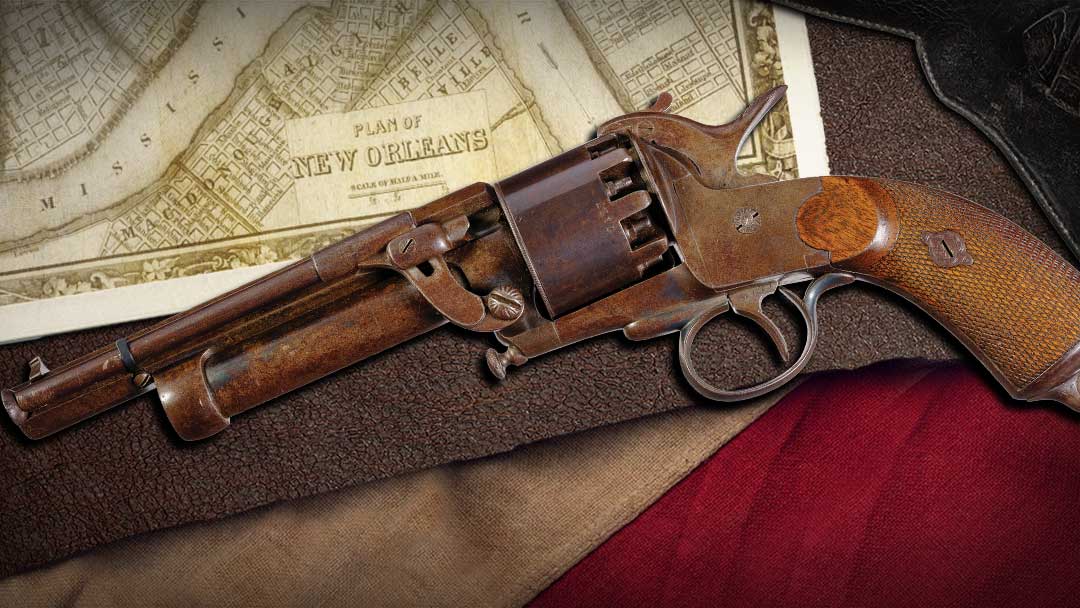
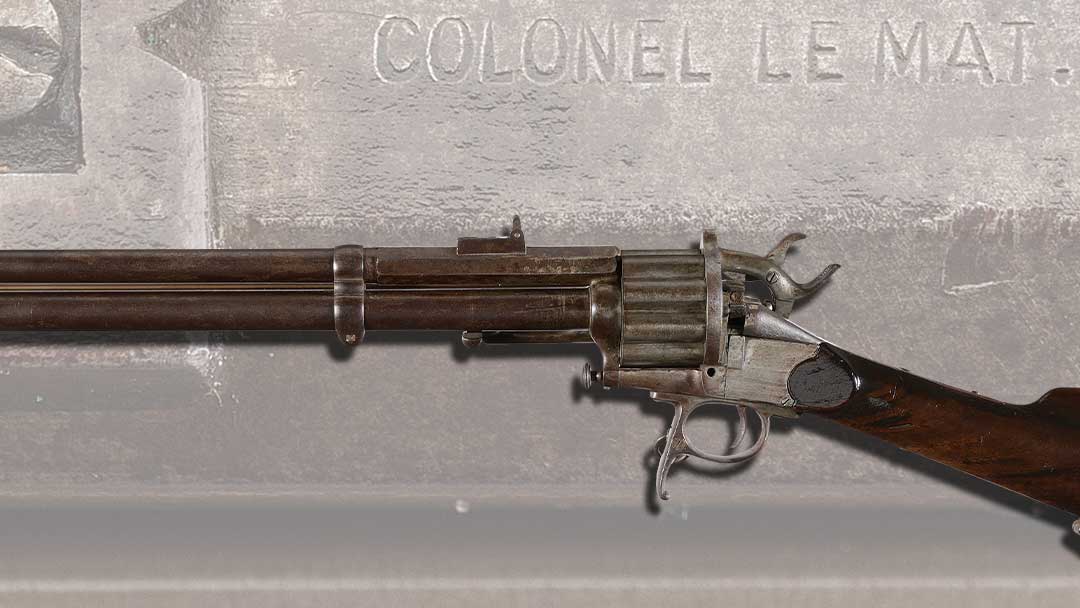
The high-condition LeMat revolvers for sale this August at RIAC cover numerous models, including (from left to right) a Belgian LeMat Patent SA centerfire revolver, a centerfire LeMat revolving carbine, and a Civil War-era Second Model LeMat percussion revolver.

The LeMat revolver’s low production numbers, novel design, and service as a Confederate cavalry weapon have made the unique pistol one of the most popular guns in antique arms collecting. Rock Island Auction Company’s August 25-27 Premier Auction includes four historic examples of the genre, including a First and a Second Model LeMat Civil War percussion revolver, a LeMat patent centerfire revolver, and an exceptionally rare LeMat revolving carbine. Click on the images throughout this article to learn more about each revolver model.

When was the LeMat Revolver Invented?

Jean Alexander Francois LeMat was born in France in 1821 and immigrated to America in 1843 after becoming a physician. A lifelong inventor, Dr. LeMat was awarded numerous patents in the medical, maritime, and aviation fields throughout his storied career, though the LeMat revolver is undeniably his most famous design.

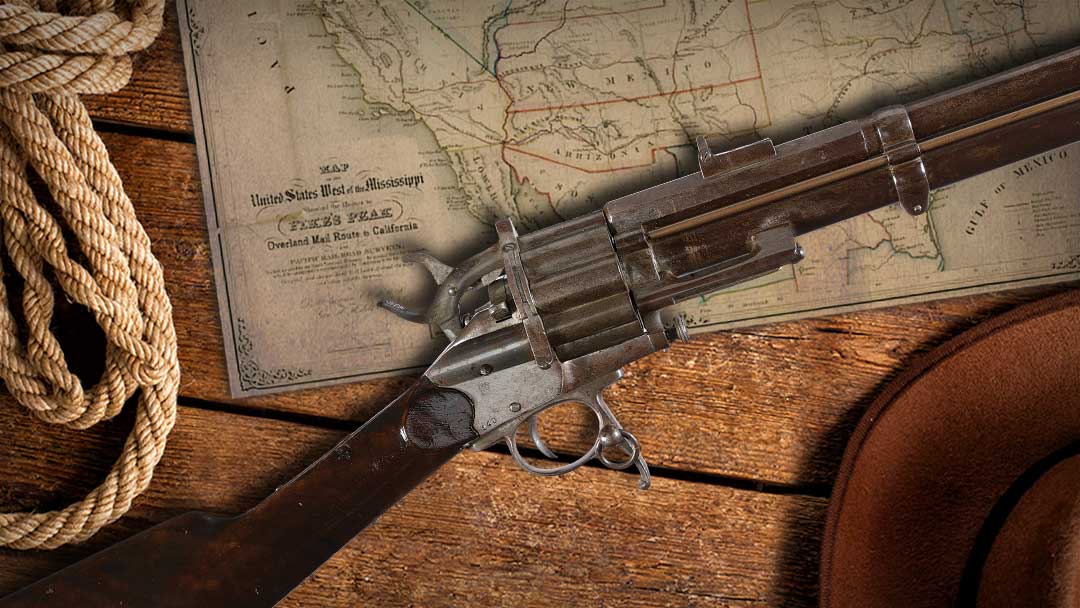
A rare centerfire LeMat revolving carbine for sale. LeMat centerfire carbines like this example offered in RIAC’s August Premier Auction are illustrated and described in ‘LeMat: The Man, The Gun’ by Forgett and Serpette.Available this August.

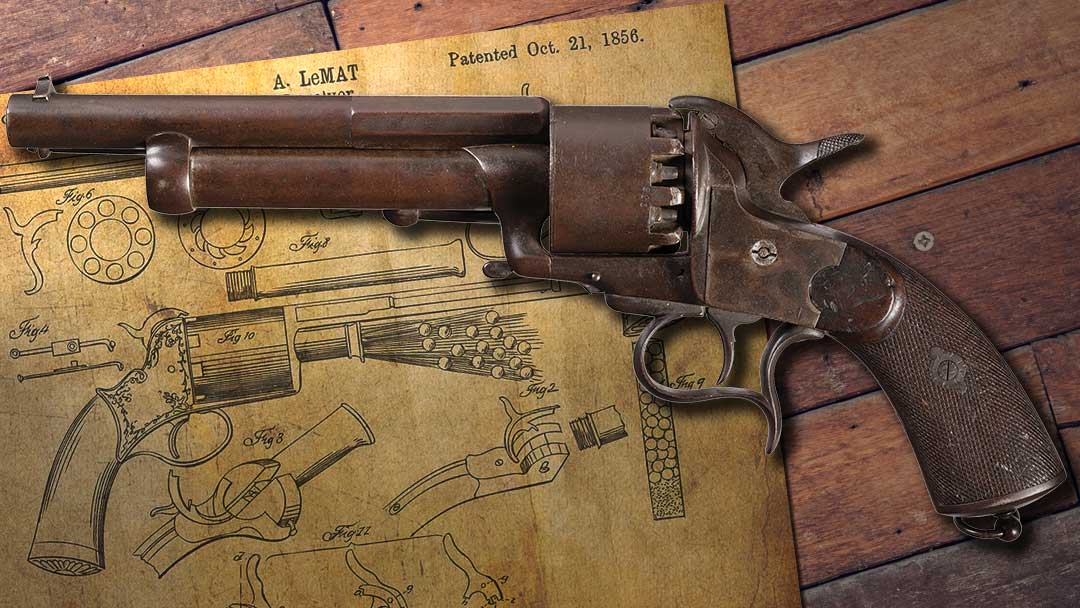
Through his marriage to Justine Sophie in April 1849, LeMat also became cousin-in-law to P.G.T. Beauregard, a Louisiana-born military engineer who would rise to fame as the Confederate general who ordered the first shots of the Civil War at Fort Sumter on April 12, 1861. Dr. LeMat patented his grapeshot percussion revolver in 1856 and received financial assistance from Beauregard to begin production in Europe.

Dr. Jean Alexander Francois LeMat of New Orleans invented the LeMat revolver in 1859. 

Prior to the Civil War, then-U.S. Army Major Beauregard purchased 25% of the LeMat Company and urged the U.S. military to adopt the design, arguing that the LeMat revolver’s secondary smooth-bore barrel offered a lethal close-quarters option for cavalry and artillery units, as well as an efficient anti-boarding naval gun. Beauregard was able to arrange a trial in Washington on March 2, 1859.

The armament board provided a positive assessment of the LeMat revolver, stating, “We consider the arm far superior to any we have seen for the use of cavalry acting against Indians or when charging on a square of infantry or a battery of field pieces. It is also indispensable for artillerists in defending their pieces against such a charge, and for infantry defending a breach.”

The LeMat revolver offered its user nine shots with a conventional revolver and one big hit with its 18 gauge shot barrel that doubled as the cylinder pin. Available this August.

Despite the promising trial, the U.S. Army was reluctant to invest in new weapon systems and may have been skeptical of ordering a gun that lacked a domestic manufacturing facility. Beauregard and LeMat hoped to establish a factory in the South, but the outbreak of war and the subsequent Union blockade prevented the LeMat Company from importing the necessary machinery and tooling. LeMat revolver production would remain in Europe, forcing the Confederate States to rely on smuggling for future arms shipments.

LeMat Revolver Ammunition

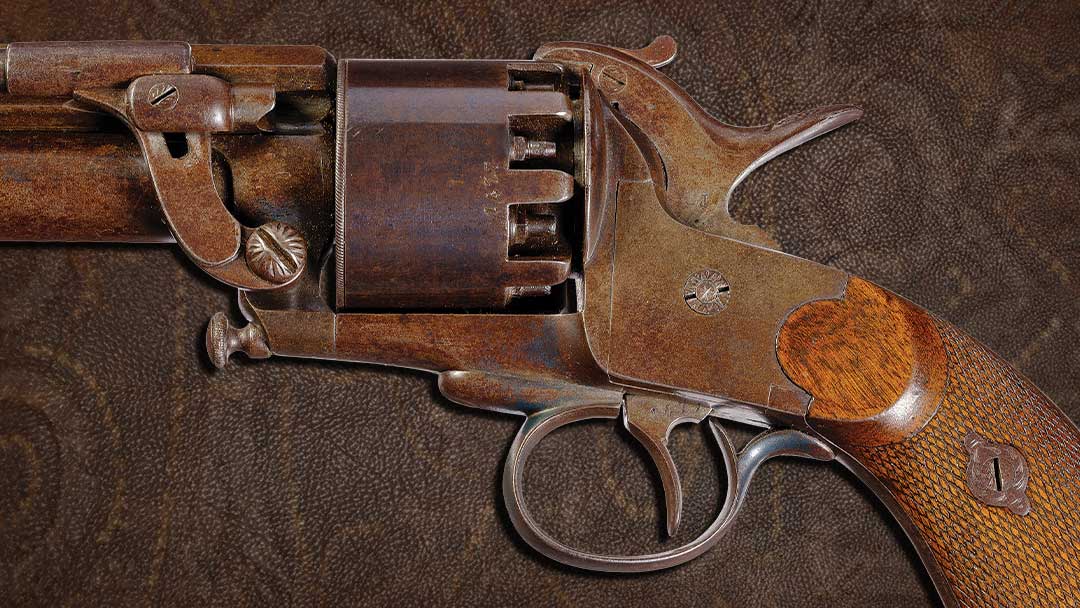
LeMat revolver percussion models stored nine black powder pistol rounds in a cylinder that revolved around a separate central smoothbore “grapeshot” barrel. This unconventional design provided the revolver with an impressive 10-shot capacity. The LeMat’s two distinct firing modes could be alternated by toggling a movable firing pin that pivoted the hammer nose to engage either the percussion nipples on the cylinder or on the grapeshot barrel nipple.

A First Model LeMat revolver. Period advertisements referred to these unusual wheel guns as “LeMat’s Grape Shot Revolvers.” Available this August.

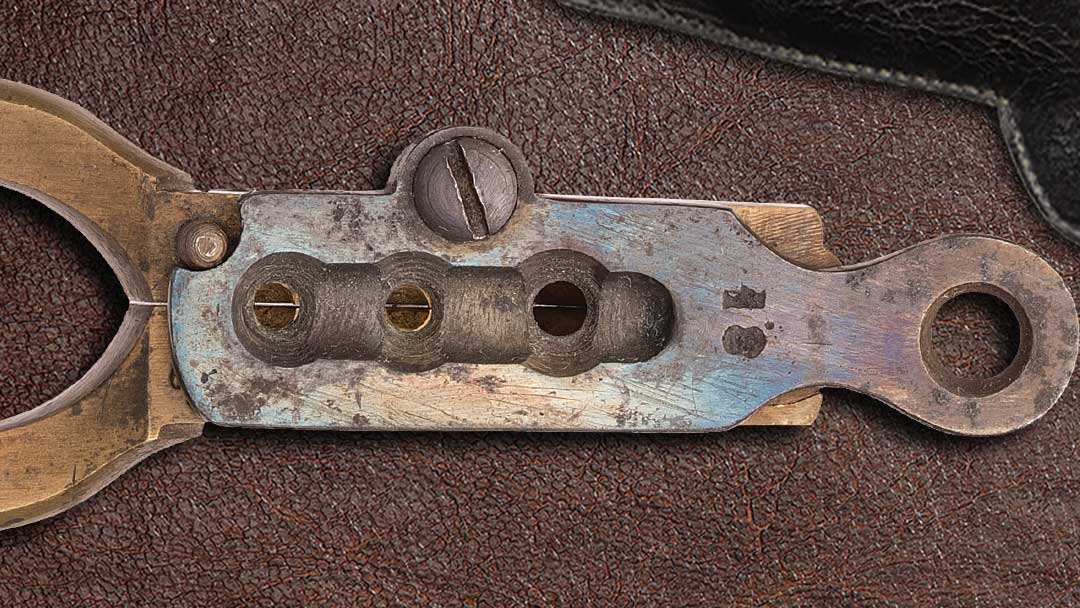
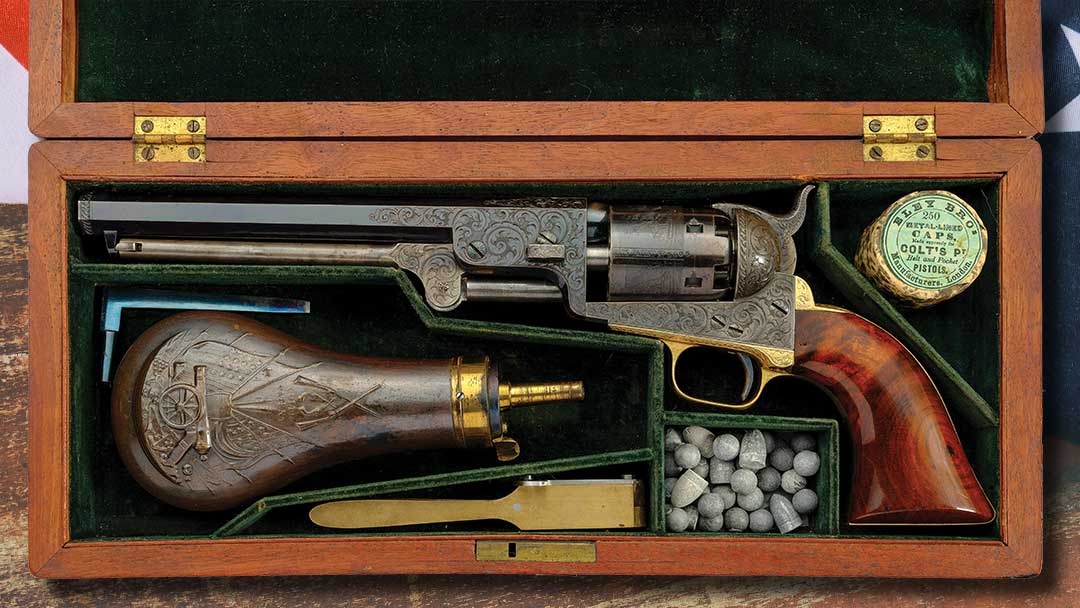
LeMat revolvers were typically produced in non-standard calibers like .40, .41, and .42. The bullet and buckshot mold pictured below allows a user to cast two small .28 caliber buckshot balls (approximately #2 buckshot) and a .40 caliber conical bullet. This pattern of LeMat revolver mold is discussed in depth on page 105 of ‘The Confederate LeMat Revolver’ by Doug Adams.

During the LeMat revolver’s range test in March of 1859, the armament board recorded loading each cylinder chamber with 1 gram of black powder and loading the shotgun barrel with 2.5 grams of powder and 15 pellets of buckshot.

This distinctive LeMat revolver bullet and buckshot mold comes from the collection of accouterment expert Robin Rapley. Available this August.

Compared to other popular wheel guns of the era such as the Colt Model 1851 Navy and the Starr Arms revolvers, the LeMat was bulky, had less accuracy, and required more reload time. Still, the LeMat revolver offered higher capacity than most of its competitors as well as the ability to deliver a devastating blast of buckshot at close range with its signature shotgun barrel. These traits made the LeMat revolver a popular option with the Confederate generals and high-ranking cavalry officers fortunate enough to be issued a grapeshot pistol or acquire one through private purchase.

Offering its user nine .40 caliber bullets and a powerful 18 gauge shotgun blast, the LeMat revolver was a terror at closer range. Available this August.

Civil War LeMat Revolvers

The Confederacy had fewer factories, a scarce iron supply, and a decentralized manufacturing base compared to the industrialized North. As a result, the Southern States faced a constant shortage of guns and artillery throughout the Civil War. Given the prominence of Confederate cavalry early in the conflict, a steady supply of revolvers was in especially high demand. Despite limited production numbers and a Union blockade that hindered imports, the LeMat revolver became a battlefield staple.

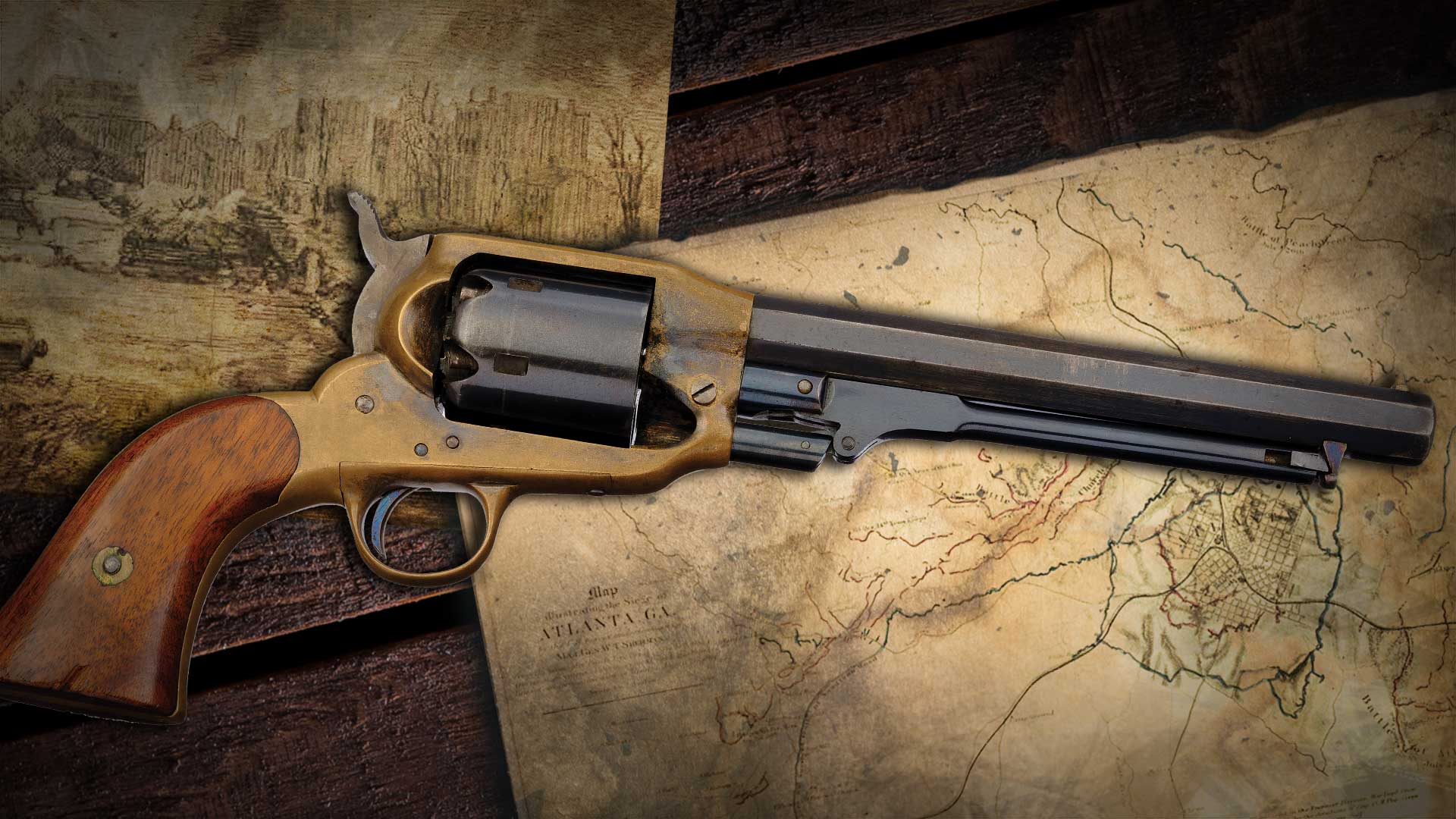
Shortages of iron and graded steel led to Confederate revolvers relying on brass pistol frames and other brass componentry as displayed in this outstanding Civil War era round frame Spiller & Burr revolver. Available this August.

The LeMat revolver was carried by Confederate legends like “Stonewall” Jackson and Braxton Bragg, and the pistol became particularly closely associated with Major General J.E.B. Stuart. Commanding the Army of Northern Virginia’s cavalry, the defiant Stuart was firing his LeMat revolver at Union troops when he was mortally wounded at the Battle of Yellow Tavern in 1864.

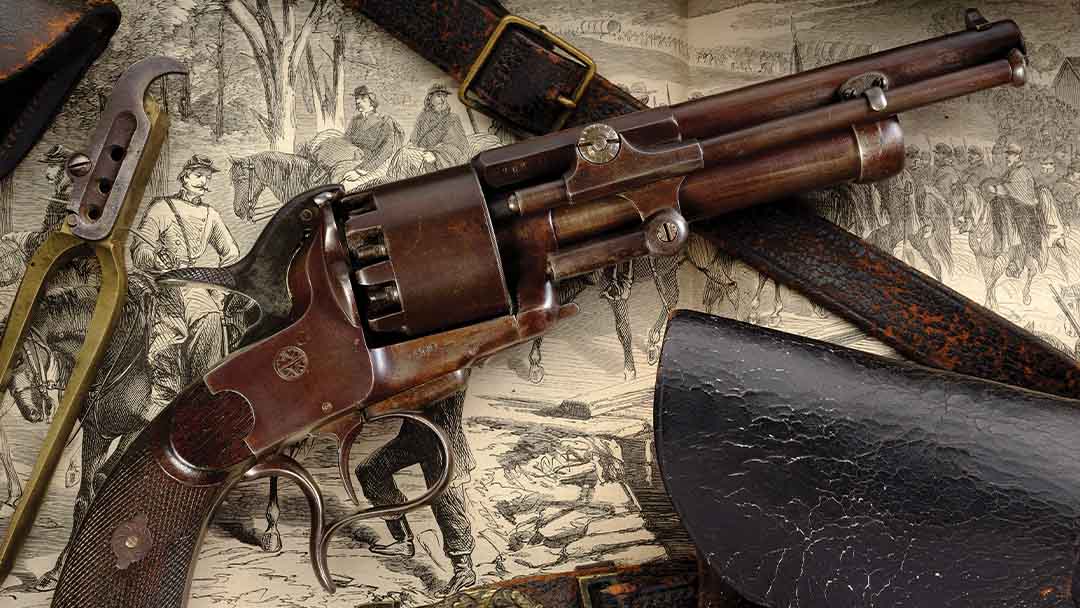
Many percussion LeMat revolvers saw use in the Civil War and have fascinating stories to tell. The example below, one of two Civil War-era LeMat revolvers for sale this August at Rock Island Auction Company, was discovered in the attic of a Virginia farmhouse along with several rifles and “a large quantity of Confederate currency.” The revolver is an astonishingly well-preserved example of a Second Model LeMat and is accompanied by a Confederate States Amory & Museum analysis that concludes, “This LeMat revolver is in excellent, original, untouched condition.”

An outstanding Second Model LeMat revolver accompanied by an affidavit from the family and detailed analysis from the Confederate States Amory & Museum. Available this August.

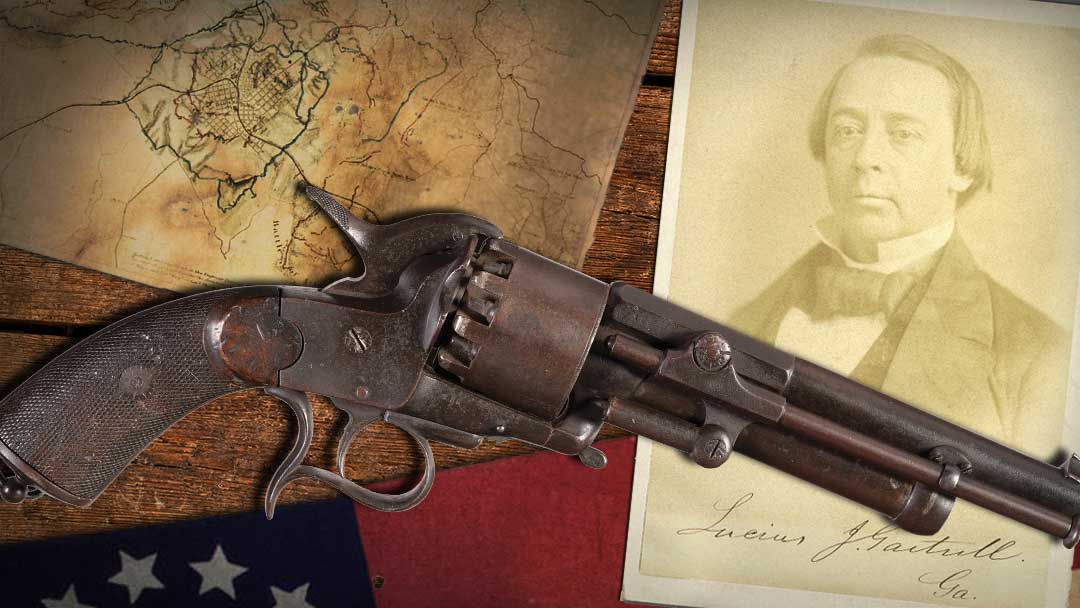
The second LeMat percussion revolver for sale this August at Rock Island Auction Company is another absolute treasure in Civil War collecting. The sidearm of a Confederate general, this historic LeMat revolver was passed down through the family of Lucius Jeremiah Gartrell of Wilkes County, Georgia. A lawyer and U.S. congressman, Gartrell resigned when Georgia seceded from the Union and raised the 7th Georgia Infantry Regiment. Gartrell served as the colonel of the regiment during the historic battle at First Bull Run.

During the fighting, Gartrell and his men charged on the right, driving away the Union infantry and artillery, but their victory came at a heavy cost. Among the nearly 2,000 Confederate casualties was Gartrell’s 16-year-old son, Henry, who served in the Atlanta Confederate Guards.

A historic Civil War First Model LeMat revolver passed down through the family of Confederate Brigadier General Lucius Jeremiah Gartrell. Available this August.

Gartrell served a two-year term in the Confederate Congress before rejoining the rebel army as a brigadier general in 1864 and organizing four reserve regiments for his brigade. Though he was wounded at Coosawhatchie, Gartrell survived the war and returned to practicing law and participating in local politics until his death in 1891. All LeMat revolvers are collecting touchstones, with examples documented to Confederate generals ranking among the most desirable pieces in the fine arms pursuit.

Confederate General Braxton Bragg’s LeMat revolver realized an incredible $103,500 during Rock Island Auction Company’s December 2021 Premier Firearms Auction.

LeMat Revolver Variations

Only an estimated 1,500 LeMat revolvers are thought to have been delivered to the Confederacy during the Civil War, less than one-fifth of what Dr. LeMat was contracted for. Most LeMat revolvers were produced in Paris, France, with a smaller number manufactured in Liege, Belgium from 1861 to 1862, including 450 Belgium First Model LeMat revolvers. Numerous variations are found in the standard models since LeMat revolver components were manufactured by smaller shops and later shipped to a main factory for final assembly.

The First Model LeMat revolver for sale at RIAC this August is similar to other well-documented First Model LeMats, like serial number 282 shown on page 55 of ‘LeMat: The Man, The Gun’ by Forgett and Serpette. Both revolvers feature a spurred trigger guard, a pair of checkered walnut grips, a lanyard ring, and a loading lever on the right side of the upper barrel that houses a removable ramrod for loading the smoothbore lower barrel.

A fine representation of a Belgium First Model LeMat revolver, marked serial number 286. Available this August.

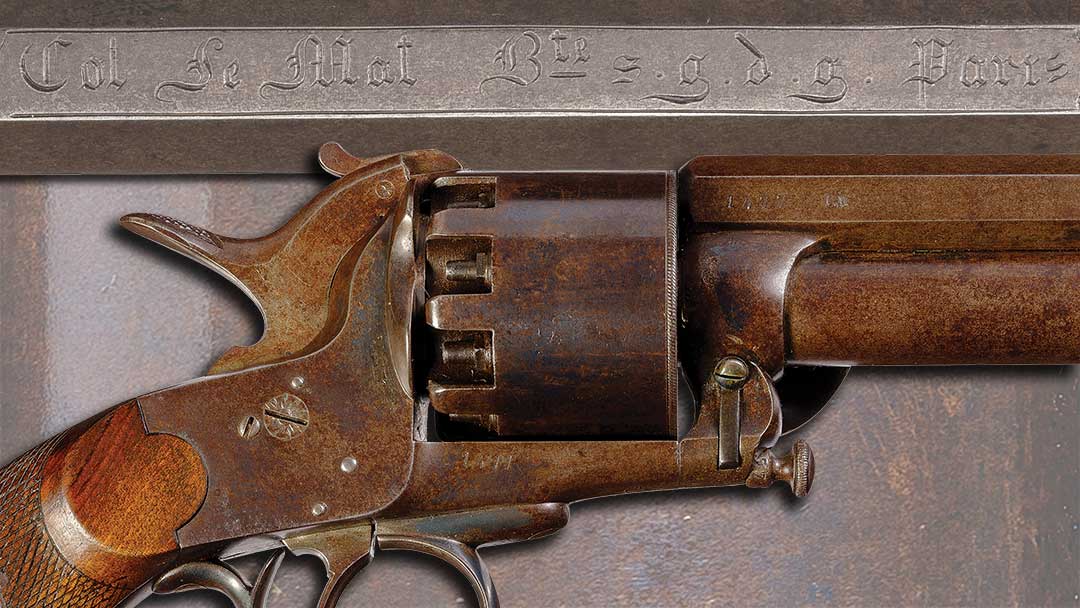
The Second Model LeMat revolver was manufactured in Paris, France from 1864 to 1865. Design changes were gradually implemented to improve reliability and decrease production costs. Second Model LeMats often feature a round trigger guard, an integral lanyard ring on the butt, an octagon barrel, a pull-out assembly latch, a center-mounted hammer pivot, and a loading lever mounted on the left side of the barrel.

A Second Model LeMat Revolver for sale. The barrel is signed “Col Le Mat Bte s.g.d.g. Paris” on top with lined borders and entwining finials and has the distinct “/LM” mark on the right side ahead of the serial number. Available this August.

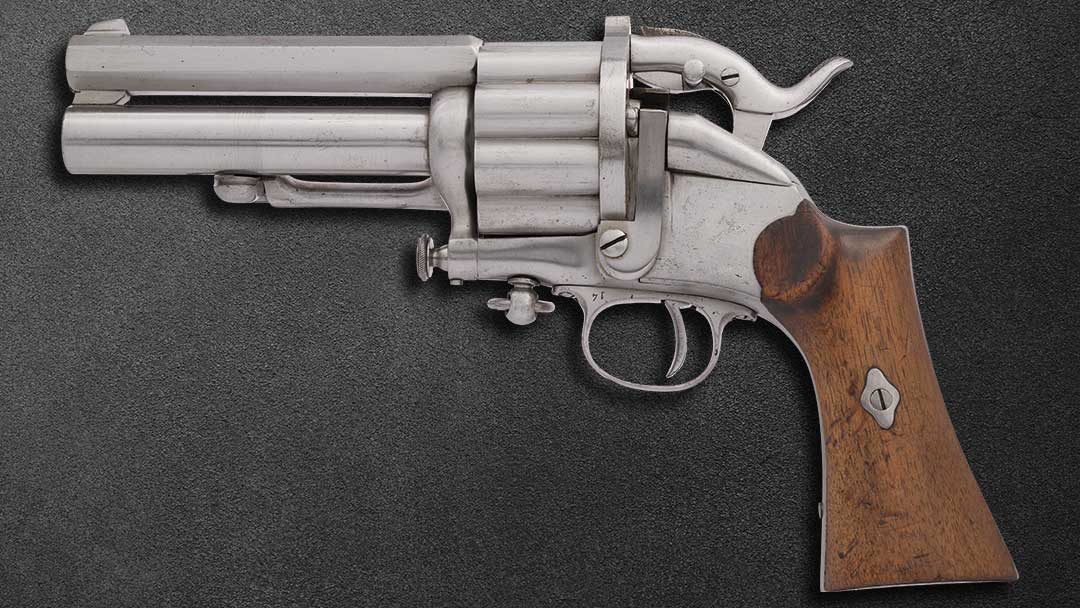
Dr. LeMat continued to pursue and update his grapeshot revolver design in the post-war era. LeMat pinfire examples were sold primarily to the European market but met with little success. In 1869, LeMat received patents in the United States and Belgium that covered a centerfire version of his two-barreled firearm.

Like their famous percussion predecessors, centerfire LeMat revolvers combined a rifled barrel fed by a revolving cylinder with a central shot barrel. A loading gate on the upper right of the gun allows for loading the revolving cylinders and a larger loading gate with a firing pin on the back of the recoil plate is used to load the shotgun barrel.

A rare centerfire LeMat revolver for sale. This example is similar to the design shown in Dr. LeMat’s 1871 French patent extension. Available this August.

In addition to a traditional holster pistol-sized offering, the centerfire LeMat revolver was produced in a LeMat revolving carbine variant and the smaller “Baby LeMat” revolver. Unfortunately for Dr. LeMat, competition in the small arms market after the Civil War was fierce, with a surplus of cheap and plentiful guns to choose from. The production numbers for all centerfire LeMat revolver variants manufactured from 1869 to the 1880s only numbers in the hundreds, making them extraordinary rare finds today.

The LeMat Revolving Carbine

Revolving rifles, carbines, and shotguns never achieved great popularity, and the cartridge-loading LeMat revolving carbine was no exception. Higher capacity options like the Winchester family were more affordable and didn’t carry the negative reputation some revolving rifles had earned, like the Colt Model 1855 rifle’s tendency to blast splinters of lead into the forward hand of its shooter.

The LeMat revolving carbine attempted to address this concern by adding a spur at the front of the trigger guard to aid in holding the carbine without placing a hand in front of the cylinder and allow the shooter to support the carbine with their left hand on the trigger guard instead of the barrel.

LeMat revolving carbines are chambered for 12mm cartridges and 15.2mm shot shells (approximately .44 caliber and 20 gauge). Available this August.

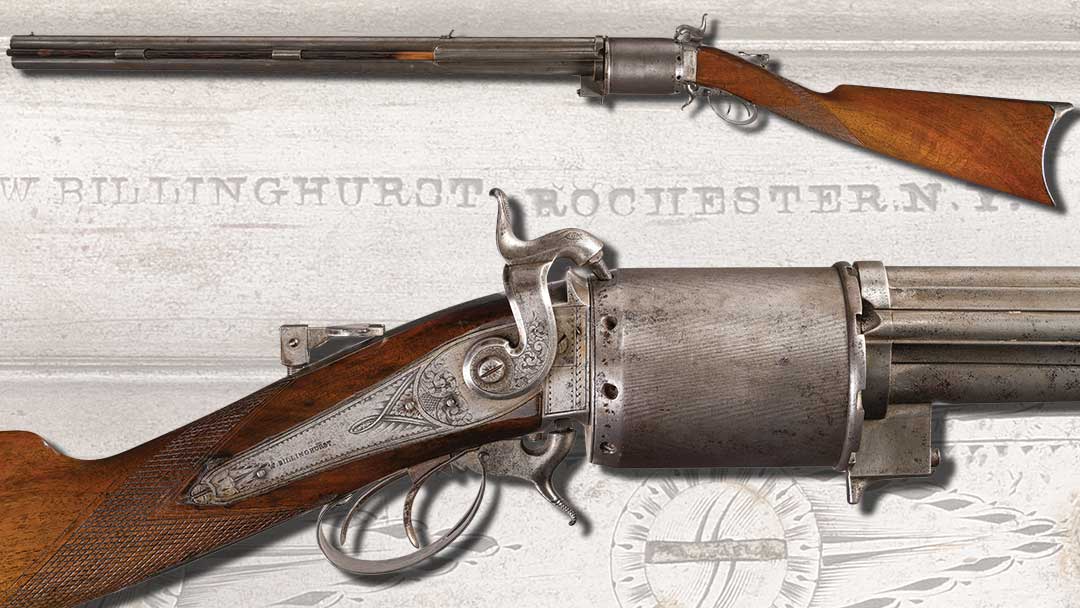
Rock Island Auction Company’s August 25-27 Premier Auction includes another fascinating example of the revolving rifle genre that shares numerous similarities with the LeMat design. Based on the Miller patent, the William Billinghurst combination percussion revolving rifle and underhammer shotgun pictured below is fed by a nine-shot, manually revolved cylinder. The upper rifle barrel is chambered in .38 caliber and the lower barrel fires a .72 caliber smoothbore load of shot, approximately 12 gauge. The lower barrel is fired using an underhammer mechanism using the trigger guard as the spring.

A highly rare, NRA award-winning William Billinghurst combination percussion revolving rifle and underhammer shotgun. Available this August.

LeMat Revolver Price

During the Civil War, the LeMat revolver was contracted for approximately $35.00 dollars each, nearly twice the cost of the Colt Model 1860. The LeMat’s price was driven up further still by inflation and gun-running expenses. The LeMat was an expensive gun in its time, and today these iconic revolvers garner ever-more impressive prices at auction.

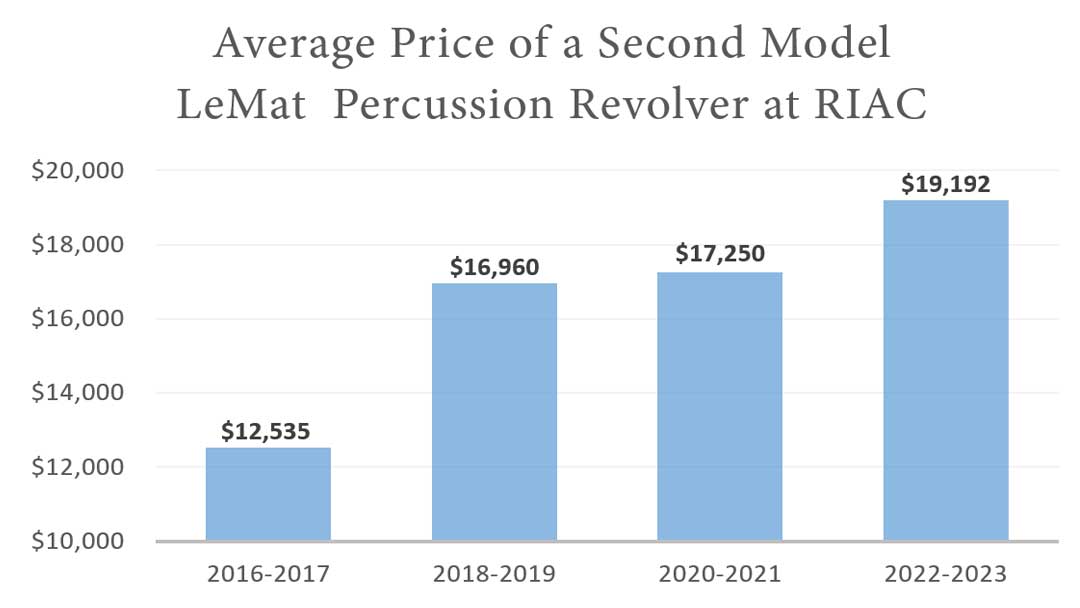
When considering the average Second Model LeMat revolver price by year at Rock Island Auction Company, we’ve gathered data from every Premier Auction dating back to 2016. The graph below looks at Second Model LeMat revolvers with a condition rating range from “fine” to “very good” and excludes examples such as transitional models, presentation pieces, and other extremely scarce and atypical Second Model LeMat revolvers. The buyer’s premium (15% through June of 2022 and 17.5% thereafter) is included in the sales price, as this properly reflects what a collector paid to own a Second Model LeMat revolver.

The average Second Model LeMat revolver price by year at Rock Island Auction Company. LeMat revolver prices for the period ranging from 2022 to 2023 are based on auctions to date.

Since 2016, average Second Model LeMat revolver prices have been steadily climbing, leaping to $16,960 in 2018 and 2019 before inching up $290 dollars in 2020 and 2021, then continuing their uptrend in 2022 and 2023 with an average price of $19,192.

Though this dataset includes far fewer examples than other recent pieces RIAC has published on gun prices and trends, and LeMat revolver values can vary considerably based on factors such as finish, grips, engravings, provenance, condition, and supporting documentation, the graph still provides a useful snapshot of how LeMat revolver prices have been trending higher in recent years.

An early serial number First Model LeMat revolver in very good condition sold for $52,875 during RIAC’s May 2023 Premier Auction. Provenance: The Greg Lampe Collection.

The LeMat Revolver Today

Popular media has introduced the LeMat revolver to a new generation of Western fans and arms collectors. Films such as 1997’s ‘The Quick and the Dead’ and 2003’s ‘Cold Mountain’ feature the LeMat, and a modern LeMat revolver replica is famously carried by Ed Harris’ mysterious ‘Man in Black’ character in HBO’s Westworld. Perhaps the greatest recent surge in popularity for the LeMat revolver comes from Red Dead Online, where the iconic big iron wheel gun has become a clear fan favorite.

An engraved Pietta LeMat revolver prototype sold for $3,738 in RIAC’s Sept 2019 Premier Auction.

The concept of a revolving pistol/shotgun combination fell into relative obscurity until recent times when contemporary examples like the Taurus Judge and the Smith & Wesson Governor brought the spirit of the LeMat revolver back into the public eye. Both wheel guns are able to chamber cartridges for bullets or shot, but use a single barrel instead of the LeMat revolver’s double barrel design. Modern LeMat revolver replicas are offered by Pietta Firearms of Gussago, Italy, but when it comes to history, extreme rarity, and collecting value, there’s nothing like owning an original LeMat revolver.

A supremely rare centerfire LeMat revolver for sale this August.

LeMat Revolver for Sale

Due to their limited production numbers and heavy use during combat, few LeMat revolvers have survived to the present day. For fans of Civil War weapons, Wild West curiosities, or rare examples of 19th century gun innovation, the various models of LeMat revolvers can elevate any arms collection to new heights, and Rock Island Auction Company has become the premier destination for these extraordinary firearms.

Find the finest LeMat revolvers for sale at Rock Island Auction Company. This rare centerfire carbine is available this August..

When it comes to experimentation, innovation, and the sheer number of weapon types fielded, it’s hard to match the Civil War-era. Most firearms from the period have a rich history to share, so subscribe to the Rock Island Auction weekly newsletter to receive new gun blogs and gun videos that dive deeper into Civil War guns like the Henry rifle, the Sharps rifle, the Spencer carbine, the Maynard carbine, the Pettengill’s hammerless revolver, the Butterfield Army Model disc primed revolver, the Bowie Knife, the Gatling gun, and more.

An exemplary cased, early factory engraved Colt Model 1851 Navy revolver with extremely scarce gold plated grip straps. Available this August.

SOURCES:

‘The Confederate LeMat Revolver’ by Doug Adams

‘LeMat: The Man, The Gun’ by Forgett and Serpette

‘Confederate Longarms and Pistols’ by Anthony & Hill

Collectible Firearms for Serious Gun Collectors

0

When a gun, or set of guns, earns its own nickname, it’s a good sign you’ve encountered something beyond the ordinary, and the Parsons Armies certainly qualify.

While their moniker immortalizes their underappreciated Civil War recipient, surprisingly the Parsons Armies draw most of their value and fame within the fine arms community from qualities the revolvers themselves bring to the table: a classic model, rarity, an astonishing level of embellishment, and superb condition.

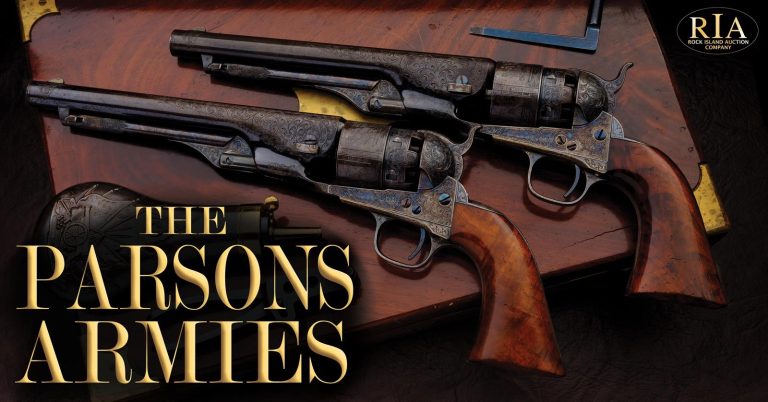
The Parsons Armies are a pair of Colt 1860 Army revolvers and a giant in the fine arms world.

The Parsons Armies

What Makes the Parsons Armies Special?

Ordered by Philo Parsons for his brother Colonel Lewis B. Parsons, the factory letters state this pair was factory engraved on November 13, 1862, and bracketed together in the records, indicating that they were always intended to be a true, consecutive pair. Whether Philo intended them as a lavish Christmas gift or as congratulations for his brother’s recent military promotion, he clearly spared no expense.

The engraving work is some of the finest to leave the factory and, save for those with gold inlay generally reserved for heads of state, represents Colt’s highest level of artistry. Foliate scrollwork flows seamlessly across them, and those with an eye for elite level Colts will quickly take notice of the hand-cut cylinder scene and the prominent hand-checkering at the end of each loading lever – each instantly placing this Colt among very select company. The scrollwork itself is an ornate departure from typical Colt engraving, but does still come with a familiarity, including the animal and bird’s heads secreted away among the many lines – as one might expect from a Germanic master engraver. The work is frequently cited in books as performed by Master Engraver Gustave Young, but Young was working as a private engraver in Hartford at the time the Parsons Armies were cut. The work could very well be Young based on its excellence, but it could also be that of Georg H. Sterzing, or even the two men working together. Whichever master completed the work, both revolvers end in the warmth of deluxe walnut grips bathed in Colt’s high gloss “piano” varnish finish.

Their deluxe treatment is outstanding in every way, but it’s their model that sets them apart even among the top percussion Colts. The Parsons Armies were ordered at a time when every available Colt 1860 Army was being purchased by the Union for use in the Civil War. Most Civil War era presentations are not a model under military contract, and Colt’s Model 1860 Army is no exception. Not only are the Parsons Armies objectively beautiful, not only is their level of embellishment seldom seen in the world of Colt collecting, but for such work to be done on a military model revolver is a level of rarity that instantly strikes Colt collectors as spectacle. It’s the sort of defiance of convention that turns heads from across the room.

If all that wasn’t enough, their condition is superior. The historical inscription, markings, and engraving all remain wonderfully crisp. Original finish is abundant on both gun and grips. The original silver plating is over 95% complete, and the case colors and shades of nitre blue give the guns a near ethereal hue to their frames and loading levers. Perhaps the highest testament to their condition is the fact that this consecutive, cased pair remains complete to this day.

The case coloring on the Parsons Armies is nothing short of spectacular.

There are comparable revolvers that Colt created such as the pair for General W.S. Rosecrans (SN 111592 & 111594) and the pair for General George B. McClellan (SN 100359 & 100362), both of which are also well-known examples pictured in numerous books. However the Parsons Armies are a step beyond even these admirable examples.

The pair presented to Rosecrans, while excellent in many ways, are not consecutive nor have they survived in as excellent condition as the Parsons Armies. The McClellan set, despite being issued to a prominent Civil War figure, are a matched pair, but not consecutive. Plus they were split up many moons ago when the case and single revolver were placed in the Smithsonian in 1870. Rock Island Auction had the more recent pleasure of offering the remaining McClellan revolver in 2019 when it sold for $299,000.

General George McClellan’s Colt Model 1860 Army. Sold in 2019 for $299,000.

The completeness, condition, special level of engraving, and historical ties have earned the Parsons Armies a place in some of the most respected collections of this century and the last. When Parsons passed, his daughter Julia placed them in the care of Parsons College, a Fairfield, Iowa institution founded by Lewis B. Parsons with two of his brothers. There they remained until they became the property of Bill Sisney, a gentleman and good friend of Rock Island Auction Company.

Mr. Sisney sold them fairly quickly to George S. Lewis who built one of the most respected Colt collections of the 20th century, a claim without hyperbole that places Mr. Lewis in rarefied air. They remained with Mr. Lewis for nearly half a century before finally selling them into the collection of Mr. Greg Lampe. Mr. Lampe made a significant investment to obtain the Parsons Armies, but not without cause. His collection already outstanding in many ways, Mr. Lampe wanted that all-star piece to stand atop his excellent congregation of Colts and the Parsons guns more than fit the bill.

George Lewis proudly displays the Parsons guns with his family at a Kansas City, MO gun show c. 1973.

It is from Mr. Lampe’s collection that the Parsons Armies are now being offered at Rock Island Auction Company. They have never before been publicly sold.

Who was Lewis B. Parsons?

In short, Lewis B. Parsons was the Union’s “Mover of Armies” during the American Civil War. A logistics phenom, Parsons didn’t just oversee the Union’s troop movements and supply lines, he overhauled the system resulting in never before seen levels of efficiency, punctuality, and quantities of goods and men shipped along the rails.

Lewis B. Parsons in a Civil War era photo

It would be impossible to list his every achievement and contribution to the war effort in a single blog. There have been books dedicated to the task, and they are remarkably thorough thanks to the copious notes and documents of Parsons that were also provided to Parsons College upon their founder’s death.

Before we dive into specifics, the following quote on Parsons summarizes things quite succinctly.

“Were trains to be employed in carrying troops to a distant point, Lewis B. Parsons provided them; were the great rivers to be used for the needs of the army, Lewis B. Parsons assembled flotillas and fitted them for their purposes; were food or clothing or forage or arms to be supplied, Lewis B. Parsons gave the orders that carried them to their destination; were Grant or McPherson or Sherman to be fitted out in the midst of great enterprises, they rested with absolute reliance upon the work of Parsons, and he never failed them.”

Parsons graduated from Yale in 1840 and Harvard Law four years later. An educated man from some of the nation’s highest institutions, he traveled west to practice law in Alton, IL. Fast forward to 1857, Parsons began working in St. Louis for the banking firm of Page & Bacon which helped finance the Ohio & Mississippi Railroad. It was in that role he became friends with the railroad’s vice president and future Union general, George B. McClellan.

It was near Lewis B. Parsons’ entry into the Union Army that his brother Philo presented him with the consecutive, cased pair of Colt 1860 Army revolvers.

When the Civil War began in 1861, Parsons wrote to his friend McClellan offering his services. McClellan quickly accepted and Parsons, at 43 years-old, was brought to Washington D.C. as a Captain. Despite Parsons’ desire to serve in a combat role, McClellan recognized his friend’s intelligence and gifts for business and reorganization and sent him to related duties. It was to be a recurring theme in Parsons’ military career. This time, no doubt in part due to a letter from President Abraham Lincoln himself which stated, “I personally know Mr. Parsons & have no doubt he would make a good Paymaster, Quartermaster, or Commissary.”

The Parsons Armies in the brassbound, velvet lined, rosewood case.

Parsons’ Civil War Work

McClellan sent him in November to the Chief Quartermaster in St. Louis. Parsons was wading into an office rife with corruption via inflated prices, padded payrolls, kickbacks, nepotism, forged vouchers, and more. If the criminal fleecing wasn’t damaging enough, there were also inefficiencies so gross and negligent that actual theft might have been a welcome relief. Both cost the Union untold millions in dollars and in precious time. Food, arms, and ammunition sat in railroad depots or warehouses, while railroad executives haggled with the military over rates. Everybody wanted to cash in on the country’s sudden great need for transportation.

In Parsons’ own words,

“My first object was to introduce, as far as possible, such system as should combine uniformity with responsibility, and efficiency with economy, not then existing, owing to the confusion generally prevailing at the commencement of the war, and especially in the Western department…”

By December 6, 1861, Parsons was ordered to take charge of all river and rail transport in the Department of the Mississippi. This was an area that stretched from Pittsburg to New Orleans and as far west as Yellowstone – no small order.

Parsons’ work involved him intimately with the logistics of river transportation.

As an example of his reforms, one can turn to his early work regarding the use of steamships. His predecessor General Frémont was chartering boats for transport. Parsons wrote,

“Satisfied, on a cursory examination , that this mode of conducting the service was as wrong in principle as it was extravagant in practice; that a small proportion of the boats then in service were actually required, (many of them being either idle or unprofitably engaged, according to the caprice of officers in command,) with the approval of General Allen, I made temporary contracts by the hundred pounds or by the piece for government transportation, and discharged all boats from charter, with the multitude of employees connected therewith. The result was that half the boats were at once put out of service and lying idle at the levee, while government transportation was not only performed at a less cost, but in a much more prompt and satisfactory manner.”

Such changes were implemented throughout Parsons’ area of command. He wrote rules and regulations, set pricing fair to both the government and the railroads, established responsibilities and accountability for transportation officers, made information widely available, ensured railways were paid promptly, solicited open bids for government contracts, and so on.

If that weren’t enough, he began coordinating efforts not only between the myriad of competing railway companies, but also with the steamboat operators.

Railroads became complex yet powerful resource for the Union.

It wasn’t all smooth sailing for Parsons, who saw no small amount of push-back mostly from those railways and boats that were profiting under the old system. However, money talks and the government was listening. The simple difference of charting boats per diem and paying to have them on call regardless of their workload or effort compared to paying them per poundage is quoted in one report which states, “…it can be easily shown that the Government saved one to two millions of dollars in its operations in this department alone.”

Reports from other, independent officers make similar statements. One particularly convincing example from Captain F.S. Winslow reads,

“Although the figures I shall now present will appear almost fabulous, yet I am honestly convinced they are too low. I wish to establish the difference of cost of the above 158,016 tons, if it had been transported on chartered vessels, instead of, as it was, on boats contracted at a given price per hundred pounds… The cost for transporting the above 158,016 tons would have consequently have reached the sum of $4,740,493… the transportation cost the Government the sum of $1,896,192. Consequently, the change from the charter to the contract system saved the government the enormous sum of about three millions of dollars.”

…and those figures cited by Winslow only cover, “the amount of work done during the season of navigation, at Nashville, from February 1 to May 27, 1864.” One can only imagine the effect and dollars saved when considering his changes implemented across a whole nation, for both rail and waterways.

It wasn’t just his cost savings, but also improvements to speed as well. Some of his greatest feats are equally well documented.

  1. “His greatest single achievement, the most picturesque and startling in the annals of the war, was in the movement of Schofield’s army from the neighborhood of Nashville to the Coast near Wilmington, North Carolina, passing over the Ohio River, eastward over the Alleghenies, and down by the way of the Atlantic Coast to its destination; and the men who had stood fighting splendidly with Thomas at Nashville appeared in front of their astounded and bewildered foemen at a new and far distant point in the theater of war.” That’s over 20,000 men in 11 days during frigid weather without a single accident or loss of life.
  2. “When supporting Grant’s Fort Donelson campaign, Parsons moved more than 10,000 men, over 5,000 horses and mules, 56 guns and caissons, thousands of tons of supplies, and 9,000 Confederate prisoners during one week in February 1862.” (Hess, 82)
  3. In December 1862, he moved General Sherman’s army of 40,000 men, cavalry, artillery, and livestock from Memphis to attack Vicksburg, helping the Union capture the last key Confederate stronghold on the Mississippi and giving Parsons greater ability to utilize the Mississippi and its tributaries for the Union war effort. This took 80 steamers and was completed with only seven days notice.

It’s no surprise that during his tenure, Parsons was promoted numerous times, always with “in charge of rail and river transport” in the title. In a bit of lesser-known trivia Parsons was one of the last officers promoted to brigadier general of volunteers. This appointment was pushed along by President Lincoln who made no secret about his urgency when he wrote Secretary of War Edwin Stanton on March 9, 1865, “I have long thought Col. Lewis B. Parsons ought to be promoted, and this impression has been deepened by his great success in the recent matter of transporting troops from the West to the East. Is there any legal obstacle in the way? If not let the promotion be made at once.”

A copy of Abraham Lincoln’s first letter to Secretary of War Edwin Stanton regarding Parsons’ promotion. A less diplomatic follow-up letter was sent two days later inquiring why the promotion had not yet been made.

Yet for all his promotions, Parsons never stopped wishing to serve in the field. The New York Times aptly stated in 1865, “Gen. Parsons repeatedly solicited permission, during the war, to quit the department he was in and go into the field. But his superiors, while admitting his eminent fitness for success in the field, would never consent to spare him from the position he filled. When every department of the public service during the war comes to have its true place in history, there will be few with a more brilliant and enduring reputation than Gen. Lewis B. Parsons.”

Lewis B. Parsons’ enduring legacy – The Parsons Armies.

Lewis Parsons’ Lasting Legacy

There are a wide number of sources that attribute the Union’s victory in the Civil War, in no small part, to the superiority of their rails.

General William Tecumseh Sherman mentions their efficacy several times in his memoirs, and specifically states, “The value of railways is also fully recognized in war quite as much as, if not more so than, in peace….Therefore, I reiterate that the Atlanta campaign was an impossibility without these railroads.”

President Lincoln saw the advantages of railroads so clearly, he began Federal support for the transcontinental railroad in 1862.

According to the Smithsonian, “Every major Civil War battle east of the Mississippi River took place within twenty miles of a rail line.” While author Tommy Franks succinctly states, “The geography of the railroads became, almost overnight, the geography of war.”

These iron veins were lifelines for troops, moving supplies, food, equipment, horses and their food, medical supplies, transporting casualties and, of course, the fighting men themselves.

But this giant advantage for the Union had just as much potential to be a tangled rat’s nest of disorganization or even a budgetary albatross around its neck. Thanks to Lewis B. Parsons, it wasn’t, and the Union could move its vastly superior stores of guns, men, and supplies with unprecedented ease.

The Parsons Armies are a fitting legacy for a man so meticulous and detail oriented. Everything is in its place, even after 160 years. Their rosewood and brassbound case holds a spectacular consecutive pair that radiates with high condition, superlative engraving, brilliant nitre and case colors, historical significance, and a rarity that strikes a spark in the hearts of collectors.

In the field of 19th century American fine arms, percussion Colts are king, and one of the elite members of that group are the Parsons Armies.

SOURCES:

https://americanexperience.si.edu/wp-content/uploads/2015/02/How-the-Railroad-Won-the-War.pdf

Hess, Earl J. Civil War Logistics: A Study of Military Transportation. Louisiana State University Press, 2017.

In Memoriam. General Lewis Baldwin Parsons. 1908.

PARSONS, LEWIS BALDWIN. Reports to the War Department by Brev. Maj. Gen. Lewis B. Parsons, Chief of Rail and River Transportation. George Knapp & CO, 1867.

Pratt, Harry E. “Lewis B. Parsons: Mover of Armies and Railroad Builder.” ‘Journal of the Illinois State Historical Society (1908-1984)’, vol. 44, no. 4, 1951, pp. 349–54. JSTOR, http://www.jstor.org/stable/40189175.

Sherman, William T. Memoirs of General William T. Sherman. Appleton, 1875. p. 398.

Unknown author. “Gen. Lewis B Parsons.” The New York Times, 31 July 1865, p. 4.

Wilson, R. L. Colt Engraving. Beinfeld Pub., 1982.

Collectible Firearms for Serious Gun Collectors

0

One of the lesser-known names in Old West wheel guns was also arguably the finest. Meet the Merwin Hulbert, a line of cartridge revolvers that were ahead of their time in terms of precision machining, technology, and innovation.

While ultimately out marketed by the likes of Colt and Smith & Wesson, Merwin Hulbert revolvers found a niche with late 19th-century city police departments back East, saw use with lawmen and outlaws on the American frontier, and today they’ve become an important piece of Old West gun collecting. Most of the featured examples below are offered in Rock Island Auction Company’s August 25-27 Premier Auction. Click on the images throughout this article to learn more about each revolver model.

An outstanding Merwin Hulbert & Co. Fourth Model DA revolver with a deluxe Hartley & Graham factory case and a matching extra barrel. Available this August.

The Story of Merwin Hulbert & Company

With a devastating fire in early 1900 destroying most of the Merwin Hulbert & Company records, information on the firearms maker can be fragmented and difficult to verify. Much of what we know today comes from Art Phelps and his 1992 book, ‘The Story of Merwin Hulbert & Company Firearms.’

Phelps’ research explores the early career of Joseph Merwin and his involvement in firearms marketing and manufacturing with Merwin & Bray in the 1850s. Like Oliver Winchester, Joseph Merwin was first and foremost a businessman and financier, though Merwin also played a role in gun design during his next venture with the Hulbert brothers of Brooklyn, New York.

This historic Merwin & Bray-Plant’s Patent Model .42 Cup-Fire Army revolver was offered by RIAC in April of 2015.

In 1868, Merwin entered into a partnership with well-known firearms importers and exporters William and Milan Hulbert. Their new company, Merwin, Hulbert, and Co., or simply Merwin Hulbert, also sold a vast array of sporting goods and offered an extensive mail-order catalog nearly two decades before Sears.

A company promotion from 1870 advertises, “Arms, Ammunition, Fishing Tackle, Cutlery, Sportsmen’s Goods of all kinds, styles, and prices.” Featured firearms included Ballard’s breech loading rifles, Merwin & Bray’s single shot pistols, the Spencer, Henry, and Winchester rifles and carbines, and numerous European shotguns.

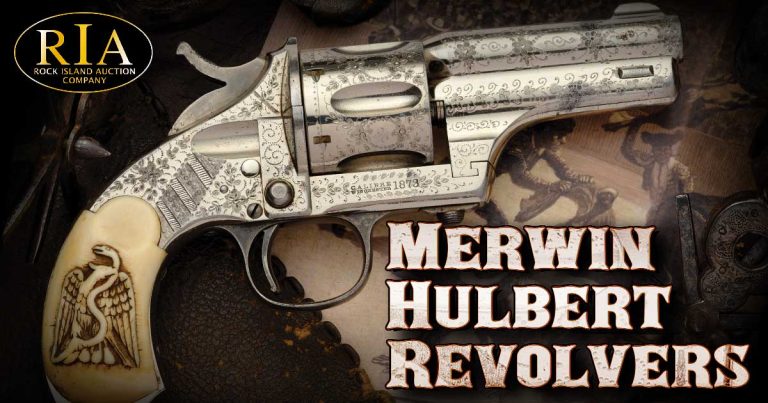
An incredible Merwin Hulbert revolver for sale this August, this historic inscribed factory panel scene engraved Merwin Hulbert & Co. open top Pocket Army SA revolver features relief carved Mexican eagle grips.

Merwin Hulbert owned a substantial interest in numerous arms and ammunition manufacturers, including the Phoenix Rifle and Ammunition Company, the American Cartridge Company, and Hopkins & Allen. The latter would be selected as the manufacturing subsidiary charged with producing the new Merwin Hulbert revolvers in their Norwich, Connecticut factory.

A Hopkins & Allen Army Model XL No. 8 SA revolver. Only several hundred of these scarce revolvers are estimated to have been manufactured from the late 1870s to early 1880s in several variations. Available this August.

Merwin Hulbert Revolver Quality

Author Art Phelps repeatedly emphasizes the standout quality and precision of the Merwin Hulbert revolver design. Hopkins & Allen also developed a more affordable nickel-plating process compared to their competitors, offering their customers nickel-plated Merwin Hulbert revolvers for the same price as their blued versions. Customers valued both the appearance and the resistance to wear and corrosion that nickel plating provided, so it’s no surprise that less than 5 percent of Merwin Hulbert revolvers were produced with blued finish.

A Merwin Hulbert 1st Type large frame SA revolver with the scarce blued finish. Available this August.

Another defining feature of the Merwin Hulbert revolver is its twist-open barrel design and unique extraction system. This unusual mechanism allowed the user to rotate the barrel 90 degrees in order to pull the barrel and cylinder forward to allow the selective ejection of fired cartridge cases. For most models, opening the revolver was accomplished with a sliding button on the underside of the frame that is pushed back toward the trigger guard. Then the barrel can be twisted and pulled forward along with the cylinder. The unfired cartridges with bullets are long enough to be held in the cylinder while empties fall clear. As Merwin Hulbert stated in their advertising, “An inclined screw action on the base pin starts the shells, overcoming any resistance.”

Quick barrel removal is another notable advantage offered by Merwin Hulbert revolvers, accomplished with the press of a single lever when the gun is open for extraction. Not only does this feature allow for easy cleaning, but the user can swap out their barrel with minimal time and effort. Many Merwin Hulbert revolver models came with a shorter and a longer barrel, offering customers both a holster and pocket option in a single revolver.

An exceptional Merwin Hulbert & Co. large frame DA revolver. Available this August.

The Merwin Hulbert revolver extraction and barrel removal mechanisms are a testament to 19th century arms innovation and the high-level precision machining performed by Hopkins & Allen. As one Merwin Hulbert period advertisement proudly proclaimed, “The Pocket Army is made with an interchangeable 7 inch barrel that enables it to be changed into a belt revolver. No tool required. The barrel can be changed in three seconds.”

Merwin Hulbert Revolver Competition

Demand for cartridge revolvers was surging in the late 1870s, but the competition was fierce. Merwin Hulbert revolvers faced off against the Colt Single Action Army, the Remington Model 1875, and the Smith & Wesson No. 3 Model. Each wheel gun found a niche, but Colt took a sizable lead thanks to large military contracts, a simple and sturdy design, and its popular chambering options.

Despite their premium manufacturing quality, the Merwin Hulbert revolver was offered at a competitive price point. An 1883 advertisement in the Billings, Montana ‘Daily Herald’ prices the large frame Merwin Hulbert Pocket Army “.44 Cal. Frontier size” at $16.50, similar to the cost of a Colt SAA.

A Merwin Hulbert revolver (left) and a Colt Frontier Six-Shooter (right), two Wild West wheel guns available at Rock Island Auction Company this August. Available this August.

Like the twist-open Merwin Hulbert revolver design, Smith & Wesson large-frame top breaks of the era relied on tightly fit precision manufacturing. The Smith & Wesson No. 3 and the Schofield held an advantage over the Merwin Hulbert in terms of reload speed since the latter requires the user to insert one cartridge at a time through a loading gate. In its favor, the Merwin Hulbert revolvers feature a shroud around the rear of the cylinder to shield the action from dust and grime, a clear advantage out on the frontier.

A variety of Old West Smith & Wesson revolvers for sale in RIAC’s August 25-27 Premier Firearms Auction.

Merwin Hulbert Revolver Variation

During their 12-year production run, Merwin Hulbert & Co. produced numerous revolver variations. In general, small and medium framed five-shot Merwin Hulbert & Co. revolvers were designed for the city-goer while their larger framed sixguns were created with the frontier and military market in mind.

A factory panel scene engraved Merwin Hulbert & Co. DA medium frame revolver with pearl grips. Available this August.

Some of the Merwin Hulbert revolver naming conventions can be confusing at first glance. For instance, the Merwin Hulbert “Pocket Army” models are hefty sidearms that compare in size to the Smith & Wesson Schofield. The smaller interchangeable barrels allowed users to carry these sturdy sixguns in a coat pocket, an ideal feature for the discrete traveler or someone hoping to circumvent the increasingly common no-carry ordinances being implemented across the Old West.

A Merwin Hulbert & Co. 1st Type large frame SAA revolver with pearl grips. Available this August.

The earliest Merwin Hulbert revolvers were single actions with open top frames. Later Merwin Hulbert variations standardized top straps, and double action models were produced in every frame size. Another notable feature was the bird’s head butt found on many Merwin Hulbert revolvers. Colloquially called the “skull crusher,” this beak-shaped projection on the bottom of the grip allowed the revolver to function as a backup weapon if ammo ran dry or to buffalo an unsuspecting miscreant if less than lethal force was desired.

A fantastic Merwin Hulbert revolver for sale this August, an open top Pocket Army SAA revolver with pearl steer head grips and the “skull crusher” butt.

Merwin Hulbert Revolver Ammunition

Small and medium framed Merwin Hulbert revolvers were chambered in .38 and .32 centerfire. Early large framed models were offered in a proprietary .44 Merwin Hulbert cartridge as well as Smith & Wesson’s .44 Russian, the later chambering being produced as part of a bid to win Russian military contracts.

A rare American Metallic Cartridge Company box of .32-100 cartridges marked for Merwin Hulbert & Co. revolvers sold at RIAC in Dec 2018.

Later large framed Merwin Hulbert revolvers were chambered in .44-40 WCF, the most common chambering for the popular Winchester Model 1873 rifle. Like Colt’s “Frontier Six-Shooter” of 1877, the Merwin Hulbert Army revolver could now be paired with the Winchester rifle, an advantage that went well beyond simple convenience. As Frank James pointed out, “When a man gets into a close, hot fight, with a dozen men shooting at him all at once, he must have his ammunition all of the same kind.”

An 1874 production Winchester First Model 1873 rifle chambered in .44-40. Later Merwin Hulbert large framed revolvers were chambered in the same cartridge. Available this August.

Merwin Hulbert Revolvers in the Field

Merwin Hulbert revolvers were a popular option with the New York Police Department and other law enforcement agencies throughout New England. Out West, the Merwin Hulbert struggled to gain a foothold, though the wheel gun found favor with the likes of lawman Pat Garrett and outlaws such as Bob Dalton, Pearl Hart, and the infamous Jesse James.

A Hopkins & Allen/Merwin Hulbert & Company large frame SAA revolver. Available this August.

Joseph Merwin heavily pursued military contracts as well and struck what appeared to be a promising deal with Russia in 1876. Three shipments of revolvers were delivered to the Imperial Russian Army, but the Tsar decided to renege on payment. Merwin spent the better part of the next three years unsuccessfully attempting to collect on the agreement.

The Fall of Merwin Hulbert and Hopkins & Allen

According to author Art Phelps, sales of the Merwin Hulbert revolvers were hindered from the start by their association with Hopkins & Allen. Despite the fact that Merwin Hulbert revolvers were produced with the highest standards in mind, Hopkins & Allen had developed a longstanding reputation as a lesser-quality bargain brand, and having their name stamped on any product would have been a potential turnoff to certain buyers.

A scarce Hopkins & Allen Army Model XL No. 8 SAA revolver. Available this August.

Even before the financial blow the company suffered due to its failed Russian contract, Merwin Hulbert suffered a crippling series of setbacks. Numerous lawsuits dealing with patent infringement were filed against Merwin Hulbert, including a devastating suit from Smith & Wesson over the Merwin Hulbert “Baby Merwin” revolver, which was a close copy of the Smith & Wesson Model 1. Joseph Merwin also wrestled with several failed investments like the bankruptcy of the Evans Repeating Rifle Company in 1879.

The October 28, 1880 issue of Menasha, Wisconsin’s ‘Saturday Evening Press’ states, “The failure of Merwin Hulbert & Co., dealers in arms and ammunition, New York, is announced. Liabilities estimated between $150,000 and $250,000; stock valued at $150,000.”

Merwin Hulbert revolvers offered one of the finest wheel guns available in the Wild West.

After Joseph Merwin passed away in 1888, the business was reorganized as Hulbert Brothers & Company. Financial troubles continued to plague the venture, which was finally forced to liquidate in 1896. Hopkins & Allen continued to survive as a manufacturer, but their factory, machinery, and records were lost to a fire on February 4, 1900, a disaster described in a New York Times headline as “$500,000 FIRE IN NORWICH.”

Hopkins & Allen persevered and rebuilt, focusing primarily on small caliber single shot rifles and eventually obtaining a contract to produce Mauser bolt actions for Belgium. Their efforts were again hindered in 1905 when their new warehouse was robbed bare, including their entire inventory of military rifles. Hopkins & Allen struggled on for another decade before finally calling it quits in 1916 and being purchased by Marlin Firearms.

Merwin Hulbert Revolvers for Sale

Though not as famous today as their iconic Colt and Smith & Wesson competitors, Merwin Hulbert revolvers have been featured on screen in films such as 1980’s ‘The Long Riders’ and 2015’s ‘Bone Tomahawk,’ and in the 1997 TNT miniseries ‘The Rough Riders.’ Numerous attempts have been made to produce Merwin Hulbert replicas, but so far no one has managed to get past the prototyping stage. For collectors, shooters, and fans of Old West history, owning an original Merwin Hulbert remains the only game in town.

A fantastic Merwin Hulbert revolver for sale this August, a desirable open top pocket Army SAA.

An unsung wheel gun of the Wild West, Merwin Hulbert revolvers were reliable shooters with a precision design that offered greater resistance to wear and tear compared to other options of the era. In addition to their innovative extraction system and the ability to quickly swap out the barrel, the attractive Merwin Hulbert nickel plating made owning these stunning revolvers an object of pride, and today some of the finest known examples are offered at Rock Island Auction Company.

Rock Island Auction Company’s August 25-27 Premier Firearms Auction includes an iconic assemblage of Old West icons.

Subscribe to the Rock Island Auction weekly newsletter to receive new gun blogs and gun videos that explore some of the most storied firearms of the American frontier, including the Henry rifle, the Sharps, the Winchester 1866 Yellowboy, the Derringer, the Pepperbox, the Colt 1851 Navy, the double barrel hammer shotgun, and the various Civil War revolvers, surplus muzzleloaders, and breech loading rifles that found their way westward.

OFFGRID Survival Budget Bug Out Bag Recommended Gear

0

The OFFGRID Survival Budget Bug Out Bag is made up of gear that we have personally used and recommend to those putting together a bugout bag on a budget.

Recommended Budget Backpack

Falko Tactical Backpack

The Falko Tactical Backpack is obviously a knock-off, but tfor those looking for a budget bag this is one of the best we found at this price point — in fact, it’s about a quarter of the price of similar bags from brands like 5.11.

Buy it on Amazon


What’s budget-friendly bugout gear is in the bag?

The main gear in our budget bugout bag covers our main needs: shelter, water, emergency coms, and a good knife.

KALINCO Tarp Tent

For our shelter, we choose a budget tarp tent for emergency situations where we may need to make a quick improvised shelter to keep us protected from bad weather or the sun. For information on how to use a tarp tent, check out our article on light-hiking tarp setups.

Buy it on Amazon

Bambaw 32 oz Water Bottle

The Bambaw 32 oz Water Bottle is a single wall stainless steal bottle that can be used to both carry water and sterilize water out in the wilderness. Single Wall Stainless steal bottles can be thrown over a campfire to purify water and is something that should be in any good bugout bag. This is a knock-off version of the Klean Kanteen and is about half the price.

Buy it on Amazon

Morakniv Companion 

The Morakniv Companion Sandvik Stainless Steel Fixed-Blade Knife may be a budget knife, but this thing more than stacks up to knives selling for 10x what this sells for. In fact, I carry quite a few of these as everything from my go-to EDC to my main knife in my fishing bags.

Buy it on Amazon

Baofeng UV-5R

The Baofeng UV-5R is about as budget friendly as it gets when it comes to ham radio and emergency communication gear. While we love our Yaesu radios, you can literally buy 10 of these for the same price as 1 Yaesu.

Buy it on Amazon

The Rest of the Gear…

Bic Lighters

In a survival situation, a good lighter will start far more fires than the matches you’ll find in most commercial kits.

Buy it on Amazon

Ferro Rods

I do like having a backup for some gear, and this is one of the items we carry as a backup to the bic lighters.

Buy it on Amazon

Lifestraw

This is another one of those important backup items I like to keep in my bags. The Stainless steel water bottles are great, but there are times where you may not be able to start a fire and these are great on the go!

Buy it on Amazon

550 Paracord

This is another one of those bulk buys that we purchase and then split it up between our bags. From hunting and fishing uses to building survival shelters and first aid, Paracord is an important multi-purpose item that every bag should have!

Buy it on Amazon

Knowledge is the best piece of gear you can pack!

In the end, it really doesn’t matter what gear you pack if you haven’t obtained the knowledge you need to use it and survive! So please, don’t jut pack the bag and forget it, thinking you have everything you need when the shit hits the fan!

Take the time to consider where to go, what to take, how to survive during crisis situations, and why bug out bags are a crucial part of your plan. Here are some articles that can help.

Shirts of Liberty

OFFGRID Survival book

Newsletter

Collectible Firearms for Serious Gun Collectors

0

Sharps carbines and rifles are among the most iconic firearms of the mid to late 19th century in America. They were one of the first successful breech-loading firearms and certainly one of the most popular single shot breech-loading rifles of the 19th century. Rock Island Auction Company’s August 25-27 Premier Auction offers a number of rare and desirable Sharps carbines and rifles, including a historic Sharps Model 1853 slant breech percussion carbine documented as shipped to a Kansas abolitionist during the Bleeding Kansas conflict. Click on the images throughout this article to learn more about each model.

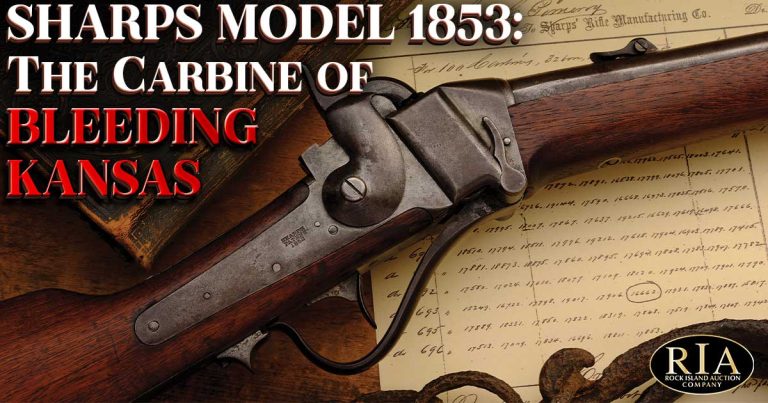
A historic Sharps Model 1853 “John Brown Sharps/Beecher’s Bible” slant breech percussion carbine documented as shipped to abolitionist General Samuel C. Pomeroy in Kansas during the Bleeding Kansas period. Available this August.

The Sharps carbine and rifle played a major part in the settlement of the American West in the antebellum era, were widely used by the Union Army during the Civil War, and were easy to modify for metallic cartridges after the Civil War. The Sharps also saw widespread use in the West, including by the famous buffalo hunters that nearly wiped out the American bison by the time the Sharps Rifle Manufacturing Company closed its doors for good in 1881.

This Sharps Model 1853 Slant Breech carbine is factory documented as sold to the Emigrant Aid Society during the antebellum conflict known as Bleeding Kansas.

Inventors of the Sharps Rifle

The Sharps rifle draws its name from American inventor Christian Sharps (1810-1874) who patented the basic breech-loading design on September 12, 1848. The Sharps went through numerous revisions within just a few years in preparation for mass production at Robbins & Lawrence and then the newly formed Sharps Rifle Manufacturing Company in Hartford, Connecticut.

Christian Sharps (left) and Richard S. Lawrence (right) were the two main inventors involved in the development of the Sharps Rifle.

Sharps left the company in 1853 and founded C. Sharps & Co. in 1855 and also partnered with William Hankins from 1862 to 1867. C. Sharps & Co. produced pistols and rifles based on his original patent as well as additional carbines during the Civil War, but his later companies’ most famous product was the four-barrel Sharps pepperbox pistols produced in multiple variations from 1859 to 1874.

A fantastic Tipping and Lawden Sharps patent four shot pepperbox pistol from the Greg Lampe Collection. This presentation cased, factor engraved pistol was manufactured under license in the United Kingdom. Available this August.

Master armorer Richard S. Lawrence (1817-1892) played a major role in designing what most collectors think of as the classic Sharps rifles and his contributions are often overlooked. Lawrence first worked in the gun shop of Nicanor Kendall in 1838 and became Kendall’s partner in 1843.

The C. Sharps & Co. “Pistol Rifle” is closer to Christian Sharps’s original design and was manufactured in Philadelphia c. 1857-1860. Available this August.

The following year, Lawrence and Kendall partnered with Boston lumber dealer Samuel E. Robbins to manufacture 10,000 U.S. Model 1841 “Mississippi Rifles” for the government. Kendall soon moved to Davenport, Iowa, just across the river from the current-day location of Rock Island Auction, and the company became Robbins & Lawrence Co. One of their employees was Benjamin Tyler Henry, the inventor of the Henry rifle, and another was Daniel Baird Wesson of Smith & Wesson revolver fame. It was a veritable “who’s who” of early American firearms manufacturing.

The Smith-Jennings was one of several innovative firearms designs manufactured by Robbins & Lawrence in addition to the Sharps. Available this August.

Robbins & Lawrence manufactured a variety of innovative firearms, including the Smith-Jennings Repeating Rifle, a predecessor of the Volcanic pistol and Henry rifle. They were approached to build Sharps rifles in 1850 and Lawrence worked to make the design practical for both use and mass production. Robbins & Lawrence manufactured Sharps rifles until the company failed on October 28, 1856. The Sharps Rifle Manufacturing Company had been formed back in 1851 as a holding company by Robbins & Lawrence Co. and continued to produce and market the rifles.

A cased Robbins & Lawrence Co. Leonard’s Patent percussion pepperbox. Available this August.

Lawrence patented improved automatic priming systems and sights, so you’ll find his name on the lock plates and rear sights of many Sharps rifles. He was arguably a more significant gunsmith in the Sharps design long term as he remained with the company until 1872 and both helped develop the classic percussion Sharps rifles that saw widespread use during the antebellum era and Civil War and the new metallic cartridge Sharps rifles of the post-Civil War era, including the Model 1874 which actually came out in 1871.[1]

The First Slant Breech Sharps: The Model 1852

While there were earlier Sharps models, the first Sharps rifle that really looks like a “classic” Sharps was the Model 1852 manufactured in 1853-1854 by Robbins & Lawrence Co. These and the following Model 1853 and Model 1855 are nicknamed the “Slant Breech Sharps” because the breechblocks are in the frame at a slant and the breech end of the barrels are correspondingly angled so that the top of the barrel reaches slightly farther back than the bottom of the barrel at the breech. This makes these famous rifles and carbines readily identifiable to Sharps collectors.

This is a classic Sharps Model 1852 Slant Breech military style carbine. These carbines were manufactured for the commercial market. Available this August.

Per ‘Sharps Firearms: The Percussion Era’, there were 4,488 Sharps Model 1852 military style carbines were manufactured of which only 50 were actually U.S. military contract guns. Robbins & Lawrence Co. also manufactured 209 Sharps Model 1852 sporting carbines, 606 sporting rifles, and just 73 shotguns before production quickly shifted to the very similar Sharps Model 1853.

A photograph from the Library of Congress of an unknown but well-armed Confederate cavalryman armed with a Sharps Model 1852 Slant Breech Carbine, two large knives, a shot pouch and powder flask, and what appears to be a Colt Model 1849 Pocket and a Colt Model 1851 Navy. This carbine can be identified by the spring at the rear of the forearm against which the lever pin rests.

The Model 1853 Slant Breech Sharps

Over 20,000 Model 1853 Sharps were manufactured from 1855 to 1857, first by Robbins & Lawrence Co. and towards the end by the Sharps Rifle Manufacturing Co. The 1853 Model Sharps can be quickly differentiated from the Model 1852 by the presence of the retaining button for the lever pin on the right side of the frame while the Sharps Model 1852 had the pin rest against a spring on the forearm. The Sharps Model 1853 was produced in several variations.

While the Sharps was a well-made and serviceable firearm, the small size of the U.S. Military in the antebellum era kept government orders of the “Slant Breech Sharps” fairly limited. This Sharps Model 1853 saddle ring carbine is a rare surviving example of one of the estimated 250 carbines purchased by the government. Available this August.

The U.S. Ordnance Department purchased around 250 Model 1853 Sharps and issued them to the U.S. Dragoons patrolling the American West in the 1850s. The total size of the military prior to the Civil War was only around 16,000 soldiers, so government purchases were limited for this model. Later models during the Civil War, however, were purchased in much greater numbers as volunteers swelled the size of the military to hundreds of thousands of men and up to 1 million by the end of the war.

This rifle is a classic Sharps Model 1853 sporting rifle that became popular in the 1859s and helped establish the Sharps rifle’s reputation as dependable for hunting and personal defense. Available this August.

Approximately 2,970 Model 1853 Sharps sporting rifles were manufactured between 1854-1859 in a variety of configurations, including the option for various grades of engraving. Engraved Sharps Model 1853 rifles are also discussed in Sharps Firearms: The Percussion Era on pages 235-251, including a reference to the below rifle.

Dr. Richard J. Labowskie’s original Sharps factory records note that he had located 149 engraved octagon barrel sporting rifles with 26 part-engraved, 10 engraved, 58 fine engraved, and 55 extra fine engraved like the above rifle. Like the Colt revolvers of the period that were also manufactured in Hartford, the engraving is generally German-American style scrollwork.

This exceptional and rare Sharps Model 1853 Sporting Rifle is one of the finest examples of this variation you are ever going to find. It has factory “extra fine” grade engraving including a panel scene and shipped on June 30, 1855. Available this August.

Beecher’s Bibles: The Slant Breech Sharps and Bleeding Kansas

The Model 1853 carbine was very popular in the antebellum West and became particularly associated with the Free Soil movement. There were over 10,000 manufactured, and the Emigrant Aid Company purchased several hundred carbines for the Free State settlers in the Kansas Territory. Known as “Bleeding Kansas” this period was named for the sometimes violent struggle between pro-slavery and anti-slavery forces in the lead-up to Kansas statehood following the passage of the controversial Kansas-Nebraska Act of 1854. The Sharps offered a real advantage for the Free State citizens compared to their rivals who were mainly armed with muzzleloading rifles, muskets, and shotguns.

The “Slant Breech” Sharps Rifle models are nicknamed for the slanted angle of the breechblocks and breech end of their barrels. They were some of the earliest widely used breech-loading rifles and are historic firearms used in the conflicts of the antebellum era and by both Union and Confederate troops in the American Civil War. Available this August.

The above example is a rare documented Sharps Model 1853 Carbine purchased by the New England Emigrant Aid Company and is listed on a copy of the Sharps invoice as one of the carbines in an order of 100 carbines, ammunition, and accouterments totaling $2,773.12 sent to General Samuel C. Pomeroy (1816-1891) on March 19, 1856. The Sharps invoice lists this carbine by serial number in case 693. Pomeroy was the Emigrant Aid Company’s most important agent in the Kansas Territory from the mid-1850s to 1860.

The Emigrant Aid Society raised funds, arms, and materiel for free-state voters who were moving to the state. The arms were often sent in crates marked “Bibles” to avoid confiscation as they traveled up the Missouri River. Available this August.

This was the fourth order of Sharps carbines by the New England Emigrant Aid Company to supply the free state settlers of Kansas with arms for defense against pro-slavery “border ruffians” mainly from Missouri. These arms along with additional Hall rifles and artillery were seized by the pro-slavery forces while being transported up the Missouri River on the famed steamboat ‘Arabia’. After various legal maneuvers, the Sharps carbines were finally recovered. They arrived in Kansas in 1860 and were delivered to Colonel James Montgomery who led the 3rd Kansas Infantry during the Civil War in James H. Lane’s brigade.

Hundreds of other Sharps carbines were successfully shipped to Kansas, generally disguised as less controversial cargo such as books. The Sharps carbines were nicknamed Beecher’s Bibles both because some shipments were disguised as books and because Reverend Henry Ward Beecher said, “the Sharps rifle was a truly moral agency, and that there was more moral power in one of those instruments, so far as the slaveholders of Kansas are concerned, than in a hundred Bibles. You might just as well…read the Bible to Buffaloes as to those fellows…but they have a supreme respect for the logic that is embodied in Sharp’s rifles.” Beecher also helped fund the purchase of some of the Free State Sharps carbines.

A look into the breech of this historic Sharps Model 1853 slant breech percussion carbine. Available this August.

Firearms were required by the Free State settlers due to very real threats against both the settlers and their communities. On May 21, 1856, pro-slavery forces totaling around 300 men under the leadership of Douglas County Sheriff Samuel J. Jones faced off against Pomeroy and the Free Staters of Lawrence. Jones had been previously shot and wounded while trying to arrest some of the town’s residents and demanded they turn over their arms. Samuel Pomeroy indicated he did not have the authority to compel Jones’ request but he did turn over the town’s cannon.

Sheriff Jones and his men then attacked the Free State Hotel and also destroyed the Kansas Free State and Herald of Freedom newspaper offices and looted the town. One of Jones’ men was killed by debris during the attack. None of the Free State residents were killed in contrast to the August 21, 1863, Lawrence Massacre conducted by the Confederate Quantrill’s Raiders that killed more than 150 unarmed men, boys, and civilians.

The fierce intrastate fighting between free-state, pro-slavery, and abolitionist forces drew hundreds to the state in an attempt to swing the popular vote that would legally settle the matter. Available this August.

While the first raid on Lawrence may have resulted in little bloodshed, it was part of an escalation that led to further raids by both the Free State and Pro-Slavery forces, including two attacks on Franklin’s Fort where Sheriff Jones’ men had taken the cannon and other loot secured during the Lawrence raid. The second attack was successful.

David S. Hoyt, who handled the Sharps carbine shipment, was murdered near Fort Saunders on August 12, 1856, after trying to negotiate an end to the fighting. After his mutilated body was discovered, Fort Saunders was destroyed by the Free State forces, and they also attacked Fort Titus and compelled its surrender. Violence on both sides continued, including famously bloody attacks by John Brown and his men.

As the Civil War loomed, Kansas was finally admitted to the Union as a Free State in January 1861 thanks to the senators of the seceding states leaving the Senate.

The John Brown Sharps: The Model 1853 “Slant Breech” Sharps and the Harper’s Ferry Raid

The Model 1853 “Slant Breech” carbines are also known as the John Brown Sharps because the famed militant abolitionist John Brown used the model during his ill-fated attempt to instigate a slave rebellion in October 1859.

Abolitionist John Brown was the most famous user of the Slant Breech Sharps. He and his “army” used Sharps rifles in their famous raid on the U.S. arsenal at Harpers Ferry in Virginia as part of Brown’s attempt to overthrow the system of slavery in the southern states via armed insurrection.

At least 900 Sharps carbines had been funded for the anti-slavery forces by the Secret Six: Thomas Wentworth Higginson, Samuel Gridley Howe, Theodore Parker, Franklin Benjamin Sanborn, Gerrit Smith, and George Luther Stearns. Some of the John Brown Sharps serial numbers are recorded in Frank Sellers’ book ‘Sharps Firearms’.

This is classic Sharps Model 1853 “Slant Breech” Saddle Ring carbine like the Sharps carbines used by Brown and his men. Available this August.

Brown’s men assembled at the Kennedy Farm he rented in Maryland 4 miles from Harpers Ferry where Brown had a cache of around 200 Sharps carbines and other weapons including hundreds of pikes. The latter would be easier for runaway slaves to wield with little to no training compared to firearms. Of the 200 Sharps carbines belonging to Brown, the U.S. government only retrieved 102 of the Sharps carbines after Brown was captured. U.S. Marines under the command of Robert E. Lee surrounded Brown and his men at the engine house at Harpers Ferry and launched their assault after Brown refused to surrender.

An extremely rare and documented Sharps Model 1853 captured from John Brown during his ill-fated raid on Harper’s Ferry Arsenal sold in December of 2015 at Rock Island Auction Company.

Ten of the raiders were killed. Brown and seven of the captured raiders were hung for their crimes, and just five escaped. Before he was hung, Brown passed a note to the jailer which read: “I, John Brown, am now quite certain that the crimes of this guilty land will never be purged away but with blood. I had, as I now think, vainly flattered myself that without very much bloodshed it might be done.” Soon Brown was proven right with the outbreak of the Civil War.

Corporal Elias Warner or Warnear of Company K, 3rd New York Cavalry Regiment armed with a cavalry saber, Colt revolver, and a Sharps Model 1853.

The Last of the “Slant Breech Sharps”: The Maynard Primed Model 1855

The Sharps Model 1855 varied from the prior models mainly by the use of the Maynard tape primer system and was manufactured by the Sharps Rifle Manufacturing Co. 263 of these rifles were manufactured for the U.S. Navy in 1856 and issued to the USS Wabash, USS Merrimack, USS Mississippi, and the USS Minnesota. 50 Model 1855 Sharps were fitted with a self-cocking mechanism designed by Rollin White, but the mechanism proved too fragile in U.S. Navy trials.

The Sharps Model 1855 featured the Maynard priming system like the other U.S. Model 1855 series firearms, and a small number of examples also featured a self-cocking mechanism designed by Rollin White like the very rare example shown in the video above which sold at Rock Island Auction Company’s December 2021 Premier Auction for $46,000.

The larger purchaser of this model was actually the British government which purchased 3,000 Maynard Primed Model 1855 Sharps carbines. Surviving examples of the British carbines are rare since they were spread out across the British Empire, but they do occasionally pop up at Rock Island Auction Company.

The “Straight Breech Sharps,” the Civil War, and Beyond

The Sharps Model 1859 introduced a more vertical angle on the breechblock and ended the era of the “Slant Breech Sharps,” but the older models continued to be used by both sides during the Civil War. While Rock Island Auction Company’s August 25-27 Premier Auction includes a nice selection of the early model Sharps, they are far harder to come by than the approximately 115,000 “Straight Breech Sharps” manufactured in 1859-1866.

This historic rifle is a New Model 1859 Military Rifle with double set triggers manufactured for the 1st and 2nd U.S. Sharpshooters, aka the Berdan Sharpshooters. It is among the most desirable of the “straight breech” percussion Models and sold for an impressive $28,750 with RIAC in December of 2021.

After the Civil War, the Sharps design was readily modified for metallic cartridges, and the government had thousands of the percussion Sharps from the Civil War modified for centerfire cartridges. New models were also introduced. The Model 1874, released in 1871, was the most popular. The Sharps remained a popular rifle in the post-war West, but demand was not enough to keep the company going as repeating rifles began to increase in power. Sharps would close up shop in 1881.

A documented Civil War U.S. martially inspected Berdan Sharpshooter double set trigger Sharps New Model 1859 percussion military rifle with sling. Available this August.

Sharps Carbine for Sale

The Sharps carbine has remained popular with collectors and shooters for generations. Shooters still regularly hunt and compete with both original Sharps carbines and rifles and reproductions by companies like Shiloh Rifle Manufacturing Company and C. Sharps Arms Co. in Montana as well as foreign-made copies.

August’s Premier Auction offers some of the finest 19th century firearms for sale.

It’s little wonder that gun collectors and history enthusiasts are drawn to rare firearms from the 19th century. Rock Island Auction Company’s August 25-27 Premier Auction features a wide selection of guns and militaria from the period, and you can subscribe to the weekly Rock Island Auction newsletter to receive new gun blogs and gun videos that dive deeper into innovative carbine designs of the era, including the Spencer, the Burnside, the Maynard carbine, the Starr carbine, and more.

Select Sources and Suggested Reading

● Boyer, Richard O. The Legend of John Brown: A Biography and a History. New York: Alfred A. Knopf, 1973.

● Isely, W. H. “The Sharps Rifle Episode in Kansas History.” The American Historical Review 12, no. 3 (1907): 546–66. https://doi.org/10.2307/1832405.

● Marcot, Roy Jr., Ron Paxton, and Edward W. Marron. Sharps Firearms: The Percussion Era 1848-1865. Northwood Heritage Press, 2019.

● Proceedings of the Vermont Historical Society for the Years 1921, 1922, and 1923. Montpelier: Capital City Press, 1924.

● Sellers, Frank. Sharps Firearms. Beinfield Publishing Inc., 1988.

● Sutton, Robert K. Stark Mad Abolitionists: Lawrence, Kansas, and the Battle over Slavery in the Civil War Era. New York: Skyhorse, 2017.


[1] See Proceedings of the Vermont Historical Society for the Years 1921, 1922, and 1923, (Montpelier: Capital City Press, 1924), p. 170-176.

Collectible Firearms for Serious Gun Collectors

0

Double action revolvers were all the rage in Europe, being produced by Adams, Webley, and Tranter, but on the other side of the pond, Samuel Colt was not a fan.

Colt thought a self-cocking gun lacked accuracy, wasted ammunition, and was more liable to mechanical failures. After the U.S. Civil War, the United States military valued ruggedness and accuracy as it fought guerrilla-style conflicts with Native Americans in quick skirmishes, hence Colt’s Single Action Army. In contrast, European militaries fighting land wars wanted large caliber guns that could fire quickly.

Col. James Benton, commander of Springfield Armory, wrote of the double action revolver, “The only advantage this system possesses is, that the arm can be fired rapidly without disturbing the aim. The disadvantages are, liability to accidental discharge, and failure to explode the cartridge.”

Following Colt’s death and the success of the Single Action Army, the company finally gave in to the double action trend, releasing the Model 1877. Originally known as the Double Action, Self-Cocking Central Fire Revolving Pistol, a bit of marketing for the gun was needed. Benjamin Kittredge, a large Colt distributor who already named the commercially available Single Action Army as the Peacemaker handed out nicknames to the double action revolvers. The .38 caliber was known as the Colt Lightning, the .41 caliber as the Colt Thunderer, and the .32 caliber as the Colt Rainmaker. The Model 1878 in .45 caliber was named the Omnipotent.

This pair of ejectorless Colt Lightning Sheriff’s Model revolvers features the engraving of Howard Dove. Dove’s full coverage engraving on both revolvers have “D+” American style scroll engraving with small punch dot background and signed each backstrap on the left side. The revolver with a nickel finish, top right, has nitre blue screws, hammer, cylinder pin, and trigger. The revolver, at lower left, has a blued finish, a casehardened frame, gold inlay, nitre blue screws, hammer, cylinder pin, and trigger.

Rock Island Auction Company’s Aug. 25-27 offers collectors a rare opportunity to bid on all three models of the double action Model 1877, including the Rainmaker that is only counted in the hundreds made, as well as the Model 1878 Omnipotent, for which there are less than 200.

Double Action Demand

Frederick van Oppen, manager of Colt’s London Agency, shared his thoughts with the company headquarters in Connecticut, acknowledging the success of the Single Action Army but knowing for Colt to succeed in Europe, a double action revolver was needed.

“Our new Army pistol continues to give general satisfaction. We hope to do much with it, but all gunmakers abroad and at home, within British Dominions especially, state they can scarcely sell anything now in revolvers but double action central fire .450 bore pistols, with short to medium length barrels in preference,” van Oppen wrote in a letter to Colt headquarters in 1874, also forwarding on examples of English double action revolvers from Adams, Webley, and Tranter.

The company apparently considered making a double action revolver for a short time before reversing course, disappointing van Oppen who fired off another missive in 1874 noting that a San Francisco gun dealer ordered 200 English double action revolvers from Birmingham and that a London export house was no longer getting Single Action Army.

The Rainmaker, a .32 caliber of Colt’s Model 1877 is rare, with only about 200 made. This example is even more rare for being a Sheriff’s Model with a 3 1/2 inch barrel and no ejector and that configuration is confirmed by an accompanying factory letter.

“Your decision on the subject of manufacturing double action pistols is a great blow to our hopes of being able to increase our sales here, or to hold our own in the arms trade here, the competition in which is yearly growing harder.”

An 1875 letter from Col. James Franklin, vice president at Colt, to van Oppen seemed to show some acquiescence by the company possibly pressured by Webley introducing a double action revolver in the United States. “We are working out the double action pistol question. Perhaps we will be soon able to do something with it.”

William Mason, Colt’s plant superintendent worked on a double action design in 1876. Franklin wanted to know how many double action revolvers could be sold annually by the London Agency and van Oppen replied that he could sell 500 to 600 in the first year if chambered in .450 Boxer. Van Oppen also received a double action test model that seemed to be partially made from Single Action Army parts. He did not approve.

Once the Colt Lightning started production, it took several months for any to be sent to London because of their popularity in the United States.

This Colt Model 1877 is a Thunderer in .41 caliber and is an excellent example with 97 percent of its original finish. It was sold to Pacific harward Co. of San Francisco, Calif.

The Colt Lightning, Thunderer, and Rainmaker

Upon first appearance, the Model 1877 looked like a slimmed down Single Action Army but with a “bird’s head” grip. Along with its three different chamberings, this six-shooter was also offered in barrel lengths from 1 1/2 inches to 7 1/2 inches. Despite taking different calibers the exterior appearance of the gun was the same from the Colt Lightning to the Thunderer to the Rainmaker.

The 1877 was first offered in .38 Colt and priced at $14 before the .41 Colt Thunderer was added. Only a couple hundred were chambered in .32. Because of the double action, the guns were considered to be complicated with a reputation for breaking. Still, more than 166,000 of the Model 1877 were made between 1877 and 1909. They were popular with police who could conceal the guns because of their size.

The following year, the more robust Model 1878 – and the Omnipotent – was introduced.

A letter from Master Engraver Howard Dove accompanies this pair of Colt Model 1877 Lightnings details his work that covers all the guns’ metal surfaces except under the front edge of the barrel and inside the trigger guard area. The pattern is a mix of several styles with exceptional scrollwork along with numerous geometric designs similar to that of Cuno Helfricht.

From Colt Lightning to Omnipotent

The Model 1878 had a lowered and shortened hammer spur and a was a larger frame than the 1877. It was rejected by the military because it fell out of time and had light primer strikes. That wasn’t a problem because Colt aimed it at the commercial market. The 1878 proved popular with military officers who purchased their handguns. They were also popular along the western frontier.

The 1878 could fire a 250 grain bullet at almost 900 feet per second.

Like the 1877, the Model 1878 were designed by Mason and Charles Richards, Colt’s superintendent of engineering. Its design was deemed more reliable than the 1877. The gun also had a lanyard ring on the butt, something in common with British wheelguns that van Oppen had relayed to Colt. While the 1878 was chambered for eight larger caliber rounds, it is the .45 caliber round that is attached to the Omnipotent.

This Model 1978 is the large frame double action revolver that fires .45 Colt. Dubbed the Omnipotent by Benjamin Kittredge, it is one of 154 shipped with the designation etched into the gun’s barrel.

The Model 1878 Becomes Omnipotent

Benjamin Kittredge was an arms dealer in Cincinnati, Ohio from 1845 to 1891 and was one of the original Colt allies that pooled resources to buy 12,000 Colt Single Action Army revolvers at a better price than what the Army was paying. He gave the SAA the name, “Peacemaker.”

He gave nine Colt guns nicknames for marketing, including the Colt Lightning, Thunderer, Rainmaker, and Omnipotent. Kittredge received his first shipment of the 1878 in July of that year, a sample of the .45 caliber. He received an order of six guns that the order marked “Omnipotent” in the Colt ledger.

Kittredge purchased the Model 1878 from his first shipment that year until 1890. Through Colt Records, author Don Wilkerson believes there are 154 Kitteredge-shipped Model 1878s etched Omnipotent on the barrel, making them highly attractive to collectors.

Although not originally interested, the Army did order 4,600 of the Model 1878 for use in the Philippines insurrection. That run of revolvers are considered the Philippine or Alaska models.

This photo of the Colt Model 1878 shows the etched “Omnipotent” on the gun’s barrel, making it highly sought after by collectors. This example available in Rock island Auction Company’s August Premier Auction is from the Tom Selleck Collection.

Colt Lightning and Outlaw Legends

Sales of the Colt Lightning jumped in the first years of the 20th century as pulp western writers shared the guns carried by John Wesley Hardin, Billy the Kid, Doc Holliday, and Pat Garrett. Famed shooter and writer Elmer Keith wrote in his box “Sixguns” that he carried a Colt Lightning.

The Colt Lightning was also part of a tobacco promotion that if a person bought enough tobacco twists with a metal tag they could return the tags for prizes. Tobacco twists were tagged to prove they weren’t counterfeit nor poor quality. Consumers could order a Model 1877 – most likely the Colt Lightning — for 1,800 tags.

This view of the backstraps of the Colt lightning pair available in the upcoming August Premier Auction shows the details of Howard Dove’s engraving and shows the word “Duchess” engraved on the nickel finished gun on the left and the same word in gold inlay on the gun on the right.

Colt Lightning, Thunderer, Rainmaker, and Omnipotent

This quartet of double action firearms are all fascinating in their own way. The Rainmaker numbers about 200 made, and this example is offered in Sheriff’s Model configuration with a 3 1/2 inch barrel and no ejector, makes it even rarer. The Thunderer with its factory box letters to being California shipped. The Omnipotent, one of fewer than 175 acid-etched with Omnipotent on the left of the barrel is remarkable. The Lightning is a pair with phenomenal engraving by Howard Dove, scrimshaw grips and gold inlay.

Colts first-ever double action revolver, the Colt Lightning, Thunderer, and very rare Rainmaker of the Model 1877 are all available in Rock Island Auction’s Aug. 25-27 Premier Auction, offering a tremendous opportunity for the collector who is a completist. In addition, an extremely rare Colt Omnipotent, a .45 caliber double action from the Model 1878 line makes this auction an appointment not to be missed for double action revolver fans or collectors of rare Colts.
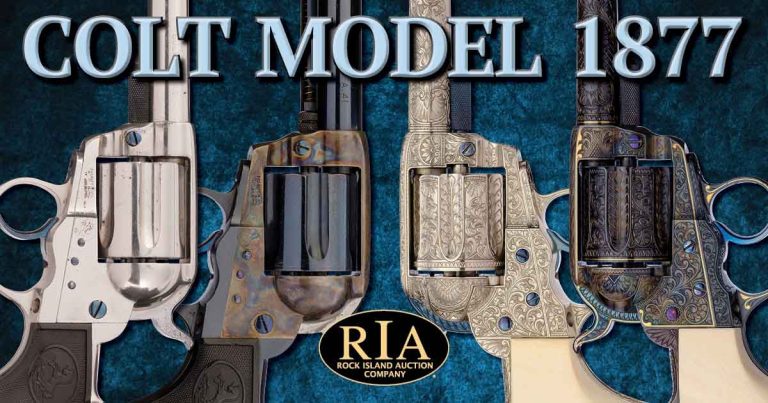
An advertisement for the Colt Model 1878 Omnipotent by B. Kittredge & Co. Kittredge often marketed Colt revolvers with nicknames. The Colt Single Action Army was sold as the “Peacemaker,” while the three Colt 1877 double action revolvers were named the “Lightning” for the .38 caliber, the “Thunderer” for the .41 caliber, and the “Rainmaker” for the .32 caliber.

Sources:

The Peacemaker and its Rivals, by John E. Parsons

Colt’s Double-Action Revolver Model of 1878, by Don Wilkerson

This old Gun: Colt Model 1877 Lightning Revolver, by Rick Hacker, American Rifleman

Colt M1877 Revolver The Double Action Taking the Old West by Storm, by Alan Garbers, Guns magazine

60+ Long-Term Survival Foods You can Buy at the Grocery Store

0

When disaster strikes, there’s a pretty good chance your local grocery stores will be stripped bare in a matter of hours. From panicked people trying to stock up on last-minute supplies to those who failed to prepare for even short-term disasters and now find themselves facing the prospect of starving, your local grocery store will look like a battleground in a post-apocalyptic movie.

Most grocery stores have a maximum three-day supply of goods on hand before they run dry. That means even short-term disasters like hurricanes, floods, and earthquakes can cause supply chain problems that will quickly wipe out their inventory. Now throw in a long-term disaster that cuts off supplies for months, and you have a real recipe for disaster.

To be prepared to face an emergency situation where supply chains fail and food deliveries are blocked, you need to invest in a long-term food supply. This supply should be made up of at least six months’ worth of emergency food with a long shelf-life – preferably something that you already eat.

From Supermarket Shelves to Survival Pantry: Building Your Emergency Food Stockpile with Long-Lasting Food From The Grocery Store

Storing Long-term food supplies at home.

In the face of so many uncertainties, it’s important to ensure your and your loved ones’ survival by stockpiling an emergency pantry with long-lasting food supplies. While many so-called survival experts try selling commercial ‘survival food’ as the answer, we advocate for building your stockpile with familiar foods you probably already eat – all from your local grocery store or farmer’s markets.

During an emergency situation, the last thing you want to do is eat a bunch of weird survival foods that you’ve never eaten before – from possible allergy concerns to the stuff just downright tasting like crap, now is not the time to start experimenting. On top of that, we don’t like wasting money, so buying foods you already eat and running them on a rotation system that ensures you don’t find yourself years from now with a pantry full of expired food!

With the help of suggestions that have come in from our readers, we have compiled a list of the top food items and emergency supplies that you can buy at the grocery store. The list contains foods with a long shelf-life, items that have multiple uses, and supplies that are great for bartering.

Survival Foods that add flavor & comfort:

Comfort foods can be a huge morale booster during a stressful survival situation, something that needs to be kept in mind when starting to stockpile food. These four things can be stored for over 10 years, and are a great way to add a little bit of flavor to your cooking. If stored properly they will probably last indefinitely.

  1. Salt: From food preservation to maintaining proper electrolyte balance in the body to enhancing the flavor of your food, salt is an an essential part of your food storage stockpile!
  2. Sugar: – Brown or White sugars can be stored for quite some time and during emergencies or high-stress situations can help boost energy levels and provide a quick source of fuel. It can also be a huge morale booster when things start getting tough.
  3. Raw Honey: Honey has an incredibly long shelf life contains numerous vitamins, minerals, and antioxidants. Honey has also been used for centuries as a natural remedy for wound healing due to its antimicrobial properties.
  4. Alcohol – Whiskey, Vodka, etc.: From bartering to health and medicinal uses, alcohol is one of those items that should be part of any good preparedness stockpile. Check out our article on which liquors are best to stockpile for preparedness.

Base cooking ingredients with a long shelf life

Survival Cooking Ingredients

Many people today lack the ability to cook anything from scratch, relying heavily on prepackaged and processed foods. This trend is unhealthy, but it could prove deadly during a long-term survival situation. Learning how to cook from basic ingredients is crucial for successfully preparing for emergencies and ensuring self-sufficiency in food storage.

The following categories of food make up the foundation of most recipes and are all things that store well.

Hard Grains: Stored properly hard grains have a shelf life of around 10 – 12 years.

  1. Buckwheat
  2. Dry Corn
  3. Kamut
  4. Hard Red Wheat
  5. Soft White Wheat
  6. Millet
  7. Durum wheat
  8. Spelt

Soft grains: These soft grains will last around 8 years at 70 degrees, sealed without oxygen.

  1. Barley,
  2. Oat Groats,
  3. Quinoa
  4. Rye

Beans: Sealed and kept away from oxygen the following beans can last for around 8 – 10 years.

  1. Pinto Beans
  2. Kidney Beans
  3. Lentils
  4. Lima Beans
  5. Adzuki Beans
  6. Garbanzo Beans
  7. Mung Beans
  8. Black Turtle Beans
  9. Blackeye Beans

Flours and Mixes and Pastas: 5 – 8 years

  1. All Purpose Flour
  2. White Flour
  3. Whole Wheat Flour
  4. Cornmeal
  5. Pasta
  6. White Rice ( up to 10 years)

Oils: It’s important to include fats in your stockpile. Fats are a concentrated source of energy and are crucial for overall health and well-being.

  1. Coconut oil – Unrefined, virgin coconut oil has one of the longest shelf lives of any kind of oil. It can last for over 2 years, has numerous health benefits, and is a great item to add to your survival food supply list.
  2. Clarified butter (Ghee): Clarified butter, also known as ghee, is butter that has been heated to remove moisture and milk solids. The process increases the fats stability and extends its shelf life. Ghee can last for several months to a year when stored in an airtight container in a cool, dark place.
  3. Olive oil: Extra virgin olive oil has a decent shelf life and can be stored for up to a year or more if kept in a cool, dark location.

For more information on cooking from scratch, check out these articles and books:

What About Buying Canned Goods for your Survival Pantry?

Proper Storage and Shelf Life of Canned Goods

We get a lot of questions on canned goods and how long they can safely be stored. To ensure the quality and safety of canned goods, it’s important to store them correctly and be aware of how long the manufacturer recommends they be stored. While most best-by dates are placed there to protect the manufacturer from lawsuits, The U.S. Department of Agriculture says that most shelf-stable foods are safe indefinitely. In fact, they say canned goods will last for years and that Dating is for quality, not safety.

Here are some guidelines to follow when dealing with store-bought canned goods and most shelf-stable foods:

1. Storage: Keep commercially canned foods and other shelf-stable products in a cool, dry location. Avoid placing them above the stove, under the sink, or in areas prone to high humidity or temperature fluctuations, such as a damp garage or basement.

2. Shelf life: The shelf life of canned goods varies depending on the type of food. High-acid foods like tomatoes and fruits maintain their best quality for up to 18 months, while low-acid foods such as meat and vegetables can maintain their original quality for 2 to 5 years. But again, if cans are undamaged (no dents, swelling, or rust) and have been stored properly in a cool, clean, dry environment, they can remain safe indefinitely.

3. Safety precautions: While extremely rare, the production of toxins by Clostridium botulinum bacteria poses the most significant risk when dealing with canned goods. To minimize the risk, make sure your cans are in good condition and show no signs of damage or contamination. If any cans appear compromised (bulges or leaks), it’s best to get rid of them to avoid any potential health hazards.

For more information on canning your own foods at home, check out our article on Canning your own food!

Survival Foods that are great during short-term disasters

Canned Foods for Emergency Situations

The following items are great for short-term emergencies, and will stay fresh for a long period of time. During most disasters, you’re going to want to have food that requires very little cooking, or can be eaten without any preparation at all. Make sure some of your stockpile includes these types of food.

Other good survival foods: 2 – 5 years of shelf life

  1. Canned Fish: Tuna, Salmon, Sardines
  2. Canned Meats: Chicken, Beef, Pork, Spam & Sausages
  3. Canned Vegetables & Fruits
  4. Peanut Butter
  5. Coffee
  6. Tea
  7. Ramen Noodles – not the greatest food in the world but they are very cheap so they made the survival food list.
  8. Hard Candy
  9. Powdered milk
  10. Dried herbs and spices
  11. Canned soups (a variety of flavors)
  12. Canned pasta sauces
  13. Canned broth or stock (chicken, beef, or vegetable)
  14. Crackers or rice cakes
  15. Dried fruits (raisins, apricots, cranberries)
  16. Nuts (almonds, walnuts, peanuts)
  17. Granola bars or energy bars
  18. Cereal or granola

Items that can be used for more than cooking:

  1. Apple Cider Vinegar – Cleaning, cooking and has antibiotic properties
  2. Baking Soda – Cleaning, cooking, etc…
  3. Honey – Mentioned again for its antibiotic properties and wound healing.

Nonfood items to stock up on at the grocery store:

  1. Bic Lighters
  2. Toilet Paper
  3. Soaps
  4. Bottled Water
  5. Multi-vitamins or supplements
  6. Medicines
  7. Bandages
  8. Peroxide
  9. Lighter fluid
  10. Canning Supplies
  11. Charcoal

More Emergency Food Resources

While we always advise the DIY approach to stockpiling food, this way you have the things that you would normally cook and eat and can then rotate them in and out of your normal life, there are some circumstances where commercially made survival food supplies might make sense. Here are some of the top emergency survival foods that can help you quickly bulk up your emergency supplies.

guns-and-more | Rock Island Auction

0

From the “duckfoot” gun to the real-life Liberator single shot pistol to conventional firearms, history has shown that defense drives innovation whether it is fighting spies, gangsters, or the Axis.

Some firearms, like the Thompson submachine gun or a Registered Smith & Wesson Magnum, are carried by heroes while the unusual and impractical Sedgley “Fist Gun” and the CIA’s Deer Gun remained in the shadows. Not all are spy guns, but these items are all brilliant in their own way and should be highlighted and remembered for what they contributed in the fight against crime or military aggression.

Sedgley “Fist Gun”

Officially known as the Sedgley Mark Two “Fist Gun” Hand Firing Device with Fitted Glove, this weapon was never an Office of Strategic Services (OSS) spy gun, but made for the U.S. Navy. Stanley M. Haight patented the single-shot gun in 1944. The firing mechanism was riveted to a leather work-type glove that had a plunger-like trigger that extended just above the knuckles.

The gun was fired with a punch of the fist to deploy the plunger. People may recognize the gun from Quentin Tarantino’s “Inglorious Basterds” when two of the protagonists have to take out a pair of Nazi guards.

Only 50 to 200 were produced as a weapon of last resort. It was originally intended to fire a .410 shotgun shell but instead when it was developed it fired Smith & Wesson .38 caliber cartridges. Despite being issued to Seabees and beach jumpers that provided distraction prior to an amphibious operation, there doesn’t appear to be any recorded instances of the gun being used in combat because of the weapon’s impracticality.

The Sedgley Mark Two “Fist Gun” hand firing device was fitted to a work glove. The firing mechanism was a plunger that extended above the knuckles that would be fired by punching someone, depressing the plunger-style trigger.

Deer Guns Are Truly Spy Guns

The Central Intelligence Agency doesn’t acknowledge this spy gun exists. In the early 1960s as the Cold War and Vietnam War started heating up, the Central Intelligence Agency was looking for a clandestine weapon to drop to allies. It took inspiration from the single shot Liberator that was made during World War 2 with the idea it could be used by resistance fighters to shoot the enemy and take their weapon.

The gun, made by American Machine & Foundry, had a cast aluminum receiver and a screw-out two inch barrel and plastic parts. Chambered in 9mm, it was about the same size as the .45 caliber Liberator but slightly lighter. Along with the different caliber, the Deer Gun differed from the Liberator by being simpler. The Deer Gun was made with 12 components to the Liberators 23 and had no trigger guard.

The story of the Deer Gun’s name varies, whether it was made from the acronym Denied Area (DEAR) Pistol or a tongue in cheek reference as a survival weapon.

The Deer Gun was commissioned by the CIA that won’t confirm it existence. Similar to the Liberator single shot gun of World War 2, the Deer Gun is lighter, simpler — with only 12 components to the Liberator’s 23, and fires 9mm ammunition.

These spy guns bore no serial numbers and were packaged with Styrofoam with rounds of ammunition and illustrated instructions. The CIA ordered 1,000 Deer Guns on a contract for $300,000. Of the original guns made, about 20 remain in circulation.

A Deer Gun is available in RIAC’s August Premier Auction in a solitary lot, but another example is also in a collection on offer of Liberator single shot pistols that include prototypes, a cut-away version, and an unopened box.

Pilot Barter Kits Instead of Spy Guns

During World War 2, pilots were issued Escape & Evasion Kits, with gold coins and jewelry that could be used to barter for safe passage if they came down behind enemy lines. The kits were issued as Atlantic and Southeast Asia versions. Each “barter kit” was individually serial numbered so pilots had to sign them out and return them for each mission. A similar kit was issued to Gary Powers whose U2 plane was shot down over the Soviet Union.

These kits’ hard rubber cases were 5 1/2 inches by 4 inches with form-fitted compartments for the rings and coins. The Atlantic kit held two French gold coins, three British coins, and three gold rings. The Asia kit held a gold link chain, heart-shaped gold pendant, two gold rings, and a Swiss calendar watch with cloth watchband that was included for convincing primitive tribes that it was a “god-like” mechanism.

No one had to barter for their freedom so the Escape and Evasion Kits were collected and sat until 1979 when they went up for auction. Three auctions were held in 1979 and 1980, with interest generated by volatile gold prices. Three hundred were offered in the first auction that drew 1,450 bidders. The next auction featured 3,000 kits for sale, with the highest bid coming in at $4,000. A fourth sale of 325 remaining kits was held in 1981. The kits’ original cost was $30 each.

Barter kits were issued to pilots during World War 2 and held gold coins and jewelry to trade for safe passage if a pilot was shot down over enemy territory. Gary Powers, whose U-2 spy plane was shot down during an overflight of the Soviet Union, carried something similar. The exterior of the kit reads “IF FOUND RETURN TO/COMNAVAIRLANT (CNAL 34)/NORFOLK, VIRGINIA” on both sides.

Operation Tidalwave

The Romanian oil fields at Ploesti, responsible for 30 to 50 percent of Axis fuel production, had always been a tempting target for the Allies but it was just out of reach of British-based bombers. A hush-hush mission, code named Operation Tidal Wave, was planned using B-24 Liberators flying from Libya for a mass low-altitude bombing attack against nine refineries. Crews only learned about the mission and its objectives the night before takeoff on Aug. 1, 1943.

One hundred seventy eight bombers took off from their Libyan base, but radio silence, to keep their destination a secret, ruined any coordination and the mission was quickly in disarray. Bombing runs were mistimed and bombers made their attacks from different directions.

The mission cost 54 bombers lost and 440 aircrew killed, and 220 captured or missing. Forty percent of refinery capacity was destroyed but restored within weeks. The operation was considered a failure.

Lt. Homer S. Gentry was a navigator on one of the B-24s who returned from the mission safely. In April 1944, Gentry, as navigator of the B-24 “Patriotic Patty,” was killed in action, setting course after a raid as he bled to death, wounded by anti-aircraft fire. Among his personal effects were a Remington Rand Model 1911A1 pistol, a flight jacket, and other personal artifacts that are available in the August Premier Auction.

The flight jacket and other personal effects including a Remington Rand M1911 of Lt. Homer S. Gentry Jr. are available in Rock Island Auction Company’s August Premier Auction. Gentry was a B-24 navigator who took part in the secretive Operation Tidal Wave, a low-level bombing raid of oil refineries at Ploesti, Romania. The raid was a disaster, with 54 bombers lost and 440 aircrew killed along with 220 captured or missing.

School for Spies and Assassins

Commissioned a lieutenant in the U.S. Army after graduating from the University of Oregon in 1938. Rex Applegate became a military policeman. He was intimidating with his 6-foot-3-inch frame and 230 pounds and was an expert marksman.

During World War 2, OSS chief Wild Bill Donovan recruited Applegate, handing him $50,000 cash. Donovan gave Applegate the task of building a training camp for OSS officers in a remote part of Maryland. He coordinated instruction in hand-to-hand combat, knife fighting, and shooting spy guns. He emphasized speed and ruthlessness. The training camp was initially called Area B, before becoming the presidential retreat of Shangri-La, and then Camp David.

A lung issue prevented him from combat, but he wrote a book on combat techniques called “Kill or Be Killed” with the premise of “Do unto others as they would do unto you, but do it first.”

He retired as a lieutenant colonel at the end of World War 2, and worked in Latin America as a consultant on riot control. After two decades he returned to the United States in the 1960s to advise the military and police departments on riot control tactics, advising “be firm, yet friendly,” and only using more aggressive measures when necessary. A knife and gun collector, Applegate’s Al Mar Knives 10th anniversary commemorative Bowie Knife is available in RIAC’s August Premier Auction.

This Bowie knife was owned by Rex Applegate, who started and coordinated the Office of Strategic Services Schools for Spies and Assassins, a training center in rural Maryland used by the OSS during World War 2. Applegate wrote a book on combat techniques called “Kill or Be Killed.”

What Did He Know about Lee Harvey Oswald?

Birch O’Neal was a CIA agent who served as the Guatemala station chief during the CIA’s 1954 coup who moved on to the Special Investigations Group. He opened the file on Lee Harvey Oswald in November, 1959. That brought him into the sphere of John F. Kennedy assassination conspiracy theorists.

Jefferson Morley, author of the JFK Facts blog, wrote that the CIA received more than 40 reports on Oswald between the date the CIA file was opened and Kennedy’s assassination. Morley writes that when questioned by the FBI about Oswald’s file, O’Neal told them there was nothing in it, putting him in the CIA cover up of the assassination from the start.

O’Neal, who truly moved in the shadows and of whom little is known because of his work for the CIA, owned a Registered Smith & Wesson Magnum that will be on offer in Rock Island Auction Company’s August Premier Auction.

While not technically among the spy guns, this Smith and Wesson Registered Magnum was owned by a spy. The gun belonged to Birch O’Neal, a CIA agent who opened the file on Lee Harvey Oswald in 1959 that put him squarely into the conspiracy theories surrounding the assassination of President John F. Kennedy in 1963.

Used against the Axis, Gangsters

Initially conceived as a trench gun, the Thompson submachine gun didn’t make it into service in World War 1, but the Tommy gun found a home with gangsters and the police that fought to stop them. The Tommy gun could be found in the United States military arsenal, with more than 1.5 million of the M1928A1 and M1A1 produced during World War 2. Nearly 140,000 Thompson SMGs were exported to the Soviet Union. They were also used by Special Forces in the Vietnam War.

Tommy guns could also be found in police armories as coppers battled bank robbers like Bonnie and Clyde, and Machine Gun Kelly who often went better armed than their law enforcement pursuers. This legendary American gun was in the Hot Springs National Park inventory in the late 1920s, among 20 shipped to the West Virginia State Police in 1922, and part of a 10-gun shipment to the Omaha Police in 1930.

The Thompson submachine gun was the weapon of cops and robbers of the 1920s, the American GI and Soviet soldiers in World War 2, and even used by Special Forces in the Vietnam War.

Working in Sun and Shadow

These items all seem unrelated but they share a common thread in the protection of America at home and abroad. Weapons were owned by OSS and CIA agents, a heroic flyer, were contained in police inventories, and intended to defend democracy. They are all available in Rock Island Auction’s August Premier Auction.

This is a good view of the Sedgley Mark Two “Fist Gun” Hand Firing Device with its plunger-like trigger mechanism that when attached to a glove would fire when punching someone. This mechanism and one still attached to its glove are available in Rock Island Auction Company’s August Premier Auction.

Sources:

Rex Applegate, 84, Instructor of Deadly Skills, by Richard Goldstein, The New York Times

Pieces of the Past, Naval History Magazine

1943 – Operation Tidalwave, the Low-Level Bombing of the Ploesti Oil Refineries, August 1, 1943, Air Force Historical Support Division

Brownells

AI-Generated Content Floods Prepper Sites as Media Kills Off The Rest!

0

As someone who has maintained one of the last of the truly independently run survival sites, I have witnessed and wrote about a concerning trend unfolding over the past decade: the systematic suppression of alternative media. This has now infiltrated the survival community, resulting in the proliferation of AI-generated content and carefully curated misinformation on platforms that were once independent but have since been assimilated by the BORG (mainstream media conglomerates).

Our troubles began when a mainstream media giant attempted to acquire our company – we told them in more colorful language to “fuck off”. Around that same time we were in talks to do a Television show, until we were told that we would have to fake who we were with a fake backstory for the public, pretend to live in a cabin deep in the wilderness (none of it would actually be shot there is was just to build our fake persona) and basically compromise ourselves forever by living this fake life! Step out of line, BOOM they got you! We told them all again, to go fuck themselves!

In retaliation, another connected media organization shamelessly trademarked our name and unleashed a team of lawyers from the West Coast to silence us and attempt to shut us down. While we resisted their attacks, the remnants of our once-thriving site were then attacked on multiple other fronts. Sites like ours have been deliberately shadowbanned, deplatformed, and eradicated from major search engines, their places taken by corporate entities masquerading as “ordinary people.”

If you’ve wondered where OFFGRID SURVIVAL has been, or why you rarely see us in your feeds…

It’s All By Design, almost everything you now see is government/media controlled propaganda!

This week, the Daily Mail ran an article highlighting the flourishing luxury prepper industry, featuring an alleged prepping website as their go-to expert. The irony lies in the fact that the site they featured, much like many others today, is filled with stolen content from our site and other independent sources that have long since surrendered to the daily attacks. To add insult to injury, it is backed by Silicon Valley elites such as Sam Altman, CEO of OpenAI, a prominent pioneer in artificial intelligence, and one of the groups the media giants use to steal, spin content, and then pass it off as their own.

These fucking assholes don’t give two shits about you and me!

Their purpose is far from providing genuine guidance on survival; in fact, the information they disseminate contradicts their own actions. These are the very same individuals who orchestrated the global COVID deception and implemented business and economic killing shutdowns that have caused widespread economic turmoil. They know you are fucked, and they are prepping for a time when you realize it was they who caused it!

Isn’t is odd that a deepstate Obama administration adviser now runs the top google searched prepper site on the internet — all feed with stolen content from sites like mine? It’s almost as if they are all in this together and this is the plan we warned you about years ago when we told you they were suppressing search results, shadow banning real people, and replacing us with CONTROLLED OPPOSITION and AI BOTS pretending to be real people.

In the Daily Mail article, they highlight a number of so-called elite preppers. Sam Altman, CEO of OpenAI, Steve Huffman, co-founder of Reddit, Obama administration adviser-turned-prepper John Ramey who now run a site called theprepared.com filled with our stolen and AI spun web content… THESE PEOPLE ARE NOT YOUR FRIENDS and they are spending billions of dollars to prepare for the coming chaos that they themselves planned!

These Elites are spending billions of dollars on dooms day yachts, underground bunkers and private islands where they believe they can escape the coming rage-fueled doomsday that they fear is coming — because they orchestrated the whole damn thing!

Article we suggest reading:

There is no doubt something is coming. From the World Health Organization and the Bill Gates psuhing the the Next Pandemic will be ‘More Deadly’ than COVID to the Biden administration stockpiling $290 Million Worth of Drugs for Radiation Sickness to four-star U.S. Air Force General Mike Minihan, head of Air Mobility Command telling Air Force operational commanders that they should be preparing for war with China these people are up to something!

Are you prepared to stay in communication and gather vital intel if the communication networks go down?

For more information on Emergency Communication, and gathering intel from the radio waves, check out these articles:

It’s Time to start taking this seriously!!

Be Prepared to Feed Yourself when the Collapse Hits!