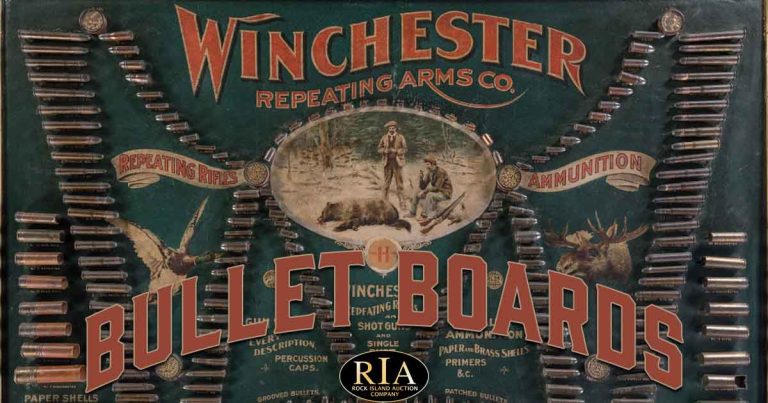
That’s the request on the back of a Winchester cartridge display board — or a bullet board, and with the prices of these items on the march upward, it is likely one would want to comply.
A bullet board or cartridge board was a late 19th century advertising display of the numerous cartridges that a particular company made or could be used in its guns, offering a tactile piece of art that may also include a painted outdoor scene. While prices can vary because of condition or desirability, Winchester bullet boards are regularly selling for more than $40,000 at Rock Island Auction Company. Some bullet boards are achieving prices approaching $100,000.
Winchester “Double W” cartridge displays — or bullet boards — have proved to be highly valuable at recent Premier Auctions at Rock Island Auction Company. This “Double W” is available in the August Premier Auction.
Winchester Cartridges and the Bullet Board
As guns advanced after the American Civil War, companies like Winchester started making ammunition themselves to optimize their weapons’ performance. That is how the .44-70 WCF came into being. However, people were still hand-loading their own, so these same companies had to promote their ammunition.
Winchester did this in a number of ways, sending “missionaries” to shooting competitions, club shoots, and county fairs, as well as to gun stores and distributors. Many of these “missionaries” were expert marksmen able to demonstrate and sometimes win shooting competitions, showing the consistency and quality of the ammunition over cartridges loaded at home. Winchester employed Adolph and Elizabeth Topperwein at the turn of the 20th century as marksmen to demonstrate the company’s firearms and ammunition and get brand recognition.
Companies advertised in newspapers and magazines and also provided items to give away. These were things like calendars, posters, and other display items, like Winchester’s bullet board.
A closeup of the Winchester “Double W” bullet board shows the painting of two hunters after the hunt by A.B. Frost. The display board also features a mallard duck in flight and a moose. This bullet board will be available on the first day of the August Premier Auction.
Bullet Board Background
In the late 1870s, Oliver Winchester wrote about his company’s name, “It has become a household word, and a household necessity on our western plains and mountains.”
Since the company had name recognition and a reputation for dependability, it went toward more artistic advertising. By 1875, Winchester was manufacturing 1 million cartridges per day, including 25 types of rimfire cartridges, 24 centerfire cartridges, and four shot shells. Wanting to promote its ammunition, Winchester created the bullet board. The first board appeared in 1874 as Winchester produced one centerfire cartridge for its Model 1873 and the rest were rimfire. The bullet board showed game scenes along with the cartridges.
The company produced six different patterns of commercial bullet boards from 1874 to 1897’s “Double W” boards. Over the years they displayed the evolution of metallic cartridges from rimfire to centerfire and black powder to smokeless powder.
The “Double W” boards, like the one in the August Premier, features a central sporting print by A.B. Frost surrounded by more than 200 cartridges, shells, and bullets. Frost’s work shows two hunters after a hunt, a dead bear at their feet. One hunter stands over the bear while the second sits on a nearby log smoking a pipe, with their Winchester rifles propped against the log.
Winchester also produced a limited run of lithographs of its “Double W” bullet boards in the early 20th century that can be found at a relatively lower price point than an actual display board, despite being scarcer in production numbers.
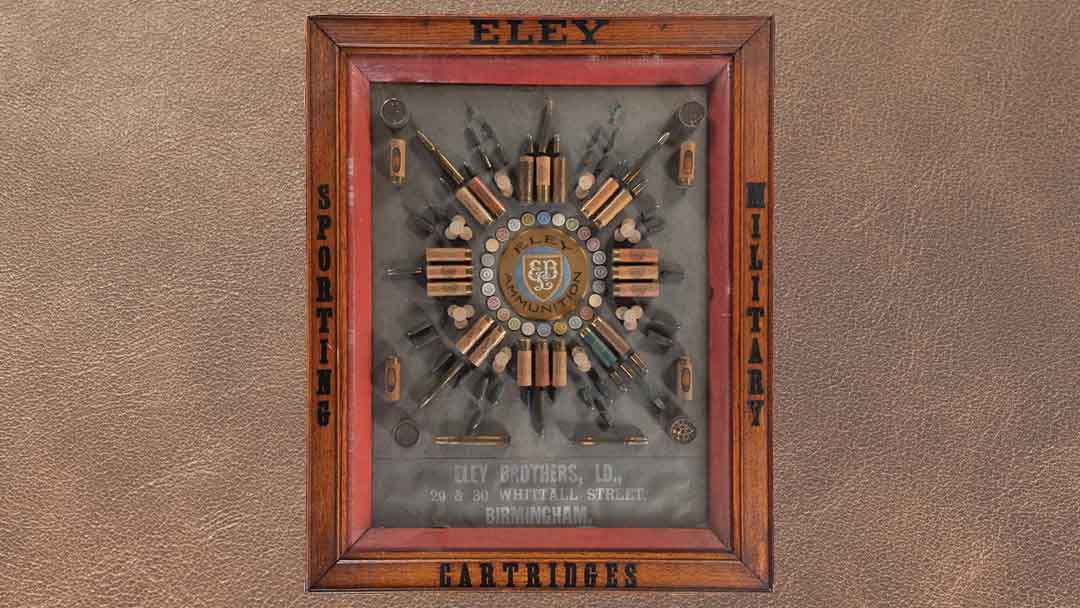
Cartridges run from tiny .22 shorts up to the .475 No. 2 Nitro on this Eley Brothers bullet board that is available in RIAC’s August Premier Auction and would be a terrific addition to a collection of fine British arms.
A Bullet Board and Western Art
Bullet boards are finding their way into western art auctions alongside paintings that achieve prices in six- and seven-figures. Interest in western art, once derisively described as “cowboy art,” is growing in popularity.
Artists like Philip R. Goodwin, N.C. Wyeth, and Carl Rungius that painted late in the 19th century and into the early 20th century were often commissioned by companies for outdoor scenes that would appear in advertising posters and calendars.
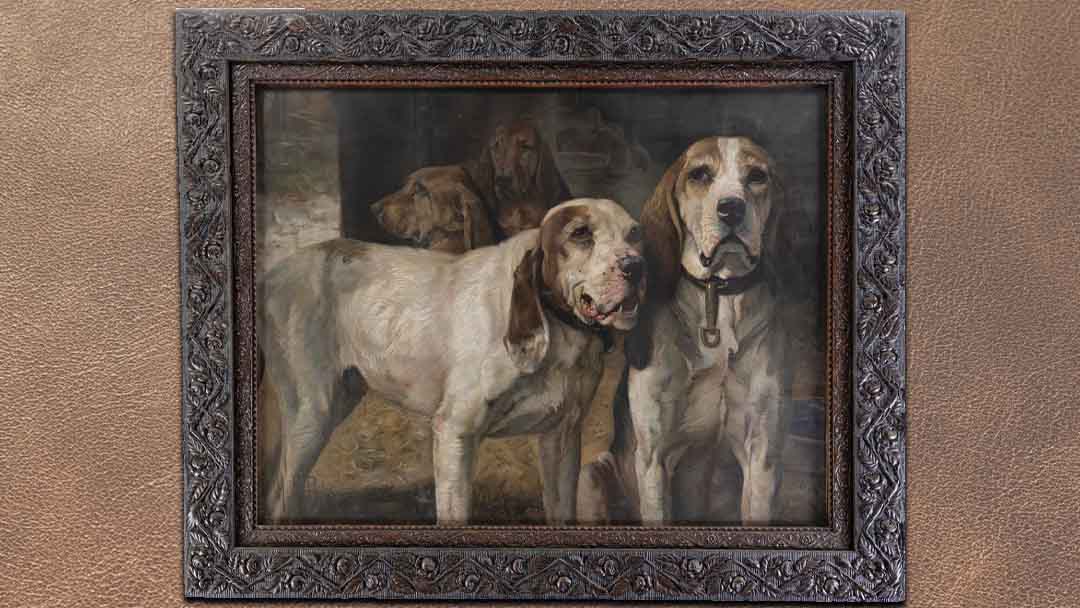
A print of H.R. Poore’s “Bear Dogs” painting that has served as a classic Winchester advertisement. The artist-signed print is available in Rock Island Auction Company’s August Premier Auction.
Advertising lithographs by companies like Winchester, Union Metallic Cartridge Company, Dupont Powder, and Harrington & Richardson from the George Gamble Collection, recently performed well at Rock Island Auction. The realistic paintings often pit man against nature in rigorous yet majestic settings or take on an air of sentimentalism.
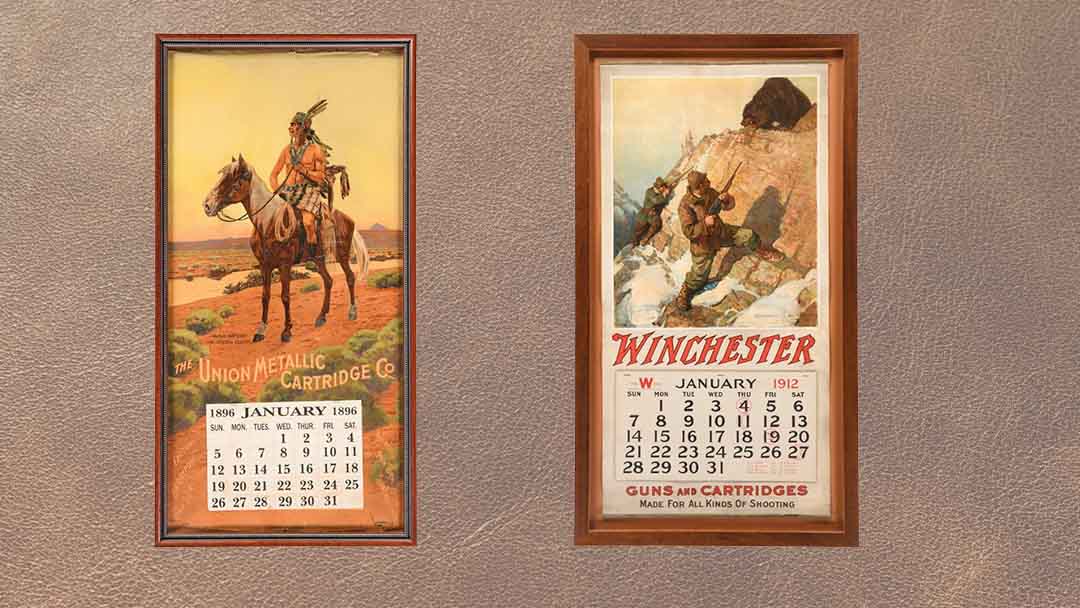
In RIAC’s December 2022 Premier Auction, a framed Winchester calendar from 1912 with art by Wyeth that shows two men on a rocky embankment taking aim at a bear more than doubled its high estimate, while a framed 1896 Union Metallic Cartridge Company calendar with Fernand Lungren’s “Navajo War Chief In Arizona Desert” nearly tripled its high estimate.
On offer in the upcoming August Premier Auction will be a print of the well-known “Bear Dogs” painting that was used in a number of Winchester advertisements and a tin lithograph advertisement of Four Roses whiskey featuring a painting by Arthur W. Woelfle that shows waterfowl, a fox, and a coat hanging on the wall where a side-by-side shotgun is propped up and a Winchester Model 1894 rifle is also hanging, and a bottle of whiskey and a glass sits alongside a deer head, shotgun shells, and playing cards.
This lithograph advertisement for Four Roses whiskey features a painting by Arthur W. Woefle is a still life showing the results of a hunt along with a shotgun and Winchester Model 1894 as well as a bottle of whiskey and a glass alongside it.
Bullet Board Bonanza
In December 2022 a Winchester “Double W” bullet board hammered at RIAC for $70,500. The Winchester “Double W” boards appear to be the gold standard. In the May Premier Auction, one crossed the podium for $64,625. Prices occasionally top $80,000, catching one consigner off guard but pleased with the sale price, saying, “Never in our wildest dreams did we think that the cartridge boards had such value.”
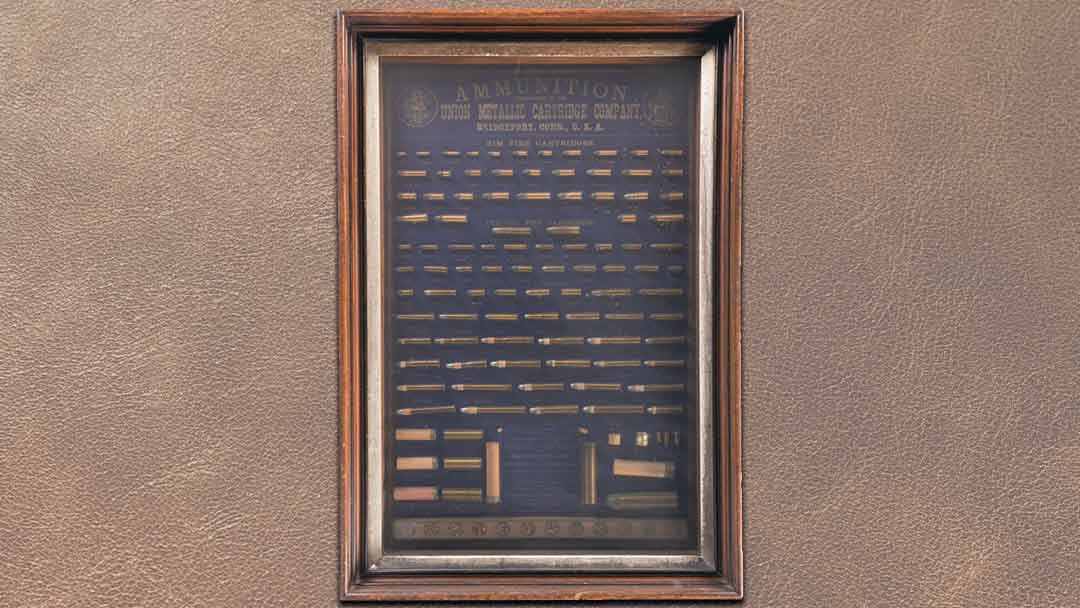
Bullet boards have fared well when they’ve come to the podium in recent sales at Rock Island Auction Company, and not just Winchester displays. Union Metallic Cartridge Company bullet boards have exceeded $44,000, going as high as $51,750 on two occasions. A United States Cartridge Company board gaveled for $43,125 in December 2021.
Other bullet boards that might be from less well known companies like Kynoch or Eley Brothers, or not as large as the Winchester boards but are also desirable at a lower price point, coming in at less than $10,000.
This Union Metallic Cartridge Company bullet board achieved $51,750 at Rock Island Auction’s September 2020 Premier Auction.
In the August Premier Auction, the Winchester “Double W” board has its original frame and displays a vibrant dark green background with images of a mallard duck in flight and a bull moose along with the vignette of the hunters mentioned earlier. It displays various cartridges and shotgun shells as well as primers. On the back is the wording “PRESENTED WITH COMPLIMENTS/Winchester Repeating Arms Co./PLEASE HANG IN A PROMINENT PLACE.” The back of the bullet board also displays the number 1590.
Bullet Board for Sale
A collector’s space needs adornment, and a bullet board showing the progression of ammunition cartridges is something that can be proudly displayed on the wall of a gun room, study, or office. Winchester bullet boards, like this “Double W” board, draw the most attention and higher prices, but bullet boards with more modest estimates, like this Eley Brothers board, provide different price point opportunities. Both are available in the Aug. 25-27 Premier Auction and could soon be on your wall.
The 1896 Union Metallic Cartridge Company calendar on the left featuring Fernand Lungren’s “Navajo War Chief in Arizona Desert” nearly tripled its high estimate, hammering for $12,925, while the 1912 Winchester calendar with artwork by NC. Wyeth doubled its high estimate, also achieving $12,925. Both were sold in RIAC’s December 2022 Premier Auction.
Sources:
Winchester Promotional Arts: Graphic, Three-Dimensional and Live Advertising Mediums, by Richard Rattenbury
Winchester: The Gun That Won the West, by Harold Williamson
Early Brand Development in the U.S. Firearms Industry, by Terrence H. Witkowski
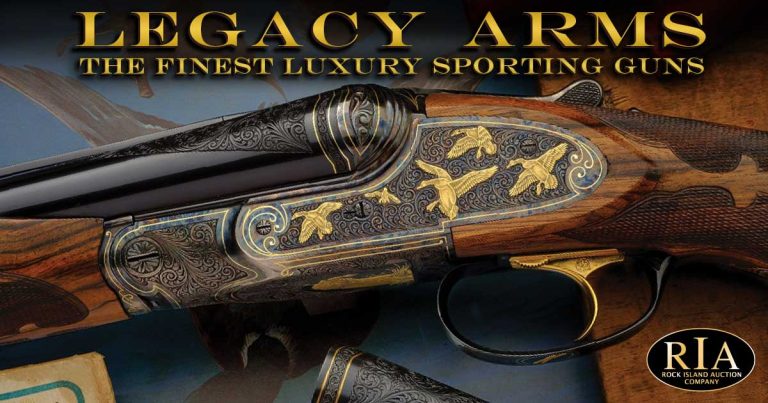
True legacy arms are far more than the sum of their parts. Whether displayed as a decorative heirloom or marked with the fingerprints of those who came before, a fine sporting arm can offer both a tangible connection to our hunting heritage and serve as a timeless treasure to pass down through the generations.
An Albino Contessa signed, engraved and gold inlaid Fratelli Rizzini .410 bore R-1E sidelock shotgun with case, one of the finest legacy arms for sale this August.
Whether displayed at home or abroad, at the club or the cabin, a masterpiece sporting arm makes a defining statement in any gathering, an object of pride for its owner and an absolute standout for every collector, shooter, and fowler who appreciates the best of the best.
A cased pair of game scene engraved and gold inlaid Holland & Holland shotguns from The Tom Selleck Collection leads a superb selection of legacy arms featured at RIAC this August.
From golden age craftsmanship to the pinnacle works of modern artisans like Diego Bonsi, Ken Hunt, and the late, great Philippe Grifnee, you’ll find the highest level the industry has to offer during Rock Island Auction Company’s August 25-27 Premier Auction. Click on the images throughout this article to learn more about each outstanding sporting arm.
A Claudio Tomasoni signed and game scene engraved Abbiatico & Salvinelli (FAMARS) sidelock O/U shotgun with case. Available this August.
European Shotguns
For hundreds of years, high-end sporting guns were reserved for Europe’s wealthy elite. The introduction of the break open, breechloading action along with the invention of the hammerless boxlock and sidelock actions gave rise to a trove of classic European designs, including legacy arms from storied European manufacturers such as Holland & Holland, Westley Richards, and E. J. Churchill.
A documented matched pair of factory engraved and gold inlaid E. J. Churchill premiere quality sidelock O/U shotguns with case. Available this August.
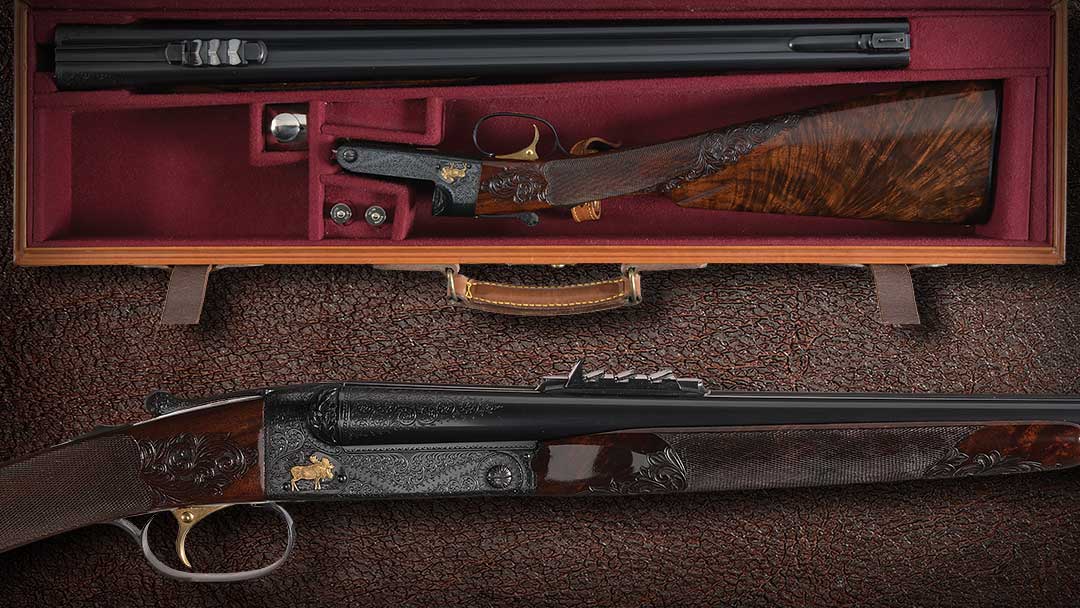
The gold inlaid Westley Richards Super Magnum Explora droplock double barrel ejector shot & ball gun featured below illustrates the innovation and variety present in the European sporting market by the turn of the 20th century. Shot & ball guns were once quite popular, giving a sportsman the utility of two guns in one and the ability to take everything from upland birds to dangerous game on the plains of Africa and the jungles of India.
A gold inlaid Westley Richards Super Magnum Explora droplock double barrel ejector shot & ball gun manufactured in 1909. Available this August.
Few things embody our hunting heritage more handsomely than a premium double gun. The lofty reputation earned by European giants like John Rigby & Co. continues today through their modern offerings, where precision craftsmanship and exceptional engraving sets these legacy arms apart from their mass-produced competitors.
A true pair of legacy arms, this exceptional cased engraved, consecutively serial numbered matched pair of P. Arrizabalaga assisted opening hand detachable sidelock double barrel hammerless shotguns is marked “Made For John Rigby & Co. London.” Available this August.
Holland & Holland Legacy Arms
When sportsmen and gun collectors think of legacy arms, Holland & Holland is a name that quickly comes to mind. A leader in the fine arms industry since 1835, this storied London gunmaker has offered the finest doubles to kings, heads of state, and the wealthiest of the world’s social elite. The prestigious pair of Holland & Holland double guns below was custom ordered by Hollywood’s Tom Selleck, an avid hunter, Second Amendment supporter, and former NRA board member who assembled a truly elite firearms collection.
A magnificent cased true pair of master Philippe Grifnee signed, game scene engraved, and gold inlaid subgauge Holland & Holland marked “Model De Luxe” self-opening sidelock double barrel shotguns. Available this August.
The next Holland & Holland shotgun for sale this August ranks as one of the most luxurious O/U pieces on the market and serves as yet another example of why Holland & Holland continues to define excellence in its industry. With its elegant lines, brilliant finish, and exquisite master engraving, this Holland & Holland Sporting Deluxe exemplifies the shotgun as a canvas for the highest levels of artistry.
An engraved Holland & Holland Sporting Deluxe O/U shotgun with case, one of the numerous fine legacy arms available this August.
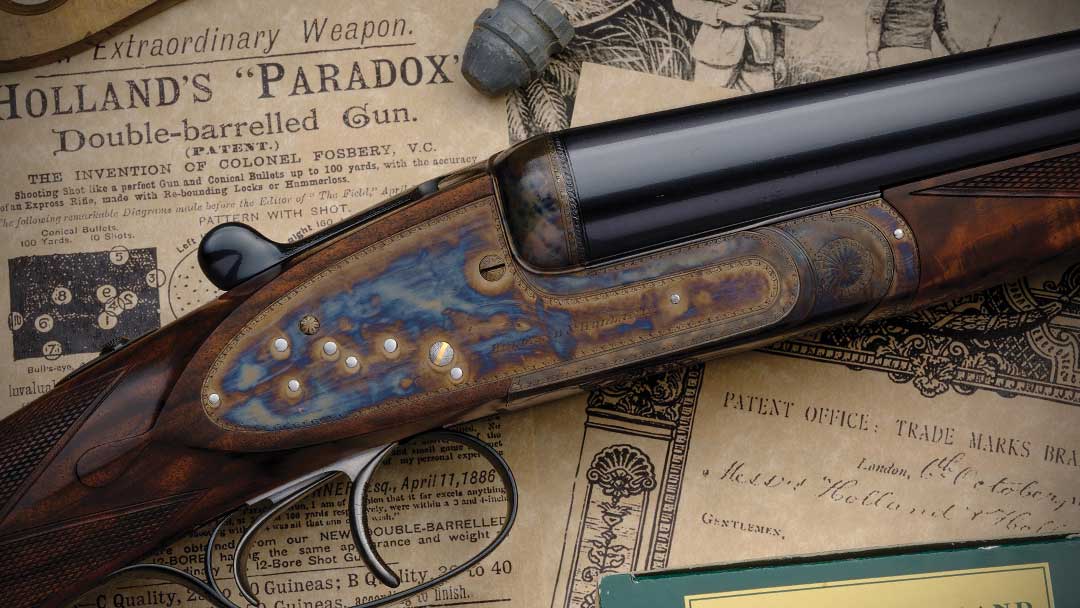
Another legacy arm from The Tom Selleck Collection, the Holland & Holland Paradox gun for sale during Rock Island Auction Company’s August 25-27 Premier Auction is a defining example of an already rare genre. The gun is pictured on page 106 of ‘Paradox: The Story of Col. G. V. Fosbery, Holland & Holland, and the Paradox, Volume One’ by David J. Baker and Roger E. Lake.
The factory engraved Paradox gun includes an oak and leather takedown case, nine rounds of H&H Paradox ammunition in a factory box, a nickel oiler, loading tools, and a letter from Mr. Selleck noting his ownership of the gun and the quality of the refurbishment performed by Master Gunsmith Les Pittman.
A documented factory engraved Holland & Holland Royal hammerless ejector Paradox gun with case. Available this August.
Holland & Holland is also the gunmaker most associated with the double rifle thanks to larger-than-life hunters like Teddy Roosevelt and Ernest Hemingway. The Holland & Holland double rifle has represented the adventure of the African Safari for over a century and continues to represent the golden age of big game hunting with appearances in films like ‘Ghost in the Darkness’ and ‘Out of Africa,’ and Taylor Sheridan’s recent 1923Yellowstoneprequel series,
A Ken Preater engraved Holland & Holland sidelock ejector double rifle in .458 Win Mag, from the Petersen Museum Collection. Available this August.
Beretta Shotguns
The oldest active gunmaker in the world, Beretta, has remained competitive in the ever-changing marketplace by continuing to update its roster, including its coveted sporting arms lineup. Possibly Beretta’s most famous shotgun, the Beretta SO sidelock, was designed in 1935 to compete with the English Boss O/U shotgun.
The SO line became a popular option for both field use and clay shooting. The exceptional game scene engraved Beretta Model SO4 two barrel set pictured below is an elite example of the longest-produced iteration of this historic model, a true legacy arm with exceptional engraving.
A masterpiece M. Gobbi engraved and signed Beretta Model SO4 O/U shotgun two barrel set with case. Available this August.
Until 1990, the SO shotgun line was exclusively manufactured in large gauges. To meet demand, Beretta began to offer the SO9 in 20 and 28 gauge, as well as .410 bore like the impressive example below. These gauges came with a considerable premium compared to their larger-bored siblings and are considered the rarest Beretta SO shotguns.
Another one of the head-turning legacy arms for sale this August, a Diego Bonsi signed and game scene engraved P. Beretta .410 bore SO9 pinless sidelock O/U shotgun with case.
Fabrique Nationale
Founded in 1889 as Fabrique Nationale d’Armes de Guerre, the Belgium-based company started as a military supplier before they began plying sportsmen with shotguns like the Auto-5 and Browning Superposed. Designed in 1923 by legendary gun inventor John Browning and released in 1931 by Fabrique Nationale, the Belgium Browning Superposed kick-started a developmental renaissance for the O/U shotgun.
An Angelo Bee signed and engraved Belgian Browning Diana Grade Superposed shotgun four barrel set with case. Available this August.
With the Superposed shotgun, John Browning saw an opportunity to develop a quality production-made O/U that could be priced to compete in a crowded market. Browning’s longtime partner Fabrique Nationale produced the model in Belgium and the gun went on to become one of the most popular O/U shotguns in the world. Top-quality examples like Exhibition Grade Superposed below have become desirable legacy arms for today’s collectors.
A factory engraved and gold inlaid Belgian Browning Exhibition Grade Superposed shotgun with case. Available this August.
American Legacy Arms
In 1880, New York native Daniel Myron Lefever patented the hammerless shotgun and ushered in a golden age for sporting arms development in America. The classic shotgun pictured below, manufactured in 1903 by D. M. Lefever, Sons & Company, demonstrates some of the finest craftsmanship of the era.
An outstanding factory game scene engraved Lefever Grade B double barrel shotgun, a great opportunity for a hard-to-find high-condition Lefever. Available this August.
Many sportsmen today look fondly back at the legacy arms produced during this high point in American shotgun making, and for good reason. That hallowed tradition can still be found with gunmakers like Connecticut Shotgun Manufacturing. Operating out of New England’s “Gun Valley”, the cradle of American arms development, Connecticut Shotgun Manufacturing combines the aesthetic of golden age craftsmanship with the precision of modern manufacturing, illustrated by exceptional pieces like the A-10 American sidelock O/U below.
Another fantastic legacy arm from The Tom Selleck Collection, this factory Engraved Connecticut Shotgun Manufacturing Co. A-10 American Sidelock O/U shotgun is a two barreled set that includes its factory takedown case. Available this August.
Parker Brothers Shotguns
As America’s most famous pre-WW2 shotgun manufacturer, Parker Brothers holds a special place in the hearts of countless hunters across the Land of Stars and Stripes. “The Old Reliable,” as the company dubbed their guns, referenced the hand-assembled precision and quality craftsmanship offered by these iconic legacy arms. These traits are skillfully exhibited in the gorgeous shotgun pictured below, an engraved and gold inlaid “Invincible” Grade Parker Brothers two barrel set that would serve a new owner well both out in the field and as eye candy in the gun room.
An outstanding engraved and gold inlaid Pachmayr upgrade “Invincible” Grade Parker Brothers shotgun two barrel set. Available this August.
Next, we have one of the rarest Parker Brothers shotgun configurations ever produced. According to page 279 of ‘The Parker Story’ by Gunther, Mullins, Parker, Price, and Cote, the .410 bore GHE Grade Parker Brothers was one of only 27 built manufactured in this combination of grade, gauge, barrel length, and barrel steel, making this already rare 1926 produced Parker a true treasure in sporting arms collecting.
A Parker Brothers .410 bore GHE Grade shotgun, a fine example of one of America’s classic legacy arms. Available this August.
For most hunters, there’s a romance in legacy arms, the appreciation of tradition and heritage, the exhilaration of shouldering a shotgun with a story to tell and a history to share. Parker Brothers represent classic Americana at its finest. From Ernest Hemingway to Zane Gray, from Annie Oakley to Gary Cooper, Parker Brothers shotguns were the choice for a generation of upland hunters and clay shooters and came to define an era of outdoor adventure.
A Robert P. Runge engraved Parker Brothers Larry Del AHE Grade upgraded double barrel shotgun.
Ithaca Shotguns
A household name today for many firearm fans around the globe thanks to the widely popular Model 37 shotgun, Ithaca has produced some luxury sporting arms as well. Fewer than 500 Ithaca Classic Doubles were produced, including three consecutively serial numbered examples featured in Rock Island Auction Company’s August 25-27 Premier Auction.
Three consecutively serial numbered Superlative Grade Ithaca Classic Double Shotguns in three different chamberings. Available this August.
Each of these Ithaca shotguns was assembled and finished in the United States using Italian-made parts by a litany of the most skilled men in their crafts. The engraving was carried out on the standard grade guns by the famous father-son engraving duo John Sr. and John Adams Jr. as well as John Pease, with the high grade guns, such as the three offered for sale this August, engraved by Creative Art Studios of Brescia, Italy.
A factory engraved and gold inlaid Ithaca Classic Doubles Superlative Grade Double Barrel Shotgun in 28 gauge. Available this August.
This trio of Ithaca shotguns exhibits some of the finest gunmaking ever carried out on this side of the Atlantic. Each Ithaca double gun includes an oak and leather takedown case with a canvas cover, nickel snap caps, a nickel oiler, an Ithaca Classic Doubles pamphlet, and a copy of the March/April 2002 issue of “Shooting Sportsman” in which there are two advertisements and an article featuring Ithaca Classic Doubles.
One of three legacy arms from Ithaca for sale this August, this factory engraved and gold inlaid Superlative Grade double gun is chambered in .410 bore.
The Winchester Model 21
The name Winchester embodies American gunmaking at its finest, and the Winchester Model 21 is widely hailed as one of the most elite American boxlock double guns ever manufactured. Although technically a production gun until 1960, each Winchester Model 21 was custom-crafted in terms of workmanship, configuration, and attention to detail, and every one of these classic shotguns has a story as unique as the sportsmen and shooters who shouldered them.
An engraved and gold inlaid Winchester .410 bore Model 21 Grand American-style double barrel shotgun three barrel set with case. Available this August.
One of America’s finest legacy arms, even the most basic Model 21 was a costly investment, but the owner was rewarded with a double gun built to last. Higher-end Winchester Model 21 variants like the exceptional shotgun below were lavished in full coverage scroll engraving that stands out against the laser engraving found on many of today’s production guns.
Engraved and gold inlaid Winchester .410 bore Model 21 Grand American-style double barrel shotgun two barrel set with case. Provenance: The Buffalo Bill Center of the West. Available this August.
The spirit of Winchester’s magnificent premium double gun lives on today with examples produced by Connecticut Shotgun Manufacturing Company. One of the most intriguing sporting arms for sale this August at RIAC, the deluxe custom Winchester gold inlaid Royal Grand American double rifle featured below chambered in .45-70 Government was finished by Connecticut Shotgun Manufacturing Company on an original Winchester manufactured Model 21 action. The deluxe engraving and gold animal inlays were designed and executed by master engraver Nick Kusmit, a long-time employee of the Winchester Custom Shop.
A rare and exceptional Royal Grand American-style Connecticut Shotgun Manufacturing Co. Model 21 double rifle in .45-70. Available this August.
Legacy Arms for Sale
For the shooter, collector, and gentleman sportsman, true legacy arms are one of life’s finest treasures. The precision craftsmanship of a premium shotgun or double rifle is evident in everything from its clock-like workings to its exceptional engraving and finely checkered walnut, and the variety showcased here touches on just a few examples featured in Rock Island Auction Company’s August 25-27 Premier Auction.
An exceptional and rare Burgess Gun Company “Folding Gun” slide action shotgun with Waist Holster. Available this August.
From subtle elegance to lavish luxury, from sterling condition examples to guns with touches of wear that speak to their experience, all tastes and aspirations are well-represented at Rock Island Auction Company.
An exhibition quality, factory engraved Spencer slide action shotgun. Available this August.
Two exquisite legacy arms. (Right) A Giovanni Steduto signed and engraved J. Rigby double rifle in .600 Nitro Express. (Left) A Ken Hunt signed, engraved, and gold inlaid J. Rigby & Co. sidelock double rifle in .577 Nitro Express.
In recent years, the Crimean Peninsula in southern Ukraine has been frequently in the news due to the Russian occupation of Crimea starting in 2014 and the ongoing Russia-Ukraine War. The peninsula has been hotly contested many times throughout its history, including in an important war that erupted in the 1850s between mainly the Ottoman Empire, France, and the United Kingdom on one side and Russia on the other. The conflict started with a Russian attack based on claims of protecting Eastern Orthodox Christians within the Ottoman Empire while also clearly serving Russia’s geo-political objectives by extending its territory in the southeast. Sound familiar?
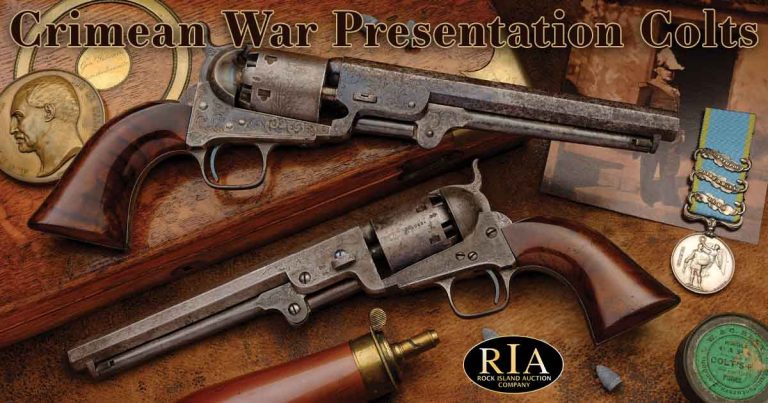
Samuel Colt tried to increase business in Europe, and this cased pair of presentation Colt Model 1851 revolvers was part of that effort, presented to French General Aimable-Jean-Jacques Pelissier. Colt planned on building an armory in France at one time. Colt made several presentations in hopes of earning military contracts at the start of the Crimean War.
The Crimean War (October 1853-February 1856) in part broke out due to religious tensions within Ottoman territory, particularly between Roman Catholics and Eastern Orthodox Christians in Palestine. Russia’s Tsar, Nicholas I, asserted his responsibility to protect the rights of the Eastern Orthodox Church, and Napoleon III of France argued on behalf of the Catholics in the Ottoman Empire. Ottoman troops, supported by the British and French that wished to contain Russian expansion (sounding familiar again?), responded to a Russian invasion of Moldavia and Wallachia by sending in their own forces to push back the invaders in Crimea.
This wonderful, deluxe, cased pair of factory engraved Colt Model 1851 London Navy revolvers come inscribed from “the inventor” to the French General who helped humiliate the Russians, weakening their empire for decades to come.
The Russians faced stiff resistance and enormous casualties. They also faced a revolt in Kiev. French and British troops worked with the Ottomans to attack the Russian naval base at Sevastopol, and the allied forces met the Russians on the field in several battles. One most the most recognizable is the Battle of Balaclava which included the famous-yet-suicidal Charge of the Light Brigade as well as the valiant “thin red line” of Highlanders holding their ground against Russian cavalry.
In the end, the Russian Empire accepted a humiliating defeat that prevented its expansion and ended its claims on the protection of Eastern Orthodox Christians in the Ottoman Empire. Despite the allies capturing Russian territory, including Sevastopol, Balaklava, Kerch, and Kinburn, the war ended with an agreement essentially of antebellum territorial boundaries.
This presentation cased, factory engraved, and silver-plated London Model 1851 Navy from 1855 would have been the kind of revolver Colt would have displayed as an exhibition.
The Colt London Model 1851 Navy Revolver
By now you might be asking, “What does Samuel Colt and the 1851 Navy revolver have to do with all of this?” The Crimean War was the first major European conflict since Samuel Colt’s revolvers took the world by storm at the Great Exhibition of the Works of Industry of All Nations in 1851, the first World’s Fair. Colt debuted his new revolvers in a large display at the fair, including the Model 1851 Navy which was known originally as Colt’s Belt Model. This was to be Colt’s most significant revolver on the international market.
The Observer of London on November 23, 1851, under the heading “Colt’s Revolvers” noted, “No weapon has attracted more attention than the American revolvers of which several specimens were exhibited during the recent Exhibition…” They stated that U.S. Ordnance tests that showed the ‘51 Navy could be fired 1,500 times a day with only one cleaning. It also reported that they had been used in the Mexican-American War, referencing Colt’s earlier Paterson revolvers, and that the British government had approved the Colt for officers in Africa and India and that this sanctioning had, “not only served to clear the shelves and counters of the American department of the Exhibition, but has been the means of obtaining a large number of orders to be executed for persons in this country.”
French General Aimable Pelissier’s cased pair of Colt London Model 1851 Navy revolvers are among the few French presentation Colr revolvers known. Another pair previously sold by Rock Island Auction Company were made for Napoleon III. They are rare examples of Colt’s attempt to market his revolutionary revolvers to the French.
Clearly Colt was on the path to success in 1851 prior to the Crimean War, but he wanted to secure the market and worked to open his own factory in London to supply the British market. While his London factory is well-known to Colt collectors, many may not know that Colt also hoped to establish another factory in France for the French and Continental European markets. European armies were significantly larger than the U.S. Military in the period and arming them could be particularly lucrative. The French force alone during the Crimean War totaled over 309,000 men. Colt manufactured around 215,348 Model 1851 Navy revolvers in Hartford and another roughly 42,000 in London, so a contract with such a large army could certainly have led to substantial sales.
Colt had to push hard in order to get his revolvers adopted and worked to earn the approval and favor of influential figures just as he was doing simultaneously in the U.S. by presenting them with lavish examples of his latest designs. Other historic pairs of Colt revolvers have previously been sold by Rock Island Auction Co. that were presented by Samuel Colt during this period to figures involved in the Crimean War, including the Napoleon III pair sold by RIAC in 2019 and the cased pair sold to Lord Cardigan, British Commander of the Light Brigade, sold by Rock Island Auction Co. in 2021. He also worked to solicit positive testimonials from officers who had actually used his weapons in combat.
Samuel Colt’s London factory may have closed shortly after the Crimean War thanks to stiff competition from British designs like the Adams revolvers but he wasn’t done with the British markets. He contnued to ship Model 1851 Navy revolvers like this one across the Atlantic to his sales office in London.
When the Crimean War broke out in 1853, Colt seized the opportunity and presented revolvers in an effort to secure lucrative war time contracts. Thanks to production at his modern factory compared to the hand filing and fitting of English manufacturers, Colt was the only one in a position to supply large numbers of revolvers in a short time. Herbert Houze in Samuel Colt: Arms, Art and Invention on page 9 notes that The British Board of Ordnance contracted with Colt for 25,540 Model 1851 Navy revolvers mainly for the Royal Navy, and Colt also sold an estimated 5,000 to 10,000 revolvers to officers. During the war, Colt also sold smaller numbers of revolvers to the Ottoman Turks and even armed their adversaries in Russia. Two thousand of the Russian contract 1851 Navy revolvers hidden in bales of hay were seized in shipment by officials in neutral Prussia during the war, and 1,000 were kept for use by the Prussian Navy. Some revolvers did make it to the Russians, and they also produced their own knockoffs of Colt’s design.
Colt certainly wanted to sell many more of his revolvers, especially to the French. Europeans were famously nationalistic and tended to favor their own homegrown designs, so Colt had to compete with the Adams and Beaumont-Adams in England which ultimately out competed him and forced the closure of his London factory. In the 1850s, the French were still mostly using single shot pistols, so their market was ripe for the picking but Colt had less success with the French, though not for a lack of effort.
French General Pelissier’s Samuel Colt Presentation 1851 Navy Revolvers
Samuel Colt presented a cased pair of revolvers to French General Aimable-Jean-Jacques Pelissier (1794-1864), one of the most powerful and influential figures in France in the mid-19th century. He had been an officer in the French military since 1815 and rose from a second lieutenant in the artillery to a major-general (general de division) by 1850 and military commander of Oran. Pelissier was ruthless. He ordered mass executions of resisting tribal peoples in Algeria, driving the Ouled Riah tribe from their settlements and then suffocating them in caves in 1845. The incident brought public scrutiny but also earned him a promotion to brigadier-general. He was the interim governor of Algeria in 1852 during Napoleon III’s coup d’état.
During the Crimean War, Pelissier took command of an army corps in January of 1855 and then commanded the French forces at Sevastopol that May. He successfully captured the important port city on the Black Sea after his men captured the Tower of Malakoff. He was made a marshal of France and Duke of Malakoff as rewards. The latter was the only victory title bestowed during Napoleon III’s reign. Pelissier was also the vice president of the French Senate, a member of the Privy Council, commander in chief of the Army of the East, grand chancellor of the Legion of Honor, and governor general of Algeria.
French General Aimable Pelissier is seen during the Crimean War in this photo at left. On the right is the Battle of Malakoff painted by Adolphe Yvon depicting Gen. Pelissier’s French troops capturing the Russian fortifications leading to the fall of Sevastopol. Note the French officer aiming a pair of single shot percussion pistols. The French were much slower to adopt revolvers than the British.
The date of the presentation to Pelissier is not given. It is known that some revolvers remained in Colt’s London Armory for extended periods after being produced, such as the London Dragoons imported for the American Civil War, and Pelissier was in London as the French ambassador from March 1858 to April 1859 before returning to Algeria where he was Governor General until his death in Algiers in 1864. He may have received the pair as a gift from Colt while in London through Colt’s London Agency, but regardless of the timing, his role as French commander during the Crimean War was very likely a significant reason for Colt to present him this pair.
Pelissier and Colt also had significant correspondence that Colt historian R.L. Wilson noted within the Wadsworth Athenaeum’s collections. This historic pair is featured in Wilson’s book The Colt Engraving Book Volume 1 on page 228. The guns are accompanied by a large brass memorial medallion with the bust of Pelissier on the front and a list of offices he held. A British Crimean War campaign medal with the bust of Queen Victoria on the front marked “CRIMEA” and a Roman warrior receiving a laurel crown from Victory on the reverse. The medal has the proper pale blue ribbon with yellow edges with three oak leaf clasps noting the battles of Sebastopol, Inkermann, and Alma.
French General Aimable Pelissier’s brass memorial medallion with his bust on the front and his list of offices he held on the back and a British Crimean War campaign medal with the bust of Queen Victoria on the front marked “CRIMEA” and a Roman warrior receiving a laurel crown from Victory on the reverse with the proper pale blue ribbon with yellow edges and three oak leaf clasps noting the battles of Sebastopol, Inkermann, and Alma.
Revolvers in Use during the Crimean War
If you study photographs from the period, you’ll find revolvers and handguns of any sort rarely show up in images from the Crimean War which may come as a surprise given how frequently they appear in photographs from the American Civil War. Handguns were primarily used by British officers as sidearms and by some mounted troops, but the cavalry depended far more heavily on their sabers in actual combat. There are references in written accounts from the period of revolvers in use, often noting their ability to take out multiple opponents in close-quarters combat. For example, in The Crimean War as Seen by Those Who Reported It,on page 56, a firsthand account notes, “Captain Lindsey, seeing the ganger to which the colors were exposed, rushed to the relief and, with a revolver-pistol, shot three of the assailants. The successful bearers of the standard escaped almost miraculously.” On page 76, an account of the Scots Greys’ injuries notes that “Cornet Handley stabbed in the side and arm, being at one time surrounded by four Cossacks, three of whom he shot with his revolver, and the fourth was cut down by his sergeant.” Another account on page 93 tells of, “Captain Crosse, 88th, was wounded in the leg, and surrounded by six Russians, who came to dispatch him. Drawing his revolver, he shot three of them dead upon the spot, wounded the fourth, and the other two took to their heels.”
After the end of the Crimean War, the sales prospects for Colt’s revolvers in Europe decreased. Peace combined with the popularity of the double action Adams and Beaumont-Adams revolvers in the U.K. led Colt to close his London factory in 1857. He continued to market his wares abroad through his London sales office and also worked diligently in the U.S. to ensure his revolvers were in wide circulation. They were particularly popular in the American West and saw widespread use in the lead up to the American Civil War and throughout the conflict by both the Union and Confederacy. The Model 1860 Army was the official revolver for the Union in the early years of the war alongside Colt Model 1851 Navy revolvers already purchased by the U.S. military and thousands of Colts carried as privately purchased sidearms.
This London Model 1851 Navy revolver from Lot 3128 was presented to A.E. Rykert of the 100th Regiment of Foot (Prince’s Royal Canadian) and was reportedly presented by the Prince of Wales himself in 1858. Colt’s revolvers also found some success with the militia in Upper and Lower Canada in the 1850s.
Collecting the Crimean War
The ongoing war in Ukraine has certainly increased interest in the history of Crimea, Ukraine, and the entire region in recent years. Military historians and collectors have long been intrigued by the Crimean War as an important transition point in military history as rifled firearms became the dominant infantry weapons and changed the nature of warfare. American military historians have been particularly interested given many of the same weapons were utilized by both sides of the American Civil War that followed the Crimean War. American military observers, including George McClellan, had watched the events in Crimea carefully in hopes of learning from the European conflict and then used their knowledge to shape tactics during the American Civil War.
Rock Island Auction Company regularly has firearms and other items from the Crimean War in our various auctions. That is certainly the case with the upcoming August Premier Firearms Auction which contains Colt percussion revolvers from the London factory as well as English firearms. Auctions also regularly feature long guns from the war, including the famous British Pattern 1853 Enfield rifle-muskets that were the main arms of the British infantry in the conflict and also became a primary infantry weapon during the American Civil War.
This cased pair of Colt Model 1851 Navy revolvers goes beyond the Wild West or American Civil War to the Crimean War and French military and offer a great opportunity for a collector and student of 19th century European history to obtain a piece that relates to the current struggle in Ukraine.
The cased pair of presentation Colt Model 1851 revolvers “from the inventor” to French General Aimable Pelissier with the accessories.
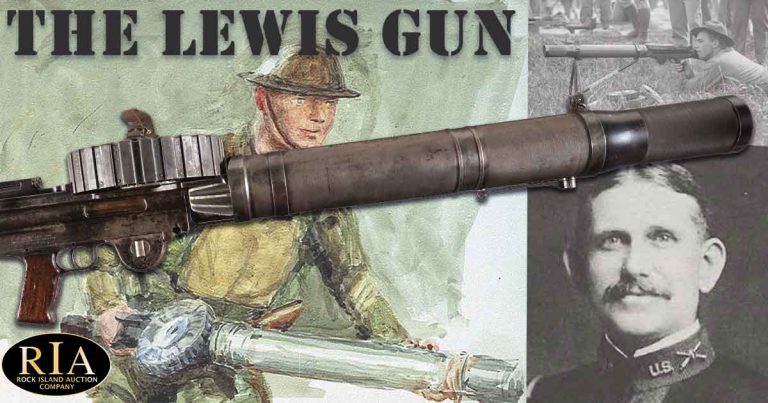
Isaac Newton Lewis showed his machine gun design to several United States ordnance officers and the Secretary of War by 1912, but received no interest from the American military. His military.
By then a colonel in the United States Army, Lewis retired and took the four models of his gun to Europe in 1913, just in time to be one of the most important weapons of World War 1. The Lewis gun was an open bolt, gas-operated, air-cooled machine gun that was light enough to be carried by a doughboy but packed enough punch to mount on new-fangled war machines like airplanes and tanks.
A pair of Lewis guns, one a Birmingham Small Arms Model 1914 chambered in .303 British and a U.S. Savage Model 1917 Lewis gun chambered in the American .30-06, are available in Rock Island Auction Company’s Aug. 25-27 Premier Auction.
A Birmingham Small Arms Lewis gun is available in Rock Island Auction’s Aug. 25-27 Premier Auction. The Lewis gun was highly utilized by the British who saw the effectiveness in its stopping power and mobility.
The Belgian Rattlesnake
The Lewis gun earned its nickname, “the Belgian Rattlesnake,” from German soldiers faced with its rate of fire of 550 rounds per minute. The gun weighed in at 26 lbs. with its bipod, far less than the M1909 Benet-Mercie that weighed 30 lbs., the Colt Model 1914 machine gun that weighed 93 lbs. with its tripod, and the Vickers that was a hefty 90 lbs. with its tripod and full water jacket for cooling. The Lewis gun weighed slightly more than the Browning Automatic Rifle when it was introduced late in World War 1.
The gun’s mobility was a huge factor in its success, being able to be used and brought to fire more easily and quickly than the far heavier Vickers that required a six-man crew. The British would create a machine gun corps during the war that would strategically treat the Vickers as artillery.
The Birmingham Small Arms (BSA) factory made 145,397 Lewis guns during World War 1 so that each British infantry unit had one by the end of 1917. Demand for the gun was so high that BSA licensed Savage Arms of Utica, N.Y. to manufacture the gun, too. Despite its early rejection of the Lewis gun, the United States eventually received 16,000 by May 1918. Of those, 10,000 were for aircraft and the rest were assigned to the Marine Corps.
Demand was so great for the Lewis gun that inventor Isaac Newton Lewis contracted with Savage Arms of New York to make his namesake gun. The Lewis gun was also made in Britain by BSA. This Savage Lewis gun is available in Rock Island Auction Company’s Aug. 25-27 Premier Auction.
Lewis Gun Inventor
Isaac Newton Lewis was born in 1858 in Pennsylvania before his family moved to Kansas. He started his career as a teacher before he attended West Point where he graduated in 1884, 11th in a class of 37. He was commissioned as a second lieutenant for artillery. He earned his first patent, for the world’s first successful artillery range and position finder, in 1888. The United States declined the range finder.
After several assignments and a promotion to captain, in 1900 Lewis went to Europe, ordered by Col. Nelson Miles to study manufacture and supply of ordnance by other countries’ militaries. He reported back and his findings led to new organizational standards for artillery adopted in 1902.
He served with the Board of Ordnance previously and found himself re-assigned there as the board’s recorder. He got caught up in political controversy and testified to Congress about the “obsolete policies and worn-out conditions” in the Board of Ordnance, getting cross-ways with Brigadier Gen. William Crozier who led the board.
After being rejected by the United States Army, Isaac Newton Lewis, left, took his namesake gun to Europe on the eve of World War 1 and found buyers for his light, air-cooled machine gun. A gunner fires a Lewis gun from the hip with the assistance of a sling. The Lewis gun weighed 26 lbs. A British-made BSA Lewis gun and an American-made Savage Model 1917 Lewis gun are both available in Rock Island Auction Company’s Aug. 25-27 Premier Auction.
Lewis found himself in a “limbo posting” in San Francisco where it appeared he’d been put out to pasture. However, Lewis continued with his work and created a successful defensive plan for San Francisco harbor. This success infuriated Crozier further and Lewis was sent to Puget Sound, furthering his exile.
“Why is it some of the biggest men in military and government positions have the smallest minds?” Lewis wrote.
Lewis continued to invent and write, increasing his reputation to the point he returned to the east coast, and posted at the Coast Artillery School at Fort Monroe, Va. He served as an instructor in electricity and power as well as an artillery instructor. He took on several roles, including director of the department of enlisted specialists, acting commandant of the school and commander of Fort Monroe. He bore the rank of lieutenant colonel by 1911.
He drew the interest of business for his mechanical engineering prowess and was brought on as a part-time consultant by Automatic Arms Company in Cleveland, Ohio to develop a light machine gun based on his ideas and any patents the company owned.
A U.S. Marine fires a Lewis gun. The United States Army didn’t recognize the importance of full-auto guns that were light enough to move easily until after the nation entered World War 1. The Marine Corps did order Lewis guns from Savage.
Lewis Gun Design
Lewis focused on the light machine gun design of Dr. Samuel N. McClean that had failed to interest military buyers. By 1910, McClean’s company was in financial difficulties and was bought out by Automatic Arms Company. An ordnance expert, presumably Lewis, told investors that it needed to develop an air-cooled gun and that it would receive no interest from the United States military, which wasn’t considering the use of automatic weapons at the time.
McClean’s design overheated, so Lewis knew where he had to go to work. He created a newly designed gun that utilized some of McClean’s patents. Lewis’ design cooled the barrel through forced air drawn from the back of the barrel to the front, with a large tube over the barrel. The gun drew ammunition from a circular pan magazine – holding either 47 or 97 rounds — on top of the gun. The Lewis gun had 62 parts purportedly for easy assembly.
By 1911, Lewis had a gun he was ready to unveil and contacted an old friend, Gen. Leonard Wood, the Army Chief of Staff. Fired in front of several War Department and Army officials, the prototype performed excellently and earned an official test.
This closeup of the British BSA Lewis gun shows its circular pan magazine atop the gun. Magazines were made in two sizes, one for 47 rounds and one for 97 rounds.
Unfortunately, the gun failed to perform as well as it had in its informal demonstration. Lewis had continued tinkering with it after its success and made it worse. He quickly made the necessary changes and in a second public demonstration, Lewis mounted his gun to an airplane, making it the first aerial fired machine gun. The weapon received tremendous publicity but little interest in the United States.
One issue that might have hurt Lewis’ chances of gaining a contract was his personality conflict with the Board of Ordnance’s Crozier who called the gun “Lewis’ military mower.” Lewis pledged not to take any royalties from the United States government on the sale of the gun but heard nothing.
Promoted to full colonel in 1913, Lewis was fed up and set his retirement date with plans to sail to Europe with his prototypes. “I was an army officer for nearly 37 years and devoted myself to my country’s service … all I got was slapped with rejections by ignorant hacks,” he told friends.
The markings on the Savage Lewis gun in a closeup without the magazine. Note the anchor on the lower left since the U.S. Marines and the U.S. Navy both used the Lewis gun.
Lewis Gun in Europe
The Lewis gun quickly drew interest from Belgium and Lewis set up a factory in Liege, but when the British expressed interest, he moved production to the Birmingham Small Arms factory. Guns were starting to roll off the assembly line as the opening salvos of World War 1 were being fired. BSA had trouble meeting production numbers and quickly expanded the factory as it was making the Lewis gun for Belgium, France, and Russia, too. By early 1916, more than 40,000 Lewis guns were in use by French, British, and Belgian troops.
The gun was well thought of by troops but ordnance officers in World War 1 were unsure if it was a light machine gun or an automatic rifle since it could serve in both roles. Still, its importance was never questioned, described in a British ordnance report as “…finest weapon for frontline trench strafing, both offensively and defensively.”
U.S. Marines train with the Lewis gun. A BSA Lewis gun and a Savage Lewis gun are both available in Rock Island Auction Company’s Aug. 25-27 Premier Auction.
Lewis Gun in World War 1
The Battle of the Somme erupted on July 1, 1916. When it ended Nov. 18, 1916, a third of the three million men who fought in the battle were dead or wounded. The Lewis gun played an out-sized role in the battle. British ordnance experts estimated the Lewis gun’s rate of fire exceeded 15 million rounds every 24 hours during the battle that raged for 140 days. By the end of 1916, the British fired more than 7 billion rounds of ammunition through their Lewis guns.
The United States ordered 350 Lewis guns for Gen. John J. Pershing’s pursuit of Pancho Villa. When the United States declared war, it had less than 1,000 rapid-fire guns in its arsenal. The Marines adopted the gun and trained vigorously with them only to be handed unreliable French Chauchats when they arrived in Europe.
Despite the Army’s misgivings over the Lewis gun, it eventually ordered 2,500 from Savage. The Lewis gun also became popular as an airplane-mounted weapon with the tube removed from over the barrel and the wood stock replaced by spade grips.
Lewis was true to his word and declined to take money from the United States government for his gun. He returned $1.2 million in royalties to the U.S. Treasury. In March 1918, the acting Secretary of War, Benedict Crowell wrote to Lewis: “I cannot let these long negotiations be concluded without expressing to you my personal and official thanks for your gracious action in permitting the government to retain from royalties to be paid on the Lewis patents all your interests in these payments for guns delivered after January 1, 1918. It is exceedingly gratifying to observe the fine spirit of sacrifice patriotism manifested in the people of this country, a notable instance of which is your action in this matter.”
A soldier takes aim with a Lewis gun without its aluminum tube over the barrel. When Lewis guns were mounted on aircraft during World War 1, they didn’t have the tube because the cool air aloft kept the gun from overheating.
Lewis Gun Later and Legacy
The U.S. Marines continued to use their Lewis guns in small actions in the 1920s and 30s like Haiti, Nicaragua, and China. The American BAR and the British Bren would eventually replace the Lewis gun. A second-string gun for U.S. forces in World War 2, the Lewis gun still found use mounted on landing ships. The British pulled the Lewis gun from mothballs in 1940 after Dunkirk when the nation was desperate for weapons. They were issued to the Home Guard.
Even after use in two world wars, the Lewis gun even saw limited action in the Korean War. There is no doubt the Lewis gun served superbly in World War 1 and in support during later actions and World War 2.
A British publication, “The Complete Lewis Gunner,” published in 1918 laid out the importance of the Lewis gun:
“A Lewis gun in the hands of good gunners will work as much destruction as 50 average riflemen. The rat-tat-tat of a Lewis gun has a great moral effect. Against a machine gun a man stands little chance, and human flesh will not face it. A machine gun has terrible killing powers. A Lewis gun gives a maximum volume of fire from a minimum of front.”
Marines carried the Lewis gun into a number of minor actions between world wars. Here a marine holds a captured Lewis gun taken from Nicaraguan rebels.
Lewis Gun for Sale
Leaving the disinterest of the United States, Isaac Newton Lewis took his full auto namesake to Europe on the eve of war and found ready buyers for an air-cooled weapon that could change a battlefield with its high rate of fire and mobility. Rock Island Auction Company will offer two Lewis guns in its Aug. 25-27 Premier Auction, a Birmingham Small Arms Model 1914 chambered in British .303 caliber and a U.S. Savage Arms Model 1917 chambered in the American military’s .30-06, providing an opportunity for collectors of military weapons to acquire a “Belgian rattlesnake” from either the country that embraced it, or the country that dismissed it.
Elvis Presley loved guns. He loved buying them, shooting them, gifting them, and showing them off. As his fame grew, threats came and he regularly went armed as well as arming the men who surrounded him. At the time of his death at the age of 42, Elvis, the King of Rock and Roll, reportedly owned 37 firearms and a machine gun.
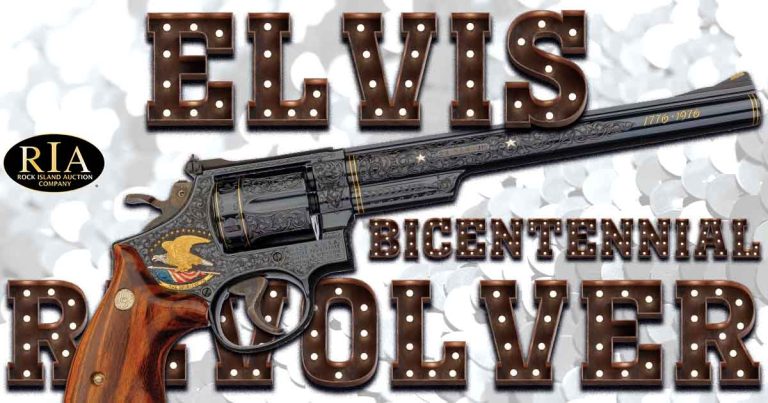
Rock Island Auction Company has proudly offered guns owned by Elvis in the past that were as flashy and brilliant as his concert jumpsuits. An engraved Smith & Wesson Model 53 revolver with gold and silver inlays matches the Las Vegas razzle-dazzle of any of his other guns and will be on offer in this month’s Premier Auction.
The blued Model 53’s exhibition engraving done by Smith & Wesson’s master engraver Russell Smith has an American bicentennial theme with relief floral scrollwork on stippled background, silver inlaid five-pointed stars, “1776-1976” in flush gold toward the muzzle, and gold inlaid bands at the muzzle and breech. On the side plate is an eagle in flight grasping an enamel 13-star Betsy Ross American flag, while the left side of the frame has a minuteman flanked by stars, and the Liberty Bell is on the back strap. The gun’s delivery date, according to documentation was Nov. 16, 1976. Elvis died just nine months later.
Elvis Presley owned several guns in his lifetime and bought countless more for friends and acquaintances. This Smith & Wesson Model 53, adorned with a bicentennial theme by Master Engraver Russell Smith and with an extra cylinder, was delivered to the King of Rock and Roll only months before his untimely death.
Elvis Guns
Elvis received a .410 Winchester shotgun in 1956. When he served in the Army he earned sharpshooter badges for the M1911 and the M1 rifle and a marksman badge for the M2 Carbine.
The King of Rock and Roll kept a Colt Government Model for protection at Graceland and was made a Shelby County deputy sheriff in 1964. He regularly carried at least one gun, even when he was on stage, especially after the Manson family murders and receiving death threats when he started performing in Las Vegas in 1970. Elvis encouraged members of his entourage to do the same.
The King mostly used wheel guns since many of his movies were set in the Wild West. He sang and danced with a Colt Single Action Army in “Viva Las Vegas,” and wielded a number of Smith & Wesson revolvers in films like “Follow That Dream,” “Tickle Me,” and “Stay Away, Joe.”
The gold relief inlaid minuteman pops from the beautiful blued finish of Elvis Presley’s Smith & Wesson Model 53. The gun also bears oversize smooth grips.
Of course, part of the Elvis Presley legend is that he shot televisions. One of the televisions he shot, a 25-inch RCA model, was allegedly sacrificed when the King saw Robert Goulet singing.
“There was nothing Elvis had against Robert Goulet. They were friends,” Kevin Kern, a spokesman for Presley’s home and museum, Graceland, where the TV was put on display, told the AP in 2006. “But Elvis just shot out things on a random basis.”
The right side of Elvis Presley’s bicentennial-themed Smith & Wesson Model 53 revolver features 13 gold stars, and a gold relief inlaid eagle with a Betsy Ross flag in its talons.
Elvis Guns: How Many Did He Buy?
The book “Elvis ̶The Final Years” opens with Vernon Presley, Elvis’ father questioning him about his spending after seeing some invoices. “There must be a mistake, because this one’s from Kerr’s and it says you charged $38,000 in guns there this month.”
He brushed off the inquiry saying the purchases at the Beverly Hills sporting goods store was Christmas shopping. Elvis’ anger at his father spurred his trip to the White House and meeting with President Richard Nixon.
During the decade he would buy dozens of guns at a time, keeping some of them while giving away the others. It is believed he bought 300 guns during his lifetime.
One story about Elvis is that he was gun shopping and a man was admiring a shotgun. Elvis asked if he liked it to which the man replied that he did but the gun was out of his price range. As the King of Rock and Roll was leaving the store, he told a store employee to charge the shotgun to him and give it to the man.
The bicentennial-themed Smith & Wesson Model 53 revolver of Elvis Presley has plenty of gold, from the relief inlays of a minuteman and an eagle to narrow bands on the barrel and cylinder, and and “1776-1976” on the barrel. Even the sights have gold on them. Stars on the barrel are silver relief inlays.
Elvis Guns: A Gift for the President
Elvis liked to give guns to people, like those who worked closely with him, and to friends. He reportedly gave Hawaii-Five-O star Jack Lord a Walther PPK in 1973. The revolvers sold by RIAC in 2017 were both gifts from the King of Rock and Roll, but more on those later.
The most well-known of Elvis’ gift guns was what has simply been described as a Colt .45 in a display case with seven silver bullets that he presented to President Nixon. That meeting was precipitated by an argument between Elvis and his father over spending referenced earlier.
After the argument, he left Graceland in Memphis and flew across country to his Los Angeles home where he stewed for a bit. Elvis also collected badges, and decided he wanted a Bureau of Narcotics and Dangerous Drugs badge so he decided to write a letter to the president asking for one and hand delivered it to the White House. As he left his California mansion, Elvis plucked a cased commemorative Colt M1911A1 off the wall.
Elvis and one of his bodyguards flew across country to Washington, D.C., and drove to the White House and left the letter for Nixon on Dec. 21, 1970. The King received a call later in the day summoning him to the White House. The Secret Service wouldn’t allow Elvis to bring the gun into the Oval Office because of security concerns but accepted the gift on behalf of the president. In the Oval Office, that famous photo of the president and the King of Rock and Roll was snapped.
President Richard Nixon and King of Rock and Roll Elvis Presley met in the Oval Office of the White House in 1970 when Elvis went to Washington, D.C., asking for a Bureau of Narcotics and Dangerous Drugs badge and presenting the president with a cased commemorative M1911A1 he took off the wall of his Los Angeles mansion.
Elvis Guns: Showing Off
Numerous celebrities have recalled incidents with Elvis and his guns, like Tom Jones who discovered one of the King’s guns in the restroom of his dressing room. The tales can be either humorous or harrowing.
Comedian Steve Martin, in a radio interview with Howard Stern, talked about meeting Elvis when he opened for Ann-Margret in 1971 in Las Vegas. She had co-starred with Elvis in the film “Viva Las Vegas.” At the time, Martin’s act was what he described as a magic show with jokes and Elvis told him he has “an oblique sense of humor.”
As the men spoke, the King of Rock and Roll asked Martin if he wanted to see his guns, to which Martin said yes. Elvis was safety conscious and pulled out a Derringer, removed the bullets and handed it to the comedian. He did the same with the other two guns.
“Eventually, I am holding three guns and Elvis was holding 18 bullets,” Martin told Stern.
Brilliant engraving and inlays of gold and silver pop from the blued canvas of Elvis Presley’s bicentennial-themed Smith & Wesson Model 53.
Shock rocker Alice Cooper has a more disturbing tale to tell about meeting Elvis in 1970, telling how Elvis gave him a gun and told him to shoot him. Cooper said in a BBC interview they were in a kitchen full of guns, and the King of Rock and Roll pulled a loaded .38 stubnose from a drawer and made his request of the “Schools Out” singer.
Cooper wondered what was happening, thinking Elvis’ security would see what was happening and shoot him. “Before I could decide what to do I was on the floor and he has his boot on my throat. I said, `that’s good Elvis.’” It turns out, Elvis, the martial arts practitioner was just looking to show off his skills.
Elvis Guns at Rock Island Auction
Both of the Elvis guns offered by RIAC in May 2017 were gifts. The first was an elaborate, exhibition grade .357 Magnum that was given to Vice President Spiro Agnew who eventually returned it since he was under investigation for corruption, an investigation that would lead to his resignation.
Very little of the K-frame revolver is free of embellishment. The gun was sent to Friedrick Wilhelm Heym Co. in Germany where it was covered with relief leaf and scroll engraving, gold and silver inlaid borders, and five raised gold North American game animals. That might be expected on a fine long gun but is a rarity for a Smith & Wesson. The revolver also features elaborately engraved staghorn grips with a vine and scroll pattern and two engraved game animals.
Elvis later gave the gun to Shelby County Sheriff Gene Barksdale after he did Elvis a favor. Barksdale retrieved some of Elvis’s friends from a local airport and shuttled them to Graceland. After he dropped off the friends, Elvis and the sheriff got to talking about guns. Elvis said, “Well, sheriff, I got something for ya,” and left the room. The King returned with the highly decorated Smith & Wesson Model 19-2 and presented it to the lawman. The gun brought $195,500 at auction.
The second gun sold in the May 2017 Premier Auction was an equally flashy Colt Python with exhibition quality engraving. The revolver, with similar engraving also done by Friedrick Wilhelm Heym Co. of Germany, was featured in Guns magazine in 1973. It too has North American big game animals in raised gold relief and plenty of silver and gold inlays. Engraving on the scrimshaw-esque grips compliments the gun’s engraving and has sweeping scrollwork and a leaping stag on one side and a pouncing mountain lion on the other side. The gun was given to Richard Grob who was Elvis’ director of security. The snake gun hammered for $172,500.
Among the documentation accompanying Elvis Presley’s bicentennial-themed Smith & Wesson Model 53 revolver are drawings of the planned engraving by Smith & Wesson Master Engraver Russell Smith.
Elvis Guns: Smith & Wesson Model 53
Among the documentation for the copiously engraved Smith & Wesson Model 53 are drawings by master engraver Russell Smith as well as pictures taken of the gun by Smith before shipping. It is work the engraver should be proud of. The amazing scrollwork that pops from the blued finish is further highlighted by inlaid gold bands at the muzzle and the breech. The barrel is highlighted by “1776-1976 in flush gold toward the muzzle and silver inlaid five-pointed stars. The serrated blade front sight has a gold insert, and the while the adjustable square notch rear sight is outlined in gold. The bicentennial theme bursts from the bluing with an eagle flying with a relief inlaid Betsy Ross, 13-star flag in its talons while the opposite side shows off a relief inlay of a minuteman flanked by five silver stars. The gun comes with oversize smooth grips and a second cylinder that is engraved and inlaid to match.
While this magnificent wheel gun’s beauty and patriotic theme allows it to stand on its own, the fact that it was bought by the King of Rock and Roll and engraved at his request makes this a true opportunity for fans that love Elvis Presley and love guns as much as he did. It will be available in Rock Island Auction Company’s Aug. 25-27 Premier Auction.
Elvis Presley’s bicentennial-themed Smith & Wesson Model 53 revolver is beautifully adorned with a blued finish, floral scrollwork and gold and silver relief inlays by Smith & Wesson’s Master Engraver Russell Smith.
DISCLAIMER – I never advocate doing anything illegal and always try to stay within the legal limits of the law. This article is for informational and research purposes only and is to not be taken as advice of any kind – the Reader accepts all responsibility for trying/attempting anything read here.
Since the advent of the National Weather Service (NWS) there is no excuse for being blind-sided by a hurricane because they start giving advisories many days in advance of any storm approaching anywhere near US coastlines beginning from the mundane, “Hey guys, there’s a storm possibly headed our way.” to the more serious, “Stock up and/or get out!” all the way to, “You should have left yesterday. Good luck.” However, as in Hurricane Katrina, due to ignorance, arrogance, personal negligence, entitlement/privilege, or some other un-stated BS reason, some groups didn’t heed the warnings and paid the price – some with their lives. There are two last resort and rarely discussed evacuation sources, however both are very illegal: the Railroad and Intracoastal Waterway.
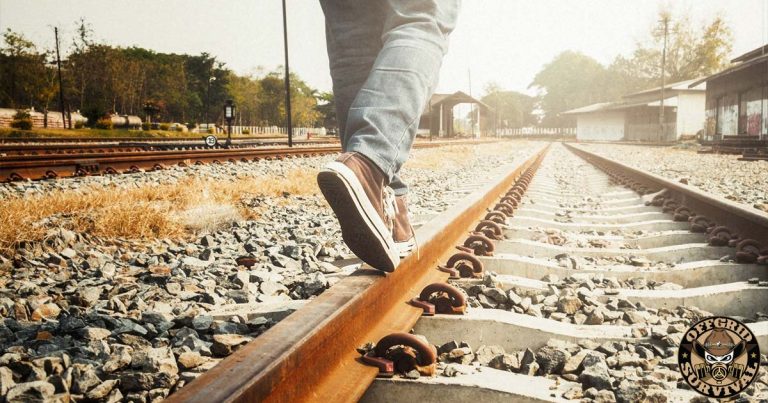
Railroads crisscross our country and have their own police force but still fall under the jurisdiction of state and federal laws, not to mention Homeland Security in some areas. On maps the railroads are marked by dashed lines (see below).
If forced to bug out on foot, I would attempt to find a railroad with a train on a side track and wait if it’s safe. A side track is where one train will pull off the main line, stop, and let a faster or more important train pass – it’s much safer to climb on a train that is stopped than one rolling down the tracks. Most of the railroads in the south are built on berms and are above the surrounding countryside giving some small protection from flood waters. A lot of the railroads travel near major highways and are fairly easy to find – they are even shown on most roadmaps.
The railroads don’t use cabooses any longer so finding a good spot to ride is more difficult. Finding an unlocked idling engine might be a good choice as long as you don’t tamper with the controls. A side benefit is if the engine is idling, you have a fantastic source to charge your phone and other devices, use the onboard heaters, fans, A/C if available), etc. while out of the harsh elements. The problem begins when the crew returns and finds you in the engine compartment; maybe they’ll be sympathetic to your survival plight if you didn’t damage anything (totally their choice here but realize if caught, you may be held and face charges for trespassing but at least you survived the storm alive. Boxcars are usually locked and if lucky to find an open one you need to be sure no one can secure or lock you inside, plus you need to be on alert for others on the move. Flatcars and tank cars are not a good choice because they are no very few places on them to offer protection from the weather and also be out of sight. The ends of Hopper cars appear to be the best choice for a concealed and weather free ride.
Advice if hopping a train: be forewarned it’s against the law to hop any train and you can be arrested and charged with multiple state and federal criminal offences – if you do it’s at your own risk, stay away from others, don’t start a fire on any type of rail car, stay as hidden and packed as possible in case you have to move out quickly, try to get on the train when it’s stopped, don’t argue and fight with the railroad crews if they catch you; politeness might buy you a continued ride where rudeness will surely get you kicked off the train and possibly arrested, be aware some railroad police are armed and well-trained. (NOTE: If I’m telling you this information as an on-looker be advised RR police will probably know it and much more.)
The Intracoastal Waterway is a mostly inland east-west water route across the Gulf of Mexico.
Catching a fishing boat or a tug and barge out of the area is possible but demands extreme caution. Boat Captains and their crews are a notoriously close-knit group; we know as we’ve investigated both for and against them. These are the men and women that the sheriff calls when a search and rescue or search and recovery needs to be conducted due to their experience on the area waterways. Stowing away is against the law and you can be arrested and charged with multiple state and federal criminal offences. Most are nothing but nice but many of them live and work in the marsh and swamps and know how to cook and eat stuff that will eat you. If they like you, you’ve got friends for life. If you’re nosing around be very careful and don’t ever think you “fit in” or that they don’t know you’re an outsider. The Cajuns and other residents of the coastal areas are a very tight knit group that like to stay out of each other’s business and that’s the way they keep it. It’s best to let them learn to “like” you instead of forcing friendship and being all “faux-friendly.” And don’t forget you’re going to need mosquito spray. Lots of it.
There are many different types of boats in southern waterways and on the Intracoastal Waterway. The hard part is getting on a boat (tug, barge, etc.) and staying there undetected and would not be worth the effort if caught. Bear in mind, the Intracoastal Waterway is through mostly marsh, swamps, gators, and other things that can eat you or at minimum hinder your progress if thrown off the boat – you’ve been warned to be nice. Boats range in size from small fishing boats to large party/house boats, offshore rig supply boats, tugs and barges.
Always treat a man’s boat as his home because it is part-time. Never enter onto a man’s boat uninvited or unannounced. Always ask for and wait for permission. There are much bigger ships but there under the supervision of the US Navy, Coast Guard, Homeland Security, and other US government agencies so I’d avoid them at all costs if you wish to remain a free man.
We’ve installed Uniden scanners in the truck and used handhelds when on foot for many years. The railroad and maritime frequencies have always provided entertainment and information. We’re retired and no longer work in the coastal areas but do visit there occasionally. While we’re there if a storm is forecast for the area, believe me we’re topping off the fuel tanks, replenishing any supplies we’ve used, and heading out to the Village of Elsewhere well before the evacuation traffic, food, and fuel rationing begin.
Jim Jones
Editors Note: As Jim has noted multiple times, the article is theoretical and not something we advise doing do to legal and safety concerns. That being said, we do like the idea of using old rail lines as bugout routes out of town — in fact, many of the nation’s old railroad tracks can legally be used for hiking (or bugging out during an emergency). A great resource for this is the maps and books by the Rails-to-Trails Conservancy.
Also, If you do live near one of these waterways a good fishing kayak or emergency boat may be something you want to think about adding to your bugout planning and gear.
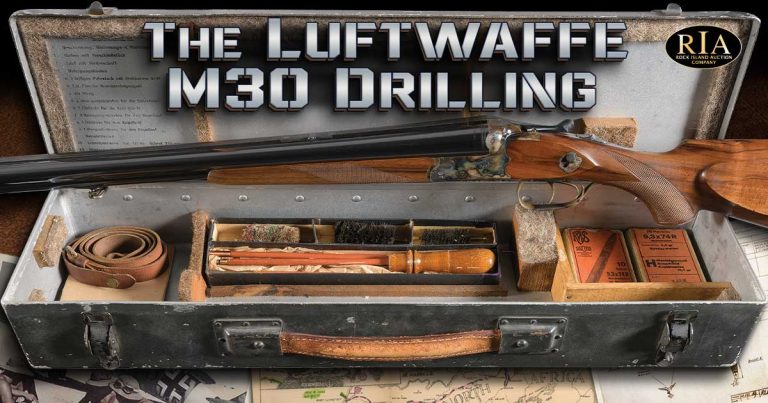
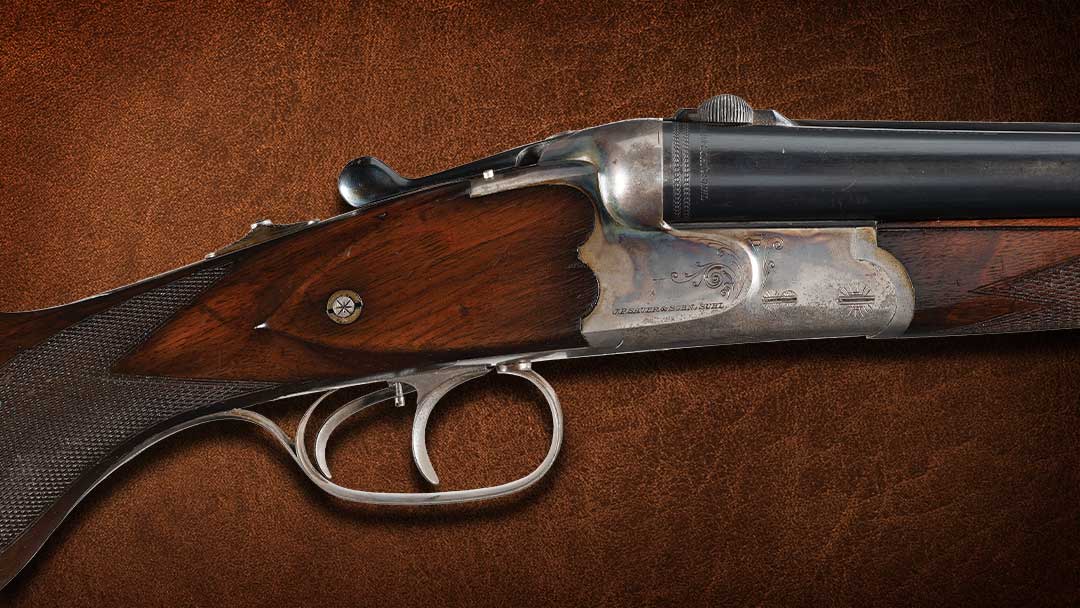
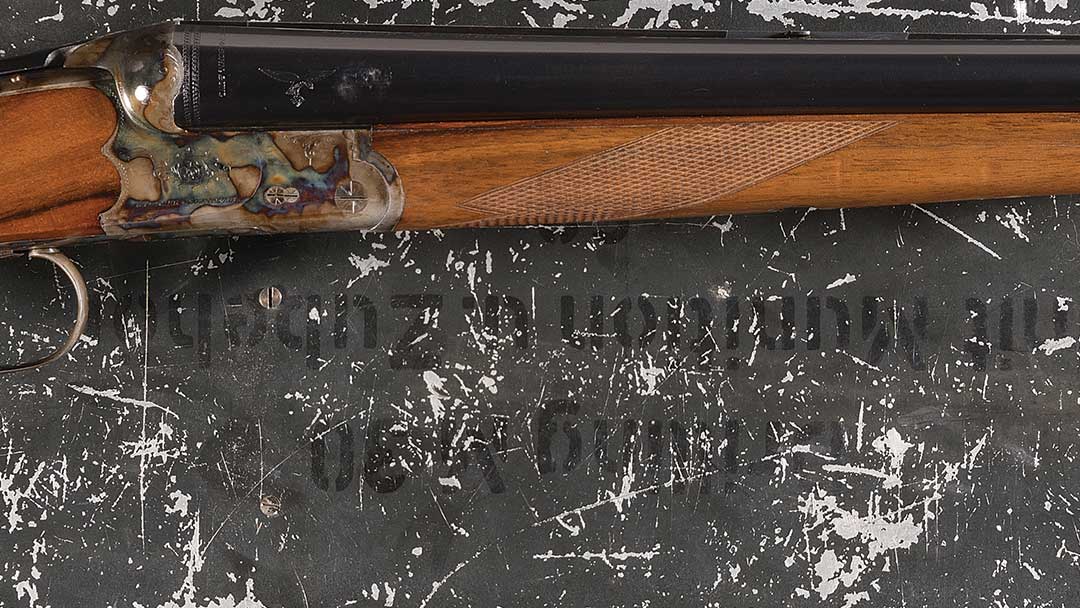
Germany permitted itself many luxuries during WW2. While other countries emphasized austerity and high production rates, the Third Reich equipped some of its Luftwaffe aces with elegant combination guns and O/U shotguns, including the famous M30 drilling.
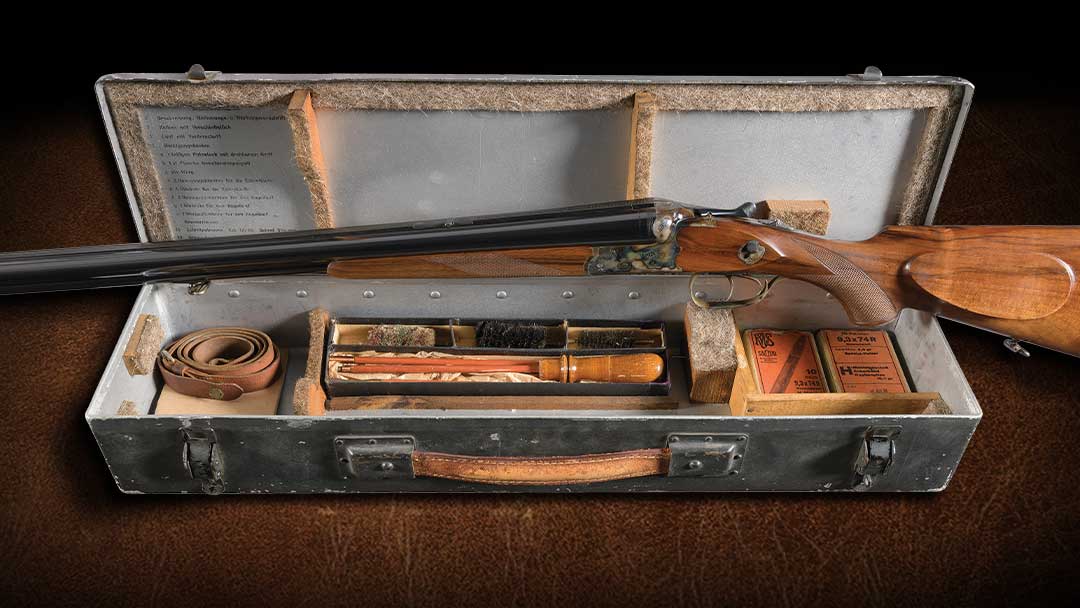
Two Luftwaffe guns for sale. (Top) A J.P. Sauer M30 Luftwaffe drilling. (Bottom) A Luftwaffe Merkel O/U shotgun.
Rock Island Auction Company’s August 25-27 Premier Auction includes an outstanding M30 drilling with its original case and accessories as well as an exceptional Luftwaffe Merkel O/U shotgun. Click on the images throughout this article to learn more about each firearm.
The M30 Drilling and the Luftwaffe Merkel O/U Shotgun
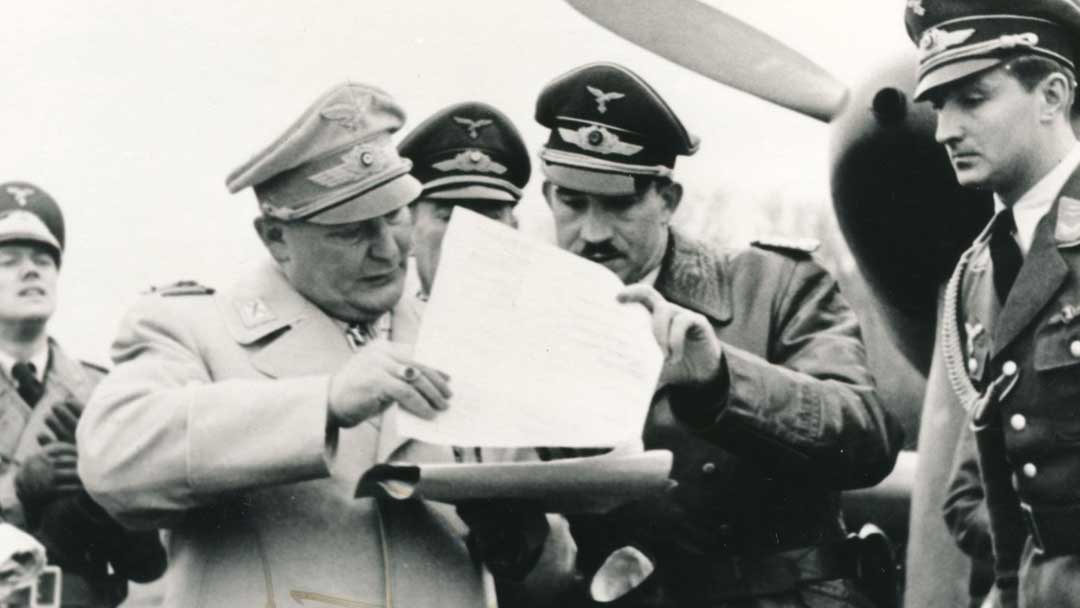
An ace fighter pilot during WW1 and one of Hitler’s most loyal supporters, Hermann Göring became a natural choice to head up the German Luftwaffe. Göring was an avid hunter and outdoorsman, and these interests were reflected in the M30 drilling and the 12 gauge O/U shotguns he issued to Luftwaffe aircrews operating in the North African Theater.
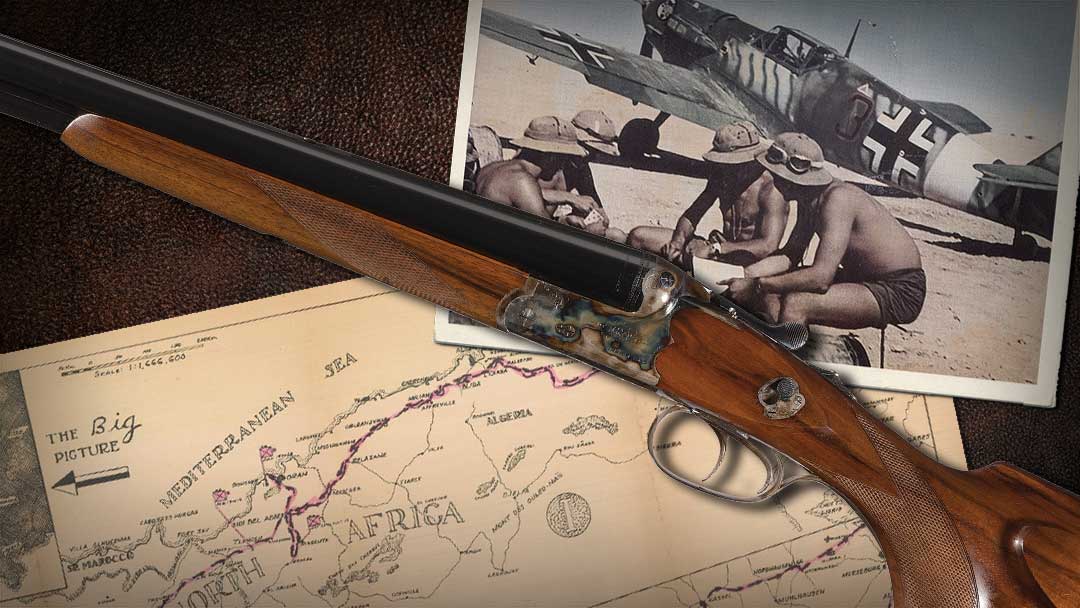
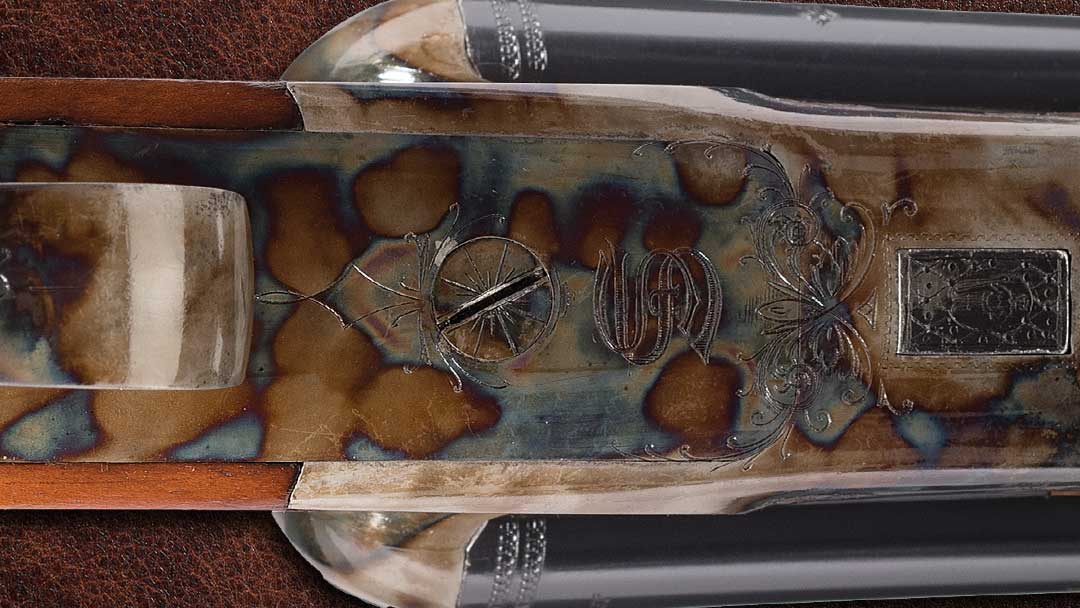
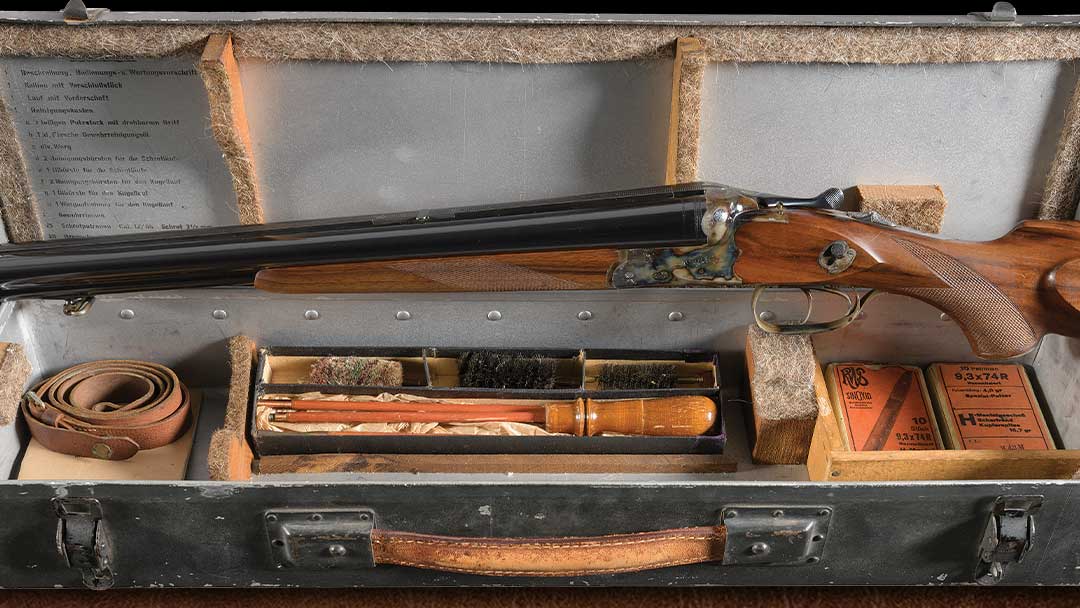
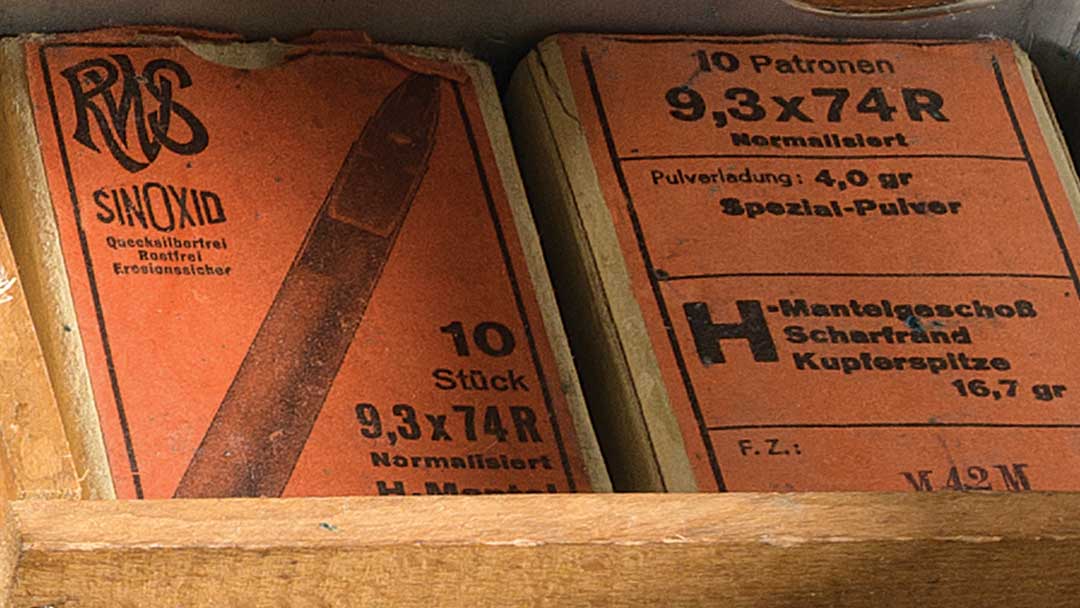
A survival gun with class, this outstanding WW2 J.P. Sauer & Sohns M30 Luftwaffe drilling includes its original case and accessories, including original ammunition. Available this August.
Germany seldom sacrificed in the realm of well-finished weapons, and that focus on quality craftsmanship is illustrated by well-known models like the Luger and the Walther PP. This philosophy carried over to the Luftwaffe’s survival and target shooting guns as well, and today these magnificent arms are some of the most valued rarities in WW2 collecting.
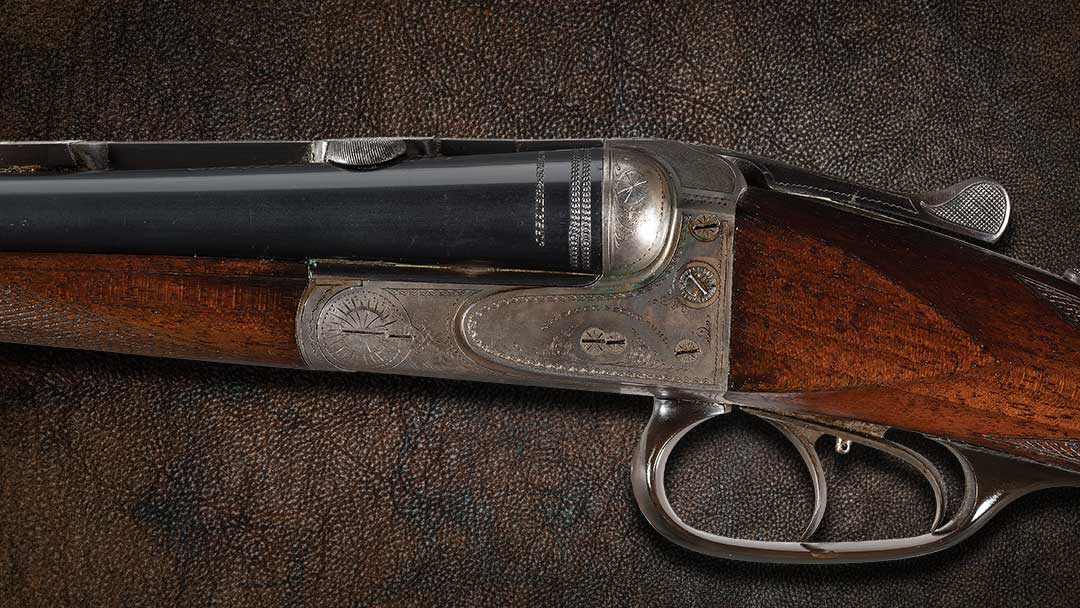
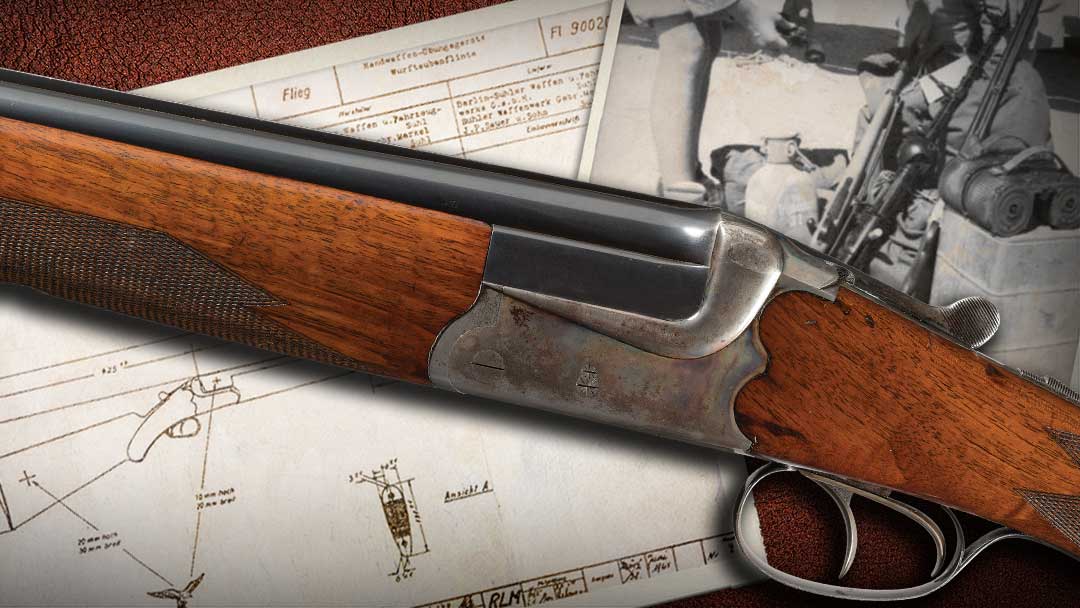
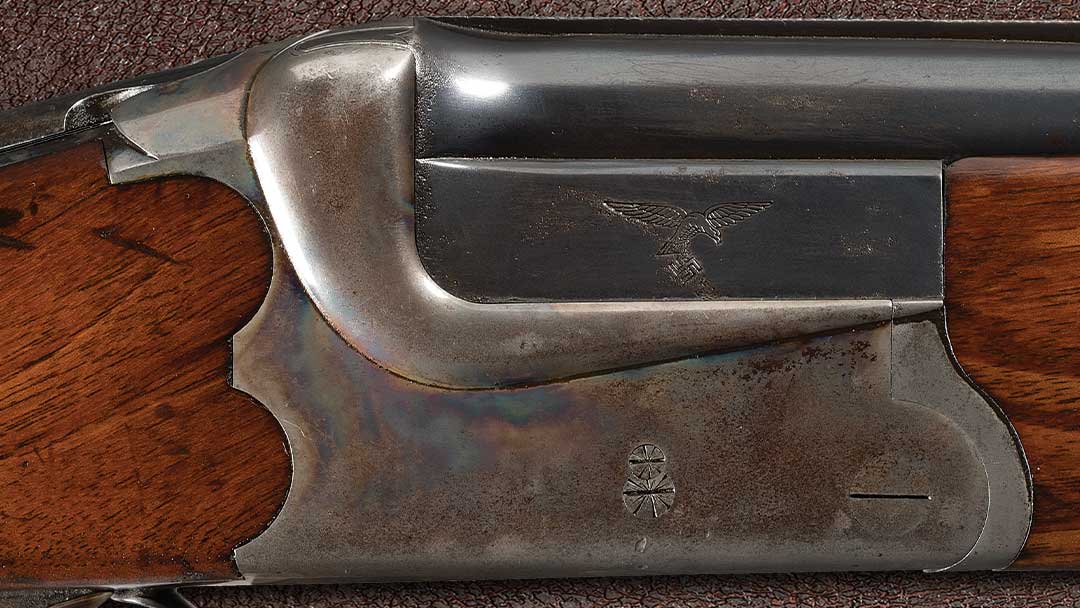
An exceptionally rare WW2 German Luftwaffe Merkel O/U shotgun. Luftwaffe shotguns were issued to pilots and gunners as training tools to refine their shooting technique on moving targets. Available this August.
J. P. Sauer & Sohn: Road to the M30 Drilling
One of the oldest German gunmakers, J. P. Sauer und Sohn GmbH began producing firearms in Suhl in 1751. Though initially focused on military contracts, the company produced a predecessor to the double-barrel percussion shotgun in 1844 and began developing a reputation for luxury hunting arms.
In 1881, Sauer & Sohn was granted patents for the three-barreled drilling and developed special steel barrels in collaboration with German steel innovator Friedrich Alfred Krupp. The drilling combination gun, deriving its name from “drei,” the German word for the number three, is traditionally composed of a rifle barrel situated beneath a break action double barrel shotgun.
Many classic drillings were stocked more like a shotgun than a rifle since German hunters tended to take more game with shot and slug, but configurations with two rifled barrels were also offered, and an assortment of alternative layouts were produced to cater to a variety of European hunting needs. The rarest configurations include the vierling (four-barrel) and fünfling (five-barrel).
The drilling and its variants have been manufactured in countless configurations, chambering options, and barrel combinations.
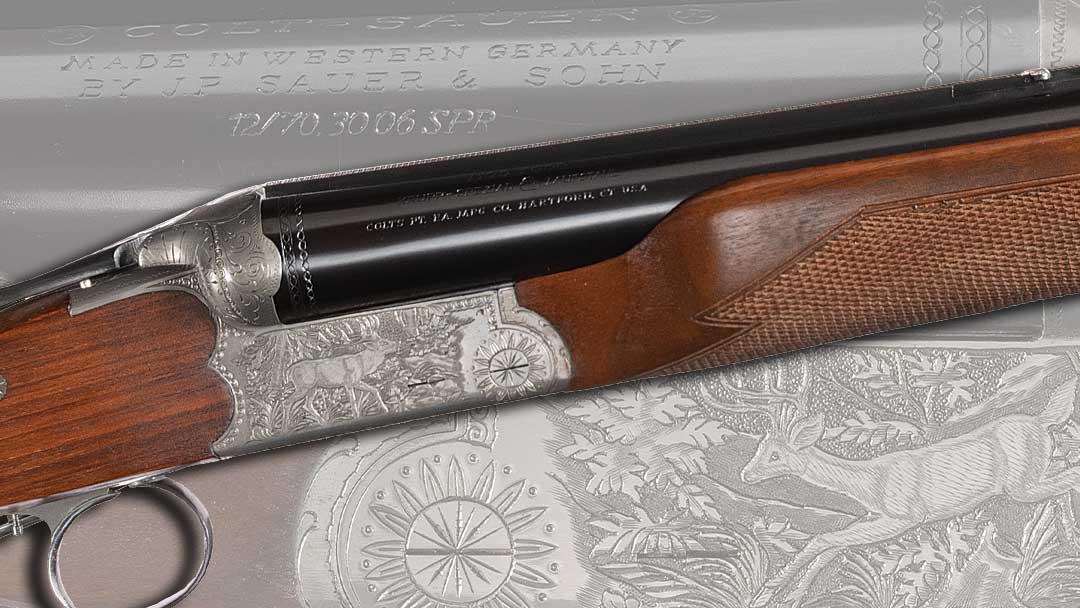
From 1914 to 1918, Sauer & Sohn focused on war production for the Kaiser. The company fell on hard times after the war, producing typewriters and bikes to stay afloat. With the Treaty of Versailles forbidding military production, Sauer & Sohn once again focused its firearms division on sporting arms. One of Sauer & Sohn’s finest innovations from the interwar period was the M30, an immaculately crafted drilling composed of a pair of two 12 gauge shotgun barrels over a 9.3x74R rifled barrel.
A factory engraved J. P. Sauer & Sohn boxlock drilling with 1936 dated German proofs. Available this August.
Equipping the Luftwaffe
In early 1941 Mussolini begged Hitler for German troops, weaponry, and aircraft to help retain a slipping hold on his colonial aspirations in Africa. Rommel’s Afrika Korps led the charge, with the German Luftwaffe providing air support.
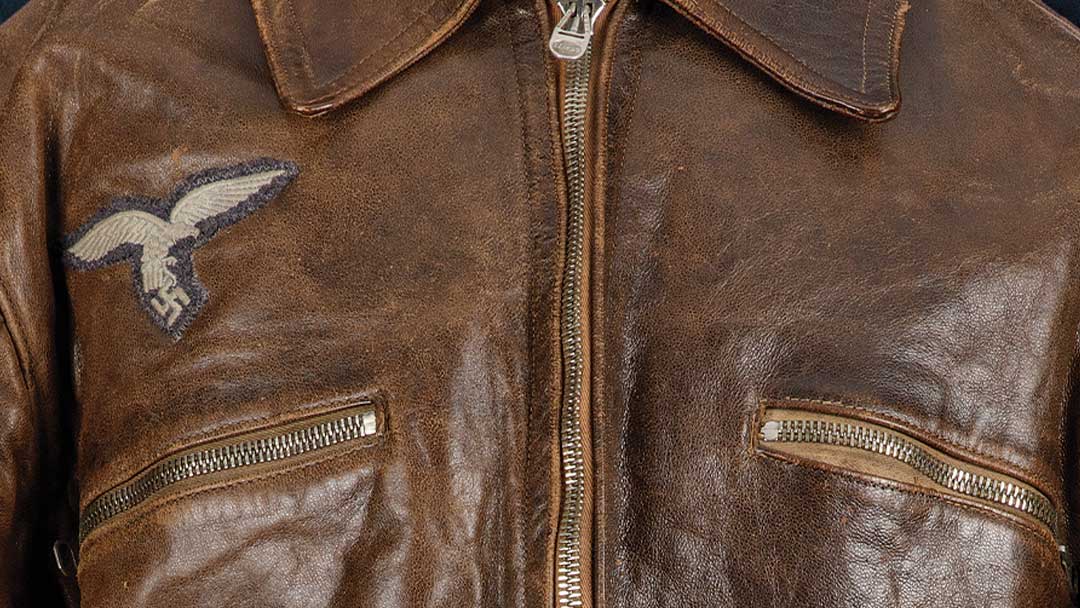
A WW2 Luftwaffe flight jacket worn by Group III/JG 26 ace Josef “Pips” Priller (1915-1961). Priller flew 307 combat missions and claimed 101 confirmed aerial victories. Available this August.
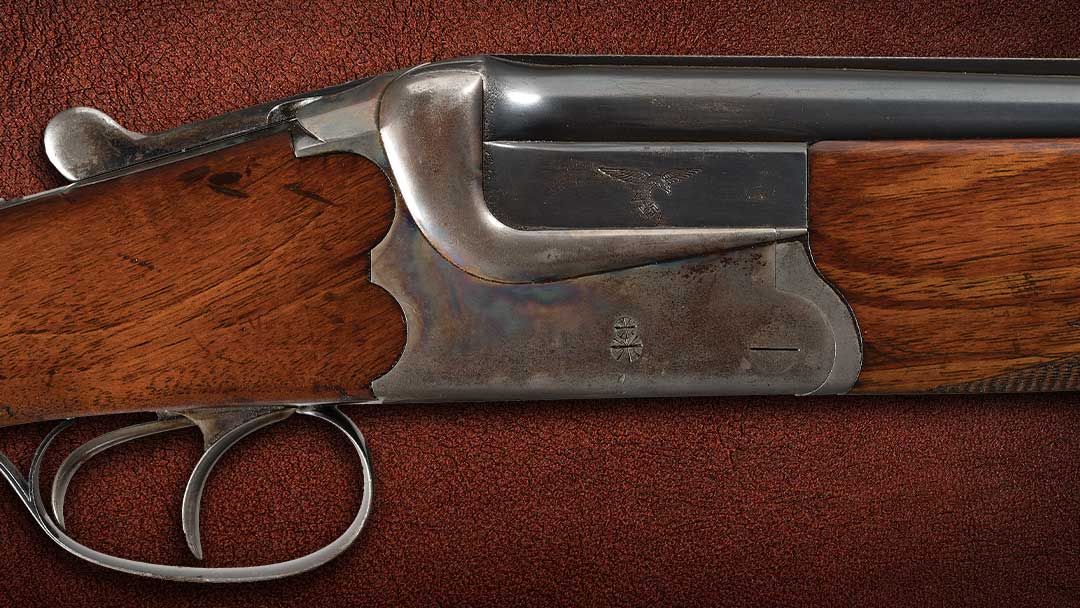
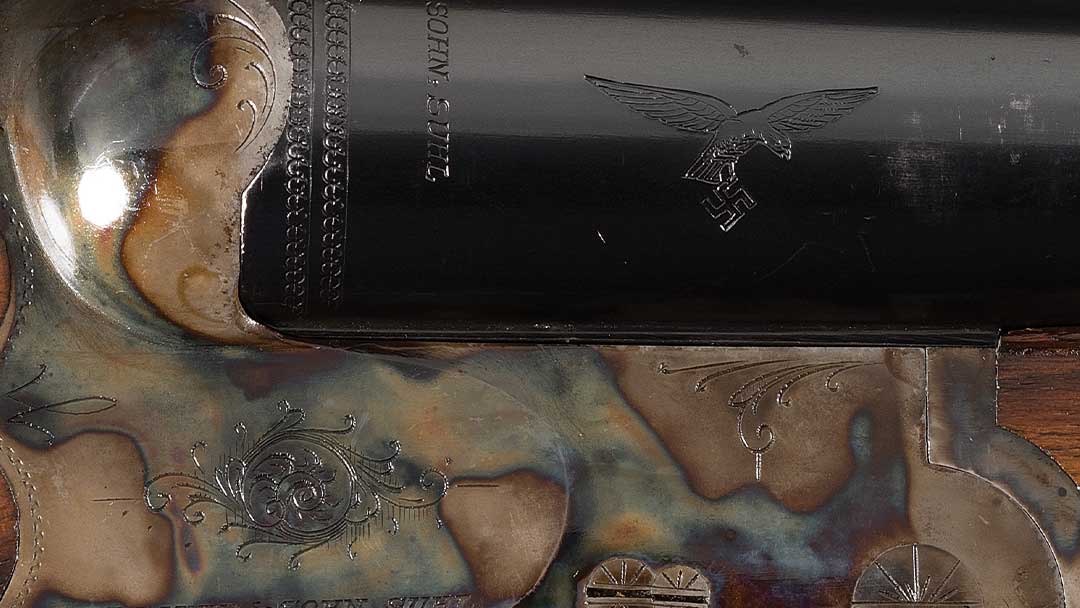
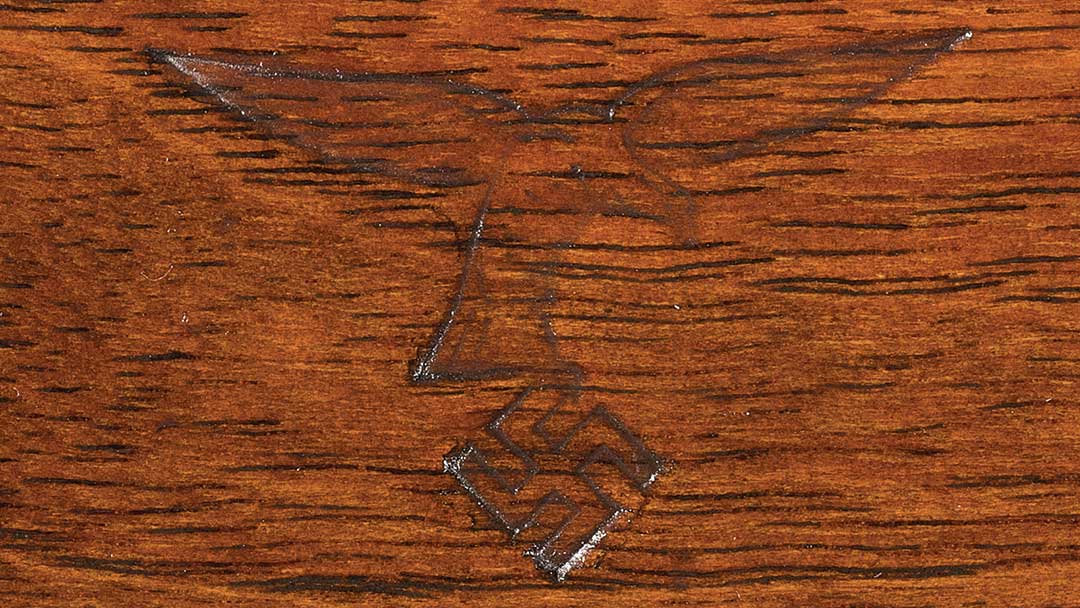
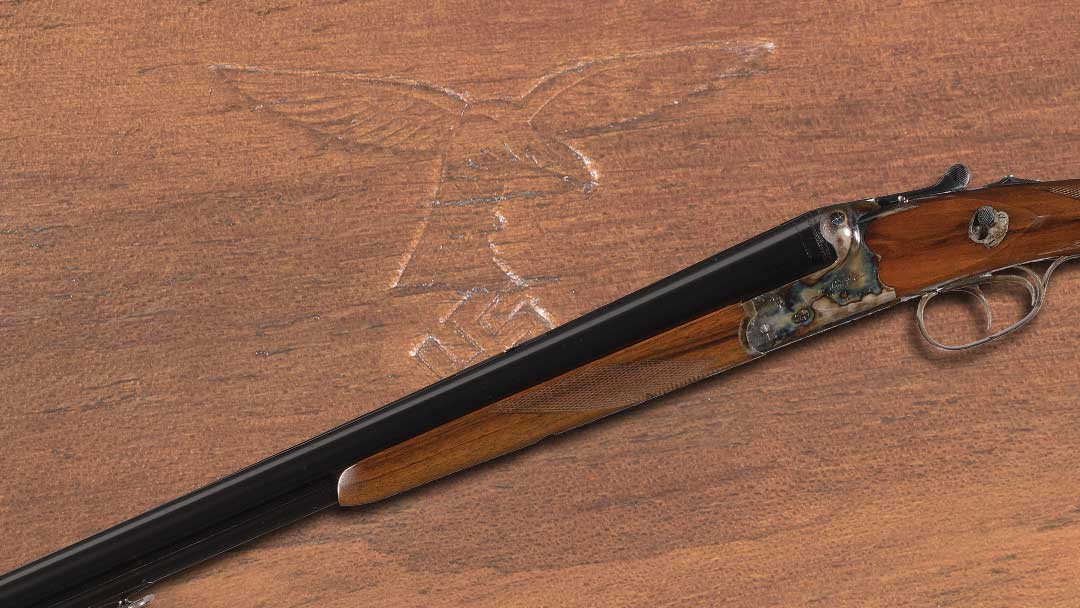
In mid-1941, J. P. Sauer & Sohn received a contract from the Luftwaffe to supply about 4,000 of their M30 drillings as survival guns in the event fighter and bomber pilots were shot down in remote locations in the North African wilderness. These Luftwaffe contract models were case hardened and included the Luftwaffe flying eagle stamped on the barrel and stock of each gun.
An outstanding example of a Sauer M30 Luftwaffe drilling for sale in exceptional, unissued condition. Includes original case, accessories, and ammunition. Available this August.
Where the M30 drilling was issued with survival in mind, the Luftwaffe used 12 gauge O/U shotguns from Sauer & Sohn, BSW, and Merkel to hone their marksman skills on moving targets, typically clay pigeons. The Luftwaffe was the only branch of the German military to be officially issued shotguns.
A highly sought-after German Luftwaffe Merkel O/U shotgun for sale. Available this August.
Typically, the German Army was charged with accepting firearms for all branches of the German war machine. The Luftwaffe only deviated from this process with a few firearm types, including the Krieghoff Lugers, the FG42paratrooper rifle, the M30 drilling, and the Luftwaffe shotguns.
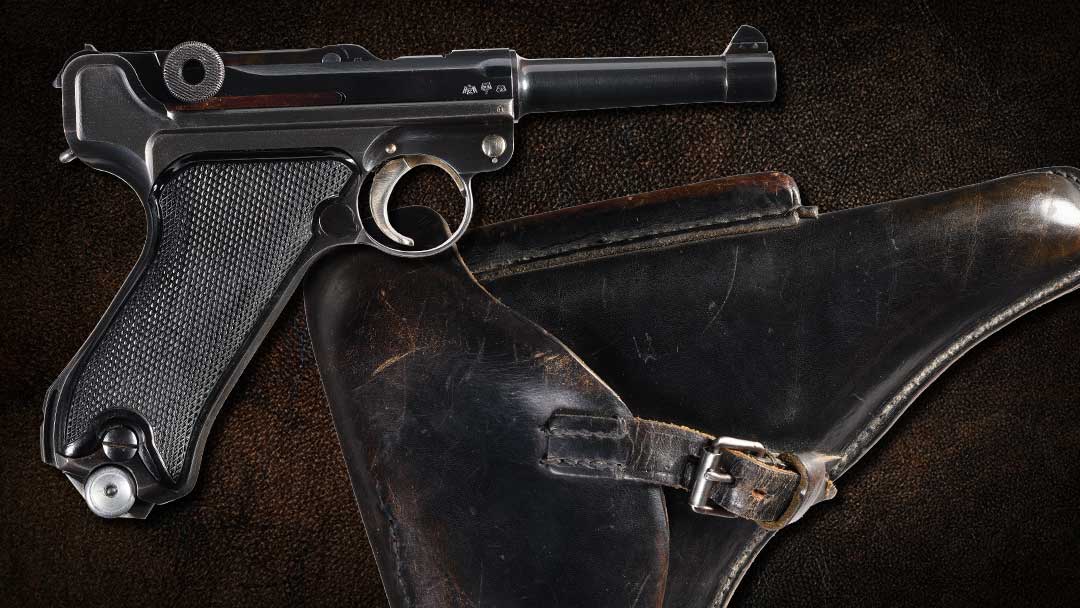
A 1943 dated Krieghoff Luger pistol rig with a Luftwaffe-proofed holster and two matching mags. Available this August.
The Purpose of the Luftwaffe Drilling
As Luftwaffe General Adolf Josef Ferdinand Gallan recalled, “In 1942 and 1943 the M30 drilling was standard equipment for our fighter jets, the Messerschmitt 109 and the Stuka bombers as we operated in North Africa. The purpose was to shoot animals for survival.”
Describing a second function for the M30 drilling, Gallan recounted, “We also used it for trap shooting during our obligatory exercise training to sharpen our eyes and reflexes of the fighter pilots.”
These target practice exercises would have presumably been similar to the intended use of the Luftwaffe shotguns.
The M30 drilling for sale this August retains 99% of the bright original blue and vivid casehardened finish. Available this August.
General Gallan also suggested that Hermann Göring had a third reason for ordering the M30 drilling. Göring was famous for his extravagant hunting trips. Carinhall, his 300-acre hunting estate located in the Schorfheide Forest northeast of Berlin, became the unofficial headquarters of the Luftwaffe during WW2. Gallan noted how Göring gifted the M30 drilling to some of his hunting friends, Luftwaffe officers, and distinguished guests visiting Carinhall, a weapon well-suited to the diversity of German game animals populating the Schorfheide.
German fighter ace Adolf Galland reviewing documents with Hermann Göring, surrounded by other Luftwaffe officers.
The Luftwaffe Drilling Case
A fine shotgun needs to be protected, and each M30 Luftwaffe drilling was issued with a distinct aluminum case with a leather handle. The M30 case is painted dark gray and stenciled on top with the words: “drilling M30/mit Munition u.Zubehor/ce”. This roughly translates to “M30 drilling with ammunition and accessories.” The M30 drilling for sale inRock Island Auction Company’s August 25-27 Premier Auction includes a fine example of an original case.
An M30 drilling for sale is a rare find, and an example that includes its original aluminum case with many of its original accessories is even scarcer. 60% of the case’s original dark gray paint is intact. Available this August.
The M30 drilling case interior is divided into sections for ammunition, accessories, and areas for the barrel and receiver after the gun is broken down. A list of contents is stenciled on the inside of the lid.
The case included with the M30 drilling for sale this August contains its russet leather sling, the original black cardboard box of cleaning equipment, two boxes of RWS rifle cartridges (17 rounds), and the original operating and maintenance manual entitled “drilling M.30” dated “1941”. The cleaning gear consists of a three-piece jointed wood cleaning rod with the brass tip in the original wrapping paper, a cotton shotgun barrel swab, a fiber shotgun bore brush, a smaller wire bore brush, and a brass rifle bore brush.
This original M30 drilling case includes a russet leather sling, operating manual, RWS rifle cartridges, and appropriate cleaning equipment. Available this August.
M30 Drilling Ammunition
Each M30 drilling case was equipped with 25 shotshells, 20 Breaneke slugs, and 20 9.3x74R rifle rounds. The latter is a hefty round for a survival rifle and roughly equivalent to .375 H&H.
The M30’s front trigger fires the gun’s right shotgun barrel, with its rear trigger firing the left. Pushing the thumb selector on top of the wrist flips up a rear leaf sight and allows the front trigger to fire the rifle round. Both the rifle barrel and left shotgun barrel (for slug) are sighted out to one hundred meters.
The 9.3x74R, a larger rifle round compared with many European drillings. M30 drilling cases that include original ammo are exceptionally rare. Available this August.
Though a compact SMG like the MP40 would take up far less room in a cockpit and provide superior firepower in a combat situation, the M30’s rifle round and 12 gauge slug would have been more than sufficient to take down an unsuspecting Tommy.
The M30 drilling’s primary advantage would have been versatility. Despite the gun’s heft, its 12 gauge shotshells offer the ability to take native birds like the rock dove and sandgrouse, and the M30’s rifle rounds and slugs would have little problem dealing with medium-to-large game animals or defending a downed pilot from predators.
As a military-issued weapon, the M30 Luftwaffe drilling was a survival tool capable of taking on a variety of game.
The Luftwaffe Merkel Over/Under Shotgun
Another respected German gunmaker, Merkel Jagd- und Sportwaffen GmbH began producing weapons in 1905 and the company quickly found a niche in the fine sporting arms market. During WW2, Merkel produced a variety of items for the German war effort, including engine parts and carbines.
A rare Luftwaffe shotgun for sale, this Merkel O/U is in mechanically excellent condition. The barrels are manufactured from the finest Krupp steel and stamped on the right side of the lower barrel with the Luftwaffe flying eagle. Available this August.
Hermann Göring owned several Merkel sporting arms, most famously an exquisite gold engraved Merkel O/U shotgun gifted from General Francisco Franco of Spain in 1937. Four years later, the company was selected alongside Sauer & Sohn and Berlin-Suhler Waffen to produce the Luftwaffe shotgun.
The symbol of the Luftwaffe, a German flying eagle over the swastika, is stamped on the stock of this rare Luftwaffe Merkel shotgun. Available this August.
Even fewer Luftwaffe Merkel O/U shotguns were produced than M30 drillings. Issued as training devices for fighter pilots and gunners and intended for use with clay pigeons, the Luftwaffe shotgun is one of the scarcest and most unusual weapons of WW2.
Luftwaffe Drilling Value
Gun value is often a convergence of popularity and scarcity, and the M30 drilling and Luftwaffe shotgun carry each in spades. With only about 2,500 M30 drillings delivered to the Luftwaffe, the model has become a true rarity with arms collectors. Modern video games have introduced the Luftwaffe drilling to a new generation and sent its popularity soaring, with series like ‘Call of Duty,’ ‘Sniper Elite,’ and ‘Battlefield,’ featuring the iconic M30 drilling in numerous variations.
The Luftwaffe M30 Drilling Einfall II variant in ‘Call of Duty: WWII.’
Though drillings are typically marketed to European sportsmen, Colt and J.P. Sauer produced a quality model for the North American hunter in the Colt-Sauer Model 3000 in 12 x 12 x .30-06. A direct descendant of the M30 drilling in many ways, the Colt-Sauer drilling continues to be fielded in America’s Southern woods and swamps, capable of taking anything from turkey to white-tailed deer.
Today, numerous models of affordable combination guns can fill a similar survival, hunting, and target shooting role as the M30, but when it comes to rarity, collecting value, and owning one of the most fascinating pieces of WW2 history, the M30 drilling checks all the right boxes.
A factory game scene engraved Colt-Sauer Model 3000 drilling, manufactured in 1976. Available this August.
An M30 Drilling and a Luftwaffe Shotgun for Sale
The M30 drillings and the Luftwaffe shotguns are physical illustrations of German excess, precision, refinement, and old-world quality. The demands of the German war machine were insatiable, and these short-lived military-issued luxury arms were soon replaced by more modest options as the tides turned against the Third Reich. For fans of unique military weapons, survival guns, and WW2, Rock Island Auction Company’s August 25-27 Premier Auction presents two opportunities to own one of these unique treasures.
Whether it’s the WinchesterModel 1866 or the ColtPaterson, there’s an undeniable pride in owning a gun model that launched a legacy. Enter the Registered Magnum, the first and finest of the .357 Magnum revolvers and one of the holy grails of gun collecting.
This well-document Smith & Wesson .357 Registered Magnum revolver, registration no. 4467, from FBI Agent and later CIA operative Birch O’Neal, includes its original box, registration certificate, and factory letter. Available this August.
To say the Registered Magnum changed the face of handgunning, law enforcement, and hunting is putting it mildly. Rock Island Auction Company’s August 25-27 Premier Auction offers some of the rarest and most coveted examples of this iconic Smith & Wesson revolver, most hailing from the prestigious Dave Ballantyne Collection. Click on the images throughout this article to learn more about each gun.
A Smith & Wesson .357 Registered Magnum revolver with a scarce 7 inch barrel, a Call gold bead front sight, and square notch rear sight. Each Registered Magnum offered a multitude of custom options. Available this August.
Developing the .357 Magnum Cartridge
By the early 1930s, law enforcement officers were increasingly outgunned by heavily armed criminals. Douglas B. Wesson, the grandson of Smith & Wesson co-founder Daniel Wesson, worked hand-in-hand with ballistic experts Phil Sharpe and legendary outdoors author and wildcatter Elmer Keith to develop a new cartridge more potent than the .38/44 S&W Special.
Using a heat treated, hand-built .38/44 Outdoorsman revolver as a test platform, the .357 Magnum emerged, a cartridge that was widely advertised and reported as reaching a muzzle velocity in excess of 1,500 fps when fired from an 8 3/4 inch barrel, a 37% improvement over its .38 Super competitor.
An excellent pre-war Smith & Wesson .38/44 Outdoorsman with its box. Manufactured from 1931 to 1941, the .38/44 revolvers were built on the hefty N-frame and were capable of firing both conventional .38 Special rounds as well as higher pressure loads like the .38/44 S&W Special. Available this August.
The new heavy-duty .357 Magnum cartridge was based on an elongated .38 Special case to prevent it from being chambered in other .38 caliber guns that couldn’t handle the higher pressures. Smith & Wesson built a new revolver on a beefed-up .38/44 Outdoorsman and its large N-frame design, a blueprint for what would soon become the Registered Magnum.
Smith & Wesson’s Registered Magnum revolver forged the legacy of the .357 Magnum cartridge.
Offered below is a historic pre-production S&W .357 Magnum used in U.S. government testing and evaluation by the military and FBI, one of two prototypes assembled in March of 1935. The revolver was owned by legendary FBI firearms expert Special Agent Thomas Franklin Baughman who served as an administrator and adviser to J. Edgar Hoover and was heavily involved in the testing and evaluation of weapons considered for the FBI’s arsenal.
A historic pre-production S&W .357 Magnum for sale this August. This revolver was instrumental in the development of the .357 Magnum for use with the FBI and its popularization with other law enforcement agencies. Available this August.
In the factory letter, Smith & Wesson historian Roy Jinks states, “This revolver is a very important handgun in the history of the .357 series. It was one of the very first .357 series. It was one of the very first .357 Magnums produced for testing and evaluation. Because this handgun was to be used for evaluations it was not assigned any registration number.”
Birth of the Registered Magnum
Some of the earliest pre-production Registered Magnum revolvers are known as club guns. These extreme rarities, marked with a “zero” prefix number, were assembled between 1934 and 1935 to be evaluated by the period’s leading shooters and hunters. The accompanying factory letter for the revolver below lists the gun as shipped on September 20, 1935, and delivered to M.H. Bingham, a lifelong employee at the Smith & Wesson factory who also shot on the S&W pistol team.
A stunning, one-of-a-kind pre-production .357 Registered Magnum revolver. Produced in 1935, the gun was later engraved, re-barreled, and restocked for Mr. Bingham’s long-term protégé Charles McGowan. Available this August.
The Registered Magnum enjoyed an incredible marketing campaign upon its release. The Hartford Courant newspaper touted Smith & Wesson’s state-of-the-art custom handgun in their March 31, 1935 issue and reported, “Orders will take three or four weeks to fill.”
Douglas Wesson selected three of his finest craftsman to assemble the new .357 Magnum revolvers. Each gun received extensive hand assembly and fitting, resulting in some of the smoothest actions to ever leave the Smith & Wesson factory. The Registered Magnum offered customers a bespoke premium revolver with a remarkable level of customization. Choices included barrel length, grips style, grip adapters, blue or nickel finish, and numerous front and rear sight options.
An extremely early production Registered Magnum, registration no. 19. Available this August.
The first Registered Magnum revolver was gifted to FBI Director J. Edgar Hoover on April 8, 1935. Registration no. 2 went to Phil Sharpe shortly thereafter. General George S. Patton’s registration no. 506 was shipped to Hawaii in October and would be carried by “Old Blood and Guts” along with his ivory-handled Colt SAA throughout WW2, where Patton nicknamed the .357 Magnum his “killing gun.”
Phil Sharpe’s Smith & Wesson .357 Registered Magnum, Registration No. 2, sold at Rock Island Auction Company in September of 2019 for $54,625.
Other notable Registered Magnum customers included shooting legend Ed McGivern, founder of the U.S. Office of Strategic Services “School for Spies and Assassins” Colonel Rex Applegate, and actors Clark Gable, Jimmy Stewart, and Gary Cooper.
Registered Magnum Certificates
Though the new revolver was advertised and known to the general public as the “.357 S&W Magnum” some shooters and gun writers dubbed the model “Registered Magnum” due to the individual registration number stamped inside each revolver and the registration card that was sent to customers after an order was placed. This registration number is separate and unrelated to the gun’s serial number.
This law enforcement shipped Registered Magnum includes a factory box with a matching serial number, its registration certificate, and a factory letter. “REG. 4597” is stamped in the yoke cut. Available this August.
Once received, the registration card could be optionally filled out by the owner and mailed back to Smith & Wesson in order to obtain a registration certificate. Each registration certificate was a guarantee of quality from the manufacturer that was carefully shipped in a mailing tube and intended for framing.
A registration number is stamped inside each Registered Magnum revolver, located on the yoke cut of the frame. Available this August.
In addition to Douglas Wesson’s personal signature, each Registered Magnum certificate also listed the owner’s name and the revolver’s registration number, serial number, barrel length, front and rear sights, the distance the revolver was sighted, the type of hold, and the ammunition. Surprisingly, out of the 5,400 Registered Magnums manufactured from 1935 to 1939, only half saw their registration cards mailed back to Smith & Wesson, making examples that include a registration certificate highly prized by today’s collectors.
Registration no. 19 Smith & Wesson .357 Registered Magnum revolver. Includes its factory letter, registration certificate, and original box. Available this August.
Registered Magnum Finish
The Registered Magnum revolver was offered in countless possible factory combinations that made each gun a unique work of art. Two types of factory finish were available, blue and nickel. Smith & Wesson’s high-grade polished blued finish was the overwhelming favorite, with nickel available at an additional cost. The example below is one of only 144 Registered Magnum revolvers produced with a nickel finish.
The first grips available for the Registered Magnum were the pre-war service style checkered S&W medallion walnut grips that had been worn by most Smith & Wesson N-frame revolvers since 1907. The Registered Magnum was the first Smith & Wesson to be fitted with Magna stocks, which were soon available as an option in the later half of 1935, advertised as “the new MAGNA grips which make the heaviest loads feel comfortable.”
A documented Ed McGivern revolver, this Smith & Wesson .357 Registered Magnum sports checkered walnut grips. From the Dave Ballantyne collection. Available this August.
Rare Registered Magnum grip choices included pearl, ivory, stag, and Roper, with fewer than 7 of each option shipped from the factory. The revolver below is furnished in the rarest Registered Magnum factory grips, the only documented example of original tuskoid, an ivory-colored early polymer material.
A one-of-a-kind Registered Magnum, this Mexico City shipped .357 Magnum revolver is the only example of its model to wear factory-shipped tuskoid grips. Available this August.
Registered Magnum Barrel Length
The Registered Magnum revolver was produced in 23 different barrel lengths ranging from 3 1/2 inches to 8 3/4 inches. All barrels were manufactured in 8 3/4 inch length and later cut to size according to each order. For owners who initially opted for longer barrel lengths, it wasn’t uncommon for a Registered Magnum to be returned to the factory to have their barrel shorted.
Short barrel lengths such as 3 1/2 inches were popular with law enforcement as demonstrated with this example ordered for FBI Agent Birch O’Neal who later joined the CIA and became entangled in the JFK assassination. Available this August.
According to factory records and the research of Smith & Wesson historian Roy Jinks, the most popular Registered Magnum revolver barrel lengths were 6 1/2 inches, 5 inches, 6 inches, 8 3/4 inches, 4 inches, and 3 1/2 inches. Most of these lengths were retained as standard options for future .357 Magnum revolver models.
Ten factory-shipped Registered Magnum barrel lengths are extremely scarce, listed as seeing only 11 or fewer examples shipped. Of these, four barrel length choices only saw a single example shipped and were truly one-of-a-kind, including 5 3/4 inches, 6 1/4 inches, 7 1/4 inches, and 7 3/4 inches.
This fantastic Registered Magnum, registration no. 477, has an extremely scarce 7 inch barrel. Available this August.
Registered Magnum Sights
In addition to selecting the sighting for yardage on a newly ordered gun and choosing either a center or six o’clock hold, Registered Magnum customers had a multitude of front and rear sights to pick from, including options from Smith & Wesson, Lyman, and King. By the end of the Registered Magnum revolver’s production run, at least 13 different front sights and six different rear sights were offered. The revolver below was shipped with a King No. 80 peep sight, one of only six documented Registered Magnums produced with a factory peep sight.
This Registered Magnum is equipped with a King red bead front sight and an extremely rare King No. 80 peep sight. Available this August.
The Registered Magnum served as a test platform for new sight styles, including the McGivern front sight and the Baughman Quick Draw sight. FBI firearms expert Agent T. Frank Baughman designed the ramped combat sight with law enforcement in mind. The Baughman sight proved a popular option and remains in use today.
Ed McGivern’s Registered Magnum with the distinctive McGivern front sight. Available this August.
The Power of the .357 Magnum Revolver
The Registered Magnum packed the strongest punch of any revolver since the 19th century Colt Walker, and Smith & Wesson heavily advertised the .357 Magnum revolver as “The Most Powerful Pistol Made.” J. Edgar Hoover agreed, commenting, “Many a gun will shoot and hit a man but before he is killed and stopped in his path, he can return fire. The Magnum ammunition will go through two sheets of steel, two thicknesses of pine wood seven eights of an inch thick. Bullet-proof cars and vests are of no avail against the Magnum ammunition.”
A Smith & Wesson Pre-Registered .357 Magnum zero serial number “Club Gun.” Available this August.
The March 31, 1935 issue of the Hartford Courant declared the .357 Magnum revolver’s “penetration power exceeds not only all foreign and domestic revolvers and automatic pistols, but submachine guns as well.”
In one of his demonstrations to the FBI, Douglas Wesson fired a .357 Magnum cartridge at the center of this glass panel.
Douglas Wesson went to great lengths to showcase the previously unheard-of strength of the .357 Magnum, demonstrating his apex handgun’s effectiveness against 1 1/8 inch thick bulletproof banker’s glass. But as his company touted, “A moose and an elk each dropped with one shot by the Magnum is better proof of its power than any ballistic table can give.”
Registered Magnums and Handgun Hunting
In his 1937 book, ‘Complete Guide To Handloading,’ Phil Sharpe wrote, “The .357 Magnum cartridge was born in the mind of the author several years ago. On a hunting trip with Col. D.B. Wesson, Vice-President of Smith & Wesson, a pair of heavy framed Outdoorsman revolvers was used with a large assortment of handloads developed and previously tested by the author. In the field they proved entirely practical, but Col. Wesson was not content to attempt the development of a Magnum .38 Special cartridge for ordinary revolvers, and set to work on a new gun planned in the field.”
A Registered Magnum, registration no. 303, with a blue finish, a rare 8 3/4 inch barrel, and one of only six documented Registered Magnum revolvers with a factory peep sight. Available this August.
Wesson generated publicity for his new gun and cartridge on numerous hunting trips. Using both a 6 1/2 and an 8 3/4 inch barrel, Wesson took everything from woodchucks to grizzly bears. In their November 2, 1935 issue, the El Paso Herald Post reported that Wesson had recently killed “an antelope, an elk, and a moose with the long-barreled model. The antelope was killed by a shot from 230 paces.”
(Left) Douglas Wesson poses with a moose he took with his .357 Magnum revolver in 1935. (Right) The record-sized walrus taken by Wesson’s friend Father Bernard Hubbard and his Registered Magnum.
Wesson’s friends also helped establish the .357 Magnum as a big game hunting gun. In 1937, Father Bernard, a famed geologist, Alaskan explorer, and media darling dubbed the “Glacier Priest” used a Registered Magnum to kill the largest walrus bagged up to that point in time.
This Mexico City shipped Smith & Wesson .357 Registered Magnum demonstrates the international appeal of the model. Available this August.
Law Enforcement and the Registered Magnum
Law enforcement agencies had been calling for a cartridge capable of penetrating automotive sheet metal and the makeshift padded body armor of the period. The short-barreled .357 Magnum revolver proved an ideal fit and quickly gained popularity around the country. Some officers privately purchased a Registered Magnum, while the gun was bulk ordered and officially issued to departments like the Butte P.D., the New Hampshire State Troopers, and the Kansas City P.D.
FBI Agent and CIA operative Birch O’Neal’s Smith & Wesson .357 Registered Magnum revolver with extensive documentation. Available this August.
The FBI appreciated the Registered Magnum as well. Special Agent Thomas Franklin Baughman served as lead contact for all FBI and individual agent orders. Baughman began his 30-year career with the FBI in 1919 and was later assigned to the General Intelligence Division where he worked closely with J. Edgar Hoover.
Following the infamous Kansas City massacre in 1930, a shootout at Kansas City’s Union Station involving that notorious Pretty Boy Floyd that left four law enforcement officers dead, Baughman was appointed as a firearms instructor and played a pivotal role in organizing a more standardized firearms training or the Bureau. In this role, Baughman championed the stopping power of the Registered Magnum.
A historic U.S. Military and FBI test and evaluation Smith & Wesson .357 Magnum owned by FBI Special Agent T. Frank Baughman. Available this August.
Another Registered Magnum with a storied law enforcement history, the revolver below was owned by Sheriff Rex Sweat of Duval County, Florida. During his 24-year tenure as sheriff, Sweat is credited for successfully fighting organized crime. When he passed away in 1986, the then-current Duval County sheriff expressed his gratitude for Sweat’s service record, remarking, “He served Duval County very well during the turbulent years of the 1930s, ’40s, and ’50s. His most important contribution is that he never let organized crime get a foothold in Duval County as it did during those years in much of the state.”
A staunch supporter of the death penalty, Sheriff Rex Sweat administered the execution of nine criminals sentenced to die. On his role as executioner, Sweat said, “The law clearly made it my duty. It was an unpleasant task, but there was no trace of doubt in my mind that these nine men were guilty.”
A Florida Sheriff shipped Smith & Wesson .357 Registered Magnum revolver with a desirable 4 1/2 inch barrel. Available this August.
Registered Magnum Cost
Introducing a premium revolver during the Great Depression was a risky strategy by Smith & Wesson, but the Registered Magnum was well received by its target audience. The Registered Magnum cost $60.00 when it debuted in 1935, or about $1,281.68 in 2022 dollars. This $60.00 price tag was $15.00 more than the Registered Magnum’s .38/44 Outdoorsman sibling and comparable to the price of the Winchester Model 21 shotgun, a high-end firearm of the age.
As confirmed in the accompanying factory letter, this Registered Magnum revolver was shipped on March 28, 1939, and delivered to Pondera County Sheriff’s Office, Conrad, Montana. Available this August.
In their November 16, 1936 issue, the New Jersey Courier News reported that the Registered Magnum “cost approximately twice as much as a policeman’s service revolver.”
Smith & Wesson offered significant discounts for law enforcement and military personnel to offset some of the cost. The initial 20 percent discount brought the Registered Magnum price down to $48.00, with some bulk orders for police departments reducing the cost to as low as $43.40. Today, the prices of these incredible revolvers have been on the rise due to the model’s history, quality, and diversity of configurations.
End of the Registered Magnum
Registered Magnum orders poured in faster than Smith & Wesson could produce the hand-crafted revolver and backlogs began mounting. In September of 1939, Smith & Wesson ceased the practice of building each .357 Magnum to order and discontinued the costly process of stamping a registration number inside the yoke and registering each revolver. Known to collectors as “Pre-War Non-Registered Magnums,” only about 1,400 of these revolvers were produced over the next 15 months.
Manufactured in 1946 as one of 2,300 total produced, this Smith & Wesson Outdoorsman transitional revolver uses a leftover pre-war Registered Magnum barrel. Available this August.
Production finally ceased in early 1941, when Smith & Wesson’s manufacturing prowess was instead directed to arming Americafor WW2. Six years later, remaining parts from the “Pre-War” Magnums were utilized for production and resulted in a small batch of “Transitional Post-War” revolvers. Only 142 Post-War Magnums were produced from late 1946 through 1949, with one revolver going to President Harry Truman.
A production table for the .357 Magnum revolvers produced from 1935 to 1942. From the S&WCA Journal Volume 4, Number 2 articile ‘Registered .357 Magnums’ by Roy Jinks.
The .357 Magnum revolver was shifted back to regular production in 1949 and became a standard catalog item with standard features. A more limited range of sights and barrel lengths were offered based on the most popular Registered Magnum selections, with custom barrel lengths available for an additional fee.
In 1957 the .357 Magnum revolver became a number instead of a name, and the Model 27 officially arrived. Though still a quality revolver, the Model 27 never enjoyed the top-level customization of its predecessor, and the Model 28 variation was introduced as a lower-cost model. Still, the spirit of the .357 Magnum endured, and these less costly models proved popular with law enforcement and the general public.
The Registered Magnum revolver launched the “Magnum Era,” a period where larger caliber revolvers dominated the firearms market for decades. Thanks to their precision engineering, hand workmanship, and pioneering place in the annals of handgun history, these custom made-to-order Registered Magnums enjoy a prominent position on the bucket list of nearly every firearms fan, and some of the finest Registered Magnums for sale can be found in Rock Island Auction Company’s August 25-27 Premier Auction.
A police shipped Registered Magnum with a 4 inch barrel, a Cockeye hammer, and scarce nickel finish. Available this August.
The market for the .357 Magnum revolver thrives today. From Colt’s recent re-issuing of the Python to a range of options from Ruger, Kimber, Freedom Arms, Dan Wesson, and Taurus, there’s a .357 Magnum revolver out there to suit just about anyone’s fancy. But when it comes down to it, nothing beats the Smith & Wesson Registered Magnum. As with classic cars, nostalgia has only enhanced the elite status of the first .357 Magnum revolver and the investment potential enjoyed by these treasures in arms collecting.
This .357 Magnum Colt Python revolver is a one of 250 “Silver Snake” edition from Colt’s Custom Shop. Available this August.
Samuel Colt went to sea as a 16-year-old boy after a number of escapades left him without options.
As the brig `Corvo’ crossed the equator to Calcutta, India, and then on to England, Colt, an observant young man intrigued by the workings of machines, watched the ship’s windlass and how it rotated and locked in place with a ratchet and pawl.
At night as the ship swayed and creaked, Colt used a jackknife to carve away at what would be a wooden model of his revolver. When he returned home, he convinced his father to give him enough money to have a revolving pistol and similar rifle made.
The pistol failed and Colt’s father withdrew his backing and urged his son to sign on to another 26-30 months at sea. The young inventor declined, choosing rather to chase his dream of a revolving handgun. During his career, Colt dabbled in underwater telegraph and coastal defense systems but was never as successful as he was with his revolver.
As the struggling businessman became a successful industrialist, he had plenty of opportunities to return to the sea. He traveled often between Hartford, Conn., and New York City by steamship, and he and his wife Elizabeth sailed to Europe aboard the U.S. Steamship `Baltic’ in 1856.
This cased Colt Model 1949 Pocket revolver was presented to steamship captain Joseph King “by the inventor” Samuel Colt. It is one of at least three guns that Colt presented to steamship captains during his career.
Colt is known to have presented his revolvers to a trio of steamboat captains, including Capt. J.J. Comstock of the Baltic who received a Colt Model 1851 revolver. Rock Island Auction Company sold the Comstock gun in 2021 for $276,000. In RIAC’s upcoming Premier Auction, Aug. 25-27, the cased presentation deluxe factory engraved Colt Model 1849 Pocket inscribed to steamboat Captain Joseph King “from the inventor” along with accessories will be offered.
From the Greg Lampe Collection, this Colt Model 1849 Pocket, made in 1854, was engraved at the factory, likely by legendary Master Engraver Gustave Young early in his career with Colt. The finely detailed engraving consists of punched backgrounds, floral blooms, rayed accents, finely beaded backgrounds, crosshatched panels, and border designs. The barrel features an ornate “Saml Colt” inscription while the cylinder displays the classic Colt stagecoach robbery scene. The backstrap is inscribed “Capt Jos. H. King/Steamer Granite State/From the Inventor.”
This Colt Model 1849 Pocket is likely engraved by Master Engraver Gustave Young early in his career with Colt. It was presented to Joseph King, the captain of the `Granite City’ steamship, by Samuel Colt.
Steamship Travel Reforms
In 1815, the steamboat `Fulton’ began regular service on Long Island Sound, traveling between New Haven, Conn., to New York City, an eight to 12-hour trip. The ticket was $6.
The Supreme Court ended Robert Fulton’s monopoly in New York waters in 1824, opening the market for what would quickly be six new steamboat lines, sailing from the Connecticut ports of Bridgeport, Norwalk, New Haven, Hartford, Norwich, and Stamford. Competition over rates, routes, schedules, and fares abounded. At one time, travel from Hartford to New York cost 25 cents and included meals.
Steamboats proved to be an efficient way to ship freight and for personal travel, but steam travel could be dangerous in its early years. The steamer `New England’s’ boiler blew up late at night Oct. 8, 1833, killing 15 passengers. The Steamboat Act of 1852 required stricter construction standards, inspections, and safety measures to prevent fire and collisions.
Samuel Colt presented guns to a number of people mostly for business reasons, but for Joseph King and his fellow steamship captains the guns presented to them, like this Colt Model 1849 Pocket seemed to be simply out of respect for their work.
Other Presentation Colts for Steamship Captains
Leaving the sea behind and needing money to make his revolver, Samuel Colt cut his teeth as a promoter through his alter ego, Dr. S. Coult of New York, London, and Calcutta. He would lecture on the medical benefits and provide samples of nitrous oxide – laughing gas.
After earning enough through his sideshow performances, Colt left Dr. Coult behind and started producing revolvers. His first effort failed but with an order from Capt. Samuel Walker in hand for the Texas Rangers, Colt’s business would begin to flourish.
The backstrap of the Colt Model 1849 Pocket revolver presented to Joseph King by Samuel Colt reads, “Capt Jos. H. King/Steamer Granite State/From the Inventor.”
The steamers `City of Hartford’ and `Granite State’ plied the route between Hartford and New York City, and Colt likely frequently traveled back and forth from the factory to the sales office at 155 Broadway in New York City. These steamboats likely also carried Colt products to start their journey west or across the Atlantic to Europe as Samuel Colt took aim at the European market.
Captain Daniel A. Mills was presented with an inscribed Colt Model 1849 Pocket in 1854. About that time, during flooding of the Connecticut River, Mills helped rescue Colt’s workers and their families that were stranded.
Mills was held in high esteem by the businessmen of Hartford who presented him with a gold watch and chain in July 1858, according to the Hartford Courant newspaper. Among the comments in a report on the presentation was a letter from “Thos. C. Acton and others” stating “The undersigned, your personal friends, and passengers upon various occasions on board the steamer you command desire to bear testimony to their high appreciation of your qualities as a man and as a sailor.”
A closeup of the Colt Model 1849 Pocket presented to steamship captain Joseph King has engraving likely by Master Engraver Gustave Young and features floral engraving that flows across the frame to the barrel, finely beaded backgrounds and border designs.
Mills responded a few days later, writing “If I cannot adequately express my obligations for your kind letter and present, I can fully appreciate your friendship and good will. It will not be expected that a sailor should express himself in the courteous language of diplomatist, but I assure you my heart is touched in its tenderest sensibilities on reading your flattering letter. I thank you from my heart, and it is a source of the highest comfort to me that you think me deserving of this distinction.”
Also in 1854, Comstock, who captained the U.S. Mail Steamship `Baltic’, received a Model 1851 Navy from Colt. The `Baltic,’ a sidewheeler that carried passengers and cargo, was one of the fastest ships of its time and set records for the fastest trips between New York and Liverpool as part of the Collins Line.
The engraving work of Gustave Young on this presentation Colt Model 1849 Pocket revolver, likely done early in his career, already shows off the amazing floral work, punch backgrounds, cross-hatching and border work shows the depth of his talent.
Captain Joseph King’s Colt 1849 Pocket
The third and final of the Samuel Colt presentations for steamship captains comes to Rock Island Auction Company from the extraordinary Greg Lampe Collection, and will be offered in the August 25-27 Premier Firearms Auction.
Joseph King worked on steamships starting in the 1840s and by the end of the decade commanded the steamboat `Hero’ on the Connecticut River between New York and Hartford as Colt’s business was building. He commanded both the `Granite State’, built in 1853 and the `City of Hartford,’ built in 1852. He didn’t command the `City of Hartford’ until after Colt’s untimely death in January 1862.
The `Granite State’ was a sidewheeler that could achieve 16 knots and had 40 finished state rooms, including two bridal suites, as well as a saloon. It could carry 900 passengers and as much as 1,400 tons of freight. The `Granite State’ is known to have carried Colt revolvers. August 1864 reports show that the steamer arrived in New York with 42 boxes of revolvers and ammunition labeled “Sunday school books” that were destined for Copperheads in Indiana as part of an order of 30,000 revolvers. Copperheads favored a negotiated end to the Civil War.
The steamer `Granite City’ sits at anchor. It was commanded by Joseph King at a time when Samuel Colt was regularly visiting his company’s New York City sales office, often traveling via steamship.
King was promoted to the command of the steamer `Continental’ in April 1866, according to the Hartford Courant that described him as one of the most experienced, capable, intelligent, and successful commanders on Long Island Sound.
“Better discipline, greater watchfulness and care, and more general efficiency cannot be desired than `Captain Joe’ always secures his unceasing and untiring personal supervision,” the newspaper states.
Colt 1849 Pocket for a Sailing King
Joseph King commanded the Granite State at a time when Samuel Colt traveled on it between Hartford and New York, befriending its captain. This stunning Colt Navy with its fine engraving by Gustave Young has matching visible serial numbers. From the Greg Lampe Collection, this Model 1849 Pocket was presented to the captain of the Granite State by Samuel Colt (“From the Inventor”) and still bears 95 percent of its original blue finish and 90 percent of its casehardened finish. The highly figured, deluxe factory walnut grips bear their factory high polish varnish finish.
In an exciting twist for collectors, this cased Samuel Colt presentation was unknown to the collector world prior to 2017, when it was sold from a private collection in Massachusetts. Like many items after entering Mr. Lampe’s Collection, King’s 1849 Pocket now comes with enough extensive documentation to fill a its own binder, including information on Captain King, his vessels, family, and even an original freight receipt from King’s steamer ‘Granite State.’
The stage coach robbery scene on the Colt Model 1849 Pocket cylinder is classic Colt engraving. The floral scrolling can be seen at the back of the frame and at the top of the backstrap. The top of the barrel features an ornate “Saml Colt.”
Tragic Epilogue
In March 1876 when the Connecticut River was in flood, the pilot for the City of Hartford made a mistake on the fast-moving river and hit the span of a railroad bridge, badly damaging the steamer. The bridge span crumpled the steamer and took days to get the ship removed. The City of Hartford was rebuilt in 1883 and renamed Capitol City.
In May 1883, the same year that the City of Hartford was re-christened, the Granite State caught fire and the bride of a recently married couple returning from the wedding drowned after they leaped into the river to escape the fire. She was one of four who died in the tragedy. A year later, the steamboat company raised the Granite State with hopes of salvaging the boiler and other machinery but the damage was too great. The remains of the old steamer that had been in service since 1853 was towed to the mouth of North Cove in Old Saybrook. Its ghostly outline can be seen on Google Maps near the opening to the cove perpendicular to a sea wall.
Samuel Colt’s love for the sea never faded, for a time working at underwater inventions, traveling by water with some regularity between Hartford and New York City, and also a trip to Europe. His love of the water is what he shared with these three men whom he presented with revolvers, offering them as a sign of respect for their profession and hard work. The Colt Model 1849 Pocket presented to Joseph King is an opportunity to own one of these finely engraved and inscribed guns that weren’t given in hopes of earning a contract or getting business but simply in recognition for the work they did. This amazing piece of Long Island Sound maritime history is available in Rock Island Auction Company’s Aug. 25-27 Premier Auction.
This Colt Model 1849 Pocket given to steamboat captain Joseph Young by “the inventor” Samuel Colt. Colt likely traveled on the steamship `Granite State’ as he went back and forth between Hartford and New York City.