Once again, the Biden administration is ringing the COVID alarm bells, urging Americans to receive another COVID-19 booster shot. Like clockwork, they are raising fears over newly emerging subvariants “Eris” and “Fornax.” But one can’t help but wonder, how many times will Americans fall for this tactic?
A Never-Ending Cycle of FEAR
The administration’s push for vaccines and boosters, under the guise of battling a new wave of so-called infections, is nothing but the latest assault on our personal freedoms. Each new variant brings about a new surge in media hysteria, government overreach, and a troubling calls for more restrictions on our freedoms.
With every new wave and variant, the public forgets that people did get sick before COVID and the goalpost shifts further away. Despite past vaccines and boosters proving ineffective in offering protection from the virus, we are told that yet another shot is the solution. How many more will we need? 10, 20, weekly shots — When will this end?
Media’s Role in the Fear Campaign
Media outlets like The New York Times, The Washington Post, and The TODAY show are already pushing for Americans to mask up again in response to the new Eris variant. The psychopaths in the mainstream media are all clamoring for renewed restrictions — with some even advocating a return to full lockdowns.
National Geographic published an article titled: “The EG.5 COVID variant is spiking in the U.S. Is it time to mask up?”
The Washington Post advocated, “Vaccines and boosters still should be encouraged, as should safe social practices such as wearing face masks and keeping rooms well ventilated, health experts say.”
The New York Times advised, “As for how to behave in response to this trend, that’s a tricky question. Many experts still recommend wearing a mask in crowded indoor settings, but they know that not everyone will want to do so. If you’re at high risk for serious illness, you might want to mask up at the grocery store and avoid eating indoors at restaurants. Other people might just want to wear a mask at the airport, to avoid getting sick during that big summer vacation.”
Syracuse’s Upstate Hospital in upstate New York announced this week: “Effective immediately, mandatory masking is required by all staff, visitors and patients in clinical areas of Upstate University Hospital, Upstate Community Hospital, and ambulatory clinical spaces.”
The New York hospital reinstating its mask mandate is just the tip of the iceberg. The underlying message is clear: COVID fear is back in fashion.
The Conspiracy to Lock Us Down?
What’s most alarming is the information from whistleblowers within TSA & Border Patrol, as reported by Infowars. According to them, the Biden administration has a plot in motion to unleash a FULL Covid lockdown starting in September, synchronized with the hysteria over these new variants.
BREAKING: Alex Jones says a TSA whistleblower has told him TSA employees were instructed on Tue that masks are coming back by October for travelers & full Covid restrictions/lockdowns by December due to a new “dangerous variant” out of Canada. pic.twitter.com/sw4b2XYuoh
We’ve been here before, and the damage to our country was catastrophic. Small businesses destroyed, mental health crises skyrocketing, and an erosion of our freedoms.
The Pharmaceutical Scam
Meanwhile, Moderna and other big pharmaceutical companies, such as Pfizer and Novavax, are racing to create new versions of their vaccines aimed at the latest subvariants. With the upcoming fall vaccination season, these updated shots are hailed as the next line of defense against the virus.
But it raises the question: are we in an unending cycle where we are being manipulated by big pharmaceutical companies and government bodies that stand to gain from a continuous state of panic? I think we all know the answer!
This never-ending cycle of alarm bells and restrictions is not just an attack on our freedom but a betrayal of everything this country once stood for. Whether it’s the never-ending push for the next pandemic or trying to convince the world that global warming is going to kill everyone, it’s high time people wake the hell up and start to question the narratives being fed to us and demand that our liberties be respected and upheld.
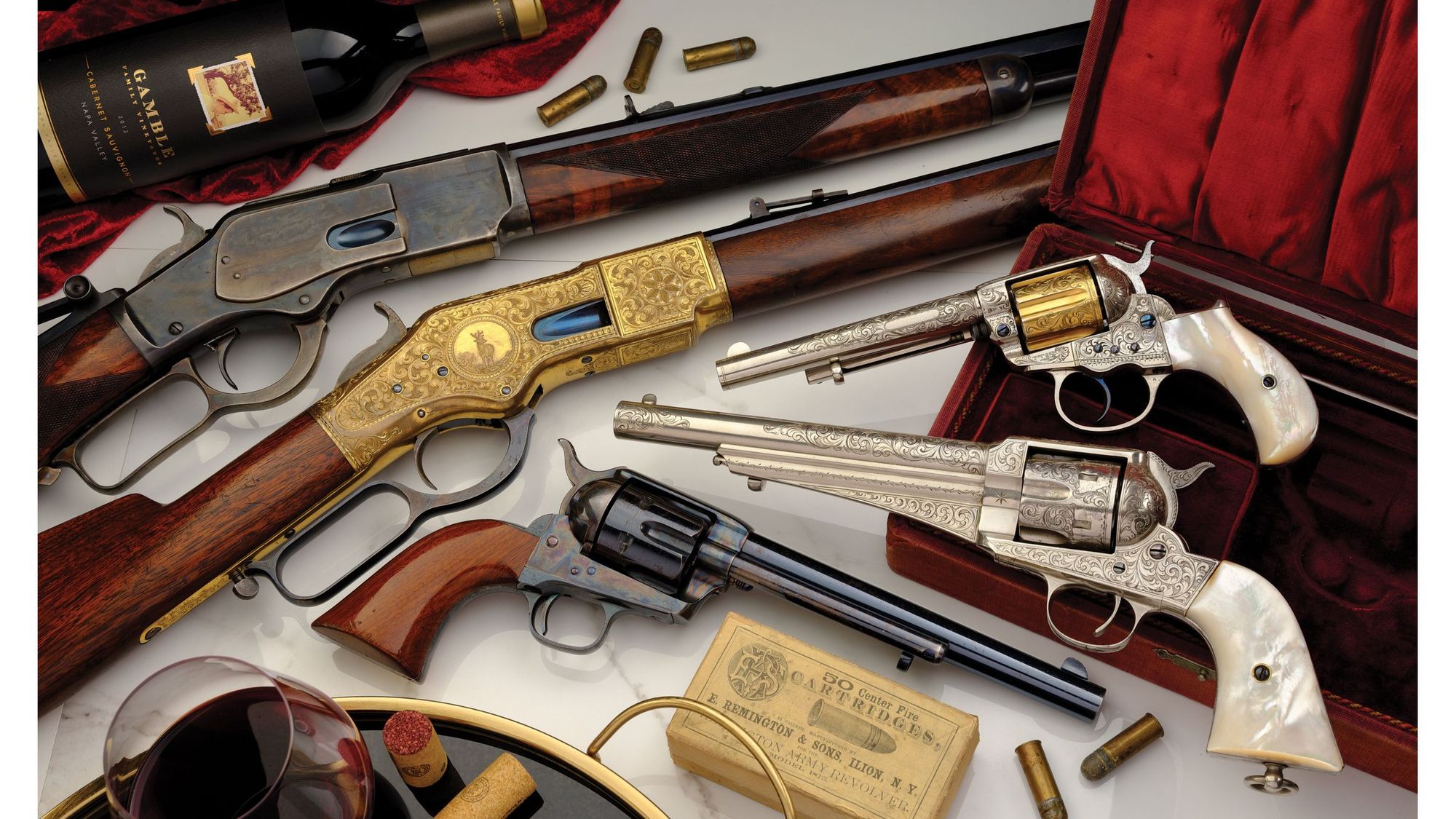
Rock Island Auction Company’s August Premier Auction has Hollywood glitz thanks to Elvis Presley and Tom Selleck, but also the star power of guns that have filled books and stood in elite collections for decades.
The Parsons’ Armies, revered in collectors’ circles, leads a lineup of firearms that are amazingly embellished, beautifully conditioned, and bearing epic historic stories. Several great collections are represented in the auction with amazing diversity in genres, eras, and price points to be found.
The Aug. 25-27 auction also features 109 Class III offerings from full auto machine guns to short-barrel rifles, classic Colts and Winchesters, fantastic flintlocks, and fine sporting arms available as part of the three-day sale. And don’t forget Elvis.
An amazing array of revolving rifles and shotguns are available in Rock Island Auction Company’s August Premier Auction.
Great Collections
There is no denying that this auction has amazing offerings from several great collections of guns. It includes fine arms from the amazingly well-conditioned and historic guns of The Greg Lampe Collection, to the superb collection of Colt New Line pistols and derringer revolvers of The George S. Lewis Jr. Collection, to the spectacular diversity of The Tom Selleck Collection and the Joe Marlin Hilliard Collection to the brilliant Smith & Wesson offerings of The Dave Ballantyne Collection, and the unsurpassed air guns of The Dr. Robert D. Beeman Collection.
The auction also features a fine slate of revolving rifles, a collection of FP45 Liberator pistol, prototypes, and classic European and American arms from all eras and genres.
Great Collections: The Greg Lampe Collection
The artistry and history of The Greg Lampe Collection showed itself in RIAC’s May Premier Auction, but this month brings one of the pinnacles of Colt collecting, L.B. Parsons’ cased, engraved Colt Model 1860 revolvers, to the podium. This pair of cased, engraved Colt Model 1860 Army revolvers given to Lewis B. Parsons, “Mover of Armies” for the Union in the Civil War, offer stunning factory engraving and was enshrined in several publications.
The Greg Lampe Collection has so much depth to its artistry and history that it has to be seen to be believed, so make a point of attending the auction’s Preview Day on Aug. 24.
Great Collections: The George S. Lewis Jr. Collection
Along with being marvelous pieces, guns from The George Lewis Collection are dripping with provenance, like a cased, factory engraved Colt New Line .41 spur trigger revolver that is among two guns on offer that appeared as part of the Colt “Wheel” display at the 1876 Exposition in St. Louis. His guns have also been previously featured in R.L. Wilson’s book “Colt Engraving” and “Colt Pistols: 1836-1876,” and in “The William M. Locke Collection,” by Frank Sellers.
Great Collections: The Dave Ballantyne Collection
Dave Ballantyne is a long-time Smith & Wesson collector and has served on the Smith & Wesson Historical Foundation so it should come as no surprise as to what he collects, nor their quality. All but one firearm is a Smith & Wesson among those available from The Dave Ballantyne Collection including several Registered .357 Magnums.
Whereas Ballantyne had a singular focus, The Tom Selleck Collection offers diversity, ranging from fine European sporting arms to cowboy guns. Leading the Selleck firearms is a magnificent pair of Holland & Holland shotguns embellished by Master Engraver Philippe Grifnee commissioned by Selleck and bearing his initials (“TWS”). Chambered for 20 gauge, this “Model De Luxe” displays highly detailed banknote-style game scenes as flowering scrollwork swirls around them.
Selleck’s collection also offers an incredibly rare Colt Model 1878 “Omnipotent” etched panel revolver. Colt’s first large frame double action revolver was marketed by B. Kittredge & Co. out of Cincinnati, Ohio, with the name etched on the barrel. Of the 174 revolvers shipped to Kittredge, only 154 revolvers will letter as an “Omnipotent.”
This gold-plated Walther PP was presented to Romanian King Carol II before World War 2 as the German government wanted to remain friendly with the country because of its oil reserves.
Great Collections: The Dr. Robert D. Beeman Collection
Perhaps the most comprehensive collection of air guns is The Robert D. Beeman Collection. Beeman shaped the face of air gunning around the world and he gathered an extensive collection of antique air guns from every genre with examples from the 17th century to the late 19th century. These fascinating firearms had several advantages over black powder firearms, like less recoil, less noise, less fouling, and a quicker reload. They also weren’t impacted as much by rain and moisture.
Elvis Presley loved guns. Rock Island Auction has previously sold guns of the King of Rock and Roll, and this August will offer a bicentennial-themed Smith & Wesson Model 53 given to him in 1976. Though Elvis provides the star power, this beautifully engraved and gold and silver inlaid gift to Elvis can stand on its own. Smith & Wesson Master Engraver Russell Smith rose to meet the expectations of a gun for Elvis with its floral scrollwork on a stipled background, silver inlaid five-pointed stars, and “1776-1976” on the barrel with gold inlaid bands at the muzzle and breech. The right side plate shows a gold relief eagle in flight grasping an enamel 13-star Betsy Ross American flag, while the left side of the frame has a gold relief minuteman flanked by stars, and the backstrap has the Liberty Bell. The gun comes with two equally embellished cylinders in .22 Jet and .22 LR.
This brilliant bicentennial-themed Smith & Wesson Model 53 was given to Elvis Presley in 1976, with the engraving and relief worlk done by Smith & Wesson Master Engraver Russell Smith.
Lot Five U.S. Cavalry Colt SAA
A Colt Cavalry Model Single Action Army from Lot Five is among the “blue chips” of gun collecting and this revolver falls right there among guns issued to the U.S. 7th Cavalry under Gen. George Armstrong Custer. Authenticated by Colt SAA authority John A. Kopec, this revolver had been tucked away since at least the 1940s passed down through a single family. This is a fresh-to-market opportunity for a collector to own a previously undiscovered piece of Lot Five history.
Great Collections: Class III Firearms
The August Auction will feature 109 Class III items, from heavy machine guns to light machine guns, submachine guns, to modern pre-ban converted full auto guns. The auction brings all of the recognizable full auto guns together, like the M60, the Browning Automatic Rifle, Thompson submachine guns, German MP-40s, a Street Sweeper, the Uzi, and the M16.
The stellar lineup of the August Premier Auction should draw any collector at any price point, whether it is for Colt revolvers, Winchester rifles, European shotguns, flintlocks, or machine guns. These great collections should be considered an opportunity for a collector to add a magnificent piece. Visit RIAC to see these fantastic offerings in person at Preview Day, Aug. 24.
In our previous Premier Auction, Rock Island Auction had the privilege of introducing the excellent Greg Lampe Collection. When it came to high condition, deeply researched, rare, and correct fine arms very few collections could be considered its equal.
Having covered some of Mr. Lampe’s fascinating biographical information in its initial offering, it won’t be readdressed here (but please watch the video below if you missed the Lampe Collection’s introductory video). Instead, we’ll focus on the brightest points in a brilliant second chapter from the Lampe Collection, available during RIAC’s August 25-27 Premier Firearms Auction.
The Parsons’ Armies
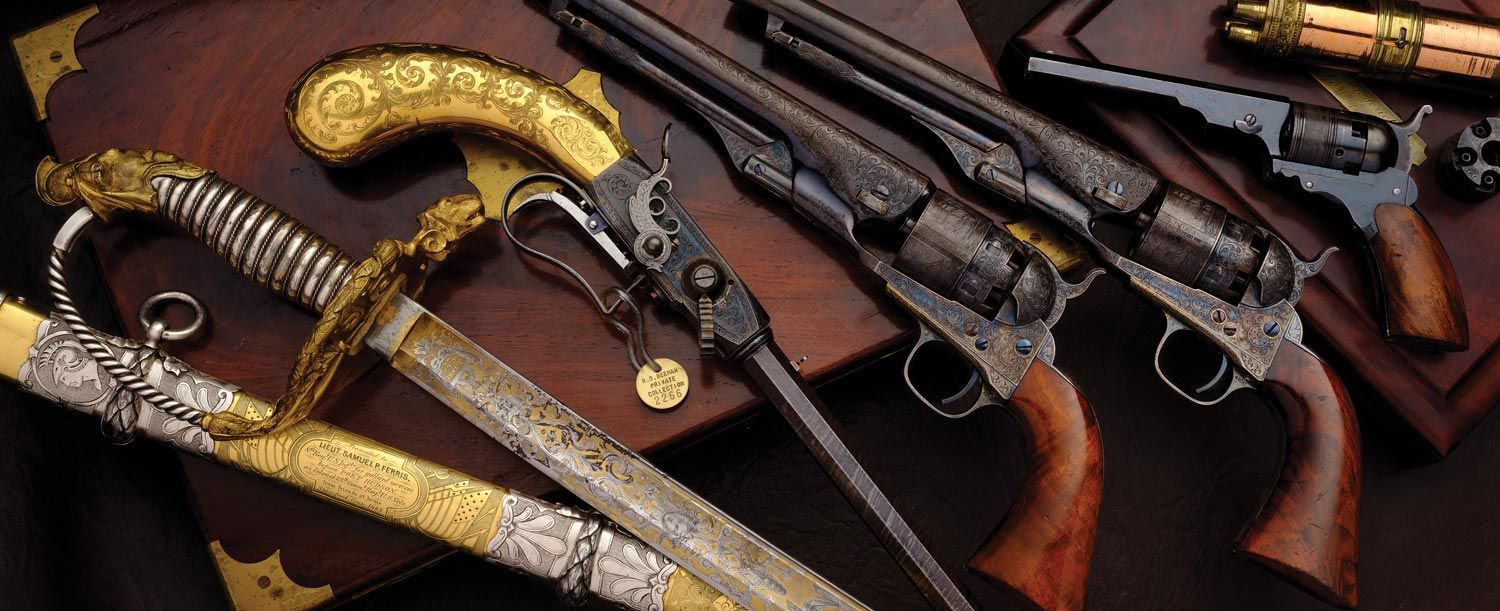
Serving as flagship for the entire auction are the famous Parsons’ Armies. This cased pair of Colt 1860 Army revolvers has been a fawned over commodity in the fine arms sphere for decades. Originally presented to Union Civil War Brigadier General and “Mover of Armies” Lewis B. Parsons, after his death they stayed in the family until presented to Parsons College, a school he founded with two of his brothers. From there they have been housed in only three elite collections: Bill Sisney, George S. Lewis, and Greg Lampe.
This jaw-dropping double cased set is beautiful, highly engraved, with wonderful colors, crisp markings, stunning deluxe grips, and an important history. The Parsons Armies are rightly one of the precious few collector arms in the world worthy of a nickname. For the full story on this illustrious set, please watch our video below.
Colt Paterson No. 2 Belt Model
Second on the list is another cased Colt with a who’s who of collectors to list in its provenance. This Paterson No. 2 belt model was manufactured in 1837 and is STILL complete with its original mahogany case and suite of accoutrements.
Three notable collections counted this Paterson among their ranks, and it’s easy to see why. Pre-auction estimate: $180,000-$275,000.
It was discovered in Europe by author and expert Herb Glass Sr. during an 1962 visit. From Mr. Glass’ distinguished collection, it found its way to the A.I. McCroskie Collection, a grouping known for accepting only the highest condition items. Finally in 2001, it came into the possession of Greg Lampe, where it has been housed ever since, making this little Paterson fresh to market and ready to make a splash after being tucked away for more than two decades.
A Golden Colt 1851 Navy
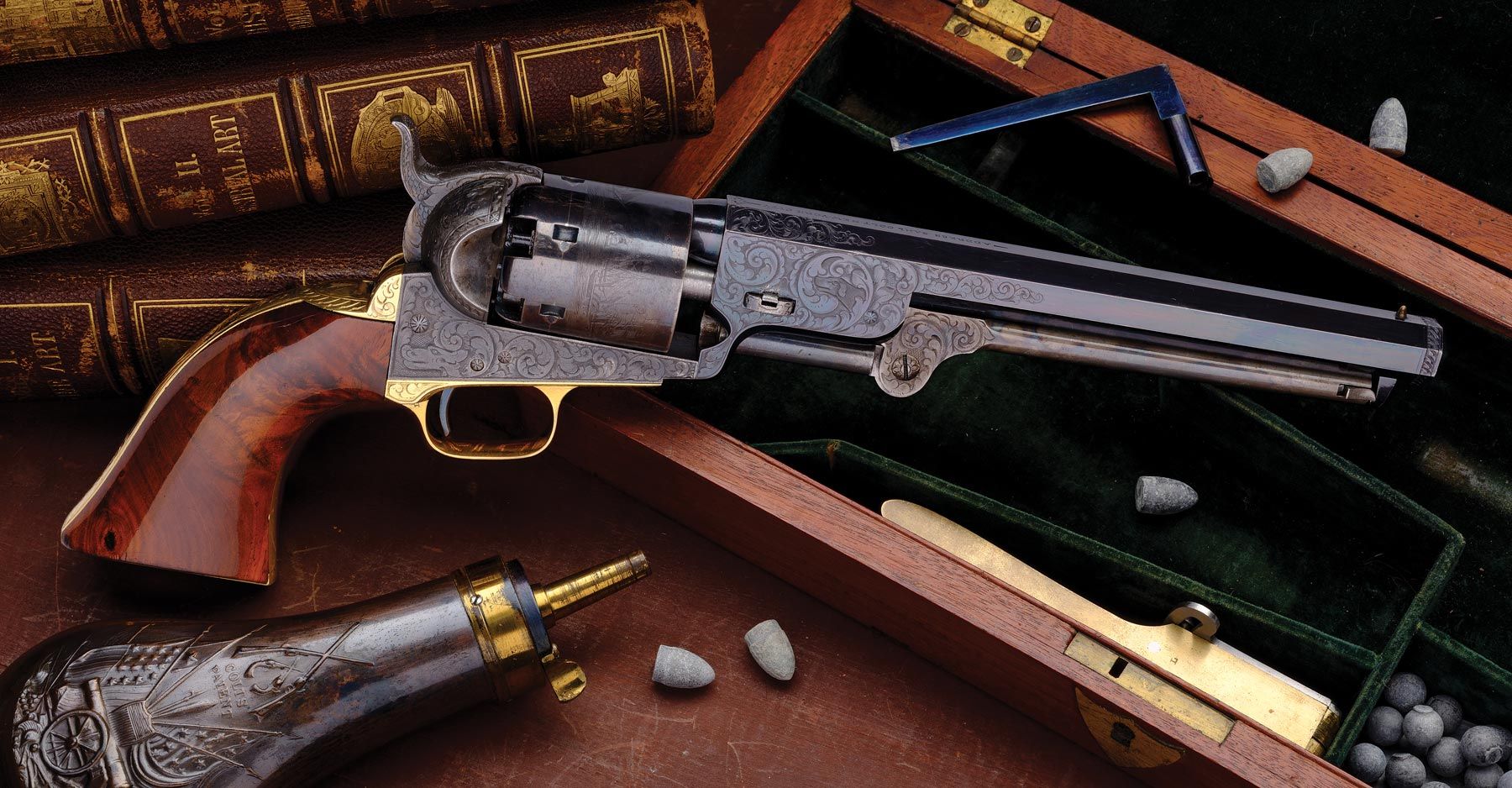
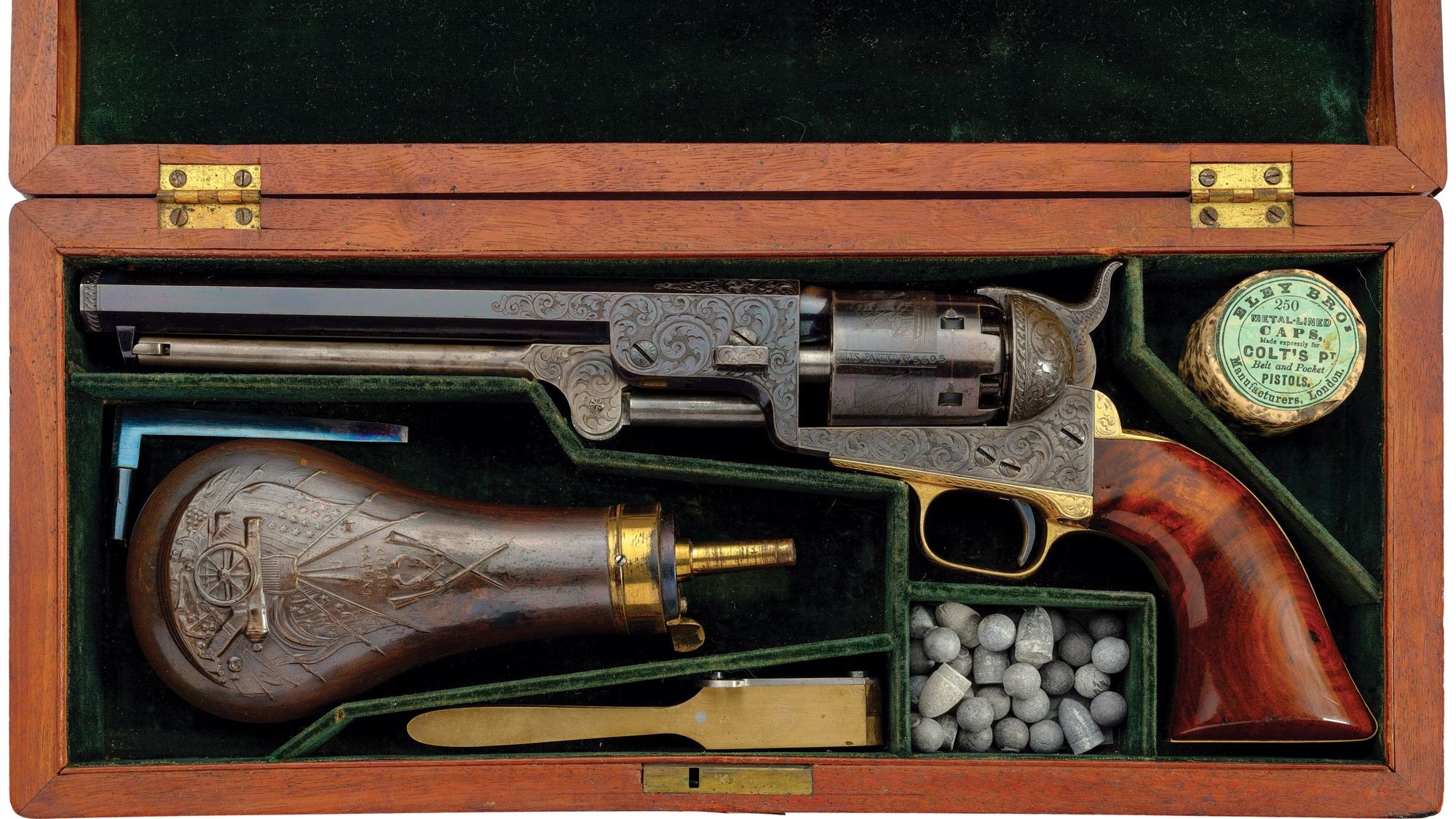
In the initial Lampe Collection offering there was a Colt so good, our headline was, “Outstanding Finest Known U.S. Army Colt Model 1851 Navy Percussion Revolver with Holster and Accessories.” That’s not a claim RIAC makes lightly. Now, in the August Premier comes another giant of a Colt 1851 Navy, and this one has been given the deluxe treatment.
The only known Colt 1851 Navy with gold plated grip straps. Pre-auction estimate $130,000-$225,000.
May’s example, which sold for $293,750 in the face of its pre-auction estimate of $95,000-$180,000, was, as its aforementioned headline states, a U.S. contract model. Its appeal was its near mint condition, no small miracle considering that almost every U.S. military contract arms would have seen use in the Civil War. This example, SN 78466, never got that memo.
The revolver available this August, SN 5606, is another superb condition Colt 1851 Navy, but the first-year production model was intended for the commercial market and was given deluxe treatment for the factory. In fact, one could argue it has more in common with Mr. Lampe’s Colt 1849 Pocket that was offered a few short months ago, which also brought $293,750.
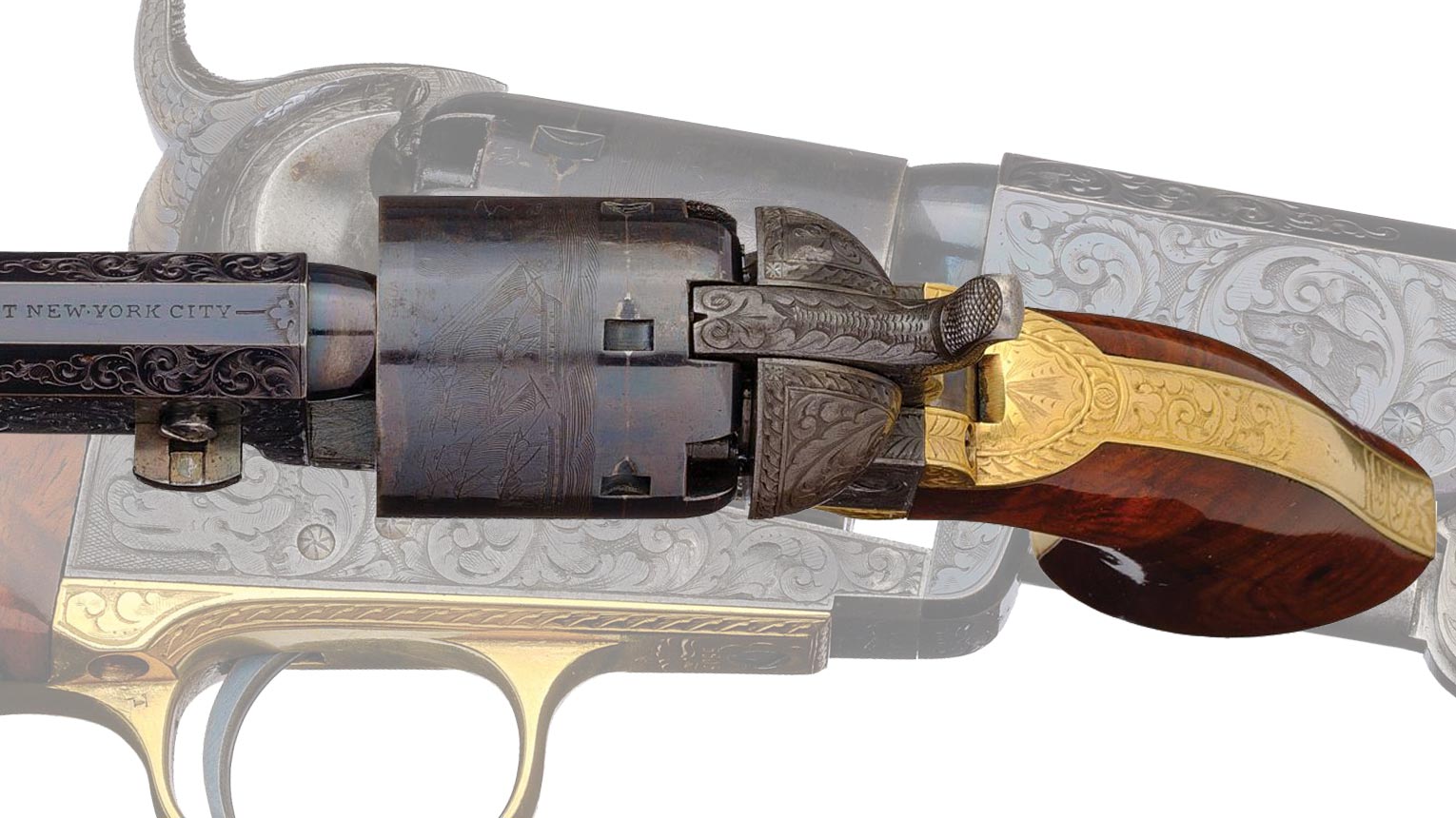
From stem to stern SN 5606 is a vision of how a deluxe Colt would have appeared in 1851. This is safely a 95% gun, covered with its deep, original, meticulously polished blue finish, an art in itself that may be lost forever. It is subtly accented by the casehardened loading lever running parallel to the brightly finished barrel, with touches of the case coloring also gracing the hammer. Said loading lever bears what one publication calls “extra engraving” on its joint, a fitting touch with its flat surface providing a natural extension of the copious “donut style” foliate engraving found on the breech end of the barrel.
That canvas extends onto the frame, trigger guard, hammer, recoiled shield, and backstrap, ensuring that almost every surface of the revolver has been touched by the tools of the engraver’s trade. Moving further back on the revolver brings a viewer to its most lavish portions yet – the trigger guard, and grip frame are plated in lustrous, bright yellow gold. It is the only known Colt 1851 Navy to possess such a luxurious feature. Said gripstrap provides the framework for two remarkable pieces of burl walnut. The highly figured wood, still bearing the smoke-like sworls of its natural tissue, is covered in a high gloss finish that helps its shine alongside the golden accents.
Given such a treatment, one could safely assume Samuel Colt’s direct involvement in its commissioning, but for whom and for what purpose are likely lost to history. The space on its backstrap for an inscription remains unfilled.
With such superb condition and extraordinary embellishment, including the one-off golden finish, SN 5606 has not escaped the eye of collectors nor authors. It has appeared in no less than five significant written works on Colt revolvers, and been housed in several elite collections including that of William Locke, Paul McCombs, and Joseph Murray. Finding its way to the Greg Lampe Collection seems a natural fit, given his proclivity for fine arms with stellar condition.
This Colt 1851 Navy is one of the absolutely finest known, and it has the authors, the condition, the embellishment, and pedigree to back it up.
Gold Winchester 1866
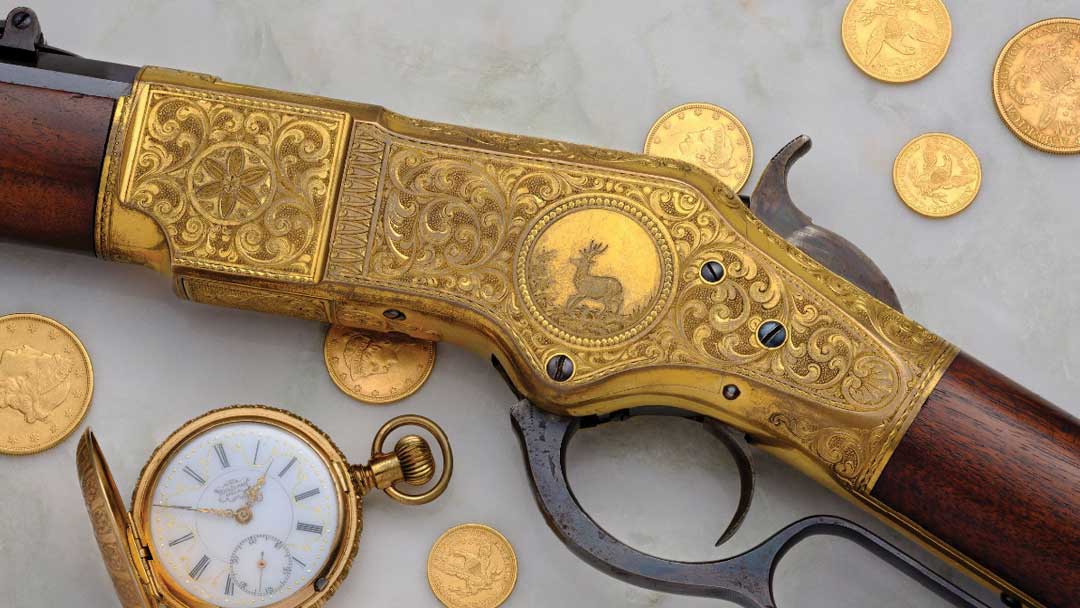
Mr. Lampe was obviously fond of his Colts, but not to the exclusion of all others. This golden, factory engraved Winchester 1866 is a testament to that. It’s the type of Winchester that graces museums and the world’s elite fine arms collections.
Few collections can claim rights to top grade Winchesters such as this Model 1866. Pre-auction estimate $95,000-$160,000.
This particular Winchester was made in 1874, with the type of exhibition-grade engraving likely executed by Conrad or John Ulrich. Many such golden and engraved guns saw subsequent exhibition at the world’s fairs that were so popular in the late 19th century, but it may also have been ordered by someone who appreciated the very best of fine arms.
Its circular panel scenes, each of a buck, its bright nitre blue loading gate, and bright golden finish have provided an abundance of opportunities for Rock Island Auction photographers, who have clearly “made hay while the sun shines.”
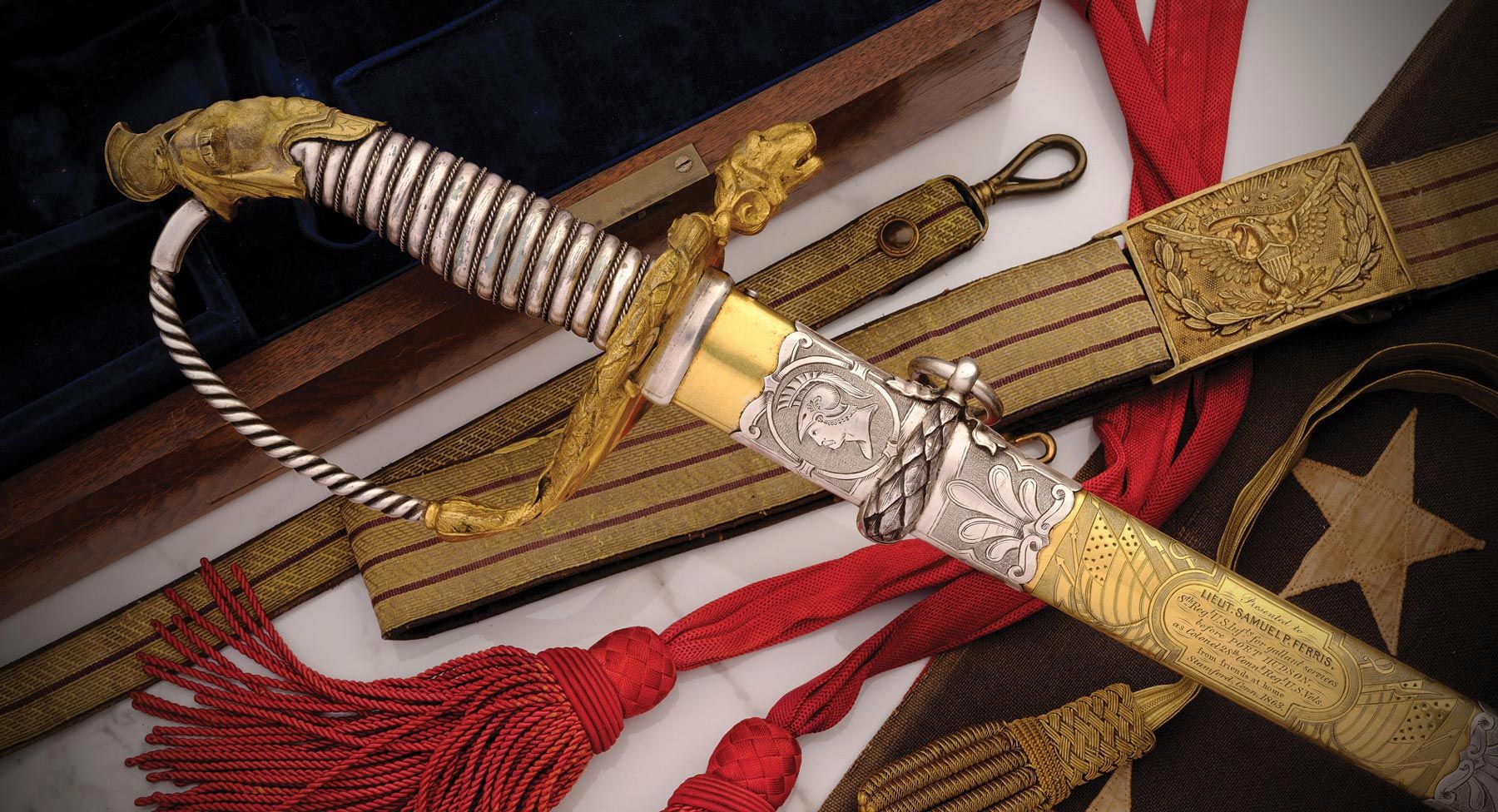
As with most items from the Lampe Collection, a staggering assemblage of research is included with the sword, so future collectors will never have to wonder about the identity of Ferris nor his contributions that earned him this haute blade.
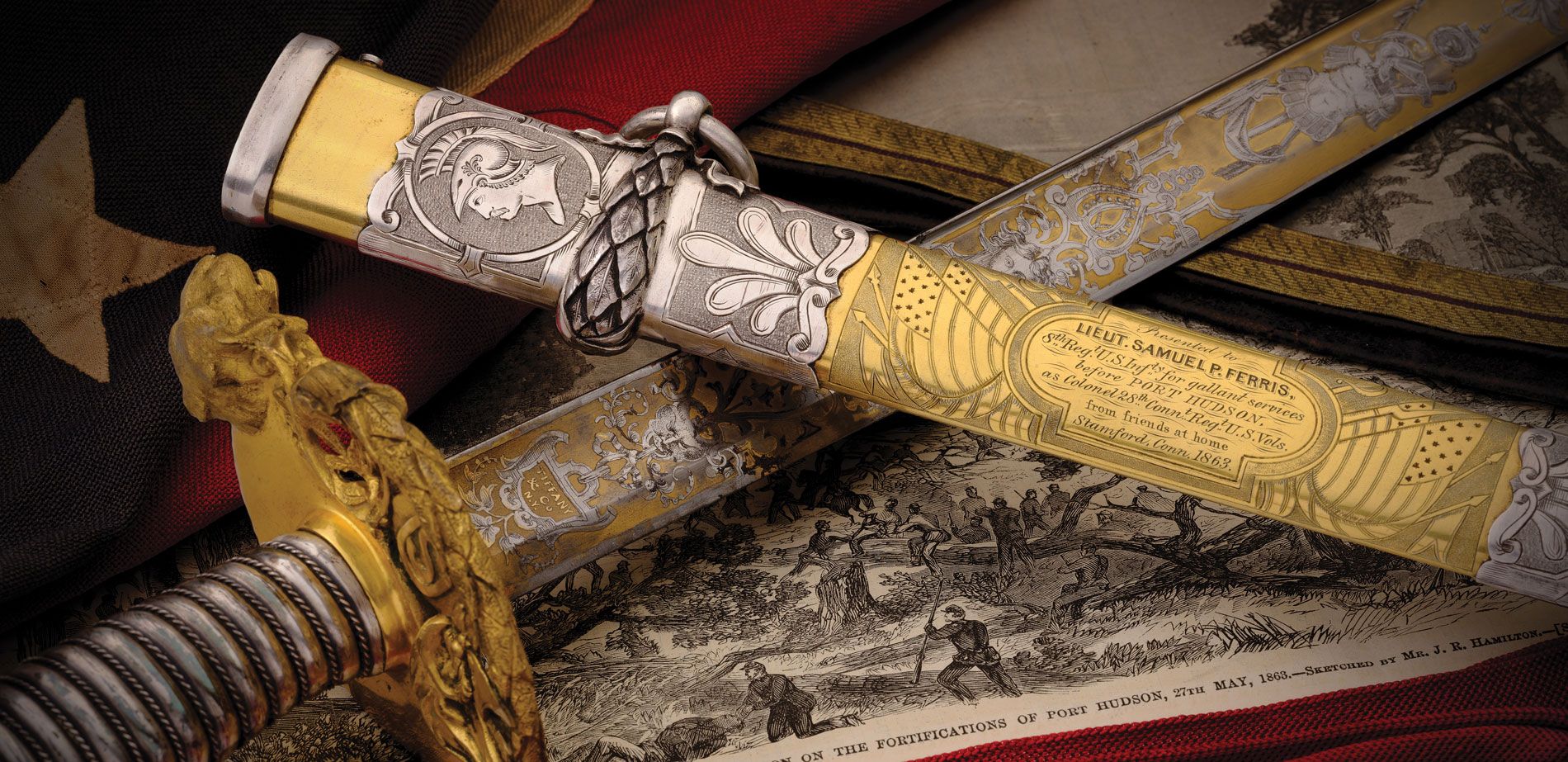
A Tiffany & Co. Civil War presentation sword absolutely awash in gold and silver. Pre-auction estimate $45,000-$75,000.
Samuel P. Ferris graduated West Point in 1861 and was immediately pressed into Civil War service for the Union, fighting in the Battle of Bull Run in command of Company C of the 8th U.S. Infantry. After taking leave to raise a volunteer regiment, he promptly led them as a newly commissioned colonel during the attack on Port Hudson, Louisiana in May 1863. His “gallant and meritorious service” earned him the brevet rank of captain. That August his volunteer regiment, the 28th Connecticut, mustered out of service, and it is likely they presented him with this sword at that time.
True to the name and reputation of Tiffany & Co., this high grade officer’s sword is awash in gold and silver, comes with its dress and field scabbards, gold sword knot, and dress belt with hangers.
With gifts such as this sword, Lt. Samuel Ferris had clearly endeared himself to the fighting men in his command.
The 32-inch Collins & Co. blade is covered over half of its length with gold finish and deeply etched scenes of floral designs, masks, Roman armor, geometric patterns, and a large calligraphic “U.S.” on its left side. Its hilt is equally stunning with its gold and silver sculpted depictions of a lion’s head, U.S. heraldry, and a gilt pommel sculpted as a Roman helmet and armor. The perfectly matching dress scabbard bears the presentation inscription between more patriotic heraldry in a gilt panel that reads, “Presented to Lieut. Samuel P. Ferris, 8th Reg. U.S. Infty, for gallnt services before PORT HUDSON, as colonel 28th Connt Regt. U.S. Vols. From friends at home. Standford, Conn. 1863.”
It is a brilliant art object in gold and silver crafted by one of America’s most famous artisan firms, all the more striking and bright when placed inside the navy blue velvet lining of its fitted presentation case. Unfortunately, words can only do this sword and its craftsmanship so much justice. It is something that is best observed in person to appreciate.
Click this image to view all items in the auction from the Greg lampe Collection.
The second offering of the Greg Lampe Collection will include 42 lots in the August 25-27 Premier Auction. From the collection defining Colts shown here to the pepperboxes he collected later in life, and numerous genres besides, it is a phenomenal opportunity to elevate one’s own collection by obtaining pieces from an elite grouping known for its benchmark condition and exhaustive research.
The first lever action rifle came from the man who invented a safety pin to pay off a debt.
Before a shirt maker named Winchester put his name on a gun company, Walter Hunt invented a gun. Hunt had a mechanical mind and invented hundreds of things: a saw, a nail-making machine, a bicycle, and a ceiling walking circus device. He also made a revolver, bullets, and the Volition rifle, the root of the lever action rifle family tree.
Hunt’s long gun led the way, but there are other lever action rifle firsts in Rock Island Auction Company’s August 25-27 Premier Auction with a Second Model Smith-Jennings, a Spencer repeating sporting rifle, Henry Second Model rifle, and a Winchester 1866 on offer among others. All of the guns shown here are available this August.
There are plenty of titans of 19th century gun making, business partnerships, failures, and dealings before we get to Winchester’s first lever action rifle. This is streamlined a bit in order to talk about the guns.
First Lever Action Rifle
Hunt developed a metallic cartridge called the Rocket Ball with its powder and bullet contained in a single package. He just needed to design a rifle to fire it. In 1847 he patented the Volition rifle, a complex weapon with small, delicate parts and a 12-round under-the-barrel magazine.
Despite his mechanical aptitude, Hunt was a terrible businessman and couldn’t get the gun off the ground, never making it past the prototype stage. Lewis Jennings, a machinist where Hunt was working on the Volition, was brought on to make improvements. Jennings’ gun was better but had issues when an order was placed to make 5,000 by the Robbins & Lawrence Arms Company of Vermont, where Horace Smith worked and was included in continuing to make the gun better.
Also at Robbins & Lawrence was Daniel Wesson, who worked inspecting parts and finished pepperbox pistols contracted to Robbins. Oh, and Benjamin Tyler Henry served as foreman. With all this talent under one roof, it’s a wonder that Robbins & Lawrence didn’t somehow grow into the United States’ top arms manufacturer.
Back to our story, the Smith-Jennings rifle received a patent in 1851 and was made at Robbins & Lawrence from 1851 to 1852. The Second Model Smith-Jennings had a pronounced bulge on the underside of the frame, often leading to being called the “pregnant frame Jennings.” The pill primer and cartridge carrier were improved from the First Model, but only 400 were made.
Most of the Smith-Jennings rifles were converted to single shot with a ramrod replacing the magazine tube.
While a majority of Smith-Jenning rifles were converted to single shot, this Smith-Jennings remains in its original configuration as a repeating firearm, making it a rare and desirable piece for collectors. The rifle is pictured and identified in Lewis and Rutter’s “Volcanic Firearms: Predecessor to the Winchester Rifle.”
Smith and Wesson started the first Smith & Wesson company in 1854 before changing the name to Volcanic Repeating Arms Company. It produced the Volcanic pistol and one of the first lever action rifles, the Volcanic carbine. By 1855, when the company’s name changed it also brought in new investors including businessman Oliver Winchester.
Smith departed Volcanic when the name changed and investors, including Winchester were brought on board. Wesson departed the company after less than a year and joined Smith. The duo created the company that would be Smith & Wesson, obtaining the 1855 Rollin White patent for bored through revolver cylinder.
Faced with financial difficulty, Winchester dissolved Volcanic and created the New Haven Arms Company in 1857. Benjamin Tyler Henry had left Robbins & Lawrence when it too faced financial difficulty and joined Winchester’s new company, setting the stage for the first lever action rifle to achieve financial success.
Generally found with factory engraved frames, this New Haven Arms Company Volcanic lever action carbine is unadorned, with a 16 1/2-inch barrel and plain polished brass frame. About 1,000 of these were made with 16-, 21-, and 25-inch barrels. The lever action and integral spring-loaded magazine served as the basic design for the Henry rifle. Volcanic’s repeaters faced trouble due to their underpowered ammunition.
First Lever Action Rifle Chambered for a Metallic Cartridge
Somehow not part of the Winchester/Smith/Wesson/Henry cabal, Christopher Spencer actually started out in Samuel Colt’s orbit, working for the entrepreneur for a time. He designed his lever action in 1860 before starting the Spencer Repeating Rifle Company in 1862. Spencer’s patent predated Henry’s patent by only eight months.
Spencer’s repeating rifle was capable of firing off 14 shots per minute from seven-round magazines loaded into the stock, using metallic cartridges – the first lever action rifle to do so. A lever, moved back and forth, ejected a spent cartridge and loaded a new one. The hammer still had to be manually cocked.
When the Civil War started, demand for the Connecticut gun maker’s weapons rose. He traveled to Washington D.C., in June 1861 to show off his gun to Ordnance officials. Impressed and tested, the Ordnance Board contracted for 10,000 Spencer rifles. Despite the order, the Ordnance Department was concerned about supply issues considering the Spencer’s rate of fire meant more ammunition would be needed.
By the time the gun went out of production in 1869, 200,000 Spencer repeaters were made. Bringing this full circle, Spencer Repeating Rifle Company was eventually purchased by Winchester Repeating Arms and went out of business in 1869.
This Spencer Repeating Sporting rifle represents the first lever action rifle patented, for metallic cartridges. After the Civil War, the Spencer sporter went west for the Indian Wars. George Armstrong Custer went west with one. This rifle with its 26-inch barrel has 11 “kill notches” marked on the right side of the wrist.
Was it the cartridge or the gun that was the problem preventing the lever action rifle from achieving commercial success? Benjamin Tyler Henry took a stab at the issue and developed a .44 caliber cartridge in 1858 that had a muzzle velocity of 1,200 fps. To handle the cartridge, a gun needed a larger frame and a barrel adapted for the cartridge, firing pins independent from the bolt face, and an ejection system. By October 1860 he had a patent for the 16-shot Henry rifle.
Unfortunately, Winchester didn’t have the money to re-tool the plant for the gun until the company agreed to make 3,000 Walch pocket revolvers. With the money in hand, the factory was set up and the first Henry rifles were made in 1862. Despite not earning a significant government contract during the Civil War, the Henry was the first lever action rifle to achieve commercial success. Union soldiers often used reenlistment bonuses to buy a Henry rifle because of its rate of fire. Reportedly about 6,000 to 7,000 were used by Union soldiers during the war. Many of the Henry Rifles went west after the Civil War. About 14,000 had been produced by the time manufacturing ended in 1866.
This New Haven Arms Company Henry Second Model represents the first lever action rifle to be commercially successful. This late production model, formerly of the Mac McCroskie Collection, has a 24-inch octagon barrel and a square back nickel-silver blade sight.
Despite the success of the Henry rifle, Benjamin Tyler Henry didn’t think he was getting a fair cut as he saw Winchester reap the benefits of his work. When Winchester went overseas to try to drum up business for the lever action rifle, Henry tried to take over the company, only to lose the fight.
Winchester came out in a financially superior position to Henry and created the Winchester Repeating Arms Company and hired a new foreman, Nelson King. Nelson made improvements to the Henry rifle internally, added a loading gate, enclosed the magazine tube and added a wooden forearm. Enclosing the magazine prevented dirt and other gunk getting into the magazine. The Winchester board voted a $5,000 bonus to King.
In transition, the Winchester guns had both “King’s Patent” and “Henry’s Patent” stamped on their barrels, but that would soon disappear from the Winchester Model 1866. The Model 1866, released in 1867, was the original cowboy rifle as hundreds of thousands of settlers headed west. Winchester would make about 170,100 Model 1866s.
The Winchester 66 was nicknamed the “Yellowboy” because of its distinctive gunmetal frame, forend cap, sideplates, and buttplate. Gunmetal is a bronze alloy of copper, tin, zinc, and occasionally a small amount of lead giving it its glossy appearance. It was rust-resistant and easy to machine and proved more durable than iron framed guns in the harsh environs of the American West.
More than a “Yellowboy” Model 1866, this gilded rifle was manufactured in 1874 and features exhibition engraving from Conrad or John Ulrich and has a gilt frame, forend cap, and buttplate. It features circular buck scenes on the side plates and sand dollar designs on the front of the frame on each side. The gun also entwines scrollwork with punched backgrounds, shell accents, border designs, and an elongated oval panel atop the frame.
First Lever Action Rifle Chambered for Centerfire Ammunition
Winchester’s Model 1873 was dubbed “the gun that won the West,” with its strengthened action and adaption of parts to handle the heavier centerfire cartridge. A sliding lid, or dust cover, was added to cover the ejection port on top of the frame. Gunmetal was initially abandoned for forged iron which was replaced by steel in 1884.
A new cartridge was made for the Model 1873, the .44 Winchester Centerfire. The gun was later chambered in .38 WCF in 1889 and the .32 WCF starting in 1882.
A special order Deluxe Winchester Model 1873 lever action rifle is chambered in .38 WCF and its barrel, magazine, dust cover, bolt, and loading gate are blued, and the forearm cap, receiver, hammer, lever, and trigger are color casehardened. The stock and forearm have a high polish piano finish. Special order features include the 24-inch part-round, part-octagon barrel, single set trigger, tang mounted adjustable peep site, and fancy grain walnut forearm and pistol grip stock. The pistol grip has an ebony inlay.
The Winchester 1876 came about because of the light cartridge used with the 1873 in comparison to more powerful cartridges used with single shot rifles. The .45-75 WCF was developed for the 1876 and the rifle was first shipped in June 1877. The new cartridge had a striking energy of 1,400 foot pounds, doubling that of the .44-40 cartridge. Significant changes from the 1873 were mainly to handle the more powerful cartridge, including making the receiver and key internal parts larger.
The barrel of each Model 1873 and Model 1876 sporting rifle was shot at a target and that target numbered to correspond with the barrel. The most accurate were combined with set-triggers and extra finish and marked “one of a thousand” and sold at a higher price.
The program was short-lived since it suggested that the regular 1873 and 1876 weren’t accurate. These guns, designated in both the 1873 and 1876 models, have become highly collectable because less than 200 were made.
This documented “One of One Thousand” Winchester Model 1876 was restored by Turnbull Restorations in 1996. It is one of only 55 “One of One Thousand” Model 1876 rifles and one of just 22 chambered in .45-60. This gun, shipped in 1880 at the end of the “One of One Thousand” program, has inlaid silver bands at the muzzle and breech, a casehardened frame, hammer, and lever, and nitre blue loading base.
First Lever Action Rifle Models for Smokeless Powder
When Marlin Firearms Company was founded in 1870, it was making pistols, adding single shot rifles in 1875. John Marlin received a patent for a repeating rifle in 1881 that used the .45-70 cartridge then followed that with the 1888 that used pistol rounds. John Marlin anticipated the popularity of smokeless powder and designed the Model 1893 specifically for the more powerful propellant. The Model 1893 proved to be popular with more than one million made. It was a side ejecting rifle, a key selling point over Winchester since it better protected the internal workings from weather and debris.
This Marlin Deluxe Model 1893 takedown was shipped on Feb. 22, 1896, in takedown configuration, pistol grip stock, German silver blade front sight, an elevation adjustable rear sight, and a folding tang peep sight. The frame is casehardened along with the lever and hammer and has a blued loading gate.
The John Moses Browning designed Winchester Model 1894 was the first lever action rifle put on the market for smokeless powder cartridges, the .25-35 Winchester and the .30-30 Winchester. Often called the “Klondike Model,” because of its popularity in the Klondike gold rush of 1898, the Model 1894 was also the first Winchester offered with nickel steel barrels. The Model 1894 was the first sporting gun to pass the one million mark. The one millionth was presented in 1927 to President Calvin Coolidge.
This Winchester Model 1894 was manufactured in February 1895, the second month of the second year of production and features the early “first model” receiver featuring the “10 o’clock” screw by the loading gate. This rifle is chambered in .38-55 WCF.
First Lever Action Rifle with a Box Magazine
Browning and Winchester’s relationship was coming to an end when his design became the Model 1895 rifle. Gone was the tubular magazine, and in its place a box magazine that held bottleneck cartridges. The gun was also strong enough to handle more powerful rounds. The Model 1895 was among the guns carried by Theodore Roosevelt on his African hunting trip.
This Winchester Deluxe Model 1895 is factory engraved, making it very rare. The scrollwork engraving on a punch dot background on the sides of the receiver that compliment an engraved bear in a lake scene on the right side of the receiver. The rifle has a German silver blade elevation adjustable rear sights. This Winchester rifle has a deluxe checkered forearm and straight grip stock with high gloss lacquer and a trapdoor crescent buttplate.
First Lever Action Rifle for Sale
Rock Island Auction Company’s August Premier Auction offers an impressive array of lever action rifle firsts, from the earliest lever action like the Smith-Jennings rifle, or the Henry rifle, the first lever action rifle that was commercially successful, to a number of Winchester rifles that have amazing pedigrees, including the Model 1866, the Model 1873, and the Model 1895. These are an opportunity for a lever gun collector to obtain not just an example of these “firsts,” but terrific examples that would truly boost a collection to another level.
Sources:
The History of Winchester Firearms 1866-1966, by George R. Watrous
As Hawaii’s Maui Island attempts to recover from some of the deadliest fires we have ever seen, a storm of controversy is brewing over the government’s response to the disaster. A picture is emerging of an ill-prepared system that has left residents to fend for themselves, struggling to coordinate the recovery efforts and pick up the pieces of their shattered lives. From a failure to activate warning sirens to allegations of conspiracy to steal land, the government’s actions – or lack thereof – generate outrage and questions about what is really going on.
The situation in Maui is not just a failure of leadership; it is a damning indictment of a system that has lost its way. It’s also a reminder of why we have been telling you for decades that YOU CANNOT COUNT ON THE GOVERNMENT DURING A DISASTER – You are your own First Responder!
The scene in Lahaina is one of complete devastation. A town destroyed, families torn apart, and a community left to fend for itself. The wildfires have taken so much from these residents, and now it seems their own government has abandoned them in their hour of need. Here at OFFGRID Survival, we find this situation infuriating, but sadly not at all surprising.
Government Disaster Response Failures at Every Level
Let’s start with the first and most deadly failure: the absence of warning sirens. Why were 80 warning sirens never activated? Where was the communication that could have saved lives? These are not just missteps but catastrophic failures that reveal a profoundly broken emergency response system.
Next, There are 11 military bases in Hawaii. The world’s largest fleet command, the U.S. Pacific Fleet, is stationed in Pearl Harbor, just 116 miles from the disaster zone. Yet, residents were forced to flee into the oceans in a desperate attempt to escape the fires, and our largest military bases were nowhere to be found. Instead, residents from other Islands on Jetskis and makeshift rafts went out themselves and desperately tried to save people. Today, there are almost 1,000 still missing; many either burned in the fires or drowned while waiting for help at sea.
The problems don’t end there; in fact, they are going on as we speak. The delayed delivery of essential supplies like medication and food is outrageous. People’s lives are at stake, and yet bureaucracy again stands in the way of relief. It’s a sickening display of apathy, demonstrating how far removed our federal agencies have become from the real needs of the American people.
Government Incompetence or a Calculated Conspiracy to Defraud People of Their Land?
But some native Maui residents claim much more is happening here, claiming a disturbing conspiracy that goes far beyond incompetent government workers. They claim police barricades are blocking charity groups from entering the disaster zone. What twisted logic is at play here? Why would local organizations be told they cannot deliver food and water because they lack “proper licensing” when people are dying? This isn’t incompetence; it’s something much more sinister.
If there is truth to the claim of a conspiracy to defraud Native Maui residents of their lands, this goes from a failure to respond and incompetence to an outright criminal act.
Here are resident’s asking Maui Chief of Police John Pelletier — yes this is the same guy who was the incident commander during the Las Vegas Mass Shooting — Why was water shut off? Why did Police Barricade and block escape routes? Why are you Lying???
Maui Residents asking Maui Chief of Police John Pelletier — yes this is the same “officer” who was the incident commander during the Las Vegas Mass Shooting — Why was water shut off? Why did Police Barricade and block escape routes? Why are you Lying???https://t.co/4b4QLy9cmhpic.twitter.com/rzhKW6oT6j
YOU are your own first responders! The Role of Local Heroes
Amid tragedy, the real heroes are the people of Maui. Charities, churches, and local groups are stepping up to do what the federal government has failed to do. They are showing the true spirit of Aloha, but as we have shown, even that is now under attack from a system that has gone so far off the rails that it is literally killing people!
This is what happens when you replace people who care, with WOKE morons!
Hawaiian official M. Kaleo Manuel refused to release water in Maui as the fire raged
HEre is M. Kaleo Manuel, the director of the Department of Land and Natural Resources who refused to release water in Maui, contributing to up to 106 deaths…https://t.co/4b4QLy9cmhpic.twitter.com/hXYJ4Dnfj0
This disaster must serve as a wake-up call. It’s a tragic confirmation of what many of us have been warning about for years: the government will not be there to save you, and they CANNOT handle disaster response. It’s not only time for a complete overhaul of our emergency management system; it’s time the public wakes up and starts preparing themselves to deal with what’s coming.
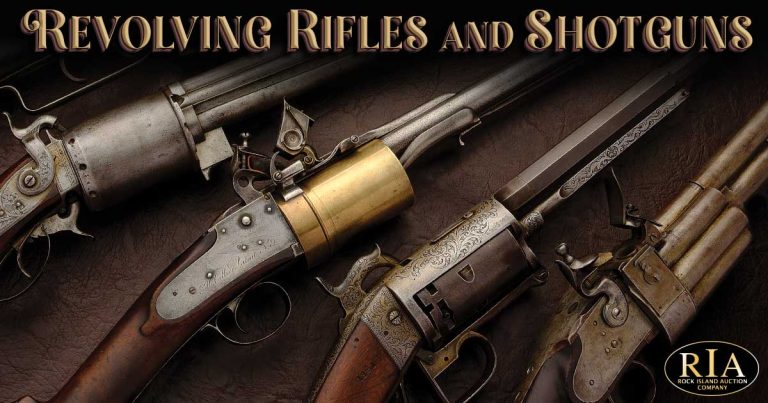
Revolving rifles and shotguns offered users a repeating long gun option before the age of lever and pump action firearms. Rock Island Auction Company’s August 25-27 Premier Auction features over two dozen extremely scarce examples of the genre that illustrates the progression and innovation of this fascinating chapter in firearms history.
(Left) A Hall 15-shot percussion revolving rifle. (Right) A Thomas W.G. Treeby patent percussion chain rifle.
The only known, documented U.S. Navy Trials Artemus Wheeler flintlock revolving rifle in private Hands. Available this August.
Most of the historic assortment of revolving rifles and revolving shotguns offered below originate from a single collection. The decades of dedication, research, and scholarship are evident throughout this supremely well-curated grouping and is a testament to fine arms collecting at the highest level of the pursuit. Click on the images throughout this article to learn more about each fascinating firearm.
The incredible assemblage of revolving rifles and revolving shotguns is filled with rare prototypes and curiosities of design.
Early Revolving Rifles
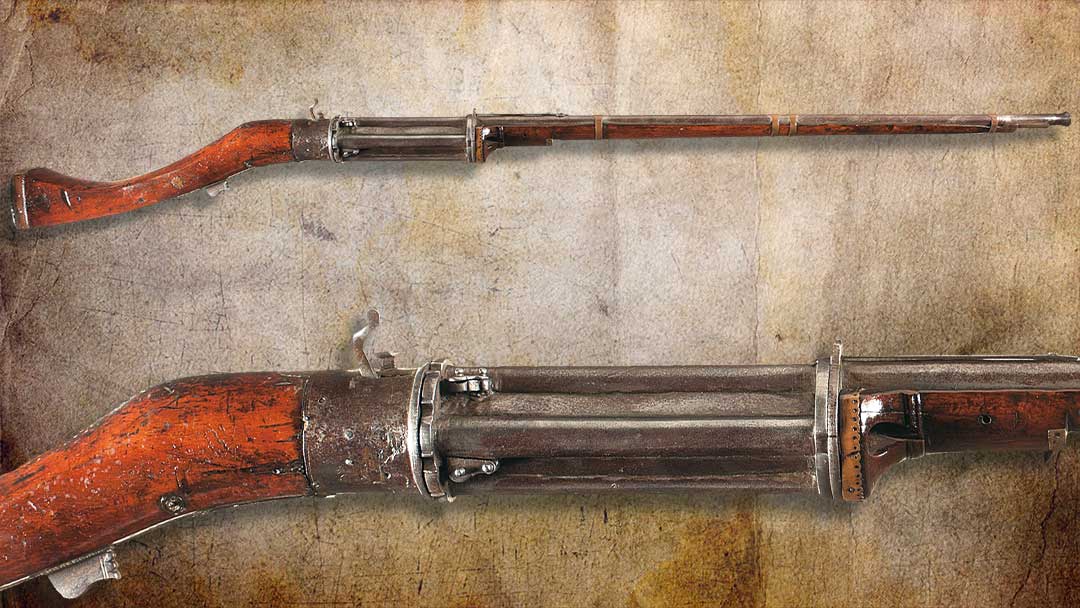
Revolving rifles and shotguns date back to the 16th century in the form of matchlocks with manually revolving chambers. Matchlock revolver rifles were costly to produce and suffered from reliability issues, but gunmakers continued to experiment with the design as metallurgy improved and new ignition systems became available.
Another solution to achieving multiple shots with a single firearm was adding entire barrels. The swivel breeches or “wenders” (meaning “turner” in German) offered their users two, three, and sometimes even four barrels. The extra barrels and locks added considerable expense and weight to these manually rotated firearms.
An elaborately engraved and extensively German silver inlaid four-barrel swivel breech percussion combination gun by M. J. Whitmore of Potsdam, New York. Available this August.
The Nock, Wheeler, and Collier Revolving Rifle
London gunmaker Henry Nock produced several innovative weapons during the late 18th and early 19th centuries, including a revolving flintlock carbine. Unlike Henry Nock’s famous volley gun design which fired all its barrels at once, Nock’s revolving carbine features a six-shot, hand-turned smooth bore barrel cluster and an automatic primer system. This model is strikingly similar to the American revolving carbine design by Artemus Wheeler of Concord, Massachusetts.
Only four U.S. Navy trials Wheeler flintlock revolving rifles are known today, and the example below is the only known Wheeler flintlock that hasn’t been institutionalized. Manufactured for the U.S. Navy in 1821, Wheeler offered these guns at $100 each, a hefty price for the era. Wheeler’s revolving rifle design was subsequently improved and patented in Europe by Elisha Haydon Collier, a resident of Boston, Massachusetts.
The only known U.S. trials Artemus Wheeler flintlock revolving rifle in private hands. An extremely important, one-of-a-kind treasure in gun collecting. Available this August.
Elisha Haydon Collier operated “Collier & Co., Gunmakers” in London from 1818 to 1827 and sold revolving pistols, rifles, carbines, and shotguns. Fewer than 250 Collier revolving firearms were produced. The Collier revolving flintlock carbine below is one of the rarest and earliest of the Collier line and is believed to have been manufactured between 1819 and 1820 in London.
A historic E.H. Collier patent No. 9 revolving flintlock carbine with a snap bayonet. Available this August.
The Miller Patent Revolving Rifle
Samuel Colt is widely believed to have been influenced by the Collier design, an inspiration that might have occurred upon witnessing one of Collier’s flintlock revolvers during a sea voyage in 1831. Two years before Colt’s epiphany, another American developed his own revolving firearm system.
James Miller of Rochester, New York, was granted a patent on June 11, 1829. Five years later, James and his brother had started manufacturing their revolving rifle in limited quantities and also licensed the design to 15 other gunsmiths. An exceptionally scarce firearm, the Miller system is manually revolved and is generally configured to be fired using priming pills rather than percussion caps.
A scarce J. & J. Miller pill lock revolving rifle. The seven-shot cylinder is rotated manually by releasing the latch located in front of the cylinder on the bottom of the barrel lug. Available this August.
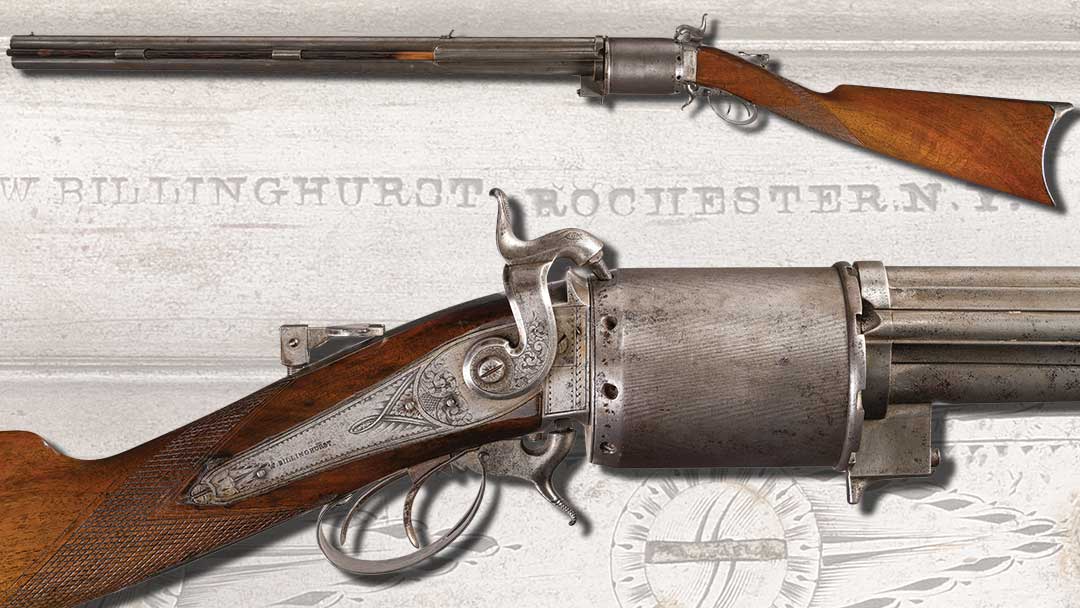
Of the 15 gun makers who produced Miller patent revolving rifles, William Billinghurst was by far the most prolific. Billinghurst, a former employee of James Miller, purchased the Miller patent in 1841. Billinghurst’s name has become synonymous with the Miller revolving rifle design and is marked on the octagon barrel of the example below.
This unique Billinghurst percussion revolving rifle was built in a similar style to a classic half-stock muzzleloading rifle. Available this August.
Surviving examples of revolving rifles and shotguns using the Miller patent were produced in numerous barrel lengths, barrel styles, capacities, and chamberings. Perhaps the most unique Miller patent configuration is the nine-shot William Billinghurst combination percussion revolving rifle and underhammer shotgun pictured below. The upper rifle barrel is chambered in .38 caliber and the lower barrel fires a .72 caliber smoothbore load of shot, approximately 12 gauge.
An NRA award-winning William Billinghurst combination percussion revolving rifle and underhammer shotgun. Available this August.
The Colt Paterson Revolving Rifle and Revolving Shotgun
Colt received his first American firearm patent on Feb. 25, 1836, for a revolver with a synchronized cocking and locking system. Colt’s earliest guns were produced at the Patent Arms Manufacturing Company based in Paterson, New Jersey, including 225 Colt Model 1839 revolving shotguns built between 1839 and 1841. The Colt Paterson Model 1839 revolving shotgun can be identified from the Model 1839 revolving rifle by the shotgun’s larger cylinder and round barrel.
An exceptionally rare Colt Paterson Model 1839 revolving shotgun. Available this August.
Reportedly only 950 Colt Model 1839 Paterson percussion carbines were manufactured, with the Republic of Texas and the U.S. Navy purchasing a substantial number of the carbines. The model saw service during the Mexican-American War, with author R.L. Wilson dubbing the carbine, “the most practical and popular of all Colt’s long arms from the Paterson period.”
(Top) A scarce Colt Paterson Model 1839 percussion revolving carbine. (Bottom) A cased Colt Paterson No. 2 Belt Model percussion revolver.
Though the Paterson revolving rifles and shotguns weren’t the success Colt had envisioned, the design still inspired numerous competitors, including Otis W. Whittier of Enfield, New Hampshire. Patented in May of 1837, only around 100 Whittier “Zig-Zag” percussion revolving rifles and revolving shotguns were produced. Whittier was a single gunsmith and his guns exhibit a handmade character, with a range of capacities and calibers found in the few surviving examples like the nine-shot Whittier revolving rifle pictured below.
An extremely desirable Whittier nine-shot revolving rifle featuring a “zig-zag” style cylinder and a rear trigger that cocks the action. Available this August.
The Turret Revolving Rifle
Some revolving rifle models were developed to circumvent Samuel Colt’s patent, including the Cochran and Porter designs. Unlike the Colt configuration, turret revolvers used chambers arranged around a horizontally rotating disk, like spokes on a wheel. August’s auction includes a Third Type of Cochran turret rifle manufactured by Cyrus B. Allen of Springfield, Massachusetts in the mid-to-late 1830s.
A C.B. Allen Cochran patent underhammer percussion turret rifle, one of only about 50 produced. Available this August.
Another fascinating example of the genre, the 12-shot turret revolving rifle pictured below has exposed cylinders that help illustrate this unique 19th century design. Dating to the 1830s or 1840s, this unmarked turret rifle is fired using a double action bar hammer style action that rotates the turret as the trigger is pulled allowing for rapid fire.
A seldom-seen 12-shot percussion horizontal turret revolving rifle. Available this August.
In 1851, Parry W. Porter patented his own turrent revolving rifle. Porter’s design employed vertically oriented turrets, a mule ear side hammer to keep the hammer out of the line of sight, and a lever that cocked the hammer and rotated the turret. The example below is a Second Type Porter revolving rifle manufactured by G.P. Foster of Taunton, Massachusetts, and is equipped with a unique automatic percussion primer built into the lock plate.
Only 550 Third Model Porter revolving rifles were manufactured. The Porter revolving shotgun/musket for sale in Rock Island Auction Company’s August 25-27 Premier Auction includes a larger caliber smoothbore barrel than its revolving rifle counterpart and is numbered “6” on the bottom of the barrel and “5” inside the lock and frame. This falls well outside the model’s typical 680 to 1225 serial numbering range and suggests that these larger caliber smoothbore Porter turret shotguns might have been assigned their own numerical identification range and were perhaps manufactured as prototypes or trials guns.
Revolving Rifles and Revolving Shotguns in the 1840s and 1850s
The 1840s and 1850s continued to see revolving rifle and shotgun innovation from aspiring Colt competitors. This James Warner design is one of only 50 to 100 manually rotated Warner revolving rifles manufactured in 1849. Production of the Warner patent design was limited thanks to Samuel Colt receiving an extension of his revolver patent in 1854.
A James Warner grooved cylinder open frame percussion revolving rifle. Available this August.
Another revolving rifle based on the Warner patent, fewer than 25 Springfield Armory percussion revolving rifles are estimated to have been produced. The example below, an automatically revolving version with a brass top strap and breech frame, is one of the finest known.
A Springfield Arms Co. open frame Warner percussion revolving rifle. Available this August.
The North & Skinner percussion revolving shotgun made up a small fraction of the only 600 North & Skinner revolving long arms manufactured between 1856 and 1859. The North & Skinner revolving shotgun is operated by a lever beneath the cylinder which rotates the cylinder and cocks the hammer. Few of these scarce firearms would have received fancy engraving like the example below exhibits.
‘Flayderman’s Guide to Antique American Firearms’ by Norm Flayderman estimates the total number of Massachusetts Arms Co. Wesson & Leavitt patent percussion revolving rifles to be “less than 50 and very probably less than 20.” Fewer still survive, with the high pedigree condition Massachusetts Arms revolving rifle below distinguishing itself as quite possibly the finest of its kind.
A Massachusetts Arms Co. Wesson & Leavitt Patent percussion revolving rifle. Available this August.
The quality continues with a unique and scarce British revolving carbine. Manufactured between 1855 and 1856, this Third Model William Harvey patent six-shot “hammerless” percussion sporting carbine incorporates two British revolving firearms patents.
A Third Model William Harvey patent six-shot percussion revolving sporting carbine. Available this August.
The Thomas W.G. Treeby Percussion Chain Rifle
The Thomas W.G. Treeby patent percussion chain rifle is one of the most unusual and impressive firearms ever created. Quite possibly the first belt-fed firearm design, the Treeby rifle utilizes a series of individual chambers linked together like a chain for a total of 14 shots. As few as four of these fascinating Thomas W.G. Treeby chain rifles may have been manufactured, with the Royal Armouries noting only three are thought to survive today.
August’s auction presents the rare chance to own the only known cased Thomas W.G. Treeby patent percussion chain rifle. Available this August.
The 15-Shot Hall Revolving Rifle
Alexander Hall manufactured revolving rifles in New York City in the mid-1850s. The Hall 15-shot revolving rifle example below is engraved with the script ‘Hall’s / Repeating Rifle / patented June 10 / 1856.’ Hall’s revolving rifle exhibits several unusual features, including a concealed hammer and a manually rotated cylinder positioned beneath most of the receiver. The brass frame rifle offered its user 15 rounds in .38 caliber, with a front trigger that cocked the striker, a rear trigger used to fire the rifle, and a lever in front of the trigger guard that released the rifle’s iron cylinder for manual rotation.
Originally designed as an enlarged version of the Colt Root revolver, the Colt Model 1855 revolving rifle was manufactured from 1856 through 1864. Samuel Colt produced the rifle for both the military and civilian markets, manufacturing the model in a variety of configurations that makes the platform a rich field for gun collectors today.
The Colt Model 1855 six-shot half-stock sporting rifle in .40 caliber featured below, serial number 34, was included in R.L. Wilson’s ‘The Book of Colt Firearms’ due to its high condition, scarce chambering, and its shipping case marked for Lieutenant Benjamin E. Newhall of the historic 8th Regiment Massachusetts Volunteer Militia during the Civil War.
One of an estimated 125 Colt Model 1855 half-stock sporting rifles in .40 caliber. Includes its original wooden shipping case. Available this August.
Colt’s revolving rifle was the first widely fielded American military-issued repeater, and the offering below is a representative example of a U.S. martially marked Colt Model 1855 revolving carbine produced before the Civil War. According to the production figures on page 183 of ‘The Book of Colt Firearms’ by Wilson, approximately 2,300 Colt Model 1855 revolving carbines were produced in .56 caliber with a 21 inch barrel, and ‘few only with saber bayonets,’ as seen on this exceptional piece.
This tremendous example of a rare Colt Model 1855 carbine with its saber bayonet would make a fine addition to any Colt firearms collection. Available this August.
The 10 gauge Colt Model 1855 revolving shotgun was produced using the largest frame size developed for the Model 1855 sidehammer revolving long arm series, with only 600 such examples manufactured. Due to their hard use during the Civil War and in the American West, surviving Model 1855 revolving shotguns are rare, especially specimens like this example that retain more than 85 percent of its original polish blue finish. By some estimates, only 50 to 100 large-frame Model 1855 revolving shotguns are known today, making them among the scarcest of all antique Colts.
A Colt Deluxe Model 1855 revolving shotgun in the large frame 10 gauge configuration. Available this August.
Revolving Rifles and Revolving Shotguns the Civil War
Gunmakers continued to innovate revolving rifle and revolving shotgun designs in the years following the Civil War. Developed using post-war surplus components from the Remington New Model Army Revolver along with an added rifle stock and longer barrel length, the E. Remington & Sons revolving rifle was initially offered in .36 and .44 caliber percussion variants. By March of 1872, Remington was advertising an “Improved” New Model cartridge conversion revolving rifle in .38 and .46 long rimfire.
An E. Remington & Sons “Improved” New Model cartridge conversion revolving rifle. Available this August.
In 1866, Sylvester Howard Roper briefly partnered with fellow gun inventorChristopher Spencer on a repeating shotgun concept in Amherst, New Hampshire. The Roper Sporting Arms Company was later moved to Hartford, where several revolving shotgun models were produced from 1869 to 1876. ‘Flayderman’s Guide to Antique American Firearms’ estimates that only 25 Roper four-shot “Cloverleaf” revolving shotguns were manufactured, with the example below remaining in impressive condition.
Roper Sporting Arms Company also produced rifles based on their shotgun design, though these firearms are even scarcer than their revolving shotgun counterparts. The example below is a .41 caliber rifle with a six-shot revolving carrier enclosed within the frame and is one of the most unique revolving rifles in an August auction filled with exceptional rarities.
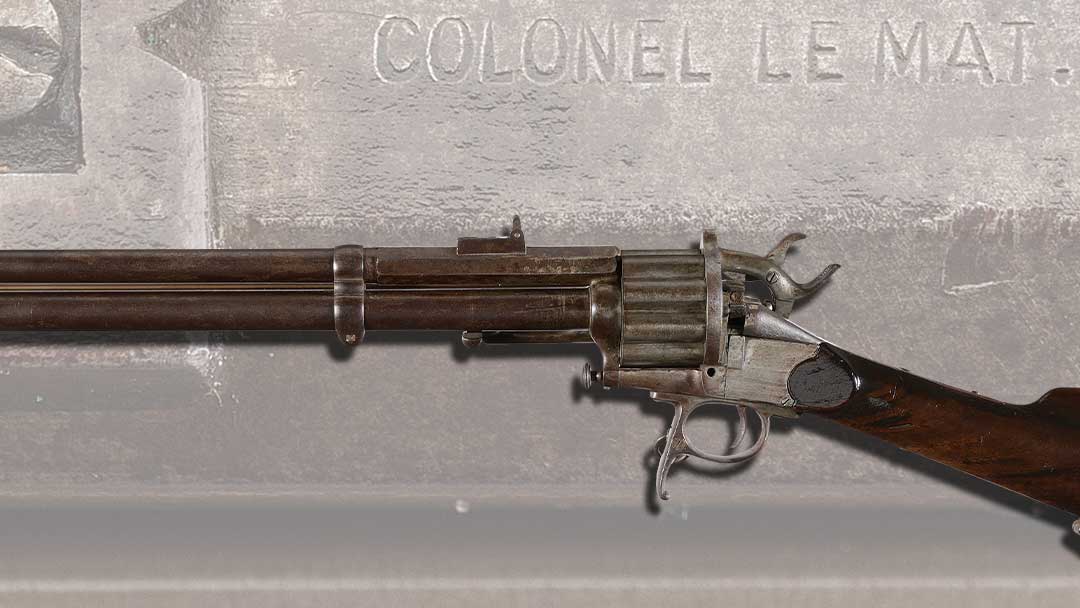
If unsure whether to add a revolving rifle or a revolving shotgun to your collection, the LeMat offers the best of both worlds. Invented by Dr. Alexandre LeMat of New Orleans, the LeMat revolver earned fame as a Confederate cavalry weapon. After the war, Dr. LeMat received patents for a centerfire version of his two-barrel grapeshot revolver design. Centerfire LeMat variants included a “Baby LeMat” revolver, a holster pistol-sized model, and the LeMat revolving carbine variant.
Revolving rifles, carbines, and shotguns offered some of the first affordable repeating long arms. This changed with the invention of metallic cartridges and the lever action repeater. Higher capacity options like the Henry rifle and its Winchester successors provided equivalent firing rates without the negatives inherent to most revolving rifle designs.
A gold factory panel scene engraved Deluxe Winchester Model 1866. Available this August.
Revolving rifles and revolving shotguns tended to be uncomfortable to operate. When a revolving rifle is fired, hot gases, unburnt powder, and lead shavings are blown back into the underside of the shooter’s wrist and forearm.
Models like the previously mentioned LeMat carbine added a spur in front of its trigger guard as a way for a user to hold and aim the weapon without the need to place their non-dominant hand in front of the cylinder. This solution only traded one problem for another and required the user to learn a less intuitive and arguably less effective firing position. By contrast, lever action rifles like the Spencer and Winchester Model 1866 could be fired naturally from the shoulder like any other long arm.
An exceptional example of a special order Deluxe Winchester Model 1873 rifle. Available this August.
In the following decade, Winchester centerfire lever action rifles like the Model 1873 and Model 1876 would further improve the design and go on to dominate the repeating long arms market, with Marlin Firearms offering a lever gun option for big bore cartridges in 1881. The revolving rifle was unable to compete with these reliable lever actions, with models like the well-made Smith & Wesson Model 320 revolving rifle failing to turn the tide of public perception.
An exhibition quality, factory engraved Spencer slide action shotgun. Available this August.
As the lever action rifle rode a wave of success, repeating shotguns also experienced a renaissance in innovation. The Spencer Repeating Shotgun was patented by Christopher Spencer in 1882 and became America’s first successful pump shotgun. Five years later John Browning’sWinchester Model 1887 lever action shotgun hit the market, offering five rounds in the magazine and one in the chamber. Like its revolving rifle sibling, the revolving shotgun had finally met its match.
Revolving Rifles and Revolving Shotguns for Sale
The revolving rifles and revolving shotguns featured here represent some of the rarest antique production guns available and would make fantastic additions to any antique arms collection. Any of these scarce examples of the genre would be an auction highlight on their own, but to find an exquisite assemblage offered from a single arms collection speaks to an eye for quality, authenticity, and a commitment to preserving the history of these forgotten firearms.
Anyone who enjoys art, engineering, craftsmanship, history, and the evolution of technology through the centuries will find something to enjoy in this exceptional assortment of revolving rifles and shotguns for sale in Rock Island Auction Company’s August 25-27 Premier Auction. Preview Days at Rock Island Auction are often advertised as a museum you can touch, and nowhere is that more evident than in the profound variety of styles, mechanisms, eras, and innovations covered in this elite firearms grouping.
A collection of revolving rifles and revolving shotguns for the ages this August at Rock Island Auction Company.
The Biden administration’s latest move is more than just an attack on our Second Amendment rights; it’s an attack on our way of life, heritage, and culture. For years the anti-gun crowd has told us, “You don’t need an AR-15 to hunt”, all while proclaiming their support for hunters saying they would never try to ban hunting or hunting firearms.
They have now decided to go after hunting and are starting with the youth of America.
The Biden administration has decided to withhold vital federal funding from schools that offer hunting and archery programs. This decision falls under the guidelines set by the Elementary and Secondary Education Act (ESEA) of 1965 and the Bipartisan Safer Communities Act (BSCA) passed in the previous year. The Department of Education’s interpretation of these laws means that school hunting and archery classes are now ineligible to receive federal support, potentially affecting millions of American children participating in these activities.
It’s a punch in the gut to millions of American children and their families – a calculated attack on our rights, traditions, and future.
Tommy Floyd, the president of the National Archery in the Schools Program, told Fox News Digital, “It’s a negative for children.” … “In many communities, it’s a shooting sport, and the skills from shooting sports, that help young people grow to be responsible adults. They also benefit from relationships with role models.” And he’s absolutely right. These are programs that help young people grow into responsible adults. They benefit from relationships with role models and learn skills that many communities cherish.
“You’ve got every fish and wildlife agency out there working so hard to utilize every scrap of funding, not only for the safety and hunter education, but for the general understanding of why stewardship is so important when it comes to natural resources,” Floyd continued. “Any guidance where it’s even considered a ‘maybe’ or a prohibition for shooting sports is a huge negative.” “It is ironic that the U.S. Department of Education is actively denying young Americans the chance to educate themselves on basic firearm and hunting safety so that they can go afield knowing how to keep themselves, their friends, and family safe,” Ben Cassidy, executive vice president for international government and public affairs at Safari Club International (SCI), told Fox News Digital.
In addition, the National Shooting Sports Foundation blasted the Education Department’s interpretation of the BSCA, saying it was part of the administration’s attacks on the Second Amendment.
In an article on the NSSF blog, Larry Keane wrote, “When repeatedly attacking the Second Amendment, gun owners and the firearm industry, the president constantly tries to assuage those skeptical of claims – “this isn’t about hunting,” “you don’t need that to hunt deer,” “I own shotguns.” The Second Amendment isn’t about hunting at all, but the president’s recent decision reveals his contempt for lawful and safe gun ownership. It’s an attack on hunting and a calculated backdoor attack on gun rights and ownership.”
The Biden administration’s justification for withholding the funds, claiming it’s based on a straightforward interpretation of the BSCA, has been met with disapproval and rejection from Congressional lawmakers across both political parties.
“We were alarmed to learn recently that the Department of Education has misinterpreted the BCSA to require the defending of certain longstanding educational and enrichment programs — specifically, archery and hunter education classes — for thousands of children…,” U.S. Sens. John Cornyn (R-Texas) and Thom Tillis (R-N.C.) wrote in a letter to Secretary Cardona. “The Department mistakenly believes that the BSCA precludes funding these enrichment programs. Such an interpretation contradicts congressional intent and the text of the BSCA.”
Sens. Cornyn and Tillis wrote that the Bipartisan Safer Communities Act provides $1 billion for such activities under Section 4108 of the Elementary and Secondary Education Act of 1965 – or “activities to support safe and healthy students.” They added, “Critical educational programs like archery and hunter education fall well within this scope to promote student safety and health.” Mental health experts are already warning that blocking the funds and eliminating these programs will contribute to mental health problems for young participants.
According to a shocking survey, the typical American household spent $709 more in July than they did just two years ago to buy the same goods and services. This figure, coming from Moody’s Analytics, is a painful reminder of the financial struggle that families are enduring across our country. But it’s not about mere numbers; it’s about shattered dreams, broken budgets, and the grim reality that the cost of living is spiraling out of control under the current administration. The inflationary nightmare we’re witnessing is a manufactured disaster severely affecting millions of Americans’ survival and everyday life.
The catastrophic reality playing out across the American economy is not an accident. It’s a direct result of the COVID-era nightmare and reckless decision-making of the Biden administration. Couple with that with the latest push to use climate change as the next excuse for lockdowns and economic killing policies, and you have a disaster that is only getting started.
“High inflation of the past 2+ years has done lots of economic damage,” Mark Zandi, chief economist at Moody’s Analytics, wrote in a post on X. Most of that increase in spending is driven by housing costs, which have surged, Zandi told CNN in an email on Friday.
Mark Zandi’s warning about the “economic damage” inflicted by rampant inflation over the past two years isn’t just another “expert opinion.” It’s the sad reality that is being ignored by those in power. The economy is worse off than it was five years ago. In fact, according to a brand new Reuters/Ipsos survey that was just released, 73 percent of all Americans believe that the economy is in worse condition than it was five years ago.
Homelessness has been a persistent problem in the U.S. for decades, but it has reached a new level since the end of the COVID lockdowns as our country plunges forward into the economic abyss.
But the media says Bidennomics is working!
Well let’s talk about the deceitful inflation numbers. A 3.2 percent annual rate? Who are they trying to fool? We know, and they know, that the real numbers would show inflation well into the double digits if calculated the way it was in 1980.
The American people are suffering. Forty-six percent of our population couldn’t even cover an unexpected $400 bill. Credit card debt has hit the $1 trillion mark. People are draining their retirement accounts to make ends meet. This is not just a troubled economy; it’s an economy in collapse.
The U.S. Government Right Now by the Numbers:
Borrowing Spree Unleashed: $5.2 billion borrowed every single DAY for the next 10 years!
Interest Payments Skyrocketing: On track to pay an eye-watering $1 trillion in just one year!
Tax Revenue Tumbles: A worrying drop of roughly 8% over the last 12 alarming months.
Debt Balance Explodes: A staggering addition of $8 trillion in just 3 short years.
Debt Ceiling “Crisis” Fallout: $1.5 trillion added to the debt balance since the crisis, and it’s not slowing down.
Spending Out of Control: 40% more expenditure in 2023 compared to 2019, and where’s the accountability?
Default Danger Averted, for Now: Nearly defaulted before finally uncapping the debt limit until 2025 – but at what cost?
Future Debt Catastrophe Looms: Debt-to-GDP ratio expected to rise to an unthinkable 225% by 2050 – a time bomb in the making!
The current economic meltdown is more than a warning sign. It’s an alarm bell ringing loudly, and it’s time to wake up and act. The Biden administration’s inaction and the do-nothing Republican morons who enable him seem hellbent on allowing our economy to crash into the ground.
Are you Prepared for an Economic Collapse?
In many ways it is already here. For many families they are already living the nightmare. This economic crisis is not to be taken lightly, it is one of the biggest threats we face. Don’t wait for the mainstream media to tell you how bad it is, take action now to protect yourself and your loved ones. It’s time to prepare for the worst and hope for the best.
We advise reading our article on Preparing for an Economic Collapse. We talk about the history of economic collapses, list the steps you need to take, and talk about what will most likely happen when the banking system goes down. You can read the article here.
Be Prepared to Feed Yourself when the Collapse Hits!
Is this really where we’re headed? A national emergency for climate change? It’s become abundantly clear that the Biden administration is now considering COVID-style lockdowns with the idea of exploiting weather conditions as a pretext for exerting more control over the American people.
White House Considering Declaring National Emergency over “Climate Change”
During a recent CNN interview, John Kirby suggested President Biden treats the supposed climate crisis with “all the due gravity and seriousness.” What does that even mean? Is it another clever way to prepare the masses for yet another assault on our freedoms, this time under the guise of “climate emergencies”?
On Thursday’s broadcast of “CNN This Morning,” White House National Security Council Coordinator for Strategic Communications John Kirby stated that President Joe Biden hasn’t decided whether he’ll declare a national emergency on climate and that “all the severe storms” that “we continue to see are definitely caused as a result of what’s going on in the rising temperature across the globe.”
Kirby said, “The President hasn’t decided yet on declaring a national emergency on climate, Poppy. But he’s treating this with all the due gravity and the seriousness that the climate crisis deserves. It’s been a focus for him since day one.”
He added, “I don’t want to get ahead of the President or his decision-making here. All I can tell you is that, as an administration, we’re going to stay focused on the climate crisis. It is front and center. It is right in front of us. And these wildfires and all the severe storms that we’re — that we continue to see are definitely caused as a result of what’s going on in the rising temperature across the globe. And so, we’ve got to treat this seriously.”
As we reported earlier in the year, The White House was already hard at work trying to figure out how they could use the climate as the next tool of fear to enact control. In fact, back in January The U.S. Consumer Product Safety Commission kicked off the strategy with an attempt to ban gas stoves, claiming they were damaging the climate.
This is beyond insane, but frankly not shocking, to see the White House laying down the groundwork to declare that ALL severe storms are a result from global warming. This statement blatantly disregards the fact that extreme weather conditions have been part of Earth’s natural history. By attributing every severe storm to human activity, the Biden administration is setting up a story that will now be used to enact further control over the people.
In fact, we’ve seen these tactics before, and it’s looking a whole lot like what they pulled in the leadup to the COVID shutdowns and lockdowns.
The blaming of human activity for every single disaster, natural or otherwise, allows politicians to draft “emergency” policies, enforce ridiculous business killing regulations, and push a political agenda that suits them, regardless of scientific validity or common sense. And what about those who disagree with the latest scam? They are labeled “climate deniers,” which dismisses any attempt at a balanced and reasoned debate. Dissenters are sidelined and ridiculed for daring to question the religion of the climate change movement.
Consider what a a national emergency on climate would look like.
It would yet again empower the government to take sweeping actions similar to what we witnessed during the “COVID emergencies”, killing individual liberties, severely damaging businesses, and exerting even more control over the everyday lives of Americans. Kirby’s suggestion that the White House might declare a national emergency on climate should raise red flags for every freedom-loving American.
The climate has always been changing, and it always will. That’s not a crisis; it’s a reality. What’s truly alarming is the deliberate manipulation of science and the outright attack on our freedoms in the name of a political agenda.
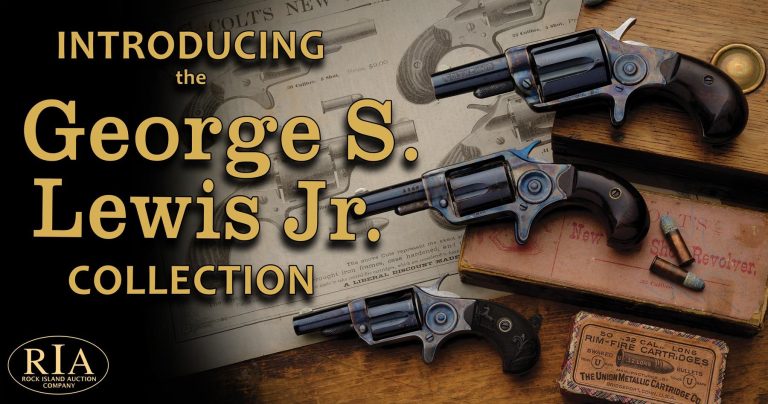
George Lewis amassed a collection coined by one fellow collector as, “…one of the classic Colt collections of all time,” but in the face of such lofty praise Mr. Lewis started out like most of us – he had no idea what he wanted to collect and essentially bought what he could afford.
George Lewis Collection Begins
The late Mr. Lewis cites the beginning of his journey slightly before 1960, when he would’ve been approximately 25 years old. Also like most nascent collectors he didn’t have a particular genre in mind when began truly collecting in earnest. He once wrote,
“As time went on, I found that I was drawn to the little Colt derringer, not because it had an interesting history or because it was beautiful or because there are many variations and models to obtain, but mainly because my pocketbook could afford the derringer, and I could compete with the best of collectors.”
In a twist that Mr. Lewis no doubt appreciated during his lifetime, his collection now proudly showcases all the attributes he couldn’t consider earlier in life: interesting histories, beauty, and numerous variations. From his first collecting days until his passing in 2020, Mr. Lewis took an area of collecting considered ordinary in previous decades, and showed it to be extraordinary.
Despite Mr. Lewis’ extremely relatable circumstances as he began collecting, he was able to take advantage of a rather fortunate situation. At that time, Colt derringers and most pocket pistols were largely unnoticed by gun collectors as a whole. Again, in Mr. Lewis’ words,
“The Colt derringer in those years was greatly overlooked by advanced collectors. Most collections included only a sample of a 1st, 2nd, and 3rd model colt derringer, not going after any special type or variation. Though not plentiful, there were some mint derringers and a very few of the rare types to be found.”
Not only was Lewis collecting Colts long before it became popular to do so, he was doing it in a genre that very few others were pursuing. Add to that the fact that most advanced collectors of the day focused on acquiring rare variations over high-condition examples, but Mr. Lewis sought out examples that exemplified both. Expanding on that value, he also saw the importance of period-correct accessories, cases, even scooping up correct cartridge boxes and “skin packets.”
For 65 years, much of it without the advantages of electronic communication, George Lewis collected. He attended most major gun shows, scoured the auctions, advertised in major periodicals such as Gun Report and Shotgun News, traveled the country, and like many collectors of the day, built a trusted network of friends and connections with their ear to the ground.
Highlights of the George Lewis Collection
Throughout his collecting career, Mr. Lewis naturally branched out into other areas of collecting, specifically pre-war Colts, but never strayed far from his love for the little Colt pocket gun.
There are nearly 50 items in the initial offering of the George Lewis Collection available in the August Premier Firearms Auction, most of which are true to his original interest in small handguns primarily used for self-defense, be it in the suit pocket of a 19th century urbanite or concealed beneath a frontier town faro table.
Several of his most high-value firearms have already been showcased in a related video, but this article will highlight other items for the sake of variety. Collectors rightly interested in Mr. Lewis’ guns are strongly encouraged to look at both.
Case Hardened Colt New Lines
As the majority of Mr. Lewis’ offerings in this auction consist of Colt New Line revolvers, it only seems right to begin with them here. Also, while starting with three examples in a single “highlight” might seem like cheating, it saves the author from featuring all three examples separately and thus exposing his own bias toward the combination of deep Colt bluing and vibrant case hardening.
A fantastic line-up of Colt New Line revolvers.
Top to bottom, they are lots 244, 245, and 243 in the auction, and even for their similar condition and appearance, they still embody the variety of the genre as well as Mr. Lewis’ collection.
Beginning at the top with the largest of the trio is the Colt New Line chambered for .38 centerfire. Made for the English market in 1879, it bears British proofs and its oak presentation case shows a “Colt London Agency” label inside its lid. The case, lined in navy-toned velvet, houses 10 unfired cartridges, a cleaning rod, and the attractive revolver.
A 90% gun, it is winsome with its smooth rosewood grips, vibrant case colors on the frame, bright nitre blue small parts, and the distinctly etched “COLT NEW 38” on the left side of the barrel. Its pre-auction estimate of $4,500 – $6,500 seems a bargain for any collector interested in the red-hot field of high-condition, 19th century Colt revolvers.
A excellent condition, early production (SN 1109), Colt New Line in .32 cal with factory box.
In the middle, and also with a 2 ¼-inch barrel, is the Colt New Line chambered in .32 rimfire. It bears the early serial number 1109 in the unusual location on the barrel’s left, with the Colt two-line address on the barrel’s top, a rarely seen placement of those markings. With matching numbers, rosewood grips, and a rare correct factory box plus cleaning rod, this high condition Colt checks several interesting boxes for collectors. A remarkable beauty for its pre-auction estimate of $3,000 – $4,500.
For the smallest of the trio, there’s a LOT to appreciate on this little Colt.
Lastly, we come to serial number 2227 located at the bottom of the photograph. The smallest chambering of the grouping, .30 rimfire, also bears the smallest barrel, measuring just 1 ¾-inches. The checkered hard rubber grips feature a unique floral scroll at the bottom which is seldom seen, as is the short barrel length. The crisp barrel etching appears to be the best of the trio. Acid etched markings are a fragile feature on any firearm. To see them survive at all, let alone in this outstanding level of condition is the type of thing that collectors quickly notice. Hence its presence in the famed William Locke Collection as well as Mr. Lewis’. Its estimate of $4,000 – $6,000 seems a small price to pay relative to other, similarly conditioned Colts.
Colt Open Top Pocket
The Colt Open Top Pocket is one of Colt’s first two cartridge revolvers, both of which began production in 1871. It isn’t hard to see its influence on the eventual New Line which would begin production just two years later. Chambered in .22 short and .22 long, the Open Top Pocket initially sold for $8, substantially more than similar .22 caliber revolvers of the period. The example offered this August (shown top in the following photo) from the Lewis Collection was manufactured in the first year of production, and even after over 150 years, this little pistol is a LOOKER.
High condition Colts sometimes come in small packages.
Rich Colt bluing, a silver finished frame, a nitre blue that wouldn’t look out of place in a Caribbean seascape, and all ending in a pair of smooth, biscuit-toned antique ivory grips, it’s the stuff Colt dreams are made of. The added bonus is the rare factory box with its bright red lettering advertising the small revolver as “Colt’s Seven Shot Pistol” – a surprising reminder of its capacity despite its diminutive size. Finding this level of condition with a $6,000 – $8,000 estimate seems unfathomable.
Remington Over/Under Derringer
For all the previous talk of Mr. Lewis’ love of Colt derringers, this is the first derringer on the list, though it isn’t a Colt. This is one of Remington’s classics, this one known as the “Double Derringer” or the “Model 95.” These small O/U Remington derringers are one of the Old West’s most recognizable, especially after being drawn from garter belts or dealers’ vests on countless TV shows and movies.
Lot 1997: Attractive Factory Engraved Early Production E. Remington & Sons Over/Under Derringer with Desirable Blue Finish
This little beauty not only bears the desirable blue finish, but also factory engraving. Add to that some rosewood grips, glowing nitre blue parts, and the relatively beefy .41 RF chambering and you’ve a good looking derringer that’s ready for the poker tables. It’s also ready for its next world class collection. Much like the Parsons’ Armies, this little Remington can also boast the illustrious pedigree of being housed in both the collections of Mr. Greg Lampe AND George Lewis.
Honorable mention goes to the factory engraved, nickel plated Remington O/U in lot 201 for being clean as a whistle, factory engraved, pearl gripped, and with an inscription on its backstrap that seriously bumps its cool factor.
Wexell & DeGress Grips
It’s another Colt Open Top Pocket, and it’s exceptional. The elephant in the room is the ornate and highly desirable Wexell & Degress grips which adds a wonderful bit of contrasting texture to the otherwise mirror-smooth original nickel finish.
Lot 254: Exceptional Factory Engraved Colt Open Top Pocket Spur Trigger Revolver with Highly Desirable Wexell & DeGress Grips and Factory Box
The grips are finished in silver, featuring a lion motif on the right side and flowers on the opposite. It’s a factory engraved gun, and it too comes in a well-preserved box with labels that read “NICKEL PLATED” and “FULL ENGRAVED.” That original nickel is gorgeous, the nitre blue hammer stands out a mile away, and the grips add the right amount of flash for this very stylish Colt.
Colt 1877 DA revolvers
So many decisions for what to feature last. Ultimately, the Model 1877 revolvers were chosen, not only because of their sheer condition, but to show that the Lewis Collection did venture beyond the pocket Colts. Also, Colt Lightning revolvers have brought significant sums in our last two Premier Auctions ($176,250 and $323,125), so the two shown below present excellent opportunities to obtain a popular model that is climbing in value, each of which has been housed in an elite Colt collection.
This superb Colt Thunderer is sure to create some rumbles at auction.
The first is a near-pristine Thunderer manufactured in 1907. It’s a 97% gun with a dark, warm color palette that wouldn’t be out of place during a summer rain shower at daylight’s waning golden hours. Black, hard rubber grips with crisp checkering, sepia-toned case hardening, dark nitre blues, and a barrel absolutely bathed in inky blue finish. Even though the back of the hammers is well-known to have bright nitre blue on the Colt 1877 models, in a unique twist it is the bright mirror-polished sides of the hammer that provide the eye-catching accent on this Thunderer. It was shipped to San Francisco in its year of manufacture and comes with a 1970 Colt factory letter addressed to Mr. Lewis – he had been in possession of this Colt for at least half a century! This is a fine opportunity to obtain a fine Colt that’s fresh to market. As per Mr. Lewis’ penchant for fine arm accessories, it is accompanied with a correctly labeled factory box. Such an attractive Colt comes with an equally attractive estimate of $7,000 – $11,000.
It’s not difficult to imagine what this Colt 1877 Lightning looked like when it left the factory in 1877.
However, the second 1877 ups the ante even higher. It’s like reading a list of everything Colt collectors seek. It’s a first year production model, it’s an ejectorless Sheriff’s Model, the 3 ½-inch barrel is a sought after length, the one-piece checkered hard rubber grips are extremely scarce, the barrel has acid etched markings which remain ridiculously crisp, there are matching serial numbers, it letters, it has a correct factory box, and on top of all that the condition is through the roof. The nickel finish from its muzzle to its bird’s head grip is superb, and if there’s one value quality in collecting above all others, it’s this: condition, condition, condition. This is an absolute stunner and could reach well above its $8,500 – $12,000 pre-auction estimate.
Mr. George Lewis is what the collecting fraternity calls a “lifer.” For over 65 years he build his impressive collection. He focused on pre-war Colts, but never turned a blind eye to those pieces that both grabbed his interest and met his lofty standards. On the forefront of Colt collecting, he also was a founding member of the Colt Collectors Association, a 50-year member of the Texas Gun Collectors Association, as well as a member and contributor to the prestigious American Society of Arms Collectors.
His is a collection that all fellow collectors can aspire to, and the best way to start is by putting an item from Mr. Lewis’ esteemed collection, into your own.
Click the image to see all items in the George S. Lewis Jr. Collection as appearing in the August Premier Auction.