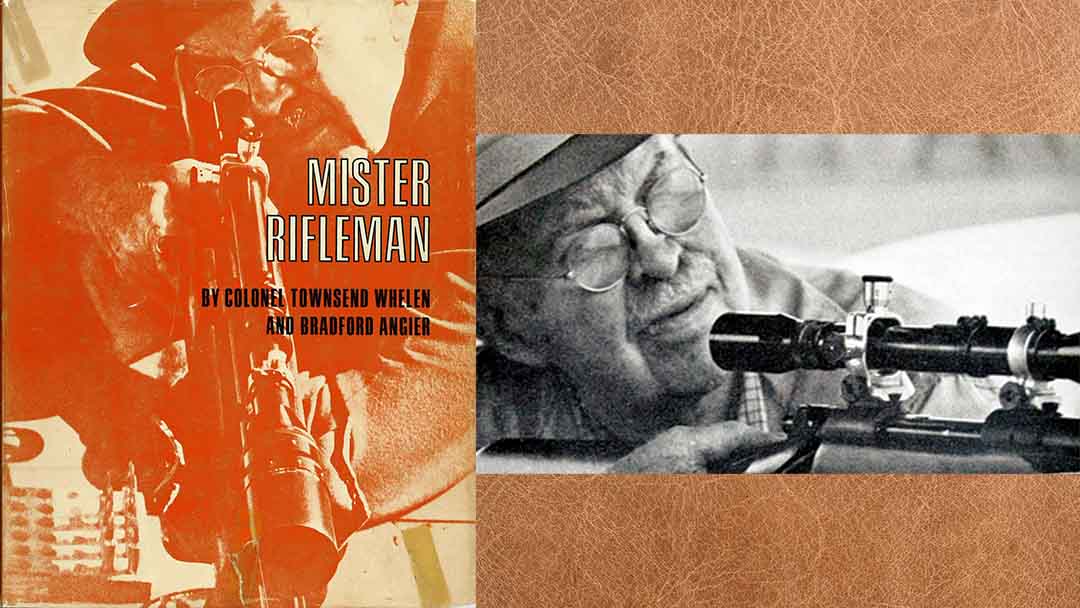
“I have sometimes been called a “big-game hunter,” but I dislike the term. I have been rather a wanderer in and worshiper of beautiful and unspoiled country, what some overcivilized and atrophied individuals call `The Waste-lands,’” outdoors writer and gun expert Townsend Whelen wrote in his book “On Your Own in the Wilderness.”
Whelen penned thousands of articles and countless words about the outdoors, guns, and ammunition for publications like “American Rifleman,” “Guns & Ammo,” “Field and Stream,” and others. He wasn’t a hunter who went out for the day, bagged game, then headed home. He believed in the whole experience of being outdoors away from civilization.
“To me hunting has always been a very different affair. I have always saved up my holidays until I could have a real long hunt in the unspoiled country I love so much, and I never returned to “brick and mortar” until I had to, and always with regret,” he wrote in his book “Mister Rifleman.”
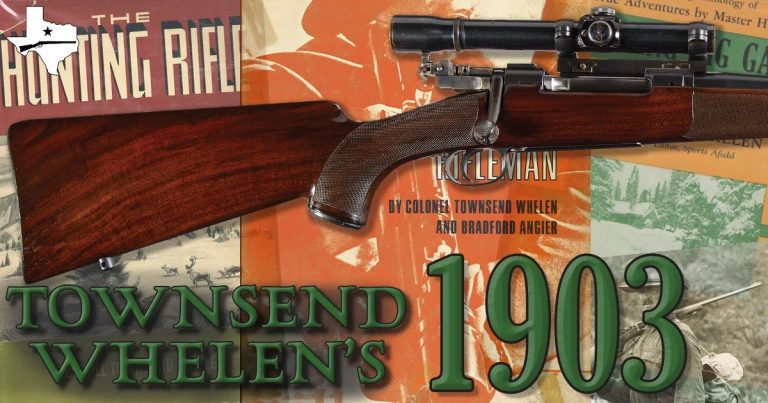
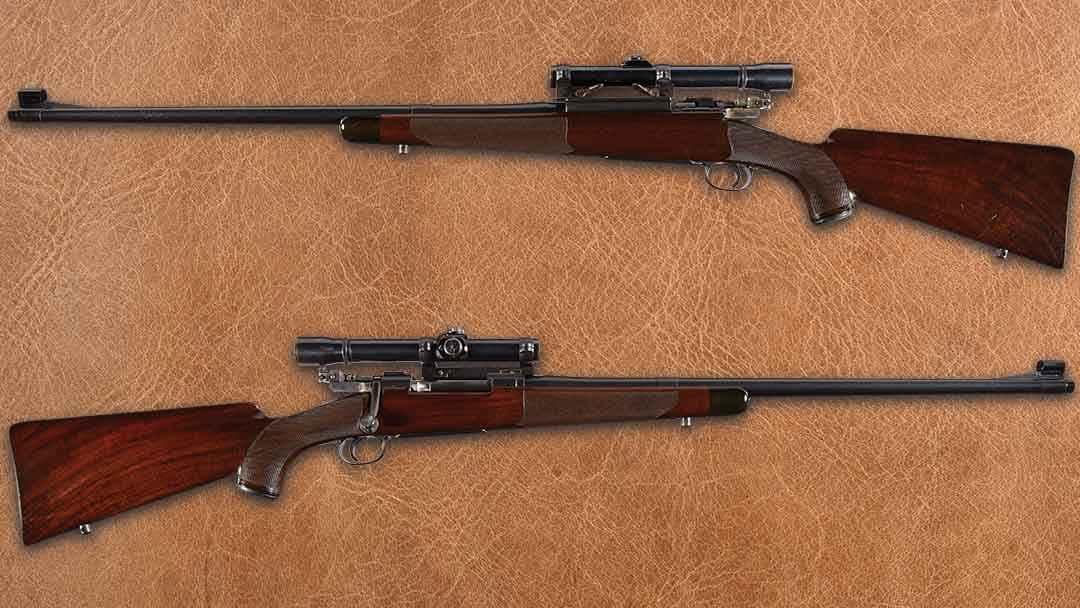
A Griffin & Howe Springfield Armory Model 1903 rifle, customized to Whelen’s very particular specifications and carried by him, will be on offer in the inaugural Premier Auction in Rock Island Auction Company’s Bedford, Texas location, Dec. 8-10.
This Griffin & Howe Springfield Armory Model 1903 was customized to legendary outdoors writer Townsend Whelen’s particular specifications when he was the superintendent of Springfield Armory. A barrel was set aside as well as the piece of walnut that would be used for the stock.
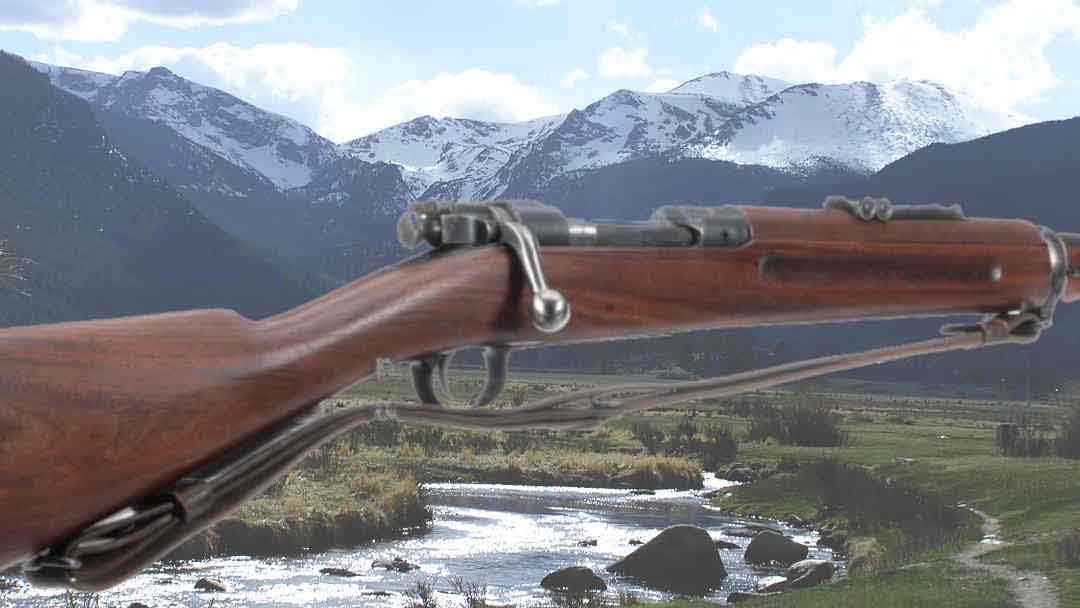
The Springfield Model 1903
Bolt action rifles took the world by storm at the turn of the 20th century. Designs such as the Springfield Model 1903 can handle higher-powered cartridges than their lever action counterparts thanks to their locking lugs. They also have a simpler action, are more reliable, and bring with them a reputation for accuracy. The Model 1903 was replaced by the semi-automatic M1 Garand in 1936, but the 1903 still served as the standard issue rifle during World War 2.
During manufacture, the Springfield Model 1903’s receiver started as a 5 lbs. piece of steel that was machined down to about 1 lbs. through nearly 100 machining operations. The gun enjoyed an excellent reputation, but was more from the .30-06 cartridge and workmanship than the gun itself, author Stuart Otteson wrote.
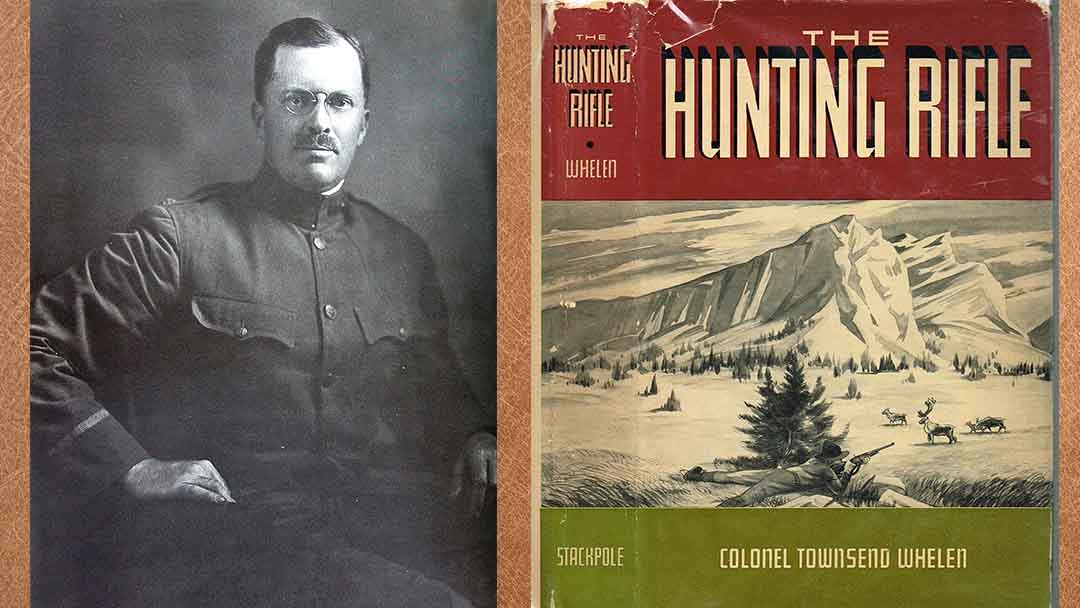
Townsend Whelen wrote numerous articles for several publications during his career and wrote books about hand-loading, rifle shooting and wilderness living. He died in 1961 at the age of 84.
Townsend Whelen Rifle
A career Army officer, Townsend Whelen was assigned to Springfield Armory in 1929 when he decided he would create “the finest” hunting rifle from the Springfield Model 1903, a bolt action gun he wrote about in “Mr. Rifleman,” starting with the barrel:
“… I determined that I would have made up the finest possible .30-06 Springfield hunting rifle that it was possible to construct. Accordingly I asked the foreman of the barrel shop to keep me in mind when his shop was making sporting type barrels, and when they turned out one that they deemed was perfect, to set it aside for me. To hold it six months, and then if they did not find a superior one, to let me have that one.”
In 1930 the armory found a barrel “not chambered, which star-gauging showed grooved .3080 inch, and bore .3000 inch for every inch of the bore, 24 inches long and that had been bored straight,” he wrote in “Mister Rifleman.” Star-gauging was the most accurate way of measuring the consistency of the lands and grooves of the bore diameter along the barrel length.
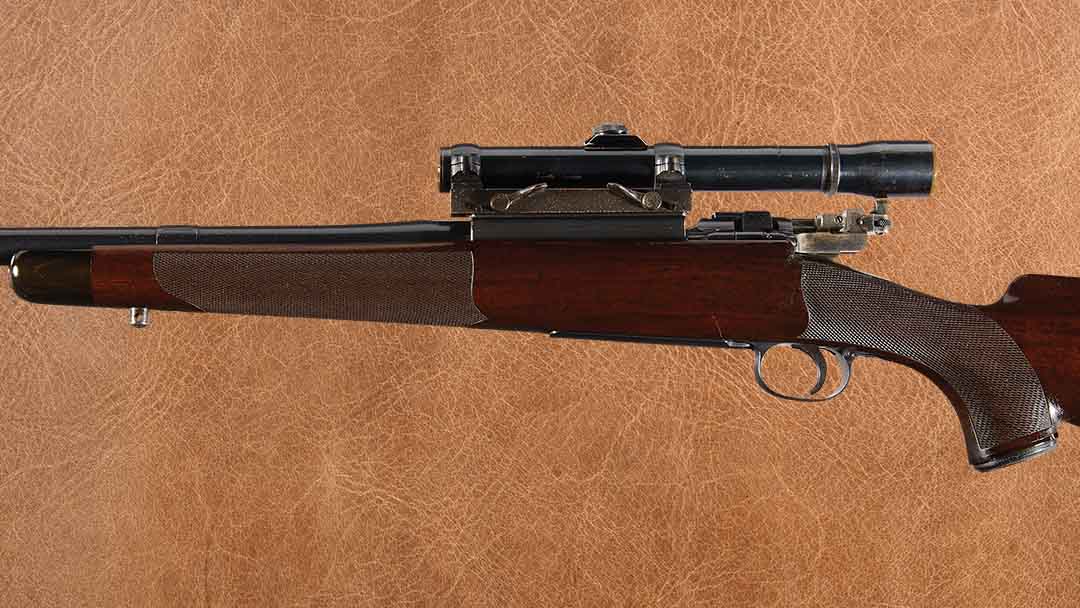
This Springfield Model 1903 received special attention from legendary outdoors writer Townsend Whelen, with a custom buttplate and a 2-1/4 Zeiss scope mounted on it. He grew tired of the scope and later changed it to a Weaver K 2.5 scope.
Next was to get an action with a nickel steel receiver and bolt that wasn’t heat treated and to send it off to Griffin & Howe where they matted the top of the receiver ring, turned down the bolt handle to accommodate a scope, and installed sights and a trigger guard safety.
The Model 1903 was returned to Springfield where it was heat treated, the barrel assembled, chambered, and blued. He sent the gun parts to have a very dark American walnut checkered stock attached along with a custom buttplate. Under his specifications, Whelen also had a 2-1/4 Zeiss scope mounted. He later became disenchanted with the scope and had it replaced with a 4x Lyman Challenger. The gun currently has a Weaver K 2.5 scope.
He wrote that he did accuracy test on the Model 1903 several times from 1932 until 1940 and always returned good groupings. “It averaged about two-inch groups of 10 shots at 200 yards.” He would give the gun away toward the end of his life.
Townsend Whelen: The Early years
Whelen was born to a family of Philadelphia blue bloods in 1877 and early in life was gawky and unassuming. He didn’t seem like the rugged outdoorsmen he was to become. His father gave him a .22 rifle when he was 13 and by 15 he was winning shooting matches against older competition.
At 18, he discovered weight training and a fitness routine and gained 30 lbs. of muscle. Whelen joined the Pennsylvania National Guard and was called up for the Spanish-American War three years later. Though he didn’t get deployed to the Caribbean, he saw a life in the military. He resigned from his National Guard unit to apply for a commission as a civilian but learned he would have to wait a year to be considered. At the age of 23, he decided to go west.
Townsend Whelen received his first gun at 13 and was winning shooting matches over older competition by the time he was 15. After serving in the Pennsylvania National Guard he decided he wanted to serve in the U.S. Army and sought a commission.
Townsend Whelen in British Columbia
Whelen packed up a .30-30 Winchester Model 1894, a .40-72 Winchester-chambered rifle, ammunition, a tarp, Army blankets, a poncho, and cooking set, and boarded a train for British Columbia. Arriving in Canada, he bought a saddle horse, two pack horses, a saddle, packs, and “grub.” All for $110 and set out for the wilderness.
He befriended a prospector who taught him about living off the land, setting up camp, and cooking on a campfire. In his book, “On Your Own in the Wilderness,” written years later, he wrote of the tranquility he found in the wild:
“We eat our moosemeat and bannock, sip our tea, and gaze into the living warmth of the embers. Presently like a cool sough of air across a glacier, there breathes a sound: softly, hesitantly, sadly at first, soaring and falling and lifting again – a wolf singing of love, of the beauty of the silent places, and of freedom. Over and over again Mahheekun howls, so tenderly, sweetly, yearningly. Then we are alone with the stillness.”
Whelen roughed it for nine months before packing up and returning to Philadelphia. He later wrote of the trip:
“I’d had a wonderful time, learned the ways of the West and how to rustle for myself from a past master of the art, and I had obtained first rate trophies of all the game of the country except grizzly.”
Townsend Whelen resigned from the Pennsylvania National Guard to seek a commission in the regular U.S. Army. He had to wait a year but went to British Columbia to hunt for nine months, taking a number of game animals.
Townsend Whelen in the Army
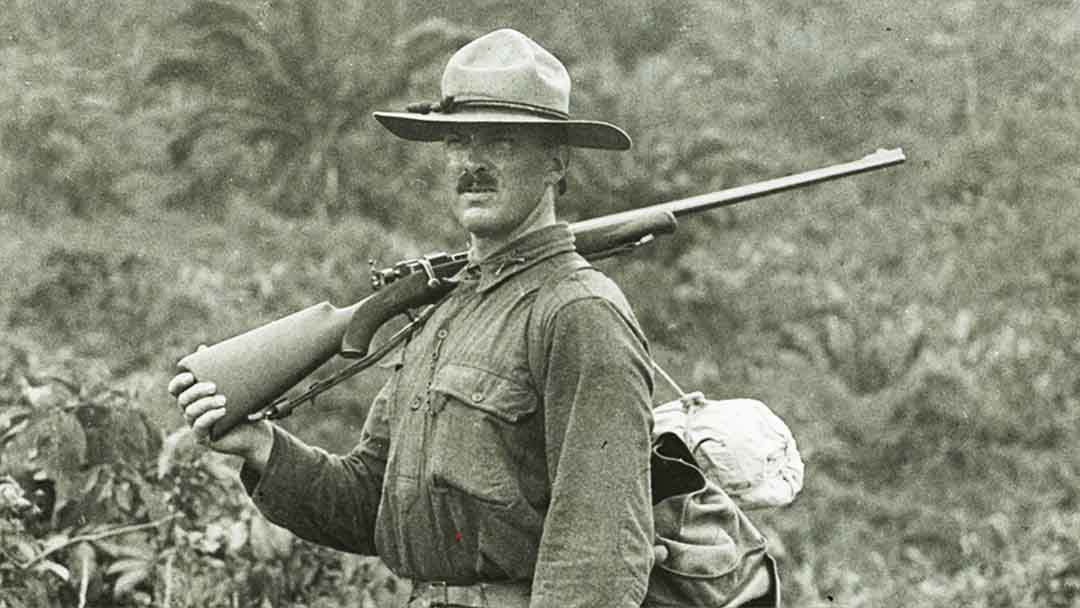
Whelen served in the infantry early in his U.S. Army career and part of that was at the garrison in Panama defending against threats to the construction of the Panama Canal. It also meant treks into the jungle to map out a largely unmapped landscape. He and his men camped in the rainforest, hiked over mountains, and recorded the land Whelen once described as “terra incognito.” It was on this assignment that 40-lbs. packs were reduced to 12 lbs., carrying just the essentials.
The young Army officer recalled encounters with coati, that he said were similar to raccoons, hunting sloth, peccaries, a crocodile, and even deer that were smaller than those back in the United States. He wrote about the various species of monkeys in Panama, and how he regretted shooting a monkey and would never do it again. “I cannot stand the expression on the face of a dying monkey.”
In one incident, he recounted coming down a steep mountainside and thinking he could jump down to a ledge. What he thought was a flat surface was just the jungle canopy and he went clear through, sliding down a steep slope until he could stop himself in the heavy vegetation. He was shaken up and bruised, but the worst of it was breaking his ubiquitous pipe.
Returning to the United States he served on the Army staff as World War 1 began and was assigned to write training manuals and review training procedures at bases across the country. He wasn’t deployed to Europe.
After World War 1, he moved to the Army’s Ordnance Department and headed the Frankford Arsenal, not that far from his boyhood home. He served as director of research and development at Springfield Armory where his specially made Model 1903 was made. After 34 years, Whelen retired from the Army in 1935 as a full colonel.
The Springfield Model 1903 of Townsend Whelen. Whelen served in the United States Army in the early 20th century, first in the infantry and was assigned to garrison duty in Panama during the construction of the Panama Canal and was involved in training during World War 1. After the war he was assigned to the Ordnance Department and served as Superintendent of Frankfort Armory and Springfield Armory before he retired in 1935.
The Legacy of Townsend Whelen
Whelen took his last deer in 1958, and died in December 1961 at the age of 84. “Guns & Ammo” editorial director Tom Siatos, following Whelen’s death, recalled him as a good friend and declared him the dean of all gun writers. His name would remain on the magazine’s masthead in memoriam: “In this way, we can in some small measure pay homage to a man who saw fit to honor us by setting forth his prodigious gun knowledge on our pages.”
Whelen had an affinity for the .30-06 cartridge, writing “The .30-06 is never a mistake.” Still, he created several cartridges that bear his name: .25 Whelen, .35 Whelen, .375 Whelen, and .400 Whelen from when he commanded Frankford Arsenal. And Siatos wasn’t wrong about Whelen’s vast knowledge of guns and the outdoors. He penned books on the rifle, small arms, shooting, wilderness hunting, and trekking into the wilderness.
Rock Island Auction had the privilege of offering an extremely rare Springfield Model 1901 in its February 2022 Sporting & Collector Auction, and is pleased to offer this Model 1903 made to Whelen’s specifications and offer an opportunity to own a gun especially made for and owned by a true hunting and outdoor legend in December’s Premier Auction in Bedford, Texas.
Revolutionary War firearms rank among the most elusive firearms in the collecting pursuit. Surviving examples are rarely found outside of museums and dedicated historic societies, and Rock Island Auction Company’s December 8 – 10 Premier Firearms Auction features an exceptionally scarce U.S. flintlock pistol from the American Revolution and other items from the era.
Two Revolutionary War-era firearms tied to the Maryland Committee of Safety. Both of these immensely significant pieces are available this December.
In the lead-up to the Revolutionary War, the American colonies were ill-prepared to produce standardized military weaponry and equipment at scale. Committees (or Councils) of Safety were organized in the various states to address this issue. Most of these early American firearms have been lost to the ravages of time, and surviving examples with ties to America’s fight for independence are holy grails for military arms collectors, history enthusiasts, and anyone interested in owning a crucial piece of the American story.
One of only two known Revolutionary War, Thomas Ewing inspected, Maryland Council of Safety flintlock pistols. Available this December.
A Maryland Council of Safety Flintlock Pistol
One of the most desirable pieces for Revolutionary-era arms collections in December’s auction, the flintlock pistol pictured below follows the overall design of its contemporary, the British Light Dragoon pistol. Manufactured between 1775 and 1777, the pistol was stamped with the mark of Captain Thomas Ewing, an inspector for the Maryland Council of Safety and the commander of the Third Battalion of the Maryland Flying Camp mobile reserve during the American Revolutionary War.
The Maryland Council of Safety issued pistols like this example primarily to militia officers, although some were also given to cavalry units and to the limited number of sailors fighting for the American cause. Then Captain Thomas Ewing was responsible for inspecting weapons that were intended both for the Maryland state militia as well as the Continental Army.
On the left side of the barrel, this pistol is stamped with the tulip-shaped proofmark of Captain Thomas Ewing, a Maryland Committee of Safety Council inspector appointed about 1775. Available this December.
This pistol, serial number 434, is nearly identical to pistol number 226 as illustrated and described on pages 16 and 17 of ‘Historic Pistols: The American Martial Flintlock’ by Samuel Smith and Edwin Bitter. The authors identify the tulip-shaped symbol on the left side of the pistol as a Maryland proofmark of the Revolutionary period and provisionally that of CaptainThomas Ewing. A scarce few American-made pistols with a recognized individual maker’s proofmark have survived.
In addition to Ewing’s inspection mark, the underside of the pistol’s barrel bears serial number “434” and the stamp of “JGM/ eagle” inside a shield, denoting that before the firearm left the manufactory it was inspected by James Johnson, Superintendent of the Pistol Division and co-founder of the Catoctin Furnace, a historic iron forge outside of Fredericktown. Current research indicates that serial numbers 226 and 434 are the only pistols manufactured by the Maryland Council of Safety that are known to exist today.
One of the rarest American martial flintlocks in existence, this Maryland Council of Safety Flintlock pistol closely follows the British Light Dragoon design style but with distinct iron furniture and a civilian “Germanic” lock. Available this December.
The .64 caliber pistol is in exceptional condition for a Revolutionary War gun. Its smoothbore, round iron barrel is 9 inches long, produced in a pin-fastened British style with a series of rings at the breech. The stock is light-colored walnut with a pronounced “beavertail” carved around the barrel tang. The pistol’s hickory ramrod has a flared head and an iron tip with a worm on the opposite end.
In a December auction packed with some of the finest firearms of every genre, this Maryland Council of Safety flintlock pistol, one of only two known, produced during one of the most significant periods in American history would be a centerpiece in even the most advanced U.S. martial arms collections.
Serial number “434” is crisply marked on the pistol’s left stock flat. This phenomenal piece represents American history from the cradle of liberty. Available this December.
A “US” Surcharged Maryland Committee of Safety Attributed Flintlock Musket
Offered next is a Maryland Committee of Safety-attributed musket. The Maryland Council of Safety directed and regulated the local militia, with the group’s 16 council members appointing and commissioning officers and establishing a gunlock factory in Fredericktown, Maryland, in December 1775 to help answer the state’s desperate call for war manufacturing.
This historic musket includes a number of interesting markings, including the raised letters “ICI” in an apparent maker’s mark located on the lock near the frizzen spring, with a “US” stamp on top of the breech and a mark resembling an inverted “V” within the arms of a larger “V” stamped at the left quarter of the breech, and a “D” stamped in the stock behind the trigger guard tang. Available this December.
Brown Bess Maryland Committee of Safety muskets were assembled using imported locks and barrels. These firearms resemble British Short Land Pattern Brown Bess muskets at a glance, but feature a wrist escutcheon/thumb plate secured by an exterior wood screw, which is considered a distinguishing feature of early Maryland-attributed muskets.
This Committee of Safety-attributed firearm features a 42 inch barrel and brass furniture similar to a British Short Land Pattern musket. Available this December.
More information on these fascinating Committee of Safety muskets can be found on pages 110 to 111 of ‘The History of Weapons of the American Revolution’ by George C. Neumann, page 161 of ‘Muskets of the Revolution’ by Bill Ahearn, and pages 114 to 116 of ‘American Military Shoulder Arms Volume I’ by George D. Moller.
One such example, the New England fowling piece, was a popular hunting arm in the northern colonies that often doubled as a service weapon for American militiamen. Produced by Benjamin Homer and his son Benjamin Perrott Homer, both merchants in Boston during the Colonial and Revolutionary eras, these long smoothbore hunting guns were sometimes shortened and modified to take bayonets.
This New England club butt flintlock fowling piece produced in the 1760s or 1770s has “B-HOMER” on the English-style lock. The wrist escutcheon is silver and has the initials “BG” in ornate script. Available this December.
During the American Revolutionary War, Verbruggen guns were in wide use with the Royal Army and Royal Navy in North America, and their bronze guns were among the most commonly recovered artillery pieces in the American fight for independence, including at the Battle of Cowpens and the Siege of Yorktown. The 3-pounders, nicknamed “Grasshoppers” or “Gallopers,” were particularly well-suited for warfare in North American and were specifically designed for use as light battalion guns to support the infantry and were able to be transported by a single horse or carried by men. This allowed them to be far more mobile and suitable for difficult terrain.
A historic Revolutionary War era 1775 dated Verbruggen 3-pounder “Grasshopper” bronze cannon. Available this December.
In the 18th century, the British Royal Navy began to standardize its firearms. The Sea Service pistol of .54 caliber was a reliable design that saw extensive use around the globe. In contrast to the less defined proof marks on American guns of the era, the barrel markings on British pieces tended to be far more uniform. The example below, a British pattern 1756/77 Long Sea Service flintlock pistol, would have been a common model during the French & Indian War and the American Revolution, but surviving examples are few and far between.
British Pattern 1756/77 Long Sea Service Flintlock Pistol features a “crown/GR” royal cipher and “crown/broad arrow” marked at the center of the lock, and “broad arrow/BO” stamped on top of the wrist. Available this December.
Scottish belt pistols were carried by men in the U.K.’s Highland regiments in the latter part of the 18th century, including during the Revolutionary War. One of the most famous examples was the 71st Regiment of Foot, the Fraser’s Highlanders, who were raised in 1775 to help put down the American rebellion.
Perhaps the most famous example is the Scottish belt pistol is the pair of Pitcairn-Putnam Pistols displayed in the Hancock-Clarke House of the Lexington Historical Society. Originally belonging to Major John Pitcairn, a Scot who commanded the advance British force that marched into Lexington in April 1775, these Scottish belt pistols were said to be recovered by American militiamen during the British retreat back to Boston and were presented to General Israel Putnam.
Extravagant examples like this silver-accented Thomas Murdoch Scottish pistol, produced during the 1770s, were designed as more ceremonial pieces to compliment dress uniforms, but they were fully functional firearms that were carried in battle when the need arose.
An ornate, extensively engraved, silver-accented Thomas Murdoch Scottish flintlock belt pistol from The Norman R. Blank Collection. Available this December.
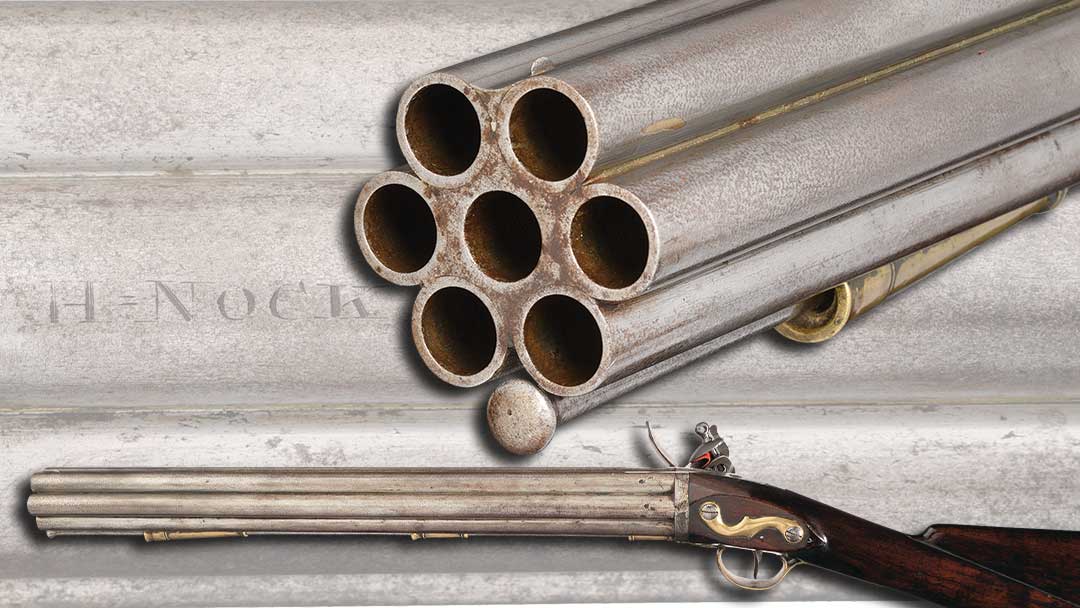
Approximately 549 first type Nock seven-shot volley guns were delivered to the British Royal Navy during the Revolutionary War between 1779 and 1780. The firearm’s distinctive barrel cluster, six outer barrels around a central barrel, produced a tighter shot group and had greater range than a blunderbuss, making the Nock volley gun an ideal naval weapon for sharpshooters of the day firing at the deck of a passing enemy ship.
The example pictured below is an even rarer second type Nock volley gun, one of only 106 issued to the British Royal Navy. After the American Revolution, the Nock volley gun went on to serve in the French Revolutionary Wars and the early Napoleonic Wars. According to Admiral Horatio Nelson, the firearm’s severe recoil could cripple its users. The massive fireball the weapon produced also risked igniting nearby sails and rigging. Both factors contributed to the gun being pulled from service between 1804 and 1805.
This second type Nock Volley gun, one of the finest examples of the model in circulation, was previously part of the famous Clay P. Bedford Collection and was displayed in the “Early Firearms of Great Britain and Ireland” exhibition at the Metropolitan Museum of Art. Available this December.
Revolutionary War Guns for Sale and More
After nearly 250 years, most firearms from the American Revolution have been lost to time. The Thomas Ewing inspected pistol and the “US” surcharged Brown Bess musket offered by Rock Island Auction Company this December, both linked to the Maryland Committee of Safety, represent two of those rare survivors and are absolute cornerstones in early American martial arms collecting.
Find Revolutionary War guns for sale this December at Rock Island Auction Company.
The Revolutionary period saw a multitude of unique pistols, carbines, rifles, and other distinctive firearms produced. The handsome lines and graceful aesthetic of flintlocks manufactured during this era stand out against some of the more utilitarian designs that followed, and Rock Island Auction Company’s December 8 – 10 Premier Firearms Auction includes some of the finest examples from this fascinating chapter in arms development.
A documented engraved pair of Griffin & Tow double barrel, silver mounted boxlock flintlock pistols manufactured in the early 1770s. Available thid December.
Making its debut this December, The Norman R. Blank Collection offers collectors a comprehensive look at the pinnacle of craftsmanship in the genre of high-art European antique firearms. From exquisite 17th century flintlocks and wheellocks to exhibition quality percussion pistols from the early 19th century, Mr. Blank’s collection is a tour-de-force of the era’s most noted craftsmen, including Nicolas-Noël Boutet, Gastinne Renette, Durs Egg, Henry Nock, Joseph and John Manton, and numerous other elite artisans from the U.K. and Continental Europe.
The Norman R. Blank Collection is one of the most exceptional assortments of high-end European firearm artistry ever offered.
This will be the largest firearms auction in Texas history, and RIAC is giving it our famous attention to presentation. We’re creating the finest brick-and-mortar auction venue in America, it’s going to require the largest catalog we’ve ever created, and its remarkable items are going to go toe-to-toe with the finest auctions we’ve ever held.
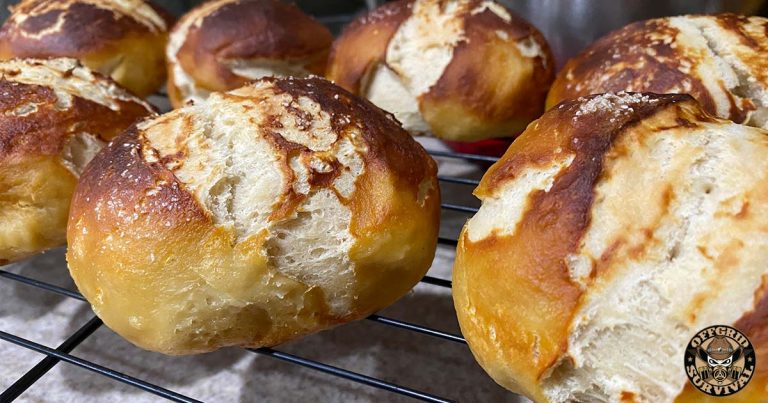
In a world where convenience often trumps self-reliance, there’s something deeply satisfying about creating your own food from scratch. One culinary endeavor that embodies self-sufficiency and off-grid living is baking homemade artisan bread. With just a few simple ingredients and a little patience, you can craft loaves that rival those found in the finest bakeries.
In this article, I am going to walk you through the process of making your own homemade artisan bread, complete with an enriching twist: the use of milk instead of water.
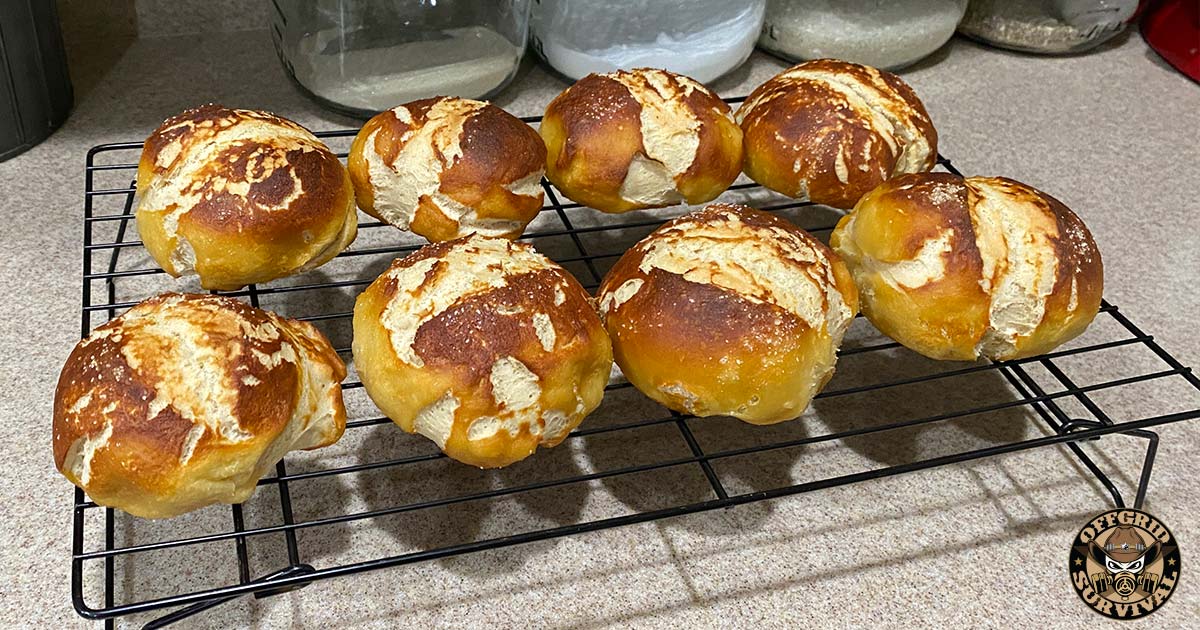
Ingredients for Homemade Artisan Pretzel Bread:
Dough Ingredients:
1 cup milk
3 tablespoons butter or margarine
3 tablespoons brown sugar
1 envelope Fleischmann’s® Active Yeast
2 teaspoons salt
3 cups all-purpose flour, or more as needed
Boiling Solution:
3 quarts water
¾ cup baking soda
Directions for Making Pretzel Bread:
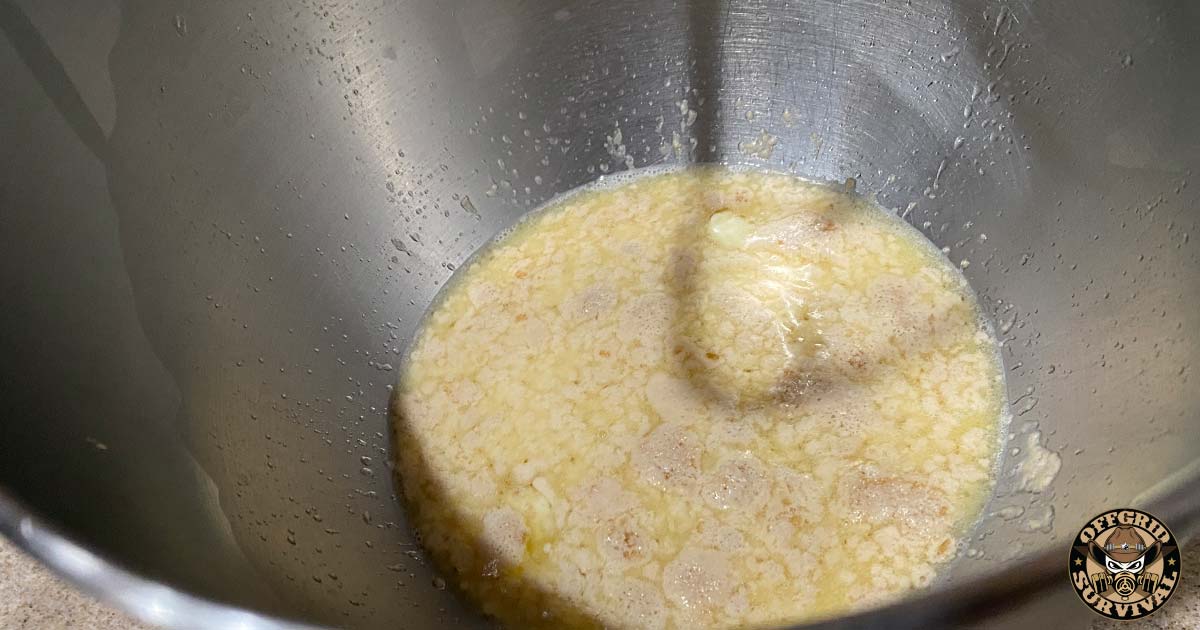
1. Begin by heating the milk and butter until warm, ideally between 100 to 110 degrees Fahrenheit. The butter will not completely melt, and this is perfectly fine. Combine this mixture with the undissolved Yeast and brown sugar in a large mixer bowl. Make sure the liquid is not too hot, or you will kill the Yeast – more on this below in Proofing Yeast Instructions
2. Stir in the salt and 2 cups of flour, then beat the mixture for 3 minutes. Gradually add enough remaining flour to make a soft dough.
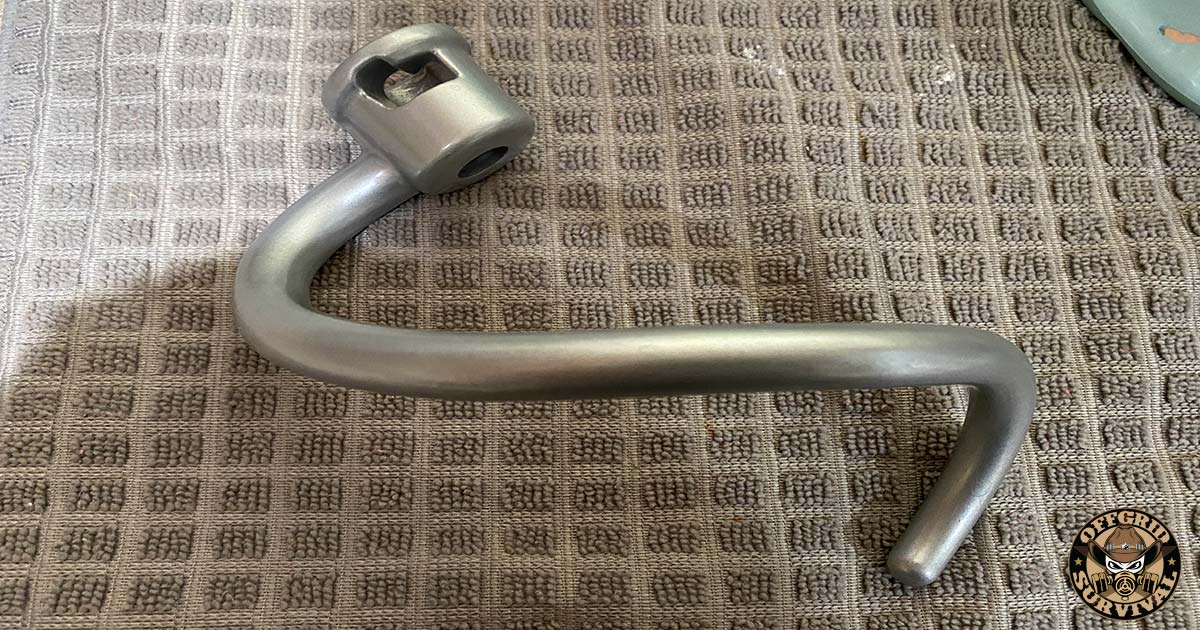
3. Transfer the dough to a floured surface and knead it until it becomes smooth and elastic. This usually takes about 8 to 10 minutes. An alternative and easier option to this would be using a dough hook in your mixer, which saves you from sore hands and cuts down your kneading time in half.
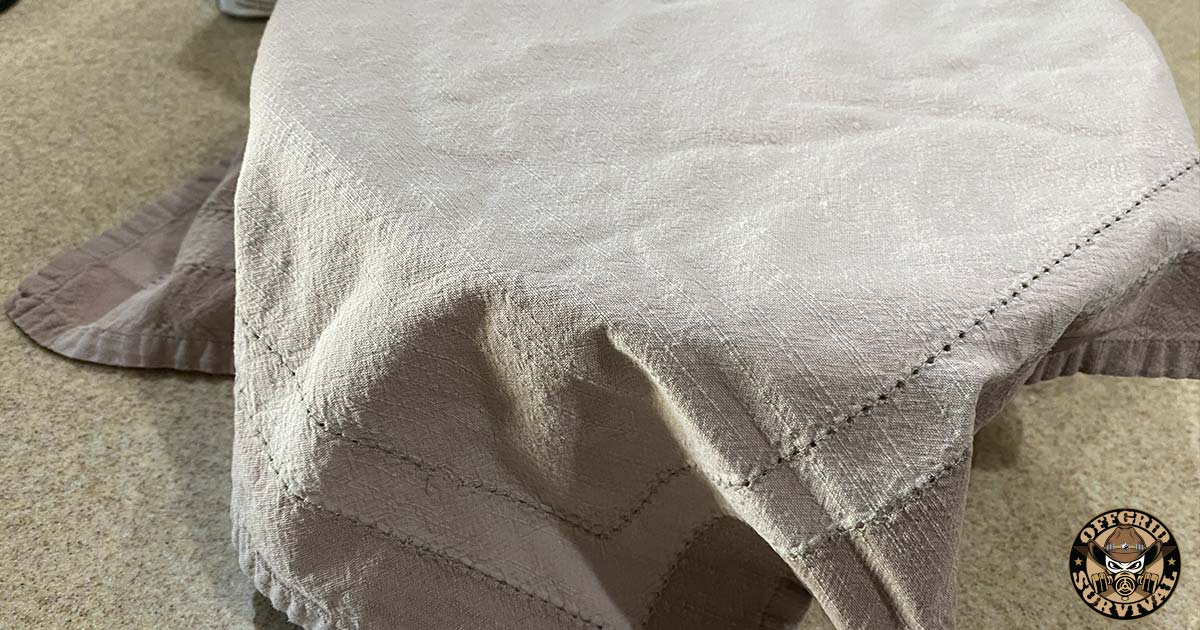
4. Place the dough in a greased bowl, cover it, and let it rise for about 1 ½ hour or until it has doubled in size.
5. Preheat your oven to 350 degrees Fahrenheit.
6. While the dough is rising, prepare the boiling solution by combining 3 quarts of water with ¾ cup of baking soda and bringing it to a boil.
7. Once the dough has doubled in size, punch it down and divide it into eight equal pieces. Form each piece into a tight, smooth ball.
8. Boil each loaf in the boiling solution for 2 minutes, turning them after 1 minute.
9. After boiling, remove the loaves from the pot using a slotted spoon and place them on a greased baking sheet.
10. Bake for 20 minutes, then reduce the oven temperature to 350 degrees Fahrenheit, or continue baking until the loaves are evenly browned.
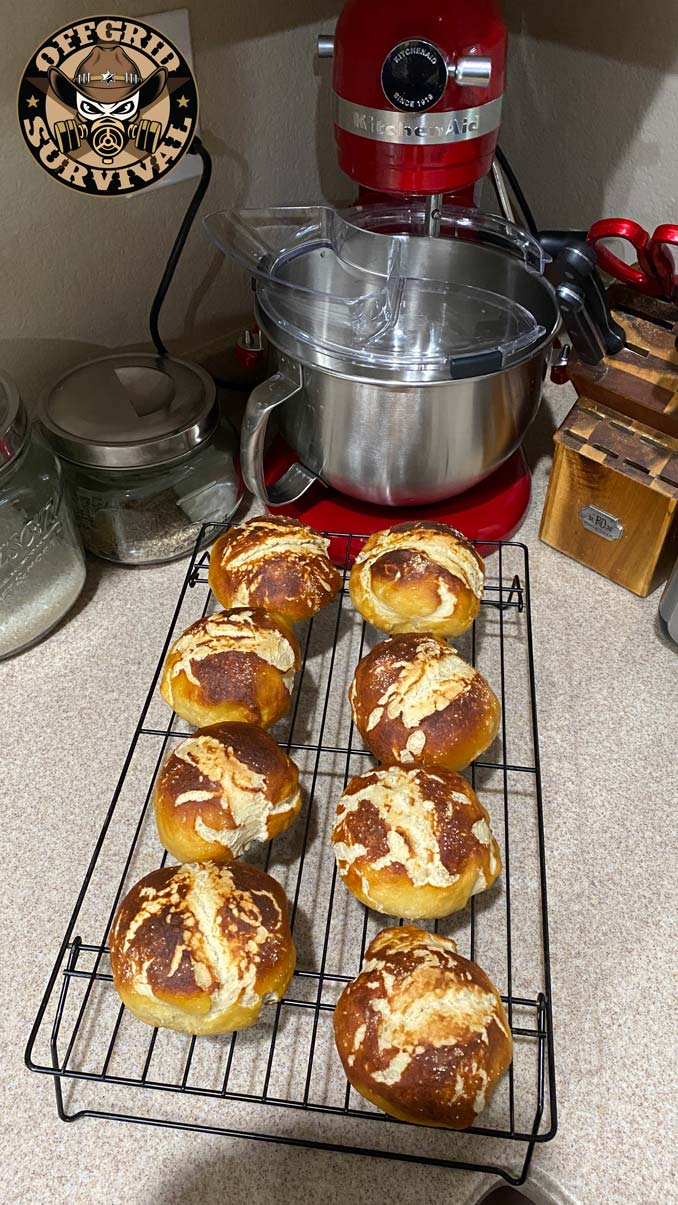
11. Finally, remove the loaves from the pan and allow them to cool on a wire rack.
Why Use Milk Instead of Water:
One key element that sets this homemade artisan bread recipe apart is using milk instead of water. Milk serves as an enriching agent in bread dough. Enriching agents, such as eggs, fats (like butter or oil), and various sugars or sweeteners, are used to enhance the flavor and texture of bread.
Bread made without enriching agents is referred to as “lean dough” and typically contains only flour, water, salt, and Yeast. It results in traditional crusty European and American bread, characterized by a firm crust and an elastic, springy interior with large irregular holes.
Substituting milk for water in bread dough introduces fat (from milkfat) and sugar (from lactose). This brings about several changes:
The interior of the bread becomes softer and less springy/elastic.
The flavor becomes richer due to the fat and somewhat sweeter due to the sugar, though bread with milk but no added sugar will not be overly sweet.
Enriching agents disrupt larger gluten networks, reducing the likelihood of large holes in the bread’s interior.
The added weight of sugars and fats decreases the final loaf volume and oven spring slightly.
Enriching agents often extend the time before the bread develops a “stale” flavor/texture.
Incorporating milk into your homemade artisan bread not only enriches the taste and texture but also elevates your bread-baking skills to a new level of culinary mastery.
How to Proof Yeast for Perfect Homemade Artisan Bread
Before you start making your delicious homemade artisan pretzel bread, one crucial step in the process is proofing the Yeast. Proofing Yeast is the process of activating the dormant yeast cells, ensuring they are alive and ready to work their magic in your dough. This step is essential for achieving your bread’s perfect rise and texture. Here’s how to do it:
Ingredients for Proofing Yeast:
One envelope of Active Yeast (included in the list of the main ingredients)
Warm water or milk (about 110 degrees Fahrenheit)
3 Tablespoons of Brown Sugar
The water should be between 100 and 110 degrees Fahrenheit. Using water that’s too hot can kill the Yeast, while water that’s too cold won’t activate it properly. A kitchen thermometer can be handy for this, but you can also gauge the temperature by touch.
Dissolve the Yeast in the warm liquid mix.
Make that the warm water moistens all the yeast granules. Give it a gentle stir to help dissolve any clumps.
Wait for Bubbles: Now, the waiting game begins. Allow the yeast mixture to sit undisturbed for about 5 to 10 minutes. During this time, the Yeast should start to activate, and you’ll notice tiny bubbles forming on the surface. The mixture will also become frothy and emit a yeasty aroma.
Check for Froth:** After 5 to 10 minutes, examine the yeast mixture. If it’s frothy and filled with bubbles, congratulations! Your Yeast is alive and ready to be used in your bread dough. If you don’t see any activity, it’s possible that your Yeast is expired or the water temperature was not within the optimal range.
Once your Yeast is successfully proofed, you can now get on with the rest of your homemade artisan bread recipe. The active Yeast will work its magic, helping your dough rise beautifully and creating the perfect texture and flavor in your bread.
Proofing Yeast is a small yet crucial step in the bread-baking process. It ensures that your Yeast is active and ready to do its job, setting the stage for a successful baking experience. So, don’t skip this important step, and enjoy the satisfaction of crafting your own homemade artisan bread, complete with perfectly proofed Yeast.
In a world where fast food, takeout, and pre-packaged meals have become the norm, the art of cooking at home for your family is a skill that is often overlooked. Learning to cook for yourself is not merely about preparing food; it is about gaining control over what you eat, adopting self-reliance, and nurturing a deeper connection to your food and well-being.
Self-Reliant Skills: Learning to Cook
If you’re serious about preparedness and the off-grid self-reliant lifestyle, learning how to cook from scratch is something you cannot afford to ignore. Here our some of our past favorite articles on how to learn how to cook from scratch.
For more information on cooking from scratch, check out our favorite cooking books:
The EDC Tool Roll is a feature on Jerking the Trigger in which we profile various everyday-carry-worthy tools. The tools shown aren’t multi-tools but rather real tools, that by virtue of their compact size, light weight, usefulness, or unique functionality, can find a place in any range kit, emergency kit, or everyday carry bag.
Feel free to comment on the tools that you carry so we can all learn! The discussion on these posts has been very valuable so far.
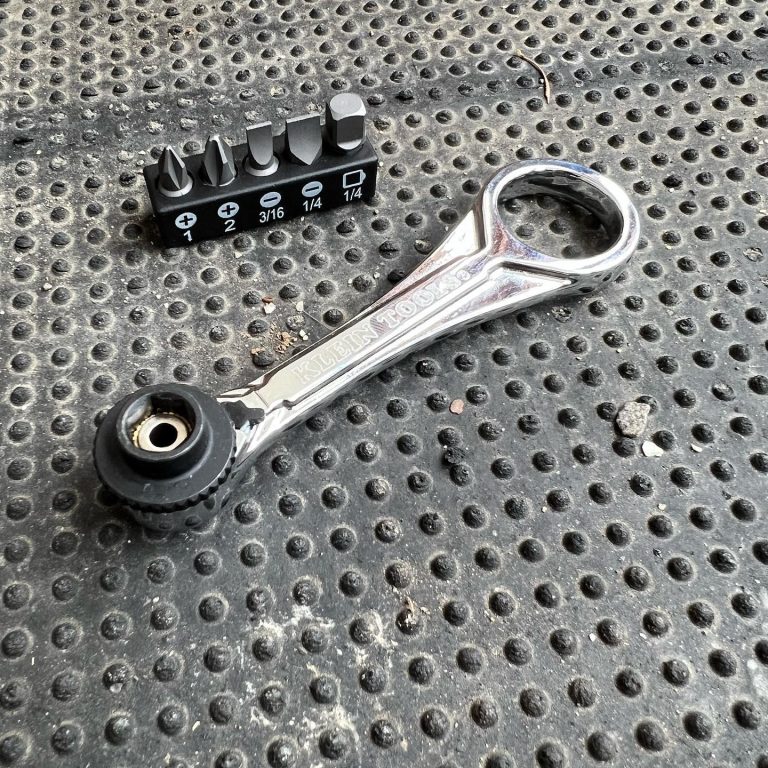
I have covered a lot of ratchet/driver tools on The EDC Tool Roll and the Klein Tools 65200 has become a favorite. I have carried this one but I also reach for it quite a bit for projects at home and it all comes down to few key features.
The most obvious feature that sets the 65200 apart from every other ratchet I have reviewed is the inclusion of a large ring. The ring allows you to turn the ratchet with just a finger which acts somewhat like an extension giving you some additional reach and leverage. It could also be used to clip or dummy-cord the 65200 to yourself or your gear. I find myself using it a lot.
Klein Tools also designed an excellent finger-turning ring for this tool. If you have ever tried to start a screw with one of these ratchets, you know that it can take a few turns before there is enough friction on the fastener for the ratcheting mechanism to work well. The finger ring is useful for hand-turning fasteners to start them and this one works well thanks to its easy-to-grip texture and large diameter.
I also like the included bit holder. It is more compact than most, holding just 5 bits. I guess some people may wish they could carry more bits but I like how small this holder is and find myself using it with other tools!
Finally, Klein Tools includes a 1/4″ socket adapter with this kit. It seems odd to point this out but it is actually somewhat unusual. I appreciate that this is included because I am often having to buy one separately for other similar ratchets.
As I said, this is among my favorite ratchets but I should point out that the 65200 is chunkier than many similar offerings. Also, as handy as I find the ring, it might make it more difficult to store in some kits. If you need the most compact option, this likely isn’t it.
Where to Buy:
You may actually be able to find these if you have a local source of Klein Tools. Home Depot carries it in some stores as part of a larger tool kit which may be useful to some. Otherwise, these are extremely affordable on Amazon which is where I bought mine: Klein Tools 65200 on Amazon
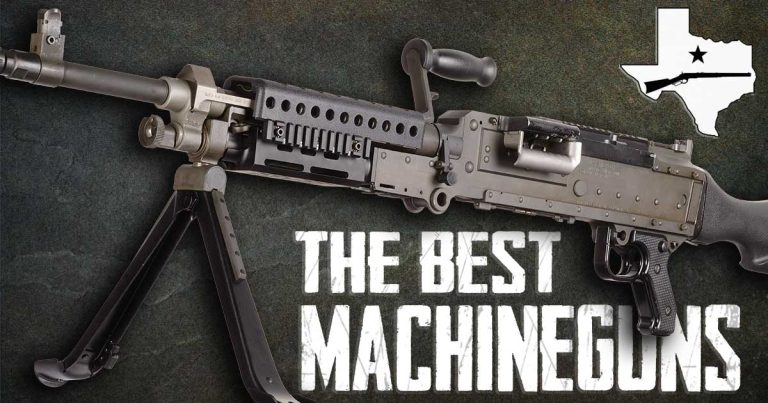
For arms collectors, military historians, and any fan of hard-hitting heavy metal, it doesn’t get much better than the machine gun. From pinnacle pieces like the FG42 and MKb 42(H) to the classic BAR, M60, and BREN MkII, some of the best machine guns will be offered during Rock Island Auction Company’s December 8 – 10 Premier Firearms Auction. One of the genre’s rarities of rarities heads up this star-studded lineup, the mighty M240.
A seldom-seen M240 machine gun for sale, this M240B features a blade front sight and folding ladder rear sight, a folding bipod, and a lower handguard with Picatinny rail sections on either side. Available this December.
The Fabrique Nationale U.S. M240B belt-fed machine gun up for auction this December is one of a scarce few fully transferable examples in the registry. The remainder are government property and will never be released for public sale, making this a can’t-miss opportunity for military arms collectors.
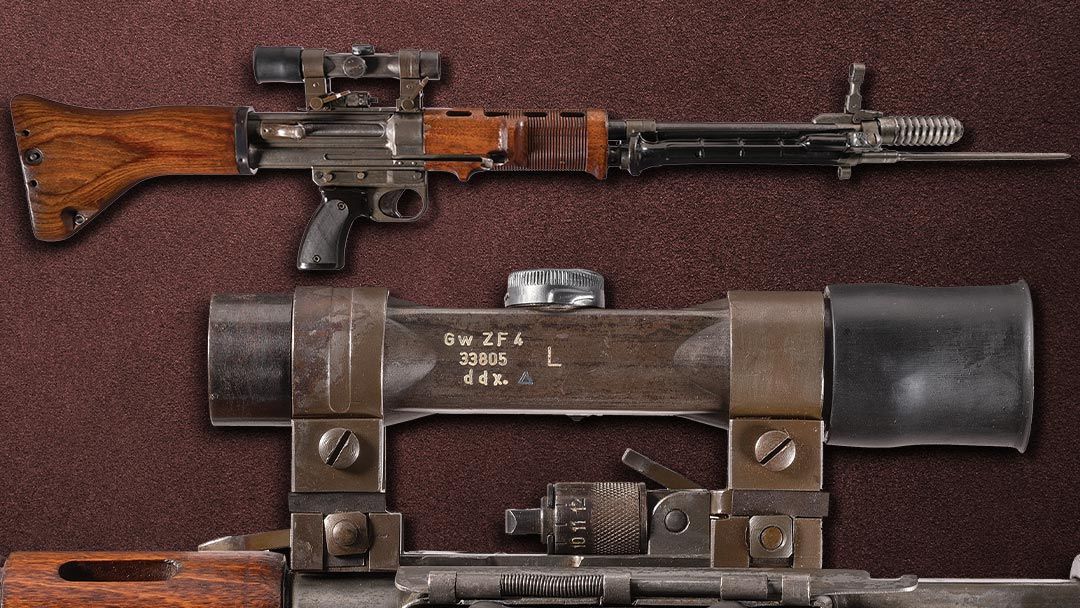
An extremely rare German Krieghoff FG42 “Type III/Type G” paratrooper rifle with a ZF4 scope, another one of the most desirable Class 3 weapons for sale this December. Available this December.
Whether you’re in the market to buy a Tommy gun, a Johnson LMG, or a Stoner 63, machine gun lovers will find the largest collection of Class 3 weapons for sale ever offered by Rock Island Auction Company this December, including some of the best machine guns publically available. We’ll examine a few of the highlights and compare them head to head.
Find the best machine guns at Rock Island Auction Company.
The M60 vs the M240
The M60 is unquestionably one of the coolest machine guns around, as well as an icon of Hollywood action films. Nicknamed “The Pig”, the M60 was deployed as America’s chief infantry machine gun for Vietnam, along with a variety of air, ground, and water vehicle mountings. Though still in limited service today with American and Allied armed forces, in the late 1970s the Fabrique Nationale MAG emerged to challenge the M60’s dominance.
An M60 machine gun for sale this December. Manufactured by the New England Group of the Maremont Co., the barrel on this M60 machine gun is equipped with a fixed blade front sight, a ventilated barrel shroud, a bird cage flash hider, and a swiveling bipod. Available this December.
When it comes to belt-fed heavy hitters, the Belgian FN MAG family is considered one of the best machine gun designs around. The American-built version of the FN MAG, the M240 was officially adopted by the U.S. Army in 1977. By the 1990s, the M240B, commonly referred to as the M240 “Bravo,” would go on to replace the M60 series of machine guns in their longstanding infantry role.
Though the M240 is heavier than the M60, the M240 is a more robust platform with a faster cyclic rate, and the weapon’s popularity with militaries around the world is beyond dispute. For collectors, finding an M240 machine gun for sale is always an exciting event.
One of the best machine guns in the world, and certainly an extreme-rarity for collectors, this Fabrique Nationale U.S. M240B “Bravo” belt-fed medium machine gun is one of December’s highlights. Available this December.
The FG42 vs the Johnson LMG
The German FG42 stands as one of the most distinctive weapons of WW2. Designed for the Luftwaffe’s paratrooper division, the Fallschirmjaegergewehr 42 was intended to be a “universal weapon” with enough range to replace the rifle, enough suppressive power to replace the standard machine gun, and enough agility to replace the SMG. The FG42 could also double as a sniper/designated marksman weapon with the addition of a ZF4 scope and carried an on-board spike bayonet for a last resort close-quarters option.
An FG42 “Type III”, also referred to as a “Type G”, paratrooper rifle manufactured by Krieghoff, one of the coolest machine guns to emerge from the Second World War. Available this December.
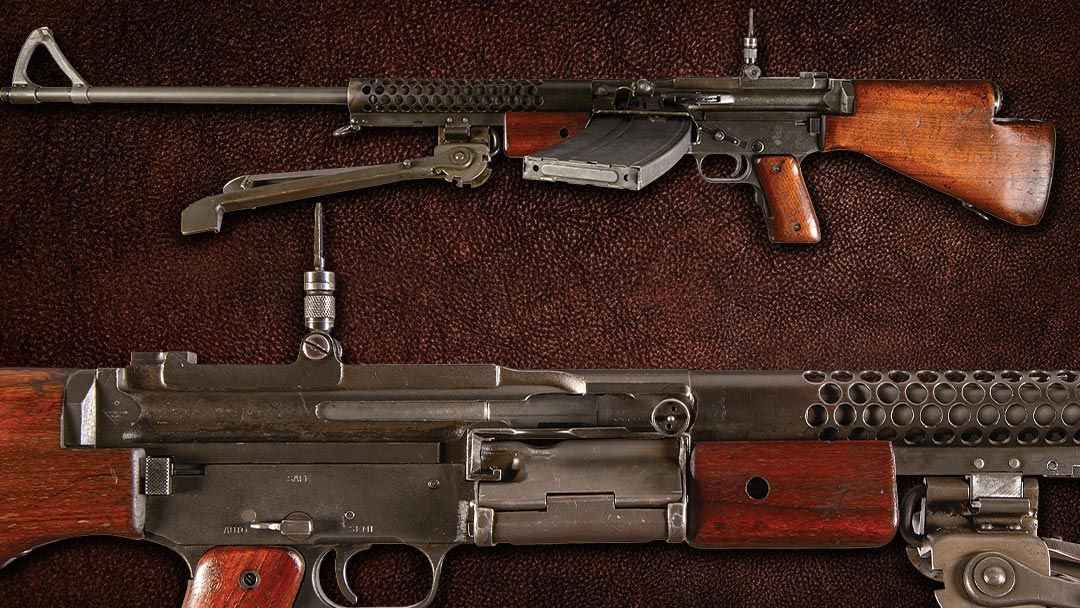
American inventor Melvin Maynard Johnson Jr. Johnson pitched the M1941 as a squad automatic rifle that could serve in numerous battlefield roles, including being fired from the shoulder when necessary like the FG42. The two machine guns had a number of parallels, including similar profiles. Both designs placed the physical characteristics of a light machine gun into a shorter frame and used full-power rifle cartridges. Each gun employed a front-mounted bipod and a side-mounted horizontal box magazine, and the FG42 and the M1941 Johnson both used an open-bolt system when set to automatic and a closed-bolt when switched to semi-automatic mode.
One of the best machine guns of December, and certainly among the scarcest to find for collectors, the Johnson Automatic M1941 LMG was accepted as a substitute weapon by the United States Marine Corps due to a shortage of BARs in the early days of WW2. Available this December.
The Stoner 63 vs M16
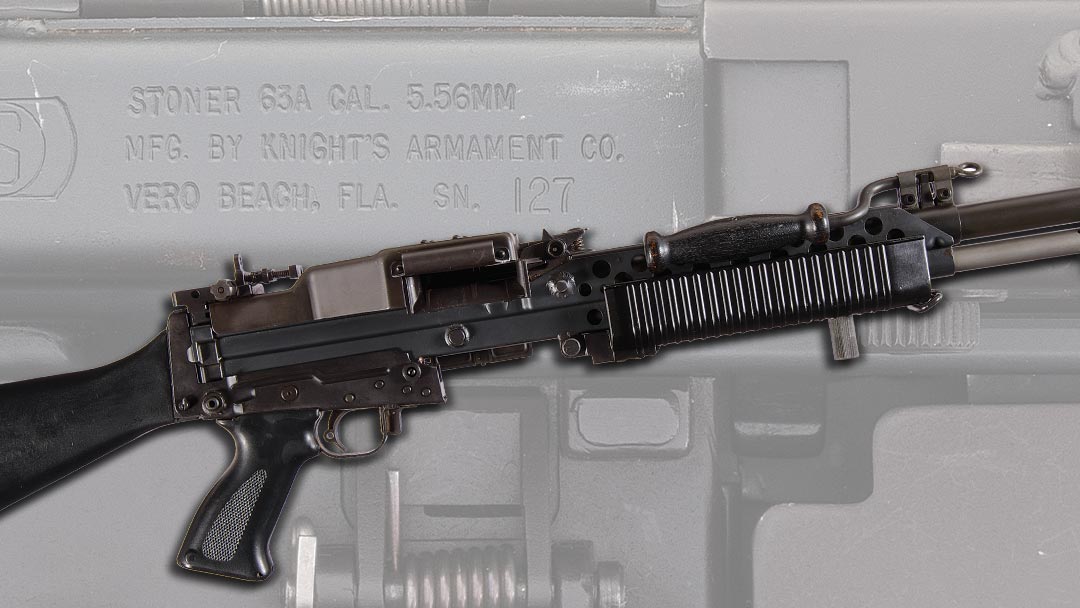
One of the many notable products from the mind of American arms designer Eugene Stoner (of AR10, M16/AR15, and AR-18/180 fame, among others), the Stoner 63 was developed in the early 1960s as a modular weapon system with a receiver that could be reconfigured rapidly based on the mission needs and area of operation. Unit armorers could convert the basic Stoner 63 platform from a fully automatic rifle into a carbine, light machine gun, and even a fixed belt-fed tank version. The versatile machine gun was successfully employed by the elite Navy SEALS throughout the Vietnam War, but another Stoner design beat it to production by several years.
Another collecting rarity this December, and one of the best machine guns of its era in terms of sheer adaptability, the Stoner Model 63A could fill numerous roles on the battlefield. Available this December.
The Stoner 63’s various components and barrels allowed unparalleled customization, but these capabilities came with a higher learning curve, greater upkeep, and more initial expense than the iconicM16 rifle.
The M16 would also see its share of accessories and customization as the platform was developed and refined. The example below has been fitted with winged post front and adjustable two leaf rear sights, an A2 pattern flash hider on the desirable 11 1/2 inch “Commando” pattern “C MP CB” marked barrel, a Colt 3×20 mm scope with a carry handle mount, and a quick-detach “BIPOD RIFLE M2” marked bipod.
Who doesn’t need an M16? This Colt M16A2 Commando pattern selective fire carbine with scope and accessories, including two Beta C-Mag 100-round drum magazines, make this example of the genre one of the coolest machine guns for sale this December. Available this December.
The MKb 42 vs the STG 44
The idea behind the grandfather of the assault rifle started in 1935 when the German High Command ordered the development of a new intermediate-range cartridge, the 7.92mm Kurz. In 1939, the C.G. Haenel firm was tasked with producing a fully automatic rifle prototype chambering the new round.
Walther would manufacture a competing version of the MKb 42, and the letters “H” and “W” were used to distinguish between the two designs. The resulting Maschinenkarabiner 1942 offered a higher capacity than Germany’s standard bolt action rifles, could provide covering fire like a machine gun, and was able to outdistance the Russian submachine guns it faced on the Eastern front.
A WW2 German C.G. Haenel MKb 42(H) machine carbine with a sheet metal sniper scope mount, a ZF41/1 sniper scope, and an original “MKb/42” marked magazine. Not only one of the coolest machine guns of December, this extremely rare firearm may be the only fully registered, fully transferable MKb 42(H) publically available. Available this December.
Only 10,700 of the original MKb 42 were manufactured, with German arms producers continuing to improve on the design throughout the war. The next iteration, the MP 43, would take most of its inspiration from the far more successful MKb 42(H), with the MKb 42(W) contributing several features to the platform’s new configuration, including the MP 43’s hammer-firing system.
The rifle received minor upgrades and another new designation in 1944, and several months later Adolf Hitler, who’d been opposed to the entire production of the platform, finally embraced the weapon and renamed it “Sturmgewehr” or “assault rifle.”
A WW2 J.P. Sauer & Sohn MP 44. Both the MKb 42 and the MP 44 are incredibly significant examples of assault rifle development and some of the best machine guns a serious collector could ask for. Available this December.
BAR vs BREN
A legendary firearm from one of America’s most famous inventors, the Browning automatic rifle served as America’s original squad gun and played a significant role on the battlefield during WW2 and the Korean War. Between World Wars, the BAR received some minor updates before getting its biggest redesign in 1938 when it became the M1918A2. Modifications included a flash suppressor, iron sights, a carrying handle, and a lengthened buttstock, as well as a second slower firing model that helped mitigate the high recoil from the weapon’s .30-06 rifle rounds.
A British-proofed Marlin-Rockwell Corp. U.S. Model 1918 BAR Browning automatic rifle with accessories. A small British “Crown / GP” acceptance proof is stamped on the right side of the receiver which may indicate that this was an early WW2 British Lend Lease weapon. Available this December.
In 1922, the British Army conducted trials to replace the aging Lewis gun with a light machine gun. The BAR was recommended, but its price was prohibitive at the time. Trials continued in the early 1930s, with the Czech ZB vz.26 light machine gun winning out over contemporaries like Danish Madsen. Designated the ZGB 33, the platform underwent a series of alterations that resulted in the BREN gun. While the BAR wasn’t as heavy as the BREN, the BREN more faithfully filled the role of a light machine gun, and the BREN MkII introduced in 1941 further boosted the platform’s firing rate.
An Armitage International Mark II Bren gun. This example is fitted with a folding bipod and a fixed conical flash hider, and it includes two magazines and a sling. Available this December.
MG 34/42 VS M1919 Browning
One of the best machine guns of the early period of WW2, Germany’s MG34 is a classic example of a light to medium-weight squad weapon suited for vehicle use or support fire when mounted on its sturdy folding tripod. The Maschinengewehr 34 was produced with a quick change barrel assembly firing from an open bolt to help stay cool during firing, features later adopted into the U.S. M60 machine gun. The weapon’s steel-machined and hand-fitted parts later proved too costly and time-consuming to maintain and produce during wartime. Though never fully retired, Germany eventually phased out production in favor of the MG42.
A fine example of a WW2 German Mauser MG34 medium machine gun with its tripod and accessories, manufactured by the Mauser-Werke, A.G. Borsigwalde in Berlin. Available this December.
The Browning M1919A4 was a reliable machine gun that was easy to produce en masse. While it didn’t have the portability of the MG34 or MG42, the M1919A4 was effective at sustained fire and paved the way for the more mobile M1919A6. Though an aging design compared to Germany’s squad machine guns, the Browning 1919’s core system was well understood by American gunners and armorers, with ample parts available. Along with the AN/M2 “Stinger”, a .30 caliber M2 customized for ground fighting in the Pacific, the Browning 1919 platform filled the logistical role as a functional squad weapon until the M60 came online.
Manufactured using original USGI parts and a new-made right sideplate, this full function Browning 1919A4 machine gun was produced by Charles E. “Chuck” Hudak’s firearms business, Inland Arms Co. of Austin, Texas. Available this December.
Tommy Gun vs MP40
No collection of best machine guns is complete without a classic Tommy gun. Perhaps the most famous submachine gun of its era and a perennial Hollywoodfavorite, the Thompson SMG ranks as one of the truly signature American weapons.
The Thompson, a product of finely machined old-school hand craftsmanship, was completed too late to fill its intended role as a WW1trench sweeper. On the eve of WW2, the Thompson was pressed into service by both the British and United States and went on to serve on all Allied fronts. Though over 1.5 million of the M1928A1 and M1A1 military variants were produced, earlier Thompsons found their way to the field as well.
Find every model of Tommy gun for sale this December. This high-condition Colt Thompson Model 1921 SMG comes with a carrying case and a host of original accessories including a 50-round “L” drum magazine, four 20-round blued stick magazines, and an Army technical manual dated October 1942. Available this December.
While the Tommy Gun vs MP40 question touches on the decades-old debate between the 9mm and .45 ACP round, the two submachine guns carry notable differences across the board. The German MP40 was a lighter SMG with a folding stock and a more compact design. In its favor, the Thompson had a stronger milled steel receiver, a select fire option, and an absolutely blistering firing rate, a devastating advantage in extreme close quarters.
On the other hand, the MP40’s slower cyclic rate translated to less recoil and muzzle rise, allowing superior accuracy at a distance. Perhaps the MP40’s greatest advantage, however, came in the form of cost. The German SMG made extensive use of metal stampings instead of costly machined parts, as well as synthetic materials to make a weapon robust enough to withstand the rigors of war while being simple enough to pump off the assembly line.
The MP40, another Hollywood favorite from the WW2 era. This example features markings from Haenel and Merz-Werke and has been fitted with a set of brown bakelite side panels and an under-folding stock. Available this December.
M1A vs M14
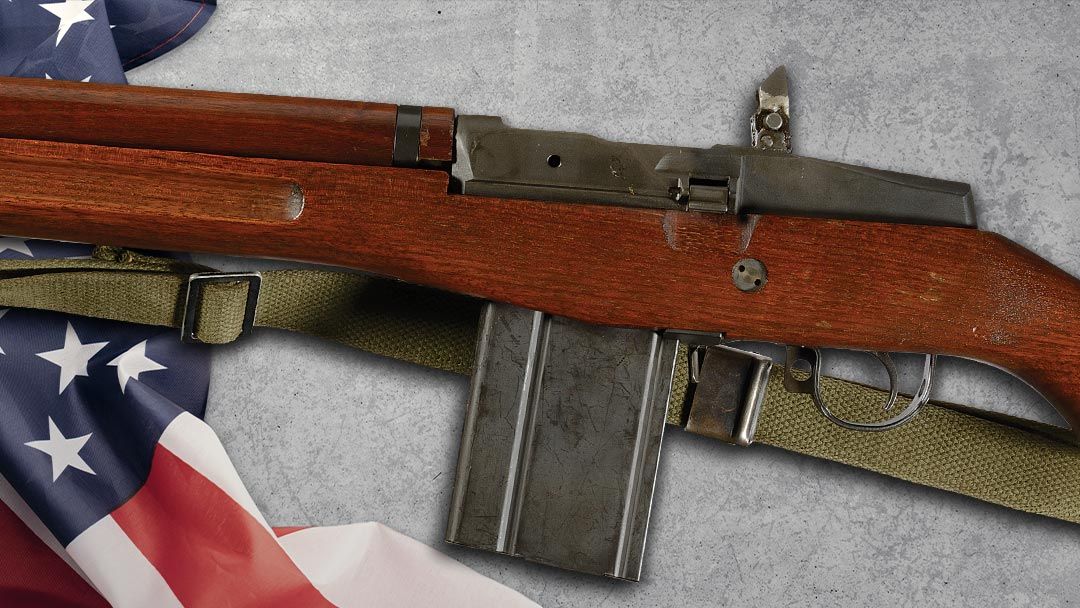
Developed as the follow-up to the famous M1 Garand, the M14 was conceived as a multi-role universal weapon. This everything-to-everyone approach hamstrung what was otherwise a perfectly suitable combat rifle, leading to a relatively early retirement for the platform as an infantry standard. However, the M14 continues to serve America in a number of specialized roles, including finding an audience with special forces units and snipers, as well as being adopted by the Border Patrol and National Park Service.
A Harrington & Richardson M14 selective fire battle rifle in “Guerrilla Gun” configuration, with a shorter barrel and extra milling performed on the receiver to smooth out the lines and reduce weight. Available this December.
(pic) A Harrington & Richardson M14 selective fire battle rifle in “Guerrilla Gun” configuration, with a shorter barrel and extra milling performed on the receiver to smooth out the lines and reduce weight.
In 1974, the M1A was developed as a semiautomatic version of M14, with numerous variations offered over the subsequent decades. Springfield Armory also produced a limited number of fully automatic M1A rifles compatible with the M14’s selective fire hardware, as exampled by the two rare sequentially serial-numbered M1A rifles featured below, with very little separating the pair from their military-issued M14 siblings save for the receiver markings.
Two of the coolest machine guns this December for their sheer rarity alone. Both available in RIAC’s upcoming Texas Premier Auction, factory original selective fire M1As are seldom offered, but the two rifles above, available as separate lots, are an extraordinarily scarce sequential set. Available this December.
MAC 10 vs Uzi
The Uzi warrants a nod on any list of best machine guns for its popularity in modern media. Designed in the 1950s for the Israeli Defense Forces, the Uzi SMG was a standard for IDF paratroopers, armored crews, and special forces involved in close-quarters fighting. Like its later MAC-10 rival, the Uzi became a common fixture of ’80s action films.
An excellent I.M.I. Uzi selective fire SMG, one of the coolest machine guns for SMG collectors. Available this December.
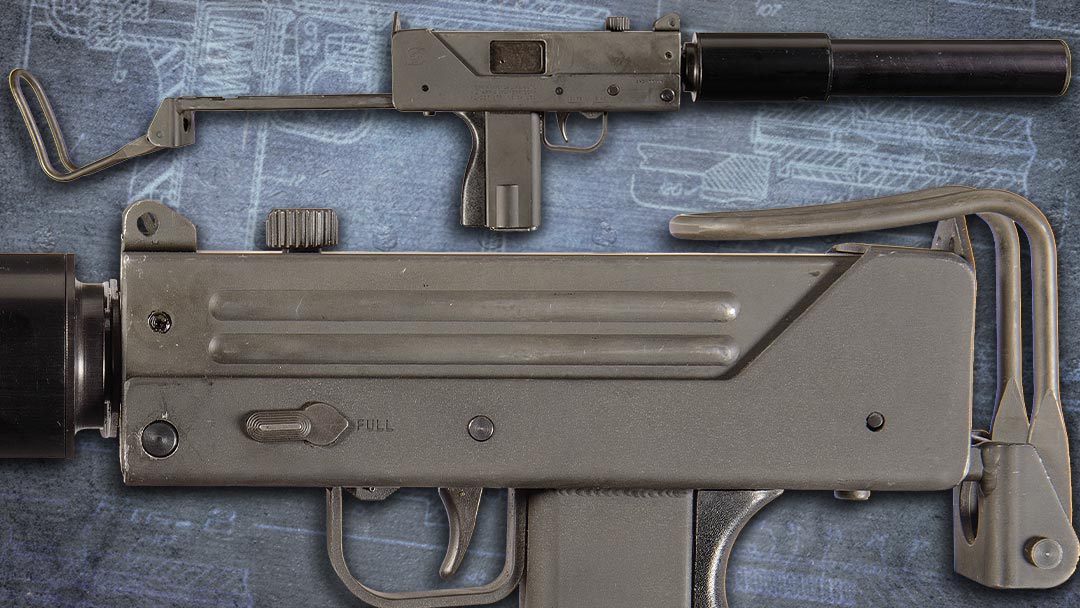
Advertised as “the gun that made the 80s roar” by its manufacturer, the MAC-10 and its MAC-11 successor shared a number of similarities with the Uzi. At a glance, bothgunsare designed for economics and simplicity, evident in their open bolt design and stamped metal construction. Both the MAC-10 and the Uzi incorporate the magazine well into their pistol grip, making the weapons more compact.
While the MAC-10 has a blistering firing rate that doubles its Uzi competitor, capable of spraying 1,000 rounds/minute when chambered in .45 ACP and even higher in .9mm, the Uzi is the clear winner when it comes to accuracy. For its superior range, reduced muzzle climb, more comfortable factory grip, and greater reliability in the field, the Uzi saw a far higher rate of adoption with military and law enforcement units around the globe.
The M240 and the Best Machine Guns of December
From the Persian Gulf to Afghanistan, the FN M240 has distinguished itself as America’s go-to medium machine gun. The M240B continues to see action in all branches of the armed forces and the exceedingly few examples that are fully transferable are almost never offered for public sale. In a December auction filled with some of the coolest machine guns around, Rock Island Auction Company bidders have the chance to take home the Christmas gift of a lifetime.
An M240 machine gun for sale, an incredibly rare opportunity for even the most advanced firearms collections. Available this December.
Other eye-catching Class 3 weapons for sale this December include an M60E3, a rare Springfield manufactured “M2-AC”, and a plethora of Heckler & Koch conversions like the HK21K. Whether you’re looking to buy a Tommy gun, own an FG42, or find an M240 for sale, Rock Island Auction Company’s December 8 – 10 Premier Firearms Auction features some of the best machine guns a collector could ask for.
A David’s Gun Room/Fleming Firearms/Heckler & Koch MP5SD SMG and silencer combination, one of the coolest machine guns when it comes to H&K conversions. Available this December.
It’s only fitting that the largest collection of Class 3 weapons for sale ever offered by RIAC will cross the podium in the company’s new state-of-the-art facility at 3600 Harwood Rd., Bedford, Texas. This inaugural Premier Auction event for Rock Island Auction Company’s new venue kicks off with a Thursday preview day on December 7th, where guests will have the opportunity to examine all of these fantastic machine guns firsthand in the facility’s recently completed 19,000 square-foot preview hall, as well as a breathtaking selection of legacy guns, investment-grade arms, and museum-worthy masterworks from every genre of firearms collecting.
Rock Island Auction Company’s December 8 – 10 Premier Firearms Auction, the inaugural event for the company’s new state-of-the-art facility at 3600 Harwood Rd., Bedford, Texas, will be the largest firearms auction in the history of the Lone Star State.
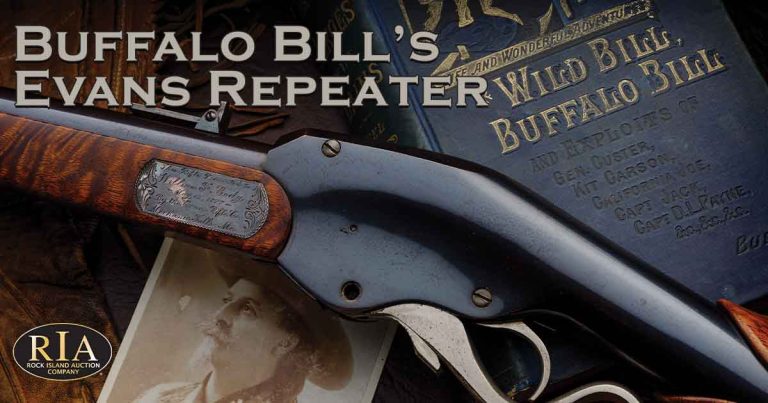
Buffalo Bill Cody entangled true life and tall tales to create his image as the Wild West showman, and the “first scalp for Custer” episode is a perfect example of that.
Briefly, Buffalo Bill killed a Cheyenne warrior in late July 1876 after the Little Bighorn massacre and reportedly removed the scalp and held it aloft proclaiming, “the first scalp for Custer!” In at least one retelling of the story, he is carrying an Evans Repeating Rifle.
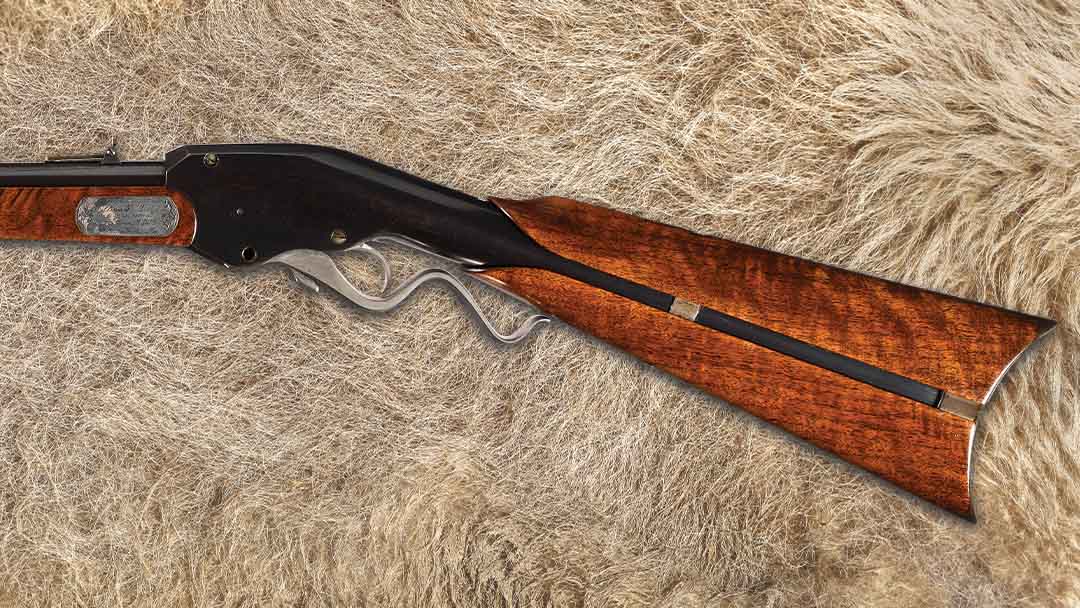
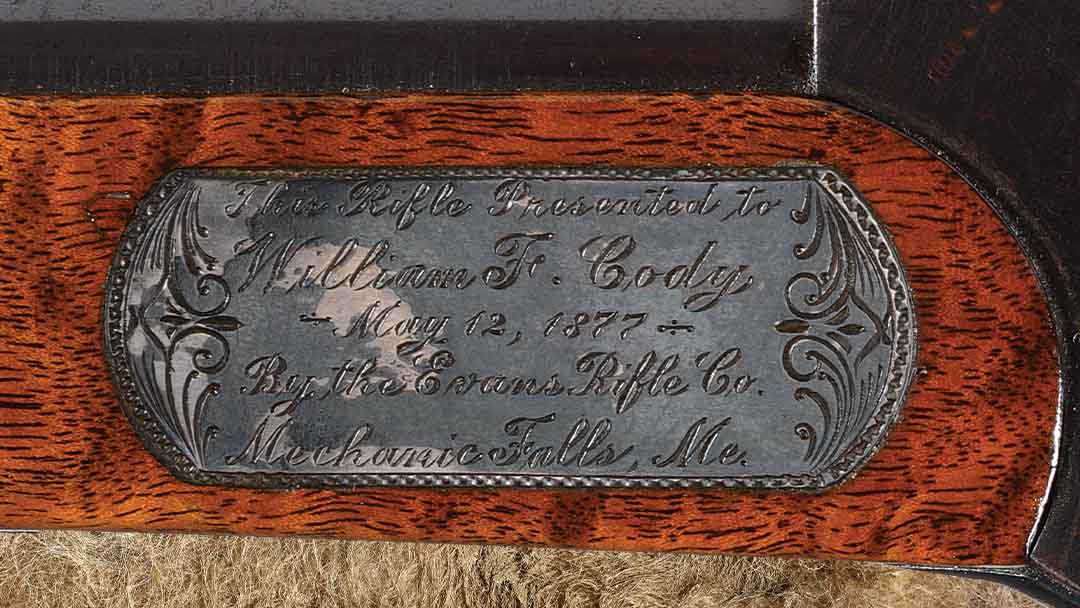
An Evans Rifle Transition Model with a factory presentation plaque inscribed to William F. Cody on May 12, 1877, a rare L.D. Nimschke presentation engraved Evans transition model, and a Winchester Deluxe Model 1873 rifle with the engraved inscription “WM F. Cody/1ST Prize” is available in Rock Island Auction Company’s first Premier Auction in its new Bedford, Texas facility, Dec. 8-10. Also on offer is a rare L.D. Nimschke presentation engraved Evans transition lever action rifle.
Legendary Wild West showman Buffalo Bill Cody.
The Evans Rifle
Designed by dentist Warren R. Evans, the Evans Repeating Rifle had the largest magazine capacity of any rifle made in the United States during the 19th century. Manufactured in Mechanics Falls, Maine from 1875 to about 1880, the Evans Old Model could carry 34 rounds of proprietary .44 caliber ammunition in a helical magazine in the stock that was an extension of the receiver. The New Model was made for longer cartridges and had a capacity of 26 rounds. By comparison, the Winchester Model 1873 – “the gun that won the West” – had a magazine capacity of 15 rounds.
The key difference between the New Model and the Old Model was that the new model used slightly longer cartridges though both were still .44 caliber. The Transition Model had a walnut lower buttstock and a redesigned butt plate that improved the gun’s balance.
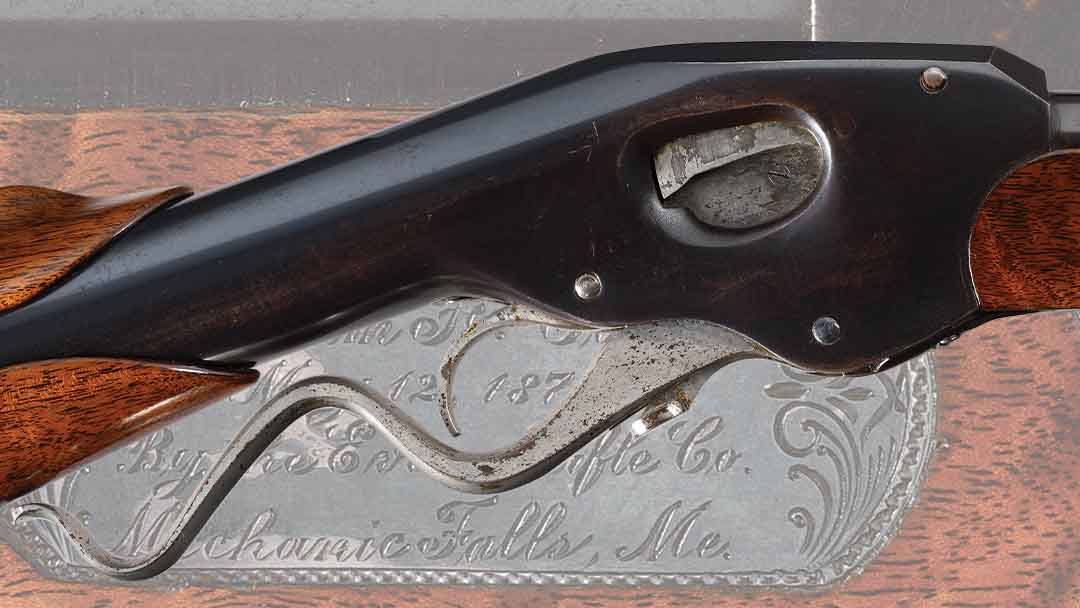
The 34-round magazine for the Evans Repeating is located in the stock and uses a helicual system to feed proprietary .44 caliber cartridges to the receiver. This rifle was presented to Buffalo Bill Cody.
When loading cartridges into the spiral channel of the magazine through the butt plate, the lever had to be activated, then closed and reopened, rotating the magazine by a quarter, then repeating the process until all 34 cartridges are loaded. If during loading, the lever is operated and returned without a cartridge, that would leave an empty gap between loaded rounds.
The rifle has a pressed steel receiver and magazine with an underhammer action. It was intended for military use but failed at trial so went into commercial production. It weighs in at more than 9 lbs. with most of the weight in the butt stock where the spiral magazine is located. Author Philip B. Sharpe described the gun as jam-proof from tests he did.
More than 12,000 rifles and carbines, including 1,050 of the Transition Model were manufactured by the time the Evans Repeating Rifle Company went bankrupt in 1879. The company’s assets were liquidated in 1881.
The plaque on the left side of the Evans Rifle presented to Buffalo Bill Cody reads, “This Rifle Presented to/William F. Cody/May 12, 1877/By the Evans Rifle Co./Mechanic Falls, Me.”
The Death of Yellow Hair
The Cheyenne warrior killed by Buffalo Bill at the Battle of Warbonnet Creek in July 1876 has variously been called Yellow Hair or Yellow Hand. He has often been described as a chief, but was actually a warrior who was the son of a chief. When this episode was shared, it was with varying degrees of embellishment.
Starting with what Buffalo Bill wrote to his wife, Lulu on July 18, 1876:
“We have had a fight. I killed Yellow Hand a Cheyenne Chief in a single-handed fight. You will no doubt hear of it through the papers. I am going as soon as I reach Fort Laramie the place we are heading for now send the war bonnet, shield, bridal, whip, arms and his scalp to Kerngood (who had a clothing store in Rochester)to put up in his window. I will write Kerngood to bring it up to the house so you can show it to the neighbors. … I have only one scalp I can call my own that fellow I fought single handed in sight of our command and the cheers that went up when he fell was deafening.”
In his 1879 autobiography, he told of a running fight — perhaps with that Evans Repeating Rifle — that lasted several minutes and left three Cheyenne dead before coming up against Yellow Hair/Hand who was riding back and forth challenging him.
“One of the Indians, who was handsomely decorated with all the ornaments usually worn by a war chief when engaged in a fight, sang out to me, in his own tongue:
“I know you, Pa-he-haska; if you want to fight, come ahead and fight me,” Buffalo Bill wrote.
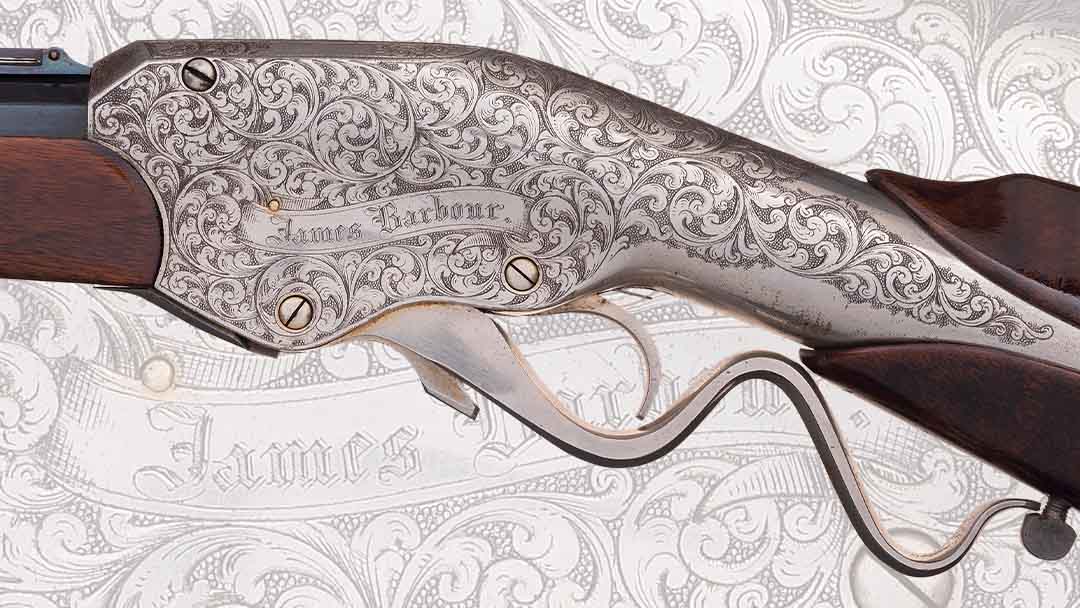
A closeup of a rare Evans Rifle engraved by Master Engraver L.D. Nimschke that was likely a deluxe presentation piece and has a banner with the name “James Barbour” in Old English engraved on the left side of the receiver. The nickel-finished receiver features flawlessly executed Germanic scroll engraving on a punch-dot background. The hammer, lever, and buttplate are also nickel-finished.
According to the autobiography, they galloped toward each other and stopped. Buffalo Bill took a shot and killed the warrior’s horse. Buffalo Bill’s horse stumbled from a prairie dog hole and he fell to the ground. Both men recovered from their fall and arose about 20 paces apart and fired simultaneously. The warrior’s shot missed but Buffalo Bill’s aim was true and shot Yellow Hair/Hand in the chest.
“He reeled and fell, but before he had fairly touched the ground I was upon him, knife in hand, and had driven the keen-edged weapon to its hilt in his heart. Jerking his war-bonnet off, I scientifically scalped him in about five seconds,” Buffalo Bill wrote.
Soldiers and Native Americans came charging toward Buffalo Bill. He continued in his autobiography, “As the soldiers came up I swung the Indian chieftain’s topknot and bonnet in the air, and shouted: “The first scalp for Custer.””
Another account, offered in “Buffalo Bill, Last of the Great Scouts,” by Helen Cody Wetmore, Buffalo Bill’s sister, and Zane Grey, describes the run-in similarly to the autobiography, with Yellow Hair/Hand challenging Buffalo Bill to a duel.
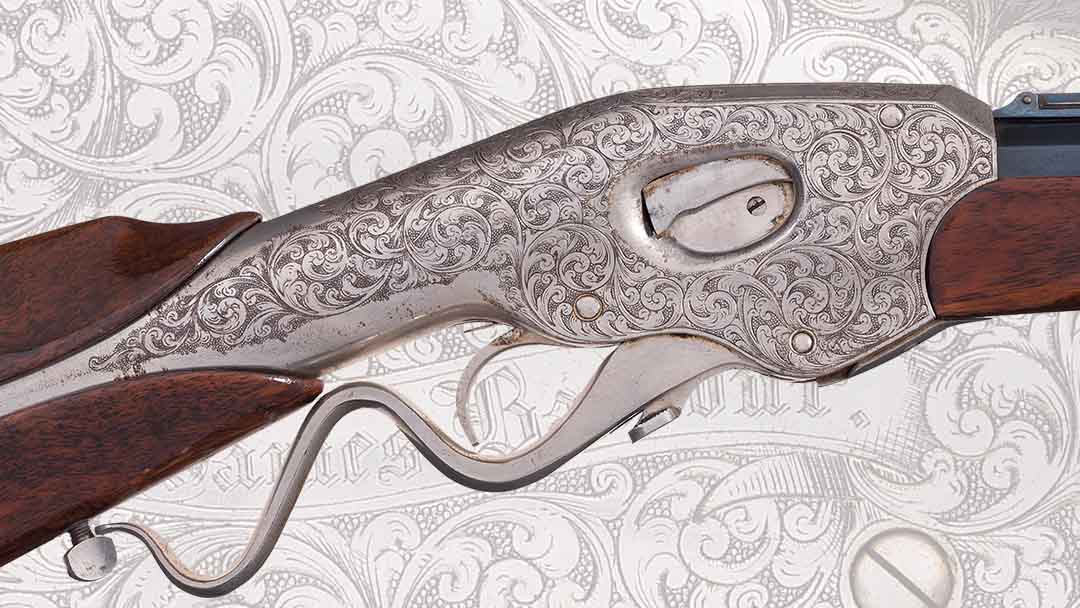
A closeup of the right side of this nickel-finished Evans Rifle engraved by Master Engraver L.D. Nimschke shows the amazing Germanic scroll engraving on a punch-dot background.
The Truth of Yellow Hair’s Death
Author Don Russell reviewed a number of contemporary accounts that knock down the more lurid moments of the incident. Among the first things he corrects was the warrior’s name. It wasn’t Yellow Hand. He was called Yellow Hair because he carried the scalp of a white woman.
Yellow Hair didn’t challenge Buffalo Bill, but rather met almost by accident and fired almost immediately, according to Russell. The Cheyenne took a bullet to his leg that killed his horse, and the incident continued about as Buffalo Bill’s autobiography states though he didn’t stab Yellow Hair in the chest. He did scalp the Cheyenne as soldiers rode after the other combatants, but no one heard what Buffalo Bill claimed to have shouted, according to accounts from other witnesses that included cavalrymen and a correspondent from the Ellis County Star. Despite these reports, this tall tale took hold within days of the encounter.
There were even claims, though mostly dismissed, that Buffalo Bill hadn’t killed Yellow Hair, but that he was killed by other troopers, Russell wrote. Most of those claims were from people who weren’t near the skirmish. What weapon he used against Yellow Hair remains unknown. Again, the tale is full of inaccuracies and myth-making.
Buffalo Bill was dressed in one of his stage outfits, a black velvet vaquero suit with silver buttons and lace so that, according to Russell, Buffalo Bill could claim that he was dressed in an authentic scout outfit. Was he carrying an Evans Rifle when the confrontation occurred? It is from Buffalo Bill’s autobiography and stage show that Yellow Hair became Yellow Hand and was elevated to chief. He began to tell the tale of “the first scalp for Custer!” when he returned to the stage in October 1876 after leaving the Army.
As the small stage show expanded to Buffalo Bill’s Wild West show and Native Americans were hired as performers, Buffalo Bill interacted with them and over time grew less comfortable about the scalping act. He also removed the scalp and war bonnet from display at stage side.
A closeup of the Evans Repeating Rifle presented to Buffalo Bill Cody shows the ejection gate, the blued receiver and the fine walnut of the forearm and stock.
Evans Rifle of Buffalo Bill
Author Dwight Demeritt Jr. makes the best case for the Evans Repeating Rifle being presented to Buffalo Bill. Writing on page 138 in “Maine Made Guns and Their Makers,” Demeritt states, “The [Evans Company] followed the lead of other arms companies and presented specially made rifles to well-known personalities of the day. One such presentation made by the Evans Company was to William F. Cody (Buffalo Bill) on May 12, 1877. A rifle, allegedly the rifle that was presented to Cody, still exists and is what the author has described as the transitional model gun. It has the old model action with the two-piece buttstock.” Demeritt attributes the information to the “Lewiston Journal,” a Maine newspaper.
Buffalo Bill wasn’t unknown to Maine and its cities at the time the gun was presented to him, according to the date on the presentation plate. Newspapers of the time showed a number of appearances at various Maine theatres and at least one shooting match that Buffalo Bill won in the late 1870s, perhaps with the Evans Repeater.
Winchester 1873 Rifle of Buffalo Bill
Frank Butler, an Army scout, Annie Oakley’s husband, and good friend of Buffalo Bill’s who spent a short time in the Wild West show, wrote a letter to the Glasgow, Scotland newspaper in 1891 to defend him. He wrote that he never saw Buffalo Bill brag about his shooting ability in 12 years of friendship, but that “Yet during that time I have seen him accomplish feats with the repeating rifle that have seldom, if ever, been equalled, and certainly never surpassed.”
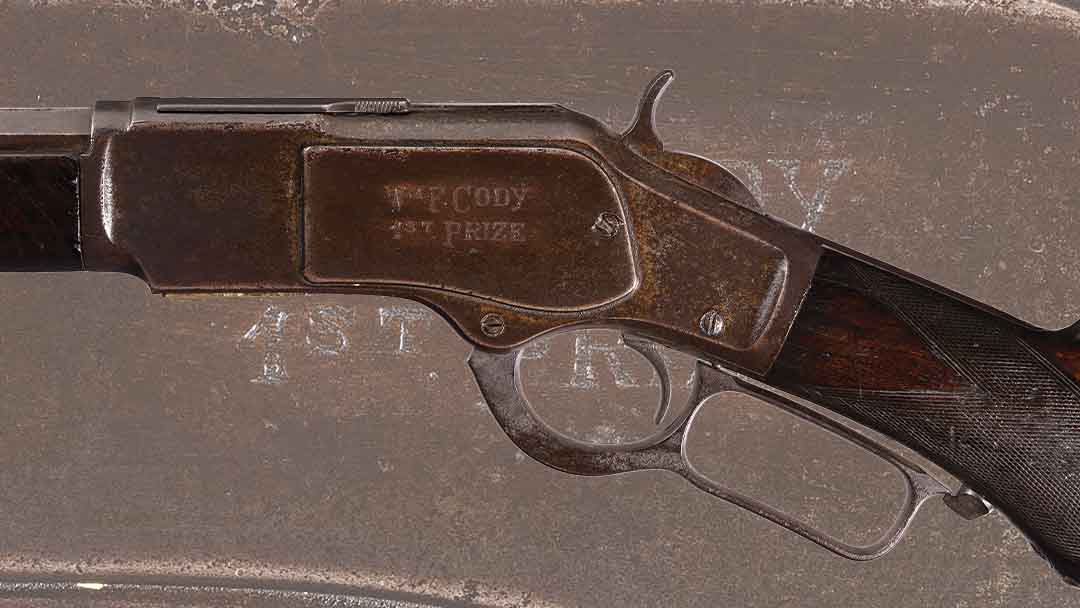
As a frontiersman and Indian fighter, Buffalo Bill was a fine shot, so a Deluxe Model Winchester 1873 in .38 caliber inscribed to “WM. F. Cody/1st Prize” suggests he won it in a shooting contest of some sort. The gun shipped from the warehouse in February 1893 with an octagon barrel, plain trigger, checkered pistol grip stock and casehardened buttplate. Despite no time or place of the shooting match known, the previous owner wrote that the gun was examined by three curators at the Buffalo Bill Historical Center Firearms Museum and the consensus was that the inscription is credible and authentic to the period.
A closeup of a Deluxe Model Winchester 1873 that is inscribed “WM. F. Cody/1st Prize” that has been called credible and authentic to the period by Winchester experts who have examined the rifle.
Evans Rifles for Sale
Buffalo Bill Cody received guns from a number of gun companies as his fame grew and he often gifted them to friends and associates. A gun attributed to Buffalo Bill is an amazing piece of Wild West history on top of the already interesting history of a gun like the Evans Repeating Rifle with its 34-round capacity from the 1870s as is a Winchester that documents Buffalo Bill’s shooting prowess. Another Evans Repeating Rifle with rare engraving by legendary master L.D. Nimschke is also available in the Dec. 8-10 Premier Auction, offering immense opportunities to obtain 19th century guns with amazing history, artistry, and technical innovation.
Sources:
“The Lives and Legends of Buffalo Bill,” by Don Russell
“Buffalo Bill, Last of the Great Scouts,” by Helen Cody Wetmore and Zane Grey
So many amazing revolvers have passed through Rock Island Auction Company, like Ulysses S. Grant’s Remington New Model Army pair, a spectacular Lot 5 Ainsworth-inspected Colt Cavalry Model, and the Parsons Armies just to name a few.
Amazing revolvers can be cool revolvers, too, but what makes a cool revolver? They may not be pristine, beautifully engraved or be attached to a historic figure of Grant’s or Theodore Roosevelt’s stature, but what they have is a fantastic story or fascinating technological advancement that give them that edge. There is that little something extra. Something cool.
All of the cool revolvers featured here are available in Rock Island Auction Company’s inaugural event at its new Bedford, Texas facility, the Dec. 8-10 Premier Auction.
Cool Revolvers: Griswold and Gunnison Percussion Revolver
Straight out of the Confederate arsenal, about 3,700 of these Griswold and Gunnison revolvers were made, making them the largest handgun maker of the rebellion. Manufactured in Griswoldville, Georgia they were a southern example of the Colt Model 1851 Navy.
This wheel gun doesn’t have any markings identifying the maker but it does have mysterious markings like a “13” stamped on the loading lever, “M” stamped on the right surface of the front, and “X” on the left side of the front and back straps. That’s a cool revolver, but there’s more.
There is documentation that John A. Morris, a farmer from Rock Ford, Mississippi, carried this in the Civil War. Morris was a member of Company E, 7th Mississippi Cavalry that served in North Mississippi, Kentucky, and West Tennessee during the war. Morris had the gun when he surrendered at Holly Springs, Mississippi on May 4th 1865.
A scarce, Confederate-documented, southern knockoff of a Colt revolver with appearances in several books is pretty cool.
This Griswold and Gunnison revolver was featured in “Civil War Relics from Georgia” by David and Celeste Topper, noting the gun was manufactured in May 1863, and is also noted in “Confederate Presentation & Inscribed Swords and Revolvers” as well as other publications.
Cool Revolvers: Colt Model 1889 Carried in the Spanish-American War
Rock Island Auction has moved plenty of awesome Colts, be they Walkers, Patersons, Colt Single Action Armies, Model 1860 Armies and M1911s, but who knew how cool a Colt Model 1889 double action revolver could be?
The Model 1889 was the U.S. military’s first double action with a swing-out cylinder, offered in both .41 Long Colt and .38 Long Colt calibers. This particular gun is chambered for .38 Long Colt.
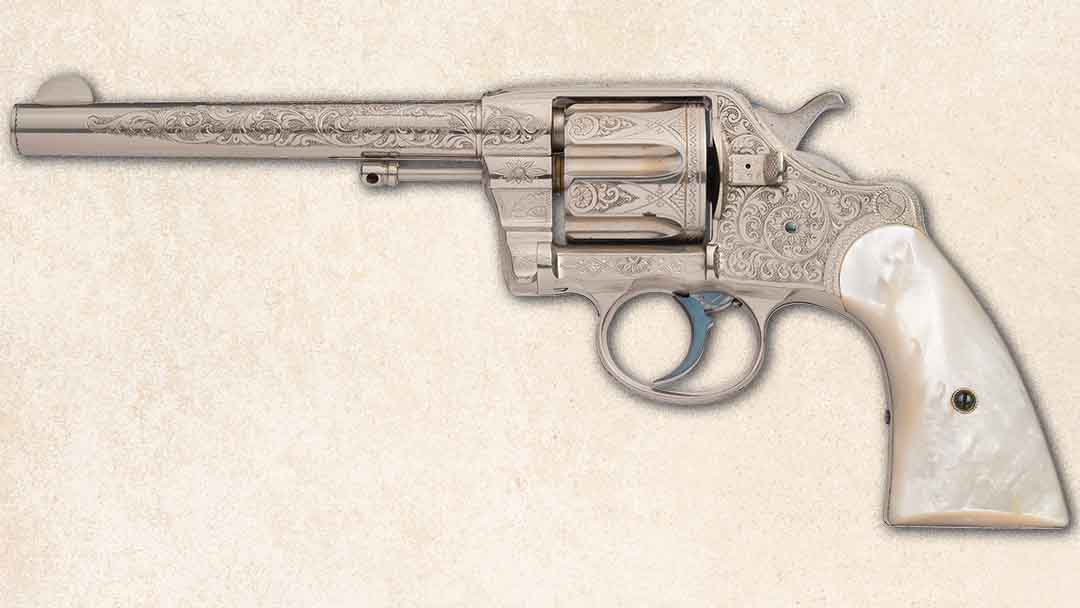
This six-shooter is nickel-plated and with a gold-washed cylinder, and covered with beautifully executed factory engraving, almost certainly by Cuno Helfricht. It was owned by Major Taylor E. Brown of the Illinois National Guard who newspapers reported as the first U.S. soldier on shore in the invasion of Puerto Rico during the Spanish-American War.
Look at the grips! Look at the engraving! The nickel and splash of gold! The nitre blue trigger! It resonates with the history of the Spanish-American War! This two-tone, high condition Colt double action is an unquestionably cool revolver.
Manufactured in 1891 and owned by Major Taylor E. Brown who led a company of engineers ashore in Puerto Rico. Newspapers of the time reported he was the first American soldier ashore when the United States invaded Puerto Rico during the Spanish-American War.
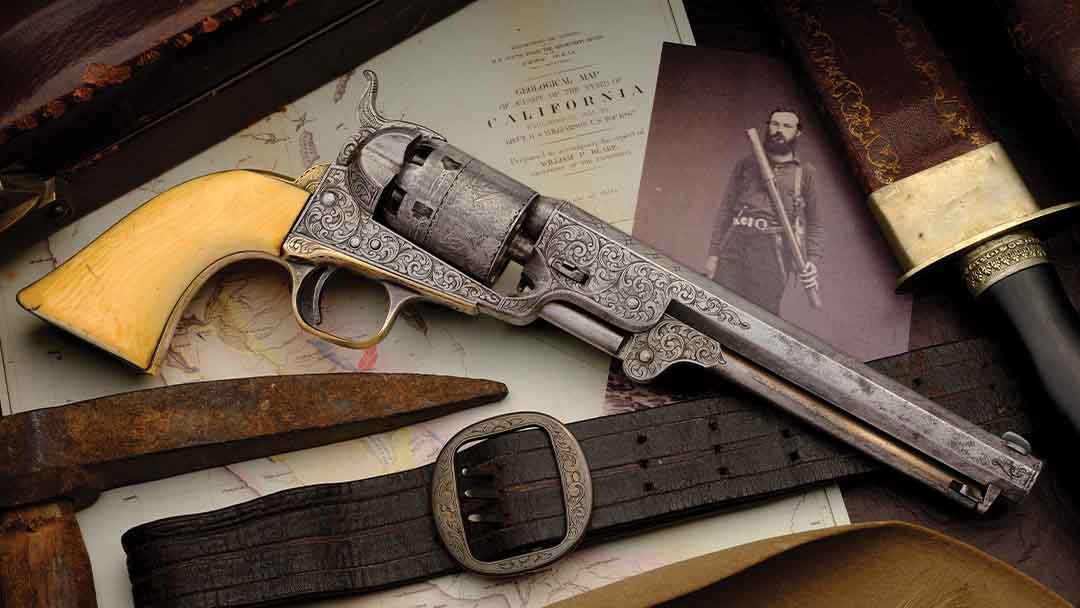
Cool Revolvers: Colt Model 1851 Navy from the First California Geological Survey
Earlier this year, RIAC sold a near mint Colt Model 1851 Navy, an awesome gun. However, this cool Colt Navy was owned by Yale Professor William Henry Brewer when he served as the principal assistant and field operative of the first California Geological Survey. His experiences led to the works “Botany of California” in 1876 and “Up and Down California 1860-1864” in 1930. As well as his role as first assistant, Brewer was also “the first to botanize to any considerable extent in the high Sierras.” His notes and observations were written in a series of letters home that included his travel experiences and observations of habitats and vegetation.
When he returned to Yale in 1864, Brewer was chair of the agriculture department. He also went on expeditions into the Colorado Rocky Mountains (1869), Greenland (1894), Alaska (1899), and the Philippines (1905).
The gun was manufactured in the midst of the Civil War and master engraved by L.D. Nimschke with Germanic scrollwork on a punch-dot background on the muzzle and barrel lug, sides of the loading lever, frame, hammer, trigger guard and back strap. The revolver was silver plated with gold wash on the hammer, cylinder, loading lever, and wedge.
How many different ways is this revolver collectible? Civil War manufactured Colt. Check. L.D. Nimschke engraving. Check. Precious metal finishes. Check. Documented as owned by a Yale University professor who trekked into the Sierra Nevada Mountains as the Civil War raged. Check. Cool revolver for sure. Plus, it gets bonus points for a purple velvet lined case and its Slim Jim holster.
Professor William Henry Brewer’s Colt 1851 Navy was engraved by L.D. Nimschke. It is silver plated with a gold wash and its grips feature a carved golden eagle perched on a cactus with a rattlesnake in its claws and beak based on the Mexican coat of arms. It comes with a purple velvet lined case made in the early 20th century and a hand-tooled California “Slim Jim” holster.
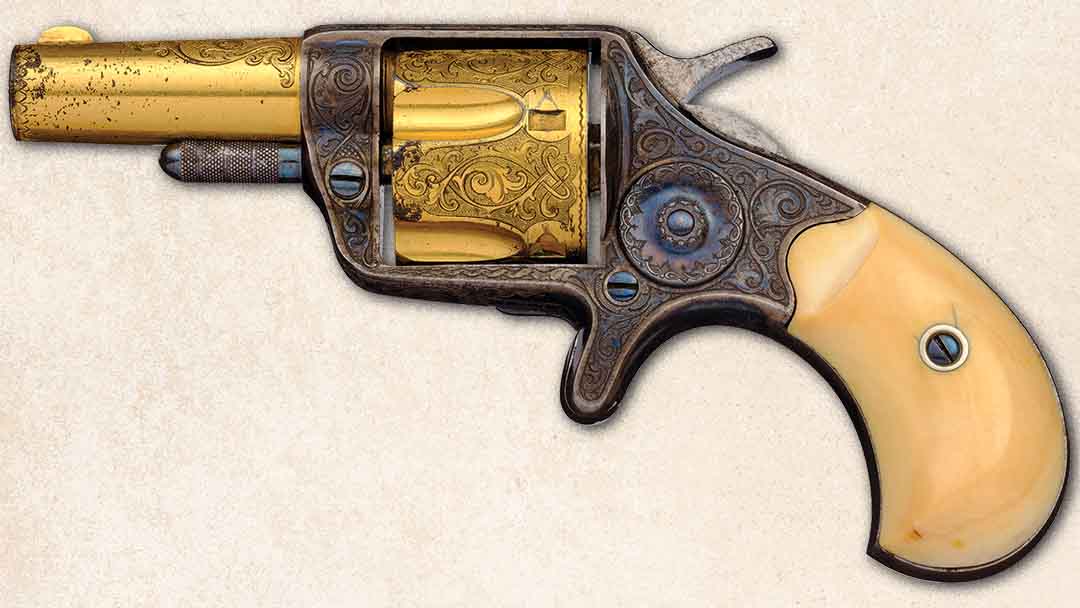
Cool Revolvers: Unserialized Factory Exhibition Engraved Colt New Line
Colt New Line revolvers are pocket wheel guns introduced at the same time as the legendary Single Action Army that found appeal among urban dwellers not wanting to carry a full-size piece. This revolver, without a serial number and its masterful factory engraving was likely made specifically for advertising and display as an example of Colt’s high quality craftsmanship. Chambered in .41 caliber, this spur trigger revolver also comes with a desirable “pipe” style case.
This gun has plenty of attitude with its engraving, gold-plating, nitre blue screws, and casehardening. It was simply made to show off, and it excels at its task.
Likely manufactured for exhibition and advertising, this New Line revolver shows off the fantastic engraving from the Colt factory, featuring masterfully executed vine and scroll engraving on a punchdot background like many of the “wheel display” of revolvers from the 1876 Centennial Exhibition. The barrel and cylinder are gold plated, the frame is casehardened and the small parts are nitre blue.
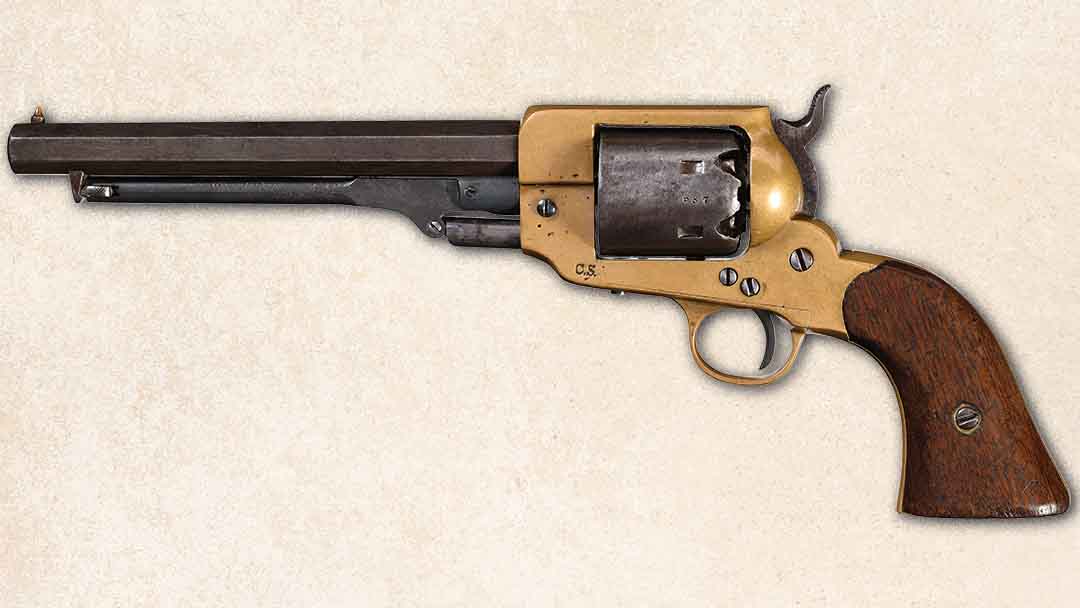
Cool Revolvers: Spiller & Burr
Confederate revolvers are scarce because of the limited manufacturing capability of the southern states during the Civil War. Only 700 Spiller & Burr percussion revolvers were produced in Atlanta from 1862 to 1864. The results of an ambitious Confederate contract of 15,000 revolvers never materialized as manufacturing ended as Gen. William T. Sherman approached on his “March to Sea.” The gun is patterned after the Whitney Navy Model with its brass frame stamped with a “C.S.” marking.
A rare Confederate made and marked, brass-framed revolver is rare and striking in appearance, making it a cool revolver.
This Spiller & Burr brass-framed revolver has matching serial numbers on the trigger guard, barrel, cylinder, frame under the trigger guard, and an included examination letter that states the gun’s condition is “overall condition is above average for a brass framed Confederate firearm.”
Cool Revolvers: Savage & North
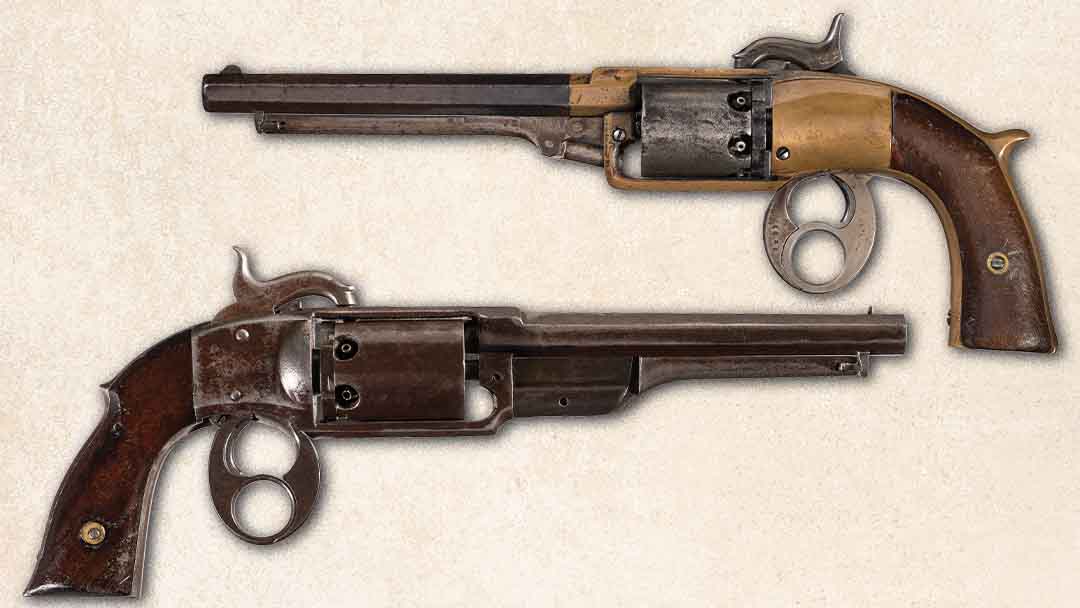
Manufactured between 1856 and 1859, this six-shot revolver is known for its “figure 8”shaped trigger guard that is actually integral to firing it. The lower part of the “figure 8” is the cocking lever that also rotates the cylinder, while the trigger is at the top.
The second variation of the First Model has a brass frame, while the Fourth Model is distinguishable by its iron frame. About 250 of the First Model revolvers were made, and about 50 of the Fourth Model were produced. The Middletown, Conn. Company reorganized in 1859 as the Savage Revolving Firearms Co., and made about 24,000 revolvers for Union military use during the Civil War.
A Union Civil War revolver that is easily recognizable and has a fascinating “figure 8” mechanical design that started with a notable brass frame marks this as a cool revolver.
Shown at top is the Second Variation of the Savage & North First Model “Figure 8” percussion revolver, recognizable by its brass frame, while the revolver below is a Fourth Model, made with an iron frame.
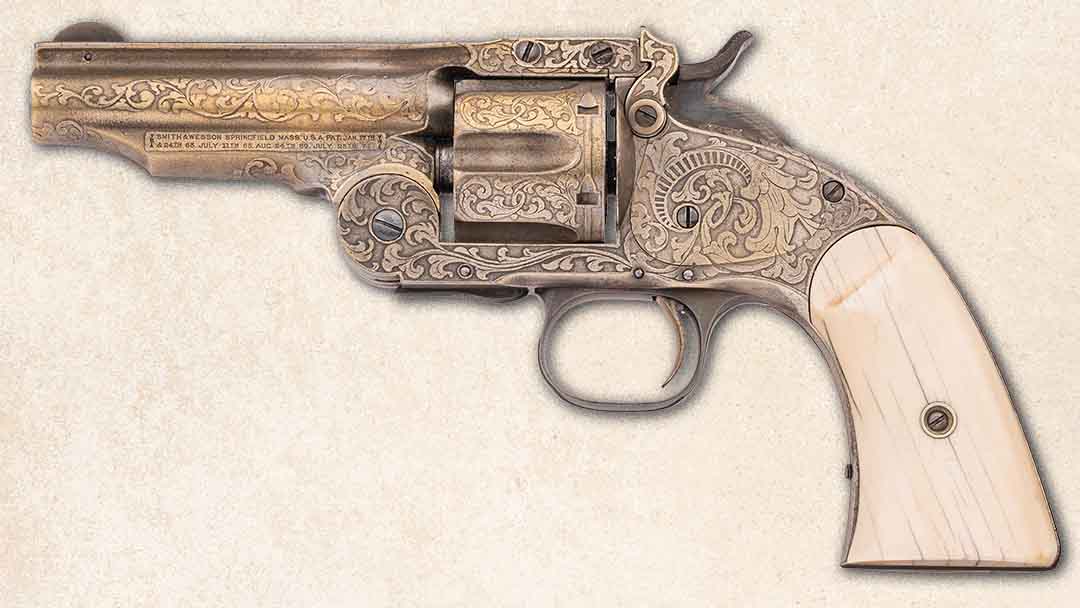
Cool Revolvers: Tiffany & Co. Embellished Smith & Wesson First Model Schofield
Being bedazzled by Tiffany & Co. makes you the belle of the ball. This Tiffany & Co. marked, etched and gold-plated Smith & Wesson First Model Schofield was made in 1876-77 then embellished by the famous jeweler in the 1890s. Smith & Wesson had the largest number of firearms decorated by Tiffany at the close of the 19th century.
Smith & Wesson guns adorned by Tiffany were never duplicate models and were executed on a mostly individual basis. These guns were commissioned by D.B. Wesson who was a believer in Tiffany & Co.’s artisanship. Many of these are documented in R. L. Wilson’s book “Steel Canvas: The Art of American Arms.”
Tiffany & Co. guns also are included in the Metropolitan Museum of Art’s collection, so you can get a Smith & Wesson regarded as a work of art. That’s a pretty cool revolver.
This Smith & Wesson First Model Schofield is nearly covered with floral scroll acid etched in the art nouveau style popular at the time along with Maltese crosses. The hammer and trigger guard are casehardened while the trigger and other remaining surfaces are gold-plated.
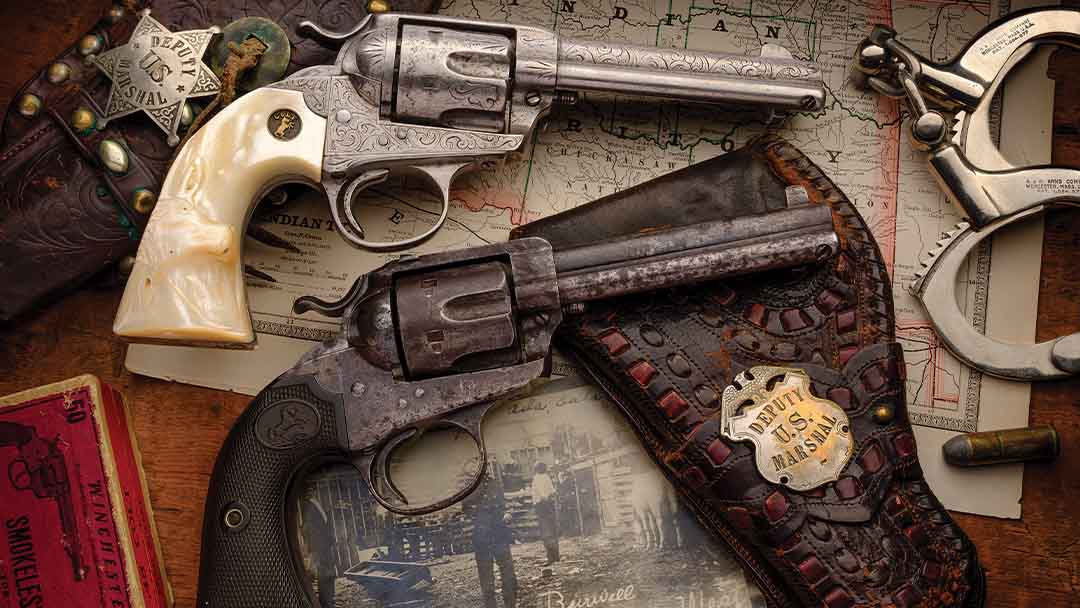
Cool Revolvers: Colt Bisley Single Action Armies Owned by Oklahoma Lawmen
Bisley revolvers, designed for shooting in the British Bisley pistol matches, have a distinct grip shape as well as lower and wider hammer spurs. This pair belonged to members of the Collins family of Oklahoma, a long line of U.S. Deputy Marshals. George Collins, who died in 1982, said in an interview that his father, Charlie Collins who was a deputy U.S. Marshal, gave him the nickel plated, pearl-gripped revolver chambered in .38 WCF when he became a deputy sheriff in 1939. The factory engraved gun served as a sidearm for three generations of Collins.
Ben Collins, an uncle of George Collins, owned the blued, Special Target Bisley chambered in .45 Colt with a shortened barrel. He was fatally shot in a revenge killing by James B. Miller during an August 1906 ambush. Miller, also known as Killer Miller and Killing Jim Miller, also killed legendary lawman Pat Garrett two years later.
The documented Colt Bisleys from a family of U.S. Deputy Marshals in Oklahoma, including one who was killed by the same man who killed Pat Garrett, and a rare .45 caliber chambering for a Bisley makes these guns extremely rare, highly collectible and definitely cool revolvers.
These Colt Single Action Army revolvers are both Bisley models. The top revolver, chambered in .38-40, with a 4 3/4-inch barrel is nickel-plated and has factory engraving and pearl grips. The Bisley below is one of only 97 chambered for .45 caliber and shipped in .45 caliber with a 7 1/2-inch barrel that was shortened and had a blued finish. It is accompanied by a dark leather single loop holster.
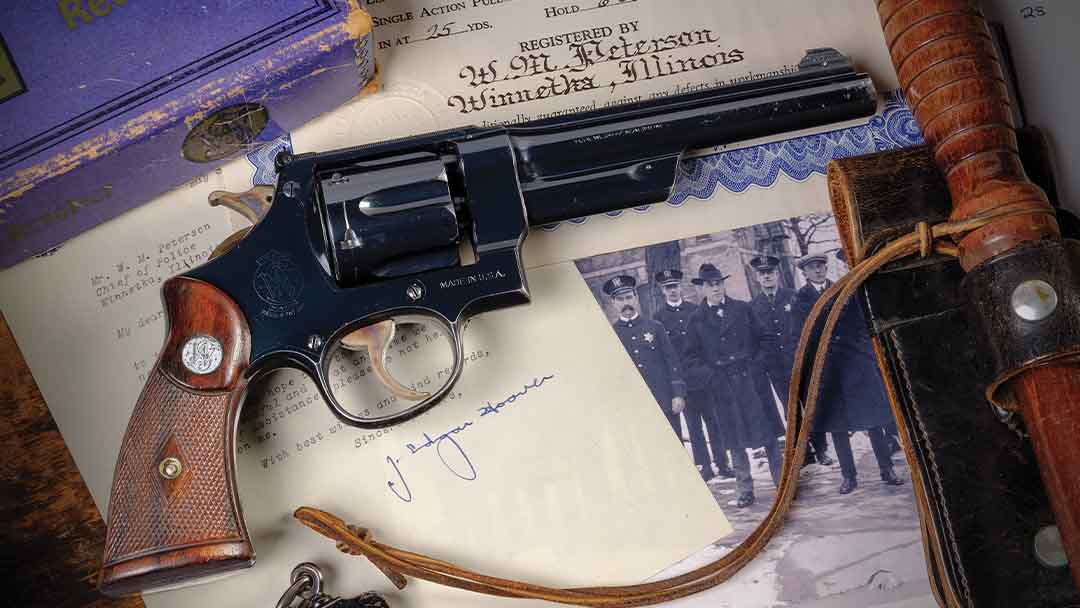
Cool Revolvers: A Police Chief’s .357 Registered Magnum
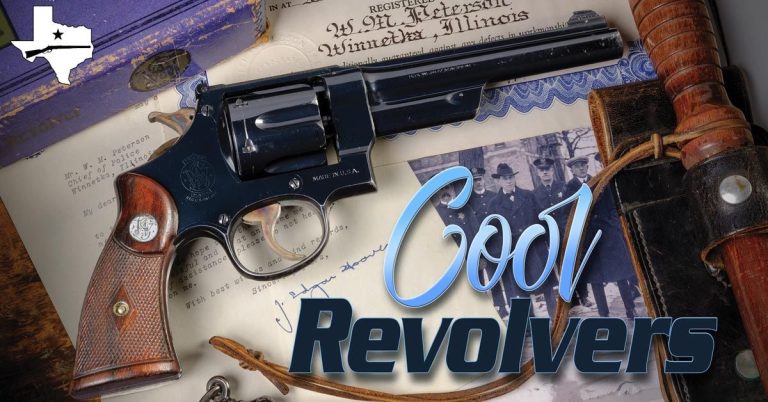
Winnetka, Illinois Police Chief W.M. Peterson registered his Smith & Wesson Registered Magnum double action revolver after it was shipped in April 1937 with a six-inch barrel.
Peterson was the first full-time police chief of Winnetka, a suburb of Chicago. He served in the position for more than 30 years, a period that spanned both world wars (1913-1945). Before Peterson, the police organization was a part-time marshal and four officers. Included with the revolver is correspondence between Peterson and notable law enforcement members. A letter from FBI Director J. Edgar Hoover congratulated Peterson on being elected vice president of the Association of Chiefs of Police. Other letters are related to investigations of Third Reich and communist sympathizers.
This Registered Magnum shows the wear of a well-cared-for police sidearm with its bluing, and is accompanied by its registration card and letters from significant law enforcement figures of the day to make it a cool revolver.
The Registered Magnum of Winnetka Police Chief W.M. Peterson was manufactured with a six-inch barrel one of only 839 made with that configuration. It has a blued finish square notch rear sight and checkered walnut Magna grips and is accompanied by the original registration certificate.
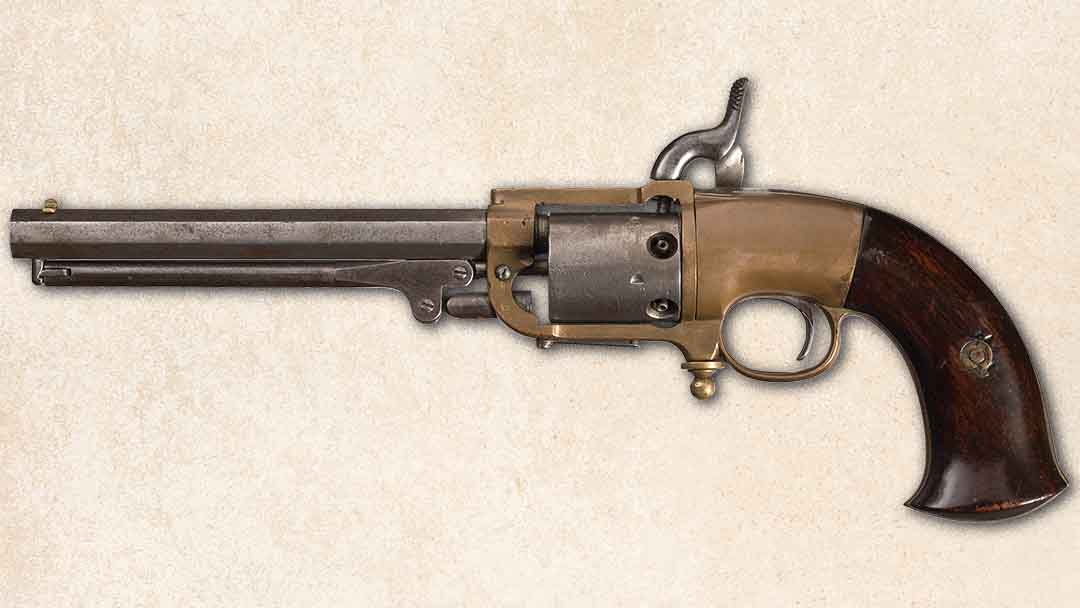
Cool Revolvers: Civil War-Era Butterfield Army Model
Philadelphia gunmaker Jesse Butterfield’s revolver relied on a patented priming system that fed priming discs from a spring-loaded tube to fire .41 caliber ammunition. He was commissioned to make revolvers for the “Ira Harris Guards” of the 5th New York Cavalry for the Civil War, but didn’t actually have a contract with the U.S. Ordnance Department.
Butterfield made between 590 to 640 of the revolvers but was unable to sell them, even offering them for $1 at the close of the Civil War. This revolver is serial number 267.
Jesse Butterfield was an innovative gunmaker but a terrible businessman. He simply couldn’t sell his namesake firearm – an innovation that never took hold — during a war, and that makes it a cool revolver.
This brass-framed Butterfield Army Model is chambered in .41 caliber. The gun came at a time when self-priming guns were popular for being able to fire more rapidly, waterproof, and having surer ignition.
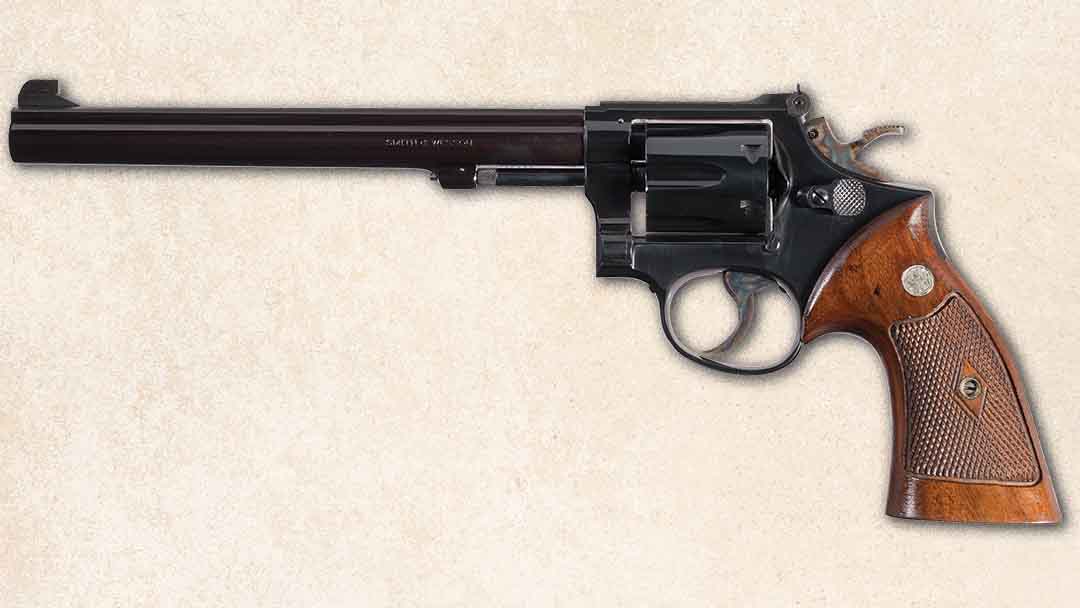
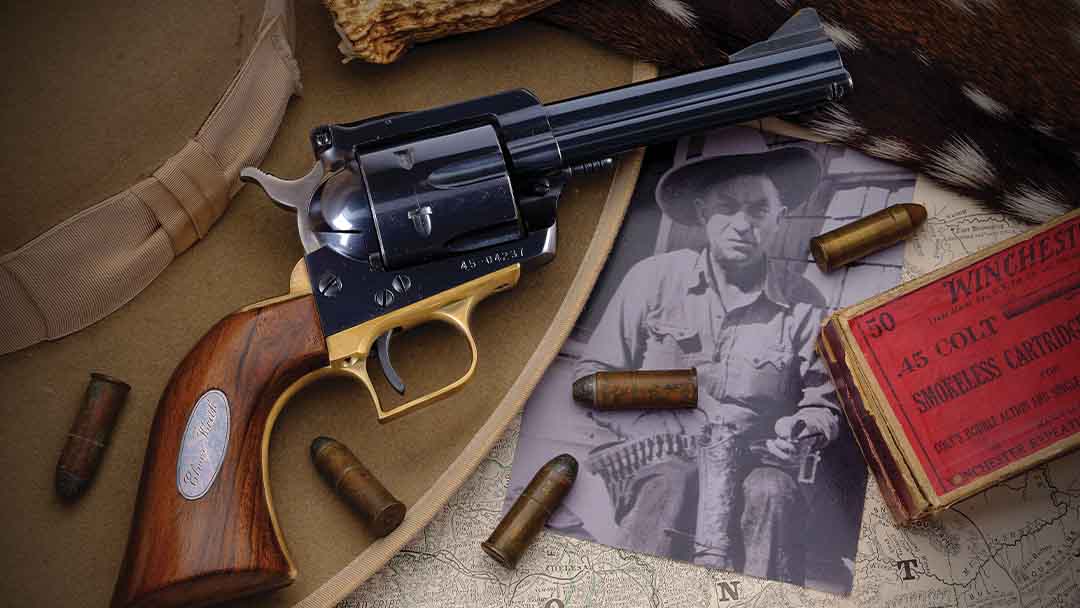
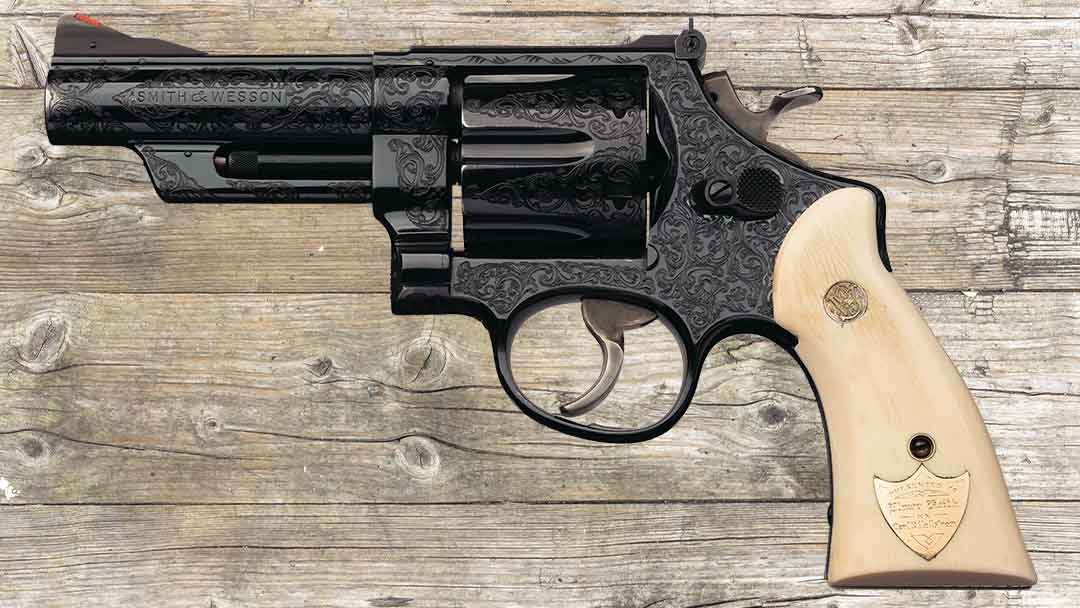
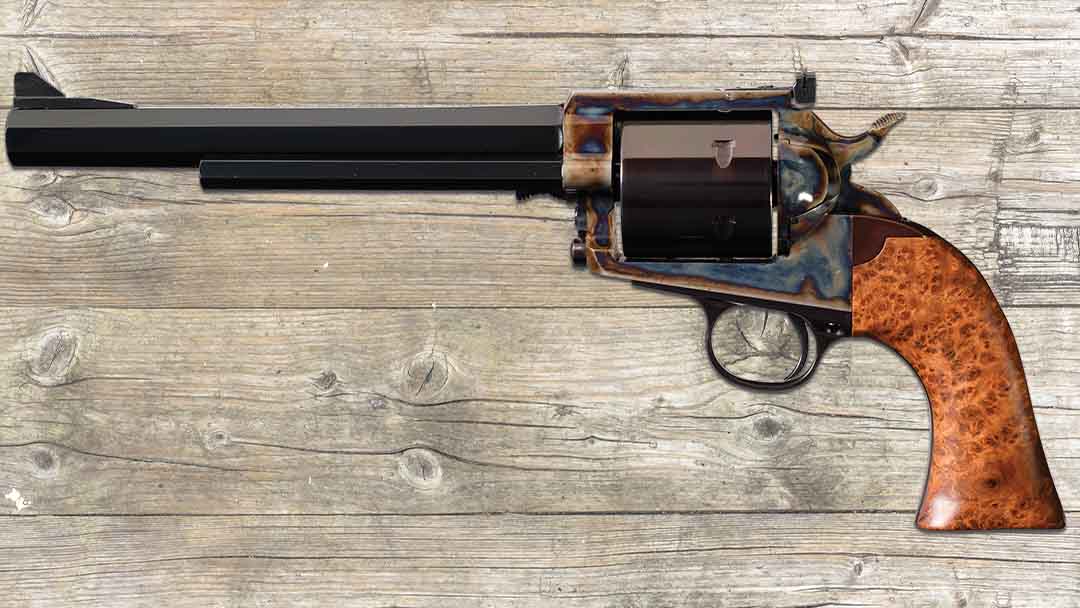
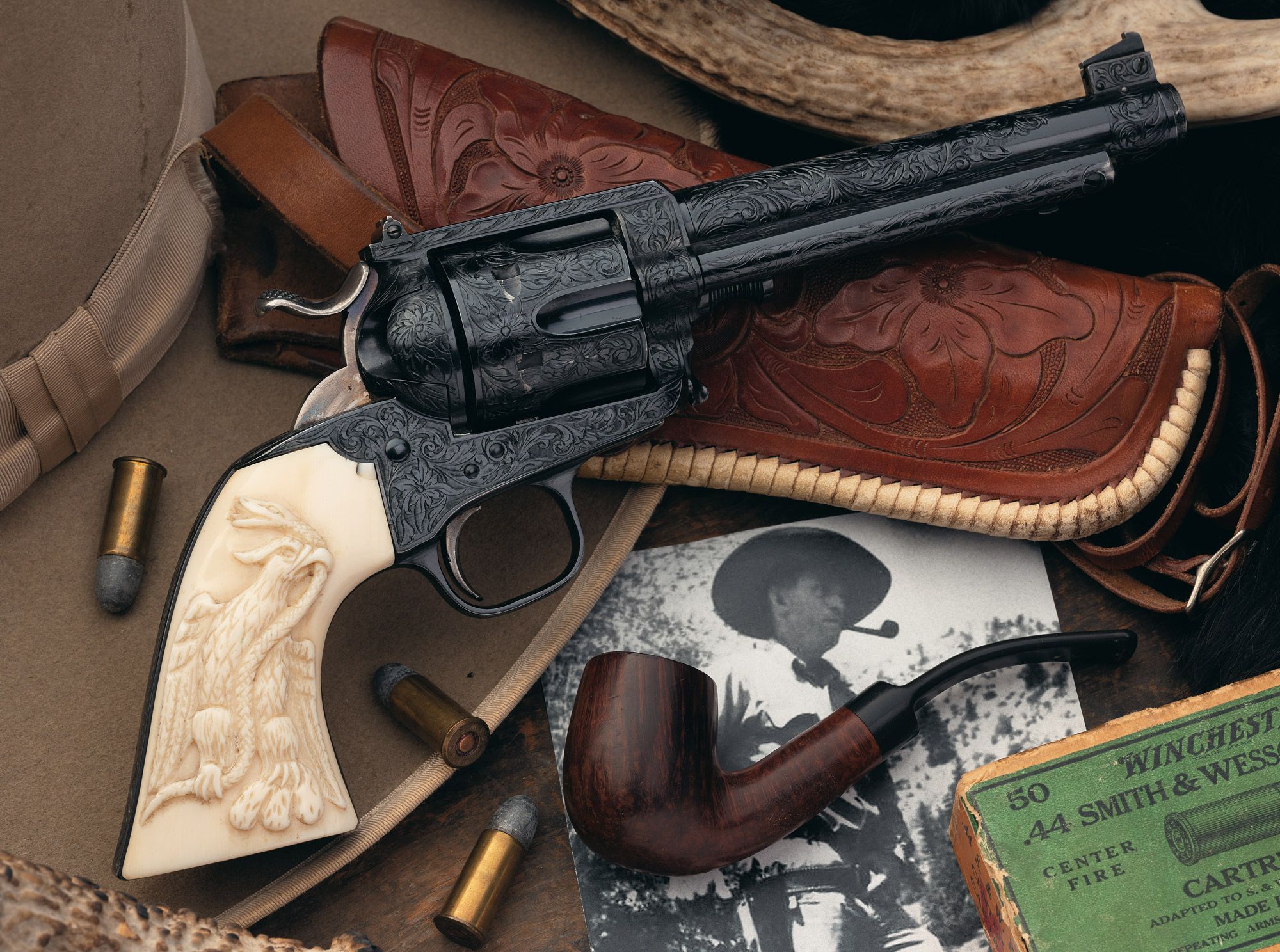
Frank L. Wyman was a well-known pistol shooting competitor who served as Secretary of the National Rifle Association for many years and also director of the program division until he retired in 1966. This Smith & Wesson was given to him at his retirement.
This K-32 Masterpiece has an 8 3/8-inch barrel that was fitted at the factory likely at the request of Wyman. The revolver originally shipped with a 6-inch barrel. Only 3,630 K-32 Masterpiece revolvers were manufactured over 26 years starting in 1947.
The provenance of Wyman, as secretary of the National Rifle Association and a significant figure in pistol shooting circles of his time, along with its extended factory barrel and jaw-dropping condition, makes this a surprisingly cool revolver.
This revolver is the rarest of the standard K-Masterpiece series, has a factory-fitted 8 3/8-inch barrel, and comes with a presentation case with royal purple lining that was attributed as a retirement gift for NRA Secretary Frank L. Wyman.
Cool Revolvers for Sale
Revolvers don’t all have to be extremely rare, have an epic history, or high condition to be cool. They just have to have that special something like a fascinating story or a technological innovation, whether it succeeds or fails, to set it apart and make it cool. All of the above-mentioned revolvers have that undeniable cool factor and they are available in Rock Island Auction Company’s Dec. 8-10 Premier Auction.
Outdoor legend, handloader, and writer Elmer Keith knew what a good cartridge for game was, and that the .38 Special wasn’t strong enough to stop a man. He helped develop the .357 Magnum, .44 Magnum, and .41 Magnum rounds. Elmer Keith spun yarns of the mountains, gunfights, and 600-yard shots in the yet untamed American West of the early and mid-20th century.
A mentor and ally to many, Elmer Keith was also a lifelong student and collector of guns. These Elmer Keith guns: a Colt Model 1851 Navy, a pre-29 Smith & Wesson, an inscribed and engraved Smith & Wesson Model 1917, a factory game scene engraved Victor Sarasqueta double rifle, and a Ruger Old Model Blackhawk single action revolver will cross the podium along with many other high conditioned, historic, and beautiful firearms Dec. 8-10 at Rock Island Auction Company’s inaugural Premier Auction at its new Bedford, Texas location.
Elmer Keith Guns: Colt Navy
Keith wrote in his book “Sixguns” that he learned to shoot handguns with the Colt Navy (Model 1851). “When a boy, our best small game revolver was an old .36 Navy Colt 1851 model. It accounted for a great many grouse, sage hens and rabbits, both big Montana jacks and cottontails.”
He expanded further on the Colt Navy. “Its grip was perfect for most men, and while smaller, it was much the same shape as the old Walker grip. In fact Colt pistols show little change in grip shape from the 1847 Walker on down to the Colt’s S.A. Army, manufactured up to the second world war. No other grip will absorb the recoil of a heavily loaded revolver with less punishment to the hand, as it simply turns up in the hand in recoil, allowing the thumb to come up over the hammer for a quick repeat shot. This design was excellent for cavalrymen and both safe and fast when a recalcitrant horse had to be managed at the same time.”
Keith, born in Missouri in 1899, moved with his family to Montana as a young boy. He knew Civil War veterans and gunfighters. Sometimes the two intersected, like Confederate Major R.E. Stratton who served in the 1st Texas Regiment during the Civil War. He carried a pair of Colt Navy revolvers serving under Robert E. Lee and as he rode the West, Keith wrote.
“I bought one of them from him and when I asked him what became of the mate to it, he wrote me that he lost it, along with his left arm in a gun fight in Cheyenne, Wyoming and that I might possibly find it in or around Cheyenne somewhere.”
Elmer Keith’s Colt Navy is well documented and features Keith’s name lightly inscribed on the barrel and classic Germanic scroll factory engraving along with a bird’s head on the left side of the barrel and floral blooms throughout. It has a raised relief carved steer head on the left side grip. The gun has been displayed at the Elmer Keith Museum in Boise, Idaho, and was part of the “Handloader Magazine” article “Elmer Keith Museum: Tribute to a Legend.”
Elmer Keith Guns and Wisdom
Keith wasn’t one to bother with automatic pistols. He was a wheelgun man through and through, writing in “Sixguns,” “The sixgun was as important a part of a cow-poke’s outfit as his rope. Throughout the West the sixgun was responsible for most of the law, what little there was, and one of the main deterrents to wholesale outlawry.”
Keith was acquainted with firearms from a young age, with his father teaching him to shoot small game to help feed the family. “To become an expert sixgun shot, one must live with the gun. Only by constant use and practice can one acquire a thorough mastery of the shortgun. You must work and play with it, eat with it, sleep with it and shoot it every day – until it becomes a part of you and you handle it surely and easily as you would your fork and knife at the table. Muscles and nerves must be trained for the job in hand.”
A Smith & Wesson Government Model 1917 engraved and inscribed to Elmer Keith is chambered in .45 ACP with a blued finish and 5 1/2-inch barrel. Engraving includes a walking, spread winged eagle in raised gold on the right side plate as well as flowing floral scrolling, arabesque and feather patterns adorn the gun. The backstrap is inscribed Elmer Keith.
He participated in match shooting at Camp Perry in the 1920s when he served in the National Guard. When an officer asked where he learned to shoot he replied that it certainly wasn’t in the Army.
As a young man Keith bought a Colt Single Action Army and started hunting with it. In his writing he advised to practice until being accurate up to 50 yards out on a regular basis. “Shoot only when you know you can place your shot, is a rule for all hunters and especially so for pistol hunters. There is no satisfaction in wounding and losing game.”
He often decried hunters that used underpowered ammunition that didn’t take down their quarry. In a July 1964 column for “Guns & Ammo” magazine, he reported how a Colorado hunting guide required clients to use rifles rated for at least 3,125 foot/pounds or 250-gr bullets at not less than 2,800 foot/pounds. After the season the guide reported his hunters took 14 elk and there were no crippled elk or wounded elk that were lost.
“(The guide) said he had grown tired of trailing up elk wounded with .270s, .308s, and .30-06s, and this year placed a mandatory caliber limitation on all who booked. It paid off,” Keith wrote. “He said all hunters did exceptionally well even with rifles having some recoil.”
Keith considered his guns to be tools of his trade, whether it was hunting or self-protection, and that quality tools were important, he wrote. “You get about what you pay for in this world, be it guns, autos, whiskey or clothes. Start with the best gun you can afford.”
This game scene engraved Victor Sarasqueta sidelock double rifle with scope has a coin finish and scroll engraving surrounding four deeply engraved game bird scenes. A flock of Mallards in flight appears on the left, a covey of pheasant on the right, mallards in flight over water underneath, and a standing crane on the trigger guard. The gun was previously owned by Elmer Keith.
Elmer Keith Guns and the Ruger Old Model Blackhawk
Keith’s book, “Sixguns” came out in 1955 just as manufacture of the Colt Single Action Army, out of production since the start of World War 2, was going to resume. Ruger, knew this and quickly worked to put one of their new single actions in Elmer’s hands. If Elmer Keith could gush over a gun it was this one.
“For the shooter, be he plinker, peace officer, cow-poke or hunter, this new Ruger is a good, well-made arm. Colt collectors may prefer the original old Peacemaker but any shooter who wants to have first class target sights combined in a really modern arm with all improvements including the rebounding separate firing pin will find the new Ruger Blackhawk the finest single action revolver manufactured to date.”
Yes, he wrote “the finest single action revolver manufactured to date.” And yet there’s more hyperbole about the Ruger, from Keith.
“(The Colt Single Action) will sell to collectors and to those who just want a genuine Colt Peacemaker, but for the shooter or gun crank, Bill Ruger has a far better single action than has ever came out of the Colt Factory,” Keith wrote.
Keith mentions this Ruger Old Model Blackhawk with a 4 5/8-inch barrel in his book “Hell, I Was There,” in discussing a hand-loaded cartridge he made. The revolver, from Keith’s collection, is available in the upcoming Premier Auction and includes a letter stating it was bought from Keith’s estate in March 2015 and a letter stating when Ruger shipped it. The gun itself has a fixed blade front sight and adjustable rear notch sights, a scarce brass grip frame, and custom tuned trigger. The grips are smooth with an inset silver elk head on the left panel and a silver inscription oval on the right inscribed “Elmer Keith” in fancy script.
Elmer Keith Guns: Presentation Pre-29 with holster
As a handloader and writer, Keith was a pivotal figure in the 1930s development of the .357 Magnum cartridge. As mentioned earlier, he didn’t find the .38 Special round to be strong enough, especially for police use, so Keith and others went on lobbying for a more thumping round. Never done tinkering and experimenting, it would be almost two decades before he began development on the .44 Magnum.
The .44 Magnum was born in the 1950s, again with Keith and other handloaders leaning on ammo makers. Remington acquiesced as long as a gun manufacturer agreed to make a gun that could handle it. Smith & Wesson answered the call with their simply named “.44 Magnum,” which several years latter would be redubbed the Model 29.
He wrote about trying the new Smith & Wesson in .44 Magnum. He would later carry a pair with 4-inch barrels. “Both gun and load proved to be all I had dreamed. The 6 ½-inch barrel gun was a masterpiece, both as to accuracy and careful fitting and sighting. In fact I consider it the finest product of the great Smith & Wesson factory.”
One story that Keith told about the .44 Magnum was during a fishing trip off the coast of California when Keith’s group encountered several sharks on their return trip. Keith, strapped with his .44 Magnum, found an advantageous position on the boat and started taking shots at them.
“Shooting was usually at 50 to 60 yards, but being up in the pilot house gave me a very good angle of fire,” Keith wrote in his July 1963 “Guns & Ammo” column. “By aiming just below and in front of the big dorsal fin that protruded out of the water, I started getting hits from the outset… I had one close shot – at some 25 yards – at a big one and saw the strike in front of his dorsal fin. He simply curled himself in a half circle and lay there stiff and as the boat rolled around him I tried another shot at the back of his head but never did learn the result (except I know I hit him).”
This Pre-Model 29 with a 4-inch barrel has a blued finish with engraving by George Dallas, red ramp front sight, white outline rear sight, target hammer, target trigger, blue finish, and Magna grips. The carved grips feature gold S&W monogram medallions, a gold inlaid presentation inscription shield engraved “PRESENTED TO/Elmer Keith/BY/Carl R. Hellstrom” on the left panel, and a relief carved American eagle on the right panel. The gun was presented to Keith by his friend and S&W President Carl Hellstrom who was encouraged by Keith to develop a revolver capable of loading the .44 Magnum.
Elmer Keith Guns and Gunfights
Keith was in Washington D.C., once for an NRA meeting and visited the Smithsonian Institution and its gun collection. As he perused the firearms collection he met three men who told him about practicing their quick draw technique and that two of them shot themselves in the leg. “Quick draw practice should be with empty guns until thoroughly mastered,” Keith wrote, recounting the conversation.
He also offered some wisdom about gunfights, writing “The best way to keep from getting hurt in a gunfight is to keep from getting into a gunfight.”
In December, RIAC will offer an homage to Keith’s Old No. 5, one of 1,200 designed by gunsmith Bill Grover of Texas Longhorn Arms. The gun is designed to be loaded and unloaded from the right hand and the unfluted cylinder rotates counter clockwise. It has a fixed blade front and adjustable rear notch sights with a gorgeous Bisley pattern smooth burl grip.
Keith was a proponent of making sure to be well armed when confronted by desperados or hoodlums. “Criminals seldom travel singly and you may have more than one adversary. It is mandatory that you carry a holster gun powerful enough to floor an opponent, with one well placed hit,” he wrote in “Sixguns.”
He praised police departments that committed to harder-hitting ammo for its officers, calling .38 Special a “pip-squeak.” In his December 1962 column for “Guns & Ammo,” Keith singled out the El Cajon PD for permitting officers to use .44 Special.
“If all police departments in this country were to emulate El Cajon and train their officers thoroughly in combat firing, we would not lose a fraction of the good police officers we now do annually,” he wrote.
Elmer Keith Guns at Rock Island Auction Company
The rugged outdoorsman left a legacy of hard-earned handgunning tales, wildcatting cartridges, and a seemingly infinite knowledge of guns and ammunition that is reflected in the firearms he collected. Elmer Keith’s guns are a reminder of an untamed American West of not so long ago and offer a link to that time and the man who chronicled it.
Rock Island Auction Company had the privilege to sell Elmer Keith’s Custom Colt Single Action Army target revolver called the Old No. 5 in September 2021 for $253,000.
Arthur William Merrifield (1855-1929) was a Canadian by birth but a man of the American West through and through. He worked as a rancher in the Dakota Territory in the 1880s with Sylvane and Joseph Ferris and personally guided Theodore Roosevelt on some of his first hunts in the West after Roosevelt first came to their Chimney Butte Range to hunt buffalo in September 1883. Merrifield guided his first grizzly bear hunt in 1884 in the Bighorn Mountains, during which Merrifield tracked the grizzly Roosevelt shot.
Theodore Roosevelt went back and forth from the east coast to the Dakota Territory in the early 1880s. It was during this time, that the future Rough Rider presented this Merwin, Hulbert revolver to hunting guide, business partner, and friend Arthur William Merrifield. Available this December.
Initially skeptical of the easterner, Merrifield became close personal friends with the future president as well as his business partner after Roosevelt invested ranches in the Dakota Territory in the 1880s. Both men had lost their wives in the early 1880s shortly after the births of their first children, and they shared a love of hunting, the West, and animals. Merrifield continued to correspond with Roosevelt as the New Yorker’s political clout grew and visited with him on a number of occasions. Later, as president, Roosevelt appointed Merrifield as a U.S. Marshal for Montana.
Theodore Roosevelt gifted a Merwin, Hulbert revolver to his friend Arthur William Merrifield while he was living in the Dakota Territory in the 1880s. The pocket watch was a reward from Roosevelt to Merrifield for guiding him on a hunt that resulted in the future president taking a grizzly bear. It is inscribed with Merrifield’s quote from a hunt, “If it’s a black bear, I can tree him. If it’s a grizzly, I can bay him.” Available this December.
The Goliath-sized grizzly bear taken by Roosevelt on his hunt with Merrifield was reported to be nine feet and over 1,000 lbs. As recorded in multiple publications, Roosevelt offered Merrifield $150 or a gold watch in return, and Merrifield selected a pocket watch which is inscribed with a quote from Merrifield during the hunt: “If it’s a black bear, I can tree him. If it’s a grizzly, I can bay him.”
Theodore Roosevelt as a young hunter on the left in the early 1880s in the Dakotas. On the right is a rendering of the future Rough Rider and U.S. president taking a massive grizzly on the hunt with Arthur William Merrifield.
Theodore Roosevelt Writes About His Grizzly Bear Hunt
The Theodore Roosevelt Center has Roosevelt’s letter to his sister Bamie on September 20, 1884, after his hunting trip into the Bighorn Mountains with Merrifield. He wrote,
“I shall not soon forget the first one [grizzly bear] I killed. We had found where he had been feeding on the carcass of an elk; and followed his trail into a dense pine forest, fairly choked with fallen timber. While noiselessly and slowly threading our way through the thickest part of it I saw Merrifield, who was directly ahead of me, sink suddenly to his knees and turn half round, his face fairly ablaze with excitement. Cocking my rifle and stepping quickly forward, I found myself face to face with the great bear, who was less than twenty five feet off — not eight steps. He had been roused from his sleep by our approach; he sat up in his lair, and turned his huge head slowly towards us. At that distance and in such a place it was very necessary to kill or disable him at the first fire; doubtless my face was pretty white, but the blue barrel was as steady as a rock as I glanced along it until I could see the top of the bead fairly between his two sinister looking eyes; as I pulled the trigger I jumped aside out of the smoke, to be ready if he charged; but it was needless, for the great brute was struggling in the death agony, and as you will see when I bring home his skin, the bullet hole in his skull was as exactly between his eyes as if I had measured the distance with a carpenter’s rule.”
In 1906, Arthur William Merrifield hosted Theodore Roosevelt’s nephews Monroe and Stewart Robinson on a hunting trip and its believed they presented him with this Winchester Model 1894, likely recommended by the president. Available this December.
Sometime during this period Roosevelt is reported to have presented Merrifield with the Merwin, Hulbert & Co. revolver and J.S. Collins & Co. holster rig. The revolver, holster, and watch were among the items that remained in the Merrifield family deep into the 20th century and were owned by his granddaughter Blanche Merrifield McDaniel.
The inscribed Merwin, Hulbert & Co. single action revolver given to Merrifield by Roosevelt and the inscribed pocket watch from the bear hunt are in one lot during RIAC’s inaugural event in our newly expanded Bedford, Texas, location. A second lot is Merrifield’s Colt Model 1903 Pocket Hammerless, shoulder holster rig, and badge he carried as a U.S. Marshal in Montana. A special order Winchester Model 1894 presented to Merrifield by Roosevelt’s nephews on a hunting trip is a third lot available in the auction.
Merrifield and Sylvane Ferris continued to manage Roosevelt’s herd after the closure of the Elkhorn Ranch in 1887. In an included letter from Sagamore Hill dated Oct. 13th, 1889, Roosevelt writes to Merrifield telling him of the birth of his new son and noting his regret of his loss running for office and also asks about cattle shipments and payment. The letter is signed, “Your friend, Theodore Roosevelt.”
Merrifield remained on for a few more years and finally sold out in the early 1890s and moved to Montana where he established his own ranch at the headwaters of the Kooteni River on Pleasant Valley Creek. Later he formed the Pleasant Valley Land & Cattle Company in 1901 and served as its general manager. Ferris managed the herd in the Dakota Territory which Roosevelt continued to have an interest in until the Rough Rider leader sold his interest in 1898, something he’d discussed for several years.
Merrifield remained in contact with Roosevelt who had returned to the East and was elected governor of New York, served as vice president under President McKinley, and then president upon McKinley’s assassination in 1901. When Roosevelt ran for re-election in 1903, Merrifield went to Spokane, Washington, to see Roosevelt’s speech, and Roosevelt was filled with joy upon seeing his old friend, pulling him aside for a chat in the speaker’s box before the speech. Merrifield served as Montana’s elector when Roosevelt won the election and visited with the president while in Washington, D.C., in 1905.
Merrifield’s pistol, its holster rig and the badge he carried after Roosevelt appointed him a U.S. Marshal for Montana are available this December.
Theodore Roosevelt Appoints Merrifield as U.S. Marshal
In the fall of 1905, Merrifield wrote to his friend President Roosevelt seeking a position as a U.S. marshal in Montana. Marshal positions are appointed by the president, and Roosevelt gladly worked to place his friend in the office. Merrifield was a man he respected and trusted, but they had to wait until the sitting marshal’s term ended before he could take the position. He was sworn in on January 2, 1907, as the 12th U.S. Marshal for the District of Montana the year after the Colt Pocket Hammerless pistol was manufactured.
Theodore Roosevelt’s friend and business partner Arthur William Merrifield asked for an appointment to be a U.S. Marshal for Montana in 1905. He was appointed and sworn in in 1907. During that time, Merrifield carried this Colt 1903 Pocket Hammerless and its holster. Available this December.
Earlier in 1906, two of Roosevelt’s nephews, Monroe and Stewart Robinson, traveled to Merrifield’s ranch to go hunting. While there, Merrifield was injured during a fall from a haystack leading to a broken wrist preventing him from going on the trip, but he arranged suitable guides in his stead. It was during this hunting trip that Merrifield is believed to have been presented the Winchester Model 1894 by the Robinsons. Theodore Roosevelt likely recommended the rifle as a gift for his longtime friend. Roosevelt wrote to Merrifield on November 29, 1906, thanking him for being “mighty good to Monroe and Stewart. I am greatly obliged to you. I look forward to sending in your appointment soon.” He also wrote to Merrifield on January 16, 1907, about 16-year-old Oliver Roosevelt coming out to do some hunting and asked Merrifield to write to the boy’s mother, Mrs. J. West Roosevelt of New York City, as to what steps the teenager should take.
A Winchester Model 1894 attributed as presented to Merrifield by Roosevelt’s nephews. Available this December.
Included documents show that the rifle, like the other items in this auction, was owned by Arthur William Merrifield’s family for many years. Norman V. Chatterman first used the rifle on a hunt in 1947 with his uncle John A. McDaniel, husband of Blanche Merrifield McDaniel, Merrifield’s granddaughter. She reported that the rifle had been purchased as a thank you gift for Merrifield hosting members of the Roosevelt family at his ranch and “it had been told to her that the gun was made special order from the Winchester factory to be a duplicate of one that Theodore Roosevelt had.” Blanche Merrifield McDaniel had inherited the rifle from her grandfather and later sold it to Chatterman in 1990, and he later sold the rifle to Greg Lampe in 1999.
Roosevelt wrote about shooting pronghorn with one of his Winchester Model 1894s in Good Hunting: In Pursuit of Big Game in the West, stating that after he had shot a pronghorn through the flank at 180 yards, Joe Ferris remarked, “I guess that little 30-30 is the ace” to which Roosevelt added, “I guessed so too.” He also owned many other Winchesters and famously took several along with thousands of rounds of ammunition on the Smithsonian-Roosevelt African Expedition in 1909-1911 after leaving the White House. A Winchester Model 1876 presented to Merrifield by Theodore Roosevelt is displayed at the South Unit visitor center in Theodore Roosevelt National Park in North Dakota.
In preparation for his marshal position, Merrifield sold his ranch and purchased a home in Helena near the federal building. He was sworn in on January 2, 1907. His badge and the Colt Model 1903 he used during his time as marshal, along with his holster, are part of the auction and are attributed by Merrifield’s descendants as specially ordered by Roosevelt for his western friend. The Colt Pocket Hammerless and its holster items were purchased by Greg Lampe directly from Gary McDaniel, Merrifield’s great-grandson.
Arthur William Merrifield who served as the 12th U.S. Marshal for the Montana District met Theodore Roosevelt as a hunting guide in the 1880s and the men became friends and business partners. Roosevelt appointed Merrifield to be the U.S. Marshal in 1907.
Merrifield was very active as marshal, and in four years, his office served over 400 warrants. He also transported seven Chinese prisoners back to China on-board the ship `North Dakota’ and toured China and Japan with his wife. The ship actually was grounded at Yokohama Bay causing them to be stuck for a few days.
The robbery of the Great Northern Railroad Oriental Limited express car near Rexford, Montana, on September 12, 1907, by Charles McDonald and George Frankhauser (aka Ed Smith) was probably the most famous incident in Merrifield’s career as a lawman. The two men took over the train at gunpoint and then blew open the safe in the baggage car with dynamite and severely damaged the car. Finding nothing of value, they then pilfered the mail bags and found around $40,000 destined for the Old National Bank of Spokane and then slipped away.
Roosevelt gift to his friend and hunting mentor, an inscribed pocket watch. Available this December.
Soon their partying antics got them arrested in Bonners Ferry, Idaho, and Merrifield delivered them to the Lewis and Clark County jail, but they sawed their way out of jail and escaped. They committed several robberies before splitting up. McDonald was reportedly never seen again. Frankhauser boldly took a job working for the Northern Pacific Railroad but was arrested in Minnesota and extradited back to Montana where he was convicted and sentenced to life in prison doing hard labor at Leavenworth.
Theodore Roosevelt Follows His Friend’s Career
Roosevelt watched Merrifield’s career from afar, including corresponding with both Merrifield and other Montana officials to learn of his friend’s activities. Upon learning from Judge William Hunt of his good work, Roosevelt wrote him noting, “I cannot tell you how proud this made me feel. I want you to show this to your wife because she will be proud of it also.” He also came and visited with Merrifield and his second wife, Miriam, while visiting Montana in 1911.
After his term as marshal ended in 1911, Merrifield and Miriam moved to Flathead Lake, Montana and he remained in contact with Roosevelt as demonstrated by included original correspondence, such as a letter from Oyster Bay to Merrifield in Somers, Montana, dated June 3rd, 1915, in which Roosevelt writes: “I wish I could come this summer. I should particularly like to visit Glacier National Park and stay with you at your home; but it just is not possible. By the way, I have become pretty stiff and old and the other day was thrown off a horse and ‘bust’ two ribs. However, I smashed out Mr. Barnes in the libel suit and I would have been willing to ‘bust’ every rib I had twice over to have achieved that.”
Celebrating its first auction event in Texas this December, Rock Island Auction Company proudly offers a historic selection of legacy guns with deep ties to the Lone Star State.
Firearms are an undeniable part of the Texas story, protecting the region from hostile thieves and Comanche raids, winning the territory’s independence, and bringing order to frontier cow towns and oil boomtowns as the state expanded into an economic powerhouse. From legendary guns like Samuel Walker’s revolvers, Davy Crocket’s “Ol’ Betsy” rifle, and Frank Hamer’s iconic Single Action Army revolvers, the history of Texas has been tied to the history of the gun.
An Austin, Texas shipped factory engraved antique black powder Colt Frontier Six Shooter documented as an early service revolver belonging to legendary Texas Ranger Frank Hamer. Available this December.
Rock Island Auction Company’s December 8 – 10 Premier Firearms Auction, the inaugural event for the company’s new state-of-the-art facility at 3600 Harwood Rd., Bedford, Texas, offers gun lovers from around the world the opportunity to examine arms from every era of the Lone Star State’s rich and diverse history. We’ll explore some of the highlights below.
A selection of personal firearms from the collection of legendary Texas lawman Jess Sweeten. Available this December.
The Texas Paterson
“Come and Take It,” a phrase made famous by 300 defiant Spartans at the Battle of Thermopylae in 480 B.C. and again by Col. John McIntosh during the American Revolution as the British laid siege to Fort Morris in Georgia, became both a flag and a rallying cry for Texians in 1835 when residents of Gonzales refused to return a cannon to Mexican soldiers.
The Texas Revolution was won with steel and gunpowder, and the fledging new republic looked for any firepower advantage it could to defend itself. Texas had not received Mexican recognition of its independence and expanded the Texas Rangers to patrol its southern border as well as guard its vast frontier. In 1839, the Rangers found an ideal weapon in the Paterson revolver, a recent invention from Samuel Colt.
A rare cased Colt No. 5 Holster Model “Texas Paterson” percussion revolver. With only around 1,000 manufactured, No. 5 Patersons in any condition are rarely encountered, and this early production No. 5 remains in high condition and is complete with a case, matching spare cylinder, and loading tools. From The Greg Lampe Collection. Available this December.
The Texas Rangers had been defending the region since 1823, when Stephen F. Austin founded the group to guard his colony against “errant thieves united with Indians.” By 1840, Rangers like the famed John “Jack” Coffee Hays were putting their newly acquired Paterson revolvers to the test. Colt’s revolver proved an ideal weapon for mounted combat and offered a decisive advantage in numerous engagements, allowing the vastly outnumbered Rangers to hold their own against the Comanche at the Battle of Bandera Pass and the Battle of Walker’s Creek.
Samuel Colt sold Paterson rifles and shotguns to the government of Texas as well. According to prominent Colt collector Robert Pershing, the Paterson rifle below was likely shipped to Texas on October 8, 1839, and “was issued to a soldier in the Texas Army and was kept by him when discharged. He started a cattle operation in South Eastern Texas, utilizing Galveston as a port for shipping his livestock.”
A Second Model Ring Lever Paterson rifle, one of only 500 produced from 1838 to 1841. This exact rifle’s extensive Texas history is discussed on pages 199 to 201 of “The Paterson Colt Book” by R.L. Wilson. Available this December.
Samuel Colt came to call the Paterson No. 5 Holster Model, the largest of all Paterson handguns, “The Texas Arm,” and present-day collectors generally refer to it as the Texas Model or Texas Paterson. Samuel Walker, another legendary Texas Ranger, put the No. 5 Holster Model to good use during his battles with the Comanche. Walker’s experiences with the revolver would influence the Paterson’s successor and lead to one of the most defining guns in Texas history.
The Colt Walker and the Mexican-American War
The Republic of Texas was forged by the gun and preserved by the gun, and black powder and steel would continue to play a pivotal role in the future of the region when Texas was admitted into the United States on December 29, 1845. War between the U.S. and Mexico broke out four months later when America claimed the land between the Rio Grande and the Nueces River.
The Colt Walker, the signature gun of the Texas Rangers during the late stages of the Mexican-American War. This historic C Company No. 12 Colt Model 1847 Walker is available this December.
The Rangers played a key role in the Mexican-American War, earning the nickname “los diablos Tejanos,” or “Texas Devils” for their fierce fighting. Samuel Walker gained particular notoriety for his heroics, leading the charge at the Battle of Monterey. Walker accepted the commission of captain with the newly formed U.S. Regiment of Mounted Riflemen and was dispatched to Washington D.C. in October of 1846 to recruit for the cause.
Samuel Colt seized the opportunity to meet with Walker, hoping for a military contact. Captain Walker praised the Paterson revolver, noting, “With improvements I think they can be rendered the most perfect weapon in the world for light mounted troops…The people throughout Texas are anxious to procure your pistols & I doubt not you would find sale for a large number at this time.”
This C Company No. 12 Colt Walker revolver was included in the famous Texas Gun Collectors Association “Parade of Walkers” display to celebrate the TGC’s 50th anniversary in 2003. The revolver includes its holster, flask, tools, a Parade of Walkers Certificate, and additional documentation. Available this December.
The .44 caliber Colt Walker revolver added an additional round to the .36 caliber, five-shot Paterson and incorporated a loading lever. Designed to be holstered on the saddle, the massive Walker was an absolute powerhouse, weighing in at more than 4 1/2 pounds and sporting a 9 inch barrel.
The first 394 Walker revolvers were issued in October of 1847 to the 1st Regiment, Texas Mounted Volunteers commanded by Colonel Jack Hays. Captain Walker, who’d returned west to join General Winfield Scott during his invasion of Mexico, led four cavalry companies at the Battle of Huamantla. Walker was shot and killed while armed with two of the powerful new revolvers that bore his name.
Texas Guns in the Civil War
Samuel Colt’s revolvers proved their worth on the battlefields of Texas, and Colt included engraved combat scenes from the Texas-Mexican Wars and the Comanche Wars on his subsequent revolver iterations such as the Dragoon, the 1851 Navy, the 1860 Army, and the 1861 Navy. A scene from the Battle of Campeche is displayed on the latter three models, depicting the victory of the Texas Navy over their Mexican rivals.
Texans were particularly fond of the Colt Model 1851 Navy, as journalist and social critic Frederick Law Olmsted observed during an extended tour of the Southwest in 1856. “There are probably in Texas about as many [Navy] revolvers as male adults, and I doubt if there are one hundred in the state of any other make.”
This Colt Model 1851 Navy revolver belonged to Confederate Major R. E. Stratton of the 1st Texas Regiment before being purchased by legendary handloader and firearms writer Elmer Keith. Available this December.
When the Civil War broke out, most Texan volunteers were required to furnish their own armaments. For example, Benjamin Franklin Terry’s Eighth Texas Cavalry, better known as Terry’s Texas Rangers, asked each member to equip themselves with a shotgun or carbine, a Colt revolver, a Bowie knife, saddle, bridle, and blanket. Horses were provided.
Unlike the industrialized North, the Confederacy had fewer factories, a scarce iron supply, and a decentralized manufacturing base. As a result, southern states like Texas faced a critical shortage of firearms and artillery throughout the War. J.H. Dance & Brothers of Columbia, Texas, was one of the few arms producers in the South to manufacture revolvers, modeling their .44 caliber wheelguns after the Colt Dragoon.
A Confederate Dance & Brothers percussion revolver, attributed to a Private Bell of the 23rd Brigade of Texas Cavalry, sold for $199,750 in RIAC’s May 2021 Premier Auction.
In the tense months leading up to the Civil War, Southern States sought to stock up on as many arms as possible. The example pictured below is an extremely rare early production Colt Model 1860 Fluted Army revolver originally included as part of a shipment of 750 to Kittredge & Folsom of New Orleans, Louisiana on April 9th, 1861. Noted historian Charles W. Pate indicates this grouping of revolvers was purchased under the direction of Texas Ranger and Civil War Brigadier General Benjamin McCulloch for the State of Texas.
A documented Confederate Texas-issued fluted cylinder Colt Model 1860 Army revolver with its factory letter, a Charles Pate letter, and a period holster. Available this December.
Pate states that the revolvers “arrived in New Orleans on 16 April and were supplied to the 2nd Texas Mounted Rifles, commanded by the famous former Texas Ranger John S. (“Rip”) Ford. A soldier in Ford’s regiment recorded in his diary on 1 June 1861, ‘A train of wagons arrive from San Antonio loaded with arms, cooking utensils & etc., they are immediately issued to the company; each man has a Mississippi rifle and a Colt’s six.’ The presence of these Model 1860 revolvers in the 2nd Texas is confirmed in the service records of some of the regiment’s members.”
The Single Action Army and The Lone Star State
After the Civil War, the revolver platform continued to forge its legacy on the Texas frontier with the Single Action Army. Colt’s most famous sixgun provided Rangers and lawmen with the firepower to combat cattle rustlers, horse thieves, smugglers, and bank robbers, but often the outlaws they faced were equally well-armed.
One such outlaw was Braxton “Brack” Cornett, co-leader of the Bill Whitley Gang in the 1880s. Also known as the Brack Cornett Gang or the Cornett-Whitley Gang, the daring desperados robbed a bank and a series of trains in 1887 and 1888, including the Great Flatonia Train Robbery, dubbed by the New York Times as “the most daring train robbery that ever occurred in Texas.” Brack Cornett was killed in February of 1888 by Texas Ranger Alfred Alee in Frio.
Hartley & Graham Soft shipped engraved antique black powder frame Colt Single Action Army attributed to Texas desperado Brack Cornett of the Cornett-Whitley Gang, with a notarized letter from Edward F. Cornett, one of Brack’s descendants. Available this December.
The Colt SAA revolver’s popularity in Texas continued into the 20th century. The documented factory engraved example below with a factory steer head carved grip lists as having shipped to A.J. Anderson, a legendary wholesaler in Fort Worth, Texas. As reported by the “History of Texas: Fort Worth and the Texas Northwest Edition,” the A.J. Anderson Company was “one of the oldest commercial concerns in Fort Worth.” A range of Old West characters did business with Anderson, with everyone from outlaw Sam Bass to lawman Longhair Jim Courtright purchasing firearms from the store.
A Fort Worth shipped, factory engraved, antique Colt black powder frame SAA revolver with factory steer head carved grips, one of the rarest special order features to appear in Colt’s factory ledgers. Includes a factory letter. Available this December.
Another famous Fort Worth gun supplier, Wolf & Klar had a history of equipping the cattlemen, police officers, and ruffians of the region. On the outskirts of “Hell’s Half Acre,” Wolf & Klar also supplied hardware and jewelry and became known for its aftermarket nickel-plated, engraved Colts and Smith & Wesson revolvers.
By the 1920s, oil money was flowing into the Fort Worth area, which had been easing away from its Wild West reputation and was increasingly seen as a gateway to the Texas oilfields. The nickel-plated Colt SAA revolver pictured below was shipped to Wolf & Klar on September 29, 1926.
A documented nickel plated pre-war Colt Single Action Army revolver shipped to Wolf & Klar in Fort Worth, Texas in 1926. Available this December.
Though Fort Worth had grown beyond its “Cowtown” roots, both the cowboy and the wheelgun continued to define the city’s culture. The stunning Colt SAA revolver pictured below was awarded to Burel Mulkey, known as the “Banty Cowboy,” as a gift from Louisiana Governor R.W. Leche for Mulkey’s victory in the Fort Worth Rodeo in March 1937, an event that celebrated the anniversary of the Texas Centennial.
Burel Mulkey was one of the best saddle bronc riders to ever do the dance, and in 1937, during the Texas Centennial, he won “Outstanding Contestant” in the Ft. Worth Rodeo. His prize for being names best all-around cowboy? He was made the governor’s colonel aide de campe, and was presented this masterpiece Colt SAA by Louisiana Governor R. W. Leche. Available this December.
In the early 1980s, gunmaker Bill Grover continued the legacy of the wheelgun in the Lone Star State by founding Texas Longhorn Arms in Richmond, Texas. Though the company would struggle financially and eventually close up shop in 1998, their revolvers are widely praised for their quality. The flattop target style revolver pictured below was designed by Grover as an attempt to improve on Colt’s classic SAA. The gun mirrors Colt’s SAA frame so that the loading gate and ejector housing are on the left side of the revolver. The unfluted cylinder also operates in a counterclockwise fashion allowing for loading and unloading without removing the revolver from the shooter’s dominant hand.
A Texas Longhorn Arms Inc. One of One Thousand Single Action Flat Top Target revolver. Available this December.
Heavy-Hitting Revolvers of the Texas Lawmen
The revolver remained one of the Banner State’s preeminent platforms in the 20th century, with the double action wheelgun offering a reliable sidearm with an impressive rate of fire. Revolvers chambered in .44 Special became especially popular with Southwest Texas law enforcement looking for more punch, and Smith & Wesson’s .38/44 Heavy Duty model presented an even more potent option.
The gun below was one of 249 Smith & Wesson .38/44 Heavy Duty revolvers received by the Austin Police Department between 1952 and 1964 in order to replace the department’s aging stock of the .38 M&P revolvers. The S&W .38/44 Heavy Duty revolvers would remain in service with the APD until 1968 when they were replaced by the Smith & Wesson Model 27-2 chambered in the powerful .357 Magnum cartridge.
A Smith & Wesson .38/44 Heavy Duty revolver, one of an initial shipment of 110 revolvers received by the Austin Police Department on June 3, 1952. Available this December.
The Model 27’s predecessor, the Registered Magnum was the first and finest of the mighty .357 Magnum revolvers and proved an especially fitting gun for Texas police officers, security guards, homeowners, and outlaws looking to increase their firepower. The Registered Magnum’s hefty pricepoint meant many law enforcement agents were forced to privately purchase the model if able.
An outstanding Houston, Texas shipped S&W .357 Registered Magnum with a rare 4 1/2 inch barrel, box, and factory letter. From the Dave Ballantyne Collection. Available this December.
In the years following the Registered Magnum, Smith & Wesson introduced less costly models to chamber the .357 cartridge. The .357 Combat Magnum, later renamed the Model 19, was developed with the assistance of famed author, shooter, and Texas Border Patrol legend Bill Jordan. Jordan conceived of a medium-framed .357 Magnum revolver with a 4 inch barrel as an ideal law enforcement sidearm, and the Texas Department of Public Safety, the umbrella organization overseeing the Texas Rangers, agreed.
A Texas Ranger attributed, Department of Public Safety marked Smith & Wesson Model 19-2 revolver. The backstrap is marked “AUSTIN POLICE DEPARTMENT 6.” Available this December.
The Texas Department of Public Safety marked Smith & Wesson Model 19-2 revolver pictured above was owned by Texas Ranger Weldon Lucas. During his long and storied career, Lucas served as an undercover narcotics agent, a Texas Ranger, and Denton County Sheriff. Lucas also found work as a consultant for the hit TV show “Walker Texas Ranger,” and several of the Rangers in his unit were utilized for small roles throughout the show’s time on air.
The Finest Texas Guns for Sale this December
The legendary connection between Texans and their guns runs deep, and the firearms featured here only scratch the surface when it comes to weapons connected to the Lone Star State offered at Rock Island Auction Company this December.
A documented Texas Ranger-owned Browning High-Power pistol with checkered grips inlaid “BP” over a Texas Rangers captain badge for Bob Prince, who worked on the famous Confession Killer case and appeared in the 2019 Netflix miniseries “The Confession Killer.” Available this December.
December’s 8 – 10 Premier Firearms Auction will be the first of many memorable experiences at Rock Island Auction Company’s new venue in the Dallas-Fort Worth metroplex, the most advanced and spectacular brick-and-mortar auction facility in the United States.
This will be the largest firearms auction in Texas history, and RIAC is giving it our famous attention to presentation. We’re creating the finest brick-and-mortar auction venue in America, it’s going to require the largest catalog we’ve ever created, and its remarkable items are going to go toe-to-toe with the finest auctions we’ve ever held.
The three-day auction event is preceded by a Thursday Preview Day on December 7th, where guests will have the opportunity to examine a breathtaking selection of legacy guns, investment-grade arms, and museum-worthy masterworks displayed in RIAC’s recently completed 19,000-square-foot preview hall.
Manufactured using original USGI parts and a new-made right sideplate, this full function Browning 1919A4 machine gun was produced by Charles E. “Chuck” Hudak’s firearms buisness, Inland Arms Co. of Austin, Texas. Hudak built and registered machine guns in the late 1970s and early 1980s. His initials are stamped on the side plate. Available this December.
Subscribe to the weekly Rock Island Auction newsletter for upcoming gun blogs and gun videos featuring more standouts from December’s sale, and be on the lookout for both the Highlight Portfolio mailer and the online catalog in the weeks ahead. Browse your favorites, make your travel plans, and we’ll see you in December!