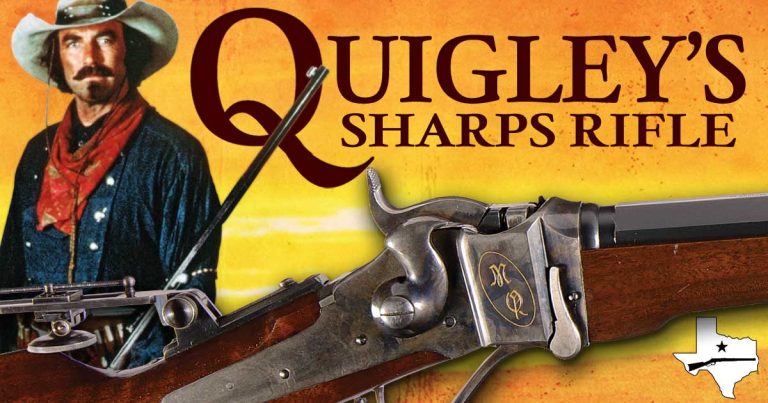
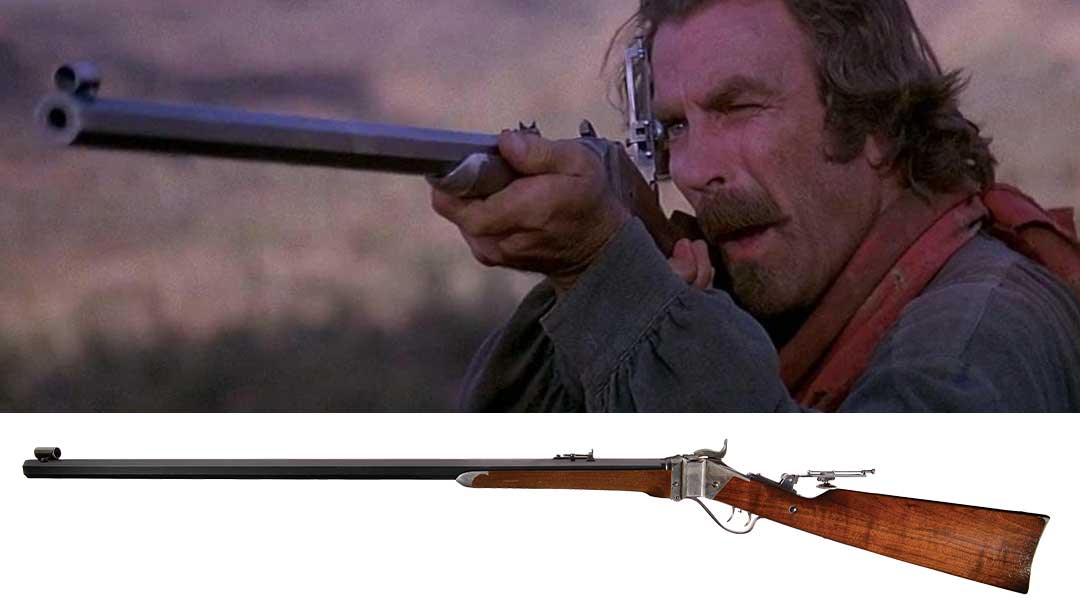
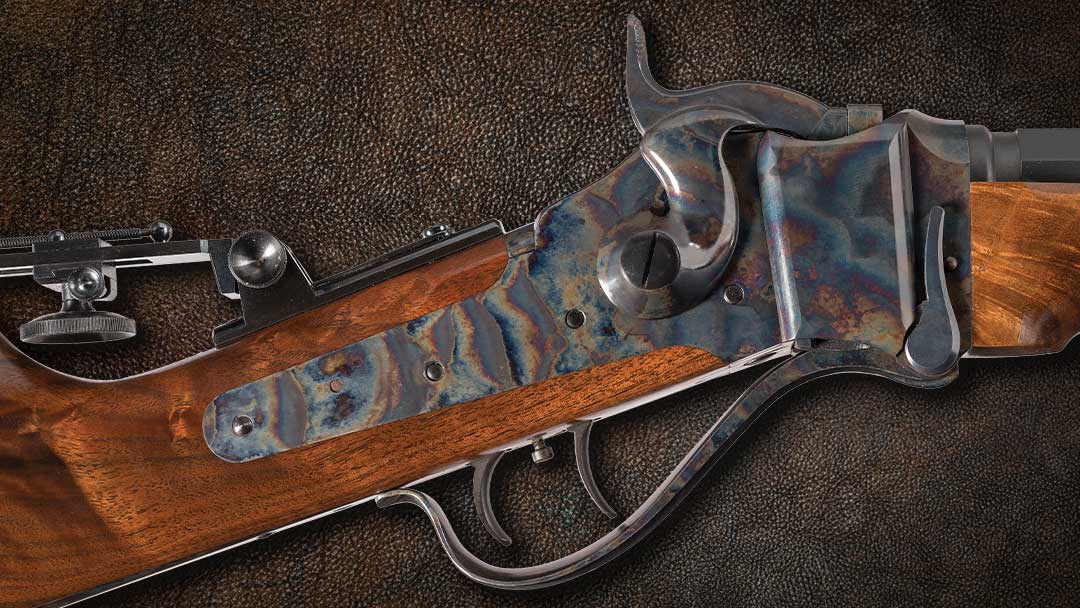
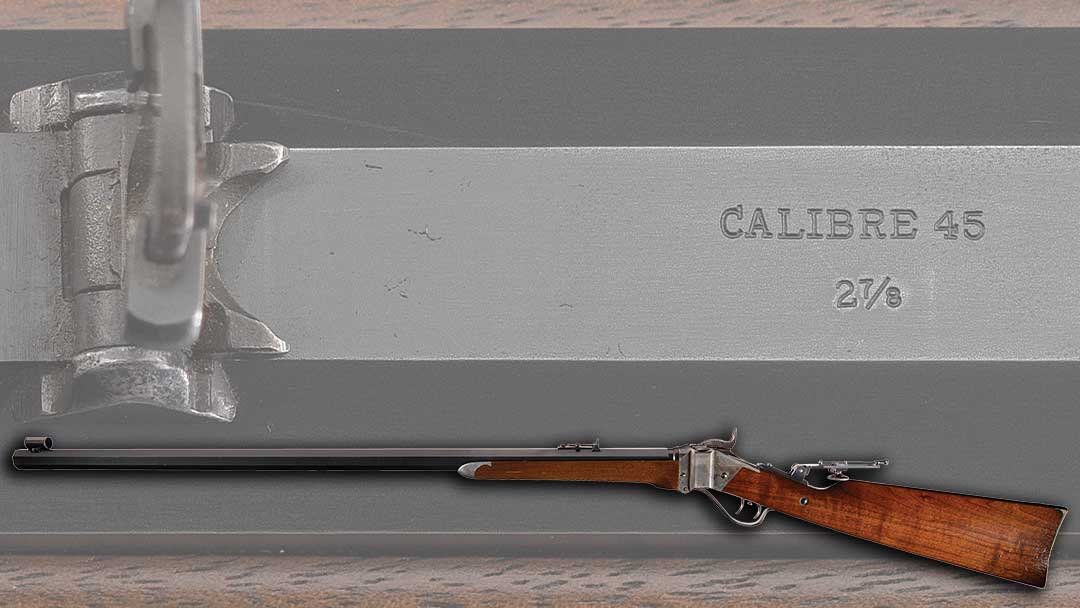
Matthew Quigley continues to make an impression with Western fans around the world, and his custom Shiloh Sharps Model 1874 Long Range rifle has become one of the most celebrated guns in cinema. This iconic onscreen “Quigley Down Under” rifle, created for and carried by Tom Selleck in the film, is up for sale in Rock Island Auction Company’s December 8 – 10 Premier Firearms Auction.
One of Tom Selleck’s three onscreen Sharps Rifles from the “Quigley Down Under” film, and one of only two designed for the shooting scenes. Available this December.
Like John Wayne’s Colt and Han Solo’s iconic blaster, Quigley’s rifle is an icon of the silver screen. The gun has often been called the co-star of the movie alongside Tom Selleck, and the history of Quigley’s legendary Sharps is as intriguing as the film it starred in.
Released in 1990, “Quigley Down Under” was a welcome reprieve by those who longed for the days of classic Western cinema, and today it enjoys cult status. The stars of the film? Tom Selleck as Matthew Quigley and, of course, his custom Sharps Model 1874 Long Range rifle.
What is the “Quigley Down Under” Rifle?
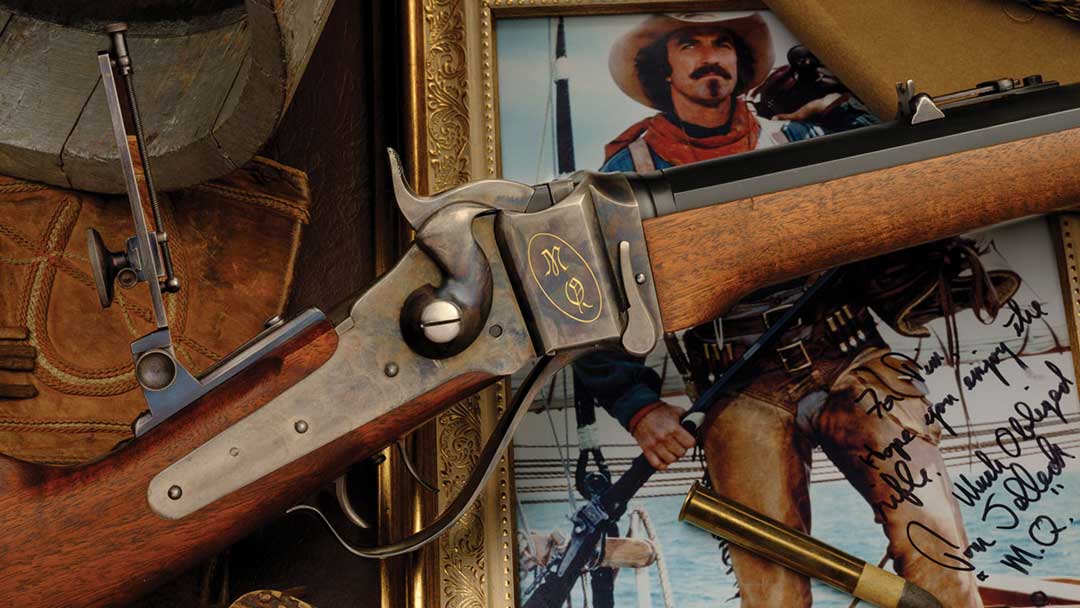
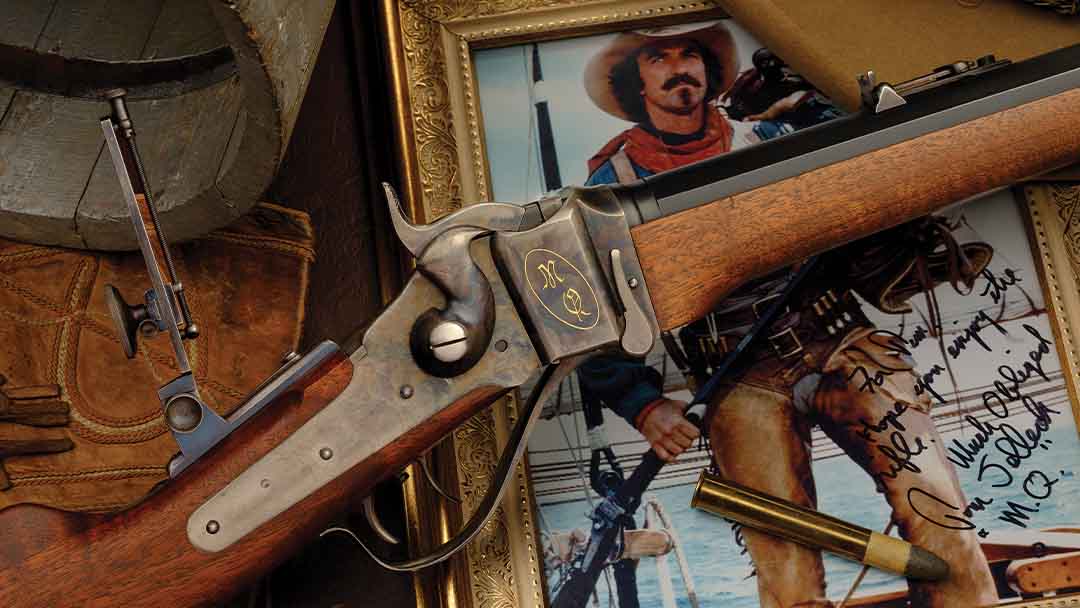
In MGM’s Australian Western “Quigley Down Under,” Tom Selleck uses a Shiloh Sharps Model 1874 single shot falling block rifle, one of three custom guns produced for the film. An accompanying letter states that the rifle pictured below was sent to MGM Grand of Hollywood, California in 1989 in preparation for the film, and that the gun sported a smooth military-style buttplate and a special straight-grained, custom-fit American walnut stock elongated to 15 ¼-inch length of pull to accommodate the lank 6-feet, 4-inch Selleck.
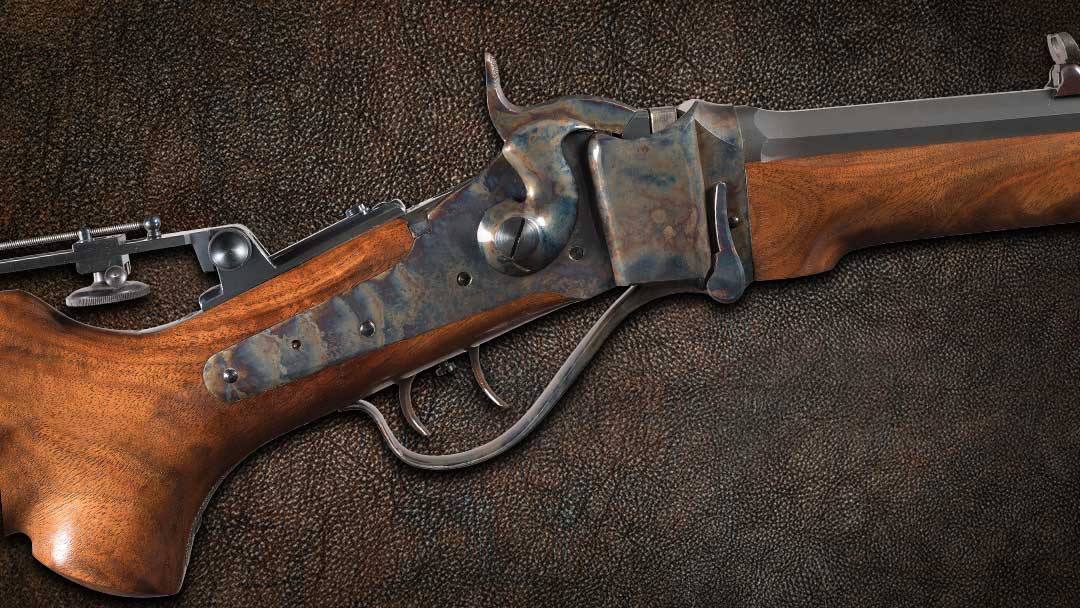
The iconic Sharps rifle for sale at Rock Island Auction Company this December is just as Matthew Quigley described the gun in the movie, a “lever action breech loader” with a 34-inch blued octagonal barrel. The receiver is case-colored with a gold inlaid monogram “MQ” encircled on the right side of the frame, standing for Matthew Quigley.
“I wanted to hire the greatest long distance marksman in the world. Have I?” Quigley demonstrates his custom Sharps rifle.
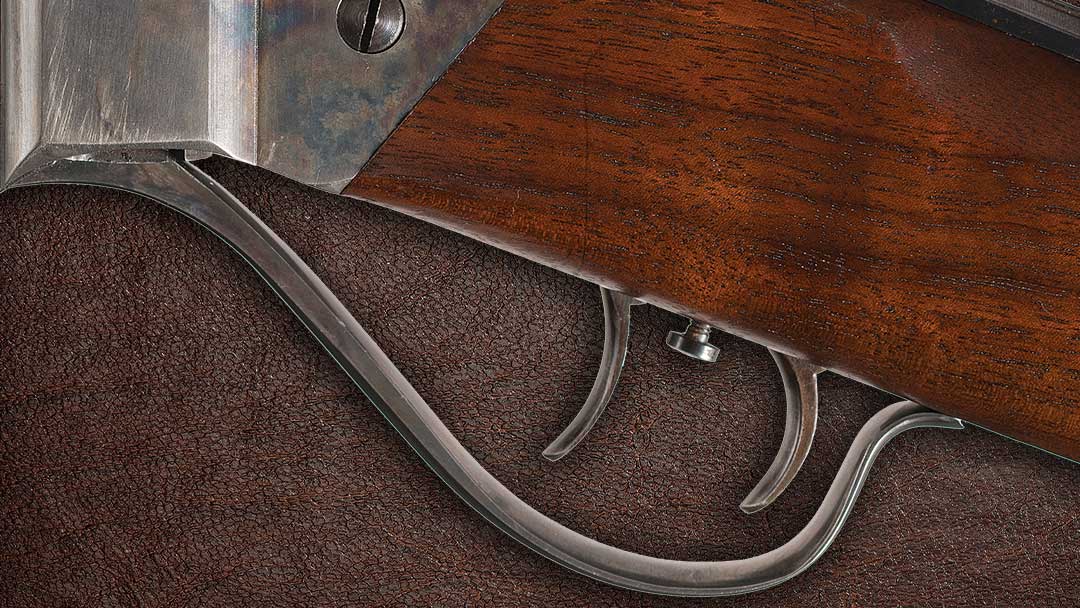
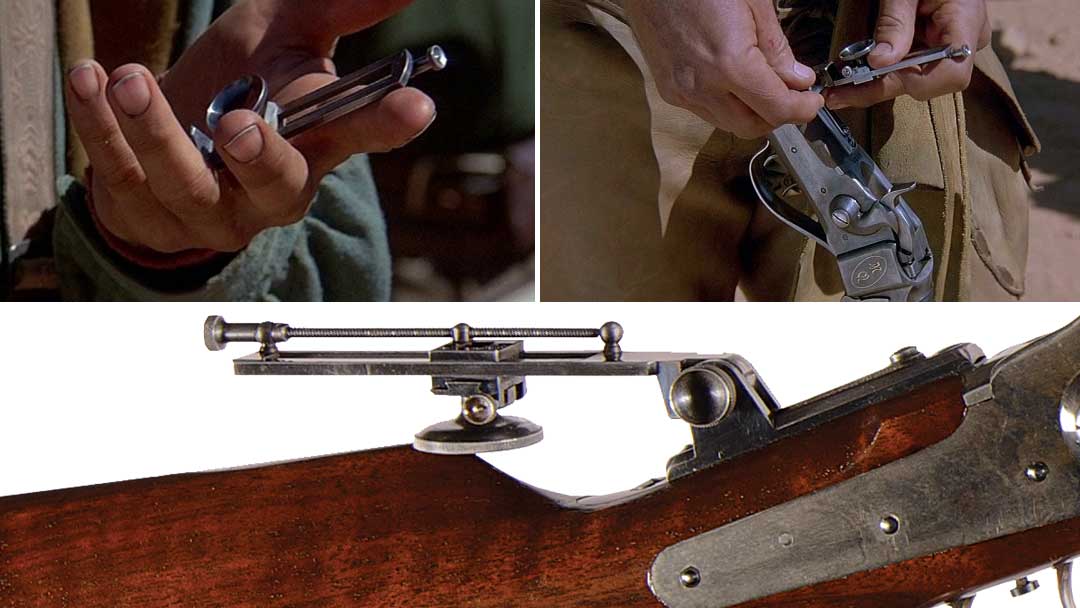
This “experimental weapon with experimental ammunition” has a hooded post and ball front sight and a Lawrence patent notch, semi-buckhorn folding ladder rear sight as well as double set triggers and an adjustable 1,200-yard long range Vernier tang-mounted peep sight. Like the Civil War era percussion Sharps rifles, Quigley’s gun also includes a custom casehardened steel patch box in the stock and a pewter-tipped forearm. The rifle also received an antiqued finish for the movie.
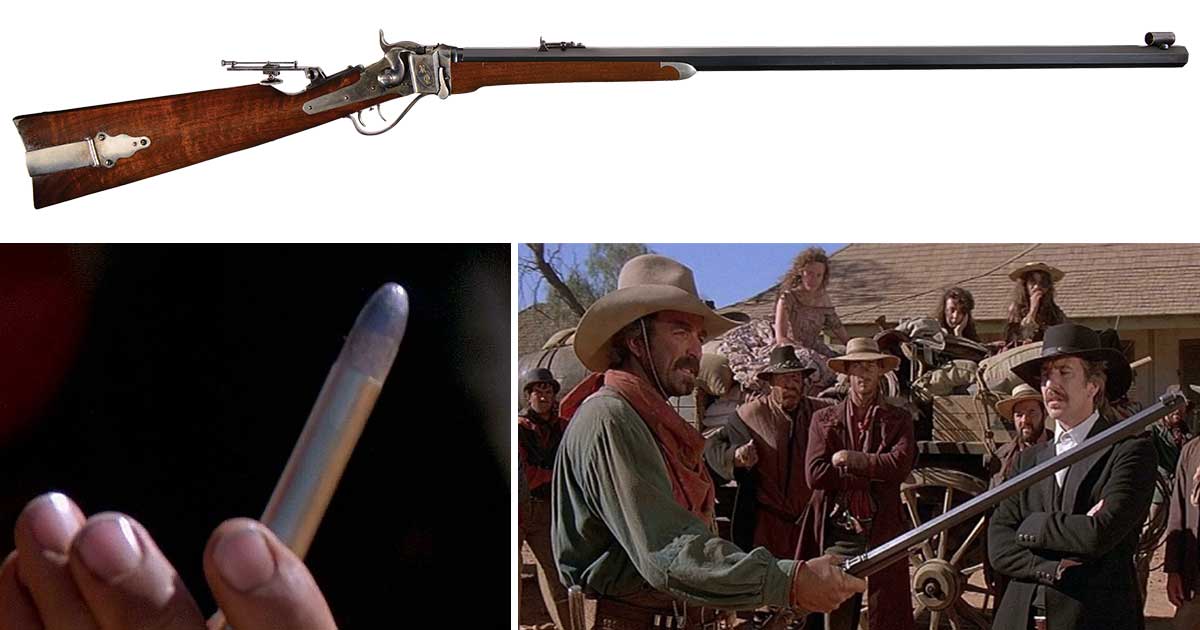
“It is converted to use a special .45 caliber, 110 grain metal cartridge with a 540 grain paper patch bullet.” Available this December.
“The legendary Sharps,” as Alan Rickman describes Quigley’s rifle model, has a famed history as a long-range sharpshooter. In the movie, Quigley’s rifle is essentially an extension of the character himself. Quigley’s exceptional marksmanship with his Sharps absolutely dominates the action scenes of the film.
“It’s fitted with double set triggers.” One of Tom Selleck’s onscreen Sharps Rifles from the Quigley Down Under film. Available this December.
In addition to shooting buckets at considerable distances and taking out criminals terrorizing Aboriginal Australians, Quigley’s Sharps rifle also serves as a utility belt of sorts for the main character. Quigley uses the gun for much more than shooting, and the rifle’s hefty weight of 12 pounds, 14.1 ounces makes it a sturdy club. At one point, Quigley uses his gun to pull himself up through a window.
“It’s marked up to 1,200 yards. This one shoots a mite further.” The adjustable vernier tang-mounted peep sight on Quigley’s rifle was produced for Shiloh by The Riflesmith of Sheridan, Montana. Available this December.
The Guns of “Quigley Down Under”
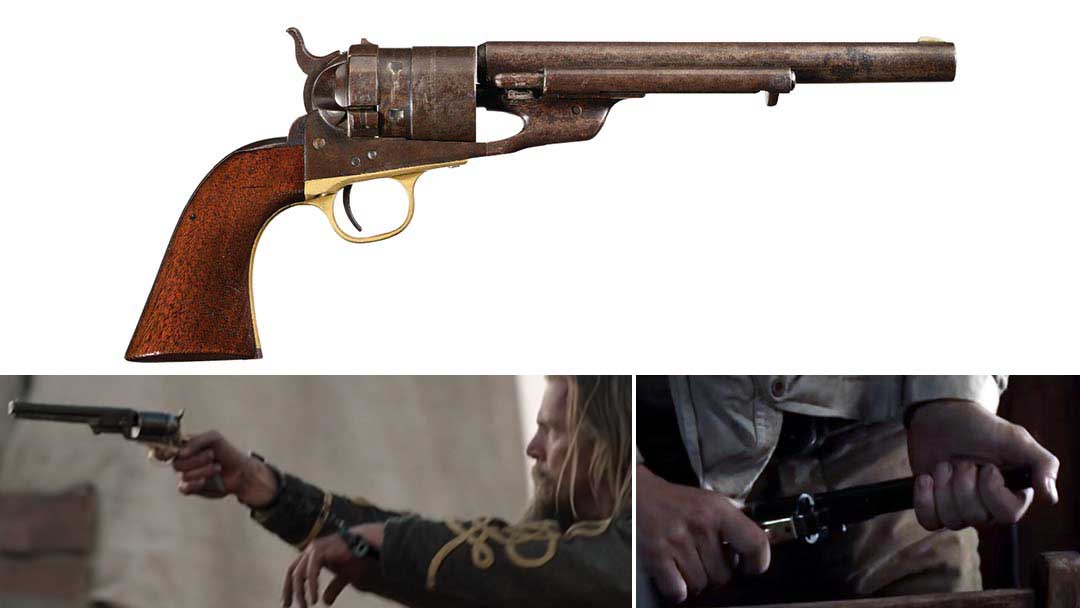
As far as the film’s other guns go, Matthew Quigley “never had much use for” six-shooters. In contrast, Elliott Marston and his henchmen carry a variety of percussion revolvers, as well as numerous muzzle-loading rifles and carbines like the Hawken. The weapons reflect the film’s premise of an Old West gunslinger in the strange yet also strikingly familiar setting of Colonial Australia. Though Quigley’s rifle is the only specific gun from the film up for bid this December, many historic examples of the firearm models depicted in “Quigley Down Under” can be found at Rock Island Auction Company such as the antiqueColt revolvers pictured below.
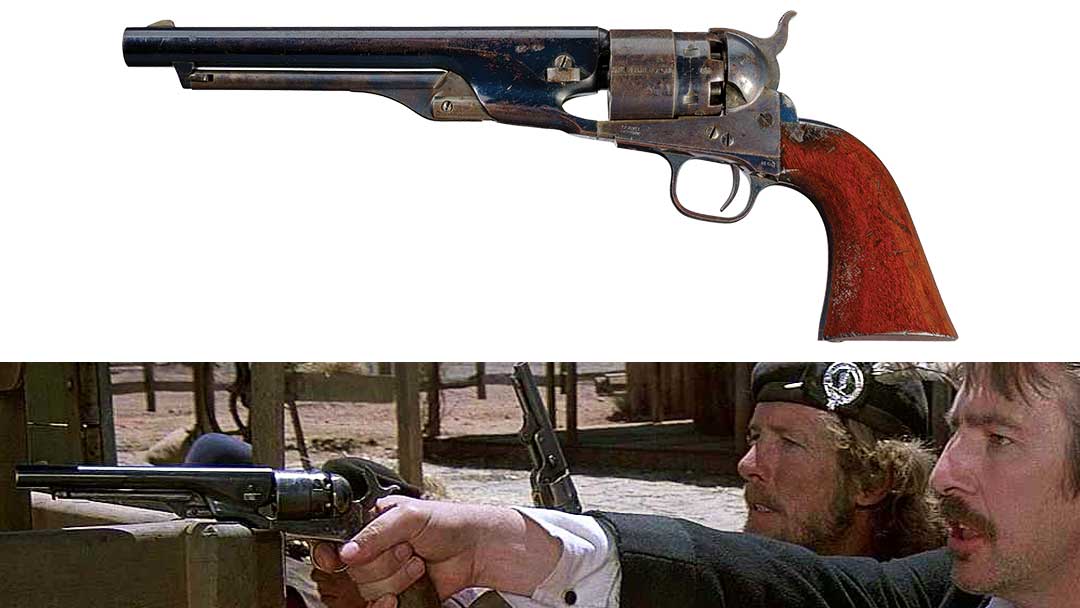
Alan Rickman totes a Colt 1861 Army revolver, but as Quigley points out, “This ain’t Dodge City and you ain’t Bill Hickok.” Available this December.
On the guns of “Quigley Down Under,” Tom Selleck stated, “I wanted the movie to be accurate. You see a film like Vera Cruz, that takes place in the 1860s, and they’re using 1892 Winchesters and Colt Single-Action Armies, which were not even around then.”
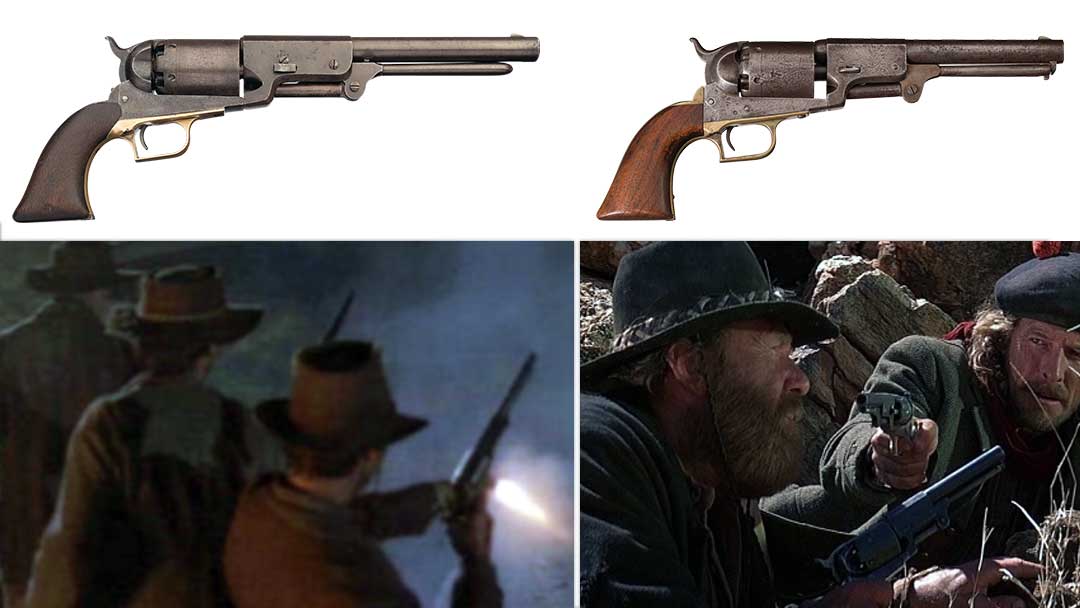
“God made man, Sam Colt made them equal, more or less.” A wide range of real Wild West guns like the Colt Walker and Colt Dragoons are available in RIAC’s December Premier Auction.
Veteran gun writer Phil Spangenberger advised on the film and helped steer the producers toward period-correct firearms. “I received a call from the movie’s production company, asking me what type of circa 1850s-1860s percussion breechloader could shoot accurately at over 1,000 yards. I suggested it could be easily set in the early 1870s, so they could use an 1874 Sharps metallic cartridge rifle, which was actually introduced in 1871. They liked my suggestion and asked where they could obtain such rifles.”
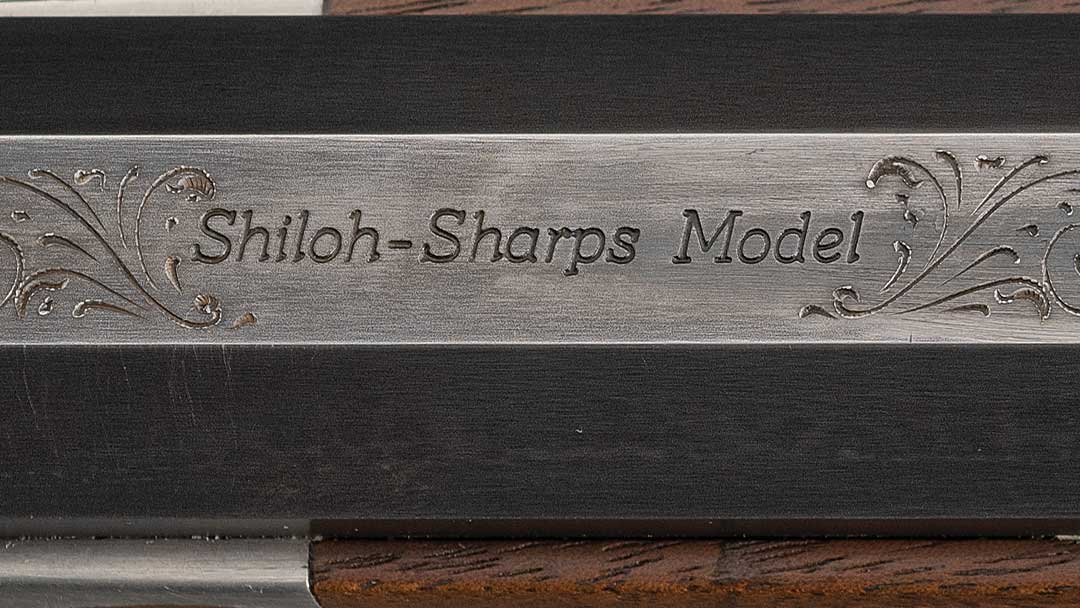
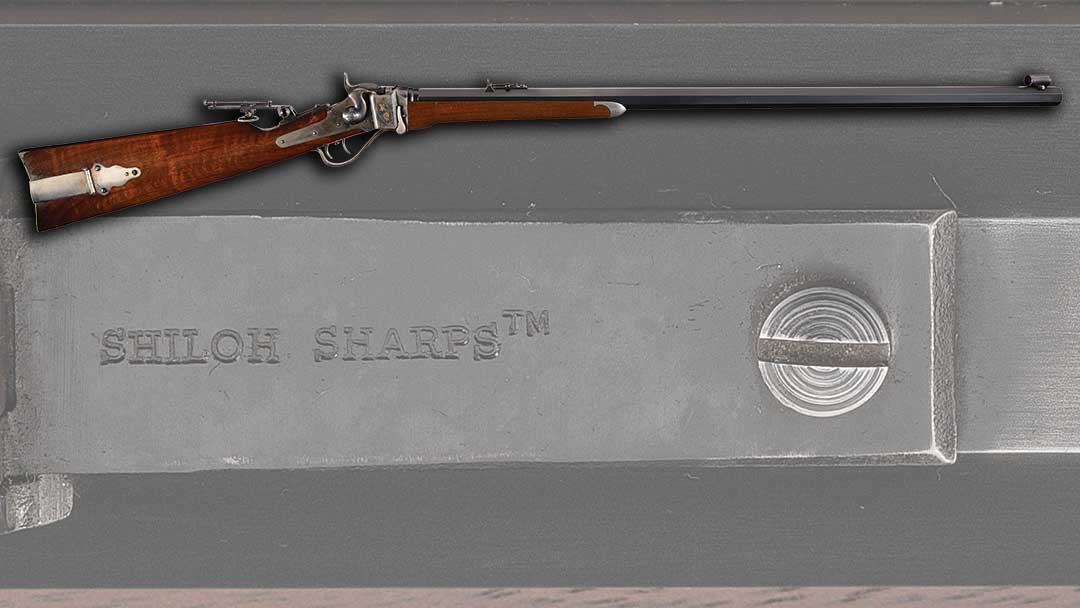
The included factory letter lists Quigley’s rifle as a custom made piece produced by Shiloh Rifle Manufacturing Company in Big Timber, Montana, one of three rifles created for the film. Available this December.
The Sharps Rifle and Quigley’s Gun
More than any other western, “Quigley Down Under” has been responsible for kindling popular interest in long-range shooting with black powder cartridge rifles and Sharps rifles like the special order Quigley Sharps used in the movie. While films like “True Grit” and “The Good, The Bad, and The Ugly” featured the Sharps rifle, “Quigley Down Under” made the gun a star.
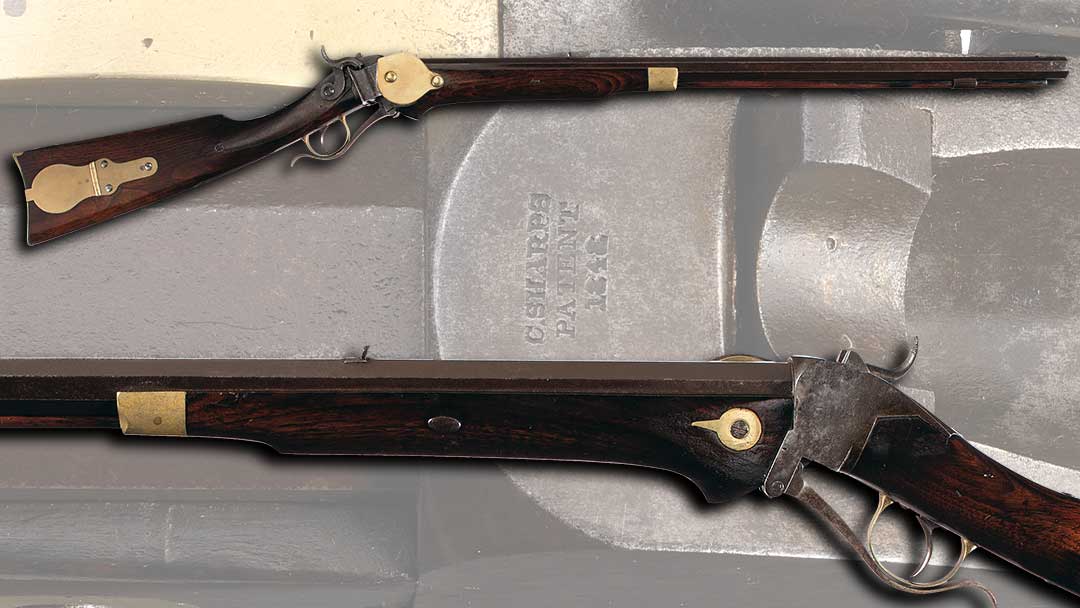
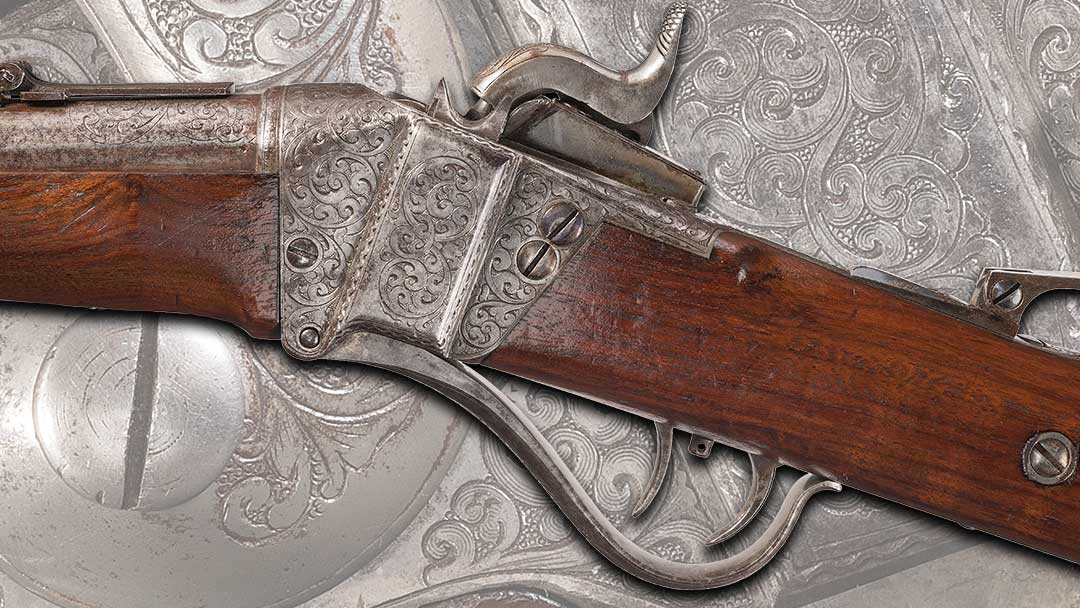
The Sharps Model 1874 traces its lineage back to Christian Sharps’ patent in 1848 for a breechloading rifle. It is similar to the Sharps New Model 1859, 1863, and 1865 rifles and carbines used during the Civil War but differs primarily in being adapted for use with centerfire metallic cartridges. The updates include a simplified lock since a percussion priming system was no longer necessary and a new breechblock with a firing pin instead of a percussion nipple and flash channel.
A rare Sharps Model 1849/First Model “Nippes” breechloading sporting rifle, serial number 25. Available this December.
The various Sharps rifle and carbine models manufactured from the Antebellum Era and into the late 19th century during the Indian Wars are some of the most celebrated firearms of the American frontier. From John Brown, Brigham Young, the Union’s elite Berdan Sharpshooters, to the cowboys, outlaws, and gangs that roamed the Wild West, these rifles remain very popular with hunters, target shooters, and collectors today as well.
An incredibly scarce documented Sharps Model 1853 slant breech percussion sporting carbine with a factory letter. Available this December.
Christian Sharps had left the company long before the “Old Reliable” Model 1874 was debuted in 1871 (the Model 1874 moniker came later). As shown in “Quigley Down Under,” the Sharps Model 1874 was favored due to its reliability, its capacity to chamber powerful cartridges, and the rifle’s ability to accurately hit targets at great distances.
Sharps rifles and carbines were manufactured in a dizzying array of configurations, both official sub-models and many, many special orders. Customers could be very specific and order an array of barrel lengths, weights, calibers, sights, triggers, stock configurations, engraving, and more. This helped inspire the “Quigley Down Under” gun, a unique custom rifle that Sharps would have been more than happy to provide a Montanamarksman in the 1870s.
Weighing in at 12 pounds, 14.1 ounces, Tom Selleck’s Shiloh Sharps, serial number 8887, was patterned after a Hartford model 1874 Sharps. Available this December.
Why Are Quigley Sharps Rifles Valuable?
More than three decades after its release, “Quigley Down Under” continues to inspire Western fans, gun collectors, and lovers of frontier firearms worldwide. The film has left a lasting impression on pop culture as a whole. Today, snipers refer to the act of killing two targets with a single bullet as a “Quigley” directly because of the movie.
Quigley Sharps rifles are among the most popular Sharps models and configurations sold by modern gunmakers. Shiloh Rifle Manufacturing Company produces similar guns to the movie rifle dubbed the “1874 Quigley”, with the option for customers to have their own initials gilded on the receiver. A. Uberti offers an “1874 Sharps Down Under” model, and Davide Pedersoli manufactures an “1874 Sharps “Q” Down Under” model.
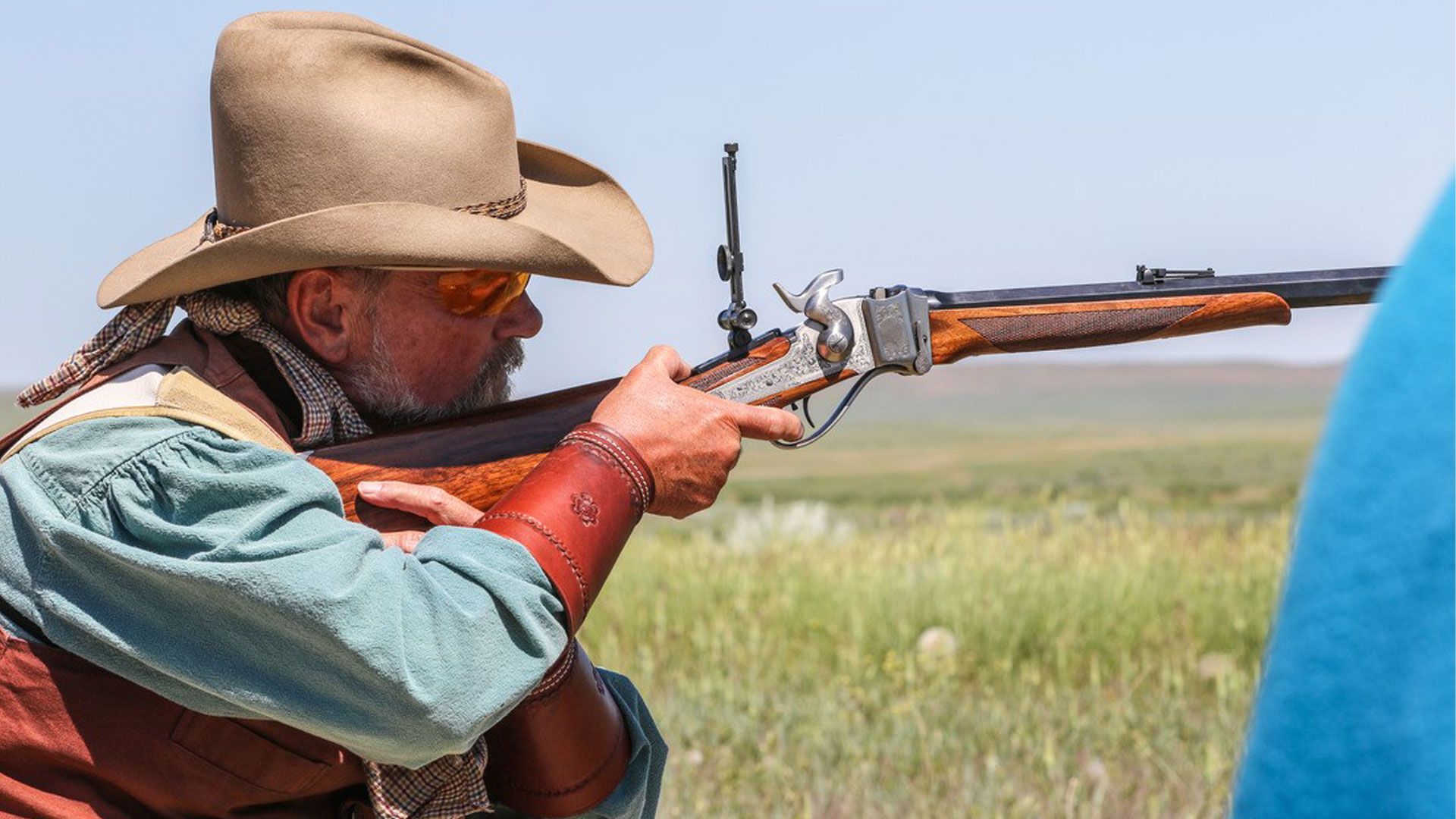
Both reproduction and antique Sharps rifles are used annually at the Matthew Quigley Buffalo Rifle Match, “the biggest rifle shooting event in Eastern Montana since the Custer Massacre.” Many antique Sharps rifles are still in excellent shooting condition and are offered at Rock Island Auction Company at a range of price points. Note that any antique firearm should be inspected by a qualified gunsmith before it’s loaded or fired.
A competitor at the 2016 Matthew Quigley Buffalo Rifle Match.
Quigley’s Rifle and the Guns of Hollywood
As a gun owned by and customized specifically for Tom Selleck and fired on-screen during one of his most celebrated films, Quigley’s rifle checks all the right boxes when it comes to top-tier arms collecting and is a must-have gun for rare firearm collectors, Western fans, and anyone interested in owning a legendary piece of Hollywood history.
Matthew Quigley’s gun is a Hollywood icon carried by the immortal Tom Selleck. Included with the rifle is a signed photo of Tom Selleck in costume as Matthew Quigley. Available this December.
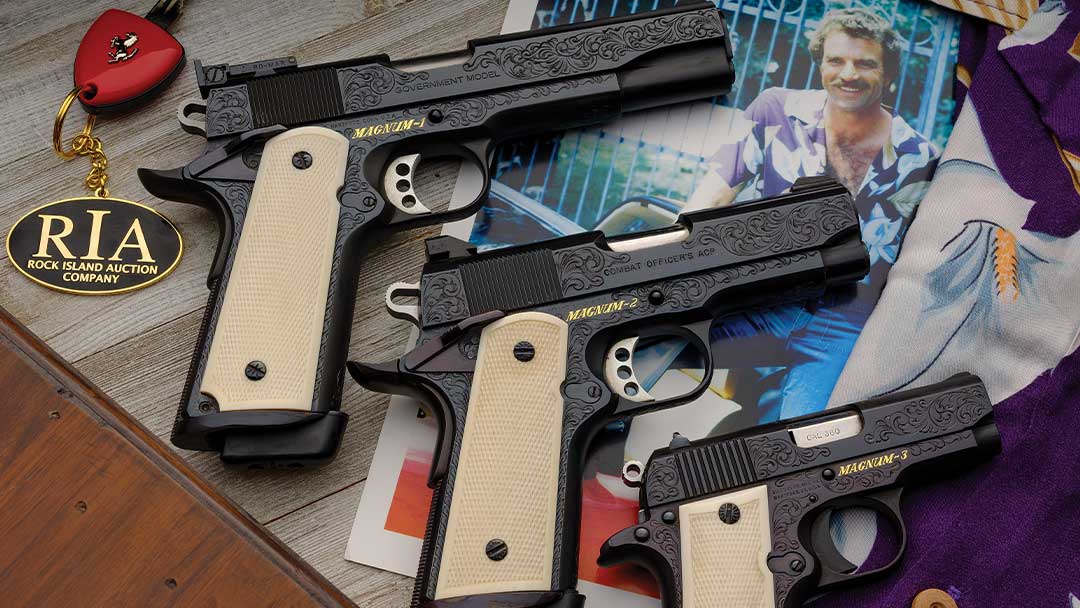
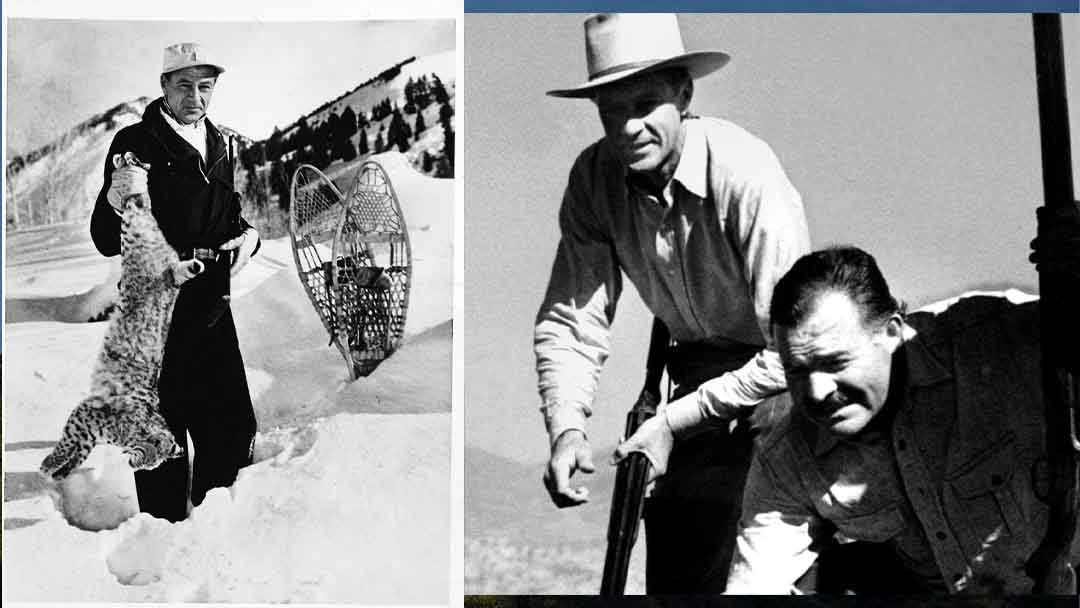
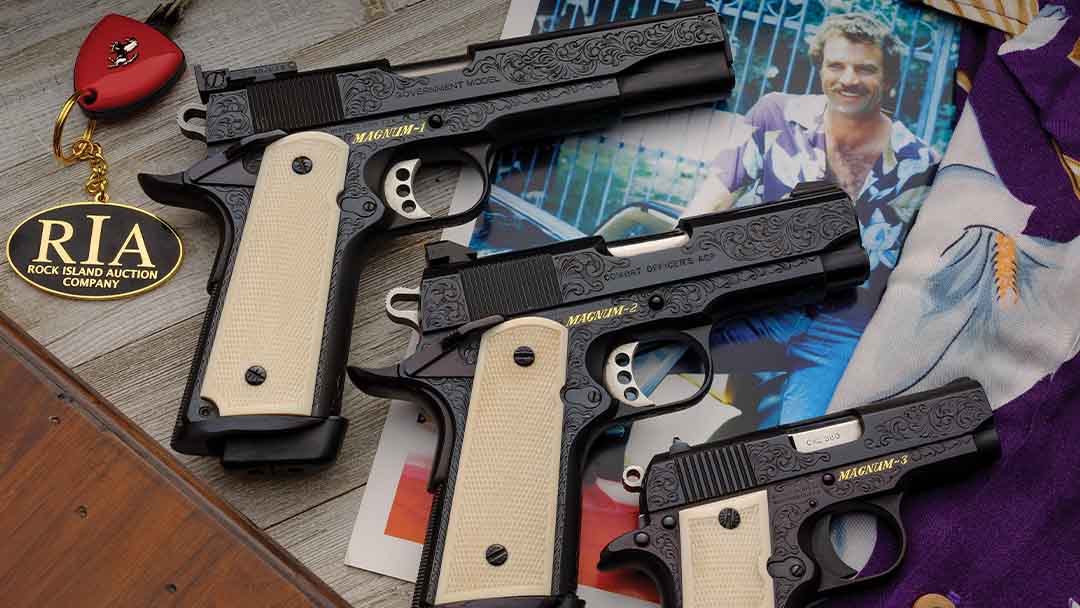
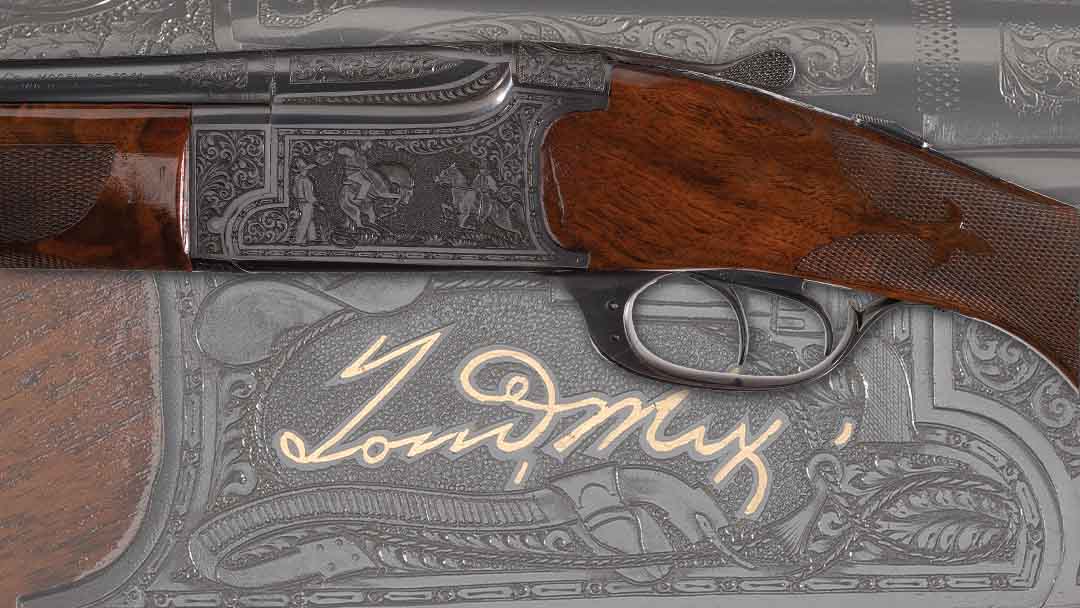
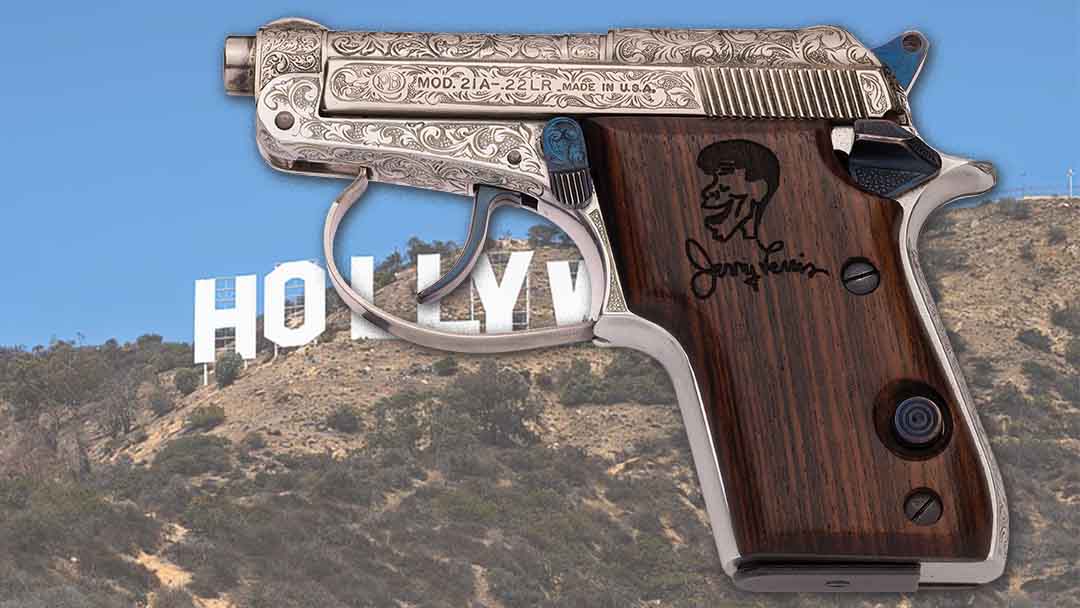
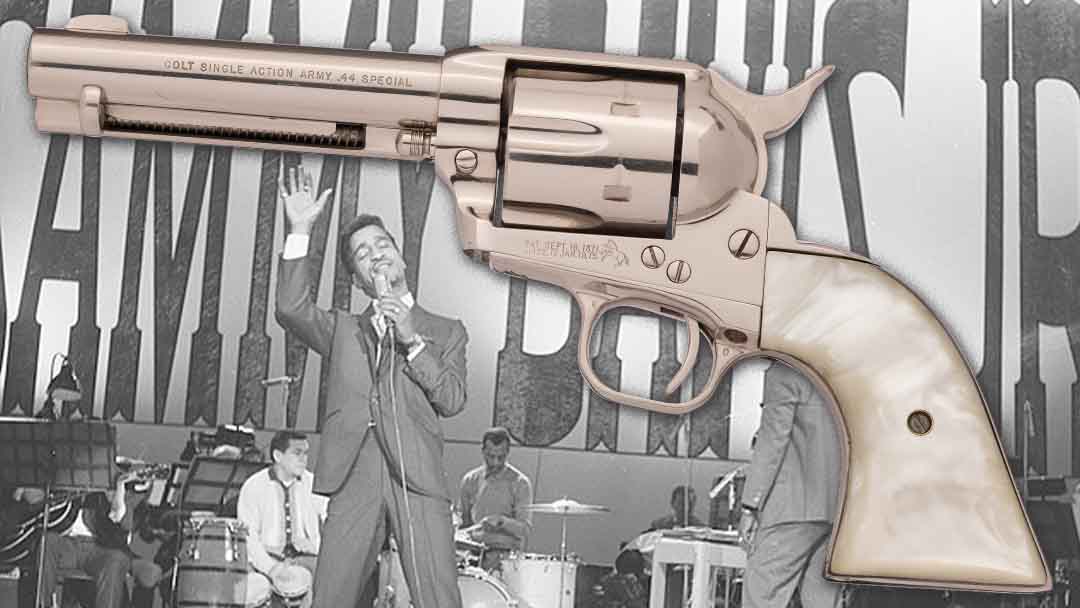
The guns of “Quigley Down Under” and other popular film and television properties are hot items in the collecting community right now, as are guns owned by the legends of the silver screen. Rock Island Auction Company’s December Premier, the inaugural event for its new facility in Bedford, Texas, features firearms from cinema icons such as Gary Cooper, Jerry Lewis, Sammy Davis Jr., and the “King of the Cowboys” Tom Mix, as well as a special trio of pistols from Tom Selleck’s personal collection.
While Quigley didn’t have much use for pistols, Thomas Magnum certainly did. A three-gun set made for Selleck from the Colt Custom Shop will be available in December. Available this December.
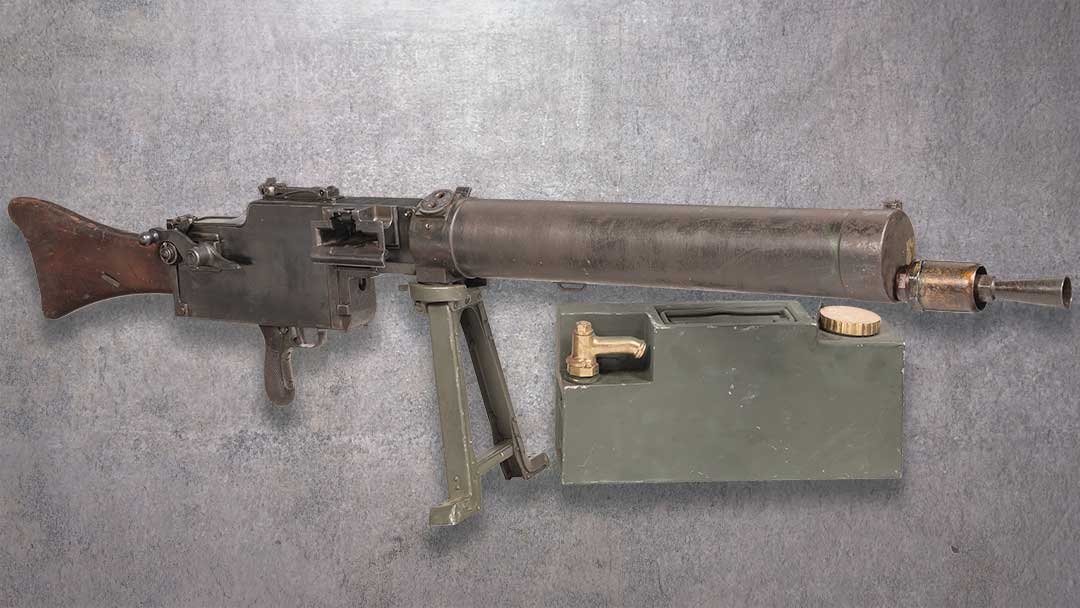
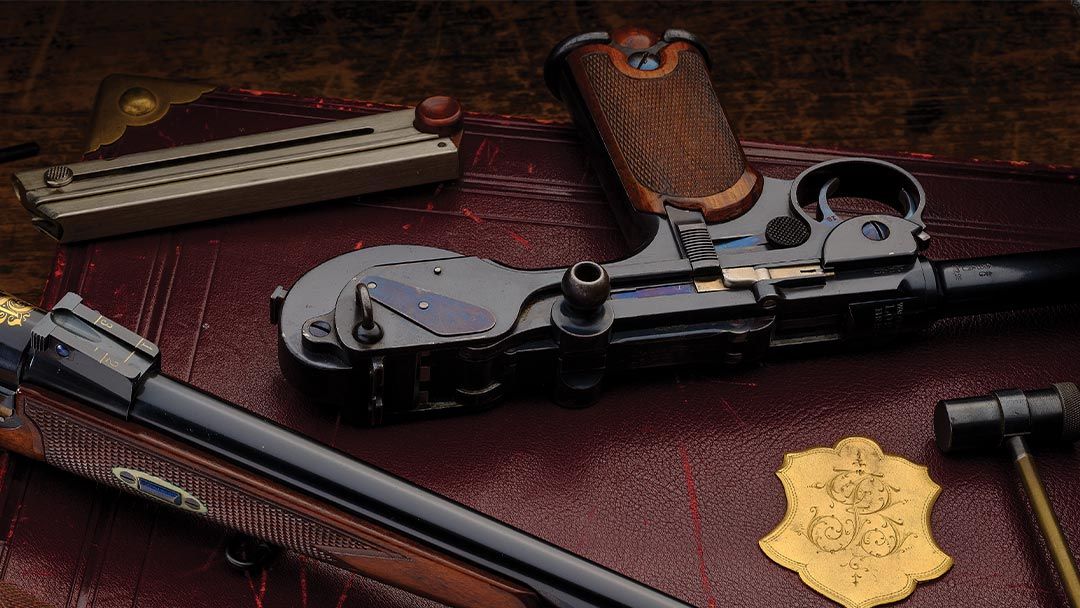
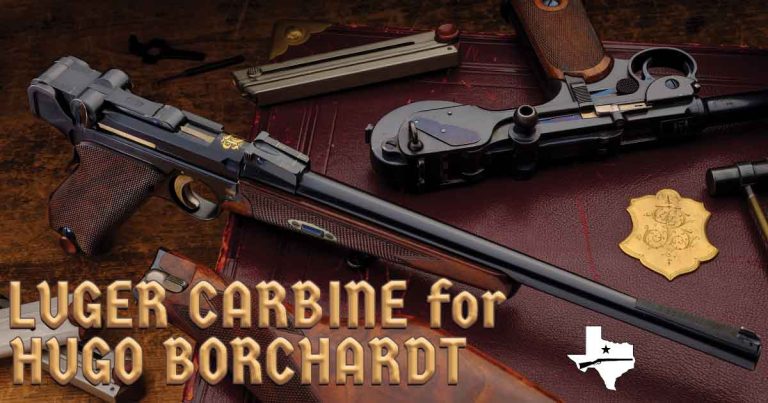
The Borchardt C93, often hailed as the grandfather of modern semi-automatic pistols, was the first auto-loading pistol to enjoy a notable production run. For early pistol and military collectors, the Borchardt C93 is a pinnacle firearm, and Rock Island Auction Company’s December 8 – 10 Premier Firearms Auction offers one of the finest examples of the Borchardt pistol in the collecting pursuit.
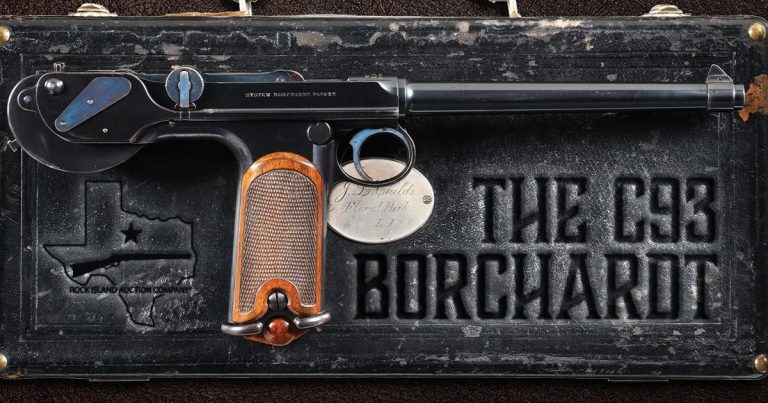
This exceptional Borchardt C93 pistol includes the original matching wooden shoulder stock, the original black leather holster, four matching numbered original magazines, carrying strap, spare dummy magazine, original silver oil bottle, screwdriver, and the original black leatherette carrying case that houses the pistol, stock and accessories. Available this December.
The outstanding C93 Borchardt pistol offered this December, serial number 19, is possibly the earliest known, all-original, unaltered, and completely cased Borchardt pistol in existence today. In addition to its exceptional condition, this historic C93 pistol rig was personally owned by J. L. Childs, a New York entrepreneur who made his early fortune in the horticulture business. John Lewis Childs was responsible for building more than 20 buildings in the Floral Park area on Long Island, formerly known as East Hinsdale, and served as the area’s first mayor after it was incorporated in 1908.
The wealth and status of John Lewis Childs is reflected by the inscribed silver plaque on the case of his Borchardt pistol rig.
When was the Semi-automatic Pistol Invented?
Engineering a reliable semi-automatic pistol wasn’t feasible in the age of low-pressure, foul-burning black powder. Early efforts to develop repeating magazine pistols required a manual method to cycle the action, like the lever actionVolcanic line and the latter Remington Rider magazine pistols of the 1870s and early 1880s. The invention of smokeless powder by French chemist Paul Vieille in 1884 opened the door to a range of possibilities, including the semi-automatic pistol.
A Remington Rider magazine pistol. Produced from 1871 to 1888, the Rider was one of the most distinct 19th century pocket pistol designs. Available this December.
Firearms designers developed new mechanisms based on smokeless powder almost immediately, including Hiram Maxim introducing his recoil-operated machine gun in 1884. Archduke Karl Salvator and Captain Georg Ritter von Dormus of Austria patented the blowback-operated Salvator-Dalmus pistol on July 11th, 1891, one of the earliest known semi-automatic pistol designs. Other armsmakers followed, like the Schönberger-Laumann in 1892, the Mannlicher Model 1894, and the Bergmann Schmeisser Model 1894.
This rare Salvator-Dormus Austrian military trials pistol sold for $40,250 in May of 2021.
In 1893, Hugo Borchardt introduced the first semi-automatic pistol to make a lasting impact on the market. The Borchardt C93 included many of the essentials seen in pistols today, including a semi-automatic action, a spring-loaded box magazine, a magazine inserted into the grip, and a push-button magazine release. These features were the result of Borchardt’s extensive experience in the firearms industry and his role in helping to design one of the earliest detachable box magazine rifles.
This mechanically excellent Ludwig Loewe C93 Borchardt pistol retains 97% of its original blue finish. Available this December.
Hugo Borchardt Invents the C93 Pistol
Born in Magdeburg, Germany in 1844, Hugo Borchardt immigrated to the United States at the age of 16 and settled in New England. Over the next two decades, Borchardt found work with some of America’s top gun manufacturers, including Colt, Winchester, and Sharps. During his time serving as the superintendent and treasurer of the Sharps Rifle Co., Borchardt helped produce the Sharps Borchardt Model 1878 sporting rifle.
An exhibition quality, engraved and gold inlaid, horn paneled Sharps Borchardt Model 1878 rifle. Available this December.
In the late 1870s, a British Canadian inventor named James Paris Lee partnered with Sharps to produce his Lee Model 1879, the first successful bolt-action repeating rifle employing a spring-loaded, column-fed, detachable box magazine system. Hugo Borchardt helped refine Lee’s design before Sharps went bankrupt in 1880. Borchardt would later use a detachable spring-loaded box magazine for his C93 pistol.
A high condition early production two-digit serial number Borchardt pistol rig with four matching magazines, a matching shoulder stock, and an inscribed case that would be nearly impossible to improve upon. Available this December.
Hugo Borchardt returned to Europe and designed his namesake pistol while working for FÉG Arms and Machine Manufacturing Company of Hungry. Borchardt partnered with Ludwig Loewe & Co., a German manufacturer of machine tools and military rifles. Ludwig Loewe was an astute businessman and thought the Borchardt 93 pistol had the potential to garner military contracts.
The Borchardt C93 Pistol
The 7.65 Borchardt Auto cartridge was inspired by the Gewehr 88 rifle’s 7.92 mm round, a rimless cartridge with a bottlenecked case that was scaled down to suit Borchardt’s C93 pistol design. The C93 Borchardt included several notable traits, such as a reliable toggle-lock system, a slide safety, and a push-button magazine release. The Borchardt magazine could hold eight cartridges.
This Borchardt pistol’s original walnut shoulder stock is complete with the original blued attaching mechanism, the original black leather holster, and the original leather stock attaching straps with the original shoulder carrying strap. Available this December.
Hermann Boker & Co. of New York, U.S. dealers for the Borchardt pistol, advertised the C93 as a simple-to-understand weapon whose “only operation necessary is to draw back the bolt the first time, which cocks and loads the arm. After this the arm works automatically. The recoil of the first cartridge unloads, cocks, and loads the arm, and as fast or slow as the trigger is pulled the arm is discharged.”
An attractive early production Ludwig Loewe Model 1893 Borchardt pistol, serial number 109. Available this December.
The Borchardt C93 pistol was marketed as “light, powerful, and effective” and “the ideal weapon for the woods” with an effective range of 200 to 300 yards. The Borchardt was 14 inches in length, with a full C93 pistol rig weighing 3 3/4 pounds with its holster, sling, and stock. The Borchardt’s detachable walnut shoulder stock allowed the weapon to function as a light carbine.
Borchardt Pistol Cost
Hermann Boker & Co. of New York sold the Borchardt C93 pistol for $30.00 each. Included were “three extra magazines, tools, oilers, holster, and strap.” A leather case cost an additional $5.00, and ammunition for the pistol cost $3.50 per 100 rounds of 7.65 mm Borchardt.
One of three C93 Borchardt pistols for sale this December at RIAC, this example sets itself apart due to its beautiful condition and its included leather case with a matching numbered shoulder stock and four matching numbered magazines.
The Borchardt pistol offered in RIAC’s December Premier Auction belonging to J.L. Childs could have been either a private purchase or a special order presentation piece. Like many intrepid arms manufacturers, Ludwig Loewe understood the benefit of gifting guns to the politically connected as part of their marketing efforts, and handgun competition was fierce in the 1890s.
Borchardt Pistol Competition
When the Borchardt C93 pistol hit the scene, the double action revolver had been dominating civilian and military markets around the globe. Platforms like the Webley Mk IV, the Rast & Gasser M1898, and the Bodeo Model 1889 were widely adopted in Europe, while the Colt M1892 and its improved line of successors like the M1894, M1895, and M1896 found a home with the U.S. Army and Navy. The revolver offered an adaptable, reliable platform, and even new models were often more affordable in the 1890s than their emerging semi-automatic pistol competition.
A rare documented antique factory engraved Colt Model 1889 DA revolver with pearl grips purchased by Major Taylor E. Brown prior to the Spanish-American War. Available this December.
Though the C93 Borchardt was among the first viable semi-automatic pistol platforms released, a second wave of direct challengers quickly emerged. Many of these designs were also developed in Australia and Germany, including the Krnka-Roth Model 1895, the Bergmann Model 1896, the Mannlicher M1896, and the famous Mauser C96.
An excellent Mauser Model 1896 cone hammer pistol with a matching numbered shoulder stock. Available this December.
The brainchild of three brothers employed by Mauser, the C96 “Broomhandle” pistol found success on the commercial market and earned a limited number of military contracts. DWM, the new weapons and ammunition branch of Ludwig Loewe & Co., knew they needed to innovate to keep up with the rapidly changing marketplace and encouraged Borchardt to update his design. Borchardt refused, and arguably the greatest rival for his C93 pistol would come from within the company in the form of the platform’s would-be successor, the Luger.
The Borchardt C93 competed in several military trials, including a demonstration to the U.S. Navy Ordinance Board in late 1894 and a round of Swiss pistol trials in 1897. Though the Borchardt pistol was praised in both cases, it was ultimately rejected. Suggestions for improvements included reduced size and barrel length, a more natural grip, and reduced recoil. With Hugo Borchardt rejecting every request to improve his pistol, DWM ultimately appointed Georg Luger to the task of redesigning the C93.
Georg Luger, who’d personally demonstrated Borchardt’s C93 pistol to the U.S. Navy, would go on to develop the famous Pistole Parabellum Model 1900.
Georg Luger, a consultant designer at Ludwig Loewe & Co., took the core mechanical principles of the Borchardt and developed a more compact profile, reducing barrel length, angling the grip for comfort, moving the return spring into the grip frame, and eliminating the need for the pistol’s bulky toggle housing. He also adapted the Borchardt round into the shorter 7.65 mm Luger cartridge, which allowed for a smaller magazine well and a more ergonomic grip.
A rare European Luger/Borchardt style Auguste Francotte single shot target pistol with a manually operated toggle lock bolt, serial number 10. Available this December.
DWM submitted Luger’s new design to the Swiss military in 1898. After another round of modifications, the Swiss adopted the weapon as the Model 1900 Luger. Borchardt felt betrayed, claiming he wasn’t getting proper recognition or royalties from the success of the Luger pistol and that Luger had circumvented most of his patents. This perceived slight caused a lifelong rift between the two gun designers.
An excellent documented Imperial German DWM Model 1906 Second Issue Navy Luger with its shoulder stock and leather holster. Available this December.
Legacy of the Borchardt Pistol
Only around 3,000 Borchardt pistols were produced in total compared to an estimated 3 million Lugers. Despite Georg Luger’s redesign, many features of the Borchardt remained, including the C93 pistol’s toggle-link breech locking system, sear assembly layout, and striker-fired action. Borchardt’s design helped lay the foundation for the Luger’s near half-century of dominance in the European pistol market.
An exceptional 1942 dated German Police Mauser Banner P.08 Luger rig with two matching magazines and a serial-numbered holster. Available this December.
Locked-breech pistols like theBrowning 1911challenged Luger’s dominance, andby World War 2, new designs like the Walther P38 largely supplanted the Luger in Germany. The Borchardt’s toggle lock system wasn’t adopted by most next-generation small arms aside from rare instances like the Pedersen semi-automatic rifle.
Hugo Borchardt was a prolific inventor and was awarded numerous patents beyond the arms industry, including concepts for a rock drill, a wire straightener, and various ideas for gas burning and electrical appliances. Today, his name is most prominently tied to the C93 pistol, a design that set lasting standards like the spring-loaded box magazine, the placement of the magazine inside the grip, and the push-button magazine release. For arms collectors, historians, engineers, and firearms fans who grew up loving the Luger, much of what we recognize as the semi-automatic pistol started with the C93 Borchardt.
An excellent three-digit serial number German Ludwig Loewe Model 1893 Borchardt pistol for sale with a matching magazine. Available this December.
Borchardt Pistols for Sale
A Borchardt C93 is a fantastic addition to any arms collection, and the three early production Borchardt pistols for sale in Rock Island Company’s December 8 – 10 Premier Firearms Auction are top-tier examples of late 19th century semiautomatic pistol development. When it comes to the best of the best, the Borchardt C93 pistol pictured below, serial number 19, ranks as one of the finest treasures in gun collecting.
This outstanding early production Borchardt pistol includes a case with a small oval silver name plate that has been inscribed in a jeweler’s/presentation style with “J.L Childs/Floral Park/L.I.” Available this December.
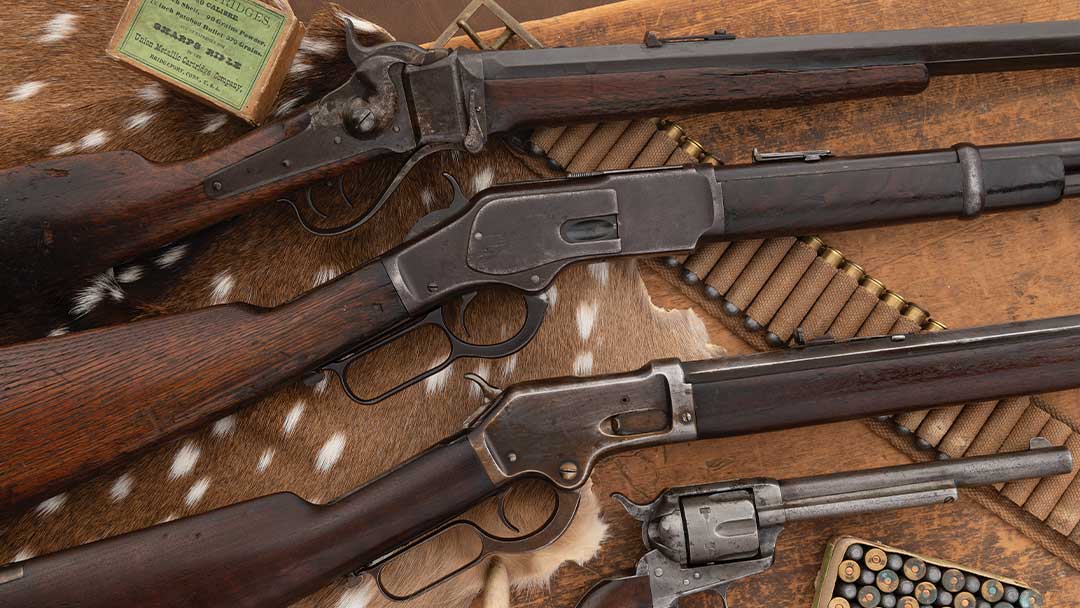
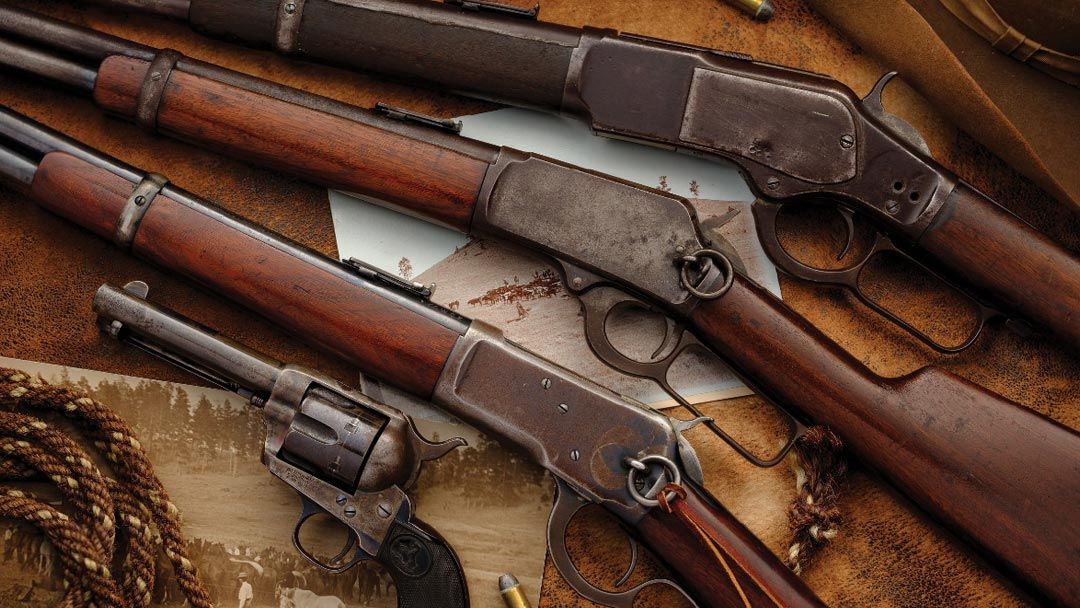
From top to bottom: A Borchardt Sharps Model 1878, a Winchester Model 1873, a Remington Model 1873, and a Colt SAA, four arms of the American frontier. Available this December.
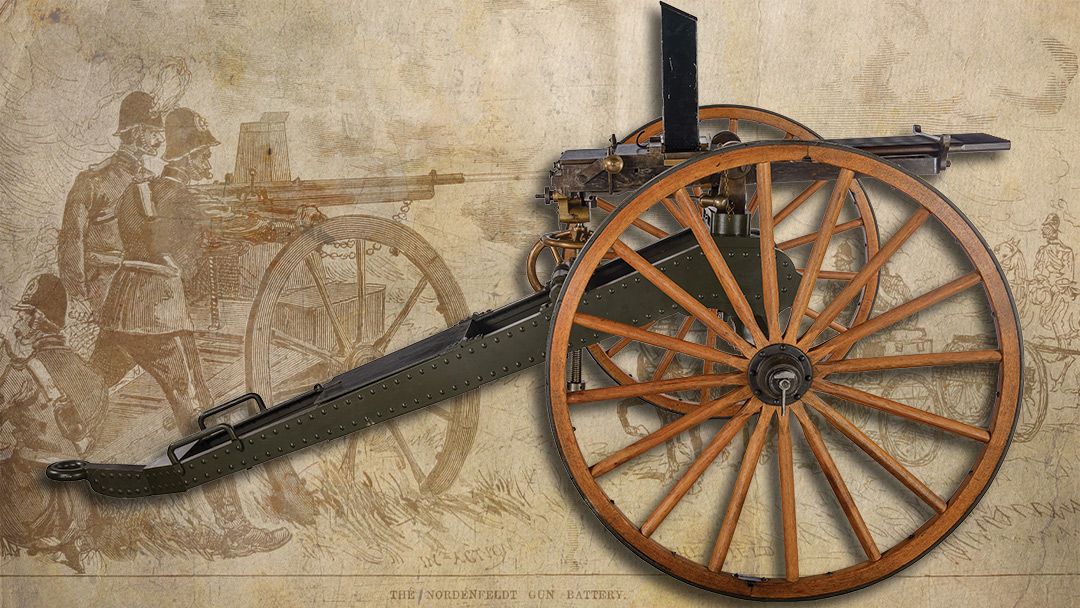
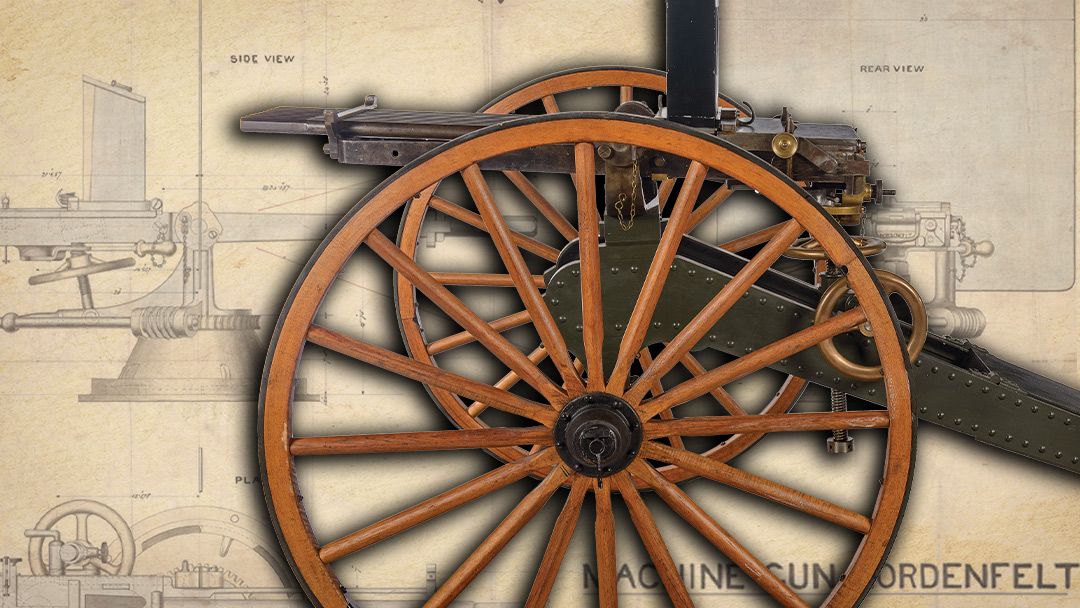
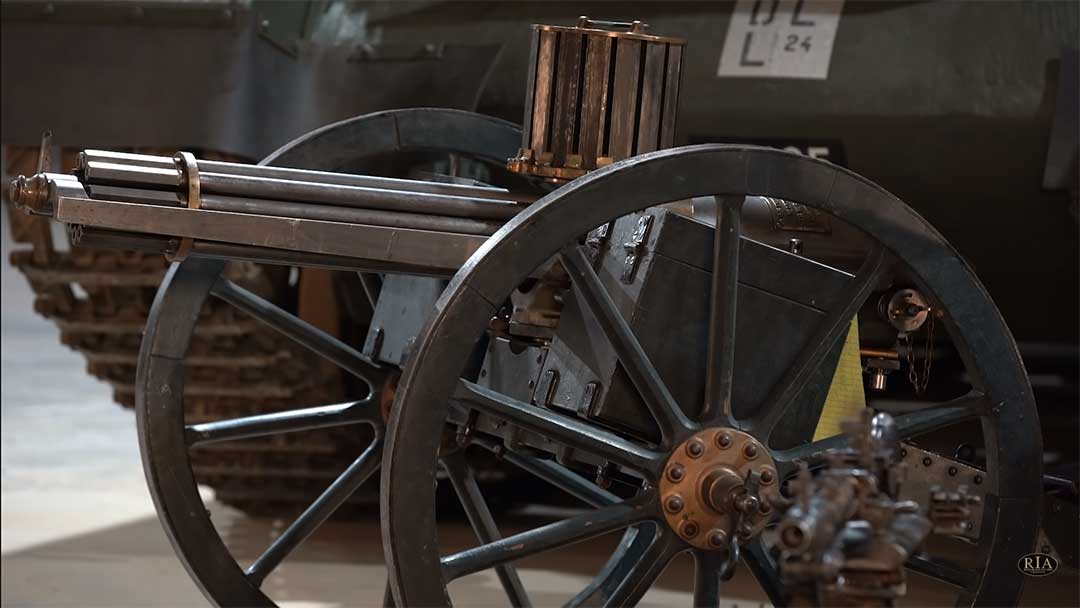
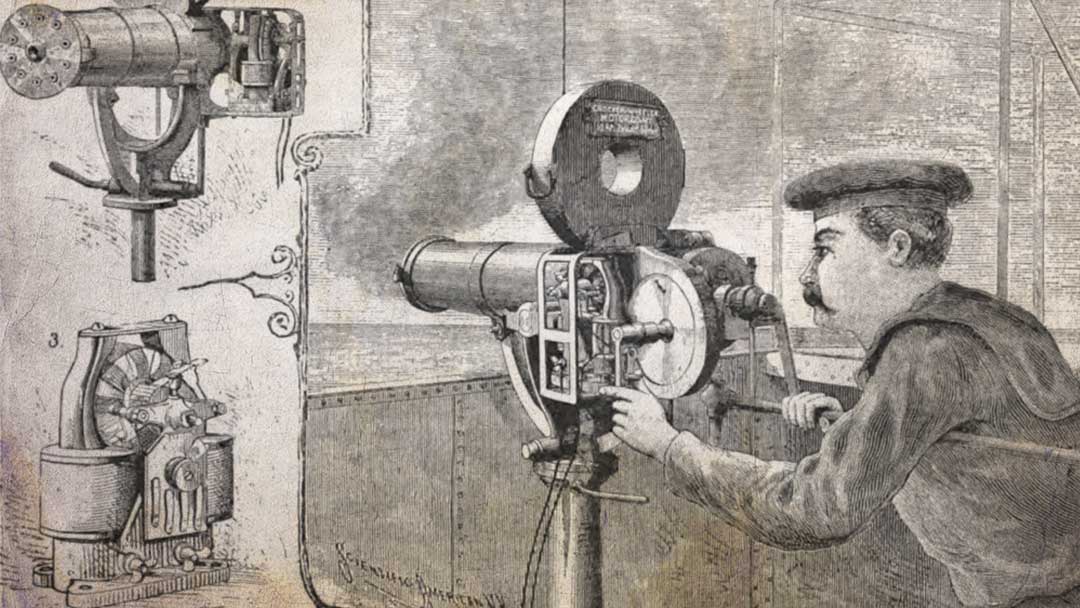
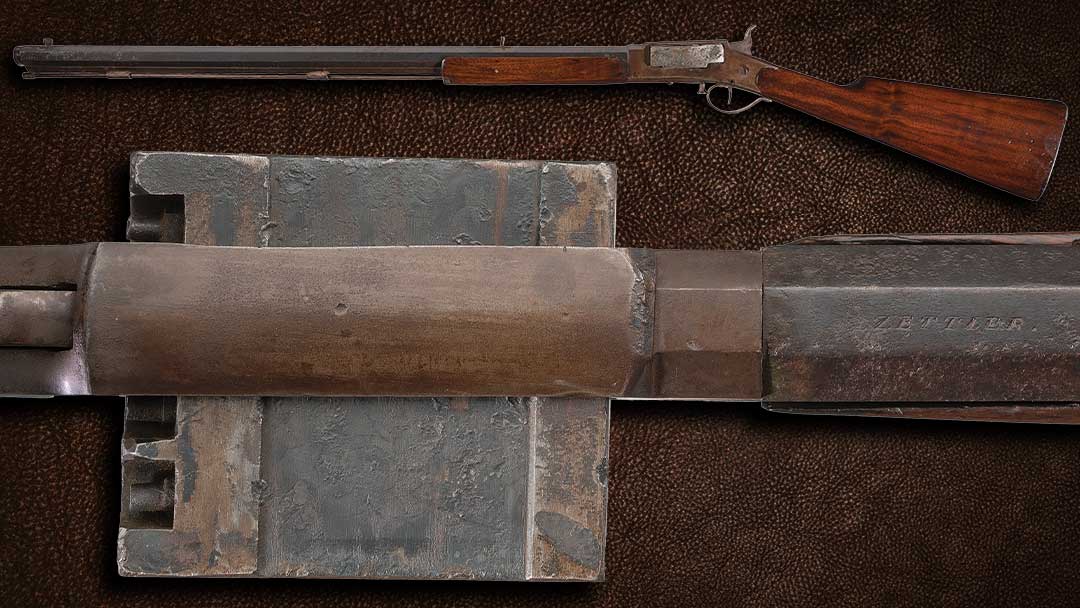
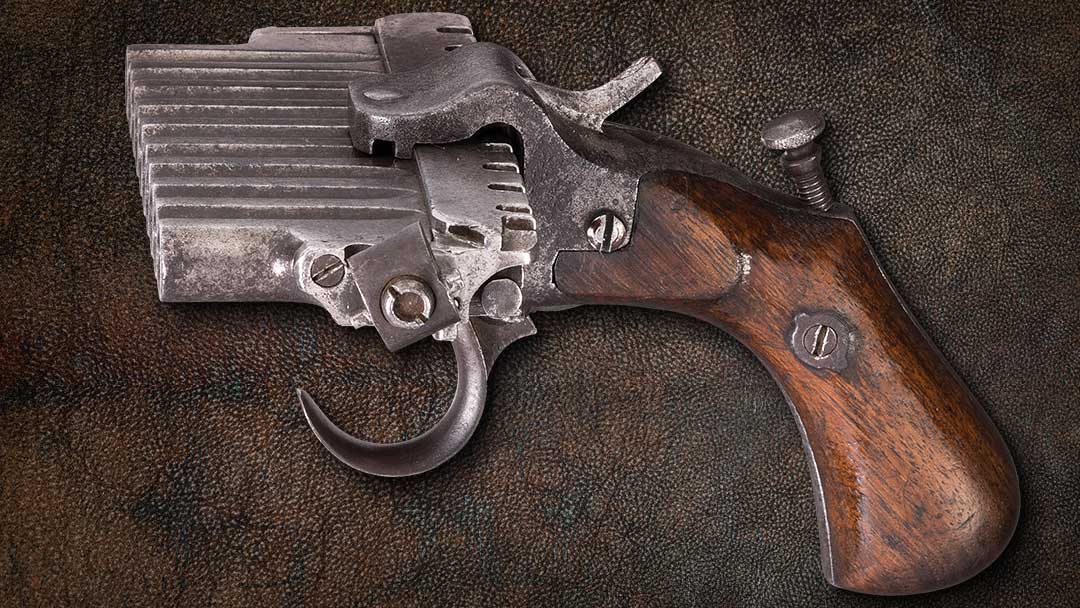
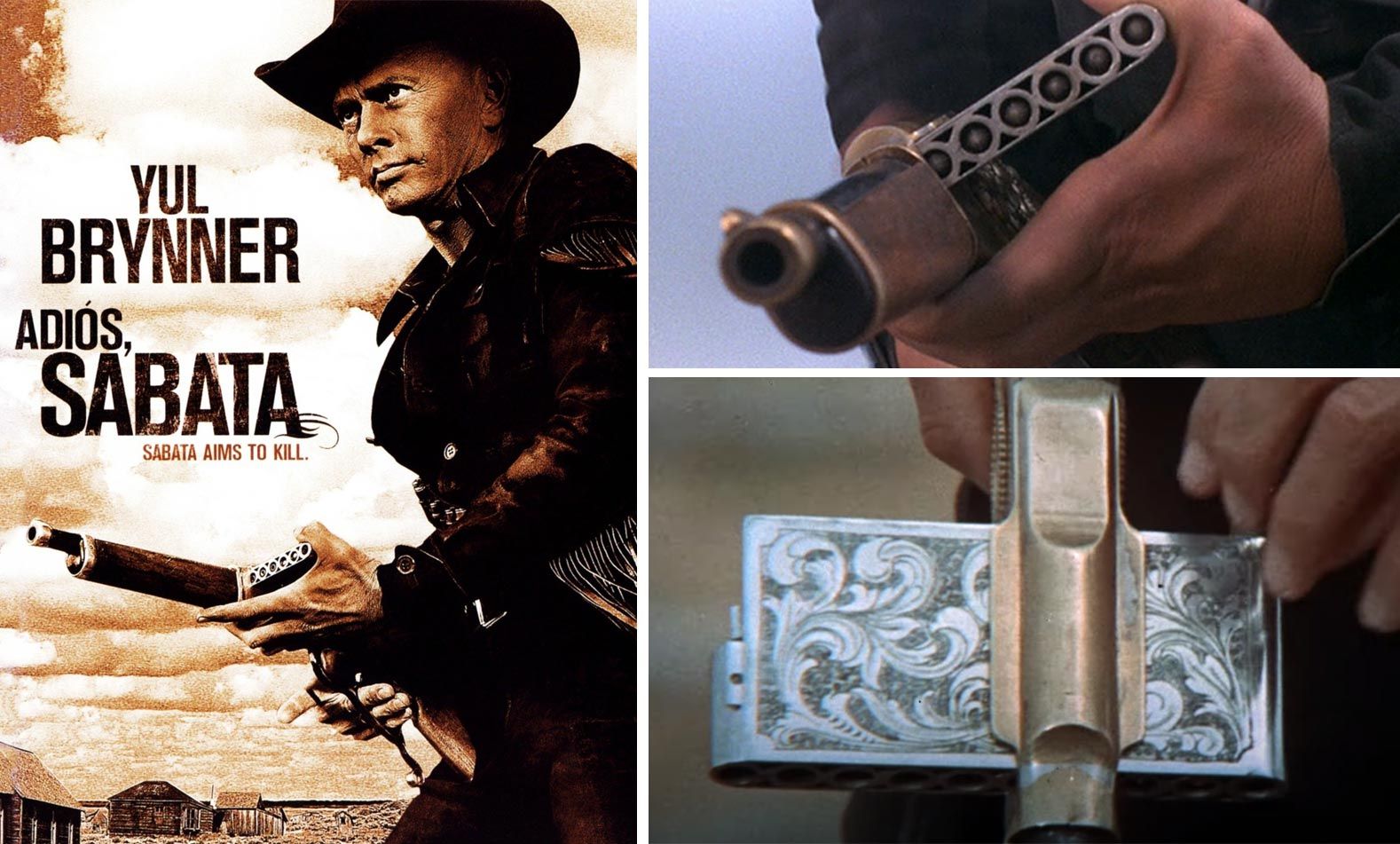
One of the easiest ways for early arms makers to increase the rate of firepower for a single gun was to add multiple barrels that could be fired simultaneously or in sequence. Enter the volley gun, a design that was developed in numerous styles, sizes, and configurations through the centuries, including the duck foot pistol, the Nock volley gun, the Montigny Mitrailleuse, and the crank handle Nordenfelt “machine gun”, a multibarreled volley gun that competed with the Gatling gun in the 1870s.
A number of rare 18th and 19th century volley guns are for sale during Rock Island Auction Company’s December 8 – 10 Premier Firearms Auction, and each standout example of the platform illustrates the lengths gun designers went to offer a force multiplier on the battlefield or in the sporting pursuit. Click on the images throughout this article to learn more about each firearm model.
The concept of the volley gun dates to at least 1339 with the Organ Gun, or “Ribauldequin.” One of the world’s first multibarreled firearm platforms, the Organ gun and its numerous variations were large anti-personal platforms that offered more mobility compared to conventional artillery of the era, but they were expensive weapons to produce.
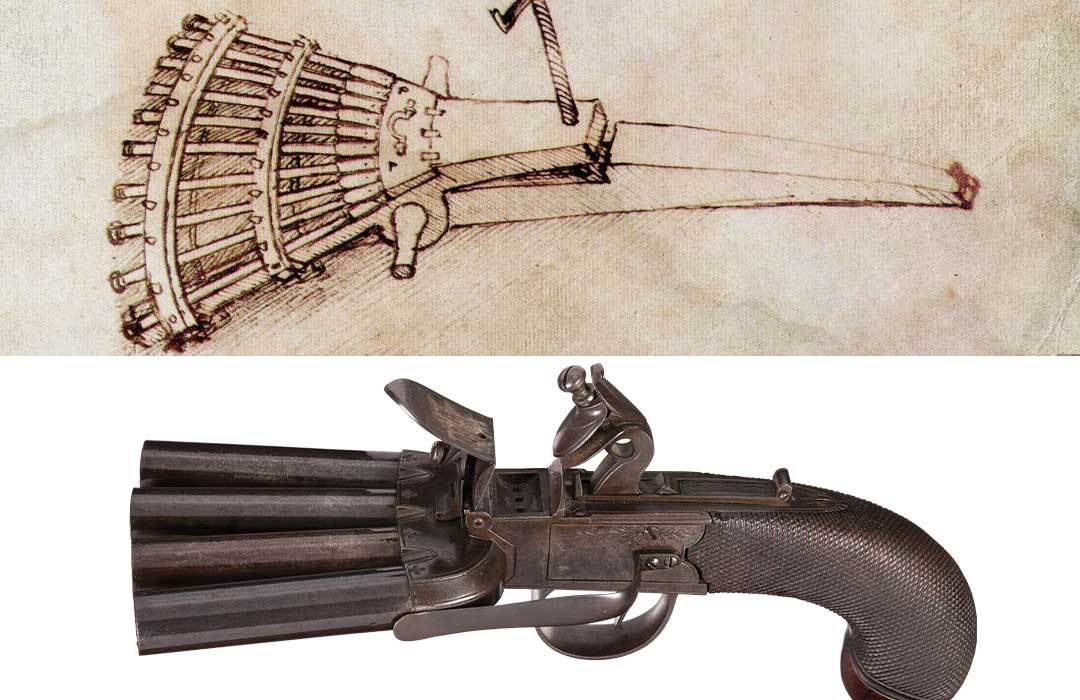
A sketch of the Organ gun (left) and a duck foot pistol (right), a miniaturized flintlock version of the same concept with similarly splayed barrels. The Duck Foot pistol is available this December.
Five centuries later, a Frenchman named Giuseppe Marco Fieschi constructed one of the most famous volley guns in history. Dubbed “the infernal machine”, Fieschi and his co-conspirators constructed the 25-barrel volley gun in a failed effort to assassinate King Louis Philippe I. Fieschi’s weapon was a crude custom design, but it relied on the same concepts seen in several later 19th century battlefield platforms, employing a row of horizontally aligned barrels to concentrate firepower on a target downrange.
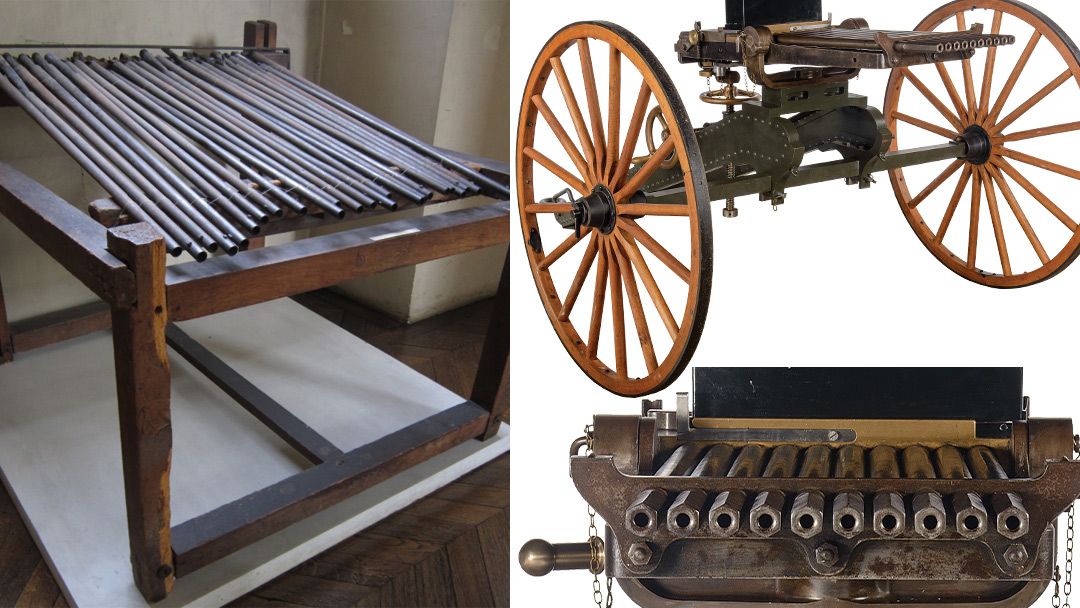
Fieschi’s infernal machine at the Musée des Archives Nationales (left) and the Nordenfelt volley gun design produced more than four decades later (right). This rare Nordenfelt example is available this December.
The Chambers, the Mitrailleuse, and the Nordenfelt Volley Gun
Commissioned by the U.S. Navy during the War of 1812, the Chambers swivel gun was a large volley gun that fired sequentially using a circled cluster of seven barrels, each loaded with 25 special superposed rounds. Belgian Captain Toussaint Henry Joseph Fafchamps revisited the concept 40 years later with his 50-barrelled Mitrailleuse volley gun design.
One lesser-known step in the journey toward today’s modern machine guns is that of Joseph Montigny and his Montigny Mitrailleuse. These multibarrel creations arms sought to up battlefield firepower, but militaries were uncertain of how to best implement them.
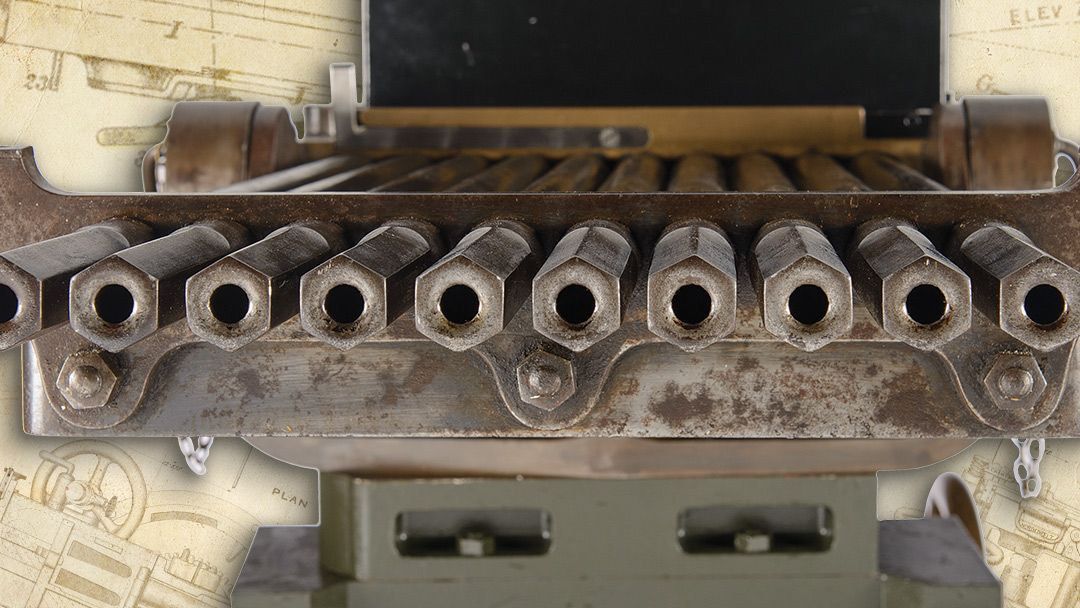
The Mitrailleuse volley gun employed a cluster of barrels mounted in a hexagonal shape. The French variant was fired with a side crank similar to a Gatling gun, while the Austrian Montigny Mitrailleuse utilized a rear-mounted lever. Swedish inventor Helge Palmcrantz opted for a design similar to the latter mechanism when he developed the Nordenfelt volley gun in the late 1860s.
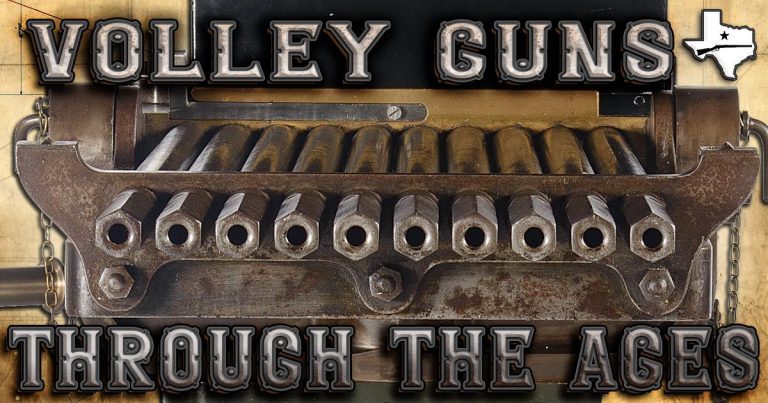
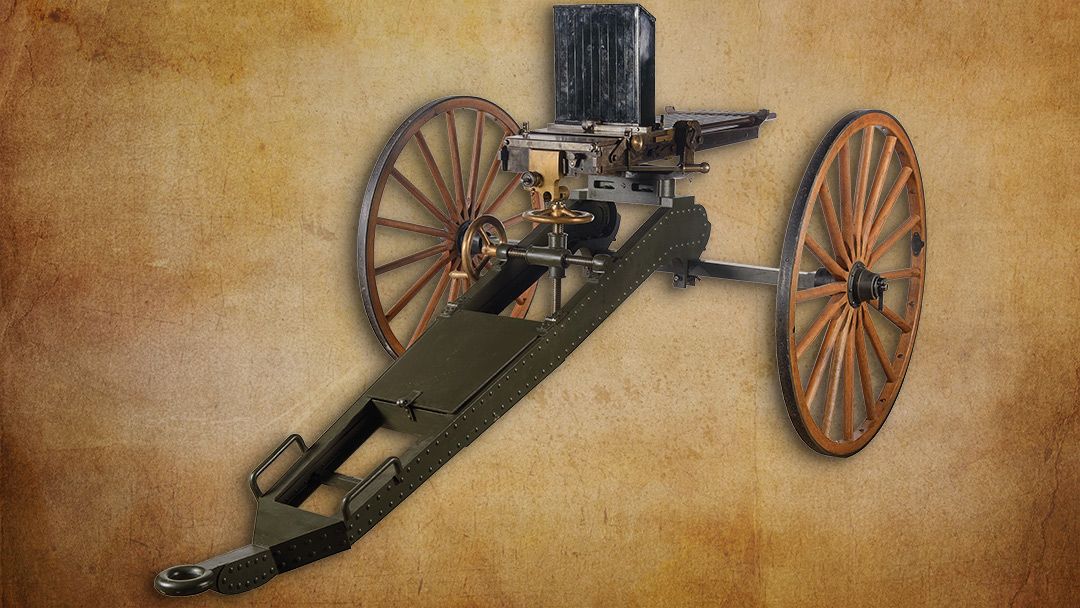
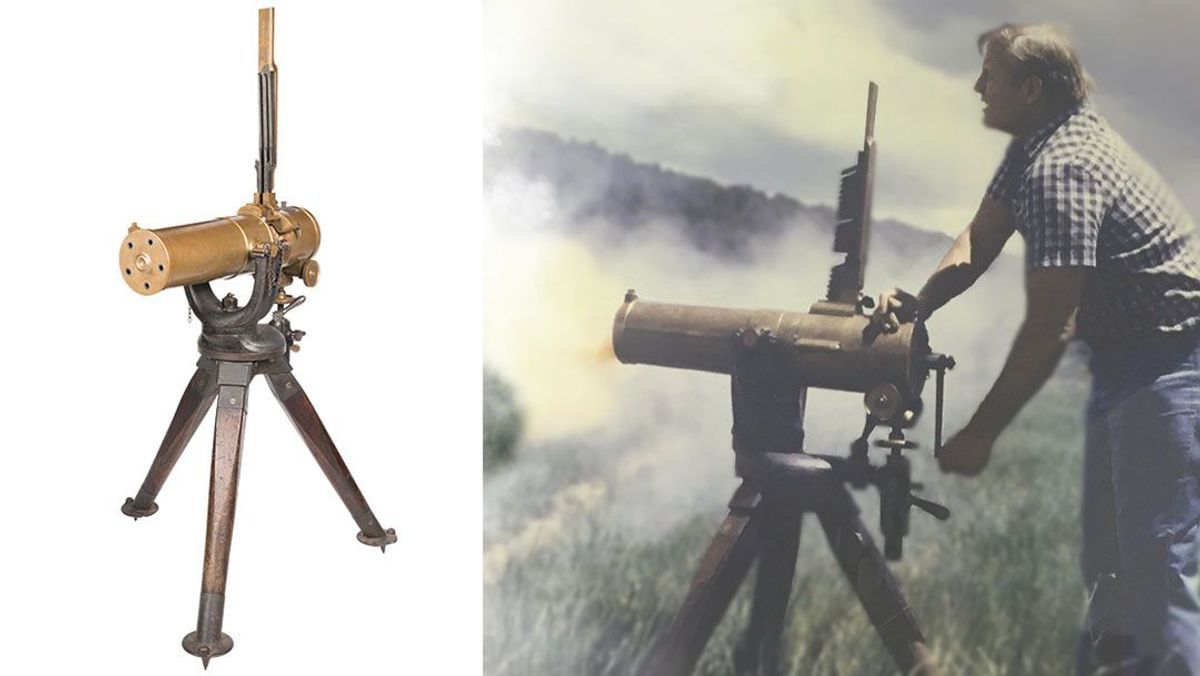
A 10-barrel Model 1873 Nordenfelt crank handle volley gun. Nordenfelt’s concept used a horizontal, back-and-forth, lever action that fired all barrels at nearly the same time. Available this December.
The Nordenfelt Volley Gun
The 1860s was a time of rapid industrial advancement and innovation in arms technology. While new ideas were plentiful, finding financial backing for the production stage was often difficult for gun inventors to secure. In the early 1870s, Helge Palmcrantz partnered with fellow Swede Thorsten Nordenfelt, a steel producer and banker operating out of London.
Thorsten Nordenfelt patented the volley gun and set up “Nordenfelt Guns and Ammunition Company” in England to produce and market the platform. The Nordenfelt volley guns included between 2 and 10 side-by-side barrels depending on the model and were produced in numerous calibers. An early variant of the weapon was demonstrated to the Swedish Defense Minister, and it was subsequently bought into the Swedish Army. The Nordenfelt found even more success with the British Navy.
A rare Nordenfelt volley gun chambered in a necked .43 centerfire caliber. Available this December.
During a demonstration at Portsmouth naval base in England, a 10-barrel Nordenfelt volley gun, like this example for sale with Rock Island Auction Company this December, reportedly fired 3,000 rounds in 3 minutes and 3 seconds without any stoppages, an impressive feat for the era.
The Nordenfelt volley gun is operated by moving its side-mounted crank handle backward and forward. The backward pulling movement retracts the breech bolts rearward, which in turn allows ammunition to drop from the gravity feed hopper magazine located atop the weapon through the cutouts above the receiver/top cover. A push of the crank handle then advances the breech bolts forward, while simultaneously positioning the ammunition in line with the chambers in which the rounds fire at the end of travel. The speed or cyclic rate of firing is determined by how fast the operator can move the crank handle in this manner.
The Nordenfelt volley gun available in RIAC’s December auction is composed of all machined steel with a “U” shaped frame in which the ten barrels are mounted in parallel, with a brass breechblock, dual blade and notch sights on the left and right with elevation adjustable rear sights. Available this December.
The Nordenfelt volley gun was available in both naval mount and carriage configuration and was especially valued as an anti-ship deterrent. In the 1870s and 1880s, the Nordenfelt served in the British Royal Navy alongside the Gardner and Gatling gun. All three platforms were eventually overshadowed by Sir Hiram Maxim’s machine gun design.
Thorsten Nordenfelt eventually merged operations with the Maxim Gun Company to officially become Maxim-Nordenfelt Guns and Ammunition Company Limited in 1888. The merger became a takeover, and four years later, the two men would engage in one of the most famous court cases in history, Nordenfelt v Maxim Nordenfelt Guns and Ammunition Co Ltd. Though Nordenfelt would achieve a partial victory, Maxim and his machine gun would go on to dominate the market.
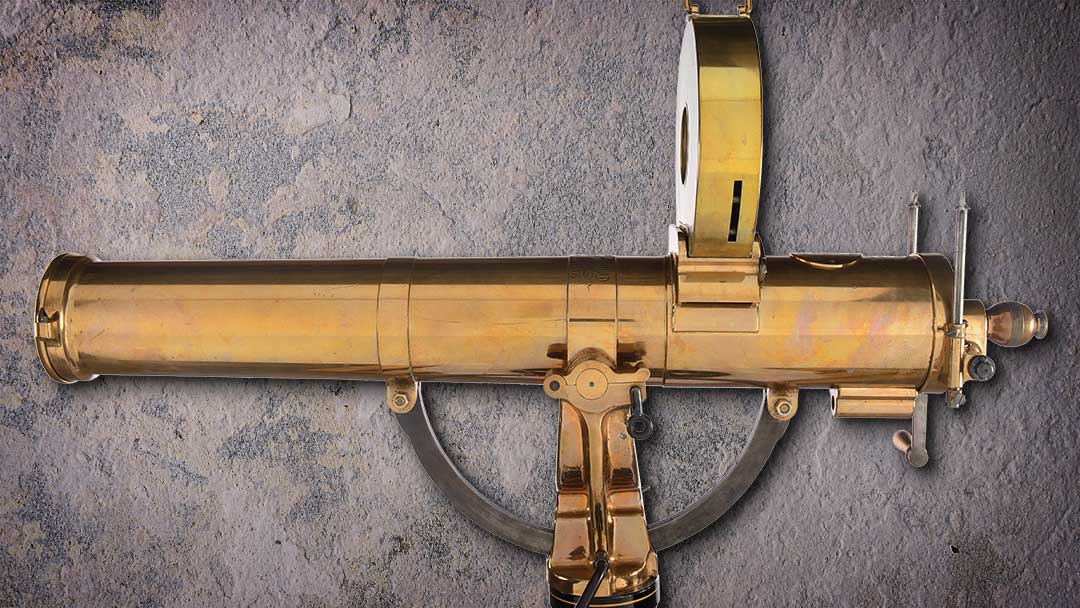
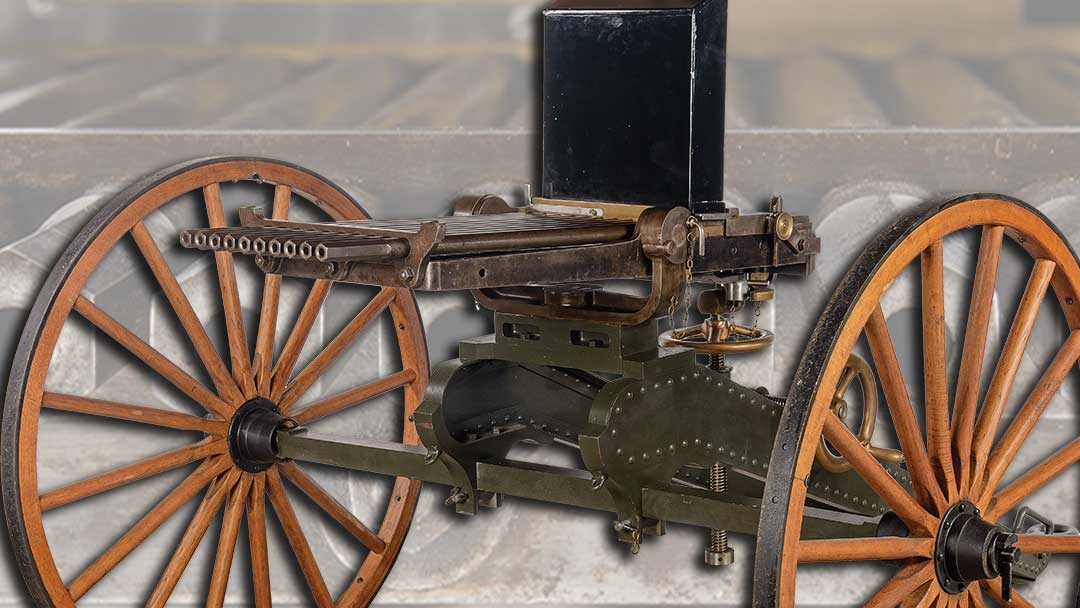
The Gatling gun, one of the Nordenfelt volley gun’s contemporaries. This U.S. inspected Colt Model 1883 Gatling gun is available this December.
The Nock Volley Gun
In the 18th century, advances in metallurgy allowed several styles of volley gun to be miniaturized. The duck foot pistol used splayed barrels like certain styles of the Organ gun, while the Nock volley gun employed circled clusters of barrels that were welded together.
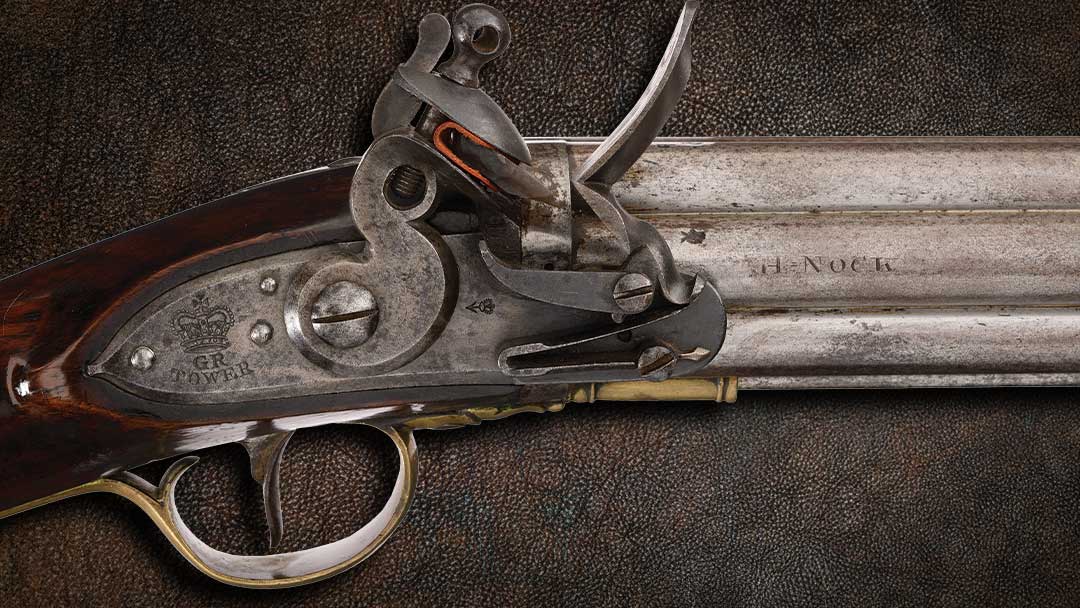
This second type Nock Volley gun, one of the finest examples of the model in circulation, was previously part of the famous Clay P. Bedford Collection and was displayed in the “Early Firearms of Great Britain and Ireland” exhibition at the Metropolitan Museum of Art. Available this December.
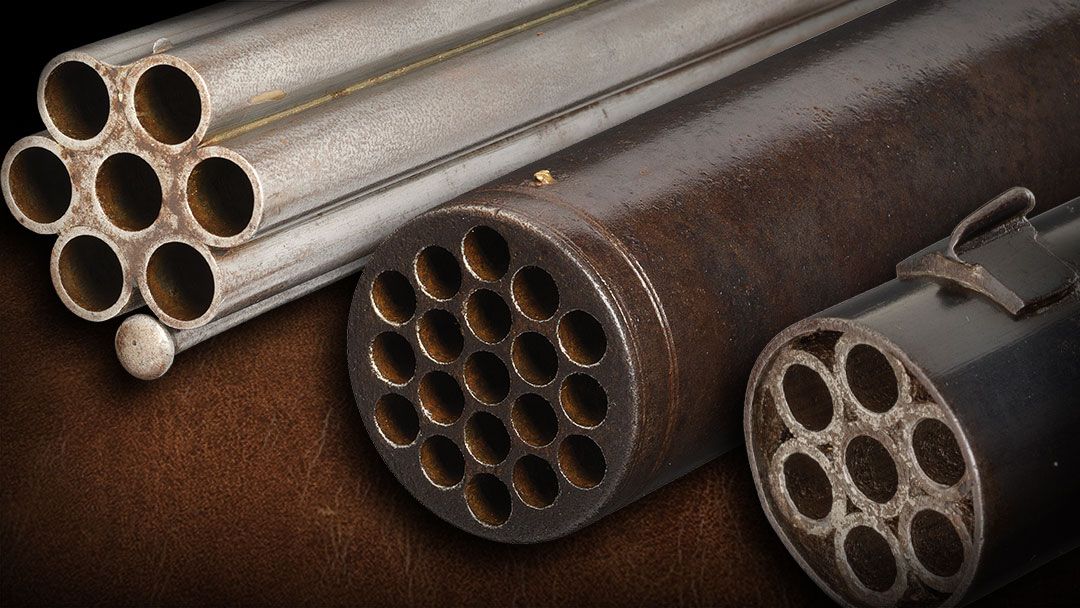
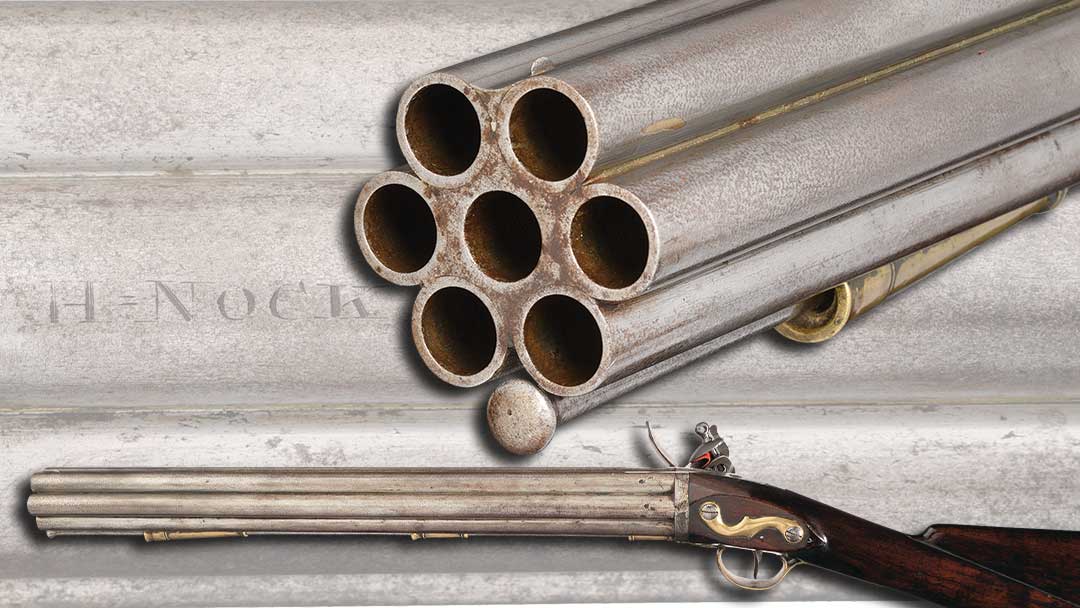
The Nock Gun, or Nock volley gun, was designed by James Wilson in 1779 and produced by British gunsmith Henry Nock. Approximately 549 first type Nock seven-shot volley guns were delivered to the British Royal Navy during the Revolutionary War era between 1779 and 1780. The Nock volley gun example pictured above is an even rarer second type Nock volley gun, one of only 106.
After the American Revolution, the Nock volley gun went on to serve in the French Revolutionary Wars and the early Napoleonic Wars. According to Admiral Horatio Nelson, the firearm’s severe recoil could cripple its users. The massive fireball the weapon produced also risked igniting nearby sails and rigging. Both factors contributed to the gun being pulled from service between 1804 and 1805.
Despite its downsides, the Nock volley gun’s distinctive barrel cluster, six outer barrels around a central barrel, produced a tighter shot group and had greater range and velocity than a shotgun or blunderbuss. The Nock volley gun went on to enjoy a brief period of popularity as a sporting arm as well, and in more recent times the weapons have appeared in film and television properties like ‘The Alamo,’ ‘Sharpe, Turn: Washington’s Spies,’ and ‘Master & Commander.’
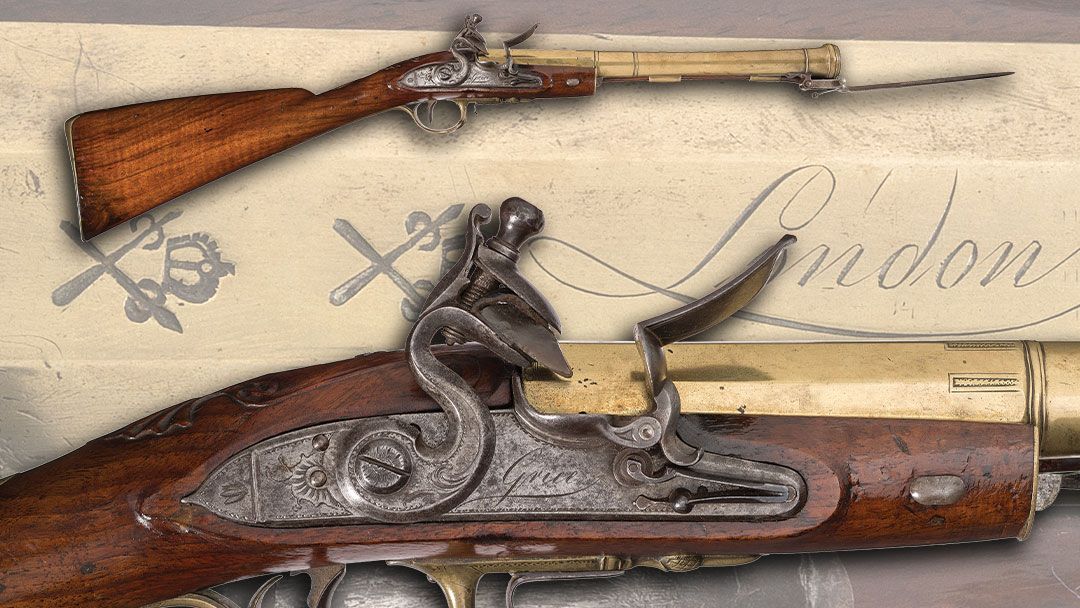
This late 18th century blunderbuss features a folding under barrel snap bayonet. Available this December.
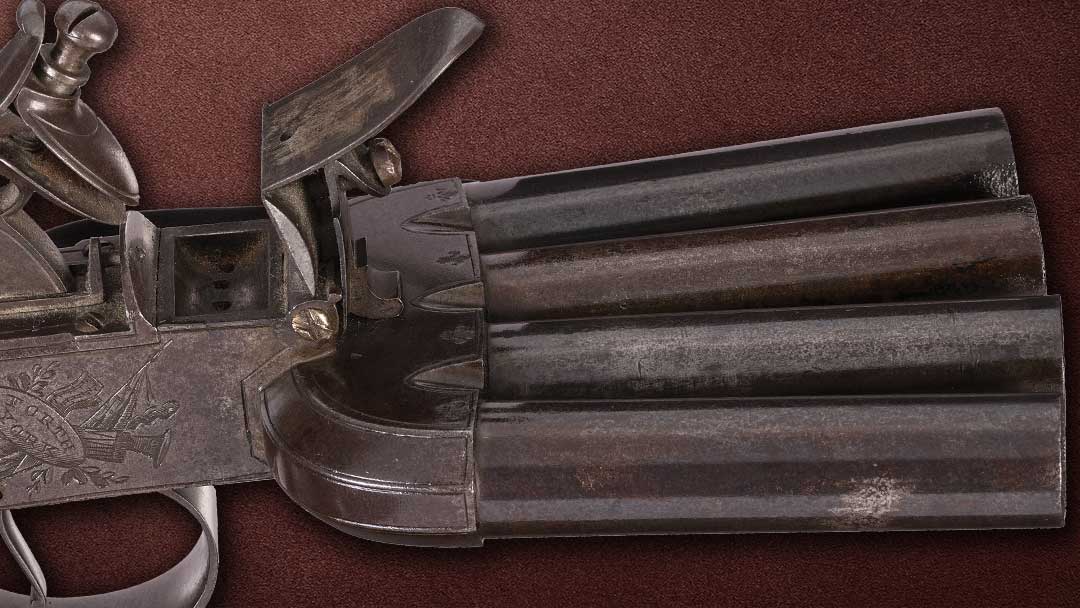
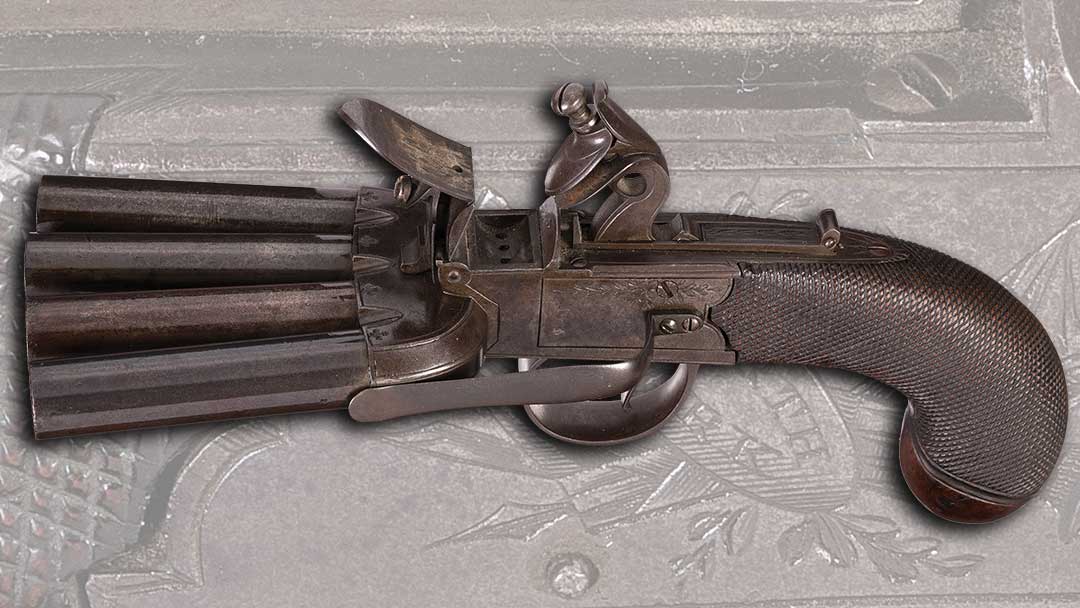
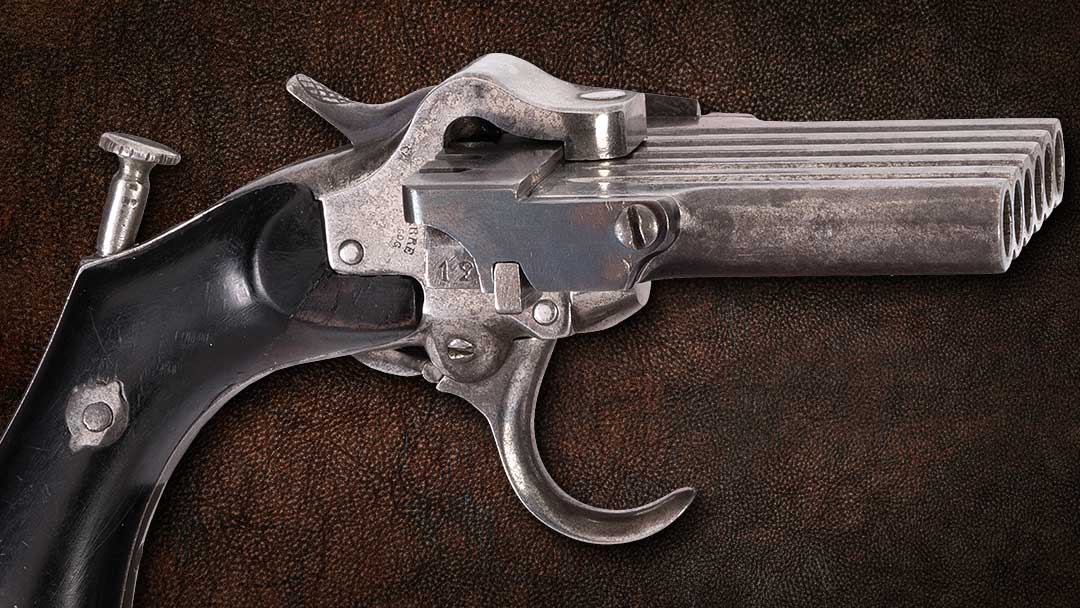
A handheld version of the Organ gun, the duck foot pistol employed multiple barrels radiating out from a single lock, giving rise to its popular nickname due to the weapon’s resemblance to everyone’s favorite waterfowl. These unique volley guns specialized in crowd control situations that might be encountered by bankers, jailers, riot police, or sailors engaging a boarding party or a group of mutineers.
A four barreled duck foot pistol, one of the most unusual handheld volley gun designs. Available this December.
The duck foot volley gun was produced in a host of configurations, with a varying number of barrels splayed outward at different angles. The widest duck foot pistol barrels were spread out as much as 60 degrees, and often none of the barrels pointed straight.
Although each barrel of the duck foot pistol needed to be individually loaded, a single trigger pull discharged every shot nearly simultaneously using a shared priming pan. When the priming powder was ignited by the sparks from the flint and frizzen, the resulting flash traveled through touch holes leading to each barrel to ignite the main charges propelling the balls.
This boxlock duck foot pistol is engraved with “FORTH/YORK” on the frame in an oval surrounded by martial engraving. Available this December.
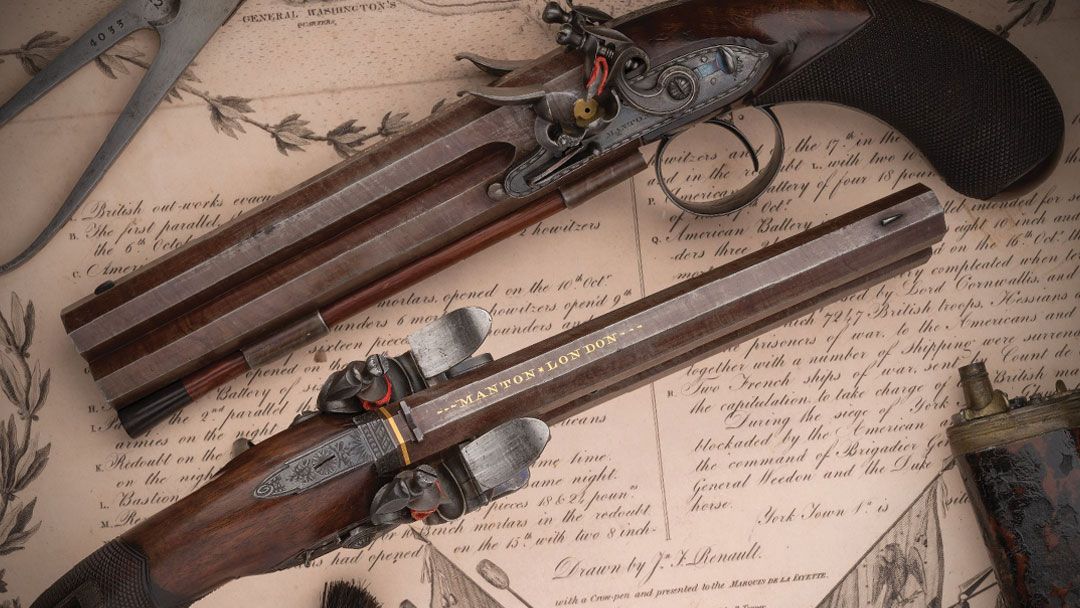
While the duck foot volley gun excelled against multiple targets in confined spaces, it offered little in the way of accuracy. Weight was another detriment. The platform’s most popular configuration included four barrels, with each barrel increasing the weapon’s heft. By the height of the duck foot pistol’s popularity in the late 18th century, multi-barreled flintlock pistols like the John Manton over/under pair below were becoming increasingly available, and the pepperboxes and early revolvers of the 1830s finally would finally spell the end for these unusual volley guns.
A scarce documented engraved and gold inlaid cased pair of “hair rifled” John Manton single trigger over/under flintlock pistols, from The Norman R. Blank Collection. Available this December.
The Henry Harrington Nineteen-Shot Volley Gun
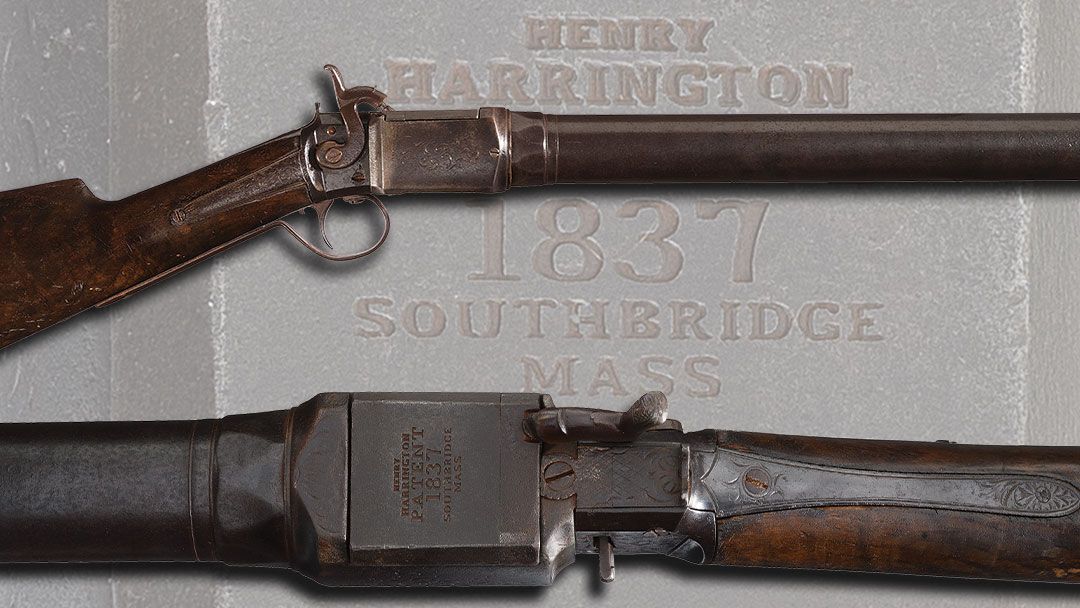
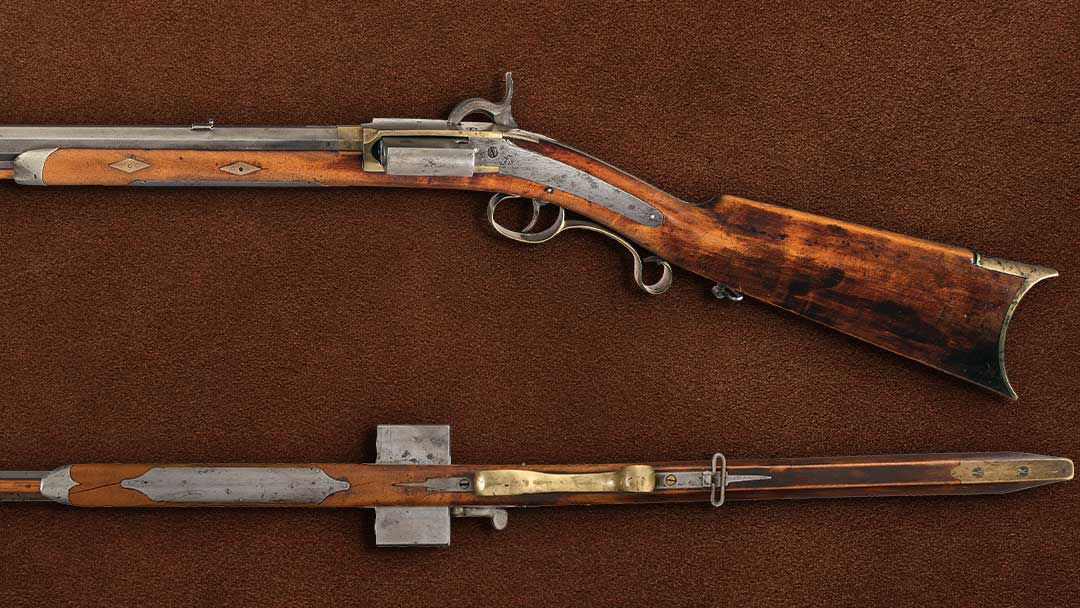
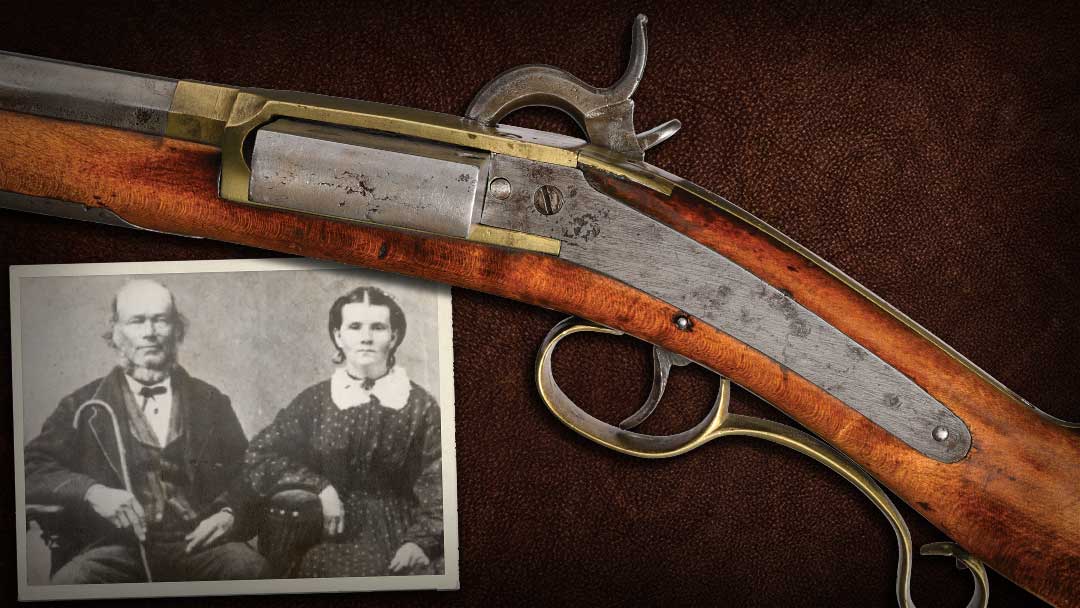
While Henry Harrington is more widely remembered as America’s first major cutlery manufacturer, the Massachusetts craftsman tried his hand at gunmaking as well. Harrington patented a percussion ignition volley gun design in 1837 and produced a limited number of long guns and handguns of various patterns based on this concept, with the intention of manufacturing or licensing cannons as well.
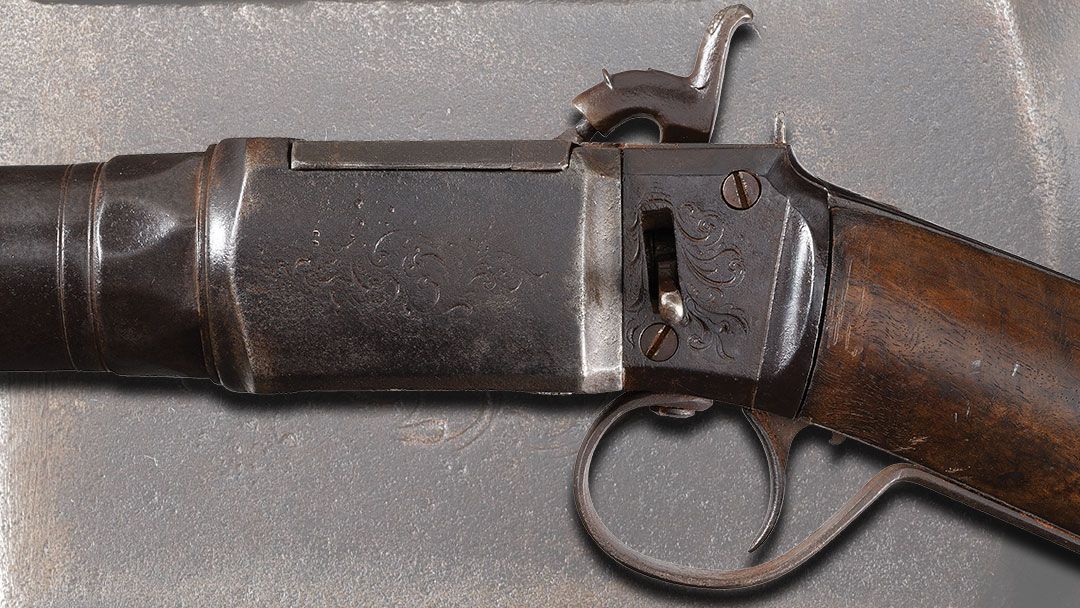
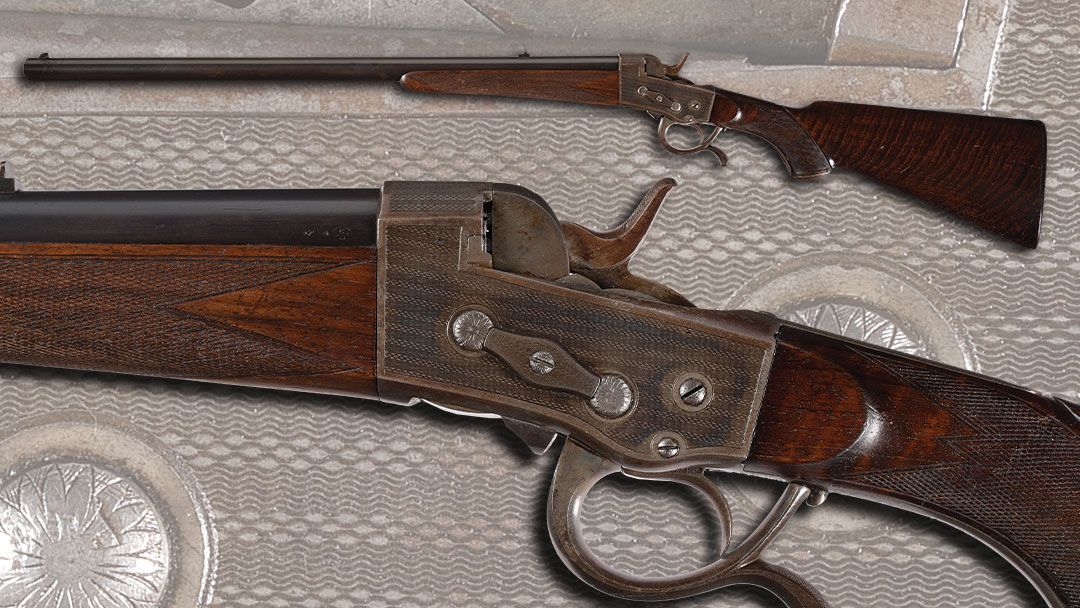
Like its Nock volley gun flintlock predecessor, the Harrington volley gun example pictured below would have offered an accurate option for taking fowl down range. The weapon’s barrel group is comprised of a central rifled bore surrounded by smoothbore outer barrels. A lever on the left of the frame pivots to allow the breechblock to lift out, offering a user with a spare block the option to quickly reload the volley gun.
This Henry Harrington Patent 19-shot volley gun marked “HENRY/HARRINGTON/PATENT/1837/SOUTHBRIDGE/MASS” on the breechblock, with “PATENT/1837” in larger text. Available this December.
Surviving Harrington patent volley gun examples demonstrate how the design was produced in a range of configurations, including different calibers, barrel lengths, and single and double hammer variations. Firearms author Norm Flayderman indicated that a three-shot Harrington was the most common model produced, making this 19 shot Harrington volley gun a particularly desirable example of the rarely encountered design.
An incredibly scarce Henry Harrington Patent percussion 19-shot volley gun. Available this December.
The H. Pieper Rolling Block Seven-Shot Volley Rifle
Henri Pieper, a German-born inventor and entrepreneur who settled in Belgium in 1859, had a prolific career. His accomplishments included producing shotgun barrels for some of Remington’s finest double guns, designing trial rifles for Belgiam’s army, developing the Pieper M1893 revolver, and patenting a gas-electric hybrid automobile 100 years before the Toyota Prius. He also found time early in his career to develop a unique rolling block volley gun rifle.
Henri Pieper’s .22 RF rolling block volley gun employed a seven round barrel cluster housed in a single iron sleeve that measures one inch across. Pieper’s experience with sporting arms production can be seen in the volley gun’s finely figured checkered walnut and embossed shotgun-style buttplate.
The Volley Gun Today
Several volley gun concepts have been introduced in recent times that utilize multiple barrels designed to be fired sequentially or simultaneously. An electronic ignition volley gun system was developed by Australian manufacturer Metal Storm Limited capable of firing 180 rounds of caseless 9mm ammo from 36 barrels in less than one-hundredth of a second. The Spanish Navy employs the Meroka Close-In Weapon System (CIWS), a 12-barreled volley gun intended for close-range defense against missiles, aircraft, and small boats.
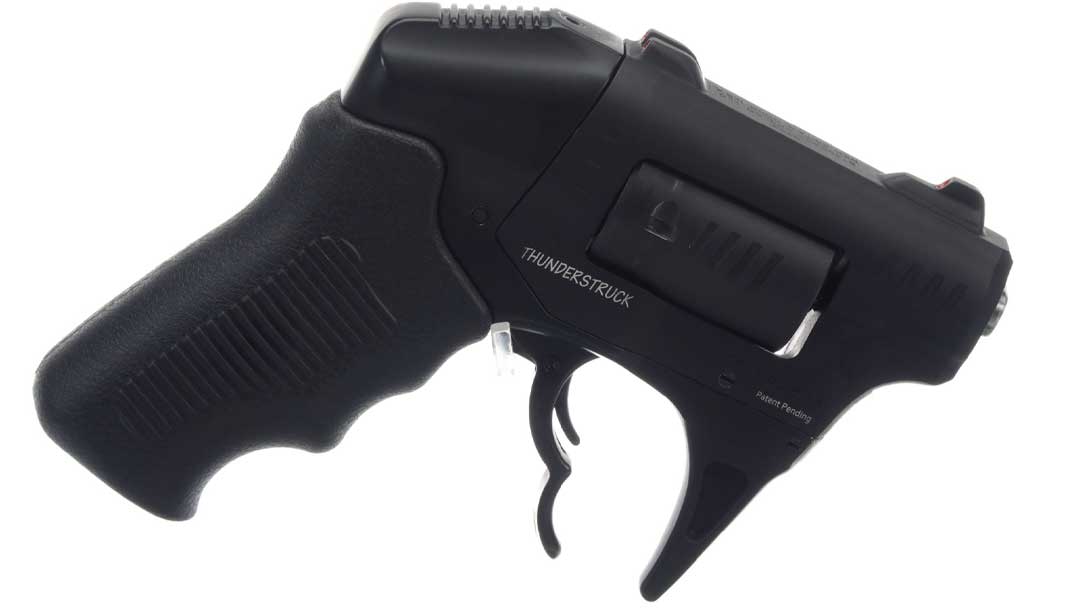
One modern example of a handheld volley gun is Connecticut gunmaker Standard Manufacturing’s recently introduced S333 Thunderstruck, an aluminum-frame double-barreled pocket revolver. Each pull of the trigger simultaneously fires a .22 Winchester Magnum Rimfire cartridge from both of the revolver’s barrels.
A modern day volley gun, the S333 Thunderstruck pocket revolver fires a .22 Winchester Magnum Rimfire cartridge from both barrels.
Surviving examples of the Nordenfelt volley gun are extremely rare in any form, with almost all remaining instances of the platform residing in museums. Available this December.
Rock Island Auction Company preview days are often advertised as a museum you can touch, and nowhere is that more evident than in the profound variety of styles, mechanisms, eras, and innovations featured in the company’s December event, the first-ever Premier Auction in RIAC’s new Bedford, Texas facility.
The Norman R. Blank Collection is the last of the great European arms collections in private hands. Largely forgotten and unseen until now, this assortment of museum-quality firearms offers unmatched examples of European craftsmanship.
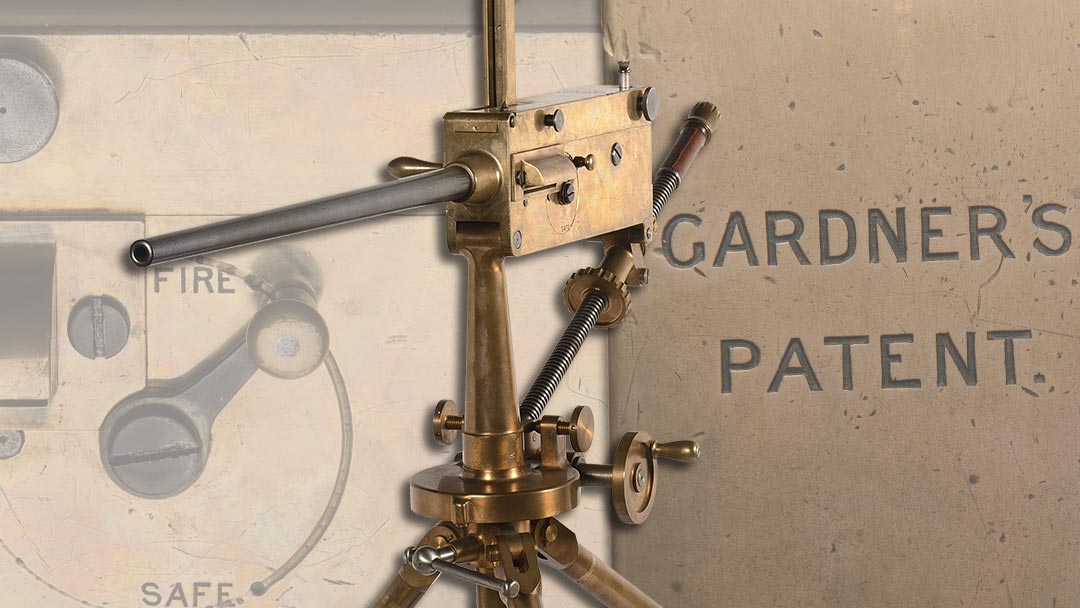
The 1882 Gardner gun is a key firearm in the evolutionary development of the machine gun and is missing from even the most advanced public or private collections. Available this December.
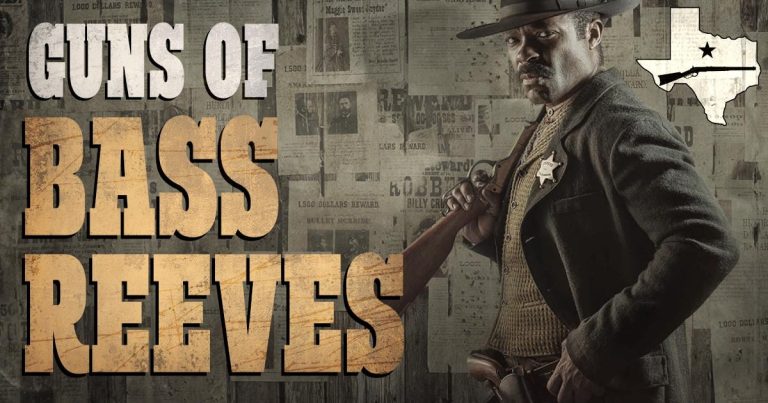
Paramount’s ‘Lawmen: Bass Reeves’, a Western miniseries developed by ‘Yellowstone’ creator Taylor Sheridan, follows the life of the titular character during the Civil War and the volatile decades to follow, an era where some of the most iconic firearms were introduced to the American frontier. Like the real story of the historic Bass Reeves, Paramount’s series is a tale of survival and justice in a lawless corner of the American West.
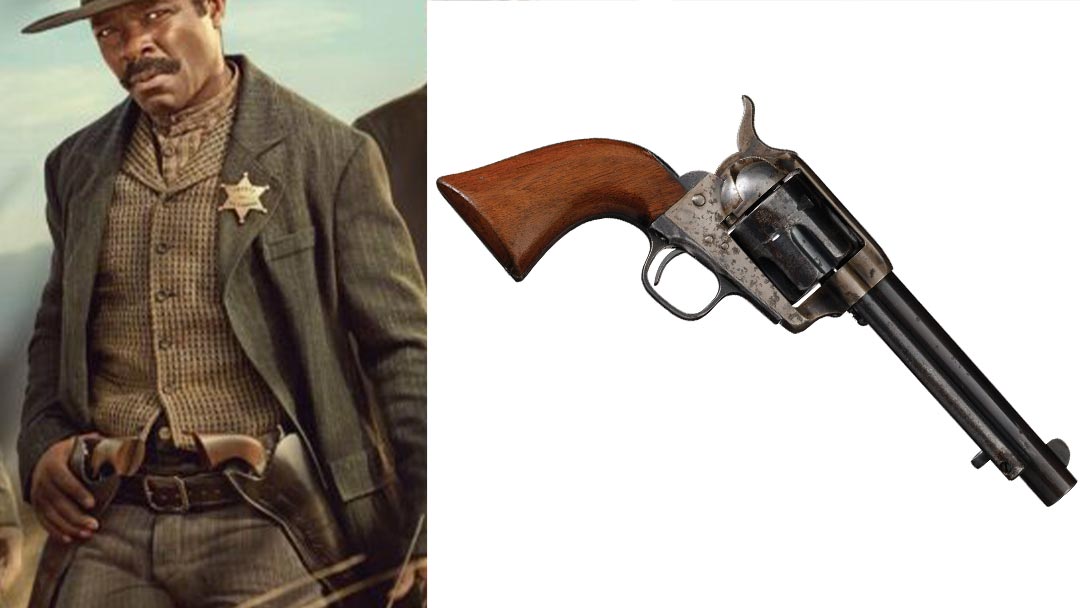
(Bottom) Bass Reeves (David Oyelowo) brandishes a Colt SAA Cavalry Model, one of his signature guns in the Paramount series. (Top) A David F. Clark inspected U.S. Colt Cavalry Model SAA with a factory letter and John Kopec Gold Seal Letter, available this December.
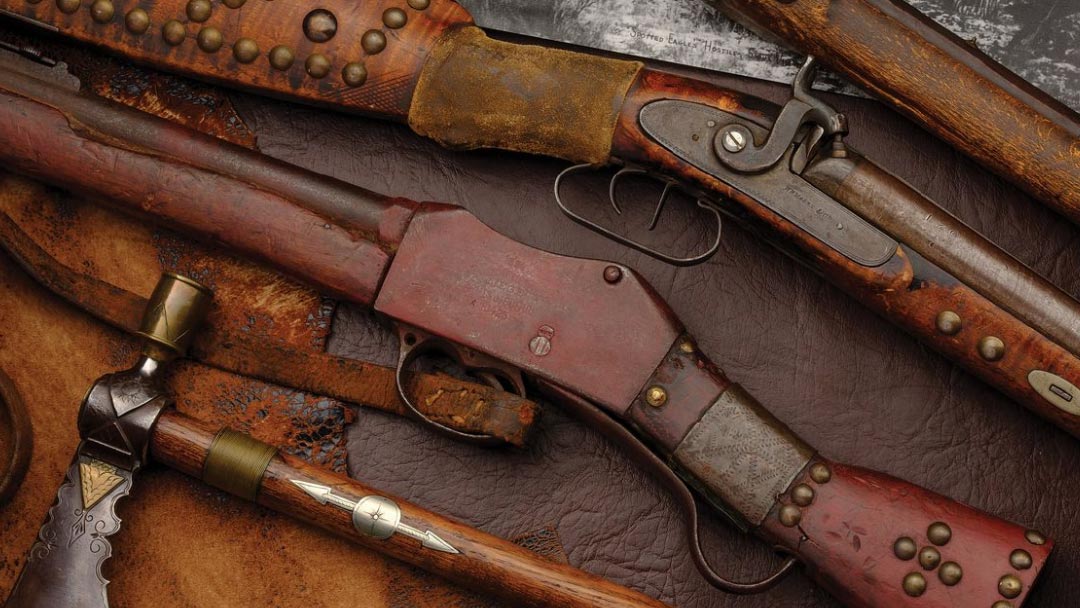
Though the historical accuracy of the Bass Reeves series varies, most of the guns depicted are real firearm models that are highly collectible today, and similar examples can be found in Rock Island Auction Company’s December 8 – 10 Premier Firearms Auction. Click on the images throughout this article to learn more about each model.
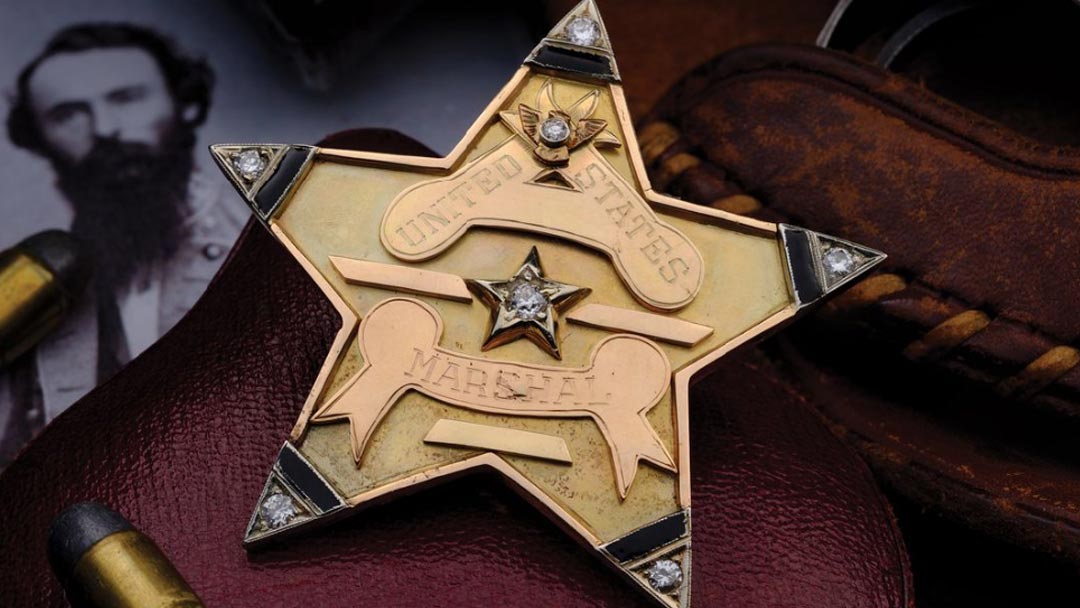
In addition to featuring a multitude of frontier firearms, December’s selection includes a number of guns and artifacts owned by U.S. Marshals who served during the tenure of Bass Reeves, including the badge of U.S. Marshal James F. Fagan of Fort Smith, Arkansas. Fagan deputized Reeves and started the legendary lawman on what would become a more than three decade’s mission to restore order to Indian Territory.
A historic presentation, 1875 dated, diamond-studded 14K gold U.S. Marshals badge inscribed to James Fagan, the man who recruited Bass Reeves later that year. The inscription on the back reads, “PRESENTED BY/WIFE AND FRIENDS TO/JIM FAGAN/FT. SMITH ARK./1875.” The badge comes in a period velvet-lined presentation case. Available this December.
In 1875, “Hanging Judge” Isaac C. Parker tasked James Fagan with hiring 200 Deputy U.S. Marshals. Fagan had been recently appointed U.S. Marshal for the Western District of Arkansas by President Ulysses S. Grant. Fagan added Bass Reeves to his team in 1875, the same year he was presented with the diamond-studded U.S. Marshals badge pictured above.
In little more than a decade, Bass Reeves went from escaping the bonds of slavery to becoming one of the first Black U.S. Marshals west of the Mississippi. We’ll explore the world of Bass Reeves, the guns depicted in the series, and the history behind one of the most prolific lawmen to ever don the badge. Spoiler warning: If you haven’t watched the series yet, and are hoping to go in fresh, read no further.
Find real frontier guns and more this December at Rock Island Auction Company.
The Guns and Legend of Bass Reeves
After the Civil War, the Indian Territory became a haven for criminals looking to escape the reach of the American justice system. The federal court for the Western District of Arkansas was relocated to Fort Smith in 1871 and focused its efforts on apprehending the murderers, horse thieves, smugglers, and other fugitives who frequented the lawless region.
Bass Reeves, who’d been farming in the nearby town of Van Burren, was recruited due to his familiarity with the land, languages, and native peoples of Indian Territory. Reeves also knew a thing or two about guns, an absolute necessity for anyone venturing beyond the “Dead Line,” the Missouri-Kansas-Texas Railroad that marked the southwestern fringe of civilization.
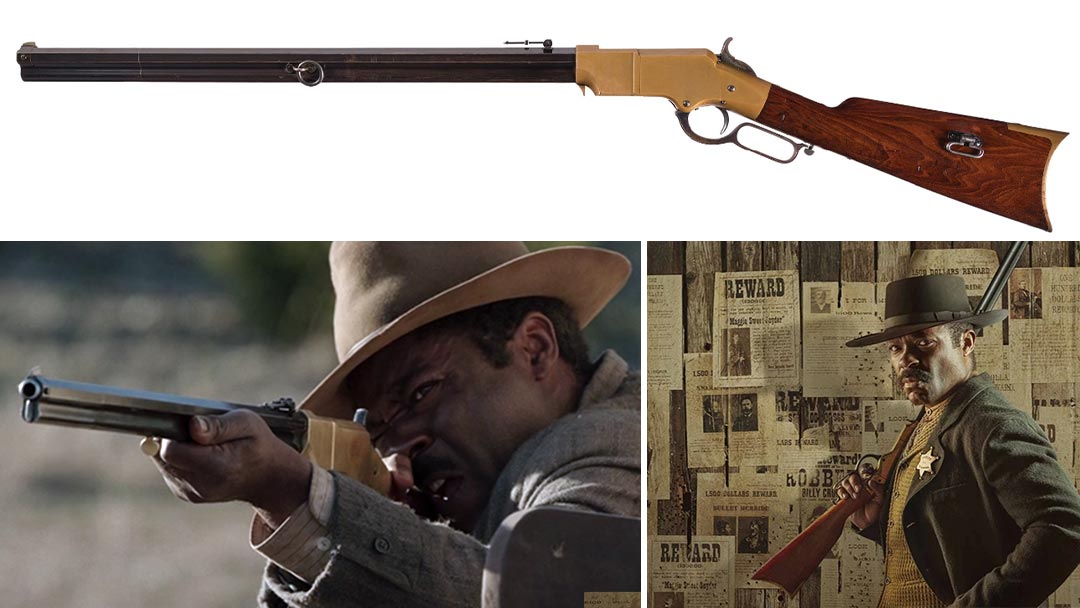
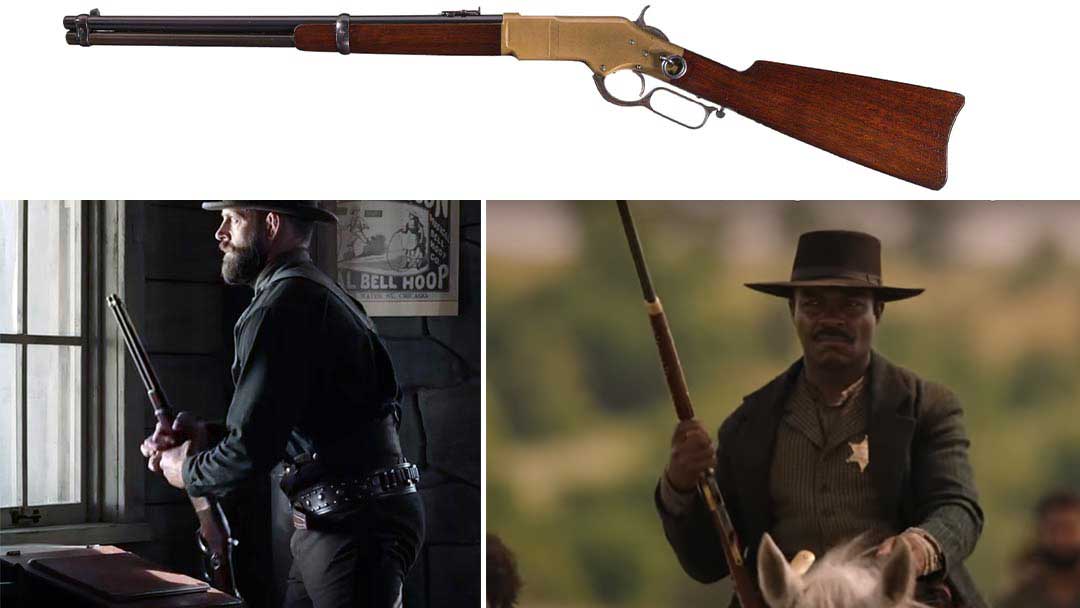
(Bottom) In the Paramount series, Bass Reeves prefers the Henry rifle as his longarm of choice. (Top) An outstanding Civil War production New Haven Arms Company Henry rifle available this December.
Between 1850 and 1907, nearly 120 U.S. Marshals lost their lives in Indian Territory, more than half the total number of U.S. Marshals ever killed in the line of duty. Judge Isaac C. Parker, a familiar name to fans of Western novels and films like ‘True Grit’ had a well-earned reputation as a hangman, leaving fugitives facing Parker’s deputies all the more inclined to engage in a gunfight when they were backed into a corner.
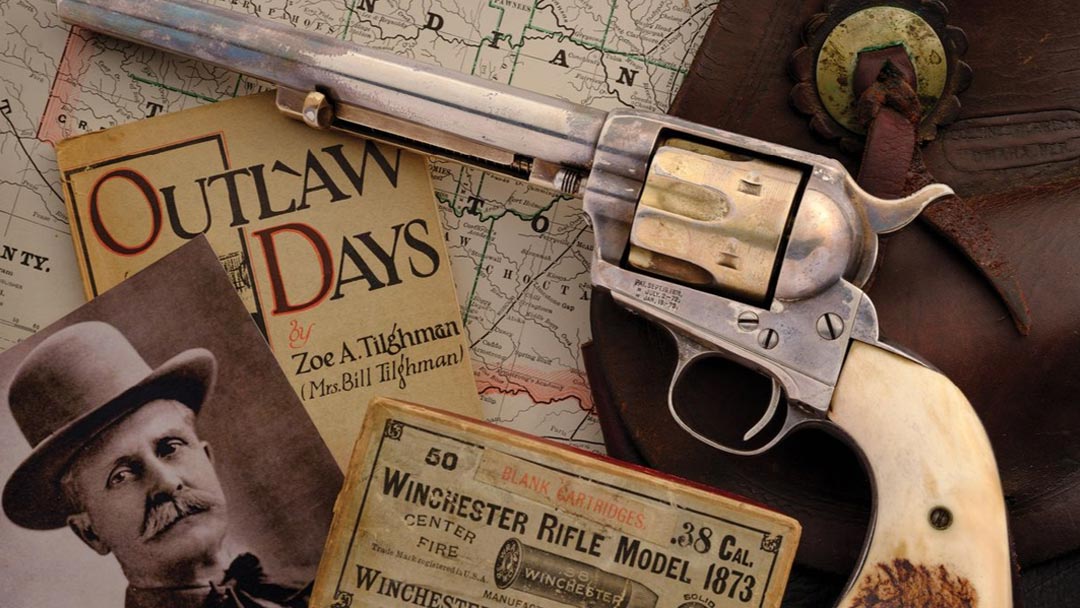
One of the most nefarious gangs to operate out of Indian Territory in the late 19th century was known as The Wild Bunch, or The Doolin–Dalton Gang. During the 1890s, Bill Tilghman became a Deputy U.S. Marshal and one of Oklahoma’s “Three Guardsmen,” toting a Colt revolver like Bass Reeves as he helped capture and kill several members of the gang and drove them from the region.
An 1888 shipped silver and gold plated Colt SAA inscribed “WM TILGHMAN DEPT. U.S.M.” attributed as Bill Tilghman’s personal sidearm. Available this December.
On Bass Reeves’s experience operating in the lawless region of Indian Territory, a February 28, 1907 article in the Charleston, West Virginia Advocate recounted, “Eighty miles west of Fort Smith was known as “the dead line” and whenever a deputy marshal from Fort Smith or Paris, Tex., crossed the M. K. & T. track he took his life in his hands and knew it. On nearly every trail would be found posted by the outlaws a small card warning certain deputies that, if they ever crossed the dead line, they would be killed. Reeves has a dozen of these cards which were posted for his special benefit.”
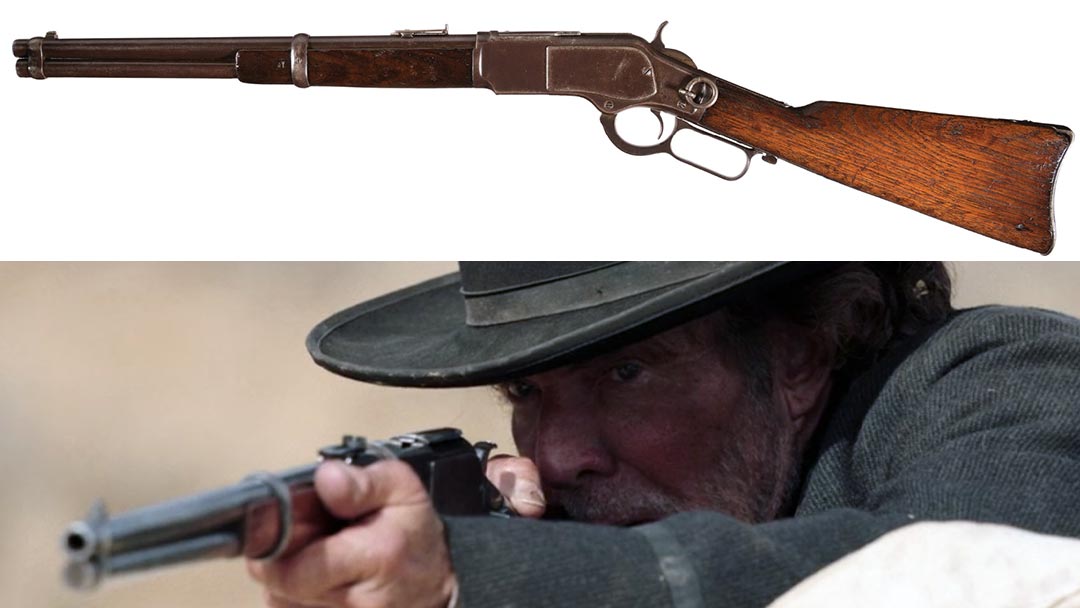
“Out here there ain’t no law – only outlaws.” (Bottom) Marshal Sherrill Lynn (Dennis Quaid) returns fire with his Winchester as he and Bass Reeves hunt a fugitive in Indian Territory. (Top) A Winchester Model 1873 saddle ring carbine available this December.
Bass Reeves was well aware of the risks of riding the bloody Seminole and Pottawottamine trails and he knew the threats against him were no idle boast, yet this wasn’t the first time he’d faced mortal danger. Like many U.S. Marshals of his era, Bass Reeves had seen the horrors of the Civil War and survived to tell the tale.
Bass Reeves in the Civil War
According to Bass Reeves, he was forced to accompany his master, Colonel George Robertson Reeves to several Civil War battles, including the Battle of Pea Ridge in northwestern Arkansas. Bass Reeves was one of thousands of slaves pressed into the role of body servants during the conflict, functioning primarily as support rather than engaging in combat.
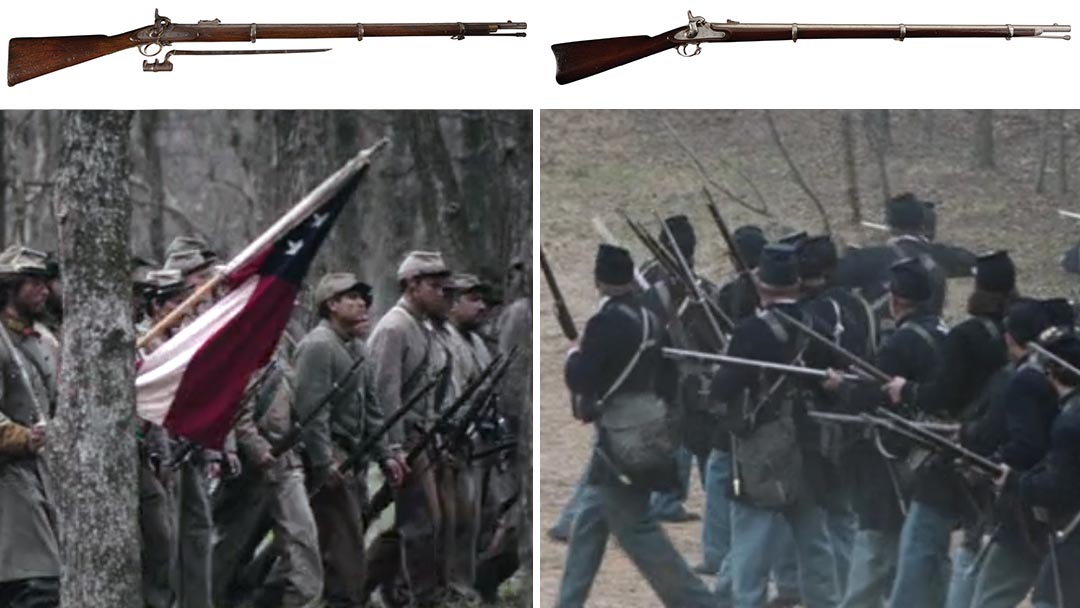
A variety of Civil War guns are featured in the Bass Reeves series. During the Battle of Pea Ridge, Confederates are armed primarily with pattern 1853 Enfield rifles, while the Union soldiers appear to be chiefly equipped with the famous Springfield Model 1861.
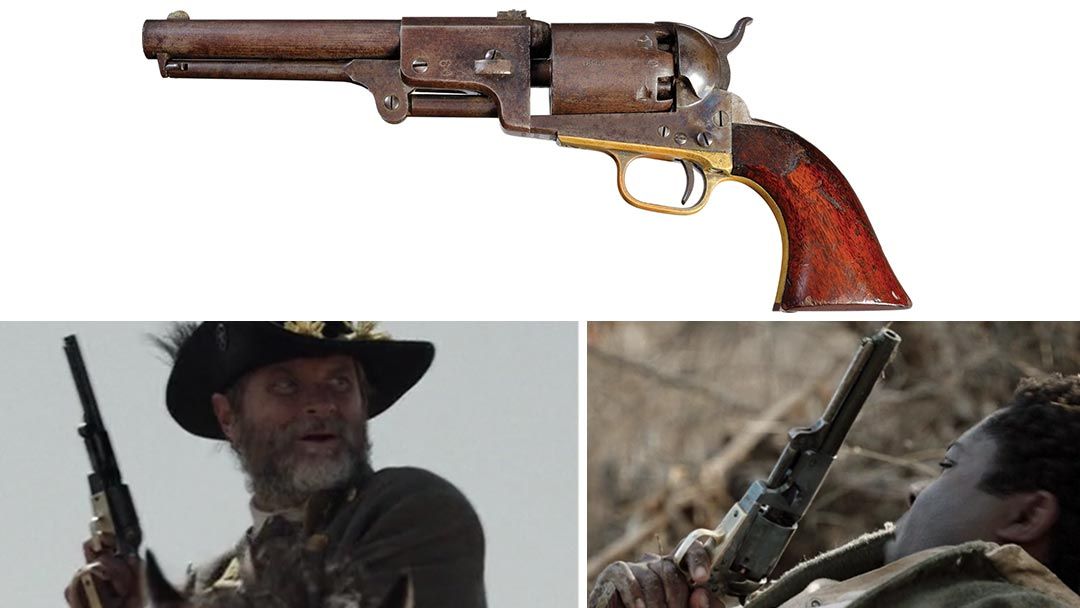
The first scene of the Bass Reeves series depicts the Confederates facing off with a Union artillery position near Pea Ridge on the morning of March 7th, 1862. Union cannon open fire, and George Reeves quotes ‘The Charge of the Light Brigade’ and rallies the 11th Texas Cavalry Regiment to charge. George Reeves carries what appears to be a Third Model Dragoon pistol, a sidearm employed by cavalry on both sides of the Civil War.
(Bottom) The Colt Dragoon, George Reeves’ primary sidearm, is later taken by Bass. (Top) A London Colt Hartford Third Model Dragoon revolver available this December.
Leading up to the Civil War, southern states purchased thousands of revolvers from Colt’s Manufacturing Company. Even after Lincoln ordered the Union Blockade in April of 1861, Colt revolvers continued to find their way into the Confederacy. The Colt Dragoon pictured below was likely smuggled into the South by arms dealer Cooper & Pond of New York and intended to equip an Alabama cavalry company that became known as the C.L. Dragoons.
A historic, documented “C.L. DRAGOON’S.” marked Colt Third Model Dragoon percussion revolver attributed to the Confederate Crocheron Light Dragoons. Available this December.
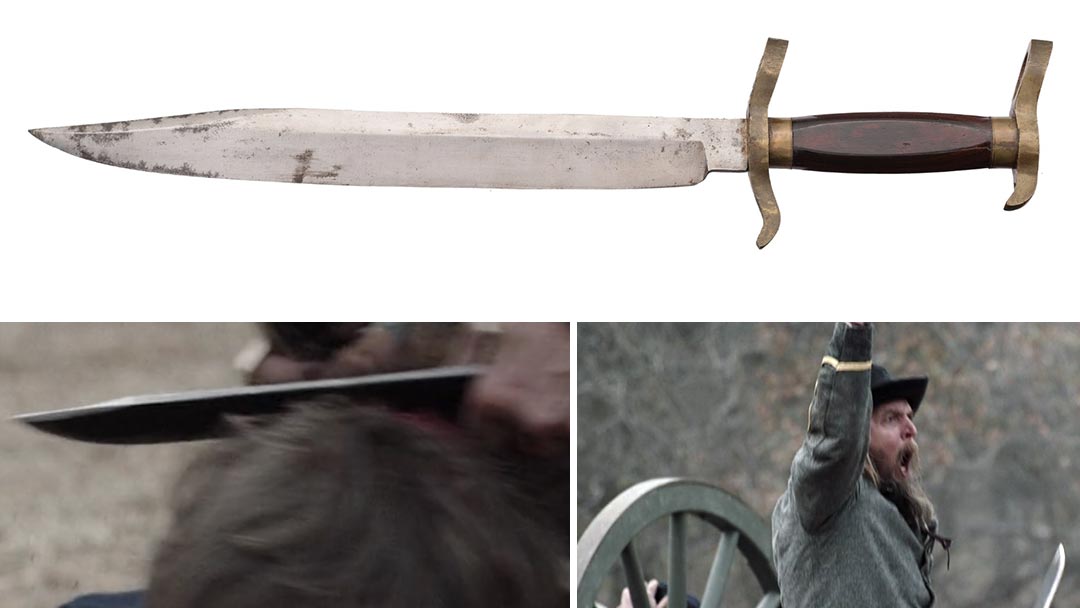
During the fighting, Bass Reeves encounters Confederate Major Esau Pierce (Barry Pepper). Esau, one of the officers in General Albert Pike’s 1st Cherokee Mounted Rifles, dismounts and scalps a wounded Union soldier with a classic clip-point Bowie knife, howling as he displays his gruesome trophy. Historically, the scalpings committed by the 1st Cherokee Mounted Rifles at Pea Ridge caused a nationwide uproar, with General Pike resigning his commission later that year. Pike was indicted for war crimes in Federal court and tried and convicted in absentia due to the incident.
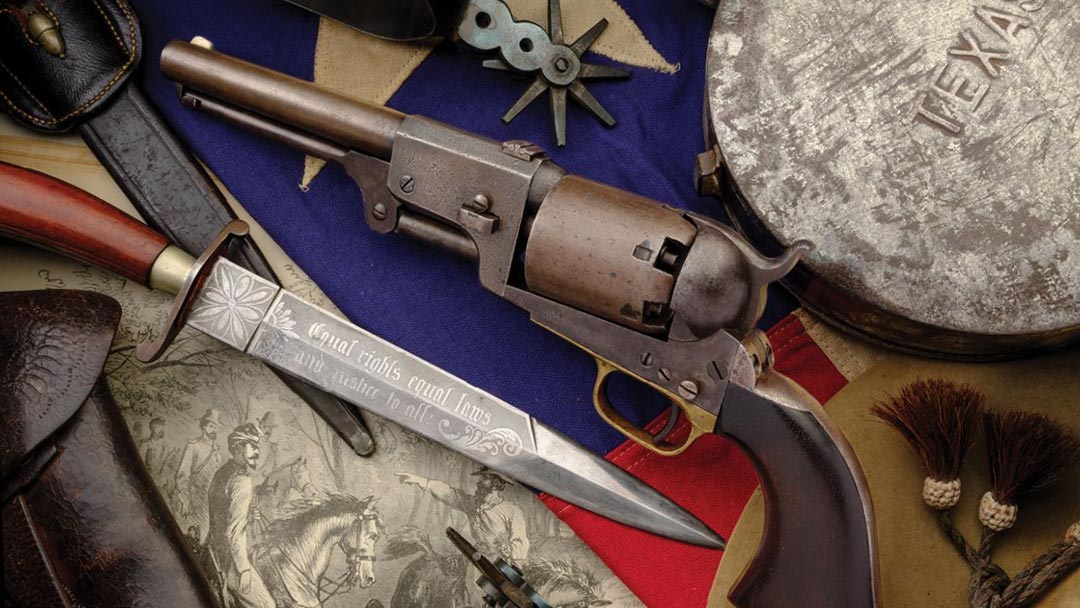
(Bottom) Major Esau Pierce takes a trophy with his Bowie knife. (Top) A rare Confederate “pike head/bayonet” Bowie knife available this December.
The Confederates would ultimately lose the battle due to poor planning. As George Reeves points out to Major-General Earl Van Dorn in the series, “We marched fast, only to find ourselves outflanked, outmaneuvered, and now out-supplied.”
The series portrays this dispute as the reason George Reeves resigned his commission. While historically, Reeves didn’t depart until much later in the conflict and became the longest-serving leader of the Texas 11th Cavalry Regiment, the Bass Reeves series accurately depicts both George’s eventual disillusionment with his commanders and the prevailing disgust with Major-General Earl Van Dorn’s strategic failure.
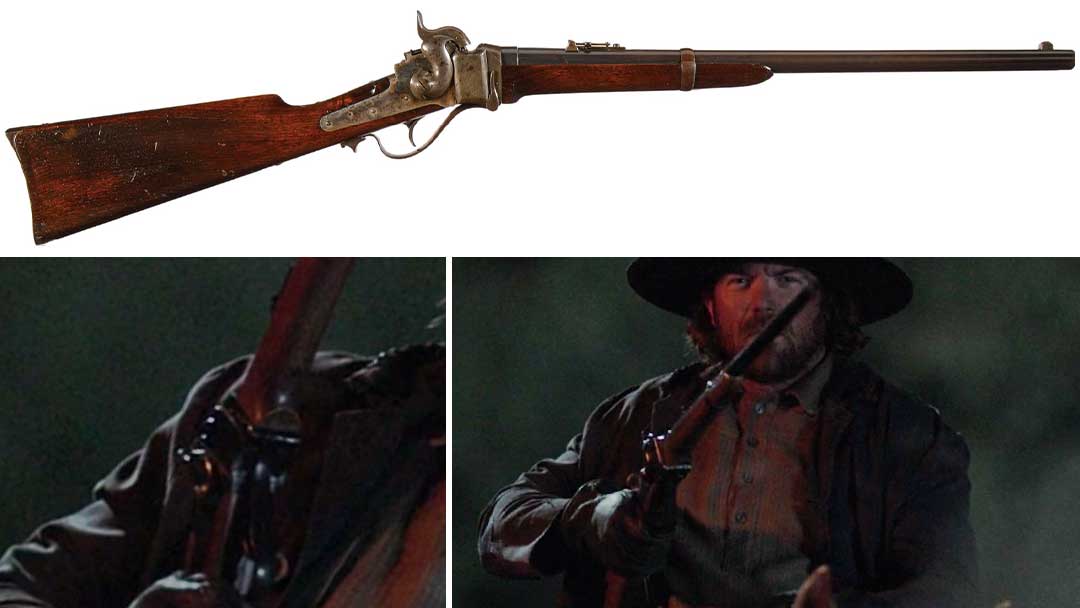
After returning to Grayson County, George Reeves cheats Bass in a game of cards, leading to Bass delivering an epic beatdown in response. Bass takes George’s Colt Dragoon and flees to Indian Territory, but not before gaining some first-hand experience with the revolver that will become his primary sidearm for the next decade.
(Bottom) Bass Reeves is confronted by a slave patrolman toting a Sharps carbine. (Top) A Civil War U.S. Sharps New Model 1863 saddle ring carbine available this December.
Lever Action Rifles of Lawman: Bass Reeves
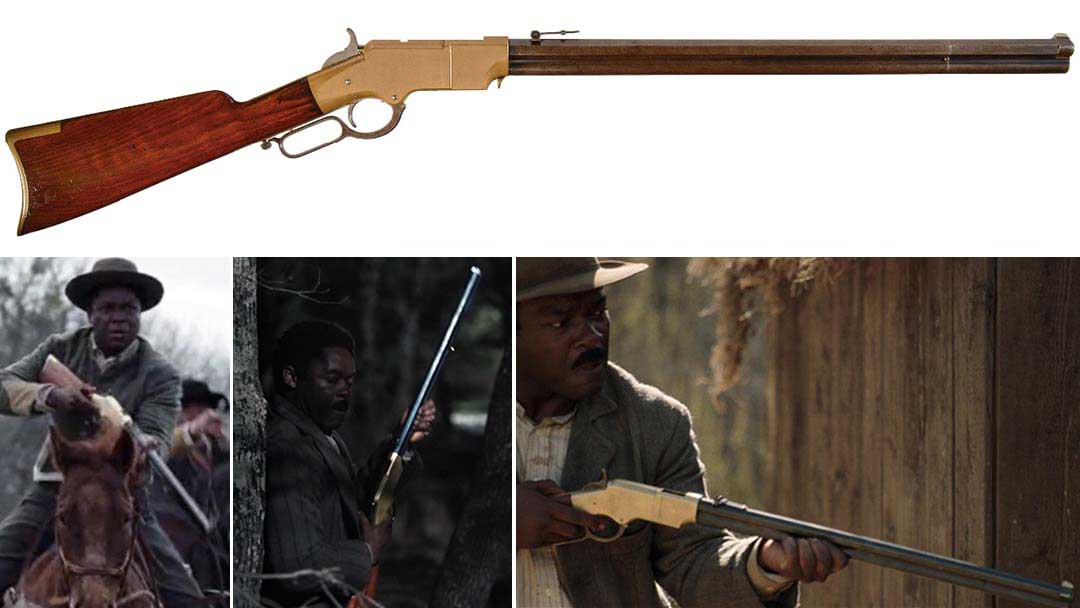
Bass Reeves was known for his skill with a Winchester, and the series depicts George Reeves introducing Bass to the platform by way of the Henry rifle. Though not impossible, a Confederate soldier owning a Henry rifle in early 1862 would have been highly unlikely. The New Haven factory was producing fewer than 200 Henry rifles per month during this period and the aforementioned Union Blockade made smuggling such weapons into the South a daunting task, so George Reeves’ rifle would have been far more likely to be a Union capture.
In the series, Bass Reeves acquires another Henry rifle at some point after returning to Arkansaw in 1865, a time when there would have been ample Civil War surplus guns available.
(Bottom) Bass Reeves in action with the Henry rifle, one of the most prominent guns of the Bass Reeves series so far. (Top) A Civil War production First Model Henry rifle available this December.
Most U.S. deputy marshals carried multiple guns when venturing into Indian Territory, and Bass Reeves was no exception. Revolvers were used for backup and close-quarters encounters, while long guns were preferred for their range, power, and accuracy. During Reeves’ early career, the Winchester Model 66, or “Yellowboy,”would have been in ample supply.
The “Improved Henry” design sped up the loading and reloading process, was better suited to the elements with its closed magazine tube, and offered a wooden forearm that improved handling and protected the shooter’s supporting hand from a hot barrel. The Winchester Model 66 also eliminated the “Henry hop” of its predecessor, where the shooter would need to reposition their support hand to avoid blocking the follower.
(Bottom) The famous Winchester Model 66 appears in the Bass Reeves series. (Top) An exceptional Winchester Model 1866 saddle ring carbine with its factory letter available this December.
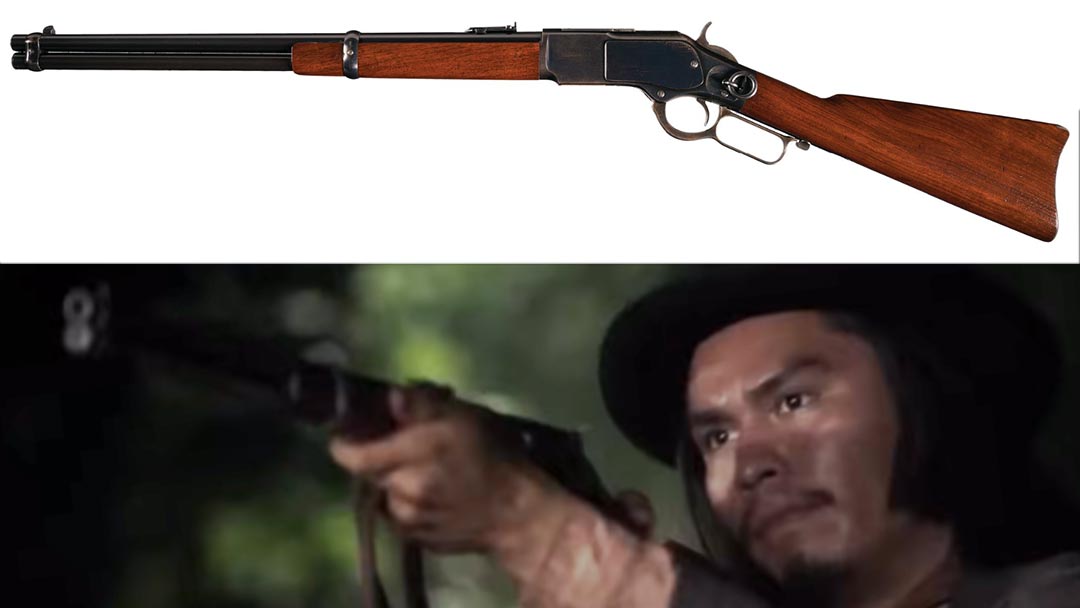
Marshal Sherrill Lynn, who first hires Bass Reeves as a “posseman,” carries Winchester’s most famous frontier incarnation in the Model 73. Commenting on Reeves’ Henry rifle, Lynn quips, “Best load that antique of yours.” The Model 1873 did indeed offer an upgrade matched up against its Henry rifle and Model 1866 predecessors. While the latter two guns were chambered in the comparatively weak, copper-cased .44-caliber Henry Flat rimfire, the steel-framed Model 1873 was designed for Winchester’s new brass-cased .44-40 centerfire cartridge.
(Bottom) Billy Crow (Forrest Goodluck) aims a Winchester Model 73 carbine. (Top) A high condition Winchester Model 73 carbine available this December.
In 1884, Bass Reeves engaged a killer named Jim Webb, both men wielding lever action rifles. According to Reeves, “I shifted my six-shooter and grabbed my Winchester and shot twice. He dropped, and when I picked him up I found that my two bullets had struck within a half-inch of each other. He shot four times, and every time he shot he kept running closer to me. He was 500 yards away from me when I killed him.”
Historically, Bass Reeves eventually came to prefer the Winchester Model 1873 as his long gun of choice due to its ability to share ammunition with revolvers like the Colt Frontier chambered .44-40 WCF. This meant one less cartridge belt to keep track of and less chance for confusion when reloading in an occupation where every second could be the difference between life and death. New Winchester lever action models like the 1876 and 1886 offered even more powerful cartridges, and the U.S. Marshals adapted accordingly.
Real frontier firearms are some of the most desirable guns in the collecting pursuit. Available this December.
Revolvers of Bass Reeves
Like all great Westerns, the Bass Reeves series features a plethora of revolver models, including the distinct LeMat carried by Marshal Lynn. Based on Lynn’s account of being injured during the Confederate ambush of the steamboat J.R. Williams in Indian Territory, he likely fought with the Union during the war, so his First Model LeMat could have been acquired as a Confederate capture.
(Bottom) Marshal Lynn fires his First Model LeMat revolver. (Top) A historic Civil War First Model LeMat revolver belonging to Confederate Brigadier General Lucius Jeremiah Gartrell sold in RIAC’s August Premier for $64,625.
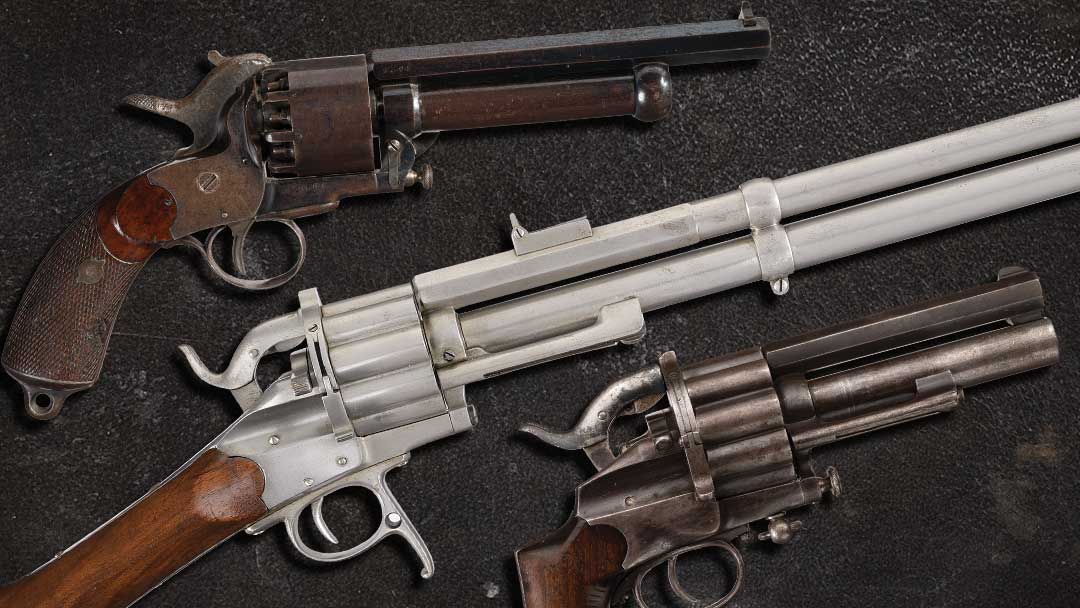
The LeMat two-barrel grapeshot revolver was one of the most unconventionalhandguns of the Civil War era. Conceived by a French inventor, the LeMat percussion models offered nine .40 caliber pistol rounds and a powerful 18 gauge shotgun blast, making the weapon a terror at close range. After the war, Dr. LeMat continued to upgrade the design, including developing pinfire examples and centerfire models like the two rare pieces pictured below.
The Bass Reeves series features a number of cartridge conversion revolvers, including the Colt Richards-Mason Model 1851 Navy and the Colt Richards-Mason 1860 Army. While conversions would have been anachronistic during the Turkey Creek ambush scene near the end of the first episode, they would have been fairly abundant by the 1870s.
(Bottom) A Colt Richards-Mason Model 1851 Navy and a Colt Richards-Mason 1860 Army. (Top) A U.S. Contract Colt 1860 Army Richards Conversion revolver delivered to the U.S. Ordnance Department in the early 1870s. Available this December.
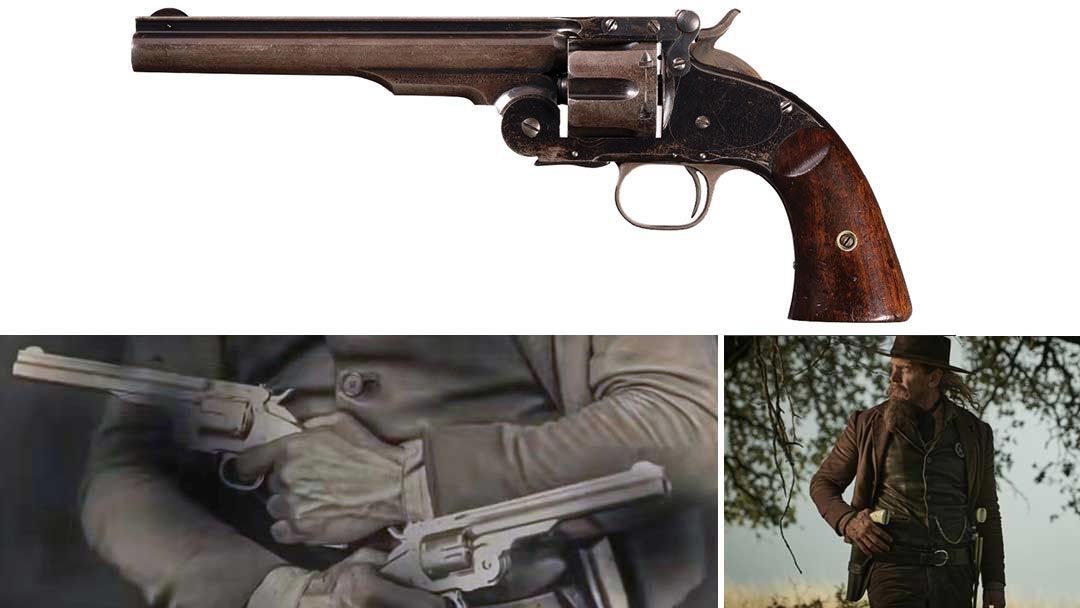
Many deputy marshals of the Old West packed two revolvers, and Esau Pierce is no exception in the Bass Reeves series. The Jonny Reb turned lawman carries a pair of Smith & Wesson Schofields. Introduced in 1875, the First Model Schofields were almost all issued to American cavalry units, with the latter Second Model Schofield revolvers finding a home with state militias, law enforcement agencies, and the civilian market.
The Schofield is a fitting choice for a rival of Bass Reeves, since these S&W top break revolvers were intended to compete with the Colt Single Action Army, the signature sixgun Reeves became known for and the most iconic revolver model of the Wild West.
(Bottom) Esau Pierce carries two S&W Schofield revolvers. (Top) A San Francisco Police issued U.S. Smith & Wesson Second Model Schofield Single Action revolver with a U.S. holster rig, available this December.
Bass Reeves Guns: The Colt Single Action Army
According to Bass Reeves, he frequently practiced drawing and shooting his revolvers early in his career, eventually becoming a crack shot with both hands. While most lawmen who carried a second gun did so to avoid having to reload during a gunfight, Bass Reeves learned to dual-wield his Colt Single Action Army revolvers at the same time.
(Left) Bass Reeves wearing his signature guns, two Colt .45 revolvers. (Right) A documented U.S. Colt Artillery Model SAA attributed to U.S. Marshal Reuben A. Jager, with a letter from author and Colt historian Keith Cochran. Available this December.
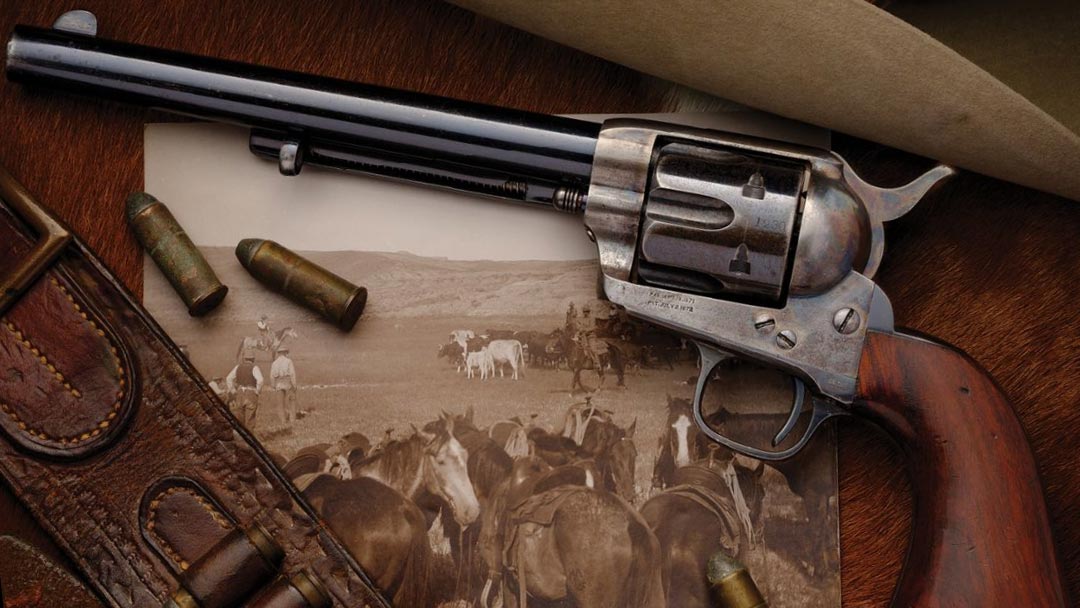
A standard Colt Single Action in 1875 would have been chambered in .45 Colt with a 7 ½ inch barrel and offered in a blue and casehardened finish, and these traits are accurately depicted in the Bass Reeves series. Prior to 1880, other barrel lengths were not widely available from the factory, but shorter lengths like the 5 1/2 inch Cavalry Model and 4 3/4 inch Sheriff’s Model became common options going forward, particularly with civilians, lawmen, and the outlaws they hunted.
An exceptionally fine, documented 1875 production Colt Single Action Army revolver with its factory letter. Available this December.
As noted earlier, Bass Reeves eventually purchased Colt revolvers chambered in calibers that would be interchangeable with his Winchester rifles, such as .44-40 and .38 WCF. The pair of Colt revolvers below were owned by the Collins brothers, two deputy U.S. Marshals of Indian Territory who would have been contemporaries of Bass Reeves toward the end of his career. Each gun is chambered in .38 WCF.
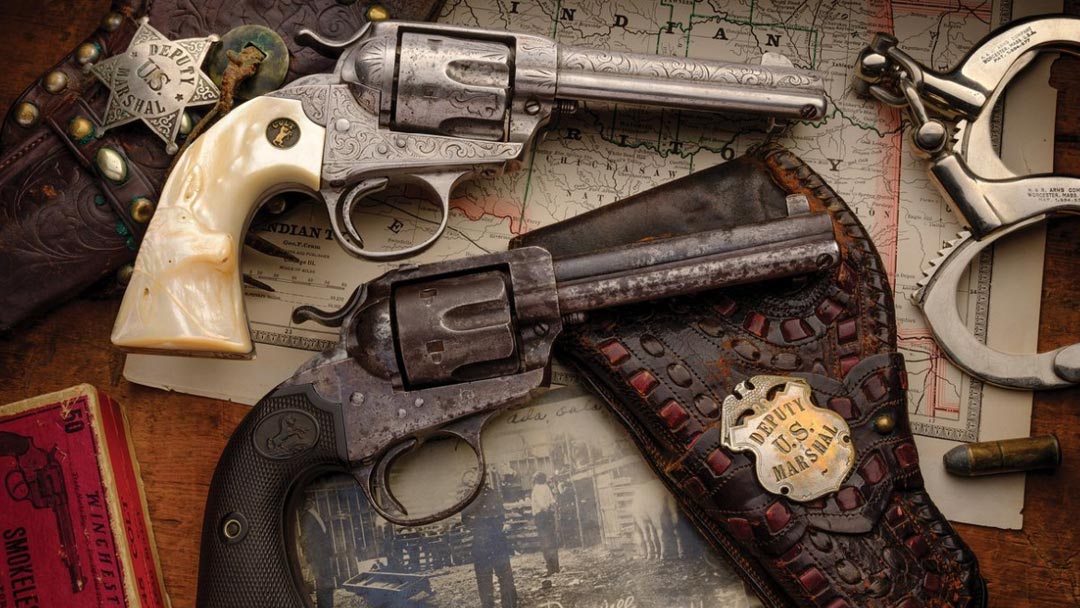
A pair of Colt Bisley SAA revolvers, two holsters, and two badges from the Collins family. Deputy U.S. Marshal Dan Collins and Deputy U.S. Marshal Benjamin Carter Collins worked “in Southeastern Indian Territory during the day of the James Brothers, the Younger Brothers, the Daltons, and the Starrs” and “took prisoners to Fort Smith to “Hanging Judge” Isaac Parker.” Available this December.
Old West Shotguns of Bass Reeves
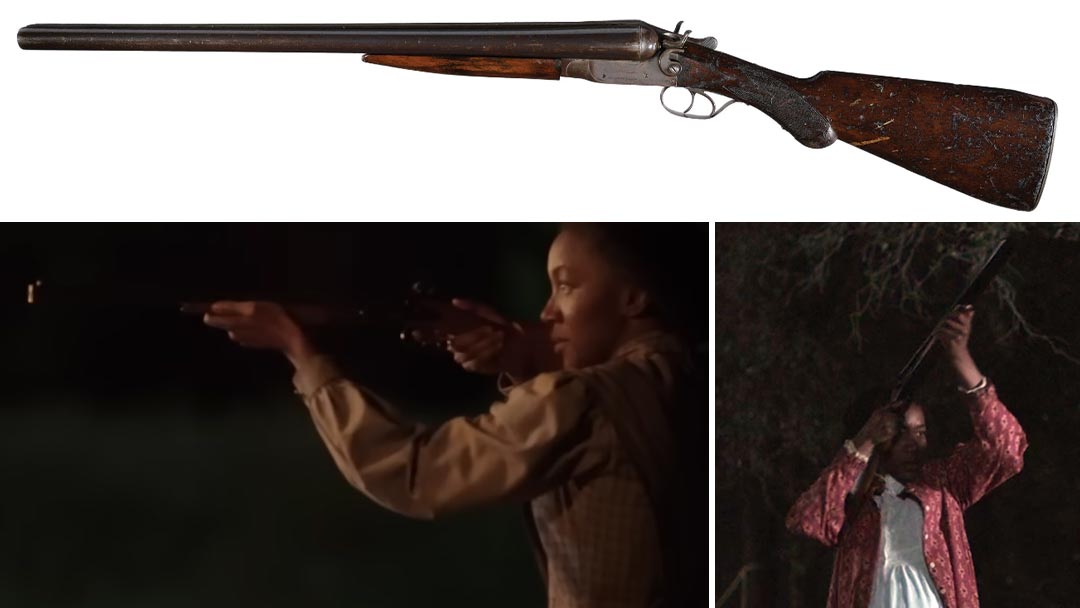
Bass Reeves and many other U.S. Marshals of the era also carried a double barrel hammer shotgun slung on their saddle. One of the most common firearms of the frontier, the shotgun could arguably be called the real gun that won the West. The double barrel scattergun was an affordable firearm for the average settler and offered a reliable means of hunting and self-defense. The gun is featured prominently in the Bass Reeves series.
(Bottom) The double barrel shotty, one of the most prominent guns in the Bass Reeves series. (Top) A Colt Model 1878 double barrel hammer shotgun available this December.
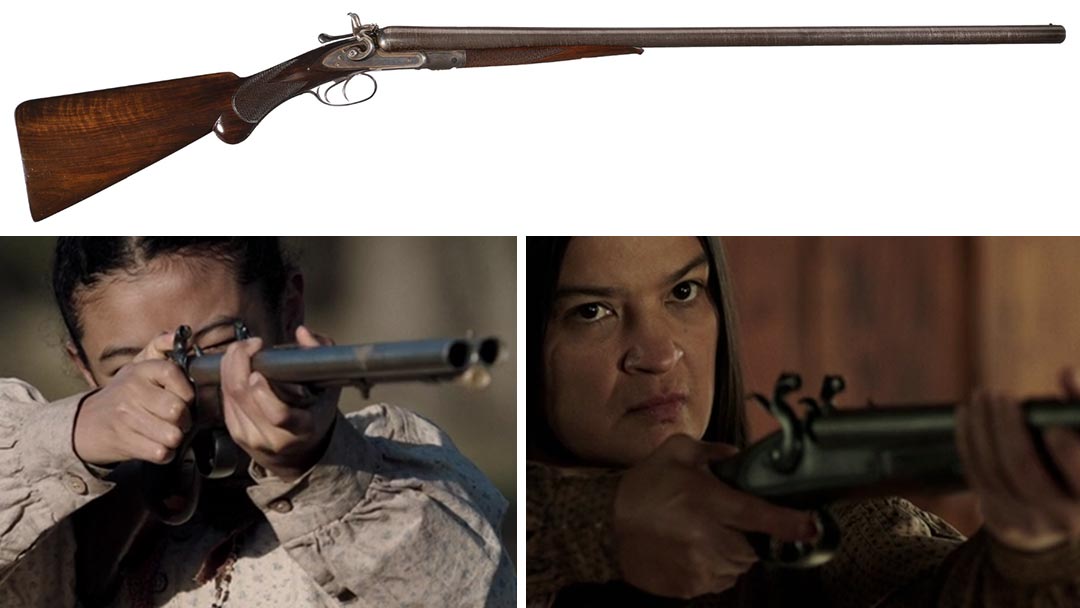
The Old West scattergun came in many makes and models, with plenty of older muzzle loadingpercussion examples, various English and Belgian imports, the Remington-Whitmore line (Models 1874/1876/1878), and the Colt Model 1878 double barrel. A limited number of ‘coach guns,’ or shotguns with barrel lengths shorter than 26 inches, were also available to storeowners and shotgun messengers who protected trains, stagecoaches, and freight wagons. The shotgun used by Jennie Reeves (Lauren E. Bank) appears similar to these shorter-barreled coach gun models.
(Bottom) Jennie Reeves makes an impression with her double barrel coach gun. (Top) A documented Wells Fargo & Co. Express shipped and marked Ithaca Grade X coach shotgun sold in RIAC’s August 2023 Premier Auction.
Guns of Bass Reeves and the Lawmen of the Old West
Though the history of the Wild West is filled with mythmaking and tall tales, Bass Reeves was a man who lived up to his larger-than-life persona. From shotguns to revolvers to the lever action rifle, Bass Reeves was proficient with every type of gun a lawman in the late 19th century needed to survive.
Beyond his gunfighting abilities, Reeves was a skilled horseman, an expert tracker, and a master of covert disguises that he often employed to get the drop on his quarry. This impressive array of skills has led some historians to attribute Bass Reeves as the inspiration for the Lone Ranger. Whether true or not, Reeves certainly was one of the few Old West figures who lived a life worthy of the comparison, and Paramount’s Bass Reeves series delivers a riveting portrayal of the legendary lawman.
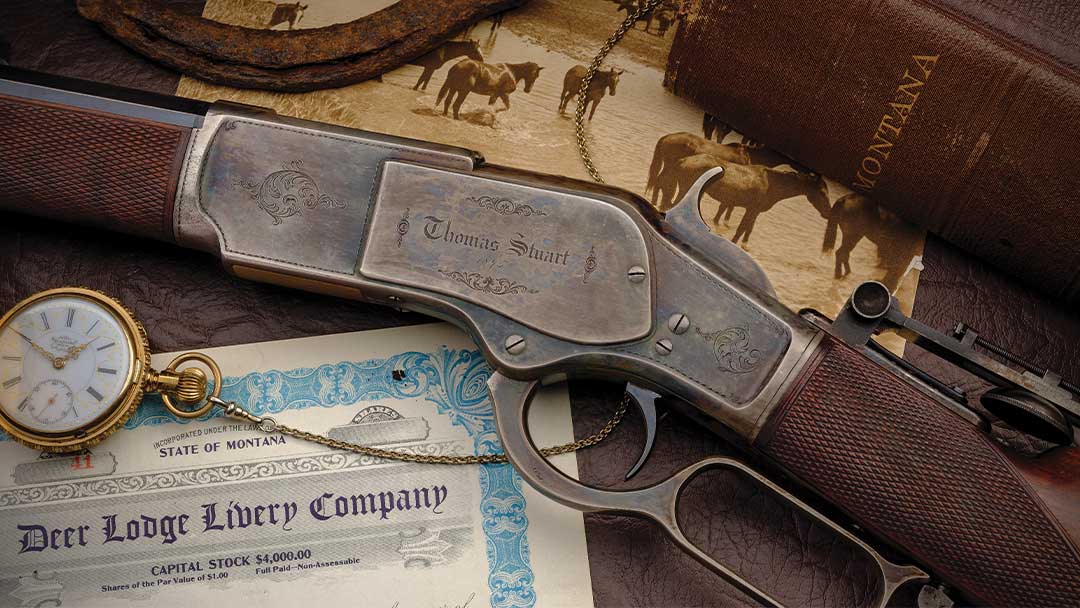
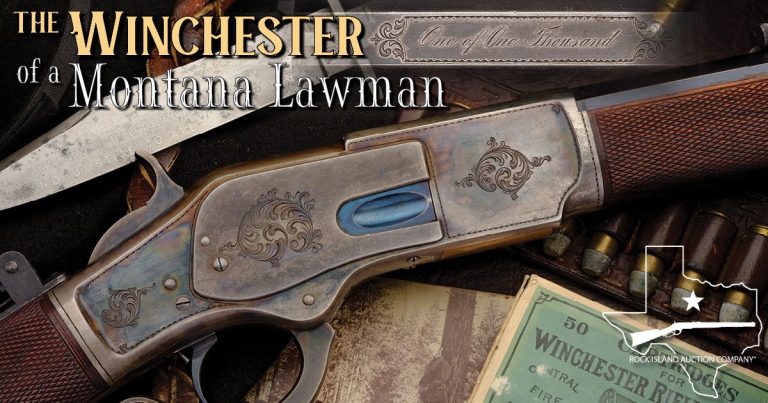
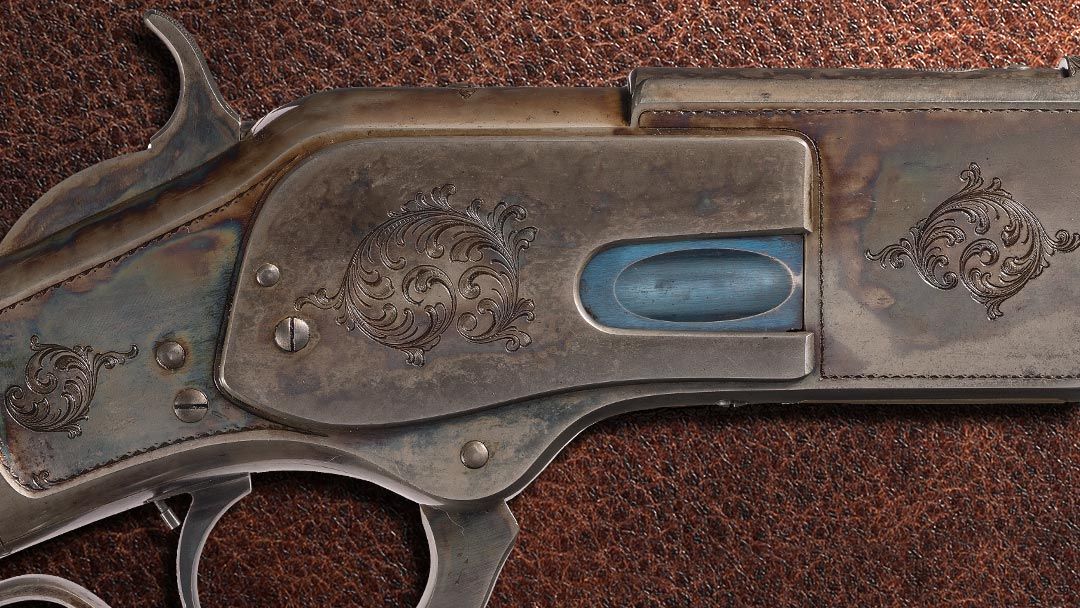
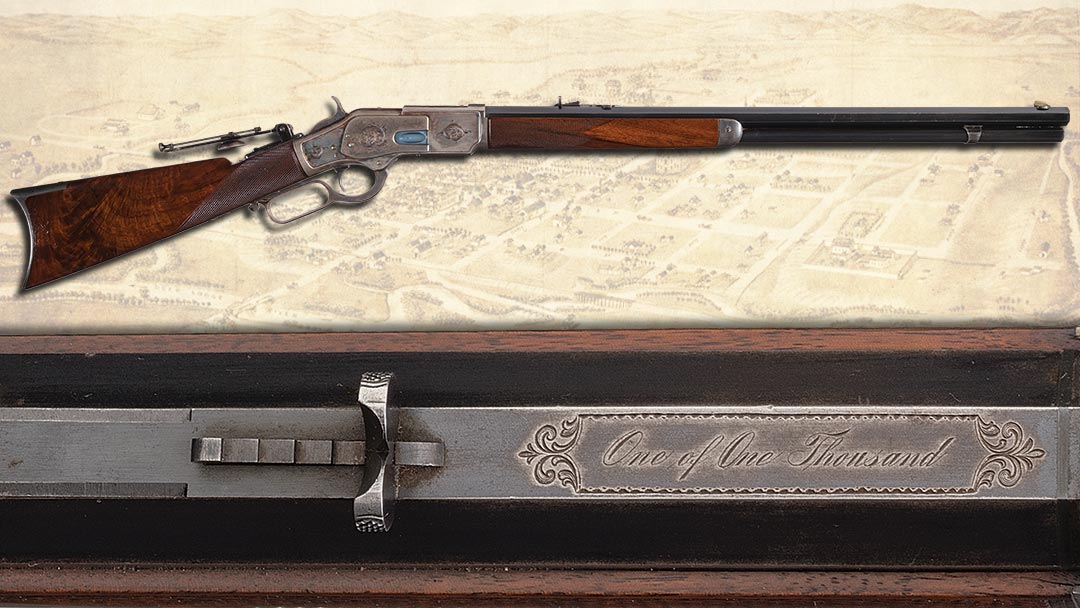
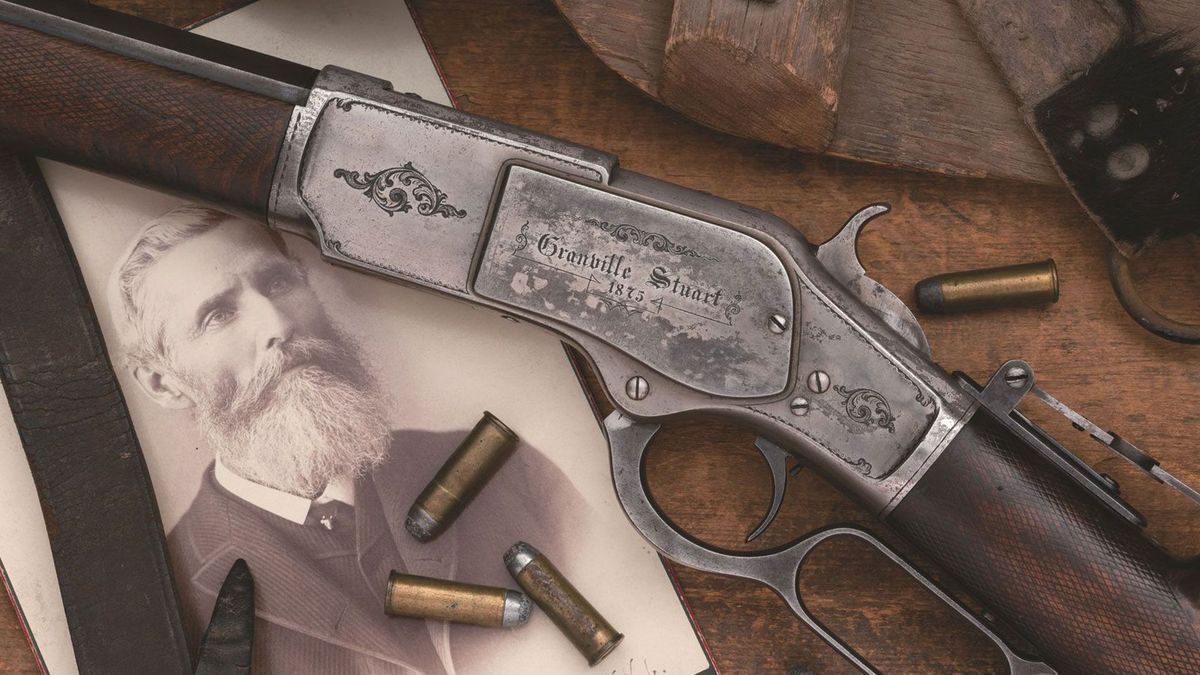
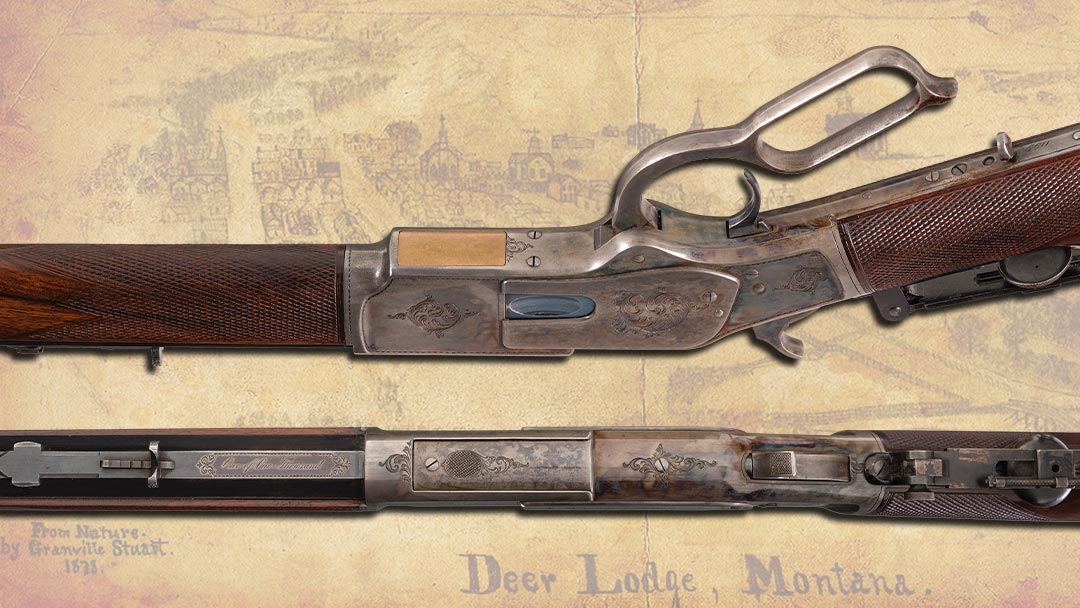
The rifle of an Old West lawman, Thomas Stuart’s extraordinarily fine, factory engraved “One of One Thousand” Winchester Model 1873 is a well-documented piece of the American West and hails from the legendary Mac McCroskie Collection. Available this December.
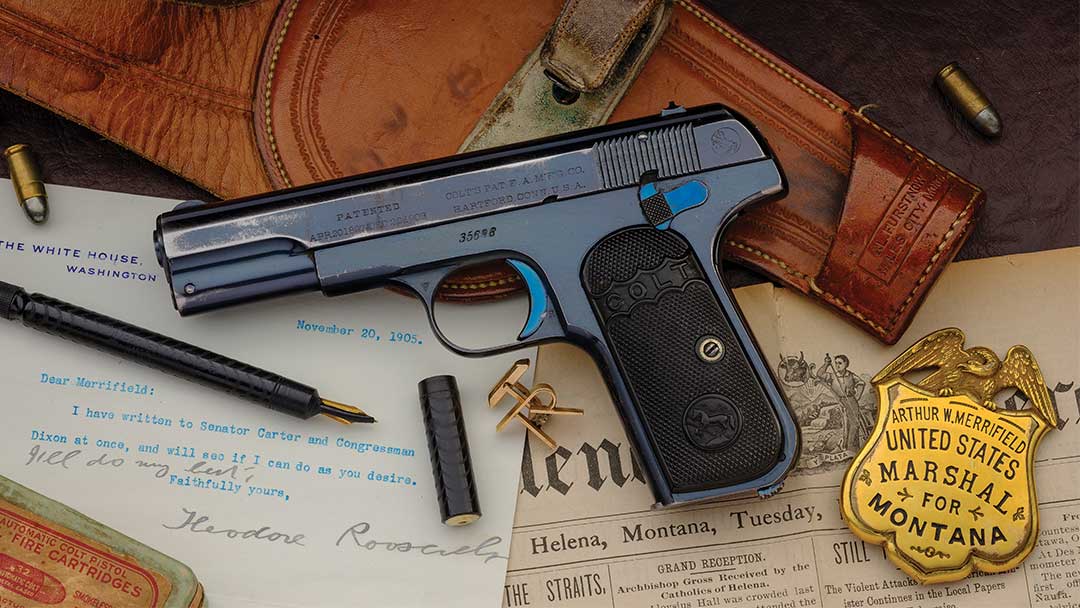
Arthur Merrifield, Teddy Roosevelt’s friend and hunting guide, carried this pistol, holster rig, and badge after Roosevelt appointed him a U.S. Marshal for Montana. Available this December.
Released in 1990, “Quigley Down Under” was a welcome reprieve by those who longed for the days of classic Western cinema, and today it enjoys cult status. The stars of the film? Tom Selleck as Matthew Quigley and, of course, his custom Sharps Model 1874 Long Range rifle, one of the highlights offered this December at Rock Island Auction Company.
When it comes to American lever action rifles, Winchesters reign supreme. They are among the most iconic and collectible American firearms of all time, especially the Winchester Model 1873 in .44-40 W.C.F., and few are more desirable than the exceedingly rare One of One Thousand. James D. Gordon in his book ‘Winchester’s New Model of 1873: A Tribute’ wrote, “To the collector of early Winchesters, the Model 1873 ‘One of a Thousand’ has long been the epitome of desirable guns.”
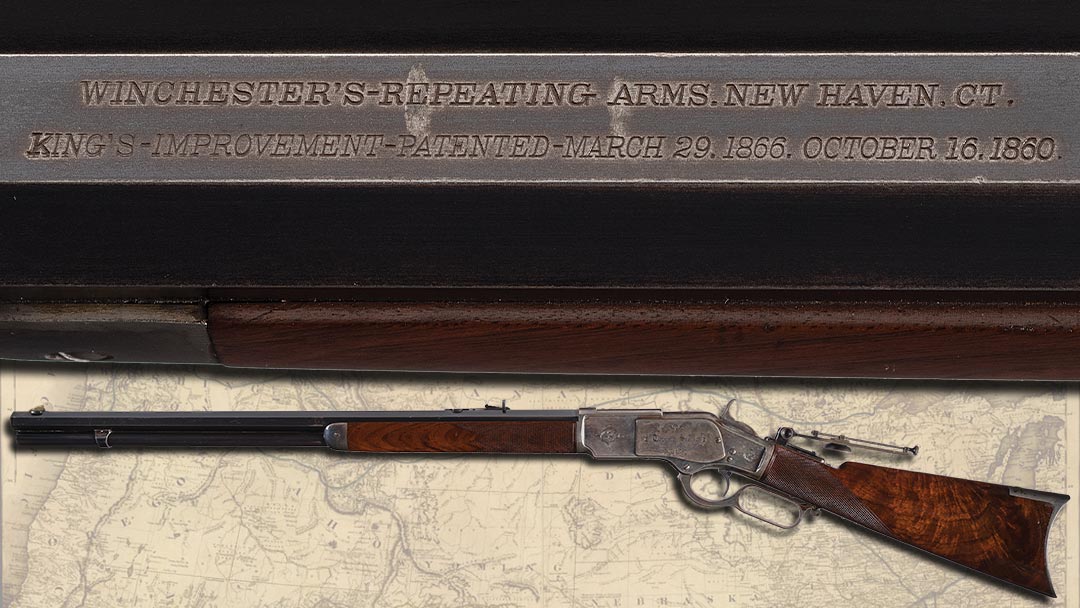
A historically significant, factory documented “One of One Thousand” Winchester Model 1873 lever rifle ordered by “Mr. Montana” Granville Stuart and inscribed for his brother and fellow pioneer Thomas Stuart in 1875. One of the headline pieces in Rock Island Auction’s 2023 December Premier sale.
If the scarce One of One Thousand rifles are one of the epitome of desirable guns, Thomas Stuart’sincredible rifle has to be at the pinnacle of the most desirable One of One Thousands. This elite Winchester includes everything a collector could want: immense rarity, extremely high condition, exceptional quality, and a documented connection to the Montana frontier starting with its special order by “Mr. Montana” himself, Granville Stuart, followed by its historic factory inscription for his younger brother and fellow pioneer Thomas, and the rifle’s publication in several notable collecting books.
The author examines Thomas Stuart’s stunning Winchester Model 1873 One of One Thousand rifle, one of the highlights in RIAC’s December Premier Auction.
In nearly a decade of cataloging antique and historic firearms for Rock Island Auction Company, I have had the pleasure of working with several One of One Thousand and One of One Hundred Winchester Model 1873 and Model 1876 rifles, including Granville Stuart’s One of One Thousand Model 1873 that was this rifle’s counterpart, but none has come close to surpassing Thomas Stuart’s rifle in terms of overall quality and condition.
In a December Premier Auction filled with legacy guns, investment-grade arms, and museum-worthy masterworks, Thomas Stuart’s Winchester 1 of 1000 ranks as one of the elite offerings. Available this December.
Winchester’s One of One Thousand Rifle
Winchester’s One of One Thousand and One of One Hundred program was announced in 1873 and then more fully explained in the company’s 1875 catalog under the headline “Variety of Arms.” The details of this section are covered in depth in Edmund E. Lewis’ book ‘The Story of the Winchester 1 of 1000 and 1 of 100 Rifles.’ Winchester’s advertising helps show why men like Granville and Thomas Stuart would have been drawn to order these expensive rifles for use on the Montana frontier:
“Every Sporting Rifle we make will be proved and shot at a target, and the target will be numbered to correspond with the barrel and be attached to it. When one hundred barrels are thus proved, the one making the best target will be selected and set aside, and another hundred proved in the same way, and so on until one thousand have been tested and ten targets selected with the barrels with which they were made. They will then be made up into Guns, in which each part is selected with the utmost care and finished in the finest manner. They will then be again subjected to trials for accuracy, and the best of the ten selected and marked ‘One of a thousand,’ the price of which will be $80.00 to $100.00. The other nine will be marked ‘one of a hundred,’ and the price will be from $60.00 to $75.00 each. Sportsmen will readily see that this severe process of gleaning will be a slow and expensive one, and the result be but a limited number of choice Guns, and that orders should be given in advance of their wants, or patience exercised with the necessary delay of filling them.”
Ordered by Granville Stuart, this exceptional Winchester Model 1873 “One of One Thousand” rifle is one of the finest examples of this exceptionally rare genre. Available this December.
Winchester only manufactured 132 of these 1 of 1000 rifles in the 1870s before scrapping the program. Many of them have long since been lost. In 1997, James D. Gordon only knew of 57 surviving examples when he wrote his two volumes on the Model 1873, and that was long after the famous campaign to seek these rifles out during the production of the movie “Winchester ’73” starring James Stewart. Perhaps some are still waiting to be discovered in some forgotten gulch out on the frontier or tucked away in a private family collection passed down from one generation to the next, but the number will always be very limited, and it would be nearly impossible to surpass Thomas Stuart’s 1 of 1000.
The Stuart Brothers’ One of One Thousand Rifles
Given its history and exceptional condition, it is no surprise that Thomas’ rifle has been featured in several publications, including: ‘The Story of the Winchester 1 of 1000 and 1 of 100 Rifles’ by Lewis on page 30, ‘Winchester: The Golden Age of American Gunmaking and the Winchester 1 of 1000’ by Wilson on page 64, ‘Winchester: An American Legend’ by Wilson on page 49, and ‘Winchester’s New Model of 1873: A Tribute Volume II’ by Gordon on 385 and 388.
Thomas Stuart’s extraordinarily fine, factory engraved “One of One Thousand” Winchester Model 1873 is a well-documented piece of the American West and hails from the legendary Mac McCroskie Collection. Available this December.
In the first of these books, Lewis writes, “The story of Granville Stuart is, in many ways, the story of the Montana Territory and the fledgling state of Montana,” and, “His elegant rifle, along with his brother Thomas’ rifle, are the only ones to have the Style Three barrel inscription. At the time the Stuart rifles were produced, the ‘standard’ type of barrel inscription was the Arabic 1 of 1000.”
The special markings and the later Style Four markings are based on Granville Stuart’s complaints about two earlier Winchester One of One Thousand rifles he rejected and his specifications for what the new rifles should look like. The Stuart brothers’ “Third Style” rifles are also distinct from later versions since their upper left and right barrel flats are not engraved. Thus, this incredible Model 1873 is one of only two One of One Thousand rifles to have the “Style Three” barrel inscription.
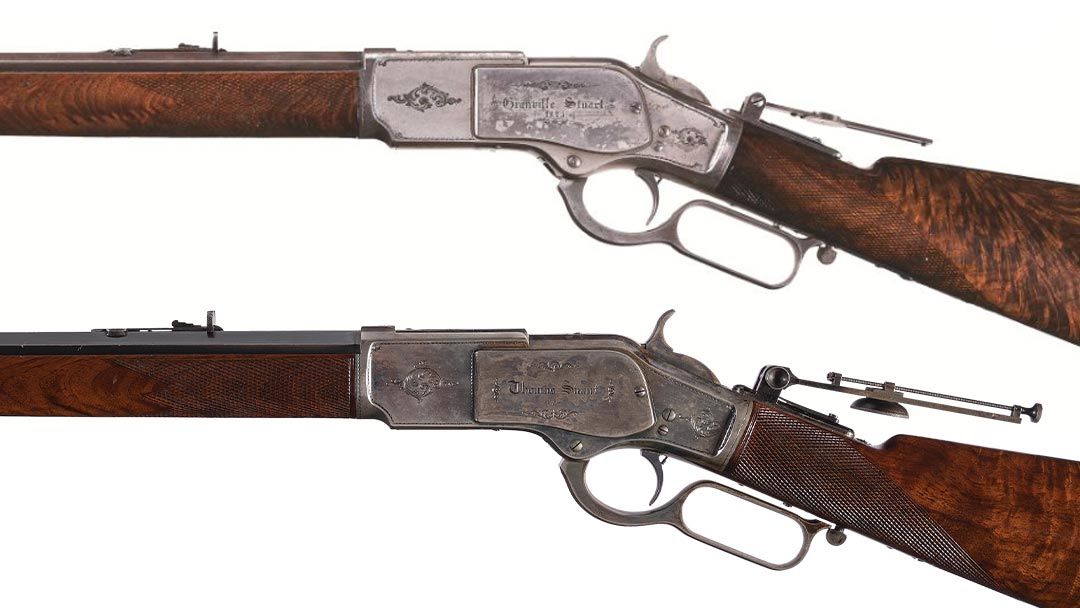
Granville Stuart’s matching One of One Thousand Winchester Model 1873 lever action rifle was sold by Rock Island Auction Co. from the famous Montana collection of John Fox in December 2020 for $345,000. While his rifle was a beautiful piece of frontier history, his brother Thomas’ rifle is even more immaculate.
In his book, Model 1873 expert Gordon writes, “Few historic guns have as much interesting documentation as serial number 5611 and 7282, both 1 of 1000s.” That documentation is shown in some of the publications noted and also accompanied Granville Stuart’s rifle when I researched and cataloged his rifle as part of the John Fox Collection sold by Rock Island Auction Company in December of 2020. The documentation shows exactly what the Montana pioneer was looking for when ordering rifles for himself and his brother.
(Top) Granville Stuart’s 1 of 1000 rifle. (Bottom) Thomas Stuart’s 1 of 1000 rifle.
Granville Stuart’s original order from October 22, 1874, had requested: “Two of your One in a Thousand Rifles, 24 inch, Octagon barrels, set triggers, & finely engraved, in fact the finest guns made by you, but not plated, Model of 1873, (center fire) fitted with hunting sights, and also peep rear sight, with Beach front sight. Also wiping rod and all appurtenances & leather case for each, full length of the gun.” Stuart added, “If these guns are as accurate as they should be . . . and as well finished as described, I think many can be sold in this territory.” On November 15, 1874, he noted that his goal was to get rifles “in superior finish” and desired the rifles be “as nearly absolutely accurate as you can make them” since they intended to use them in shooting matches. A ledger from May 1875 lists “for ‘One of a thousand’ Winchester rifle 122.50.” among other expenditures including ammunition.
The Thomas Stuart Winchester 1 of 1000, the rifle of a frontier lawman, miner, and pioneer. Available this December.
After receiving the first two rifles, Granville Stuart wrote back to Winchester on May 20th, 1875, stating “The two 1 of 1000 rifles order[ed] by me arrived in good order but I am disappointed in them because you did not send such as I ordered, nor do you give any explanation why you did not follow the terms of the order.” After repeating the above order, he notes that Winchester had initially said they could not send a One of One Thousand meeting his specification for some months but could send “a very fine gun, finished in accordance with my instructions.”
He wrote back telling them he wanted nothing but One of One Thousand Rifles and repeated that he wanted,
“two of your very finest finished (not plated) one of a thousand rifles. Now with the exception of the wood in the Model 1873, I do not see that the guns are any better finished your common ones, there is not a single line of engraving on them, and you did not send a hunting front sight nor a Beach front sight, nor did you send the leather cases, and although you state the sights are adjusted to 1000 yards, yet I find upon [inspection] that their greatest range is only 850 yards.”
He notes that he has “some cause to be dissatisfied with” Winchester’s handling of his order but did note that his rifle “shoots remarkably well.”
Stuart requested replacements for the first two rifles and ultimately sent them back. He noted in a letter on June 14, 1875, that the new rifles should come with both hunting sights and globe and peep sights and the latter graduated out to 1000 yards and,
“on some appropriate place on this latter engrave in fancy text surrounded by a wreath of flowers my name and date this, ‘Granville Stuart 1875’ and on the other ‘Thomas Stuart 1875’ in same styles. The guns of course to be ‘one of a thousand,’ engraved and finished in your best style. I also want the words ‘One of a Thousand’ in fancy letters and surrounded by a wreath or other appropriate border for the figures on those guns you sent before, ‘1 of 1000’ are neither neat nor of a handsome appearance.”
In this last statement, you can clearly credit Granville Stuart with the origin of the distinctive Third Style inscription on the Stuart brother’s rifles and the Fourth Style that followed.
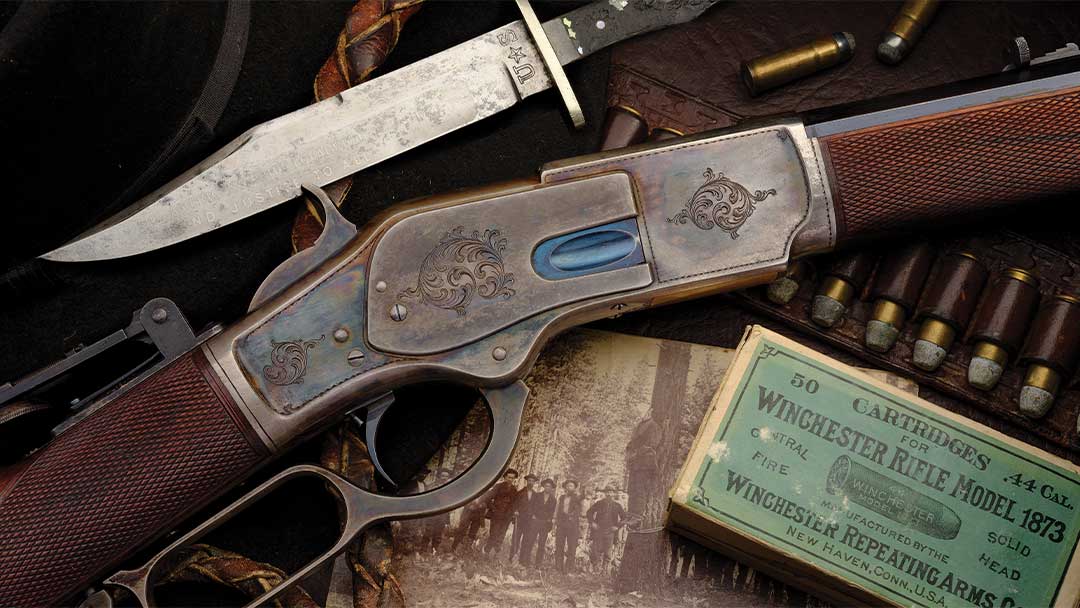
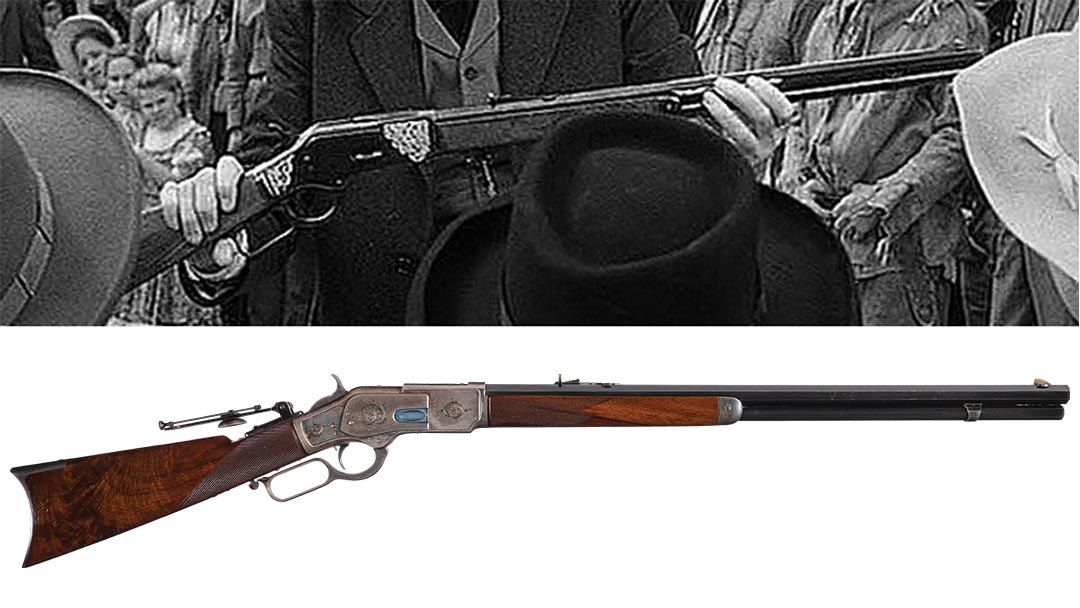
The 1 of 1000 rifle featured in the movie, engraved by John Kusmit, a student of George Ulrich (top), compared to Montana pioneer Thomas Stuart’s 1 of 1000 (bottom). The rifles ordered for the Stuart brothers could very well have inspired one of film’s most famous guns.
Thomas Stuart’s One of One Thousand Winchester Model 1873 Lever Action Rifle
A copy of a factory letter for Granville Stuart’s rifle is included with Thomas’ rifle and lists it as 1 of 1000 rifle with an octagon barrel, set trigger, XXXX checkered stock, Vernier peep and wind gauge sights, casehardened finish, and Granville Stuart engraving. It was received in the warehouse on August 13, 1875, and shipped on August 21, 1875, in order 3514, which is the same order number listed on the ledger entry for Thomas Stuart’s rifle as shown in Gordon’s book. When sending the replacement rifles, Winchester aimed to please the Stuart brothers, and they succeeded.
Thomas Stuart’s Winchester 1 of 1000 includes a number of custom features requested by his brother. Available this December.
On September 6, 1875, Granville wrote to them stating the rifles “which arrived yesterday are perfect in every particular, they are far superior to any rifle made, except for very long range shooting, and I am not sure that I will not make even that exception for today at my first trial of my gun I made 45 out of a possible 60 at 500 yards, and I expect to be able to reach 55 at my next trial. When I get it down to a scratch, I will send you some of my scores.”
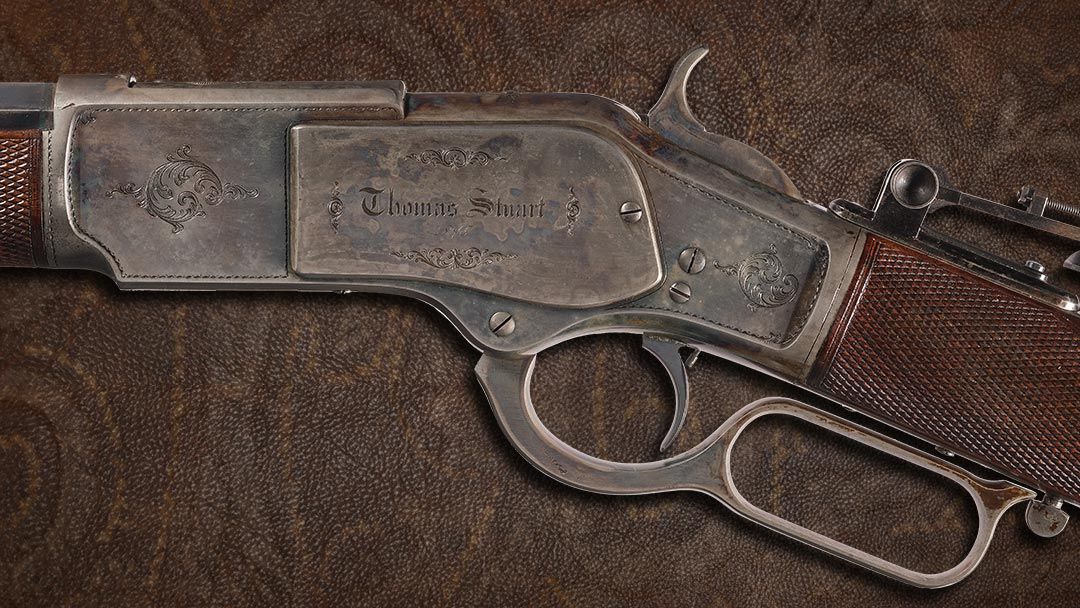
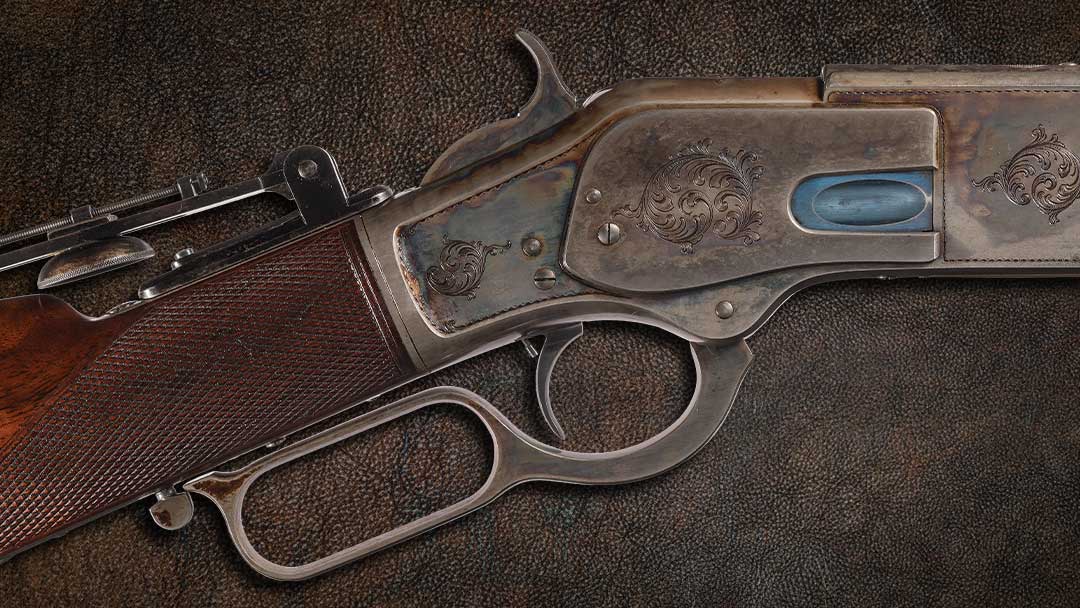
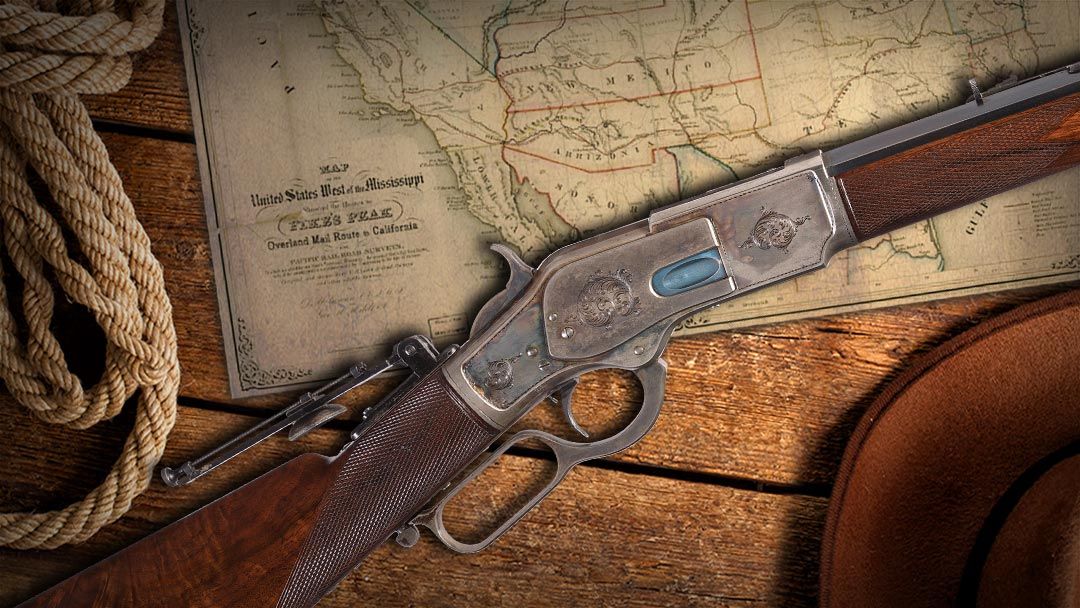
In basic form, Thomas Stuart’s rifle is a classic Winchester Model 1873 sporting rifle with a 24 ⅜ inch barrel chambered in .44-40 W.C.F. but it is certainly far from a standard rifle. The barrel has an inlaid silver band at the muzzle, a dovetailed brass blade front sight, an adjustable sporting rear sight, and the distinctive “Third Style” “One of One Thousand” in script engraving in a decorative banner with floral finials on top of the barrel at the breech followed by another inlaid silver band. An inscription on the rifle’s left side plate reads, ‘Thomas Stuart/1875” and is accented by scroll and geometric line engraving.
Thomas Stuart: Miner and Pioneer
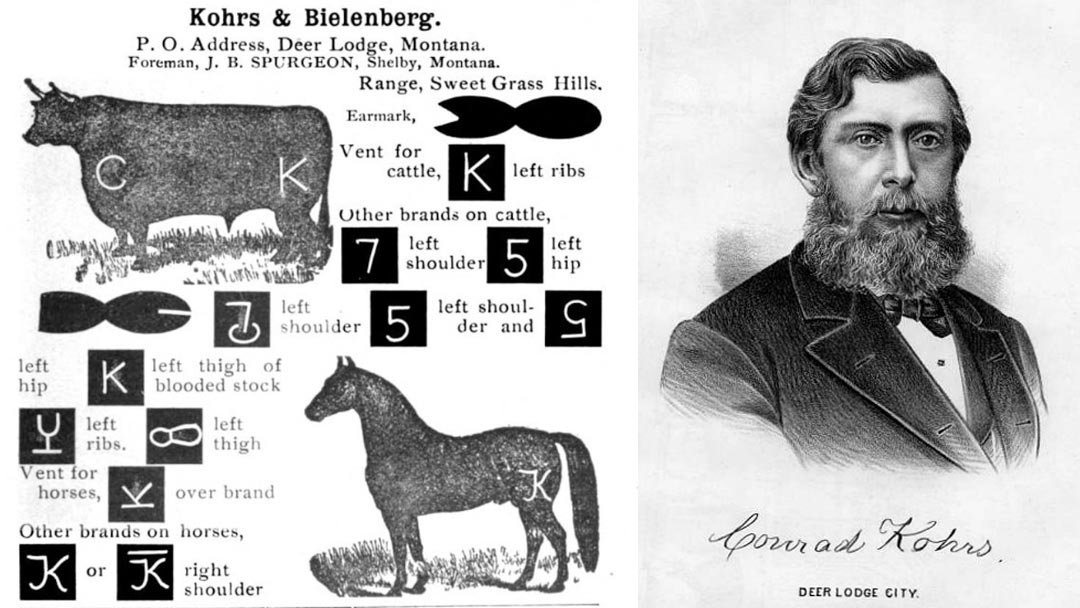
The Stuart brothers led remarkable lives that parallel the history of the American West. They were gold miners, Montana pioneers, ranchers, vigilantes, and community leaders in the town of Deer Lodge, the territory’s second oldest town. Granville Stuart is the most famous of the brothers and has been called the “Father of Montana” and “Mr. Montana” and was a nationally known figure in his own time that lived the most notable years of his life as a pioneer in Montana in the second half of the 19th century.
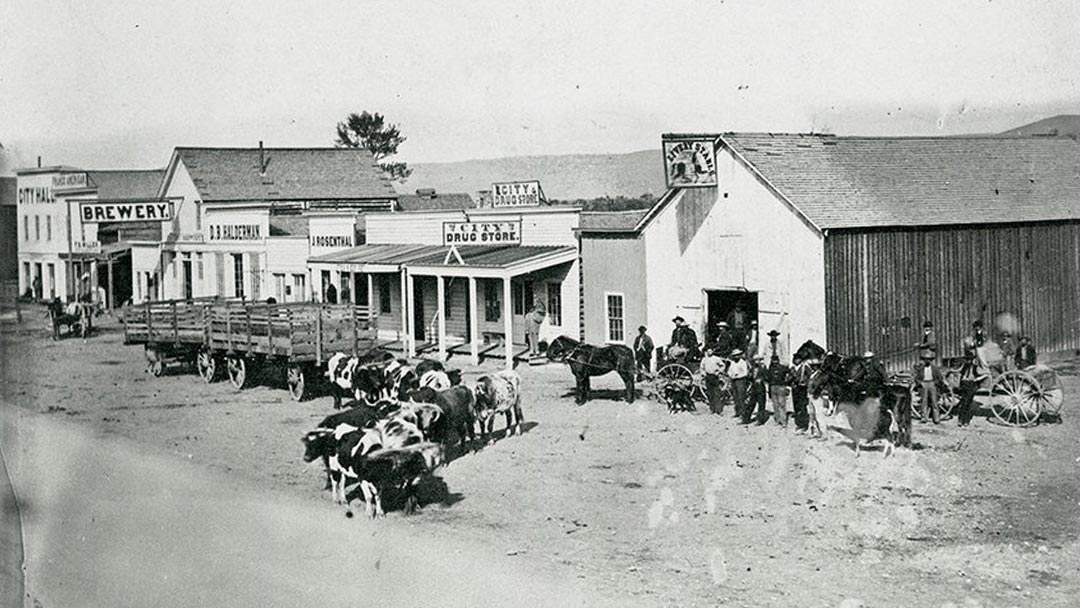
Deer Lodge, Montana, as it looked in the 1860s when Thomas Stuart first came into town after traveling from Colorado to Idaho and then to Deer Lodge to see his older brothers and their gold finds. The photo is from the Montana State Library which notes that this block was destroyed by a fire in 1872.
Granville Stuart’s life story was a grand adventure with gold, shootouts, travels through dangerous conditions, conflicts with Native Americans, and even years spent in faraway lands that feel like a tale you might have heard before in a Western. Thomas and his brothers were very much part of that story and had numerous adventures of their own.
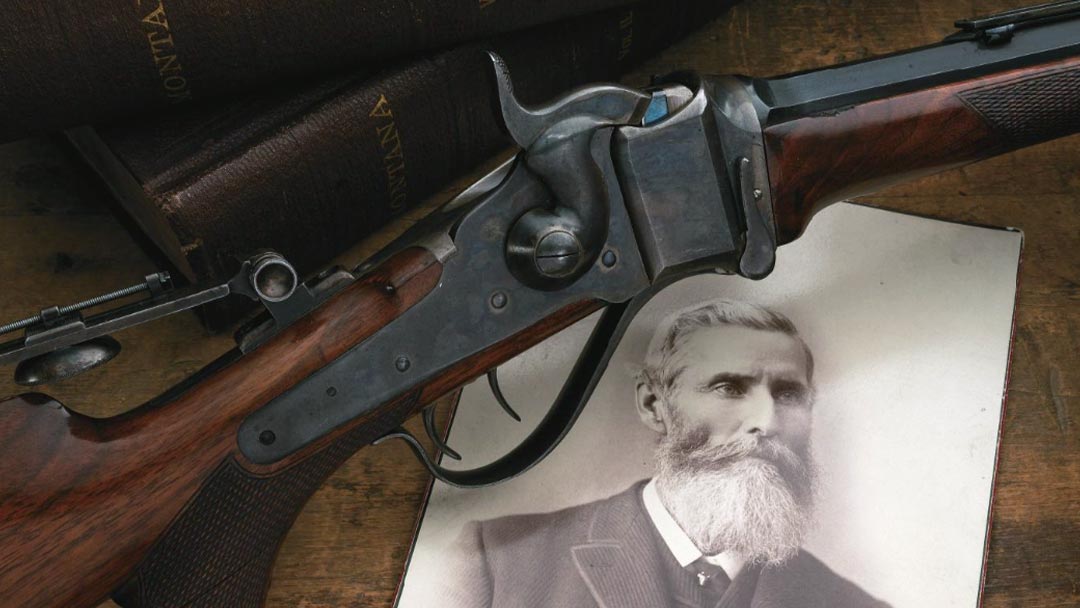
In a 1875 competition, Granville Stuart won this rifle as the leader of the Deer Lodge team. It was sold by Rock Island Auction Co. in December 2020 for an impressive $51,750.
Thomas Stuart (1839-1915) was cut from much of the same cloth as his older brothers and was also an influential pioneer in the Montana Territory, especially Deer Lodge in western Montana. Thomas was the son of Robert and Nancy Stuart and was born in Iowa and grew up in Muscatine County just to the west of our Rock Island, Illinois, facility with his older brothers James (1832-1873), Granville (1834-1918), and Samuel (1836-1909). Robert, Granville, and James Stuart went to California in search of gold in 1852, and Thomas didn’t see Granville or James again for more than a decade.
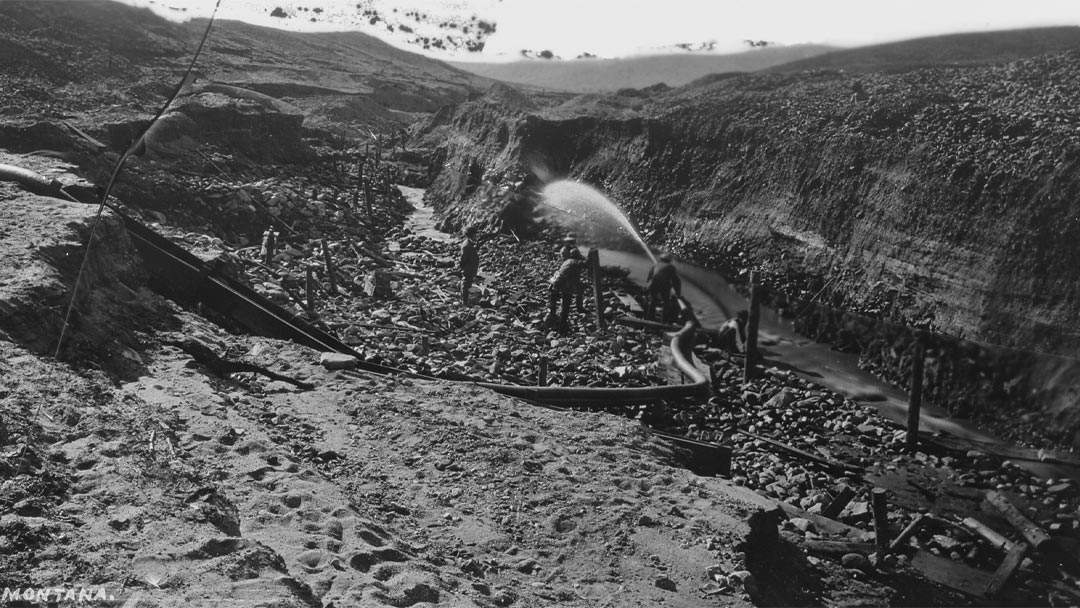
Thomas Stuart headed west in the early 1860s and mined in Colorado. Granville wrote to tell Thomas of his gold discoveries in the Alder Gulch, Montana, which induced Thomas and his other mining friends to join Granville. This surge of mining interest led to a Montana gold rush in 1862. Some sources say he was met with hostile Indians during his journey which caused him to end up temporarily in Boise, Idaho. Others say he headed to Boise first intentionally to mine there and then left the following spring. The Society of Montana Pioneers indicates he then traveled across the mountains via the Camas Prairie and Lava Bed trail and arrived at the Alder Gulch in May of 1864.
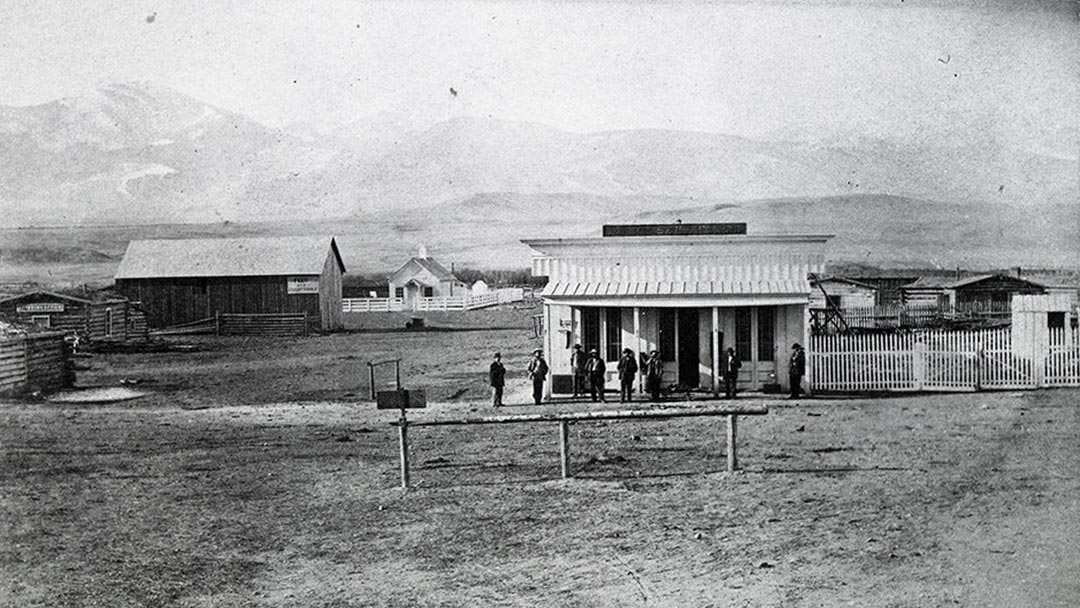
A group of men in front of a store in Deer Lodge, Montana Territory, taken by A.F. Thrasher in 1867. Could the Stuart brothers be among the men?
After arriving in Montana, Thomas Stuart worked in the Dance, Stuart & Co. store with his eldest brother James and also prospected with Granville while continuing to work as a miner. He married the following November to Ellen Armell (1853-1934) of French-Canadian and Piegan ancestry whose father was the agent at the Big Timber Indian Agency. In 1870, they were living southeast of Deer Lodge, likely on one of his claims, and soon made good money from high-grade ore at the Lower Boulder and Pioneer sites. In fact, he was doing well enough to loan Granville $1000, employ numerous servants, and expand into horse breeding.
This exceptional Winchester 1 of 1000 rifle has “Thomas Stuart/1875” inscribed on the left side plate accented by scroll and geometric line engraving. Available this December.
When their eldest brother James died in 1873, Granville and Thomas traveled 500 miles to bring his remains back for burial in Deer Lodge. With the loss of their eldest brother, Granville became the family patriarch and grew even closer to his youngest brother Thomas as demonstrated by the gift of this Winchester rifle and their continued business connections.
The Marksmanship of Thomas Stuart
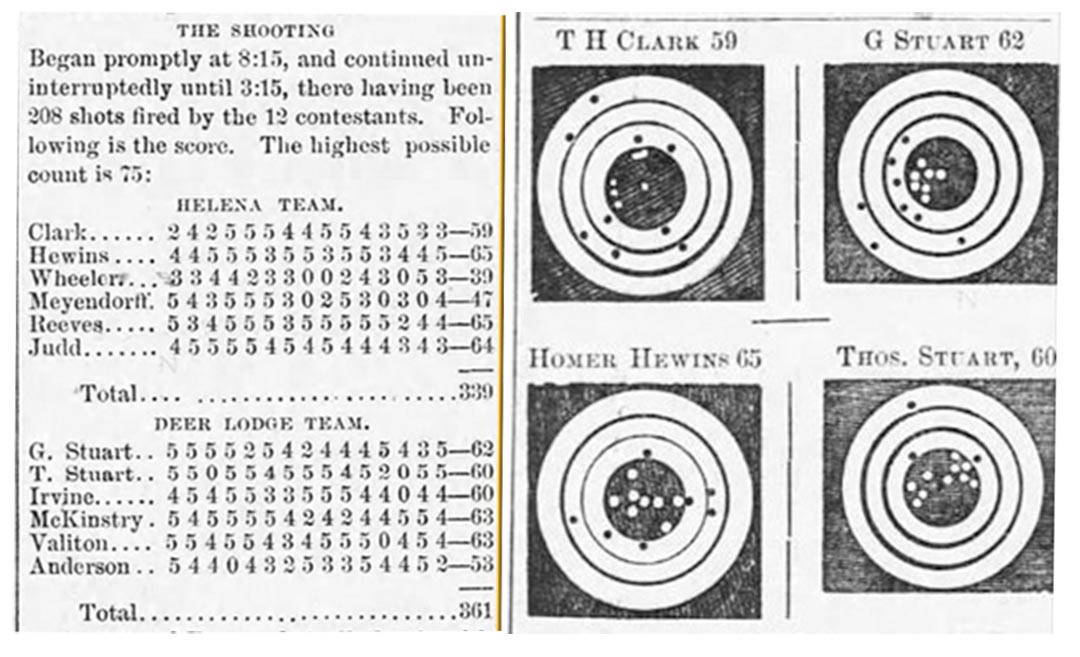
Of the two Stuart brothers, Thomas appears to have been the better marksman based on his performance in two historic shooting matches in 1875, the same year this Winchester rifle shipped. On October 8, 1875, the New North-West reported the scores from the match between the Deer Lodge team led by Granville Stuart and Samuel T. Hauser’s Helena team. In the 1000 yard match, Thomas shot the best with a score of 28 to Granville’s 24. The best score on the Helena team was 22. In the 500 yard match for the Creedmoor rifle, Thomas was again the best marksman with a score of 56. Granville and the best competitor on the other team each scored 51. With the Stuart brothers’ marksmanship, the Deer Lodge men brought home both prizes from the territorial fair.
The scores and some of the targets from the 1876 match were shown in the April 28, 1876, issue of The New North-West newspaper in Deer Lodge, Montana. Thomas clearly had the better group of the two Stuart brothers, but had two bad cartridges.
In a match the following spring between the two teams, Granville bested Thomas by two points, and their team again beat the Helena marksmen in terms of overall team score, but two of the Helena marksmen ultimately had a head-to-head to determine the overall winner. Granville is noted to have been shooting his Sharps Creedmoor Rifle won by the team in 1875 while Thomas was using a Sharps sporting rifle and is noted as having two defective cartridges resulting in two zeros. Of the shots fired, if you drop those two shots, he again outshot Granville, and that becomes clear when you see the targets that were reproduced in the newspaper. Only three of Thomas’ shots are outside the black, two in the ring just outside, and one high.
Given Thomas’ loan to Granville, perhaps the rifle was a thank you gift from his older brother, but it may have also been paid for by Thomas himself given he was the more financially stable of the brothers and Granville simply handled the order. From Granville’s writing, it appears they had planned to use them in rifle matches, but they continued to use their trusty Sharps rifles, which is logical given single shot rifleswere the standard for long-range competition.
Thomas Stuart: A Frontier Legacy
In 1875, Thomas was also one of the members of the Pioneer Co. mining operation. Like his older brother, Thomas served in various local civic offices and organizations, including the Masons and as the secretary and a board member of the Montana Collegiate Institute, and donated $5,000 for the building of St. Mary’s Catholic School despite being a Presbyterian.
“Hydraulic Gold Mining in Montana” by William Henry Jackson shows mining at Alder Gulch in 1871. Thomas Stuart may be among the men shown.
In 1877, Thomas led the Deer Lodge Volunteers during the Nez Perce War in defense of the territory which also led to some controversy in the newspapers over General Oliver O. Howard’s criticism of the volunteers. Thomas purchased land in 1880 from Colonel J.C. Thornton and established a homestead near the north of town. On November 9, 1883, the New North-West newspaper advertised Thomas’ horses and separately noted that “One of the best Horse Farms in the Territory is that of Thomas Stuart, Deer Lodge. His stock is unexcelled, Live Oak and his progeny having first rank wherever known.” It also noted that a couple of Conrad Kohr’s horses along with several of Granville Stuart’s had been stolen. The next summer, Stuart’s vigilante group, “Stuart’s Stranglers”, meted out frontier justice to suspected rustlers, killing at least 20 in extrajudicial gun fights and lynchings.
Thomas Stuart’s Winchester 1 of 1000 features an inlaid silver band at the muzzle, a dovetailed brass blade front sight, an adjustable sporting rear sight, and a border around the hammer well terminating in a scroll accent ahead of the adjustable peep rear sight. The stock and forearm are checkered, and the deluxe walnut buttstock has absolutely exceptional figuring. The stock compartment contains a takedown cleaning rod. Available this December.
Thomas Stuart’s involvement in the vigilante activities of Granville and the “Stuart Stranglers” is not clear. He was an actual lawman as Deer Lodge’s night marshal for a decade, so he might have stayed out of it. 1884 was also a terrible year for his family in a fashion all too common on the frontier: he and his wife lost three of their children to diphtheria within one month early in the year. On April 5, 1884, he sold his 160 acres to Conrad Kohrs and John Bielenberg, the biggest cattle ranchers in the territory, and then moved into a house owned by Granville in Deer Lodge. Thomas worked for Kohrs & Bielenberg off and on for many years.
(Left) The cattle brands for Kohrs’ & Bielenberg as shown in the Montana Stock Growers’ Association’s brand book for 1899. (Right) A portrait of Conrad Kohrs, a famed Montana cattle baron and politician. Some of Kohrs’s land belonged to Thomas Stuart originally, and he continued to work for Kohrs & Bilenberg for many years.
In 1885, the Montana Stock Growers Association was formed and headed by Granville, and through his brother’s influence and his own experience with livestock, Thomas was appointed to the position of territorial veterinary surgeon despite lacking the appropriate credentials. He soon resigned to allow Dr. George H. Keefer to take the role but was later appointed deputy surgeon. Thomas also continued to buy and sell mining claims with Granville in the 1880s and 1890s. He died suddenly in 1915 while caring for his horses, and his funeral was held at the local Masonic Hall. Thomas Stuart was survived by two sons and three daughters as well as his wife.
A Winchester One of One Thousand from the Montana Frontier
As noted above, Thomas Stuart’s rifle remained in incredible condition as it changed hands in the century since his death and has been featured in several notable publications as part of the famous McCroskie Collection. It was no doubt one of Mac McCroskie’s most incredible finds, a true testament given how many world-class Winchesters Mr. McCroskie collected during his lifetime.
While Granville Stuart’s writings and fame have helped keep the name of Thomas Stuart alive, this incredible Winchester 1 of 1000 rifle is a physical representation of the younger Stuart’s frontier legacy and a true treasure of the American West. Available this December.
Both One of One Thousand Model 1873 rifles ordered by Granville Stuart are two of the most significant American frontier artifacts the author has had the pleasure to work with. Thomas Stuart’s rifle in particular stands out, possessing everything one could want in an antique Winchester, and the Stuart family’s story is truly an integral part of the American West, especially the Rocky Mountains in the late 19th century.
Stuart’s Winchester is available as part of Rock Island Auction Company’s December 8 – 10 Premier Firearms Auction, the company’s inaugural auction event in its new state-of-the-art facility at 3600 Harwood Rd., Bedford, Texas, a celebration of arms collecting at the highest level of the pursuit.
Few weapons in history are as famous or as impressive as the Colt Gatling Gun. Richard Gatling’s rapid-fire, multi-barrel invention was originally designed in the optimistic hope of decreasing the number of wartime deaths caused by infectious diseases by reducing the need for large military forces.
A rare and historic Colt U.S. Model 1897 Gatling gun with an iron carriage with markings commemorating the Battle of San Juan Hill, Theodore Roosevelt’s Inauguration, and other historical events. Available this December.
Tacticians came to instead view the Gatling gun and its machine gun successors as force multipliers that would significantly change the face of warfare and set the stage for the industrial-scale firepower unleashed during World War 1.
Due to their rarity, history, and exquisite engineering, every surviving Gatling gun has become a coveted piece for museums and private collections, and Rock Island Auction Company’s December 8 – 10 Premier Firearms Auctionin Bedford, Texas offers three of these exceptional weapons.
Richard Gatling
Richard Gatling was not just one of 19th century America’s greatest gun inventors, but an accomplished designer all around. Gatling’s work included improvements to agriculture equipment and new designs for steamboat technology. Little more than a decade after receiving a medical degree from Ohio Medical College, Dr. Gatling turned his attention to the grim science of warfare.
An evolution of Richard Gatling’s original 1862 design, the 1883 Gatling integrates a full brass housing from the barrel group, which protects the mechanism from debris, sea spray, and other hazards. Available this December.
The early months of the American Civil War resulted in shocking casualty numbers. Dr. Gatling set out to invent a gun that could help reduce the number of men on the battlefield and in turn diminish the devastating losses suffered from disease in the camps. This new multi-barrel, crank-operated gun would, Gatling hoped, with its rapidity of fire, “enable one man to do as much battle duty as a hundred, that it would…supersede the necessity of large armies.”
Gatling Gun Cost
When the Gatling gun was invented in 1862, military strategists were uncertain how to best utilize this new killing machine on the battlefield. Union bureaucrats were skeptical of many new firearms breakthroughs that occurred during the Civil War.
An exceptional Colt U.S. Navy Mark II Model 1900 Gatling gun with carriage. Available this December.
Despite the Gatling gun’s successful early trials, Brigadier-General James Ripley, the Union Chief of Ordnance, balked at the Gatling gun’s price tag. Some in the media were more forgiving.
“One of these guns, with its appendages added, costs $1,500,” the Indianapolis Evening Gazette observed in 1862. “A regiment of men ready for the field costs about $50,000, and it takes $150,000 to keep a regiment in service twelve months. It will be seen … that it would be a great economy to use the Gatling gun.”
A Modern Battery Gun Co. reproduction of a Model 1862 Gatling Gun available this December. Includes an original period “Manual of the Gatling Battery Gun.” Richard Gatling’s Model 1862 was the first step in a long line of firearm innovations that eventually led to modern-day machine guns.
For perspective, the cost of artillery was significantly cheaper than the Gatling gun. Field Artillery Weapons of the Civil War by Hazlett, Olmstead, and Parks cite the approximate cost for a 10-pound Parrott Gun at $198, a 3-inch Ordnance Rifle at $359, and a 12-pound Napoleon cannon at $822. Given the Gatling gun’s high cost and the confusion as to how the new weapon would fit in with the conventional tactics of the day, the Union’s reluctance to adopt Gatling’s invention isn’t surprising.
An extraordinarily rare 1863 dated Confederate Columbus Arsenal bronze 9-Pounder sold for $661,250 in RIAC’s May 2021 Premier Firearms Auction.
The Gatling Gun in Combat
General Benjamin Butler purchased eight of Gatling’s “Battery Guns” out of his own pocket and positioned them to defend his trenches during the brutal Siege of Petersburg. Other Gatling guns were privately purchased for use on Union gunboats, and by 1866 the U.S. Army officially adopted Gatling’s invention.
The Gatling gun helped change the face of warfare, but the design faced its share of skeptics along the way.
Richard Gatling’s Model 1862 was the first step in a long line of innovations for the Gatling gun design. Gatling guns could be fitted to a variety of carriages and mounts and were especially suited for naval service. As an anti-infantry weapon in the field, military strategists used the Gatling gun to repel mass attacks and provide suppressing fire before a major charging maneuver.
A Colt Model 1897 Gatling gun with an iron carriage, available this December. Often called a “hand-cranked machine gun”, the Gatling gun revolutionized warfare.
The Gatling gun also became an ideal crowd control weapon and was deployed against strikers and protestors during the Labor Wars of late 19th century America. According to The Gatling Gun by Wahl and Toppel, “Time and again, during its long history, the Gatling Gun proved itself a ‘super riot gun’-a little of its characteristic ‘music’ or just the sight of its menacing multiple muzzles was usually enough to discourage a mob.”
Colt’s Patented Firearms Manufacturing Company in Hartford, Connecticut produced all Gatling guns for the domestic U.S. market from 1866 to 1903 and continuously improved and experimented with the platform. The original Gatling gun design could fire 200 rounds per minute, for example, but was quickly surpassed by later iterations of the Gatling model, which were eventually capable of achieving firing rates as high as 1,500 rounds per minute.
One of only 20 Model 1900 Mark II Gatling guns issued to the U.S. Navy, this handsome example of the platform is one of the rarest Gatling gun models extant. Available this December.
Over its four decades of service, the Colt Gatling gun design also saw several different cartridge feed systems in order to increase reliability and firing rate. The first Gatling gun models had simple hopper feeds with limited capacity. Cartridges could be placed in tinned sheet-iron boxes that lacked springs and followers, serving only to guide the ammunition into the hopper to assist in loading. The 1871 pattern Colt Gatling gun introduced an early box magazine with a retaining flap held closed by a spring catch, and one year later the Gatling Gun Company patented the Broadwell drum.
This Furr Miniature Model 1874 Gatling gun and carriage includes a Broadwell style magazine. Available this December.
Gatling Feeder Technology
The Broadwell drum was invented in 1872 by Lewis Wells Broadwell, a European sales agent for the Gatling Gun Company. This pioneering drum magazine used multiple stacks of cartridges all pointed towards the center and was set up for rapid manual switching from one stack to the other allowing for hundreds of rounds to be fired without reloading.
An extremely rare W.G. Armstrong & Co. British Gatling gun and carriage with Broadwell drum sold in 2019 for $218,500 with Rock Island Auction Company.
Nearly a decade later, Lucien Bruce patented a system for the Gatling gun called the Bruce Feed, a piece of Gatling feeder technology using vertical magazines that retained many of the advantages of the Broadwell drum and could be kept topped off while the gun was still in use.
The Colt U.S. Navy Mark II Model 1900 Gatling Gun with carriage employs a Bruce feed magazine system. Available this December.
All of the aforementioned Gatling feeder systems relied on gravity, which worked well enough when the Gatling gun was resting on a level surface. Gravity-fed Gatling guns experienced higher malfunction rates when the ground was markedly uneven, however. An Australian engineer and explosives expert named James G. Accles came up with an innovative solution.
Accles Positive Feed Drum
The Accles drum was the most advanced piece of Gatling feeder technology manufactured for the Gatling gun platform. Holding 104 rounds of .45-.70 ammunition, the donut-shaped Accles drum had an onboard sprocket/rotor driven by the Gatling gun crank which allowed for higher and more consistent rates of fire than the gravity-fed magazines of earlier models.
The Accles positive feed magazine, Patent No. 290622, dated 18 December 1883, was one of the first snail-style drum magazines. Available this December.
One of the first snail-style drums, cartridges loaded into the brass Accles drum were pushed along a spiral track and into the Gatling feed by a driver geared to the gun’s rotating barrels.
While a remarkable magazine design when clean, the Accles drum proved far too fragile for sustained field use. The delicate system could also fail if it was dented by mishandling or struck by enemy fire, and the military soon retired the Accles drum in favor of the more durable Bruce feed system.
A desirable Furr 1/3 scale Colt Gatling gun 1883 reproduction with a carriage and an Accles pattern magazine. Available this December.
Colt Gatling Gun Evolution
Similar to its 1877 Bulldog sibling, the 1883 Colt Gatling gun integrated a full brass housing from the barrel group, which protected the mechanism from debris, sea spray, and other hazards. The gun became popular with the U.S. Navy as a result.
A U.S. Army Colt Model 1877 Bulldog Gatling gun from the George Moller Collection, one of 17 purchased by the American military, sold for $345,000 in Rock Island Auction Company’s December 2021 Premier Auction.
The Gatling was chambered in a number of different rounds as cartridge technology evolved, including .45-70 and the new .30 Army smokeless. Springfield Armory converted some Gatling guns to use the .30-03 round, then its famous .30-06 follow-up that was standardized for the Springfield 1903 rifle.
The Gatling gun employed numerous cartridge types over its 45 year development history. This impressive Union Metallic Cartridge Co. cartridge display board includes cartridges ranging from the tiny BB cap up to Gatling rounds like the .45-70. Available this December.
The Gatling gun served in Europe, Africa, Asia, and across the Americas. The United States deployed the weapon in China, Panama, Haiti, and perhaps most famously during the Spanish-American War, when four M1895 mounted on carriages similar to the example below provided support for Teddy Roosevelt, the Rough Riders, and the Buffalo Soldiers during the Battle of San Juan Hill.
This Colt U.S. Model 1897 Gatling gun with an iron carriage features a ten-barrel cluster, and the modern-made replacement barrels are chambered in rimmed .30 Army. Available this December.
Gatling Gun Competitors
The Gatling gun faced several competitors in the years after its introduction, including a multi-barreled volley gun designed by Swedish inventor Helge Palmcrantz at the end of the 1860s. These “Nordenfelt machine guns” were later named for the weapon’s financier, Thorsten Nordenfelt, a Swedish steel producer and banker operating out of London.
Nordenfelt guns were a crank-operated platform produced in a number of barrel configurations and calibers. These unique weapons were tested and adopted by both the Swedish Army and the British Royal Navy, serving alongside the Gatling gun and the Gardner gun, another crank-operated machine gun predecessor with a fascinating history.
Invented in 1874 by William Gardner, a Civil War Union Army captain, the Gardner gun brought the world another step closer to the machine guns that defined the early 20th century. Gardner guns were designed with one or two barrels. These unique weapons were fed with gravity-driven magazines and operated by hand turning a crank that moved bolts back and forth to fire the action as well as extract the spent case. This reciprocating motion system is used in many of today’s machine guns.
The 1882 Gardner gun is a key firearm in the evolutionary development of the machine gun and is missing from even the most advanced public or private collections. Available this December.
Although the U.S. Navy purchased a limited number, the U.S. Army was not interested and never adapted the Gardner gun, preferring the Gatling gun to fulfill current needs. Eventually, the Gardner gun gained the attention of the British government which ordered it for all branches of their military and purchased the manufacturing rights, and both the Netherlands and Denmark purchased some Garner guns as well.
The Gatling Gun vs the Machine Gun
Gatling guns demonstrated the utility of high-volume firepower on the battlefield and forever changed the course of warfare. The United States and Britain continued to employ multiple versions of the Gatling gun into the early 20th century, when the first true recoil-based machine guns like the Maxim design quickly gained traction.
Where Gatling guns of the era required a hand crank to rotate the barrels into battery and fire, machine guns like the Maxim gun were designed to use the energy of recoil to mechanically cycle themselves. Although the Gatling gun design was declared obsolete before the outbreak of WW1, its story was far from finished.
This Spandau Maxim MG08/15 machine gun sold for $14,100 in August of 2022 at RIAC.
The Gatling Gun Today
The Gatling gun is a powerful platform, even more so when paired with a motor. In 1890, the Crocker-Wheeler Motor Company of New York demonstrated an electric Gatling gun to the U.S. Navy. The prototype fit an 80 volt motor with a current of 3 to 3.5 amps to a Gatling gun equipped with an Accles feed system and a clutch that allowed the gun to be operated either electrically or manually. Even when geared down, the gun could fire at a blazing rate of 1,500 rounds per minute.
The Crocker-Wheeler electric Gatling gun fitted with an Accles positive feed drum.
Though the Crocker-Wheeler version of the electric Gatling gun was never adopted, the concept saw a resurgence after WW2 with the M61 Vulcan, theM134 Minigun, and the A-10 Warthog fighter’s Gau-8/A Gatling-type seven-barrel cannon. The GAU-8/A Avenger cannon and its naval cousin, the Phalanx Close in Weapons System (CIWS) are widely used by the U.S. military, demonstrating the adaptability of the design Dr. Richard Gatling developed 160 years ago.
In the 1970s and 1980s, Karl Furr and Paul Kuhni produced functional replicas of the Gatling gun. Today, companies like U.S. Armament Corp and Battery Gun Co. continue that tradition, and RIAC’s December auction includes at least one example from each of these manufacturers.
Manufactured by the Battery Gun Co. of Metamora, Michigan, as a full-scale, fully functional Gatling gun, this modern, fully-functional reproduction is constructed with a brass body and an array of blued barrels with blued support arms. Intended for use with the included .45 caliber reloadable steel percussion inserts. Available this December.
Gatling Gun for Sale
Despite their relatively long production period, only around 1,300 Gatling guns were manufactured by Colt across all models. Many Gatling guns saw hard service, and others were melted down for scrap during WW1, so finding surviving Gatling guns for sale today is a true rarity. The three Gatling gun examples offered in Rock Island Auction Company’s December 8 – 10 Premier Firearms Auction demonstrate the evolution of this fantastic collecting platform.
Hollywood guns attributed to an Academy Award winner, a TV detective and big screen cowboy, “King of the Cowboys,” the “King of Comedy,” and “Mister Show Business” are on offer in Rock Island Auction’s Premier Auction debuting in Bedford, Texas, Dec. 8-10.
These Hollywood guns were owned by household names: screen legend Gary Cooper, 80s sex symbol Tom Selleck, silent film and early talkies star Tom Mix, comedy great Jerry Lewis, and multi-talented Sammy Davis Jr. All of the guns below will be able to be viewed and inspected at the auction’s Dec. 7 preview day. Let’s take a look.
Gary Cooper’s Guns
Gary Cooper arrived in Hollywood first playing horseback riding extras before getting regular roles and playing memorable characters like his Oscar-winning portrayals of “Sergeant York,” and Marshal Will Kane in “High Noon” in his 36-year career. Cooper grew up in Montana where he learned to ride and shoot. During a slow point in his career in 1931 he went on safari in Africa where he collected 82 kills, including a lion, tigers, impala, gazelles, an Oryx, and a rhinoceros.
The rifle on offer is a .30-06 Springfield rifle crafted by Griffin & Howe that bears his initials on a silver oval on the underside of the stock and has a Zeiss scope. Cooper was a close friend and hunting companion of towering literary figure Ernest Hemingway. The men admired each other’s gun collections and Hemingway had expressed jealousy over at least one of Cooper’s rifles. This gun appears to be shown in photos of Cooper on the hunt in Idaho with Hemingway. It was originally chambered in .220 Swift according to factory documents before it was rechambered, likely by Griffin & Howe.
This .30-06 Springfield rifle with a silver oval on the underside inscribed with “GC” for Gary Cooper. It was originally chambered in .220 Swift. The original caliber has been milled off and replaced with “.30-06.” It has a Zeiss scope and knurled bolt handle and a deluxe checkered shadow line cheekpiece stock.
The limited edition book “High on the Wild with HEMINGWAY” by Lloyd Arnold has an image on pg. 188 of Gary Cooper in the snowy mountains outside of Ernest Hemingway’s Trail Creek Cabin in Sun Valley, Idaho with what appears to be this exact rifle over his right shoulder while holding a slain bobcat in his left hand. Page 187 states, “…Coop came to the shop one cold morning to tell me he got a fine “bobkitty” the day before… he wondered if someone could take a picture of him with it.”
Two-time Oscar winner Gary Cooper hunted the west with good friend Ernest Hemingway. At left is a photo of Cooper holding a bobcat he shot outside Hemingtway’s Idaho cabin. At right is Cooper, left, with the legendary author.
Likewise, the Smith & Wesson Military & Police revolver with a rare 2-inch barrel and a hair trigger was also beloved by Cooper, according to his widow, Veronica Cooper, who went by “Rocky.” She said it was “Coop’s favorite belly gun.” Cooper’s widow eventually gave the gun to the police chief of Southampton, New York, on Long Island in 1977. The wheel gun is one of 250 or less manufactured prior to World War 2 with a two-inch barrel.
According to Cooper’s widow, “This 38-cailiber Smith & Wesson has a hair trigger and was Coop’s favorite belly gun. He carried it shoved in his belt and used to walk around the streets of Belair half hoping someone would hold him up.” The revolvers two-inch barrel makes it a rarity, as only 250 or less were made before World War 2 in that configuration.
Tom Selleck’s Guns
The Hollywood guns of the beloved the star of “Magnum P.I.” and “Quigley Down Under” are both related to those roles. Selleck is an avid shooter and collector and Rock Island Auction has had the privilege of offering guns from his collection in previous auctions.
The iconic Shiloh-Sharps Model 1874 single shot falling block rifle is just as Matthew Quigley described it in the 1990 movie with a 34-inch barrel, “Usual barrel length’s thirty inches. This one has an extra four. It’s converted to use a special forty-five caliber, hundred-and-ten-grain metal cartridge, with a five-hundred-forty-grain paper patch bullet. It’s fitted with double-set triggers, and a Vernier sight, marked up to twelve-hundred yards. This one shoots a mite further.”
The rifle also has a custom patchbox in the stock and has a 15 ¼-inch length of pull to fit the lanky 6-feet, 4-inch Selleck. The gun was custom “antiqued” for the movie. Selleck took possession of the three rifles made for the movie and donated the one on offer to National Rifle Association in 2006 for a fundraising raffle.
This Shiloh Sharps Model 1874 single shot falling block rifle is one of three made for the 1990 film “Quigley Down Under” starring Tom Selleck as the titular cowboy. An accompanying letter states the rifles were sent to MGM Grade of Hollywood, California and that it has a fitted buttstock to accommodate Selleck’s longer length of pull. It has a hooded post and ball front and semi-buckhorn folding ladder rear sight as well as double set triggers and an adjustable Vernier tang-mounted peep sight.
While Quigley didn’t have much use for pistols, Thomas Magnum certainly did. A three-gun set made for Selleck from the Colt Custom Shop will be available in December. He ordered the guns to commemorate the CBS show, writing in an accompanying letter “that literally changed my life.” The guns bear special serial numbers signifying his hugely successful role as the Hawaiian detective. A Special Combat Government Model bears MAGNUM-1, while a Special Combat Officer’s Model is marked MAGNUM-2, and a Mark V Series 80 Mustang is MAGNUM-3.
The guns were loaned to the NRA Firearms Museum for display that included Hollywood guns like the Smith & Wesson Model 29 from “Dirty Harry,” and a Beretta 92FS from “Die Hard.” The guns are accompanied by a letter of thanks from the museum to Selleck for the loan of the pistols, as well as a copy of “Hollywood Guns: An NRA National Firearms Museum Production.”
Tom Selleck’s three pistols from the Colt Custom Shop have special serial numbers, with floral scroll engraving on a punch-dot background over 50 percent of each gun. The serial numbers on each gun are gold inlaid. The guns are a Special Combat Government Model (MAGNUM-1 serial number), a Special Combat Officers’ Model (MAGNUM-2), and an MkV Series 80 Mustang (MAGNUM-3).
Tom’s Mix’s Shotgun
“King of the Cowboys” Tom Mix took a circuitous route to Hollywood, busting broncs for a Ponca City, Oklahoma ranch and Wild West show from 1905 to 1908 before moving on to another Wild West show performing with his third wife. He was a champion rodeo rider and roper. His first appearance on film was as a Wild West performer in 1909. He finally signed with a studio in 1917 and was the highest paid actor in Hollywood by 1928. He was a friend of Wyatt Earp and served as a pallbearer at his 1929 funeral.
Often flamboyantly dressed, Mix made about 300 films before his death in a car accident at age 60 in 1940. He licensed his name in 1933 for the Tom Mix Ralston Straight Shooters radio show that proved popular during the decade and after his death in the 1940s.
Marlin Firearms presented Mix this engraved and gold inlaid Marlin 20 gauge Model 90 over/under shotgun — one of the few presentation pieces offered by the company — for working with the company on a gun handling and safety program for American youngsters and his promotion of the Marlin Model 100-S “Tom Mix Special” rifle. The shotgun, with its engraved scrollwork surrounding cowboys busting broncos on the left side and “Tom Mix” inlaid in gold script on the right on a matted background with a cowboy hat, belt rig and single action revolver, is considered one of the premier pieces in Marlin collecting by author William Brophy.
This Marlin 20 gauge Model 90 over/under shotgun and its engraving by Charles Preiss and Dan Cavanaugh is featured in William Brophy’s book, “Marlin Firearms: A History of the Guns and the Company that Made Them.” The gold inlaid inscription and engraving on the right side of the receiver is illustrated in “The Gun Digest Book of Single Action Revolvers.” This Model 90 is also believed to be one of only two Marlin presentation guns held privately.
Jerry Lewis’s Pistol
Jerry Lewis started as a Borscht Belt comedian before teaming with Dean Martin in 1946 that led to television appearances and several movies together before they fizzled out in 1956. Lewis would go on to perform in Las Vegas and make television appearances before breaking into films, becoming the highest paid talent in Hollywood with a 1959 Paramount contract that paid $10 million plus 60 percent of profits from 14 films over 10 years. In later years “the King of Comedy” was best known for being the host of the Muscular Dystrophy Association’s Labor Day Telethon that he led from 1966 to 2010. He died in 2017 at the age of 91.
Lewis’s pistol is an engraved Beretta Model 21A. In 1994, it was revealed that a man had been stalking Lewis and his family. He was convicted and served four years in prison. Along with the gun is Lewis’s 2009 Las Vegas registration card for the pistol and a nylon holster.
This Beretta Model 21A owned by comedy legend Jerry Lewis has scroll coverage with a punch-dot background and smooth walnut grips, with the left side laser engraved with the comedian’s signature and cartoon caricature of his head.
Sammy Davis Jr.’s Colt Single Action Army
“Mr. Show Business” Sammy Davis Jr. was a multi-talented nightclub performer, actor, recording star — and among the original members of Frank Sinatra’s “Rat Pack.” Born into a family of entertainers, he sang with his father on stage from an early age and learned tap dance from his mother. He enjoyed success on the Broadway stage, and appeared in a several films, including a number with Sinatra and company. His biggest singing hit was “The Candy Man” in 1972. He died in 1990 at the age of 64.
Davis was also a quick draw artist and reportedly trailed only Jerry Lewis as the fastest gun in Hollywood. Taught by stuntman and marksman Arvo Ojala, who was opposite Marshal Matt Dillion in the intro to “Gunsmoke,” Davis showed off his quick draw and twirling talents on television’s “Zane Gray Theatre,” “Lawman,” and “The Rifleman.” He also showed his moves on talk shows where poor quality clips are available on the internet.
Rock Island Auction had the privilege of selling another of Sammy Davis Jr.’s Colt Single Action Army revolvers, spectacularly engraved and gold inlaid by Master Engraver Joseph Condon, crossing the podium for $19,550 at the September, 2019 Premier Auction.
Davis’s Single Action Army includes a quick draw holster rig of black leather with “SAMMY” carved on the inside of the belt with engraved sterling silver buckles on the belt and holster. The revolver was modified by Ojala and the holster made by him as well. The gun and holster were returned to Ojala by Davis as a gesture of friendship.
This third generation nickel-plated Single Action Army of Sammy Davis Jr. is modified with a shortened front sight blade, narrowed hammer slightly turned to the right, a pair of smooth pearlite grips, and a lightened mainspring. As well as a holster with “SAMMY” carved on the inside.
Hollywood Guns for Sale
What a tremendous collection of firearms from a legendary lineup of Hollywood royalty available in Rock Island Auction Company’s Premier Auction in Bedford, Texas on Dec. 8-10! Fantastic guns attributed to a cowboy king, a two-time Oscar winner, a comedy great, a superstar of the small screen, and a quick draw expert from the Rat Pack will all be on offer at Texas’s biggest gun auction.
For those who love the thrill of off-roading and cherish the freedom of backcountry RVing and off-grid living, the SEMA Show 2023 is your gateway to the latest and greatest overlanding gear and vehicles. This year, the SEMA Show Overland Experience is gearing up to be one of the most exciting shows yet for adventure seekers, taking things up another level a bigger and better off-road experience.
This strategic relocation is a game-changer for overland enthusiasts and professionals. SEMA Vice President of Events Tom Gattuso highlights that this shift will not only showcase the latest products and innovations in their natural habitat but also facilitate better accessibility and a more authentic experience for all attendees. The Overland Experience’s new home in the Diamond Lot offers the perfect rugged canvas for exhibitors to demonstrate their gear, vehicles, and gadgets designed for the wild.
A New Overlanding Market Takes Center Stage at SEMA 2023
At the SEMA Show 2023, the spotlight is on the burgeoning trend of overlanding with adventure vans emerging as the new favorites among backcountry enthusiasts. These vans, often based on 1-ton chassis like the Ford Transit, RAM ProMaster, and the Mercedes Sprinter, offer a more affordable and maneuverable alternative to traditional RVs, attracting a diverse demographic of outdoor aficionados. With the RV industry seeing record sales, the adventure van segment stands as a burgeoning $16.8 billion market with forecasts projecting significant growth.
The market expansion is fueled by consumers’ increased desire for remote travel and the capability to venture beyond conventional campsites. As this sector evolves, aftermarket outfitters are finding lucrative opportunities in catering to the customization needs of these vehicles, prioritizing distinctive features and backcountry performance. The pandemic accelerated the industry’s growth, yet despite current economic challenges, the demand for adventure vans with superior off-grid capabilities remains robust. SEMA Show attendees can explore this thriving niche, which not only reflects a shift in consumer preferences but also signals a new era of growth potential for businesses within the adventure and specialty-equipment market.
Sport UTVs Lead the Charge as Newcomers Rev Up the Aftermarket Scene
As the SEMA Show unfolds, attendees are witnessing a some cautious optimism in the powersports sector, despite a global market still finding its footing post-pandemic. Industry leaders are noting a steady, if not explosive, growth trajectory, with a particular emphasis on the enduring popularity of sport UTVs. Newcomers are introducing products tailored to this market, joining OE manufacturers like Polaris in broadening their ranges to cater to the versatile needs of consumers, from agriculture to extreme sports enthusiasts.
The SEMA Show also highlights key trends and consumer preferences that continue to shape the powersports market. Overlanding has surged as a leading interest, capitalizing on the pandemic-driven shift toward outdoor activities, while the accessories market remains robust, with high demand for customization from tires to storage solutions. Marketing strategies are evolving too, with racing events proving effective in engaging consumers and showcasing product durability and innovation. As the market continues to adapt to changing economic conditions and consumer behaviors, the resilience of the powersports culture is clear, promising ongoing opportunities for industry players and enthusiasts alike.
“I would say the market is in recovery,” said Jason D’Armond, director of sales and marketing for PRP Seats. “COVID was a big boom for the off-road industry, and last year we saw the pendulum swinging back a bit. We expect it to contract a bit more this year but stabilize.”
The SEMA Show isn’t just about the spectacle; it’s a vital hub for business within the automotive specialty-equipment industry. From October 31 to November 3, it’s where new products are launched, trends are set, and industry connections are forged. Whether you’re looking to upgrade your rig, outfit your RV for the next off-grid escapade, or simply soak up the community vibes, SEMA is the place to be.
The harmonica gun is one of the fascinating rarities in arms design to come out of the mid-19th century. Rock Island Auction Company’s December 8 – 10 Premier Firearms Auction offers one of the most historic examples of this scarcely-seen platform in Jonathan Browning’s personal harmonica rifle.
This immensely significant harmonica rifle is documented as built by Jonathan Browning and carried with him during the Mormon Exodus. Available this December.
This one-of-a-kind harmonica rifle carries a provenance that traces all the way down the Browning family tree to the patriarch himself. Jonathan Browning was a gunsmith, businessman, pioneer, and the father of famed arms inventorJohn Moses Browning, and he carried this very rifle while leading a wagon train from Council Bluffs, Iowa, to Utah over the Mormon Trail.
In a December auction filled with Old West rifles, exceptional rarities, and legacy arms of every era, Jonathan Browning’s documented harmonica gun checks all the right boxes for gun collectors hoping to own a piece of frontier arms innovation from America’s most prominent family of gun inventors.
Rock Island Auction Company’s December 8 – 10 Premier Firearms Auction, the inaugural event for the company’s new state-of-the-art facility at 3600 Harwood Rd., Bedford, Texas, will be the largest firearms auction in the history of the Lone Star State.
What is a Harmonica Gun?
For centuries, gun designers experimented with repeating firearms. While Samuel Colt turned to the rotating cylinder to provide customers with multiple shots, some inventors instead explored the idea of a slide bar repeater, or “harmonica gun.”
The harmonica gun, a firearm with multiple chambers bored into a removable steel slide, saw several design variations across multiple platforms. The firearm’s nickname was derived from the similarities between its thin rectangular slide bar and the harmonica instrument.
A Zettler-marked, boxlock action, four shot percussion harmonica rifle. This unique firearm has a center hammer and a knob on the bottom to free the breechblock. Available this December.
The harmonica gun represents one of the earliest detachable magazine designs, in this case a steel slide inserted perpendicularly into the receiver. After each shot, the slide is moved horizontally in succession, either manually or by a hammer-driven ratchet action depending on the model.
For earlier harmonica guns, the user would be required to cock the hammer, release the slide bar’s locking mechanism (either a cam or a spring-loaded plunger), manually move the slide bar’s next chamber into line with the bore, and re-secure the locking mechanism before each shot. The rounds in the slide bar were individually loaded prior to shooting, like a cap and ball revolver.
Harmonica guns were designed in both muzzleloading and cartridge varieties. The latter is illustrated by this rare Jarre 10 shot pinfire harmonica pistol. Available this December.
Harmonica guns were produced in both rifle and pistol variants. Most American models were designed with a single barrel and a sliding magazine, while some later examples, including certain models produced by Alphonse Jarre of Paris, included a separate barrel for each chamber of the magazine.
Who Invented the Harmonica Gun?
It’s uncertain who initially started producing the harmonica gun, but the concept dates back to at least the early 19th century. In March of 1814, James Thomson, a merchant and inventor from Colebrooke Terrace, Islington, London filed British patent No. 3784 for a flintlock“poli-chambered gun”, a predecessor to the harmonica gun concept. In April of 1837, Elijah Fisher and Dexter H. Chamberlain were granted a patent for a percussion harmonica gun, with Cyrus B. Allen of Springfield, Massachusetts producing their design.
Though other inventors experimented with the percussion harmonica gun, Jonathan Browning went on to become its most prolific producer. Available this December.
In ‘Firearms of the American West: 1803-1865’, authors Louis A Garavaglia & Charles G. Worman write, “In February of 1838 Nicanor Kendall & Co., advertising in the St. Louis Missouri Republican, declared that they would have “constantly in this market a supply of single and double barrel rifles [and] slide repeating rifles.” Kendall’s “slide repeating rifle”-later termed a “harmonica rifle”- was designed around a rectangular iron bar, bored with five chambers at right angles to the bar’s long axis.”
Elijah Fisher and Dexter H. Chamberlain were granted a patent for a percussion harmonica gun in 1837.
Henry Gross Jr. of Tiffin, Ohio also assembled various styles of the harmonica gun during this period. Gross’s most famous example was a 5 shot, pill ignition harmonica gun owned by Sam Houston that’s displayed in the Smithsonian. A number of firearms from both Nicanor Kendall and Henry Gross Jr. accompanied pioneers into the expanding American Midwest, including the harmonica gun.
Jonathan Browning was likely inspired by Kendall’s design, and could have encountered one of the Henry Gross Jr. models as well. In his book, ‘Following the Wrong God Home: Footloose in an American Dream’, author Clive Scott Chisholm credits Heber Chase Kimball, a leader in the early church and a member of the Nauvoo City Council, for introducing Browning to the Harmonica gun.
This documented Jonathan Browning harmonica rifle features a five round chamber bar, heavy octagon barrel, and brass receiver. Available this December.
‘Firearms of the American West: 1803-1865’ states that by 1842 Jonathan Browning “was making his own “slide gun,” which according to the customer’s preference could fire between five and twenty-five shots without reloading.”
The Harmonica Gun of Jonathan Browning
Jonathan Browning, the father of John M. Browning and the first of four generations of firearm inventors, was born in Tennessee in 1805. He learned gunsmithing and blacksmithing at an early age. In 1834, Browning relocated his burgeoning family to a farm near the city of Quincy, Illinois, where he repaired and crafted conventional firearms as well as experimenting with repeating designs like the revolving rifle.
In 1840, Jonathan Browning met Joseph Smith and converted to the Church of the Latter-day Saints. Two years later, Browning moved to Nauvoo, Illinois, and constructed a new home and gun shop that still stands today as a museum. There, he continued to build firearms that helped the growing Mormon community protect themselves from persecution, including his own variation of the harmonica gun. According to the Historic Society of Quincy & Adams County, Browning’s harmonica gun “cost $24 to make and took two weeks to produce.” This would have been roughly twice the price of a typical single shot rifle of the period.
Jonathan Browning produced and repaired a variety of firearms from his gun shop in Nauvoo, Illinois, including his early harmonica guns. Available this December.
After Joseph Smith was assassinated in 1844, his followers in Illinois faced relentless persecution. Numerous period references to Browning’s harmonica rifles can be found in various newspaper reports and Mormon journals often referred to as “fifteen shooters”.
Frank Worrell, one of the men who’d aided in Smith’s murder, led a mob against Nauvoo the following year, only to be gunned down by a defender wielding a harmonica rifle. That winter, George Albert Smith, another prominent leader in the Mormon Nauvoo Legion, wrote “We have four peices of cannon & a great number of fifteen shooter rifles & many six shooter pistols & if a c[o]llision should take place with the mob we would stand a good chance to give them a sound scrubbing.”
Many of Smith’s followers traveled west in what became known as the Mormon Exodus. Browning’s harmonica rifles are mentioned in several accounts of this migration as indispensable tools for big game hunting and as displays of power shown to Native Americans encountered on the journey.
Jonathan Browning temporarily settled in Western Iowa, eight miles south of Council Bluffs, which was then called Kanesville. At the request of Brigham Young, the acting head of the church, Browning helped outfit and equip Mormon pioneer wagon trains as they headed for Utah Territory.
Jonathan Browning’s harmonica rifle no doubt provided a sense of security for the wagon train he captained during the long journey to Ogden, Utah. Available this December.
In 1852, Jonathan Browning resumed his journey to Utah and captained a wagon train of 10 Mormon families on the 1,000-mile trek across the Great Plains. According to members of the Browning family, the harmonica gun for sale this December at Rock Island Auction Company accompanied Jonathan Browning on this three-month expedition. Jonathan’s rifle was passed down from father to son for generations before being purchased in recent times by Idaho Falls gunsmith and firearms collector John Kontes from J.E. Browning, a direct descendant of Jonathan Browning.
Harmonica Gun Early Competitors
The harmonica gun offered frontiersmen one of the first attainably priced repeating firearms in an age when percussionrevolvers were in their infancy. Both weapon types suffered from issues like chain fire, where the muzzle flash could unintentionally ignite the charge in an adjoining chamber.
An incredibly rare “Third Model” Collier patent revolving shotgun with the Wyatt Patent grip safety. Available this December.
Harmonica rifles and revolving rifles like the Paterson and the J. Miller pill lock system were also both subject to gas blowby and the tendency to blast lead shavings and unburnt powder into the underside of the shooter’s wrist and forearm. This issue could be avoided by keeping both hands behind the magazine or cylinder and wasn’t a problem in the handgun variants of each model.
The early harmonica gun was typically slower to fire than its revolver competitors due to the need to manually re-index after each shot and manipulate the locking mechanism. Harmonica pistols also had a disadvantage over revolvers when it came to holstering and could be unwieldy to fire due to the shifting weight of the slide as it moved from left to right or vice versa with each subsequent shot.
The harmonica gun’s handling issue could be mitigated with experience, as one example recorded by William Clayton notes during the Mormon Exodus, when Heber Kimball used his “heavy loaded” harmonica rifle to take a buffalo on horseback “at full gallop.”
Serial number 2 C.B. Allen Cochran patent under hammer percussion turret revolver with a factory engraved german silver grip. This design was produced by the previously mentioned gunsmith Cyrus B. Allen, who manufactured the limited number of Elijah Fisher and Dexter H. Chamberlain harmonica guns and numerous other innovative firearms designs in the 1830s. Available this December.
In their favor, harmonica guns offered a higher capacity compared to their revolver counterparts, in some instances by a substantial margin. In one widely printed sermon from 1857, when warning his people to prepare for the imminent threat from the United States Army, Brigham Young stated, “I have about a hundred shots on hand all the time; three or four fifteen shooters, and three or four revolvers right in the room where I sleep.”
Harmonica guns were also faster to load than some early revolver models that required disassembly. And in the case of Jonathan Browning’s design, harmonica guns were easier to produce and repair for an independent gunsmith, all qualities that made them an ideal repeating firearm for the Utah settlers far removed from accessible supply lines.
Harmonica Gun Evolution
After arriving in Ogden, Utah in the fall of 1852, Jonathan Browning continued to produce his harmonica gun design. The example below, manufactured by Browning in 1853, exhibits a larger bore and slightly longer barrel than the rifle he carried during his journey to Utah Territory.
A documented Jonathan Browning 1853 percussion harmonica rifle owned by Congressional Medal of Honor winner George E. Albee sold for $138,000 in RIAC’s September 2015 Premier Auction.
In 1854, English inventor Alexander Bain filed a patent for a pump action harmonica gun. A crank-operated harmonica gun, described as “a small fieldpiece,” was patented in 1856 by Charles C. Terrel of Shullsburg, Wisconsin. Though neither of these saw significant production, French inventor Alphonse Jarre found some limited success with his 1862 pinfire harmonica gun patent.
Jarre’s “breech-bar” harmonica gun used a horizontal arrangement of pinfire chambers to supply repeating fire, which could be put to use on pistols, rifles, and even cannons. In operation, the slide bar is pre-loaded with 10 pinfire cartridges, all secured in place with a spring-retained bar, and is then advanced from chamber to chamber left to right by a push arm connected to the double action trigger. As illustrated by the example below, the chambers each have their own short barrel, but other examples use a single barrel.
Though capable firearms, the harmonica gun’s advantages were gradually overshadowed by more reliable revolvers, the invention of rimfire and centerfire cartridges, and the lever action repeater. Models like the Henry rifle and its Winchester successors provided ample capacity and would go on to dominate the repeating long arms market, with the harmonica gun falling into relative obscurity by the end of the 19th century.
A phenomenal Winchester Model 1886 lever action rifle, a robust design from Jonathan Browning’s son, the legendary John Moses Browning. Available this December.
The Legacy of Jonathan Browning
As a resident of Ogden, Jonathan Browning served as probate judge, a member of the Utah Territorial Assembly, and he became an influential member of the Mormon Church. Jonathan continued to operate his gun shop, where the most famous of his 22 children, legendary inventor John Moses Browning, would eventually get his start.
Jonathan Browning’s documented harmonica rifle has a slight flourish of engraving on the top of the barrel at the breech, and it has blade and notch sights in the style often found on Kentucky rifles. The smooth walnut half stock also has a Kentucky style butt and furniture. Available this December.
Though Jonathan Browning became the most noted producer of the percussion harmonica gun and would make incremental improvements to the design, raw materials were more scarce in Utah and much of his time was now occupied with supplying the growing community with plows, mill irons, and factory machinery, so Jonathan largely stuck to the tried-and-true in the firearms he manufactured. His son John Moses later recalled, “We ridiculed some of the guns we fixed, and I damned some of them when Pappy wasn’t near, but it never occurred to us to make better ones. He was too old, and I was too young.”
Jonathan Browning lived just long enough to see his son John Moses file his first gun patent in May of 1879 for the Browning Single Shot. The elder Browning passed away a month later in Ogden. According to John M. Browning, his father, “worked so hard that, finally tired out, he went to sleep and didn’t wake up.”
An exceptional special order Winchester Deluxe Model 1885 High Wall Schuetzen .22 Short takedown rifle with its factory letter. John M. Browning’s first patent was sold to Winchester and became the Model 1885. Available this December.
In the late 1960s, a multi-shot grenade launcher design called the T148 was considered by the U.S. Military as a replacement for the M79. The weapon was fed by a spring-driven harmonica magazine that could hold 3 rounds.
Though the T148 is one of the few instances where a more modern version of the harmonica gun concept has been directly explored, the platform’s most lasting influence survives in the idea of a removable slide magazine as well as a possible influence in the belt-fed system. Rifles like the Remington-Lee series and early pistols such as the Borchardt C93 demonstrated the effectiveness of a detachable box magazine, where the equivalent of the harmonica slide is inserted vertically into the magazine housing beneath the receiver.
An early inscribed serial number 19 cased Loewe Model 1893 Borchardt pistol rig with a matching walnut shoulder stock, four matching magazines, and accessories. Available this December.
The harmonica gun has rarely appeared in popular media, with 1970’s ‘Adiós, Sabata’ being one of the few examples where the unusual weapon is featured onscreen. In this unique Spaghetti Western,protagonist Yul Brynner brandishes a harmonica gun as his primary firearm, typically storing his cigar in the last chamber of the slide.
Sabata (Yul Brynner) carries a custom harmonica gun in ‘Adiós, Sabata.’
Harmonica Guns for Sale and More
As firearms expert, collector, and prolific author Norm Flayderman noted, harmonica guns are “rarely seen or traded on the open market place.” The documented Jonathan Browning harmonica rifle for sale this December carries the immense history, rarity, and extraordinary provenance of a cornerstone collector’s piece and embodies the legacy of America’s most prominent family of gun inventors.
Jonathan Browning’s harmonica gun includes a provenance that traces all the way down the Browning family tree to the patriarch himself. Available this December.
Rock Island Auction Company’s Premier Auction events present a rare opportunity for collectors to inspect, examine, and handle some of the most seldom-seen firearms in history, with this December’s auction, the inaugural event for the company’s new Bedford, Texas facility, featuring one of the most diverse lineups to ever cross the podium.
Rock Island Auction Company’s December 8 – 10 Premier Firearms Auction features a range of rarities from every genre and era of gun invention.
Hugo Borchardt considered his C-93 revolver to be perfect. The Swiss military didn’t think so and suggested changes, but the inventor refused.
The manufacturer, Ludwig Loewe, stepped in and assigned Georg Luger to modify Borchardt’s gun. The changes and Luger’s patent that built on Borchardt’s work but didn’t include him, dampened the men’s professional relationship to the point they weren’t on speaking terms.
Still, with his namesake gun gaining in popularity, Georg Luger presented a Luger carbine to Borchardt. The gun, one of only a handful of presentation models, was given to Borchardt. The pistol has a rare gold inlaid stylized letter “B” over the chamber and “GL” at the rear toggle link and showing the gun’s inspection and presentation was overseen by Luger himself. This historic and rare Luger carbine is available in Rock Island Auction Company’s Dec. 8-10 Premier Auction, the first to be held at its new location in Bedford, Texas.
This Luger carbine has a rare gold inlaid gold “B” on top of the chamber that is believed to stand for Borchardt.
Hugo Borchardt and the Future of Handguns
Borchardt was a naturalized American citizen after he immigrated to the United States in 1860. A mechanical genius, he was working as a foreman for Singer Sewing Machines, and then as superintendent for Sharps Rifle Company where he designed the Sharps Borchardt Model 1878 rifle. He also worked for Winchester on creating a revolver to compete with Colt but when that project faltered he returned to Germany working for small arms companies.
Now in Europe, Borchardt learned about the toggle system that another American, Hiram Maxim, used in his machine gun and put it to use in a slightly different way in what was to become the Borchardt C-93. He also designed the box magazine for the pistol grip that is still in practical use today. During U.S. Naval trials of 1894, Ludwig Loewe tasked Luger with presenting the C-93.
A view of the right side of this presentation Luger carbine shows the detail of the checkering on the grip and the forend.
Luger Makes Changes
During military trials, the Swiss noted the C-93’s barrel was long, the grip ran perpendicular to the receiver, recoil was heavier than expected, and the recoil spring was exposed atop the pistol.
When Luger stepped in, he utilized a shorter, less powerful cartridge, angled the grip, and moved the recoil spring into the grip. He also shortened the barrel while keeping the narrow profile. The changes made the gun lighter and shorter. It was the birth of the Luger.
“Let it suffice by stating that Hugo Borchardt, a naturalized American citizen, was basically responsible for the invention of the Luger in an indirect and possibly even in a direct manner,” wrote Fred A. Datig.
Submitted to the Swiss trials again in 1898, it was the only gun to perform satisfactorily in the tests for endurance, dust, and water. After a few more changes, the Swiss adopted the Model 1900 Luger. It would take several years before the German military adopted the gun in 1908.
The Luger’s success created a rift between the two men because Borchardt believed he deserved more credit than he received. He saw similarities between his gun and Luger’s, but they weren’t reflected in the patents. Plus, Borchardt’s cartridge that he designed was released to other companies.
This Luger carbine has the rare “GL” (Georg Luger’s initials) marking on the back of the rear toggle link. This “GL” marking only appears on Luger pistols and carbines personally inspected and/or presented by Georg Luger.
Luger Carbine
The Model 1902 Luger Carbine is too long to be a pistol, and with the buttstock attached is too short to serve as a rifle. The gun is actually a long-barreled Luger Model 1900 with an accelerator spring housed in the wooden fore-end to assist in restoring the barrel/receiver assembly to battery. The barrel measures 11 3/4 inches, more than double the 4 3/4 inch barrel on a standard Model 1900.
About 300 carbines were sent to the United States for sale where they were listed at the fairly high price of $50 with the included shoulder stock. Early sales appeared to be slow as the price was later reduced to $30. About 1,600 carbines were produced in total.
On a visit to Germany, Theodore Roosevelt was presented a model 1902 Luger Carbine by Kaiser Wilhelm II that today is on display at the Roosevelts’ New York home. The Kaiser also used a Luger Carbine because full-size hunting rifles were difficult to handle because of a hand deformity. A hypoxic birth resulting in Erb’s Palsy left the Kaiser’s left hand significantly shorter than his right.
Author and Luger scholar Charles Kenyon Jr., writing in 1969, was aware of only three examples of presentation Luger Carbines but doesn’t identify who received them. In his book, “Lugers at Random,” Kenyon states that he has examined all three and two have initials above the chamber and one doesn’t. A photo in the book shows the inlaid initials “HSM,” and is noted the presentation date was in English, so this is the Model 1902 Luger carbine presented to Hiram S. Maxim.
A view of the left side of this Luger carbine shows its amazing condition nearly as it was when presented in the early 20th century.
Presentation Luger Carbine
Kenyon mentions Borchardt’s Luger Carbine in two of his articles written for “The Gun Report.” First in a November 1998 issue and then in April 2002 where he illustrated and discussed serial number 9109C presentation carbine that is “GL” marked at the rear toggle, with “H.S.M. March 15, 1903” in gold inlay over the chamber that is thought to have been presented to Maxim. That serial number is only three digits away from the Borchardt presentation Luger’s serial number of 9106C.
Luger worked for gun maker DWM, a successor of Ludwig Loewe, at the time of the presentation of this carbine. Ludwig Loewe had employed Borchardt during the production of his pistol. DWM or Luger himself presented these special carbines to both Borchardt and Maxim. The presentations acknowledge that the Luger had been modified from Borchardt’s design, and that Borchardt’s toggle design had been borrowed from Maxim’s design for his famous machine gun which preceded the Borchardt pistol.
The cased carbgine from Luger to Borchardt.
This presentation Model 1902 Luger carbine from Georg Luger to Hugo Borchardt is complete in its original apple green velvet lined burgundy leather covered presentation case with gold plated latches, reinforcing corners and handle hardware. The top of the case has a large very decorative gold plated plaque engraved with a large “B” and multiple decorative border lines.
The front of case has a mortised gold plated 2-pronged lock. The lining is French fitted for the carbine, as well as its matching numbered stock, three spare correct wood base magazines plus a fourth magazine in the pistol, an original tin of vaseline, an original small flat sided tin oiler, both encased in burgundy leather sleeves, a rare brass and steel carbine length cleaning rod/oiler, a pin punch and takedown tool.
The rear edge of the lower compartment has a hinged lid with ivory pull which conceals a compartment containing five period nickel-plated dummy cartridges with “D.M./K” head stamp and a 5-pointed star on each side. There is also the original gold-washed functioning key for the lock and the extremely rare original burgundy leather sling with leather-cover buckle making this an absolutely complete and original cased presentation Luger carbine, one of the few known in private hands in the world today.
Luger Carbine Origins
This presentation Luger Carbine was an important piece from the Press Collection where it was represented as having come from the Borchardt family, and research confirms that. A well-known East Coast dealer at the time stated that he bought the gun at a Rochester, New York gun show directly from a World War 2 veteran who had been stationed in Berlin at the end of the war. A check of 1941 phone directories for Berlin proved that members of the Borchardt family lived in and around the Charlottenburg area, a wealthy enclave of the city. The G.I. could have taken the carbine from a Borchardt family home, or since all German citizens were required to turn in their arms it is very likely that the gun was confiscated with other weapons and subsequently liberated.
A view of the presentation Luger carbine atop its case shows the fine burgundy leather of the case as well as the exception condition and beauty of the detachable buttstock.
A Luger Carbine for Hugo Borchardt
Hugo Borchardt is often considered the father of the self-loading handgun and this presentation Luger Carbine recognizes the foundation for which the Luger pistol, one of the most recognizable guns ever, was built on. Collectors of European modern arms should pounce on this opportunity to obtain this historic and high-conditioned presentation piece available in Rock Island Auction Company’s first Premier Auction in Bedford, Texas on Dec. 8-10.
Sources:
“The Luger Pistol, Its History and Development from 1894-1945,” by Fred A. Datig