Collectible Firearms for Serious Gun Collectors

0

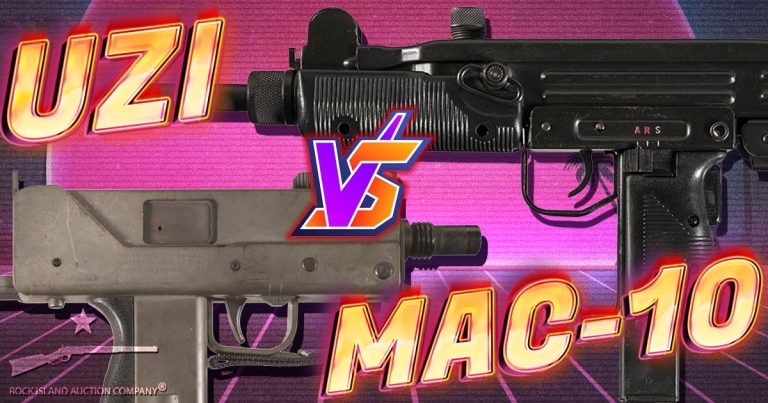
For arms collectors, military historians, and any fan of hard-hitting heavy metal, it doesn’t get much better than the machine gun. The MAC-10 vs Uzi debate is a popular topic in the firearms community, pitting two of the most famous 20th century submachine guns head to head. We’ll compare and contrast both of these lead-slinging legends and examine the evolution of each platform.

The quality is improving in our Sporting & Collector Auctions and that includes a robust offering of NFA and Class III items. Typically reserved for our Premier Auctions, there will be 30+ fully transferrable NFA items available at RIAC this February.

Rock Island Auction Company’s Feb. 16-18 Sporting and Collector Firearms Auction features numerous examples of the MAC-10 and Uzi families. Like their other machine gun siblings, both platforms are worthy collectible investments due to their limited quantity and provide some memorable range action. Click on the images throughout this article to learn more about each gun variant.

Manufactured in the 1970s/1980s as part of the “A” suffix serial range, this Auto-Ordnance 1928 Thompson is virtually a perfect continuation of the vintage Tommy Gun. Available this February.

MAC 10 vs Uzi

In the final stages of WW1, the German MP18 made an impression on the battlefield. This early SMG served as the blueprint for numerous next-generation SMG designs. By WW2, every major power had developed its own submachine gun, and these firearms laid the groundwork for a more advanced generation of SMGs after the war like the Czech SA 23 and its spiritual sibling, the Uzi.
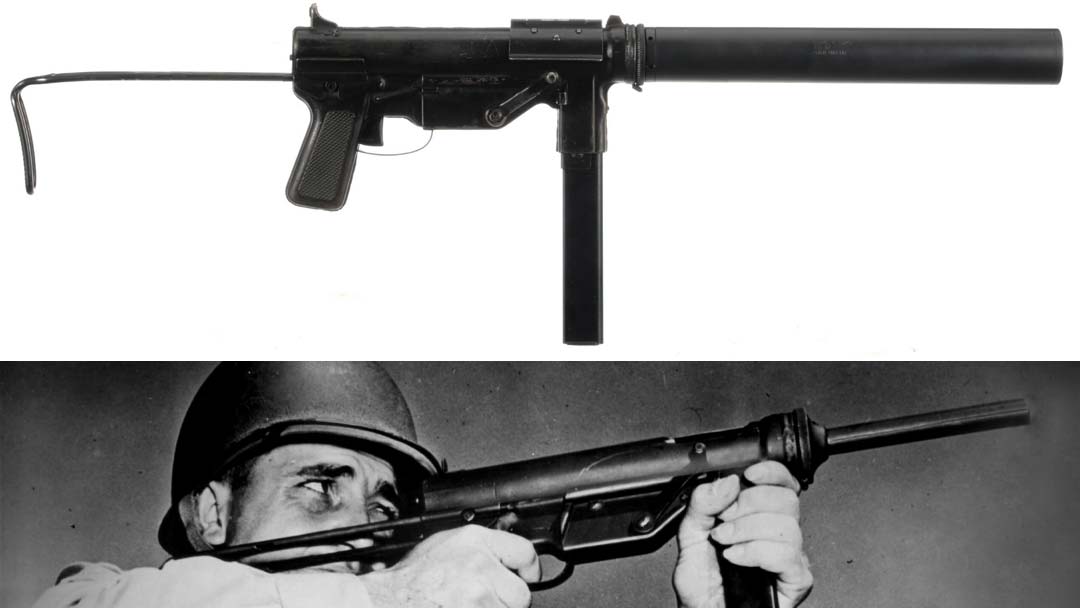
A Guide Lamp M3 with silencer in .45 ACP. Available this February.

Designed in the 1950s by Israeli inventor Uziel Gal, the Uzi SMG became a standard for IDF paratroopers, armored crews, and special forces involved in close-quarters combat. The Uzi’s SA 23 inspiration can be seen in the weapon’s telescoping bolt and grip-mounted magazine. A reliable and easy-to-use design, the Uzi quickly gained traction around the world.

A Group Bolt, IMI Model B host Uzi with an AWC silencer. Available this February.

Two decades and an ocean removed from the Israeli Uzi, the MAC-10 was invented by American Gordon Ingram and produced in 1970 by Military Armament Corporation. The company had high hopes for its boxy, stamp-steel welded submachine pistol and hoped the model’s low price point would give it an edge in the market for military contracts.
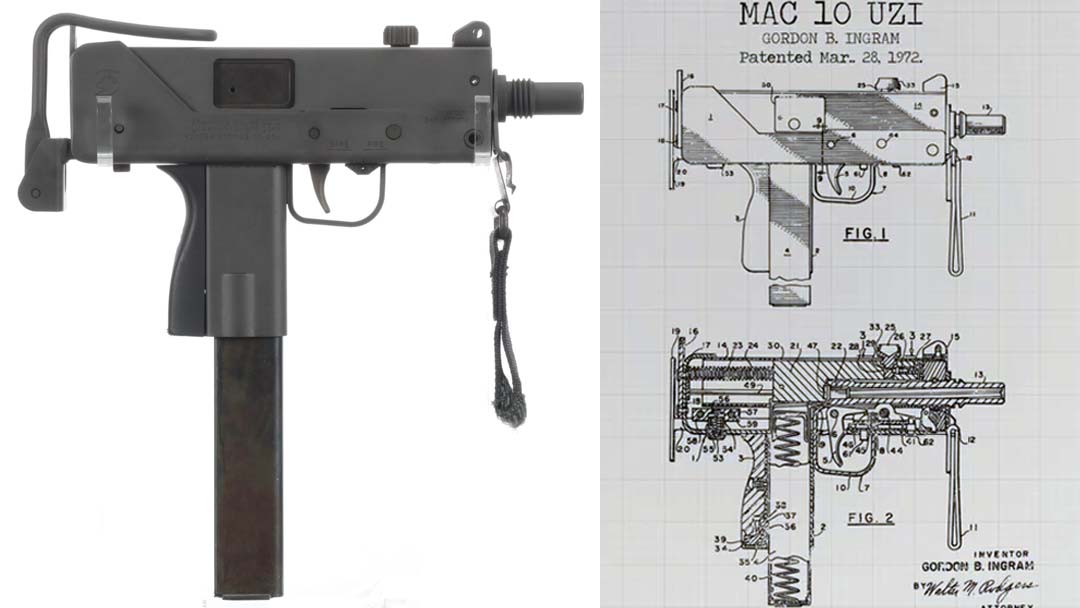
This particular M10 is addressed to Powder Springs, Georgia, making it among the earliest Ingram/MAC variants produced. Available this February.

The MAC-10 vs Uzi debate has raged since the 1970s, gaining traction over the decades as each platform appeared in a slate of action films and video games. At a glance, both guns share some vague similarities. Each weapon offers a comparatively affordable, magazine fed, open bolt submachine gun chambered for pistol caliber rounds. Both the MAC-10 and the Uzi are blowback operated designs with retractable stocks and a stamped metal construction.
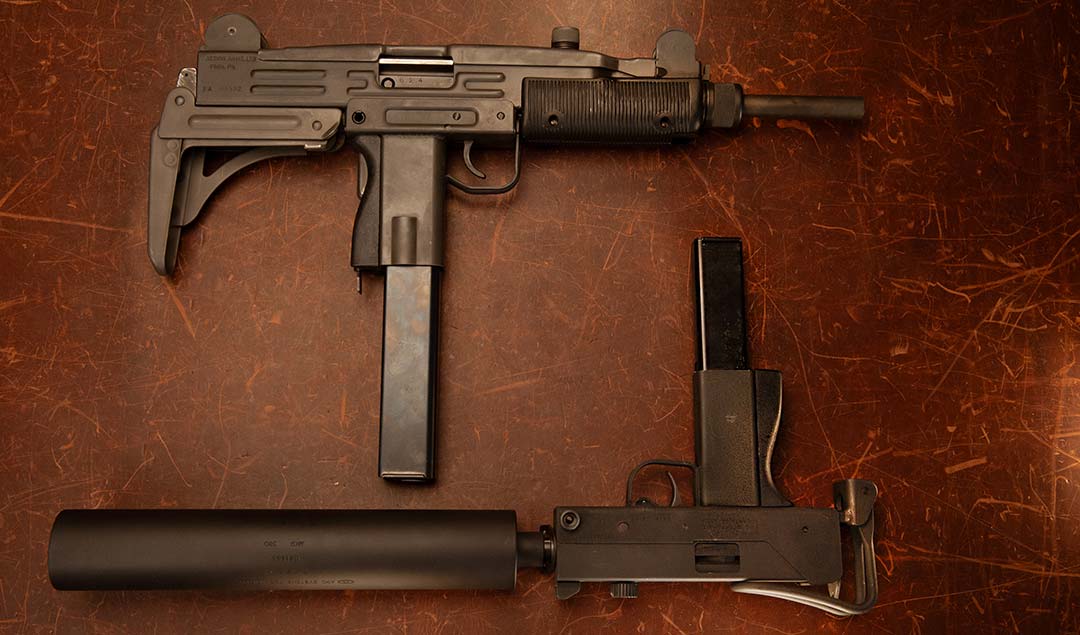
The MAC 10 vs the Uzi. Both submachine gun platforms face off this February at Rock Island Auction Company.

Despite these cosmetic similarities, the MAC-10 and Uzi are entirely distinct firearms, with personalities as divergent as the men who made them. Let’s look at them head to head.

MAC-10 vs Uzi Accuracy and Rate of Fire

When comparing the MAC-10 vs Uzi, one of the most significant differentiators is the firing rate. While the Uzi runs at about 600 rounds per minute, its MAC-10 competitor more than doubles that cyclic rate with a blistering 1,250 rounds per minute with 9mm ammunition.
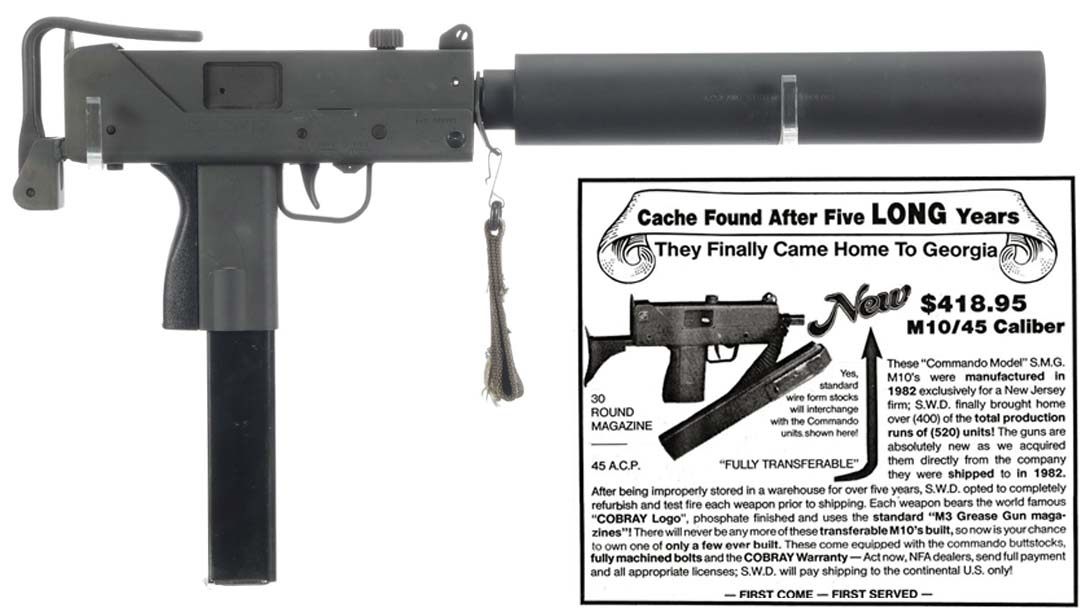
A MAC-10 addressed to Powder Springs, Georgia. Available this February.

The Uzi beats the MAC-10 in the accuracy department not only for its more modest firing rate, but also for its longer barrel, ample forend grip, lesser recoil, and greater bulk. The MAC-10’s effective range drops off beyond 50 meters, while the Uzi offers useful distance out to 100 meters or more. In terms of accuracy, one law enforcement official commented that the MAC-10 was, “fit only for combat in a phone booth.”
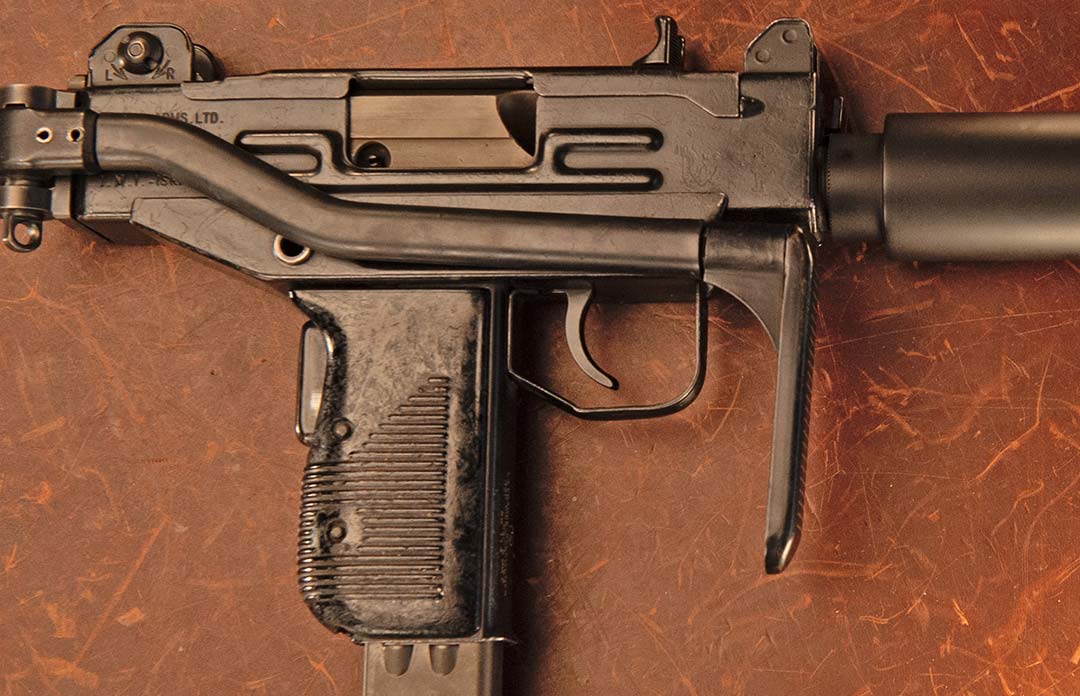
A LaFrance Specialties/IMI Uzi and silencer. This “micro” example has been outfitted with a LaFrance Specialties conversion bolt with a permanently installed fixed firing pin. Available this February.

The MAC-10 has been dubbed a bullet hose due to its speed, which comes at a clear cost. The weapon is notably lighter and more compact than its Uzi counterpart and thus more challenging to control. With an attached muzzle suppressor and a strap front grip, the MAC-10 becomes easier to handle. MAC-10 models chambered in .45 ACP cycle about 15% slower than their 9mm siblings and offer more manageability in turn.

Submachine guns chambered in slower cycling cartridges like .45 are often easier to handle, like the PAWS ZX7 pictured above. The PAWS ZX7 is based on the famous British Sterling. Available this February.

MAC-10 vs Uzi Cost and Marketing

A New York Times article from 1982 stated that the Uzi sold for “an average $350 on the export market.” During the same timeframe, the Mac 10 and Mac 11 could be purchased for less than $200. The UZI’s higher price point didn’t hinder its sales, however, and I.M.I. alone sold over 1 million Uzis in their first 30 years of production.
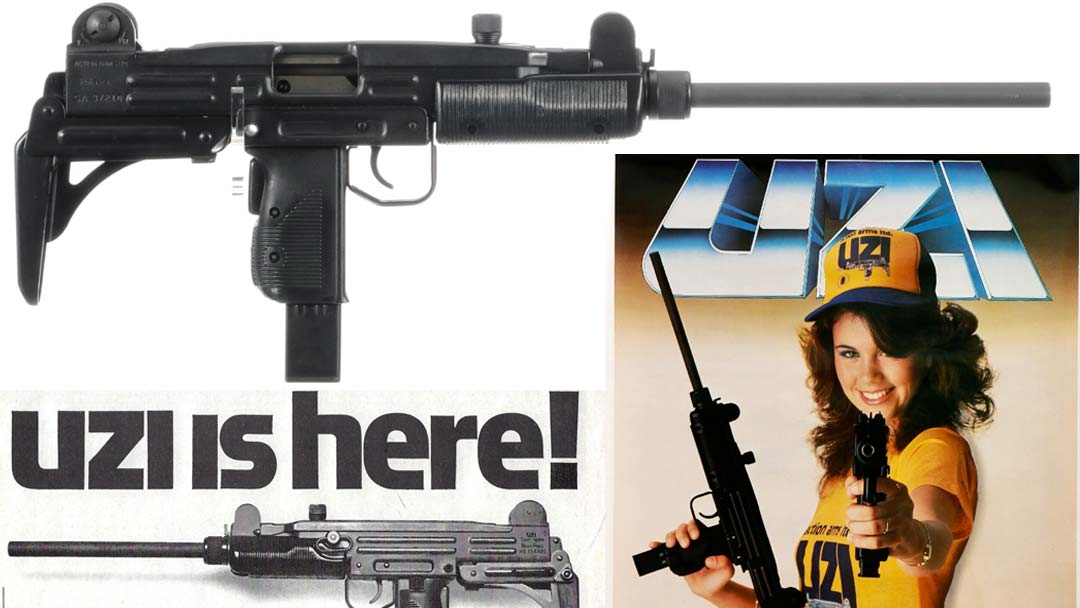
The Uzi emerged the clear winner in the Uzi vs MAC-10 marketing war. The I.M.I./Action Arms Model B Uzi pictured above is available for February.

Despite designing the MAC-10 with a military market in mind, the gun had little success on that front. Limited use with US Special Forces and the British Air Service failed to lead to large contracts, and a prohibition on exporting suppressors limited the viability of foreign sales, so the MAC-10 was instead advertised to American civilians. This wasn’t enough to support Military Armament Corporation, which folded in 1976.
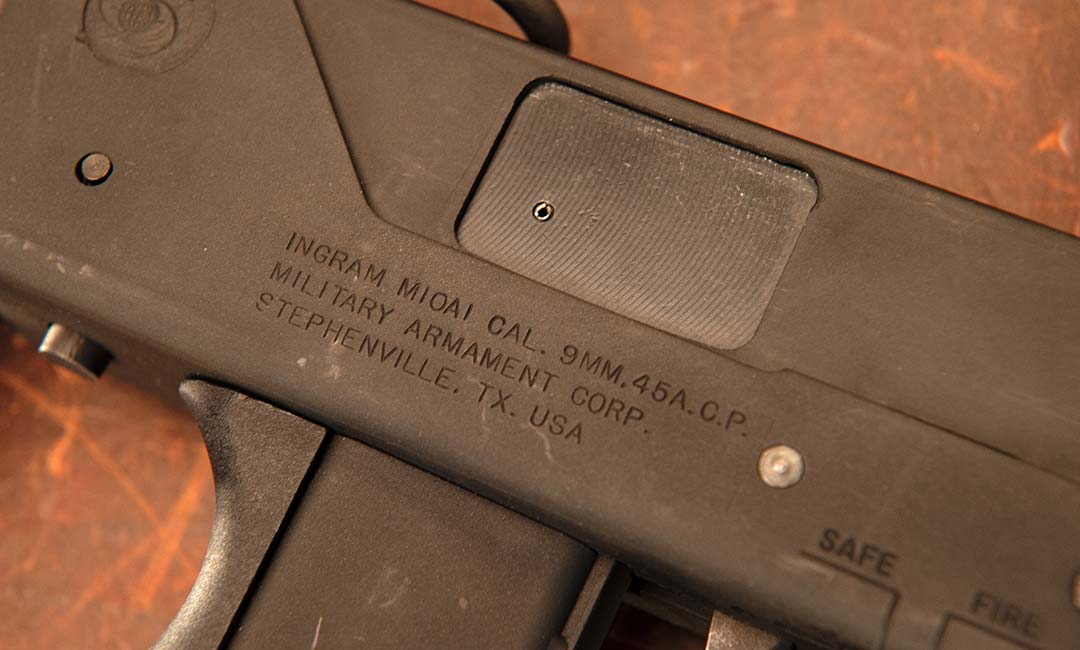
A Military Armament Corporation M10A1 with silencer. Available this February.

MAC-10 vs Uzi Variants

Both the Uzi and the MAC-10 platforms have seen numerous variants over the decades. The compact Mini Uzi, introduced in 1980, offered a lighter weapon with a higher rate of fire. Six years later, the closed bolt Micro Uzi reduced the platform’s size further still.

Starting in 1980, a semi-automatic Uzi variant was produced by IMI and targeted the civilian market. These closed bolt models were produced with 16 inch barrels to comply with ATF laws regarding short barreled rifles. Some included fixed wooden stocks for carbine use.
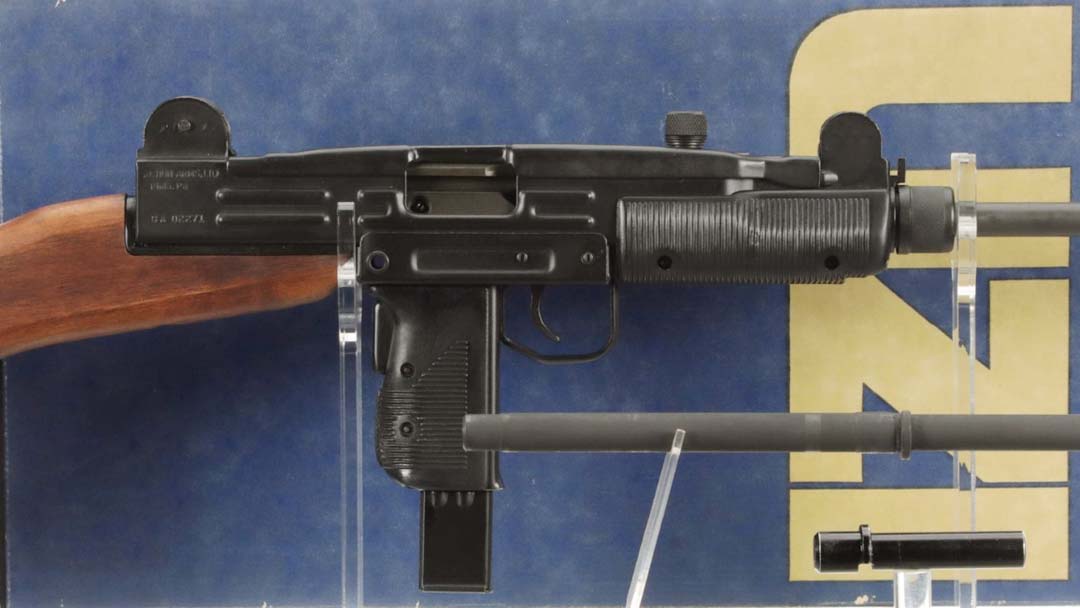
An IMI/Action Arms UZI Model A semi automatic rifle. Includes an Uzi box, an extra barrel, a prop barrel, and a sling. Available this February.

The MAC-10 has also seen its share of evolution over the years. In 1972, the sized-down MAC-11 made an already compact weapon even more maneuverable and offered a higher firing rate in its .380 ACP chambering. The M11/Nine included a slightly longer receiver than the MAC-11 to accommodate a caliber upgrade to 9mm and allow for a longer range of bolt travel to dampen felt recoil.

These variants of the platform were developed by RPB Industries and later SWD, Inc. after Military Armament Corporation went bankrupt. SWD and Cobray also produced a semi-automatic version of the platform with the M12 pistol in .380 ACP.
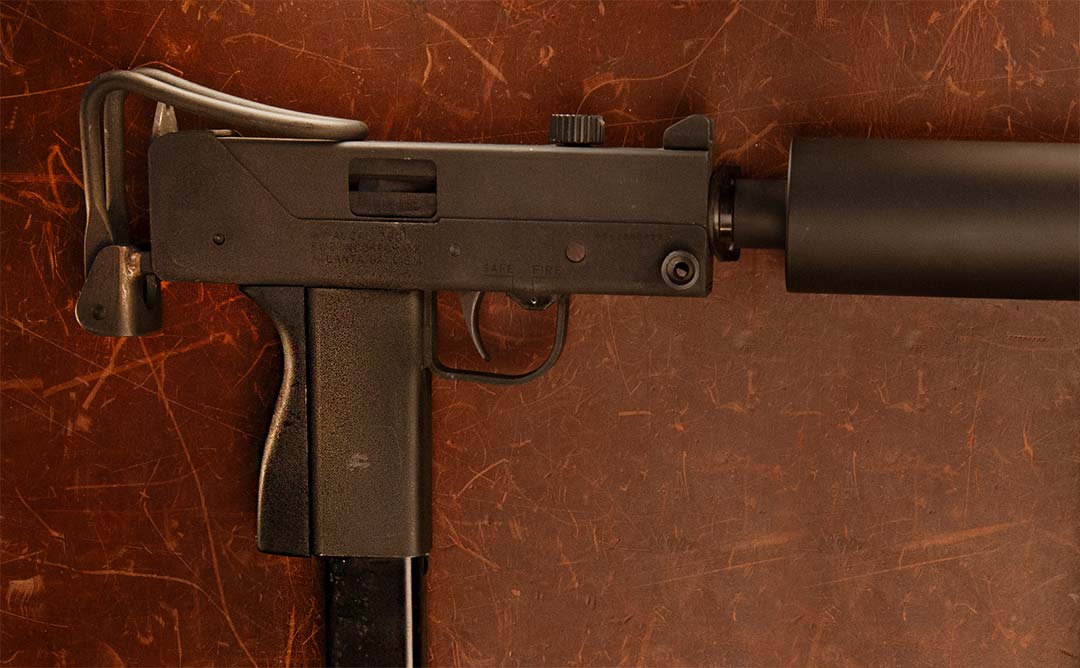
An SWD M11-A1 with a silencer. Available this February.

MAC-10 vs Uzi Around the World

In the MAC-10 vs Uzi debate, the production numbers don’t lie. The Uzi has been purchased by governments, law enforcement, and security agencies in over 100 countries, becoming the world’s most popular SMG from the 1960s through the 1980s. The platform remains in production today.

A BG machine registered bolt in an IMI/Action Arms UZI Model A host gun. Available this February.

Both the MAC-10 and Uzi platforms faced a host of competitors in the rapidly evolving SMG market, including the German Heckler & Koch MP5 and the Austrian Steyr MPi 69. But while the MAC-10 struggled to stay relevant, the Uzi continued to thrive.

Originally developed in the late 1960s, the S&W Model 76 was designed to fill the niche of a lightweight and compact 9mm SMG. This example has a barrel that is heavily ported and tapered for compatibility with the J.C. Benjamin suppressor. Available this February.

The MAC-10 became infamous in 1979 when it was used to assassinate a Miami drug kingpin, earning the nickname “Miami chopper.” The weapon was mired by controversy again when it was employed by a neo-Nazi in 1984 to murder Denver radio talk show host Alan Berg. Advertisements tried to capitalize on the MAC-10’s notorious reputation, dubbing the weapon “the gun that made the 80s roar.”

The MAC 11, a more sized-down version of its already compact MAC-10 sibling. Available this February.

MAC-10 vs Uzi in Pop Culture

One area where the MAC-10 excelled was on the silver screen. The gun appeared in 15 films in the 1970s and saw an even more prominent presence during the golden age of 1980s action films. Some of the weapon’s most notable appearances include in John Wayne’s 1974 film ‘McQ,’ 1981’s ‘Escape from New York, where the MAC-10 served as Kurt Russell’s primary firearm, and the weapon made a recent splash in AMC’s ‘The Walking Dead’ series when Negan totes the famous lead slinger.
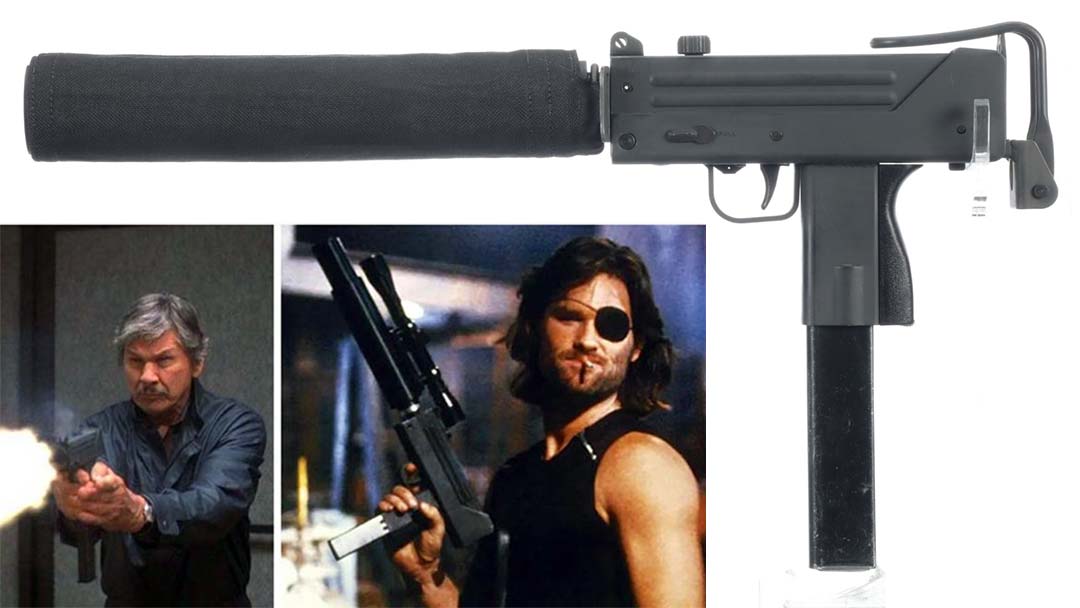
A MAC M10 with an AWC silencer. Available this February.

The Uzi, of course, is no stranger to the big screen either. From Chuck Norris to Arnold Schwarzenegger, the Uzi is an absolute staple of 80s action fare, and its design became known far beyond the bounds of Hollywood. From toy guns to video game appearances, the Uzi has garnered widespread recognition few gun models have achieved and its silhouette is instantly recognizable the world over.
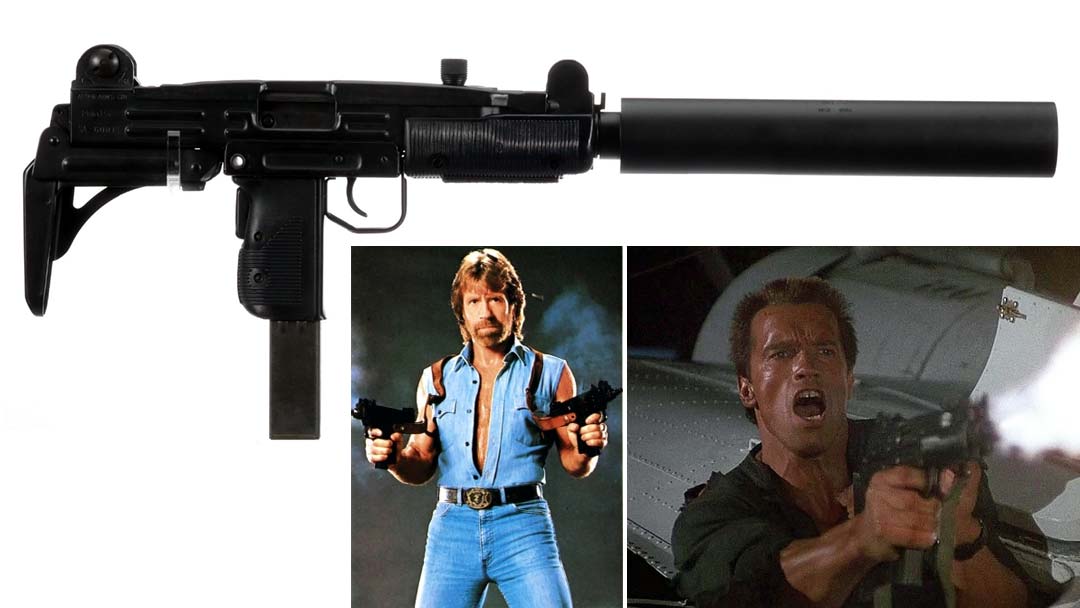
The Uzi, an absolute staple of 80s action cinema. The example above with the silencer available this February.

MAC-10 vs Uzi Value Today

Today, both the Uzi and the MAC-10 have climbed in value and can demand a price in the low five-figure range. Machine gun prices have spiked across the board thanks to a fixed supply and increasing demand from collectors, investors, and shooters looking for a heavy-hitting range experience.

The rise of firearms-focused social media influencers like Demolition Ranch and Garand Thumb have also contributed to the rapid uptrend in machine gun values, as arms enthusiasts around the world are able to watch the Uzi and MAC-10 being fired in the field and are inspired to get in on the action themselves.

Matt Carriker of Demolition Ranch bought an Uzi in RIAC’s May 2019 Premier Auction.

In 1975, a MAC-10 could be purchased for $125. The example below sold at Rock Island Auction Company for $14,100 in 2023, a staggering 11,180% increase in value. Though nearly every collectible firearm genre has experienced a notable uptick in recent years, submachine guns like the MAC-10 and Uzi are shattering records and show no signs of losing steam.
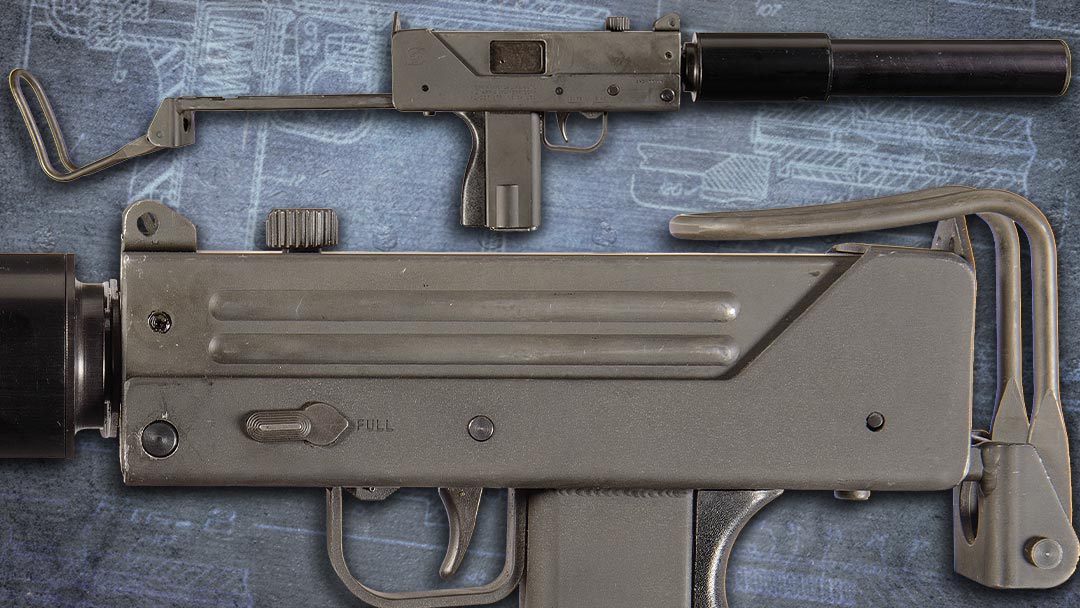
A Military Armament Corporation M10 submachine gun and silencer set sold for $14,100 in RIAC’s December 2023 Premier Auction.

Machine Guns for Sale and More This February

Rock Island Auction is always ready to help build machine gun collections, and February’s 16-18 Sporting and Collector Firearms Auction features a range of Uzi models, MAC 10 variants, and many more examples of the genre. In the end, both the Uzi and the MAC-10 are worthy additions to any arms collection and offer fun investment options in the process.

Find machine guns and more this February at Rock Island Auction Company.

Subscribe to the Rock Island Auction newsletter to receive new gun blogs and gun videos every week on some of the earliest machine gun predecessors such as the Gatling gun, the Hotchkiss revolving cannon, the Maltruse volley gun, the Nordenfelt volley gun, the Chambers swivel gun, as well as modern heavy hitters like the Japanese Type 99, the PPD-40, the Smith & Wesson Model 76, and more.

Manufactured by Wilson Arms of Brunswick, Georgia, using components from the Egyptian “Port Said” submachine gun, a licensed copy of the famous Swedish M/45 “Swedish K” submachine gun. Available this February.

Collectible Firearms for Serious Gun Collectors

0

Cool rifles want to be in on the action whether it is lever, bolt or pump.

From an antique wheellock to a modern Heckler & Koch to a crate chocked full of Mosin-Nagants and everything in between, Rock Island Auction Company’s Feb. 16-18 Sporting & Collector Auction has plenty of terrific long guns. This blog won’t include the massive JDJ nor any Class III offerings but take a look at this selection of cool rifles that will be available.

Cool Rifles: U.S. Johnson Model 1941 Semi-Auto

Melvin Maynard Johnson Jr. shot on a rifle shooting team at Harvard, served at its coach, graduated Harvard Law School and earned a U.S. Marine Corps commission, but he couldn’t convince the U.S. Army to give up on the M1 Garand.

John Garand’s design was the leading candidate for the U.S. service rifle in 1935. Johnson considered the Garand to be obsolete, based on the gas blowback action similar to the Lewis light machine gun. Johnson’s design for a semi-auto service rifle used a short recoil system. His insistence on the Army considering his gun ground on U.S. Ordnance officials and Johnson couldn’t get a significant stateside contract.

Johnson’s company got a contract from the Netherlands to arm the Royal Netherlands East Indies Army, but production wasn’t able to completely fill the rifle order before the East Indies fell to Japan.  Guns were sold to Chile and the U.S. government took over the Dutch contract and issued some of the M1941 to the Marines and offered them to the Free French government.

U.S. Marine Capt. Robert Hugo Dunlap of Monmouth, Ill., hometown of Wyatt Earp, earned the Congressional Medal of Honor for his actions on Iwo Jima while armed with a M1941.

(pic) The Johnson Model 1941 is a cool rifle that didn’t get a lot of love from the U.S. military, but it was carried by anti-Castro forces during the failed 1961 Bay of Pigs invasion. The rifle is chambered in the classic U.S. service round, .30-06. Melvin Maynard Johnson Jr. is at the bottom left. At bottom right are Dutch East Indies soldiers carring M1941s.

Cool Rifles: Factory Engraved New Haven Arms Henry Rifle

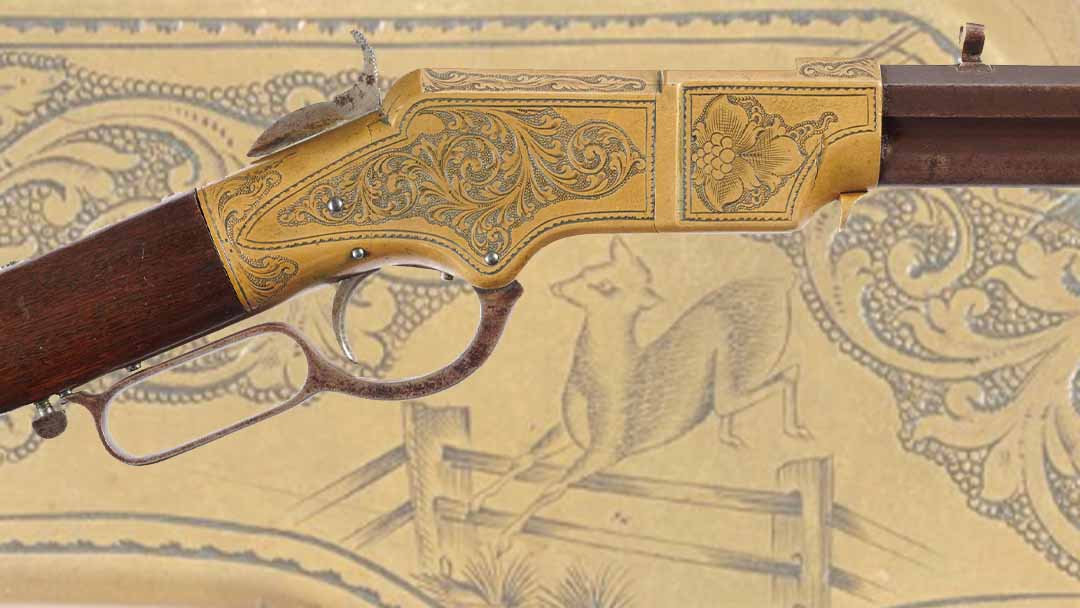
First came the .44 Henry rimfire cartridge developed by Benjamin Tyler Henry. What followed is the lever action rifle that set the stage for the legendary lever guns of Winchester. Henry received a patent for his rifle in October 1860. This Henry has received attention from gun writers, landing it in two books, which is cool.

Despite getting the reputation as “That damned Yankee rifle that can be loaded on Sunday and fired all week,” the federal government only purchased 1,731 Henry rifles during the Civil War for $37 each. Private sales to cavalry and infantry officers and soldiers boosted the number of rifles sold considerably. The federal government purchased 4.61 million rounds of Henry ammunition during the war for a cost of $107,500. More than 10,100 Henry Rifles were sold during the Civil War, mostly through private sales.

This rifle is factory engraved by Samuel J. Hoggson and pictured in “The Winchester Book,” by George Madis and in “Winchester Engraving” by R.L. Wilson. Engraving of a doe leaping a fence is on the left side of the receiver along with extensive floral scroll and decorative borders that are also on the right side.

Cool Rifles: Winchester Model 1866 Saddle Ring Carbine with Henry Patent Barrel Marking

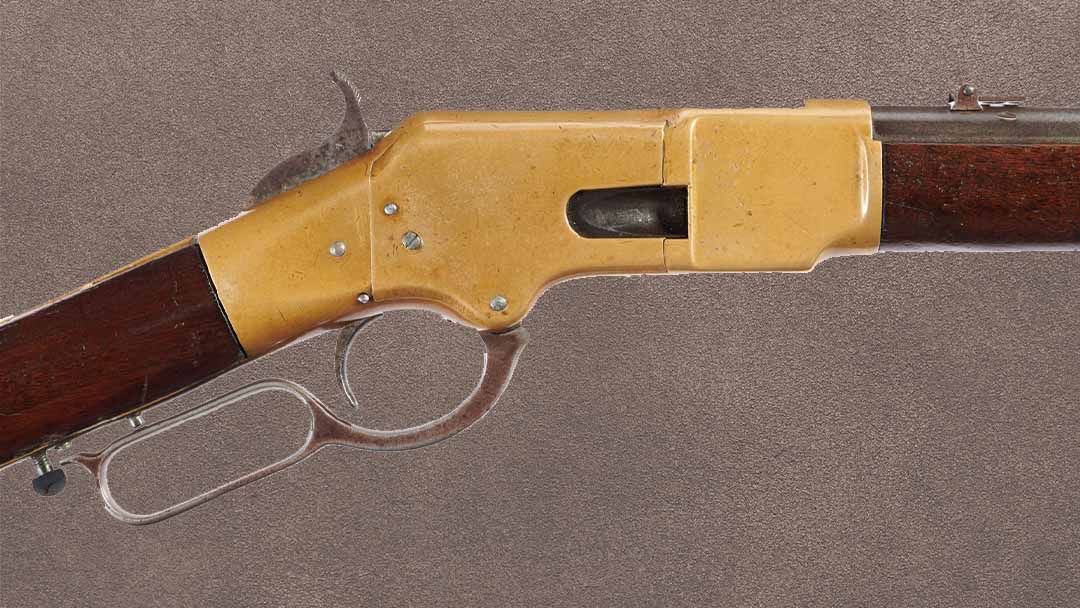
The Henry Rifle stabilized the financially troubled New Haven Repeating Arms Company. Years later, Oliver Winchester had reorganized the company Winchester Repeating Arms Company and wanted to build on the success of the Henry. He directed Nelson King to make improvements to the Henry, including an improved extraction spring, an enclosed magazine and new method of loading.

The Model 1866 was born. With its brass receiver it earned the nickname “Yellow Boy.” Winchester believed in producing obsolete models until all the parts were used so Henry Rifle parts lived on. What makes this gun cool is that both Henry’s and King’s patents are listed on the gun. That was done on the Model 1866 to approximately serial number 23,000. Winchester produced the Model 1866 until 1899.

This Winchester Model 1866 is serial number 16,179. Nelson King’s and Benjamin Tyler Henry’s patents both appear on the barrel. It is chambered in .44 rimfire.

Cool Rifles: Colt Burgess Saddle Ring Carbine

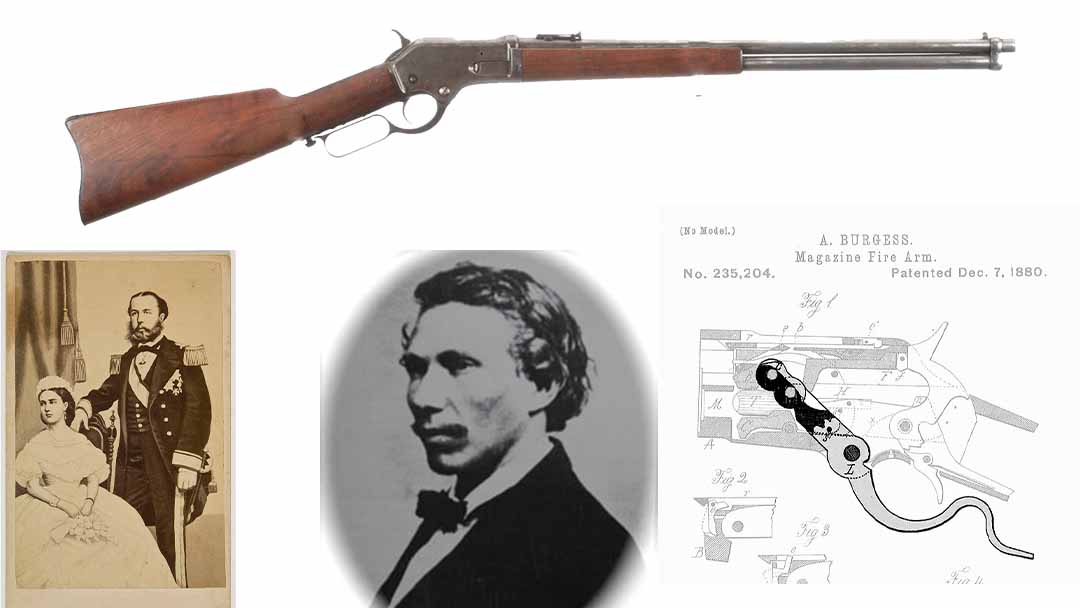
Andrew Burgess worked for famed Civil War photographer Mathew Brady and is credited with taking some of the most famous photos of Abraham Lincoln that are credited to Brady. He developed a breechloading patent and also basic lever action patents by 1873.

At the Philadelphia Exposition of 1876, Burgess displayed his firearms and met Eli Whitney. He went to Marlin and contributed to the design of the Model 1881, and then went to Colt where the Colt-Burgess rifle was made. Colt manufactured the rifle for 16 months starting in 1883 and produced 6,403 rifles.

Apocryphally, Burgess’s rifle led to the gentlemen’s agreement where Colt would keep to revolvers and Winchester would stick to long guns. That’s pretty cool.

This scarce Colt-Burgess saddle ring carbine is one of 1,219 rifles with a round barrel manufactured during the limited production run by Colt. It was shipped to E.C. Meacham Arms Co. in St. Louis, Mo., in August 1884. Center is Andrew Burgess. Left is Mexican Emporer Maximillian and his wife who Burgess photographed in Mexico City. At right is a patent drawing of Burgess’s lever action.

Cool Rifles: Colt Model 1855 Revolving Rifle

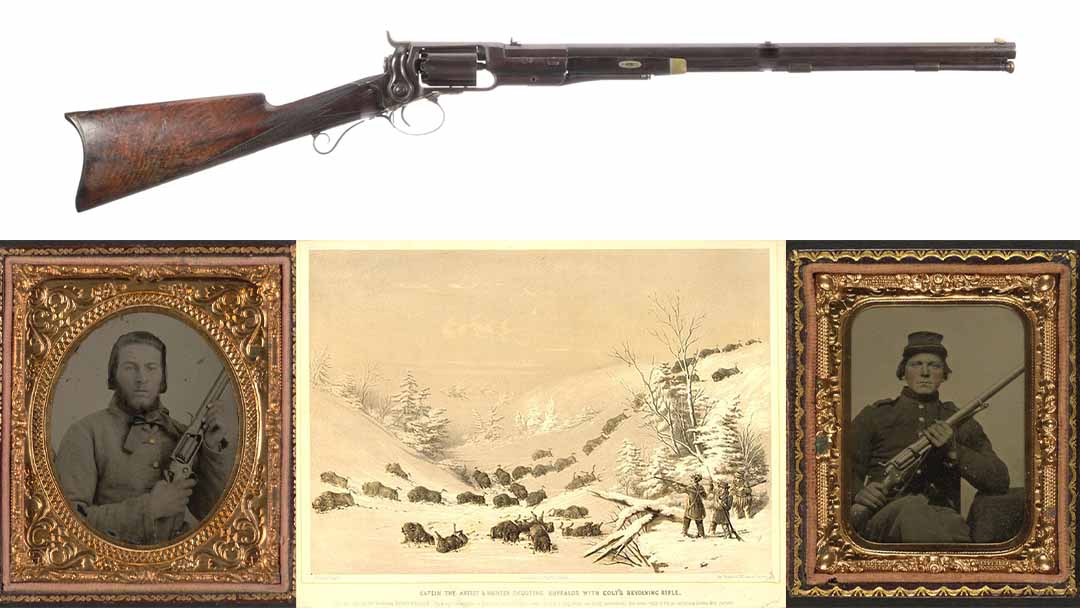
Among the weapons in the U.S. arsenal on the eve of the Civil war was the Colt revolving rifle, utilizing a side hammer. As the Civil War began, the guns were first issued to the 8th Massachusetts Infantry as it served in the defense of Washington, D.C., early in the war. In early 1862, the Union received 1,000 and issued them to the Berdan Sharpshooters that nearly rioted angrily over these guns they didn’t want.  Six months later the Sharpshooters gladly swapped their Colts for Sharps rifles. Still, the Colt revolving rifles, chambered in .56 caliber for military models, found plenty of action in the Civil War, issued to both infantry and cavalry, especially in the western theatre.

Something cool about the Colt revolving rifle was that it was loaded from the front of the cylinder, making it a muzzleloader but could still be loaded faster than a musket.

About 10,000 Colt Model 1855 revolving rifles were made. This scarce rifle is chambered in .40 caliber, one of only 125 sporting rifles made in this caliber, and of that only 55 have a 24-inch barrel. On left and right are soldiers armed with the Colt revolving rifle. Center is a 19th century drawing of hunters with Colt revolving rifles.

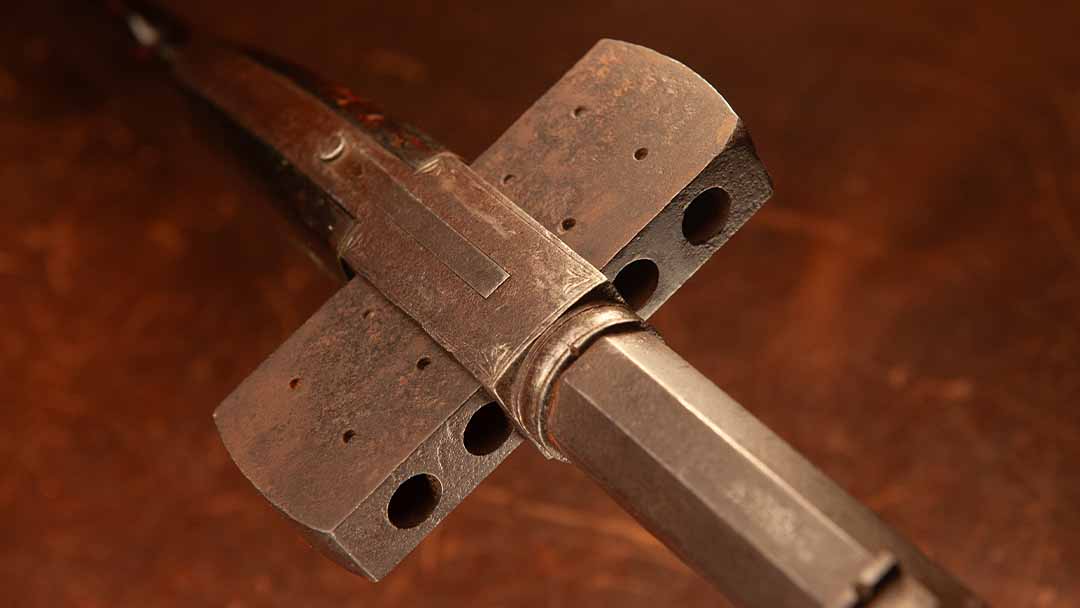
Cool Rifles: Nicanor Kendall Five-Shot Harmonica Rifle

Nicanor Kendall was born in Vermont in 1807, the son of a blacksmith. He served an apprenticeship under a gunsmith before earning a patent for an underhammer percussion lock that was safer and more reliable than other locking systems. His firearms, like the harmonica gun, tended to be simple designs making them easier to produce as well as use interchangeable parts.

He partnered with two other men, Richard Smith Lawrence and Samuel E. Robbins, to land a federal contract to manufacture 10,000 rifles. After Kendall sold his interest in the company and moved west, Lawrence and Robbins worked with Christian Sharps, as well as Horace Smith and Daniel Wesson. These gunmakers helped usher in the “American system of manufacturing” with interchangeable parts and mechanized production, and that’s pretty cool.

This Nicanor Kendall five round harmonica gun is reportedly one of fewer than 100 of these rifles made by Kendall. The gun utilizes an underhammer action and is chambered in .45 caliber.

Cool Rifles: Winchester Flat Side Model 1895

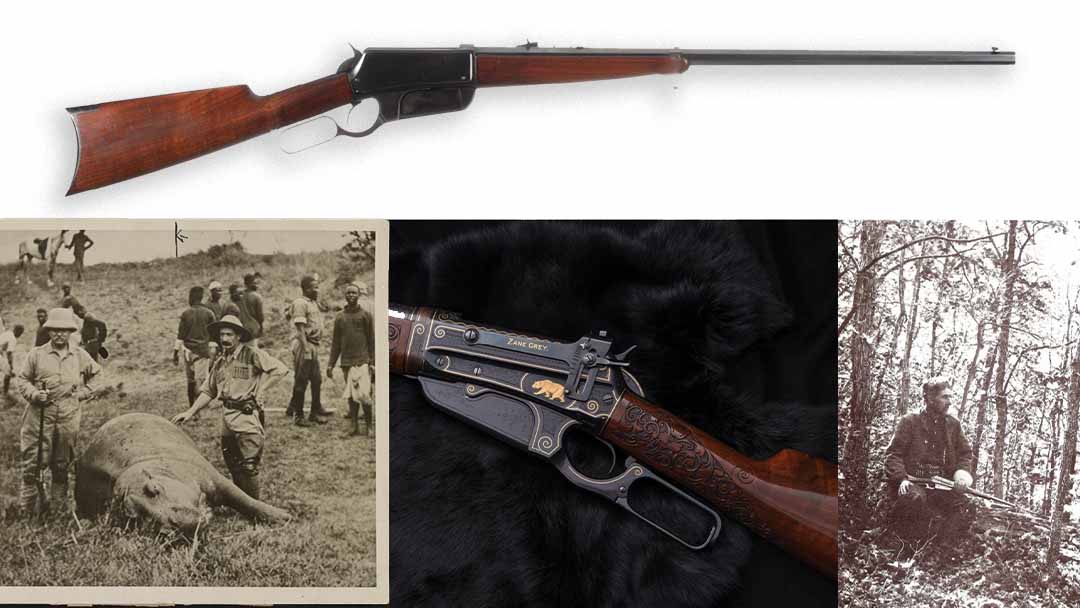
John Moses Browning’s design of the Winchester Model 1895 was made to handle the higher pressures of the new smokeless cartridges. Its fixed single column box magazine also allowed the 1895 to take the pointed Spitzer bullets to make it attractive to European buyers where they were enjoying popularity. Early models, like this one with a three-digit serial number has flat sides, a real cool rarity.

The 1895 was popular with outdoorsmen like Theodore Roosevelt and author Zane Grey. Grey praised the Winchester 1895 as “the finest rifle ever built.” Despite its popularity with sportsmen, the Model 1895 also found its way into military arsenals and fights at the end of the 19th century, chambered in 7.62 Russian, .30-06 and British .303 among others. Russia commissioned Winchester to make 294,000 of them.

This rare Winchester Model 1895 has a three digit serial number and a flat-sided receiver. The rifles were made with flat receivers to about serial number 4500. After that, the receivers were fluted, making the gun about 1/16 of an inch wider.

Cool Rifles: Pre-World War 2 Winchester Model 61 Rifle in .22 LR Shot

The Winchester Model 61 was meant to be the plinker for every need, whether it was gallery shooting, target shooting or varmint hunting. Cartridges for .22 Short, .22 Long and .22 Long Rifle could be used in the Model 61 with round barrels. The barrels were marked “22 S. L. OR LR.” Model 61s equipped with octagon barrels, were chambered for specific cartridges. Rifles chambered for .22 Long Rifle shot like this one had smooth bores making them a rarity.

The beloved and popular Model 61, with its hammerless action, could hold 14 Long Rifle cartridges, 20 of the .22 Short and 16 of the .22 Long. Introduced in 1932, it was manufactured until 1942 when the war effort took resources. Production resumed in 1947 and ran until 1963. By that time 363,000 of the Model 61 were made.

This pre-war Winchester Model 61 is chambered for .22 Shot and was manufactured in 1939.

Cool Rifles: Winchester Model 71 Type 4 Special Rifle

The Model 71 replaced the Model 1886 in its 50th anniversary year, produced starting in 1836, serving as a rifle for North American big game hunters. Despite being mechanically similar to the Model 1886, few parts were interchangeable. One gun writer described the Model 71 as “the smoothest lever action ever built.”

The rifle was only chambered for .348 caliber, but could take 150, 200 or 250 grain bullets. Its tubular magazine could hold four shots and one in the chamber. The gun was expensive to make and about 38,000 were produced between 1936 and 1958 when it was discontinued. Production did stop during World War 2 and resumed in 1947.

This Winchester Model 71 has a 20-inch carbine-length barrel and was made in 1936. These guns proved popular in the Alaskan wilds for being strong enough to take down deer, moose and bears.

Cool Rifles: Pre-64 Winchester Model 70 Rifle

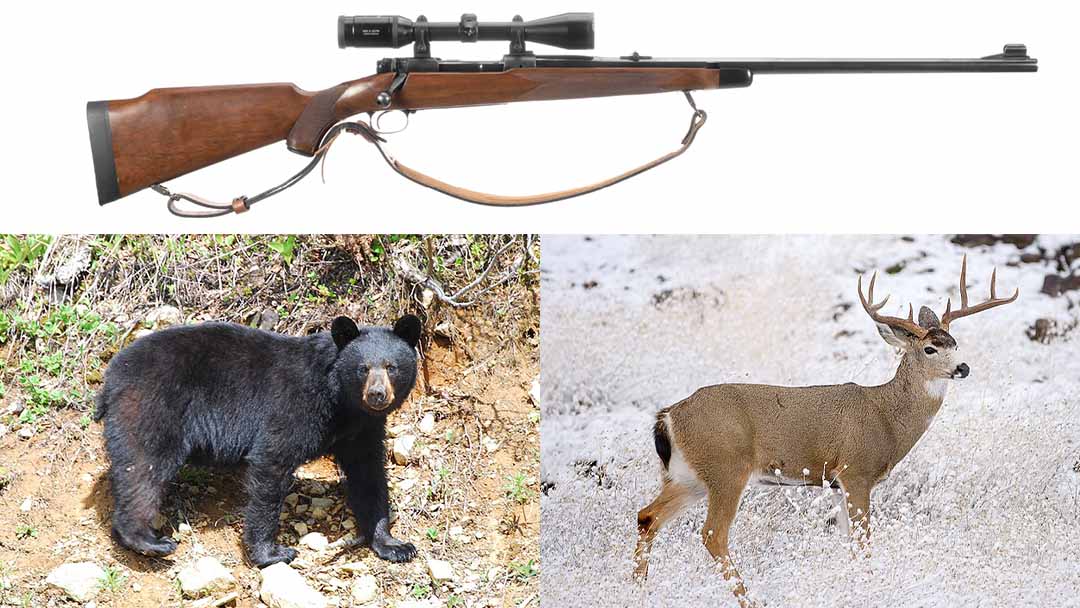
Winchester’s bolt action Model 70was introduced in 1936 as an improvement of the Model 54 as part of Winchester’s modernization plan. The bolt lock and safety were new and the trigger. Chamberings in new calibers .375 Holland & Holland and .300 Magnum were added to those already used with the Model 54, including .270 WCF and .30-06, making the Model 70 Winchester’s first high-power bolt action rifle. Chambering in the .375 H&H required modification to a longer travel action that makes this cool.

The pre-64, manufactured from the 30s to 1963 except during World War 2, was known for the beauty of the wood stocks and the hand-fitted parts that showed an amazing degree of craftsmanship. As the 1960s dawned, many of the craftsmen were starting to retire and more machines were brought into the manufacturing process making Pre-64 models like this particularly desirable.

This popular pre-64 Winchester Model 70 made in 1956 is chambered for .375 H&H and is mounted with a Swarovski 3-10×42 A Habicht scope.

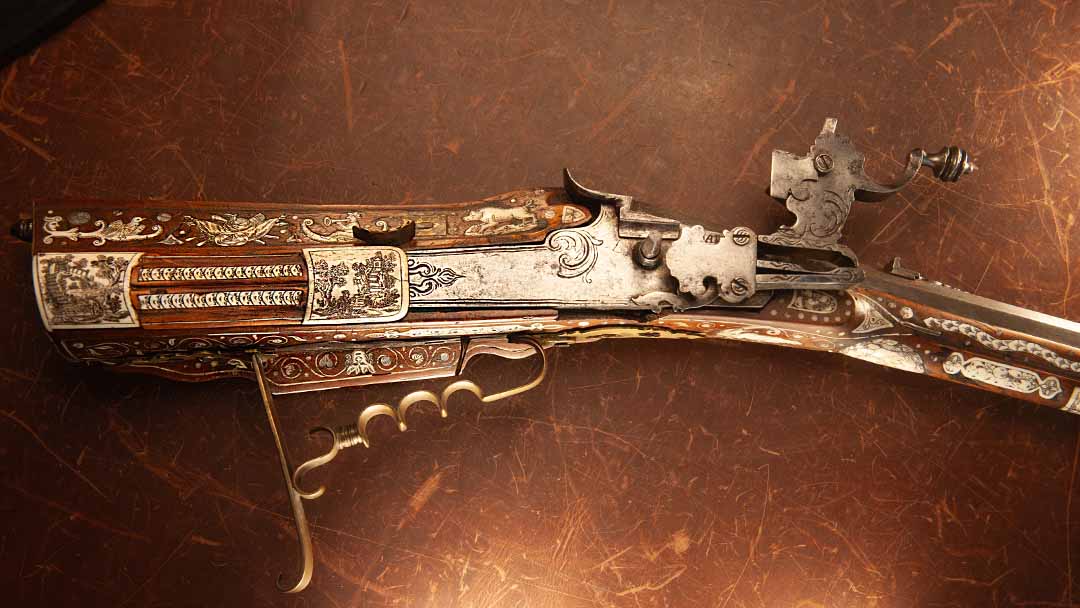
Cool Rifles: Ornate Engraved Wheellock Rifle with Inlaid Scrimshaw

A wheellock uses a metal wheel under spring tension to generate sparks that in turn ignite gunpowder. This small combustion lights the powder in the pan and that explosion ignites the main powder charge the touch hole in the barrel. Despite its description, this process happens nearly instantaneously. This firearm mechanism likely originated in the early 16th century in Nuremberg, Germany. Firearm technology dating back 500 years is pretty cool.

This ornate and engraved Wheellock rifle has numerous inlays using scrimshaw in the buttstock that including whimsical cottages on both sides of the butt. The right side features a boar, a man in a boat, a panoply of flags and a bird on a branch. The left side’s inlays are a dog, fairy tale faces, a wolf invading an eagle’s nest. Inlays are also visible on top and underneath the stock as well.

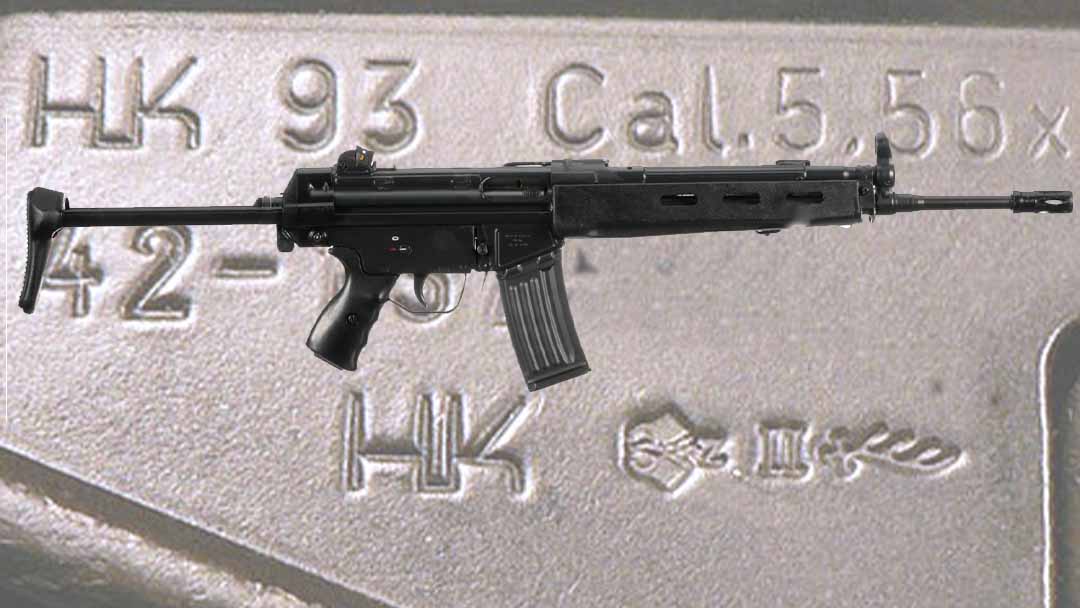
Cool Rifles: Heckler & Koch Model 93

The most modern firearm on the list is this civilian semi-auto version of the H&K 33. The rifle was imported from Germany starting in 1974 as a variant of the HK43 but with a different barrel length. It was prohibited from importation by the 1989 assault rifle ban. The HK93 has seen screen time in action and horror movies, including “First Blood.”

The Heckler & Koch HK93A2 has a fixed stock, but this lot has a retractable stock marking that it is HK93A3. This rifle also comes equipped with a paddle mag release that is not standard. Chambered in .223 Remington, this HK93 comes with four extra magazines.

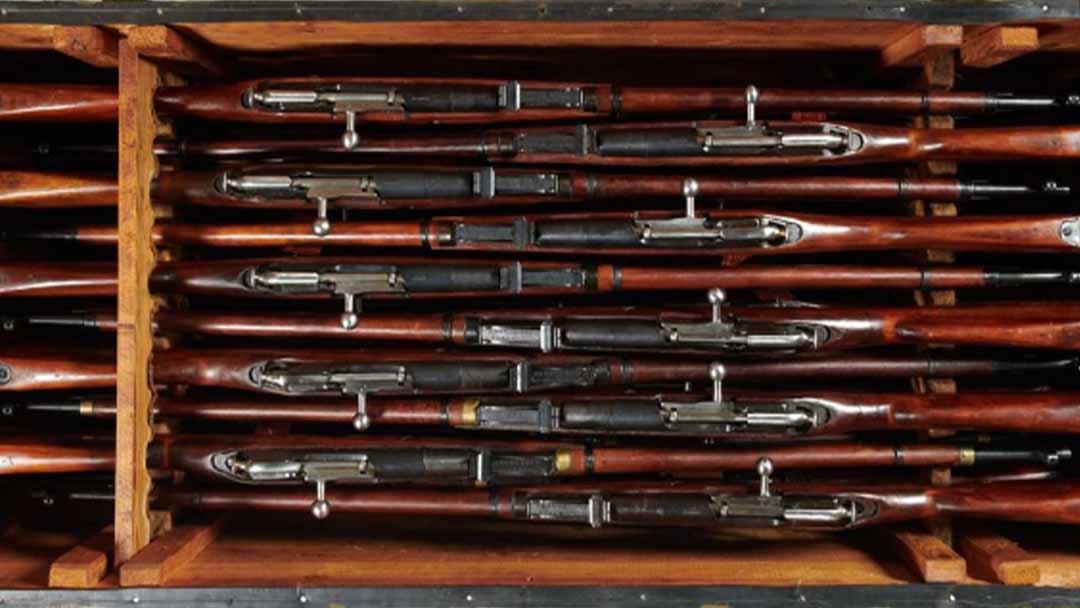
Cool Rifles: Mosin-Nagant

Russia needed a repeating rifle after soldiers of the Ottoman Empire armed with Winchester Model 1866 rifles inflicted heavy casualties during the Russo-Turkish War. It took time, but by 1891, the Russian Imperial Army selected the design of Capt. Sergei Ivanovich Mosin over two others. The gun also shares aspects from the Belgian inventor Leon Nagant who lent his name to the rifle.

The bolt action rifle’ a magazine spring, clips for loading into the magazine and an interrupter to avoid double feeding of cartridges were modified in 1930. The rifle was standard issue for the Red Army at the start of World War 2. About 37 million are estimated to have been produced from 1891 to 1973.

How cool is a crate of 20 Mosin-Nagant rifles dated 1943? This collectors lot of the rifles include 20 bayonets, 20 oilers, 40 stripper clip pouches, 20 slings and cleaning tools. Four sequential importer numbered pairs of rifles are present in the box.

Plenty of Cool Rifles

This is just a sampling of the cool rifles that will be on offer in Rock Island Auction Company’s Feb. 16-18 Sporting & Collector Auction. A collector can find history, innovation, high condition among the rifles available as well as modern shooters, so visit us in Bedford.

Review: ThermoWorks ThermoDrop Zipper-Pull Thermometer

0

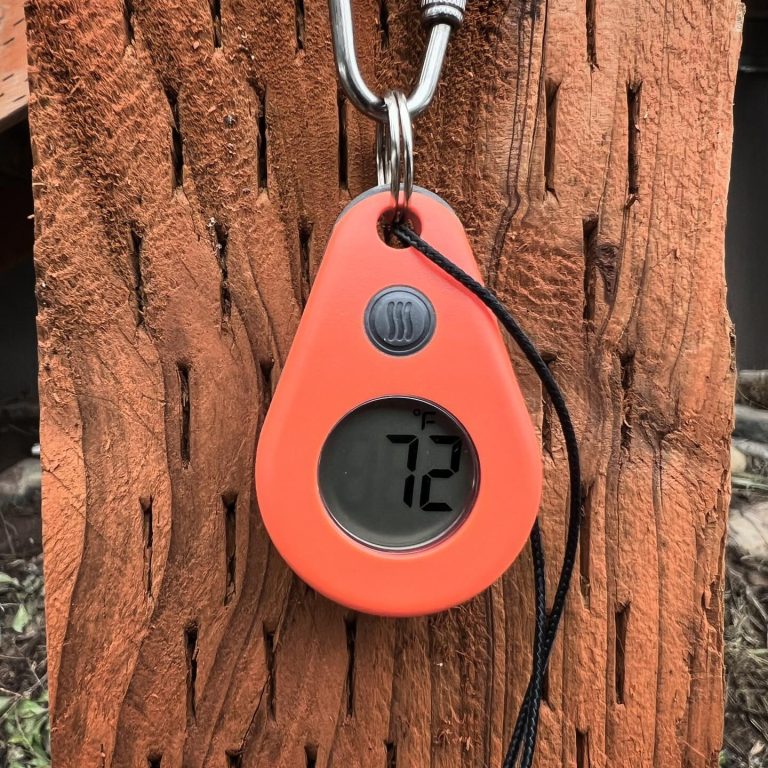
I picked up this ThermoDrop Zipper-Pull Thermometer to help fill in the temperature data gap in my favorite areas to explore in my area. The forecasts in my area come out of a city that is about 2 hours away by car and there are countless microclimates between here and there. There are mountain weather websites that do their best to make some algorithmic guesses about forecasts but they often miss the mark which leaves me guessing about how to gear up for trips into the mountains.

Last summer, I spent a night out on a mountain bench just below the tree line. According to forecasts for that elevation, I should have seen temperatures down around 32F. The actual temperature never went lower than 56F which was MUCH closer to the forecasted temps for the valley below. This will help inform future trips into this area.

There are a few specific attributes of the ThermoDrop that make it so useful. First, it is extremely compact and lightweight (smaller than the diameter of a US quarter and weighing in at half a gram). Second, it shows the current temp but also records the lowest and highest temp since it was activated which is the real game changer versus most cheap zipper-pull/keychain thermometers.

I have found no end to the usefulness of this little thermometer. I’ve used it to monitor the temperature inside a cooler during power outages, check temps in a crawl space during a cold snap, test my comfort level in various sleeping bags and insulation layers, and even check temps on training runs/walks during hot summer days.

This is GREAT gear that has changed the way I hike and train. It is small enough that you’ll never leave home without it and useful enough that you won’t want to. I highly recommend it.

ThermoWorks.com

Collectible Firearms for Serious Gun Collectors

0

From the time a young Samuel Colt observed the working of a capstan on board a sailing ship in the early 1800s to when he produced the Colt Paterson and beyond, revolvers have been evolving and improving.

Classic revolvers’ history is multi-layered, with tales of both innovation and failure. For every bored-through cylinder and double action revolver is the “figure 8” trigger and the turret gun. Take a look at these wheelguns that will be available in Rock Island Auction Company’s Feb. 16-18 Sporting & Collector Auction.

Classic Revolvers: Colt Model 1871-72 Open Top Single Action

The Colt Open Top revolver is the gun that begat the legendary Colt Single Action Army revolver that would come a year later in 1873. Colt started working on a bored-through cylinder, rear-loading revolver as Rollin White’s patent was expiring. The company had an eye toward the upcoming Army trials that would select the first metallic cartridge revolver. The Open Top, chambered in .44-70, was the first gun manufactured to fire metallic cartridges.

The Army objected to Colt’s entrant, reporting that a lack of a top strap made it structurally weak. It also wanted a gun in .45 caliber. Colt returned with a revolver with a top strap, a change to the rear sight and grips similar to the Model 1851 Navy’s plowhandled ones. The Single Action Army was born and after a manufacturing run of 7,000, the Colt Open Top missed being one of the truly classic revolvers.

This Colt Model 1871-72 Open Top revolver is chambered in .44 rimfire and has “U.P.R.R.” inscribed on the backstrap for the Union Pacific Railroad Express Agency.

Classic Revolvers: Mateba Unica 6

Meteba was founded in Italy by Emilio Ghisoni who designed the Unica 6 as a revolver that is also a semi-automatic pistol. The cylinder is part of the upper frame that slides when fired and returning to battery rotates the cylinder and cocks the trigger so that it is ready to fire again. A large rear tang prevents the slide from biting the user’s hand.

The gun, its name translates to “You’re unique” in Italian, is a low bore revolver with the barrel firing at the bottom of the cylinder rather than the top. Guns with a low bore axis experiences less barrel rise, while lessening recoil seems to be more hoped for than real. Maybe not among the classic revolvers but definitely an interesting one that deserves mention.

Maybe not one of the classic revolvers, but this interesting modern gun design is offered in .357 Magnum, .44 Magnum and .454 Casull. This gun is chambered in .44 Magnum with a six-inch barrel. This auction also has a Unica chambered in .357 Magnum with a four-inch barrel.

Classic Revolvers: Forehand & Wadsworth Old Model Army

Gunmaker Ethan Allen had two daughters, Laurette and Nettie, who married Henry C. Wadworth and Sullivan Forehand, respectively, who worked for Allen’s company. Allen made his sons-in-law partners and the two men continued the company with their names after his death in 1871. At the time, the company was known best for its small caliber revolvers.

Forehand and Wadsworth borrowed ideas from Smith & Wesson, Webley and Merwin Hulbert for its Army trials revolver in the mid-1870s. The gun reportedly performed well but didn’t show any advantages over the Colt Single Action Army. Chambered in .44 Russian, the revolver was expensive and had a clumsy ejector rod. The company’s inability to land a military contract led to its decline and it was taken over by Hopkins and Allen in 1902.

Less than 1,000 of these rare Forehand & Wadworth Old Model Army revolvers were made. Unable to land a military contract kept this revolver from joining the pantheon of classic revolvers.

Classic Revolvers: RNWMP Marked Colt New Service Double Action

The Northwest Mounted Police formed in 1873 to combat lawlessness in the Northwest Territories and provide a martial presence and maintain border sovereignty in the Klondike gold rush along the border of Alaska and the Yukon. Officers of the Northwest Mounted Police served in the Second Boer war. The Mounties added  the prefix of “Royal” in 1904, then in 1920, combining with the national Dominion police, became the Royal Canadian Mounted Police.

The Colt New Service revolver came out in 1897 and was adopted by the Mounted Police in 1904, putting the Enfield Mark II out to pasture. British and Canadian forces received 60,000 of the New Service during World War 1 and these classic revolvers continued to see service in World War 2.

This New Service revolver, chambered in .455 Eley, was manufactured in 1916. It is marked “R.N.W.M.P” on the backstrap.

Classic Revolvers: Engraved New Haven Arms Walch 10-Shot Pocket Revolver

John Walch received a patent in 1859 for a revolver that fired superposed loads from each chamber of the cylinder. The gun had two hammers fired by one trigger. The right side hammer fired the front charge and the left would fire the rear charge after rotating. The rear lead bullet served as a seal to prevent the rear charge from igniting prematurely.

This rare gun was made in small numbers around the same time as the Henry Rifle. Soldiers of the 9th Michigan and 14th Wisconsin volunteer infantry regiments but were likely bought personally rather than as Army issue.

This Walch Firearms & Co. pocket revolver has a brass frame with a deer engraved on the left and a dog on the right. The gun includes a case and accessories.

Classic Revolvers: Squareback Trigger Guard Colt 1851 Navy

Carried on the goldfields of California and the Australian outback, carried by soldiers on both sides of the U.S. Civil War, and serving in militaries from England, Canada and Austria, the Colt 1851 definitely is one of the classic revolvers of the 19th century, when more than 250,000 were made.

A favorite of Robert E. Lee, Doc Holliday and Wild Bill Hickok, the 1851 Navy ushered in the gunfighter era as a revolver that was comfortable to wear on the belt, weighing about 2 1/2 lbs. It was less bulky than the Colt Walker and Dragoons, was well-balanced, accurate and had man-stopping power.

Squareback trigger guards were an early production trait of the Colt 1851 Navy. Only 4,200 were made from among the roughly quarter of a million of the classic revolvers manufactured.

Classic Revolvers: Mauser C78 “Zig-Zag”

A single action revolver, it gets its name for the way it rotates the cylinder. When the trigger is pulled, a lug with a stud on its upper surface moves forward, engaging a diagonal slot on exterior of the cylinder and then follows the groove straight back.

This was Mauser’s first handgun design, made as a test for the 1879 German military trials. It was the first German revolver manufactured for brass centerfire cartridges. It was deemed too complex for military use. This classic revolver from Germany was manufactured from 1878 to 1896 when it was replaced by the C96 Broomhandle.

This Mauser C78 “Zig-Zag” was considered too complex for military issue but was produced for nearly 20 years. Mauser also designed the Gewehr 98, a bolt action rifle that served as the German Empire’s service rifle from 1898 to 1935.

Classic Revolvers: U.S. Navy Colt Model 1909 Double Action

First made in 1898 and produced for over 46 years, this Colt New Service double action revolver became the Model 1909 two years before the military adopted the Colt Model 1911, a pistol that would be the sidearm workhorse of the military for decades.

Chambered in .45 Colt with “U.S.N.” stamped on the butt, about 1,000 were produced for the Navy, making this a rarity since about 18,000 U.S. Army models were made. These remained military issue until the end of World War 2. Fearing a shortage of 1911s, the military rechristened the revolver the Model 1917 as World War 2 approached. As the 1917, it was bored to handle rimless .45 ACP cartridges and required a half-moon clip for loading.

Chambered in .45 Colt, the consignor states that the Perspex grips on this Colt Model 1909 were handcrafted aboard ship from a World War 2 airplane canopy.

Classic Revolvers: Engraved Smith & Wesson .357 Magnum Pre-Model 27

One of the classic revolvers on this list that also qualifies as a hand cannon. Built on Smith & Wesson’s large N Frame, the largest of the company’s hand ejector frames, it was the standard for strength and durability and designed to handle the pressure of smokeless powder.

After World War 1, Smith & Wesson made sewing machines, handcuffs, washing machines and toilet flush valves and was nearly bankruptcy in the years leading up to World War 2. First called the Registered Magnum when it was released in 1935 it would become the Model 27 four years later as production was standardized and fewer features were made available. The Model 27 was the most powerful handgun in the world until the Model 29, that fired the .44 Magnum cartridge, was introduced in 1935.

This Smith & Wesson .357 Magnum Pre-Model 27 shipped in 1953 and features floral scroll engraving over the blued finish.

Classic Revolvers: Colt Python with 2 1/2 Inch Barrel

Colt has a series of revolvers given snake names — Anaconda, Diamondback, Cobra, Boa, King Cobra, and Viper, but the king of the company’s snake guns is the Python. First manufactured in 1955, the Python was chambered in .357 Magnum.

A Classic and power revolver, Pythons were introduced in 1955 and were available in several barrel lengths including the desirable 2 1/2 inch barrel. Known as “the Rolls Royce of Colt revolvers” the Python went out of production in 2005 but was reintroduced in 2020.

Manufactured in 1964, this Colt Python has an amazing blued finish that shows limited handling marks. The 2 1/2 inch barrel is highly desirable of the number of barrel lengths offered.

Classic Revolvers: Cased Pair of Colt 1862 Police

From 1862 to 1873 about 28,000 Colt Model 1862 Police revolvers were made. It is similar to the Model 1860 Army but is chambered in .36 caliber. Taking advantage of stronger steel, the fluted cylinder and round barrel provides a lighter platform than the 1860 Army.

These cased guns are inscribed to Lt. George Book of Philadelphia who enlisted in Company A of the 82nd Pennsylvania where he served until being discharged in November 1862. He joined Company H of the 59th Pennsylvania, serving until his discharge in September 1863. The 82nd Pennsylvania was part of the Washington, D.C., defense before joining the Peninsula Campaign, fighting in several key battles, including Antietam. Book died in Philadelphia in 1892.

This pair of Colt Model 1862 Police revolvers are inscribed on the backstraps “Presented to Lt. G. Book by Co. A 82d PV.” The custom case has cap tins, an oiler, back-shaped flask, screwdriver and cartridge pack.

Classic Revolvers: Colt First Model New Line

Colt’s New Line was a series of solid frame single action revolvers that were among Colt’s first metallic cartridge handguns in the early 1870s. The New Line guns came chambered in .22 rimfire, .30 Rimfire, .32 Rimfire and Centerfire, .38 Rimfire and Centerfire. The cylinders held five shots except the .22 caliber that could carry seven. Colt eventually dropped the line of guns in the mid-1880s after other companies offered less expensive pock revolvers.

Chambered in .32 Rimfire, a factory letter states the revolver shipped in March 1882 with gold finish, pearl grips and factory engraving.

Classic Revolvers: Colt Single Action Army

The King of the revolvers. The head of the class of classic revolvers is Colt’s Single Action Army. The production run of first generation of SAAs was from 1873 to 1940 when 357,859 of the revolvers were manufactured.

Colt considered the Single Action Army obsolete after World War 2 and didn’t resume production. Television and movie westerns led to Colt’s revival of the SAA in 1956 and the second generation ran until 1974, with about 70,000 manufacture before production quietly ended. Production of third generation Single Action Army revolvers ran from 1976 to 1982. Manufacturing of fourth generation SAAs began in 1994. More than 150 years old, more than 450,000 of the legendary wheelgun have been made.

This Colt Single Action Army, manufactured in the first year of second generation production, is in .38 Special, one of four standard calibers the revolvers were chambered in during the manufacturing run.

Classic Revolvers for Sale

Whether they are legends of the wheelgun community or peculiar for their attempt at innovation, classic revolvers abound in Rock Island Auction’s Feb. 16-18 Sporting & Collector Auction. Collectors looking for a historic piece like the Colt 1860 Army or something modern like the Colt Python or Mateba Unica and anything in between should be able to find it at the auction at RIAC’s Bedford, Texas venue.

Review: Vosteed Corgi | Jerking the Trigger

0

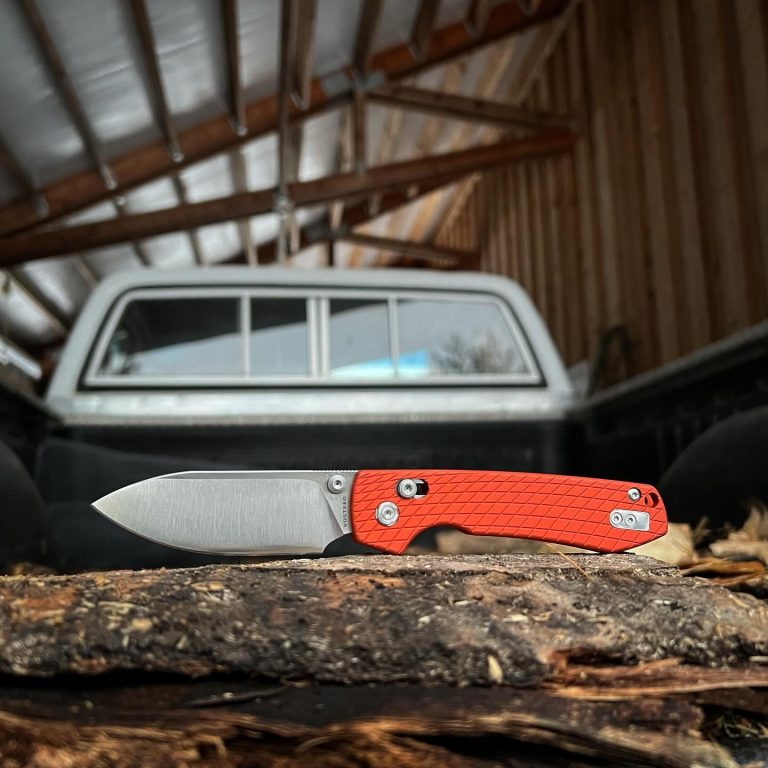
You’ve likely noticed that I am on a bit of a Vosteed Cutlery kick lately. That is for good reason. One, I think they are offering some very compelling and unique knives at a variety of price points. Two, I think they are a brand that is worth watching because they are making some major moves. The Vosteed Corgi is a great example of that. This is a knife that has an incredible, eye-catching, stylish design while also offering great performance. When they offered to send one, I jumped.

Stats

Blade Length: 2.99″ | 75.98 mm

Overall Length: 7.17″ | 182.12 mm

Blade Width: 0.84″ | 21.31 mm

Blade Thickness: 0.118″ | 3.00 mm

Blade Material: 14C28N

Blade Grind: Flat

Blade Style: Drop Point

Blade Finish: Black Stonewash

Hardness: HRC 60±2 

Handle Length: 4.18″ | 106.14 mm

Handle Width: 0.92″ | 23.32 mm

Handle Thickness: 0.49″ | 12.33 mm

Handle Material: G10

Color: Jade

Weight: 3.50 oz | 99.22 g

Opener: Front Flipper | Back Flipper

Lock Type: Trek Lock

Pivot Assembly: Caged Ceramic Ball Bearing

Pocket Clip: Reversible | Stainless Steel

Carry Position: Tip-up

Knife Type: Manual Folding

Backspacer Material: G10

Backspacer Color: Jade

Button Material: Stainless Steel

The insert colors and materials vary by model. My Corgi review sample has silver titanium inserts but other options like brass and copper are also available.

Observations from Use

I want to go hard on the design of this knife so I am going to get the cutting performance out of the way up front. It cuts well – really well. Vosteed’s factory edges are great and this relatively thin 14C28N blade has great cutting geometry thanks to the full-height flat grind. The point is excellent thanks to a long swedge grind. It is almost like a scaled-up Swiss Army Knife blade – thin, flat, and slicey.

Now… that design. Oh my. What a great-looking series of knives. The Corgi gives a great first impression with its symmetry which is very stylishly executed. I don’t know of another production knife that is quite this symmetrical.

After you take in that satisfying symmetry, you notice the modern-traditional details that make this knife both futuristic and a throwback at the same time. The shape of the knife and the way the blade slips fully into the handle is a call back to the slim pen knives of yesteryear. The metal inserts around the pivot colors look super slick and hint strongly toward older, bolstered designs like barlow knives while still looking very modern. You have to admit, this is a great-looking knife.

The design isn’t just there for show. The symmetry means that the button lock is always under thumb… easy to find and ready to use. The slimness of the design means this knife slips easily into the corner of the pocket, out of the way, and unlikely to ever get in your way. The Corgi is VERY easy to carry.

The design also bakes in a lot of fun. If you like to fidget with your EDC knife, this one gives you a lot of options. You can depress the button lock and open it with just a flick of the wrist… a very small flick because it’s buttery smooth. You can front flip it, back flip it, slow roll it off the front flipper, or even reach over to snap it open with your index finger (knife guys call this the “reach around”).

The fit and finish are excellent. Vosteed does a lot of machined micro-textures on their handle scales and I don’t think enough people call this out when reviewing these knives. This texture provides great grip without shredding your pockets. It’s a nice touch that you might not notice until you have one in hand.

The Corgi in particular is Vosteed flexing on everyone with their fit and finish because the design doesn’t let them hide a thing. The way the blade nests flush with the handle and the fitting of the inserts around the pivot would make any kind of fitment issues painfully obvious. You won’t find them on my example. Everything is straight as an arrow and satisfyingly flush.

As thrilled as I am with the style of this knife, I do have a nit to pick. The detent is lighter than I would prefer. I suspect that this is on purpose to support all of the various opening methods that this knife offers. I am not saying this is going to open in your pocket. It’s not a dangerous detent. It just isn’t a strong detent like you might find on a liner/frame lock. It would be nice if it was just a bit stronger and the action might feel even snappier.

Finally, because I know the knife guys will be wondering. I spine whacked this knife multiple times and it passed every time. I spine-whacked it lightly at the tip and back at the base of the blade when I took it out of the box. I repeated this after a week of carrying/fidgeting with it and I have done it multiple times since. It never failed and, typical for button locks, the lock-up has actually improved with use. The knife now belongs to my daughter. I trust it.

Wrap Up

This knife is a great cutter. It’s super fun to play with. It carries like a dream thanks to a very slim design. And, as much as I want to say form follows function and looks don’t matter… this knife looks so good, it turns that whole sentiment on its ear. Style is subjective but, to my eye, this is the one to beat.

Learn more at Vosteed.com. Vosteed often has increased inventory and frequent sales at Amazon. The Corgi is 15% off right now for Valentine’s Day: Vosteed Corgi at Amazon.com.

Collectible Firearms for Serious Gun Collectors

0

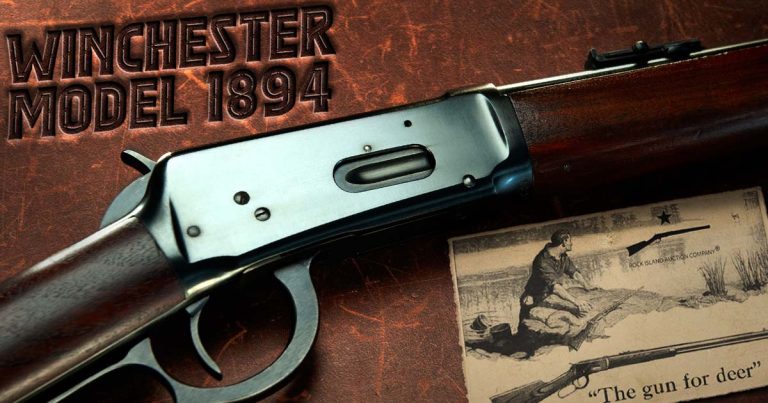
For nearly 130 years, the legendary Winchester Model 1894 has served as America’s quintessential walking gun. An impeccable reputation earned from decades of sporting use has kept the model in near-continuous production, and the sheer number of variants offers a popular collecting platform for firearms fans of every stripe.

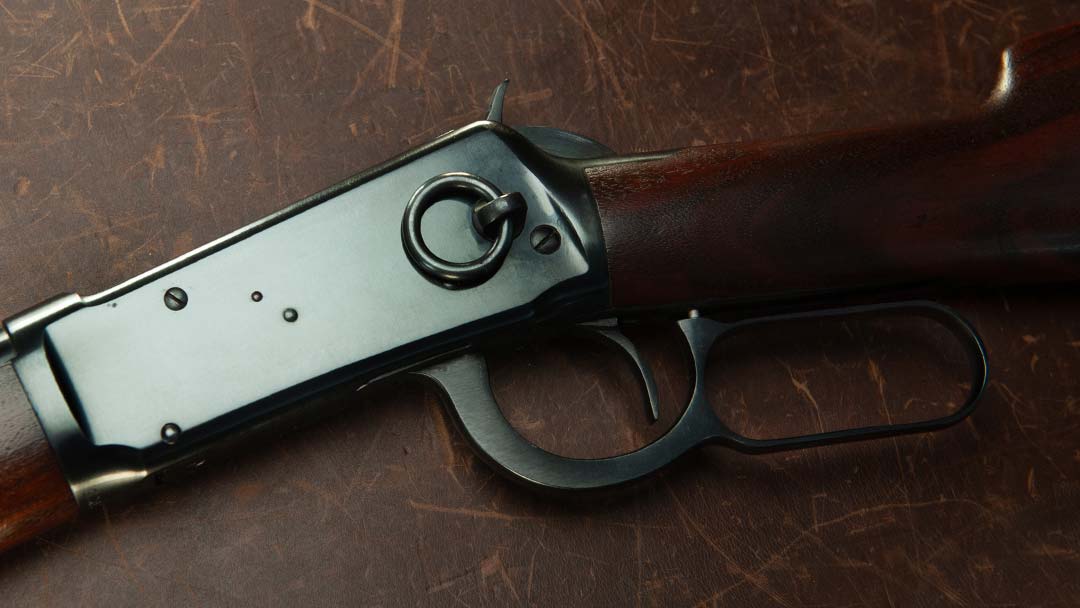
A Winchester Model 94 saddle ring carbine in .30-30, a true American classic. This example, manufactured in 1928, is available this February.

Rock Island Auction Company’s Feb. 16-18 Sporting and Collector Firearms Auction features hundreds of antique and curio Winchesters, including a wide range of Winchester Model 1894 rifles and carbines. Click on the images throughout this article to examine the diversity of the platform firsthand.

Find a wide variety of quality Winchesters this February, from classic lever actions and beyond!

Winchester 1892 vs Winchester 1894

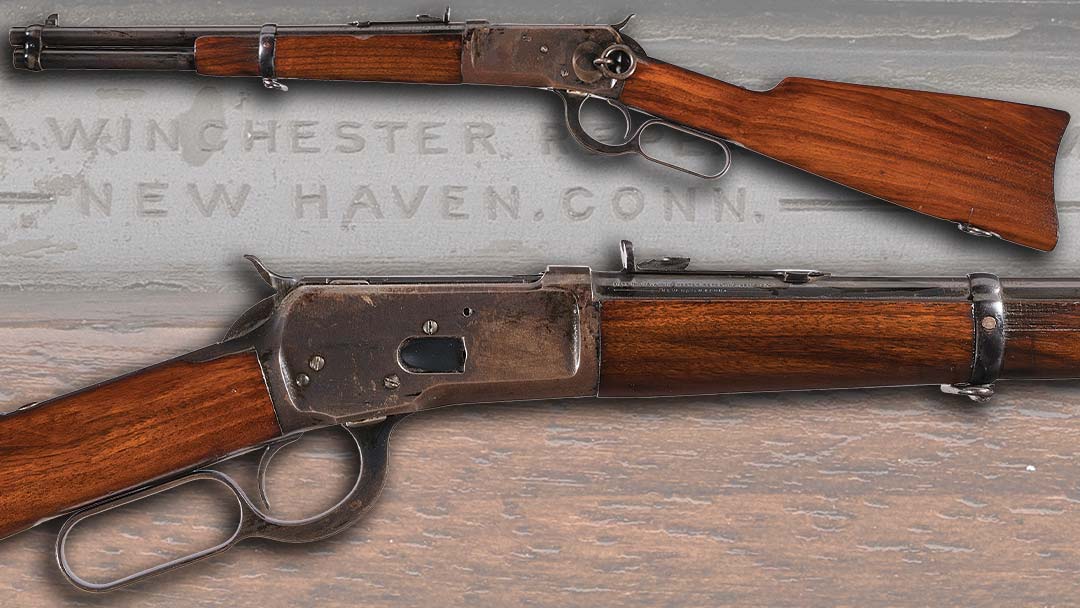
As America went west, so did the Winchester. The Model 1886, the first lever action rifle developed by John Moses Browning for Winchester Repeating Arms, was distinguished by its duel vertical locking bars designed to seal the breech bolt against the chamber. This allowed the weapon to chamber larger cartridges like .45-70 Govt. Six years later, Browning introduced the Winchester Model 1892, effectively a scaled-down version of the Model 1886.

A Winchester Model 92 Trapper saddle ring carbine with a 14 inch barrel length and ATF exemption letter. Available this May.

An incredibly popular design, the Model 1892 was best suited for short cartridges commonly used in revolvers of the era. Browning’s next lever action concept, the Winchester 1894, would take a different approach and focus on the ability to chamber longer and more powerful rifle cartridges like the .38-55.

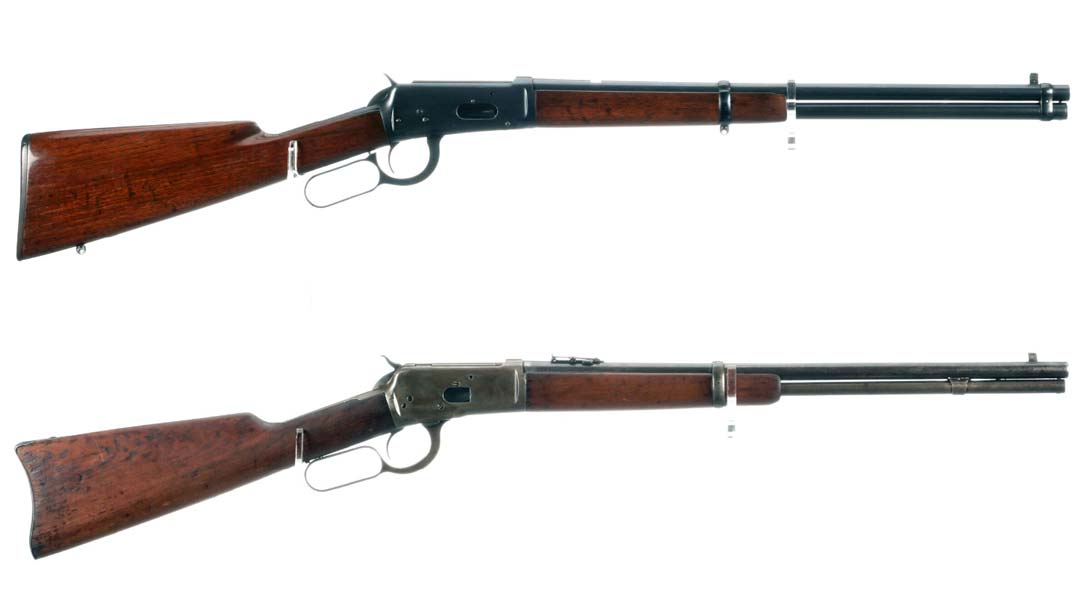
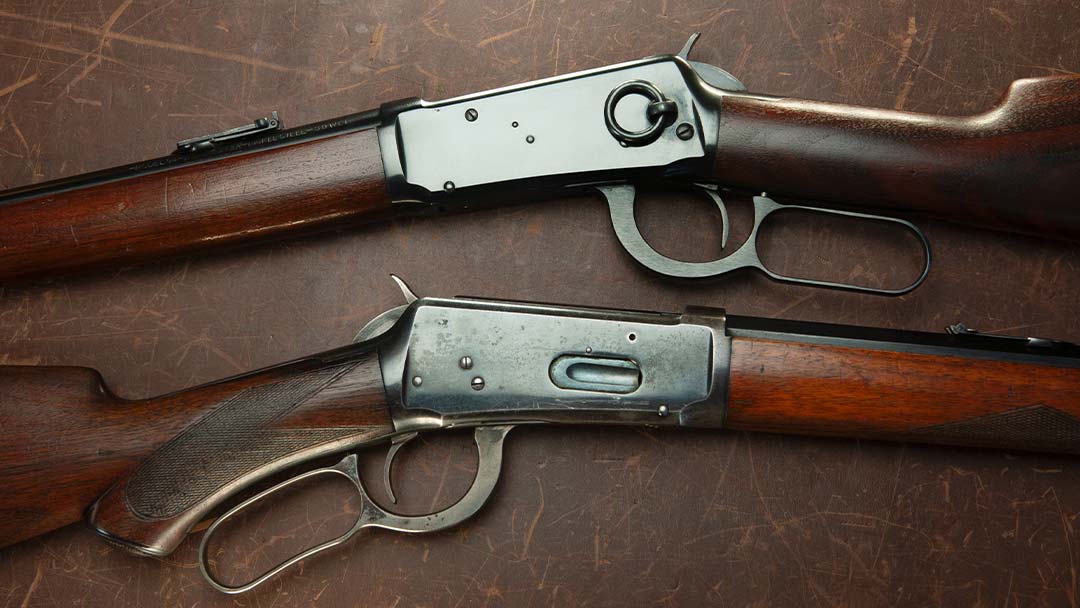
A Winchester Model 1894 carbine (top) and a Winchester Model 1892 carbine (bottom.) Available this February.

With its single rear locking bolt block instead of the Model 1892’s dual rear locking bar design, the sturdy Model 1894 platform also proved suited for a new line of smokeless powder cartridges. Two of Browning’s most popular designs, both Winchester models are lever action legends that continue to be fielded today.

A special order Winchester Model 1894 rifle for sale, manufactured in 1908. Available this February.

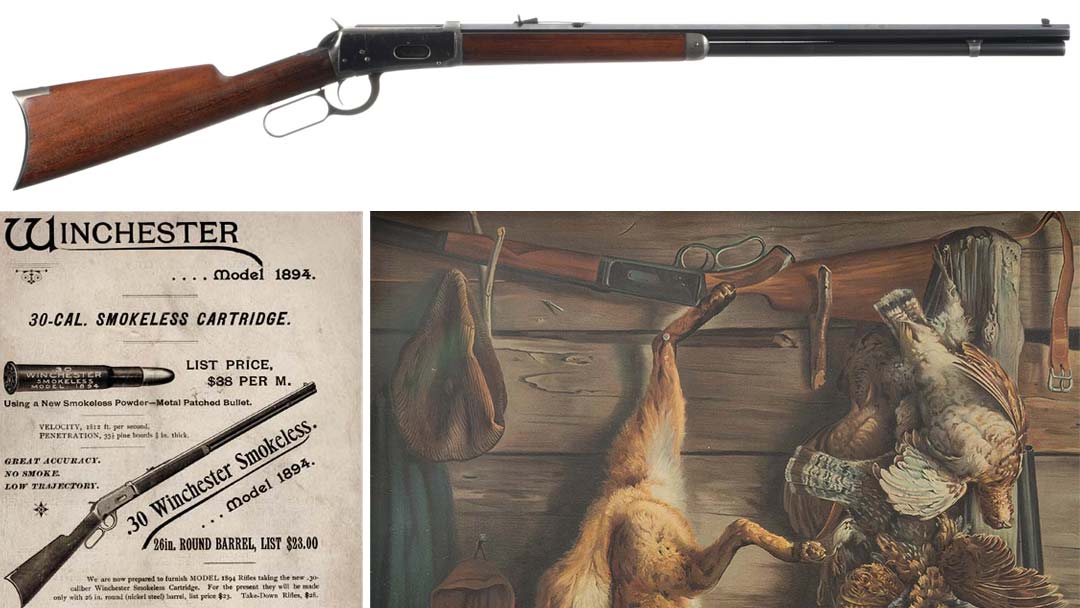
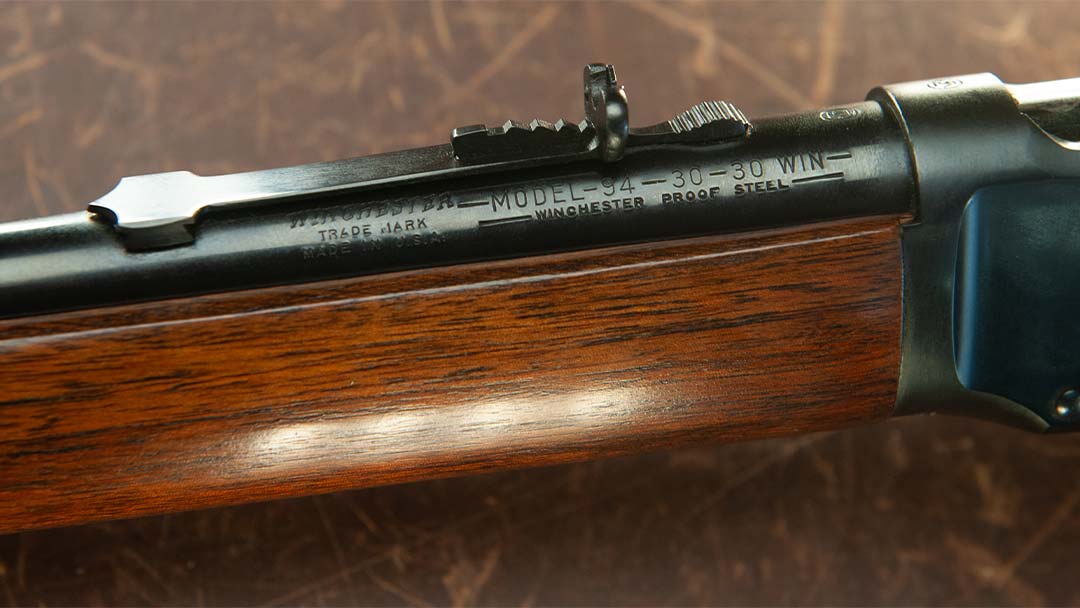
The Winchester Model 1894 in .30-30

When the first Winchester Model 1894 rifle and carbines rolled out in late 1894, the only two chamberings were .32-40 and .38-35, both black powder cartridges. The following year, the Model 1894 was adapted for Winchester’s new .30-30 smokeless cartridge. The pairing proved a match made in heaven.

A Winchester 1894 rifle chambered in 30-30. Available this February.

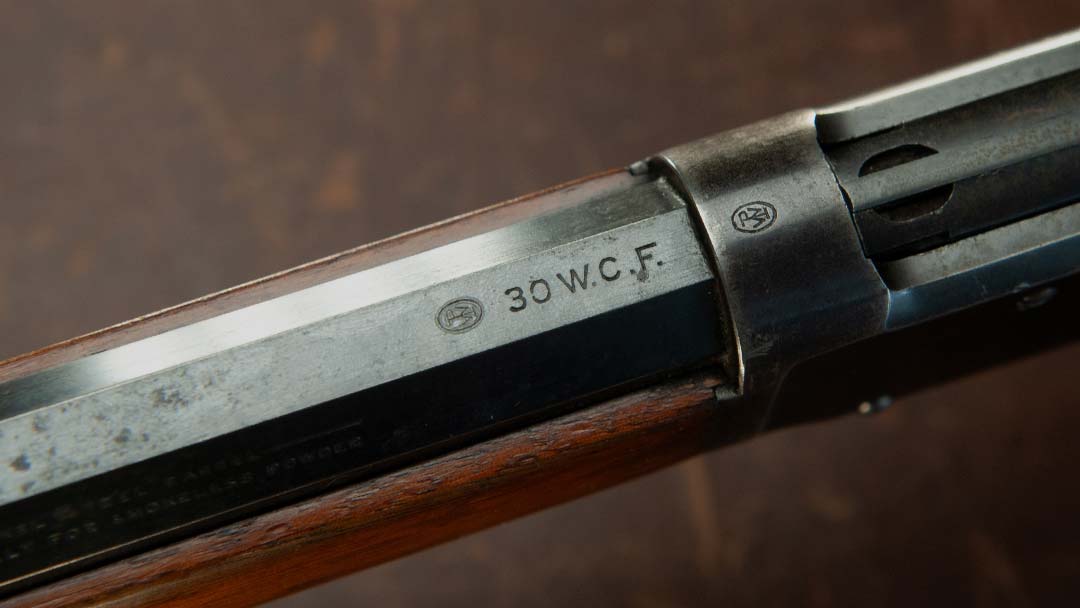
While the Model 1894 was available in a variety of calibers, including the simultaneously released .25-35 Winchester smokeless cartridge and the .32 Winchester Special introduced in 1901, the .30-30 dominated the market. As Winchester proudly notes, “The old standby 30 W.C.F., also known as the “30-30” (30 caliber bullet with 30 grains of powder) has killed more North American big game than any other cartridge.” With the great majority of the more than 7.5 million Model 1894s ever produced chambered in 30-30, Winchester’s claim is supported by the numbers.

A Winchester Model 1894 carbine for sale, manufactured in 1955. Available this February.

The .30-30, advertised by Winchester as the “most proven of all modern cartridges,” remained America’s sporting round for decades. Popular throughout the West as a saddle gun and in the East as a timber rifle, the Model 1894 and its new cartridge could outpower and outdistance its lever action predecessors. The quickness and maneuverability of the lightweight platform proved well-suited for a variety of North American game hunting. Alongside its .30-06 bolt action competitor, the Winchester 1894 in .30-30 came to dominate the big-woods whitetail hunt.

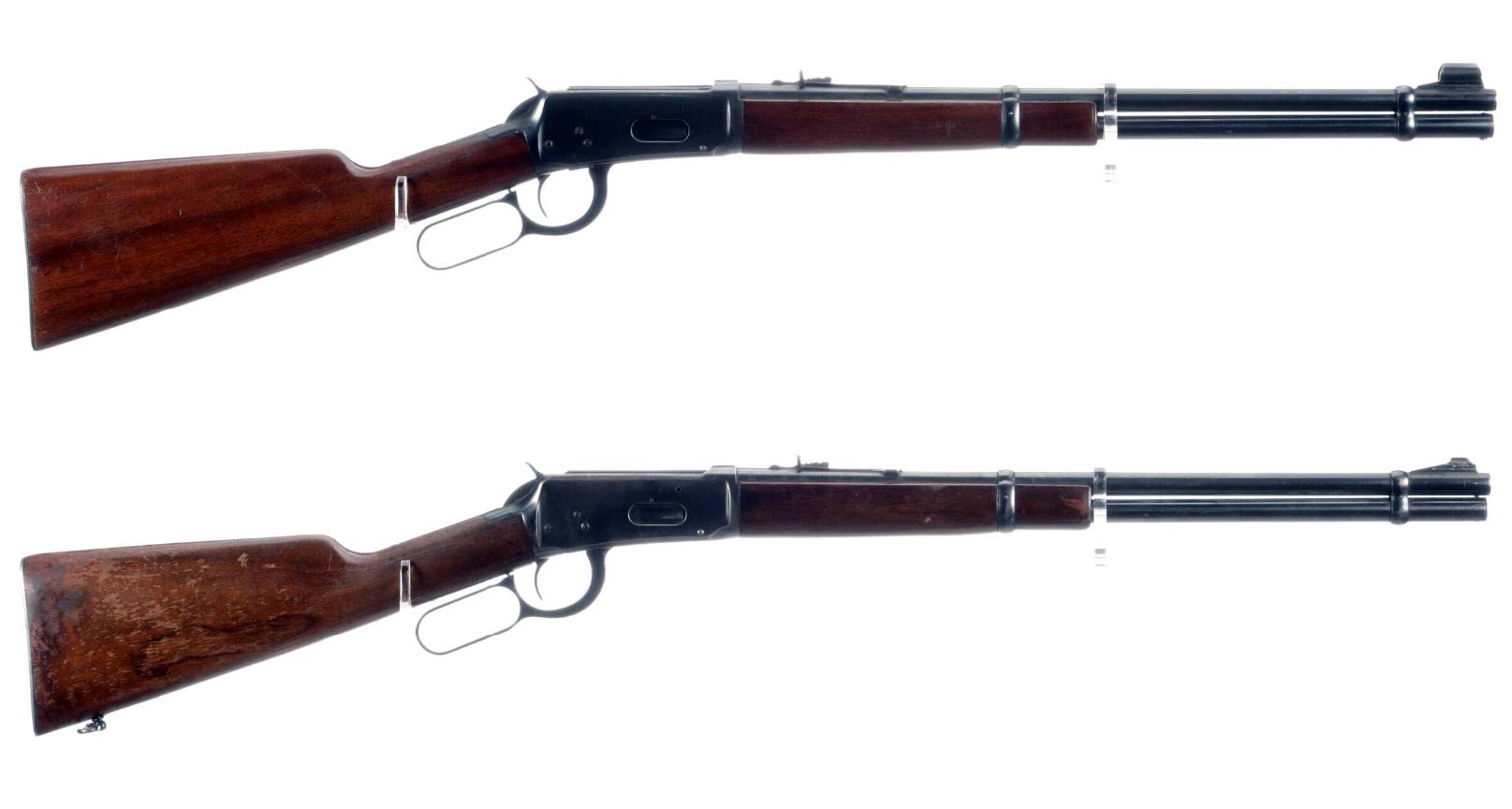
Two Winchester Model 94 carbines chambered in .30-30. Available this February.

Winchester 1894 Variations

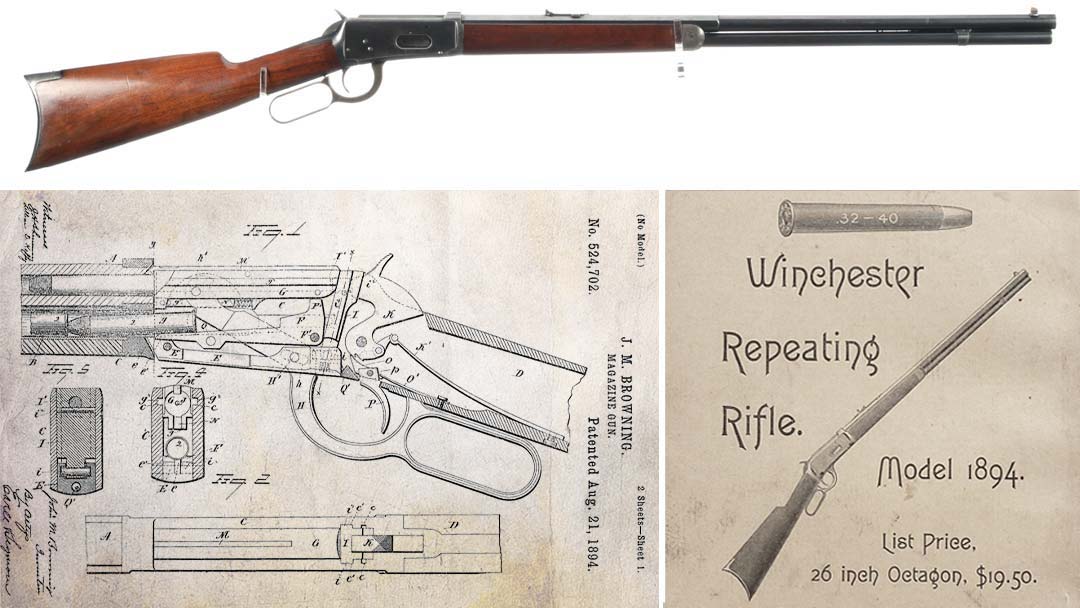
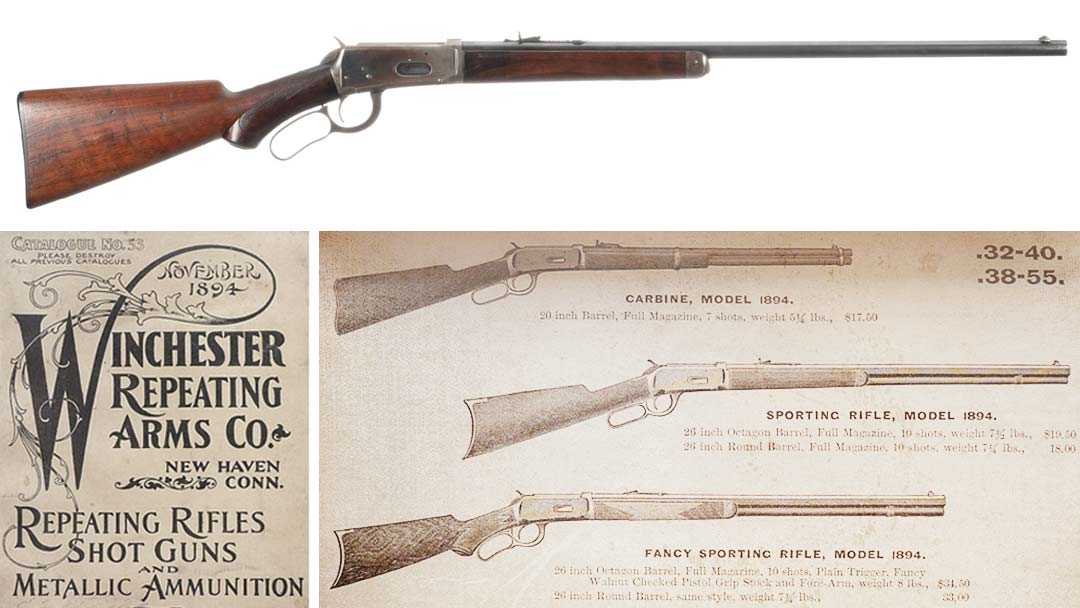
In Winchester’s November 1894 catalog, the Model 1894 was initially advertised in four configurations: A 20 inch carbine with a round barrel for $17.50, a 26 inch rifle with a round barrel for $18.00, a 26 inch rifle with an octagonal barrel for $19.50, and a 26 inch takedown rifle in either barrel shape for $25.00. A fancy sporting rifle with a checkered walnut pistol grip stock and forearm was offered for an additional $15.00. During the Model 1894’s first production run, 78% of the orders were for the rifle variants.

A special order semi-deluxe style Winchester 1894 rifle in .38-55 W.C.F., manufactured in 1902. Available this February.

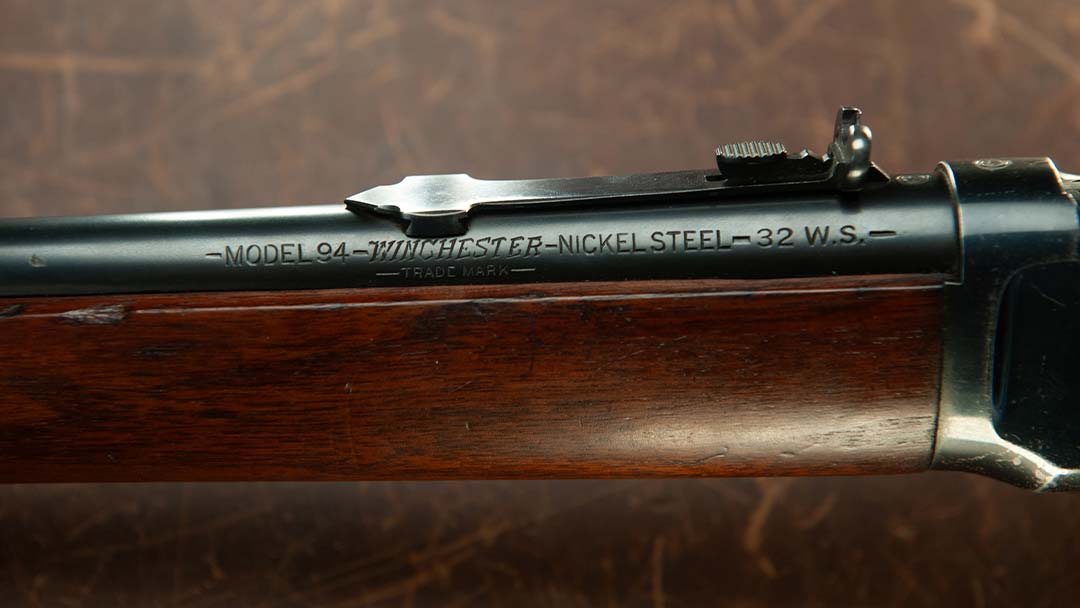
Catalogs from the early 1900s advertise Winchester 1894 models chambered in smokeless calibers at a higher price point, and these options are typically equipped with nickel steel barrels and include slightly modified sight elevator calibrations. Though a limited number of extras were initially available for the Winchester 1894, the platform’s popularity quickly gave rise to numerous options for triggers, wood grades, buttstocks, barrel lengths, and a wide range of special ordered features that make this classic lever gun one of the most collectible models in the Winchester family.

Two classic Winchester Model 94 options available this February.

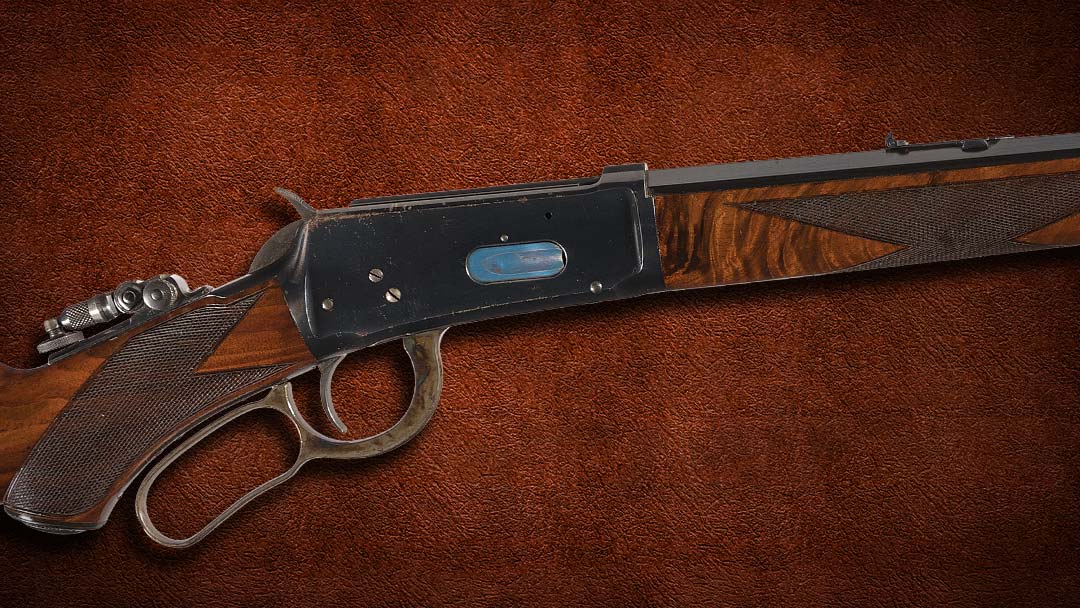
The early production Winchester Deluxe Model 1894 rifle pictured below illustrates some of the early special order options available. The rifle’s factory letter lists the gun’s original configuration when received by the warehouse on March 19, 1897, and shipped four days later. Initial features included a round barrel, a .25-35 caliber chambering, a plain trigger, a checkered pistol grip stock, and a hard rubber shotgun buttplate. The rifle was later returned to the factory and reconfigured with an octagonal barrel, a .30 WCF chambering, and a steel crescent buttplate.

An exceptionally fine antique Winchester Deluxe Model 1894 rifle with its factory letter. Available this May.

Model 1894 vs Model 94

Though only 1,400 Winchester 1894s were shipped in its first year on the market, the model’s momentum steadily climbed. By century’s end and the twilight of the Wild West, the Model 1894 production totals had exceeded 80,000. By 1927, Winchester’s trusty buck-buster approached an impressive 1 million units produced.

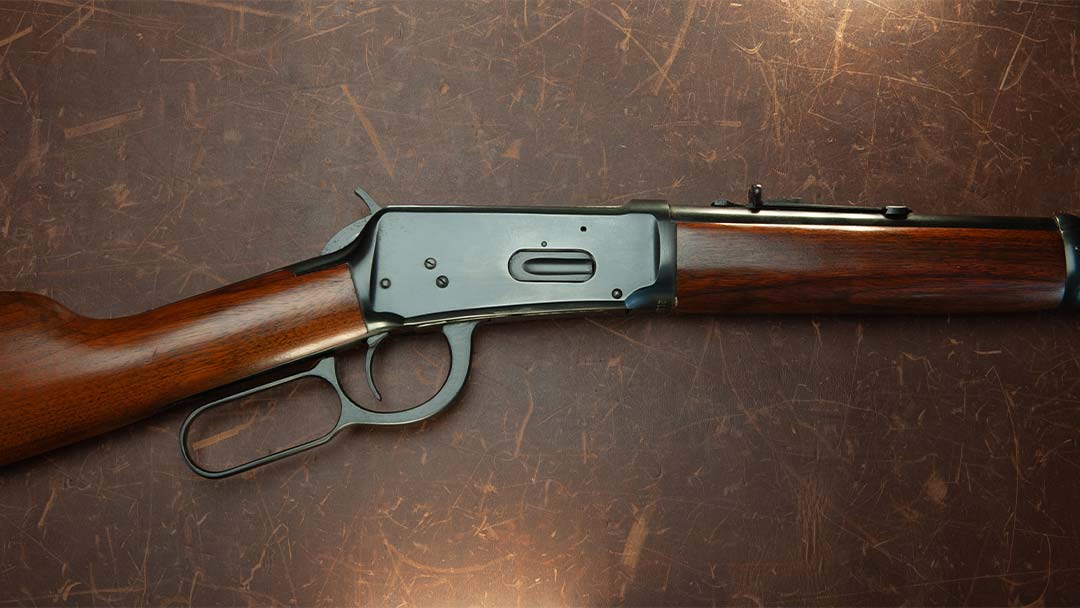
A Winchester Model 94 saddle ring carbine manufactured in 1928. Available this February.

In 1921, around the 895,000 serial range, Winchester shortened the Model 1894’s designation to “Model 94,” a name that still stands today. Mechanically, the Model 1894 and Model 94 are the same firearm.

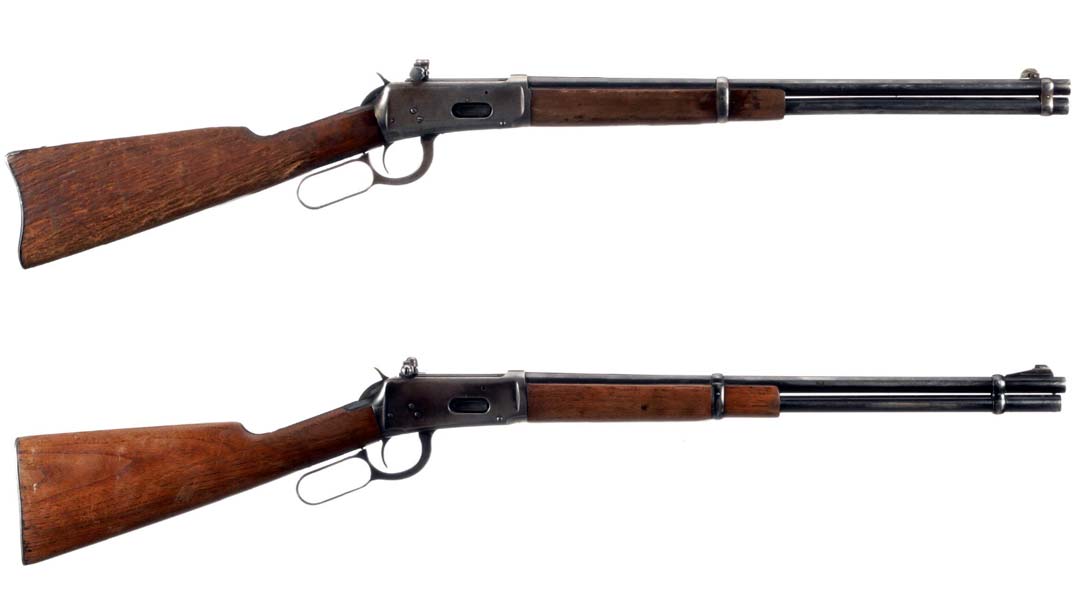
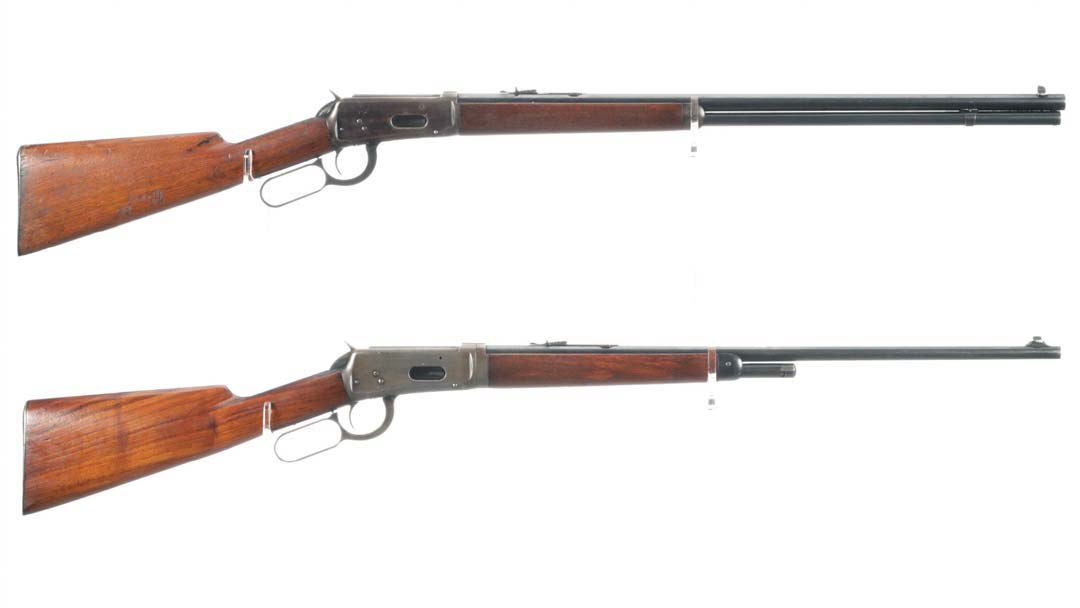
Two Winchester carbines. (Top) A Winchester Model 1894 saddle ring carbine manufactured in 1917. (Bottom) A Winchester Model 94 carbine manufactured in 1949. Available this February.

To make matters more confusing, Winchester produced two siblings of the Model 1894: the Model 55 and Model 64. Manufactured from 1924 to 1932, the Winchester Model 55 saw a total production run of about 21,000 total units and was introduced as a potential replacement for the Model 94 rifle and takedown variants, whose sales had been long eclipsed by the Model 94 carbine configuration.

The Model 55’s replacement, the Model 64, was manufactured between 1933 to 1957, and again from 1972 and 1973, with 67,000 units produced between both runs. The Winchester Model 94, Model 55, and Model 64 all employed the same receiver and many of the same parts. Though both the Model 55 and Model 64 achieved modest sales, Winchester’s efforts to rebrand and revitsalize the market for Model 94 takedown and solid frame rifles was a comparatively short-lived experiment, and the Winchester Model 94 carbine continued to reign supreme.

(Top) A Winchester Model 1894 rifle manufactured in 1917. (Bottom) A Winchester Model 55 takedown rifle manufactured 1927. Available this February.

Pre-1964 Winchester Model 94 Models

In late 1963, the Winchester Model 94 rifle underwent a revamp to reduce production costs, including utilizing different internals and replacing the forged steel receivers that gave the Model 94 such a classic aesthetic. In the eyes of many shooters, hunters, and arms collectors, these changes were perceived as a step backward in quality.

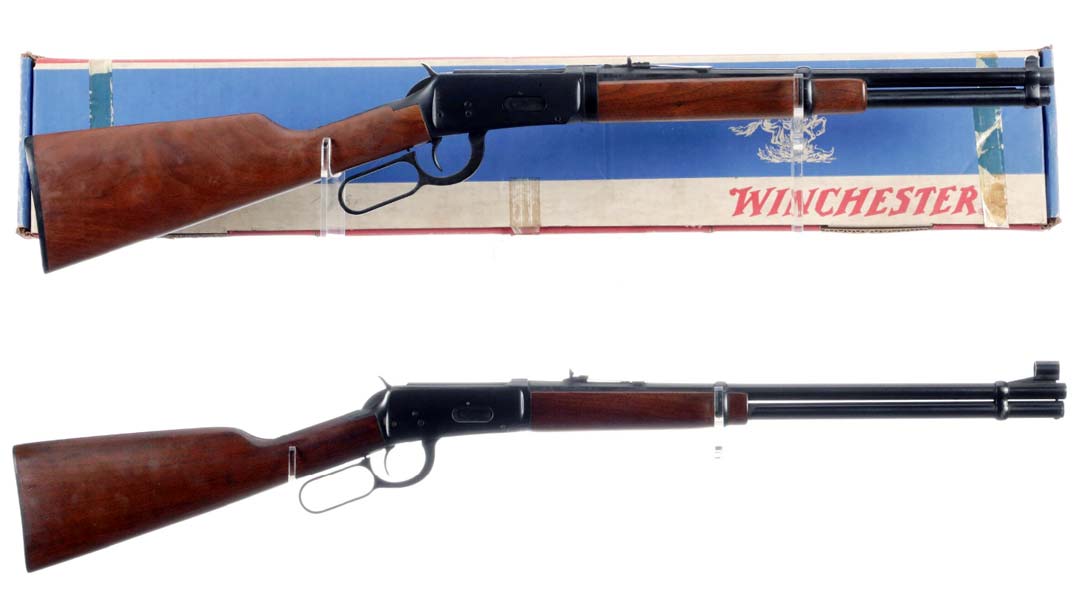
The Winchester Model 94, modern vs classic. (Top) A Winchester Model 94 Trapper takedown saddle ring carbine with box. (Bottom) A Winchester 94 carbine manufactured in 1954. Available this February.

Winchester Model 94 Value by Serial Number

The Cody Firearms Museum in Cody, Wyoming provides original Winchester factory records for Model 1894s from serial number 1 through 353,999. Early production examples of the genre are particularly valuable to collectors, such as the special order Winchester Model 1894 semi-deluxe style rifle below manufactured in 1907.

A special order Winchester Model 1894 semi-deluxe style rifle manufactured in 1907, serial number 358,449. Available this February.

Winchester Model 94 serial number 1,000,000 was presented to President Calvin Coolidge in 1927, an engraved and checkered sporting rifle with gold plating. Serial number 1,500,000 went to President Truman in 1948, and Winchester Model 94 serial number 2,000,000 was awarded to President Eisenhower in 1953.

Other notable milestones for the Winchester Model 94 include reaching serial number 2,500,000 in 1961 and the end of the pre-64 Model 94 run starting at serial number 2,700,000. The Winchester Model 94 reached serial number 3,000,000 in 1967, and U.S. production of the Model 94 ended around the 6.58 million serial number range in March of 2006.

The Winchester 94AE

Despite the backlash over the 1964 manufacturing changes, the Winchester Model 94 continued to see steady sales. Different variants of the Model 94 were introduced to cater to a wide range of hunters and shooters. The Model 94 Ranger served as an economic option, while 1978 saw the debut of the Model 94 XTR, a deluxe version of the platform. Four years later, the Winchester 94AE, or “Angle Eject,” was introduced.

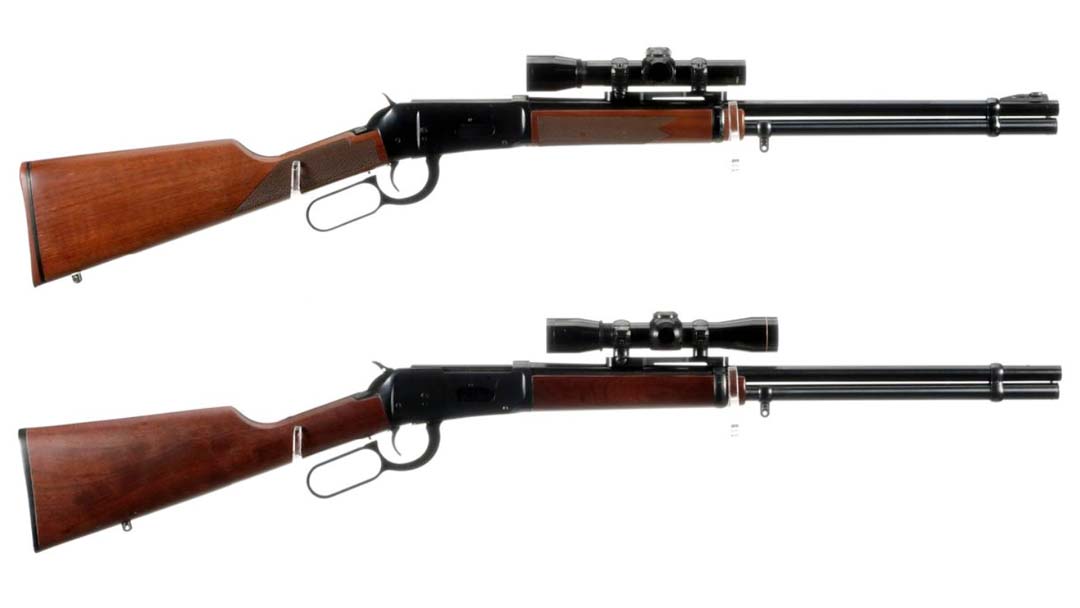
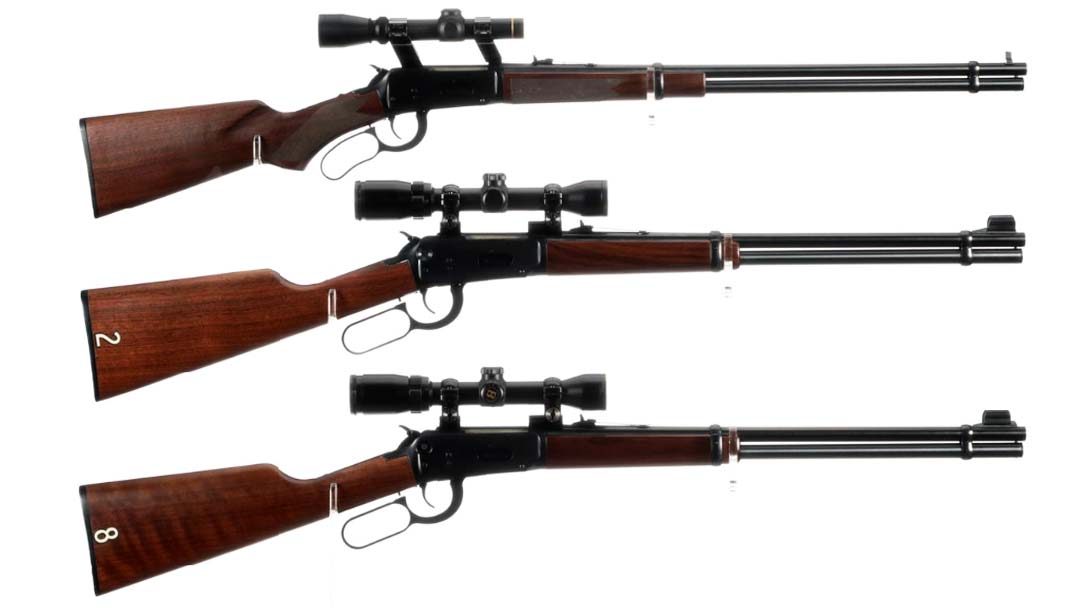
Two Winchester Model 94 carbines with scopes, a Winchester 94AE and a Winchester Model 94XTR. Available this February.

The Winchester 94AE was produced by the U.S. Repeating Arms Company (USRACo), which had purchased the New Haven factory in 1981 and leased the Winchester trademark from the Olin Corporation. The new model’s angled cartridge ejection system allowed shooters to mount riflescopes over the top of the action.

Three Winchester 94AE long guns with scopes. Available this February.

Winchester Model 94 Commemoratives

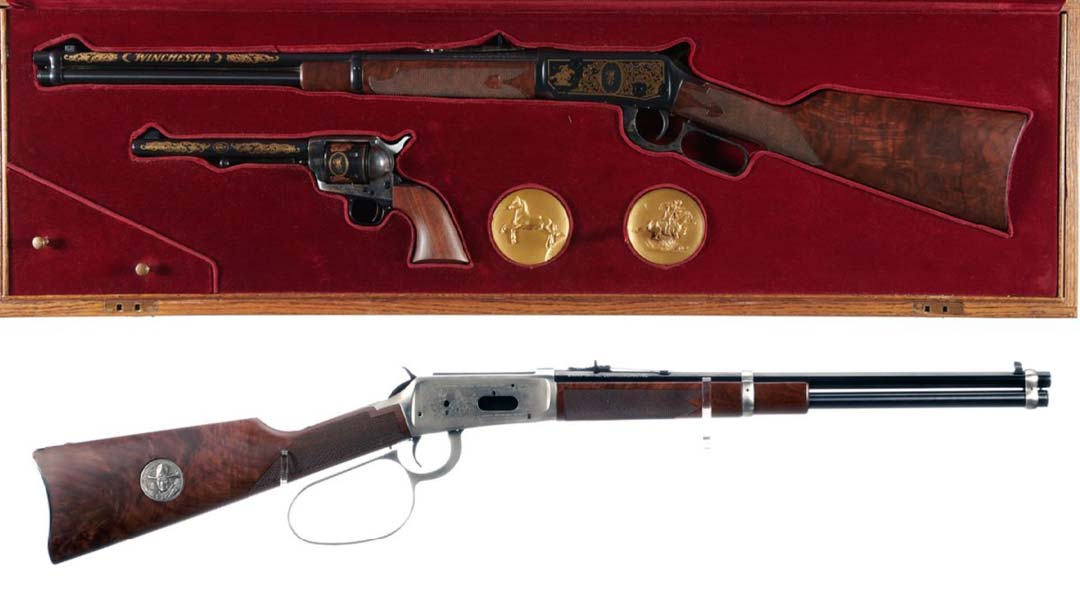
Over the decades, Winchester has produced at least 119 factory issued commemorative models and 30 special ordered and privately issued commemorative models, with the Winchester Model 94 being the most numerously offered commemorative. First introduced in 1964 to honor the Wyoming Diamond Jubilee, Winchester commemorative models were themed around celebrating specific states, Wild West figures, Hollywood actors, significant Winchester gun models, and historic events, institutions, and anniversaries from U.S. and Canadian history.

Two Winchester Model 94 commemorative carbines offered this February. A Winchester/Colt commemorative set with a shared display case and commemorative medallions (top) and Winchester Model 94 John Wayne commemorative carbine (bottom.)

Winchester commemoratives often feature fancy stocks, quality metal finishes, and specialty engraving. Due to their limited production runs and attractive aesthetic, certain Winchester Model 94 commemorative issues have achieved surprising prices at auction, with themes like John Wayne, Geronimo, Antlered Game, and the Boy Scouts of America Winchester Model 94 commemoratives being some noted standouts.

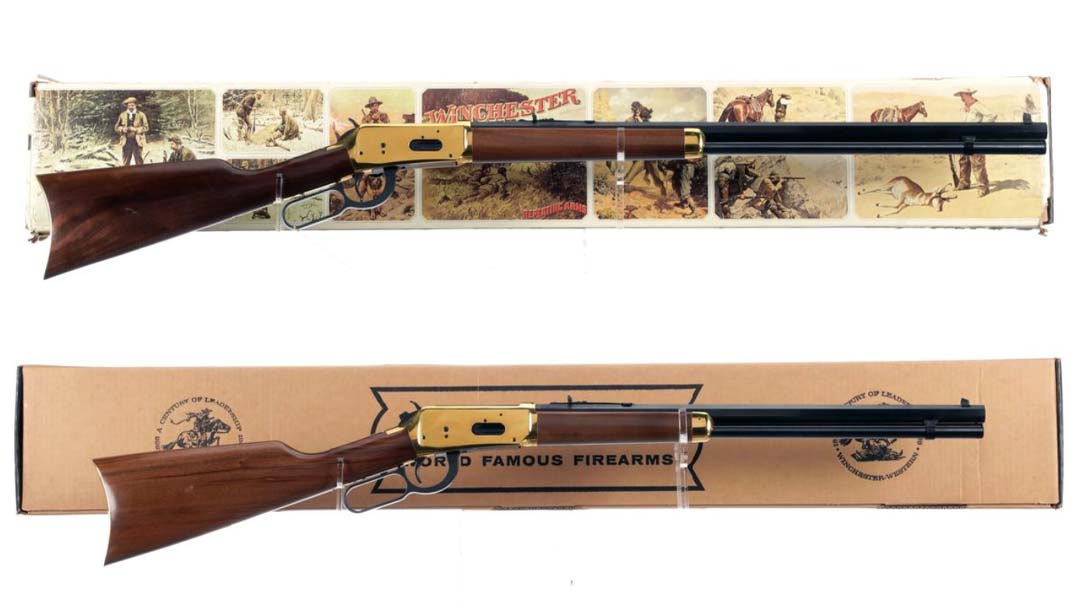
Two Winchester Model 94 Centennial 66 saddle ring long guns with boxes Winchester. Available this February.

Winchester Model 94 Legacy

The Winchester Model 94 was a gun of many eras, serving as Teddy Roosevelt’s varminting rifle of choice, a mainstay of silver screen cowboys, and seeing limited military issue with the U.S. Army Signal Corps during World War 1. From October 20, 1894 to March 31, 2006, the Winchester Model 94 was manufactured in New Haven, Connecticut, and today Miroku Corporation of Japan continues to produce the iconic lever action and keep the model’s 130-year-old legacy alive.

A 1955 manufactured Winchester Model 94 carbine for sale this February.

Released too late to claim the title “Gun That Won the West,” the Winchester Model 1894 faithfully carried the torch passed on by its lever action forbearers. Serving as the hunter’s choice, the ranchman’s standby, and a backyard range essential, the Winchester Model 94 can still be found in countless safes, racks, deer camps, truck beds, and saddle scabbards across the nation. Now that’s an American success story.

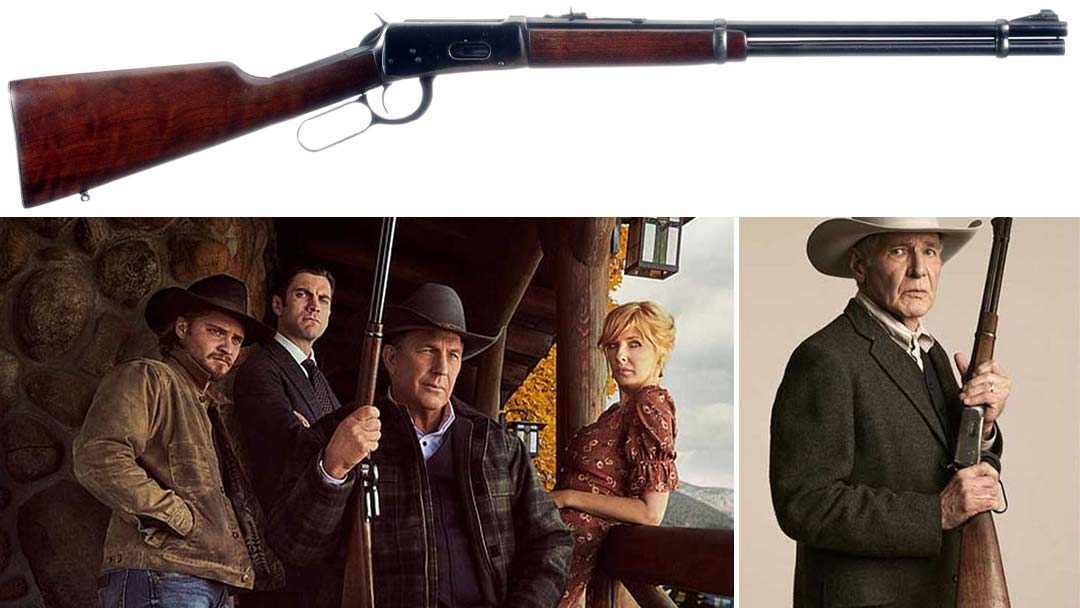
The Model 94 carbine pictured above is similar to the Winchester models featured in the ‘Yellowstone series’ and its ‘1923’ prequel. Available this February.

Winchester Model 94 for Sale

Due to the sheer variety of configurations produced over the last 130 years, the Winchester Model 94 offers a broad platform for nearly every arms collecting aspiration. From antique and curio examples produced during the golden age of American gun manufacturing to the wide number of limited edition commemorative issues, Rock Island Auction Company offers an unparalleled selection of Winchester Model 94 rifles and carbines for sale.

Find the Winchester Model 94 for sale in a range of configurations at Rock Island Auction Company.

Rock Island Auction Company’s Feb. 16-18 Sporting and Collector Firearms Auction includes every lever action legend from the Winchester family. From the historic Henry rifle and Winchester Model 1866 “Yellowboy,”, Old West icons like the Model 1873 and Model 1876, and John Browning designed classics like the Model 1894 and Model 1895, a Winchester aficionado will find no shortage of opportunities to expand their collections.

Find sporting arms of every genre this February at Rock Island Auction Company.

Subscribe to the Rock Island Auction newsletter for weekly gun blogs and gun videos featuring other iconic American arms like the Hawken rifle, the Sharps rifle, the Spencer carbine, the Colt SAA, the Springfield M1903, the Winchester Model 70, the Ithaca 37, the Smith & Wesson Model 29, the Savage 99, and more.

Am Ulrich signed presentation inscribed Winchester Deluxe Model 1892 lever action takedown rifle with factory letter. Available this May.

Collectible Firearms for Serious Gun Collectors

0

Black and white photos from mid-century gun shows and collector meet-ups past offer glimpses of men in sport coats and ties holding guns. There are pictures of educational displays and award winners. You can almost hear Patsy Cline songs and smell the cigarette smoke hanging in the air. You can see it’s a community. What you can’t see is the knowledge and expertise. Still, you know it’s there.

These people knew each other, leaned on each other for advice and met to find that one elusive piece missing from a collection. They told each other hunting lies and gun truths. Curious about a Colt Single Action Army? Ask Bob. Not sure about this Winchester Model 1876? Phil can set you straight. They could enlighten you in a conversation or reinforce their thinking by loaning the definitive book.

It was this community of shared knowledge that collected the guns that generations later are coming back around. They recognized the importance of a Colt Walker, a Brown Bess or a Spencer Carbine. Rock Island Auction wants to rediscover that community of gun collectors from bygone days.

Rock Island Auction Company has established the finest brick and mortar auction venue in the United States at Bedford, Texas.

A writer for The Gun Report in 1969, wrote about the fine qualities of what was a gun show for fellow collectors and that sentiment is what RIAC wants to invigor.

“There were MANY excellent displays. The boys went to a lot of effort to make these both attractive and educational, which, after all is the point of a real good show. AND there were enough goodies offered for sale or trade to make anyone happy,” wrote Frank Wheeler in his The Cartridge Collector column.

Rock Island Auction Company aims for and delivers an outstanding online auction experience each time, and with a new facility in the heart of Texas, the company provides an opportunity to regain the camaraderie that is so visible in those monochromatic photos of collector club meetings and gun shows.

Rock Island Auction Company’s Bedford, Texas facility that opened in December is 90,000 square feet of the finest brick-and-mortar auction venue in the United States.

A writer in one of the first issues of The Gun Report, from July, 1955, explained the benefit of getting together with fellow collectors.

“Before 1949 a tri-state gun collector had to combine with his knowledge of guns the abilities of a detective for running down leads, the nose of a Horace Greeley for news of guns and as it says in the classified section, be `free to travel,’” wrote Dick Miller.

These events brought like-minded collectors together. They might know someone looking to part with a sought-after gun or be aware of someone who does. They might provide insight into what makes one gun better than another.  They provided an opportunity to increase the size and value of their collection or just shoot the breeze over an unfiltered Camel and cold bottle of Schlitz.

Collector shows offered the chance to see real rarities even if they weren’t for sale. A Gun Report write-up shared that one collector brought his Winchester collection to display including his One of 1,000 and a mint-condition Henry rifle. Another article reported that among the weapons to be shown included two Colt Walkers – TWO! – along with cased Colt revolvers, LeMat revolvers and “rare collections of guns from some of the country’s finest collectors.”

Looking for that first antique gun or just wanting to know more about gun collecting, then a Rock Island Auction preview day and live sale is an event that offers an educational experience to those wanting to immerse themselves in what is both an investment and avocation.

Are you going to find those types of guns displayed at a local gun show these days? Unlikely. Where will you find guns like that and be able to admire and examine them? Step into the preview hall at Rock Island Auction Company’s Bedford, Texas venue and take a look. Where will you find knowledgeable collectors and industry leaders that might offer some advice to a collector just getting started? You might just find them in Rock Island Auction Company’s spectacular preview hall or leaning against the bar that runs along the back of the auction hall.

Some of the finest collections from legendary collectors like Larry Jones, Robert M. Lee, Mac McCroskie and John Kopec find their way onto the roster of Rock Island Auction Company sales. In our May Premier, the classic Colts of George S. Lewis Jr., to the detailed and finely conditioned offerings from Greg Lampe and the superb flintlock and percussion guns of the Norman R. Blank Collection will be on offer.

This Winchester Model 1873 One of 1,000 owned by Montana lawman Thomas Stuart from the Mac McCroskie Collection is a historic and high-conditioned firearm that can only be found at one of Rock Island Auction Company’s live events. It realized $528,750 at the RIAC’s December 2023 Premier Auction.

These days, few shows can provide the level of collecting savvy and display guns dripping with history, high condition and beauty than what is found within the walls of Rock Island Auction Company. The Antique Arms and Armor Show held in Las Vegas in January is where you’ll be able to visit with Rock Island Auction Company representatives on hand to discuss fine arms collecting.

The Antique Arms and Armor Show is a good example of the camaraderie of the gun collecting community. When the show’s founder, Harry Mann died in early 1969, The Gun Report devoted two pages of brief eulogies from dozens of friends and colleagues in the collecting fraternity, including names that are recognizable to many, like Norm Flayderman, Arnold Chernoff and Herb Glass.

Rock Island Auction Company’s Sporting & Collector Auctions are a good place to start for those dipping their toes into the avocation of gun collecting. Rare, historic and fine firearms are available at a wide variety of values. It provides a chance to explore, educate and experience the gun collecting culture and rub shoulders with fellow collectors.

Take in firearms from multiple genres and eras during one of Rock Island Auction Company’s preview days ahead of the live auctions. Find that one that truly ignites the passion of gun collecting.

These aren’t mere exhortations, but a simple invitation to learn from those who know the intimate details and qualities of Winchesters, Colts, Smith & Wessons, Class III firearms or martial arms from the wars of the 20th century.

Weapons from multiple genres and eras and guns that are jaw-droppingly beautiful can be found at Rock Island Auction Company’s preview days and live auction events than can ever be seen next to a table of polymer pistols. If you truly want to explore the depths of gun collecting, put Rock Island Auction Company’s Feb. 16-18 Sporting & Collector Auction and May 17-19 Premier Auction on your calendar to see how we’ve envisioned what a gun show is. After all, “History Lives Here.”

Collectible Firearms for Serious Gun Collectors

0

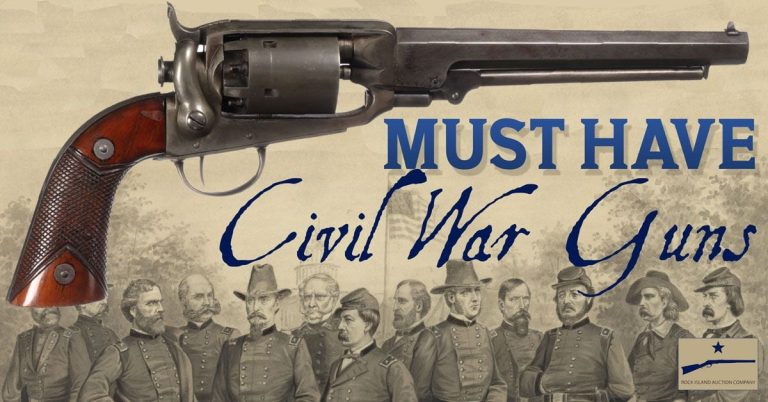
The guns of the American Civil War provide an anchor to a deeply historic moment and often a connection to someone who was there, fighting a war that up-ended America and righted an abhorrent and inhumane wrong.

To their wielders, Civil War guns offered an increased rate of fire and firepower, from the Henry Rifle to percussion revolvers and breech-loading carbines. These guns would be the precursors for the guns carried west by emigrants, frontiersmen, desperados and lawmen, like the Winchester lever action rifles and the Colt Single Action Army.

Check out these great pieces that any collector of firearms of the Civil War will find in Rock Island Auction Company’s Feb. 16-18 Sporting & Collector Auction in Bedford, Texas.

Find some of the finest must have firearms of the Civil War this February.

Firearms of the Civil War: Henry Rifle

Perhaps the most famous Civil War repeating rifle, the New Haven Arms Co. Henry rifle is also one of the most recognizable collector guns today. These trailblazing lever action rifles fired .44 Henry rimfire cartridges, 15 of which were kept within a tube magazine located under the barrel, offering an unprecedented rate of fire for the era.

Confederate Colonel John Mosby, who became infamous for his sudden raids against advanced Union positions and captured Union Gen. Edwin H. Stoughton in 1863, when first encountering the Henry in battle called it “that damned Yankee rifle that can be loaded on Sunday and fired all week.”

Of the approximately 13,000 Henry rifles manufactured from 1860-1866, only 1,731 were purchased by the U.S. Ordnance Department. Many other Henry rifles were acquired by individual soldiers, often veterans using a portion of their re-enlistment bonus to obtain the expensive firearm.

This Henry Rifle was manufactured late in the war and has period inscribing to “Frank W Meese/KANE/Pa” on the left sideplate Frank Meese mustered out of the Union Army shortly before the gun was presented to him. A Civil War pension record lists a Frank Reese as part of Company F, 16th Ohio infantry that was active between May 1861 and August 1861 and then from Sept. 23, 1861 to the end of October 1864. The unit was involved in a number of battles during the war.

Firearms of the Civil War: LeMat “Grape Shot Revolver

Designed by Jean Alexandre LeMat with his manufacturing backed by P.G.T. Beauregard, a relative by marriage who would serve as a Confederate Civil War general and order the first shots of the Civil War at Fort Sumter on April 12, 1861, the LeMat was created in 1856 before the outbreak of the Civil War. The South didn’t have the manufacturing ability to produce the guns they needed at the start of the Civil War, so they contracted 5,000 to be produced overseas.

Only about 2,500 made it to the Confederacy by means of their gun runners. The majority of LeMats that actually saw use in battle were produced in France and shipped via the United Kingdom to the Confederacy. The gun was very popular with the army because of its large caliber .42 caliber, up to 100 yard firing range, and nine shot capability.

The favored revolver of a number of Confederate officers, including J.E.B.Stuart, this gun bears very faint remnants of Paris markings on top of the barrel.

Firearms of the Civil War: Savage & North “Figure 8” Second Model Iron Frame Revolver

Manufactured between 1856 and 1859, this rare Civil War six-shot revolver is known for its “figure 8” shaped trigger guard that is actually integral to firing it. The lower part of the “figure 8” is the cocking lever that also rotates the cylinder, while the trigger is at the top.

About 100 of the Second Model have a creeping loading lever and about 100 were produced. The Middletown, Conn. Company reorganized in 1859 as the Savage Revolving Firearms Co., and made about 24,000 revolvers for Union military use during the Civil War.

Made between 1856 and 1859, only about 100 of this Second Model of the Savage & North “Figure 8” were reportedly made of a total production run of less than 700. These were redesigned and became the more widely used Savage Navy model manufactured during the Civil War.

Firearms of the Civil War: C.S. Pettengill Double Action Army Revolver

In an era dominated by single-action revolvers with external hammers, New Haven-based inventor C.S. Pettengill created a double-action revolver with an internal hammer. Subsequent patents improved on the design, streamlining the double-action mechanism by reducing the number of parts and eliminating the hinged cylinder locking pin on the original design.

Through a connection with one of the owners of the factory where the revolvers were made, Pettengill secured an order of 5,000 of the .44 caliber, six-shot Pettengill Army Model revolvers at a price of $20 each. It was a slightly lower price than the original military contract for the popular Colt 1861 Navy revolver.

The guns did not fare well in military trials, fouling quickly with black powder residue, preventing them from cycling properly. More political wrangling reduced the contract to 2,000, rather than cancel the order outright; the individual price remained at $20.

A total of 2,001 revolvers were delivered to the U.S. military. At least six different Army units were issued Pettengill guns, with the 3rd Michigan Cavalry receiving a quarter of the entire contract production. Other units from Arkansas, Illinois, Kentucky, and Missouri received the remaining revolvers.

All told, approximately 3,400 Pettengill Army Model revolvers were made, most between June 1862 and January 1863. Within a year, almost all of the guns had been removed from service.

This C.S. Pettengill double action revolver chambered in .44 caliber, one of 3,400 made, bears a legible grip cartouche.

Firearms of the Civil War: U.S. Colt Model 1860 Army Revolver

From the start of the war, the Colt Model 1860 Army took over as the handgun primarily used by Union forces. Interestingly enough, Colt Manufacturing sent around 2,200 Model 1860 Colts to the South on contract early in the war. The Colt revolver made its way to be the second most common military handgun of the Confederacy.

The six shooter, single action black powder gun could do some damage to an opponent up to about 100 yards away. The Union’s first choice was always the Model 1860. The price, range and accuracy were big selling points, as well as its .44 caliber which provided excellent stopping power. More than 200,000 were manufactured during its production run from 1860 to 1873.

Colt produced more than 200,000 Model 1860 Army revolvers from 1860 to 1873. This gun has a boxed script inspection cartouche stamped on the left grip.

Firearms of the Civil War: Smith & Wesson No. 1 Second Issue Revolver with Holster

The Smith & Wesson No. 1 was manufactured from 1860-1868. These spur trigger revolvers used metallic cartridges and were distinguishable from the first issue by their flat sides and irregular shaped side plates. Daniel Wesson learned that his bored-through chamber had already been patented by Rollin White, a former Colt employee, so Smith & Wesson agreed to pay White 25 cents/gun until his patent expired in 1872.

More than 250,000 Model No. 1 revolvers were produced in three issues before it was discontinued in 1881. Of those about 110,000 were Second issues.

Allen M. Haight of the 52nd Pennsylvania Volunteers, to whom the gun is attributed, can be seen in a photo with his brother Orlando. Allen is on the right holding a musician’s sword and fife, a revolver and knife, that appear to be the same as those included in this lot, are tucked into his belt.

This revolver is attributed to Allen M. Haight, who is listed as a musician in the 52nd Pennsylvania Volunteers from Sept. 1861 to November 1864. Included is a leather holster marked “A.M. Haight/Burlington/PA.” Also in the lot is a Marsh Bros. & Co. knife that features gilt floral etching on one side of the blade and a leather sheath.

Firearms of the Civil War: Colt Model 1861 Special Percussion Rifle-Musket

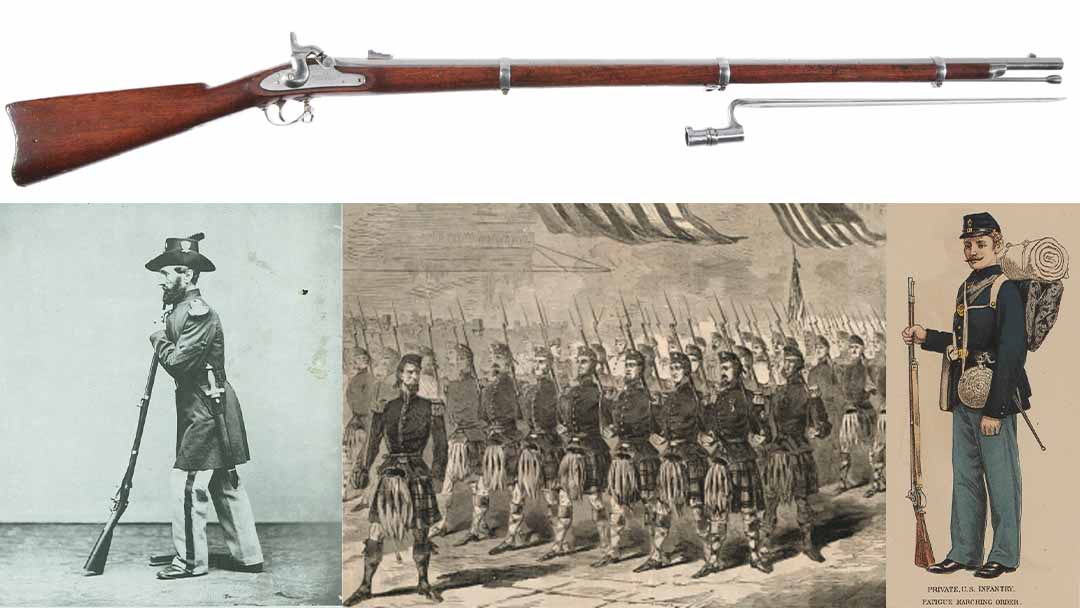
This is patterned after the British Enfield Model 1853 including the “S” shaped hammer, a bolster clean-out screw that was eliminated and split barrel bands. These were very similar to the U.S. Model 1861 rifle-musket.

Colt made about 100,000 with an unknown number rejected by the military going to the civilian market. Along with Colt, Amoskeag and E.G. Lamson and other contractors manufactured about 50,000.

This U.S. Colt Model 1861 special percussion rifle is marked “1862” and includes a socket bayonet.

Firearms of the Civil War: Joslyn Army Model Revolver

Designer Benjamin Joslyn designed a spring-clutch that both rotated and moved backward and forward with the hammer’s movement, rotating the cylinder. Military tests saw it positively because of its simple construction. The U.S. government ordered 3,000 revolvers but the company was unable to fill its first batch of 500 revolvers to the U.S. Ordnance Department despite being assured by a Massachusetts state senator (they were made in Worcester) that there were ample revolvers to deliver. Joslyn was also producing breech-loading carbines during the Civil War and doing a somewhat better job of delivering them.

Joslyn moved production but the revolvers delivered continued to have defects. The Ohio 5th Cavalry were issued 418 Joslyn revolvers. One officer would declare that the Joslyn revolvers were “condemned as wholly unfit for service. They are a spurious weapon, made out of cast iron, and one half of the time will neither cock nor revolve.”

This gun is a great addition to any Civil War gun collection for its scarcity, since only 3,000 were produced.

The Joslyn Army revolver was initially sold to for $22.50, but after the Civil War they could be found for about $4 each. About 3,000 were made.

Firearms of the Civil War: London Armoury Co. Kerr’s Patent Double Action Revolver

Manufactured in England, the five-shot Kerr revolver found its way to the Confederacy and was carried by a number of Southern generals and even CSA President Jefferson Davis. This gun is marked “LAC” on the barrel for London Armoury Company.

James Kerr had been foreman for English gunmaker Deane, Adams and Deane. He developed an improvement on the Adams revolver, made by his cousin Robert Adams. Adams and Kerr left to create the London Armoury Company, a major arms supplier of the Confederacy during the Civil War. How many of the company’s guns made it through the Union blockade is unknown, but the London Armoury Company supplied more revolvers to the Confederacy than the total of all southern manufacturers.

This Kerr revolver from the London Armoury Company was known to be carried by several well-known Confederates including Gen. Edward Porter Alexander and Gen. Josiah Gorgas.

Firearms of the Civil War: U.S. Lindsay “Two Shot” 1863 Double Rifle-Musket

This superposed muzzleloader had two hammers with a single trigger; only about 1,000 were made. They were issued to the 16th Michigan infantry; made in New York; known contemporarily as one of the least-favored rifles.

The inventor J.P. Lindsay had experienced the tragedy of his brother being killed by two attackers. He was able to kill one of the men with his single shot musket but the other was able to overcome the now defenseless man. Lindsay always thought about what if his brother had a second shot in that encounter. Along with the rifle-musket, Lindsay also made two-shot pistols, as well.

When both hammers were cocked, the gun was designed to fire the right hammer first; if the soldier dropped the left-hand hammer before the one on the right it would ignite the both powder loads at the same time, resulting in heavy recoil. Issued to soldiers of the 16th Michigan Volunteers, they reported in combat that in the heat of battle simultaneous discharge was a common event and could severely damage the gun.

This Lindsay 1863 double rifle-musket bears the inspection cartouches of Andrew D. King (ADK on the left stock flat). The other is partially obstructed.

Firearms of the Civil War: James Warner Breech Loading Saddle Ring Carbine

James Warner got his patent for the carbine in February 1864 and even landed a contract with the federal government before the patent was issued. The contract was for 1,000 carbines priced at $18 each. About 1,500 were made as the war came to an end. The Third Massachusetts completely turned up its collective noses to the Warner, but the First Wisconsin reported better results though some inadequacies were also reported.

Warner carbines were sold to France by Schuyler, Hartley and Graham and other dealers in 1870 along with more than one million cartridges. The guns were improperly chambered for the ammunition, leaving the French to grumble about guns with no ammunition.

This Civil War carbine is the lone gun designed or made by James Warner accepted and purchased by the U.S. government for military issue.

Firearms of the Civil War: U.S. Remington Model 1863 “Zouave” Rifle

The Zouave fighters harken back to North Africa and refers to Berber fighters of Algiers. In 1855, U.S. Army Capt. George McClellan was assigned to Europe as an observer in the Crimean War and saw the French Zouaves face Russian troops. He called them “the finest light infantry that Europe can produce;”

Zouave-style training with its acrobatic moves became popular in the United States in the 1850s. During the Civil War about 70 Union volunteer Zouave regiments existed while about 25 smaller units served in the Confederacy; fighting from the First Battle of Bull Run to Appomattox. These units often wore vibrantly colored uniforms that made them easy battlefield targets.

Mysteriously named the Zouave Rifle, these are officially referred to as Harpers Ferry Pattern in U.S. Army documents. Like the colorful uniforms of Zouave soldiers these guns were a bit flashy with brass barrel bands, trigger guard and a patchbox, a blued receiver and barrel. More than 12,000 of these .58 caliber muzzleloaders were made.

Firearms of the Civil War for Sale

In the progression of weapon technology, the American Civil War was a bridge from old to new, with breechloaders finding use alongside muzzleloaders, and various revolver mechanisms being created as companies tried to match Colt. The Civil War is an interesting chapter of arms development, with stories of technological triumph and failure. These fascinating and sometimes scarce firearms are available in the Feb. 16-18 Sporting & Collector Auction.

Review: Vosteed Raccoon Crossbar Lock with Aluminum Scales

0

The Vosteed Raccoon Crossbar Lock is one of my favorite EDC knives in recent history. Vosteed recently allowed me to check out one of the latest versions of Raccoon, one with a different steel and some great looking aluminum scale options. I jumped at the chance in large part because I was interested to try Vosteed’s texture treatment of the aluminum scales on these new versions and to try their Nitro-V blade steel in a knife I already know I like.

Stats

Blade Length: 3.25″ | 82.55 mm

Overall Length: 7.60″ | 193.12 mm

Blade Width: 1.07″ | 27.27 mm

Blade Thickness: 0.118″ | 3.00 mm

Blade Material: Nitro-V

Blade Grind: Flat

Blade Style: Drop Point

Blade Finish: Satin

Hardness: HRC 60±2

Handle Length: 4.36″ | 110.75 mm

Handle Width: 1.10″ | 27.95 mm

Handle Thickness: 0.49″ | 12.40 mm

Handle Material: Aluminum

Color: Orange

Weight: 3.66 oz | 103.80 g

Opener: Thumb Stud

Lock Type: Crossbar Lock

Pivot Assembly: Caged Ceramic Ball Bearing

Pocket Clip: Reversible | Stainless Steel

Carry Position: Tip-up

Observations from Use

This is a new version of a knife that I already like very much and a lot of my interest in reviewing it will lies in the comparison to the Raccoon with micarta scales that I have already used extensively. The size and shape are identical but scale material and blade steels differ.

There is a lot to be said for how Vosteed treated the aluminum scales on these knives. Aluminum scales can lend a rigidity and weight to a knife that is very satisfying but they can also be cold and slick. Vosteed used a matte powder coat on these scales that seems durable and feels textured in hand which I appreciate. They also milled an attractive texture pattern into the scale. This is the grippiest and most comfortable aluminum-handled knife I own.

I should note that these really are aluminum scales. They are still screwed to the same stainless steel chassis found on other versions of the Raccoon. The result is a knife that feels even beefier than previous versions of the knife and makes a lot of very satisfying sounds when you flick it like only an all-metal knife can.

Vosteed used Nitro-V steel on this version and I was keen to try this considering all the time I have with their 14C28N. On paper, Nitro-V is very similar to 14C28N and I found that to be true in day to day use. It feels similar on sharpening stones and responds similarly on a strop. Edge holding also seemed very similar. Like the Vosteed’s 14C28N, this Nitro-V steel seems to be an excellent, fine-grained, and tough stainless steel that makes a fine choice for an EDC knife that will be pressed into varied tasks.

During my time with this knife, I tried to figure out what I could tell you about how to choose a Raccoon variant for yourself… then a record cold snap hit my area and it became obvious. If you don’t have to deal with cold temperatures regularly, I actually really like the feel and sounds of the aluminum-scaled version of the Raccoon. If you do have cold temps on the regular, the micarta versions will likely feel warmer in hand. It is nice to have options and I hope that one day Vosteed may even offer accessory scales to their customers as it would be very nice to be able to swap them.

In the end, this is just another option for an already great design. It has the same useful blade size and shape. You get the same great handle design that splits the difference so well between being slim in the pocket but hand filling. It is the same just-right EDC knife with a new scale and steel option.

Wrap Up

I own a number of aluminum-handled knives and found this one to be very comfortable and very grippy. The scale treatment provides both a soft, textured feel and plenty of grip. It also happens to look great in my opinion. The Raccoon Crossbar Lock Knives already feel very stout but these new aluminum versions seem to lean even harder into that impression.

Available from Vosteed.com or at the Vosteed Storefront on Amazon.com: Vosteed Raccoon on Amazon.com.

See our previous review of the micarta version of this knife here.

Collectible Firearms for Serious Gun Collectors

0

Actor and comedian Tim Allen continues to preach about the benefits of adding “more power” to nearly every situation. Gun makers throughout history have echoed Allen’s sentiment in their efforts to provide the most powerful guns for hunting, combat, and fun on the range.

Two of the most powerful guns for sale this February at Rock Island Auction Company, including an SSK Industries .950 JDJ bolt action rifle (top) and a McMillan Bros. 14.5 JDJ bolt action rifle (bottom.)

Determining what is the strongest gun in the world in each firearms category is no easy question, but as the number one firearms auction house in the industry, Rock Island Auction Company is well-equipped to compare some of the rarest heavy-hitters available. RIAC’s Feb. 16-18 Sporting and Collector Firearms Auction, as well as its other upcoming events, include some of the most powerful guns designed for hunting and shooting that can be owned and enjoyed by the average collector.

A Smith & Wesson Model 29-2, “the most powerful handgun in the world” according to Clint Eastwood in 1971’s ‘Dirty Harry.’ This impressive example of the platform is available this February.

Most Powerful Rifles

For big game hunting, the most powerful rifle models are needed to bag some of the world’s largest beasts. The Winchester Model 70 offered sportsmen a sturdy bolt action platform that would eventually be adapted for every powerful cartridge apart from the largest double rifle calibers. Thanks to strong factory chamberings and custom-modified Model 70s pushing the limits even further, this powerful gun model remains a popular option when taking on Africa’s “Big Five” today.

A Winchester Model 70 Custom Express bolt action rifle in .416 Remington Magnum, a reliable variant of one of hunting’s most powerful rifle platforms. Available this February.

.50 caliber is the largest cartridge a civilian can own without an NFA exemption. Rifles with larger bores, such as African double rifles and their hard-hitting ammunition, are exempted for sporting purposes, for example. Among the most powerful gun models that can be widely owned by civilians is the Barrett M82 in .50 BMG. If you’re looking for hard-hitting range action and an unforgettable shooting experience, a quality .50 BMG rifle can’t be beat.

Brandon Herrera fires the M82A2 .50 BMG rifle, a bullpup variant of one of the world’s most powerful rifle families.

The double rifle platform is the strongest gun in the world fielded for hunting African game. When facing a changing Cape Buffalo, rhino, or an enranged bull elephant, stopping power is a matter of life or death. The Nitro Express series of cartridges was introduced to equip large bore hunters, ranging from the popular .470 Nitro Express to the more recent .700 NE. Of course, the king of the double rifle platform and the most powerful gun of its genre was and still is the mighty 4 bore.

The most powerful guns for hunting African game are unquestionably the double rifle platform. This incredible game scene engraved Holland & Holland .500/450 Nitro Express sidelock double rifle is available this May.

Modern ammunition makers like Peter Hofer continue to push the boundaries of sporting rifle ammunition. The Austrian gunmaker recently developed a 4 bore Magnum double rifle, a candidate for the most powerful gun ever developed in the double rifle market and designed to fire a 1-inch-diameter 2,000-grain bullet at a staggering 2,624 feet per second. Monstrous figures, no doubt, but one offering from SKS Industries was created that eclipses even Hofer’s powerhouse.

L to R: .30-06, .700 Nitro Express, .950 JDJ, and 4-Bore rounds. JD Jones’ .950 JDJ cartridge is generally described as the largest sporting rifle cartridge ever produced for arguably the strongest gun in the world for sporting purposes.

Most Powerful Guns from J. D. Jones

Gunmaker, cartridge designer, and SSK Industries founder J. D. Jones forged a name for himself with quality hunting arms and ammunition. He also created some of the most powerful rifle models ever designed for civilian shooting, including the 14.5 JDJ and the .950 JDJ.

A huge McMillan Bros. 14.5 JDJ bolt action rifle with reloading accessories. Available this February.

The 14.5 JDJ cartridge is based on the standard .50 BMG with the neck opened to accept the SSK 1,173 grain solid brass 14.5mm bullet. Needless to say, a round this large required SSK Industries to obtain an NFA exemption. This devastating custom cartridge makes the McMillian Bros. 14.5 JDJ bolt action rival a worthy candidate in our list of most powerful gun candidates, but its larger sibling, the .950 JDJ “Fat Mac,” dwarfs all competition.

One of the most powerful guns the average collector can own, an SSK Industries .950 JDJ bolt action rifle, only one of only three produced. Available this February.

The biggest gun in the SKS Industries family and a strong contender for the most powerful rifle outside of antitank military guns, the .950 JDJ Fat Mac chambers a 20x110mm Vulcan Cannon cartridge that’s been cut down to 70mm case length and necked up to 24mm (.95 caliber.) The JDJ’s fires a 3,600 grain bullet at 2,200 fps for a whopping 38,685 foot-pounds of muzzle energy. For comparison that’s well over three times the muzzle energy as even the strongest .50 BMG loads.

The strongest gun in the world for sports shooting? This massive SSK Industries .950 JDJ bolt action rifle is available this February.

Most Powerful Handgun Models

Some of the most powerful handgun models of the black powder era included the Colt Walker and the Howdah pistol. While the big bore Howdah pistol was designed to ward off lions, tigers, and other dangerous game, the Walker was an oversized cavalry sidearm. The Colt Walker would retain the title of most powerful revolver until 1934 and the birth of the Magnum Era.

The Colt Walker, the biggest revolver of its age. This historic B Company No. 102 U.S. Colt Model 1847 Walker, marked for Mexican General and Governor of Coahuila Andres Viesca, is available this May.

In the 1930s, wildcatters like Elmer Keith spurred a renaissance in ammunition development and pushed for stronger revolvers that could chamber their experimental cartridge loads. Col. D.B. Wesson, Vice-President of Smith & Wesson, answered the call with the .357 Magnum. Widely advertised as “The Most Powerful Pistol Made,” the .357 Magnum revolver was widely praised by law enforcement agencies and handgun hunters alike for its higher muzzle velocity and penetrative power.

The .357, the first in a new wave of powerful handguns from Smith & Wesson. This factory engraved and lettered S&W .357 Magnum Pre-Model 27 revolver is available this February.

“The Magnum Era” continued in the 1950s with the .44 Magnum cartridge. Smith & Wesson’s large N-frame revolver, chambered in the world’s most powerful handgun round to date, went into production in 1955. Hyped as the world’s biggest revolver, what would eventually become known as the Model 29 saw overwhelming success, and its reputation further skyrocketed in 1971 thanks to Clint Eastwood’s ‘Dirty Harry.’ Numerous gun makers would eventually release their own .44 Magnum revolvers, including Colt’s mighty Anaconda, the most powerful handgun in Colt’s “Snake Gun” series.

The .44 Magnum Anaconda revolver is the most powerful gun in Colt’s Snake Gun family. The cased example above is available this February.

Revolvers from Ruger, Colt, Taurus, Korth, and other noted manufacturers were designed to take advantage of the potent .44 Magnum cartridge. One of the most unique handguns to chamber the .44 Magnum was the Italian Model 6 Unica. Among the scarce few true semiautomatic revolvers, the Model 6 Unica was engineered to reduce recoil by firing off of the revolver’s lower chamber instead of the top, where the force of recoil was better aligned with the shooter’s hand. This greater control worked well with some of the powerful cartridges appearing in the commercial market, including Dick Casull’s famous .454.

A Mateba Unica 6 Auto Revolver in .44 Magnum, one of the more unique entries on our most powerful handgun list. Available this February.

Most Powerful Handguns Today

The most powerful gun models in the handgun family evolved to chamber an ever-expanding line of monster cartridges being introduced in the decades following the .44 Magnum. In terms of commercial semiautomatic pistols, the strongest gun in the world title includes contenders like the Wildey Survivor and the mighty Desert Eagle.

One of the most powerful handguns on the market, the Magnum Research Desert Eagle is offered in heavy hitters like the .44 Magnum and the .50 AE. The cased three barrel set pictured above is available this February.

Revolvers have seen even more of a cartridge arms race in recent years than their semiautomatic cousins. Today’s most powerful handgun models are designed to chamber titans like the .454 Casull, .480 Ruger, .475 Linebaugh, .500 JRH, and .500 Linebaugh. Some firearms fans dub the .500 S&W Magnum and the Model 500 X-Frame series the most powerful revolver pairing, and the platform certainly makes a case for itself.

When you want biggest gun in the room, its hard to beat the S&W 500. Smith & Wesson’s powerful handguns have been featured in recent Hollywood action films (right.) The two consecutively serialized S&W Performance Center Model 500 DA revolvers (left) are available this February.

Appearing on the commercial market in the early 2000s, both the .460 S&W and .500 S&W are true titans in their field. For production arms, the most powerful gun in the single action revolver family might just be the Magnum Research BFR, which can be chambered in either of the aforementioned rounds. In terms of the most powerful gun model for factory double action revolvers, when measured by sheer muzzle velocity, Smith & Wesson has an answer, boasting that their Model 460XVR is “the highest muzzle velocity of any production revolver on earth.”

The most powerful gun of its class, according to Smith & Wesson. This cased S&W Model 460 XVR revolver is available during RIAC’s Feb. 7th A&A Auction.

Most Powerful Shotguns

The 10 gauge shotty is the most powerful gun platform legally allowed for waterfowling in the United States today. While the 10 gauge is somewhat of a rarity in the current sporting market, that wasn’t always the case. Before smokeless powder hit the scene near the end of the 19th century, the 10 gauge side-by-side offered hunters, storekeepers, lawmen, and security personnel a means to pack a big punch, as illustrated by the 1887 manufactured Parker Brothers hammer shotgun pictured below.

The 10 gauge side-by-side, one of the biggest gun models available to fowlers past and present. This antique Parker Brothers Grade 0 double barrel shotgun is available this February.

When it came to fowling, even more powerful guns were available for the wealthy elites of the 19th century. These behemoths were far from common, however. For example, from 1867 until the Federal Firearms Act of 1938, Parker Brothers only manufactured 246 shotguns in 8 gauge. 4 gauge shotguns were even more scarce, and today these specially ordered powerhouses are some of the rarest sporting arms in the collecting field.

An example of the most powerful gun platform for fowling outside of the boat mounted punt gun, this scarce cased engraved Holland & Holland single barrel 4-bore percussion duck gun from The Norman Blank Collection was originally made for the Chisholm of Chisholm, c. 1876-1883. Available this May.

Before the U.S. government banned the use of anything larger than 10 gauge for hunting migratory birds in 1918, the mammoth punt gun was the most powerful gun platform available to market hunters seeking to bag dozens of birds in a single shot. Manufactured in 4 gauge, 2 gauge, and even a colossal 1 gauge variant, the most powerful punt guns were more similar to small artillery than hunting arms.

English sports writer John Henry Walsh noted one London maker offered punt guns that were 1 1/2 inches in bore diameter, weighed 120 pounds, and carried 2 to 2 1/2 pounds of shot. An illegal punt gun seized by the U.S. Fish and Wildlife Services in 1920 was recorded as measuring nearly 11 feet long and weighing a staggering 250 pounds, certainly one of the biggest gun models for hunting purposes, past or present.

A candidate for strongest gun in the world in the sporting field. (Top) A massive 2 bore punt gun compared to a 4 bore punt gun. (Bottom left) The colossal 9 1/4 inch steel shell used with a Holland & Holland 2 bore screw breech punt gun rivals the size of a 37×257 mm. R (37mm Bofors) anti-tank round.

Most Powerful Guns for Sale

The lead-belching behemoths featured here present the chance to own some of the most specialized guns in arms development and are an opportunity for the determined shooter to enjoy a truly unique range experience. For fans of the biggest revolvers, the most powerful rifles, and the strongest shotguns, Rock Island Auction Company is calling your name.

The SSK Industries .950 JDJ Fat Mac “Gun Number One” (left) and a McMillan Bros. 14.5 JDJ rifle (right.) Available this February.

For collectors, shooters, and firearm fans of every stripe, Rock Island Auction Company’s Feb. 16-18 Sporting and Collector Firearms Auction features some of the rarest of the big and small from across the centuries. From the smallest palm pistols to the incredible firepower of the .950 JDJ, RIAC’s selection is unparalleled.

A custom Barrett M82A1 semi-automatic rifle with a class III/NFA silencer. Available this May.

Subscribe to the Rock Island Auction newsletter for more gun blogs and gun videos covering more heavy hitters in arms development, including the Gatling gun, the Mitrailleuse volley gun, the Nordenfelt, the Hotchkiss revolving cannon, the SPAS-12, Ithaca Auto & Burglar, the M60, the M240, the BAR, and more.

Looking for powerful guns? The .950 JDJ returns to Rock Island Auction Company this February!