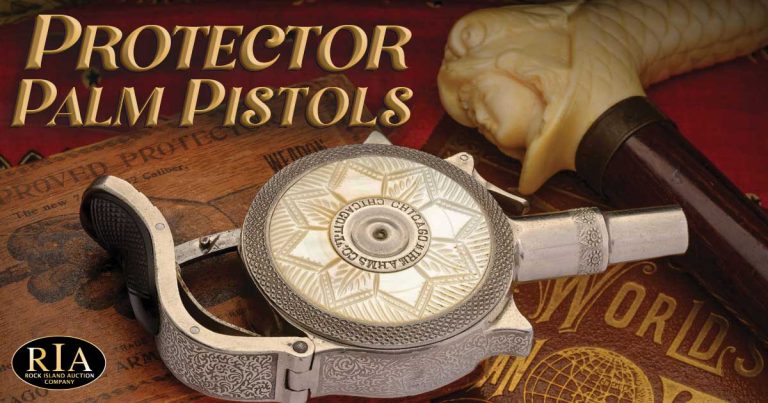
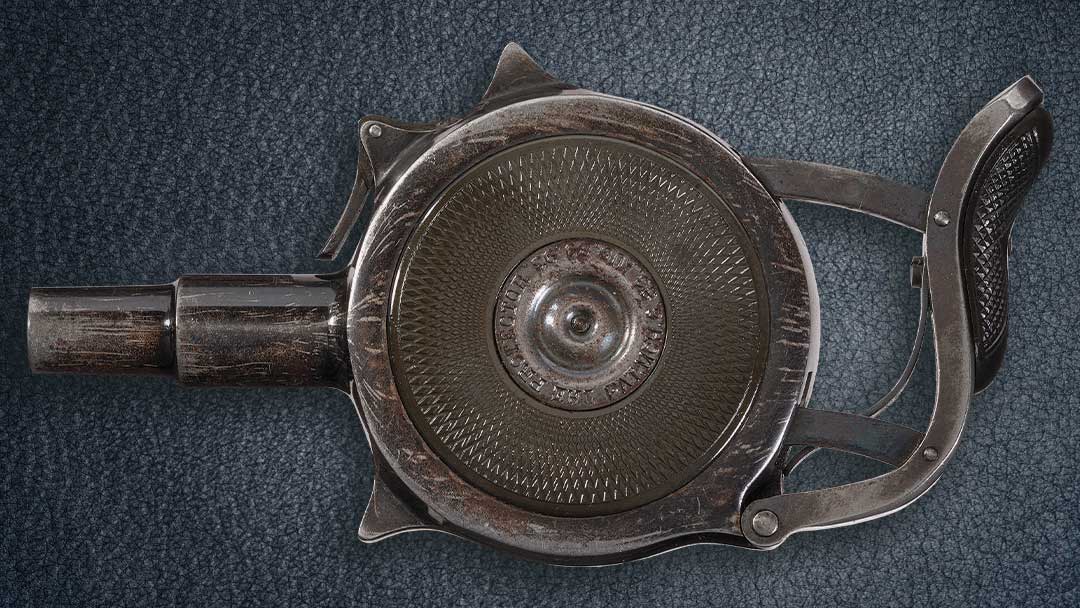
Taking the concept of the handgun to its most literal extreme, French inventor Jacques Edmond Turbiaux came up with the palm pistol in 1882. Intended for concealed self-defense, the Le Protector palm pistol and its successors and competitors were offered in numerous variations, finishes, grips, calibers, and even presentation styles that make them an appealing genre for today’s antique arms collectors.
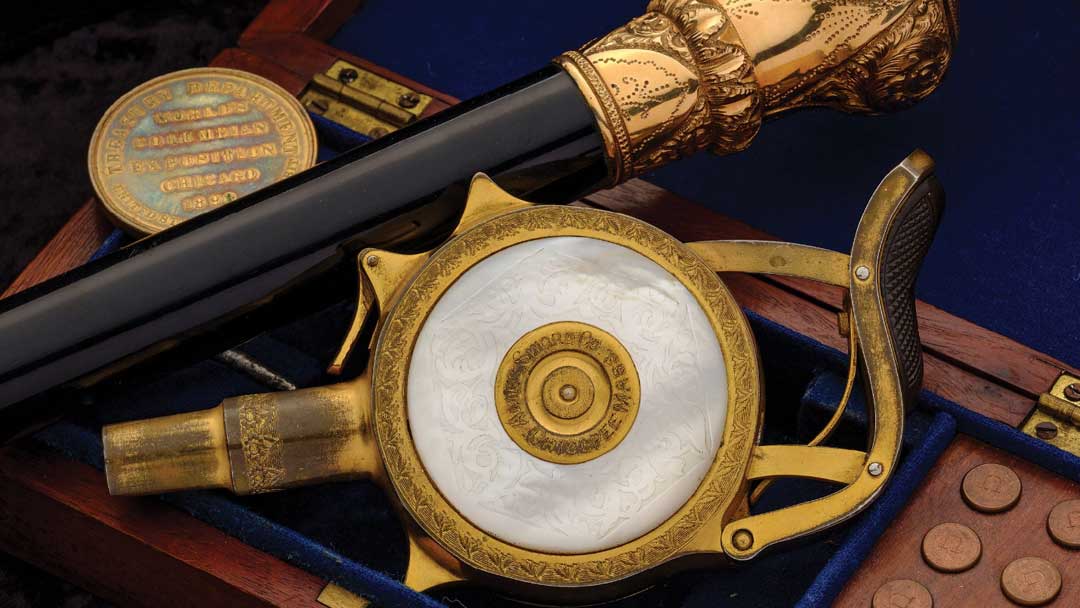
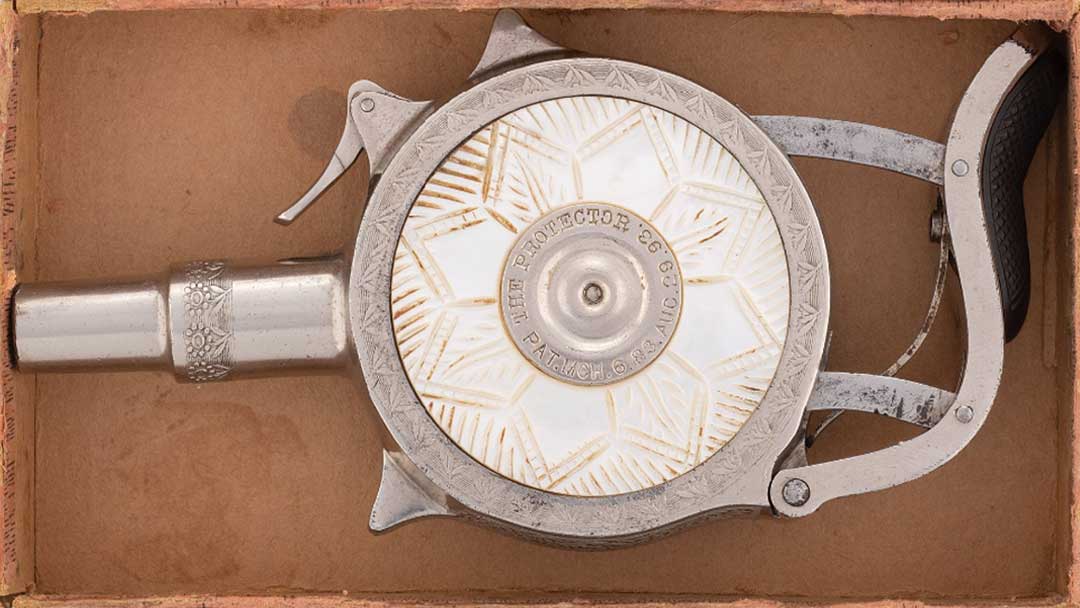
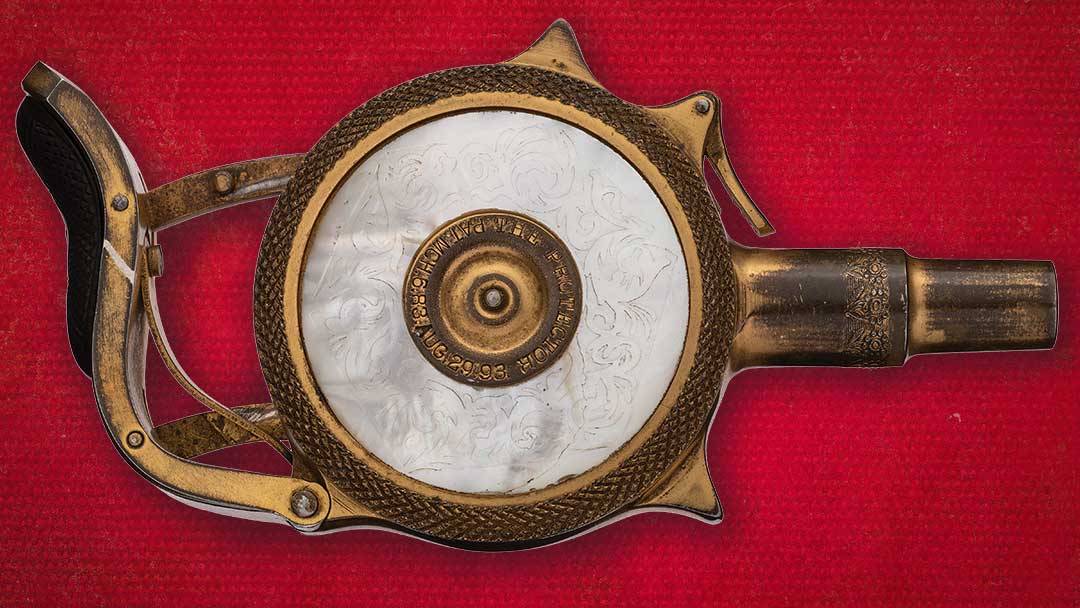
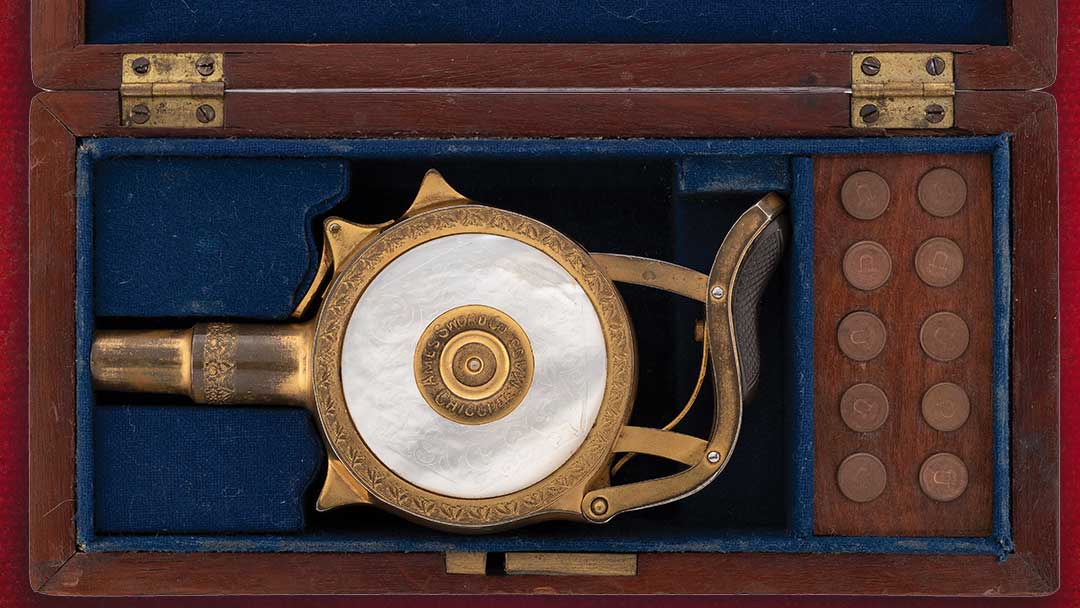
An exceptional cased, exhibition quality, gold plated Ames Sword Co. Chicago Fire Arms Co. Protector palm pistol with rare etched pearl panels.
Rock Island Auction Company’s May 2023 Premier Firearms Auction includes two of the finest known Protector palm pistols manufactured, as well as a number of other rare examples from the genre. Click on the images throughout this article to learn more about each item.
What is a Palm Pistol?
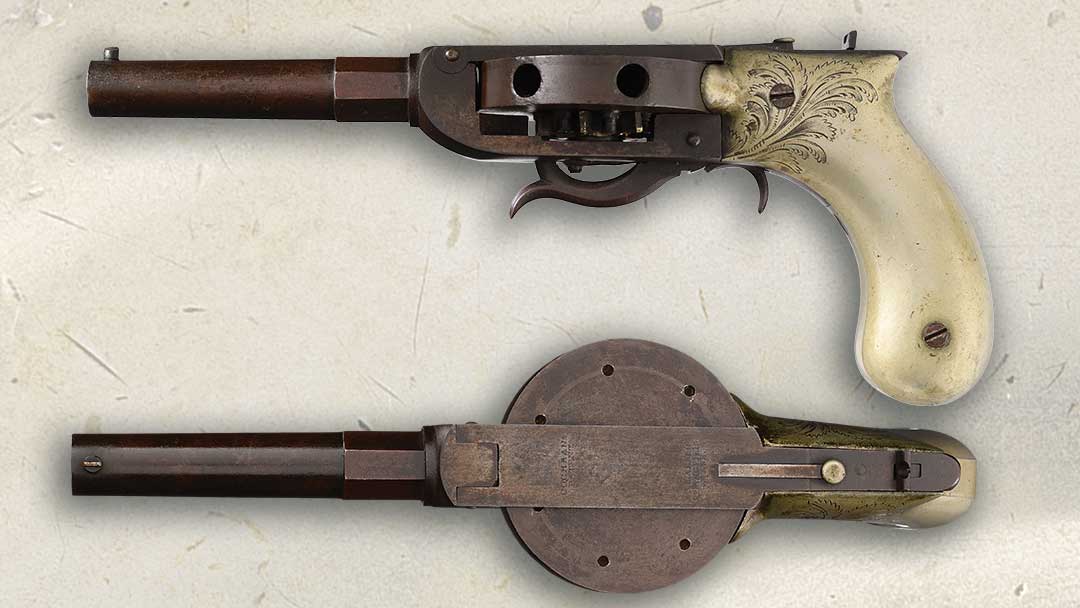
Palm guns, or “squeeze pistols,” are a small type of double action revolver with a barrel that fits between two fingers, typically the pointer and middle finger. To fire, the gun is clasped in the fist, with the shooter’s palm squeezing against a hinged lever at the rear of the pistol. Clenching the hand compressed the lever, rotated the cylinder, and triggered off the shot.
This cased gold and pearl palm pistol is marked “AMES SWORD CO./CHICOPEE MASS.” on one side plate and “THE PROTECTOR/PAT. MCH. 6, 83, AUG. 29, 93” on the reverse side plate.
Palm pistols used small cartridges that were placed in internal chambers arranged around a horizontally rotating disk, like spokes on a wheel. This design was somewhat similar to vertical turret revolvers like the 1837 Cochran and 1851 Porter models that were developed to circumvent Samuel Colt’s patent. The palm pistol’s side plate twisted off with a quarter turn, allowing the cylinder to be removed and reloaded.
An extremely rare, factory engraved, C.B. Allen Cochran patent under hammer percussion turret revolver serial number “60,” one of less than 150 manufactured in the late 1830s.
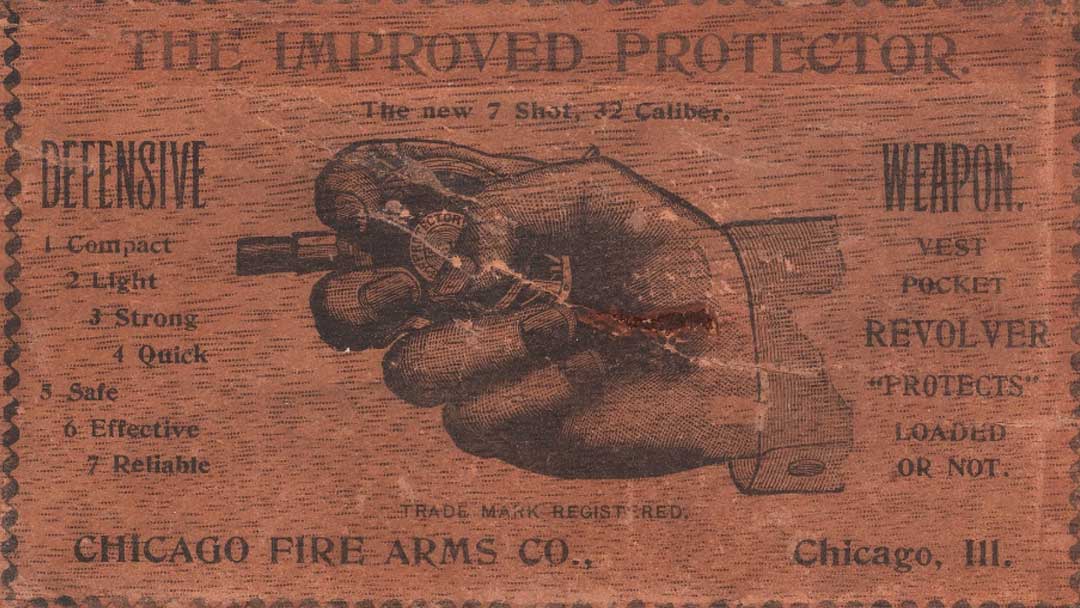
The palm pistol was small and light, comparable to the size of a pocket watch, and its lack of an external hammer or a traditional trigger meant it could be fired from the pocket without obstruction. Advertised as compact, safe, and reliable, the palm pistol was the ultimate concealed carry weapon of its day.
The palm pistol was fired with a grip-squeezed operating handle.
The Turbiaux Patent Palm Pistol
The idea of the pocket pistol had existed since the compact flintlock box lock actions of the 18th century and short-barreled versions of popular revolvers like the Colt SAA “Sheriff’s” Model.” In the mid-19th century, small hideaway vest pocket guns like the derringer were in hot demand, and French armorer Jacques Edmond Turbiaux saw an opportunity to bring something new to the table.
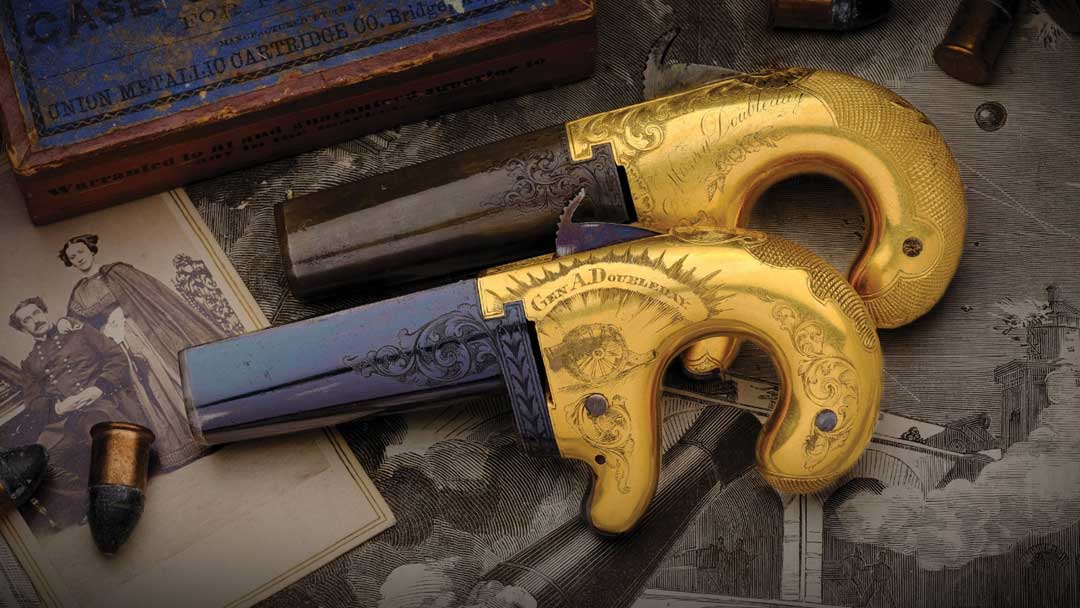
A pair of Moore’s Patent gilt derringer pistols inscribed to General Abner Doubleday, one of numerous concealable firearm designs that found a market in the mid-18th century.
Jacques Turbiaux first patented his palm pistol concept in France, Germany, Belgium, England, and Italy, then filed a U.S. patent in March of 1883. The first variation of the Turbiaux palm pistol was produced in Paris as “Le Protector.” Turbiaux described his invention as “A revolver which may be held in the hand with no part exposed except the barrel.”
Jacques Edmond Turbiaux considered his palm pistol to be a “revolver without stock or handle.” Today, examples of this unique firearm class are prized by collectors.
The Turbiaux patent palm pistol design offered seven or more shots, depending on the model. The typical derringers, pocket pistols, and cane guns of the period only had a one or two-shot capacity. And unlike many pepperbox pistols of the era, the palm pistol didn’t require manual recocking, operating effectively as a double action weapon. Finally, the palm pistol’s more accessible squeeze trigger provided a more feasible self-defense option for some physically handicapped shooters.
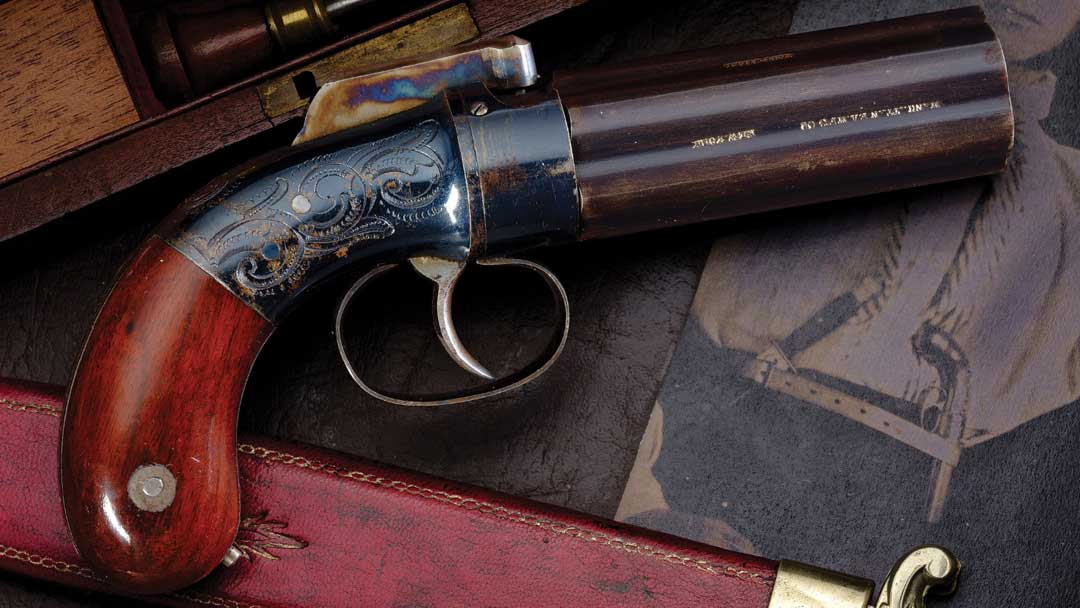
The pepperbox pistol, another popular option for early concealed carry. This exceptional example comes out of the Greg Lampe Collection.
The Chicago Protector Palm Pistol
In 1891, the palm pistol arrived in America, produced by James Duckworth of Springfield, Massachusetts and sold by the Minneapolis Firearms Co. as “The Protector Pocket Pistol,” or “The Chicago Protector.” In 1892, Peter H. Finnegan of the Chicago Fire Arms Company bought the patent and partnered with famous swordmaker Ames Sword Co. of Chicopee, Massachusetts.
Ames Sword Co. of Chicopee, Massachusetts, was contracted to produce these palm pistols in the 1890s for Peter Finnegan and the Chicago Fire Arms Co.
Finnegan contracted Ames Sword Co. to manufacture 15,000 palm pistols in anticipation of selling them during the 1893 Columbian Exposition in Chicago. Only1,500 were completed by the deadline, resulting in a lawsuit from Finnegan. Ames counter-sued and continued to produce the palm pistol as litigation dragged on.
An exhibition quality, cased gold and pearl Ames Sword Co. Protector palm pistol.
Peter Finnegan ultimately declared his company insolvent. Ames Sword Co. secured the patent rights to the palm pistol and continued to manufacture them into the early 20th century.
Palm Pistol Variations
Though manufactured using the same design, palm pistols sold by the Minneapolis Firearms Co. and the Chicago Firearms Company/Ames Sword Co. have several notable differences. Minneapolis Firearms Co. palm pistols are slightly smaller and are chambered for .32 Centerfire Extra Short. The palm pistols produced by Ames Sword Co. are chambered for .32 Rimfire Extra Short (also called .32 Protector) and were sometimes fitted with a trigger guard that could act as a set of brass knuckles after the pistol ran out of ammunition. The latter feature was touted in advertisements, boasting that the pistol “protects, loaded or not.”
The standard finish for both palm pistol designs was nickel, with a scarce blue option and an even rarer gold finish available. The grips were typically offered in hard rubber, though antique ivory and incised pearl panels are found on some examples manufacturers for high-end clientele.
A Chicago Firearms Co. Protector palm pistol manufactured in the 1890s, without the typical floral pattern accents on the barrel and frame. This example shows a very scarce blue finish.
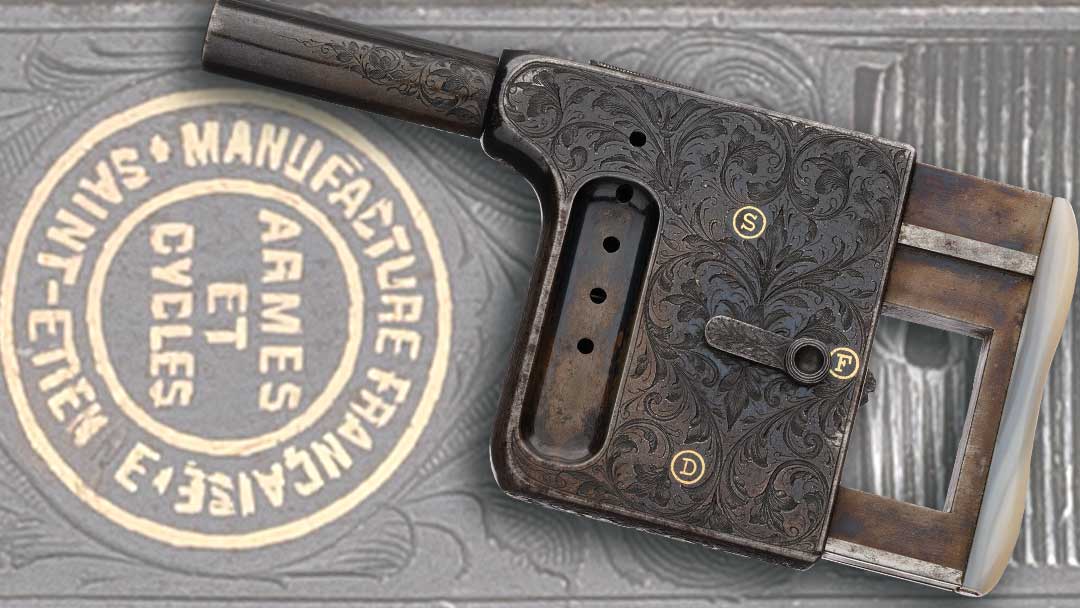
Another palm pistol invented in France, the Gaulois was initially called the “Mitrailleuse” pistol, a word that had become synonymous with “machine gun” in the region by the late 19th century. They were soon re-branded as “Le Gaulois.” These five-shot, 8mm palm pistols operated on a squeeze fire action with an internal magazine. The Le Gaulois was manufactured from 1893 to 1912 and competed with similar designs like the J. Rouchouse & Co. Le Merveilleux and the Le Vainqueur.
A factory engraved and gold inlaid Gaulois No. 1 palm squeezer pistol manufactured by Francaise d’Armes & Cycles de St. Etienne.
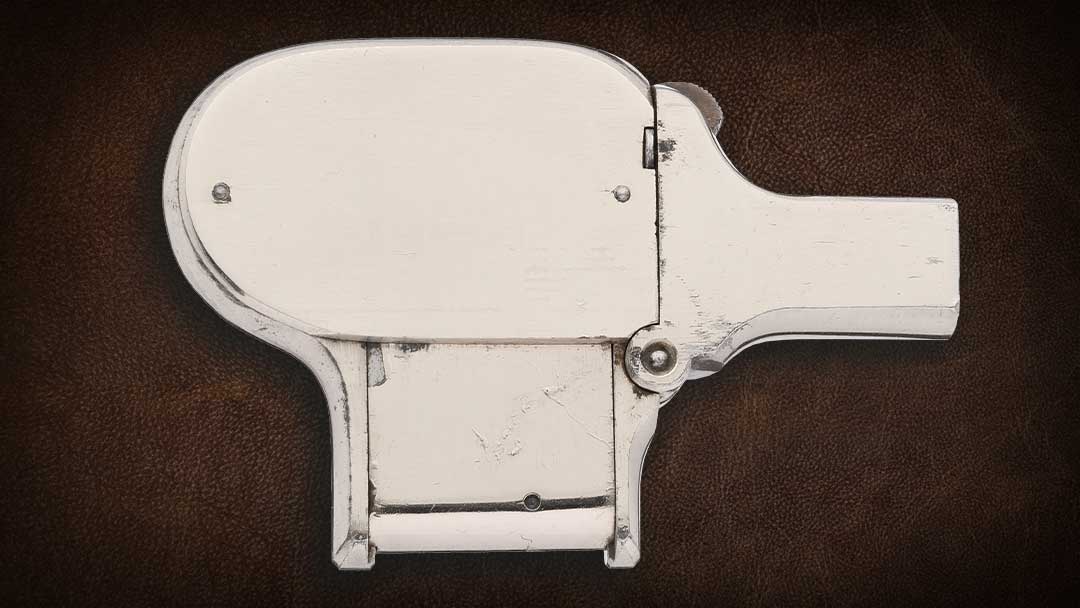
The “Unique” palm pistol invented by Oscar F. Mossberg and produced by the Shattuck Company of Hatfield, Massachusetts, demonstrates the relative popularity of the genre and the different approaches gun designers were taking with the palm pistol concept even into the early 20th century. Manufactured from 1901 to 1915, these four-barreled guns operated with a rotating firing pin that discharged rounds sequentially. Mossberg’s patent makes clear that his pistol was designed for pocket carry, stating, “The arm may be fired while held in the pocket, there being no parts extending beyond the frame to interfere with this operation.”
An unusual Charles S. Shattuck “Unique” palm pistol chambered in .22 short.
The Twilight of the Palm Pistol
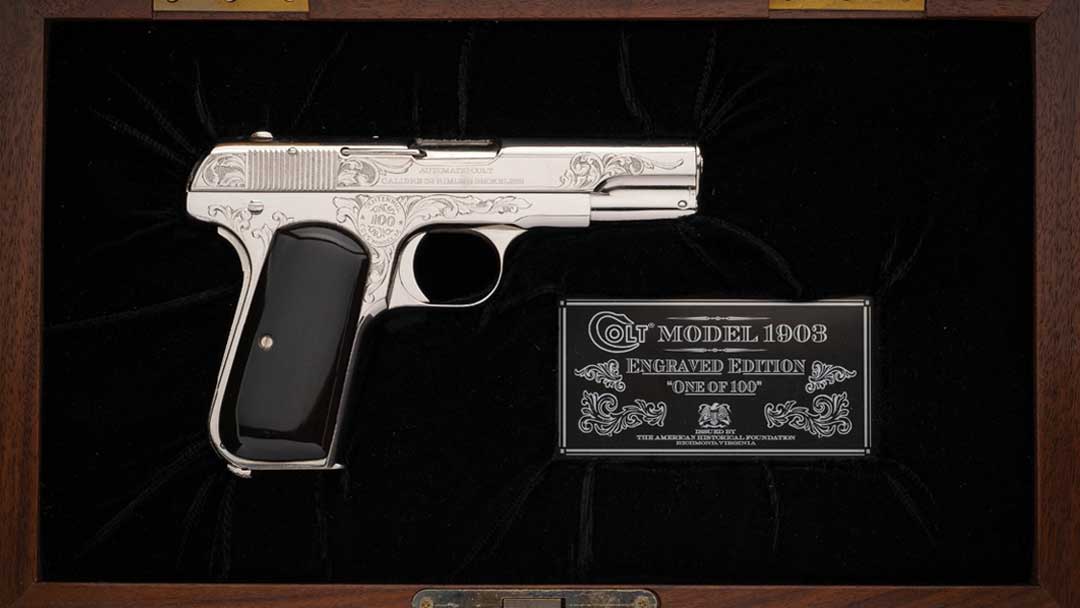
While the palm pistol genre was somewhat popular for a time, these fascinating handguns started to fall out of favor in the 1910s due to the introduction of semi-automatic pistols, some of which were even smaller and more compact than the palm guns they replaced. Small pistols like the popular Colt Model 1903 Hammerless pistol, for example, could be reloaded faster, aimed more accurately, and chambered a more powerful cartridge than their palm pistol competitors.
One of 100 pistols custom embellished by Colt and the American Historical Society to celebrate 100 years of the Model 1903 Pocket Hammerless.
The difference in stopping power was particularly significant. The Chicago Protector palm pistols used .32 Rimfire Extra Short black powder cartridges that delivered a rather anemic charge. In ‘Ammo Encyclopedia’by Michael Bussard, the Protector palm pistol muzzle velocity is cited at 650 feet per second, with a muzzle energy of 51 foot-pounds, less than half of the 129 foot-pounds of energy delivered by a Colt Model 1903 Pocket Hammerless and its .32 ACP smokeless cartridge.
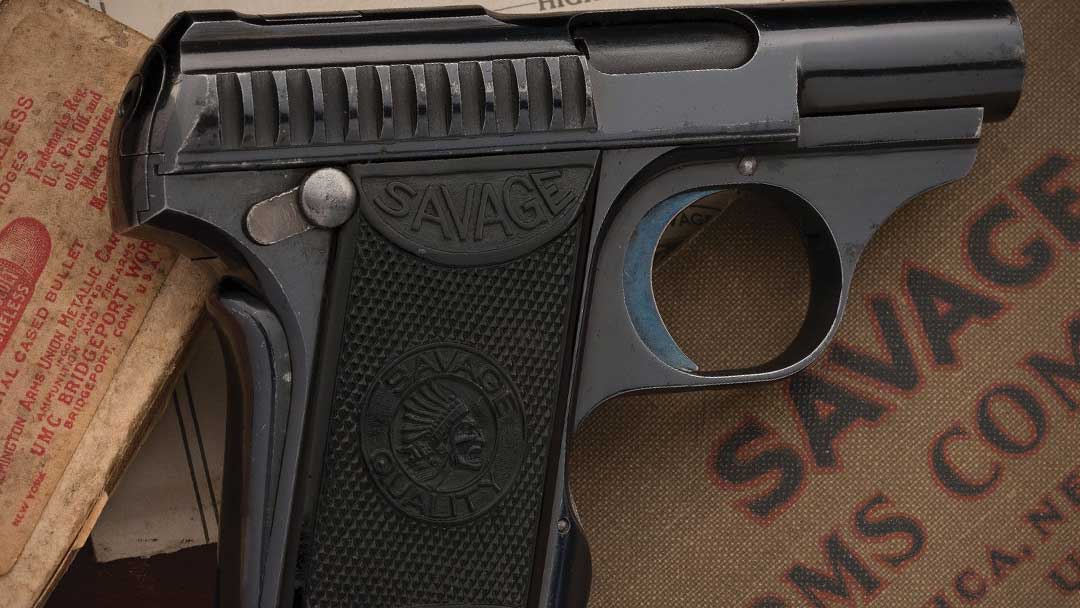
Development of these scarce pistols began in 1912, with Savage feeling a need to make a pistol to compete with the .25 ACP pocket automatics offered by both Colt and FN/Browning.
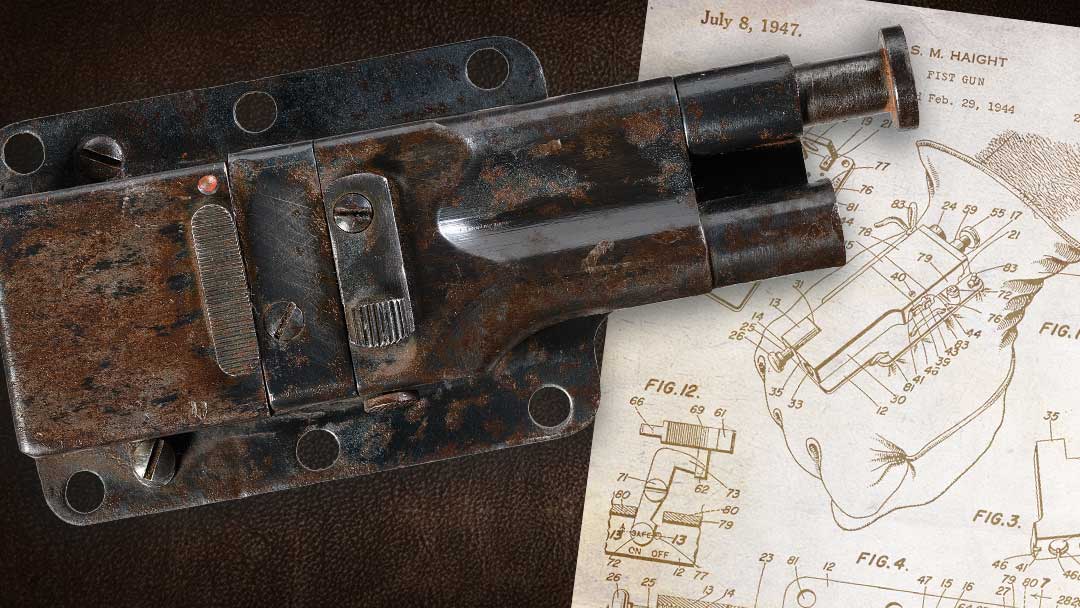
Innovation continued in the pocket automatic and snub nose revolver genres, ending the production of most palm pistol designs. The spirit of the concept has endured through oddities like 1944’s Sedgley Fist Gun, famously portrayed in Quentin Tarantino’s ‘Inglourious Basterds,’ and New Jersey inventor Matthew Carmel’s recent Constitution Arms Palm Pistol, a single-shot, squeeze-operated firearm chambered in .38 Special that’s specifically intended for seniors and physically disabled users who struggle with arthritis and hand weakness.
A U.S. Navy Sedgley Mark Two “Fist Gun” hand firing device, also called the “Hand Firing Mechanism Mark 2.”
Palm Pistol for Sale
Despite their limited accuracy and stopping power, palm pistols enjoyed a notable production run and offer an intriguing look into the creative attempts to develop concealed firearms that could be carried as personal accessories. Today, palm guns are scarce enough to be desirable pieces for gun collectors and a great find for any history buff, and they won’t take up much shelf space.
One of the finest palm pistols for sale this May, an extraordinary exhibition quality Chicago Protector with exceptionally rare gold plating and etched pearl panels that would fill a gap in even the most advanced antique firearm collections.
The United States is currently facing a crisis of epic proportions as the economic situation in the country continues to collapse. Since the end of the so-called COVID crisis, cities throughout the country have been taken over by gigantic homeless encampments, a disturbing trend that is indicative of the more significant economic problems facing the country.
Cities Overrun by Homeless Encampments
Homelessness has been a persistent problem in the United States for decades, but it has reached a new level since the end of the COVID lockdowns as our country plunges forward into the economic abyss. Major cities throughout the country are now being taken over by giant homeless encampments, which are causing of problems for local residents and businesses alike.
From drug use, causing first responders to be overwhelmed with overdose calls to violent attacks on the public, these encampments and the addicts that come with them are wreaking havoc throughout the country.
It’s only going to get worse!
The current economic crisis in the United States is out of control with the commercial real estate market imploding, home sales plunging, rising inflation, bank failuers and now a growing number of large companies laying off workers all over America. As we’ve been covering for some time now, our economy is anything but stable and, in all likelihood, could collapse at any time.
Additionally, a significant percentage of the population is struggling with debt, with 45% of millennials and 44% of US adults aged 43 to 58 having more credit card debt than savings. Meanwhile, credit card interest rates are rising at a historic pace, with the average rate on credit card debt in the US hitting a record 24%. All the while 73% of millennials now say they are living paycheck to paycheck.
Total credit card debt in the US is set to cross $1 trillion this year, with US credit card debt jumping $61 billion in the last three months of 2022 alone, the largest quarterly jump since 1999. Since the pandemic, credit card debt has skyrocketed, with total US credit card debt up nearly $200 billion in under three years.
But if that doesn’t tell you where things are heading, just take a look at bank deposts – PEOPLE ARE BROKE!!! Since, March 1st, total bank deposits have dropped by $500 billion, the largest two-month drop in history. This is a clear indication that people are withdrawing their money from the banks due to the uncertain economic situation in the country.
And now the Invasion at the Southern Border could be the Final Kill Shot!
To make matters worse, the country is also facing a major crisis at the southern border. As Title 42 ends, millions of illegal aliens are expected to flood into the country, causing devastating consequences for the US economy. When Title 42 ends, America will be open to a foreign invasion the likes of which no country has ever seen or survived. Every major city will find itself besieged by homeless illegals begging on the streets, exacerbating an already dire situation.
I’ve never seen anything like this – hundreds of migrants living on the streets of El Paso and officials expect the situation to only get worse onceTitle 42 expires. Border towns are facing a humanitarian crisis @NewsNationpic.twitter.com/tvWqEPdCqO
— Jorge Ventura Media (@VenturaReport) May 6, 2023
It’s Time to start taking this seriously!!
The economic situation in the United States is growing more dire by the day, with the country facing a perfect storm of financial and social unrest. The rise of homeless encampments is a stark reminder of the where we are heading, as millions of Americans struggle to make ends meet. The upcoming border crisis is only expected to make the situation worse, leading to even more economic instability and social unrest.
As preppers, we know that we can’t rely on the mainstream media to warn us of the dangers ahead. We must take responsibility for our own financial future and that of our families. That’s why we urge you to take action now to protect yourself and your loved ones. It’s time to prepare for the worst and hope for the best.
Our team has put together a comprehensive article on Preparing for an Economic Collapse — You can read the article here. We delve into the history of economic collapses, provide a detailed list of steps you need to take to protect yourself, and discuss what will most likely happen when the banking system inevitably goes down.
Be Prepared to Feed Yourself when the Collapse Hits!
As an American who values hard work, freedom, and integrity, it is almost impossible to remain calm in the face of the unfolding crisis at our southern border. The Biden administration has already pushed us to the brink of disaster with three years of unconstitutional COVID mandates, and now they are getting ready to set our nation ablaze. The unchecked influx of illegal aliens and the looming expiration of Title 42 is a ticking time bomb, and the consequences will be dire.
BREAKING: Texas has deployed their own Texas Tactical Border Force as migrants wait to storm the border once Title 42 ends.
The Texas National Guard is readying Black Hawk helicopters and C-130s as they brace for an invasion along the southern border.
As of this moment, over 700,000 illegal aliens are gathering at our border, ready to charge in once Title 42 expires. To make matters worse, Texas Governor Greg Abbott says that the Biden administration expects around 13,000 illegal crossings each day after Title 42 is no longer in effect. In response, Governor Abbott has declared that Texas will mobilize up to 10,000 National Guard members and 1,200 troopers from the Texas Department of Public Safety. This is not just an immigration issue, but a clear threat to our national security.
NEW: Remarkable video from our Fox drone team shows an enormous line of hundreds of migrants who just crossed illegally into Brownsville, TX this evening. A large majority of them are single adults. The RGV continues to see a massive surge of illegal crossings ahead of T42 drop. pic.twitter.com/xHDV8sc8PD
Make no mistake about what this is; the illegal aliens flooding our southern border are not hardworking Mexicans seeking employment opportunities. This is a well-organized invasion force comprised of fighting-age men, including members of notorious Mexican drug cartels. Many are not even Mexican they are being recruited from the infamous MS-13 prisons in El Salvador.
American Journalist Michael Yon and muckraker.com have been documenting another troubling invasion of military-aged Chinese men who are using the cartels to come up through the Darien Gap into the United States — something OFFGRID Survival documented back in March.
Another platoon of military-aged Chinese men headed toward the United States.
China is slowly invading America without firing a single shot.
This is another group waiting to board buses to Costa Rica to continue to the US.
Yuma, Arizona sheriff Leon Wilmot does a ride along to show the con job illegal aliens put on the American immigration system. Also mentions NGO’s cleaning the area prior to Senators arriving so it appears there is no crisis at the border pic.twitter.com/GrKOipJhOR
NOW: 24 busses of aliens leaving Darien up Highway 1 on way to Costa Rica to USA. After I stopped taping they kept coming. There will be more tonight. We heading to Darien camp now. pic.twitter.com/jpbtxnTMlU
I’ve never seen anything like this – hundreds of migrants living on the streets of El Paso and officials expect the situation to only get worse onceTitle 42 expires. Border towns are facing a humanitarian crisis @NewsNationpic.twitter.com/tvWqEPdCqO
— Jorge Ventura Media (@VenturaReport) May 6, 2023
Recent incidents of violent attacks by these cartel members, which the media has conveniently tried to downplay or even ignore altogether by falsely attributing them to white supremacists, should be enough to shake us to our core. The mass shooting in Brownsville, and the gruesome incident where a vehicle was used to mow down and kill innocent illegal aliens in Texas, serve as a stark reminder that America is under siege.
It is appalling that over 6.3 million illegal immigrants have crossed the border since President Biden took office. This is not just a failure of policy but a failure of leadership. The lack of action from the Biden administration is unconscionable and will have long-lasting consequences for our nation’s future.
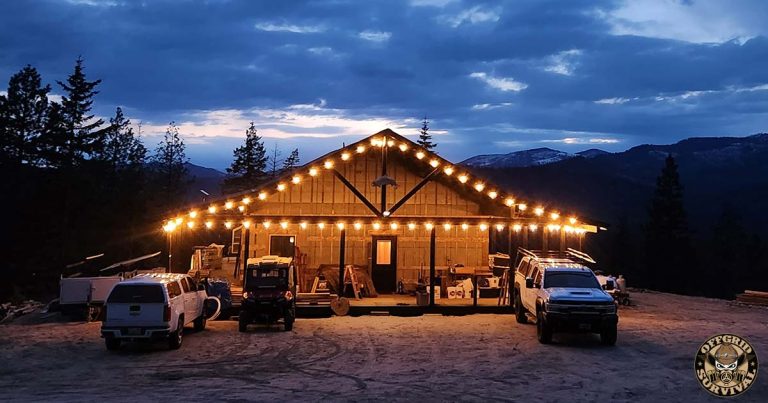
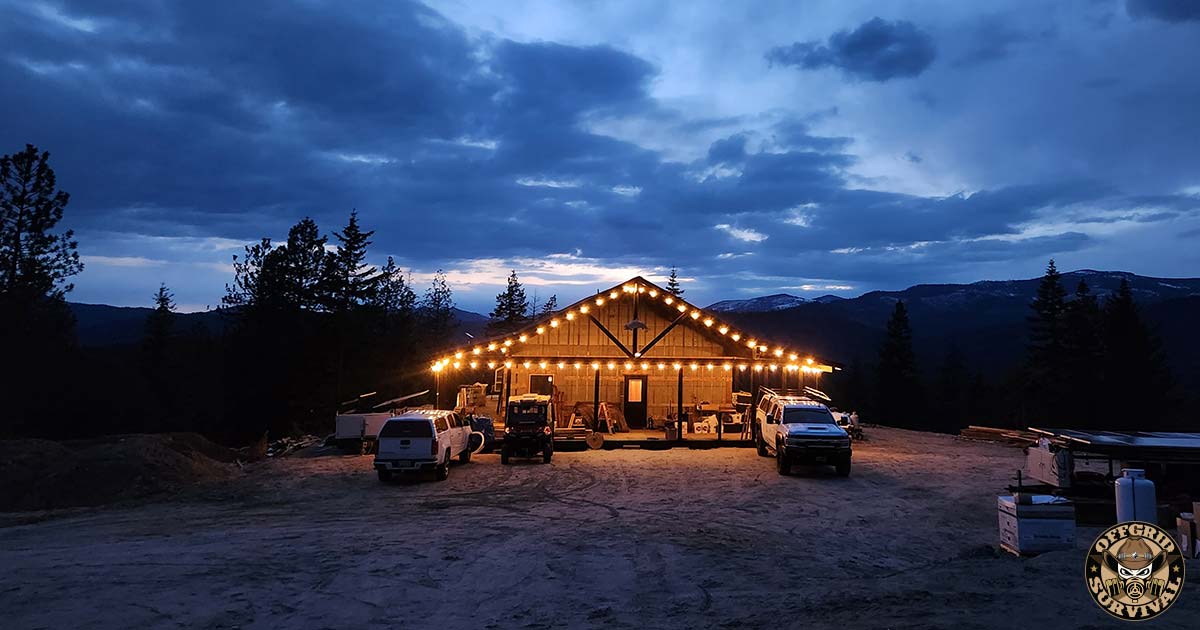
The wind howls through the barren landscape of North Eastern Washington State, a rugged and unforgiving terrain that has claimed the dreams of many who dared to venture into its harsh embrace. But for a couple of adventurers Chad and Rhonda, the call of the wild was too strong to ignore. They left behind the comforts of modern living to embark on an off-grid adventure that would test their limits, challenge their ingenuity, and reward their courage with the sweet taste of freedom.
Eagle Rest: A Majestic Symbol of Freedom and Self-Sufficiency
With a spirit of adventure and a deep desire to live life on their own terms, they set out on a journey that would take them far from the trappings of modern living. Their journey is an inspiration to others who long for a life of independence and self-sufficiency, and a reminder that sometimes, the road less traveled can lead to the most rewarding destinations.
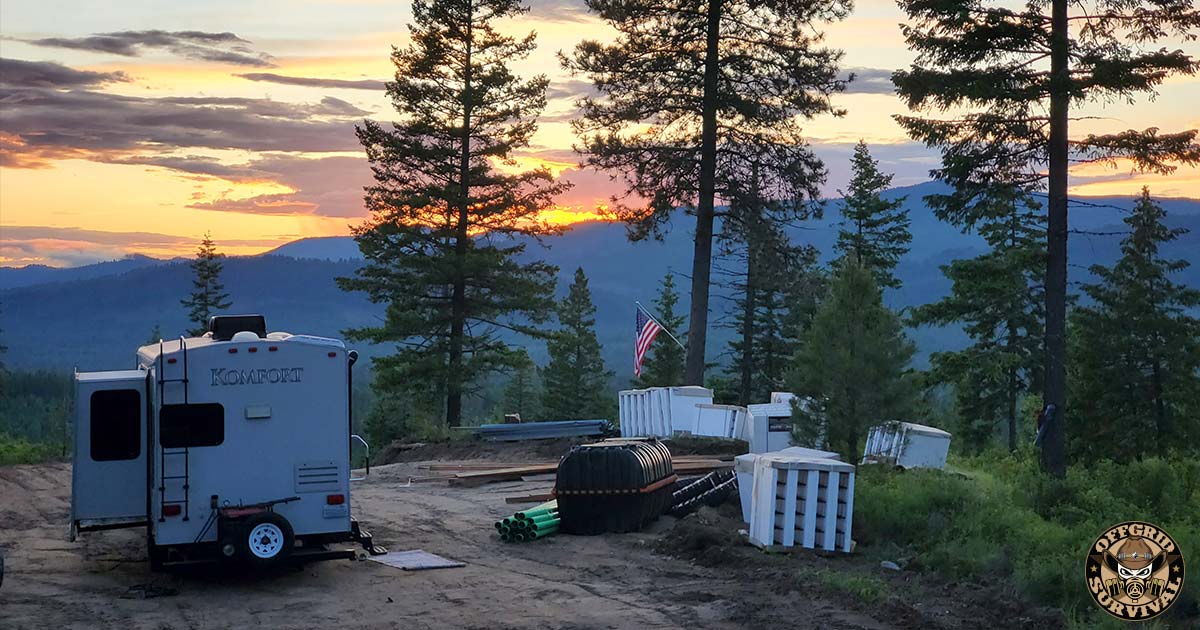
Chad and Rhonda saw an opportunity to take control of their lives, to break free from the shackles of dependency and conformity, and to create a sustainable, self-sufficient oasis in the heart of nature’s raw power. Their journey began with a leap of faith, as they purchased a 20-acre parcel of land sight unseen. But when they arrived, they realized that it lacked the sunlight needed to operate solar during winter, a critical element for their off-grid dreams. “I knew this would make winters longer, roads harder to maintain, and would put additional stress on fuel supply to operate generators.”
Chad’s professional career in building material sales in Alaska gave him a wealth of knowledge about construction and the importance of location in building. “I was a building material supplier most of my professional career, primarily wholesale contractor sales in Alaska. While working with builders in AK, they helped me understand the importance of location of the build relative to sunlight, insulation techniques for extreme fluctuations and best methods of construction. While I had a lumber yard at my disposal, I built one of the first ICF (insulated concrete form) structures in Anchorage.”
So, Chad and Rhonda sold the land and acquired a 60-acre parcel that was perfect in every way, despite being more expensive. They called it Eagle Rest, inspired by the majestic bald eagle circling overhead, symbolizing the freedom they had found.
But finding the right location was only the first step. Next, they had to design and engineer their dream home from the ground up. “I designed and engineered the structure from the ground up with insulation and thermal bridging in mind. We built the footings using Form-A-Drain.”
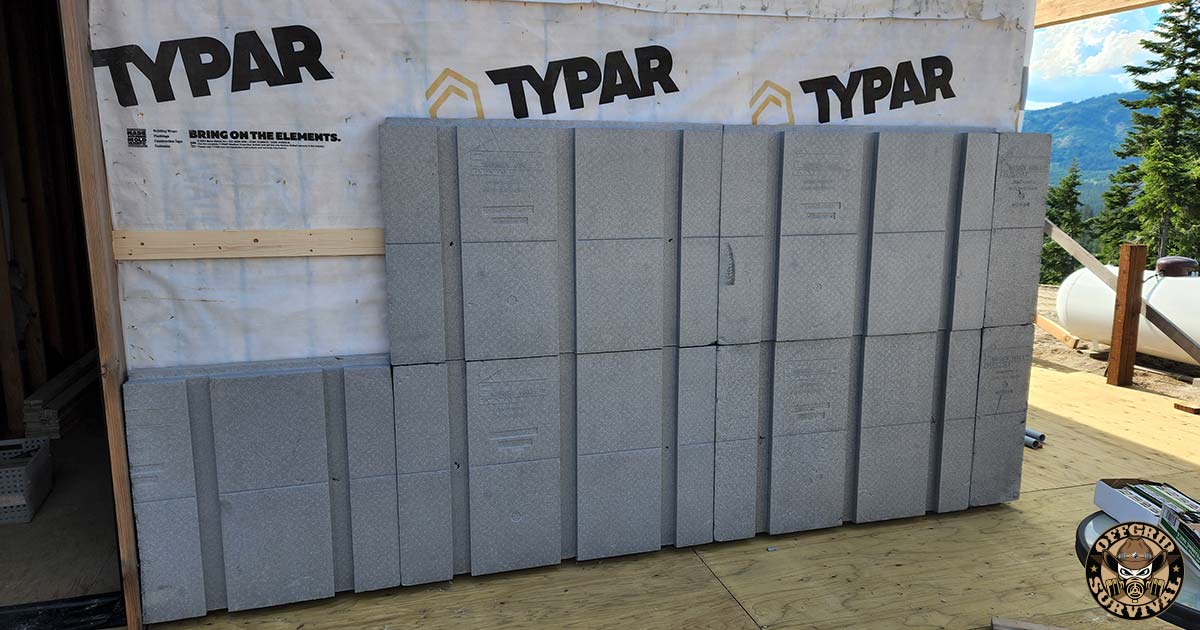
“The 4′ stem wall is built out of Fox Block ICF, another great DIY system. I would have preferred building the entire structure out of ICF, but concrete was too hard to get to this location. We used a Canadian product known as Energy Wall to insulate the EXTERIOR walls and roof. This system goes over the exterior sheathing, which eliminates ALL thermal bridging. While we insulated the interiors with regular batt insulation, the exterior system provides performance that has been way better than imaginable.” The shell of their home remains warm in the winter and cool in the summer.
For power, they incorporated complete solar systems into their home, acquiring three solar trailers out of California. They didn’t know how much power they would provide but took a chance. As it turns out, one trailer is driving the entire house and well pump.
“The generator has not turned on for one week, the house has remained 69-71 degrees without any heat or cooling systems on and the temps have been in the upper 80s to low 90s; we are amazed because of the low/no cost of energy going into summer.”
“Knowing what we wanted out of this home, which is energy efficiency, all lights are LED, and all appliances are the best-performing appliances we could find.”
Winter was a test of their resolve, as they endured over 120″ of snow and constantly had to clear snow from the solar panels. But all in all, their home continued to function as planned. They used propane to supplement their energy needs, but in the height of winter, they never consumed more than $200 a month for fuel. Now, they are running solely on solar, and their generator will only turn on if their solar drops below 30%, which probably won’t happen until October or November at this point.
“While we miss our gentleman’s farm we had in Western Washington, we both love this new lifestyle; we are independent and have cut our home operating expenses by thousands of dollars annually.”
But their off-grid adventure isn’t just about energy efficiency. They are living their dream and loving the freedom that comes with it.
Off the Grid: Pursuit of Freedom in an Off-Grid Lifestyle
Living off the grid is not for the faint of heart. It requires grit, resilience, and a willingness to adapt to changing circumstances. But for those who are willing to take the plunge, the rewards are immeasurable. The freedom to live life on your own terms, to disconnect from the trappings of modern society, and to reconnect with nature is a gift that cannot be quantified. The couple’s experience is a testament to this. By living a life stripped of excess and distractions, they have rediscovered the joy of self-sufficiency and the value of true connection.
Their story is an inspiration to others who long to break free from the confines of the modern world and live a simpler, more fulfilling life. It reminds us that we are capable of more than we think and that true freedom can only be found when we are willing to step outside our comfort zones and embrace the unknown. So let this couple’s example be a beacon of hope and courage for those who dare to dream of a life lived on their own terms, free from the shackles of societal norms and expectations.
If you think the economy is bad now, I’d hate to tell you but the problems are far from over!
Are you concerned about the state of the U.S. economy? You should be. The current banking crisis is a ticking time bomb that threatens to rock the entire financial system. From soaring inflation to steep interest rates, there are a numerous of warning signs that we can’t afford to ignore.
Here is why you should be preparing for trouble from the current banking crisis:
The Banking Collapse Of 2023 Is LARGER Than The Banking Collapse Of 2008
While the bullshit artists in the media won’t tell you this, the three big banks that collapsed in 2023 had more assets than all 25 banks that collapsed in 2008. And, the crisis is far from over.
When Silicon Valley Bank and Signature Bank went down, we warned our readers that it was only the tip of the iceberg. Now, we’re seeing even more banking failures. First Republic has collapsed, and PacWest, Western Alliance, First Horizon, and many other regional banks are rumored to be on the chopping block. But hey, don’t take our word for it, just check out their crashing stock prices.
It’s a disaster out there for US regional bank stocks this year!
PacWest has plummeted 75%, with Metropolitan Bank following closely behind at 60% in the red. First Horizon is down 57%, Western Alliance down 53%, and Comerica has taken a 46% hit! This isn’t just a bad year for these banks, it’s a nightmare!
Higher Interest Rates Are on the Horizon
The Federal Reserve has done it again! They have raised their key federal funds rate to over 5%, marking a 16-year high. This move is supposedly aimed at curbing inflation, but it seems like the average American is the one who will bear the brunt of it. The Fed’s actions will have severe consequences for consumers, as it will make it harder for them to borrow and spend money.
Things are bad, and now that the Fed has decided to raise interest rates again, they will soon get even worse. Higher interest rates can lead to a decrease in borrowing and spending, which can hurt economic growth. This is especially true in the housing market, where rising rates can make it harder for people to afford homes, potentially leading to a real estate crisis.
During a housing market collapse, foreclosures can skyrocket due to homeowners being unable to make their mortgage payments due to higher interest rates. This can lead to a glut of homes on the market, causing prices to drop. As a result, a vicious cycle of more foreclosures, more homes on the market, and even lower prices can occur. This can have a ripple effect on the economy, leading to job losses, decreased consumer spending, and overall economic downturn.
Small Businesses Will Suffer
The downturn of midsize regional banks will hurt commercial lending to small businesses. Seizing and selling small banks could create a credit crunch, especially in lower-income US regions. With rapidly rising interest rates creating perilous conditions for banks, looming panic in the real estate sector, and fears of a recession on the rise, further instability seems more likely than not.
According to the NFIB Small Business Optimism Index, small businesses are grappling with historic inflation, chronic labor shortages, and a bleak economic outlook.
One of the biggest concerns for small business owners is the expectation of worsening business conditions in the coming months. As many as 45 percent of small business owners believe that the economy will continue to deteriorate, making it difficult for them to operate and stay afloat.
Adding to their woes is the challenge of hiring new employees. In January, 57 percent of small businesses tried or hired new staff, but a shocking 91 percent of small business owners reported few or no qualified applicants for the positions they were trying to fill. This is particularly true in blue-collar industries like construction, transportation, and manufacturing, which have been hit the hardest.
Small businesses are also suffering from the inflation crisis that has been exacerbated by the policies of the current administration. The NFIB Small Business Optimism Index revealed that 42 percent of small businesses had to raise their prices in the month of January to keep up with the rising costs of goods and services. Additionally, 46 percent of small businesses had to raise employee pay to help their staff keep up with the worst inflation crisis in 41 years.
As a result of these challenges, small businesses are struggling to stay afloat. They are facing tremendous pressure to raise prices on their customers, which could lead to a decrease in consumer spending and further harm their business prospects. It’s crucial for policymakers to address these challenges and support small businesses as they work to weather this storm. Without adequate support, many small businesses may be forced to close their doors, leading to devastating consequences for the American economy.
National Debt Is Skyrocketing
The national debt in the United States is skyrocketing and no one seems to care! In just three years, the US has added $8 trillion in debt, bringing the total debt to a whopping $22 trillion since 2008. It’s absolutely insane to think that it took 230 years for the US to accumulate the first $8 trillion in debt, and now it only takes a few years to add the same amount.
But it gets worse. The estimated total US debt within the next 10 years is a staggering $50 trillion with an annual interest expense of over $1 trillion. Can you imagine? Interest payments will soon be the largest expense of the US government. How is this sustainable? How can we allow our government to continue down this path of financial ruin?
Are you Prepared?
The current banking crisis is not to be taken lightly, it is one of the biggest threats we are facing today. Don’t wait for the mainstream media to tell you how bad it is, take action now to protect yourself and your loved ones. It’s time to prepare for the worst and hope for the best.
We advise reading our article on Preparing for an Economic Collapse. We talk about the history of economic collapses, list the steps you need to take, and talk about what will most likely happen when the banking system goes down. You can read the article here.
Be Prepared to Feed Yourself when the Collapse Hits!
Civilian American muzzle loading pistols are much rarer than their British and Continental European counterparts and the U.S. martial pistols, especially in the early national period, are very rarely found together as matched pairs despite most were probably made that way. American gun makers more commonly produced rifles and fowling pieces. It appears demand was far less for pistols, and that the demand was largely filled by imported pistols from Europe. That changed as the country delved into the California Gold Rush, westward expansion, and the violent antebellum era as gun makers like Ethan Allen, Henry Deringer, and others began making more pistols for the growing nation.
The relatively few American-made pistols of the era varied somewhat but were often influenced by the fashion trends set by the London gunmakers. Nonetheless, the American pistols tend to have a more folksy, frontier appeal. Like their rifle counterparts, they are often referred to as “Kentucky pistols,” but they were primarily made in other parts of the country.
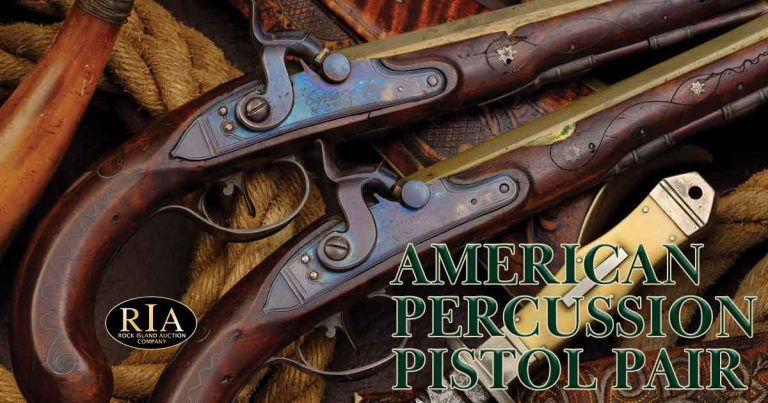
This percussion pistol pair made by Daniel Searles were converted from flintlock pistols and feature octagonal brass barrels with smooth bores and silver furniture. They were featured on pages 134 and 135 of “The Kentucky Pistol” by Chandler & Whiskerin.
Percussion Pistol Pair
This pair of pistols from the early 1800s features octagonal brass barrels with smooth bores, silver blade front sights, “D Searles Cincinnati” signed on top, and rear sight grooves that continue onto the niter blued tangs which have English style engraving. The locks were originally flintlocks and were likely converted for percussion caps in the 1830s. The locks are signed “Capper/& Co.” Capper & Co. marked locks are also found on other early 19th century American firearms, and the company also imported French swords c. 1800-1812. The furniture is all silver. The trigger guards have floral engraving on the bows and pineapple style finials. Pineapples were all the rage in the period and a sign of luxury. You could even rent them for parties! The stocks also feature engraved silver star inlays, silver wire inlays, and blank silver wrist escutcheons. The stocks have slab sided grips with a slight flare at the pommels similar to many English dueling pistols in the late 18th century.
This pair was made by the famous gunsmith and blacksmith Captain Daniel Searles (1782-1860). These pistols are among the few firearms by Searles known today. Among the others is a rifle owned by Robert Anderson of the U.S. Army, son of first Ohio Governor Richard Clough Anderson Sr. Robert Anderson is most famous as the commander of Fort Sumter as successionists let loose the first cannon volleys of the Civil War. Like these pistols, his rifle had silver mounts (see page 76 of Steel Canvas or The History and Art of the American Gun by R.L. Wilson).
Made by Capt. Daniel Searles, this percussion pistol pair is converted flintlocks and feature engraved silver star inlays, silver wire inlays, and blank silver wrist escutcheons. The stocks have slab sided grips with a slight flare at the pommels similar to many English dueling pistols in the late 18th century.
Searles was born in Maryland but was living at Fort Hamilton by 1804 when he advertised in The Western Spy and Hamilton Gazette for his missing horse. By 1811, he had moved to Indiana and served as a private in Colonel William McFarland’s detatchment of Indiana Militia during the War of 1812. While under the command of McFarland (1773-1845) Daniel met and married his commander’s sister, Jane McFarland (1784-1853).
Daniel and Jane had two children, Charles J. Searles (1811-1854) and daughter Louisa Searles (1813-1830) who are both listed as born in Indiana. Jane’s family had moved to Cincinnati from Pennsylvania led by their father Thomas McFarland (1750-1818), a veteran of 10th Pennsylvania Regiment during the American Revolution, in 1799.
The Battle of New Orleans and Searles’ Percussion Pistol Pair
During the War of 1812, Searles found his way down the Mississippi River, and he fought in the militia with Andrew Jackson at the Battle of New Orleans and then remained in New Orleans until the 1820s when he moved to Baton Rouge and established a gunsmith and blacksmith shop on St. Louis Street. Like Daniel Searles’ family, the McFarlands found their way to Louisiana where Thomas McFarland died a few years later.
Captain Searles won a silver cup as an award for a gun and pair of pistols he made and presented at the Meeting of the Agricultural Association held on December 6, 1841. Census records list him as a gunmaker as well, but local newspapers confirm he was a very talented craftsman and produced a wide variety of metal goods, including sundials. They also indicated he was “one of our oldest and most worthy citizens.”
The silver wire engraving and blank silver wrist escutcheons can be seen in this pair of closeups of this percussion pistol pair.
Tragic Death of a Pistol Maker
While in Baton Rouge, Searles famously produced knives for Rezin Bowie, including one presented by Bowie to Captain Henry Waller Fowler of the U.S. Dragoons (see page 109 of The History and Art of the American Gun). Census records list Searles as a gunmaker, but Captain Searles suffered a fate all too common in the 19th century: the early deaths of his wife and two children. Heaping more grief upon tragedy, Searles’ wife and son died just a few weeks apart in early 1854.
As he grew older, his health failed leaving him largely bedridden, and he became “weary of living” as the Times-Picayune reported. He had previously had his tomb engraved, had a winding sheet ready, shaved, and completed suicide by shooting himself in the head with a pistol. His business near the State House in Baton Rouge was taken over by S. Hyatt & Son around June of 1860.
Here is a closeup of the trigger guards from one of a percussion pistol pair that shows pineapple style finials and floral engraving on the bows of these converted flintlocks.
Percussion Pistol Pair and Bowie Knives
Daniel Searles was a craftsman and artisan whose work went beyond the fine pistols he made to include Bowie knives and other metalwork, but his pistols stand alone as nearing art pieces. While most American gun makers of the era were making utilitarian long guns, Searles’ fine pistols were and remain as rarities. This pair of fascinating converted percussion pistols show the fine quality and embellishment that Searles brought to his work. The guns features silver furniture, niter blue drum bolsters and silver star inlays and silver wire inlays in the stock that makes these guns rise above the martial handguns of the day. As a gunsmith, Daniel Searles’ craftsmanship stands the test of time and provides an opportunity and to own the work of an early American artisan.
Daniel Searles was an excellent craftsman who produced a number of goods including sun dials. Though none of his Bowie knives are offered in RIAC’s May Premier Auction he made them for Rezin Bowie, Jim Bowie’s brother, that was displayed at the Alamo where Jim Bowie died. The knife shown above was made by artisan Samuel Bell Coffin that is available in the May auction.
Sources:
Daniel Searles:
United States War of 1812 Index to Service Records, 1812-1815, database with images, FamilySearch (https://familysearch.org/ark:/61903/1:1:Q29K-5BG5 : 8 March 2021), Daniel Searles, 1812-1815; citing NARA microfilm publication M602 (Washington, D.C.: National Archives and Records Administration, n.d.); roll 185; FHL microfilm 882,703.
“United States Census, 1850,” database with images, FamilySearch (https://www.familysearch.org/ark:/61903/1:1:MCJ3-V8S : 22 December 2020), Daniel Searls, Baton Rouge, East Baton Rouge, Louisiana, United States; citing family , NARA microfilm publication (Washington, D.C.: National Archives and Records Administration, n.d.).
R.L. Wilson. The History and Art of the American Gun (New York City: Chartwell Books, 2015), p. 76 and 109.
First Republic Bank Seized and Sold to JPMorgan Chase Amidst Regional Bank Crisis
On the heels of the recent economic fallout from the collapse and FDIC takeover of First Republic Bank, we now see the acquisition of the bank by JPMorgan Chase, all under the guise of “saving the day.” But let’s be clear: this was entirely for JPMorgan’s benefit. They stand to profit $5 billion in just 5 years, while the FDIC is forced to cover $13 billion in losses. And where is the media outrage over this blatant manipulation of the system for the benefit of big banks?
JP Morgan’s acquisition of First Republic Bank has been the source of much controversy in the financial world. Critics have accused the banking giant of flouting laws that were designed to prevent any one bank from controlling too much of the US banking industry. These laws were put in place to ensure that the industry remained competitive, with no single bank holding an unfair advantage over its rivals. However, with JP Morgan’s FDIC-approved acquisition of First Republic Bank, the bank now controls more than 10% of all US deposits, effectively bypassing these laws.
Meanwhile, regional bank stocks are plummeting, yet the FDIC remains silent and the mainstream media fails to report on it. The fact is, in all of these recent bank collapses, shareholders are the ones getting shafted. Regulators are doing everything they can to avoid any hint of a “bailout,” so instead they just let the big banks absorb the losses and reap the rewards.
This short-sighted approach is only going to result in the further consolidation of power in the hands of a few mega-banks. Already, the top 15 banks control a whopping 75% of all US deposits. If this trend continues, we’ll soon see that number skyrocket to 90% or more. And where does that leave the American people? At the mercy of a handful of banks who have no incentive to serve their interests.
Just take a look at the numbers: this year alone, the entire US banking sector has lost nearly $2 trillion in market cap since January 1st. The top 10 regional banks have seen their stocks tank, with some experiencing losses of up to 75%. And yet, the FDIC remains silent and the media refuses to cover the real story.
The US Regional Bank stock has been hit particularly hard this year:
HomeStreet, $HMST: -75%
PacWest, $PACW: -71%
Metropolitan Bank, $MCB: -64%
Zions Bank, $ZION: -51%
Western Alliance, $WAL: -47%
KeyCorp, $KEY: -45%
HarborOne, $HONE: -39%
Valley National, $VLY: -35%
Truist, $TFC: -33%
Citizens Financial, $CFG: -32%
People need to wake the hell up! The future of our economy and our country depends on it.
It’s time for people to take action and protect themselves from the impending financial disaster. We can’t rely on the government to bail us out when their policies are what caused the problem in the first place. It’s time to get our finances in order, invest in assets that hold their value during times of economic turmoil, and become more self-sufficient.
Preparing for a possible Economic Collapse
We advise reading our article on Preparing for an Economic Collapse. We talk about the history of economic collapses, list the steps you need to take, and talk about what will most likely happen when the banking system goes down. You can read the article here.
Be Prepared to Feed Yourself when the Collapse Hits!
The U.S. Federal Deposit Insurance Corporation is set to take control of First Republic Bank in the near future due to its poor financial condition, according to a recent report. Shares of the troubled regional bank plummeted on Friday following a CNBC report indicating that it is likely to be seized by federal financial regulators, making it the third bank to fail since Silicon Valley and Signature banks. FDIC officials have reportedly determined that First Republic Bank has run out of time to find a rescue involving other banks, leaving the agency with no other option but to take control of the bank, Reuters reported.
A disaster waiting to happen, or the purposeful takeover of the banking system?
As a result of the recent bank failures, some customers of mid-sized and community banks have been withdrawing funds from smaller banks and moving them to larger, systemically important banks that are deemed “too big to fail.” This trend may worsen if more banks fail.
The FDIC typically insures deposits up to $250,000 per depositor, leaving any excess balances vulnerable in the event of a bank failure. While federal regulators granted systemic risk exceptions and guaranteed all deposits at Silicon Valley Bank and Signature Bank, the Treasury Department has indicated that uninsured deposits at banks without systemic risk exceptions will not be backed by regulators.
As we reported, In the wake of the significant economic repercussions resulting from the collapse and subsequent takeover of Silicon Valley Bank and Signature Bank by the FDIC, 186 banks have been flagged as having a comparable risk profile that leaves them susceptible to a similar fate.
Better Start Prepping for Major Economic Troubles!
It’s time for people to take action and protect themselves from the impending financial disaster. We can’t rely on the government to bail us out when their policies are what caused the problem in the first place. It’s time to get our finances in order, invest in assets that hold their value during times of economic turmoil, and become more self-sufficient.
Preparing for a possible Economic Collapse
We advise reading our article on Preparing for an Economic Collapse. We talk about the history of economic collapses, list the steps you need to take, and talk about what will most likely happen when the banking system goes down. You can read the article here.
Be Prepared to Feed Yourself when the Collapse Hits!
When it comes to fierce battles, rich history, and a wealth of innovative weapons, it’s hard to match the Civil War era. There’s little wonder that today’s collectors are drawn to relics from the conflict, and some of the finest, scarcest, and most historic Civil War guns for sale can be found at Rock Island Auction Company.
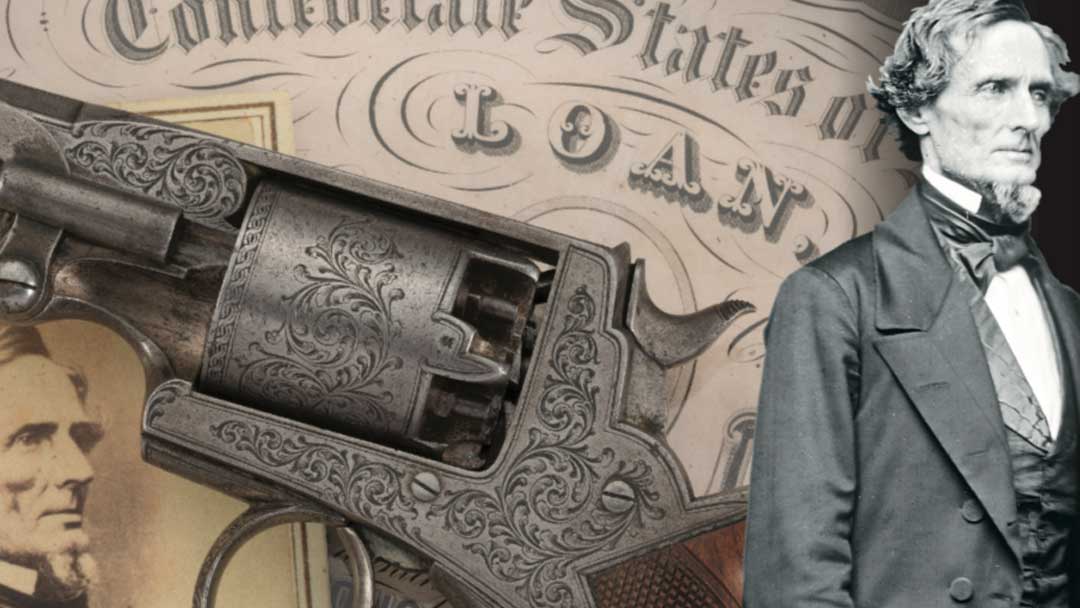
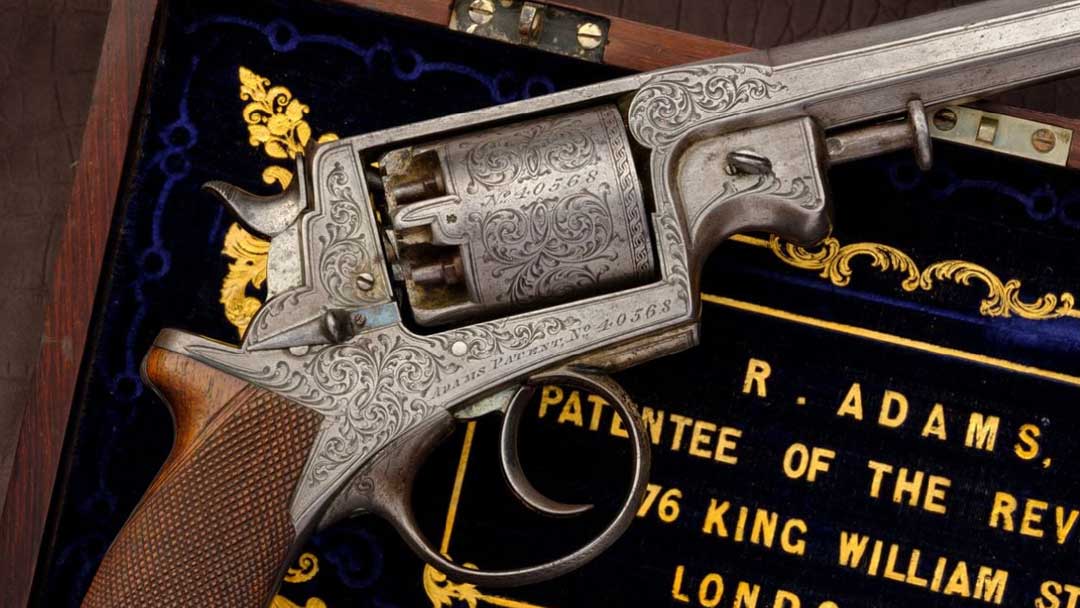
One of the most important war trophies of any American War: the Beaumont-Adams revolver presented to Confederate States of America President Jefferson Davis by Robert Adams of London and personally surrendered to Union Cavalryman John Hines of the 4th Michigan Cavalry at the capture of Jefferson Davis on May 10, 1865.
A pair of Moore’s Patent gilt derringer pistols inscribed to General Abner Doubleday. Manufactured from 1861 to 1863.
Whether defined by their superlative condition, immense rarity, or links to the legendary figures who fought in the conflict, Rock Island Auction Company’s May 2023 Premier Firearms Auction offers an unmatched selection of Civil War guns for sale that would complete even the most advanced collections. From rifles, carbines, and revolvers to swords, canes, and cannons, every genre is well-represented, and you can click on the images throughout this article to learn more about each item.
Civil War guns for sale and more this May at Rock Island Auction Company.
The Revolver Surrendered by a Captured Jefferson Davis
The story of the Jefferson Davis revolver, one of the most important Confederate artifacts in private hands, started with John and Edwin Hines. Both brothers served in Company E of the 4th Michigan Cavalry, the regiment famous for capturing the Confederate President. This surrendered Beaumont-Adams revolver comes with complete, detailed, and documented provenance tracing the moment it came into the possession of John Hines at the capture of Jefferson Davis until its consignment in this auction through official military records, published accounts, newspaper articles, family letters, and full chain-of-ownership.
The Davis Revolver, #40568, is four serial numbers away from an almost identically embellished Beaumont-Adams revolver (blued rather than silver plated) presented to Stonewall Jackson from Robert Adams, #40572.
Jefferson Davis likely chose this .45 caliber Beaumont-Adams revolver as his sidearm of last resort over his .36 caliber Colt due to the superior speed and stopping power of the Adams.
Civil War Guns for Sale: Union Revolvers
Another immensely historic part of the Civil War, the Captain Williams presentation cased, factory engraved, silver plated, and gold trimmed Colt Model 1861 Navy revolvers rank among the most well-known of all known Civil War Colts. Captain George Augustus Williams of the 1st U.S. Infantry saw action in some of the most noteworthy battles of the Civil War’s Western Theater, including serving with the heavy artillery during the capture of New Madrid, Missouri, the Battle of Island Number Ten, and the Siege of Corinth, Mississippi. A newly promoted Williams was in command of the 47th Illinois Volunteers during Grant’s Vicksburg Campaign, where Williams was wounded and disabled during the Yazoo Pass Expedition. He received a promotion to lieutenant colonel on July 4, 1863, for his service during the Siege of Vicksburg.
This matched pair of exquisite Civil War-era Colt 1861 Navy revolvers has been featured in numerous significant books on Colts and housed in prominent collections documented back to 1924.
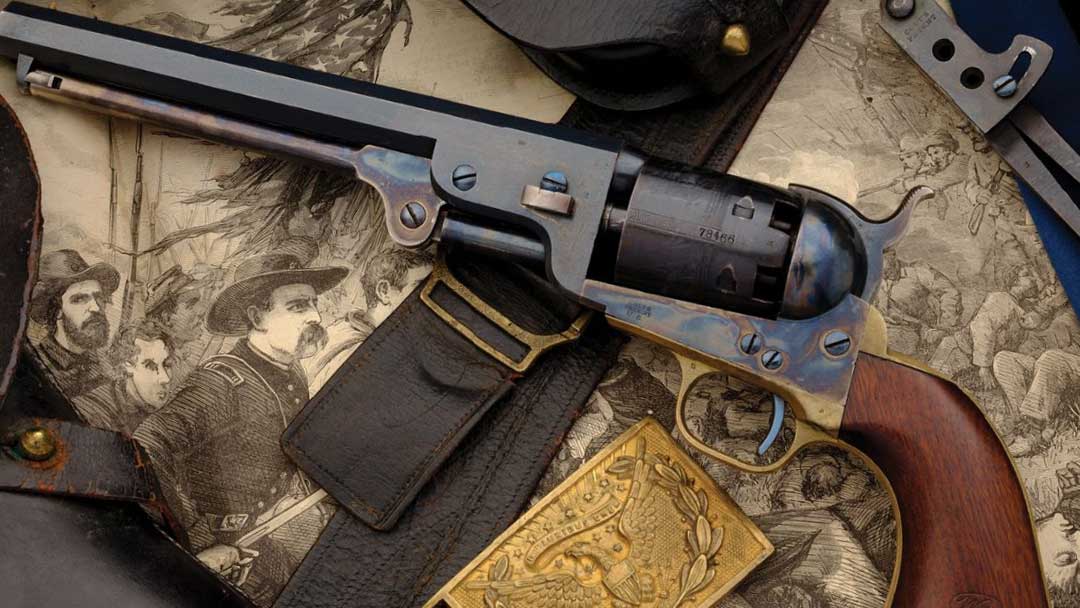
The Colt Model 1851 Navy was one of Samuel Colt’s most popular revolvers in the 19th century. Nearly all Colt Model 1851 Navy revolvers show signs of use, and this is especially true for the U.S. Army contract revolvers that were widely fielded during the American Civil War. The very near-mint Model 1851 revolver for sale this May was manufactured in 1857 under contract for the U.S. Army but remains in as-issued condition, about as near to mint as possible for a military contract revolver from more than a century and a half ago.
This outstanding U.S. Army Colt Model 1851 Navy revolver is rated in excellent plus condition.
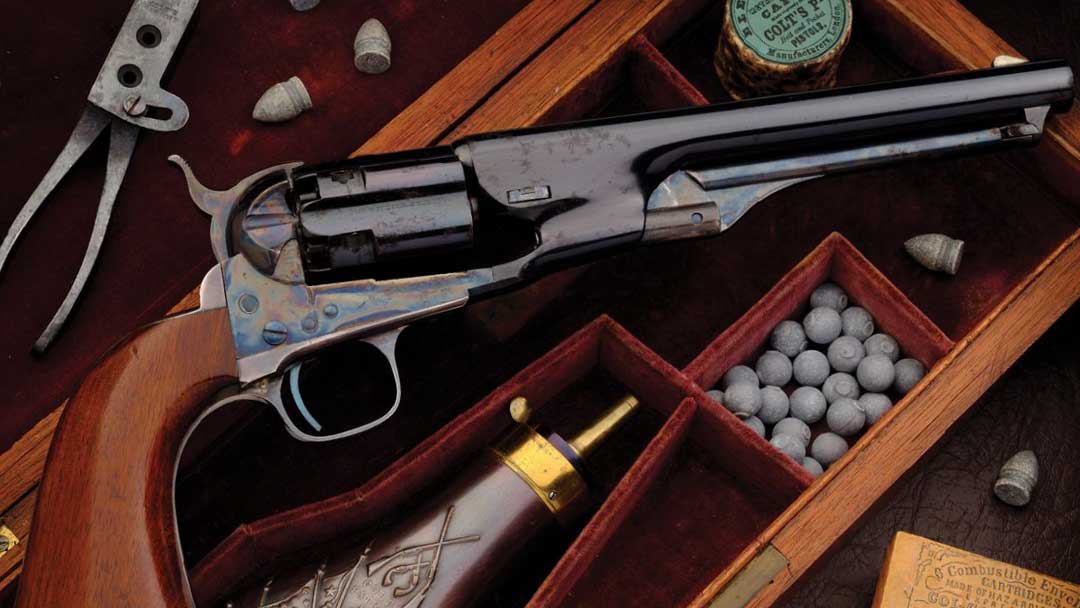
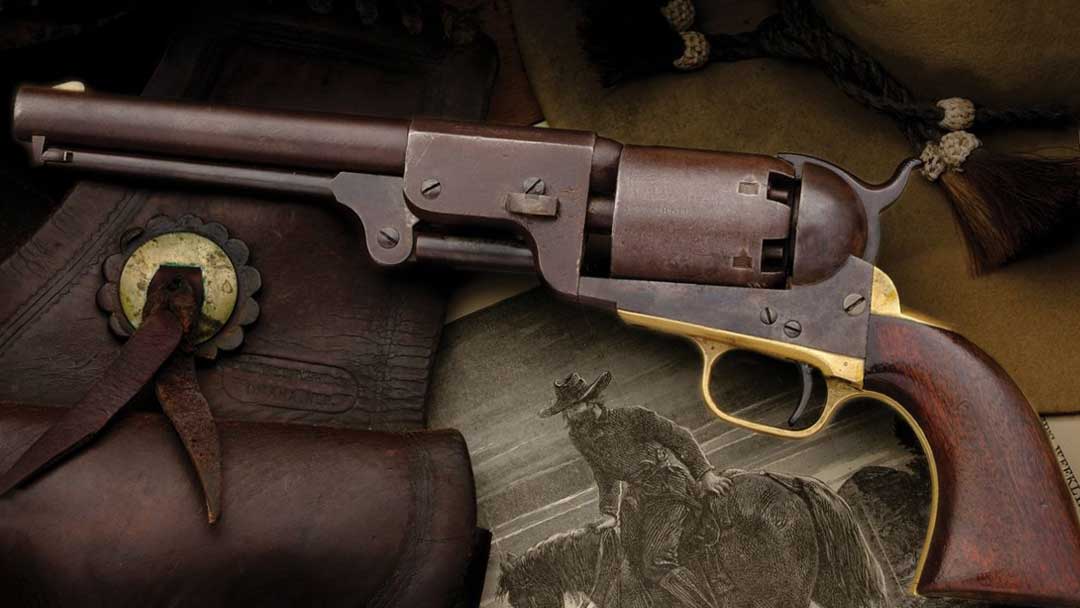
More than 200,000 Colt Model 1860 Army revolvers were manufactured between 1860 and 1871, with the United States government purchasing nearly half of all models produced. Early production, fluted cylinder Colt Model 1860 Army revolvers are among the most sought-after Civil War guns for sale, with the stunning example below among the rare few surviving Model 1860 Army revolvers in such striking condition.
A three-digit serial number cased Colt Model 1860 Fluted Army revolver, the finest of its kind. From the Greg Lampe Collection.
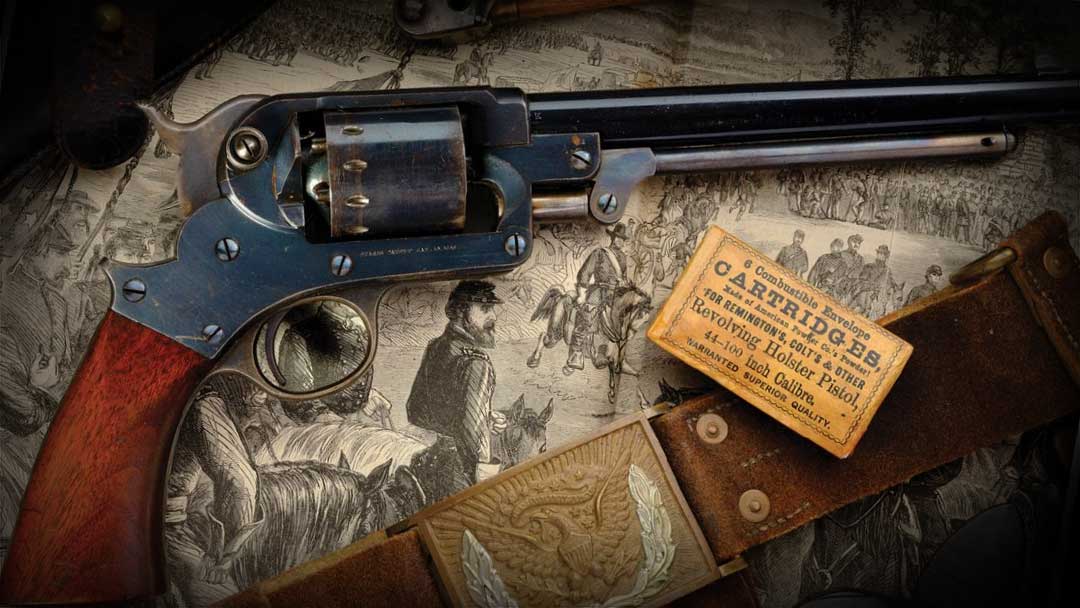
This outstanding U.S. Starr Model 1863 single action percussion revolver rig with its holster belt, bullet mold, and cartridge pack is in exceptional condition and will be nearly impossible to improve upon.
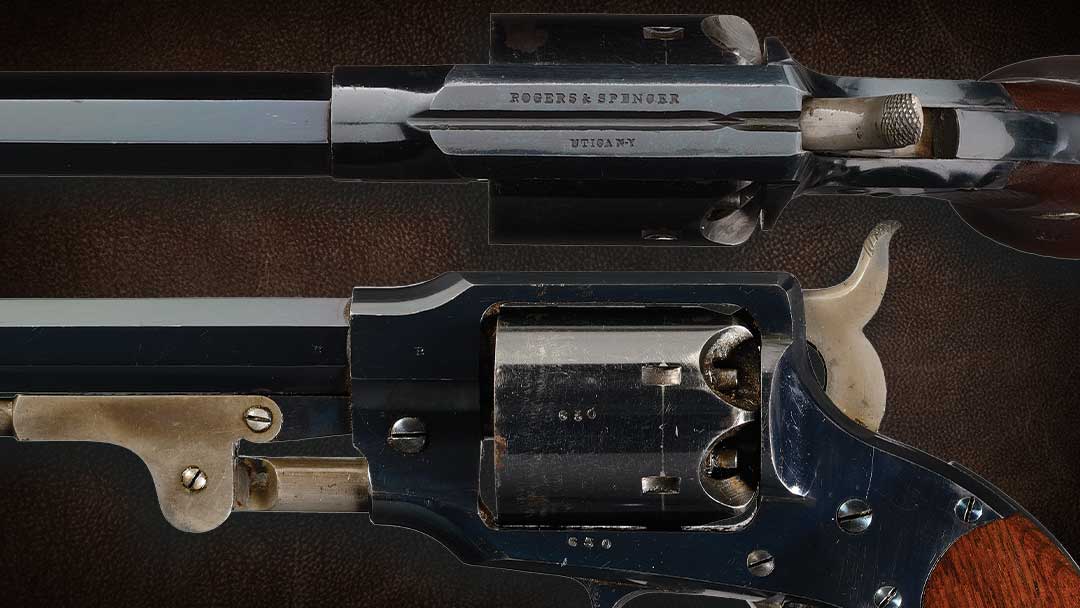
Rogers & Spencer Co. of Willow Dale, New York, was awarded a contract by the Ordnance Department for 5,000 .44 caliber revolvers in November of 1864. Only 1,500 revolvers had been delivered before the conclusion of hostilities in April of 1865, with the remaining 3,500 eventually sold into surplus. The early production, three-digit serial number Rogers & Spencer Army Model single action revolver offered by Rock Island Auction Company this May appears to be unfired and shows only storage wear.
A remarkable example of a Civil War Rogers & Spencer Army Model revolver displays crisp Ordnance inspection marks and all of its original oil finish. “ROGERS & SPENCER/UTICA N-Y” is stamped on either side of the top trap sighting groove.
Civil War Guns for Sale: Confederate Revolvers
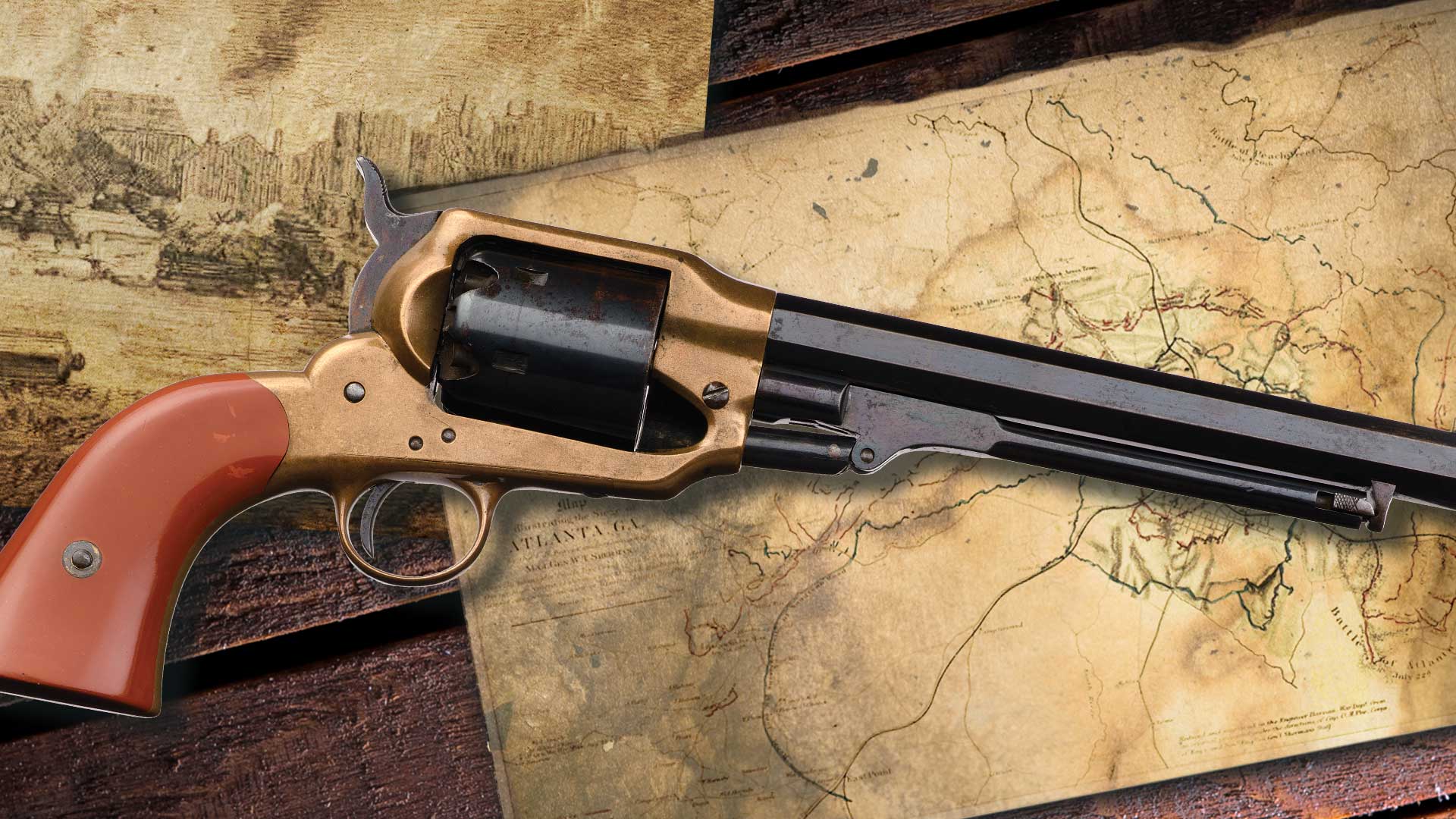
Confederate revolvers were born from the need to compete with the might of an industrialized North and to supply a rebel army strangled by the Union blockade. Due to their history and extreme rarity, Confederate-produced revolvers are some of the most coveted Civil War guns for sale today. One of those manufacturers was founded by Lt. Col. James H. Burton, Edward N. Spiller, and David J. Burr in 1861, with their revolver patterned on the Whitney Arms Company Navy. Fewer than 1,500 Spiller & Burr revolvers were manufactured before production was halted in November of 1864 due to Sherman’s March to the Sea, and the spectacular example in RIAC’s May Premier is one of only four known round frame Spiller & Burr revolvers.
One of only four known examples of a round frame Confederate Spiller & Burr percussion revolver, and one of the most coveted Civil War guns for sale this May.
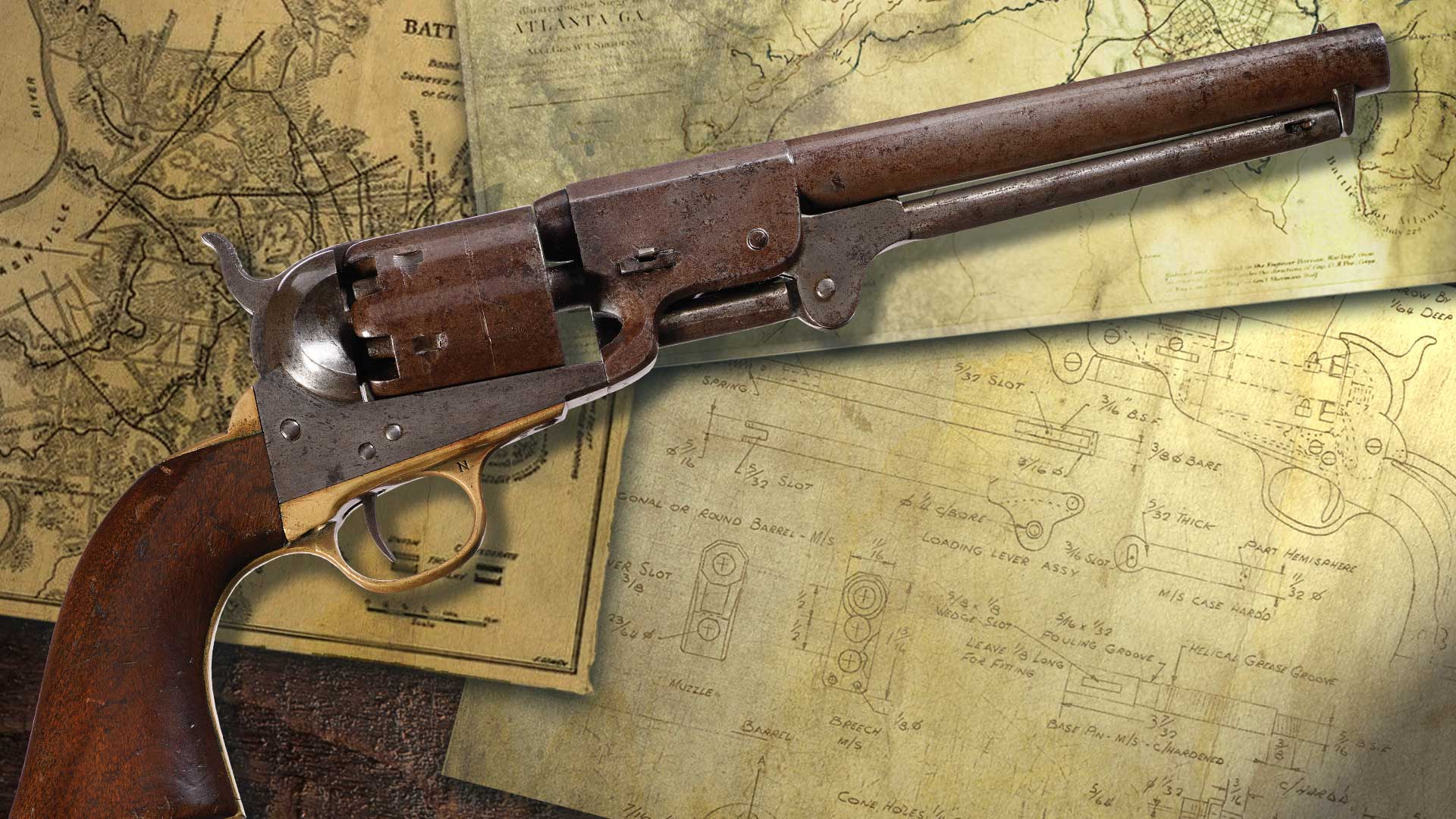
Manufactured in Greensboro, Georgia by Thomas Leech and Charles Rigdon, the Leech & Rigdon revolver design was a close copy of the Colt Navy Model, though with a distinct round barrel with an octagonal top barrel housing similar to the Colt Dragoon. Only 1,500 Leech & Rigdon revolvers were produced between 1863 and 1864 on contract with the Confederate government, and May’s auction includes one of the most exceptional examples in the collecting pursuit.
Among the finest known Civil War Confederate Leech & Rigdon percussion revolvers.
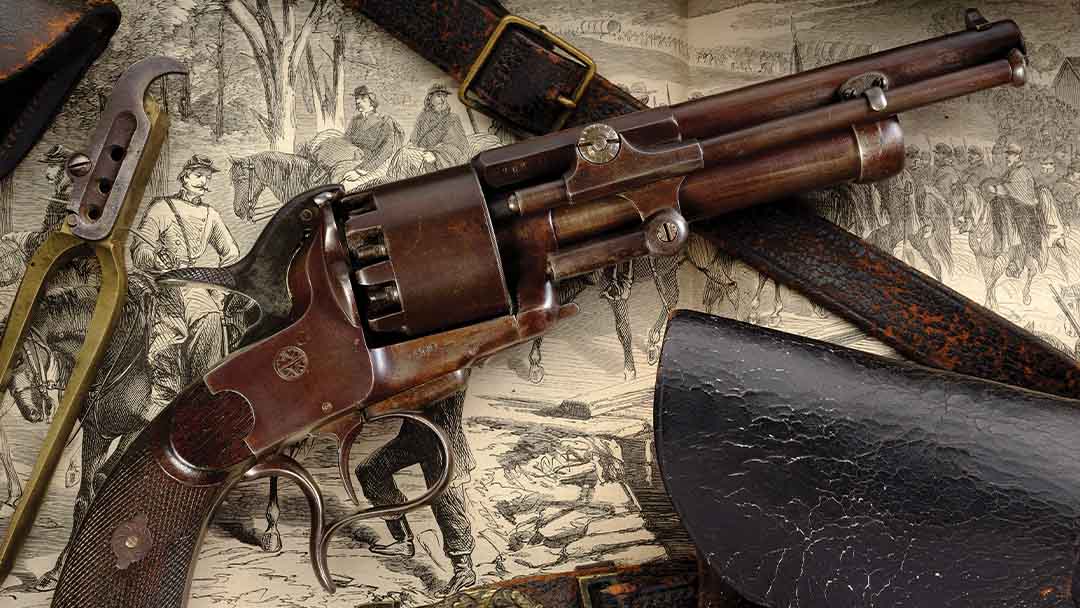
One of the most unique Civil War guns for sale this May, “LeMat’s Grape Shot Revolver” provided a soldier with versatility and comparatively high capacity. Designed by Dr. Jean Alexandre LeMat of New Orleans, these fascinating combination guns were primarily produced in Liege, Belgium, and Paris, France, and smuggled into the South during the Civil War. The LeMat revolver was carried by numerous Confederate generals and officers such as P.G.T. Beauregard, Braxton Bragg, and J.E.B. Stuart.
A LeMat revolver, a nine-shot .42 caliber wheel gun with an 18 gauge shotgun barrel mounted beneath the barrel.
In the months leading up to the Civil War, Colt’s Manufacturing Company sold guns to all parties until accusations of Southern sympathies forced the company to end the practice in late April of 1861. Colt revolvers continued to find their way past the Union blockade throughout the conflict. In an article titled “C.L. Dragoons” in “The Gun Report” Volume 36, Number 8 from January 1991, author Walter L. Anderson concluded that arms dealer Cooper & Pond of New York ran a number of revolvers through the Union blockade. These efforts were likely funded by wealthy Alabama planter John Jay Crocheron in order to equip a company of Confederate light dragoons led by a Captain Robert W. Smith. The company was named in Crocheron’s honor, becoming the “C.L. DRAGOONS.”
One of less than 20 “C.L. DRAGOONS” inscribed 3rd Model Dragoon revolvers known today.
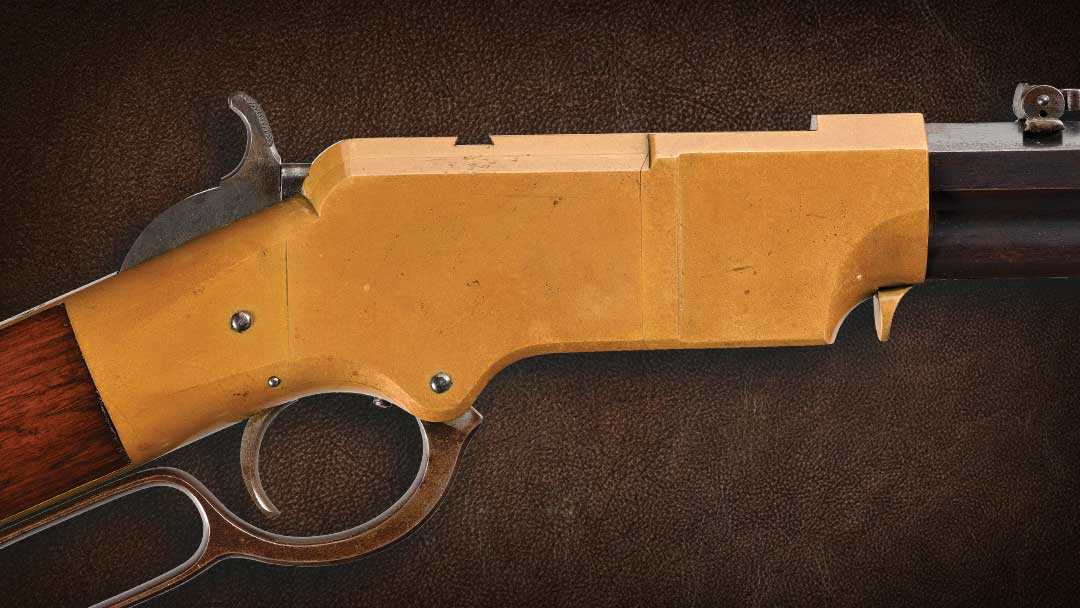
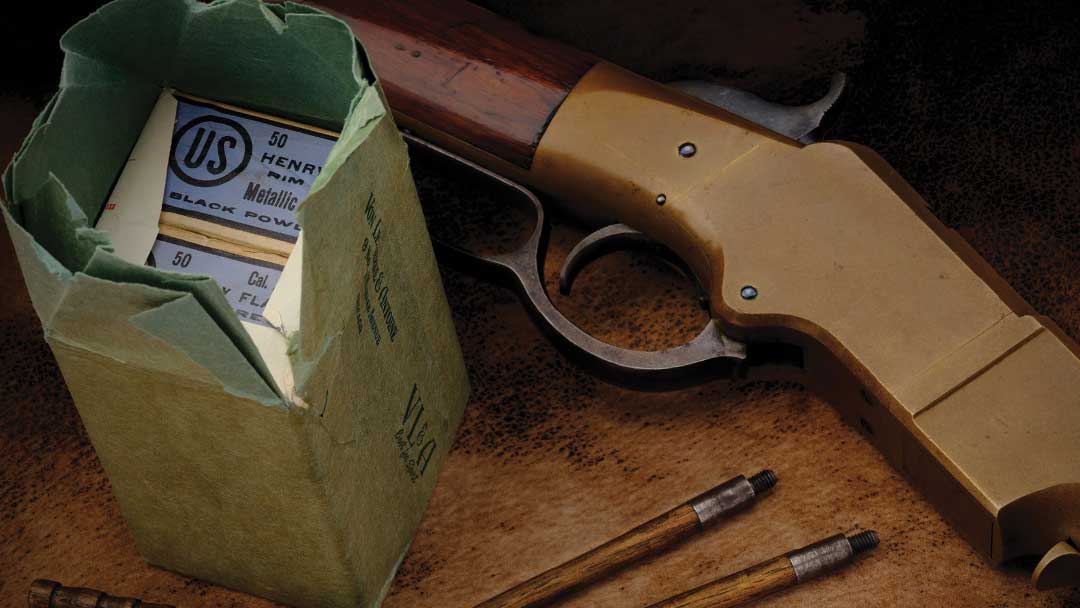
The New Haven Arms Co. Henry repeating rifle is legendary among collectors for its American Civil War ingenuity and its status as the blueprint for the Winchester Model 1866 and its iconic lever gun lineage to follow. Aside from 900 rifles purchased by the Ordnance Department in 1863 and 1864 to arm the 1st D.C. Cavalry Regiment, nearly all Henry rifles used in the Civil War were privately purchased by individual soldiers or volunteer units who wanted to have the most advanced firearm available and take advantage of the sustained firepower of a 15-shot magazine rifle. Henry rifles manufactured during the Civil War with any original finish are a remarkable rarity.
An extraordinary example of a Henry lever action rifle that was manufactured by the New Haven Arms Co. of New Haven, Connecticut, in 1863.
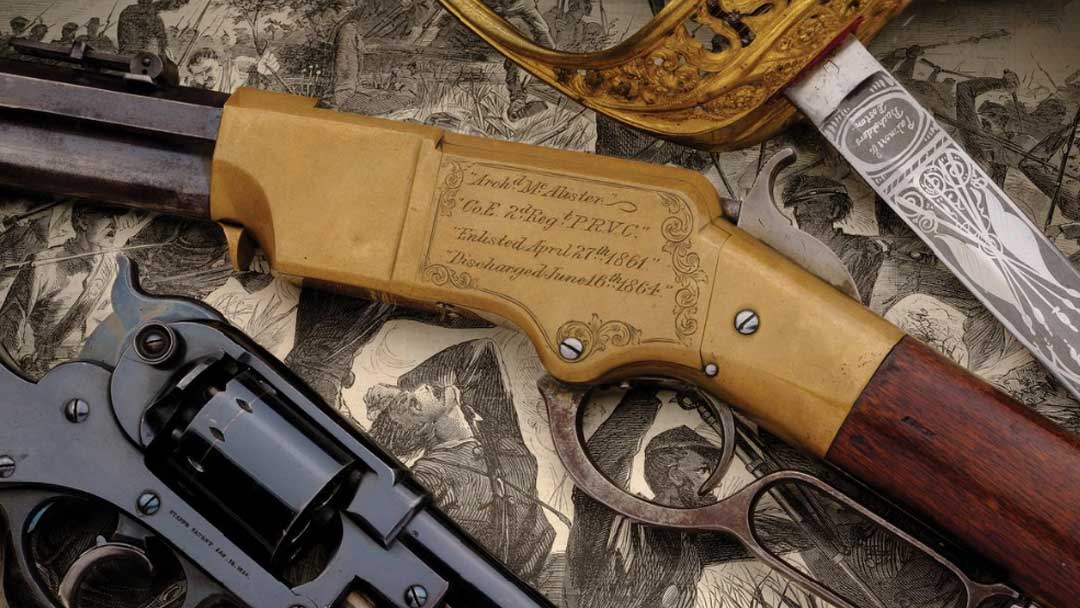
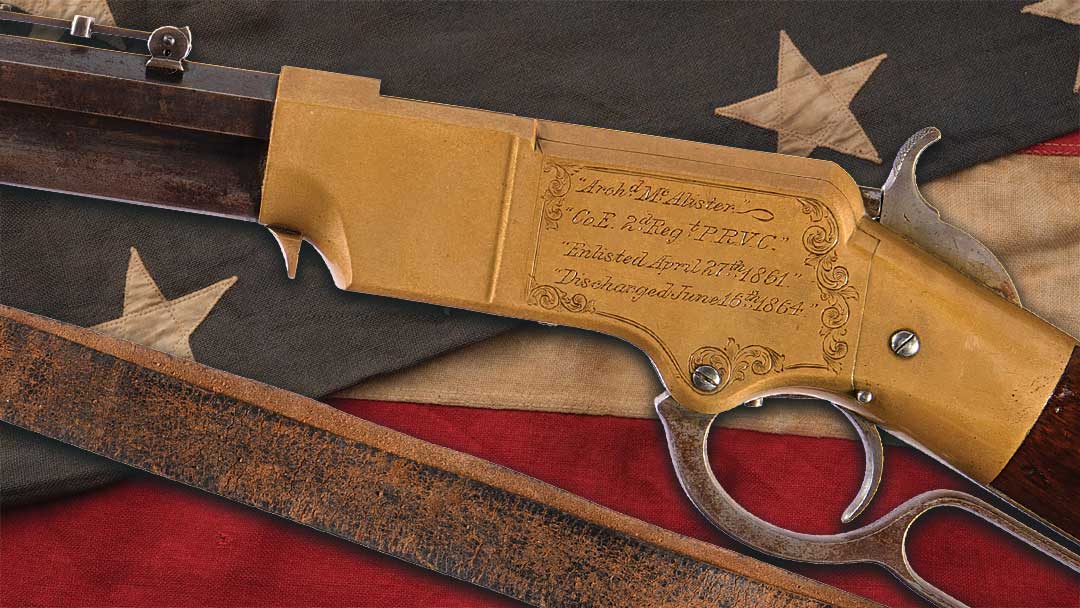
Next on the list of museum-worthy Civil War guns for sale this May is a scarce example of a documented U.S. second contract Henry rifle that was issued to the 3rd Veteran Volunteer Infantry and inscribed to Archibald McAlister of Co. E of the Pennsylvania Regiment Volunteer Corps and the 3rd Regiment of Veteran Volunteers. Given the dates on the rifle, Archibald McAlister appears to have enlisted for the 1-year minimum period and would have received a $100 enlistment bounty.
U.S. martially inspected second contract New Haven Arms Company Henry rifles are among the rarest and most desirable Civil War guns for sale.
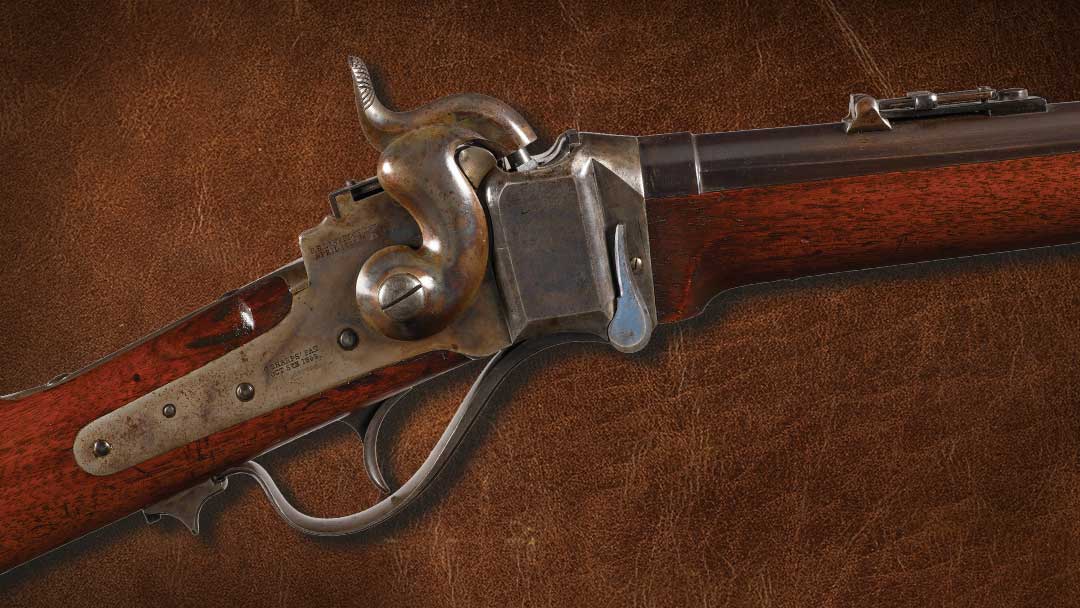
Sharps rifles and carbines were fielded by elite marksmen on both sides of the Civil War. Some special New Model 1859 rifles were ordered for and used by the First and Second U.S. Sharpshooters, a green-jacketed regiment of volunteers popularly known as Berdan’s Sharpshooters. The Sharps rifle proved well suited for the role of testing an enemy’s strength, slowing advances, picking off officers, and harassing a retreating foe, and the iconic rifle helped Berdan’s Sharpshooters leave a lasting legacy on small unit tactics and modern warfare.
For collectors looking for the finest Civil War guns for sale, it doesn’t get much better than this exceptional condition Sharps New Model 1859 with a saber bayonet.
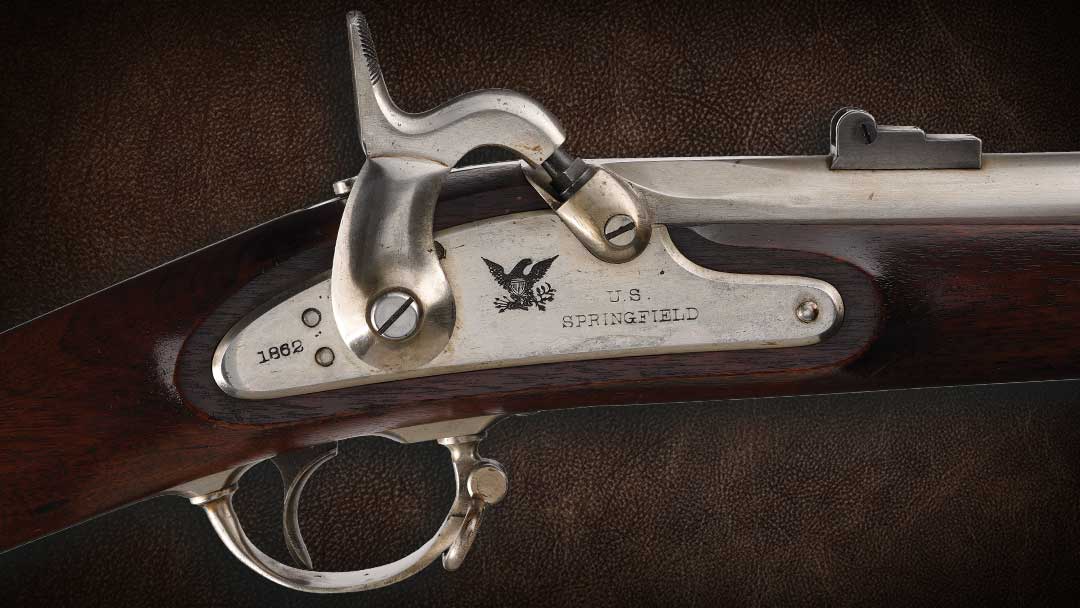
The dependable Springfield Model 1861 rifle-musket was produced by Springfield Armory and about two dozen other contracted firms using interchangeable parts on a wide scale. As the primary shoulder arm used by the Union infantry during the Civil War, the Springfield Model 1861 rifle-musket saw heavy use in every major battle, and finding such a pristine condition example is a treasure for any military arms collector.
One of the numerous time capsule quality condition Civil War guns for sale this May at Rock Island Auction Company, this Model 1861 rifle-musket with bayonet appears to have remained in storage for the length of the war.
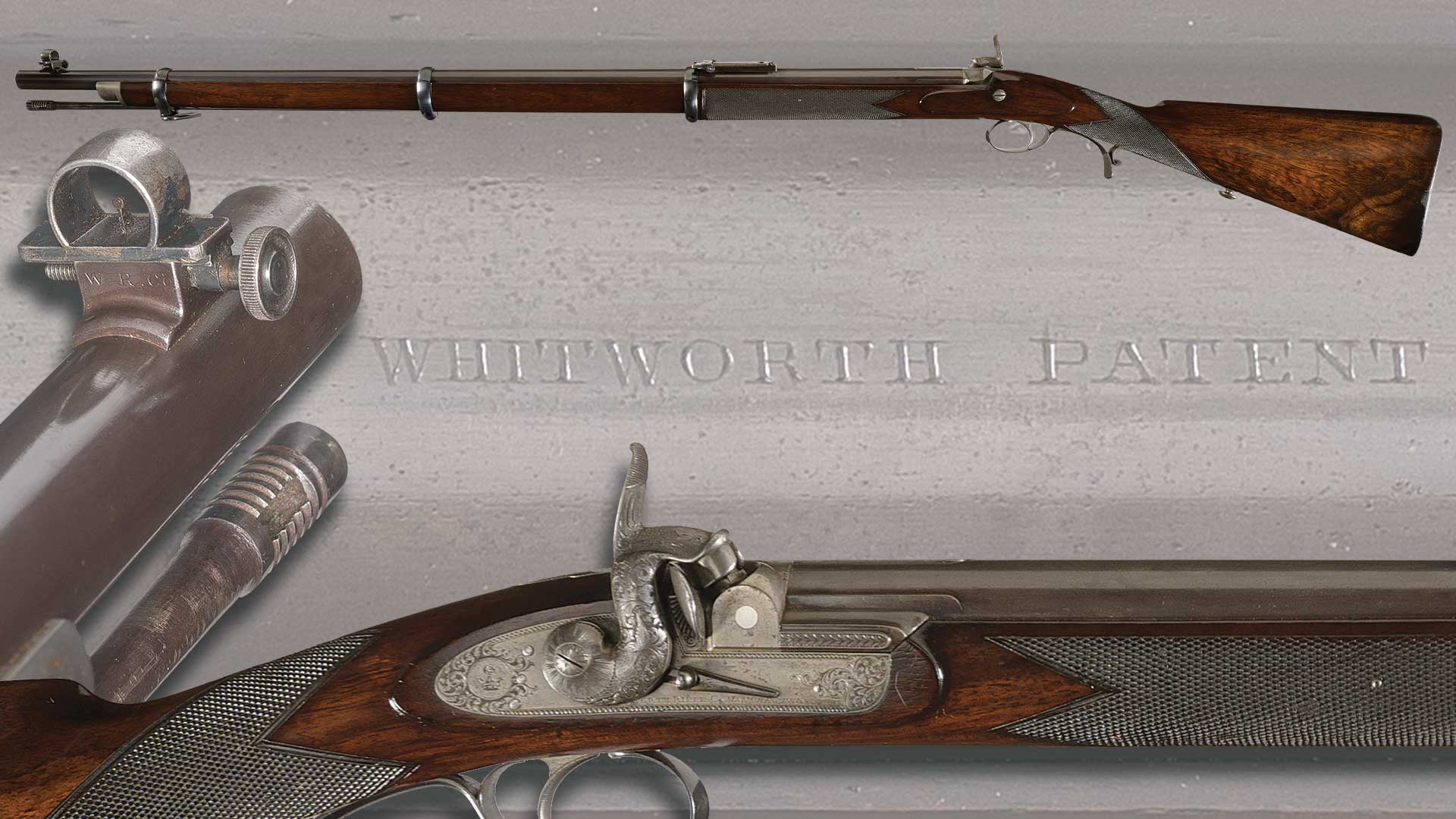
On the other side of the Mason-Dixon line, the English-manufactured Whitworth rifle became a favorite of Confederate snipers. Though more accurate than the standard Enfield infantry rifle, the Whitworth commanded nearly four times the price and was only issued to the most proficient southern marksmen, or “Whitworth Sharpshooters.”
A rare engraved Whitworth percussion military match/sharpshooter rifle. “WHITWORTH PATENT” is marked on top, referring to Joseph Whitworth’s famous patented hexagonal rifling, and the rifle is fitted with an adjustable hooded blade front sight and target ladder rear sight.
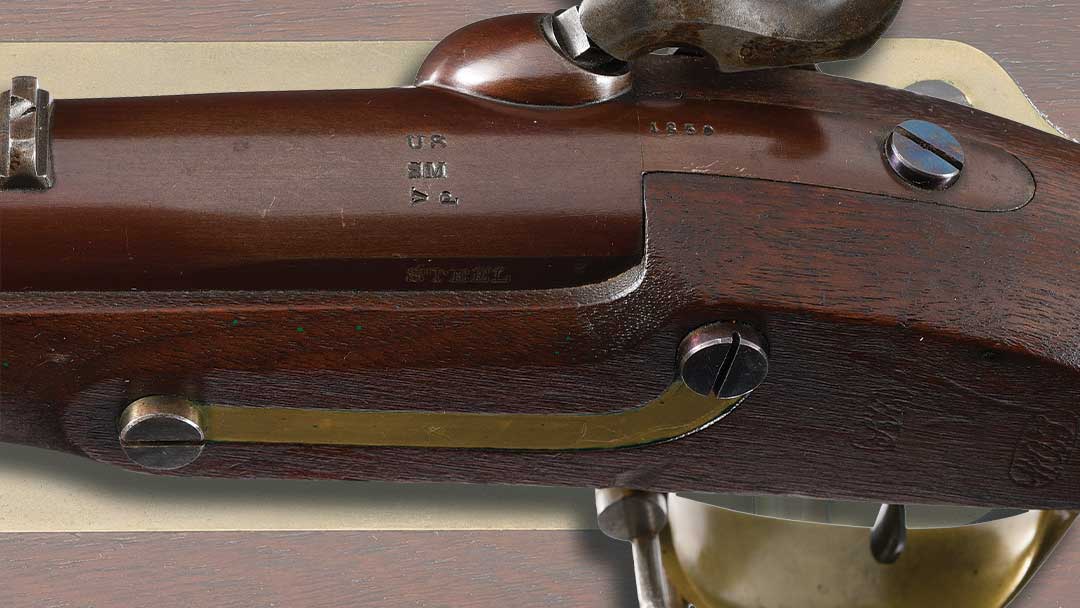
The Model 1841 “Mississippi” rifle belongs in any complete U.S. martial firearms collection, and one of the finest examples of its kind is available this May. The Model 1841 earned its reputation during the Mexican War with the 1st Mississippi Rifles commanded by Colonel Jefferson Davis, where it earned its famous nickname. Initially issued to light infantry and the 3rd Regiment of Mounted Rifles, the Model 1841 saw wide use with both the Union and Confederate armies during the Civil War.
This is an exceptional, nearly as-issued, original example of a U.S. contract Model 1841 rifle in .54 caliber round ball configuration with its 7-groove rifling.
Civil War Guns for Sale: Exquisite Carbines
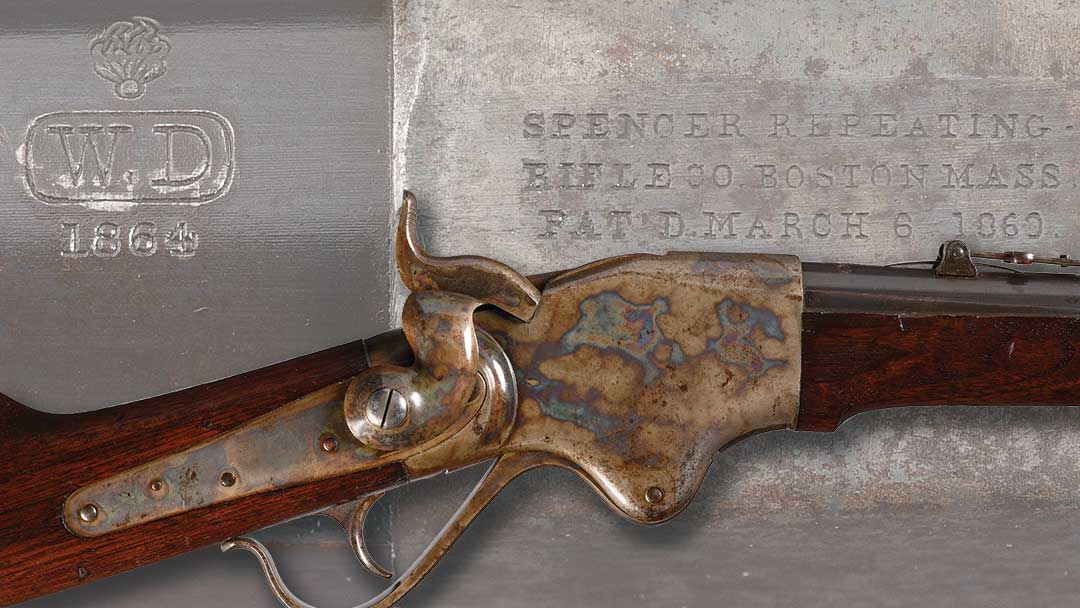
As the first military-issued repeating metallic-cartridge long gun design, the Spencer rifle and carbine offered an unprecedented level of firepower during the Civil War. After inventor Christopher Spencer gave President Lincoln a personal demonstration of his seven-shot lever action repeater, Lincoln pressured his Ordnance Department to adopt the new weapon. RIAC’s May 2023 Premier features a War Department pattern Spencer carbine examined by noted inspector William A. Thornton, whose June 9th, 1864 letter identifies the exact gun pictured below by serial number and proceeds to offer a thorough report on the weapon.
This rare Spencer Model 1860 carbine is identified as a War Department pattern gun and the top of the breech end of the barrel is bearing a flaming bomb stamp above “W.D” (War Department) surrounded by an oval and “1864” in three lines.
One of the many innovative breech loading carbines utilized by the Union cavalry was developed by future General Ambrose Everett Burnside during the 1850s. The Burnside carbine became the third most purchased breech loading carbine during the Civil War after only the Sharps and the Spencer. The “Fifth Model” Burnside carbine represents the most refined variant of General Burnside’s reliable carbine design, with a “guide screw” in the breech block that helped accelerate the loading process.
A spectacular Civil War U.S. Burnside Fifth Model breech loading saddle ring carbine, one of the can’t-miss Civil War guns for sale this May.
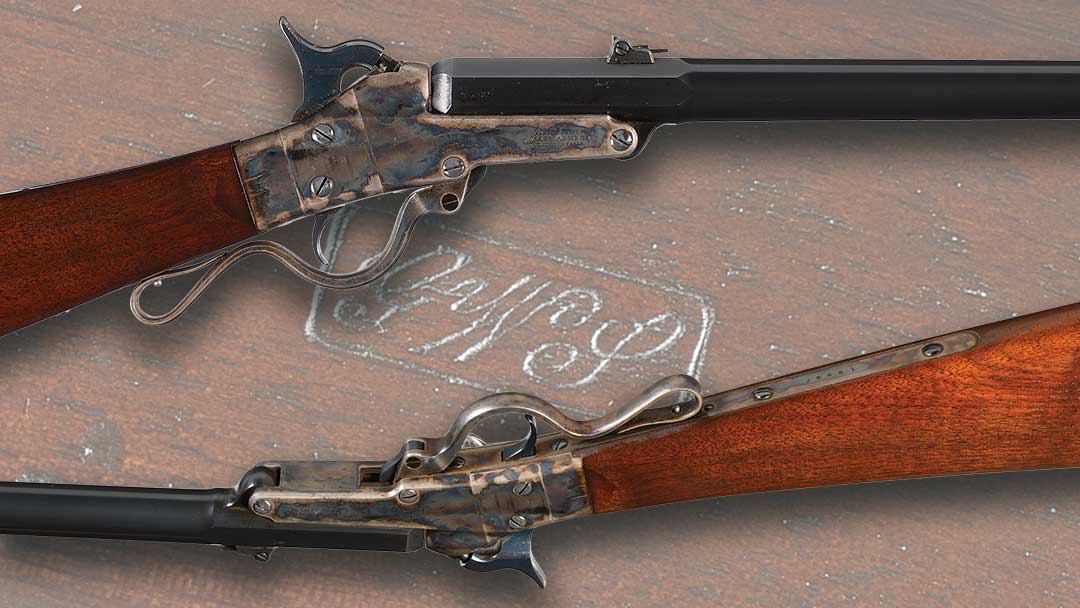
Dr. Edward Maynard, a dentist and inventor from New York, conceived one of the war’s best breech loading carbines. Manufactured by the Massachusetts Arms Company, Maynard’s single-shot, metallic-cartridge, breech loading carbine saw two variations, with several thousand First Model Maynard carbines purchased by southern states in the lead-up to the Civil War. Approximately 20,202 Second Model Maynard carbines were manufactured from 1863 to 1865 to arm Federal cavalry units, including the 6th, 9th, and 11th Indiana Cavalry as well as the 10th and 11th East Tennessee Union Cavalry.
A spectacular Civil War U.S. Massachusetts Arms Co. Second Model Maynard saddle ring carbine. Two boxed script “GWS” and “JM” inspection cartouches are crisply stamped on the left stock wrist.
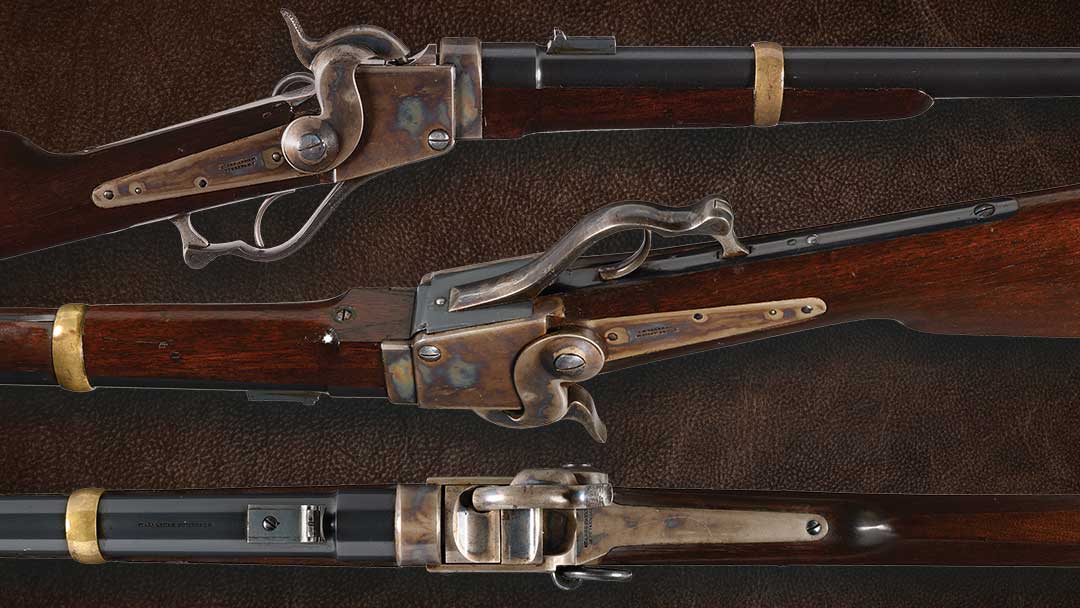
Before he developed his famous revolvers, Ebenezer Starr patented a .54 caliber carbine with a falling block design activated by the trigger guard in 1858. As the War Between the States commenced, the federal government ordered 20,000 Starr carbines and earmarked the weapons for cavalry units in the West. In the end, the Starr became the fifth most manufactured Civil War carbine, though high-condition offerings like the Starr carbine example below are immensely difficult to find.
Another high-pedigree Civil War gun for sale, this is one of the few Starr carbines known to survive in such immaculate condition.
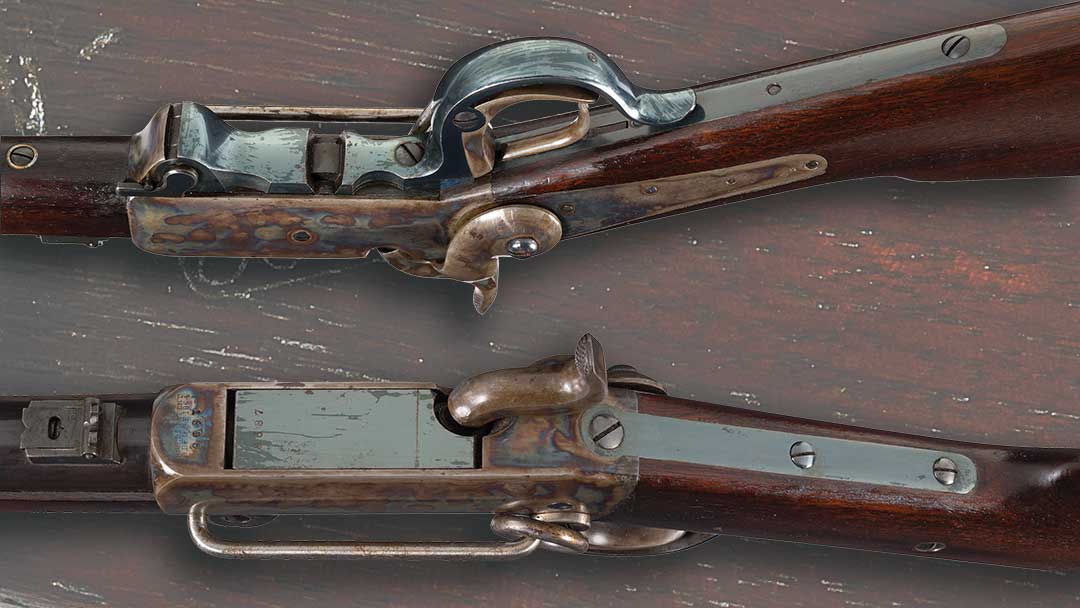
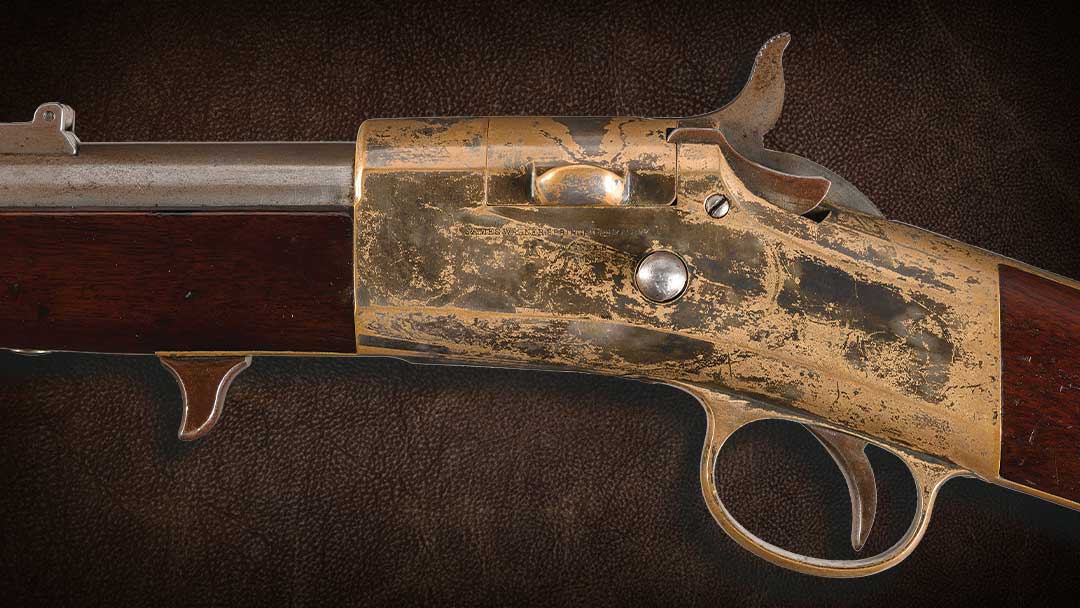
Civil War guns are an antique collector’s dream for the same reason the conflict was a nightmare for the Ordnance Department: a dizzying array of different gun models and ammunition were being produced to equip the vast armies being fielded. Cavalry carbines from 19 different manufacturers were adopted by the Union side alone. Elusive models like the Gwyn & Campbell Type I and Type II carbines, the Joslyn Model 1864 carbine, and the James Warner carbine are among the rarest Civil War guns for sale this May.
A unique silver-plated example of a very scarce James Warner carbine.
Civil War Swords for Sale
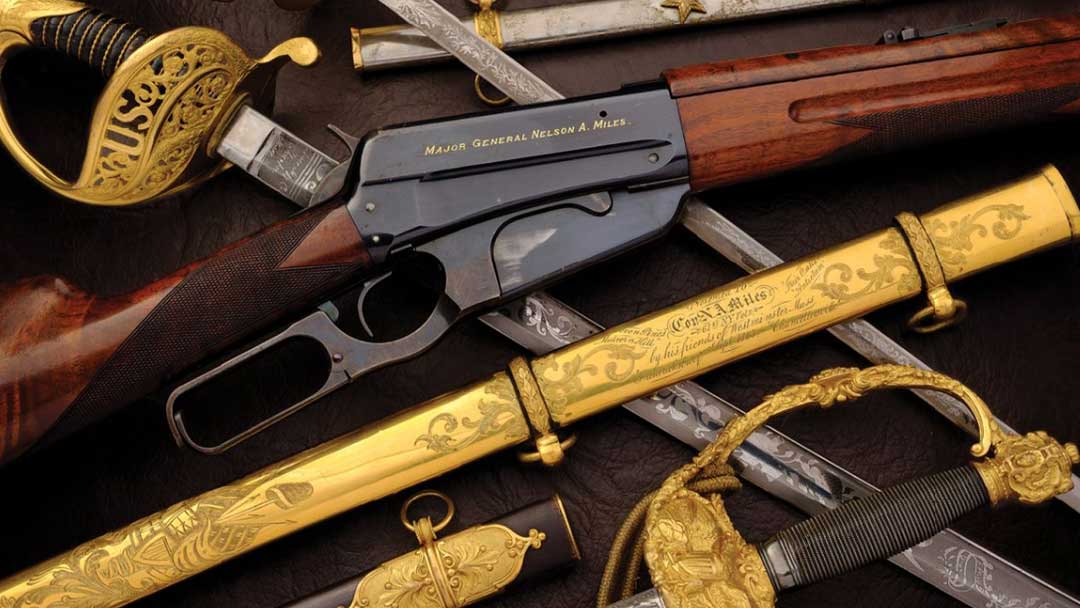
Like the surviving firearms from the conflict, most Civil War swords have a story to tell and a legacy to share. Needless to say, Civil War swords are arms collecting cornerstones, especially marquee condition swords owned by one of the most decorated American generals in history. General Nelson A. Miles fought in the Civil War, earned a Medal of Honor, and put Jefferson Davis in chains. May’s auction offers several swords, firearms, and additional artifacts owned by the legendary general, including a presentation-grade gilt Ames Model 1860 staff & field officer’s sword and two officer’s dress swords.
Col. Nelson Miles Presentation Model 1860 officer sword (bottom), Col. Nelson Miles Winchester Model 1895 rifle (middle) and Col. Nelson Miles’ two officer’s dress swords (top) are all available this May at RIAC.
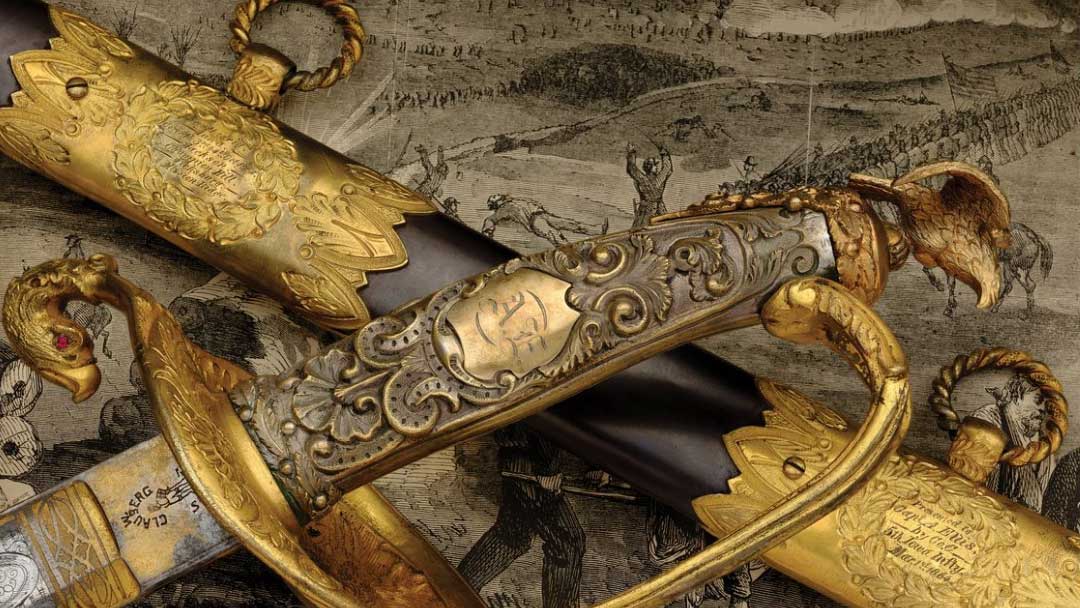
Another breathtaking example of condition, rarity, and well-documented Civil War history is found in this Civil War Clauberg officer’s gilt presentation staff & field officer’s sword. The scabbard is inscribed “Presented to Capt. A. Ellis,/by Co. C/5th Iowa Infty/Mar. 1st 1864” and lists his battle honors as “New Madrid./Iuka./Corinth 3rd & 4th Oct. 1862./Jackson./Champion Hill./Vicksburg./Mission Ridge.” Captain Albert Gallatin Ellis (1835-1918) enlisted as a private in the 5th Iowa Infantry on July 16, 1861. The 5th Iowa saw serious combat in the Western Theater of the war, fighting in Missouri, Mississippi, and Tennessee.
A historic Civil War sword for sale, a Clauberg officer’s gilt presentation staff & field officer’s sword and scabbard inscribed to Captain Archibald Ellis of Company C of the 5th Iowa Infantry with additional personal artifacts and extensive research documentation.
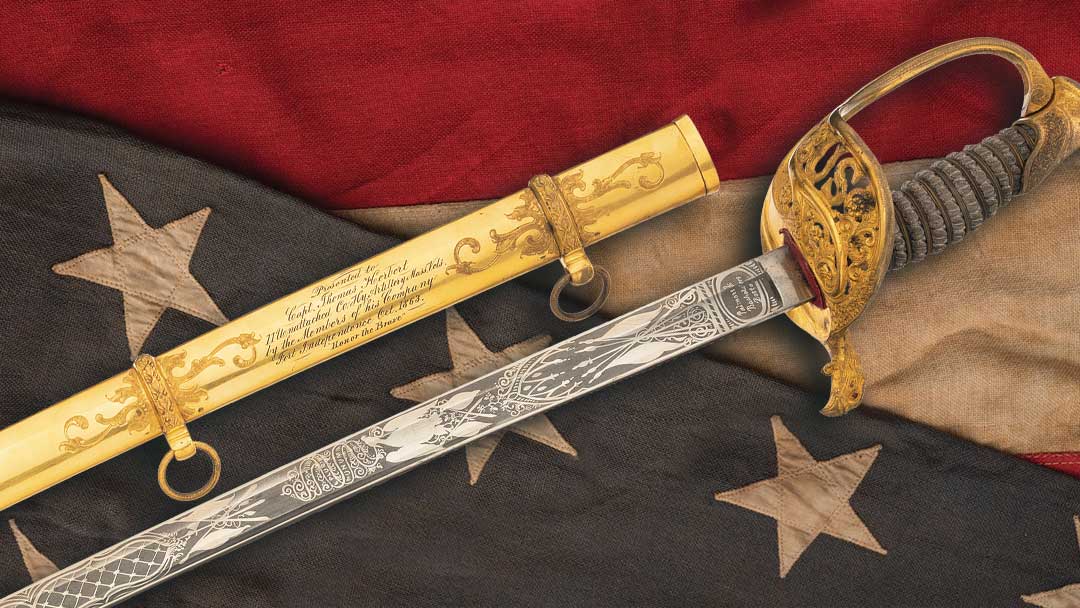
Another stunning presentation sword, the example below follows a similar pattern to other Model 1850 foot officer swords but with the addition of wonderfully etched floral scrolls covering nearly its entire length. An inscription on the hilt reads “Presented to/Capt. Thomas Herbert/11 Unattached Co. Hy. Artillery Mass. Vols./by the Members of his Company/Fort Independence Oct. 1863/-‘Honor the Brave’-“. Thomas Herbert served with Company I of the 8th Massachusetts Volunteer Infantry before mustering into the Company G (11th Unattached Company) of the 3rd Massachusetts Volunteer Heavy Artillery which was raised on October 20, 1863 to protect the numerous forts around Washington D.C.
A very attractive Civil War officer’s sword with an Ames scabbard inscribed to Captain Thomas Herbert, who served with Company I of the 8th Massachusetts Volunteer Infantry.
Civil War Cannons for Sale
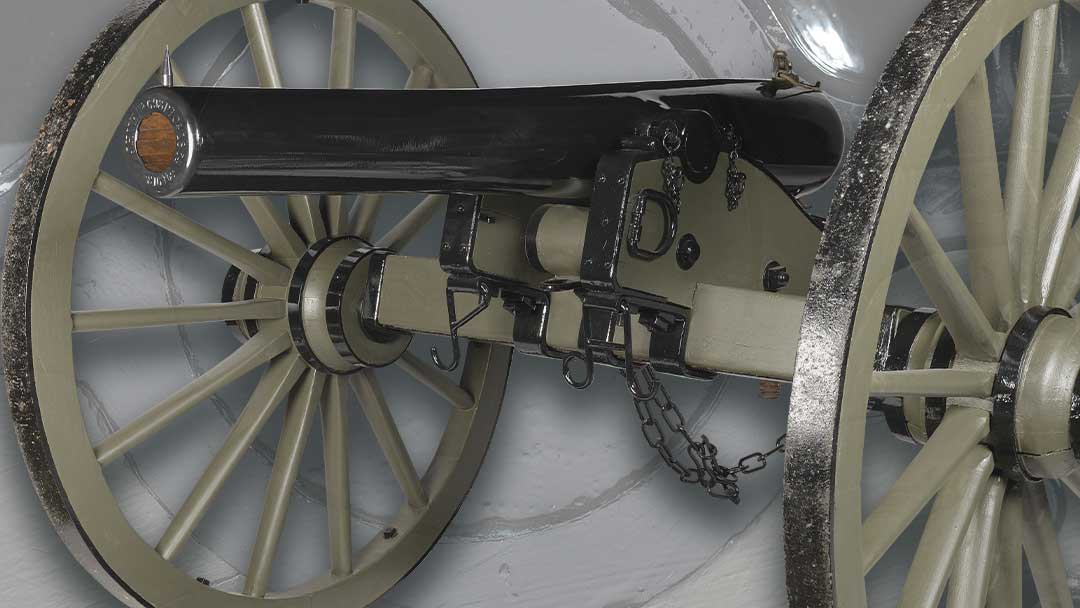
When it comes to the biggest Civil War guns for sale, one genre stands above the rest in terms of sheer scale and firepower. Enter the mighty cannon, the true difference-maker in the conflict’s bloodiest battles. The Model 1861 3-inch ordnance rifles were among the best and most widely used field artillery pieces of the Civil War, offering tremendous distance, accuracy, and maneuverability. With most of the roughly 350 surviving 3-inch ordnance rifles displayed in museums, historic sites, and battlefields, finding an example offered to the public is a rare opportunity indeed.
An 1864 dated Civil War Phoenix Iron Co. Model 1861 3-inch ordnance rifle with carriage, marked “J.H.V.F. No 693 PICo. 1864/816 lbs” on the muzzle.
Designed by Navy Lieutenant John A. Dahlgren shortly after the Mexican-American War, the bronze-casted 12-pounder boat Howitzer was developed with the capability of being mounted and fired from a frigate, quickly remounted on a naval launch carriage, and then remounted to a field carriage to serve as light artillery for Marine landing parties. Having only a single mounting lug expedited this process and period reports claim that an experienced Dahlgren boat Howitzer crew could get off 10 shots in a minute.
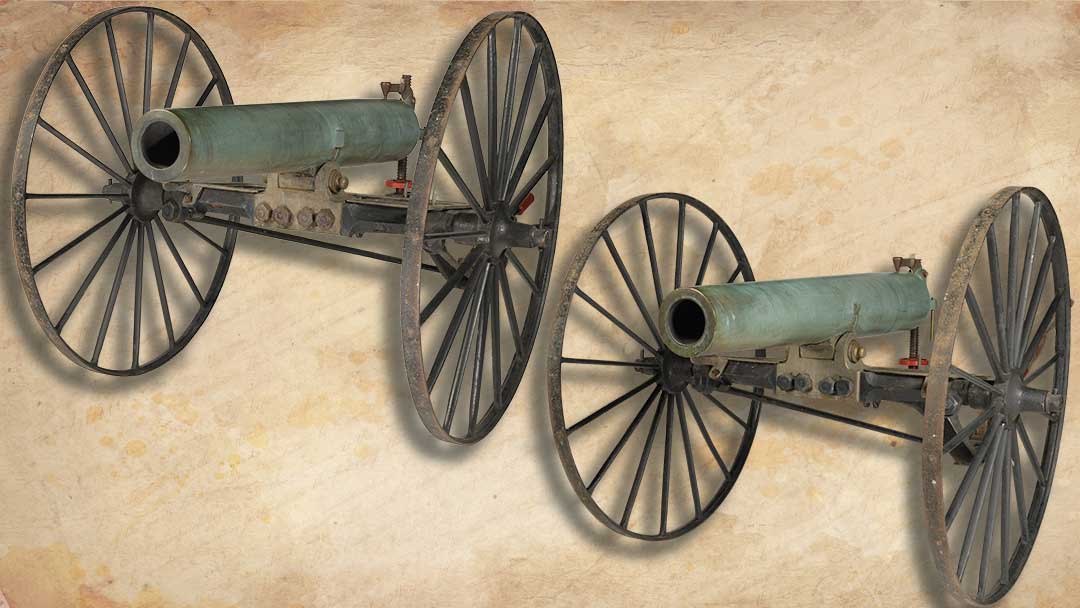
Two of the biggest Civil War guns for sale this May, a pair of incredibly rare Dahlgren 12-pounder bronze boat Howitzers with iron field carriages.
The Finest Civil War Guns for Sale
The Civil War spurred a renaissance in arms innovation, so it’s little wonder that gun collectors and history enthusiasts are drawn to relics from the period. Rock Island Auction Company’s 2023 May Premier Firearms Auction offers a wide selection of Civil War guns for sale that cater to every collecting aspiration, as well as featuring firearms and militaria connected to some of the most famous American heroes who forged their legends in the conflict.
Individual objects with this type of legacy and provenance are far and few between. To have an assortment of them is all but unheard of. General Nelson Miles’ Winchester 1895 and presentation sword are outstanding and well-preserved pieces of American history.
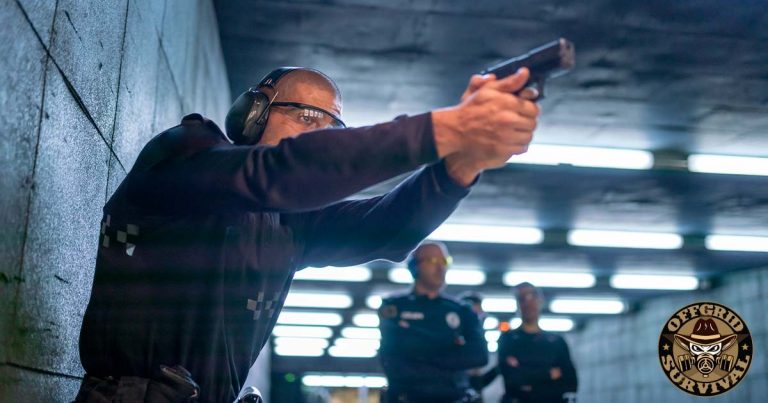
The IRS is seeking to hire gun-carrying agents in all 50 states who are willing to use deadly force. That’s right, you heard it correctly. The agency responsible for collecting your taxes is now recruiting agents who are armed and ready to take extreme measures to enforce their will.
According to the IRS job board, the agency is actively recruiting special agents who are willing to use force up to and including deadly force. The job description states, under the “Major Duties” section of the job description, applicants “must be willing to use force up to and including the use of deadly force.” [Archived link here in case the IRS removes the listing]
And if that wasn’t concerning enough, it has been reported that the IRS has repeatedly failed to ensure that proper procedures relating to firearms are followed. This means there is no guarantee that these new gun-toting agents have even received the necessary firearms training to safely handle their weapons.
To make matters worse, a report from the Treasury Inspector General for Tax Administration (TIGTA) found that the IRS has repeatedly failed to ensure that its agents receive proper firearms training. The report states, “There is no national-level review of firearms training records to ensure that all special agents meet the qualification requirements.”
This lack of training and oversight has resulted in numerous incidents where IRS agents have discharged their firearms. According to the TIGTA report, there were a total of eight firearm discharges classified as intentional use of force incidents and 11 discharges classified as accidental during FYs 2009 through 2011.
But that’s not all folks, there have even been cases where the IRS has actually lost weapons issued to its agents. In a 2014 report by the TIGTA, it was found that the IRS had lost 2 firearms, 1,556 rounds of ammunition, and 15 badges and credentials between fiscal years 2006 and 2013. This type of negligence by the IRS poses a serious threat to public safety and underscores the importance of proper firearms training and accountability.
Adding to the concern, the Biden administration recently announced plans to spend $80 billion to hire 87,000 new IRS agents. That’s right, the government is pouring more money into an already bloated agency that is now seeking to arm its agents and give them permission to use deadly force.
What does this mean for law-abiding citizens?
It means that the IRS could now have the power to kick down your door and use force, even deadly force, to collect your taxes. And with the agency’s history of failing to ensure proper firearms training, who knows how many innocent lives could be put in danger.
The IRS is a corrupt and tyrannical institution that consistently abuses its power and authority. Its recent move to hire gun-toting agents in all 50 states who are willing to use deadly force is just the latest example of its blatant disregard for the American people.
“The accumulation of all powers, legislative, executive, and judiciary, in the same hands, whether of one, a few, or many, and whether hereditary, self-appointed, or elective, may justly be pronounced the very definition of tyranny.”
– James Madison
Let’s not forget the IRS’s targeting of conservative groups, which was nothing short of a politically motivated attack on free speech. The agency subjected these groups to unreasonable scrutiny and delays, demanding invasive and irrelevant information just to suppress their voices.
Another example of IRS abuse of power involves civil asset forfeiture, a practice where law enforcement agencies can seize property suspected of being involved in criminal activity, even if the owner is not charged with a crime. In 2015, the IRS seized $107,000 from a convenience store owner in Michigan without any evidence of wrongdoing. When the owner tried to get his money back, the IRS threatened to arrest him if he didn’t stop demanding his money.
McLellan had operated a convenience store for more than a decade and had never been in trouble with the law. But in 2014, the IRS seized $107,000 from his bank account, claiming that he had violated anti-structuring laws by making a series of cash deposits under $10,000. McLellan maintained that he was simply trying to avoid extra paperwork and fees associated with deposits over $10,000.
The IRS did not charge McLellan with any crime, but it still sought to keep his money under civil asset forfeiture laws. McLellan fought back, hiring a lawyer and rallying support from his community. Eventually, the IRS backed down and returned his money.
This case is just one example of how the IRS can act without justification and infringe on the rights of innocent Americans. What’s even more concerning is that these IRS agents will now be armed and willing to use deadly force. Under the guise of civil asset forfeiture, these armed agents could easily seize the property of innocent Americans without due process, threatening their livelihoods and even their lives. Imagine having your life savings seized at gunpoint by an IRS agent, who may not even have proper firearms training.
The government should not have the right to take away your hard-earned assets without due process or justification, especially at gunpoint. The thought of being at the mercy of armed IRS agents is a terrifying prospect, and Americans must demand that their rights and freedoms are protected.