
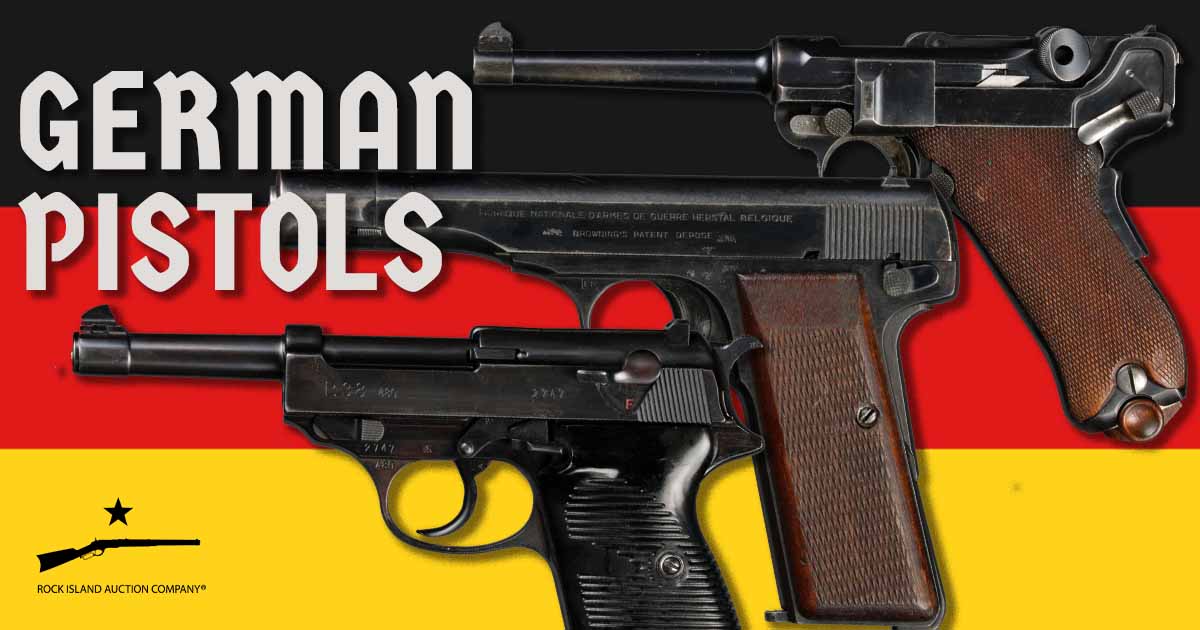
Germany has a rich history of innovative gunmaking, from the armories of renaissance nobility to World War 2 and the present, and Rock Island Auction Company’s Oct. 4-6 Sporting & Collector Auction has a fantastic selection of 20th century German pistols.
From the Mauser C96, designed toward the close of the 19th century to Heckler & Koch’s P7 there are plenty of fascinating examples of German pistol design. For more information about a specific gun, click on the photo.
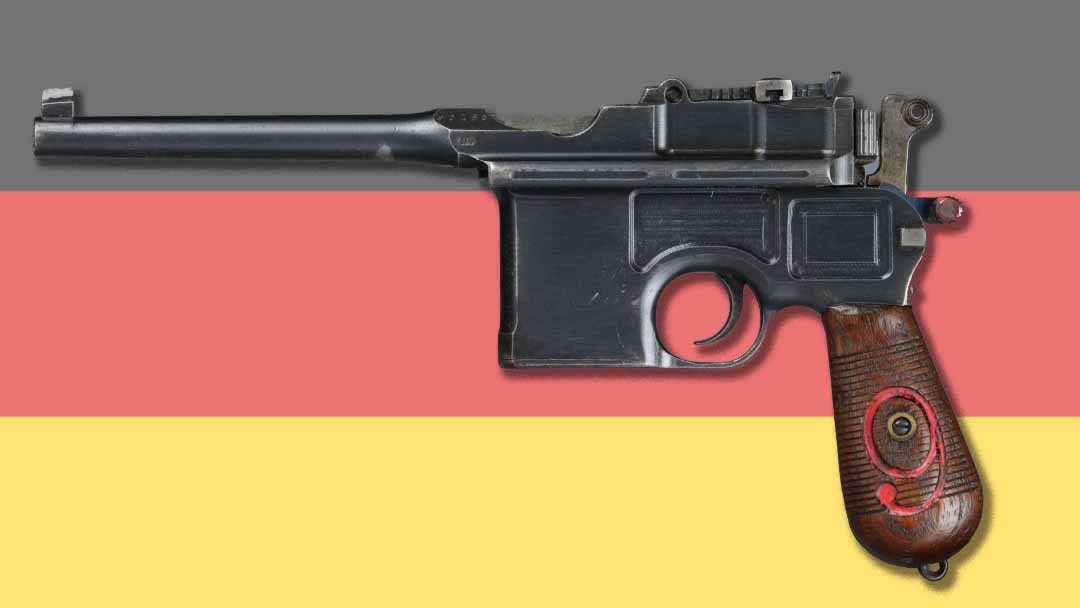
German Pistols: C96 Broomhandle
Easily recognizable by their broom handle-shaped grip and box magazine, the semi-automatic C96 was conceived by the three Feederle brothers – Fidel, Freidrich and Josef — employed by Mauser. Company co-founder Paul Mauser initially dismissed the design before rethinking it with the advent of Hugo Borchardt’s C-93 semi-automatic pistol.
The steel-machined C96’s design was intricate for the time, raising questions about the gun’s durability during military field tests. The hand-fitted parts of the design also made the pistol expensive and therefore typically acquired by officers, generals and the wealthy elite.
The gun was never adopted by any major military power but did see limited military purchases. The gun proved popular around the world with numerous unlicensed copies produced for the commercial market. Winston Churchill carried a Broomhandle in the Second Boer War as did T.E. Lawrence (better known as Lawrence of Arabia) during his time in the Middle East. The most recognizable Broomhandle might be the modified one that became Han Solo’s DL-44 Heavy Blaster of “Star Wars: A New Hope.”
German Pistols: Luger
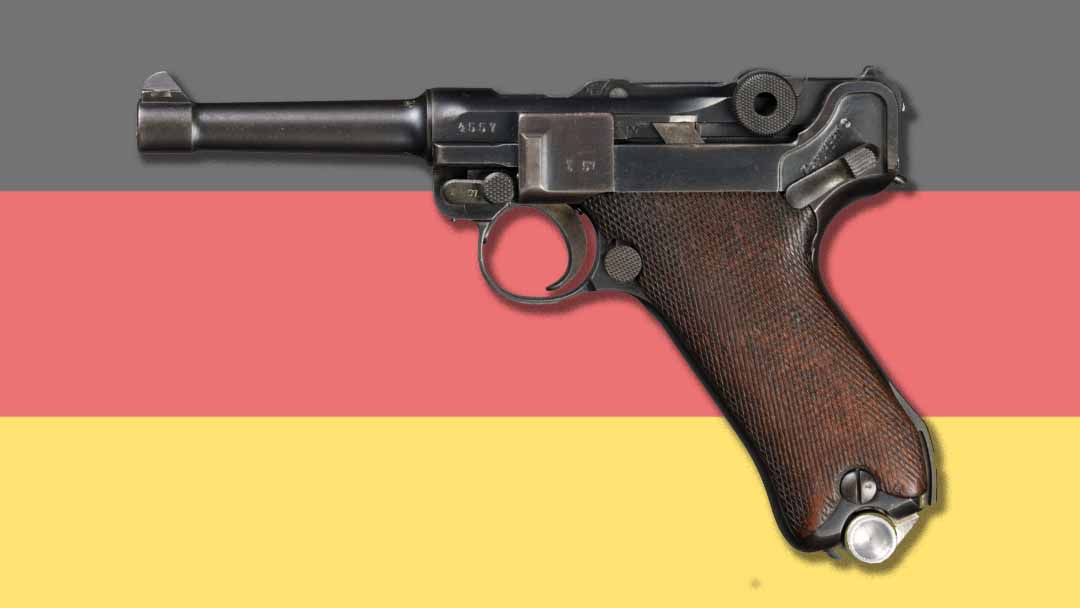
The Luger enjoyed a long military life before attaining legendary status and popularity as a prized World War 2 war trophy. It took time and some redesigns before the German Navy and Army adopted it in 1904 and 1908, respectively. It also served as the official sidearm of the militaries of Switzerland, Holland, Bulgaria and Portugal among others. The gun was offered to the Prussian Military Ordnance Board five times before acceptance and tested by the U.S. military three times but never adopted. American test Lugers and those sold commercially in the United States bear an eagle crest atop the receiver.
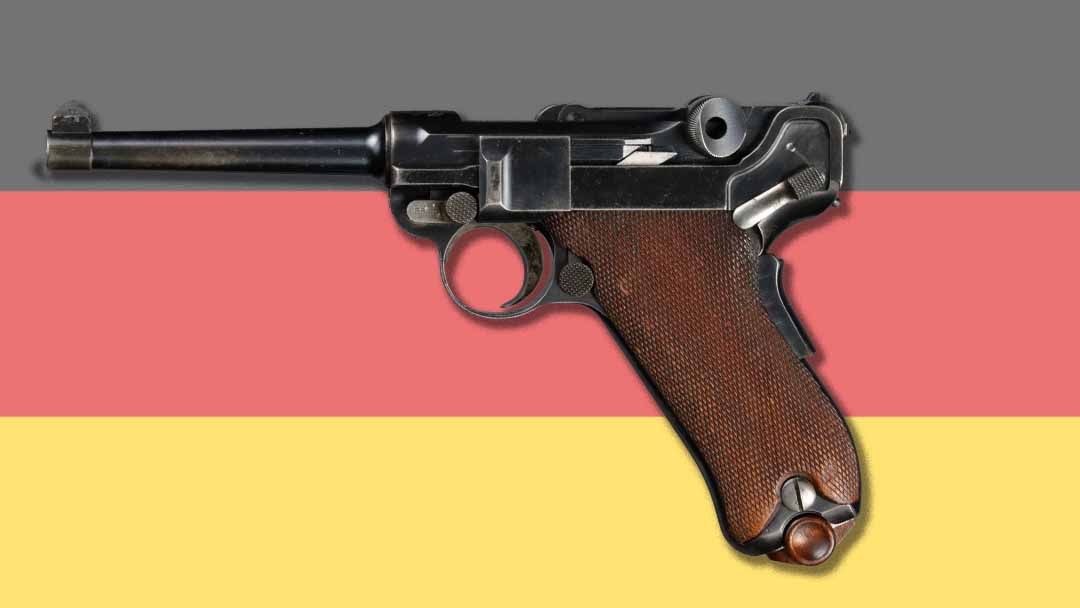
Georg Luger’s pistol utilized many of the principles used in Hugo Borchardt’s design of the C93 but Borchardt wasn’t given any recognition, resulting in a long-time rift between the two men. The 1902 Luger like the one here was chambered in 9mm, changing handgun history. Author Fred A. Datrig considered the 1902 a bridge from the original 1900 model to the 1904 adopted by the German Navy.
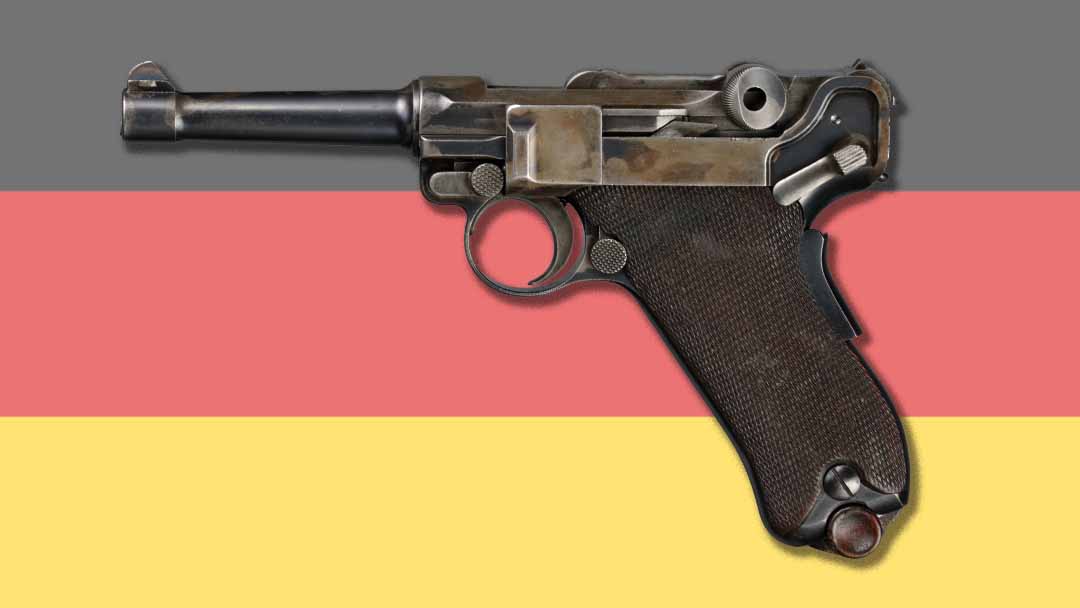
Following World War 1, Simson & Co., owned by a Jewish family, was given the contract to supply Lugers to the diminished 100,000-man Reichwehr and were the only supplier of pistols from 1925-1934. Simson only made 12,000 Lugers. Arthur Simson who led the company was charged with failing to pay income tax in the 1930s and imprisoned for seven months. After being released from prison he fled Germany and eventually making his way to the United States where he joined his family. The Nazis took control of the company.
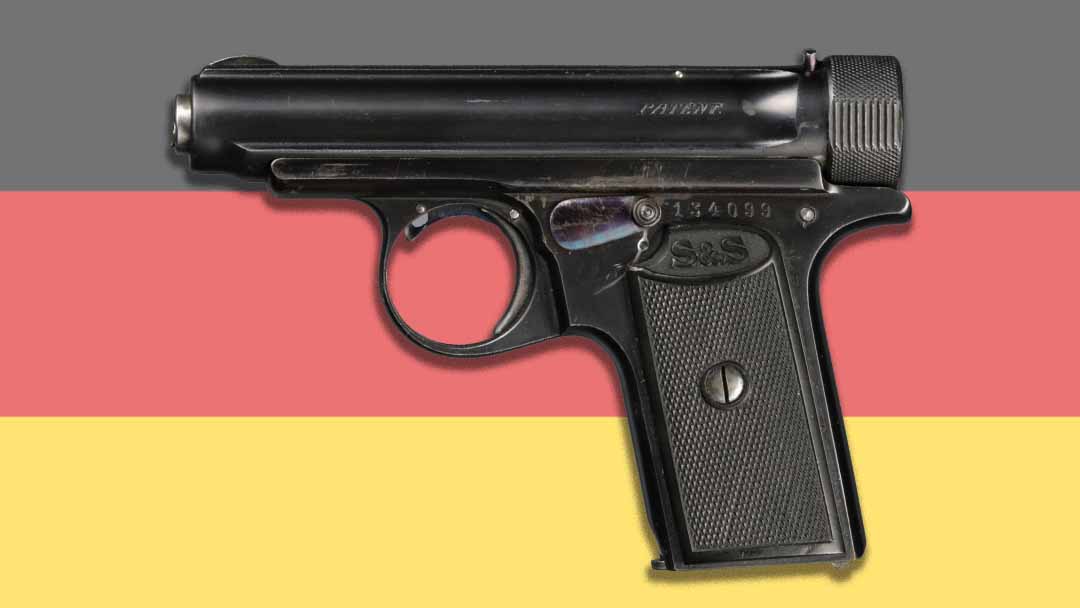
German Pistol: J.P. Sauer & Sohn Model 1913 Semi-Automatic
The Luger era was lengthy so let’s work back to J.P. Sauer & Sohn, a distinguished gunmaker founded in 1751. The company’s first semi-automatic pistol was made in 1905 but didn’t bear Sauer’s imprimatur. That wouldn’t happen for nearly a decade with the Model 1913 compact pistol.
Chambered in .32 ACP, the 1913 was considered a sturdy gun, with its most distinctive feature the large knurled cocking knob at the back of the slide. The gun was intended for commercial sale but with the outbreak of World War 1, the German military purchased 10,000. Production ended in 1931 with a run of 175,000 pistols made.
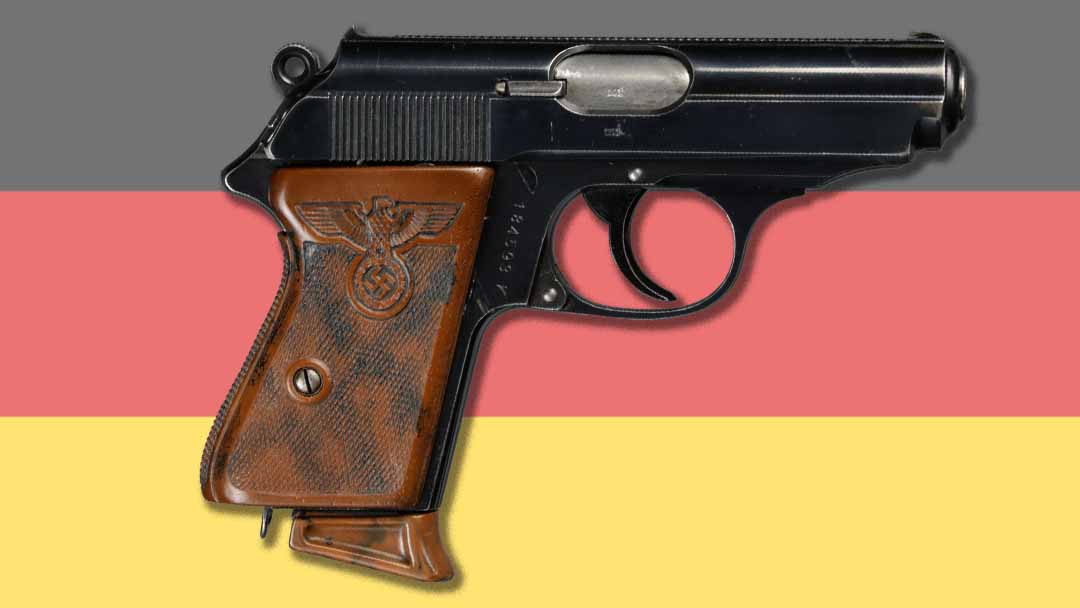
German Pistol: Walther PPK
Founded in 1886, Walther started making pistols with the Model 1 in 1908. The PP came about in 1929 followed by the PPK, a compact version of the Model PP, two years later. Walther offered the PPK at a discount to Nazi Party officials. These pistols known to collectors as Party Leader pistols, were officially “Honor Weapon of the Political Leaders.”
Chambered in 7.65 mm and concealable, the pistol found new life after World War 2 especially as Agent 007 James Bond’s handgun of choice. The PPK remains in production today.
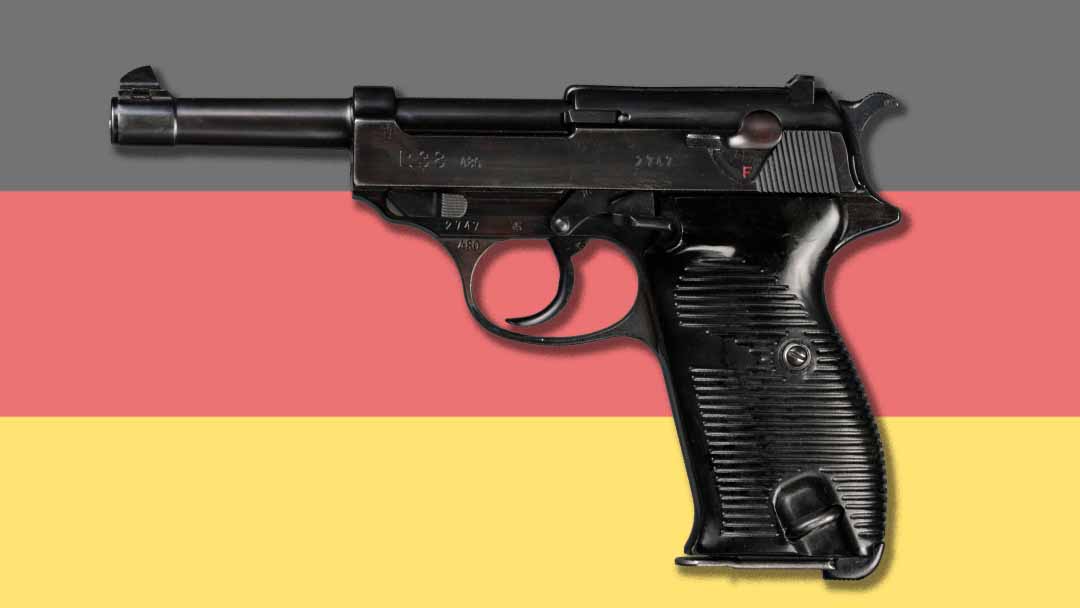
German Pistol: Walter P.38
The Luger gave way to Walther’s P.38 in 1938 when it was adopted by the Wehrmacht and it was the standard German pistol during World War 2. About 1.2 million P.38 pistols were manufactured by May 1945 by Walther, Mauser and Spreewerk when the factories were captured by the Allies.
The P.38 found new life when it was adopted by the West German armed forces in 1956. A duralumin frame replaced the steel frame making the gun lighter and less expensive to manufacture.
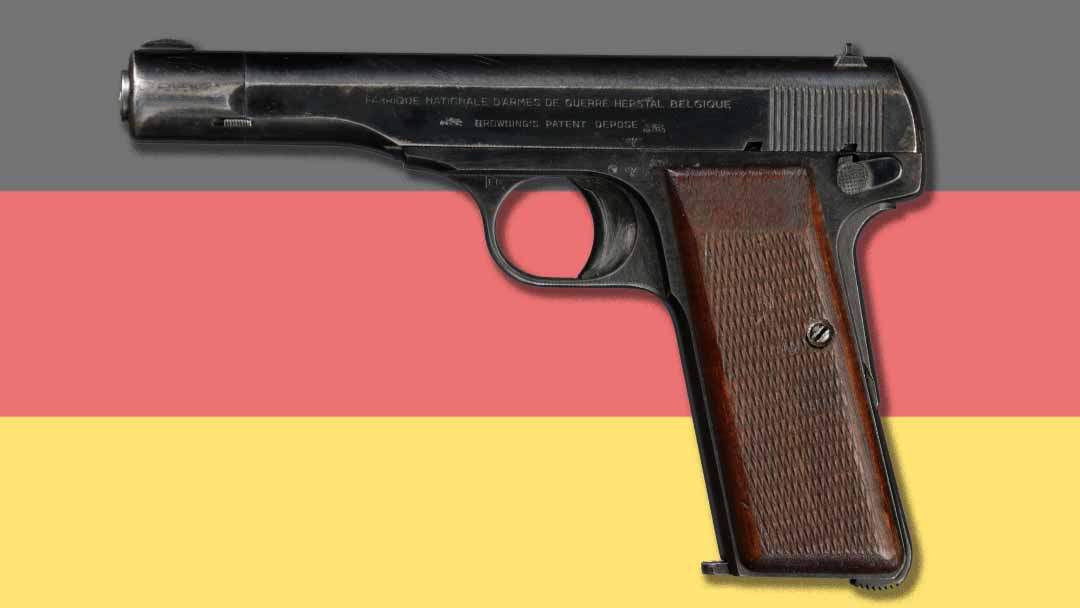
German Pistol: Fabrique Nationale Model 1922
Fabrique Nationale’s Model 1922 was manufactured for commercial and military use before World War 2. Chambered in 7.65mm, its German military designation was Pistole 62(b), with the “b” denoting it was made in Belgium. Germany made or assembled 363,200 of the Model 1922 before the FN plant was liberated in September, 1944. This example of the Model 1922 came to the United States as a war trophy and it is accompanied by the capture certificate.
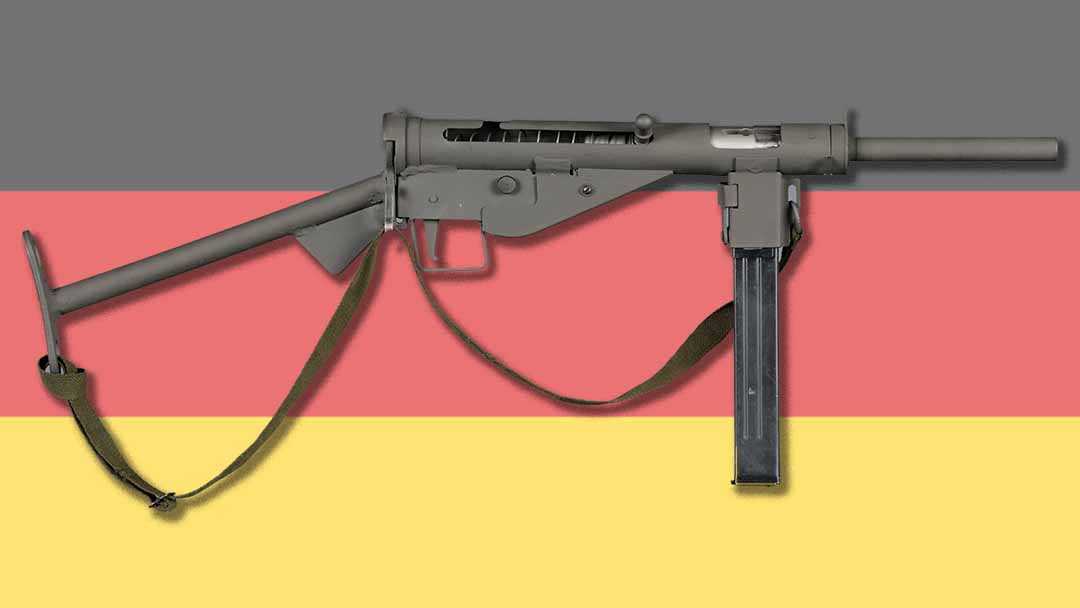
German Pistol: MP3008 Submachine Gun
A last gasp weapon, the select fire MP3008 – the MP is for maschinenpistole – was a knockoff of the Sten Mk II except that it utilized a vertical magazine like the MP40. Initially, the gun was made with a skeletal pattern stock and used phosphate components. Mauser created production drawings and tooled up its plant to make the gun in just a few weeks. More than 10,000 were made by February 1945.
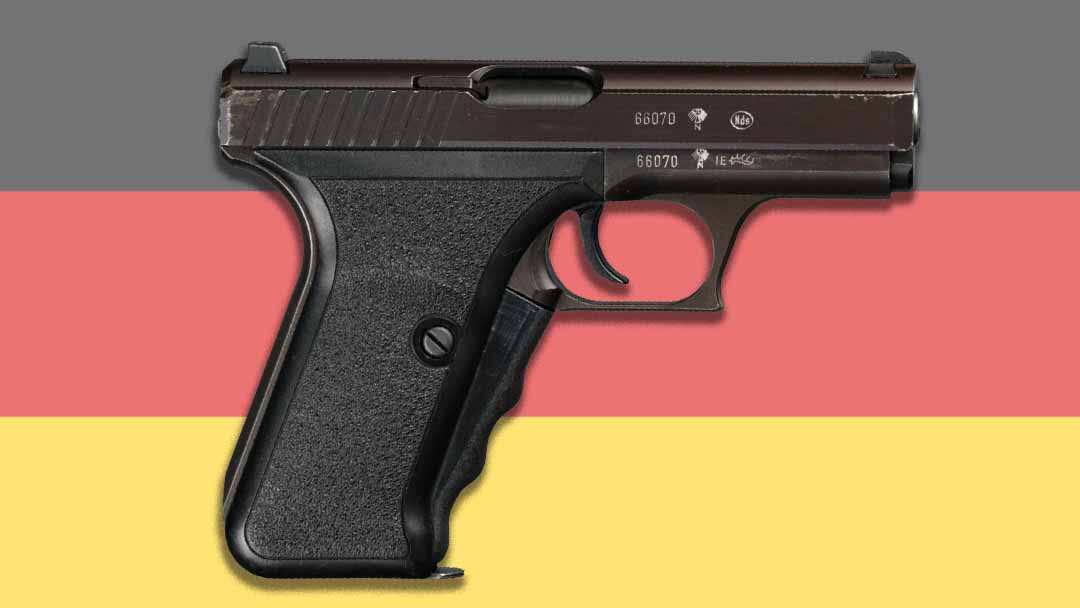
German Pistol: Hecker & Koch P7
Described as the most innovative pistol design since World War 2 and advertised as “the most expensive handgun in the world,” Heckler & Koch’s P7 was designed for German police contracts for a compact pistol after the Munich Olympics terror attack. Alas, only three police forces adopted it.
An interesting feature of the pistol is the lever that serves as the frontstrap of the grip and also cocks the gun before firing. If dropped the gun decocks and won’t accidentally discharge, plus it doesn’t require a double-action first shot for more accurate shooting. H&K produced the P7 from 1976 to 1998.
In 1983, the gun was modified for a thumb lever magazine release for sale in the United States (as the P7M8) but was adopted by only a handful of departments. The P7M13 followed a year later with a magazine capacity of 13 rounds, again in an attempt to attract interest from police.
German Pistols for Sale
With the tragedy of two world wars and the tension of the Cold War, firearms innovations grew rapidly in the 20th century and German firearms grew, too, first as an adversary and later as an ally. These firearms from a once and still mighty military are fabulous opportunities to obtain pieces that turned the semi-automatic pistol into a mainstay of fighting forces around the world and are available in Rock Island Auction Company’s Oct. 4-6 Sporting & Collector Auction.