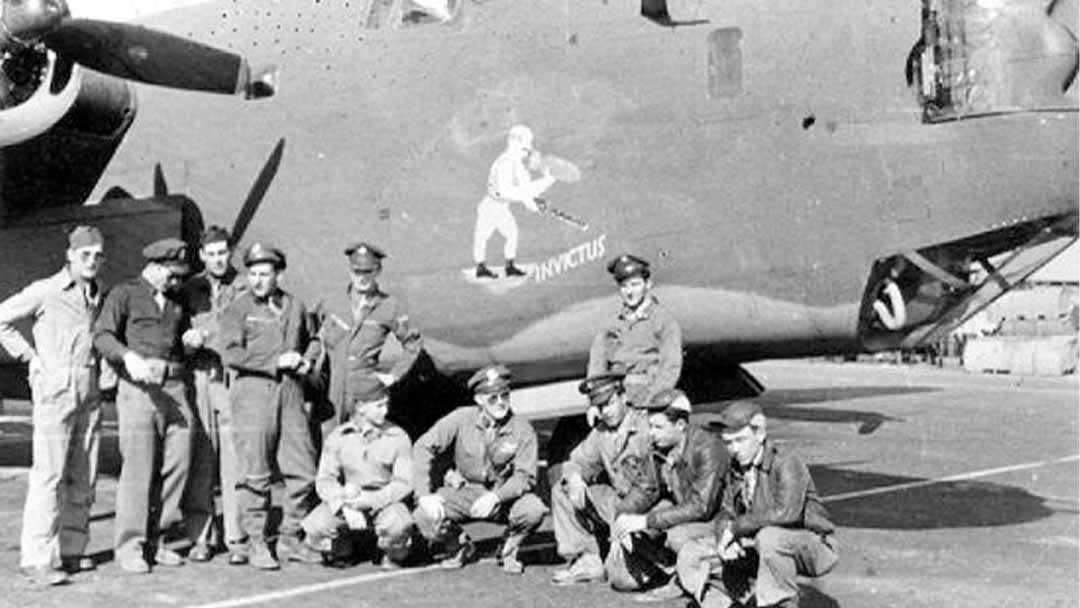
The same day Allied troops stormed the beaches of Normandy, Lt. Thomas R. Moss strained against the controls of his B-24 — named “Invictus” by his wife Margie — during a raid on the oil refineries of Ploesti, Romania.
While Allied forces fought to overpower the defenses of “Fortress Europe,” Moss’s Invictus and the rest of his B-24 Liberator squadron of the 461st Bombardment Group of the 15th Air Force again tried to flatten Ploesti’s refineries in hopes of starving the Third Reich of fuel. Missions to heavily-defended Ploesti claimed more than 200 B-24 Liberators and more than 2,000 crewmen during the war.
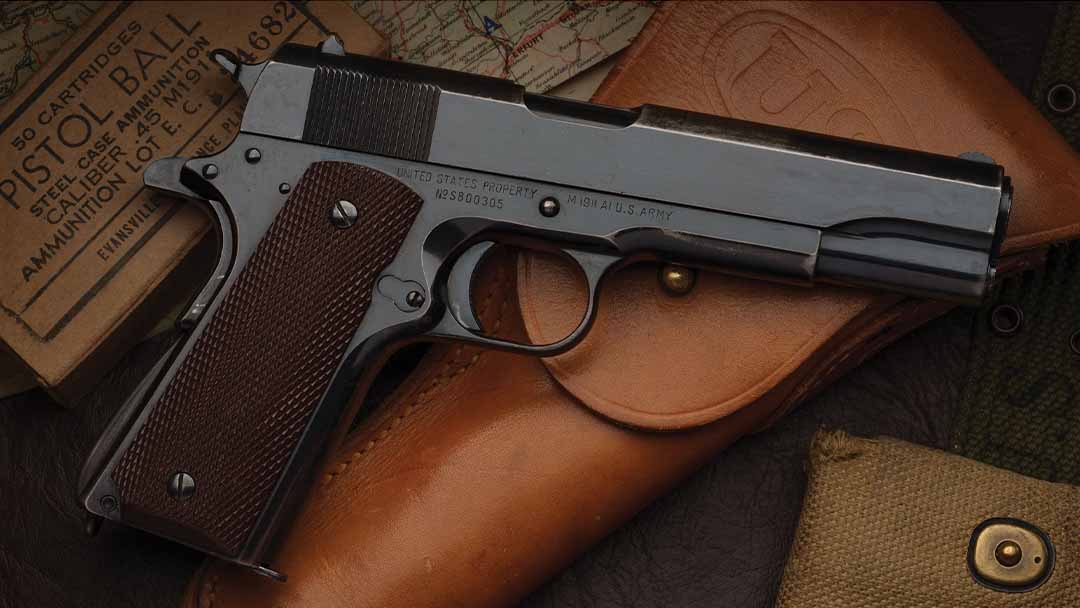
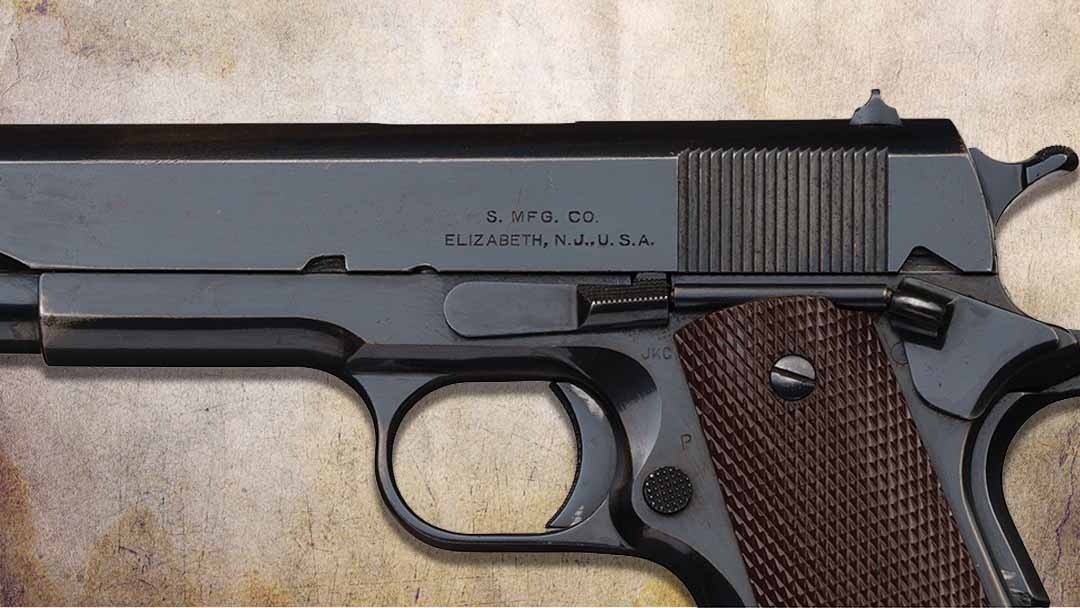
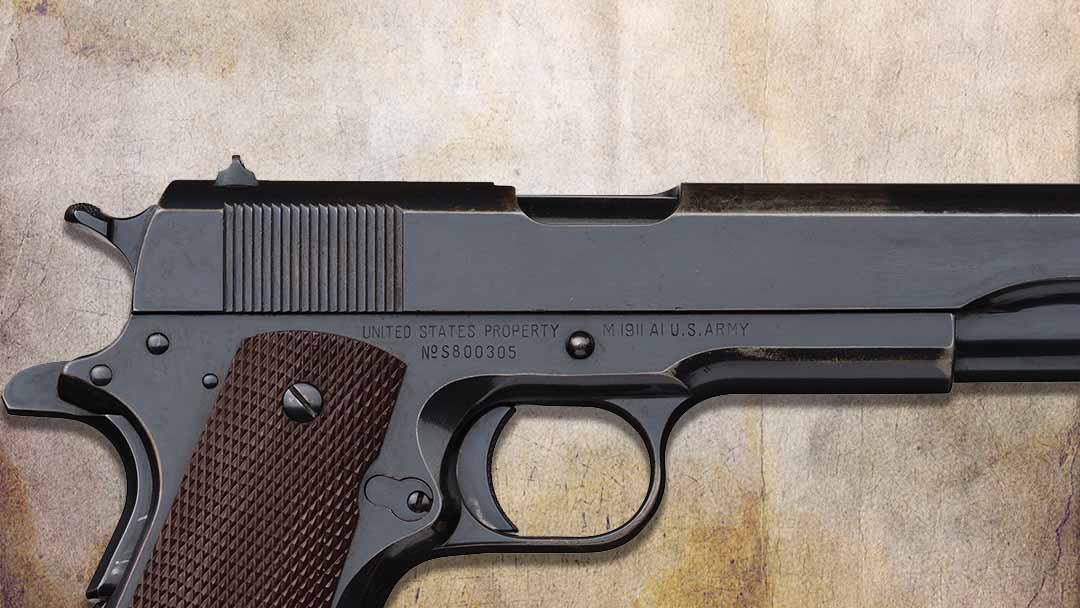
During the attack the Invictus lost an engine supercharger, making the already lumbering Liberator that much harder to control. Moss fought to maintain control and speed, in hopes of making it to Italy or at least Yugoslavia where if they had to bail out or crash land the crew might be taken in by partisans. Would he have to use the Singer Model 1911A1 he carried to stay alive in order to get back to Margie? For Moss the gun served as a tool for personal defense, but 80 years later, the rare firearm has become a highly-desired firearm among collectors.
Moss ordered his crew to jettison the B-24’s guns and other equipment to lighten the plane to keep up with the squadron’s protective formation. Away from the target, the Invictus broke formation and limped its way across the Adriatic Sea, landing at Foggia, Italy with only fumes left in the fuel tanks. The crew refueled the Invictus and the hobbled B-24 bomber made its way back to its home base at Torretta, Italy.
Moss, with the Singer 1911A1 as his sidearm, flew 13 more missions before completing his tour with his 35th on July 8, 1944. Moss’s pistol, nicknamed the “Invictus Singer” and carried on every one of his bombing runs over Yugoslavia, Romania, France, Italy, Austria, Hungary and Germany is available on Day Two of Rock Island Auction Company’s Aug. 23-25 Premier Auction. The gun, one of 500 made by Singer was kept by Moss until 2018, and still shines with 80 percent of its original blue finish. Moss died in 2020 at the age of 99.
Who Is B-24 Liberator Pilot Thomas R. Moss?
Moss was the son of musician parents, born in Spokane, Wash., but grew up in and around Baltimore and Washington, D.C. A student at Johns Hopkins University where he was in the engineering ROTC program when the Japanese bombed Pearl Harbor, Moss decided to control how he fought in the war. At an Army recruiting office he took the aviation cadet examination and passed, so he left college and entered the U.S. Army.
He recalled the decision he and a friend made to take the flight cadet test in a video interview in the Library of Congress, saying “If we don’t do something first, they’ll do it for us.”
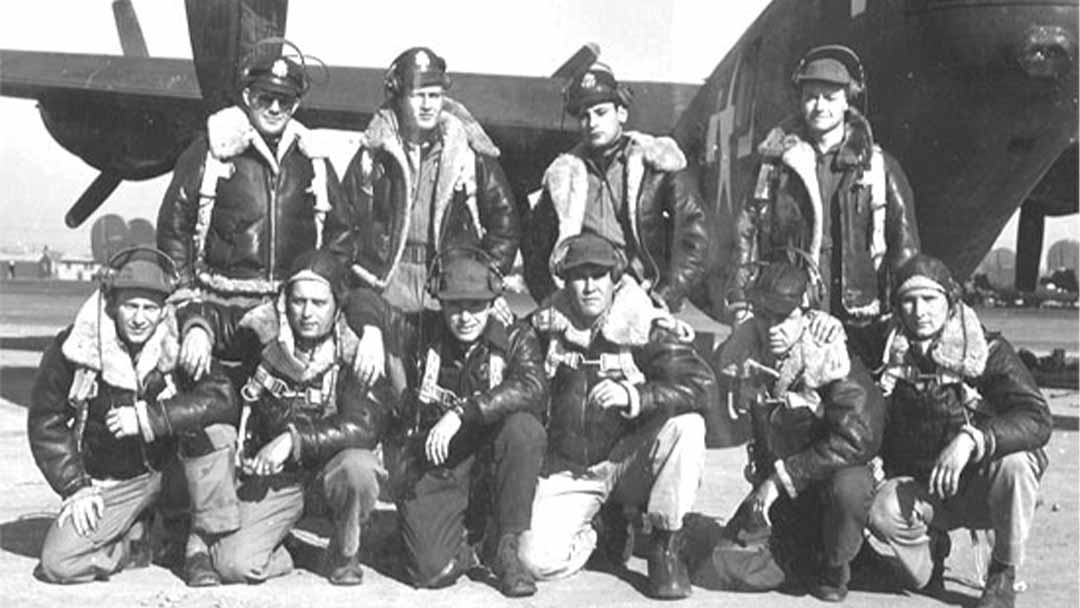
He started training at Maxwell Field in Montgomery, Ala., before pre-flight training at Douglas, Ga., where he learned flying on biplanes. He returned to Montgomery for further basic training before transferring to Blytheville, Ark., for advanced flight training, flying the A-20 Havoc light bomber. Perhaps the biggest day of Moss’s life was March 25, 1943 when he was commissioned in the Army Air Force and married Margie, his high school sweetheart.
Moss bounced from several assignments, even flying B-17 bombers for a few weeks before being assigned to fly the B-24 Liberator despite a minor protest. “I said, I don’t know how to fly the B-24. They said, `you will;’ and I did.”
After training on the B-24s for a few months in northern California, Moss, piloting the Invictus, headed east with the 765th Bomber Squadron to Florida. The unit transited across the Atlantic via Brazil and North Africa before arriving in Italy in early 1944. When he was issued his rare Singer sidearm isn’t known.
The first of Moss’s and the Invictus’ 35 missions was on a railyard in Bihac, Yugoslavia. Two Liberators collided in mid-air and were lost. With one mission completed, the 461st Bombardment Group “set out to let the “Jerries” know that the organization with the painted cowlings was over here strictly for business; and that business was complete destruction of the enemy,” according to the squadron history.
Flying with the 765th Bomber Squadron
Flying out of Italy could be dangerous at takeoff since airfields were located so close together along the Adriatic coast. The airbase at Torretta certainly wasn’t a tourist destination, with ragged-looking tents and hard scrabble buildings.
Moss and the Invictus, Latin for “unconquered,” flew 12 of the 765th’s 20 combat missions in May 1944 when the 461st Bombardment Group was rated first in the 15th Air Force in bomb hits within 1,000 feet of the target. June was slower with only 10 combat missions flown by the 765th due to poor weather conditions in southern Europe and the Balkans regions.
The 765th and the Invictus made their first raid into Germany on June 9, bombing industrial targets in Munich. On that raid to Munich, the Invictus held its own in the air as the ball turret gunner Staff Sgt. Peter Drezek claimed a probable kill of a Messerschmitt as it was last seen smoking as it plummeted to earth.
In July, Moss and Invictus flew five missions before he and Drezek, the ball turret gunner, reached 51 mission points. Moss’s final two missions were against a synthetic oil refinery at Blechhammer, Germany and Korneuburg, Austria. Anti-aircraft fire over both targets was heavy but all the squadron’s ships returned safely.
The B-24 Liberator and Ploesti Oil Fields
Romania’s oil fields and the refineries at Ploesti were vital to Germany, supplying 60 percent of the Third Reich’s crude oil and making them a crucially vital target for American bombers. Ploesti bristled with anti-aircraft batteries, and squadrons of fighters laid in wait. The first bombing mission to Ploesti on Aug. 1, 1943 was a disaster, with the loss of 52 aircraft, 310 American airmen killed 130 wounded and 100 captured.
That Mission, Operation Tidal Wave, went against U.S. Army Air Forces policy and attempted low-level bombing from less than 1,000 feet. Taking off from Benghazi, Libya, 1,200 miles from the target, a force of 178 Liberators made their way to Ploesti, maintaining strict radio silence. It didn’t matter because the Germans were ready.
The 88mm anti-aircraft guns boomed and smoke generators created confusion over the targets. Barrage balloons protected valuable assets. Fighters awaited. The American bombers suffered navigational errors and formations didn’t arrive on target at the same time. The Americans didn’t strike the blow they had hoped. Within weeks, through the use of forced labor, the refineries were back at full capacity.
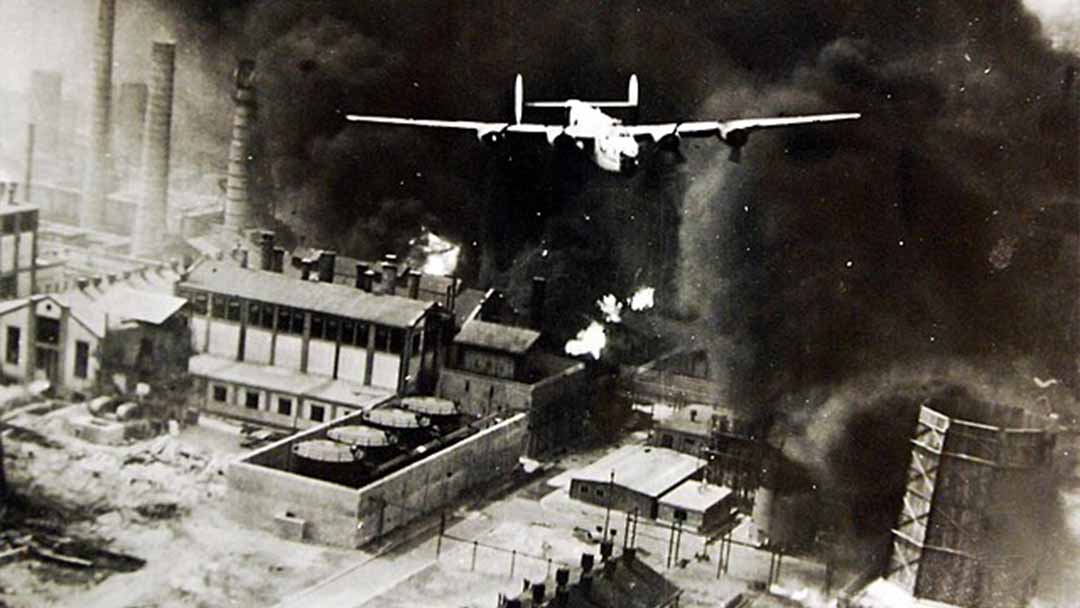
Attacks on Ploesti didn’t resume until April, 1944, by that time, the Army had air bases in Italy, making the distance shorter for the bombers. Moss and the Invictus flew their first raid against Ploesti on May 31.
“We had to get rid of Ploesti,” Moss said in the Library of Congress interview. “When we would walk into the briefing room, the briefing officer would pull the blankets down (from the mission map); there was that line going from our place straight east almost to Ploesti. I thought, he we go again. We had to get rid of Ploesti, it was just bad news to go to Ploesti.”
Enemy fighters were spotted but reportedly none engaged on the May 31 raid. Anti-aircraft fire was heavy and many of the Liberators of the 765th were damaged, but only one plane was lost on the mission.
Moss and the Invictus made one more raid over Ploesti, the eventful June 6 mission that earned him the Distinguished Flying Cross. The squadron report listed heavy, accurate and intense anti-aircraft fire that again left many of the planes damaged, though all 10 of the squadron’s planes returned safely, including the limping Invictus.
Thomas Moss after Invictus
Moss recorded 279 hours of flight time at the controls of the Invictus. Of the 35 missions Invictus flew, 16 were considered more hazardous and crews received double credit, so Moss earned 51 mission points. After completing his tour, he continued as a B-24 instructor as well as for the C-54, a four-engine cargo plane. He also flew for Transcom, Air Transport Command that ferried cargo and troops.
He remained in the Army as the world settled into the Cold War, and by 1948 he was on the front line of that simmering conflict. At the end of World War 2, the Allies divided Germany into four occupation zones, with the Soviet Union controlling the east-most zone that contained the German capital of Berlin that was likewise divided. As the relationship between the western Allies and their one-time ally broke down, concern was whether Berlin’s sections controlled by the U.S., Great Britain and France would continue under their control.
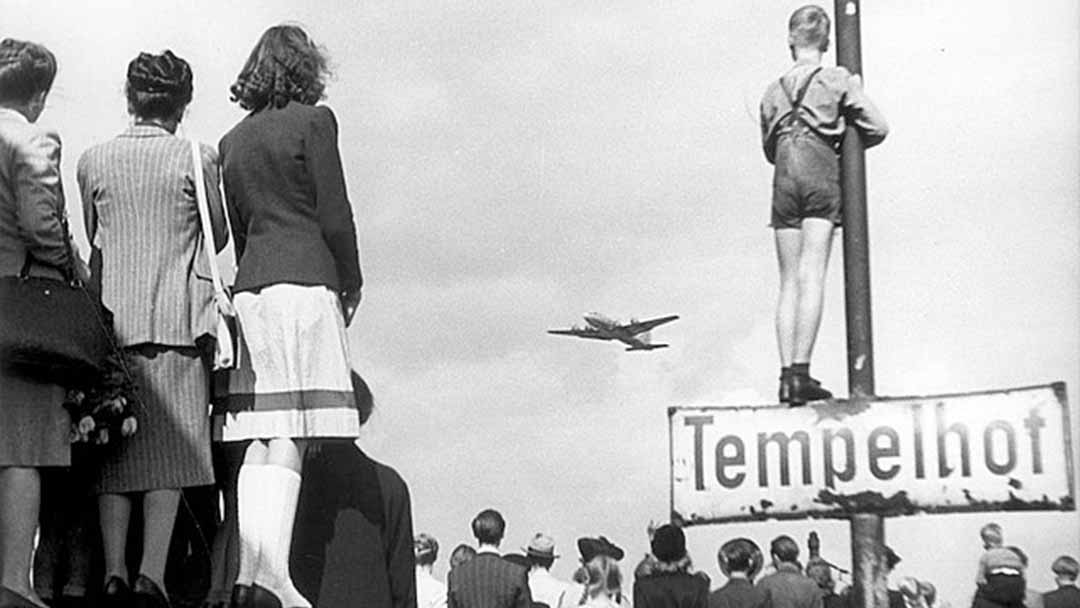
On June 24, 1948, the Soviets blockaded rail, road and water access to the Allied-controlled part of Berlin. The Allies started airlifting food and fuel to Berlin, putting Moss at the controls of a C-54, hauling 8,000 lbs. of coal per flight. At the height of the airlift, a plane landed every 45 seconds at Berlin’s Tempelhof Airport. The airlift delivered supplies for nearly a year, from June 16, 1948 to May 11, 1949, shortly after the creation of the North Atlantic Treaty Organization (NATO).
After more than 20 years of service, Moss retired as a lieutenant colonel in 1964. He continued working in the air industry, training flight engineers on the DC-10 for United Airline, McDonnell Douglas and others. He logged over 60,000 hours of flight time in his career. His 63-year love story with Margie, who named the Invictus, ended with her death in 2006.
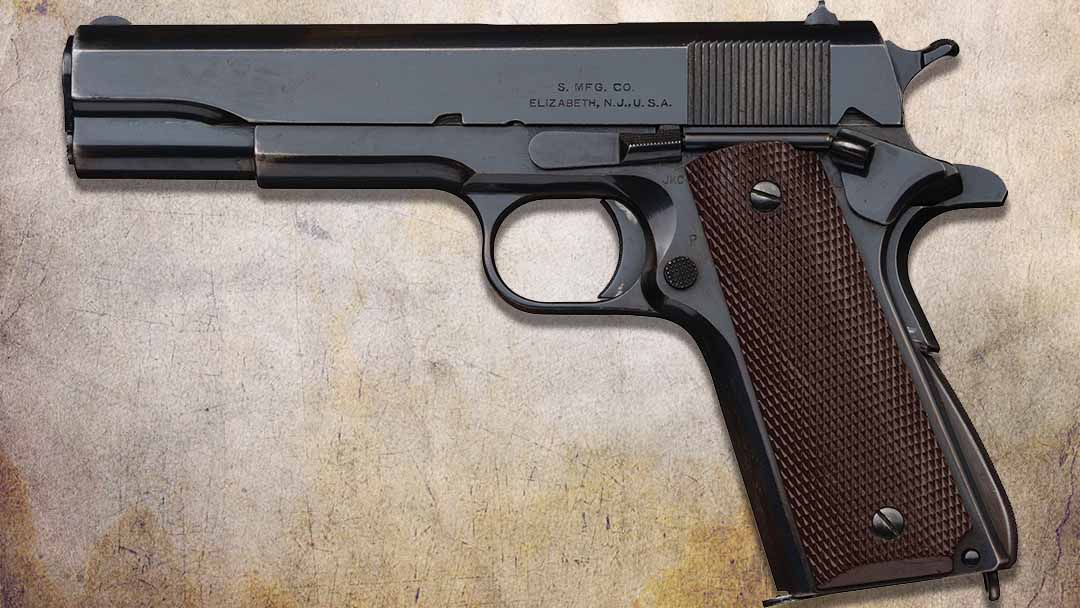
The Singer M1911A1
Singer Sewing Machine Company was a global leader in sewing machine manufacturing and during World War 1 the company’s factories were converted for wartime production, making armaments, ammunition and parts. In 1939, Singer and other companies were invited to participate in a production study of the M1911A1 and bid on educational orders. Selected, Singer was to produce 500 pistols along with the necessary tooling, fixtures and machines and patterns for mass production for $278,875.67, or $538 per gun.
Singer completed its order of 500 pistols in December, 1941 but couldn’t achieve the 100 pistols/day production level wanted. During World War 2, the production run of 500 pistols were reportedly issued to flyers like Moss. Given that airmen suffered high casualty rates, it’s hard to tell how many Singer M1911A1 pistols remain.
The equipment and tooling Singer used to manufacture the 500-pistol run was shipped to Remington Rand. Singer went on to contribute to the war effort by producing highly-precise aviation components, for the Sperry T-1 bomb sight, B-29 bomber gunfire control computers, directional gyroscopes, artificial horizon instruments, and automatic pilot systems.
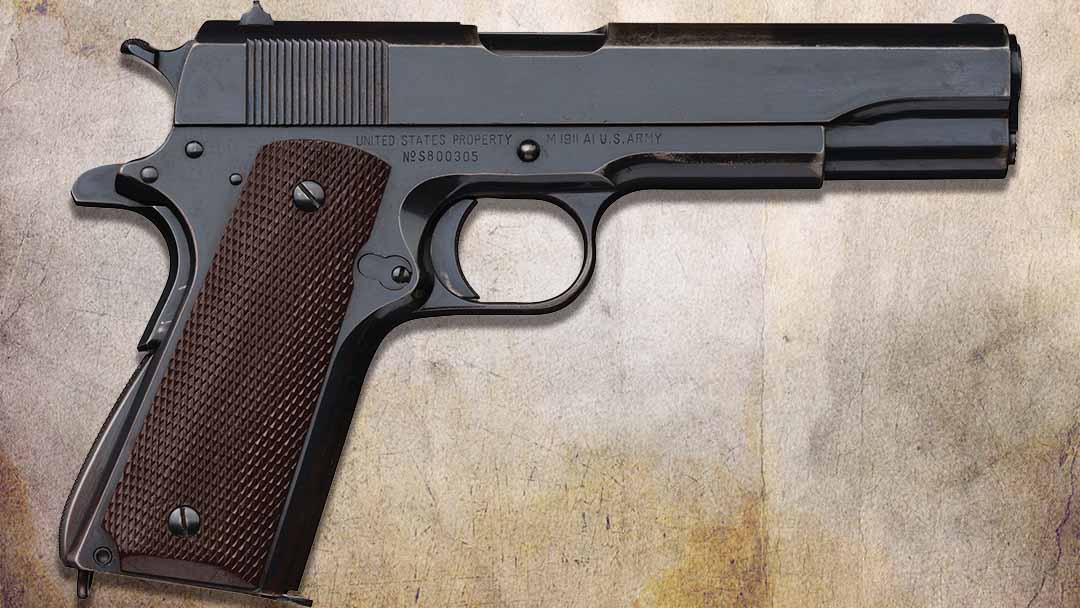
The Invictus Singer M1911A1
This magnificent Singer M1911A1 conjoins immense history, high condition and rock solid provenance. Carried on 35 B-24 Liberator missions by pilot Thomas R. Moss over Axis-controlled Europe and held in his possession until 2018, this is a spectacular firearm that would easily be the cornerstone of any collection of World War 2 firearms or M1911 pistols, and it is available in Rock Island Auction Company’s Aug. 23-25 Premier Auction in Bedford, Texas.