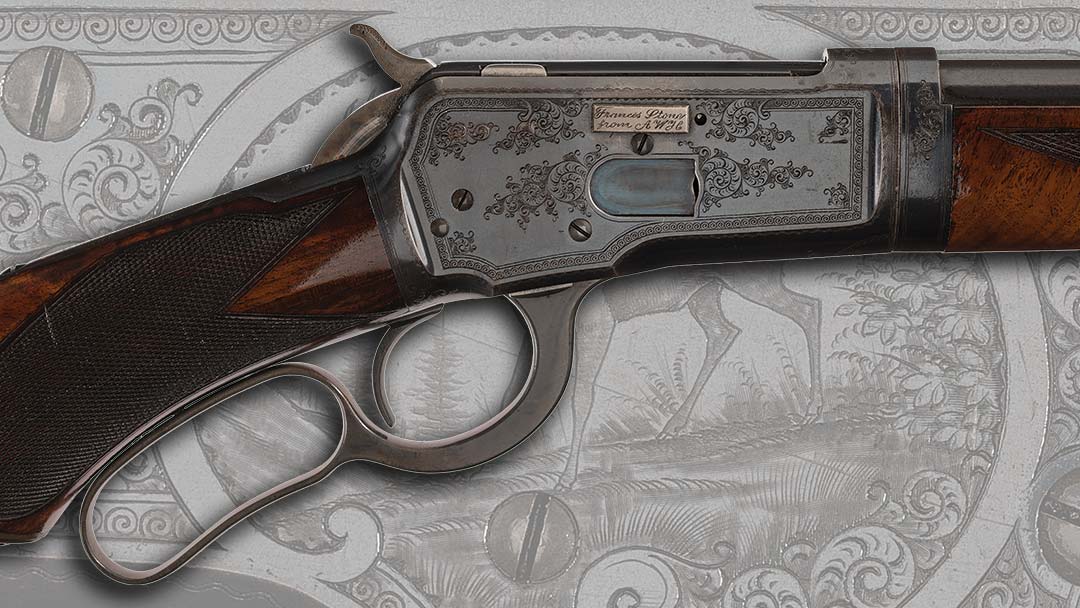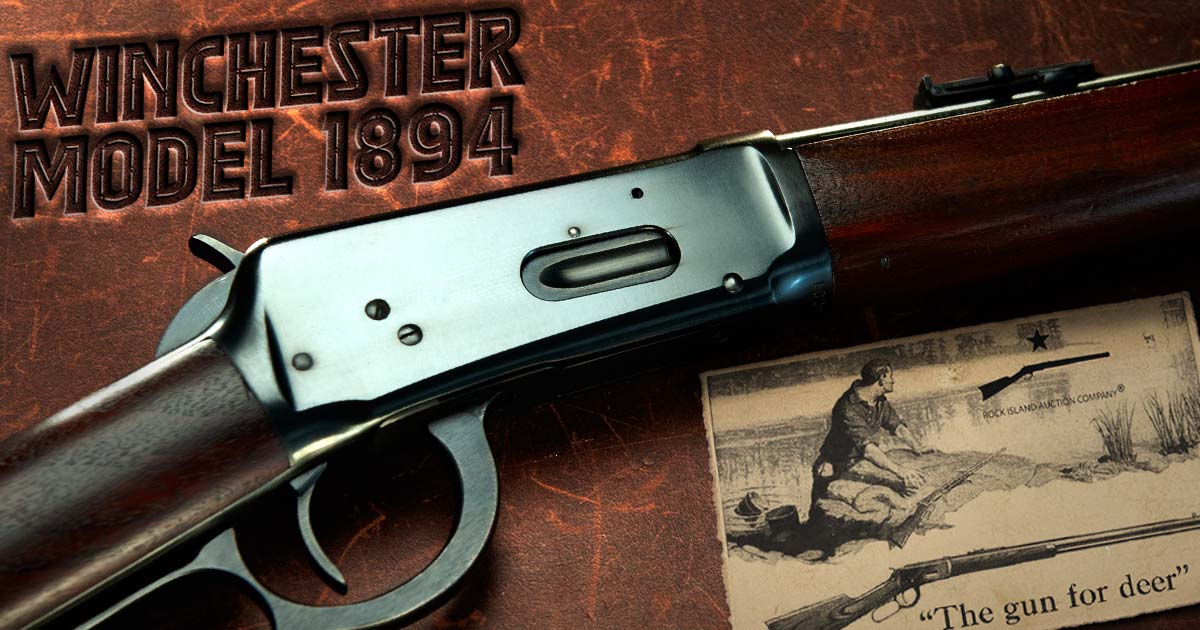
For nearly 130 years, the legendary Winchester Model 1894 has served as America’s quintessential walking gun. An impeccable reputation earned from decades of sporting use has kept the model in near-continuous production, and the sheer number of variants offers a popular collecting platform for firearms fans of every stripe.
Rock Island Auction Company’s Feb. 16-18 Sporting and Collector Firearms Auction features hundreds of antique and curio Winchesters, including a wide range of Winchester Model 1894 rifles and carbines. Click on the images throughout this article to examine the diversity of the platform firsthand.
Winchester 1892 vs Winchester 1894
As America went west, so did the Winchester. The Model 1886, the first lever action rifle developed by John Moses Browning for Winchester Repeating Arms, was distinguished by its duel vertical locking bars designed to seal the breech bolt against the chamber. This allowed the weapon to chamber larger cartridges like .45-70 Govt. Six years later, Browning introduced the Winchester Model 1892, effectively a scaled-down version of the Model 1886.
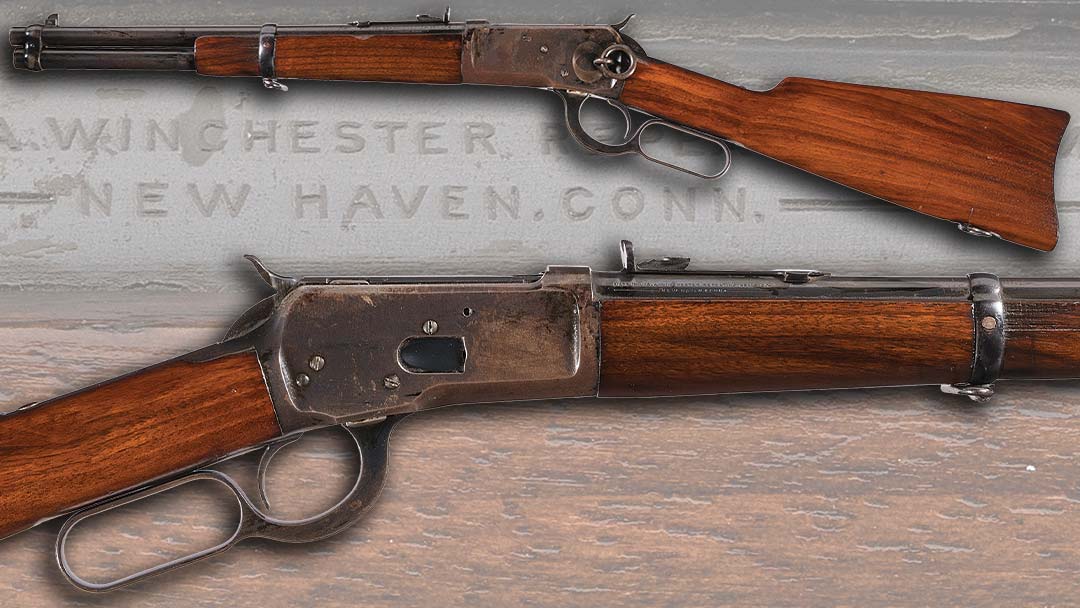
An incredibly popular design, the Model 1892 was best suited for short cartridges commonly used in revolvers of the era. Browning’s next lever action concept, the Winchester 1894, would take a different approach and focus on the ability to chamber longer and more powerful rifle cartridges like the .38-55.
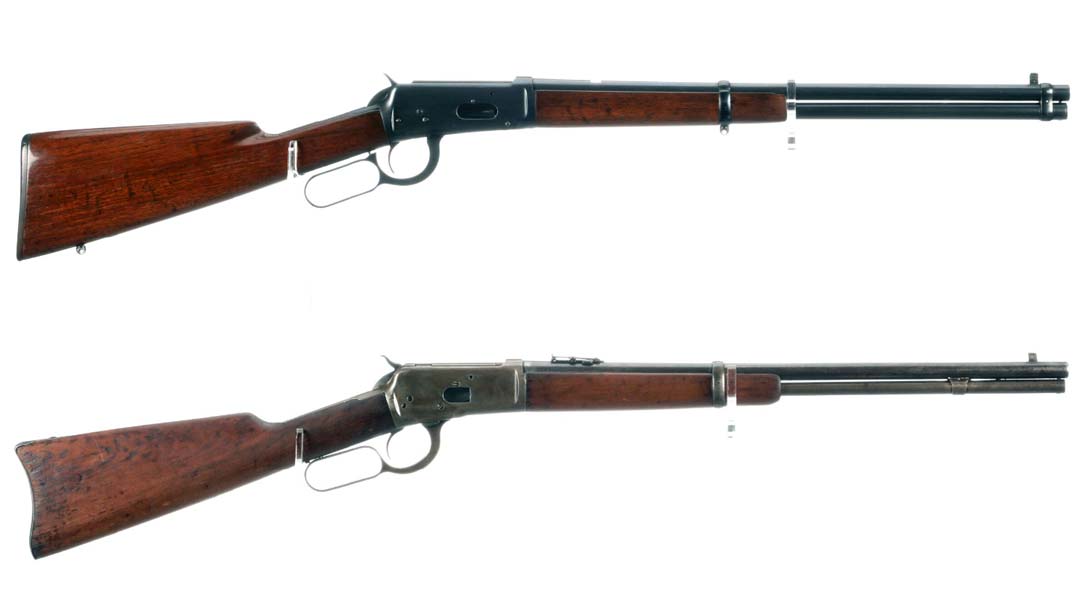
With its single rear locking bolt block instead of the Model 1892’s dual rear locking bar design, the sturdy Model 1894 platform also proved suited for a new line of smokeless powder cartridges. Two of Browning’s most popular designs, both Winchester models are lever action legends that continue to be fielded today.
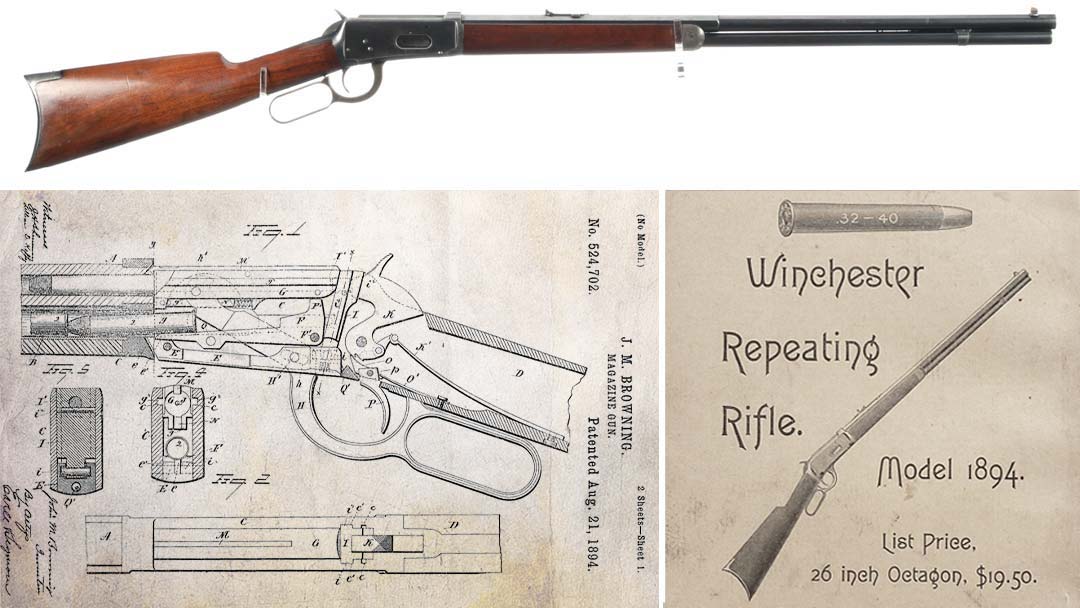
The Winchester Model 1894 in .30-30
When the first Winchester Model 1894 rifle and carbines rolled out in late 1894, the only two chamberings were .32-40 and .38-35, both black powder cartridges. The following year, the Model 1894 was adapted for Winchester’s new .30-30 smokeless cartridge. The pairing proved a match made in heaven.
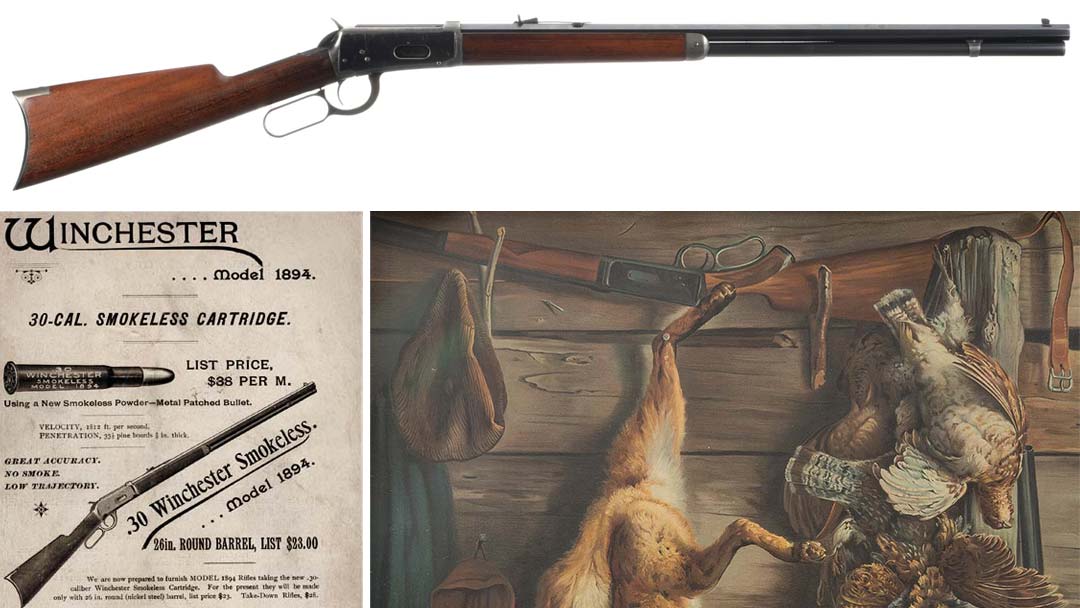
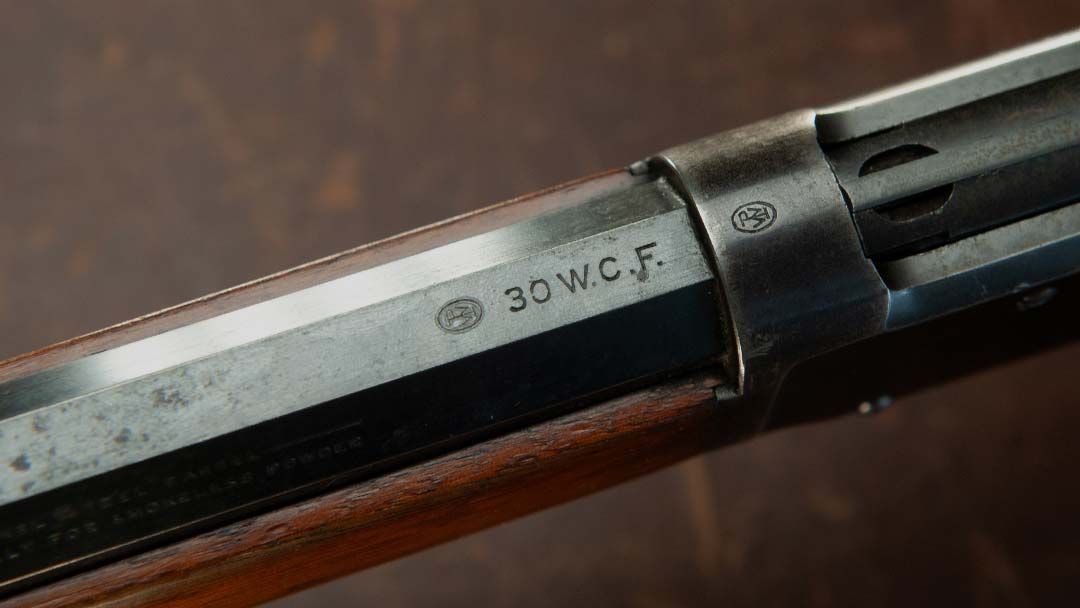
While the Model 1894 was available in a variety of calibers, including the simultaneously released .25-35 Winchester smokeless cartridge and the .32 Winchester Special introduced in 1901, the .30-30 dominated the market. As Winchester proudly notes, “The old standby 30 W.C.F., also known as the “30-30” (30 caliber bullet with 30 grains of powder) has killed more North American big game than any other cartridge.” With the great majority of the more than 7.5 million Model 1894s ever produced chambered in 30-30, Winchester’s claim is supported by the numbers.
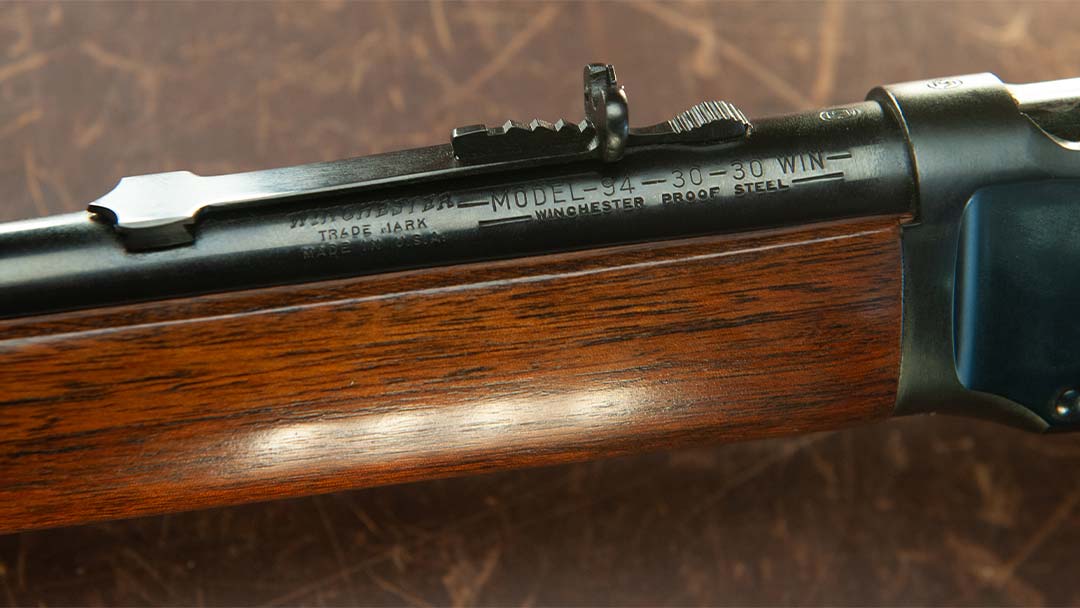
The .30-30, advertised by Winchester as the “most proven of all modern cartridges,” remained America’s sporting round for decades. Popular throughout the West as a saddle gun and in the East as a timber rifle, the Model 1894 and its new cartridge could outpower and outdistance its lever action predecessors. The quickness and maneuverability of the lightweight platform proved well-suited for a variety of North American game hunting. Alongside its .30-06 bolt action competitor, the Winchester 1894 in .30-30 came to dominate the big-woods whitetail hunt.
Winchester 1894 Variations
In Winchester’s November 1894 catalog, the Model 1894 was initially advertised in four configurations: A 20 inch carbine with a round barrel for $17.50, a 26 inch rifle with a round barrel for $18.00, a 26 inch rifle with an octagonal barrel for $19.50, and a 26 inch takedown rifle in either barrel shape for $25.00. A fancy sporting rifle with a checkered walnut pistol grip stock and forearm was offered for an additional $15.00. During the Model 1894’s first production run, 78% of the orders were for the rifle variants.
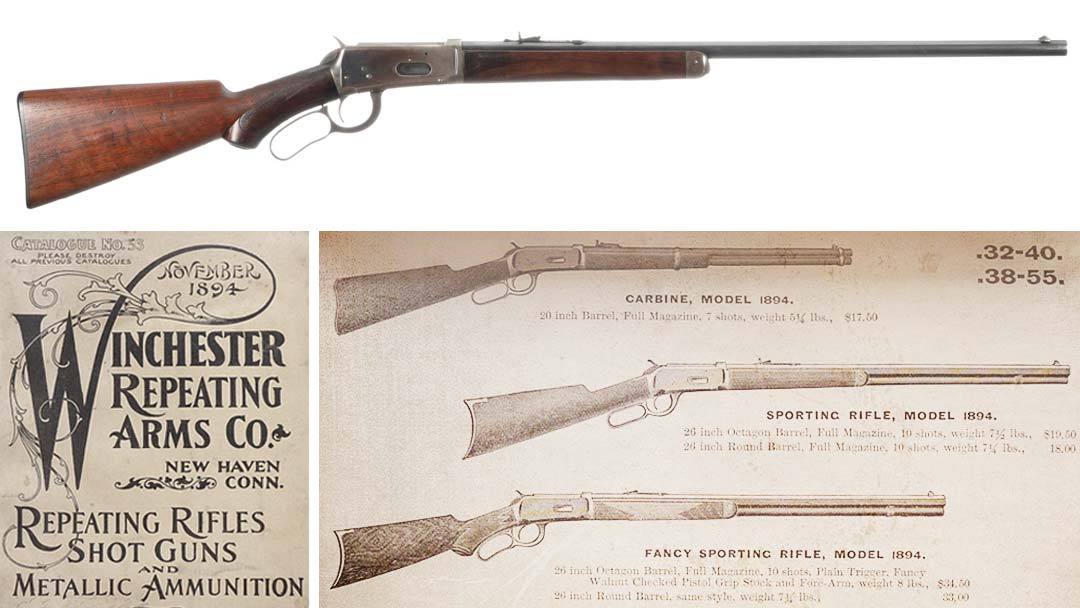
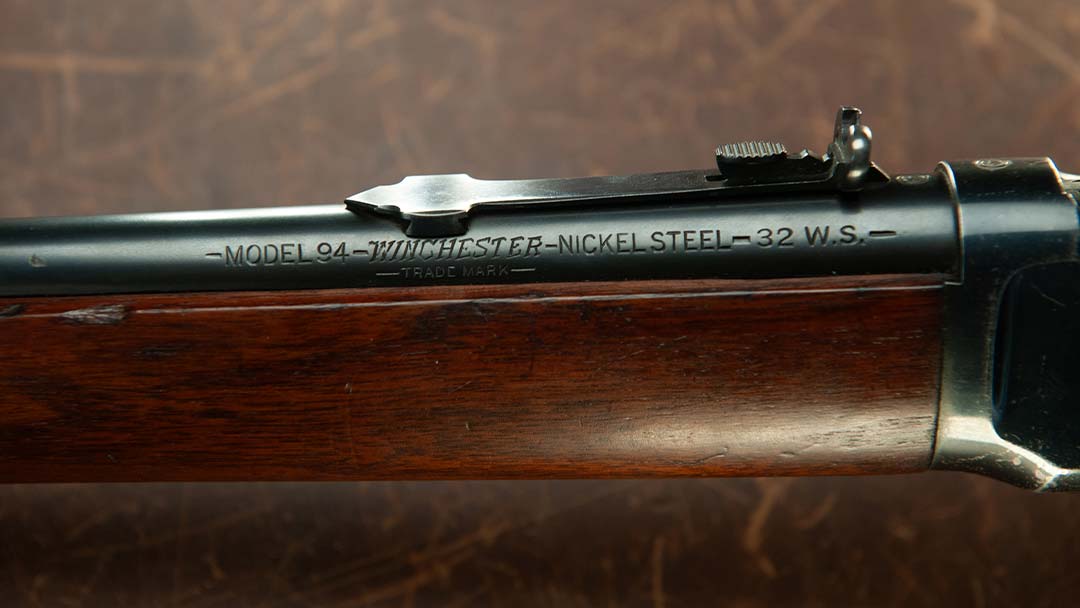
Catalogs from the early 1900s advertise Winchester 1894 models chambered in smokeless calibers at a higher price point, and these options are typically equipped with nickel steel barrels and include slightly modified sight elevator calibrations. Though a limited number of extras were initially available for the Winchester 1894, the platform’s popularity quickly gave rise to numerous options for triggers, wood grades, buttstocks, barrel lengths, and a wide range of special ordered features that make this classic lever gun one of the most collectible models in the Winchester family.
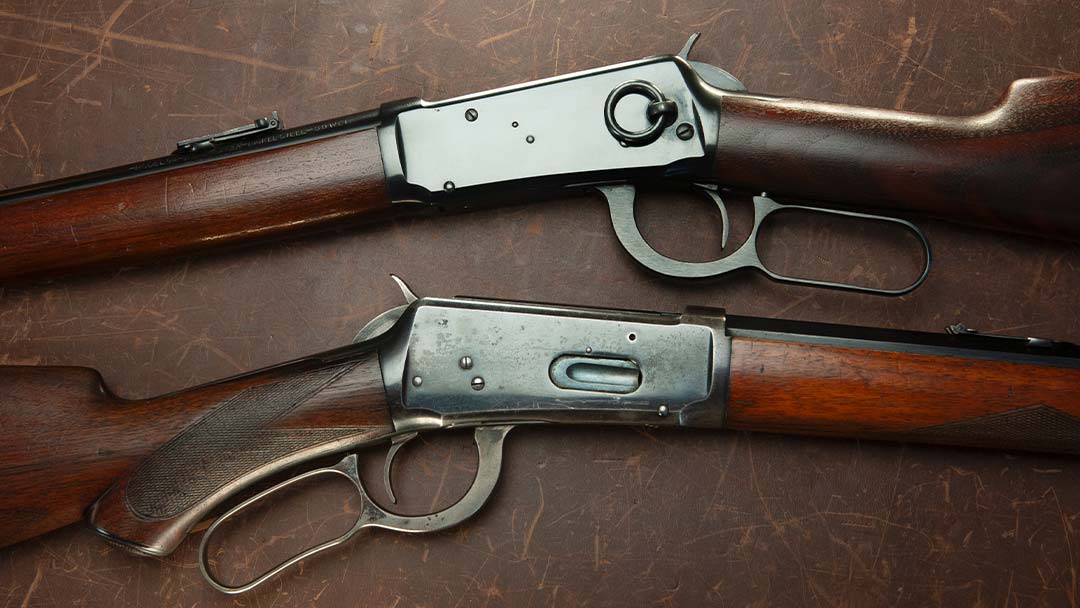
The early production Winchester Deluxe Model 1894 rifle pictured below illustrates some of the early special order options available. The rifle’s factory letter lists the gun’s original configuration when received by the warehouse on March 19, 1897, and shipped four days later. Initial features included a round barrel, a .25-35 caliber chambering, a plain trigger, a checkered pistol grip stock, and a hard rubber shotgun buttplate. The rifle was later returned to the factory and reconfigured with an octagonal barrel, a .30 WCF chambering, and a steel crescent buttplate.
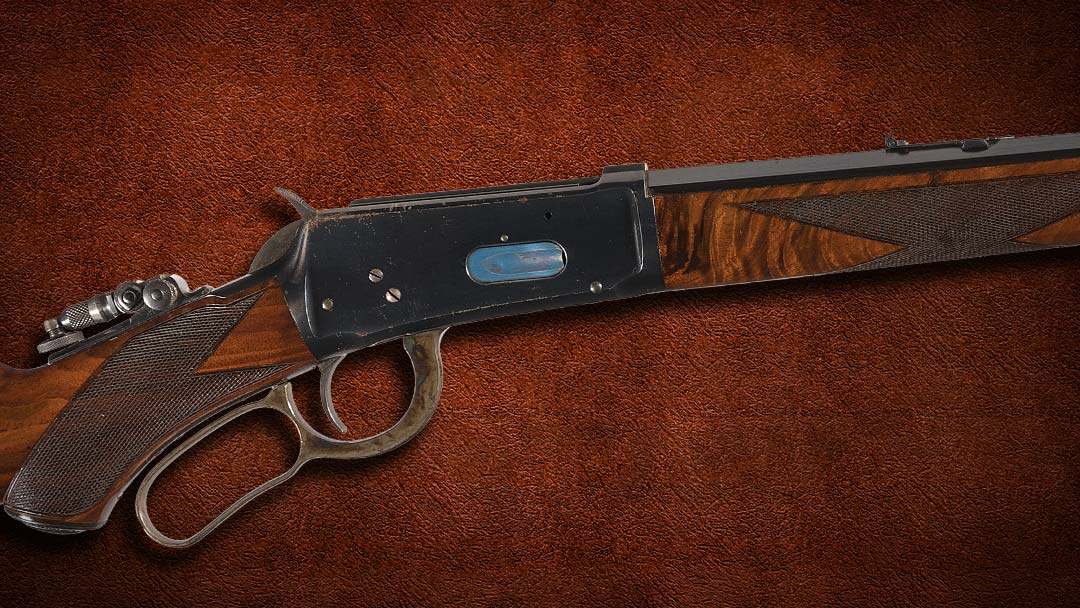
Model 1894 vs Model 94
Though only 1,400 Winchester 1894s were shipped in its first year on the market, the model’s momentum steadily climbed. By century’s end and the twilight of the Wild West, the Model 1894 production totals had exceeded 80,000. By 1927, Winchester’s trusty buck-buster approached an impressive 1 million units produced.
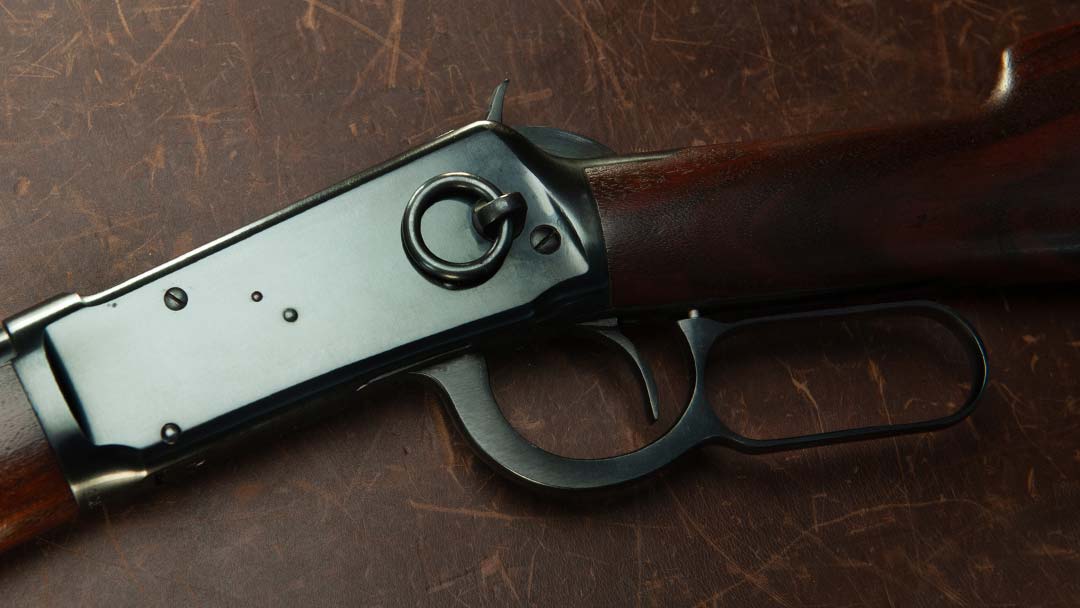
In 1921, around the 895,000 serial range, Winchester shortened the Model 1894’s designation to “Model 94,” a name that still stands today. Mechanically, the Model 1894 and Model 94 are the same firearm.
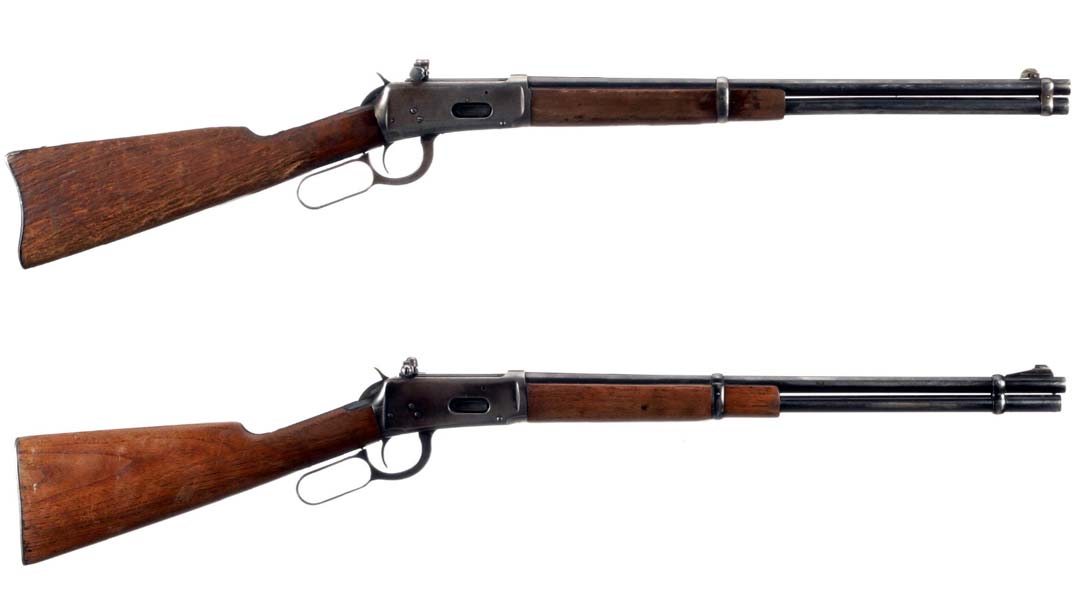
To make matters more confusing, Winchester produced two siblings of the Model 1894: the Model 55 and Model 64. Manufactured from 1924 to 1932, the Winchester Model 55 saw a total production run of about 21,000 total units and was introduced as a potential replacement for the Model 94 rifle and takedown variants, whose sales had been long eclipsed by the Model 94 carbine configuration.
The Model 55’s replacement, the Model 64, was manufactured between 1933 to 1957, and again from 1972 and 1973, with 67,000 units produced between both runs. The Winchester Model 94, Model 55, and Model 64 all employed the same receiver and many of the same parts. Though both the Model 55 and Model 64 achieved modest sales, Winchester’s efforts to rebrand and revitsalize the market for Model 94 takedown and solid frame rifles was a comparatively short-lived experiment, and the Winchester Model 94 carbine continued to reign supreme.
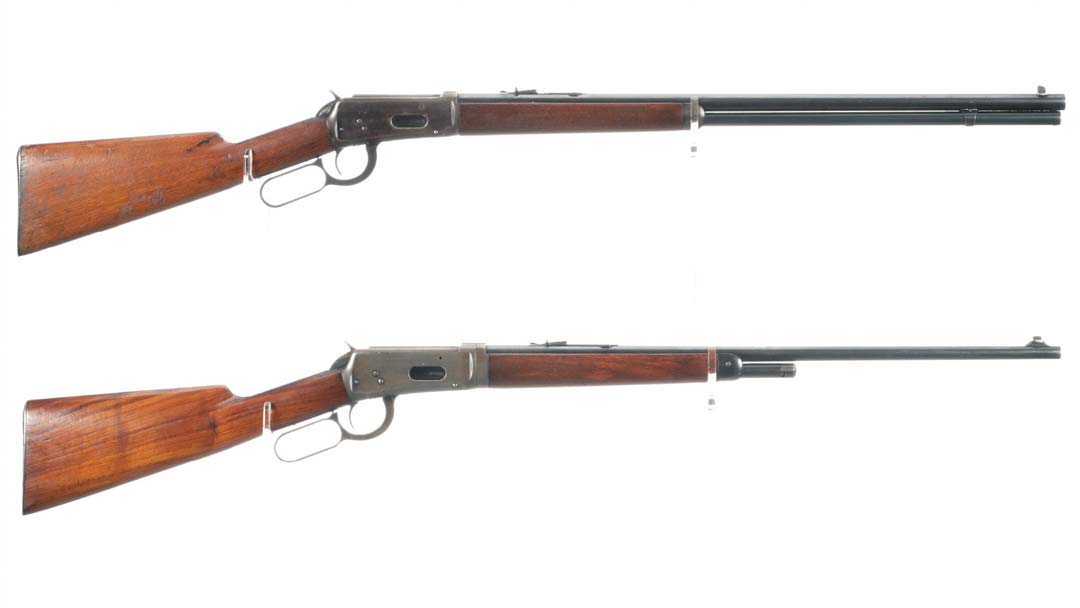
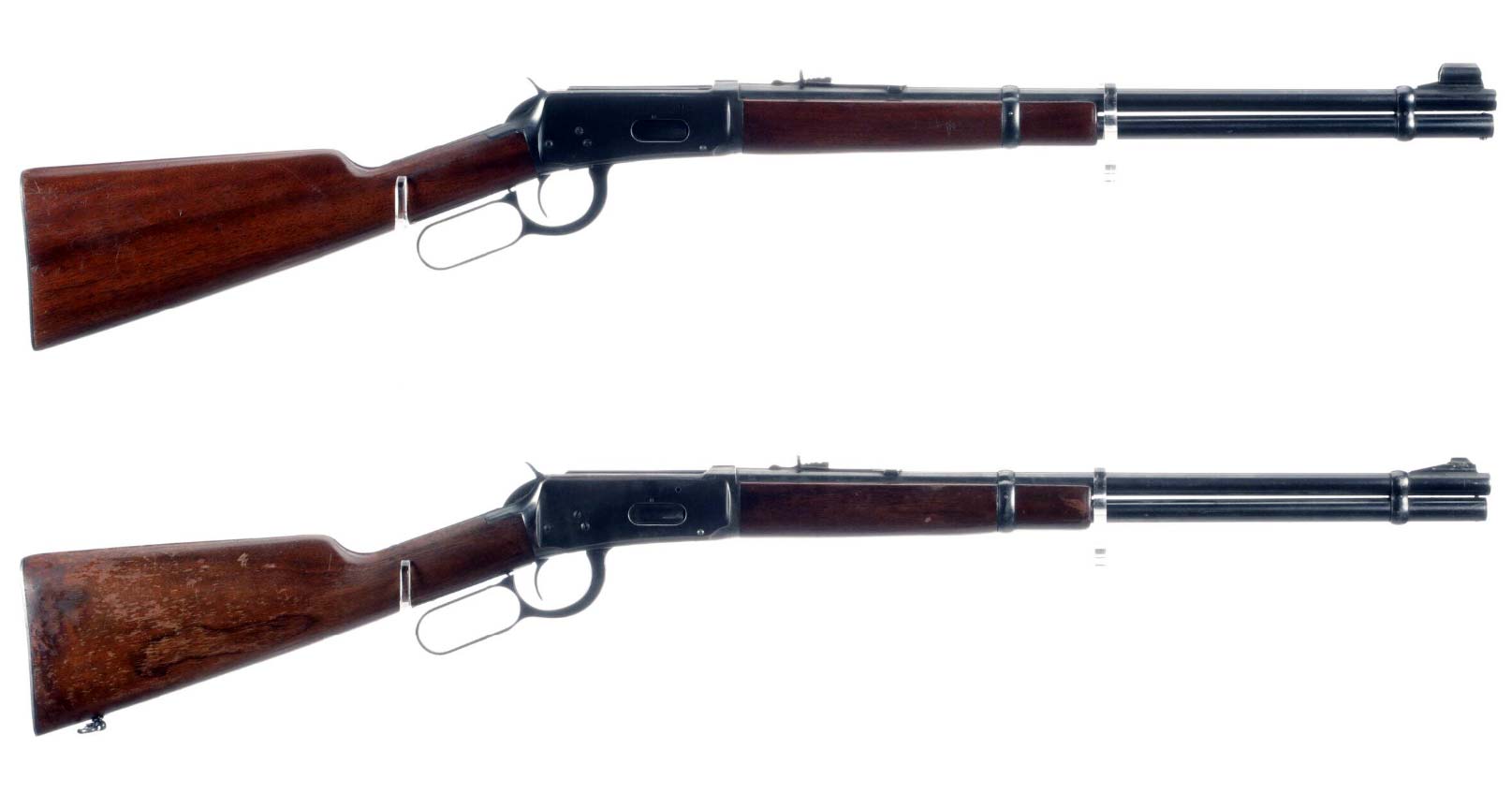
Pre-1964 Winchester Model 94 Models
In late 1963, the Winchester Model 94 rifle underwent a revamp to reduce production costs, including utilizing different internals and replacing the forged steel receivers that gave the Model 94 such a classic aesthetic. In the eyes of many shooters, hunters, and arms collectors, these changes were perceived as a step backward in quality.
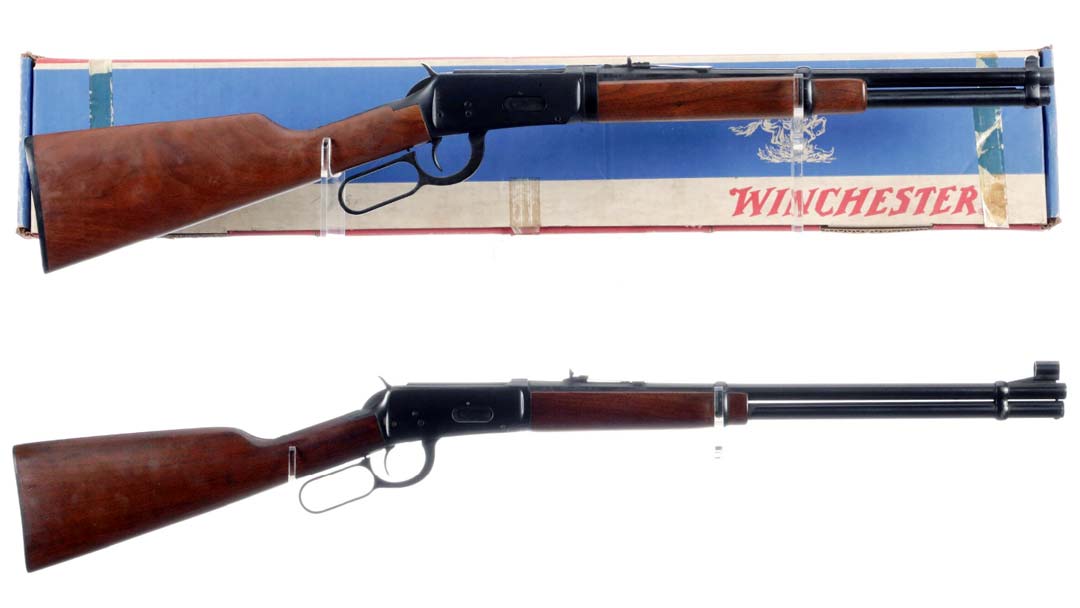
Winchester Model 94 Value by Serial Number
The Cody Firearms Museum in Cody, Wyoming provides original Winchester factory records for Model 1894s from serial number 1 through 353,999. Early production examples of the genre are particularly valuable to collectors, such as the special order Winchester Model 1894 semi-deluxe style rifle below manufactured in 1907.
Winchester Model 94 serial number 1,000,000 was presented to President Calvin Coolidge in 1927, an engraved and checkered sporting rifle with gold plating. Serial number 1,500,000 went to President Truman in 1948, and Winchester Model 94 serial number 2,000,000 was awarded to President Eisenhower in 1953.
Other notable milestones for the Winchester Model 94 include reaching serial number 2,500,000 in 1961 and the end of the pre-64 Model 94 run starting at serial number 2,700,000. The Winchester Model 94 reached serial number 3,000,000 in 1967, and U.S. production of the Model 94 ended around the 6.58 million serial number range in March of 2006.
The Winchester 94AE
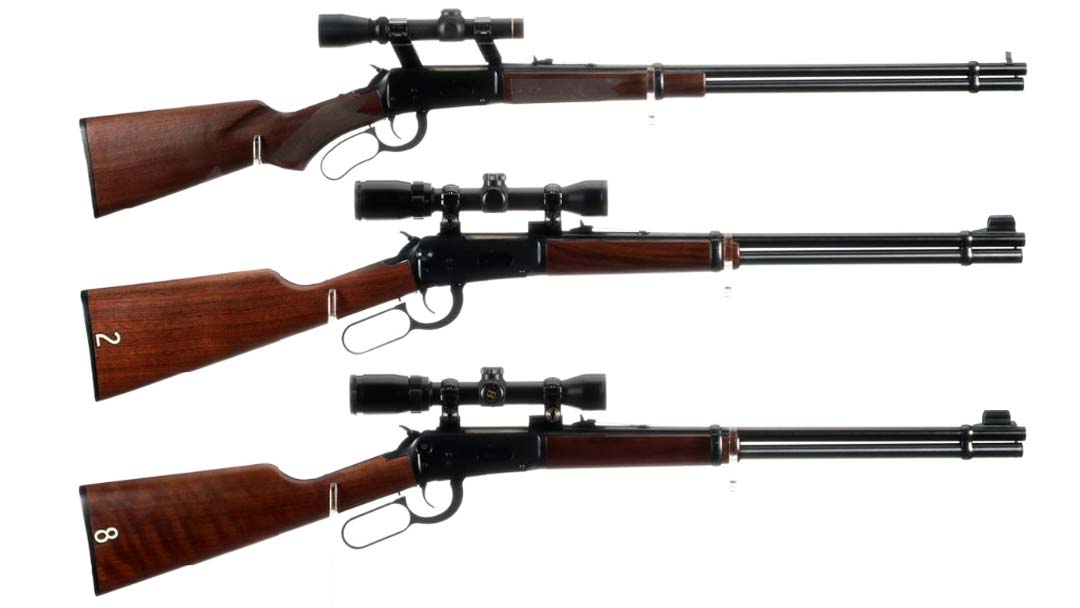
Despite the backlash over the 1964 manufacturing changes, the Winchester Model 94 continued to see steady sales. Different variants of the Model 94 were introduced to cater to a wide range of hunters and shooters. The Model 94 Ranger served as an economic option, while 1978 saw the debut of the Model 94 XTR, a deluxe version of the platform. Four years later, the Winchester 94AE, or “Angle Eject,” was introduced.
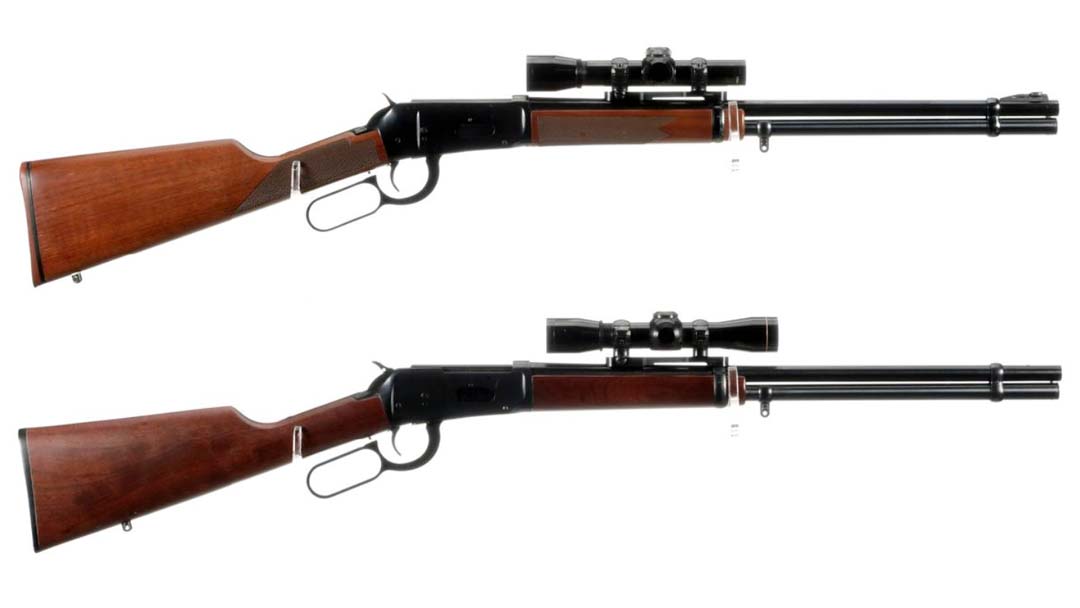
The Winchester 94AE was produced by the U.S. Repeating Arms Company (USRACo), which had purchased the New Haven factory in 1981 and leased the Winchester trademark from the Olin Corporation. The new model’s angled cartridge ejection system allowed shooters to mount riflescopes over the top of the action.
Winchester Model 94 Commemoratives
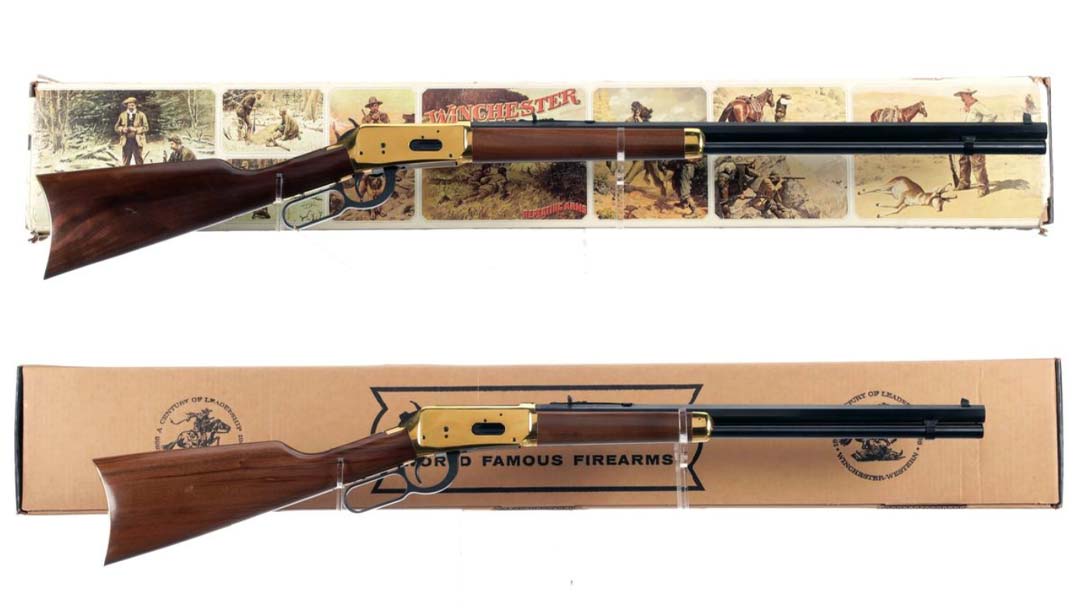
Over the decades, Winchester has produced at least 119 factory issued commemorative models and 30 special ordered and privately issued commemorative models, with the Winchester Model 94 being the most numerously offered commemorative. First introduced in 1964 to honor the Wyoming Diamond Jubilee, Winchester commemorative models were themed around celebrating specific states, Wild West figures, Hollywood actors, significant Winchester gun models, and historic events, institutions, and anniversaries from U.S. and Canadian history.
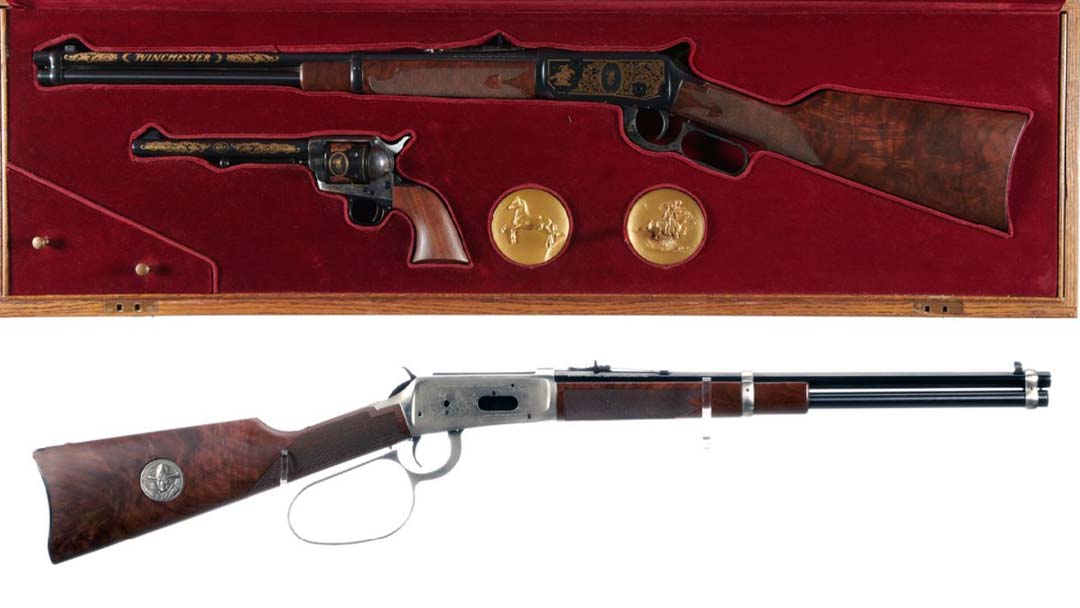
Winchester commemoratives often feature fancy stocks, quality metal finishes, and specialty engraving. Due to their limited production runs and attractive aesthetic, certain Winchester Model 94 commemorative issues have achieved surprising prices at auction, with themes like John Wayne, Geronimo, Antlered Game, and the Boy Scouts of America Winchester Model 94 commemoratives being some noted standouts.
Winchester Model 94 Legacy
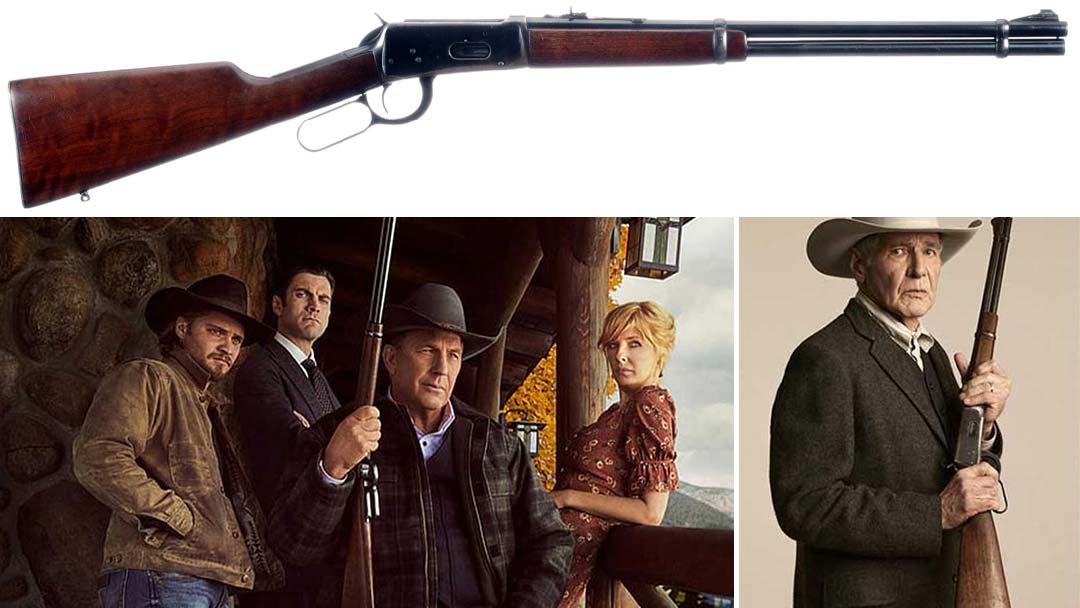
The Winchester Model 94 was a gun of many eras, serving as Teddy Roosevelt’s varminting rifle of choice, a mainstay of silver screen cowboys, and seeing limited military issue with the U.S. Army Signal Corps during World War 1. From October 20, 1894 to March 31, 2006, the Winchester Model 94 was manufactured in New Haven, Connecticut, and today Miroku Corporation of Japan continues to produce the iconic lever action and keep the model’s 130-year-old legacy alive.
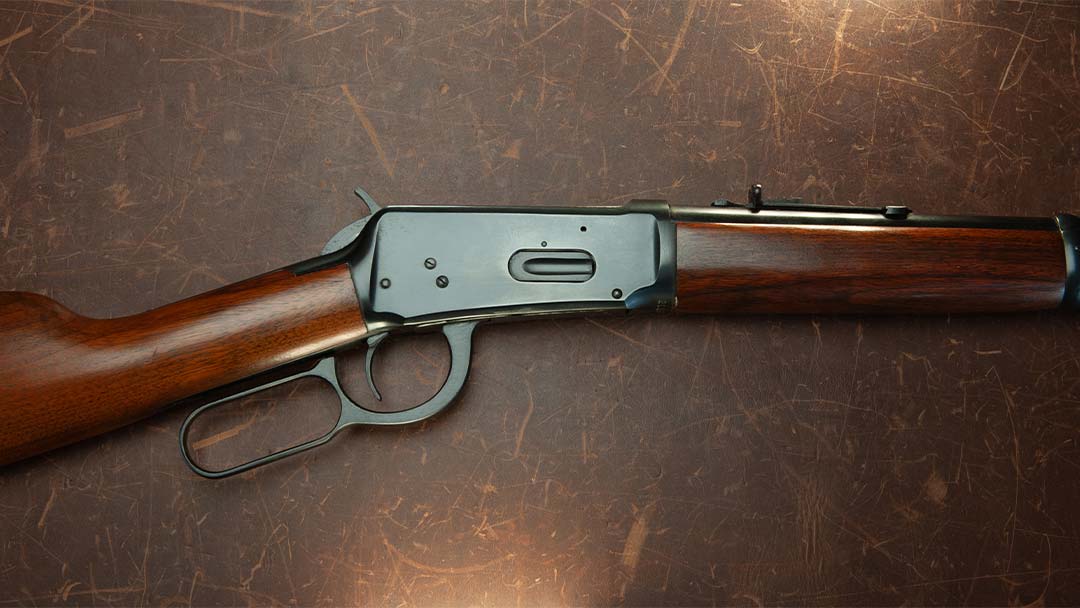
Released too late to claim the title “Gun That Won the West,” the Winchester Model 1894 faithfully carried the torch passed on by its lever action forbearers. Serving as the hunter’s choice, the ranchman’s standby, and a backyard range essential, the Winchester Model 94 can still be found in countless safes, racks, deer camps, truck beds, and saddle scabbards across the nation. Now that’s an American success story.
Winchester Model 94 for Sale
Due to the sheer variety of configurations produced over the last 130 years, the Winchester Model 94 offers a broad platform for nearly every arms collecting aspiration. From antique and curio examples produced during the golden age of American gun manufacturing to the wide number of limited edition commemorative issues, Rock Island Auction Company offers an unparalleled selection of Winchester Model 94 rifles and carbines for sale.
Rock Island Auction Company’s Feb. 16-18 Sporting and Collector Firearms Auction includes every lever action legend from the Winchester family. From the historic Henry rifle and Winchester Model 1866 “Yellowboy,”, Old West icons like the Model 1873 and Model 1876, and John Browning designed classics like the Model 1894 and Model 1895, a Winchester aficionado will find no shortage of opportunities to expand their collections.
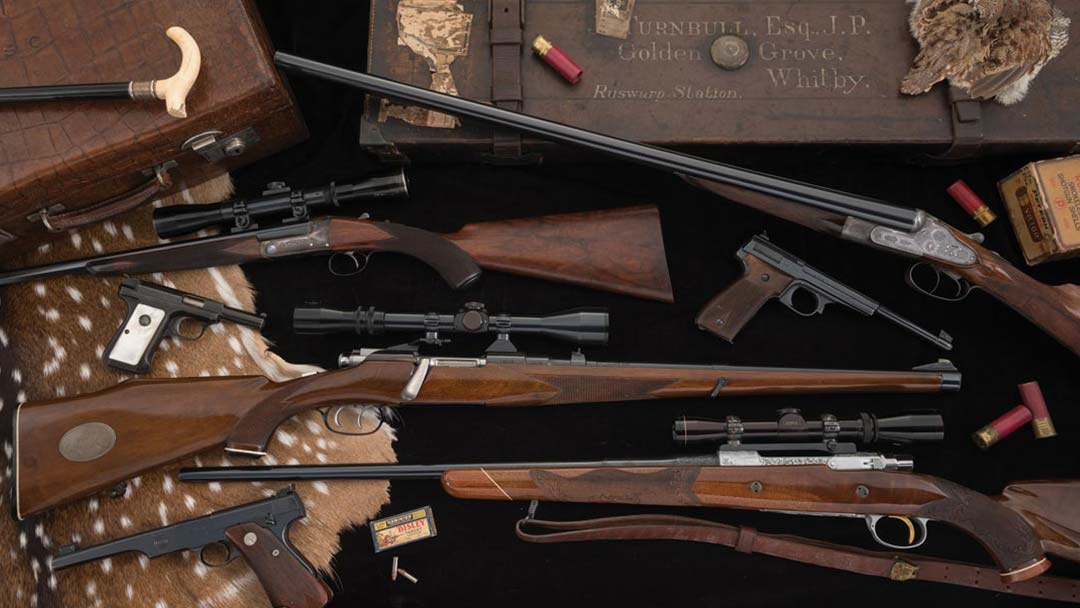
Subscribe to the Rock Island Auction newsletter for weekly gun blogs and gun videos featuring other iconic American arms like the Hawken rifle, the Sharps rifle, the Spencer carbine, the Colt SAA, the Springfield M1903, the Winchester Model 70, the Ithaca 37, the Smith & Wesson Model 29, the Savage 99, and more.