
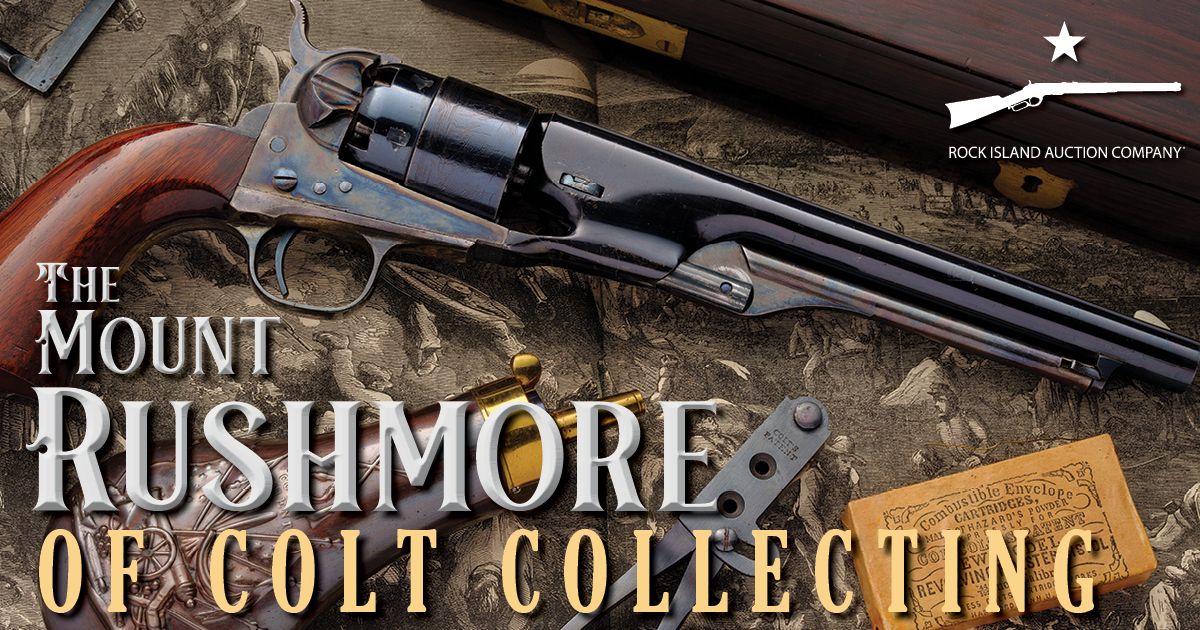
Colt’s Manufacturing Company has been producing historic guns for 177 years, drawing numerous collectors, scholars and devotees, so declaring the “Mount Rushmore of Colt collecting” Is a good way to start an argument. Trying to present the best four examples of just about anything — from rock singers to American authors to WWE wrestlers — is a thought experiment that can quickly get emotional.
That said, let’s replace George Washington, Thomas Jefferson, Abraham Lincoln and Theodore Roosevelt – some of the greatest presidents in U.S. history – to find the most legendary Colt firearms. Consider the historic impact that these guns should have such monumental recognition. Of the many guns, Colt has produced, the four presented here bear a historic and lasting impact on the United States and the world. Examples that will be available in Rock island Auction Company’s Dec. 6-8 Premier Firearms Auction in Bedford, Texas, are presented as part of this spirited discussion.
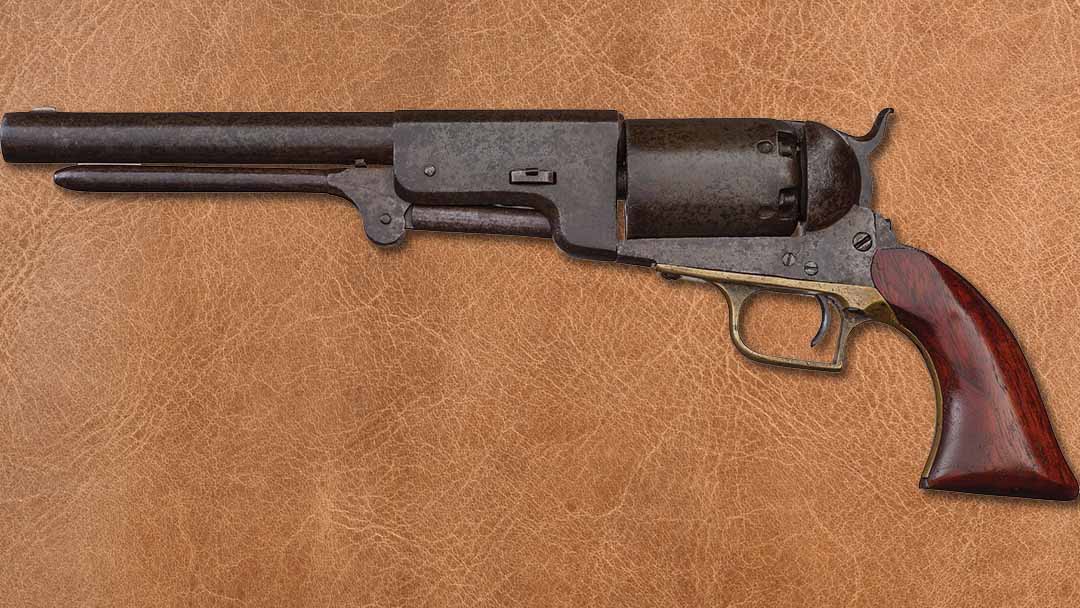
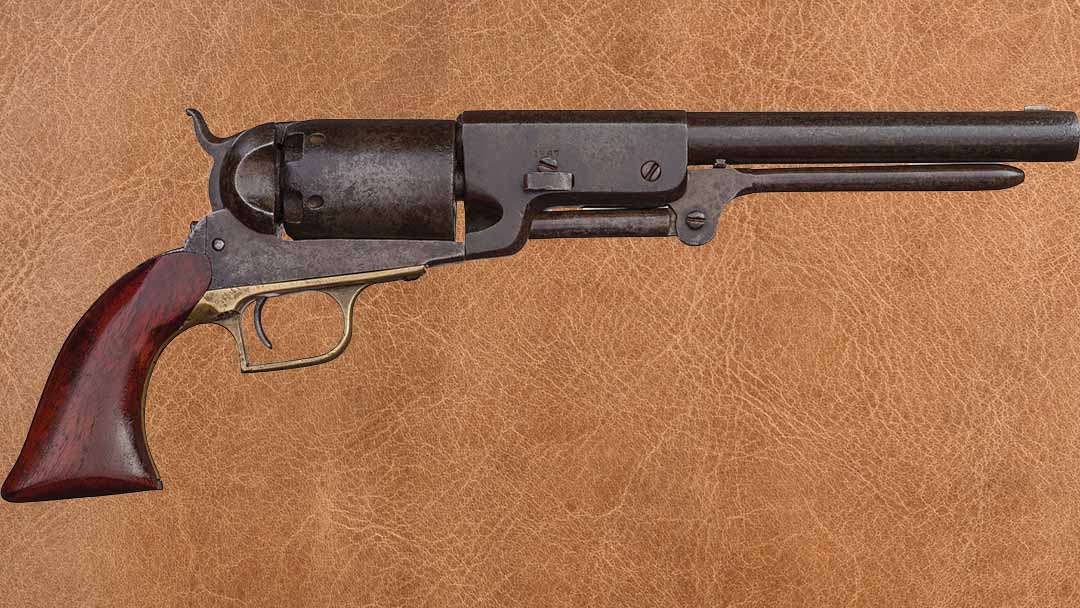
Mount Rushmore of Colts: Colt Walker
Some may say the Paterson deserves to be on this Mount Rushmore as Samuel Colt’s first commercial venture, patented in 1836, but that was made by the Patent Arms Company, rather than the company that would bear its founder’s name. It was a gun that would show the promise Colt would fulfill a decade later with the Walker revolver and truly show Colt’s innovation. Without the Walker revolver, there would be no discussion. Without George Washington, there would be no other faces on Mount Rushmore. The Walker is truly a foundational gun
In 1846 as war with Mexico was looming, Samuel Walker, a captain with the Texas Rangers who had used the Paterson, contacted Colt about an improved version of his first revolver. Walker wrote to Colt, whose Patent Arms had failed, telling him of a band of 15 Texas Rangers holding off 80 Comanche warriors because of the repeating Paterson revolvers, rather than the single shot guns of the day.
“With improvements I think they can be rendered the most perfect weapon in the world for light mounted troops…The people throughout Texas are anxious to procure your pistols & I doubt not you would find sale for a large number at this time,” wrote Walker.
Colt who had been working on underwater naval mines saw a business opportunity and expressed his interest in restarting his gun-manufacturing-concern. The two men met in New York City to discuss improvements and by December 1846 had secured a contract for 1,000 of Colt’s revolvers. The specifications for a more durable and powerful gun included 9-inch rifled barrels and a cylinder chambered in .44 caliber for six charges. The chambering was a significant difference with the Paterson that was a .36 caliber revolver. The Walker would weigh in at a beefy 4 lbs. 9 oz. and turn around Colt’s business fortunes.
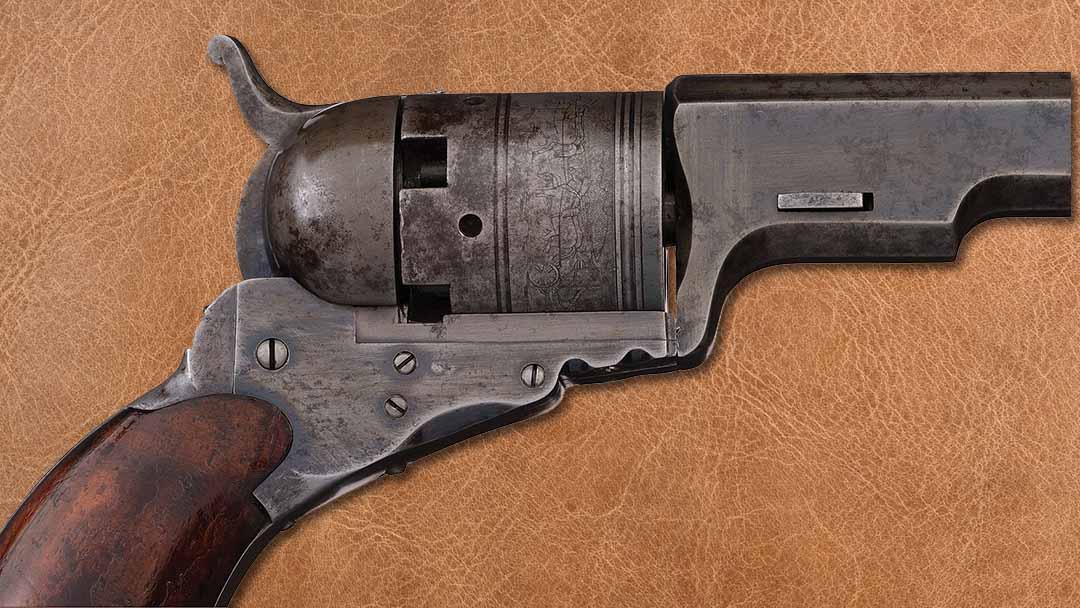
Despite not having a facility to make the guns, he contracted with Eli Whitney to manufacture the Walker revolver and delivered the first lot of 220 pistols in June 1847. Though they were to go to Walker’s unit the initial shipment was claimed by Col. Jack Coffee Hays for his First Regiment of the Texas Mounted Volunteers.
After the war ended most of the surviving Walker revolvers were returned to government arsenals. Of the 191 turned in by Hays’ men, only 92 were recorded as serviceable. Some walkers, captured by the Confederacy at the start of the Civil War and issued to cavalry units.
The Walker was the beginning of Colt’s large “horse pistols,” known as dragoons that would be manufactured up to the Civil War. Though Colt claimed he made little or no profit off the Walker, he gained publicity and the tooling through his contract with Whitney to build his own factory in Hartford, Conn. One of the Ordnance Department’s early suggestions was to make it smaller and lighter though early Dragoons still weighed in at 4 lbs. From 1847 to 1844, the U.S. government purchased 6,000 army pistols, and by the time of Colt’s death in 1862, more than 100,000 Colt revolvers were in circulation because of his collaboration with Samuel Walker.
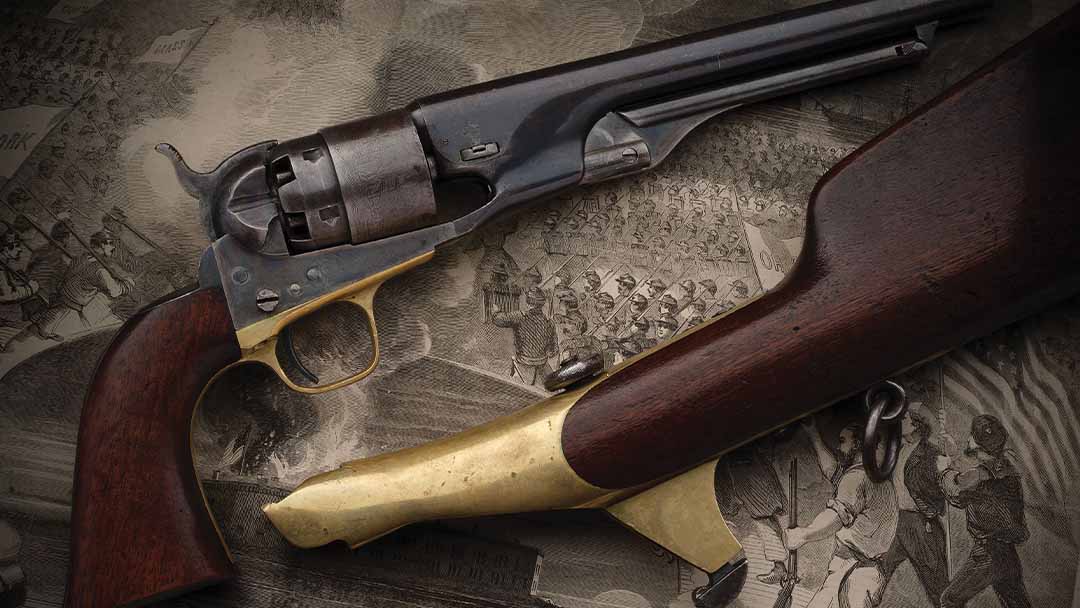
Mount Rushmore of Colts: Model 1860 Army
The Civil War wrenched apart a nation in order to do what the Founding Fathers didn’t — answer the question of slavery. In this war of North versus South and in the hands of brother versus brother, was the Colt Model 1860, the most widely used firearm of the conflict. The revolver contributed mightily to the northern victory and holding the country together, a monumental feat.
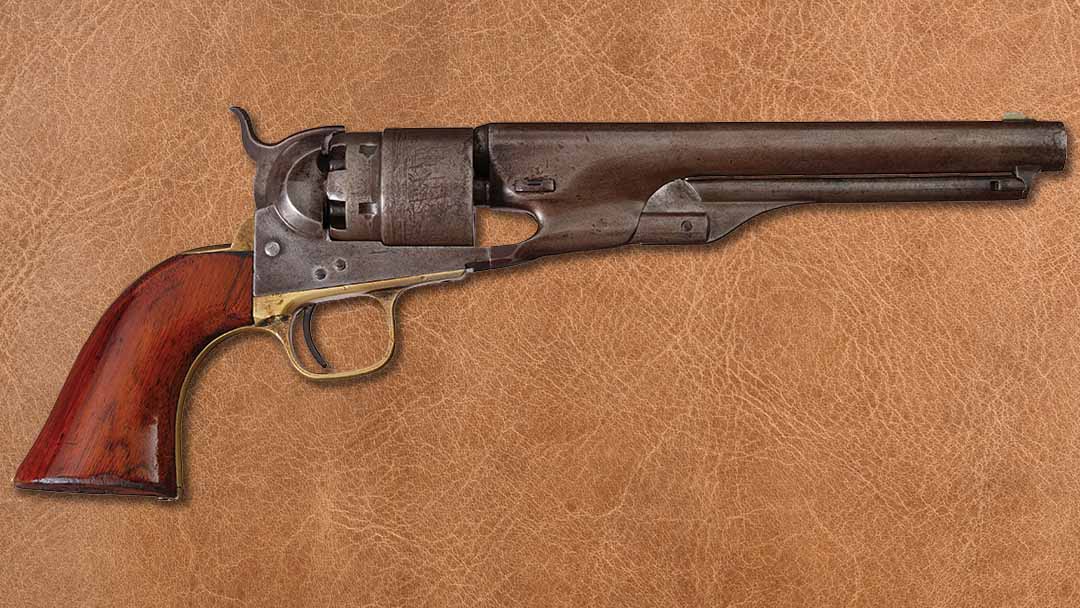
The U.S. government was the biggest customer for the Model 1860 Army, purchasing 129,730 revolvers for the Union Army, but the gun found itself in the hands of both sides during the Civil War. Colt shipped revolvers to the South before the start of hostilities and for a short time after fighting began. Plus, firearms scholar and author Charles W. Pate estimates that during the war 10,000-12,000 of the revolvers were captured by the Confederacy.
To examine a Model 1860 is to hold a piece of American history, of camaraderie around bivouac campfires and the shared horror of battle. Adopted a year before the southern states made their intentions clear, many examples of the 1860 Army have the finish, patina, nicks and scratches of a firearm that was in the crucible of war, a tool of both tragedy and triumph.
Through the 1850s, Samuel Colt was aware of what U.S. Army officers thought about the Dragoon and Model 1851 Navy revolvers. They liked the size of the Navy revolver but wanted the .44 caliber punch of the Dragoon. Colt engineers experimented with lightening the Dragoon and enlarging the caliber of the Navy revolver. What they designed was the Colt Model 1860 Army.
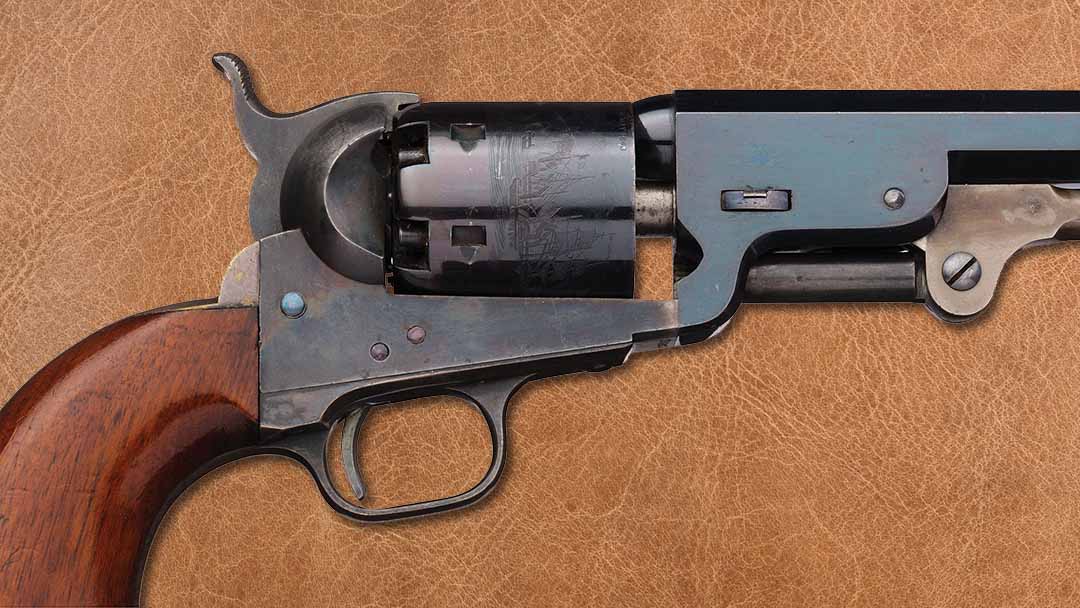
Colt’s health was deteriorating as his company worked to produce a revolver suitable for the U.S. Army. He saw the 1860 Army adopted by the U.S. government but died in 1862 as his revolver was becoming crucial to the Union effort.
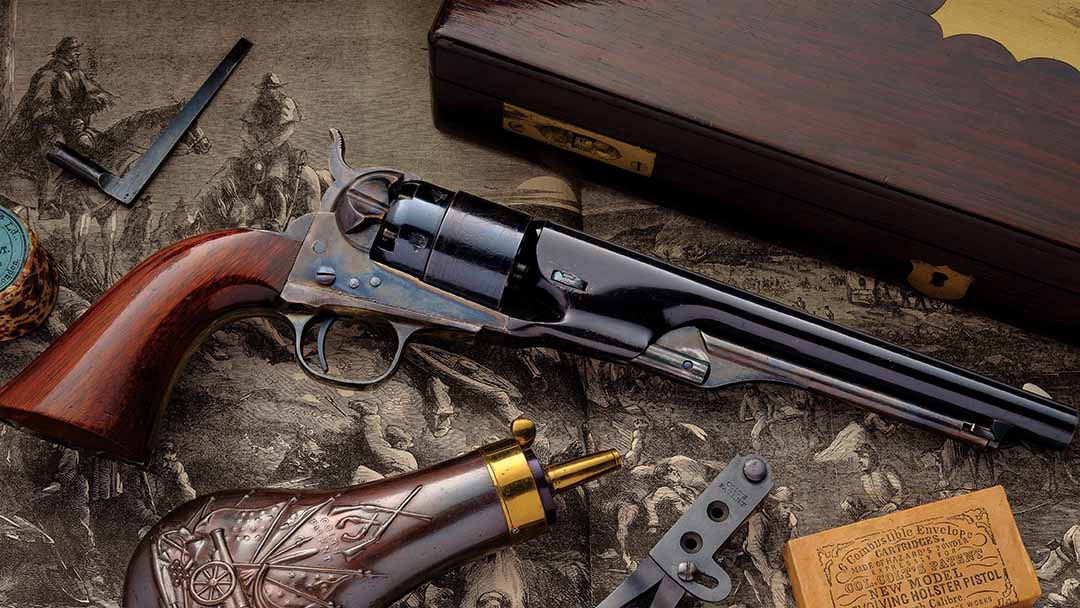
Though many 1860 Army revolvers show the wear of use, there are also amazing cased examples. Samuel Colt wasn’t shy about greasing the wheels of commerce to his advantage, so often presented his firearms to those in government and business who could help him in some way.
Like many Colt firearms, the original often isn’t the best or only model and the 1860 Army is no different. Early examples have fluted cylinders before they were discontinued, while some have the short grips of the 1851 Navy. The U.S. contract stipulated 8-inch barrels, but can be found with 7 1/2-inch barrels and even as short as 4 1/2-inches. Some of the Model 1860 also were later converted to take metallic cartridges.
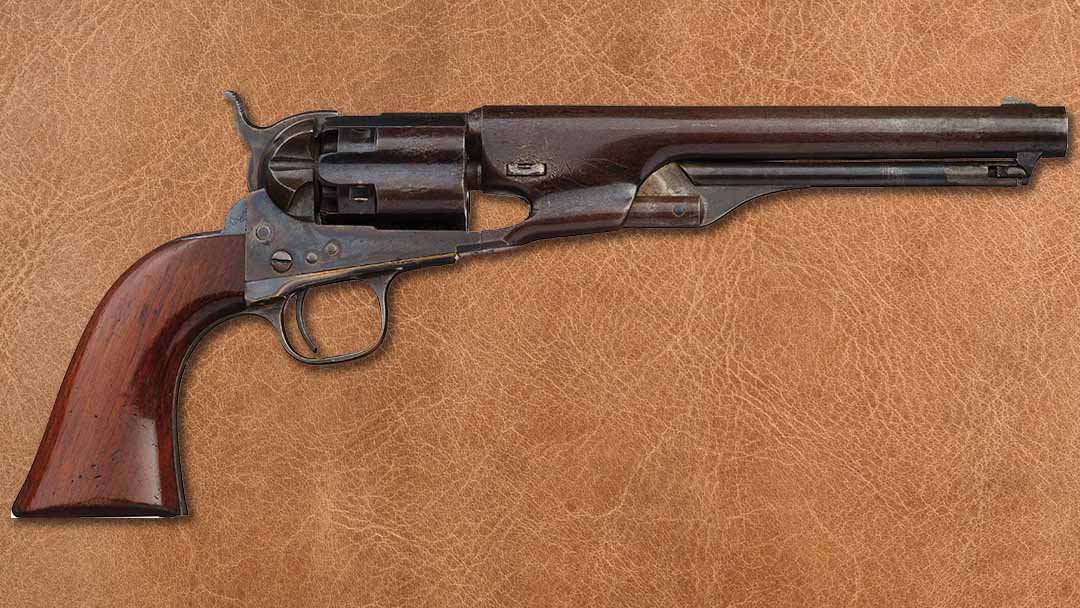
Many of these revolvers made their way west as war veterans sought their manifest destiny while cavalry soldiers wielded them in the early years of the ongoing Indian Wars, extending the weapon’s war experience for nearly a decade after the Civil War. In total, more than 200,000 Model 1860 Army revolvers were made 1860-1873. By comparison, more than 350,000 first generation Single Action Army revolvers were manufactured between 1873 and 1940.
Mount Rushmore of Colts: Single Action Army
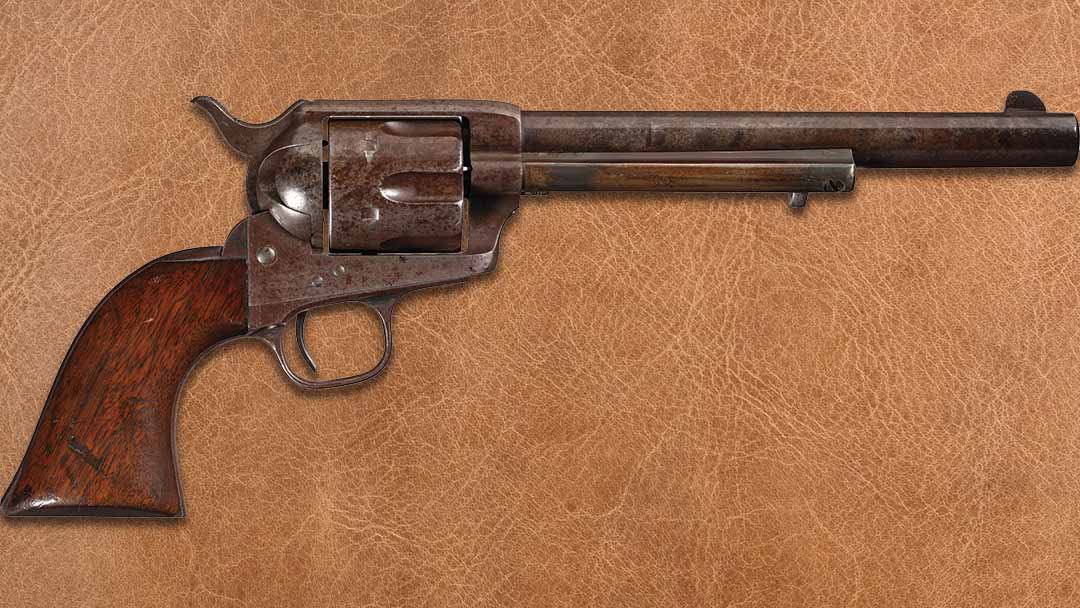
The Colt Single Action Army is indelibly written in the history of America’s westward expansion. Despite its development and use at a time without major conflict, it was in the hands of Indian fighters, lawmen trying to keep the peace, ranchers carving out a life on the frontier and desperadoes looking for a payday. To think of 19th century manifest destiny is to think of covered wagons and Colt’s revolver. The Single Action Army stands shoulder to shoulder with the Winchester Model 1873 as the guns that shaped the American West.
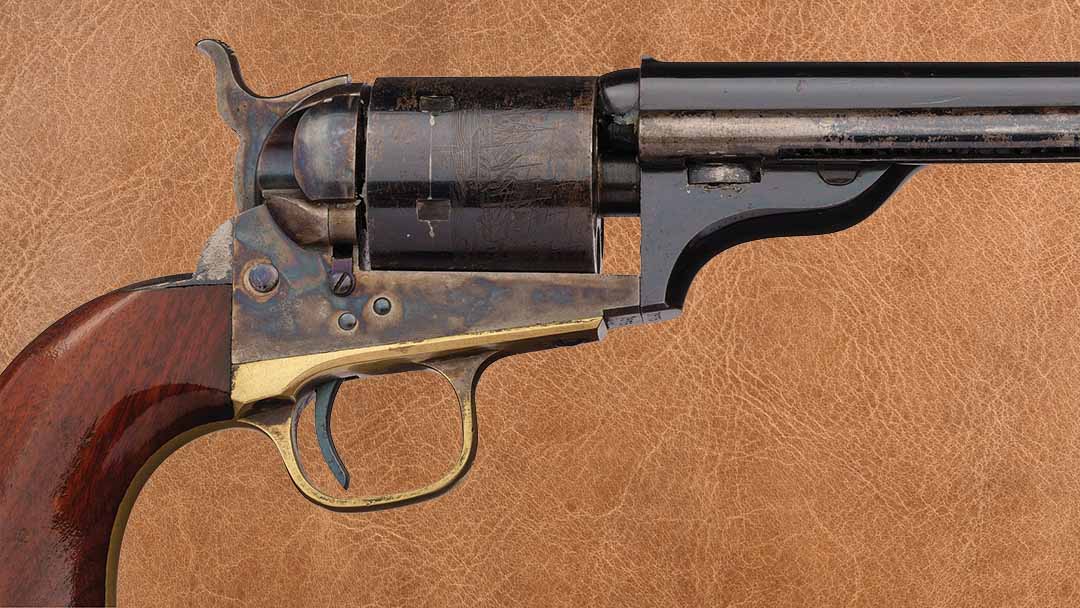
The Single Action Army was initially intended for the U.S. Army. Colt submitted its Model 1871-1872 Open Top to military trials and was rejected. The Army also wanted a more powerful cartridge than the .44 Rimfire. Colt designed a well-balanced revolver with a top strap and worked with Union Metallic Cartridge to create the .45 Colt.
“I have no hesitation in declaring the Colt revolver superior in all aspects, and much better adapted to the wants of the Army than the Smith & Wesson, wrote Capt. Joh R. Edie in the official test board summaries. The Army ordered 8,000.
Issued to the Cavalry with 7 1/2-inch barrels, and the guns found their way into the Indian Wars. Guns from the fifth military shipment of SAAs, known as Lot 5 guns, are legendary because of their rarity and their ties to the 7th Cavalry at the Little Bighorn Massacre.
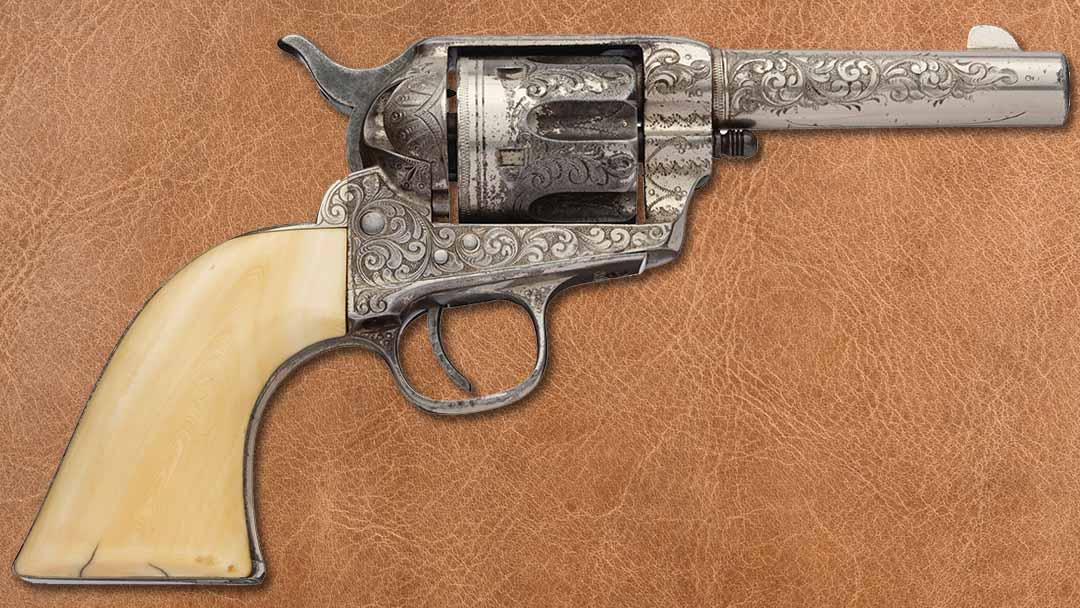
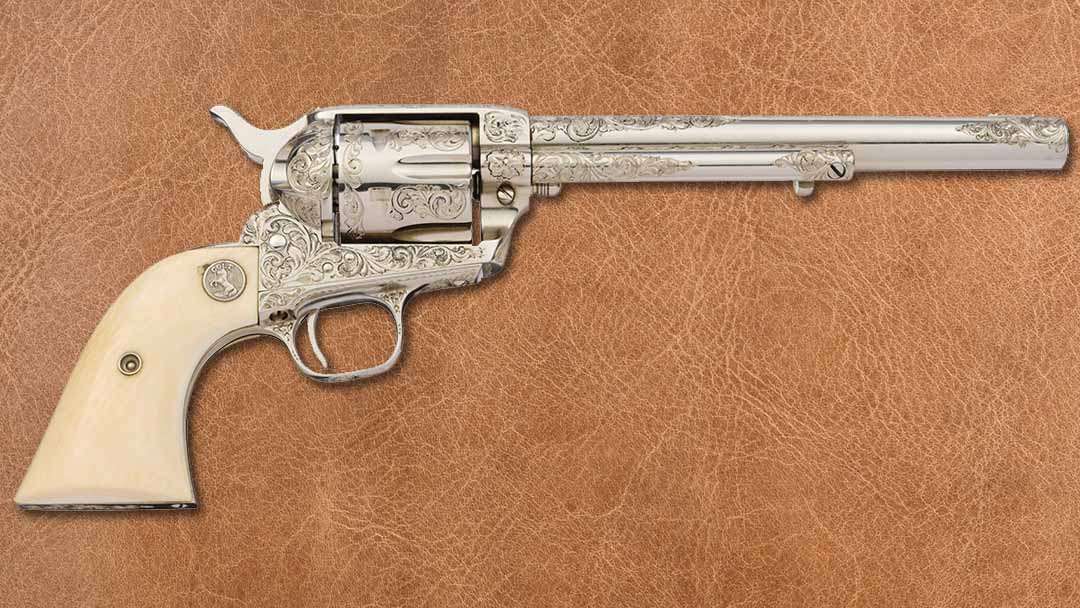
Starting in 1875, the guns could be purchased by the general public with 5 1/2-inch barrels known as the Artillery Model starting in 1875 and with 4 3/4-inch barrels called the Sheriff’s Model in 1879. In 1878, the revolver was chambered in .44-40 Winchester, pairing it with the legendary Winchester 1873 lever gun so the lawless, lawmen and frontiersmen could use the same ammunition.
The Single Action Army’s popularity only grew after Colt displayed 18 beautifully engraved SAAs at the 1876 World Fair in Philadelphia. The famous like Theodore Roosevelt, Bat Masterson and Elmer Keith, as well as the infamous Billy the Kid, Butch Cassidy and Bob Dalton were known to carry the wheelgun.
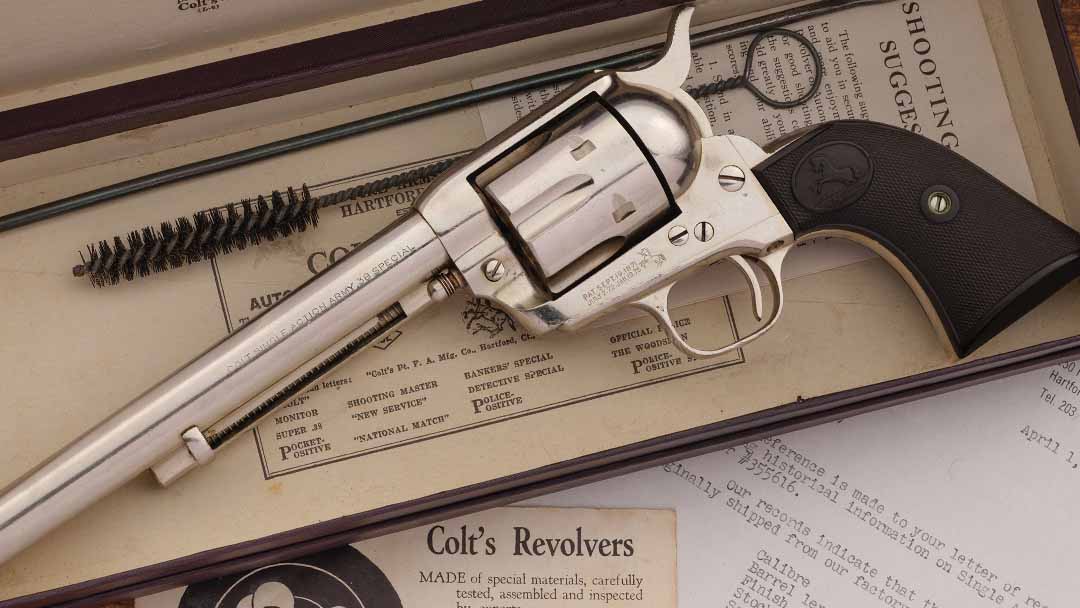
The Single Action Army became highly collectable based on when it was made, where it was shipped, who owned it and whether it had special features. Author and collector David M. Brown recorded 36 different chamberings in his book, “The 36 Calibers of the Colt Single Action Army. Nearly half are chambered in .45 Colt but some caliber offerings can be counted on one hand.
Though initially blued, the SAA would eventually be offered with additional finishes and legendary 19th century artisans Gustave Young, Cuno Helfricht and Louis D. Nimschke would engrave them. The gun would be offered as a target shooter with a flattop rather than a half-round top. Colt would also offer a Bisley Target model named after the famous British shooting range that had an under-swept grip, an enlarged trigger guard and a lowered and widened hammer spur.
Collectors are also interested in early sub-inspector marks and where they went, whether they shipped to Fort Worth’s Wolf & Klar, carried in the Spanish-American War or served as emergency replacement small arms during the Battle of Britain.
The Single Action Army has been in and out of production since 1873. The first generation stopped for World War 2 in 1940, but restarted in 1955 with the rise of the Hollywood westerns when John Wayne and Clayton Moore wore the SAA on their hip. The second generation ran to 1975 when equipment had to be retooled after being used for 100 years. Production of a third generation restarted in 1976, powered by the growth in cowboy shooting. This true legend has been in countless scraps and accumulated fantastic history, weaving itself into the fabric of America.
Mount Rushmore of Colts: M1911
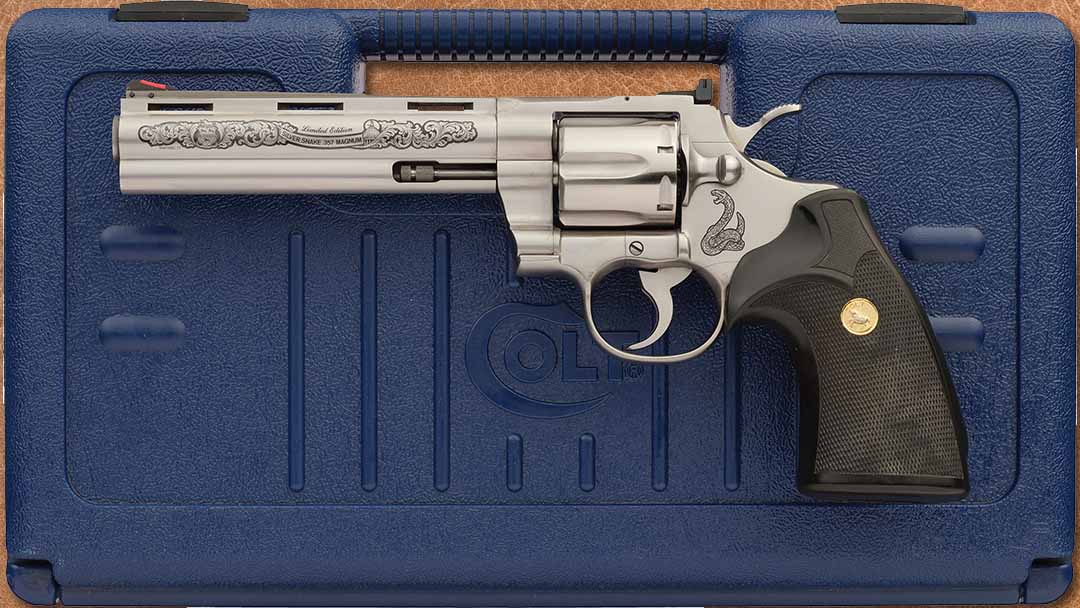
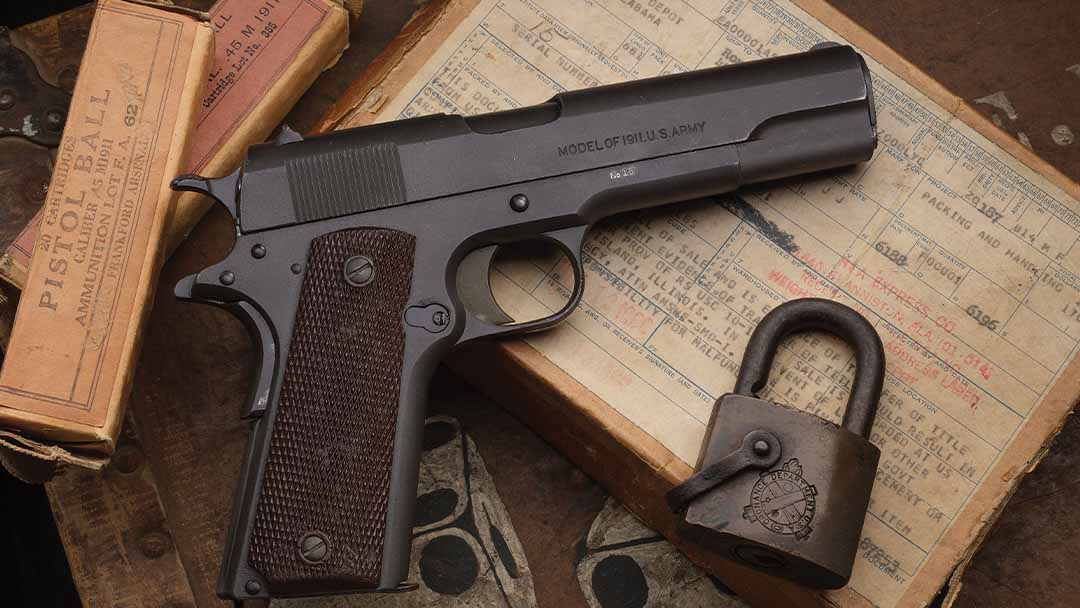
If this were a Mount Rushmore of Colt revolvers, then an argument can be made for the Colt Python, a reliable and wonderfully well-made wheel gun chambered in .357 Magnum that historian R.L. Wilson called “the Rolls Royce of Colt revolvers.” However, this is about Colts in general and there is no way to leave out a back-to-back World War 2 champion like the Model 1911. This gun fought at Belleau Wood, the beaches of Normandy and island-hopped the Pacific. “Old Slabsides” was the longest serving pistol in U.S. military history before being replaced by the Beretta M9 in 1985.
The invention of John Moses Browning, this classic military arm launched Colt into the 20th century and wears its reputation proudly. It offers design, reliability, historic pedigree and stopping power. It arrived at a time when automatic handguns like the Mauser C96 and the DWM Luger were coming into vogue in Europe. Colt was one of six manufacturers that submitted a gun for the 1907 U.S. military trials, Browning’s design and two others were the only ones remaining after the early rounds.
The design included years of revisions, experimentations and torture tests to the guns and it simply outperformed the competition from Savage and DWM. During World War 1, production was slow, but Colt and Remington-UMC went into full production and turned out 643,000 while Springfield added an additional 25,767 M1911 pistols by the end of World War 1.
The 1911 saw early uses in Mexico and Haiti prior to World War 1 before taking on heroic actions during the “War to End All Wars,” by the likes of Ace of Aces Lt. Frank Luke Jr. who used his he was surrounded after being shotdown, or Sgt. Alvin York who was immortalized by Gary Cooper after using his M1917 rifle and M1911 pistol to capture 132l German soldiers as well as killing 20.
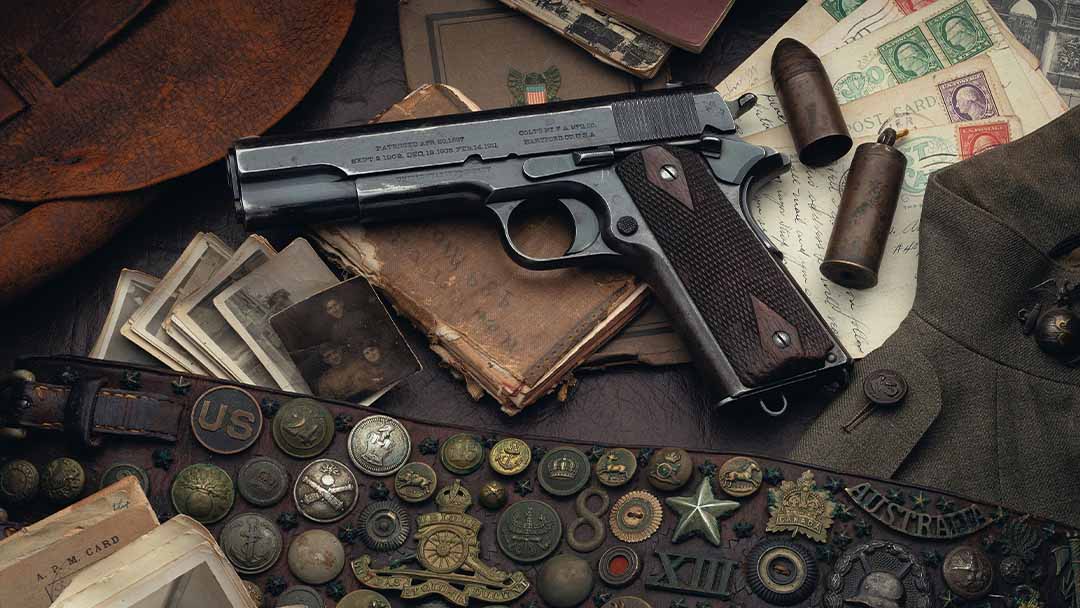
Given some refinements after World War 1 and designated the M1911A1, the gun was shipped to Great Britain, Canada and China among others for use during World War 2. To help with production, the U.S. enlisted companies Ithaca, Remington Rand, Union Switch & Signal and sewing machine maker Singerto make the 1911A1 along with Colt. About 2.7 million of the pistols were made with the stopping power of the .45 ACP dwarfing the competition.
There are also heroic tales of soldiers using their 1911 during World War 2. Sgt. John Basilone’s might be one of the best known for his actions on Gaudalcanal trying to defend Henderson Field in October 1942. Basilone, a Marine, braved constant enemy fire to repair and man machine guns, rally his men and keep them supplied, running form position to position. Fighting his way back through Japanese lines to deliver more ammunition, using his 1911 to take down several attackers. He received the Congressional Medal of Honor.
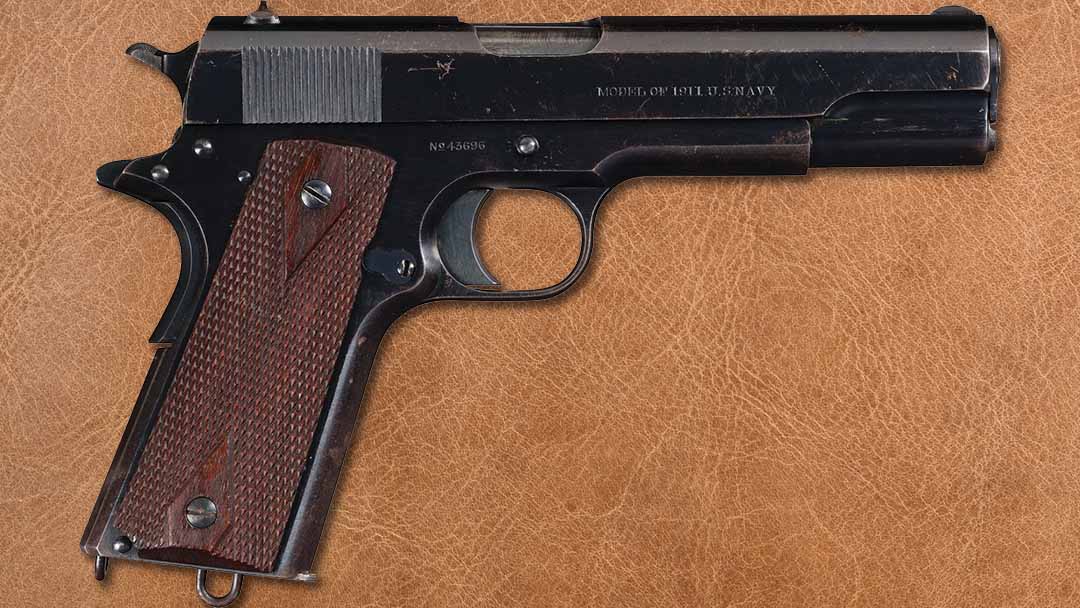
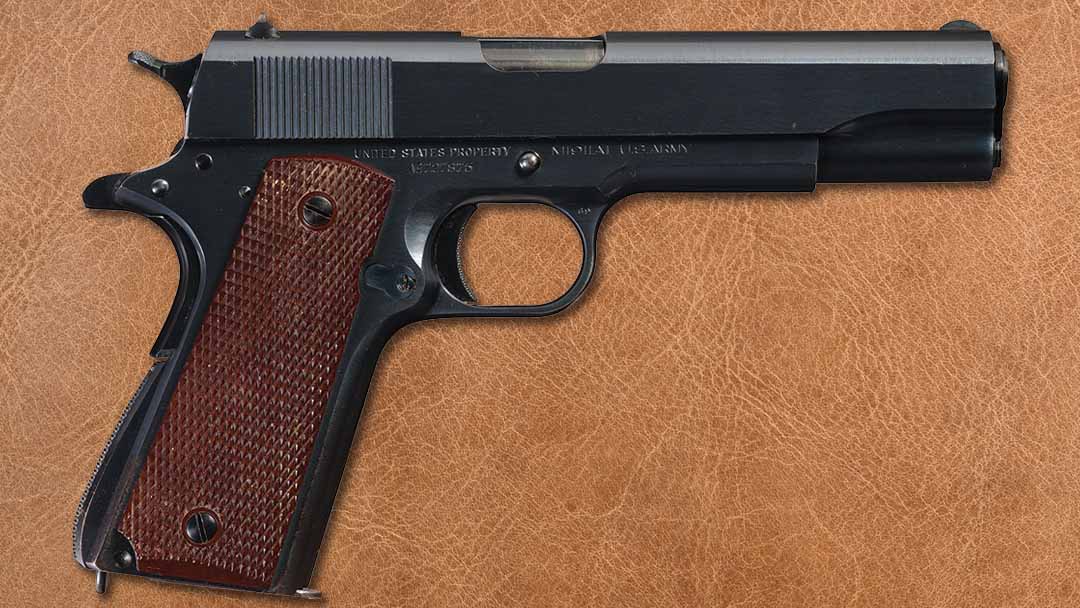
Browning’s “Yankee fist” wasn’t done after contributing to American victories in both world wars. The gun played a role in the Korean War and in Vietnam. Even after the Beretta was adopted, the 1911A1 still found use by elite fighting units like Delta Force and the U.S. Marine Corps Force Recon, serving in both Gulf Wars and Afghanistan. The 1911 is simple to operate, take apart and repair. It’s accurate and functional. Its silhouette has made it familiar on the big screen and on TV making it an American icon and the definitive firearm of the 20th century.
Amazing Colt Firearms for Sale
The Mount Rushmore of Colt firearms is truly the company’s foundation, from the Walker revolver that gave life and business to Samuel Colt’s dream, to the legendary Colt Single Action Army that saw action in the Indian Wars, across the frontier of the American West and served in late 19th century U.S. conflicts, remaining in production today. The Model 1860 Army proved to be the trusted sidearm of the American Civil War, especially the victorious Union Army, while the Model 1911 saw action in both world wars of the 20th century and into the gulf wars and Afghanistan during its long and storied history. Rock Island Auction is proud to offer these heroic and celebrated guns in its Dec. 6-8 Premier Auction in Bedford, Texas.