

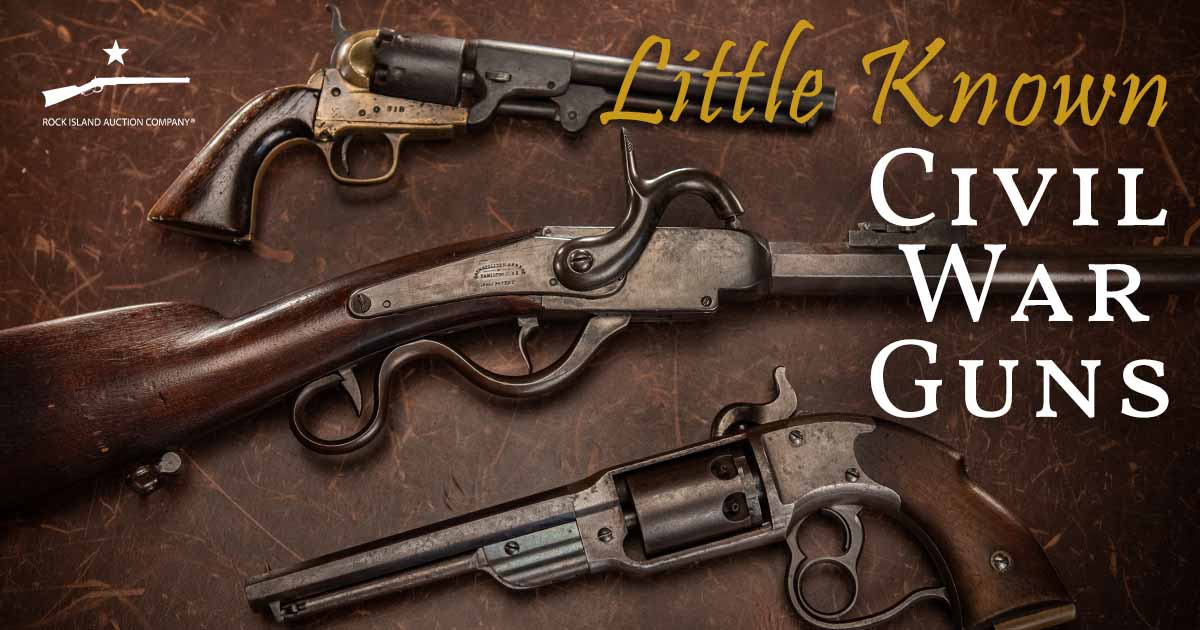
As the United States descended into Civil War, both sides came to the realization they didn’t have the weapons to put up a fight. The Union, with its industrial advantage, started manufacturing all types of weapons, many that were well-made, innovative and accurate but not necessarily well known.
Many gun companies like Starr and Burnside that had struggled to find an audience for their product now had a ready and willing buyer in the U.S. government. The Confederate government, without the industrial base the northern states had and unable to buy guns from northern companies, struggled to find weapons, looking to Europe, but occasionally finding a home-grown opportunity.
Here are some guns that might not be as well-known as many Civil War-era firearms as well as two legendary wheelguns that will be available in the June 21-23 Sporting & Collector Auction in Bedford, Texas.
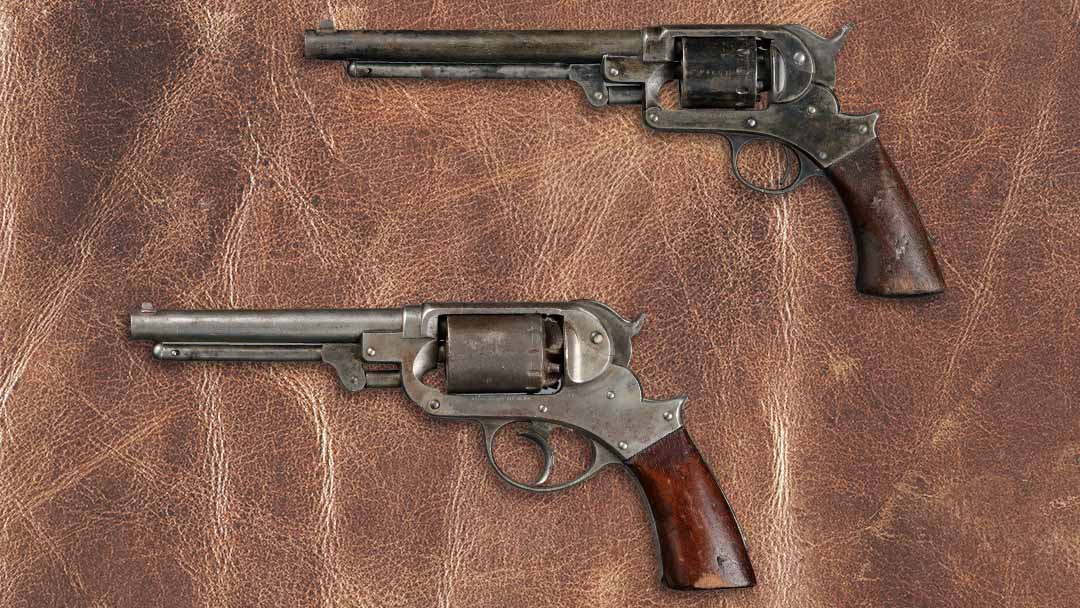
Starr Arms Percussion Revolvers
Inventor Ebenezer Starr’s family supplied the U.S. government with swords, sabers, cutlasses and pikes for several years as well as more than 20,000 flintlock muskets from 1831 to 1845. He designed a carbine and revolver but sold out his part of the company that bore his name by the time the Civil War started.
Starr created something innovative with a double action revolver, but the Ordnance Department wanted single action. Though popular in Europe, double action revolvers were looked down on in the United States because of concerns that the action was easier to fire, leading to the depletion of more ammunition than the single action. The government successfully persuaded Starr Arms to do away with the double action and the Army purchased 25,000 revolvers.
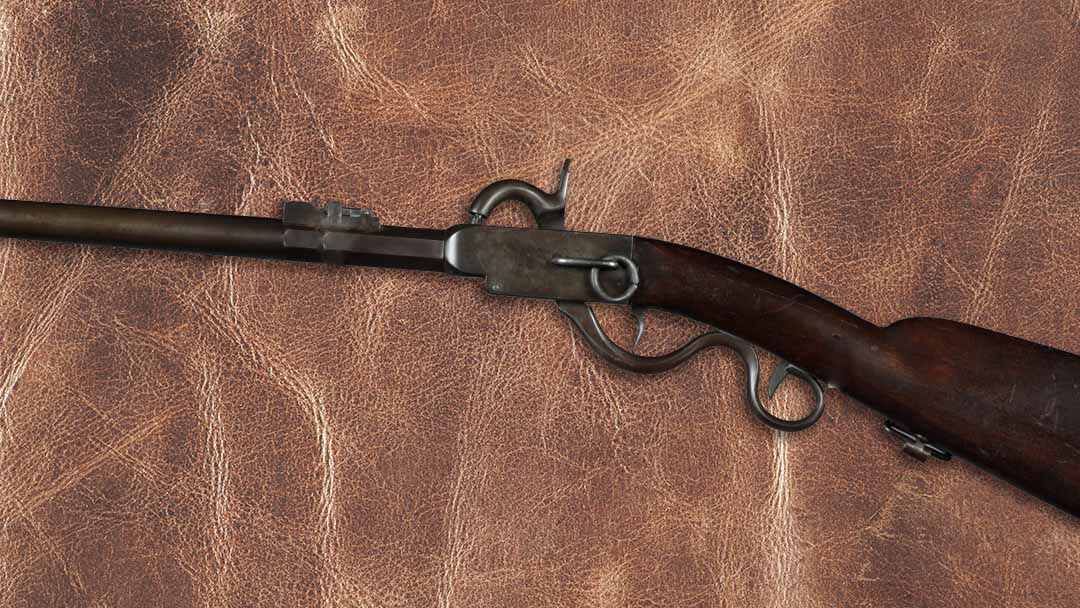
Cosmopolitan Arms “Grapevine” Carbine
The Cosmopolitan Arms Company was founded in Hamilton, Ohio in 1859 by Abner Campbell and Edward Gwyn and received one of the earliest Union contracts among any carbine manufacturer – and there were several! At the start of the war, the federal government didn’t see a need for many horse-mounted troops because a short infantry-fought affair was expected. However, state militias saw the usefulness of cavalry and organized their own units and required carbines that could be handled on horseback.
Cosmopolitan shipped 1,140 breech-loading, .52 caliber carbines to Illinois units in mid-1862. They had a unique double loop lever that lent the carbine its “grapevine” nickname. The company reorganized as Gwyn & Campbell, producing 8,200 carbines for Union forces.
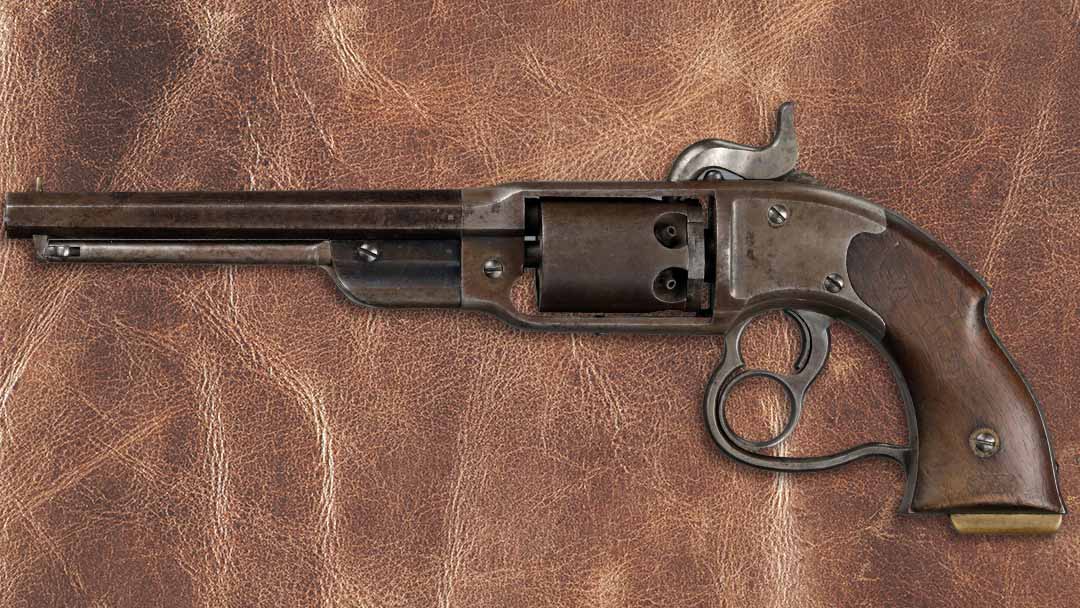
Savage Navy Percussion Revolver
Its predecessor, the Savage & North “figure 8” revolver had a distinct look with its trigger and trigger guard, and the Savage Navy is also recognizable with its over-sized trigger guard. Made in 1861-62, the dual-trigger setup with a ring trigger to rotate the cylinder and cock the hammer, and the forward trigger to fire the gun reportedly made it difficult to manipulate and shoot accurately. The guns, in the Navy caliber, were sold to the Army for use mostly in the Civil War’s western theater. Some did find their way into Confederate hands, mostly troops from Virginia and Texas.
Rather than located at the rear of the cylinder, the percussion caps sit and rotate so they point upward and the hammer comes down on the cap. The caps couldn’t fall off and jam, but they could be knocked off and create a failure to fire.
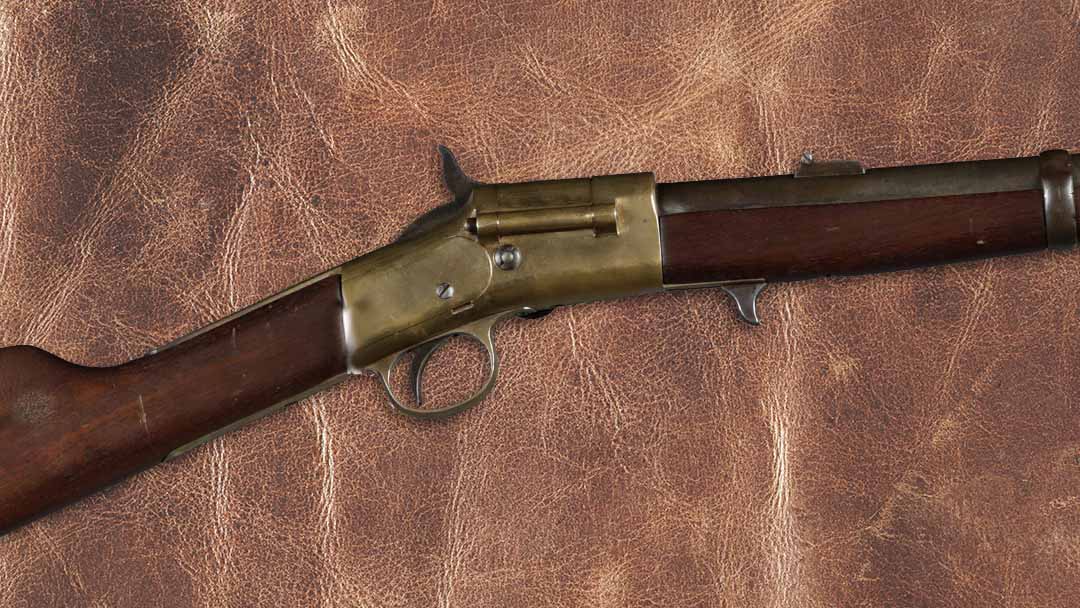
James Warner Saddle Ring Carbine
One of the most distinctive Civil War carbine models, the brass frame Warner carbine was designed, patented, and produced by lifelong gun inventor James Warner of Massachusetts. Warner managed to land an Ordnance Department contract for his carbine before the patent was issued in February 1864.
Billinghurst-Requa Volley Gun
Dentist Josephus Requa invented his namesake volley gun with gunsmith William Billinghurst. The Billinghurst-Requa Volley Gun mounted 24 barrels mounted in a horizontal fashion running parallel. Patented in 1862, the gun’s hammer ignited a percussion cap that lit a channel of black powder that fired cartridge clips. A three-man crew could fire 175 shots – seven volleys – per minute.
Never accepted into military service, the gun was considered unpredictable and unreliable with a chain reaction difficult to achieve. The Billinghurst-Requa was patented a few months before another doctor, Richard Gatling, patented his Gatling Gun.
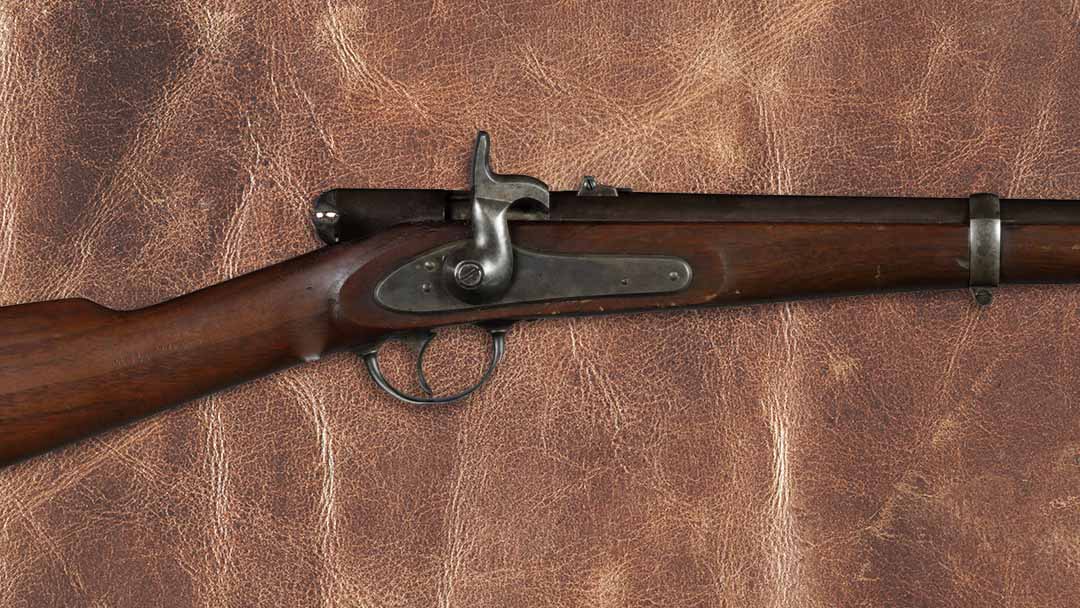
E.G. Lamson Palmer Bolt Action Saddle Ring Carbine
The Palmer carbine was patented in 1863 and holds the distinction of being the first metallic cartridge bolt action firearm ever adopted by the U.S. Ordnance Department. The bolt on this design is used to seat the cartridge and seal the breech. It fires with a traditional side lock. Over 1,000 of these innovative Civil War carbine models were ordered by the U.S. government, but they arrived one month too late to see action in the conflict.
Confederate Griswold & Gunnison Revolver
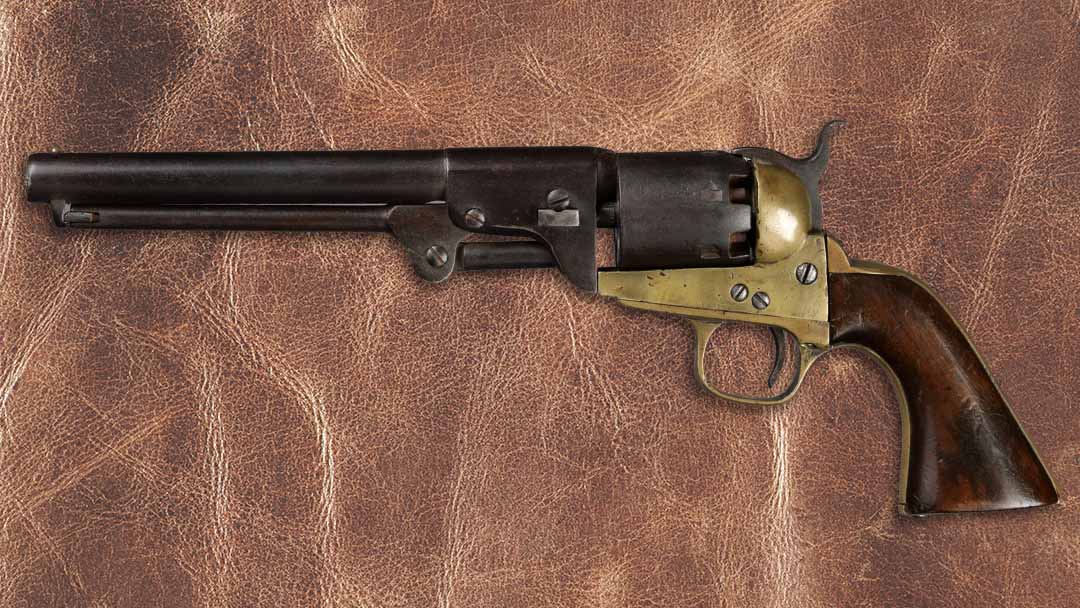
The Battle of Griswoldville was the first battle on Sherman’s March to the Sea. Unincorporated, the village outside of Macon, Ga., was mostly industrial buildings as well as worker and slave residences. Union cavalry burned down the factory where the Griswold & Gunnison revolvers were made. Many of the Confederate dead and wounded were old men and boys of the Georgia militia. A Union officer remarked, “I hope we will never have to shoot at such men again.”
About 3,700 Griswold & Gunnison revolvers, with their recognizable brass frames and dragoon-type barrel, were manufactured between 1862 and 1864, more than any other revolver in the Confederacy.
Rogers & Spencer Army Model Percussion Revolver
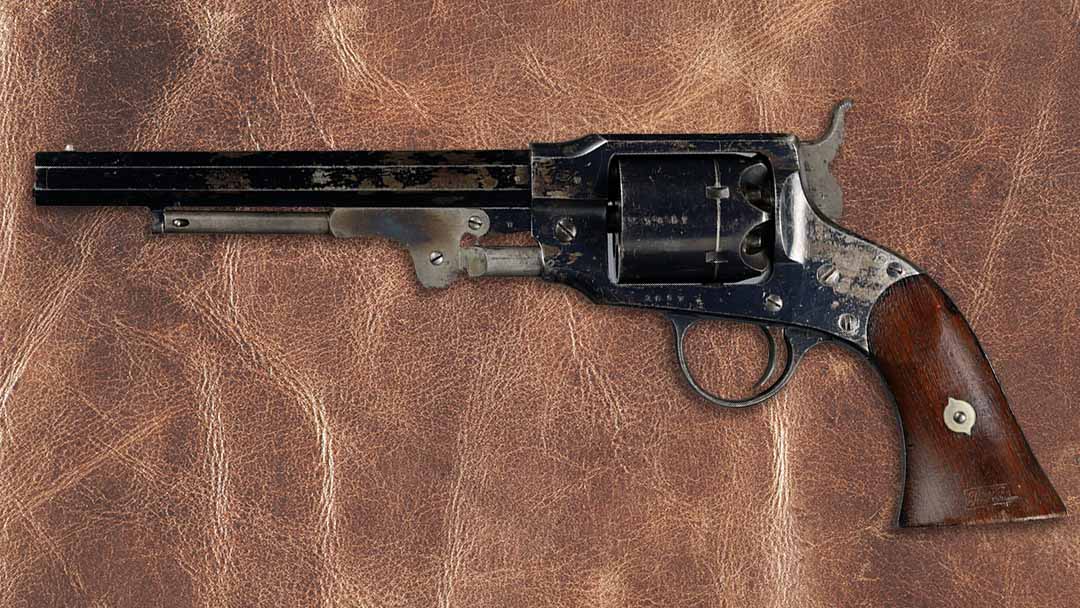
Like the Lamson Palmer carbine, the Rogers & Spencer revolver never got to prove its mettle in war. Rogers & Spencer of Willowvale, N.Y., received an order for 5,000 revolvers in November, 1864, but Gen. William T. Sherman had captured Atlanta, Lincoln was re-elected, and the war’s end was fast approaching. Rogers & Spencer produced 5,800 single action revolvers for the Ordnance Department. After the war they were issued to the Army and police. In 1901, the unused revolvers were purchased by Francis Bannerman, a sporting goods company, for sale to the public.
Burnside Carbine Second Model Percussion Saddle Ring Carbine
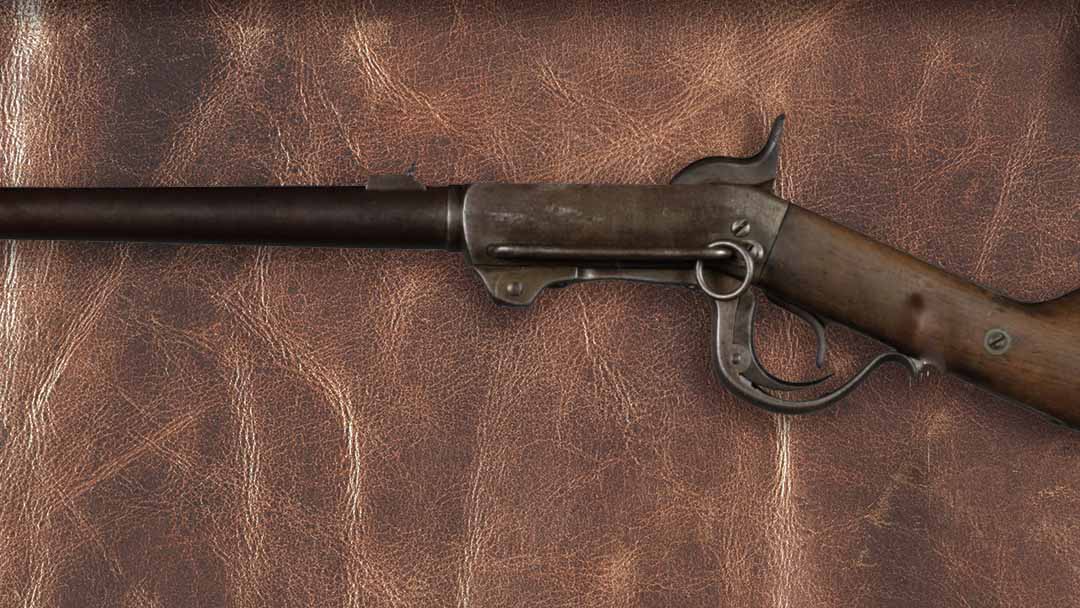
The Burnside carbine trailed only the Sharps and Spencer carbines as the most manufactured shoulder-fired cavalry weapon of the Civil War. However, that wasn’t until the Burnside’s Fifth Model with 43,000 made. The previous models just trickled along, with as many as 2,000 each of the Second and Third Models manufactured. There were 7,000 of the Fourth Model produced.
The Second Model had a curved locking device for the operating lever/trigger guard instead of a lever wrapped under the hammer as the first model had. It also didn’t have a forend, but one was added with the Third Model. The Fifth Model was made with a newly patented breech action that was an improvement on earlier versions.
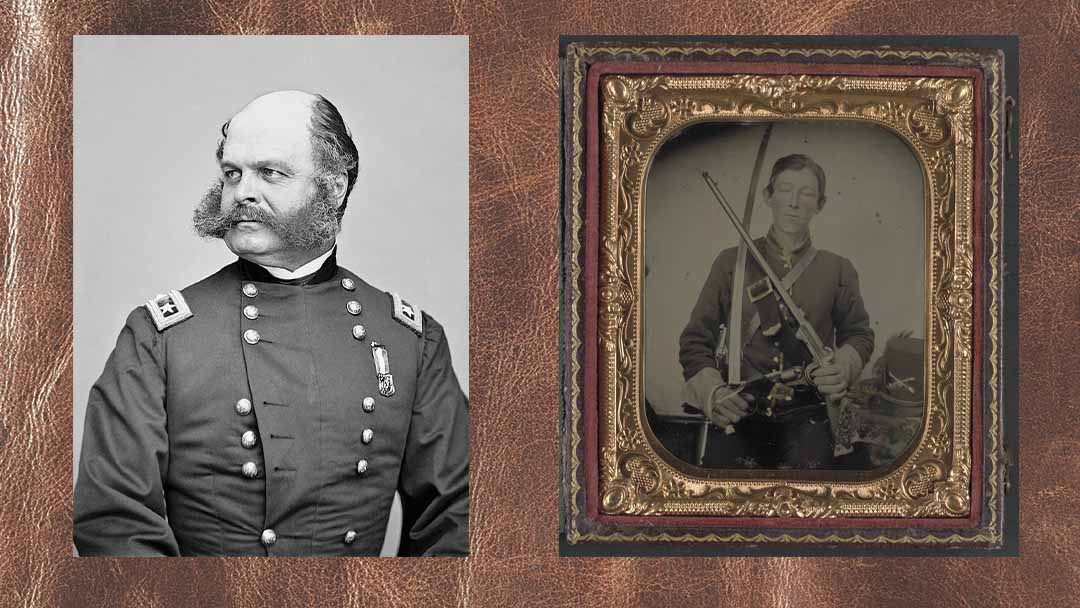
The carbine’s namesake was Ambrose Burnside, a West Point graduate who served in the Mexican-America War and on the western frontier before resigning his commission to devote his time to designing his carbine. The business failed and Burnside sold his patent to cover the debts. During the Civil War, his carbine would find wide use.
At the dawn of the Civil War, Burnside organized an infantry unit that was one of the first to arrive in Washington, D.C., to protect the capital. Promoted to general, he experienced early successes and was named commanding general of the Army of the Potomac but within a few months was relieved of his command after costly strategic mistakes. He was given command of the Department of Ohio in 1863 and found some renewed success before he resigned his commission near the end of the war following one last failure. He served as governor of Rhode Island and as a U.S. senator after the war.
Colt Model 1860 Army
Some guns related to the Civil War are well known but when they offer an amazing glimpse into a lesser known part of the Civil War, they deserve a mention. Colt manufactured more than 200,000 Model 1860 Army revolvers during their production with 129,000 purchased by the Ordnance Department, so obviously these aren’t little known Civil War guns, but that it is inscribed to a Union army surgeon whose harrowing ordeal definitely makes it unusual.
More than 12,000 surgeons served during the Civil War, with about 3,200 serving the Confederacy. This was at a time when antiseptic principles were still being learned by the medical profession. That said, nearly 30,000 amputations were performed in the Civil War with a 26.3 mortality rate. Amputations took from two to 10 minutes. Compared to medical advancements and better understanding of sterile environments, the mortality rate for amputations during the Franco-Prussian War of 1870 the mortality rate for amputations was 76 percent.
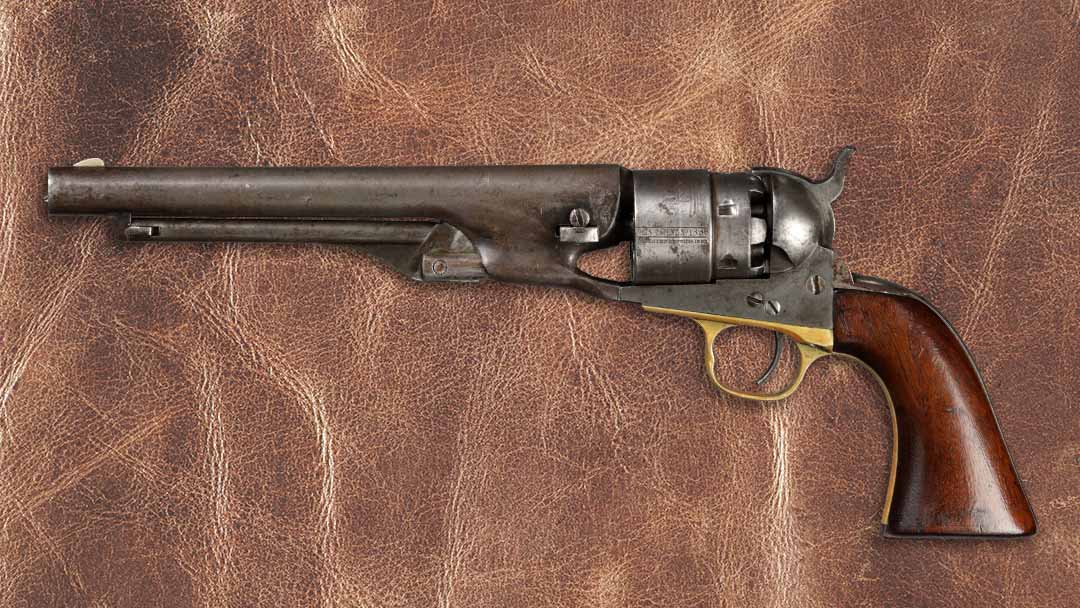
Three of every four surgical procedures performed during the Civil War were amputations. Dr. M.W. Townsend, who owned this Colt, performed amputations for 36 straight hours during the Battle of the Wilderness. The year after the Civil War ended, Mississippi spent 20 percent of its annual budget on artificial limbs for veterans.
Medical advancements during the Civil War included the use of quinine to prevent malaria, use of quarantine to stop the spread of disease, particularly yellow fever, the ambulance system, large hospitals, anesthetic during surgery, rudimentary neurosurgery, techniques for arterial ligation, and plastic surgery.
Dr. Townsend practiced in Bergen, N.Y., for 40 years. He enlisted as a surgeon with the 47th New York Regiment of the New York State Volunteers in December 1861 and mustered out in 1864. He participated in 12 battles including Chancellorsville, the Wilderness, Spotsylvania and Cold Harbor.
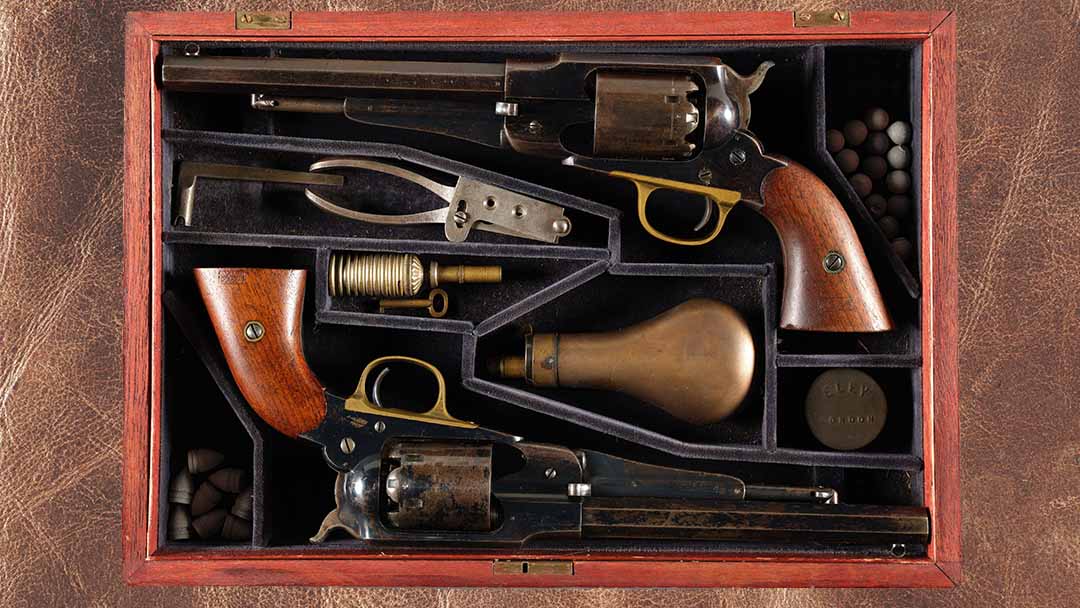
E. Remington & Sons New Model Army Percussion Revolver
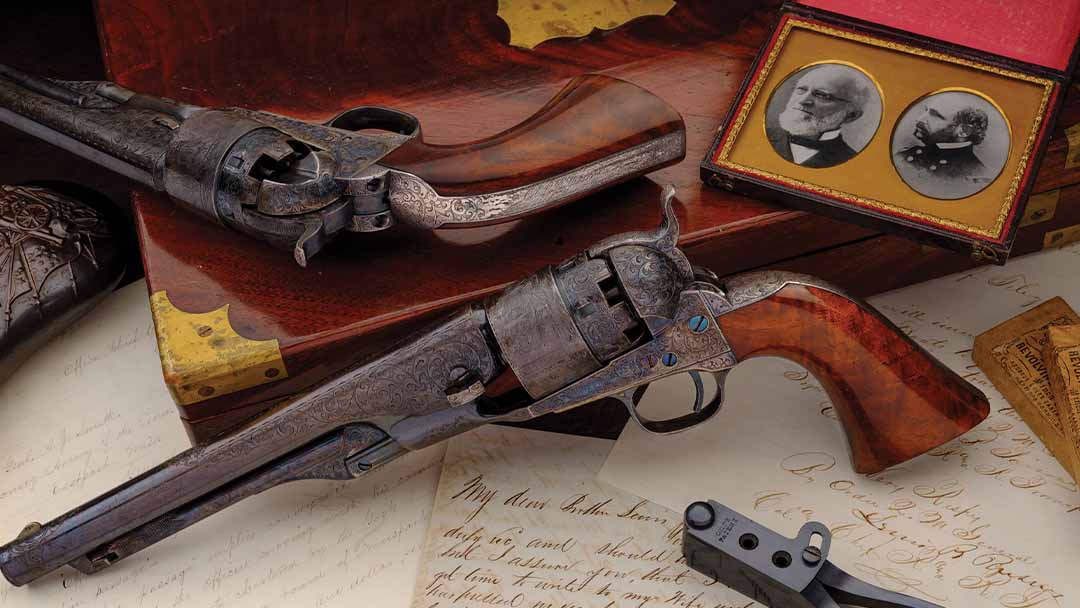
Another well-known Civil War revolver that lives in the shadow of Colt’s 1860 Army, the New Model Army from Remington deserves a mention, too. Remington & Sons started making percussion pistols in the mid-1850s, but didn’t have a large frame revolver for military use. Seizing on a pocket pistol design, the way it secured the cylinder pin with the loading lever would be adapted to Remington’s military revolvers. Seeing the signs of conflict, Samuel Remington, the middle son of company founder Eliphalet Remington II, went to Washington, D.C., where he secured a contract for 5,000 revolvers. Eliphalet Remingon II died in July 1861. After going through a design change from earlier models, the New Model Army revolvers were first delivered to the Ordnance Department in March 1863.
Remington trailed only Colt in the number of revolvers delivered during the Civil War, manufacturing 116,765 Army pistols for the U.S. Ordnance Department. The disparity in production numbers between the two companies was clear at the Battle of Gettysburg where Union Cavalry units carried 7,674 Colt 1860 Army revolvers while only 380 Remington pistols were carried. However, Remington delivered more revolvers than any other company in the war’s final two years in part because of the Colt factory fire in 1864.
Civil War Guns for Sale
The U.S. Civil War pitted brother against brother in a brutal struggle that led to numerous weapons innovations and improvements from multi-shot volley guns to breech-loading carbines and revolvers. Some of the manufactures are recognizable like Colt and Remington, but others remain relatively unknown but with examples of their works left behind for collectors in small numbers. Find firearms like the Griswold & Gunnison and Starr Arms revolvers and Cosmopolitan “Grapevine” Carbine in the June 21-23 Sporting & Collector Auction and June 20 Preview Day in Bedford, Texas.


