

The sky above the trenches of France was a new frontier as World War 1 opened in 1914, with each side using lumbering, unarmed airplanes for observation, and not for an aerial fight. By the time the armistice was signed four years later the planes flew faster, higher, and were far better armed.
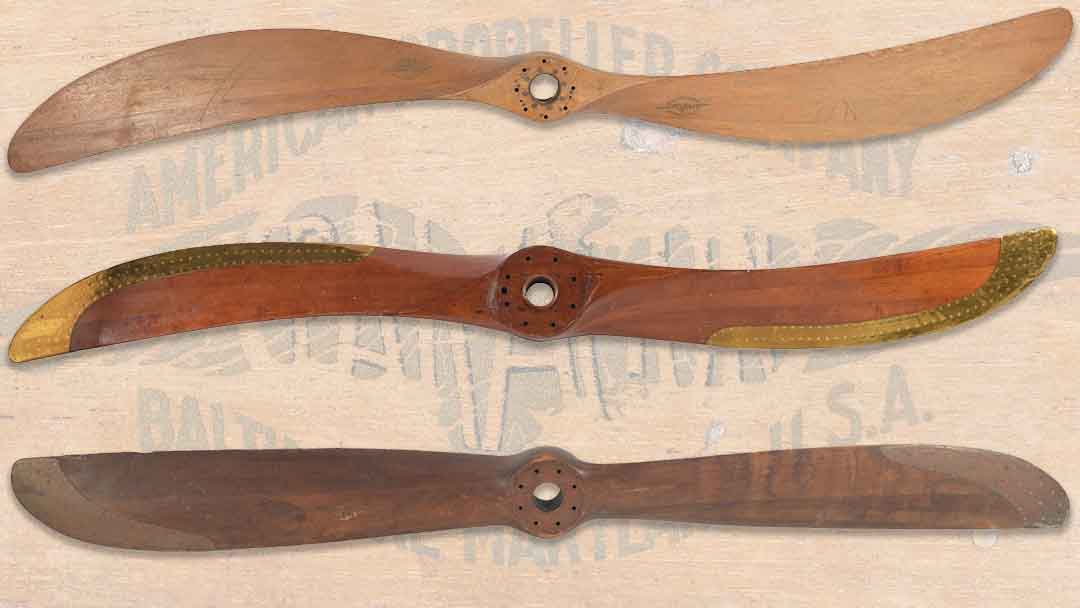
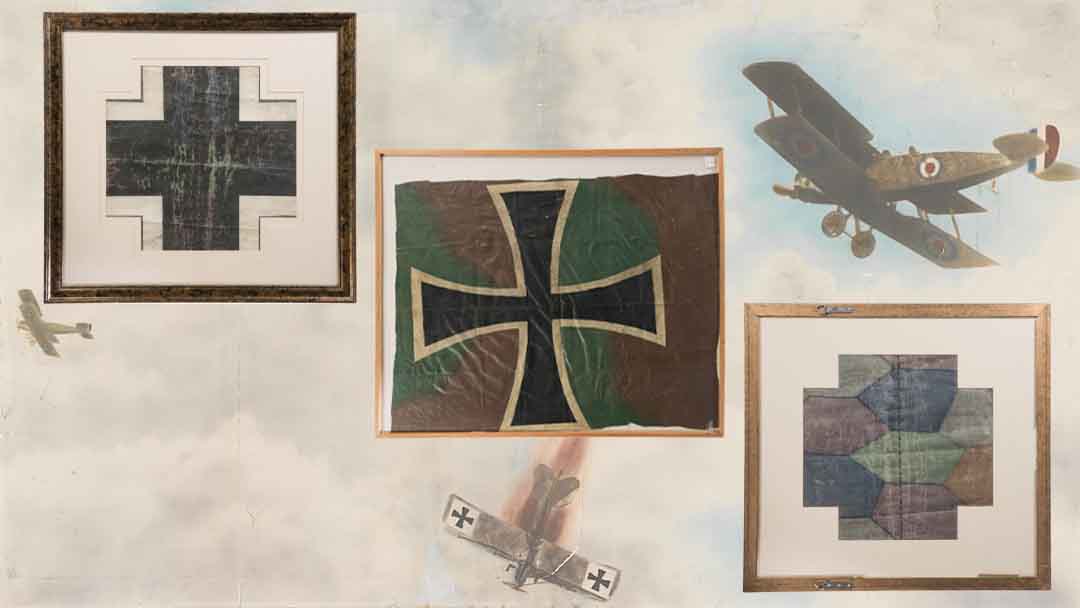
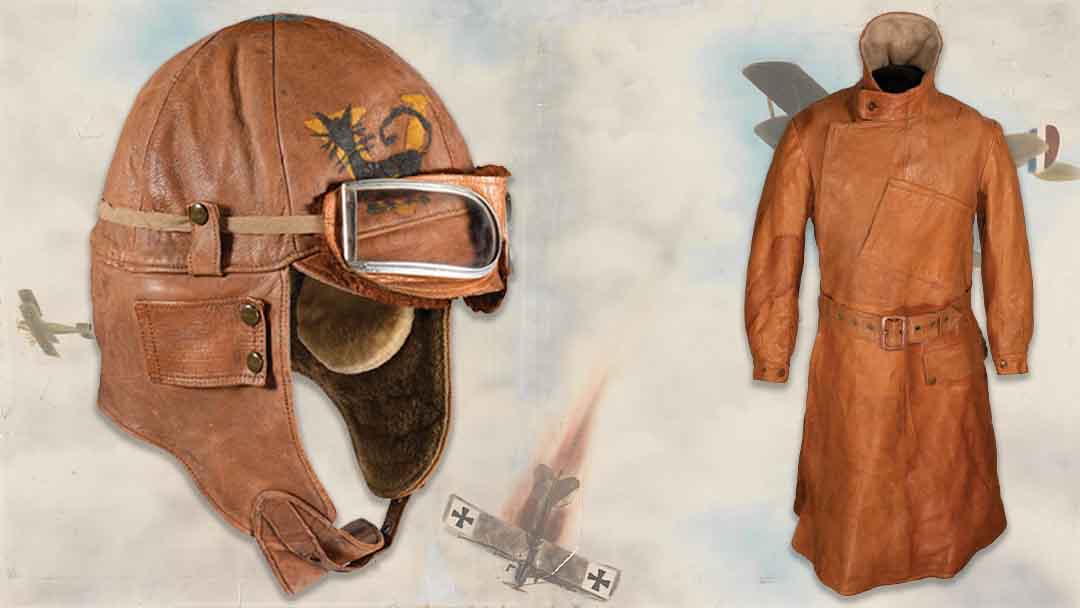
Motorized flight was barely in its second decade, but warfare brings technological change with it, and a number of aerial World War 1 artifacts in Rock Island Auction Company’s May 19-21 Premier Auction reflect the primitiveness these daring young men in their flying machines faced during their aerial fights.
This aerial World War 1 artifact is a canvas section taken from the fuselage of an American 11th Aero squadron bomber by its wartime pilot as a memento. Atop its olive green base coat is a large numeral five with the unit’s logo, and the famous comic strip character of the time, Mr. Jiggs, carrying a bomb under his arm. Mr. Jiggs’ creator, George McManus, served in the 11th Aero Squadron during World War 1. The 11th Aero remains in operation today as the U.S. Air Force’s 11th Bomb Squadron assigned to Barksdale Air Force Base.
First in Flight, First to Fight
Planes were first used to bomb the enemy during the Italo-Turkish War of 1911-1912 but proved to be ineffective. By the time of World War I, most military leaders were still uncertain of the role of aircraft. Balloons and dirigibles had been use in the American Civil War and Franco-Prussian War for observation.
That remained the primary role of airplanes as World War 1 started, reporting troop movements and directing artillery rather than taking on an aerial fight. A British Royal Flying Corps plane spotted German troops preparing to lay siege to Paris in August 1914, but alerted French and British military leaders who were able to get their troops into position to outflank the Germans in the Battle of the Marne, a key early victory.
While planes became faster, quicker, and more deadly, their pilots still got lost. Planes could often be seen following train tracks and flying low enough for pilots to read signs on railway stations to figure out where they were.

Early in the war, opposing pilots would give each other friendly waves as they went about their reconnaissance missions, but once they realized they didn’t want the other side to observe what was going on behind their lines, the aerial fight began, at first with pistols and carbines. Machine guns proved to be trickier.
When the war opened, many planes were “pushers,” with the engines behind the pilot and the propeller pushing the plane. A machine gun could be mounted for the observer. When designers started building airplanes with the engine in front – called “tractors,” shooting could be much more accurate if it weren’t for the propeller. The problem of how to mount a gun that can shoot through the propeller had to be solved.
Airplane Problem and the Solution
French flyer Roland Garros (for whom the tennis complex where the French Open is held is named) tried to tackle the problem of forward mounting machine guns in 1915. He and an engineer from a French aircraft company installed an interrupter gear on Garros’ plane that would regulate the machine gun’s fire to pass between the spinning propeller blades. The system could get out of sync so they fitted metal deflectors to the propeller to protect it from stray bullets. Most bullets passed through the propeller arc, but a few were still expected to hit the propeller.
Garros was able to shoot down three German planes over the course of about three weeks with the benefit of the interrupter system in April 1915. Late in the month, ground fire brought Garros down behind enemy lines. He was captured along with his aircraft and its interrupter system. The Germans shared the technology with Dutch airplane designer Anthony Fokker.
Fokker, who designed planes for the Germans, fine-tuned a synchronization system that gave the Germans a decided advantage in the aerial fight from mid-1915 into 1916, a time known as the “Fokker scourge.”
Flying Aces
The French coined the term “l’as” or “aces” for a pilot who shot down five or more planes, with these dashing men becoming heroes and celebrities. The most successful aces also flew the best planes where handling, rate of climb, airspeed, and armament came into play.
Manfred von Richthofen, aka “the Red Baron,” recorded the most victories in the aerial fight with 80, though most of those came against observation or reconnaissance planes. Eddie Rickenbacker recorded 26 aerial victories for the United States that didn’t enter the war until 1917.
Upper Hand in the Aerial Fight
Improved aircraft and expanded British and French squadrons allowed them to regain air superiority over the Germans in 1916, but the Germans would regain the upper hand in 1917. That year, the British suffered four times more casualties than the Germans.
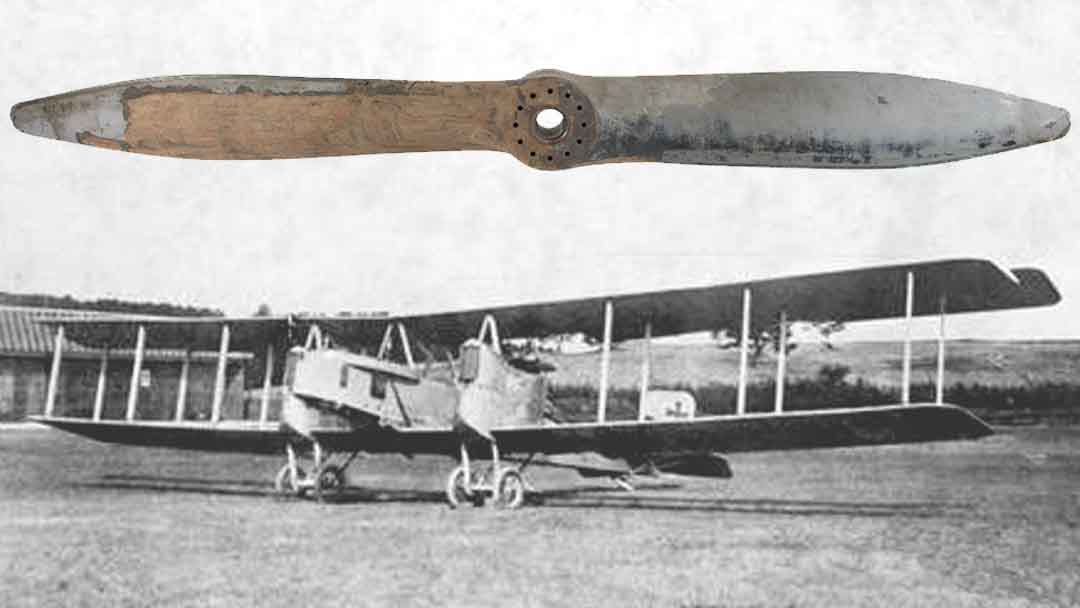
The Germans took the idea of using large planes as bombers from the Russians. The German Gotha bomber was developed late World War 1 and was enormous for its time, with a wingspan of nearly 78 feet and capable of carrying 350 lbs. of bombs. The Germans used Zeppelins along with bombers, to target logistics and manufacturing in England. The missions killed civilians and created more terror than physical destruction.
Aerial Fight of the Future
World War 1’s aerial fight showed that aircraft were the weapon of the future. Allied bombers were flying in group formations to bomb German munitions plants, and both sides came together for large air battles that showed the importance of air superiority in World War 2, especially in the Battle of Britain as England fought alone early in the war.
Items like propellers, flight coats, and pieces will be on offer in Rock Island Auction Company’s May 19-21 Premier Auction. These are aerial World War 1 artifacts that acknowledge the past of World War 1 fighter aces and the unproven use of planes as a weapon of war, and also serve as a nod to the rapid change in technology in just over 100 years that led from prop-driven, canvas-covered bi-planes to fighter jets, to the creation of the Space Force.
Sources
Evolution of Fighter Planes during World War 1, by Utkarsh Chaudhary
The Sky Was the Limit – Aviation in World War 1, The Great War
How Airplanes were used in World War 1, by Dave Roos, history.com